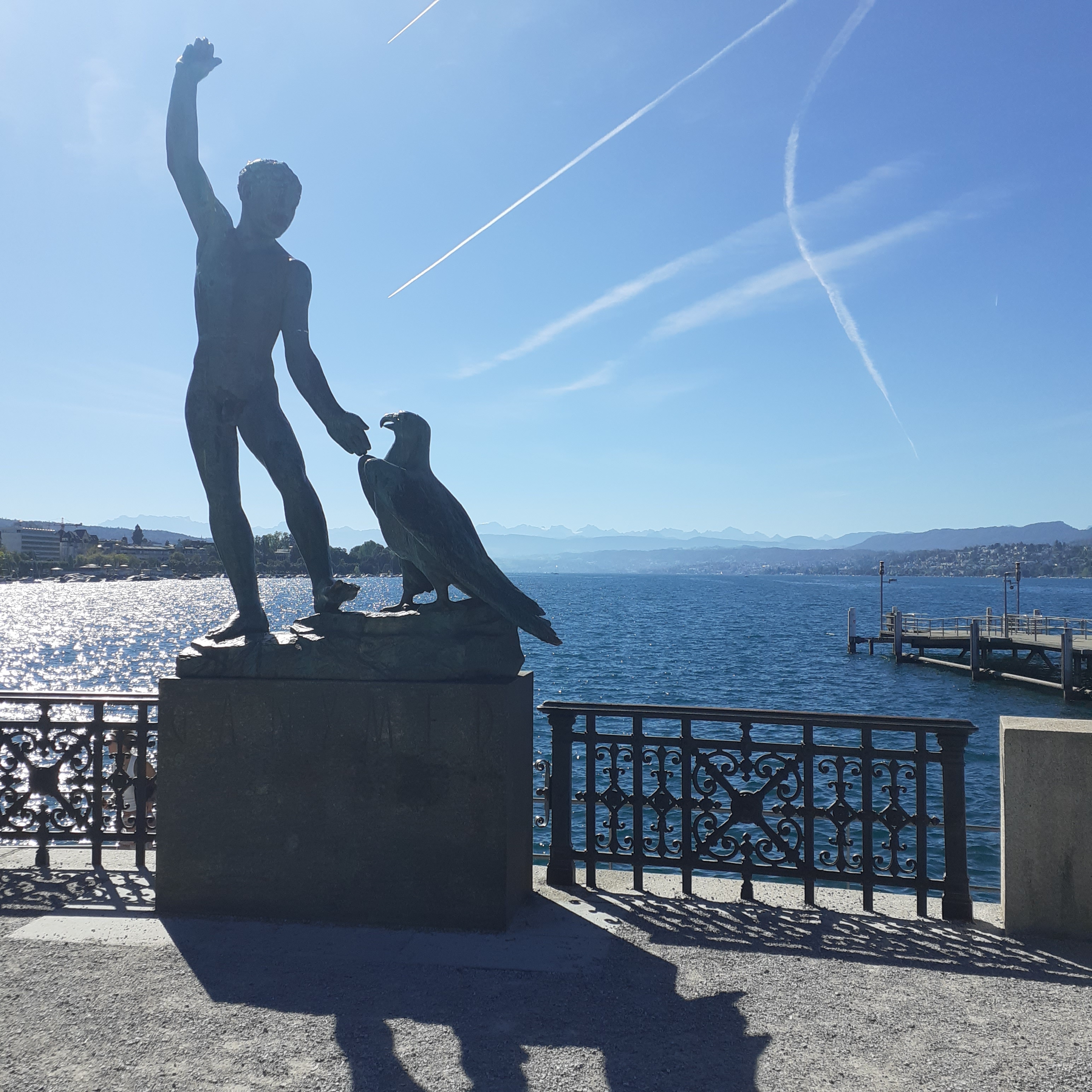
Swiss Trip 2 – Zurich

Zurich is Switzerland’s largest city with a population of around half a million people. It lies in the northern lowlands of Switzerland, where the Limmat River flows from its lake the Zurichsee. I’ve taken the midday train from Lucerne. Within the hour I am entering the city from the hills in the southwest in glorious sunshine. Zurich’s Hauptbahnhof is a massive station but consolingly is also the epitome of organisation. Runs like clockwork. Indeed hardly a minute passes without a train coming or going. Almost three thousand trains pass through every day, connecting with Swiss, local and international destinations in one of Europe’s busiest hubs.
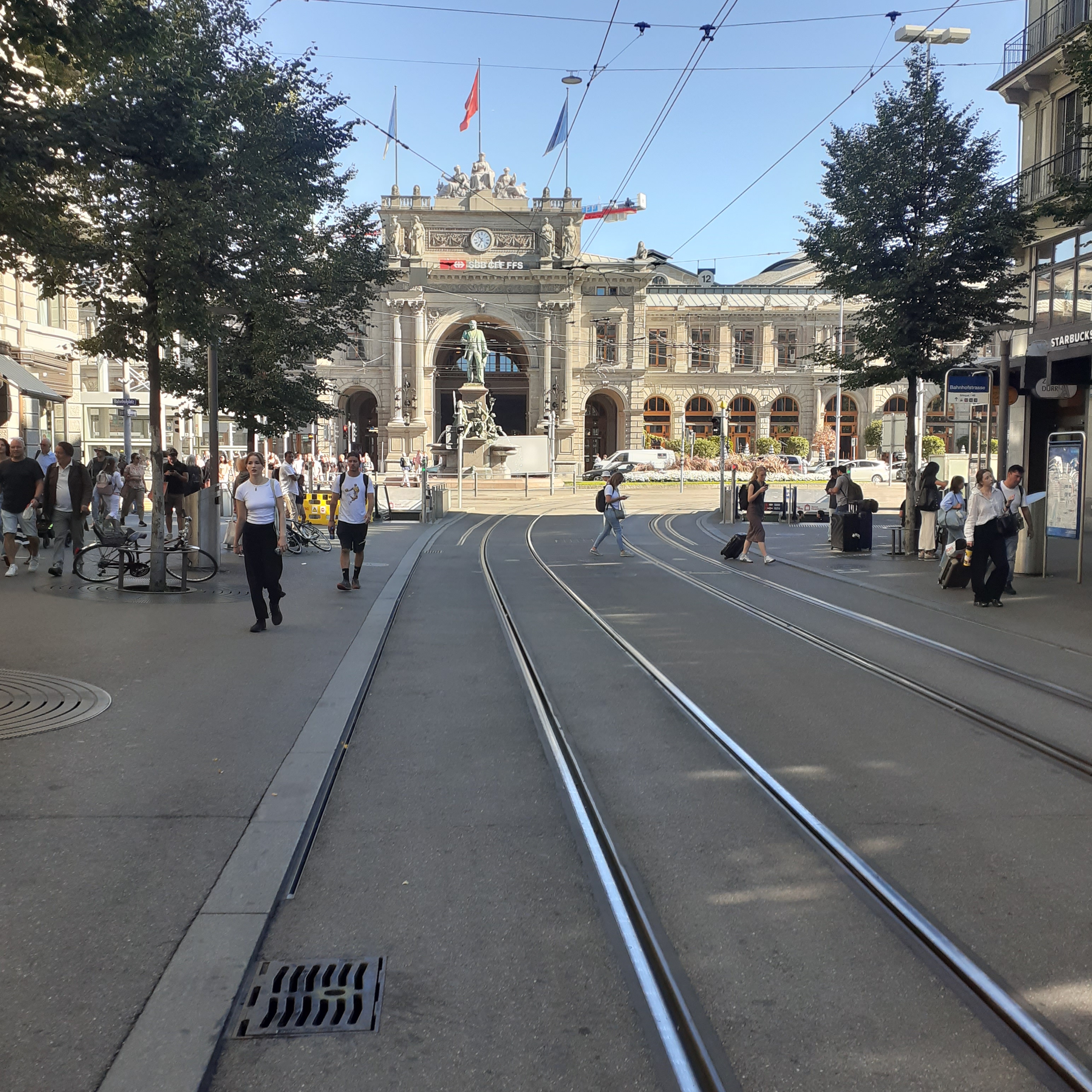
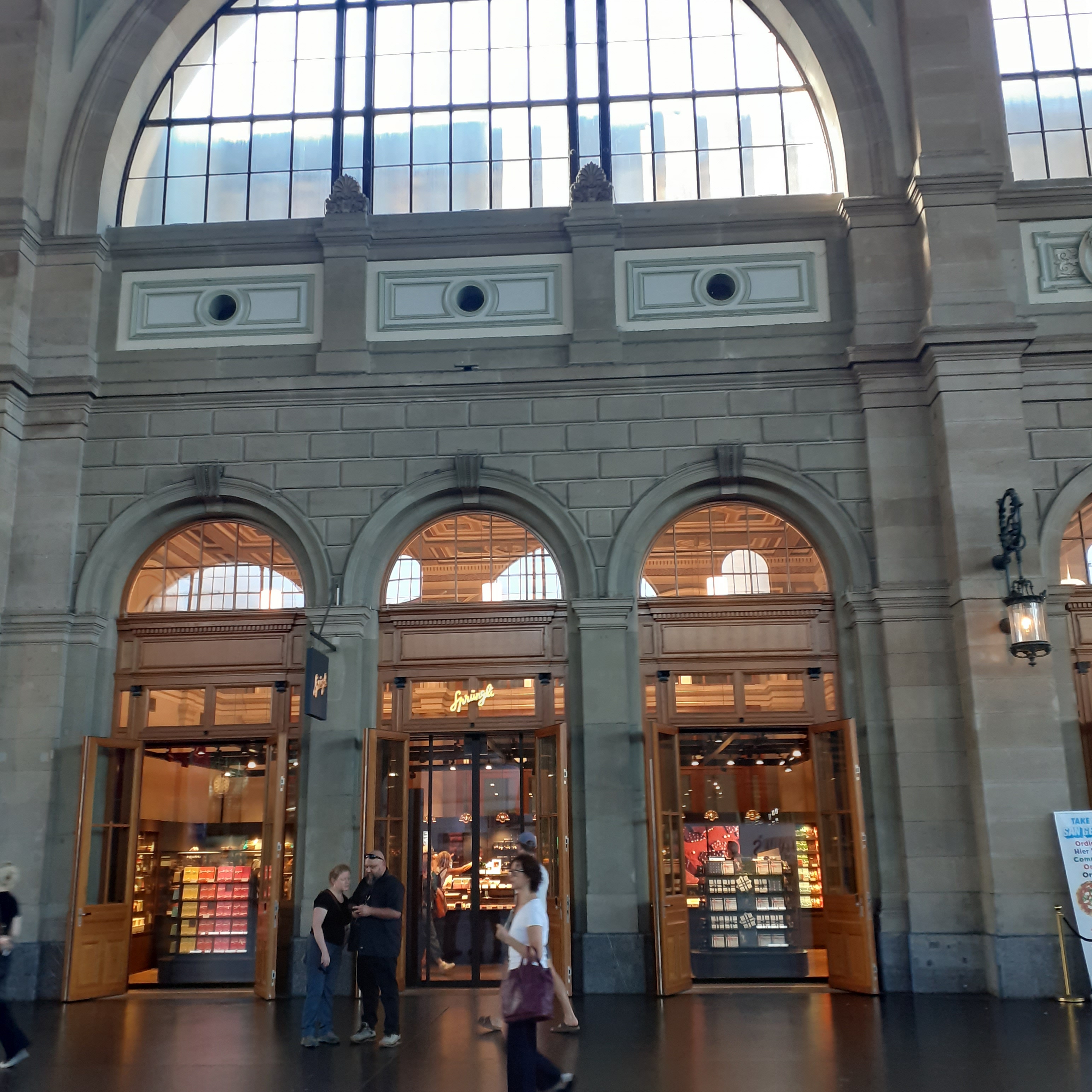
The first station here opened in 1847. Two decades on and it was already too small. In 1871 the rebuild was complete and the Neo Renaissance building emerged from its scaffolding as a significant city landmark. The Hauptbahnhof is cast in the station-as-palace mode. A massive triumphal arch at its entrance looks down Bahnhofstrasse, Zurich’s main street. A bronze statue of railway pioneer Alred Escher stands guard atop a grand fountain. The imposing Main Hall is framed by high arches with restaurants and cafes lining the concourse leading to the platforms beyond a spacious lateral concourse. The Main Hall also houses regular exhibitions and events. There are three platform levels. The upper street level holds sixteen platforms beneath the vast glass and steel roof. Downstairs the ShopVille shopping centre occupies the mid level and below this are ten underground platforms for the city S Bahn. If you are at all anxious about where to go, the signage and information boards are clear, and there are alo helpful personnel on hand to deal with any questions.
I exit by way of the Europallee development, a converted train yard now lined with high rise buildings and street level eateries, bars and clubs along its pedestrianised length. I am staying at the Trip Inn a short walk further on at the edge of the city centre. Still, sunshine and baggage take their toll. Arriving early, a leafy terrace behind reception makes a good oasis after my trip, if you’ll pardon the pun. There’s a lively restaurant next door and plenty more places for refreshments nearby. It’s a short walk sloping down Backerstrasse to the Sihl River which borders the west end of the city centre, flowing beneath the Hauptbanhof before joining the Limmat.

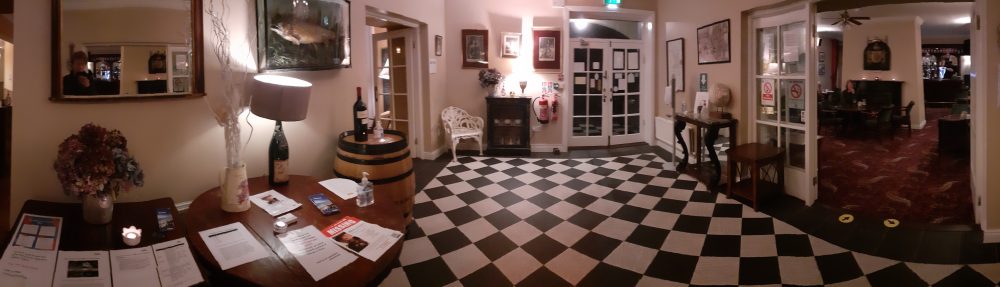
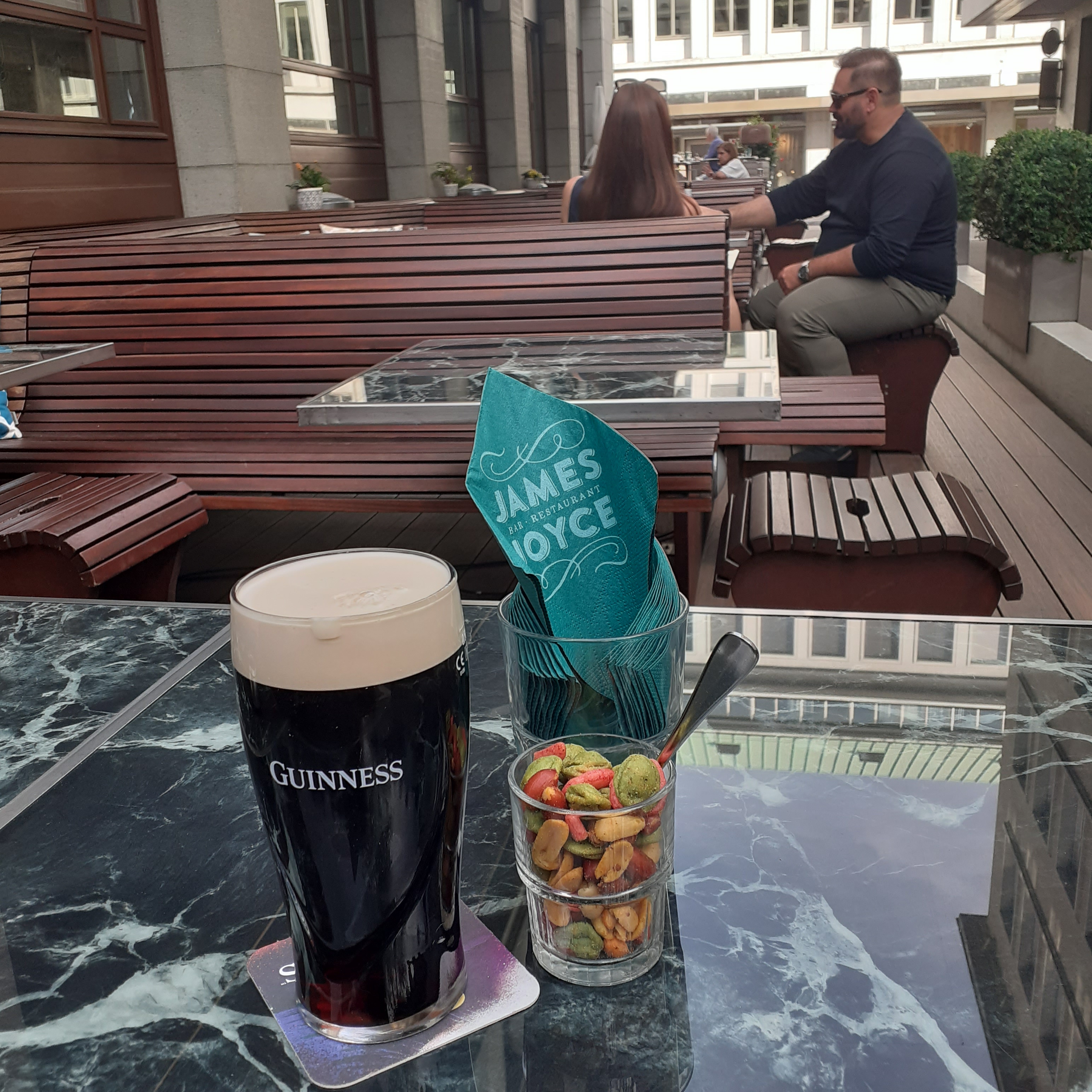
East of the Sihl things are picking up with the gathering crush of rush hour wrapping Zurich in clinking trams and throngs of pedestrians and cyclists. By way of an oasis, and also my first point of pilgrimage, the James Joyce Pub on Pelikanstrasse is quiet. The pub’s interior is in fact the bar of Jury’s Hotel in Dublin, shipped here in the 70s and reconstructed, lock, stock and barrel of stout. Much of the terrace decking is reserved but I blag a pew and order a Guinness. Very good it is too.
James Joyce is Dublin’s most famous exile. A renowned wanderer, Zurich is the place he ultimately came to rest. He stayed only briefly on his first visit in 1904. A decade later with the outbreak of the Great War he left Trieste for Zurich and stayed until 1919. Here he finished Portrait of the Artist as a Young Man and the play, Exiles. He began Ulysses as a novel taking its lead from an earlier short story and developing his own literary alter ego Stephen Dedalus. Ulysses recreates Dublin but looks to the heart of every great city. Zurich as the starting point was particularly important as the refuge for artistic and political emigres during the war years, sparking the Dada movement and sheltering Lenin on the threshold of revolution. 

After the war Joyce lived in Paris but throughout the 30s returned regularly to Zurich, receiving treatment for his failing eyesight and for his daughter Lucia’s mental health. In December 1940 Joyce and his family fled here but he died in January 1941 and is buried in Fluntern Cemetery  with his wife Nora, and children Giorgio and Lucia
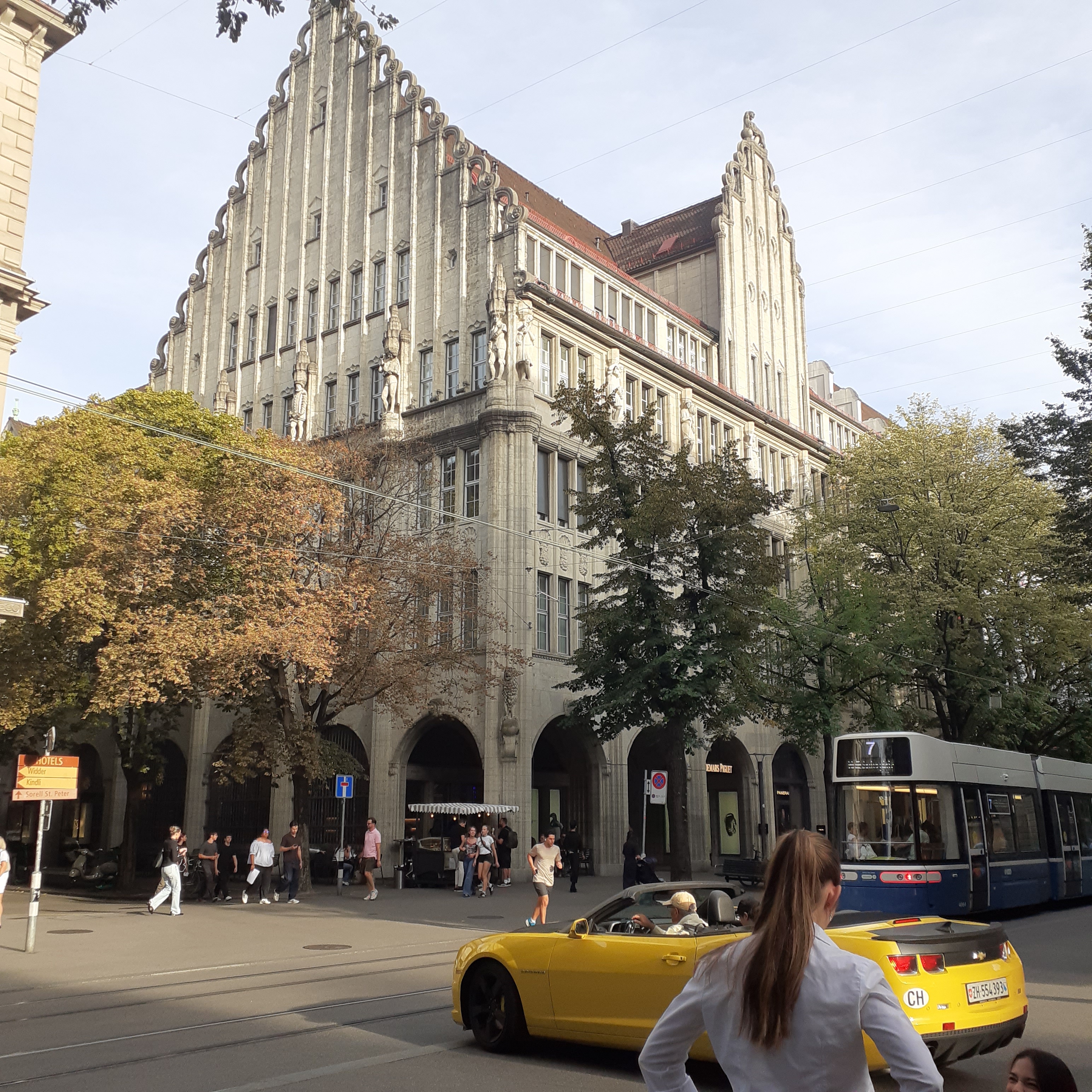
Pelikanstrasse leads onto Bahnhofstrasse through the Pavilion Sculpture, a concrete gateway by sculptor Max Bill from the late twentieth century. Bahnhofstrasse is Zurich’s swishest street. Originally built over the city’s ancient moat, today it marks the commercial centre of the city. Upmarket retail, hotels and banking institutions make this one of Europe’s most prestigious and expensive addresses. Mostly pedestrianised, but accommodating Zurich’s ever swirling tramways, this is a place you must walk with a spring in your step. Brass in pocket too. Paradeplatz is a famous square halfway down. The Peterhof built in 1913 is a striking building with stepped gables emphasising its status as a cathedral of commerce., 
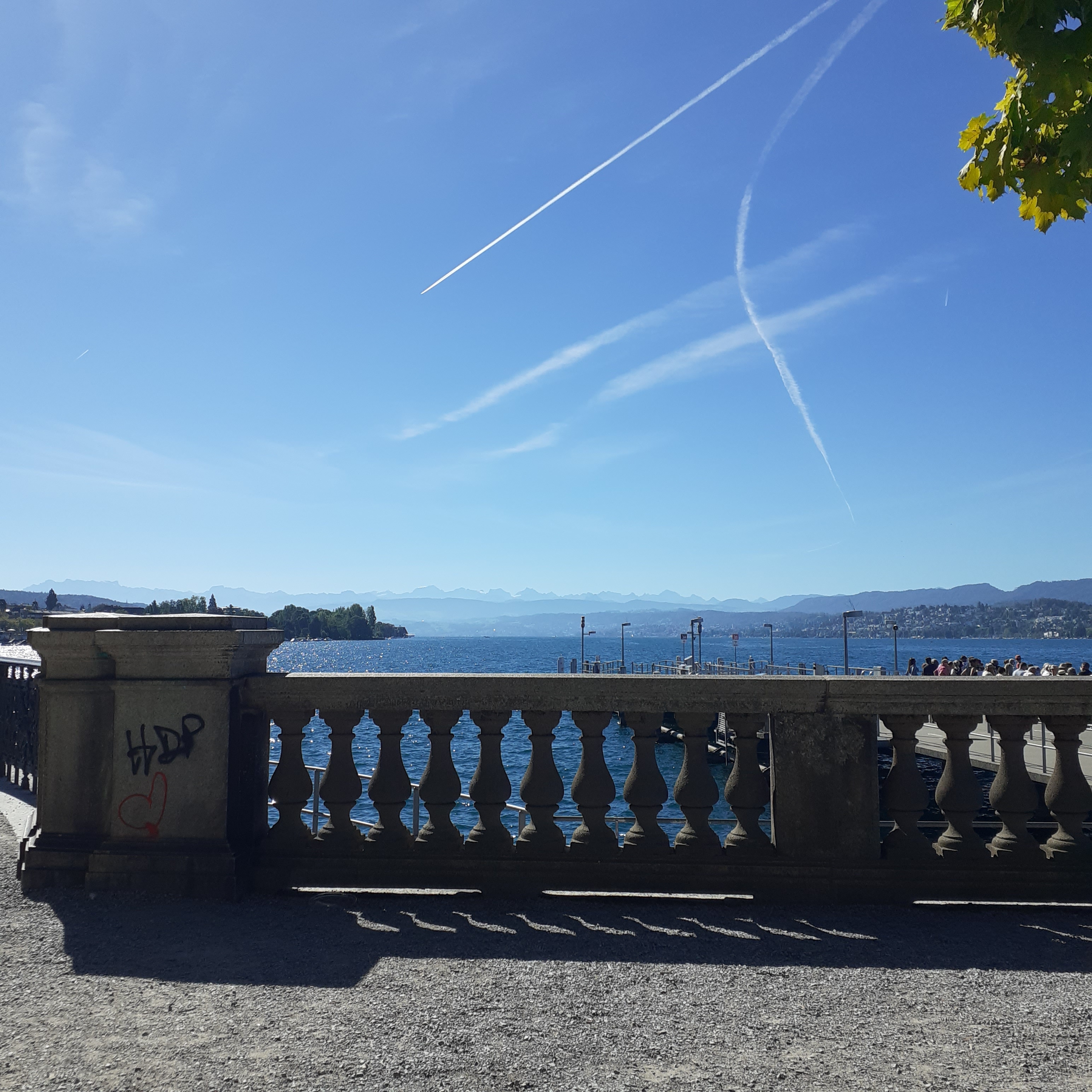
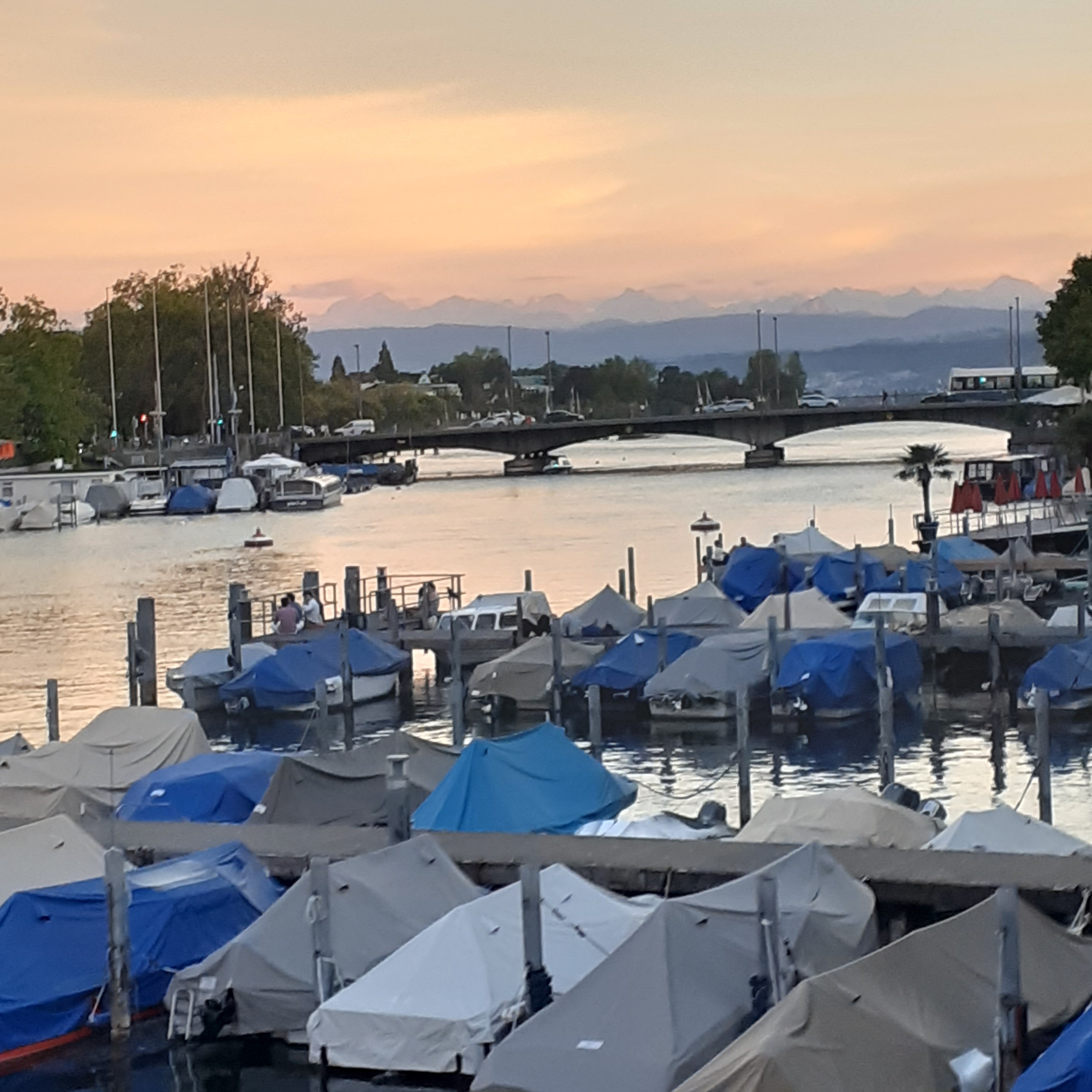
Further on the street terminates at Burkliplatz. Along here are the quays for boat trips on the lake which stretches 25 miles into  the southern distance with glorious views of the snow capped Alps beyond. The sun beats down and I pause for breath, and some more refreshment. Cheap at half the price, at least it would be. Worth it though.
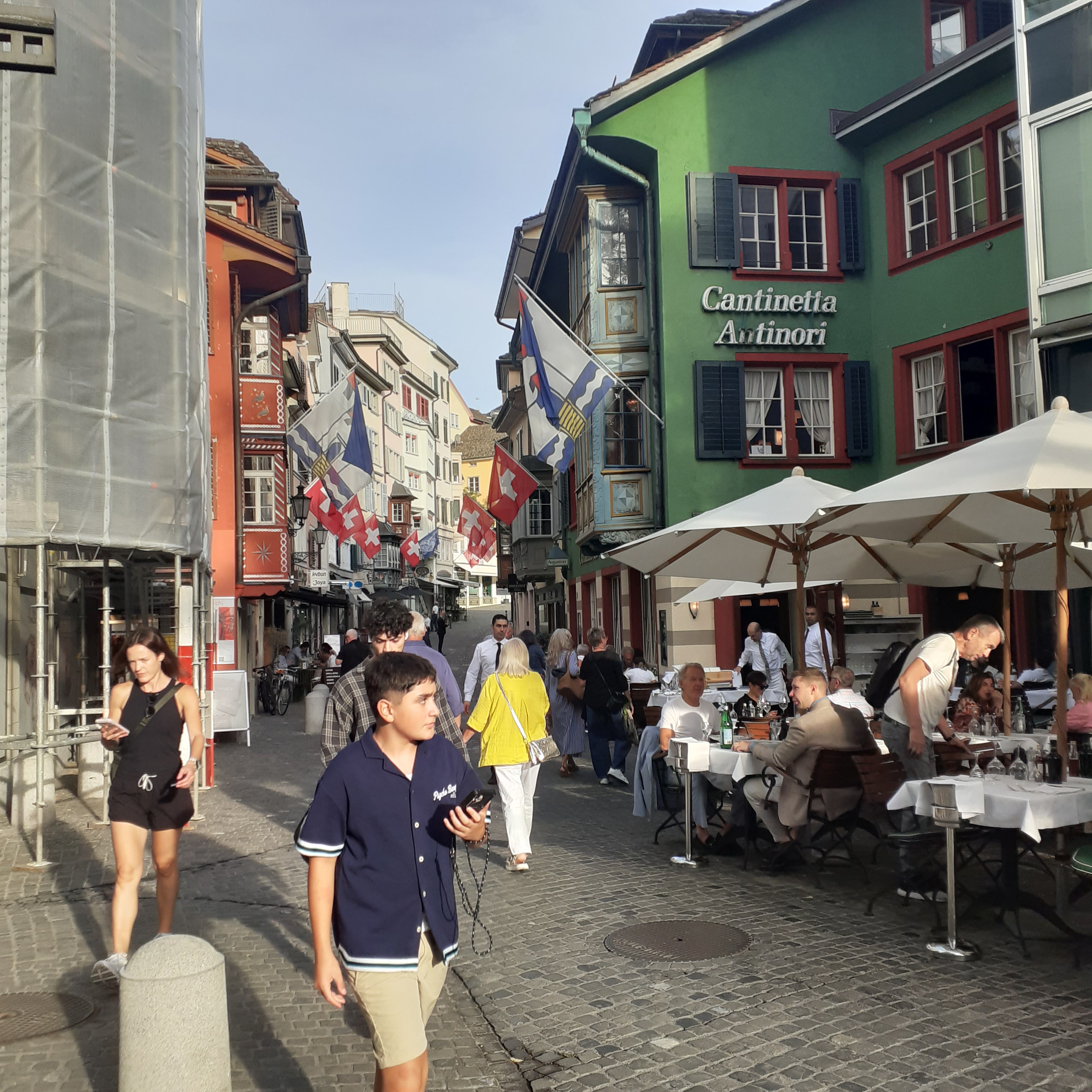
Stepping off the contemporary commercial swirl of Bahnhofstrasse is stepping into a different world. Between here and the Limmat the Altstadt, Old Town, is a warren of winding narrow streets, rising and falling amongst traditional housing in the Swiss style. This is where Zurich was founded by the Romans on the Helvetian settlement at Lindenhof Hill and named Turicum. Lindenhof is the still the focal point of Zurich. The hill itself is now parkland, presiding over the roofs of the Altstadt.

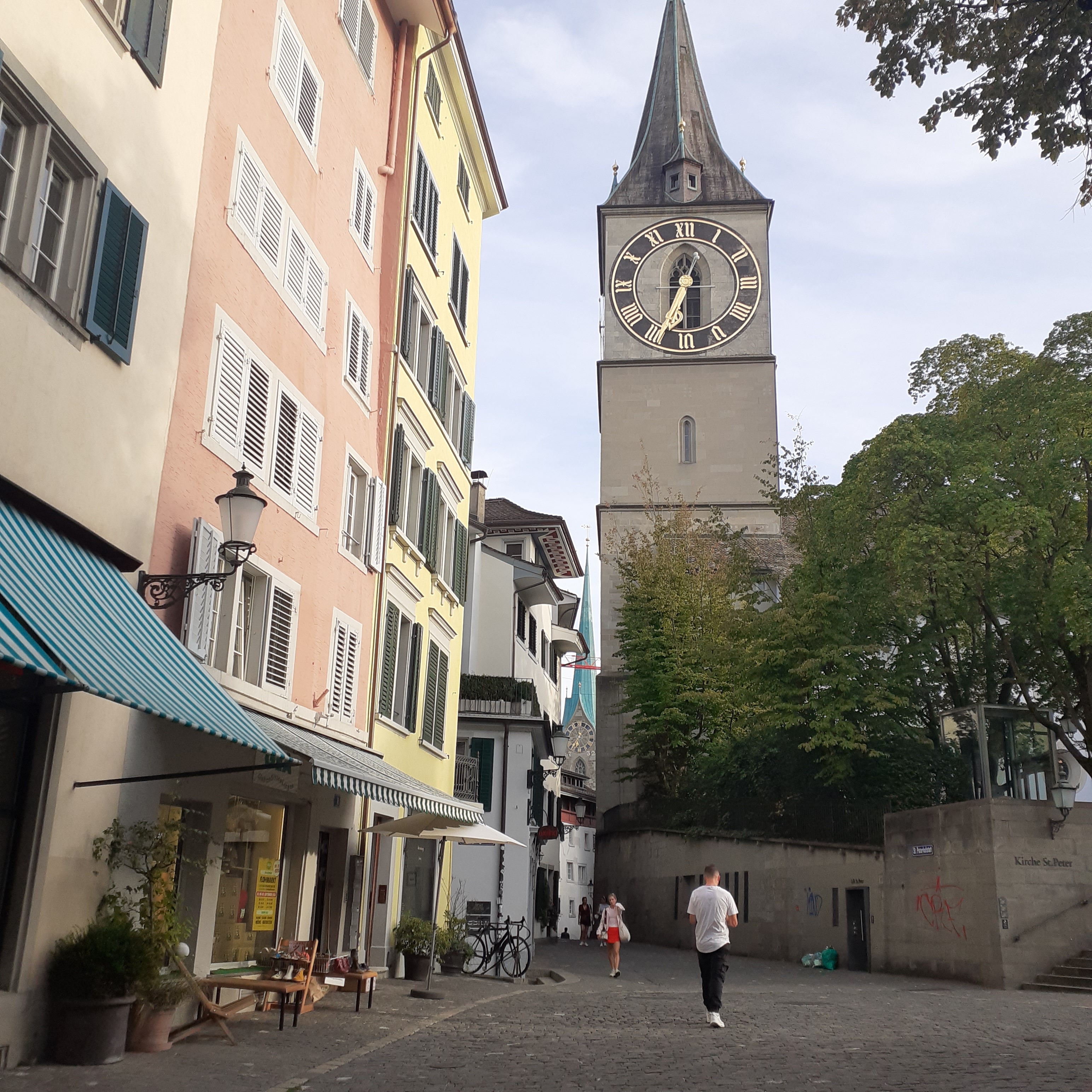
Restaurants and bars colonise the pavements. The lanes widen into picture book squares flowing around antique churches. St Peter’s Kirche is distinguished by its huge clockface, reputedly the largest in europe with a diameter of twenty eight feet. The church dates back to the thirteenth century, with the tower being built in the 15th century. I find space in a square at a small Italian restaurant which is becoming a habit of mine. But all of Europe meets in Switzerland, and thoughtully left me a seat and table to fortify myself with pasta bolognese and a glass of wine.
Across the river the Altstadt continues with the Niederdorf area on the east bank. This pedestrianised area of narrow cobbled street, antique shops, galleries and all sorts of cafe life has a more edgy Bohemianism than the far bank. The Old Town continues on through Munstergasse, or Lunstergasse as my DK has it. Mmm why name a street after them? Anywho, Munstergasse leads to the Grossmunster, Zurich’s signature twin towered cathedral. The twin towers were unfortunately scaffold clad for restoration work. 

The church was originally founded by Charlemagne in the 8th century, the present structure dating back to 1100AD. In 1519 it became a centre for the Protestant Reformation with Zwingli.as its preacher. Ulrich Zwingli was born in 1484 and studied at Vienna and Basel. Influenced by the Humanist teachings of Erasmus he pushed for radical church reform. The issue of fasting at Lent led to the Affair of the Sausages, something to which we can all raise a hot dog. Zwingli did not stop there but opposed Rome across the spectrum. He joined with other radical preachers including Luther and Calvin in breaking from the Papacy. 

The Swiss divided along religious lines and sporadic civil war followed. The second War of Kappel  in 1531 near Zug frustrated Protestant objectives with Catholic Cantons asserting their traditions. Zwingli died on the battlefield and Switzerland emerged uniquely as a country of two religions. Catholicism and Protestantism are still equally practiced.
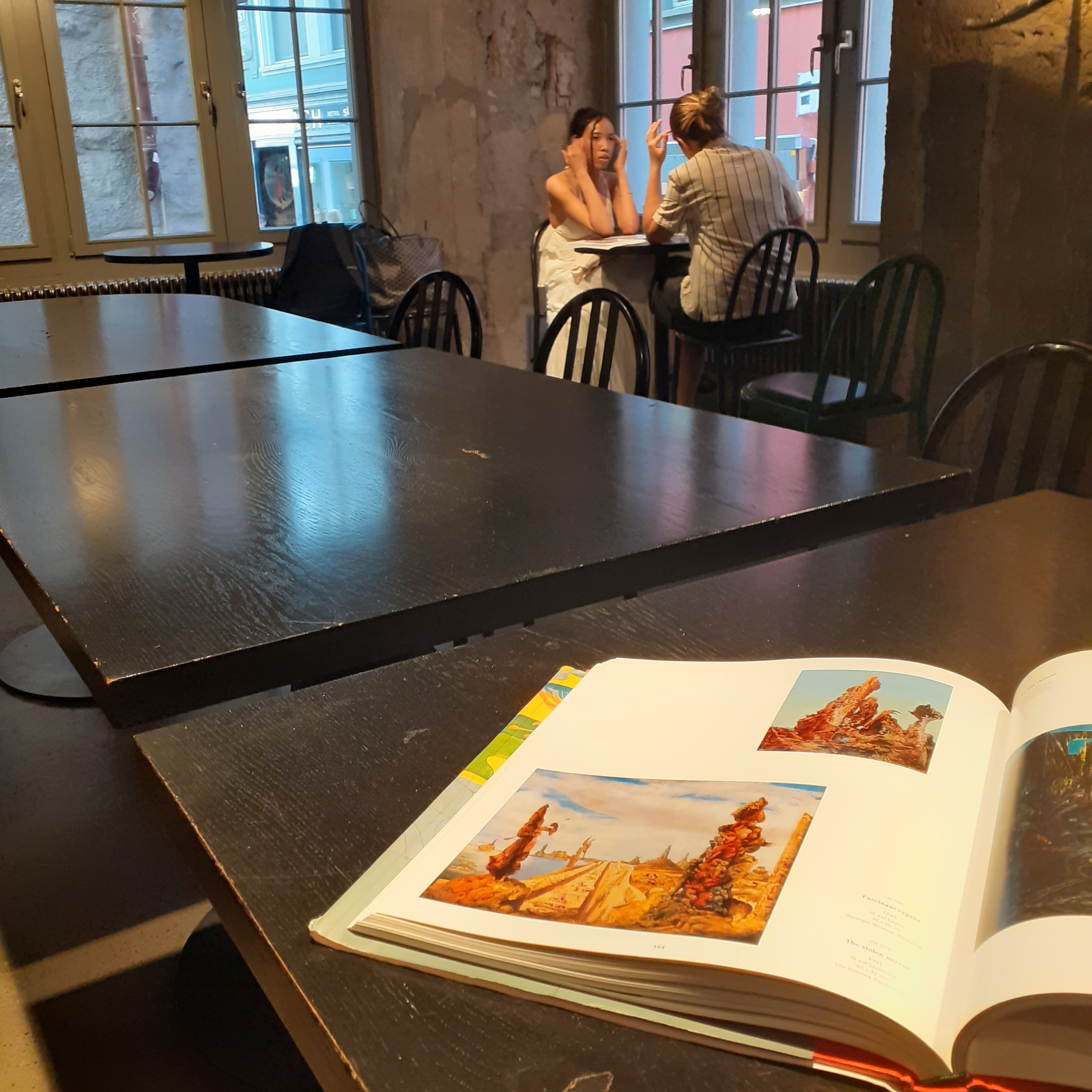
Four centuries later, another form of revolution was in the air. On Spiegelgasse, the Dada movement was founded in 1916 at the Cabaret Voltaire. Artists Hugo Ball and Emmy Hemmings set up the venue as a radical venture to tilt at the conventional strictures of art. Tristan Tzara, Jean Arp and others of the art community huddled in Zurich during the war years joined in. They fought the idiocy of war with an idiocy of their own. Sound poems, collage and performance art were developed by the Dadaists as a protest against authority. After the war, the movement leaked into the wider world and developed into Surrealism, 

The original Cabaret Voltaire was shortlived, but is now reincarnated at its original premises with a cafe, exhibition and performance space and an upstairs library. The downstairs exhibition features a collection of artefacts with a disconcerting soundtrack of sound poetry. Included here was, intriguingly and logically, Fear of Music by Talking Heads. It all makes sense. Or stops making sense, perhaps. Upstairs, a long, hushed room has shelves full of books for quiet perusal. far removed from Dadaist anarchy, but perfect all the same. I take my time over a wonderful pictorial history of Max Ernst, one of my favourites. In the German army during the war, it was afterwards in Paris that Ernst hooked up with Dada, and became a leading light of Surrealism. 

After the songs, and the building, there’s room for food or refreshment at the ground floor cafe. I order a coffee at the counter and retreat into more silence with my notebook. What good are notebooks?! Well, they’re the place I first create the cities in my head, which brings me back to Talking Heads. Road to Nowhere was written by David Byrne, taken from their sixth album Little Creatures in 1985. We are all on that journey, so let’s stick together.

There’s a city in my mind

Come along and take that ride

It’s alright, baby, it’s alright

And it’s very far away

But it’s growing day by day

And it’s alright, baby, it’s alright

Back along the main drag of Niederdorf, I find shelter from the sunshine at a tavern where a clever sign promises ‘beer as cold as your ex’s heart’. Ah, without love, where would we be now? The bar is amiable, the beer is cold, and I balance on the pavement beneath a brolly watching the folk sail by. Later I must sail myself across the Limmat and home. Across the Sihl again too. Lagerstrasse along the side of the Banhof is well named. There’s an Irish bar, Kennedy’s, and they do good food for a cheerful rush hour crowd. The Donegal barman tells me he’s settled in here and insists the price of food and drink is much the same as home. Although Swiss mountains are also a bit higher, I’d say. 
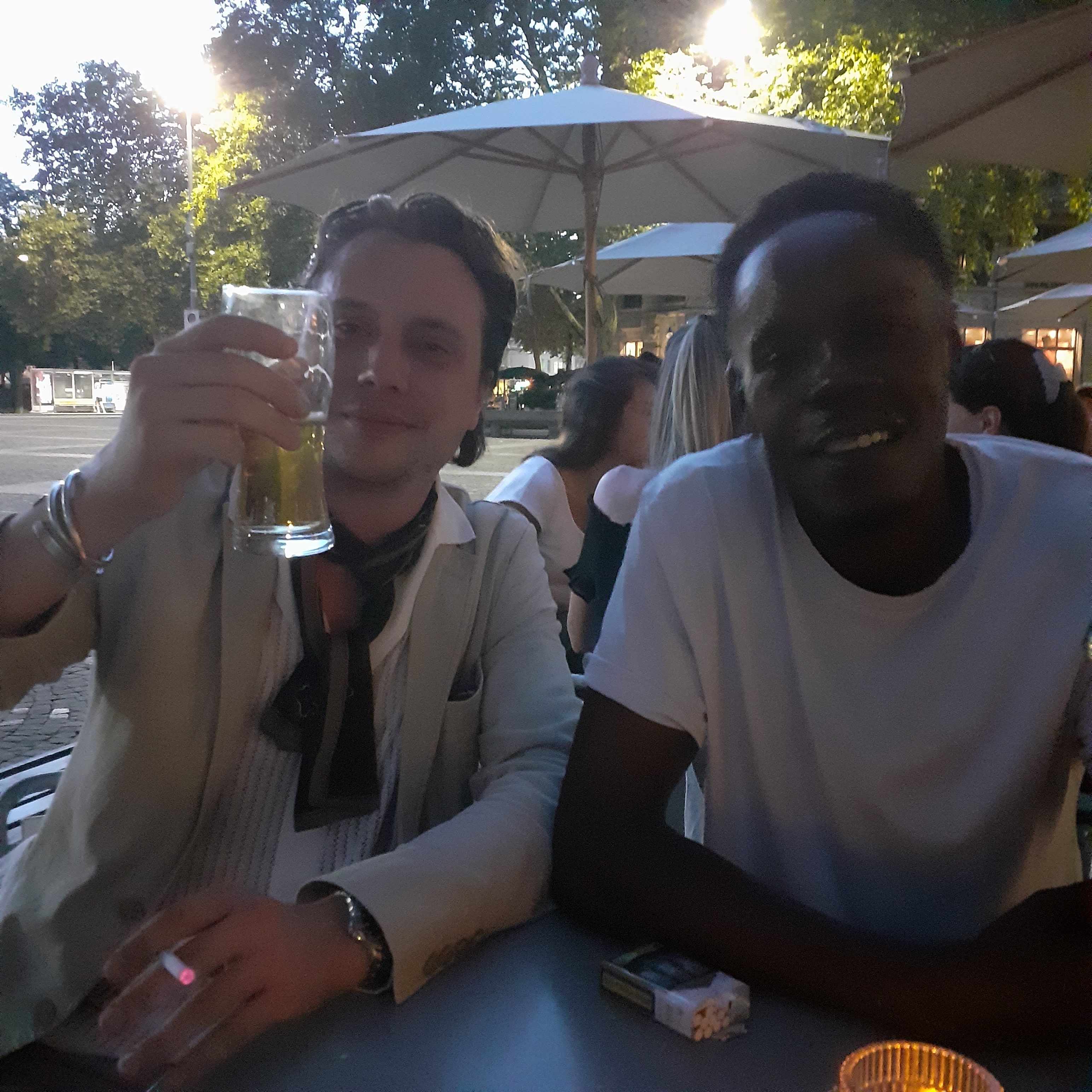
Later on the sun reluctantly sets. For my last blast I sip beer al fresco at Bar Campo on Helvetia Platz at the top of Backerstrasse. It’s a warm Autumn night and retiring early doesn’t appeal, morning flight or no. I fall into company with a couple of friendly locals. Zurchers are born linguists, speaking English easily besides their own native ingredients, German and French, some Italian too. Richard was raised on Swahili while Marelio juggles a couple of local languages. It’s good to talk. We are at the crossroads of Europe after all. Those roads do lead to a load of somewheres.
Swiss Trip – Lucerne and its Lake.

If you like mountains, and I do, Switzerland is the place to go. The country is a small package, sixteen thosand square miles, half the size of Ireland, but goes up and up. The Alps range across South and Central Switzerland, reaching heights of more than 4,000 metres, or 13,000 feet. I visited the south of the country forty years ago when staying in Cluses, France, in the vicinity of Mount Blanc, the highest peak in the Alps. We drove through Valais and visited the spectacular Grande Dixence Dam. The famed Matterhorn is also in that region. This time I aimed to stay in Lucerne, in Central Switzerland, flying in to Zurich, the country’s largest city.

Switzerland has a population of nine million and was founded n 1291. The country has a strong national identity and has been determinedly neutral for centuries. It is linguistically and culturally diverse, the Swiss speaking, variously, German, Italian and French. A fourth official language is Romanche spoken by 50,000 people in the east of the country. It remains outside of the EU.

Such diversity and detachment makes concise definition difficult. In the 1949 film, The Third Man, the Swiss are disparaged by Orson Welles’s character, Harry Lime. Atop the famous ferris wheel in postwar Vienna, Lime justifies his self serving criminality to erstwhile friend Holly Martins (Joseph Cotten). Comparing the achievements of Renaissance Italy under the corrupt Borgias with Switzerland: “.. five hundred years of democracy and peace and what did they produce? The cuckoo clock.” The line is not in Graham Greene’s screenplay. Welles ad libbed from a similar quote by James MacNeil Whistler. In truth the cuckoo clock dates  back to the eighteenth century Black Forest, with the Swiss chiming in a century later.

The Swiss were quite warlike in Renaissance days, but have mellowed, and made many contributions in technology and culture. The modern zipper (Martin Winterhalter 1925), Velcro (George De Mestral 1941), milk chocolate (Daniel Peter 1875) and LSD (Albert Hofman) are amongst Swiss inventions we regularly use. Though perhaps not the LSD so much. which was accidental. Yeah, right. The International Red Cross was founded by Henry Dunant in Geneva,1863. Dunant became the first recipient of the Nobel Peace Prize in 1901. The Swiss flag, a white cross on a red field, is the inverse of the red cross. Helvetica, designed by Max Miedinger in 1956 in Basel, is the most popular sans serif font. Its name afirmed the importance of the Swiss in graphic design and typography in the 50 and derives from the Celtic tribe that ruled here in the first millennium BC and into Roman times. 

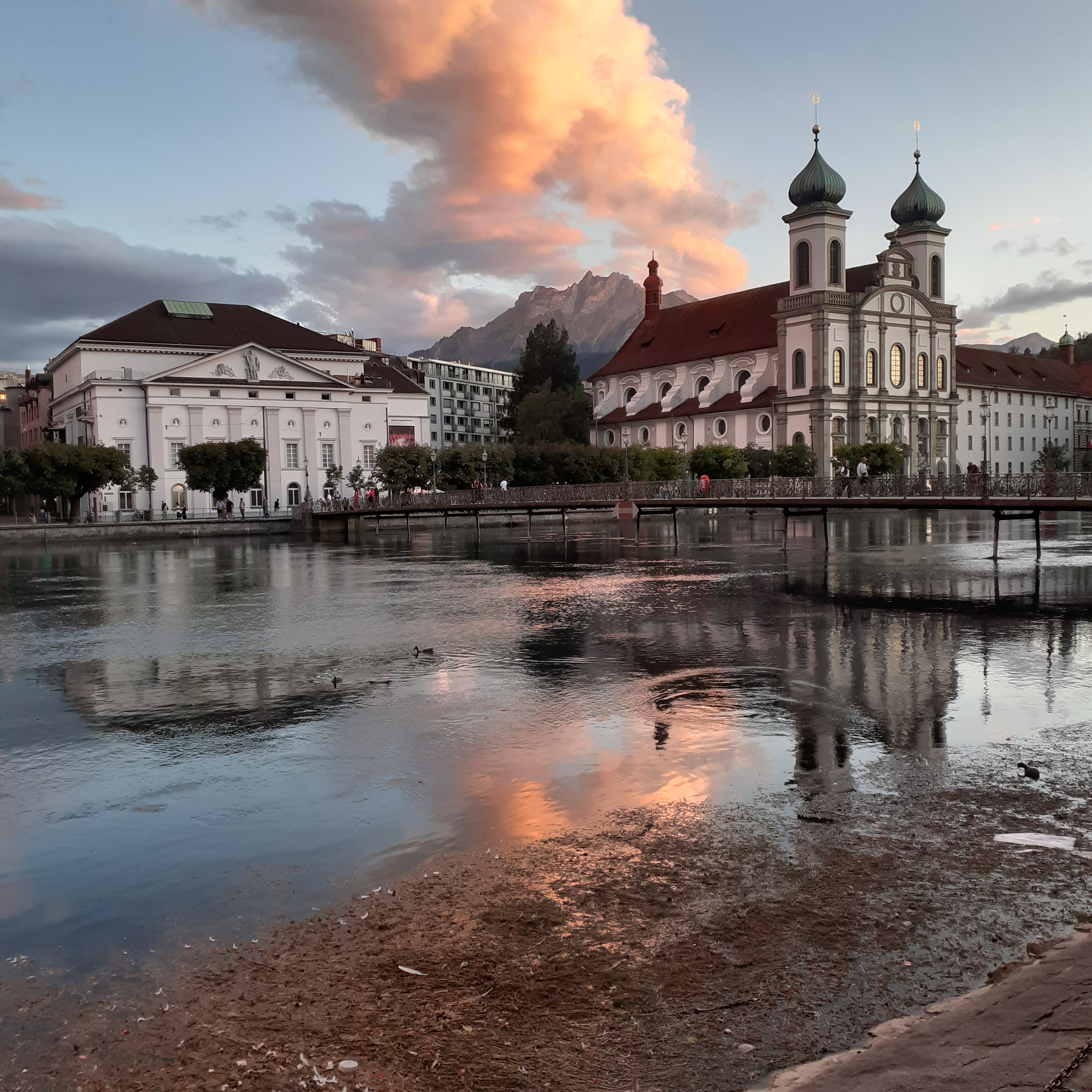
Where would we be without the Swiss? From Zurich airport there’s a rail station connecting to Zurich city centre, and other regional towns and cities. I’ve booked a train to Lucerne, a journey of about thirty miles which takes just under an hour, via Zurich Hauptbanhof. The train takes us through Zug, on the shores of Lake Zug, with views of the majestic Bernese Alps. Lucerne is a few minutes further on. The name is said to denote the city of light, from lucerna, the Latin for lantern. It certainly lit the path towards Swiss independence. The city formed a confederacy with surrounding regions and defeated the Hapsburgs in 1386. It had been built where the Reuss River flows out of Lake Lucerne. The river is the focal point of tourist sites, with the picturesque old town nestling along its north bank. From a settlement then of about five thousand people it has grown to host a population of 85,000 today.

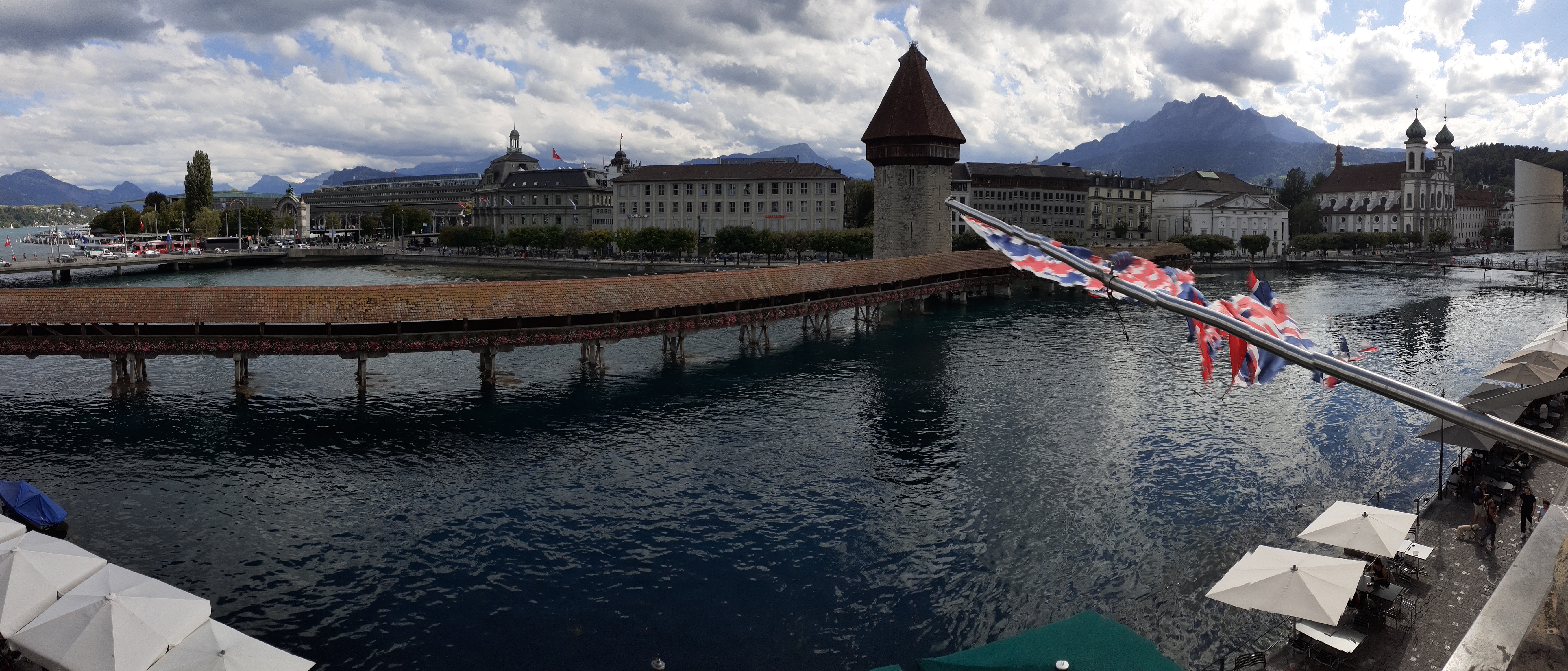
I am staying at the Hotel Pickwick and Pub,across the famous Chapel Bridge on the north bank. The hotel and bar have an English theme, and is clearly marked by a large Union Jack. The Irish tricolour and St Andrew’s saltire make me feel more at home. The theme checks Charles Dickens who stayed in Lucerne in 1846. The Luzerner Theater across the river hosts an annual production of the Christmas Carol. His first novel, the Pickwick Papers was published a decade earlier, featuring the adventures of the peripatetic Mr Samuel Pickwick. Mr Pickwick presides in spirit over the hotel bar, which is moulded to the English and Irish traditional bar. Meanwhile the hotel’s boast of a ‘room with a view’ is borne out. There really is a spectacular view from my balcony. Mount Pilatus rises sheer above the city on the far bank, the Chapel bridge just below, and to my left the lake is framed by Alpine peaks.

Mount Pilatus is Lucerne’s defining backdrop. At a height of two thousand one hundred metres. it is more than twice the height of Ireland’s highest peak Carrauntoohill. The summit is reachable by boat, cogwheel railway and cable car excursion from Lucerne. Legend has it that the name derives from Pontius Pilate, and that he was buried there. More likely it derives from the Latin for capped, being requently cloud topped.
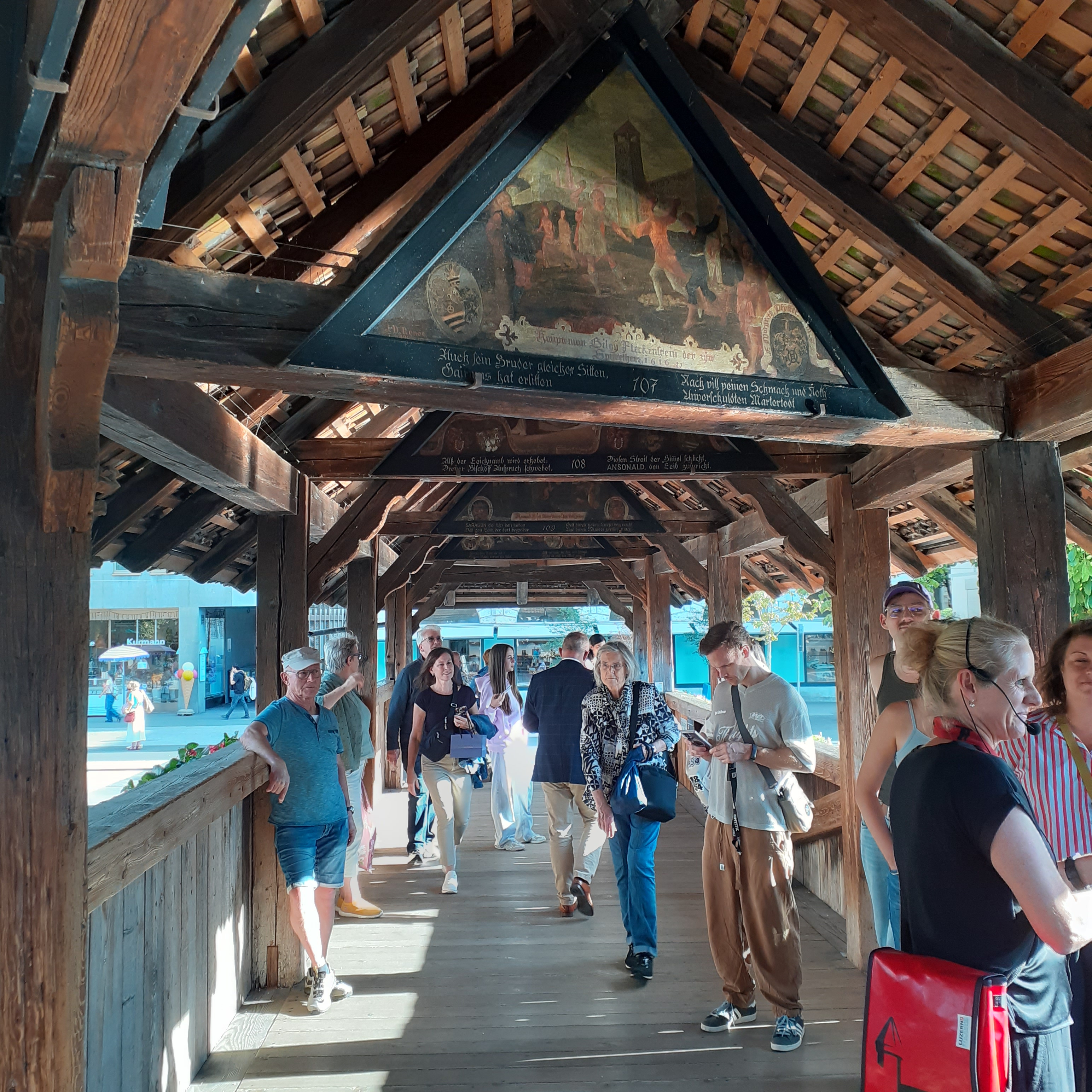
However, Lucerne’s most iconic site is the Chapel Bridge. This is an ornate, zig zag structure spanning the river with a large fortified tower to one side. Built in the fourteenth century it formed part of the city’s defenses. The thatched roof is decorated wth triangular painted panels illustrating the history of the Swiss Confederation and the lives of the city’s patron saints, Saint Leger and Saint Maurice. Hans Heinrich Wagmann was the principal artist from the start in 1611. One hundred and forty panels were completed. A disastrous fire in August 1993 destroyed two thirds of the paintings. Fortunately, all had been photographically archived. Crossing the bridge is a magical experience. Crowded, yes; but the pervasive atmosphere is joyous and serene. You need to cross several times to take in the views to each side and the bridge itself.
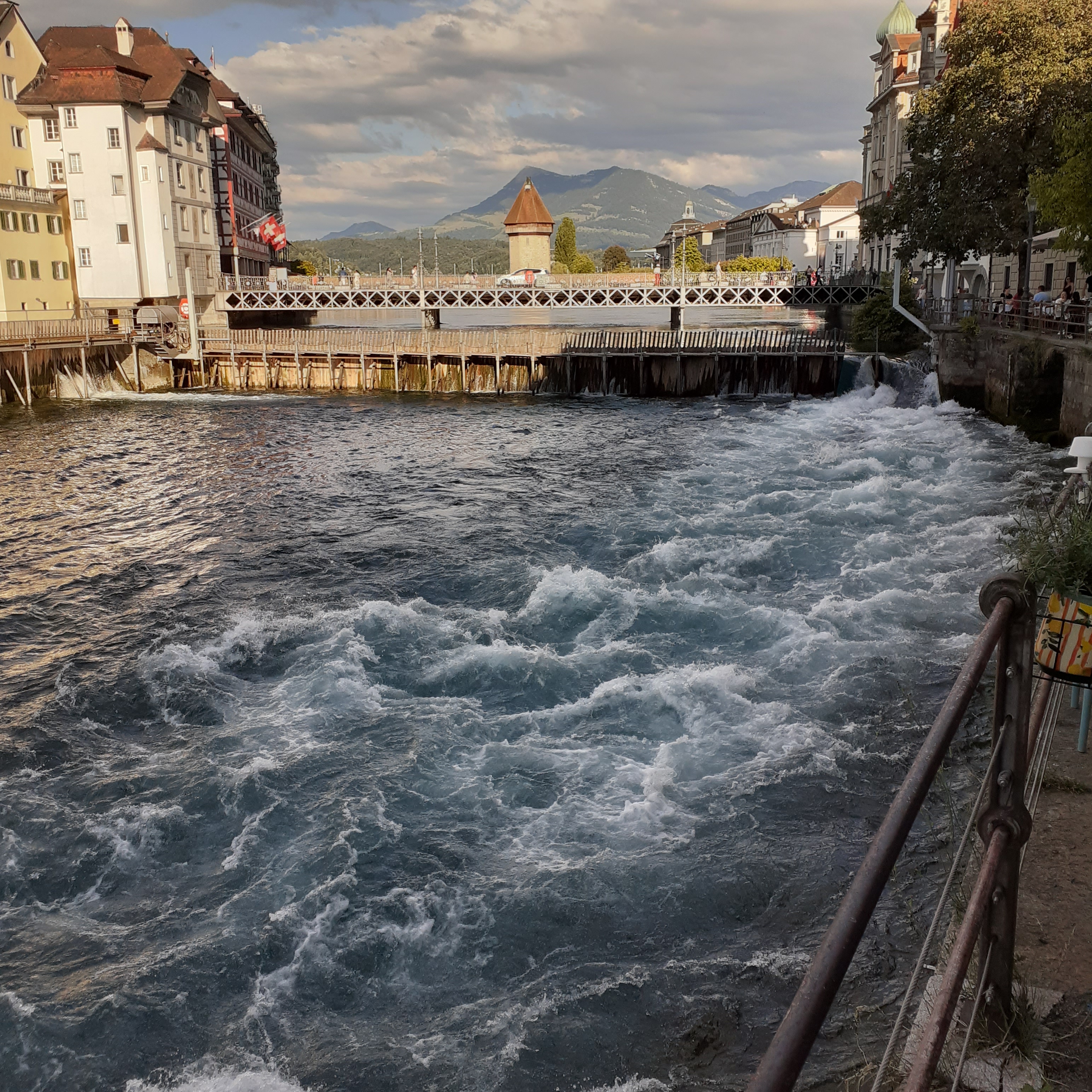
On the south bank, it’s a short walk down the quayside to another old covered bridge. Spreuer Bridge was built a little after Chapel Bridge. It means Chaff Bridge, as people were allowed to dump their chaff in the river here. The roof of this is also illustrated. Completed around 1637 forty five paintings remain from an original seventydepicting the Dance of Death. Nearby the river bank features an old flood control system, the Needle Dam. This was installed in 1861. Designed by Charles Poiree it’s an ingenious device using wooden slats to control the water level. It is still, partly, operated by hand.

The beautiful Baroque church overlooking the south quays is the Jesuit Church. The Jesuits came to Lucerne during the Reformation at the request of the city fathers of Catholic Lucerne to counteract the zealous Protestantism of Calvin and Zwingli in Zurich and Geneva. The church was begun in the late 17th century. The onion toppoed towers were only added in 1893.

Lucerne is, of course, surrounded by majestic scenery. You are never out of sight of it, but it’s worthwhile getting out in it. The trip up Mount Pilatus is very popular. I ran into two happy travellers from Caliornia, Cindy and Britney, who were looking forward to it the next morning. The roundtrip takes about five hours. I had opted for the one hour boat trip. The same company also does longer dining cruises. There are regular ferries to other lakeside towns for even more independent explorers.

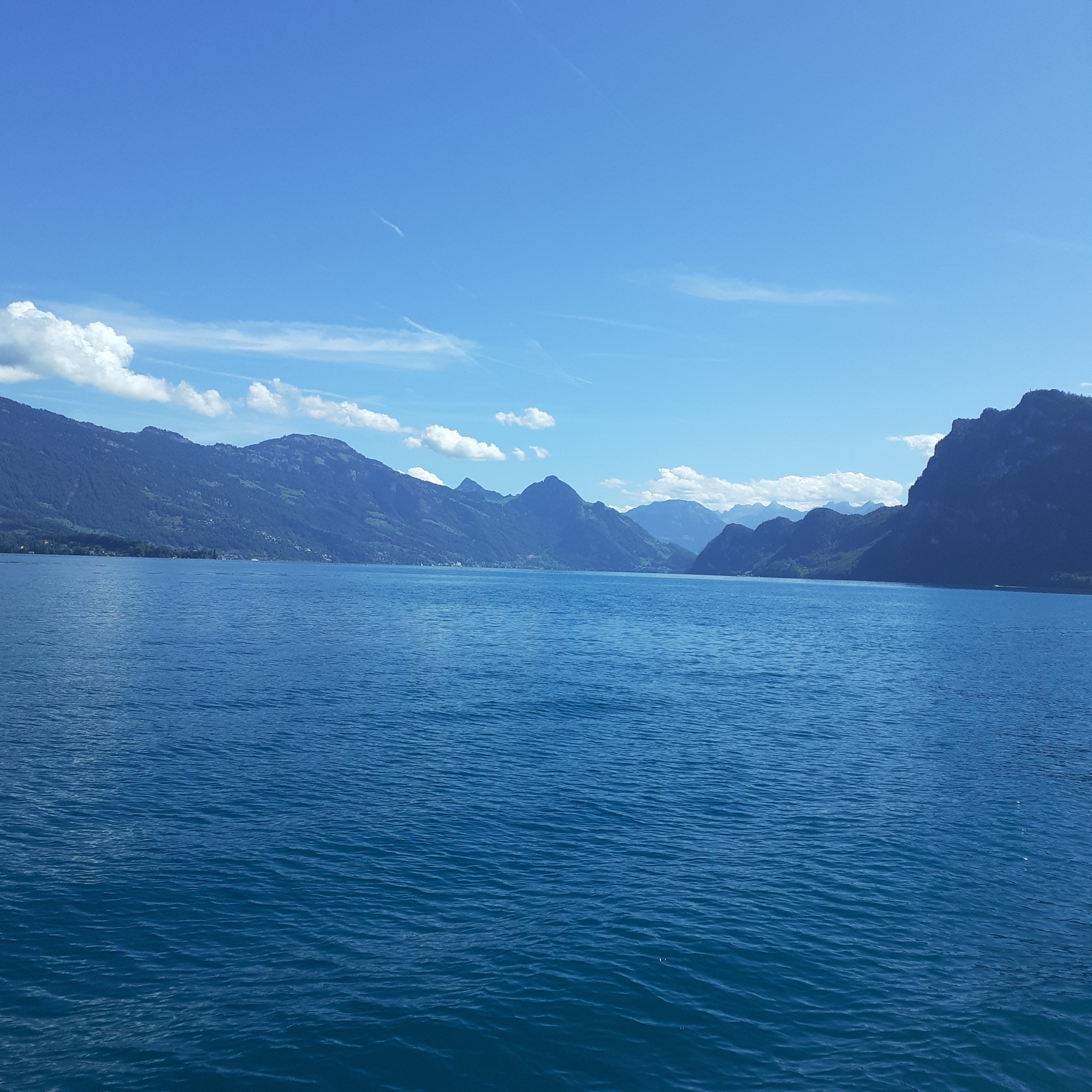
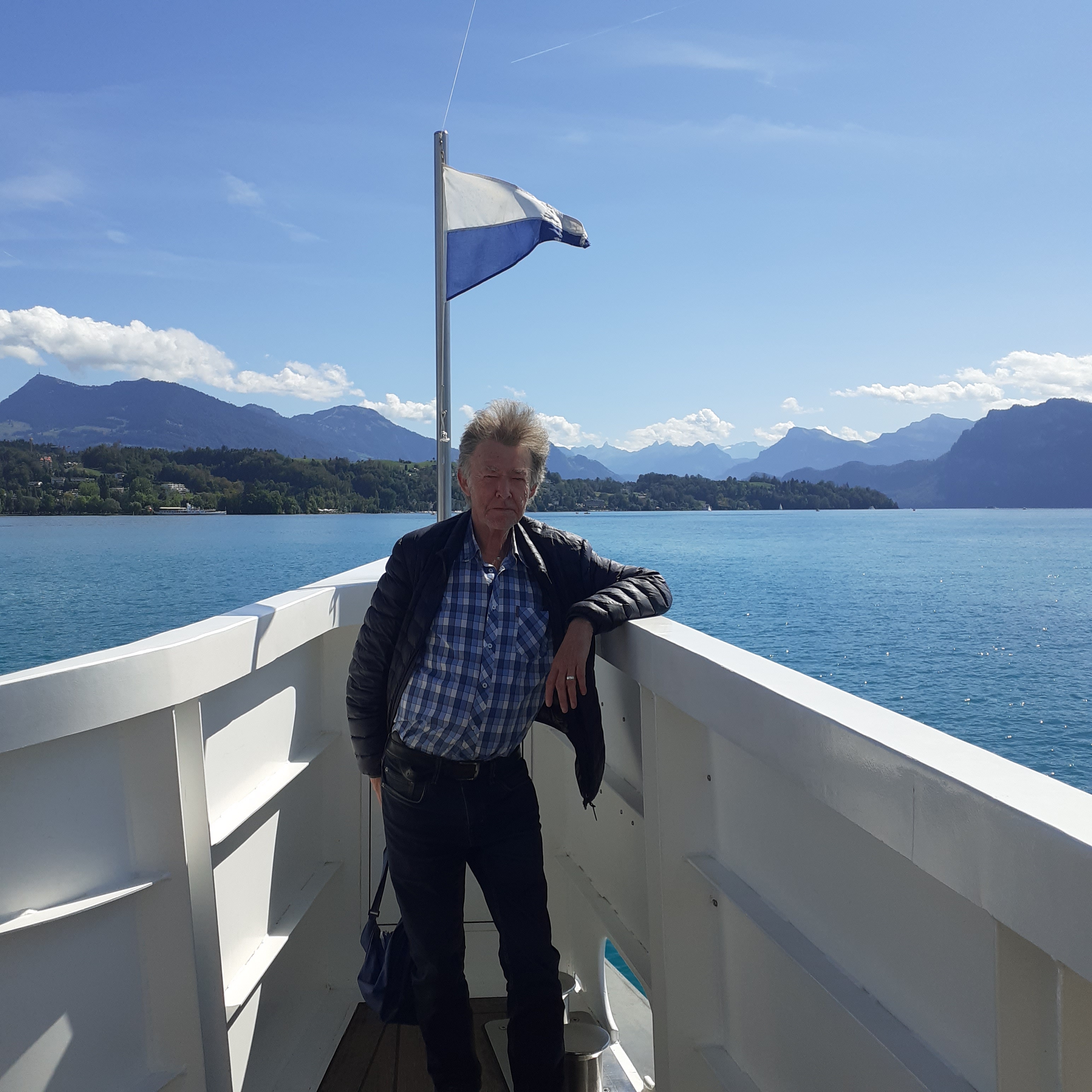
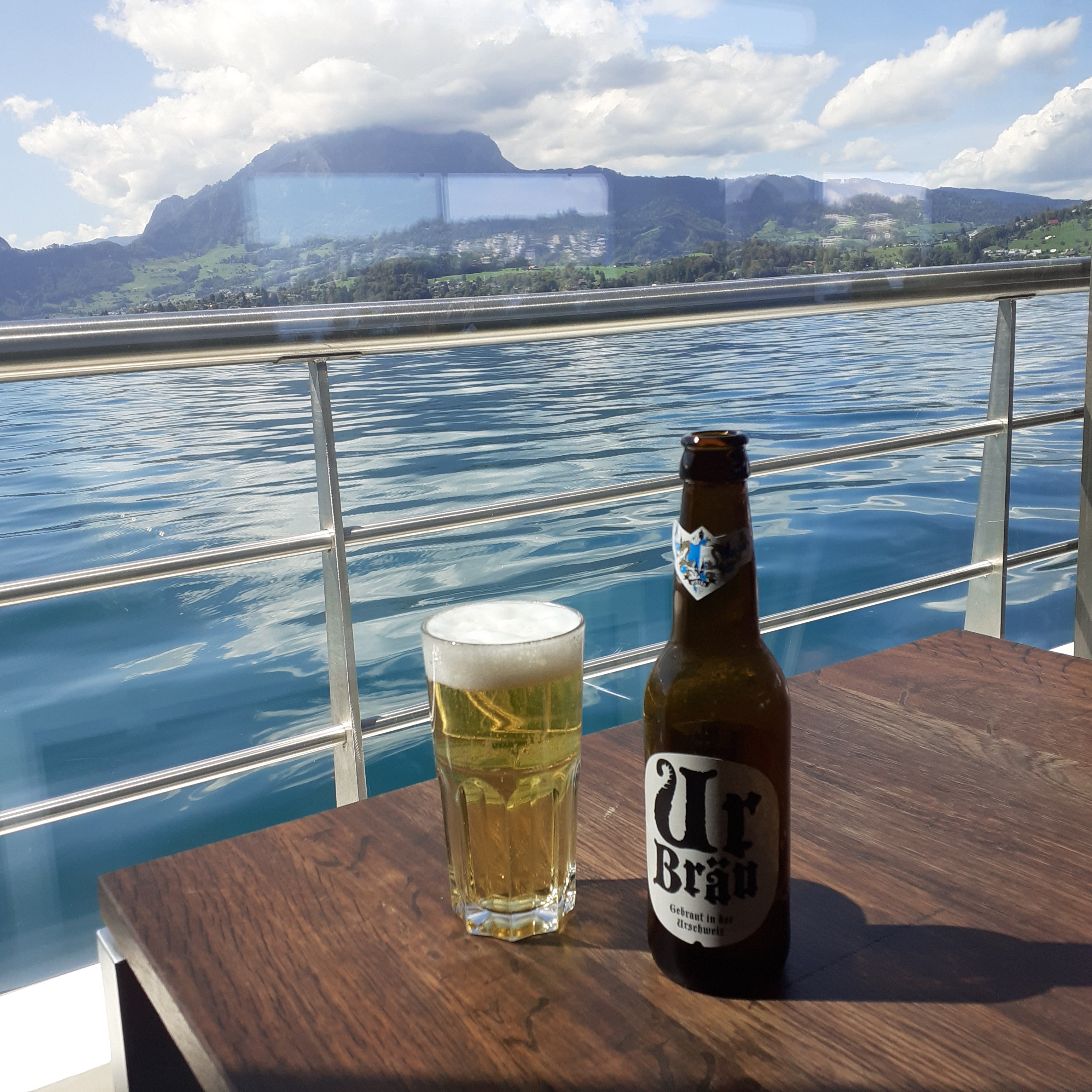
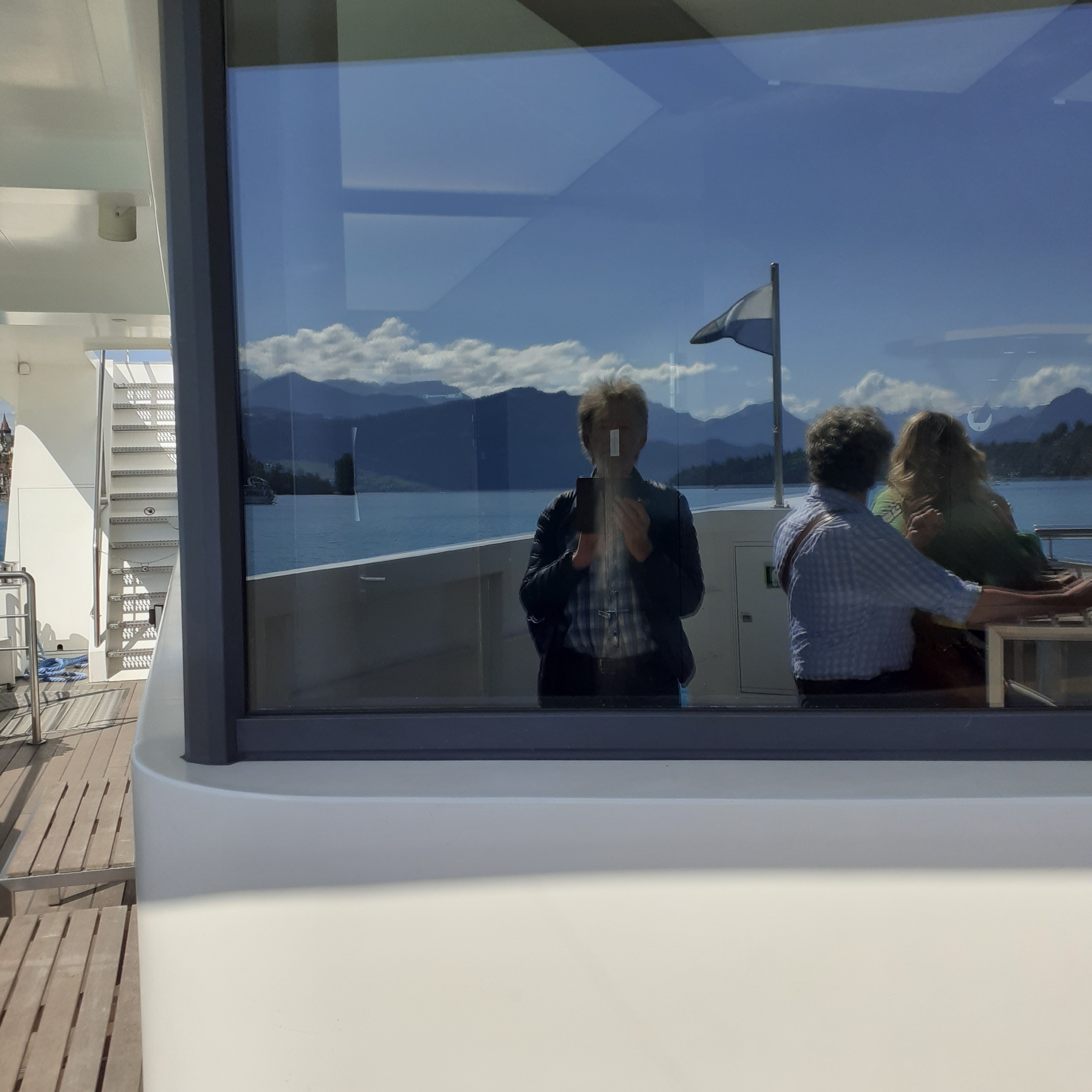
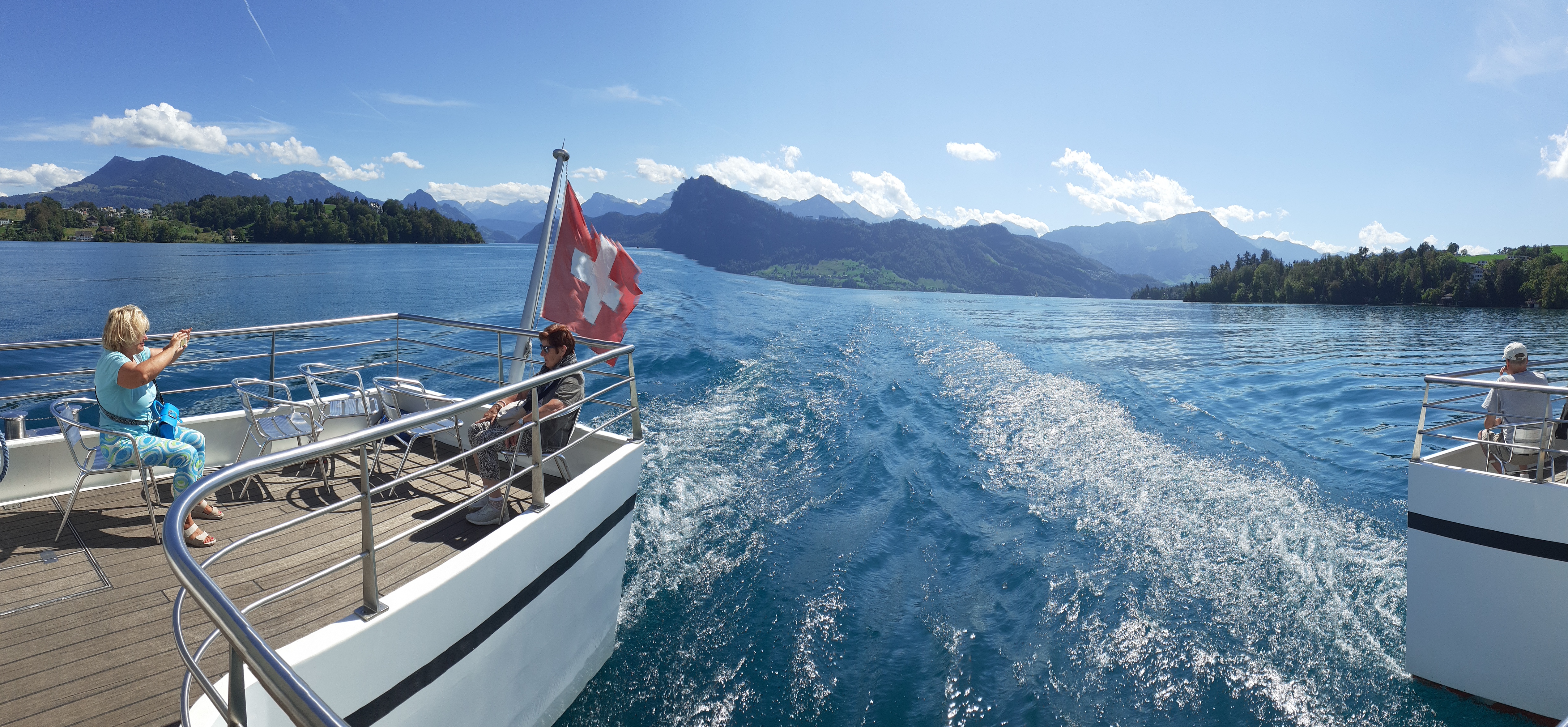
I took off in the sleek catamaran at noon in glorious sunshine. The craft was quiet, none too crowded, with snacks and drinks available. Sitting with a bottle of suds I was catapulted into paradise. Lake Lucerne sweeps southward before us into the jagged blue maw of the Alps. We circle back as the lake branches west and south. I moved astern for the return leg and let the majestic vista recede. If only time could stand still.

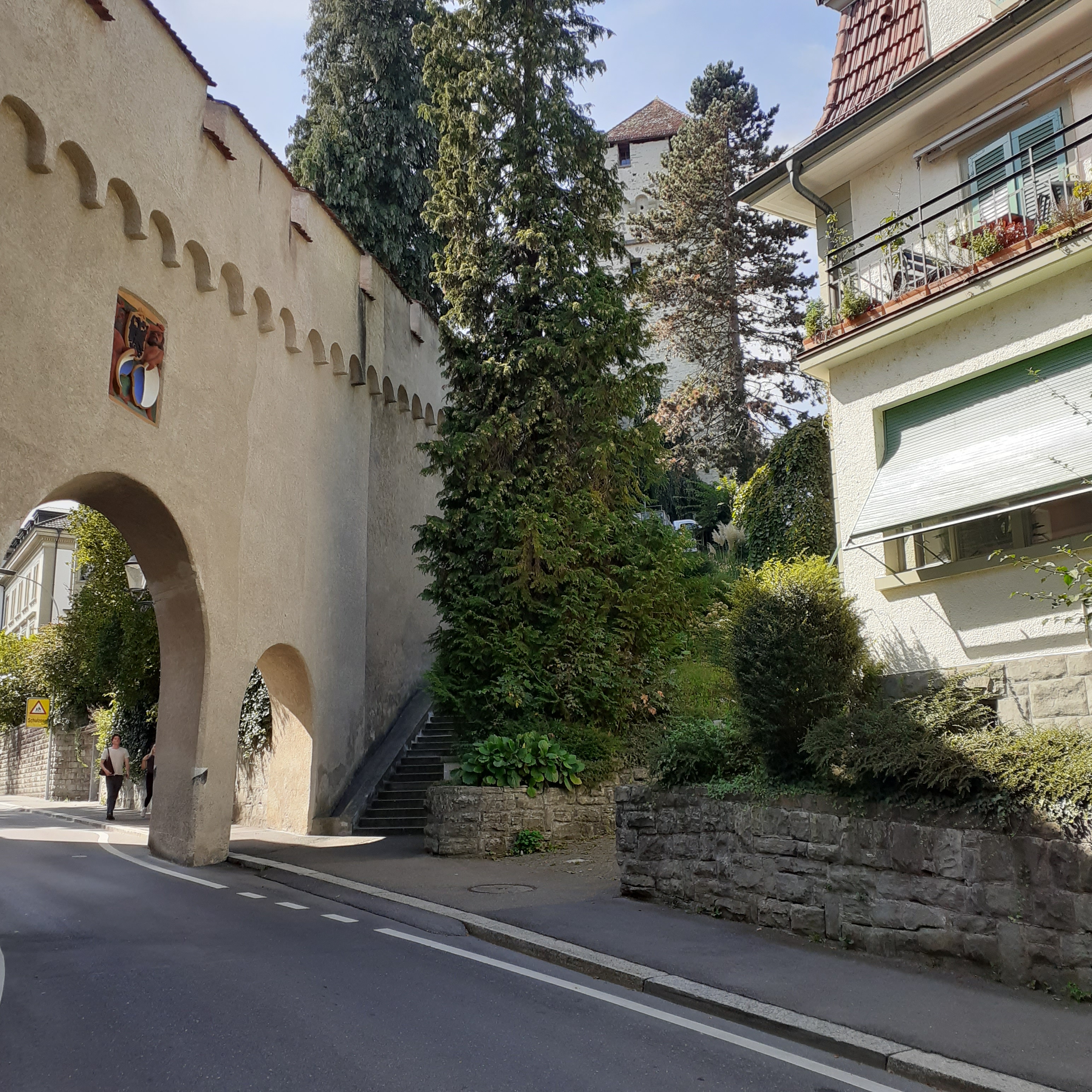
Back on terra firma, there’s plenty of exploring still to do in Lucerne. The Musegg Wall with its nine towers was built at the end of the fourteenth century along the steep rise south of the Old Town. It’s a steepish walk from the lakeside quays, steeper still by way of narrow laneways connecting with the lower Old Town.

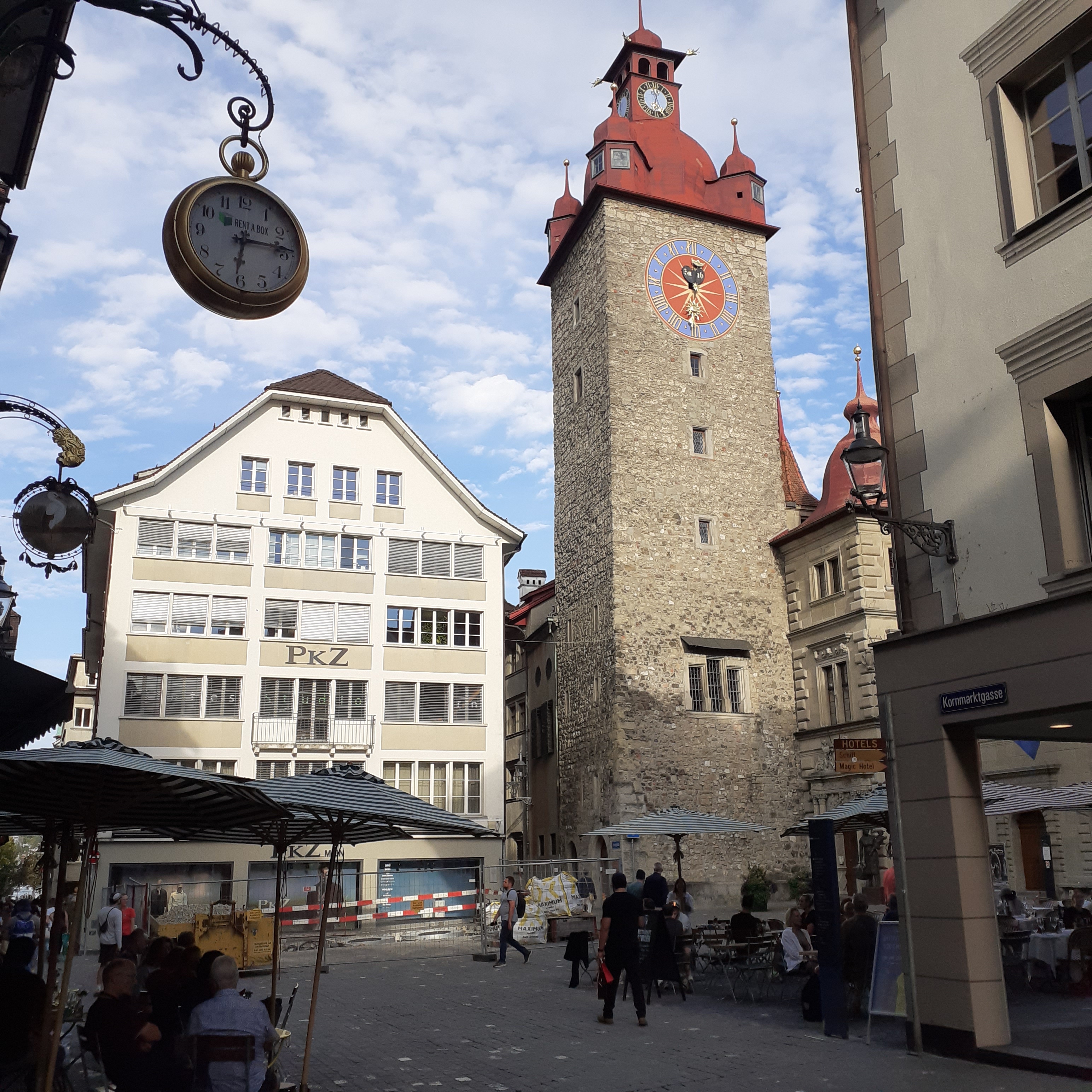
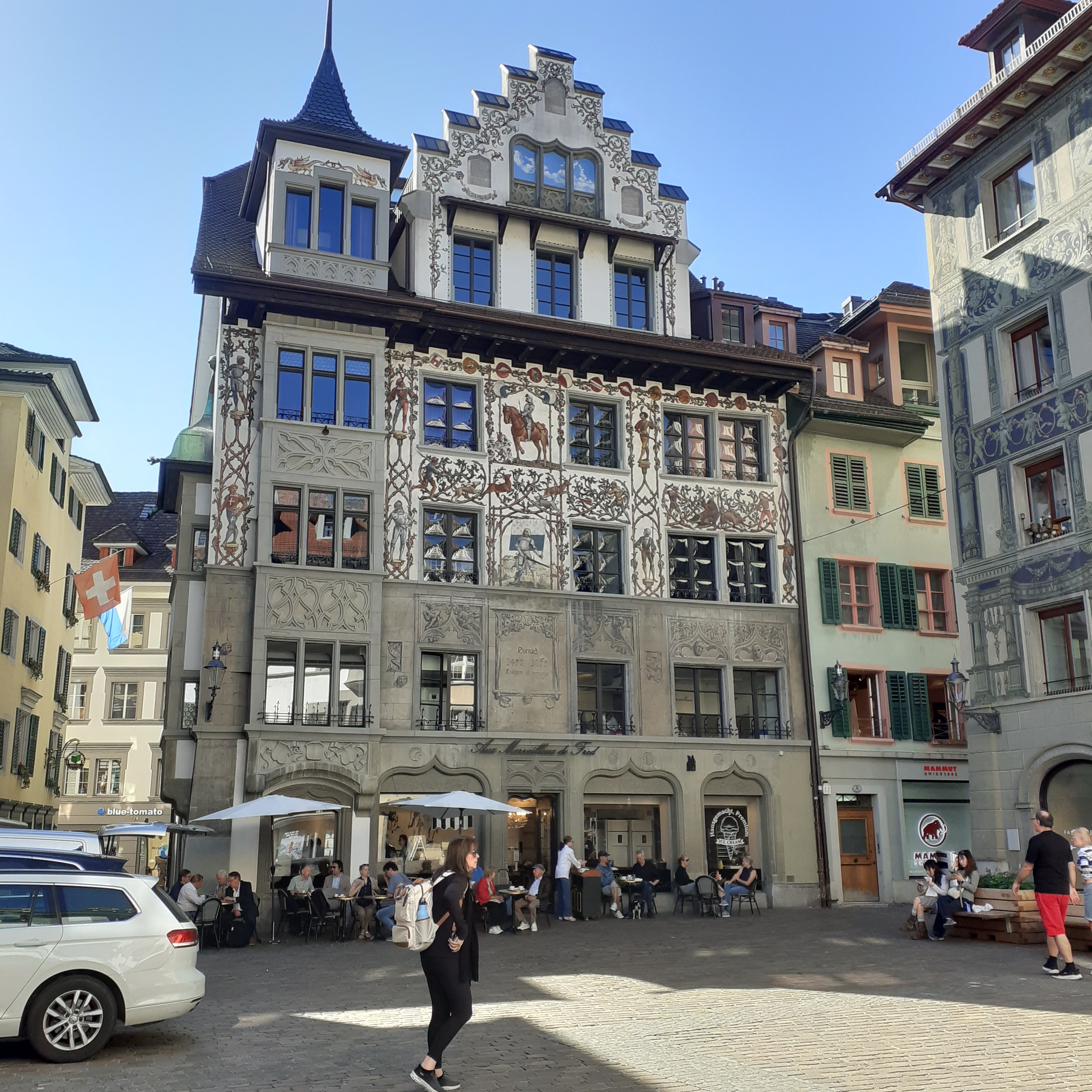
The Old Town meanders through pedestrianised streets from the Chapel Square at the lake end to Muhlen Platz and on to the Spreuer bridge. It’s a bustling strip of shops and hostelries widening randomly into small squares. Fine buildings are adorned with frescoes. At Kornmarket the Rathaus, or Town Hall, towers above. This was built around 1600 with the tower dating back to the 14th Century. The building backs onto the Reuss with a bistro beneath its collonades. The Weinmarket is adjacent and slopes towards the river quayside, Unter der Egg.

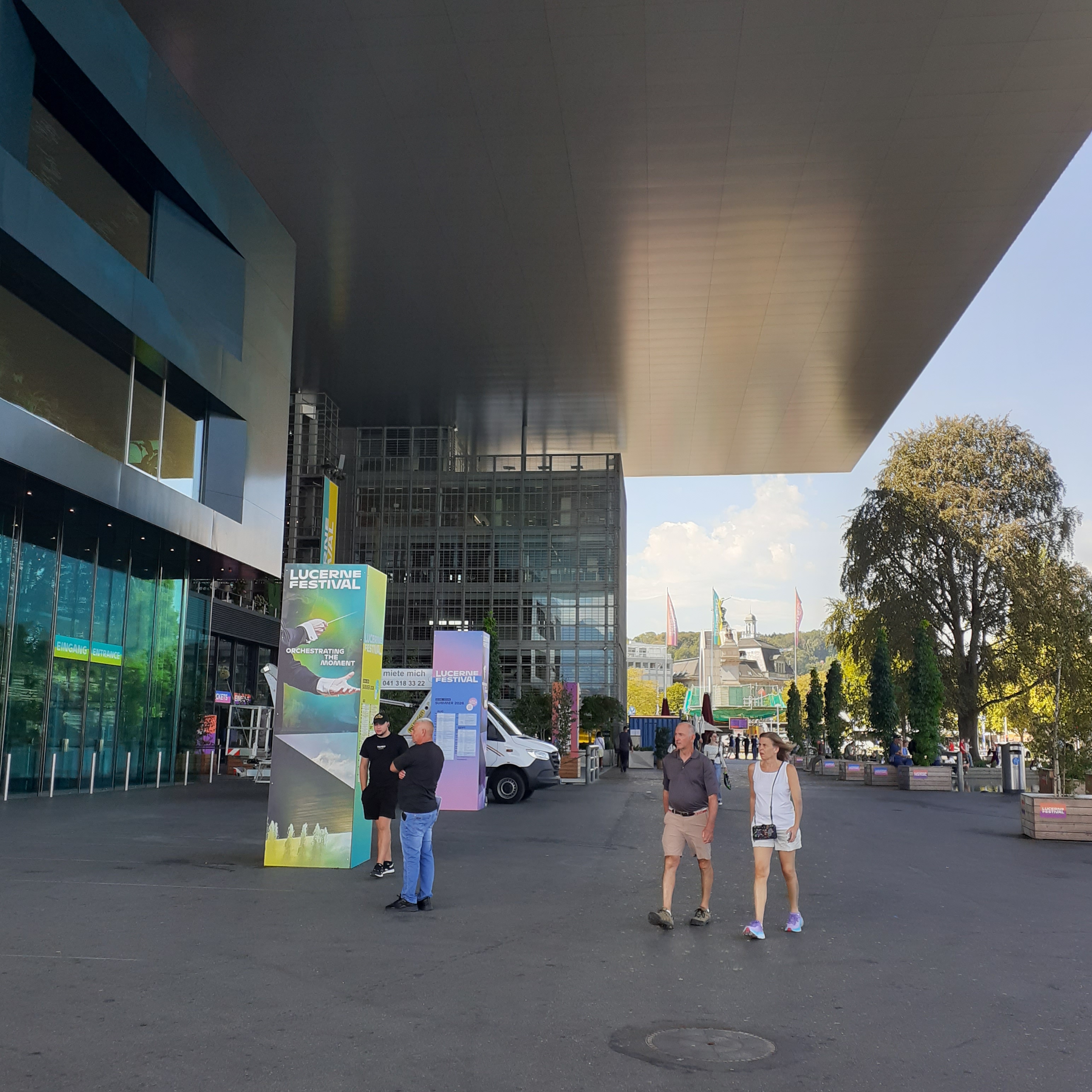
From the ancient to the modern on the south bank. Seebrucke is a very busy thoroughfare crossing the river. The Hauptbanhof lies just beyond the Torbogen Arch with its Zeitgeist sculpture atop. Across the Plaza towards the lake is the KKL (Kultur und Kongresszentrum Luzern). A large modernist glass and steel structure leaning over the lake It includes a conference centre and a concert hall. It was designed by French architect Jean Nouvel and opened in 1998. The concert hall holds 1,800 people and the Lucerne Festival of Music is a major annual event. The Museum of Modern Art hosts contemporary exhibitions on the top floor. Local artist, Shirana Shahbazi’s exhibition All at Once – an Interplay with Light, is a lustrous show with music and video installations besides painting and photography. Extremely varied, being a collaborative exhibition, but peaceful too, a consolation for my addled brain. I particularly liked the lifeform under water photographs.

Another important Art Museum is the Rosengart Collection on Pilatus Strasse, back past the railway station. The Rosengart hosts an extensive collection of Picasso on the ground floor and Paul Klee in the basement. Upstairs there’s an extensive display of modernist art from the late nineteenth and early twentieth centuries including work by Impressionists Monet, Renoir, Cezanne and others. Post Impressionist Georges Seurat contributes a sketch of his major painting, and one of my favourites, A Sunday Afternoon on the Isle de la Grande Jatte. Another room shows a video of the building’s conversion to the present museum.

Pilatus Strasse is a wide straight-ish thoroughfare running west from Seebrucke, the lakeside bridge, and the railway station. It marks the start of the modern city and is lined with commercial shopping, offices and plenty of bars, cafes and restaurants. Roadworks too. Ah, city life. Still, I liked a morning outside a cafe here amidst all the movement and noise. The DB Bar was another good spot, fast and friendly. Yo Flo! Farther down, I was fond of the restaurant La Vie en Rose for breakfast and evening meal. Edith Piaf also pops up at a bistro beside the KKL, Le Piaf. I don’t know of Lucerne’s particular connection with the famed French songbird, but I can imagine.

Quand il me prend dans ses bras

Il me parle tout bas

Je vois la vie en rose

Qu’il me dit des mots d’amour

Des mots de tous les jours

Et ça me fait quelque chose

The song from 1947 sings of seeing the world through the rose tinted glasses of love. It evokes beauty and romance, very much in tune with the lovely city of Lucerne. The lyrics were written by Piaf and the melody by Louiguy (Louis Guglielmi)

By night the city centre is lively but relaxed. The quayside is lined with tables of various hostelries and packed with promenaders. For liquid refreshment, the Pickwick and the collonaded terrace beneath the Rathaus were amongst my favourite spots. Heading into the Old Town, the Boar’s Head off the Weinmarket has a brown cafe vibe. With a country rock soundtrack, it’s a cool place to relax of an evening, the floor to ceiling mirrors giving a disconcerting feel of parallel universes. Wow, what was in that orange juice?

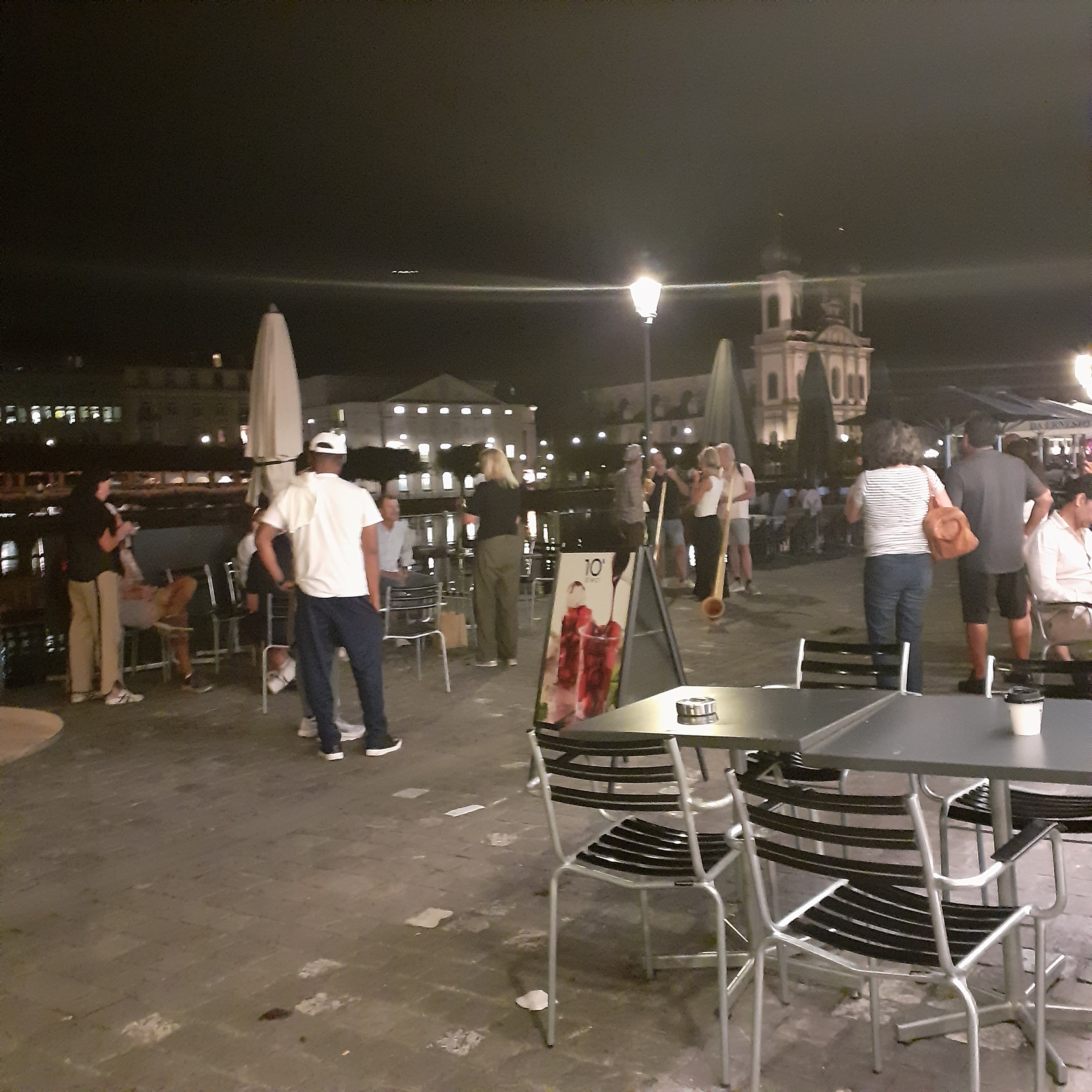
A fitting farewell on my last night. As I relax on the riverside outside the Pickwick with a well earned pint or two, we are serenaded by a couple of musicians with alpenhorns. The alphorn is a traditional instrument of the Alps. The wooden stem, honed from a single pine shaft, is up to four metres long. Like whalesong at altitude, it was a form of communication amongst isolated mountain communities. As the lights and stars come on over the city of light, the sonorous bass of the horns trembles upwards to the darkening summit of Mount Pilatus. Heaven indeed.

Soho at the Signal

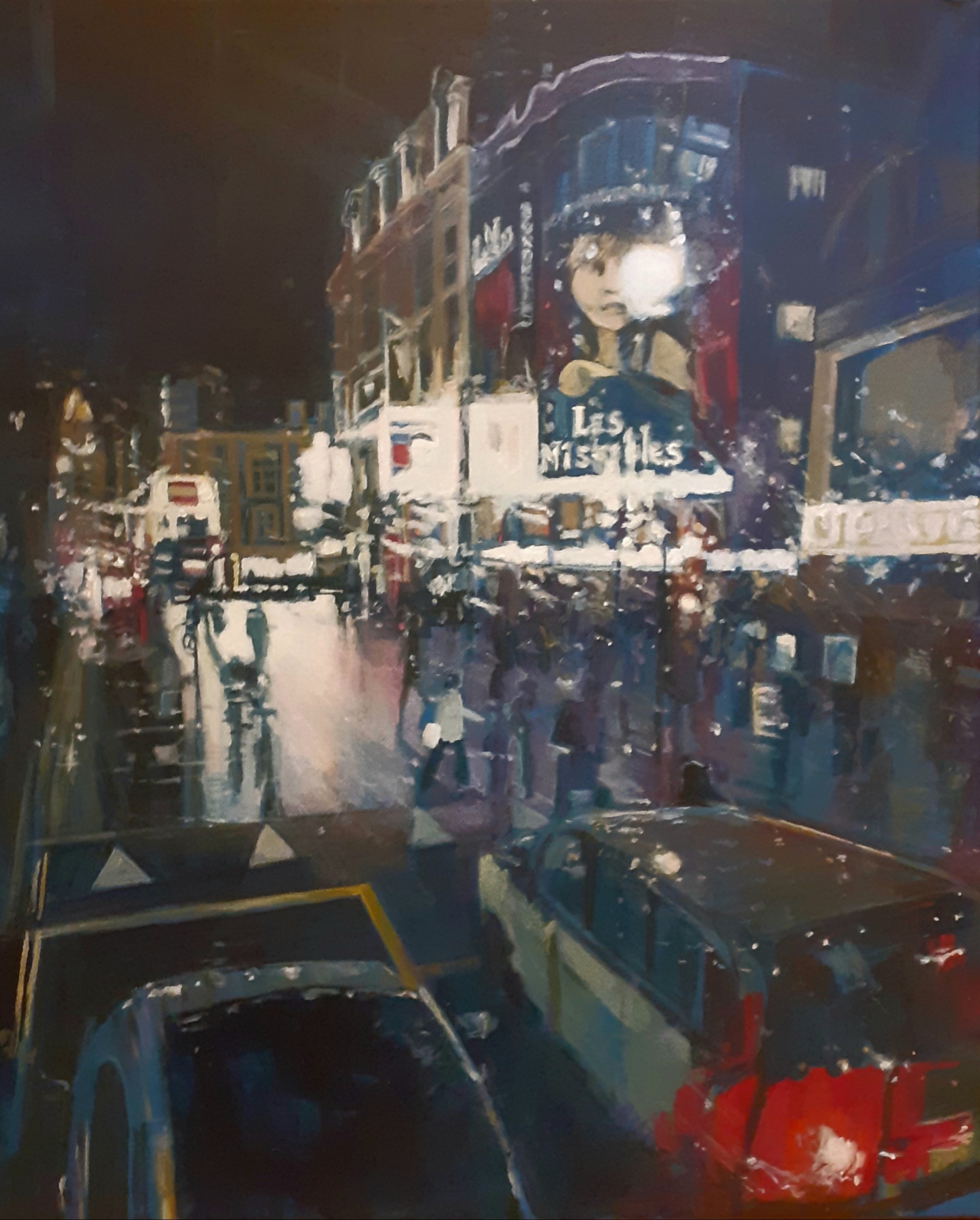
I posted this painting some months back but I thought I would run it up the flagpost again. It has been accepted for the 14th Annual Signal Open Exhibition over the first fortnight in August. The Signal Arts Centre was established in 1990 in Bray and provides workspace, classes and gallery for local artists. It is on Albert Avenue near the seafront and, as the name hints, right beside the railway line. Whoo whoo! I have had work there before and it is always great to be accepted. Whoo whoo, again. The Open Exhibition will feature around a hundred visual artworks. It runs from Tuesday the 4th to Sunday the 16th of August. Mine is an acrylic painting called Soho in the Rain. It shows a view of Shaftesbury Avenue in London from the top of a bus. There’ll be loads of great stuff there, so come and have a deco!

Local Bar in Elviria

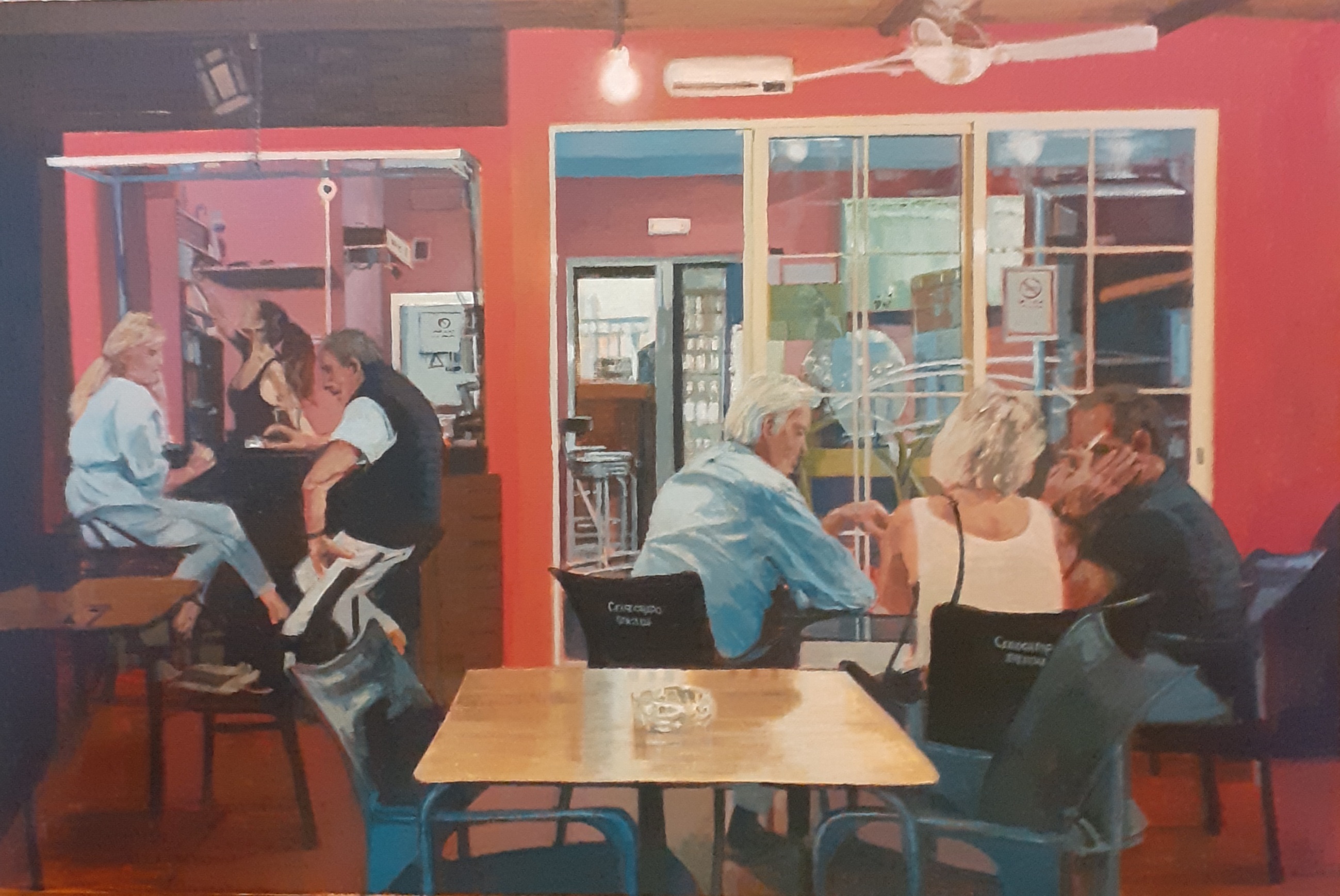
Elviria is a place I often stay when in Andalusia. It is just four miles out of Marbella, set in hilly woodland sloping down to the Mediterranean. I have committed a few scenes to paintings and here is another. This is the Itohavi Bar and Cafeteria. Situated at the bottom of the Avenida de las Cumbres where we stay, it is the perfect local spot for a morning coffee, a daytime snack, an early evening bite and a few drinks, well, any time really. This scene is of a pleasant April night, drink and conversation are flowing, and the rich texture of falling night blends with the bright colours of an Andalusian day. Perfect.

I’m dancing in the moonlight
It’s caught me in its spotlight
It’s all right, all right
Dancing in the moonlight
On this long hot summer night

Thin Lizzy’s 1977 song, from the album Bad Reputation makes for a sublime soundtrack for this warm Spanish night. Written by Philip Lynott from my own Old Town of Dublin, Dublin 12 to be precise. Born on the 20th August, 1949, his birthday bash at the Bloody Stream in Howth will be celebrated on that weekend.

Art in London

London is an exceptional venue for the art lover. From the pleasure of its public spaces, with a millennium of architecture, to its deeply embedded history of writers, artists and musicians who have lived there, many coming from all over the world. Then of course, there are the must visit galleries: The National Gallery, the National Portrait Gallery, the Tate Britain and Tate Modern, the Victoria and Albert Museum and the Courtauld Gallery.

Growing up, I feasted on the plates of such great art popularisers as Ernst Gombrich. Gombrich’s book, The Story of Art, was published in 1950 and became necessary reading for any teenager in love with art. The Louvre, Prado, Uffizzi, and Hermitage were all well represented, and so too the National, Tate Britain and Courthald. What pleasure received from a picture in a book is multiplied several times over in seeing the real thing.

Dublin, mind, is not without its masterpieces; Renoir’s Parapluies was always worth an afternoon off school to visit, and Harry Clarke’s Geneva Window another favourite. Both featured in Dublin’s Municipal Gallery, The Hugh Lane. Renoir alternates with London, where it currently resides, while Clarke’s window is in Miami. Dublin’s National Gallery has many fine international works, alongside homegrown greats. Notably: Woman Writing a Letter by Vermeer, and the Taking of Christ by Caravaggio. The latter has a remarkable provenance, only discovered in 1990 having hung unrecognised in the house of the Jesuit Fathers on Leeson Street.

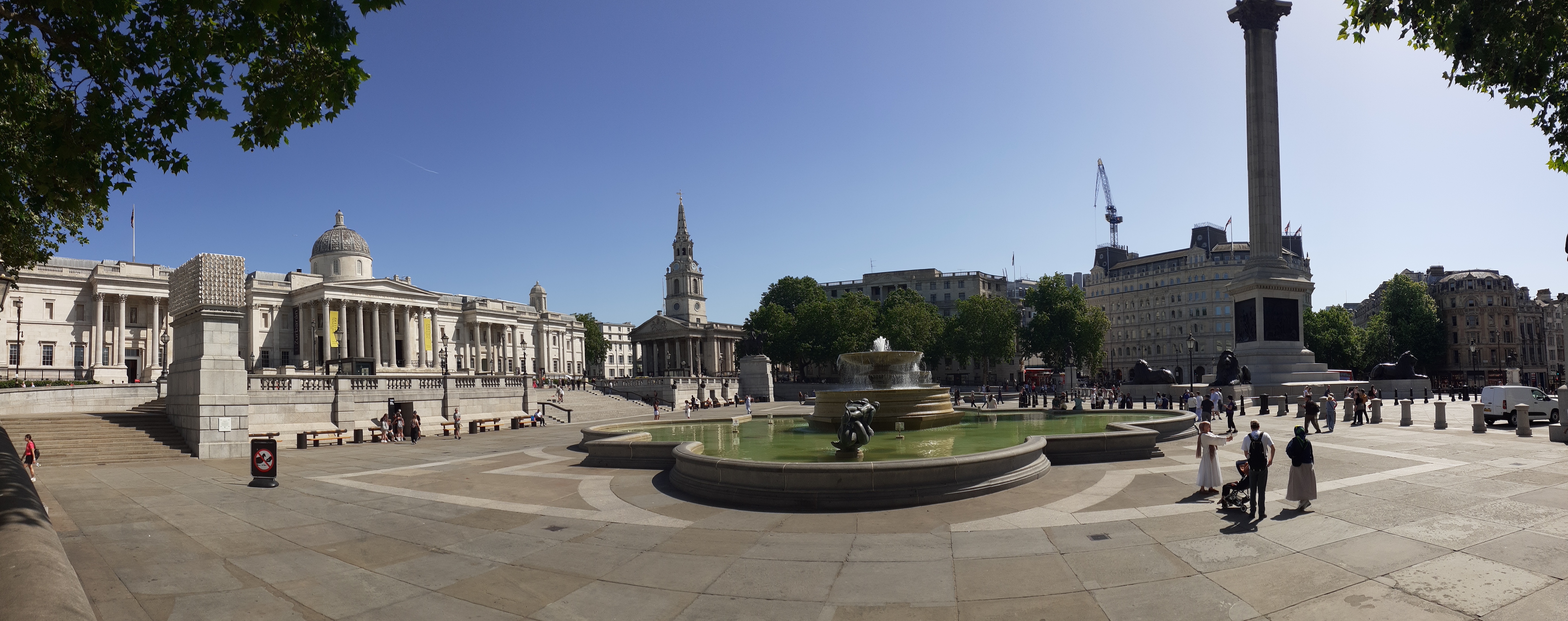
For sheer concentration of ageless masterpieces though, one needs to travel. London’s gallerys are in the top rank. The National Gallery on Trafalgar Square is home to many world masterpieces.

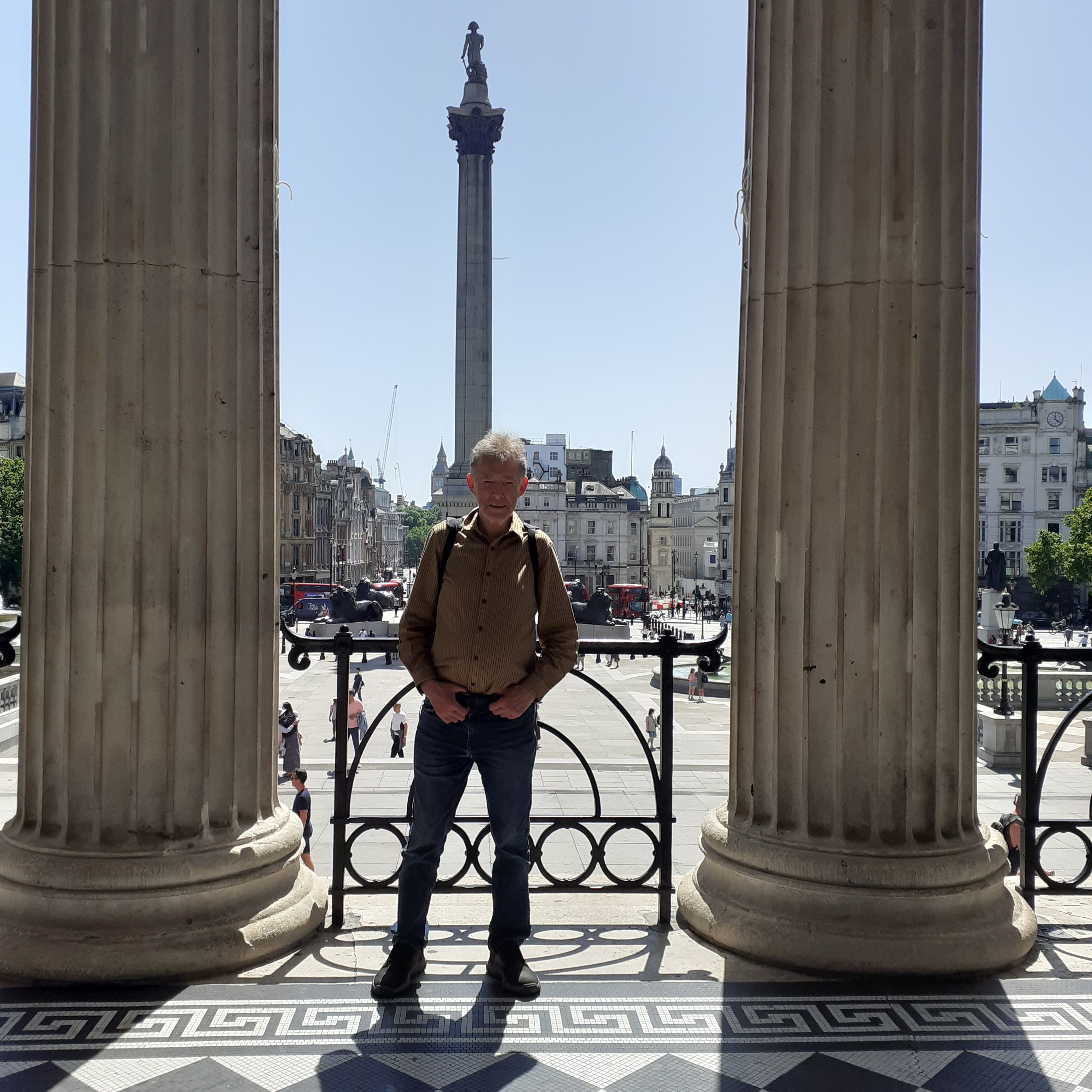
The Gallery building dominates Trafalgar Square, very much the centrepoint of London. Nelson stands atop his column here, a focal point of the square from its inception. The National Gallery was established in 1824, and the building itself comleted in 1838. Designed by William Wilkins it formed the northern edge of the newly constructed square, on the site of the old Royal Mews.

The Sainsbury Wing was added in the 1990s and is the point of entry to the museum.Entrance is free and it’s a good idea to get there early and beat the crowds. Not that you are ever going to be alone. Medieval, Renaissance, Baroque, Rococco, Romantic and Modernism are laid out for you to pick your favoured path. I’d give it two days. But don’t rush. The point is to enjoy the faboulous story presented here at your own pace.

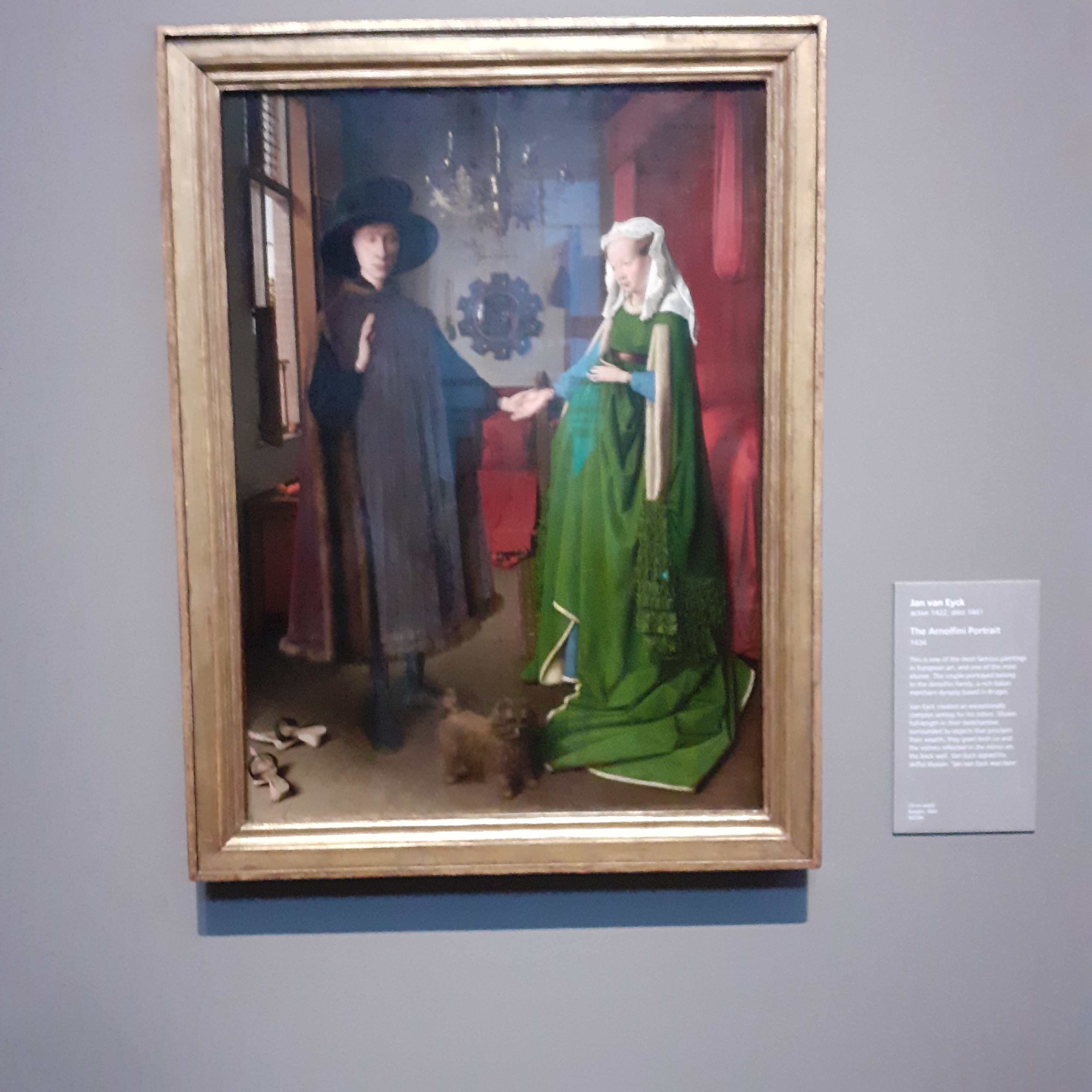
Highlights include Venus and Mars by Sandro Botticelli. It is playful and brilliant, one of the many masterpieces from Gombrich’s book. The Portrait of Giovanni Arnolini and his wife is another must see, and one that will stop you in your tracks. Van Eyck’s astonishing painting from 1434 is a very early example of realist, or illusionist, painting, and of domestic subject matter. The Rokeby Venus by Velazquez has been no stranger to controversy since painted by the Spanish artist in the mid seventeenth century. Such paintings were condemned by the Spanish Inquisition, and in the twentieth century it has been slashed by a suffragette and assaulted by climate activists., You could spend a day sitting before it, lost in admiration, or spend fifteen minutes, if like me you are with the missus. The name comes from Rokeby House in Yorkshire, where the painting hung prior to being acquired by the National in 1906.

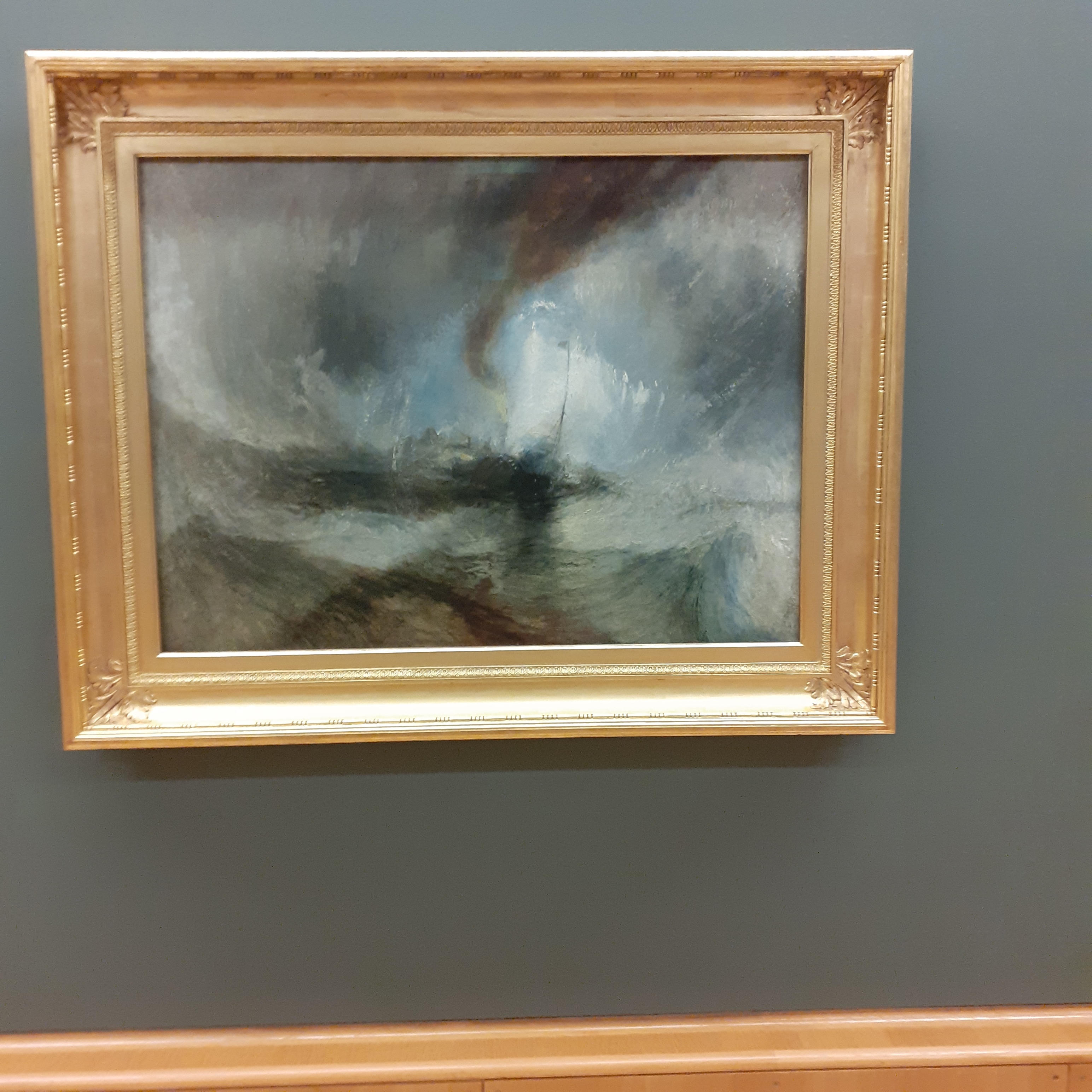
Look for the 19th century to discover the evolution of modern art as we know it. JMW Turner is the most revered English painter and hugely influential. His admiration for French painter Claude is illustrated by the exhibition of two Claude’s side by side with two of Turner’s own This permanent display is a condition of his bequest. Turner was born in 1775 in Covent Garden a little further east of Traalgar Square.-He died in 1851 leaving a large body of his work to the nation. Most of this work was turned over to the Tate Britain after settlement of the Turner Bequest in 1856. 

The National Gallery still holds Turner’s masterpiece, the Fighting Temeraire painted in 1838. This has been voted Bitain’s favourite painting. Also look out for Rain, Steam and Speed from 1844 a dramatic depiction of a locomotive crossing the Maidenhead Railway bridge in the rain.

The National Portrait Gallery is next door. There’s a rooftop restaurant here with great views over central London. We stop for a coffee outside, where a glass kiosk offers an air conditioned cocoon in the gathering midday heat. Beautifully dappled in the shade of urban trees, we are together and alone. We often like to touch base at the Portrait Gallery on a London visit. Founded in 1856 it was one of he first National Gallerys devotied to portraiture. It moved to its current home adjacent to the National forty lears later. It presents English history through portraiture with paintings of the likes of Henry VIII and William Shakespeare (probably) up till the present day, with regular contemporary group and individual exhibitions.. 

The Tate Gallery was established in 1897. Located in Millbank on the Thames, south and upriver of Westminster. We take the tube to Pimlico and it’s a short walk from there. Before going in we have a look at the Vauxhall Bridge, a steel arched bridge from the early twentieth century framed by a cluster of highrise towers. On the far bank is the Vauxhall Cross Headquarters of MI6, the Secret Intelligence Service of Britain. You’ll know it from James Bond films, no doubt.

The Tate was founded as a gallery for modern British art by Sir Henry Tate, the Victorian sugar merchant. He was the Tate of Tate and Lyle. Lyle’s Golden Syrup logo is a visual arts icon in itself, illustrating the biblical tale of Sampson with the catchline: out of the strong, came forth sweetness. Since 2000 the Tate Modern downriver is housed in the Bankside Power Station and devoted to art that is, um, more modern. A riverboat connects the two venues. The Tate Britain, as the original is known, hosts a significant collection of British art. Millais’ Ophelia is a well known work that featured in Gombrich’s book and there are plenty of others from the Pre Raphaelite Movement. Holman Hunt’s The Awakening Conscience, the Annunciation by Rossetti, the Death of Chatterton by Henry Wallis and Waterhouse’s iconic bedsitter image The Lady of Shallot. There’s another familiar swoon on seeing Whistler’s Nocturne in Blue and Gold, depicting the Old Battersea Bridge from his time living in the city.

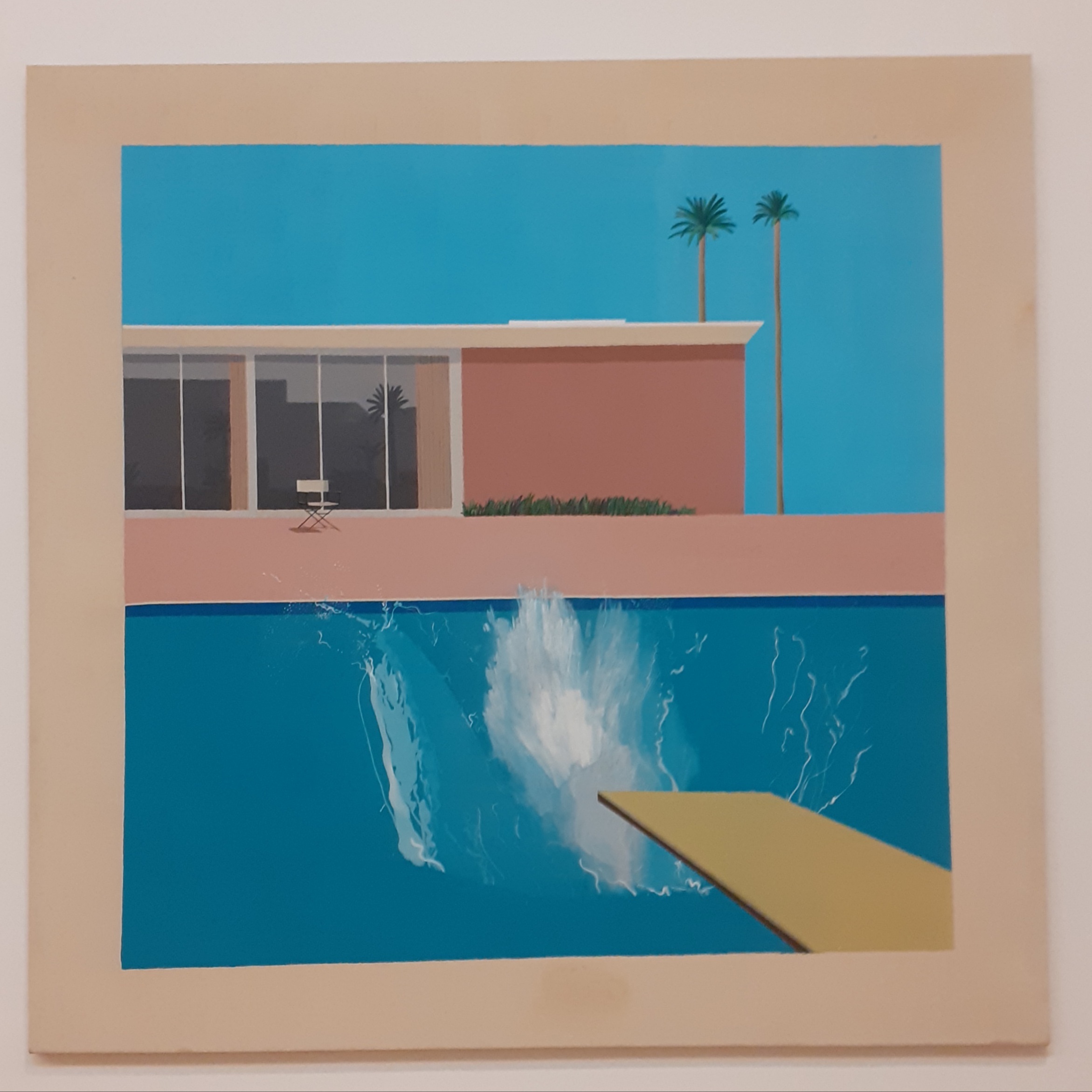
The Bath of Psyche by Frederic Leighton, once President of the Royal Academy, forms the backdrop for a pop up lecture on the artist. The young guide who launches into the talk knows how to grab a crowd. There’s plenty in the collection to hold the crowds, including of course the large collection of Turner’s work. There’s great twentieth century art also, A Bigger Splash by David Hockney being a particular standout.

After the Tate, we walk through the redbrick Millbank estate. This was built at the end of the nineteenth century and was an early social housing scheme, similar to the Iveagh Trust buildings. The seventeen estate blocks are named after famous artists including Turner, Millais and Leighton.

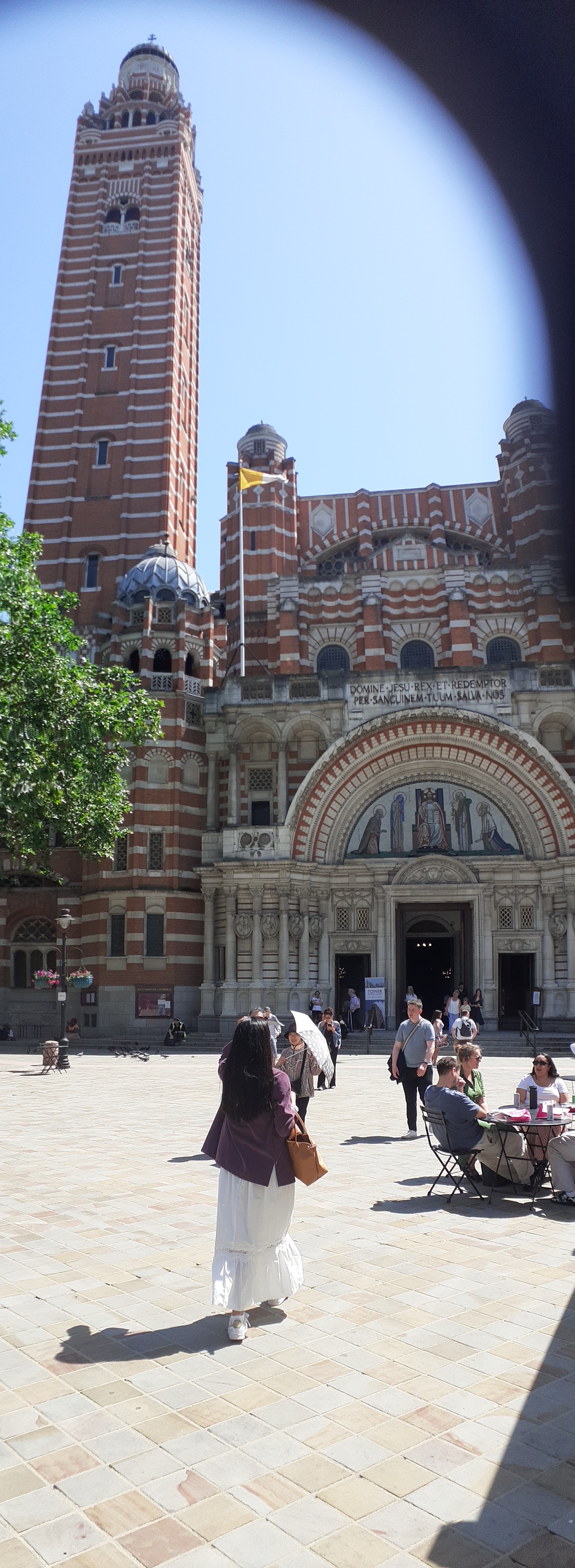
Past the Millbank estate we come to Westminster Cathedral. The Roman Catholic Cathedral was built in 1903 and heavily inluenced by Eastern Orthodox architecture, particularly the Hagia Sofia, the ancient cathedral of Constantinople. Designed by John Francis Bentley and constructed of brick, it makes a startling visual statement of red with horizontal white stripes. It is dedicated to the Most Precious Blood of Our Lord Jesus Christ and also pays homage to, amongst others, Saint Andrew of Scotland, my own patron saint.

From there we made our way past Buckingham Palace and on to Green Park. Here we had our own Dejeuner sur l’Herbe. A modest affair, I’d have you know; coffee, beer and snacks are available from park kiosks, and the sun beats down and we lie on the grass. Had we wanted to see Manet’s original, we could head for the Courthauld Gallery up on the Strand. There are other days and plenty more paintings to see.

Battersea at Night

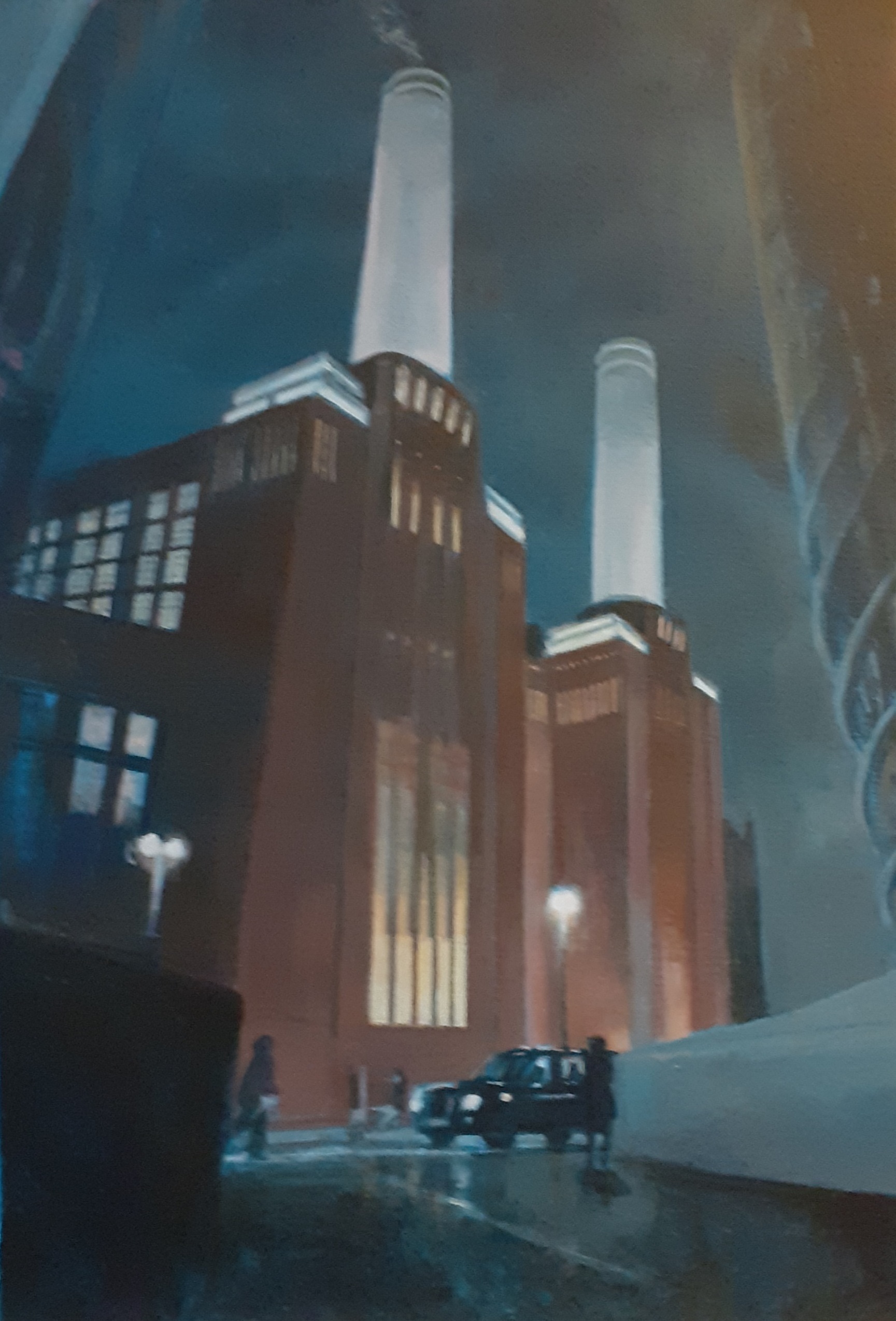
The Battersea Power Station is one of my favourite London buildings. With its four cream chimneys towering over the south bank of the Thames it has become a much loved icon of the city. Giles Gilbert Scott and Theo Halliday were the project architects and construction started in 1930 to be completed twenty five years later.

Since I am on a bit of a roll London-wise, I thought I would attempt to capture it on canvas. This view is from the back of the Station, and taken a little down the ramp of an underground car park. A taxi is waiting with a passenger inside and a woman at the door. Another person is caught in the headlights. The implied story struck me as dramatic, heightened by the Art Deco design and the evening illumination. The finished acrylic has something of a 1930s poster feel to it. M thinks it would make an excellent fridge magnet. I’m very happy about that.

Heaven, I’m in heaven

and my hearts beats so that I can hardly speak

And I seem to find the happiness I seek

when we’re out together dancing cheek to cheek

You know the song. Written by Irving Berlin for the musical Top Hat starring Fred Astaire and Ginger Rogers. We had front row seats for that in the West End some years back. We were in heaven, indeed.

After Astaire other versions include Ella Fitzgerald, Doris Day, Frank Sinatra Tony Bennett & Lady Gaga, and the sensational Alex Harvey.

Dublin Highlights

I was born and grew up in Dublin. I spend a lot of time travelling through Dublin and its environs. I live nearby, in the town of Bray just 20km down the coast. I have regularly posted on my Dublin adventures. Of late, I have noted some good posts from overseas travellers and locals alike (World in Your Eyes and Finding Your Feet). So I thought I might join in and post a few Dublin memories. Something of a greatest hits perhaps, or top ten tips type of thing.

5 Top Sights

The Liffey

Christchurch Cathedral

St Stephen’s Green

Phoenix Park

Grand Canal Docks

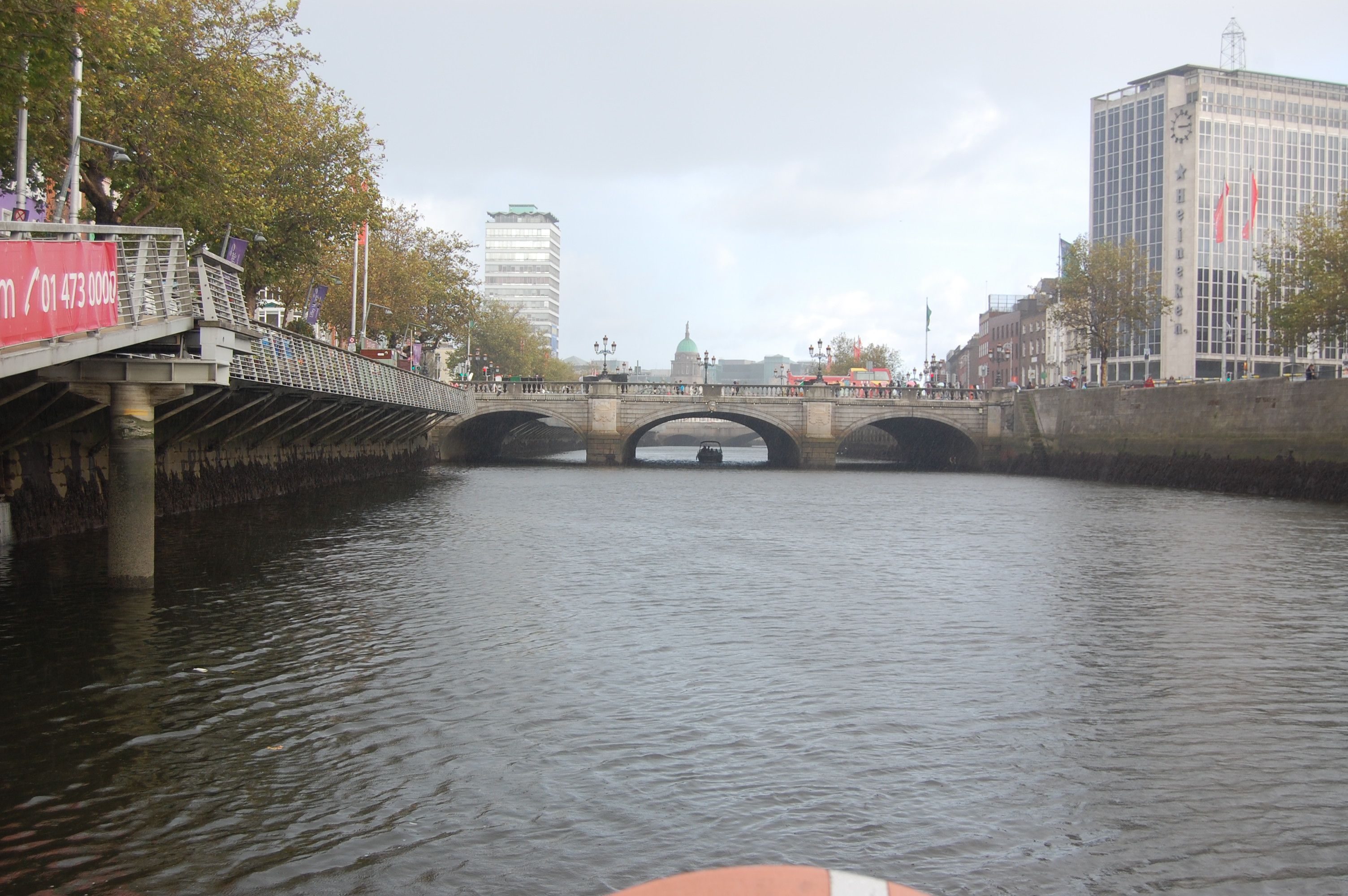
Dublin is a great city to walk round. Literally. My series Dublin’s Circular Roads describes a particular route. Another circle is provided by the two canals, the Royal to the North and the Grand on the south. Within their radius the city centre is divided into north and south sides by the River Liffey. It is the river that makes the city. Each bank is lined with quaysides from the estuary in Dublin Bay upriver to the western rail terminus, Heuston Station. The main buildngs to see are the Custom House and the Four Courts, both by Gandon and on the North Quays. The Ha’penny Bridge, a cast iron pedestran bridge spanning the river between Liffey St and Temple Bar is one of Dublin’s most iconic sights.

Christchurch is the more ancient of Dublin’s two cathedral’s. King Sitric Silkenbeard, overtaken with piety in his later years, established it in 1028. The Synod House to the west is joined to the Cathedral by an arched brdge, making it look like the main road passes through the ancient church. Wonderful.

Dublin can be heaven

With coffee at eleven

And a stroll in Stephen’s Green

(Dublin Saunter by Leo Maguire and sung by Noel Pucell)

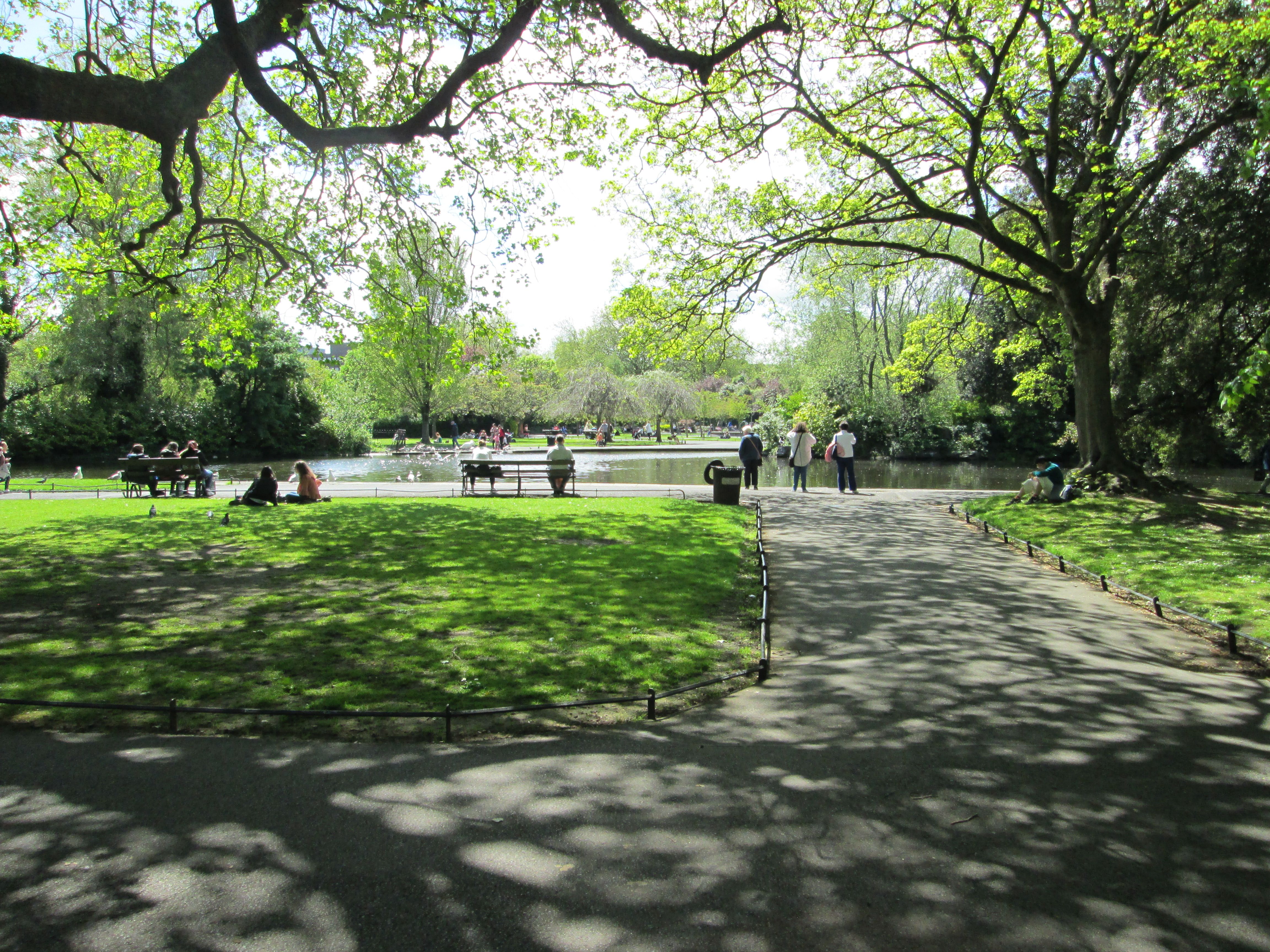
St Stephen’s Green waits at the top of Grafton Street. In the seventeenth century it was a commonage on the outskirts of the city. It was walled in 1664 with access restricted to owners of adjacent properties until 1877 when Sir A E Guinness, Lord Ardilaun, put the park into public ownership. Entering through Fusiliers’ Arch, pathways flow around the ornamental lake. Young Dubliners and visitors lounge on the grass, taking time out from the big smoke. Meanwhile, on the western end of the city (just past Heuston) the Phoenix Park is a vast walled park housing the Zoo, the President and a herd of deer. 

The Grand Canal inscribes a sublime arc around Dublin’s south inner cty. It reaches the estuary at Grand Canal Docks where the modern highrise of Google Docks clashes appropriately with nineteenth century docklands. This area provides a fitting finale for my Dublin’s Circular Roads series.

5 Top Visits

Dublin Castle

Trinity College

National Gallery

Hugh Lane Gallery

Guinness Hopstore

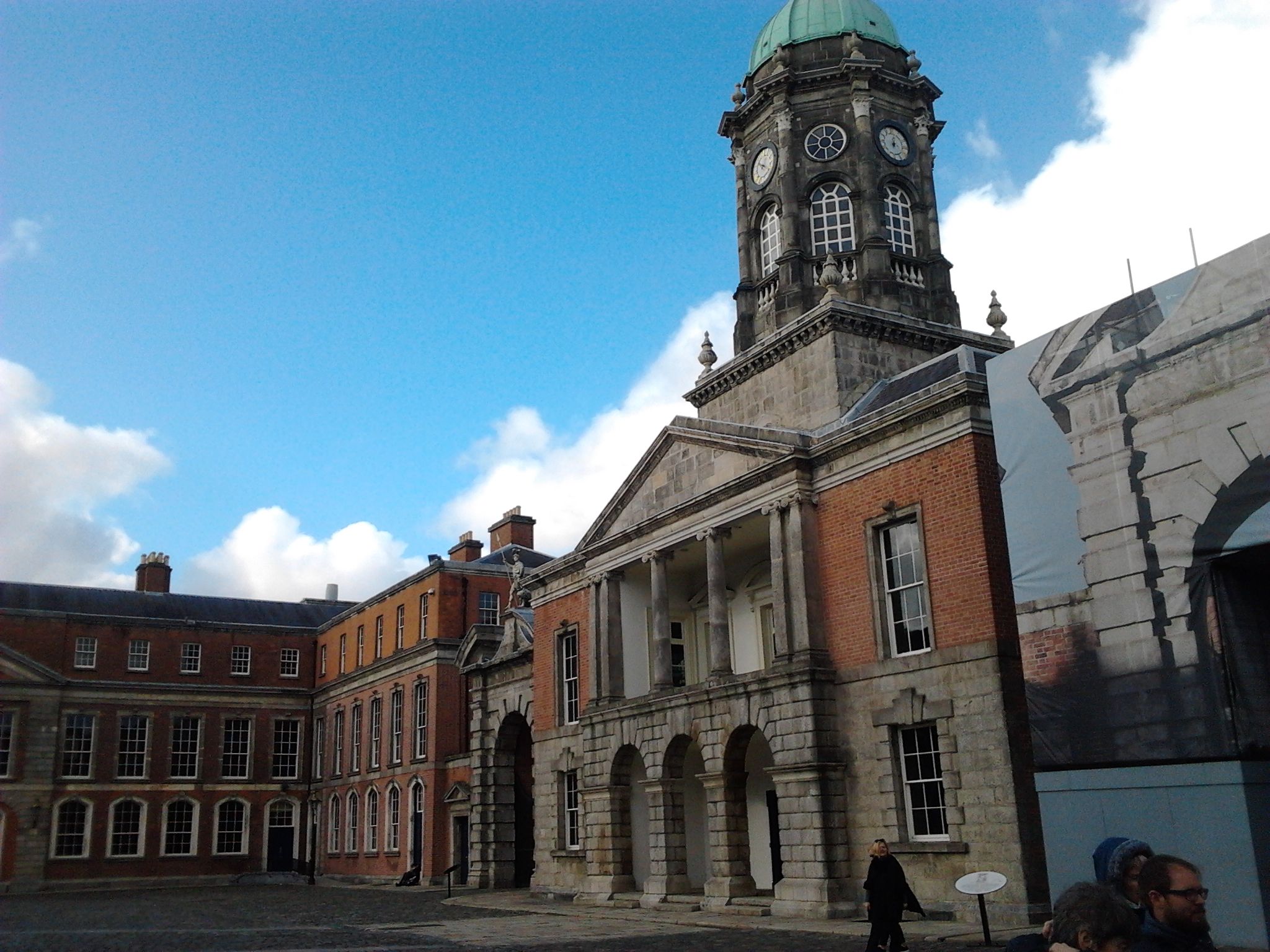
Dublin Castle stands on the spot where Dublin began. In the ninth century Viking raiders landed at the confluence of the Liffey with its tributary the Poddle. On the shore of this dark pool they established the Danish settlement, taking its name from the Gaelic for the pool: Dubh Linn. The Norman invasion three centuries later led to the building of Dublin Castle by order of King John in 1202. For eight hundred years it was the centre of foreign power. After Independence the Castle was used for state occasions and became a major tourist attraction. There’s a garden on the site of the old Dubh Linn, near the Chester Beatty Library which holds a priceless treasure of Oriental manuscripts, art and artifacts.

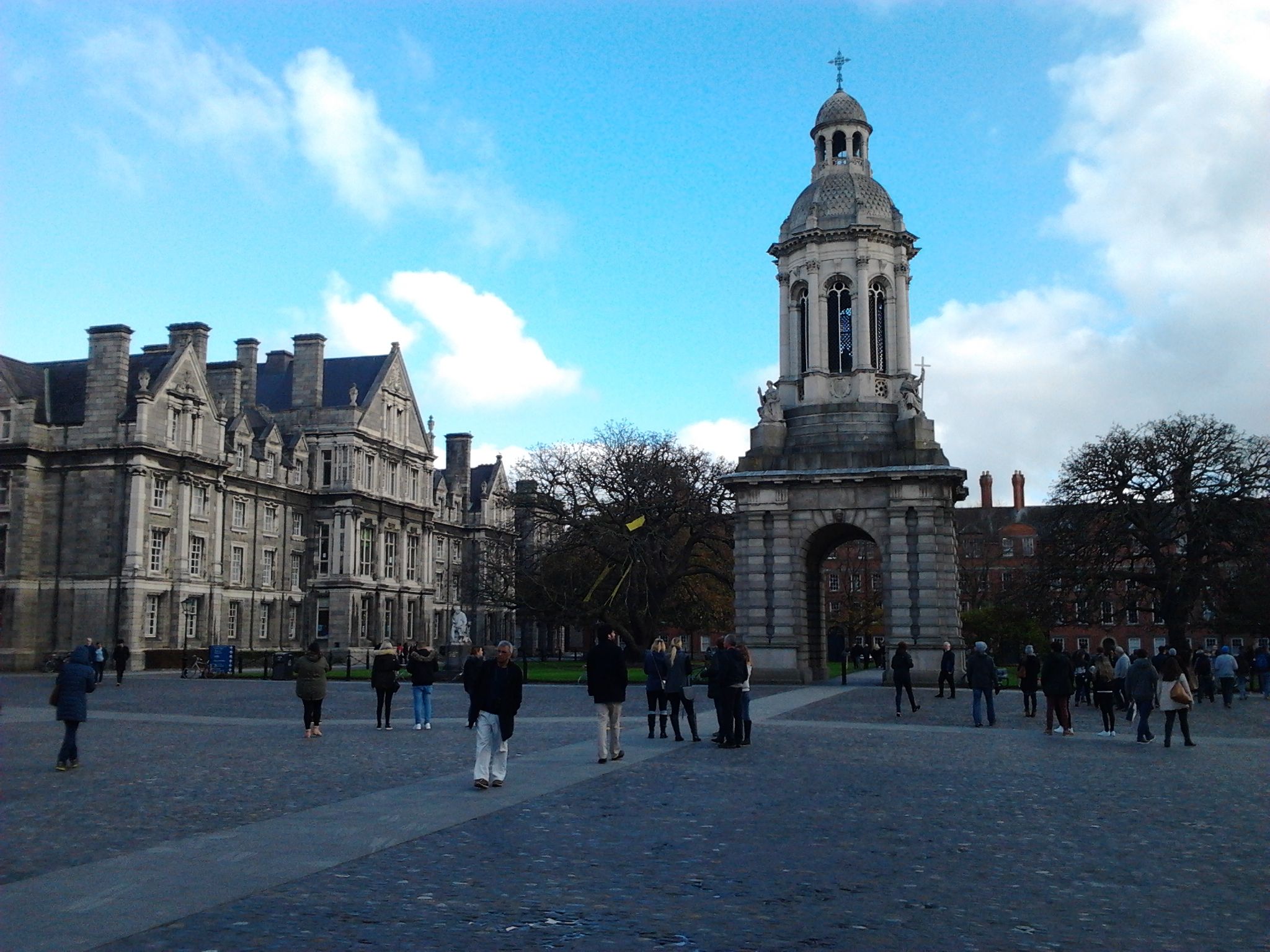
Trinity College campus is an oasis in the swirling centre of the city. Founded in the reign of Elzabeth at the end of the 16th Century it has become one of the most prestigous colleges in the Enlish speaking world. It houses the Book of Kells and its Library by right holds every book published in Ireland and Britain. 

The National Gallery is one of a quartet of public buildings flanking Leinster House, Ireland’s Dail (Parliament). The National Museum and Library face Kildare St, while the Gallery and the Natural History Museum (or Dead Zoo) face Merrion Square. The Gallery came from the Great Exhibition of 1847 on Leinster Lawns, proposed by Railway developer, William Dargan. The collection features the best of Irish art including Lavery, Yeats, Burton, Orpen, and international greats including Vermeer, Turner, Caravaggio and Monet. An extensive portrait gallery features contemporary and period art. 

The Hugh Lane Gallery on Parnell Square was founded as Dublin’s Metropolitan Gallery. It is named for Hugh Lane, a young collector who amassed a fine collection of Impressionst art. He died on the Lustania in 1915, not quite forty.

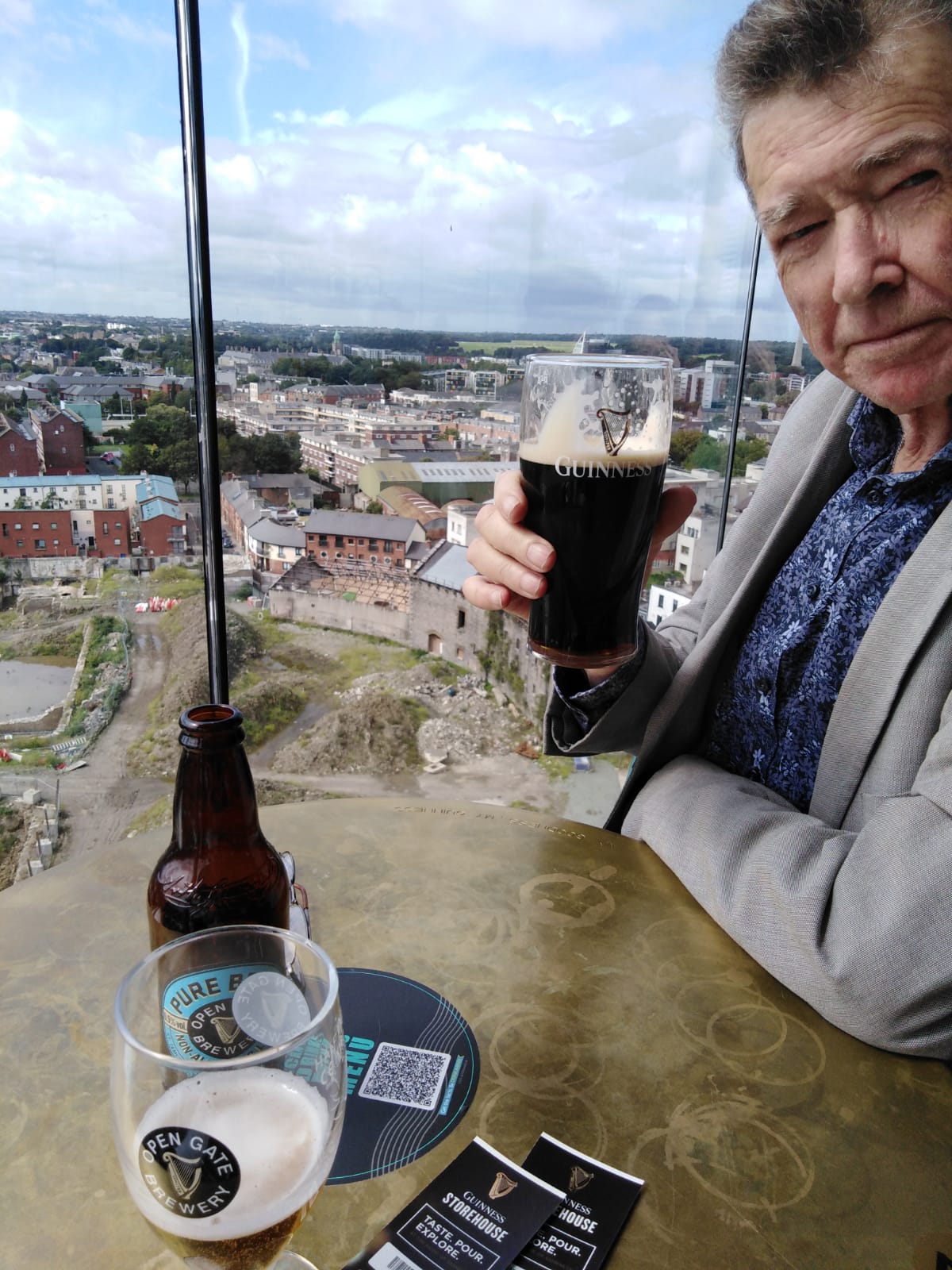
Arthur Guinness established his brewery in 1759. The clocks of Dublin have been stuck at a minute to six ever since. In our heads, at least. The St. James’s Gate Brewery lies in the Liberties to the southwest of the city. A visit to the Hopstore will give you the full story, followed by a creamy pint in the elevated splendour of the tenth story Gravity Bar.

Or, you could go to one of Dublin’s many pubs.

5 Top Pubs

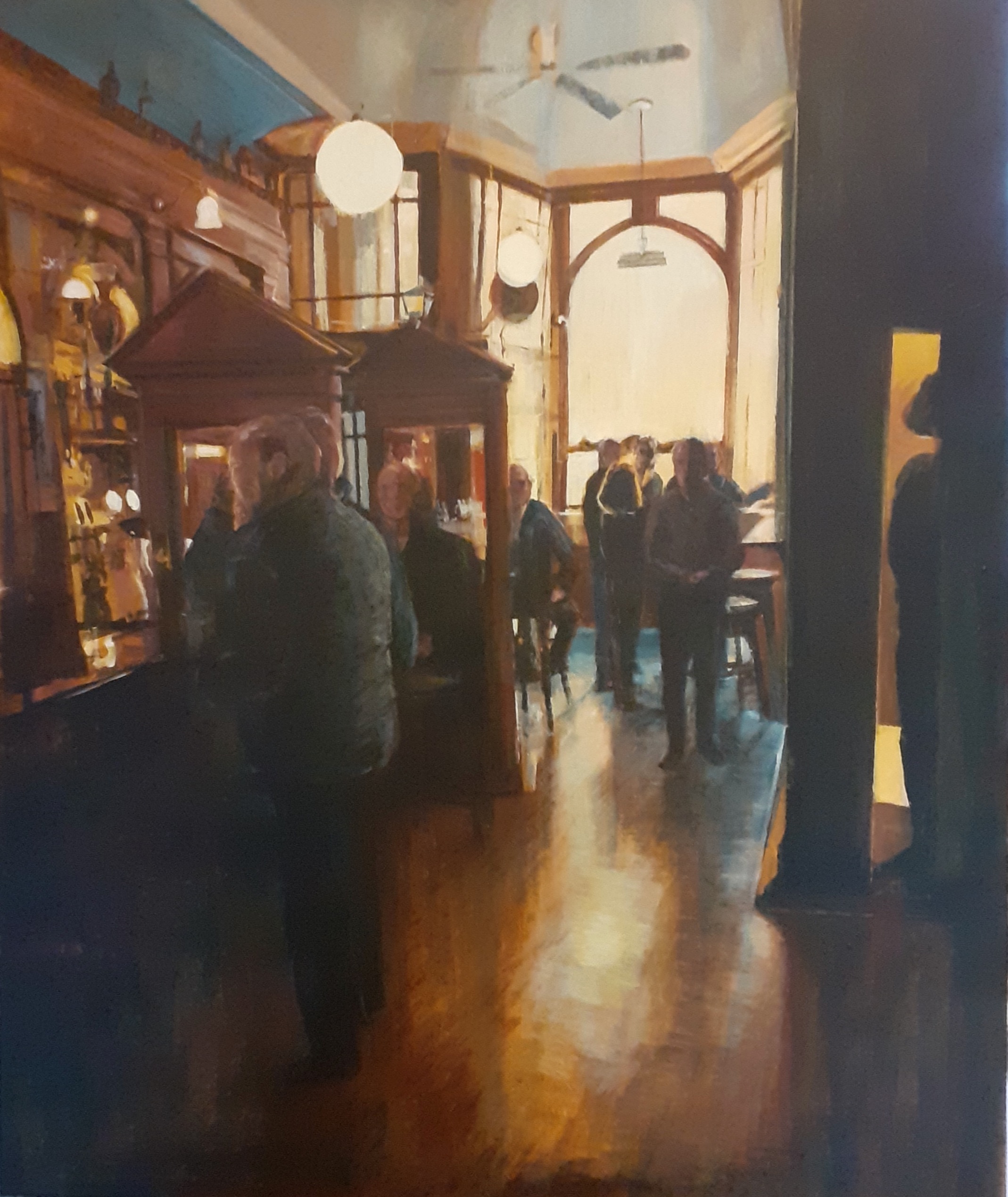
Dublin is packed with great pubs. There is no definitive syle, they come in all shapes and sizes. The Victorian and late Edwardian are perhaps most typical. Many’s the blog and pubication that has given the top ten or twenty. It all depends. For what it’s worth, my favourite five are:

1. O’Donoghue’s of Merrion Row, 2. Toner’s of Baggot Street, 3. The Palace in Fleet Street, 4. Grogan’s Castle Inn on Sth William St, 5. The Stag’s Head at Dame Court.

That’s maybe enough for one pub crawl, but there are many more. James Joyce’s Ulysses posed the riddle of the impossibility of crossing Dublin without passing a pub. It is easily solved, of course. Don’t pass any, just go in. If indeed you do pass the Stag’s Head, and you shouldn’t, it’s near enough the definitive old style Dublin pub. 

With all that drink, the only people to remain upstanding in Dubln are its statues. Dublin’s statues immortalise figures from fact and fiction

5 Top Statues

1. Molly Malone on Suffolk Street, 2. Phiil Lynott on Harry Street, 3. Oscar Wlde at Merrion Square, 4. James Joyce, 5. Patrick Kavanagh.

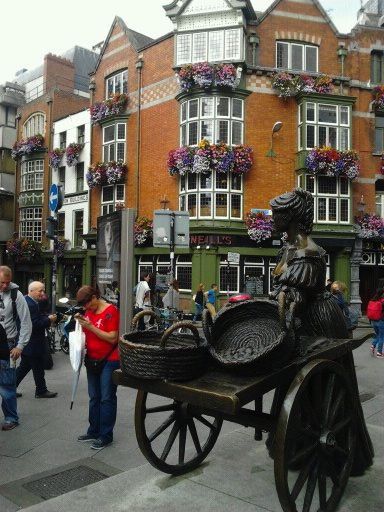
The statue of Molly Malone by Jeanne Rynhart dates from Dublin’s millennium celebrations in 1988. Molly steps from the air of a song to become flesh, or bronze at least.

In Dublin’s Fair City

Where the girls are so pretty

I first set my eyes on sweet Molly Malone.

As she wheeled her wheelbarrow

Through streets broad and narrow

Crying cockles and mussels, 

Alive, alive-oh!

The song is of obscure provenance. A music-hall ballad of the 1880s it was attributed to Scottish songsmith, James Yorkston. It has become the anthem for the capital city. She can certainly wheel her wheelbarrow. First time I saw it ‘twas at the bottom of Grafton Street, now it stands outside Saint Andrew’s Church on Suffolk Street.

Molly was a seventeenth century barrowgirl who earned a bit on the side plying the oldest profession. The song certainly alludes to sex. Cockles and mussels has salacious connotations. Young lovers and visitors to the Fair City have taken the photo opportunity the statue offers. It is traditional to fondle one or both of Molly’s breasts, giving them a sunburst emphasis.

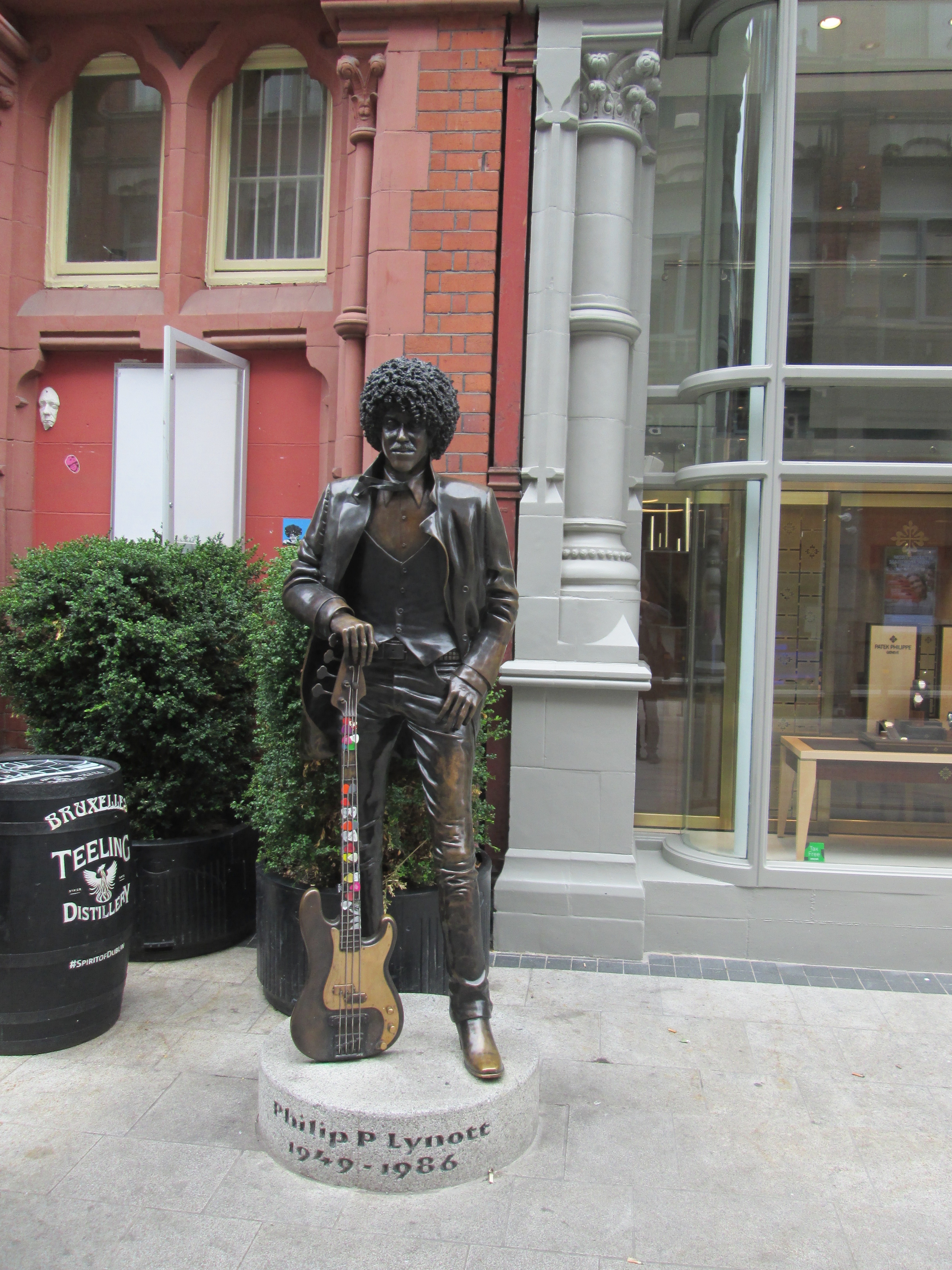
At Bruxelles Pub near the top of Grafton Street, another lifesize statue vies with Molly for popularity. Phil Lynott was black and Irish as Guinness and leader of Thin Lizzy, kings of the Dublin Rock scene. They took a rocked up version of Irish trad balled, Whiskey in the Jar, to the British charts. The ballad records the misadventures of a seventeenth century highwayman whose lover in Lynott’s version is called Molly. So no accident that they’re still close. 

But me I like sleeping

Especially in my Molly’s chamber

But here I am in prison

Here I am with a ball and chain.

(Whiskey in the Jar)

Lynott died in 1985, aged just thirty six. The video for his solo hit, Old Town, features him swanning about Grafton Street, Ringsend and the Long Hall pub on George’s Street.

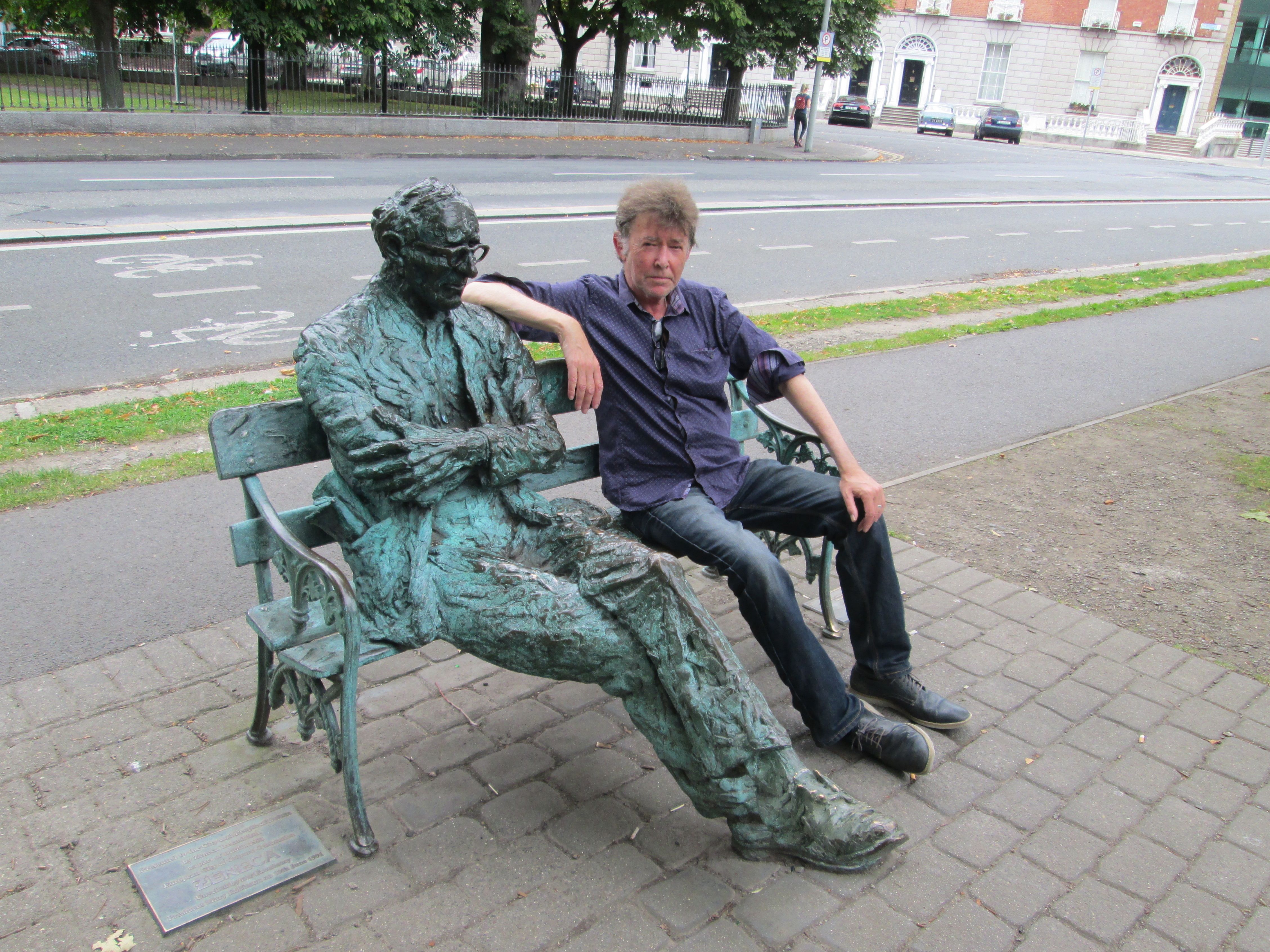
Oscar Wilde reclines sedately at the northwestern corner of Merrion Square. James Joyce saunters down North Earl Street across from the GPO. Another writer, poet Patrick Kavanagh, reclines on a bench on the Grand Canal at Baggot Street Bridge.

On Pembroke Road look out for my ghost

Dishevelled with shoes untied

Playing through the railings with little children

Whose children have long since died

Soho in the Rain

I took shelter from a shower

And I stepped into your arms

On a rainy night in Soho

The wind was whistling all its charms

This painting is from my recent trip to London. We are on the front seat of the 14 bus heading down Shaftesbury Avenue. Soho is to our right and we are about to pass the Sondheim Theatre. Formerly the Queen’s Theatre, it was refurbished and renamed in 2019 and has hosted Les Miserables since 2004. London’s longest running musical has been playing since 1985. It is a sung through musical, without spoken text, conceived by Alain Boublil with music by Schonberg and is based on Victor Hugo’s novel.

Soho itself abounds in great songs, some of which I have included in previous posts. Warren Zevon’s Werewolves of London is perfect for howling at the moon. Last Night in Soho by Dave Dee, Dozy, Beaky, Mick and Tich was my very first record. But there are few that capture the spectrum of love and longing as movingly as Rainy Night in Soho. It was was written by Shane MacGowan and released by the Pogues in 1986, There have been many cover versions since including Bruce Springsteen, Bono, Bob Dylan and Nick Cave.

We watched our friends grow up together

And we saw them as they fell

Some of them fell into heaven

Some of them fell into hell

Glasgow Again

Glasgow is an hour’s flight from Dublin. The airport is south of the city and the bus takes us there in thirty minutes for £11. The driver doesn’t have change of a fifty, Britain being weirdly averse to high denominations, but my friend obliges and pays the fare with his magic phone. We are dropped off just below Blythewood Square, close to our hotel. When I say below, I mean below, remembering now how hilly Glasgow is. The city’s modernist grid system accentuates this, with a quite San Franciscan undulation of steeply sloping sidewalks and buildings. 

The Sandman Hotel is on West George St. The desk is excellent and we are given comprehensive guides and recommendations for our wining, dining and cultural pleasure. Plenty of that in Glasgow for sure. A short walk around the neighbourhood brings us past the Glasgow Art Club. But why pass when there’s people wandering in with paintings under their arm? We figured to blag our way in, though in fact it’s open to public callers; simply ring the bell. Eslyn Barr of the Paisley Art Institute, fellow inmates of the building, gave us a fascinating tour. The Club has occupied these premises on Bath Street since 1893 when a gallery was added. Architect John Keppie designed this and was assisted by his draughtsman and future partner Charles Rennie Mackintosh. Eslyn shows us the Mackintosh frieze and the beautiful paintings and artefacts accumulated over the years. The members exhibition is also going up, a continuation of such predecessors as John Lavery, George Pirie and James Paterson. These artists would feature prominently on our trip.

The next morning we breakfast at Wetherspoon’s. This becomes a habit, as it had on a previous trip. What’s not to like? Full Scottish with Haggis and copious cups of coffee. My friend’s magic phone isn’t accepted here so my cash is king. This branch on Sauchiehall Street is called Hengler’s Circus after the circus which perfpormed nearby in the early twentieth century. Iillustrations on the walls tell the history of Hengler’s, the Empire Theatre and other aspects of Glasgow history, including the Glasgow Boys. And you can drink till the wee small hours.

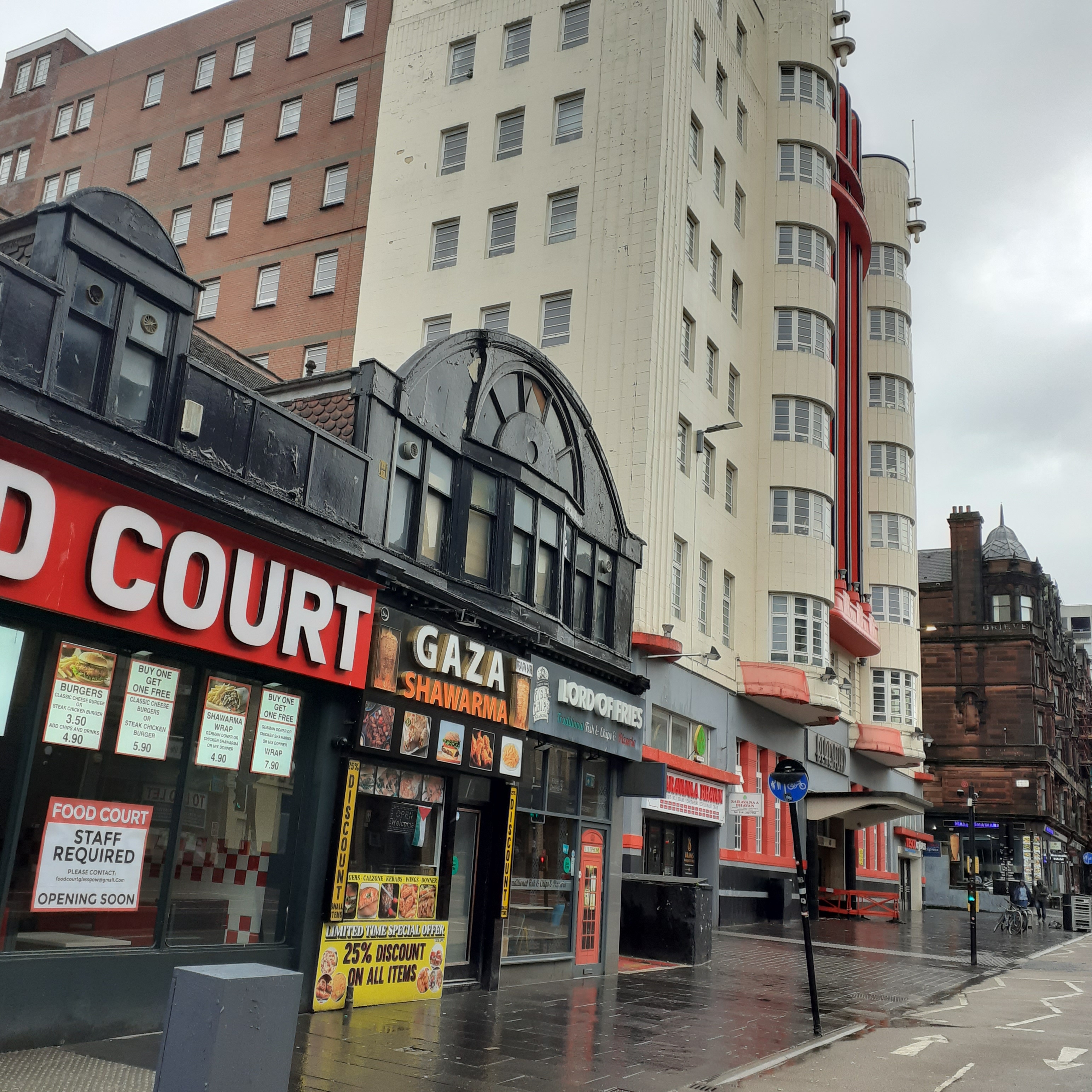
We aim for the open top bus tour and a stroll down Suachiehall Street. The street makes for a good point of orientation. It cuts east west through almost the entre city. Towards the city centre it’s pedestrianised and a bustling shopping precinct. The name comes from the Scots for Willow Meadow, as the area once was before the city expanded in the boomtimes of the nineteenth century. It was first the haunt of the well to do in fine Victorian townhouses. The Art Deco Beresford Hotel was built in 1938 for the Empire Exhibition. Rising to eight stories it was referred to as Glasgow’s first skyscraper. A student residence and briefly a casino, it is now an apartment block, while newer, higher skyscrapers abound. A browsing highlight was poster shop On a Wall Near You. A world of iconic images, stone age, rock age space age, you name it.  Picture heaven, and paraphernalia besides, with teeshirts, tote bags and, my addiction, fridge magnets. Smiles all round.

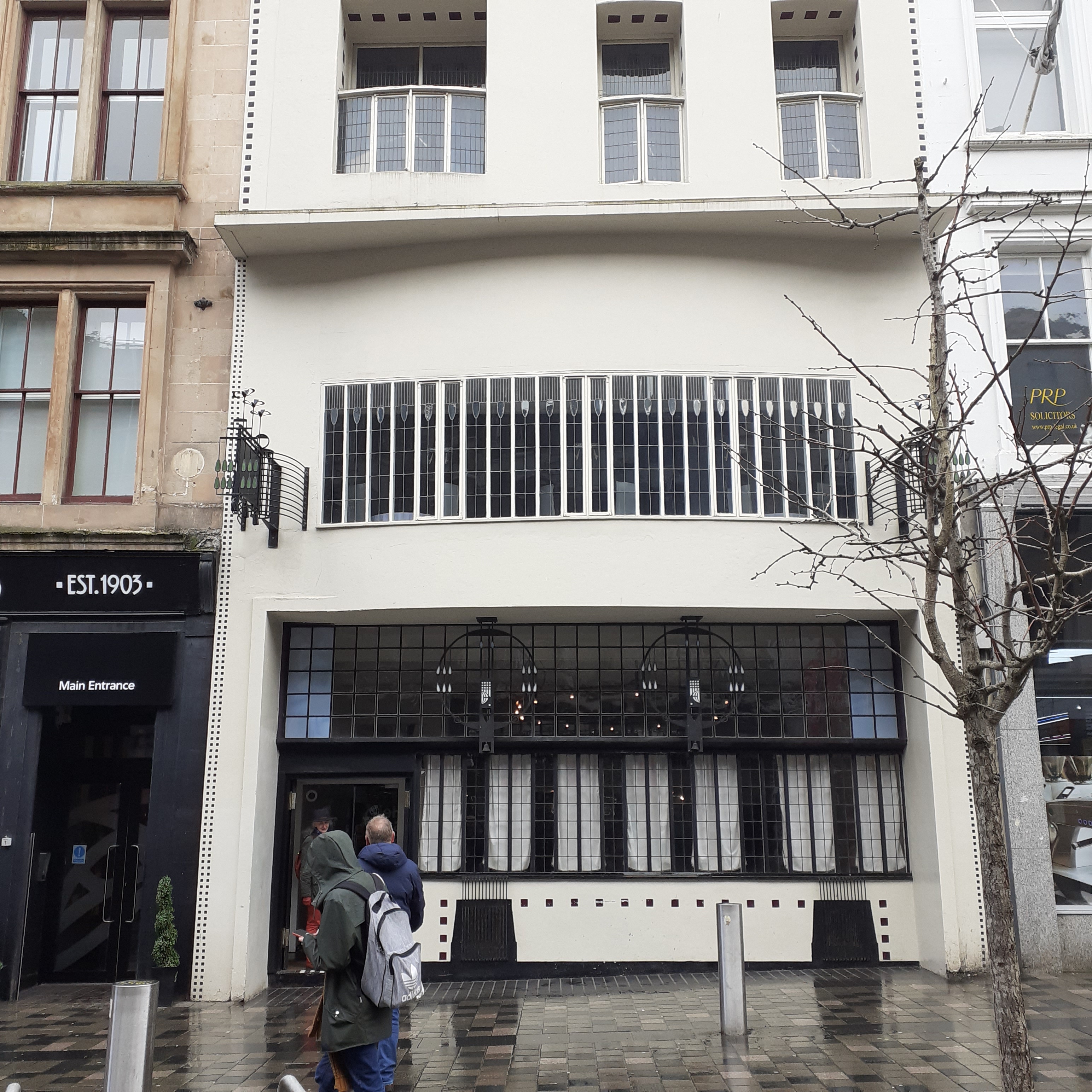
I lead a short detour to the School of Art on Renfrew Street, Mackintosh’s most famous architectural work. Seriously damaged by fire in 2014, it was undergoing extensive reconstruction when last I visited. It burned down again in 2018, The School was founded in 1845 and gives degrees in Architecture, Fine Art and Design. In 1909 Mackintosh’s building was completed and became a testament to the genius of its creator. Hopes are to have it reinstated by 2030. In consolation, back on Sauchiehall we made for the Mackintosh Tearooms. Miss Cranston’s project for sober sipping saw her open four tearooms in the city. Tea Rooms were an intrinsic part of Glasgow life in the late Victorian age. Miss Cranston commissioned Mackintosh to design her Willow Tearooms on Sauchihall Street in 1903.  He created an elegant Art Nouveau merger of modern glass and steel craft with the exotic aesthetic of the Orient.

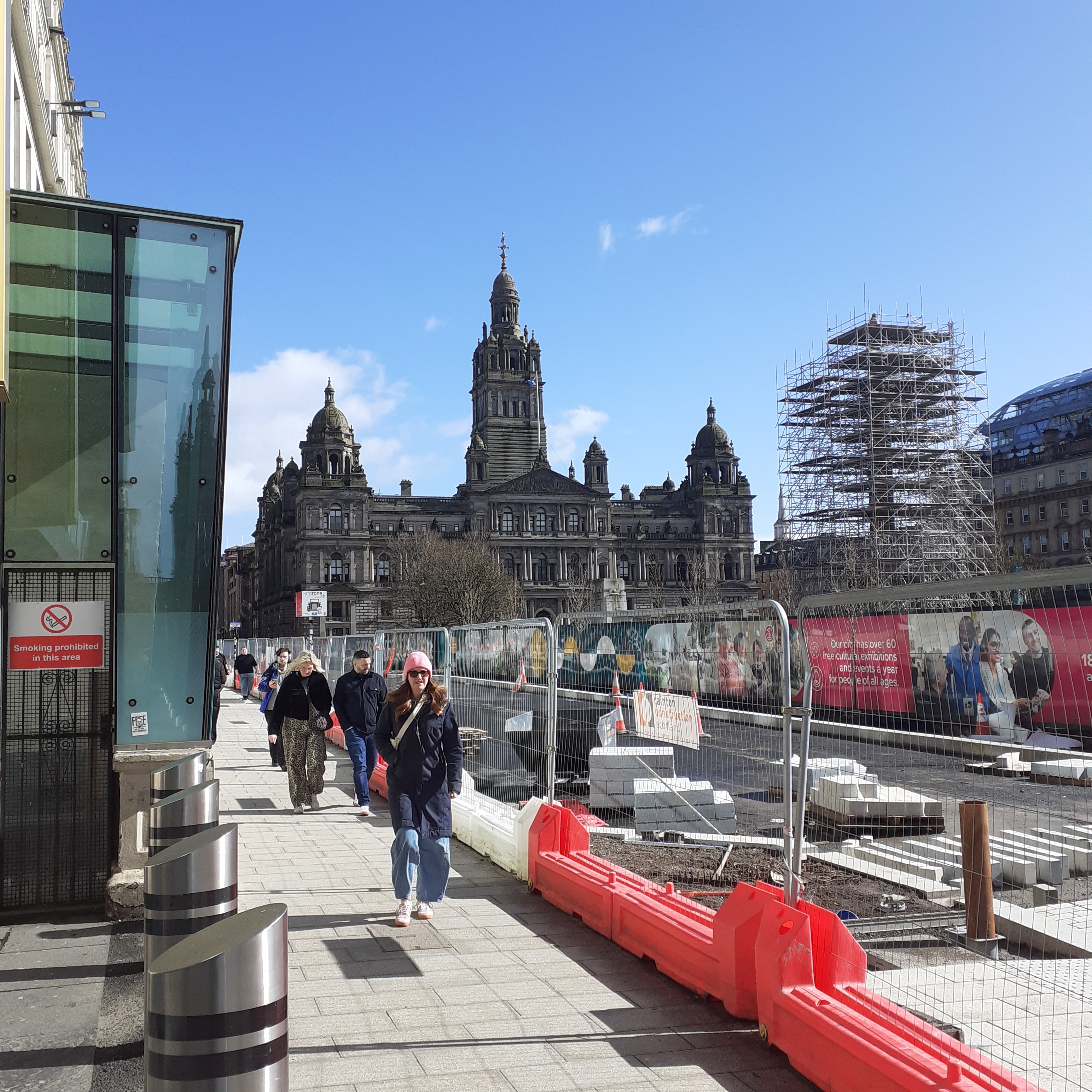
The open top bus eludes us. It should be based on George Square but that whole area was suffering from excessive repair and the bus was diverted elsewhere. Instead we spent the evening recuperating with food and drink in a variety of downtown bars including Malone’s Irish Bar. We saw Scotland suer a one goal deeat to Japan in a friendly at nearby Hamden Park. Indeed, Glasgow does boast that its the friendliest city in the world. For us it held true. It can be a bit like a thistle curry at times; spiky to begin with, but guaranteed enduring warmth.

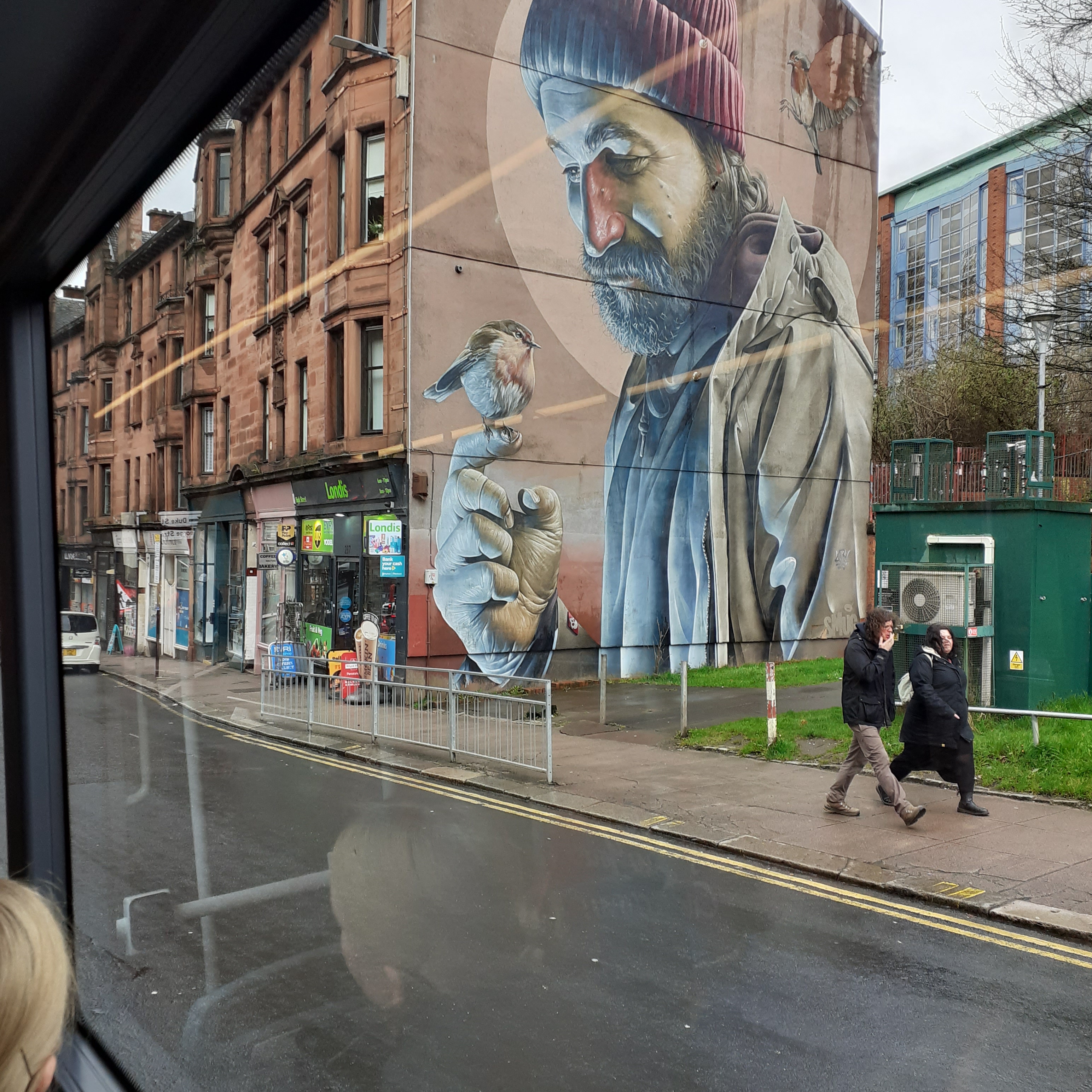
Tomorrow is another day and we find the bus actually departs from Cathedral Street. The audio guide gives a good chronological account of the city. Glasgow Cathedral is dedicated to St Mungo who founded the city in the 6th century. His four miracles of Glasgow are formed into a rhyme: Here is the bird that never flew, here is the tree that never grew, here is the bell that never rang and here is the fish that never swam. The bird he saved is illustrated by a startling mural on a gable nearby The Cathedral was begun in 1136 and the city grew around it. High Street and Trongate are a couple of the medieval streets remaining on the East side. 

This town was built on muscle and blood. Tobacco, cotton and slavery saw its port prosper in the eighteenth century. It became a gateway to the new world. With the Industrial Revolution, Glasgow became a European leader in industry and engineering, particularly as a centre of shipbuilding. The Clyde made Glasgow and Glasgow made the Clyde. Our tour takes us along the north bank of the river passing through scattered parkland and ambitious modern developments including the SEC Armadillo Arena and the Riverside Museum with the tall ship Glenlee.

Beyond the ring road motorway we enter the West End with its grand terraces and parkland. The area is famed for its restaurants and bars and home to some of Glasgow’s top sights. The scenic Kelvingrove Park is a central feature. Sylvan and sublime it is bisected by the River Kelvin The river’s name was appropriated for Baron Kelvin. The famous Irish physicist William Thomson was born in Belast in 1824 and for fifty years was professor of Natural Philosophy at the University of Glasgow. Here he figured that the coldest temperature possible, absolute zero, was -273 degrees Celcius. Even in Glasow.

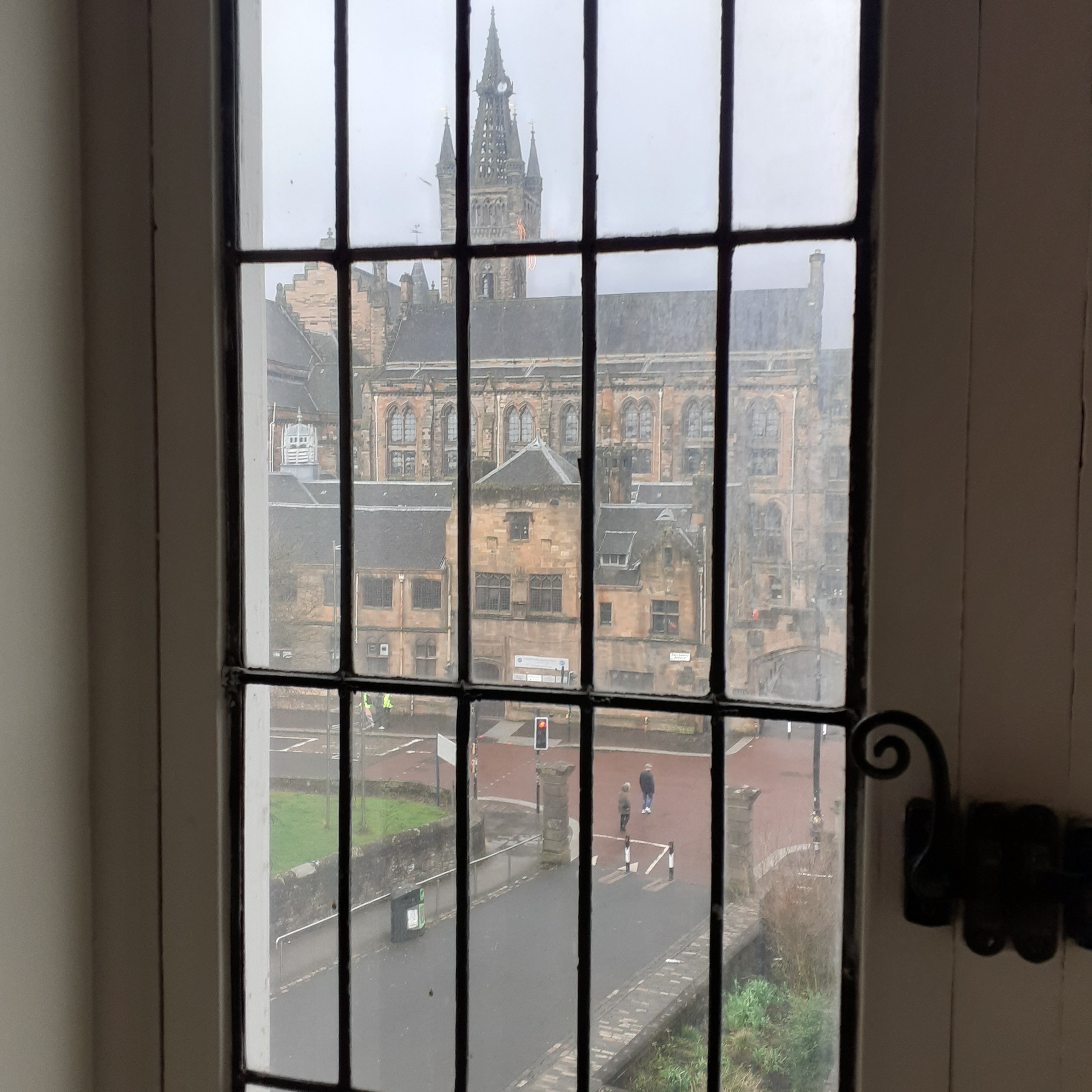
The University of Glasgow sits atop Gilmore Hill. Its majestic spire dominates the city. Across the road the Hunterian Museum has a large exhibition on Charles Rennie Mackintosh and his group, The Four. He and friend Herbert McNair and the sisters, Margaret and Frances MacDonald met at the Glasgow School of Art and later married; Charles to Margaret. She was a renowned decorative artist and worked in collaboration with her husband on many projects. The sisters flowing art style was influenced by Aubrey Beardsley, leading to the group being dubbed the Spook School. 

The Mackintosh’s lived right here. The modern museum was built on top of their terrace. The interior has been skillully recreated within the modernist building, preserving its aspect and most importantly the wonderful interior design Mackintosh imposed on the Victorian house. The Hunterian boasts a huge collection of Scottish and internastional paintings. The Glasgow Boys feature strongly with work by Patterson and Lavery amongst others. American artist James MacNeill Whistler is well represented, the University receiving a large body of his work by bequest. Whistler’s Scottish ancestry, the actual Whistler’s Mother, and the admiration of the Glasgow Boys helped bring this about.

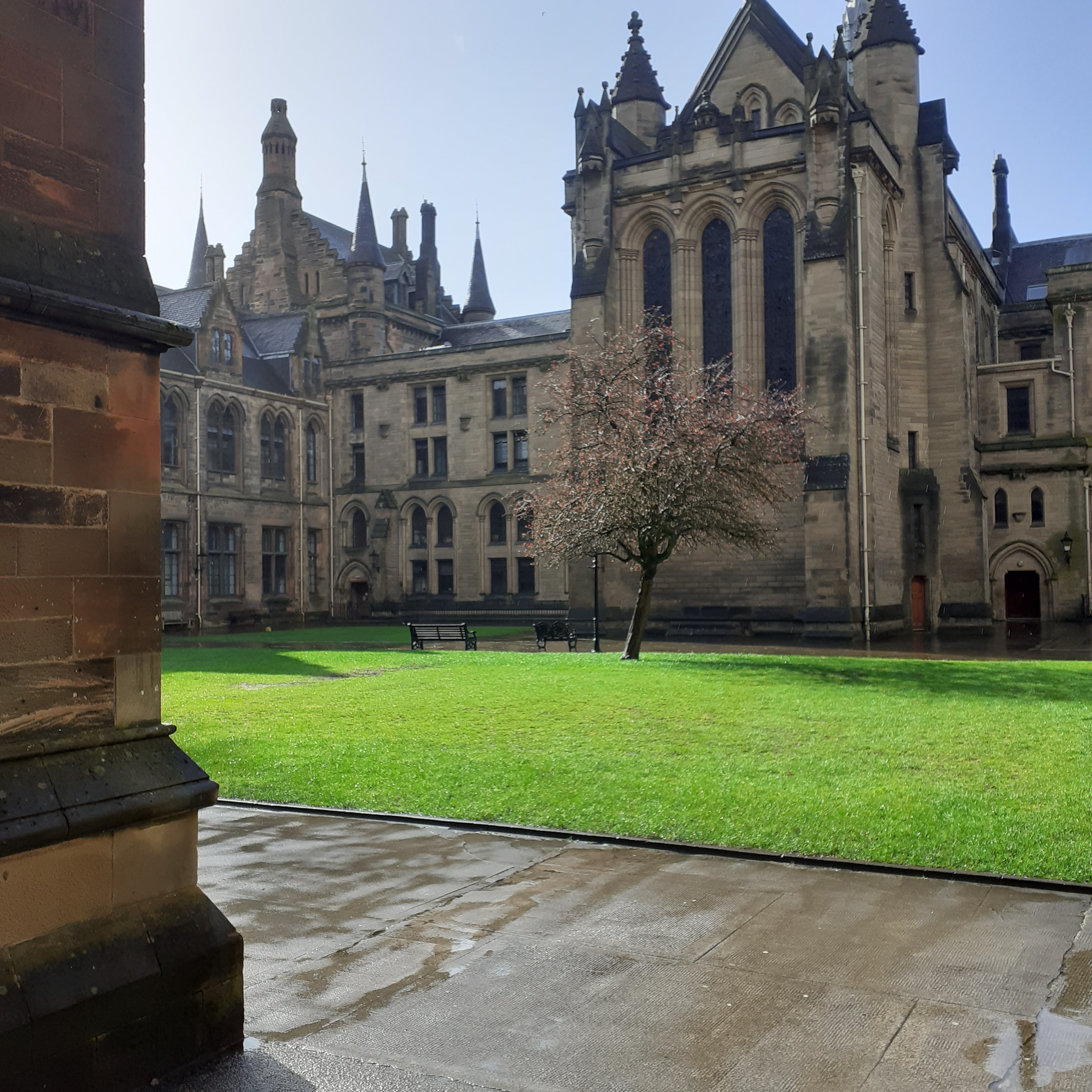
Rain falls as we cross the road to the University. We ghost through the quads and cloisters, evoking magical worlds, including Hogwarths it seems. The University was ounded in 1451 and moved here in 1870. The Gothic Revival spectacle was designed by George Gilbert Scott, crowned with the eighty five metre bell tower in 1887. 

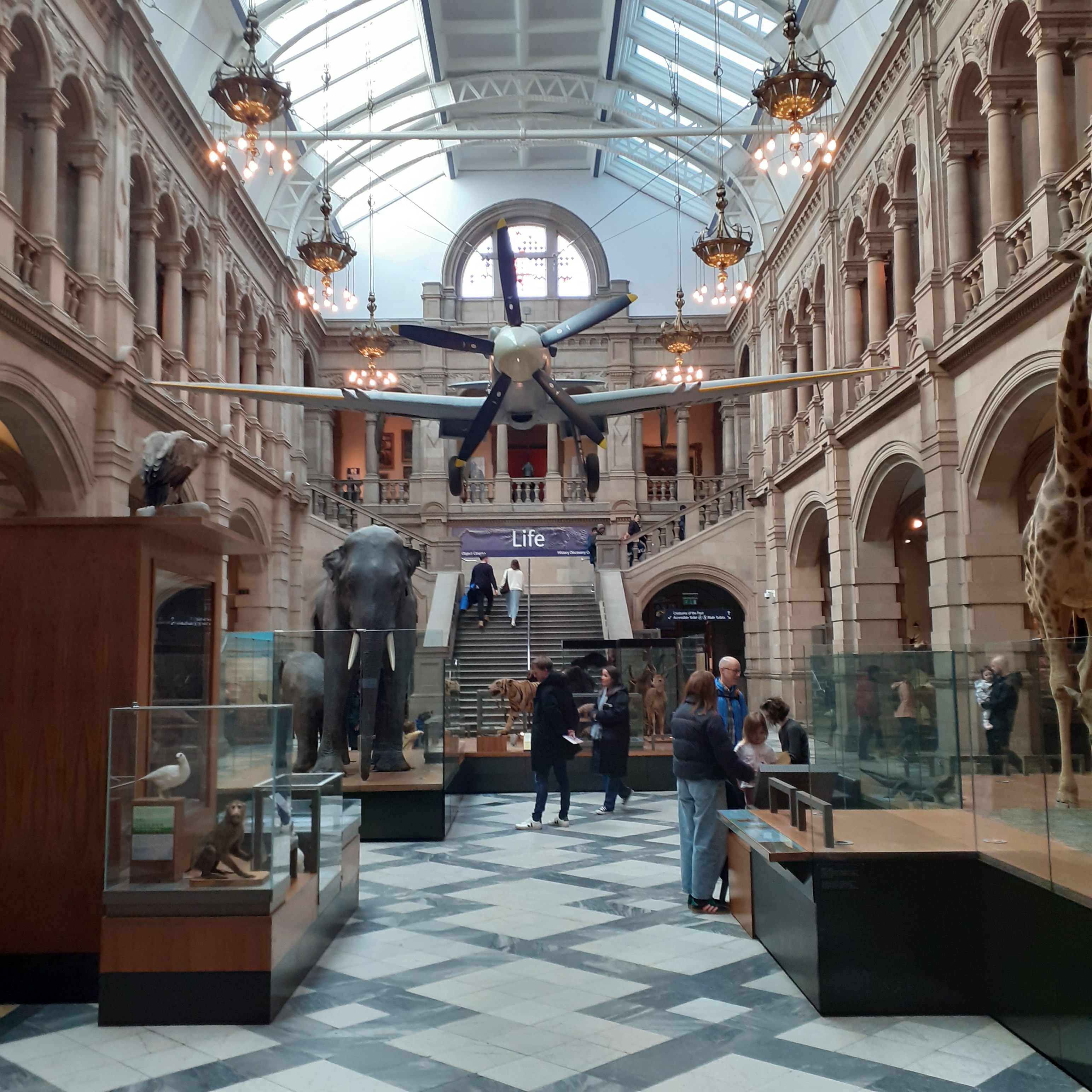
Downhill through parkland and over the Kelvin River brings us to the Kelvingrove Museum. Completed at the start of the twentieth century, the red sandstone Baroque temple houses a richly varied collection of art and artefact. The main concourse is dominated by the classical pipe organ which booms into life at lunchtime when there is a regular recital. It is blasting out music to a lively throng of all ages as we arrive. The ground floor houses an eclectic and dynamic exhibition, including an Elephant and a Spitfire, a vernacular history of Glasgow and an Egyptian collection. The art again features the Glasgow Boys, Mackintosh, Scottish Colourists and French Impressionists. Floating above all is Salvador Dali’s most coherent masterpiece, Christ of Saint John of the Cross. This famous work places us, the viewers, at a vertiginous angle. Along with the painting we find ourselves being borne heavenwards. But heaven must wait and we take the bus back to the hotel. Time for rest and recreation, and another night tossed about on the waves of Glasgow’s undulating streetscape. Pure magic.

When I look out my window many sights to see

When i look in my window so many different people to be

That it’s strange, so strange

You’ve got to pick up every stitch

You’ve got to pick up every stitch

Must be the season of the witch

Donovan Leitch is a local boy, as is apparent on his song Season of the Witch from his third album Sunshine Superman (1966). The song is soaked in urban paranoia and possibility. Its timeless span reaches from Celticism to modern gothic. It is almost an obligitory soundtrack; in the last month I’ve heard it on three or more tv series, including Australia’s The Twelve and Norway’s Harry Hole series. Strange indeed.

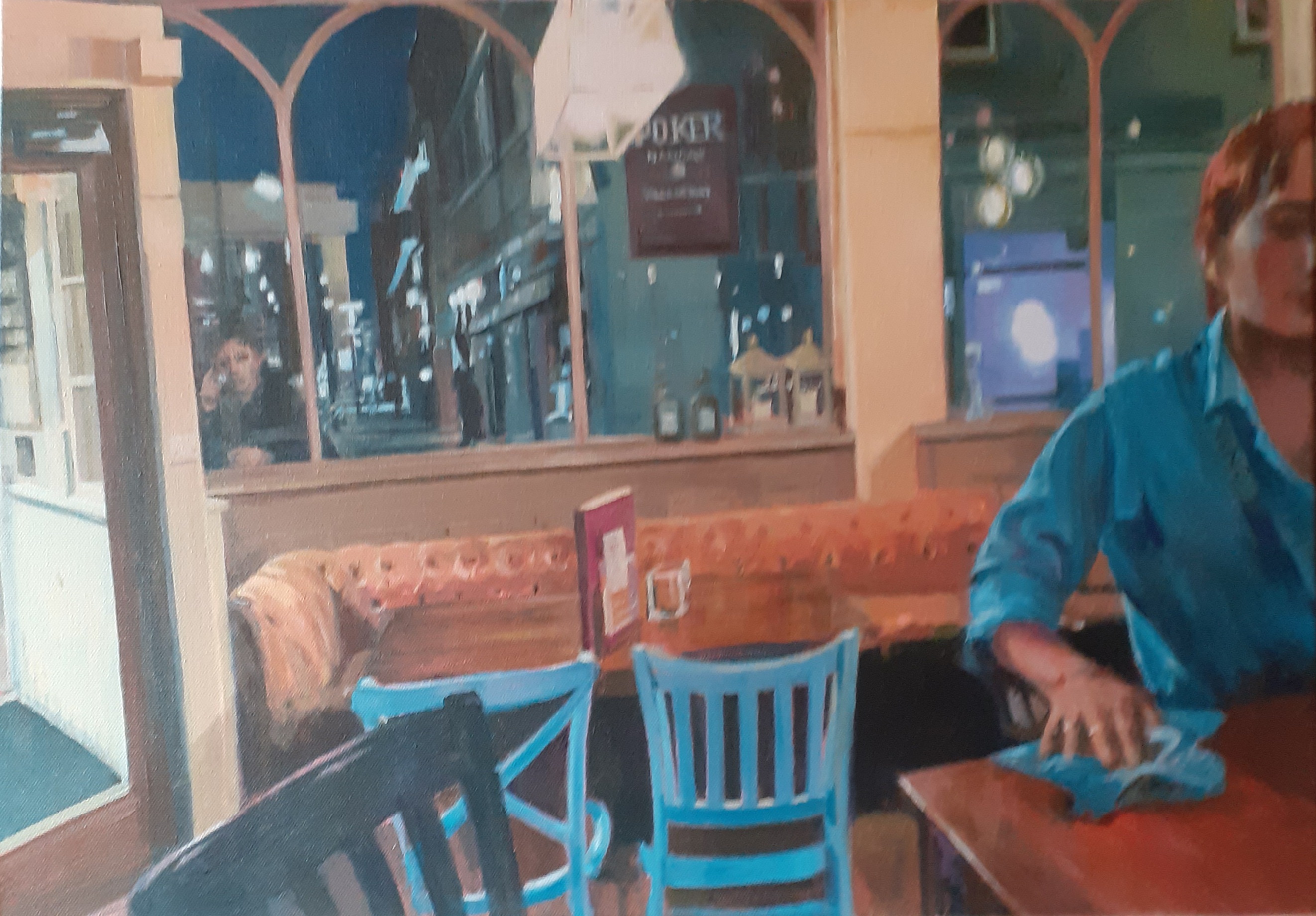
A Bar in Bayswater

I stayed in Bayswater, London, last year. This acrylic is the view from a local bar looking towards Main Sreet, Queensway that is. I have returned from exploring the area of white Victorian terraces and dinky squares. Farther on, I spent much of the evening on Portobello Road known for its street market. I had never walked it before, though it had long fascinated me. It was a central feature of Martin Amis’s 1989 novel London Fields, in particular a pub called the Black Cross. There, Nicola Six, Keith Talent and Guy Clinch would meet and Nicola, the Murderee, set the macabre menage a trois (a quatre?) in train. Narrated by doomed author Sam Young and set in late 1999, it is a comedy tinged with foreboding. The end of the world, the end of love.

The Black Cross is a fictional bar, of course, so I made do with convivial reality. Portobello Road is at the pleasant end of culture clash. Cosy, quaint, common and sophisticated, like much of London’s inner patchwork, it is village and urban combined. Back in Bayswater, I find a bar invitingly empty. It is that dread hour: closing time. There are, as always, plenty of stories set to continue into the night. Not quite the Folies Bergere, more Edward Hopper meets Rock Dreams.

The Stranger Song is appropriate, given that the bar advertises poker nights on Monday and Wednesday. The 1955 film noir The Man with the Golden Arm starring Frank Sinatra was an inspiration. The song is one of the Songs of Leonard Cohen, his debut album from 1967. Cohen’s Golden Voice seduces the listener. No better man than Leonard for the chat up line, but here it is developed into an invitation. We are all strangers, our paths intersecting in those almost arbitrary places, hotels, bars and train stations.

You hate to watch another tired man lay down his hand

Like he was giving  up the holy game of poker

And while he talks his dreams to sleep, you notice there’s a highway

That is curling up like smoke above his shoulder