Unknown's avatar

About shane harrison

Short story writer, novelist, visual artist, journalist and librarian.

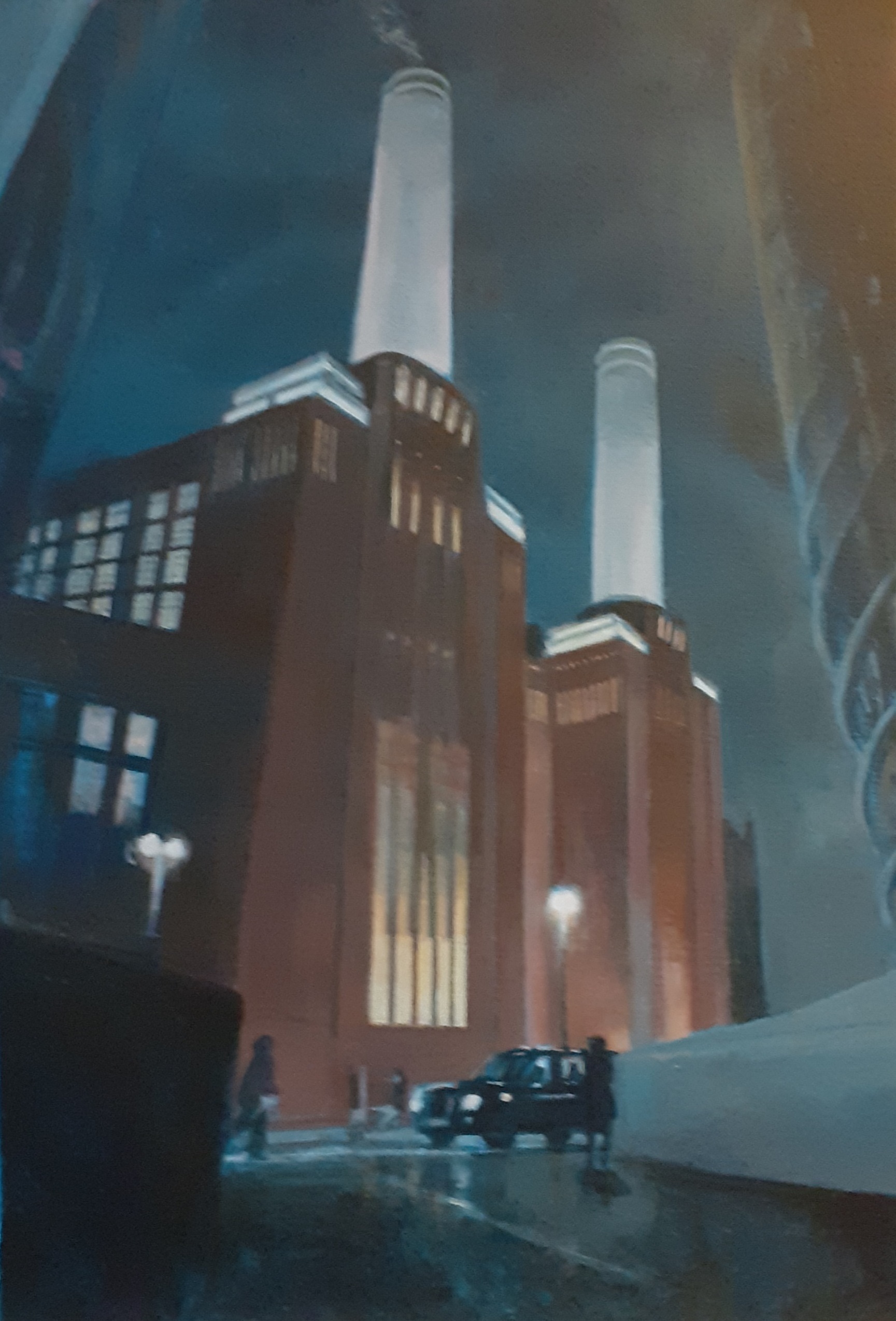
Battersea at Night

The Battersea Power Station is one of my favourite London buildings. With its four cream chimneys towering over the south bank of the Thames it has become a much loved icon of the city. Giles Gilbert Scott and Theo Halliday were the project architects and construction started in 1930 to be completed twenty five years later.

Since I am on a bit of a roll London-wise, I thought I would attempt to capture it on canvas. This view is from the back of the Station, and taken a little down the ramp of an underground car park. A taxi is waiting with a passenger inside and a woman at the door. Another person is caught in the headlights. The implied story struck me as dramatic, heightened by the Art Deco design and the evening illumination. The finished acrylic has something of a 1930s poster feel to it. M thinks it would make an excellent fridge magnet. I’m very happy about that.

Heaven, I’m in heaven

and my hearts beats so that I can hardly speak

And I seem to find the happiness I seek

when we’re out together dancing cheek to cheek

You know the song. Written by Irving Berlin for the musical Top Hat starring Fred Astaire and Ginger Rogers. We had front row seats for that in the West End some years back. We were in heaven, indeed.

After Astaire other versions include Ella Fitzgerald, Doris Day, Frank Sinatra Tony Bennett & Lady Gaga, and the sensational Alex Harvey.

Dublin Highlights

I was born and grew up in Dublin. I spend a lot of time travelling through Dublin and its environs. I live nearby, in the town of Bray just 20km down the coast. I have regularly posted on my Dublin adventures. Of late, I have noted some good posts from overseas travellers and locals alike (World in Your Eyes and Finding Your Feet). So I thought I might join in and post a few Dublin memories. Something of a greatest hits perhaps, or top ten tips type of thing.
5 Top Sights

The Liffey

Christchurch Cathedral

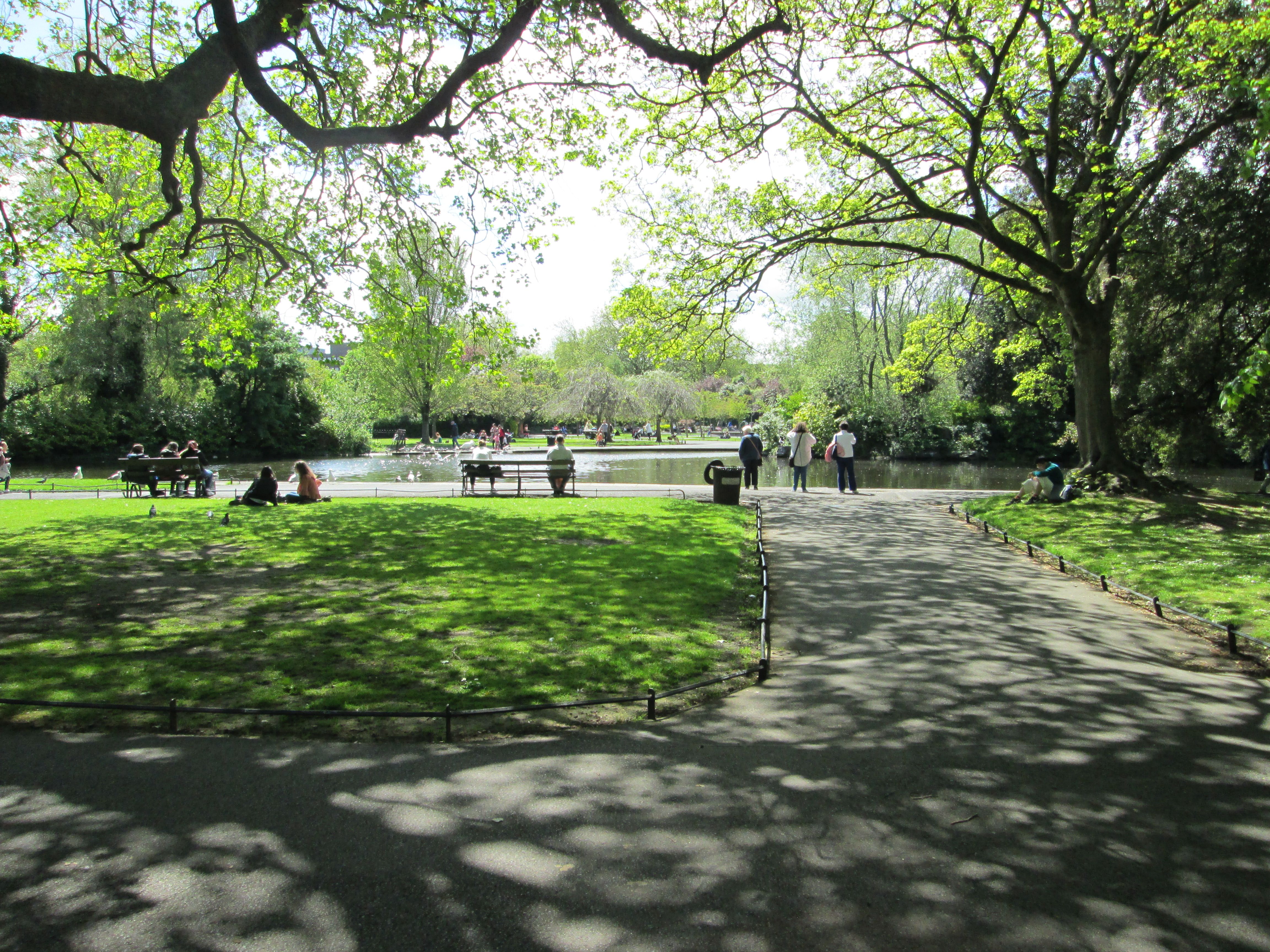
St Stephen’s Green

Phoenix Park

Grand Canal Docks

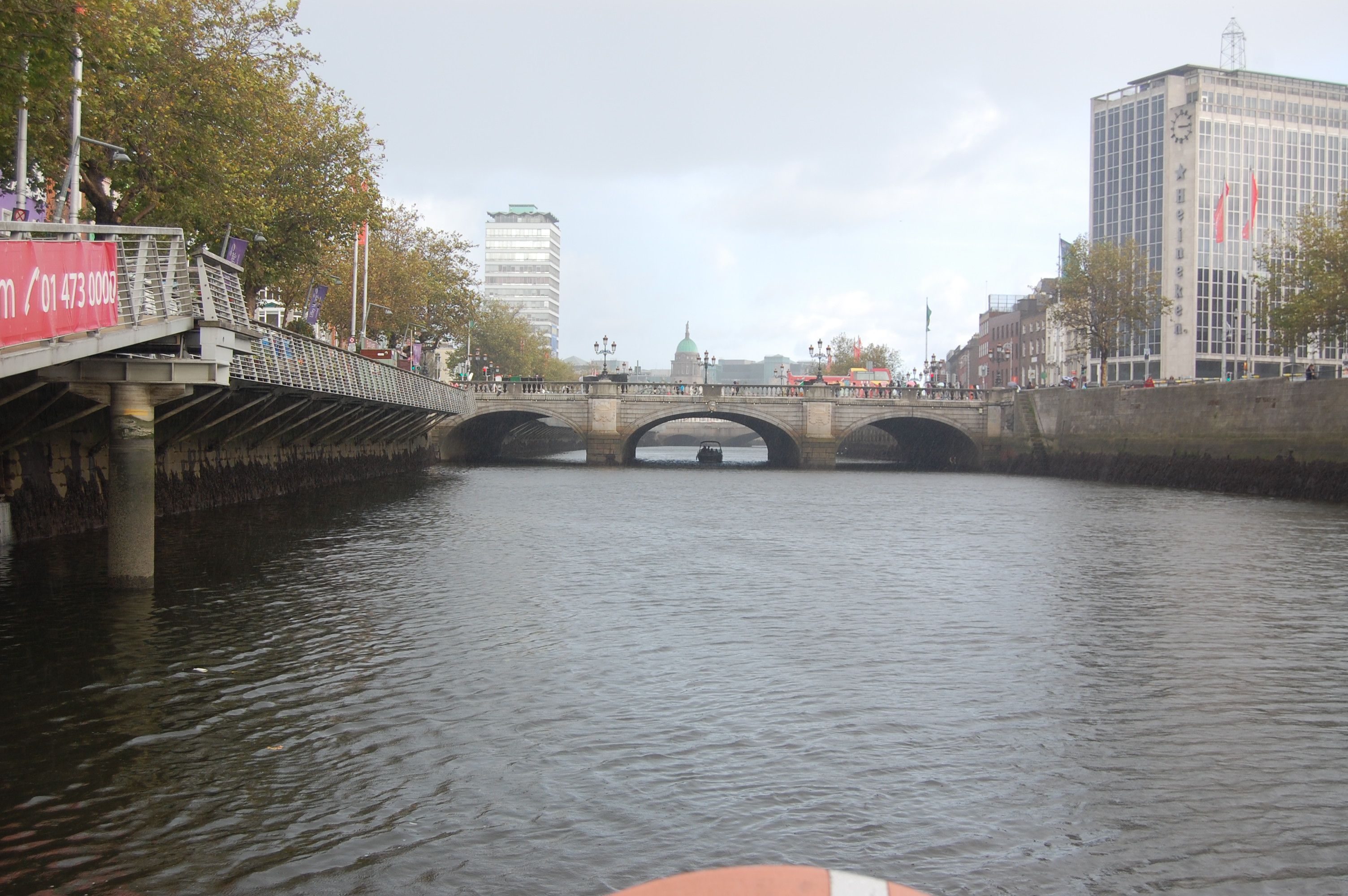
Dublin is a great city to walk round. Literally. My series Dublin’s Circular Roads describes a particular route. Another circle is provided by the two canals, the Royal to the North and the Grand on the south. Within their radius the city centre is divided into north and south sides by the River Liffey. It is the river that makes the city. Each bank is lined with quaysides from the estuary in Dublin Bay upriver to the western rail terminus, Heuston Station. The main buildngs to see are the Custom House and the Four Courts, both by Gandon and on the North Quays. The Ha’penny Bridge, a cast iron pedestran bridge spanning the river between Liffey St and Temple Bar is one of Dublin’s most iconic sights.
Christchurch is the more ancient of Dublin’s two cathedral’s. King Sitric Silkenbeard, overtaken with piety in his later years, established it in 1028. The Synod House to the west is joined to the Cathedral by an arched brdge, making it look like the main road passes through the ancient church. Wonderful.

Dublin can be heaven

With coffee at eleven

And a stroll in Stephen’s Green

(Dublin Saunter by Leo Maguire and sung by Noel Pucell)

St Stephen’s Green waits at the top of Grafton Street. In the seventeenth century it was a commonage on the outskirts of the city. It was walled in 1664 with access restricted to owners of adjacent properties until 1877 when Sir A E Guinness, Lord Ardilaun, put the park into public ownership. Entering through Fusiliers’ Arch, pathways flow around the ornamental lake. Young Dubliners and visitors lounge on the grass, taking time out from the big smoke. Meanwhile, on the western end of the city (just past Heuston) the Phoenix Park is a vast walled park housing the Zoo, the President and a herd of deer. 

The Grand Canal inscribes a sublime arc around Dublin’s south inner cty. It reaches the estuary at Grand Canal Docks where the modern highrise of Google Docks clashes appropriately with nineteenth century docklands. This area provides a fitting finale for my Dublin’s Circular Roads series.

5 Top Visits

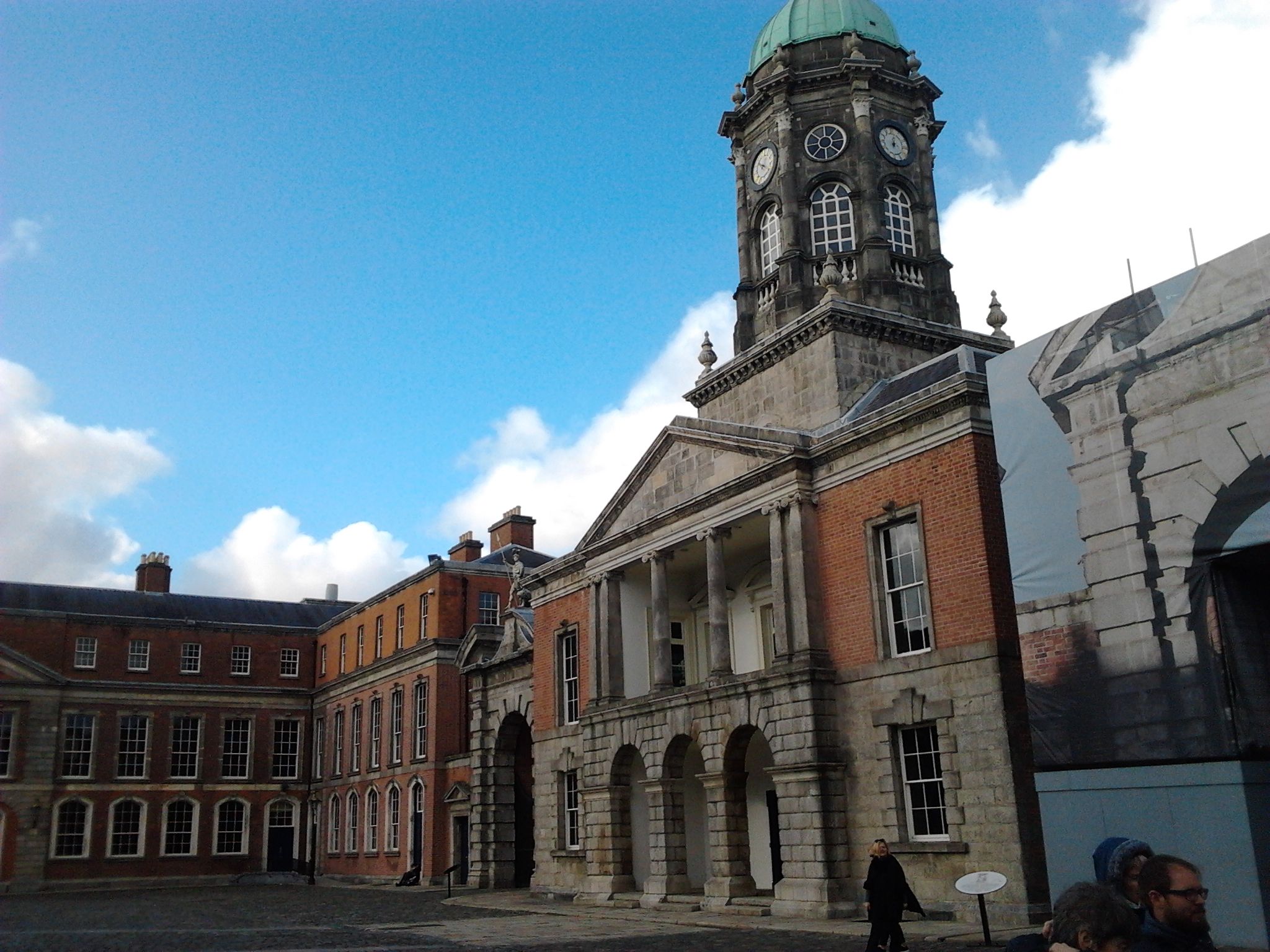
Dublin Castle

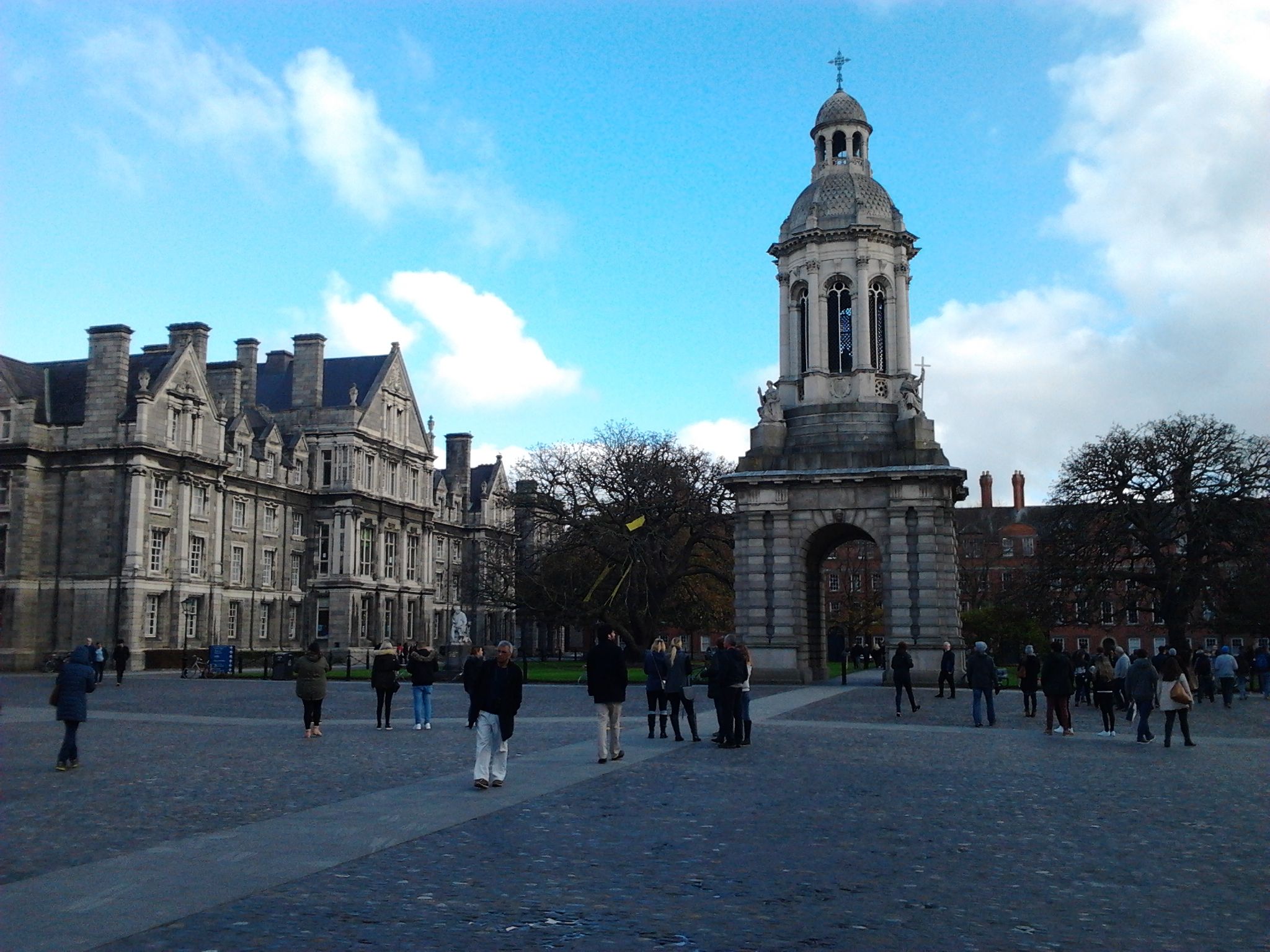
Trinity College

National Gallery

Hugh Lane Gallery

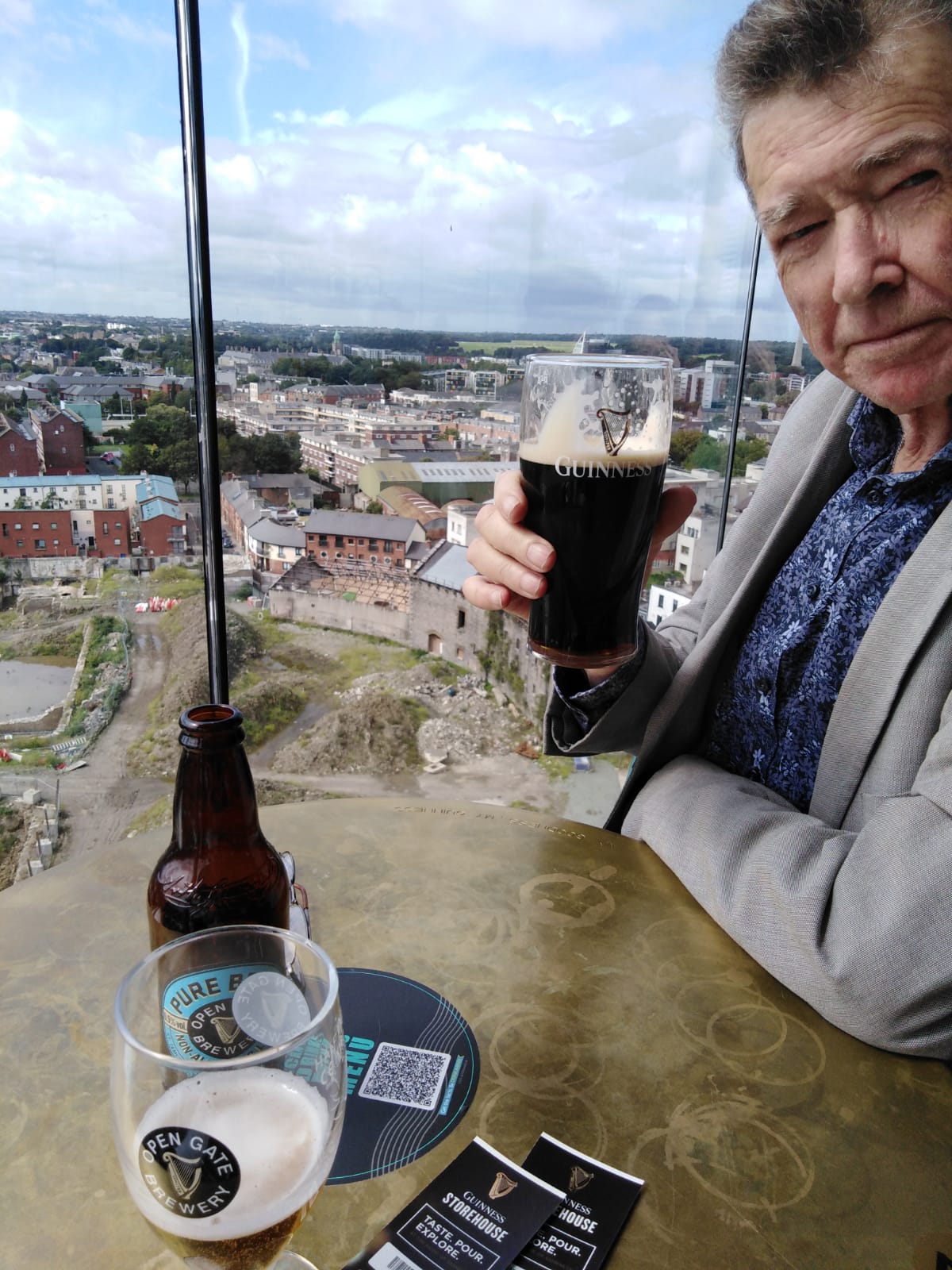
Guinness Hopstore

Dublin Castle stands on the spot where Dublin began. In the ninth century Viking raiders landed at the confluence of the Liffey with its tributary the Poddle. On the shore of this dark pool they established the Danish settlement, taking its name from the Gaelic for the pool: Dubh Linn. The Norman invasion three centuries later led to the building of Dublin Castle by order of King John in 1202. For eight hundred years it was the centre of foreign power. After Independence the Castle was used for state occasions and became a major tourist attraction. There’s a garden on the site of the old Dubh Linn, near the Chester Beatty Library which holds a priceless treasure of Oriental manuscripts, art and artifacts.

Trinity College campus is an oasis in the swirling centre of the city. Founded in the reign of Elzabeth at the end of the 16th Century it has become one of the most prestigous colleges in the Enlish speaking world. It houses the Book of Kells and its Library by right holds every book published in Ireland and Britain. 

The National Gallery is one of a quartet of public buildings flanking Leinster House, Ireland’s Dail (Parliament). The National Museum and Library face Kildare St, while the Gallery and the Natural History Museum (or Dead Zoo) face Merrion Square. The Gallery came from the Great Exhibition of 1847 on Leinster Lawns, proposed by Railway developer, William Dargan. The collection features the best of Irish art including Lavery, Yeats, Burton, Orpen, and international greats including Vermeer, Turner, Caravaggio and Monet. An extensive portrait gallery features contemporary and period art. 

The Hugh Lane Gallery on Parnell Square was founded as Dublin’s Metropolitan Gallery. It is named for Hugh Lane, a young collector who amassed a fine collection of Impressionst art. He died on the Lustania in 1915, not quite forty.

Arthur Guinness established his brewery in 1759. The clocks of Dublin have been stuck at a minute to six ever since. In our heads, at least. The St. James’s Gate Brewery lies in the Liberties to the southwest of the city. A visit to the Hopstore will give you the full story, followed by a creamy pint in the elevated splendour of the tenth story Gravity Bar.

Or, you could go to one of Dublin’s many pubs.

5 Top Pubs

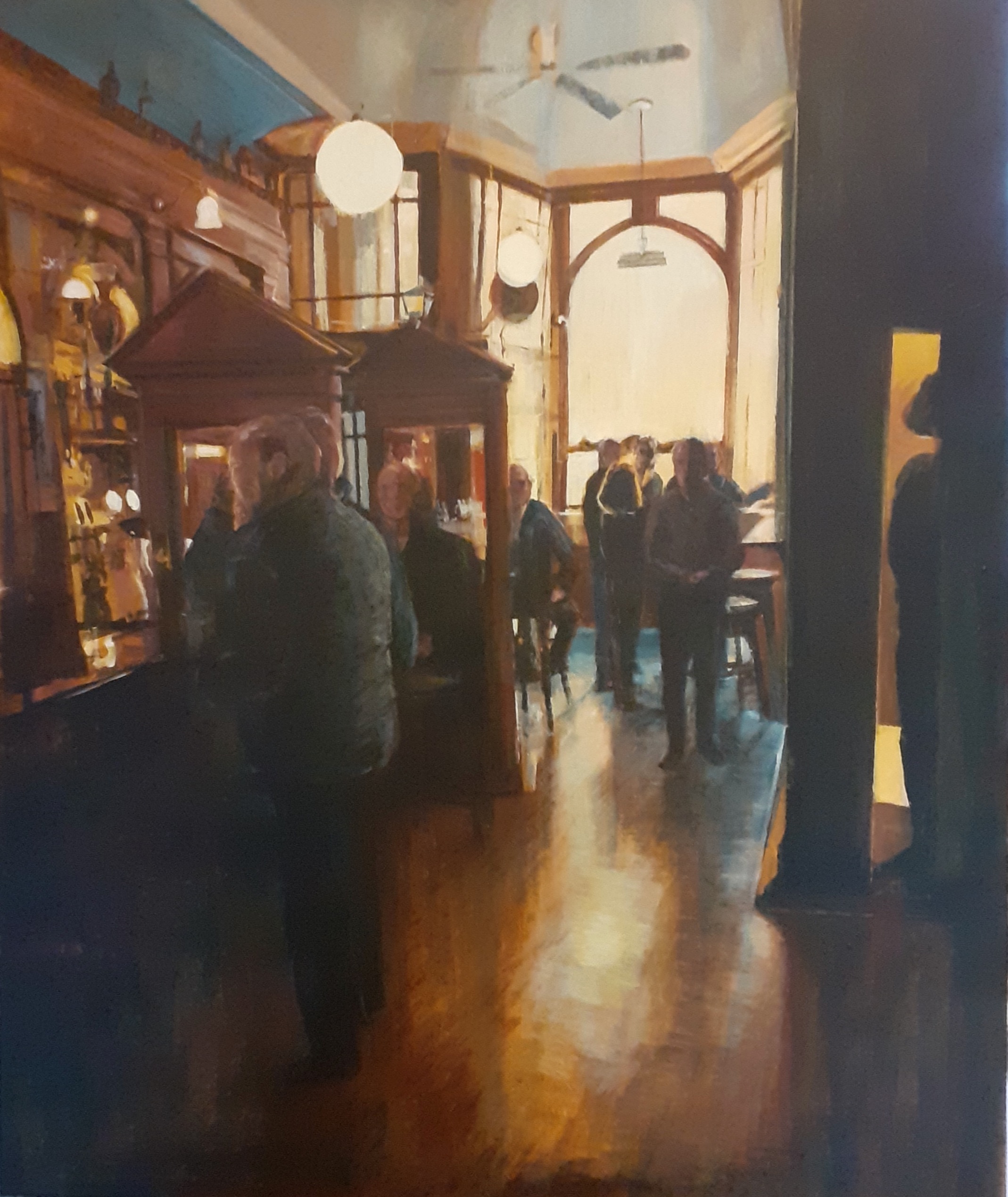
Dublin is packed with great pubs. There is no definitive syle, they come in all shapes and sizes. The Victorian and late Edwardian are perhaps most typical. Many’s the blog and pubication that has given the top ten or twenty. It all depends. For what it’s worth, my favourite five are:

1. O’Donoghue’s of Merrion Row, 2. Toner’s of Baggot Street, 3. The Palace in Fleet Street, 4. Grogan’s Castle Inn on Sth William St, 5. The Stag’s Head at Dame Court.

That’s maybe enough for one pub crawl, but there are many more. James Joyce’s Ulysses posed the riddle of the impossibility of crossing Dublin without passing a pub. It is easily solved, of course. Don’t pass any, just go in. If indeed you do pass the Stag’s Head, and you shouldn’t, it’s near enough the definitive old style Dublin pub. 

With all that drink, the only people to remain upstanding in Dubln are its statues. Dublin’s statues immortalise figures from fact and fiction

5 Top Statues

1. Molly Malone on Suffolk Street, 2. Phiil Lynott on Harry Street, 3. Oscar Wlde at Merrion Square, 4. James Joyce, 5. Patrick Kavanagh.

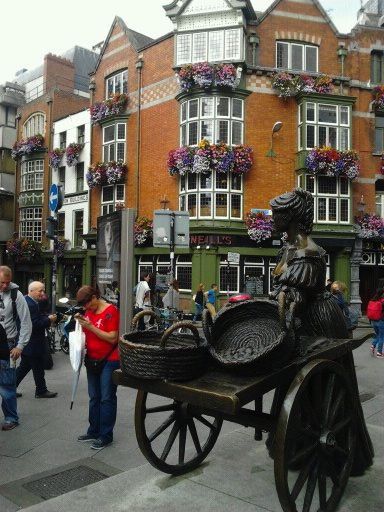
The statue of Molly Malone by Jeanne Rynhart dates from Dublin’s millennium celebrations in 1988. Molly steps from the air of a song to become flesh, or bronze at least.

In Dublin’s Fair City

Where the girls are so pretty

I first set my eyes on sweet Molly Malone.

As she wheeled her wheelbarrow

Through streets broad and narrow

Crying cockles and mussels, 

Alive, alive-oh!

The song is of obscure provenance. A music-hall ballad of the 1880s it was attributed to Scottish songsmith, James Yorkston. It has become the anthem for the capital city. She can certainly wheel her wheelbarrow. First time I saw it ‘twas at the bottom of Grafton Street, now it stands outside Saint Andrew’s Church on Suffolk Street.

Molly was a seventeenth century barrowgirl who earned a bit on the side plying the oldest profession. The song certainly alludes to sex. Cockles and mussels has salacious connotations. Young lovers and visitors to the Fair City have taken the photo opportunity the statue offers. It is traditional to fondle one or both of Molly’s breasts, giving them a sunburst emphasis.

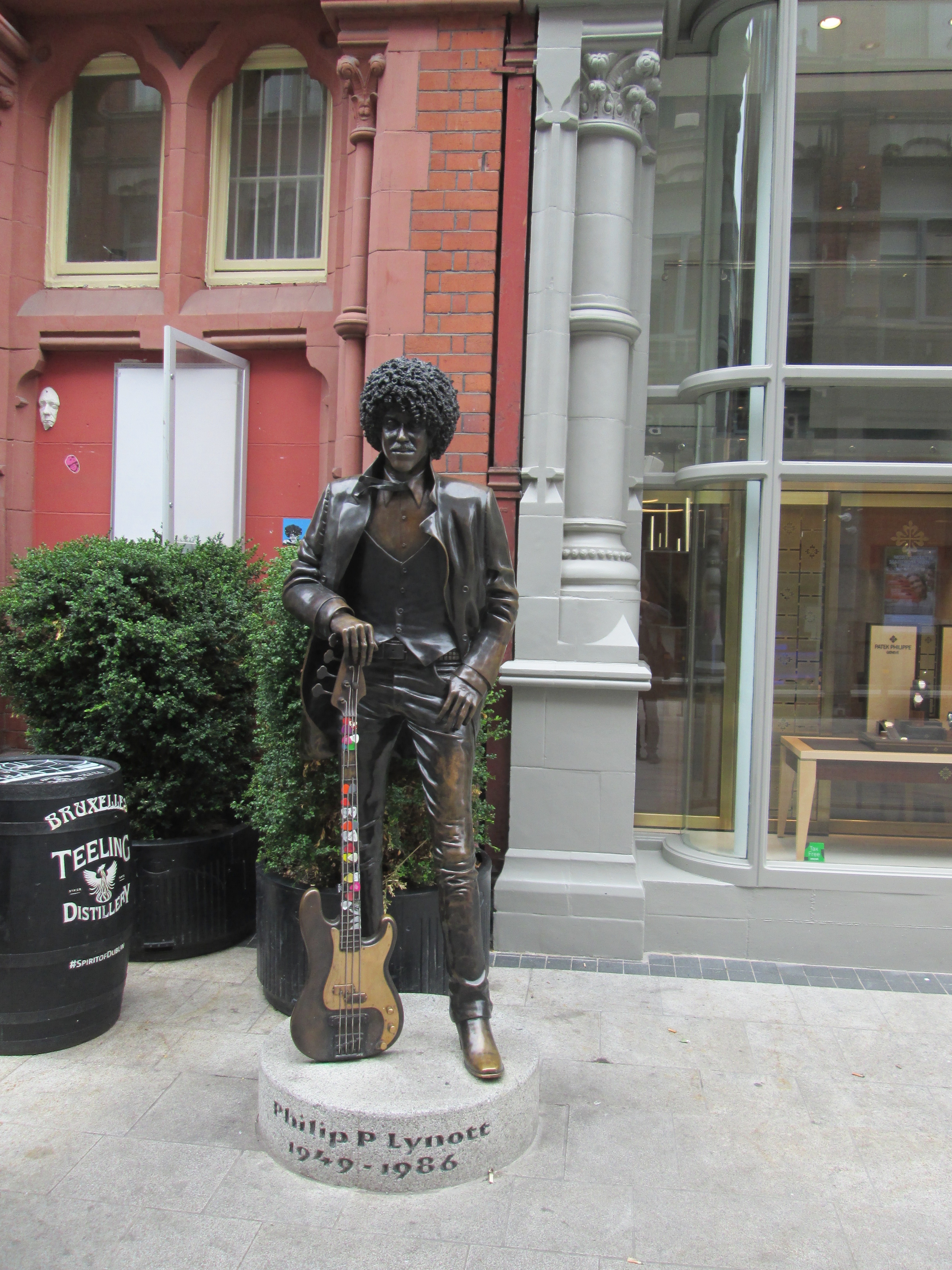
At Bruxelles Pub near the top of Grafton Street, another lifesize statue vies with Molly for popularity. Phil Lynott was black and Irish as Guinness and leader of Thin Lizzy, kings of the Dublin Rock scene. They took a rocked up version of Irish trad balled, Whiskey in the Jar, to the British charts. The ballad records the misadventures of a seventeenth century highwayman whose lover in Lynott’s version is called Molly. So no accident that they’re still close. 

But me I like sleeping

Especially in my Molly’s chamber

But here I am in prison

Here I am with a ball and chain.

(Whiskey in the Jar)

Lynott died in 1985, aged just thirty six. The video for his solo hit, Old Town, features him swanning about Grafton Street, Ringsend and the Long Hall pub on George’s Street.

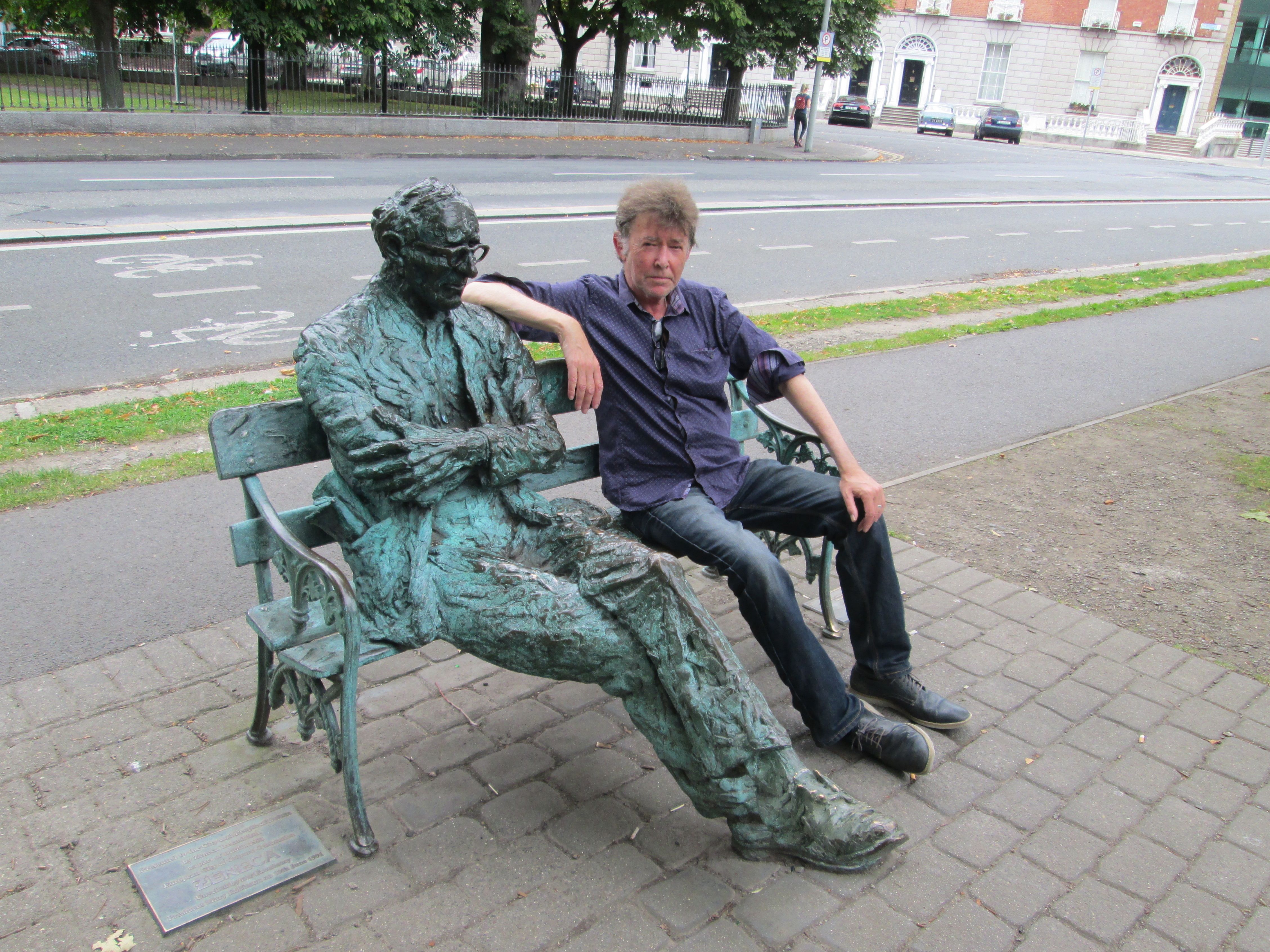
Oscar Wilde reclines sedately at the northwestern corner of Merrion Square. James Joyce saunters down North Earl Street across from the GPO. Another writer, poet Patrick Kavanagh, reclines on a bench on the Grand Canal at Baggot Street Bridge.

On Pembroke Road look out for my ghost

Dishevelled with shoes untied

Playing through the railings with little children

Whose children have long since died

Soho in the Rain

I took shelter from a shower

And I stepped into your arms

On a rainy night in Soho

The wind was whistling all its charms

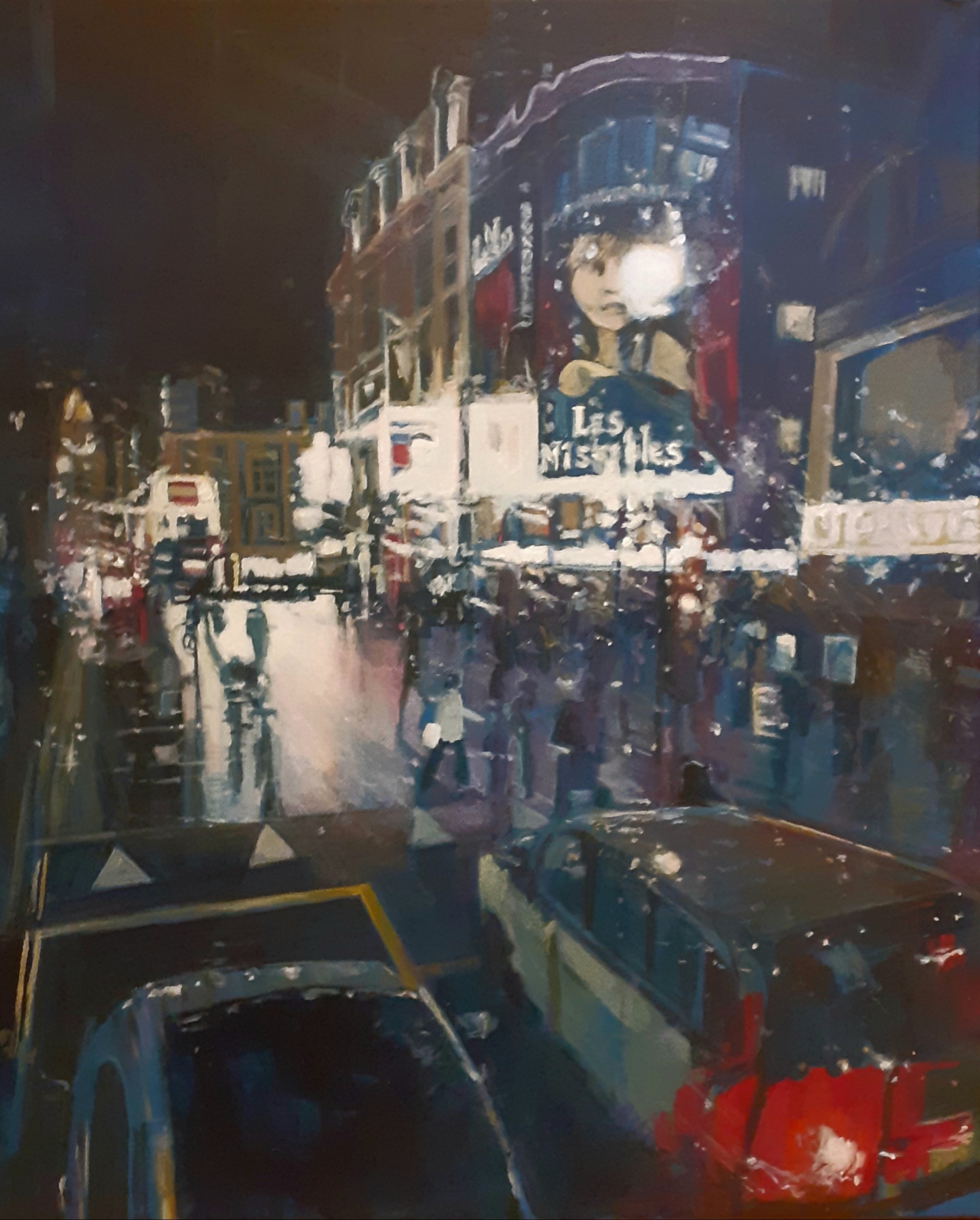
This painting is from my recent trip to London. We are on the front seat of the 14 bus heading down Shaftesbury Avenue. Soho is to our right and we are about to pass the Sondheim Theatre. Formerly the Queen’s Theatre, it was refurbished and renamed in 2019 and has hosted Les Miserables since 2004. London’s longest running musical has been playing since 1985. It is a sung through musical, without spoken text, conceived by Alain Boublil with music by Schonberg and is based on Victor Hugo’s novel.

Soho itself abounds in great songs, some of which I have included in previous posts. Warren Zevon’s Werewolves of London is perfect for howling at the moon. Last Night in Soho by Dave Dee, Dozy, Beaky, Mick and Tich was my very first record. But there are few that capture the spectrum of love and longing as movingly as Rainy Night in Soho. It was was written by Shane MacGowan and released by the Pogues in 1986, There have been many cover versions since including Bruce Springsteen, Bono, Bob Dylan and Nick Cave.

We watched our friends grow up together

And we saw them as they fell

Some of them fell into heaven

Some of them fell into hell

Glasgow Again

Glasgow is an hour’s flight from Dublin. The airport is south of the city and the bus takes us there in thirty minutes for £11. The driver doesn’t have change of a fifty, Britain being weirdly averse to high denominations, but my friend obliges and pays the fare with his magic phone. We are dropped off just below Blythewood Square, close to our hotel. When I say below, I mean below, remembering now how hilly Glasgow is. The city’s modernist grid system accentuates this, with a quite San Franciscan undulation of steeply sloping sidewalks and buildings. 

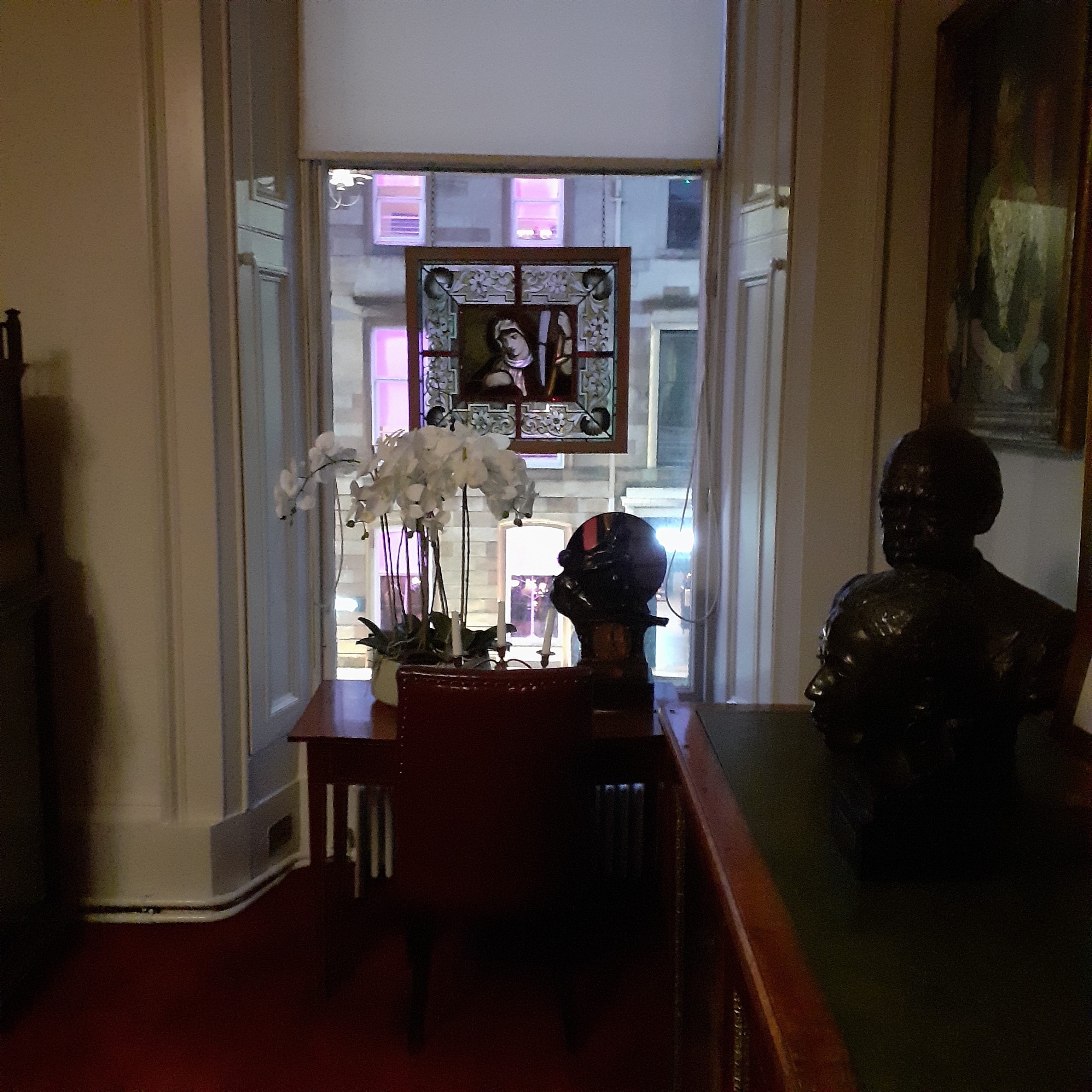
The Sandman Hotel is on West George St. The desk is excellent and we are given comprehensive guides and recommendations for our wining, dining and cultural pleasure. Plenty of that in Glasgow for sure. A short walk around the neighbourhood brings us past the Glasgow Art Club. But why pass when there’s people wandering in with paintings under their arm? We figured to blag our way in, though in fact it’s open to public callers; simply ring the bell. Eslyn Barr of the Paisley Art Institute, fellow inmates of the building, gave us a fascinating tour. The Club has occupied these premises on Bath Street since 1893 when a gallery was added. Architect John Keppie designed this and was assisted by his draughtsman and future partner Charles Rennie Mackintosh. Eslyn shows us the Mackintosh frieze and the beautiful paintings and artefacts accumulated over the years. The members exhibition is also going up, a continuation of such predecessors as John Lavery, George Pirie and James Paterson. These artists would feature prominently on our trip.

The next morning we breakfast at Wetherspoon’s. This becomes a habit, as it had on a previous trip. What’s not to like? Full Scottish with Haggis and copious cups of coffee. My friend’s magic phone isn’t accepted here so my cash is king. This branch on Sauchiehall Street is called Hengler’s Circus after the circus which perfpormed nearby in the early twentieth century. Iillustrations on the walls tell the history of Hengler’s, the Empire Theatre and other aspects of Glasgow history, including the Glasgow Boys. And you can drink till the wee small hours.

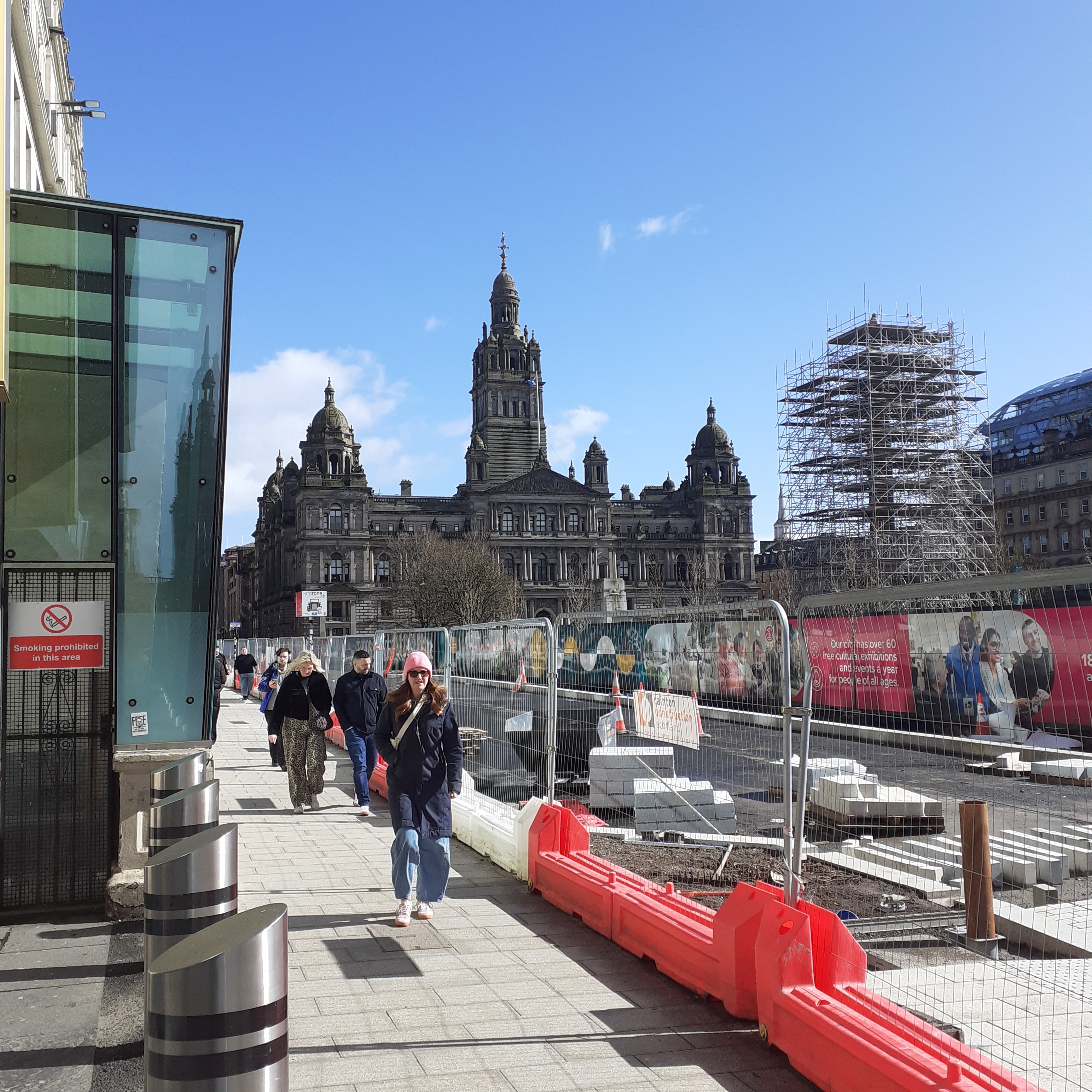
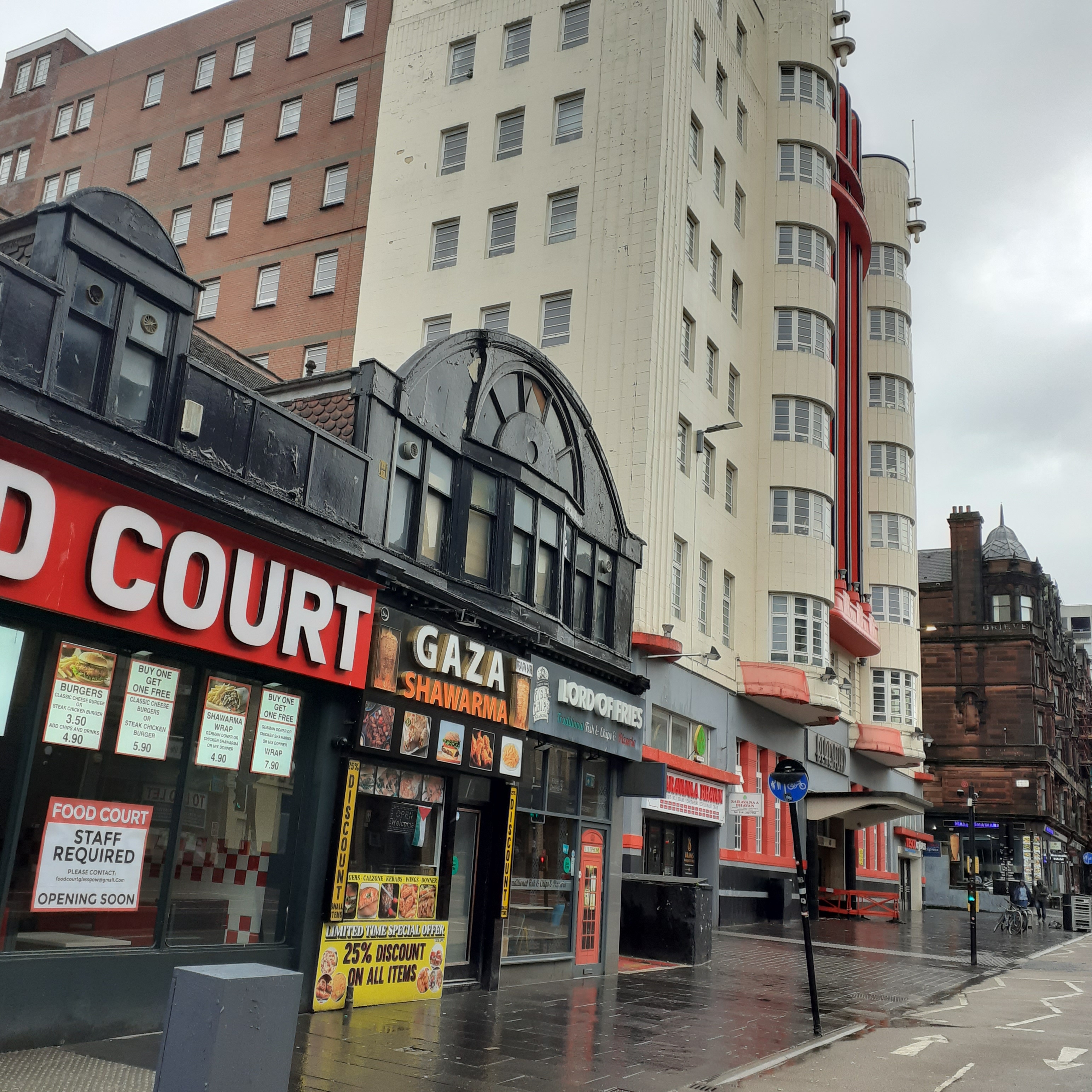
We aim for the open top bus tour and a stroll down Suachiehall Street. The street makes for a good point of orientation. It cuts east west through almost the entre city. Towards the city centre it’s pedestrianised and a bustling shopping precinct. The name comes from the Scots for Willow Meadow, as the area once was before the city expanded in the boomtimes of the nineteenth century. It was first the haunt of the well to do in fine Victorian townhouses. The Art Deco Beresford Hotel was built in 1938 for the Empire Exhibition. Rising to eight stories it was referred to as Glasgow’s first skyscraper. A student residence and briefly a casino, it is now an apartment block, while newer, higher skyscrapers abound. A browsing highlight was poster shop On a Wall Near You. A world of iconic images, stone age, rock age space age, you name it.  Picture heaven, and paraphernalia besides, with teeshirts, tote bags and, my addiction, fridge magnets. Smiles all round.

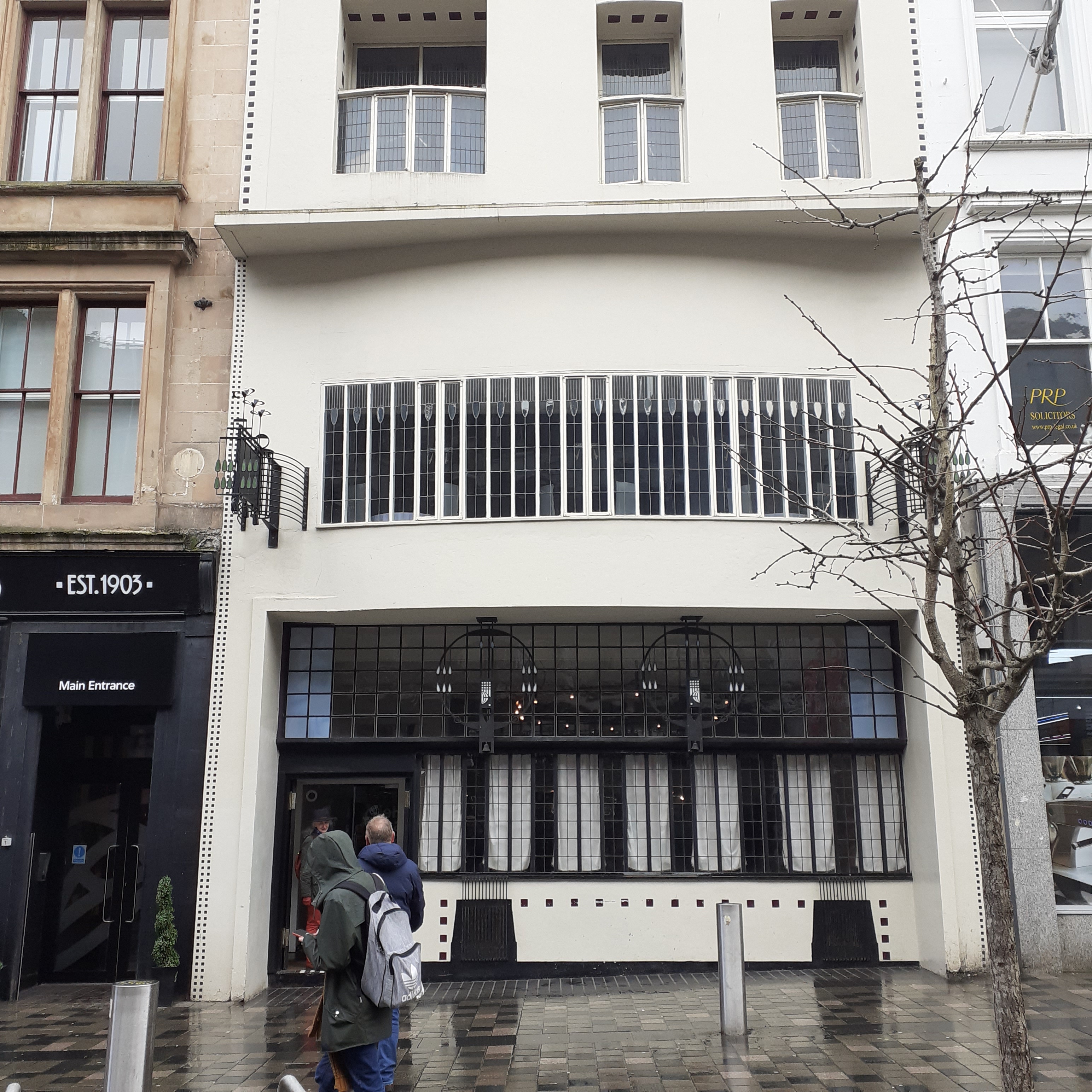
I lead a short detour to the School of Art on Renfrew Street, Mackintosh’s most famous architectural work. Seriously damaged by fire in 2014, it was undergoing extensive reconstruction when last I visited. It burned down again in 2018, The School was founded in 1845 and gives degrees in Architecture, Fine Art and Design. In 1909 Mackintosh’s building was completed and became a testament to the genius of its creator. Hopes are to have it reinstated by 2030. In consolation, back on Sauchiehall we made for the Mackintosh Tearooms. Miss Cranston’s project for sober sipping saw her open four tearooms in the city. Tea Rooms were an intrinsic part of Glasgow life in the late Victorian age. Miss Cranston commissioned Mackintosh to design her Willow Tearooms on Sauchihall Street in 1903.  He created an elegant Art Nouveau merger of modern glass and steel craft with the exotic aesthetic of the Orient.

The open top bus eludes us. It should be based on George Square but that whole area was suffering from excessive repair and the bus was diverted elsewhere. Instead we spent the evening recuperating with food and drink in a variety of downtown bars including Malone’s Irish Bar. We saw Scotland suer a one goal deeat to Japan in a friendly at nearby Hamden Park. Indeed, Glasgow does boast that its the friendliest city in the world. For us it held true. It can be a bit like a thistle curry at times; spiky to begin with, but guaranteed enduring warmth.

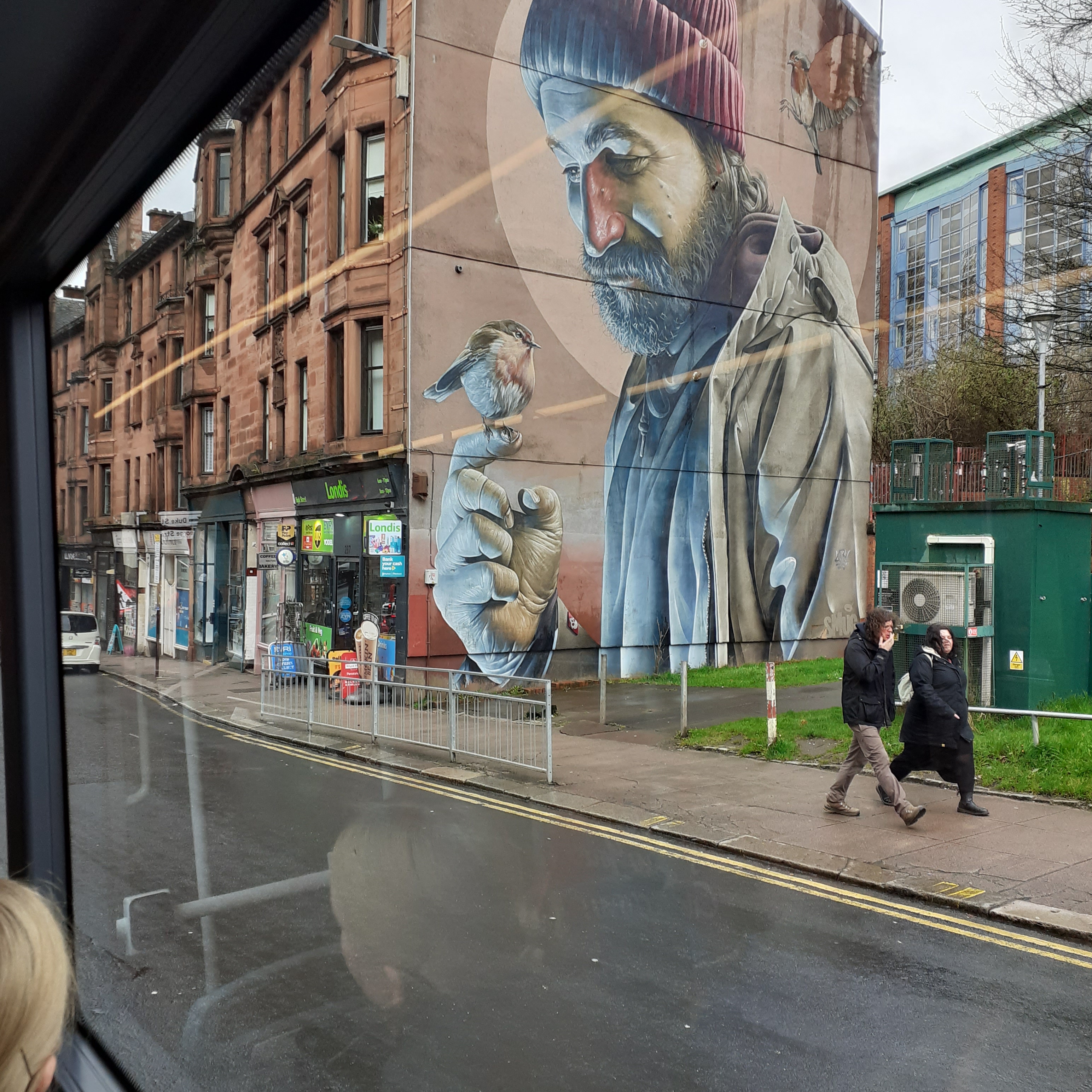
Tomorrow is another day and we find the bus actually departs from Cathedral Street. The audio guide gives a good chronological account of the city. Glasgow Cathedral is dedicated to St Mungo who founded the city in the 6th century. His four miracles of Glasgow are formed into a rhyme: Here is the bird that never flew, here is the tree that never grew, here is the bell that never rang and here is the fish that never swam. The bird he saved is illustrated by a startling mural on a gable nearby The Cathedral was begun in 1136 and the city grew around it. High Street and Trongate are a couple of the medieval streets remaining on the East side. 

This town was built on muscle and blood. Tobacco, cotton and slavery saw its port prosper in the eighteenth century. It became a gateway to the new world. With the Industrial Revolution, Glasgow became a European leader in industry and engineering, particularly as a centre of shipbuilding. The Clyde made Glasgow and Glasgow made the Clyde. Our tour takes us along the north bank of the river passing through scattered parkland and ambitious modern developments including the SEC Armadillo Arena and the Riverside Museum with the tall ship Glenlee.

Beyond the ring road motorway we enter the West End with its grand terraces and parkland. The area is famed for its restaurants and bars and home to some of Glasgow’s top sights. The scenic Kelvingrove Park is a central feature. Sylvan and sublime it is bisected by the River Kelvin The river’s name was appropriated for Baron Kelvin. The famous Irish physicist William Thomson was born in Belast in 1824 and for fifty years was professor of Natural Philosophy at the University of Glasgow. Here he figured that the coldest temperature possible, absolute zero, was -273 degrees Celcius. Even in Glasow.

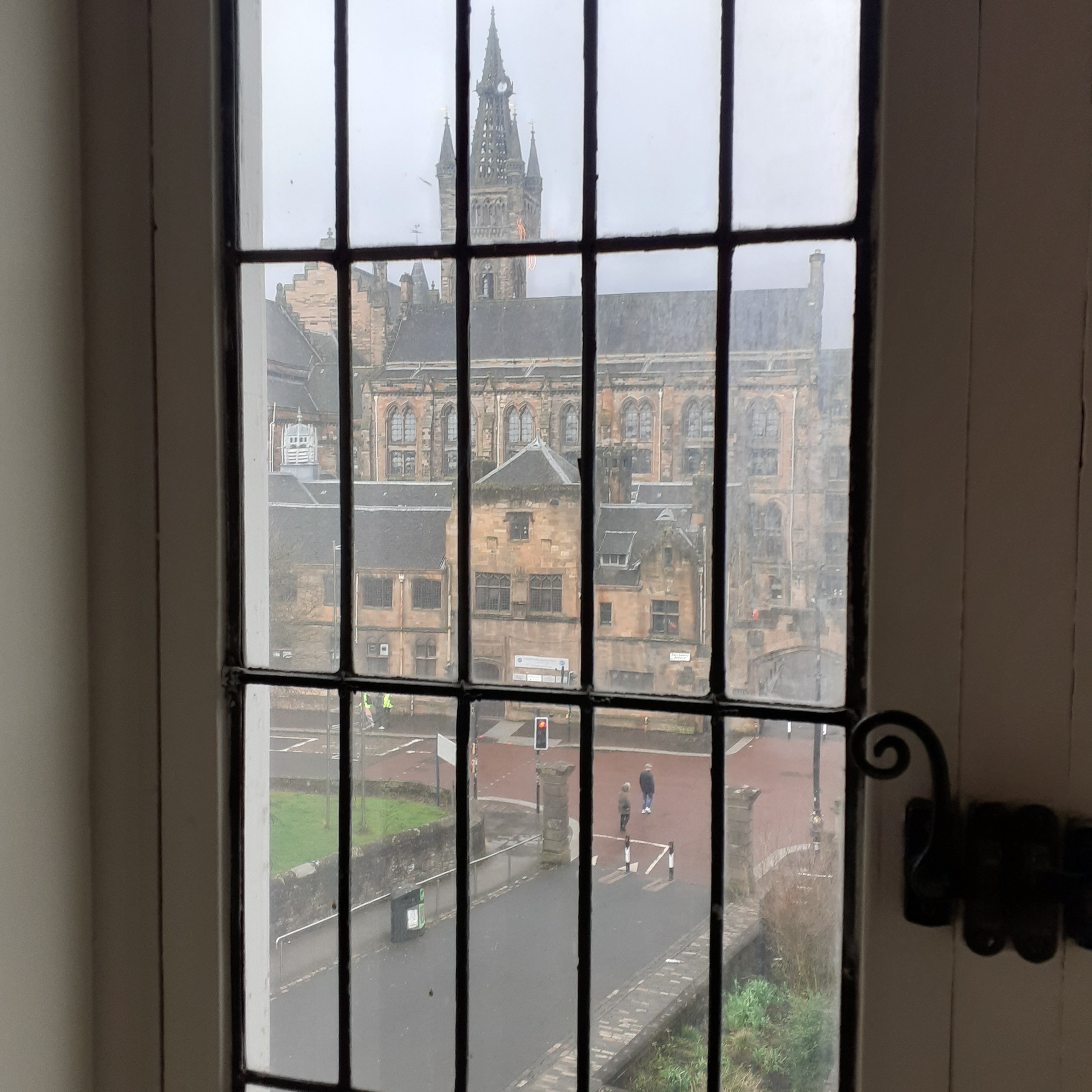
The University of Glasgow sits atop Gilmore Hill. Its majestic spire dominates the city. Across the road the Hunterian Museum has a large exhibition on Charles Rennie Mackintosh and his group, The Four. He and friend Herbert McNair and the sisters, Margaret and Frances MacDonald met at the Glasgow School of Art and later married; Charles to Margaret. She was a renowned decorative artist and worked in collaboration with her husband on many projects. The sisters flowing art style was influenced by Aubrey Beardsley, leading to the group being dubbed the Spook School. 

The Mackintosh’s lived right here. The modern museum was built on top of their terrace. The interior has been skillully recreated within the modernist building, preserving its aspect and most importantly the wonderful interior design Mackintosh imposed on the Victorian house. The Hunterian boasts a huge collection of Scottish and internastional paintings. The Glasgow Boys feature strongly with work by Patterson and Lavery amongst others. American artist James MacNeill Whistler is well represented, the University receiving a large body of his work by bequest. Whistler’s Scottish ancestry, the actual Whistler’s Mother, and the admiration of the Glasgow Boys helped bring this about.

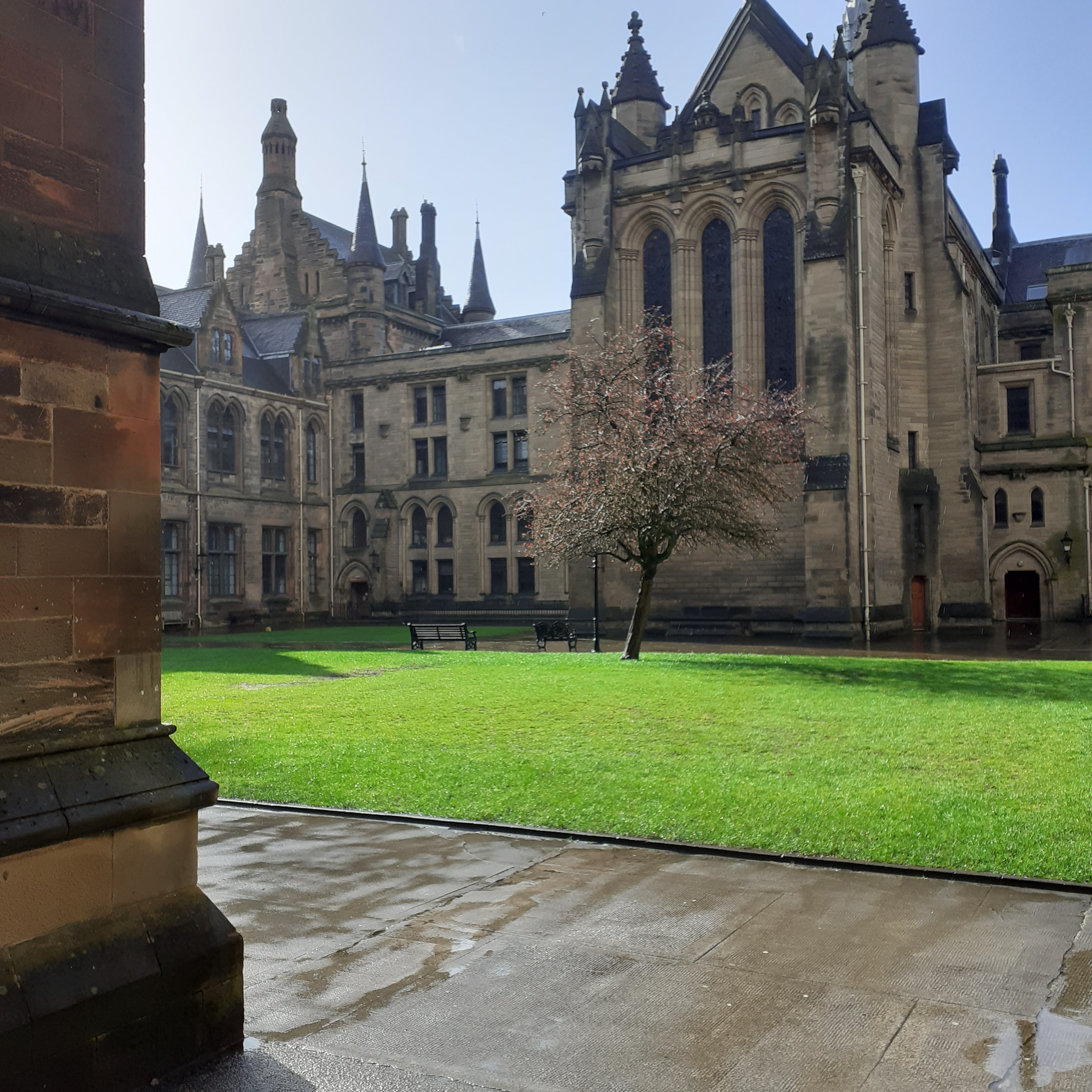
Rain falls as we cross the road to the University. We ghost through the quads and cloisters, evoking magical worlds, including Hogwarths it seems. The University was ounded in 1451 and moved here in 1870. The Gothic Revival spectacle was designed by George Gilbert Scott, crowned with the eighty five metre bell tower in 1887. 

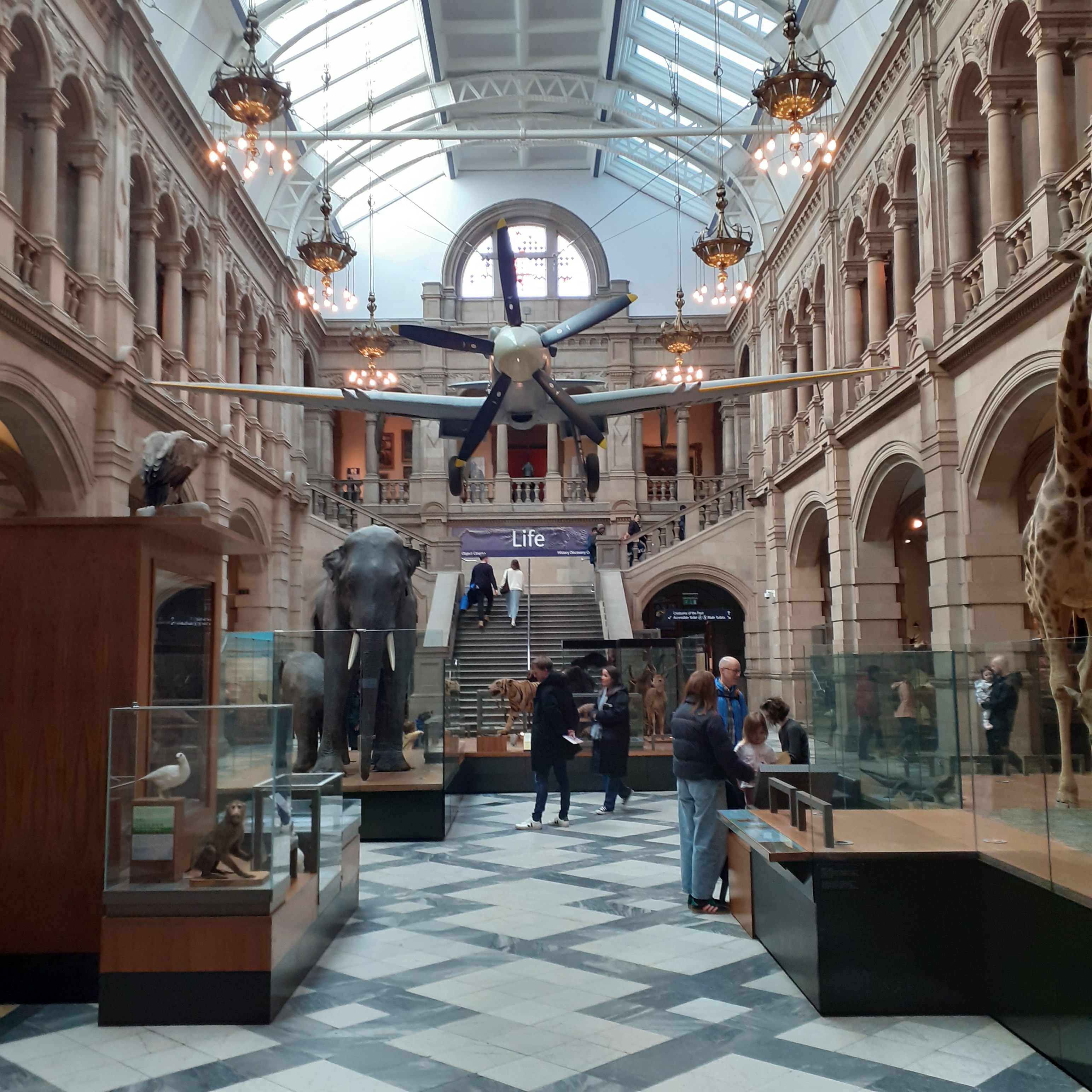
Downhill through parkland and over the Kelvin River brings us to the Kelvingrove Museum. Completed at the start of the twentieth century, the red sandstone Baroque temple houses a richly varied collection of art and artefact. The main concourse is dominated by the classical pipe organ which booms into life at lunchtime when there is a regular recital. It is blasting out music to a lively throng of all ages as we arrive. The ground floor houses an eclectic and dynamic exhibition, including an Elephant and a Spitfire, a vernacular history of Glasgow and an Egyptian collection. The art again features the Glasgow Boys, Mackintosh, Scottish Colourists and French Impressionists. Floating above all is Salvador Dali’s most coherent masterpiece, Christ of Saint John of the Cross. This famous work places us, the viewers, at a vertiginous angle. Along with the painting we find ourselves being borne heavenwards. But heaven must wait and we take the bus back to the hotel. Time for rest and recreation, and another night tossed about on the waves of Glasgow’s undulating streetscape. Pure magic.

When I look out my window many sights to see

When i look in my window so many different people to be

That it’s strange, so strange

You’ve got to pick up every stitch

You’ve got to pick up every stitch

Must be the season of the witch

Donovan Leitch is a local boy, as is apparent on his song Season of the Witch from his third album Sunshine Superman (1966). The song is soaked in urban paranoia and possibility. Its timeless span reaches from Celticism to modern gothic. It is almost an obligitory soundtrack; in the last month I’ve heard it on three or more tv series, including Australia’s The Twelve and Norway’s Harry Hole series. Strange indeed.

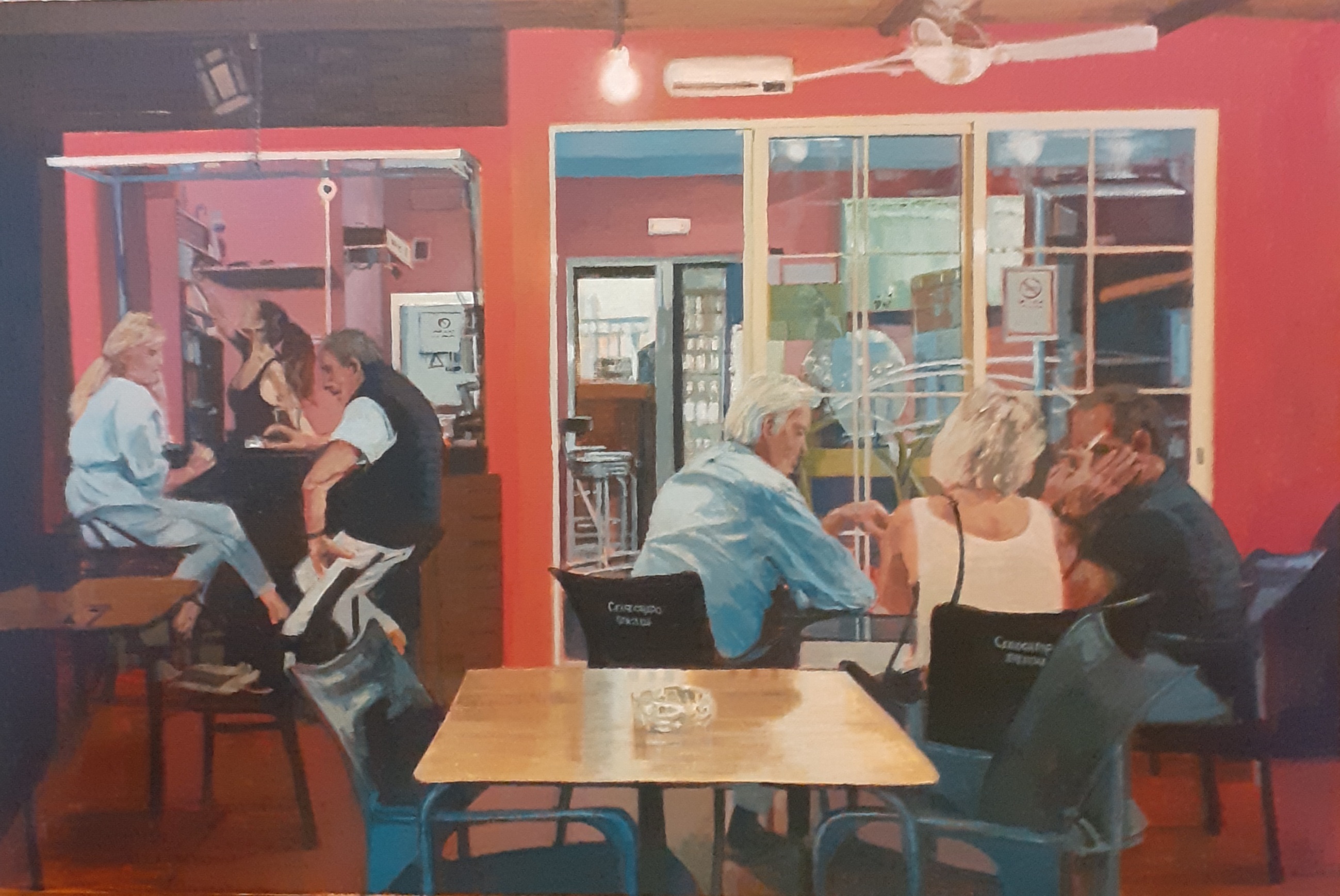
A Bar in Bayswater

I stayed in Bayswater, London, last year. This acrylic is the view from a local bar looking towards Main Sreet, Queensway that is. I have returned from exploring the area of white Victorian terraces and dinky squares. Farther on, I spent much of the evening on Portobello Road known for its street market. I had never walked it before, though it had long fascinated me. It was a central feature of Martin Amis’s 1989 novel London Fields, in particular a pub called the Black Cross. There, Nicola Six, Keith Talent and Guy Clinch would meet and Nicola, the Murderee, set the macabre menage a trois (a quatre?) in train. Narrated by doomed author Sam Young and set in late 1999, it is a comedy tinged with foreboding. The end of the world, the end of love.

The Black Cross is a fictional bar, of course, so I made do with convivial reality. Portobello Road is at the pleasant end of culture clash. Cosy, quaint, common and sophisticated, like much of London’s inner patchwork, it is village and urban combined. Back in Bayswater, I find a bar invitingly empty. It is that dread hour: closing time. There are, as always, plenty of stories set to continue into the night. Not quite the Folies Bergere, more Edward Hopper meets Rock Dreams.

The Stranger Song is appropriate, given that the bar advertises poker nights on Monday and Wednesday. The 1955 film noir The Man with the Golden Arm starring Frank Sinatra was an inspiration. The song is one of the Songs of Leonard Cohen, his debut album from 1967. Cohen’s Golden Voice seduces the listener. No better man than Leonard for the chat up line, but here it is developed into an invitation. We are all strangers, our paths intersecting in those almost arbitrary places, hotels, bars and train stations.

You hate to watch another tired man lay down his hand

Like he was giving  up the holy game of poker

And while he talks his dreams to sleep, you notice there’s a highway

That is curling up like smoke above his shoulder

London Waterways

Chelsea, Battersea and Paddington

The Thames is broad and sinuous on its passage through London and into the sea. There’s a boat service from Putney in the west to Greenwich in the far east. For the more athletic a walk along the river bank is a necessary pleasure in getting to know the city. Staying recently in Fulham, we took an afternoon stroll down to Chelsea Harbour and continued on downriver to Battersea. 

The sleek new highrise development around the Harbour blends attractively with Lots Road Power Station, an incongruous landmark and a reminder of industrial times past. The name Chelsea derives from chalk wharf, signifying the nature of its river trade. Chelsea itself is a well to do city residential area. Rather grand, mostly pretty, it is often quirky too. 

We are fans of the Chelsea Detective, the tv series starring Adrian Scarborough as DI Max Arnold, with Irish actress  Vanessa Emme as DS Layla Walsh. Arnold lives in a Thames houseboat around here, The moorings stretch along Cheyne Walk and we almost felt we should call in for a drop of wine and some piano accompaniement. The riverside idyll is overshadowed by the redbrick towers of Worlds End, a residential borough development from the 1970s. The name derives from a local pub built in the 1890s. An earlier inn of that name dates to Restoration times, when it stood at the end of London, or civilisation. The King’s Road leads back to the city centre. The King in question is Charles II and has become, perhaps inevitably, a byword for trendiness.

Along the river Cheyne Walk is lined with eighteenth century Georgian townhouses and long home to the rich and famous including artists Dante Gabriel Rosetti, JM Turner and James McNeill Whistler. Whistler’s painting of the Old Battersby Bridge is one of his famed blue nocturnes. A modern bridge now spans the river.

The Old Chelsea Church is a much older resident. Dating back to Norman times, it has become a fascinating patchwork over the years, with much reconstruction after the Blitz. Thomas More’s statue by Leslie Cubitt Beavis sits to the side. More wrote Utopia, a fictional acme for an idyllic society. The book was published by Erasmus in 1516, in Latin. The English translation appeared in 1551 sixteen years after the author’s death. More had refused to take the Oath of Supremacy that recognised Henry VIII as head of the Church.

Albert Bridge was built in the 1870s as a suspension bridge to link Chelsea with Battersea. Structurally plagued by problems, it is sometimes called the Trembling Lady as it can vibrate under certain traffic conditions. Calls for its demolition have gone unheeded, and the bridge is spectacularly illuminated at night.

By Albert Bridge, the intimacy of Cheyne Walk gives way to the bustling thoroughfare of the Chelsea Embankment. This leads on to Chelsea Royal Hospital. Established by Charles II, at the prompting of Nell Gwyne, allegedly. Gwyn was the King’s mistress, not a fact that was hidden away. She would have wielded influence over the King, Nell was one of the first leading ladies of English theatre. Charles himself had abolished the ban on women taking to the stage. She was something of a pin up of her day, and the king commissioned a nude portrait, with Nell cast as Venus, to be shown, furtively, to special guests. 

The Hospital was designed by Christopher Wren and completed in 1682. It is used as a nursing home for army veterans. Their resident uniform is blue, but their scarlet dress uniorm is better known.The red uniformed pensioners are regular pitchside guests at Chelsea Football club who were once nicknamed the Pensioners. They discarded the monicker in 1955 the year they first won the league title, ironically with the oldest average age team to win. The Hospital grounds have hosted the Chelsea Flower Show held annually since 1913

Chelsea Bridge is framed by the massive Battersea Power Station across the river. The current structure is a suspension bridge built in 1937 replacing a previous structure from1694. It is also illuminated at night. Battersea Power Station has been extensively renovated in the last decade to return the building to its former glory. And glorious it is; the four cream chimneys towering above its redbrick bulk make for one of London’s most loved icons. Giles Gilbert Scott and Theo Halliday were the project architects. Construction started in 1930 and with the interruption of the war was only completed twenty five years later.

The recent redevelopment masks some of the spectacle with highrises, so I was fortunate to get the full view on a previous visit. Chelsea Football Club were amongst the proposals with plans for a new stadium, but the council, and indeed many of the Stamford Bridge faithful, opposed this. The resultant development transforms the old building into a modern shopping centre. The surrounding apartments are augmented by shops, restaurants and bars. At night, the illuminated chimneys are truly a spectacular sight, if also a little bit Orwellian. Pink Floyd’s Animals is probably responsible for that. Roger Waters’s opus drew freely from George Orwell’s Animal Farm, with a cast of sheep and pigs, and dogs. The 1977 album cover featured a giant inflatable pig flying between the front towers. This Hipgnosis graphic is amongst the memorobilia you can buy at the souvenir shop inside. 

There’s a full shopping centre inside the old structure, and a museum with lift to the top of a chimney. Good eateries too, though we opt to eat outside and catch the fading light. Megans Restaurant is a pleasant informal eaterie with Mediterranean fare and panoramic views of the river. It’s the perfect spot for a famished sunset meal. Here the Thames turns sharply north towards the city where the glass highrises bounce the sun back at us before their own illuminations fade in. The Tube Station south of the complex connects with Leicester Square, the epicentre of London’s nightlife. Picadilly Circus is adjacent with Shaftesbury Avenue winding between Soho and Chinatown where we can go walking in the wild West End. 

We are staying at the Hotel in Stamford Bridge. The evening game is Chelsea v Leeds. Echoes of the 1970 FA Cup Final. That was a 2 all draw, with Chelsea winning the replay. An hour in on a rainy Tuesday night and Chelsea are two up, but when the orphaned referee lost his white stick Leeds pulled level. Normal service resumed but the score remained the same. Cole Palmer, maker and taker respectively of both Chelsea scores, had an open goal at the final whistle but his shot, if taken at Battersea, would have creased Pink Floyd’s flying pig. Two all again. But it’s always good to be back at the Bridge singing Blue is the Colour and marching down to the Fox and Pheasant for a few well earned pints.

A more modest waterway meanders along London’s northern perimeter. We have walked the Regent Canal from King’s Cross to Camden Lock, after which it arcs around Regent’s Park and London Zoo. This time we aim to explore the intriguingly named oasis of Little Venice. We take the District Line from Fulham to Paddington, where a helpful Station Man gives us detailed instructions. Little Venice forms where the Regent’s Canal joins with the Grand Union Canal and the Paddington Basin. The naming is variously attributed to Lord Byron and Robert Browning, who each noted the place as an oasis from the bustling city, and helped popularise the area for artists and other creative wanderers. The junction forms a triangular basin, wide enough for long boats to turn. The surrounding area is characterised by white stucco houses of the Regency era. The salubrious suburbs of Maida Vale and St John’s Wood spread to the North. Abbey Road, another famous album cover, is not far off. 

Water is all around, including regular dousings from above. We shelter under Westbourne Terrace Bridge and watch a longboat turn. Then, passing beneath the Westway, we’re back in the crowds with Paddington Station the focal point. There are table tennis tables laid out if you fancy a set or two of ping pong. Cafes in barges line the basin if you fancy refreshment. We did both, the tennis first, then the coffee.

Watching us politely is a small blue bear. Paddington Bear was created by Michael Bond in the fifties. It all started when he bought the one remaining teddy bear, sitting alone on a shop shelf, as a Christmas gift for his wife. After he had time to think on that, expensive jewellery and the like, he wrote the first Paddington book, A Bear Called Paddington, and the rest is history. Not exactly history, the bear is a fictional character after all (real bears don’t wear duffel coats, usually). The station returns the honour with a bronze statue and themed bench inside.

Paddington Station was built in 1854 and designed by Isambard Kingdom Brunel. The huge glazed roof was inspired by the Crystal Palace of the Great Exhibition in Hyde Park. Brunel is familiar to us from our own home station of Bray, also built in 1854. Paddington itself brings back memories too. I spent part of the summer of 1976 here in a squat, dividing time between Elephant and Caste and Paddington, flitting along the Bakerloo Line, or upstairs on the busses. Dickens Tavern and The Sawyers Arms on London Street are familiar names. One, I recall, had a sunken central area with booths on a surrounding mezzanine. It’s all something of a dream to me now, was then even.

South of Paddington is Hyde Park. with Kensington Gardens to the west. The Serpentine divides them, a long curved pond, wide and calm. Rain shrouds the surrounding city and we shelter at the tearooms past the bridge across the Serpentine. There’s a homely friendliness amongst the small crowd sheltering and the customers entering and leaving the cafe. Rain restricts the view to a misty parkland. It is hard to believe we are at the centre of a great Metropolis.

Millions of people swarming like flies ‘round Waterloo Underground

But Terry and Julie cross over the river where they feel safe and sound

And they don’t need no friends

Long as they gaze on Waterloo Sunset 

They are in Paradise

Released by the Kinks in 1967, and written by Ray Davies, Waterloo Sunset is an evocative imagining of a pair of lovers filled with hope set against the glowing backdrop of the Thames at Sunset. Alternating between first and third person lends the song a sense of melancholy, offsets the glow of a loving couple with the bittersweet consolations of the solo traveller. 

London’s Piccadilly Line and the 14 Bus

If you are flying into London Heathrow, the most convenient connection to the city centre is to take the Piccadilly Line on the London Underground, aka The Tube. It’s just over half an hour to reach the central zone while the line continues on out to the suburb of Cockfosters. From Earl’s Court in the west, the line passes through ten Tube stations in the city centre before reaching King’s Cross St Pancras in the north east, all convenient for most top London sights, accommodation and your wining and dining pleasure. If the Piccadilly line doesn’t go by your front door, there are numerous connections with London’s spaghetti bowl of underground lines, eleven in all.

While the Tube is a boon, fast and comprehensive, it’s a good idea to use the above ground bus service too. London’s red double deckers are a famous attraction in themselves, and they are cheaper than the Tube. A favourite route is the 14 which starts in Putney on the River Thames, the starting point for the annual University Boat Race between Oxord and Cambridge. The 14 passes through Fulham before following much the same route as the Picadilly Line, terminating at Russell Square not far from Kings Cross.

Here’s just some of the fun you can have along these routes. On our recent trip we took the Tube from Heathrow to Earl’s Court and could have taken the District Line to Fulham Broadway, but walked instead through Brompton Cemetary. Opened in 1840 this is the resting place for two hundred thousand departed. Amongst these are Luisa Casati flamboyant Italian fashion and art icon, whose Venetian residence is now the Guggenheim, Henry Cole, inventor of the Christmas Card and moving force behind the Great Exhibition of 1851 in Hyde Park’s Crystal Palace, Emmeline Pankhurst, radical Suffragette leader and Kit Lambert manager of The Who. Beatrix Potter, who lived nearby, browsed the tombstones in naming her characters, including a certain Peter Rabbett. An impressive feature at the southern end centres on a domed chapel flanked by symmetrical collonades, the development modelled on St Peter’s Square in Rome.

We were staying at the Stamford Bridge Hotel at Chelsea FC on the Fulham Road. The 14 goes past the door, heading along the Fulham Road before turning into South Kensington. It is a lively spot at the nexus of several major thoroughfares. The tube station lies below a shopping arcade facing onto Onslow Square. The natty boulavardier cast in bronze is Bela Bartok, the Hungarian composer who lived hereabouts between the wars. He stands on stainless steel leaves serenaded by a songbird.

Turning onto Cromwell Road, the street is dotted with elegant landmarks of the Victorian Age. The  Natural History Museums is an ornate gothic cathedral guarded by dinosaurs The Victoria and Albert Museum is next door. Founded in 1852 by the V and A mentioned it is another majestic landmark and the largest museum of applied art and design in the world, Joining Brompton Road we head into Knightsbridge ,London’s shopping mecca. Flagship of fashionable retail is Harrods Luxury Department Store opened in 1905. Its vast redbrick facade fronts the largest department store in Europe. 

Hyde Park Corner marks the southeastern edge of the park at its junction with Green Park. The entrance pays much homage to Dubliner Arthur Wellesley, the Duke of Wellington. He had defeated Napoleon at Waterloo, though on which platform we can’t say (as Myles na gCopaleen might have said). Speakers Corner, by the way, is at the northeastern end, the place where you can spif publicly on any topic, a hobby more often endured in public bars.

The thoroughfare of Piccadilly is wide and straight, leading into the heart of central London. The name comes from piccadill, the white lace collars popular in Shakespearean times, and made and sold here in the early 1600s. Getting off before Piccadilly Circus, we turn into the Burlington Arcade. Lit by giant chandeliers it is  the oldest and swankiest of London’s covered shopping arcades. Built in 1819, there are forty high end shops, many famed jewellers and watchmakers, pampering cafes or even a shoeshiner where you can relax to take it all in. The Burlington is patrolled by Beadles kitted out in traditional attire.

At the end of the arcade we turn right towards Regent Street and strike for Liberty’s, a Tudor Revival building from 1920. Like its architecture, it is an intriguing blend of traditional and cutting edge, offering fashion, beauty, homeware and textiles over five floors around a central atrium. The building picturesquely spans the entrance to Carnaby Street. The famed indigenous fashion shops of sixties London are now mostly swamped by international brands. The vibe of Soho persists and there are plenty of quirky shops and no shortage of choices for refreshment. We get a coffee in Cafe Concerto, a large Italian cafe on the corner of Shaftesbury Avenue, with huge picture windows, sidewalk seating and  tempting cakes and snacks. Leicester Square is around the corner, the centre for theatre tickets and cinema.

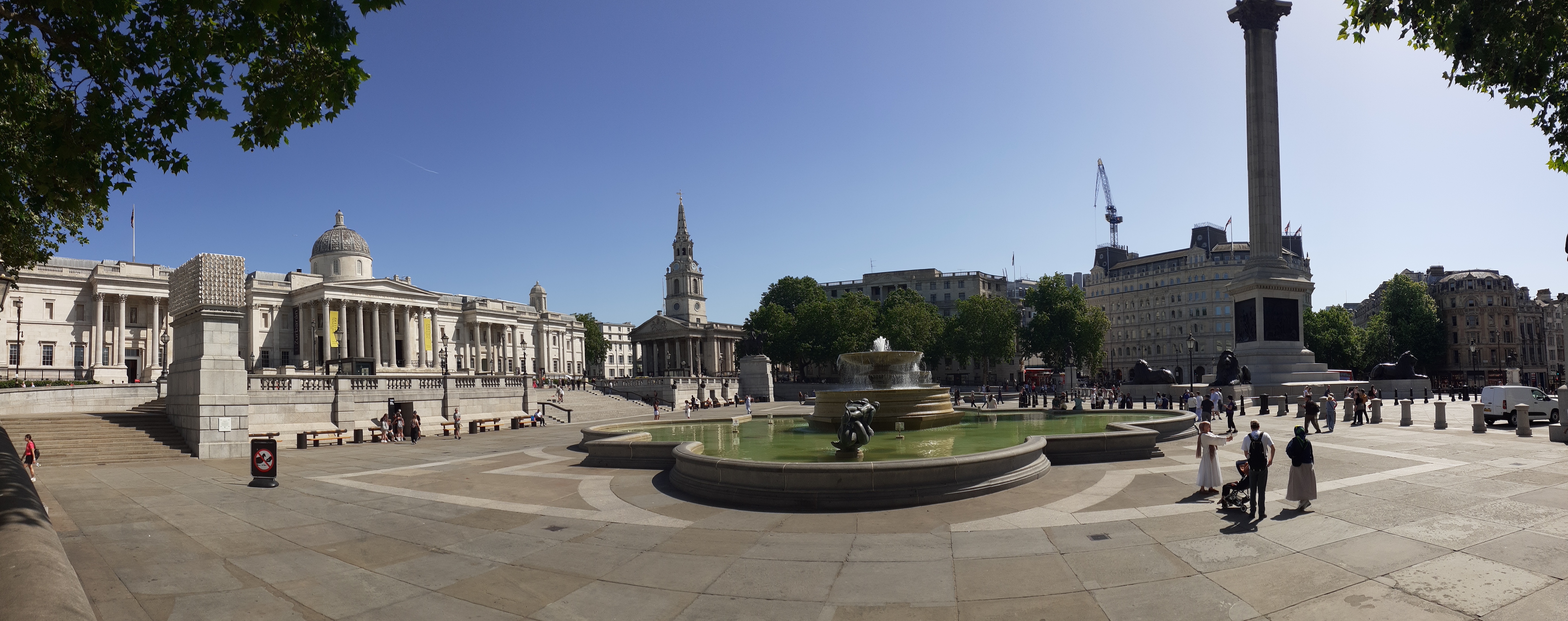
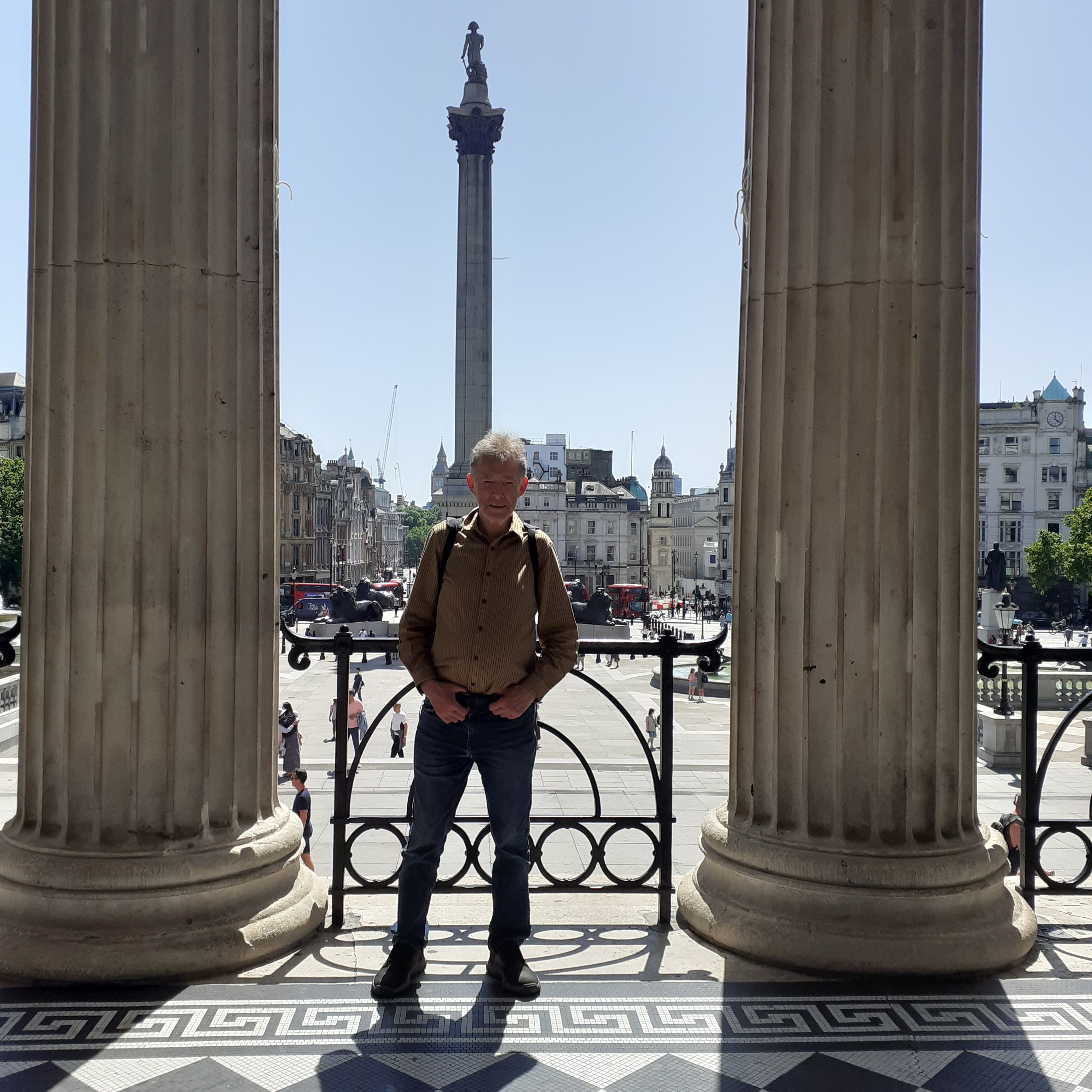
The visual arts are also world class around here. A visit to the National Gallery of Art on Trafalgar Square is a must. Or the Portrait Gallery nearby, both if you can. Turner’s part in the collection is a central feature. Most recently we concentrated on late eighteenth and nineteenth century art. The viewer is led from Constable and Turner on to Monet’s reflective pools and Seurat’s giant bathers. But there’s much more than that. It’s free in, so make a few visits. Don’t eat it all at once.

A stroll up the Strand takes us through the heart of old London. The street divides in two at the churches of Mary le  Strand, and St Clement Danes. These churches were once traffic islands, but pedestrianisation has returned to them a more antique and relaxed vibe. Volunteers and vicars are happy to greet, and impart interesting information. St Mary’s, smaller of the two, was associated with the Wrens during WW2, Clement Danes with the RAF. Here, I am told, it was designed by a Scottish Catholic, an unusual combination you would think but to which I can attest, being the son of one.

Safely on the kerbside, the Law Courts is a sprawling masterpiece of Gothic Revival, familiar to watchers of the BBC News. It was designed by George Street and opened by Queen Victoria in 1882. Opposite the Law Courts is Temple Bar, once an ancient gate on the western edge of the City. Ducking into a laneway we head down towards the river. A detour through the Temple is worth it, entering the quiet and traditional world of England’s ancient court procedures. The Inns of Court, professional associations for barristers, have their own dining halls, administrastion offices and the various Chambers for practicing lawyers include appartments for senor barrisers and judges. Temple Church is nestled here. It was built by the Knights Templar in the late twelfth century. Extensively damaged during the Blitz, renovation work was not completed until 1958. The church is famed for its appearance in the Da Vinci Code by Dan Brown.

St Paul’s sits at the top of the hill. The entrance fee is prohibitive, but prayer is free. There’s a calm square to the side of the cathedral where we rest and watch stormclouds brewing. A steep pathway leads us down to the river where the Millennium Bridge leads over to the South Bank. You can see downriver to Tower Bridge while the Globe Theatre and the Tate Modern bracket four centuries of creativity on the quayside. This time we walked the north bank upriver, cut  in through Temple Bar, and had a few nice pints of Guinness at Daly’s back on the Strand.

The monumental postwar buildings of Aldwych curve back towards the West End. Covent Garden is a little farther on. An oasis from its merry mayhem is found in the grounds of another St Paul’s. The church was built the 1630s and designed by Inigo Jones an early trailblazer of Neo-classicism in England. Entrance is from the graveyard garden.The portico facing the public square is technically to the rear. This has been noted for the first recorded performance of a Punch and Judy Show and remains a regular haunt for street performers. The portico also featured in George Bernard Shaw’s Pygmalion and the later film My Fair Lady. The area around became a noted theatre district soon after St Paul’s completion. Known as the Actors Church, inside there are plaques dedicated to many notable figures of stage and screen, including Charlie Chaplin, Noel Coward and Vivien Leigh. Across the square Covent Garden’s nineteenth century market building is busy and pleasant, with musicians playing on the lower level. The old market area also hosts the Royal Opera House and the London Transport Museum.

We are on a contemporary London transport project however. A short walk to Holborn by way of Lincoln’s Inn Fields, we stop at an Indian restaurant before heading on to Russell Square to catch our bus. Although London’s alleged rainforest climate is often touted in film, on my sixteen or so visits in the last fifty years I can’t actually recall being rained on. Now the rain pours down as we reach the 14 terminus at Russell Square. First we pass the British Museum, then through the full length of Shaftesbury Avenue. The theatre district glimmers in its floodlights and neon, the madding crowds unfazed by the downpour. A sign proclaims Les Miserables. Not us.

I saw you walking down Shaftesbury Avenue

Excuse me for talking I wanna marry you

This is seventh heaven street to me

Don’t you seem so proud

You’re just another angel

In the crowd and I’m…

Walking in the wild west end

Walking with your wild best friend

Wild West End is a song from Dire Straits’ eponymous debut album in 1978.

London Memories – 4.

River and Time

The River Thames is a highway, and has been since Roman times. Emperor Claudius led the invasion in the fifth decade of the first millennium, establishing Londinium as a fording point where the City of London now lies. The City itself became London’s financial district, marked by the Tower of London to the east with St Paul’s Cathedral towering above its western end. Enclosed by walls it had a population of over fifty thousand people at its height in the second century AD.

London was abandoned after the last leaving of the Romans in the early fifth century. The Anglo Saxons established a small settlement outside the ruined city, known as Lundenwick. Located just west of the ancient walls, the Strand now bisects this zone. Alfred the Great reoccupied the ruined walled city during the Viking invasions of the ninth century. By the time of Edward the Confessor, London had reestablished itself as England’s capital. Edward built WestminsterAbbey and after his death in 1066, William Duke of Normandy was crowned king there on Christmas Day, fresh from his victory at the Battle of Hastings. William would build the Tower of London, the imposing Norman fortress and notorious prison, showing who’s boss. London was back.

The ancient city’s inheritor, the financial district, is highrise and cold. This is where true power now lies. Soaring above it all, some of the more fanciful modern cathedrals of commerce have been given such playful names as The Gerkin and the Cheese Grater. Across the river the tallest of them all, the Shard, scrapes a sharp nail along the underbelly of the sky.

The true signature of the London skyline is best appreciated from the pedestrian bridge connecting the City with the Globe theatre on the South Bank. St Paul’s Cathedral boasts a heritage stretching back almost a thousand years. The medieval cathedral stood here for six centuries from 1066 until the Great Fire when it was destroyed. It was rebuilt by Sir Christopher Wren, completed fifty years later in an exuberant Baroque style. Loved by most, some stern Protestants have decried a whiff of Popery about its ornament and grandeur, noting its similarity to St Peter’s Basilica in Rome.

Some vestiges of the Roman Walls persist nearby, their perimeter topping Ludgate Hill. Walking down Ludgate Hill takes us to Fleet Street, once the centre of the newspaper trade. Hidden up a nearby lane, you might find St Bride’s Church. Another Christopher Wren building, St Bride’s is also known as the Printers Church. It was originally founded by Irish monks converting the West Saxons in the seventh century, and named to honour St Bridget of Kildare.

Bridget lived between 450 – 525 AD. The name Brigid, original Gaelic form of Bridget, is associated with a Celtic Goddess, a name we recognise from the Brigantes of Boadicea fame in Roman Britannia. Little is known of Saint Bridget’s early life but she established a community of nuns and came to be an important Abbess in the early Gaelic church, taking precedence over the Bishop of the Diocese of Kildare. Kildare, Gaelic for the church of the oak, has a cathedral dedicated to her.

Saint Brigid’s feast day falls on the first of February, and is associated with early spring rites. A ritual associated with her is the fashioning of a small cross from rushes. The distinctive cross, its prongs radiating from a central square swirl, has also been adopted as the logo for the Irish national broadcasting service, RTE. Brigid was patron of poetry and the arts, livestock and dairying, and was symbolically associated with fire. Amongst her more regular miracles was the ability to turn water into beer. She was exceptionally popular amongst both Irish and Danes for some reason

St Bride’s has an even more global association. Here, in 1587, Elenora White married Ananias Dare. The couple promptly set sail for America with a group that founded the first English speaking colony there, at Roanoke, Virginia. Their daughter Virginia, born later in 1587, was the first child born in America to the colonists but disappeared along with her parents and other colonists. Desperate attempts by Elenora’s father John White, the colony’s governor, from 1580 failed to resolve the mystery of the disappearance. The Lost Colony may have been wiped out by natives, or perhaps some, maybe Virginia, were sheltered by a local tribe, and intermarried with them.

There are plenty other churches of interest in the immense shadow of St Paul’s. Continue down the Strand, which flows either side of two landmark churches, St Clement Danes and St Mary le Strand. There’s also Temple Church made famous by Dan Brown. The Strand, as the name implies, is not far from the river. The Thames bustles with pleasure boats, service and commercial craft. M and I once took a trip from Embankment to Greenwich by boat. Operated by Thames Clippers, the service runs from Putney way out west, passing Chelsea, Battersea Power Station and the Houses of Parliament to the Embankment where we got aboard. Heading east the City rises to our left, with Shakespeare’s Globe on our right. We pass through Tower Bridge, another emblem of London with its fortress-like architecture and bascule. Horace Jones was the architect and John Barry the engineer. The project completed in 1894

Into the exotic east, Canary Wharf is a couple of stops before Greenwich, while Woolwich Arsenal lies further to the east. Greenwich awaits on the south bank. The Royal Navy College is a neo-classical masterpiece of Christopher Wren. Begun in the late 16th century, it was originally the Royal Hospital for Seamen. Beyond the splendour of its colonnades and domes, Greenwich Park slopes up to the Royal Observatory. Highrise London stretches along the western horizon. From 1884 Greenwich was recognised as the line 0 of longitude. The accurate measurement of longitude had been a problem in previous centuries. With the Longitude act of 1714, the British Parliament offered £20,000, almost four million quid in today’s money, to anyone who could devise a reliable system for the reckoning of longitude.

At that time, John Harrison, a carpenter from Lincoln in his early twenties, was making almost frictionless clocks..He took on the challenge and In 1759 Harrison’s H4, similar to a pocket watch, seemed to fulfil the criteria. However, the board demurred, putting Harrison’s success down to beginner’s luck. His H5 passed the test, though Harrison still had difficulty extricating the prize. Only the support of George III gained him some compensation, to the tune of £8,500. Harrison was eighty years old and died shortly afterwards in 1776. His timepiece was used by Cook on his second and third voyages. William Blythe also carried one, although it was nicked by Fletcher Christian, to be returned to the Maritime Museum much later. The Museum has an exhibition devoted to the Harrison clocks. On our visit a museum guide gave a detailed and entertaining account of Harrison’s travails. Spellbound, I lost all track of time. We nearly missed our boat.

Beyond Greenwich and you are flowing onto the world’s highway, with all the oceans and seas connecting with all the freeflowing rivers and placid canals. Our return trip took us to Southwark Cathedral. The bells were ringing out as we found an outdoor table at a local hostelry. Glorious sound, no doubt, unless you are tying to enjoy a quiet pint in a beer garden. London certainly swings like a pendulum do. And London is always calling the curious traveller.

London calling to the faraway towns …

The ice age is coming, the sun is zooming in

Meltdown expected, the wheat is growing thin

Engines stopped running, but I have no fear

London is drowning-and I live by the river

London Calling is by The Clash, written by Joe Strummer and Mick Jones. It is the title track of their 1979 album, and echoes the opening call of BBC World Service during WWII. The febrile apocalyptic tone is very seventyish, or maybe still persistent. I somehow heard the song’s hookline as “London’s burning, and I live by the river.” Which might be more consoling. Not to worry, though; the Thames Barrier was completed in 1982 near Woolwich protecting London’s flood plain.

Winding Down in Douglas

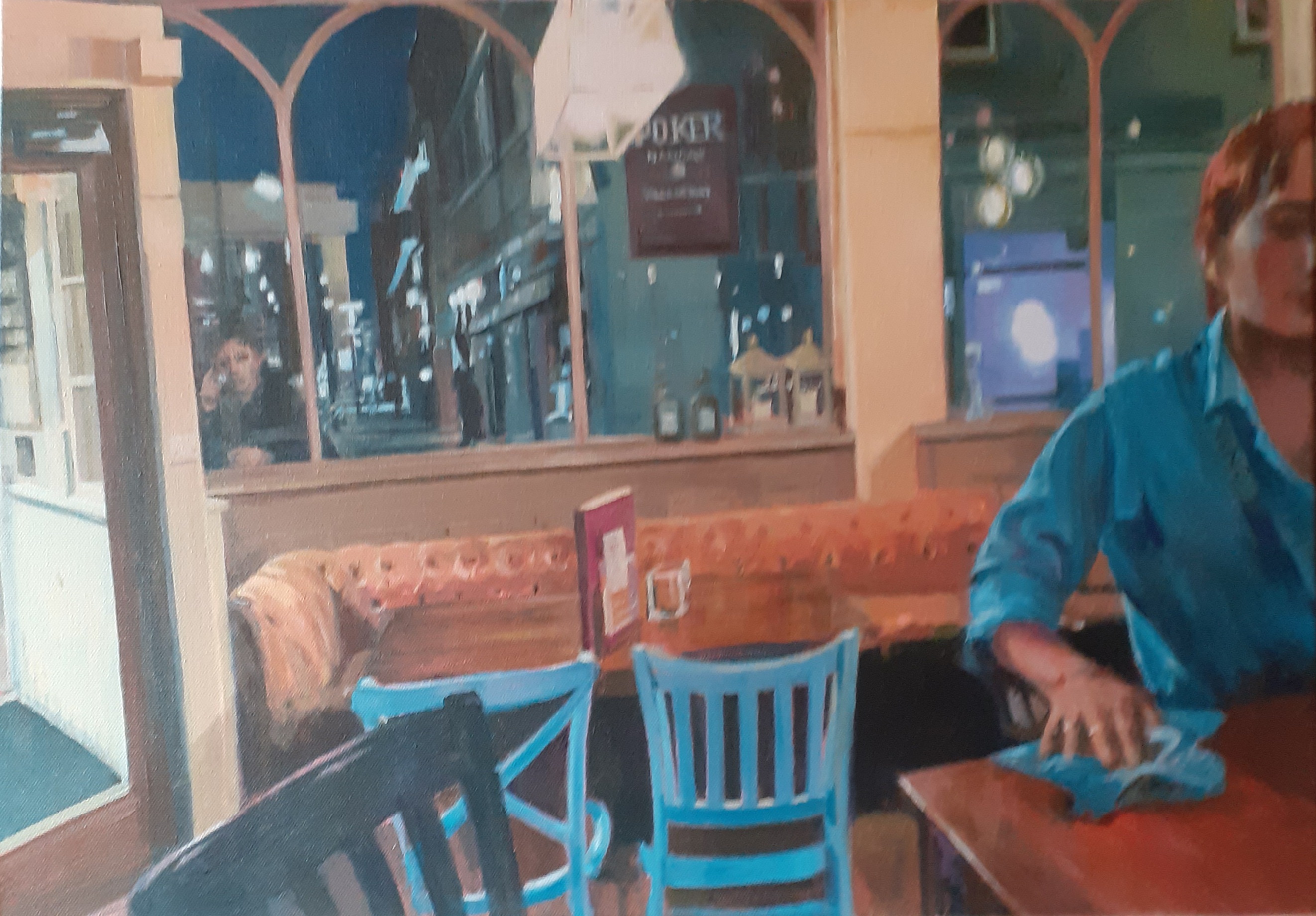
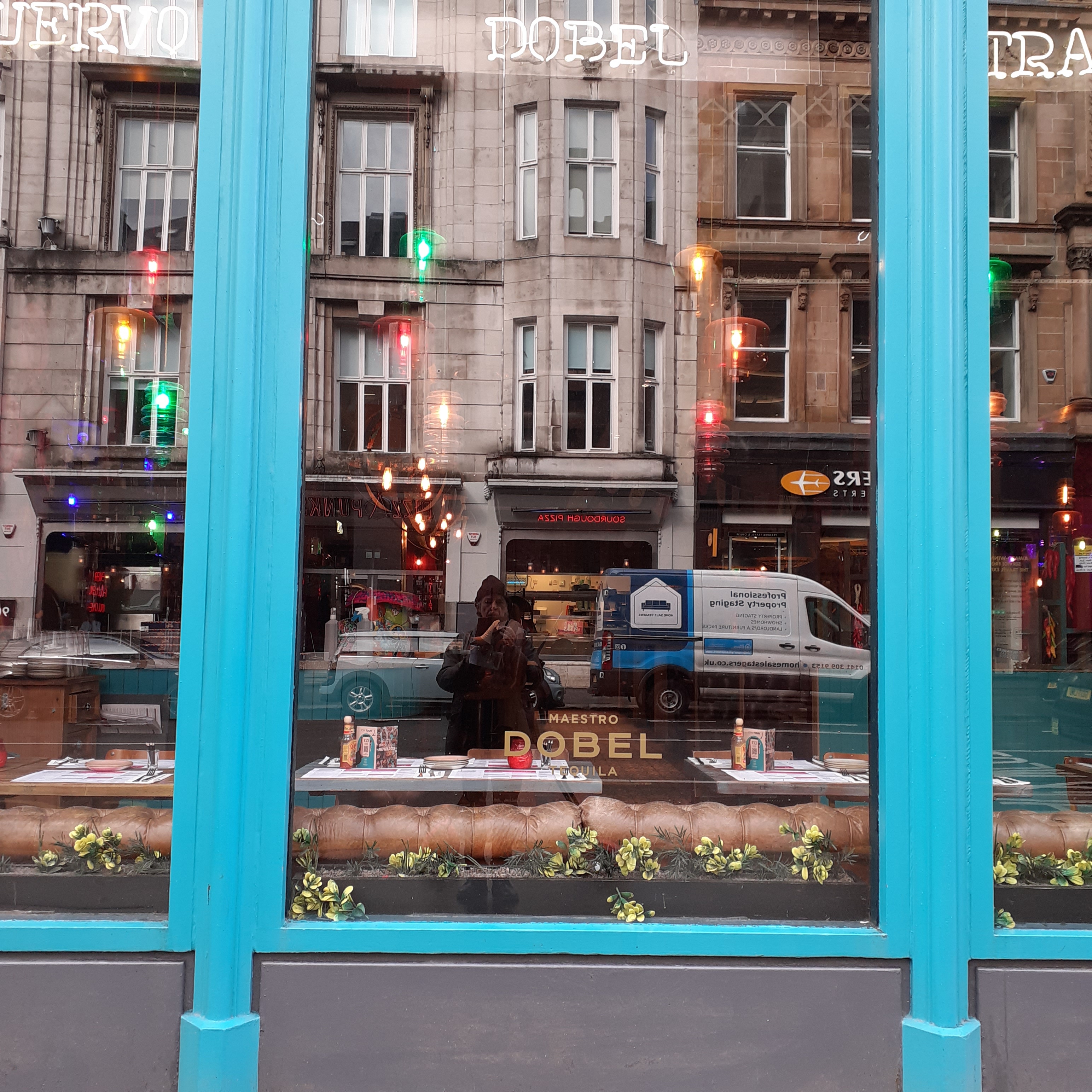
This painting is taken from our Isle of Man trip. The restaurant, Wine Down, is in Douglas. We sat on the front terrace. I took this shot looking into the crowded restaurant. The window catches interior and exterior, myself and M, and others, observing and being observed. It is a bit like a jigsaw puzzle of life. There are too many pieces and not enough time to fit them all together. And we only imagine the picture on the cover of the box to guide us.

Maybe I am overinclined to sit in cafe windows watching the world going by, while  the world watches me. But there’s belonging too, and the thrill of it all. There are consolations in being a part of the crowd. Imagine the stories of the people here, some connecting with the observer, some lost in their own world. You’ll catch whispered narratives in the buzz, a song rising from the din.

I am listening to Bruce Springsteen’s 2020 album, Letter to You. House of a Thousand Guitars is specifically a hymn to live music venues. Broader than that, it celebrates the human urge to meet socially, and the togetherness of places where the music and the people play

So wake and shake off your troubles my friend

We’ll go to where the music never ends

From the stadiums to the small town bars

We’ll light up the house of a thousand guitars

Munich – Beer and Roaming in Bavaria

The curtain of cloud lifts as I leave Salzburg. At last I get to see the sublime world of Alpine life and scenery. I could certainly skip through that swinging my guitar case and singing in a high voice. But, probably better not. The train journey is a magical collage of jagged blue peaks and melting green fields. There is sunshine too. At Munich Hauptbanhof I navigate the crowds and make my connection to Arabellapark.

Arabellapark is seven stops and under half an hour by Ubahn. The area is mostly a businesspark with a few hotels. It is modern, quiet, and convenient for the city with regular public transport. My station is on Richard Strauss Strasse. I’m booked into the Best Western Hotel nearby.

Strauss was born in Munich in1864 and became a famed composer of the late Romantic and early Modernist period. His compositions include Don Juan, Also Sprach Zarathustra and the opera Salome, from Oscar  Wilde’s play. Zarathustra provides the dramatic element in the soundtrack for Stanley Kubrick’s 2001 A Space Odyssey, with its opening fanfare, known as Sunrise. Strauss based his sound poem on Friedrich Nietzche’s Thus Spoke Zarathustra. Kubrick’s 1968 film helped reestablish Strauss’s music in the world. In 1933 he had been appointed head of the Reich Music Chamber, the regulating body for music in Germany. This led to accusations of his being a Nazi collaborator, He was cleared post war. It was noted that his insistence to work with librettist Stefan Zweig, a Jew, got him sacked.  Strauss died in 1949.

There is something of a town centre in a hdden enclave near the Ubahn terminus at Rosenkavalier Platz. Der Rosenkavalier was an opera written by Strauss in 1910. Arabellapark itself refers to another Strauss opera Arabella. The Platz is a modern pedestrian zone with an interesting Art Deco cinema. There’s a cluster of good eateries and shops. Hans um Gluck is a grill bar. The interior is a startling birch forest making an ambience popular with parents and their kids. Hans um Gluck is a folk tale of the Brothers Grimm. It translates as Hans in Luck, wherein the hapless hero manages through a series of rash transactions to convert a gold nugget the size of his head into a whetstone. There’s an Italian Restaurant nearby, Bistro Fohn, another comfy and friendly spot for good fare.

Morning, and back Into the maw of the Hauptbanhof I go, the Ubahn journey lengthened by a forced connection. It’s heavy rain this morning and I can’t get my bearings in the vicinity of the station which has no discernible front door. I find my way, unintentionally, to Theresienwiesse, the park used for the annual Oktoberfest. This festival takes place in late September, not quite what it says on the tin. I arrived the following week, Hangover Week as it isn’t known. The Oktoberest was certainly tempting, though might be best handled in a group rather than flying solo. The festival began in 1810, to celebrate Prince Ludwig’s marriage to Princess Therese of Saxony. The Festival draws seven million visitors consuming seven million litres of beer. So, they only drink a litre each? I reckon there must be big queues at the bar.

At last I align myself and walk back to the city centre. Marienplatz is that centre, a rectangular plaza dating back to 1158. It centres on the Marian Column, in honour of Our Lady, and erected in 1638 to commemorate the end of the Swedish occupation. The New Town Hall, a fabulous Neo-Gothic palace, forms the northern side of the plaza. Built in the mid nineteenth century and based on Brussels City Hall, it was extended in the early twentieth century with a soaring tower of 85 metres. The Old Town Hall marks the eastern end of Marienplatz, while to the west the towers of Fraunkirch loom. Frauenkirche, also dedicated to Our Lady, is the city cathedral. Its distinctive frontal round towers are the highest structures on the inner city skyline, almost a hundred metres tall and topped with onion domes. The church was built in the late fifteenth century, redbrick and sparse in style.

Off Marienplaz is the Viktualienmarket. This vibrant square is packed with stalls selling food, flowers and artefacts, gathered around a sprawling beer garden. It is open every day but Sunday and all human life is here. I queue for bratwurst and chips, with a foaming beer, and find a seat under the trees. The bratwurst is huge and sublime. You could sit here all day and watch the world go by. There’s waiter service, though the self service is best. The beer stall simply sets up the foaming beer by litre or half litre measure and you grab one and pay your €5 at the adjacent register. No queue, just conveyor belt booze. Happy daze.

Munich is a mecca for the dedicated beer hound. In the public interest I thought it best to investigate this phenomenon. Having at last freed myself from the embrace of the Viktualienmarket, I careened through the old town towards the Hofbrauhaus on Platzl, most famous of the city’s beer halls. Ludwig I opened it to the public in 1828 and the current building dates from 1897. The cavernous central hall hums with conversation and cheer. High above, the vaulted ceiling is adorned with baroque frescoes. Light flows in through the high arched windows. The effect is practically religious. I almost feel like genuflecting, though that would be hazardous.

I find a bench in the courtyard beergarden which is quiet. I wrap my hand around a one litre stein, or masskrug. Steins were originally a stoneware mug, though now refer to the heavy glass with a handle synonymous with German beer drinking. There’s a technique to drinking such a volume for a lightweight like me. Slide your hand inside the handle and hold the glass body between palm and thumb. Lift and quaff. Repeat as necessary.

Ein zwei drei vier

Lift your stein and drink your beer

Ein zwei drei vier

Lift your stein and drink your beer

Drink! Drink! Drink!

Platzl is a small pedestrian square lined with drinking and dining terraces. The Dubliner Irish Pub across the road provides a cozier port to put into. I can admire the Hofbrauhaus building from the outdoor terrace.

North of the city centre is the extensive Museum quarter, the Kunstreal, Along the wide treelined avenues are a cluster of major art galeries and museums. The Pinakotheks are the three main galleries: Alte Pinakothek for old masters, the Neue for 19th century art from the Romantics to the Impressionists, and Moderne for twentieth century and contemporary art. The word Pinakothek is taken from the ancient Greek.

The Alte Pinakothek was begun in 1826 on the orders of King Ludwig (him again) and was the largest art gallery in the world on its completion. It houses a vast collection of European art from the 14th to the 18th century. Amongst 700 paintings there are works by Durer, Rubens, Memling, Raphael, Titian, Breughel, Rembrandt, Van Dyck, Murillo and El Greco. That starting eleven should win the European Champions League for sure. Others that grabbed attantion included Arcimboldo’s ingenious vegetarian heads, the Debauched Student by Van Honthorst, while Bouchier’s elegant portrait of Mme Pompadour is a centrepiece, and also adorns the entrance ticket.

The Neue Pinakothek followed in 1859, the first European museum of contemporary art. Both buildings were badly damaged during World War II but while the Alte was renovated, preserving the stress suffered by the original, the Neue was demolished. It was replaced with a postmodernist building opening in 1981. We didn’t get forty years out of it. 

On my visit the Neue Pinakothek was, of course, closed. It is the same throughout Europe I’m afraid, where art museums of 18th and 19th century art are shut. This building was closed in 2019 and will not reopen before the end of the decade. A section of the Alte has been used to display a selection of work from the Neue under the title rom Turner to Van Gogh. Standouts include Manet on his boat, Sunflowers and a view of Arles from Van Gogh, waterlillies from Monet and Max Lieberman’s sundrenched beergardens. New to me was Giovanni Sagatini with a large panoramic landscape title Ploughing from the 1890s. Snow capped mountains at last! It made my trip.

Pinakothek Der Moderne is devoted to art from the twentieth century and onwards. Built in 2002, the building has an impressive glass facade with high columns supporting the canopy roof. Inside it is divided into quarters devoted to art, architecture, design and graphics around a central rotunda. The art focusses first on important works by Braque and Picasso in the development of Cubism. Woman with Violin by Picasso and Braque’s Woman with Mandoline feature as a duet. Something of an all girl band forms farther on with a lifesize vernacular photograph of Patti Smith prowling with her guitar. Magritte, Ernst, Leger and Warhol are also on show. Down towards the basement, there’s a motor car theme, merging with sixtiesish, or seventies graphics.

Finally I return to the Best Western for a relaxing drink in the hotel bar. Cillian, or Kilian, the barman keeps ‘em coming. It’s a good Irish name after all. A school in my hometown Bray being dedicated to the saint. He’s also venerated hereabouts in Bavaria. Meanwhile, a virtual band shimmers on the video wall. It’s smooth jazz rock, shades of Supply, Demand and (very attractive) Curves. I slip into the ambience.

The Drinking Song is the appropriate soundbite. It was written by Sigmund Stromberg with lyrics by Dorothy Donnelly for the 1924 Operetta the Student Prince. Sung by Mario Lanza for the 1954 film soundtrack, though in the film Lanza’s voice was lip synched by Edmond Purdom. The story tells of a Prince’s student days at Heidelberg University. Prince Karl is heir to the throne of the fictitious kingdom of Karlsberg. Hmmm, it would be called that. In the course of his studies, or daily drinking sessions as they are more accurately described, Karl falls in love with the innkeeper’s daughter. Who wouldn’t drink to that?

May those lips that are red and sweet

Tonight with joy my own lips meet!

Drink! Drink! Drink! Let the toast start!

May young hearts never part!

Drink! Drink! Drink! Let every true lover salute his sweetheart!