London is an exceptional venue for the art lover. From the pleasure of its public spaces, with a millennium of architecture, to its deeply embedded history of writers, artists and musicians who have lived there, many coming from all over the world. Then of course, there are the must visit galleries: The National Gallery, the National Portrait Gallery, the Tate Britain and Tate Modern, the Victoria and Albert Museum and the Courtauld Gallery.
Growing up, I feasted on the plates of such great art popularisers as Ernst Gombrich. Gombrich’s book, The Story of Art, was published in 1950 and became necessary reading for any teenager in love with art. The Louvre, Prado, Uffizzi, and Hermitage were all well represented, and so too the National, Tate Britain and Courthald. What pleasure received from a picture in a book is multiplied several times over in seeing the real thing.
Dublin, mind, is not without its masterpieces; Renoir’s Parapluies was always worth an afternoon off school to visit, and Harry Clarke’s Geneva Window another favourite. Both featured in Dublin’s Municipal Gallery, The Hugh Lane. Renoir alternates with London, where it currently resides, while Clarke’s window is in Miami. Dublin’s National Gallery has many fine international works, alongside homegrown greats. Notably: Woman Writing a Letter by Vermeer, and the Taking of Christ by Caravaggio. The latter has a remarkable provenance, only discovered in 1990 having hung unrecognised in the house of the Jesuit Fathers on Leeson Street.
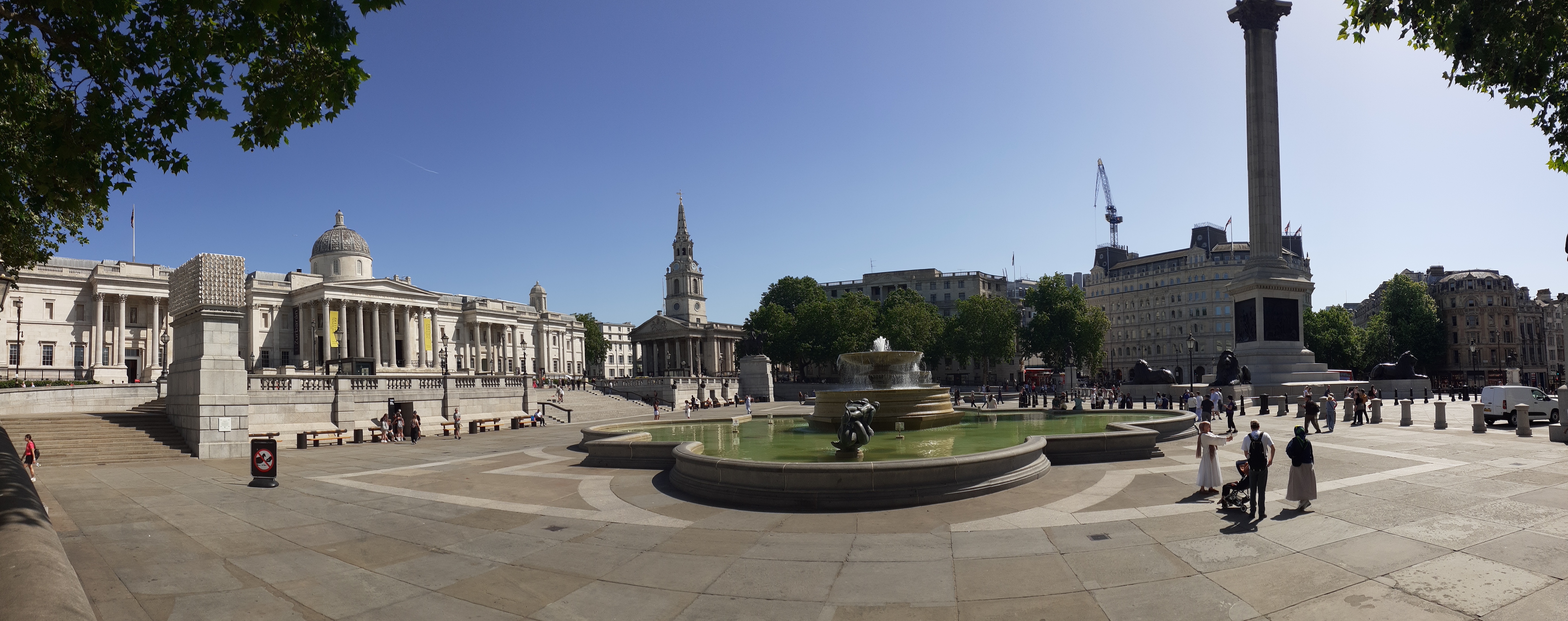
For sheer concentration of ageless masterpieces though, one needs to travel. London’s gallerys are in the top rank. The National Gallery on Trafalgar Square is home to many world masterpieces.
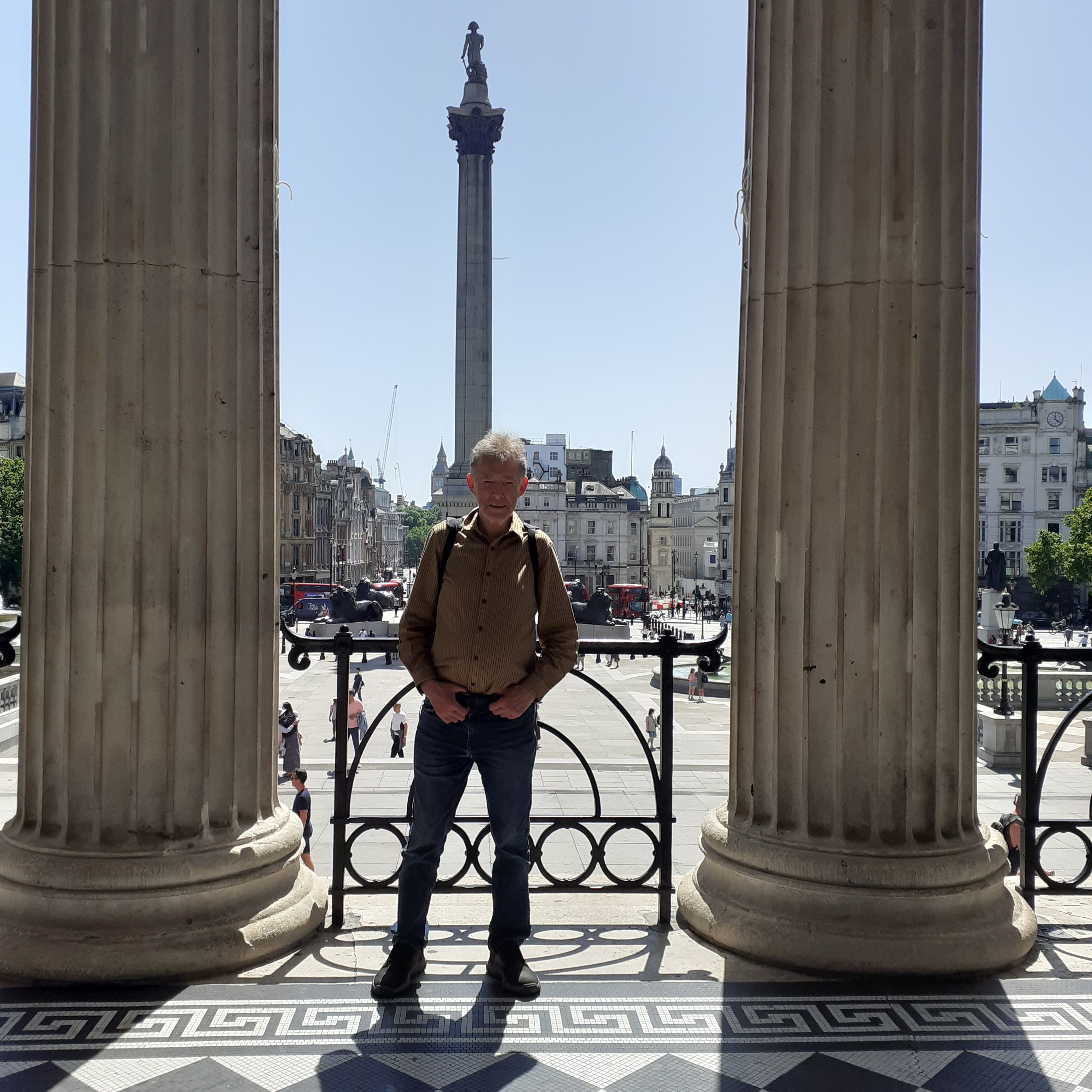
The Gallery building dominates Trafalgar Square, very much the centrepoint of London. Nelson stands atop his column here, a focal point of the square from its inception. The National Gallery was established in 1824, and the building itself comleted in 1838. Designed by William Wilkins it formed the northern edge of the newly constructed square, on the site of the old Royal Mews.
The Sainsbury Wing was added in the 1990s and is the point of entry to the museum.Entrance is free and it’s a good idea to get there early and beat the crowds. Not that you are ever going to be alone. Medieval, Renaissance, Baroque, Rococco, Romantic and Modernism are laid out for you to pick your favoured path. I’d give it two days. But don’t rush. The point is to enjoy the faboulous story presented here at your own pace.
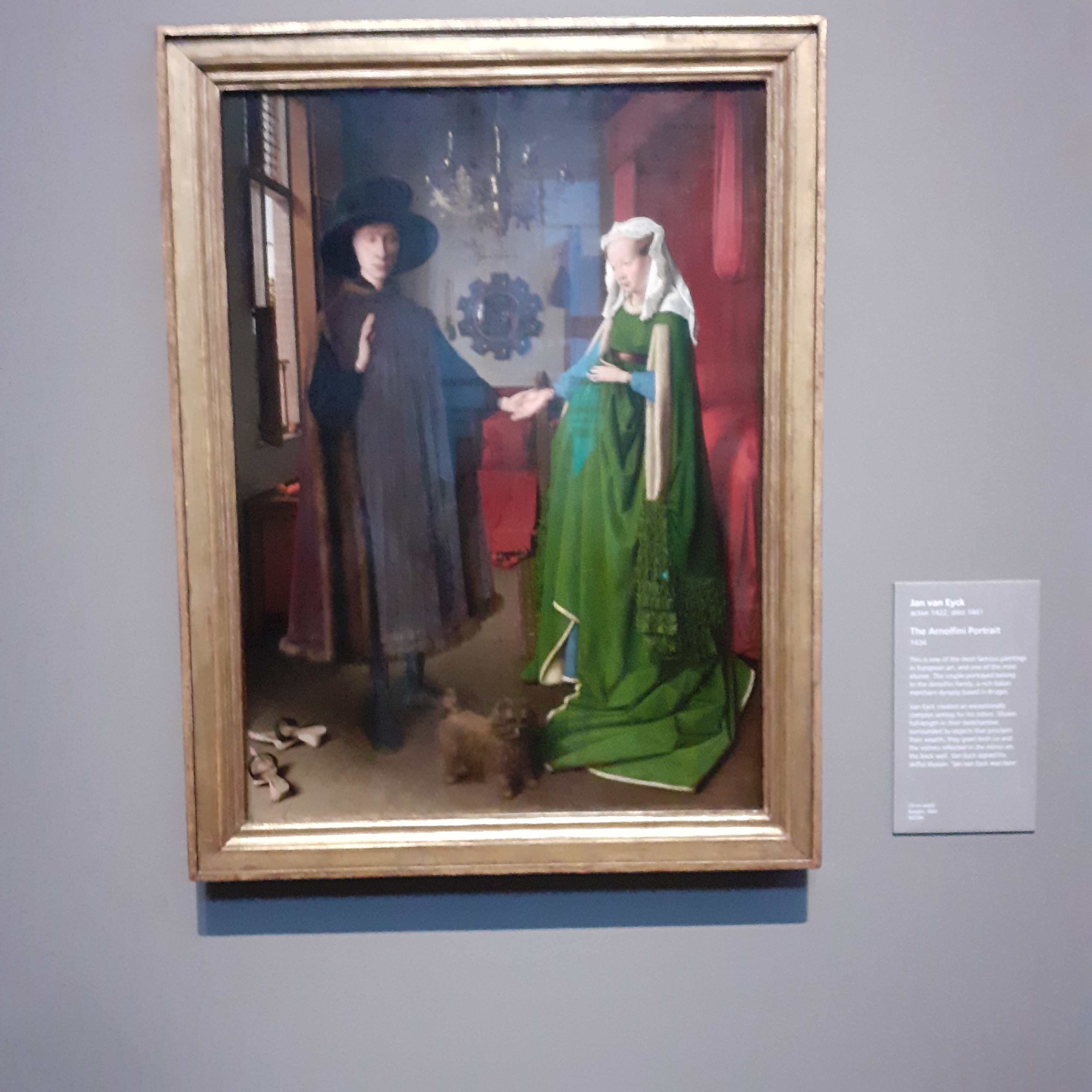
Highlights include Venus and Mars by Sandro Botticelli. It is playful and brilliant, one of the many masterpieces from Gombrich’s book. The Portrait of Giovanni Arnolini and his wife is another must see, and one that will stop you in your tracks. Van Eyck’s astonishing painting from 1434 is a very early example of realist, or illusionist, painting, and of domestic subject matter. The Rokeby Venus by Velazquez has been no stranger to controversy since painted by the Spanish artist in the mid seventeenth century. Such paintings were condemned by the Spanish Inquisition, and in the twentieth century it has been slashed by a suffragette and assaulted by climate activists., You could spend a day sitting before it, lost in admiration, or spend fifteen minutes, if like me you are with the missus. The name comes from Rokeby House in Yorkshire, where the painting hung prior to being acquired by the National in 1906.
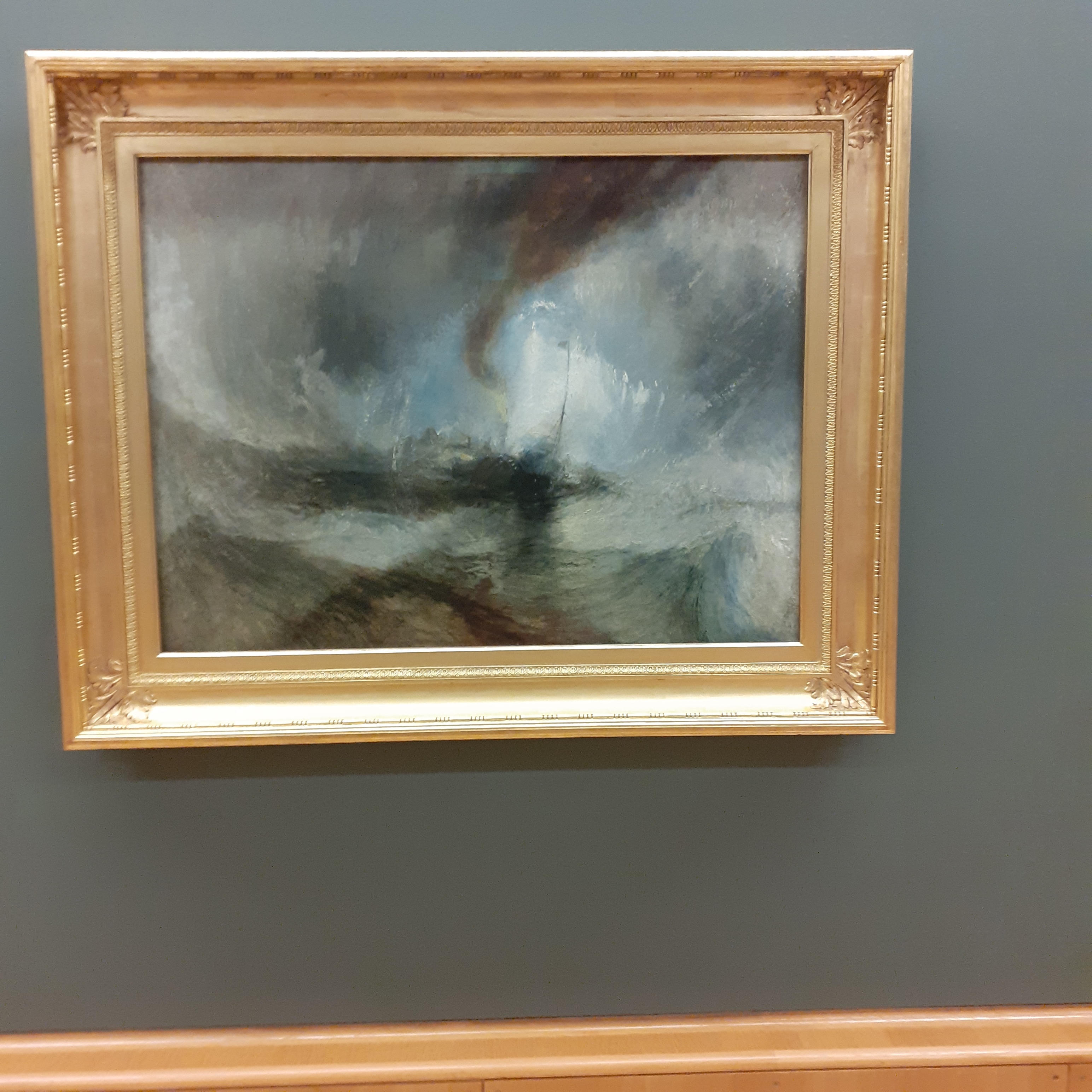
Look for the 19th century to discover the evolution of modern art as we know it. JMW Turner is the most revered English painter and hugely influential. His admiration for French painter Claude is illustrated by the exhibition of two Claude’s side by side with two of Turner’s own This permanent display is a condition of his bequest. Turner was born in 1775 in Covent Garden a little further east of Traalgar Square.-He died in 1851 leaving a large body of his work to the nation. Most of this work was turned over to the Tate Britain after settlement of the Turner Bequest in 1856.
The National Gallery still holds Turner’s masterpiece, the Fighting Temeraire painted in 1838. This has been voted Bitain’s favourite painting. Also look out for Rain, Steam and Speed from 1844 a dramatic depiction of a locomotive crossing the Maidenhead Railway bridge in the rain.
The National Portrait Gallery is next door. There’s a rooftop restaurant here with great views over central London. We stop for a coffee outside, where a glass kiosk offers an air conditioned cocoon in the gathering midday heat. Beautifully dappled in the shade of urban trees, we are together and alone. We often like to touch base at the Portrait Gallery on a London visit. Founded in 1856 it was one of he first National Gallerys devotied to portraiture. It moved to its current home adjacent to the National forty lears later. It presents English history through portraiture with paintings of the likes of Henry VIII and William Shakespeare (probably) up till the present day, with regular contemporary group and individual exhibitions..
The Tate Gallery was established in 1897. Located in Millbank on the Thames, south and upriver of Westminster. We take the tube to Pimlico and it’s a short walk from there. Before going in we have a look at the Vauxhall Bridge, a steel arched bridge from the early twentieth century framed by a cluster of highrise towers. On the far bank is the Vauxhall Cross Headquarters of MI6, the Secret Intelligence Service of Britain. You’ll know it from James Bond films, no doubt.
The Tate was founded as a gallery for modern British art by Sir Henry Tate, the Victorian sugar merchant. He was the Tate of Tate and Lyle. Lyle’s Golden Syrup logo is a visual arts icon in itself, illustrating the biblical tale of Sampson with the catchline: out of the strong, came forth sweetness. Since 2000 the Tate Modern downriver is housed in the Bankside Power Station and devoted to art that is, um, more modern. A riverboat connects the two venues. The Tate Britain, as the original is known, hosts a significant collection of British art. Millais’ Ophelia is a well known work that featured in Gombrich’s book and there are plenty of others from the Pre Raphaelite Movement. Holman Hunt’s The Awakening Conscience, the Annunciation by Rossetti, the Death of Chatterton by Henry Wallis and Waterhouse’s iconic bedsitter image The Lady of Shallot. There’s another familiar swoon on seeing Whistler’s Nocturne in Blue and Gold, depicting the Old Battersea Bridge from his time living in the city.
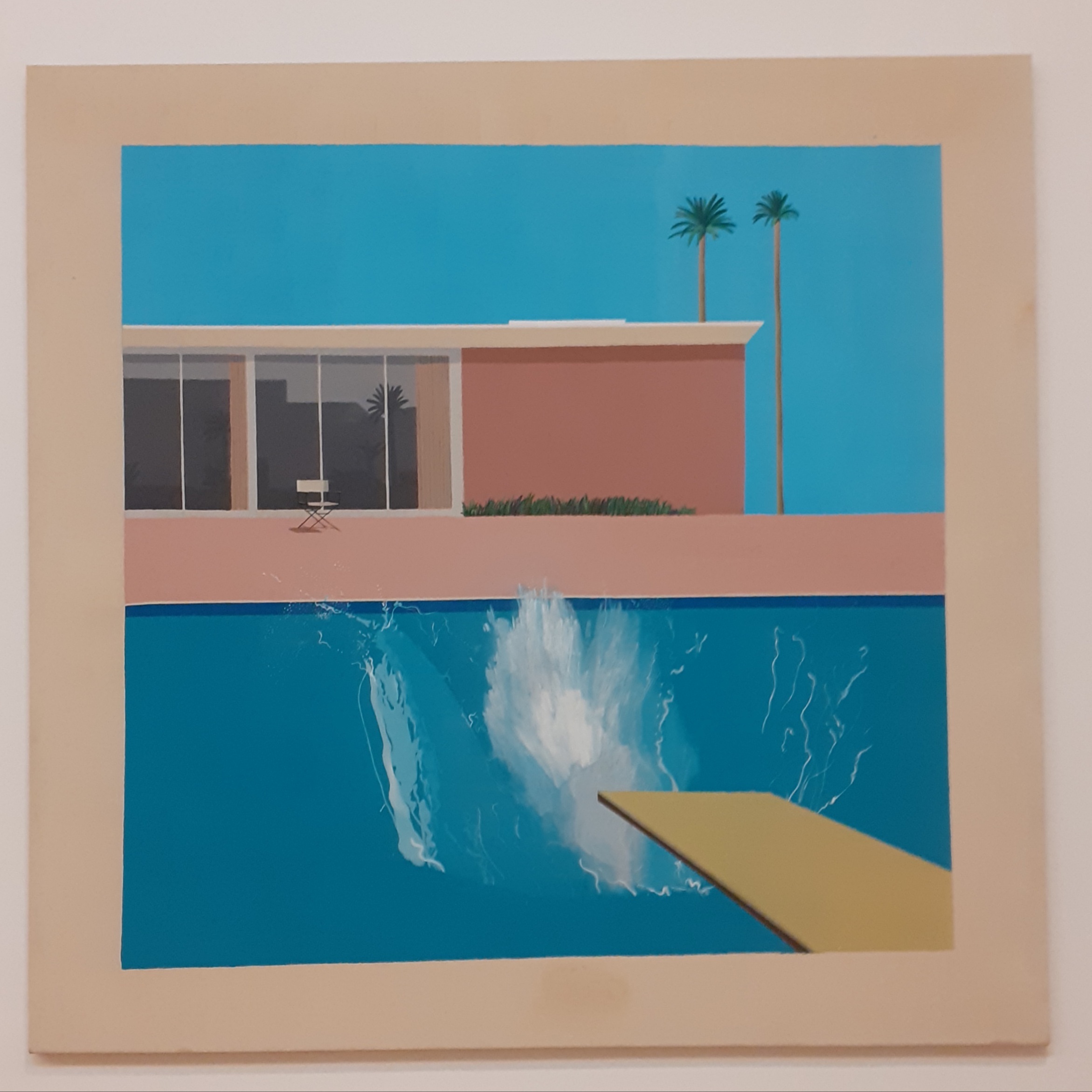
The Bath of Psyche by Frederic Leighton, once President of the Royal Academy, forms the backdrop for a pop up lecture on the artist. The young guide who launches into the talk knows how to grab a crowd. There’s plenty in the collection to hold the crowds, including of course the large collection of Turner’s work. There’s great twentieth century art also, A Bigger Splash by David Hockney being a particular standout.
After the Tate, we walk through the redbrick Millbank estate. This was built at the end of the nineteenth century and was an early social housing scheme, similar to the Iveagh Trust buildings. The seventeen estate blocks are named after famous artists including Turner, Millais and Leighton.
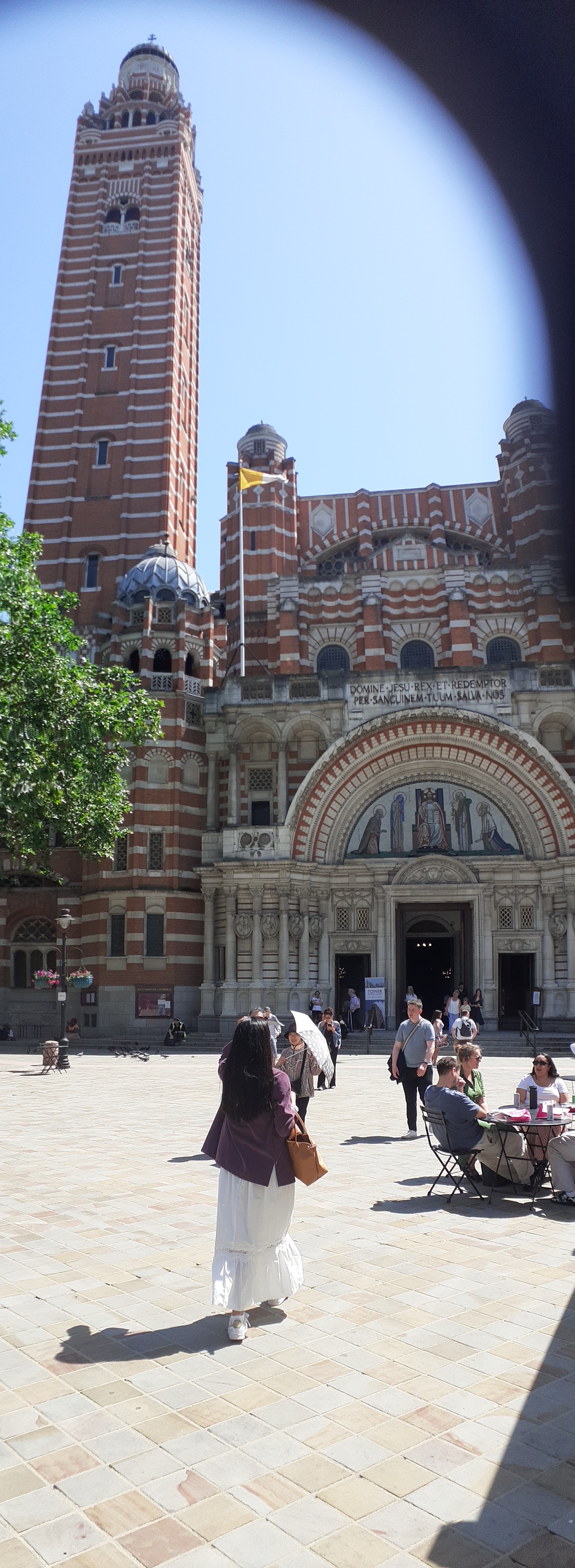
Past the Millbank estate we come to Westminster Cathedral. The Roman Catholic Cathedral was built in 1903 and heavily inluenced by Eastern Orthodox architecture, particularly the Hagia Sofia, the ancient cathedral of Constantinople. Designed by John Francis Bentley and constructed of brick, it makes a startling visual statement of red with horizontal white stripes. It is dedicated to the Most Precious Blood of Our Lord Jesus Christ and also pays homage to, amongst others, Saint Andrew of Scotland, my own patron saint.
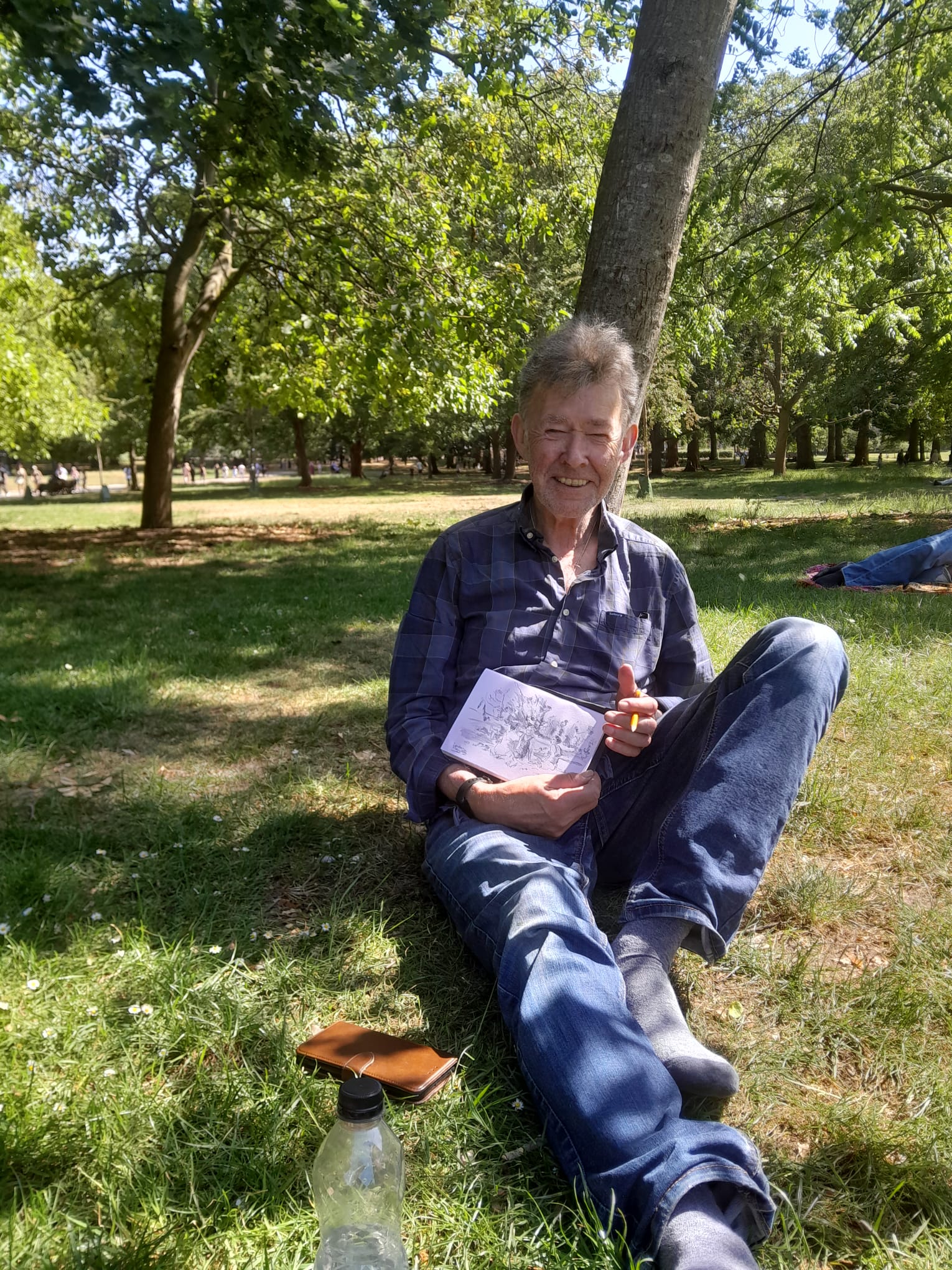
From there we made our way past Buckingham Palace and on to Green Park. Here we had our own Dejeuner sur l’Herbe. A modest affair, I’d have you know; coffee, beer and snacks are available from park kiosks, and the sun beats down and we lie on the grass. Had we wanted to see Manet’s original, we could head for the Courthauld Gallery up on the Strand. There are other days and plenty more paintings to see.
 xxharrison