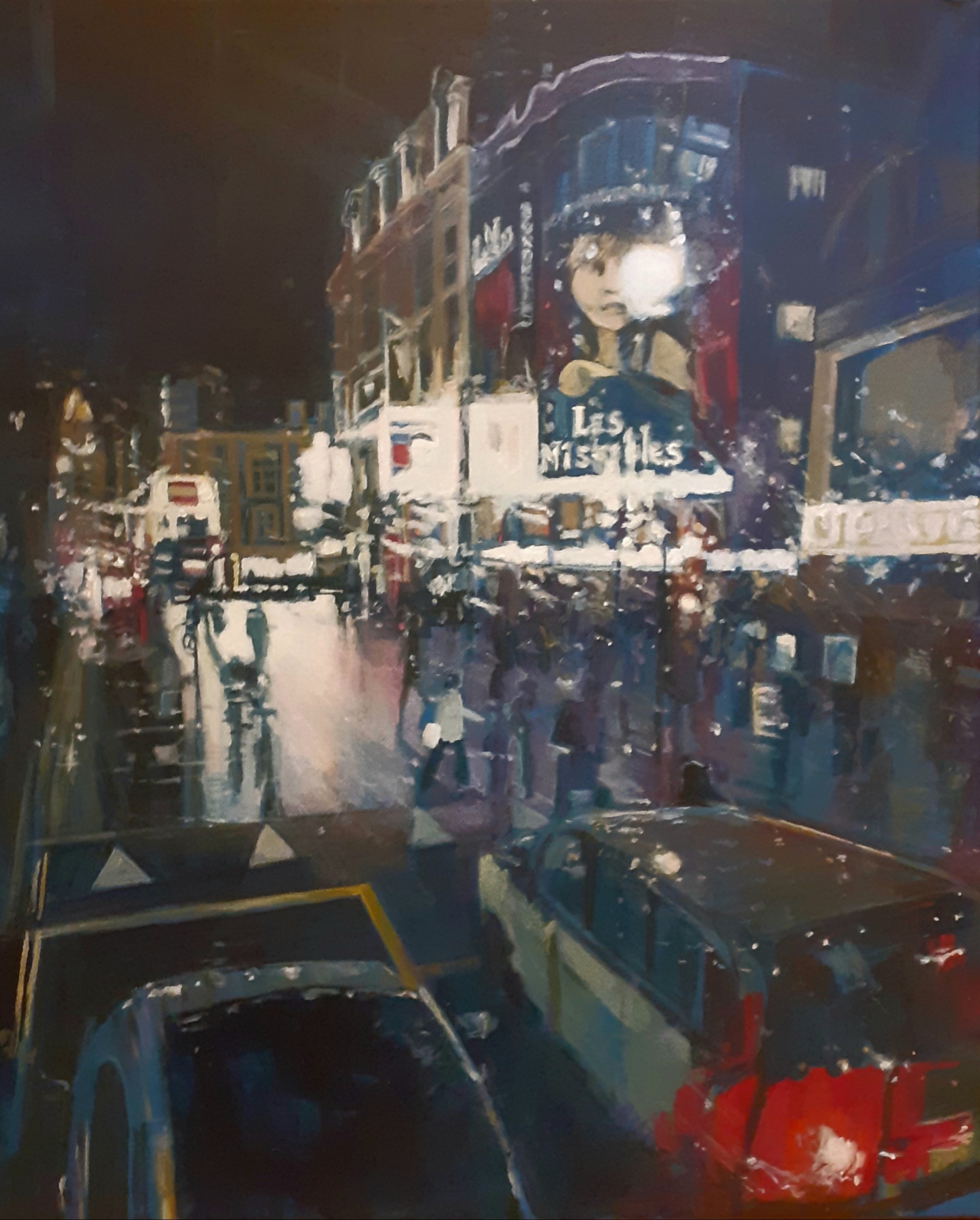
I posted this painting some months back but I thought I would run it up the flagpost again. It has been accepted for the 14th Annual Signal Open Exhibition over the first fortnight in August. The Signal Arts Centre was established in 1990 in Bray and provides workspace, classes and gallery for local artists. It is on Albert Avenue near the seafront and, as the name hints, right beside the railway line. Whoo whoo! I have had work there before and it is always great to be accepted. Whoo whoo, again. The Open Exhibition will feature around a hundred visual artworks. It runs from Tuesday the 4th to Sunday the 16th of August. Mine is an acrylic painting called Soho in the Rain. It shows a view of Shaftesbury Avenue in London from the top of a bus. There’ll be loads of great stuff there, so come and have a deco!
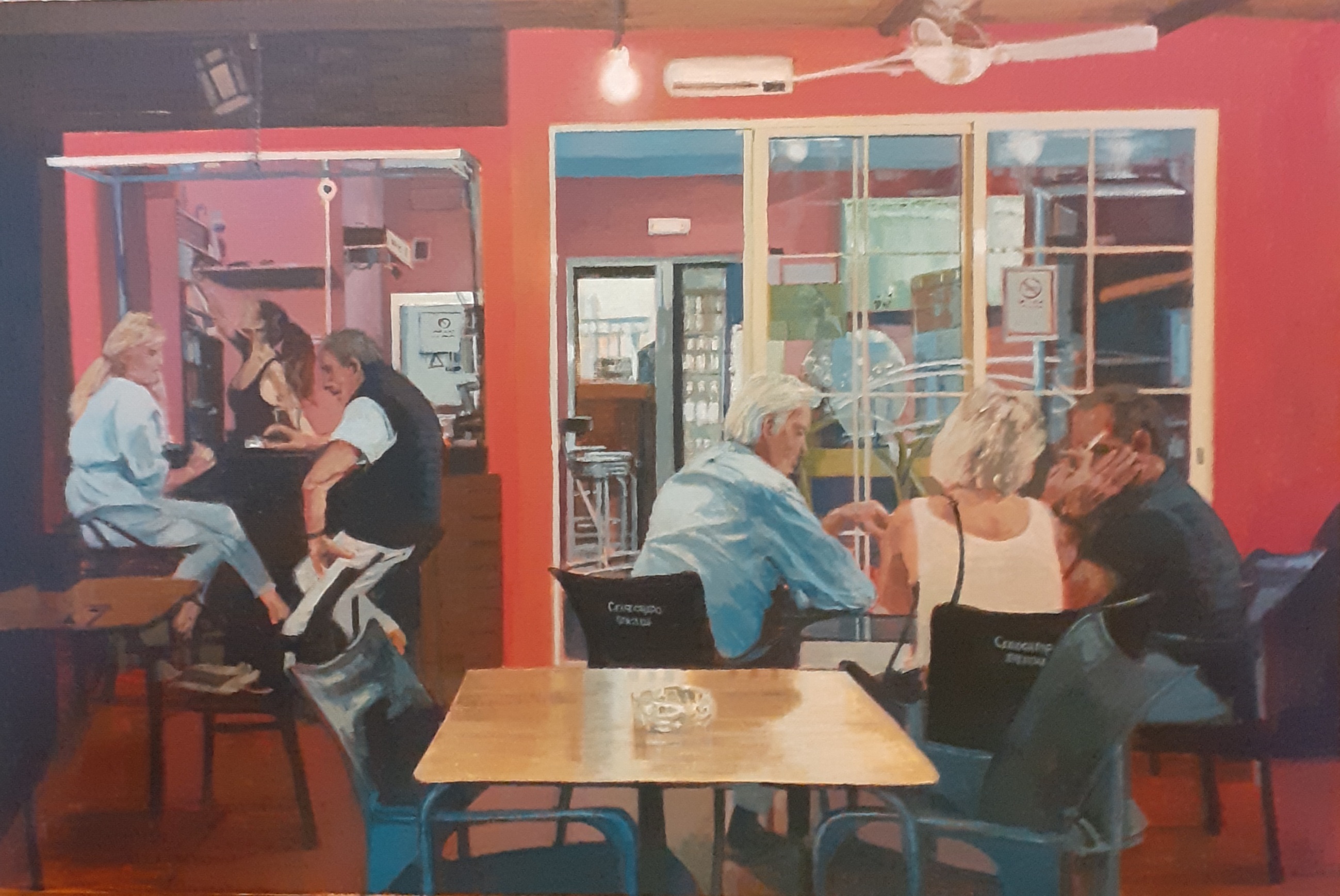
Elviria is a place I often stay when in Andalusia. It is just four miles out of Marbella, set in hilly woodland sloping down to the Mediterranean. I have committed a few scenes to paintings and here is another. This is the Itohavi Bar and Cafeteria. Situated at the bottom of the Avenida de las Cumbres where we stay, it is the perfect local spot for a morning coffee, a daytime snack, an early evening bite and a few drinks, well, any time really. This scene is of a pleasant April night, drink and conversation are flowing, and the rich texture of falling night blends with the bright colours of an Andalusian day. Perfect.
I’m dancing in the moonlight It’s caught me in its spotlight It’s all right, all right Dancing in the moonlight On this long hot summer night
Thin Lizzy’s 1977 song, from the album Bad Reputation makes for a sublime soundtrack for this warm Spanish night. Written by Philip Lynott from my own Old Town of Dublin, Dublin 12 to be precise. Born on the 20th August, 1949, his birthday bash at the Bloody Stream in Howth will be celebrated on that weekend.
London is an exceptional venue for the art lover. From the pleasure of its public spaces, with a millennium of architecture, to its deeply embedded history of writers, artists and musicians who have lived there, many coming from all over the world. Then of course, there are the must visit galleries: The National Gallery, the National Portrait Gallery, the Tate Britain and Tate Modern, the Victoria and Albert Museum and the Courtauld Gallery.
Growing up, I feasted on the plates of such great art popularisers as Ernst Gombrich. Gombrich’s book, The Story of Art, was published in 1950 and became necessary reading for any teenager in love with art. The Louvre, Prado, Uffizzi, and Hermitage were all well represented, and so too the National, Tate Britain and Courthald. What pleasure received from a picture in a book is multiplied several times over in seeing the real thing.
Dublin, mind, is not without its masterpieces; Renoir’s Parapluies was always worth an afternoon off school to visit, and Harry Clarke’s Geneva Window another favourite. Both featured in Dublin’s Municipal Gallery, The Hugh Lane. Renoir alternates with London, where it currently resides, while Clarke’s window is in Miami. Dublin’s National Gallery has many fine international works, alongside homegrown greats. Notably: Woman Writing a Letter by Vermeer, and the Taking of Christ by Caravaggio. The latter has a remarkable provenance, only discovered in 1990 having hung unrecognised in the house of the Jesuit Fathers on Leeson Street.
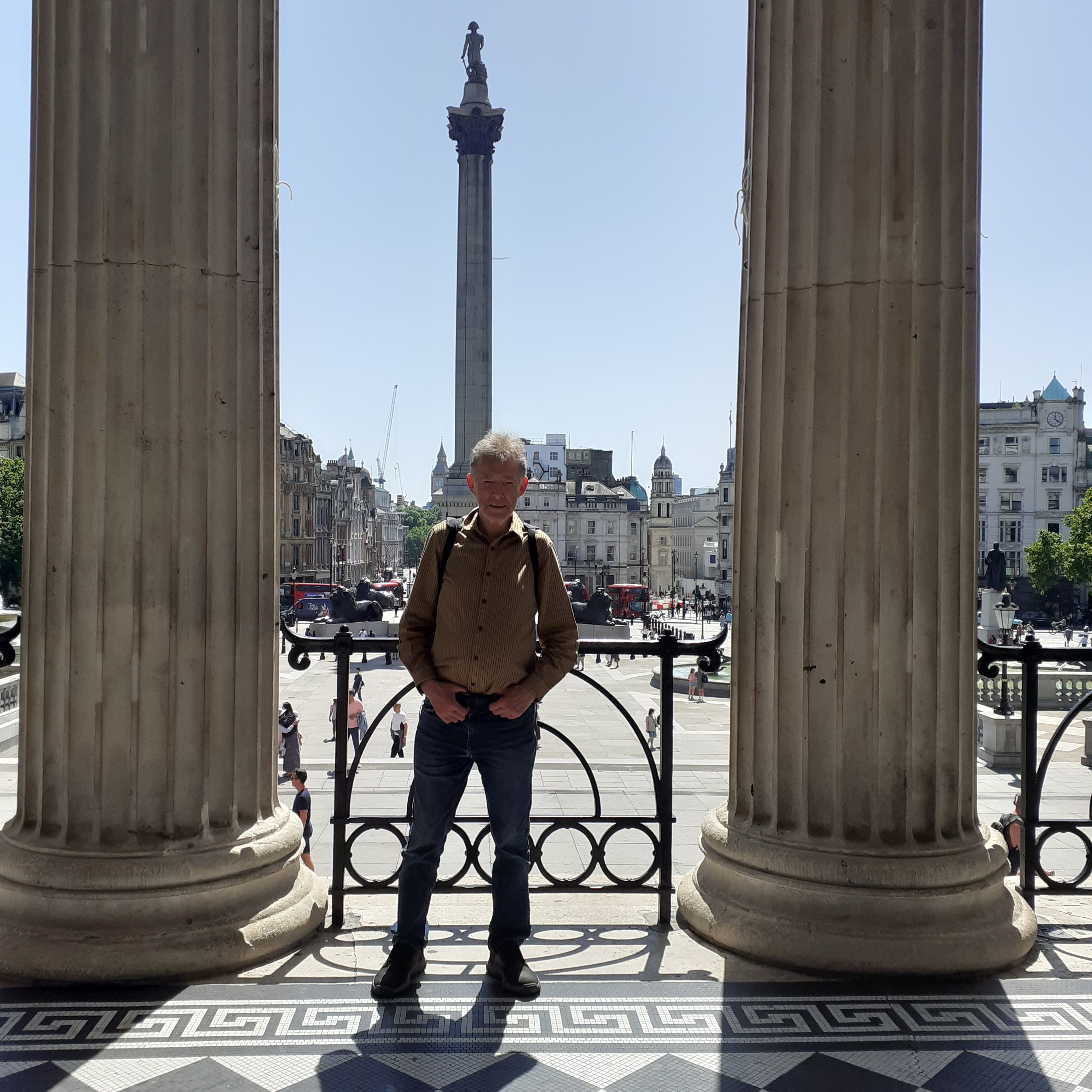
For sheer concentration of ageless masterpieces though, one needs to travel. London’s gallerys are in the top rank. The National Gallery on Trafalgar Square is home to many world masterpieces.
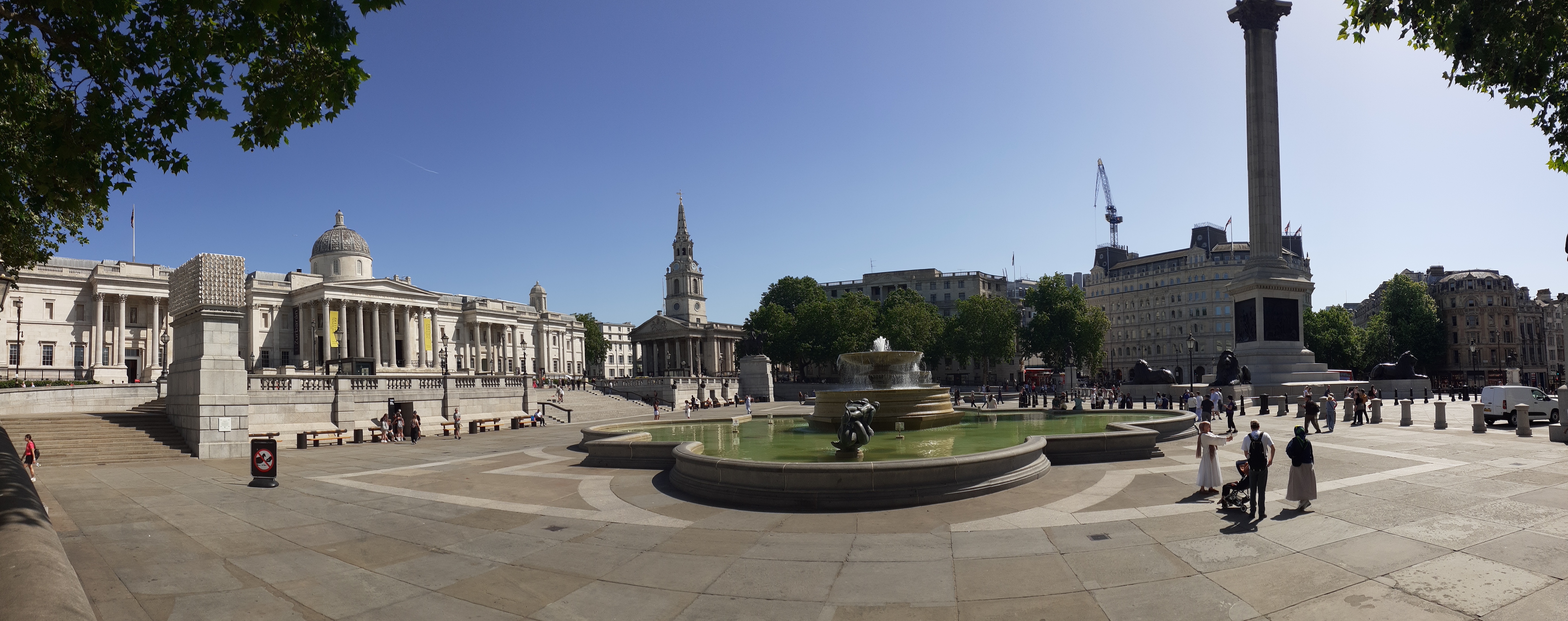
The Gallery building dominates Trafalgar Square, very much the centrepoint of London. Nelson stands atop his column here, a focal point of the square from its inception. The National Gallery was established in 1824, and the building itself comleted in 1838. Designed by William Wilkins it formed the northern edge of the newly constructed square, on the site of the old Royal Mews.
The Sainsbury Wing was added in the 1990s and is the point of entry to the museum.Entrance is free and it’s a good idea to get there early and beat the crowds. Not that you are ever going to be alone. Medieval, Renaissance, Baroque, Rococco, Romantic and Modernism are laid out for you to pick your favoured path. I’d give it two days. But don’t rush. The point is to enjoy the faboulous story presented here at your own pace.
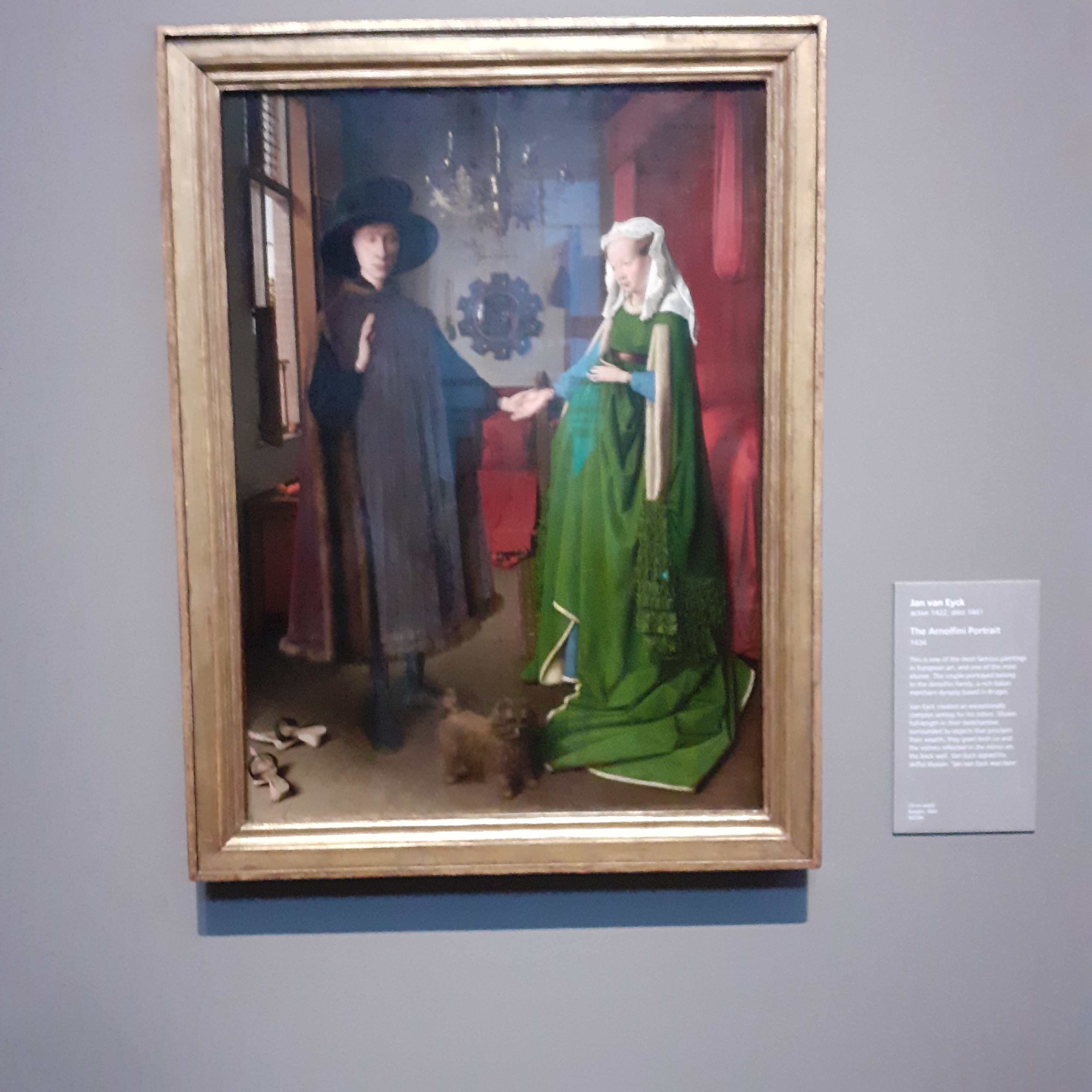
Highlights include Venus and Mars by Sandro Botticelli. It is playful and brilliant, one of the many masterpieces from Gombrich’s book. The Portrait of Giovanni Arnolini and his wife is another must see, and one that will stop you in your tracks. Van Eyck’s astonishing painting from 1434 is a very early example of realist, or illusionist, painting, and of domestic subject matter. The Rokeby Venus by Velazquez has been no stranger to controversy since painted by the Spanish artist in the mid seventeenth century. Such paintings were condemned by the Spanish Inquisition, and in the twentieth century it has been slashed by a suffragette and assaulted by climate activists., You could spend a day sitting before it, lost in admiration, or spend fifteen minutes, if like me you are with the missus. The name comes from Rokeby House in Yorkshire, where the painting hung prior to being acquired by the National in 1906.
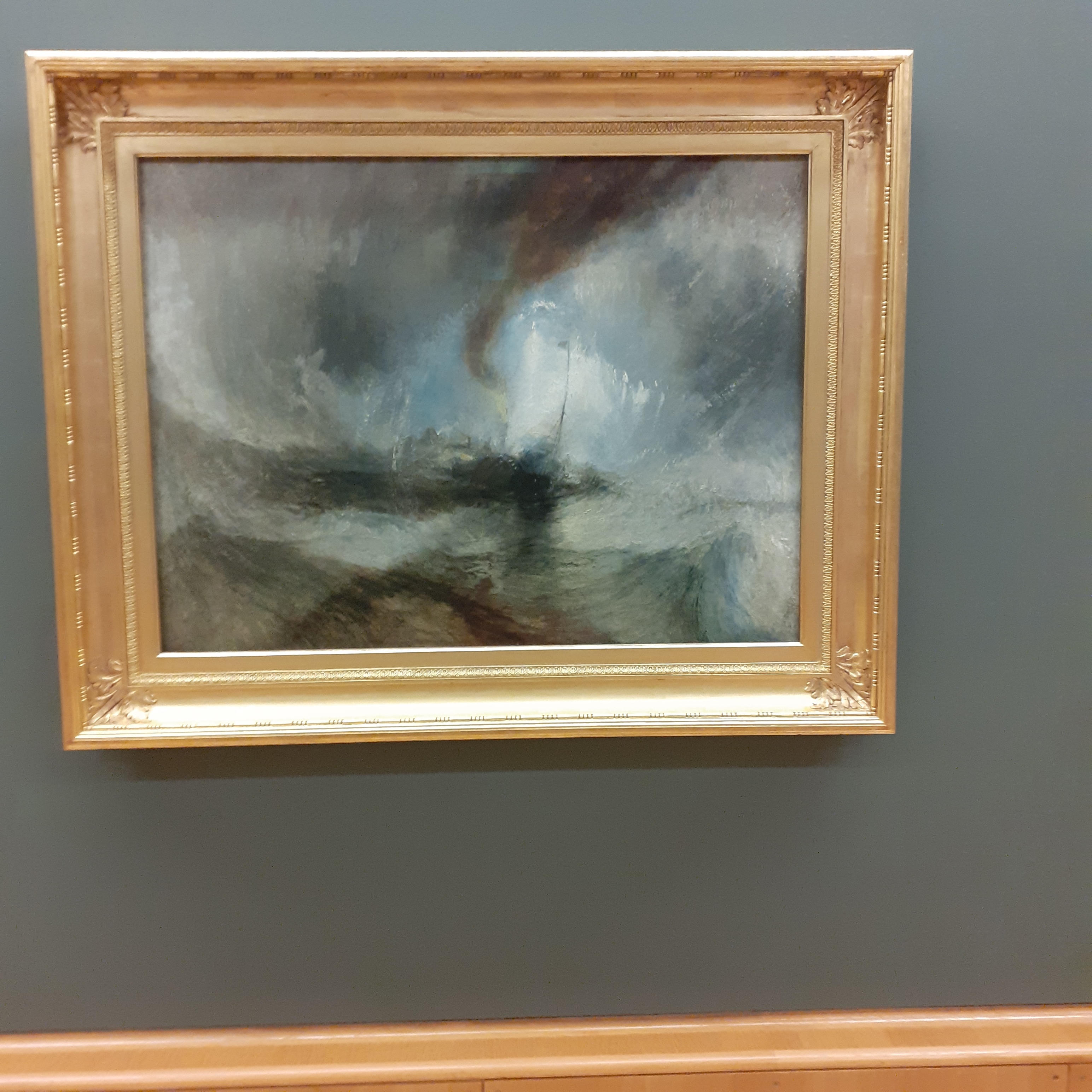
Look for the 19th century to discover the evolution of modern art as we know it. JMW Turner is the most revered English painter and hugely influential. His admiration for French painter Claude is illustrated by the exhibition of two Claude’s side by side with two of Turner’s own This permanent display is a condition of his bequest. Turner was born in 1775 in Covent Garden a little further east of Traalgar Square.-He died in 1851 leaving a large body of his work to the nation. Most of this work was turned over to the Tate Britain after settlement of the Turner Bequest in 1856.
The National Gallery still holds Turner’s masterpiece, the Fighting Temeraire painted in 1838. This has been voted Bitain’s favourite painting. Also look out for Rain, Steam and Speed from 1844 a dramatic depiction of a locomotive crossing the Maidenhead Railway bridge in the rain.
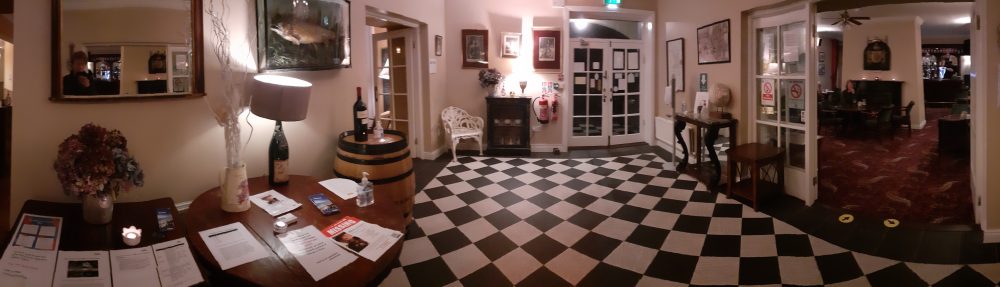
The National Portrait Gallery is next door. There’s a rooftop restaurant here with great views over central London. We stop for a coffee outside, where a glass kiosk offers an air conditioned cocoon in the gathering midday heat. Beautifully dappled in the shade of urban trees, we are together and alone. We often like to touch base at the Portrait Gallery on a London visit. Founded in 1856 it was one of he first National Gallerys devotied to portraiture. It moved to its current home adjacent to the National forty lears later. It presents English history through portraiture with paintings of the likes of Henry VIII and William Shakespeare (probably) up till the present day, with regular contemporary group and individual exhibitions..
The Tate Gallery was established in 1897. Located in Millbank on the Thames, south and upriver of Westminster. We take the tube to Pimlico and it’s a short walk from there. Before going in we have a look at the Vauxhall Bridge, a steel arched bridge from the early twentieth century framed by a cluster of highrise towers. On the far bank is the Vauxhall Cross Headquarters of MI6, the Secret Intelligence Service of Britain. You’ll know it from James Bond films, no doubt.
The Tate was founded as a gallery for modern British art by Sir Henry Tate, the Victorian sugar merchant. He was the Tate of Tate and Lyle. Lyle’s Golden Syrup logo is a visual arts icon in itself, illustrating the biblical tale of Sampson with the catchline: out of the strong, came forth sweetness. Since 2000 the Tate Modern downriver is housed in the Bankside Power Station and devoted to art that is, um, more modern. A riverboat connects the two venues. The Tate Britain, as the original is known, hosts a significant collection of British art. Millais’ Ophelia is a well known work that featured in Gombrich’s book and there are plenty of others from the Pre Raphaelite Movement. Holman Hunt’s The Awakening Conscience, the Annunciation by Rossetti, the Death of Chatterton by Henry Wallis and Waterhouse’s iconic bedsitter image The Lady of Shallot. There’s another familiar swoon on seeing Whistler’s Nocturne in Blue and Gold, depicting the Old Battersea Bridge from his time living in the city.
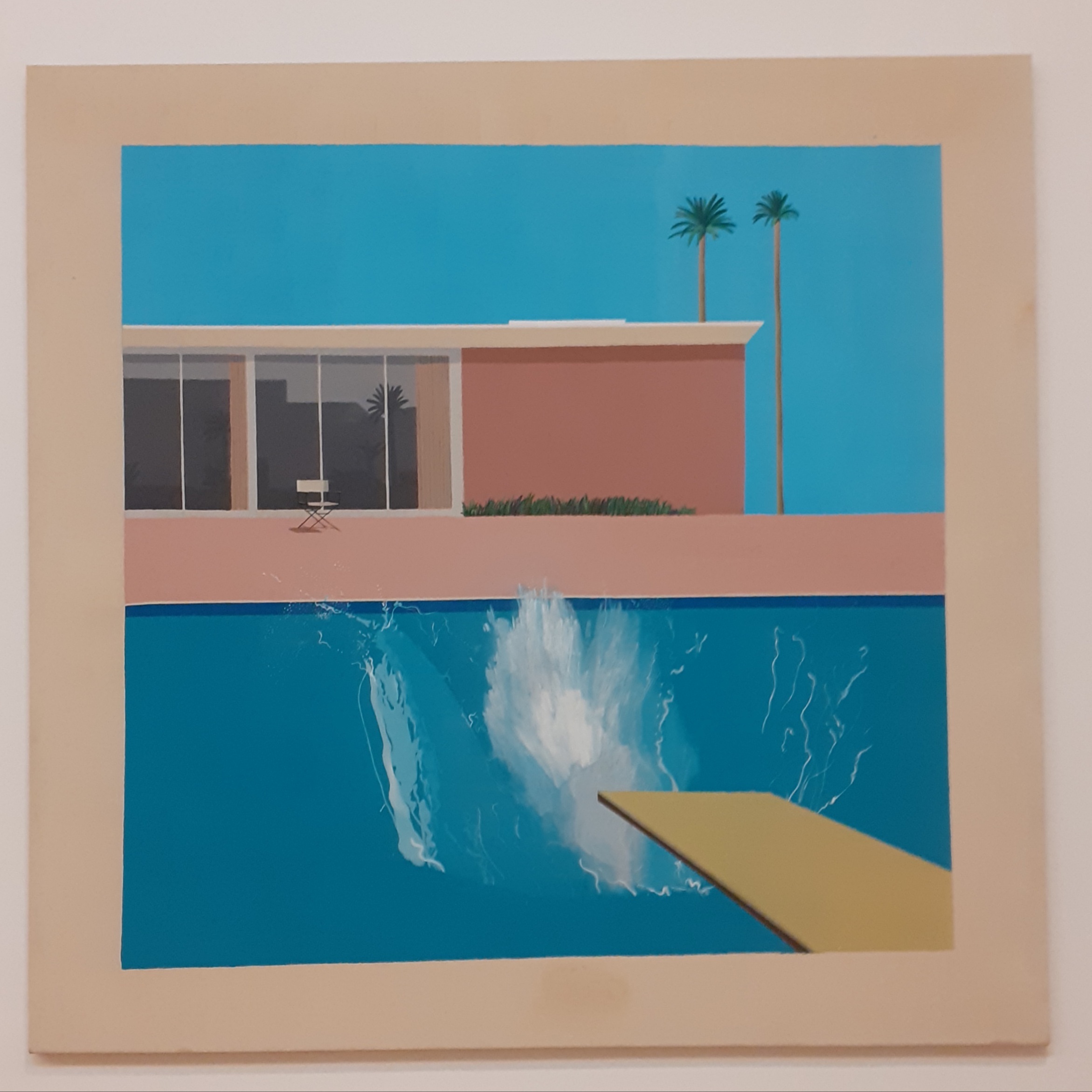
The Bath of Psyche by Frederic Leighton, once President of the Royal Academy, forms the backdrop for a pop up lecture on the artist. The young guide who launches into the talk knows how to grab a crowd. There’s plenty in the collection to hold the crowds, including of course the large collection of Turner’s work. There’s great twentieth century art also, A Bigger Splash by David Hockney being a particular standout.
After the Tate, we walk through the redbrick Millbank estate. This was built at the end of the nineteenth century and was an early social housing scheme, similar to the Iveagh Trust buildings. The seventeen estate blocks are named after famous artists including Turner, Millais and Leighton.
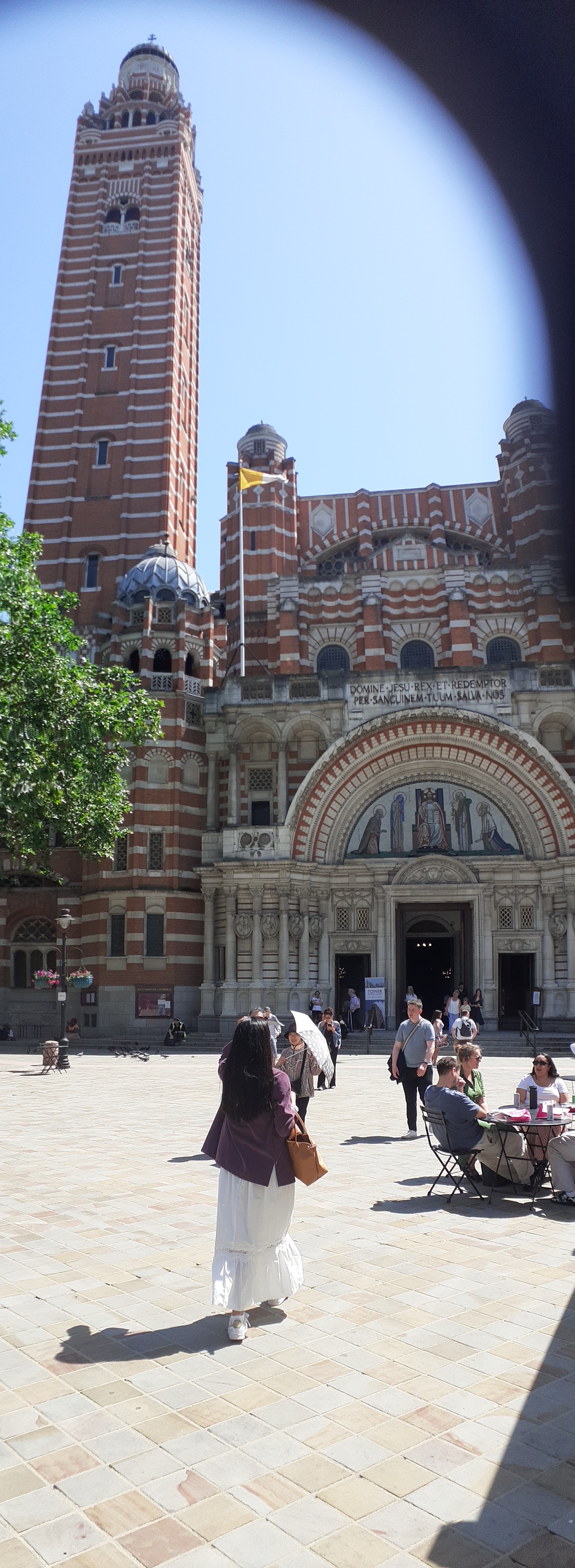
Past the Millbank estate we come to Westminster Cathedral. The Roman Catholic Cathedral was built in 1903 and heavily inluenced by Eastern Orthodox architecture, particularly the Hagia Sofia, the ancient cathedral of Constantinople. Designed by John Francis Bentley and constructed of brick, it makes a startling visual statement of red with horizontal white stripes. It is dedicated to the Most Precious Blood of Our Lord Jesus Christ and also pays homage to, amongst others, Saint Andrew of Scotland, my own patron saint.
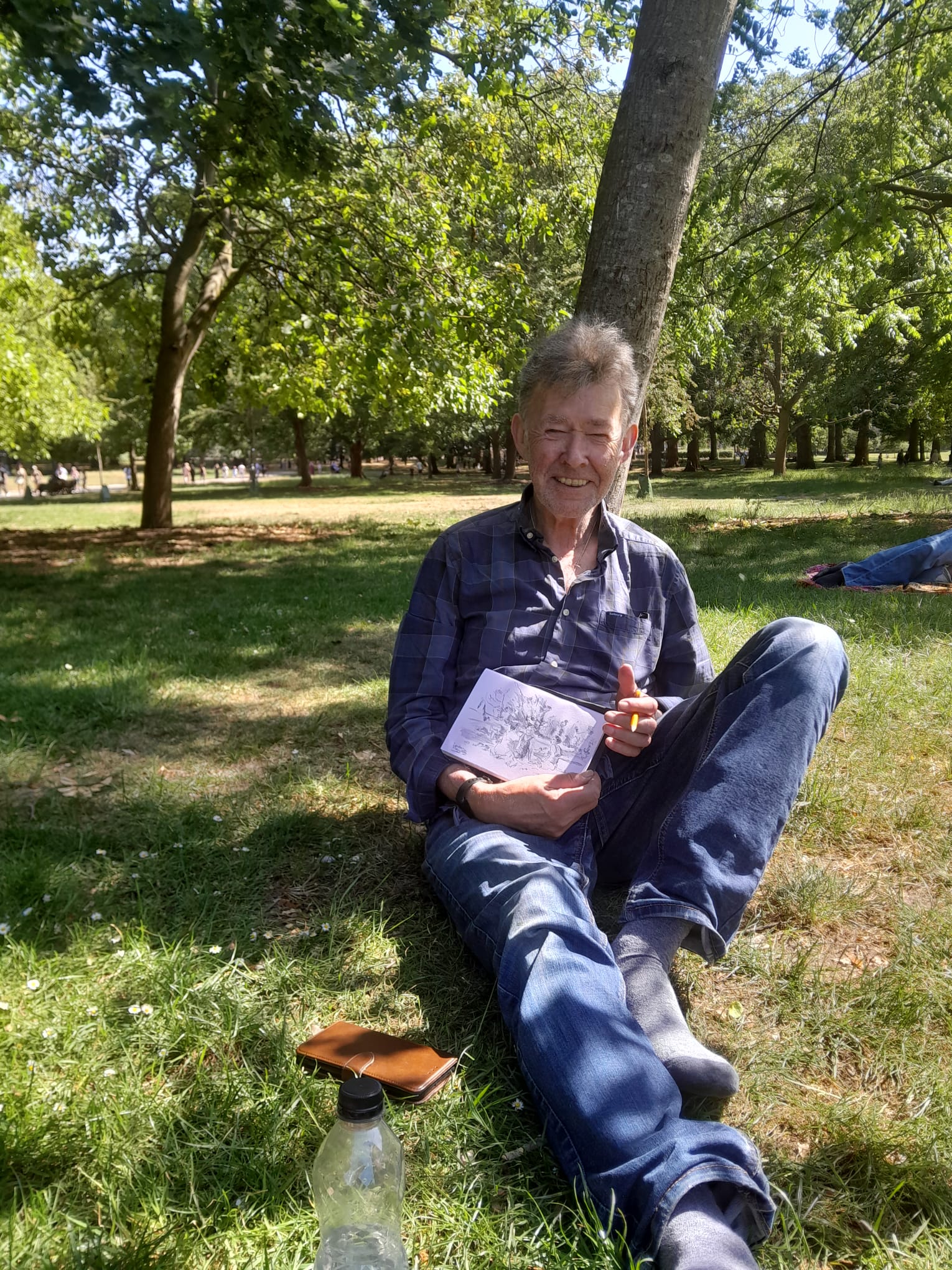
From there we made our way past Buckingham Palace and on to Green Park. Here we had our own Dejeuner sur l’Herbe. A modest affair, I’d have you know; coffee, beer and snacks are available from park kiosks, and the sun beats down and we lie on the grass. Had we wanted to see Manet’s original, we could head for the Courthauld Gallery up on the Strand. There are other days and plenty more paintings to see.
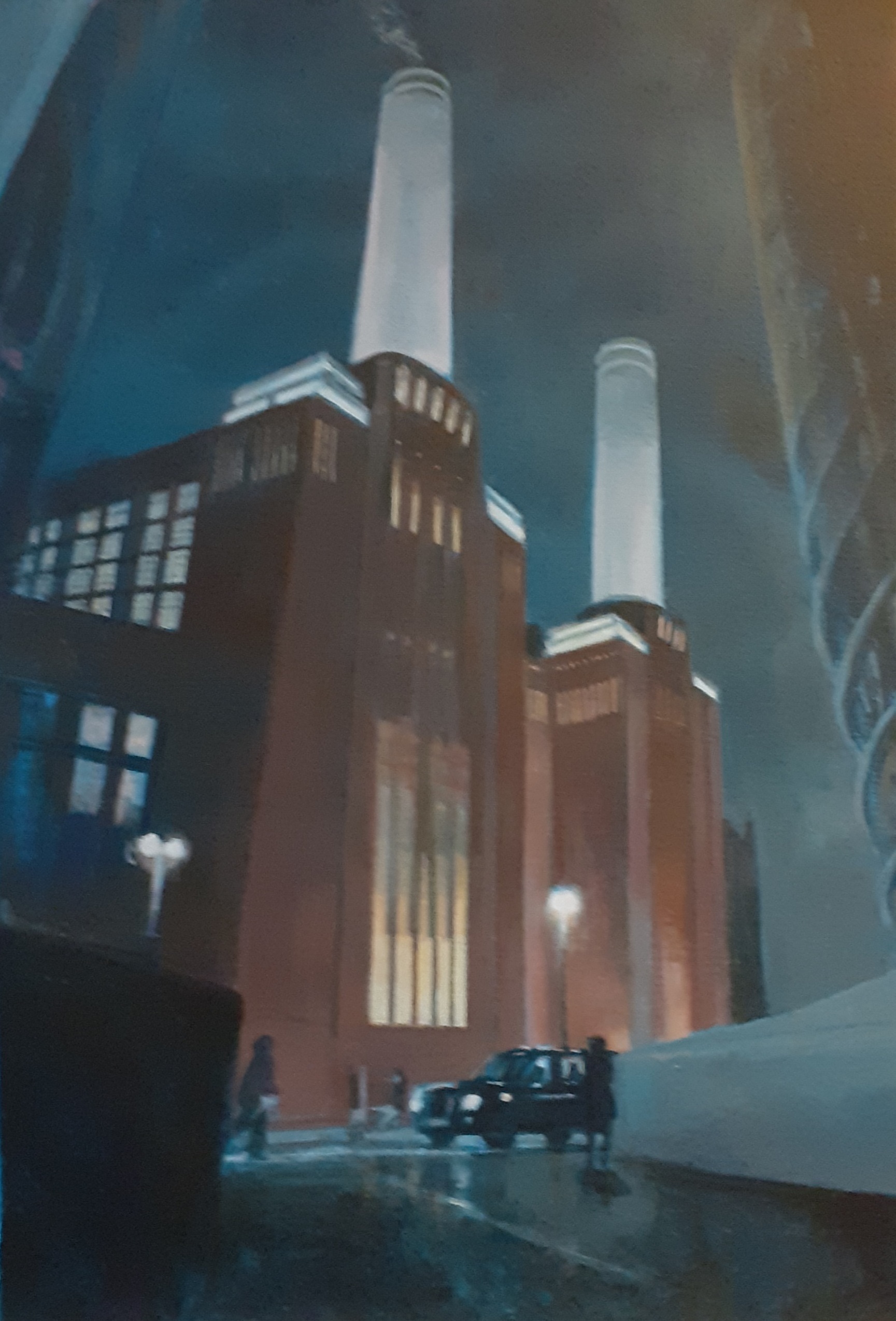
The Battersea Power Station is one of my favourite London buildings. With its four cream chimneys towering over the south bank of the Thames it has become a much loved icon of the city. Giles Gilbert Scott and Theo Halliday were the project architects and construction started in 1930 to be completed twenty five years later.
Since I am on a bit of a roll London-wise, I thought I would attempt to capture it on canvas. This view is from the back of the Station, and taken a little down the ramp of an underground car park. A taxi is waiting with a passenger inside and a woman at the door. Another person is caught in the headlights. The implied story struck me as dramatic, heightened by the Art Deco design and the evening illumination. The finished acrylic has something of a 1930s poster feel to it. M thinks it would make an excellent fridge magnet. I’m very happy about that.
Heaven, I’m in heaven
and my hearts beats so that I can hardly speak
And I seem to find the happiness I seek
when we’re out together dancing cheek to cheek
You know the song. Written by Irving Berlin for the musical Top Hat starring Fred Astaire and Ginger Rogers. We had front row seats for that in the West End some years back. We were in heaven, indeed.
After Astaire other versions include Ella Fitzgerald, Doris Day, Frank Sinatra Tony Bennett & Lady Gaga, and the sensational Alex Harvey.
This painting is from my recent trip to London. We are on the front seat of the 14 bus heading down Shaftesbury Avenue. Soho is to our right and we are about to pass the Sondheim Theatre. Formerly the Queen’s Theatre, it was refurbished and renamed in 2019 and has hosted Les Miserables since 2004. London’s longest running musical has been playing since 1985. It is a sung through musical, without spoken text, conceived by Alain Boublil with music by Schonberg and is based on Victor Hugo’s novel.
Soho itself abounds in great songs, some of which I have included in previous posts. Warren Zevon’s Werewolves of London is perfect for howling at the moon. Last Night in Soho by Dave Dee, Dozy, Beaky, Mick and Tich was my very first record. But there are few that capture the spectrum of love and longing as movingly as Rainy Night in Soho. It was was written by Shane MacGowan and released by the Pogues in 1986, There have been many cover versions since including Bruce Springsteen, Bono, Bob Dylan and Nick Cave.
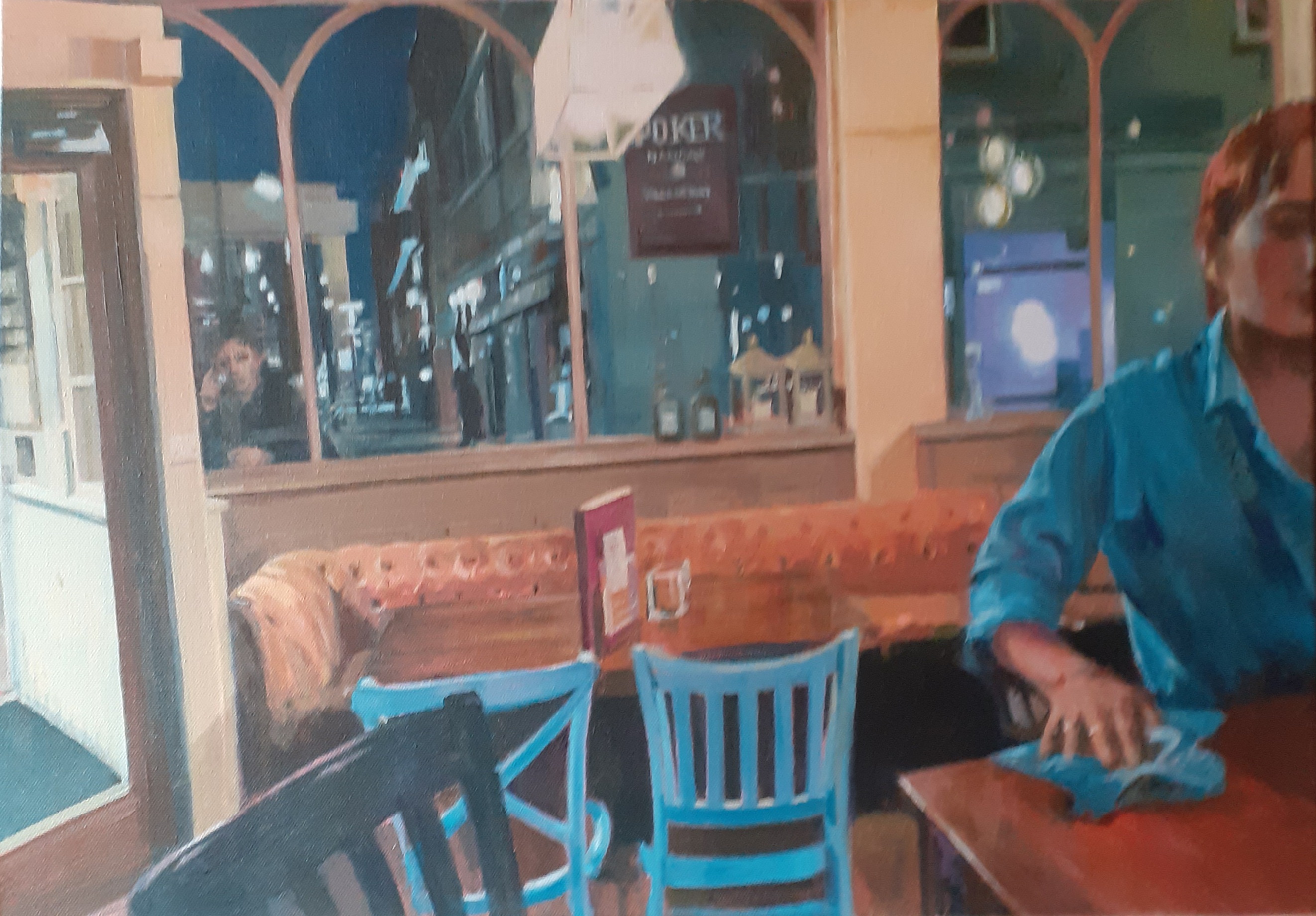
I stayed in Bayswater, London, last year. This acrylic is the view from a local bar looking towards Main Sreet, Queensway that is. I have returned from exploring the area of white Victorian terraces and dinky squares. Farther on, I spent much of the evening on Portobello Road known for its street market. I had never walked it before, though it had long fascinated me. It was a central feature of Martin Amis’s 1989 novel London Fields, in particular a pub called the Black Cross. There, Nicola Six, Keith Talent and Guy Clinch would meet and Nicola, the Murderee, set the macabre menage a trois (a quatre?) in train. Narrated by doomed author Sam Young and set in late 1999, it is a comedy tinged with foreboding. The end of the world, the end of love.
The Black Cross is a fictional bar, of course, so I made do with convivial reality. Portobello Road is at the pleasant end of culture clash. Cosy, quaint, common and sophisticated, like much of London’s inner patchwork, it is village and urban combined. Back in Bayswater, I find a bar invitingly empty. It is that dread hour: closing time. There are, as always, plenty of stories set to continue into the night. Not quite the Folies Bergere, more Edward Hopper meets Rock Dreams.
The Stranger Song is appropriate, given that the bar advertises poker nights on Monday and Wednesday. The 1955 film noir The Man with the Golden Arm starring Frank Sinatra was an inspiration. The song is one of the Songs of Leonard Cohen, his debut album from 1967. Cohen’s Golden Voice seduces the listener. No better man than Leonard for the chat up line, but here it is developed into an invitation. We are all strangers, our paths intersecting in those almost arbitrary places, hotels, bars and train stations.
You hate to watch another tired man lay down his hand
Like he was giving up the holy game of poker
And while he talks his dreams to sleep, you notice there’s a highway
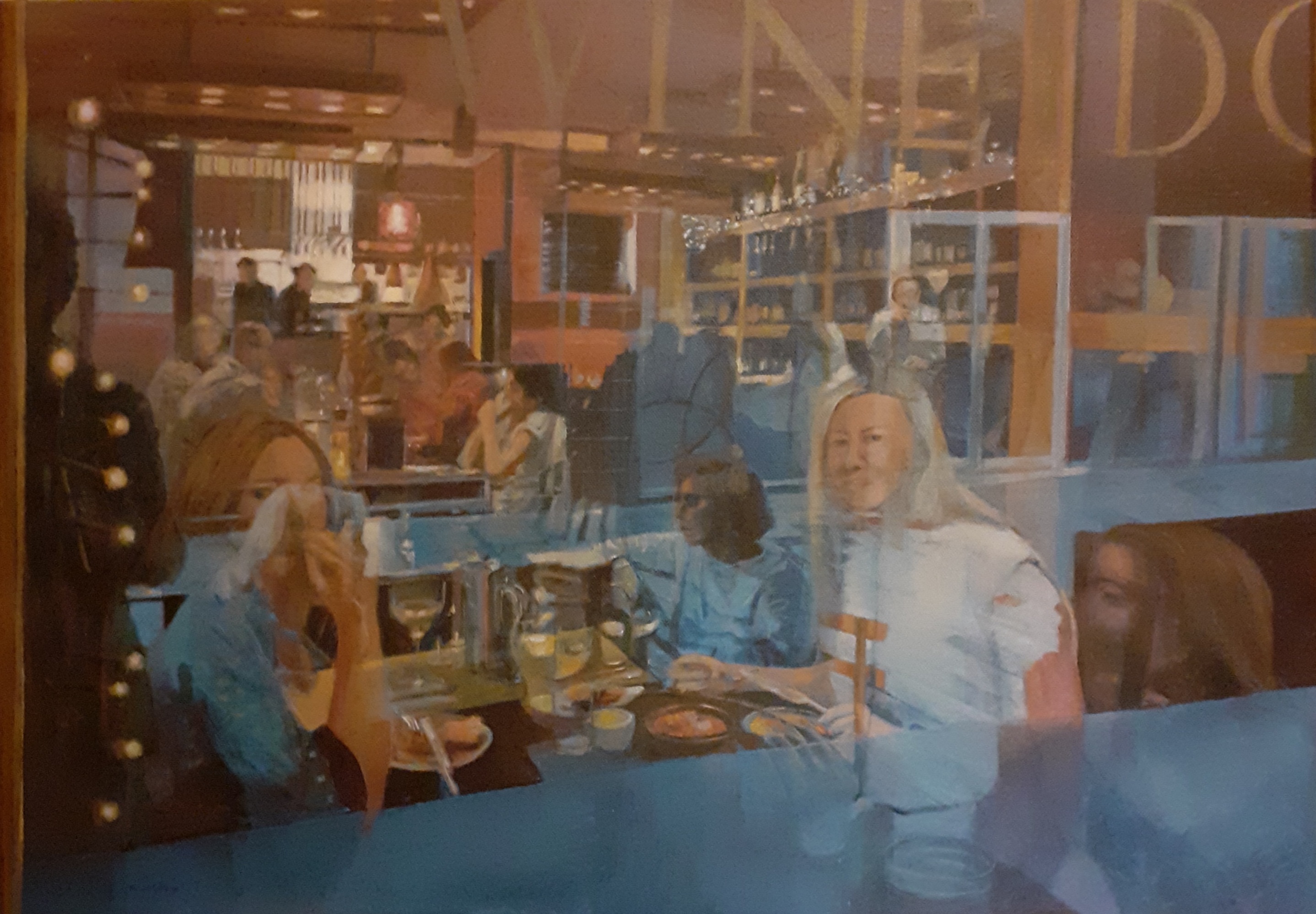
This painting is taken from our Isle of Man trip. The restaurant, Wine Down, is in Douglas. We sat on the front terrace. I took this shot looking into the crowded restaurant. The window catches interior and exterior, myself and M, and others, observing and being observed. It is a bit like a jigsaw puzzle of life. There are too many pieces and not enough time to fit them all together. And we only imagine the picture on the cover of the box to guide us.
Maybe I am overinclined to sit in cafe windows watching the world going by, while the world watches me. But there’s belonging too, and the thrill of it all. There are consolations in being a part of the crowd. Imagine the stories of the people here, some connecting with the observer, some lost in their own world. You’ll catch whispered narratives in the buzz, a song rising from the din.
I am listening to Bruce Springsteen’s 2020 album, Letter to You. House of a Thousand Guitars is specifically a hymn to live music venues. Broader than that, it celebrates the human urge to meet socially, and the togetherness of places where the music and the people play
The Hunt Museum Limerick hold their first Open Submissions Exhibition between Friday 5th December 2025 and Saturday 28th February 2026. I am delighted to have been chosen for the exhibition. My painting, Lovers on a Train, is taken from a train trip between Dublin, Cork and Limerick. I noticed the couple sitting across from me were an island unto themselves. Touring Ireland, their purchases spread between them on the table, while they were absorbed in their screens. So, the tableau involves a still life, a classical composition– like Venus and Mars, and a landscape whizzing by beyond the window. The perfect composition for me. I like to capture the moment to make a visual short story in a particular time and space. People together and all alone; in trains, bars, cafes and cars. I enjoy doing it and hope that others enjoy looking at it. I’m looking forward to heading back down to Limerick. By train, of course.
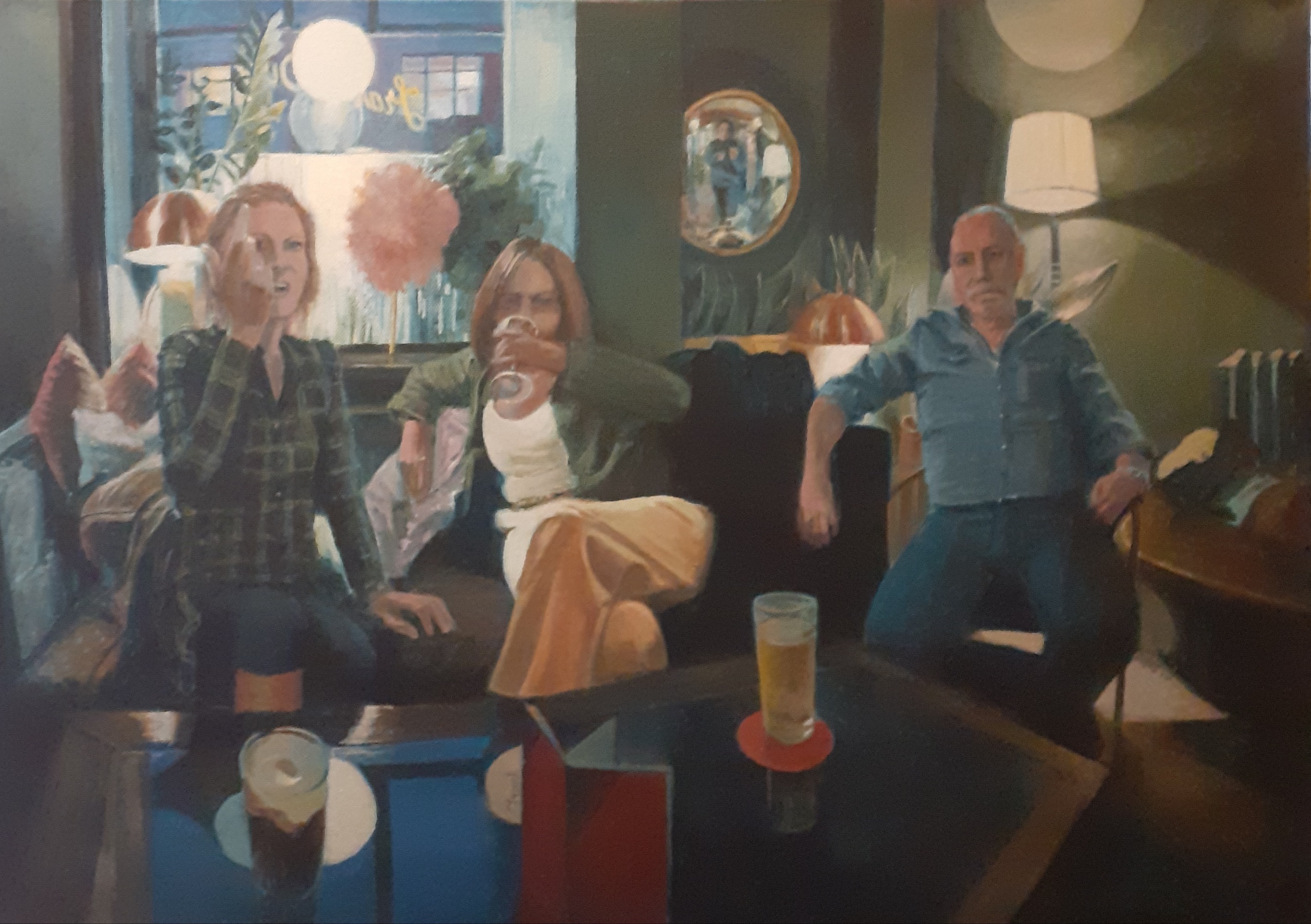
I have been slowing down of late on the art front. The pain thing. Slowing down on all fronts, truth be told. Still, I did squeeze out this spark, in the realm of friends and family. The best place to be. As before, the location is Frank Duff’s pub at the top end of Main Street, Bray. It’s last orders at the end of a great night out; drink and conversation flowing. You’ll catch me standing in the mirror. I suppose I could be singing The Parting Glass, although that’s a tad melancholy in the contecxt.
Songs of love and friendship have tumbled down to us since the time of Thomas Moore. And ever on into the future; here’s hoping. This night in Duff’s was recent, but takes me back to the days o the foreign telegram. So, I tunnel back to the early seventies and Mellow Candle’s only album Swaddling Songs. While the focal, and vocal, point of the group was the sparkling duo of Alison O’Donnell and Clodagh Simonds, this song was written by guitarist Dave Williams. The lyrics are cut from the same cloth though, and sung with gusto by the female leads. There’s a hint of winter and its globe of interior warmth in this verse, evoking that familiarity amongst friends and lovers caught in the moment.
Sell me heat-haze sell me rain sell me wet and dry
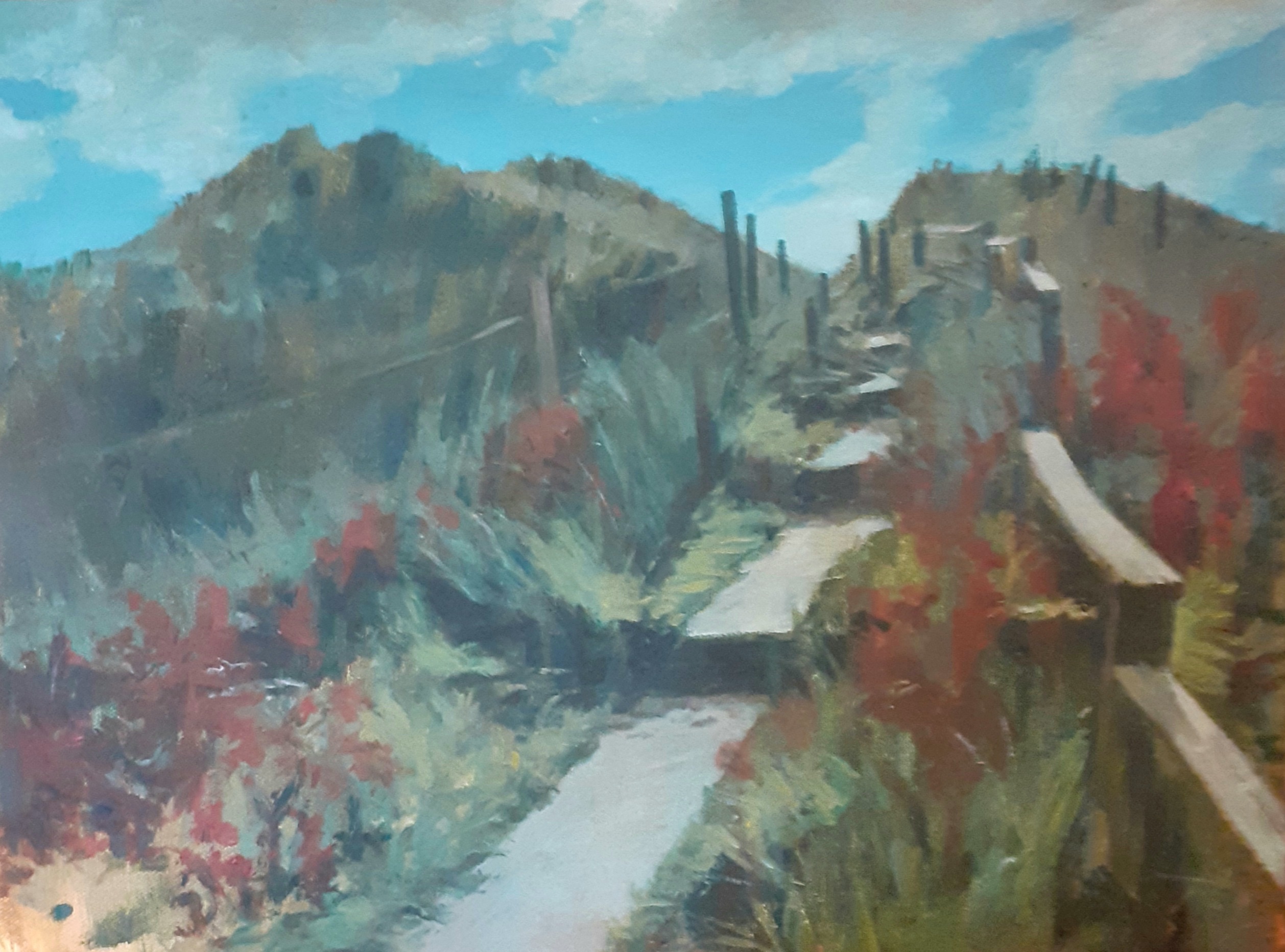
Summer is here, and amongst my favourite activities is doing nothing on a beach. Not exactly an activity so. Brittas Bay is a regular haunt. Thanks to good friends, we can spend a few weeks in a mobile on Wicklow’s wonderful coast. The mobile park is separated from the rising coast by a small river, and from the bay itself by a range of high sand dunes.
In this painting, we are approaching the beach through the dunes along one of several stepped ways. It’s something of an oasis of isolation and quiet, between the domestic suburbia of the mobile park and the windswept leisure activity of the beach.
This time I am using oils, which I have not done in a long long time. Since I went to art college in the summer of 77 I have tended towards faster graphic media such as watercolour, gouache and acrylics. One Dublin cityscape and a mountain landscape is all I can recall. So it was a bit of a struggle to begin with, and I was as much absorbed in the physicality of the whole thing, the texture and smell of the materials as I would normally be in the detail and composition of the finished work. There’s something of the wild and unkempt in this and the process. A sensual saturation that takes its own form.
And so the song that suggests itself is rough and ready too. It’s from the summer of 77 which I remember for sandy days with M in Llandudno, Wales and a holiday hut on the beach in Skerries, North Dublin. It kicks off with a to-die-for bass riff. What follows is a young ruffian gorging himself on the visual pleasures of the beach. It’s called Peaches and was the first hit for the Stranglers from their debut album Rattus Norvegicus. You might also know it from the opening credits of the 2000 geezer flick Sexy Beast, where reformed lout, Ray Winstone, soaks up the sun in a villa in Spain. Oh, I can relate to it in all sorts of ways.
Well there goes another one just lying down on the sand dunes
I’d better go take a swim and see if I can cool down a little bit
Coz you and me woman, we got a lotta things on our minds