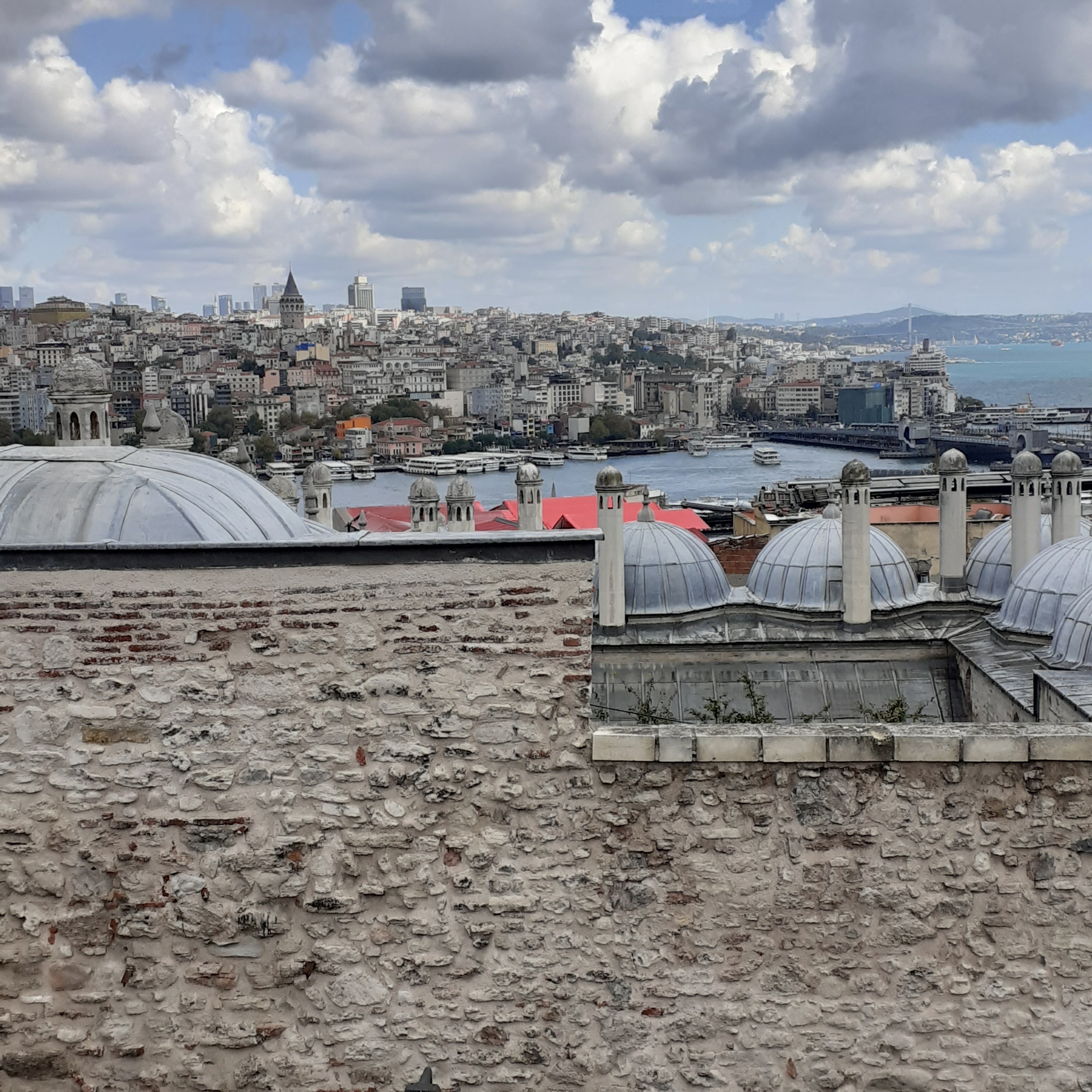
The Golden Horn is the evocative name for the waterway dividing the European sections of Istanbul. It is nearly five miles long and a half mile wide, shaped as the name suggests and will turn gold beneath the setting sun, I imagine. The sun has only rarely smiled on us during our visit. Still, the Golden Horn lives up to its name and reputation, a magical feature of a fabled city. On the south bank Seraglio Point is the site of the ancient city with the port of Eminonu along the waterfront. On the other bank the port of Karakoy lies below the district of Beyoglu.
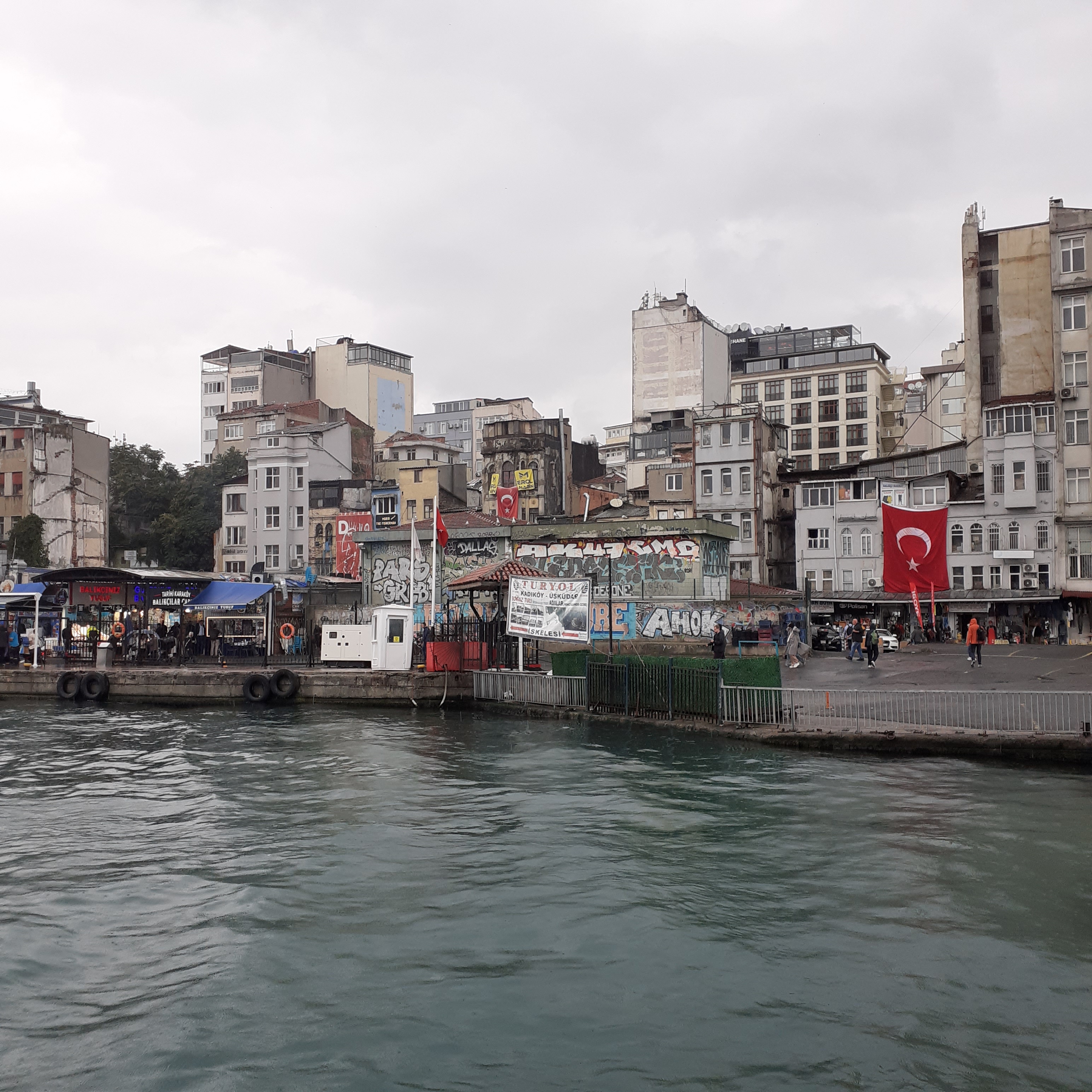
Galata is the older name for Karakoy. The Galata Bridge spans the Golden Horn. This is the fifth bridge on this site, dating from 1994. With its predecessors it has long occupied an iconic place at the heart of Istanbul. Always a popular location in literature and art, symbolic as a connection of opposites. I had once fancied it was a bridge between continents, but of course it is not. Yet, the Bridge long been seen as a pathway into a different culture, linking the old city and its palace court, with the city of trade and industry across the water. That area, Beyoglu, was once a place of migrant traders with their alien ways. Up until the the twentieth century, Greek and Armenian Christians, and Jews, were in the majority until the end o the nineteenth century. Wars with Greece and religious discrimination and expulsions has eclipsed Istanbul’s foreign communities. Now, most people here come from Anatolia, with a tenfold increase in population over the last century.
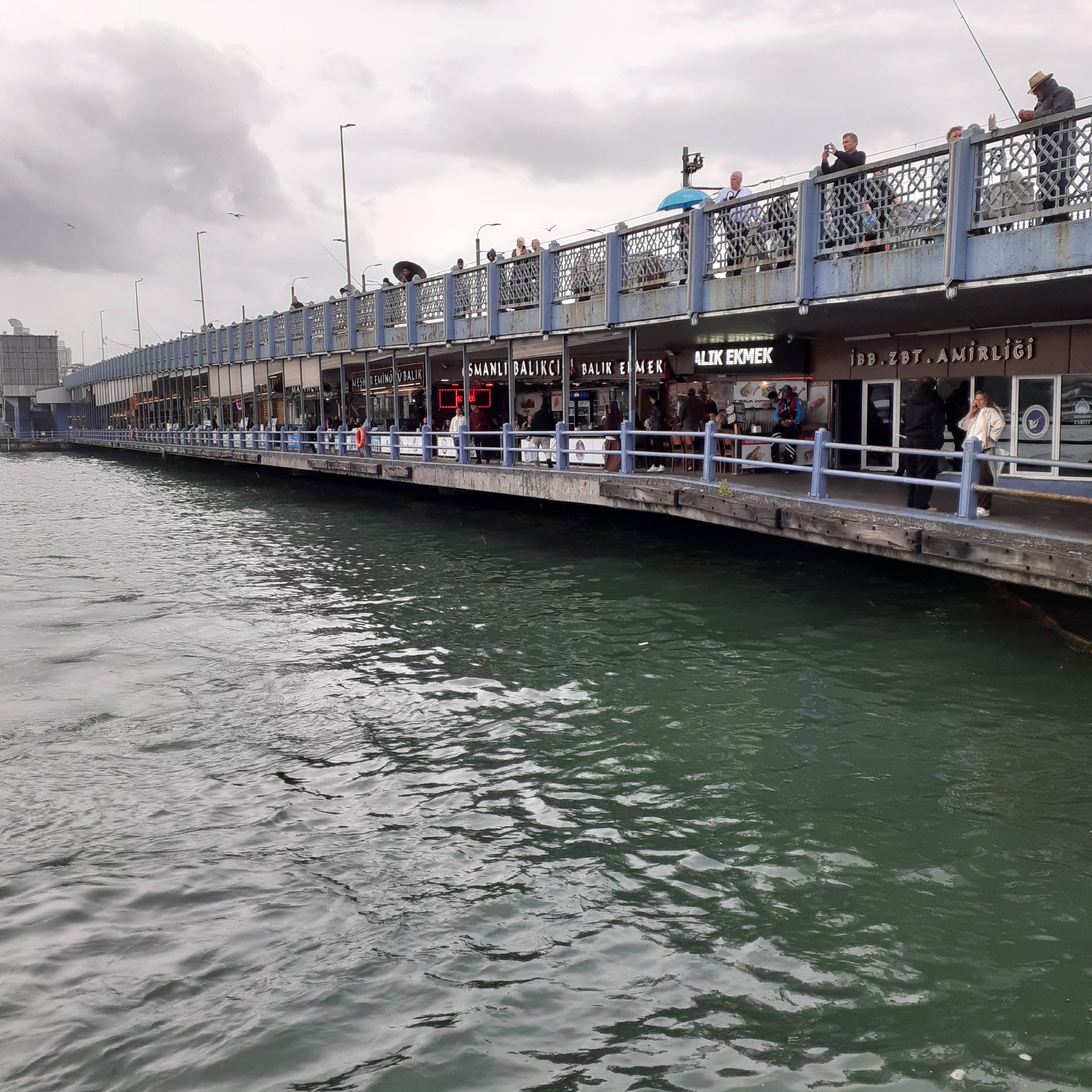
Today, the bridge still feels as if the world is crossing. yet there’s calm in the chaos. On each side fishermen line the railings, in hope and expectation, oblivious to the city whirl. Behind them the top deck carries the cross city tram which barrels along from Sultanahmet Square to Kabatas on the Bosphorus. Pedestrians can walk here or along the lower deck which is lined with restaurants and shops. The bridge is basically a floating city street. The central section is a bascule allowing large watercraft through.
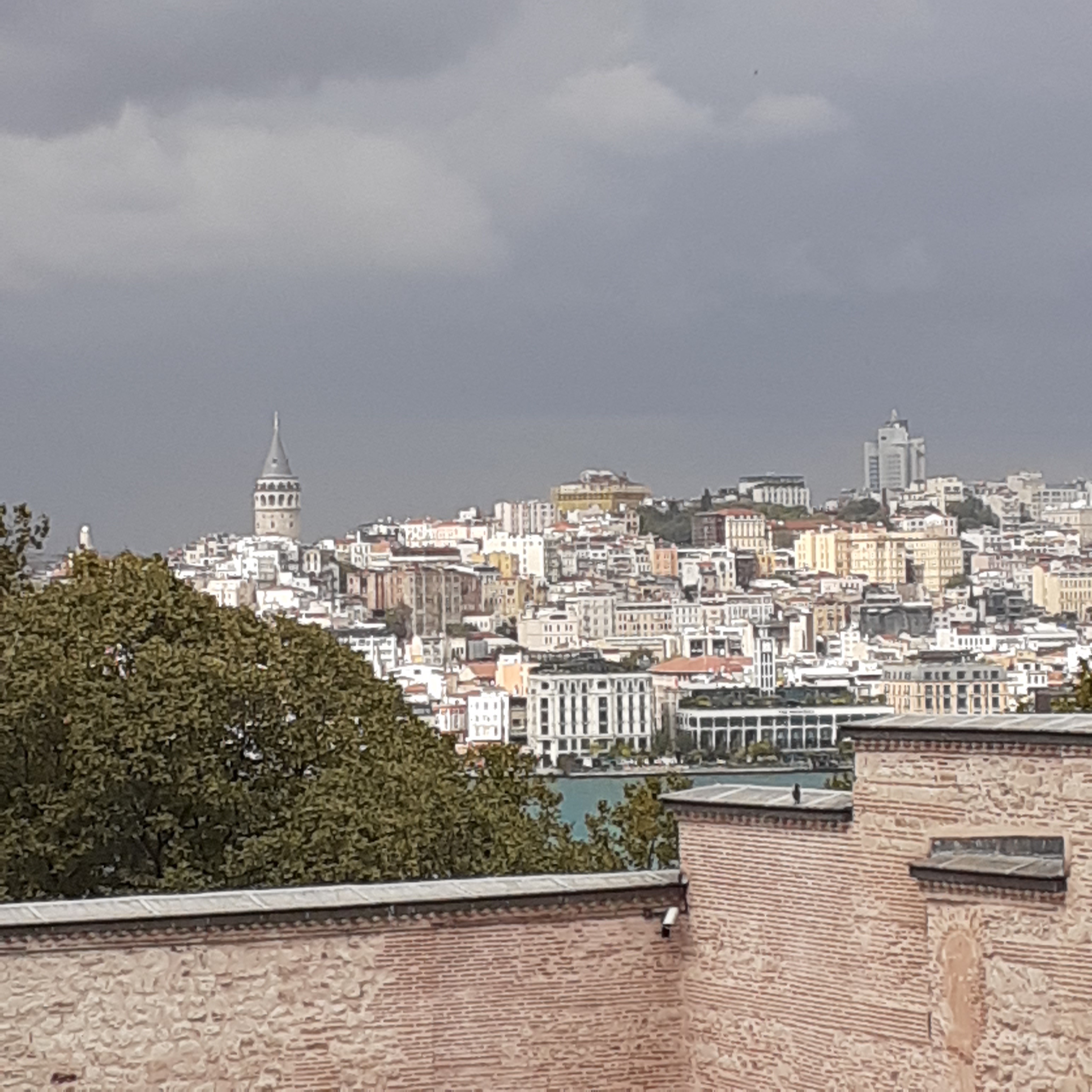
We cross on the lower deck where we are almost walking on water. The restaurants tempt, and cajole. The view to each side enthralls. Looking back to the southern bank the Galata Tower is a striking city landmark. Soaring above Beyoglu, it was built by Genoese traders in the fourteenth century as part of the fortiications protecting their enclave. The ten story tower is two hundred feet tall. There’s an observation deck beneath the conical roof. The building is now a museum having been variously used as a prison, a lookout tower and a coffee shop over the centuries.
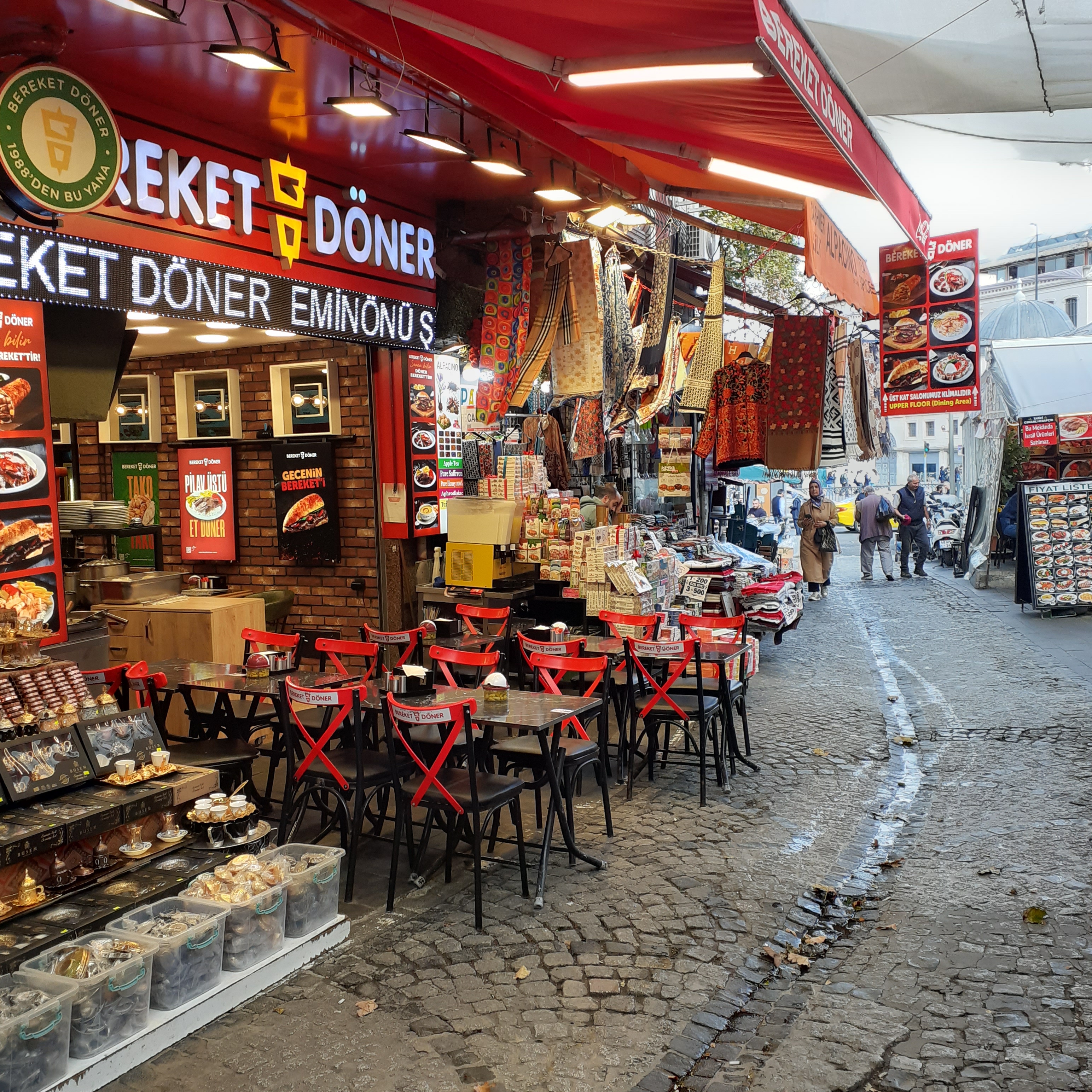
On the Eminonu side there are moored a collection of floating restaurants of oriental design and there are also many food kiosks lining the quayside. You can be sure of a Balik Ekma here and much more besides. Eminonu is as usual abuzz with boats and trams. The portside road is choc-a-bloc. Along the rim of the old city a maze of alleys and bazaars hustle for sale. The Spice Bazaar is the most famous, but food, clothes, household goods, art and knick knacks are all catered for in the neighbourhood with plenty of coffee shops and snack bars for refreshment and relaxation. More r’n’r in the rockin and rollin sense. In Istanbul there’s no lull to the backbeat.
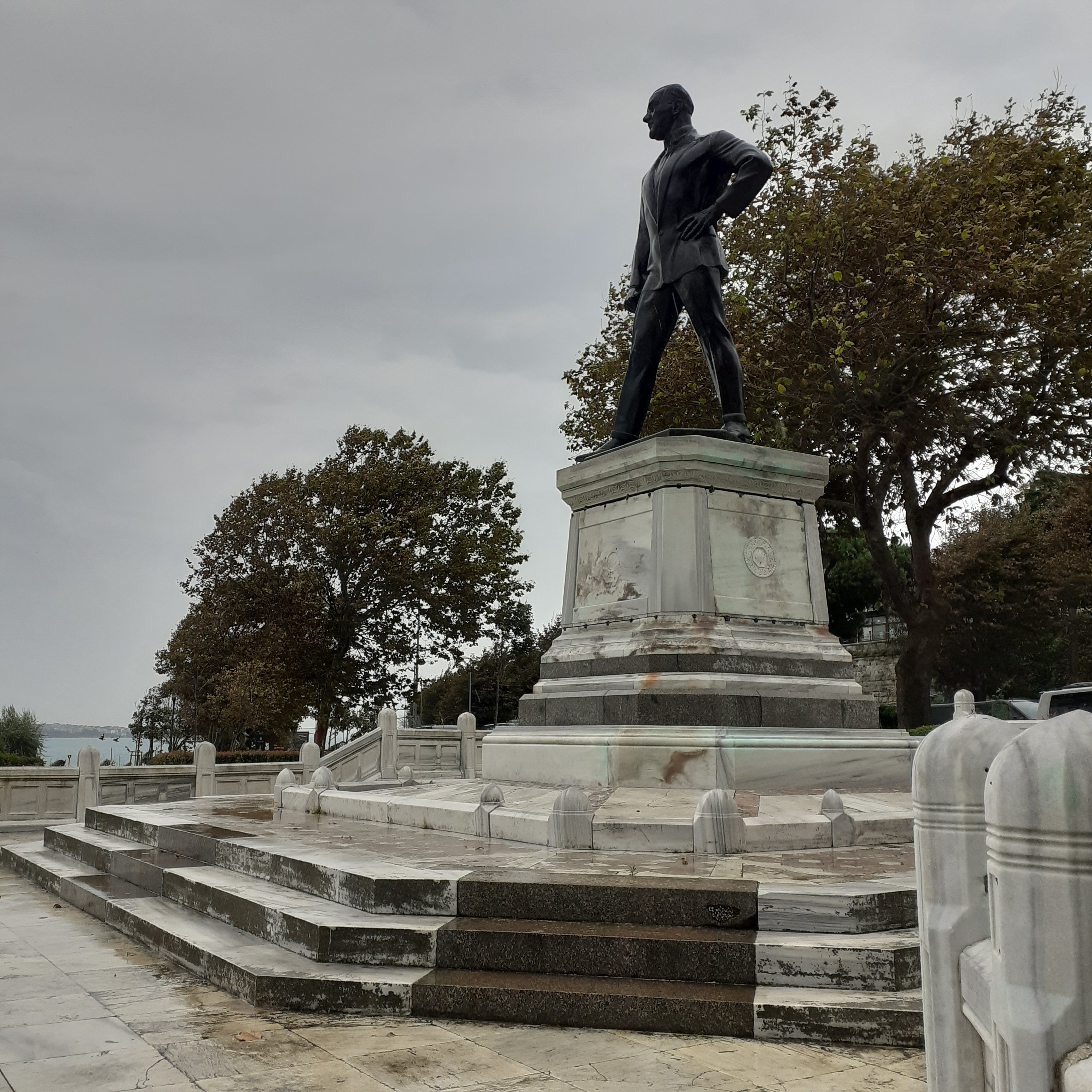
The main route up to Sultanahmet is via a wide and winding thoroughfare; Huvendigar and Alemdar Caddesi. This is doable by tram or shank’s mare. The energy will carry you up through the canyon of shops and restaurants. Meanwhile, the loop home along the seafront takes us around Seraglio Point via Kennedy Caddesi. As the port peters out Topkapi Palace is borne aloft on its hill. Seraglio is the Turkish word for palace. Seaward, there’s a pleasant coastal park looking over the great confluence of Bosphorus, Golden Horn and Marmara Sea. A statue of Kemel Ataturk in dynamic pose stands beneath a soaring, mighty Turkish flag. The flag, white crescent and star on a red field is ubiquitous throughout Istanbul.
The crescent and star has been the city symbol since the days of Byzantium. Often seen as a symbol of Islam, it features as logotype or flag of many Islamic nations. It is not itself inherently Islamic, as say the Christian cross. It derives principally from the emblem of the Ottoman Empire. Many meanings and myths have been drawn from the logo. To any watcher of the skies it will suggest the conjunction of the crescent moon with Venus, the Morning or Evening Star. That itself is a universal apparition, a familiar sight of great beauty. The Turkish symbol depicts it realistically, with the star outside the implied globe. Others depict the star inside.
Mustafa Kemal Attaturk, meanwhile, is the physical embodiment of Turkish nationalism. Born in 1881, he founded the republic after the disintegration of the Ottoman Empire at the end of the Great War. A rising star in the Ottoman army, he was amongst the Young Turks who agitated against the Sultan’s autocracy. Young Turk is now a widely used term for a young rebel within an organisation, one who rails against the old guard. Turkish radicals did gain some power in the early twentieth century but deteriorated into dictatorship and the Empire was drawn into the War. Kemal commanded Turkish forces at Gallipoli and his status as a war hero brought him to the fore of Turkish nationalism. He abolished the Sultanate and established a republic in 1922. As Turkey’s first president he ruled until his death in 1938 and was granted the name Ataturk, meaning Father of the Turks. The country he moulded was secular and western in its outlook. Turkey adopted the Roman alphabet, and women received political and civil rights. Even the distinctive traditional fez was banned.
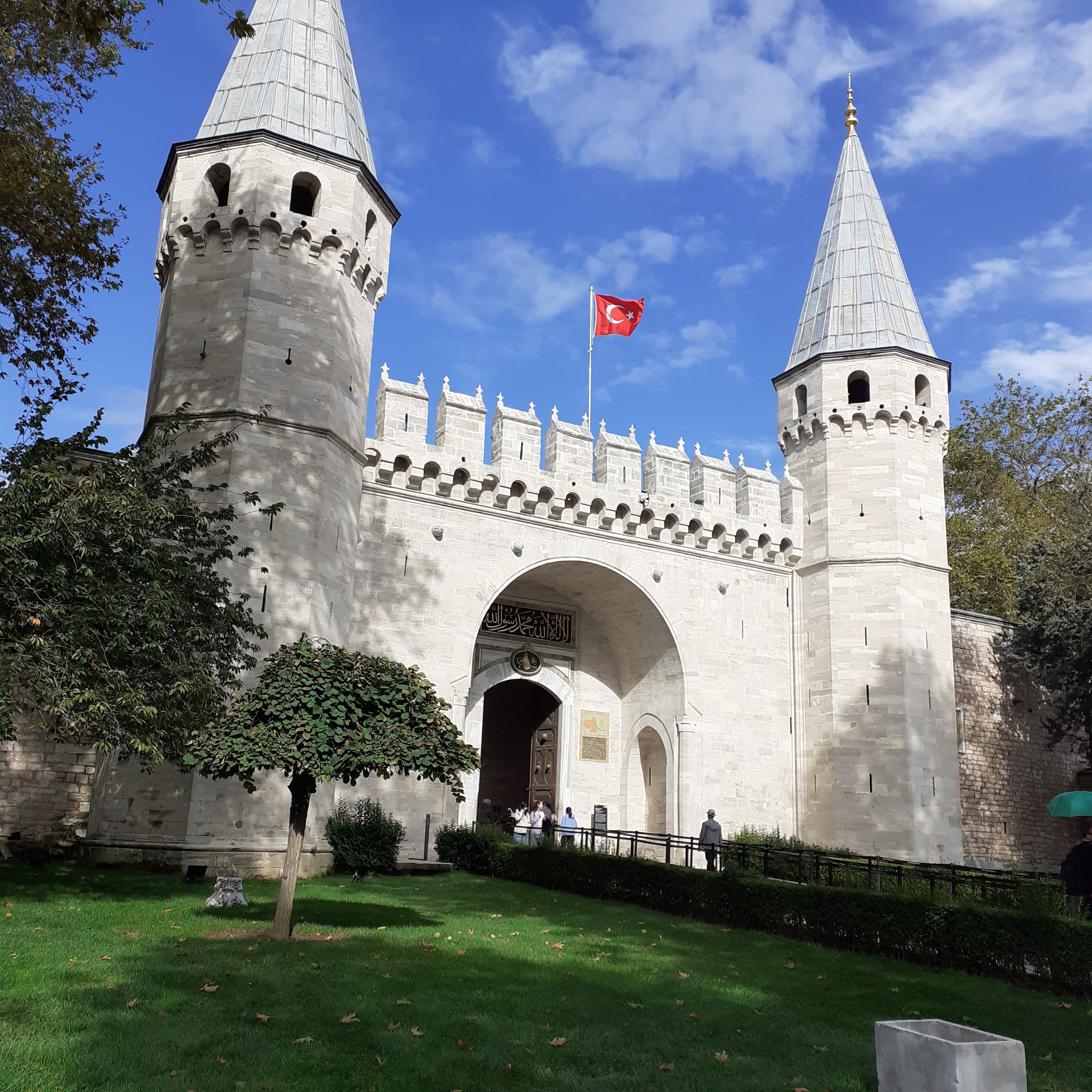
Above on the hill, Topkapi Palace was the seat of power for four centuries. Mehmet II, the Conqueror, established the palace on its promintory having taken Constantinople from the Byzantines in 1453. In 1853 it was abandoned in favour of the newly constructed, lavishly expensive, Dolmabahce Palace across the Golden Horn in Kabatas.
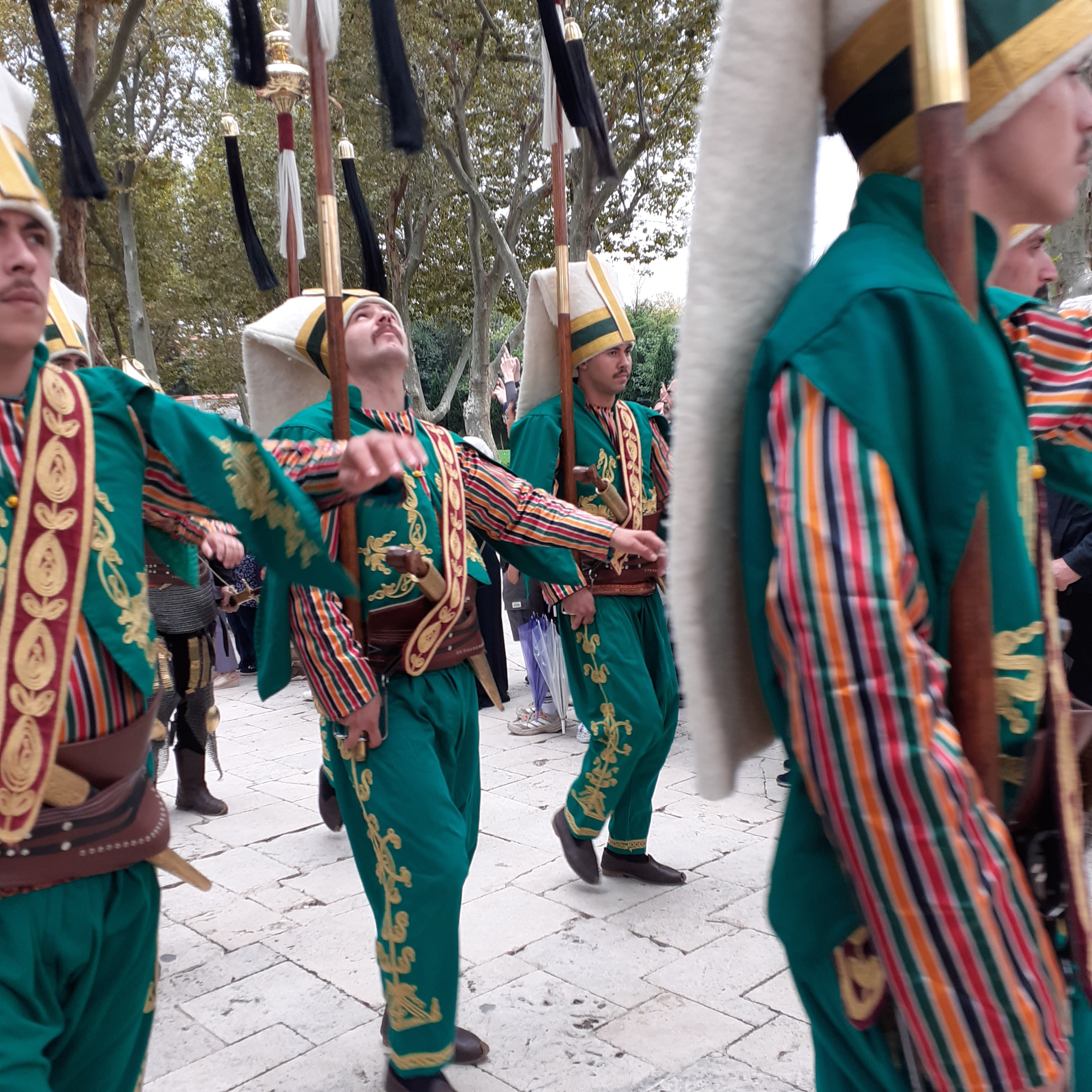
Topkapi, Alhambra esque in its scope, was the administrative centre of the Ottoman and home to the Sultan and his family. It’s a must visit to apprecite the power and opulence of the Ottomans. We booked a self guide tour with access to the Harem. We were escorted inside in a group. meeting near our hotel on Mimar Mehmet Aga Caddesi. Our flag waving guide provided a lively commentary as we zigzagged around other hopeful groups. The feeling of everybody making for the castle was increased as we found ourselves beside a marching force of colourully attired guards and accompanying band also making for Topkapi. Finally, ushered through the stiles at the Harem ,we could draw our breath. But briefly. We ain’t seen nothing yet.
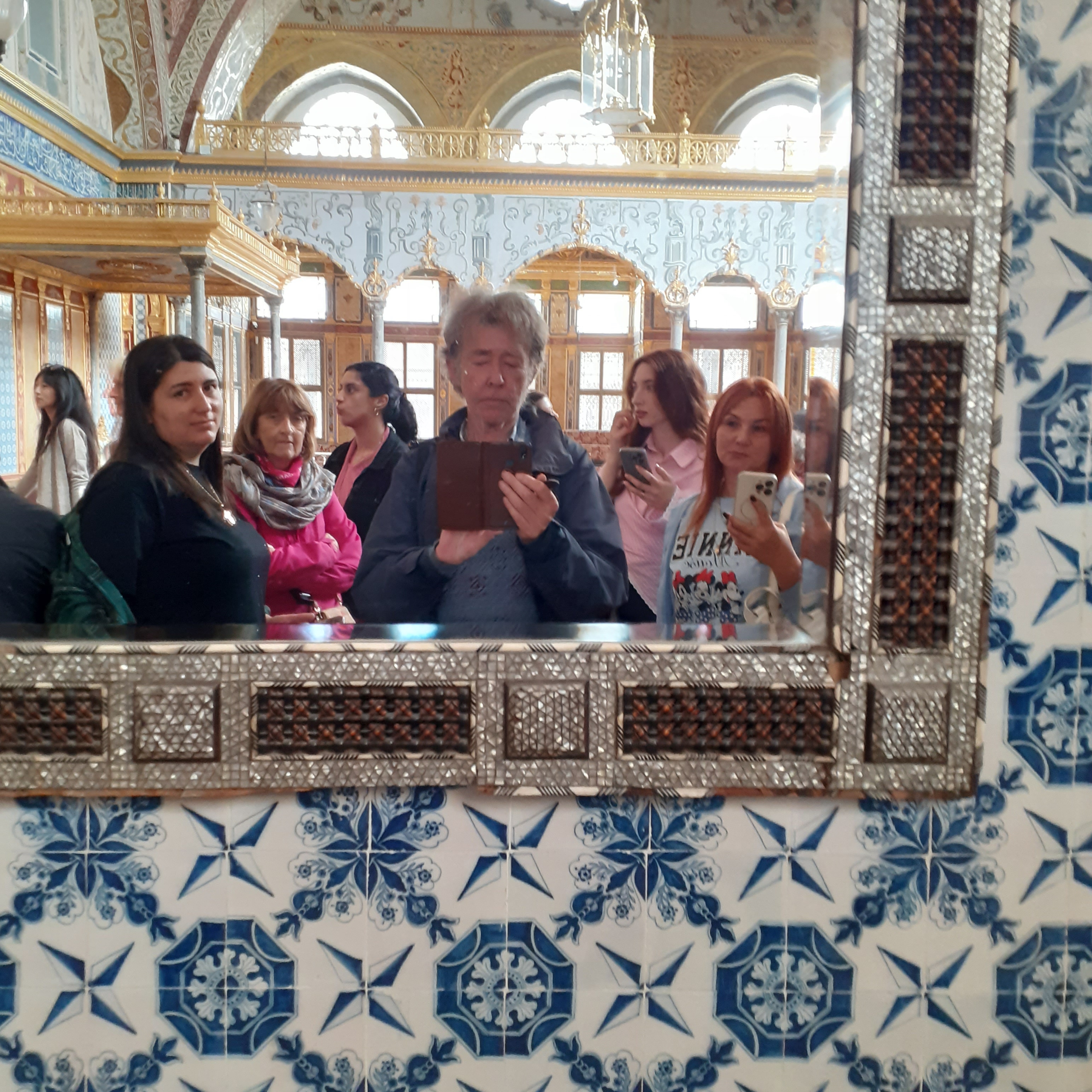
The Harem is a highlight of Topkapi’s great indoors. Harem means forbidden, and this is where the women, the Sultan’s family – wives, mother and children – were secluded. Eunochs guarded the harem, and only the Sultan was permitted to enter. Concubines were also kept. There could have been as many as a thousand concubines in the Harem. It had its own hierarchy with typically the Sultan’s mother and his favourite wife at the apex. These sometimes wielded power in the greater world, but this was their world, and their cloister.
Topkapi Palace is divided over four courtyards in a vast hilltop complex. The first takes you into Gulhane Park which was once the palace gardens. This leads you on through the twin towers of the entrance gate. The complex has been a museum since Turkish independence and the exhibitions include archaeology, weapons, imperial costumes, glass and silverwear. The Sultan’s marble library and Throne Room are in the central courtyard.
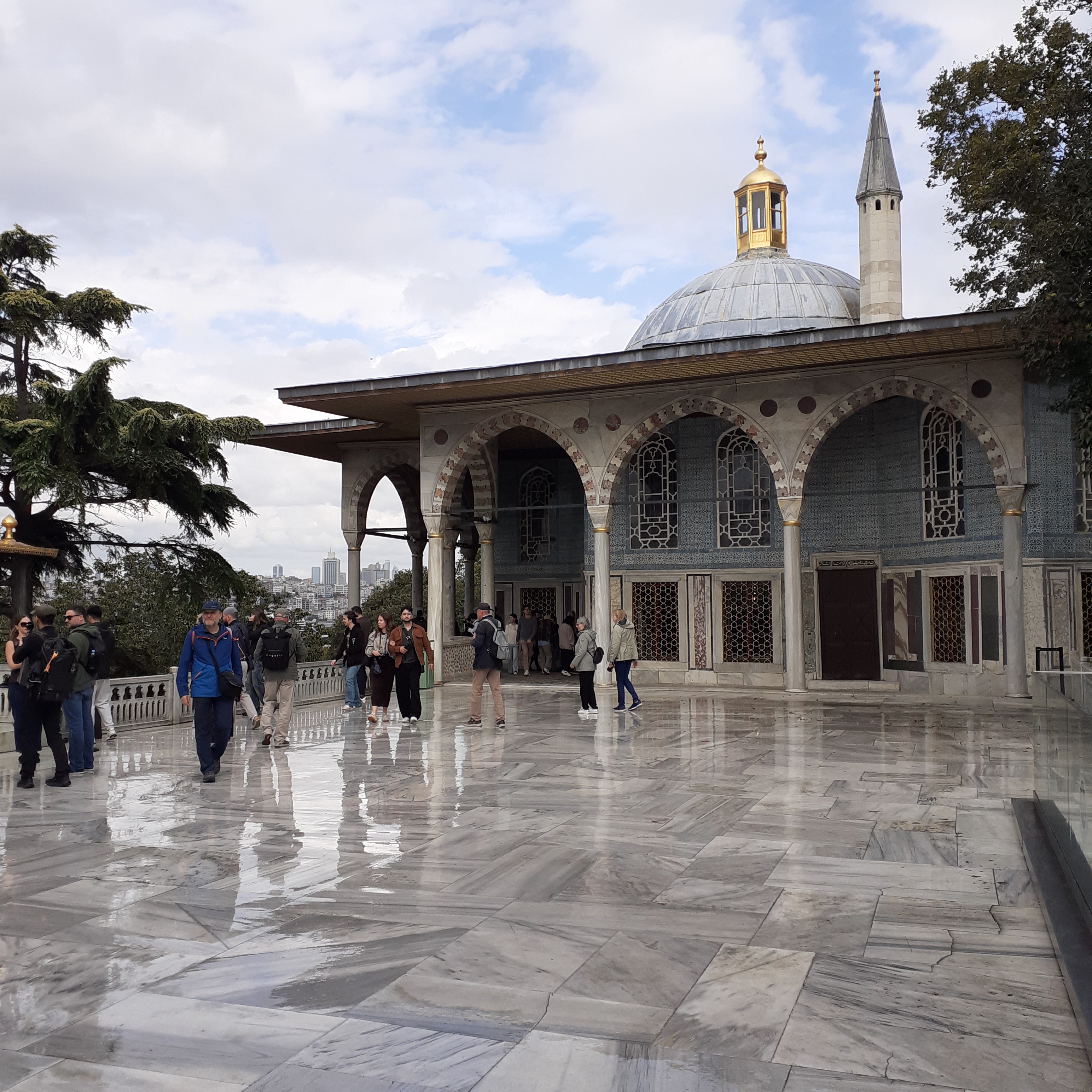
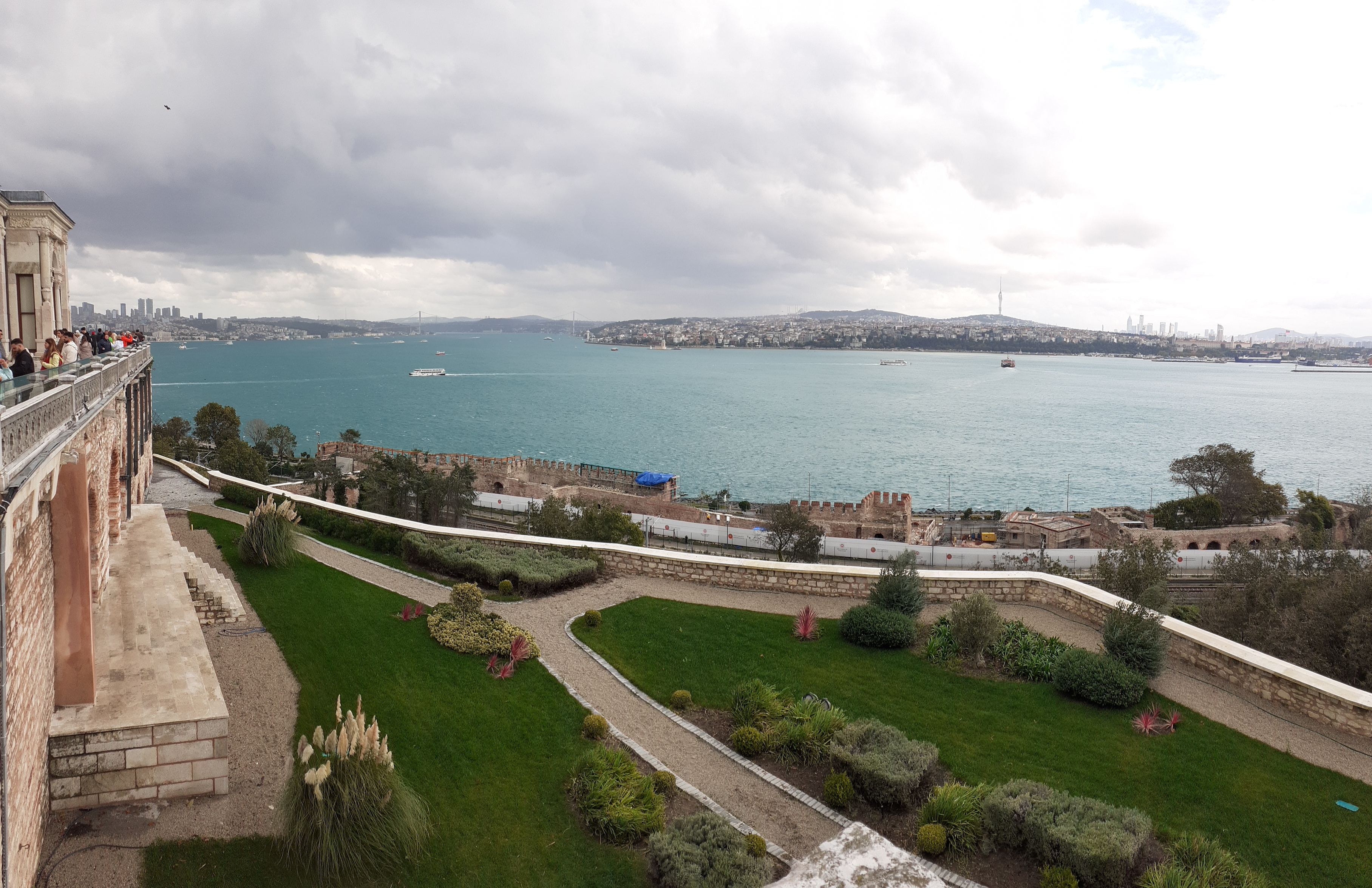
The fourth courtyard, the farthest, has several pavilions dotted about its gardens,. Along the south wall is an elegant, long nineteenth century pavillion, ornately furnished, with breathtaking views over the sea. At the other side of the courtyard, the Baghdad Pavilion is decorated with blue tiles and celebrates the taking of Bghdad in the 17th century. The adjacent terrace offers more spectacular views over Istanbul and the Bosphorus.
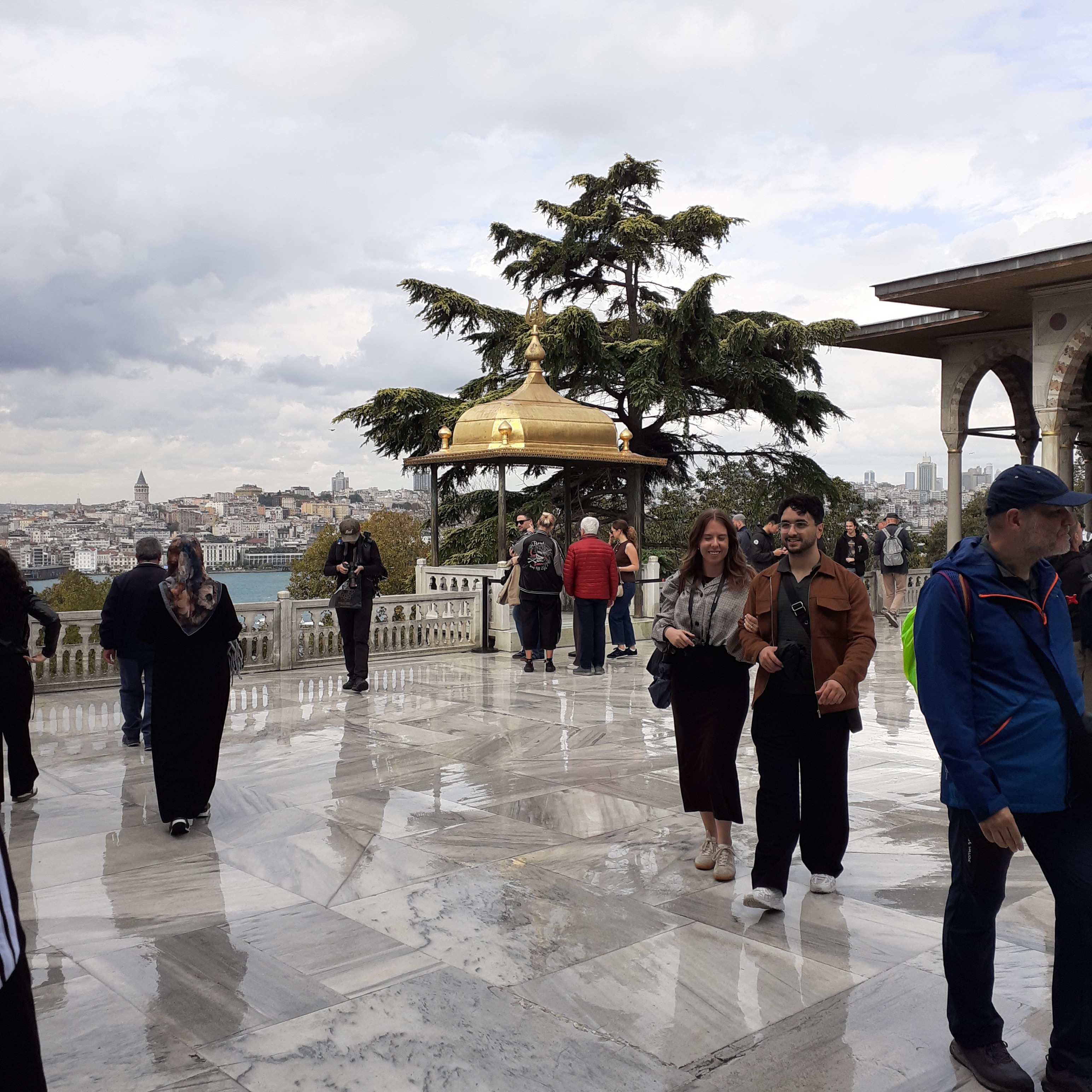
We are on top of the world. In the company of visitors from its four corners. Even amongst the crowds, though, it is possible to feel you are floating on air. The sun comes out to smile at us. We bask in this a while, before joining the ebbing evening crowds going down to the city of Istanbul.
Marbles of the dancing floor
Break bitter furies of complexity,
Those images that yet
Fresh images beget,
That dolphin-torn, that gong-tormented sea.
Byzantium, WB Yeats’s follow up to Sailing to Byzantium was written in 1930, four years after ‘Sailing’. Published in Words for Music Perhaps (1932) It fair captures the seething actuality of the city. You really do have to be there to know!

