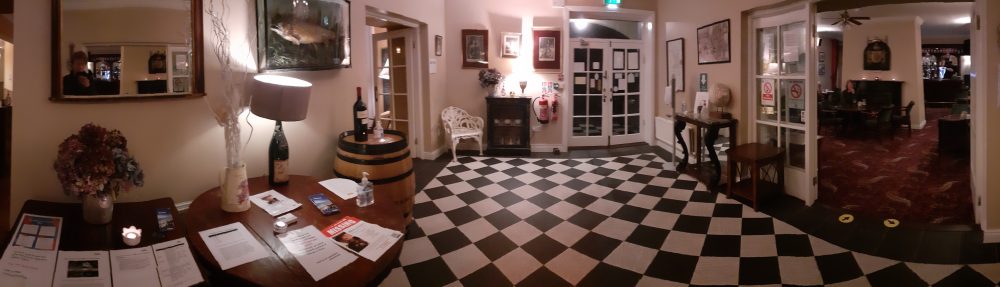
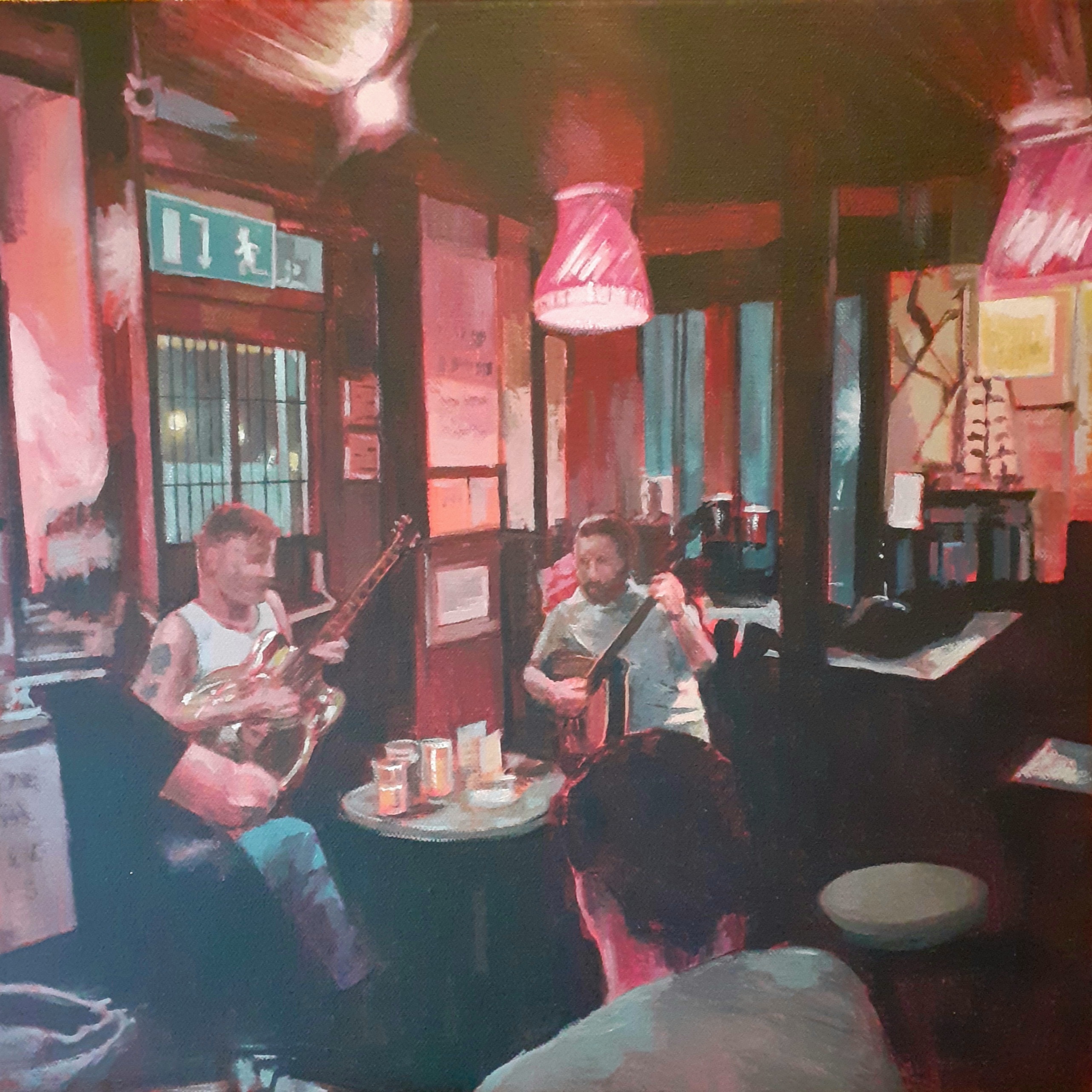
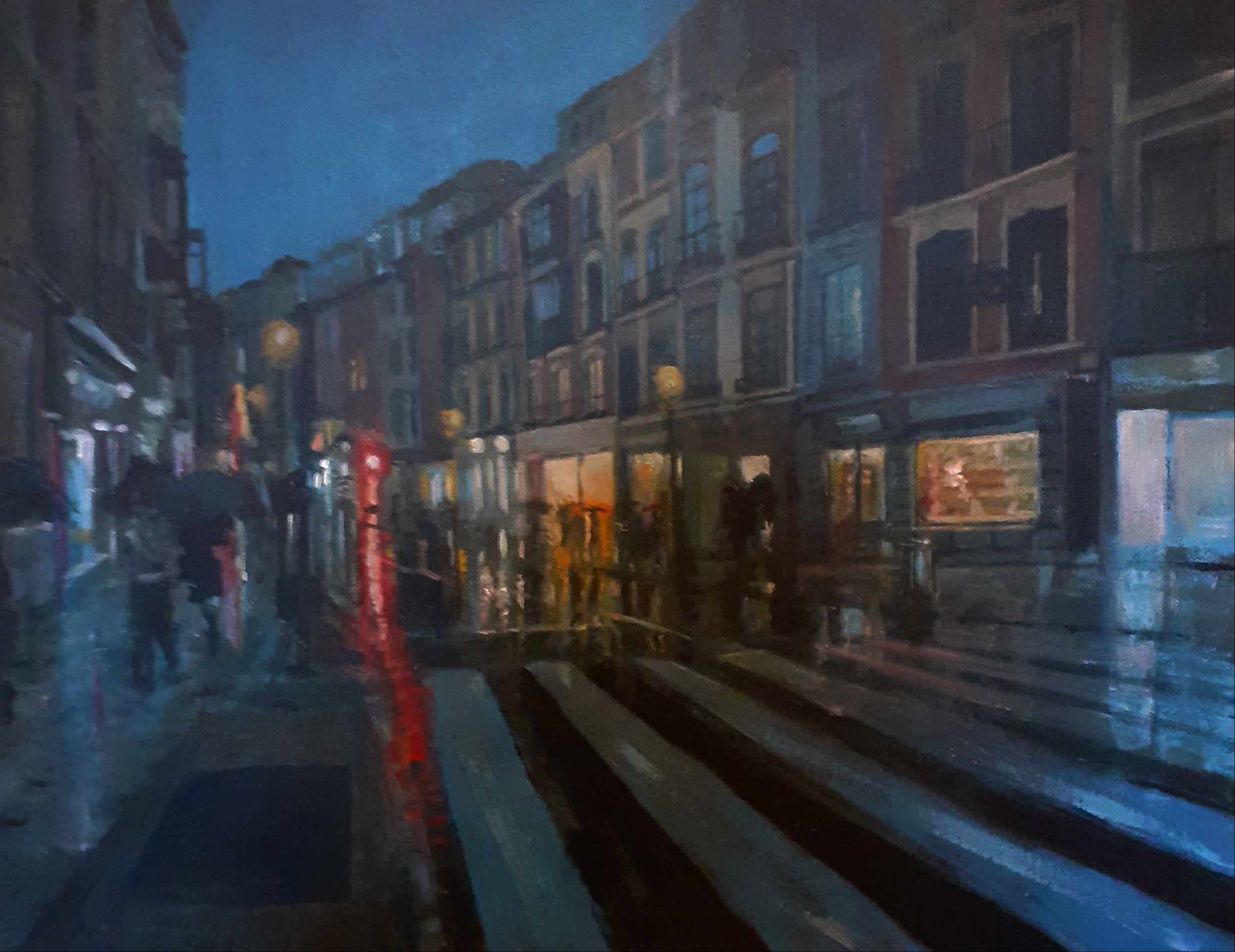
Bray’s Harbour Bar is a favourite watering hole, and I have posted on it before. Drinking Outside the Harbour Bar was painted in the bright sunshine of a summer’s evening. Here, we are huddled inside the original bar in early November. There’s a music session, with three hombres giving it yards. Ballads and folk in the bar, with rock off in the back lounge. I’m in the snug, in between, swaying from one to the other.
This was originally the Harbourmaster’s cottage when built in 1831. The harbour itself was only a small dock then, the full harbour arriving in the 1890s. The bar has been licensed since the 1860s or so. The O’Toole Bros ran the show until ten years ago when the Duggan family added it to their fleet. Throughout its century and a half, it has kept its traditional vibe; seafarin’, rough hewn, crammed with bric a brac and all the ancient, and tyro, mariners adrift on the sea of life. It’s cosy in winter, with the log fires lit and the mellow glow of lights in the timbered shadows. And the music starts to play.
Tonight, I might get loaded
On a bottle of wine, on a bottle of wine,
Gonna feel alright, gonna feel alright,
Yeah, I feel alright!
I Got Loaded is a song for the good times. Listen to Los Lobos howling. Spanish for ‘the wolves’, the band formed in East LA in the mid seventies. Their second album, How Will the Wolf Survive, appeared in 1984 and includes this track. It was written by Camille Bob, and was first released in 1965 by his band L’il Bob and the Lollipops.
The Dublin to Cork train leaves Dublin Heuston every hour on the hour. The journey takes two and a half hours via Portlaoise, Thurles, Limerick Junction and Mallow. I took it last year, celebrating my recent elevation to the free Travel Pass. We barrel through west and south Leinster before leaving County Laois past Portlaoise and crossing into Munster
To the south east the mountains of Slievenamon mark the moutainy territory beyond Ireland’s Central Plain. Slievenamon itself rises 2,365 feet above the floor of County Tipperary. The name is from the Gaeilic for Mountain of the Women. Legend is that Fionn Mac Cumhail, mighty warrior and fierce popular with the women, decreed his pursuers should race to the top of the mountain in order to claim God’s gift, as it were. Grainne won, at least as far as Fionn was concerned. She herself might have preferred a leisurely stroll, or cable car ride, and she eloped with more youthful hero Diarmuid during the marriage feast.
The Pursuit of Diarmaid and Grainne is the epic love tale depicting Fionn’s pursuit of the young lovers. I read it in the Gaelic, Toraiocht Diarmuid agus Grainne, for my Leaving Cert fifty years before. I spent a lot of time looking out windows then, too.
This is a painting of two young lovers lounging on the train as it passes the famed mountain. I tried to be discreet in taking the reference photograph, but typically was spotted. The man, ever on guard, has raised his eyes from his mobile device and is looking at me daggers. She is oblivious. In a way it is a meditation on modern love, neither sweet nothings nor spooning intruding on the current obsession with the smartphone. Still, there is an obvious sense of comfort amongst the duo; striking a tableau worthy of Venus and Mars. The two are well cast in their roles, Mars worryingly so. And I am old with wandering, through hollow lands and hilly lands.
The mountain and the moment passes. I can play with the lover scenario in my head. Are they heroes? Are they pursued? Will they change at Limerick junction, or accompany me to Cork, and all other matters arising? Such questions should stall, allowing myth to arise.
The acrylic painting is, as usual, a labour of love. The subjects classically beautiful and statuesque. An intriguing still life is briefly grouped on the table. Beyond, the world whips by at dizzying speed.We are suspended in a fragile bubble in the vast explosion of life.
Well, pistons keep on churnin’
And the wheels go ’round and ’round
And the steel rails lie cold and hard
On the mountains they go down
Without love
Where would you be right now
Without love, oh -oh.
Long Train Running by the Doobie Brothers from their 1973 album The Captain and Me. Tom Johnston wrote it, providing vocals, harmonica solo and the distinctive rhythm guitar backing. I first heard the song after my Leaving Cert that year, covered by Irish band Rodeo at Kevin Street Tech. About that time I figured why the American Band didn’t actually feature siblings with the surname Doobie.
Part of my purpose, and pleasure, in visiting Andalusia, is to paint it. Sometimes we make sketches, though mostly photography forms the record of places we visit. My Spanish paintings contrast with my Irish paintings. Climate is a decisive factor. Spain is hot and demands a hot palette. Ireland is wet and wild, its palette cool. Every place is different. Every day is different.
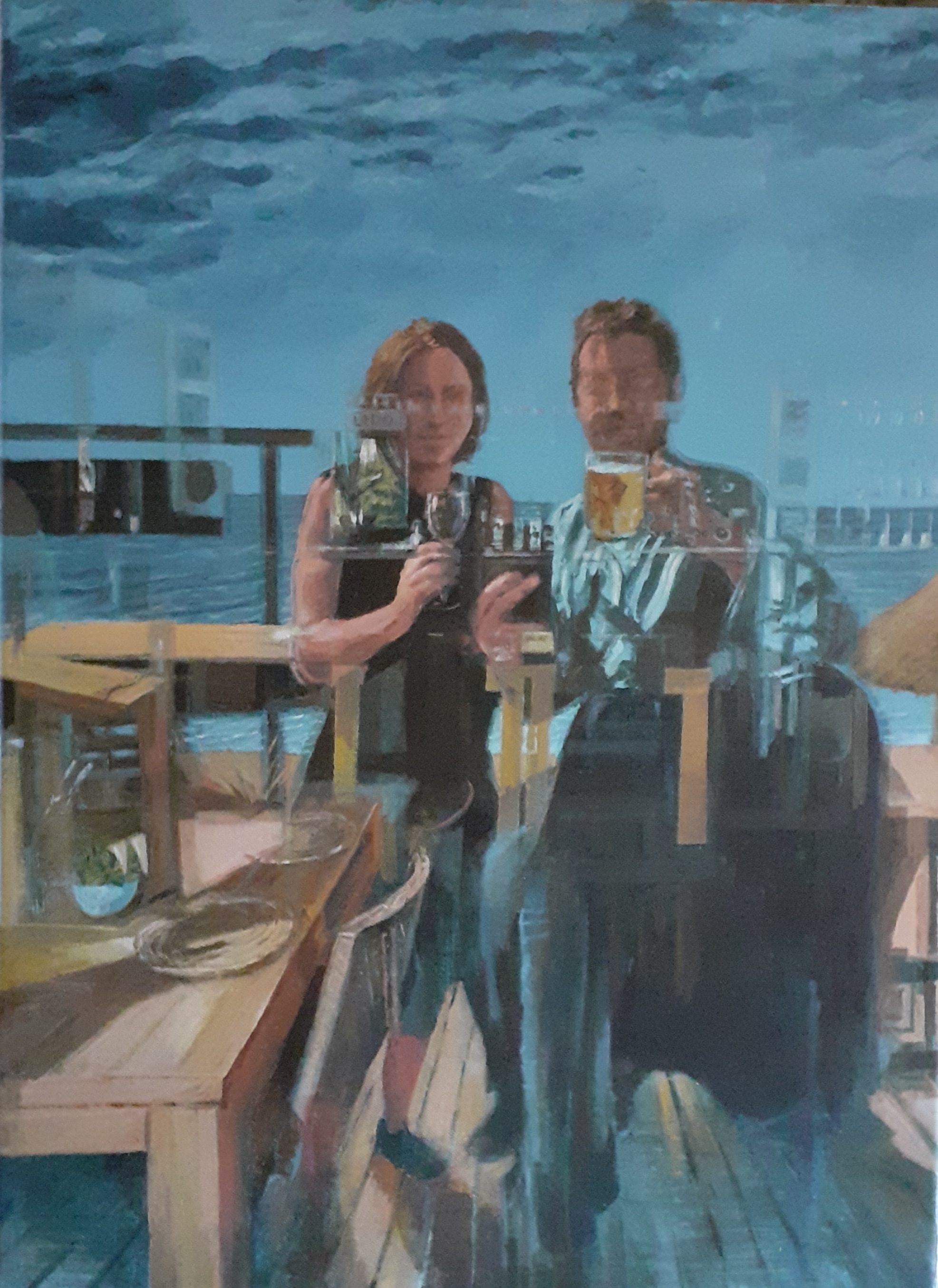
In taking photos I usually exclude ourselves. There are times when a tourist snap is required. I no longer corral innocent bystanders. It happens, but mostly volunteers. Some years back I recall waylaying a handsome young couple swanning into the Casino in Monte Carlo. I indicated the camera, gestured to the debonair male. Of course, he said, and promptly posed for us. His companion put things right. A mysterious lady in Lisbon is another fond faux pas. Reluctantly she took off her gloves on what she clearly regarded as a cold day. It was mid teens; but she obliged with a warm smile. Selfies are an obvious solution, but they don’t really work for me. There’s something awkward about doing them and I usually get it wrong, with my nostrils and ears featuring too prominently. So, M and I have evolved a habit of catching ourselves in reflective surfaces. These mirrored images have the extra advantage of being pleasantly anonymous.
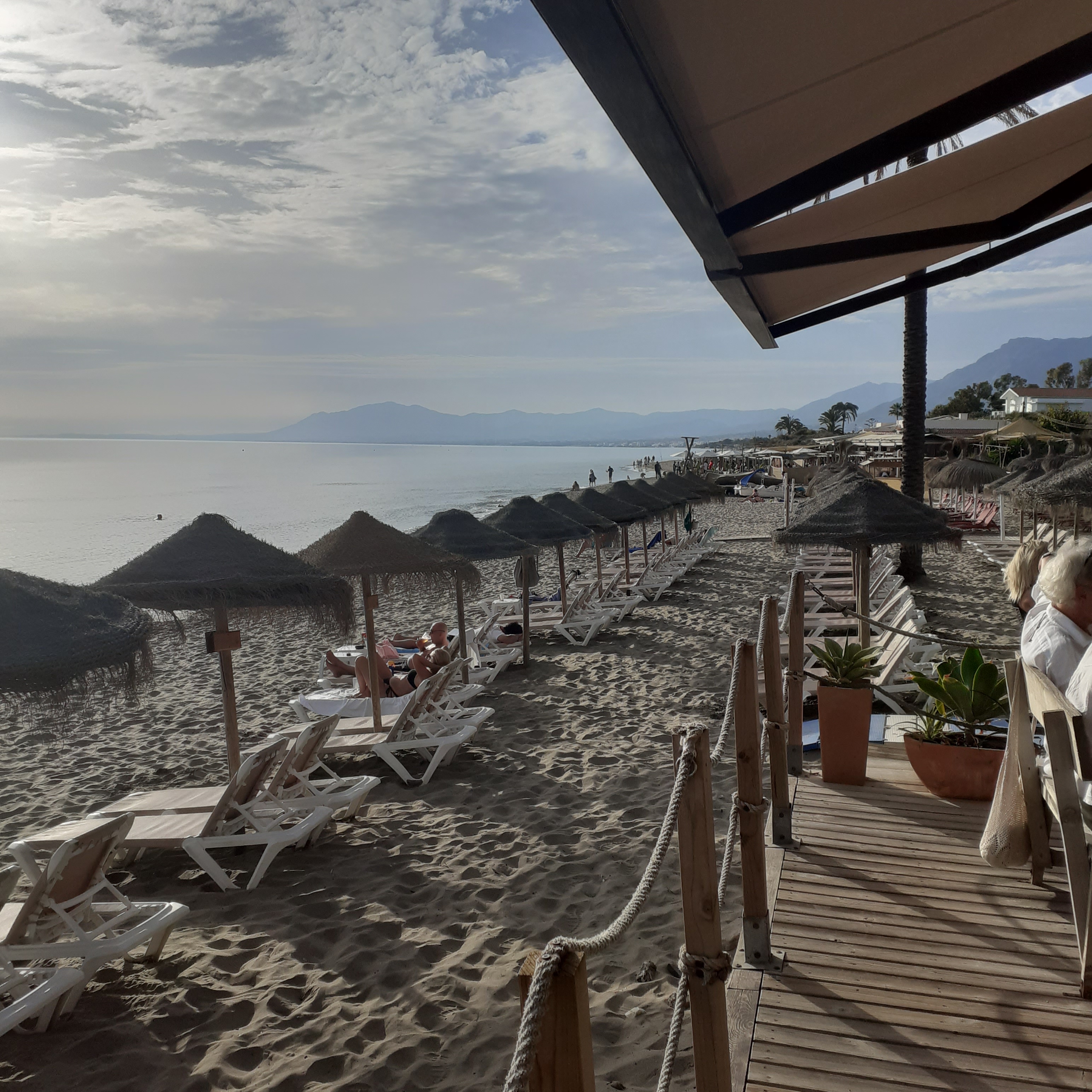
This method is seen at its best on this recent shot taken on Elviria Beach near Marbella. Our favourite bar is on the beach and a regular stop for our pre dinner drink. The Lido Bar also serves food during the day. Sitting out on deck, the beach sweeps away south towards Gibraltar funneling the Mediterranean into the Atlantic. Africa lies just over the horizon.
Painting this picture, I was struck by the shifting points of view within the tableau. We were photographing ourselves photographing ourselves. The observer, and author of the painting, is observed. It’s a self portrait, a still life and a landscape. The reflection itself is a double image due to the glazing. This gives a liveliness, a kind of shaky quality too. We are a blur against the immense physicality of the Med. There, but not there. A snapshot in time. Then gone.
Lido missed the boat that day, he left the shack
But that was all he missed, and he ain’t comin’ back
At a tombstone bar in a juke joint car, he made a stop
Just long enough to grab a handle off the top
Written by Boz Scaggs and David Paich, Lido Shuffle featured on the album Silk Degrees in 1976. Sing along!
The Dart has been taking commuters, daytrippers and various wanderers around the Bay for forty years. Dart is a clever acronym for Dublin Area Rapid Transit. It runs from Malahide or Howth in the north to Greystones in the south. The last two stops are outside of County Dublin. Reaching the Dargle River we are in County Wicklow. The town of Bray has been established here since the Norman invasion, building on earlier Gaelic settlements.
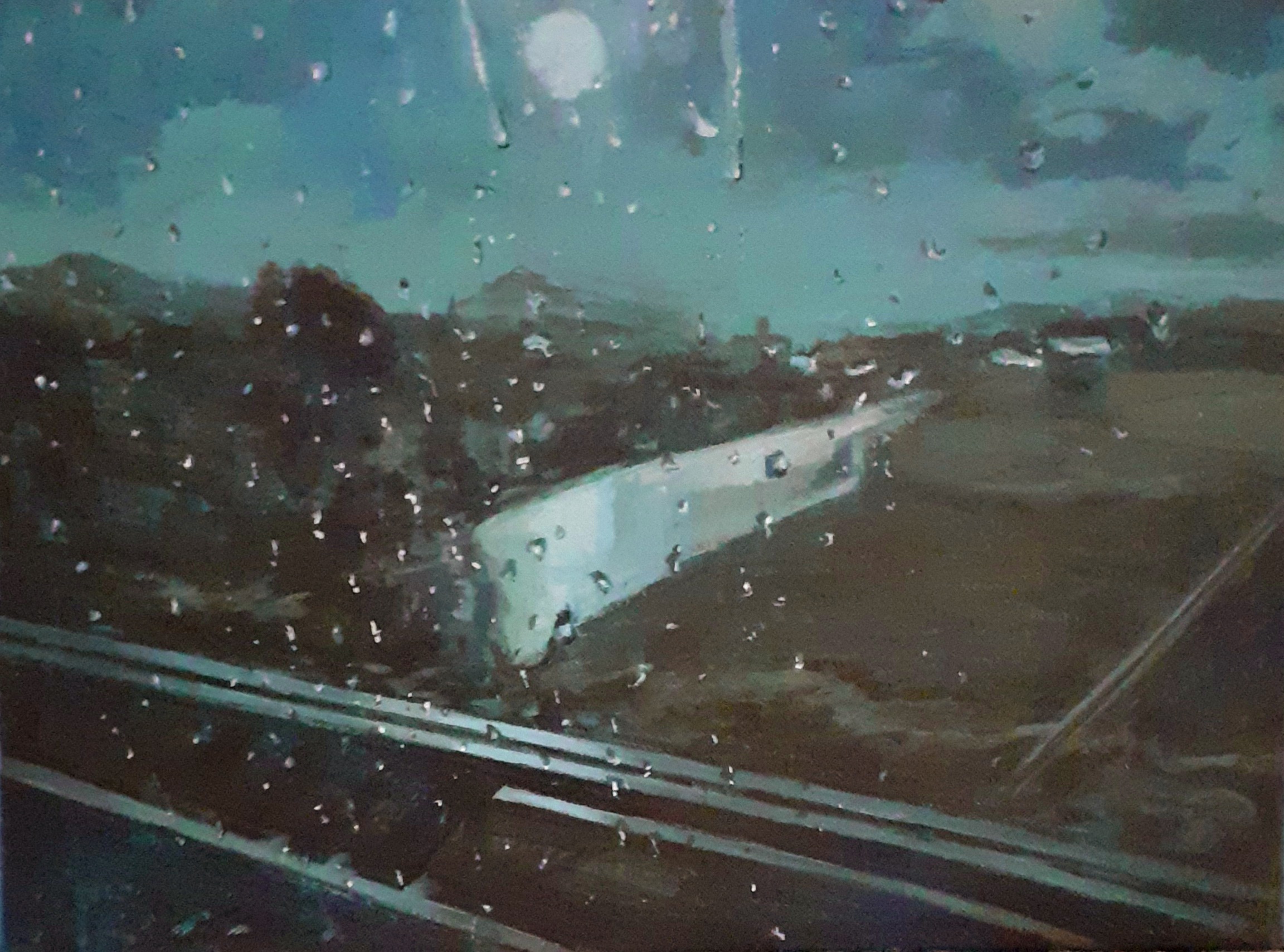
This view is taken from the window of a southbound Dart, about to cross the bridge over the Dargle. I am returning from Dublin city where it has been raining, but now the sun’s coming out and Bray rises steaming out of the gloom. The Sugarloaf Mountains appear on the horizon, and the land is marked by the tower of the Catholic Church of the Most Holy Redeemer, and the spire of Christchurch (CofI). Bray Daly Station is my stop. Opened in 1854, the line was quickly extended to Greystones and runs parallel to the seafront behind the hotels and houses lining the Esplanade which was newly established then.
This painting is acrylic on canvas and has been accepted by the Signal Open Art Exhibition of 2024. I am delighted to be chosen and looking forward to seeing all the other works on show. The exhibition runs from Tuesday 6th August until Sunday 18th August. Should be fun. Give it a dekko!
Every time it rains
You’re here in my head
Like the sun coming out
I just know that something good is going to happen
I don’t know when
But just saying it could even make it happen
Cloudbusting by Kate Bush is guaranteed to lift the heart, without reneging on past sadness. It is on her 1985 album Hounds of Love.
Touchdown at midnight in Seville airport. Step into a warm Spring night as taxis cruise conveniently to the kerb. It’s thirty five euro to the city centre, which is a bit steep; but it’s Feria, and you now how festivals eat money. Our city centre hotel is near six hundred euro for three nights, so we’re prepared. Feria is Seville’s biggest festival, where locals let there hair down, or tie it up, a fortnight after the serious religious and cultural devotion of Semana Santa.
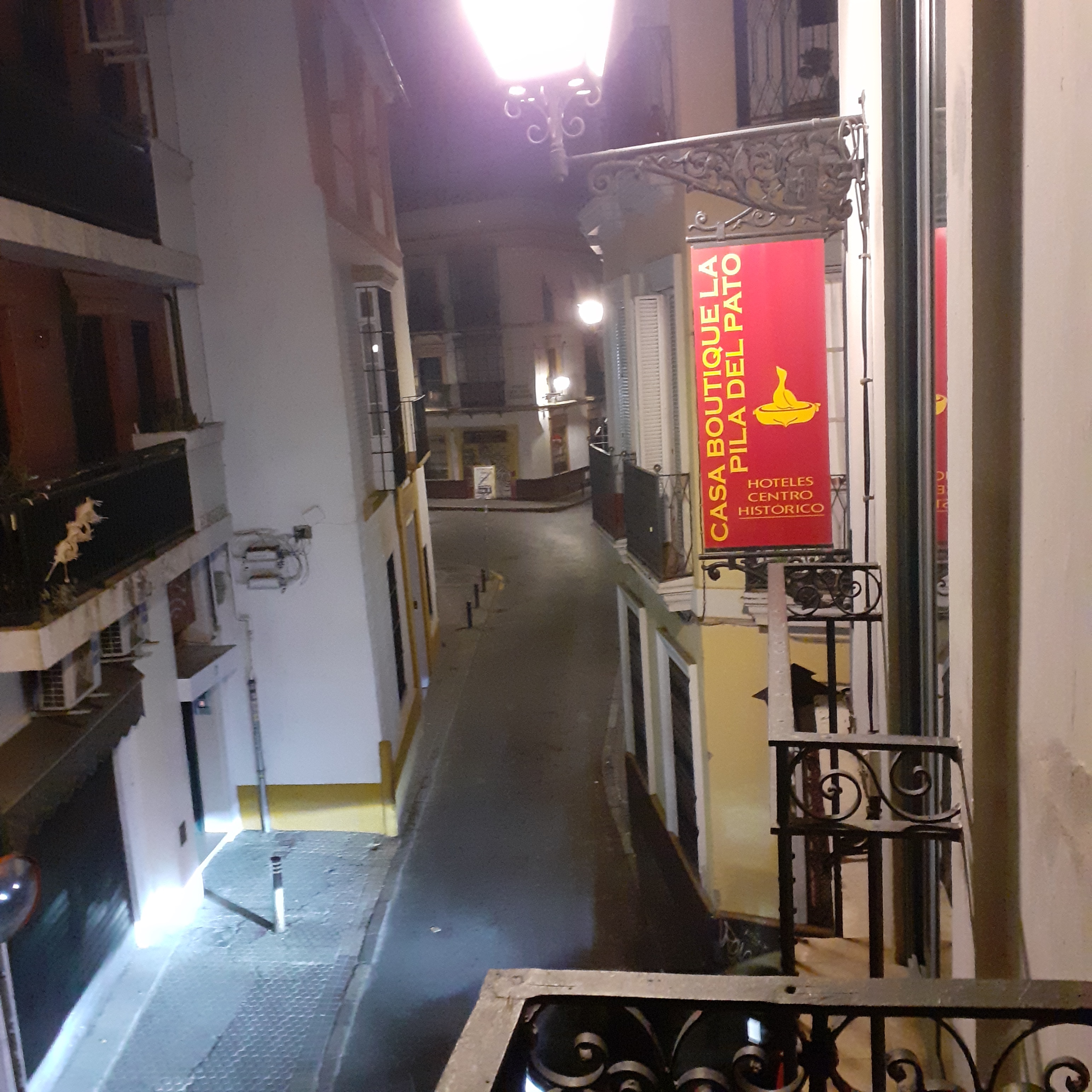
Our accommodation, La Pila De Pata is in the Old Town, Santa Cruz, within walking distance of the city’s main attractions. The room is attractive, with a timber ceiling, old style shutters, and a gigantic fan. There’s a small wrought iron balcony overlooking the narrow street, Calle Aldohinga. There are noisy neighbours across when we arrive, but hey, it’s Feria, and we’re dog tired and sleep easy.
Seville is the capital and largest city in Andalusia. Almost seven hundred thousand people live here on the banks of the mighty Guadalquivir River. Founded by the Romans and ruled by the Moors for five centuries from 700AD, in 1248 Castile conquered the Moors in the Reconquista. NO8DO is the city’s emblem. It is a rebus for No me ha dejado: she (Seville) has not abandoned me. Pronounced No ma dejado, the symbol 8 represents the trio of syllables madeja; a skein of wool. The legend is that King Alfonso X used the phrase thanking the citizens for standing by him against attempts by his son Sancho to usurp the throne. Alfonso ruled from 1252 till his death in 1284.
Seville lies fifty miles inland from the Atlantic and flourished as a river port in the late middle ages, particularly for imports from the New World. Silting of the river and other factors saw it decline in the eighteenth century and maritime power passed to Cadiz on the Atlantic coast further south. Ancient Seville lies largely within Santa Cruz. a warren of streets and lanes spreading north from the central area around the ancient fortress. Here you’ll find a cluster of magnificent buildings including the Alcazar, and the spectacular Cathedral.
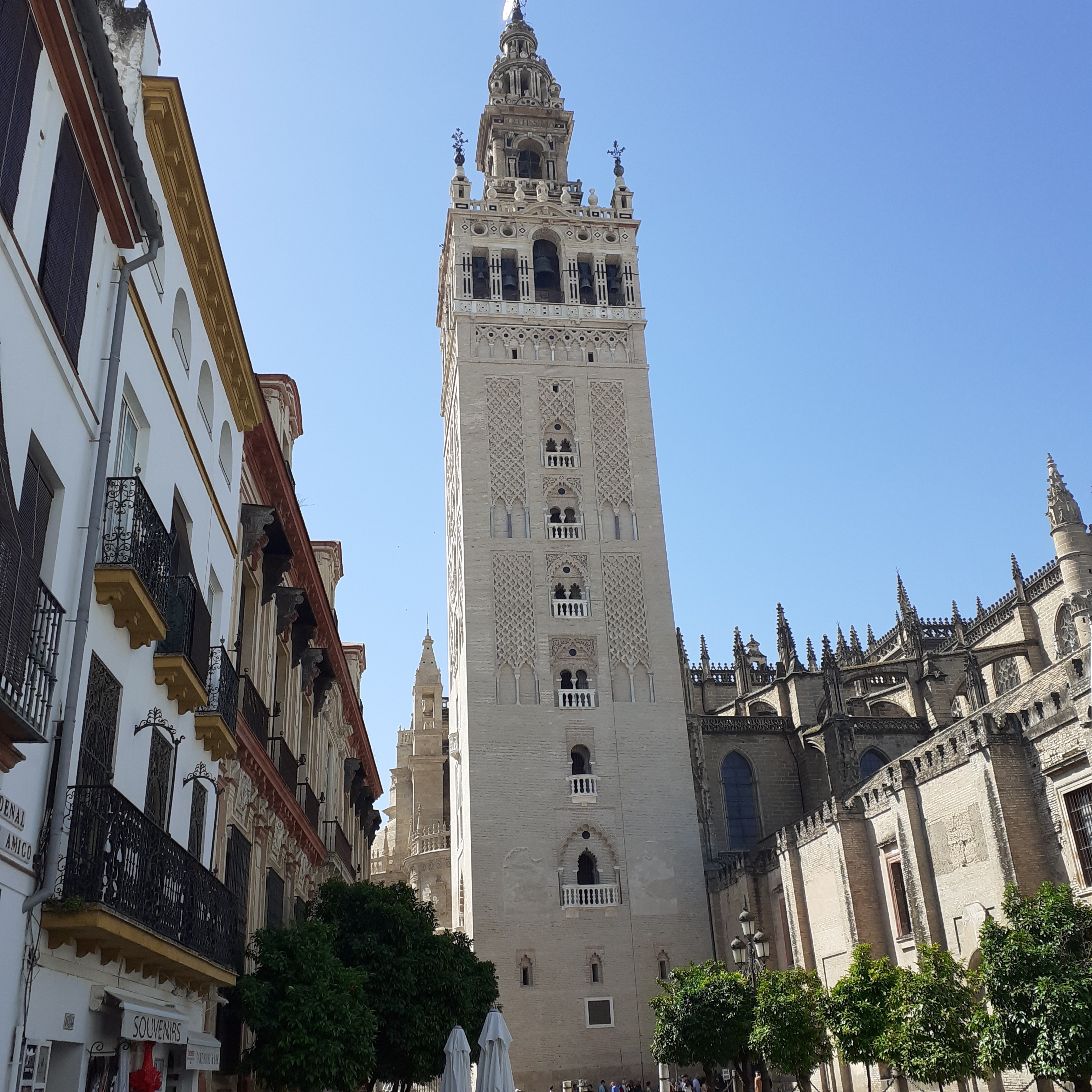
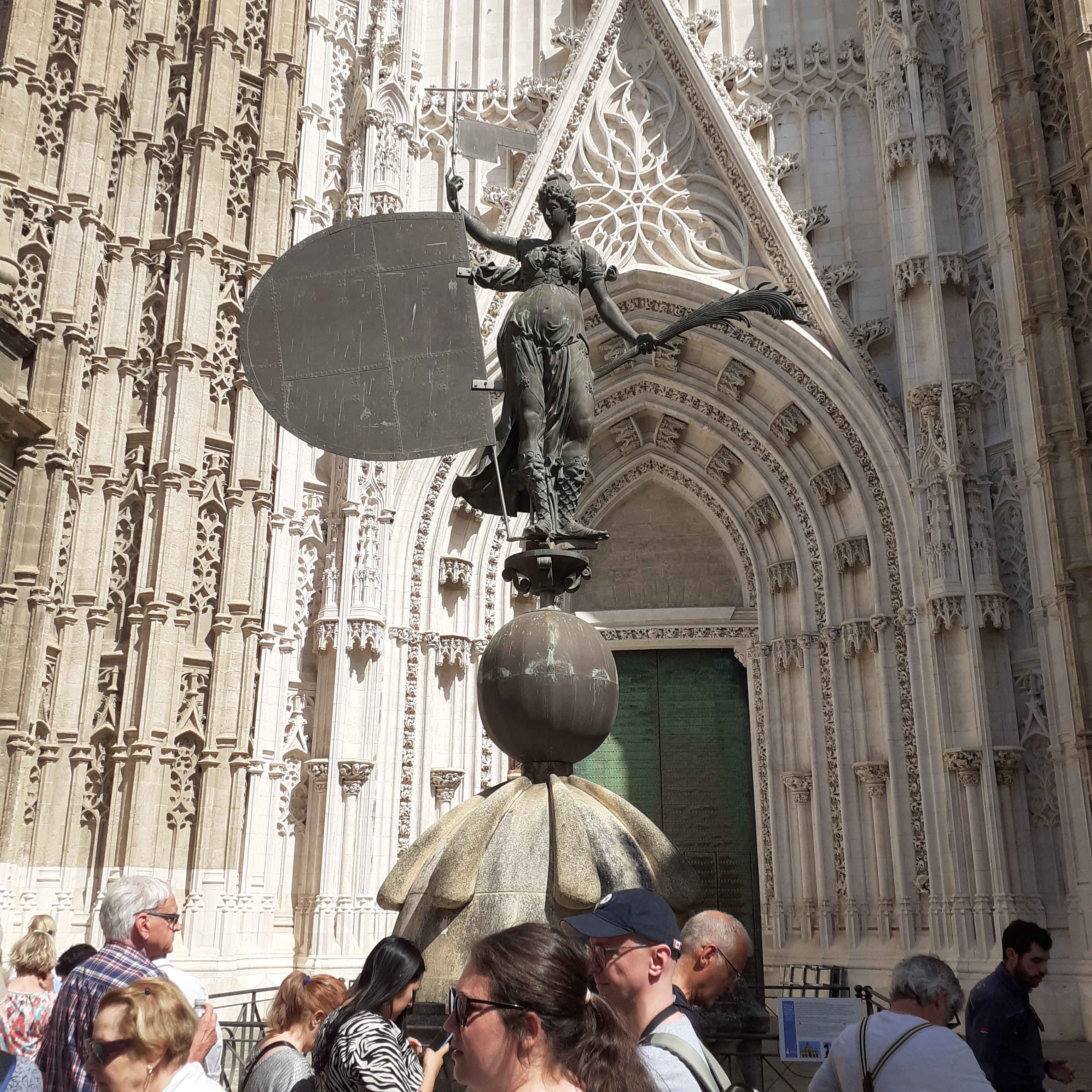
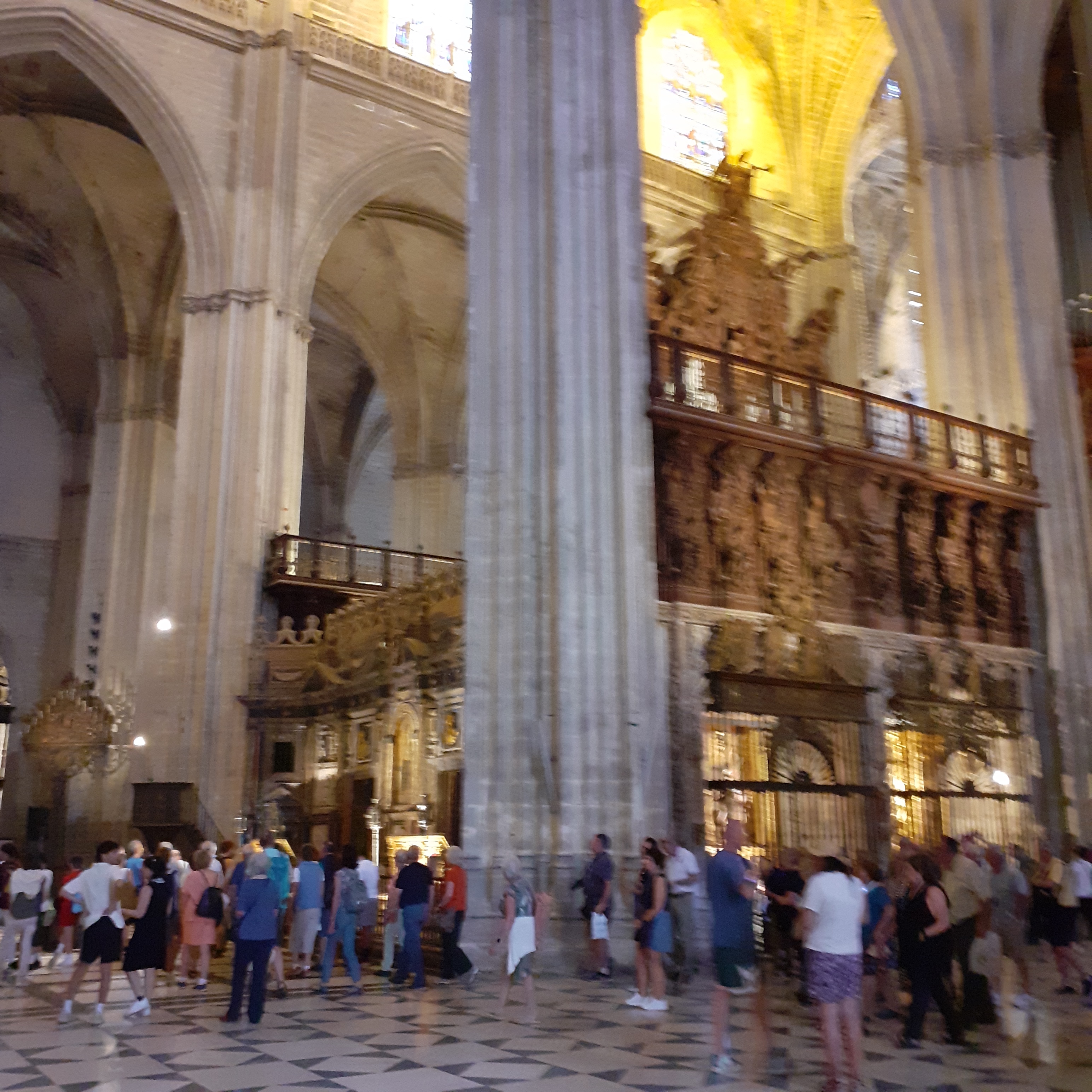
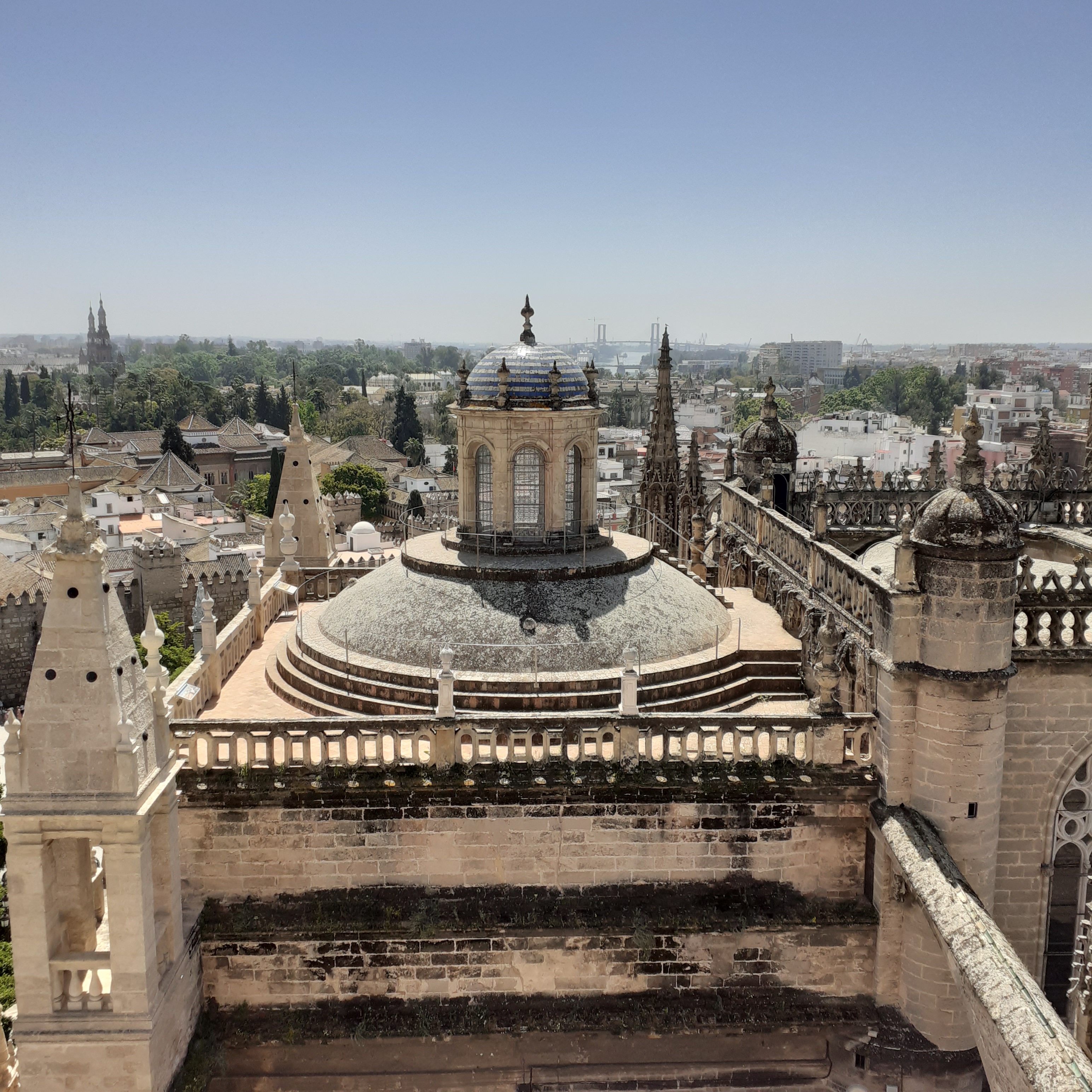
On our first day, we shimmy down from Aldohinga to Plaza Virgen de los Reyes. The Cathedral of Saint Mary of the See is six hundred years old and the largest gothic church in the world. The bell tower of La Giralda soars above. There’s a short queue for entrance, with a generous discount, almost fifty per cent for aul lads like me. Younger folk, like M, pay the full thirteen euro. The Giraldillo, the bronze statue depicting the victory of the Catholic Faith stands here, a replica of the weathervane at the top of the tower. La Giralda was originally the minaret of the Mosque, with Christian symbols added after the Reconquista. The Renaissance belfry and weathervane were added in 1598. The climb to the top is relatively easy, a ramp zig zags upwards at a moderate incline. The views are truly majestic. Even more exciting, the bells broke into full peal causing some to clutch their ears. The bells. The bells!
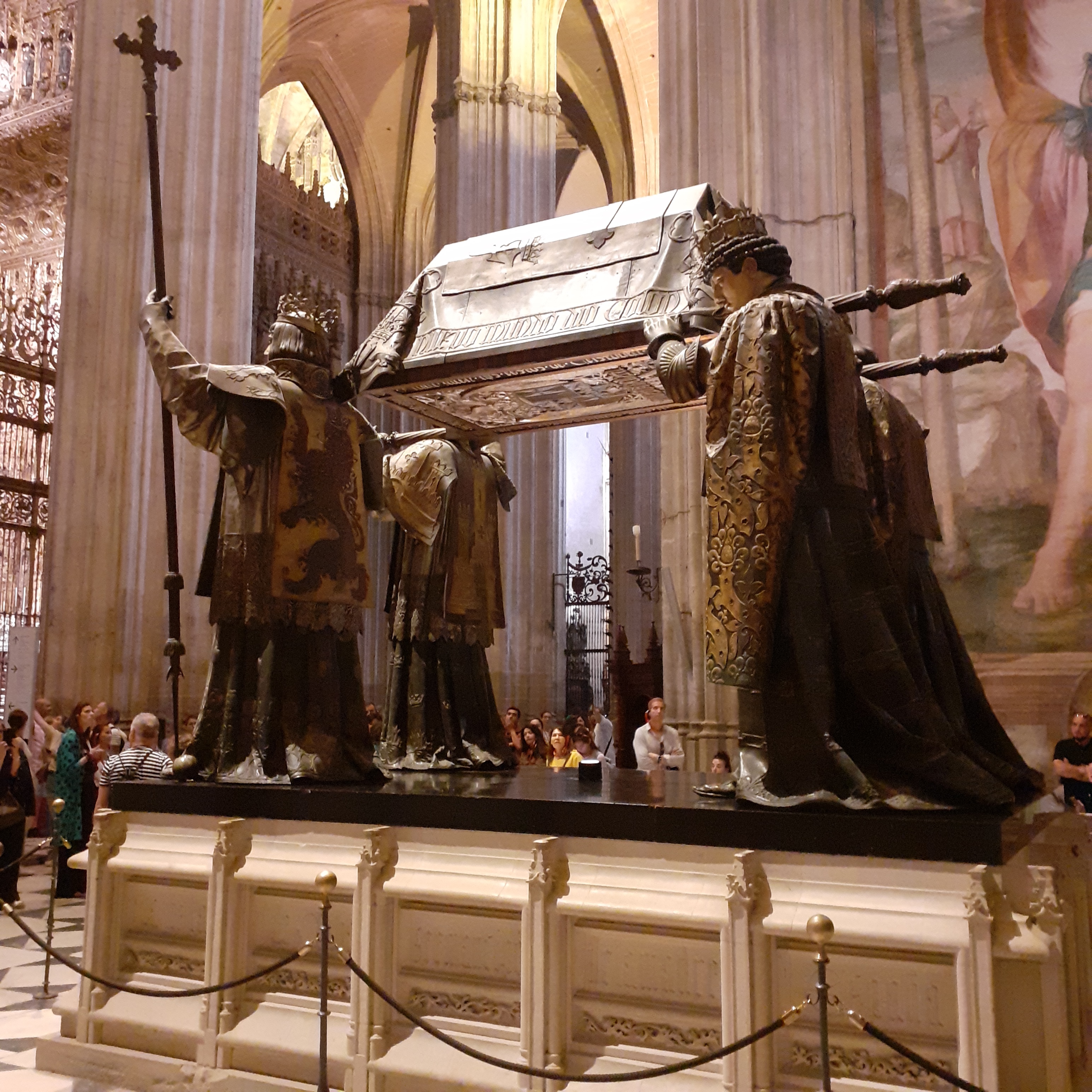
The Cathedral interior is mind bogglingly cavernous, on a scale that hints at science fiction besides a supreme exhaltation of faith. The crowds are well dispersed around its many treasures. Amongst these are the tomb of Christopher Columbus. He set sail in 1492, forging the route to the New World and making his first landfall on the island of Guanahani which he named San Salvador. Columbus was thus instrumental in the initiation of the lucrative trans Atlantic trade and more. A new world order grew, and such benefits as tobacco, potatoes and turkeys first came to Euope. Gold and silver too; and coffee, jazz and rock n roll.
Columbus’s remains were interred in the Cathedral in 1513, seven years after his death. They had an appropriately peripatetic existence, being further interred in Hispaniola and Cuba before making their way back to Seville in 1898. The tomb is a catafalque, depicting a casket borne aloft by the Kings of Leon, Castille, Aragon and Navarre.
The Vision of Saint Anthony by Bartolome Esteban Murillo from 1656 is in the Saint’s chapel nearby. There are eighty chapels within the Cathedral each host to a story, an ambience to absorb and admire. Outside, the Patio de los Naranjos is the courtyard of the original Mosque centered on a fountain. Here, the Muslim devotees would wash before prayer. It is a restful oasis after the sensory overload of the interior.
Back towards the Old Town, we stop in San Francisco Square for lunch. The Ayuntamiento, City Hall, lines the western side. This was built in 1534 and upgraded in the Neo Classical style in 1891. Over a drink we await our tapas, including Tortilla. But while the guide book refers to it as the ubiquitous Spanish Tortilla, we finish our drinks without it arriving. Moving on to Calle Sierpes, the street of the snakes, we get pizza slices for nourishment. Sierpes is a pedestrianised shopping street and perfect for the Spanish Stroll of early evening.
Hey Rosita! Donde vas con mi carro Rosita?
tu sabes que te quiero
pero ti me quitas todo
ya te robasta mi television y mi radio
y ahora quieres llevarse mi carro
no me haga asi, Rosita
ven aqui
ehi, estese aqui al lado Rosita
Spanish Stroll was a hit single in 1977 for Mink Deville, Willy Deville’s band, from their 1976 debut album Cabretta, a jacket of soft leather. Derived from the Spanish word for goat, it is in fact sheep leather. Bass player Ruben Siguenza did the spoken bit.
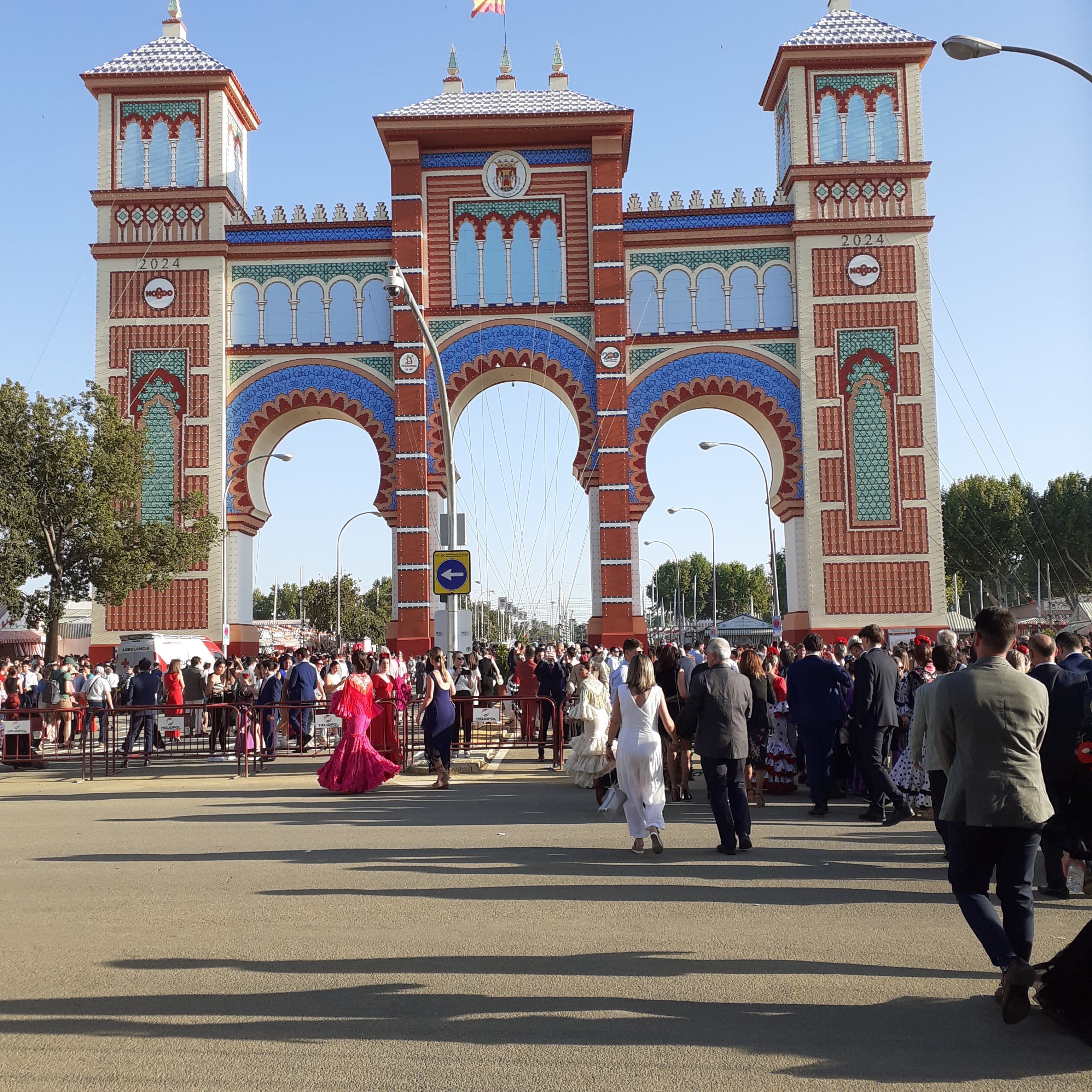
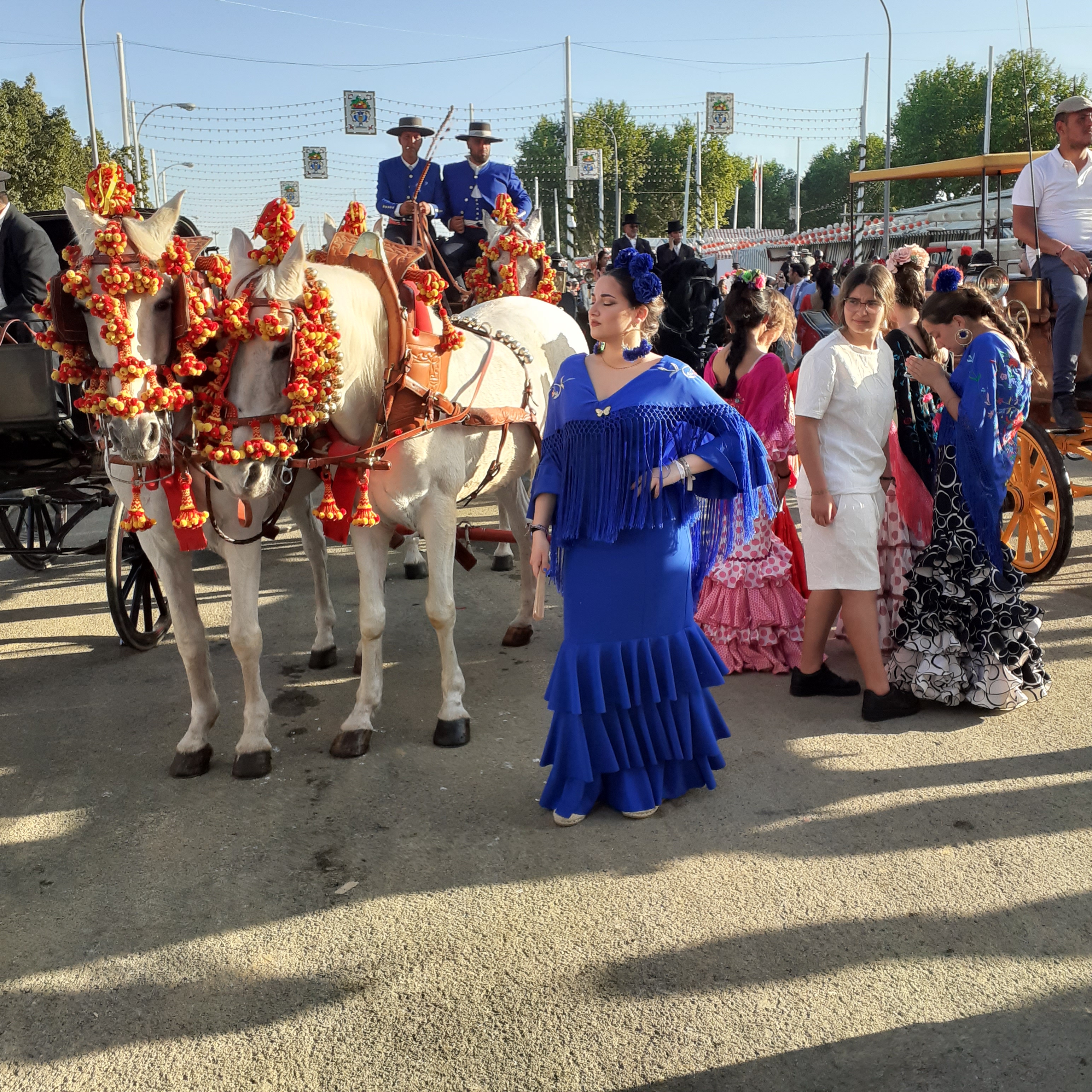
By early evening we follow the crowds across the San Telmo bridge over the Guadalquivir to Triana. Triana is said to be the cradle of Flamenco being originally the barrio for the Gitano community. Today it is a lively traditional area with riverfront bars giving great views of the city. To the south is Los Remedios, a more modern area which hosts another exuberant expression of tradition. The Feria de Abril is a week long fair held a fortnight after the Semana Santa. The locals don traditional attire and let their hair down, or tie it up, in a spree of drinking and dancing. The fairground is at the top of long, straight Calle de Asuncion.
The throng is going one way in early evening, and we are pushed along to enter through a huge gateway, bringing us into a garden of earthly delights. It is quite overpowering, a feeling the whole world is here, balanced between chaos and the vast underlying structure of community. There are a thousand tents or casetas for drinking, dining and dancing, welcoming a half million visitors per day. The casetas are mostly restricted access, for various clubs, associations and families but some are open to the general public and visitors. There is a horse and carriage parade making a colourful, traditional spectacle and further on is an amusement park known as La Calle del Infierno, or Hell Road. The week coincides with the start of the bullfighting season across the river at Real Maestranza, the twelve thousand seater bullring and one of the most iconic in Spain.
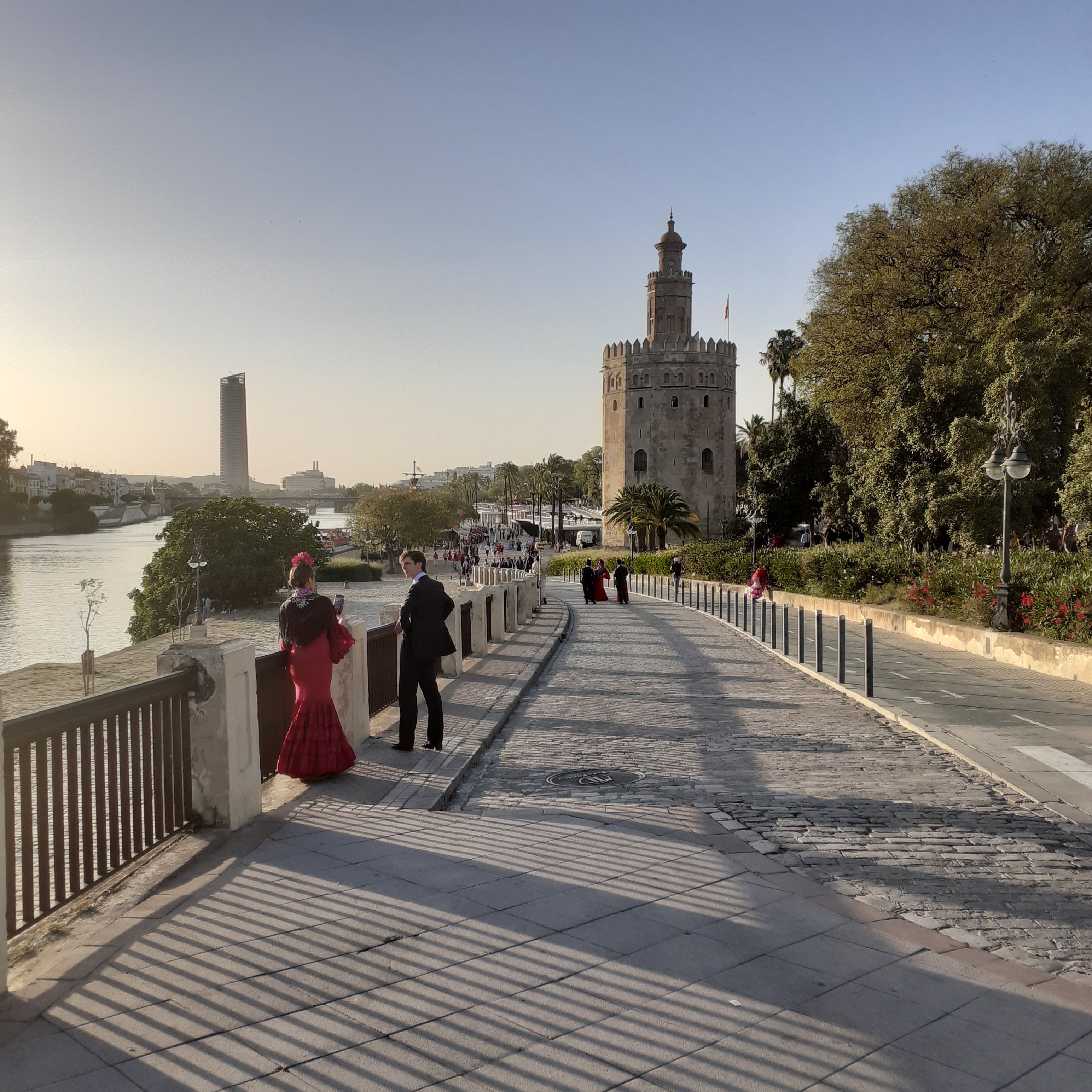
The evening serenity of Old Seville beckons. and we return across the river where the Torre del Oro guards the far bank. The tower dates from Moorish times when it was part of the city’s defensive walls. Built in 1220 the turret was added in 1760. There was once a twin tower across linked by a mighty chain to thwart enemy shipping. We find space at a restaurant on Calle Almirante Lobo, Admiral Wolf as we might say, and enjoy our meal al fresco as the sun sets behind the Tower of Gold. The sun sinks and illuminations blossom over the city. Later, we find the rooftop bar at the Cathedral Hotel to bask in the moon over magical Seville and raise a glass or two.
With five episodes so far in our tour of Andalusia, a couple of destinations remain. In April I will be going to Seville and Cadiz and I look forward to giving my account of those two fascinating cities. Seville is the capital and largest city in the region and dates back over two thousand years. Cadiz is more ancient still; one of the oldest towns in Europe. I will be travelling by plane, bus and train. Meanwhile, we will be taking a break in our hideaway in Elviria, Marbella. A break, for me, means doing nothing much at all.
We’re going on a holiday now
Gonna take a villa, a small chalet
Costa del Magnifico
Yeah, the cost of living is so low
Scribbling is allowed, in whatever form I decide to record worthwhile memories. Some painting or prose, or both, will emerge. This acrylic is a moment captured last Spring in Elviria, just a few kilometres east of Marbella. That rippling blue rectangle is a familiar motif in Hockney’s Californian paintings and sum up that mood of ecstatic indolence at the heart of swimming pool culture. To be sure. There are a couple of musical equivalents; though less than one might suppose. Kate and Anna McGarrigle’s rendition of Loudon Wainwright’s The Singing Song is one and Nightswimming by REM another, if not quite the right time of day. Closest is Dire Straits, with Mark Knopfler’s Twisting by the Pool. A rare fun rocker from the bluesy Geordies, it is a retro take on the Spanish holiday boom for sun starved Britons in the early sixties. The song doesn’t appear on any of the band’s studio albums, and first surfaced as a single 1983. It was a firm favourite as an encore, as I witnessed at Stadium gig in Dublin the early eighties.
Yeah (yeah), gonna be so neat
Dance (dance) to the Euro beat
Yeah (yeah), gonna be so cool
Twisting by the (twisting by the)
Twisting by the (twisting by the)
By the pool (twisting by the pool)
So, while I hope to be pumping ink with my biro, or painting my next masterpiece for over the mantelpiece; more than anything else I will be
Twisting by the pool (twisting by the pool) twisting by the pool (twisting by the pool)
We’re twisting, twisting by the pool, twisting by the pool, twisting by the pool
Twisting by the pool (twisting by the pool) twisting by the pool (twisting by the pool)
We’re twisting, twisting by the pool, twisting by the pool, twisting by the pool
From Marbella, the town of Ronda is sixty kilometres inland, and uphill. Head west along the AP7 and there’s an early turn off after fifteen kilometres. We shimmy up an endless sequence of hairpins along the A397 towards Ronda. Dense oak and pine woodland clings to perilous cliffs rising to our right, to our left the sylvan border thins now and then to reveal the hot blue of the Mediterranean.
The further we rise, the more the view out to sea broadens. Gibraltar points its finger towards Africa and with each death defying swerve I glimpse, or think I glimpse, both Pillars of Hercules and the far shores of another continent. There are a few observation points where you can stop and take in the view, although it’s hard to pull yourself away from the excitement of this James Bond slalom, battling slow and fast cars amidst the buzz of suicidal motorbikers.
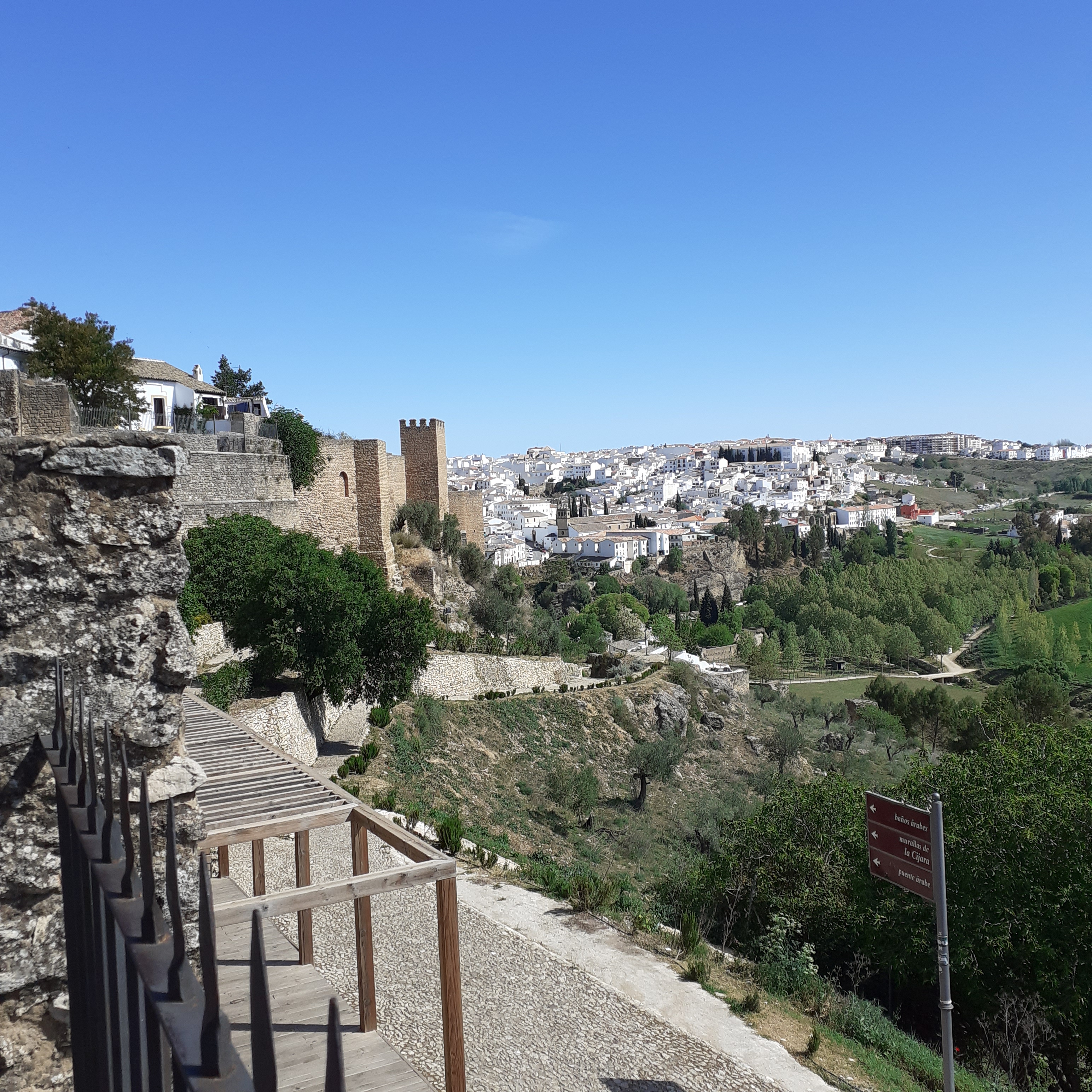
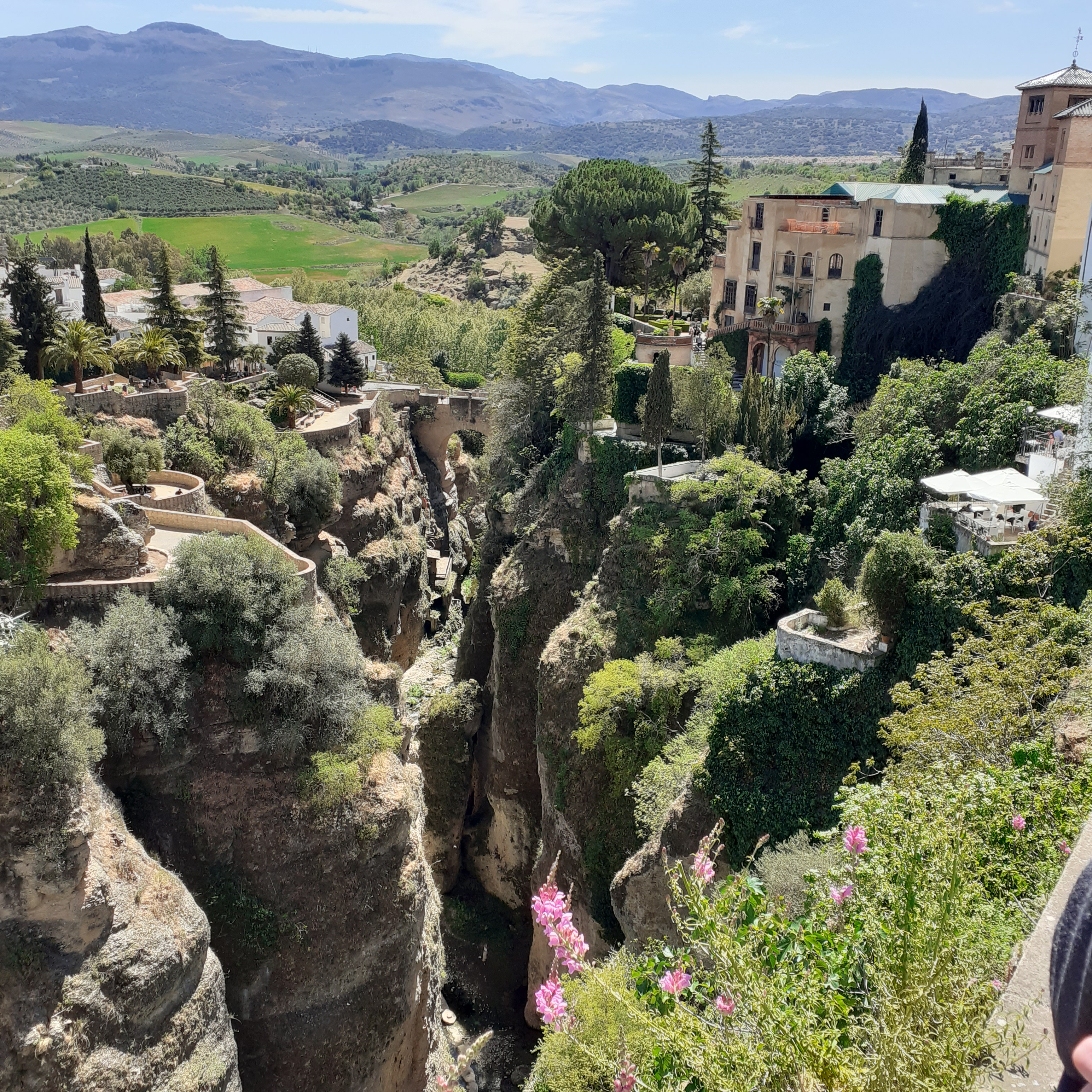
The mountains we climb are the Sierra de las Nieves, the snow mountains, which rise to almost two thousand metres. Out of the forest we reach a parched white karst landscape, harsh and romantic as an arthouse Western, its technicolor bleached with age. The plateau tilts downhill and we fall slowly to the valley of the Guadalevin River. Over the millenia this has carved out the spectacular El Tajo canyon. Atop the twin towers of the canyon, is that most preposterous city in the sky: Ronda. The city of Ronda has a popuation of thirty five thousand people. The Moors were established here by the early eight century, ushering in an Islamic era that would last seven hundred years. Ronda fell to the Catholic monarchs in 1485, seven years before the fall of Grenada, the Moors last stronghold. Although Islam was subject to a determined purge, Moorish influence remains in the architecture and the complex weave of Andalusian cultural fabric
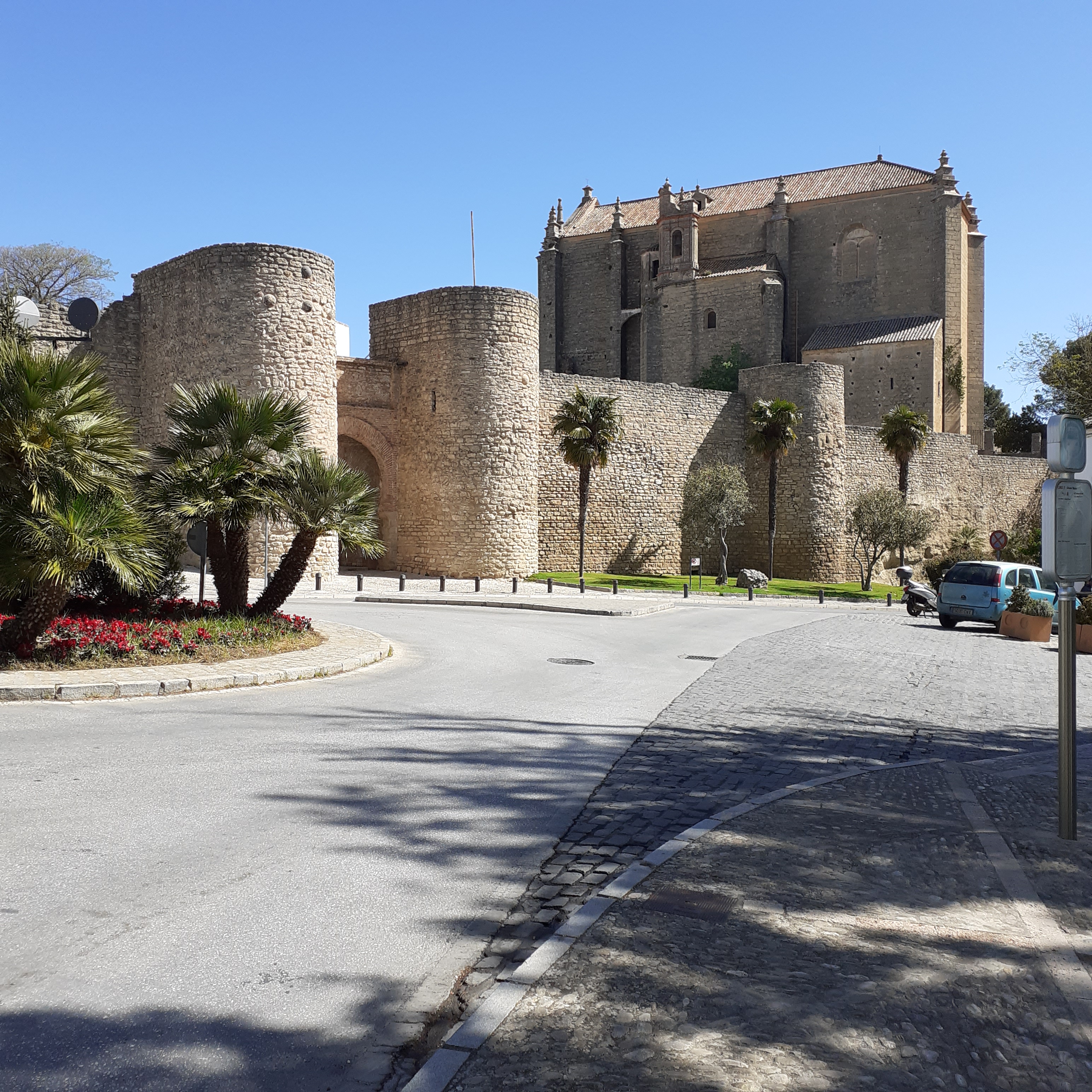
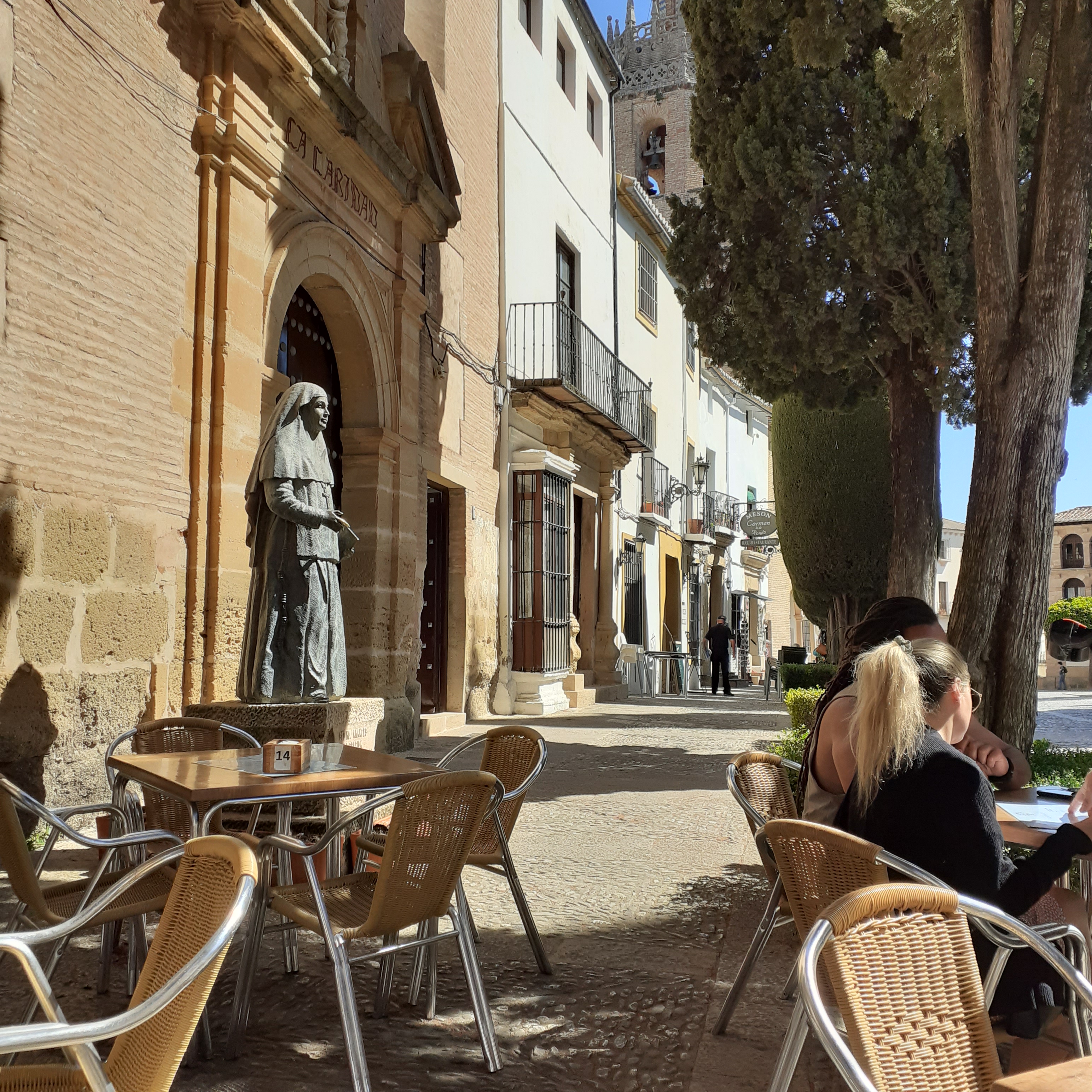
We find ad hoc parking near a shaded square beneath the ancient walled city. The Puerta de Almocabar is the southern entrance gate and dates back to the thirteenth century. The arched gateway is flanked by stern round towers and passing through you get that frisson of stepping back in time. Farther uphill, the Castillo del Laurel, first established in Roman times, was redeveloped by the Moors, and condemned to ruin by various invaders, Joseph Bonaparte especially, earthquakes and the Spanish Civil War.
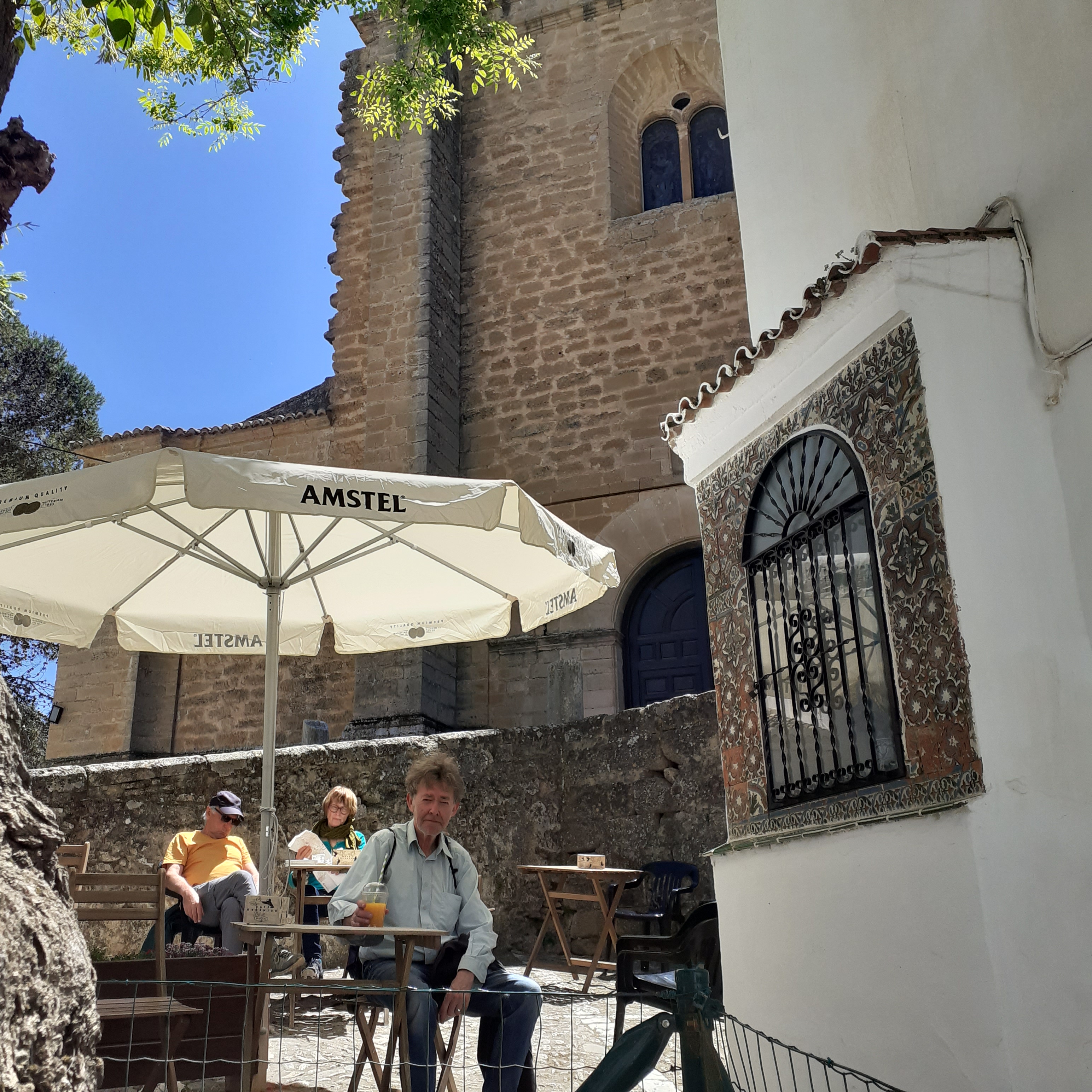
A little further on to the left lies Plaza Duquesa de Parcent which marks the spot of the old Roman forum. The imposing Iglesia de Santa Maria la Mayor and the attractive three story facade of the Town Hall dominate the square which is shaded by trees. We stop for food and refreshment at Cafe Mondragon on the corner. The restaurant is named for the Palace Mondragon nearby. The original palace was built in the early thirteenth century, and taken over by the Nasrid dynasty of Grenada who were the last Moslem rulers before the Reconquest. Such Moorish influence as remains is largely confined to the gardens. The water garden resembles the Alhambra’s in miniature. After Ferdinand and Isabella, the palace itself was given a Renaissance makeover and houses a museum.
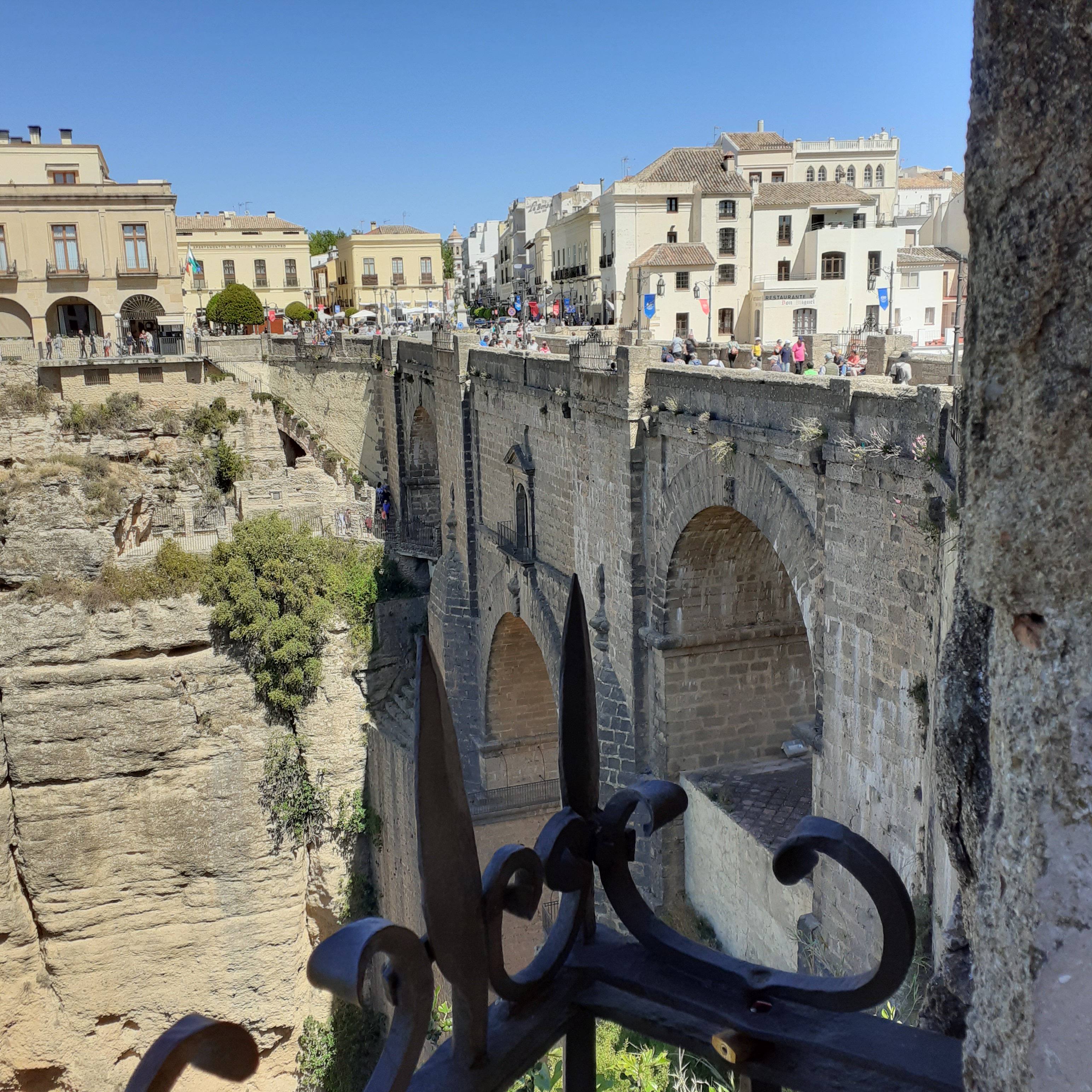
The lower part of the Old Town is pleasantly quaint and quiet. The crowds build as we near the bridge. The Bridge is the signature spectacle of Ronda, connecting the Old Town with the new town, Mercadillo, meaning the little market. Why the residents wanted to expand their town across the vertiginous canyon of El Tajo is a mystery. Perhaps they anticipated Science Fiction and figured they would create the perfect backdrop for film fantasies. There were other bridges spanning the Guadalevin, though much lower down the chasm. The Roman Bridge which was actually built by the Moors, is the oldest and lowest bridge. The Puente Viejo, or Old Bridge, dates from the early seventeenth century.
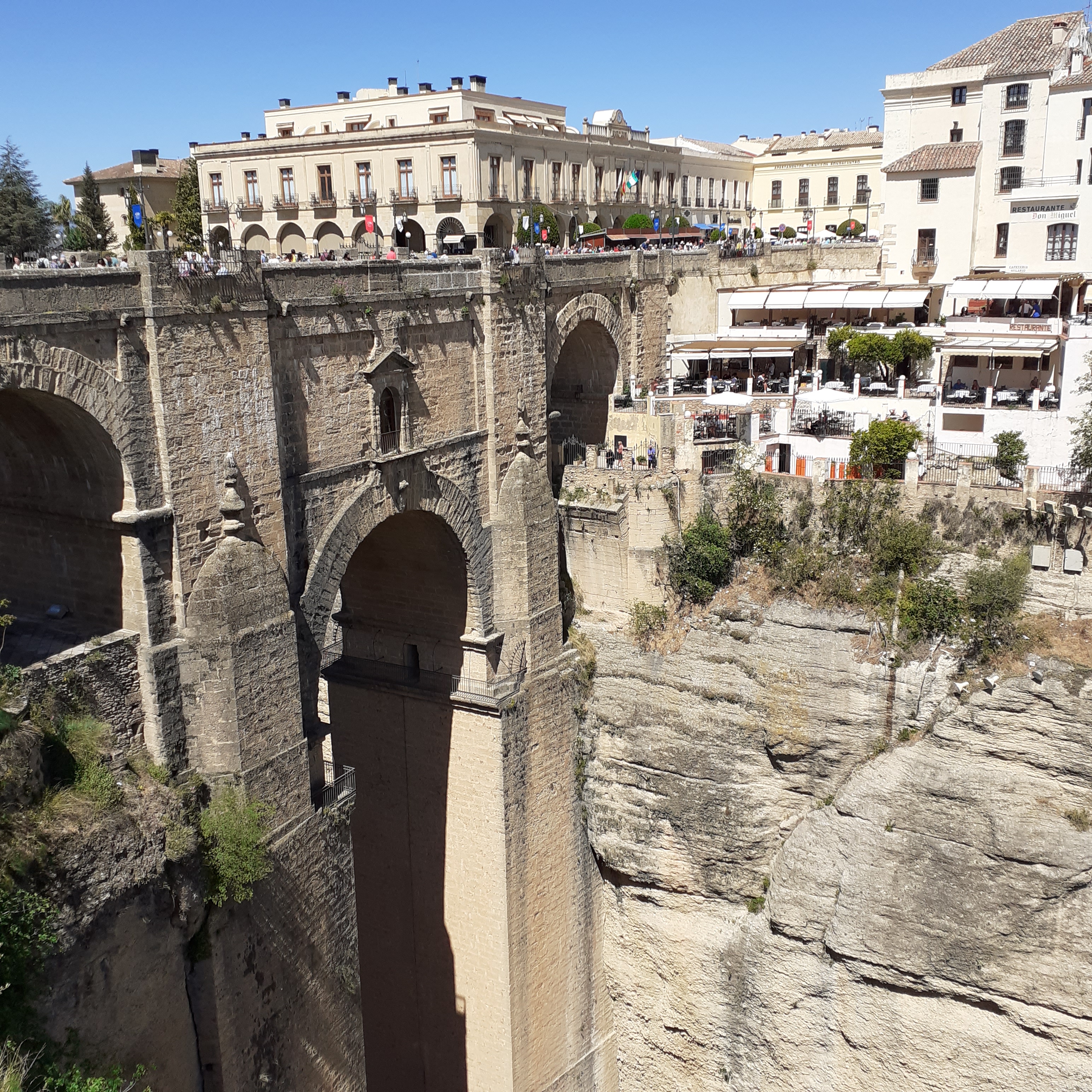
Towards the mid eighteenth century the Puente Nuevo was proposed. The first attempt lasted less than a decade before collapsing into the abyss and taking fifty unfortunate souls with it. It fell to architect Jose Martin de Aldehuela to design one that would last. Built between 1759 and 1793, it spans the seventy metre gap with three arches and rises a hundred metres above the valley floor. There is a chamber above the central arch which came into use as a prison. There are fearsome tales of prisoners being thrown to their deaths through the small window during the Civil War, and this has become embedded in legend. More happily, the place subsequently became a tavern and now houses a small museum dedicated to the bridge’s history.
There are viewing platforms on each side and many bars and eateries embedded into the top of the cliffs. The Mirador de Aldehuela is a viewpoint to the southeast side, in the Old Town. Adjacent, the small Placa de los Viajeros Romanticos is well named, and illustrated with a panoramic tiled mural. If you are a romantic traveller, surely you will find yourself here.
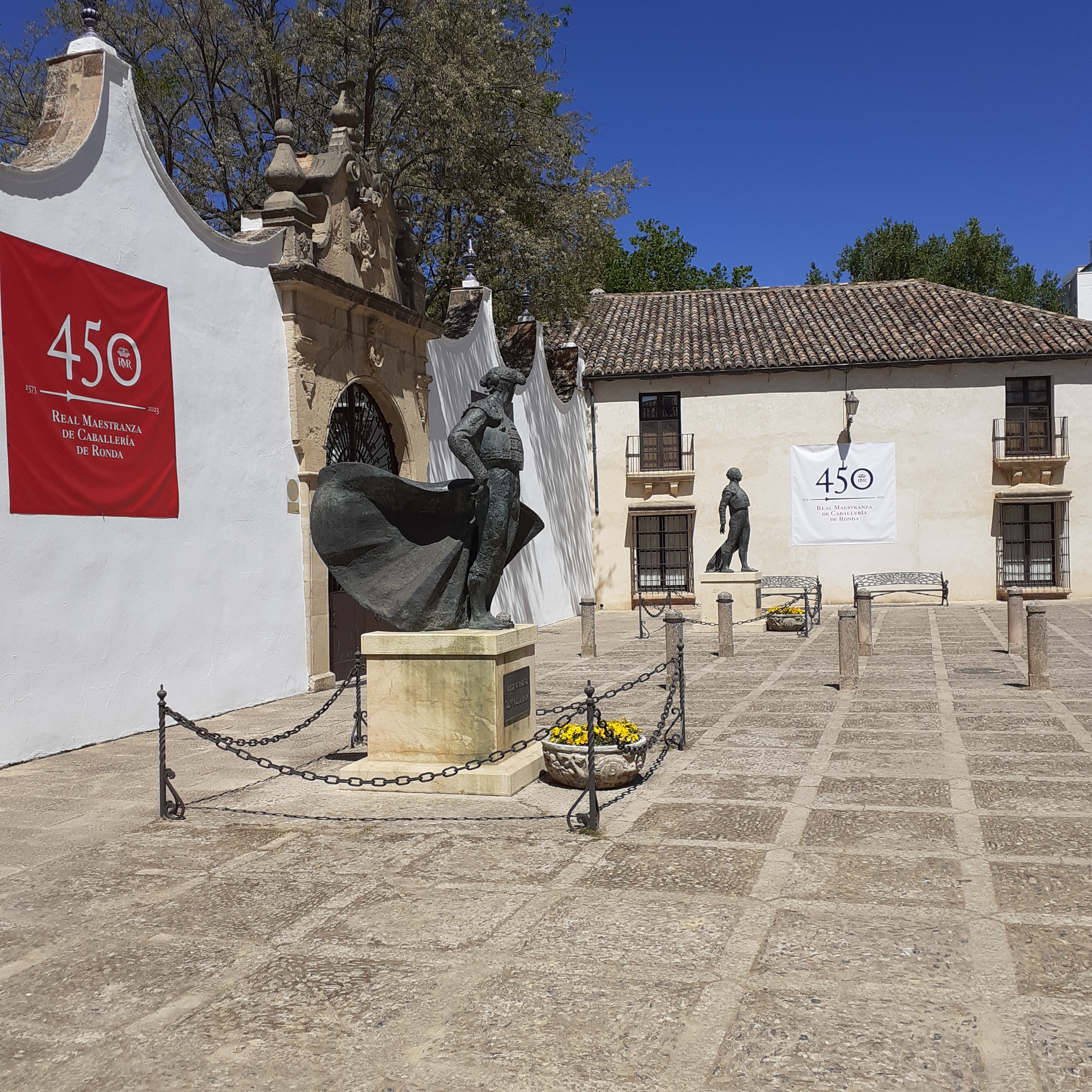
Crossing the bridge can’t but give you the illusion of being poised on a tightrope above eternity. On the north side there’s the solid, bustling centre of a more modern town. Mercadillo, as the name suggests, is the commercial centre of Ronda. To our left is the Plaza de Toros, one of the most iconic bullrings in Spain. It is amongst the oldest bullrings, built in stone in 1784 and designed by the same architect as the Puente Nuevo, Aldehuela. The ring itself is the largest, although the arena itself is small with only five thousand seats. These are all covered within the two level colonaded stand. The development of bullfighting from ritualised slaughter to cultural artform happened here. The Romero family were the leading bullfighting dynasty of the time. It was grandson, Pedro Romero, who perfected the use of the cape and sword, and the modern dramatic tableau was established.
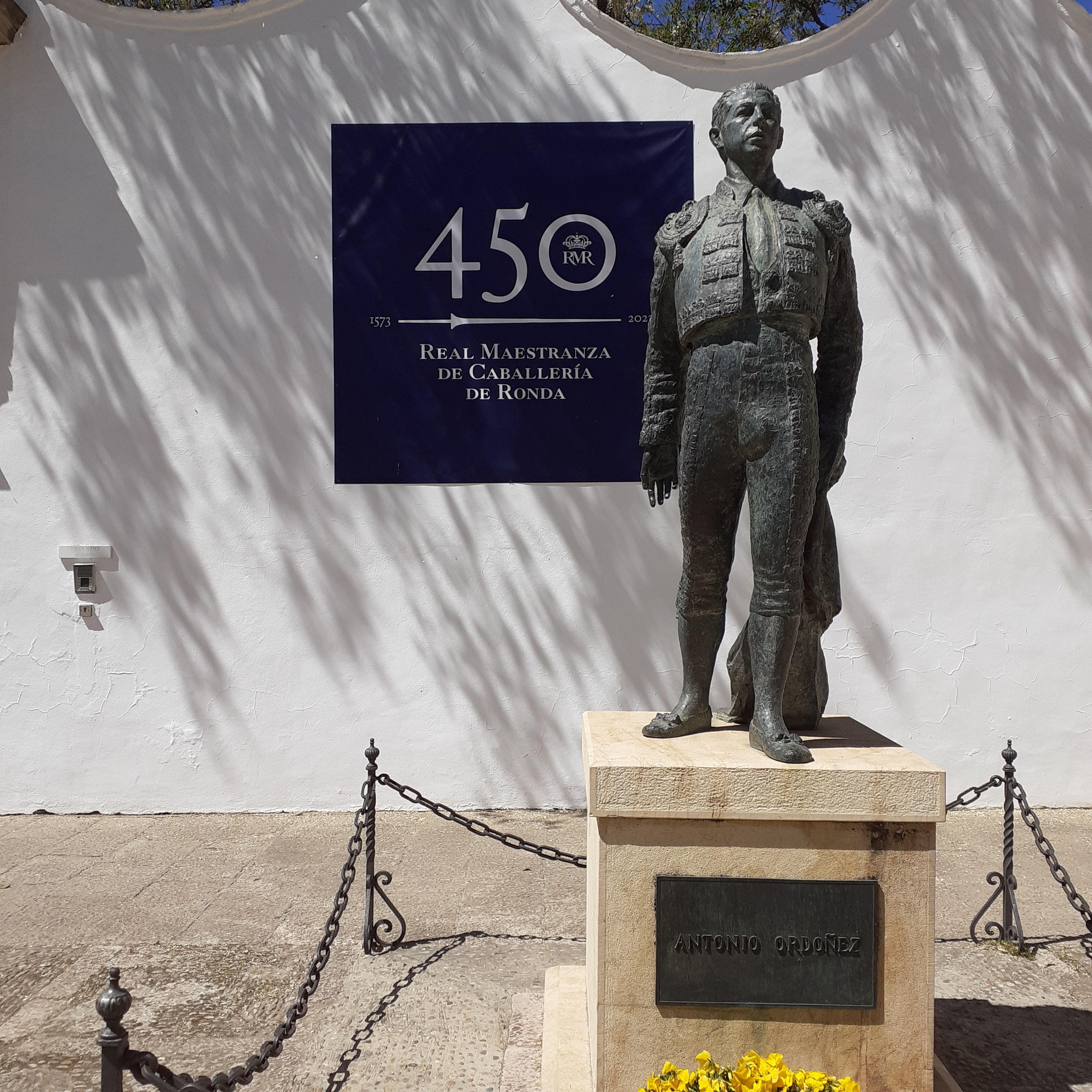
The two statues at the entrance plaza are dedicated to a more recent bullfighting dynasty: Cayetano and his son Antonio Ordonez. Cayetano initiated the Feria Goyesca which takes place in the first week in September in honour of the Romeros. Participants wear costumes of the Romero era as painted by Francisco Goya (1746 – 1828). Born in 1904, Cayetano achieved supersar status with his performances in the 1920s. He met Ernest Hemingway at the famous St Fermin festival in Pamplona. Hemingway, then a journalist, had developed a fascination with bullfighting which was woven into his writing. The Sun Also Rises, his first novel, achieved instant fame when published in 1926. It followed a group of protagonists drawn from Hemingway’s own Paris based coterie, and dubbed the Lost Generation. Their pilgrimage takes them to Pamplona and the notorious Running of the Bulls, in which Hemingway participated. The matador in the Sun Also Rises was named Romero for Pedro Romero. A model for the character was Cayetano Ordonez. By the time he had finished the book, fully smitten with Spain and its culture, Hemingway also became a Catholic. When you think of it, if you want to form identity with a matador, it is a logical progression to take the faith.
While Hemingway’s enthusiasm for bullfighting was infectious, and would surface again in the non fiction Death in the Afternoon, the custom has its detractors. Along with Hemingway, its macho stance has fallen into disfavour; though bullfighting was more open to female participants than most sports. In Childhoods End, a novel by Arthur C Clarke, bullfighting becomes a focus for the struggle between rational progress and romantic tradition. An alien invasion, ostensibly benign, is resisted in one aspect by the Spaniards who defy the dictat to prohibit bullfighting. The aliens transfer the bull’s pain to the spectator thus quelling the protest. Mind, the vicarious enjoyment of pain, or the catharsis provided by the spectacle, is a distinct pull for the bullfighting aficionado. I went with my family to a bullfight in Barcelona about twenty years ago. It was a hair raising experience. Feral, ancient, swaying from mundane to macabre and including some shards of unbelievable drama, you emerge with a less dim understanding of what it means to be alive.
Hemingway, meanwhile, looms large in this city in other respects. A hotel is named for him just south of the Bridge. In chapter ten of For Whom the Bell Tolls, Hemingway outlines a Republican warcrime against Franco’s Nationalists in 1936, wherein leading falangist sympathisers were thrown from the bridge of a fictionalised town. It is said this mirrorred actual events in Ronda, though Hemingway claimed he fabricated them. The book was published in 1940 and is seen as his finest work. Gary Cooper and Ingrid Bergman starred in the subsequent Hollywood film which was released in 1943. It also provided the first full length film soundtrack record.
We walked to Marbella along the beach one morning. It’s about 6 miles from Elviria, and I was feeling the heat near the end. Still Spring, but climbing into the mid twenties by mid-day. Approaching the city outskirts there are a number of rugby pitches, and we are in the city proper when we reach Playa de Venus adjacent to the port. Puerto Deportiva with its modern green lighthouse lies beyond. On more sedentary days, there are regular busses along the coastal highway, the A7, for a more leisurely trip into town. It takes under half an hour.
Marbella has long been a resort for the quality. Meaning well to do, and sometimes more quantity (of cash) than quality. The resort was an early example of Costa Del Sol tourism, established just after the Second world war. The city population today numbers 140,000 people, though that can treble during the holiday season. North western Europeans, including a lot of British and Irish, swarm for the guaranteed heat and sunshine. A long, long time ago it was popular with southern visitors of a different sort. The Moors colonised Iberia from the eight century, the name Al Andalus was then applied to the whole Iberian peninsula. Andalusia persists in the name of the Moors last redoubt.The Moors established a citadel here in Marbella, the Alcazaba, fragments of which survive, and a Mosque.
There are two parts to Marbella. The bustling well serviced seafront where we arrived after our walk is the modern resort. The Old Town, a little farther inland, is a warren of lanes and quaint squares sloping ever upwards. After the conquest of the Catholic Monarchs in the late fifteenth century there was significant development in this walled, medieval town. The Plaza de los Naranjes was built as the centrepiece of the Old Town. It remains a picturesque antique square with some fine public buildings. The town hall was built in 1568 and the Mayor’s House nearby. At the south west corner is the Chapel of Santiago from the fifteenth century; the oldest building in the city. It predates the square, which explains why it is set at an odd angle to it.
The square itself is regular, tree shaded and ringed with restaurants and bars. Nearby is another ancient church. The Church of Santa Maria de la Encarnacion is a Baroque building of the seventeenth century, built over the existing mosque. Painted white and with an imposing bell tower it stands out as the old city’s grandest church.
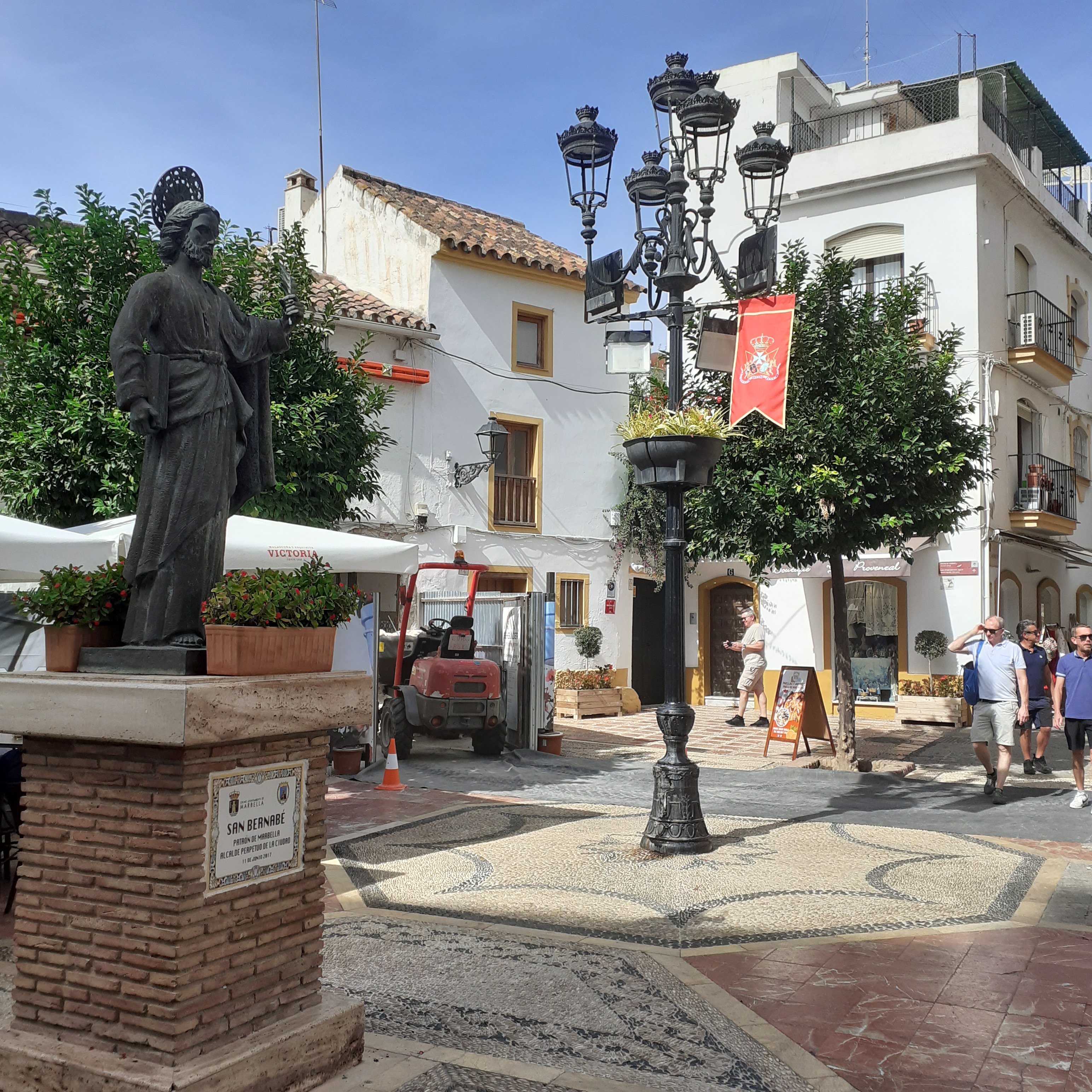
Heading further uphill the streets tunnel back to their medieval origins. The Castillo de Marbella, the remains of the Moorish Castle, lies to the north east of the square. From here, following the line of the walls back down to the modern commercial centre, we come to Plaza de la Iglesia with its statue of Saint Bernabe, the town’s patron saint. His festival is on the 11th June, ushering in a week of dancing and carousing in the Spanish way. Festivities are rarely remote from Marbella at any time though this, we hear, is particularly wild. Our ambitions for earthly delights are not particularly Bacchanalian today and we make do with an easygoing hour or two in Plaza Manuel Cantos, where the Irishman Pub and Luigi’s Italian Restaurant provide sufficient for our drinking and dining pleasure. Other soirees might include El Balcon de la Virgen and Patio Marbella in the labyrinth of the old town.
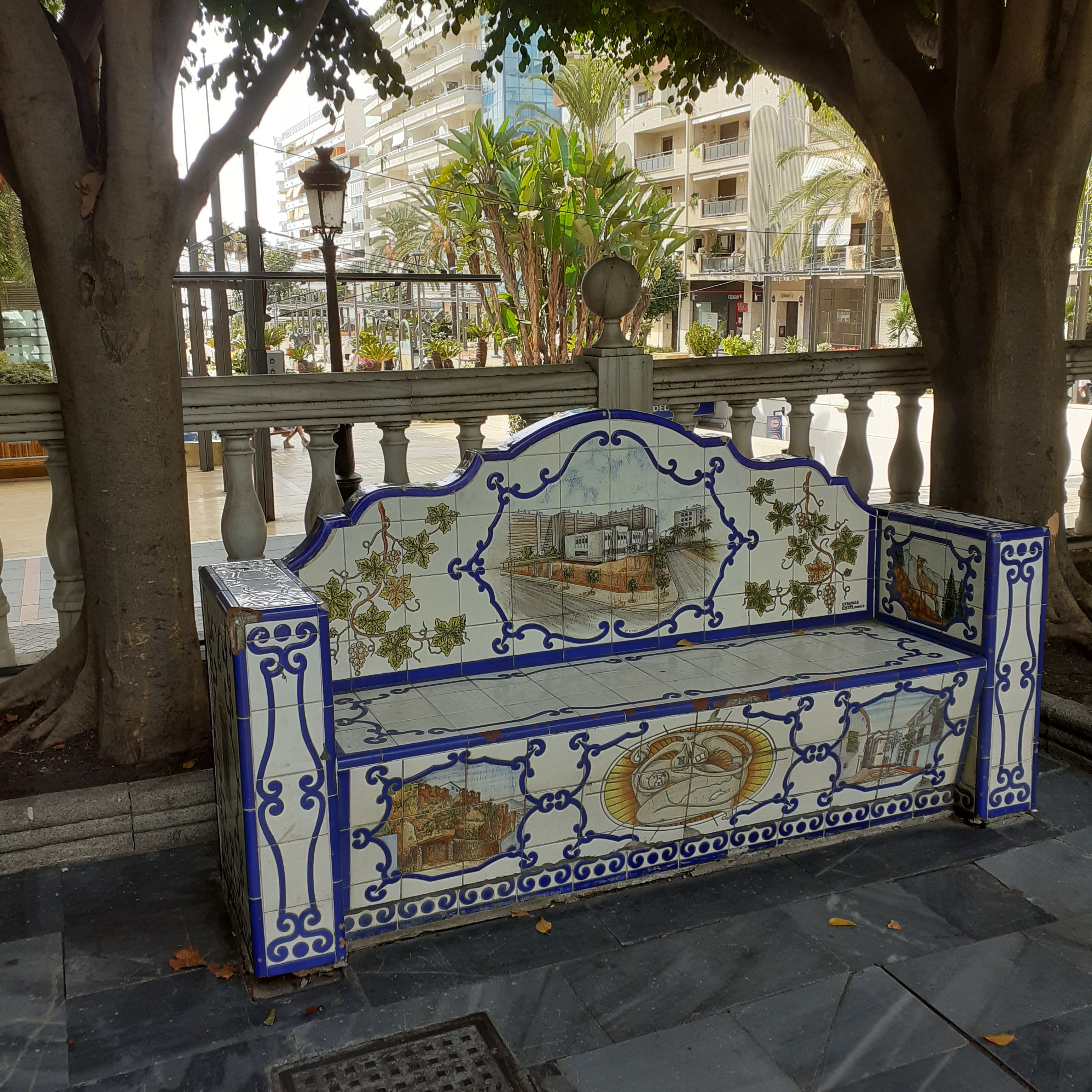
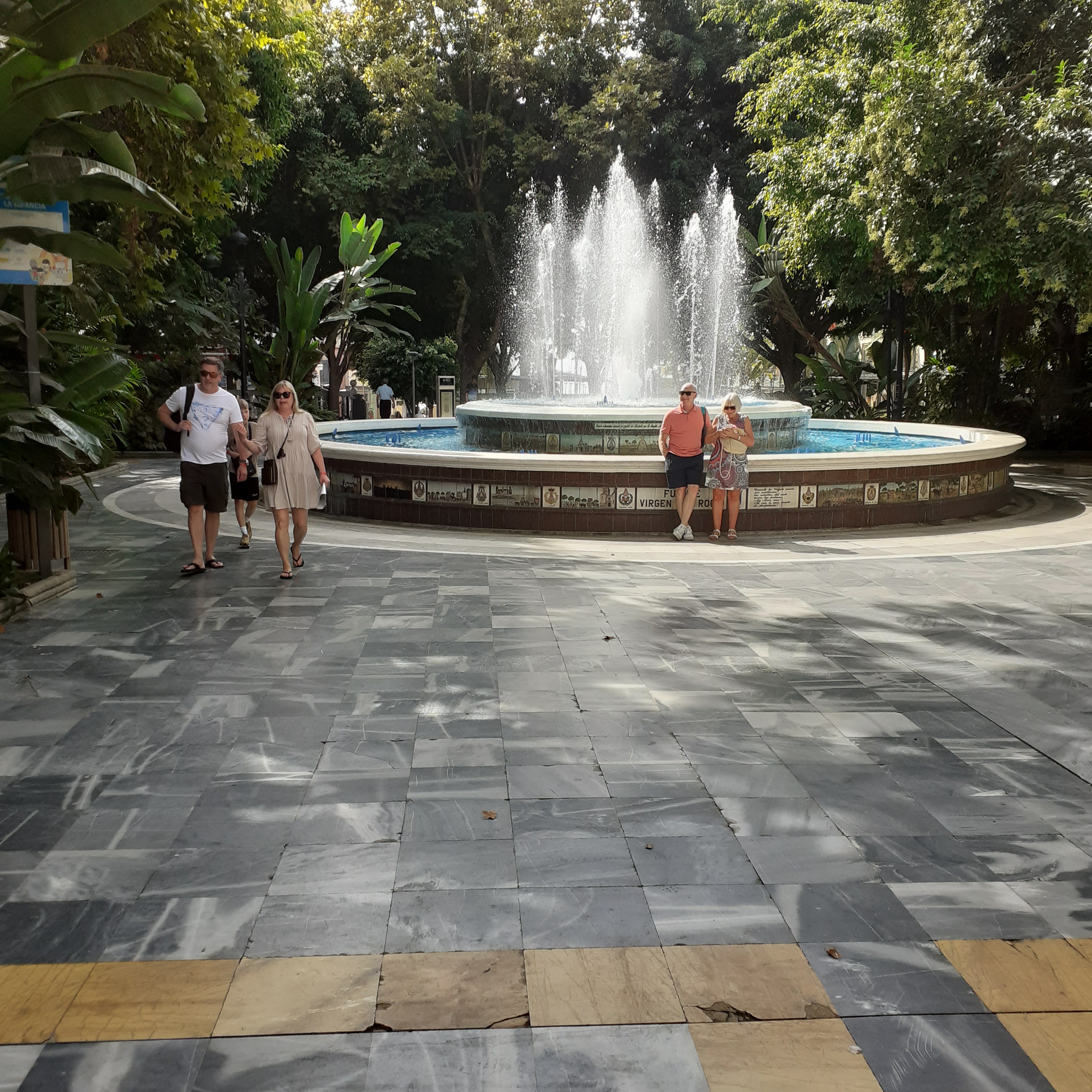
Between the Old Town and the modern seafront, Ensanche Historico, the Historic Extension, is laid out to ease transition between the two. Across the busy thoroughfare of Paseo de Alameda, Alameda Park is an elegant formal park, richly planted and decorated in colourful tiles. All of this radiating out from a historic fountain. It’s a glorious place to hang out, the setting luminous under the shade of palm trees.
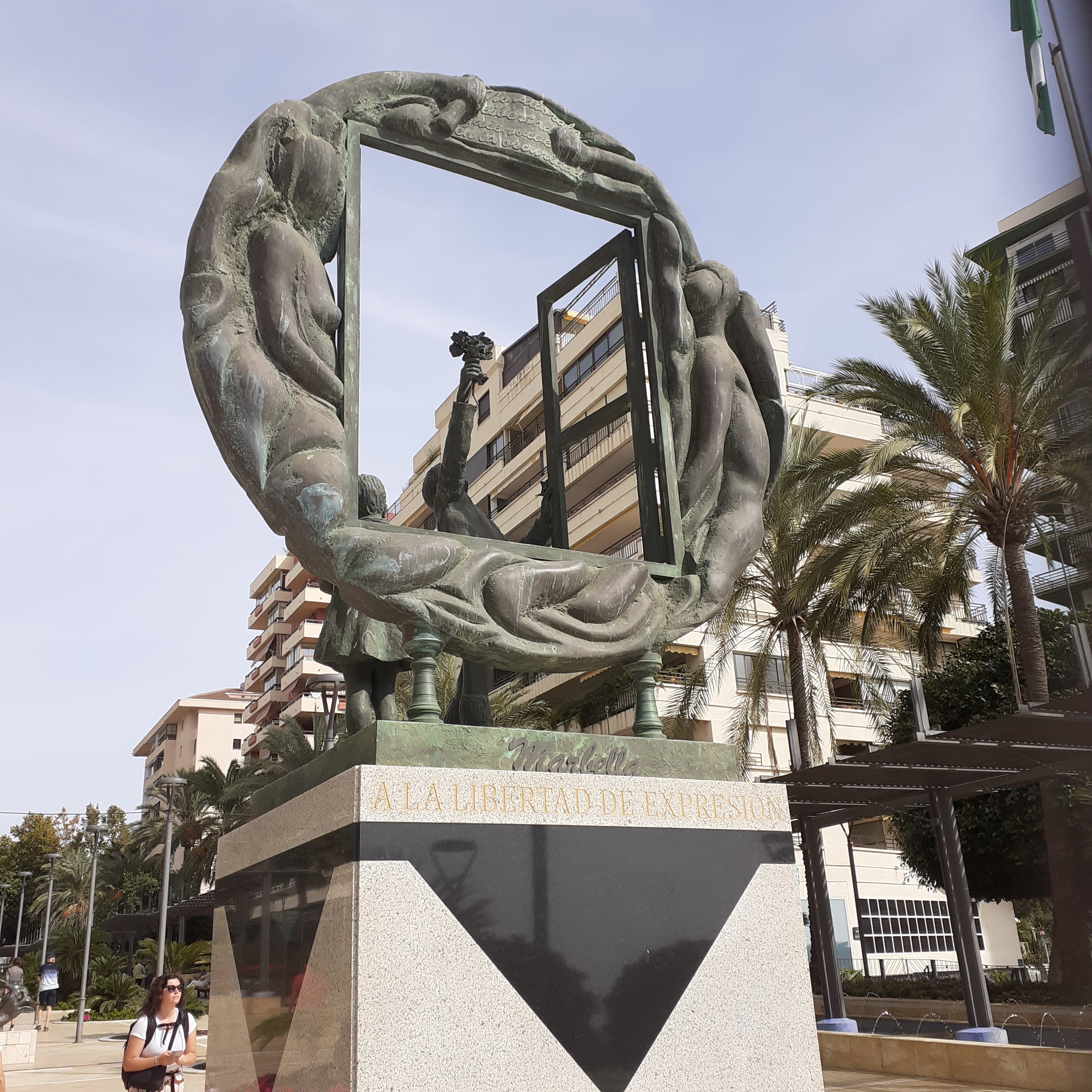
Beyond the park, The Avenida del Mar, as its name suggests, forms a wide esplanade sloping down to the seafront. It is lined with sculptures by Salvador Dali and others. Eduard Soriano is a notable other, his Monument to the Freedom of Expression overlooks the seafront promenade. This shows two figures at an open window surrounded by apt quotations, including the sculptor’s: Freedom does not die, it is born and sleeps daily.
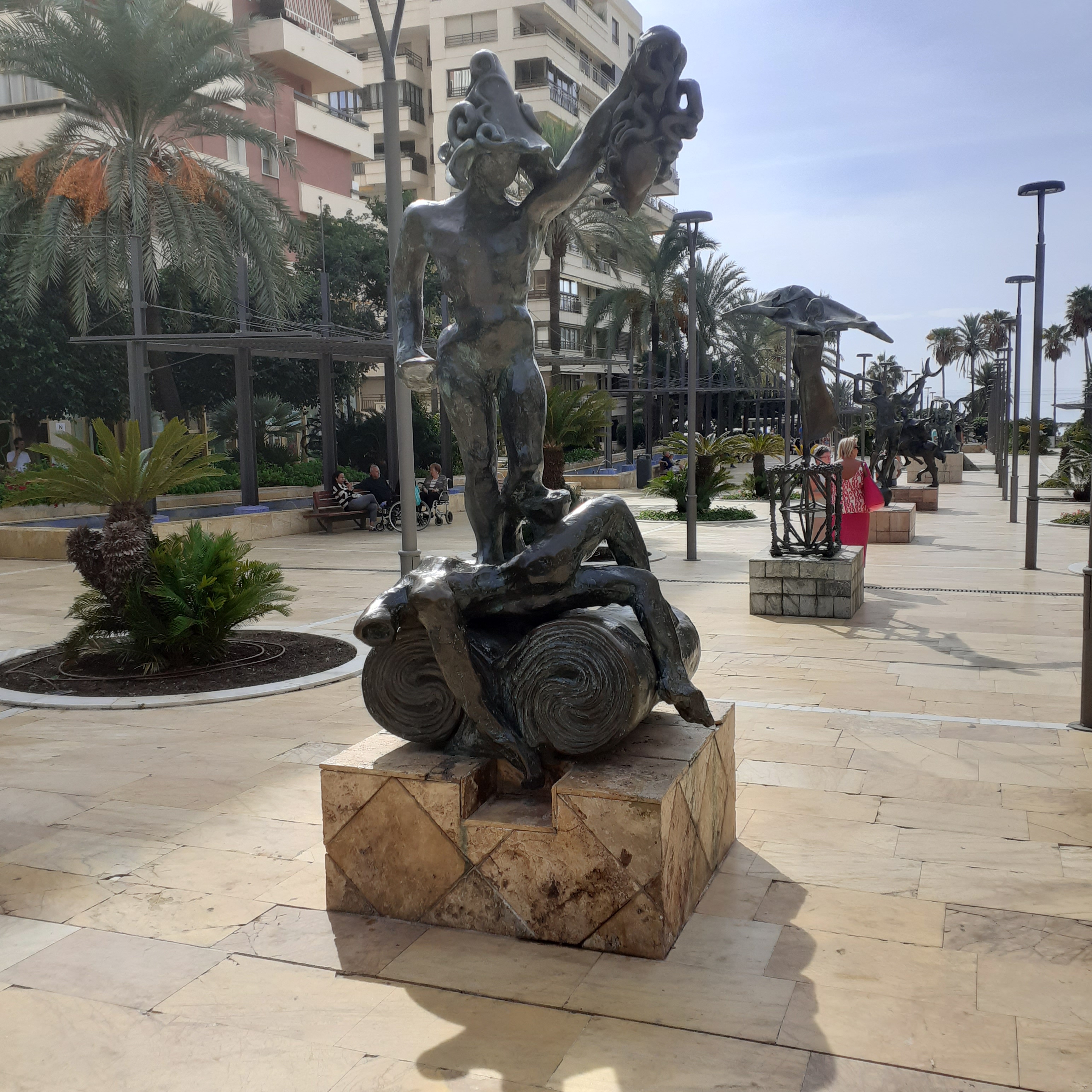
Dali’s ten bronze sculptures were cast in Verona and acquired in 1998. They feature a range of hallucinogenic imagery as one would expect from such a major Surrealist. Some are drawn from Classical mythology including figures of the god Mercury and of Greek hero Perseus beheading Medusa. There are metamorphoses of nature with Man on a Dolphin and Cosmic Elephant, and inevitably Dali’s wife and muse, Gala, who is depicted leaning out a window.
Dali has no specific connection with Marbella. He hailed from Catalonia, born in 1904 in Figueras, near the French border. As for Andalusia, he was in his younger years very friendly with Federico Garcia Lorca, one of Spain’s leading poets. Then there is the film, Un Chien Andalou. Lorca, whose advances were rejected by Dali, interpreted the film’s title as a swipe at him and became further alienated from the Surrealist movement.
Lorca may simply have been paranoid, though the title does intrigue. It is taken from the Spanish saying: an Andalusian dog howls – someone has died. The idea sprang from an exchange of dreams with filmmaker Luis Bunuel and the two collaborated on the 1929 silent film which was directed by Bunuel and co-written with Dali. It ran to just sixteen minutes. The notorious opening scene begins with the reassuring caption, once upon a time, but quickly becomes ominous. A man sharpens his razor while a thin cloud bisects the moon, He restrains a seated young woman and brings the razor to her staring eye. Provocative, repulsive and outrageous, the film went down well which was something a disappointment to its writers who were prepared for a riot. It echoes forever through avant garde film. David Lynch would be a good example. Think Blue Velvet for one, and many’s the rock video.
Marbella promenade stretches from the port for a further seven kilometres to Puerto Banus in the west. Puerto Banus marina, with its luxury yachts is an upmarket nightspot and includes, amongst other delights, O’Grady’s Irish Pub. There are plenty of opportunities for refreshment at this end of the boardwalk, and plenty of time, which seems to grow profusely in the sunshine of Andalusia. That day we took a bus back to base camp. We were helped by a lovely Norwegian couple who come here every year. And why not. Folk from frozen fjords and rain dirty valleys need some time to gaze at the actual heavens.
To everything – turn, turn, turn
There is a season – turn, turn, turn
And a time to every purpose under heaven
A time to be born, a time to die
A time to plant, a time to reap,
A time to kill, a time to heal,
A time to laugh, a time to weep.
This version by the Byrds, from 1965, surfaces whenever joy is required. Pete Seeger wrote it in 1959, setting the words from the Book of Ecclesiastes to a major chord sequence. Those words from the Bible are attributed to King Solomon of the 10th century BC. Very old school. Seeger supplied the “turn, turn, turn” and the Byrds took it to No 1 with their characteristic jangling guitars and sublime vocal harmony.
When I took up the guitar in my early teens, it was to flamenco that I turned. I was thinking a lot about the paintings of Salvador Dali in those days and I also became immersed in Spanish history. The Alhambra was a particular fascination, a red castle ringed by snow capped peaks, above the city of Granada. So, some fifty years later, I at last made my pilgrimage. An early Easter was approaching and a blanket of snow lay over Dublin. The plane was a while on the tarmac as workers chipped ice off the wings. At least we were off to sunny Spain.
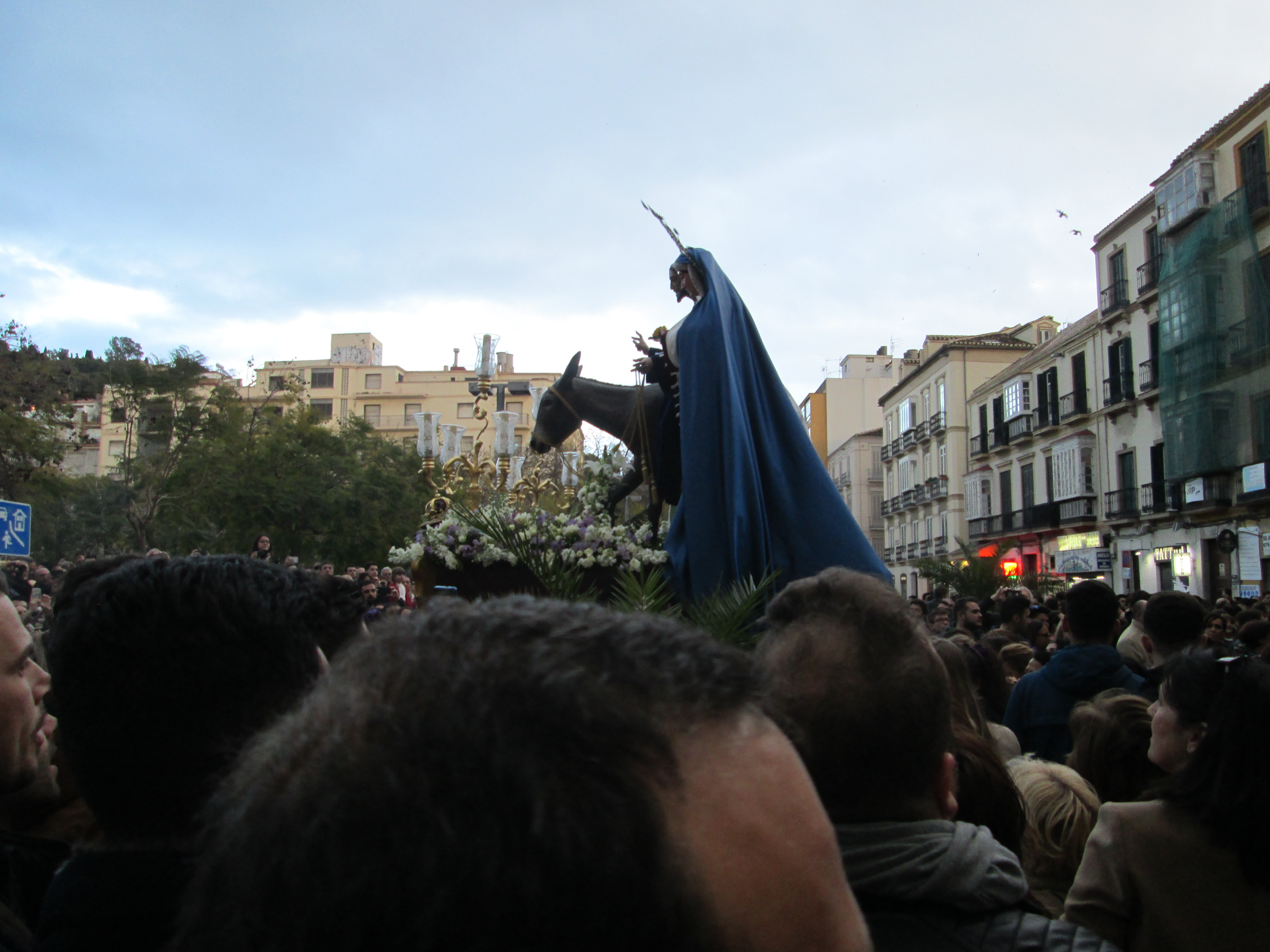
There was a bleak sun on Malaga when I landed, but it was cold and the sidewalk bars huddled behind plastic awnings with heaters ablaze. It’s a two hour bus ride up to Granada, but I had an overnight and aimed to get a taste of Malaga in a day. Relaxing over a wine, I noticed that crowds of people were heading towards the city centre and figured there was something on. It being Holy Week, a procession by one of the Brotherhoods passes each day. I quickly succumbed to its hypnotic magnetism. Solemn music accompanies towering floats, or tronos, one of the Christ and the other, typically more exuberant, is of the Virgin.
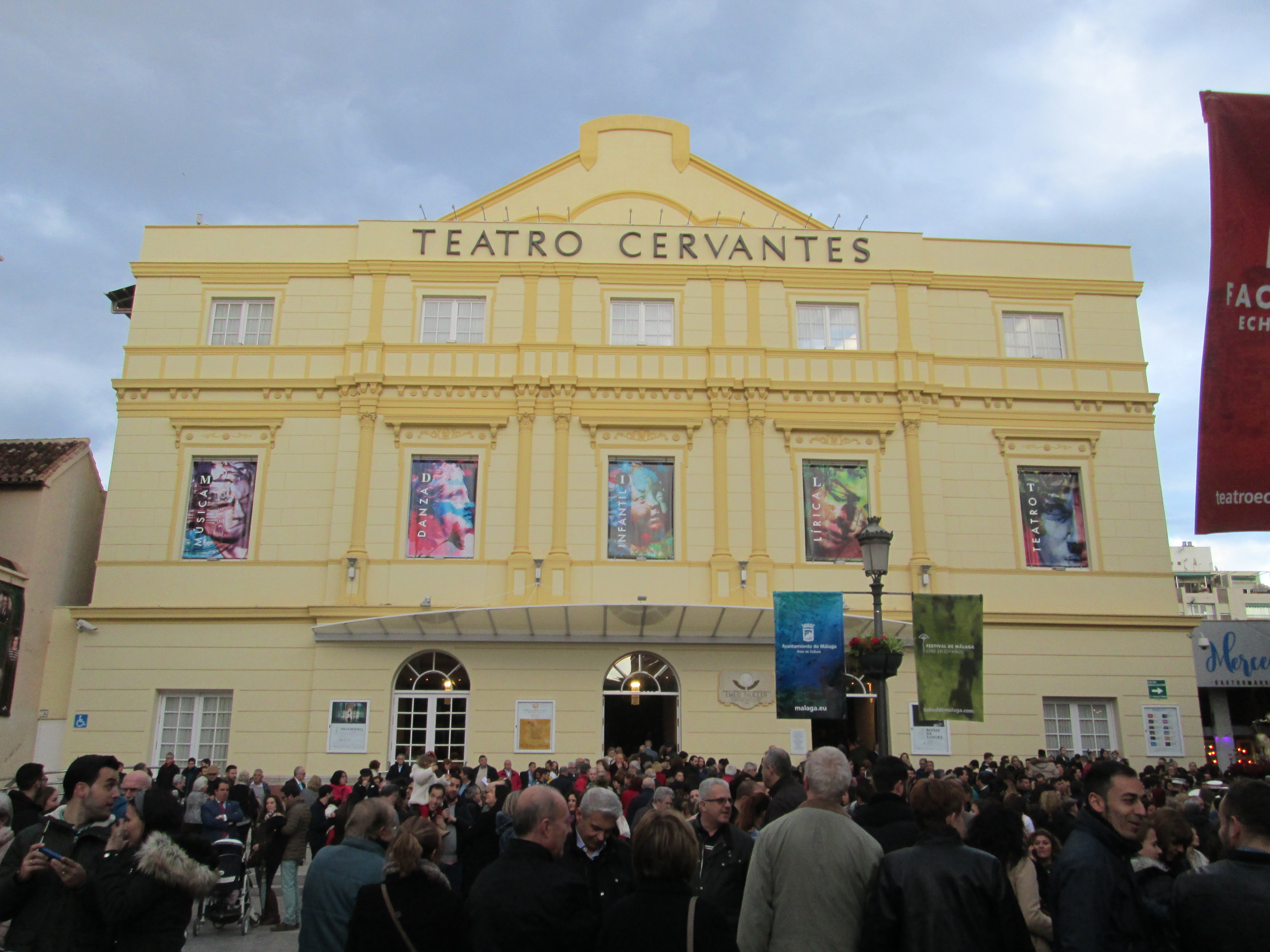
Each weighs several tons and are carried, very slowly, by members of the Brotherhood from their parish church through the city centre, past the Cathedral and on to the Plaza before Teatro Cervantes. Which is where to relax as the solemn spell wanes.
The Teatro Cervantes was built in 1870 and named for Miguel de Cervantes. Cervantes is well commemorated throughout Andalusia. His writing pervades the entire Spanish consciousness. As is Shakespeare to English, he is central to Spanish. Don Quixote is regarded as the first novel in the modern sense, and has become, after the Bible, the most translated book in the world. We all know its eponymous hero, hopeless and heroic, forever tilting agaist the hostility of life. Cervantes came to embody his own maxim, that the pen is the language of the soul
My own pilgrimage took me to Malaga Bus Station to the west of the city early the next morning. Granada, just over ninety miles distant, is a two hour bus journey through coastal mountains, the snow capped Sierra Nevada ultimately embracing the city as we reach our destination. Granada’s Bus Station is a good bit out of town and I took a taxi to the centre and my hotel.
Granada, a place of dreams, where the Lord put the seed of music in my soul. (Andres Segovia)
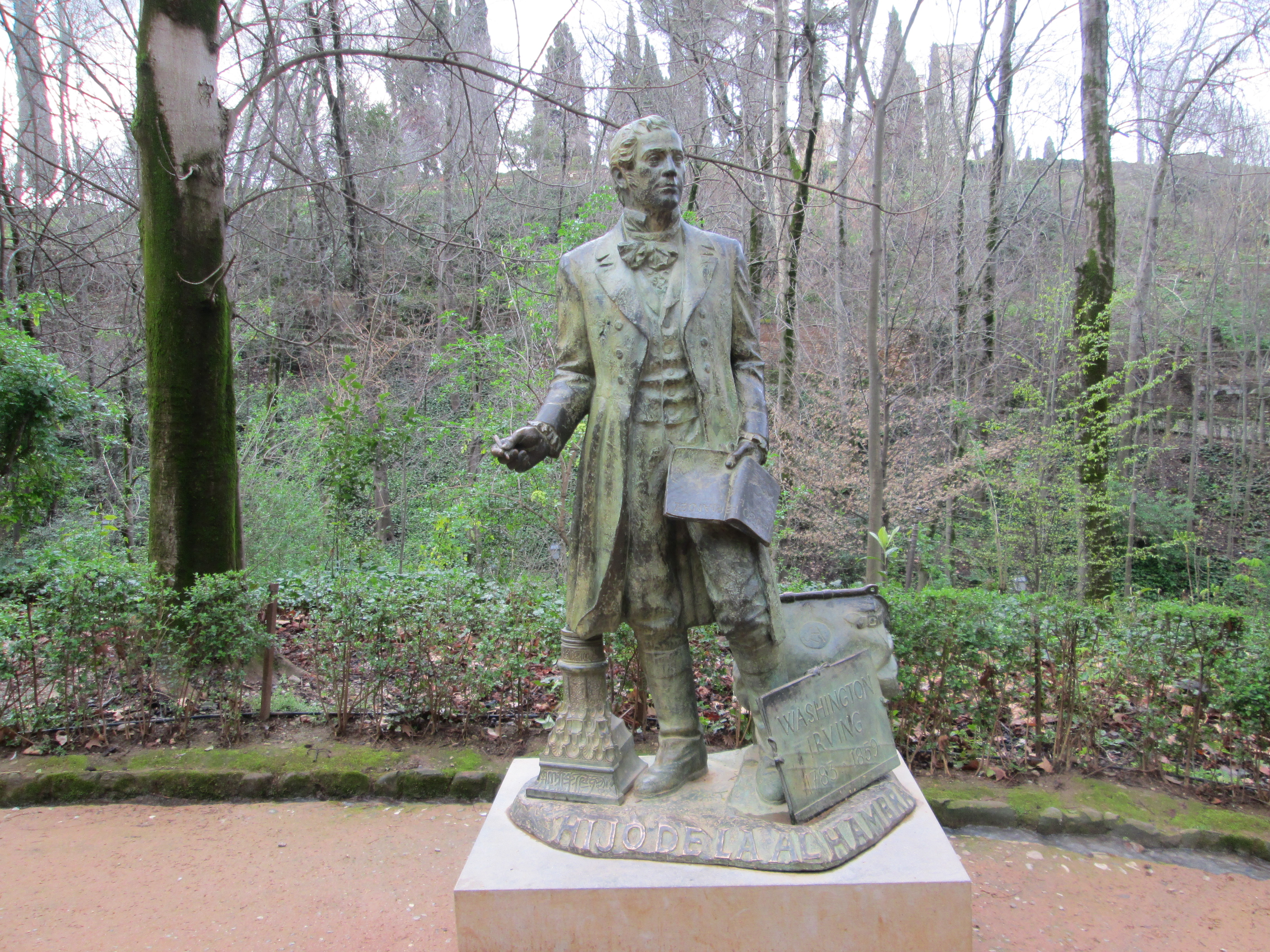
The fabulous castle overlooking it all, the Alhambra, was the last fortress the Moors. Alhambra signifies the Red Castle, from the blood toned colour of its stone. The Moors built their first fortress in the ninth century but the existing complex dates to 1333 when Yusuf I was Sultan of Granada. In 1492 the Catholic Monarchs, Ferdinand and Isabella, defeated the Emirate of Granada. 1492 was also the year when Italian explorer Christopher Columbus came here to receive the support of the Monarchs in his ambition to sail to the New World. This is when the Western World was born. An early history of Columbus was written by Washington Irving, American author and ambassador to Spain. He, in tur, rediscovered the Alhambra for the modern world. His Tales of the Alhambra was published in 1842. In 2009, on the 150th anniversary of his death, a bronze statue was erected on the wooded approach to the citadel.
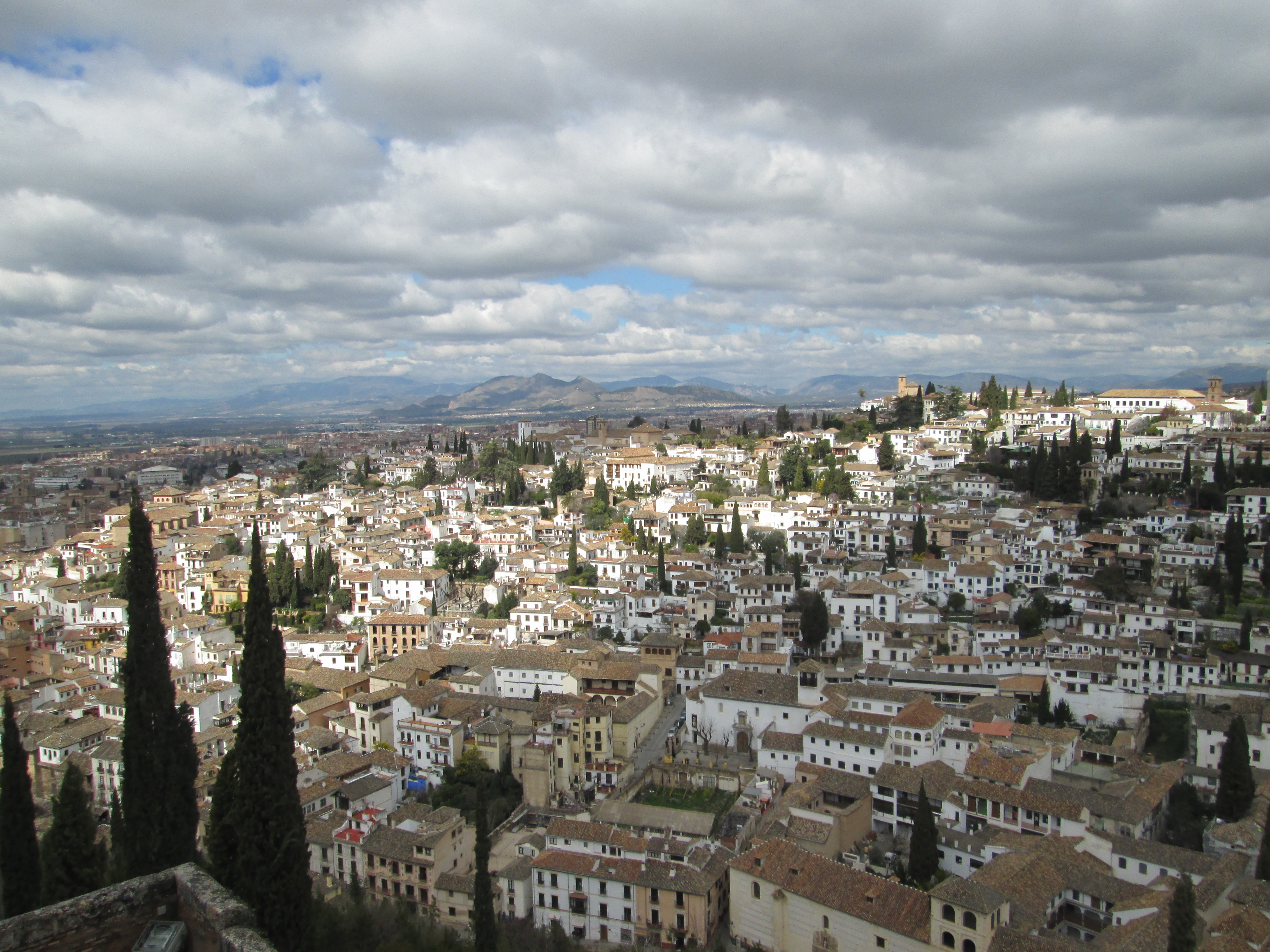
I entered through Puerta de la Justicia under its Moorish horseshoe arch. From the ramparts there’s a great view over Granada framed by the Sierra Nevada. When the Moor last looked out from here, the Alhambra was entirely a construct of the Islamic culture of northern Africa. Within a couple of decades a more European style spread. The Palace of Carlos V was built by order of the Emperor in 1527 in the Renaissance style. The entrance patio is a startling homage to Classicism, with its two story colonnade forming an entrancing circle.
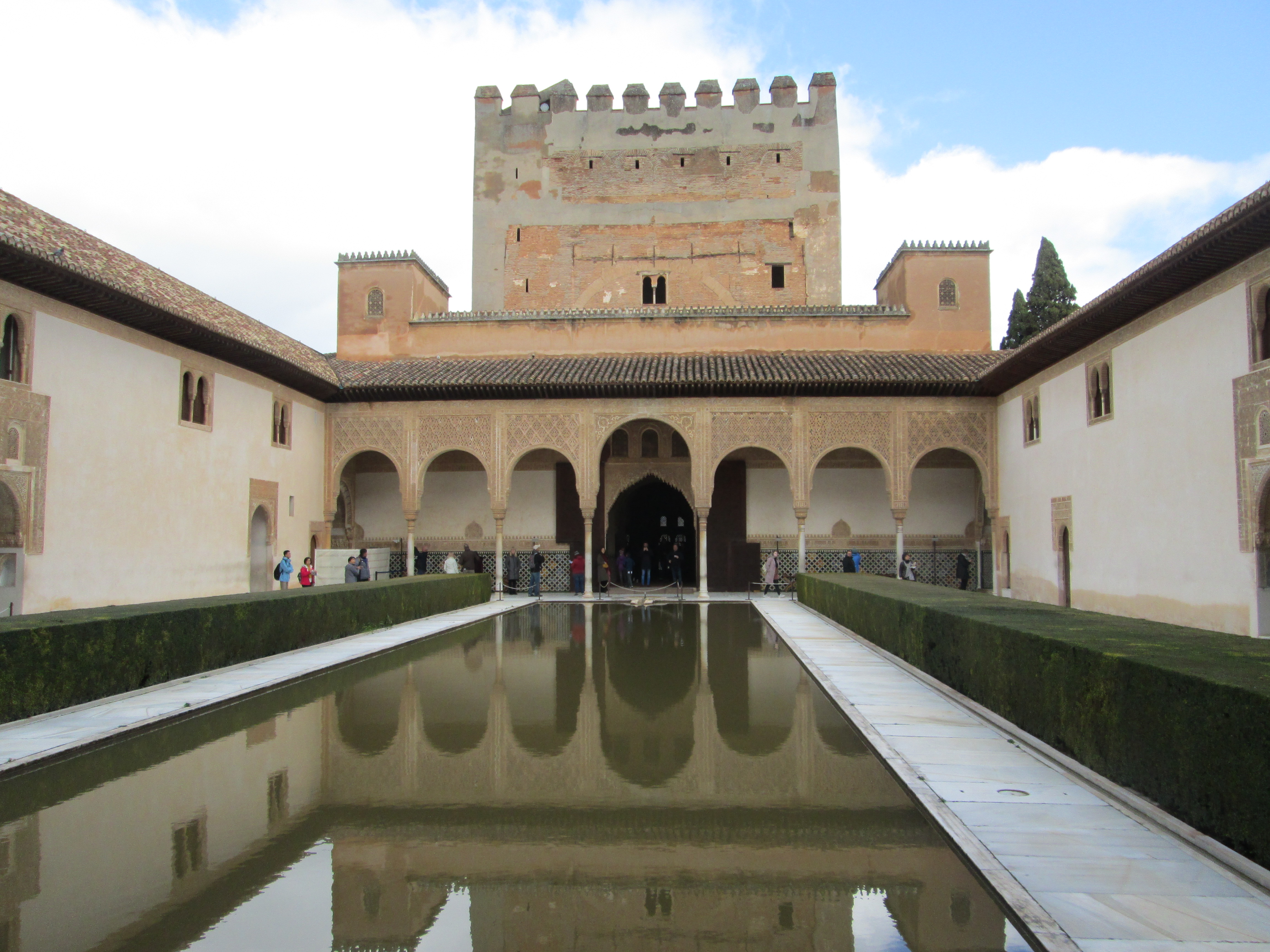
The Nazaries is the showpiece of the Alhambra, a magnificent palace for the Kings. A separate ticket is required for visitors, and well worth it. Guide books caution to come prepared for the heat, but my visit coincided wih a severe cold snap. Four degrees and falling I was frozen blue in the long entrance queue. The Nazaries unfolds on entering, a stone flower opening into more spaces than anticipated from the outside. There are three palaces within the complex. First, the public area dealing with justice and administration. Then the Camares Palace which was the royal residence. Finally, the Palace of the Lions, where the harem was located. A magnificent centrepiece is the Court of the Lions with its sculptured lions forming a circle within delicately rendered cloisters.
For a short break, I took a table in the tiny tearoom of the American Hotel. A Tuna Sandwich and two hot Americanos got me back to room temperature. A friend had recommended a visit to the terrace at the Parador Hotel but it was not a patio day and the interior had that lowrise furniture peculiar to hotels and inimicable to relaxation.
The Alcazaba is the fortress at the business end of the Alhambra, its towers giving majestic views over Granada. It is the oldest part of the complex, dating to the thirteenth century. From there, I made my way down towards the entrance through beautiful gardens. The first blooms were appearing but had not quite come to life. Across a ravine there’s a stiff climb to the Generalife, the Gardens of the Architect. These beautiful gardens surmounted by an elegant villa provided a retreat for the Royal Household from the travails of the Alhambra and give glorious views of the Alhambra.
On exit, I put into the first available bar. Below the walls there was shelter and sufficient warmth from the sun to allow me enjoy a beer and tapas al fresco. Heading downhill past the northern walls alongside a rapid stream, I emerged onto the banks of the Darro river following it back towards Plaza Nueva in the city centre.
Overlooking the Darro is the Albaicin, dating back to the 13th century and rich in Moorish heritage. The streets meander past high walled villas with white washed walls, towering palms and pines. Quiet and weird; at times I felt I had strayed into a Dali painting. Stranger still, it darkened off to the west and a sudden storm came upon us. Snow fell in curtains across the backdrop of the Alhambra.
Plaza Nueva merges into the Plaza de Santa Ana and on into the modern city centre. I had planned on a flamenco evening in Sacromonte, but the weather closed off that particular avenue of pleasure. I did spend much of my second day in Sacromonte, a bleached enclave clinging to the steep hill at the edge of Grenada, This was originally home to the gypsy, or Gitanos population, and is rich in the heritage of guitar and Flamenco. There are tiny taverns and homespun museums, and a feeling of being remote from the big city.
At night I’d spend some time in Hannigan’s Irish Bar, not far from the Cathedral of the Incarnation. Hannigan’s does not do the complementary tapas that are a feature of local establishments. It’s a wonderful custom, but there is a time to stop eating and sit in splendid isolation over a drink and contemplate the sound and stories that permeate the city. Hannigan’s seemed to share my fondness for the Red Hot Chili Peppers, whose music, to me, carries some echo of the spirit of the Andalusian guitar.
Fly away on my zephyr
I feel it more than ever
And in this perfect weather
We’ll find a place together
from the 2002 album By the Way, a favourite of mine, and yes, I remember in Granada smiling at the mention of perfect weather; but in a strange way it was. In sunshine or snow, the magic of the Alhambra endures. The winding way to the citadel begins near the Fontana del Toro on the Plaza de Santa Ana. It is said that a drink from its waters has magical qualities. Drink once and you will return forever. I hope to, some day. Meanwhile, Christmas is around the corner and this is likely to be my last post for the year. Happy Christmas to yous all!
Andalusia is the southernmost region of Spain, with its capital at Seville. It is the hottest place in Europe with summer temperatures in the forties and low rainfall. The more moderate climate along the coast, still hot and sunny, has been a magnet for tourists for decades. Coming, like many, from the cool, damp, grey green island I call home, it is always a shock to find a place where warm sunshine and blue skies are the norm. Costa del Sol is well named, stretching for about a hundred miles from Nerja in the east, via Malaga and Marbella to La Linea near Gibraltar in the west. Home to one and a half million people, millions more visit for its resorts, sunshine beach holidays made-to-measure, cheap beer and nightlife, There is much more than that, of course. Spain reveals itself to those willing to look.
Andalusia seems an ideal region for a self-drive tour, or there’s a comprehensive public transport network with bus and train linking the main cities. Malaga, Seville, Cordoba, Granada and Cadiz are rich repositories of Classical, Moorish and Renaissance heritage. It is the home of Flamenco, originally the music of the Gypsies, the theme for dancing at the crossroads of civilisation. Bullfighting is deeply embedded in the culture also, much of its tradition developed in this region, and its popularity endures here more than elsewhere.
There are more than eight million inhabitants, making it Spain’s most populous region. Andalusia is derived from the Arabic, Al Andalus. This applied to the Moorish territories of Iberia between 700 and 1492. The name may hark back to the Vandals who invaded Iberia and North Africa in the 5th century. The Vandals originated in Poland and are today remembered for their sacking of Rome and the origin of the word vandalism as the arbitrary defacement of culture and art. They faded from view in the sixth century with the expansion of the Byzantine empire under Justinian and assimilation amongst the peoples of Iberia and North Africa
Africa looms large, culturally, historically and geographically. It is closest to Andalusia where the narrow entrance to the Mediterranean forms the Strait of Gibraltar. At its narrowest point the gap separating the continents is a mere thirteen kilometres wide between Point Marroqui in Spain near Tarifa and Point Cires in Morocco. A nexus for shipping, for exploration, trade, migration and invasion, the gap is guarded by the Pillars of Hercules, a name stretching back to the myths of antiquit. Physically, these are the Rock of Gibraltar, a British territory, and across the Strait either Monte Hacho or Jebel Musa (Mount Moses). Both of these lie near the city of Ceuta. a small Spanish territory in Morocco. Regular ferries sail there from Algecerias, just across the bay from Gibraltar; a huge port and the southernmost city of continental Europe.
For most, Malaga airport is the usual gateway to the region. My first visit was aboard a cruise ship bound for the Atlantic, first to Morocco and on to the Canaries and Madeira. Our first stop was Malaga; the sort of thing one says when about to step off the edge of the world before passing through the Pillars of Hercules sixty miles to the east. It has been an important port for two millennia or more. Phoenician traders from Africa were the first to set up shop here and Malaga remained within the sphere of Carthage until the Romans established dominion in the third century BC. The Muslim Caliphate established its fortress here after the fall of the Roman empire. The Emirate of Granada arrogated power over the region in the thirteenth century. Most stubborn of the Moors, they resisted the Christian Reconquest until 1487.
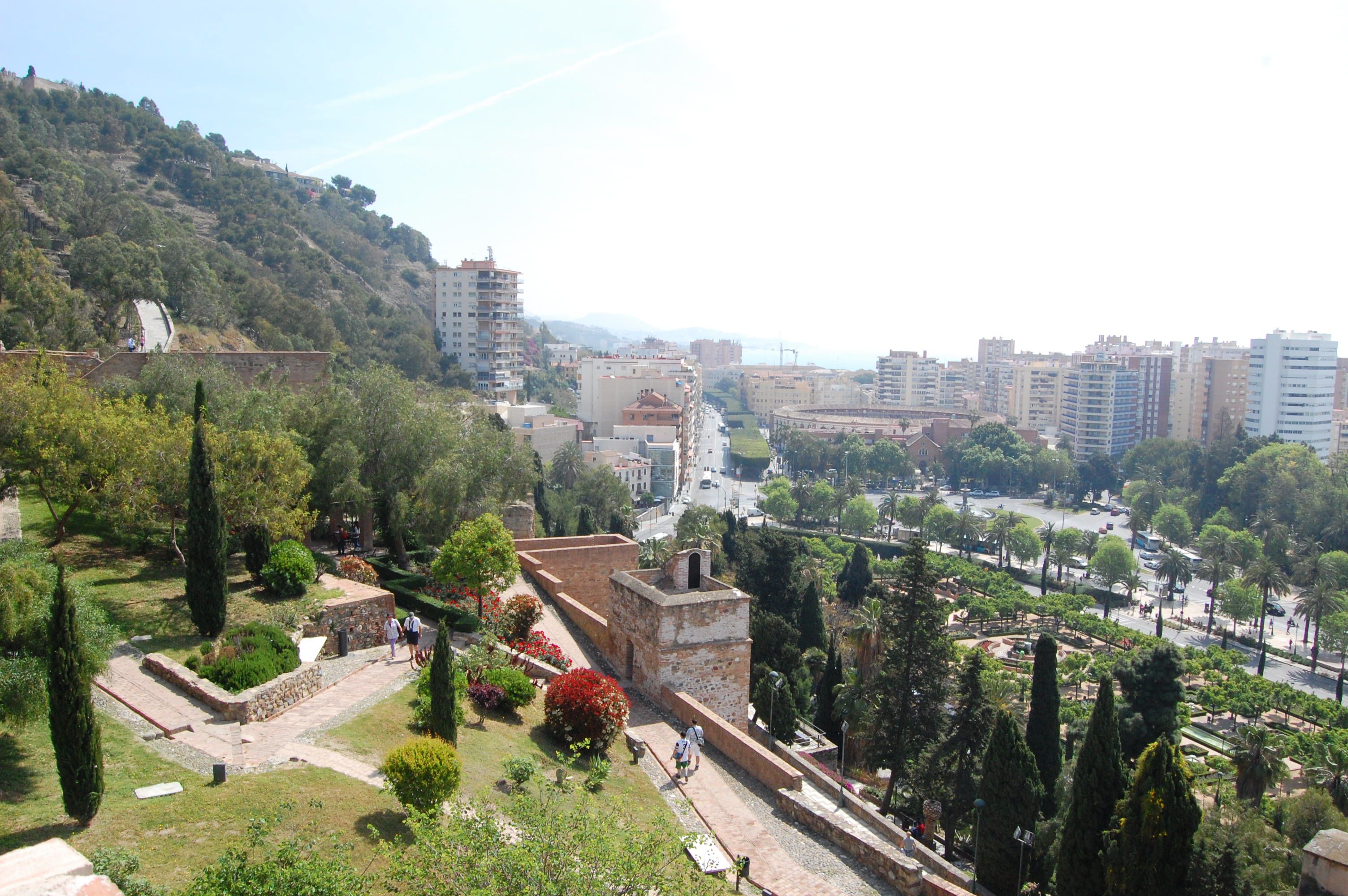
Overlooking the port, the hill of Gibralfar rises to the north.. An ancient ruined casle crowns the summit. Lower down, the citadel of Alcazaba, was built in the eleventh century within the walls of the Moorish city. Alcazaba is superbly maintained and we rise through a maze of alleyways a thousand years old, gardens and fountains emerging regularly. Gurgling water, sheltering trees and the scent of flowers mellow the near African harshness of the climate in high summer. It’s a good climb to the top, with spectacular views from the walls over the city and coast.
View from the Alcazaba
Below, the old Roman amphitheatre, dating from the first century BC, nestles on the landward side. Radiating out from this, the medieval town still preserves its chaotic street pattern. Perfect for the stroller who doesn’t mind getting lost, you certainly won’t go hungry or thirsty with a full range of daytime and eaving eateries and watering holes. We stroll down Calle Marques de Larios, a pedestrianised street with gleaming surface, lined with elegant boutiques and shoe shops. From the seafront it cuts through the heart of the medieval area. Just off this street, Calle Strachan leads to the Cathedral de la Incarnacion. Construction began in the sixteenth century on the site of the city Mosque. A grand though haphazard project, it exhibits a variety of styles, going through Gothic, Renaissance and Baroque. The completed tower soars to three hundred feet, but the project ran out of funds in the nineteenth century. The second entrance tower was left incomplete, gaining the church the nickname, La Manquita, the one-armed lady.
Near the Cathedral is the old Jewish Quarter. In the Calle San Agustin you’ll find the Buenavista Palace, a sixteenth century building which is now home to the Picasso Museum. It’s located only two hundred metres from the Plaza de la Merked where Picasso was born in 1881 and holds over two hundred works donated by members of Picasso’s family.
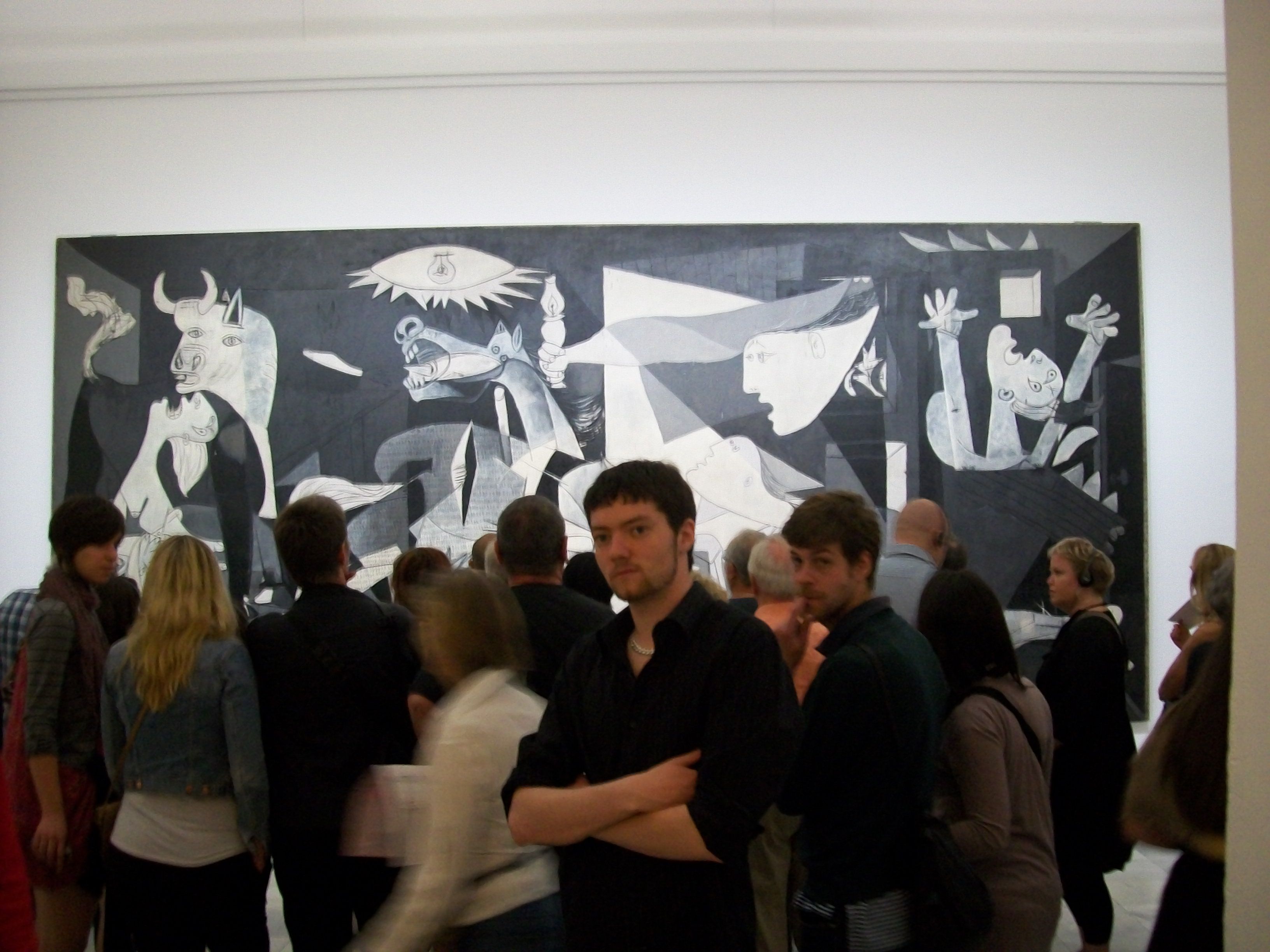
Pablo Ruiz Picasso was a radical innovator in the determinedly Avante Garde Fine Art of the twentieth century. As a young painter, his Blue Period and Rose period showed his realist skills, where colour and mood combine. He made a radical departure to develop the fragmented technique of cubism, with French painter Georges Braque and fellow Spaniard Juan Gris. Impossibly prolific, sometimes to the point of self caricature, true genius and the profound are evident in probably his best known work Guernica. This emerged from the the bombing of the Basque town by German and Italian airforce during the Spanish Civil War. Picasso did not want the work shown in Spain during Franco’s dictatorship, and it was kept for over four decades at the MoMA in New York. A century after Picasso’s birth, Spain was restored to a democracy, and the painting returned, first to the Prado and since 1991 at the Reina Sofia, also in Madrid. Although first displayed behind bullet proof glass, it has since had no extra protection than any other painting. I took this photo of my son, Davin, in front of the unprotected painting in 2010.
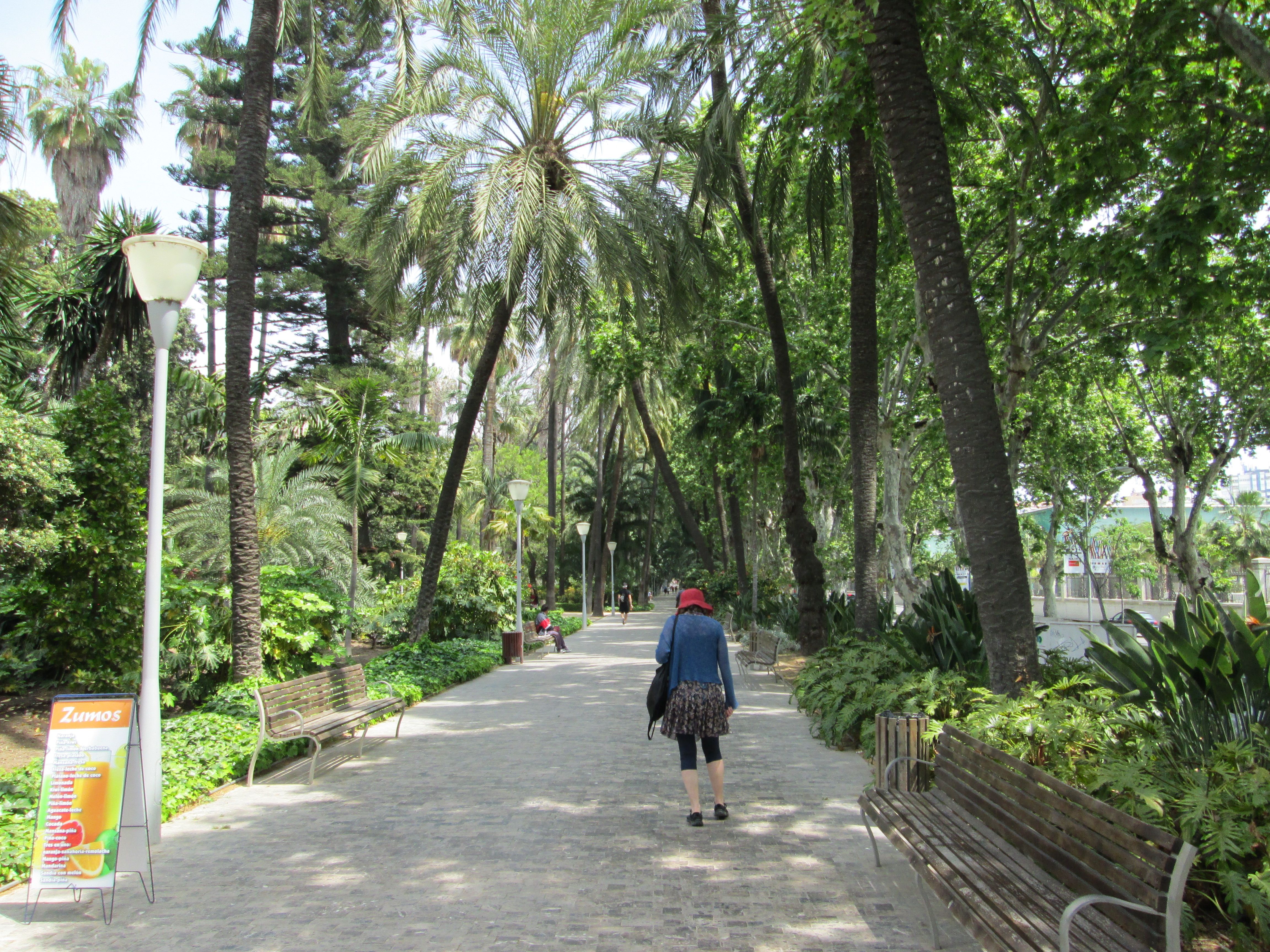
A labyrinth of streets, dotted with galleries and bars leads down to the River. The Guadalmedina, literally the Town River, is typical of Spain’s urban rivers, forming a disappointing concrete esplanade. At Siesta time crowds gather in the Atarazanes, the nineteenth century Central Market, queuing at stalls selling beer and tapas. We return through modern thoroughfares to the seafront. A lovely linear park, lined with towering palm trees, makes something of an oasis in the afternoon sun. Back at the Marina, the restaurants and bars are thronged. We squeezed into one, which is a self service. A welcome draft beer is just what the body needed. The afternoon is simmering, the crowds ebbing. We watch the sea flowing, as we soon must, towards the Pillars of Hercules, the wild Atlantic waiting beyond.
I would return, of course, and explore other parts and aspects of the city. Malaga, as a good city should, rewards many visits. And there’s so much more in the fascinating region that is Andalusia. That is something of an ongoing project for me. Over the next few weeks I will write about visits to Granada, Marbella, Ronda, and other sketches of Spain, experienced and anticipated.