Las Vegas

It’s a long drive from the Grand Canyon to Las Vegas, from the wilderness world to the land of fabrication. We’re up early and heading south to pick up Route 66 again, then turn to head west through Seligman and Kingman. At Seligman, birthplace of the Mother Road, there’s a long and lonely train strung along the horizon, and a cowboy in a pickup turning on to the range by a gateway. We stick to the freeway while the old route bumps off to our right. There’s a camper van parked in isolation with two waifs, Thelma and Louise, in halter tops and shorts posed on the roof staring off into the shimmering distance.

Kingman is off the highway but doesn’t originally reveal the tacky charm I had anticipated. We’re lost in the fast food outskirts before finding a Burger King off what could be the Naas Road Industrial estate where we pore over the maps again. This is always a good way to attract an American. A man folds up his mobile phone mid sentence to come, unbidden, to our assistance. With his help we’re back on Route 66, cruising by the amazing pink motels of ‘historic’ Kingman before picking up the highway again towards Las Vegas.

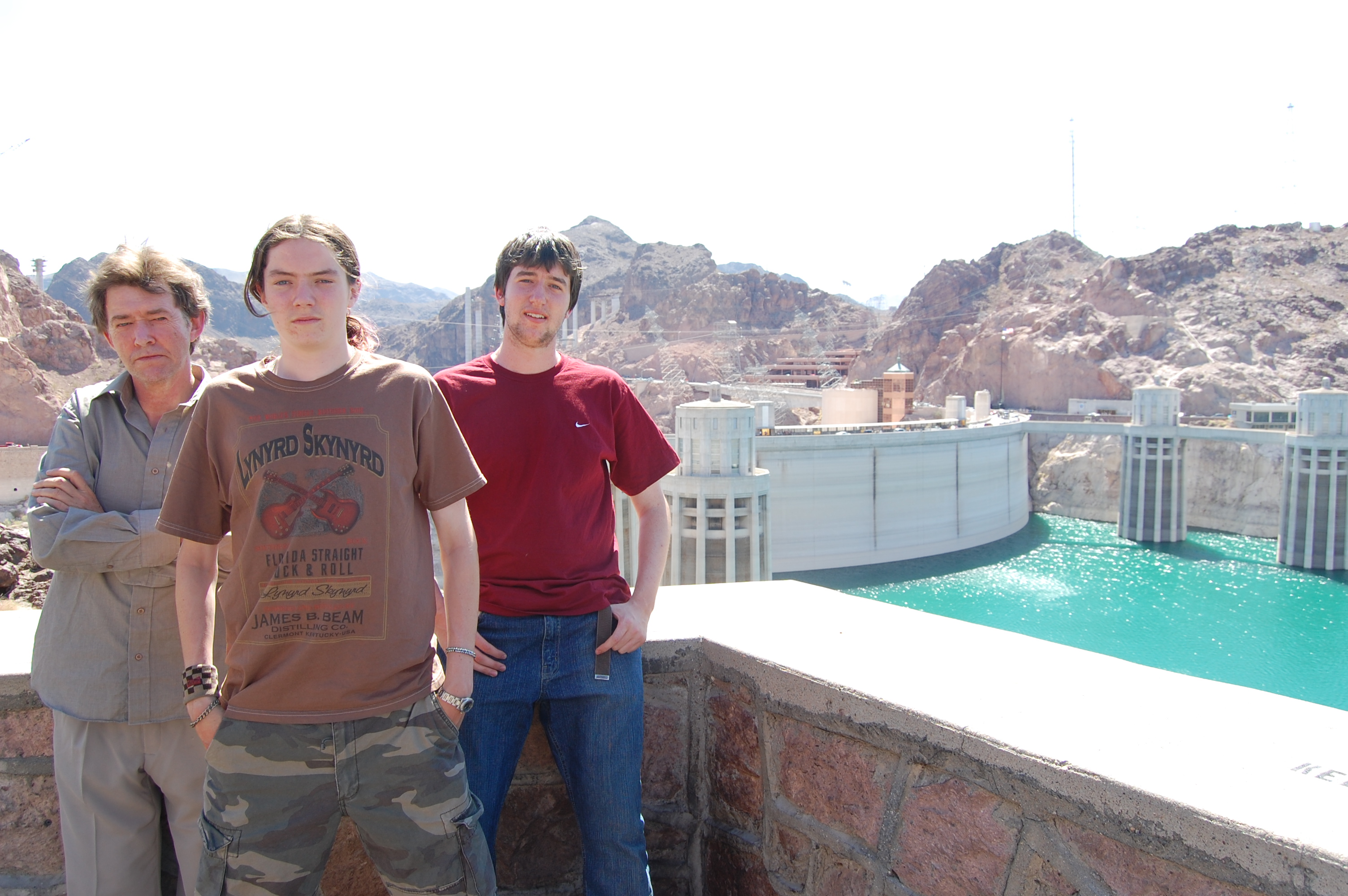
We head north on 93 with dust devils dancing off the road to the sounds of Sheryl Crow and Michelle Shocked on the stereo. Isolated trailers and shacks pin down handkerchief plots of minor cultivation in the arid landscape. We rise and rise until we come to the cooling variety of a maze of black rock hills. The troopers welcome us to Nevada and when we come to the edge of the plateau, there’s Lake Mead in its impossible cool blue, a fake lake held in the heat by the miracle of the Hoover Dam. Constructed during the Great Depression of the 1930s, it is surely one of the engineering marvels of the world, transforming the desert beyond into an Eden, of sorts.

DSC_0395


The car is now recording one hundred and ten degrees and outside the souvenir store the heat blasts at us as from an open oven. A wiry old-timer plays lock-hard in the narrow car park. British or Australian, he loves the heat but for us it’s life in the oven with the thermostat flipped. A meaty black family from New York must be shedding pounds passing over the dam from Arizona into Nevada, but they’re permanently happy with it all. Golden rest rooms offer brief respite from the heat before we head off into the desert.

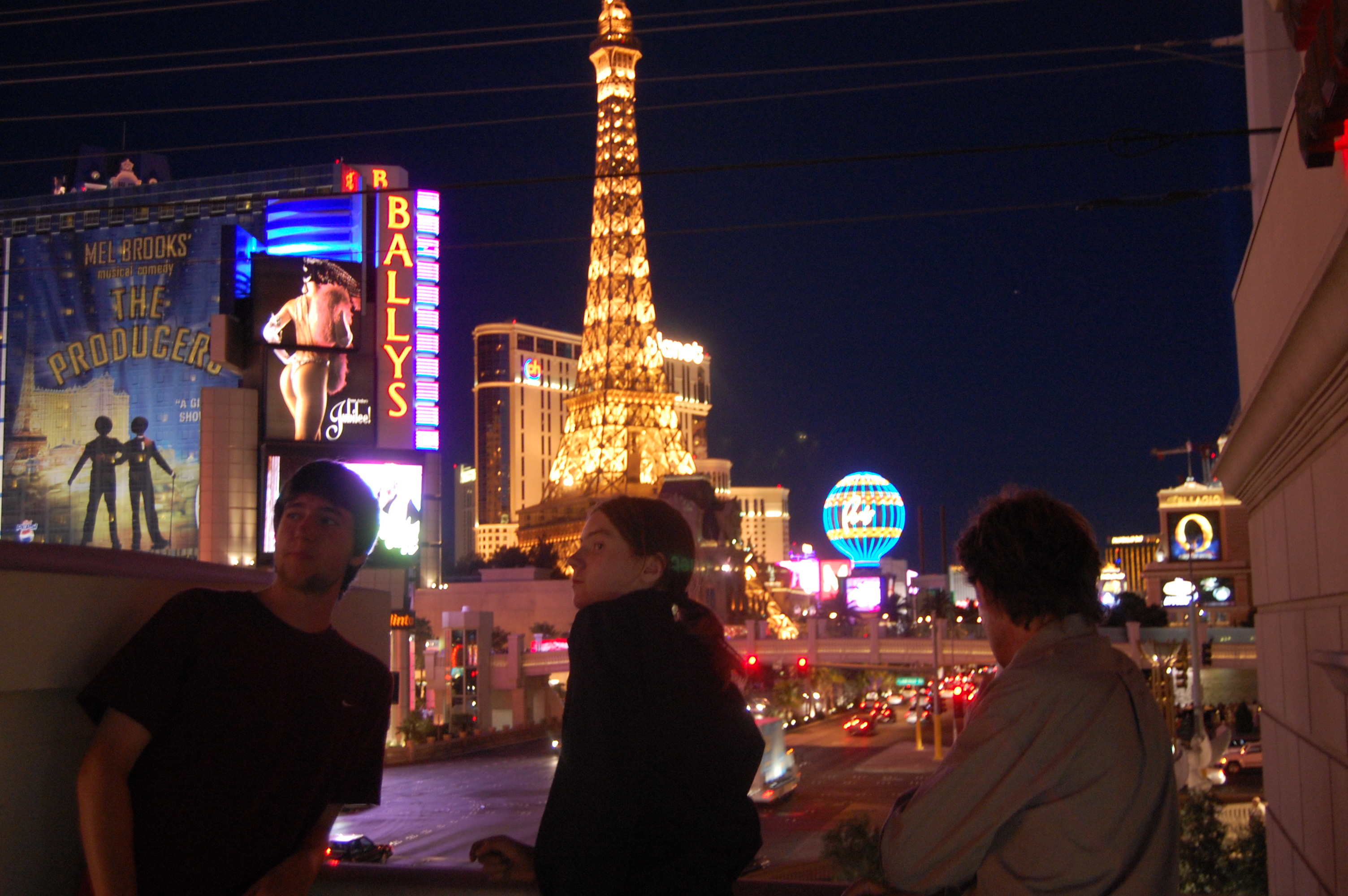
There are glimpses of Lake Mead against the desiccated landscape, then there’s a sudden pulse in the traffic and we’re flying into the Las Vegas freeways. Oran navigates us well through some tense moments and dizzy junctions but pretty soon we’re heading in city traffic towards the strip. We do an impressive swerve in the empty forecourt of Caesar’s Palace before finding the right route to the multi story. Then we’re bound for the gilded lobby of the hotel. Our room is very impressive with jacuzzi in the bathroom and telephone in the toilet. We can see the Eiffel Tower from our window and more of the unreliable skyline of Las Vegas.

Time for a swim to take off the desert heat. I could get to like the pool at Caesar’s Palace. You lounge there and call a barely clad waitress to bring you an overpriced, but well chilled and welcome, beer. Mind you, the prat at the next lounger has decided to try out his chat-up lines on her which she attempts to fend off with chillingly white, but all too polite smiles. My beer is warming.

Out on the street it’s hotter than you expect out-on-the-street to be. The heat brings a peculiar stillness to the air and with the banks of neon it feels like walking through a vast arcade. There are fine water sprays on the street to give some humidity to the desert air, but already my Mick Jagger lips are in need of a remould. Further on up and we’re on the Rialto bridge, with gondolas waiting expectantly. We stroll up the strip in the evening to see the pirate pantomime at the Treasure Island. I thought the desert heat dissipated at night but if anything it’s hotter and heavier in the milling crowds.

DSC_0406

Las Vegas is not a place you either love or loathe – you can do both. It is terribly fake. The sights of the world, the Eiffel Tower, Venice, New York, ring hollow as hardboard and will be gone again in a few seasons; but it’s fun. There is beauty in imitation and glitz has its own romance. The Belaggio and Cesar’s Palace provide their own version of grandeur and perfection at a reasonable price and, for a night or two, you can maybe feel like a high-roller or an elegant courtier.

We take the monorail on the second day and sit beside a Colorado couple who are regulars here. They are from Grand Junction – before I die, I gotta see that town- and they recommend the original strip but it’s a bit far for us. Historical Las Vegas! We walk back through baking sunshine with occasional detours into the various casinos. Circus is tacky and weird, and it echoes some childhood feeling of Fossett’s, or Bray in the fifties. And besides, herself can attempt to catapult rubber chickens into a pot. Another casino with a western theme, vaguely nineteen seventy-ish is getting ready to shut down. We eat at a chrome diner and try to cool down a little.

The pool beckons again, a better place to while away the hours than in the relentless ching ching of the interior. We splash out on the Caesar’s Palace buffet tonight and this really is a meal you can shake hands with in the dark. I dream of it still but to describe it is probably too close to food porn – eat your heart out Homer Simpson!

The Boss and Davin continue on down to Luxor tonight, but Oran and I double back at New York. I’ve seen as much of the world as I can possibly take in forty eight hours. Hispanic men flick cards with sexual services all along the strip, while families and couples gawp at the Belagio fountains and the neon show goes on and on into the night.

Later, I make my own way through Caesar’s Palace casino into the wee small hours. The arcade shops are all closed, more like a mall now than the surreal, almost Italian city it has been impersonating. Some still gather at the Trevi fountain but more are pulled towards the blackjack and roulette tables. If I wanted to be distracted I could take my place at a table where lingerie clad croupiers would take my chips and maybe spin a wheel or two, or I could just play it quietly from the bar, where it’s quiet and almost empty.

Grand Canyon

We head through the Painted Desert towards Flagstaff. The doom laden chords of The Doors seep out into the emptiness, leading on into Riders on the Storm. Ponderosa pines sprout from the arid hills and the city limits loom out of a mirage. The Cadillac heads downtown and touches tyres on Route 66. We’re on America’s main street, we’re on the Mother Road.

The town centre ranges along the railway where impossibly long trains regularly thunder through. There’s a bar and restaurant across the tracks which does a special free cocktail when the train is passing, if the waiters can hear you, I suppose. Our motel is a half mile out of town, just the right side of seedy but with a good pool and Route 66 visible from the window. There’s a Barnes and Noble next door where we spend some time reading and drinking buckets of coffee. Walking back into town the neighbourhood is a homely patchwork of residential, bohemian bars and diners, with a colourful smattering of churches, from Protestant sects to a determinedly Catholic Our Lady of Guadaloupe.

Davin spends a lot of the afternoon in a music shop with Oran and buys an effects box for his guitar. The car is filling up with stuff, but what better place than Route 66 to buy your wah-wah pedal? We relax over a beer at a shaded sidewalk bar. This is the only time I have ever seen a waitress accompanied by an intern – they’re very thorough here.

Flagstaff is a lively spot, its redbrick streets typical of the American west but with a more sophisticated, bigtown feel than Durango. At the town centre square there’s hot southern rock with a country twang playing throughout the day and into the evening. A large screen shows Happy Feet and there is indeed a happy feeling pervading the town.

After sundown, the nearby Lowell Observatory has set up a few telescopes for public amusement and edification in the square. We take our turn and talk to the astronomer who, as it turns out, is from Dublin. Small world, big universe, same sky all over. After an evening meal at the railway track, we take the windy road to the hills where the Lowell Observatory perches above the town. It’s a picture book observatory, a serene and surreal dotting of buildings set in the forest. There’s a great display of stars above us while beneath the diamond lights of Flagstaff spread out along Route 66. Again, astronomers have set out their stalls and we queue for a peek at the planets.

Percival Lowell obsessed over the sky, and there’s plenty of sky over Flagstaff. It was Lowell who put canals on Mars but also put a planet out beyond Neptune. Not long after he died this last planet was finally discovered, appropriately at Flagstaff. Pluto’s first two letters a tribute to the astronomer.

The Grand Canyon is due north of Flagstaff. We set off early through the San Francisco Peaks. The Ponderosa forest passes changelessly by. These trees are peculiarly regular. Neither dense nor inspiringly huge, they conspire to a misleading ordinariness, though the overall effect is unsettlingly vast. The Canyon is easy to find. Keep going till you hit the hole in the ground. It takes some time to locate our accommodation, the Maswik Lodge, inside the park. We’re too early to check in and a bit hot and bothered by it all. I’m anxious to see the canyon as though it will somehow close or diminish if allowed to stay unobserved for another hour or two.

Eventually we trudge down to the rim. The initial view is perplexing. Like much of America it triggers a sensation of deja vu, but such deja vu is based on the image and the reality itself is so enormous that it becomes difficult to recognise. At the canyon’s most popular viewing point the whole thing is flattened to hues of blue and magenta, presenting a tableau that is impossible to assimilate at once. It’s when we move around in the landscape an appreciation of its immensity and beauty begins to seep in. We venture just below the rim on the first day and teeter over the abyss on unprotected trails. A friendly squirrel pulls Davin’s hair and poses for the camera.

Image

The park at the south rim is spread over several miles. A free shuttle service links the various vantage points. This is just as well. At one point we decide to walk between two stops but away from the shade of the pines it is very hot. The walk along the rim is a joy. There are a number of lodges teetering on the brink dealing in arts, crafts and souvenirs. Park rangers wait politely to help tourists with enquiries and to share their knowledge of the park’s wildlife and history. Californian condors wheel far below, tiny even through the binoculars, and they are big birds. We take our first dip below the rim and the heat gathers ever closer. The boys are particularly taken with capturing all this on camera and pose appropriately above yawning chasms, all this without a safety net, or even a railings.

Sunset at the canyon is worth the price of admission. This spectacle has been specially adopted by the God crew. Our original perch was pleasantly quiet, I thought, but herself moves us two hundred yards further on to where a battalion of Jesus fans are praising the Lord with the encouragement of their pep-talking leader. Well, they do have a point. If this is God’s light show it’s the best goddamned lightshow on the planet. A resident of the park also gives strangers turns at his telescope and answers any questions. This is a thing that Americans like to do. Courtesy is by way of duty but not in any weary sense, they’re proud of this place and like showing it off.

The next morning we brave the chill of dawn to catch the sun coming up. We head westward to get a good vantage point, practically sprinting up the path so that we’re winded by the time we get to a good spot. Already we can spot hikers making for the bottom of the canyon. It is reckoned as next to impossible to get up and down in a day, and even to get down requires an early start. It looks a great adventure, setting off with a small pack, the odd lonely light shining from lodges on the rim.

Later, we take a shuttle east for a brief adventure below the rim. Myself and the boys plunge towards the towering desert. At seven thousand feet there is no sense of coolness, falling a few hundred feet in the next half hour is parching. Herself, meanwhile, relaxes by reading horror stories helpfully posted by the park authorities, telling how hikers have managed to do themselves to death by underestimating the power of the landscape. Things aren’t helped by a family foursome, whom we passed as they ascended, clearly noting our casual footwear and the boys’ black teeshirts. They ponder loudly at the top on whether they should call the rescue services given that such an ill-equipped a party as us couldn’t hope to make it out alive. We do, of course, the boys bounding up to the rim while I manage to plod home by myself.

We stop for drinks at El Tovar – the hotel for the top brass which successfully mingles elegance with rustic wilderness charm. The waiter from West Virginia cheerfully tells me I’m like Mick Jagger, but without the wrinkles. I laugh, causing more wrinkles, and get myself upgraded to Pierce Brosnan. “Why Pierce was here just last month, sitting right over there at the bar.” Small world. We return for our evening meal, although there’s a long queue. But it’s worth it to upgrade from the Maswik canteen to a proper restaurant within sight of the rim. A restaurant on the edge of the universe – in a way.

Monument Valley

The Rocky Mountains of Colorado rise to the south and we’re bound for the Million Dollar Highway towards Durango. The scenery is sheer alpine, snow-capped peaks rising out of a painted foreground of farmland and forest. Ouray, named after a chief of the Utes, is a beautiful wooden town clinging to a rugged gorge, hemmed in on three sides by spectacular mountains. This is ski resort country in winter and already the road is mimicking the giddy slalom of the skier.

We skirt some scary cliffs and there is no barrier between us and the precipice. We stop at the thirteen thousand foot Red Mountain Pass. This underlines how Colorado was named, the snow streaked peaks have changed from blue to red, most strikingly in the mountain that dominates the pass. There are two more high mountain passes before Silverton, a nineteenth century mining town. Silverton is connected to Durango by rail which offers a round trip on a traditional steam train.

We get a motel beside the quaint station in downtown Durango, a bustling place that retains its old wild west charm, punctuated by the train whistle. There are fine red brick hotels and bars, plenty of restaurants and shopping. We eat Mexican tonight, which seems appropriate on the fringes of the desert. I’m thinking of Dylan and Emmylou taking the horse across the desert, and Dylan’s Mexican taking an avenging bullet. ‘Hot chilli peppers in the blistering sun…’ The waiter is surprisingly abrupt, but the food – fajitas for me – is excellent, and plenty of it.

It’s one hundred and sixty miles to Monument Valley with plenty of interest on the way. We stop for gas outside Mesa Verde. The woman at the office has to come out to show me how to use the pump. She has a more sophisticated, citified look than I would have anticipated out here. We fill up and head into the reservation.

Mesa Verde reminds me a bit of Benbulben, but russet and arid. It’s a twenty mile trip in from the gate, winding up steeply to a thousand feet above the plain, then across the parched and rugged plateau. This was home to Pueblo Indians a thousand years ago who developed an advanced civilisation on the harsh but secure mesa. The Navajo, who arrived in these parts five hundred years ago called them the Anasazi, the enemy-ancestor. Even then the ancient civilisation had faded with mythology hinting it contributed to the southward push of the Aztecs. The scattered remnant forms a necklace across the desert, always a vulnerable target for passing warriors, be they Apache, Navajo, Hispanic or American. The Anasazi built stone villages in the rock fissures, fantastic sculpted dwellings suggesting a magical and mythological people. We visit one village clinging to shallow caves below the flat rock capping of the plateau. The place has suffered from fire recently and weird charred forests stretch for miles, like jagged tableau acting out a Rousseau painting. The desert heat is heavy, even up here, giving us a foretaste of what to expect further south, sweltering on the horizon.

Turning towards the Four Corners we pass Sleeping Ute Mountain and the landscape begins to limber up for the buttes and pinnacles of Monument Valley. The Four Corners is the one place in the US where four states meet – Colorado, New Mexico, Arizona and Utah. We pull into a circular, dusty park ringed by souvenir stalls. The stalls are operated by Native Americans. This is Navajo country, one young stallholder tells me. North, south and west, although, with a faintly bemused gesture of his chin towards the mountains to the east, he acknowledges the Utes. We get flavoured ice in a conical cup to ward off the heat.

We talk to a couple from San Diego who are heading north east on some mixture of family business and pleasure. He’s depositing the care somewhere in Montana before heading back home alone. “I look forward to it,” he says to my commiserations. You see that a lot over the mid-west; those basic motels where the guy puts in with his car, sits on the stoop nursing an amber drink, squinting into the sunset. In the morning there’ll be nothing there but tyremarks. Heading north towards Utah the car registers the outside temperature at ninety six degrees, and climbing. Now the magical monuments are glimpsed pushing out of the desert floor.

The Navajo reservation is the most populous in America. Navajoland is just over the bridge from Mexican Hat. This gets its name from a giddy stone formation nearby, for all the world resembling a sombrero held aloft on a stony pole. It’s a jagged string of rough-hewn joints, not entirely charmless, hugging the last straight stretch of road before a wide, shallow gorge. A place to go for a few jars I’d say, especially since the reservation is dry. ImageThere is a peculiarly ancient feeling to the landscape, the sensation that it was home to dinosaurs as jagged and strange as the rock formations. Everpresent is the mythology of the wild west. Our Cadillac could be a stagecoach, the windscreen the frame of a Hollywood film and, in the lengthening shadows, hostile indians follow our progress.

Goulding’s Lodge, 1000 Monument Valley, is set above a straggling settlement of low dwellings. It is built into sandstone cliffs and looks out on one of the world’s most enthralling and resonant views. Harry Goulding and his wife ‘Mike’ had established the lodge in 1923 as a trading post with the Navajo but in the Depression years the tribe had fallen on hard times. Attempting to improve their plight, the Gouldings set off for Los Angeles in 1938 to convince directors of the advantages of Monument Valley as a film location. John Ford obliged and within months had located Stagecoach starring John Wayne in this strange landscape. The Western, as we know it, was born.

There’s a museum to Goulding’s illustrious past, a red stagecoach outside and a timelessly redolent corral fence with wagonwheels. All sorts of romance come together at once: the boyhood thrill of the western, the teenage anticipation of love in the image of the silver screen, and the mature realisation of the timeless aesthetic of the western with its bold reduction of history to a mythology of good overcoming adversity. There’s an excellent shop with beautifully crafted jewelry, a predominance of silver and turquoise, and the rightly famous, and expensive, Navajo weaving. There are colourful stones and crystals too amongst interesting souvenirs of which the most poetically named are the dream catchers, and the most useful are the peace pipes, perhaps.

The restaurant is tiered and arranged arena style towards picture windows looking out on the valley. I order a Navajo Taco which might be quantitively described as minced Brontosaurus on a football pitch of pitta bread, with two choices from the salad tray. The reservation is, like I said, dry; but Davin gets one over on his Da with a pint of alcohol-free beer. We have insurance, though, having bought a bottle of Colorado wine from Durango. We retire to our room where, from the balcony, we gaze on the dreaming spires and vermilion slabs strung out before us. We watch the sun go down and, six hours or so later, watch it rise again.

Colorado

Colorado The light is fading over the freeway as we approach Denver. Way out west the sky is painted with improbable exuberance, attempting to distract from the serene, serrated silhouette of the Rockies. Denver rises from the undulating mid western prairie – the mile-high city. With our luggage still somewhere between Dublin and Dubai we are travelling light and running on empty.

On the second floor of Earl’s Place (that’s one above ground over here) there’s a sports bar and a restaurant which is practically al fresco, the outer wall is somehow removed and we are of a height with the city trees, swaying balmily in the breeze. American waitresses are programmed to attack. Relentlessly cheerful and equipped with the anorak’s grip of every nuance of the cuisine. Each order is answered with a question – how do you like your steak? your eggs? American or Italian cheese? Oh, surprise me, Oran entreats. Yet their enthusiasm is infectuous. Maybe it’s the altitude but we mirror their smiles and echo their repartee, and then find that it comes naturally.

The 16th street mall is Denver’s main drag, a pedestrianised street a mile long, lined with trees, restaurants, cafes and bars. A free electric shuttle bus operates along the street or you can take a horse drawn carriage if you fancy something more grande. The atmosphere is laid back, quiet and friendly. At one end of sixteenth street is the State Capitol, typically neo-classical, with a high burnished dome of twenty four carat gold. The high rise financial district is relatively recent, gleaming like an extrusion of giant crystals through the red brick fabric of the nineteenth century cow town. Even more unlikely is the teetering sharp edifice of Libeskind’s Art Museum. A sudden jolt from the classical lines of the Civic Centre, the multi faceted structure seems to have made an unplanned landing at the plaza from some distant and bizarre planet.

We return to the airport for our car and to leave instructions for our wandering luggage. We’re pencilled in for a Buick but at Davin’s insistence we upgrade to a Cadillac. This is still shrink wrapped, a white panther for our west coast prowl. Out on the freeway I am engulfed in a stampede of pick ups piloted by laconic maniacs in stetsons. Home on the range rover, if you like. We make for the maw of the Rockies. It’s a relief to get off the freeway and snake up silent curved roads to the mountains.

Leadville is a gem cunningly concealed in its base metal name. Here on the continental divide Colorado’s highest peaks rise snow topped over the purple sage and the scent of columbine spices the scarce air. At two miles above sea level Leadville is America’s highest incorporated city. The discovery of silver brought the boom times here. There are fifty buildings from the 1870s when Leadville was a boomtown of 30,000 people. The Tabor Opera House and Grand Hotel remain even if the population did not. The ghosts of gunslingers are caught reflected on the fine frontage of the grandly named Harrison Street where Doc Holliday, Buffalo Bill and Texas Jack once strutted, and no doubt caused plenty of lead to fly.

I enter Leadville’s legendary Silver Dollar Saloon which dates from 1879 and is the perfect synthesis of the Irish pub and the wild west saloon. It’s all aged woods and bottled beers, a louche ambience enlivened with the crackle of conversation. All roads lead here. The woman tending bar tells me she’s of Indian, German and Scottish stock and that the McMahon family has run this place for nearly seventy years. I fall in with two Canadian truckers and with the mixture of alcohol and altitude everything suddenly seams hilarious. Later I float up the sidewalk as the night sky bursts above me, just two miles nearer heaven and the view is perfect. Mind, on those echoing raised sidewalks I keep an eye out for a phanthom gunslinger, for Doc Holiday or Texas Jack; not that I’m sure I can shoot too straight right now.

After Leadville the Collegiate Range – Princeton, Yale and Harvard – guard the horizon to the west. We pass through Granite and Poncha Springs towards Gunnison. The premonition of an impending showdown is emphasised by Gunnison, still resplendent in its western clothes. There’s a fleeting Irish connection at the Gunnysack Bar which serves Harp lager on draught – but you won’t hear the cry of the curlew out here.

Davin determines that I risk life and limb to ride through a raging torrent in a tub. They don’t call it brown trouser rafting, but they might. We book with Scenic Tours for a two hour raft down the Taylor River. Their advertising doesn’t deceive and shows people plunging headfirst into boiling waters and clinging desperately to rocks. The starting point is an hour’s drive up a wooded gorge which could once have teemed with hostile Indians. Instead, thirty or so enthusiasts full of foolish and youthful optimism await the flotilla of six rafts.

Greg is our guide and tells us the hidden dangers of rafting, as if the obvious ones weren’t enough. The paddle is the source of most grief. The leading hand should keep the top of the handle covered so it doesn’t get waved about in rough water. Otherwise, according to Greg, “Franklin here could have a case of summer teeth: Some are in the boat, some are in the river and some are in Franklin’s head.”

In fact Franklin and his wife Liz are well experienced with the great outdoors and cede pole position to us on the helter skelter of the Taylor. They have a hike planned later. They want to live. After a short practice run of about ten seconds, we drop over a mini Niagara and enter a world more suitable to fish, bears and what’s left of the Mohicans. Greg has a deep knowledge of the river and of the helpful names of its most frightening features. There is the Tombstone and the Toilet (don’t ask) and more besides that I was too busy to commit to memory – why memorise something that might kill you? The Tombstone is the only one to claim victims as a rookie guide and four teenage girls get upended. There is a brief frantic scramble amongst the flotilla but all are dragged quickly to safety.

To add spice to the quieter lower reaches, as I begin to enjoy the scenery despite shivering from the soaking, Davin is allowed to ‘ride the bull‘. Greg positions him on the prow and there are a few good plunges on the last stretch to give him the soaking he so richly deserves. He enjoys it immensely. What the heck, so do I. Image

Anchorage

Volcanos spread south from Seattle, cones frosted white against the blue sky. Flying north, civilisation is trumped by the crumpled wilderness of mountain and sea. This gathers its own dusting of snow while the clear sky turns grey and mottled with cloud. We fall into conversation with Donna in the aisle seat. She is tanned from a fortnight with her daughter down in the Southern 49. We compare notes on the joys of parenthood. She hails from San Diego originally but is well naturalised now. Her dad was a pilot, as many Alaskans are. I think of the famous Fly Boys, those bush pilots that opened up the outback in the ‘20s and 30‘s. Pioneers like Carl Eilson, Russel Merrill and Bob Reeve wrote sagas and epic poetry with their vapour trails across endless daylight skies, above an empty wilderness.

Approaching Anchorage the plane twists and turns through mountain passes, crosses stormy inlets, descends through veil after veil of heavy clouds. The full spectrum of grey and black is sundered by shocking white slashes. It is ominous, yet exhilarating. There is one last banking manoeuvre, I imagine the wings tilting near enough to the perpendicular, some passengers moan while we grip our seats before sliding in to touchdown at last, with some relief.

Our luggage doesn’t show but it somehow seems unimportant. Anyway, our lift hasn’t shown up either. Both arrive simultaneously, an hour late. George, our driver, is another to hail from California. He came up here at age eight, hated it at first but loves it now. This certainly ain’t the sunshine state. Rainclouds are punctured by the serrated mountains and the long straight streets of Anchorage are shiny with rain.

Weather clears by morning and it’s warm and sunny when we hit the streets. Head out of town on 5th Avenue, out to where the streets have names. Anchorage is a railway town and follows the typical template in its street naming. Avenues are numbered consecutively north to south, Streets in alphabetical order east to west. We walk past a knife shop and other places you might not linger. Loop back on 4th which becomes downtown after A st. It’s alphabet city after that.

There are craft shops and souvenir joints aplenty. In one, rich with beautifully wrought clutter, we get talking to Richard Ziegler. Ziggy, as he is known, is a cobbler, odd job man, craftsman and muralist. He loves wolves and dogs, which form a recurrent motif in his art. He explains the First Nation and Inuit cultures of shape shifting. Consider a group of Eskimos – an allowable term in Alaska, apparently – out hunting. If one falls through ice and next animal to emerge is a seal, it is not unreasonable to explain that as a shape-shifting hunter. It is consoling, too.

Across the road, a giant mural by Ziggy adorns the intersection of D Street and 4th Avenue. It celebrates the Iditarod dog-sled race which starts from here every first Saturday in March. The world’s best Mushers set off with their sixteen strong dog teams in a race lasting nine days or more across the desolate terrain of Western Alaska, all the way to Nome, up by the Bering Strait. This was once the only way to travel, before roads, before railways and aeroplanes. One famed race against time, in 1925, saw mushers deliver diphtheria serum to Nome. The lead dog on the last run, Balto, is commemorated with a statue in Central Park, New York.

Murals and other visual tricks loom out of the city architecture elsewhere. A lifesize whale pod traverses a wall along one side of the Town Square Park nearby. Painted freehand by Robert Wyland, it brings the surrounding wilderness within the city limits. The wilderness is a very tangible thing in Anchorage.

One hundred years ago there was nothing here. Captain Cook had sailed up the inlet that bears his name, back in 1776, in a vain search for the Northwest Passage. He didn’t hang around, though the city’s finest hotel is named for him, and a memorial stands at the foot of 4th Avenue. The Russians were the first old world people to settle Alaska. Russian Orthodox churches still peep out of the Americana and remains the religion of Native population.

Typically, the Americans struck gold shortly after buying Alaska from the Russians in 1867. The Yukon goldrush is much starred in the western psyche, even still. Many legends were spun from the untamed territory. Jack London’s ripping yarns, the lucid poetry of Robert Service. Alaska, for all its vast and numbing physicality, is very much a metaphysical construct. By the early twentieth century the Americans began to sew together their patchwork territory with the railway. Thus was Anchorage born, a halfway house between the port of Seward to the south and Alaska’s Golden Heart, Fairbanks, much further north.

The oldest building to survive is the Oscar Anderson house. He was the 18th man to hit town a hundred years ago. He witnessed the growth of a roughhouse town, the engagement with the last frontier. The tussle still goes on. Oscar Anderson lived in this house until 1974, it is now converted into a museum; apparently he haunts it still. Nearby, the Tony Knowles trail heads out along the inlet, along by the railway tracks.

The parkland meanders off into the suburbs. Along the main track is a scale model of the solar system. Devised by a local college student, it is designed on the principle that walking speed equates with the speed of light, testablishing the distances between the planets which are scaled down proportionately in size. At N street, Mars is a grape, while heading back along 5th Avenue, Venus a ping pong ball, Earth something similar while Mercury is a Malteser. The sun is a hemisphere sinking behind the city theatre.

Rain is falling heavily as we pick up our rental the next morning. Heading north towards Denali on the Glenn Highway the landscape is ridiculously big. Mt McKinley, or Denali – the big one in the Native tongue – is an outsize tower dwarfing already impressive mountains surrounding. It is rarely visible. So, when it does peek palely through the mist, it is more suggestive of art or magic, a trailer from heaven’s movie. Some miles from Anchorage we are swallowed by the forests, human habitation dwindles and dies. It’s five hours to Denali where we find our wilderness lodge set on a dizzying crag overlooking the valley. The town stretches along the highway like a hastily fashioned necklace. The ad hoc boardwalk gives a feeling of frontier times. Ramshackle huts and houses are given to souvenir shops, craft shops, restaurants and snackeries. It feels both impermanent yet old.

We eat at Prospector’s Pizza, the place is hopping. We fall easily into conversation with the locals, as is becoming customary. Kelly and her husband join us at the bar. He’s on crutches and has an accident prone life from which to draw his stories. He’s worked around here variously on construction and as a pilot. His hair-raising accidents only make him more cheerful. Before leaving he hops over to our table and presses a $20 bill on me. It would rankle with an Alaskan to let us leave without showing us hospitality.

We emerge into the full glare of dusk. Grey veils float to the summits, catching fire as they drift north towards the uncertain sun. We walk onto a near deserted patio where four dudes are strumming guitars and sipping bottled beer. As the guitar music waxes I feel connected to evenings like this around the globe, experienced by me and so many others too. Glancing south I see a rainbow spin its arc through the retreating rain. It’s drawing a bridge from Denali across the sky, dropping its gold off god knows where. Behind me the music stops, and the light of evening sharply wanes.

Our return to Anchorage is brief and passing. Above us, mountain, cloud and rain conspire to show the pathway into heaven. The city slips around us like a mirage. The ground below is slick with water, and it feels as if the city could at any time fade into droplets and air. I must come back some day, back to Anchorage and walk the streets of glory. Step again onto 4th Avenue, flip a Mustang lighter to fire up one last cigarette. With darkness drawing in, the feeling persists that I am sheltering under the rainbow. Cold creeps up, coating everything in its silvered glass. Anchorage recedes into infinite space, stars spread along the avenues and streets.

Oxford

Oxford is honey-coloured, gothic and ancient. There are thirty eight colleges in the University, all orbiting within this city of dreaming spires. Most of the buildings are of Victorian vintage, some Georgian, many built on institutional foundations that go back to medieval times. The blueprint is time honoured: college buildings clustered around a quadrangle forming a self contained unit. Student accommodation, dining halls and library are on site, most colleges have their own church attached. It is one of those places, like New York, or Venice, or Paris, that we know without ever having to visit. It looms large in literature and learning, has become a historical constant, and, of course, a television star in its own right. We have decided to filter the city through the lens of the Inspector Morse television series, itself drawn from the books of Colin Dexter.

Oxford is just an hour’s train ride from London. The Thames has shaken off its city suit this far upstream where we enter the more bucolic side of the Home Counties. That startling skyline is revealed at a bend in the river a couple of miles out. That the place lives up to expectations is almost a surprise, Oxford being at the centre of a metropolitan are of a quarter of a million people. However, the ancient University is all-pervasive, dominating all aspects of the city.

After coffee at the Buttery on Broad Street, we make a quick reconnoitre before convening for the Morse tour. It’s a pleasant walk around the periphery of the city centre, through the busy main shopping precinct along Cornmarket Street, then past Christchurch and Merton Colleges into peaceful parkland and along the cheerfully named Deadman’s Walk.

Back at Broad Street, we assemble close by the original Oxfam shop. Directly opposite is Balliol College; dating from the thirteenth century, its frontage a picture-perfect slice of Victorian gothic. Further along, the Museum of Science History strikes a classical chord. Although its plinth mounted busts stand guard sternly at the entrance, its mission has always been to provide access. Established in the late seventeenth century to nurture the growing Enlightenment, it boasts that it is the oldest purpose built museum in the world.

The Morse tour is lead by Linda, an affable Liverpudlian who understands the guide’s mission: to inform and entertain. The city is counterpointed against the unfolding story of Endeavour Morse and longtime sidekick, Robbie Lewis. We learn the truth and truth-tweaking of some fictional episodes, of actor John Thaw’s preference for brandy, and, should real ale be your preference, where to drink the Morse way. We barrel through back lanes in the shadow of the city wall, with only enough time to sniff and take note of a few rambling, olde pubs.

Facts and foibles of the city are teased out. We learn about the examination undergraduates and the connotations of their dress, down to the significance of their carnations. It sounds formal and traditional but somehow seems such fun. There’s the constant whirr of spokes as students cycle by. There are end of exam celebrations, with much throwing of confetti, amongst other debris. Typically Oxford, such things are both picturesque and real. Looked at rationally, what better way for a self contained city of learning to conduct itself.

Oxford has been the fulcrum of England’s intellectual life for centuries, but it is also metropolitan, political, a microcosm of elite society. Prime ministers and poets, sportsmen and soldiers have all passed through these hallowed halls, haunt them still as ghosts, no doubt. The art and science launched from here still endures, weathering each and every stone with significance.

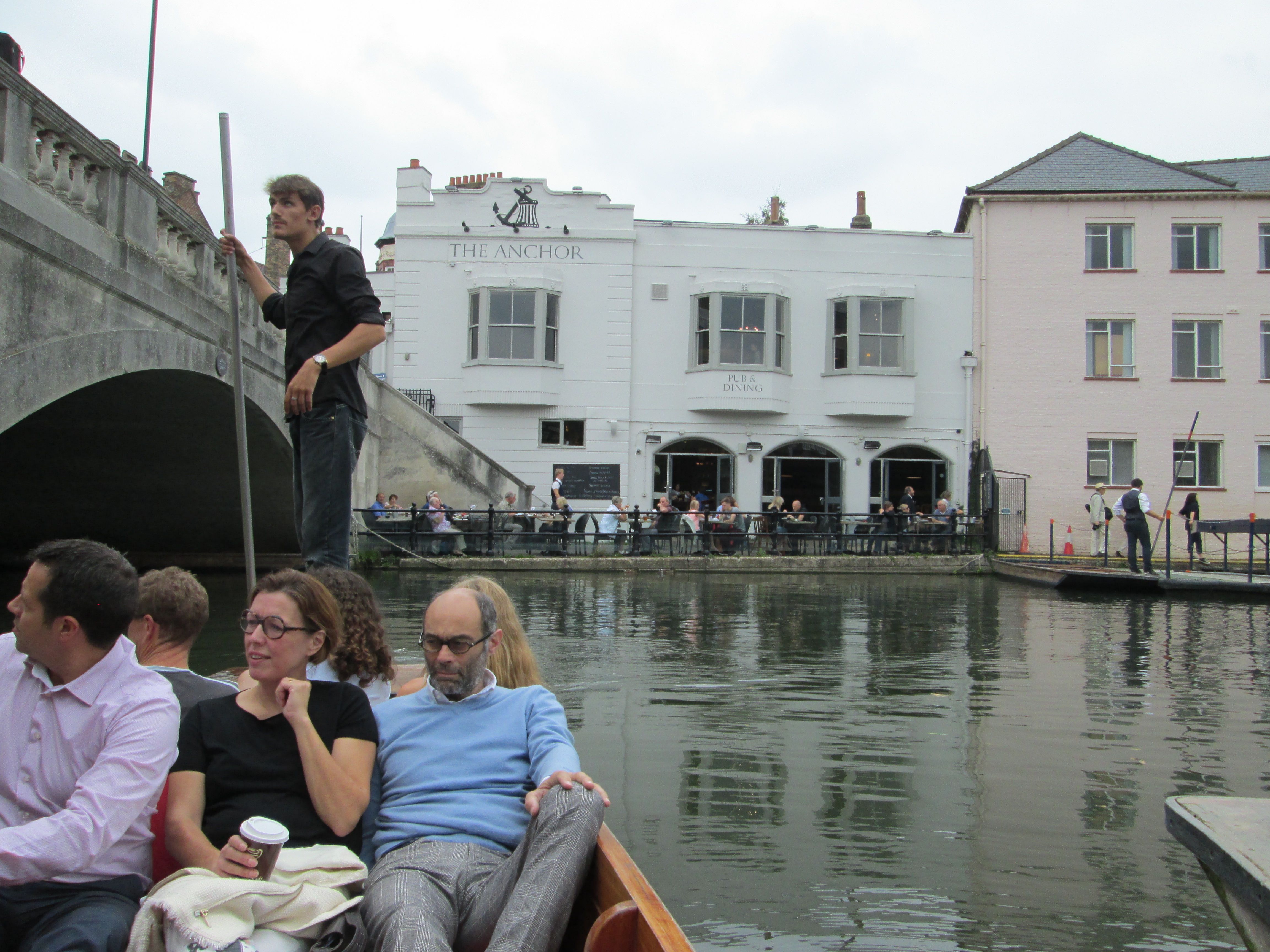
Tolkein and Lewis – that’s CS – also intrude, their elves and fabulous kingdoms spun from homely surrounds – the clink of glasses in a pub, the swirls of tobacco smoke. There’s more than a hint of Hobbiton about. Wonderland too, as episodes of Alice peek out from the masonry. It was here that Charles Dodgson first conjured the story of Wonderland, as he entertained his three child friends on the river. Punting and rowing can be arranged, with river cruises on the Thames just south of Christ Church Meadow. Perhaps another day.

The most iconic collection of buildings are grouped around Radcliffe Square. The Bodleian Library, a repository for all books published in Britain and Ireland, has expanded beyond its original buildings. It now includes the distinctive classical confection of the Radcliffe Camera, dominating the square. To the south is the place where it all began, the University Church of St. Mary the Virgin, its elegant tower accessible for views of the city centre. Emphasising the theme of our tour, we have to wait while a film crew gets its shot, but that’s to be expected here.

We finish with a visit to the more day-to-day environment of the Covered Market. This is a fine example of the traditional markets that flowered in the eighteenth century and survive today. A colourful mixture of small businesses, whether food, fruit or fashion, forming a commercial counterpoint to the academic atmosphere all around.

In order to complete our quest, with an al fresco drink a la Morse, Linda advises us to go to the Trout Pub in Wolvercote for a sup by the river. It is a short excursion on the bus to Woodstock – but not the last one. Then we walk through a village hewn from times past, a rambling slice of Old England. We pass twin pubs set either side of the green, inevitably named: The White Hart and the Red Lion, then across the Common where the English typically protest their right of way. At last the Trout leaps into view. Time to take a bench on the terrace and sample the local cask ales. This is a drink that northerner Lewis – Robbie, that is – dismisses as ‘warm beer’. So does my companion, I’m afraid. For me it provides something of a perfect moment; to sit by a river between bridge and weir, in good company, far from the madding crowds, with a pint of traditional ale further reddened by the setting sun.

Helsinki

Finland’s shape on the map is cut like a dancing woman. The snows of the Arctic are in her hair, her dress swirls with forest and lakeland. On her ankle is fashioned the elegant bracelet of Helsinki. The Finnish capital is relatively new, planned in straight lines yet fitting naturally into its marine setting. Religious temples form an exotic skyline. None more so than Helsinki Cathedral, the white neo-classical confection that is the most usual postcard image of the city. This is where we begin, climbing the dauntingly steep steps of its plinth. The day is appropriately blue and white, up at these latitudes we can almost touch the dome of the sky, see pale stars glimmer behind its glass.

   Helsinki excites the designer’s muse. No surprise that it’s designated the World Design Capital for 2012. That subtly cool skill of the Scandinavian, twisting artistic impulse into  the fashion and fabric of the city itself, is given an added exuberance by the Finns. They are noticeably a different crew than their neighbours, the Russian and the Swedes. They speak a different language, unrelated to the Indo-European of most of us; Hungarian and Estonian its only kin. 

  Like us, the Finns have suffered the overbearing attention of powerful neighbours. The Swedes founded the city as Helsingfors, running the show here until the early nineteenth century. The Swedish Theatre still stands proud on the Esplanadi, catering to the Swedish speaking remnant. It is only a century since Finns first outnumbered Swedes here, now Swedes comprise under ten per cent of the population. 

   The Russians established Helsinki as capital of their Finnish province and initiated its transformation into a city. Styled somewhat along the same neo-classical lines as St Petersburg, architect Carl Engel established the central focus of the city at Senate Square on a hill overlooking the South Harbour. The Cathedral dominates the skyline and provides a superb platform from which to admire the expansive city floating on the blue Baltic. 

   The parallel thoroughfares of the Esplanadi, each side of a slim green park, make for an elegant main street. Bronze dames dance naked in the park but whatever controversy they once aroused has now subsided. It is the place for summer strollers, bandstand music and cafe society. Sidewalk drinkers perch outside elegant establishments, devoting their full attention to people watching. Cafe Kappelli is the popular place, an ornate conservatory blending with the greenery. It is crowded on this hot summer day, but we grab a beer at a nearby kiosk and sit and watch the world go by. Some of it anyway. We are amused at the sight of the worst display of human statuary in the world. A man with a beer crate and a spiderman suit, and a brass neck.  

   The Esplanadi merges into Market Square along the seafront. Small pleasure boats and taxis bring a pleasant maritime flavour into the city’s heart. A lively market is laid out along the quays. Above, standing proud on a crag is a reminder of Russian days. Uspenski Orthodox Cathedral is full of eastern exuberance, sounding a strange, but pleasant note against the more rational symphony of architecture. 

  Nationalist confidence brought creative fervour. The zeitgeist manifested itself in Art Nouveau, Jugendstil in Finnish. The city boasts many fine examples of the style. The Central Railway Station, designed by Eliel Saarinen, is the most striking. The soaring clock tower is its distinctive landmark feature. Up close, we find the entrance guarded by four stone giants, each holding a spherical lamp. The interior doesn’t disappoint either. Coolly elegant, the design lends serenity to what is usually a hectic environment. It must be a pleasure to travel by rail here.

   Helsinki is very modern. A hundred years ago under one hundred thousand people lived here, today it is home to more than a million. Trams speed busily above ground, the metro beavers away below. To the north the extensive Olympic centre hosted the 1952 games. Finns set great store by athletic achievement. Their great Olympian, Paavo Nurmi, merits a statue, though he was hardly a person to encompass stasis. Set amongst the parkland that is such a feature of the city, the stadia and village are a monument to the greatness possible when a small nation believes.

 Alvar Alto, designer and architect, came to define the modern era. A leading figure of functionalist design, Finlandia Hall typifies the inherent style and musicality of the city. Sound and vision combine again at Tempeliaukio, The Church of the Rock is built underground; a hollow of bare rock with light streaming in from above. The design happily encompasses superb acoustics. Infested with tourists, including ourselves, there is still a pervasive hush as a pianist serenades us to the music of Sibelius. 

  We buy a strange, yet appropriate ornament. An old antique shop on an undulating, San Francisco-esque street, provides a magical interlude hinting at olden days. In the palm of your hand, four dancing ladies sashay, white with blue trim. They could be Finnish, or oriental, it is hard to tell. Perhaps they’re Lapp dancers. 

   It is hard to tell, in this imaginative city, which of the orient or the occident prevail. At sixty degrees north, lines of longitude converge and the human experience grows ever more unique and rare. Helsinki, tenuously connected to the past, embraces the present and the future. Confident, creative, individually and collectively; where such virtues pervade, dreams can be made.


Stockholm

Stockholm sleeps in its shallow lagoon. Thousands of tiny, verdant islands guard its entrance. It would be a hard job sneaking up on the canny Swedes. On the other hand, over the centuries they have ambushed a few themselves, being something of a warlike tribe that carved empires out of the ice, the oceans and the steppe. East and west, Protestant and Orthodox, can put a tick beside Swedish influence on their cv. 

  They’re a more sober bunch now, good Europeans though not Eurozoners. Still, we found that the citizens of the capital maintain a certain hostility towards the foreigner. Sverige might be almost an anagram of service, but the concept is not enthusiastically embraced in Stockholm. At our first coffee stop in Djurgarden, a large island designated as the city’s park, I pay at the counter and, after an uncomfortable silent interlude, ask for the goods. The girl serving jerks a thumb over her shoulder: get it yourself, she snaps. Charming. 

  Early on a balmy Saturday morning, the streets are yet deserted and a wonderful sense of peace envelops the massive stone palaces and well scrubbed streets of this floating world. The city is built on fourteen islands so you’re never far from the waterfront. Elegant architecture proclaims centuries of success, the hint of empire with a pervasive sense of royal power. 

  These days, of course,the Swedes are the epitome of democracy. Its system is often envied, or at least name checked in relation to public service, generous welfare and all round good and healthy living. Grumpy denigrators point to dullness and expense. Certainly Stockholm doesn’t exhibit much in the way of drunken mayhem. The citizens are well to do, but perhaps not so well to do as to splurge on a few litres of expensive brew. There is something of an inbuilt reserve too. Garish modernism, noise pollution, general rowdiness are alien to this environment.

  The Old Town, Gamla Stan, retains an ancient feel, its cobbled streets winding between huddled buildings. An outer ring of Parliament buildings, Royal palaces and museums is impressive, the soft centre of ancient lanes and tottering buildings beguiling. Vasterlanggatan is the main drag, lined with shops, atmospheric bars and eateries.

There’s even the odd Irish bar, one promising the joys of League of Ireland soccer.   

  Crowds seep in from noon and quickly the area is thronged with tourists, street performers and three card trick men. In Jarntorget, a crowded pedestrian square, a woman sings Irish songs playing an instrument that could be described as a cross between a harp and a wok. I relax over a black coffee. Having already paid, the staff refuse to give me milk and I’m a bit dubious about asking the other customers.

  Gamla Stan is where the city began almost eight hundred years ago. Birger Jarl established his base here, fortifying the harbour against invasion with wooden piles. The clearing of the woodland for this purpose is what gives the city its name. It translates as island of logs, which is unfairly prosaic. Meanwhile, Stockholm would grow from humble beginnings to become northern Europe’s dominant city in the seventeenth and eighteenth centuries.

  Since then it has continued to expand. To the west Kungsholmen island is the main centre for administration and law. Most notable is the City Hall, one of Stockholm’s best known landmarks. Completed in1927, this massive stack of redbrick, plain and modern, resounds with Nordic Gothic power. Its interior is more ornate, proving the Swedes have a certain exotic, well cached. Every year, the Nobel Prize ceremonies are hosted here.

  The north central area is simply known as City, the commercial hub of Stockholm.

Kungsgatan is a long street, specifically designed as a modernist main street in the nineteen twenties. It is guarded by two massive neoclassical towers, amongst the few high buildings in the capital. The King’s Towers also resemble a fortress, connected by a bridge which carries another busy street across Kungsgatan. This is an area of impressive stores and bustling shoppers. At Hotorget (Haymarket) Square we ask directions of a hostess outside a restaurant, but she is indignant and stalks off swearing, telling us to, more or less, get lost. Fortunately we don’t, and return to the waterfront through the bustling shops and markets along Drottninggatan, leading across a bridge that takes us back to Gamla Stan.

  We wave goodbye to Stockholm, wending our way south through its archipelago. You wouldn’t sneak up on these folk in the dead of night, hell, even in the glare of midday they don’t like it too much. But that’s okay, gaze on the natural and architectural beauty, and enjoy. In a couple of days we will get to Malmo in Sweden’s exotic south. It may not be so impressive as the capital, but it turns out to be a bit warmer in more ways than one. Perhaps the good folk of Stockholm might shed their icy reputation, if only they chilled out  some.


Copenhagen

I may as well write it: wonderful, wonderful Copenhagen, it really is. It’s way out east on the Danish archipelago, at the eastern tip of Zealand, glowering across the Oresund strait at Malmo. Sweden and Denmark have their issues, always have. So close to identity in race and language, in history and culture that surely they should be one. It is not so, that narrow stretch of Baltic is an uncanny valley dividing the twain. You can take a trip to Sweden by train, twenty minutes or so, we’ll cross that bridge when we come to it.

Copenhagen is formed by the sea, its lifeblood the water that flows through it. The Inderhavn snakes through the centre. At the northern end, the tiny figure of the Little Mermaid watches over the harbour. Hans Christian Anderson’s character seems oblivious to the sea, looking slightly stranded on a rock close to the shore. She is a most modest icon for a large city. Yet it encapsulates a larger story in its tiny form. She was a mermaid who rescued a drowning man, aren’t we all, but her pursuit of love was her tragic demise. The statue, erected by Carl Jacobsen of Carlsberg fame, has been decapitated and defaced many times, but survives. The smallest landmark of a major city, and the toughest, probably.

Copenhagen excites the fairy tale within. Slender spires touch the eggshell sky, gargoyles gambol on parapets, turrets host damsels awaiting deliverance. To walk through its streets is to court heroics, to become part of storyville. But it’s no Disneyland, wide streets turn to traffic canyons, commerce blares in all its seedy attractions. The city in parts can grow shabby with age and overuse. The ambition of an enhanced metro line is also disruptive. At times you get the feeling of a city with a glorious ruined past, hosting a modern, bustling parasite. It will be fine when it’s finished, if ever.

Olden oases persist. Age and beauty are respected. Stepping off the treadmill we take a boat tour from Nyhavn. This canal was built in the 17th century to enable ships sail into the centre of Copenhagen. Once a notorious red light district now it’s more up-market, but Nyhavn is still a sprinkling of the old salt. Gable fronted houses teeter on the pier, drinkers and diners carousing with gusto at quayside bars and stalls. There are different strata in the society of drinkers but they gel very well. Prices are prohibitively expensive so follow the local habit of buying cheap take aways and socialising around a fountain or on the banks of a canal.

There are hints of old Amsterdam. Across the Inderhavn, Christianshavn is formed around quiet canals, treelined streets carry cyclists and pedestrians, many commute by water. Bars cling to barges where punters watch the world float by. At times I am reminded of the Grand Canal back home, or what it could be.

The area merges with Christiania. The old disused army barracks was garrisoned by hippies in the late sixties and the culture persists. Dire warnings of drug crazed weirdos and overflowing garbage are wide of the mark. If anything, Christiania is cleaner than the city that surrounds it. You’ll see the stoner, early morning drinker and layabout, but enough about me, this is a quirky and fun exemplar of alternative living. The sun beams down on individualistic housing, creativity peeks through everywhere, smiling people crowd the cafes, the smell of new mown grass wafts through. On the main drag, the green light district, the mission statement is proclaimed in posters. No hard drugs or weapons, no cars or photos (oops, no-one told me). Meanwhile residents and visitors mingle, happy as hash and tobacco.

Back in the EU the world cycles on. We return across the Inderhavn to the city centre. The Stroget is a serpentine walkway through Copenhagen’s medieval heart. Thronged with strollers, lined with hostelries and shops, it seems all Copenhagen is here for the evening, anticipating the nighttime revelry. At the southern end is Radhuspladzen, dominated by the City Hall, This early twentieth century structure echoes Nordic medieval architecture, topped off by a 100 metre clock tower. The square itself is, typically I’m afraid, a cordoned off building site. Those Danes keep digging.

Night falls and the rare Baltic heat persists. The Tivoli Gardens are a step back in time and a step off the urban treadmill. Fun park, theme park, palace of recreation, it was opened in 1843 and its popularity continues to grow. The sculpted parkland is woven into an amusement park with a plethora of death defying, fantastical rides. There are restaurants, bars, concert halls and theatres, conceived in architectural styles from around the globe. As the illuminations come on it is transformed into a true wonderland.

Fortified on Danish courage, we seek the most spectacular ride. The chair-o-plane ascends to ridiculous heights. In the cooling night air we are side by side, flying above the fairytale towers, lit by magic lanterns. The stars swirl in harmony, the two of us turn to angel dust.