London: River Thames to Greenwich

The Thames flows on its serpentine path through London towards the sea. It is in no hurry to get there. It is confirmed in its relationship over two millennia, a highway to the world, a crossroads of civilisation. The Romans built their northernmost metropolis on its banks. In Christian days its centre point rose from the hill where now stands St Paul’s. At its height, sixty thousand people lived in Londonium. Abandoned in early Saxon times, Alfred the Great – though not a great baker – rekindled its fortunes as he thwarted the Danes. The ever falling, ever moving, London Bridge, anchored its location upriver of the Tower.

Big Ben from the river

Big Ben from the river

Took her sailing on the river/ flow sweet river flow/

London town was mine to give her/ Sweet Thames, flow softly.
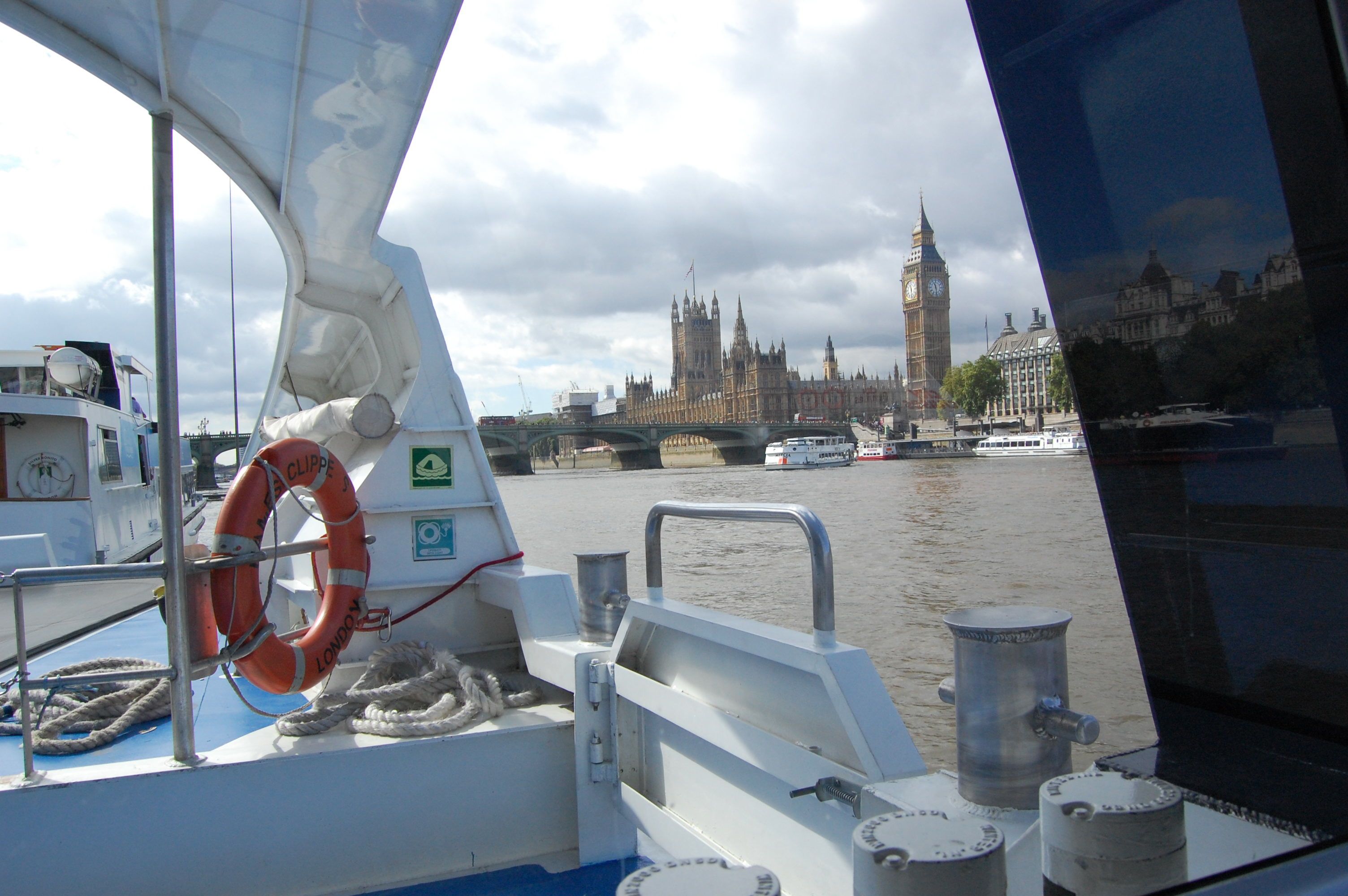
We take the Clipper commuter boat from the Embankment, eastwards towards the sea. London is teeming and towering, but calmed each side of the placid waterway. The morning sky is an optimistic blue, touching infinity above and below. In the words of Joseph Conrad, we are poised on ‘a waterway leading to the uttermost ends of the earth’. Conrad saw the connection here with all the great rivers of the world. Polish was his first language, but Heart of Darkness is an English classic, an exploration of the dark recesses of the human psyche. And it all starts here on the Thames as Conrad’s enigmatic Marlow spins his yarn. Conrad spurned his inheritance to take to the sea, eventually sailed up this river and observed its two way flow: ‘memories of men and ships it had borne to the rest of home or to the battles of the sea,’ such ships ‘whose names are like jewels flashing in the night of time.’ Another Joseph, J.M.W. Turner observed the Fighting Temeraire being towed up the estuary towards its sun drenched destruction.

Tower Bridge

Tower Bridge

From Shadwell Dock to Nine Elms Reach/ we cheek to cheek were dancing/

Her necklace made of London Bridge/ her beauty was enhancing.
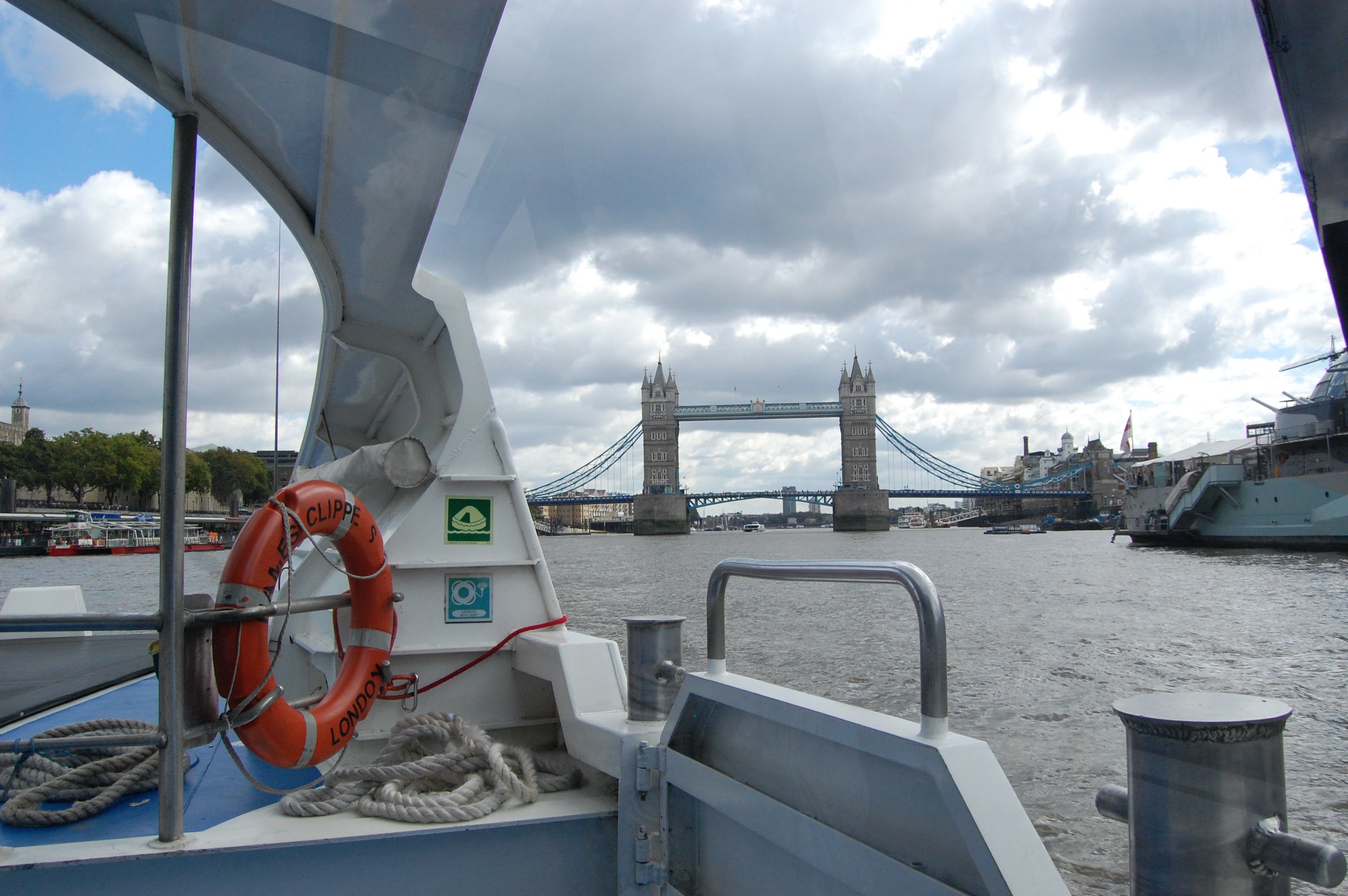
How can you resist the melody of English in the endless thoroughfare of the River? Shakespeare and Jonson lurk in punts in the shadow of the quays. Kit Marlowe sails by to his fatal reckoning at the riverside tavern in Deptford. The Globe Theatre looms out of the south, recast perfectly anew in some weird warp of time. Theatre in the round was the focal point of freedom on the periphery. We saw Henry IV here beneath a summer sky as it was meant to be seen, swirling skywriters, helicopters and all. Off season there are tours. We were told that in Elizabethan times, this was the theatre of life. A typical playhouse was some combination of festival and football stadium, rowdy patrons well past sobriety. It was a den of iniquity, the original smoker’s theatre of Brecht.

Despite appearances, time is of the essence. We have a late lunch audience with Oran at Southwark, with drinks in the Shard to follow. Greenwich is just over five miles west on the south bank where the urban crush begins to ease. We have a few hours to look around, and what better place to synchronise our watches.

Greenwich

Royal Naval College, Greenwich

Heard the bells of Greenwich ringing/ flow sweet river, flow/

All that time my heart was singing/ Sweet Thames flow softly.
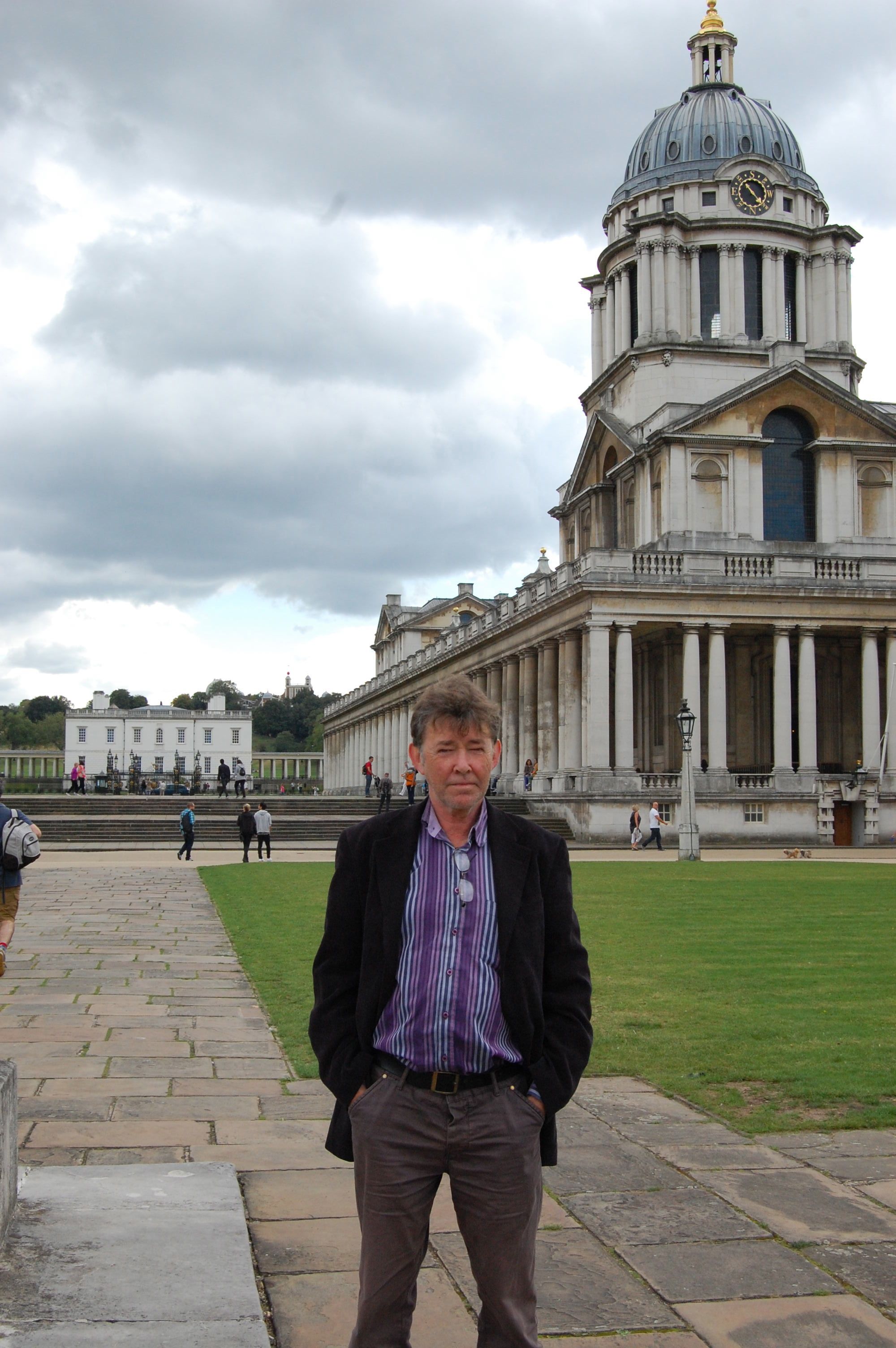
At Greenwich the city’s glow would have dimmed with distance. The lure of the sea, conversely, grew strong. The Royal Navy College steps up from the river. Initiated by James II, it is a neo-classical masterpiece of Christopher Wren. Begun in late 16th century it was originally the Royal Hospital for Seamen. Beyond the quiet splendour of its collonades and domes, Greenwich park slopes up to higher ground. The Rpyal Observatory was commissioned by Charles II. Overlooking Greenwich Park, it now boasts stunning views of the highrise London of Canary Wharf, the vast city jewelling the horizon by day and night. Here would be established the prime meridian of longitude. Bisecting the global river at Greenwich, forming the crossroads of the globe, where east is east and west is west, and never the twain shall meet. Although, good tourist that I am, I straddle the line in the yard of the Observatory, a photo opportunity in real time.

East is east and west is west.

East is east and west is west.

Made the Thames into a crown/Flow sweet river, flow/

Made a brooch of Silvertown/ Sweet Thames flow softly.
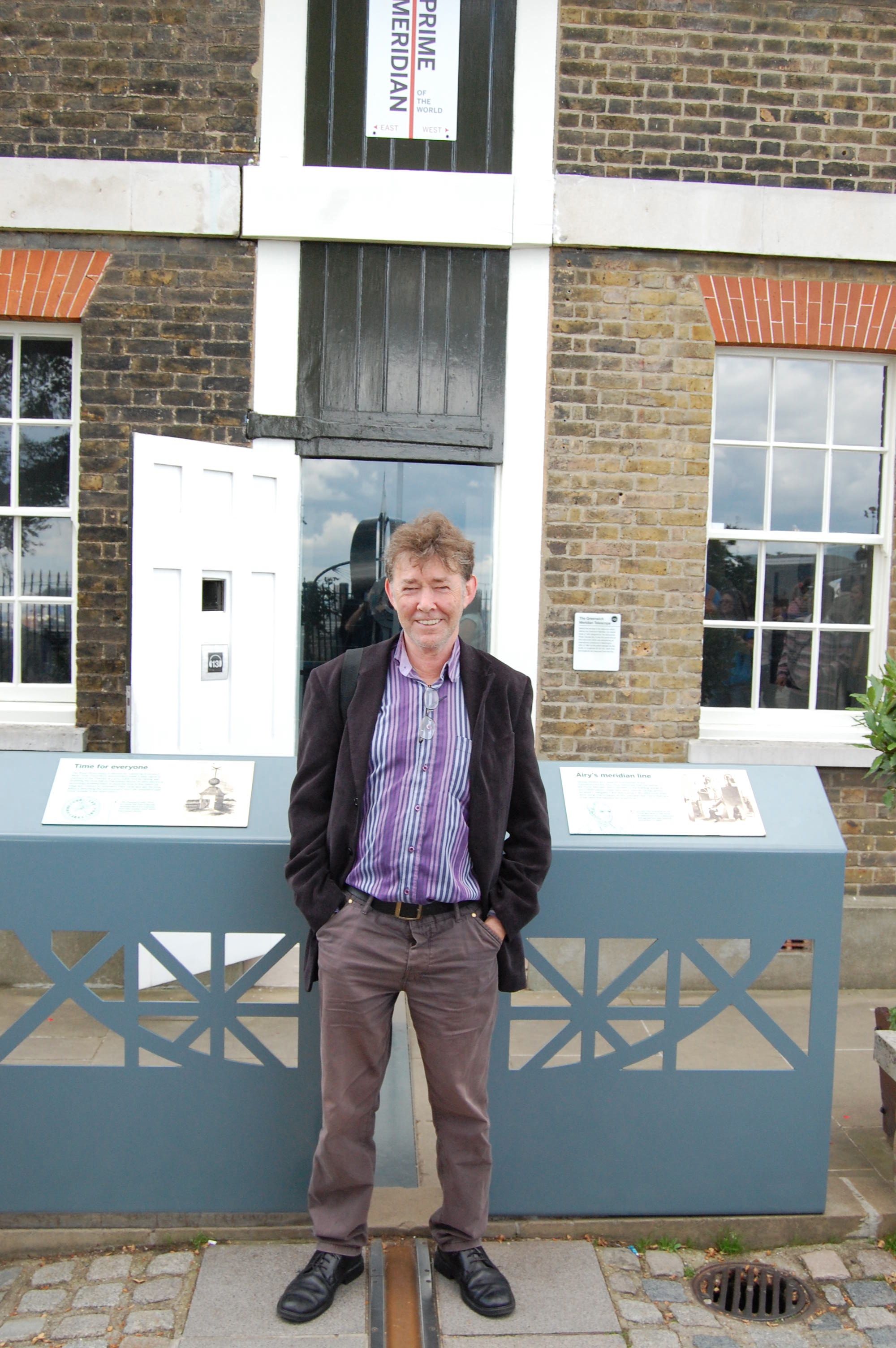
It was after 1884 that Greenwich was recognized as the line 0 of longitude. The accurate measurement of longitude had presented an intractable problem in previous centuries. With the Longitude act of 1714, Parliament offered £20,000, almost 3 million quid in today’s money, to anyone who could devise a reliable system for the reckoning of longitude. John Harrison, a carpenter from Lincoln, was building almost frictionless grandfather clocks in his early twenties. In pursuit of the prize, he set about the task of building a timepiece to reckon longitude. For the scientific community, gentlemen all, the notion of a mere craftsman providing a solution to the problem was laughable. However, Harrison had a champion in the Astronomer Royal, Edmund Halley.

After sixty years trying, Harrison’s H4, an oversized pocket watch, seemed to fulfil the criteria. However, the board demurred, putting Harrison’s success down to beginner’s luck. His H5 passed the test. But Harrison had difficulty extricating the prize. Only the support of George III gaining some compensation, to the tune of £8,5000. Harrison was eighty years old and died shortly afterwards. His timepiece was used by Cook on his second and third voyages. William Blythe also carried one, although it was nicked by Fletcher Christian, to be returned to the Maritime Museum much later.

Greenwich Park and the Maritime Museum

Greenwich Park and the Maritime Museum

At the Maritime Museum there’s an exhibition devoted to the Harrison clocks. I figure I have the best part of an hour before our return trip. As luck would have it, I’m about to leave when a museum guard takes centre stage, launching into an entertaining account of Harrison’s travails. Spellbound, I lose all track of time. Herself has seen the hour grow cold and comes in search. The account concludes, but now we’re running late.

Swift the Thames flows to the sea/Flow sweet river flow/

Bearing ships and part of me/Sweet Thames flow softly.


The giants of Southwark

The giants of Southwark

We walk through bustling Greenwich town down to the pier. Heading upriver, the bells of Southwark are chiming for our appointment. Above the shaded grove of the ancient cathedral, the blue sky is scraped by the slender Shard of Glass. Oran slopes out of the shadows as we arrive. We take a lift to the thirty first floor, where the split level Aqua bar floats in a bubble of glass. London is laid out below us, caressed by its loving river. It feels like heaven, or close enough.

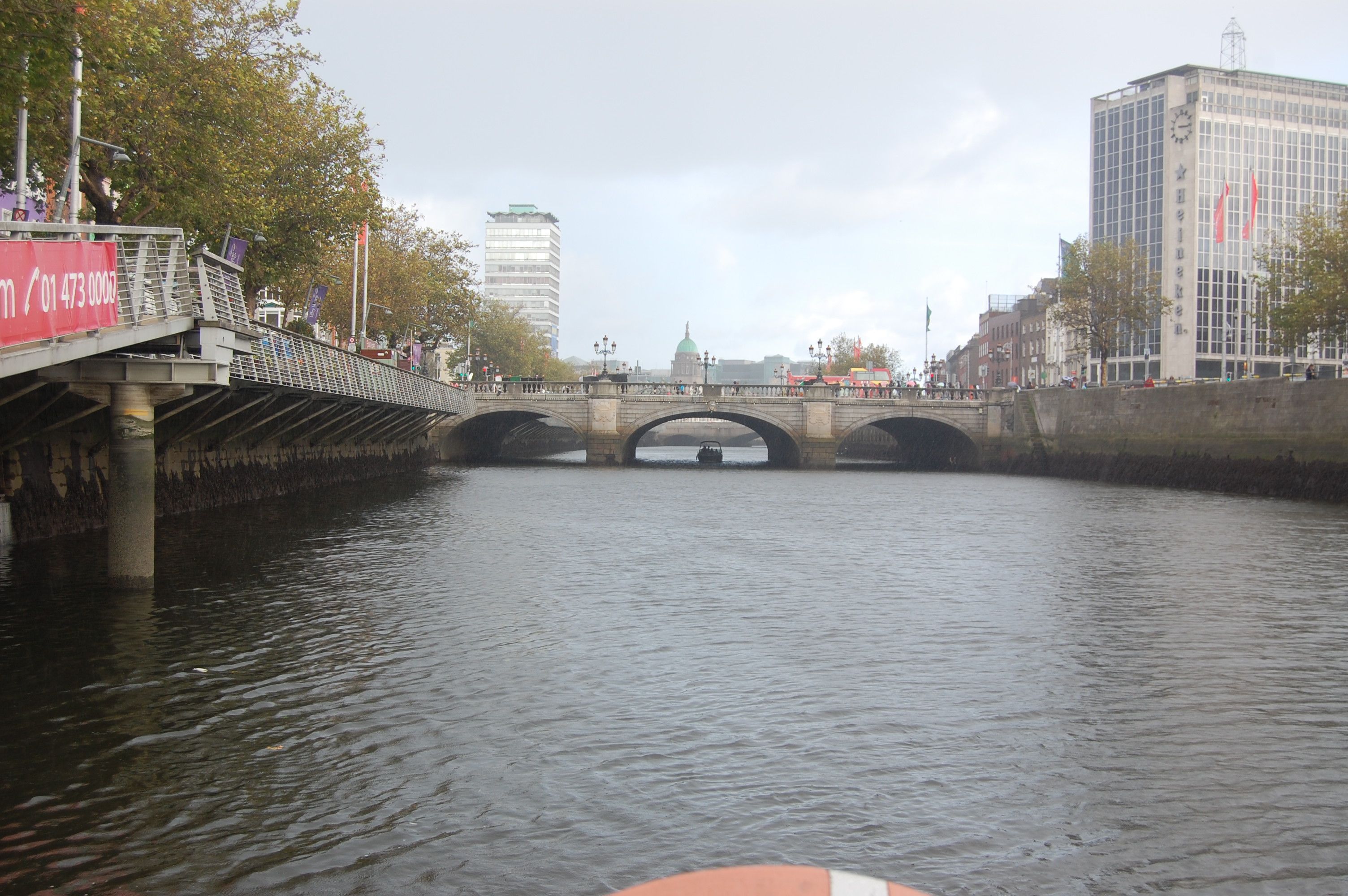
Aqua London

Saint Valentine in Dublin

Liffey

Dublin is truly the city of love. The Romantic, and certainly the Gothic, are a rich part of its weave. There is a trail to be followed plotting its many love stories, imagined and true, from its Viking origins up to modern times. Here’s one to begin with.

On this date, February 14th, we celebrate St Valentine’s day, a day dedicated to romantic love. The story of Saint Valentine dates from the time of Emperor Claudius Gothicus in 3rd century Rome. Valentine, a bishop of the time, was a keen proselytizer for the Christian faith, then considered a crime. Compounding this, he married young courting couples which was seen as weakening military effectiveness; bachelors making more fearsome warriors, apparently. Arrested for his transgressions, Valentine came to the attention of the Emperor who took a liking to him. However, when Valentine tried to convert him, Claudius countered with a death sentence. Just as well they hit it off, so.

While Valentine languished on death row, the jailer, hearing the holy man possessed great powers of healing, brought his blind daughter to the cell to be cured. Valentine applied a combination of prayer and medicine, unfortunately Valentine’s sentence arrived before a cure. The saint’s final letter was addressed to the girl, enclosing with it a crocus flower, then in bloom. When the jailer opened it in her company, the girl saw for the first time the bright colours of the flower. Her sight was miraculously restored. The letter was signed, From Your Valentine.

Valentine was martyred at Rome’s Flaminian Gate on February 14th, 269AD. Seven hundred and fifty years later, the saint’s traditional association with marital love and devotion has become more specifically associated with courtship and romance, This, in part, is due to the Saint’s day being synonymous with the onset of Spring, and all that that entails.

Valentine is depicted in red vestments, cradling the first flower of Spring, the crocus, in a life-size statue in the Church of Our Lady of Mount Carmel, Whitefriar Street, Dublin. Father John Spratt, was instrumental in the establishment of this church in the early nineteenth century. From here he ministered to the poor of the surrounding Liberty of Saint Sepulchre. Also a renowned orator, Fr Spratt visited Rome in 1835 and greatly impressed Pope Gregory XVI with his orations. As a gift, Gregory sent a reliquary containing remains of Saint Valentine and a vessel tinged with his blood. These were installed with great ceremony in Whitefriar Street Church but subsequently fell into neglect. Interest was rekindled in the 1960s and the current shrine was constructed with a statue of Saint Valentine.

The Church itself was built in the days of Catholic Emancipation and is rather plain on the exterior. Ostentatious displays of the faith still being frowned upon in Dublin. Within, it is a different matter. Most spectacular is the enshrined statue of Our Lady of Dublin near the High Altar. This Black Madonna dates from the sixteenth century. It was presumed destroyed in the iconoclasm under Henry VIII only to resurface three hundred years later. Fr Spratt is again responsible, discovering the forgotten statue in a junk shop.

Saint Valentine’s shrine is to the right hand side as you enter. It is a major attraction for courting couples from around the globe, indeed any couple seeking spiritual affection for their love. The saint is venerated in special masses on this, his feast day, and there are Blessing of the Rings ceremonies for engaged couples. So, a happy Valentine’s Day to all who love, and all who sense the onset of Spring

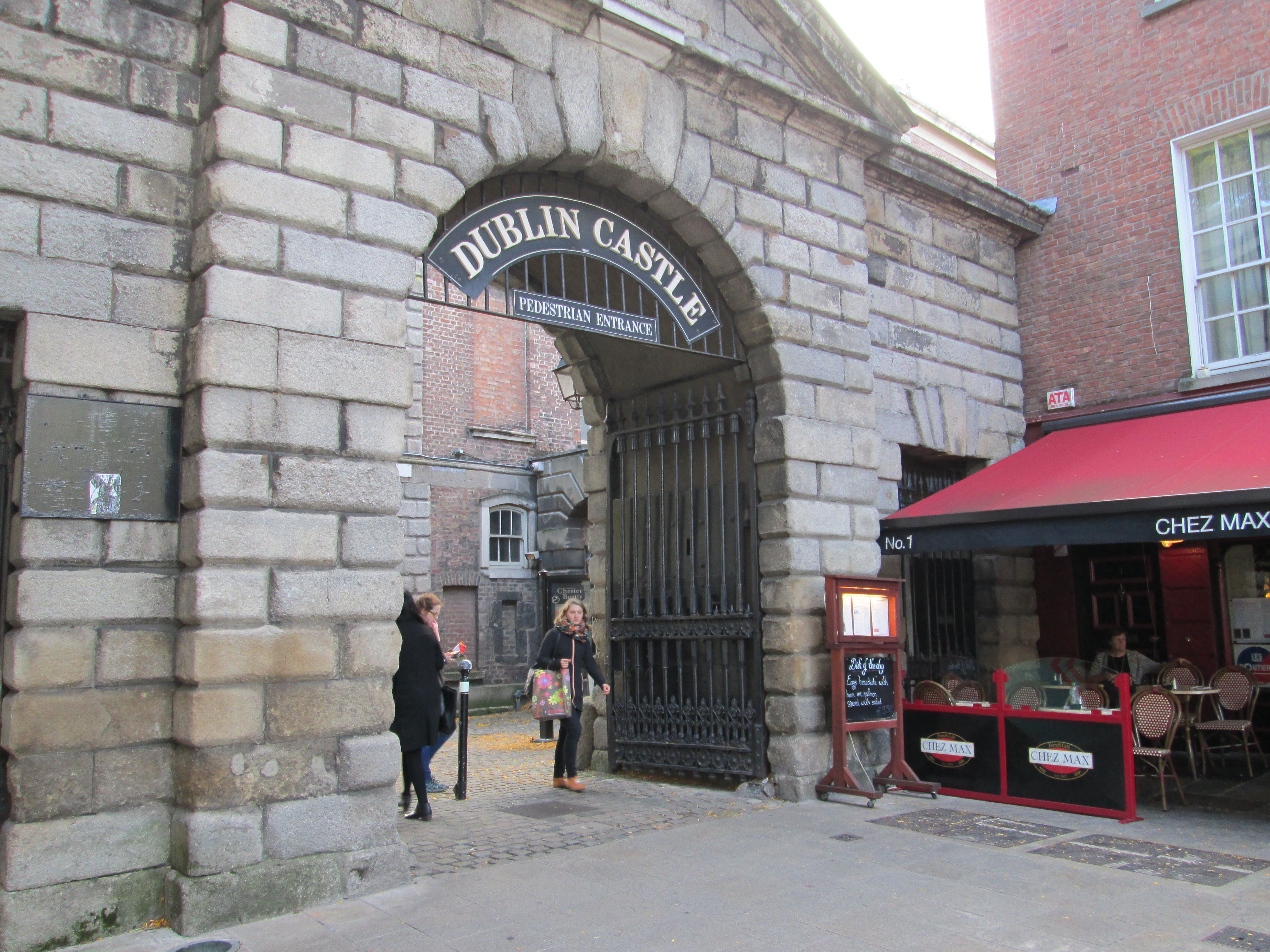
Dublin Castle

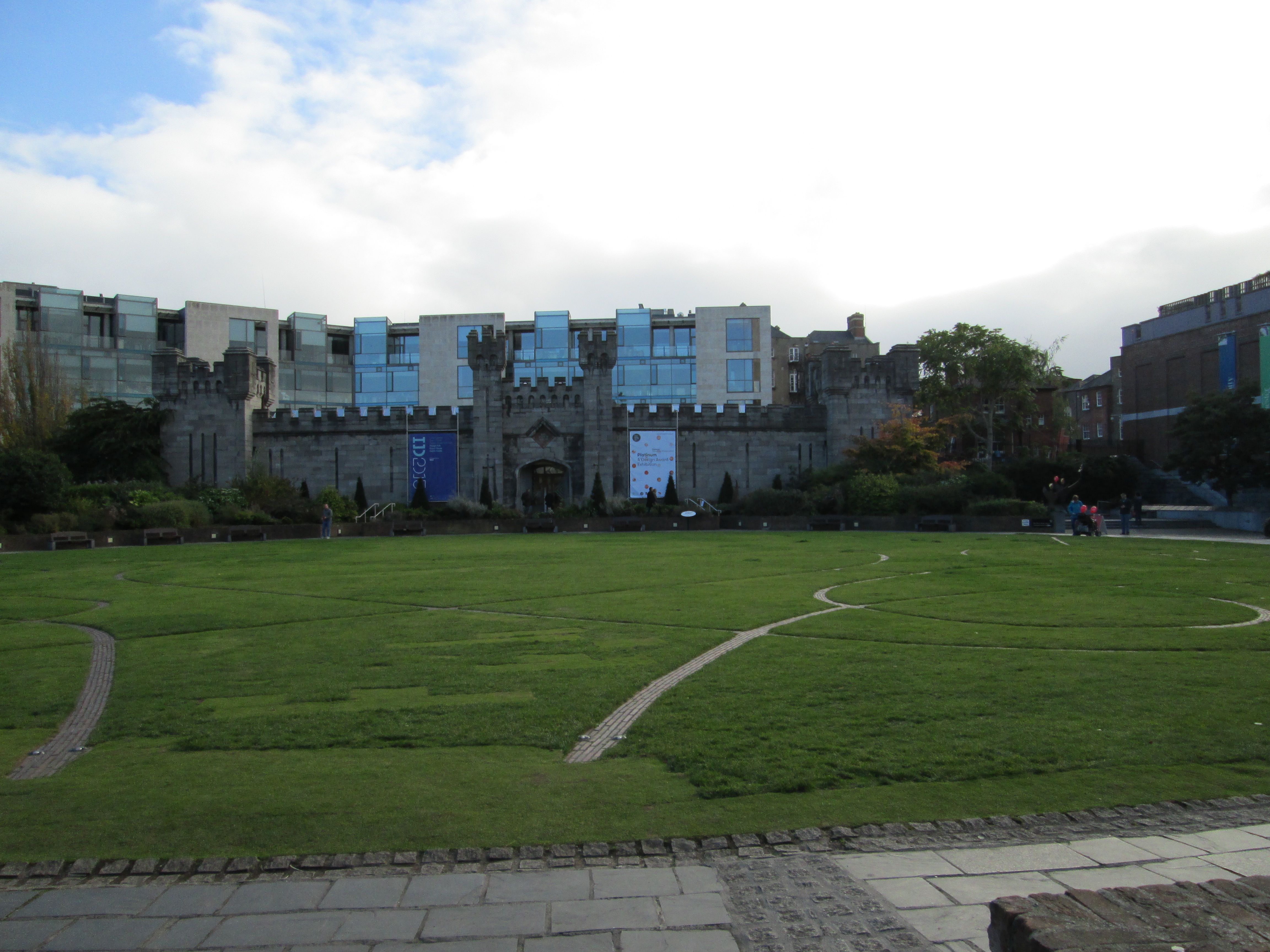
Dublin Castle stands on the spot where it all began. Towards the middle of the ninth century, a longboat of Viking raiders found the confluence of the Liffey with its tributary the Poddle, sailed up that to beach their boat on the shore of a large, dark pool. A low ridge extended to the west and here was established the Danish settlement, taking its name from the Gaelic for the pool, Dubh Linn. There had been other settlements hereabout, of course. St. Patrick establishing a church where his designated cathedral now stands. Greek geographer, Claudius Ptolemy, noted the importance of Eblana in the first century, though its size and exact location are disputed. For the Danes, and possibly their Celtic predecessors, the area now occupied by Dublin Castle seemed a logical spot, hard by the tidal harbour of the Pool, the higher aspect of the south bank affording dominance over the surrounding landscape.

Looking south over Dubh Linn

Looking south over Dubh Linn

The Danes were to dominate the East and South coast for a century and a half. We read at school that Brian Boru ‘drove the Danes into the sea’ at the Battle of Clontarf. This is true of the forces on the day, a day of carnage; but the Danish leader, Sitric Silkenbeard, survived, Brian did not. The Danes were not expelled and survived another century and a half before the Norman invasion. It was Sitric, overtaken with piety in his later years, who established Christchurch Cathedral at the height of the ridge in 1028. The Danish city was already walled.

To the Norman though, goes the credit for establishing Dublin as a city of stone. The Castle was constructed by order of King John in 1202 at the south east corner of the city wall. The Pool lay to the south while the Poddle was harnessed to form a moat to the north and west. This rejoined the river at the north east corner of the Castle’s Lower Yard, flowing north into the Liffey near where the Clarence Hotel now stands. The Normans reconstructed the walls enclosing the growing city as far as the Liffey and westwards to St Audeon’s at Cornmarket. The extent of this walled enclosure was little amended over the centuries, until they were dismantled in the eighteenth century.

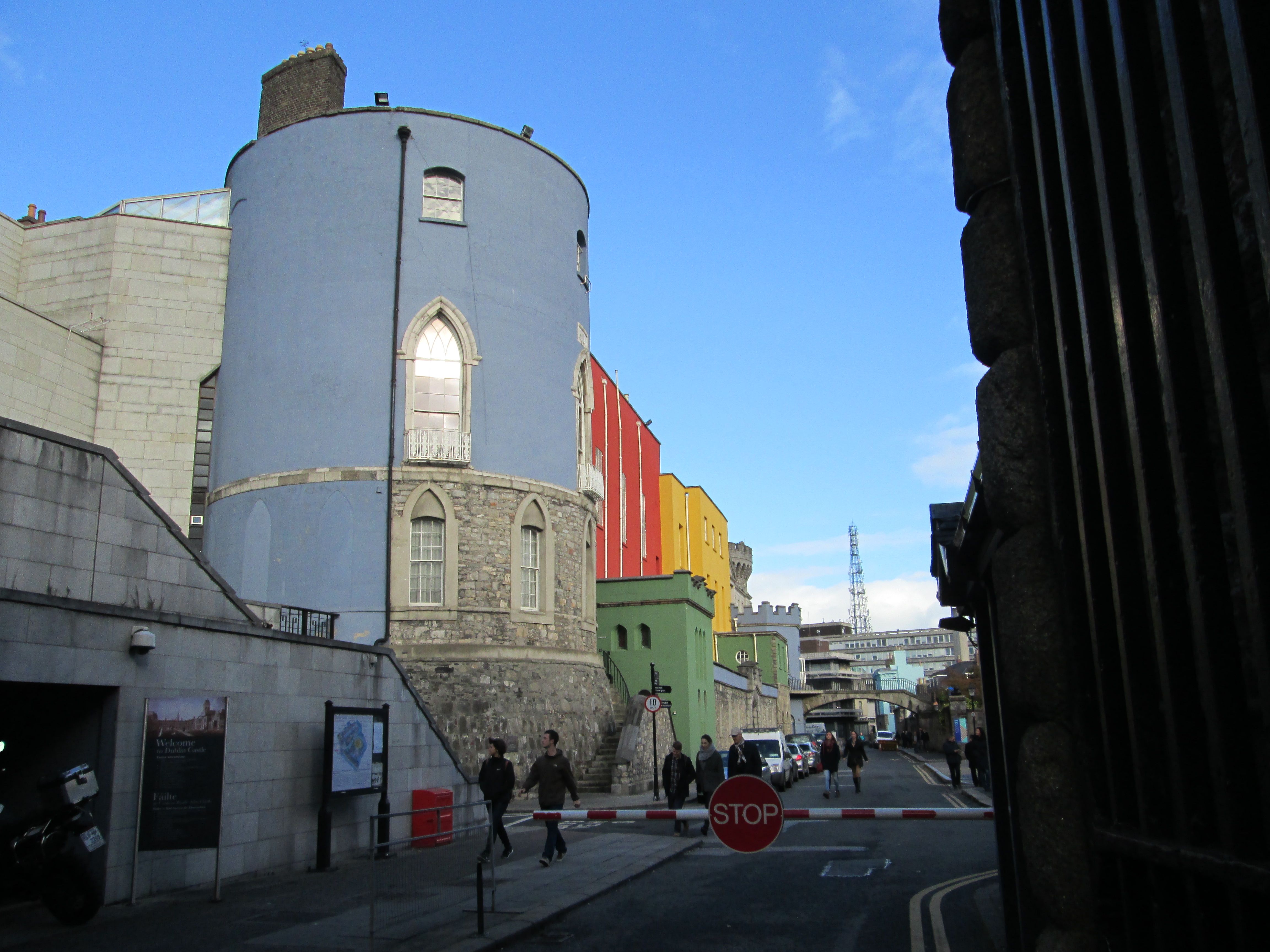
The Castle remains, itself greatly amended in the eighteenth century. For eight hundred years it was the centre and symbol of foreign power, first Norman, then English. It has never aspired to the romantic or picturesque. From the outset is was a functional, rectilinear structure comprising four stubby towers linked by curtain walls. There was no decoration, unless one counts the grisly occasions when rebel princes had their heads mounted on spikes at the gate. My own namesake, Shane O’Neill was to suffer this fate.

Bermingham Tower

Bermingham Tower

Unpopular with host and guest alike, detested by the Irish, the Castle nevertheless fulfilled its function. Edward the Bruce’s invasion of 1315 failed to rattle it. Silken Thomas’s revolt in 1534 went close, but no cigar. His first attack from within the City Walls got no further than punching a hole in the wall. The citizens expelled the attackers who attempted two more attacks. In a last, audacious onslaught the attackers gutted the buildings on Thomas Street to use as a covered ramp to breach the defenses. The garrison, facing the real prospect of defeat, made a great show of pretending that reinforcements had arrived and, rushing to meet the attackers head on, managed to see them off.

Robert Emmet’s fiasco came to naught, degenerating into a bloody riot on Thomas Street. In 1916 there was an attempt by rebels to seize it and the adjacent City Hall. Their forces weren’t up to it. They were responsible for the first death of the Rising when they shot the policeman guarding the gates. The Rebels briefly held the Upper Yard but were driven back by the garrison, though the battle raged about the Castle precincts for the rest of the day. The most significant breach of the fortress occurred during the War of Independence in the early twenties. Michael Collins, Ireland’s most wanted man, strolled into the Castle and pilfered details of Britain’s undercover network, with desperate ramifications for them. With the greatest guile and intelligence Collins effected revolution where centuries of armed assault had failed. In January 1922, Collins accepted the surrender of the Castle to the new Irish Nation.

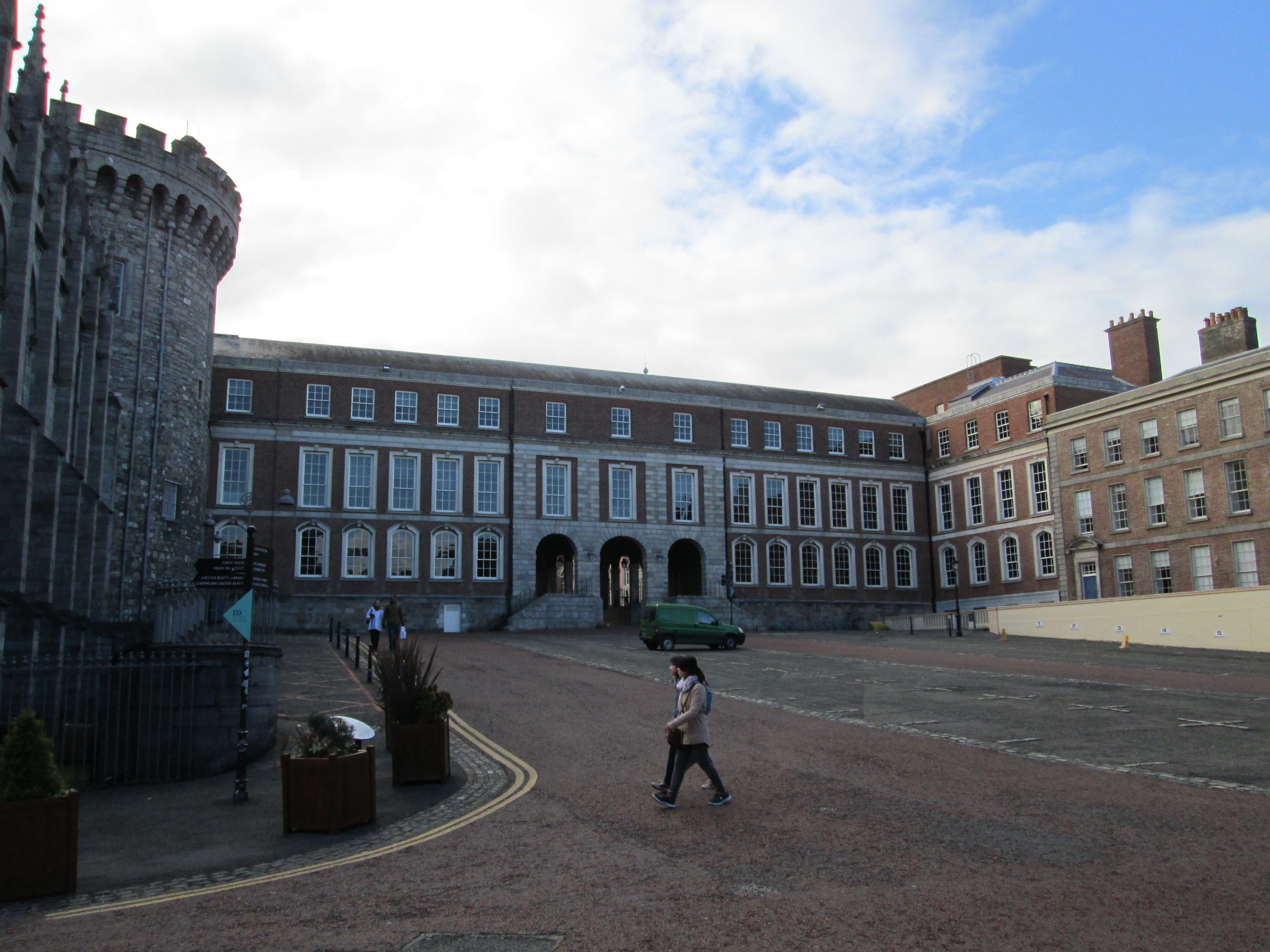
The Lower Yard

The Lower Yard

The Castle today is quite different to the original thirteenth century structure. That had fallen into ruin by the middle of the seventeenth century. Within the walls at that time was the Irish parliament building, decaying and further degraded by Cromwell’s marauding troops. When a fire broke out in 1684, the Lord Deputy, the Earl of Allen, took extreme measures to prevent its spreading to the more valuable towers, by blowing up connecting buildings. A blessing in disguise, Allen having described the place as the ‘worst castle in Christendom’.

Rebuilding started immediately and the south-eastern building was completed within four years. The colonnaded ground floor indicates the architectural style of the Jacobean period. The remainder of the refurbished Castle is in the Georgian style, typical of the explosion in development in Dublin throughout the eighteenth century. The main entrance is overlooked by the Bedford Tower. Built in 1761, this elegant neoclassical tower is the most imposing in the Castle complex. To each side are identical portals, it’s the easternmost that acts as the main gate. Atop this is a statue of Justice, pointedly turning her back on the city outside.

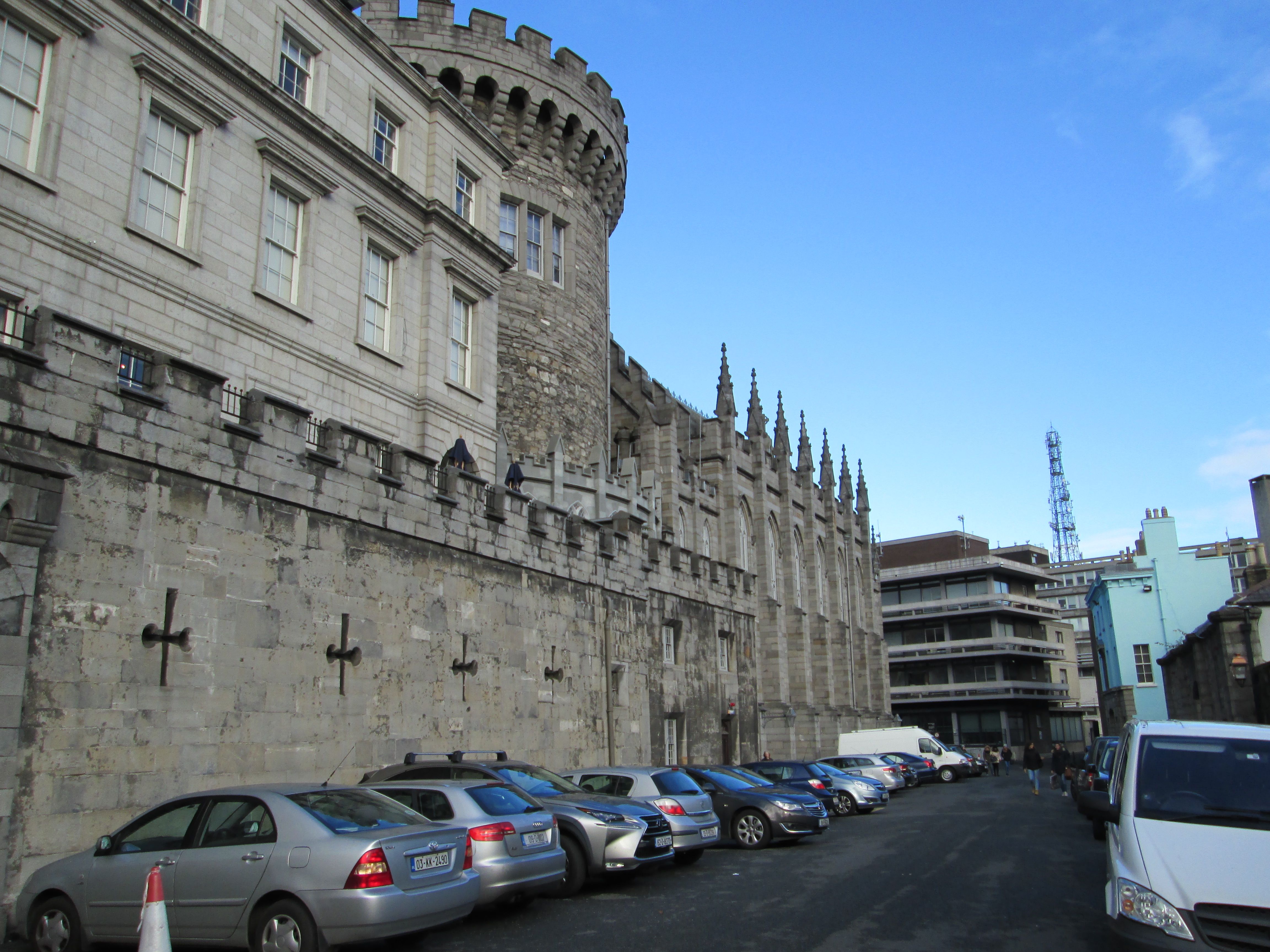
Records Tower

Records Tower

At the southeast corner of the yard stands the only remaining visible structure from Medieval times, the Records Tower. This was the main prison of the Castle up to the nineteenth century, and it is from here that the young Red Hugh O’Donnell escaped in Elizabethan times. The battlements were added in the nineteenth century at the same time the Chapel Royal, now the Church of the Most Holy Trinity, was built in the Lower Yard. The Church is built in the neo-Gothic style, then replacing the Georgian in the affections of Dublin.

Shortly after surrender, the Castle was occupied by the Civic Guard, later the Garda Siochana, the national police force. So, much of its original function as the focus of law and order persists. For a time the Castle was also used ad hoc for emergent government departments of the new state. The Revenue Commissioners remain on its eastern side, Bord Telecom on the Ship Street side. As a young man in the 70s, my first fulltime job was with the P&T, the telephone company, and I was posted here for training. With my urban hippy chique, all hair and patchouli oil, I was not best clad for a trip past the Drug Squad HQ every morning. The Castle felt like an old, forgotten outpost then. The satellites were sodden pubs, the rained-on cobbles of an empty Temple Bar.

Older now it may be, but the Castle itself has been rejuvenated as a venue for civil and state occasions and a major tourist attraction. The State Apartments along the south wall have been lavishly refurbished. There’s a garden on the site of the old Dubh Linn, overlooked by the Chester Beatty Library. Rehoused here at the turn of the century, this holds the collection of the American mining millionaire, a priceless treasure of Oriental manuscripts, art and artifacts.

IMG_0708

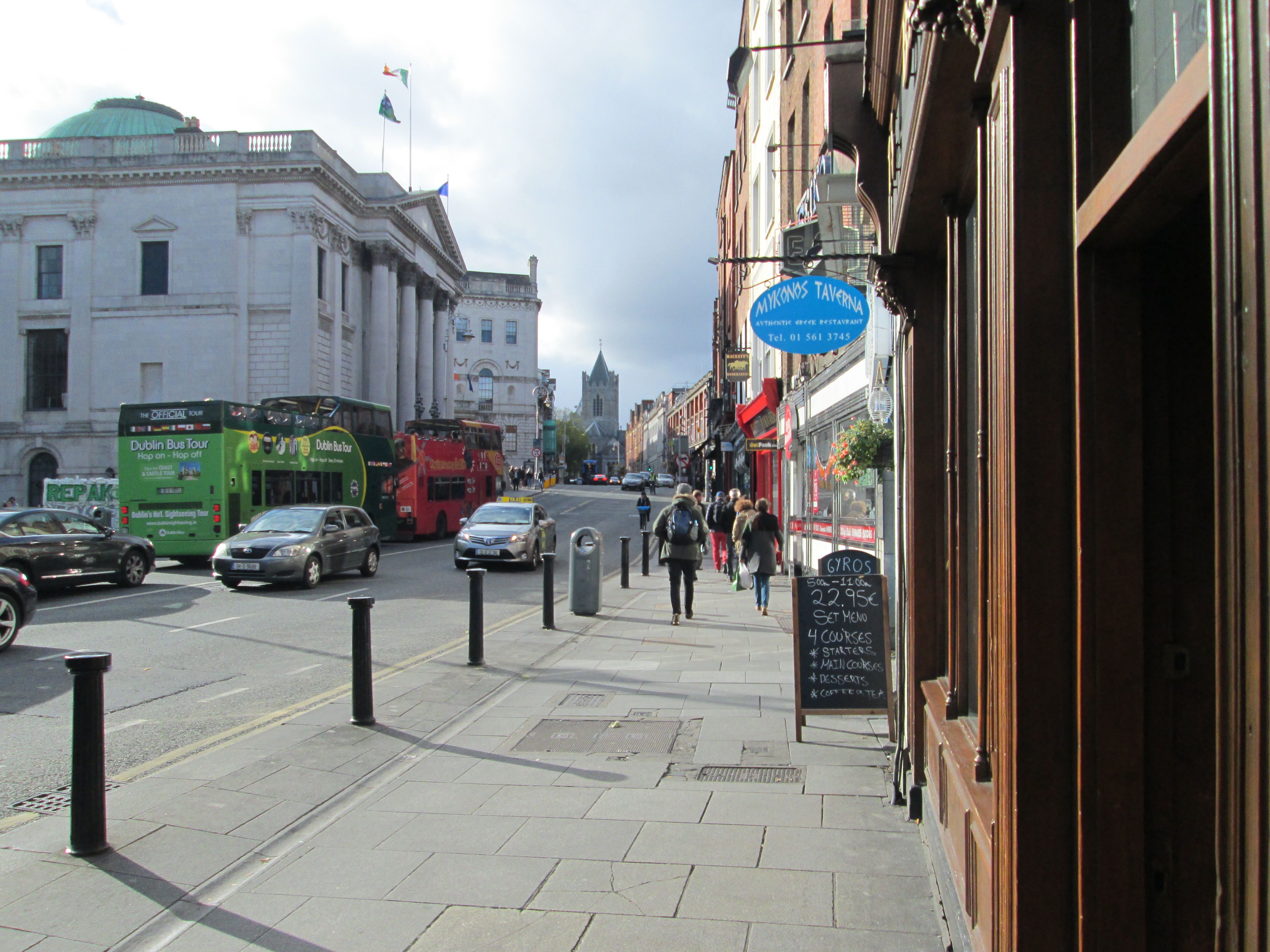
Standing at the entrance beneath the Bedford Tower, you stand very much at the crossroads of Dublin. The ancient settlement is a palimpsest here, overwritten by Norman Gothic, Jacobean, Georgian, Victorian and Modern, it is still a story contiguous with scattered settlements of Celts and Danes by a dark pool. Looking north, Parliament Street makes a straight line with Capel Street to disappear into the distance. This is the axis that bisects Dublin, the dividing line between the old, downmarket westside, and the new, more salubrious eastside. The divide is evident still

Dublin City Walls

Image

Entering Crampton Court

Entering Crampton Court

I’ve been spending my money in the Old Town,
It’s not the same, Honey, since you’re not around.

Dublin’s Old Town was delineated by its walls. Mostly vanished now, some fragments remain, and vestiges of the ancient street plan allow us to follow an imaginary walk around the ancient city. The Dane’s settled here in the ninth century, dropping anchor at a tidal pool just off the Liffey, fed by the River Poddle. Their settlement was known by its Gaelic designation, Dubh Linn, meaning Dark Pool. The Poddle, now just a stream, flows underground, while the footprint of the pool remains as an ornamental garden, along the southern walls of Dublin Castle.
At the Lower Castle Yard, you can see that the ground is low enough to accommodate a natural moat. To head downstream towards the Liffey, leave the Yard and cross Dame Street. A narrow covered laneway passes to the side of Brogan’s Bar, leading into Crampton Court, to the rear of the Olympia Theatre. Dilapidated now, and a bit dodgy, this was a bustling centre of commerce in Early Modern days. Dublin’s first coffee houses sprang up here, popular meeting houses for traders and merchants before the building of the Royal Exchange.

Leaving the Court, a narrow covered alley leads out to Essex Street, by the Dublin Theatre Festival Office. The old Custom House once stood opposite, before Gandon’s Georgian masterpiece was built further east around 1800. The site is now occupied by U2’s Clarence Hotel. After the eerie silence of Crampton Court, it’s into the rattle and hum of Temple Bar. Close by to the right, the Project Arts Centre was an early manifestation of arts and entertainment a decade before the Temple Bar scene bloomed. Here in the Seventies, prog rock and punk jostled for attention with art and drama. Jim Sheridan cut his teeth here with the likes of the prescient Inner City Outer Space.

Parliament Street

Parliament Street

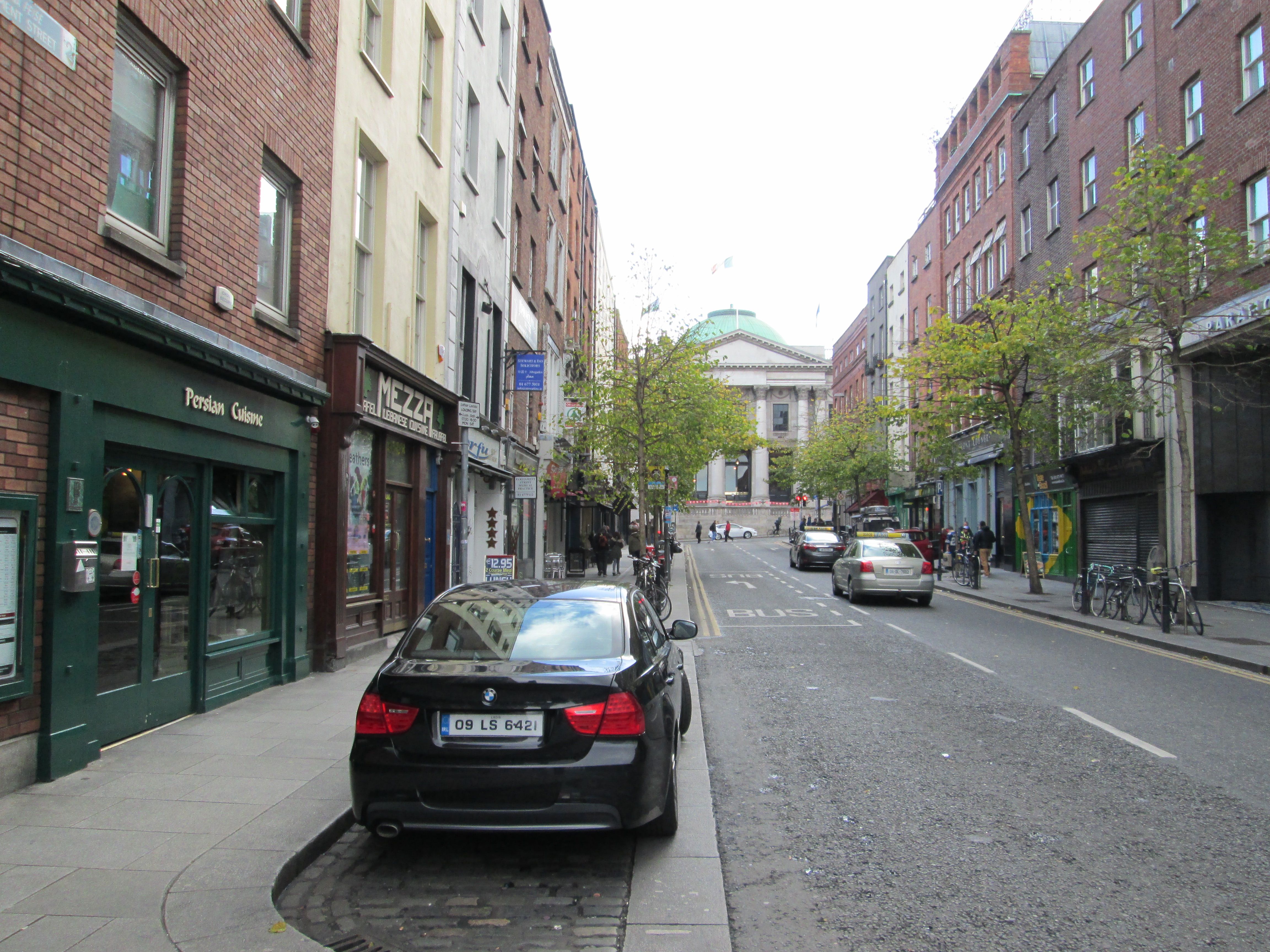
Heading west, Parliament Street marks the extremity of Temple Bar. Standing here one night recently, waiting for a friend, I experienced the tangible beat surging through the district. Back to the river, I took in that iconic Dublin view of the City Hall, even more dramatic when illuminated at night. One of the finest Georgian buildings in the city, it was originally the Royal Exchange. We had a drink and Fish n Chips in the Porterhouse. This was the first branch of the pub chain beyond its Bray home, now Porterhouses can be found in London and New York. Some things change, while others remain the same. Read’s Cutlers is Dubli’s oldest shop, dating back three hundred years. The Turks Head Chop House across the street harks back to ancient times, the Czech Inn, more recent.
That night, we headed towards Vicar Street for the Waterboys gig. Retracing old and ancient footsteps. This was often our route home after a gig at the Project or Zeros. Those days it was deserted around here, now nightlife and daylife are colonising the area too. We pass Cow Lane with it’s restaurants rising in terraces up towards Lord Edward Street. We join Fishamble Street as it curves uphill. This was Dublin’s original fish market, as the name suggests. This was also where Handel’s Messiah first rang out. At the Great Music Hall in 1743, seven hundred people enjoyed the first performance. Anticipating the large crowd, men were requested not to wear swords, women to refrain from wearing hoops.
IMG_0687

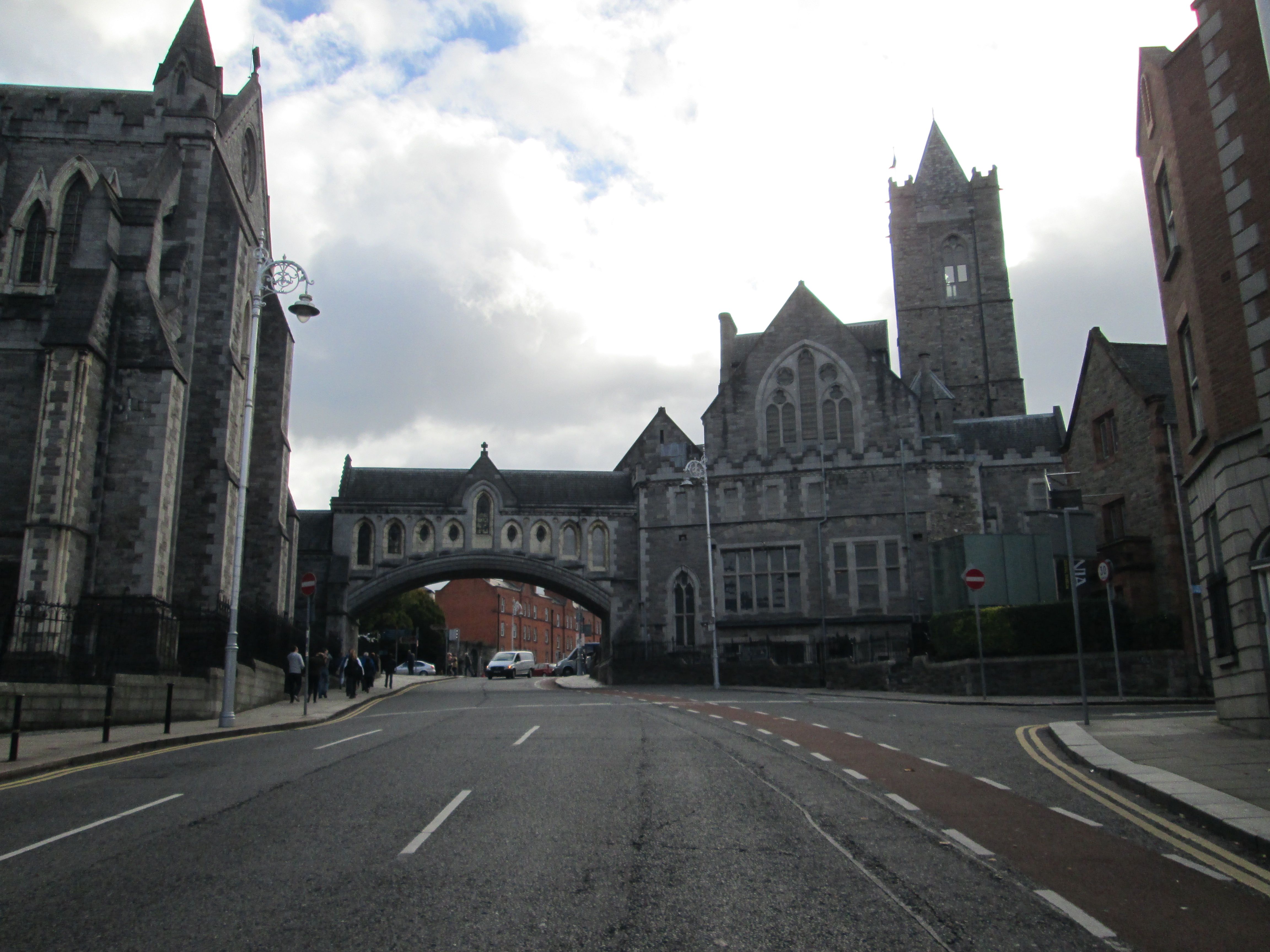
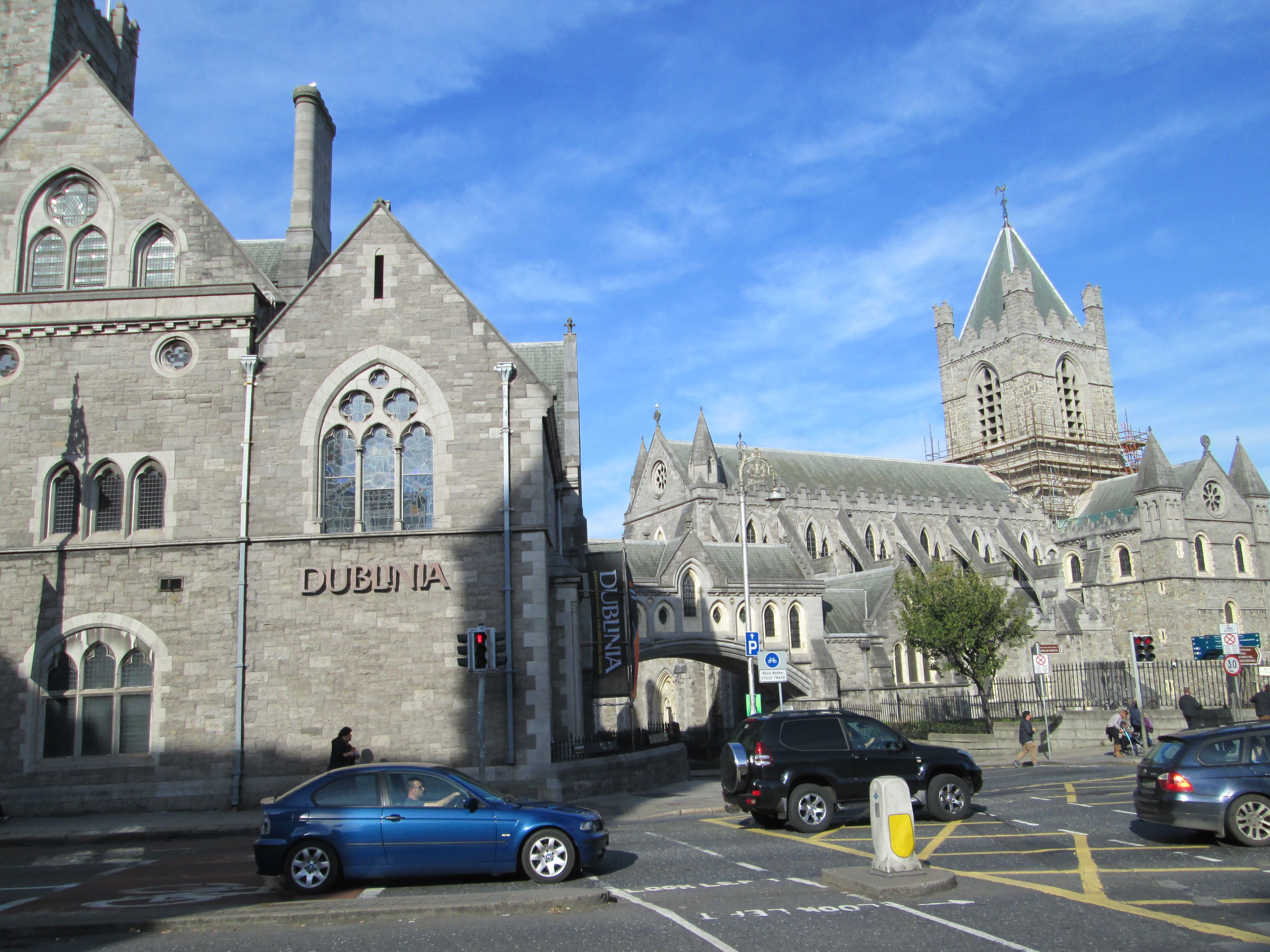
Christchurch Cathedral occupies the highest ground of the Old Town. Just below the cathedral, which dates back to the 12th century, are the Civic Offices. Sam Stephenson’s ‘bunkers‘ at Wood Quay, site of the original Viking town, excited great opposition. Twenty thousand marched through Dublin in 1978, but ultimately the campaign failed to halt them. Screened by more postmodern structures now, the four brutalist towers are less ominous than they originally appeared. Winetavern Street appears to pass through the heart of Christchurch. An elegant Neo-Gothic bridge spans the road to join the cathedral with the former Synod Hall which now houses Dublinia, an extensive exhibition of Viking and Medieval Dublin.

IMG_0690

St Audeon’s Gate  on Cook St.


Further west, along Cook Street, is the only good segment of wall remaining. Well restored, it gives some idea of what it would be like approaching Dublin in medieval times. The segment incorporates Saint Audeon’s gate, the only remaining city gate. St. Audeon’s Church is just above the gate, a modest structure established in early Norman times, it has witnessed great urban expansion over the centuries. Bridge Street descends to the Liffey, for a long time this spot was Dublin’s main fording point. In the twelfth century, a tavern was established here and the Brazen Head lays claim to being Ireland’s oldest public house. Dean Swift is said to have lowered a few here, probably en route to or from Celbridge and his trysts with Vanessa. Across the road, O’Shea’s is one of Dublin’s most renowned trad and ballad boozers.

Back to the top of the ridge, there are actually two St Audeon’s churches. The Catholic church is housed in a more imposing neo-classical structure. It is the designated church for Dublin’s Polish community. Passing outside both is Cornmarket, though there is nothing bucolic about it these days. The over-widened thoroughfare sends a constant stream of traffic west towards Thomas Street. Crossing the street, shades of Eddie Murphy in Bowfinger, Lamb Alley has a small fragment of wall. We are near the westernmost point of the walled town. From here, the walls sloped downward and eastward, cutting across Patrick Street where the Iveagh Trust Buildings now stand.

IMG_0697

Iveagh Buildings on Patrick St.


These were built in 1904, a housing development for the poor of the Liberties. The surrounding area had become a slum by the nineteenth century. The first Lord Iveagh, Edward Guinness, great grandson of Arthur, had established the Trust to provide housing in Dublin and London. The massive five storey blocks stretch all down Patrick’s Street to Saint Patrick’s Cathedral. In red brick with mansard roofs and gabled fronts, they are a distinctive and unified feature of Dublin’s streetscape. The complex also included public baths and a men’s hostel. On Bull Alley Street a ‘People’s Palace’ was built in a more ornate, grander style. This provided recreational and canteen facilities for the young of the area. It came to be known as The Bayno, an essential part of growing up in the Liberties. Closed in the 70s, it is now the Liberties College. Iveagh also developed the park opposite, it offers a great view of the St. Patrick’s Cathedral, the largest church in Ireland. Swift, Dean of the cathedral in the eighteenth century, was himself a passionate advocate for the poor of Dublin. Drapier’s Letters, A Modest Proposal and, arguably, Gulliver’s Travels, cocked a snook at English colonial misrule.
At Werburgh Street we are nearing the precincts of the Castle again. St Werburgh’s Church once had a soaring spire, but unfortunately it overlooked the Castle yard and was soon demolished. Nearby is Leo Burdock’s fish and chipper, Dublin’s most famous. Local resident Leo established it in 1913. Derby Square was also nearby. This obscure enclave features in Phil Lynott’s evocative ballad ‘Dublin’.

At sea with flowing hair I’d think of Dublin,
Of Grafton Street and Derby Square and those for whom I really care,
And you, in Dublin.

IMG_0700

Ship St

Ship Street seems far inland for such a name. But it leads down to the location of the original Dark Pool. This is now an ornamental garden along the south wall of the Castle. The Chester Beatty Library was moved here at the Millenium. The American mining magnate had established an unrivalled collection of oriental arts and crafts. There is a good cafe in the entrance atrium. Gaze up at the Castle from the grassy surface of the old pool. It has taken a thousand years to get here, the walk itself took just over half an hour.
Follow the course of the ancient river back to where we began. The circle is closed, twelve centuries spanned. Cobbled streets are peopled by ghosts, of Viking, Norman, English and Gael, the ghosts of merchants, vicars, peelers and poets, where musicians have played and sang through time. Philo’s words come back to haunt me…

I’ve been spending my time in the Old Town,
I sure miss you, Honey, now you’re not around,
You’re not around this Old Town.
IMG_0708

Barcelona Revisited

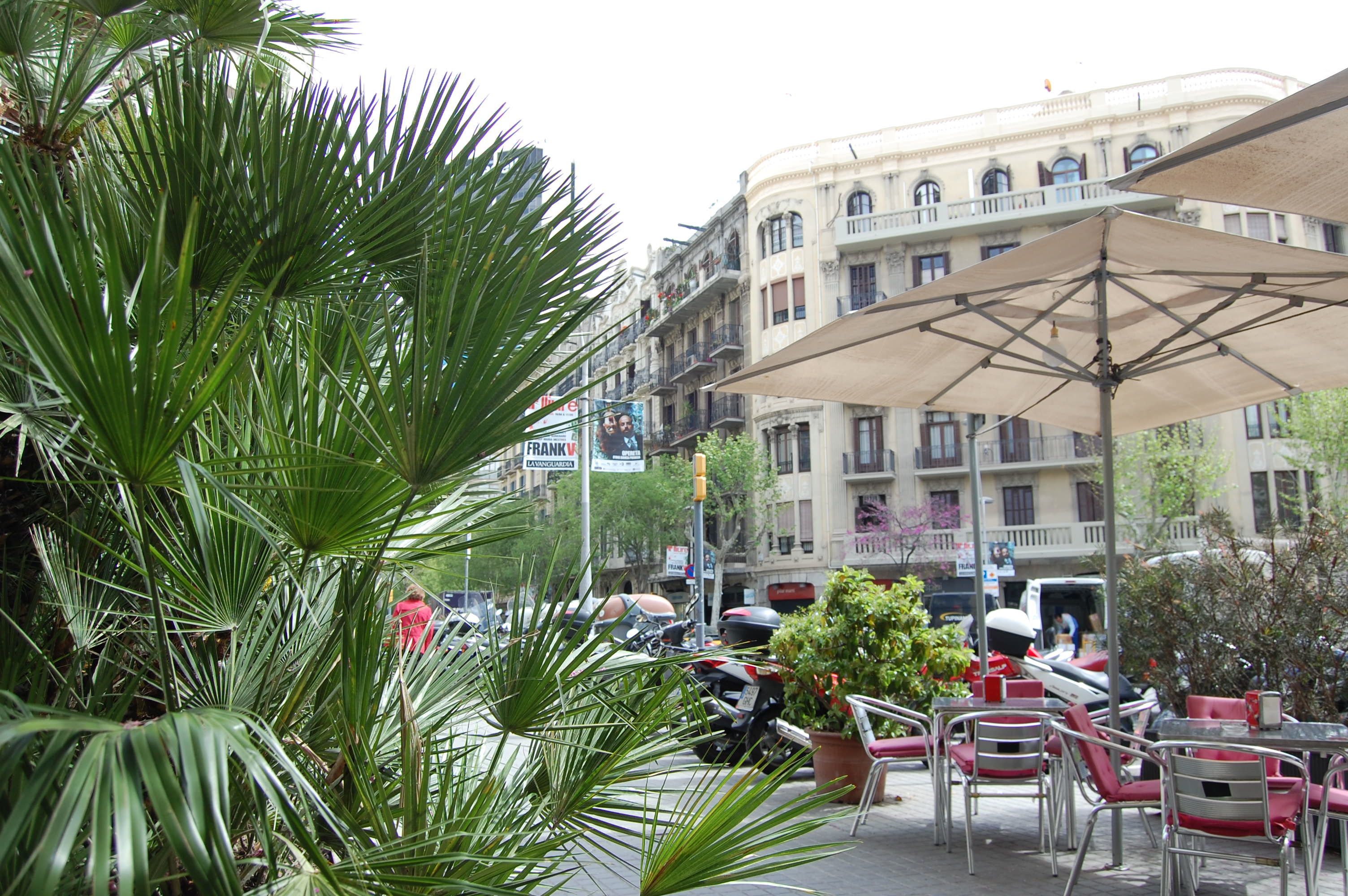
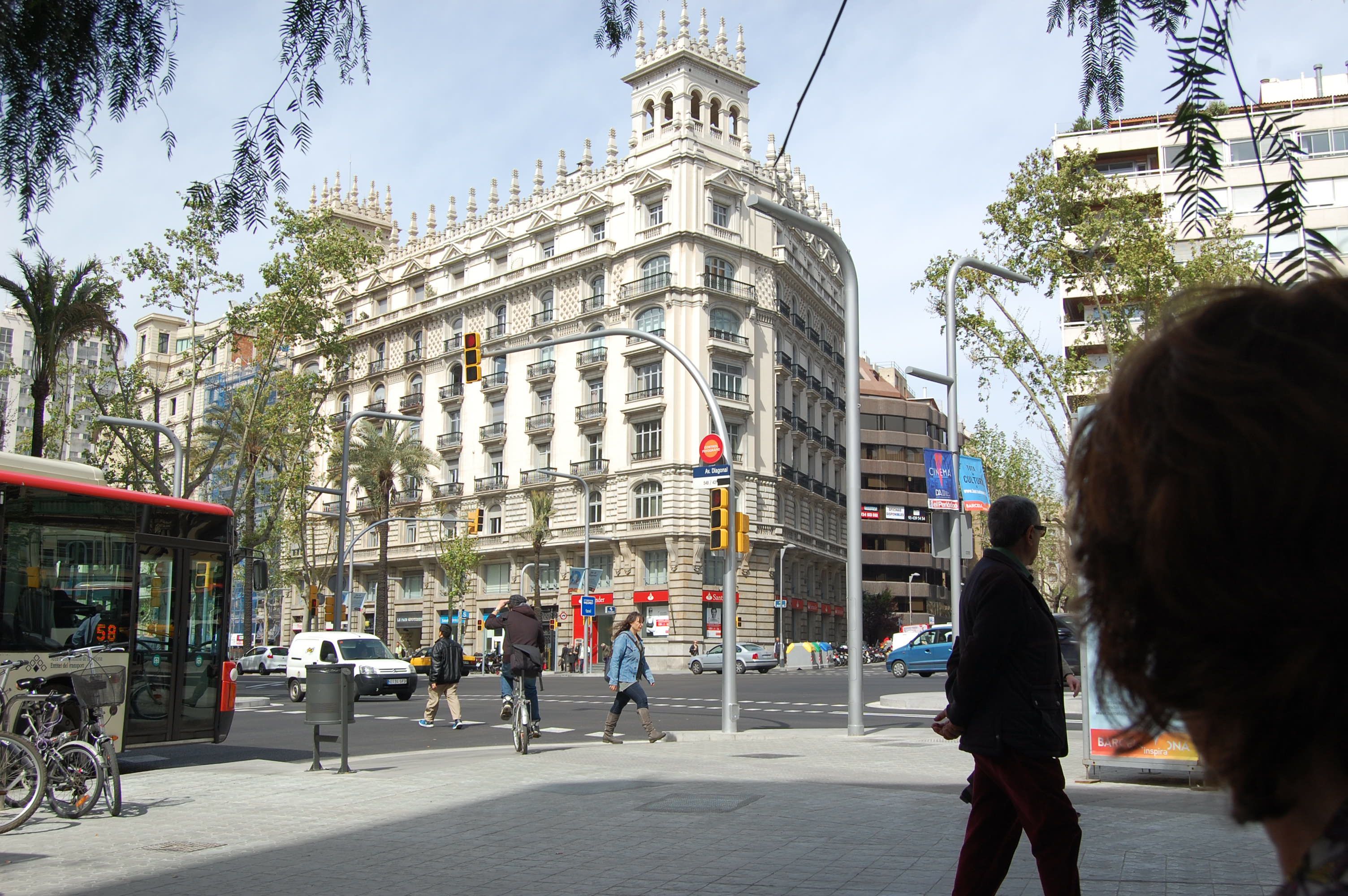
Revisiting Barcelona recently, it struck me that I have only written about the city in my fiction, though never entirely explicitly. I have few photographs other than these I took around the Eixample. Maybe that’s not so surprising. Like Dublin or London, I have been too immersed in the detail to make a brief sketch. There is so much to the mosaic of a city, a fascination with every little piece distracts from the entirety. Then there is the city of the soul that is difficult to describe in either words or pictures. What a picture Barcelona makes! A haphazard quilt of Gaudi’s giddy spires, Dali’s trompe l’oueil, Miro’s primary creatures, Picasso’s Harlequins. The city is alive in its stone and iron, shifting its shape by the hour so that some unexpected glory or horror can loom at you from a once familiar scenario.

world 15

Barcelona was one of those places which so intrigued me that I put its map on my wall. Before I set foot outside of Ireland, these exotic charts were the background to the posters and paraphernalia gathered in mis-spent youth. London’s ancient web of confusion, Chelsea to Soho with a hint of style and sulphur. New York had the added familiarity of those iconic buildings, postcards of the Chrysler and Empire State. Manhattan’s grid growing like a musical score from the chaos of its history. Barcelona was a similar confection. Its grid pattern, like New York’s, developed from an ancient harbour. There was something intriguing about the way the two parts knit together. Like two halves of a city engaged in cartographical warfare. The exotic names were occasionally almost translatable, like a science fiction text: the Diagonal, the Rambla, the Eixample.

Seductive Spanish art of the early twentieth century established a firmer connection. Such artists as Salvador Dali, Pablo Picasso and Joan Miro fashioned a bridge of sorts. Surreal visions sprang from streetscape, seascape and parched landscape of Catalonia. Cubism brought art around corners, Miro’s mobiles moved through space. I could begin to fathom form and exuberance within the plan, find a path down into it for myself. Ultimately, of course, I had to go there.

I have had companions for that trip in reality, but that fab four won’t reform. For the moment I will travel in the company of a boy in motley. Summoned up from the stone slabs of the Rambla, where briefly he played. The artists there can sew together the three dimensions we inhabit, past, present and future. Rendered on one plane, the permanent moment stands on plinths, swirls on paper. Pierrot climbs from the pavement drawing on the Rambla, still clad in chalk and stone. Originally the work of a hirsute, apparently German street artist, always smiling behind his blond beard. His creation can transform into Harlequin at will, the perfect companion, I see myself in him and he is the Other.

DSC_0014

The endeavour of Columbus and others, faced with a shrinking of their world, opened a new frontier to the west. The American continents are designated to him in only a secondary sense, Amerigo Vespucci having more court pull. But it was here they were invented as a manifestation of a new western world. The Early Modern period sees a truly new world order develop. A preference for the rational led away from the Dark Ages toward the Enlightenment. This was our world, it was up to us to make it in our image.

Modernism is a key movement in the creation of Barcelona. In the nineteenth century the city would expand beyond the medieval confines of the Barri Gotic. The Eixample was laid out in 1860 to the plans of Ildefons Cerda. The word means extension in Catalan. The plan was to create a regular grid of octagonal city blocks, the chamfering at each corner to allow light into its intersections. Cerda’s vision was Utopian, almost socialist to its critics, positing a mingling of all classes within a uniform scheme. It didn’t work out that way. The Eixample quickly became a well-to-do neighbourhood, with a greater building density than originally envisaged. But it is as fine an example, if you will, of the beauty of urban planning as you will see.

DSC_0013

The imposition of the grid pattern does not make for a conformist city. Almost organically, magically, its architecture spills exuberantly out of the old town into the new. This is where architects threw ceramic, jeweled eiderdowns across the roofs, up there where chimneys can turn into toadstools or dragons, spires wear twisted turbans, ironwork folds into leaf and fauna.

I stand on the tower of Sagrada Familia, teetering high above the distant plaza. Pierrot calls to a woman below, but from my vantage point the place is empty of people. The sound of the cry endures, but fades, merging then with the beating of wings. The doves scatter, each bird a tear in the fabric of the day, each flying shadow a tattered window into the night.

IMG_0360

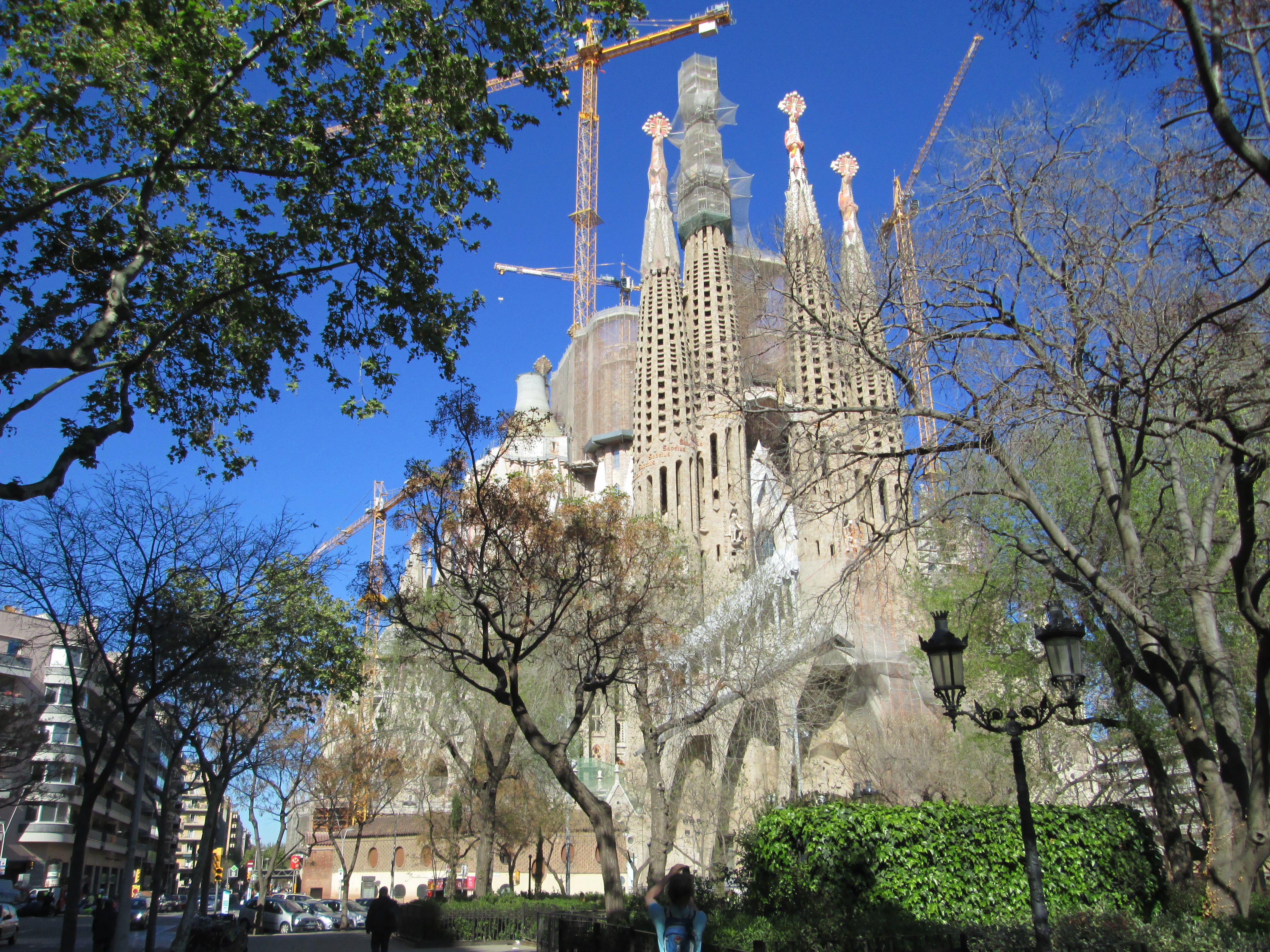
God’s own architect, Antoni Gaudi, born in 1852, was well placed to participate in the flourishing of Barcelona’s Modernism in the late century. He became the most definitive of Barcelona’s architects. Geometrically complex in conception, his buildings suspended magically within their space. Swirling domes and turrets brought eastern mysticism within the western rationale. The daring concept of the Sagrada Familia displays that eastern exotic. Each facade seems braced against giant hands clasped in prayer. The stone slips sinuously into flora and fauna, leading the eye upwards to incredible heights. It is an unfinished prayer in itself. Begun in 1883, Gaudi would devote himself exclusively to this project from 1915 until his death in 1926. It is said that Gaudi, walking to the site from morning mass, was distracted by the majesty of the construction and, stepping back to admire his work, was struck by a passing tram. The genius was gone but the work staggered on, gathering momentum in recent decades so that it is estimated it will be completed, perhaps, in 2020, the year of perfect vision.

At the Cathedral in the Barri Gotic we stand by the city walls. Statues on the rooftops wave swords, gesturing wildly to the hills. Beyond in the square Rodrigo y Gabriella play. It is Allegrias, if my memory serves me well. In a weird way I feel I am back in Dublin again. The square is full of tourists but, again, imbued with an eerie emptiness. There is a woman there, striking a southern pose, one arm raised in an imperious gesture. In the exhausted moment the light dims and the gothic city is illuminated by torchlight. Pierrot touches my arm and I turn to see him fold back into the stone. Be my guide up to heaven, I ask, but everything is silent.

Earlier, we had travelled high above the city, taking the Blue Tram and the funicular to the Tibidabo amusement park. This is a pleasure dome indeed, from the 1890s, it still features some of the antique rides from that time. We can float on air and breach the castle walls, flying above the dizzying drop with all of Barcelona below. The boy tells me the story that it was here that Jesus met the Devil, the two looking down on the wonders of civilisation. All of these things I will give thee (in Latin: tibi dabo), said the Devil, if you will fall down and worship me. The rest is history. I could sit up here forever, maybe I am. I know you can’t have everything, but sometimes, in Barcelona, it may seem that you can.

You can get anything that you want...

You can get anything that you want…

The Liberties of Dublin

As a child on early forays into Dublin, I’d sit upstairs on the bus looking over the jumbled roofs of the Liberties. Church spires punctured the sky, shifting landmarks against the sea of slate as the bus crawled down The Coombe, toiling up past St Patrick’s and Christchurch cathedrals on its way into the city centre. I recall a friend of my mother’s laughing as I blessed myself passing Saint Patrick’s. It was a Protestant church! In fact both cathedrals, though almost adjacent, are Church of Ireland. However, the persistent Catholic claim on Christchurch means the Diocese only maintains a Pro-Cathedral for Dublin.

It was down by Christchurch that I first met with Annie,

A neat little girl and not a bit shy.

She told me her father, who came from Dungannon,

Would take her back home in the sweet bye and bye.

Christchurch Cathedral

Christchurch Cathedral

Christchurch Cathedral marks the ancient centre of Dublin. It was founded in 1028 by King Sitric Silkenbeard. Dublin, more than a decade after the Battle of Clontarf, was still Danish. Sitric, one of the few survivors of the battle, became determinedly devout in his later years, the cathedral his enduring legacy. The king didn’t stay in his city to die. His throne was usurped and he decamped to York on the eve of the Norman invasion of England. A century later, the Normans came to Ireland’s green shore. Strongbow (Richard De Clare) took the spoils, including King Diarmuid’s daughter Aoife. Having defeated the Danes, in Dublin, Wexford, Waterford, and ultimately at Bloodybank in Bray, he funded the restoration of Christchurch for Archbishop Laurence O’Toole. Strongbow’s remains were interred there, while his effigy reclined peacefully on the tomb. The original stone knight has not survived, however, destroyed in one of the cathedral’s several collapses; the current figure being a substitute.

St Patrick’s, Ireland’s largest church, is close by at the foot of Patrick’s Street. Another ancient institution, it was, up to Tudor times, the equivalent of the city’s university. It’s most starred connection is with Jonathon Swift, Dean of the cathedral and creator of the permanently resonating world of Gulliver’s Travels. Next door is Marsh’s Library, a precursor of the public library. Neither borrowing nor lending were the thing then and readers were locked in cages with their chosen book to stem pilferage. Librarians these days are too soft by far.

While no visible barrier currently exists to explain the existence of two cathedrals in such proximity, that was not always the case. All those centuries ago, Christchurch was within the city walls, St. Patrick’s, without. Those ancient walls have well and truly crumbled. A portion remains to the north of St Audeon’s Church, encompassing the only remaining city gate. A couple of fragments of the wall have been unearthed nearby. At the corner of Cornmarket and Lamb Alley, a good chunk of wall gives you some idea of where the western extent of the city was.

A portion of the city wall at Lamb Alley

A portion of the city wall at Lamb Alley

Beyond here lies an area known as The Liberties. Liberties were manorial possessions, usually attached to a monastery that enjoyed benefits and independence from the walled city. Today the term applies to two ancient liberties, The Liberty of Saint Thomas and Donore, and the Liberty of Saint Sepulchre. Saint Thomas’s is delineated by its two main axes, The Coombe to the south and here, all along Thomas Street as far as James’s Street to the west. St Sepulchre’s ranges east from Patrick’s Street and Clanbrasil Street, to Whitefriar’s Street Church off Aungier Street.

All along Thomas Street and down to the Liffey,

The sunlight was fading and the evening grew dark.

Over King’s Bridge and beyond in a jiffy,

My arms were around her up there in the park.

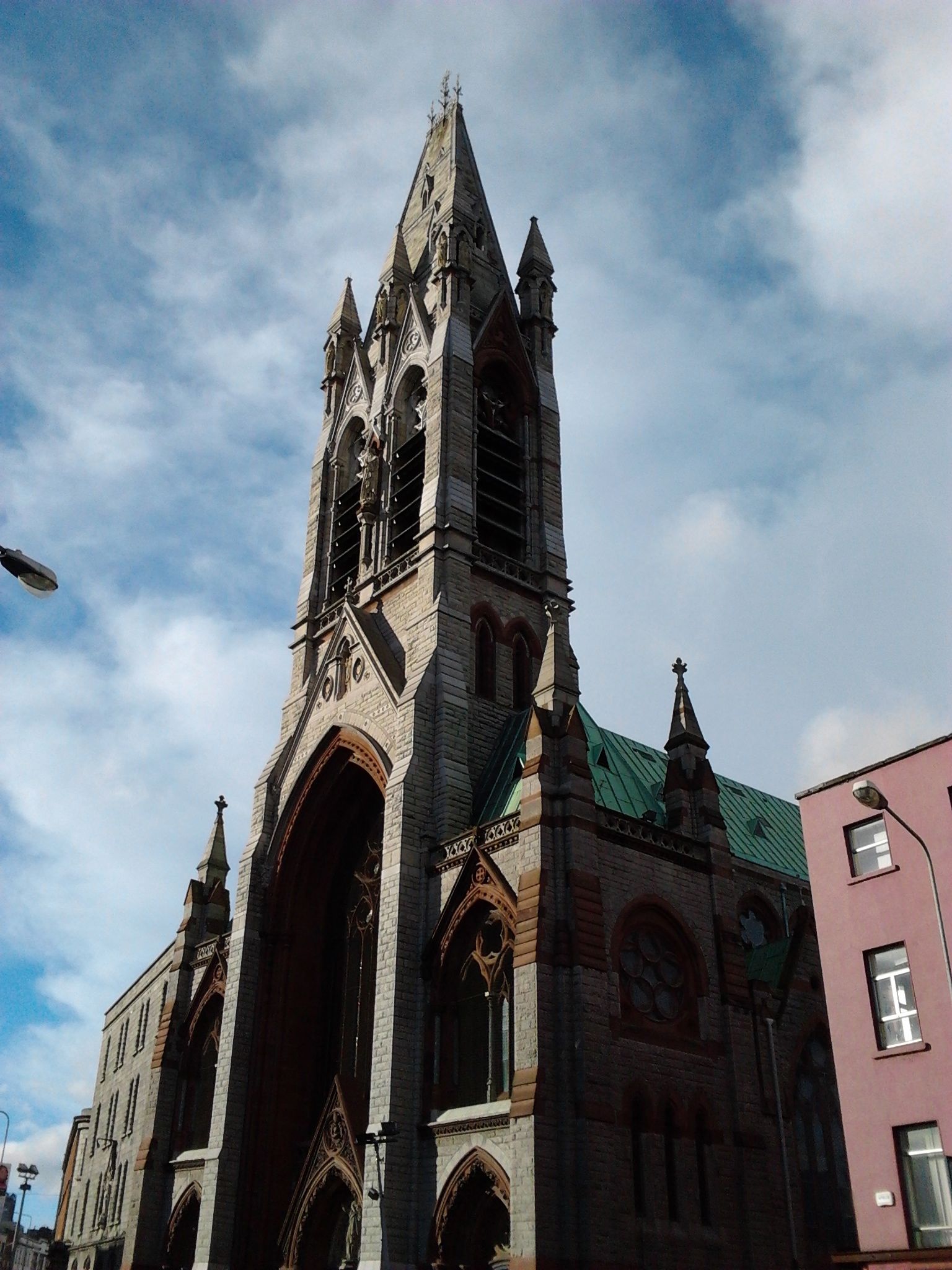
A striking landmark nails the start of Thomas Street. From afar it always seemed to me a castle in the sky, floating tantalisingly out of reach on those distant bus journeys. It is the fabulous, metred spire of the Church of St John the Baptist and St Augustine, the highest in Dublin, rising to more than two hundred feet. The church was built in the late nineteenth century where a monastery and hospice had stood in Norman times. It was designed by Edward Pugin. He was of French Hugenot stock and the building does indeed have something of the air of a French chateau about it. Described as a poem in stone by John Ruskin, it is that, it also it sings with gothic romance. The twelve statues set into niches on the tower were rendered by James Pearse, father of Patrick Pearse. Harry Clarke, that most gifted Irish exponent of Art Nouveau, is responsible for the stained glass windows near St. Rita’s side-altar. It is an interior for prayer and contemplation, a welcome respite from the antic city outside.

John's Lane Church, Pugin's 'Poem in stone'.

John’s Lane Church, Pugin’s ‘Poem in stone’.

Thomas Street evolved as a market street without the walls. Cornmarket would have been at the old western gate of Dublin. Brewing, distilling and weaving, especially silk weaving, became the main industries of the area. The busy thoroughfare was often the focus for more than industry and commerce. Thomas Fitzgerald (Silken Thomas), Earl of Kildare, made this the site for his rash assault on Dublin Castle in 1535. His forces used the upper stories as a causeway of sorts in their attempt to breach the city walls. The citizenry remained firm however, and Thomas was ultimately captured and executed.

The original monastery, the manorial centre of the Liberty, was at Thomas Court, at the top of Marrowbone Lane. It had extensive land holdings well beyond the immediate area, including lands at Ardee in County Louth and Kilruddery in Bray. At Henry VIII’s Dissolution of the Monasteries, these lands were given to William Brabazon with the title Earl of Meath. Hence, some of the names you will notice in streets throughout the liberty.

Robert Emmett had no more luck than Silken Thomas with his rebellion in 1803. Despite careful planning, his assault on Dublin Castle degenerated into a grim fiasco, with mob violence along Thomas Street. Emmett was executed for his trouble, at a gallows close to St Catherine’s Church.

Music and art have become a more notable feature of the area than riot and rebellion. Or perhaps they’re simply different facets of it. The National College of Art and Design located to the old Power’s Distillery in the nineteen eighties. Myself, amongst others, has tramped its hallowed halls. Some never escaped at all. BIMM, originally the Brighton Institute of Modern Music sends stray notes and students into the air around Francis Street. Vicar Street has become Dublin’s most comely music venue.Here, I’ve seen Patti Smith gather a group of local musicians together for a Celtic take on Smells Like Teen Spirit. Imelda May radiate love and rockabilly as the local girl made good. I’ve seen Jack L hold the audience in his hand, with the lights down and the electricity off, with nothing but a concertina and a voice to evoke the troubadour of another century. The Waterboys are coming soon, and there’s always something there.

Saint James's Gate Brewery

Saint James’s Gate Brewery

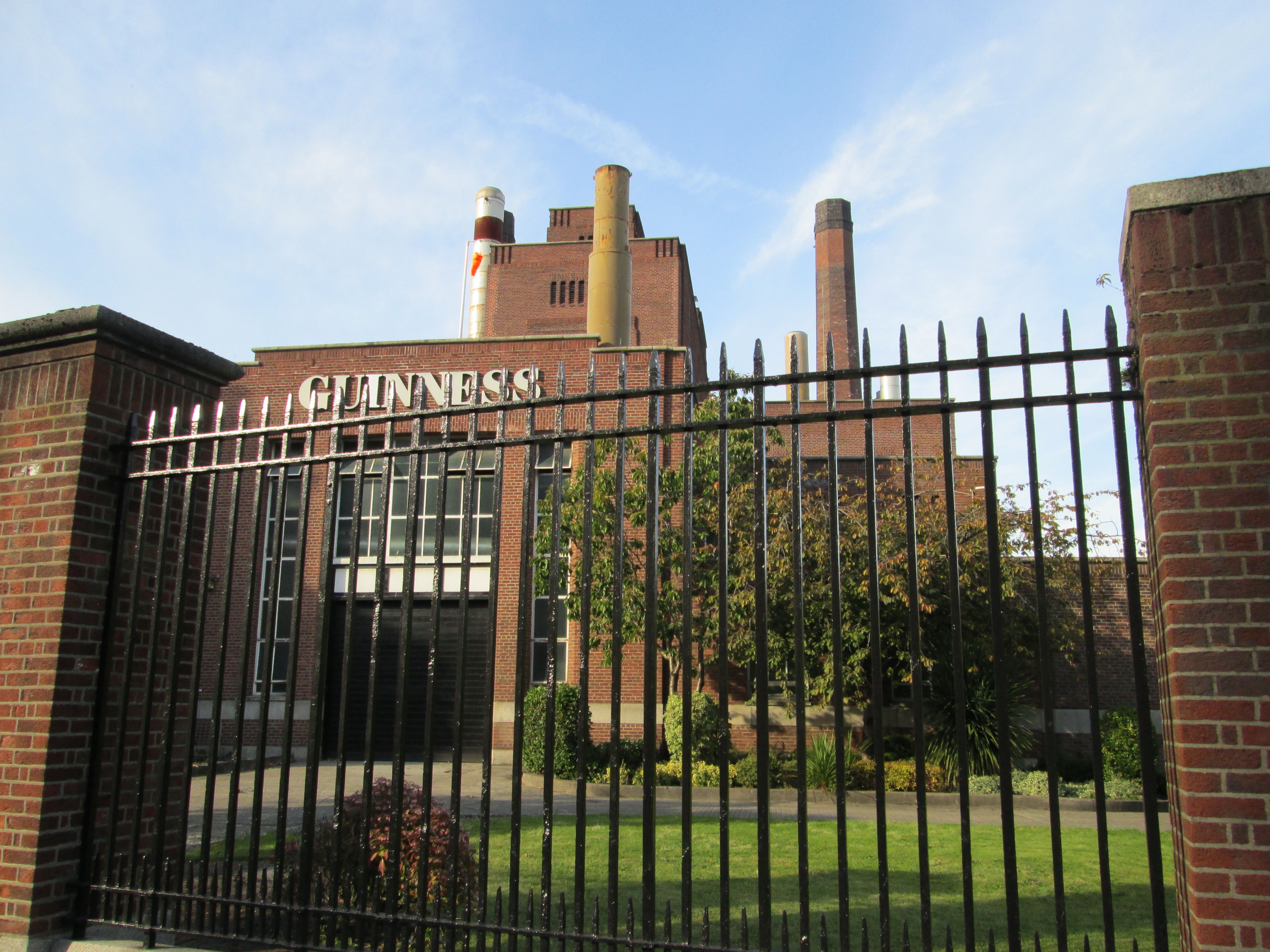
These days, Thomas Street remains one of only a couple of places in Dublin where street trading is permitted. It is, always has been, a rambunctious street. The heavy aroma of hops seeps through the air from Guinness’s brewery to the west. Arthur Guinness, from Celbridge in Kildare, founded his brewery in 1759 at Saint James’s Gate. The distinctive Stout has become something of a national emblem. As the country lurched from boom to bust, the brewery celebrated two hundred and fifty years with the inauguration of Arthur’s Day, raising a pint to the man at one minute to six on the chosen day. The great and the good, as usual, getting a whiff of people having fun, sucked in their cheeks, waved a boney finger of prohibition. But they can’t stop you doing it if you so desire. A visit to the Guinness Hop Store nearby, can be topped off with a pint and a panaromic view at the Gravity Bar. Or you can simply walk into any bar.

And what’s it to any man whether or no,

Whether I’m easy or whether I’m true.

As I lifted her petticoat easy and slow

And rolled up my sleeve for to buckle her shoe

St. James's Church

St. James’s Church

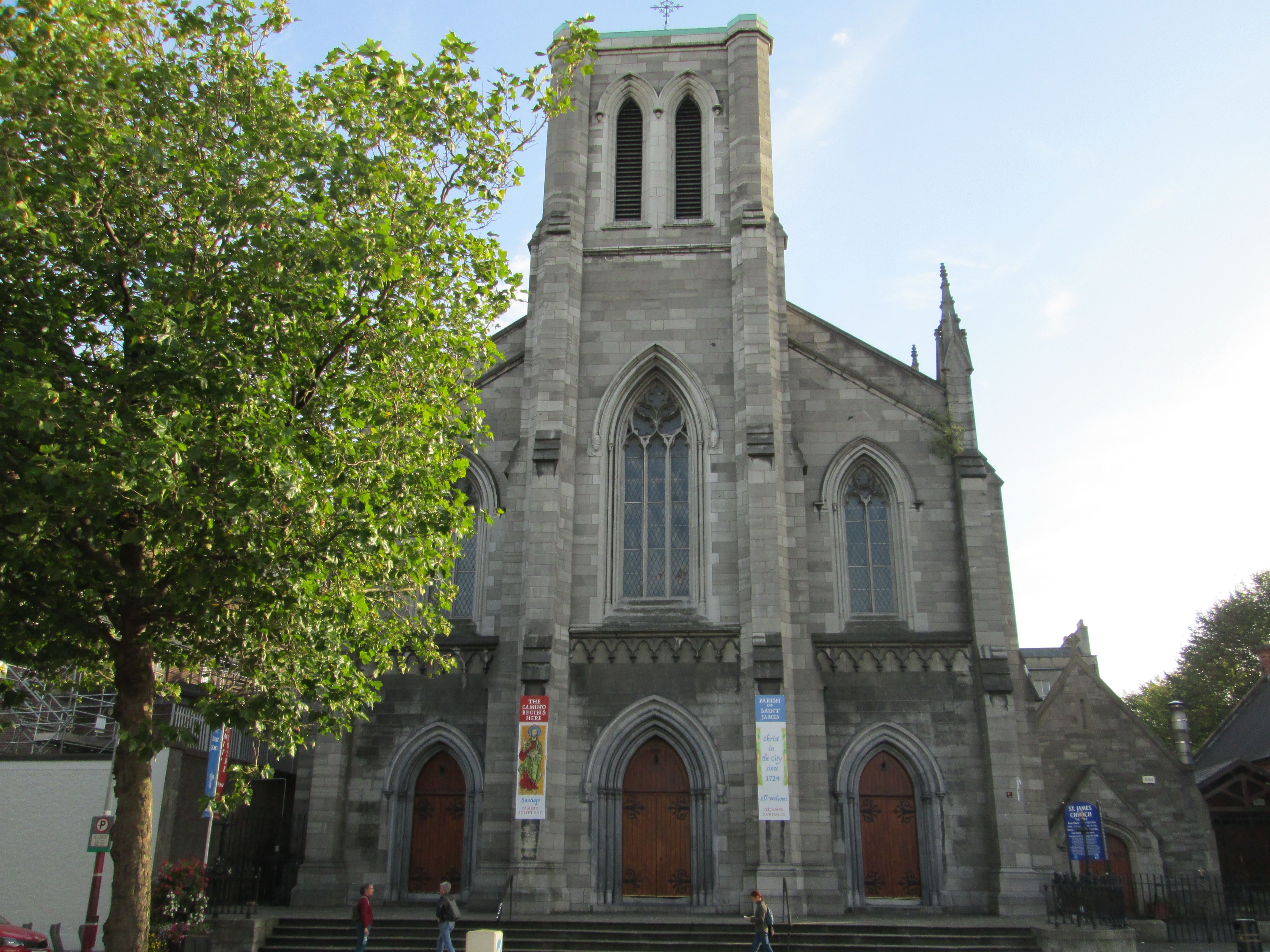
Where Thomas Street ends, St James Catholic Church marks the beginning of the street of that name. It can also be the beginning of a more ambitious walk. Passports for the Camino de Santiago are available here, a first step on the pilgrimage across northern Spain to Finistere, the very end of the earth.

The Liffey at Kingsbridge

The Liffey at Kingsbridge

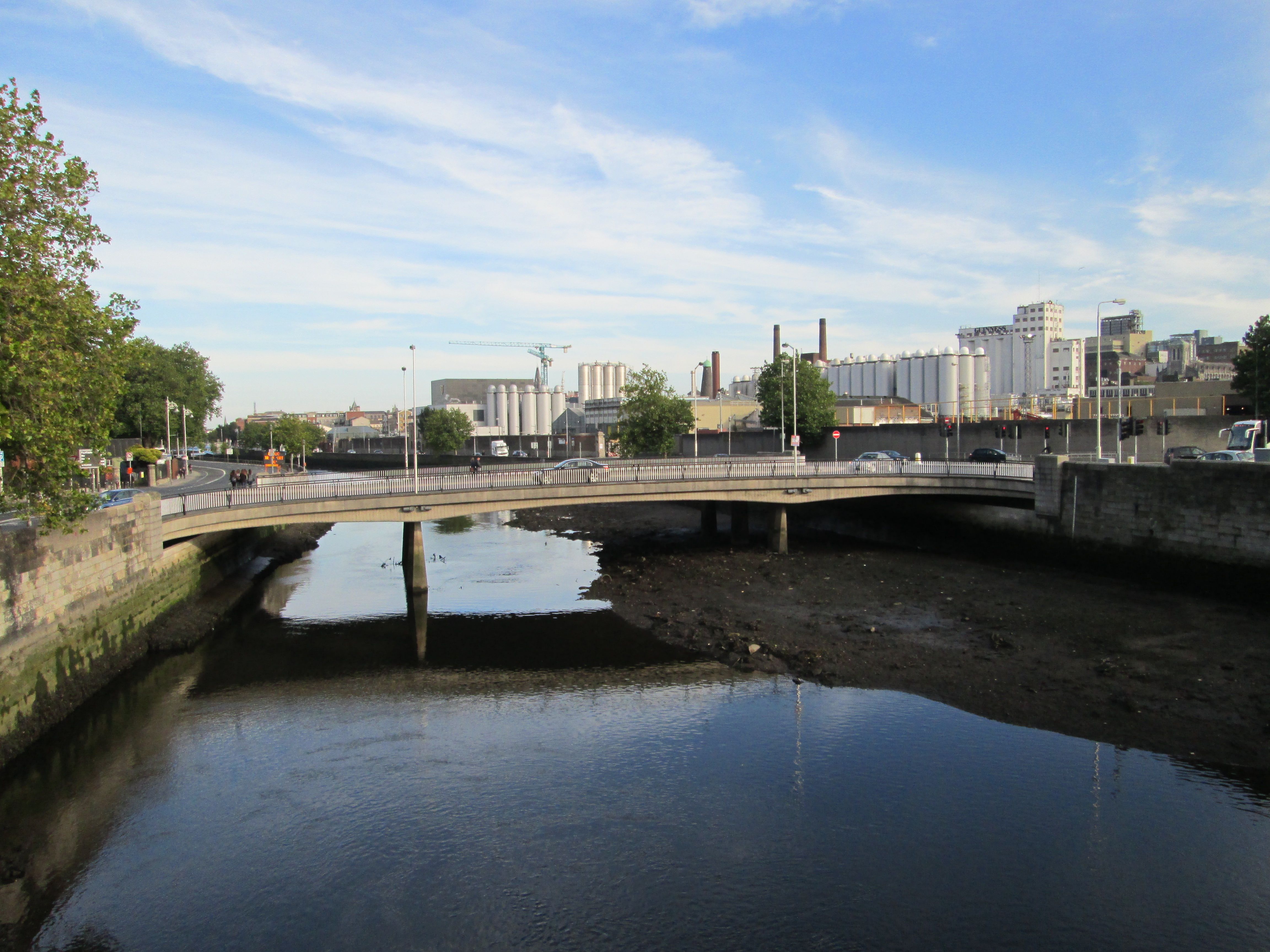
For me, I take a right turn down Steven’s Lane to Houston, formerly Kingsbridge Station. A fine piece of Victoriana from 1846, it’s the principal western rail terminal for Dublin. also serving the southwest. There’s a good bar to the side, and seating outside not far from the Liffey. To the west lies the Phoenix Park, to the east lies the city. The Luas line carries trams regularly to and fro. I will catch one, when I’m ready, leaving me conveniently near Connolly Station for my Dart home.

Manchester

Just west of the Pennines, South Lancashire seethes with cities. We’re Manchester bound, although the route I take via the circling motorways is a bit, well, circuitous. Eventually I trust to luck, or instinct, following a long straight road that falls ever so slightly downhill. Despite a brief detour through a dodgy flats complex, courtesy of ubiquitous roadworks, I stumble upon Piccadilly Station, close to where we’re staying. Mind you, the rental company has changed its address without telling anyone, but we hunt it down eventually on the roof of a multi-story.

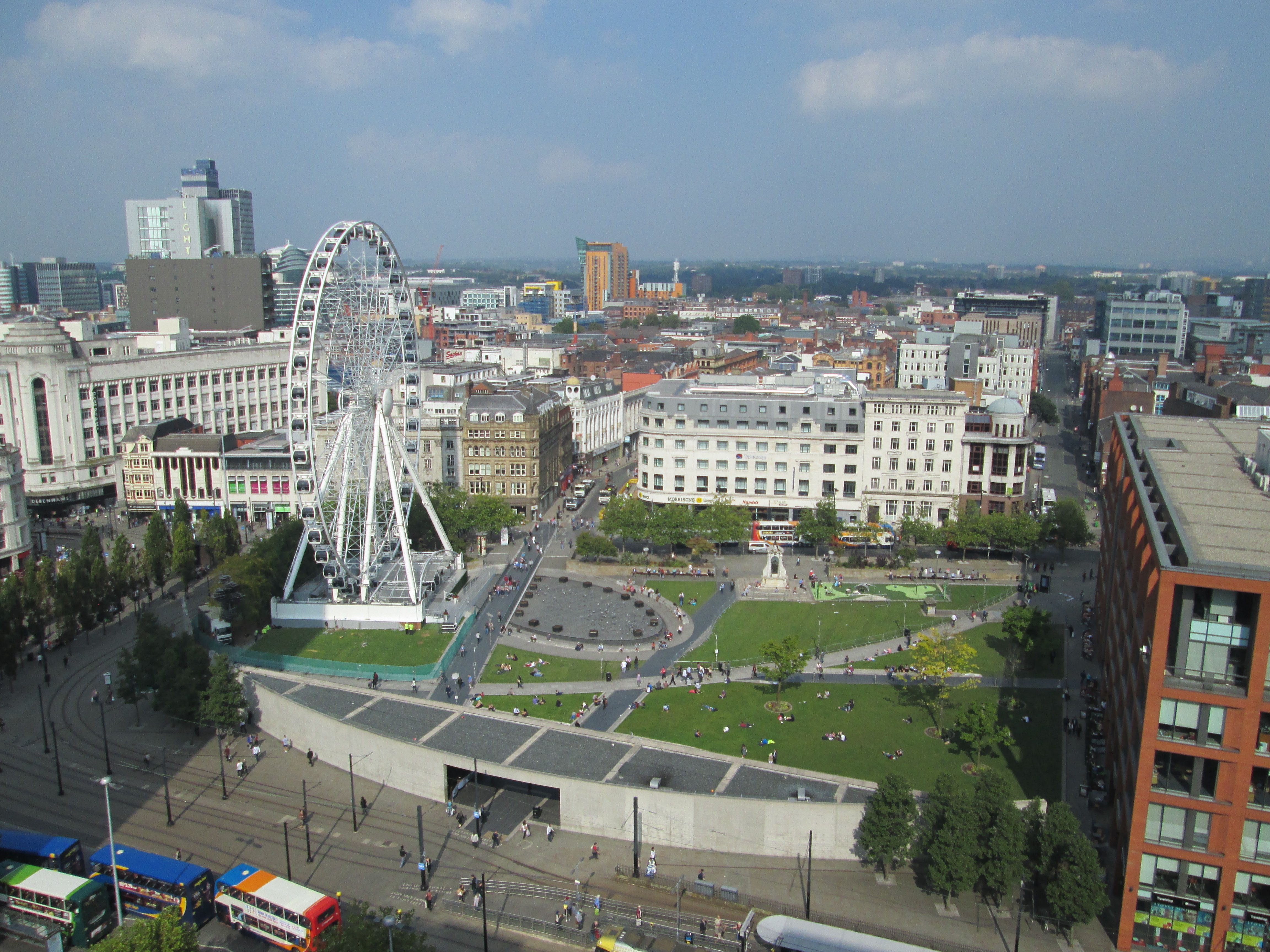
View from the Mercur over Piccadilly Gardens

View from the Mercur over Piccadilly Gardens

Manchester has been compared to an incredibly vast shopping centre, where you never feel more than halfway towards the centre, ever. It does have its fair share of malls, not necessarily a bad thing. The point is that Manchester, like many new cities, is an urban conurbation – you can go city to city without leaving town. I figure we stayed in the centre, or high above it anyway. The hotel overlooks Piccadilly Gardens which pass for the town square. Here is the hub of the clanking tram system, Britain’s most extensive and a boon for the visitor or commuter. The Gardens itself is as ugly a slice of modernity as you are likely to see, its designer presumably antagonistic to the concept of parks, or people, or possibly both. Enter, if you dare, through the facsimile of an underpass; works wonders for the confidence that. What better place to lie in wait, slither out and importune strangers for money or drugs. We decide to give it a go. One step in, someone steps out of the shadows and importunes me for money. Disengaging from that, another approaches stage right. We give it a miss, retiring instead to the relative safety of the surrounds, a rather sleazy strip of downmarket dens.

The name Piccadilly also denotes London’s centre, so what does it mean? The word supposedly derives from a collar of Spanish lace, a high fashion item in the sixteenth century. Perhaps an allusion to the parade of fashion common to a city centre. Manchester bustles more than it poses. There is a regular beat of footfall along with the throb of commerce. Plenty of shopping here, along straight, severe canyons and in extensive modern malls. Manchester has been referred to as being about as beautiful as the back of a fridge. That’s a bit harsh. While there’s something functional, determinedly commercial, about the city, there are shards of beauty in its Victorian civic and industrial architecture.

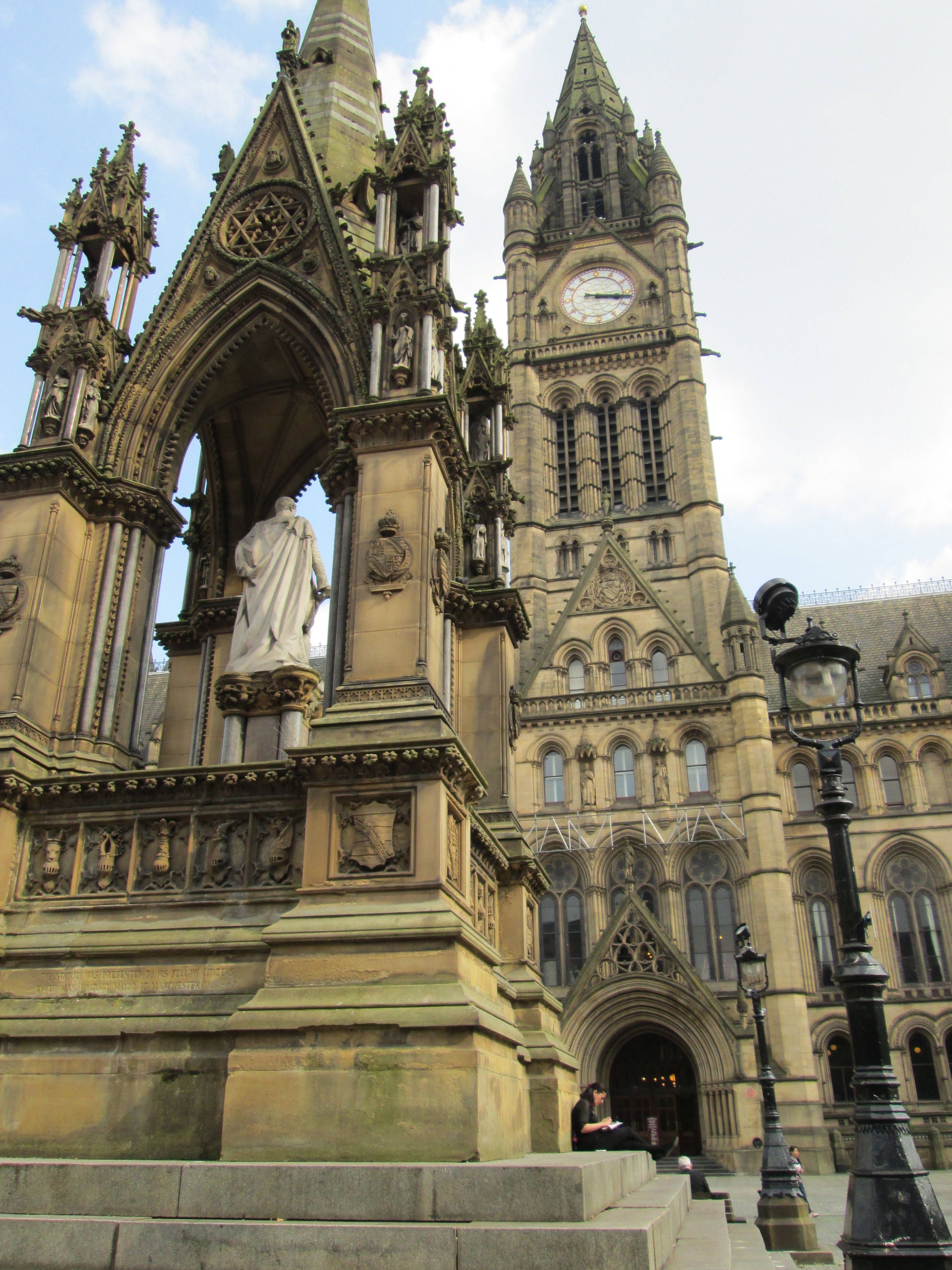
City Hall and Albert Square

City Hall and Albert Square

None finer than the Gothic extravagance of the City Hall. Palatial but, with an eye to the democracy it represents, accessible. You are free to enter, more detailed exploration by guided tour. An atmospheric restaurant peeps out of the cloistered entrance hall. Function rooms are available for those with a taste for the gothic. Both interior and exterior aspects are full of the beauties of fine craftsmanship, allied with the notion that buildings can be expressions of a higher ideal, that they can occupy the imagination as well as physical space. It dominates Albert Square, a surprisingly calm space boasting almost as many statues as people. While herself plunges into the sea of shopping, I linger in the square, The Chop House on the corner providing the oasis, a quiet pavement table with a view.

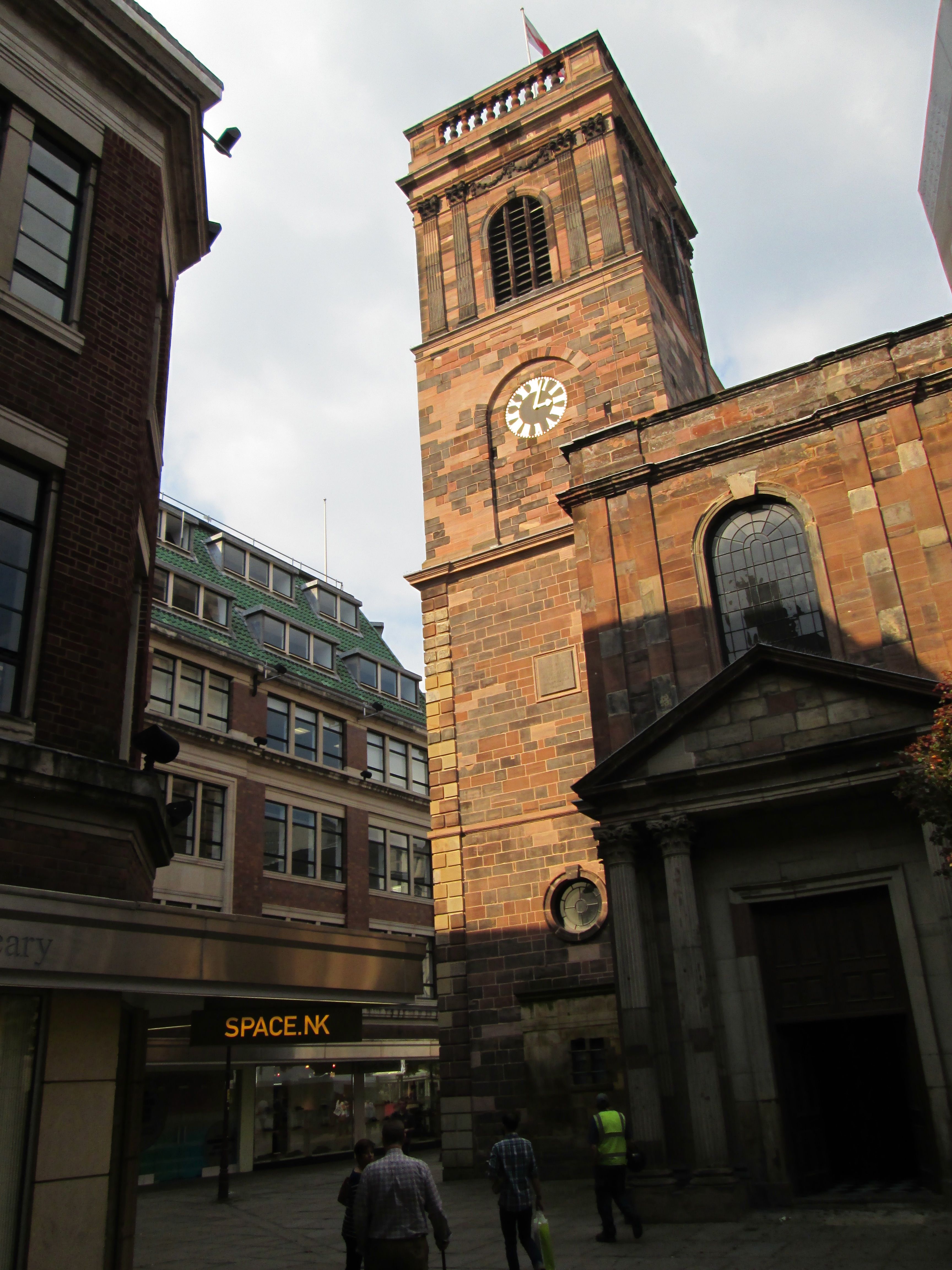
St. Anne's Church

St. Anne’s Church

We’ve arranged to meet at St Anne’s Square, a smaller, intimate space which also offers respite from the commuting and shopping throng. The old church that gives the square its name has been here since the eighteenth century when Manchester was still a small town. A feeling of more olden days pervades. There are market stalls, pub and restaurant marquees, and the right ambience to relax and watch the world go by.

Manchester is really a modern city. It only received that designation in 1853, by which stage it was on the crest of the tidal wave wrought by the Industrial Revolution. Cotton was king, the city even nicknamed Cottonopolis. Warehouse City was another monicker, as the city flexed its industrial muscles to conjure up a Lowryesque landscape. The artist was a local, lived, studied and is buried here. The major museum in his honour, The Lowry, is housed nearby on the Salford Quays. Manchester, lest we forget, became a major port in the late nineteenth century. Over sixty miles from the sea, it was connected by the Ship Canal in 1894.

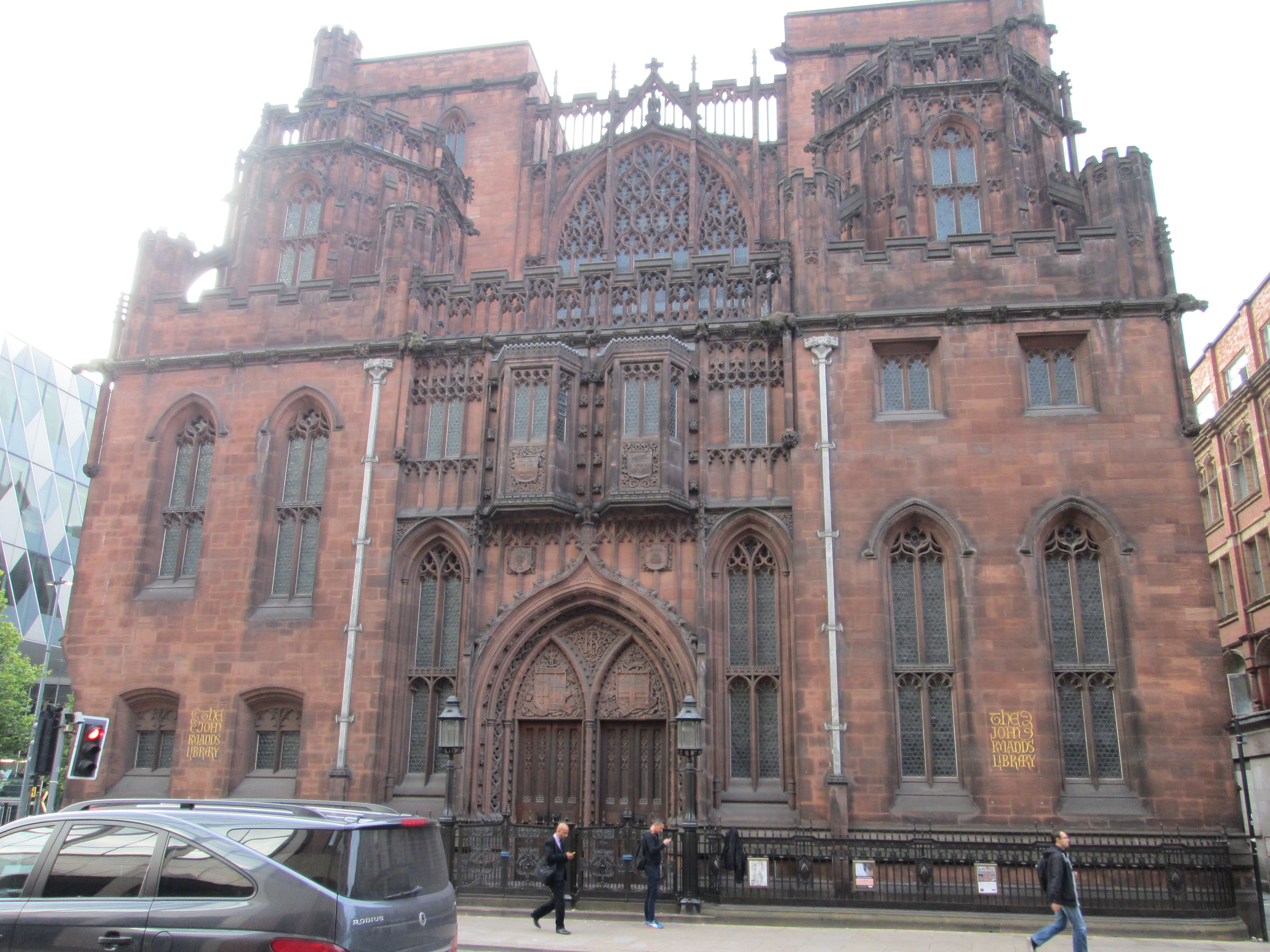
Ryland's Library

Ryland’s Library

Along Deansgate, you can catch the flavour of power that propelled this city into the twentieth century. Handsome proportions of streets and buildings, the Victorian and Edwardian palaces an impressive statement of wealth and craft. Not only God and Mammon, Manchester nurtured culture too. The John Rylands Library is a supreme Gothic confection from the early nineteen hundreds. It houses ancient papyrus and illuminated manuscripts, a Gutenberg bible and an extensive collection of the printing of Caxton. Beyond Deansgate lies the river and the great canal system. A city for exploration in itself.

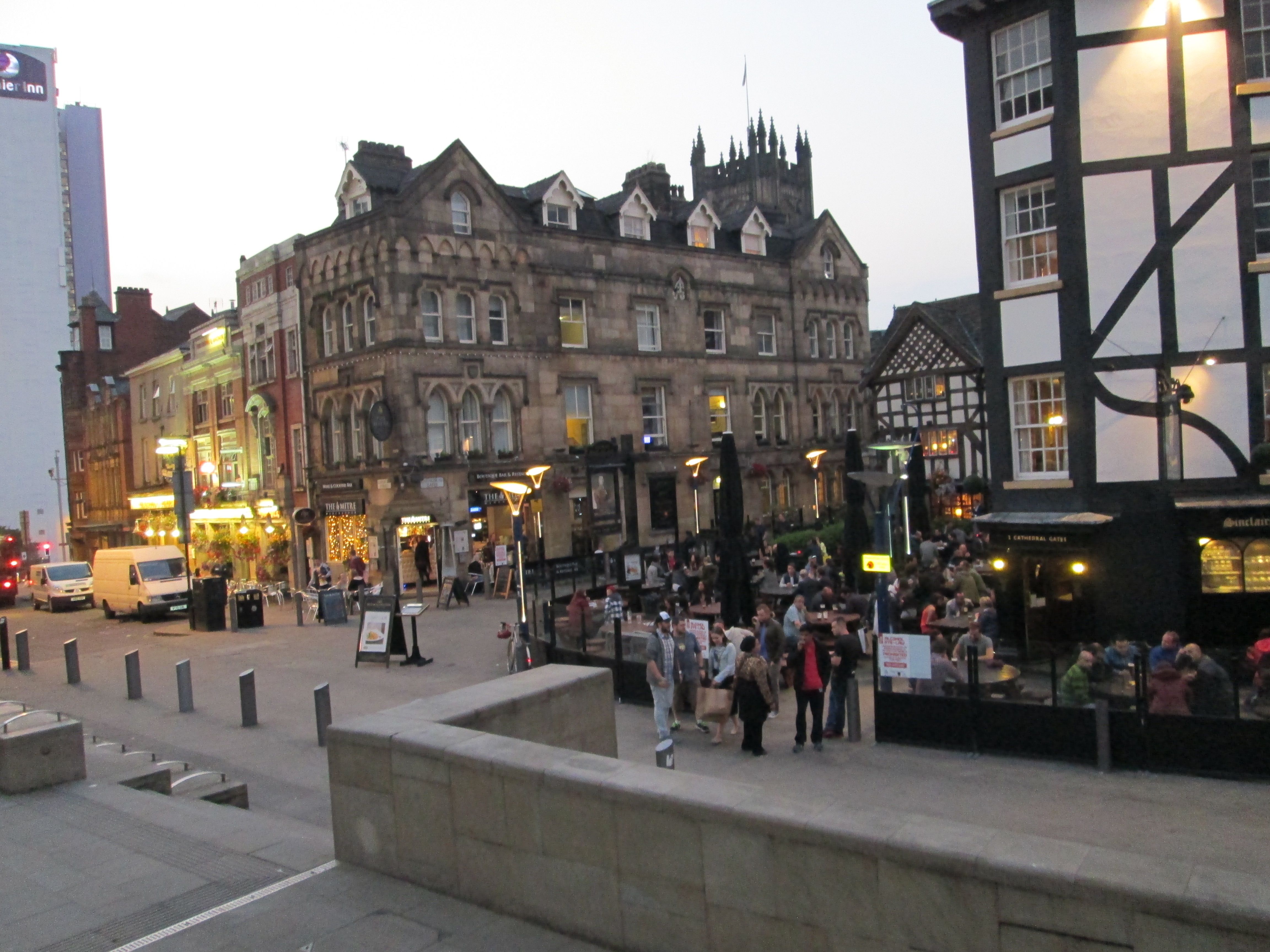
Cathedral Gate

Cathedral Gate

Hunger, for now, draws us back to the commercial hub. We dine at a high end pizzeria, and very nice it is too. This precinct has grown quieter at night but the atmosphere is good. Through a vast mall we find ourselves on a raised terrace with a view of Manchester Cathedral beyond. The Cathedral dates back to the fifteenth century though, like the city that now surrounds it, has undergone much change since. Below us is a lively spot, all mock tudor beams, called the Cathedral Gates. This is the place to be, with extensive outdoor seating and a great buzz. The medieval quarter, as such, straggles around here. There are guided walks to get you in touch with the original essence of the city. Every city comes from somewhere, you do want to keep that spirit alive.

The Mancunian with the golden car

The Mancunian with the golden car

We wake to the incessant tinkle of trams. It’s all abuzz again. We take a tram to Piccadilly Station, heading for home via England’s extensive, if weirdly connected, rail system. We require three trains to get to Holyhead; a pity the ferry cannot sail from Manchester.

Cambridge

Following last year’s visit to Oxford, we completed the learning curve with a visit to Cambridge. Just fifty miles north of London, it’s a morning’s drive in the hire-car from Russell Square, through ever decreasing suburbs into the low countryside beyond Epping. Past the Gog Magog Hills, Cambridge nestles in the fen lands, a sodden lowland through which snakes the River Cam. Romans, Angles, Vikings and Normans have stomped across this geographically open landscape, now it is pure middle England.

Cambridge is somewhat smaller than Oxford with a population of about 125,000. There is less of an urban ambience, less classical in its streetscape, it is more the winding country town. The university is the dominant force by far. About a fifth of the population are students. Formed by Oxford rejects at the start of the thirteenth century, it grew to become its keenest rival. The annual boat-race on the Thames is a famous manifestation of that rivalry.

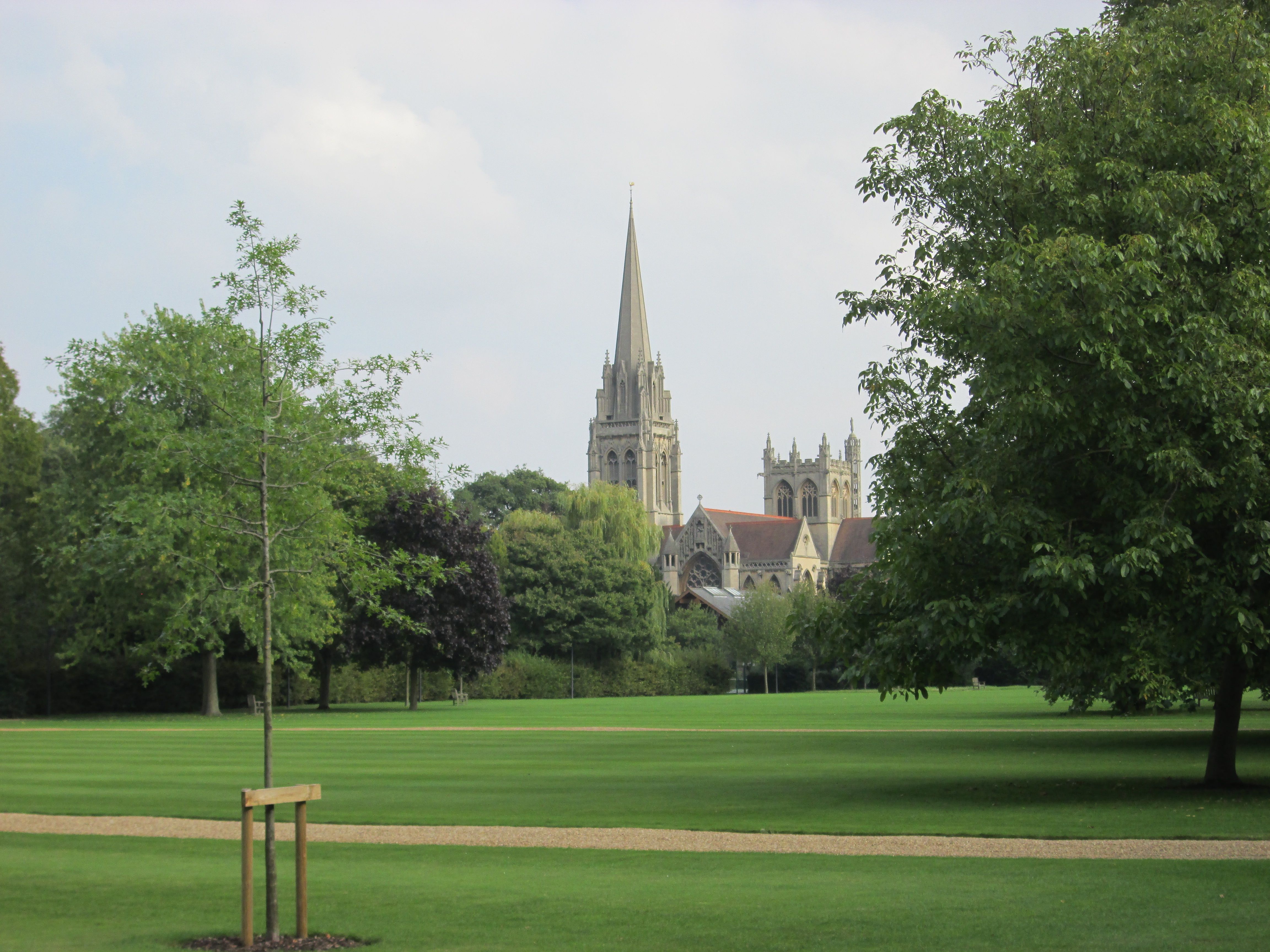
View across the Paddocks at Downing College

View across the Paddocks at Downing College

We have a room at Downing College. It overlooks a quiet quadrangle, an arcade to one side adjoins a small theatre hosting a seminar. At quieter moments we decamp there with coffee and a book. At crowded tea-breaks it is useful to eavesdrop on the networking and hob-nobbing of the seminarians. The college is in a mellow yellow stone throughout. It is cast in the neo-classical mode. Built in the early eighteen hundreds, it has been described as the last of the old colleges, and the first of the new. Its patron, George Downing also gave his name to Downing Street. Of course, knowledge is also a corridor of power. We note, with some amusement, that certain walks are confined to the Fellows. At this time of year, we should be okay. The view across the Paddocks is, in a way, quintessentially English. Yet, the spire of the church on Lansfield Road also recalls home. It’s the uncanny valley again, so near and yet so far away.

Later, we step outside of the groves of academe for our evening meal to eat curries from the carton at an Indian deli and store across the road. There’s posh for you. It was very good indeed. Next morning, we breakfast in rather grander surrounds, at Downing’s great hall. Food to feed a horse, if a bit rushed owing to our late-coming tendencies. We resolve to be better tomorrow.

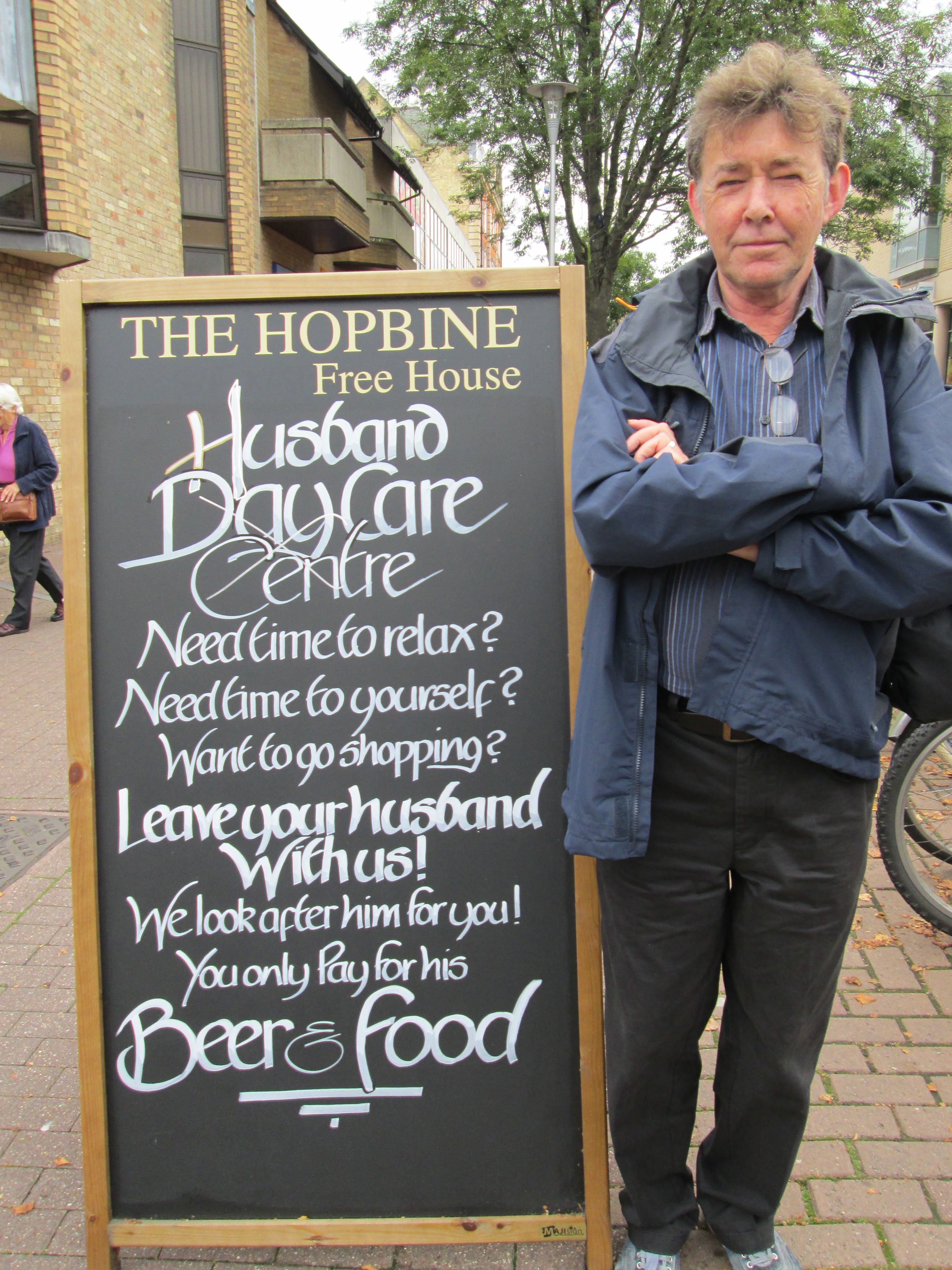
The Hopbine Pub advertises an invaluable service.

The Hopbine Pub advertises an invaluable service.

There are plenty of good restaurants here, incidentally. On our second evening we make a more serious scouting effort for our dining pleasure. The good spots fill up quickly as evening falls. We get a table at the Wildeside, another English meal with the great man, though of course he was an Oxford man. It’s quiet and stylish, with a little patio to the rear.

During the day, Cambridge, even with the tourist throngs, is eminently relaxing. Although it doesn’t quite have an aspect of dreaming spires, it is both evocative in its atmosphere and rich in visual delights. Kings Parade is probably the definitive vista. Old vernacular streetscape to one side, the impressive frontage of major colleges, notably King’s College, to the other. The winding thoroughfare retains a sense of the ancient. The oldest building in Cambridge, St. Benet’s Church, a quiet, simple structure, dates back to 1209.

Author deposits his books at Cambridge University Library

Author deposits his books at Cambridge University Library

Beyond the Cam, parkland cradles the more modern campus of the University. Cambridge University Library is a startlingly modern addition to the skyline. Built in the 1930s, the huge central tower has all the pulsing power of industrial art deco. Its architect, Giles Gilbert Scott, was also responsible for the Bankside power station that houses the Tate Modern. Chamberlain is said to have referred to it as a ‘magnificent erection’! Indeed it is impressive, it is also a repository for all books published in England and Ireland; mine too, I’m sure.

King's College Chapel viewed from the Backs.

King’s College Chapel viewed from the Backs.

Walking the city centre periphery illustrates Cambridge’s inevitable affinity with boating. Punting on the canal, or the corralled section of the Cam, is central to the Cambridge experience. Punters ply the serene waters, keeping up a patter of history, myth and gossip. Our host Phil hails from Northern Ireland, but is well versed in local lore with the gift of the gab thrown in. The route travels along The Backs, with views of the colleges across well-tended lawns. The Cam was rerouted for this. Henry VIII being instrumental in a scheme aimed at enhancing his and England’s prestige. The gothic grandeur of King’s College Chapel is another element of his legacy. Silence may have been preferrable at some sections. The Bridge of Sighs is evocative, indeed the entire poem of still water and ancient stone is a joy. But it really is a crowded river at times. You can hire your own punt too. Many do, floating drink parties are still drifting about at dusk.

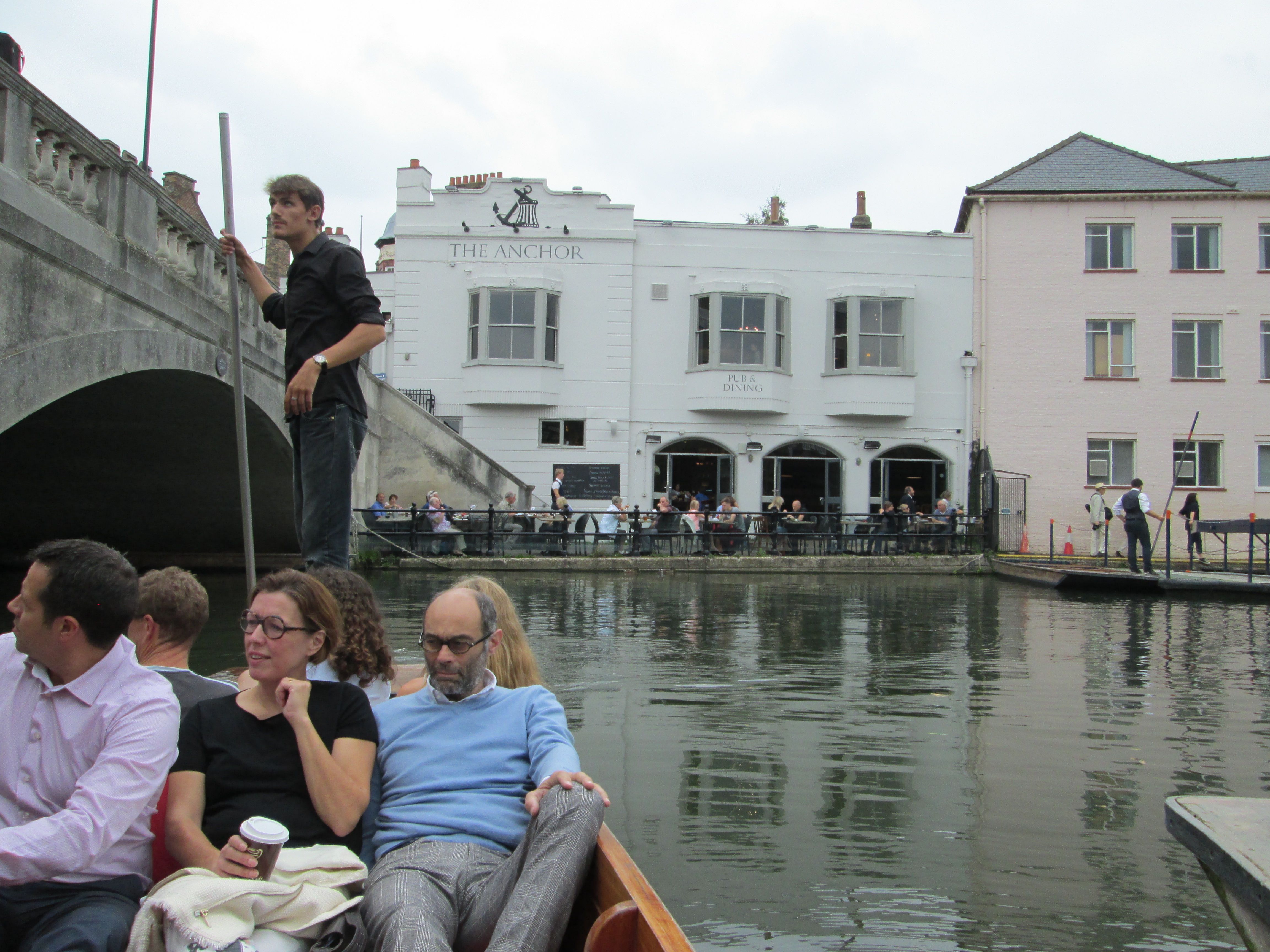
Approaching the Anchor Pub

Approaching the Anchor Pub

We put our anchor down at the terminus in Mill Pond. Appropriately enough, The Anchor pub nestles there. This was once the hangout of Syd Barrett, where, as a teenager, he used to bend an ear to the resident jazz band. He would later lead his own band, those masters of avant garde psychedelia, Pink Floyd. Barrett would ultimately be replaced by his hometown friend, Dave Gilmour. Barret is commemorated in two panoramic panels on the lower level. An open terrace looks out over the maelstrom of the pond. In a town not exactly falling down with good pubs, it quickly becomes our favourite for a few drinks. There’s keg ales and good food. The pub rises through three levels. At the top, a jazz band plays. Imagine yourself back in Floydian times, let the mellow jazz merge seamlessly with Pink sounds. Put on a gown that reaches the ground, float on a river, forever and ever…

Dublin – National War Memorial Gardens

I first discovered these gardens in the 70s, heading for Phoenix Park from Drimnagh, just past the Grand Canal and Kilmainham. Discovery is the appropriate term, back then these gardens were forgotten and in a ruinous state. Hardly a soul would venture in there, other than those wanting to step outside of society. Burnt out cars and burnt out people came to be the companions of the marooned masonry and overgrown parkland.

100_1463

You could just about discern within the remnants the outline of something which once must have been impressive, perhaps the whisper of faded empire. It was a place to give free rein to ghostly imaginings, conjuring a Classical past from Gothic decay. There were mood altering substances at work too. Like I said, it was a place where we could step outside of society for a while.

The decay was at last reversed. In the 1980s, the Office of Public Works (OPW) began the restoration work. Completed towards the end of the decade, The Irish National War Memorial Gardens were restored to their original state. The memory of our true past was once more cherished. It is sometimes thought that the Gardens were allowed to go to ruin as they were essentially a British Army memorial to those who fell under that command in the Great War of 1914 to 1918. This does not stand up to scrutiny. The 1970s saw widespread degradation of our urban fabric, including parks. In large part this was caused by the economic recession of that period, but there was also a disregard for our architectural heritage, a craven desire to prefer the modern over the old. It is the reversal of the latter trend that has allowed us to reclaim the treasures of our built heritage.

100_1462

Mind you, the Gardens at Islandbridge are not particularly ancient. In their decade of ruin they were barely forty years old. The concept of a memorial garden came shortly after the end of the Great War, at a time when Ireland was entering the throes of its own War of Independence. The object was to commemorate the fifty thousand Irishmen who had died in the European conflict. This project was initiated in the fraught first decade of Irish independence, in a country riven by the bitterness of the Civil War. 1931 saw the development of the parkland between Islandbridge and Chapelizod on the banks of the Liffey. If the accession to power of Eamon De Valera did not seem auspicious, the project didn’t founder. Work commenced on the Memorial Gardens themselves in 1933. The project was completed in 1939, as another global conflict broke out. It’s notable that, in a spirit of shared memory, with the wars of independence so fresh in the mind, the workforce consisted in equal halves of ex-servicemen from the British and Irish armies.

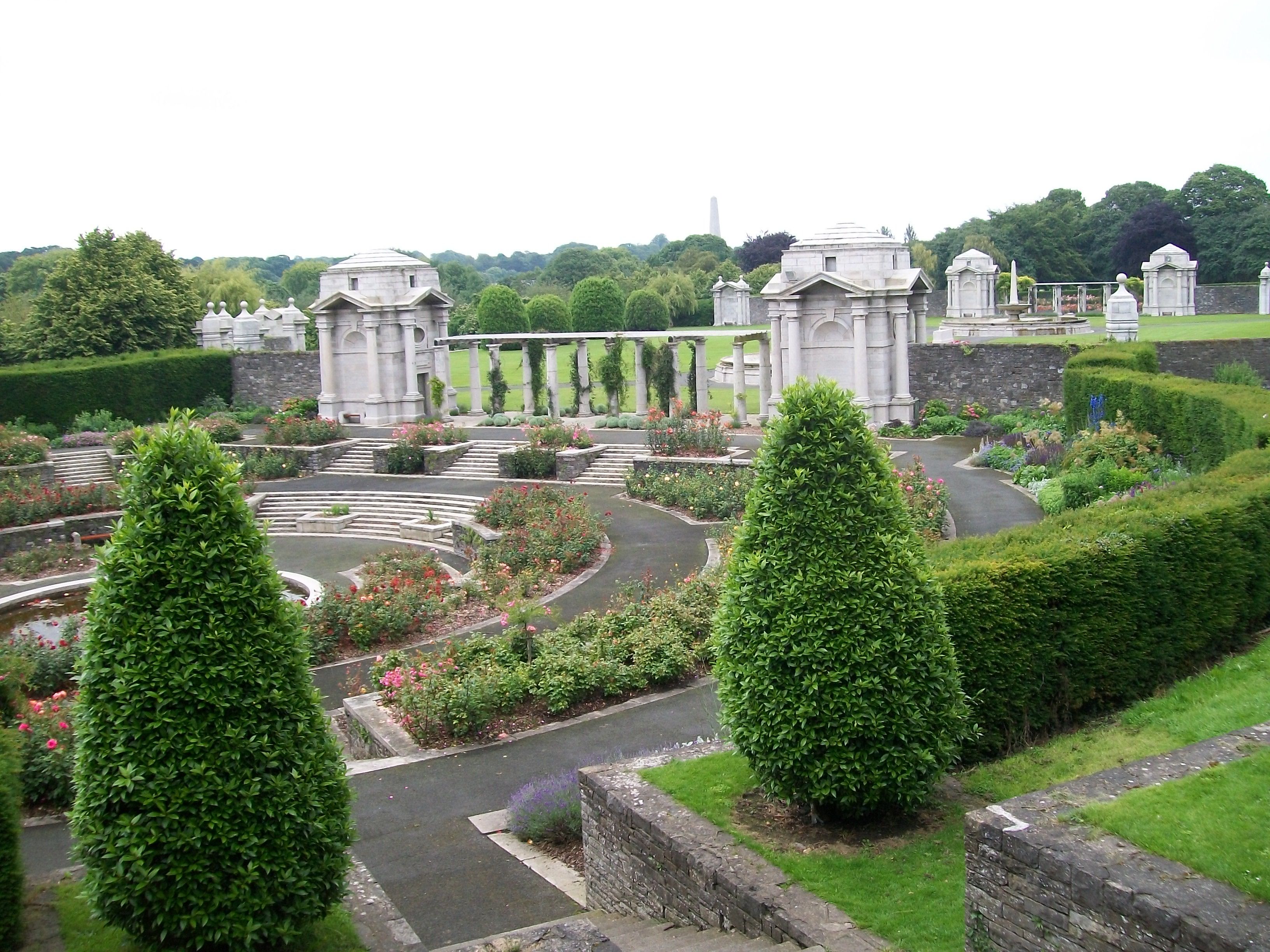
Sir Edwin Lutyens, one of the finest British architects of the Modernist era, designed the Memorial Gardens. World renowned, Lutyens had worked extensively in Ireland, including Heywood Gardens in County Laois, and at Howth Castle and Lambay Island in Dublin. His work is characterised by its harmonising of Classical and Modernist styles. At Islandbridge, he set out a symmetrical plan, rich in imagery yet restrained in effect. The main lawn is centred on a War Stone, symbolising an altar, while the flanking fountains are marked by obelisks representing candles. At each end are a pair of granite Bookrooms linked by pergolas. The Bookrooms are a repository for the eight volumes of books recording the names of all those Irish who perished during the war. These were designed and illustrated by Irish artist Harry Clarke, most renowned for his stained glass.

The Bookrooms and books can be viewed by appointment. We had contacted the Gardens in advance, and received an informal, personal tour of the monument from one of the OPW onsite team. It is an informative and moving experience, to see entries for such young men, mere boys really, who drew their last breath on a foreign field, preserved here by name, forever young.

100_1461

Passing through the linking pergolas of granite columns and oak beams, we enter the sunken rose gardens. Each are centred on lily ponds and surrounded by yew hedging. These are points of tranquil reflection, allowing the monument to recede into a serene mixture of flora and elements. To the south is the most imposing statement. The Great Cross presides over all, inscribed to ‘the 49,400 Irishmen who gave their lives in the Great War.’

The restoration of the park restores the dignity of those who fought in the war, but it is not, nor was it ever, a triumphal memorial. The classical elegance underpinning Lutyens design is a quiet reflection on the sacrifice of these men. It is, in effect, a monument to peace. The first visit of an English monarch to an independent Ireland, in May 2011, was marked with the laying of a wreath by Queen Elizabeth II at the Great Cross. Almost a century after that great fallout, a note of reconciliation was sounded.

That war, which we now call the First World War, did not end all wars. Sadly, such dreams are just that. We can wallow in wishful thinking, seek solace in forgetfulness, but it is, perhaps, better to remember our history and hopefully to learn by it. Ireland did gain its independence through bullets and blood, our National Anthem notes this fact. But it was the force of civil solidarity, allied with vision and idealism, that won the day and, to an extent, won the peace. Don’t forget that.