Vienna

v4

Stephens Dom

Vienna can seem like being lost in heaven. So much perfection, art and architecture at its most opulent and grand. There are times though, when you need an angel. I’m prone to cutting corners, just that bit off kilter. On such occasions the city orbits with bewildering intensity, an electron cloud of people, trams and buildings without horizon. I should have come for longer. I should have brought an angel.

I arrive in a heatwave in September. I am carrying Boris (my leather jacket) because my apartment is not secure and Boris holds my passport and camera, my pens and stuff. And besides, I’m weird like that. It insults cities such as Vienna to swan around in shorts and vests. Find a beach! One must look one’s best.

Vienna hugs a bend in the Danube river. The mighty Danube, famously un-blue, is generated by a leak from a faulty faucet in Bavaria, before meandering through mountains and past cartoon palaces to become the highway of central Europe. The river does not actually flow through the centre of the city. A slender offshoot, the Danube Canal, outlines the northern arc of the city centre. Historically, Europe’s super-highway, you can float downstream to Bratislava, Budapest and the ocean.
v3

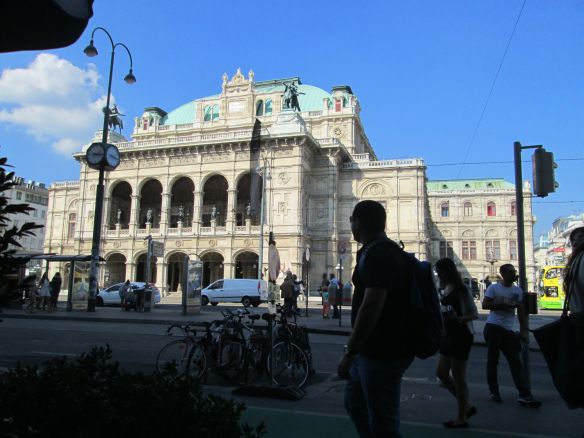
The Opera House on the Ringstrasse

Vienna finds itself at the focus of Europe. Its old city walls converted into the Ringstrasse, a grandiose avenue that delineates the city centre south of the Danube Canal. Freud’s morning constitutional was taken along the throbbing thoroughfare. Grand public buildings and palatial houses line its extent. As the Main Street of empire the imperial buildings are emphasised , arrayed in formal parkland on the south-western radial.

Amongst the many jewels in this crown is the Kunsthistorische museum. The spectacular entrance staircase leads the eyes up to The Apotheosis of the Renaissance, a Belle Epoque imagining by Hungarian artist Munkacsy. The spheres of art history and the heavenly realm merge in a celestial depiction of the glories of the Renaissance. Gustav Klimt peeps mischievously out, supplying Egyptian and Greek goddesses for support.
   

img_1437

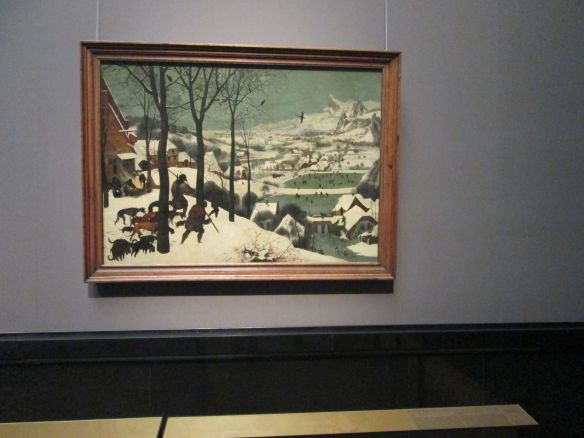
Breughel’s Hunters 

I cool my heels in front of Breughel’s Hunters in the Snow. We had a small copy of this painting in my childhood home. It is astonishing how an almost trivial ornament can evoke such a profound attachment with the real thing. Herself was overcome by Monet’s Impression Sunrise in the Thyssen Bornemisza (Madrid), as if the gallery knew she was coming and prepared a special gift. I knew Breughel’s masterpiece would be here, and more besides, but was not prepared for the shock of seeing it. I sat a long time before the real thing. I was in the landscape whereas, as a boy, I had only a postcard of it. The static, permanent power of the composition enthralls. It is a story of human endeavour and disappointment; keep on keeping on is its constant thread. With its bold line and vivid contrasts the painting looks modern. Perhaps timeless is the word.

There’s so much more. Vienna was the centre of Europe’s cultural web. Dutch masters with their fragile hues and robust folk, Italians with burning colour and burnished souls. Titian, Bellini, Tintoretto, Caravaggio, Velazquez line the corridors and rooms, all hawking their wares for our attention. Such wonders under one roof. I could stay forever and feel as if I was never indoors.

Leaving the giddy globe for the pale imitation of life without, there are still more options to consider. The Museum Quarter is nearby, and all the pleasures it implies. Still, why wallow in excess? A feast is enough for know and I seek shelter from the heat in a sidewalk bar. I am sweating again. I occupy a high table and wrap myself slowly around a tall glass. Enough art for a day, I tell myself. I need to assimilate it all.
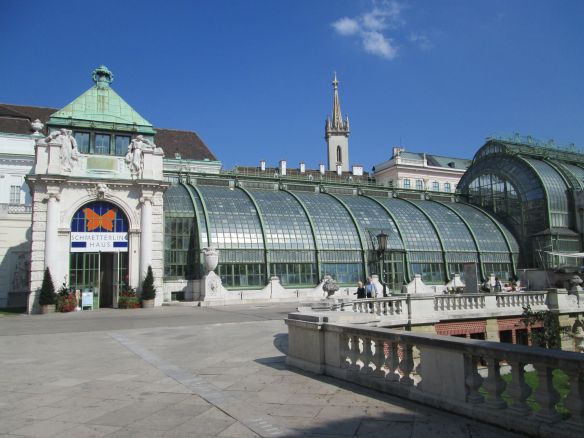
img_1460

Schmetterling Haus

Offbeat, and off kilter, I head back across the Ringstrasse. Passing through the Burggarten  I am taken by the elegance of the glasshouse and the words of a friend brush my cheek. Of all the must-dos of Vienna this was the most idiosyncratic. Visit the Schmetterling Haus, stand in the shimmering heat of a greenhouse and let giant insects land on you. It is weird that this oasis, out of the sun, is actually hotter. Yet, I had hardly taken two steps in than I was filled with elation. The glass confines form a bubble in infinity, illuminating one manifestation of flora and fauna at this intersection in space time. Butterflies in their team colours flutter unconcerned past us brief escapees from the physical dimension. Oh, if you want a touch of heaven, visit the butterfly house, angels supplied.    

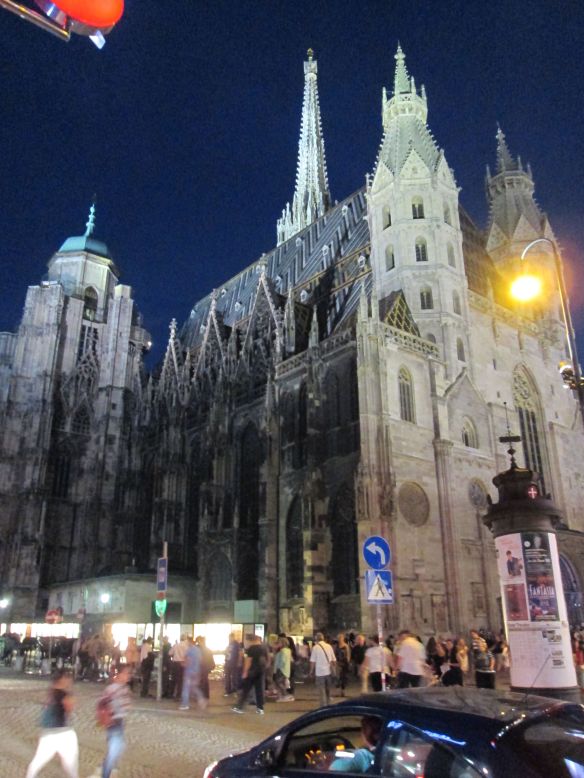
From my base at the Kunsthaus, it’s a pleasant walk of urban variety by way of Unterviaductgasse, or Oberviaductgasse even, through my local square, Radetzkyplatz, and on to Wien Mitte, with its thronged shopping centre, its convenience bars and cafes, the tabac shop with its spectacularly rude service. Across the Wien River lies the actual city centre, the Inner Stadt, the old city within the Ringstrasse. This is the place for aimless meandering through medievel streets, being pleasantly lost in a strange place. The spire of Stephens Dom is at its centre. Exuberantly gothic, the church bears the marks of centuries of adjustment. Age radiates from it, modernity encroaches. There isn’t really a good point to sit and take it in. The square is cramped and crammed, the few outdoor bars crummy.  You can go up the spire to see all of Vienna, and maybe heaven too. I’m only going to see so much in three days on the ground.
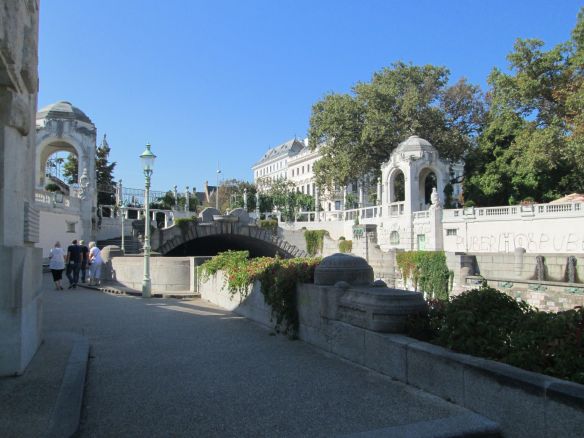
  

v1

Stadpark, along the Wien River

Along the linear Stadtpark, I set out on a quiet morning all the way to the Belvedere. Clipped and coiffured gardens slope upwards in the shimmering heat, the Upper Belvedere a toy palace in the distance. The main attraction is Klimt’s golden girls, seductive capsules of beauty and love. The Kiss grows more iconic by the day. It is the canvas where we want to be, loving and loved, flushed in the afterglow of it all, naked and golden. In a way that is both sensible and comic, the museum, while prohibiting photographs, has provided a selfie station where tourists can immortalise themselves before a life-size print. Better, I think, to put yourself within the painting.
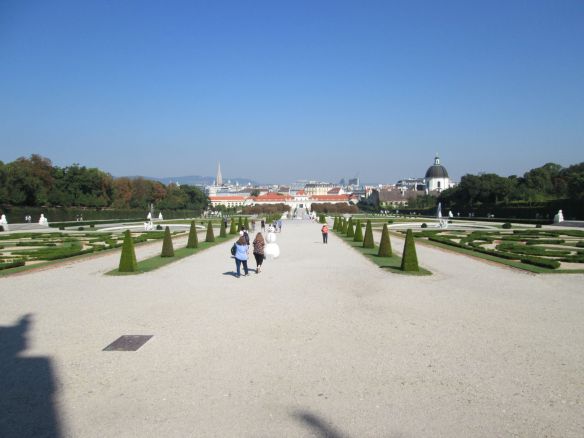
   

vbel1

Vienna from the Upper Belvedere

I am much taken too with David’s depiction of Bonaparte Crossing the Alps. A vivid flash of a personal force of history if ever there was. Less impressive is the baleful manifestation of the curse of the curator. If you must push inept contemporary work, best keep it amongst its own. The view from the chapel balcony at the end of my visit would have been better left unseen. This crucifixion is a dismal work. It compares unfavourably with Dali’s Christ of St. John of the Cross at Glasgow’s Kelvingrove which exhalted the spirit. Whereas this does not.
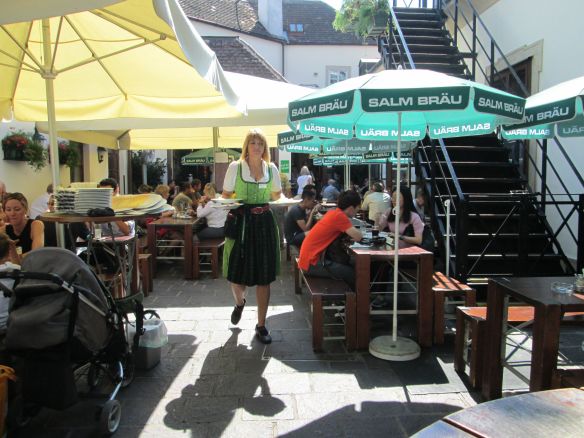
  

v2

and now for a pint

Beyond the gardens, Vienna beckons, a burnished mirage of domes and spires. The journey downhill is less arduous, though shade still eludes me. The clipped flora is so weird I feel I have been spirited, Alice like, to some imaginary world. Perhaps I am hallucinating in the heat, the surplus of art in my blood. Trams pass on the street where afternoon shade begins to creep from the buildings. There is a gap I noticed earlier. Time for a welcome beer in a shaded courtyard. Dappled shadows dance beneath the trees, brown timbered seating awaits, metal fittings of the bar glow and beckon. A traditionally clad dame welcomes me. Blond and tanned, clad in green, she smiles and takes my order. The feeling of fantasy persists. But then, where else would you find an angel, but in heaven?
Visions of Scotland 4 – Inverness

img_1261

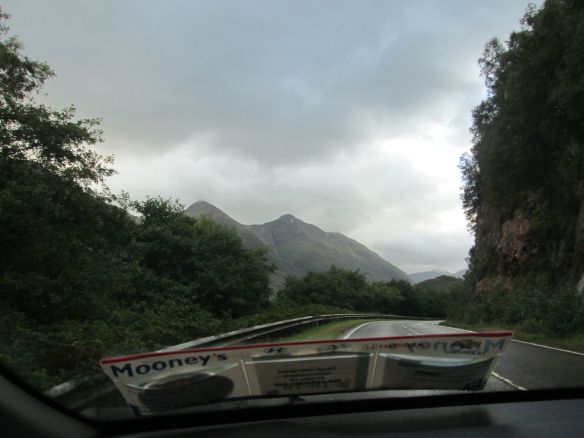
East out of Kyle we retrace the road to Invergarry where we pick up the rift valley route. As in Ireland, the east of the country is more gently scenic than the wild west. This is the Highlands still, though. Inverness, our destination, is the capital of the region.  Along the shores of Lough Ness, we are unmolested by the mythical beastie. In truth, there is no chance of dinosaurs surviving anywhere, let alone a busy narrow waterway. They were here once, as Dughal Ros told us yesterday, but only their fossils remain. Still, it’s good to have fantasy.

  Inverness has grown to city status with a population of fifty thousand. It’s centered on a low rise above the eastern bank of the Ness river where it flows into the Moray Firth, heading towards the North Sea. We stay at Carrig Eden on the western approach. The area is attractive, typically Caledonian in characteristic honey coloured stone with gable fronts. Our genial hosts, Caroline and Donald, have polished their home to a welcoming jewel. We are warned of two things. One, Daniel O’Donnell is playing that night in the Eden Court theatre nearby. Two, there is a bagpipes festival in town. Looks like it’s the bagpipes so.

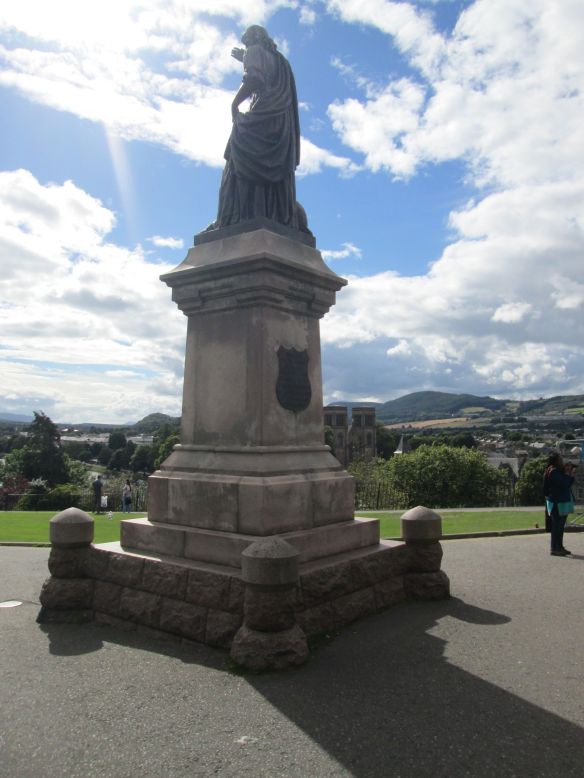
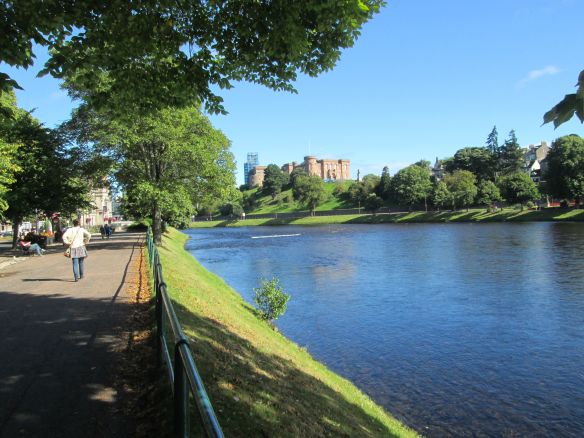
img_1267   The Eden Court is a modern complex by the banks of the river. From the banks we catch our first glimpse of the city. Inverness Castle is the dominant feature. Built in red sandstone it tops a steep escarpment rising from the Ness. It is not, strictly speaking, a castle. The present structure dates from 1836. It  functions as a courthouse. The first castle to stand on the site was destroyed by Robert the Bruce in 1307. The next castle stood here until sacked by the Jacobites in the rebellion of 1746. A statue of Flora MacDonald stands at the entrance park, shielding her eyes to gaze meaningfully westward. Having aided the escape of Bonnie Prince Charlie, and doing time for it, she headed out west herself, living in America before returning to die on the isle of Skye.

  Both sides of the river are pleasant. We pass the nineteenth century gothic Cathedral on the west bank before stopping for coffee in an Italian place with outdoor seating. We are entertained by a young woman making a major production number tying up her bike. Man, you must have to mind your bike real careful in these parts.

 shane3

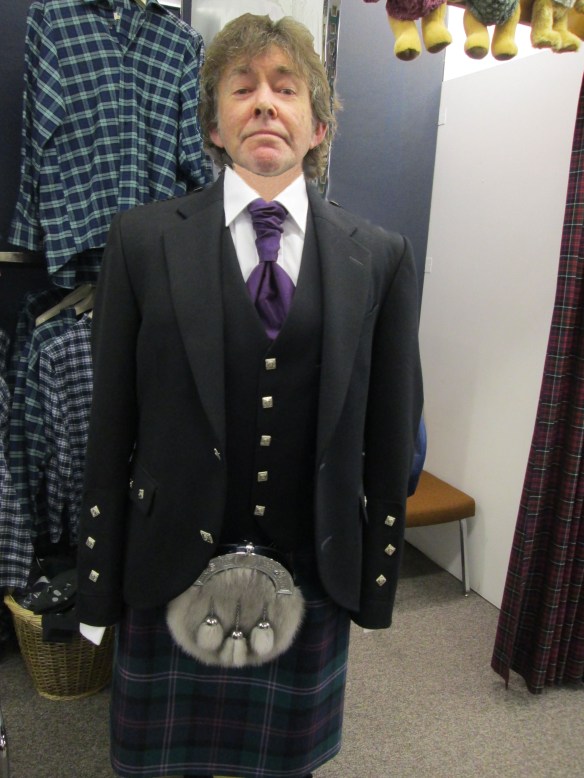
The strains of the pipes beckon us east across the bridge. Before that, we take a look at the House of Fraser. I reckon I’ll need to kit up, the whole nine yards, on the off-chance of running into Claire from Outlander (as portrayed by Caitriona Balfe) somewhere about town. A convincing impersonation of Jamie is quickly conjured. You can go for a variety of rental of traditional outfits here. Full dress for that formal night, half-dress for the more casual, a dashing Jacobite attire for the full blooded Scot.

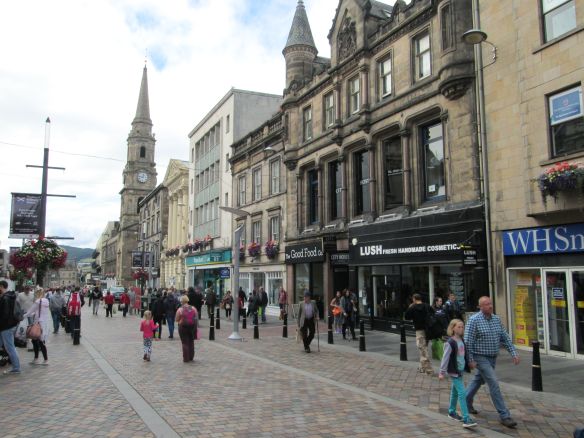
  High Street slopes uphill from the bridge. It’s busy and sporadically loud with the great yarp of the bagpipes. Something stirring about them, to be sure, if not quite the first music for the car stereo. Here, in this special place, I’d opt for the Waterboys. The attractive main street jolts to an unlovely close at the harshly modern Eastgate Centre. Still, probably better to have it in town rather than dragging people out to the periphery.

img_1277 

After extensive shopping, time for a quick snack. Hoping to sidestep the inertia that can pass for service in the Highlands, we opt for McDonald’s – an ominously local name now that I think of it. Inverness McDonald’s is the worst McDonald’s ever. The till is abandoned just as we reach the head of the queue. After a couple of minutes we call the attendant from the next till. He says he’ll get the manager, who is standing conveniently nearby with other staff leaning on the furniture, chatting. She informs us, cheerfully enough, that the attendant will return soon, and rejoins her discussion group. A few more minutes and we give up.

  img_1298

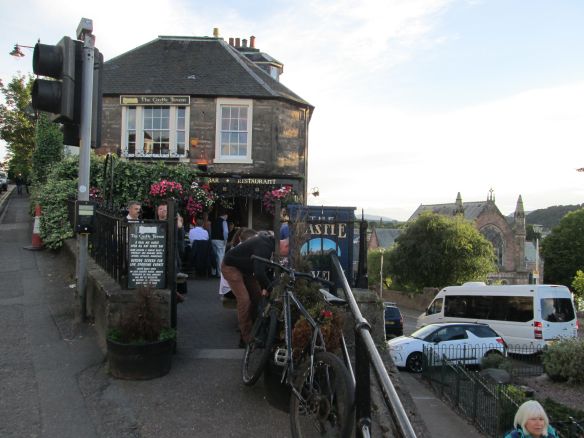
We attempt a trip down memory lane to find the lost hostel of our youth. Still lost to us, sadly. Having followed the signs through winding residential roads we eventually lose the trail. But it’s a pleasant walk in glorious sunshine. We’ve booked dinner at the Castle Inn and, hungry and thirsty, head for it early. Nicely situated, clinging to the cliff overlooking the river, the Castle visible to the north. Rustically traditional, the place is crammed, as any good place should be. We take our drinking and dining pleasures al fresco. Good food, service and company, perfectly passing the sunny afternoon into early evening.

img_1287 

Afterwards, we potter around the Castle grounds. The place itself is not open to visitors but there are plans to remedy that. We follow Flora’s gaze up towards Loch Ness, back to the wild, wild west. We head down to the nearby bank as evening falls. This is a pedestrianised river walk leading to a footbridge that will take us back to Eden Court. There’s plenty of time to stop for drinks on the lawns of the Waterside Rest, busy now as the city nightlfe clicks into gear. The sky seeps slowly to velvet blue as the first stars peep out. A stillness settles in the air. We could sit here forever, relaxing by the riverside in the chill of the endless Highland evening.img_1307

Visions of Scotland 3 – Skye

Skye 1

Kyle’s main purpose is its link with the Isle of Skye. The mainland railhead here connected by ferry with the island. This was superseded by the creation of the Skye bridge, an impressive arch just north of the town. Early morning we’re across, ready to spend the day in exploration.

Skye 2

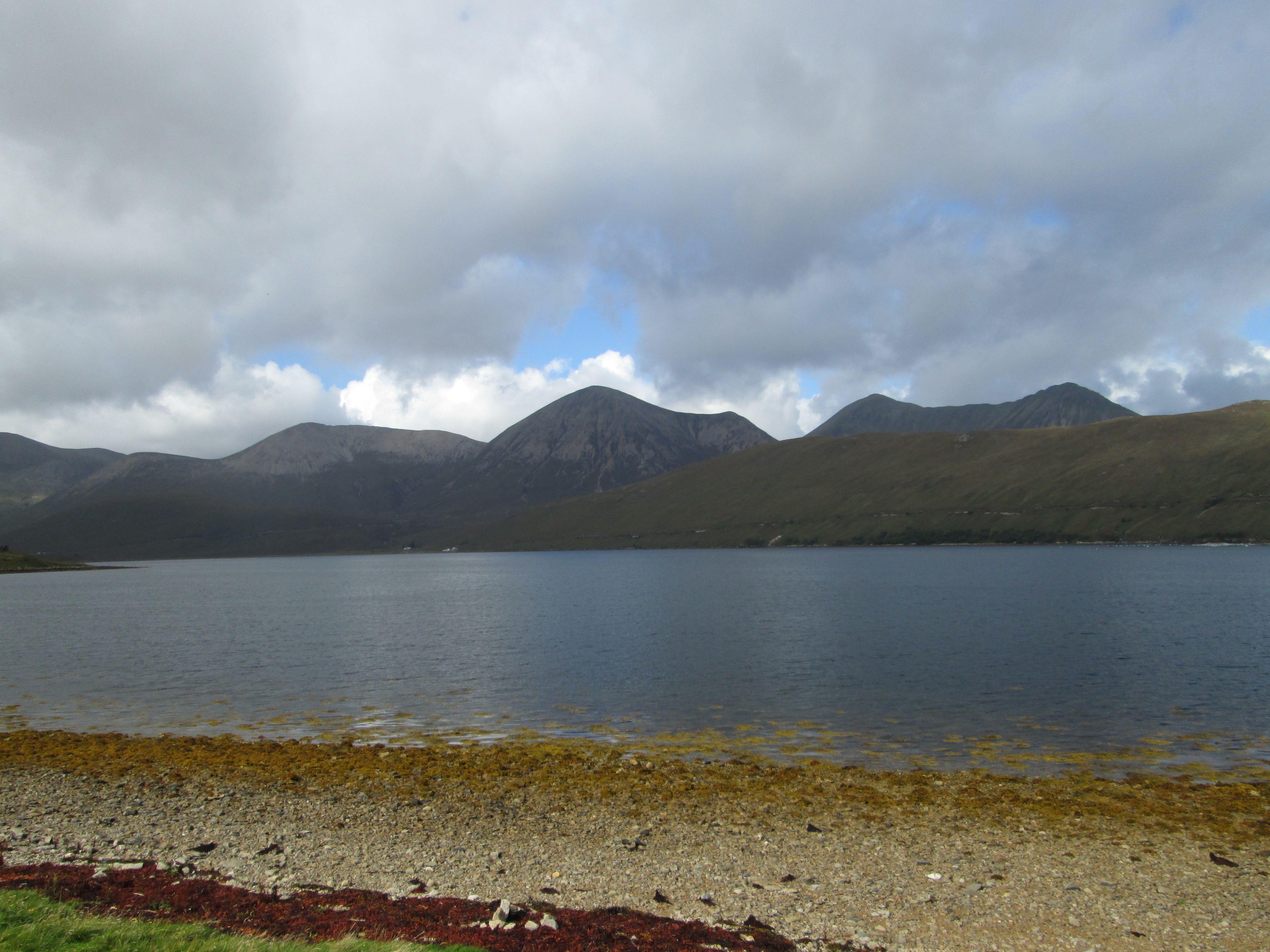
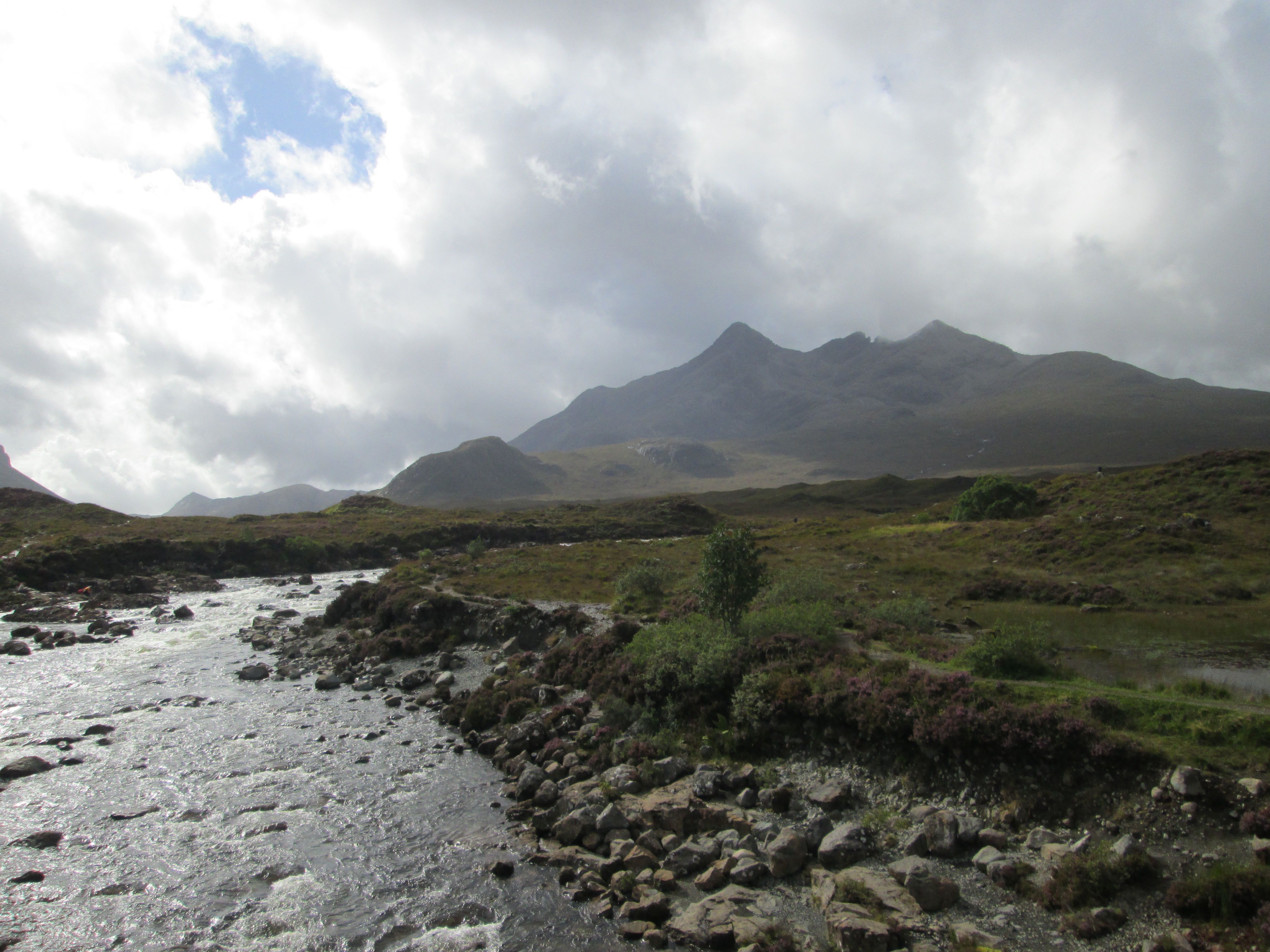
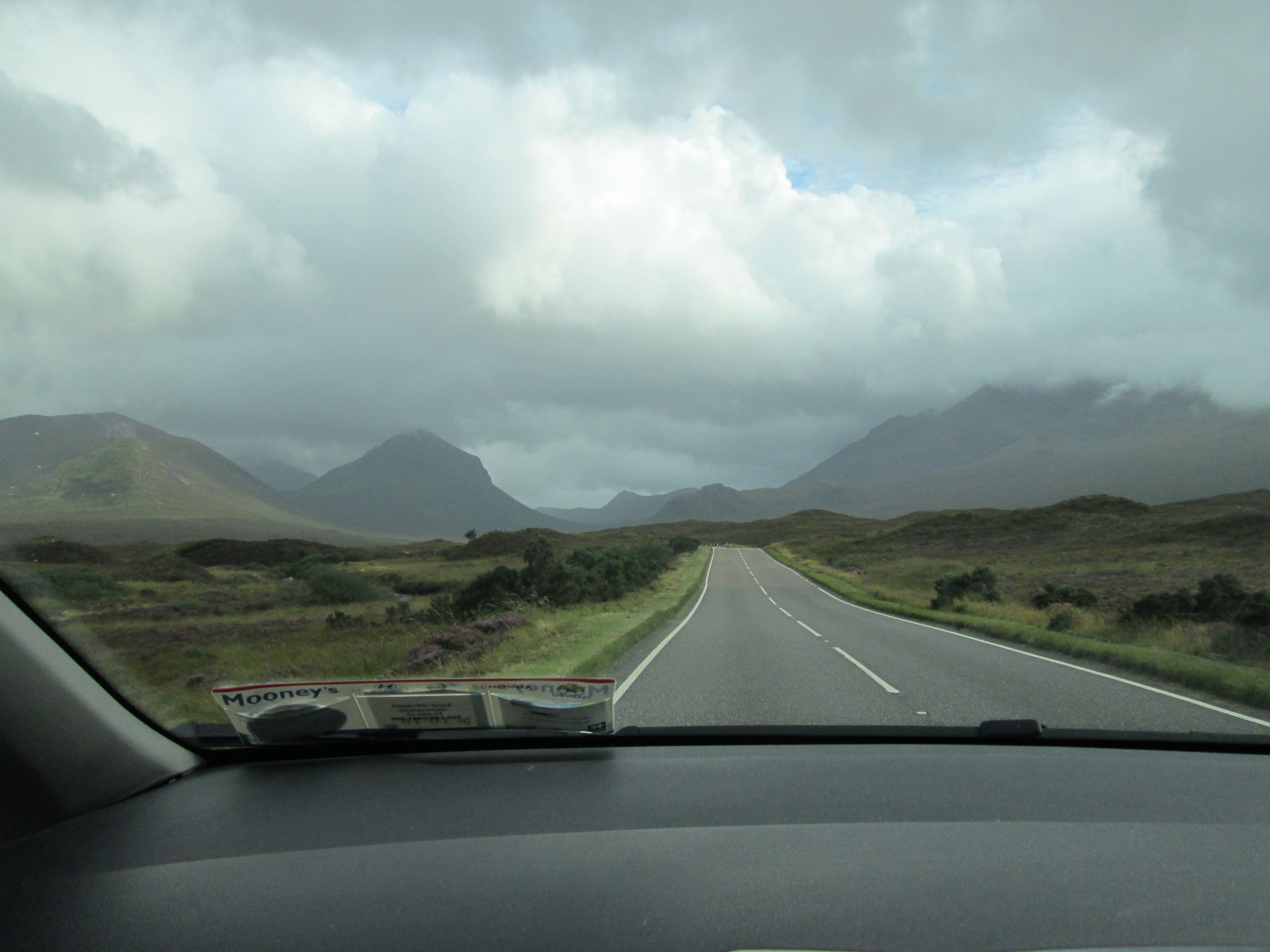
It’s a large island and we’ve picked the northern portion, including the main town of Portree. Crossing the bridge is itself akin to flying, but without the anticlimax of landing. In Skye the heart soars with each vista, heaven reflected in its lakes and mountains, God’s breath in its firmament. From Kyleakin on, the scenery never dips, each corner anticipated to trump what’s gone before.

Portree

Portree

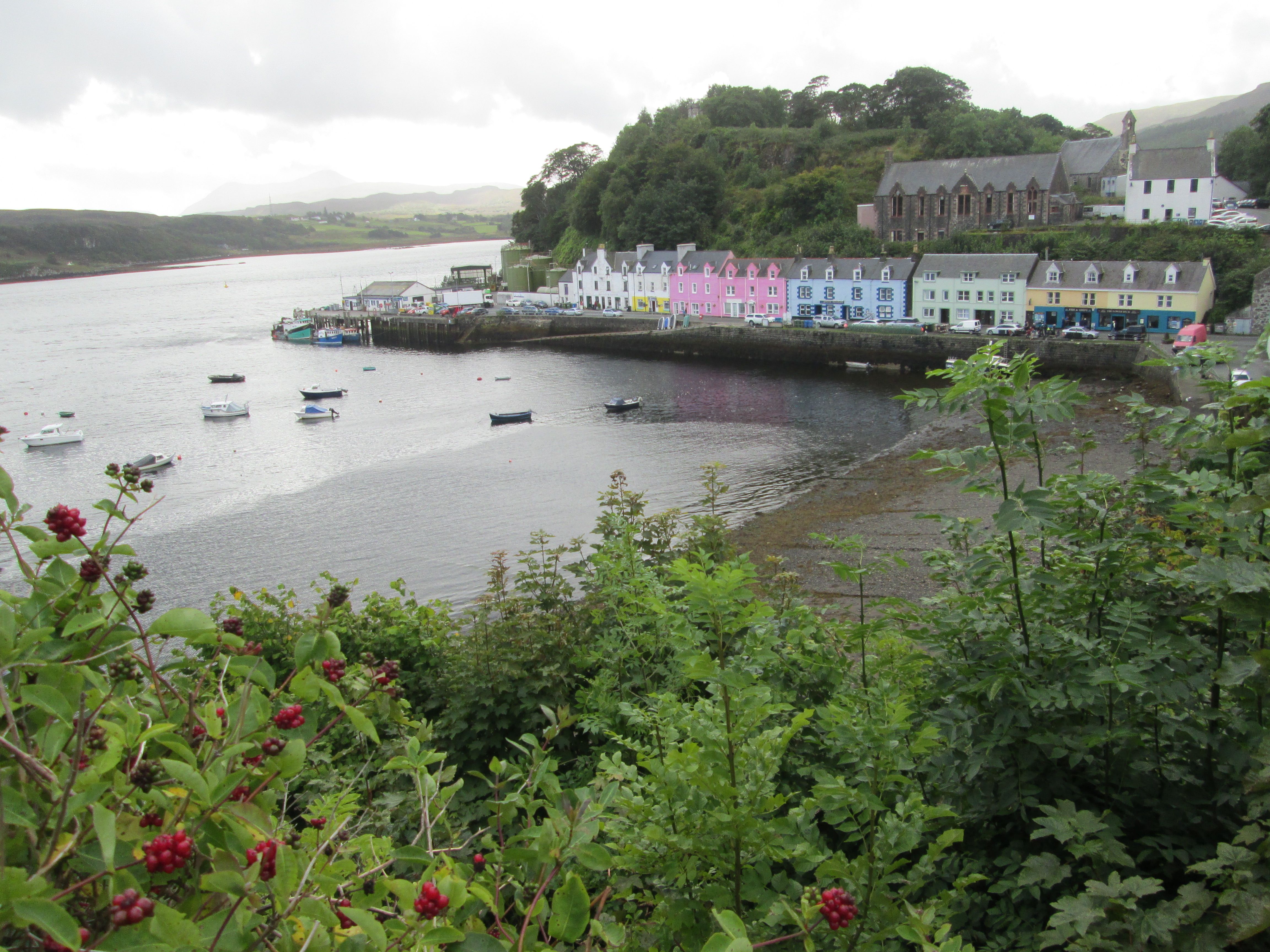
Portree is pleasant to potter around. Coming in from the empty hinterland, there’s plenty of life and commerce. The high town has a square and a couple of lively streets. There is, inevitably, a Bank Street. Plenty of shops, too, and a few decent pubs. There’s a drop down to a colourful dockside. The town curves around the bay, the housing arrayed attractively in terraces above. I’d reckon this is a good haven for sketching, although we don’t have time to indulge.

It’s a sunny day and we stop for attempted refreshments in the square where a coffee shop, or so it says, has outside seating. Sadly, we must endure another bout of Scottish service. Try to place the order inside and are told we’ll be attended on. But as regards waiting, we’re the ones doing it. Repeat process and finally give up. What is that all about? I bring money which presumably pays the wages of employees. Yet too often in Scotland there’s little interest in this transaction. Shades of Yugoslavia. Though at least the Scots are pleasant.
Old Man of Storr

Old Man of Storr

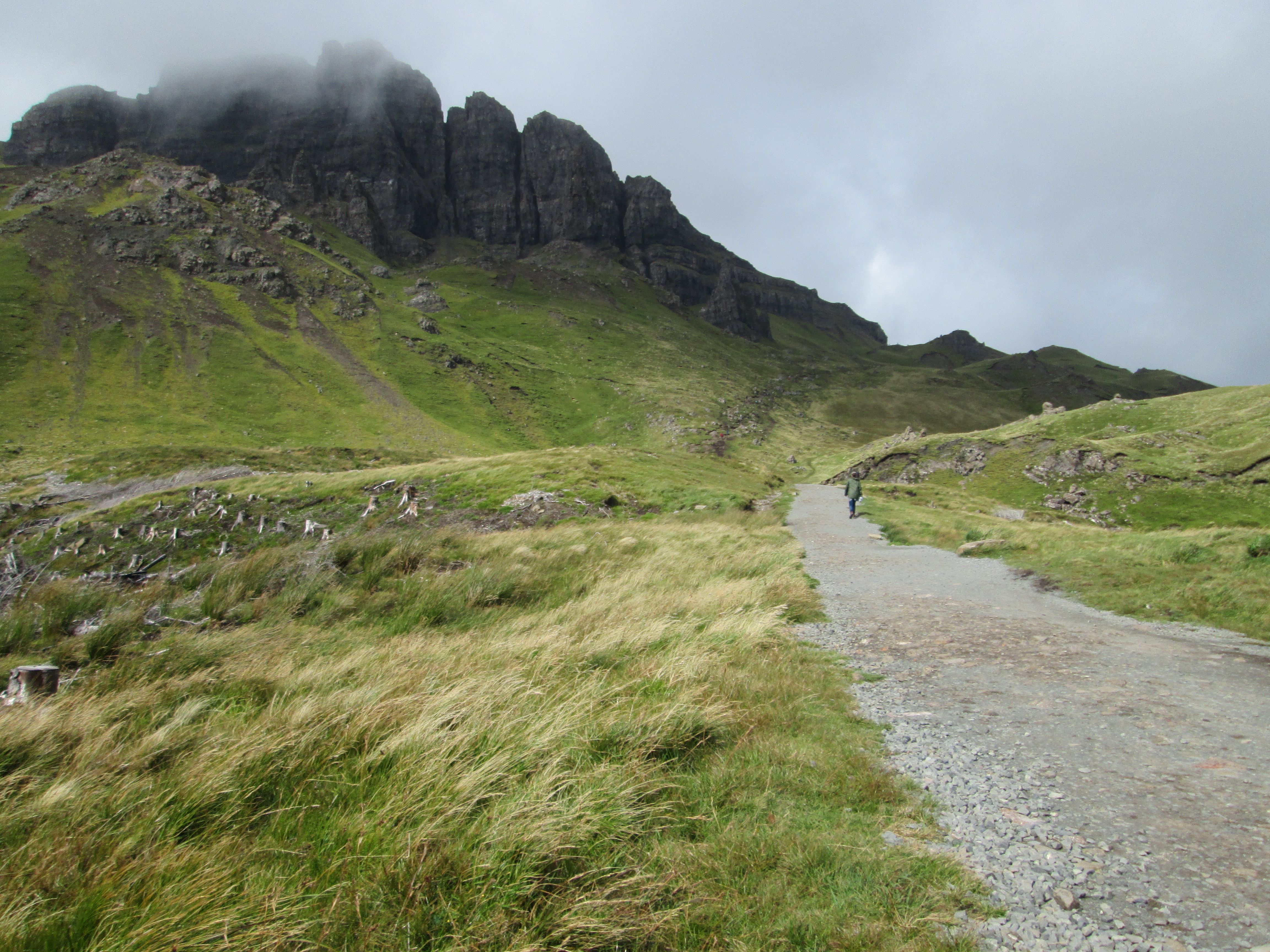
We head up the coast to the Old Man of Storr. This is a startling formation, not unlike a raised and weathered Giant’s Causeway. The geological formation is similar, being made of basalt, resulting from the rapid cooling of ancient submarine lava. There’s a well worn path snaking upwards. The destination is a bit further than we’d bargained so thirty minutes in we get to a good vantage point about halfway up and enjoy the view. Much debate on the exact configuration of the Old Man himself, but while we differ on details, I figure it’s pretty convincing.

Jurassic Park

Jurassic Park

There was a time when Dinosaurs strode the land about here. Staffin is Scotland’s Jurassic park. The name is Viking for Land of the Pillars, as evident in the alternatively descriptive Kilt Cliff. Where Mealt waterfall plunges over nearby cliffs into the sea there’s a graphic giving more details concerning the terrible lizards. Talking to a fellow traveller, we’re directed to a crofter’s cottage which local scientist, Dughall Ros has turned into a museum. You can buy ancient artifacts, large and small here. Dughall was bitten by the dino bug when just a kid and devotes his career to mining the benefits of the area. Even more precious, he’s willing and able to pass on his knowledge to the interested traveller. Time well spent talking to him, purchasing some interesting goods while we’re at it.

Further on, there’s a slightly more successful coffee stop. Strangely though, the proprietor greets us with “we’re closing in half an hour.” It’s only three o’clock! Oh well, who wants to eat anyway? Perhaps the hitchers who depart hungry and perplexed. We do manage to wolf down a tasty slice of cake.

img_1247

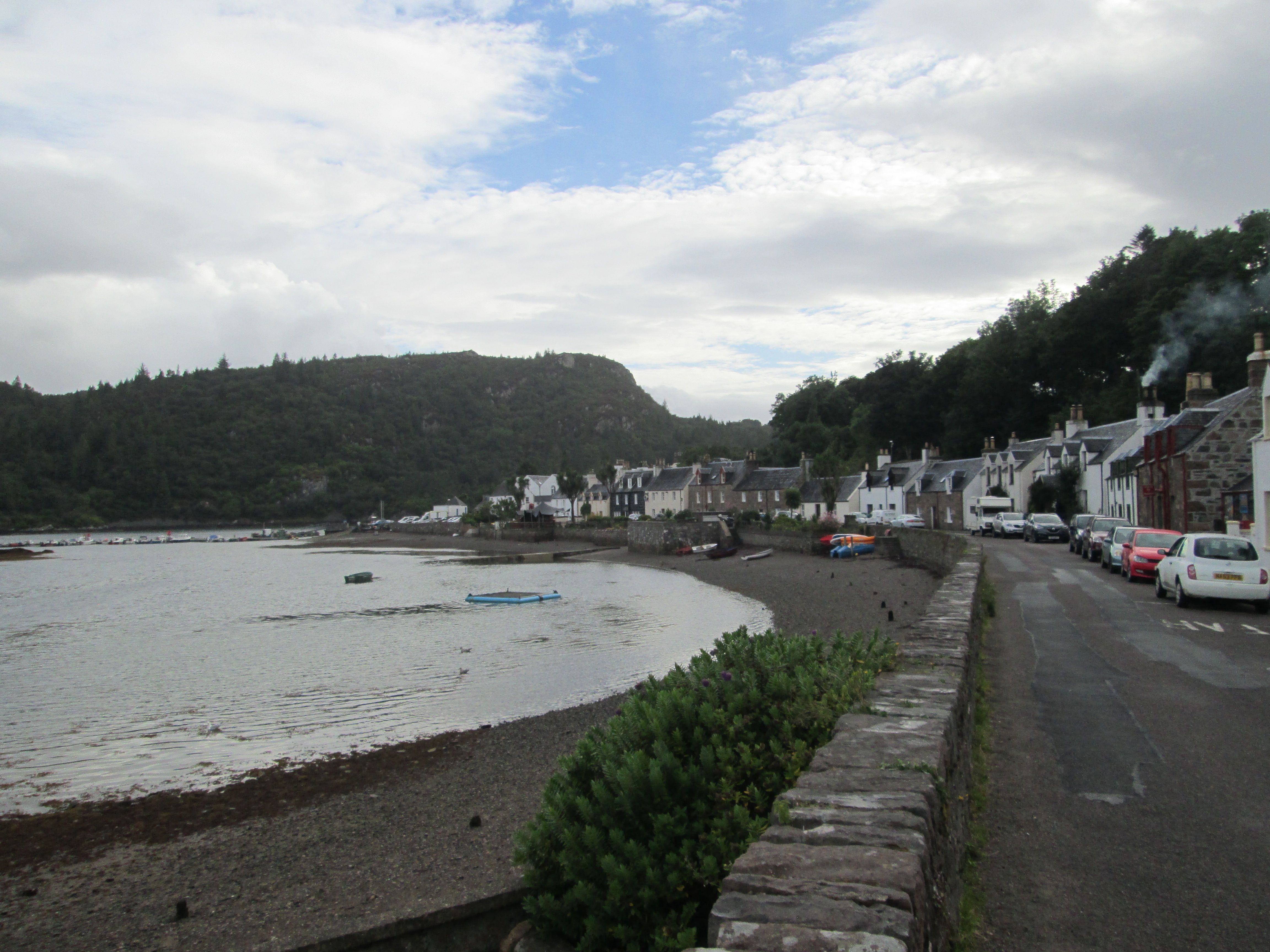
We continue on through the majestic and desolate landscape of Quirang at the top of the island. Returning to the mainland we continue past Kyle to Plockton, which a fellow guest has recommended for its drinking and dining pleasures. This was more how I imagined Hamish MacBeth’s stomping ground. Picturesquely situated around a secluded, wooded loch there are a number of attractive eateries. Plockton Hotel has a cozy bar in deeply gleaming wood and brass. I have an excellent local brew which may be called Schiehallion – try saying that after a few! The restaurant’s popular and we find out why. Good food and friendly service. Worth waiting for. If I ever get back to these parts, and I hope to, I think I’ll stay here.

Plockton

Plockton

Visions of Scotland – 2

Fort William to Kyle of Localsh


Glen Nevis

Glen Nevis

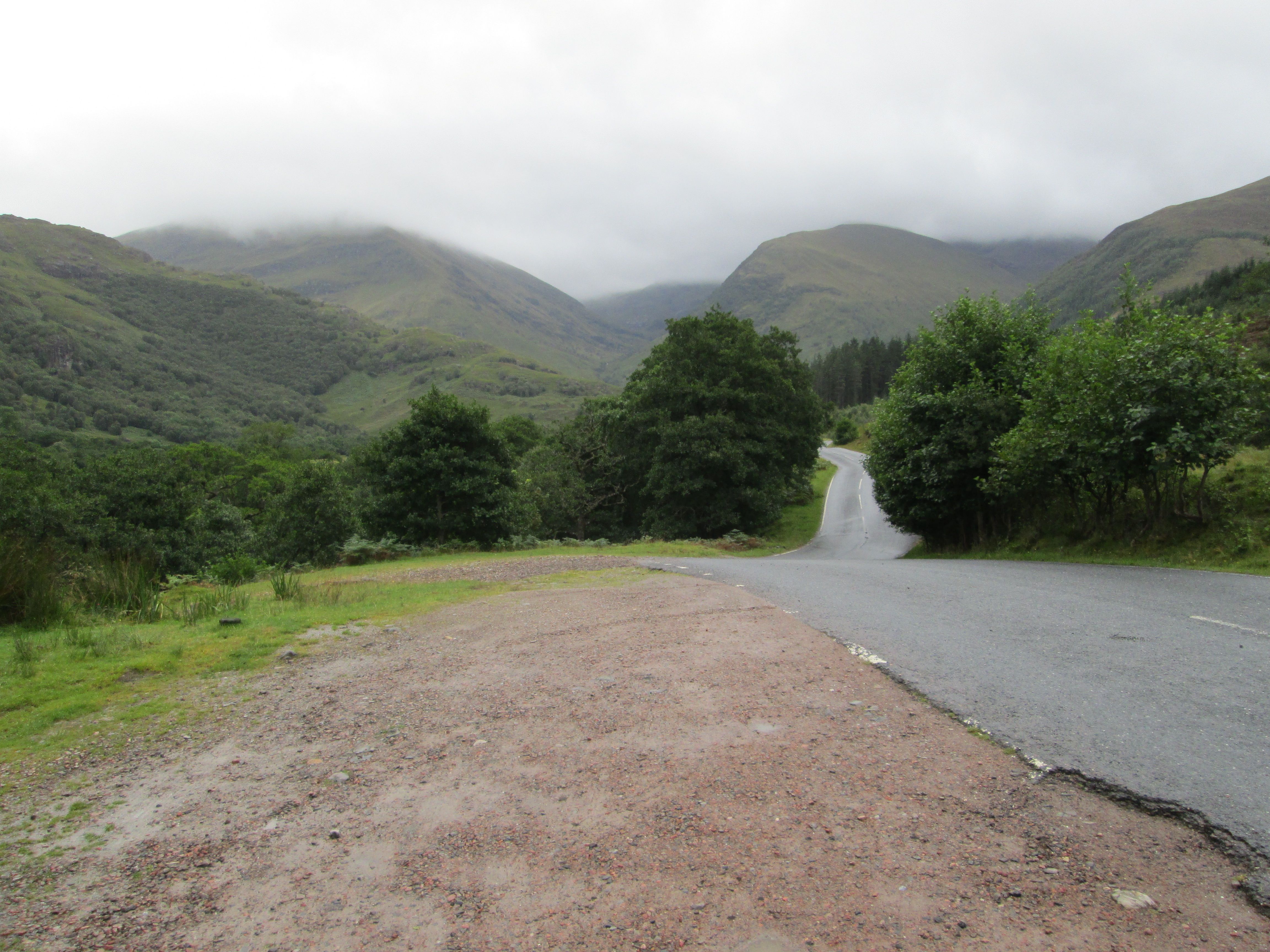
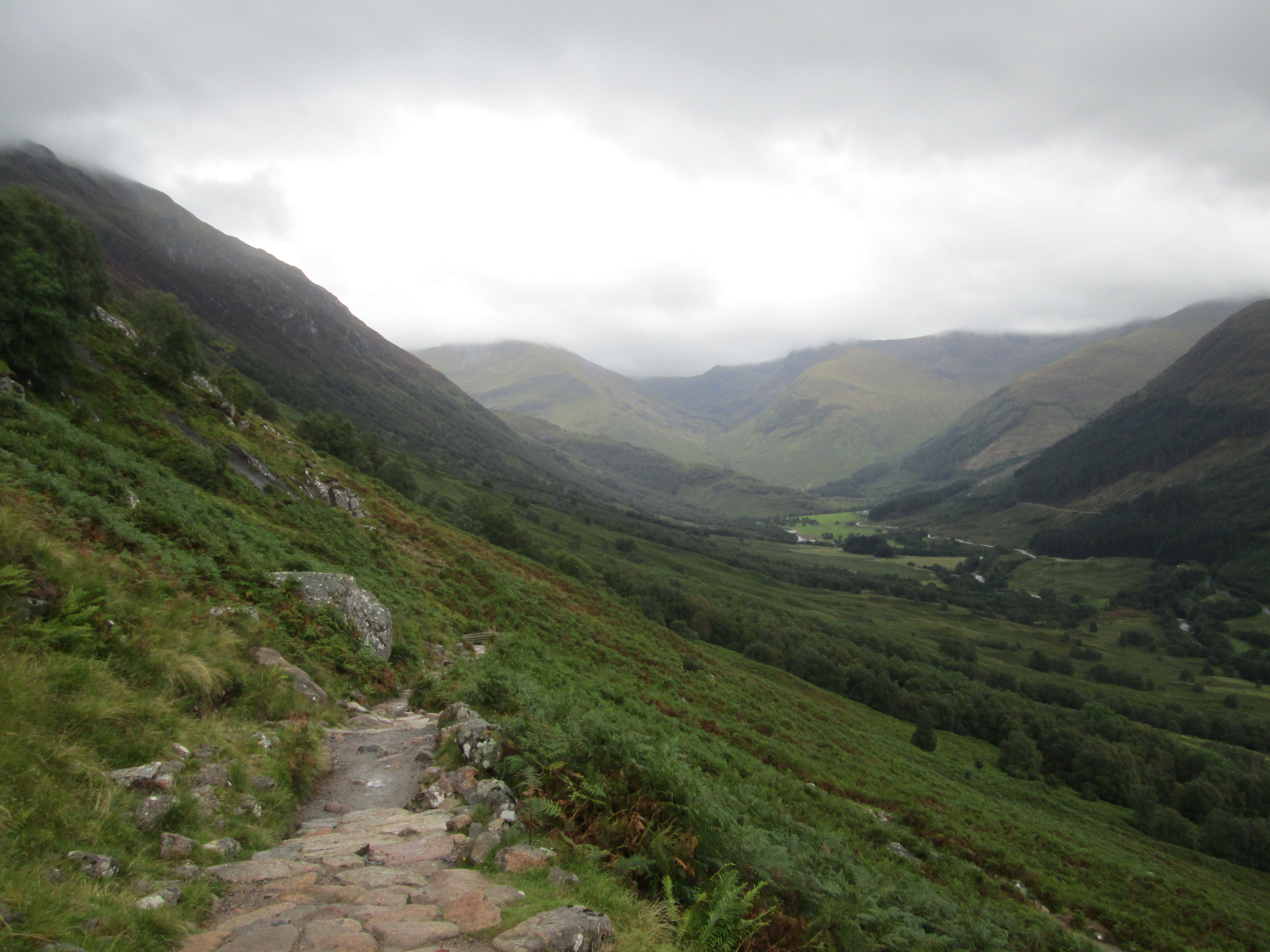
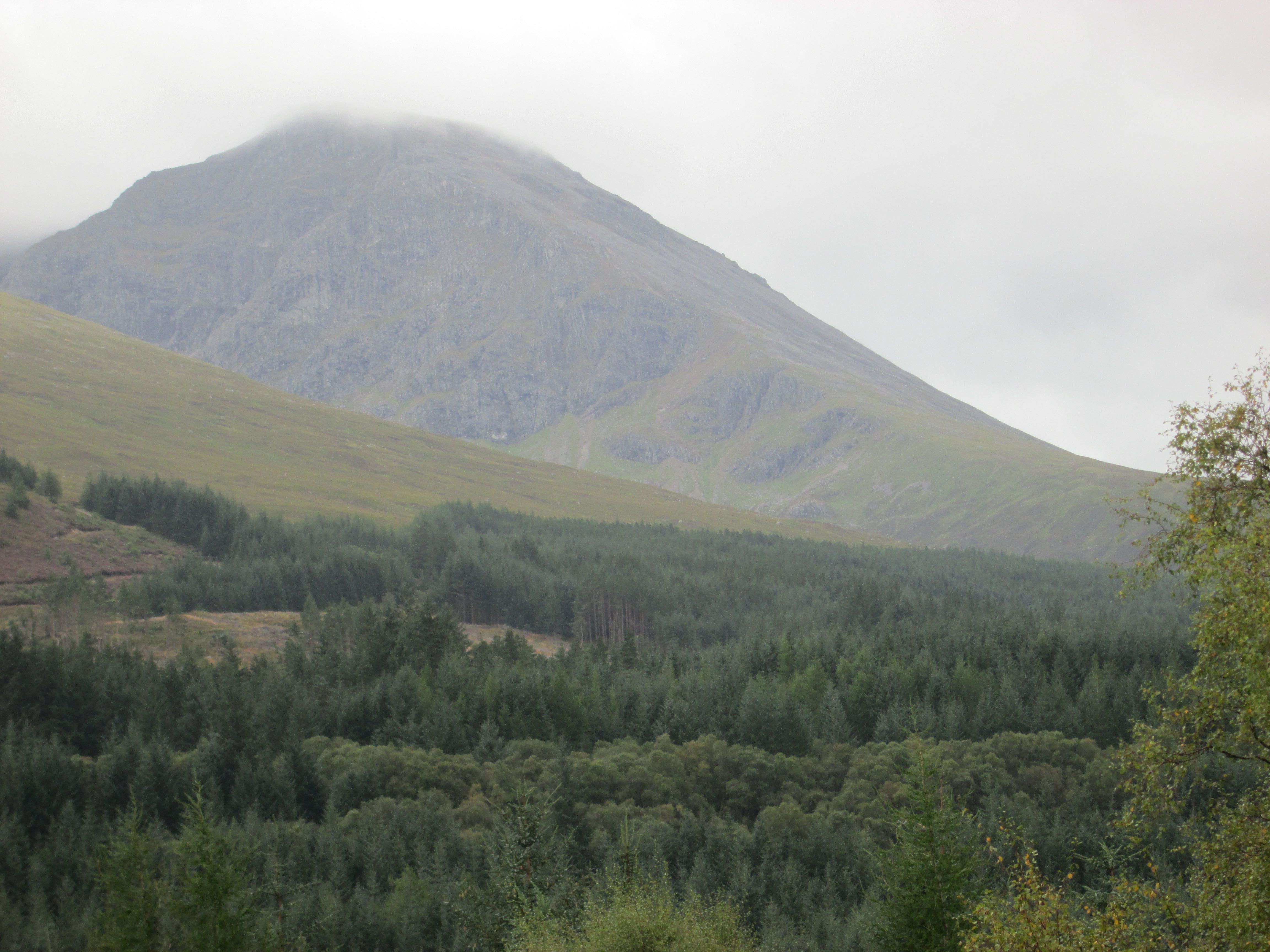
Before leaving Fort William, we must first set foot on Ben Nevis, mightiest mountain in the Celtic Isles. The mountains are obscured by clouds, but that’s just Scotland’s version of the dance of seven veils; the veils being various forms of mist and rain and translucent light. Glen Nevis is only yards from the town, but plunges immediately into giddy wilderness. We could be singing ‘I saw the rain-dirty valley, you saw Brigadoon’, indeed we probably did.

Climbing Ben Nevis

Climbing Ben Nevis

We make an assault from base camp, knowing that we lack the time to summit. Estimates of four hours up and a little less down are probably a tad conservative. Our calculations put us half way there in ninety minutes, reaching two thousand feet where a wooden bridge spans spectacular falls. And we were dawdling. Another time we’ll make it to the top. It’s a pleasant, well worn path with plenty of friendly banter from fellow travellers. The zig-zag climb is moderate, the views, slowly revealed in the waxing day, uplifting, heartstopping.

Big Ben himself

Big Ben himself

At last we hit the road, travelling up the rift valley parallel to the Caledonian Canal. At Invergarry we turn into the Highlands proper. Habitation recedes into heathland and scattered forest. We find a roadhouse at Cluanie. As we pull in, a convoy of trucks passes us uphill, each bearing a windmill propellor. What an odd juxtaposition out here! The roadhouse is sufficient for coffee and chowder, the service sporadic and homely.

Eiiean Donan

Eilean Donan

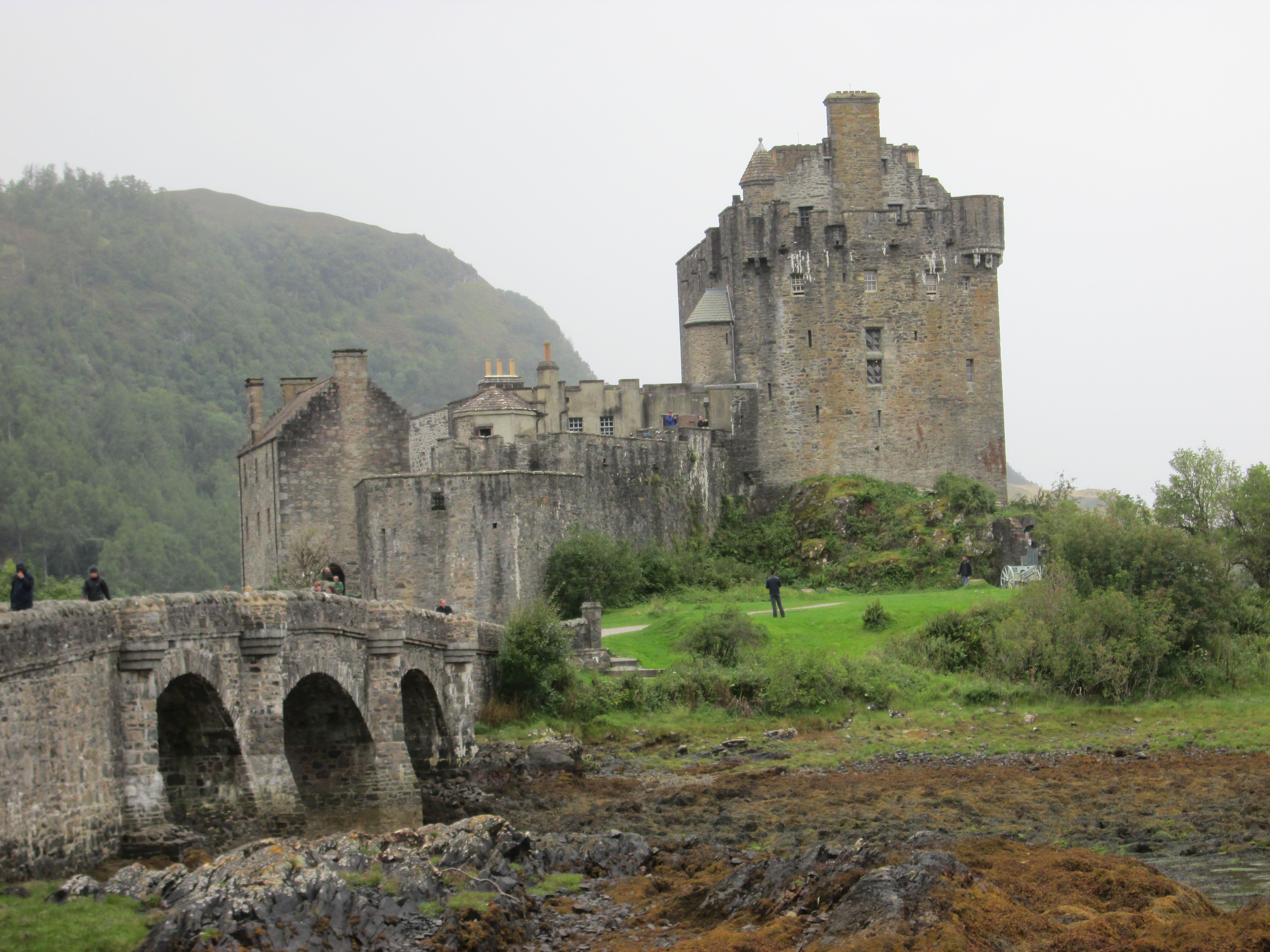
Evening approaches as we descend Glen Shiel. The castle at Oilean Donan stands proud at a craggy confluence of lochs. It’s crowded but worth the visit. The castle is well preserved and fitted, still functioning as a residence. Displays include lifesize tableaus from history creating an illusion of all time seeping through these walls. Real life folk are dotted around too, willing to converse on all aspects of the castle’s past and present. A whiskey fragrant guide in full highland garb leans casually on a waxen laird as he imparts words of wisdom. Good luck to him, he’s jovial and true. Scotland’s history is beginning to seep into me too. Half familiar but in a way that’s more storied, and sung, than factually held. So close to us also, it’s surprising it’s not more familiar back home. Only a visit can put that right. Places themselves are the living book.

Nightlife in Kyle

Nightlife in Kyle

Our destination, Kyle of Lochalsh is a couple of miles further on. I’d picked it without reference to Google Earth. I’d remembered the series, Hamish MacBeth which I thought was set here. Memory deceives, I’m afraid. Kyle’s a bit of a dump, a main road bisecting a scattered settlement, a rail terminal and a functional dockside. The Main Street is mundane, dominated by two banks with our hotel the most pleasant point at its summit. Something of a stereotype to report that while Irish main streets are lined with pubs, Scottish main streets are lined with banks. Perhaps here, men are really born to pray and save.

Still, the hotel is fine and we wave a decent meal of fish and chips in the bar. Our room is cosy old style, with a view down Main Street to the water. Raindrops mottle the window pane as the streetlights come on. Tomorrow, it’s on to Skye which is visible just across the water. We will discover too that nearby Plockton was the village I had imagined, a picture book perfect collage of mountain, woodland and water with atmospheric eateries and hotels. Look forward to telling you more.

Plockton

Plockton

Glasgow

img_1088

Approaching Glasgow from the south, the green, rolling countryside does not imply the pending city, so much as its ancient name, the Green Valley. Only as we plummet into the Clyde valley itself does Glasgow spring from the ground. Great buildings and soaring spires are piled in close order on the hills to the north. It’s a big city, and the aggressive architecture of the industrial nineteenth century emphatically underlines this.

Access by car is easy enough. Once off the ring road, the streets are laid out in a grid. We zig zag our way to the hotel just off Sauchihall Street. The street makes for a good point of orientation. It cuts east west through the city for, well, forever. Chameleon-like, it adopts the hue of all that it passes through. Towards the city centre it’s pedestrianised, a bustling shopping precinct. It’s a bit seedier heading west, where we breakfast at Wetherspoon’s – Full Scottish with Haggis – and ponder the possibilities of a host of Curry Houses. Passing the ring road we’re in the more salubrious West End with grand terraces, parkland and mature trees.

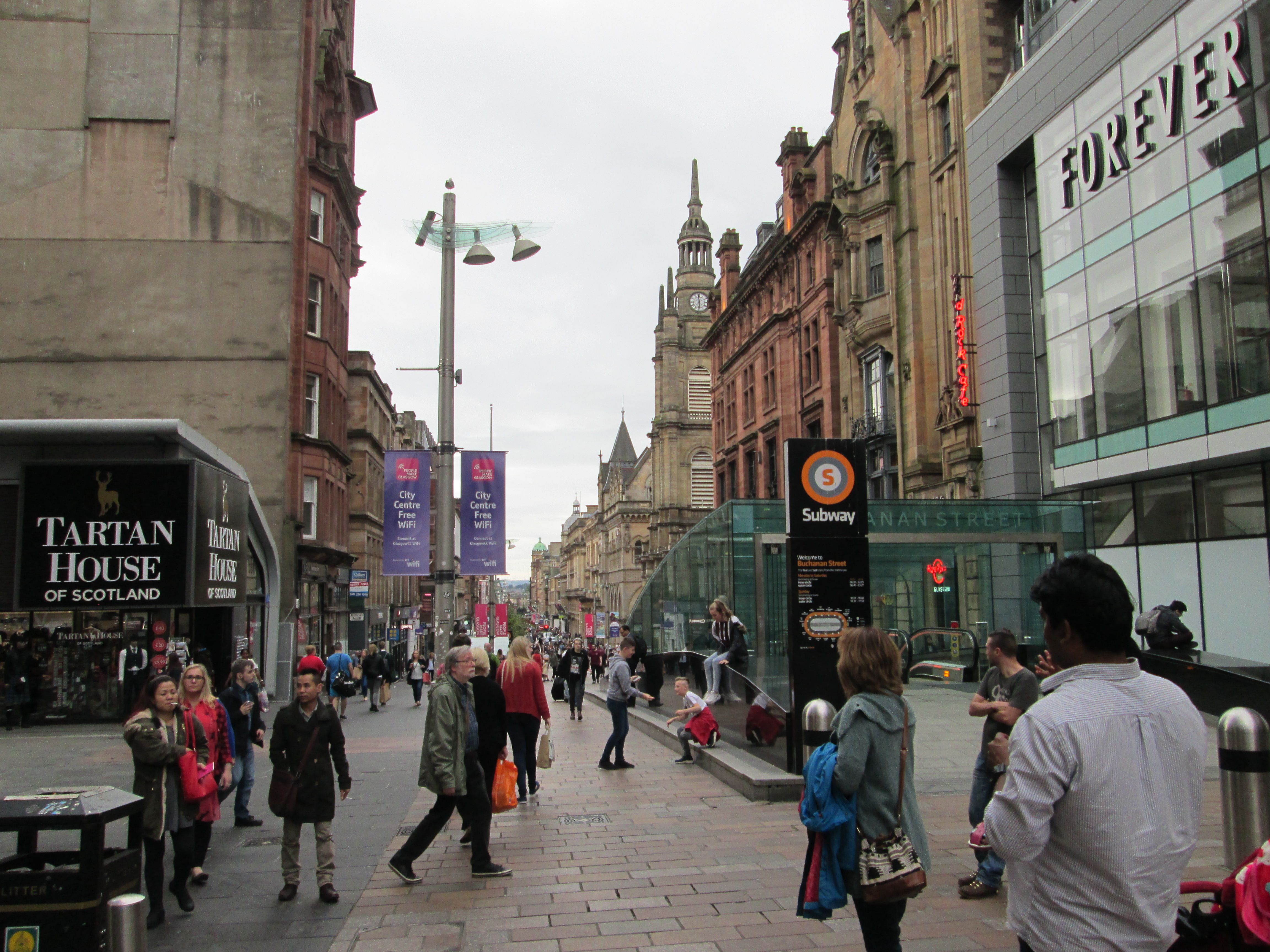
Busy Buchanan Street

Busy Buchanan Street

Sauntering east down Sauchihall Street towards the city centre we join a growing river of humanity. At each intersection streets head uphill and down, distances dotted with landmark spires and turrets. It’s bright and brisk as evening approaches, but we find there’s not much doing here after dark. At Buchanan Street we take a right angle. Sloping down towards the Clyde, Buchanan Street is lined with imposing commercial palaces. Above the pediment, spires and statuary sharpen the skyline. Soft yellow sandstone builds strong, impressive facedes, blood red sandstone breeds angels from the architecture.

This town was built on muscle and blood. Tobacco, cotton and slavery saw its port prosper in the eighteenth century. It was a gateway to the new world, in both directions. The Scottish Enlightenment forged its own genius, taking the city to new heights. After the Industrial Revolution, Glasgow became a European leader in industry and engineering, particularly as a centre of shipbuilding. I hadn’t realised Glasgow would be so hilly. The grid system accentuates this effect. If not quite San Francisco, it was reminiscent of Seattle, all that commercial power beneath the pale, active northern sky. There’s more than a twist of the Gothic going on here. Superheroes would be right at home amongst its architecture, villains too. If picturesque Edinburgh harboured Superman, Glasgow would have The Batman.

The Kelvingrove

The Kelvingrove

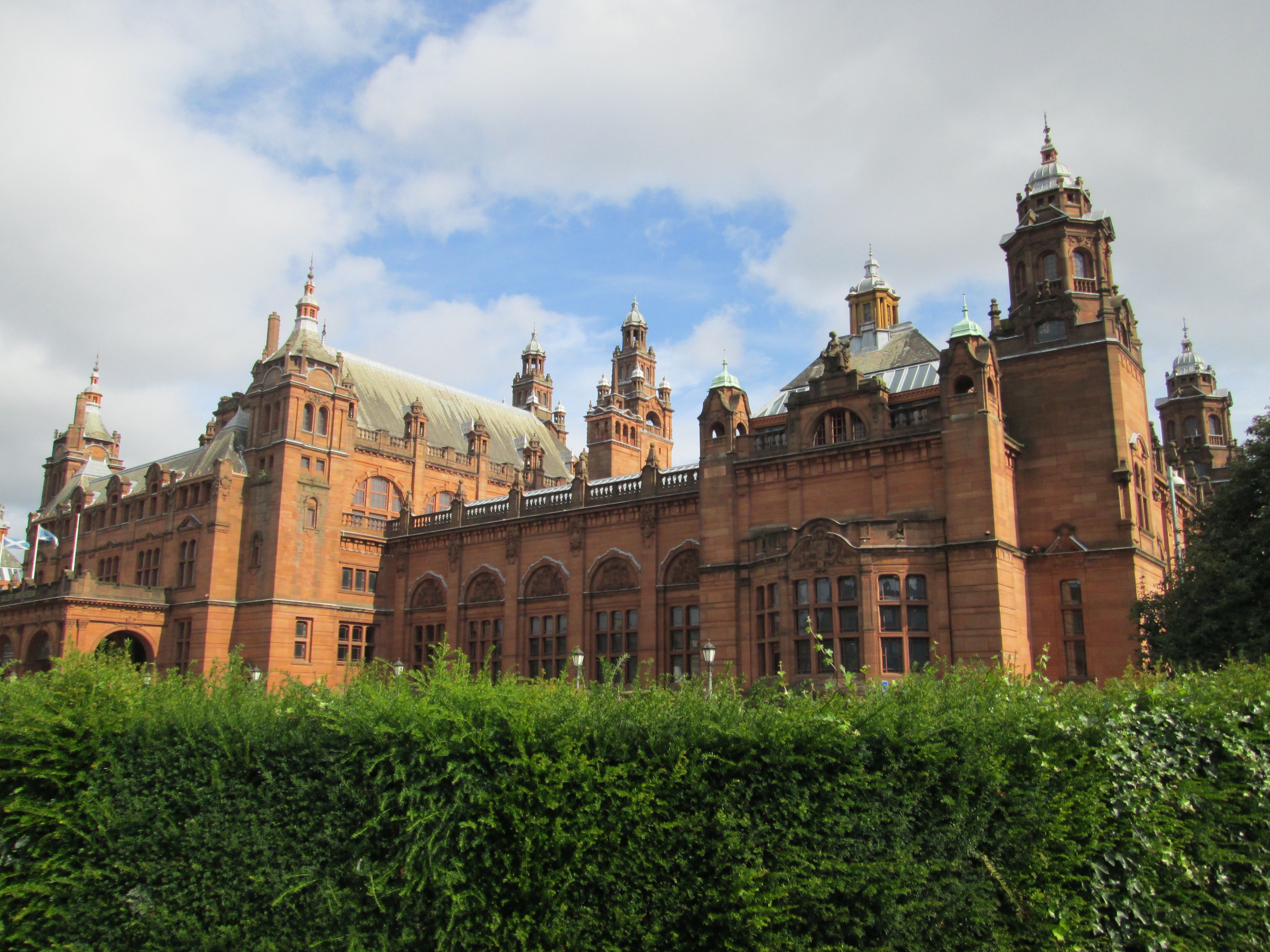
At the salubrious end of Sauchihall Street, the Kelvingrove is situated in parkland around the Kelvin River. The river’s name was appropriated for Baron Kelvin, the famous Irish physicist William Thomson, who worked from the University of Glasgow overlooking the valley. Coming to Scotland, it’s faintly humourous that he figured how low temperatures can go. The Kelvingrove Museum was completed at the start of the twentieth century. It is an impressive, pink-hued Baroque temple, housing a fine collection of international and Scottish art. Orientation was initially difficult, the museum map is a mirror image of what it should be. But Glasgow’s a bit like that, I suppose.

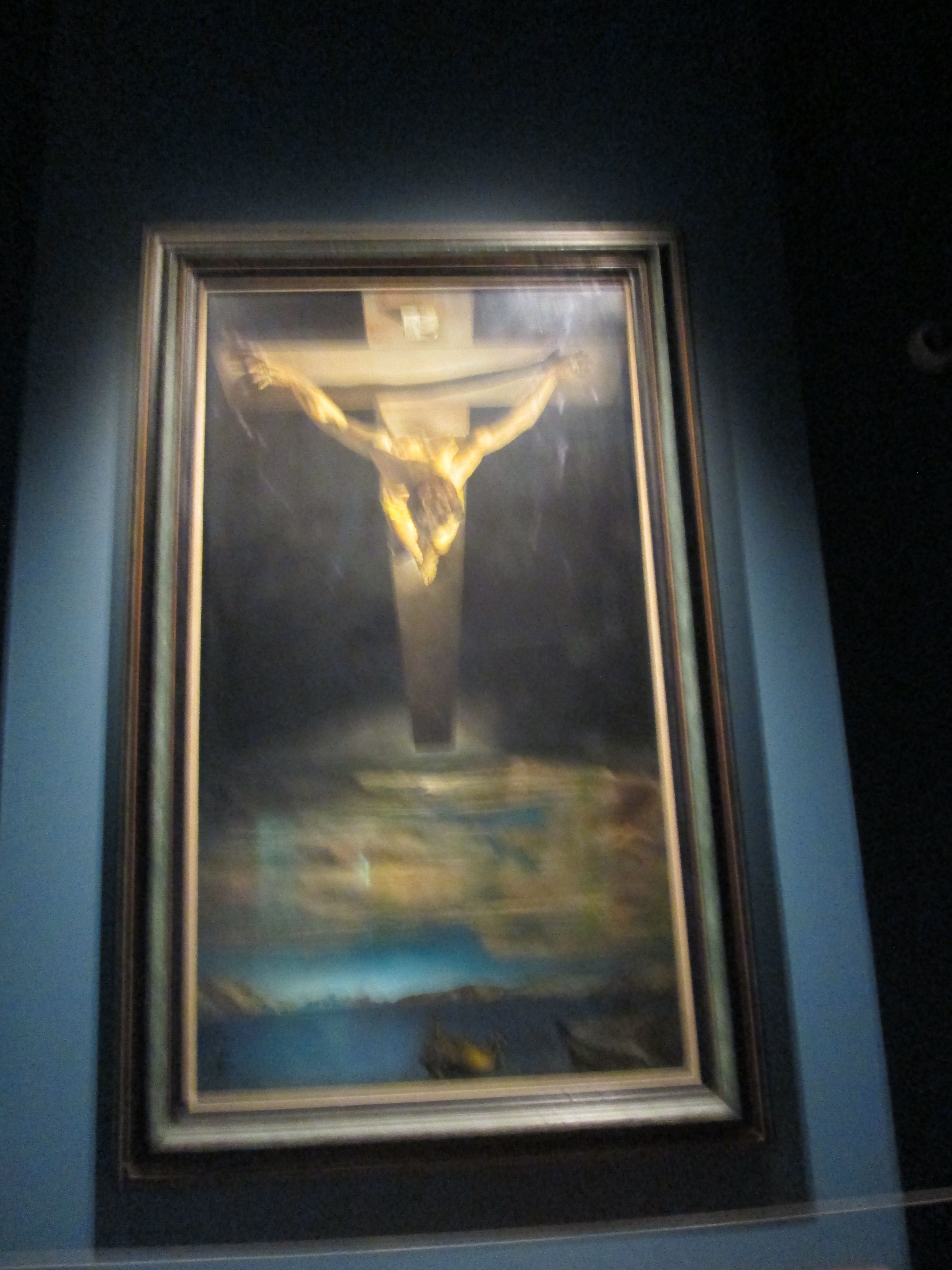
Dali's Christ of St. John of the Cross

Dali’s Christ of St. John of the Cross

Salvador Dali’s most coherent masterpiece, Christ of Saint John of the Cross, is its outstanding work. Glasgow might seem a curious repository for such a determinedly Catholic work. Indeed, the painting has suffered the attentions of a slasher, his handywork a palimpsest beneath the restoration. Still, the painting exudes an awesome serenity. It is the epitome of suspension, combining crucifixion and resurrection, appropriately enough for this city. Nearby, another startling Catholic artwork illuminates the shadow. Harry Clark’s Coronation of the Blessed Virgin was commissioned for a nearby convent in 1923. It is a fine example of Clarke’s meticulous, flowing art. It makes a most appropriate companion-piece to the Dali.

The gallery also houses paintings by Rembrandt, Van Gogh and Renoir. The ground floor houses an eclectic and dynamic exhibition, including an Elephant and a Spitfire. A haloed Elvis points the way. The main concourse is dominated by the classical pipe organ, booming into life at lunchtime when there is a regular recital.

Elvis grove

Elvis grove

It’s a hot climb through lovely parkland to the University of Glasgow atop Gilmore Hill. Its majestic spire is an ever distant destination, dominating the city from it lofty eyrie. We ghost through the quads and cloisters, seek out the Hunterian Museum where the interior of the house of Charles Rennie Mackintosh (1868 – 1928) is recreated. It is held within the silo of the Library and Art Gallery complex across from the main building. There is something Tardis like in exploring the interior of a house that no longer exists. Mackintosh was neglected in his late career, and for a while since, but his reputation is now universally established.

Though I fancied a stroll to Byers Road for some drinking and dining pleasure, time was tight and we had to move on. We take a bus through the West End, which is pleasantly alive with drinking and dining possibilities. We can only window shop from the bus, we will return another time.

Our quest for all things Mackintosh leads us back to the city centre. Mackintosh’s design is a pervasive strand throughout Glasgow, though scarce enough unless you know where to look. His work was an influence on Klimt and others in European Art Nouveau. Time has to be made for tea and coffee too. Tea Rooms were an intrinsic part of Glasgow life in the late Victorian age. A surge in Temperance was a motivating factor. Miss Cranston was a key figure in the business and she commissioned Mackintosh to design her Willow Tearooms on Sauchihall Street and Buchanan Street. He imbued them with that typical Art Nouveau merger of modern glass and steel craft with the exotic aesthetic of the Orient. Such places, whilst bolstering clean living on the one hand, were meant to be seductive. Coffee remains a favourite tipple in Glasgow today, but amongst other things. There’s a good arthouse feel to many of the cafes. Mind you, Glasgow’s friendly reputation took a dent in one. As I lounged with a stray arm draped over a nearby chair, a customer whipped it from under me without a by-your-leave. Somewhat harshed me buzz, that.

The Lighthouse

The Lighthouse

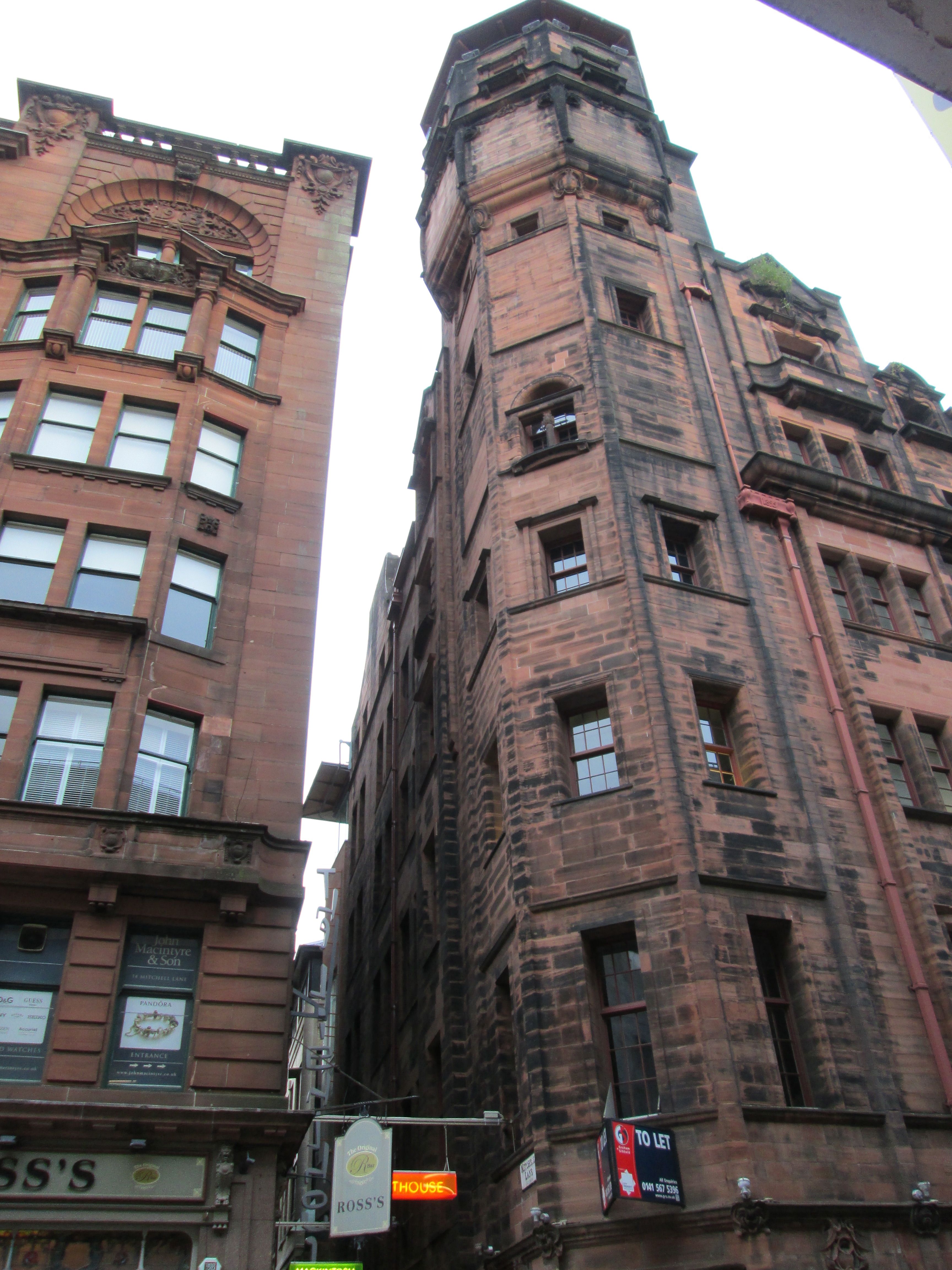
The Lighthouse, focus for all things Mack, stands sentinel on Mitchell Street. Its corner tower results in the nickname. At night, a faint light blinks from its upper storey, the beacon of a lighthouse that isn’t, aground in the metropolis. It was designed for the Herald newspaper, and was Mackintosh’s first public commission. It’s just off Buchanan Street, by way of narrow Mitchell Lane. The approach is suitably gothic. The Lighthouse gives a comprehensive view of his career. The interior of Mrs Cranston’s Tea Room is recreated. There are models and drawings of his architectural work, a sad timeline delineating his fading career.

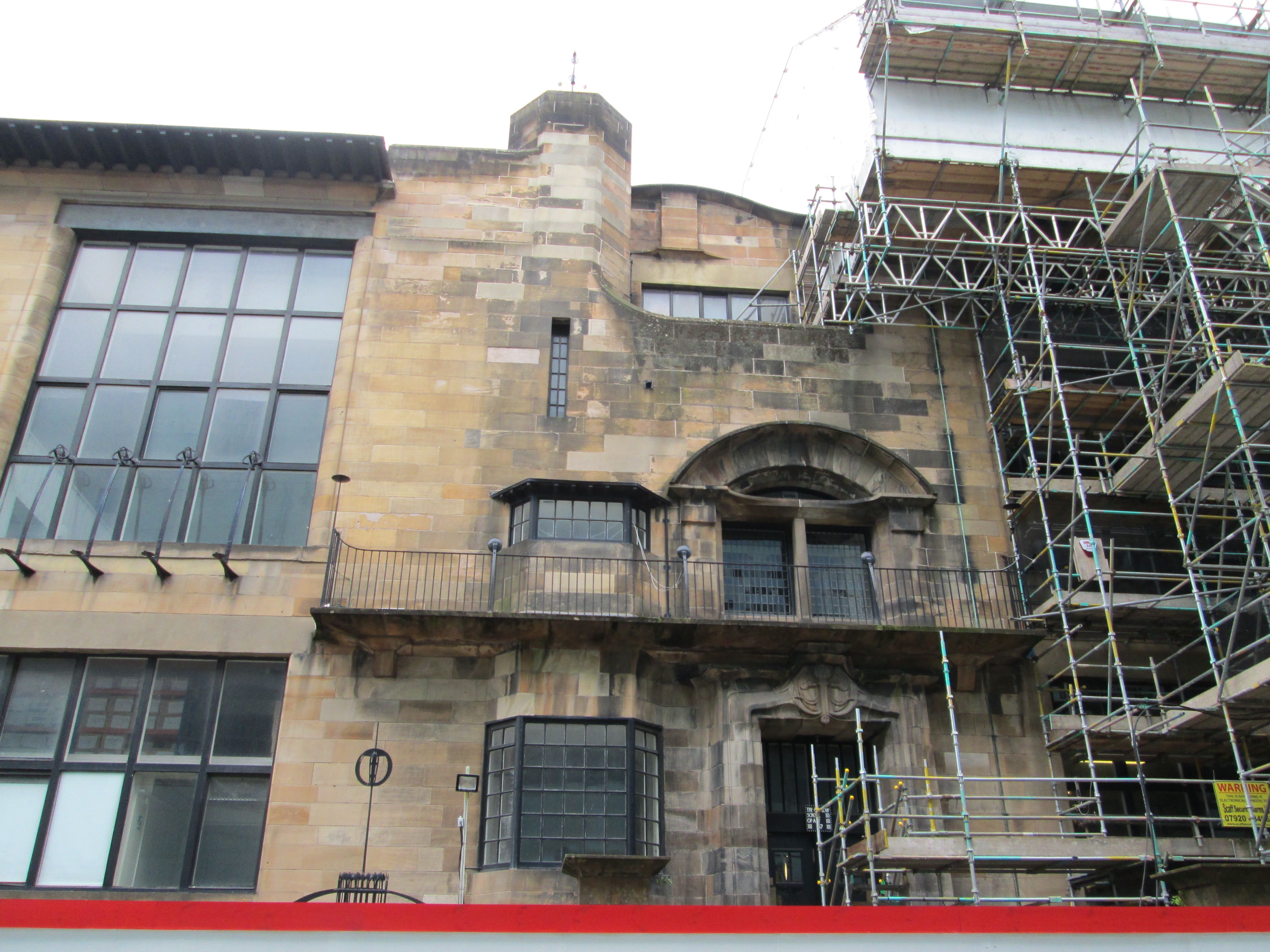
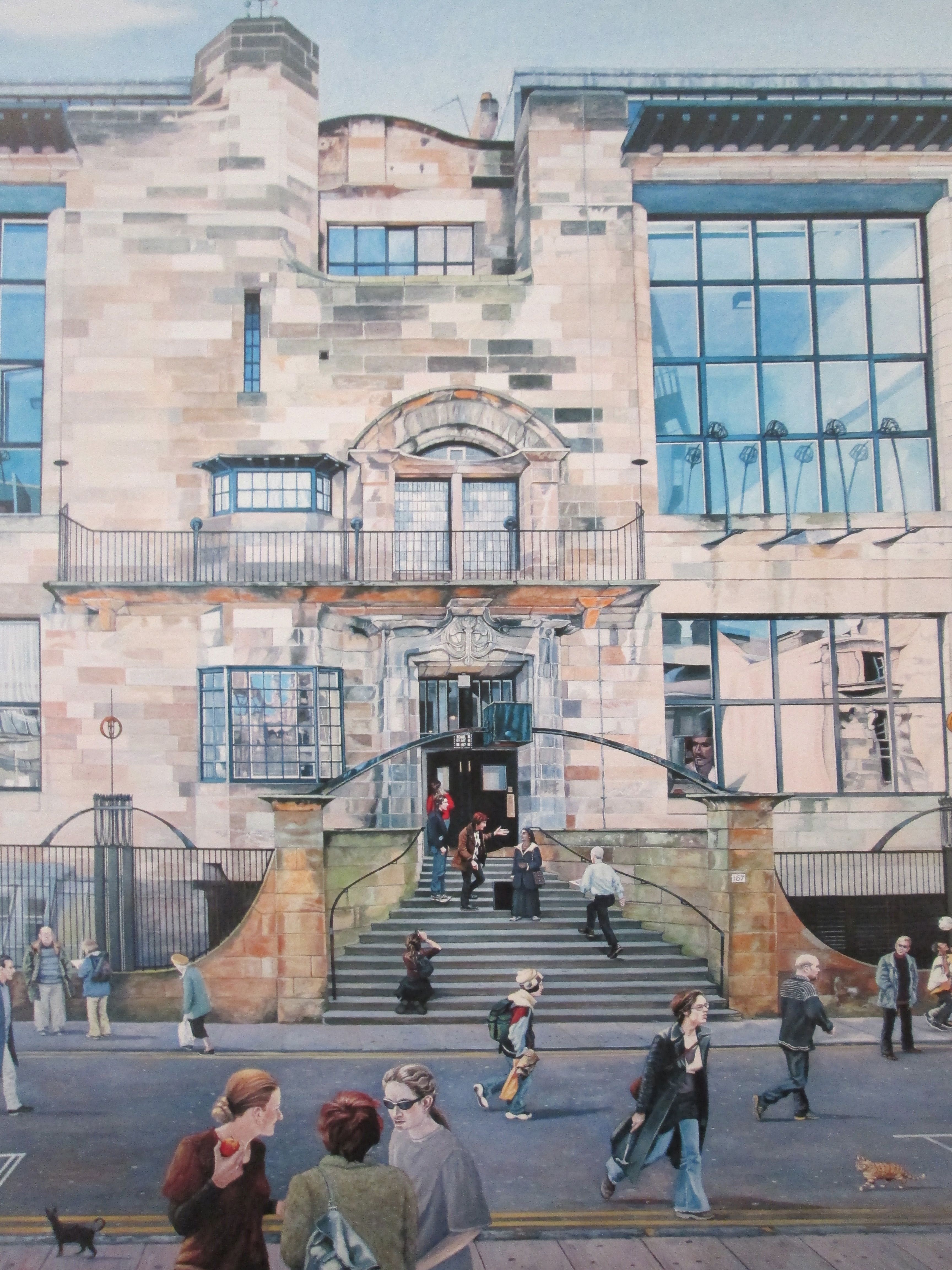
Glasgow ArtschoolGlasgow School of Art, as it is and as it's meant to be

There is a graphic depiction of the School of Art, his most famous architectural work. The original stands on Renfrew Street, just about. Seriously damaged by fire in 2014, it is undergoing extensive reconstruction and is clad in scaffolding when we visit. I’m envious of this building, my own Art College days having been spent in a dilapidated annex of Leinster House, a disused warehouse and the early days of the refurbishment of Power’s Distillery, now a fine home for Ireland’s National College. I’m familiar with scaffolding and art college. Glasgow has had this purpose built masterpiece since 1909, it is a testament to the city, and its creator, Mackintosh.

img_1095

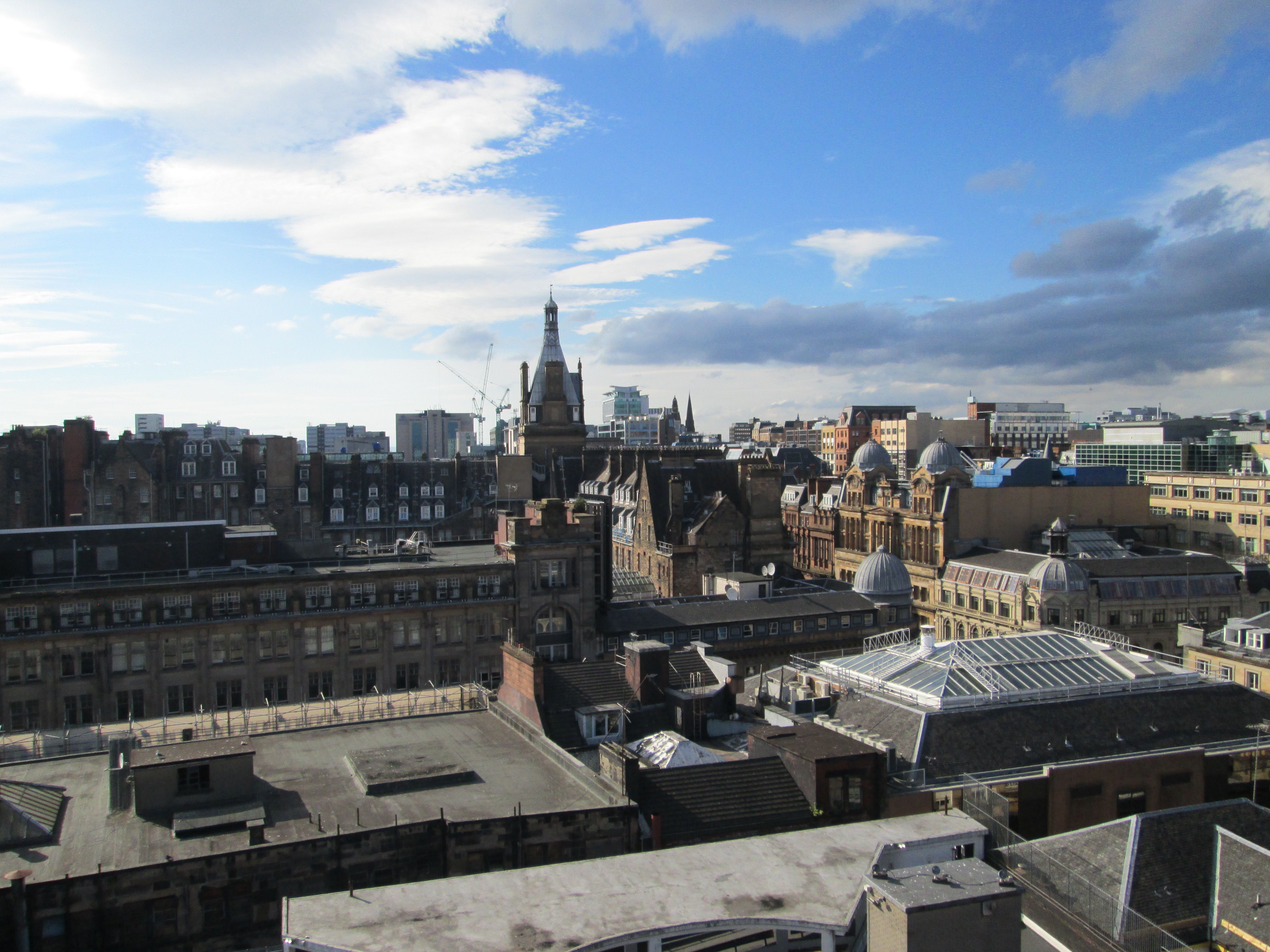
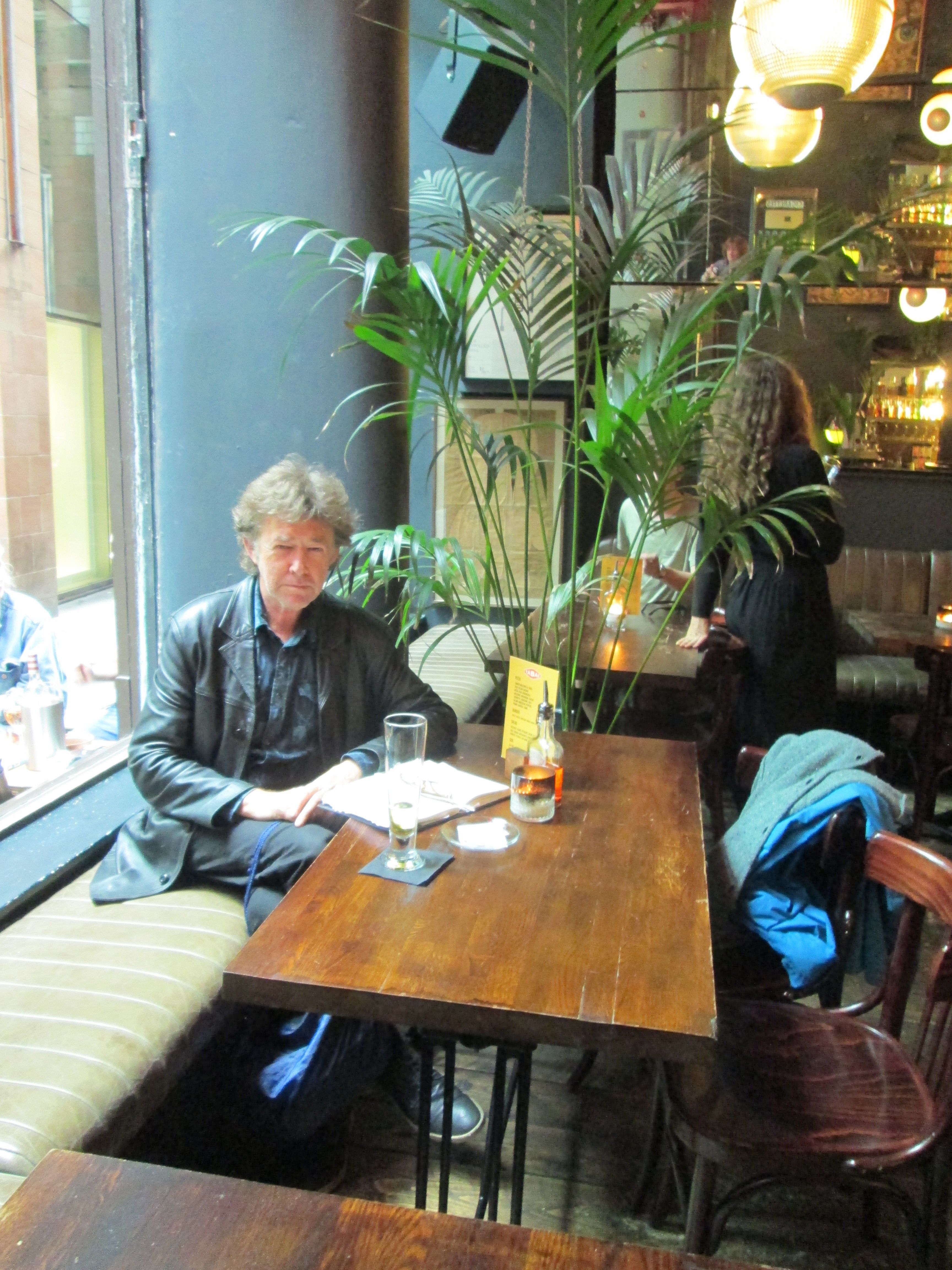
We finish by doing what one must in a Lighthouse. We climb the spiral staircase to the top, where there are magnificent views over Glasgow’s rooftops. Back to the more claustrophobic confines of Mitchell Lane. Good place for a pint, and there are good eateries nearby, for later. For now, time to absorb the September heat sitting half outdoors in the gleam and gloom of the atmospheric lane. The Lighthouse looms above. There’s a feeling here of being on a faultline between past and present, of inhabiting a graphic novel with grainy realism just a squint away. That’s draping the cloak of Glasgow around you. That’s being The Batman.

A pint in Mitchell Lane, at Bar Tabac

A pint in Mitchell Lane, at Bar Tabac

Early Modern Dublin

Stephens green

Dublin can be heaven

With coffee at eleven

And a stroll in Stephen’s Green

By the seventeenth century Dublin was spreading beyond its walls. The Liberties were established to the south and west. Settlements sprang up on the north bank of the Liffey. At the end of a tumultuous century, the Liffey was lined by redbrick gable-fronted houses and the quaysides had been constructed as thoroughfares. The trend was for enlargement to the east, which became the prosperous part of the city. Between the crumbling medieval Old Town and Georgian Dublin of the mid eighteenth century, the winding streets and lanes of today’s social and commercial heart developed.

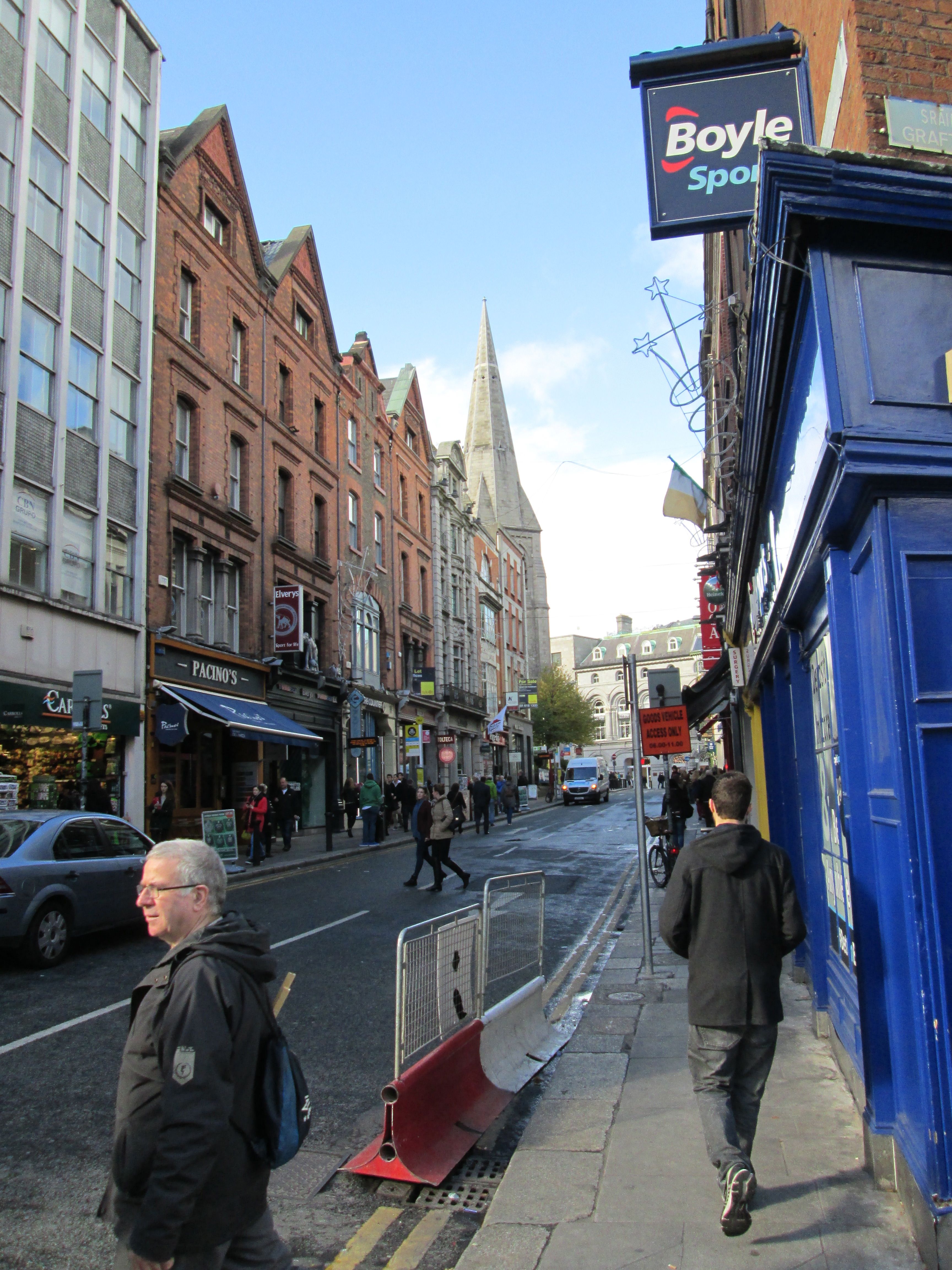
Dame Street is one of the defining thoroughfares of the city, from City Hall to Trinity College and the old Parliament Buildings. Temple Bar lies to the north, to the south lies the shopping, strolling, cafe Capital centered on Grafton Street. Dame Street is the main street of banking and commerce, its palaces of commerce capturing the exuberance of the Belle Epoque, imposing facades topped with picturesque turrets. Recently, expanding city nightlife has colonised some of these premises for drinking and dining pleasure, old trades living on in such names as the Mercantile. Running parallel, Dame Lane stretches from the Castle’s Lower Yard, across South Great George’s Street, through Dame Court and past the Stag’s Head, eventually emerging into city traffic by Trinity Street.. If indeed you do pass the Stag’s Head, and you shouldn’t, it’s near enough the definitive old style Dublin pub.

Suffolk

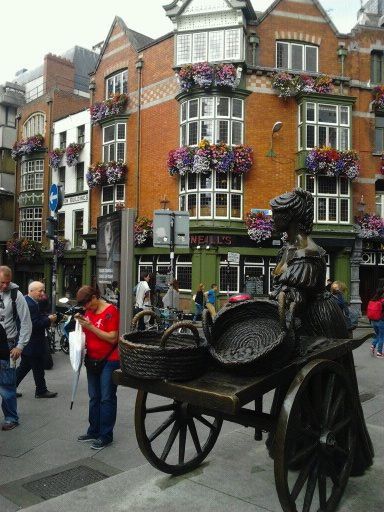
St Andrew’s Church is Dublin’s tourist HQ and as good a reference point for the city centre as you’re likely to get. Setting up stall outside is a bronzed woman with fetching cleavage. The statue of Molly Malone by Jeanne Rynhart dates from Dublin’s millennium celebrations in 1988. In just a quarter of a century it has achieved iconic status. Molly steps from the air of a song to become flesh, or bronze at least.

Molly

In Dublin’s Fair City

Where the girls are so pretty

I first set my eyes on sweet Molly Malone.

As she wheeled her wheelbarrow

Through streets broad and narrow

Crying cockles and mussels, alive, alive-oh!

The song is of obscure provenance. First recorded as a music-hall ballad of the 1880s, attributed to Scottish songsmith, James Yorkston, though it may be derived from an older ballad. It has become the anthem for the capital city; the refrain Alive, alive oh! being suitably valedictory. However the song, as is the case with many an Irish song, finishes on a mournful note.

She died of a fever,

And no one could save her,

And that was the end of sweet Molly Malone.

Now her ghost wheels her barrow,

Through streets broad and narrow,

Crying: Cockles and mussels, alive, alive oh!

In old Dublinese, fever and save her would rhyme. She can still wheel her wheelbarrow, all the same. Last time I saw it ‘twas at the bottom of Grafton Street, now it stands outside Saint Andrew’s Church. Mythology has accreted to the song. The story goes that Molly was a seventeenth century barrowgirl who earned a bit on the side plying the oldest profession. The song certainly alludes to sex. Cockles and mussels (or muscles) has salacious connotations. The refrain has a bawdy singalong quality. Young lovers and visitors to the Fair City have taken the photo opportunity the statue offers. It is traditional to grasp one or both of Molly’s breasts, giving them a sunburst emphasis, fulfilling the myth’s premise.

Top o' Grafton Street

Top o’ Grafton Street

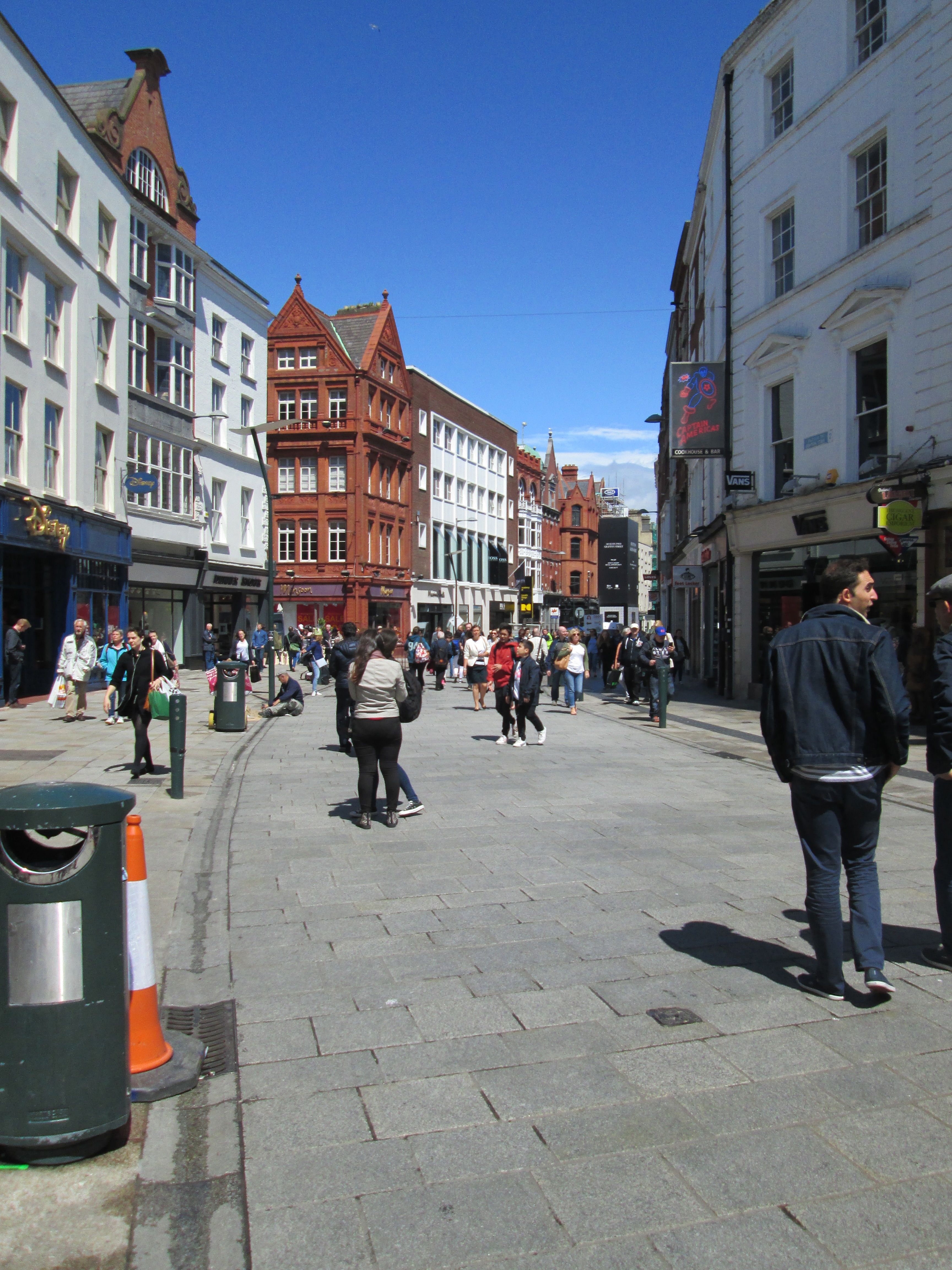
A few yards further east, Grafton Street runs at a right angle to Suffolk Street. Now Dublin’s principal shopping street, a bustling pedestrianised way thronged with shoppers and tourists, lined with buskers and street theatre.

Grafton Street’s a wonderland, there’s magic in the air.

There’s diamonds in the lady’s eyes

And gold dust in her hair.

East of this line is where Enlightenment Dublin begins, with a rationalist street plan and regular, symmetrical facades. To the left you’ll notice the streets, still narrow, offer straight vistas. Anne Street towards St Ann’s Church, dating to 1707, is a fine example. To the right narrow alleys like Johnson’s Court tunnel back to the medieval. The Court provides a rear entrance to Clarendon Street Church, an oasis of spiritual calm.

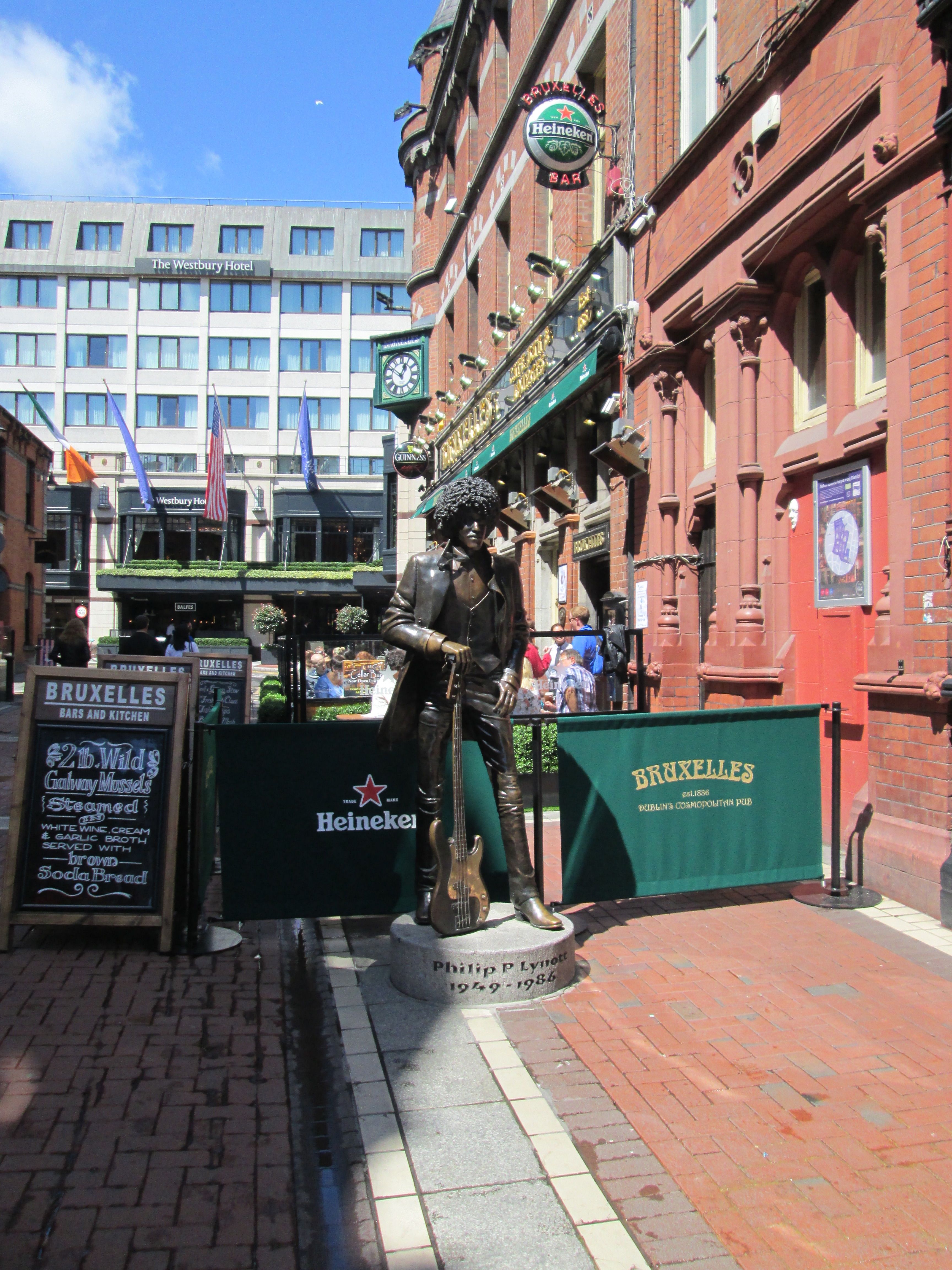
At Bruxelles Pub near the top of Grafton Street, another lifesize statue vies with Molly for popularity. Phil Lynott was black and Irish as Guinness, leader of Thin Lizzy, kings of the Dublin Rock scene of the early seventies. Lynott took a rocked up version of Irish trad balled, Whiskey in the Jar to the British charts. The ballad records the misadventures of a seventeenth century highwayman. The protagonist’s lover, or whore, in Lynott’s version is called Molly, so no accident that they’re still close.

Lynott

But me I like sleeping

Especially in my Molly’s chamber

But here I am in prison

Here I am with a ball and chain.

Lynott died in 1985, aged just thirty six. The video for his song, Old Town, features him swanning about Grafton Street, a tradition he’d maintained since the late sixties. Captain America’s near the top of the street would have known him and holds some of his and other Rock memorabilia. Captain A’s featured artworks after Lichtenstein by Jim Fitzpatrick. Fitzpatrick, famed for his depictions of Celtic myth and Che Guevara, recasts Captain America as a crusader against fascism. We came for their Mexican burgers and red wine. It was the hip hangout of the early seventies. Lizzy’s traveling coterie, Horslips, Mellow Candle and Chris De Burgh hung out here. De Burgh was resident singer, resplendent in star spangled suit. Probably helped to clear the joint.

Nearby, the Dandelion Market developed into Dublin’s hippy flea market. U2 cut their teeth here, before the whole thing was subsumed in the frothy Stephen’s Green Centre. At the top of Grafton Street, we emerge blinking into daylight dappled by trees. Saint Stephen’s Green in the seventeenth century was a commonage on the outskirts of the city. Those granted the title Freeman of the City, still maintain their right to graze their sheep on the Green. As Bono recently insisted.

IMG_0777

The Green was walled in 1664 with access restricted to owners of adjacent properties. The surrounding houses would have been gable fronted properties, known as Dutch Billys. This style gave way to Georgian by the middle of the eighteenth century. Vestiges of the earlier style can be discerned. Look above street level and you will see, here and there, an asymmetrical window layout on the upper storeys, indicating where a gable frontage once was. The Green was restricted to residents until 1877 when Sir A E Guinness, Lord Ardilaun, campaigned to put the park into public ownership. The park was newly laid out to the design of William Shephard, Lord Ardilaun contributing the extensive planting of exotic trees and shrubs.

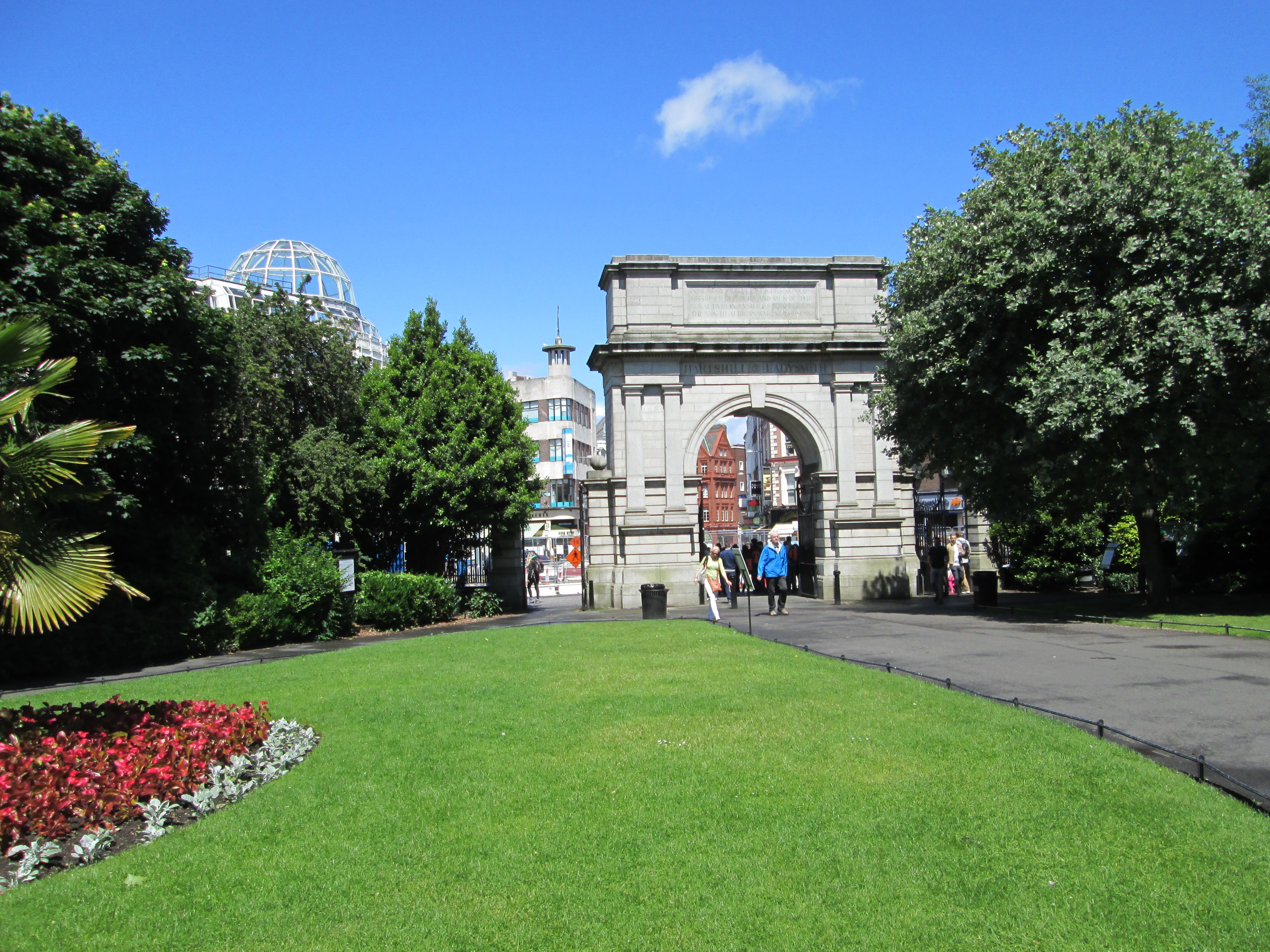
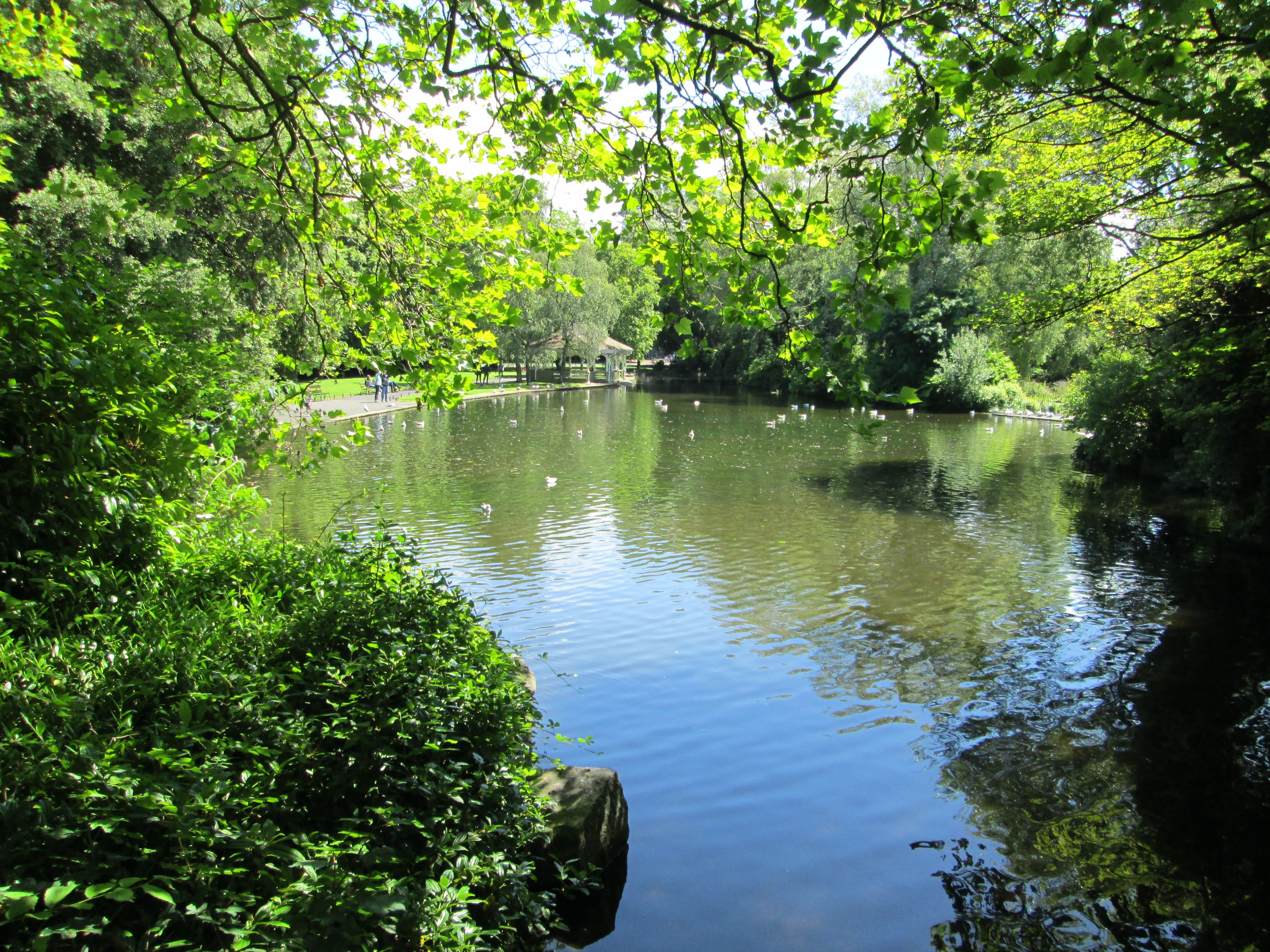
Entering through Fusiliers’ Arch, pathways flow around the ornamental lake. Young Dubliners and visitors occupy the grass, taking time out from the commercial hustle of Grafton Street. If Dublin can be heaven, and this is heaven’s heath. Beyond the park’s southern extent, the centre city starts to ebb. The rational expanse of Georgian Dublin takes over with its wide regular streets. Find a quiet elevated spot past the kip of the serenes, by Moore’s statue of WB Yeats. It looks nothing like the man! Slip into a boulevardier dream, slide back into another time.

Toora loora loora laddy, toora loora lay,

I know the Dublin pavements will be boulders on my grave.

Green pond

Prague

Angels and art on Charles Bridge

Angels and art on Charles Bridge

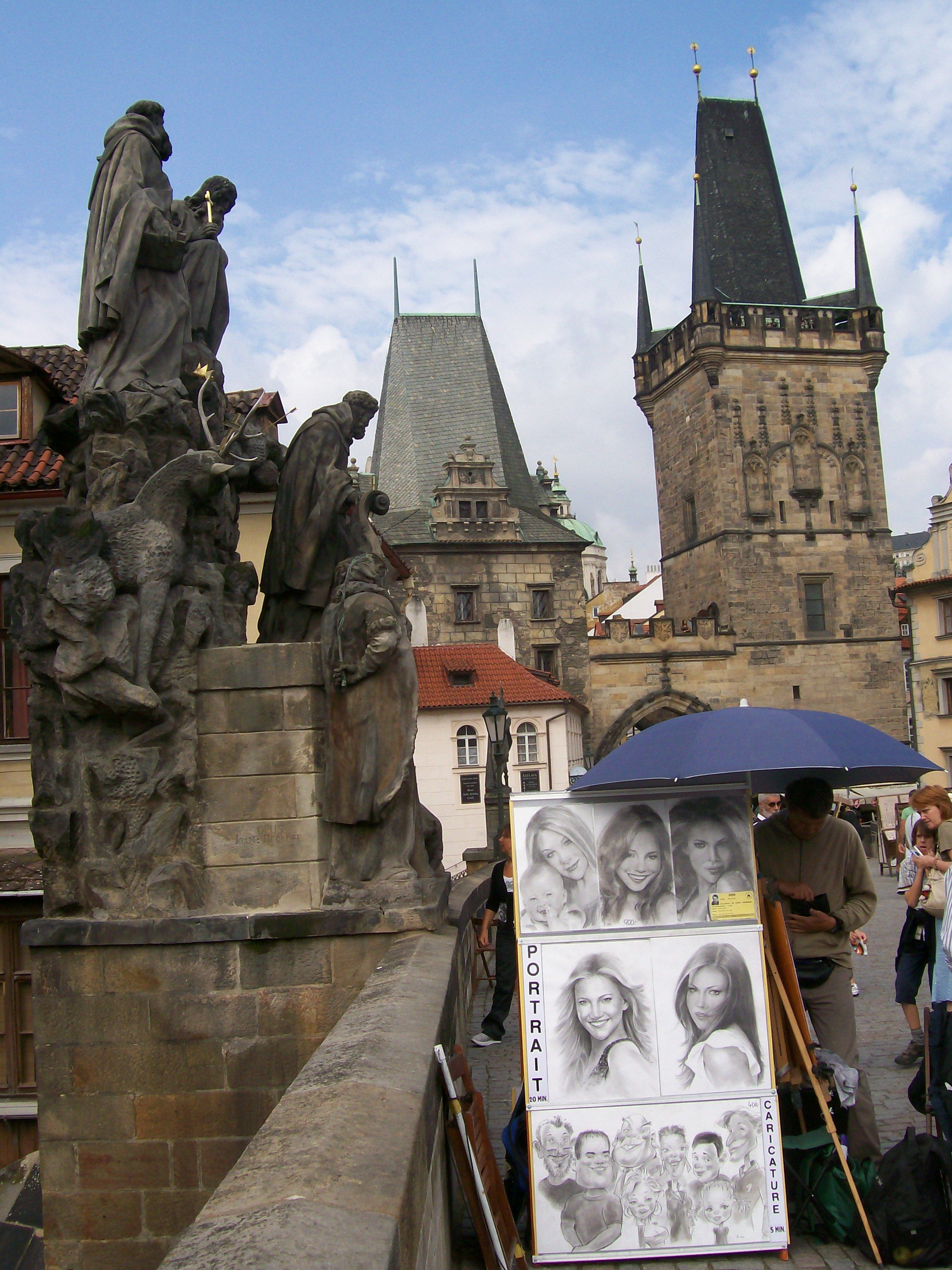
Prague is more of a dream to me now. Charles Bridge partly wrapped in scaffolding, angels and demons in the architecture, the Vltava sweet and slow, a highway diverted through time. We stayed in Mala Strana, a hundred yards from the bridge. It’s an island in the stream, insulated from the sturm und drang of the city flowing all around.

The Old Town sucks in a constant pilgrimage crossing the bridge, serenaded by snappy jazz and classical combos, confused by the street theatre amongst the stone statues. There is no let up in the sinuous streets of the Old Town, opportuned at every step with offers of classical recitals, drinking and dining experiences, and the amiable chancers who will show you all those things that you can see. The streets flow sporadically into cobbled squares. The eye is drawn upward to ornate spires, a fold-out picture book of images culled from Bosch and Brueghel. Mobile drinking groups push by propelled by tough cyclists. The pavement restaurants are packed. Advice abounds; a tall black man dressed as a leprechaun sullenly advertises an Irish Bar. It’s hectic but fun.

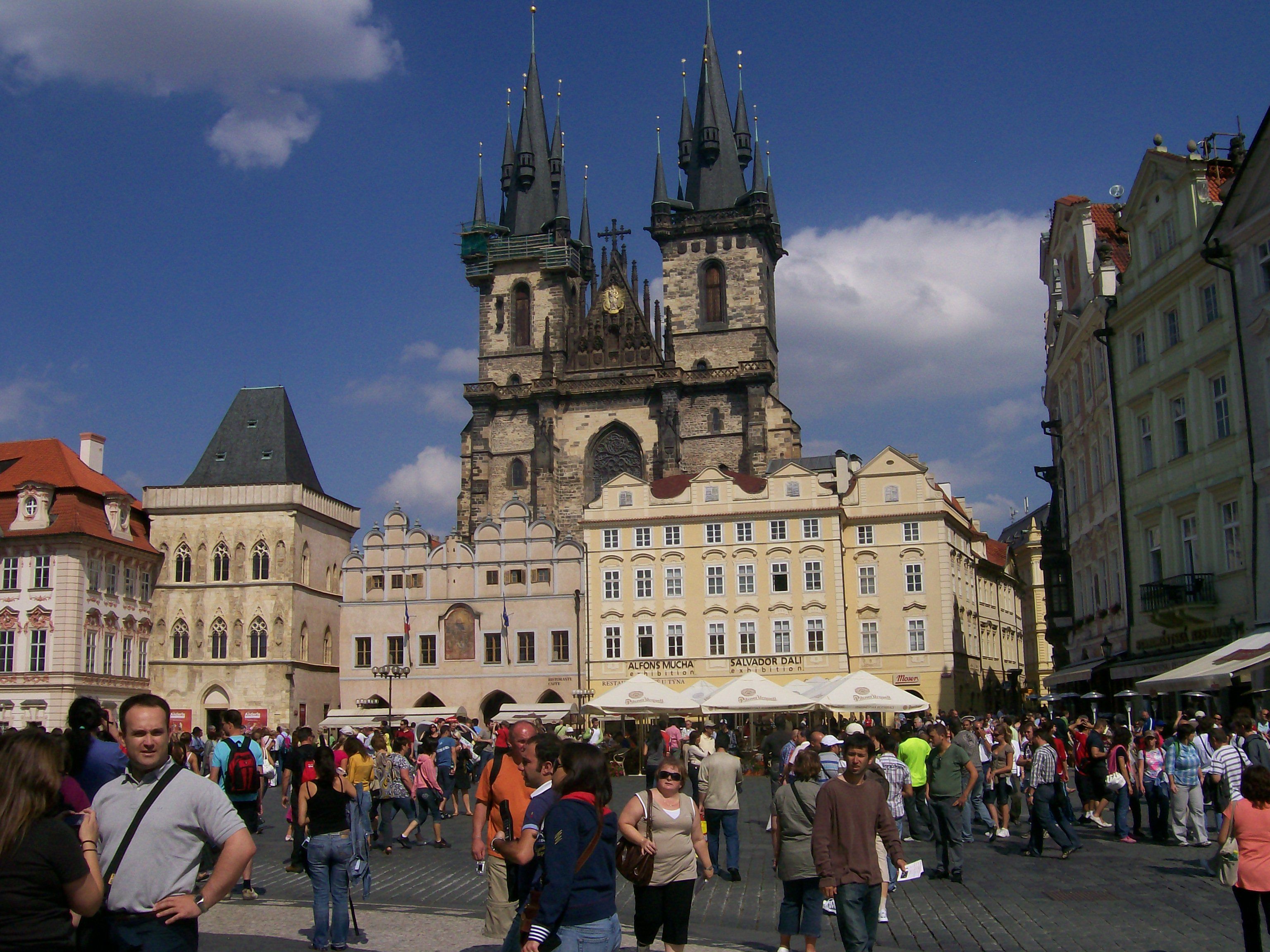
Our Lady Before Tyn beyond the Old Town Square

Our Lady Before Tyn beyond the Old Town Square

This is the perfect city to explore on foot. If somewhat over-touristic in the Stare Mesto or Old Town, fact is we’re tourists too. We go with the flow. The Old Town Square features the Old Town Hall with its Astronomical clock. Towering to the east are the incredibly ornate spires of the Church of Our Lady Before Tyn. Central Europe in the Middle Ages is tangibly real. Illuminated at night, the spires seem to float against the sky. The dream goes on while no-one sleeps.

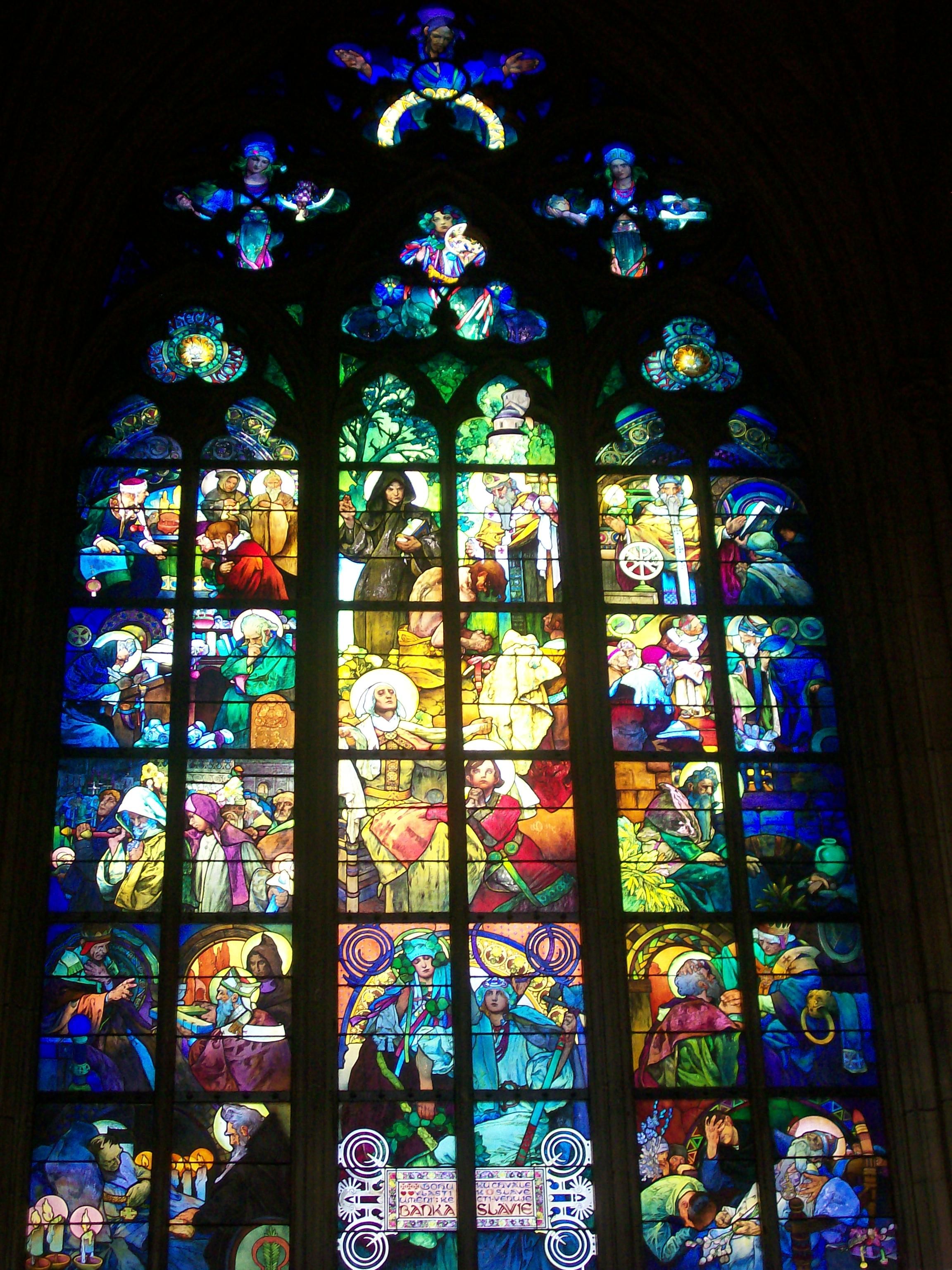
In the Square there is a gallery housing exhibits of Mucha and Dali. Alfons Mucha is amongst my favourites. His sinuous Art Nouveau has adorned my walls on posters and mirrors. I imitated his statuesque women. Goddesses culled from myth or personifying the seasons, sophisticated smokers and drinkers, their extravagantly flowing hair, dubbed, a bit scornfully, as Mucha’s spaghetti. A local boy who made it big in Paris especially with his commercial work, I come across his artwork and influence throughout the city. His ornate interlaced lines recall Celtic art and have become emblematic of Art Nouveau and its zeitgeist.

Mucha's panel at St Vitus Cathedral

Mucha’s panel at St Vitus Cathedral

The Powder Gate is the eastern limit of the medieval city. Nearby, the Municipal House is an art nouveau complex featuring museums, galleries, restaurants and cafes. Beneath is the American bar. Descending to the cellar, the giddy feeling of being one of Escher’s elves. Mucha graphics peep from the stone. The American Bar glimmers beyond doors of chamfered glass. The tiled chequered floor gleams, lightbeams angle from arched windows at street level. All tables are empty. I am served by a liveried man. A tall local lager is a work of art. While there, a small group of tourists gather at the door, looking in and around and at me. They talk amongst themselves, give me one last envious look and depart. I think they’re Americans, but this is my bar.

Big Brother in Prague

Big Brother in Prague

South of the Old Town is the Nove Mesto, though it was laid out in the fourteenth century. The New Town Hall dates from this time. It faces out on a park frequented by vagrants. The view from the top windows was sometimes the last thing seen by those chosen by enraged citizens for defenestration, the medieval Czech’s extreme example of the Big Brother House. The real Big Brother held sway here for half the twentieth century. The main drag, Wenceslas Square, was the rallying point for opponents of the communist regime. They almost carried Dubcek in the Prague Spring, but the Soviets intervened. Vaclav Havel led the ultimate revolt as the Iron Curtain fell. It is not so much a square as a broad rising street. Above the commercial, and increasingly tatty, street facades, art nouveau architecture blossoms into the sky. The National Museum dominates the vista, though it is isolated beyond a broad, busy traffic thoroughfare.

In the sanctuary of the Clemintinum we step out of the throng. It is huge baroque complex including churches and the National Library. The Astronomical Tower is where Kepler and Tycho Brahe unravelled the secrets of the heavens. After Copernicus, more and more we came to realise we were not the centre of the universe. Silence gathers and we buy tickets for a classical recital off a Bohemian Girl. This returns us to the riverside and the Church of Saint Francis for teatime contemplation. That’s Baroque and Roll.

Infant of Prague

Infant of Prague

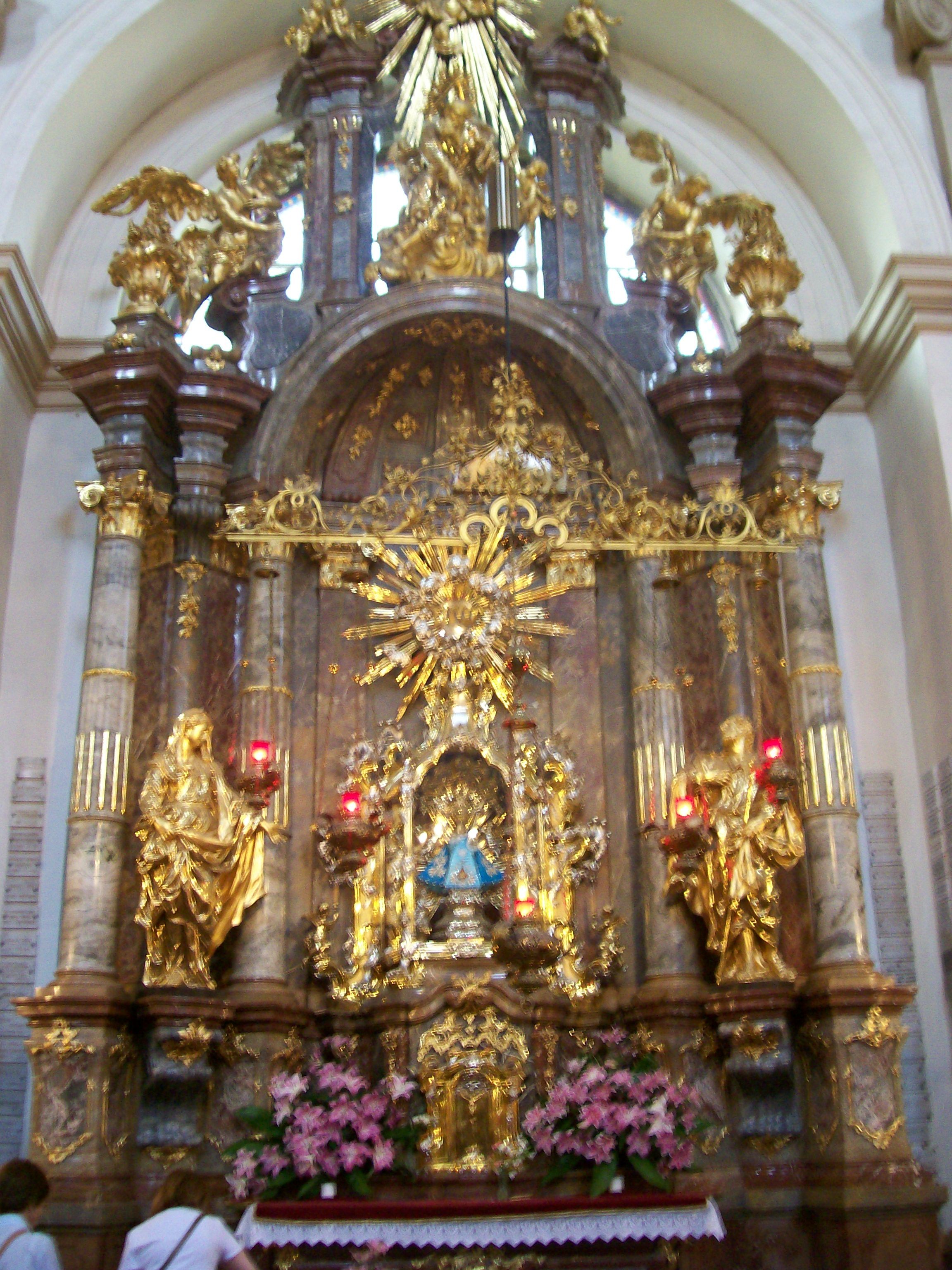
There are pilgrimages to be made. My childhood home always had as a centrepiece of the altar, the statue of the Infant of Prague. My mother venerated this miraculous icon. The original came from Spain in the sixteenth century as the Catholic Reformation took root under the Hapsburgs. It was donated to the Carmelites of the Church of Our Lady Victorious in 1628. The nuns change the vestments according to the liturgical calendar. When I call, the statue is clad in blue, which pleases me greatly.

The Castle floats above the city. We wind our way up from Mala Strana into the high area of Hradcany. To the Castle! Parkland and woods, market gardens and flowers, shield us from the city spread out below. The Castle complex is vast. At one end is a torture museum, at the other, St. Vitus Cathedral marks the high point of Prague’s skyline. From screaming to dreaming spires. The Cathedral has been a thousand years a-growing, but remains convincingly gothic. Inside, the stained glass gallery evokes Czech nationalism in the early twentieth century. Mucha’s stained glass depicts the legendary rise of the Slavic tribes.

Cruising on the Vltava

Cruising on the Vltava

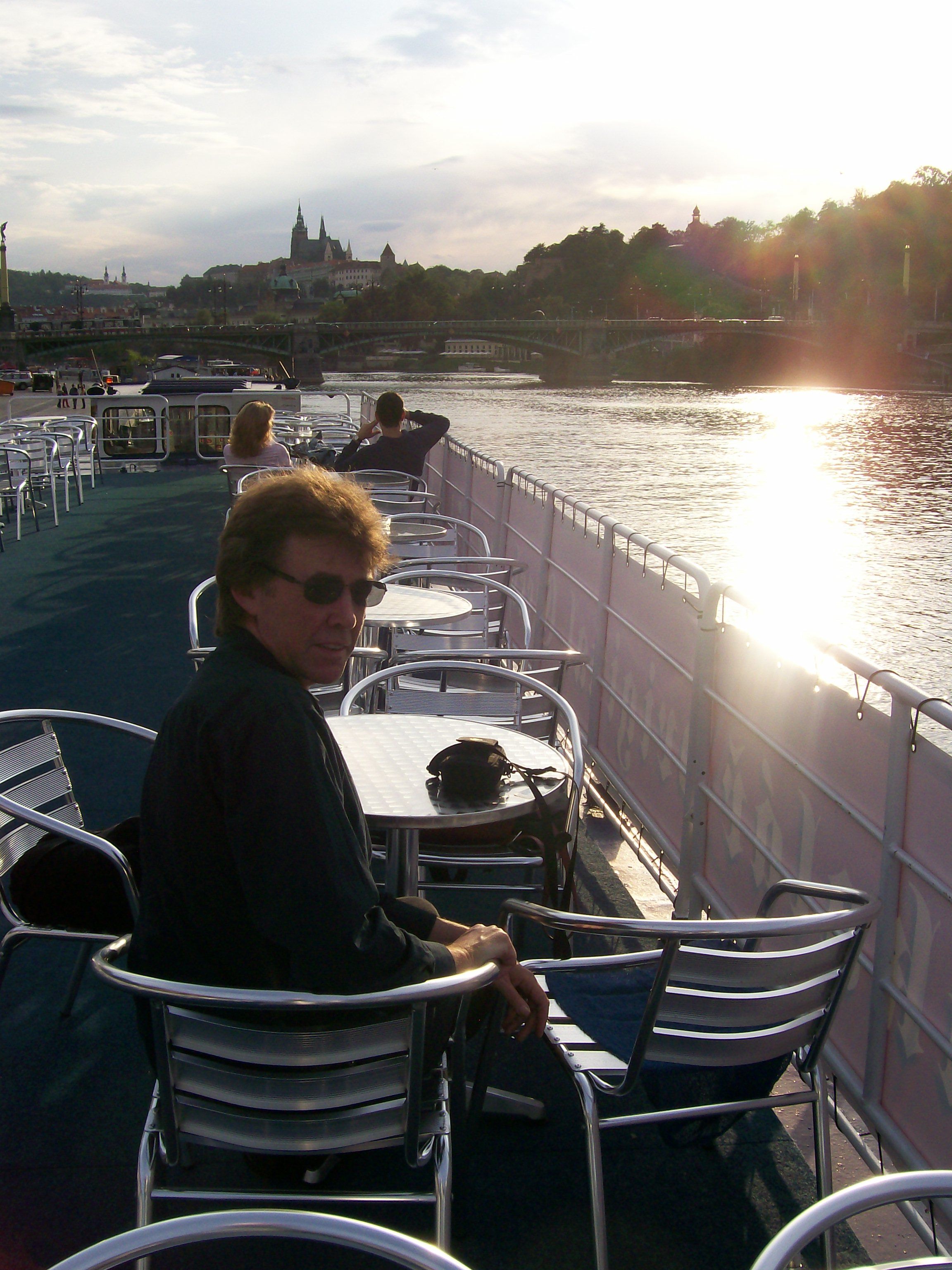
An afternoon and evening is spent messing about on the river Vltava. We cruise beyond the city limits into an unexpectedly bucolic landscape. Returning after sunset, Prague’s fantastic spires and turrets are illuminated against the night. Good wine and company, the city seems remote. The black water stretches out of sight, in both directions. Our metaphor for life, and death.

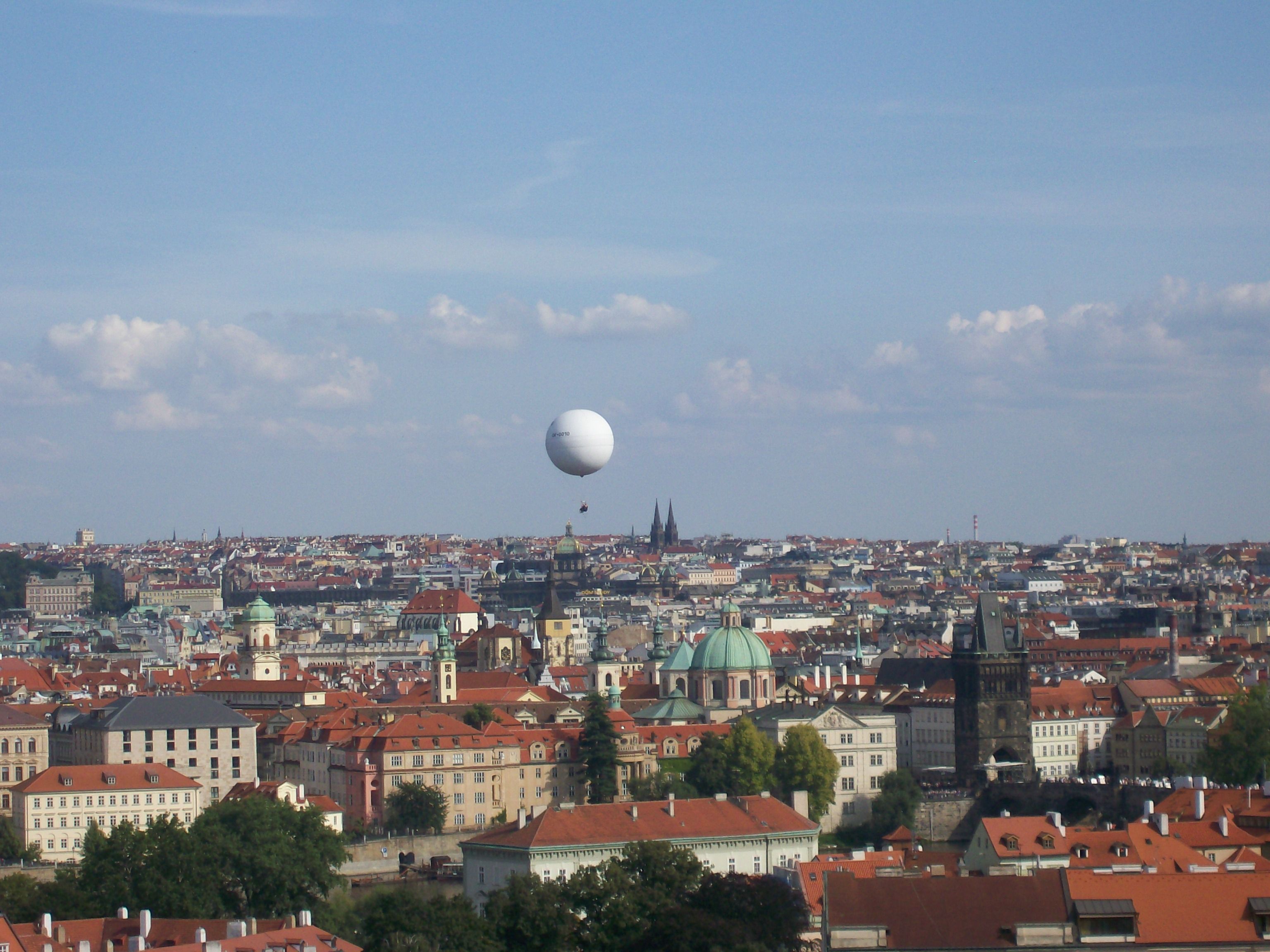
In the spirit of existential angst, on the last day, it is time to pay homage to Franz Kafka. The Kafka Museum is only a short distance from our hotel. Inside Kafka’s head there is another route through Prague. Gothic, gloomy and fantastic, this is to explore the deeper psyche. Looking through a tinted window to the back of a display panel, the Vltava is black syrup beneath a burnishing sun. My eyes slip upward to the pewter sky until its blueness seeps through. Above Prague’s skyline, a white balloon takes its passengers ever upward towards heaven

.White balloon

Dublin’s Temple Bar

View from Liffey Street

View from Liffey Street

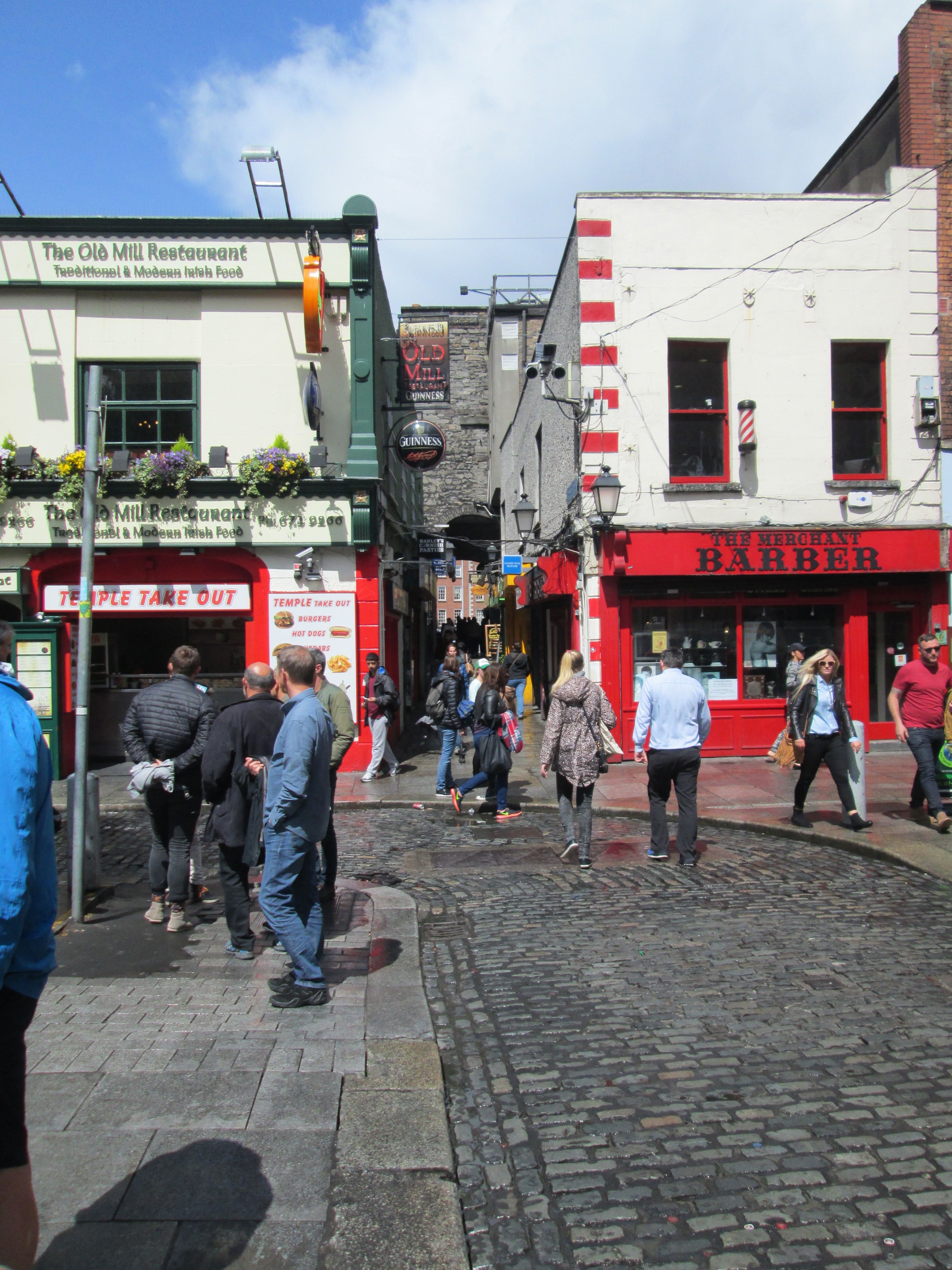
Temple Bar lies to the east of the medieval walled city of Dublin, bounded by the South Quays, Westmoreland Street and Dame Street to the south. Temple Bar itself is a short segment midway along the Fleet Street/Essex Street thoroughfare. The name may have originated in imitation of the area in London which similarly lies just outside the city gates. Or it may be named after William Temple, Provost of Trinity College in the early seventeenth century. Trinity had been established by Queen Elizabeth in 1592. Temple and his descendents had property here, so the name probably recognises both facts.

When I was young this was a dilapidated and largely deserted part of Dublin. A place of well worn cobblestones and crumbling warehouses, the odd quirky shop or hostelry looming out of the smog. You might be picking up a Dickensian atmosphere here, but I’m not that old. The city planners in the 1970s had earmarked Temple Bar for development as a major bus station. As it was, Fleet Street was then choked with busses bound for Crumlin, Walkinstown and beyond. This was where we’d gather to imbibe the petrol fumes mingling with the smell of fish and chips, rain falling, steam rising from damp coats.

Heading towards Merchant's Arch

Heading towards Merchant’s Arch

The alternative society was sussing it out in the seventies. The Granary at Essex Street was a wholefood shop, branching out into a cafe and meeting place. Next door, the Project Arts Centre moved here from King Street by Saint Stephen’s Green, bringing alternative theatre, modern art and underground music. The Alchemist’s Head, making Ireland safe for science fiction, was just across the road. My work in the P&T as then was, Eircom now, also brought me to Crown Alley, an attractive turn of the century redbrick on Fleet Street. A hub of the telephone network, the 1916 rebels had it earmarked for takeover but feared, wrongly, that the British army was in possession. Their failure here and at Dublin Castle were major opportunities missed.

The bus station never flew. The low rents prior to development attracted a creative and bohemian bunch. Representations were made to the powers that be. It was Charlie Haughey, cultured rogue that he was, who saw the light. Temple Bar properties was established to oversee development, the aim to create a cultural quarter for the capital. More famously, it has become a major social hotspot, transforming the narrow, once empty streets, into a day long conga line of partying visitors and locals.

Liquid gold in the Temple Bar pub

Liquid gold in the Temple Bar pub

Some of my old watering haunts remain. Whenever possible I return to The Palace Bar which proclaims its literary and journalistic connections at the eastern end of Fleet Street. Almost two hundred years old, it retains its original old style dark wood bar and furnishing style. High ceilinged with stained glass and a grand glass frontage, all the light pouring in is trapped in this veritable drinking palace. Such pubs are the salt of Dublin’s earthy drinks culture. Our old city haunt, The Crane at Crane Lane is gone. Here we could rub shoulders with Special Branch men from the Castle and seek out ladies from our own suburbs. It happened to be the nearest city pub to our bus terminus. There are many more additions than subtractions. No shortage of watering holes. Temple Bar may have been where the Danes dropped anchor in the ninth century, but you can still pay Copenhagen prices for your Carlsberg here. The Temple Bar pub charges near seven euro a pint, but still the place is hopping by midday. The market here is not price sensitive.

The Central Bank at Dame Street

The Central Bank at Dame Street

From nineteen seventy three, the Central Bank has towered over the area like a modern Bastille. Though I’m sure it’s much more pleasant to work there. Sam Stephenson’s monsterpiece was controversial in many ways. Built from the sky down, as it were, the completed floors hung by visible cables from central support towers. The method itself alluded to a certain exalted origin and function. Getting even bigger for its boots, it was alleged to be taller than Liberty Hall, Ireland’s awe inspiring seventeen story skyscraper of the sixties and trade union home. Labour’s Minister for Local Government, James Tully, stepped in and ordered the completed building to be taken down a peg. In truth, its height was in contravention of the planning permission. But that’s another storey.

Being a tall building, something which the Irish feel should be confined to round towers and spires, objectors considered it an affront, a Tower of Babel. Advocates insisted it would stand the test of time. I sneered then but I’d concede that it has lasted well, unlike Stephenson’s notorious Bunkers at the Dublin Corporation buildings by Christchurch. Passing beneath the Central Bank, it does seem to float in the air, and to form a fine gateway for entering Temple Bar.

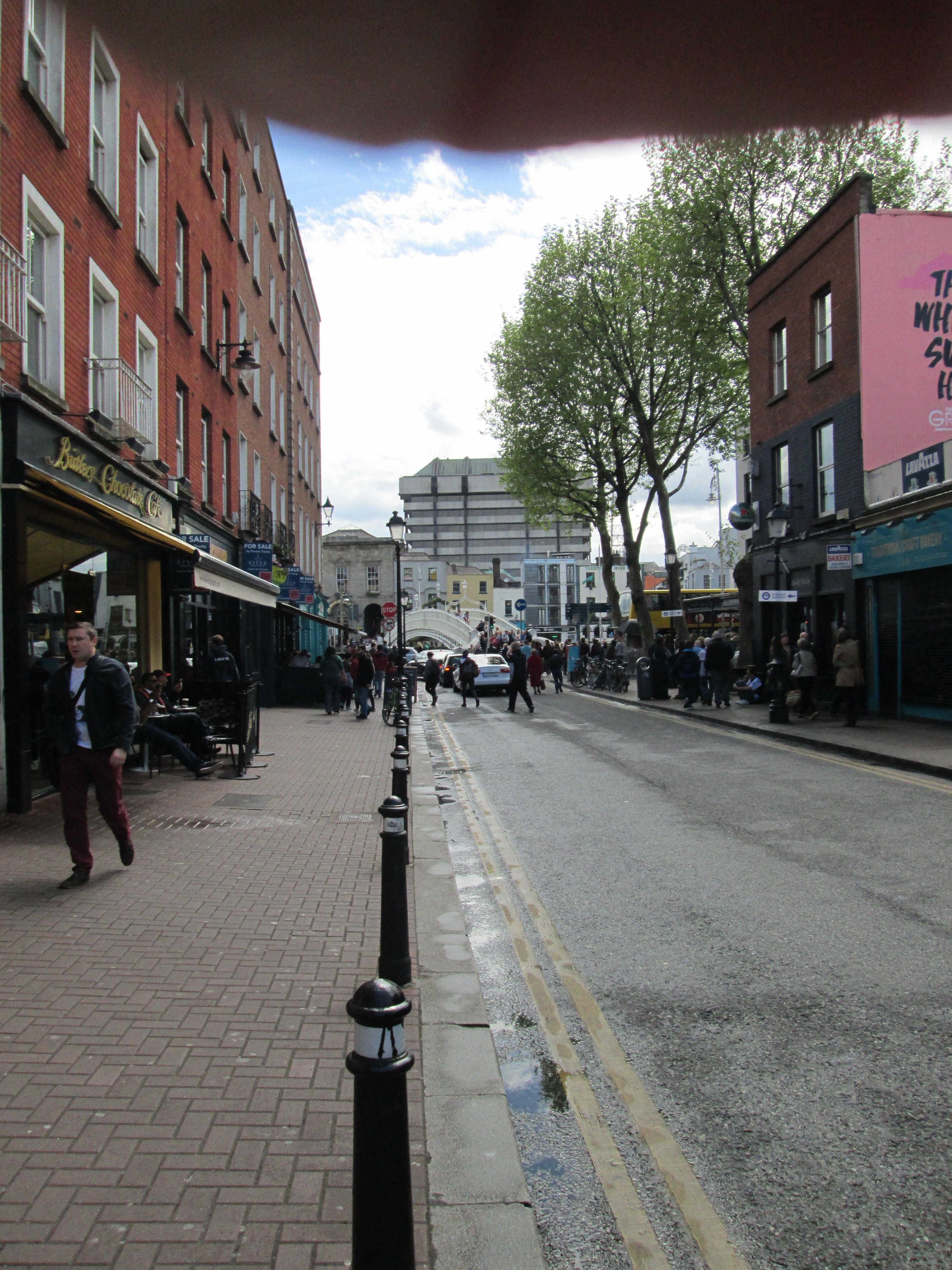
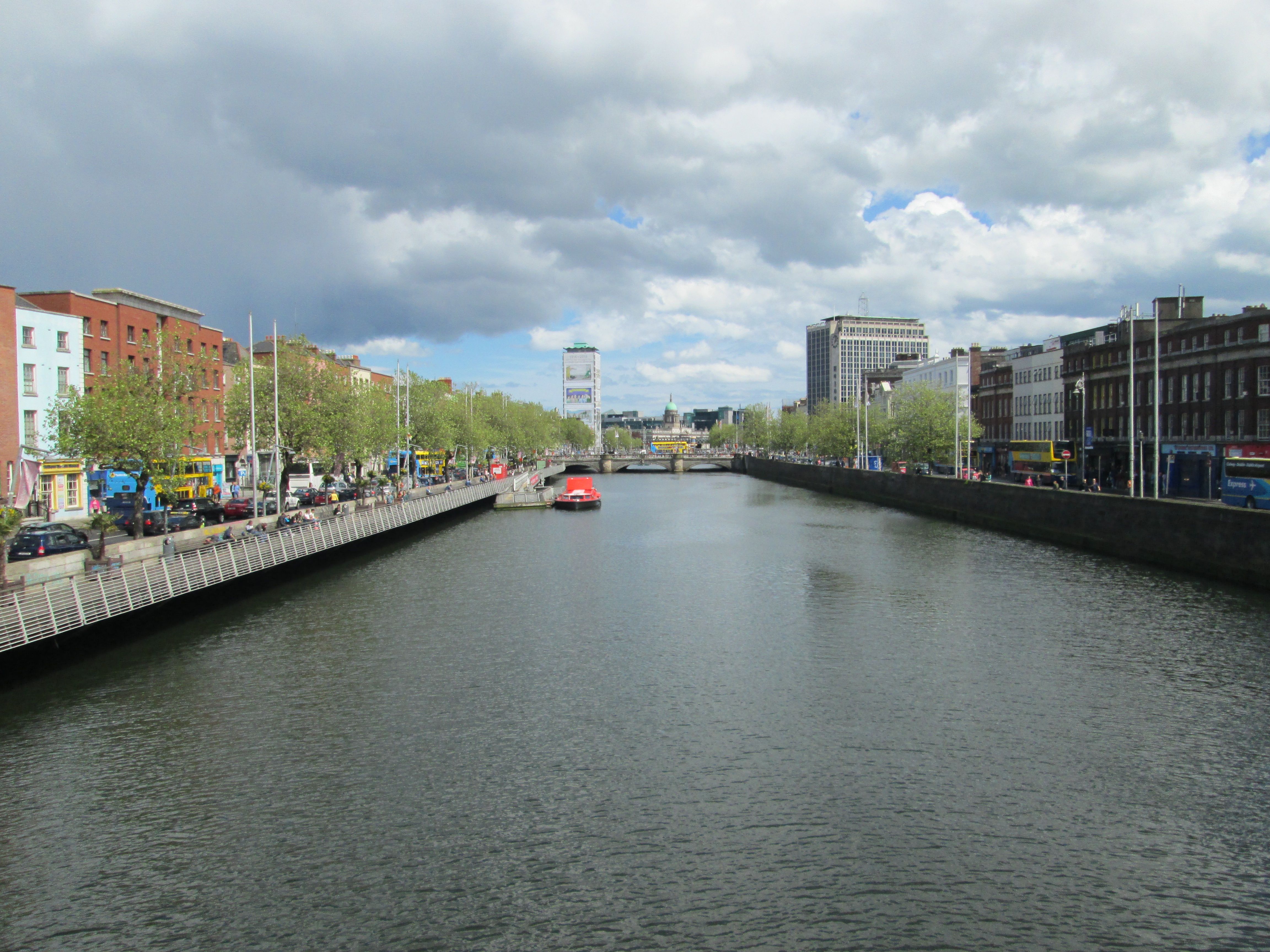
Throngs of people now float on down from Dame Street towards Merchant’s Arch. This is the main north south axis of Temple Bar. A perpetual beat on the street has replaced the isolated clack of heels on deserted cobbles. Under Merchant’s Arch you emerge blinking into the common daytime whirr of traffic, the south quays taking westbound traffic, the north quays taking it east. The elegant Halfpenny Bridge arches over the Liffey. It takes its name from the toll charged at its inception two hundred years ago, compensation to the ferryman who previously carried people over. Yeats once championed a Municipal Art Gallery purpose built on a covered bridge here. But the iron structure survives, one of Dublin’s most iconic images.

The Liffey, looking east from Halfpenny Bridge

The Liffey, looking east from Halfpenny Bridge

The river bank in medieval days would have been close to Fleet Street. As the city spilled outside the walls, houses built along the shore faced away from the river. It was after the Restoration of Charles II in 1660, that the Royalist Lord Deputy of Ireland, James Butler, the Earl of Ormond, decreed that buildings face the river, with a roadway to form the quayside. This innovation, which Ormonde had observed whilst in exile in Europe during the Cromwellian years, transformed the character of Dublin, establishing the river as the defining character in its layout and aesthetic. The Wide Streets Commission, almost a century later, further moulded the city along neo-classical lines. The extent of Temple Bar was defined by the new thoroughfares, Parliament Street and Westmoreland Street, the widened Dame Street and College Green.

Since the eighties, multitudes have come to this cramped box of little lanes, the discrete vestige of medeval Dublin without the walls. We come here to play, to plunge into the past, to live in the moment, maybe set the course of our future. But mainly to play. There is nothing ostensibly pretty about Temple Bar, it is defined more by function than finesse, a jumble of back street businesses, a mercantile slum. But cities and towns are as much about their people as their built fabric. There’s enough human life here to illuminate the city should the electricity ever be cut off. It shines, night and day.

Westmoreland Strret

Madeira

Funchal

Funchal

Madeira is improbably positioned in the middle of the north Atlantic. So many miles from nowhere, it has to be somewhere to go. Skimming across this part of the ocean, we put into port at Funchal, Madeira, before a quick skip through the Canaries. As island dwellers ourselves, it was a chance to visit places smaller and more remote than the auld sod. Warmer too, though at this time of year the bright spring weather doesn’t scorch.

Madeira was established by Portuguese adventurers six hundred years ago. The name means wooded isle, still an appropriate designation. The jagged mountains forming the island’s spine are covered in trees, well sprinkled too with vineyards and banana plantations. Sugar cane was an early product of settlers and by the end of the fifteenth century Madeira was the world leader in sugar production. Christopher Columbus, the Genoese explorer, came to Madeira to purchase sugar. Those were the days before convenience stores. He found something sweeter in Filipa, daughter of the Governor of the neighbouring island of Porto Santo. Columbus lived on Madeira with his wife for a spell in the eighties. His son Diego was born here. I wonder if Colombus sensed that America was the next stop beyond the rim of the horizon.

Santa Maria de Colombo

Santa Maria de Colombo

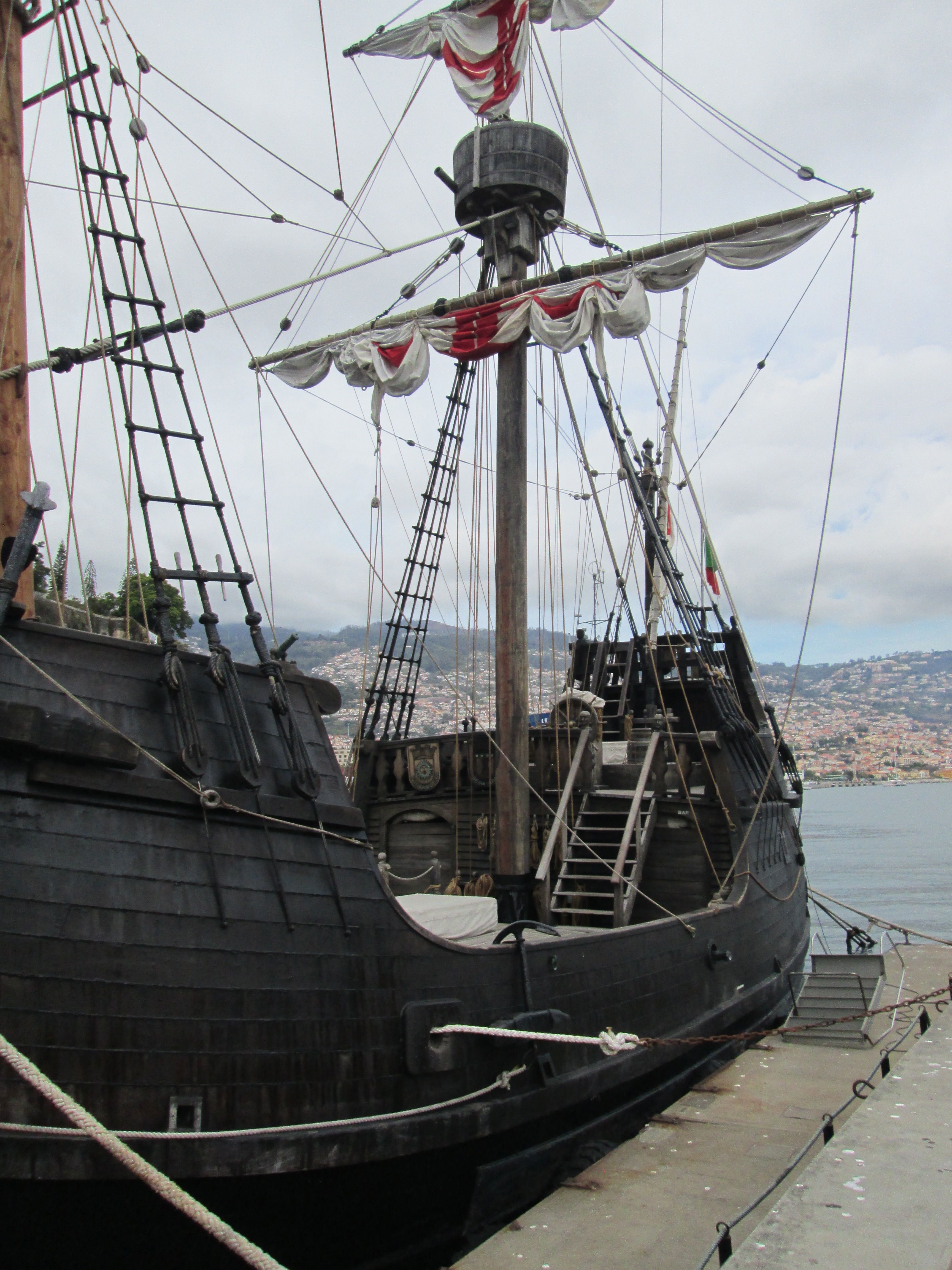
In the harbour, the Santa Maria de Colombo is a working replica of Christopher Columbus’s flagship on his voyage to the New World in the late fifteenth century. It is available for tours around the island. This class of ship, a carrack, was much used by the early explorers, many of them Portuguese. Columbus’s vessel, though larger than the two accompanying caravels, is still surprisingly small, its deck no longer than sixty foot. Moored adjacent to where mighty cruise ships now pull in, the contrast is provocative. On this spot the great adventure of the modern world began. Trade, colonisation, the New World, radiated from the endeavour of, largely, Portuguese explorers. Now, hordes follow in their wake, idle travelers like myself, well sated and safe in vast cruise ships. The modest Santa Maria sits in the shadow of our ship. It could easily be overlooked. It shouldn’t be.

Checking out Ronaldo's credentials

Checking out Ronaldo’s credentials

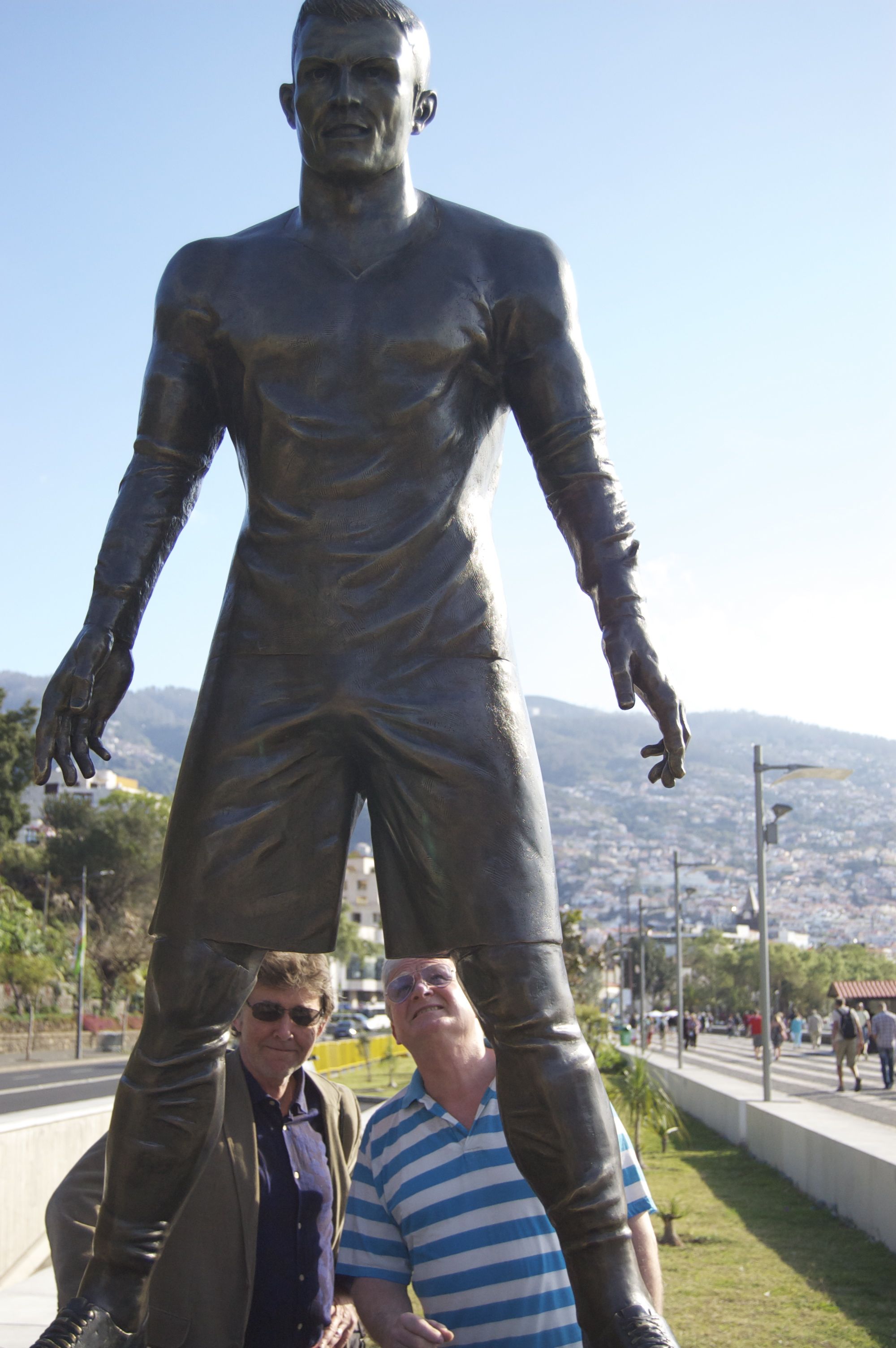
Further on up the quays, another favourite son, is immortalised in a statue. We pause to check out Christian Ronaldo, born on Madeira, who plies his trade with his boyhood heroes, Real Madrid. I’ve seen him play in the Bernebau and Tallaght, and there’s not many people you can say that about. The statue is imposing but disappointingly, well, static. Not so much an athlete as a dictator who preferred wearing shorts to a military uniform.

The island is quite densely populated, with a quarter of a million people living in an area of about three hundred square miles. Madeira is five hundred and sixty miles from Lisbon and on the same latitude as Casablance. The climate is temperate, never either getting beyond the mid twenties nor falling into single figures. The lush vegetation, the explosions of floral colour, along with the ubiquitous banana plantations give it a tropical appearance. Bananas are the main export while Madeira wine is world famed. These crops have been longterm mainstays of the economy. And tourism of course.

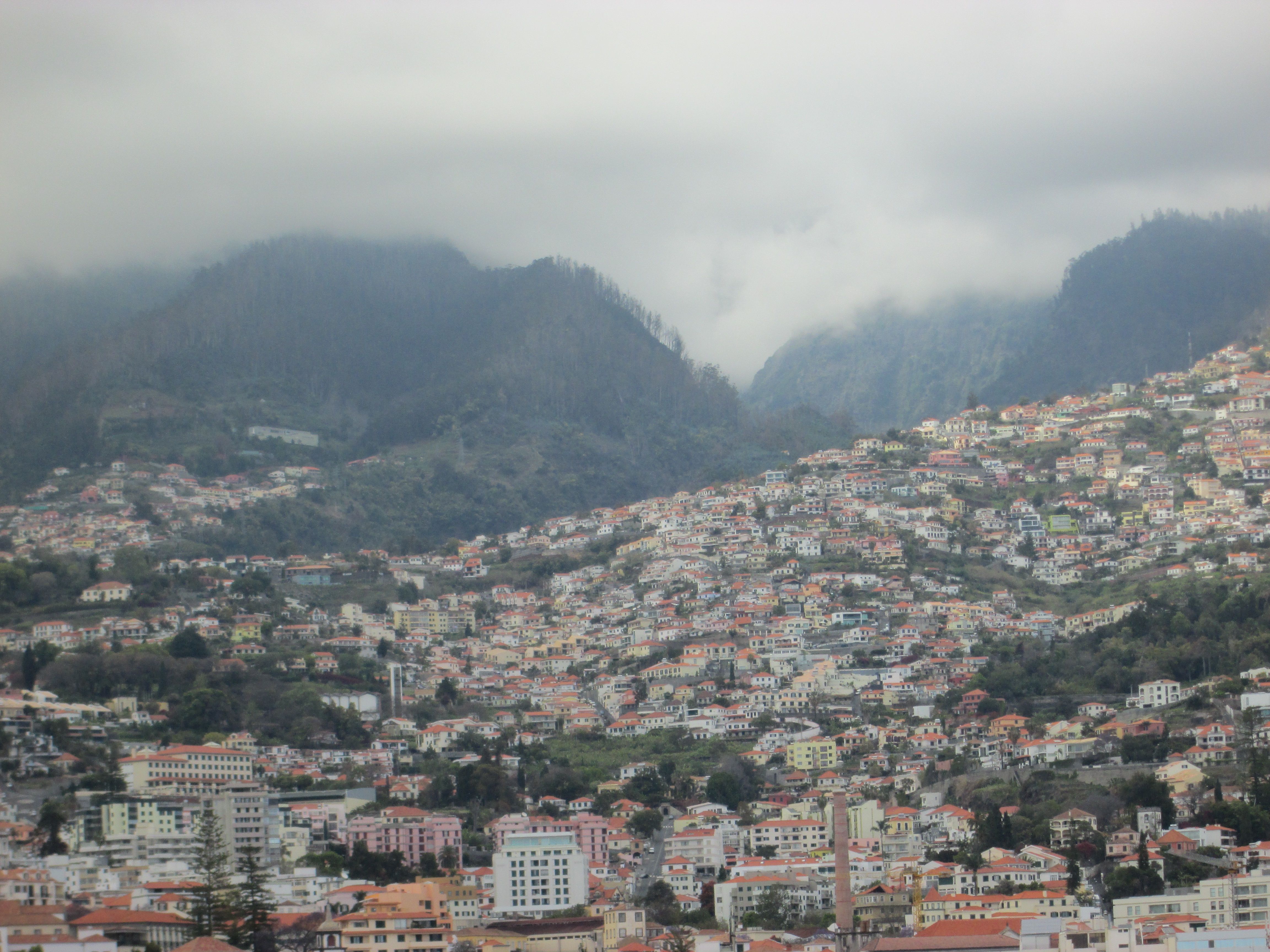
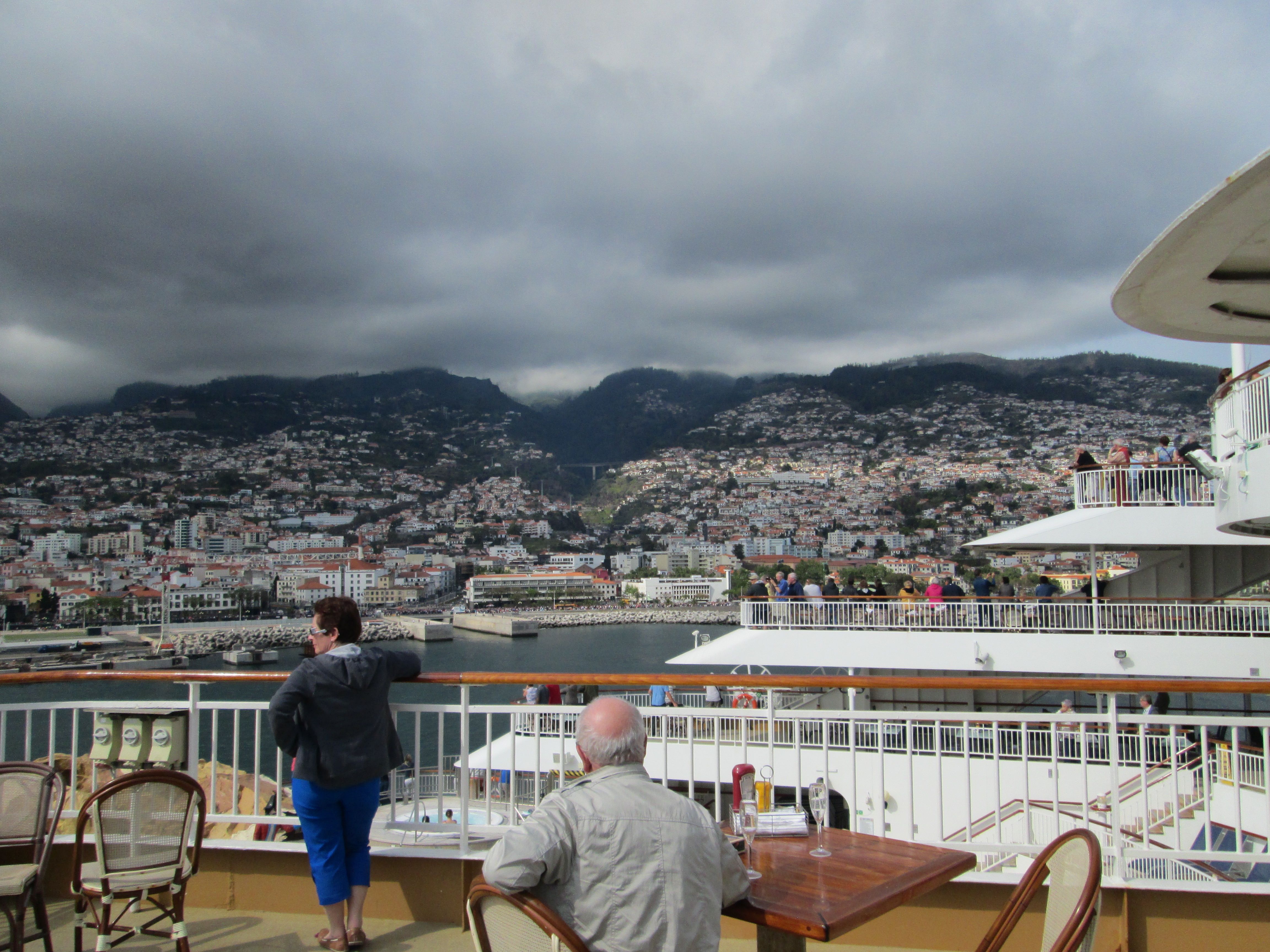
The capitol, Funchal, is home to more than a hundred thousand people. Orange tiled bungalows are piled high on the wooded hills. Jagged peaks form a natural amphitheatre into which the suburbs have spread. The high suburbs are over three thousand feet above sea level, higher than Carrauntoohil. It can be cool and cloudy up there, while the lower suburbs bask in sunshine. We take an open top bus that barrels through the city centre, past gardens and banana trees, flower festivals and vineyards. Streets lined with Jacaranda trees persuade purple into the sky. Ancient seafaring tales mentioned the Purple Isles, possibly referring to Madeira.

Camara de Lobos

Camara de Lobos

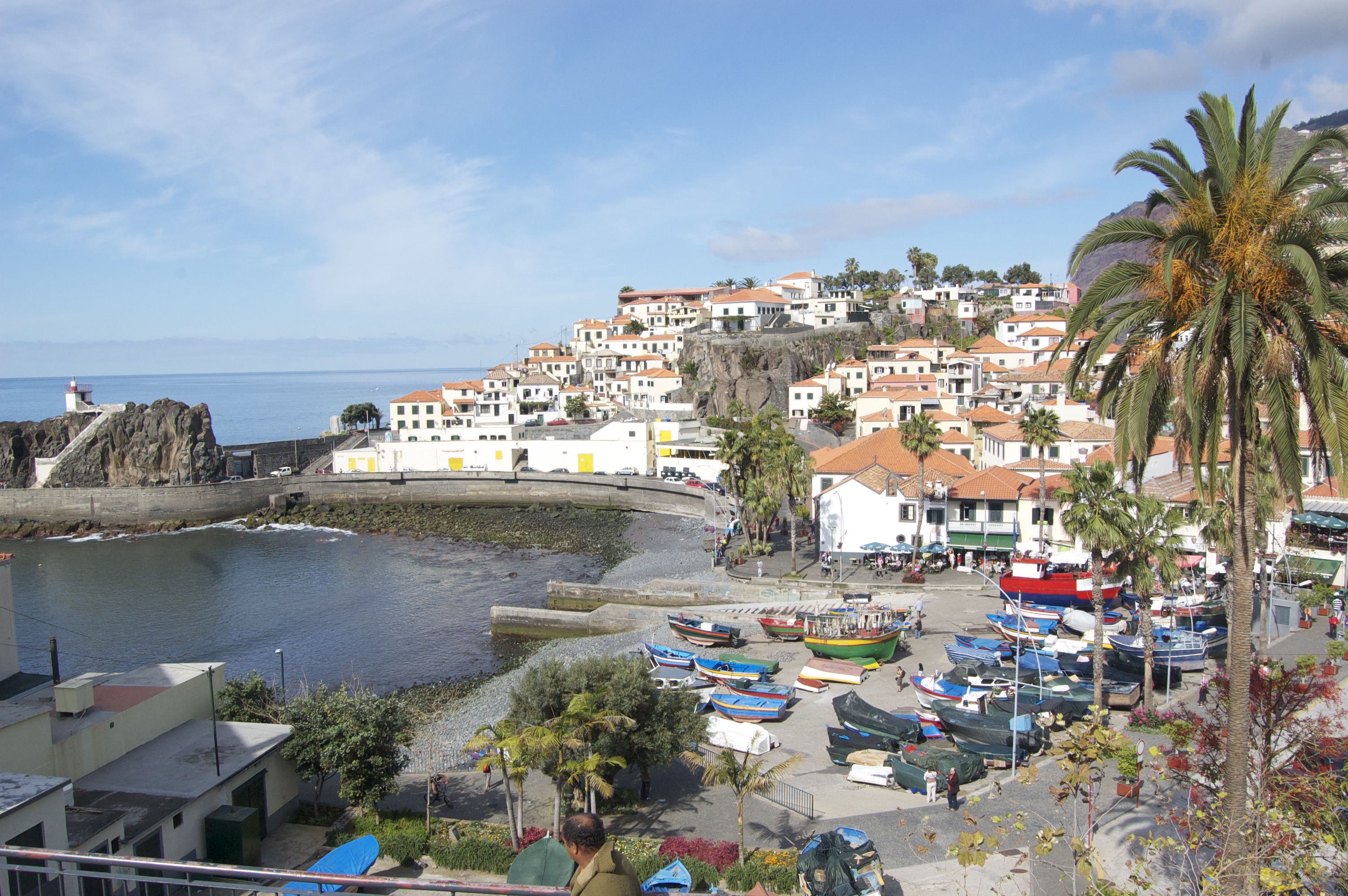
The place has a prosperous air to it, putting its natural wealth to good use. This is unlike the Canaries, where tourism is king and indigenous industry otherwise scarce. The Canaries import all their food needs. Madeira does not have that level of dependency. We briefly stop at Camara de Lobos; the Salon of the Wolf, an intriguing name. Sea cliffs mark its western periphery, and the town tumbles down to a busy, pretty harbour. The Santa Maria de Colombo was constructed here at the end of the last century.

View from the Cable Car

View from the Cable Car

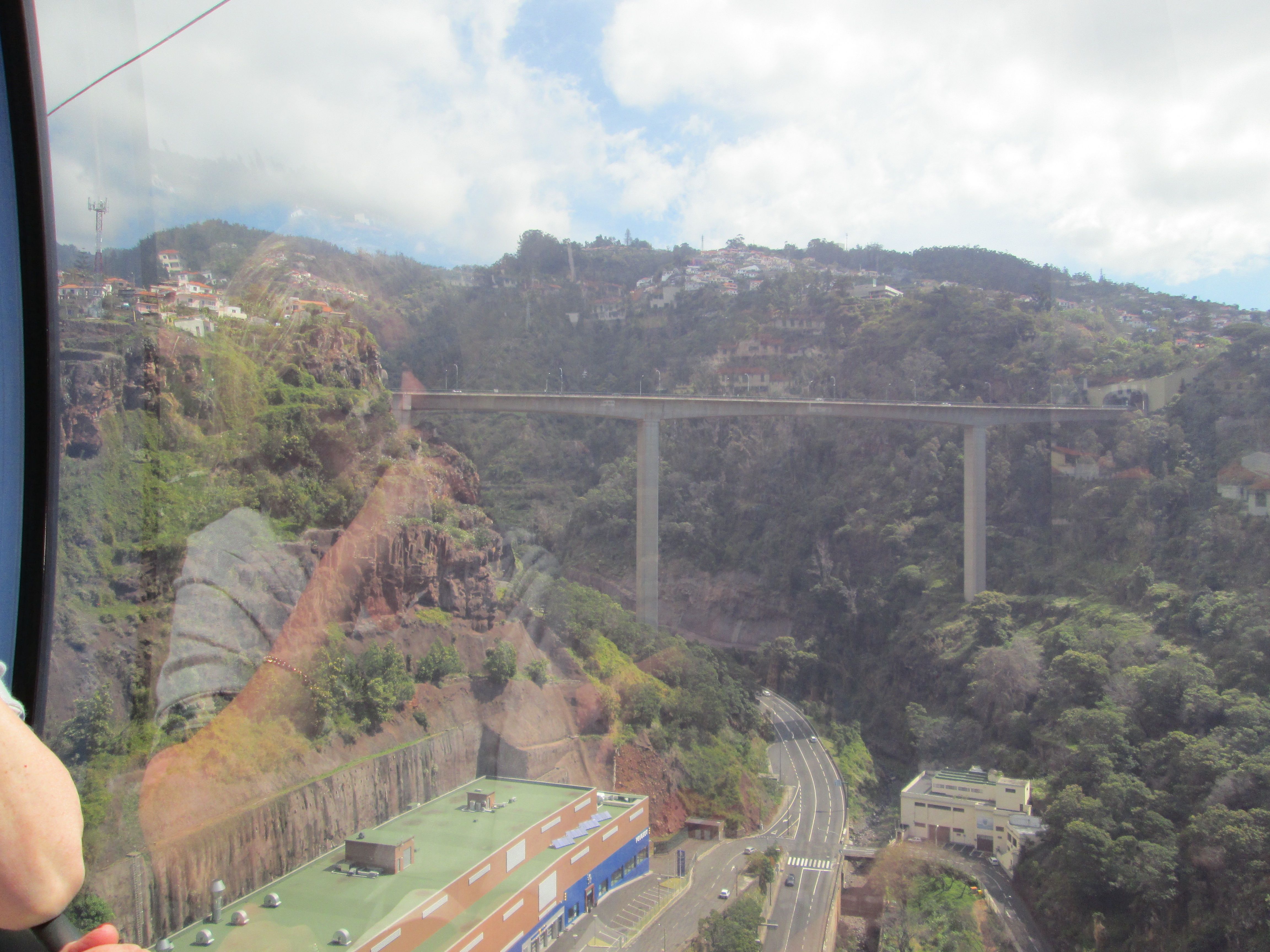
We return to the seafront Promenade at Funchal. Our friends have been here before and suggest a convenient round trip, taking the cable car up, and a guided sled down. It’s always nice to court peril in someone else’s hands. The cable car runs to Monte, high above the city and adjacent to the Botanic Gardens. You can get an inclusive ticket, but we bought a one way, for a tenner. Into the clouds by our destination, we had coffee and a snack at a small modern cafe perched above the cable line chasm. From here it’s a short meander to the sleds. We skirt the periphery of the Botanic Gardens which seem pleasant, but the whole island looks like a botanic garden to me.

Descending into Funchal

Descending into Funchal

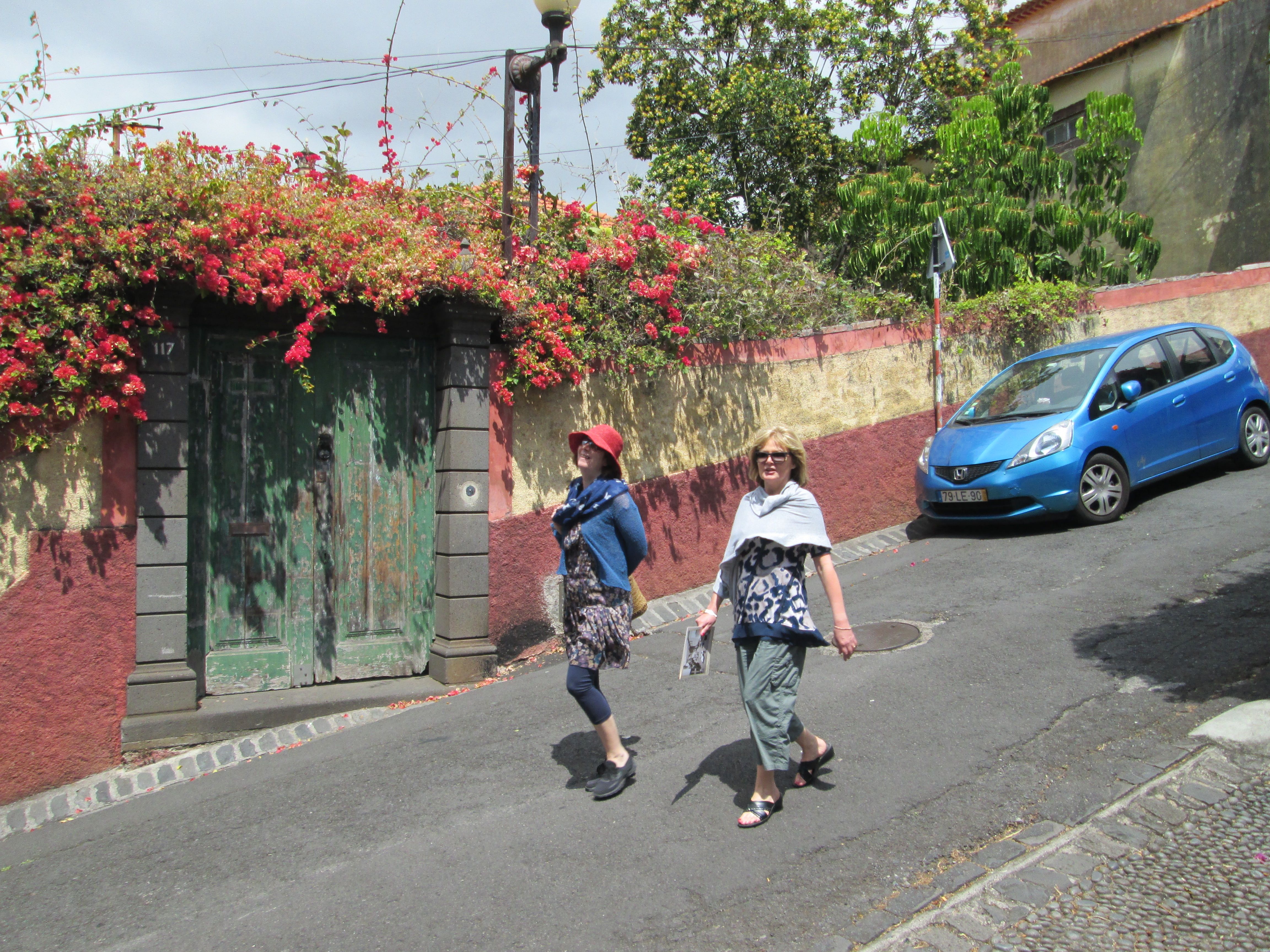
Sleds are a wicker two seater on a wooden base, guided by a street gondolier, for want of a better term. It’s a good fast slide, reaching speed up to thirty miles an hour. A hundred years of this attention has polished the surface of the lanes down to the terminus nearer the town. In fact, it’s a good distance, but it’s relaxing to saunter through the lanes heading down to the centre of Funchal. The old walls of the laneways and the houses beyond are overgrown with a colourful riot of plants and flowers.

Say it with flowers

Say it with flowers

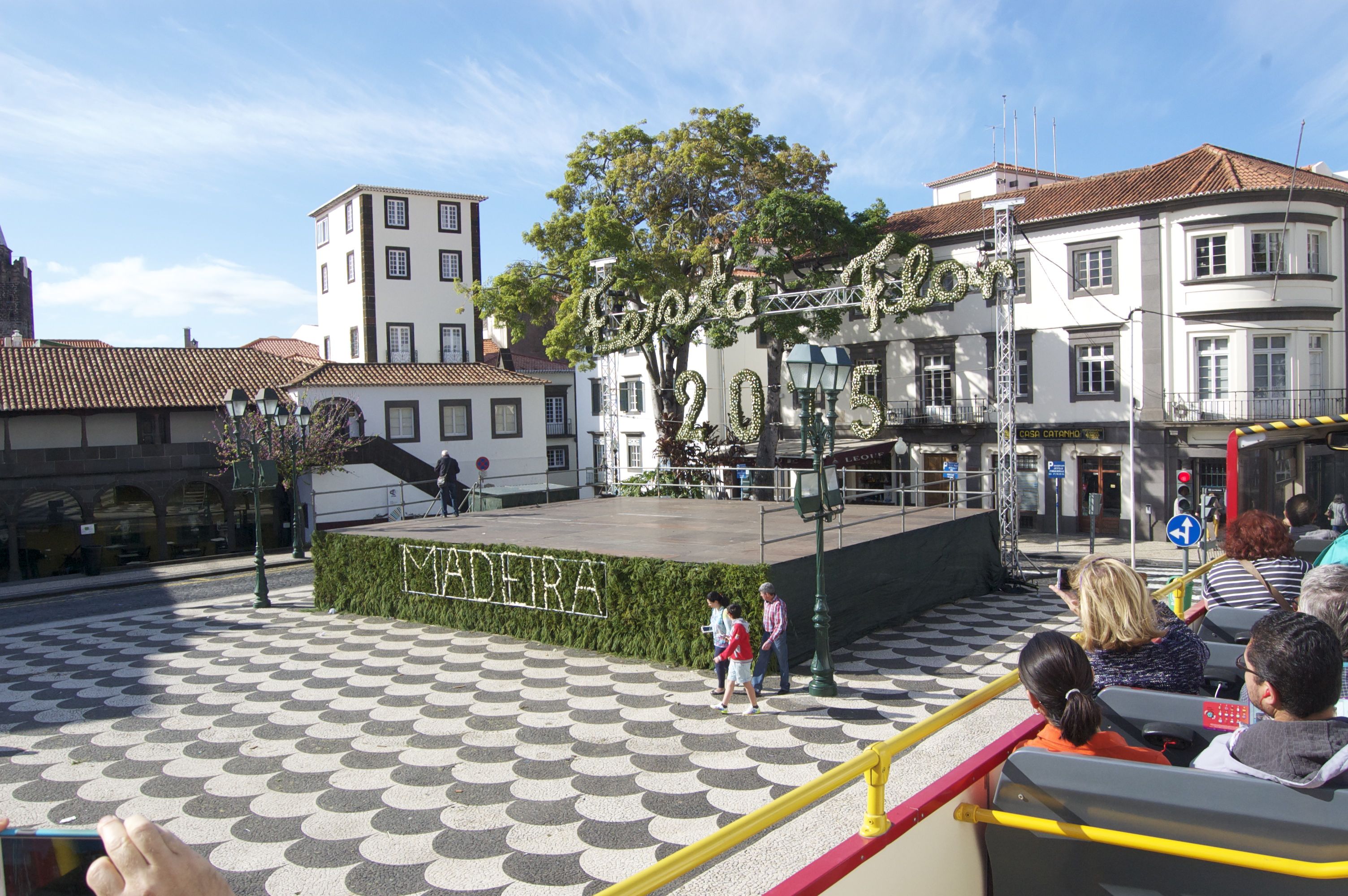
We want a quiet place for a drink, but nothing really presents itself before reaching the Main Square. With the Spring Flower festival in full swing, the place is packed. A row of pleasant period eateries and bars with extensive outside seating are ideal for people watching with the cacophony of colour and action of a festival providing the backdrop. A rather raucous calypso tinged combo, in truth a guitarist and his portable backing group, provides the soundtrack and we wonder if we should ask him to play Faraway.

IMG_0420

We finish off with a leisurely browse through the stalls in the square. The atmosphere is building up for the parade, and as we weave our way back to the port, it’s as if the entire town has turned into a pulsing, floral rumba. Relaxing on deck I absorb what passes for silence in these parts. I sketch the shaded peaks of Madeira, like dark flame rising from the dappled colours of Funchal’s teeming buildings and their vibrant forested nest.

Walkinstown Revisited

Return of the Wanderer.

Return of the Wanderer.

I left Walkinstown just over thirty years ago. Many’s the time I’ve been back since, taking the kids to visit Granny, meeting friends for football or beer. Bit by bit, the ties are loosened. There’s less opportunity to drop by and give the auld sod a look. Recently, getting a new car brought me back to those fields where I grew up.

EP Mooney's, Long Mile Rd.

EP Mooney’s, Long Mile Rd.

Walkinstown is certainly the go-to place for cars. New or in their prime along the Long Mile Road and the industrial estates to the west. Over by the Naas Road, the hypnotic Mercedes sign rotates on its Art Deco tower, day and night. A beacon in the darkness, a neon blue call to prayer. Death awaits all things, however, and auto graveyards line the moraine that carries the Greenhils Road from Tallaght down to The Cross. Junkyards are sculpture parks with a purpose, a place where discarded jalopys await their reincarnation.

Drimnagh Castle

Drimnagh Castle

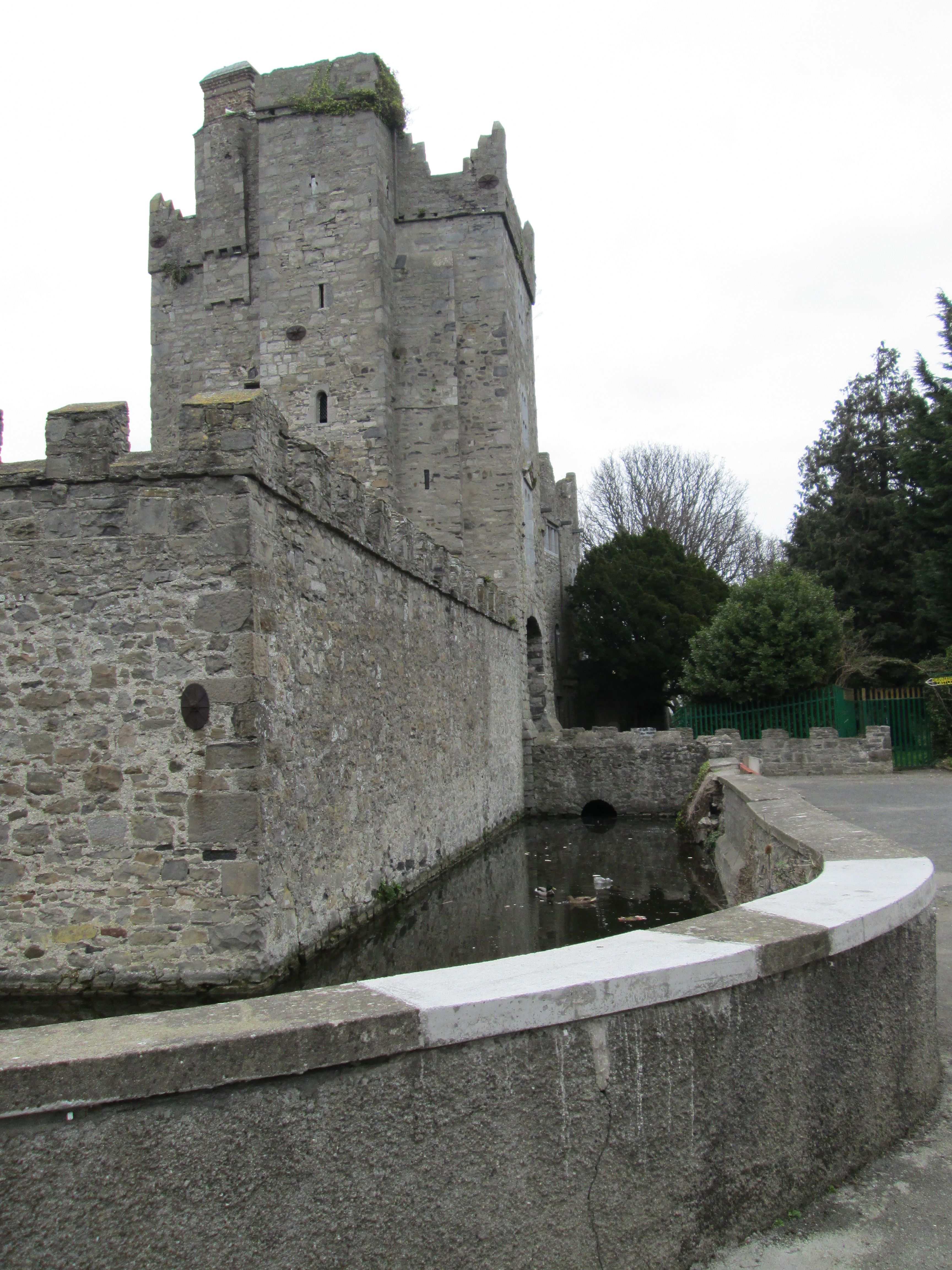
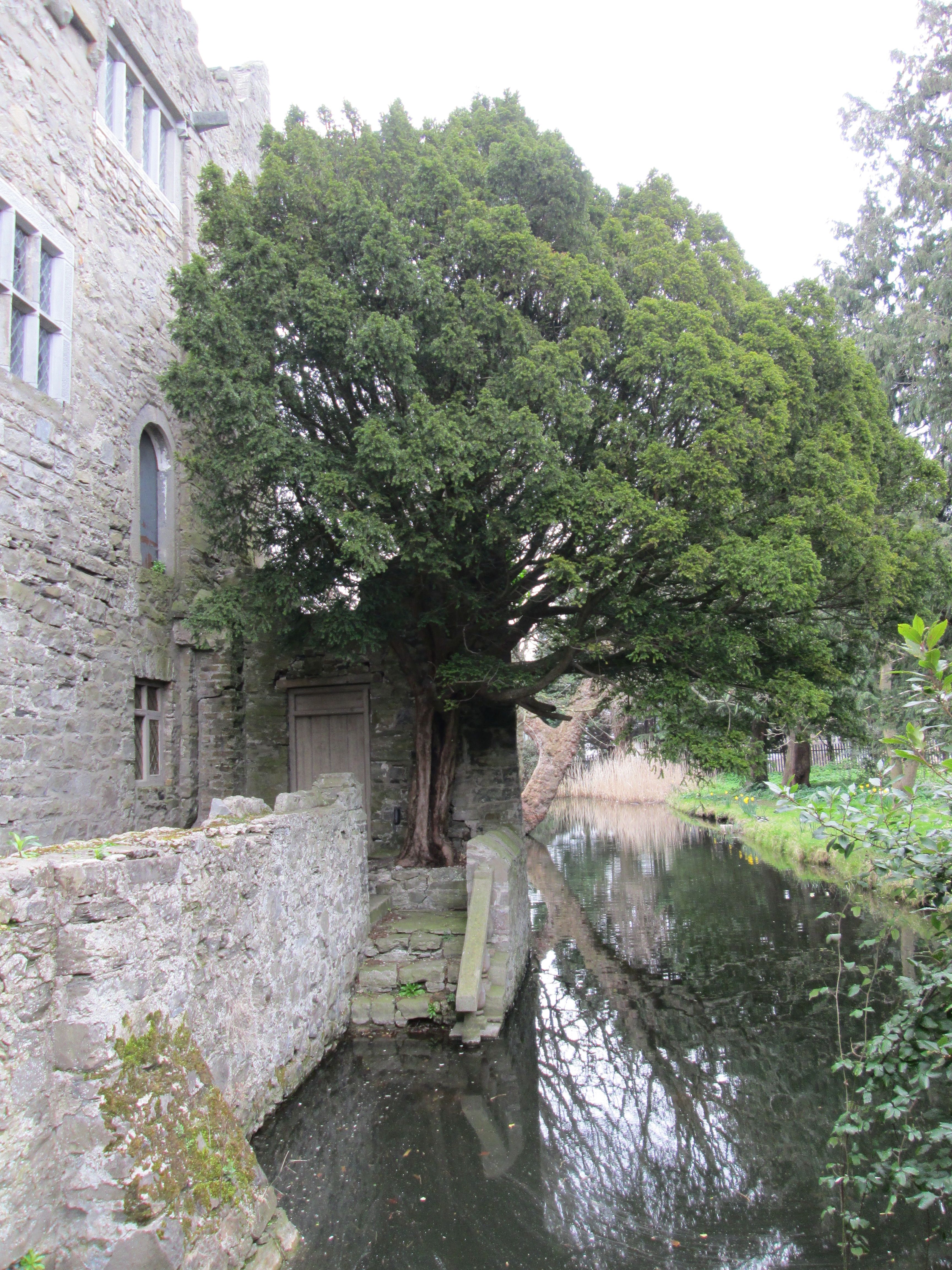
In Norman times, the land hereabouts was granted to Hugh De Bernevale, a confederate of Strongbow. The belt of land between the Dodder and Camac was densely wooded and vulnerable to attack from Irish tribes. The Pale (a fortified ditch) was established to protect settlement in the area, and a ring of castles was constructed from the Liffey Valley through Tallaght and on to Rathfarnham and Dalkey. Drimnagh Castle was built in 1240 as a prominent fortress guarding the marches. Constructed in local limestone it remains surrounded by a flooded moat, the only castle in Ireland to retain this feature. The Great Hall dates from this period, the High Tower was added in the sixteenth century, offering commanding views of the surrounding countryside. To the west lies Robin Hood. An intriguing name, it is now an industrial area. Legend, of course, insists that Robin Hood himself sojourned here. General myth places him early in the thirteenth century, when the lands in the shadow of the Castle were secured by the Bernevals. Robin Hood, of course, could simply be a stock alias for a robber. The area then would have been isolated woodland, just beyond the periphery of settlement, where banditry was rife.

The Moat

The Moat

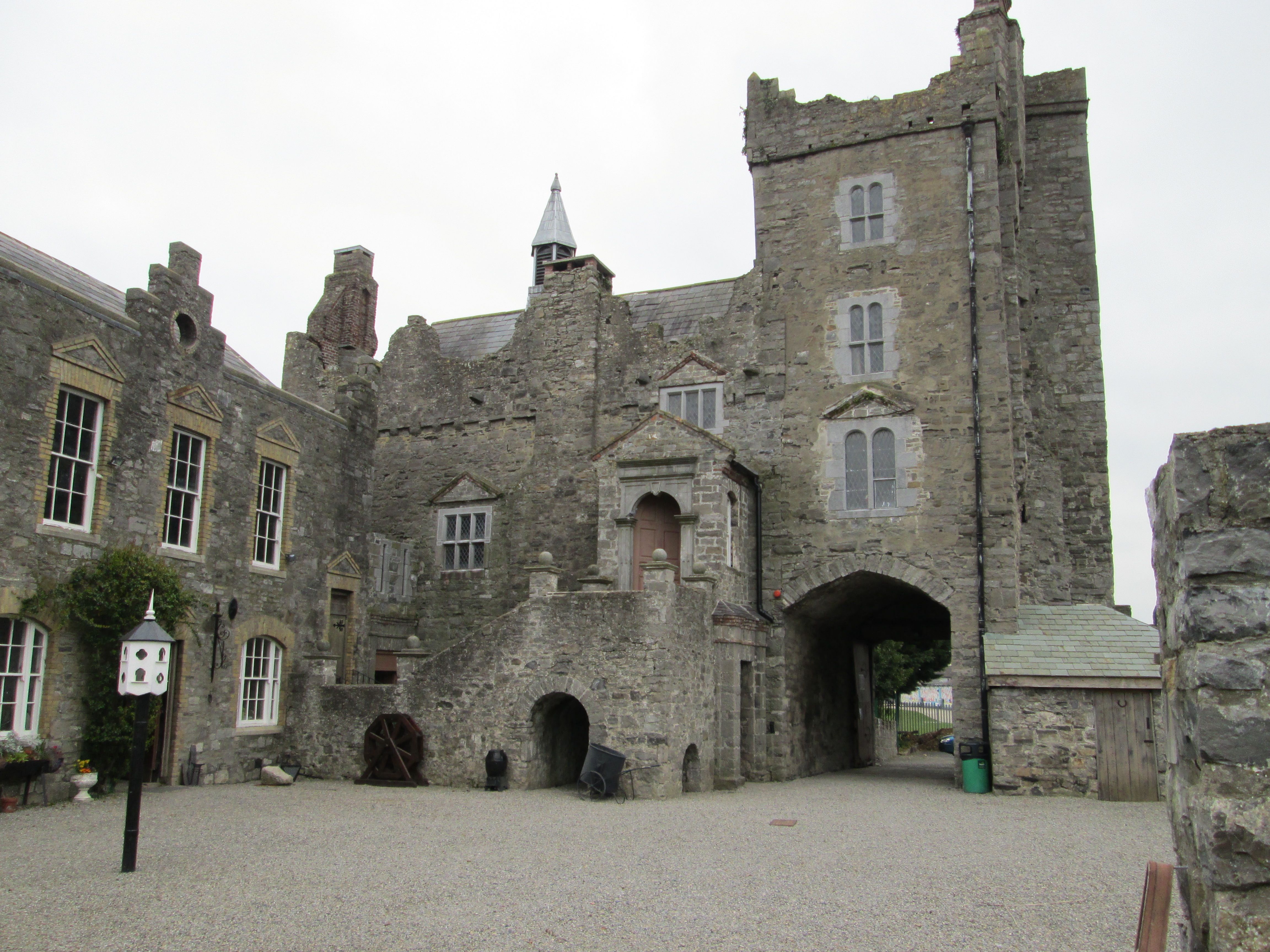
It is said that Cromwell stabled horses in the Castle during the War of the Three Kingdoms in the 1650s. Cromwell’s Fort Road draws its name from that period too. Cromwell is said to have visited many places, most of which needed to be rebuilt afterwards. Drimnagh Castle seems to have survived unscathed. The Bernevals, later Barnewalls, lived here until that time. The Castle remained inhabited until being sold to the Christian Brothers in 1954. The new schools built to service Walkinstown were completed in 1956. In the interim, the first students of Drimnagh Castle CBS were accommodated in the Castle itself. Masses were hosted before completion of the Church of the Assumption nearby. A theatre group and local GAA teams also used the building. By the late twentieth century, the Castle had fallen into disrepair. Refurbishment was carried out in the late eighties, completed by 1996. As well as the restoration of the castle itself, part of the exterior grounds have been reconstructed as a formal seventeenth century garden. Today Drimnagh Castle is open for visitors, and available for private functions. Tours give a glimpse into castle life in the late medieval and early modern period.

The Castle Yard

The Castle Yard

Walkinstown takes its name from a tenant farmer called Wilkins. A village had grown up by the early nineteenth century, straggling along the banks of the Walkinstown Stream, a tributary of the Camac. The Camac runs to the north, between Drimnagh and Bluebell, on through Inchicore and into the Liffey near Islandbridge. The stream was visible when I was young. It passed in front of the Halfway House and on to the rear of Wilkinstown House. We used to clamber on its muddy banks, in the shade of trees and bushes, competing to see who could jump across the seething waters. A wall on the western bank retained a flat scrub area, long used as a carpark for the Halfway House. This was a Coach House by the early nineteenth century. While subject to some modernisation, it retains much the same footprint and general appearance as it would back then. Wilkinstown House was originally reached along the banks of the stream. After the Famine of the 1840s the demographics changed. The village was deserted and bypassed by the Walkinstown Road. Walkinstown House passed into the ownership of the Flanagan family.

Halfway House

Halfway House

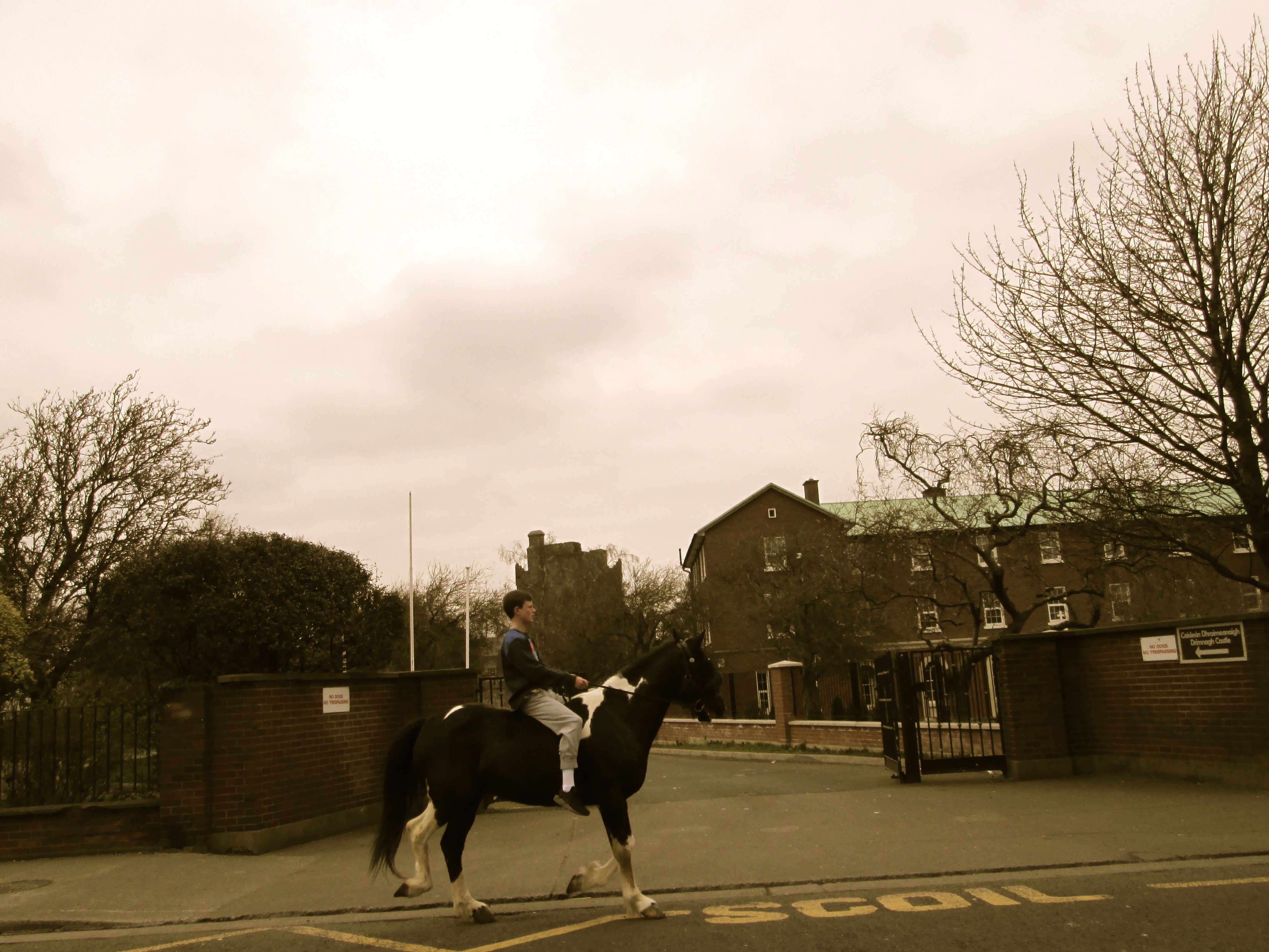
Most famous of the big house’s residents was William ‘The Bird’ Flanagan, born in 1867 and son of Alderman Michael Flanagan. Small of stature but larger than life, he was a notorious practical joker in late nineteenth century Dublin. The Bird got his name from one of his most notorious japes. Probably. One Christmas he purchased a turkey at a butcher’s in Dolphin’s Barn, requesting that it be hung at the front of the shop for collection. Later, The Bird caught the attention of a policeman on the beat nearby and began to act in a suspicious, excessively furtive manner. Grabbing the turkey, The Bird raced off towards Rialto with the constable in pursuit. Eventually apprehended, he flourished his purchase docket and the unfortunate policeman had to exchange his collar for the mirth of onlookers. The Bird Flanagan pub in Rialto illustrates the incident on its sign. The bar in the Gresham Hotel is also named for him. He once rode a horse into the bar, claiming that the horse needed cheering up, as he’d such a long face on him. His legend also attaches to the naming of the Long Mile Road. Apparently the Bird organised a horse race along its length. The Bird had the furlongs marked out dutifully. His own mount trailed badly at the eighth but as the leaders reined in it galloped past to the end of the road. The Bird claimed his winnings, saying the mile was not enough as the road was a ‘Long Mile’.

Horseman on the Long Mile

Horseman on the Long Mile

William’s brother was Frank ‘The Pope’ Flanagan. Despite the implication of piety, he featured in early Republican gun running. The Irish Volunteers sought arms to defend Home Rule against armed loyalists and their co-conspirators in the army and the Lords. A shipment aboard the Asgard landed at Howth in 1914. The Pope was one of a large crowd who rallied to the cause. He came on horseback. On the instructions of Bulmer Hobson, Frank effected a diversion, leading security forces on a merry dance across the countryside. Frank was loyal to Redmond’s wing of the Volunteers, and served with the British Army for the duration of the Great War.

WT Cosgrave married into the Flanagan family, taking Louisa Flanagan as his bride in 1919, right at the start of the War of Independence. Cosgrave had led the Insurgents at the Dublin Union in 1916, and was lucky to have his death sentence commuted. Something of an elusive pimpernel, British forces suspected he might be hiding out in Walkinstown House during the war. It was raided by the Black and Tans and suffered minor damage. Cosgrave became Ireland’s first prime Minister after independence in 1922, a position he held for ten years.

Much of the Flanagan land was sold off in the development of Drimnagh and Walkinstown. The house itself endured for some decades until it was demolished in 1970 to make way for a supermarket. Suburban expansion had begun in Crumlin in the thirties, followed by Drimnagh and the Walkinstown Musical Estate in the late forties. The Musical Roads rejoice in such names as John McCormack, Bunting, Balfe, Thomas Moore and Percy French. It certainly strikes a welcome note (ha) in the colourful nomenclature of Dublin 12. Bluebell, Robin Hood, Fox and Geese Greenhills, and Ballymount are also part of D12. Pubs include the Cuckoo’s Nest, the Halfway House, the Cherry Tree, the Submarine and the Kestrel. I worked in the Cherry Tree and drank in the rest. The past is always worth revisiting, and imagining.

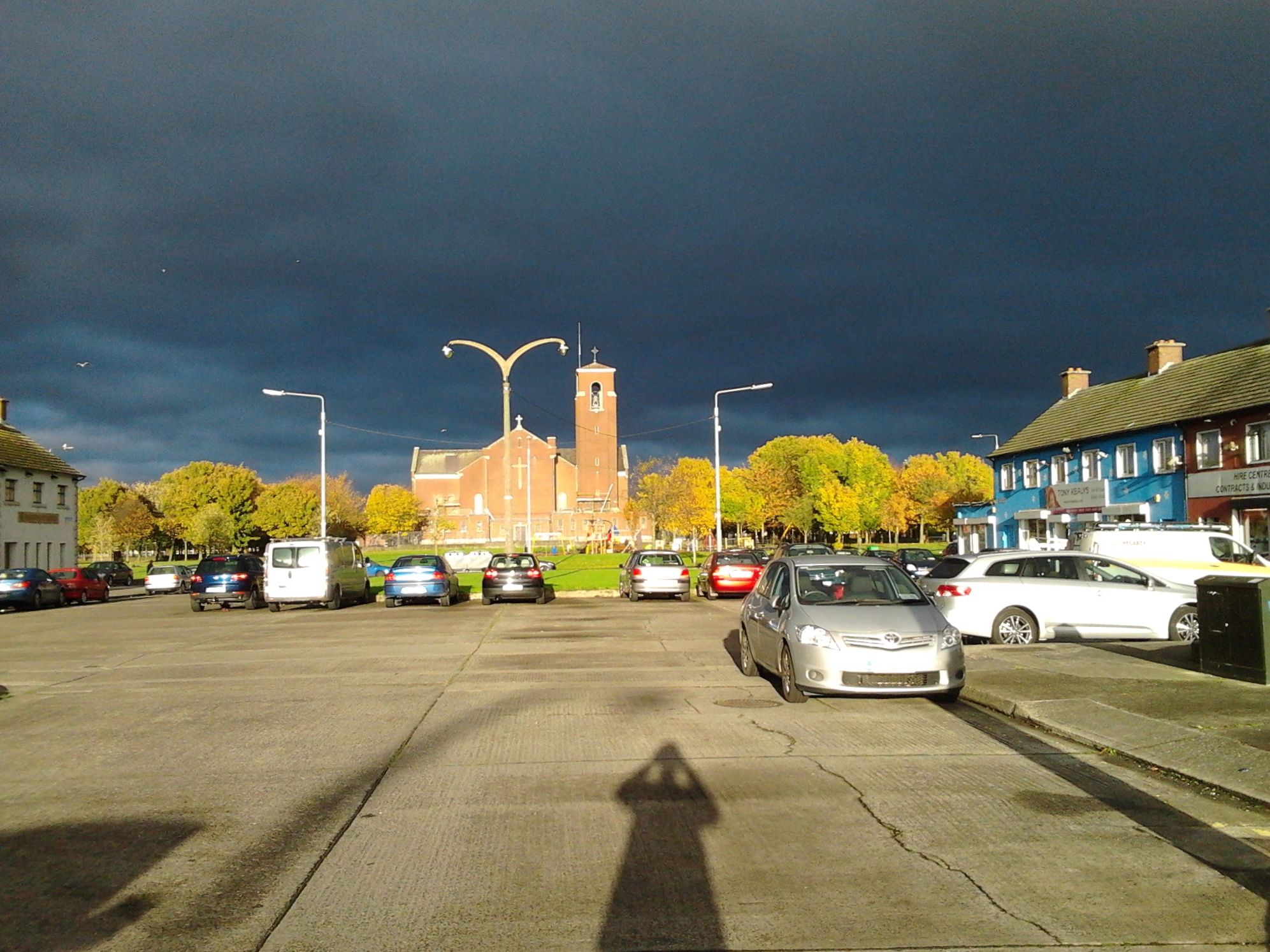
Church of the Assumption.

Church of the Assumption.