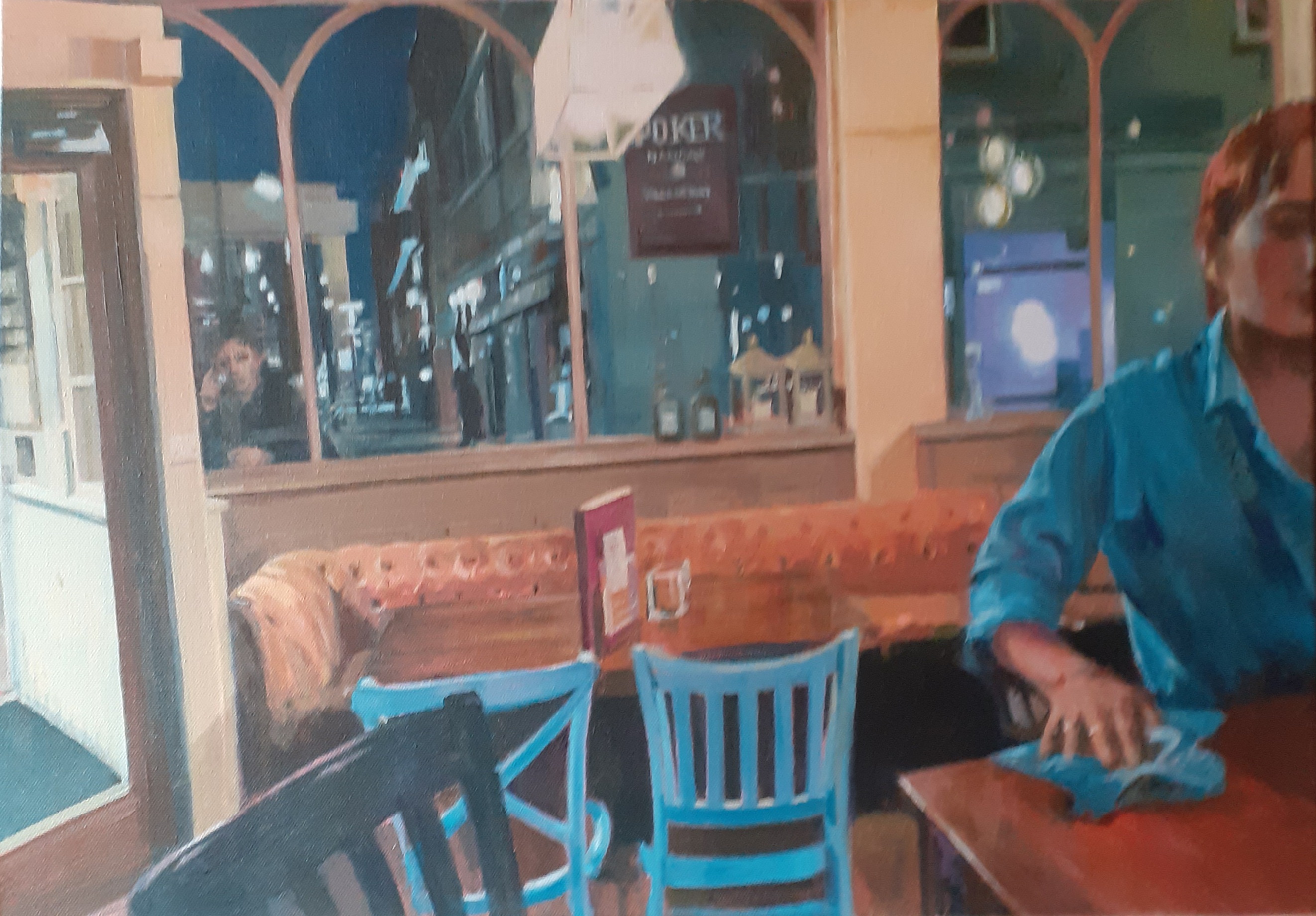
I stayed in Bayswater, London, last year. This acrylic is the view from a local bar looking towards Main Sreet, Queensway that is. I have returned from exploring the area of white Victorian terraces and dinky squares. Farther on, I spent much of the evening on Portobello Road known for its street market. I had never walked it before, though it had long fascinated me. It was a central feature of Martin Amis’s 1989 novel London Fields, in particular a pub called the Black Cross. There, Nicola Six, Keith Talent and Guy Clinch would meet and Nicola, the Murderee, set the macabre menage a trois (a quatre?) in train. Narrated by doomed author Sam Young and set in late 1999, it is a comedy tinged with foreboding. The end of the world, the end of love.
The Black Cross is a fictional bar, of course, so I made do with convivial reality. Portobello Road is at the pleasant end of culture clash. Cosy, quaint, common and sophisticated, like much of London’s inner patchwork, it is village and urban combined. Back in Bayswater, I find a bar invitingly empty. It is that dread hour: closing time. There are, as always, plenty of stories set to continue into the night. Not quite the Folies Bergere, more Edward Hopper meets Rock Dreams.
The Stranger Song is appropriate, given that the bar advertises poker nights on Monday and Wednesday. The 1955 film noir The Man with the Golden Arm starring Frank Sinatra was an inspiration. The song is one of the Songs of Leonard Cohen, his debut album from 1967. Cohen’s Golden Voice seduces the listener. No better man than Leonard for the chat up line, but here it is developed into an invitation. We are all strangers, our paths intersecting in those almost arbitrary places, hotels, bars and train stations.
You hate to watch another tired man lay down his hand
Like he was giving up the holy game of poker
And while he talks his dreams to sleep, you notice there’s a highway
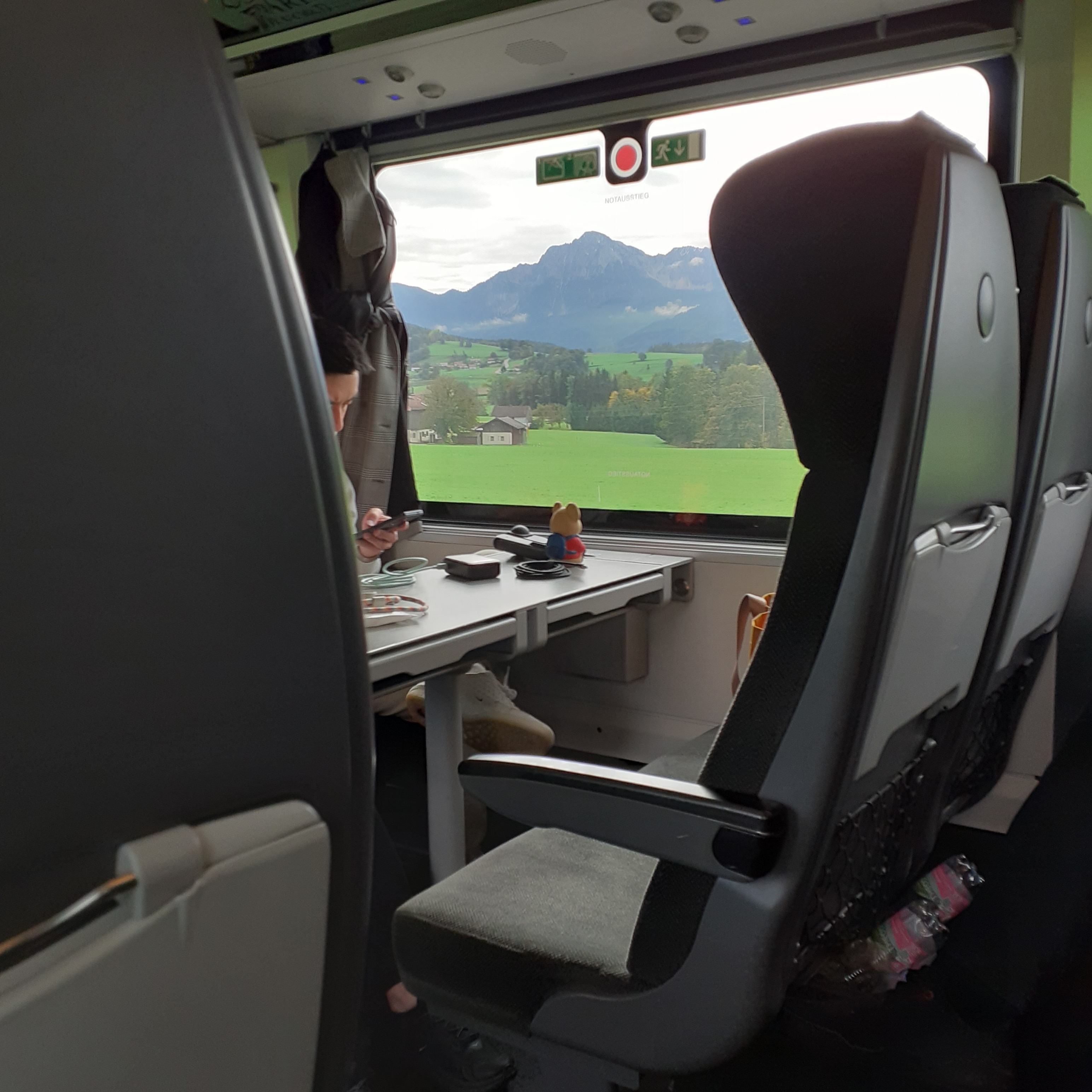
The curtain of cloud lifts as I leave Salzburg. At last I get to see the sublime world of Alpine life and scenery. I could certainly skip through that swinging my guitar case and singing in a high voice. But, probably better not. The train journey is a magical collage of jagged blue peaks and melting green fields. There is sunshine too. At Munich Hauptbanhof I navigate the crowds and make my connection to Arabellapark.
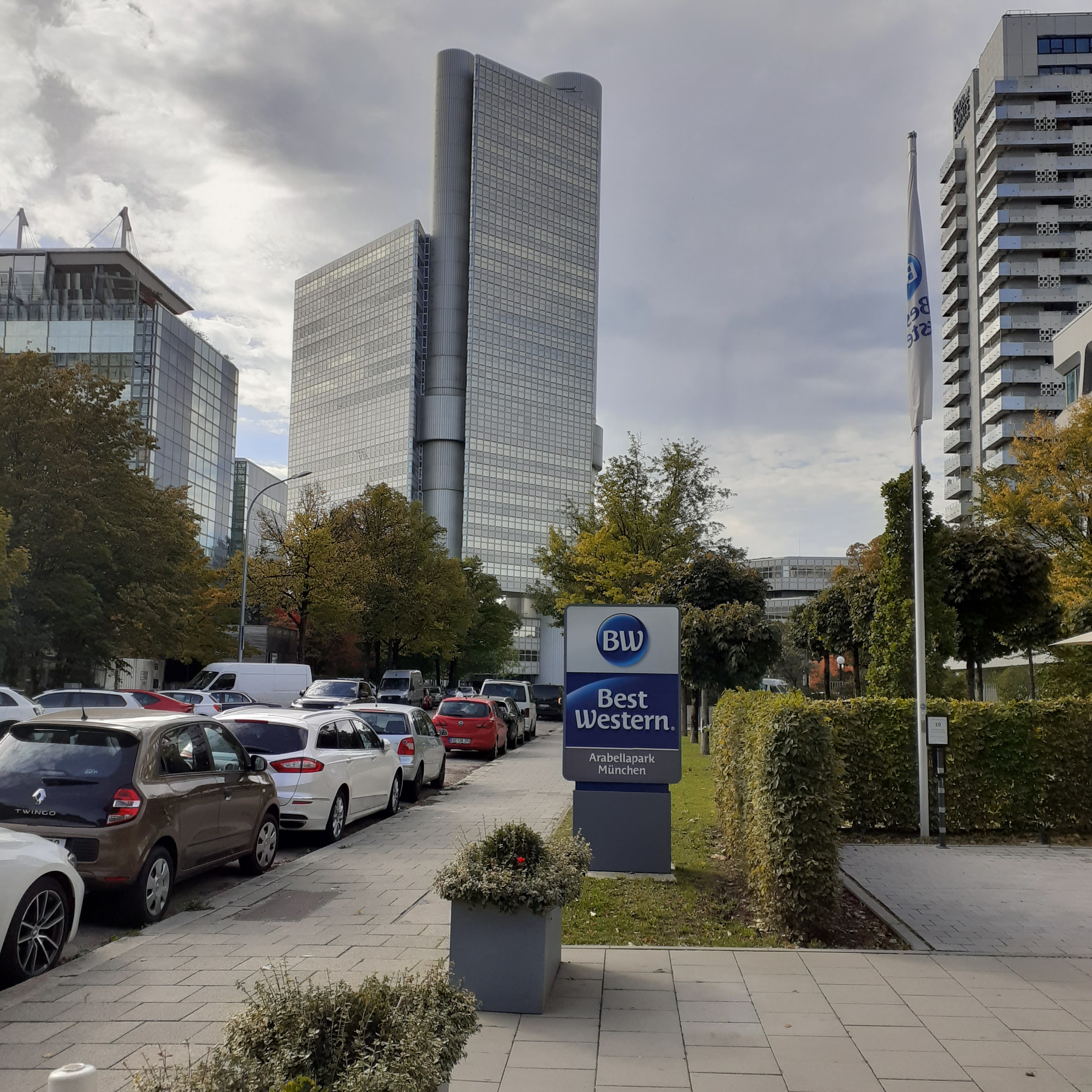
Arabellapark is seven stops and under half an hour by Ubahn. The area is mostly a businesspark with a few hotels. It is modern, quiet, and convenient for the city with regular public transport. My station is on Richard Strauss Strasse. I’m booked into the Best Western Hotel nearby.
Strauss was born in Munich in1864 and became a famed composer of the late Romantic and early Modernist period. His compositions include Don Juan, Also Sprach Zarathustra and the opera Salome, from Oscar Wilde’s play. Zarathustra provides the dramatic element in the soundtrack for Stanley Kubrick’s 2001 A Space Odyssey, with its opening fanfare, known as Sunrise. Strauss based his sound poem on Friedrich Nietzche’s Thus Spoke Zarathustra. Kubrick’s 1968 film helped reestablish Strauss’s music in the world. In 1933 he had been appointed head of the Reich Music Chamber, the regulating body for music in Germany. This led to accusations of his being a Nazi collaborator, He was cleared post war. It was noted that his insistence to work with librettist Stefan Zweig, a Jew, got him sacked. Strauss died in 1949.
There is something of a town centre in a hdden enclave near the Ubahn terminus at Rosenkavalier Platz. Der Rosenkavalier was an opera written by Strauss in 1910. Arabellapark itself refers to another Strauss opera Arabella. The Platz is a modern pedestrian zone with an interesting Art Deco cinema. There’s a cluster of good eateries and shops. Hans um Gluck is a grill bar. The interior is a startling birch forest making an ambience popular with parents and their kids. Hans um Gluck is a folk tale of the Brothers Grimm. It translates as Hans in Luck, wherein the hapless hero manages through a series of rash transactions to convert a gold nugget the size of his head into a whetstone. There’s an Italian Restaurant nearby, Bistro Fohn, another comfy and friendly spot for good fare.
Morning, and back Into the maw of the Hauptbanhof I go, the Ubahn journey lengthened by a forced connection. It’s heavy rain this morning and I can’t get my bearings in the vicinity of the station which has no discernible front door. I find my way, unintentionally, to Theresienwiesse, the park used for the annual Oktoberfest. This festival takes place in late September, not quite what it says on the tin. I arrived the following week, Hangover Week as it isn’t known. The Oktoberest was certainly tempting, though might be best handled in a group rather than flying solo. The festival began in 1810, to celebrate Prince Ludwig’s marriage to Princess Therese of Saxony. The Festival draws seven million visitors consuming seven million litres of beer. So, they only drink a litre each? I reckon there must be big queues at the bar.
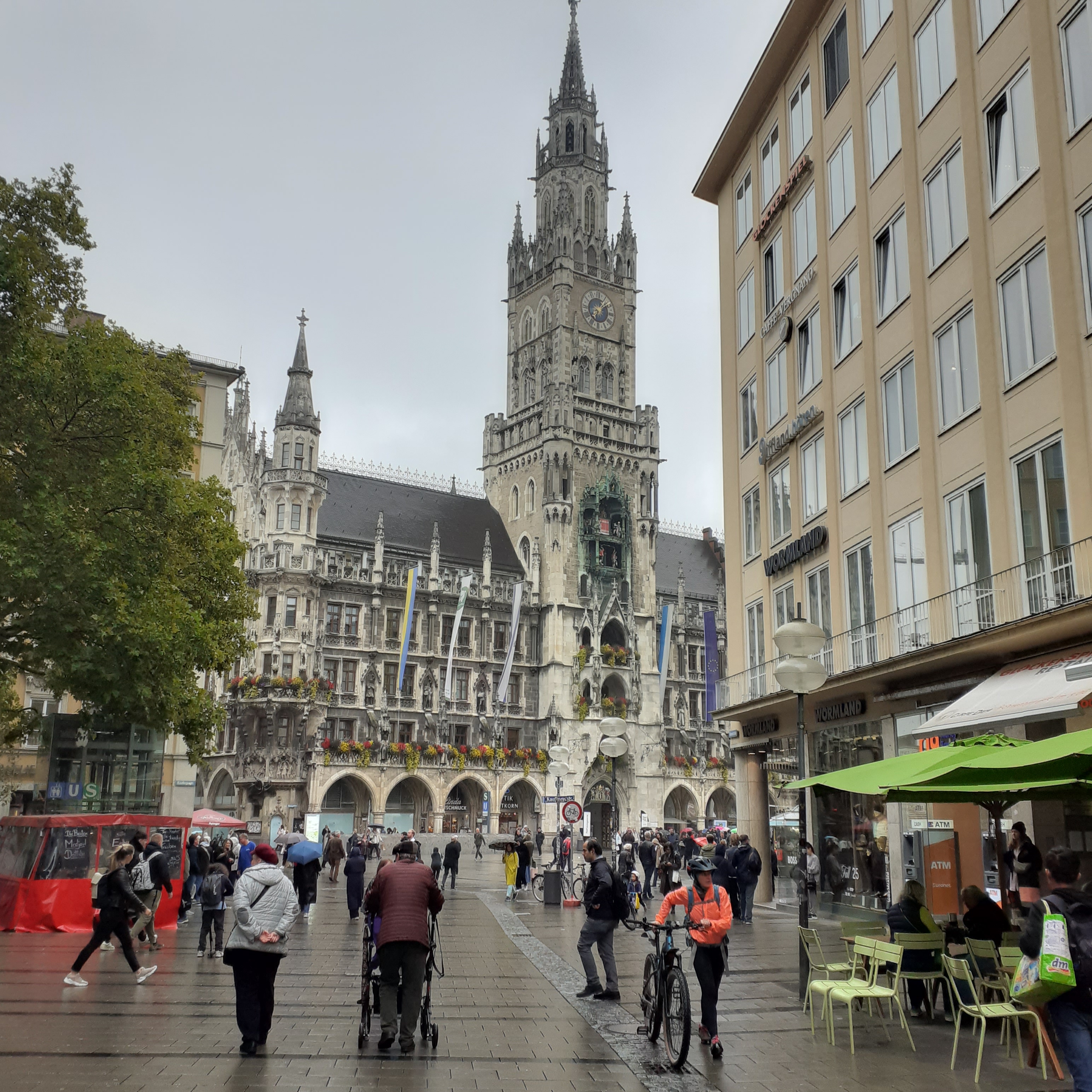
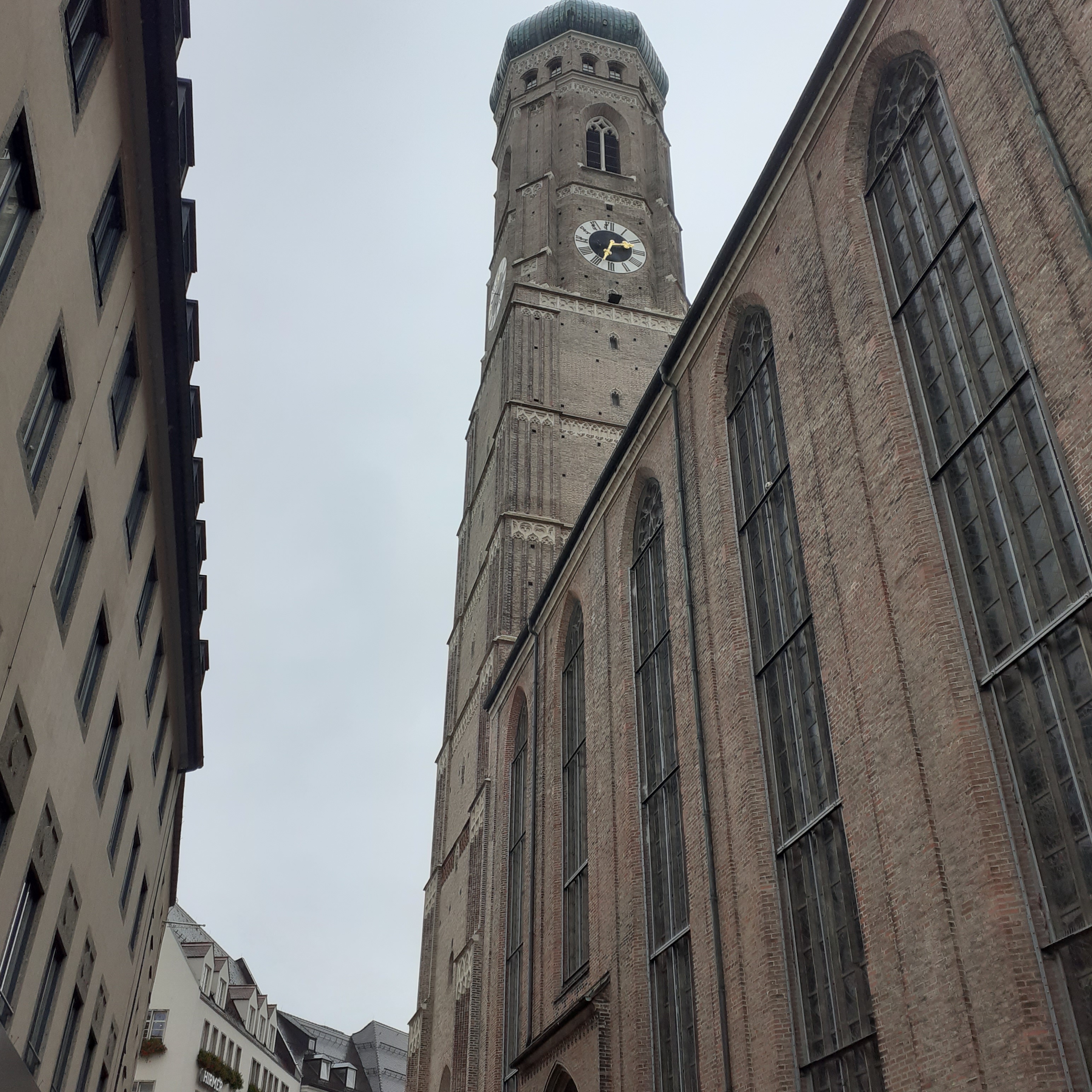
At last I align myself and walk back to the city centre. Marienplatz is that centre, a rectangular plaza dating back to 1158. It centres on the Marian Column, in honour of Our Lady, and erected in 1638 to commemorate the end of the Swedish occupation. The New Town Hall, a fabulous Neo-Gothic palace, forms the northern side of the plaza. Built in the mid nineteenth century and based on Brussels City Hall, it was extended in the early twentieth century with a soaring tower of 85 metres. The Old Town Hall marks the eastern end of Marienplatz, while to the west the towers of Fraunkirch loom. Frauenkirche, also dedicated to Our Lady, is the city cathedral. Its distinctive frontal round towers are the highest structures on the inner city skyline, almost a hundred metres tall and topped with onion domes. The church was built in the late fifteenth century, redbrick and sparse in style.
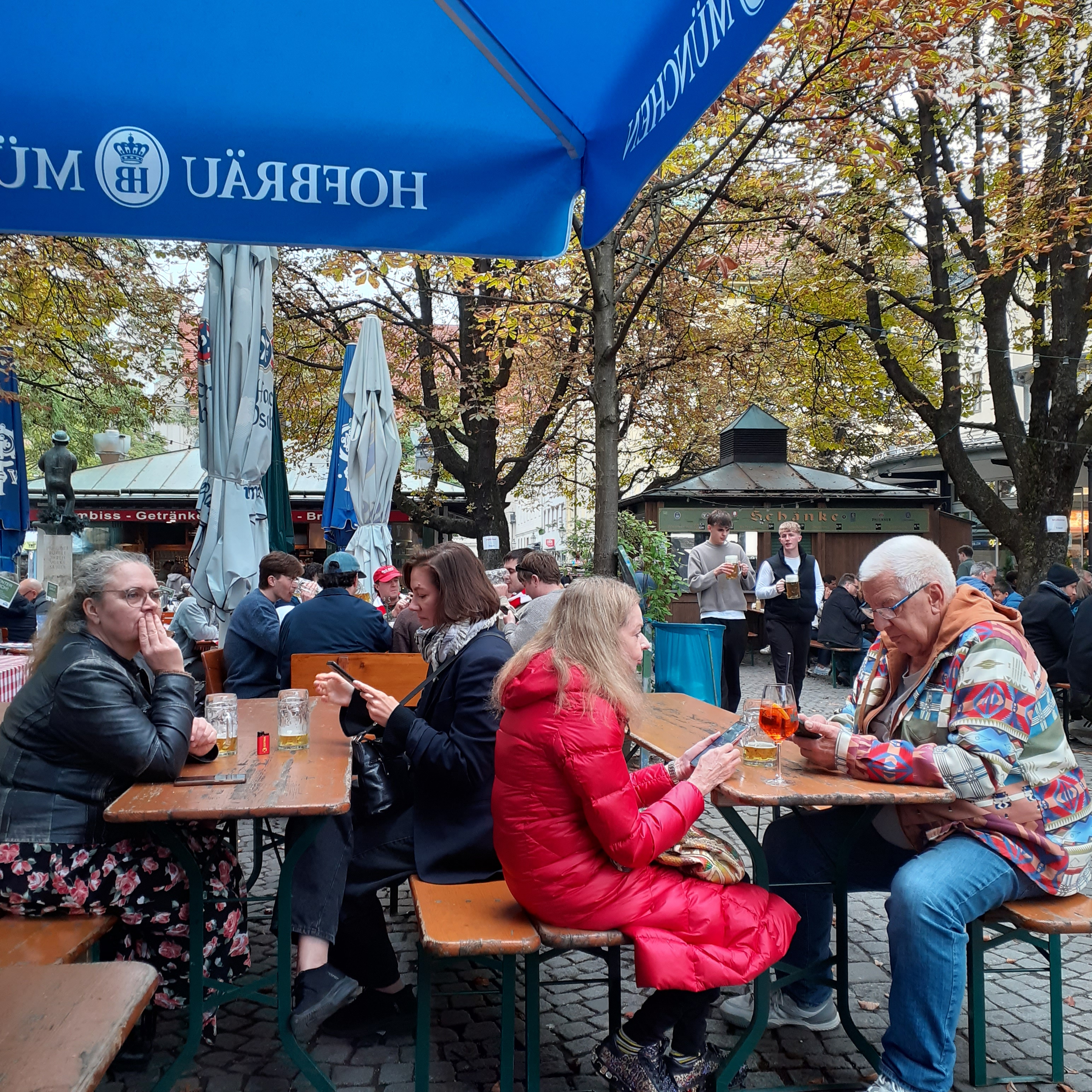
Off Marienplaz is the Viktualienmarket. This vibrant square is packed with stalls selling food, flowers and artefacts, gathered around a sprawling beer garden. It is open every day but Sunday and all human life is here. I queue for bratwurst and chips, with a foaming beer, and find a seat under the trees. The bratwurst is huge and sublime. You could sit here all day and watch the world go by. There’s waiter service, though the self service is best. The beer stall simply sets up the foaming beer by litre or half litre measure and you grab one and pay your €5 at the adjacent register. No queue, just conveyor belt booze. Happy daze.
Munich is a mecca for the dedicated beer hound. In the public interest I thought it best to investigate this phenomenon. Having at last freed myself from the embrace of the Viktualienmarket, I careened through the old town towards the Hofbrauhaus on Platzl, most famous of the city’s beer halls. Ludwig I opened it to the public in 1828 and the current building dates from 1897. The cavernous central hall hums with conversation and cheer. High above, the vaulted ceiling is adorned with baroque frescoes. Light flows in through the high arched windows. The effect is practically religious. I almost feel like genuflecting, though that would be hazardous.
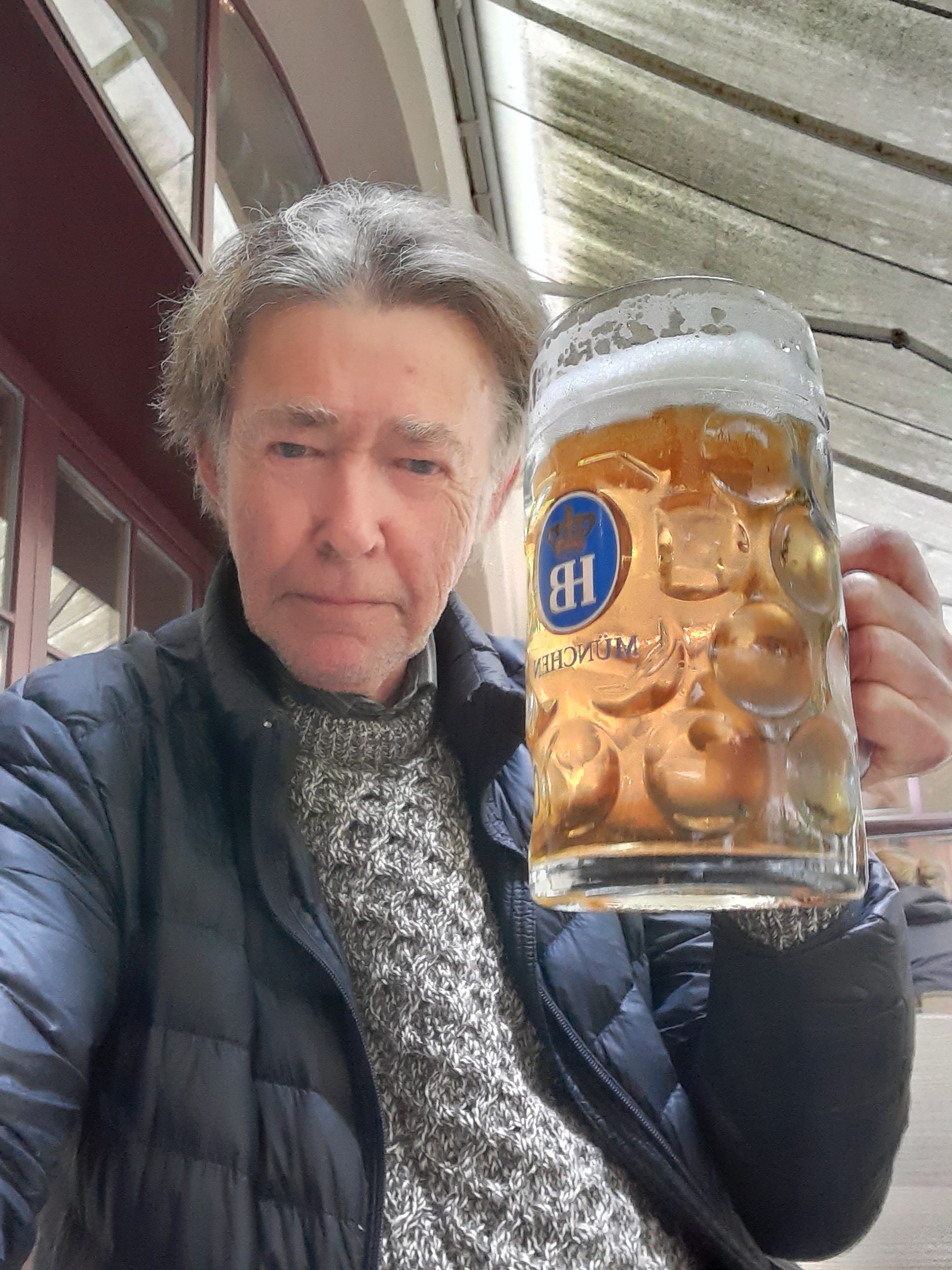
I find a bench in the courtyard beergarden which is quiet. I wrap my hand around a one litre stein, or masskrug. Steins were originally a stoneware mug, though now refer to the heavy glass with a handle synonymous with German beer drinking. There’s a technique to drinking such a volume for a lightweight like me. Slide your hand inside the handle and hold the glass body between palm and thumb. Lift and quaff. Repeat as necessary.
Ein zwei drei vier
Lift your stein and drink your beer
Ein zwei drei vier
Lift your stein and drink your beer
Drink! Drink! Drink!
Platzl is a small pedestrian square lined with drinking and dining terraces. The Dubliner Irish Pub across the road provides a cozier port to put into. I can admire the Hofbrauhaus building from the outdoor terrace.
North of the city centre is the extensive Museum quarter, the Kunstreal, Along the wide treelined avenues are a cluster of major art galeries and museums. The Pinakotheks are the three main galleries: Alte Pinakothek for old masters, the Neue for 19th century art from the Romantics to the Impressionists, and Moderne for twentieth century and contemporary art. The word Pinakothek is taken from the ancient Greek.
The Alte Pinakothek was begun in 1826 on the orders of King Ludwig (him again) and was the largest art gallery in the world on its completion. It houses a vast collection of European art from the 14th to the 18th century. Amongst 700 paintings there are works by Durer, Rubens, Memling, Raphael, Titian, Breughel, Rembrandt, Van Dyck, Murillo and El Greco. That starting eleven should win the European Champions League for sure. Others that grabbed attantion included Arcimboldo’s ingenious vegetarian heads, the Debauched Student by Van Honthorst, while Bouchier’s elegant portrait of Mme Pompadour is a centrepiece, and also adorns the entrance ticket.
The Neue Pinakothek followed in 1859, the first European museum of contemporary art. Both buildings were badly damaged during World War II but while the Alte was renovated, preserving the stress suffered by the original, the Neue was demolished. It was replaced with a postmodernist building opening in 1981. We didn’t get forty years out of it.
On my visit the Neue Pinakothek was, of course, closed. It is the same throughout Europe I’m afraid, where art museums of 18th and 19th century art are shut. This building was closed in 2019 and will not reopen before the end of the decade. A section of the Alte has been used to display a selection of work from the Neue under the title rom Turner to Van Gogh. Standouts include Manet on his boat, Sunflowers and a view of Arles from Van Gogh, waterlillies from Monet and Max Lieberman’s sundrenched beergardens. New to me was Giovanni Sagatini with a large panoramic landscape title Ploughing from the 1890s. Snow capped mountains at last! It made my trip.
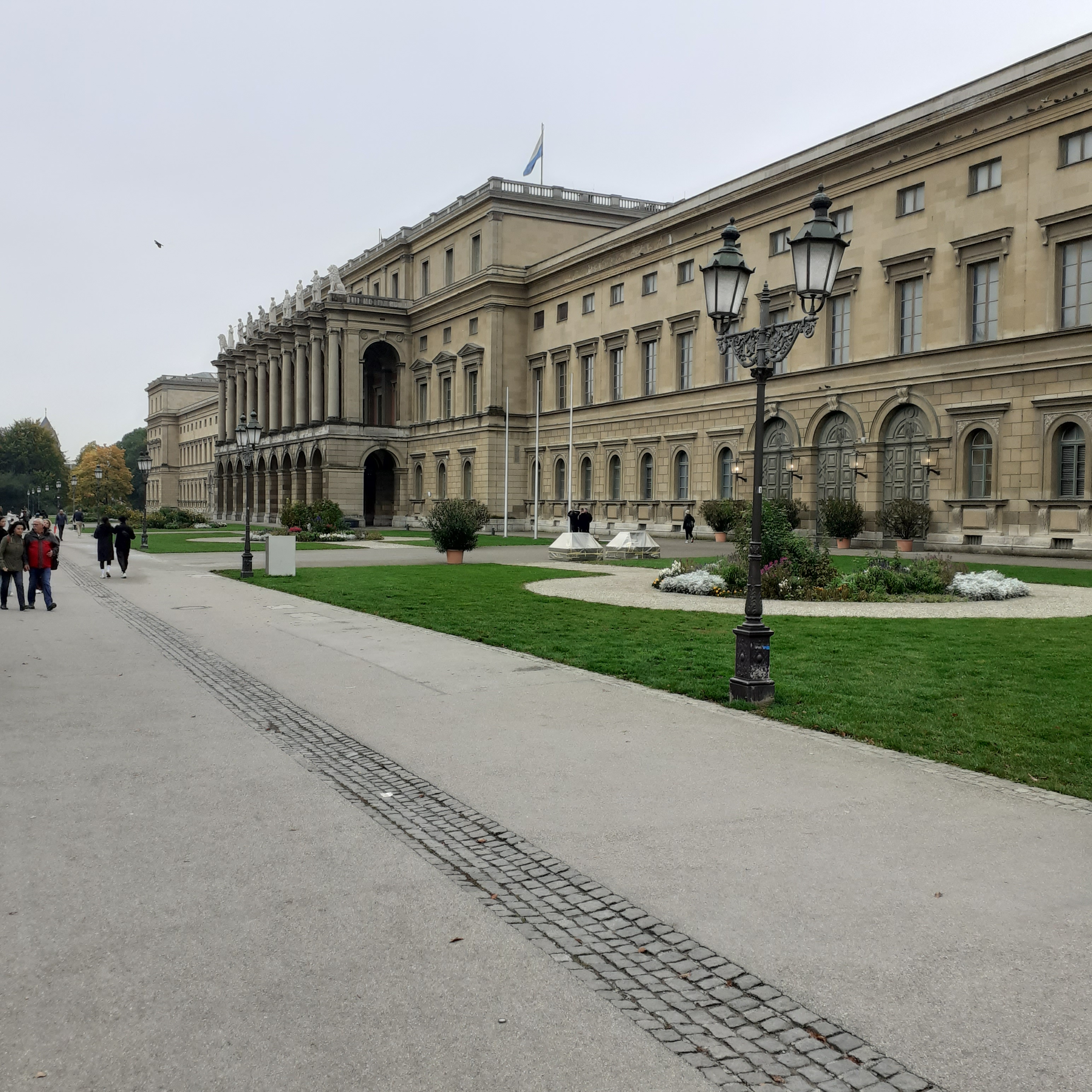
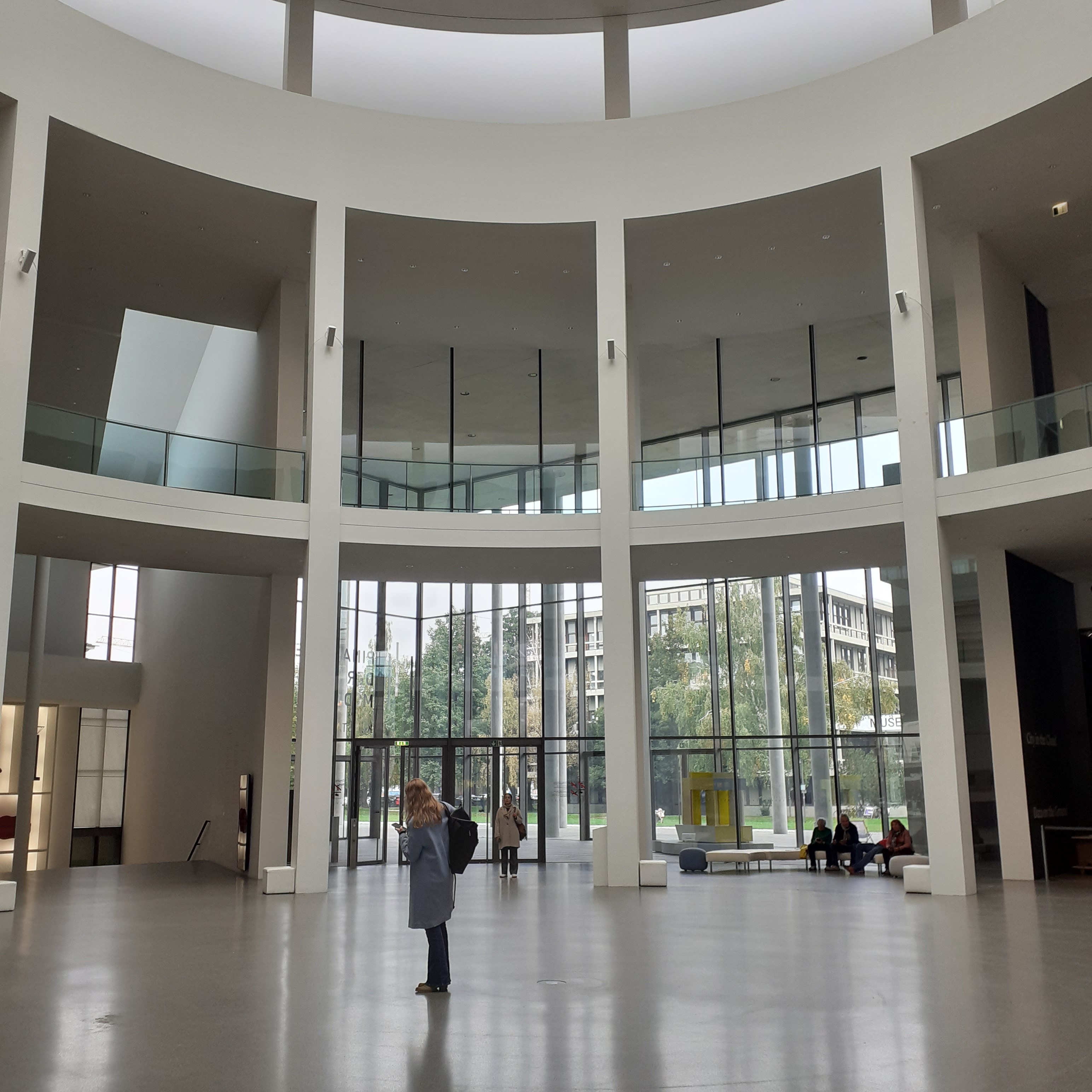
Pinakothek Der Moderne is devoted to art from the twentieth century and onwards. Built in 2002, the building has an impressive glass facade with high columns supporting the canopy roof. Inside it is divided into quarters devoted to art, architecture, design and graphics around a central rotunda. The art focusses first on important works by Braque and Picasso in the development of Cubism. Woman with Violin by Picasso and Braque’s Woman with Mandoline feature as a duet. Something of an all girl band forms farther on with a lifesize vernacular photograph of Patti Smith prowling with her guitar. Magritte, Ernst, Leger and Warhol are also on show. Down towards the basement, there’s a motor car theme, merging with sixtiesish, or seventies graphics.
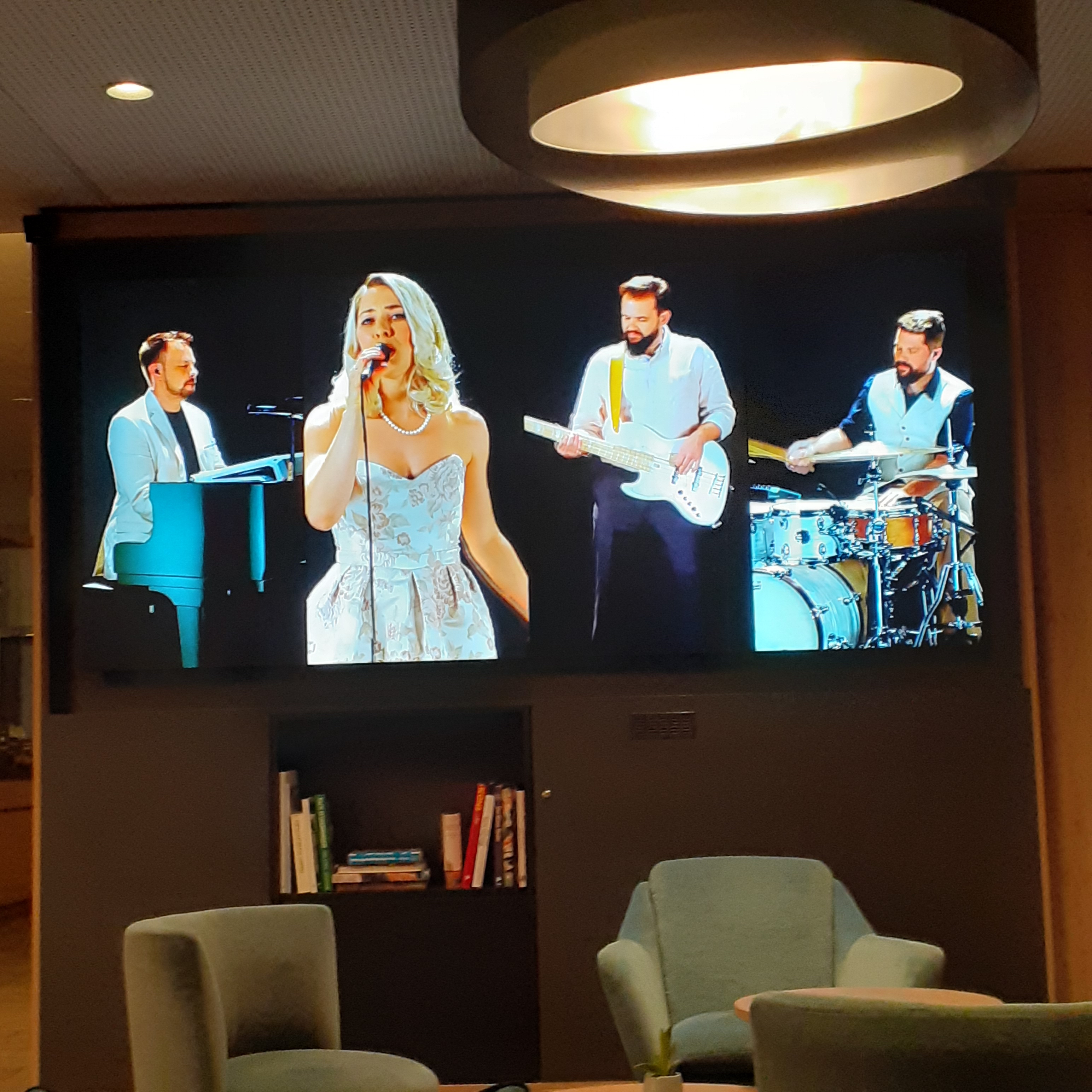
Finally I return to the Best Western for a relaxing drink in the hotel bar. Cillian, or Kilian, the barman keeps ‘em coming. It’s a good Irish name after all. A school in my hometown Bray being dedicated to the saint. He’s also venerated hereabouts in Bavaria. Meanwhile, a virtual band shimmers on the video wall. It’s smooth jazz rock, shades of Supply, Demand and (very attractive) Curves. I slip into the ambience.
The Drinking Song is the appropriate soundbite. It was written by Sigmund Stromberg with lyrics by Dorothy Donnelly for the 1924 Operetta the Student Prince. Sung by Mario Lanza for the 1954 film soundtrack, though in the film Lanza’s voice was lip synched by Edmond Purdom. The story tells of a Prince’s student days at Heidelberg University. Prince Karl is heir to the throne of the fictitious kingdom of Karlsberg. Hmmm, it would be called that. In the course of his studies, or daily drinking sessions as they are more accurately described, Karl falls in love with the innkeeper’s daughter. Who wouldn’t drink to that?
May those lips that are red and sweet
Tonight with joy my own lips meet!
Drink! Drink! Drink! Let the toast start!
May young hearts never part!
Drink! Drink! Drink! Let every true lover salute his sweetheart!
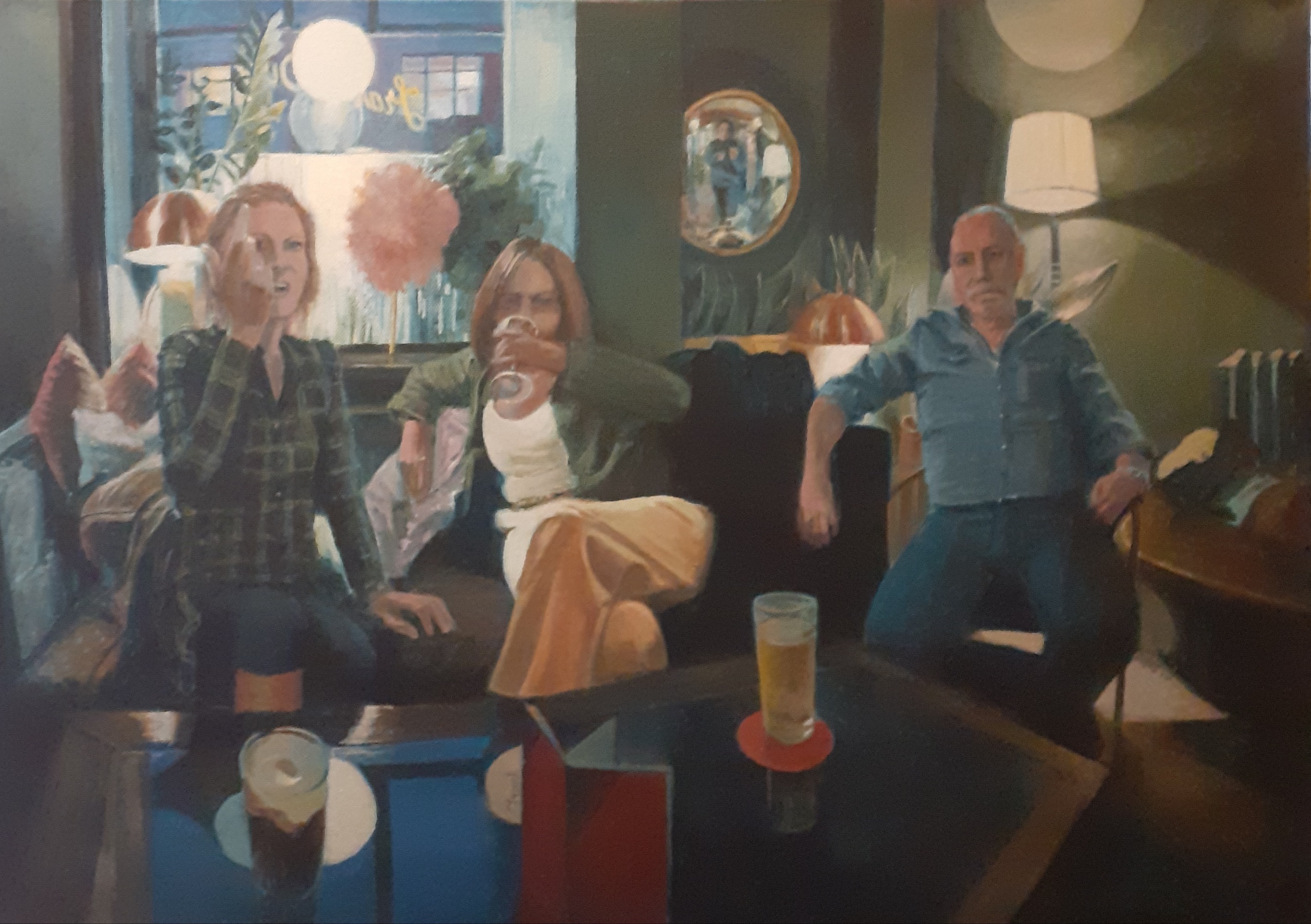
I have been slowing down of late on the art front. The pain thing. Slowing down on all fronts, truth be told. Still, I did squeeze out this spark, in the realm of friends and family. The best place to be. As before, the location is Frank Duff’s pub at the top end of Main Street, Bray. It’s last orders at the end of a great night out; drink and conversation flowing. You’ll catch me standing in the mirror. I suppose I could be singing The Parting Glass, although that’s a tad melancholy in the contecxt.
Songs of love and friendship have tumbled down to us since the time of Thomas Moore. And ever on into the future; here’s hoping. This night in Duff’s was recent, but takes me back to the days o the foreign telegram. So, I tunnel back to the early seventies and Mellow Candle’s only album Swaddling Songs. While the focal, and vocal, point of the group was the sparkling duo of Alison O’Donnell and Clodagh Simonds, this song was written by guitarist Dave Williams. The lyrics are cut from the same cloth though, and sung with gusto by the female leads. There’s a hint of winter and its globe of interior warmth in this verse, evoking that familiarity amongst friends and lovers caught in the moment.
Sell me heat-haze sell me rain sell me wet and dry
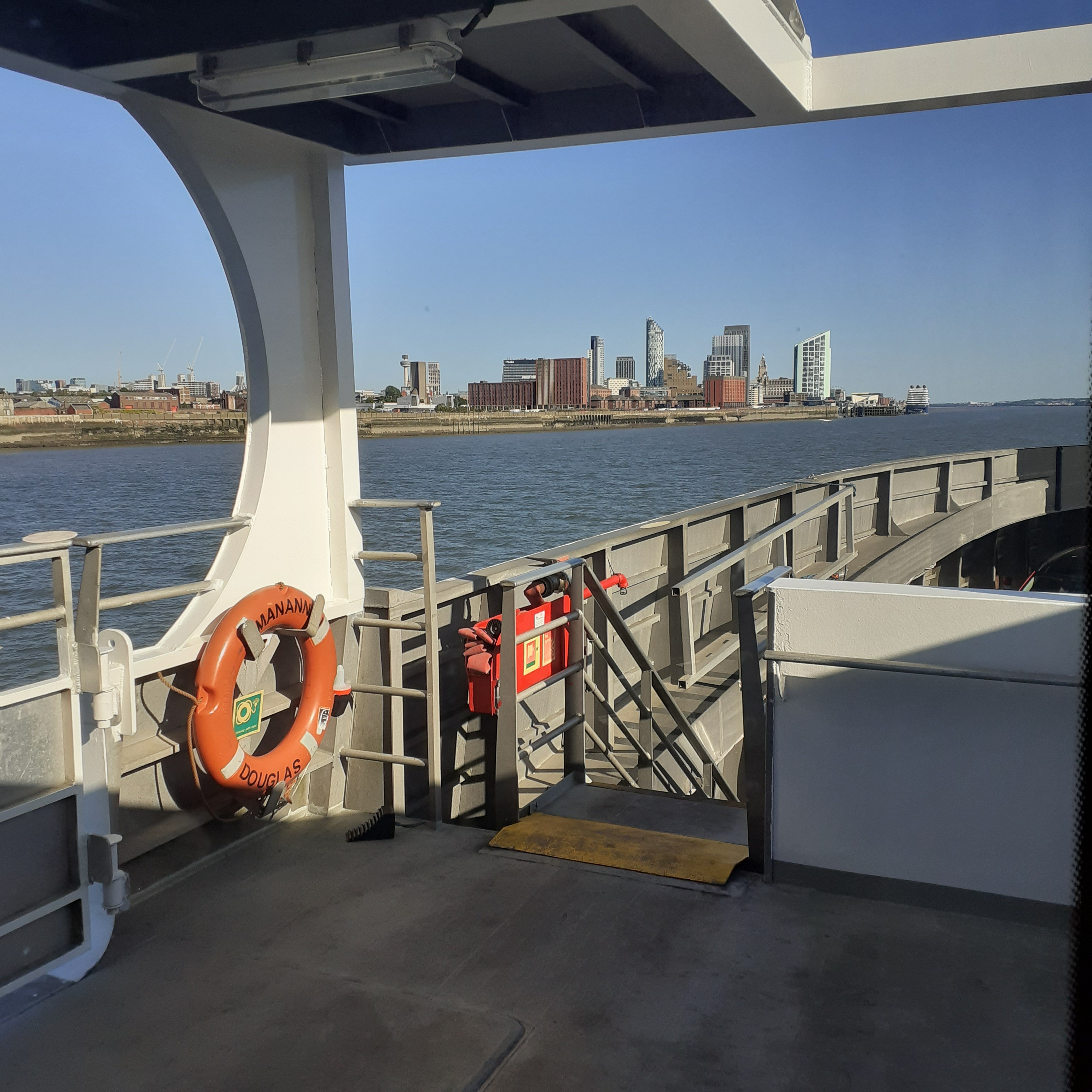
There are daily ferries from Douglas to Liverpool, the crossing taking three hours. The boat, the Mannanin again, is packed. Mostly bikers returning from their Isle of Man TT pilgrimage. We breakast on the boat. It’s a full English, or Irish, or Manx; you know what I mean. I was once in Liverpool, back in the early seventies on a daytrip by boat. I bought myself a portable typewriter and an airbrush, fuelling my twin ambitions to be a writer and an illustrator. It’s a long story. Or, several short stories and a novel, some slick illustration too, though I’ve abandoned that technique for the paintbrush.
Our day in 70s Liverpool was shrouded in drizzle, the city providing a gothic silhouette to our shopping adventure. This time, it’s baking in blue heat. The ferry berths on the northern end of the waterfront. The majestic dockside running south has been beautifully developed into a vibrant showpiece for the city, dotted by landmarks with a host of visitor attractions. It absolutely throbs with life under the hot sun.
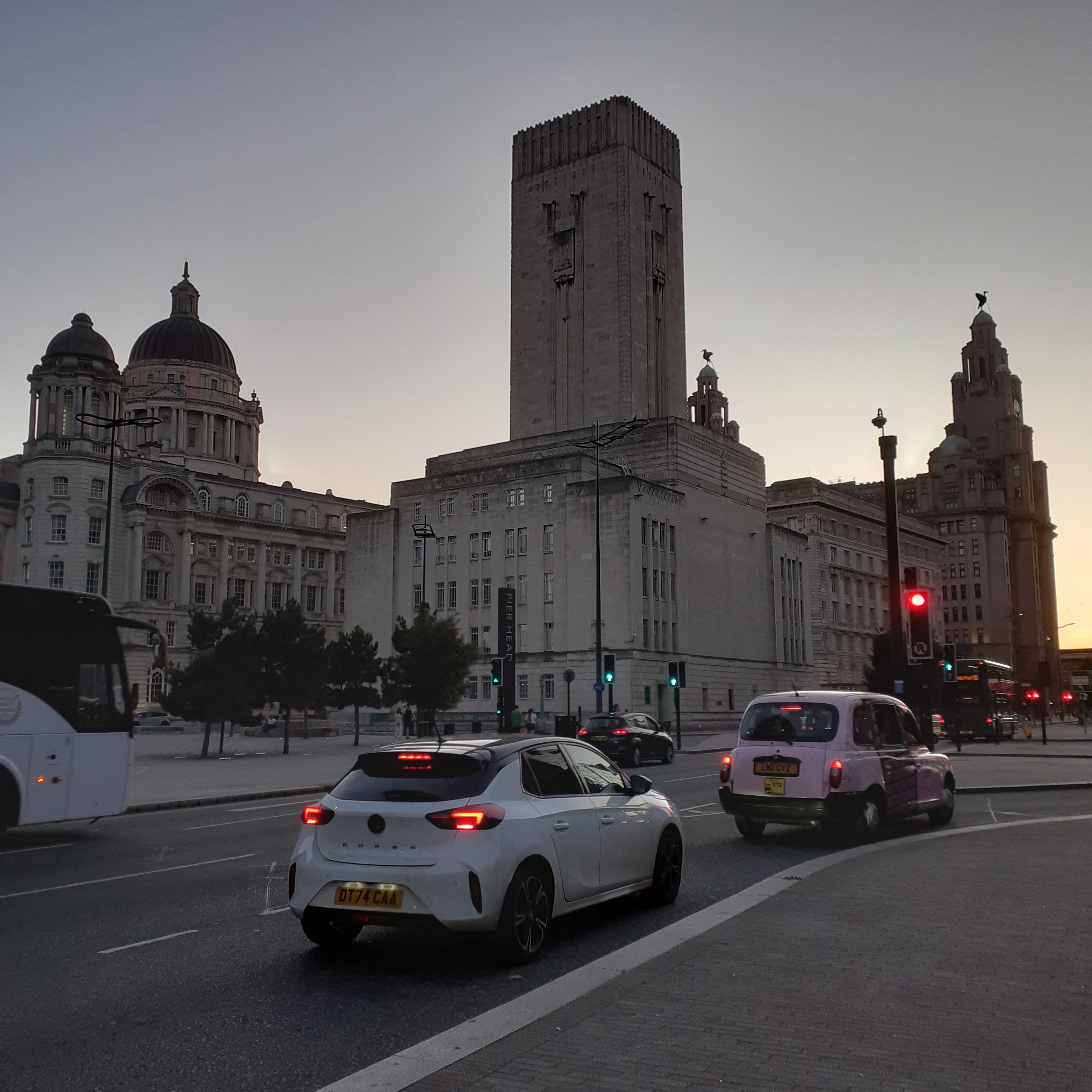
We walk the mile or so to our hotel, the Ibis, at Albert Dock. This stretch of dockland along the Mersey River is very much the heart and soul of the city. Pier Head provides a stunning architectural panorama. This area was called George’s Dock until the end of the nineteenth century. Liverpool Corporation bought the site with the Mersey Port and Docks Board retaining a portion for its new headquarters. The Port of Liverpool Building was completed in 1907. A typically Edwardian building in a Neo Baroque style, its central tower and dome was the tallest in Liverpool when built, very much the city landmark. This was surpassed in 1911 by the Royal Liver Building, the true Liverpool icon. In 1916 the Cunard Building came in between. Built to a modernist version of an Italaian Renaissance palace it completes the trio known as the Three Graces. Behind this trio is a fourth grace, perhaps, the George’s Dock building from the 1930s. This is an Art Deco building with a high central tower used as a ventilation shaft for the Mersey Tunnel. The reliefs on the top half of the tower resemble a sleeping face.
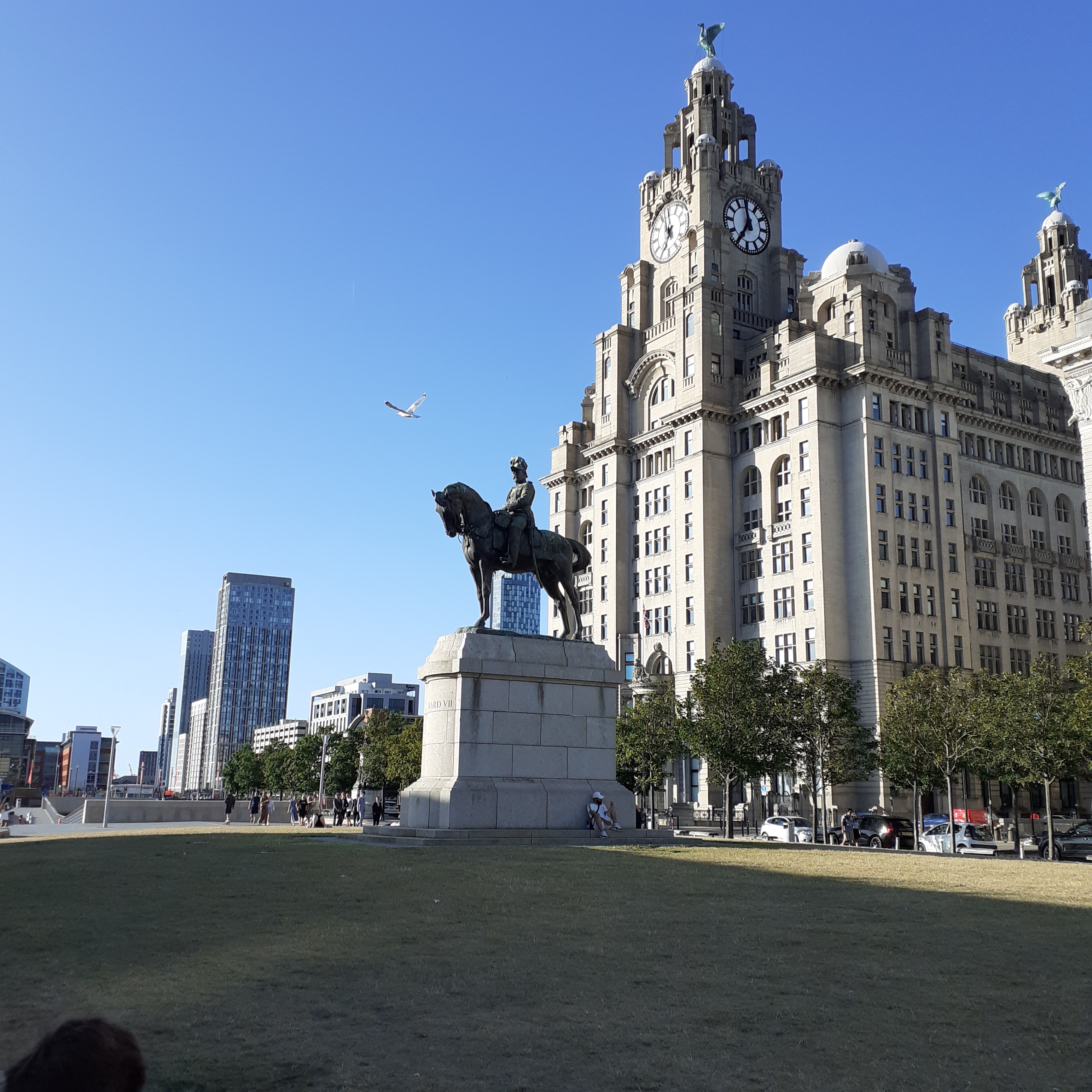
The Liver Building was designed by local architect Walter Aubrey Thomas for the Royal Liver Friendly Society. It’s one of the first major buildings I knew. My mother was a customer and her insurance book featured a line drawing on the cover The Liver Man came every month in his fancy Austin Cambridge to do the account thing. Exotic times. England’s first skyscraper is built of white reinforced concrete. Its twin towers climb to almost a hundred metres. The Liver Birds perch atop, eighteen feet tall. The mythical birds have been named Bella and Bertie. Taken from the ancient city’s coat of arms they are, officially, cormorants. Since Liverpool received its charter from King John in 1207, it’s likely that the bird first featured in the city arms, in homage to the king, was meant to be an eagle. Just badly drawn. It became a cormorant by the late eighteenth century, on the blazon for the coat of arms granted by Norroy King of Arms,the authority for northern England and Ireland, a certain George Harrison. The bird, whatever it is, has become the emblem of Liverpool itself and the football club Liverpool FC, though local rivals Everton, the older club, originally used it. Anyhow, a hundred metres up, Bertie looks inland, Bella to sea. It is said she keeps an eye out for the sailors, while he checks to see if there’s a pub open.
The Liver Birds was also the name of a BBC tv series from the early seventies, written by Carla Lane and Myra Taylor, two local housewives. It featured Polly James and Pauline Collins, and later Nerys Hughes, as the girls, or birds, in question. Something of a female equivalent of another north of England comedy the Likely Lads. The theme song was sung by the Scaffold, a comedy folk group including John Gorman, Roger McGough and Mike McGear, nee McCartney, brother of Paul. It is now possible to take a trip to the top of the Liver Building and with the birds to share this lovely view.
Even more famous than the two birds are the four lads, the Fab Four. Their statue at Pier Head provides the perfect photo opportunity. You can insert yourself amongst the foursome as they, slightly larger than life, stride out towards the Mersey. John, Paul, George, Ringo and yourself. Become your own fifth Beatle.
The Beatles form a good proportion of our mission. or pilgrimage, to Liverpool with a visit to the Beatles Story on Albert Dock. The Beatles Story opened in 1990 and has been a flagship of the growing Beatles tourist industry. Housed in a 19th century warehouse, the exhibition takes visitors through a chronological tour of the Beatles phenomenon. The group were one of many beat groups who flourished at that time, inspired by the first lowering of rock and roll across the Atlantic. Beatles was a clever pun, with a nod to Buddy Holly’s Crickets. The original trio of Paul McCartney, John Lennon and George Harrison, were augmented by drummer Pete Best and bassist Stuart Sutcliffe. The band played locally and for a few seasons in Hamburg, Germany. Sutcliffe stayed in Germany to pursue a career in art but less than a year later in April 1962, he tragically died of a brain haemorrhage. Pete Best was dismissed during their first London recording sessions with George Martin and Ringo Starr was drafted in. Then they had a hit with Love Me Do and the rest is history, with a fair bit of hysteria thrown in.
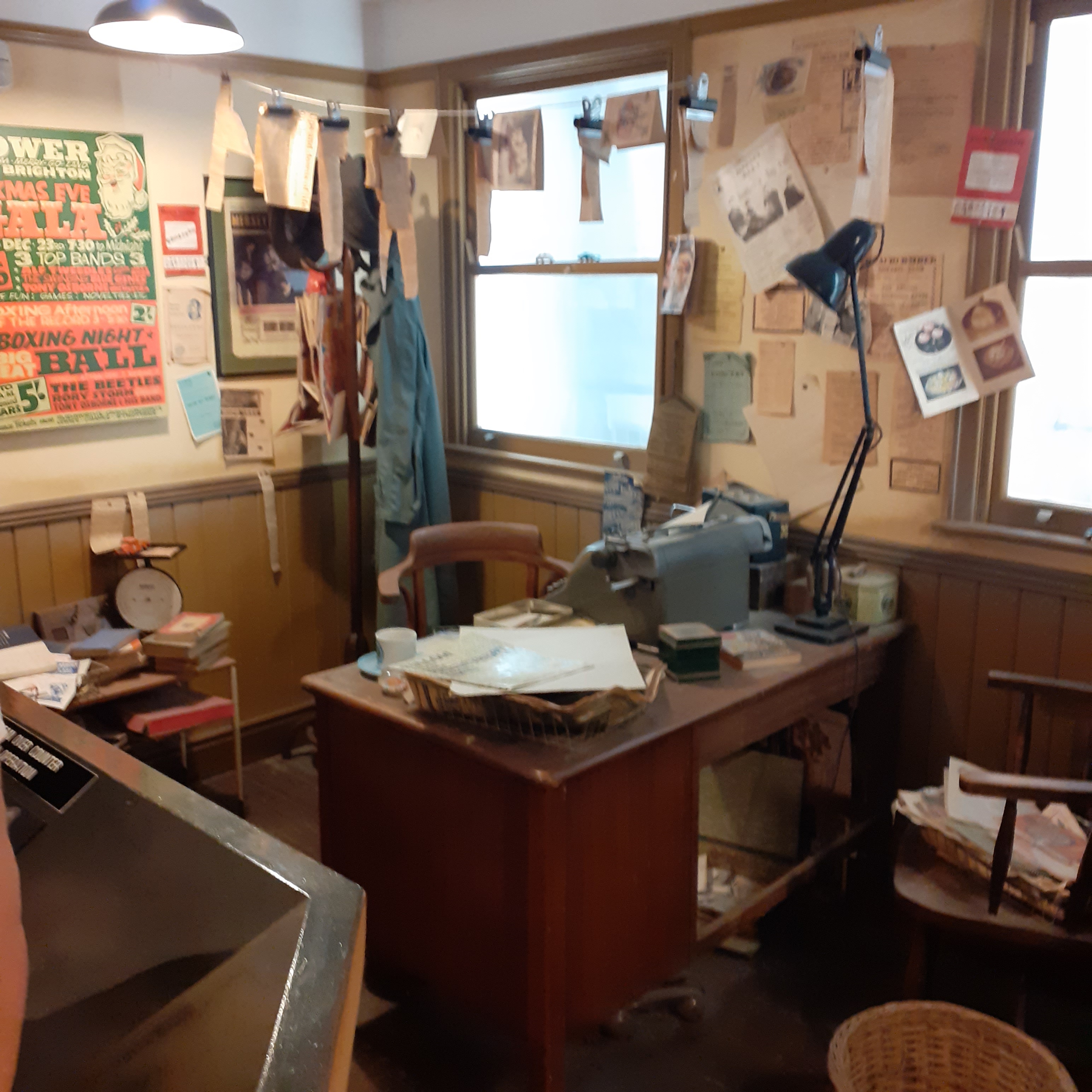
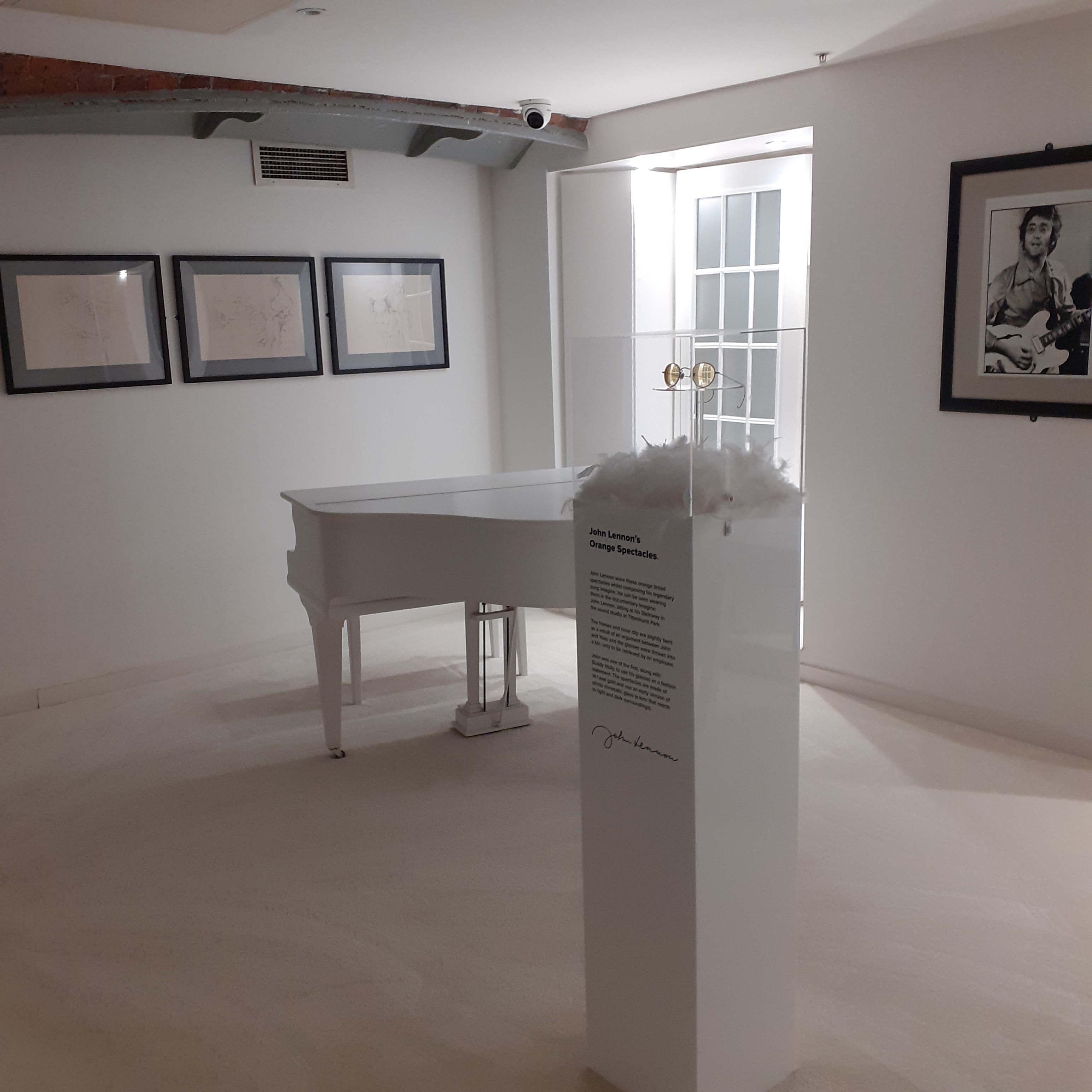
The Beatles Story constructs a sequence of imaginative tableaux and actual paraphernalia by way illustration. Brian Epstein’s crowded office, George Harrison’s first guitar, John Lennon’s specs and a room devoted to Sgt Pepper’s Lonely Hearts Club Band. Each of the four have their own room and there’s a touching note at the end with John Lennon’s piano room from Imagine.
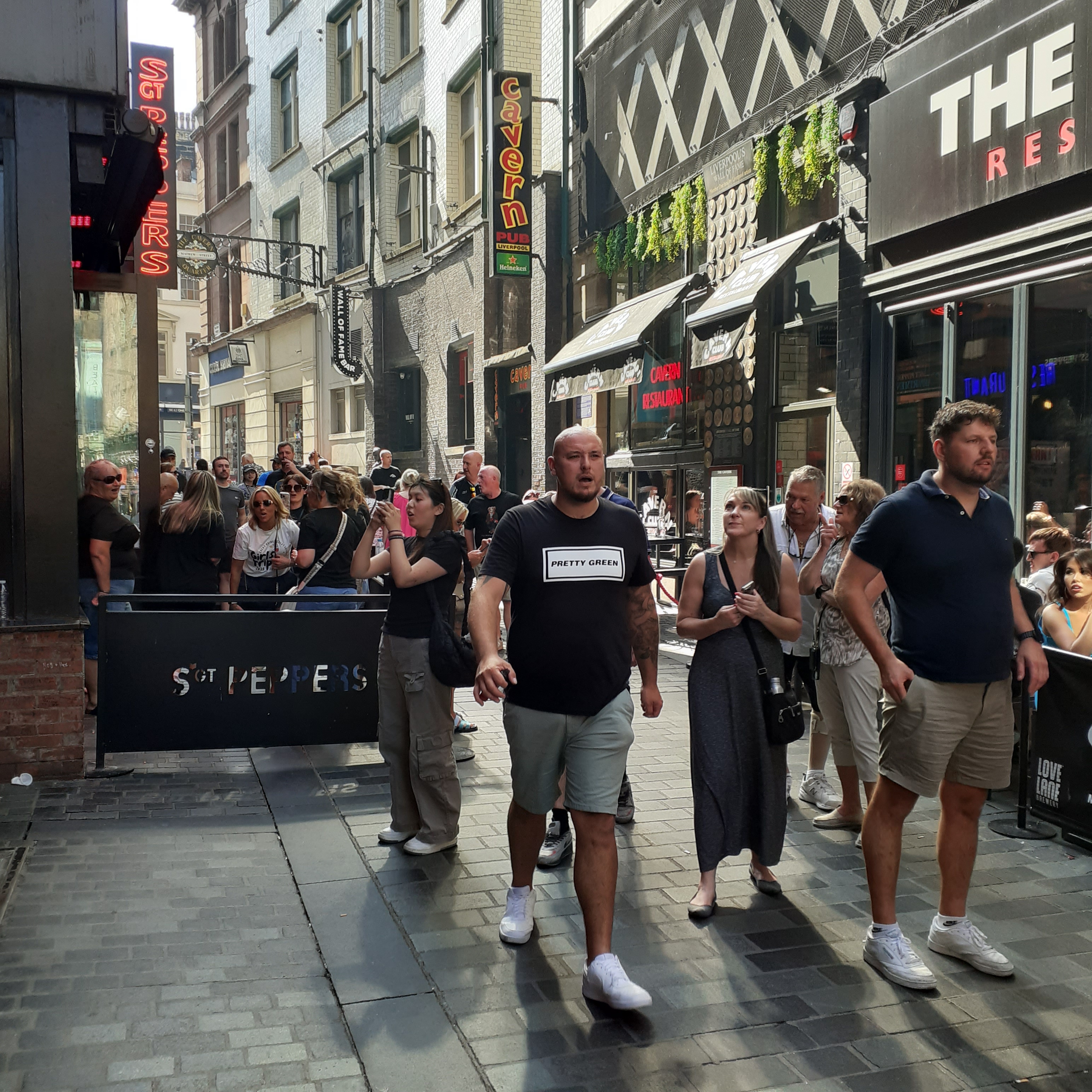
There’s also a recreation of the Cavern Club. The Cavern Club itself is a focal point of the Cavern Quarter up on Mathew Street. It opened as a jazz club in 1957. By the early sixties, beat groups were knocking on the door. The Beatles most persistently. Between February 61 and August 63 the group made almost 300 appearances there, but by then they had outgrown such a small venue. Ten years after, the Cavern shut up shop. Then the zeitgeist moved towards restoration. Developers originally hoped to excavate the original cellar but instead had to make a reconstruction with a lot of the original material
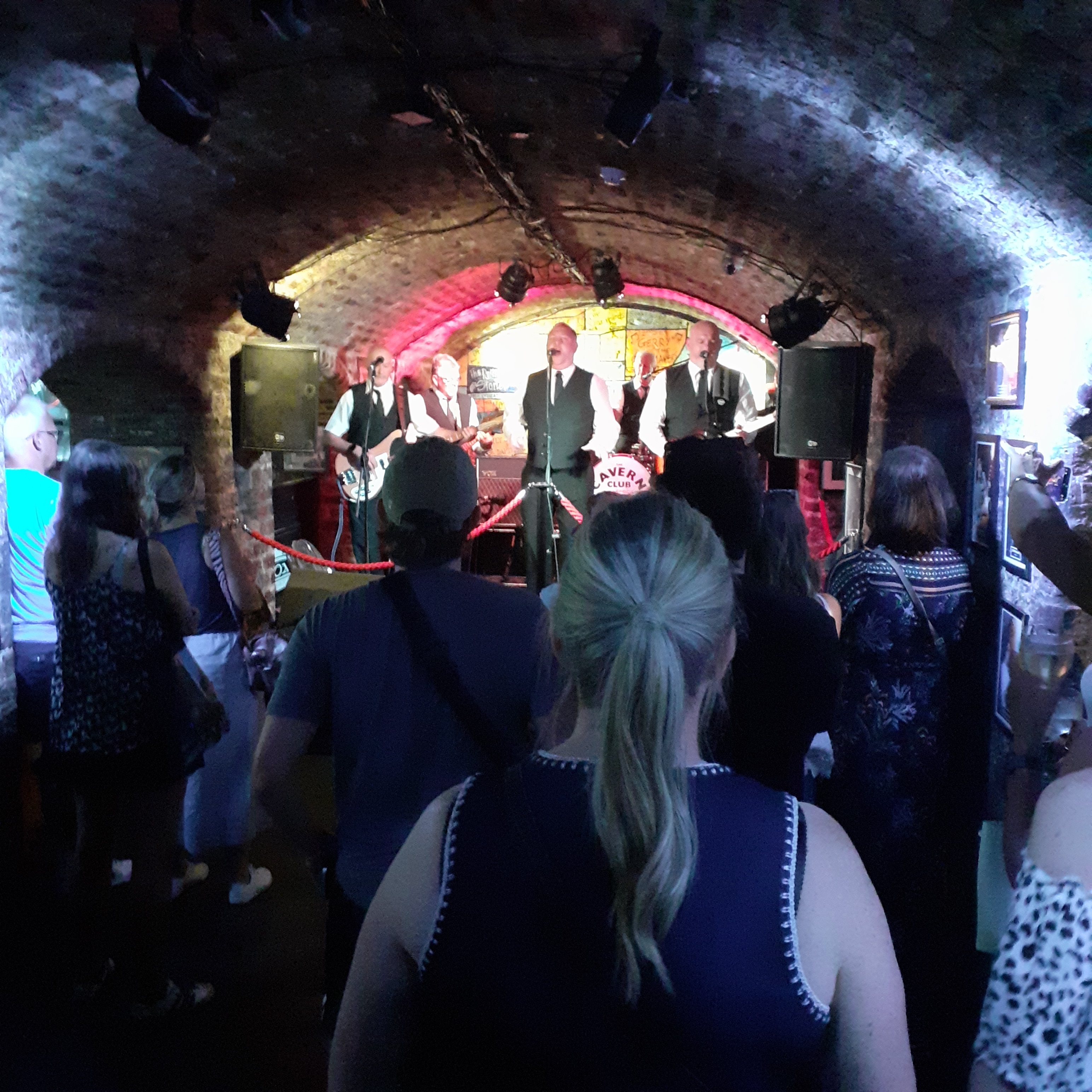
M and I make our way up there on friday night when the quarter is at its most raucous and exuberant. Weaving through the crowds in a mixed musical din has a certain spice to it. Sometimes weaving won’t quite work. A sequined lady from a time machine lurches to grab me. She is a doppelganger for the Cilla Black statue nearby on Mathew Street, if rather more aggressive. M and I decided to return on Saturday afternoon. Still loud and fun, but more relaxed. A fiver will get you in, card only, to walk a few flights down into the actual Cavern Club. Okay a reconstruction but it’s as real as it gets, and that’s fine by me. An amiable troubadour, somewhere west of Bill Bailey, takes us through a field of memories. The repertoire was a mixture of Beatles and Monkees, with some Oasis thrown in too, their comeback tour looming large in late July;
The Monkees were the American TV Beatles, and the band for my age group. Daydream Believer was amongst their best, and enjoyed a second coming with a later generation of Macams. Alternative lyrics came from a lively party of Sunderland lassies in the Cavern that day. Cheer up Peter Reid! Who, by way of connection, is a Scouser dressed in blue. Everton, in other words. As regards alternatives, it wouldn’t have been appropriate to shout for my Monkees favourite: Randy Scouse Git.
The Cavern has branched out, with a theatre hall set up and a dining area part of the labyrinth we explored. We stuck with the original, enjoying a couple of drinks before finishing with the Searchers, or five rocking old geezers in suits playing their stuff. Then we walk, tired and emotional, happy really, up many flights of steps and into the sun. We’re in the home the Merseyside sound; Gerry and the Pacemakers, the Merseybeats, Cilla Black and the Searchers. The Beatles, of course. The people who made teenage living fun, made us what we are today, and made too many damn fine records to mention.
There can be only one choice to play us out. On first setting foot in the Cavern, the opening song our troubadour played was Here Comes the Sun. It appeared on 1969s Abbey Road, the last album recorded by the Beatles. It was written by George Harrison in the April of that year. Harrison was oft referred to as the Quiet Beatle. Though he wasn’t quiet. He was, however, the most Irish of the Beatles, as you can tell from the lyrics of this song; ha ha. In fact his mother Louise, nee Ffrench, would often take him home to visit her ancestral family in Drumcondra, Dublin. In the early fifties, George with mother and brother was photographed on O”Connell Street, Dublin, by Arthur Fields, the famous Man on the Bridge. Curiously, my own mother, Veronica, was from Drumcondra. An O’Flanagan she would go on to marry a Harrison, from Blantyre, Scotland. She loved the Beatles too. Get Back was her favourite.
I have never been to the Isle of Man before. It seems a strange omission, as there’s no foreign soil closer to my home than this island cooling in the Irish Sea. It was once a popular holiday destination for people from Britain and Ireland back in the 1960s and beyond. M visited regularly in the late sixties and early seventies so something of a stroll down memory lane for her then. In keeping with the zeitgeist so, we opted to take the ferry from Dublin as most did back in the day. The Isle of Man Steam Packet Company makes weekly sailings between Dublin and Douglas during the summer months. As we were planning a two day stopover, we decided on taking a ferry onward to Liverpool. A voyage of sorts, in the old fashioned way.
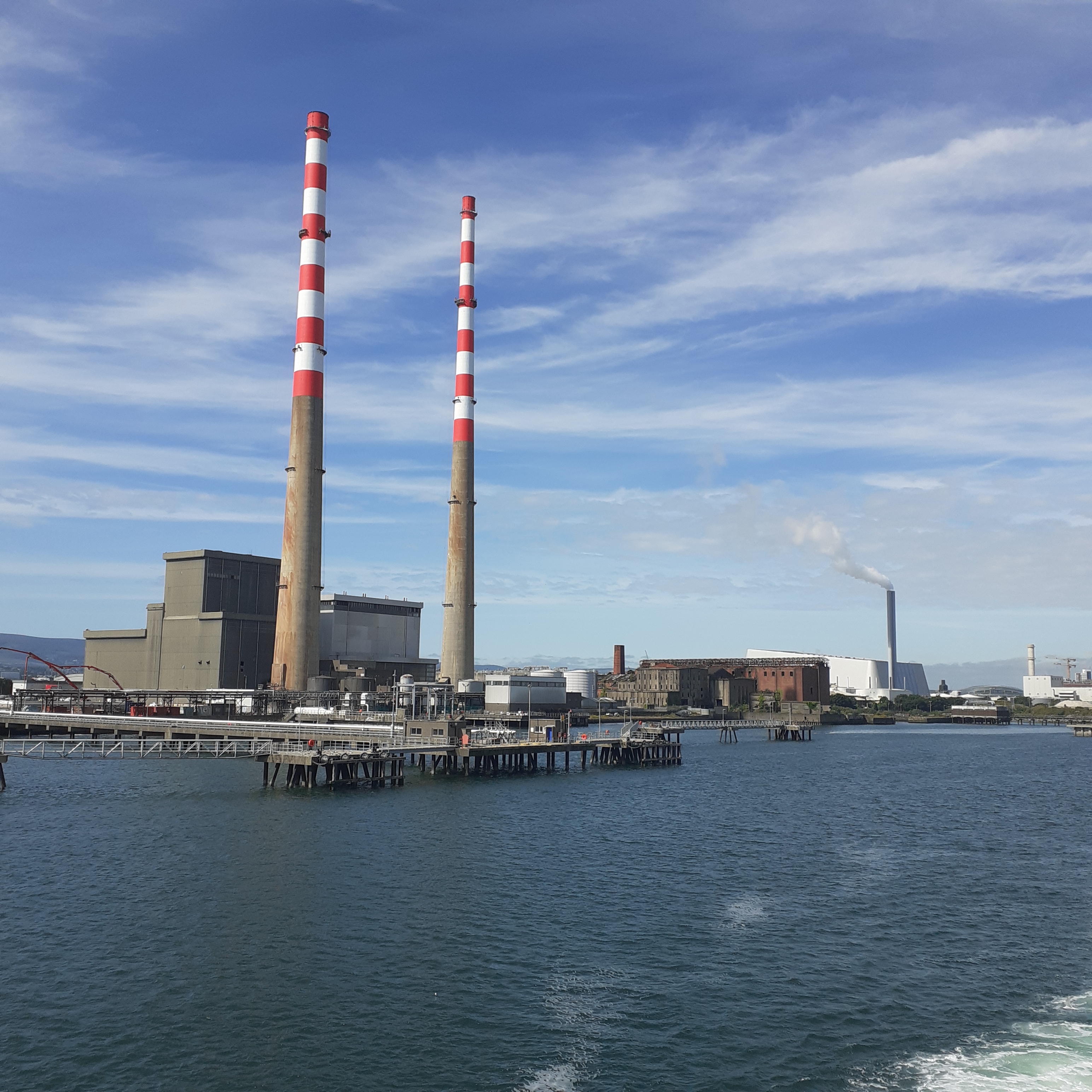
The IoM Steam Packet Company was founded almost two hundred years ago (1830) making it the oldest passenger ship company in the world. We booked Manannan, the high speed catamaran which is named for Manannan Mac Lir, sea god of the Gaels. From Connolly Station we took a taxi at the adjacent rank to the ferry port at the end of the East Wall. The Steam Packet shares the terminal with Irish Ferries who operate to Holyhead. There’s a pleasant coffee bar at the top with glorious views over Dublin port on a clear sunny morning. The good vibes have spread to the terminal staff who are friendly and jocular.
Manannan set sail at half ten. The crossing takes just three hours, with Ireland barely dipping below the horizon as Mannin rises from the blue ocean. The Isle of Man is a British Crown Dependency. Charles III is head of state and the UK looks after defence and foreign affairs, but it is otherwise a self governing independent state. The parliament, the Tynwald, was founded by the Norse in 979 and claims to be the oldest continuously operating parliament in the world. It is bicameral; the House of Keys being the Lower House.
The name Man is thought to be derived from mountainous island in Welsh, or else refers to Manannin Mac Lir. In Manx it is phrased Ellan Vannin (as Oilean Mhannin in Irish Gaelic). The Manx language is Celtic, related to the Gaelic languages of Scotland and Ireland. It is being enthusiastically revived and features prominently on street signs and many businesses. The Manx themselves are longtime English speakers, their speech rhythms and demeanour more closely resembling the North of England. There’s a hint of the Welsh or Cornish about their heritage, Mannin was a haven for pirates and splendid castles, but they are actually Gaelic rather than Britonic.
Manx was spoken until the early twentieth century. The island was Celtic up until the tenth century when Norse invaders took over. The Scottish followed in the thirteenth century when Man was grouped with the Western Isles. Control passed between the English and Scottish for the century up until 1346 when English lordship won out.
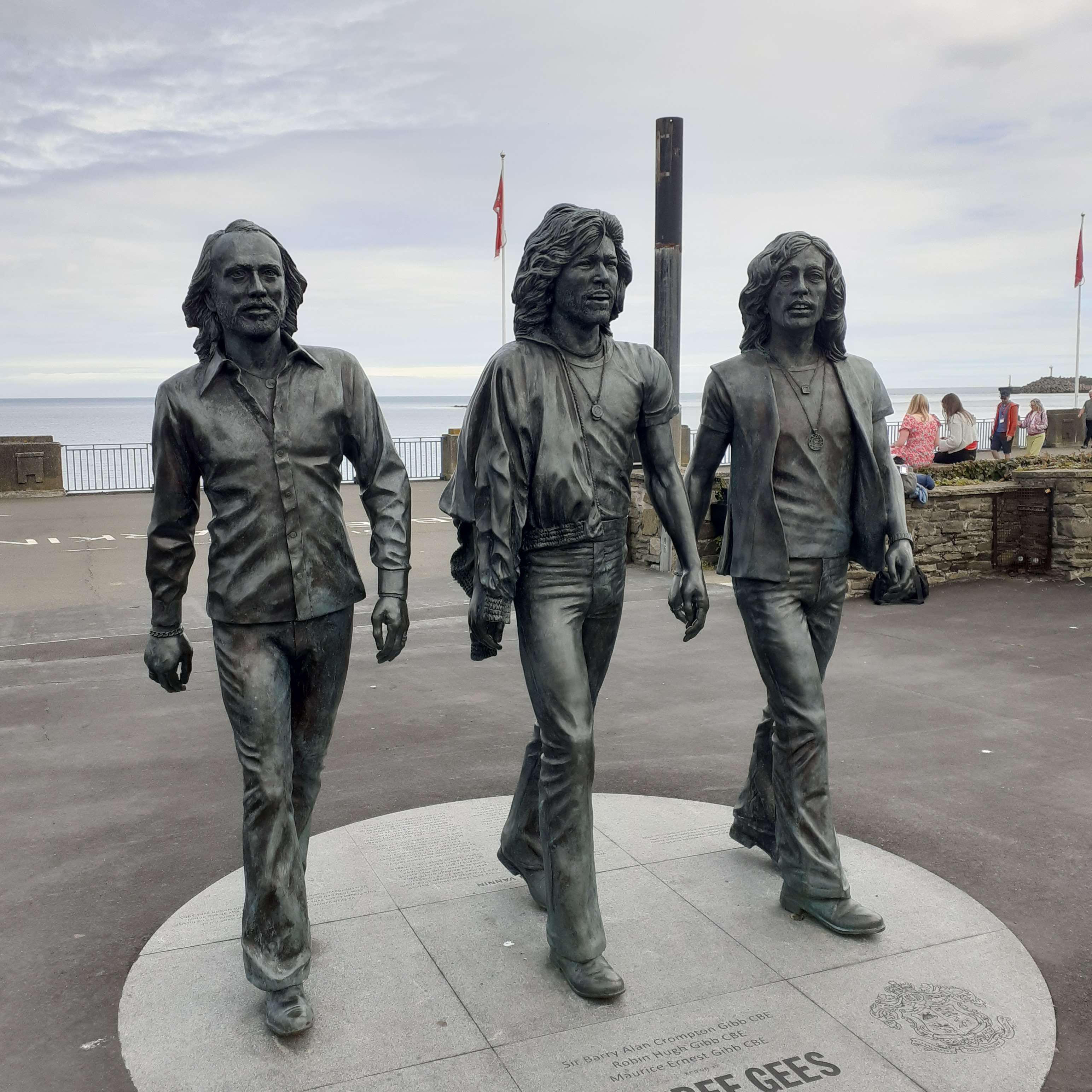
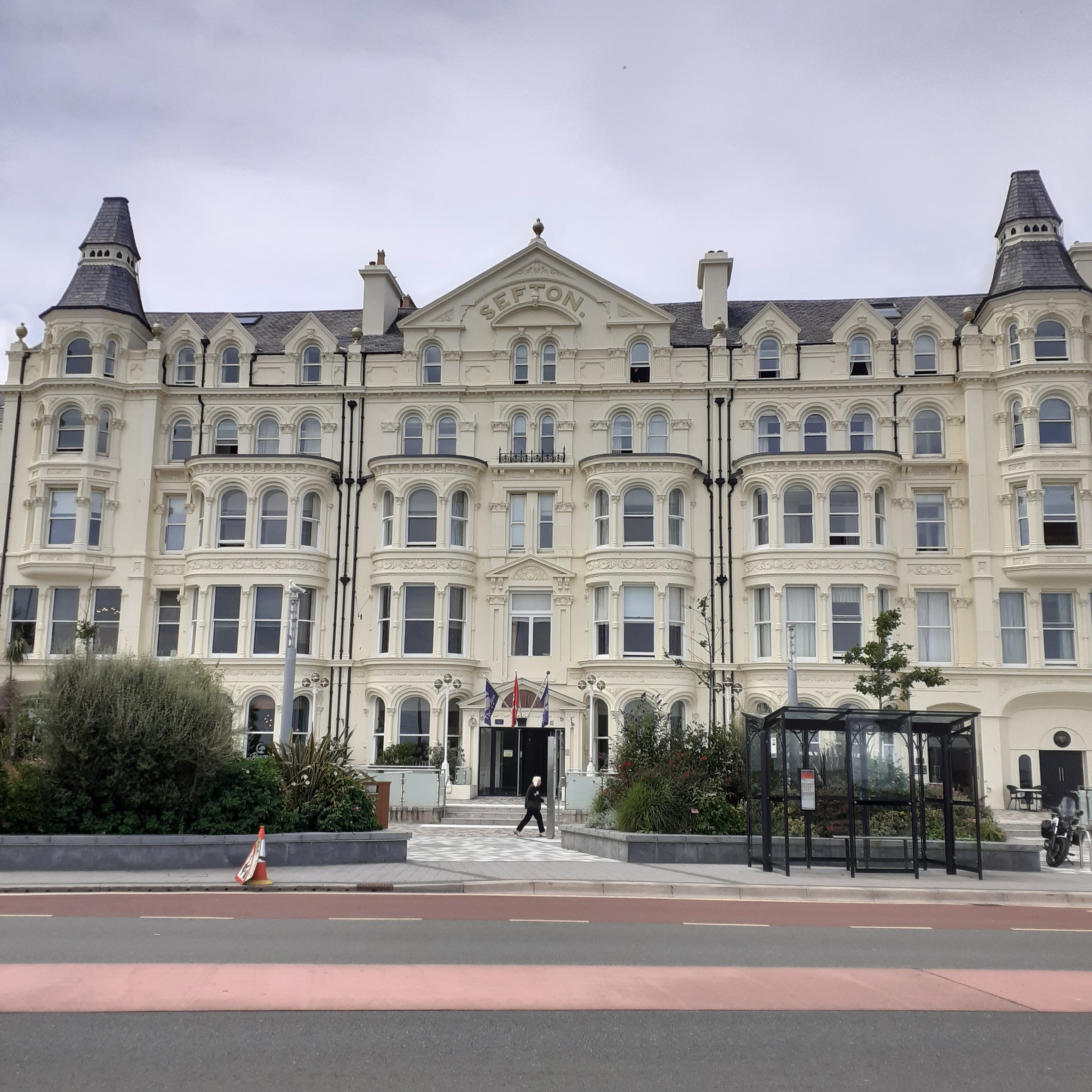
The island is thirty three miles long and about thirteen wide and has a population of eighty five thousand. Douglas, where we land, is the capital. From the terminal, the seafront formas a shallow arc of two miles around much of the bay. It is fronted by an impressive array of tall Victorian terraces and a Promenade. Our hotel, the Sefton was a ten minute walk by way of an attractive sunken park. We come across the Bee Gees walking in the same direction. Set in bronze, the trio are slightly larger than life. The brothers Gibb; Barry, Robin and Maurice, were born here in the 1940s before moving to Manchester and in 1958 to Australia. Ten years later they had a string of hits including Massachussets featuring their plaintive vocal harmonies. While that success soon faded, they reemerged in the late seventies with the soundtrack for Saturday Nite Fever, one of the biggest selling albums ever.
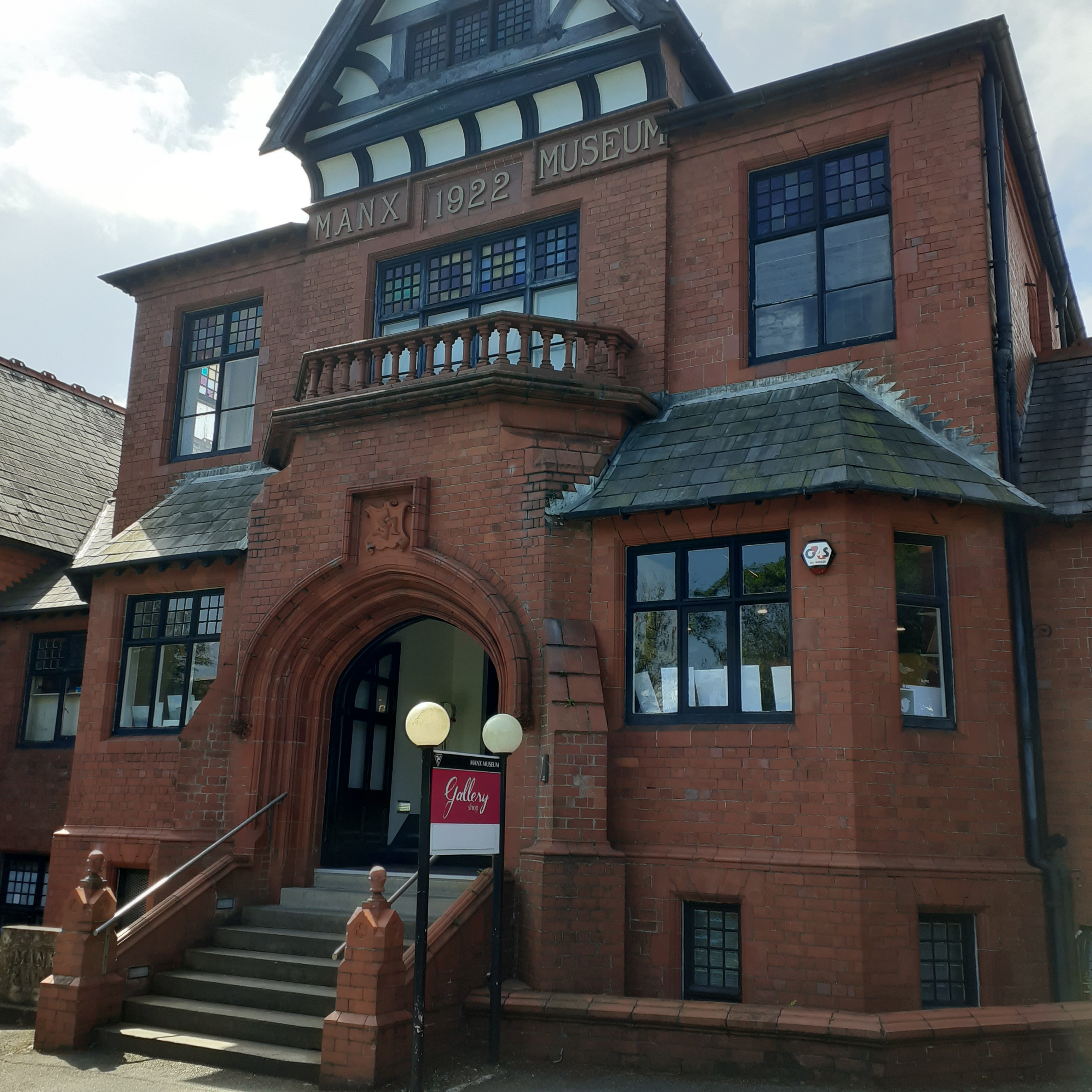
Man’s seafront heyday began in the 1950s. The seafront was the ultimate experience for families and strutting youth. That attraction has gone. The Manx Museum on higher ground above the old town, is the only place you can revisit it. It’s an interesting and eclectic display. Exhibits lead us through ancient history, into the world of Viking and Celt, through the complex political weave of the early modern and on to the often brash commercialism of the twentieth century. One picture shows a thronged seafront evoking those great seaside days of youth, the boardwalks and amusement arcades, candyfloss, rock n roll and Mods and Rockers.
George Formby is included in the mix. Formby’s comedy No Limit from 1935 was his breakthrough hit, based on the TT races. Formby, once a jockey, played a star motorbiker. The film ignited his career as the cheeky chappie, provoking laughter with inuendo laden ditties accompanied on ukelele. His heyday was in the thirties and forties. though a decade later George Harrison noted him as an early influence. There’s a state to Formby near the railway station, at the southern end of Douglas.
The Tourist Trophy was first staged in 1907, the Isle of Man being chosen as Britain’s restrictive speed limit disallowed road racing. It has become an iconic race meet for motorbikers. A high proportion of visitors to Man are from the biking fraternity. The island is a point of pigrimage, or the scene for a last sunset drive. There’s a large section in the Museum devoted to the race, with some fun interactive displays.
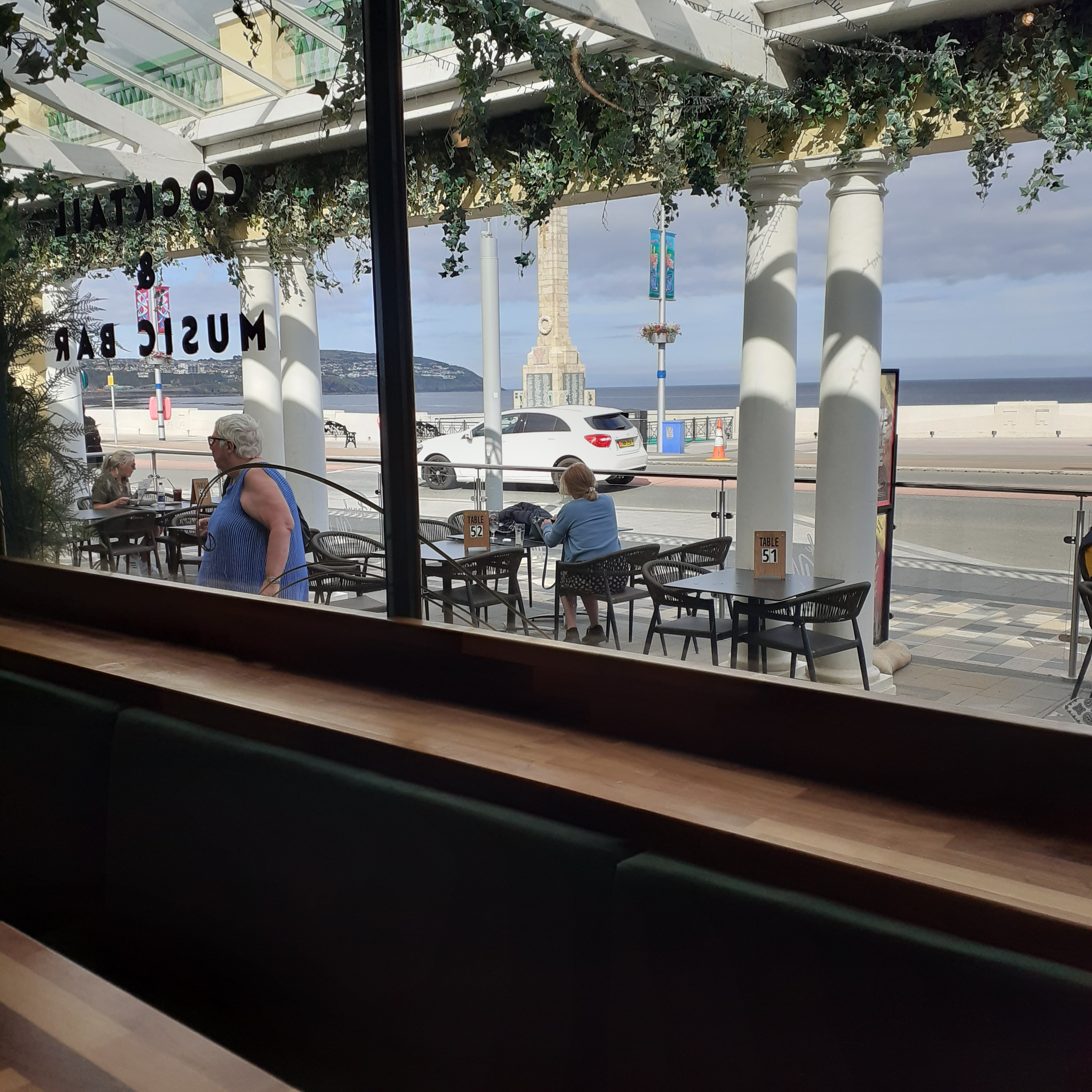
Walking along Dougas’s seafront in a summer heatwave, it was a surprise to find only one bar and a cafe with outdoor seating. The beach was as deserted as a surrealist painting. The tide had gone out in more ways than one. Matcham’s Bar and the cafe next door supplied the only refreshment terrace I could see, against an urban backdrop that was impressively Mediterranean. These hostelries front the Villa Marina, a seafront complex with old world theatre and arcade framing a pleasant public park with a few food outlets. The Sefton supplied chairs and tables outside Sir Norman’s bar which I also enjoyed later in the day. Norman Wisdom is the Norm in question, the comedian’s grinning statue occupying a bench at the door.
Douglas’s main shopping area meanders behind the seafront in the old fashioned way. Pedestrianised Strand Street leads on to Duke Sreet and farther on is the Quay, a picturesque inlet crammed with sailing craft. The south headland rises sharply behind and the quaysides are lined with period buildings housing bars and restaurants. The British Hotel and the Barbary Coast give something of a snapshot of Manx identity conflict. Pirates or patriots? There’s a pizzeria and a Chinese besides, with a selection of places to sit outside and enjoy the view. At last, our place in the setting sun, to raise a glass or two in memory of broken hearted pirates, motorbike heroes and our Celtic islands in the sun.
On an island in the sun
We’ll be playing and having fun
And it makes me feel so fine
I can’t control my brain
Thought I’d share that one. Its memory came back to me recently when it popped up in one week on a travelogue tv soundtrack, on the car radio, as a highlight at Glastonbury. Then, while walking along Nassau Street, I spied Weezer themselves playing live to a sunkissed throng on the TCD campus. Happy days indeed. Appropriate words, too. Island in the Sun was written by Weezer’s singer guitarist Rivers Cuomo and first appeared on their 2001 album, Weezer, aka The Green Album.
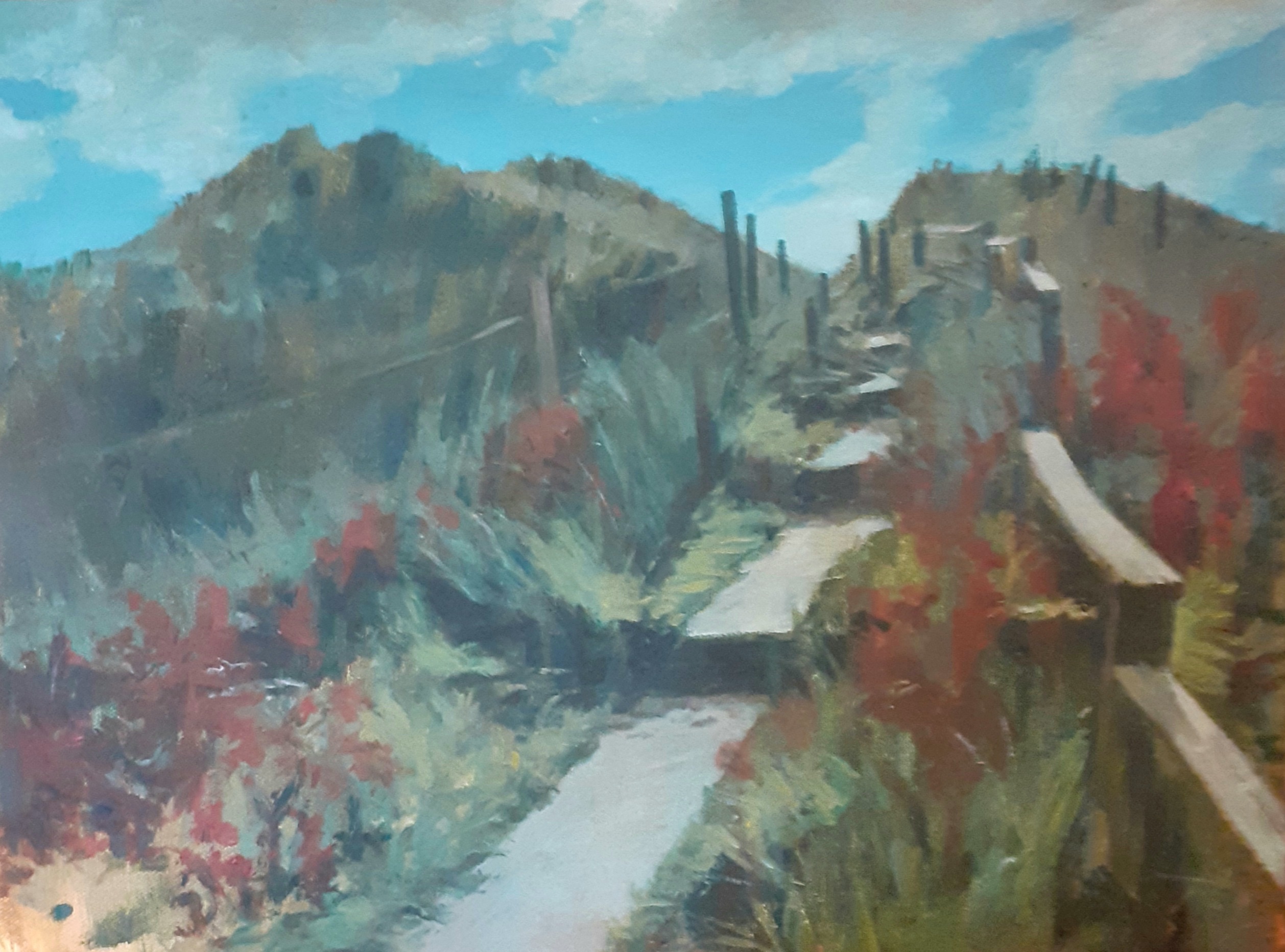
Summer is here, and amongst my favourite activities is doing nothing on a beach. Not exactly an activity so. Brittas Bay is a regular haunt. Thanks to good friends, we can spend a few weeks in a mobile on Wicklow’s wonderful coast. The mobile park is separated from the rising coast by a small river, and from the bay itself by a range of high sand dunes.
In this painting, we are approaching the beach through the dunes along one of several stepped ways. It’s something of an oasis of isolation and quiet, between the domestic suburbia of the mobile park and the windswept leisure activity of the beach.
This time I am using oils, which I have not done in a long long time. Since I went to art college in the summer of 77 I have tended towards faster graphic media such as watercolour, gouache and acrylics. One Dublin cityscape and a mountain landscape is all I can recall. So it was a bit of a struggle to begin with, and I was as much absorbed in the physicality of the whole thing, the texture and smell of the materials as I would normally be in the detail and composition of the finished work. There’s something of the wild and unkempt in this and the process. A sensual saturation that takes its own form.
And so the song that suggests itself is rough and ready too. It’s from the summer of 77 which I remember for sandy days with M in Llandudno, Wales and a holiday hut on the beach in Skerries, North Dublin. It kicks off with a to-die-for bass riff. What follows is a young ruffian gorging himself on the visual pleasures of the beach. It’s called Peaches and was the first hit for the Stranglers from their debut album Rattus Norvegicus. You might also know it from the opening credits of the 2000 geezer flick Sexy Beast, where reformed lout, Ray Winstone, soaks up the sun in a villa in Spain. Oh, I can relate to it in all sorts of ways.
Well there goes another one just lying down on the sand dunes
I’d better go take a swim and see if I can cool down a little bit
Coz you and me woman, we got a lotta things on our minds
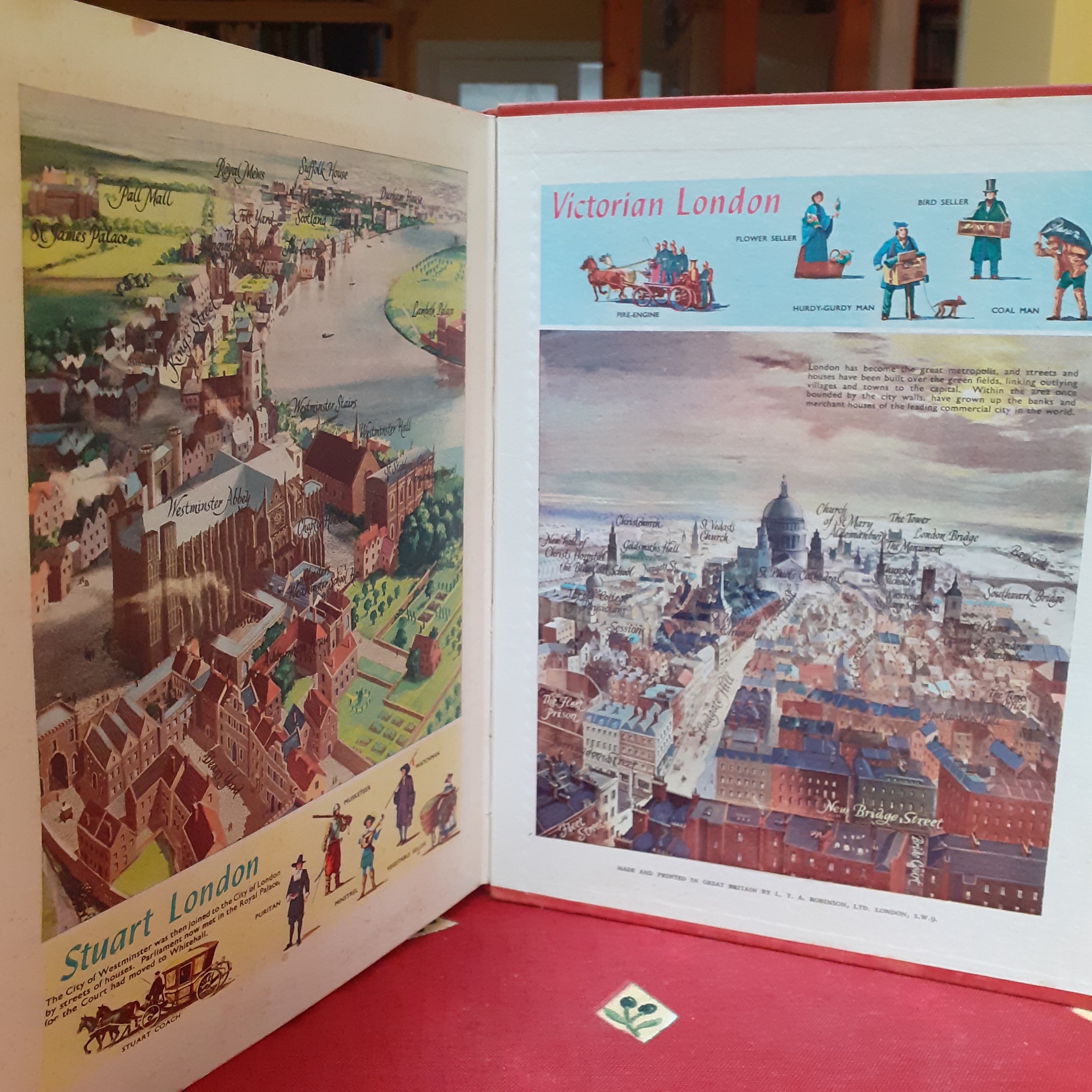
There are a number of arbitrary hooks which snared me as regards London. I loved pictorial history books as a kid and these being Anglocentric featured much on the development of English culture and society, with London at its centre. The Tower of London, St Paul’s and the Thames were familiar to me, as illustrations of their place through history.
Pop music too, of course. In 1968 my soul spun upon hearing Last Night in Soho by Dave Dee, Dozy, Beaky, Mick and Tich. Dave Dee was sometimes known, ominously, as the singing policeman having once been a cadet in the Wiltshire Police; one of those boys in blue. Here, he’s one of the bad boys we love. It was my first single, and also, I’ve just read, Waterboy Mike Scott’s. Great minds, Mike, great minds.
You came into my life like rain upon a barren desert
Just one smile and I was born again
I felt sure it wasn’t too late
I’d find strength to make me go straight
I had love and threw it away
Why did they lead me astray
For last night in Soho
I let my life go
Last Night in Soho was written by Ken Howard and Alan Blaikely and released on the Fontana label, which used attractive deep blue graphics. The song is a cautionary tale, melodramatic but seductive. London is cinematically rendered, in a collage of crime and romance. How dangerous and attractive this place Soho sounded! I had a fondness for maps, and a London street guide was thumbed close to invisibility, as I traced my path through Soho and the wild West End.
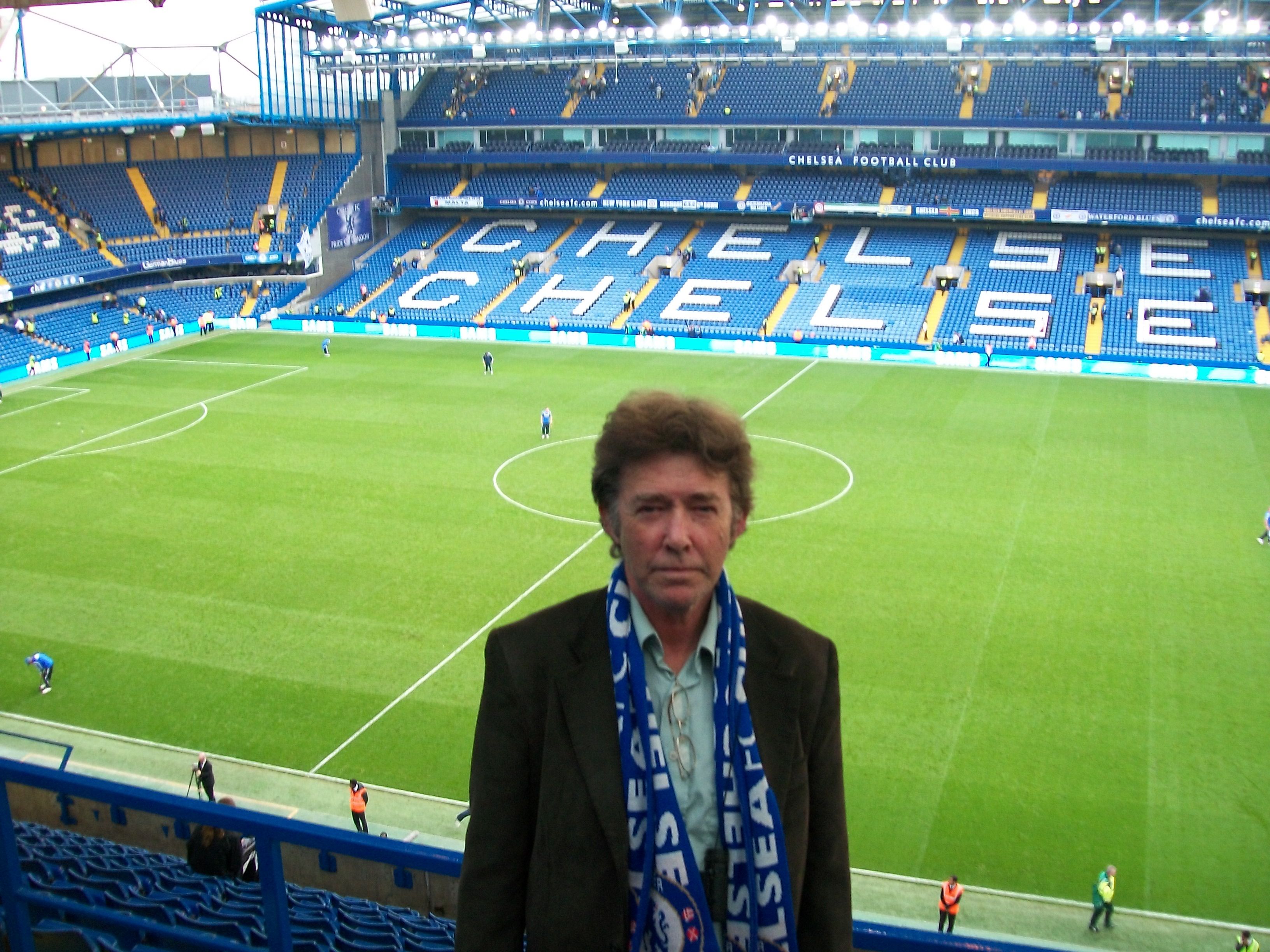
As a football fan, the towers of Wembley loomed large in my youth. FA cup finals provided a rare chance to see a full televised match. My first featured West Ham and Preston North End. But I lost my heart to the boys in blue, Chelsea, although losing the final to Spurs in 1967. I had built many memories of London by the end of the twentieth century, physically stepping onto the streets of London, seeing the sights, the galleries, eating, drinking, going to the movies, music gigs and theatre shows. But it would be 2005 before I actually went to a Chelsea game. As a treat for my fiftieth birthday, M and Sons brought me to the Hotel Chelsea right in their home ground. Chelsea were turned a hundred years old then having been founded in 1905 to occupy Stamford Bridge, an athletics stadium in Fulham. That’s a different Stamford Bridge to the one up near York that hosted King Harold’s semi final victory over the Norwegians in 1066. Harold lost the final to the Normans at Hastings, led by William, since known as the Conqueror.
Chelsea FC were admitted immediately to the Football League, though it would take another fifty years to win it, which they did in the year of my birth, 1955. Another fifty years later at the end of November I saw them play at the Bridge, as defending League Champions, having triumphed again the season before. They played Wigan Athletic, John Terry scoring the only goal of the game. They would go on to win the Premiership that season.
Earlier, with M and the boys, I met star players Peter Bonetti and Bobby Tambling. Tambling was the Blues star striker of the sixties scoring over two hundred goals. Bonetti was their goalkeeper, known as The Cat. I fancied myself as a goalie in my youth, but was known as the Vampire, as I couldn’t deal with crosses. Bonetti had played in Chelsea’s first FA Cup winning team, in 1970, beating Leeds Utd in a glorious mudbath at Wembley. Kicking and a gouging in the mud the blood and the beer, as Johnny Cash ‘sang’.
The Fox and Pheasant is the oasis of choice, out in the beer garden oiling the tonsils for the afternoon ahead. I sank a few with my boys here on an Easter weekend before seeing Chelsea beating Arsenal two nothing with a brace by Didier Drogba, later marching down the Fulham Road singing Didier Drogba, la le la le la. The day after seeing Henry IV at the Globe, Davin and I attended the first game of the season to enjoy Chelsea beating West Brom 6 – 0. Drogba scored a hat trick. Visiting the Chelsea Museum, we got to lift the Premier League trophy and the FA Cup, the benefit of a double winning year. Been there, done that, even bought a souvenir teeshirt.
Woke up, it was a Chelsea Morning
And the first thing that I heard
Was a song outside my window
And the traffic wrote the words
It came ringing up like Christmas Bells
Rapping up like pipes and drums
Chelsea!
Joni Mitchell’s song from 1969 is a song of joy. Oh, to feel like that of a morning! It appeared on her album Clouds.
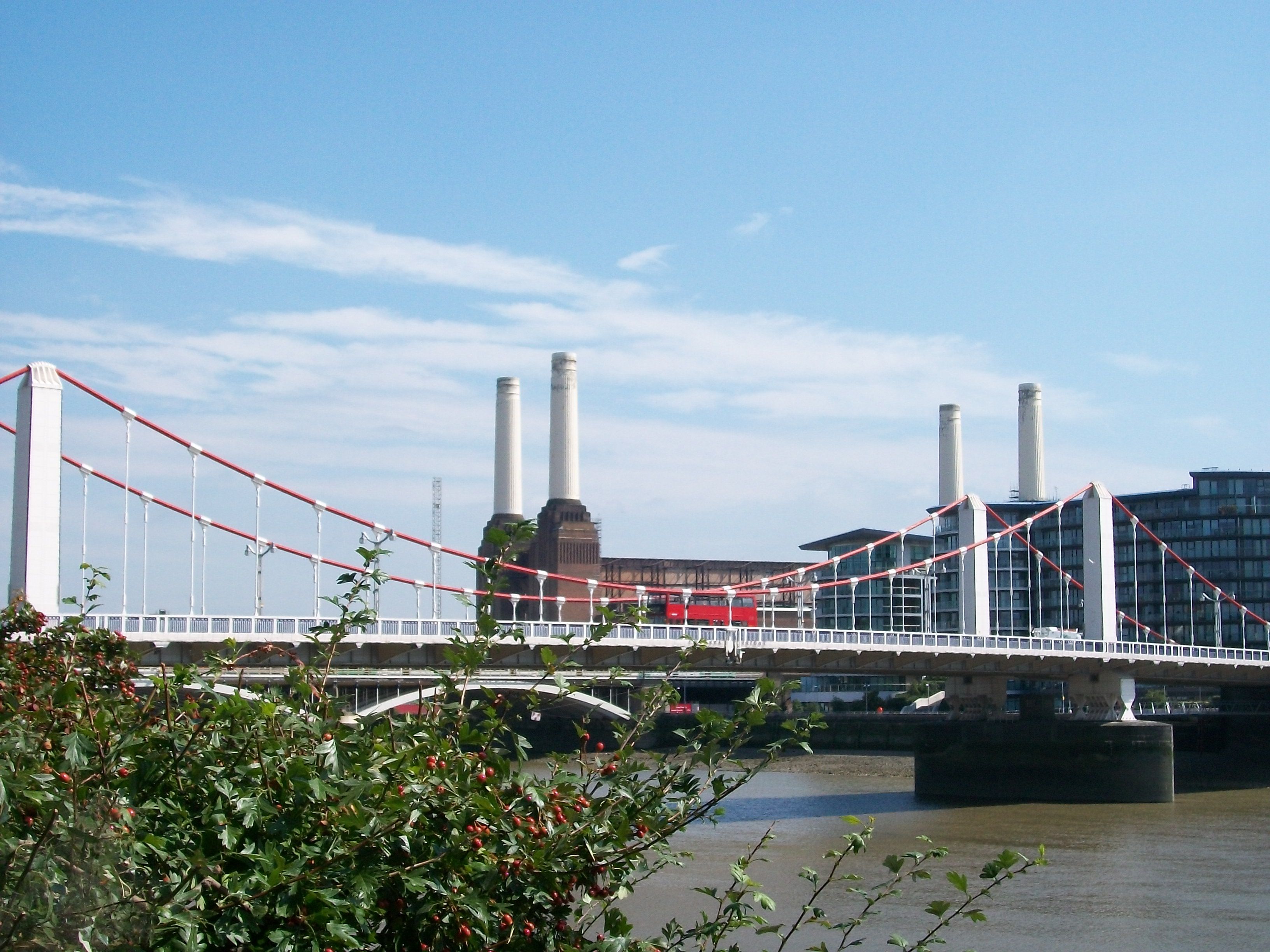
You can head back east to the Borough of Kensington and Chelsea by Fulham Road or King’s Road nearer the River Thames. The crossing is bracketed by World’s End and Brompton Cemetery, which sound more cheerful on a matchday. Along the river I can stroll along Cheyne Walk and think at least something sounds like it’s named after me. Chelsea Bridge is further on. The current structure dates from 1937, replacing an earlier one originally known as Victoria Bridge. Like its predecessor it is a suspension bridge, though much wider, and while plain enough, pleasantly illuminated at night.
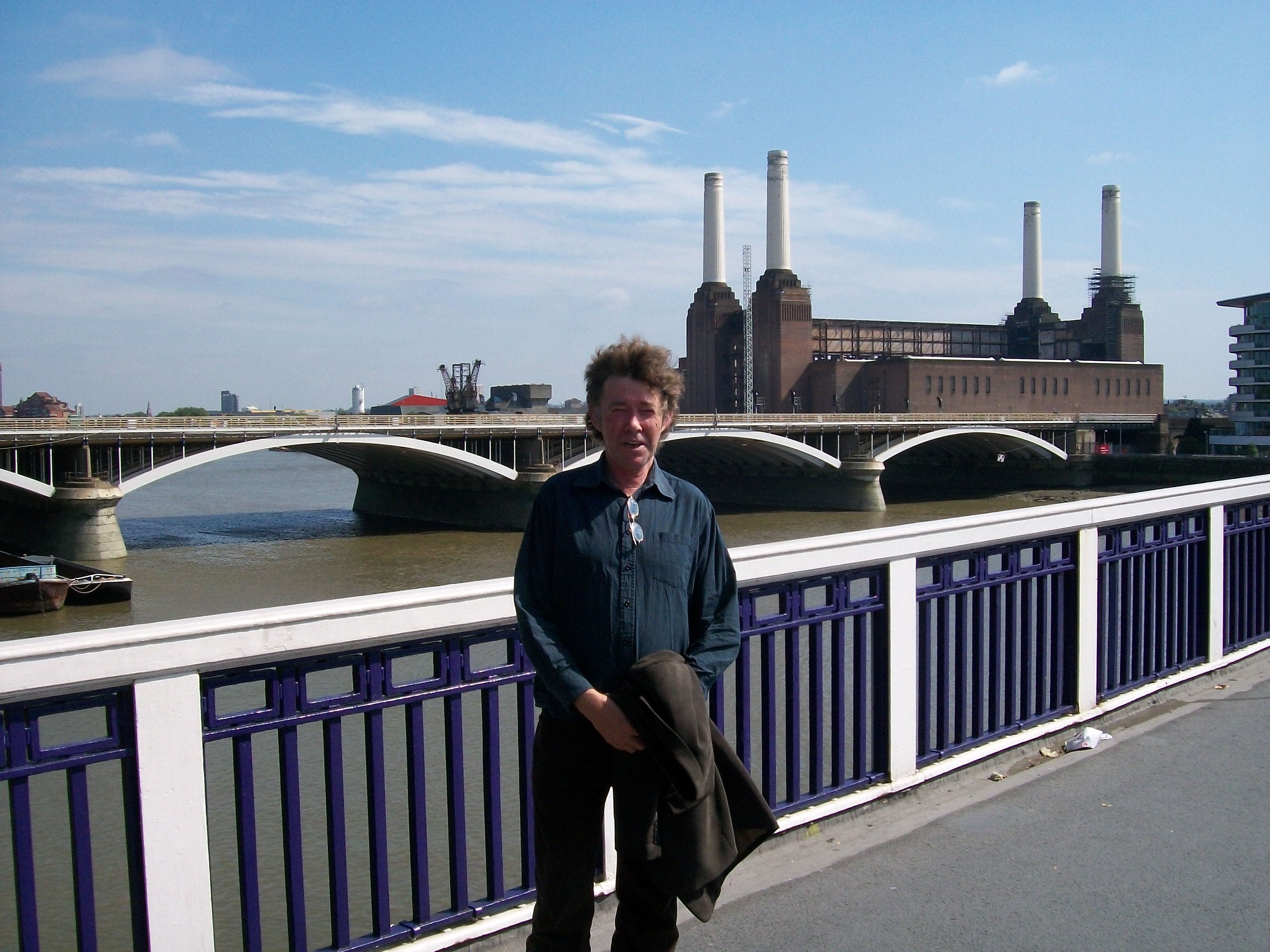
A landmark across Chelsea Bridge is the Battersea Power Station. This massive coal fired power station was designed by engineer Leonard Pearce with architects Giles Gilbert Scott and Theo Halliday. Construction began in 1929. It was paused during the Second World War; the complex ultimately completed in 1955. In the late seventies decommissioning began and the building became derelict for thirty years until redevelopment in 2012. Numerous bids included Chelsea’s plan to convert the station into a football stadium. But that didn’t fly. Frank Gehry and Norman Foster were amongst the leading architects redesigning the forty acre site along with restoring the original buiding on a project incorporating residential, retail, leisure and entertainment. The complex was opened in 2022.
Battersea Power Station is a combination of awe inspiring scale and art deco elegance. One of London’s most iconic buildings, it is also a cultural landmark in its evocation of both utopian and dystopian themes. Pink Floyd fans will know this from the cover of their 1977 album, Animals. The cover photo, by Hipgnosis, was not collaged or manipulated, no Photoshop back then. A giant inflatable pig was hoisted into place for the shoot. Unfortunately, the monster broke free, terrorising the population of West London and Heathrow Airport before landing in Kent. You can’t get more Orwellian than that.
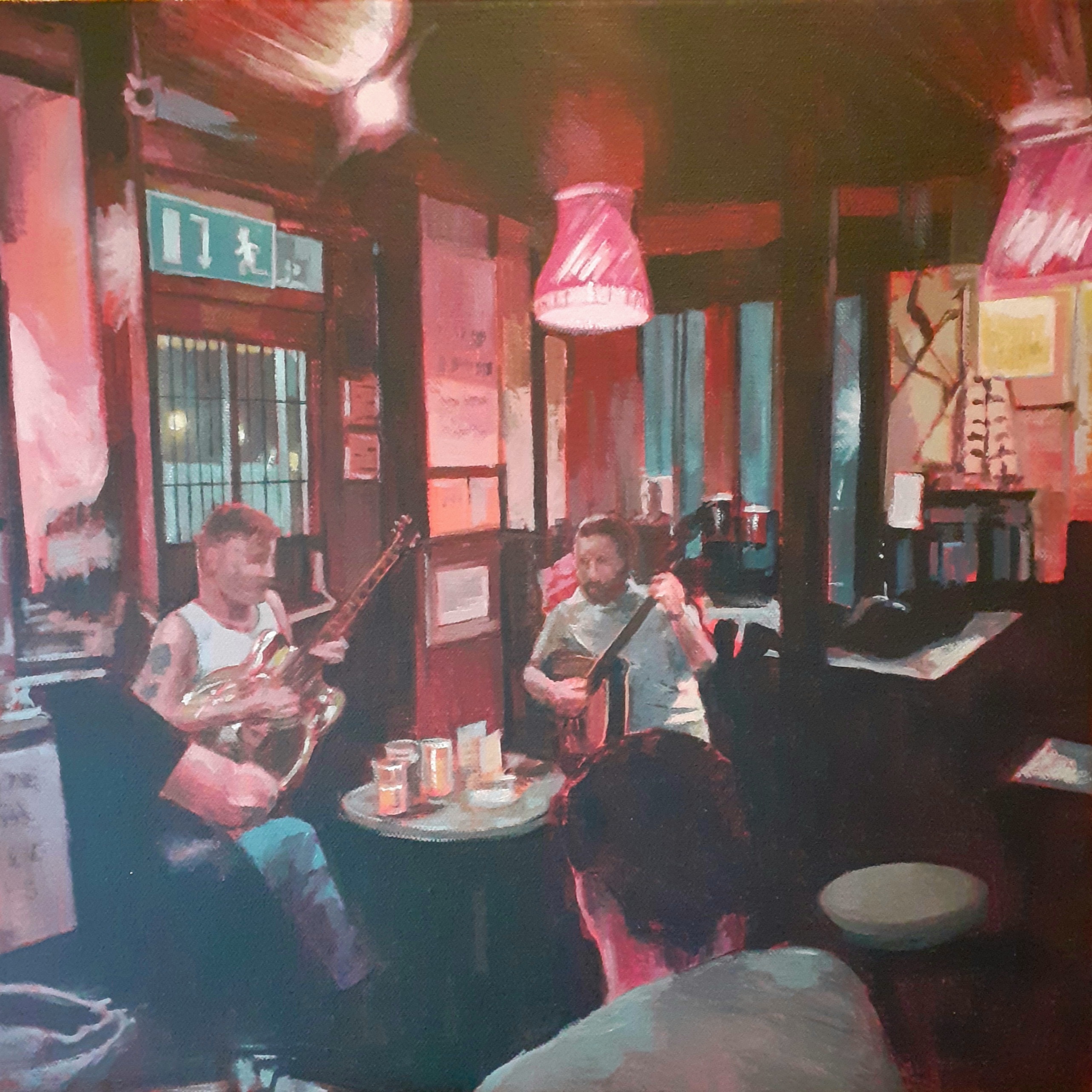
Bray’s Harbour Bar is a favourite watering hole, and I have posted on it before. Drinking Outside the Harbour Bar was painted in the bright sunshine of a summer’s evening. Here, we are huddled inside the original bar in early November. There’s a music session, with three hombres giving it yards. Ballads and folk in the bar, with rock off in the back lounge. I’m in the snug, in between, swaying from one to the other.
This was originally the Harbourmaster’s cottage when built in 1831. The harbour itself was only a small dock then, the full harbour arriving in the 1890s. The bar has been licensed since the 1860s or so. The O’Toole Bros ran the show until ten years ago when the Duggan family added it to their fleet. Throughout its century and a half, it has kept its traditional vibe; seafarin’, rough hewn, crammed with bric a brac and all the ancient, and tyro, mariners adrift on the sea of life. It’s cosy in winter, with the log fires lit and the mellow glow of lights in the timbered shadows. And the music starts to play.
Tonight, I might get loaded
On a bottle of wine, on a bottle of wine,
Gonna feel alright, gonna feel alright,
Yeah, I feel alright!
I Got Loaded is a song for the good times. Listen to Los Lobos howling. Spanish for ‘the wolves’, the band formed in East LA in the mid seventies. Their second album, How Will the Wolf Survive, appeared in 1984 and includes this track. It was written by Camille Bob, and was first released in 1965 by his band L’il Bob and the Lollipops.
At Heuston Station I flash my ticket for the guard. Where to? Galway, I say. Ceannt? Ah, there’s no call for that now.
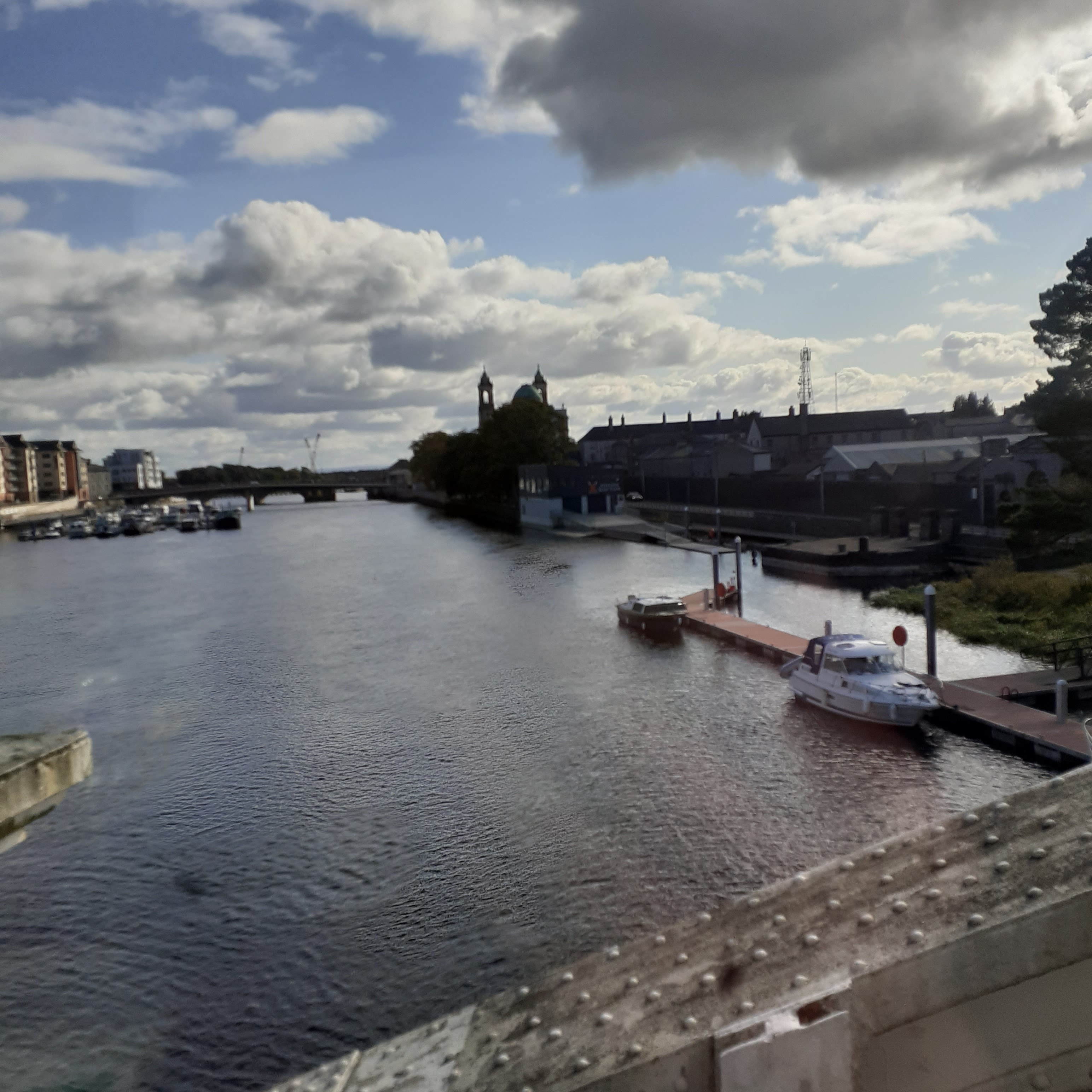
The journey from Dublin to Galway takes about two and a half hours. Passing through the midlands via Athlone, we cross the Shannon into the West, heading on to Galway by way of Ballinasloe and Athenry. Galway Ceannt is under renovation. Trains are operating normally, but otherwise it is a building site. I have a pint at O’Connell’s on Eyre Square, from where it’s just a ten minute walk to my BnB on College Road.
Galway was founded by Norman adventurer Richard de Burgh in the early thirteenth century. It is known as the City of the Tribes. The Tribes in question were not the Wilde Irishe, but Norman merchant families who rose to prominence from the thirteenth century on. Blake, French, Browne, Bodkin, Deane, Font, Joyce, Lynch, Martin, Morris and Skerrit are Norman French in origin. D’Arcy, though it looks French, was an affected spelling of an Irish clan, O Dorchaidhe, dressed up as posh. Kirwan were another tribe of Gaelic ancestry. Their power waned after Cromwell took the city in the seventeenth century; from whence the term tribes was applied, disparagingly, at first.
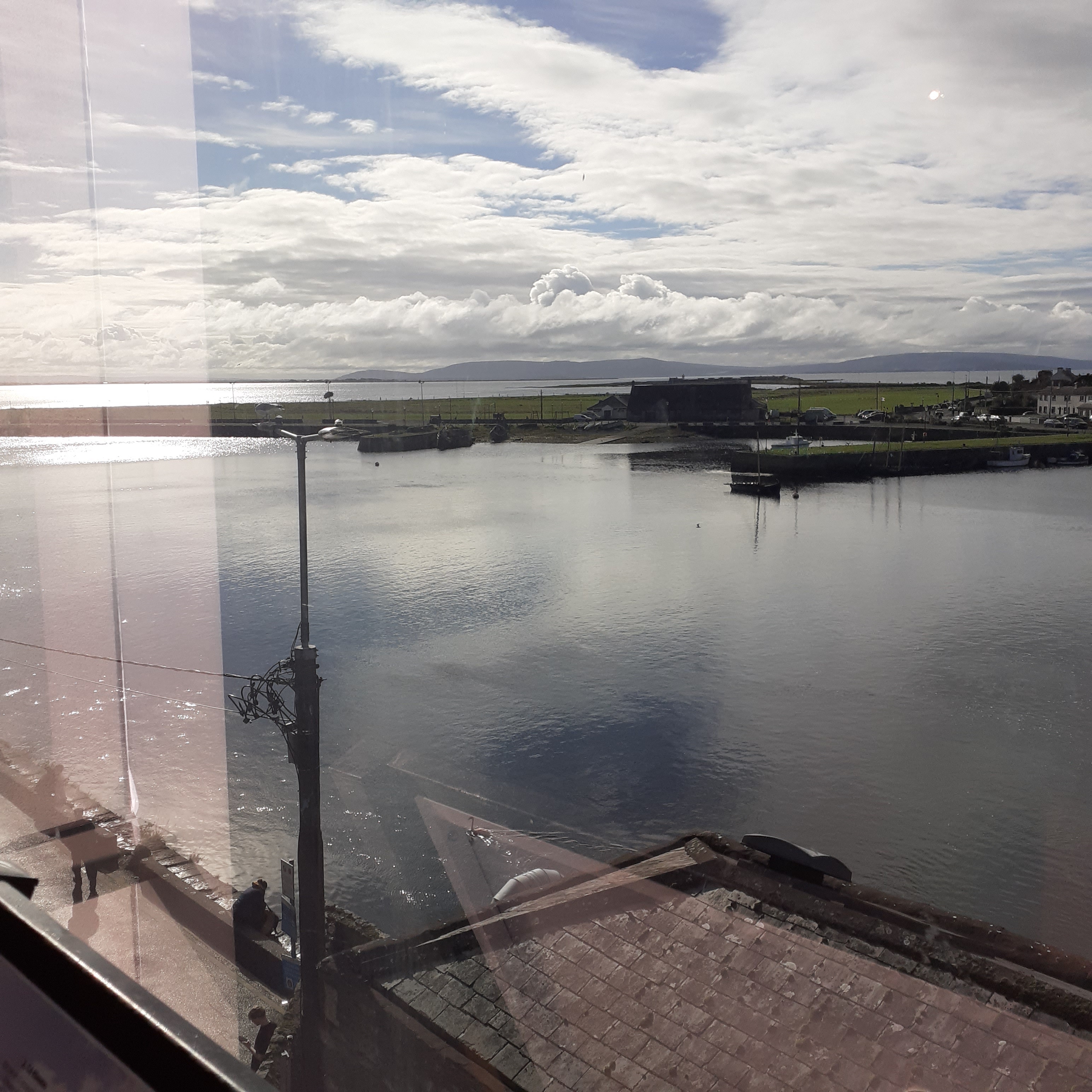
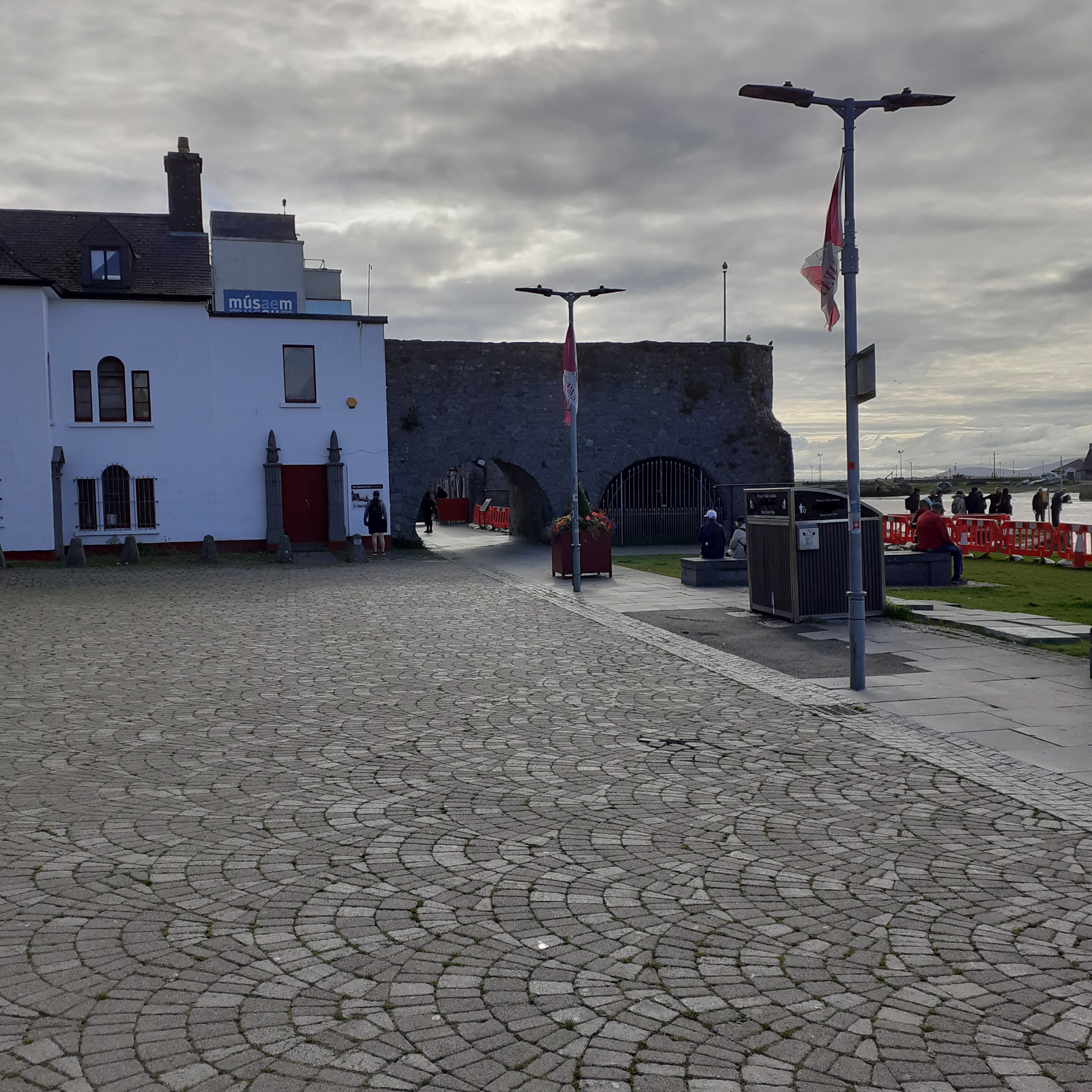
I learned all of this at the Galway City museum, by the Spanish Arch on the quayside. It’s an excellent museum outlining the colourful history of the city, its people and its many idiosyncrasies. It is flooded with light, and upstairs there are panoramic views across the city and bay. A large Galway Hooker dominates the central atrium, and is a constant reminder that you are in a city floating on water. There’s an account of the Claddagh, a history of the Claddagh Ring and a section on the Independence and Civil War era.
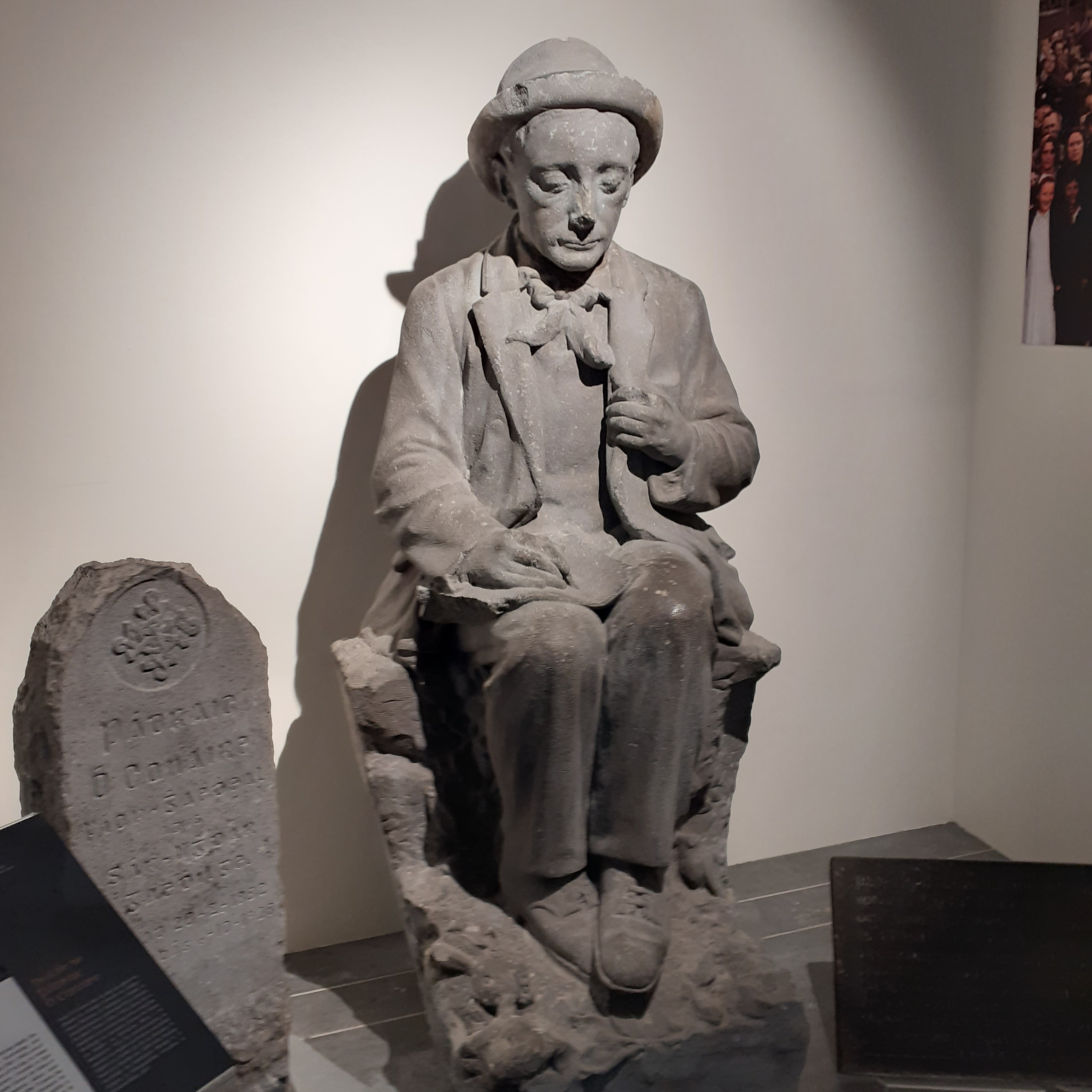
Entrance is free. In the lobby is the Padraic O Conaire statue. This originally stood, or sat, in Eyre Square. Decapitated at the Millennium, it is stored here for safekeeping. A bronze replica now presides over the square. An author and journalist, O Conaire wrote mostly in Irish. He was a figure in the Gaelic League in London before the Great War and then back in Ireland. He was only forty six when he died in 1928, although somehow the statue always seems of an older man to me. His story, M’asal Beag Dubh, concerns a chancer looking for big bucks for his shiftless donkey. It inspired an ornate hoax by Irish journalist Declan Varley. In satirising the soccer transfer market he created Masal Bugduv, a Moldovan prodigy who attracted outrageous bids from top premiership clubs. One imagines the mythical youth telling the bidders, it will take a few dollars more to shift Masal Bugduv.
The award winning building was designed by OPW architects, Ciaran O’Connor and Ger Harvey. It’s a bright, three story L-shaped building, forming an attractive, varied plaza with the Arch and Comerford House. Comerford House, a late eighteenth century residence, housed the original city museum from 1976 until the new building thirty years later. The Spanish Arch itself is notoriously underwhelming. There are two arches; the outer one closed, the inner being the Spanish Arch itself. Overall, this is an extension of the city walls built along the old fish market in 1584. The quayside was then extended to form the Long Walk, and the arches were added to give access from the city to the new quays. Originally Eyre’s Arch, it was later named the Spanish Arch to note the extensive contact between Galway and Spain in medieval times.
A couple of town castles of the period remain in the city centre. At the foot of Quay Street, Blake’s Castle looks out on the Corrib. Built in 1470 it is a typical medieval tower house. For a time it was used as the city jail, later a grainstore, and then a coffee house. The Blakes descended from Richard Caddell, Sheriff of Galway in 1300. His nickname, Negar, for his dark complexion, was Black in English, from which the Blake name derives.
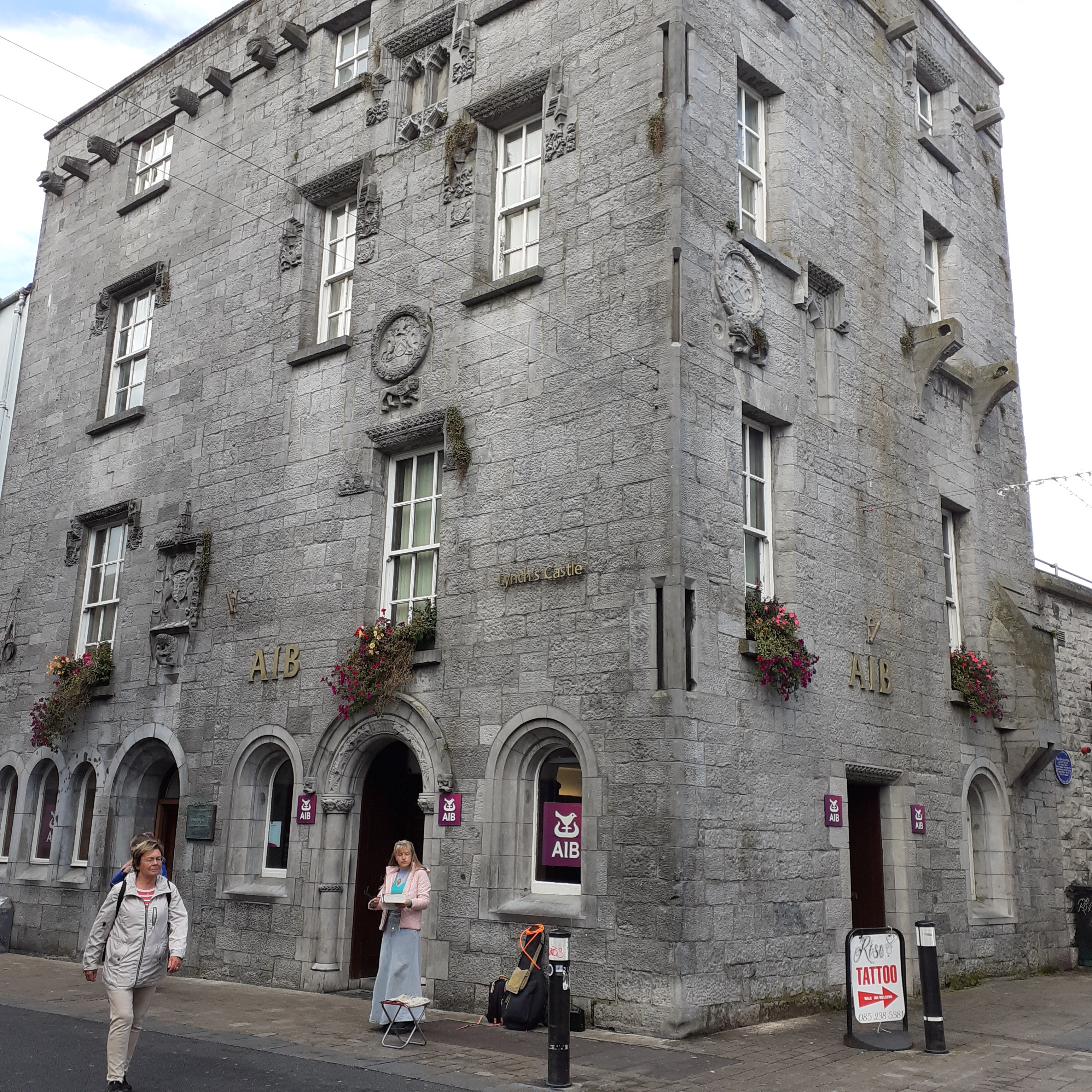
Lynch’s Castle, further on, is another fine remnant of medieval Galway. A four storey Gothic tower from the late fifteenth century, its facade is adorned with ornate stone carvings. It is now a bank. Lynch’s window is nearby, outside St Nicholas Collegiate Church. And thereby hangs a tale, if you pardon the pun. The window commemorates James Lynch Fitzstephen, Galway mayor in 1493. One version has it that Walter his son admitted to killing a Spanish merchant called Gomez in a dispute over the favours of a girl. Failing to find a hangman willing to carry out the sentence, the Mayor carried it out himself from the upstairs window of his own residence. Three and a half centuries later, the window was installed here as a memorial to stern justice showing neither fear nor favour. The word Lynch since became synonymous with ad hoc hanging, though this doesn’t quite tally with the story.
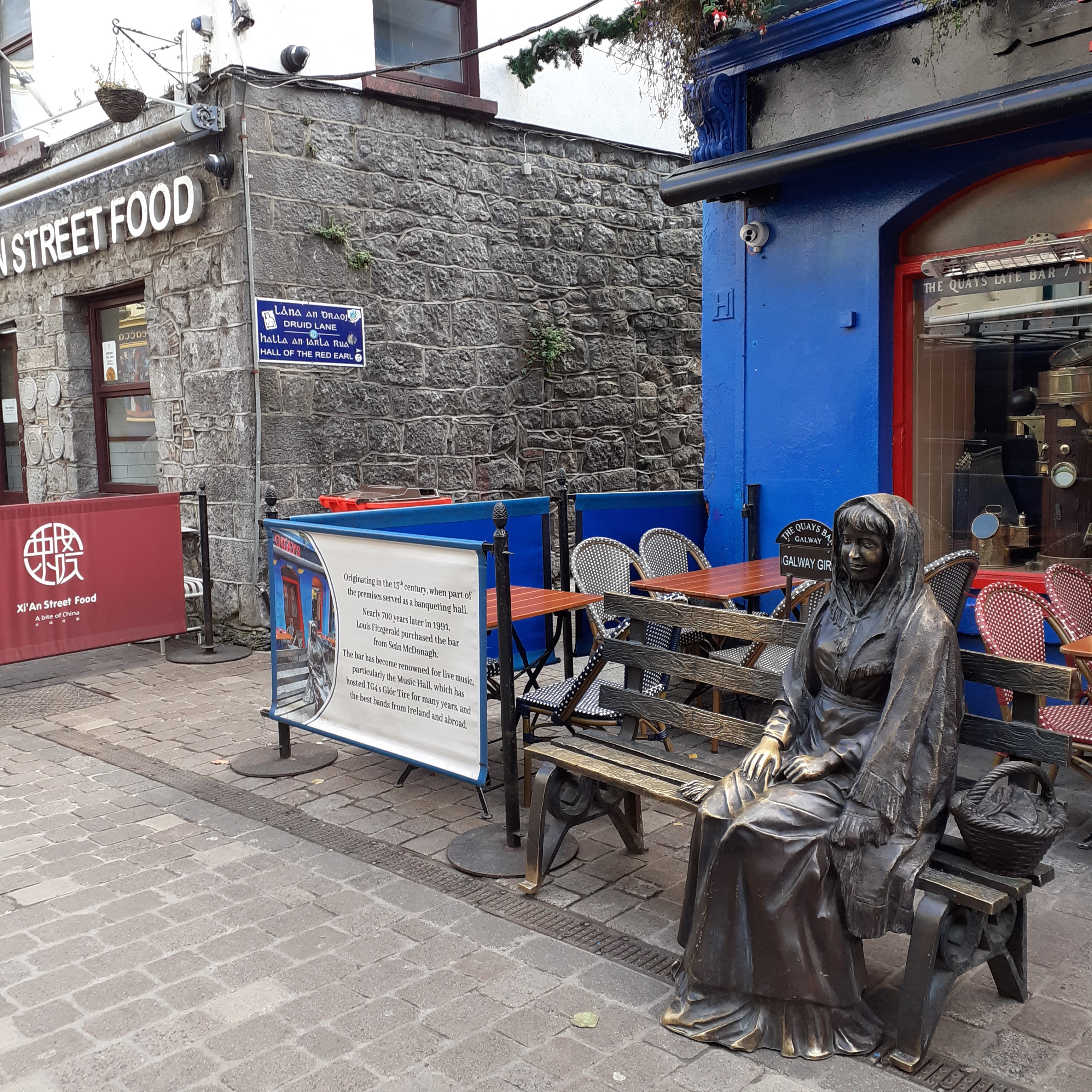
The church dates back to 1320 and is dedicated to St Nicholas of Myra, the patron saint of seafarers. Christopher Columbus is said to have attended mass here in 1477. Whether or no he also called into the Quays Bar, I always do. It traces its history back to the 13th century when it was a banqueting hall. Upstair is the Music Hall, dominated by a raised stage with a piped organ backdrop. On a seat outside sits a bronze statue known as the Galway Girl. The young woman wears traditional Irish garb so is not the same girl of the famed song. Or songs.
I took a stroll down the old Long Walk
Of the day I-ay-I-ay
I met a little girl and we stopped to talk
On a grand soft day I-ay
Written by American Country Rock musician, Steve Earle, the version by Mundy (Edmond Enright) and Sharon Shannon in 2006 became one of the best selling singles of all time in Ireland. In fact, the Galway Girl is Joyce Redmond, from Howth in Dublin, who plays bodhran on Earle’s original version on his 2000 album, Transcendental Blues.
And I ask you friends, whats a fella to do?
Because her hair was black and her eyes were blue
And I knew right then, I’d be takin a whirl
Down the Salthill Prom with a Galway Girl.
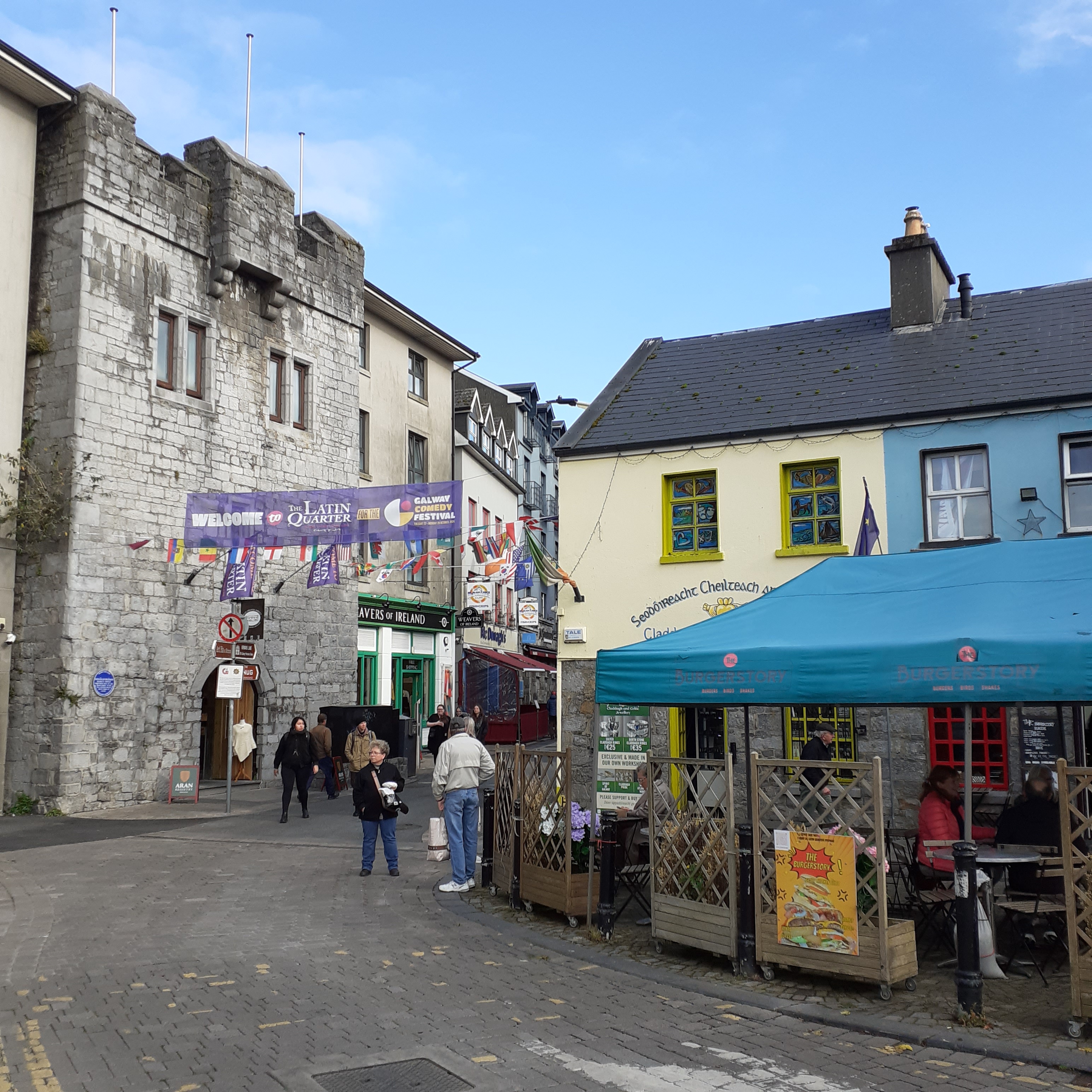
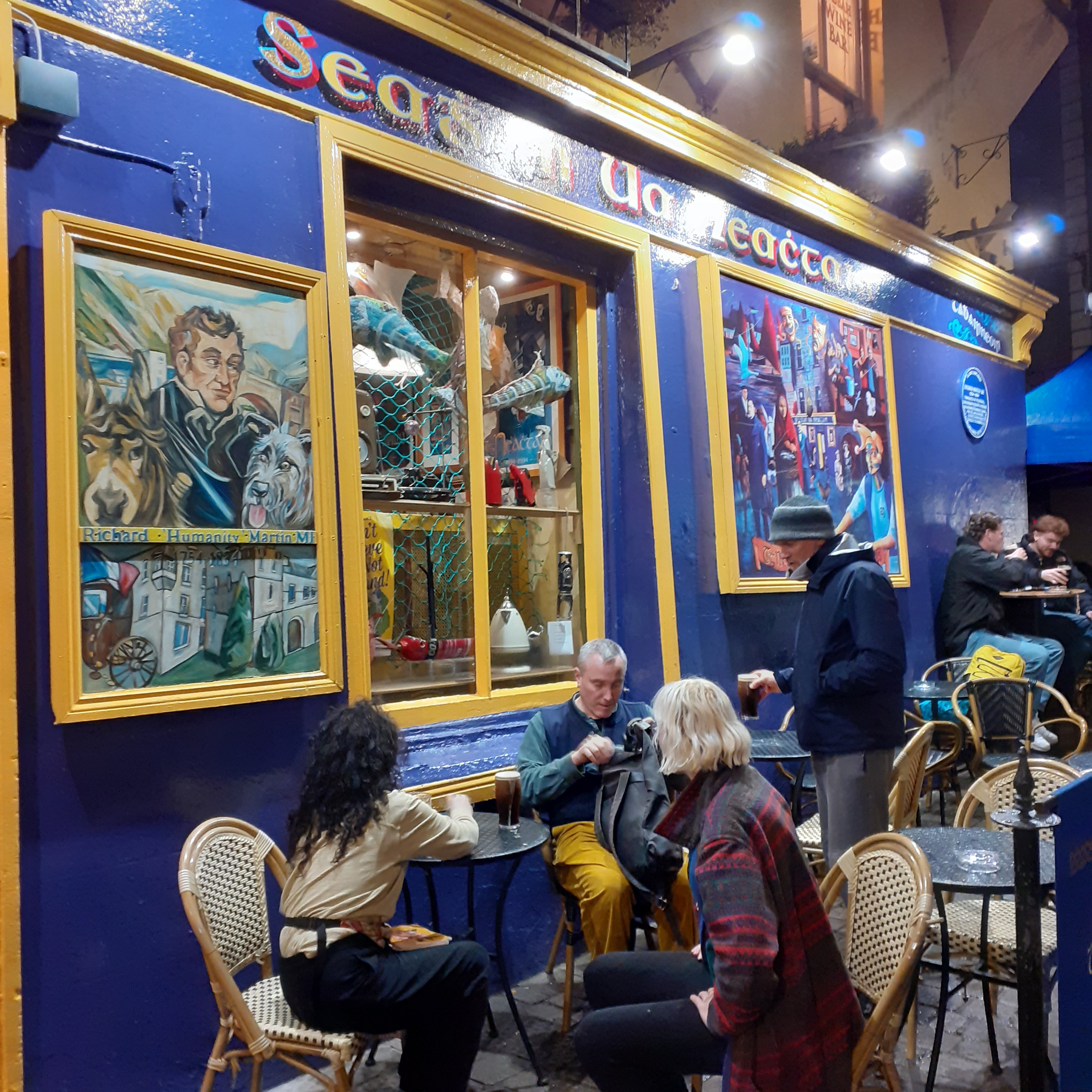
In Ed Sheeran’s song, from his 2017 album +, the Galway Girl is met in Dublin where she plays a fiddle on Grafton Street. Sheeran before his fame had busked the streets of Galway. Across the street is another famed pub, Tigh Neachtain’s, with its traditional interior and terrace seating to front and side. The junction forms a small plaza for a succession of buskers to entertain. Good busking is a notable feature of Galway’s Latin Quarter and the area is thronged with a happy promenade of local and visitor from morning till night.
The fast flowing Corrib marks the edge of the medieval city. It pours down from Lough Corrib, just 6K inland. Besides the powerful main channel, there are other branches winding through the west of the city. Crossing the Wolfe Tone Bridge, the Claddagh and Salthill are off to your left. Further upstream there’s a tangle of riverside walks leading to the open surrounds of the Cathedral and University.
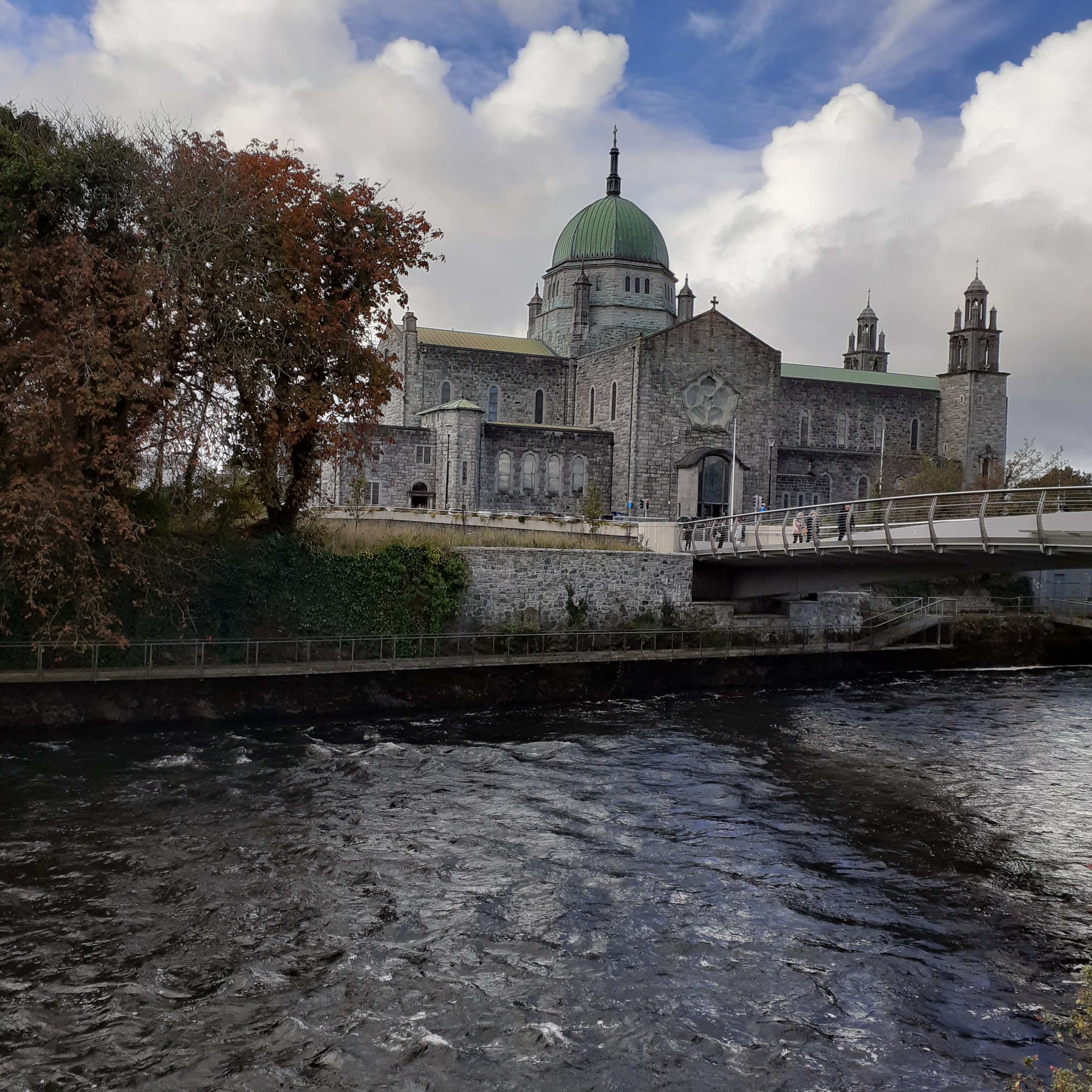
Galway Cathedral, or Our Lady Assumed into Heaven and St Nicholas as it’s officially known, was designed by John J. Robinson. Work began in 1958 and it was completed in 1965. Grimly imposing, the massive structure of limestone blocks attempts to evoke a more ancient age. Its central dome, rising to 145 feet, is its most attractive feature. Within, the bare blocks make for a Stygian atmosphere, encouraging prayers of escape. There is a Marian shrine to the side, and I light a candle there.
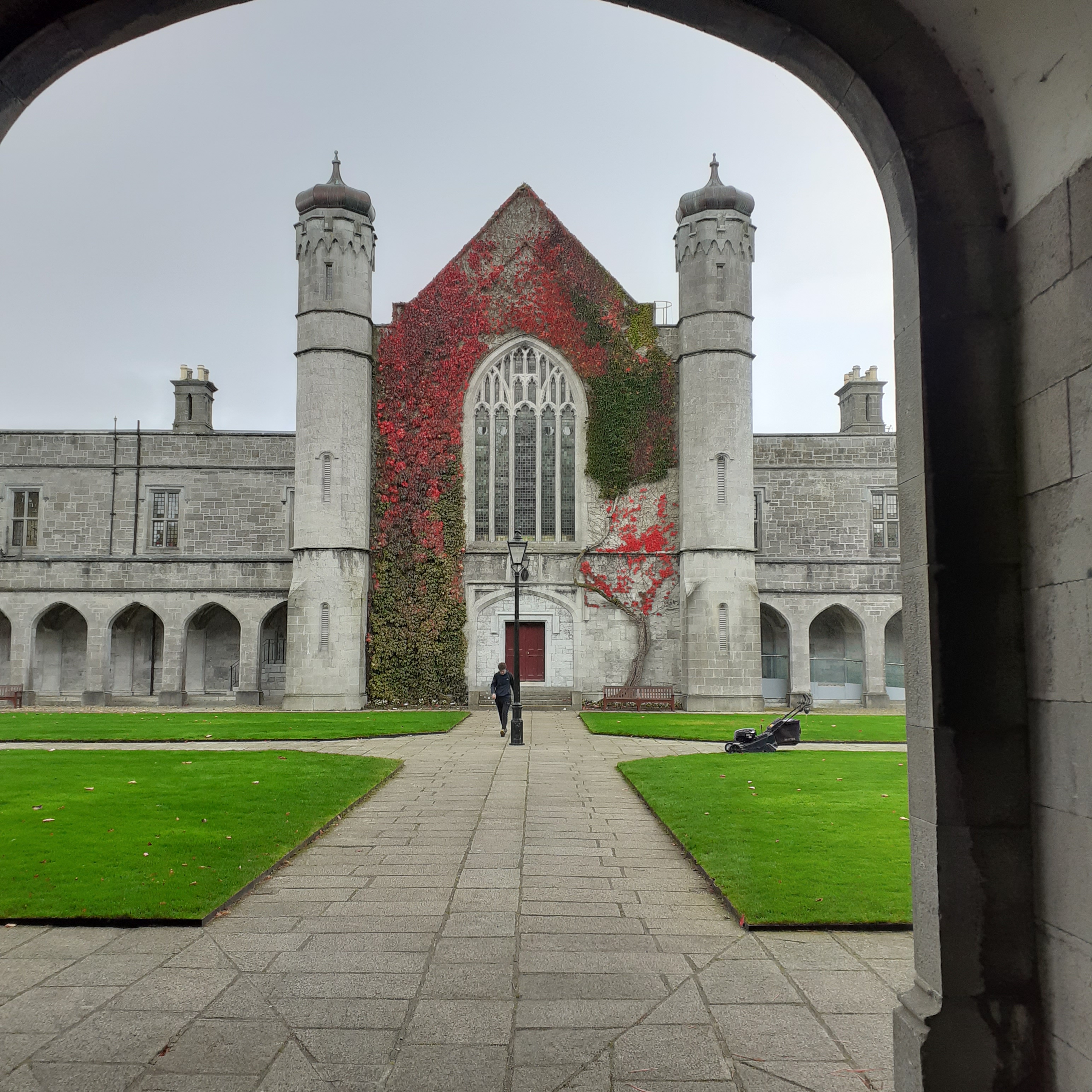
Galway University, across from the Cathedral, was founded in 1845. Its original, signature building, the Quadrangle, is a replica of Christ Church College, Oxford in the Tudor Gothic style. The campus expanded in the seventies, with a modern complex designed by Scott Tallon Walker and is growing still. It now has twenty thousand students, almost a quarter of the city’s population. Entering the campus there’s a cluster of building’s from Galway’s industrial past including a disused distillery. A branch of the Corrib here has moorings for river craft and there’s a lively bar along the bank.
The cloisters are strangely deserted but then the rain is falling and this is something of an island in time. The student population is a vibrant force in the pervasive exuberance of Galway. Also, Irish culture is more pronounced here than in other cities, we are way out West, after all. But, while careful to cultivate and preserve the ancient, even invent it, Galway is also modern and receptive; a true melting pot of cultural heritage, ideas and expression. The perfect place to find your tribe, or form a new one.
The Dublin to Cork train leaves Dublin Heuston every hour on the hour. The journey takes two and a half hours via Portlaoise, Thurles, Limerick Junction and Mallow. I took it last year, celebrating my recent elevation to the free Travel Pass. We barrel through west and south Leinster before leaving County Laois past Portlaoise and crossing into Munster
To the south east the mountains of Slievenamon mark the moutainy territory beyond Ireland’s Central Plain. Slievenamon itself rises 2,365 feet above the floor of County Tipperary. The name is from the Gaeilic for Mountain of the Women. Legend is that Fionn Mac Cumhail, mighty warrior and fierce popular with the women, decreed his pursuers should race to the top of the mountain in order to claim God’s gift, as it were. Grainne won, at least as far as Fionn was concerned. She herself might have preferred a leisurely stroll, or cable car ride, and she eloped with more youthful hero Diarmuid during the marriage feast.
The Pursuit of Diarmaid and Grainne is the epic love tale depicting Fionn’s pursuit of the young lovers. I read it in the Gaelic, Toraiocht Diarmuid agus Grainne, for my Leaving Cert fifty years before. I spent a lot of time looking out windows then, too.
This is a painting of two young lovers lounging on the train as it passes the famed mountain. I tried to be discreet in taking the reference photograph, but typically was spotted. The man, ever on guard, has raised his eyes from his mobile device and is looking at me daggers. She is oblivious. In a way it is a meditation on modern love, neither sweet nothings nor spooning intruding on the current obsession with the smartphone. Still, there is an obvious sense of comfort amongst the duo; striking a tableau worthy of Venus and Mars. The two are well cast in their roles, Mars worryingly so. And I am old with wandering, through hollow lands and hilly lands.
The mountain and the moment passes. I can play with the lover scenario in my head. Are they heroes? Are they pursued? Will they change at Limerick junction, or accompany me to Cork, and all other matters arising? Such questions should stall, allowing myth to arise.
The acrylic painting is, as usual, a labour of love. The subjects classically beautiful and statuesque. An intriguing still life is briefly grouped on the table. Beyond, the world whips by at dizzying speed.We are suspended in a fragile bubble in the vast explosion of life.
Well, pistons keep on churnin’
And the wheels go ’round and ’round
And the steel rails lie cold and hard
On the mountains they go down
Without love
Where would you be right now
Without love, oh -oh.
Long Train Running by the Doobie Brothers from their 1973 album The Captain and Me. Tom Johnston wrote it, providing vocals, harmonica solo and the distinctive rhythm guitar backing. I first heard the song after my Leaving Cert that year, covered by Irish band Rodeo at Kevin Street Tech. About that time I figured why the American Band didn’t actually feature siblings with the surname Doobie.









 xxharrison