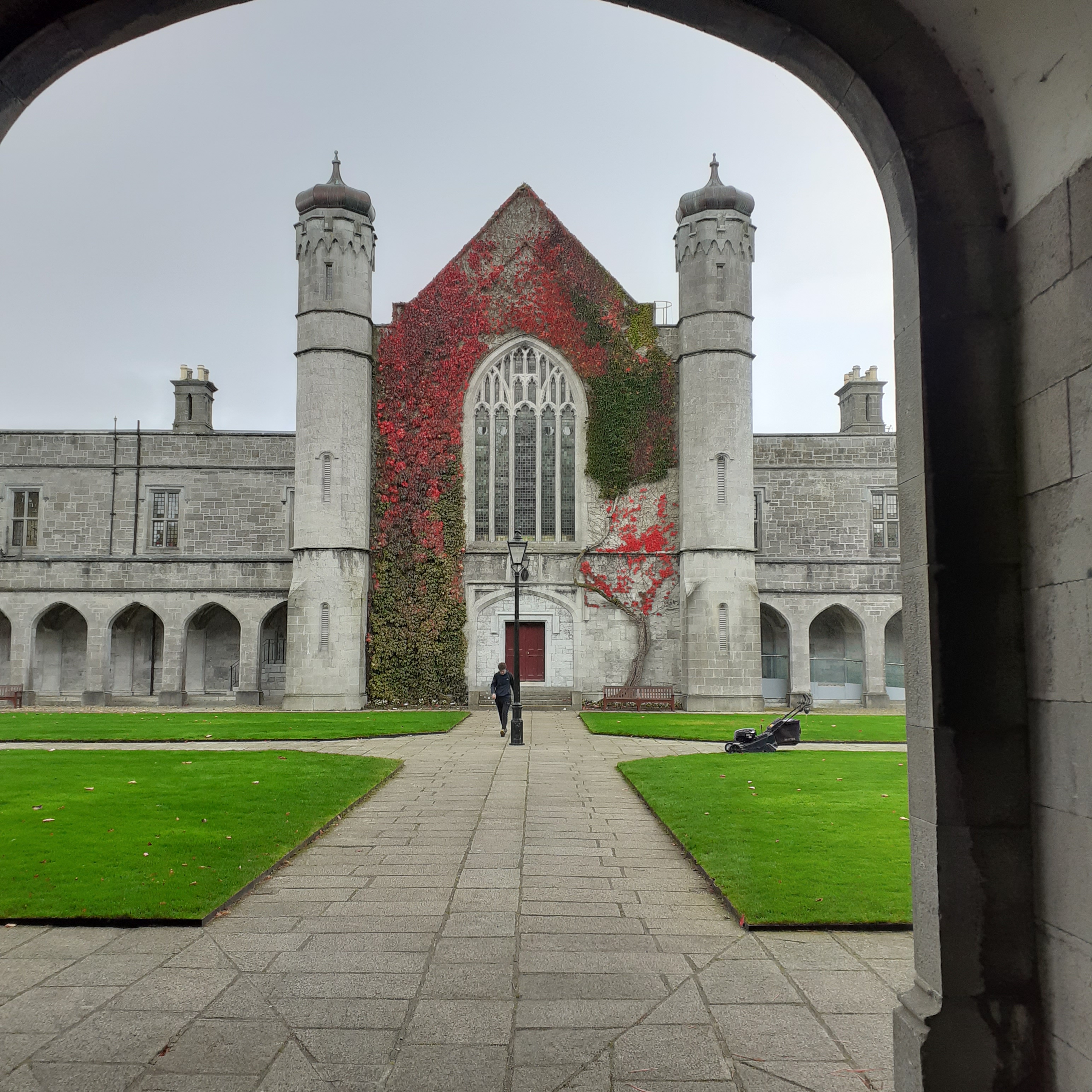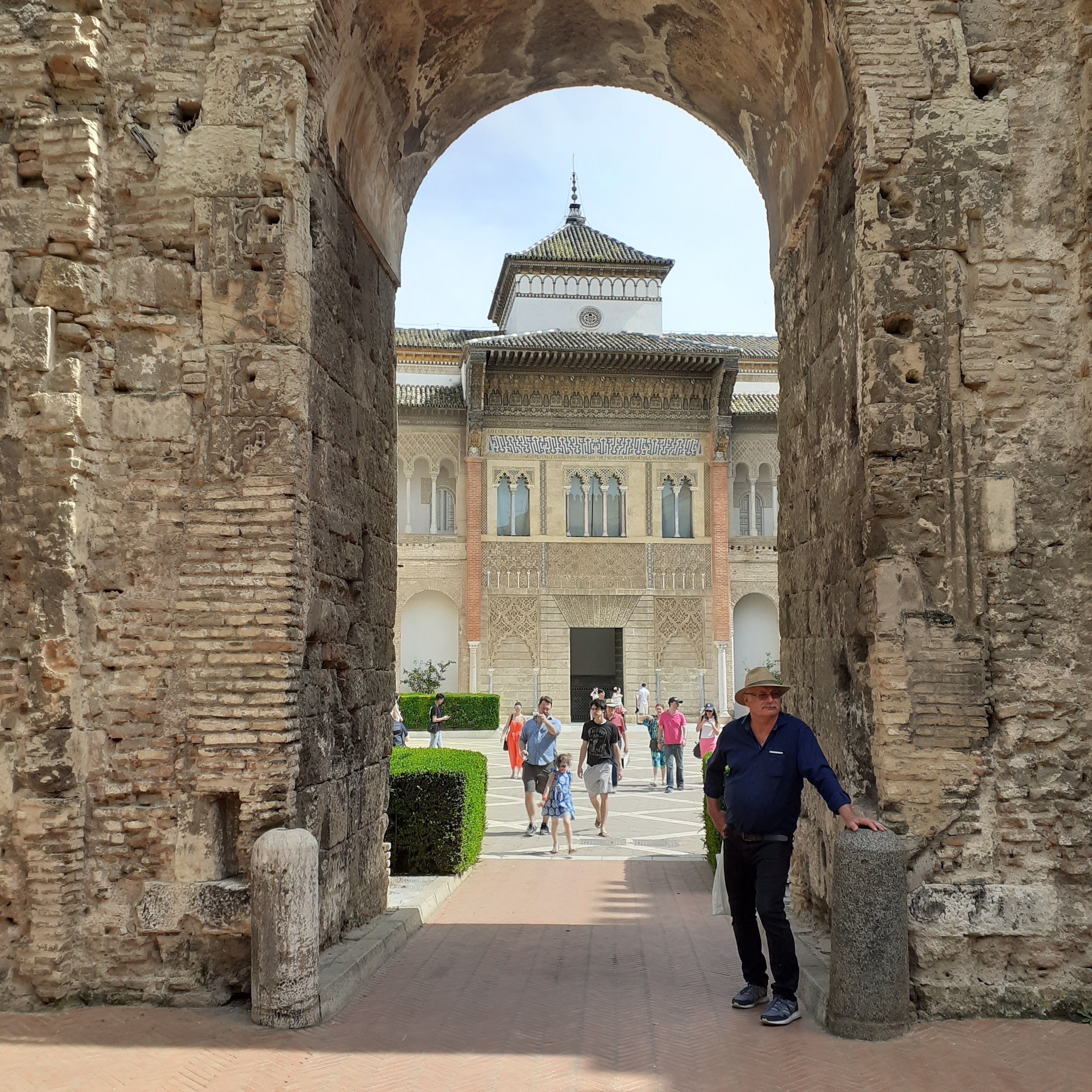
The Dublin to Cork train leaves Dublin Heuston every hour on the hour. The journey takes two and a half hours via Portlaoise, Thurles, Limerick Junction and Mallow. I took it last year, celebrating my recent elevation to the free Travel Pass. We barrel through west and south Leinster before leaving County Laois past Portlaoise and crossing into Munster
To the south east the mountains of Slievenamon mark the moutainy territory beyond Ireland’s Central Plain. Slievenamon itself rises 2,365 feet above the floor of County Tipperary. The name is from the Gaeilic for Mountain of the Women. Legend is that Fionn Mac Cumhail, mighty warrior and fierce popular with the women, decreed his pursuers should race to the top of the mountain in order to claim God’s gift, as it were. Grainne won, at least as far as Fionn was concerned. She herself might have preferred a leisurely stroll, or cable car ride, and she eloped with more youthful hero Diarmuid during the marriage feast.
The Pursuit of Diarmaid and Grainne is the epic love tale depicting Fionn’s pursuit of the young lovers. I read it in the Gaelic, Toraiocht Diarmuid agus Grainne, for my Leaving Cert fifty years before. I spent a lot of time looking out windows then, too.
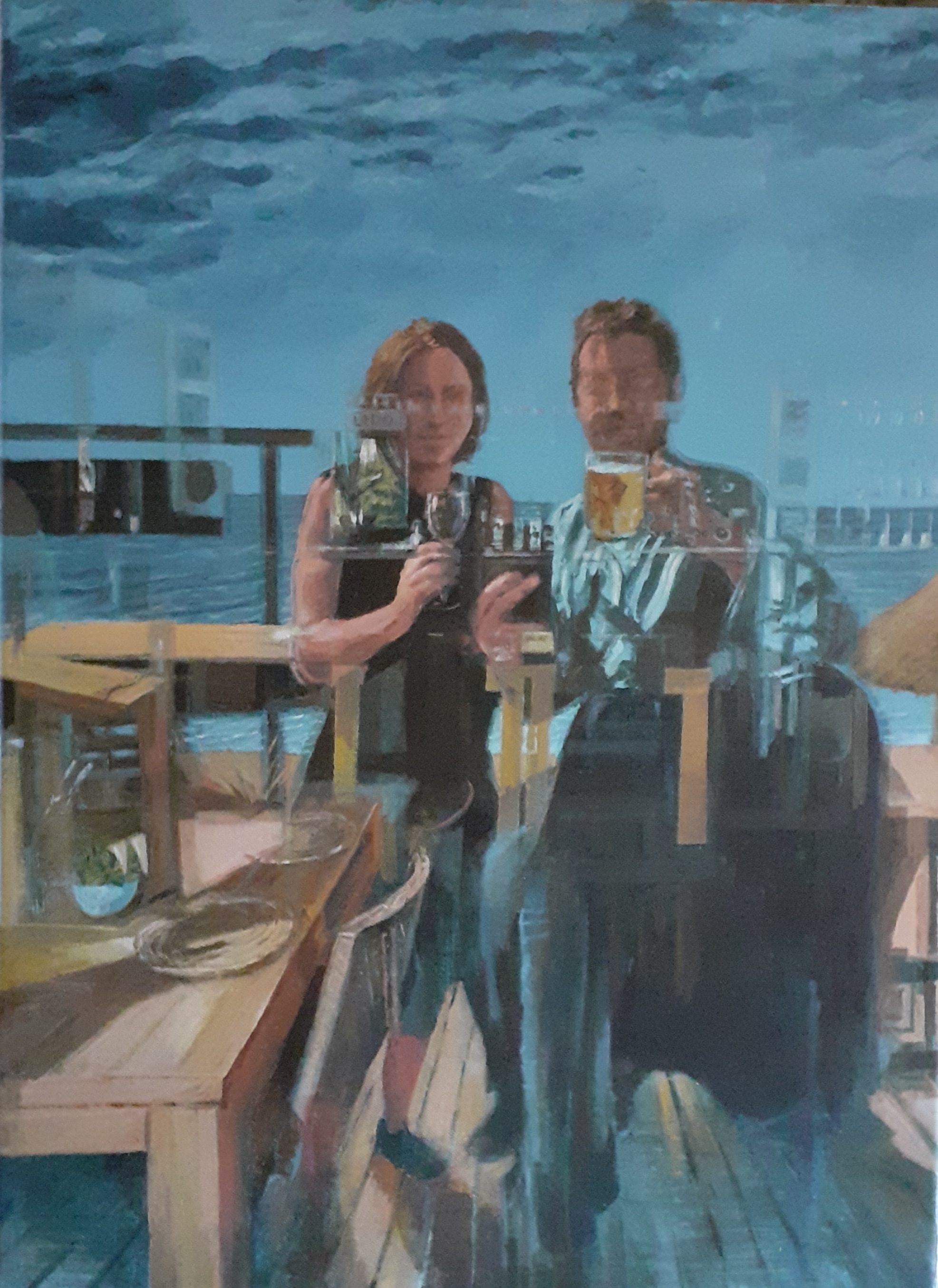
This is a painting of two young lovers lounging on the train as it passes the famed mountain. I tried to be discreet in taking the reference photograph, but typically was spotted. The man, ever on guard, has raised his eyes from his mobile device and is looking at me daggers. She is oblivious. In a way it is a meditation on modern love, neither sweet nothings nor spooning intruding on the current obsession with the smartphone. Still, there is an obvious sense of comfort amongst the duo; striking a tableau worthy of Venus and Mars. The two are well cast in their roles, Mars worryingly so. And I am old with wandering, through hollow lands and hilly lands.
The mountain and the moment passes. I can play with the lover scenario in my head. Are they heroes? Are they pursued? Will they change at Limerick junction, or accompany me to Cork, and all other matters arising? Such questions should stall, allowing myth to arise.
The acrylic painting is, as usual, a labour of love. The subjects classically beautiful and statuesque. An intriguing still life is briefly grouped on the table. Beyond, the world whips by at dizzying speed.We are suspended in a fragile bubble in the vast explosion of life.
Well, pistons keep on churnin’
And the wheels go ’round and ’round
And the steel rails lie cold and hard
On the mountains they go down
Without love
Where would you be right now
Without love, oh -oh.
Long Train Running by the Doobie Brothers from their 1973 album The Captain and Me. Tom Johnston wrote it, providing vocals, harmonica solo and the distinctive rhythm guitar backing. I first heard the song after my Leaving Cert that year, covered by Irish band Rodeo at Kevin Street Tech. About that time I figured why the American Band didn’t actually feature siblings with the surname Doobie.
Part of my purpose, and pleasure, in visiting Andalusia, is to paint it. Sometimes we make sketches, though mostly photography forms the record of places we visit. My Spanish paintings contrast with my Irish paintings. Climate is a decisive factor. Spain is hot and demands a hot palette. Ireland is wet and wild, its palette cool. Every place is different. Every day is different.
In taking photos I usually exclude ourselves. There are times when a tourist snap is required. I no longer corral innocent bystanders. It happens, but mostly volunteers. Some years back I recall waylaying a handsome young couple swanning into the Casino in Monte Carlo. I indicated the camera, gestured to the debonair male. Of course, he said, and promptly posed for us. His companion put things right. A mysterious lady in Lisbon is another fond faux pas. Reluctantly she took off her gloves on what she clearly regarded as a cold day. It was mid teens; but she obliged with a warm smile. Selfies are an obvious solution, but they don’t really work for me. There’s something awkward about doing them and I usually get it wrong, with my nostrils and ears featuring too prominently. So, M and I have evolved a habit of catching ourselves in reflective surfaces. These mirrored images have the extra advantage of being pleasantly anonymous.
This method is seen at its best on this recent shot taken on Elviria Beach near Marbella. Our favourite bar is on the beach and a regular stop for our pre dinner drink. The Lido Bar also serves food during the day. Sitting out on deck, the beach sweeps away south towards Gibraltar funneling the Mediterranean into the Atlantic. Africa lies just over the horizon.
Painting this picture, I was struck by the shifting points of view within the tableau. We were photographing ourselves photographing ourselves. The observer, and author of the painting, is observed. It’s a self portrait, a still life and a landscape. The reflection itself is a double image due to the glazing. This gives a liveliness, a kind of shaky quality too. We are a blur against the immense physicality of the Med. There, but not there. A snapshot in time. Then gone.
Lido missed the boat that day, he left the shack
But that was all he missed, and he ain’t comin’ back
At a tombstone bar in a juke joint car, he made a stop
Just long enough to grab a handle off the top
Written by Boz Scaggs and David Paich, Lido Shuffle featured on the album Silk Degrees in 1976. Sing along!
The Dart has been taking commuters, daytrippers and various wanderers around the Bay for forty years. Dart is a clever acronym for Dublin Area Rapid Transit. It runs from Malahide or Howth in the north to Greystones in the south. The last two stops are outside of County Dublin. Reaching the Dargle River we are in County Wicklow. The town of Bray has been established here since the Norman invasion, building on earlier Gaelic settlements.
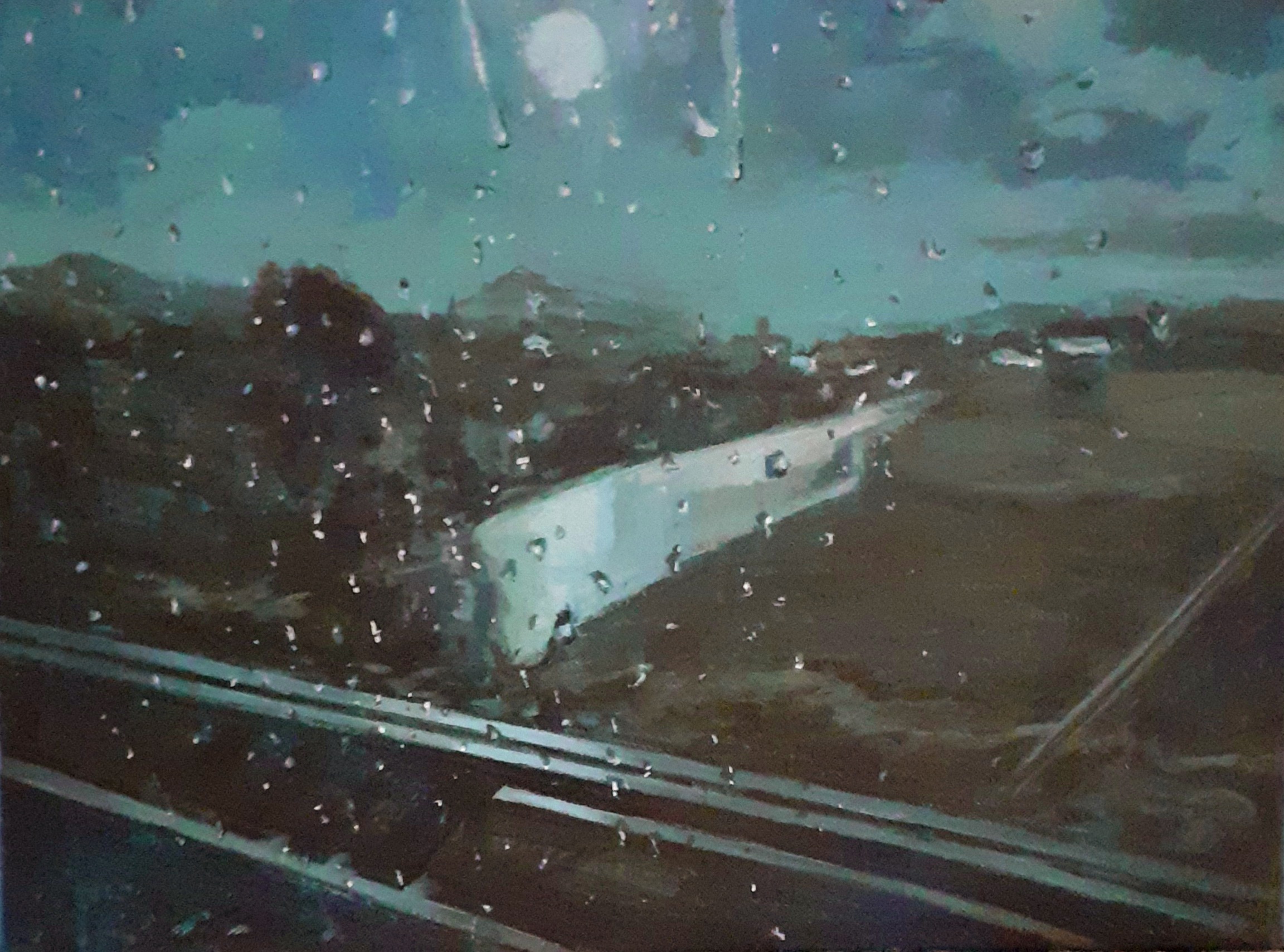
This view is taken from the window of a southbound Dart, about to cross the bridge over the Dargle. I am returning from Dublin city where it has been raining, but now the sun’s coming out and Bray rises steaming out of the gloom. The Sugarloaf Mountains appear on the horizon, and the land is marked by the tower of the Catholic Church of the Most Holy Redeemer, and the spire of Christchurch (CofI). Bray Daly Station is my stop. Opened in 1854, the line was quickly extended to Greystones and runs parallel to the seafront behind the hotels and houses lining the Esplanade which was newly established then.
This painting is acrylic on canvas and has been accepted by the Signal Open Art Exhibition of 2024. I am delighted to be chosen and looking forward to seeing all the other works on show. The exhibition runs from Tuesday 6th August until Sunday 18th August. Should be fun. Give it a dekko!
Every time it rains
You’re here in my head
Like the sun coming out
I just know that something good is going to happen
I don’t know when
But just saying it could even make it happen
Cloudbusting by Kate Bush is guaranteed to lift the heart, without reneging on past sadness. It is on her 1985 album Hounds of Love.
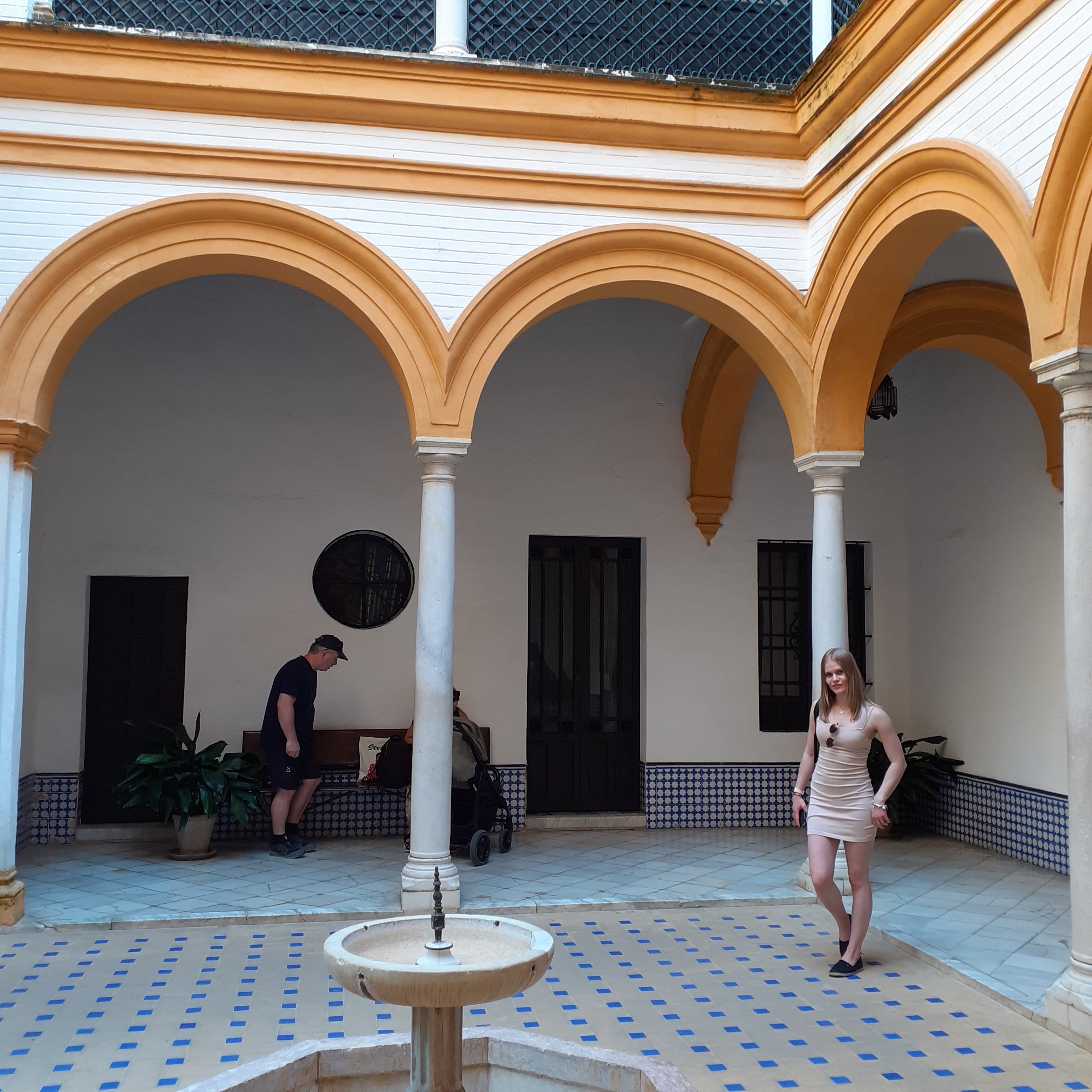
The Alcazar is Seville’s fortress and royal palace, established in Moorish times. The fort here dates to the early tenth century. The Moors ruled from the early eight century until 1248 when conquered by Ferdinand III of Castile. Significant reconstruction began and continued through the centuries. Although little of the original palace remains, the original style persists in the many ornate courtyards and the Mudejar architecture. Mudejar means those who remained, referring to Muslims in Spain after the Reconquista. It is a fusion of Christian and Islamic art and architecture, a heady mix of Gothic, early Renaissance and the flowing tracery and distinctive detail of Muslim crafts. After 1492, the Catholic Monarchs Ferdinand and Isabella renovated the palace as their main residence and it is still a royal residence today.
We queued in the morning for early afternoon tickets. Visits are restricted by number and entrance is on the hour. It costs thirteen euro, seven for over 65s. Entrance is through the Puerta del Leon (Gate of the Lion) which leads on to the Patio de la Monteria, the Courtyard of the Hunters who used to meet here before their hunts. The courtyard is dominated by Pedro’s Palace, which forms the focal point of the complex and includes the mighty Hall of the Ambassadors
Don Pedro’s Palace was built in alliance with the Moorish kingdom of Granada in the 1360s Pedro’s ally, Muhammad V, was the Nasrid ruler of Granada and supplied designers and craft workers who had also worked on the Alhambra. The Patio of the Maidens is a particularly fine example of Mudejar architecture. Formal gardens with fountains and pools were a notable feature of Moorish palaces, with greenery and shining water cooling the sunbaked setting, literally and aeshetically. The Gardens are truly an earthly delight, lying between the palace and the city walls. The Grotto gallery gives a great view over the gardens built above a stretch of the Moorish defensive wall in the 16th century. There’s a Garden of the Dance, and a Garden of the Poets alluding to the various arts that settled amidst the shading landscape. Further gardens have been added up to the twentieth century.
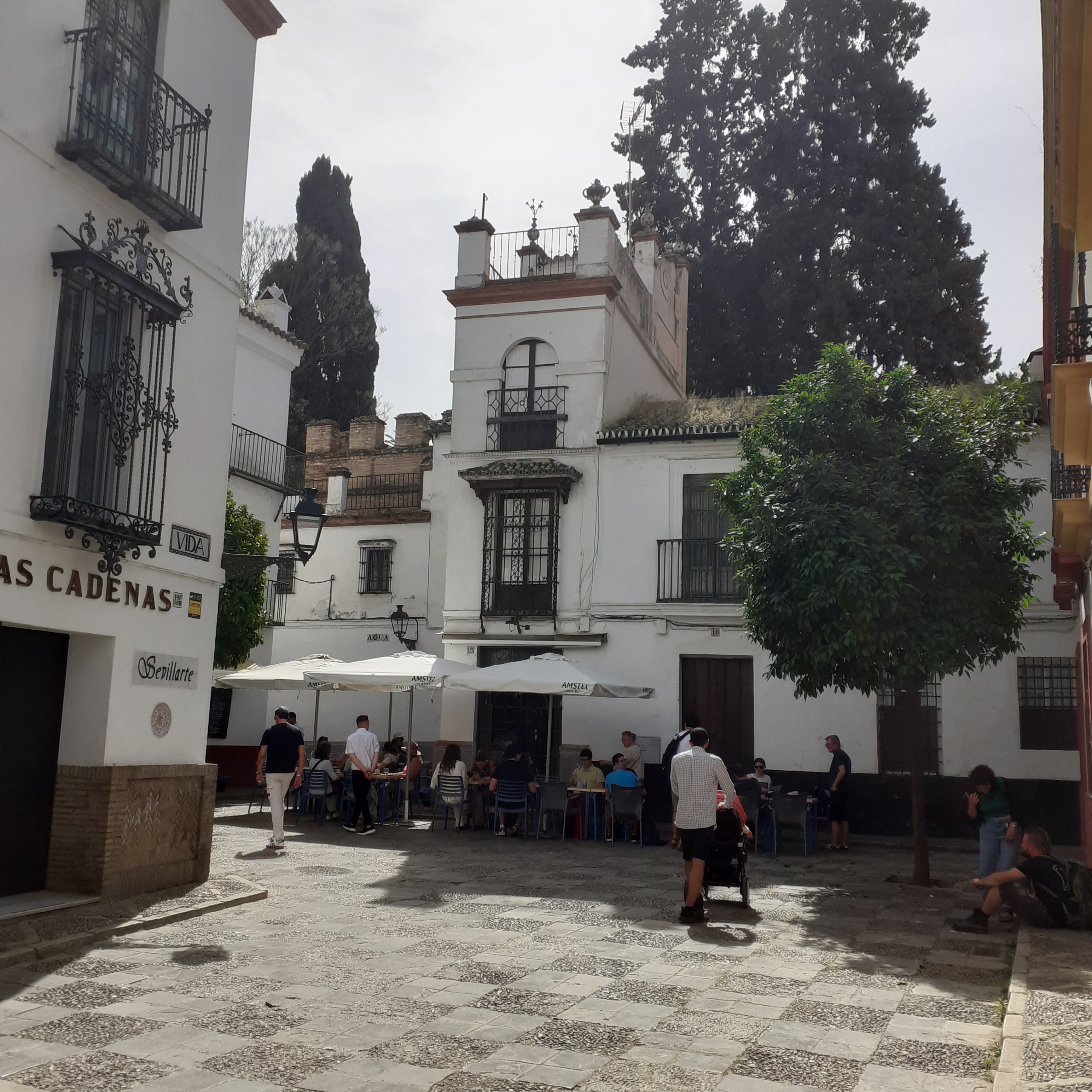
Leaving, we follow the palace walls through a charming ramble of ancient streets in this picturesque part of Santa Cruz. Sunburnt but softly rendered in pastels, there are welcoming intimate bars and cafes with the promise of music later on. The route leads on to the Murillo Gardens, named for the artist whose work is such a ubiquitous feature of Seville’s holy places. Bartolome Esteban Murillo was born in Seville in 1617 and became a leading painter of religious imagery. He is also well known for his informal paintings of contemporary street life, featuring a cast of flower girls, fruit sellers and street urchins. His paintings feature in major museums across the globe including the Prado, the Louvre, the Hermitage and the London National Portrait Gallery. He died in Seville in 1682
His park continues parallel to the Avenue Menendez Pelayo and there’s a monument for Columbus halfway along. Meanwhile the ornate carriages of La Feria’s finely clad aficionados trot past. We head for the Parque Maria Luisa, a huge green wedge of the city’s southside on the banks of the Guadalquivir. This was where the Ibero American Exposition of 1929 was held. The main pavillion at Plaza de Espana showcased Spain’s industry and technology. One of Seville’s signature buildings, it was designed by local architect Anibal Gonzales. Arranged in a semi-circle, it forms a fantastical montage of architectural styles facing onto a scenic moat. Here you can take a pleasure trip in a dinky rowing boat.
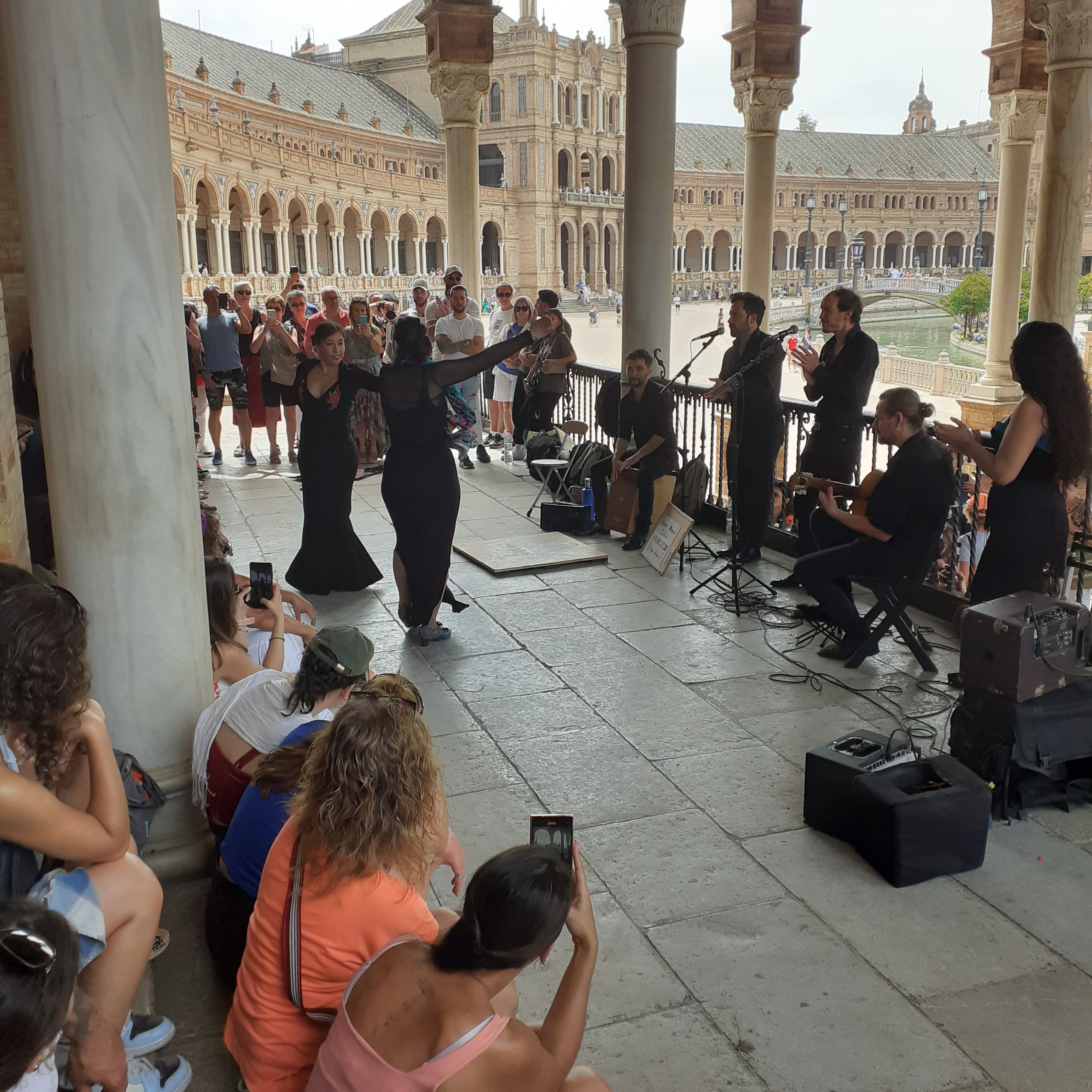
The arcades are packed with tourists, foreign and local, and a host of buskers and vendors. There’s a wedding party in full La Feria dress around the central fountain. In fact, the Exposition of 29 helped establish the traje de flamenco as a ‘traditional’ garb for the ladies of Spain. A young Flamenco group of musicians and dancers performs on the ground floor gallery at the main entrance. They are modern in style and substance, clad in uniform black, though this is a stylish mufti in the modern mode. The accousitcs are ideal for the percussive clapping and full bodied rhythm of the guitar
Returning through Arenal, we pass the famous Tobacco Factory. Seville was the first European centre for tobacco, the Spaniards spotting its benefits the moment Columbus stepped ashore in the Americas in 1492. The Royal Tobacco Factory is an 18th century building, bringing the various tobacco manufacturers under one roof, and one ruler. Since the 1950s the building has been the seat of the Rector of the University of Seville. Carmen, titular lead of Bizet’s opera, was a cigarrera here. Women were renowned for their skills as cigar rollers, and they replaced the male workforce in 1813. The fiery Carmen was a Gitano who lead the young soldier Don Jose astray, before dumping him for the dashing toreador Escamillo. The opera was first performed in Paris in 1875. Amongst its best known songs are L’amour est un oiseau rebelle, and the Toreador Song.
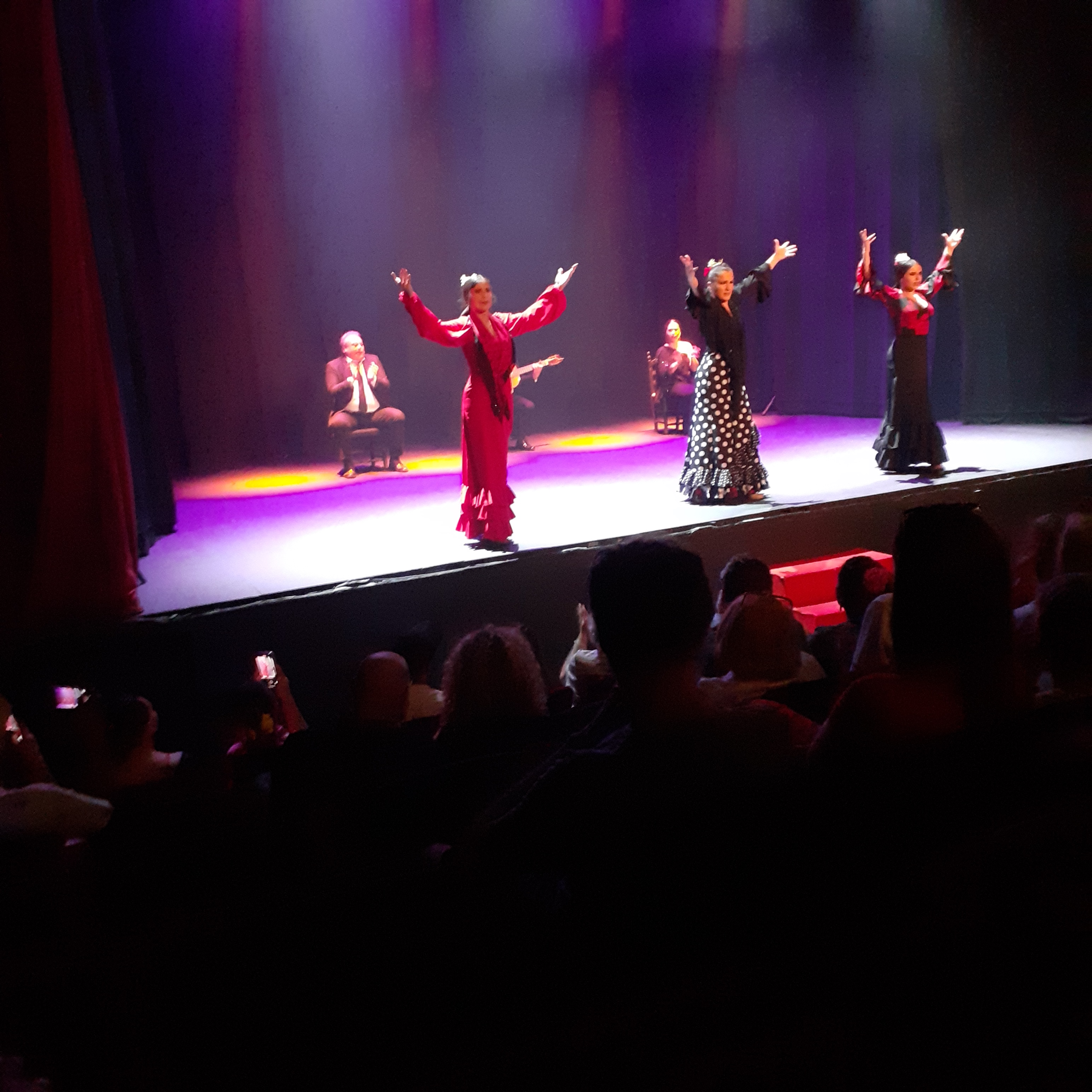
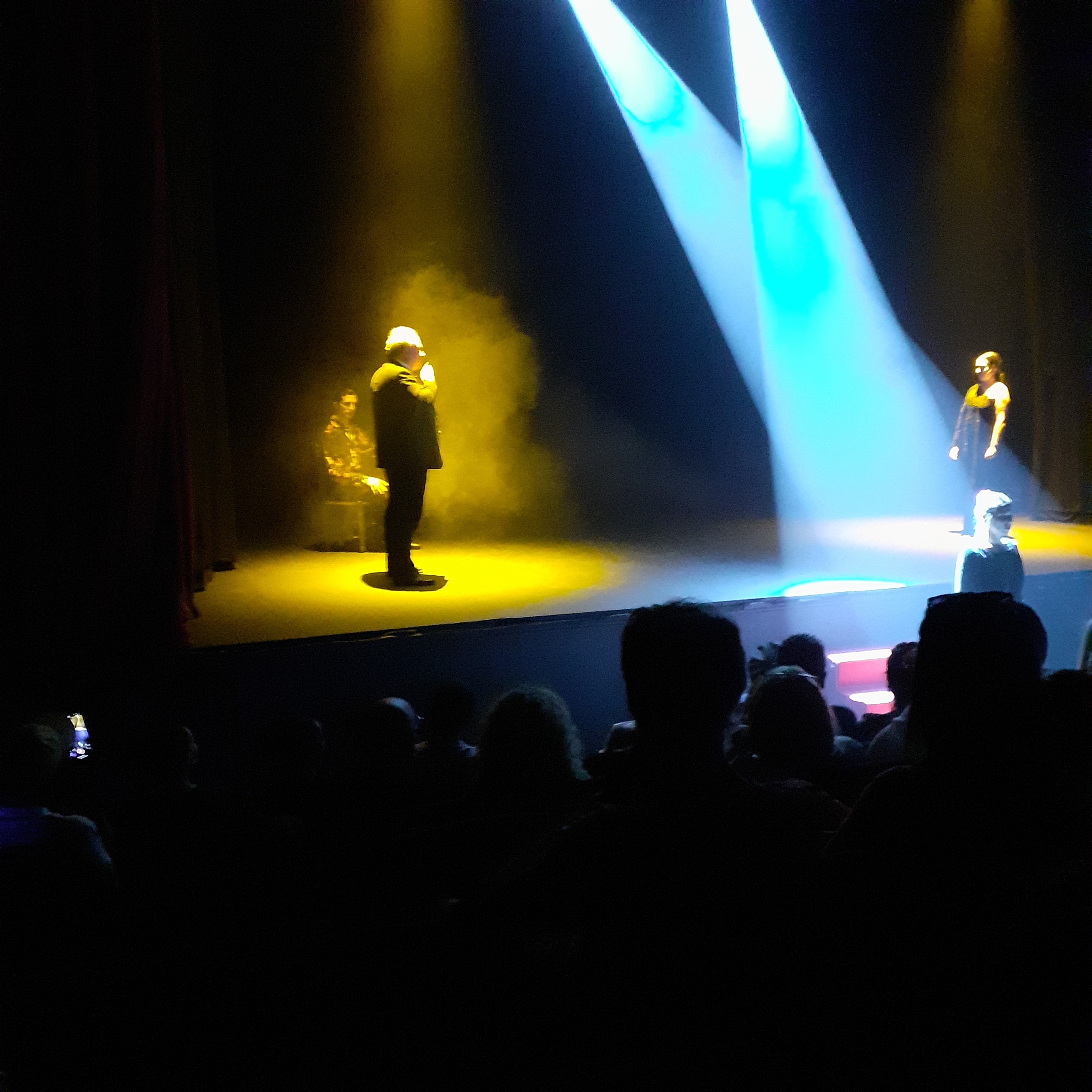
For early evening, we have booked a Flamenco show in Calle Cuna which runs parallel to Calle Sierpes close to Plaza Del Salvador. Teatro Flamenco Sevilla is an intimate theatre seating about three hundred people. They run several hour long shows daily. Flamenco grew out of the Gitano Barrio of Triana, on the west bank of the Guadalquivir. The folk form is internationally famous, a definitive Spanish culture. The singing is expressive, the guitar rhythms hypnotic, the interpretation of the dancers seductive, the whole making for a sensually charged and dramatic performance, felt as much as it is seen and heard. Traditionally, Flamenco was more of an ad hoc expression, similar to an impromptu Irish Folk session. The first flamenco cabaret bar was opened in Seville in 1842 and known as the Cafe Sin Nobre, No Name Cafe. These days Flamenco is more usually presented as a tablao, or show. Tablao refers to the stage floorboards. On the Boards, as Rory Gallagher would sing.
Our performance was at 7.30 and featured five dancers, one male, and a male and female vocalist. The guitarist was the natural leader of the troupe, although leading from the rear. The vocals were visceral. I couldn’t believe how their singing seemed to explode from inside my head. All performers contributed to the stacatto percussion, another startling feature of Flamenco. Talent, spectacle and a genuine passion permeated the performace. On the last few numbers, they and the audience got carried away, with plenty of high good humour, particularly the manic and brilliant guitarist. A great gig.
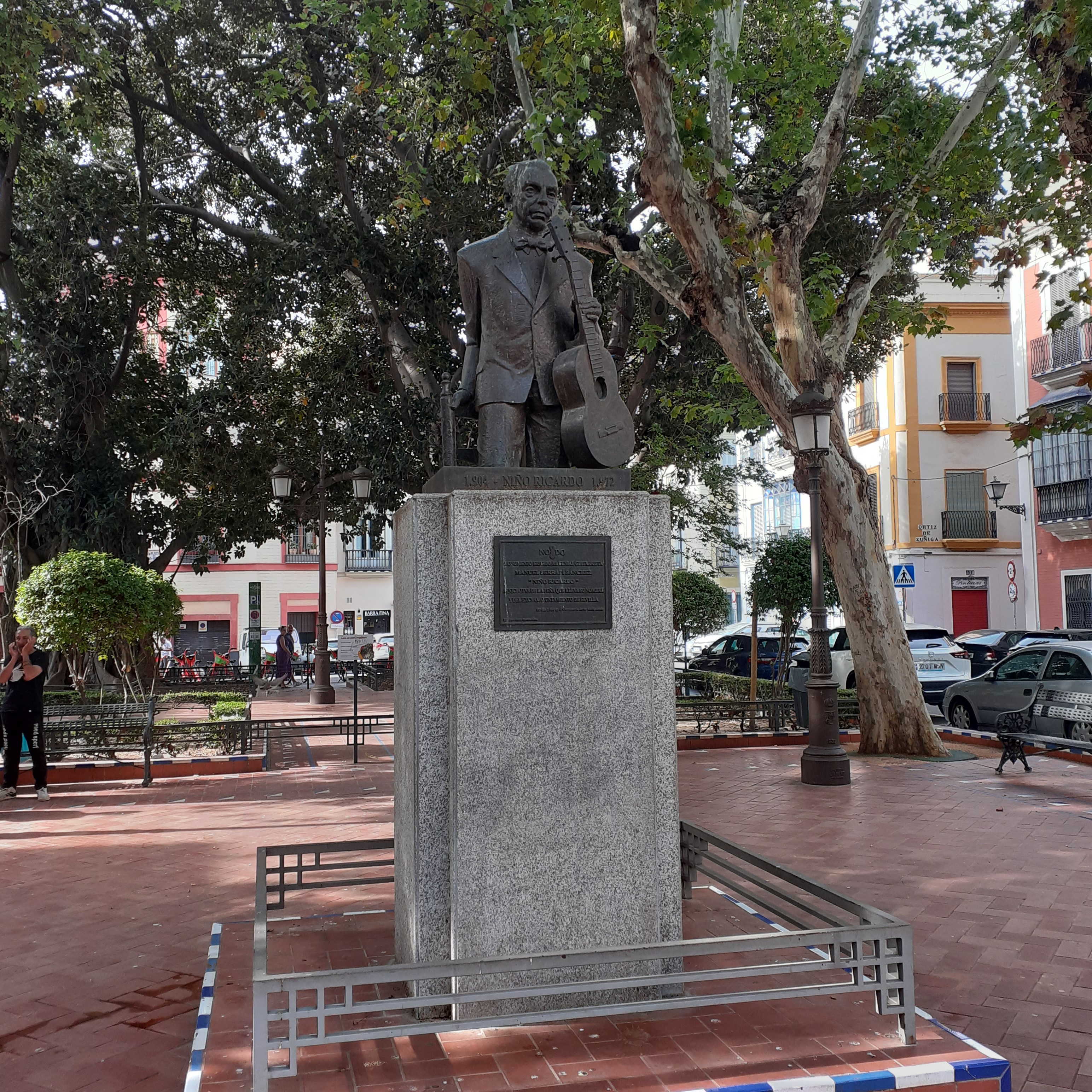
Afterwards we have a decent tapas at Plaza Alfalfa nearby. Around the corner from our hotel is the curiously named Plaza Cristo de Burgos. We decide to take a look, mindful that tomorrow we take a Spanish Train to Cadiz; but that’s another story. The small park has a statue of the great guitarist. The great guitarist being flamenco guitarist Manuel Serrapi Sanchez and known as Nino Ricardo. He was born in this square in 1904 and became a major influence on flamenco guitar technique. Paco de Lucia hailed him as the Godfather of guitar.
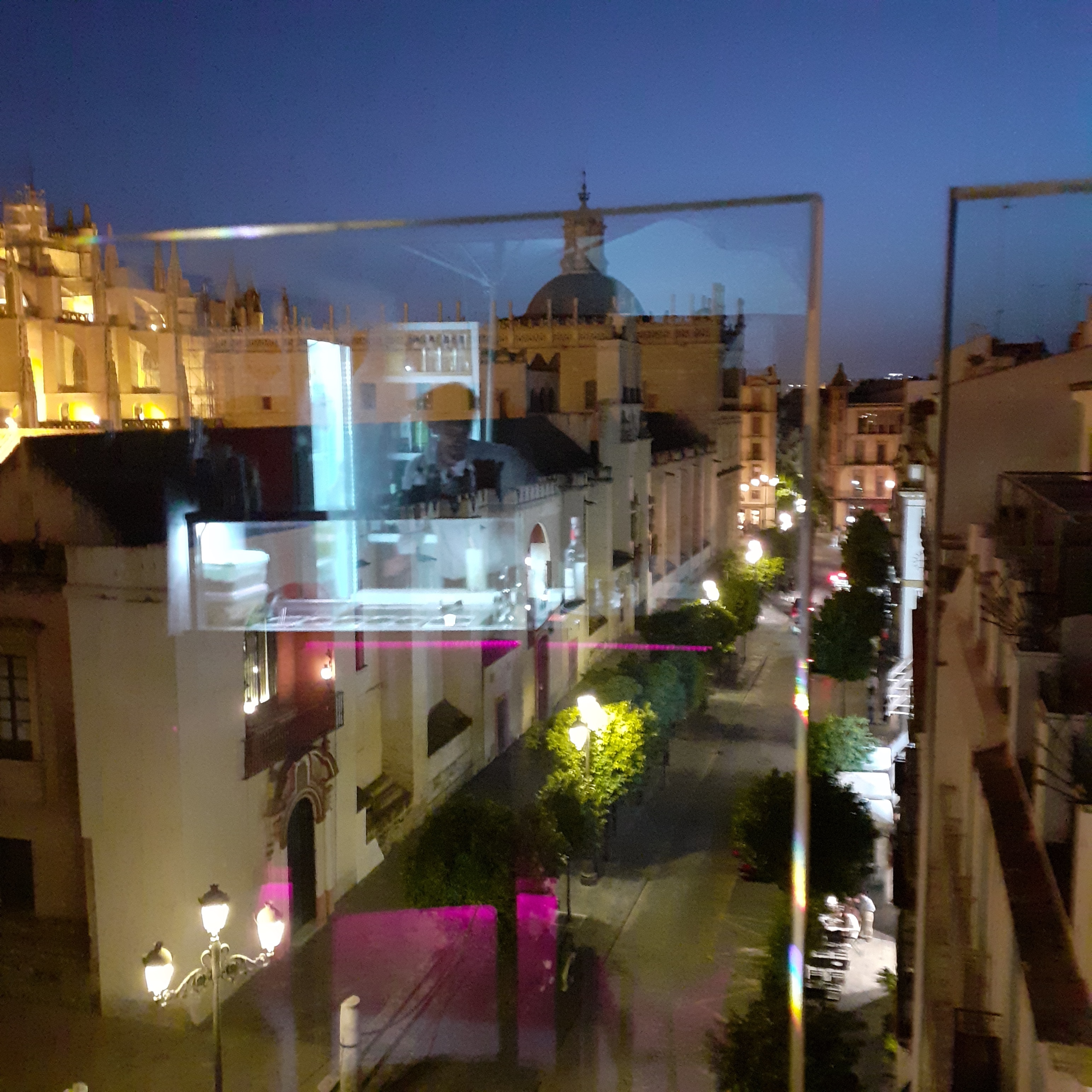
We say goodbye to Seville, from a rooftop bar above the Cathedral. The illuminations shimmer in the warm night air and it feels as if we ride above the city on a magic carpet. It all suggests a shot of Colombian espresso, a square of dark chocolate, the air scented with the smoke of a long Havana. Open a bottle of Osborne Sherry and enjoy the company of Compay Segundo and the sound of Guantanamera.
Yo soy un hombre sincero,
De donde crece la palma.
Y antes de morir yo quiero
Cantar mis versos del alma.
Guantanamera, guajira guantanamera,
Guantanamera, guajira guantanamera.
Guantanamera is a Cuban song from the poem by Jose Marti set to the music of Joseito Fernandez (probably). Look up the version by Compay Segundo with video of the noted guitarist enjoying the benefits of tobacco and drink in his native Havana.
Touchdown at midnight in Seville airport. Step into a warm Spring night as taxis cruise conveniently to the kerb. It’s thirty five euro to the city centre, which is a bit steep; but it’s Feria, and you now how festivals eat money. Our city centre hotel is near six hundred euro for three nights, so we’re prepared. Feria is Seville’s biggest festival, where locals let there hair down, or tie it up, a fortnight after the serious religious and cultural devotion of Semana Santa.
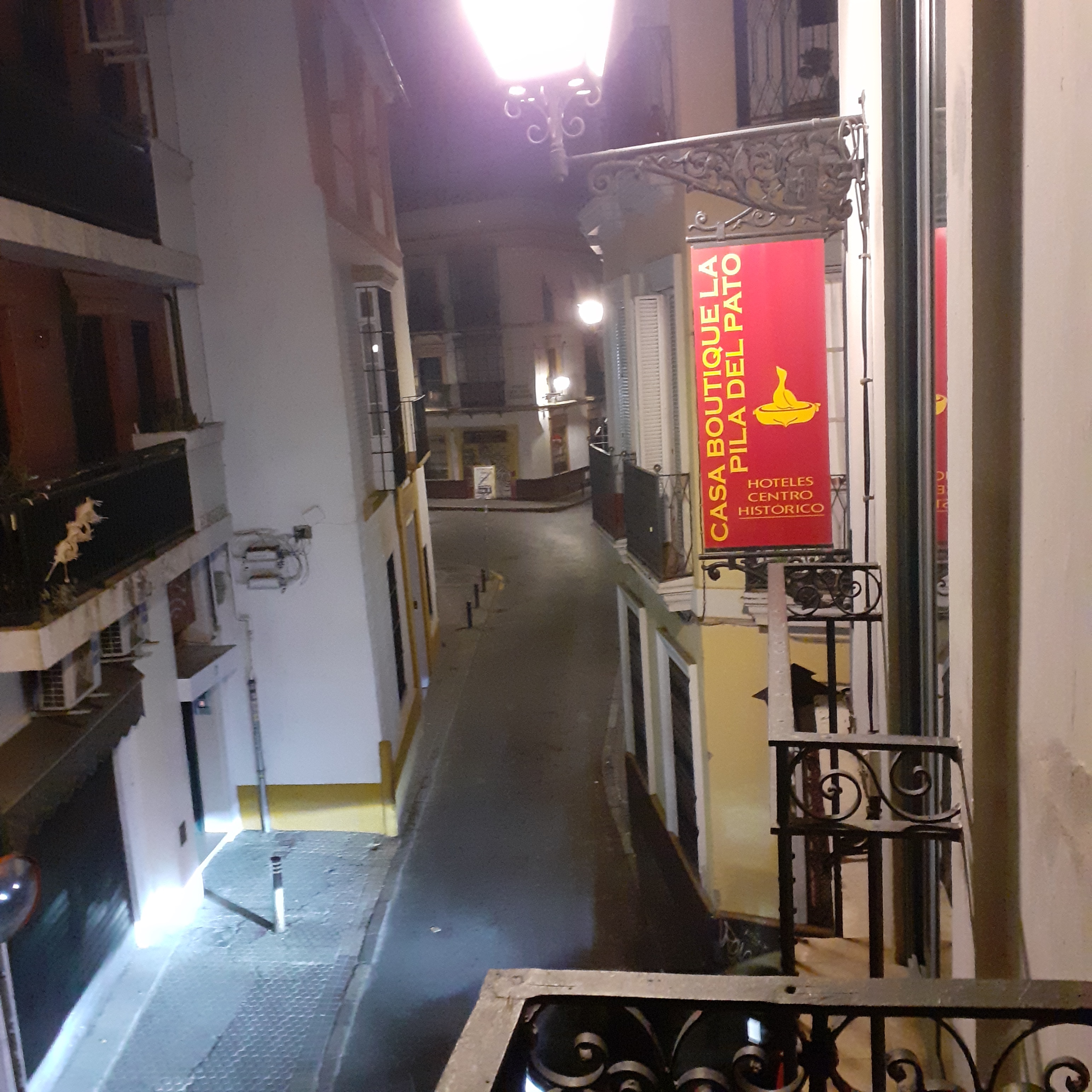
Our accommodation, La Pila De Pata is in the Old Town, Santa Cruz, within walking distance of the city’s main attractions. The room is attractive, with a timber ceiling, old style shutters, and a gigantic fan. There’s a small wrought iron balcony overlooking the narrow street, Calle Aldohinga. There are noisy neighbours across when we arrive, but hey, it’s Feria, and we’re dog tired and sleep easy.
Seville is the capital and largest city in Andalusia. Almost seven hundred thousand people live here on the banks of the mighty Guadalquivir River. Founded by the Romans and ruled by the Moors for five centuries from 700AD, in 1248 Castile conquered the Moors in the Reconquista. NO8DO is the city’s emblem. It is a rebus for No me ha dejado: she (Seville) has not abandoned me. Pronounced No ma dejado, the symbol 8 represents the trio of syllables madeja; a skein of wool. The legend is that King Alfonso X used the phrase thanking the citizens for standing by him against attempts by his son Sancho to usurp the throne. Alfonso ruled from 1252 till his death in 1284.
Seville lies fifty miles inland from the Atlantic and flourished as a river port in the late middle ages, particularly for imports from the New World. Silting of the river and other factors saw it decline in the eighteenth century and maritime power passed to Cadiz on the Atlantic coast further south. Ancient Seville lies largely within Santa Cruz. a warren of streets and lanes spreading north from the central area around the ancient fortress. Here you’ll find a cluster of magnificent buildings including the Alcazar, and the spectacular Cathedral.
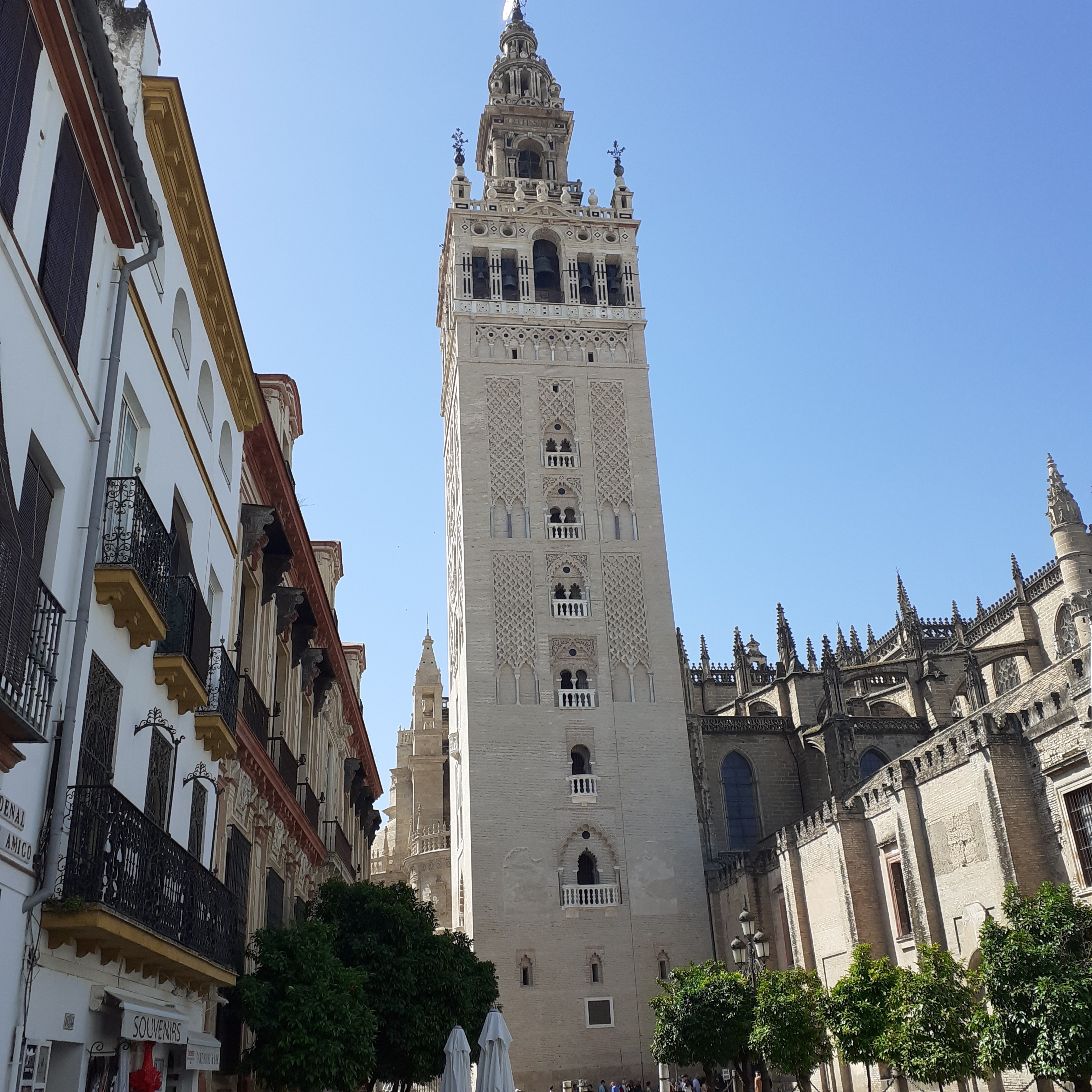
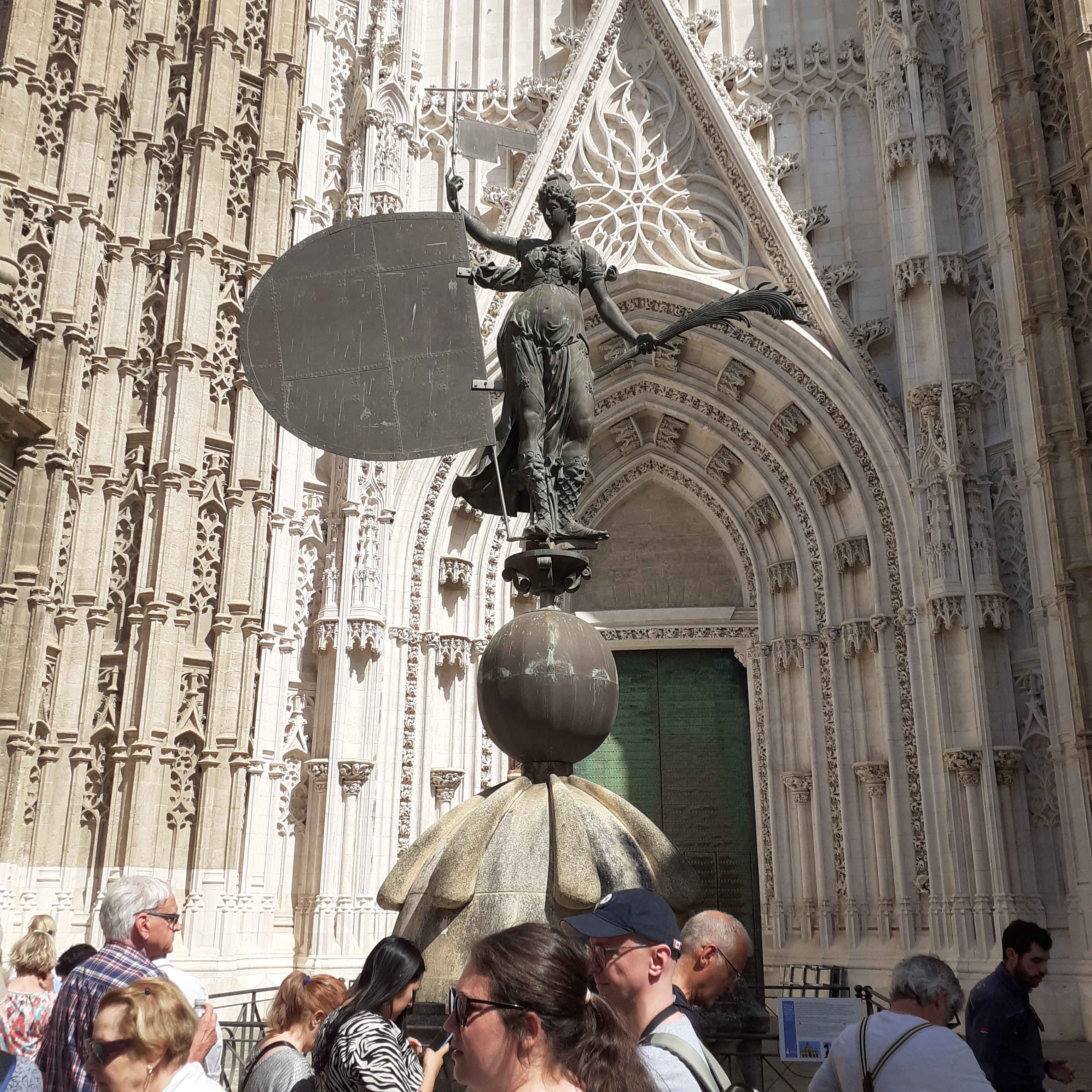
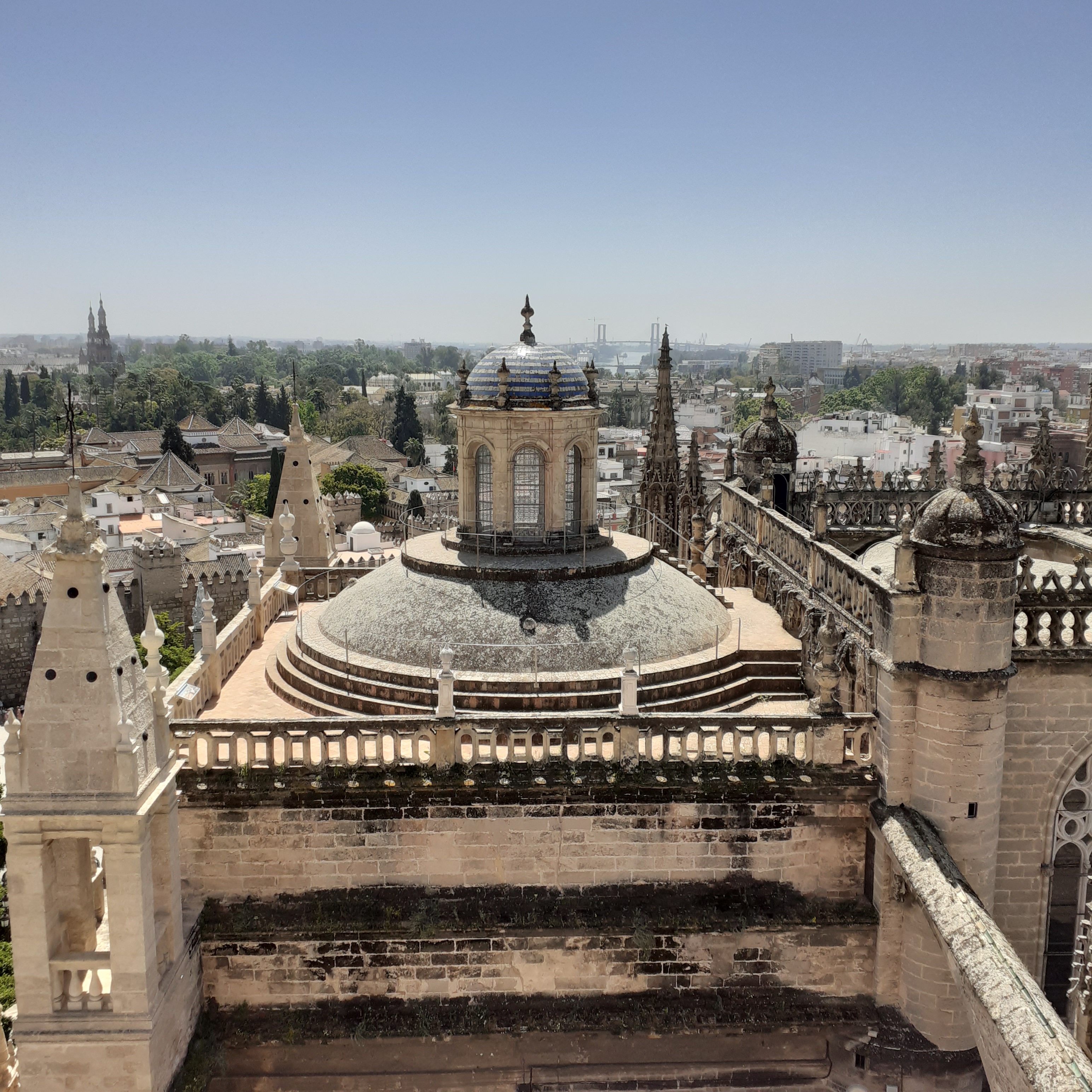
On our first day, we shimmy down from Aldohinga to Plaza Virgen de los Reyes. The Cathedral of Saint Mary of the See is six hundred years old and the largest gothic church in the world. The bell tower of La Giralda soars above. There’s a short queue for entrance, with a generous discount, almost fifty per cent for aul lads like me. Younger folk, like M, pay the full thirteen euro. The Giraldillo, the bronze statue depicting the victory of the Catholic Faith stands here, a replica of the weathervane at the top of the tower. La Giralda was originally the minaret of the Mosque, with Christian symbols added after the Reconquista. The Renaissance belfry and weathervane were added in 1598. The climb to the top is relatively easy, a ramp zig zags upwards at a moderate incline. The views are truly majestic. Even more exciting, the bells broke into full peal causing some to clutch their ears. The bells. The bells!
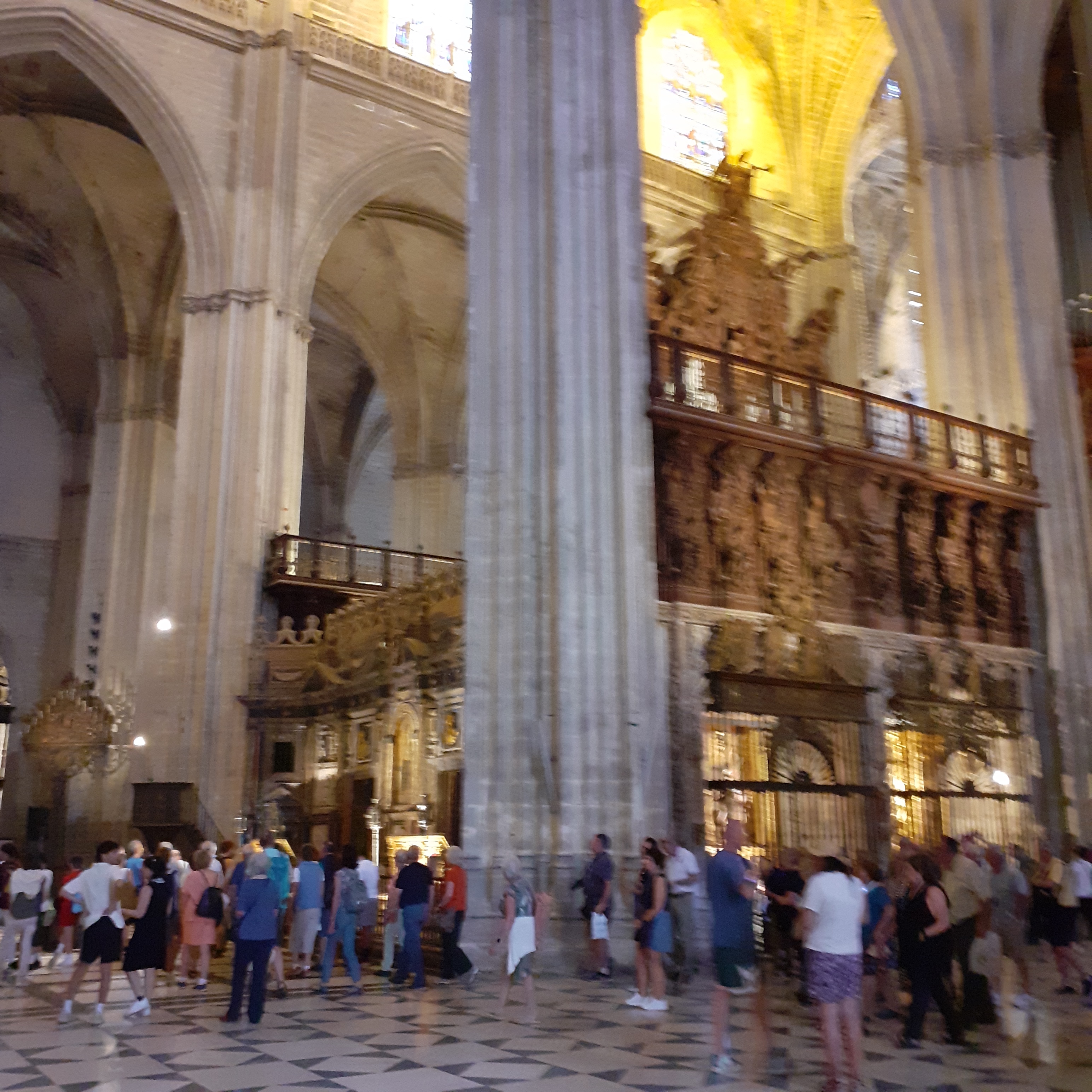
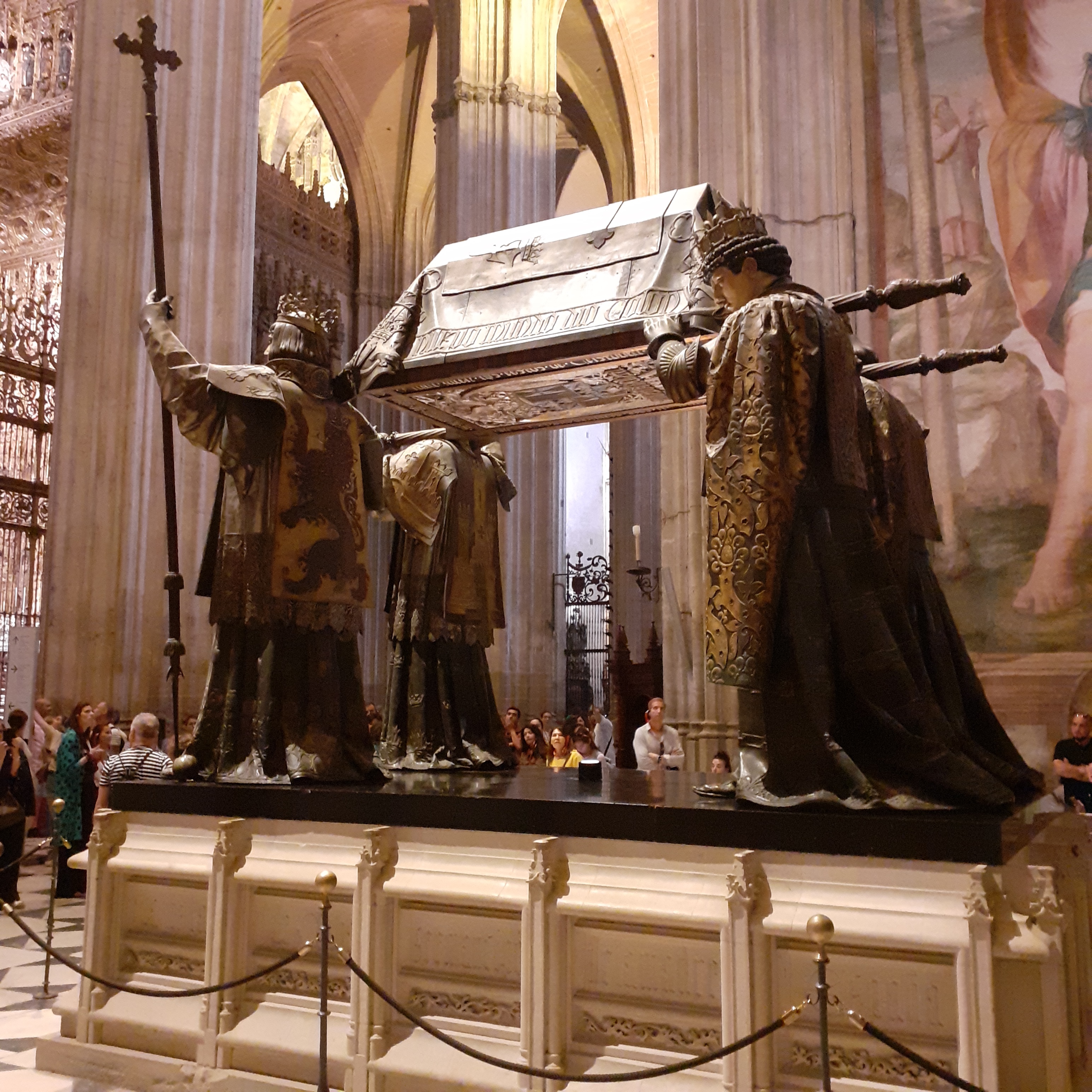
The Cathedral interior is mind bogglingly cavernous, on a scale that hints at science fiction besides a supreme exhaltation of faith. The crowds are well dispersed around its many treasures. Amongst these are the tomb of Christopher Columbus. He set sail in 1492, forging the route to the New World and making his first landfall on the island of Guanahani which he named San Salvador. Columbus was thus instrumental in the initiation of the lucrative trans Atlantic trade and more. A new world order grew, and such benefits as tobacco, potatoes and turkeys first came to Euope. Gold and silver too; and coffee, jazz and rock n roll.
Columbus’s remains were interred in the Cathedral in 1513, seven years after his death. They had an appropriately peripatetic existence, being further interred in Hispaniola and Cuba before making their way back to Seville in 1898. The tomb is a catafalque, depicting a casket borne aloft by the Kings of Leon, Castille, Aragon and Navarre.
The Vision of Saint Anthony by Bartolome Esteban Murillo from 1656 is in the Saint’s chapel nearby. There are eighty chapels within the Cathedral each host to a story, an ambience to absorb and admire. Outside, the Patio de los Naranjos is the courtyard of the original Mosque centered on a fountain. Here, the Muslim devotees would wash before prayer. It is a restful oasis after the sensory overload of the interior.
Back towards the Old Town, we stop in San Francisco Square for lunch. The Ayuntamiento, City Hall, lines the western side. This was built in 1534 and upgraded in the Neo Classical style in 1891. Over a drink we await our tapas, including Tortilla. But while the guide book refers to it as the ubiquitous Spanish Tortilla, we finish our drinks without it arriving. Moving on to Calle Sierpes, the street of the snakes, we get pizza slices for nourishment. Sierpes is a pedestrianised shopping street and perfect for the Spanish Stroll of early evening.
Hey Rosita! Donde vas con mi carro Rosita?
tu sabes que te quiero
pero ti me quitas todo
ya te robasta mi television y mi radio
y ahora quieres llevarse mi carro
no me haga asi, Rosita
ven aqui
ehi, estese aqui al lado Rosita
Spanish Stroll was a hit single in 1977 for Mink Deville, Willy Deville’s band, from their 1976 debut album Cabretta, a jacket of soft leather. Derived from the Spanish word for goat, it is in fact sheep leather. Bass player Ruben Siguenza did the spoken bit.
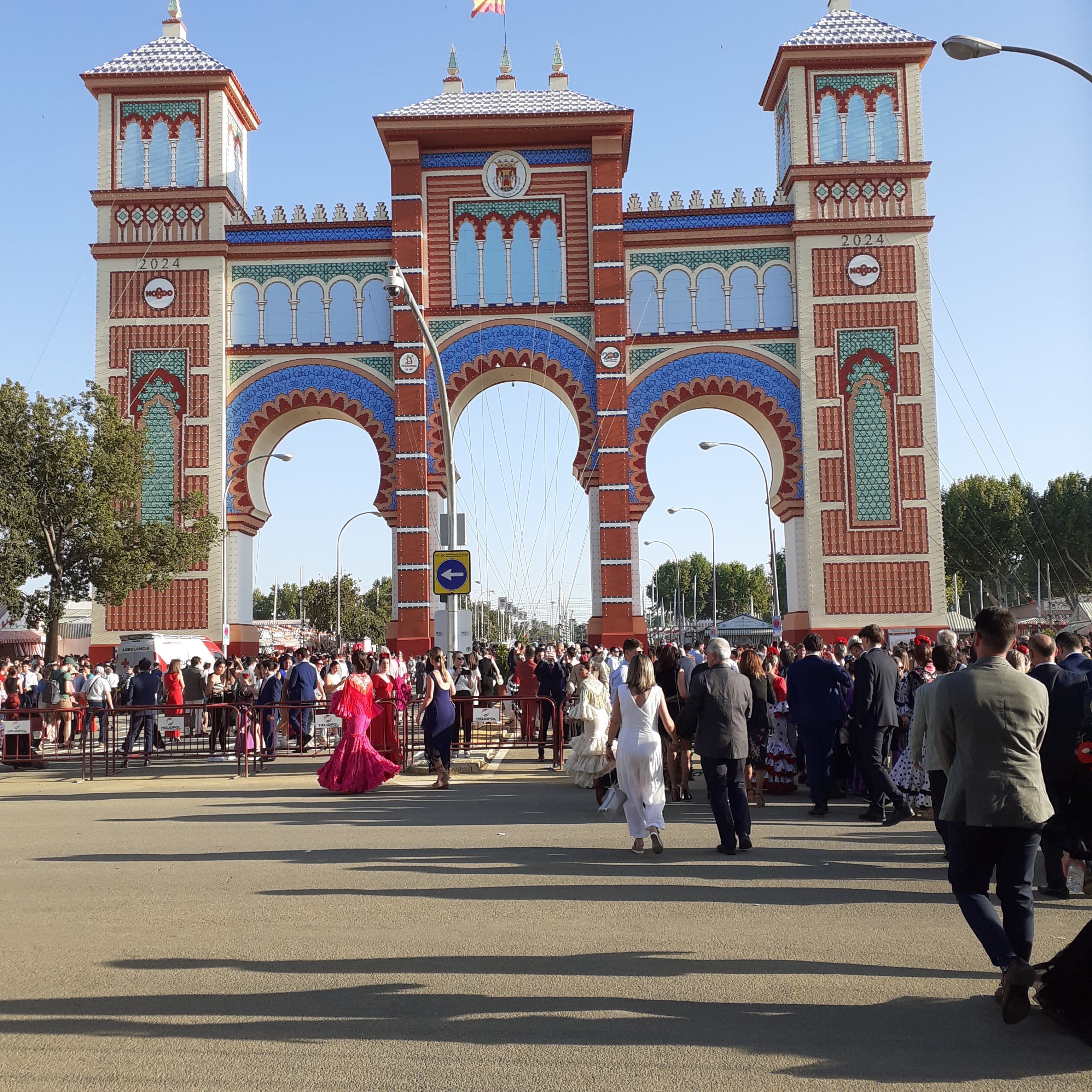
By early evening we follow the crowds across the San Telmo bridge over the Guadalquivir to Triana. Triana is said to be the cradle of Flamenco being originally the barrio for the Gitano community. Today it is a lively traditional area with riverfront bars giving great views of the city. To the south is Los Remedios, a more modern area which hosts another exuberant expression of tradition. The Feria de Abril is a week long fair held a fortnight after the Semana Santa. The locals don traditional attire and let their hair down, or tie it up, in a spree of drinking and dancing. The fairground is at the top of long, straight Calle de Asuncion.
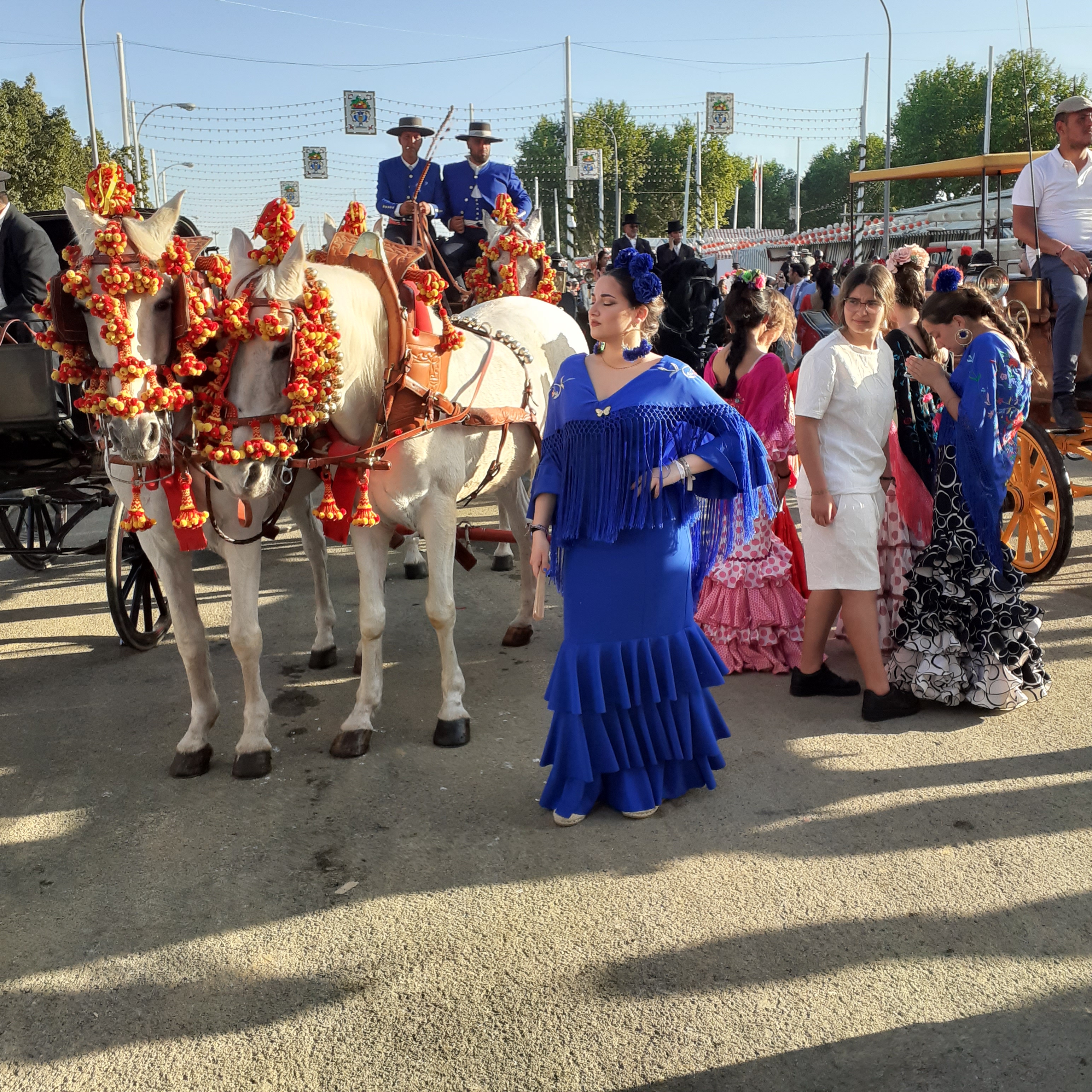
The throng is going one way in early evening, and we are pushed along to enter through a huge gateway, bringing us into a garden of earthly delights. It is quite overpowering, a feeling the whole world is here, balanced between chaos and the vast underlying structure of community. There are a thousand tents or casetas for drinking, dining and dancing, welcoming a half million visitors per day. The casetas are mostly restricted access, for various clubs, associations and families but some are open to the general public and visitors. There is a horse and carriage parade making a colourful, traditional spectacle and further on is an amusement park known as La Calle del Infierno, or Hell Road. The week coincides with the start of the bullfighting season across the river at Real Maestranza, the twelve thousand seater bullring and one of the most iconic in Spain.
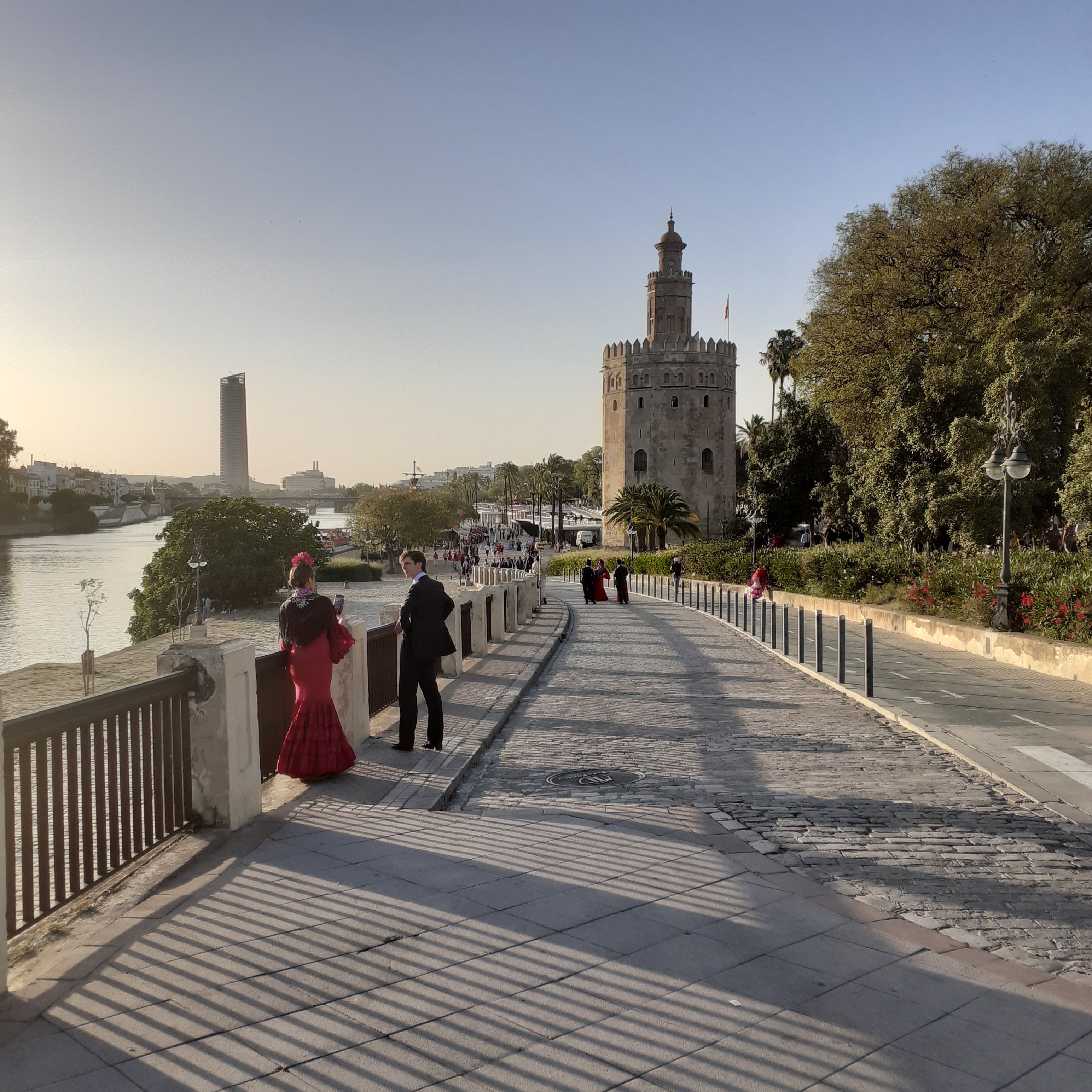
The evening serenity of Old Seville beckons. and we return across the river where the Torre del Oro guards the far bank. The tower dates from Moorish times when it was part of the city’s defensive walls. Built in 1220 the turret was added in 1760. There was once a twin tower across linked by a mighty chain to thwart enemy shipping. We find space at a restaurant on Calle Almirante Lobo, Admiral Wolf as we might say, and enjoy our meal al fresco as the sun sets behind the Tower of Gold. The sun sinks and illuminations blossom over the city. Later, we find the rooftop bar at the Cathedral Hotel to bask in the moon over magical Seville and raise a glass or two.
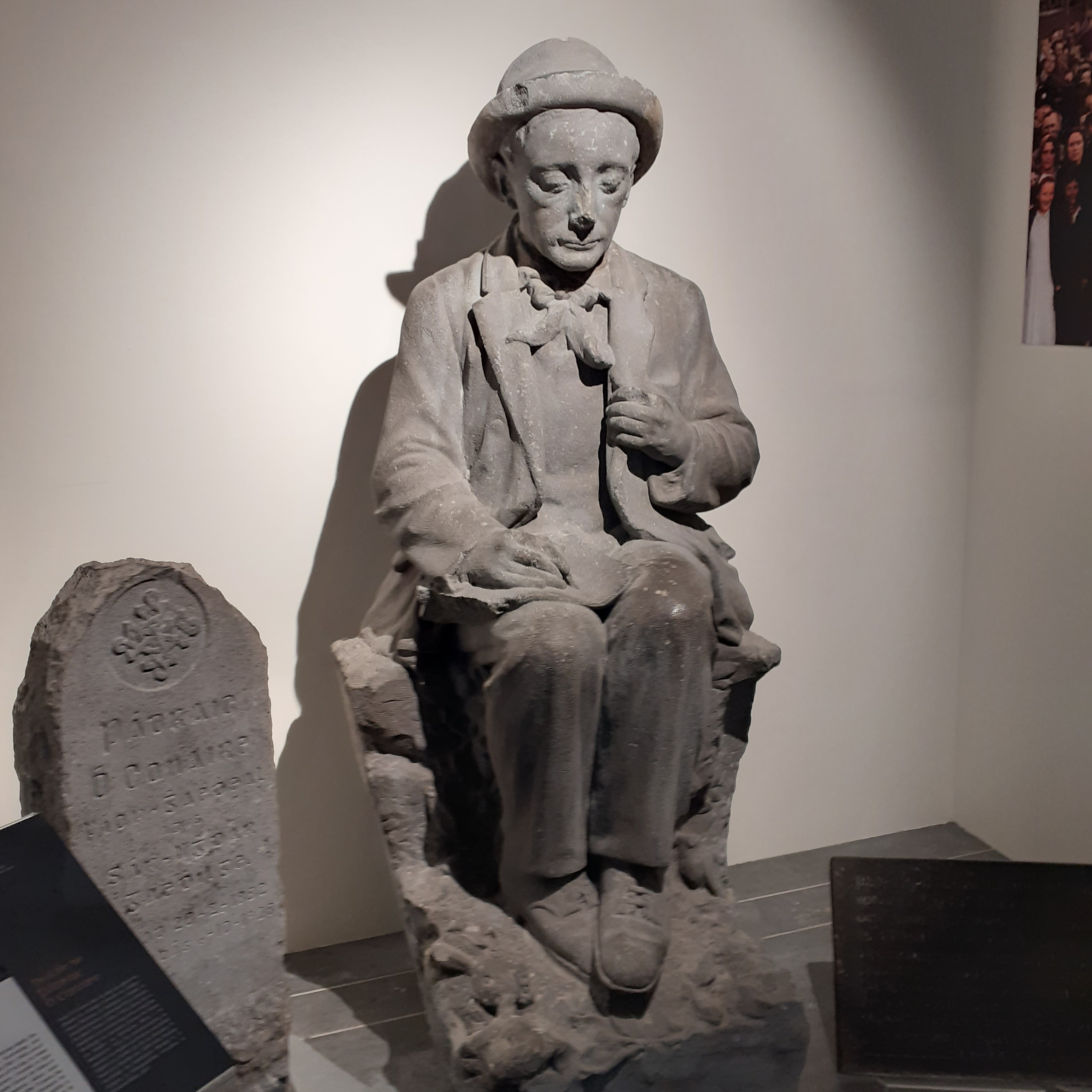
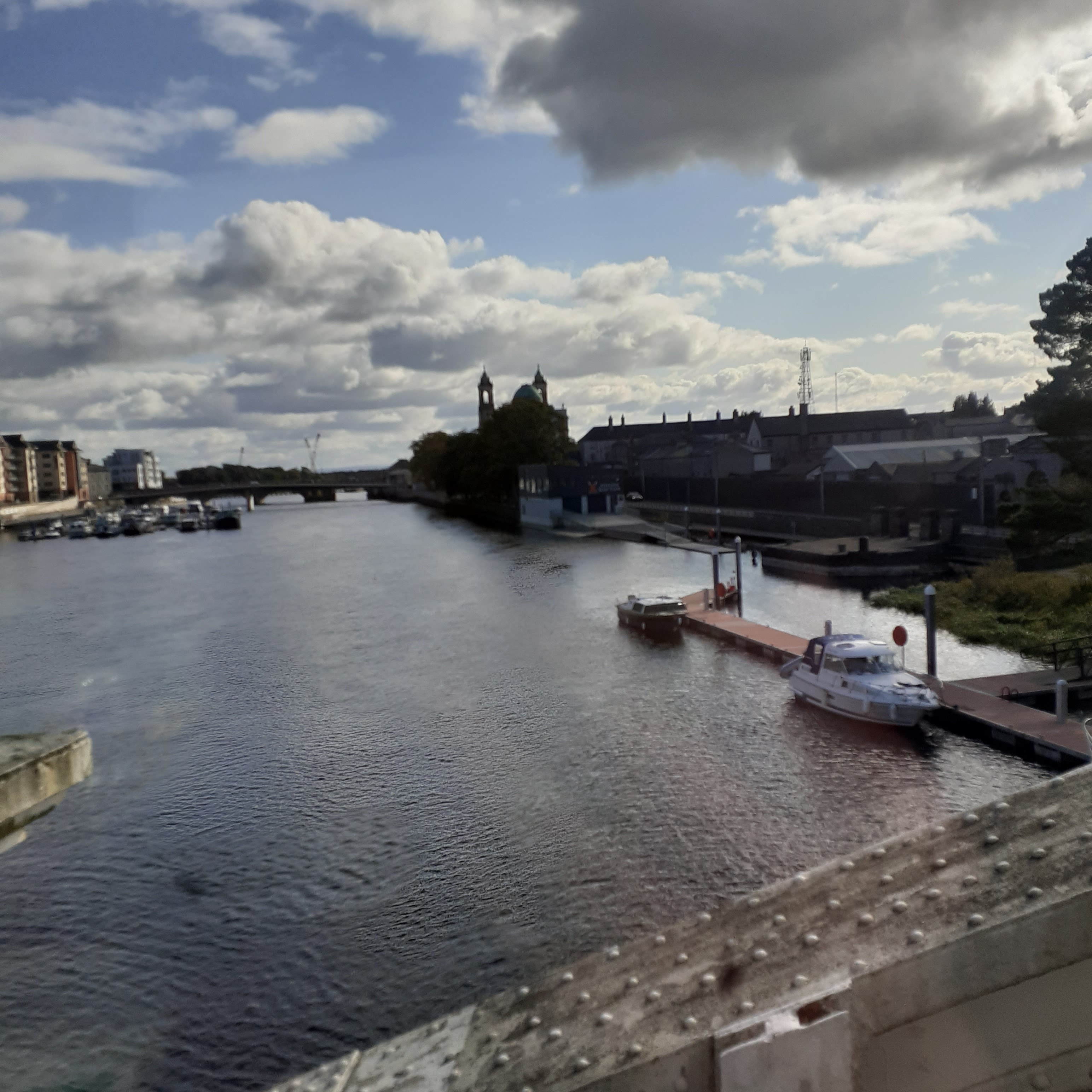
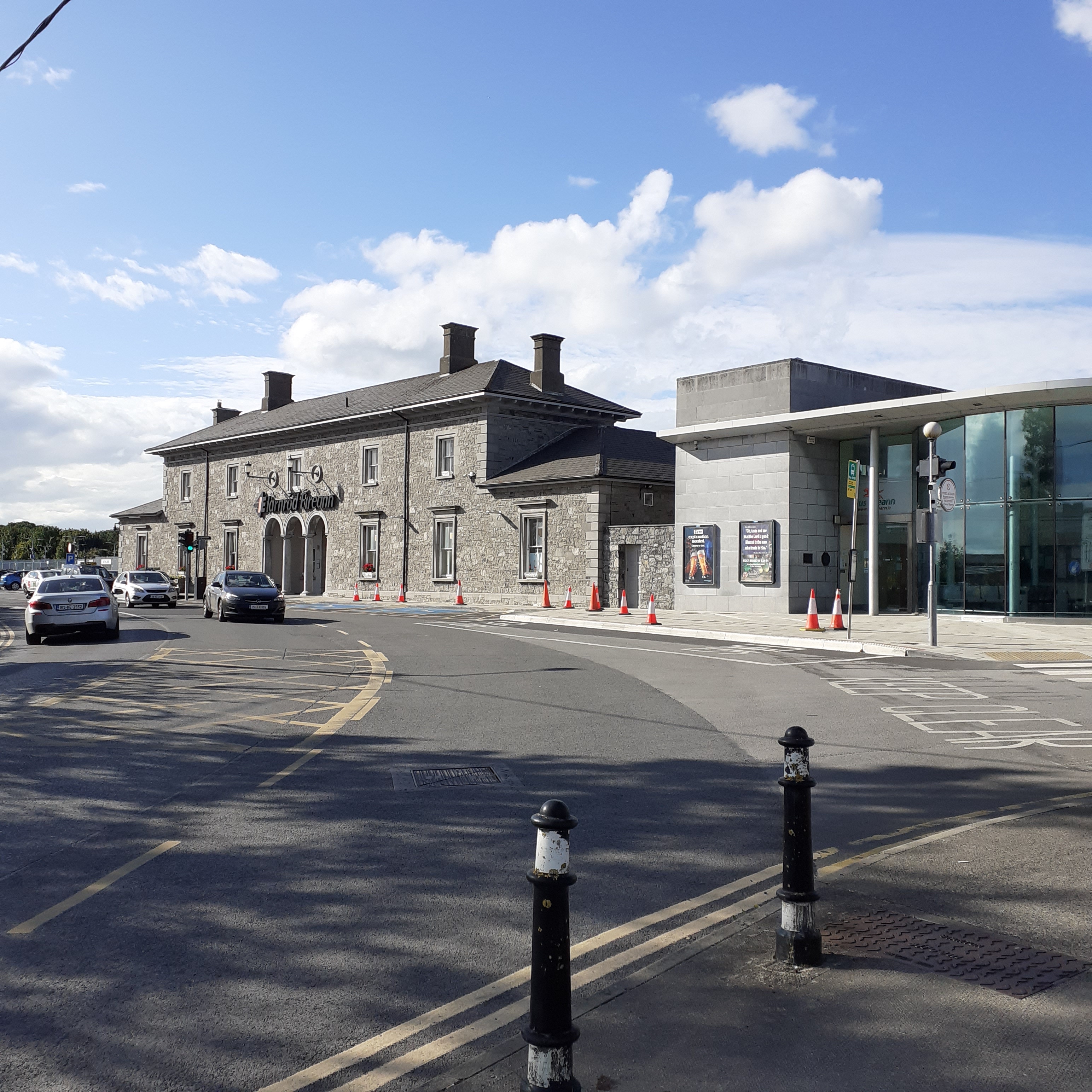
Athlone lies bang in the centre of Ireland, straddling the mighty River Shannon. It is just a hundred and twenty five kilometres west of Dublin, and about halfway between Dublin and Galway. The railway line opened in the 1850s; the station here dates from 1859. There’s a train every forty minutes from Dublin’s Heuston Station and the trip takes an hour and a half. Galway is just under ninety kilometres further on, a little over an hour by rail. The western expansion of the railway system connects to Galway City and to Westport and Ballina in County Mayo. Athlone station lies north east of the town and it’s a pleasant walk into the centre via the Civic Centre. This is a sleek modernist campus built in 2005, a combination of civic buildings including the town hall and library, retail and housing. Seated at its focal point is a bronze statue of Athlone’s most famous son, Count John McCormack. It was made by Irish artist Rory Breslin in 2014, and very good it is too.
Born in Athlone in 1884 McCormack became Ireland’s most renowned tenor whose repertoire ranged from Classic Italian Opera to Irish popular folk songs. Moving to Dublin, in his early twenties he nurtured James Joyce’s singing ambitions, persuading him to enter the Feis Ceoil in 1904 where Joyce got a bronze medal. Though Joyce would follow a different muse, McCormack became a hugely successful concert and recording artist. The songs of Thomas Moore feature strongly in his recordings, as well as patriotic airs and sentimental Irish ballads. He starred in the film Song o’ My Heart with Maureen O’Sullivan in 1930 and lived in a large estate in Hollywood.
He retired in 1938, but returned to live performance in support of the British and Allied war effort in WWII. Ill health forced his final retirement from the stage and he died at his home in Booterstown in 1945.
There’s a bright gleaming light, guiding me home tonight,
Down the long road of white cobble stone,
Down the road that leads back, to that tumble down shack,
To that tumble down shack in Athlone.
This song was recorded by McCormack in 1919. Penned by Richard Pascoe, Monte Carlo and Alma Sanders it was also recorded by Bridie Gallagher and Bing Crosby
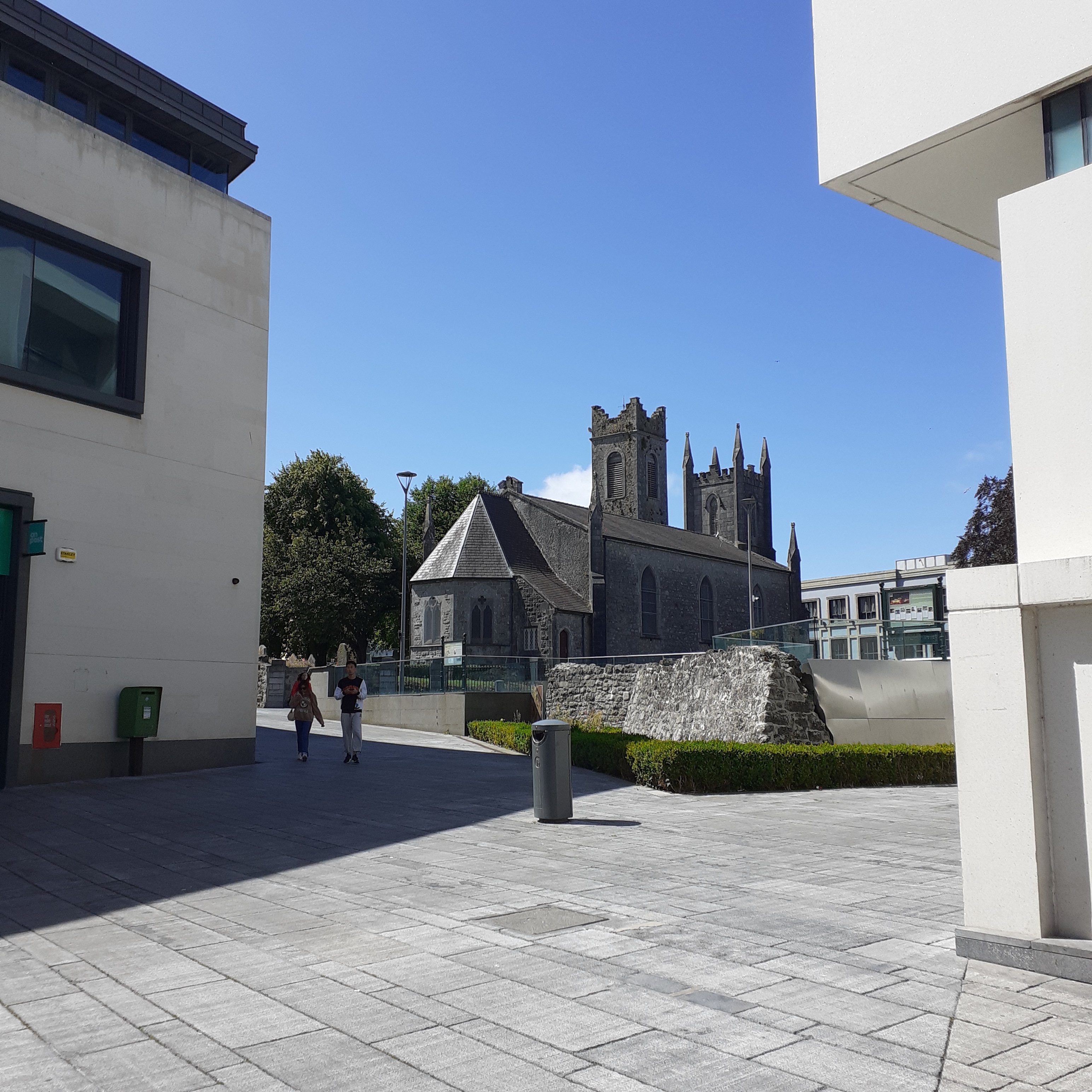
The Town Centre development opens onto Dublin Gate Street, part of the narrow main axis on the East bank leading on to Church Street. Here it contrasts charmingly with St Mary’s Church,(Church of Ireland). The Catholic St Mary’s is farther east heading out of the town. The street winds down to the bridge across the Shannon, the focal point of the town. Lough Ree, the largest lake on the Shannon, lies a few miles upstream to the North. Clonmacnoise, a major monastic site of the Middle Ages, is downriver. Built in the sixth century it flourished until the coming of the Normans, eventually abandoned in the 13th century with the development of Athlone as a defendable settlement. There are boat cruises you can take to visit.
Athlone has a population of twenty three thousand people. The name means Ford of Luan, from it’s founder, a shadowy figure. The Gaelic word Luan translates as Monday and may, perhaps, refer to the Moon. The idea of this fording place, midway along the great river, as the ford of the moon is poetic; but I am being fanciful. County Westmeath stretches along the East bank of the Shannon, however Athlone extends onto the West bank. It’s central location has long made Athlone strategically important
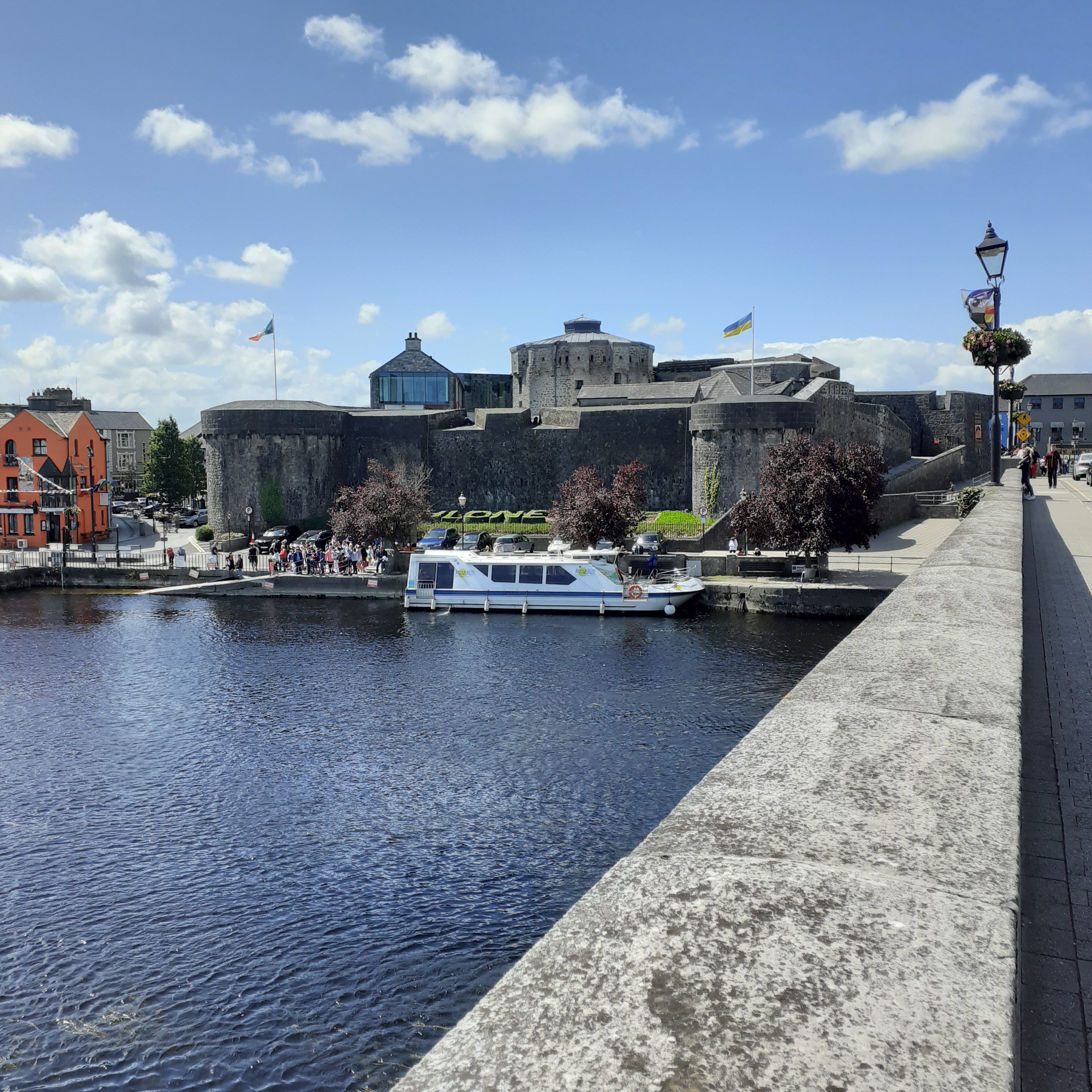
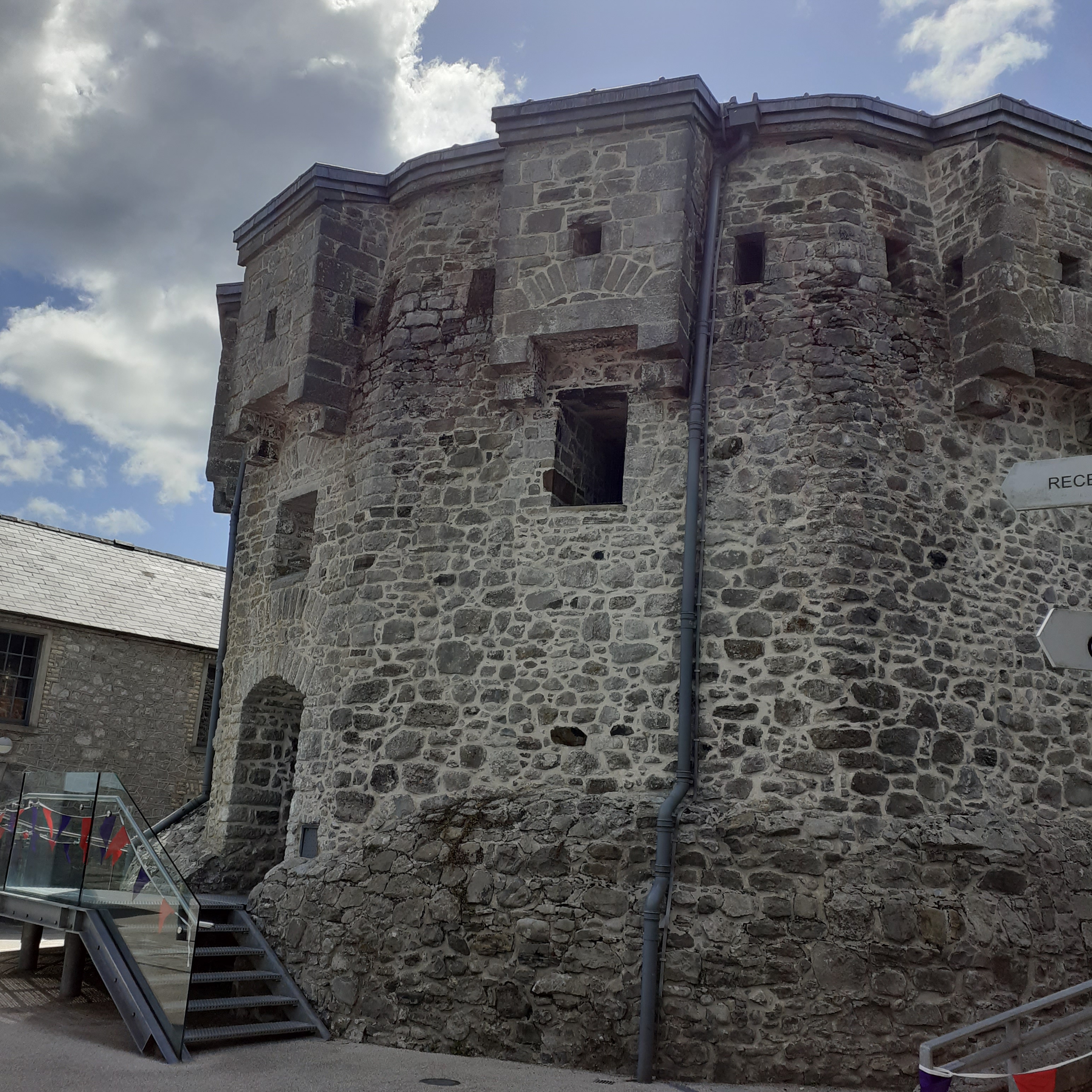
Brian Boru massed his forces here and accepted the submission of the High King, Malachy II in 1001. This was the start of Brian’s push for power, culminating in his defeat of the Danes and their Leinster allies. He was killed in the battle’s aftermath, and his crown returned to Malachy. The first bridge was built in the twelfth century and the King Turlough O’Connor established a fort to defend it. The stone fort followed in 1200 in the reign of King John. The twelve sided Donjon, or central tower, survives. The rest of the current castle dates from a reconstruction following he Siege of Athlone in 1691. Then, Athlone Castle was a Jacobite stronghold defending Connaught against the Williamites. Besieged twice, it repulsed the first onslaught of ten thousand men following the defeat of James at the Battle of the Boyne in 1690, but fell to William and Mary’s army in July 1691. The invaders were under command of Dutch General Godard Ginkel with Jacobite forces under Patrick Sarsfield and French General St Ruth. One of the defenders, killed in defence of the bridge, Sergeant Custume, is commemorated in the naming of the local army barracks.
The castle is well worth a visit, with a museum covering the area’s rich history, including John McCormack, and interactive exhibits and models in period dress. Fabulous views over the river and town from the top of the tower.
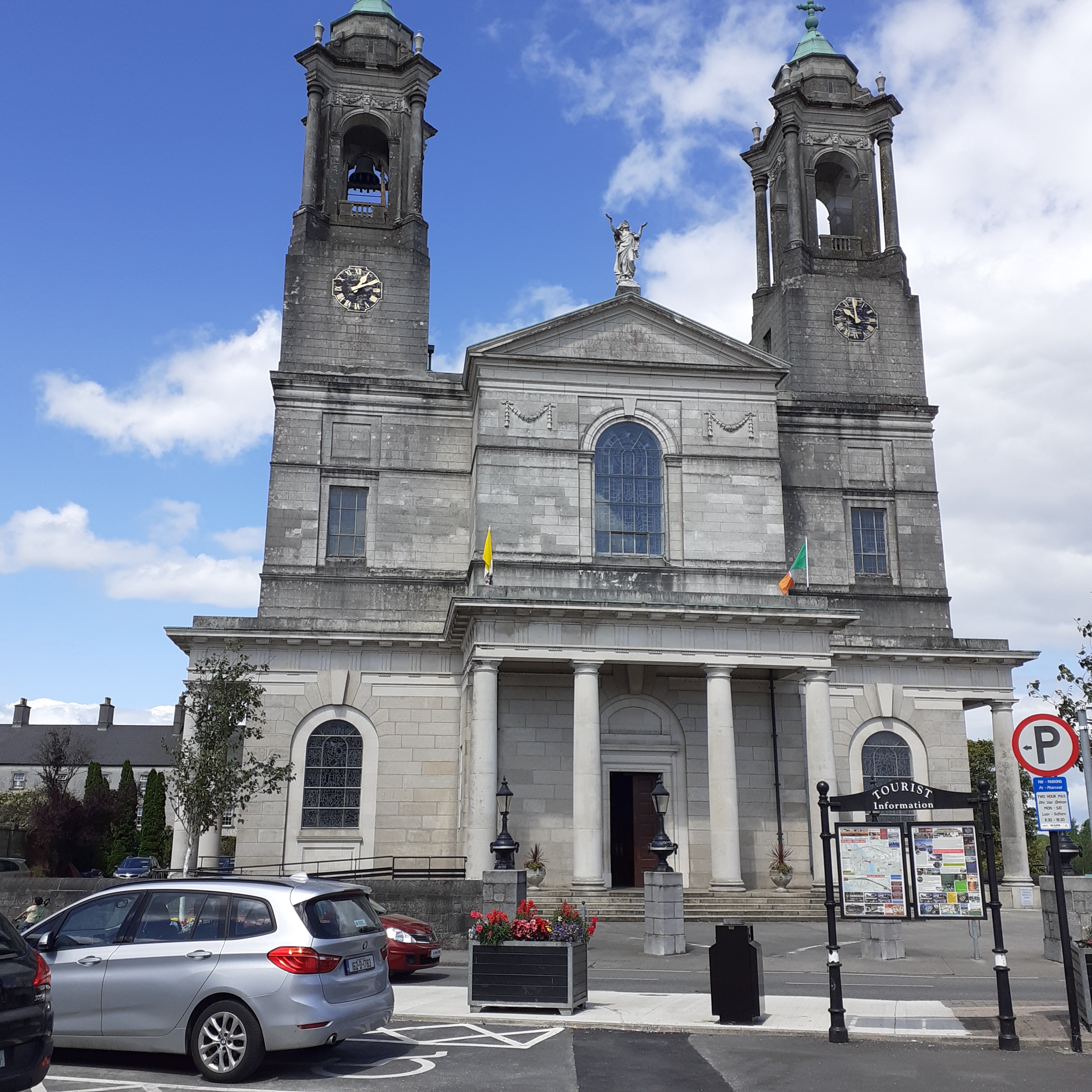
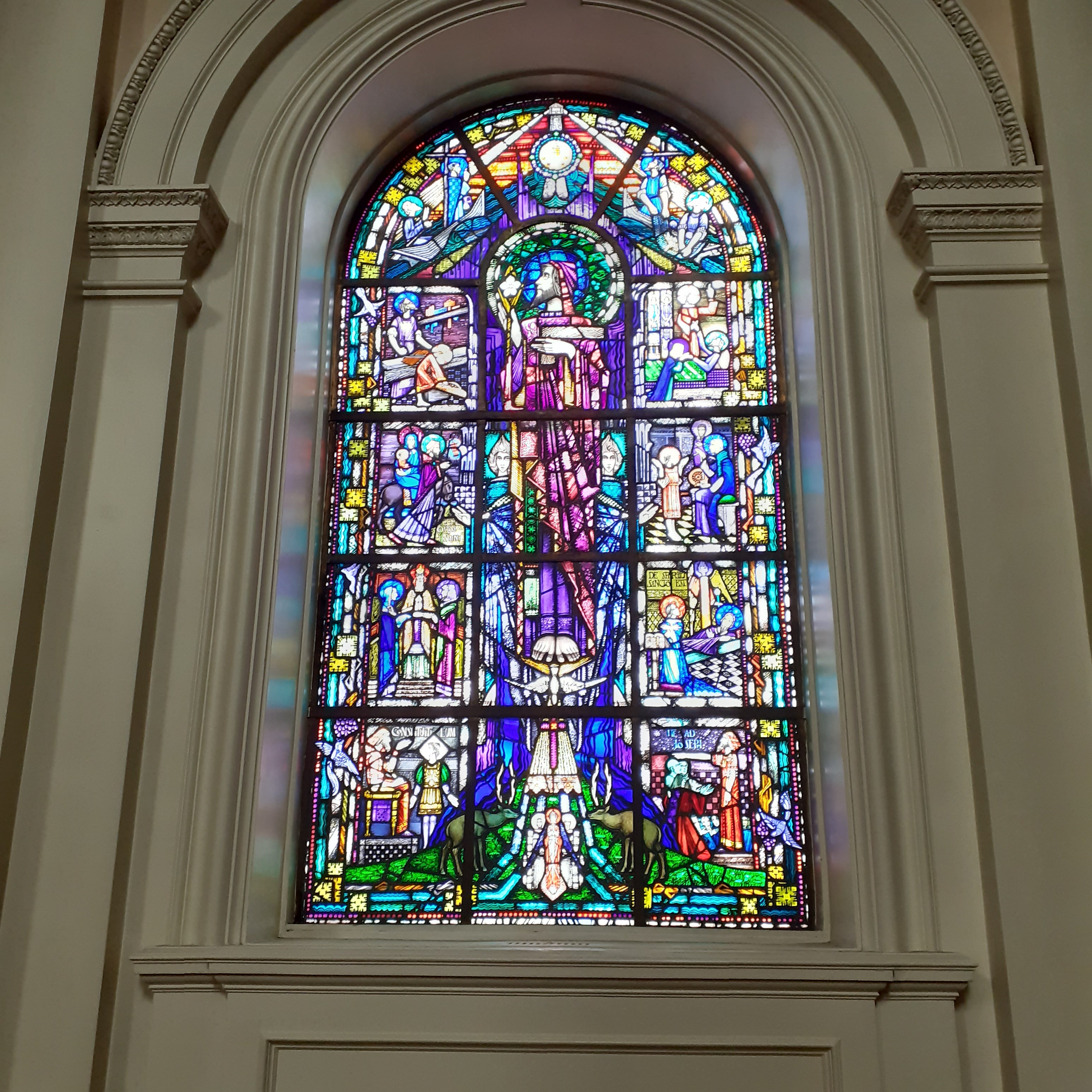
Saints Peter and Paul’s Church is an impressive Athlone landmark on the West bank. Built in the 1930s in the Baroque Revival style by architect Ralph Byrne. The neo classical entrance is framed by twin stepped belltowers and the church is topped with a central copper clad dome. Inside are five stained glass windows from the Harry Clarke studio, made by Richard King after Clarke died in 1931. Adjacent is the Luan Art Gallery, a publicly owned contemporary gallery hugging the western bank of the Shannon below street level.
On the other side of the Castle, Sean’s Bar claims to be the oldest pub in Ireland. A 1970s renovation uncovered a wall of wattle and daub from the tenth century. Artefacts found there including coins have been dated back to 900AD. Apparently Brian Boru used to pop in for the odd pint. Mind, the price of the pint has gone up a bit in the meantime, so if you leave any change lying around it won’t lie around for a millennium. The current building dates back three hundred years. It’s a pleasant, cosy old style bar and a popular music venue. The entrance is in the shadow of the Castle and there’s pavement seating in the summer. The bar steps down a few levels towards the back of the premises, where there’s a beer garden which exits onto the quayside.
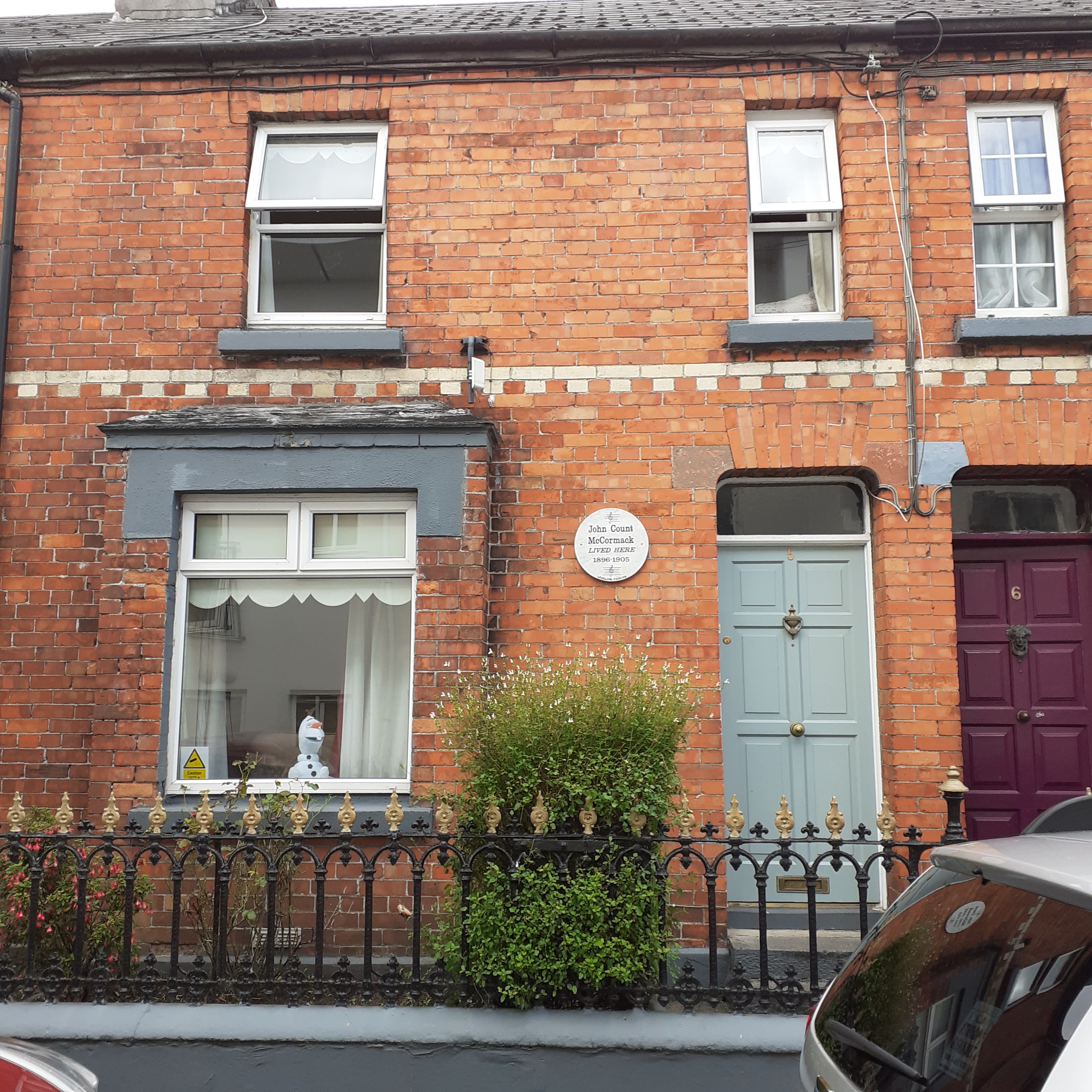
Navigation on the Shannon was facilitated by the building of a canal in the eighteenth century. This was replaced by the current system of a weir and lock gates, south of the bridge in the town centre in the 1840s. The line of the old canal forms the western border of the town, and County Westmeath, but the canal itself is no more. The winding streets of the old town are pleasant to poke around and we came across a fine old house once home to the Count himself. It’s a long way from a tumbledown shack.
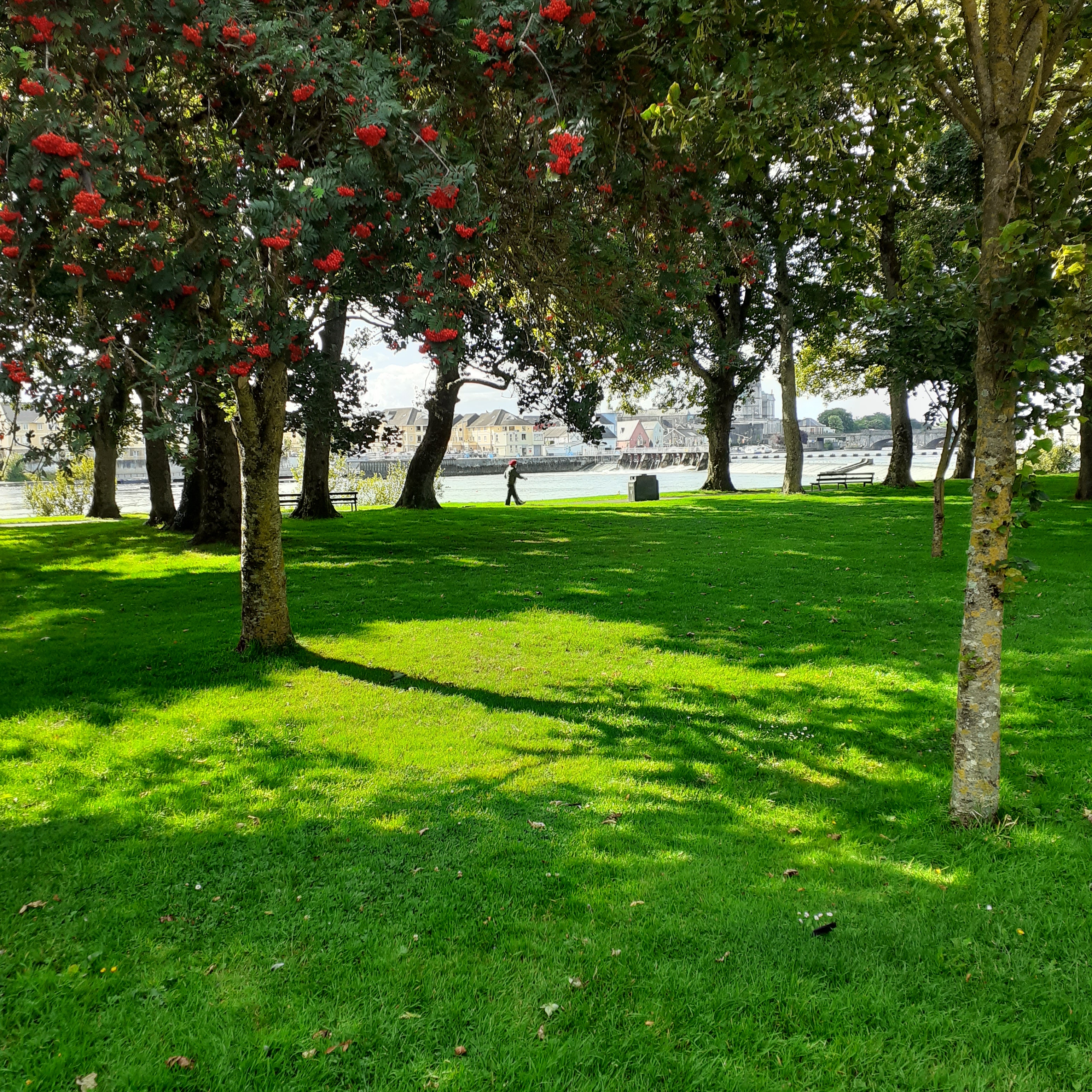
Returning to the East bank, the town’s gearing up for evening rush hour, comparatively speaking. We make our way out to the Golden Island Shopping Centre which opened in 1997. Nearby, Burgess Park beckons with woodland, walking trails, a playground and memorial garden. Sloping down to the Shannon, it is the ideal urban oasis. Sitting there in the early evening sunshine as people promenaded and relaxed, I was put in mind of Seurat’s great painting the Isle de la Grande Jatte. It just shows, that through the ages and across longitudes, people maintain a continuity, enjoying the pleasure of harmony amongst trees and flowing rivers, in the company of themselves or others.
Time to get the train back to Heuston. As a three hour round trip, the railway trip gives you time for a full day in Athlone. There are plenty of hotels too, and I must stay over sometime. Later in the year I plan to go all the way to the end of the line: Galway. Wow, I feel a song coming on.
Maybe somewhere down the road aways (end of the line)
You’ll think of me, wonder where I am these days (end of the line)
Maybe somewhere down the road when somebody plays (end of the line)
Purple Haze
This song radiates sunshine and love, and time. Most of the ingredients you need. End of the Line was written by George Harrison, and included on the Travelling Wilburys’ eponymous debut album in 1988.
Well, it’s alright (alright), riding around on the breeze
Well, it’s alright (alright), if you live the life you please
Well, it’s alright, even if the sun don’t shine
Well, it’s alright (alright), we’re going to the end of the line
Myself and my friend Paula booked a trip across to Ireland’s Eye. It’s something I had long wanted to do. In fact, I once harboured (ha ha) the ambition to visit all islands off the Irish coast, but that hasn’t happened and probably won’t. Still, it might make a good series. I’ve been on the Aran Islands (Inis Mor and Inis Oir), the Great Blasket, Garnish Island, Achill and Valentia. Attempts on the Skelligs have been jinxed, though I’ve sailed to within touching distance.
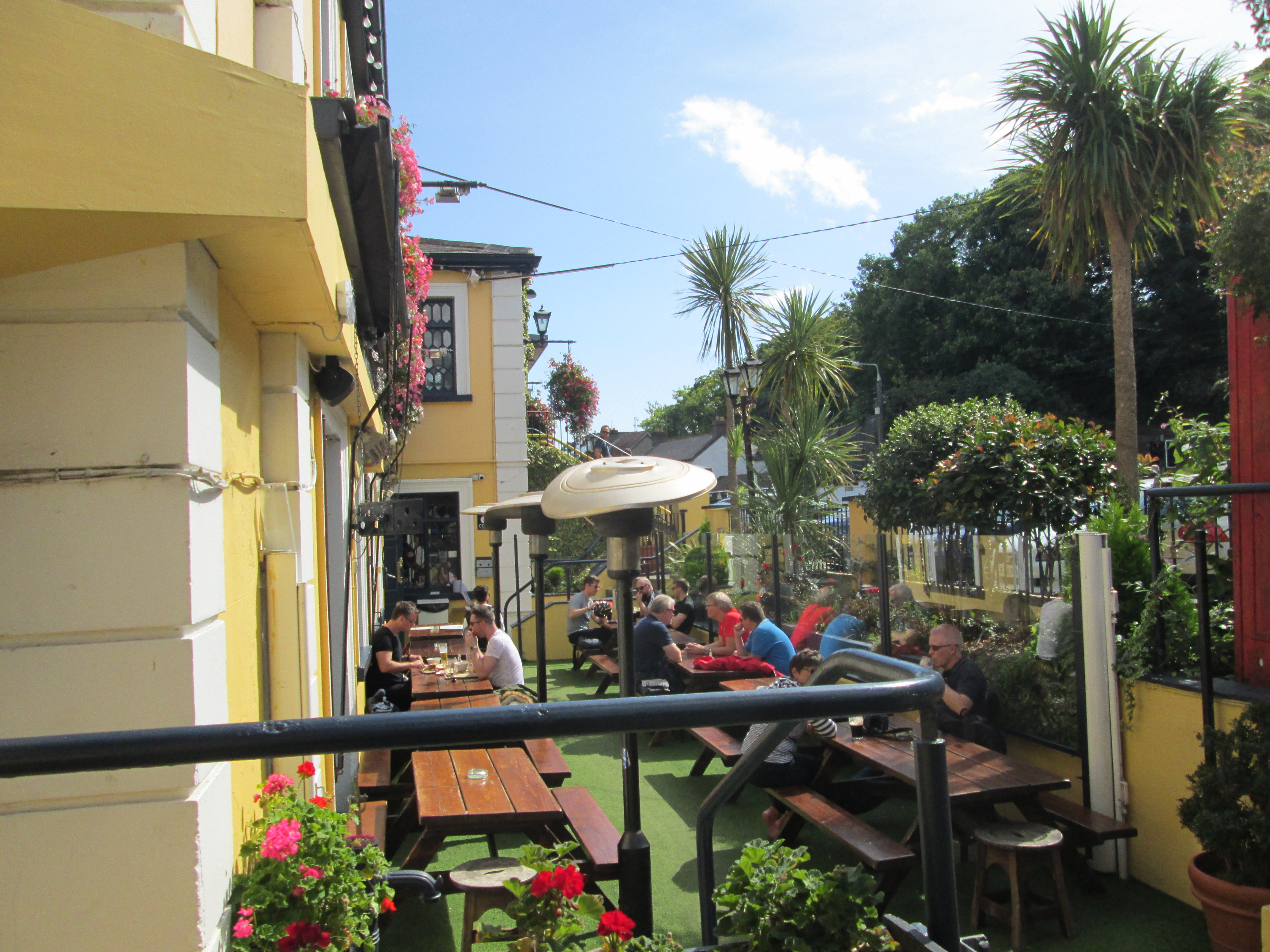
Howth is served by Dublin Bus and Dart. The train station is adjacent to the harbour. Beneath the station is a pub, the Bloody Stream, serving good food and drink in its traditional interior, or al fresco on patios to front and side. The Bloody Stream plays host to annual birthday celebrations for Phil Lynott. Born on August 20th, 1949, he grew up in Crumlin, Dublin 12. As leader of Thin Lizzy, and sometimes solo, his singing and songwriting made him the top Irish rock star of the seventies. By the early eighties it all began to fade. Thin Lizzy disbanded in 1983. Philip’s solo career didn’t ignite, though the song Old Town, and its Dublin based video became iconic; something of a celebratory epitaph besides. He died in January 1986 and is buried at St Fintan’s Cemetery in nearby Sutton. The next bithday bash will be his seventy fifth.
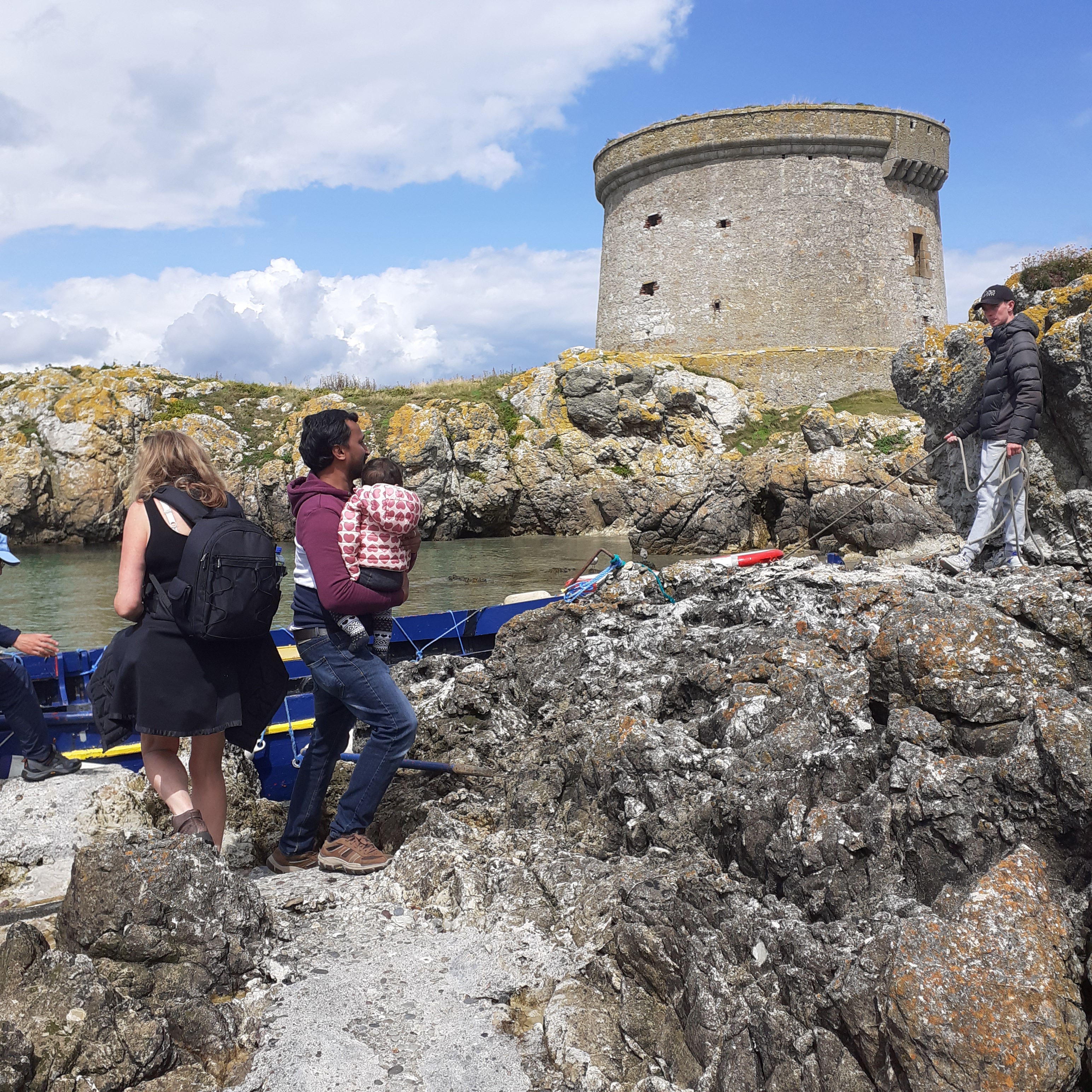
Ireland’s Eye beckons. The island lies north of the Howth Peninsula, about midway along the coast of County Dublin. The name comes from the Danish for Ireland’s island. Monks built a church there in the eight century and for five hundred years this was the parish church for the inhabitants of Howth. Later a Martello Tower was built in 1803 to protect the coast from Napoleon. These days it’s for the birds, and day trippers.
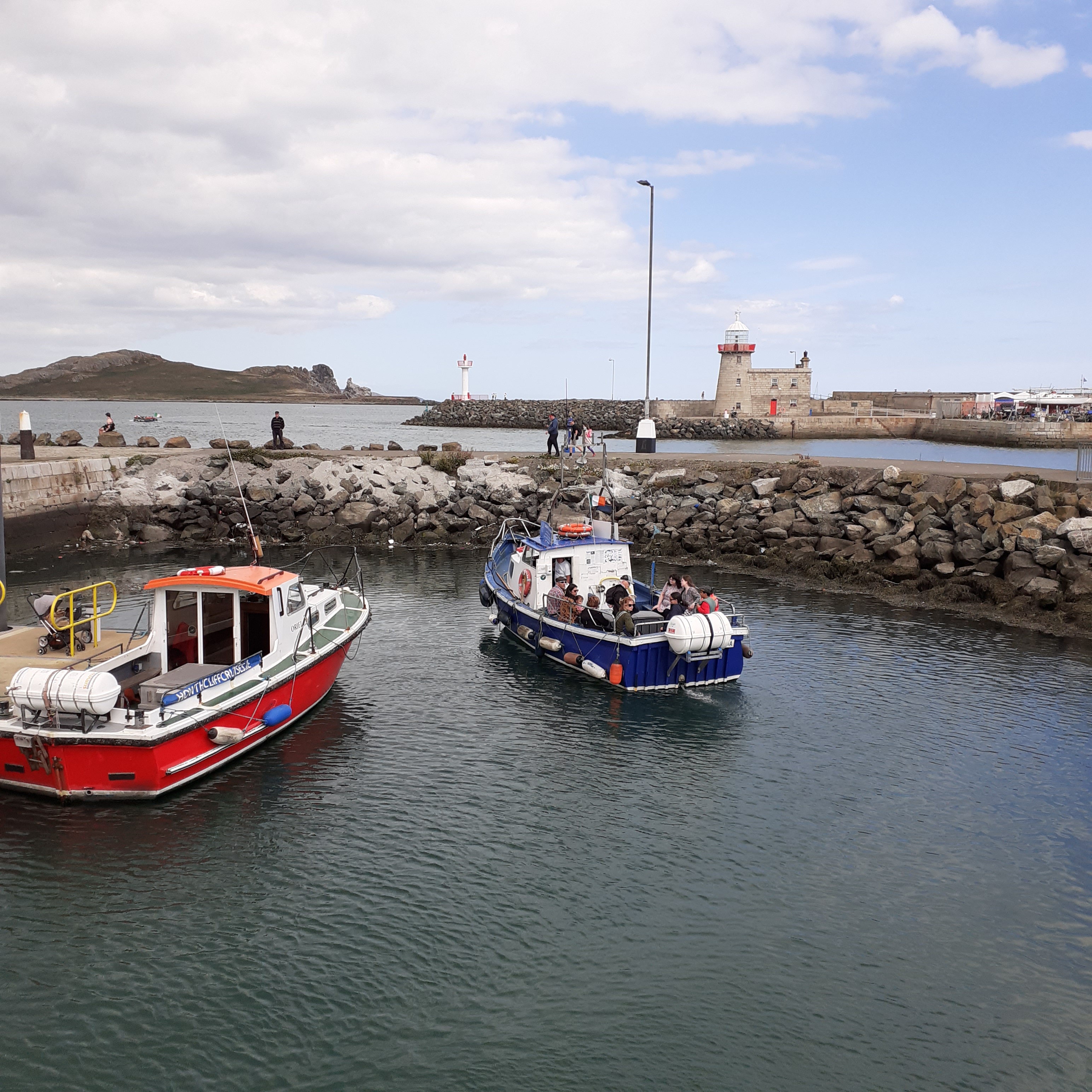
Ferries to the island, and across the bay to Dun Laoghaire, leave from the West Pier. You can book ahead to secure your seats. The crossing takes ten minutes or so, and sailings are every hour. There are a number of options with different operators, averaging about twenty five euro, but if the weather’s fine plump for landing on and exploring the island.
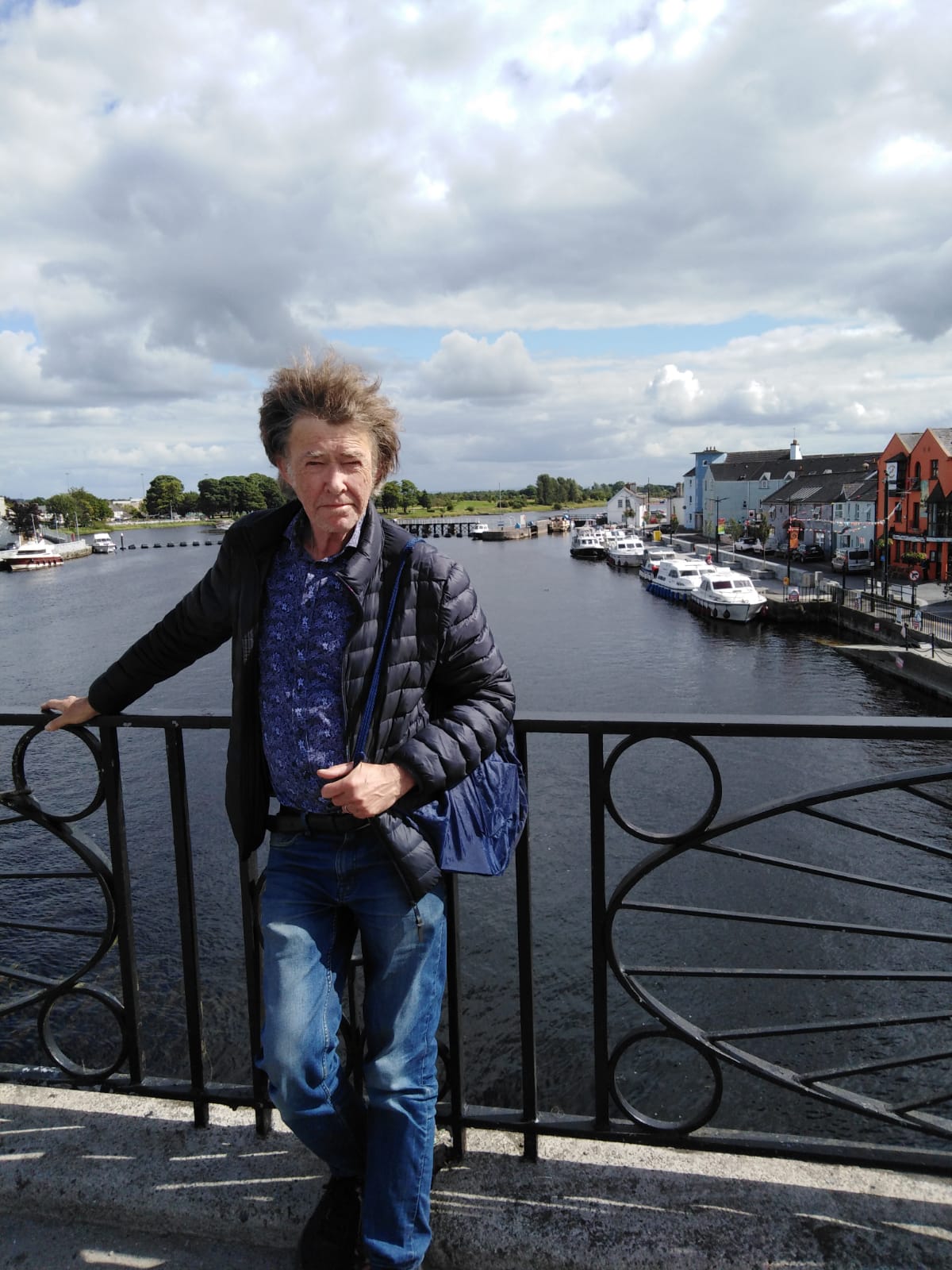
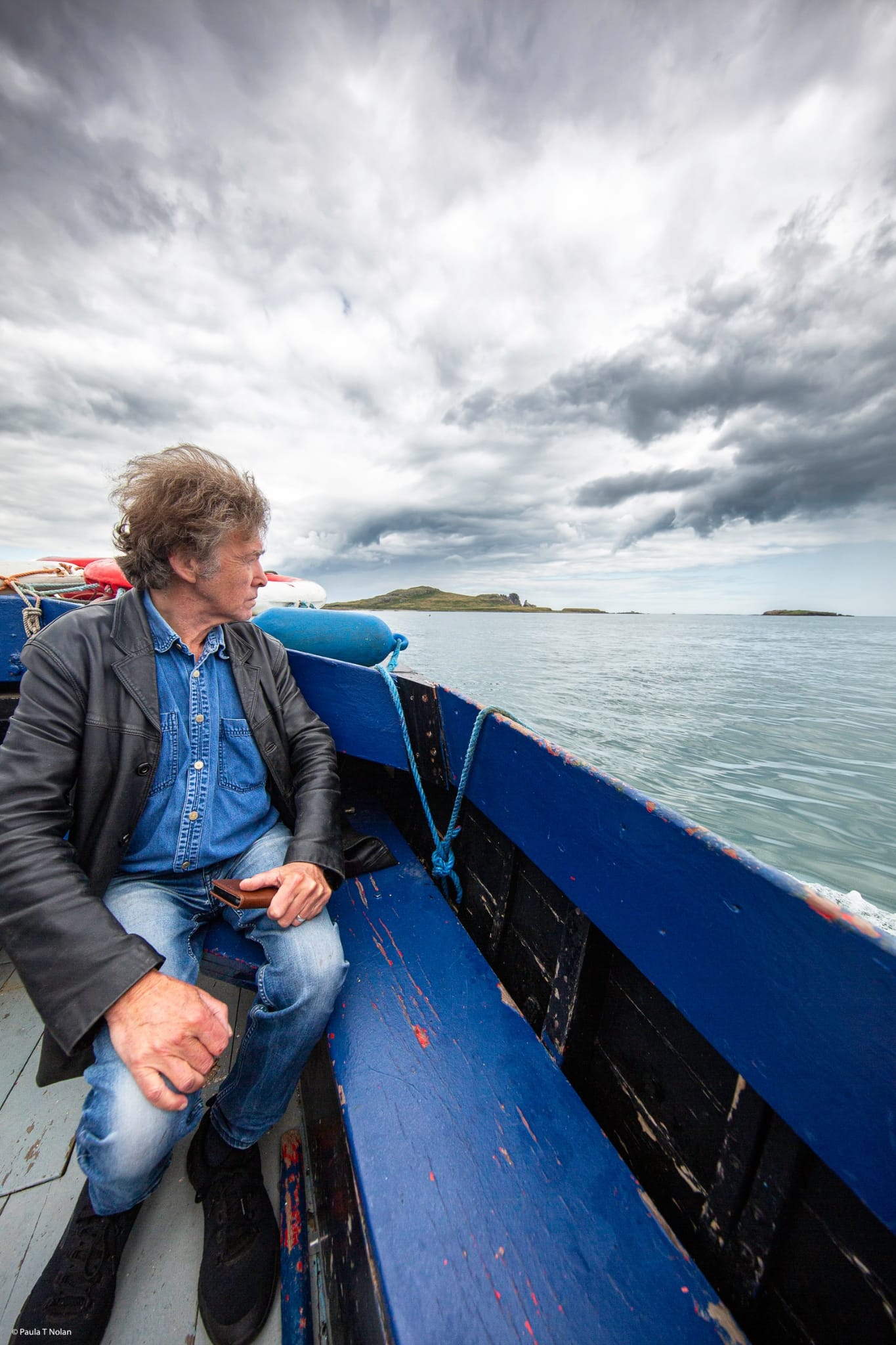
The sun is shining, the wind is blowing, and Ireland’s Eye is truly an emerald isle sparkling in the choppy waters of the Sound. My friend Paula is waiting, and a busker is playing So Long Marianne as we get on board. Paula is a photographer and it’s amazing how a professional can organise the arbitrary molecules of life into coherent and somehow meaningful visual tableaux. So, I emerge from the pixels looking somewhat mercantile and derring do. There’s no hint of that inner fear in being suspended above a watery chasm while the descendants of predatory dinosaurs circle and dive from the skies. There’s Scandinavian blood in me for sure. Well, Scottish in truth.
I wish I was a fisherman
Tumblin’ on the seas
Far away from dry land
And it’s bitter memories
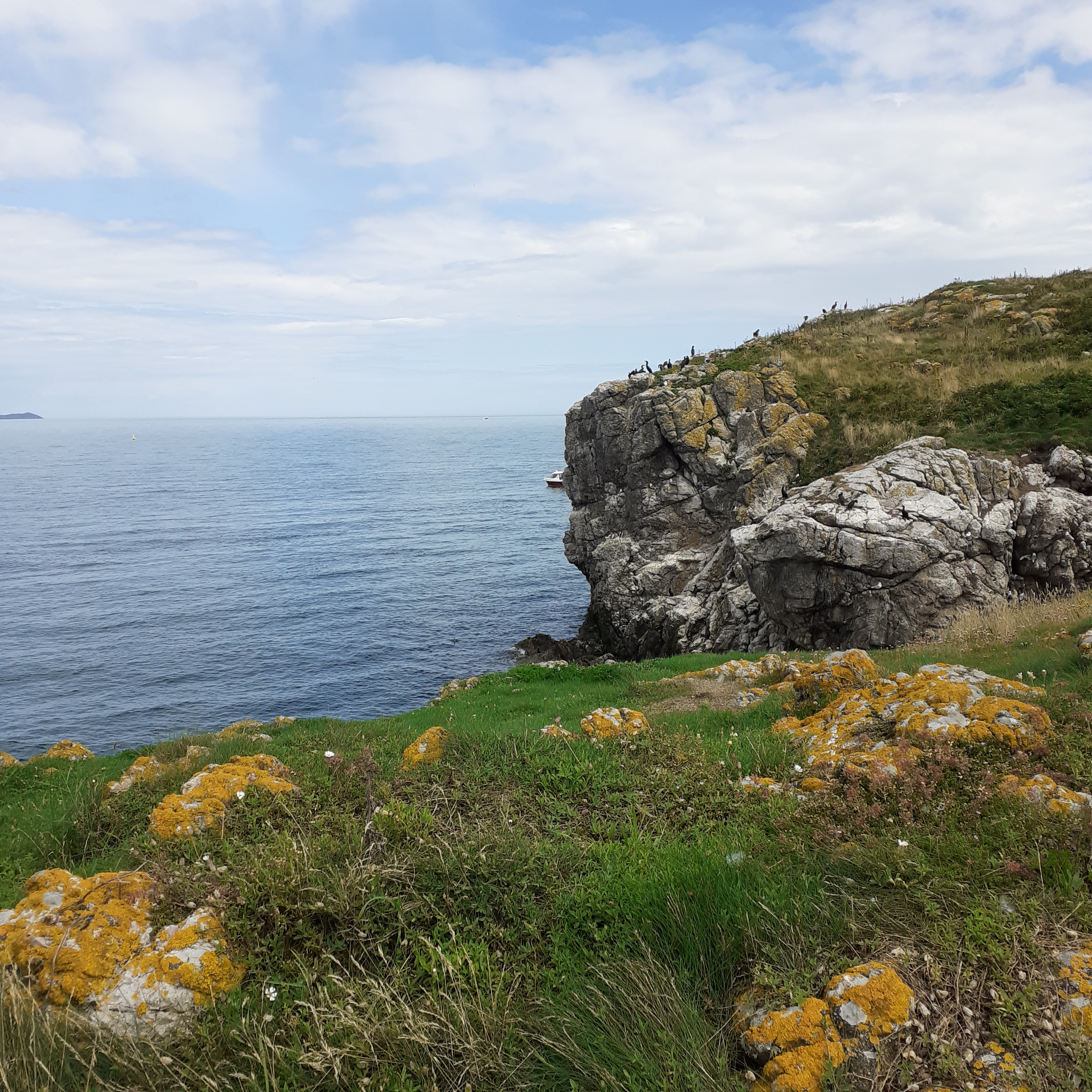
We transfer to a smaller craft for landing. It’s surprising how much larger the island seems when you set foot on it. Although several disembarked, we were quickly alone. We made for higher ground. It’s a good climb to the top and, once elevated, you get that giddy feeling of being marooned on a small island. We attempted to scale the heights but this old goat wasn’t as sure-footed as of yore. I nearly took the fast route down to the beach. The weather was good for our visit, though not exactly desert island disc good. There are beaches and coves, wonderful views, cliffs and plenty of birds. The enthusiast can search for guillemots, razorbills, kittiwakes, cormorants, puffins, gannets and gulls. Remember, this is their territory, and they know it.
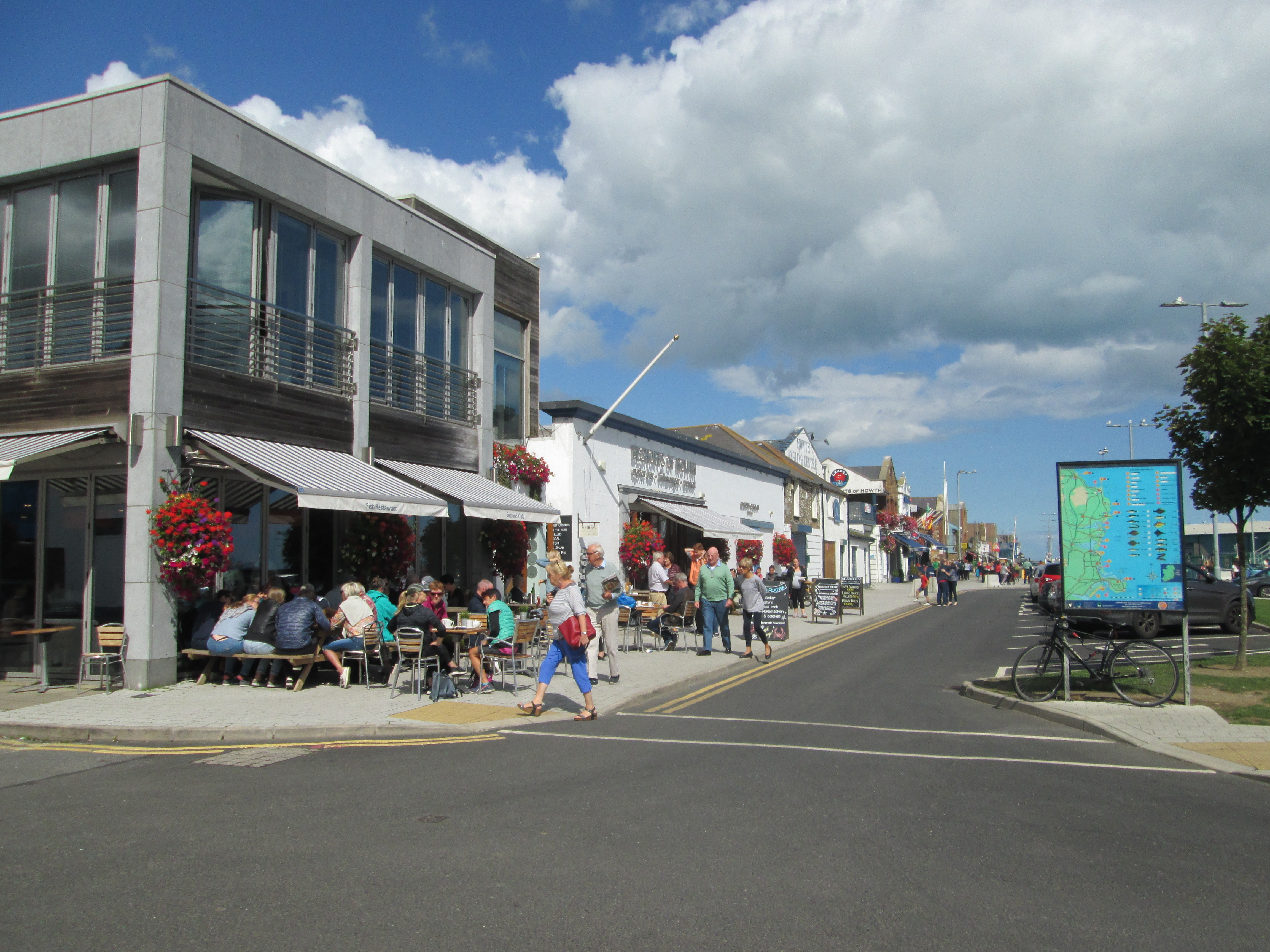
We make it back to the jetty in time to catch the return boat. We’re in an envelope of peaceful blue and sunshine; it feels like floating on forever. There’s grey seals in the sound and the harbour doing just that. Back on dry land, or land anyway, there are plenty opportunities for your drinking and dining pleasure along the West Pier. You can go for the basic, yet always beguiling, fish n chips with a bottle of suds, or perhaps go for more exotic seashell confections. There’s Beshoff’s, Crabby Jo’s, the Brass Monkey, Octopussy’s, the Helm, Baily Bites and Aqua. Howth can be your oyster, quite literally.
Castin’ out my sweet line
With abandonment and love
No ceiling bearin’ down on me
Save the starry sky above
With light in my head
With you in my arms
Fisherman’s Blues was written by Mike Scott and Steve Wickham in early 1986. A busker’s favourite, and one of my own, it was the title track of the Waterboys’ 1988 album.
With five episodes so far in our tour of Andalusia, a couple of destinations remain. In April I will be going to Seville and Cadiz and I look forward to giving my account of those two fascinating cities. Seville is the capital and largest city in the region and dates back over two thousand years. Cadiz is more ancient still; one of the oldest towns in Europe. I will be travelling by plane, bus and train. Meanwhile, we will be taking a break in our hideaway in Elviria, Marbella. A break, for me, means doing nothing much at all.
We’re going on a holiday now
Gonna take a villa, a small chalet
Costa del Magnifico
Yeah, the cost of living is so low
Scribbling is allowed, in whatever form I decide to record worthwhile memories. Some painting or prose, or both, will emerge. This acrylic is a moment captured last Spring in Elviria, just a few kilometres east of Marbella. That rippling blue rectangle is a familiar motif in Hockney’s Californian paintings and sum up that mood of ecstatic indolence at the heart of swimming pool culture. To be sure. There are a couple of musical equivalents; though less than one might suppose. Kate and Anna McGarrigle’s rendition of Loudon Wainwright’s The Singing Song is one and Nightswimming by REM another, if not quite the right time of day. Closest is Dire Straits, with Mark Knopfler’s Twisting by the Pool. A rare fun rocker from the bluesy Geordies, it is a retro take on the Spanish holiday boom for sun starved Britons in the early sixties. The song doesn’t appear on any of the band’s studio albums, and first surfaced as a single 1983. It was a firm favourite as an encore, as I witnessed at Stadium gig in Dublin the early eighties.
Yeah (yeah), gonna be so neat
Dance (dance) to the Euro beat
Yeah (yeah), gonna be so cool
Twisting by the (twisting by the)
By the pool (twisting by the pool)
So, while I hope to be pumping ink with my biro, or painting my next masterpiece for over the mantelpiece; more than anything else I will be
Twisting by the pool (twisting by the pool) twisting by the pool (twisting by the pool)
We’re twisting, twisting by the pool, twisting by the pool, twisting by the pool
Twisting by the pool (twisting by the pool) twisting by the pool (twisting by the pool)
We’re twisting, twisting by the pool, twisting by the pool, twisting by the pool
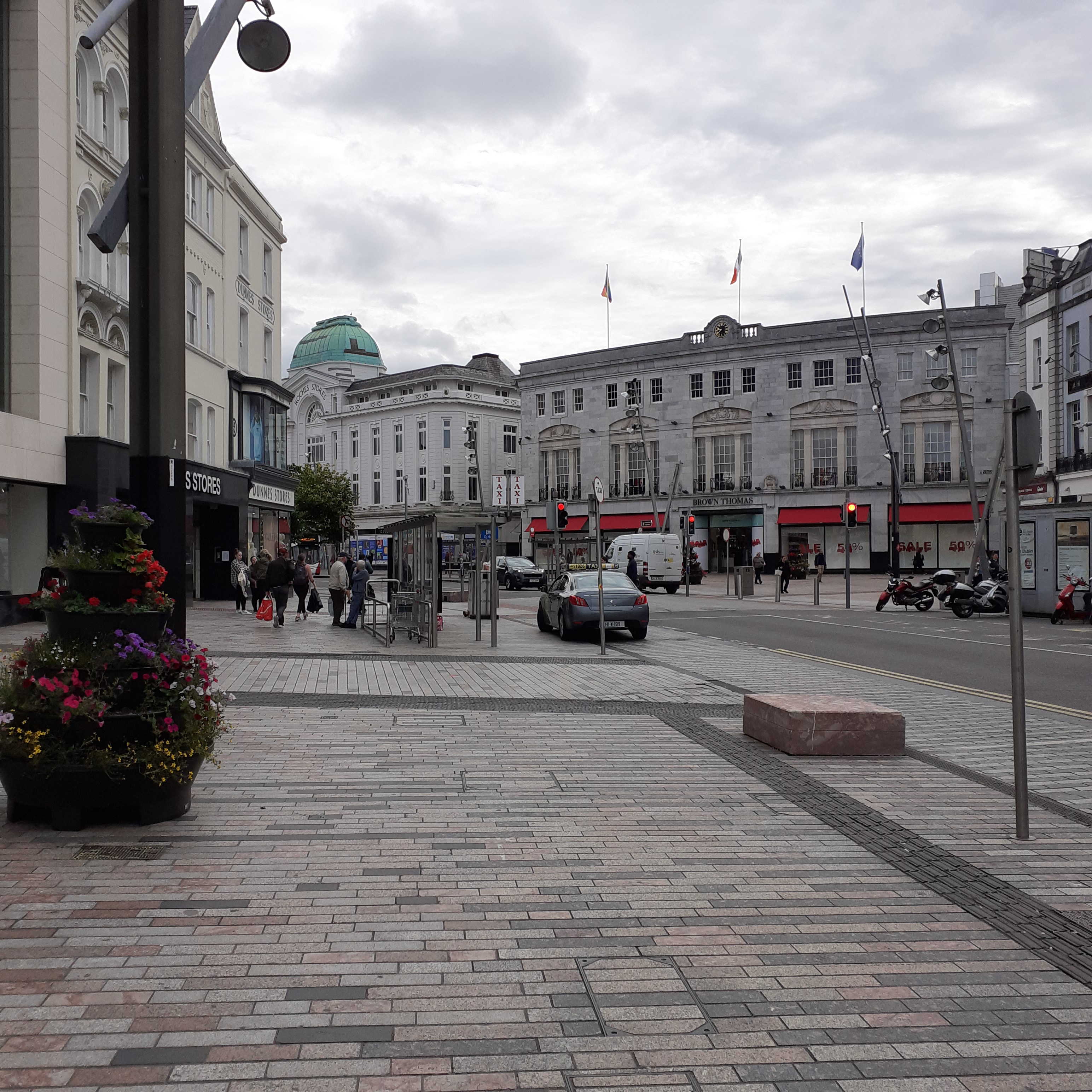
As a medieval settlement, Cork was a walled town west of Grand Parade, centred on what is now known, somewhat misleadingly, as Main Street. The official, and actual, main street, Patrick Street, is wide, but spectacularly curved. This actually follows the line of an old river channel in medieval times, the modern street being built on vaults over the water.
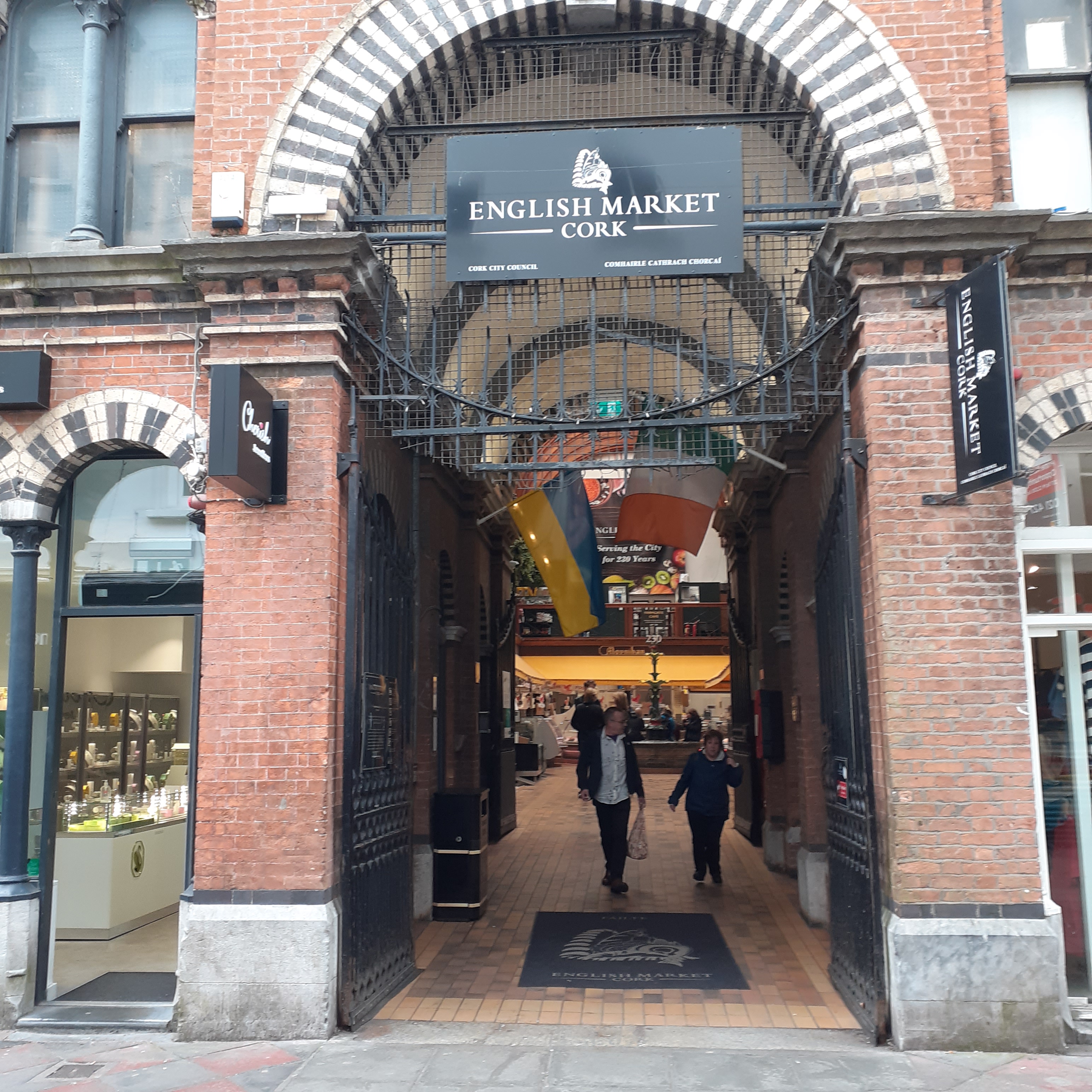
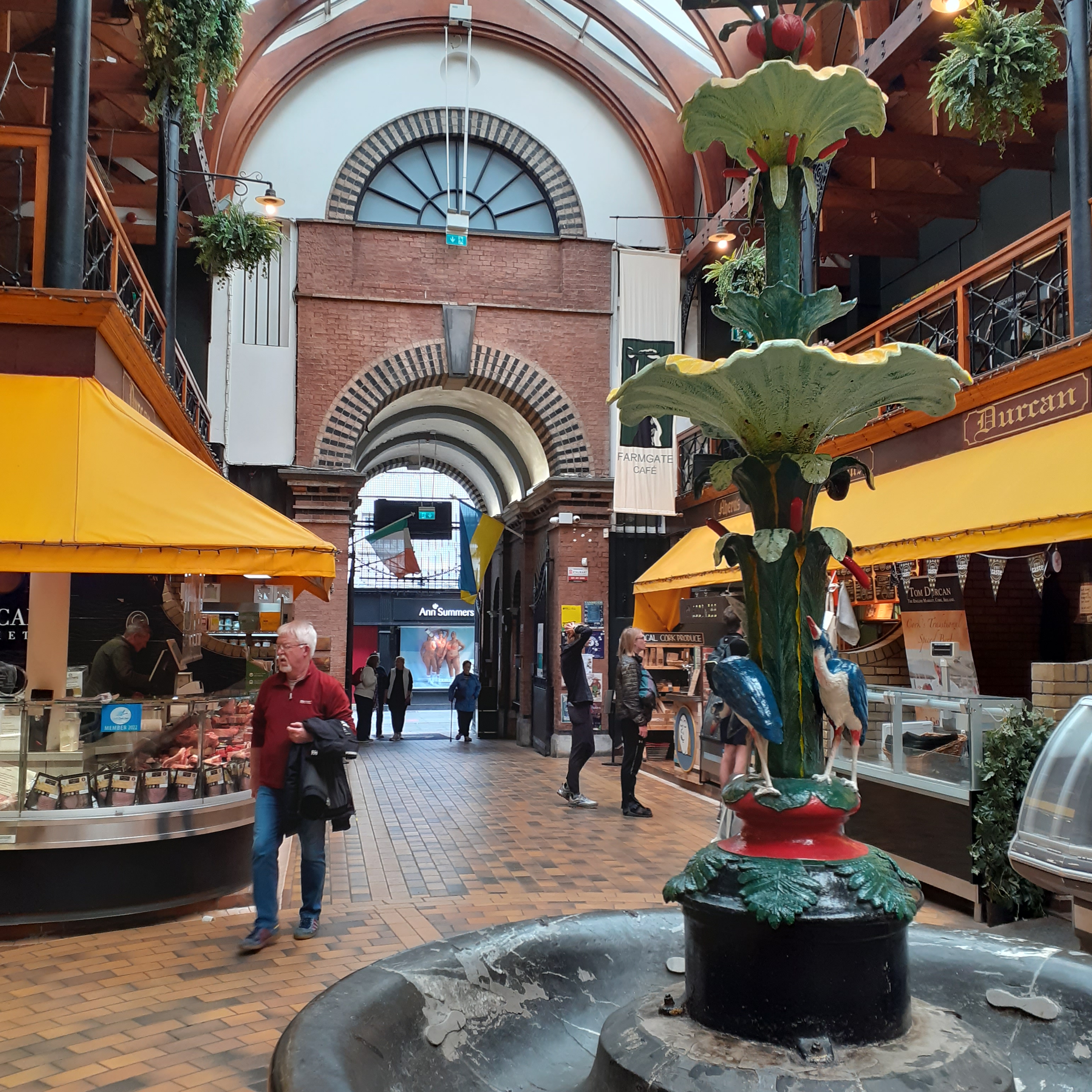
Just off the west end of the street, you’ll find the English Market. With its butchers and bakers and candlestick makers this is a perfectly preserved urban market in the Victorian style. It actually dates back to 1610 when first established by the Protestant city council. The name evolved to distinguish it from the old Irish Market on Cornmarket Street nearby, now the Bodega. The present building complex dates from 1786, though it has had further significant alterations since. The main entrances at Patrick Street and Grand Parade were part of a Victorian makeover. The Grand Parade ornamental entrance was designed by John Benson in 1862. Within the covered market, the arcades converge at a central cast iron fountain ringed by a raised mezzanine with restaurants and cafes.
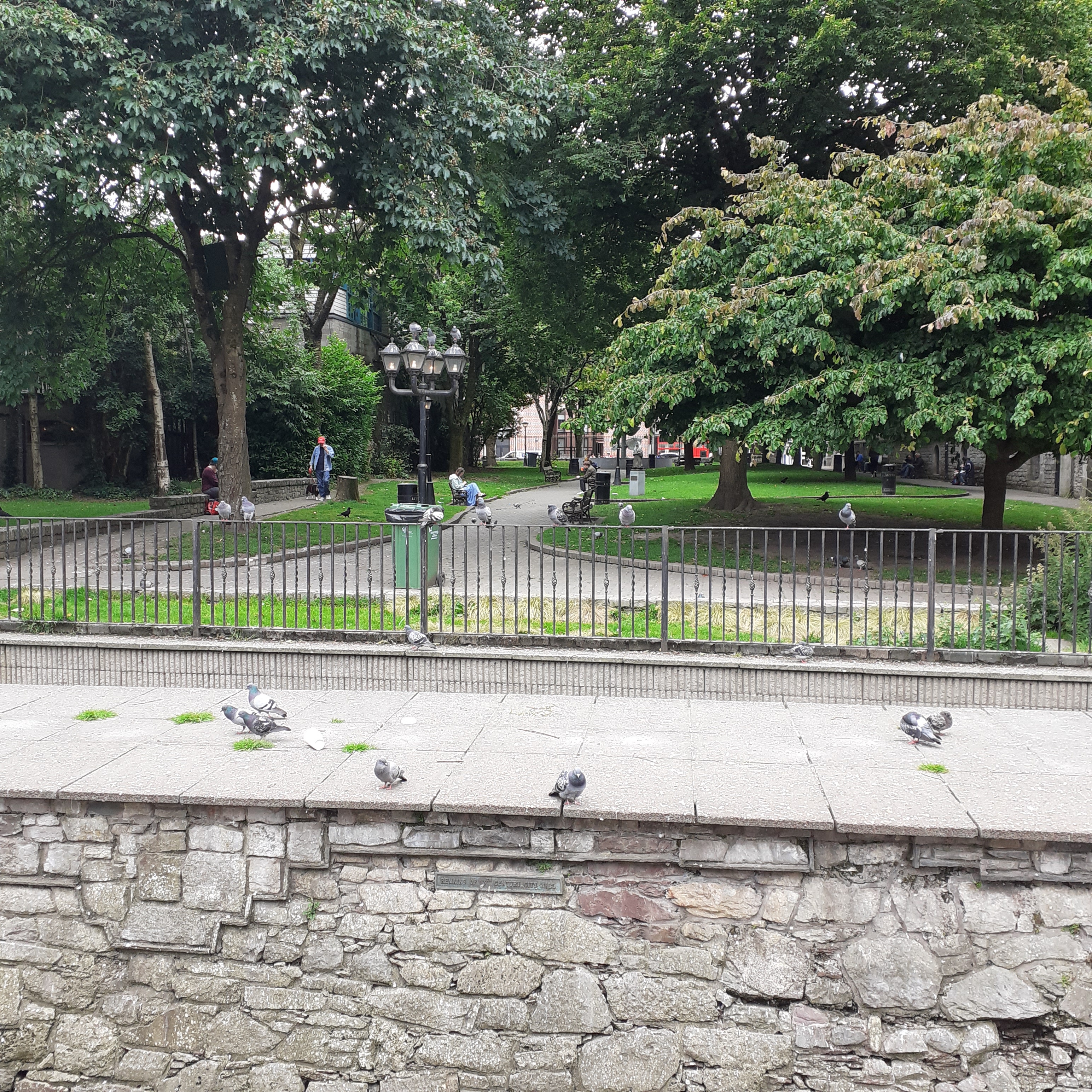
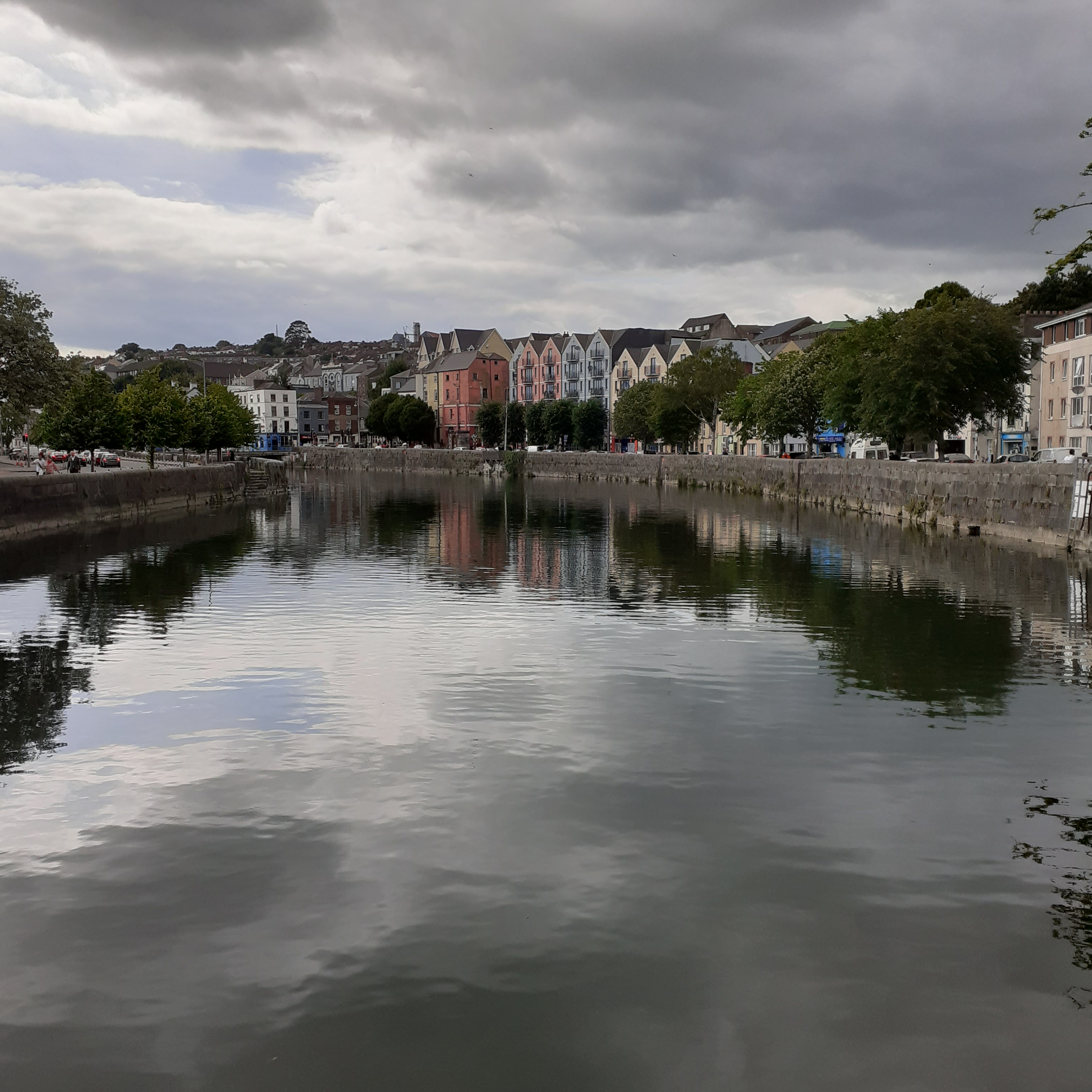
Patrick Street loops to an end at Grand Parade which is broad and straight. Like Patrick Street, it was once a water channel, the ancient settlement of Cork growing up on its west bank. Evening rush hour was approaching so we stopped for coffee and a snack at a place nearby, the Bean and Leaf, with a pleasant terrace from which to watch the world go by. On the far bank is Bishop Lucy Park, with remnants of the medieval citywall visible inside the entrance. It’s one of few parks in the city centre and dates only to 1985, when it was built to celebrate eight hundred years of city status. Around that time, myself and M holed up in Cork again at the end of a significant adventure.
It was our honeymoon, many moons ago. We stayed some days in Adare, County Limerick. Having left that frostbitten fantasy, we headed south on the midwinter roads. By Cork all had thawed and rain fell constantly on the rising waters of Cork city. We hadn’t a place to stay and booked into, and quickly out of, a dump on the outskirts of the city. Driving on into the rain and the city centre, we parked the car in Grand Parade and sought out a hotel there. They said they were full, as places tend to be in midwinter when two drenched hippies materialise in the foyer. We explained the situation and they clicked into gear. We got a nice room to the rear of the hotel. From the window, the illuminated cathedral of Saint Fin Barre sailed like a galleon across the night horizon. We would look at it occasionally through the rainsoaked pane. The hotel is now, I think, the Library.
But every time it rains
You’re here in my head
Like the sun coming out
Ooh, I just know that something good is gonna happen
I don’t know when
But just saying it could even make it happen
Cloudbusting by Kate Bush is from her 1985 album The Hounds of Love. It concerns a son’s love for his father, inspired by Peter Reich’s biographical Book of Dreams. But expressions of love can be appropiated to one’s own desire.
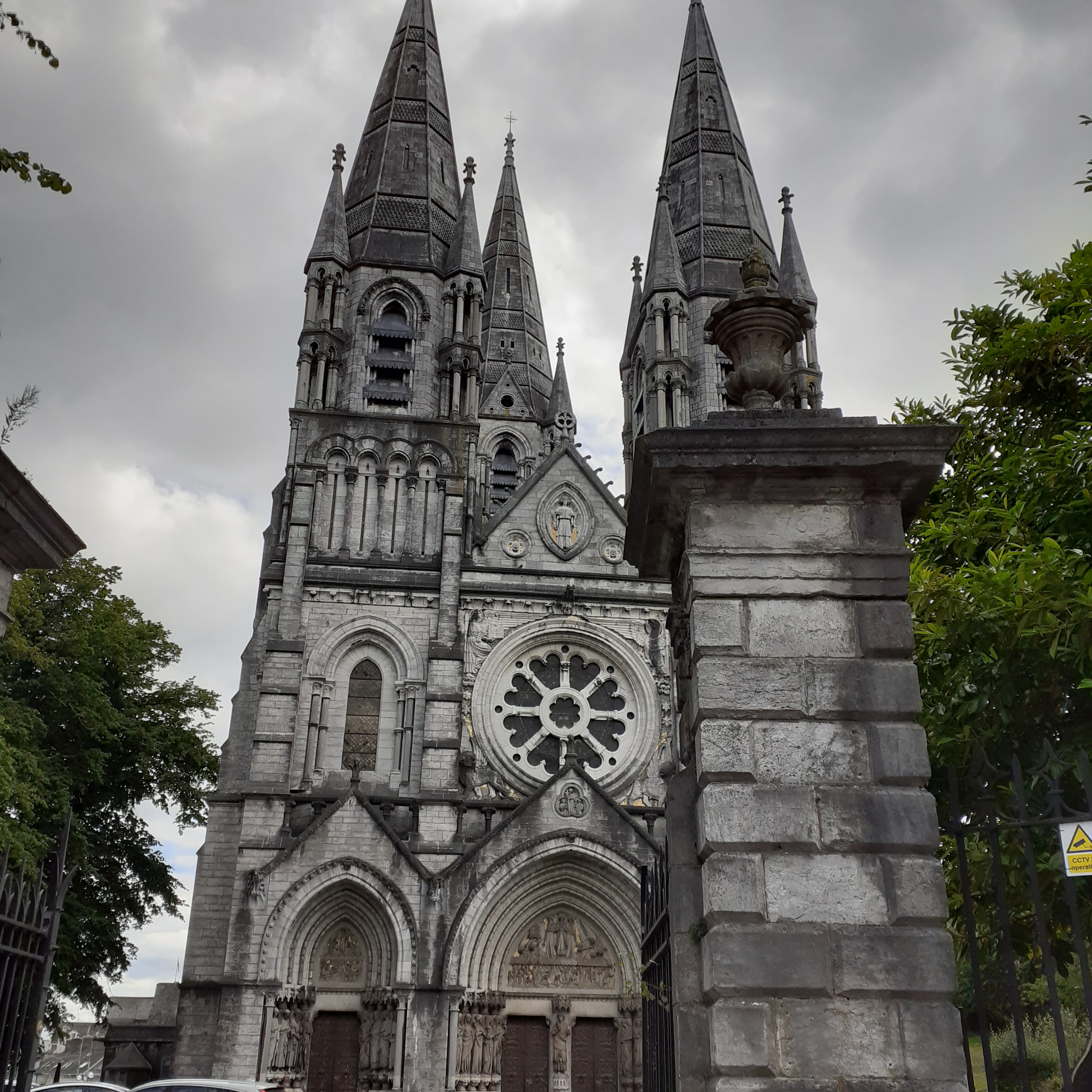
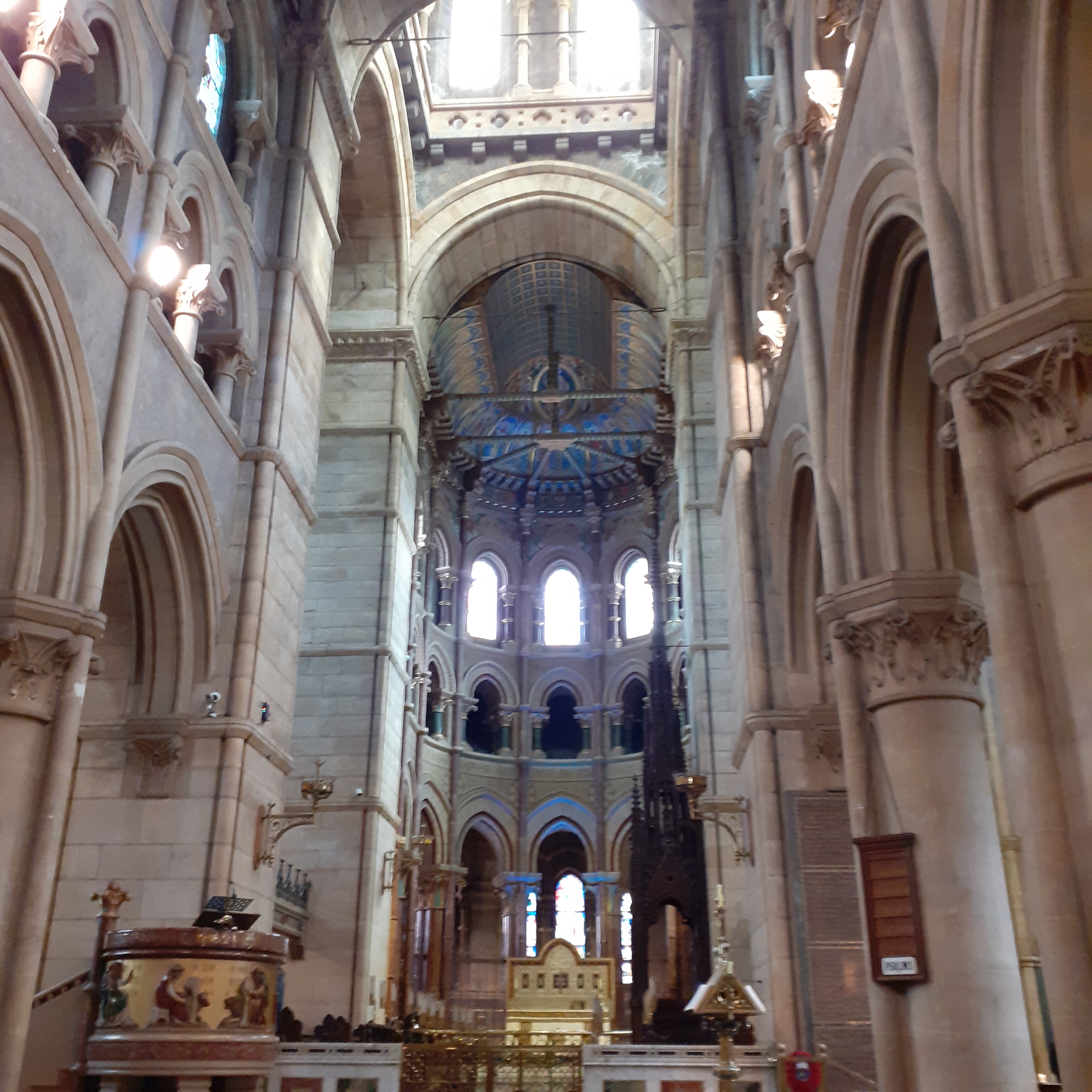
Saint Fin Barre’s lies just across the south branch of the Lee. It is the Church of Ireland Cathedral for Cork. Begun in 1863 and designed by English architect William Burges. It is a Gothic Revival masterpiece. Twin spires frame the entrance and the massive central spire towers above the nave. The exterior creates an impression of grand scale despite a relatively small interior. It replaced the eighteenth century building, long derided as ‘a shabby excuse for a cathedral.’ Finbarr is the patron saint of Cork city, born in the mid sixth century, he was based at Gougane Barra, some miles to the west at the source of the River Lee.
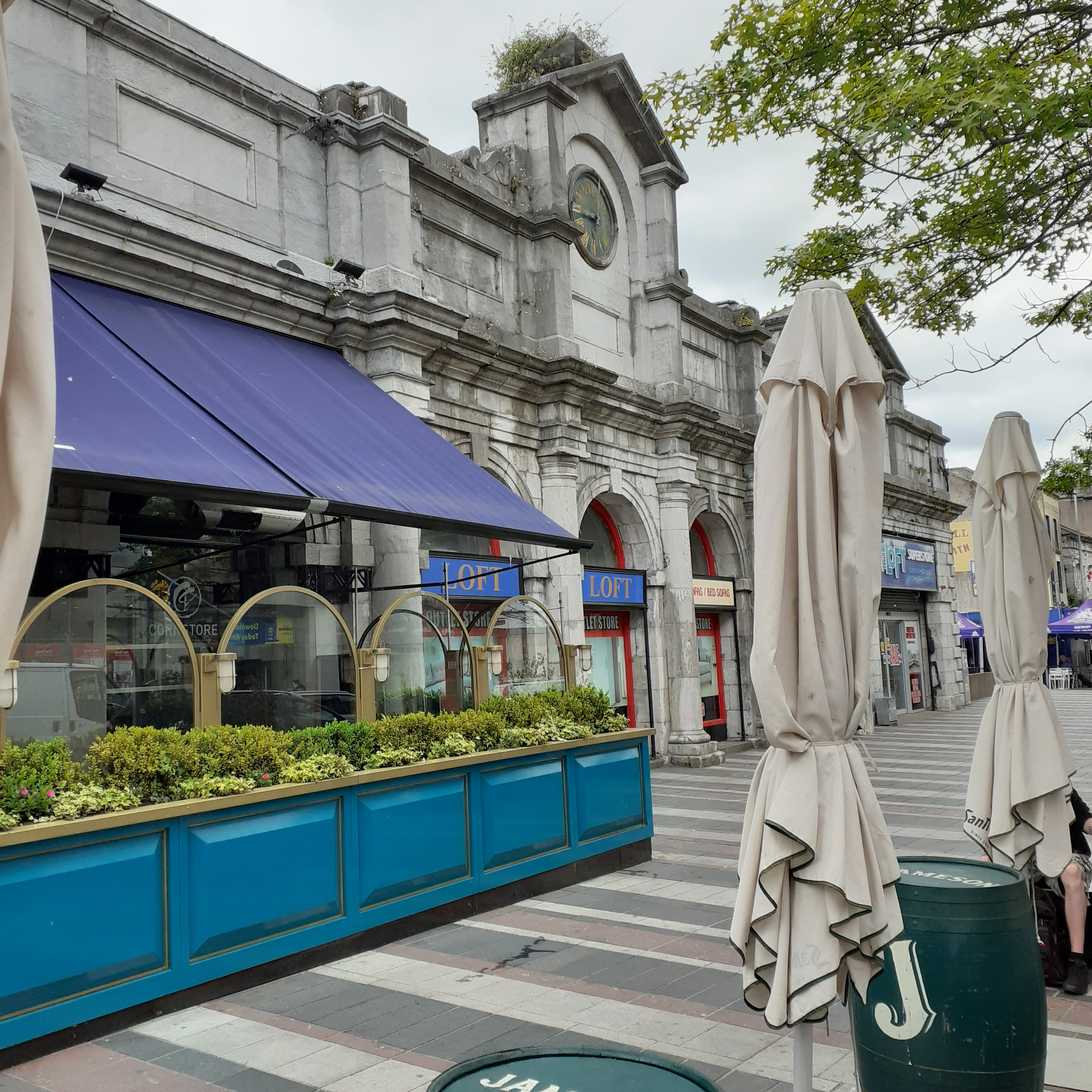
North of the junction with Patrick Street leads into Cornmarket Street. This is sometimes referred to as Coal Quay, as it was once a quayside on a short canal leading out to the River Lee. The grand old Victorian building along the western side housed the original Cornmarket. This was converted to a corporation bazaar in 1843. Known as St Peter’s Market it occupied a half acre site with hundreds of market stalls. It now houses a food and drink complex, the Bodega, including the Old Town Whiskey Bar and several craft and retail outlets. There’s a vibrant street market on Saturday mornings
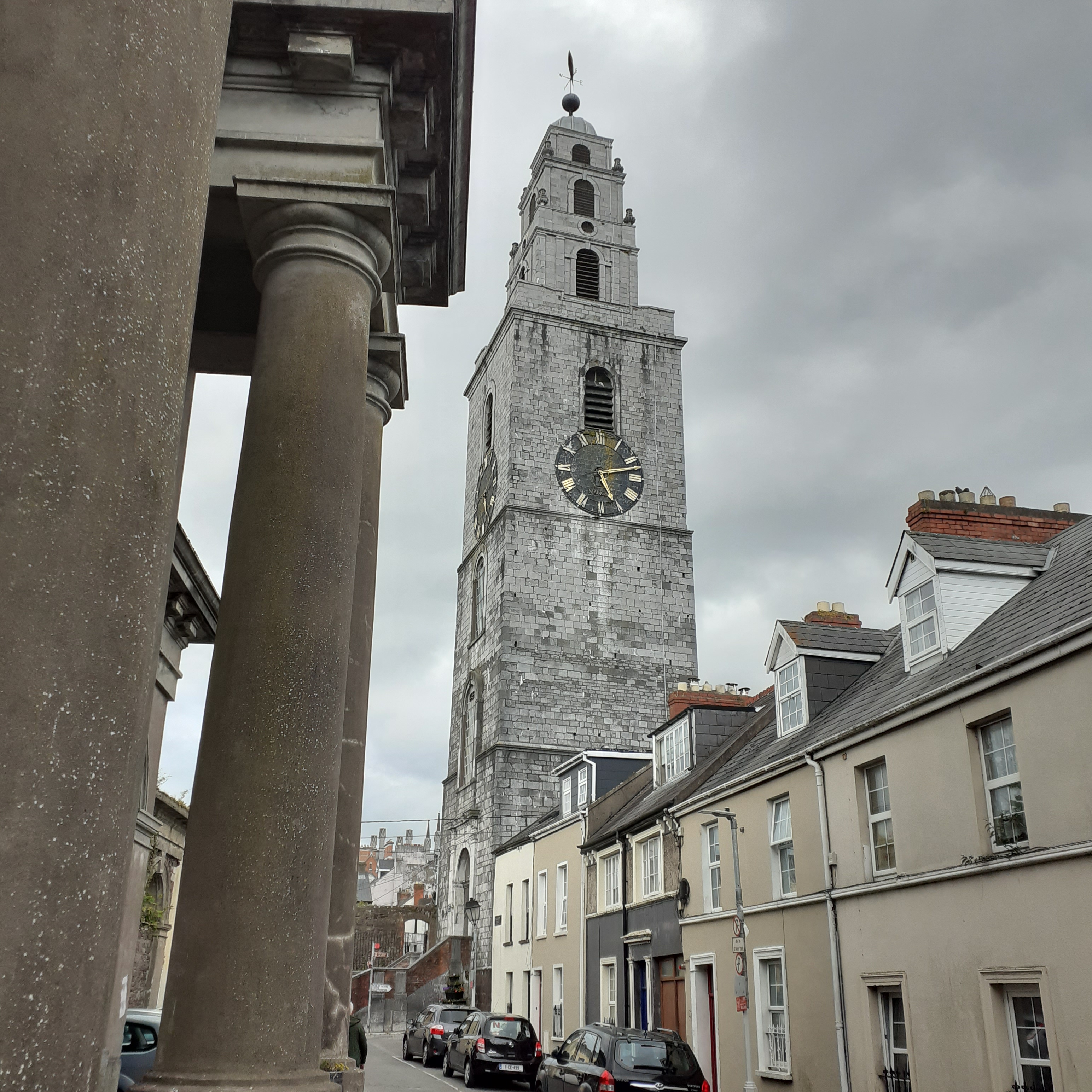
Cornmarket Street leads us back to the north branch of the river where we can cross to Shandon, its packed slopes crowned by Shandon Church with its famed belfry. This is a Cork icon, its distinctive stepped spire rising above the north banks of the Lee. A steep climb up Widderling’s Lane brings us to Dominic Street. The area maintains its ancient atmosphere, almost Mediterranean, with the packed housing streets set atop each other.
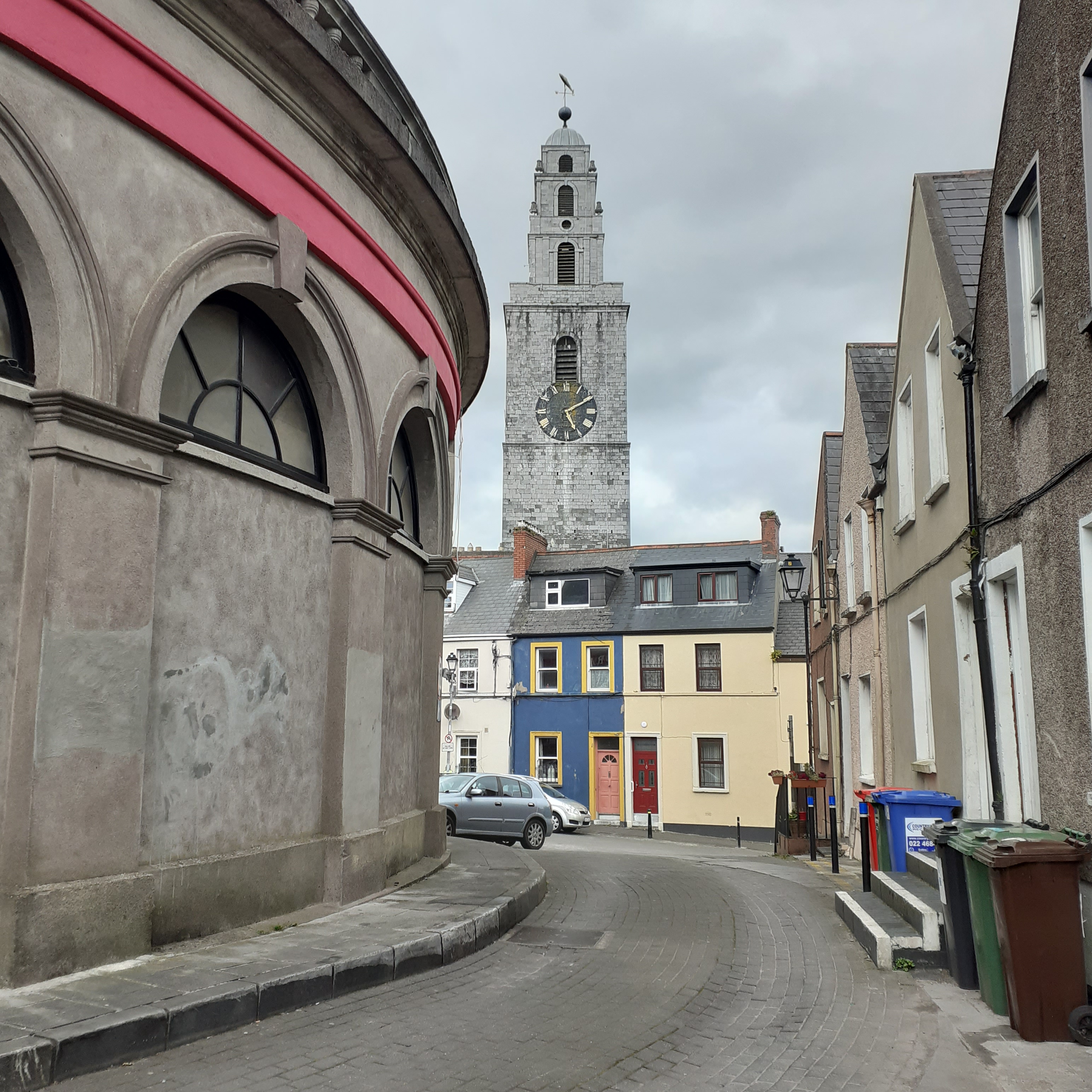
The Firkin Crane Arts Centre occupies its own little island. The distinctive rotunda was designed by John Benson in 1835 for the Cork Butter Exchange and now operates as a centre for theatre and dance. The Butter Museum is across the road. In the early evening, the empty urban space was oddly rememiscent of De Chirico’s haunted paintings. At one end of square there was an attractive Syrian restaurant, a few haphazard tables strewn outside, awaited the evening’s custom.
The Church of St Anne (CofI) nearby was built between 1722 – 26. The Church’s carillion is famous, and visitors can contribute from a choice of melodies. The eight bells were cast in Gloucester and have been ringing out over the city since 1752. As with kissing the Blarney Stone, ringing the Bells of Shandon is something of a rite of passage for any visitor to Cork. We did so on a visit in the nineties. Myself and M, and the boys, camped in Blarney and took the opportunity for a quick trip to Cork which is just 8km away. The road to Bantry connects directly to Shandon.
The Church is set village style on its own grounds and built in red and white sandstone, the Cork colours. The tower rises to 120 feet, surmounted by a further fifty foot with its pepper canister topping. Climbing through the rafters we emerged atop the bell tower to sway above the dizzying streetscape. I still get vertigo just thinking of it. The main object, of course, is to ring the Bells of Shandon. The ringing apparatus is located below on the first floor, and a nice man called Alex introduced us to our simple task. A varied popular repertoire is supplied, and, if my memory serves me well, my contribution was the Beatles, All You Need is Love (Lennon/McCartney, 1967)
Cork was built on an island between two branches of the River Lee. It means marshy place and is very prone to flooding. There were monastic and Viking settlements here, but is first noted as a city in the reign of King John, Lord of Ireland, in the late twelfth century. I regularly passed through on the way to family holidays on the south coast, and later with friends in those halcyon days; heading for Kinsale, or other vague destinations, by Hook or by Crooke. We once camped near Shandon, but more salubrious accommodation would come.
I stayed here in 1980 for the Jazz Festival and the Labour Party Conference. We stayed up late at the Metropole which had formed into one of those festival club montages, wandering from room to room as different jazz performances floated from doorways – solo piano, bebop combos and goodtime trumpet playing band. The Jazz Festival was born in 1978 when Jim Mountjoy, marketing manager of the Metropole, was looking for something to coincide with the new October bank holiday introduced by Labour minister Michael O’Leary the previous year. This often coincides with Hallowe’en, the ancient Celtic festival of the dead. Wild and windy, and wonderfully spooky, what better time for a festival of the devil’s music in a southern delta. The sponsors then were John Player whose cigarettes provided an excellent companion to all forms of music, though perhaps forever associated with Procol Harum’s A Salty Dog.
We sailed for parts unknown to man
where ships come home to die
no lofty peak nor fortress bold
could match our captain’s eye
Ella Fitzgerald headlined at the Cork Opera House that year, and for forty five years the festival has featured the cream of local and international jazz, and its children too.
Our accommodation then was more modest than the Met. When the last note sounded in the wee small hours, we got our car and headed south of the river. Darkness still reigned though the rain had ceased. However, that most Corkonian of downpowers must have burst the dykes and the streets turned to waterways. Back in Venice again, at the wheel of my own motor launch, a Renault 4 to be precise, I drove milk float slow with water halfway up the hub caps.
This time we take the train. There’s a train every two hours from Dublin Heuston, and the journey takes about two and a half hours. The frequency ensures it’s not too crowded. I avail of my free travel pass, with M being my designated minder. We arrive in Cork Kent and make for McCurtain Street. The Isaacs Hotel is opposite the larger Metropole hotel. McCurtain Street itself is north of and parallel to the River Lee.
At the foot of McCurtain Street, St. Patrick’s Hill takes us down to the river. This is the north branch of the River Lee, embracing Cork city centre on its low lying island. Patrick Street, across the bridge, is the wide and winding principal street. It has the most ugly street lighting you are likely to see, a deranged bundle of oblique scaffolding and spotlights which clash with the elegant streetscape.
Cork is Ireland’s second city. Recent boundary changes have seen its population surge towards the quarter million mark. Back in the day, in the seventies and eighties, it held barely a hundred thousand souls. Walking the city streets in late summer, that increase is palpable. There’s a buzz abroad.
Narrow lanes lead off Patrick Street, boasting such colourful names as Drawbridge Street, Bowling Green Street and Half Moon Street. The names evoke an olden atmosphere and this pervades much of the streetscape too. There are plenty of cafes and bars with outdoor seating, bohemians, students and tourists mingling with the ever growing throngs of modern shoppers.
The Crawford Municipal Gallery is within this warren. The Crawford is always a port of call for myself and M when in Cork. William Horatio Crawford, brewer and philanthropist (a good mix) funded the art college here. Beamish and Crawford produce the famous Beamish stout, a black ale with creamy head just like Guinness. Originally the building was the Custom House for Cork, built in 1724, it later was home to the Royal Cork Institution. The Art School was rechristened for its benefactor in 1885 and became the Crawford Municipal Gallery in 1979 with the relocation of the art college to new premises.
We are returned to our own college days inside the door where there’s a permanent display of casts of classical Greek and Roman statues by Italian Antonio Canova. Donated by George IV (as Regent) these came originally from the Vatican. Most spectacular is Laocoon and His Sons, which was also an emblem of our own college. It dominated the entrance to NCAD, then in Kildare Street alongside that other parcel of rogues, the Dail or Parliament. The Crawford also includes work by leading Irish artists: the stained glass of Harry Clarke and Evie Hone and paintings by William Orpen, Jack B Yeats and Nano Reid. Crawford College painters, James Brennan, Henry Jones Thaddeus, and William Barry also feature. The Zurich Prize Portrait exhibition was the main visiting attraction. We had seen it in Dublin but it was well worth seeing again.
From the Crawford on Emmet Place, we head along Paul Street to a small plaza ooutside the shopping centre: Rory Gallagher Place. There’s a sculpture by Geraldine Creedon which depicts a swirling guitar emitting streams of Gallagher songs. Gallagher is the much loved blues guitarist who founded Taste in the sixties. For my generation, seeing Gallagher play was an early rite of passage. Always on the road, his annual stadium gig, and the odd festival appearance were a must for the young rock fan. Gallagher was actually born in Donegal, in the later forties, but his family moved to Cork when he was five. As a teenager he played with the Fontana showband, but was ever moving towards the Blues-rock scene. With the power trio Taste, he enjoyed live success in Belfast clubs, and achieved chart success with their first two albums, Taste and On the Boards. His solo career brought him guitar hero status, but his fame waned in the eighties. He died in 1995, aged forty seven and is buried at St Oliver’s Cemetary in Ballincollig on the city outskirts.
On the Boards is Gallagher at his best. There’s a jazz sensibility in his playing and arrangements. Saxaphone, played by Rory, adds a particularly moody dimension. Released in 1970, it was their last album as Gallagher went solo after the Isle of Wight festival. What’s Going On was a hit single. Gallagher’s disregard for such fame didn’t help his career, or indeed musical development. Railway and Gun is another number that showcases his range as a guitarist and composer.