Cork Revisited

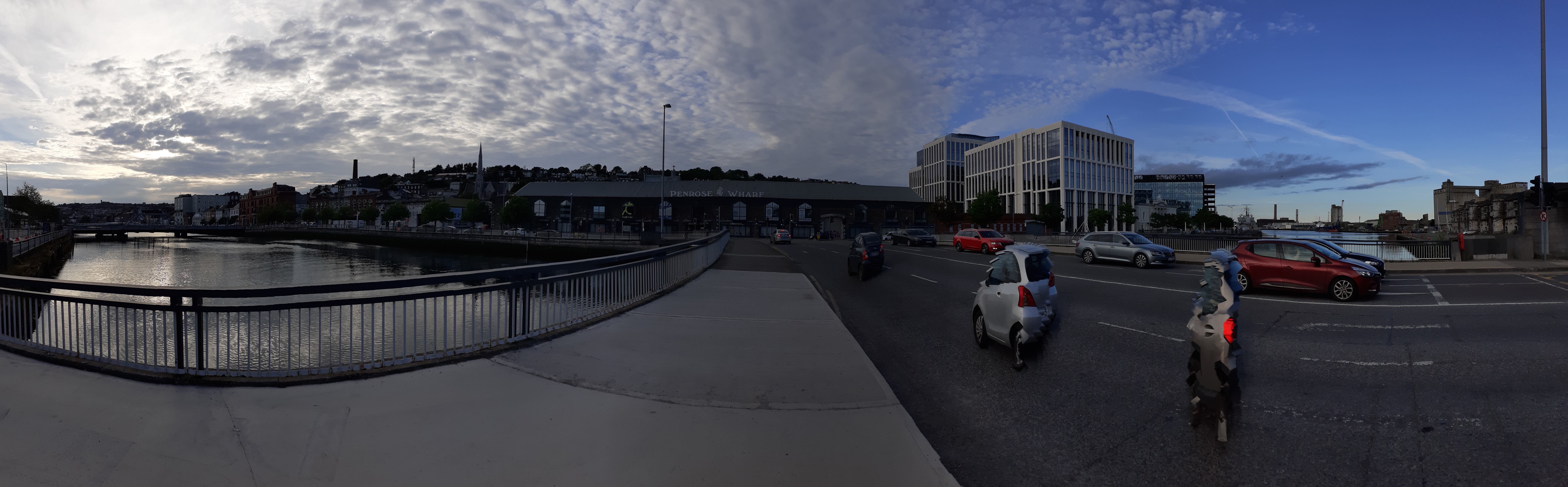
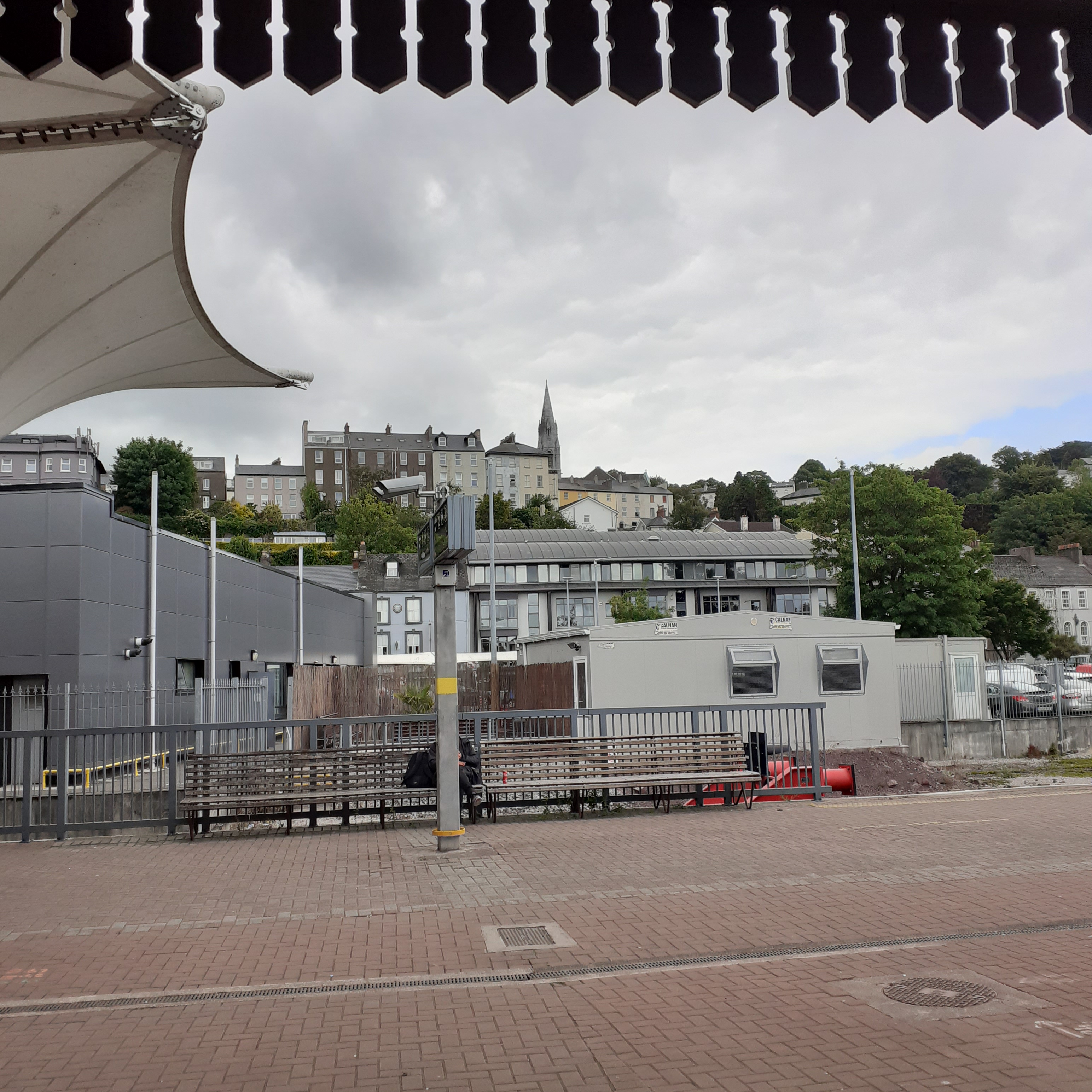
Cork was built on an island between two branches of the River Lee. It means marshy place and is very prone to flooding. There were monastic and Viking settlements here, but is first noted as a city in the reign of King John, Lord of Ireland, in the late twelfth century. I regularly passed through on the way to family holidays on the south coast, and later with friends in those halcyon days; heading for Kinsale, or other vague destinations, by Hook or by Crooke. We once camped near Shandon, but more salubrious accommodation would come. 

I stayed here in 1980 for the Jazz Festival and the Labour Party Conference. We stayed up late at the Metropole which had formed into one of those festival club montages, wandering from room to room as different jazz performances floated from doorways – solo piano, bebop combos and goodtime trumpet playing band. The Jazz Festival was born in 1978 when Jim Mountjoy, marketing manager of the Metropole, was looking for something to coincide with the new October  bank holiday introduced by Labour minister Michael O’Leary the previous year. This often coincides with Hallowe’en, the ancient Celtic festival of the dead. Wild and windy, and wonderfully spooky, what better time for a festival of the devil’s music in a southern delta. The sponsors then were John Player whose cigarettes provided an excellent companion to all forms of music, though perhaps forever associated with Procol Harum’s A Salty Dog.

We sailed for parts unknown to man

where ships come home to die

no lofty peak nor fortress bold

could match our captain’s eye

Ella Fitzgerald headlined at the Cork Opera House that year, and for forty five years the festival has featured the cream of local and international jazz, and its children too.

Our accommodation then was more modest than the Met. When the last note sounded in the wee small hours, we got our car and headed south of the river. Darkness still reigned though the rain had ceased. However, that most Corkonian of downpowers must have burst the dykes and the streets turned to waterways. Back in Venice again, at the wheel of my own motor launch, a Renault 4 to be precise, I drove milk float slow with water halfway up the hub caps.

This time we take the train. There’s a train every two hours from Dublin Heuston, and the journey takes about two and a half hours. The frequency ensures it’s not too crowded. I avail of my free travel pass, with M being my designated minder. We arrive in Cork Kent and make for McCurtain Street. The Isaacs Hotel is opposite the larger Metropole hotel. McCurtain Street itself is north of and parallel to the River Lee. 

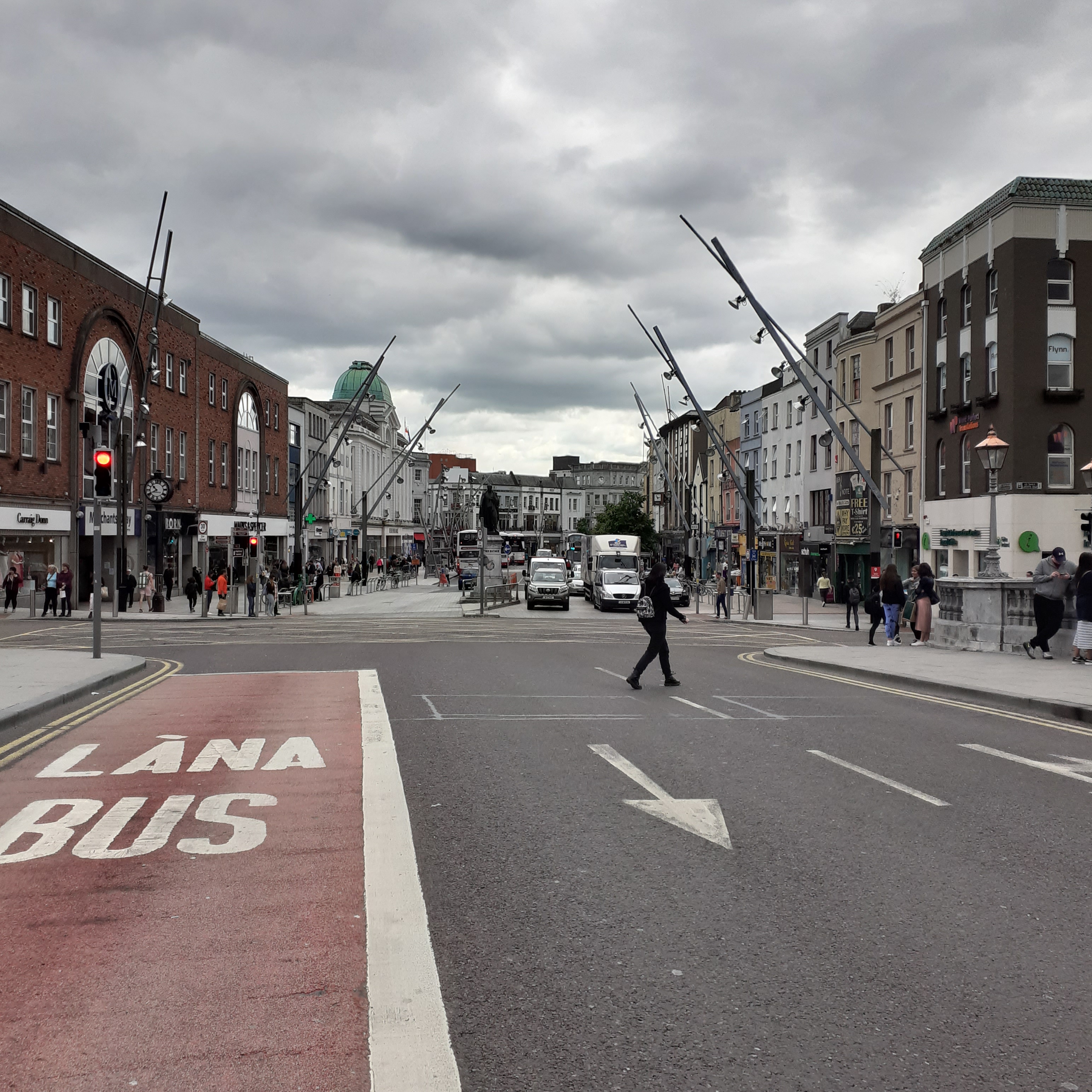
At the foot of McCurtain Street, St. Patrick’s Hill takes us down to the river. This is the north branch of the River Lee, embracing Cork city centre on its low lying island. Patrick Street, across the bridge, is the wide and winding principal street. It has the most ugly street lighting you are likely to see, a deranged bundle of oblique scaffolding and spotlights which clash with the elegant streetscape. 

Cork is Ireland’s second city. Recent boundary changes have seen its population surge towards the quarter million mark. Back in the day, in the seventies and eighties, it held barely a hundred thousand souls. Walking the city streets in late summer, that increase is palpable. There’s a buzz abroad.

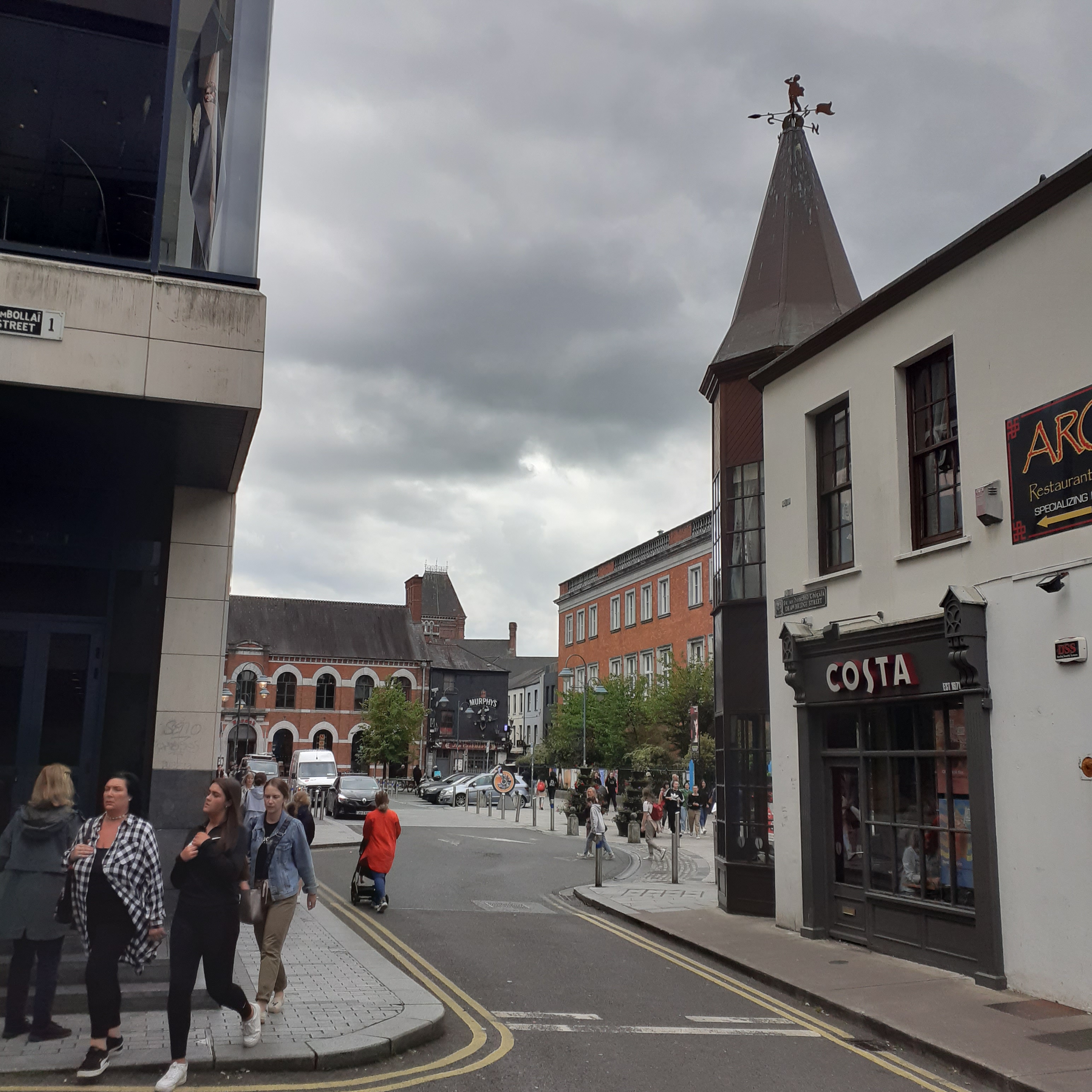
Narrow lanes lead off Patrick Street, boasting such colourful names as Drawbridge Street, Bowling Green Street and Half Moon Street. The names evoke an olden atmosphere and this pervades much of the streetscape too. There are plenty of cafes and bars with outdoor seating, bohemians, students and tourists mingling with the ever growing throngs of modern shoppers.

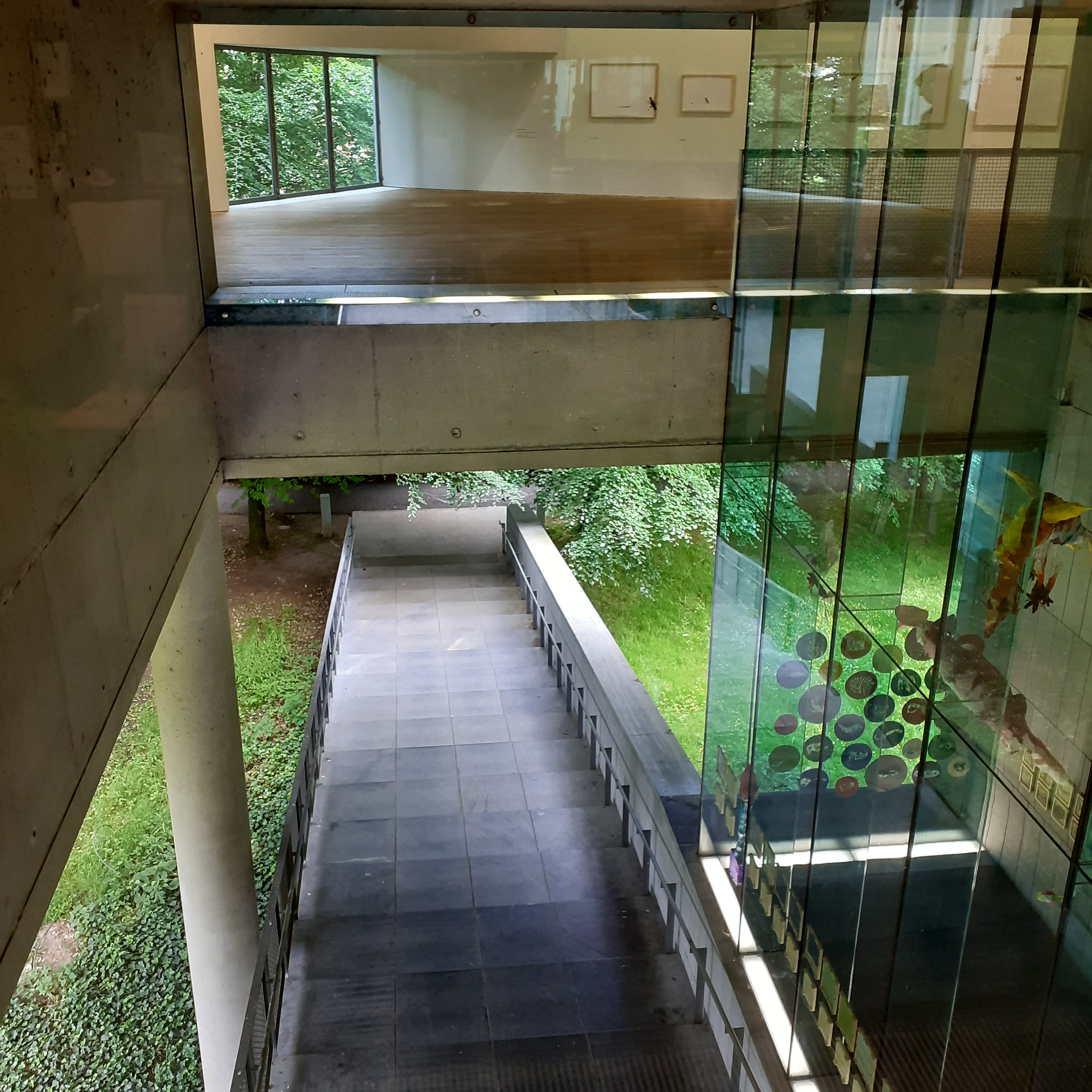
The Crawford Municipal Gallery is within this warren. The Crawford is always a port of call for myself and M when in Cork. William Horatio Crawford, brewer and philanthropist (a good mix) funded the art college here. Beamish and Crawford produce the famous Beamish stout, a black ale with creamy head just like Guinness. Originally the building was the Custom House for Cork, built in 1724, it later was home to the Royal Cork Institution. The Art School was rechristened for its benefactor in 1885 and became the Crawford Municipal Gallery in 1979 with the relocation of the art college to new premises.

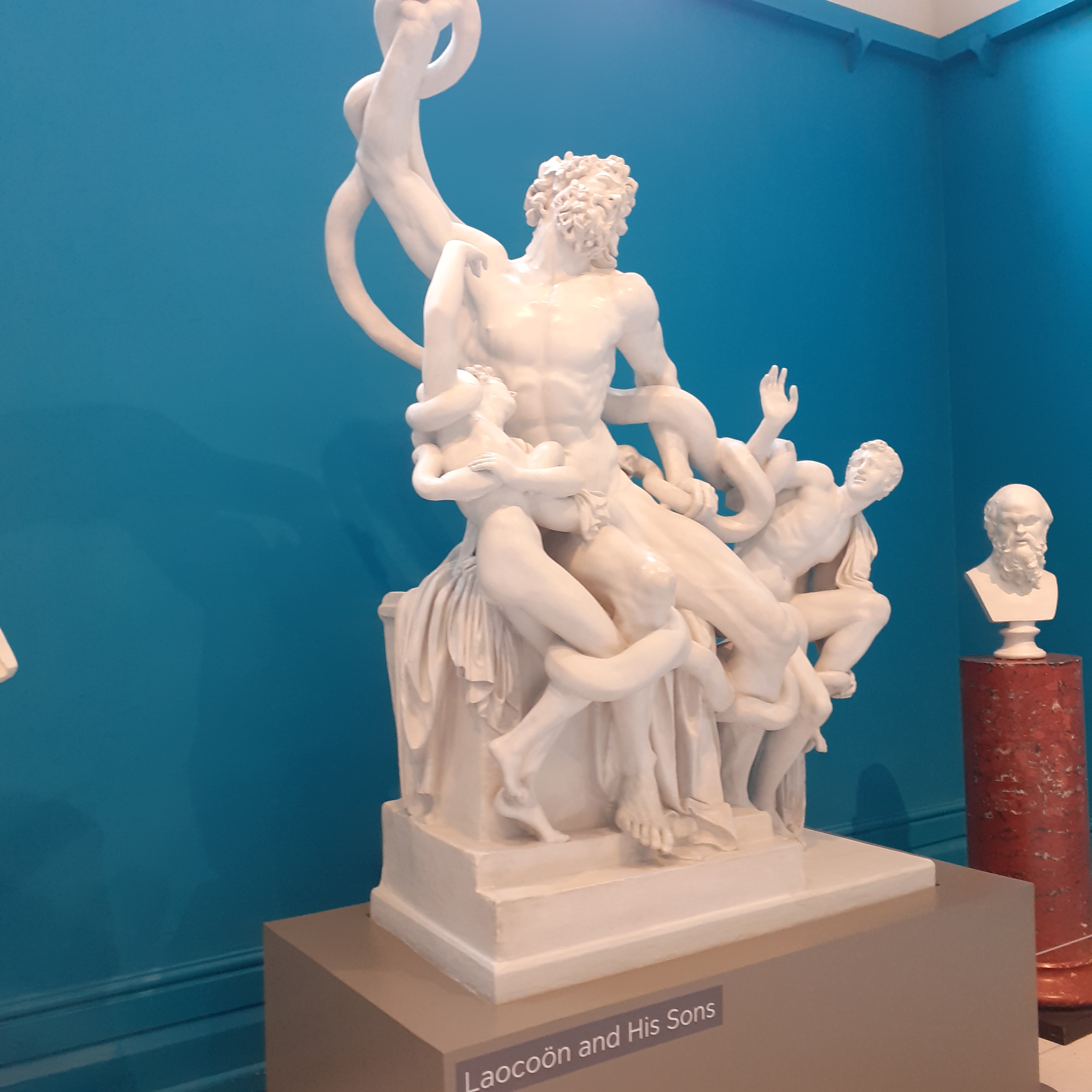
We are returned to our own college days inside the door where there’s a permanent display of casts of classical Greek and Roman statues by Italian Antonio Canova. Donated by George IV (as Regent) these came originally from the Vatican. Most spectacular is Laocoon and His Sons, which was also an emblem of our own college. It dominated the entrance to NCAD, then in Kildare Street alongside that other parcel of rogues, the Dail or Parliament. The Crawford also includes work by leading Irish artists: the stained glass of Harry Clarke and Evie Hone and paintings by William Orpen, Jack B Yeats and Nano Reid. Crawford College painters, James Brennan, Henry Jones Thaddeus, and William Barry also feature. The Zurich Prize Portrait exhibition was the main visiting attraction. We had seen it in Dublin but it was well worth seeing again.

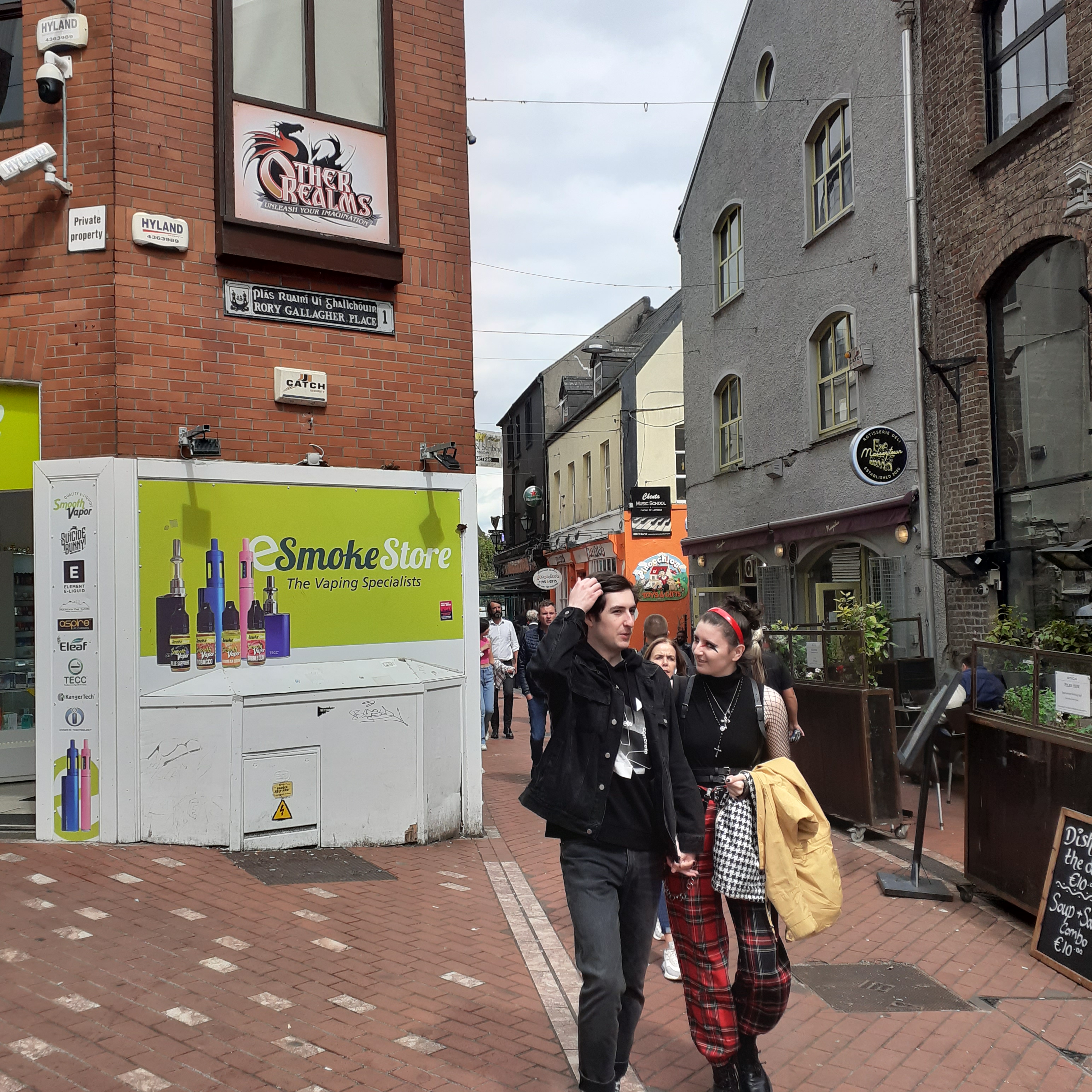
From the Crawford on Emmet Place, we head along Paul Street to a small plaza ooutside the shopping centre: Rory Gallagher Place. There’s a sculpture by Geraldine Creedon which depicts a swirling guitar emitting streams of Gallagher songs. Gallagher is the much loved blues guitarist who founded Taste in the sixties. For my generation, seeing Gallagher play was an early rite of passage. Always on the road, his annual stadium gig, and the odd festival appearance were a must for the young rock fan. Gallagher was actually born in Donegal, in the later forties, but his family moved to Cork when he was five. As a teenager he played with the Fontana showband, but was ever moving towards the Blues-rock scene. With the power trio Taste, he enjoyed live success in Belfast clubs, and achieved chart success with their first two albums, Taste and On the Boards. His solo career brought him guitar hero status, but his fame waned in the eighties. He died in 1995, aged forty seven and is buried at St Oliver’s Cemetary in Ballincollig on the city outskirts.

On the Boards is Gallagher at his best. There’s a jazz sensibility in his playing and arrangements. Saxaphone, played by Rory, adds a particularly moody dimension. Released in 1970, it was their last album as Gallagher went solo after the Isle of Wight festival. What’s Going On was a hit single. Gallagher’s disregard for such fame didn’t  help his career, or indeed musical development. Railway and Gun is another number that showcases his range as a guitarist and composer.

Keep your railway and your gun

Just leave any time you choose

Tell me what you hope to find

I’ll tell you what you’ve got to lose.

Porto, Oporto

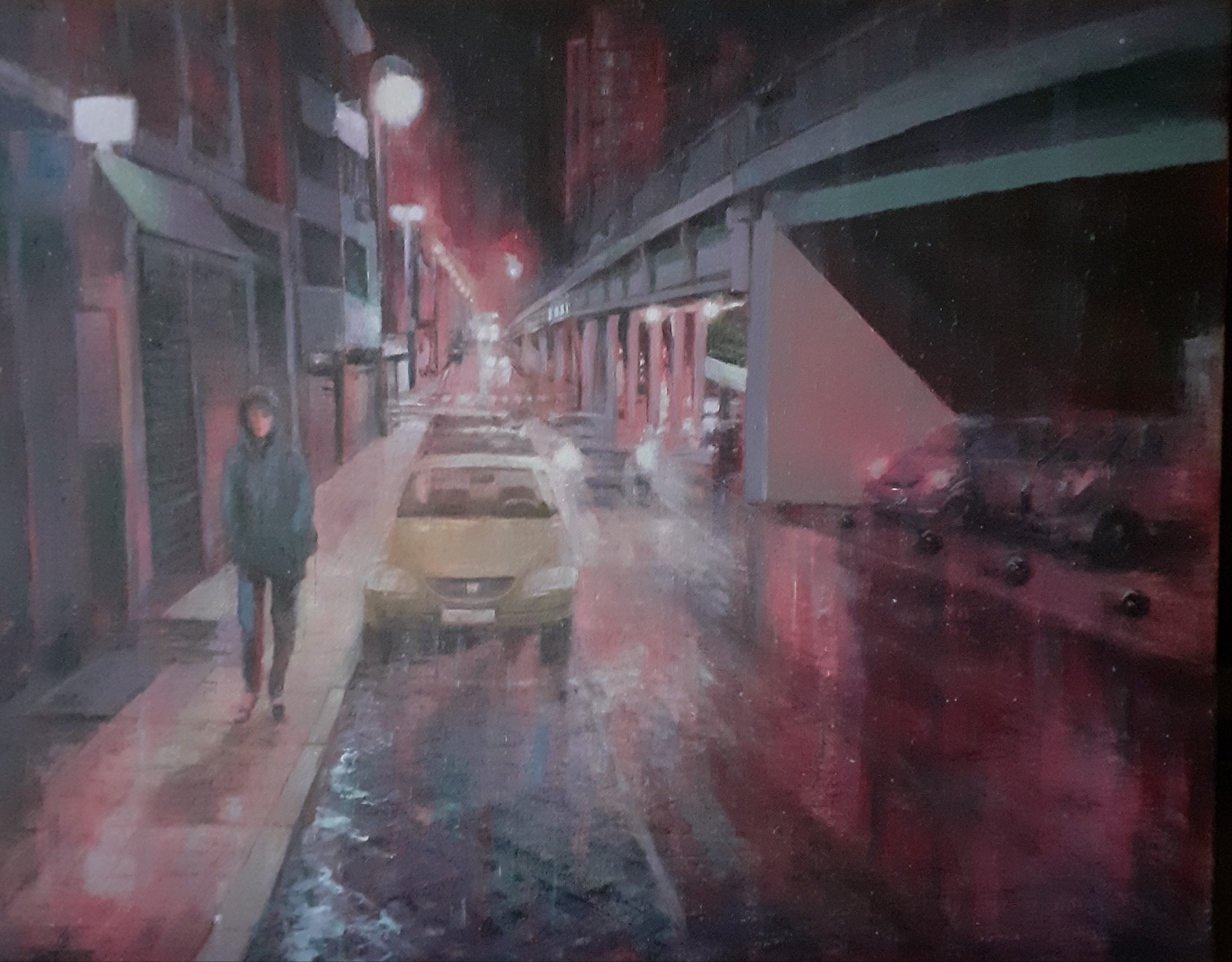
I visited Porto last September, my arrival coinciding with that of a rainfront which accompanied me for the duration. My accommodation, Sunny Balcony, Trindade, had an extensive, recessed balcony along the front wall giving me a good, sheltered panorama of the city in the rain from the fourth floor. Below my window was an overpass, taking the ring road below across a junction connecting to the city’s main street. It was busy, but cosy, there’s something soothing about the hiss of urban traffic in the rain. Visually too; the traffic forming into a sinuous illuminated snake. At ground level, the overpass provided shelter, and car parking. I passed under regularly between my accommodation and the restaurant across the road, and on to the city centre nearby.. The scene reminded me of an artwork I’d found many years ago in a calendar. The artwork, from the seventies perhaps, showed a similar underpass in an unnamed city, probably French or Belgian, the noirish nocturne suspended in a monochrome blast of chromium urban lighting. Porto was a calling for me to echo that painting.

In this acrylic I am using a different palette, with a more structured, geometric composition. I used a red ground, as the night is mild despite the rain, and the street lighting had a pinkish tinge. This is balanced against a cool grey for the city fabric with a dash of blue on the rainsoaked cobblestones. Of course, being me, it’s raining.

Why does it always rain on me?

Is it because I lied when I was seventeen?

Why does it always rain on me?

even when the sun is shining, I can’t avoid the lightning.

That song, by Scottish band,Travis, is taken from their 1999 album The Man Who. Lead singer, Fran Healy wrote it after a failed sun holiday in southern Israeli . Tell me about it. I have sometimes wondered if I could rent myself out to drought stricken regions as a rain god. Then again, there have been sunny days. Too many of them and you start missing the rain. So, let it fall, it washes the world and softens the sharpness of city life. And is often beautiful.

Morning in Amiens Street

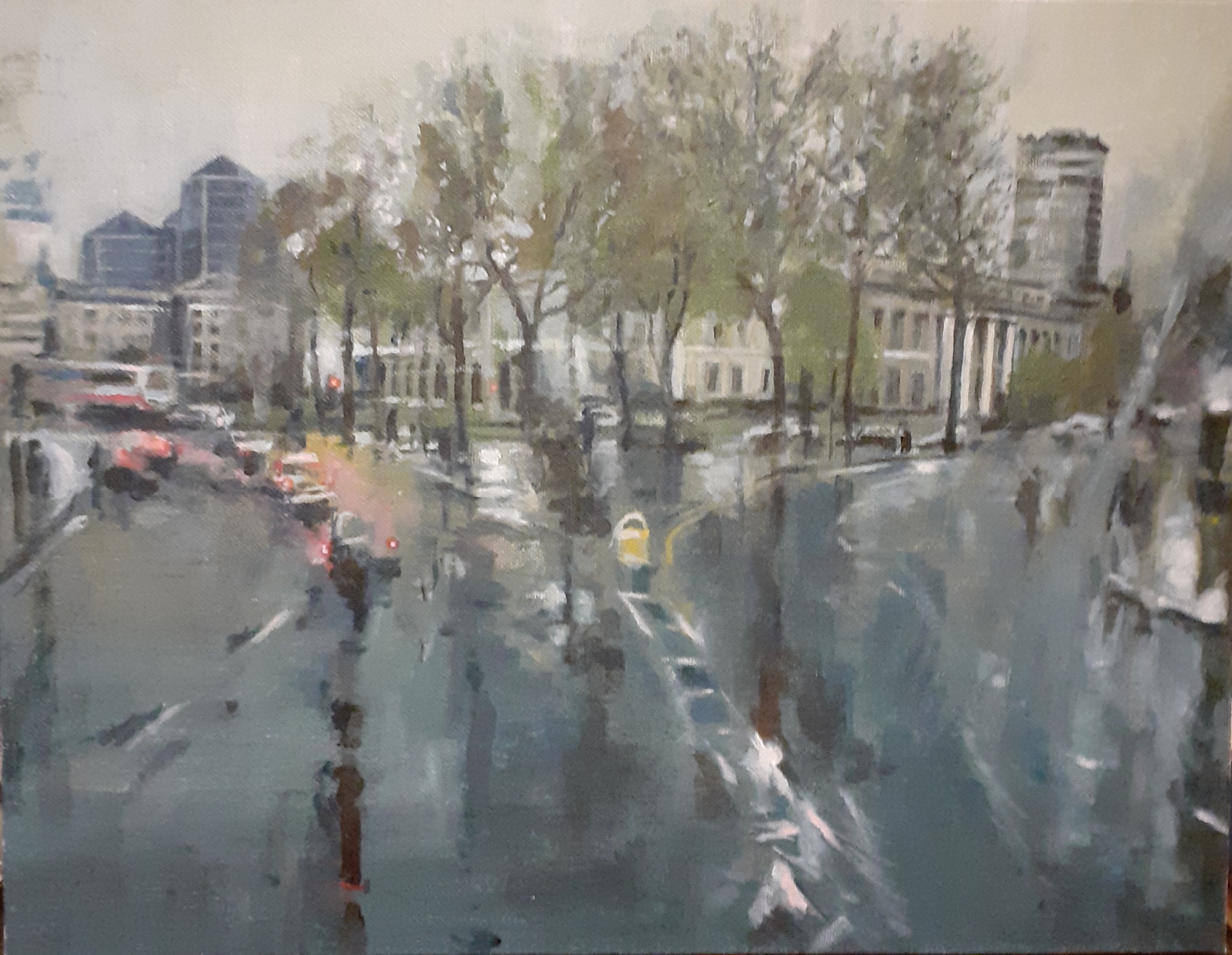
January is cold and blear, a time for hibernation, especially for ancient Hibernians like myself. This painting is appropriate for the season in terms of climate and the hectic humdrum after the Christmas festivities, but there are harbingers of the joys of life too. The view is from the upstairs front seat of a bus barrelling down Amiens Street. Connolly Station and Bus Aras, the main train and bus stations respectively, are just behind us, ahead Dublin like crystals in the rain. Liberty Hall at almost sixty metres tall, considered a skyscraper when built in the sixties, really does scrape the sky on days like this. It is still the fourth highest building in Dublin. Off to our left the pyramid capped glass towers of George’s Quay Plaza, much the same height, line the far bank of the river. Straight ahead, the Customs House, Gandon’s late eighteenth century masterpiece, is shrouded in trees. Everything melts in the unrelenting rain.

But now they only block the sun

They rain and they snow on everyone

So many things I would have done

But clouds got in my way

The photograph was taken by a friend of mine from Art College days, Paula Nolan. Back then, the late seventies, the Art College was in temporary premises on George’s Quay. Paula is a photographer of note, her work being shown at successive RHAs. Her photos can rise to the clouds above, but frequently, as here, feature the drama of ordinary life in the city as she put her morning commute to good use. Despite all the mayhem and the rain, it makes me almost wish to be commuting again.

Rows and flows of angel hair

And ice cream castles in the air

And feather canyons everywhere

I’ve looked at clouds that way

Joni Mitchell wrote Both Sides Now in 1967, and it was a big hit for Judy Collins the following year. Mitchell’s version is from her album Clouds, 1969. 

A Night in Frank Duffs

At the top of Main Street, just across from the Town Hall, is one of Bray’s finest pubs, Frank Duff’s. It’s my local, being closest to my house, exactly 1.3 km to be precise. That’s a fifteen minute walk, though longer returning.

The name bears no relation to the Frank Duff who founded the Legion of Mary and championed the destruction of Monto Town, Dublin’s red light district in the 1920s. The reference is to the Frank Duff who set up shop here with wife Sheila in the 1940s. Their son, Ken, inherited the business in the late seventies. When Ken died in 2017, his sister Madeleine, ran the business for four years. Covid effectively shut the pub down. As a food free zone it didn’t qualify for the restricted opening of other premises over the lockdown period. The Duggans, owners of several premises in Bray, including the Harbour Bar and the Martello, took over in 2021. 

During the Duff years the pub ignored such unnecessary distractions as food, piped music and television. It was all for a few drinks and a chat. The ideal local, so. More eccentrically, the pub rejoiced in a cycling theme, from the time the Tour de France came to Bray in 1998.

Shay Elliott was the focus of commemoration for the Wicklow cycling fraternity. Elliott was born and raised in Crumlin, in Dublin 12, and was a cycling pioneer in Ireland. He was the first Irishman to particiate in the Tour, and in 1963 became the first English speaker to wear the Yellow Jersey of race leader, which he held over three stages. He returned to Ireland, and became involved in Bray Wheelers, coaching new talent in the sport. He died in May 1971, from shotgun wounds, and was buried at St Mochonog’s Church, Kilmacanogue, near Bray. A monument to him was erected in Glenmalure, just south of Glendalough. It is a glorious spot to contemplate Wicklow’s mountain scenery.

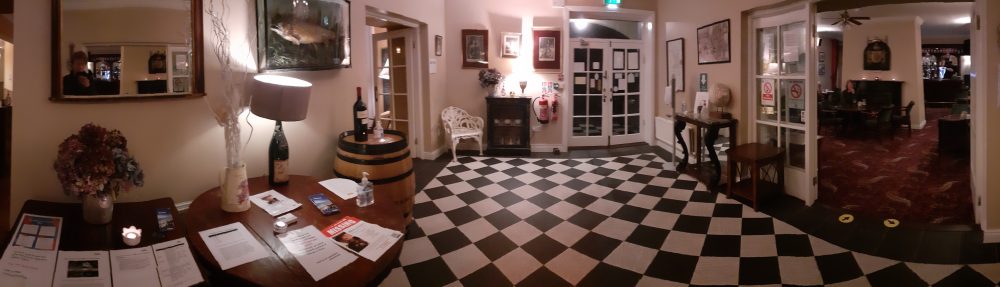
Refurbished for its reopening, the premises has been divided along traditional bar and lounge lines. Television made its first appearance at Duffs in the old style, dark wood bar, while the lounge kept to the ancient tradition of banning the haunted fishtank. I am more often found in the lounge, to the rear of the premises where there’s a fire and high stools.

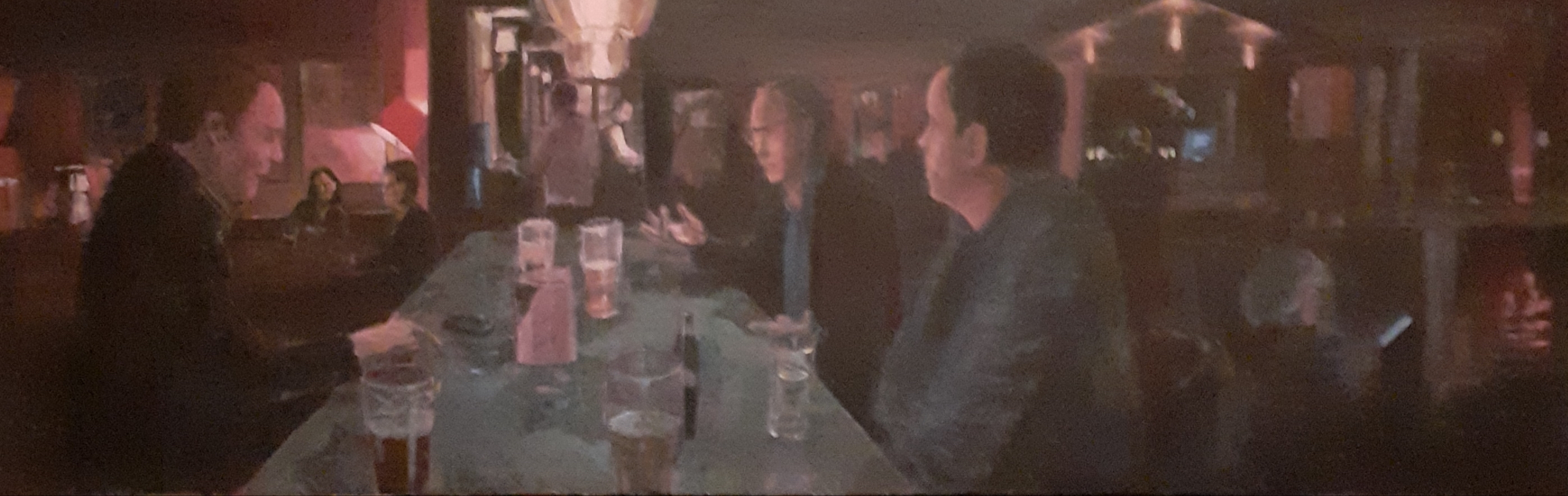
That’s the setting for this acrylic. It captures a moment in time, as friends debate the finerpoints of music, art, philosophy and football. A modest amount of drink has been consumed, though more may follow. We sit at the high table, while other clients are arrayed on armchairs and couches, bathing in the glow of warm lamps and an open fire. I am looking towards Main Street, hoping to catch the eye of a friendly staff member, more than likely, and let my comrades solve the problems of the world.

A Diner in Naas

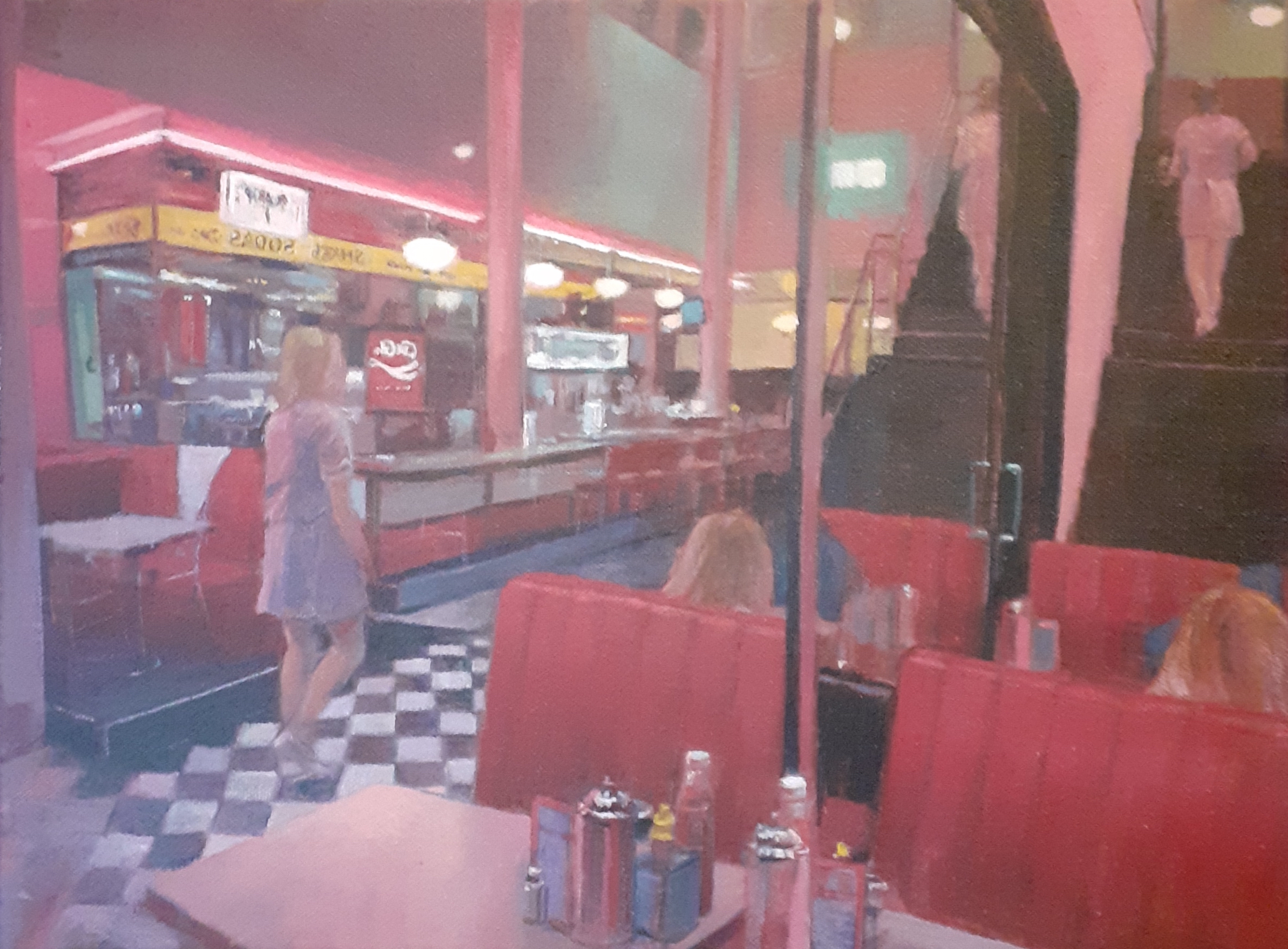
This acrylic shows the interior of Eddie Rocket’s diner in Naas, County Kildare. Naas is taken from the Gaelic Nás na Rí, meaning the meeting place of the kings. It was a walled market town in medieval times and became the civic centre for County Kildare. The modern town has a population of over twenty thousand.

Naas to me is synonymous with road travel. I frequently passed through on my journeys to the south west until the town itself was bypassed by the N7/M7. Lawlor’s Hotel at the northern end of Main street was an occasional stop for refreshments and entertainment. In the seventies we followed the band Horslips who played there. It was fifteen miles from Walkinstown, about an hour’s round trip. 

Eddie Rocket’s is just around the corner. It’s an Irish restaurant chain founded in 1989. the Naas branch, one of forty outlets across Ireland, is an extensive two storey premises. A splash of Americana, with chrome and neon and red, red leatherette, you’re stepping back into rock and roll days but in a safe bubble of twenty first century comfort. The burgers are great and the service too. 

On a recent visit, I took my reference from reflections in the plate glass window by the entrance. There’s a dreamlike quality to the scene, a sense of being in a projection of a period film. There are two worlds on the canvas, our real world beside the imaginary or ephemeral. The viewer may sense that beyond that beautiful vision of the film of our lives, lies the vast blackness of night.

I was thinking of Edward Hopper, the American painter who recorded city and motorway diners, gas stations, motels and more across the USA. An inveterate traveller by car and train, he criss-crossed the vast country to research new subjects. His paintings are more than simple realistic compositions, evoking as they do humanity and often loneliness amidst crowds and buildings, and the splendid isolation of travel. Born in 1882 he died in 1967 in New York.

Porto – 2

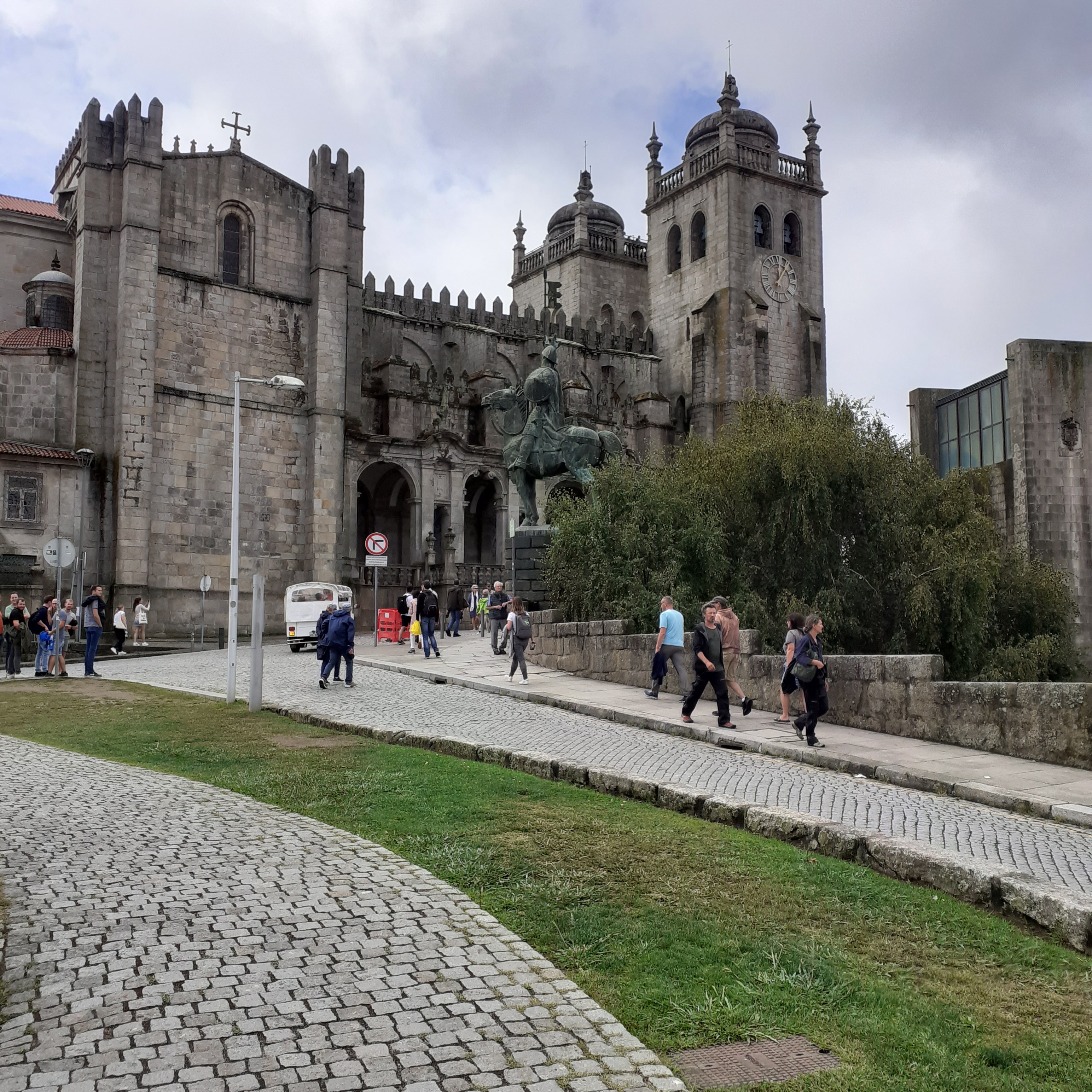
Safely back on terra firma, I begin my descent to the quayside via Se cathedral, proud on its promintory above the Duoro. Porto’s Cathedral, Se Do Porto, was begun in the 12th century, with many additions over the centuries. It is stern, but impressive, having the appearance of a fortress atop a hill. Two square towers, topped by cupolas, frame the crenallated entrance. The giant rose window above the porch is its most ornamental flourish.

In the 17th century several alterations in the baroque style added some finesse , including a new portal and with cupolas added to the towers. The Baroque loggia on the northern facade is by Nicolau Nasoni, an Italian architect who was a major figure in the architecture of Porto. He also contributed much to the interior of the cathedral in the decoration of the new Baroque apse. Nasoni designed the Episcopal Palace, adjacent to the Cathedral, in 1734, although he didn’t live to see its completion. Vast as it is up close, it looms even larger when viewed from the river or the far quays. He also designed the Clerigos church tower, soaring above the rooftops of Porto and was buried in the crypt there in 1773.

Facing Nasoni’s loggia, is a figure on horseback. The statue commemorates Vimara Pires, a warrior who led the liberation of the city from the Moors in 868. The main square in front of the cathedral offers fabulous views of the city, and the perfect place to hang out in the embrace of the cathedral. It has provided historic settings to. It was on this spot in 1142 the Bishop persuaded some passing Crusaders, English, German and Flemsh, to help free the city from the Moors, again.

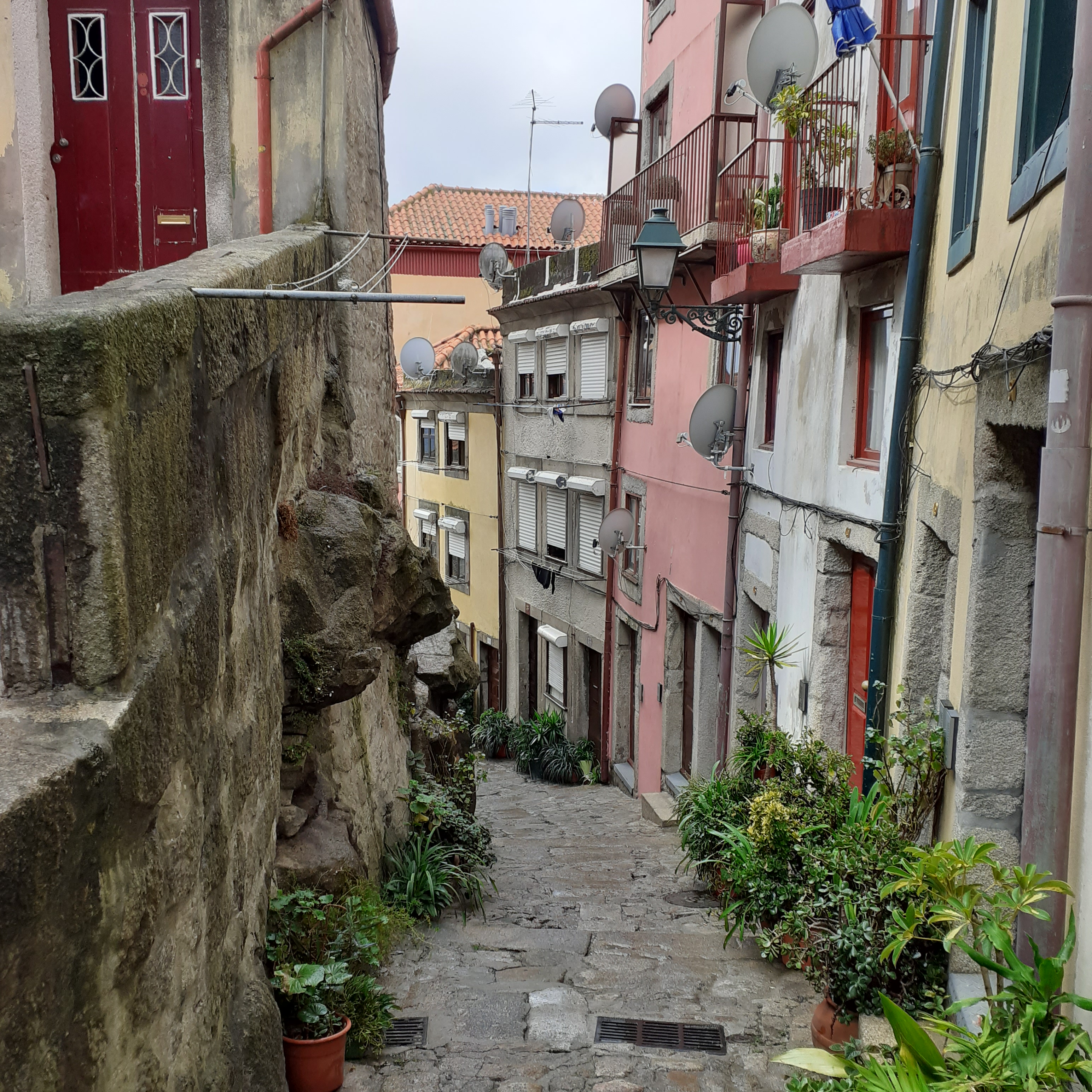
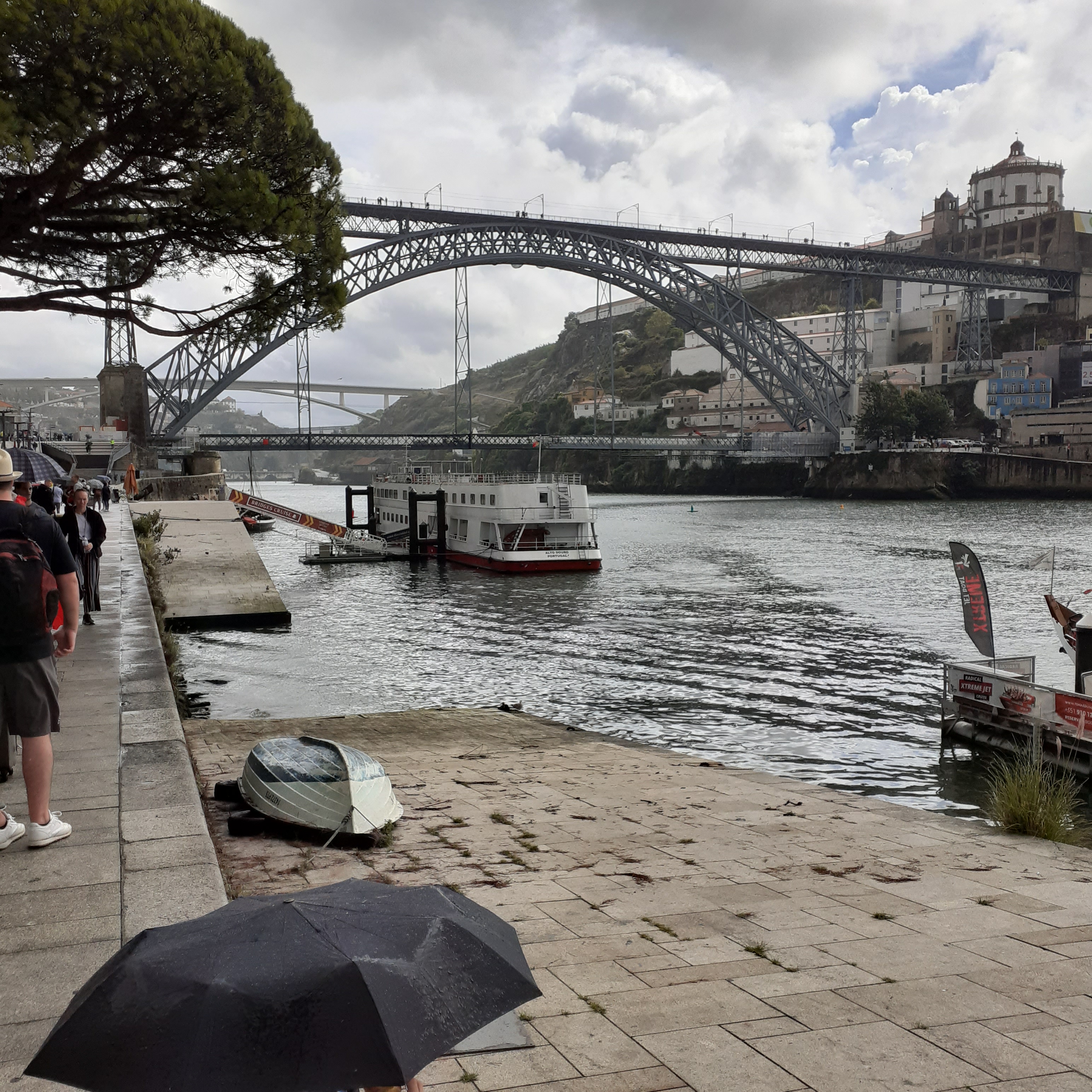
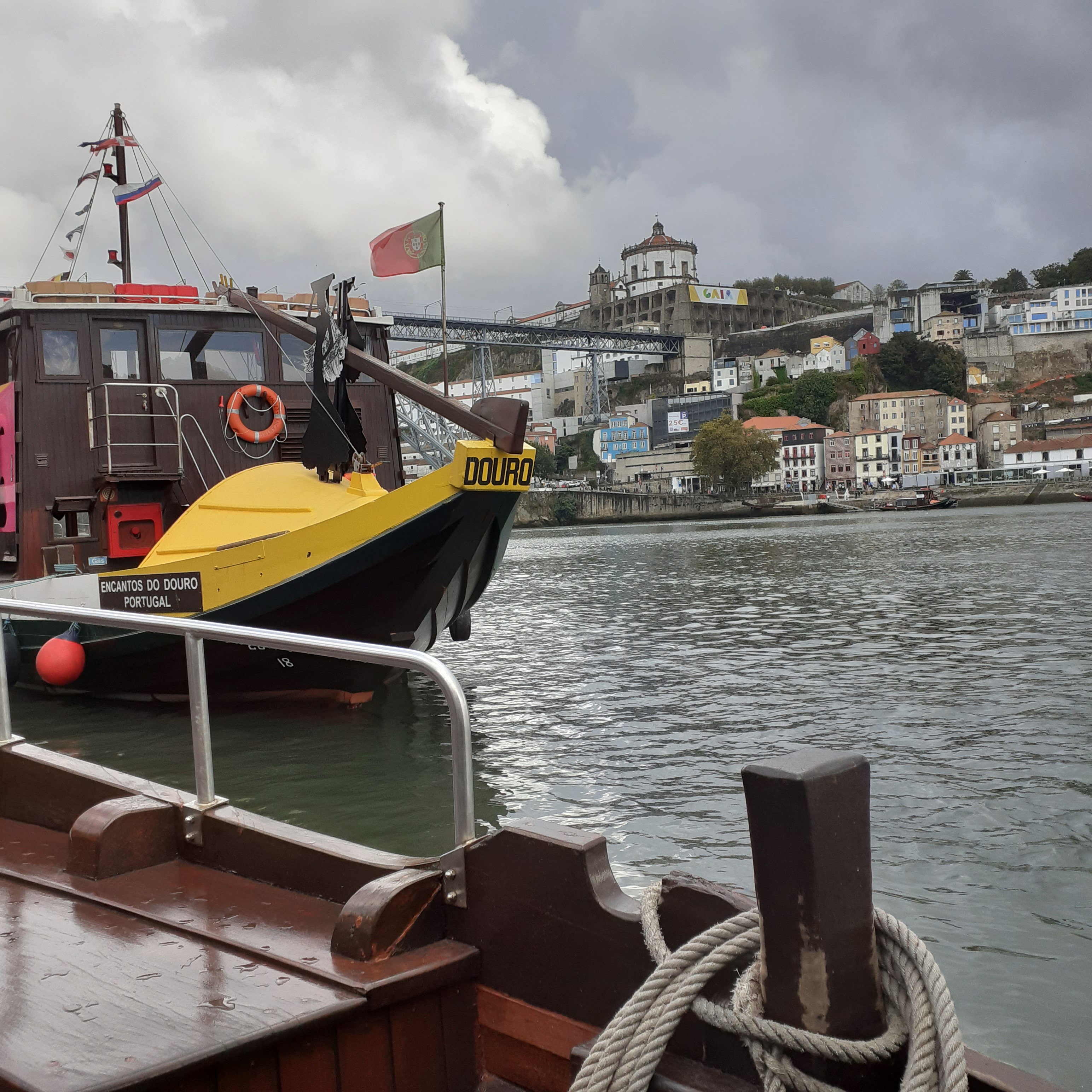
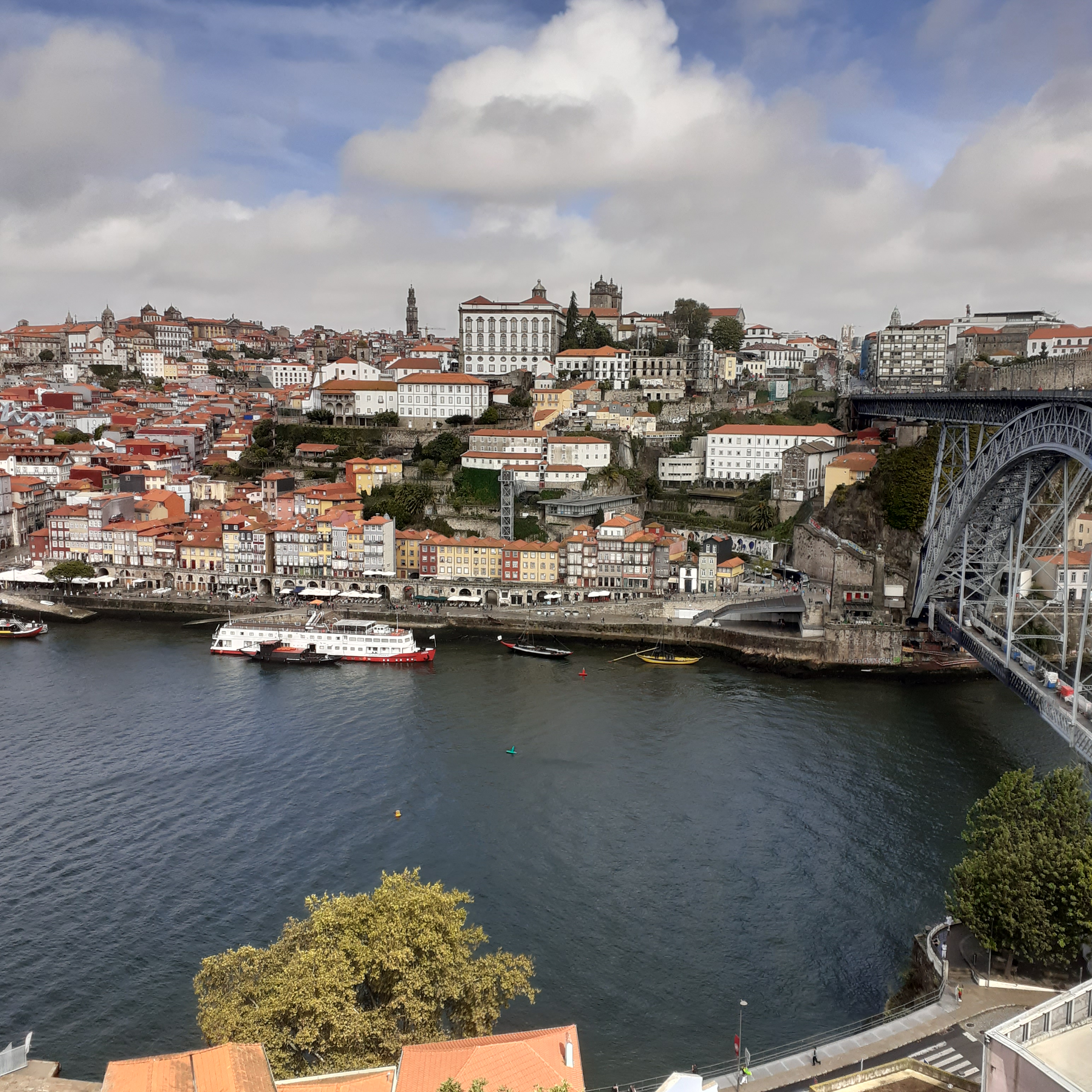
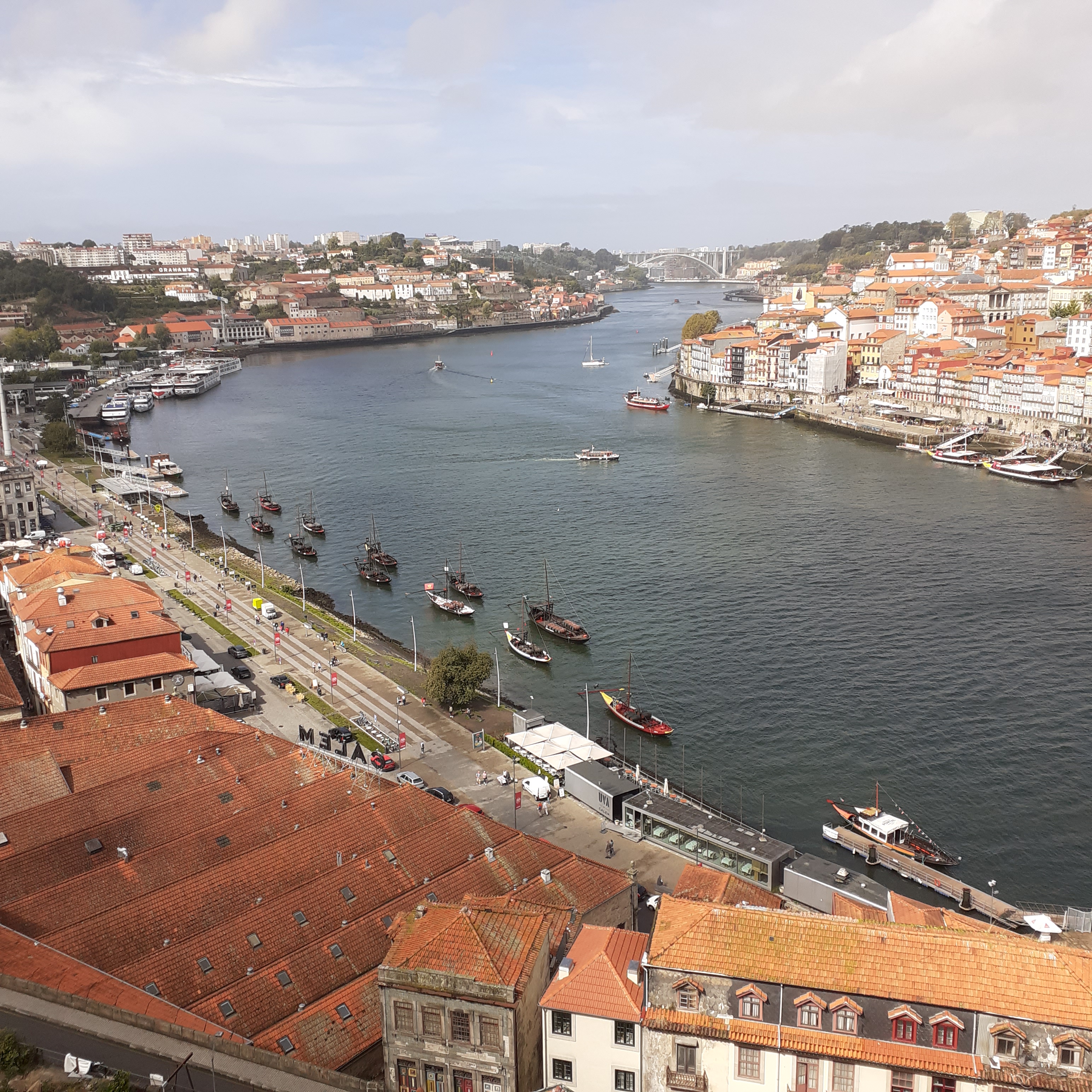
Below the cathedral lies the oldest quarter of the city, a warren of cobbled alleyways. I follow the quaint, winding lanes, down and down and down.The area is reminiscent of a Greek island village, and I feel suddenly remote from the hectic modern city with even the music of pneumatic drills absent. At the base of this steep descent, the Ribeira quayside is lined with crowded bars. Rising almost vertically above are the coloured houses. The terrace umbrellas might usually function as parasols, but today their function is more in the Irish context. I find a vacant table at last at the very end of the quay in the shadow of the bridge.

It’s Champions League night, and the local heroes of Porto take on, of all people, FC Bruges. My last European adventure had taken me to that most beautiful Belgian city. That was also a European night three years ago when FC Bruges beat an Austrian side and I caught the late second half for a famous home victory. Jovial Belgians take up most available seats but this small bar is less magnetic for crowds. One man at the adjacent table makes up for it with a stream of consciousness commentary on all events in Flemish, and occasianally English. I try to pretend he’s a pneumatic drill. Every time it rains, the same joke caption booms: Come to Oporto for the sunshine! Sunny Oporto! And, once seated safely under my umbrella, it does rain a lot, and very heavily. A few inches from my shoulder a cascade of water forms a solid sheet, as Ribeira’s gutters jam. I pull up my hood and gather my anarok about me. My Flemish friend leaps unexpectadly to the aid of a fellow countryman in a wheelschair, helping him to a sheltered table. So, a nice man, I think.

I have booked the Six Bridges Cruise on the Duoro and have long ago decided that today’s not the day. But, downing my beer, the sun hoves into view, and a large window of blue with it. I make my way to the kiosk to redeem my online booking for an actual ticket. I fish the form out of my shoulder bag. Quite literally fish it, because the water has got in through the drawstrings and the sheet is a sodden mess. The young lad at the kiosk is unfazed, all I need is the number he says, and somehow deciphers the smudged characters. The boat arrives in ten minutes and I’m on.

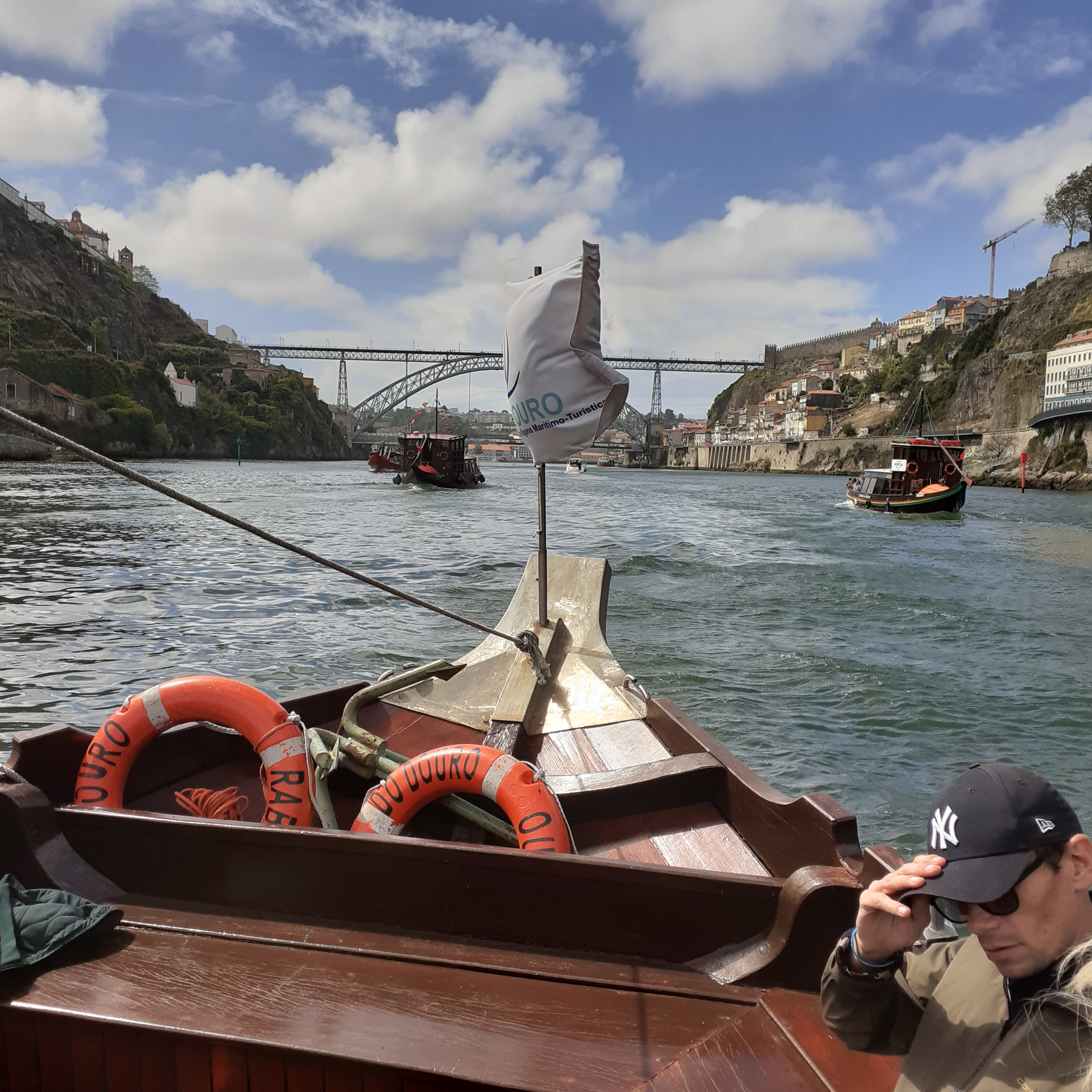
The cruise does what it says on the tin. Taking us under the six bridges that span the river. Heading inland at first, then turning and making our way to the end of the estuary where Foz meets the Atlantic. The narrow boat sits low in the water and its timber benches give it a pleasantly antique feel. You can imagine, if you wish, that you are skating along on the traditional craft, the rabelo, used in the portwine trade. However you see yourself, the shifting views from the river will quickly grab your atention. The deck is not too crowded, as you would want to be mad to go on the river on a day like this. But it’s the madness of Wonderland, with magic in the air.

From the Ribeira quayside we head inland under the Dom Luis I Bridge and on to the Infante Dom Henrique Bridge,This carries motor traffic, and pedestrians, and is the most recent bridge. Completed in 2003, its shallow arch seems to float magically above the river with no visible means of support. A little further upriver is the Maria Pia Railway Bridge, similar in style to Dom Luis I but with a single deck. It was also built by Seyrig in 1877. Railway traffic ceased in 1991 but has been wisely retained as a city landmark. The plain white modernist Sao Joao now carries the railway. It was designed by Edgar Cardoso, a local engineer and professor. Ponte de Freixo is another concrete bridge. It has eight spans and was built in  1995. This is where we turn to head once more through the city which crowds the steep river banks, jostling with a friendly flotilla of tour boats and pleasure craft.

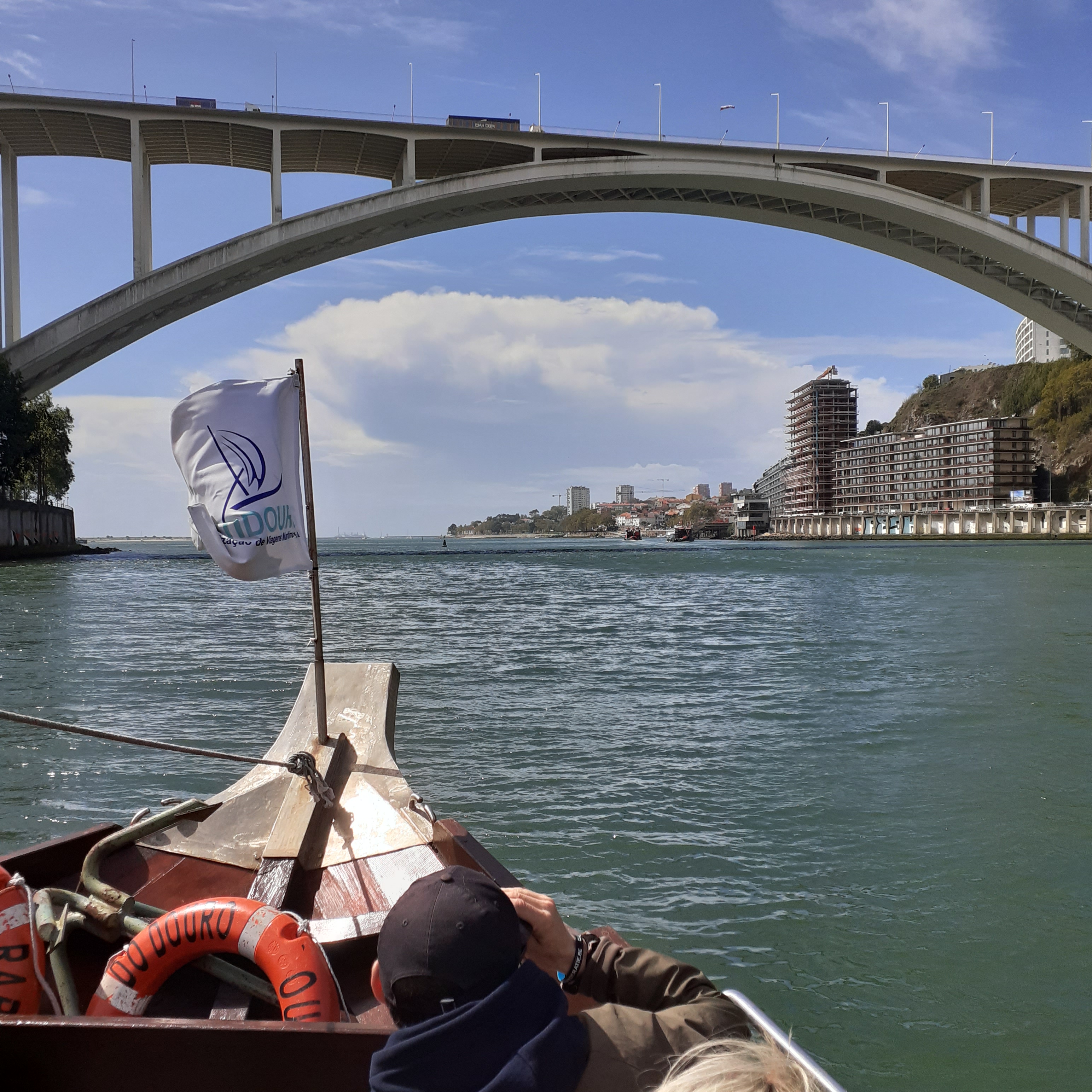
The Duoro widens as we approach the Atlantic and is spanned by the modern Ponte de Arrabida. also designed by Edgar Cardoso. This is a sleek modernist arch carrying a six lane highway. The elegant concrete arch forms the portal to Porto for the Atlantic traveller. We turn as the prow tips the bay, bathed in welcome sunshine, with the resort town of Foz appearing at the eastern edge of the city.

We disembark on the Gaia side, which makes a quiet contrast to the full voiced choire of Bruges supporters on the far bank. There’s a modern bar on the waterfront for lunch and a long drawn out pint, where I can absorb more of the river view of which no one could grow tired.

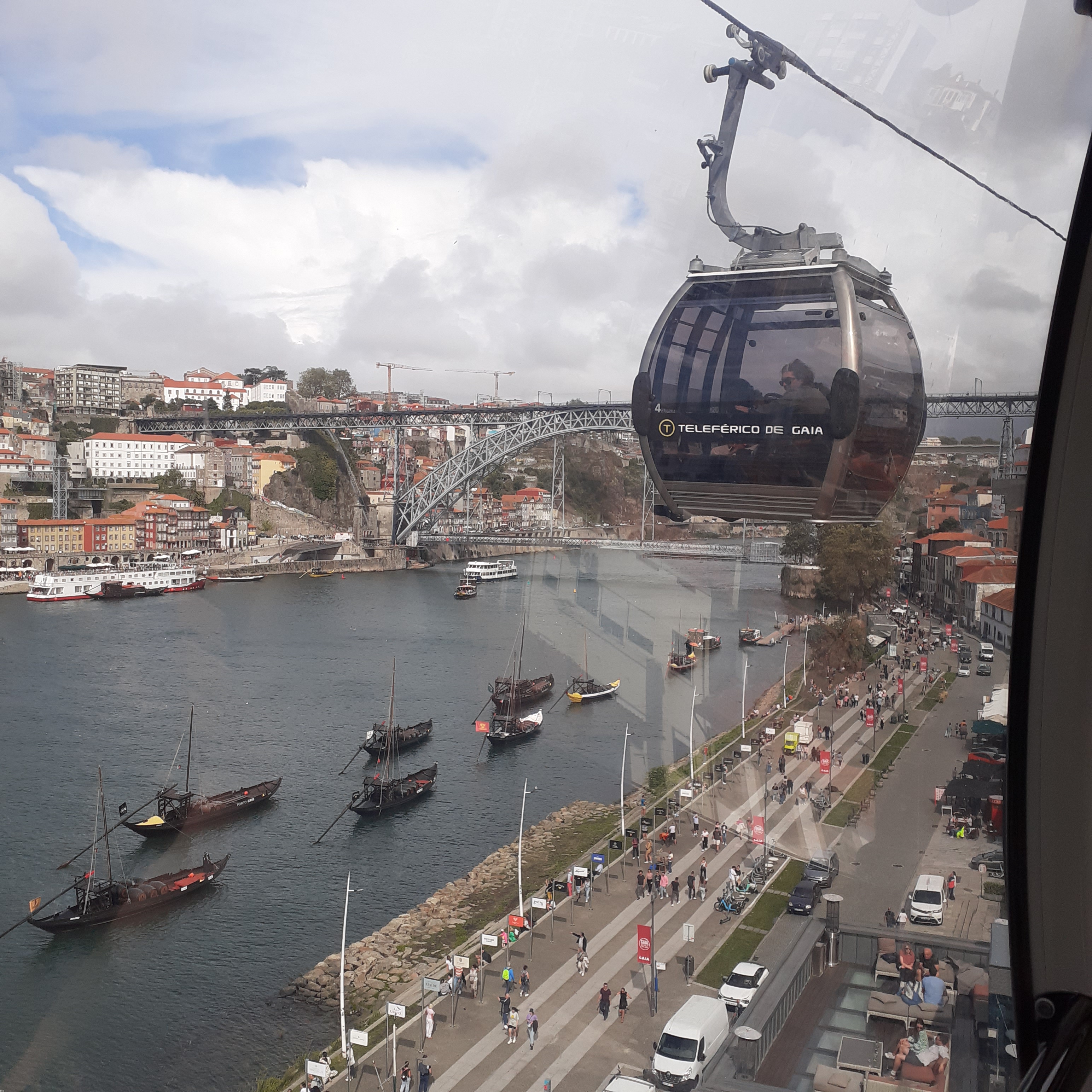
Next door is the cable car which I take to the top of the hill in high good spirits. Be a bird, or a superhero for a few minutes, drifting above the orange tiled roofs, floating further and further above the mighty river.

If life is a river and your heart is a boat

And just like a water baby, baby born to float

And if life is a wild wind that blows way on high

Then your heart is Amelia dying to fly

Heaven knows no frontiers

And I’ve seen heaven in your eyes

No Frontiers is a song by Jimmy McCarthy, most famously the title song from Mary Black’s 1989 album.

Porto – 1

Oporto, or Porto, is Portugal’s second city, three hundred kilometres up the coast north of Lisbon. It is set on the estuary of the River Duoro, and is, as the name suggests, a port city and also, the city of Port Wine. I had booked my trip to Porto in 2020, but without perfect vision. As you know, we entered near two years of lockdown and all trips were off. I wrote a poem a year back called Europe After the Rain. The title is nicked from a Max Ernst painting which alludes to a distant dawn after the Nazis embraced the continent in war. My Europe After the Rain looked forward to a time when lockdown would cease and we could resume our lives and the sublime pleasures of life, of contact, social interaction and travel. I would travel to Europe, after the rain. And so I did. And then it rained. Man, it poured.

My Ryanair flight touches down an hour or so late. Not just evening is falling on the city, but torrential rain, making everything darker still. I wonder at the optimistic name of my apartment, Sunny Apartment, Trindade Balcony. Sou’westers and turf fires would seem more in order than balconies. My host, Jose, brightens things up with a welcome, including a bottle of red wine. The apartment is sunny in atmosphere, and indeed the balcony is sufficiently sheltered to allow me sit there over a glass of wine as veils of rain drape the city, I’m home at last. In Europe

It’s late, but I must dip my toe in the ocean, so to speak. The road outside is on two levels. The central thoroughfare passes overhead on stilts. I duck beneath, and grab a seat at a bright restaurant across the road. I order Franseschina, a selection of meat in a sandwich, toasted and drowned in melted cheese and, here’s the thing, gfloating in bowl of red soup. I’m examining this in anticipation and some suspicion, when the fries arive. I can’t actually finish the thing. Although I have eaten little on my travels, it is very filling. The waiter assures me he would have no problem with it, and he’s thinner than me.

My street is just ten minutes from the city centre. The principal street, Aliedos Avenue, is just a couple of blocks downhill. I breakfast nearby on scrambled egg and bacon with toast. It’s raining again so I put up the hood on my anorak and head downtown. Halfway down Aliados there’s a problem. The city fathers have decided to transform the urban paradise into hell. An excessive fortification of machinery and metal barriers is strung across the bottom half of the principal throroughfare and encompasses several streets off, including much of the area around Sao Bento Station. Negociating the city centre is well nigh impossible as walkways run into dead ends. What were they thinking of to close down the historic city centre?

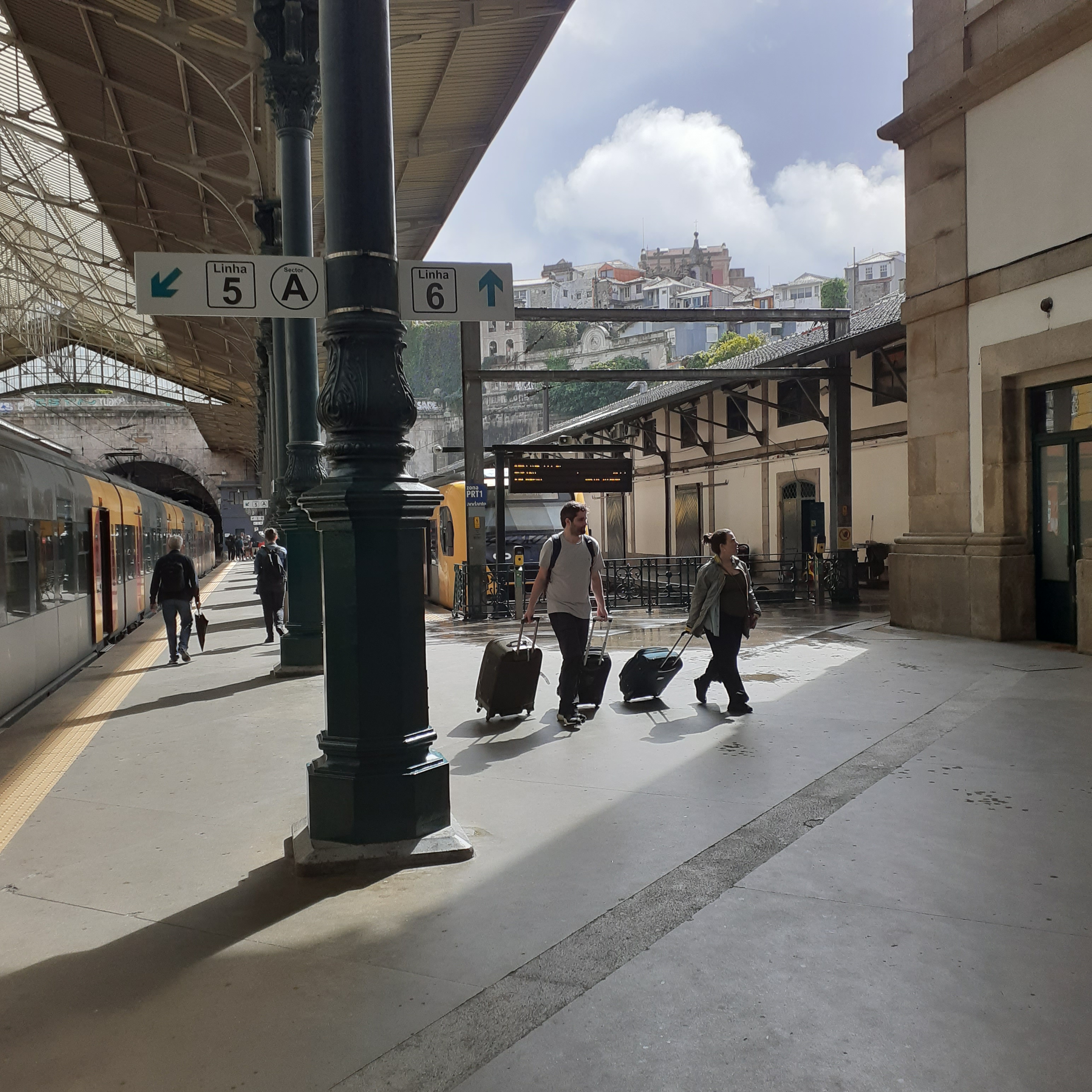
Liberty Plaza is entirely obliterated and there is no egress to the western end of the city centre from here. It’s like a bomb site. There’s nothing I can do save soldier on. I pick my way through scaffolding and debris to the railway station. San Bento is central to Porto, both as a point of arrival, and departure, and as a visitor attraction in its own right. Outside, the station is an imposing public building of the Belle Epoque, within, the entrance hall is a glorious palace of illustrative art. The building was designed by Jose Marquez da Silva in 1904 in the Beaux Arts style on a plinth overlooking Almeida Garret Plaza. Grand though it is, step inside for a truly awesome spectacle. The ticket hall is a wrap around mural, illustrating the sweep of Portugal’s history and heritage. It was made by Jorge Colaco in the blue ceramic tiles known as azulejos. These are a distinctive feature of Portugese architecture, and those of Sao Bento represent the artform at its best. It took a dozen years for the entire project to be completed and Sao Bento was officially opened in 1916. The platform itself forms its own spectacle. The Batalha area forms a steep ridge immediately east of the platform, and here the trains plunge underground, or emerge magically from the bowels of the earth. In a city of giddy views, this view of a teetering hillside barrio floating above the angular lines of the railway station is outstanding, and the perfect introduction, or adeos, to the city of Oporto.

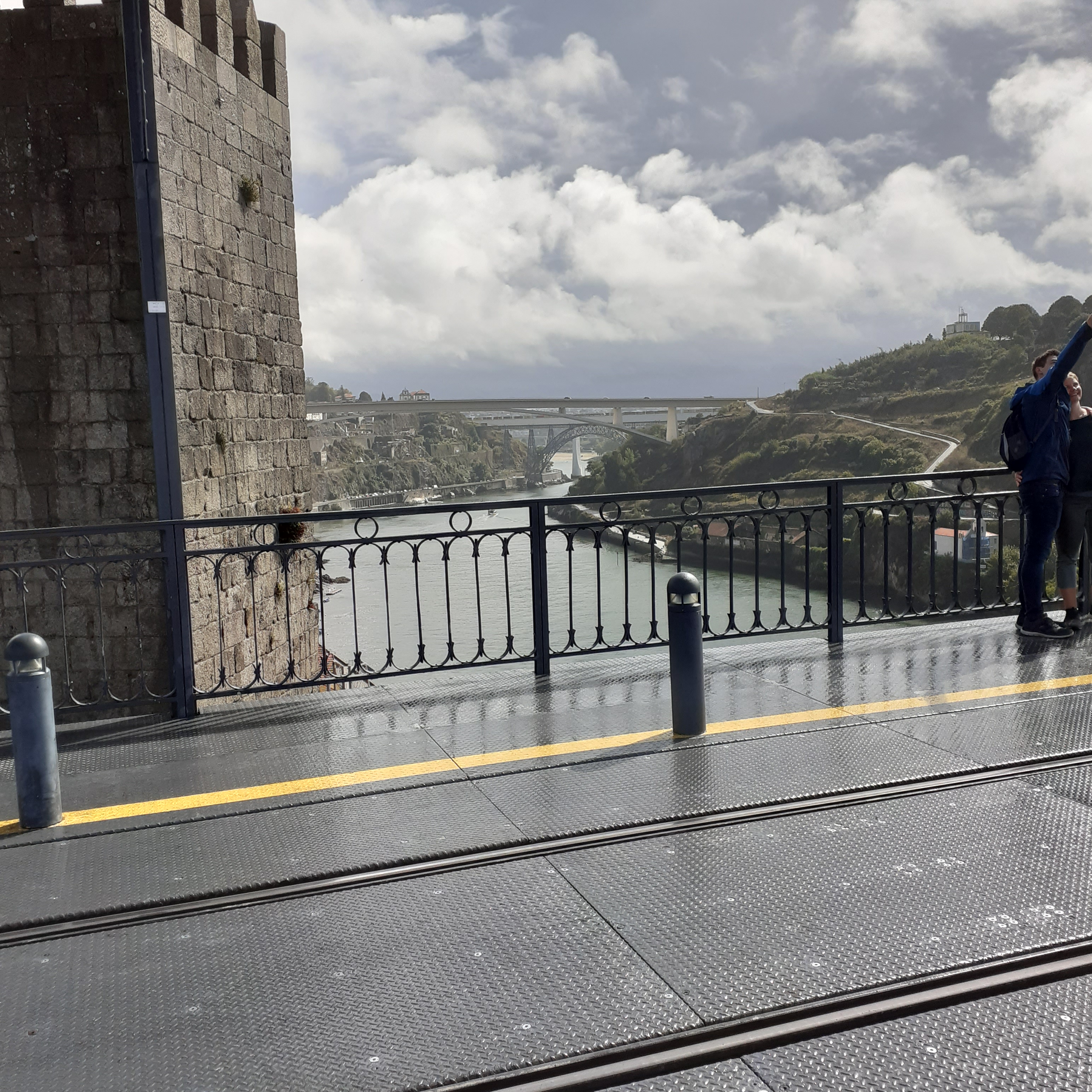
The first thing to do in Oporto is get to the bridge. The Dom Luis I Bridge is the abiding symbol of the city. Putting the station behind me, I keep to the high road where a busy pedestrian street on my right descends towars the Ribeira quayside. A little further on the ancient Cathedral perches on high, but the bridge is only a few yards further on, so I keep to my route. I am rewarded with sunshine, and suddenly the flower of Porto opens before me. The River Duoro is blue, and far, far below. I step from solid land and onto the swaying embrace of the metal bridge. I’m making a habit of this highwire for beginners. From Bristol to San Fran and now the coast of Portugal. A teetering walk, heel to heel and toe to toe, without the aid of a safety net, mad tourist with vertigo once more steps onto the wire above a bottomless chasm.

Dom Luis I Bridge was built in 1886 with a span of 170 metres. It connects two steep rocky crags that pinch the estuary of the Duoro. The city of Porto is on the north bank, Vila Nova de Gaia on the south bank. It is built on two levels. The top level carries a tram service with pedestrian sidewalks, the bottom level is pedestrian. Gustave Eiffel first proposed a design with a single deck but this was rejected. A disciple of Eiffels, Theophile Seyrig, developed Eiffel’s proposal and this was accepted. The project was carried out by a Belgian construction company. Ironically, it is Eiffel for whom the roadway on the Porto side is named.

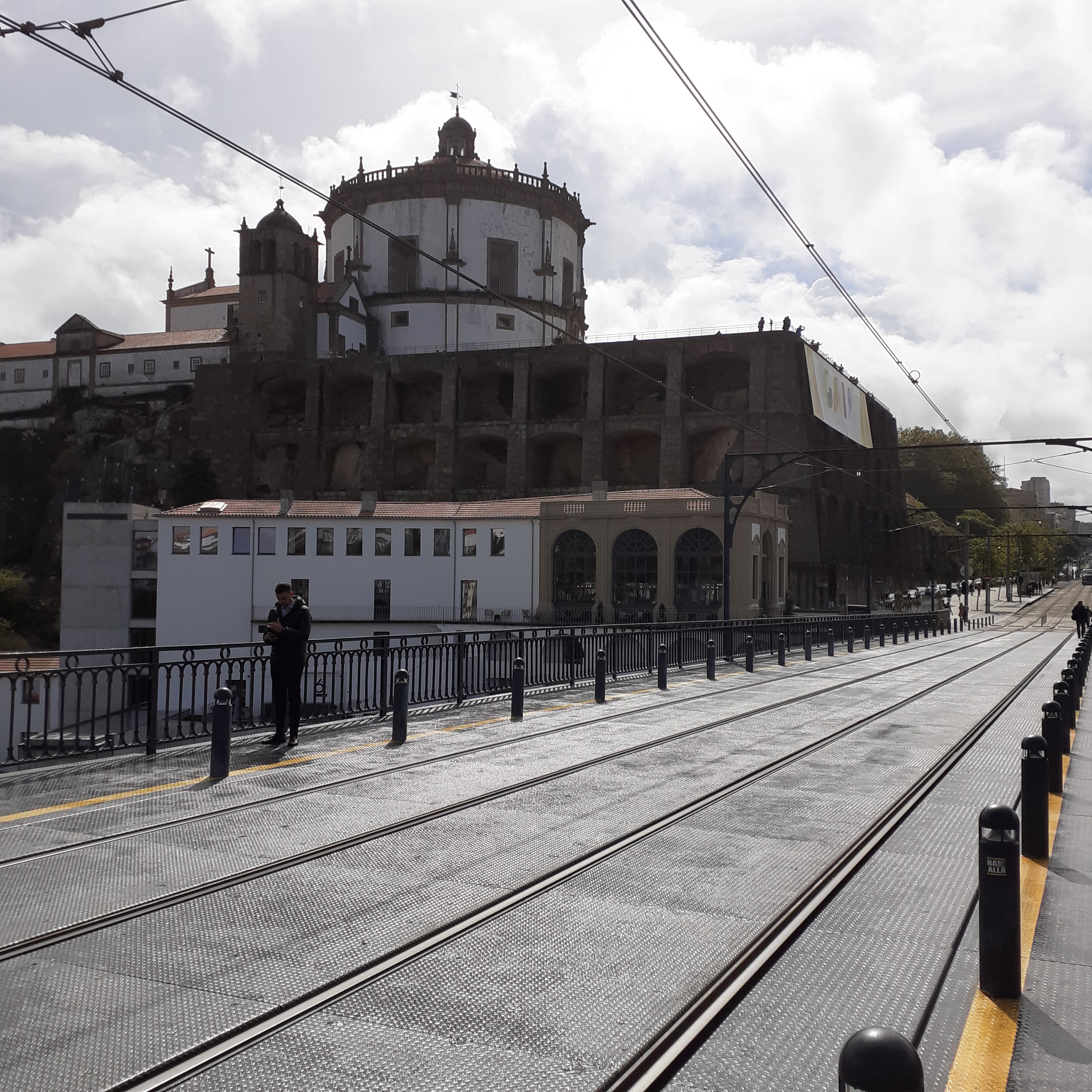
The bridge is shared with a lot of tourists and a frequent tram service. There is, of course, a dizzying array of photo opportunities. The rain has relented, allowing the sun to bathe the panorama in light. Sunny Oporto, slung across the highest slopes of paradise. On the far bank, the monastery of Serra do Pilar is perched above Vila Nove de Gaia. This was originally a 17th century monastery but has long been a military barracks. That dashing Dubliner, Arthur Wellesley, the Duke of Wellington, occupied the monastery in 1809 during the Peninsular War. From here he launched his blitzkrieg assault in the Battle of the Duoro where he routed French forces to secure Portugal. Shortly afterwards, Wellesley was elevated to the perrage as Viscount Wellington, and later Duke of Wellington after the defeat of Napoleon

There’s a cable car service down to the south bank quays, but today I’m going to retrace my steps and do the north bank, Ribeira. I returnwith more confidence, narrowly avoiding getting run over by a tram. Listen for the bells, the bells! There’s beauty and there’s danger, and a lot more to see in the sunshine and the rain of Oporto.

Window in Skerries

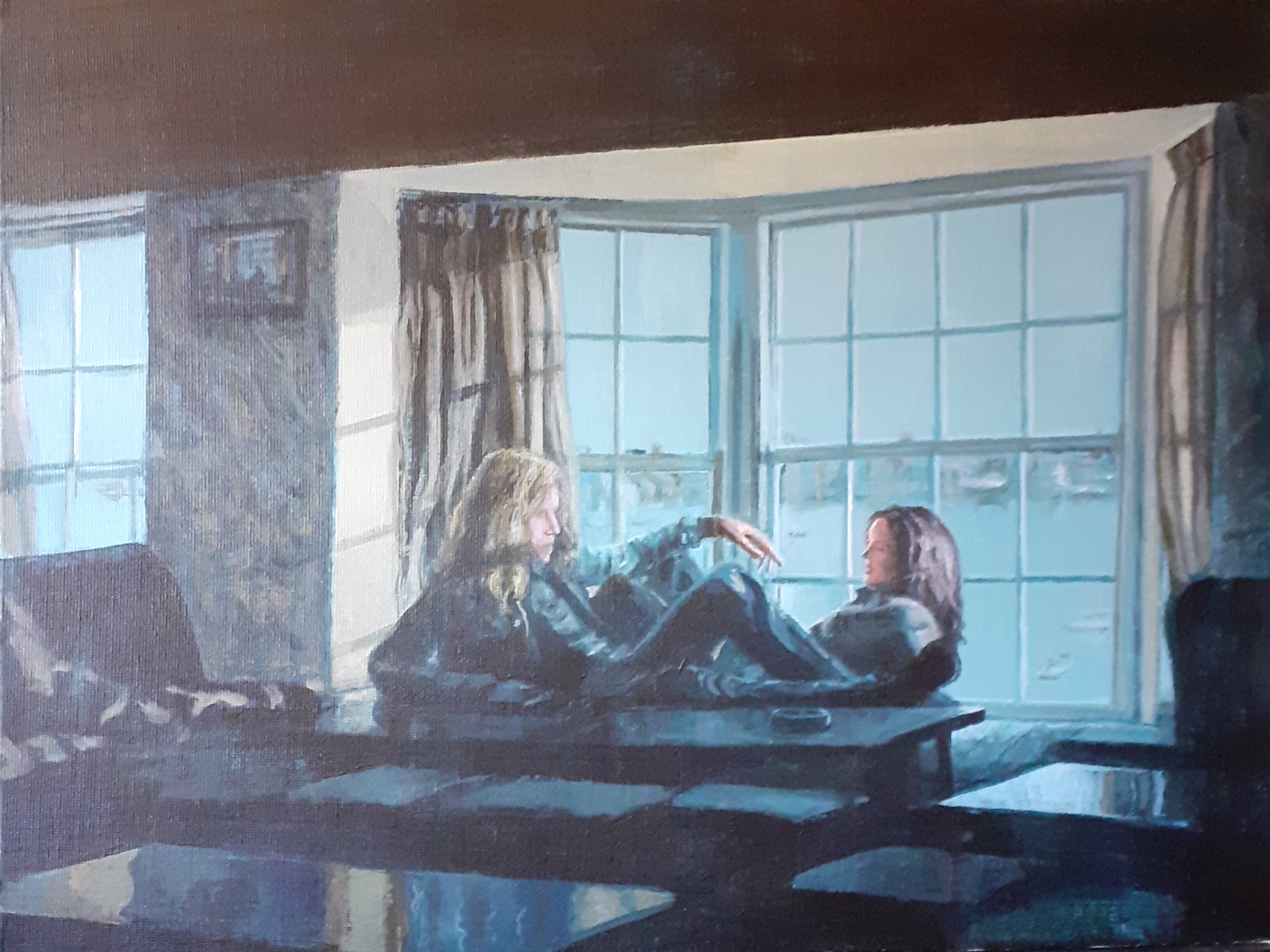
This acrylic on board is based on a photograph. The photo was taken by M on a trip, many moons ago, to Skerries in North Dublin. Four of us found ourselves in Joe Mays which is located on the harbourfront and dates back to 1865. The upstairs lounge has fine views over the harbour. It was empty and dark, but strangely flooded with sunlight. We disported ourselves in the bay window and thought, in high spirits, to enact some Renaissance tableau, as you do. M arranged the scene with myself and our friend J. We were thinking of Venus and Mars. M is also known as Mars, which shuffles the roles slightly. Since we were having fun there’s no point in being too interpretative. The shoot would have called up a few references but this was the shot that worked best. Almost fifty years later the main thing it conjures up for me is our youth, and all that entails. 

Sandro Botticelli painted Venus and Mars in the late fifteeenth century, c 1485. Botticelli was born in Florence in 1445 and lived there all his life. His Birth of Venus and Primavera reside at the Uffizzi, but this painting has found its way to the National Gallery in London. It is often seen as an allegory of sensuous love, or might be read as love conquers war. It is also funny, playful; all of which fit the mood of our carry on. Manet’s Dejeuner Sur L’Herbe, which I alluded to in my last post on Raheny, and Michelangelo’s Creation of Adam also get a look in; as do Pink Floyd’s Ummagumma and Led Zeppelin’s Presence. As a music theme however, I’ll go for This Wheels on Fire, the title being a pun which only the protagonists in our scenario will get.

If your memory serves you well, we were going to meet again and wait

So I’m going to unpack all my things and sit before it gets too late

No matter what, we’ll come to you with another tale to tell

And you know that we shall meet again if your memory serves you well

The song was written by Bob Dylan and Rick Danko and would eventually surface on the Basement Tapes in 1975, but first appeared on the Band’s album Music from Big Pink in 1968. It was a hit for Julie Driscoll and the Brian Augur Trinity in 1968 which was the first I heard it. The use of Hammond organ and electronic distortion gave it a very psychedelic feel. This aspect made it ideal as the theme song for the tv series Absolutely Fabulous in the early nineties. And there we are, young hippies of the seventies, frozen forever on the event horizon. Still friends and lovers.

Wheel’s on fire

Rolling down the road

Just notify my next of kin

This wheel shall explode

North Dublin’s Sandy Shore – 8: Raheny

After Dollymount’s wooden bridge, the coast road has a more inland feel about it. The sandy Bull Island traps a narrow lagoon within its five kilometre span, and midway along a causeway connects with the mainland. Here we reach the borders of Raheny, five miles from Dublin city centre. The name derives from the Gaelic for an ancient ring fort, or rath, and here signifies the fort in the marsh. The old centre of Raheny is further inland and can be reached via St Anne’s Park or Watermill Road. Alternatively, it can be reached directly from the city by Dart. 

The Dart stop is just north of the main road linking Dublin and Howth. The Howth Road now ploughs straight past what was once a small village remote from the city. Previously the road headed sharply seawards here, as Main Street still does. Then, in the early nineteenth century, the Telford Engineering Company were commissioned to construct the new Howth Road along its modern lines. William Dargan, having worked with Scottish Englineer Thomas Telford on the London to Holyhead Road from 1819, was placed in charge of the project in 1824. Dargan would soon graduate to the building of railways. From 1834, for two decades, the land of Ireland was well ironed, much of it thanks to Dargan. The Dublin to Drogheda railway was completed in 1844 and would ultimately connect to Belfast. Daniel O’Connell was on the first train to stop at Raheny railway station which dates from 1844. The Liberator would have been nearing seventy at the time, but still at the height of his powers as a nationalist and abolitionist. But he only had three years left to live, dying in Genoa in 1847, while on pilgrimage to Rome. 

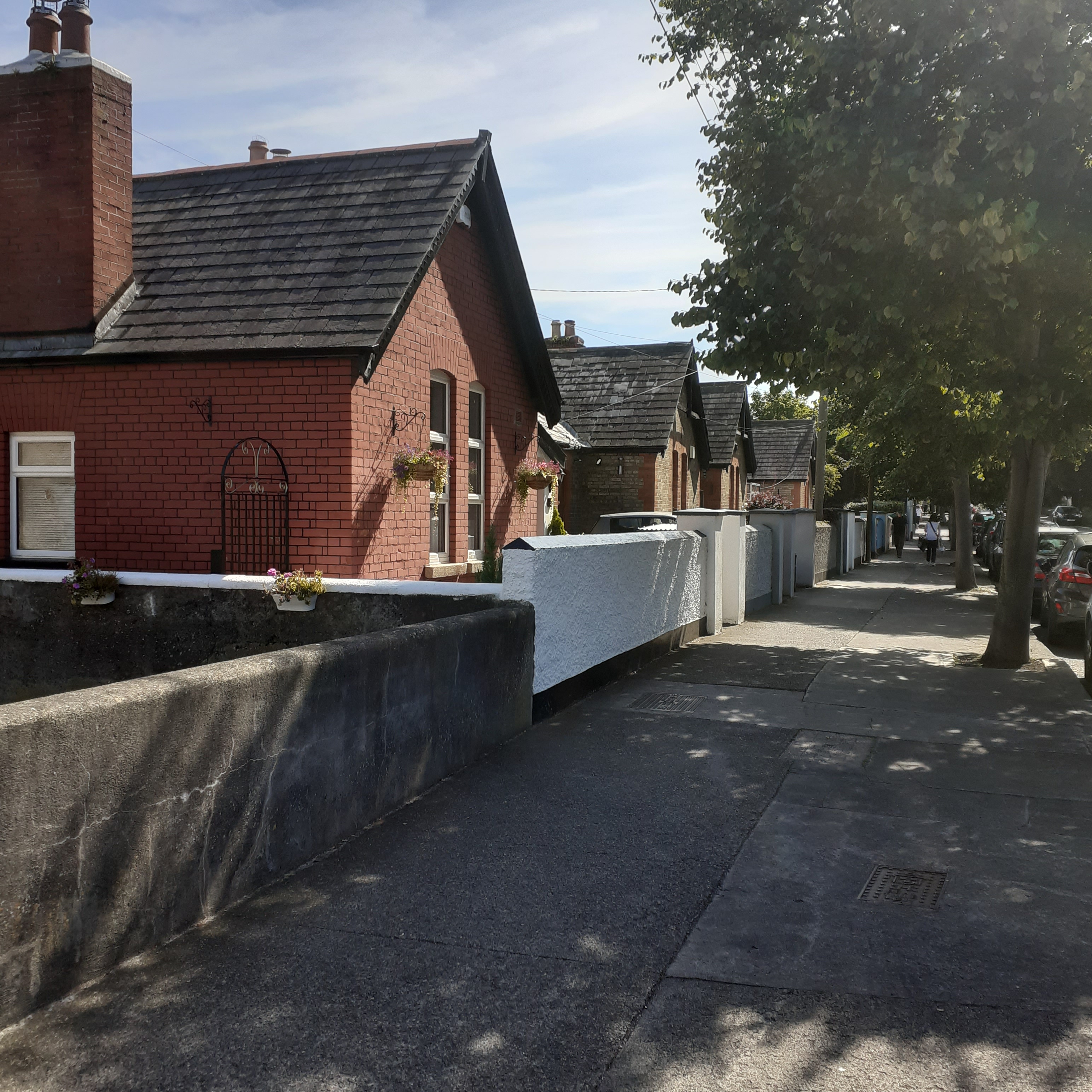
Coming from the Dart station, on the left eight cottages arranged in a crescent are Raheny’s oldest surviving dwellings. They were built in 1790 for the estate workers of Samuel Dick. He was a wealthy linen merchant who became governor of the Bank of Ireland. He also built a school, Dick’s Charity School, in 1787 for the poor children of the parish, located a little further on at the rath in the centre of the village. It is now a Pakistani Restaurant, the Mint Cottage.

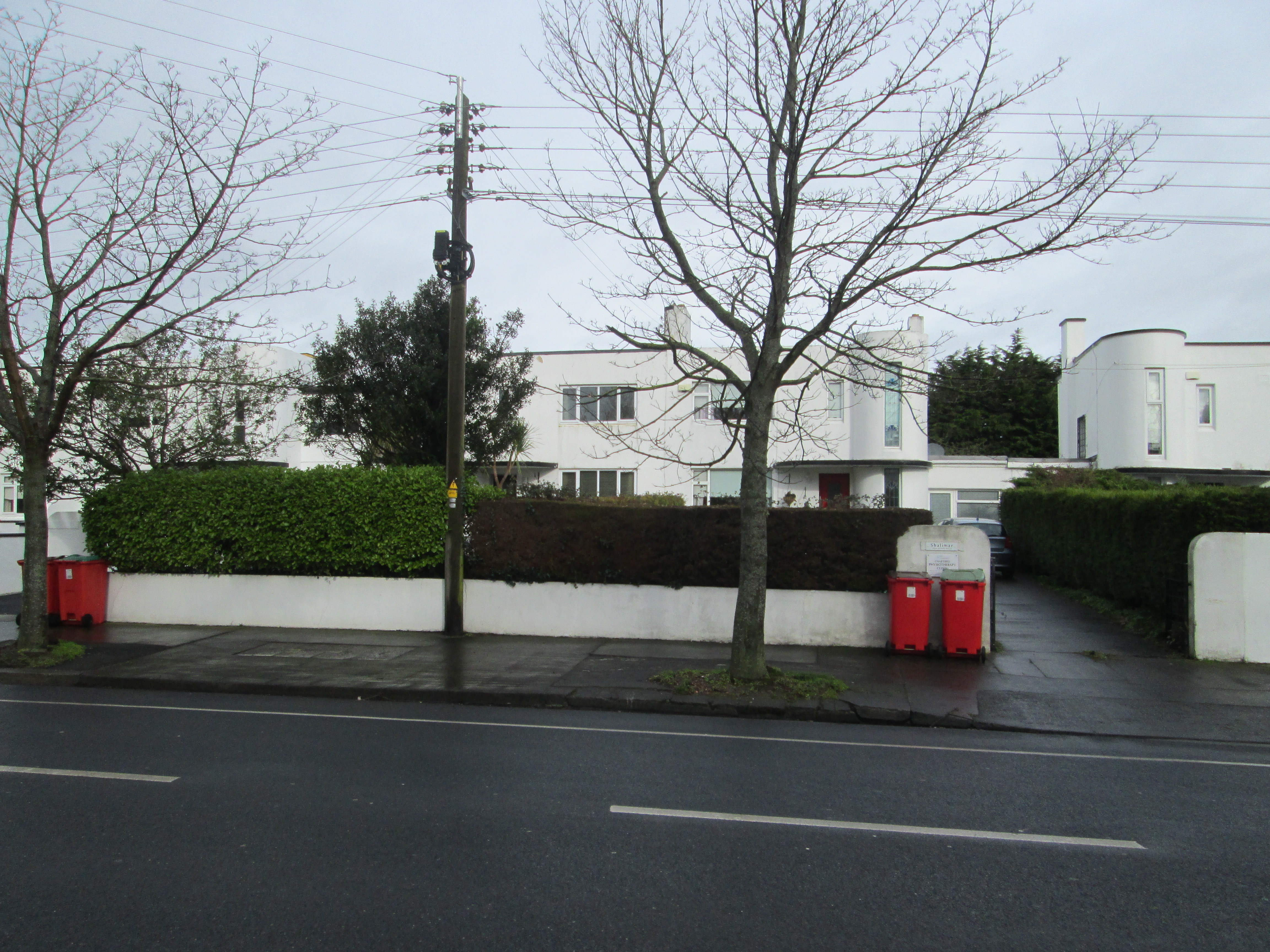
At the Manhattan pub, you reach the Howth Road. If you follow the Howth Road northwards, it soon merges into a stylish streetscape. The houses are white, Art Deco, particularly suited to a seaside environment, even one as bracing as North Dublin,  There’s just a hint of Miami in the air, giving the area a vaguely exotic twist.

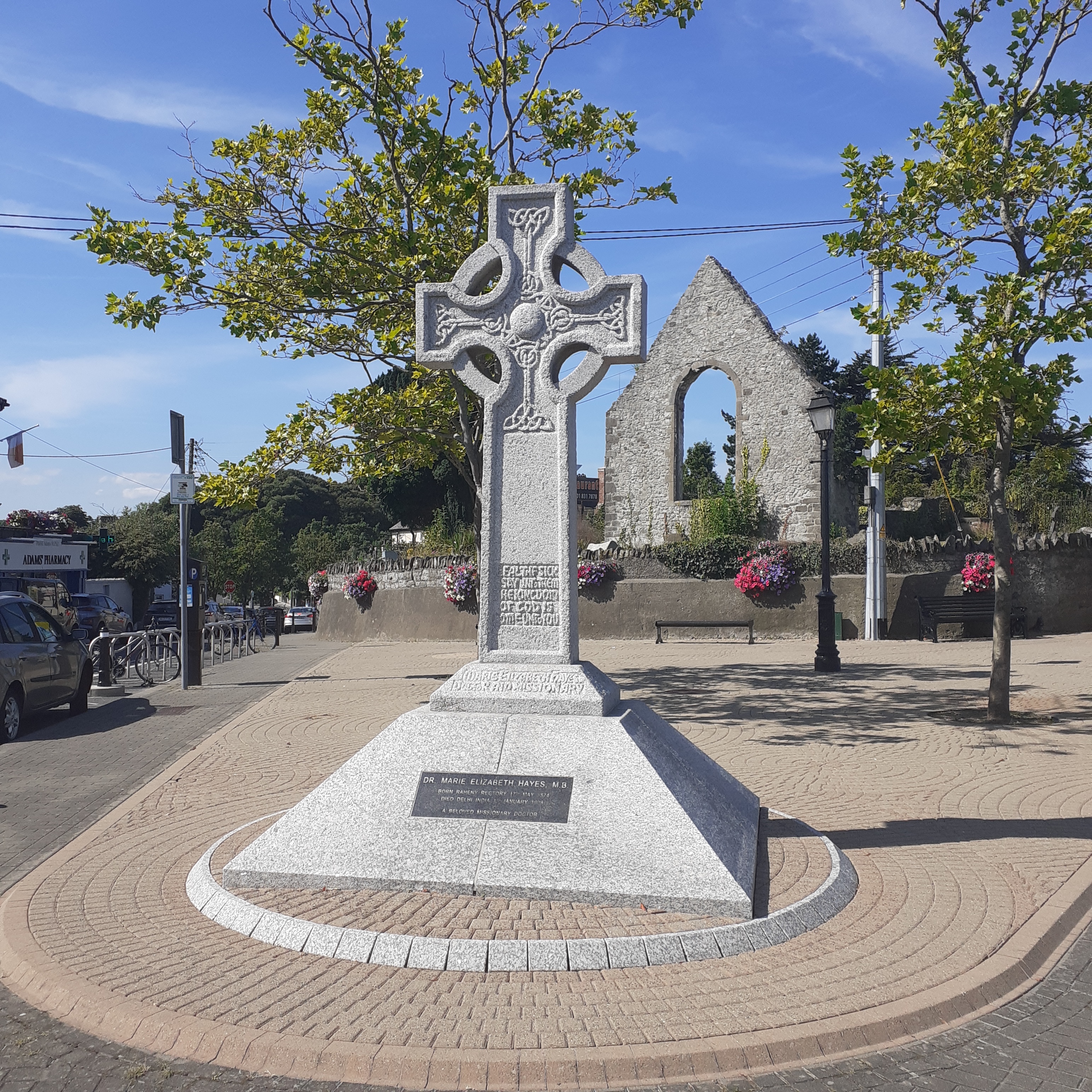
The village plaza is on the seaward side. This is centred on what remains of the ancient rath, consisting largely of old church ruins. Raheny is first noted with the establishment of Christianity in the area in 570AD. By 1179 Pope Alexander III granted ownership of the local chapel to Christchurch Cathedral. A church, dedicated to St Assam, was erected in 1609 after the Protestant Reformation and rebuilt in 1712. In 1889 the Church of Ireland decided to abandon the old church, and moved south along the Howth Road where a new church was built. The ruins of the old church remain.

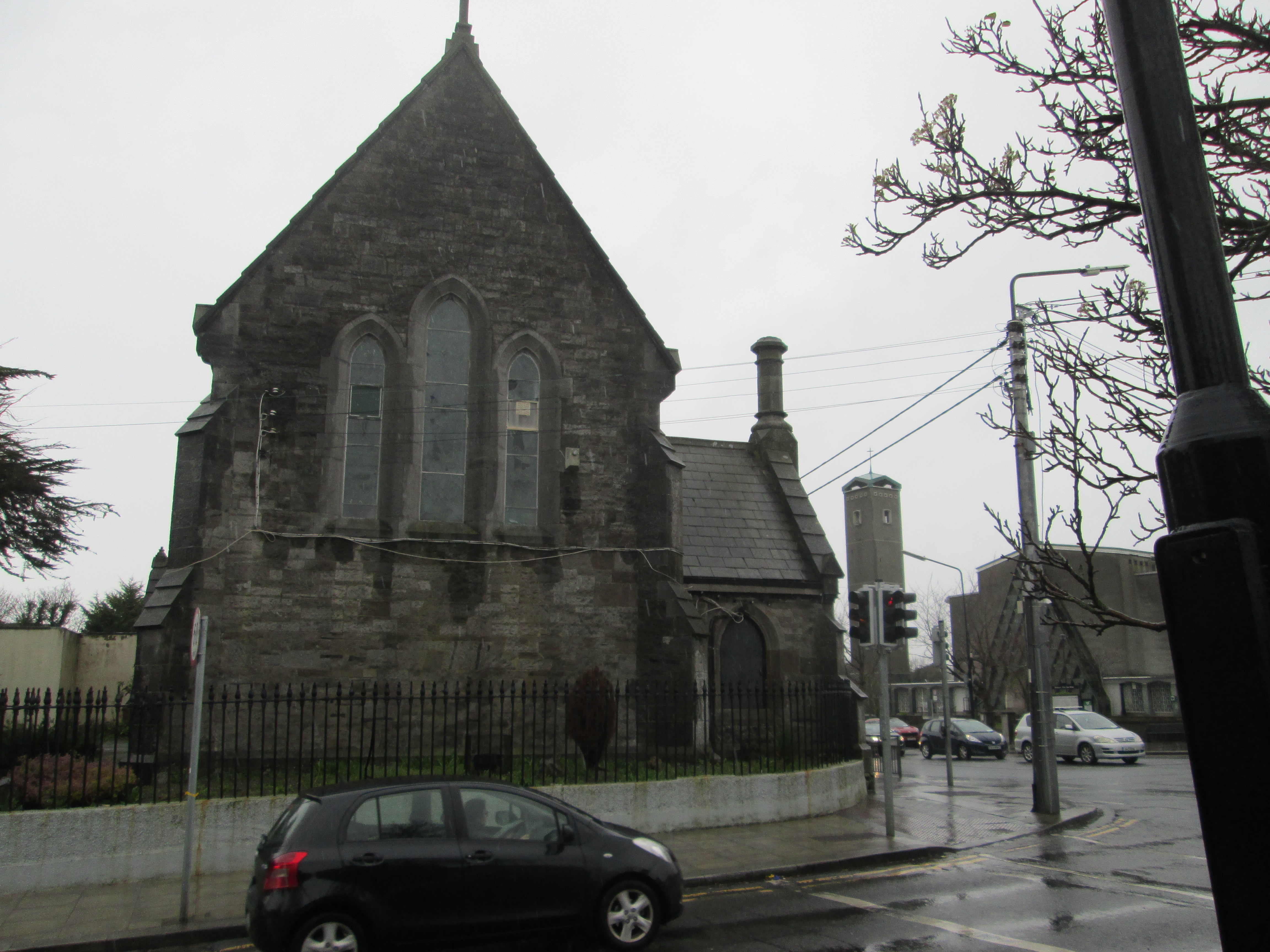
The Roman Catholic church, completed in 1864, was also called St Assam’s and lies just across Main Street from the rath. Designed by Patrick Byrne, a prominent church architect of the time, who died the year it opened. In 1962 it was replaced by the huge modernist hulk, the church of Our Lady, Mother of Divine Grace across the main road. The old church continued to function as a parish social centre und was only recently deconsecrated and earmarked for office development.

The new Church of Ireland venue, All Saint’s Church, is further south along the Howth Road. It was designed by Irish architect George Coppinger Ashlin. It is cruciform, built in the modern gothic style in Wicklow granite with limestone dressings and an octagonal spire. It is where Bono and Ali Stewart were married in 1982, with Adam Clayton as best man. The church is set within its own narrow parkland which connects to St Anne’s Park. I note a crossing road is called All Saints Drive, but not all drivers are saints.

Arthur Guinness, Baron Ardilaun, sponsored the building of All Saints. He was the great grandson of Arthur Guinness who founded the brewing company in 1759. Ardilaun owned extensive lands throughout the country including Muckross in Killarney and Ashford Castle in County Galway. Raheny was his Dublin residence. It had been purchased in 1837 by his father Benjamin who changed the name from Thornhill to St Anne’s. Arthur became renowned as a philanthropist and patron of the arts. Having bought St Stephen’s Green, he landscaped it and donated it to the citizens of Dublin in 1880. His statue stands, or sits, on the southwestern side. When approached by Sir Hugh Land to have a modern municipal gallery built there he stormed: “Are you mad? I will not have myself stand sentry to a picture palace like some giddy huckster!” The gallery eventually was established in Parnell Square, and Ardilaun was pilloried by Yeats. He died in 1915 and is buried at All Saints. The estate was eventually acquired by Dublin Corporation in 1939 and developed as St Anne’s Park. The big house itself burned down in 1943. The Guinness estate in total measured some 500 acre of which about half 240 acres has been used for St Anne’s.

I stop for a coffee in the village, at Perky’s coffee house with its pleasant little garden at the rere. Perked up, I then turn onto Watermill Road at the bottom of Main Street and stroll towards the park. From this entrance, a long, straight, pleasantly gloomy avenue of trees bisects the playing fields. There is a rough path down to the Nanikin River. Wilderness encroaches but this is balanced by a few picturesque follies. These are vestiges of the old Guinness estate. 

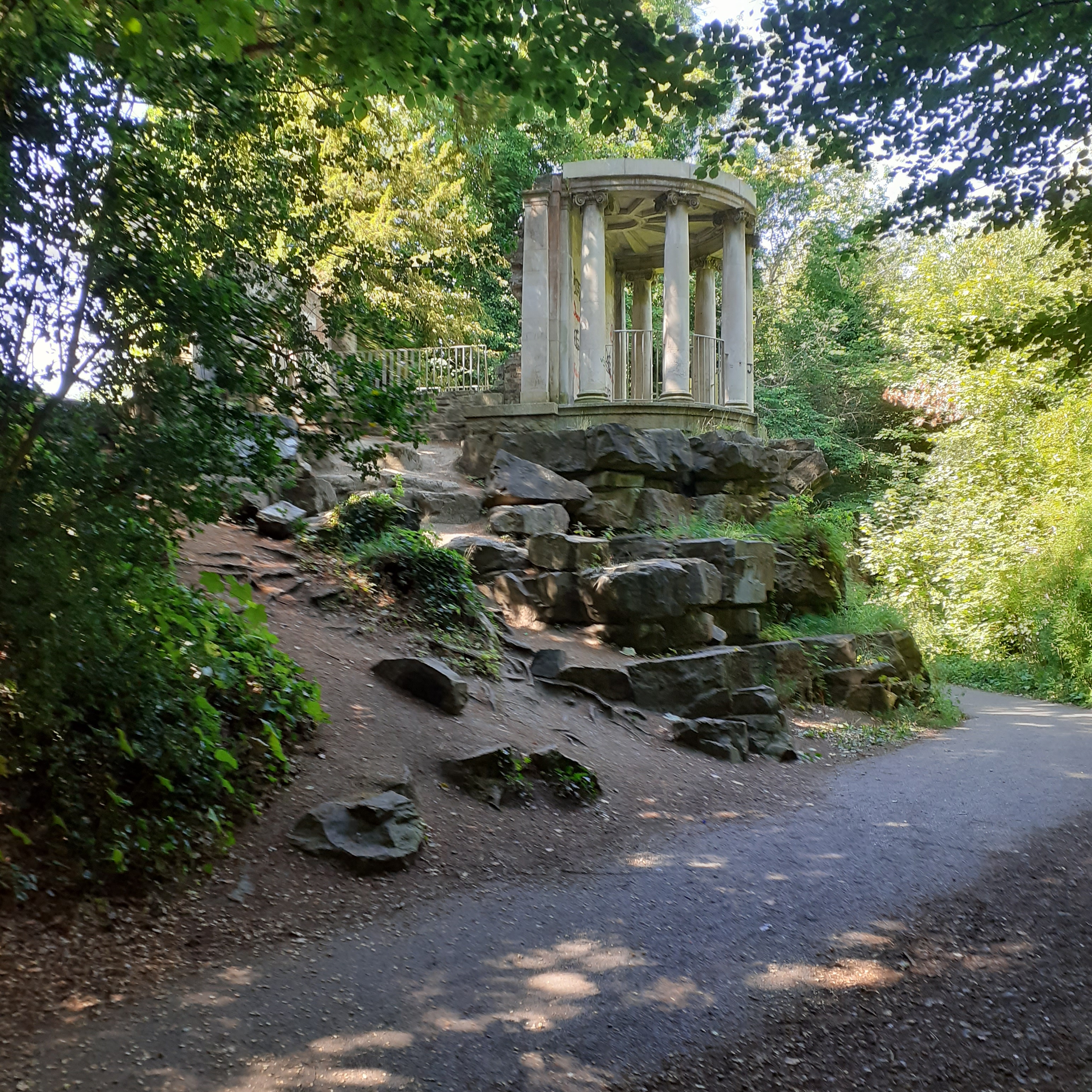
The Herculanean Temple is one of a number of follies with a Roman theme The temple of Isis by the pond nearby takes its inspiration from Pompeii. The false ruins would make an ideal backdrop for a Romantic painting, with cavorting heros and nymphs. Today, two Goth couples lounge by the water smoking the herb. So, more of a Manet then. My journey becomes ever more winding, and I eventually gain the seafront across an Impressionist meadow. 

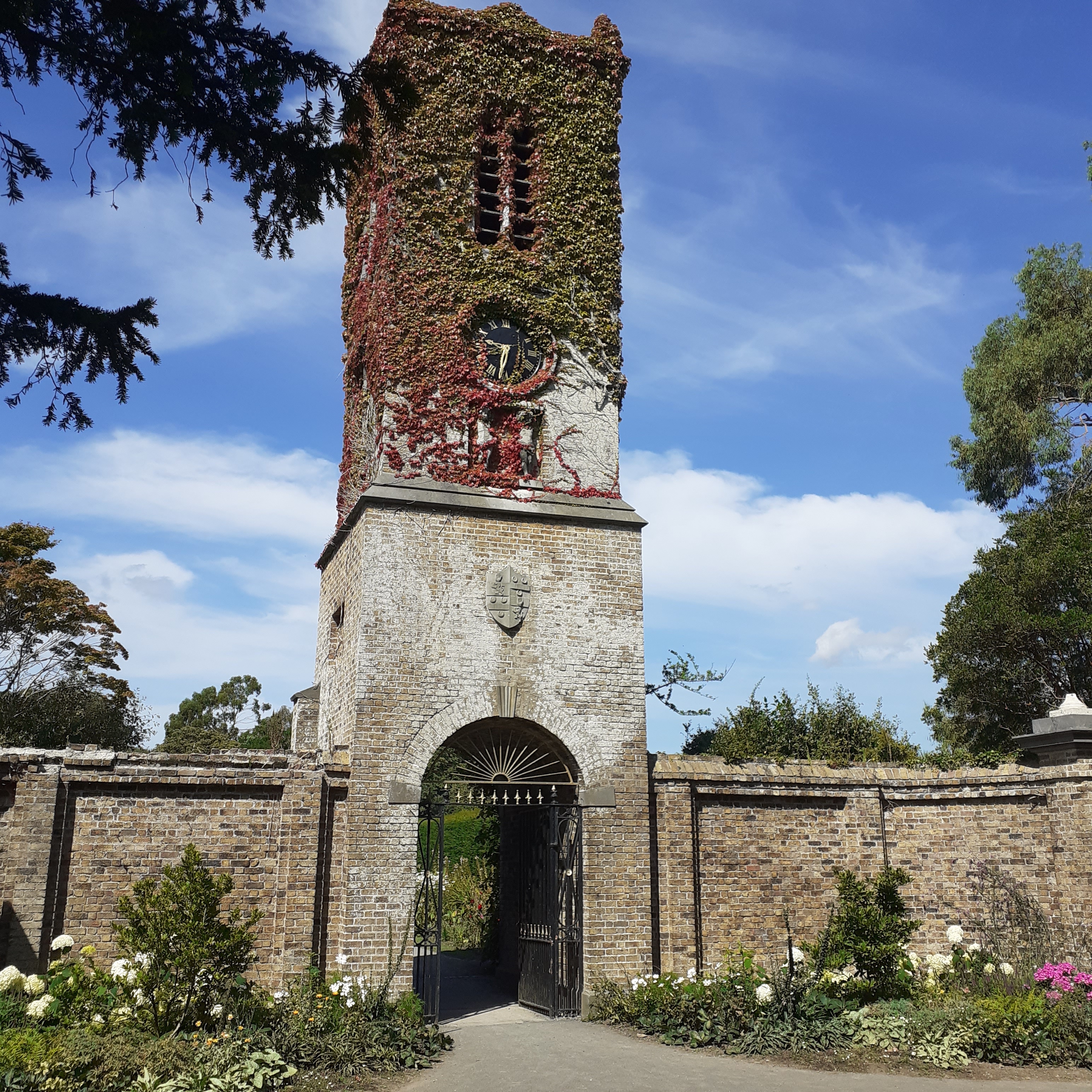
Further south, I head back inland and underneath the Annie Lee Tower and bridge which suggests medieval times. It was named for Benjamin Guinness’s daughter who became Lady Plunket. Though it would pass for an ancient park gate it also dates from the 1890s as the Ardilauns continued to embellish their estate.

Lady Ardilaun was a guiding force in developing the gardens in the manner of French classical garden design. Lady Ardilaun, Olivia Guinness, was born in 1850, daughter of the Earl of Bantry. She was a keen artist and became a member of the Water Colour Society of Ireland. Her passion for horticulture has seen plants named for her. The annual rose festival at St. Anne’s is also a testimony to her work. Amongst the many beautiful gardens that remain is the Walled Garden marked by its landmark clock tower. The Chinese Garden is adjacent.

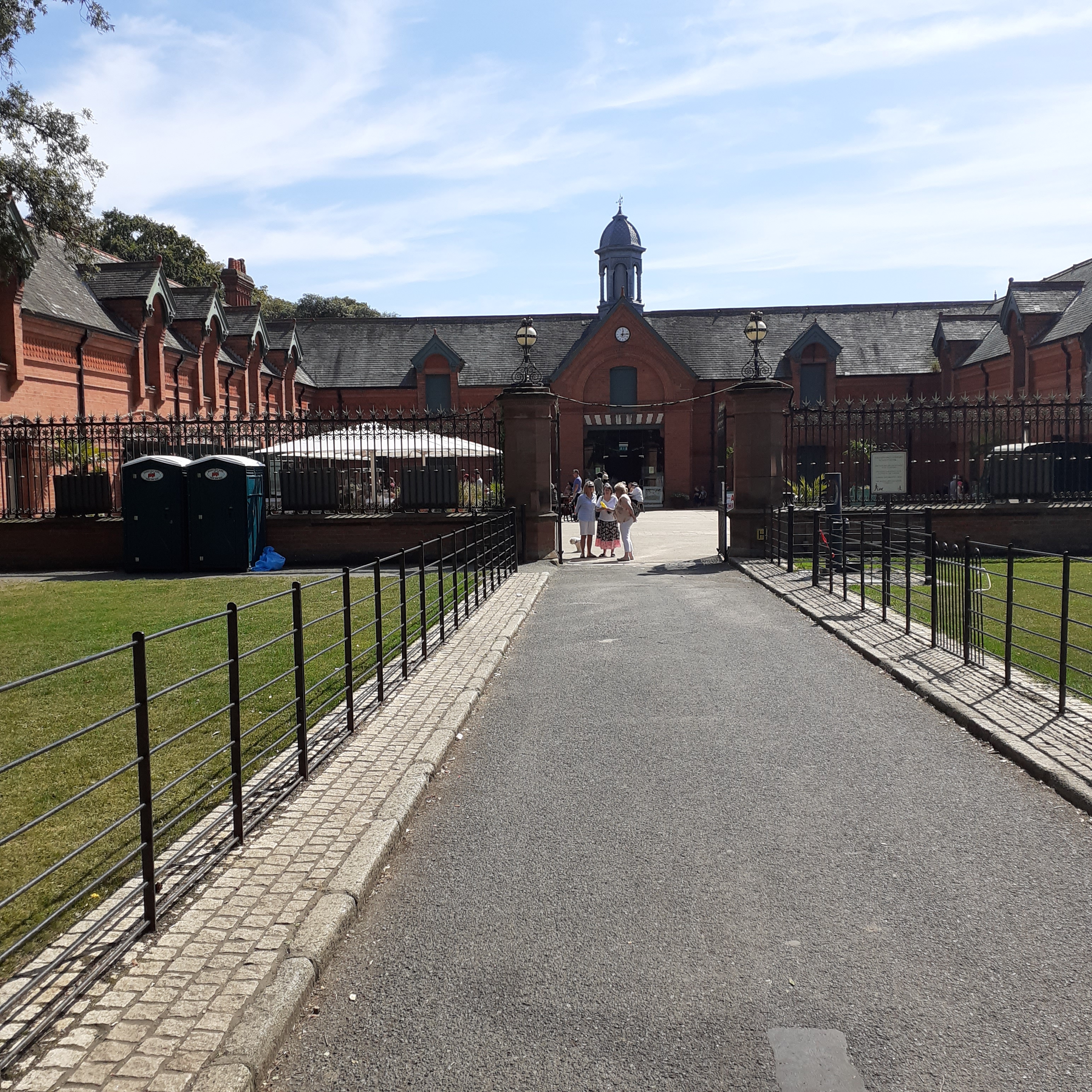
The Red Stables is the only surviving building of the demesne. This red brick stables was built in the Tudor style so popular in the late Victorian period, and also designed by George Coppinger Ashlin. Today the building houses artists residences and workspace, with a gallery and cafe. The cafe, Olive’s Room, is named for. Lady Ardilaun. Beside the gallery, there’s a a concise history display with a model of the Big House. The Red Stables is adjacent to the car park off Mount Prospect Avenue, taking you to the seafront and Clontarf Rad. The majestic central avenue leads westwards to Vernon Avenue which connects to Contarf Village. Due north, paths will lead you back to Raheny, via Watermill Road or All Saints Church.

Connemara Rain

During the recent hot spell I would, between a few leisurely lengths of our Hockneyesque pool, retreat through the sliding doors and return to my latest painting on rain and gloom. No better way to cool down. Well, there are some, but there’s only so much one’s allowed.

The road has risen from Killary Harbour behind us and cresting the pass the jagged profile of the Twelve Bens spreads along the horizon. We’re heading for Letterfrack and an assault on Diamond Hill, a standalone peak, or Marilyn, on the western edge of the Bens. We’re on a switchback road through the stark paradise of Connemara. It’s low noon in midwinter and the sky is striped with sudden storms. Raindrops spatter the widscreen and the radio plays.

Someone told me long ago, there’s a calm before the storm,

I know – it’s been coming for sometime.

When it’s over so they say, it will rain a sunny day,

I know – shining down like water.

This painting is acrylic on board, a harder surface than is usual for me. Which seems appropriate given its atmosphere. Off to our left is Lough Inagh. I stayed at the Lodge there over ten years ago, on a midweek course in Spring for watercolour painting. The few days, the fine tutelage and setting rekindled my enthusiasm for landscape painting. Most renowned landscape painter of Connemara would be Paul Henry. Belfast born in 1877, Henry lived in Achill for a decade up until 1919. His bleached landscapes have lodged in the collective view of how the west should look. He was colour blind, and lost his sight completely in 1945. He died at Sidmonton Square in Bray, in 1958.

Imagine the song on the stereo. The song that most sums up the feeling of rain, both positive and negative, was written in 1970 by John Fogerty, and included on the album Pendulum, released in December of that year. Fogerty was looking on the negative side, alluding to the growing disaffection within Creedence Clearwater Revival, despite enjoying success beyond their wildest dreams. But the lyrics and jangling guitar encourage a more consoling take on precipitation. There’s a peculiar exhaltation in sunshowers. Mind, our Connemara trip was midwinter, so the sun was slanting and cool, the rain sharp and hard. Beautiful though, within the bubble of a speeding car. 

Yesterday and days before, sun is hard and rain is cold, 

I know – been that way for all my time.

I want to know, have you ever seen the rain.

I want to know, have you ever seen the rain

coming down on a sunny day.