Dublin can be heaven
With coffee at eleven
And a stroll in Stephen’s Green
By the seventeenth century Dublin was spreading beyond its walls. The Liberties were established to the south and west. Settlements sprang up on the north bank of the Liffey. At the end of a tumultuous century, the Liffey was lined by redbrick gable-fronted houses and the quaysides had been constructed as thoroughfares. The trend was for enlargement to the east, which became the prosperous part of the city. Between the crumbling medieval Old Town and Georgian Dublin of the mid eighteenth century, the winding streets and lanes of today’s social and commercial heart developed.
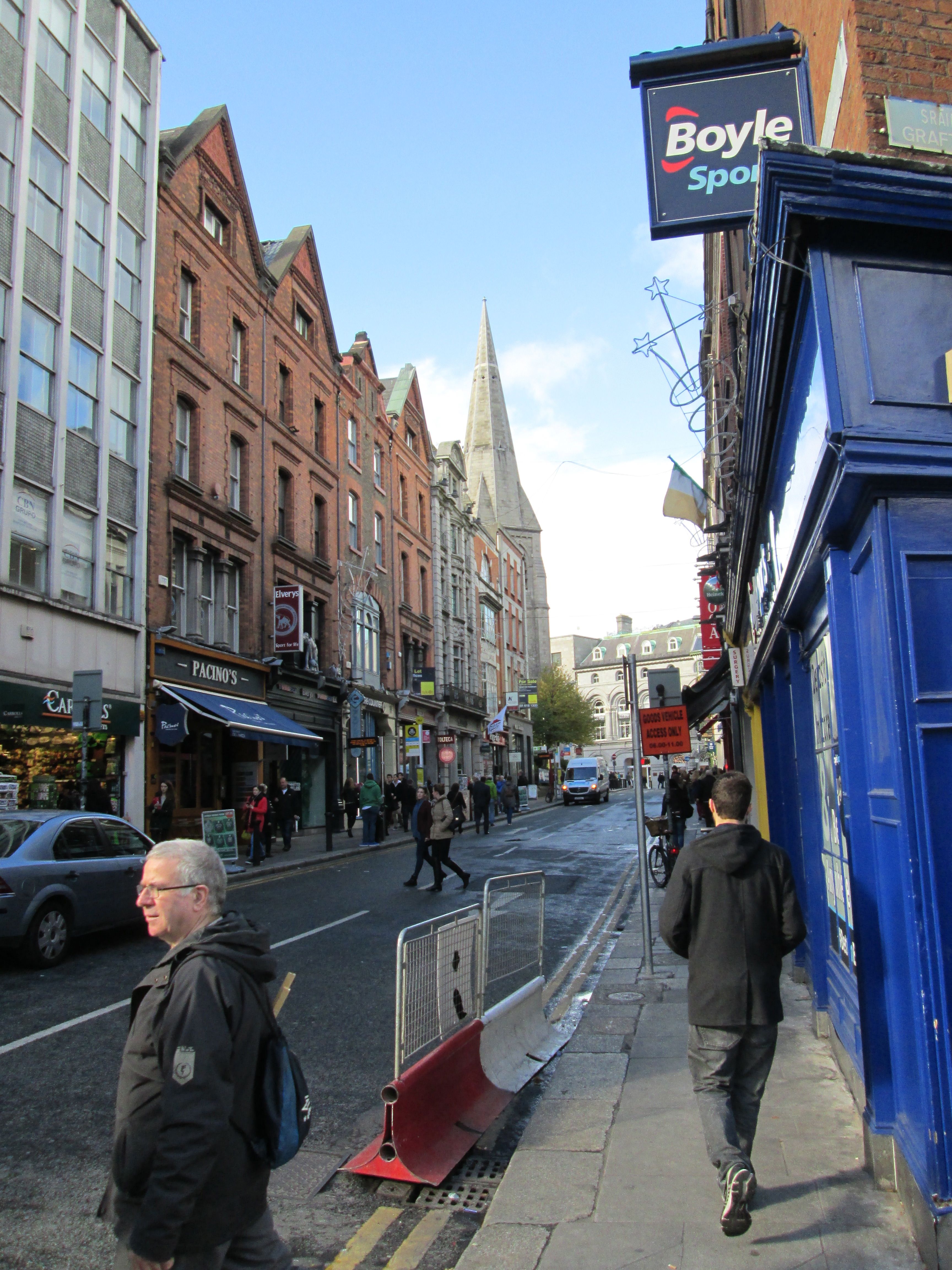
Dame Street is one of the defining thoroughfares of the city, from City Hall to Trinity College and the old Parliament Buildings. Temple Bar lies to the north, to the south lies the shopping, strolling, cafe Capital centered on Grafton Street. Dame Street is the main street of banking and commerce, its palaces of commerce capturing the exuberance of the Belle Epoque, imposing facades topped with picturesque turrets. Recently, expanding city nightlife has colonised some of these premises for drinking and dining pleasure, old trades living on in such names as the Mercantile. Running parallel, Dame Lane stretches from the Castle’s Lower Yard, across South Great George’s Street, through Dame Court and past the Stag’s Head, eventually emerging into city traffic by Trinity Street.. If indeed you do pass the Stag’s Head, and you shouldn’t, it’s near enough the definitive old style Dublin pub.
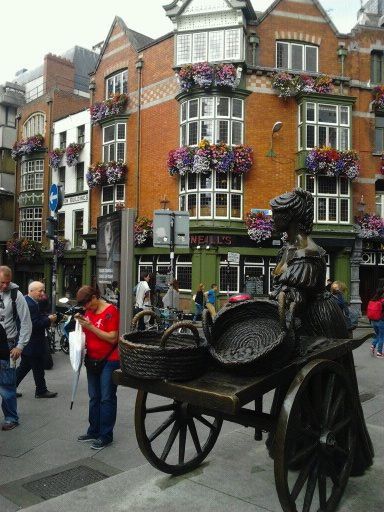
St Andrew’s Church is Dublin’s tourist HQ and as good a reference point for the city centre as you’re likely to get. Setting up stall outside is a bronzed woman with fetching cleavage. The statue of Molly Malone by Jeanne Rynhart dates from Dublin’s millennium celebrations in 1988. In just a quarter of a century it has achieved iconic status. Molly steps from the air of a song to become flesh, or bronze at least.
In Dublin’s Fair City
Where the girls are so pretty
I first set my eyes on sweet Molly Malone.
As she wheeled her wheelbarrow
Through streets broad and narrow
Crying cockles and mussels, alive, alive-oh!
The song is of obscure provenance. First recorded as a music-hall ballad of the 1880s, attributed to Scottish songsmith, James Yorkston, though it may be derived from an older ballad. It has become the anthem for the capital city; the refrain Alive, alive oh! being suitably valedictory. However the song, as is the case with many an Irish song, finishes on a mournful note.
She died of a fever,
And no one could save her,
And that was the end of sweet Molly Malone.
Now her ghost wheels her barrow,
Through streets broad and narrow,
Crying: Cockles and mussels, alive, alive oh!
In old Dublinese, fever and save her would rhyme. She can still wheel her wheelbarrow, all the same. Last time I saw it ‘twas at the bottom of Grafton Street, now it stands outside Saint Andrew’s Church. Mythology has accreted to the song. The story goes that Molly was a seventeenth century barrowgirl who earned a bit on the side plying the oldest profession. The song certainly alludes to sex. Cockles and mussels (or muscles) has salacious connotations. The refrain has a bawdy singalong quality. Young lovers and visitors to the Fair City have taken the photo opportunity the statue offers. It is traditional to grasp one or both of Molly’s breasts, giving them a sunburst emphasis, fulfilling the myth’s premise.
Top o’ Grafton Street
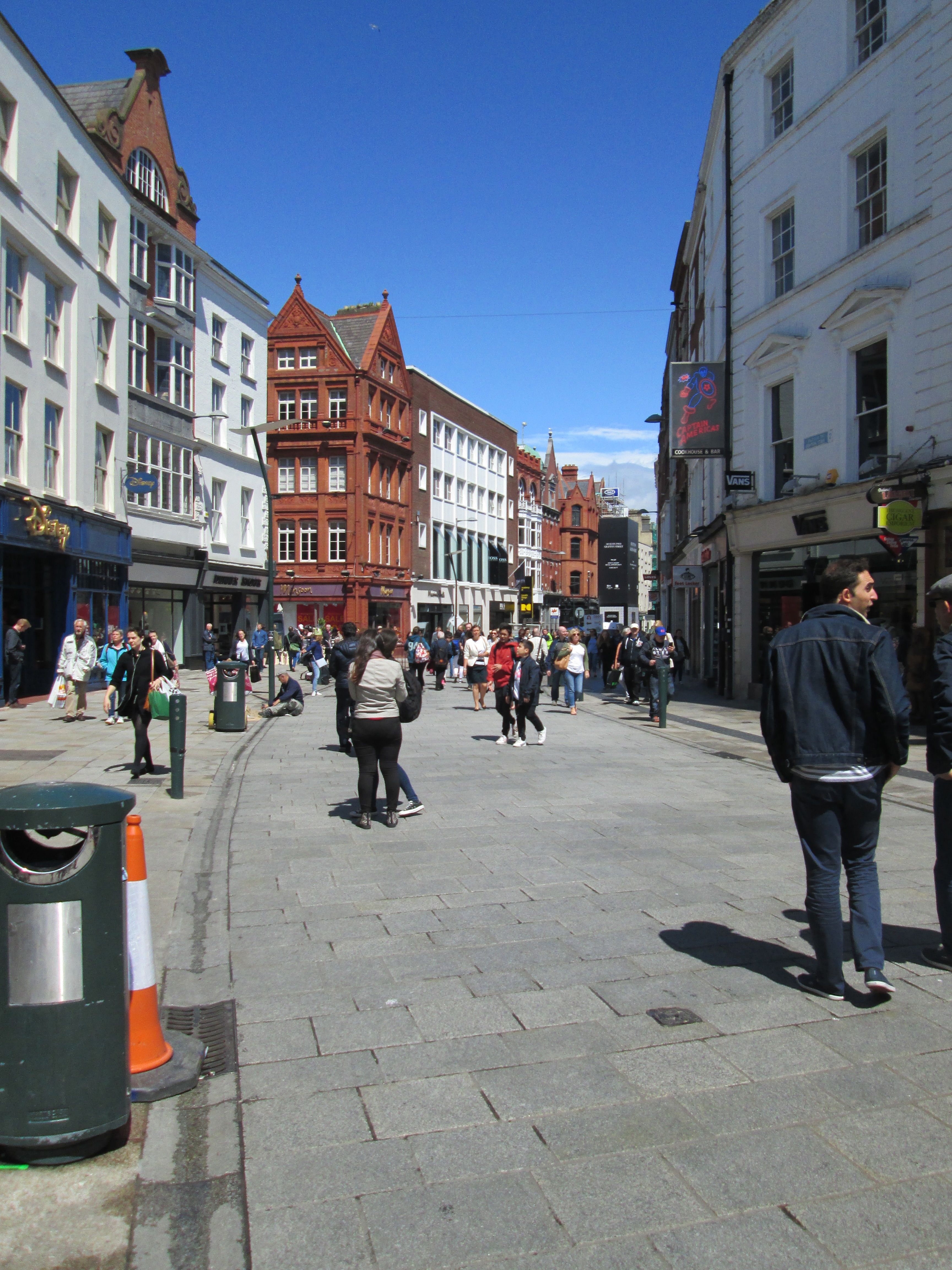
A few yards further east, Grafton Street runs at a right angle to Suffolk Street. Now Dublin’s principal shopping street, a bustling pedestrianised way thronged with shoppers and tourists, lined with buskers and street theatre.
Grafton Street’s a wonderland, there’s magic in the air.
There’s diamonds in the lady’s eyes
And gold dust in her hair.
East of this line is where Enlightenment Dublin begins, with a rationalist street plan and regular, symmetrical facades. To the left you’ll notice the streets, still narrow, offer straight vistas. Anne Street towards St Ann’s Church, dating to 1707, is a fine example. To the right narrow alleys like Johnson’s Court tunnel back to the medieval. The Court provides a rear entrance to Clarendon Street Church, an oasis of spiritual calm.
At Bruxelles Pub near the top of Grafton Street, another lifesize statue vies with Molly for popularity. Phil Lynott was black and Irish as Guinness, leader of Thin Lizzy, kings of the Dublin Rock scene of the early seventies. Lynott took a rocked up version of Irish trad balled, Whiskey in the Jar to the British charts. The ballad records the misadventures of a seventeenth century highwayman. The protagonist’s lover, or whore, in Lynott’s version is called Molly, so no accident that they’re still close.
But me I like sleeping
Especially in my Molly’s chamber
But here I am in prison
Here I am with a ball and chain.
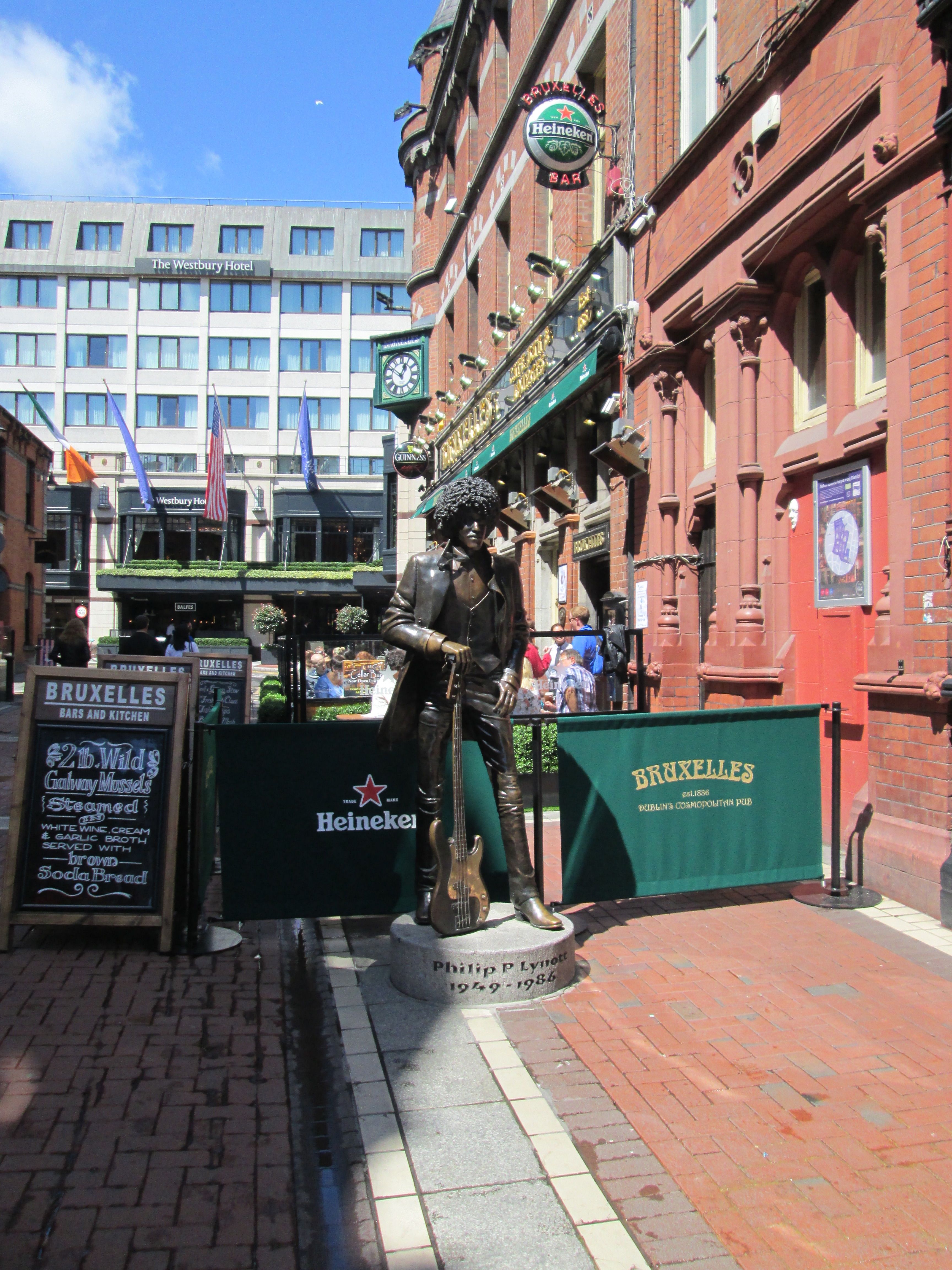
Lynott died in 1985, aged just thirty six. The video for his song, Old Town, features him swanning about Grafton Street, a tradition he’d maintained since the late sixties. Captain America’s near the top of the street would have known him and holds some of his and other Rock memorabilia. Captain A’s featured artworks after Lichtenstein by Jim Fitzpatrick. Fitzpatrick, famed for his depictions of Celtic myth and Che Guevara, recasts Captain America as a crusader against fascism. We came for their Mexican burgers and red wine. It was the hip hangout of the early seventies. Lizzy’s traveling coterie, Horslips, Mellow Candle and Chris De Burgh hung out here. De Burgh was resident singer, resplendent in star spangled suit. Probably helped to clear the joint.
Nearby, the Dandelion Market developed into Dublin’s hippy flea market. U2 cut their teeth here, before the whole thing was subsumed in the frothy Stephen’s Green Centre. At the top of Grafton Street, we emerge blinking into daylight dappled by trees. Saint Stephen’s Green in the seventeenth century was a commonage on the outskirts of the city. Those granted the title Freeman of the City, still maintain their right to graze their sheep on the Green. As Bono recently insisted.

The Green was walled in 1664 with access restricted to owners of adjacent properties. The surrounding houses would have been gable fronted properties, known as Dutch Billys. This style gave way to Georgian by the middle of the eighteenth century. Vestiges of the earlier style can be discerned. Look above street level and you will see, here and there, an asymmetrical window layout on the upper storeys, indicating where a gable frontage once was. The Green was restricted to residents until 1877 when Sir A E Guinness, Lord Ardilaun, campaigned to put the park into public ownership. The park was newly laid out to the design of William Shephard, Lord Ardilaun contributing the extensive planting of exotic trees and shrubs.
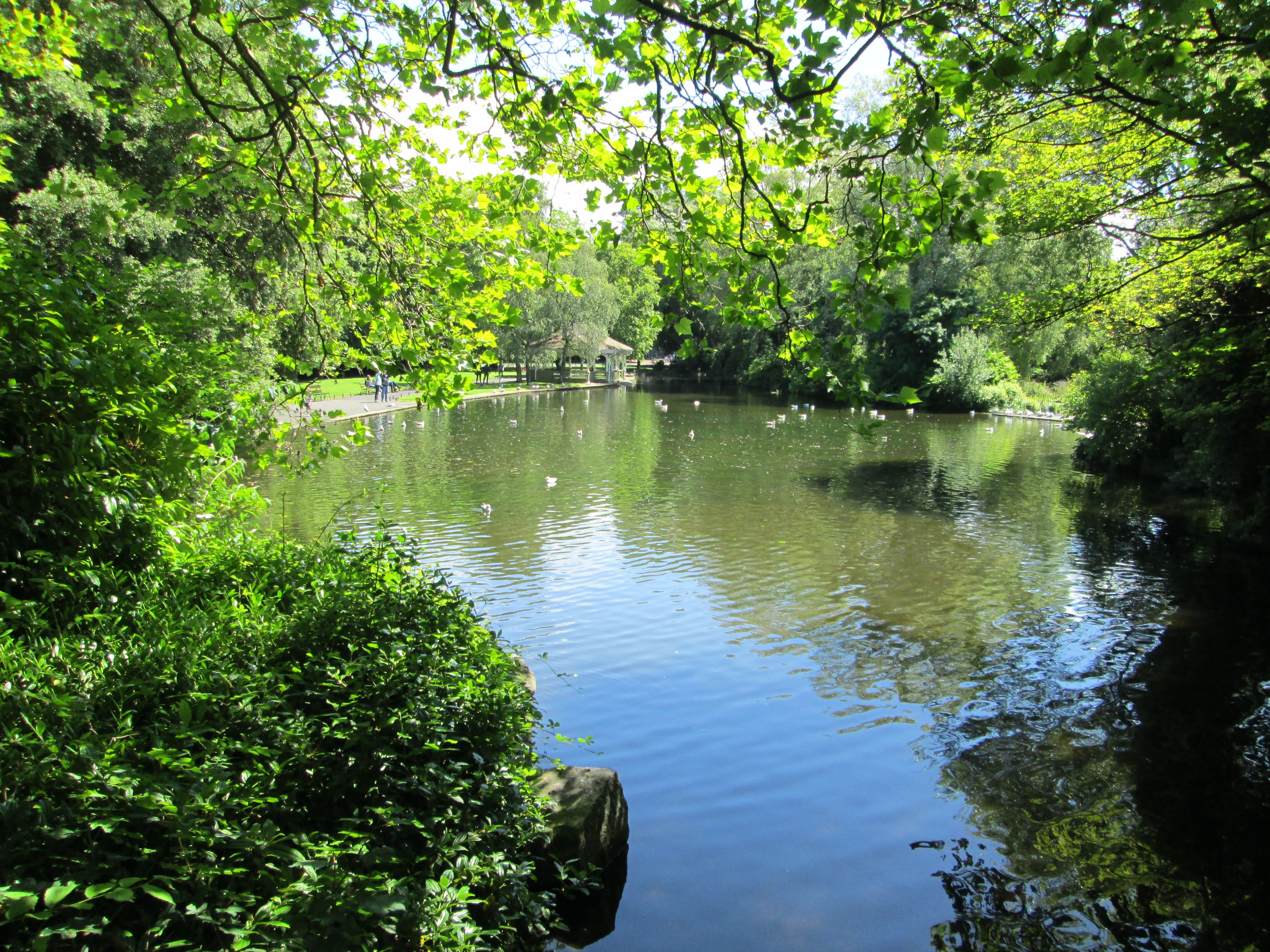
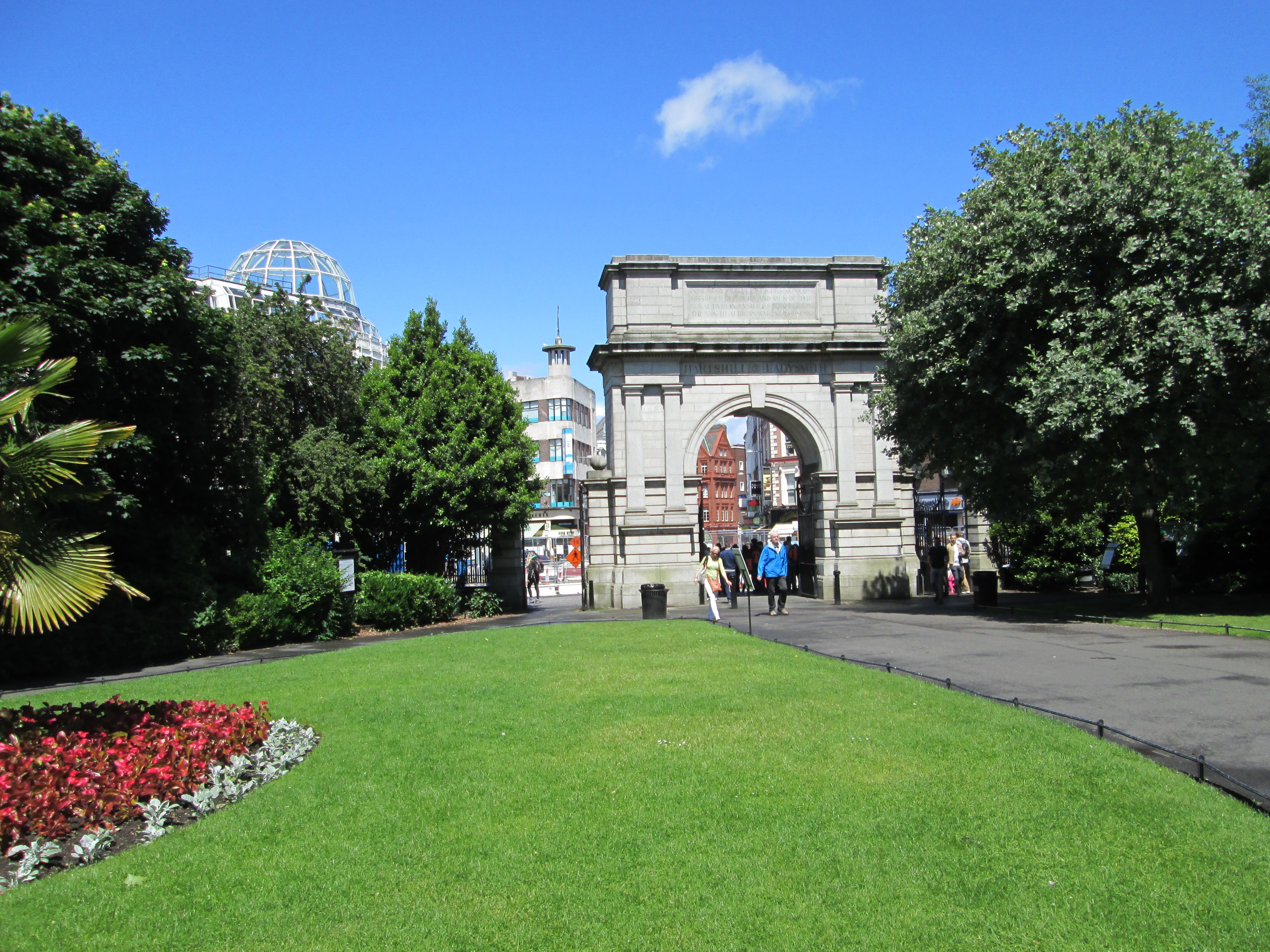
Entering through Fusiliers’ Arch, pathways flow around the ornamental lake. Young Dubliners and visitors occupy the grass, taking time out from the commercial hustle of Grafton Street. If Dublin can be heaven, and this is heaven’s heath. Beyond the park’s southern extent, the centre city starts to ebb. The rational expanse of Georgian Dublin takes over with its wide regular streets. Find a quiet elevated spot past the kip of the serenes, by Moore’s statue of WB Yeats. It looks nothing like the man! Slip into a boulevardier dream, slide back into another time.
Toora loora loora laddy, toora loora lay,
I know the Dublin pavements will be boulders on my grave.