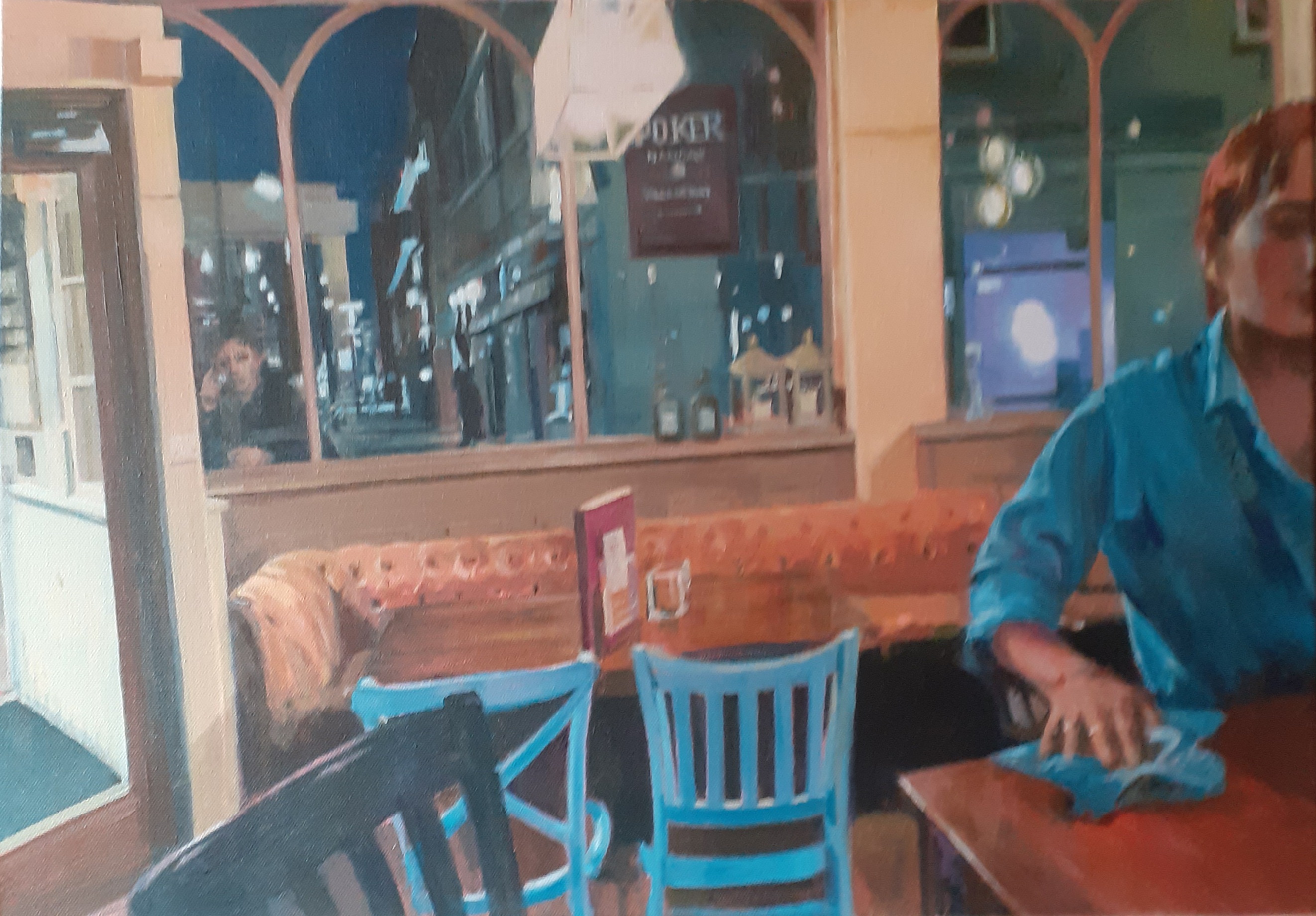
I stayed in Bayswater, London, last year. This acrylic is the view from a local bar looking towards Main Sreet, Queensway that is. I have returned from exploring the area of white Victorian terraces and dinky squares. Farther on, I spent much of the evening on Portobello Road known for its street market. I had never walked it before, though it had long fascinated me. It was a central feature of Martin Amis’s 1989 novel London Fields, in particular a pub called the Black Cross. There, Nicola Six, Keith Talent and Guy Clinch would meet and Nicola, the Murderee, set the macabre menage a trois (a quatre?) in train. Narrated by doomed author Sam Young and set in late 1999, it is a comedy tinged with foreboding. The end of the world, the end of love.
The Black Cross is a fictional bar, of course, so I made do with convivial reality. Portobello Road is at the pleasant end of culture clash. Cosy, quaint, common and sophisticated, like much of London’s inner patchwork, it is village and urban combined. Back in Bayswater, I find a bar invitingly empty. It is that dread hour: closing time. There are, as always, plenty of stories set to continue into the night. Not quite the Folies Bergere, more Edward Hopper meets Rock Dreams.
The Stranger Song is appropriate, given that the bar advertises poker nights on Monday and Wednesday. The 1955 film noir The Man with the Golden Arm starring Frank Sinatra was an inspiration. The song is one of the Songs of Leonard Cohen, his debut album from 1967. Cohen’s Golden Voice seduces the listener. No better man than Leonard for the chat up line, but here it is developed into an invitation. We are all strangers, our paths intersecting in those almost arbitrary places, hotels, bars and train stations.
You hate to watch another tired man lay down his hand
Like he was giving up the holy game of poker
And while he talks his dreams to sleep, you notice there’s a highway
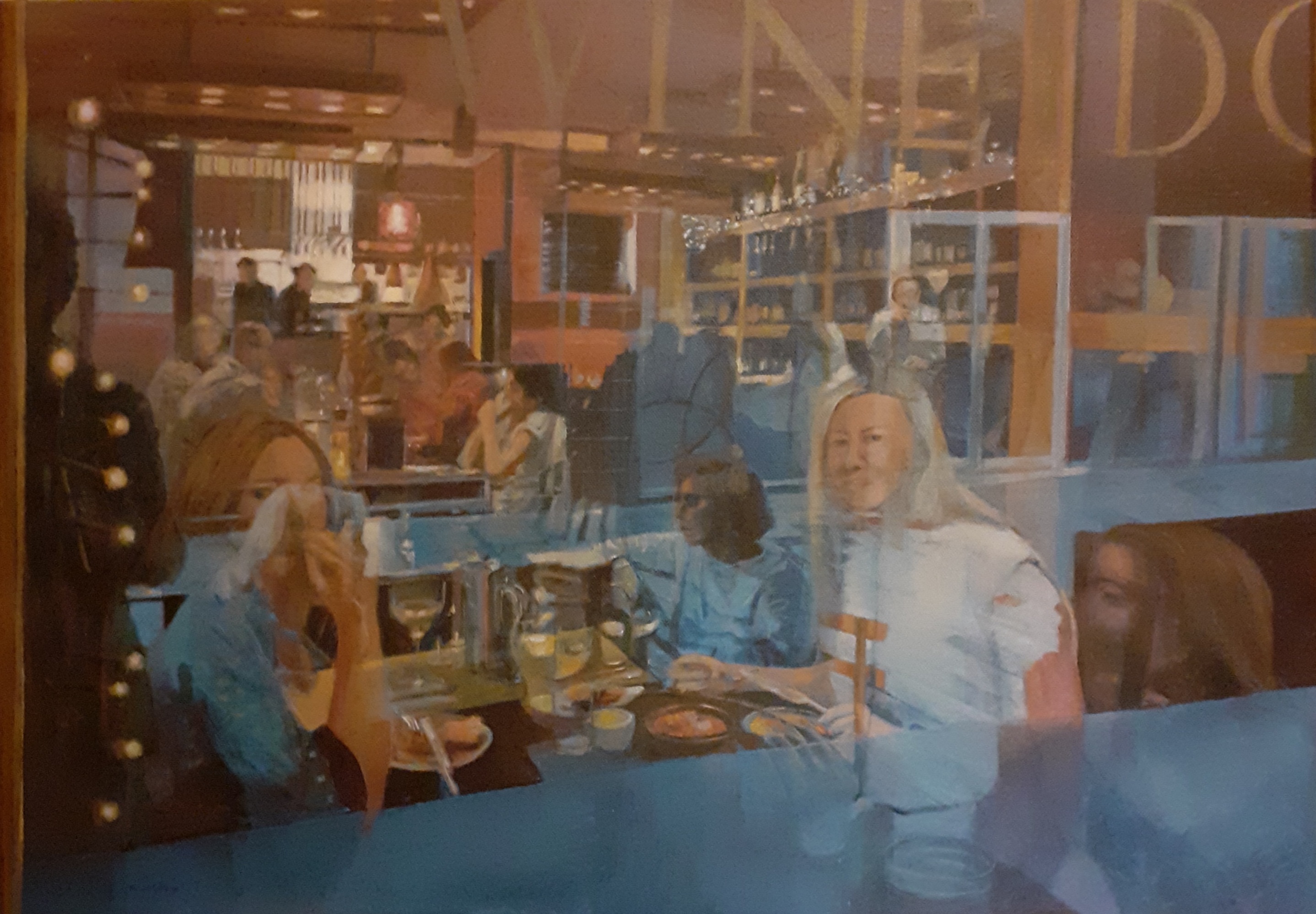
This painting is taken from our Isle of Man trip. The restaurant, Wine Down, is in Douglas. We sat on the front terrace. I took this shot looking into the crowded restaurant. The window catches interior and exterior, myself and M, and others, observing and being observed. It is a bit like a jigsaw puzzle of life. There are too many pieces and not enough time to fit them all together. And we only imagine the picture on the cover of the box to guide us.
Maybe I am overinclined to sit in cafe windows watching the world going by, while the world watches me. But there’s belonging too, and the thrill of it all. There are consolations in being a part of the crowd. Imagine the stories of the people here, some connecting with the observer, some lost in their own world. You’ll catch whispered narratives in the buzz, a song rising from the din.
I am listening to Bruce Springsteen’s 2020 album, Letter to You. House of a Thousand Guitars is specifically a hymn to live music venues. Broader than that, it celebrates the human urge to meet socially, and the togetherness of places where the music and the people play
The Hunt Museum Limerick hold their first Open Submissions Exhibition between Friday 5th December 2025 and Saturday 28th February 2026. I am delighted to have been chosen for the exhibition. My painting, Lovers on a Train, is taken from a train trip between Dublin, Cork and Limerick. I noticed the couple sitting across from me were an island unto themselves. Touring Ireland, their purchases spread between them on the table, while they were absorbed in their screens. So, the tableau involves a still life, a classical composition– like Venus and Mars, and a landscape whizzing by beyond the window. The perfect composition for me. I like to capture the moment to make a visual short story in a particular time and space. People together and all alone; in trains, bars, cafes and cars. I enjoy doing it and hope that others enjoy looking at it. I’m looking forward to heading back down to Limerick. By train, of course.
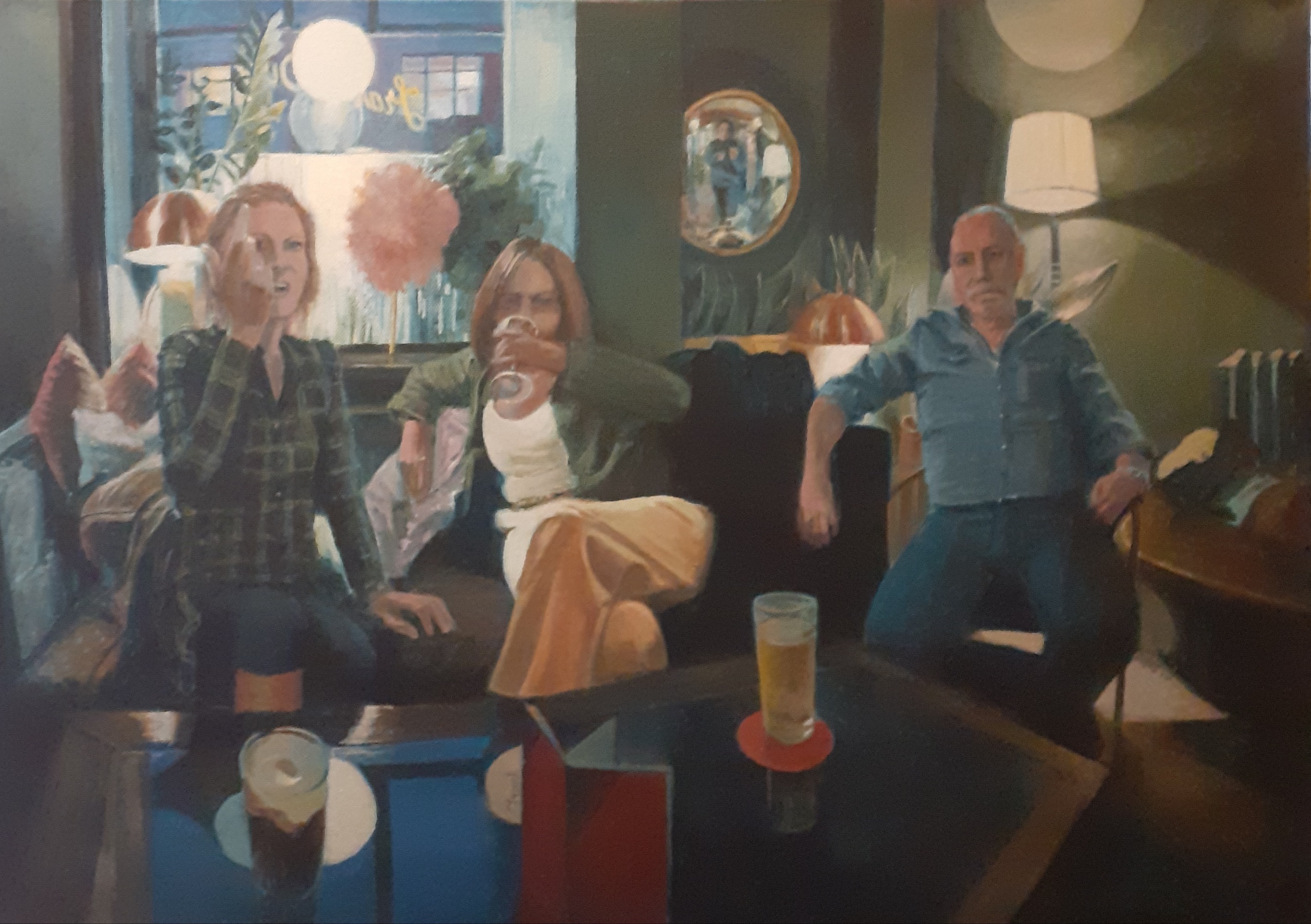
I have been slowing down of late on the art front. The pain thing. Slowing down on all fronts, truth be told. Still, I did squeeze out this spark, in the realm of friends and family. The best place to be. As before, the location is Frank Duff’s pub at the top end of Main Street, Bray. It’s last orders at the end of a great night out; drink and conversation flowing. You’ll catch me standing in the mirror. I suppose I could be singing The Parting Glass, although that’s a tad melancholy in the contecxt.
Songs of love and friendship have tumbled down to us since the time of Thomas Moore. And ever on into the future; here’s hoping. This night in Duff’s was recent, but takes me back to the days o the foreign telegram. So, I tunnel back to the early seventies and Mellow Candle’s only album Swaddling Songs. While the focal, and vocal, point of the group was the sparkling duo of Alison O’Donnell and Clodagh Simonds, this song was written by guitarist Dave Williams. The lyrics are cut from the same cloth though, and sung with gusto by the female leads. There’s a hint of winter and its globe of interior warmth in this verse, evoking that familiarity amongst friends and lovers caught in the moment.
Sell me heat-haze sell me rain sell me wet and dry
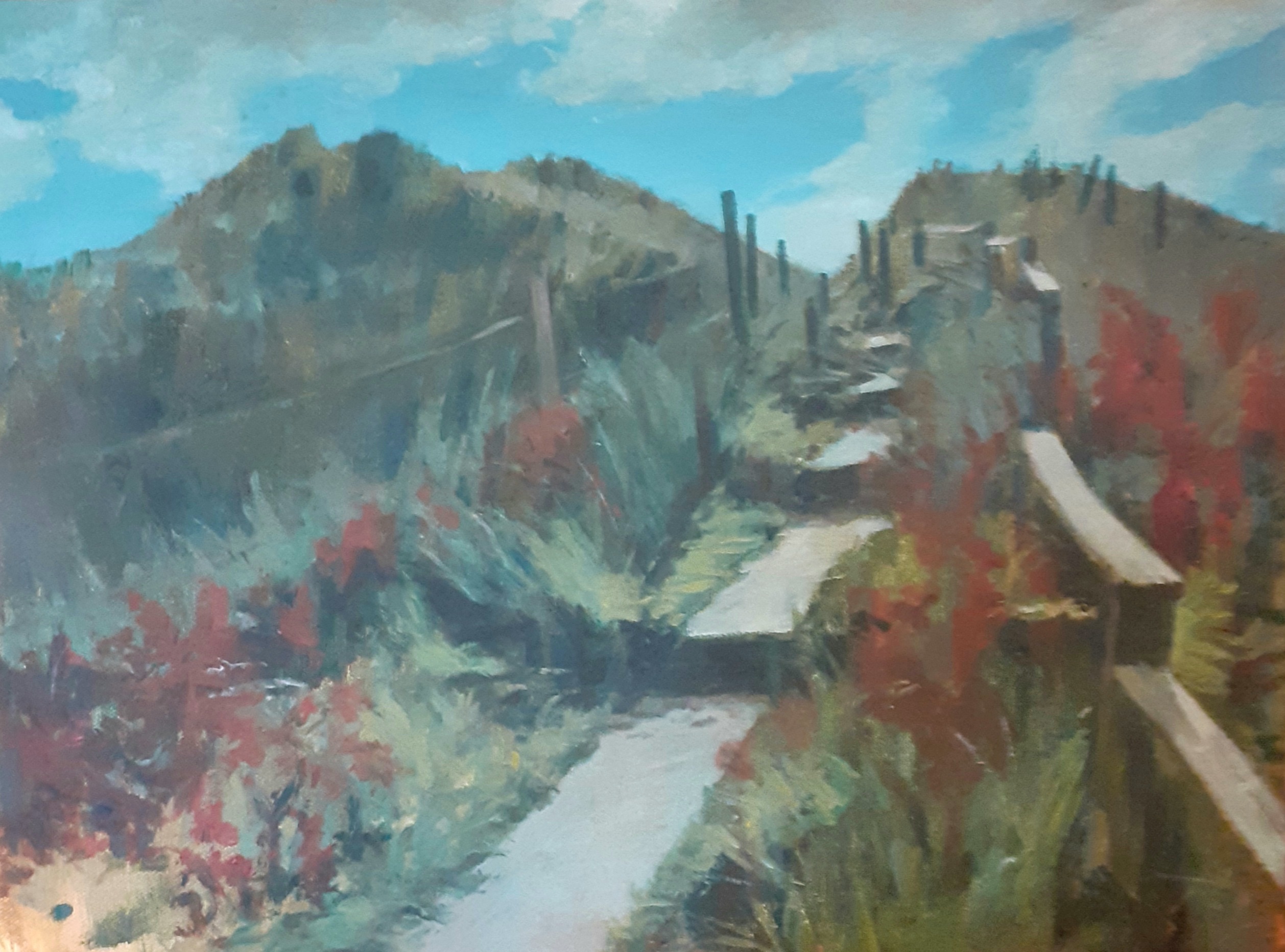
Summer is here, and amongst my favourite activities is doing nothing on a beach. Not exactly an activity so. Brittas Bay is a regular haunt. Thanks to good friends, we can spend a few weeks in a mobile on Wicklow’s wonderful coast. The mobile park is separated from the rising coast by a small river, and from the bay itself by a range of high sand dunes.
In this painting, we are approaching the beach through the dunes along one of several stepped ways. It’s something of an oasis of isolation and quiet, between the domestic suburbia of the mobile park and the windswept leisure activity of the beach.
This time I am using oils, which I have not done in a long long time. Since I went to art college in the summer of 77 I have tended towards faster graphic media such as watercolour, gouache and acrylics. One Dublin cityscape and a mountain landscape is all I can recall. So it was a bit of a struggle to begin with, and I was as much absorbed in the physicality of the whole thing, the texture and smell of the materials as I would normally be in the detail and composition of the finished work. There’s something of the wild and unkempt in this and the process. A sensual saturation that takes its own form.
And so the song that suggests itself is rough and ready too. It’s from the summer of 77 which I remember for sandy days with M in Llandudno, Wales and a holiday hut on the beach in Skerries, North Dublin. It kicks off with a to-die-for bass riff. What follows is a young ruffian gorging himself on the visual pleasures of the beach. It’s called Peaches and was the first hit for the Stranglers from their debut album Rattus Norvegicus. You might also know it from the opening credits of the 2000 geezer flick Sexy Beast, where reformed lout, Ray Winstone, soaks up the sun in a villa in Spain. Oh, I can relate to it in all sorts of ways.
Well there goes another one just lying down on the sand dunes
I’d better go take a swim and see if I can cool down a little bit
Coz you and me woman, we got a lotta things on our minds
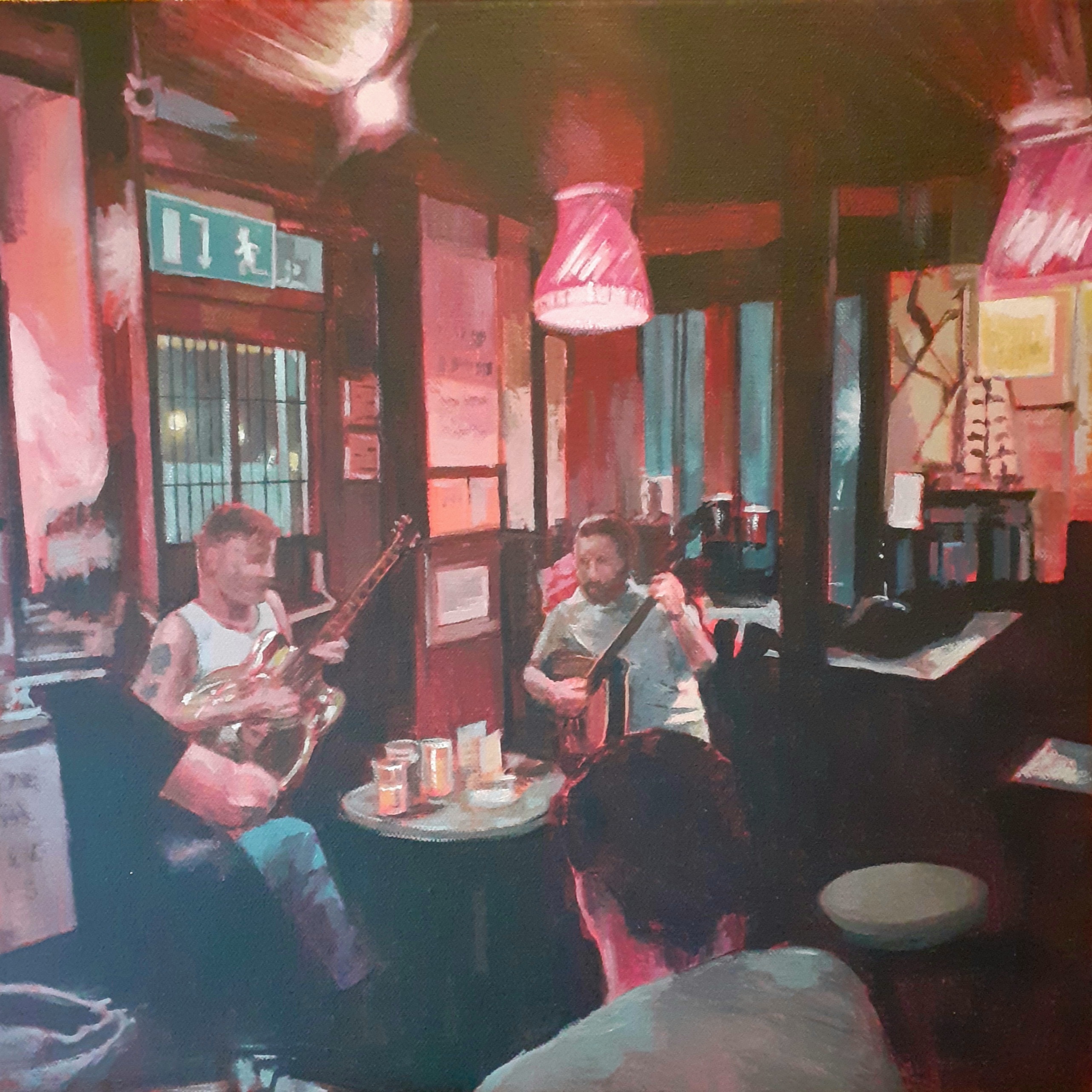
Bray’s Harbour Bar is a favourite watering hole, and I have posted on it before. Drinking Outside the Harbour Bar was painted in the bright sunshine of a summer’s evening. Here, we are huddled inside the original bar in early November. There’s a music session, with three hombres giving it yards. Ballads and folk in the bar, with rock off in the back lounge. I’m in the snug, in between, swaying from one to the other.
This was originally the Harbourmaster’s cottage when built in 1831. The harbour itself was only a small dock then, the full harbour arriving in the 1890s. The bar has been licensed since the 1860s or so. The O’Toole Bros ran the show until ten years ago when the Duggan family added it to their fleet. Throughout its century and a half, it has kept its traditional vibe; seafarin’, rough hewn, crammed with bric a brac and all the ancient, and tyro, mariners adrift on the sea of life. It’s cosy in winter, with the log fires lit and the mellow glow of lights in the timbered shadows. And the music starts to play.
Tonight, I might get loaded
On a bottle of wine, on a bottle of wine,
Gonna feel alright, gonna feel alright,
Yeah, I feel alright!
I Got Loaded is a song for the good times. Listen to Los Lobos howling. Spanish for ‘the wolves’, the band formed in East LA in the mid seventies. Their second album, How Will the Wolf Survive, appeared in 1984 and includes this track. It was written by Camille Bob, and was first released in 1965 by his band L’il Bob and the Lollipops.
The Dublin to Cork train leaves Dublin Heuston every hour on the hour. The journey takes two and a half hours via Portlaoise, Thurles, Limerick Junction and Mallow. I took it last year, celebrating my recent elevation to the free Travel Pass. We barrel through west and south Leinster before leaving County Laois past Portlaoise and crossing into Munster
To the south east the mountains of Slievenamon mark the moutainy territory beyond Ireland’s Central Plain. Slievenamon itself rises 2,365 feet above the floor of County Tipperary. The name is from the Gaeilic for Mountain of the Women. Legend is that Fionn Mac Cumhail, mighty warrior and fierce popular with the women, decreed his pursuers should race to the top of the mountain in order to claim God’s gift, as it were. Grainne won, at least as far as Fionn was concerned. She herself might have preferred a leisurely stroll, or cable car ride, and she eloped with more youthful hero Diarmuid during the marriage feast.
The Pursuit of Diarmaid and Grainne is the epic love tale depicting Fionn’s pursuit of the young lovers. I read it in the Gaelic, Toraiocht Diarmuid agus Grainne, for my Leaving Cert fifty years before. I spent a lot of time looking out windows then, too.
This is a painting of two young lovers lounging on the train as it passes the famed mountain. I tried to be discreet in taking the reference photograph, but typically was spotted. The man, ever on guard, has raised his eyes from his mobile device and is looking at me daggers. She is oblivious. In a way it is a meditation on modern love, neither sweet nothings nor spooning intruding on the current obsession with the smartphone. Still, there is an obvious sense of comfort amongst the duo; striking a tableau worthy of Venus and Mars. The two are well cast in their roles, Mars worryingly so. And I am old with wandering, through hollow lands and hilly lands.
The mountain and the moment passes. I can play with the lover scenario in my head. Are they heroes? Are they pursued? Will they change at Limerick junction, or accompany me to Cork, and all other matters arising? Such questions should stall, allowing myth to arise.
The acrylic painting is, as usual, a labour of love. The subjects classically beautiful and statuesque. An intriguing still life is briefly grouped on the table. Beyond, the world whips by at dizzying speed.We are suspended in a fragile bubble in the vast explosion of life.
Well, pistons keep on churnin’
And the wheels go ’round and ’round
And the steel rails lie cold and hard
On the mountains they go down
Without love
Where would you be right now
Without love, oh -oh.
Long Train Running by the Doobie Brothers from their 1973 album The Captain and Me. Tom Johnston wrote it, providing vocals, harmonica solo and the distinctive rhythm guitar backing. I first heard the song after my Leaving Cert that year, covered by Irish band Rodeo at Kevin Street Tech. About that time I figured why the American Band didn’t actually feature siblings with the surname Doobie.
Part of my purpose, and pleasure, in visiting Andalusia, is to paint it. Sometimes we make sketches, though mostly photography forms the record of places we visit. My Spanish paintings contrast with my Irish paintings. Climate is a decisive factor. Spain is hot and demands a hot palette. Ireland is wet and wild, its palette cool. Every place is different. Every day is different.
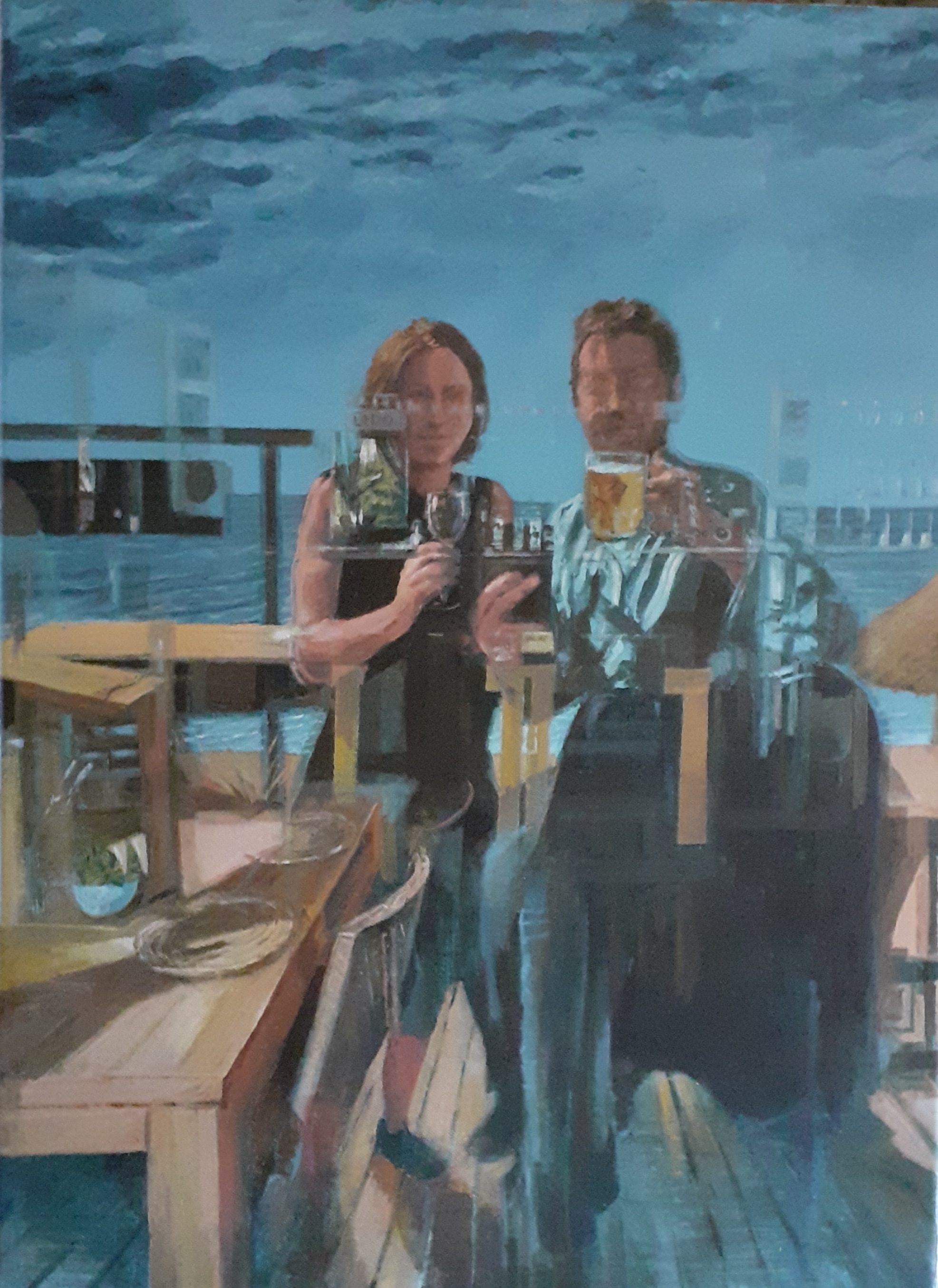
In taking photos I usually exclude ourselves. There are times when a tourist snap is required. I no longer corral innocent bystanders. It happens, but mostly volunteers. Some years back I recall waylaying a handsome young couple swanning into the Casino in Monte Carlo. I indicated the camera, gestured to the debonair male. Of course, he said, and promptly posed for us. His companion put things right. A mysterious lady in Lisbon is another fond faux pas. Reluctantly she took off her gloves on what she clearly regarded as a cold day. It was mid teens; but she obliged with a warm smile. Selfies are an obvious solution, but they don’t really work for me. There’s something awkward about doing them and I usually get it wrong, with my nostrils and ears featuring too prominently. So, M and I have evolved a habit of catching ourselves in reflective surfaces. These mirrored images have the extra advantage of being pleasantly anonymous.
This method is seen at its best on this recent shot taken on Elviria Beach near Marbella. Our favourite bar is on the beach and a regular stop for our pre dinner drink. The Lido Bar also serves food during the day. Sitting out on deck, the beach sweeps away south towards Gibraltar funneling the Mediterranean into the Atlantic. Africa lies just over the horizon.
Painting this picture, I was struck by the shifting points of view within the tableau. We were photographing ourselves photographing ourselves. The observer, and author of the painting, is observed. It’s a self portrait, a still life and a landscape. The reflection itself is a double image due to the glazing. This gives a liveliness, a kind of shaky quality too. We are a blur against the immense physicality of the Med. There, but not there. A snapshot in time. Then gone.
Lido missed the boat that day, he left the shack
But that was all he missed, and he ain’t comin’ back
At a tombstone bar in a juke joint car, he made a stop
Just long enough to grab a handle off the top
Written by Boz Scaggs and David Paich, Lido Shuffle featured on the album Silk Degrees in 1976. Sing along!
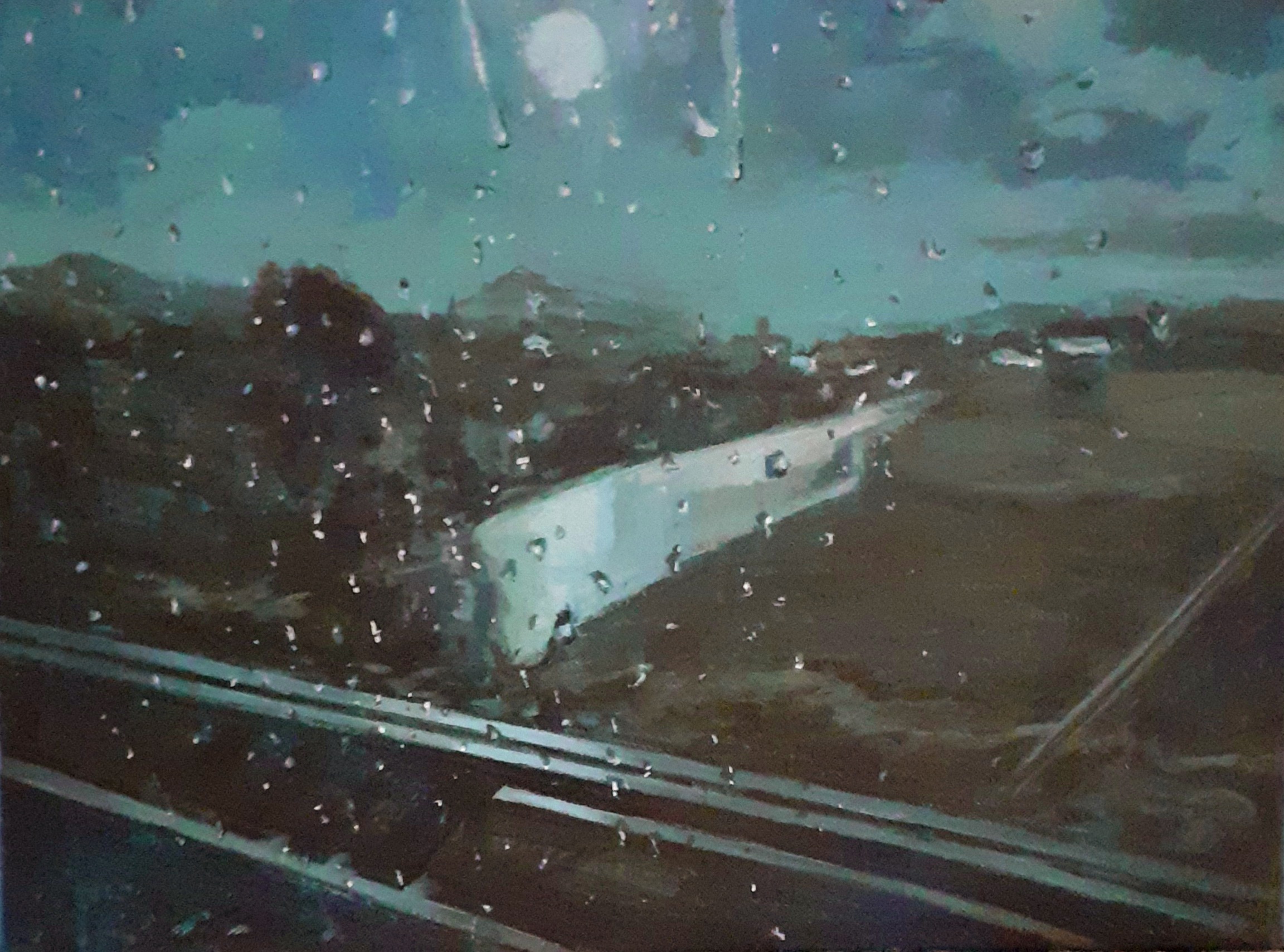
The Dart has been taking commuters, daytrippers and various wanderers around the Bay for forty years. Dart is a clever acronym for Dublin Area Rapid Transit. It runs from Malahide or Howth in the north to Greystones in the south. The last two stops are outside of County Dublin. Reaching the Dargle River we are in County Wicklow. The town of Bray has been established here since the Norman invasion, building on earlier Gaelic settlements.
This view is taken from the window of a southbound Dart, about to cross the bridge over the Dargle. I am returning from Dublin city where it has been raining, but now the sun’s coming out and Bray rises steaming out of the gloom. The Sugarloaf Mountains appear on the horizon, and the land is marked by the tower of the Catholic Church of the Most Holy Redeemer, and the spire of Christchurch (CofI). Bray Daly Station is my stop. Opened in 1854, the line was quickly extended to Greystones and runs parallel to the seafront behind the hotels and houses lining the Esplanade which was newly established then.
This painting is acrylic on canvas and has been accepted by the Signal Open Art Exhibition of 2024. I am delighted to be chosen and looking forward to seeing all the other works on show. The exhibition runs from Tuesday 6th August until Sunday 18th August. Should be fun. Give it a dekko!
Every time it rains
You’re here in my head
Like the sun coming out
I just know that something good is going to happen
I don’t know when
But just saying it could even make it happen
Cloudbusting by Kate Bush is guaranteed to lift the heart, without reneging on past sadness. It is on her 1985 album Hounds of Love.
Touchdown at midnight in Seville airport. Step into a warm Spring night as taxis cruise conveniently to the kerb. It’s thirty five euro to the city centre, which is a bit steep; but it’s Feria, and you now how festivals eat money. Our city centre hotel is near six hundred euro for three nights, so we’re prepared. Feria is Seville’s biggest festival, where locals let there hair down, or tie it up, a fortnight after the serious religious and cultural devotion of Semana Santa.
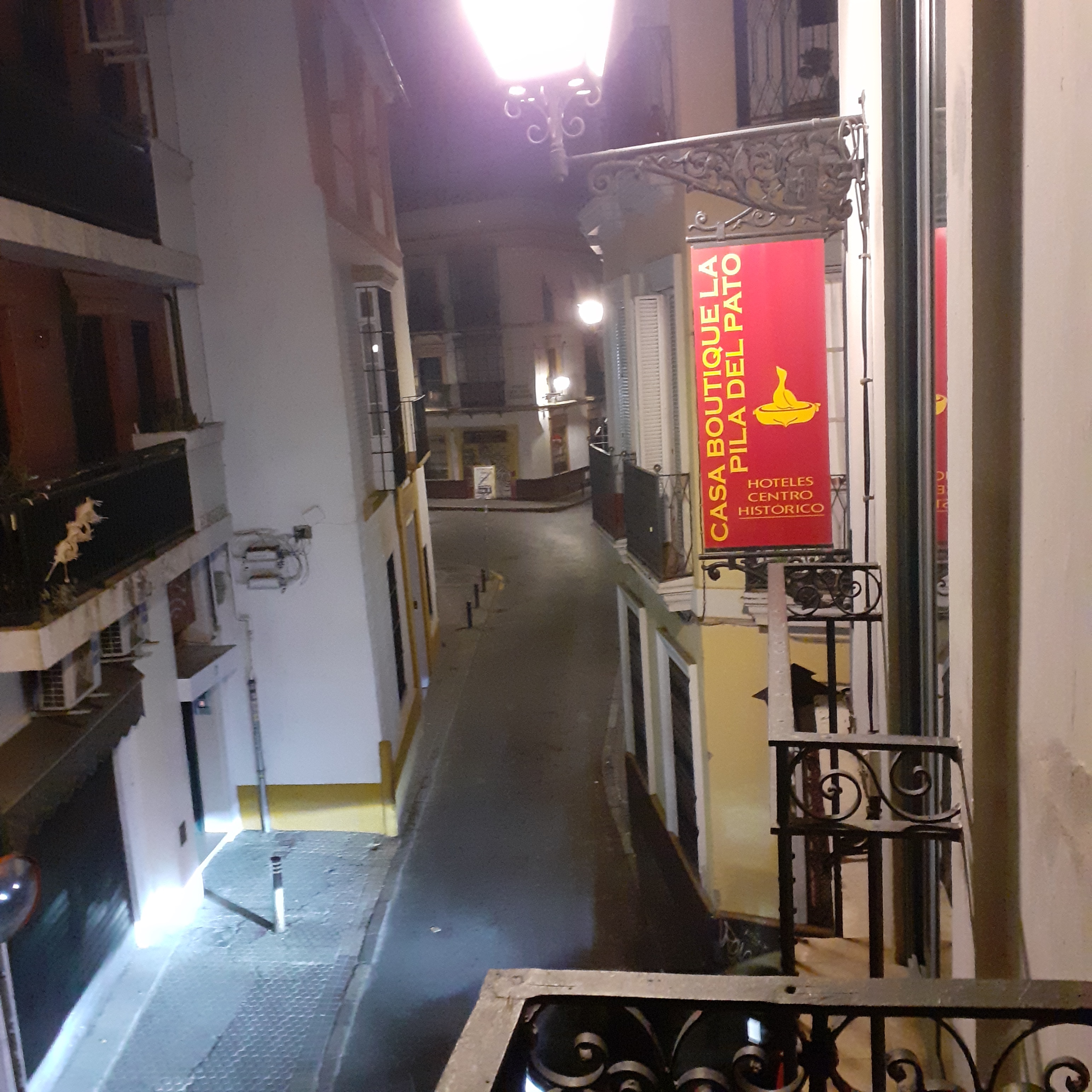
Our accommodation, La Pila De Pata is in the Old Town, Santa Cruz, within walking distance of the city’s main attractions. The room is attractive, with a timber ceiling, old style shutters, and a gigantic fan. There’s a small wrought iron balcony overlooking the narrow street, Calle Aldohinga. There are noisy neighbours across when we arrive, but hey, it’s Feria, and we’re dog tired and sleep easy.
Seville is the capital and largest city in Andalusia. Almost seven hundred thousand people live here on the banks of the mighty Guadalquivir River. Founded by the Romans and ruled by the Moors for five centuries from 700AD, in 1248 Castile conquered the Moors in the Reconquista. NO8DO is the city’s emblem. It is a rebus for No me ha dejado: she (Seville) has not abandoned me. Pronounced No ma dejado, the symbol 8 represents the trio of syllables madeja; a skein of wool. The legend is that King Alfonso X used the phrase thanking the citizens for standing by him against attempts by his son Sancho to usurp the throne. Alfonso ruled from 1252 till his death in 1284.
Seville lies fifty miles inland from the Atlantic and flourished as a river port in the late middle ages, particularly for imports from the New World. Silting of the river and other factors saw it decline in the eighteenth century and maritime power passed to Cadiz on the Atlantic coast further south. Ancient Seville lies largely within Santa Cruz. a warren of streets and lanes spreading north from the central area around the ancient fortress. Here you’ll find a cluster of magnificent buildings including the Alcazar, and the spectacular Cathedral.
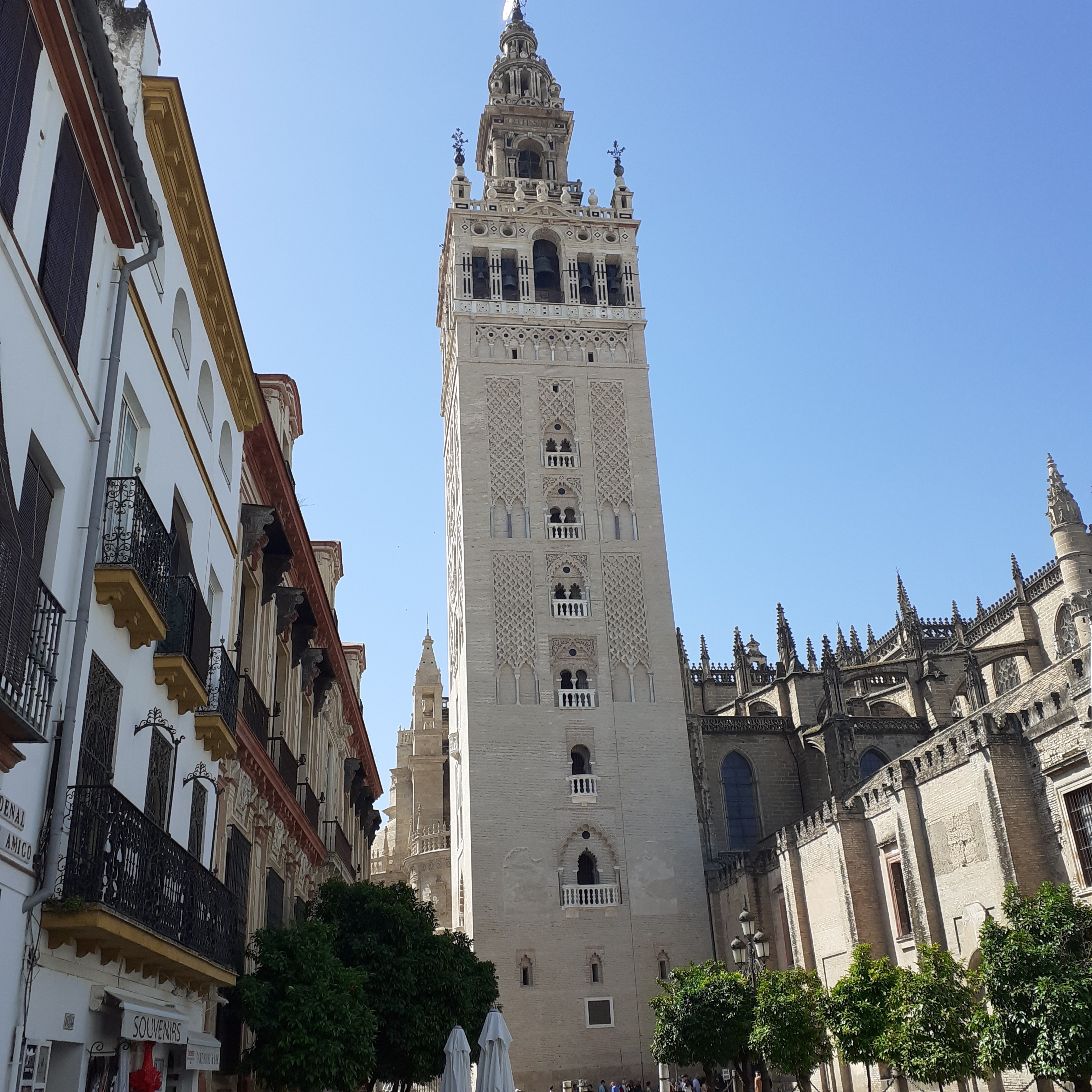
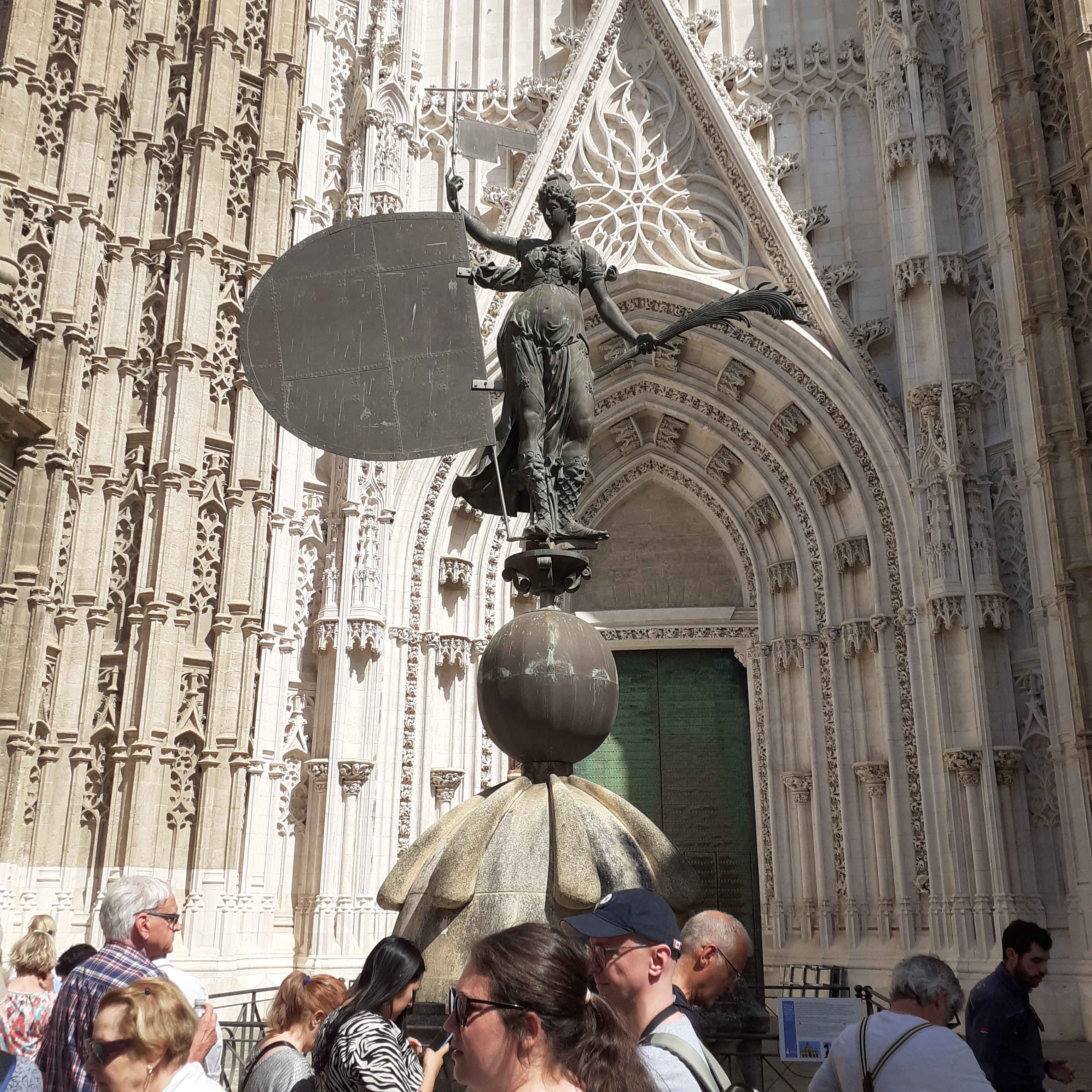
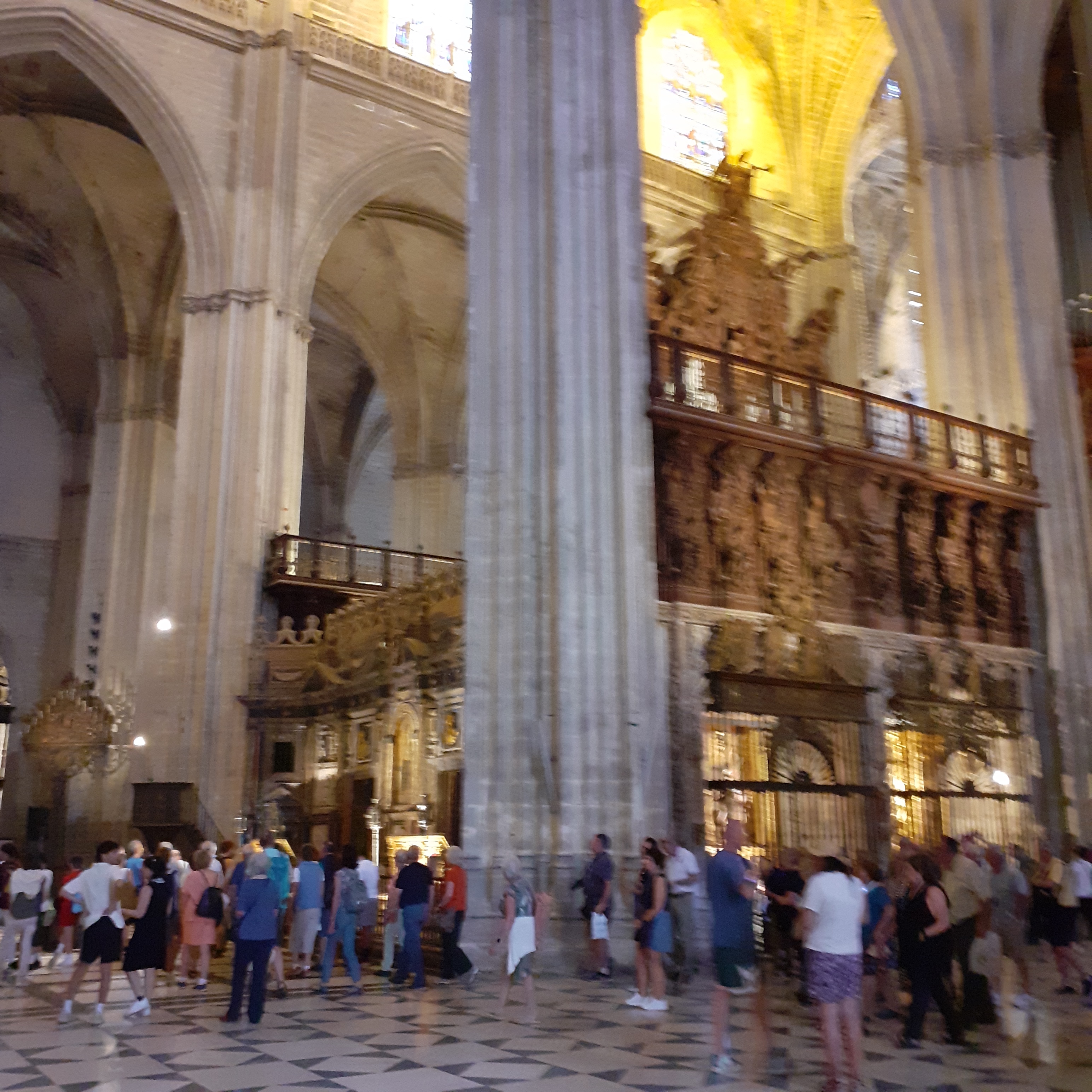
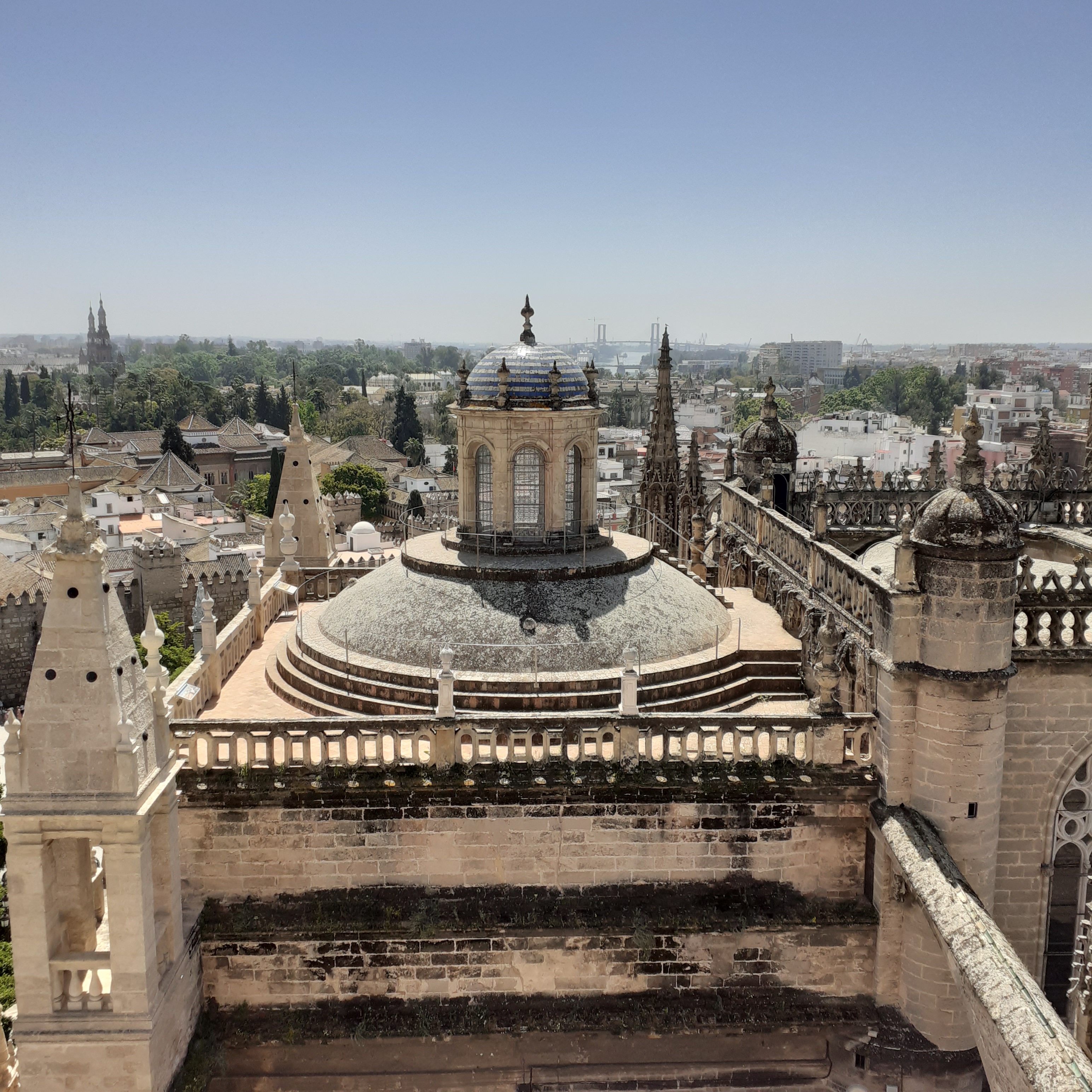
On our first day, we shimmy down from Aldohinga to Plaza Virgen de los Reyes. The Cathedral of Saint Mary of the See is six hundred years old and the largest gothic church in the world. The bell tower of La Giralda soars above. There’s a short queue for entrance, with a generous discount, almost fifty per cent for aul lads like me. Younger folk, like M, pay the full thirteen euro. The Giraldillo, the bronze statue depicting the victory of the Catholic Faith stands here, a replica of the weathervane at the top of the tower. La Giralda was originally the minaret of the Mosque, with Christian symbols added after the Reconquista. The Renaissance belfry and weathervane were added in 1598. The climb to the top is relatively easy, a ramp zig zags upwards at a moderate incline. The views are truly majestic. Even more exciting, the bells broke into full peal causing some to clutch their ears. The bells. The bells!
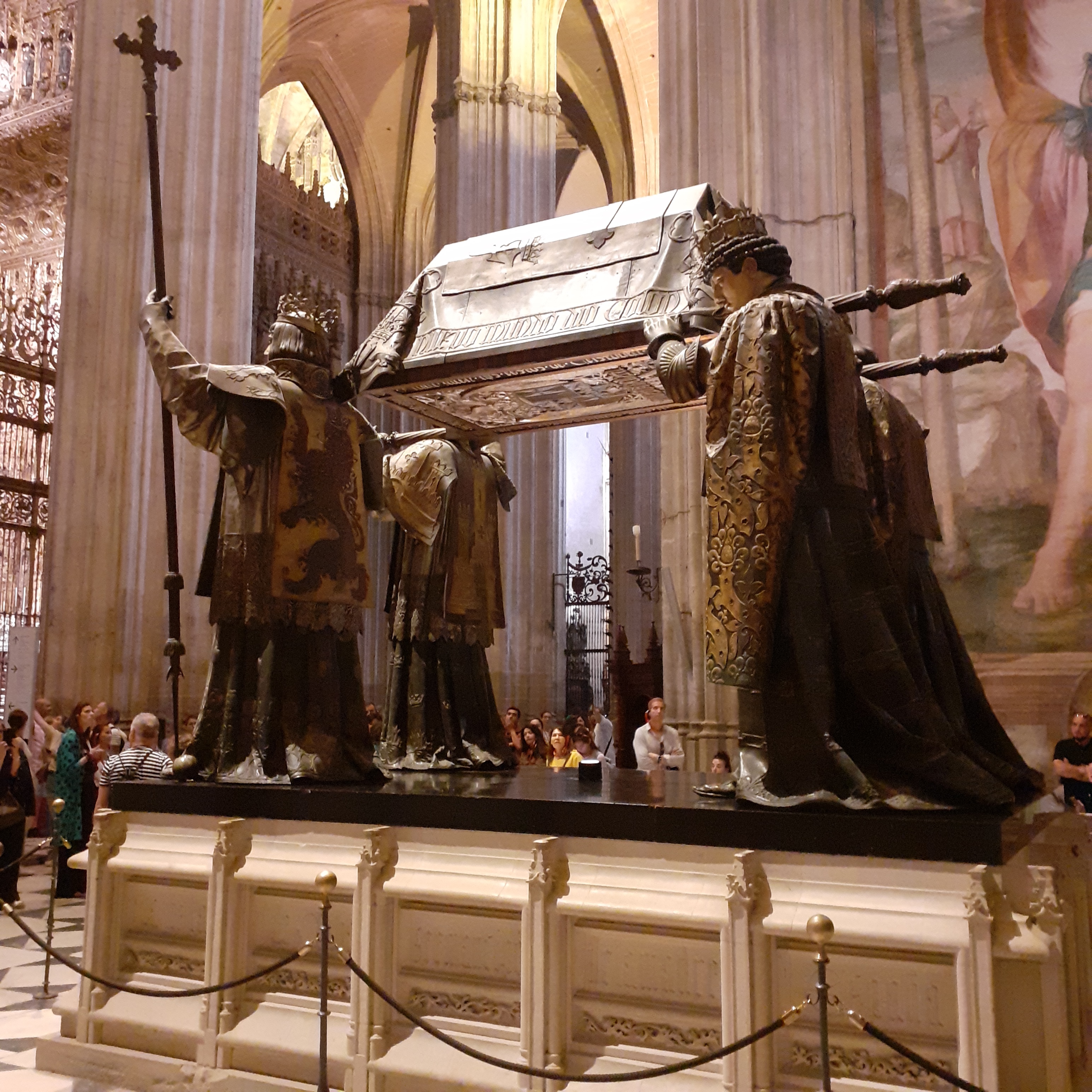
The Cathedral interior is mind bogglingly cavernous, on a scale that hints at science fiction besides a supreme exhaltation of faith. The crowds are well dispersed around its many treasures. Amongst these are the tomb of Christopher Columbus. He set sail in 1492, forging the route to the New World and making his first landfall on the island of Guanahani which he named San Salvador. Columbus was thus instrumental in the initiation of the lucrative trans Atlantic trade and more. A new world order grew, and such benefits as tobacco, potatoes and turkeys first came to Euope. Gold and silver too; and coffee, jazz and rock n roll.
Columbus’s remains were interred in the Cathedral in 1513, seven years after his death. They had an appropriately peripatetic existence, being further interred in Hispaniola and Cuba before making their way back to Seville in 1898. The tomb is a catafalque, depicting a casket borne aloft by the Kings of Leon, Castille, Aragon and Navarre.
The Vision of Saint Anthony by Bartolome Esteban Murillo from 1656 is in the Saint’s chapel nearby. There are eighty chapels within the Cathedral each host to a story, an ambience to absorb and admire. Outside, the Patio de los Naranjos is the courtyard of the original Mosque centered on a fountain. Here, the Muslim devotees would wash before prayer. It is a restful oasis after the sensory overload of the interior.
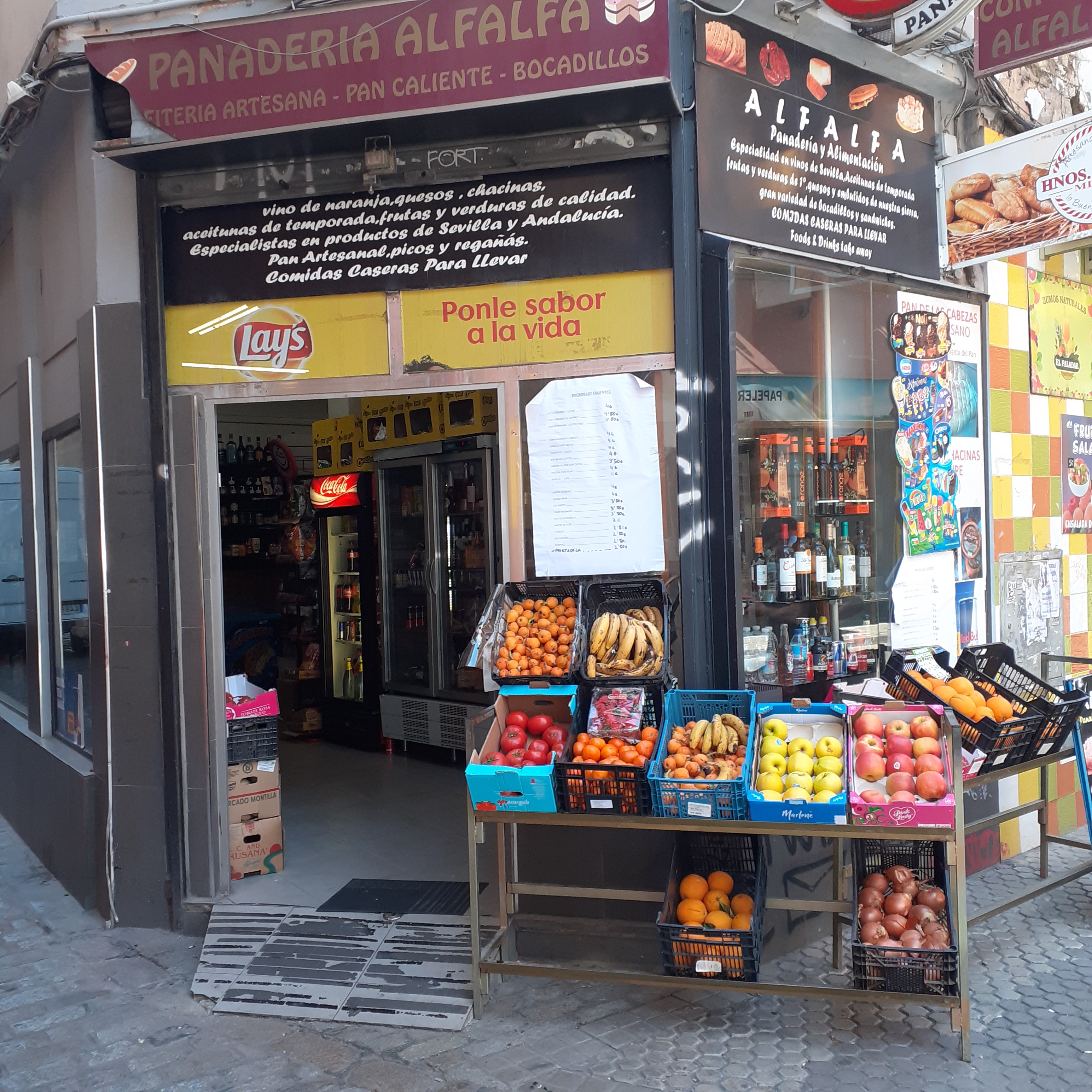
Back towards the Old Town, we stop in San Francisco Square for lunch. The Ayuntamiento, City Hall, lines the western side. This was built in 1534 and upgraded in the Neo Classical style in 1891. Over a drink we await our tapas, including Tortilla. But while the guide book refers to it as the ubiquitous Spanish Tortilla, we finish our drinks without it arriving. Moving on to Calle Sierpes, the street of the snakes, we get pizza slices for nourishment. Sierpes is a pedestrianised shopping street and perfect for the Spanish Stroll of early evening.
Hey Rosita! Donde vas con mi carro Rosita?
tu sabes que te quiero
pero ti me quitas todo
ya te robasta mi television y mi radio
y ahora quieres llevarse mi carro
no me haga asi, Rosita
ven aqui
ehi, estese aqui al lado Rosita
Spanish Stroll was a hit single in 1977 for Mink Deville, Willy Deville’s band, from their 1976 debut album Cabretta, a jacket of soft leather. Derived from the Spanish word for goat, it is in fact sheep leather. Bass player Ruben Siguenza did the spoken bit.
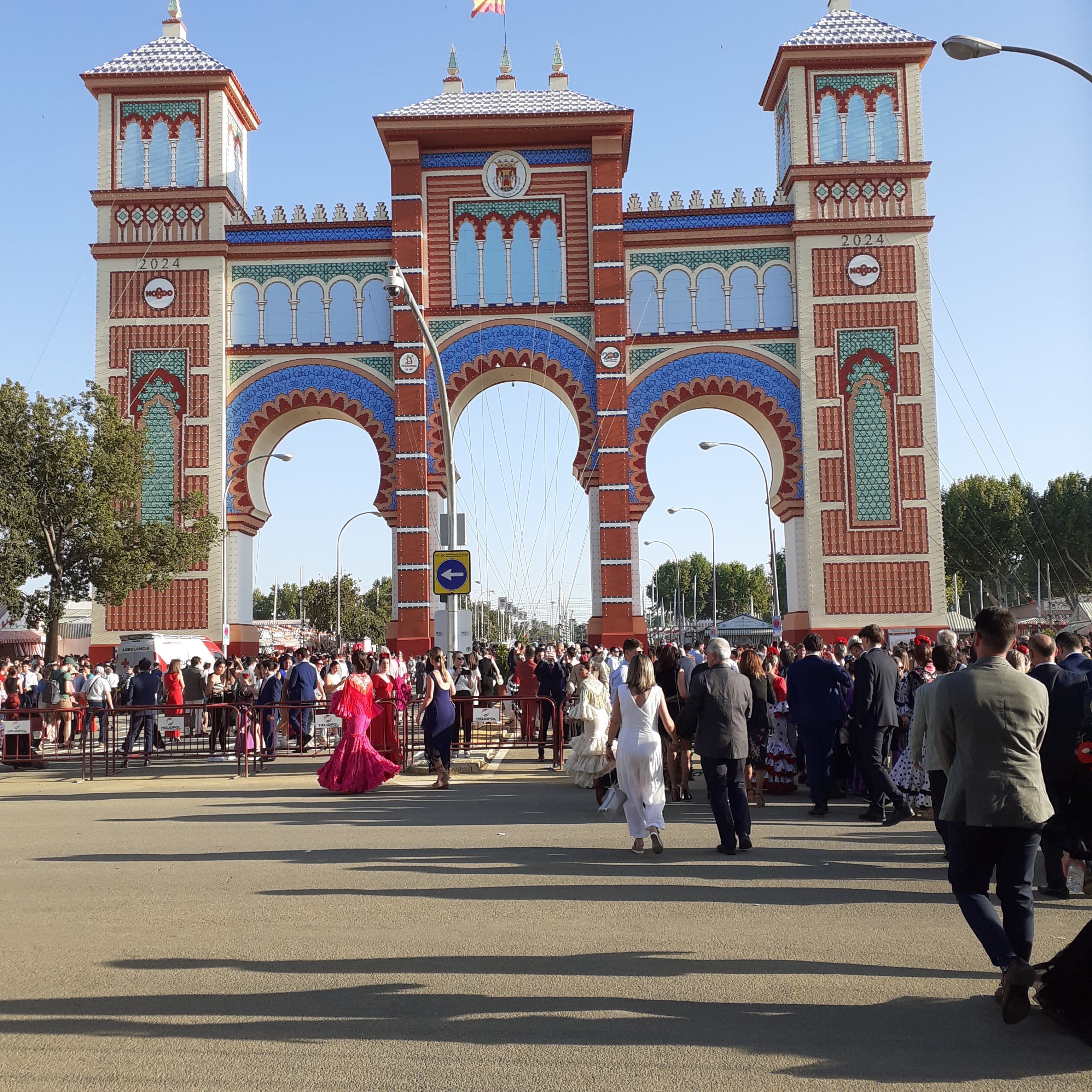
By early evening we follow the crowds across the San Telmo bridge over the Guadalquivir to Triana. Triana is said to be the cradle of Flamenco being originally the barrio for the Gitano community. Today it is a lively traditional area with riverfront bars giving great views of the city. To the south is Los Remedios, a more modern area which hosts another exuberant expression of tradition. The Feria de Abril is a week long fair held a fortnight after the Semana Santa. The locals don traditional attire and let their hair down, or tie it up, in a spree of drinking and dancing. The fairground is at the top of long, straight Calle de Asuncion.
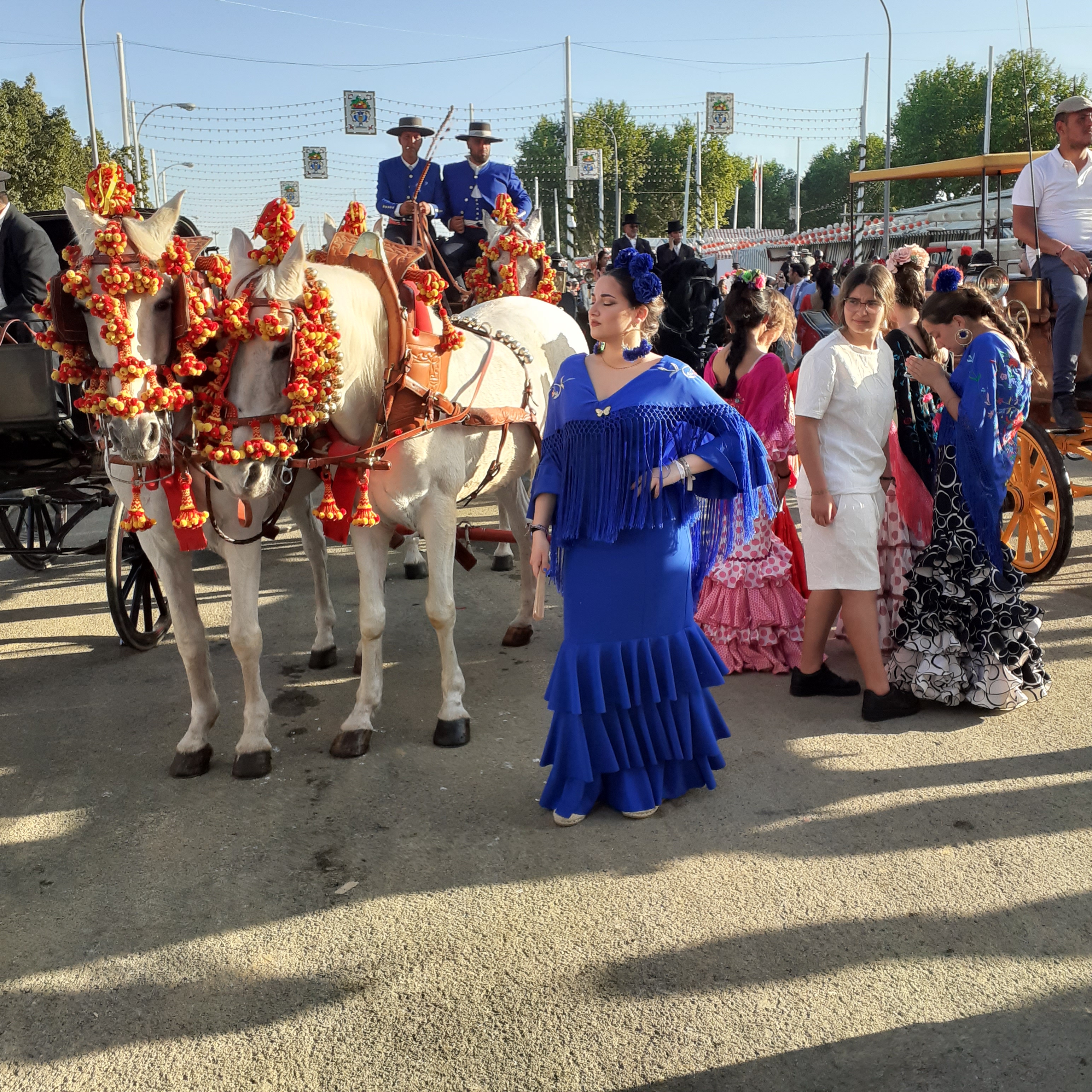
The throng is going one way in early evening, and we are pushed along to enter through a huge gateway, bringing us into a garden of earthly delights. It is quite overpowering, a feeling the whole world is here, balanced between chaos and the vast underlying structure of community. There are a thousand tents or casetas for drinking, dining and dancing, welcoming a half million visitors per day. The casetas are mostly restricted access, for various clubs, associations and families but some are open to the general public and visitors. There is a horse and carriage parade making a colourful, traditional spectacle and further on is an amusement park known as La Calle del Infierno, or Hell Road. The week coincides with the start of the bullfighting season across the river at Real Maestranza, the twelve thousand seater bullring and one of the most iconic in Spain.
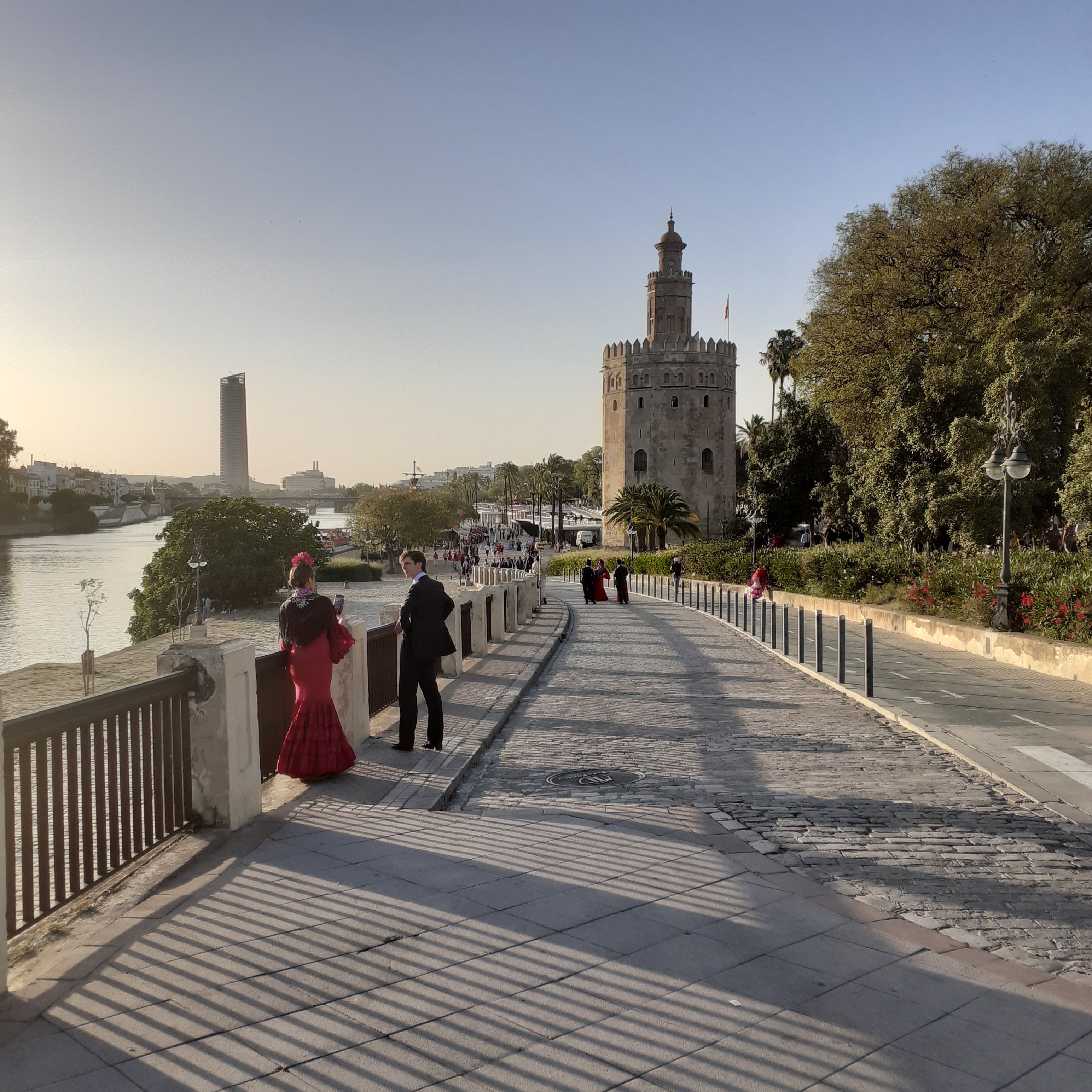
The evening serenity of Old Seville beckons. and we return across the river where the Torre del Oro guards the far bank. The tower dates from Moorish times when it was part of the city’s defensive walls. Built in 1220 the turret was added in 1760. There was once a twin tower across linked by a mighty chain to thwart enemy shipping. We find space at a restaurant on Calle Almirante Lobo, Admiral Wolf as we might say, and enjoy our meal al fresco as the sun sets behind the Tower of Gold. The sun sinks and illuminations blossom over the city. Later, we find the rooftop bar at the Cathedral Hotel to bask in the moon over magical Seville and raise a glass or two.



 xxharrison