Andalusia – 4. Marbella

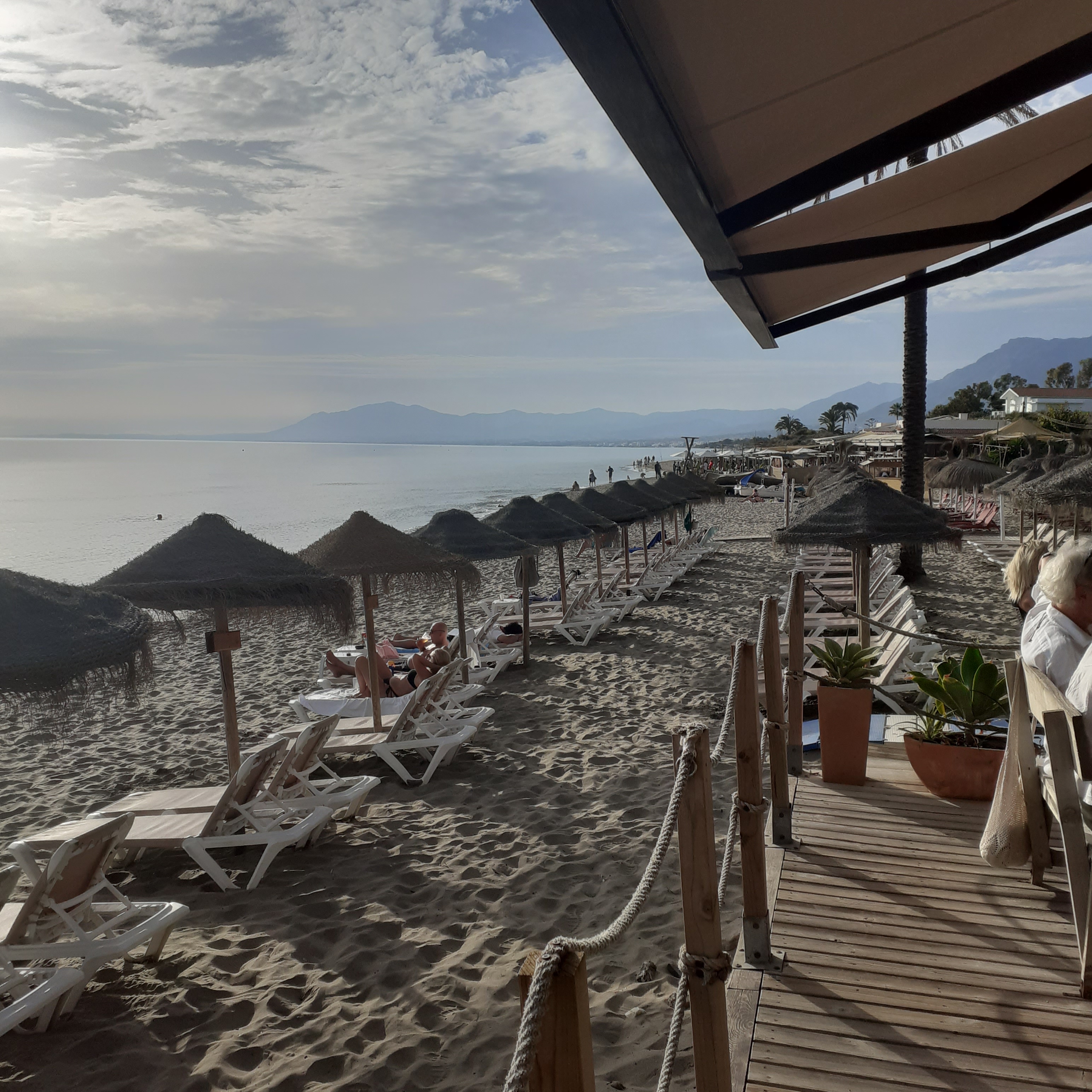
We walked to Marbella along the beach one morning. It’s about 6 miles from Elviria, and I was feeling the heat near the end. Still Spring, but climbing into the mid twenties by mid-day. Approaching the city outskirts there are a number of rugby pitches, and we are in the city proper when we reach Playa de Venus adjacent to the port. Puerto Deportiva with its modern green lighthouse lies beyond. On more sedentary days, there are regular busses along the coastal highway, the A7, for a more leisurely trip into town. It takes under half an hour. 

Marbella has long been a resort for the quality. Meaning well to do, and sometimes more quantity (of cash) than quality. The resort was an early example of Costa Del Sol tourism, established just after the Second world war. The city population today numbers 140,000 people, though that can treble during the holiday season. North western Europeans, including a lot of British and Irish, swarm for the guaranteed heat and sunshine. A long, long time ago it was popular with southern visitors of a different sort. The Moors colonised Iberia from the eight century, the name Al Andalus was then applied to the whole Iberian peninsula. Andalusia persists in the name of the Moors last redoubt.The Moors established a citadel here in Marbella, the Alcazaba, fragments of which survive, and a Mosque. 

There are two parts to Marbella. The bustling well serviced seafront where we arrived after our walk is the modern resort. The Old Town, a little farther inland, is a warren of lanes and quaint squares sloping ever upwards. After the conquest of the Catholic Monarchs in the late fifteenth century there was significant development in this walled, medieval town. The Plaza de los Naranjes was built as the centrepiece of the Old Town. It remains a picturesque antique square with some fine public buildings. The town hall was built in 1568 and the Mayor’s House nearby. At the south west corner is the Chapel of Santiago from the fifteenth century; the oldest building in the city. It predates the square, which explains why it is set at an odd angle to it.

The square itself is regular, tree shaded and ringed with restaurants and bars. Nearby is another ancient church. The Church of Santa Maria de la Encarnacion is a Baroque building of the seventeenth century, built over the existing mosque. Painted white and with an imposing bell tower it stands out as the old city’s grandest church.
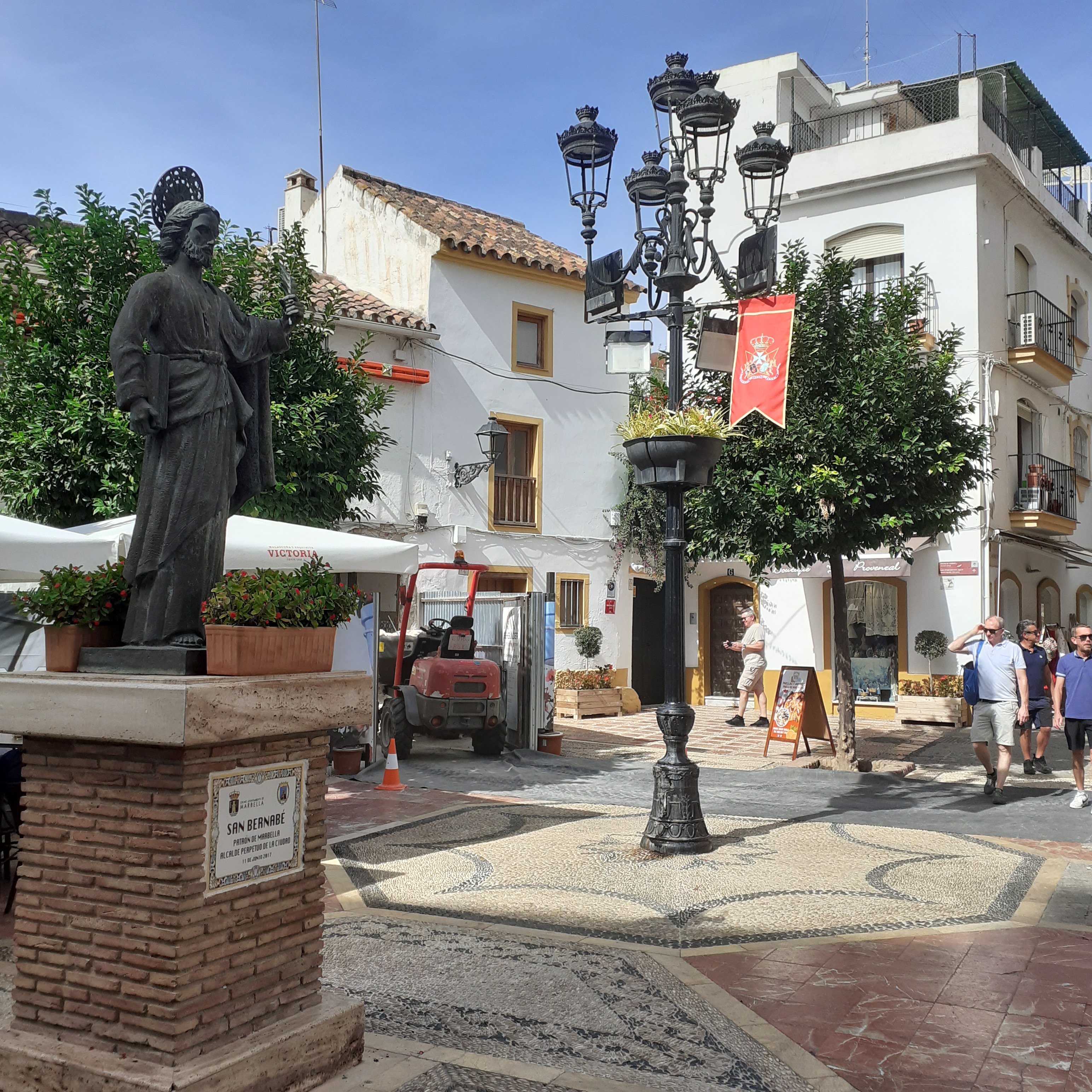
Heading further uphill the streets tunnel back to their medieval origins. The Castillo de Marbella, the remains of the Moorish Castle, lies to the north east of the square. From here, following the line of the walls back down to the modern commercial centre, we come to Plaza de la Iglesia with its statue of Saint Bernabe, the town’s patron saint. His festival is on the 11th June, ushering in a week of dancing and carousing in the Spanish way. Festivities are rarely remote from Marbella at any time though this, we hear, is particularly wild. Our ambitions for earthly delights are not particularly Bacchanalian today and we make do with an easygoing hour or two in Plaza Manuel Cantos, where the Irishman Pub and Luigi’s Italian Restaurant provide sufficient for our drinking and dining pleasure. Other soirees might include El Balcon de la Virgen and Patio Marbella in the labyrinth of the old town. 
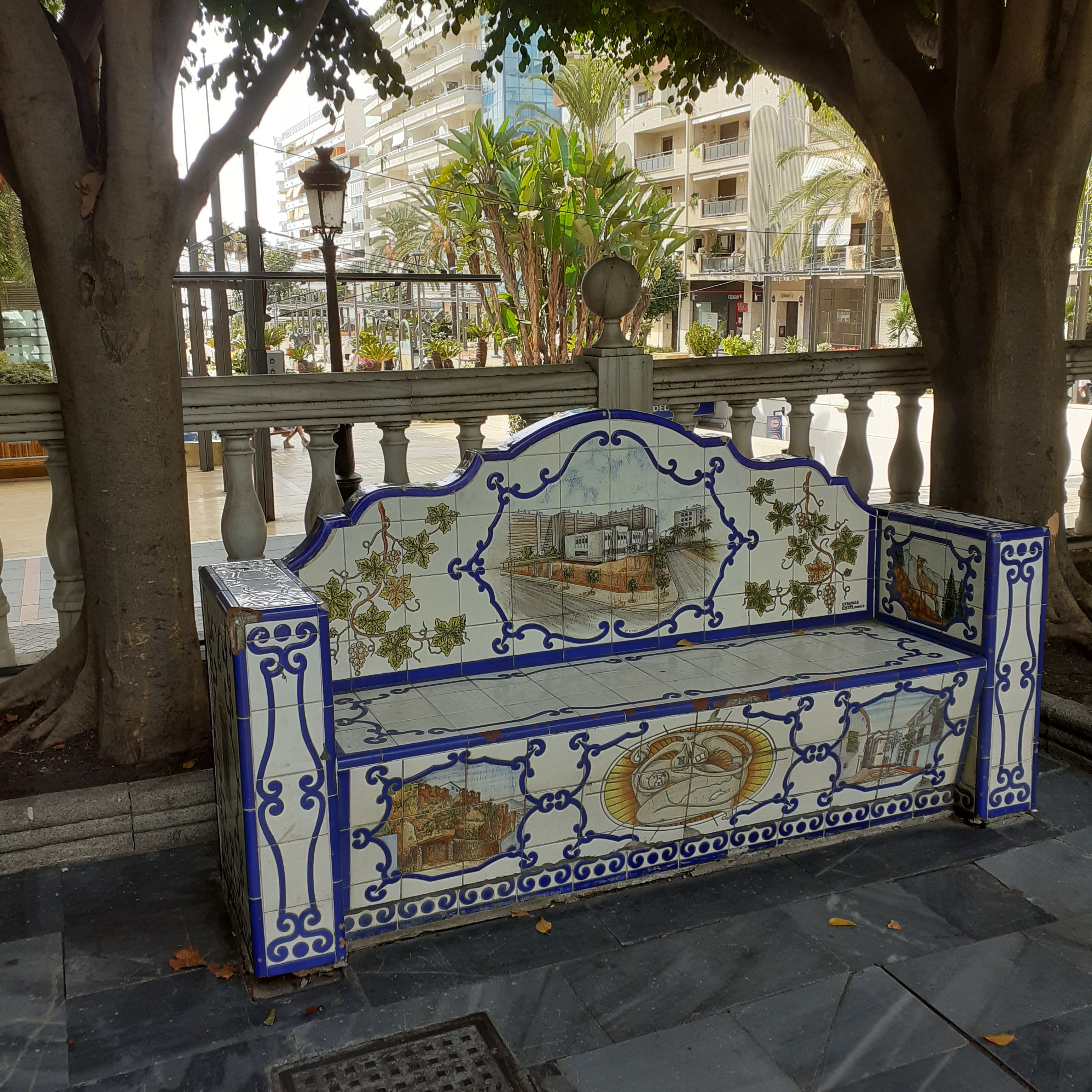
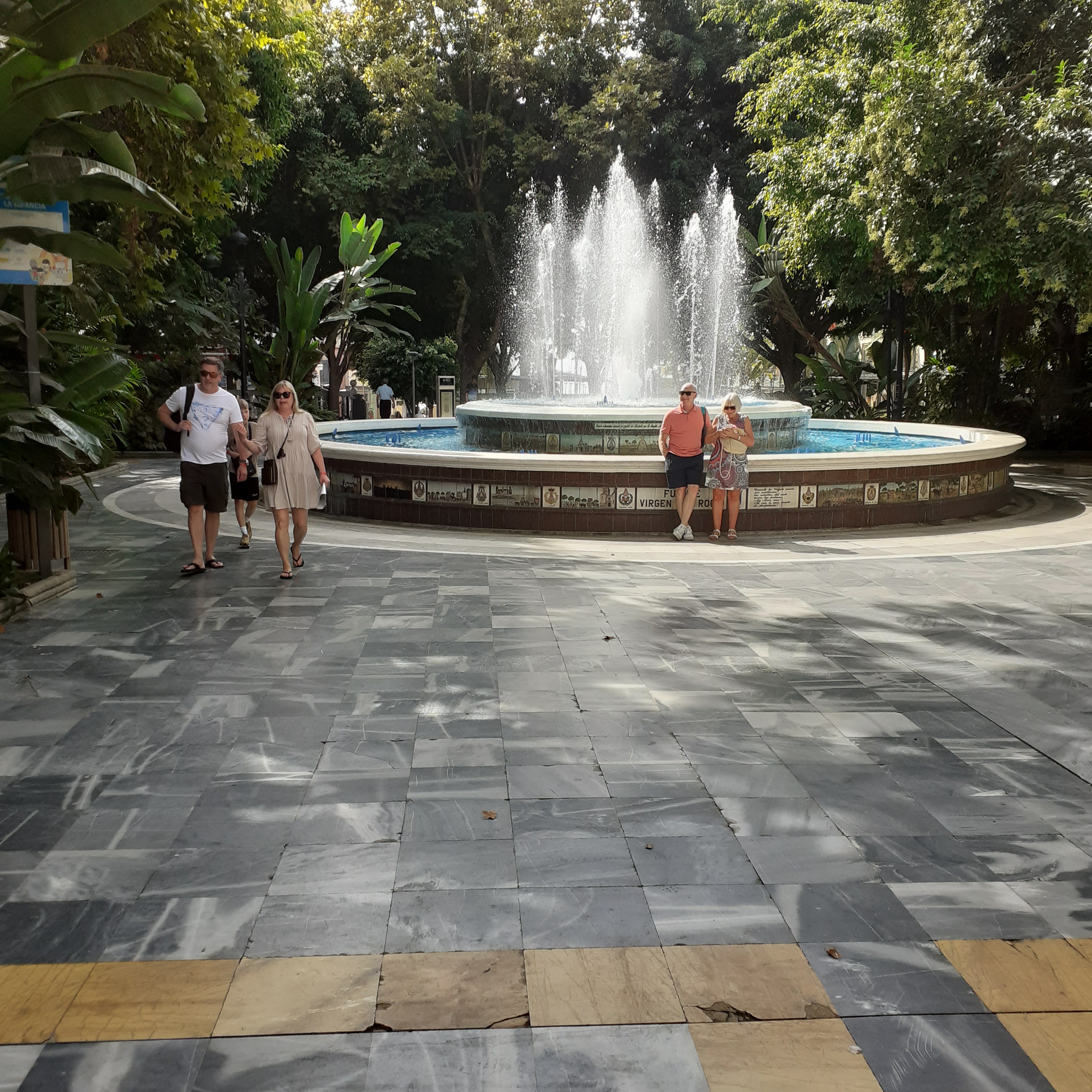
Between the Old Town and the modern seafront, Ensanche Historico, the Historic Extension, is laid out to ease transition between the two. Across the busy thoroughfare of Paseo de Alameda, Alameda Park is an elegant formal park, richly planted and decorated in colourful tiles. All of this radiating out from a historic fountain. It’s a glorious place to hang out, the setting luminous under the shade of palm trees.
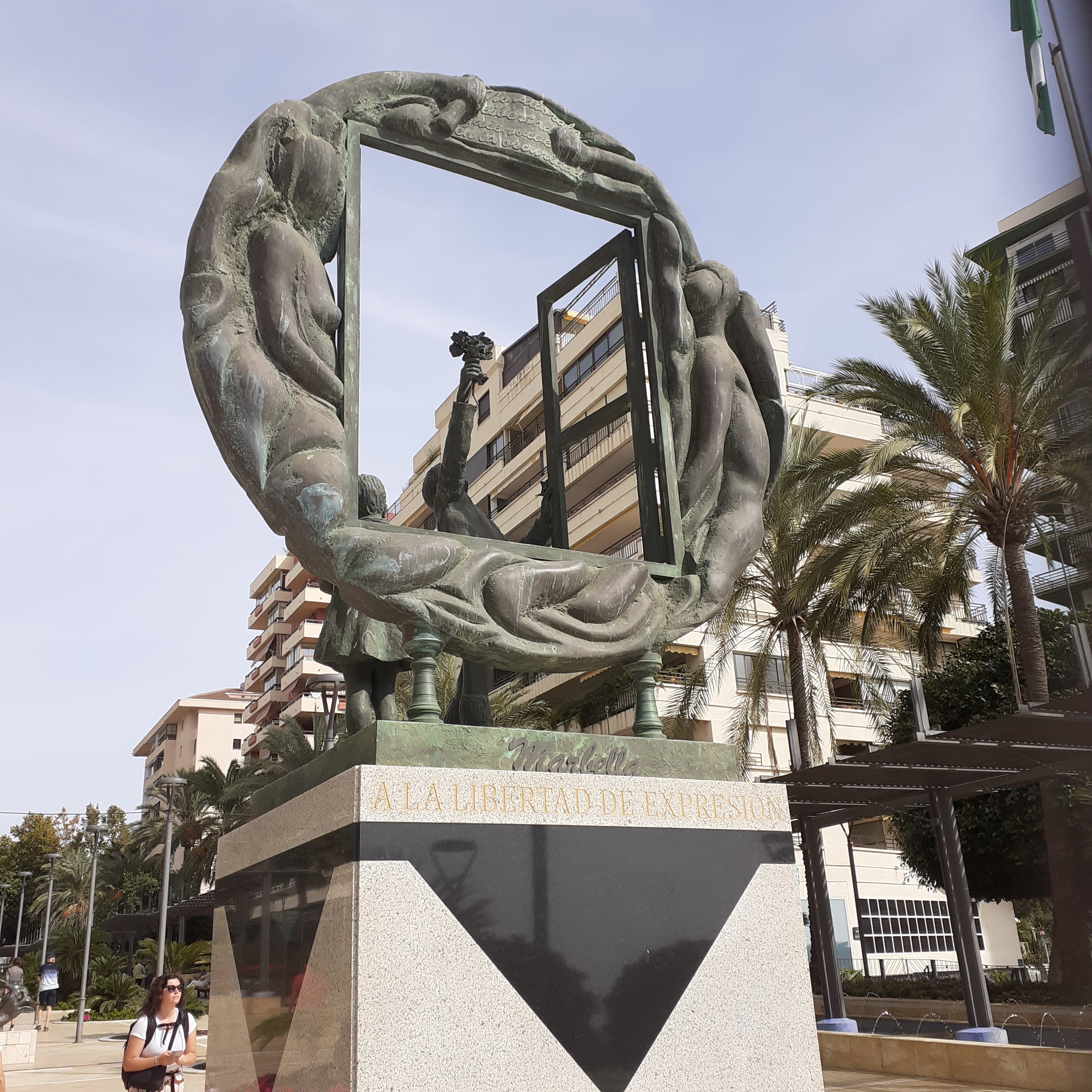
Beyond the park, The Avenida del Mar, as its name suggests, forms a wide esplanade sloping down to the seafront. It is lined with sculptures by Salvador Dali and others. Eduard Soriano is a notable other, his Monument to the Freedom of Expression overlooks the seafront promenade. This shows two figures at an open window surrounded by apt quotations, including the sculptor’s: Freedom does not die, it is born and sleeps daily.
Dali’s ten bronze sculptures were cast in Verona and acquired in 1998. They feature a range of hallucinogenic imagery as one would expect from such a major Surrealist. Some are drawn from Classical mythology including figures of the god Mercury and of Greek hero Perseus beheading Medusa. There are metamorphoses of nature with Man on a Dolphin and Cosmic Elephant, and inevitably Dali’s wife and  muse, Gala, who is depicted leaning out a window.
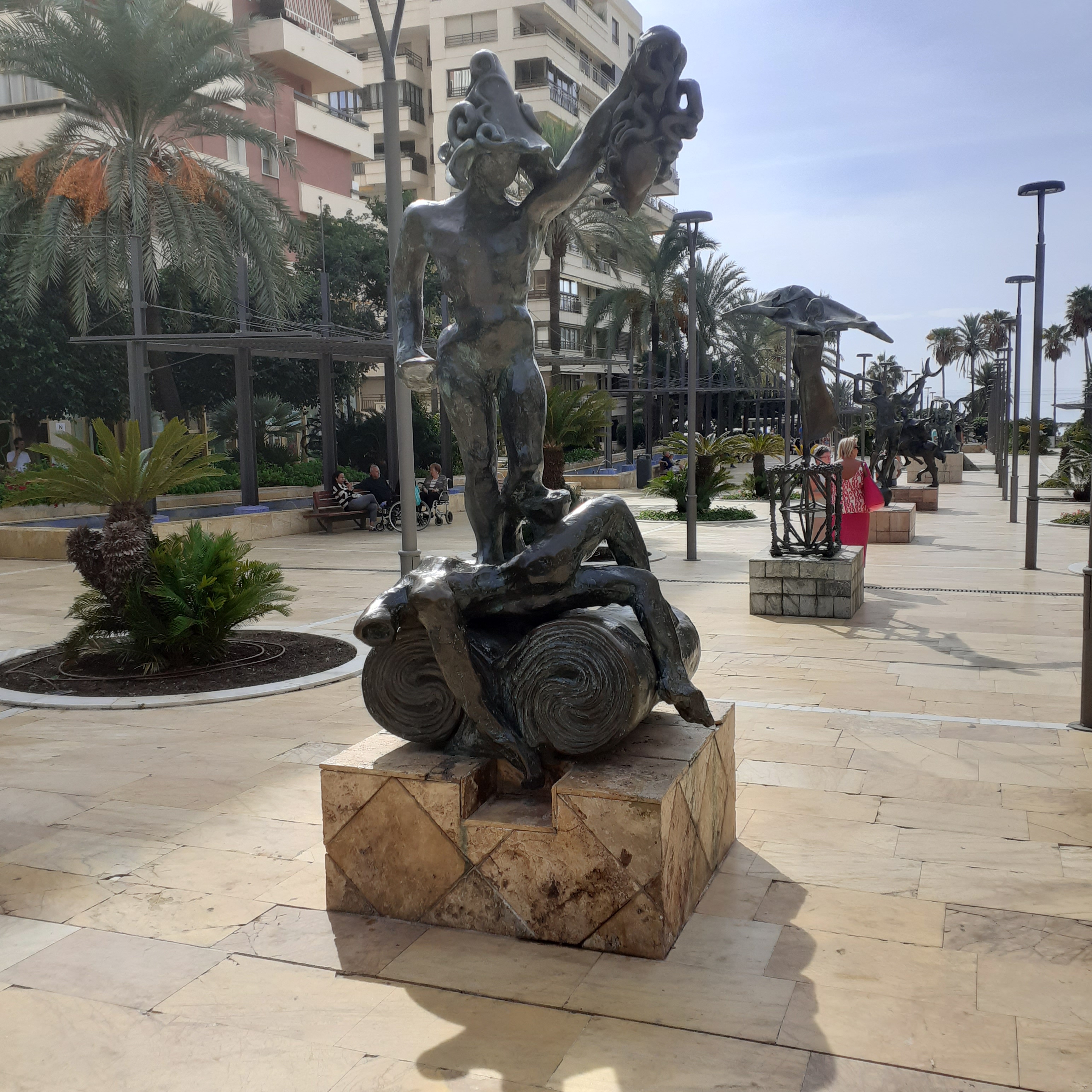
Dali has no specific connection with Marbella. He hailed from Catalonia, born in 1904 in Figueras, near the French border. As for Andalusia, he was in his younger years very friendly with Federico Garcia Lorca, one of Spain’s leading poets. Then there is the film, Un Chien Andalou. Lorca, whose advances were rejected by Dali, interpreted the film’s title as a swipe at him and became further alienated from the Surrealist movement.

Lorca may simply have been paranoid, though the title does intrigue. It is taken from the Spanish saying: an Andalusian dog howls – someone has died. The idea sprang from an exchange of dreams with filmmaker Luis Bunuel and the two collaborated on the 1929 silent film which was directed by Bunuel and co-written with Dali. It ran to just sixteen minutes. The notorious opening scene begins with the reassuring caption, once upon a time, but quickly becomes ominous. A man sharpens his razor while a thin cloud bisects the moon, He restrains a seated young woman and brings the razor to her staring eye. Provocative, repulsive and outrageous, the film went down well which was something a disappointment to its writers who were prepared for a riot. It echoes forever through avant garde film. David Lynch would be a good example. Think Blue Velvet for one, and many’s the rock video.
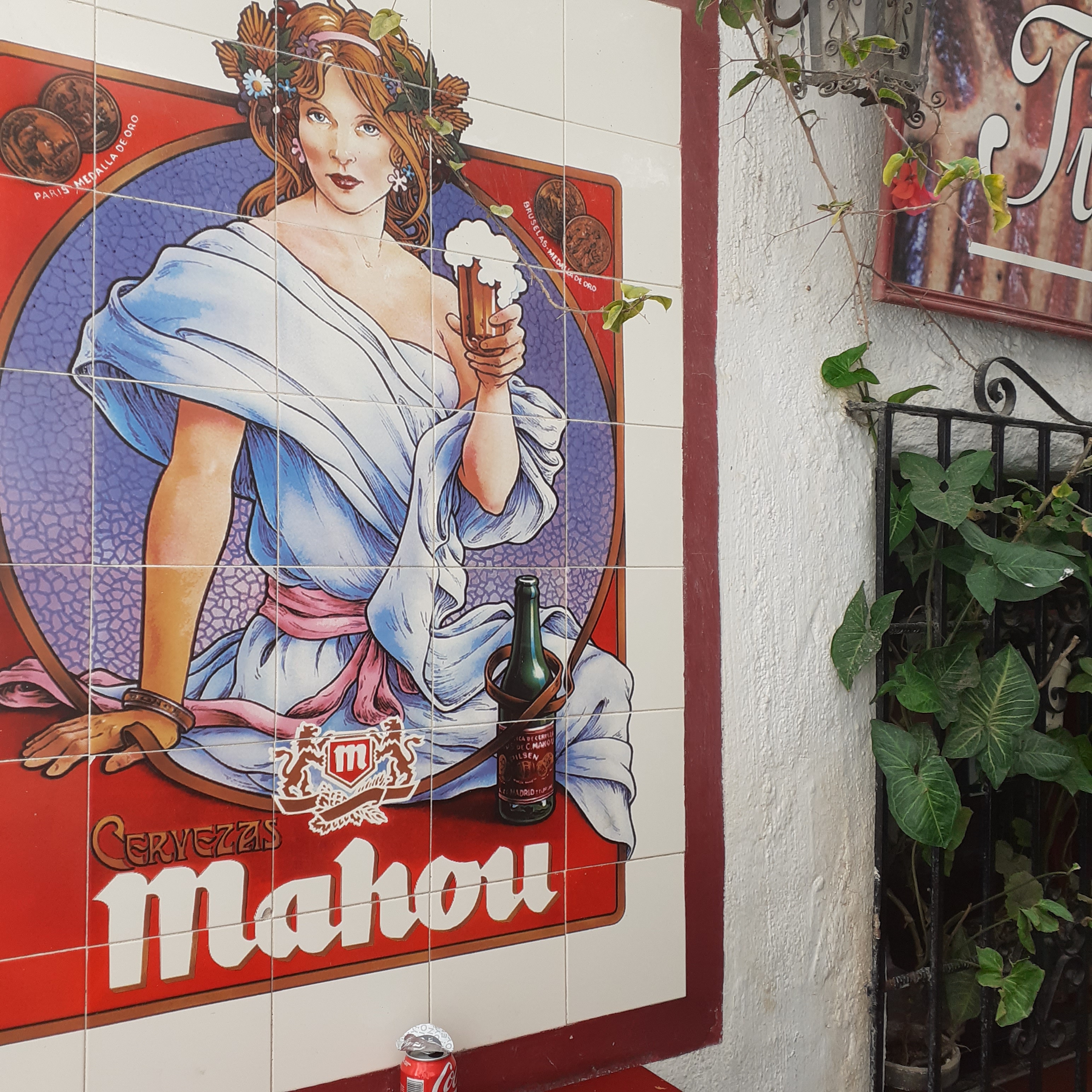
Marbella promenade stretches from the port for a further seven kilometres to Puerto Banus in the west. Puerto Banus marina, with its luxury yachts is an upmarket nightspot and includes, amongst other delights, O’Grady’s Irish Pub. There are plenty of opportunities for refreshment at this end of the boardwalk, and plenty of time, which seems to grow profusely in the sunshine of Andalusia. That day we took a bus back to base camp. We were helped by a lovely Norwegian couple who come here every year. And why not. Folk from frozen fjords and rain dirty valleys need some time to gaze at the actual heavens.

To everything – turn, turn, turn

There is a season – turn, turn, turn

And a time to every purpose under heaven

A time to be born, a time to die

A time to plant, a time to reap,

A time to kill, a time to heal,

A time to laugh, a time to weep.

This version by the Byrds, from 1965, surfaces whenever joy is required. Pete Seeger wrote it in 1959, setting the words from the Book of Ecclesiastes to a major chord sequence. Those words from the Bible are attributed to King Solomon of the 10th century BC. Very old school. Seeger supplied the “turn, turn, turn” and the Byrds took it to No 1 with their characteristic jangling guitars and sublime vocal harmony.
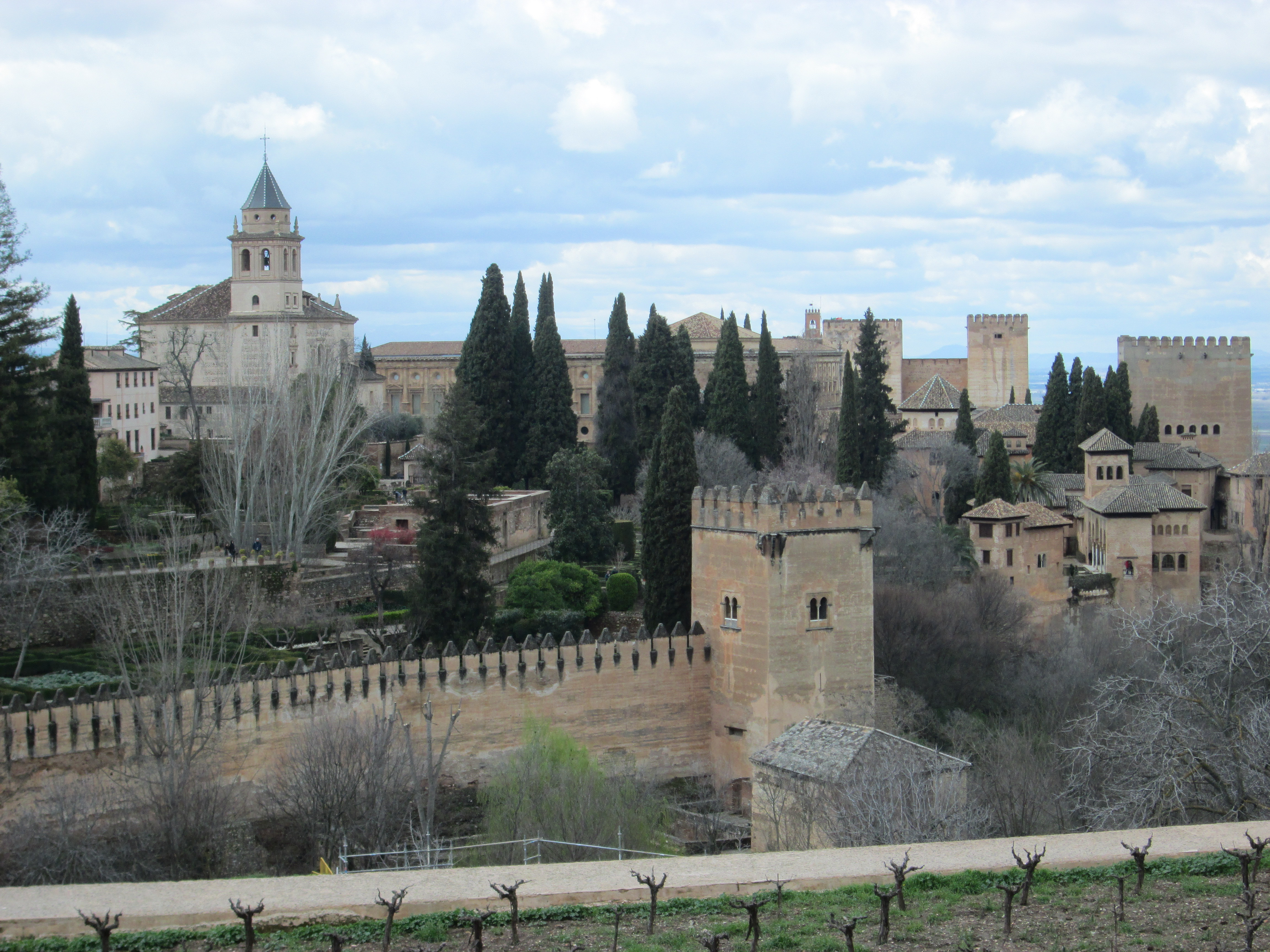
Granada – The Alhambra

Al 18 Alview

When I was thirteen, I picked up the flamenco guitar and dreamt of Spain. The intricacies eluded me, but within my head the music sang loud and true. I was a better painter than musician, and here too a fantastical world formed, inspired by Salvador Dali’s visions, mindscape merging with landscape. Crowning this dreamworld was an ancient palace of a vanished kingdom: the Alhambra. Someday I would go there, blend with its mystery in the shimmering heat of southern Spain. Almost fifty years later it comes to pass.

It’s my second day in the high city of Granada. Man, it’s cold. I had intended taking the bus to the main entrance but wandered instead down winding alleys from Plaza De Campos to Plaza Nueva close to the high western edge of the Alhambra. Beyond Plaza Nueva the city of Granada begins to shimmer and fade, blending into the landscape and replaced by a chimera of imagination and folk memory centred on the Alhambra, red bastion rising on its green and rugged plinth.

Al 16 AlcaAlhambra signifies the Red Castle, from the blood toned colour of its stone. The Moors had built a fortress here in the ninth century but the existing complex dates to 1333 when Yusuf I, Sultan of Granada, established his royal palace. It was to be the last bastion of the Moor in Spain, In 1492 the Catholic Monarchs, Ferdinand and Isabella, completed the Reconquista when they defeated the Emirate of Granada. The two monarchs entered Granada clad symbolically as Moslems, promising friendship and tolerance of religion. It was short lived. The Moors rebelled in 1500 and the treaty lapsed. Moslem and Jew were required to convert or leave. The institution of the Spanish Inquisition was set up to police this law.
1492 was also the year when Italian explorer Christopher Columbus came here to receive the support of the Monarchs in his ambition to sail to the New World. This is when the Western World was born. An early history of Columbus was written by an Alhambra resident in the 1820s. Washington Irving, joker that he was, is responsible for perpetuating the myth that, pre Columbus, Europeans thought the earth was flat.

Al gate

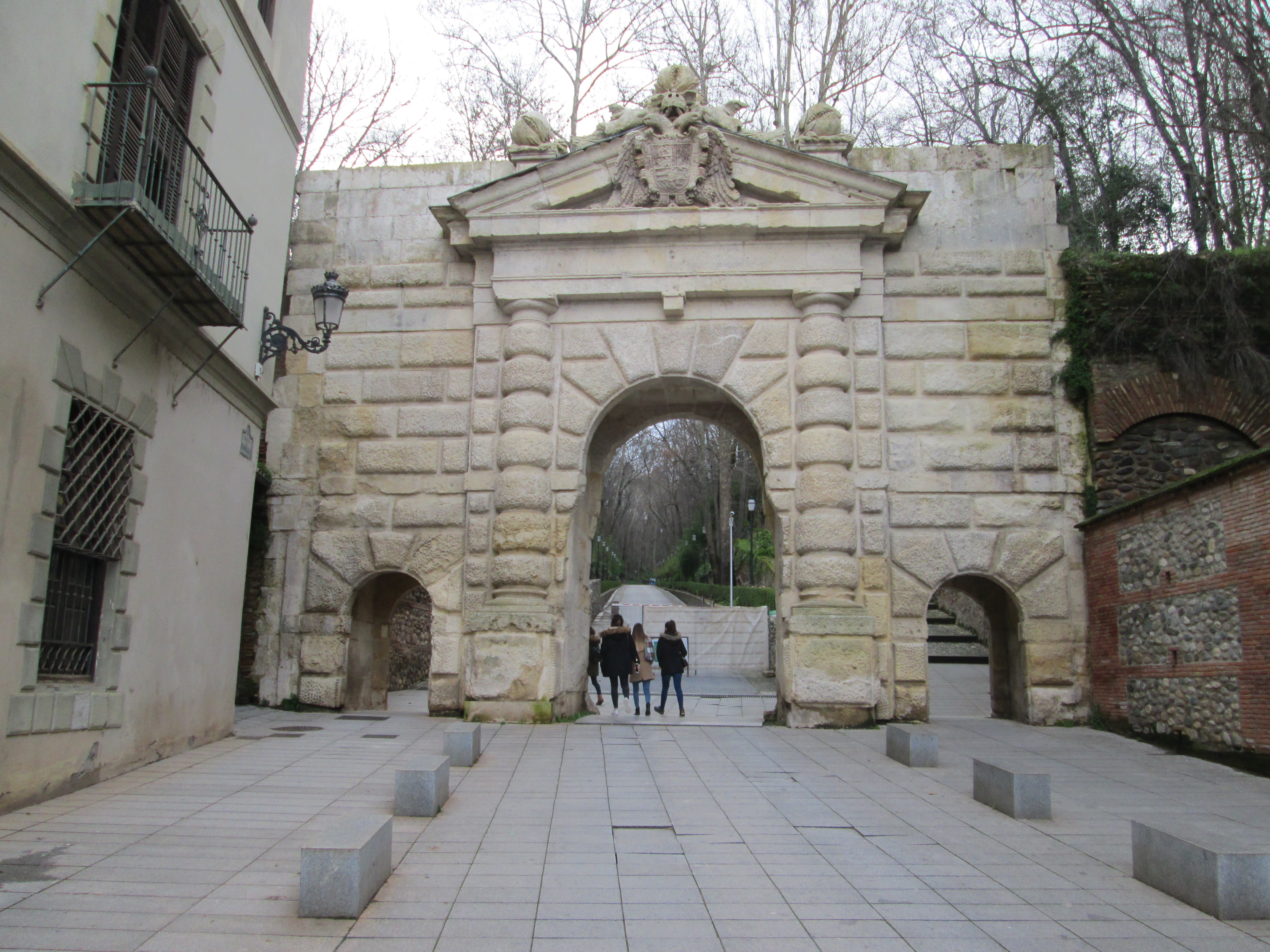
The entrance is through the Puerta de las Granadas, or Pomegranates, which gives the city its name. Inside the grounds the Alhambra reveals itself, tantalisingly peeking above the trees. With the gathering pilgrims, I push uphill. A fountain sprouts. The Pillar of Charles V dates from 1554. The ubiquitous Carlos V was a mere Carlos I until his elevation to Holy Roman Emperor. He didn’t even speak Spanish, to begin with, but his subjects warmed to him as he learned.

Al 2 Irving

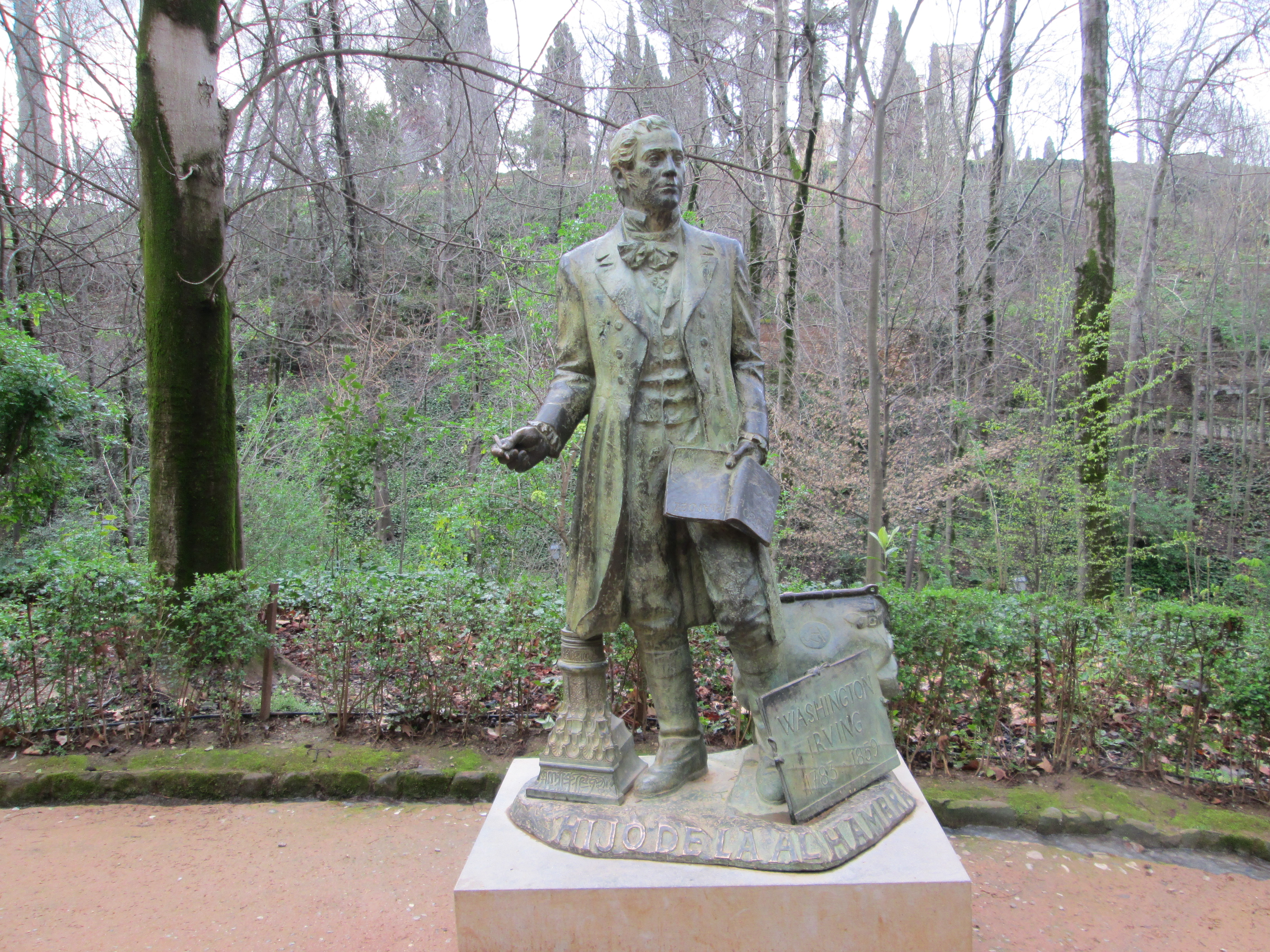
I rest on a bench. A quaintly dressed man stands nearby. He gestures to the glories spread above and wonders is it possible to capture the beauty and intensity of the place. I show him my camera and the shots I’ve taken, which he finds interesting, perplexing too. It’s words he means. How unworthy is my scribbling of the place, he says, and tells me of his Tales of the Alhambra, a history woven with imagined tales the walls must hold. What a great idea that is! Unfortunately the man must return to his home in America, but vows to come back to this most picturesque and beautiful city. I hope he does. I would wish to also, in warmer days. Again there is that faint shimmer in the air, and I find myself fading upwards along the path, past the statue of a writer I feel I must know.

Al 3.Jstgatejpg

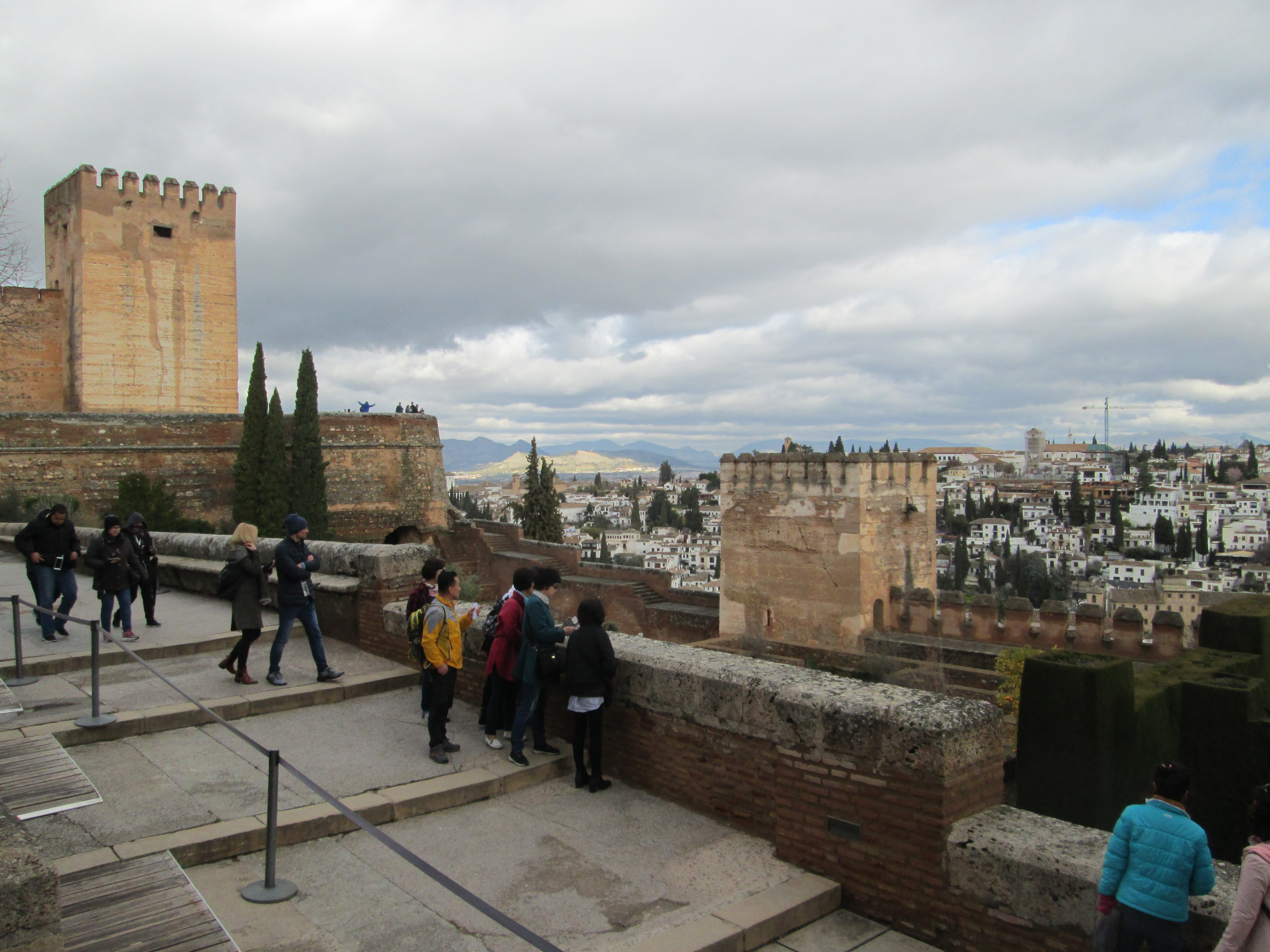
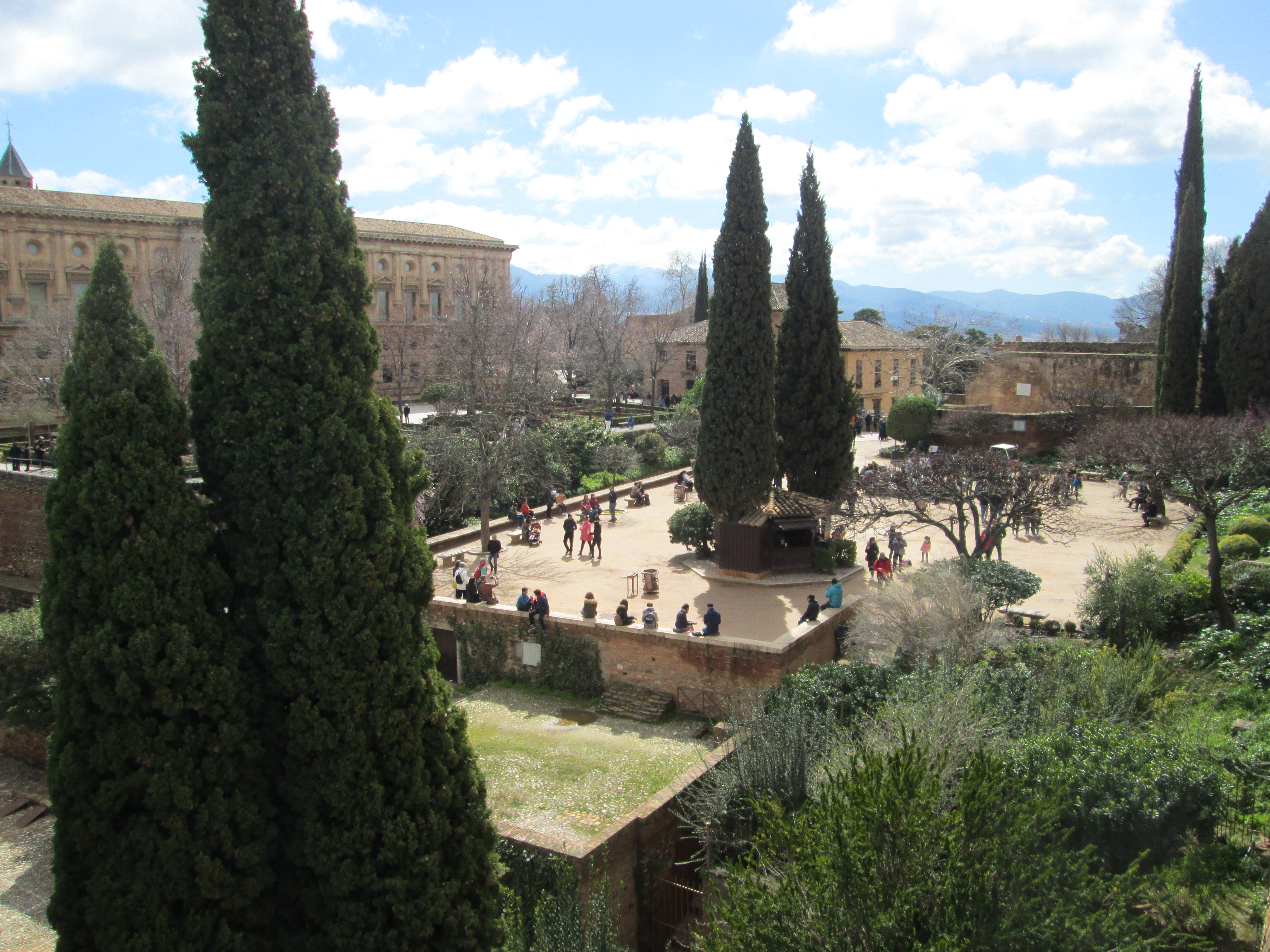
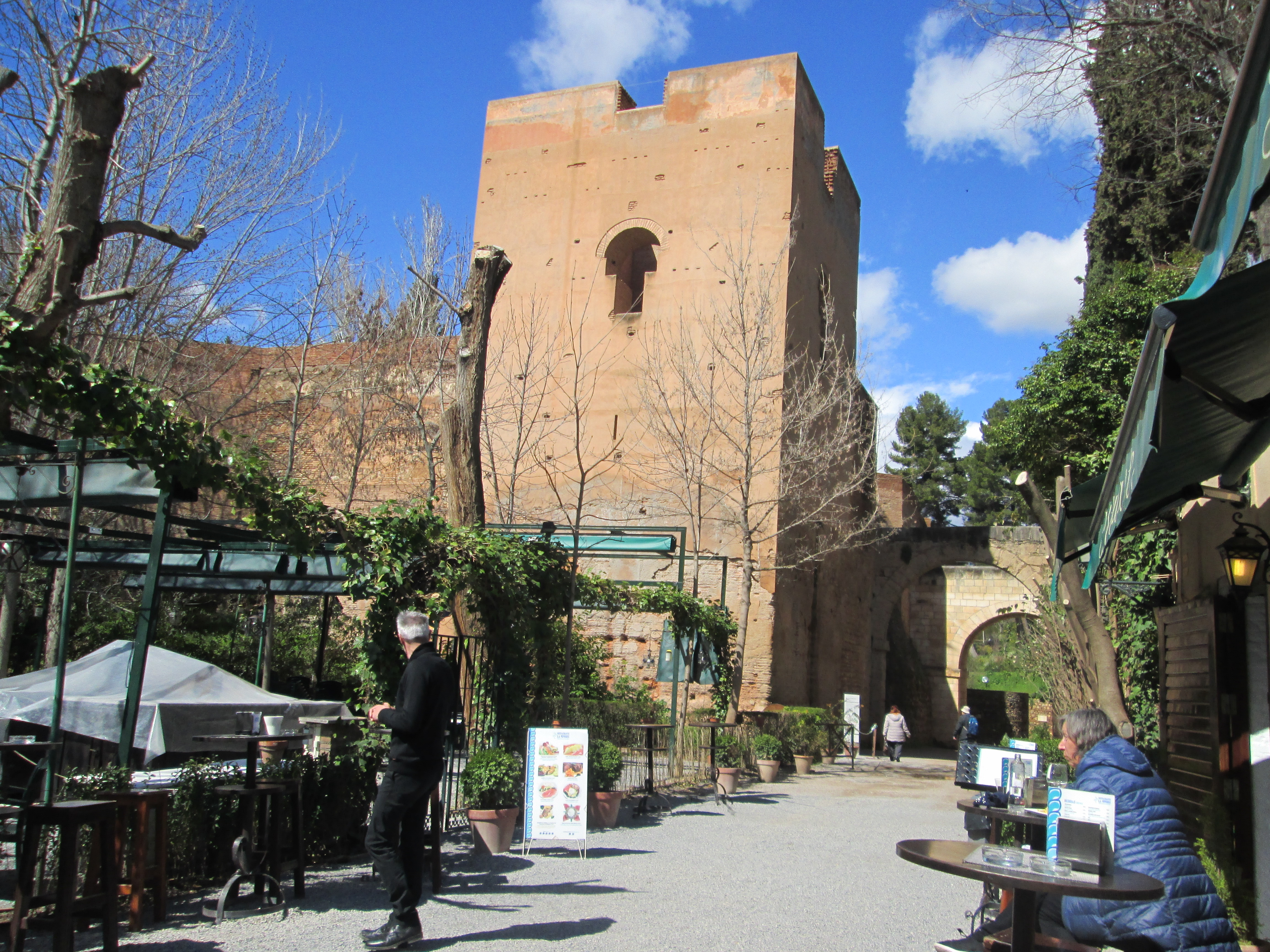
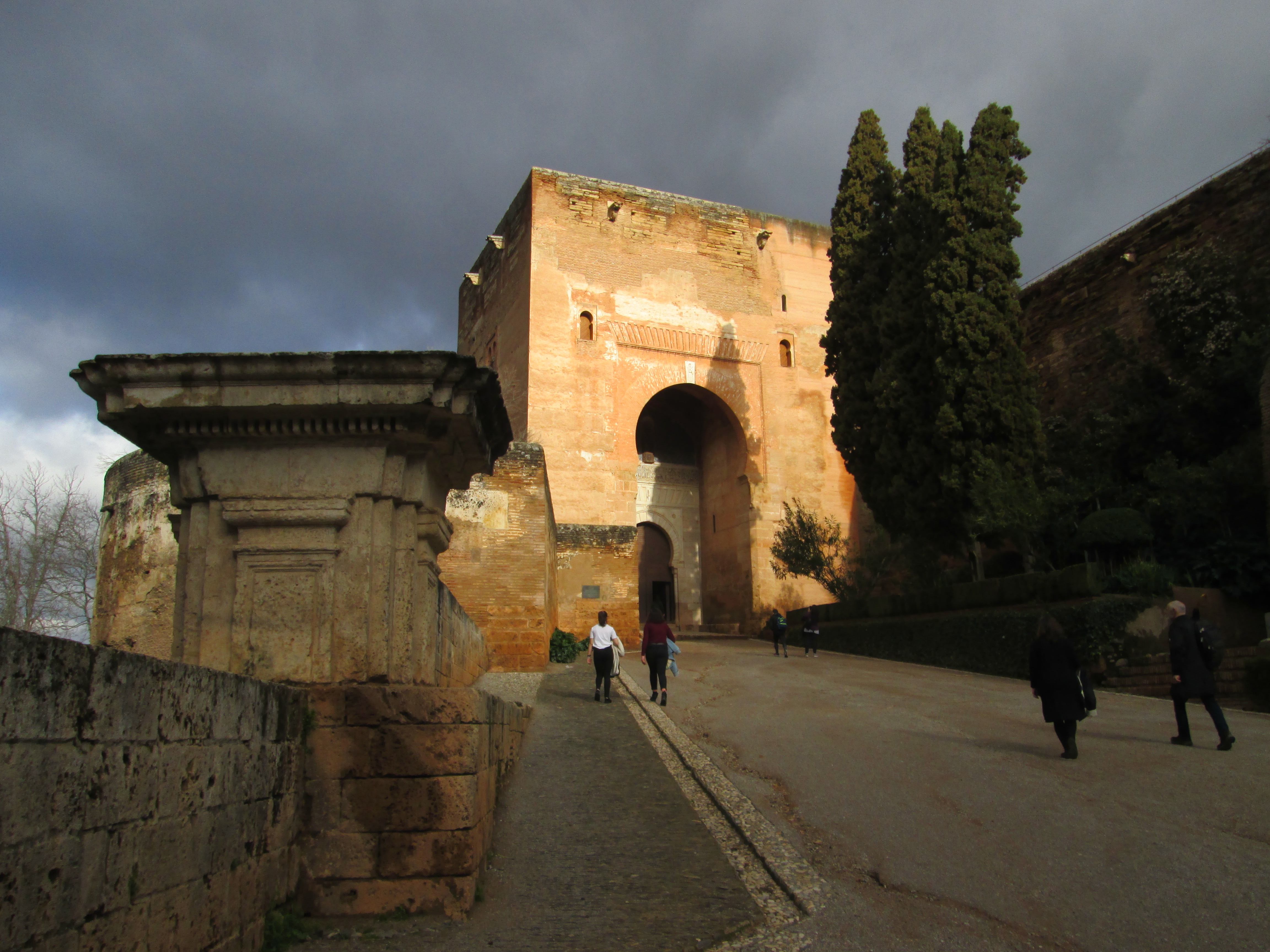
I enter through Puerta de la Justicia, imposing russet tower with its distinctly Moorish horseshoe arch. The procession of pilgrims has melted away and I am left alone. From the ramparts, I see Granada tumble from the hillsides across the plain, the Sierra Nevada shining white across the horizon. When the Moor last looked out here, the Alhambra was entirely a construct springing from the Islamic culture of northern Africa. Within a couple of decades there was a notable intrusion of European style. The Palace of Carlos V was built by order of the Emperor in 1527 in the Renaissance style. Newly confidant Europe had rediscovered the glories of Greco-Roman antiquity and honed it into the distinctly modern style of the merging continent. The entrance patio is a startling homage to Classicism, with its two story colonnade holding us in its entrancing circle.

Al 6 CVpatio

The temperature has dropped and I have forty five minutes before my appointment at Nazaries. A sign for coffee and services is misleading. This leads to a modernist concrete shack, cold and crowded, with one scabby machine offering hot beverages. The instructions are less than helpful. Yes, it takes money and credit cards, but how much? None of mine, for sure. I buy water and Doritos off a nearby Gypsy. The queue for the Nazaries is long but not long enough and when I reach the head ten minutes early I must stand to the side. I’m frozen blue, four degrees and falling. Global warming my ass!

Al 7 Qnaz

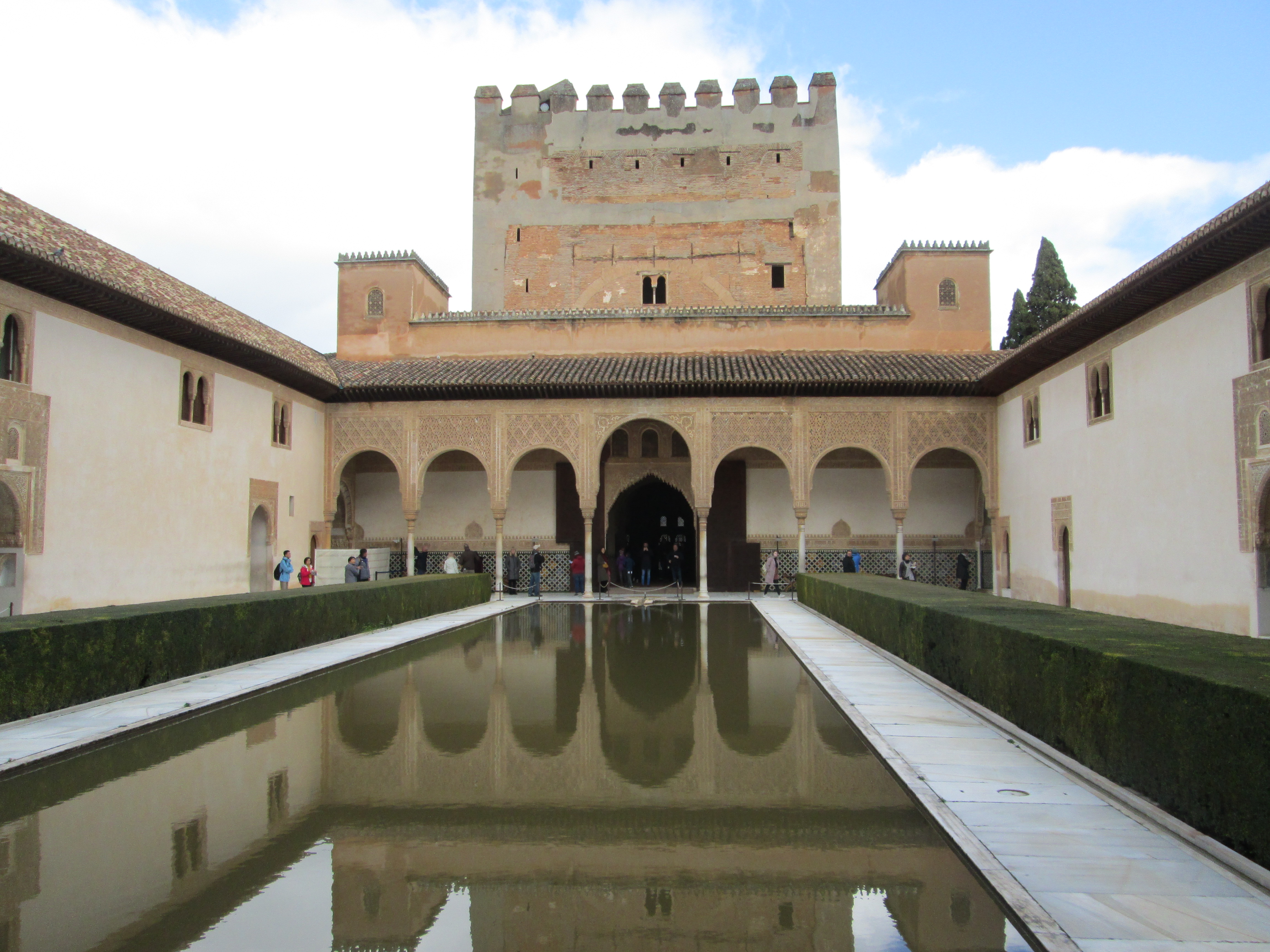
The Nazaries unfolds on entering, a stone flower opening into more spaces than anticipated from the outside. Stone becomes fire and flickers to intricate tracery; water turns to glass and beckons to a perfect nether world. What paradise this must be in heat; water stone and plants working to scent and quieten the air. This cold emphasises its abandonment and defeat; its very existence a time capsule of a vanished age.

Al 10 Nazpool

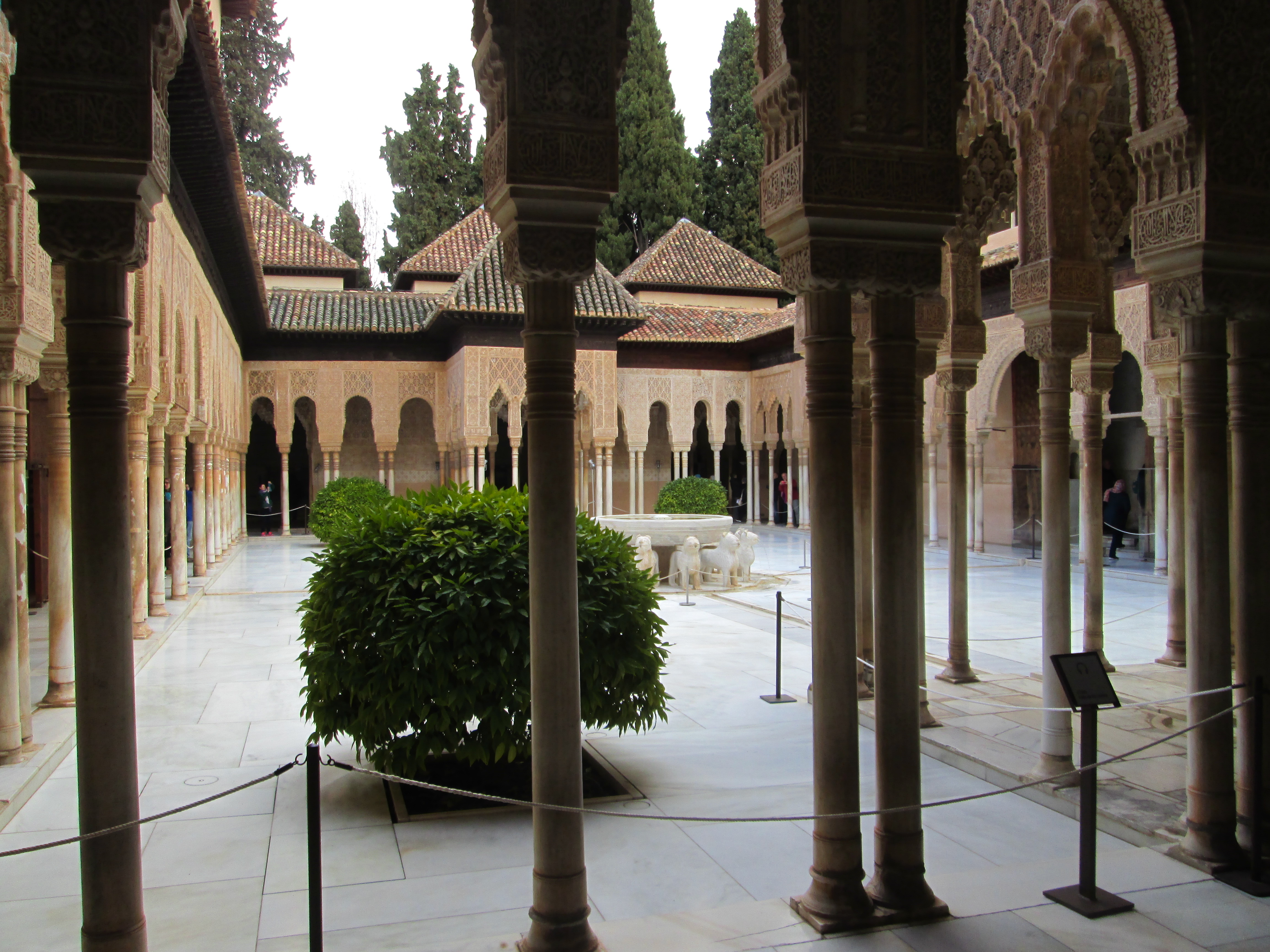
There are three palaces within the complex. First, the public area dealing with justice and administration. Then the Camares Palace which was the royal residence. Finally, the Palace of the Lions, a harbinger of heaven where the harem was located. A magnificent centrepiece is the Court of the Lions with its sculptured lions forming a circle within magnificent, delicately rendered cloisters. There is an abiding sense of harmony between the ancient Islamic order and the newly flowering Christian Renaissance. You could float on this river forever and ever.

Al 11 Nazlion

Having exited inadvertently I slip back in. A female guard calls after me. However, she is hugging a heater in her sentry post, and indisposed to follow me. In truth, I’m prone to quitting. The absence of a decent cafe, or any place of warmth erodes my will. I come across the American Hotel and find a seat in its tiny tearoom. A sturdy Tuna Sandwich and two hot Americanos later and I’m suitably fortified. A friend had recommended a visit to the terrace at the Parador Hotel with splendid views of the Alhambra. But it’s not a patio day and the interior has that lowrise furniture peculiar to hotels and innimmicable to relaxation.

Al 15

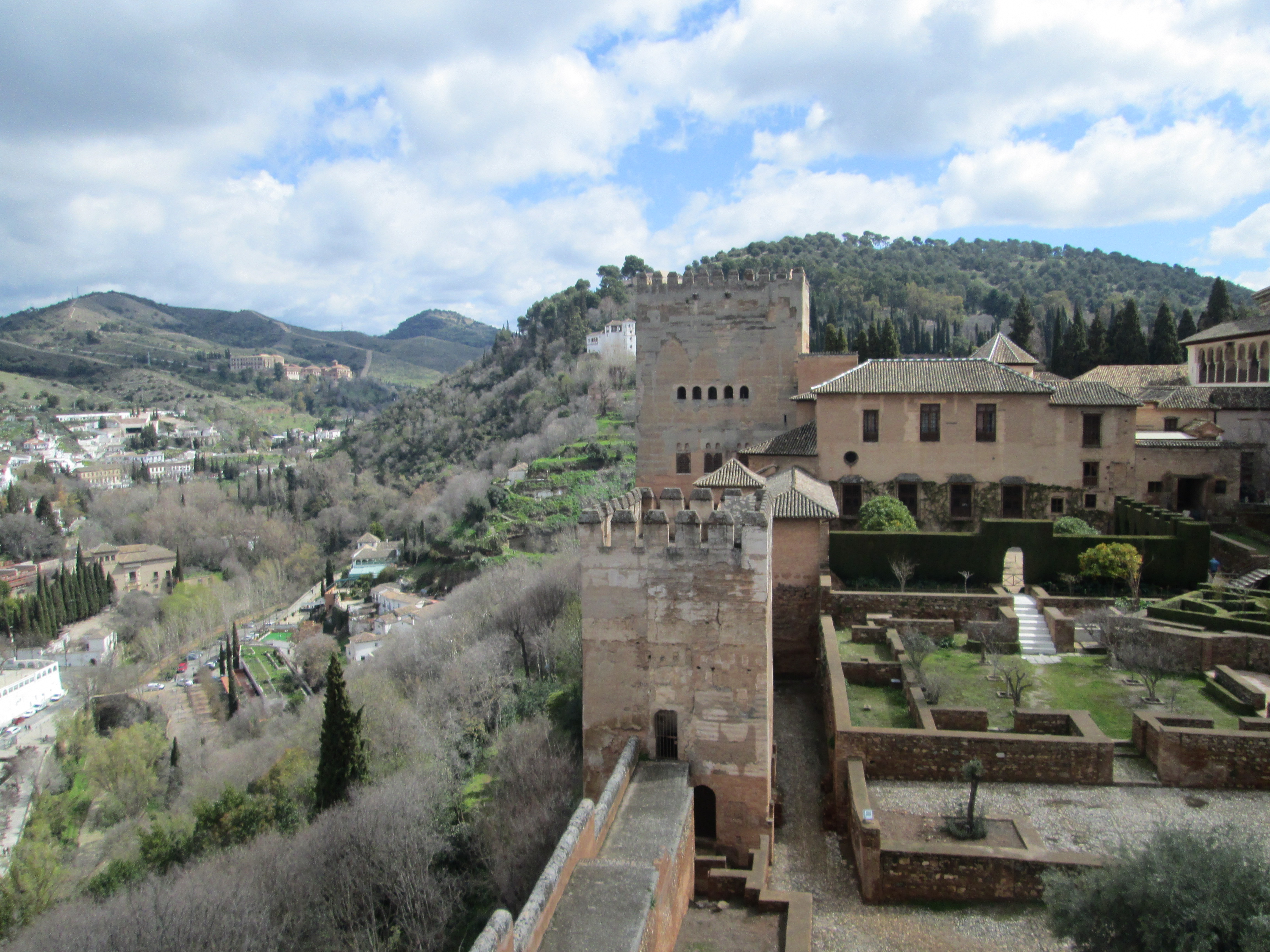
The Alcazaba is the fortress at the business end of the Alhambra, its towers giving the most majestic views over Grenada. I find myself earwigging a conversation between a Gypsy and two Americans. The Gypsy gives a brief account of their origin, relating the reasonable alternatives. Origination was somewhere in the near east, or refugees from the margins of the crumbling Roman empire. Some say we came from Egypt to wander the margins of empire. If people asked from whence we came, the answer was Egypt, which half heard, sounds like Gypsy.

Al 14 CV

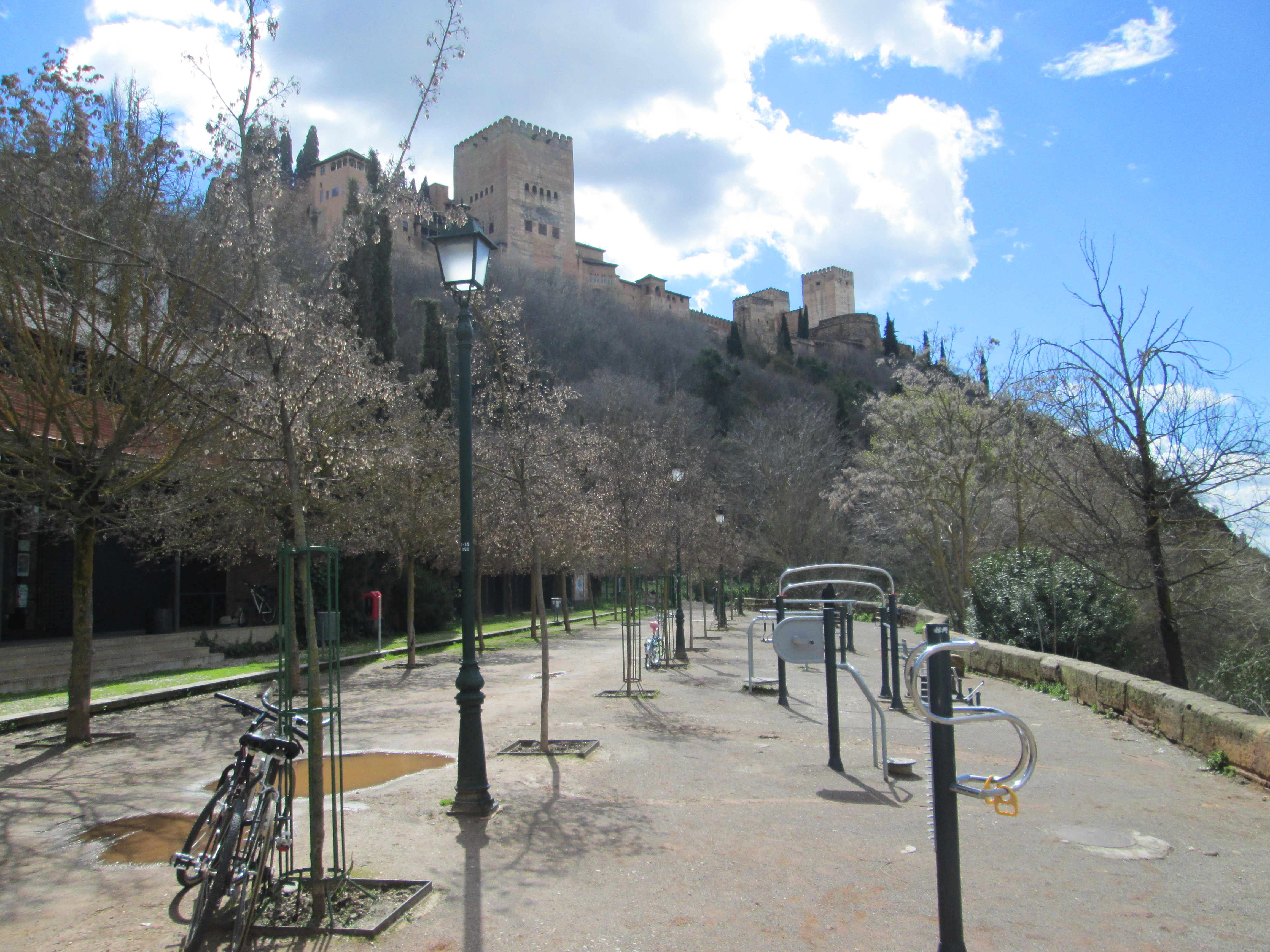
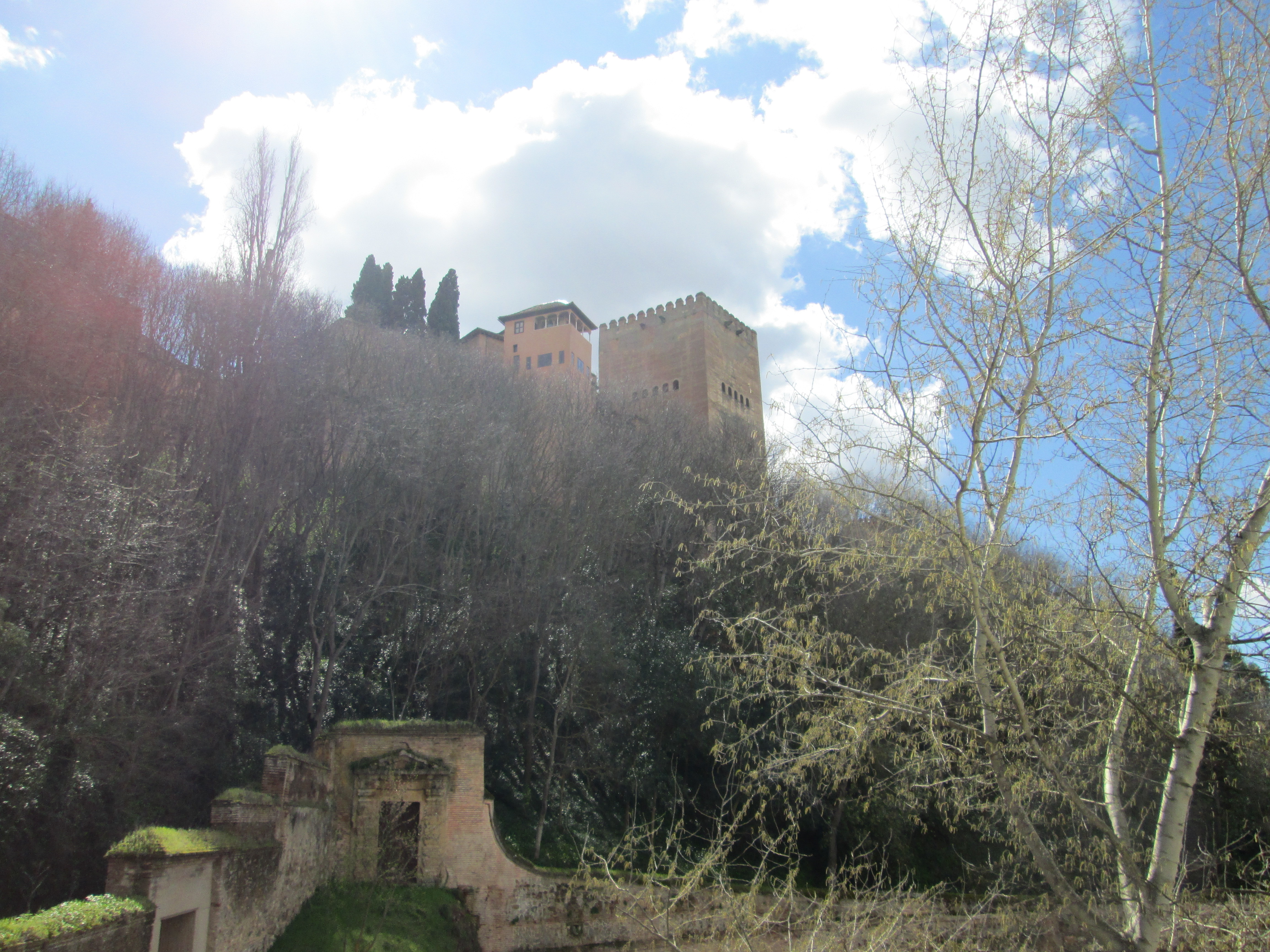
From here, I take the path that fades down towards the entrance through beautiful gardens. The first blooms are appearing but t’s not quite come to life just yet. Across a ravine and climbing the next hill takes us to the Generalife, the Gardens of the Architect. Beautiful gardens surmounted by an elegant villa provided a retreat for the Royal Household from the travails of the Alhambra. And provides glorious views of it too.

Al 20 Bar

On exit, I put into the first available bar. Below the walls of the western Alhambra, there is shelter and sufficient warmth from the sun to allow me bask outside with a beer and tapas. I walk back downhill past the northern walls alongside a rapid stream. I emerge onto the banks of the Darro river which heads back towards Plaza Nueva.

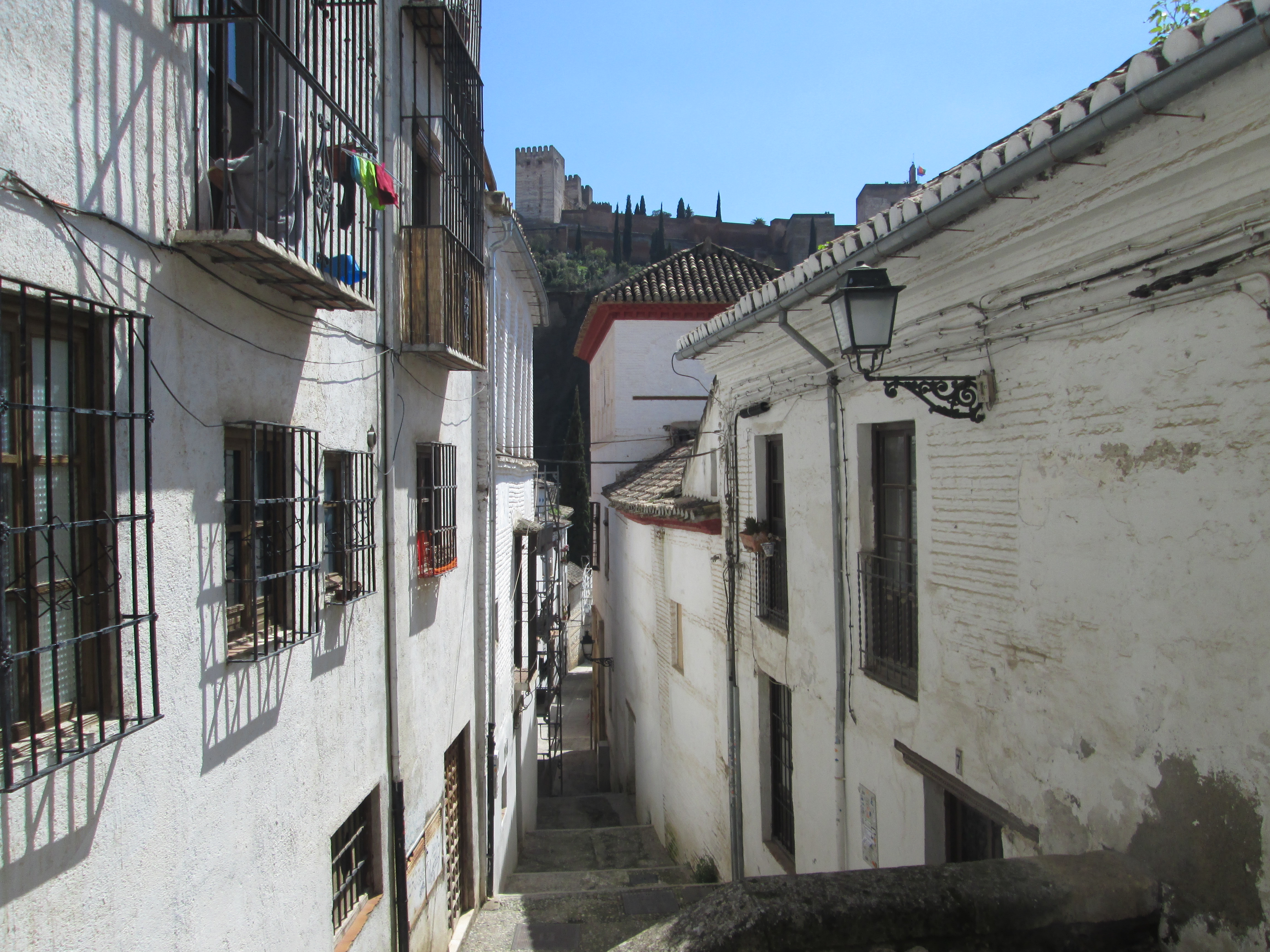
AL 22 AlcaThis area overlooking the Darro is the Albaicin, dating back to the 13th century and rich in Moorish heritage. The streets meander past high walled villas, dazzling white washed walls and towering palms and pines. Becoming impossibly narrow so you feel you must turn back, then widening unexpectedly into sparsely imposing squares. Quiet and weird; at times I feel I’ve strayed into a Dali scenario; Outskirts of the Paranoiac, perhaps.
AL 21

Stranger still, lounging by the riverside cafe terrace with another beer and tapas, soaking in the first true warmth of the day, the waiter hurries by, imploring us to retreat under the canopy. It had certainly darkened off to the west, and a smudge of rain was sensed. Then it came upon us. The sky scowled and snow fell in curtains across the backdrop of the Alhambra.

Al 20


Glasgow

img_1088

Approaching Glasgow from the south, the green, rolling countryside does not imply the pending city, so much as its ancient name, the Green Valley. Only as we plummet into the Clyde valley itself does Glasgow spring from the ground. Great buildings and soaring spires are piled in close order on the hills to the north. It’s a big city, and the aggressive architecture of the industrial nineteenth century emphatically underlines this.

Access by car is easy enough. Once off the ring road, the streets are laid out in a grid. We zig zag our way to the hotel just off Sauchihall Street. The street makes for a good point of orientation. It cuts east west through the city for, well, forever. Chameleon-like, it adopts the hue of all that it passes through. Towards the city centre it’s pedestrianised, a bustling shopping precinct. It’s a bit seedier heading west, where we breakfast at Wetherspoon’s – Full Scottish with Haggis – and ponder the possibilities of a host of Curry Houses. Passing the ring road we’re in the more salubrious West End with grand terraces, parkland and mature trees.

Busy Buchanan Street

Busy Buchanan Street

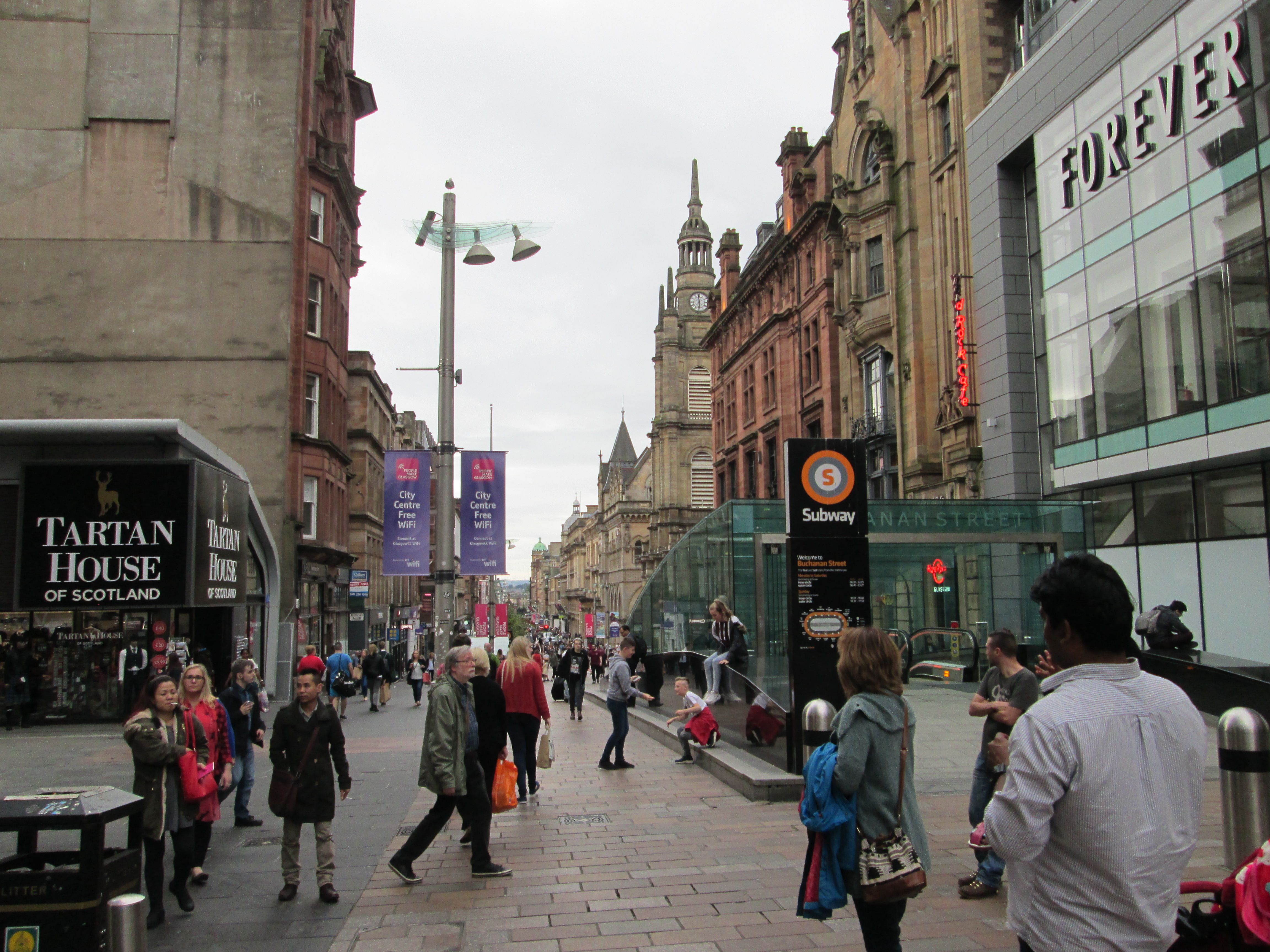
Sauntering east down Sauchihall Street towards the city centre we join a growing river of humanity. At each intersection streets head uphill and down, distances dotted with landmark spires and turrets. It’s bright and brisk as evening approaches, but we find there’s not much doing here after dark. At Buchanan Street we take a right angle. Sloping down towards the Clyde, Buchanan Street is lined with imposing commercial palaces. Above the pediment, spires and statuary sharpen the skyline. Soft yellow sandstone builds strong, impressive facedes, blood red sandstone breeds angels from the architecture.

This town was built on muscle and blood. Tobacco, cotton and slavery saw its port prosper in the eighteenth century. It was a gateway to the new world, in both directions. The Scottish Enlightenment forged its own genius, taking the city to new heights. After the Industrial Revolution, Glasgow became a European leader in industry and engineering, particularly as a centre of shipbuilding. I hadn’t realised Glasgow would be so hilly. The grid system accentuates this effect. If not quite San Francisco, it was reminiscent of Seattle, all that commercial power beneath the pale, active northern sky. There’s more than a twist of the Gothic going on here. Superheroes would be right at home amongst its architecture, villains too. If picturesque Edinburgh harboured Superman, Glasgow would have The Batman.

The Kelvingrove

The Kelvingrove

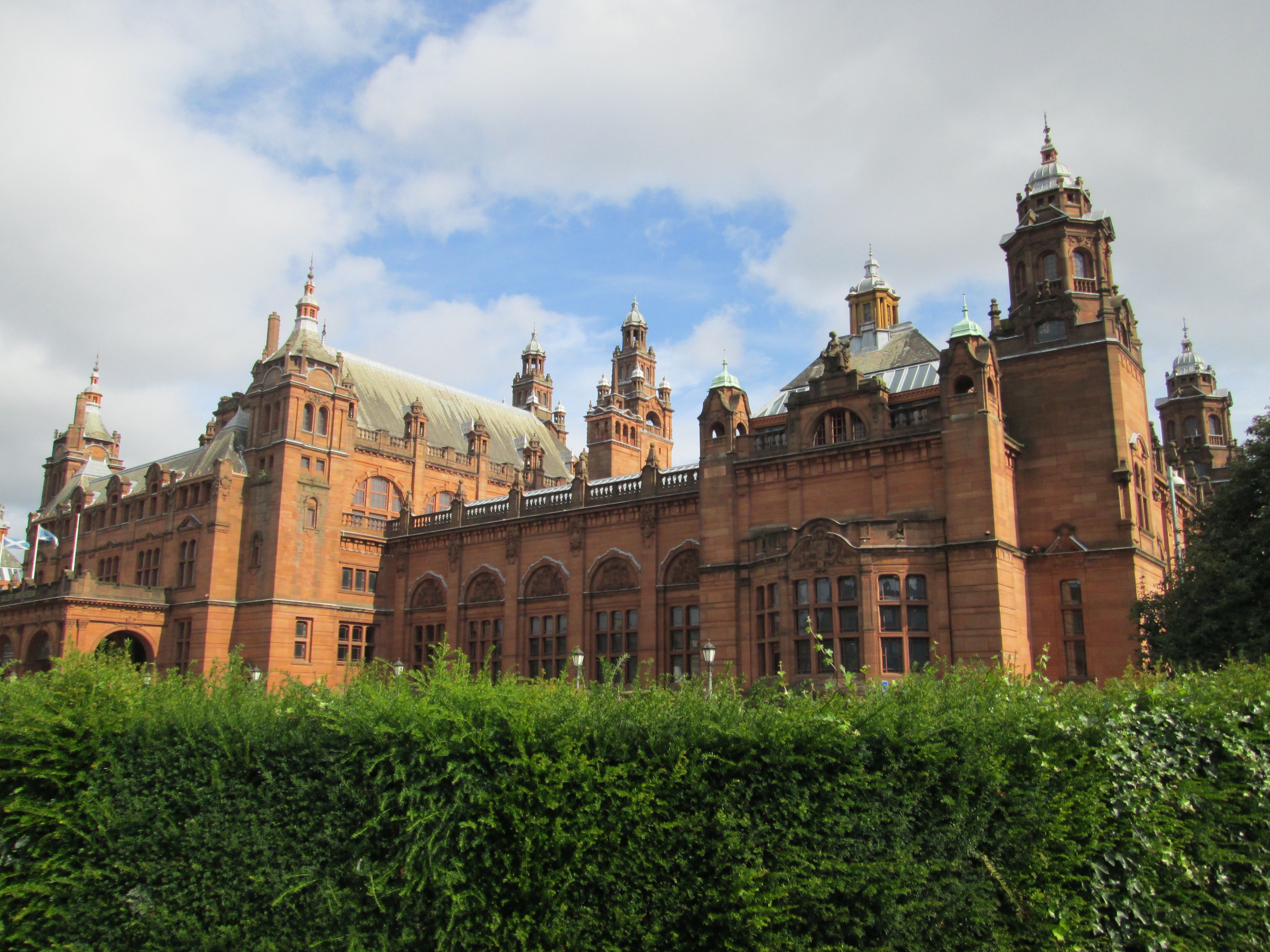
At the salubrious end of Sauchihall Street, the Kelvingrove is situated in parkland around the Kelvin River. The river’s name was appropriated for Baron Kelvin, the famous Irish physicist William Thomson, who worked from the University of Glasgow overlooking the valley. Coming to Scotland, it’s faintly humourous that he figured how low temperatures can go. The Kelvingrove Museum was completed at the start of the twentieth century. It is an impressive, pink-hued Baroque temple, housing a fine collection of international and Scottish art. Orientation was initially difficult, the museum map is a mirror image of what it should be. But Glasgow’s a bit like that, I suppose.

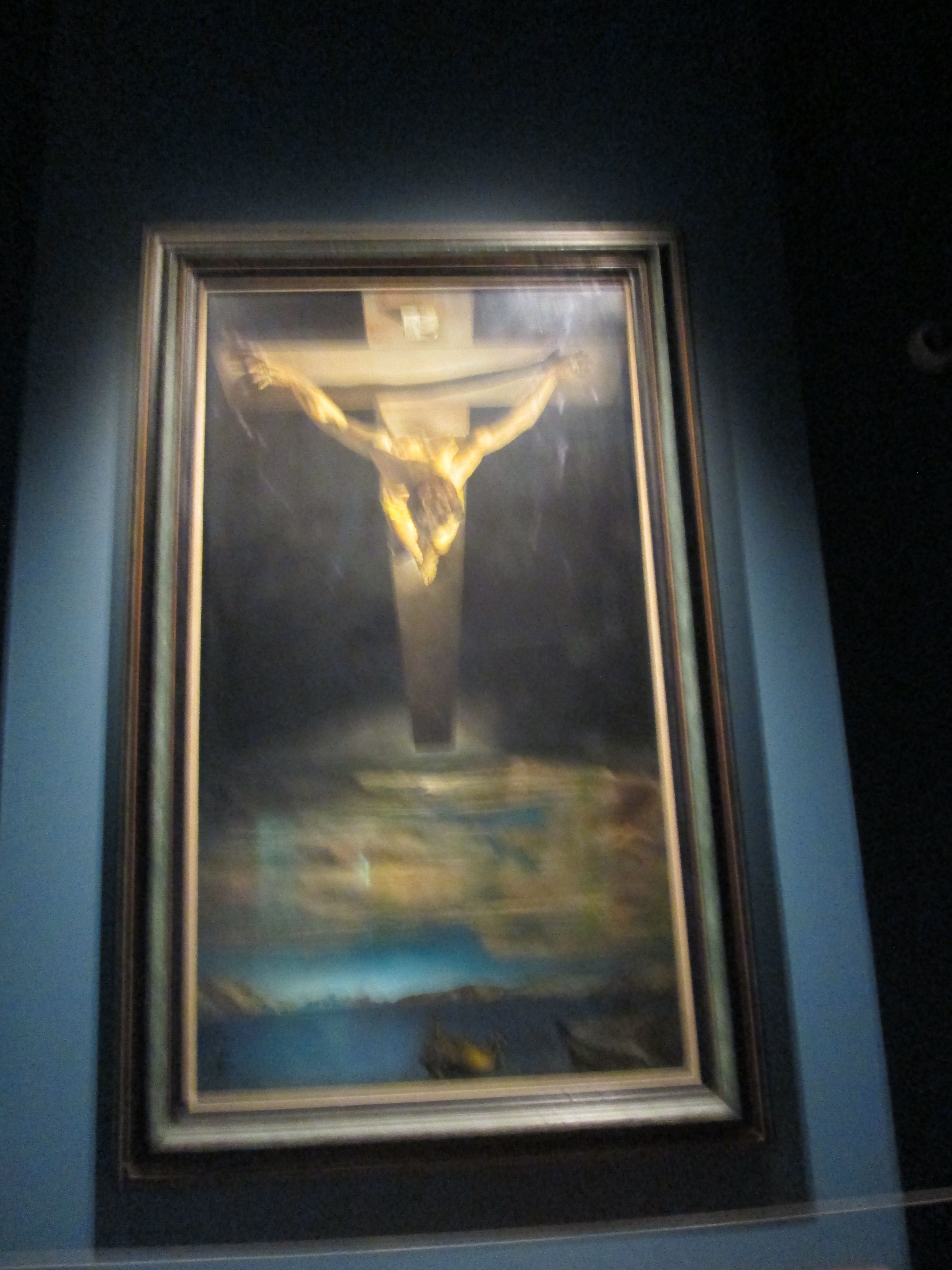
Dali's Christ of St. John of the Cross

Dali’s Christ of St. John of the Cross

Salvador Dali’s most coherent masterpiece, Christ of Saint John of the Cross, is its outstanding work. Glasgow might seem a curious repository for such a determinedly Catholic work. Indeed, the painting has suffered the attentions of a slasher, his handywork a palimpsest beneath the restoration. Still, the painting exudes an awesome serenity. It is the epitome of suspension, combining crucifixion and resurrection, appropriately enough for this city. Nearby, another startling Catholic artwork illuminates the shadow. Harry Clark’s Coronation of the Blessed Virgin was commissioned for a nearby convent in 1923. It is a fine example of Clarke’s meticulous, flowing art. It makes a most appropriate companion-piece to the Dali.

The gallery also houses paintings by Rembrandt, Van Gogh and Renoir. The ground floor houses an eclectic and dynamic exhibition, including an Elephant and a Spitfire. A haloed Elvis points the way. The main concourse is dominated by the classical pipe organ, booming into life at lunchtime when there is a regular recital.

Elvis grove

Elvis grove

It’s a hot climb through lovely parkland to the University of Glasgow atop Gilmore Hill. Its majestic spire is an ever distant destination, dominating the city from it lofty eyrie. We ghost through the quads and cloisters, seek out the Hunterian Museum where the interior of the house of Charles Rennie Mackintosh (1868 – 1928) is recreated. It is held within the silo of the Library and Art Gallery complex across from the main building. There is something Tardis like in exploring the interior of a house that no longer exists. Mackintosh was neglected in his late career, and for a while since, but his reputation is now universally established.

Though I fancied a stroll to Byers Road for some drinking and dining pleasure, time was tight and we had to move on. We take a bus through the West End, which is pleasantly alive with drinking and dining possibilities. We can only window shop from the bus, we will return another time.

Our quest for all things Mackintosh leads us back to the city centre. Mackintosh’s design is a pervasive strand throughout Glasgow, though scarce enough unless you know where to look. His work was an influence on Klimt and others in European Art Nouveau. Time has to be made for tea and coffee too. Tea Rooms were an intrinsic part of Glasgow life in the late Victorian age. A surge in Temperance was a motivating factor. Miss Cranston was a key figure in the business and she commissioned Mackintosh to design her Willow Tearooms on Sauchihall Street and Buchanan Street. He imbued them with that typical Art Nouveau merger of modern glass and steel craft with the exotic aesthetic of the Orient. Such places, whilst bolstering clean living on the one hand, were meant to be seductive. Coffee remains a favourite tipple in Glasgow today, but amongst other things. There’s a good arthouse feel to many of the cafes. Mind you, Glasgow’s friendly reputation took a dent in one. As I lounged with a stray arm draped over a nearby chair, a customer whipped it from under me without a by-your-leave. Somewhat harshed me buzz, that.

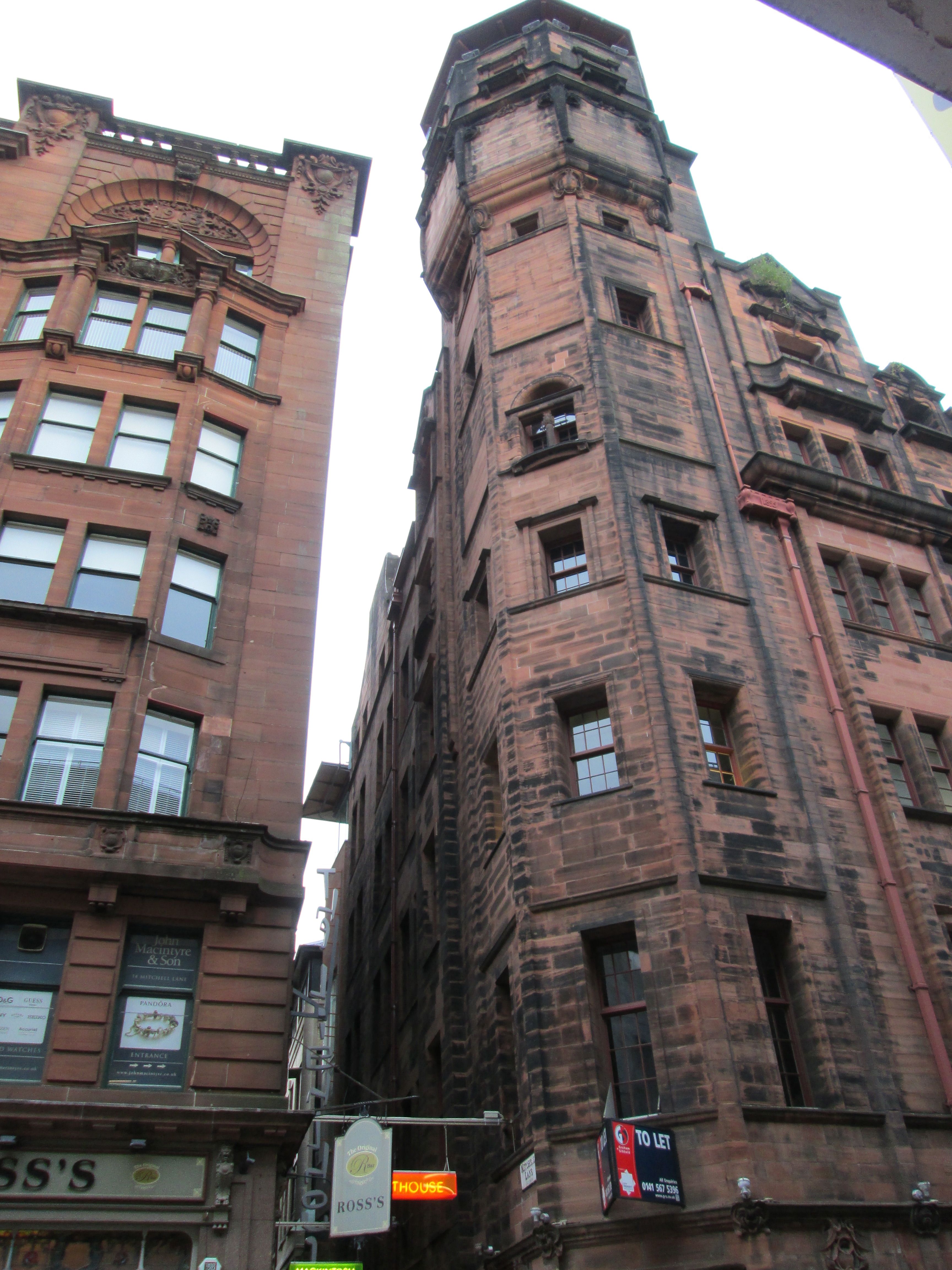
The Lighthouse

The Lighthouse

The Lighthouse, focus for all things Mack, stands sentinel on Mitchell Street. Its corner tower results in the nickname. At night, a faint light blinks from its upper storey, the beacon of a lighthouse that isn’t, aground in the metropolis. It was designed for the Herald newspaper, and was Mackintosh’s first public commission. It’s just off Buchanan Street, by way of narrow Mitchell Lane. The approach is suitably gothic. The Lighthouse gives a comprehensive view of his career. The interior of Mrs Cranston’s Tea Room is recreated. There are models and drawings of his architectural work, a sad timeline delineating his fading career.

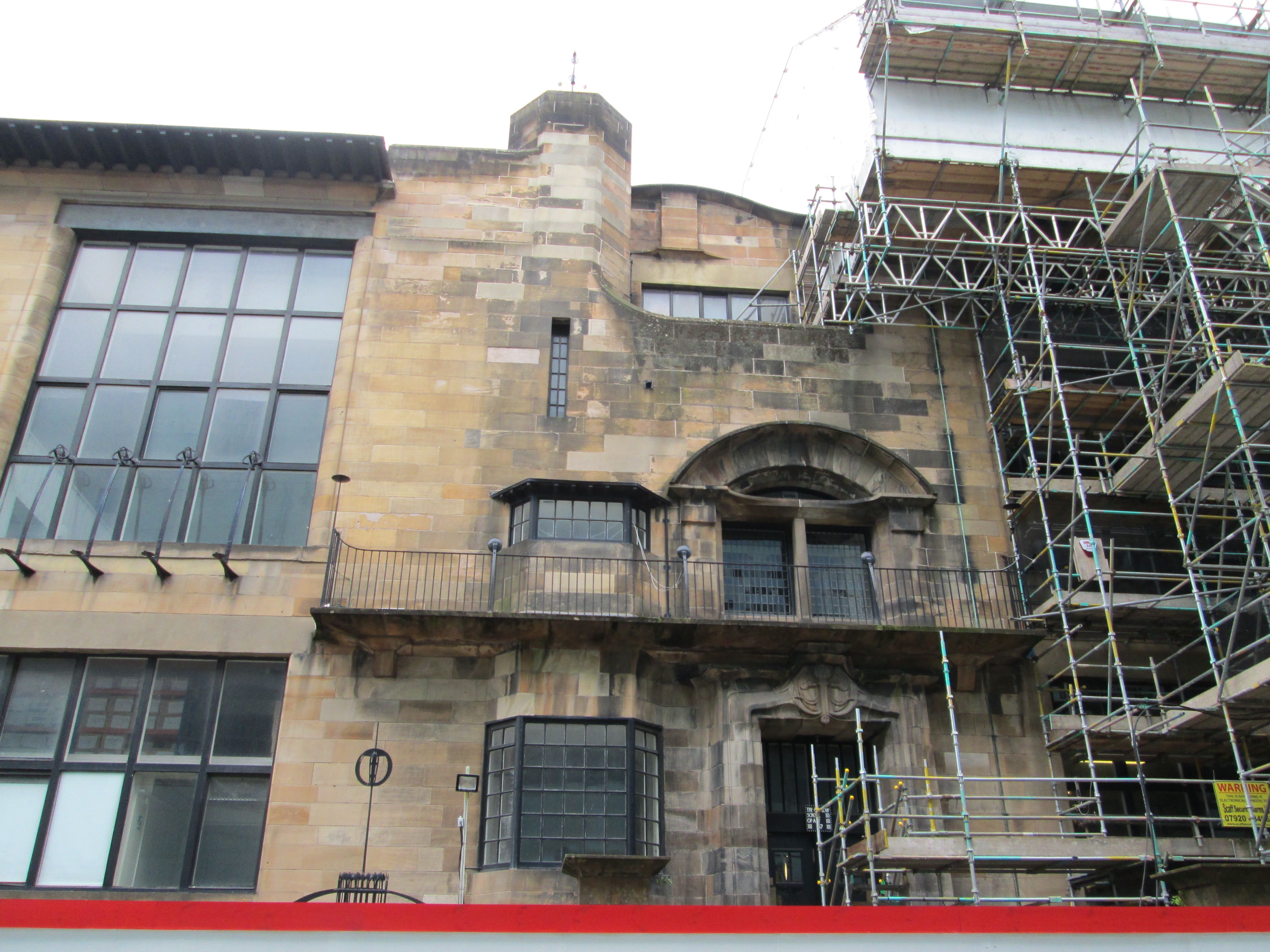
Glasgow ArtschoolGlasgow School of Art, as it is and as it's meant to be

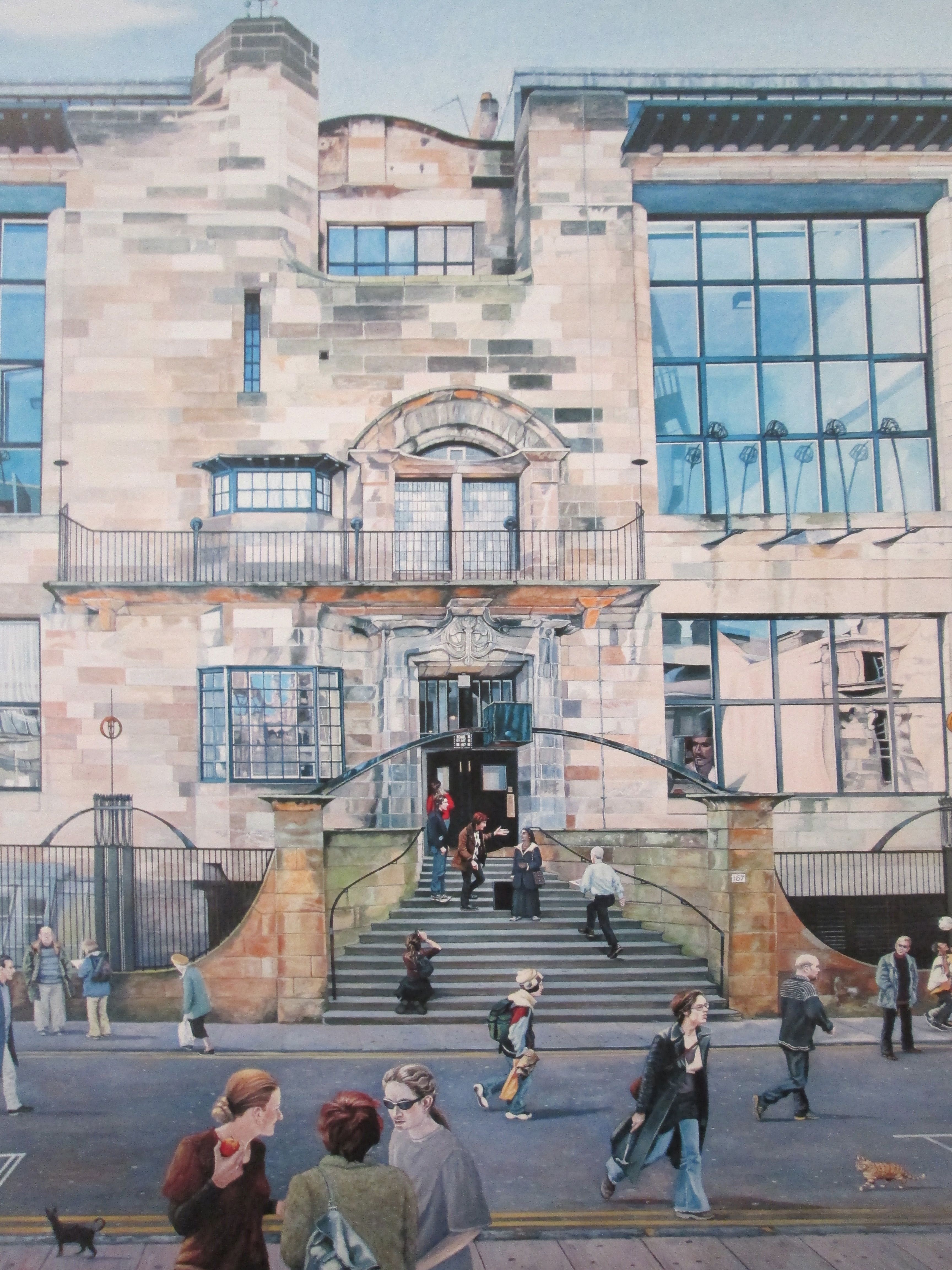
There is a graphic depiction of the School of Art, his most famous architectural work. The original stands on Renfrew Street, just about. Seriously damaged by fire in 2014, it is undergoing extensive reconstruction and is clad in scaffolding when we visit. I’m envious of this building, my own Art College days having been spent in a dilapidated annex of Leinster House, a disused warehouse and the early days of the refurbishment of Power’s Distillery, now a fine home for Ireland’s National College. I’m familiar with scaffolding and art college. Glasgow has had this purpose built masterpiece since 1909, it is a testament to the city, and its creator, Mackintosh.

img_1095

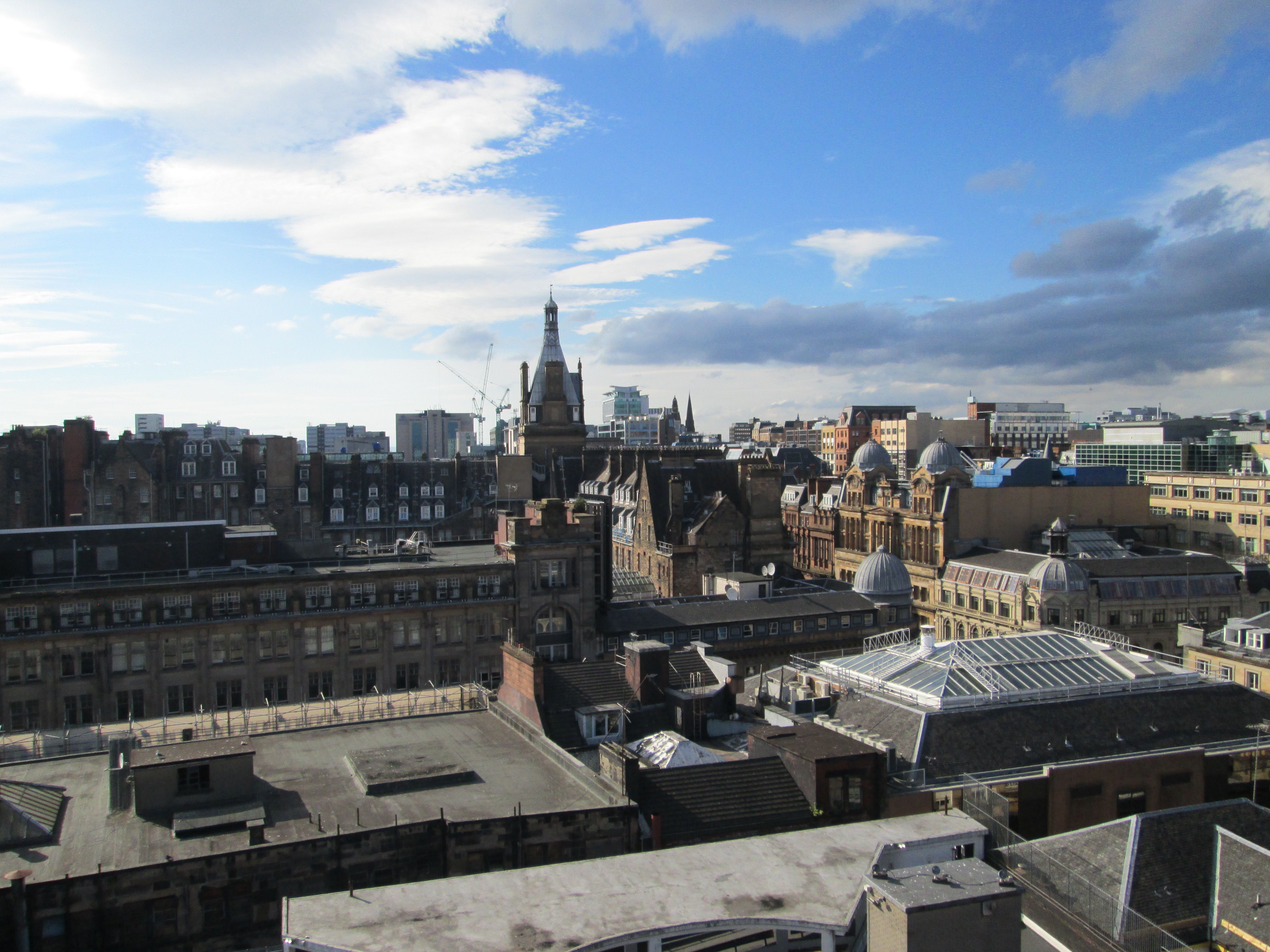
We finish by doing what one must in a Lighthouse. We climb the spiral staircase to the top, where there are magnificent views over Glasgow’s rooftops. Back to the more claustrophobic confines of Mitchell Lane. Good place for a pint, and there are good eateries nearby, for later. For now, time to absorb the September heat sitting half outdoors in the gleam and gloom of the atmospheric lane. The Lighthouse looms above. There’s a feeling here of being on a faultline between past and present, of inhabiting a graphic novel with grainy realism just a squint away. That’s draping the cloak of Glasgow around you. That’s being The Batman.

A pint in Mitchell Lane, at Bar Tabac

A pint in Mitchell Lane, at Bar Tabac