
Our second trip to Venice was the summer after myself and M tied the knot, and the trip to Italy was something of an official honeymoon. We had married in the bleak midwinter, escaping to the picturesque thatched roof frostbite of Adare, County Limerick. Like stepping into a Christmas card. Less starred was a trip to the ever-flooding city of Cork, where, and not for the first time, we drove through city streets with water up to the runner boards of our Renault. Perhaps that’s where we got the idea for our return to Venice.
Our itinerary was something of an infinity loop. From Rome, we leapt across the Pyrenees to Pescara, scurried up the coast for Venice, then on to Florence and on down to Naples, Sorrento and Pompei. After that, we took a few days on the island of Ischia and then back to Rome and the flight home. Trains and boats and planes; but mostly trains.
The train into Venice was an overnighter and packed to the gills. We were not alone in the notion that taking a kip on an overnight train would save on hotel bills. Mind you, everyone was doing it, tourist and local alike. It was hard to sleep in a corridor, with each stop introducing a new batch of salesmen to parade the corridor roaring: birra! gelati! Sounded good to me, but my companion is asleep, and I must elbow my way to the exit window for a smoke.
Well I’ve been waiting I was sure
we’d meet between the trains we’re waiting for
I think it’s time to board another.
Please understand I never had a secret chart
to get me to the heart of this or any other matter.
Arriving across the isthmus from Mestre by train, we sought accommodation from the Tourist Police at the Station Santa Lucia. Amazing now how we winged it on both honeymoons. After Adare we had launched into that pointless meander across the sodden south before cutting our losses and heading home. Italy in summer held more romantic promise. If we were stuck at least it was Italy; Al Fresco and all that.
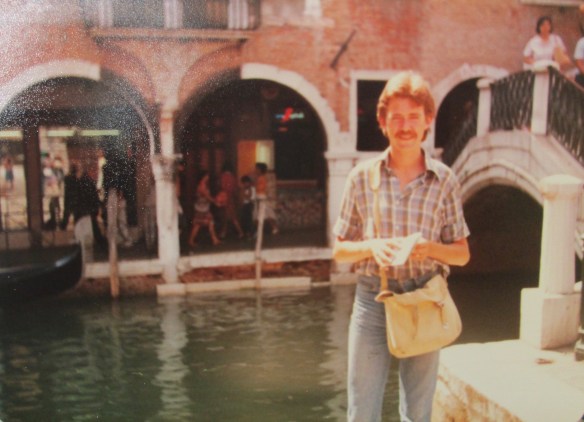
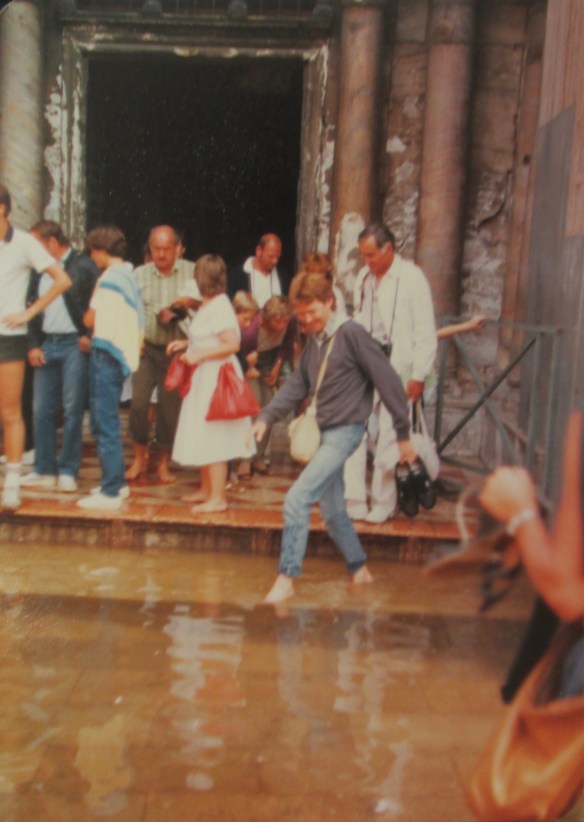
The Tourist Police were helpful, targeting accommodation and setting us the task of getting there in time. This involved a cross city dash reminiscent of those TV travel competitions. We had thirty minutes to get to the pensione, and we decided, wisely, that the Vaporetto was best. It brought us clockwise from the station, through working waterways. On first crossing the lagoon, what struck me most was seeing a working city. The non pretty parts of Venice are amongst its most exciting. We crossed wash with garbage collection boats, rough heavy goods barges, a speeding police boat. There were rich looking launches too, a taxi with a couple of most elegant poseurs astern. I’ll be there, someday, I wish. An English woman sitting beside me on the Vaporetto, turned to her companion and opined: It’s so Dirty! But that is the beauty of it. Every mosquito and screaming gull, every fat man with cigarette, every building site and bargee. This ain’t no theme park.
Our stop was the Fondamente Nuove. This ‘new quayside’ is in fact four centuries old, along the northern edge of the city with views of the lagoon. Out there are such exotic smaller islands as Murano and Burano, but most noticeable, just offshore is the cemetery of San Michele, the floating city of the dead.
It was a short, if complex, walk to the pensione. We were within time and the host gave us a tour of what was a beautiful premises, distinguished by its large courtyard with trees tapering to the sky. The room was olde worlde, plain and clean, with an ingenious device for quelling mosquitos. To awake in Venice is to own it. A whole day to embrace her and fall to bed with her again. And another morning to start over once more. Days to be spent in random exploration, browsing at markets, grazing at stalls, lingering at sidewalk cafes.
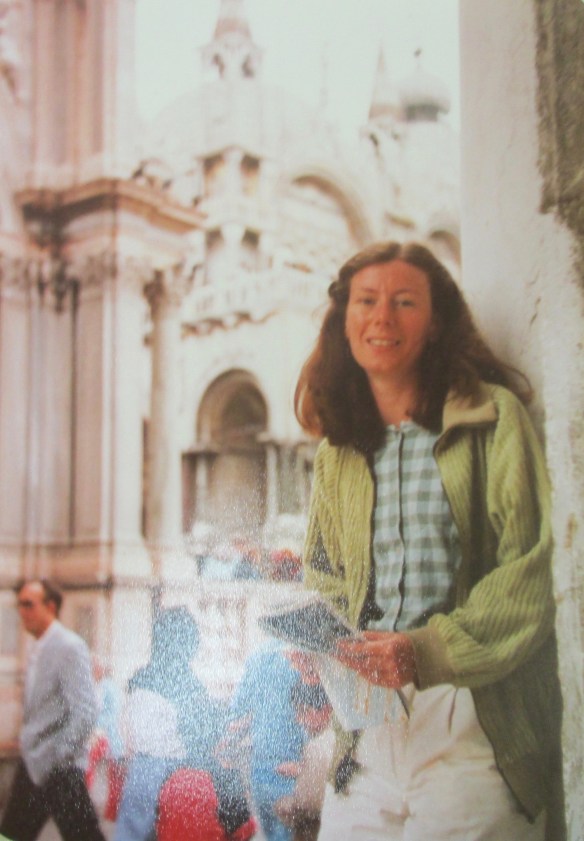
We returned again to wine and dine at St. Marks while pestered by string quartets in the shadow of the Campanile. The Campanile, or bell tower, is almost a hundred metres tall and was built as a lighthouse in 1173. The current structure dates from 1500, and from its giddy heights Galileo demonstrated his telescope to the Doge in 1609. The tower dramatically collapsed in 1902, but was rebuilt ten years after.
Evenings were quiet after the bustle of the day and spent in the darkening labyrinth of streets which seemed to have neither name nor destination. As happens, certain hostelries became haunts. We learned from the guy serving us, an English lad working at his mother’s trattoria, that accommodation was prohibitive so most visiting was confined to daytrips, cruises and the like.

Since M is a Liberties girl, and I’m not far off, we were drawn naturally towards the Rialto. There is an area in Dublin called Rialto. It once boasted two canals, or two branches of the Grand Canal. With regular barge traffic to Guinness’s brewery and other businesses there may have been cause for poetic license in its naming. You might have trouble renewing it. When, after a century of inactivity, someone fell in and drowned, on the principal of ‘if it saves one life’ the whole section including the Basin was filled in making a spectacularly unsuccessful linear park. These days it provides a thruway for the Luas light rail. Incidentally, the same city fathers also had plans to convert the surviving Grand and Royal canals into a ring road. Just think what such an enlightened mentality could do for Venice!
Rialto means the high bank (of river). Venice’s Rialto Bridge was the first to span the Grand Canal. The present structure was built in 1590 and designed by the appropriately named Antonio De Ponte. Until the building of the Accademia Bridge in 1854 it was Venice’s only pedestrian crossing point. It is a signature landmark. The steep single arch span supports a central thoroughfare with shops on each side. The symmetrical colonnades are joined by an imposing portico on the apex of the bridge. Views of the swirling life of the Grand Canal can be had from the ballustraded walkways to each side. The Rialto Markets are long established on the San Polo side. The Erberia is the fruit and vegetable market while the Pescheria is the fish market. Downriver, the Riva del Vin is the best place to get a quayside table and raise a glass to the wonders of La Serenissima.
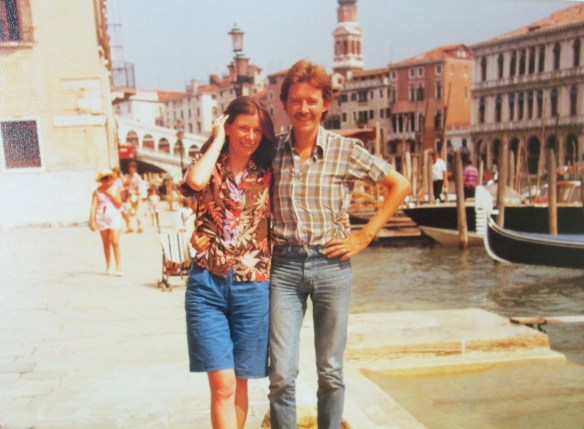
In Venice you discover that Gondolas are not simply window decorations in West Dublin. This is the romantic way to tour Venice. For Venetians the Gondola is a form of wedding limo, but tourists book the watery equivalent of the Killarney trap. It is the idea of the thing, I suppose. This is a world of water. A more straightforward Gondola trip, unmediated by an Italian roaring O Sole Mio, is to take a Traghetto, gondola ferries that cross the Grand Canal at seven points. It’s communal and much more fun, practicable and traditional. The protocol is for men to stand while the woman sits.
The Rialto traghetto crossing provides one of the most evocative moments. Here we were at the focus of a madding city, adrift in its mayhem, but briefly at one with it. Crossing the Grand Canal against the backdrop of Rialto Bridge we knew we had arrived on Earth. All the sense of history, of freedom and surprise, of surviving against the odds, the sheer beauty of it.
Let’s meet tomorrow if you choose upon the shore beneath the bridge
that they are building on some endless river.
Then he leaves the platform for the sleeping car that’s warm
you realise he’s only advertising one more shelter.
And you say okay the bridge or someplace later
The Stranger Song by Leonard Cohen
 Kilmainham to Dolphin’s Barn
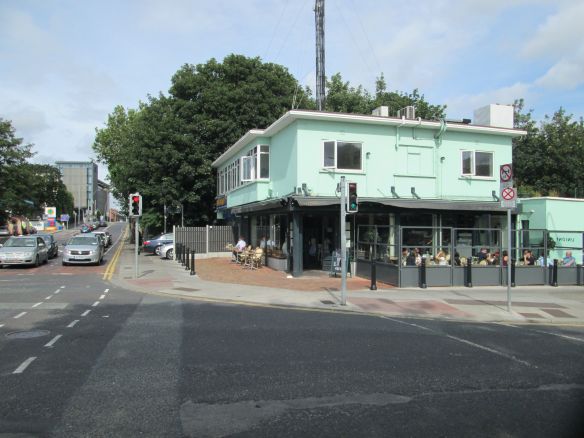 The Old Kilmainham Road heads east towards the city. Further townwards, an early twentieth century housing estate is perched on its hill. Known as Mount Brown, there’s a whiff of Gothic romance off the place, home for the urban hobbit. It’s an early example of Dublin Corporation’s attempts to break out of the ghetto housing to which the working classes were once condemned. Designed by keen modernist TJ Byrne, it stands comparison with the Iveagh Trust terraced housing projects of that era.
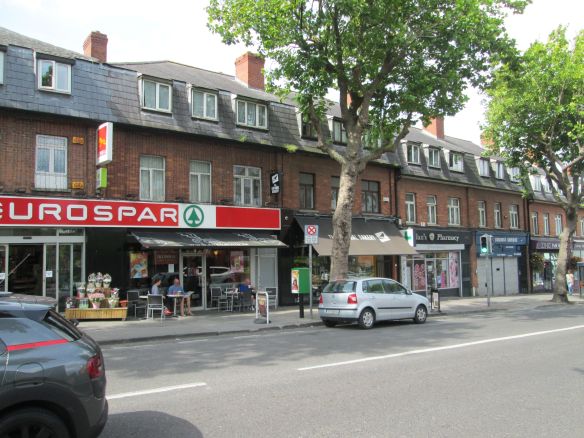 Rising with the road again, this section of the SCR holds a certain charm. The redbrick terrace with mansard roofs is dappled beneath the plane trees. Eurospar and the Natural Bakery have scattered chairs and tables providing a slice of cafe society for the passing boulevardier. I can imagine Phil Lynott strolling down from Dublin 12 with local lad, Brian Downey. There might even be a pre-echo of Parisienne Walkway.
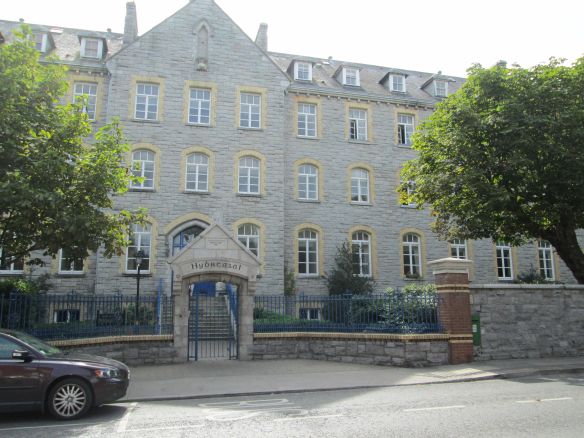 The term Hy-Breasal derives from Irish myth. The fabled isle in the Atlantic was said to appear only one day in seven years and was a land of idyllic perfection. Described by St Brendan the navigator, and others, as a circular island divided by a canal, it was something of an El Dorado, golden domes and spires set amidst great natural beauty. The name was appropriated for Brazil, on its discovery, although a convoluted rebuttal insists that the term Brasil derives from a local timber commodity. The perfection of navigation, saw the fading of such myths, as the reality which had informed them emerged from the mists. They are, I suppose, true, if inaccurate. For that matter, the Dublin of our odyssey is itself circular divided by a central waterway, the Liffey. Welcome so, to Hy Brasil.
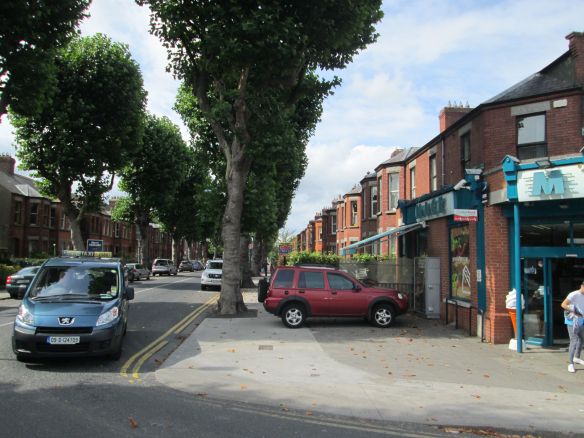 Here the Luas is built on the old terminal section of the Grand Canal. Completed by the end of the eighteenth century, having begun in 1759, the crucial waterway connection with Sallins took twenty years. Within another five the Canal pushed through to the Shannon. The Grand Canal Basin served Guinness’s and the various breweries and industries of the Liberty of St Thomas Court. At the turn of the century, the Canal was extended in a loop toward Dublin Bay, and by 1810 joining the confluence of the Liffey and Dodder rivers at Grand Canal Docks. Which we’ll see at the end of our odyssey.
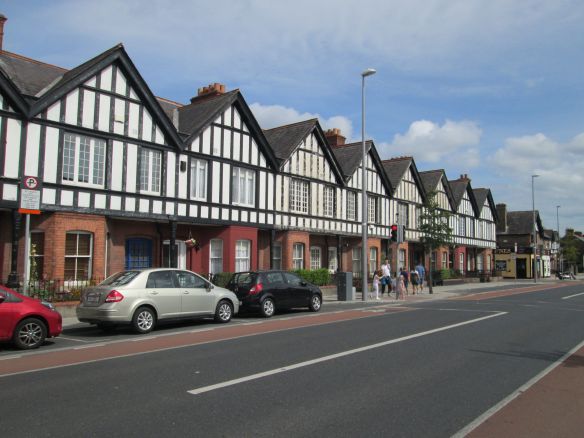 Rialto is an old working class suburb, housing those employed by the canals, breweries and distilleries as Dublin spread southwest from the Liberties. It has evolved its own character, something of an urban village. Although flanked by notorious housing projects, the SCR thoroughfare is characterised by the redbrick, woodframe ambience of Victorian design. A lovely Tudor revival terrace arcs along the northern rim of Rialto’s central plaza. The architectural style, sometimes called Mock Tudor, became popular towards the end of the nineteenth century and is somewhat incongruous, though picturesque, within the context of Ireland’s Capital.
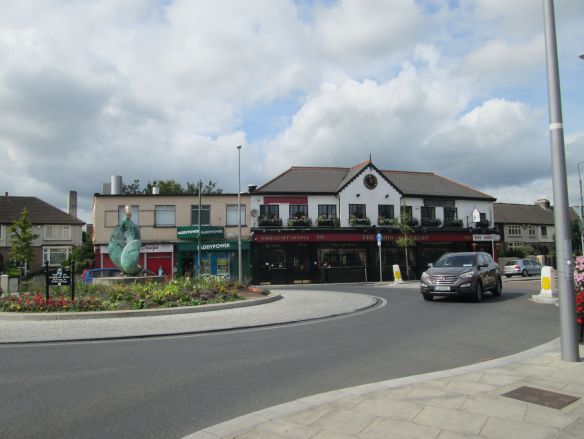 Across the road the pub is named for the Bird Flanagan. William ‘The Bird’ Flanagan, born in 1867 lived beyond in Walkinstown and was a notorious practical joker. He earned his nickname from a prank he played on a local policeman. Buying a festive goose at a local butchers at the Barn, he had it hung outside the shop for collection later. Catching the attention of the unfortunate constable, the Bird grabbed the goose and ran towards Rialto. He was apprehended near the canal, whereupon he showed his purchase docket.
 I worked in Dolphin’s Barn in the eighties and spent many a lunchtime strolling around. I often had my lunch in the sitdown chipper on the south side of the street, which I think was called The Lido, across the road from the cinema. Many years later I reimagined the place in the narrative of Annie, a teenage girl who paints an unreliable picture of life in sixties Dublin.
 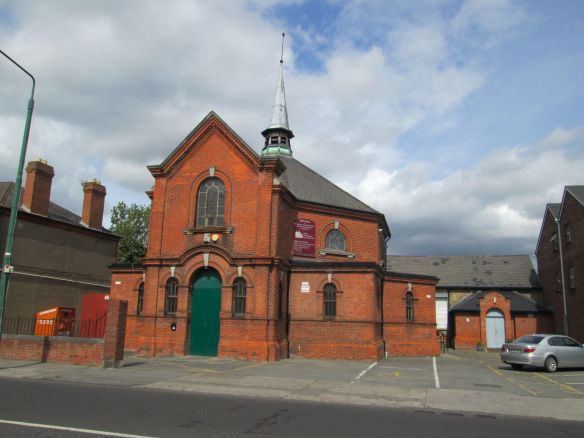 Which they did. That was the early sixties and I last frequented these parts in the early eighties. We reach Dolphin’s Barn and cross the chaotic urban artery towards Cork Street and the City. Dublin 12 lies to the South beyond the Canal, but we continue our journey to the East.
 xxharrison