The Dart has been taking commuters, daytrippers and various wanderers around the Bay for forty years. Dart is a clever acronym for Dublin Area Rapid Transit. It runs from Malahide or Howth in the north to Greystones in the south. The last two stops are outside of County Dublin. Reaching the Dargle River we are in County Wicklow. The town of Bray has been established here since the Norman invasion, building on earlier Gaelic settlements.
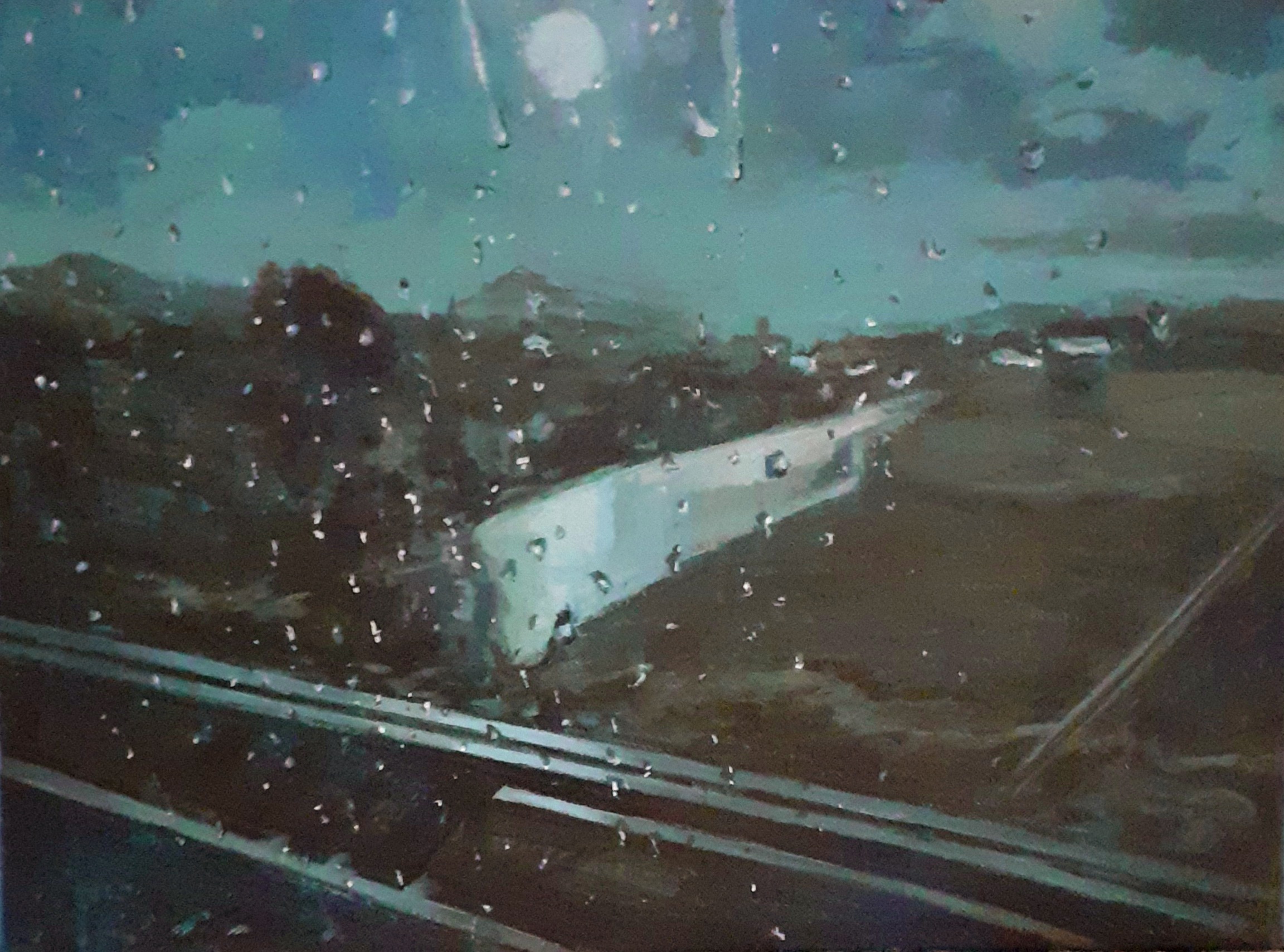
This view is taken from the window of a southbound Dart, about to cross the bridge over the Dargle. I am returning from Dublin city where it has been raining, but now the sun’s coming out and Bray rises steaming out of the gloom. The Sugarloaf Mountains appear on the horizon, and the land is marked by the tower of the Catholic Church of the Most Holy Redeemer, and the spire of Christchurch (CofI). Bray Daly Station is my stop. Opened in 1854, the line was quickly extended to Greystones and runs parallel to the seafront behind the hotels and houses lining the Esplanade which was newly established then.
This painting is acrylic on canvas and has been accepted by the Signal Open Art Exhibition of 2024. I am delighted to be chosen and looking forward to seeing all the other works on show. The exhibition runs from Tuesday 6th August until Sunday 18th August. Should be fun. Give it a dekko!
Every time it rains
You’re here in my head
Like the sun coming out
I just know that something good is going to happen
I don’t know when
But just saying it could even make it happen
Cloudbusting by Kate Bush is guaranteed to lift the heart, without reneging on past sadness. It is on her 1985 album Hounds of Love.
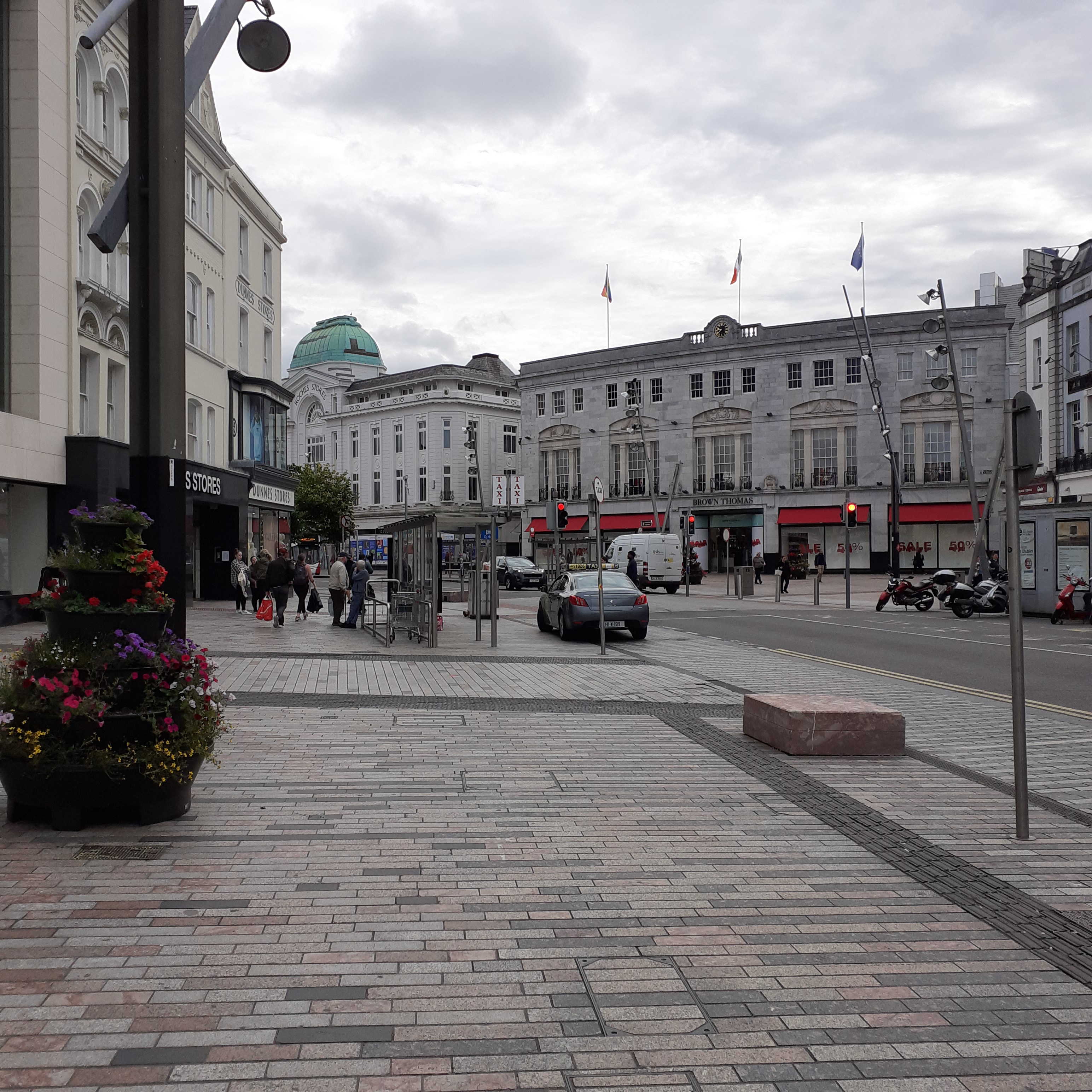
As a medieval settlement, Cork was a walled town west of Grand Parade, centred on what is now known, somewhat misleadingly, as Main Street. The official, and actual, main street, Patrick Street, is wide, but spectacularly curved. This actually follows the line of an old river channel in medieval times, the modern street being built on vaults over the water.
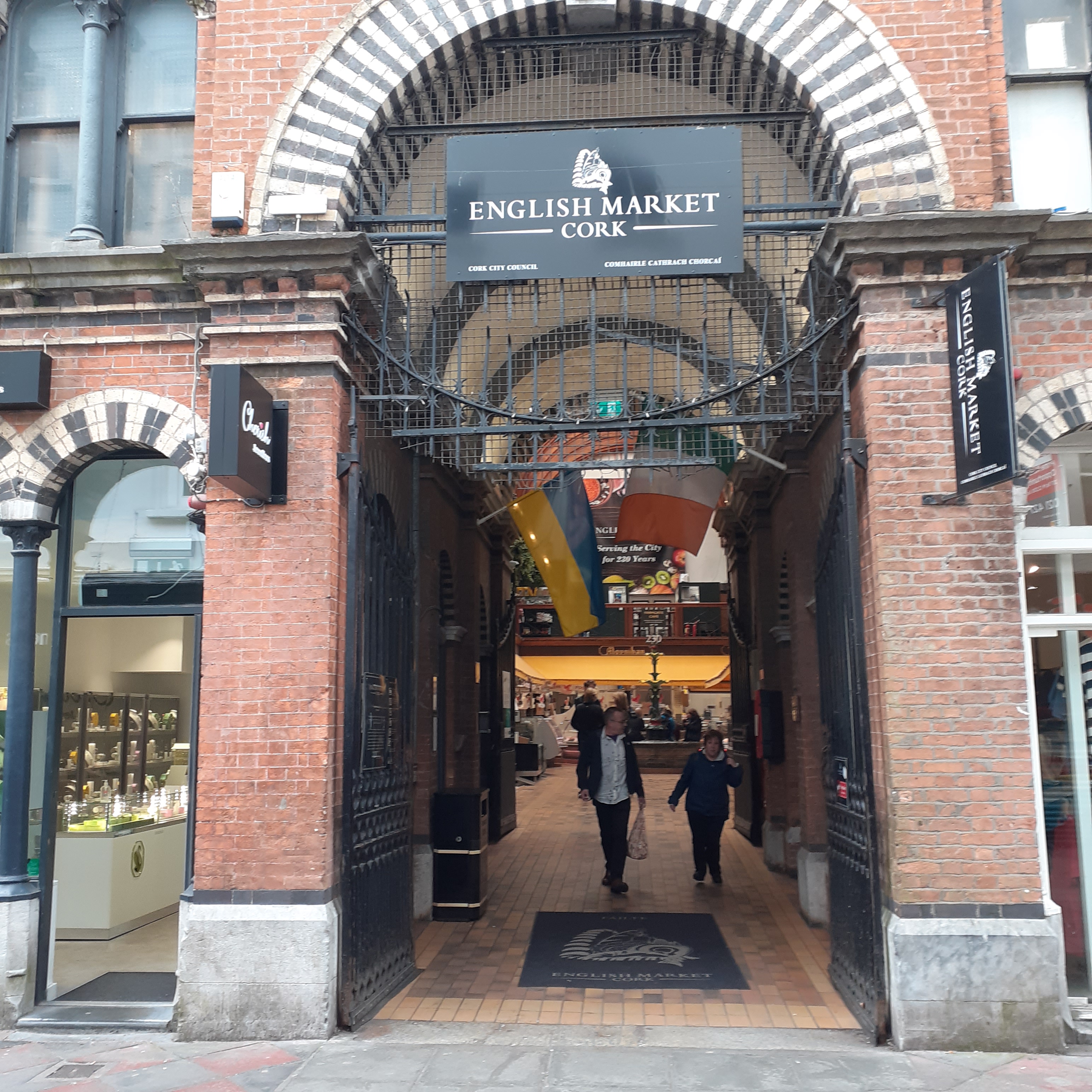
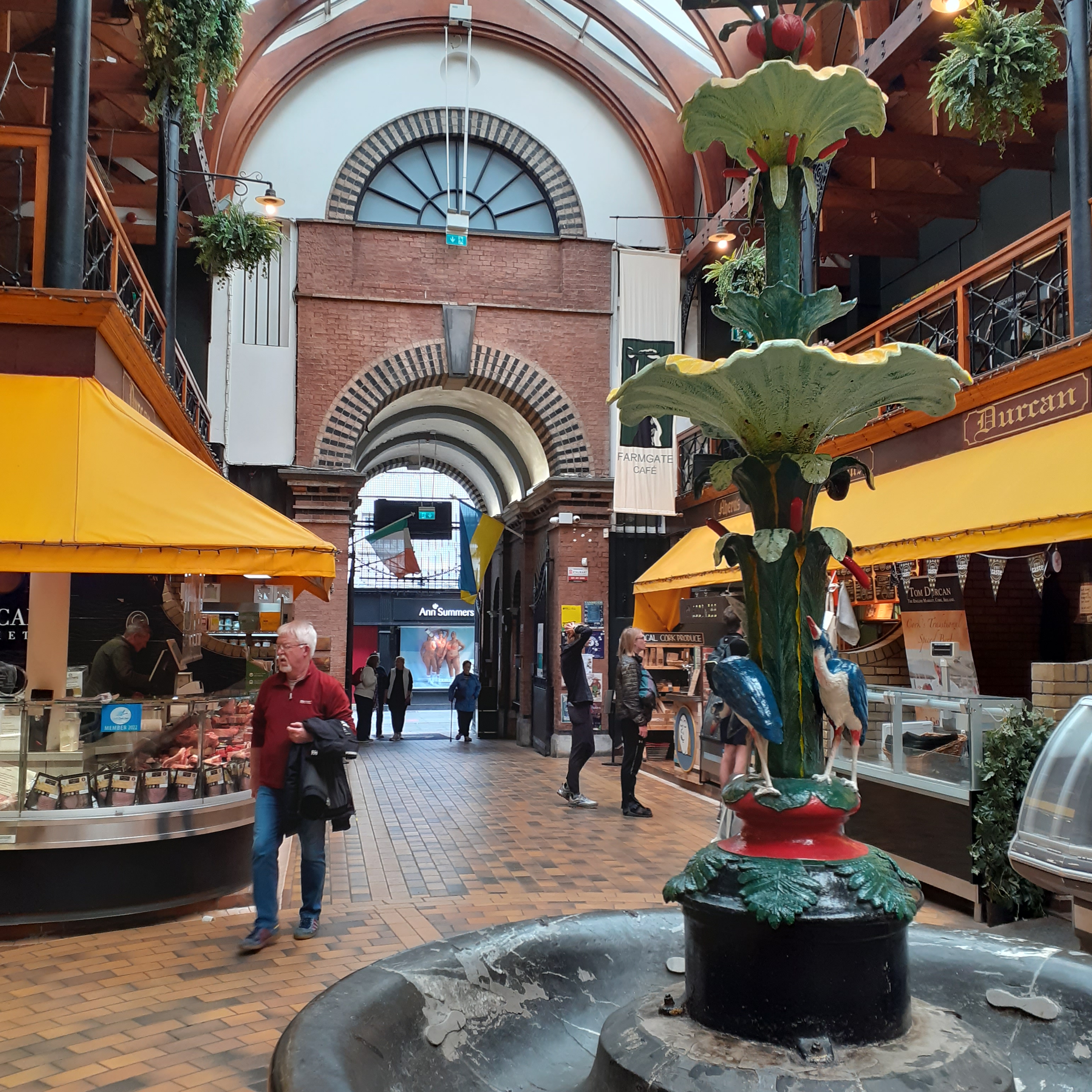
Just off the west end of the street, you’ll find the English Market. With its butchers and bakers and candlestick makers this is a perfectly preserved urban market in the Victorian style. It actually dates back to 1610 when first established by the Protestant city council. The name evolved to distinguish it from the old Irish Market on Cornmarket Street nearby, now the Bodega. The present building complex dates from 1786, though it has had further significant alterations since. The main entrances at Patrick Street and Grand Parade were part of a Victorian makeover. The Grand Parade ornamental entrance was designed by John Benson in 1862. Within the covered market, the arcades converge at a central cast iron fountain ringed by a raised mezzanine with restaurants and cafes.
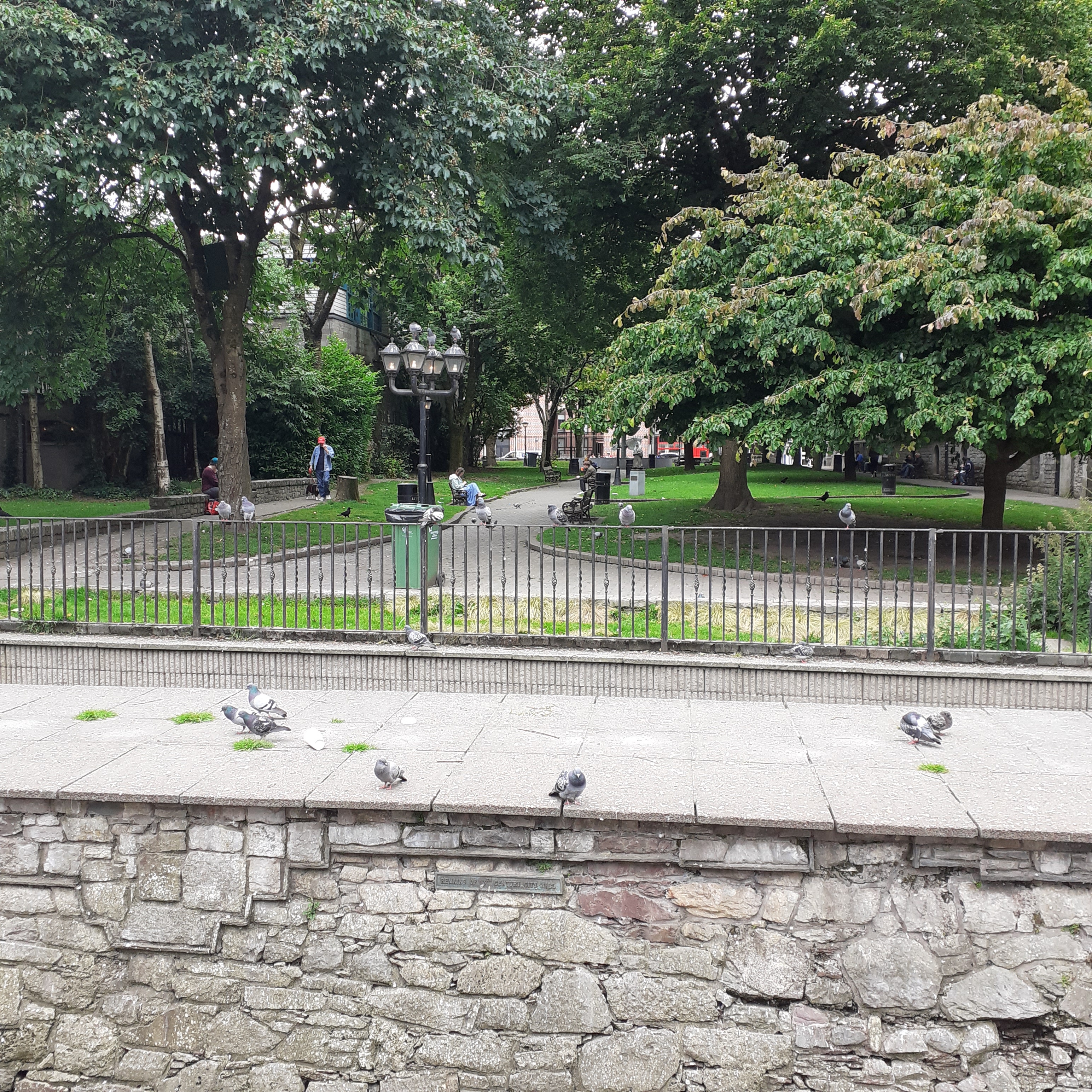
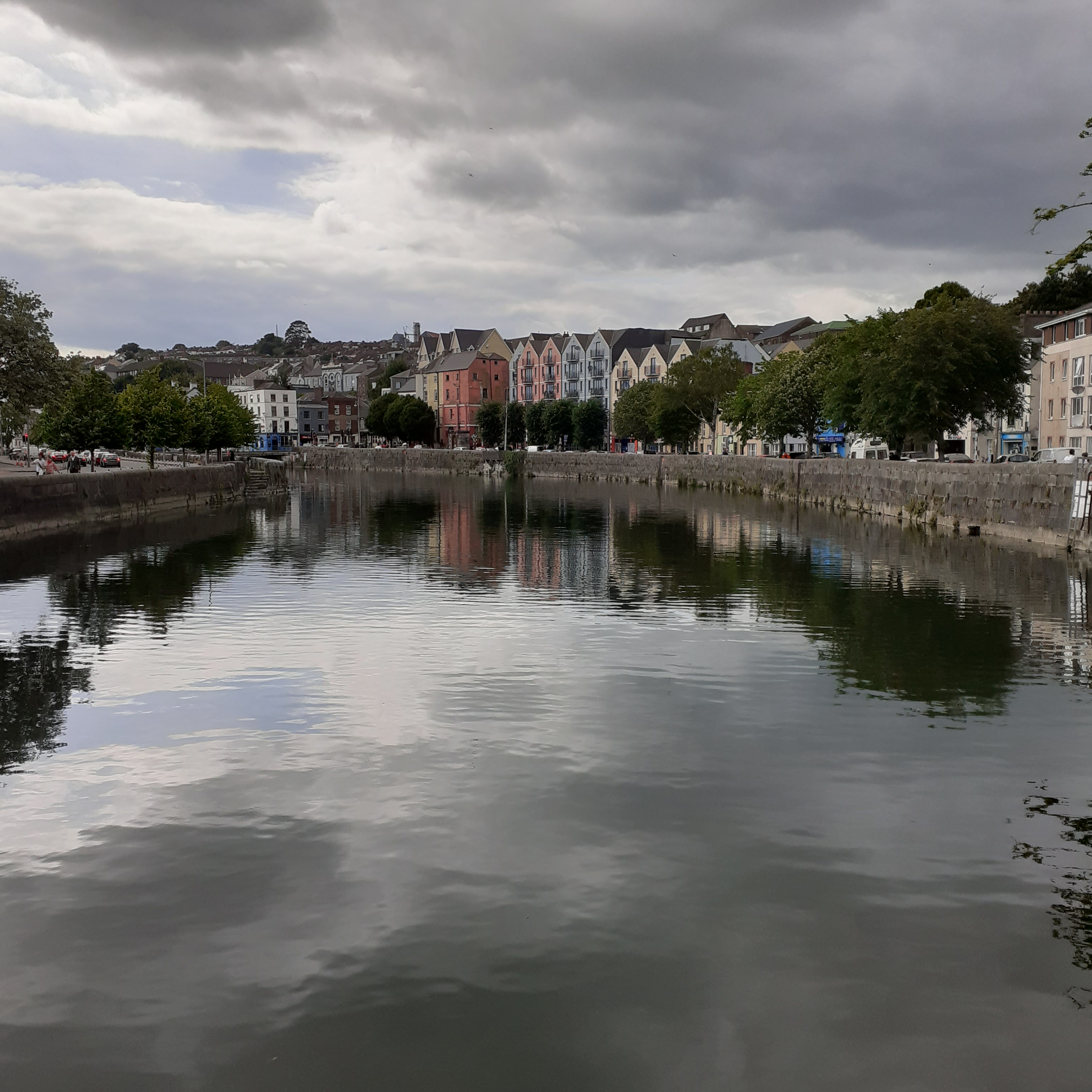
Patrick Street loops to an end at Grand Parade which is broad and straight. Like Patrick Street, it was once a water channel, the ancient settlement of Cork growing up on its west bank. Evening rush hour was approaching so we stopped for coffee and a snack at a place nearby, the Bean and Leaf, with a pleasant terrace from which to watch the world go by. On the far bank is Bishop Lucy Park, with remnants of the medieval citywall visible inside the entrance. It’s one of few parks in the city centre and dates only to 1985, when it was built to celebrate eight hundred years of city status. Around that time, myself and M holed up in Cork again at the end of a significant adventure.
It was our honeymoon, many moons ago. We stayed some days in Adare, County Limerick. Having left that frostbitten fantasy, we headed south on the midwinter roads. By Cork all had thawed and rain fell constantly on the rising waters of Cork city. We hadn’t a place to stay and booked into, and quickly out of, a dump on the outskirts of the city. Driving on into the rain and the city centre, we parked the car in Grand Parade and sought out a hotel there. They said they were full, as places tend to be in midwinter when two drenched hippies materialise in the foyer. We explained the situation and they clicked into gear. We got a nice room to the rear of the hotel. From the window, the illuminated cathedral of Saint Fin Barre sailed like a galleon across the night horizon. We would look at it occasionally through the rainsoaked pane. The hotel is now, I think, the Library.
But every time it rains
You’re here in my head
Like the sun coming out
Ooh, I just know that something good is gonna happen
I don’t know when
But just saying it could even make it happen
Cloudbusting by Kate Bush is from her 1985 album The Hounds of Love. It concerns a son’s love for his father, inspired by Peter Reich’s biographical Book of Dreams. But expressions of love can be appropiated to one’s own desire.
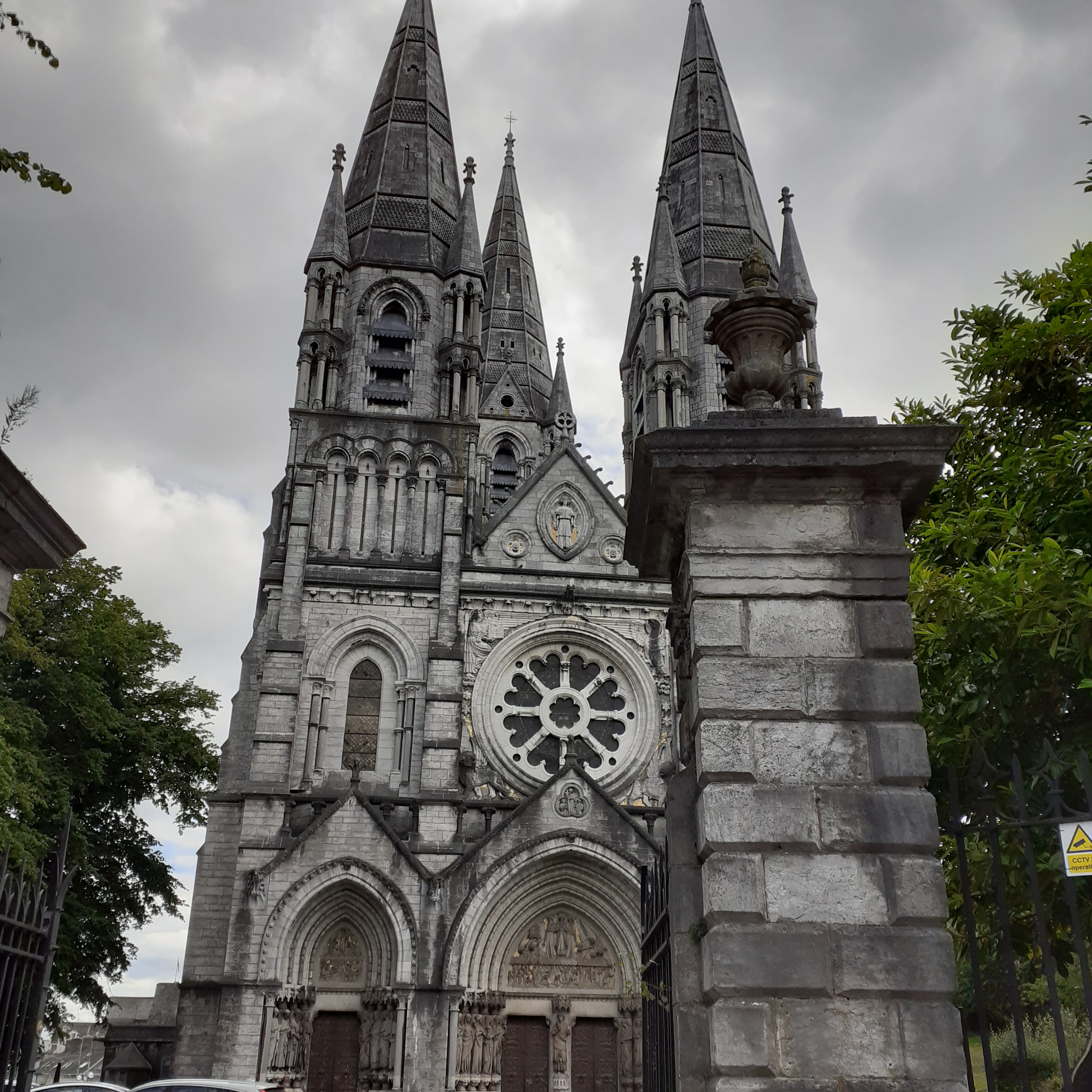
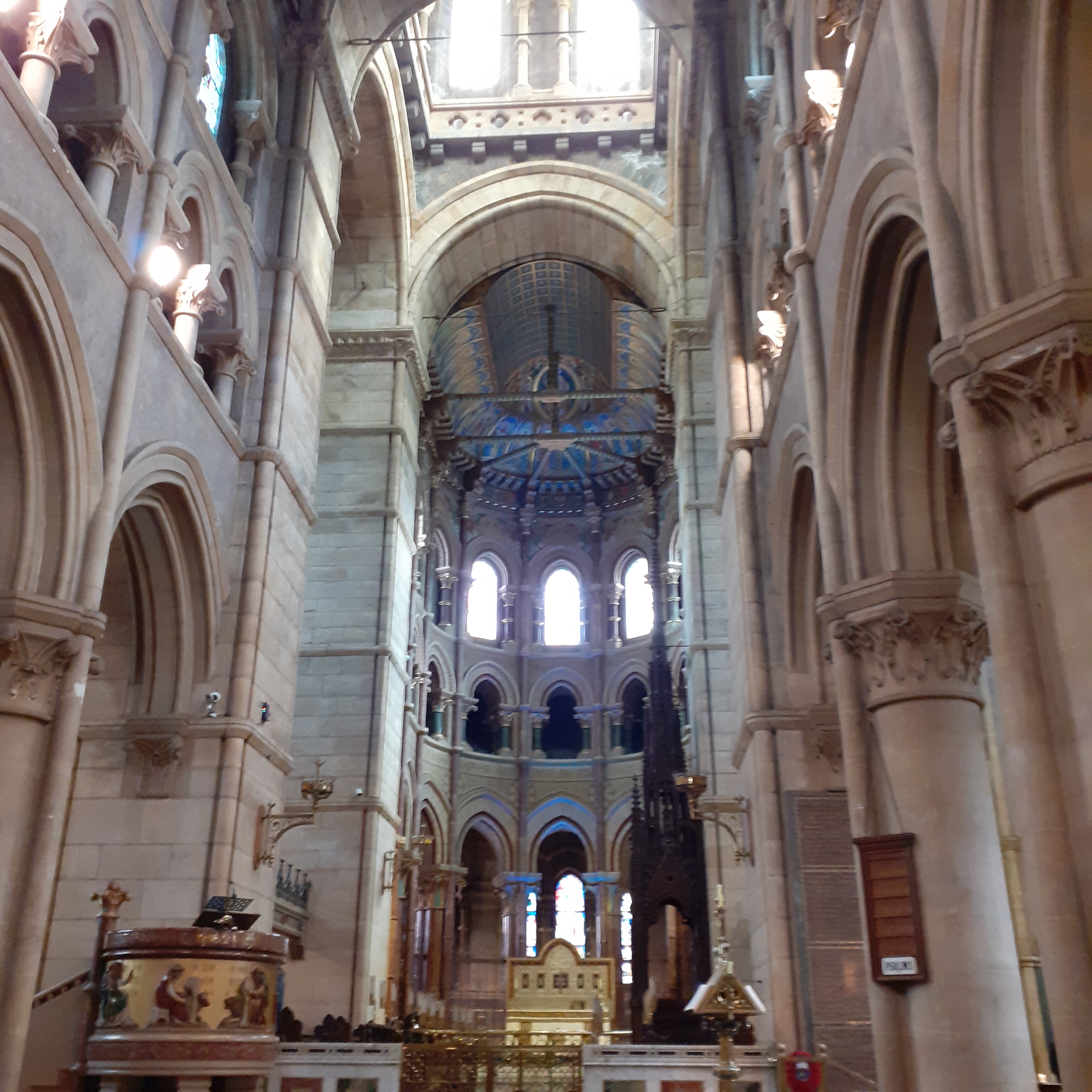
Saint Fin Barre’s lies just across the south branch of the Lee. It is the Church of Ireland Cathedral for Cork. Begun in 1863 and designed by English architect William Burges. It is a Gothic Revival masterpiece. Twin spires frame the entrance and the massive central spire towers above the nave. The exterior creates an impression of grand scale despite a relatively small interior. It replaced the eighteenth century building, long derided as ‘a shabby excuse for a cathedral.’ Finbarr is the patron saint of Cork city, born in the mid sixth century, he was based at Gougane Barra, some miles to the west at the source of the River Lee.
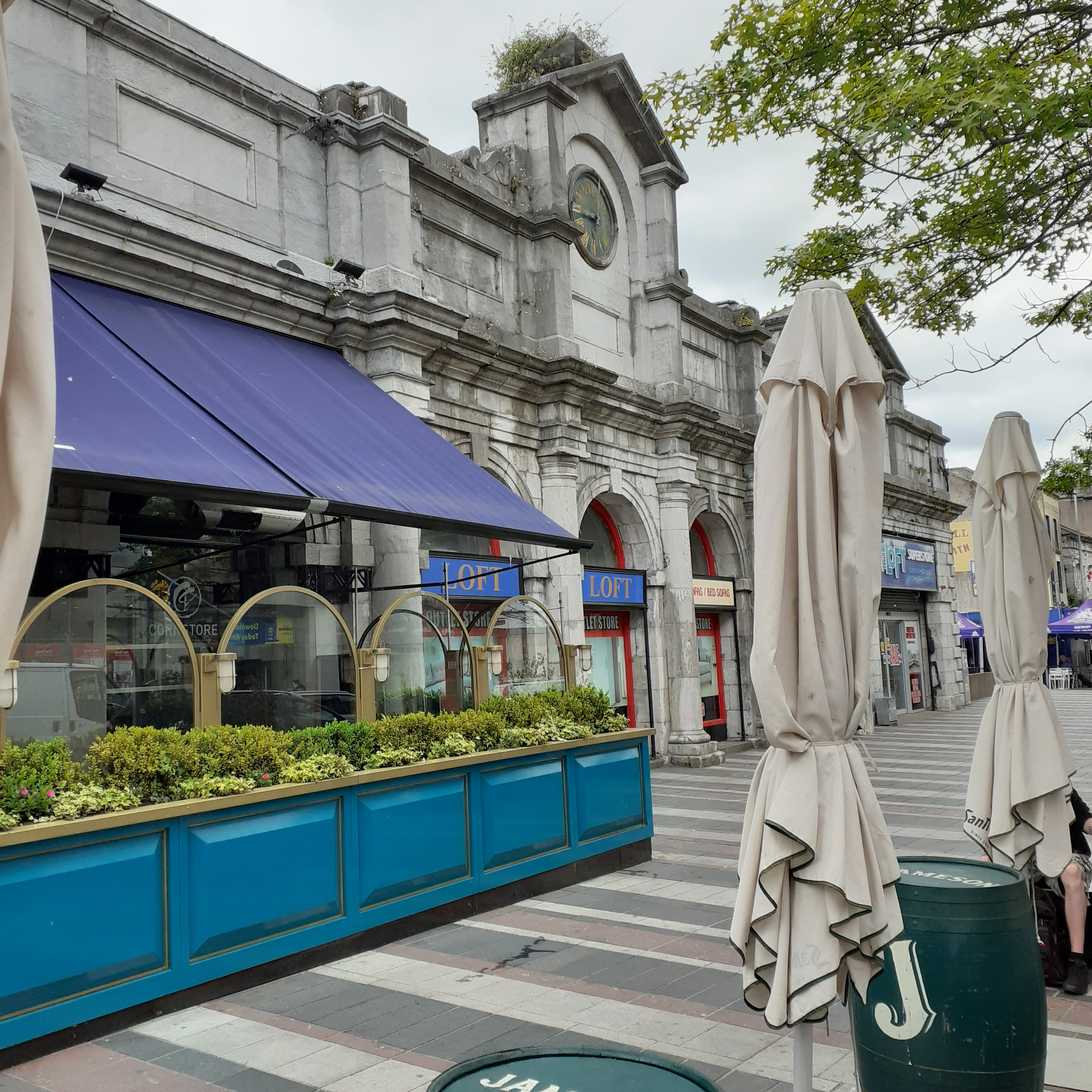
North of the junction with Patrick Street leads into Cornmarket Street. This is sometimes referred to as Coal Quay, as it was once a quayside on a short canal leading out to the River Lee. The grand old Victorian building along the western side housed the original Cornmarket. This was converted to a corporation bazaar in 1843. Known as St Peter’s Market it occupied a half acre site with hundreds of market stalls. It now houses a food and drink complex, the Bodega, including the Old Town Whiskey Bar and several craft and retail outlets. There’s a vibrant street market on Saturday mornings
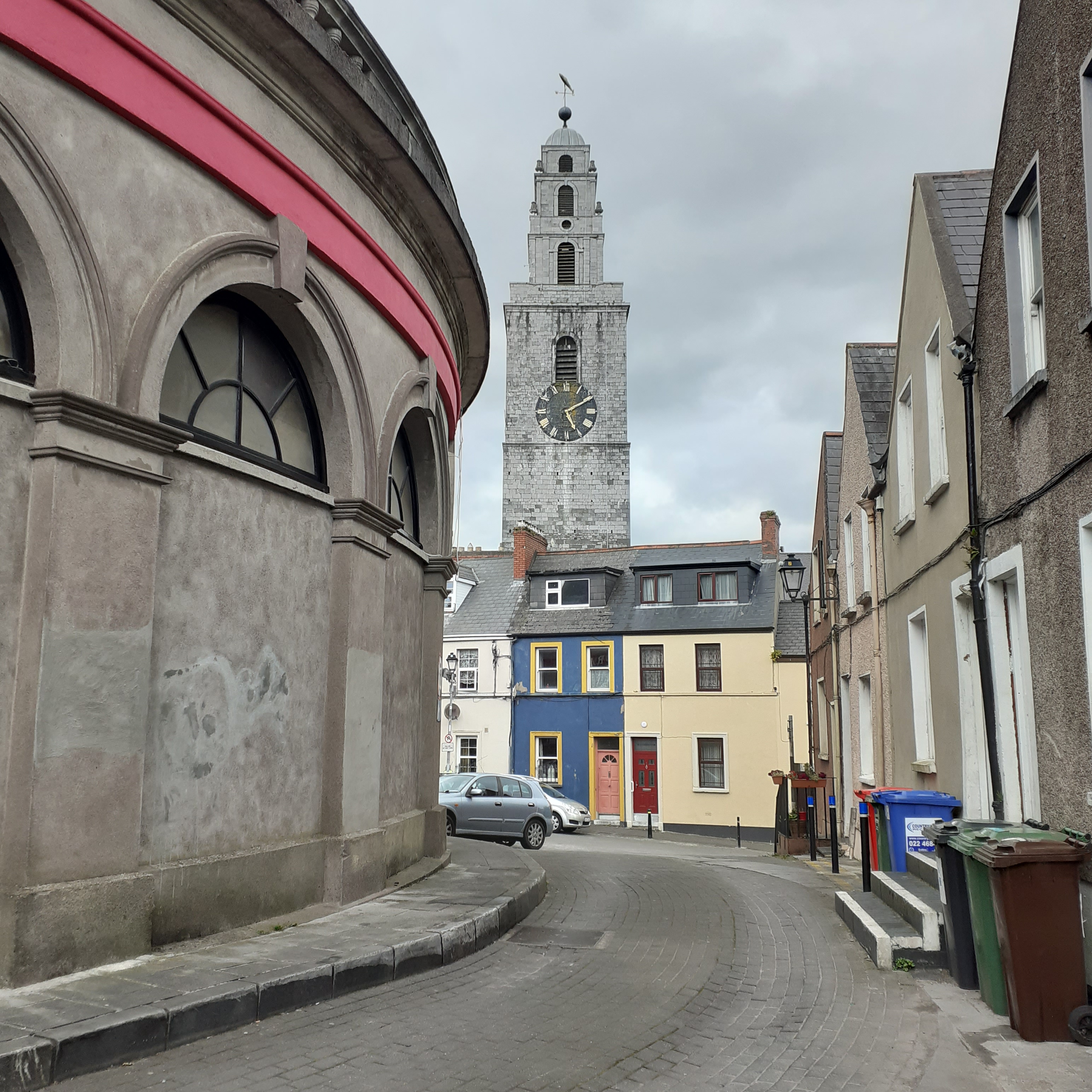
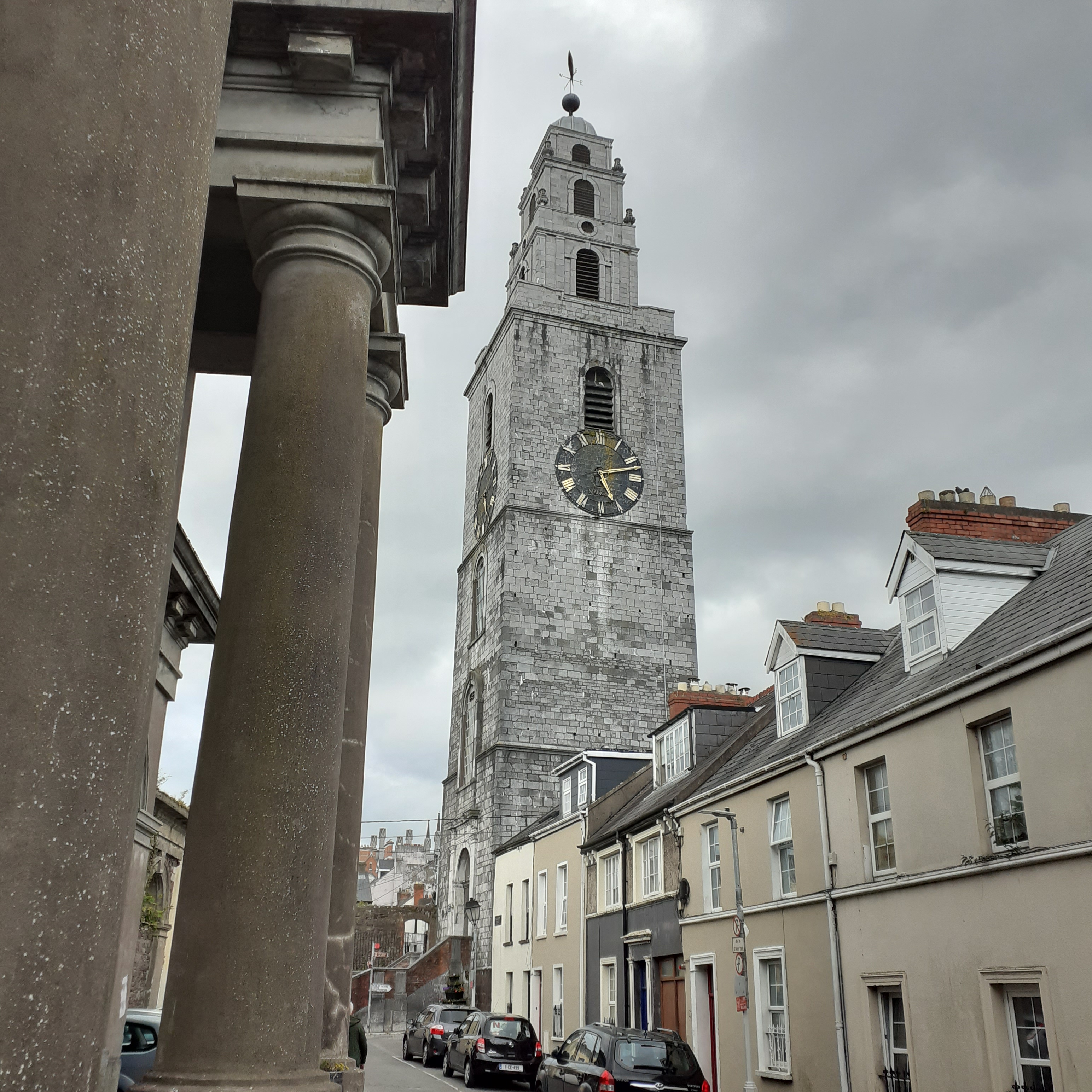
Cornmarket Street leads us back to the north branch of the river where we can cross to Shandon, its packed slopes crowned by Shandon Church with its famed belfry. This is a Cork icon, its distinctive stepped spire rising above the north banks of the Lee. A steep climb up Widderling’s Lane brings us to Dominic Street. The area maintains its ancient atmosphere, almost Mediterranean, with the packed housing streets set atop each other.
The Firkin Crane Arts Centre occupies its own little island. The distinctive rotunda was designed by John Benson in 1835 for the Cork Butter Exchange and now operates as a centre for theatre and dance. The Butter Museum is across the road. In the early evening, the empty urban space was oddly rememiscent of De Chirico’s haunted paintings. At one end of square there was an attractive Syrian restaurant, a few haphazard tables strewn outside, awaited the evening’s custom.
The Church of St Anne (CofI) nearby was built between 1722 – 26. The Church’s carillion is famous, and visitors can contribute from a choice of melodies. The eight bells were cast in Gloucester and have been ringing out over the city since 1752. As with kissing the Blarney Stone, ringing the Bells of Shandon is something of a rite of passage for any visitor to Cork. We did so on a visit in the nineties. Myself and M, and the boys, camped in Blarney and took the opportunity for a quick trip to Cork which is just 8km away. The road to Bantry connects directly to Shandon.
The Church is set village style on its own grounds and built in red and white sandstone, the Cork colours. The tower rises to 120 feet, surmounted by a further fifty foot with its pepper canister topping. Climbing through the rafters we emerged atop the bell tower to sway above the dizzying streetscape. I still get vertigo just thinking of it. The main object, of course, is to ring the Bells of Shandon. The ringing apparatus is located below on the first floor, and a nice man called Alex introduced us to our simple task. A varied popular repertoire is supplied, and, if my memory serves me well, my contribution was the Beatles, All You Need is Love (Lennon/McCartney, 1967)
 xxharrison