Back to Andalusia – Granada by Bus

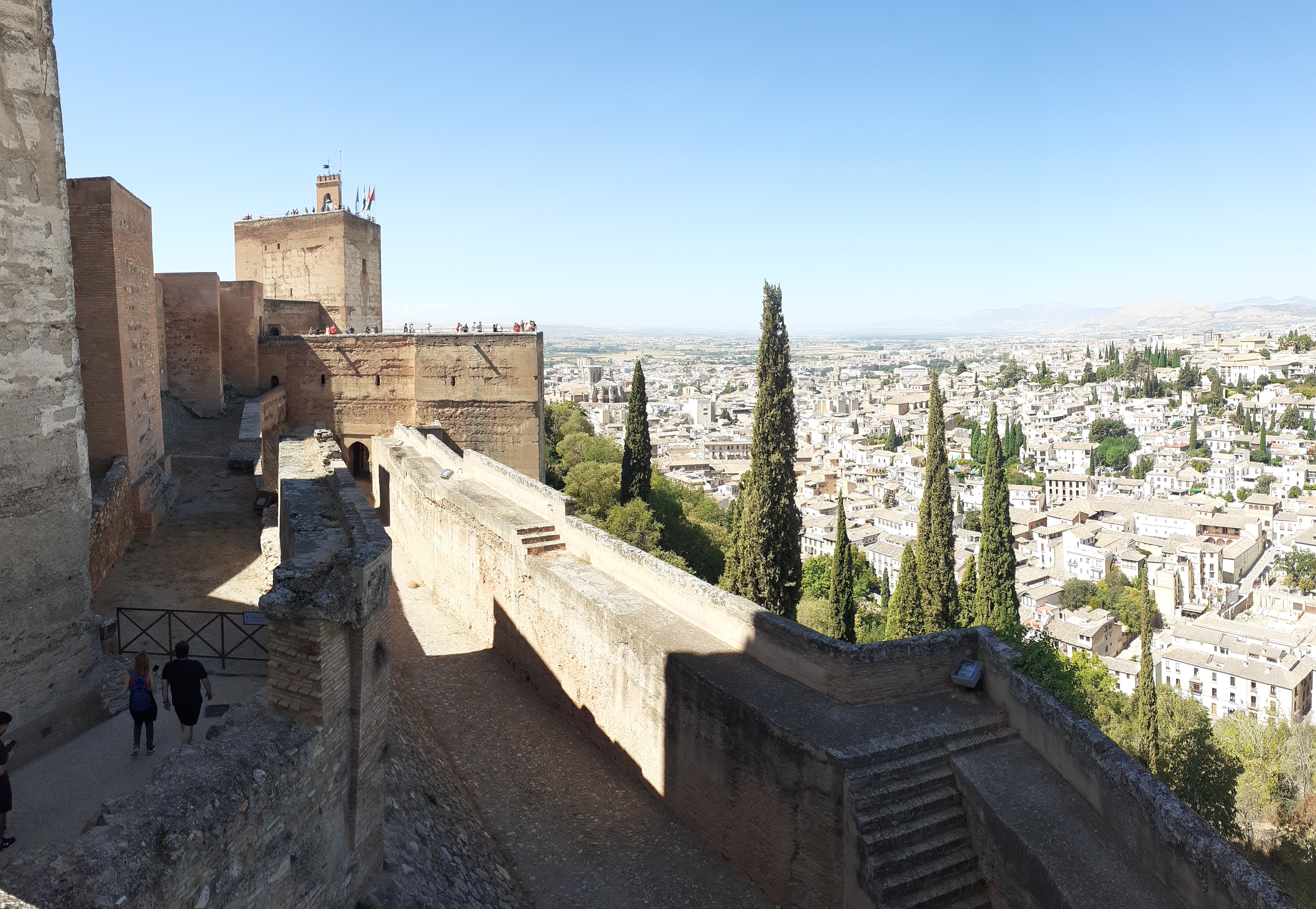
We took the bus direct from Malaga airport to Granada some sixty miles northeast. The journey takes about an hour and a half which brought us into late afternoon. The road rises through the  coastal mountain range before falling to La Vega de Granada, the fertile green basin leading into the city. The Sierra Nevada soar to the south. Spain’s highest peaks make an impressive backdrop as we alight at the terminus, Grenada with a population of over two hundred thousand sits two and a half thousand feet above sea level. Higher still, the magical Alhambra floats above the city.

I visited Grenada before, around Semana Santa in late March, and the Sierra were snow capped on the horizon. Grenada shivered, showers of snow and sleet washing across the limpid Spring air. That was my pilgrimage to the Alhambra, visions of Spain caught in a curious snow globe. It was brought about by my first guitar, an Alhambra, and my ambition to play flamenco. Now I’m back.Fying solo’s fine, but with M in tow I have a shoulder to lean on and an ear to burn and boast to.
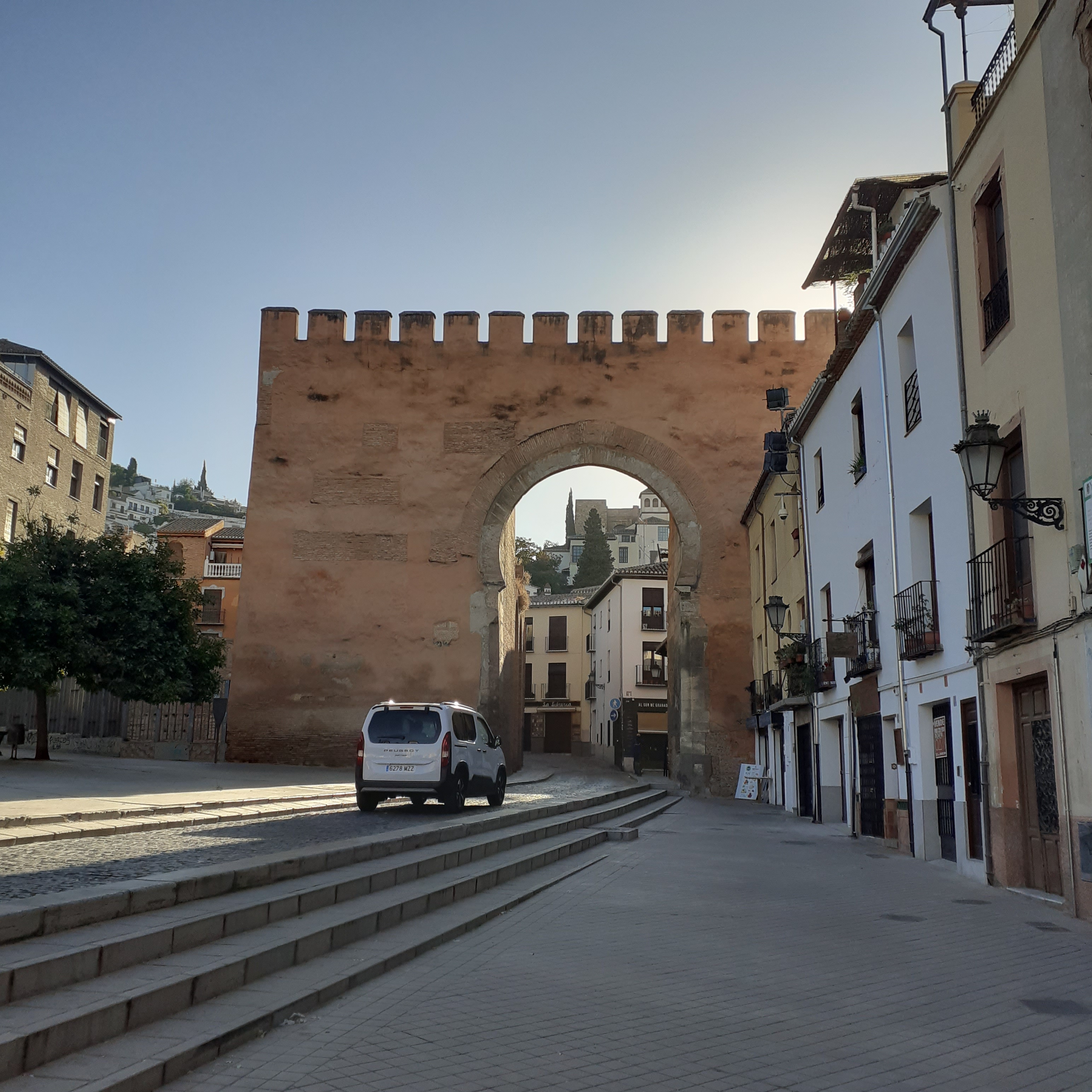
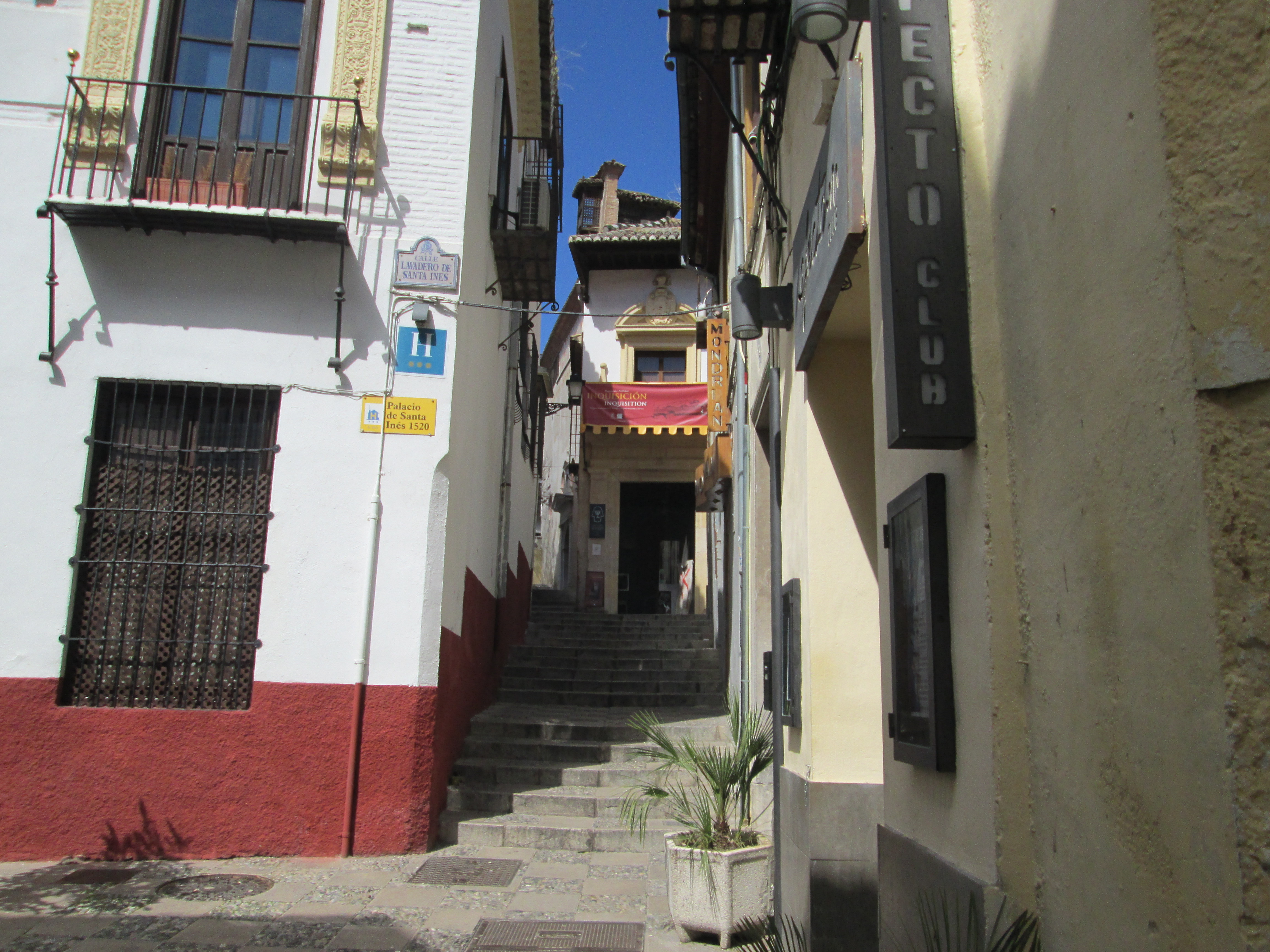
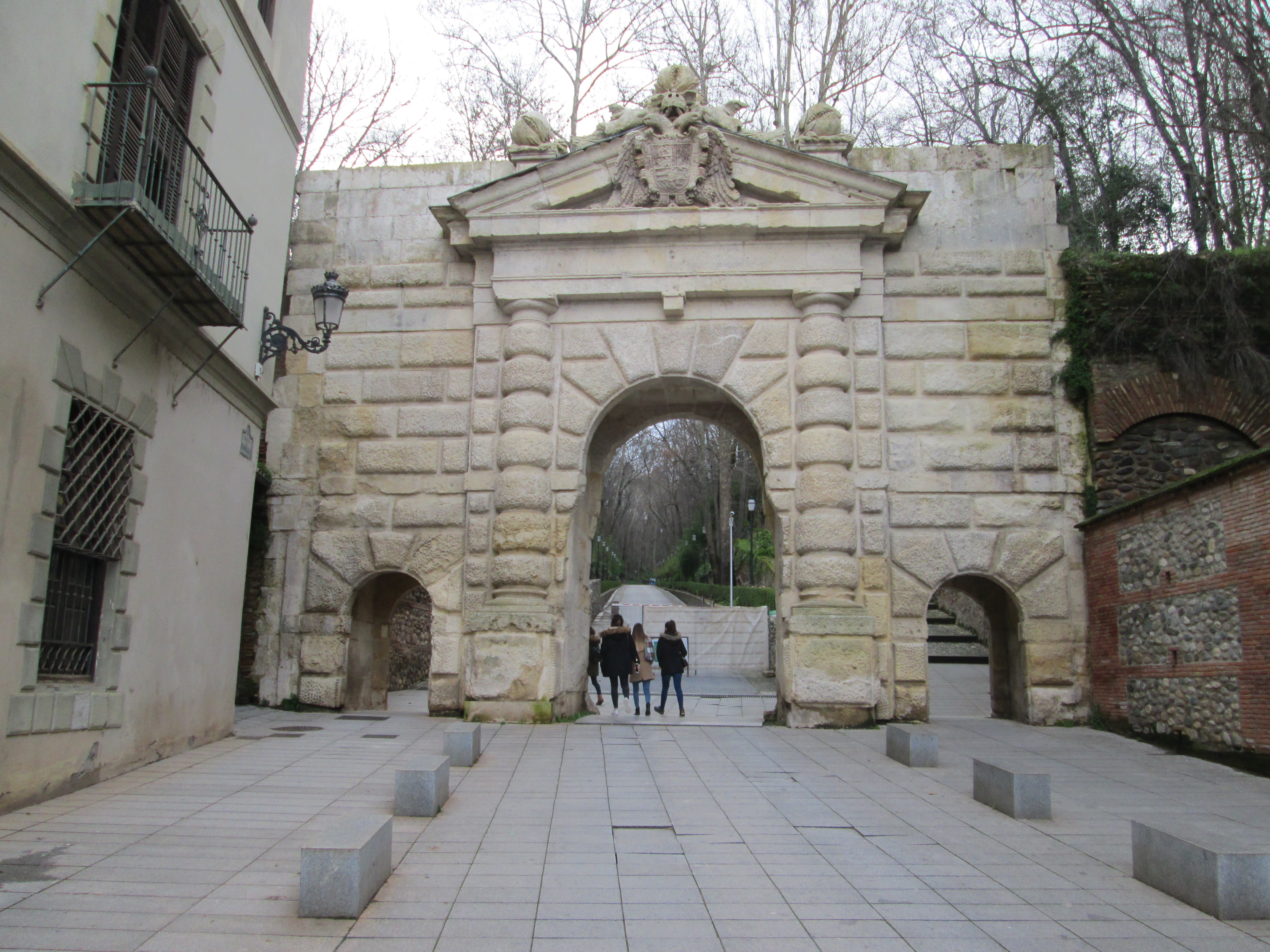
Granada bus station is a good bit out of the city centre and we take a taxi to our hotel. We are staying in the Exe Triunfo Hotel off the top of the main avenue, Gran Via de Colon. The receptionist is a fountain of knowledge and our three days in Granada are well mapped out. The hotel is next door to an ancient entrance gate of the city. The Gate of Elvira, a russet fortified archway, presides over the square. Passing through, we enter the labyrinth of the Old Town winding down to the city centre. Gran Via de Colon to one side and a steep hillside forming the other bracket.
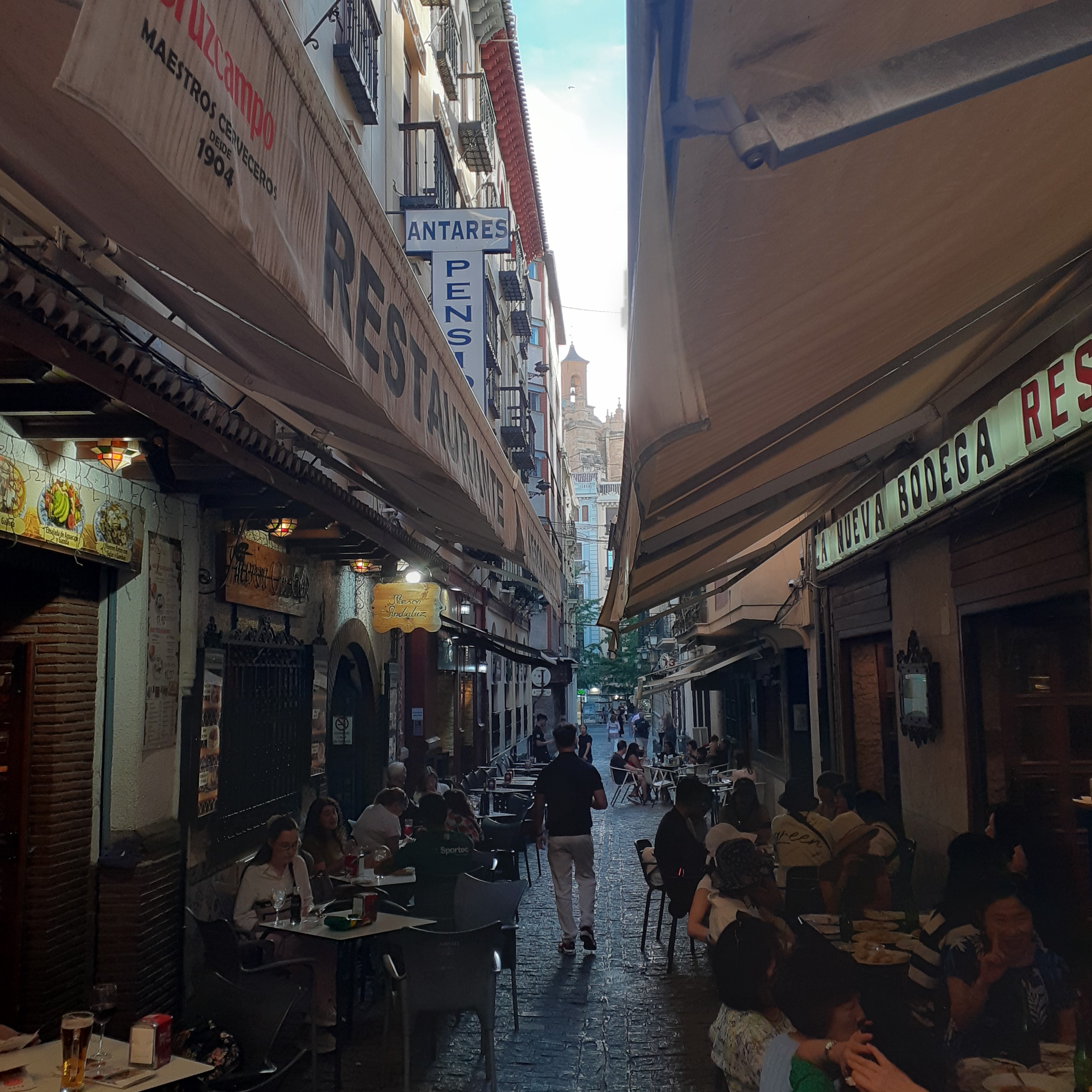
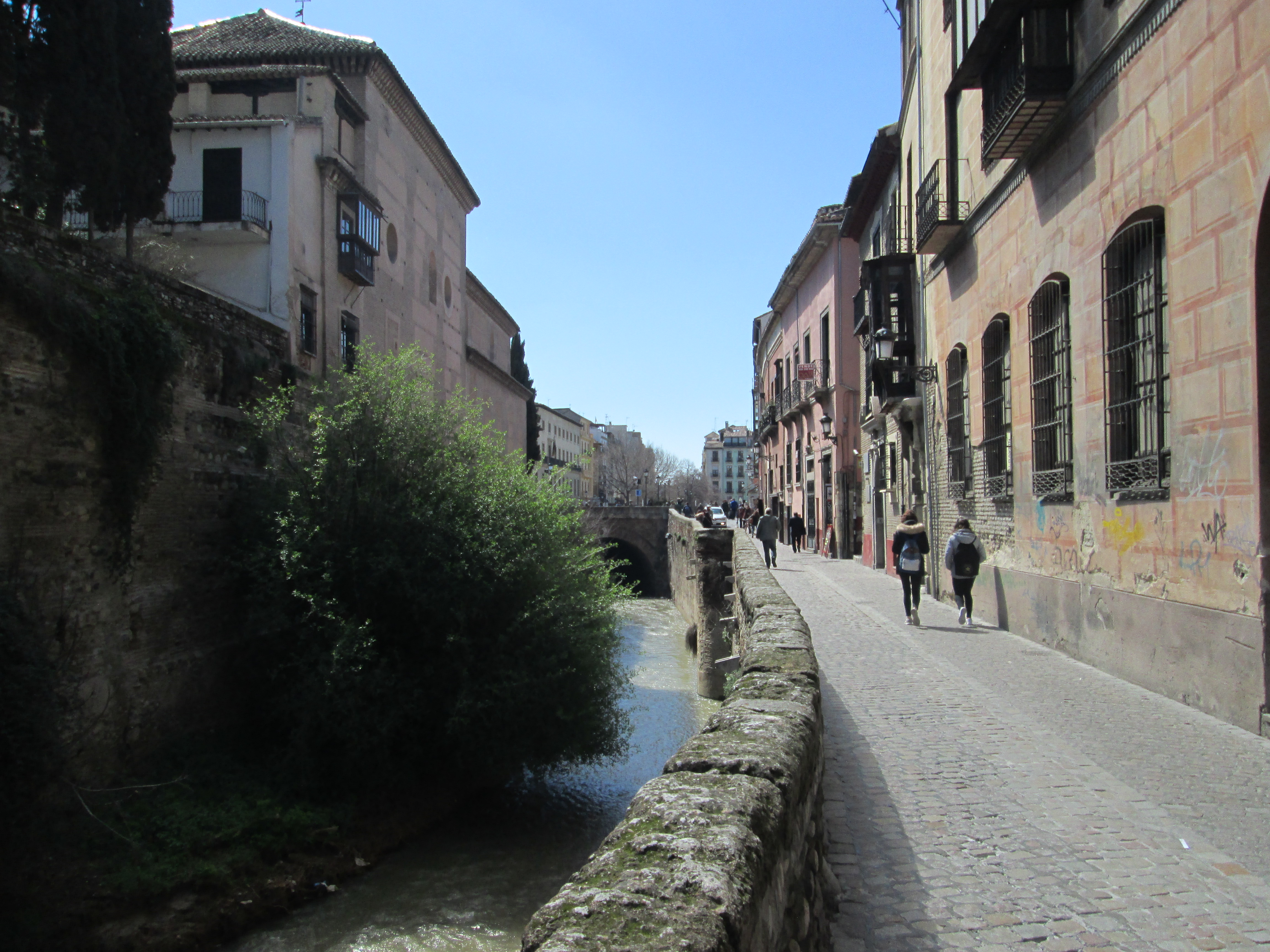
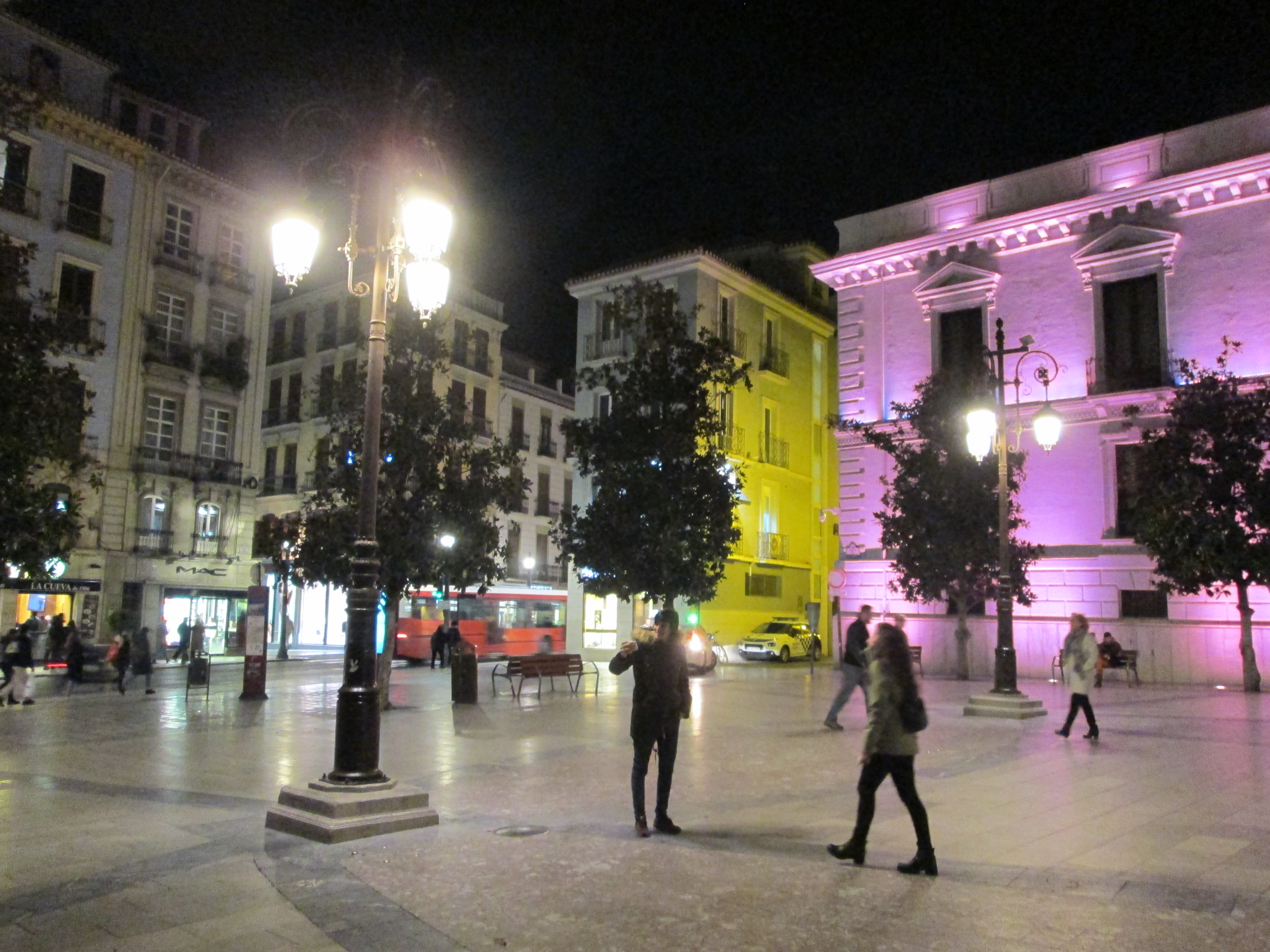
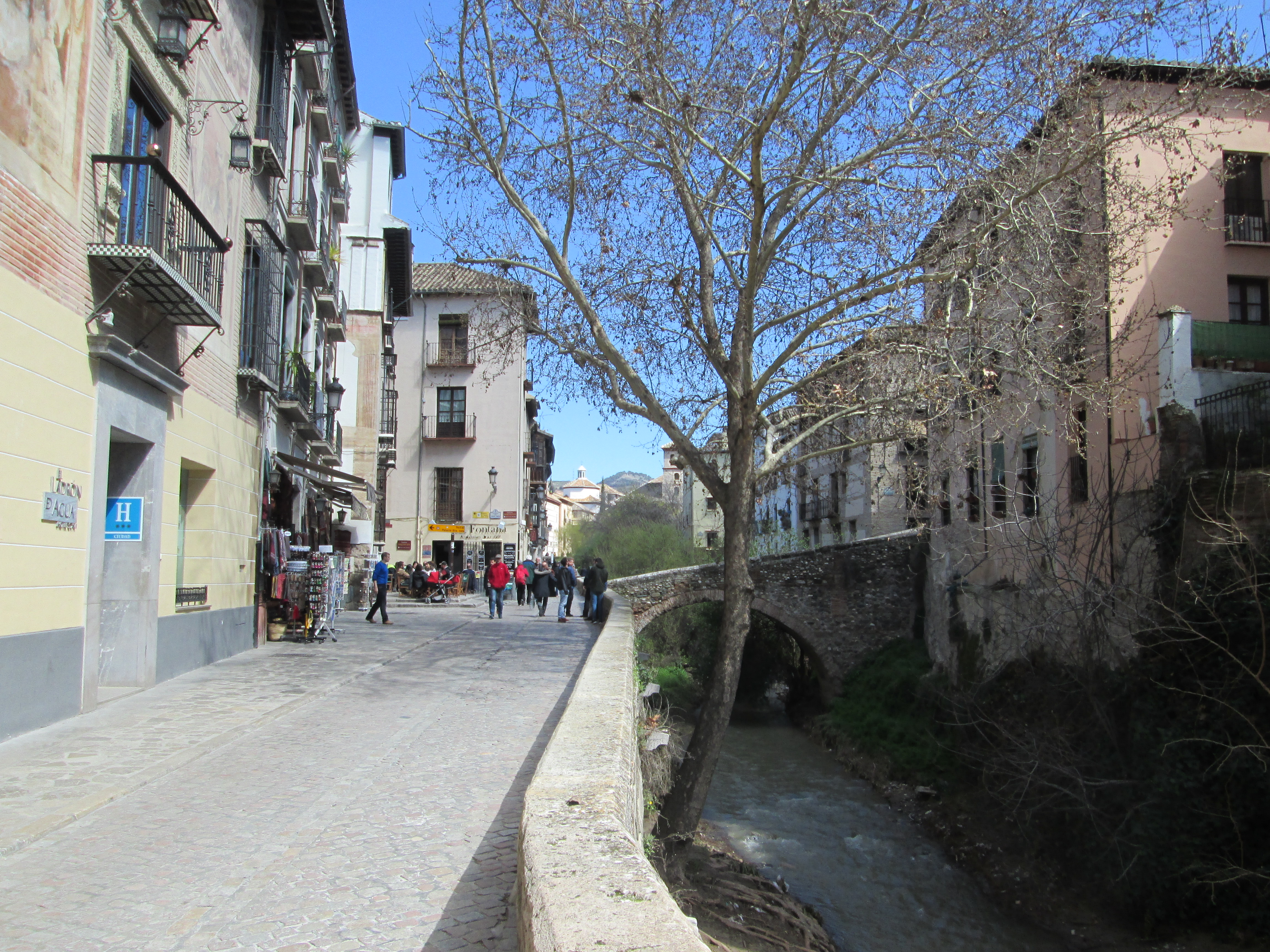
Calle Elvira itself is the main drag of the Old Town. The name is a curious echo of our friend’s villa in Elviria near Marbella where we will be heading next week.. But this is a slice of ancient urban Spain. Rambling, rickety and full of character. It is lined with quirky shops, cafes and casual eateries. Elvira leads to the city centre where the Plaza Nueva spans the Darro River.  Before that, the street branches into a few vibrant city lanes. Caldereria Nueva leads uphill into the Albaicin. Towards Gran Via, Cetti Meriem has a cluster of clubs and eateries. We eat at a few of these, the food and the atmosphere are great. This area had been a haunt of mine in the cold times of old. Hennigan’s Irish bar to be precise. Nights spent amidst copious pints and a vivid soundtrack of suitable rock including the Red Hot Chilli Peppers and Iggy Pop.
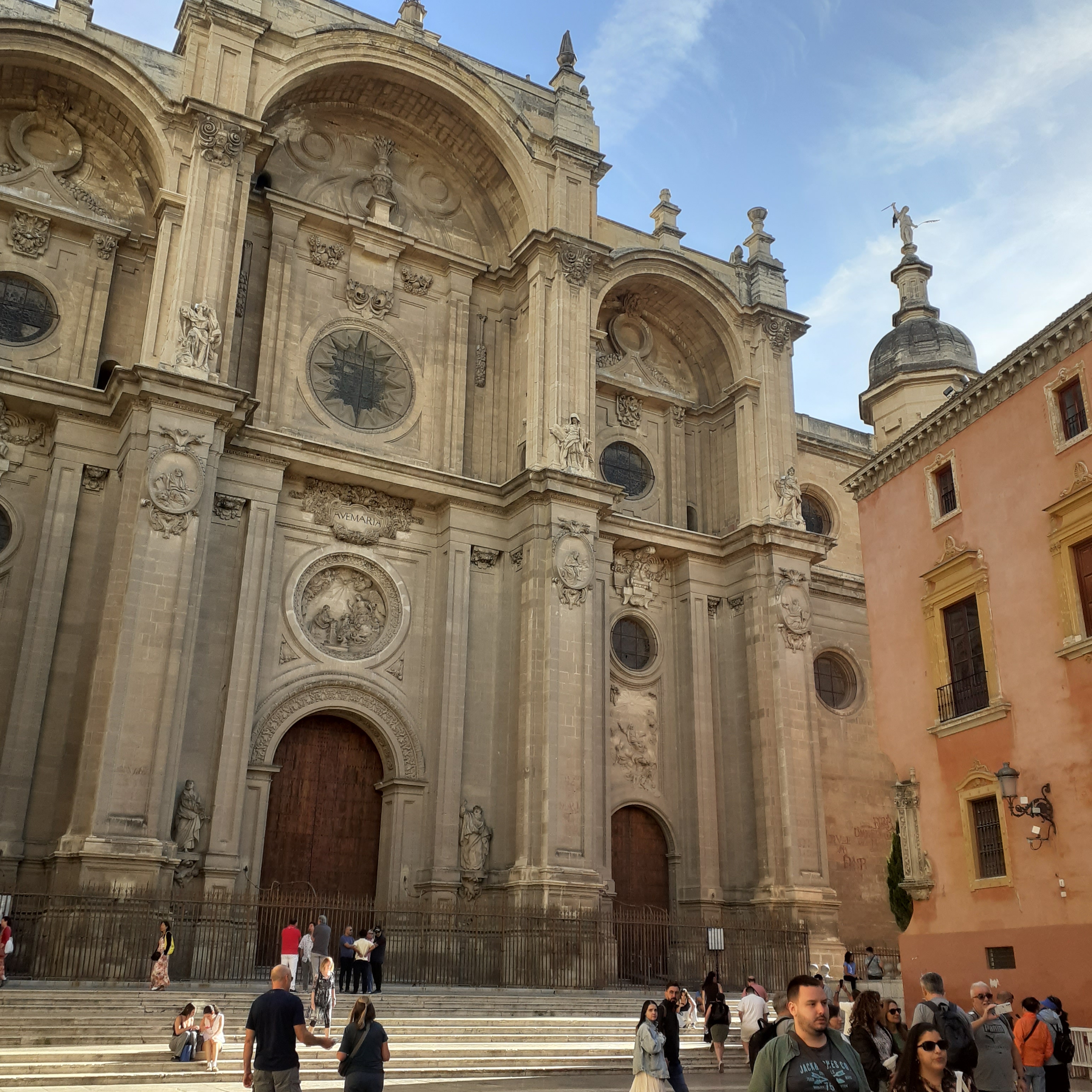
At the far end of Cetti Meriem, the Cathedral soars above the pediment. The Cathedral was begun in the sixteenth century, replacing the existing mosque within the Moorish medina. It is a montage of architecture, the end backing onto Gran Via a packed ornate gothic, the frontage an imposing Baroque facing Plaza Pasiegas. The massive towers on the north were never completed. I recall how its white interior perfectly mirrored the cold exterior in that cruel April. More comforting, the vast dome with gold stars scattered across a deep blue sky. 
Elvira ends at Plaza Nueva with its lively bars and restaurants. Despite its name it’s an old square, being built over the Darro River in 1500. The Royal Chancery flanks the north side while the Church of Santa Ana closes the square with the Darro visible beyond. Nearby there’s a fountain and beyond there’s access to the Alhambra via parkland. Alternatively, you can take a bus. It’s a punishing uphill climb, especially in the heat, so that’s what we did this time.

The Alhambra for five centuries was home to the Moors who had occupied much of Iberia in the 8th Century. Grenada would be their last stronghold. The Nasrid dynasty ruled Grenada from 1232 until the Reconquista of 1492. They built the Alhambra on the site of an 11th century fortification. In fact that had been the palace of Samual the Prince, a Jewish leader in a Moslem state. Muhammed I founded the complex we see today, greatly enlarged and embellished over the two hundred and sixty years of Nasrid rule. Ultimately, Muhammad XII, aka Boabdil, was defeated by the combined monarchs of Castile and Aragon and forced to surrender Granada to them. As he left for the coast through the Sierra Nevada, he took one last look back at what had long been his, and his people’s home.
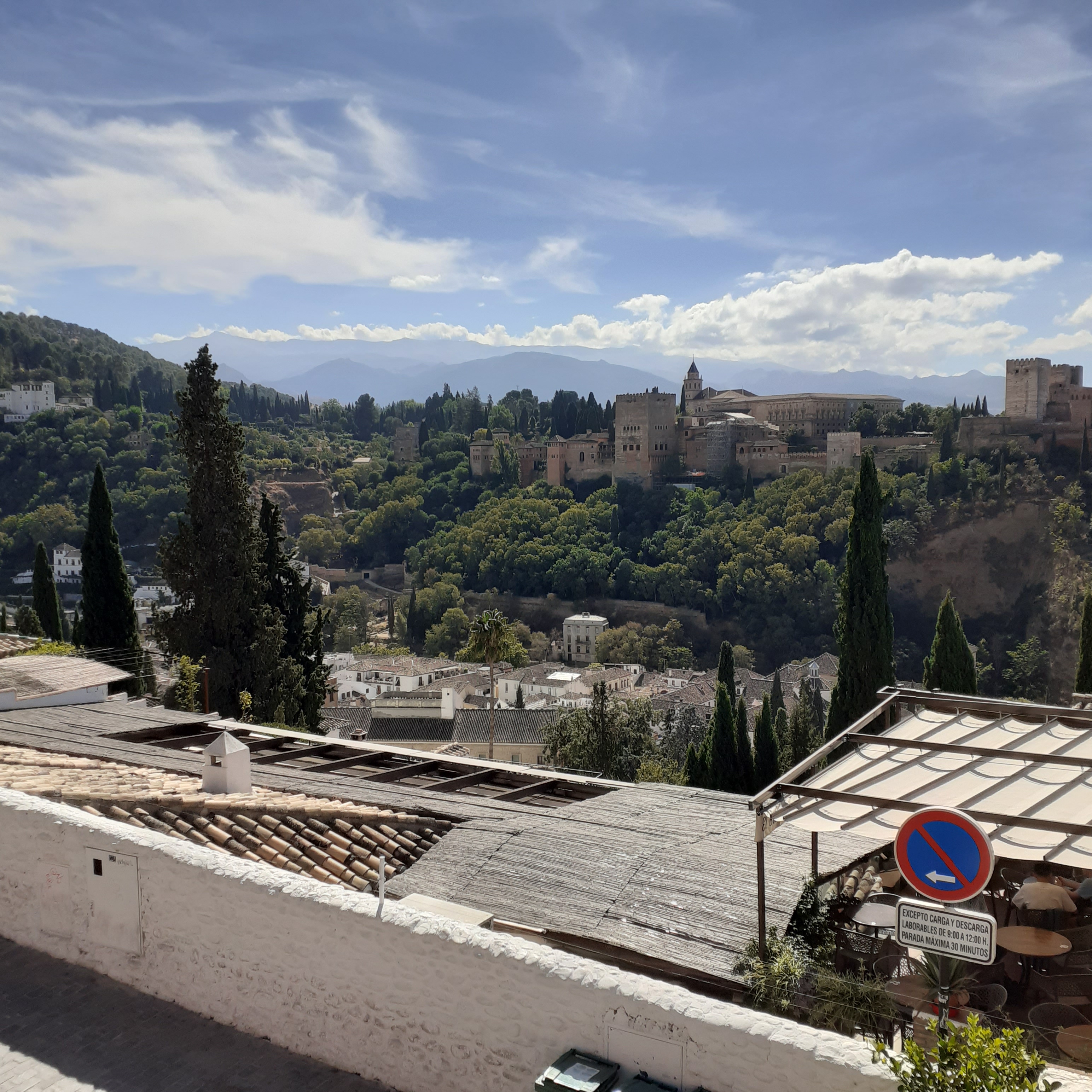
The mountain pass where this happened is now called Suspiro del Moro, the Moor’s Sigh. Salman Rushdie’s book, the Moor’s Last Sigh 1995, refers a few times to the episode. In a story of identity and memory, Boabdil’s action provides apt illustration. It was Rushdie’s first book since the Satannic Verses of 1988. Fanatical reaction to that resulted in the fatwa issued by Ayatollah Khomeini, leader of Iran. Similarly aligned groups such as Hezbollah and Al Quaeda have persisted in the fatwa into the current century. Rushdie lost an eye in a knife attack in New York three years ago. He still lives, and writes and thinks.

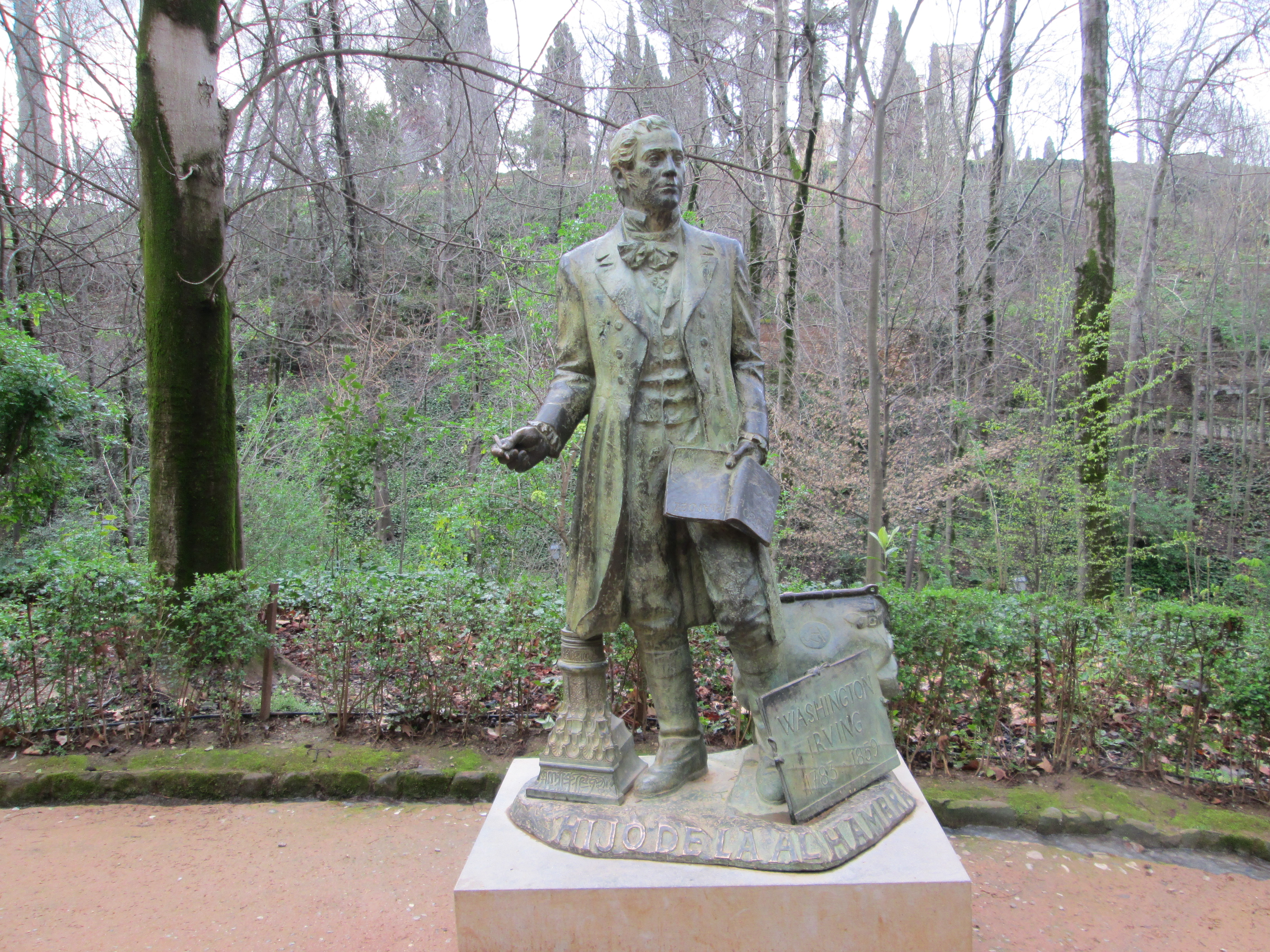
The Alhambra became the court of Ferdinand and Isabella. Christopher Columbus was witness to Boabdil’s handover and was received at court by the Monarchs as they approved his voyage to the Americas. There is symmetry therefore in that it was an American, Washington Irving, who established the Alhambra in the modern imagination. He lived in the complex in 1830 and published Tales of the Alhambra 1832. This contributed hugely to the preservation and restoration of the Alhambra over the last two hundred years.
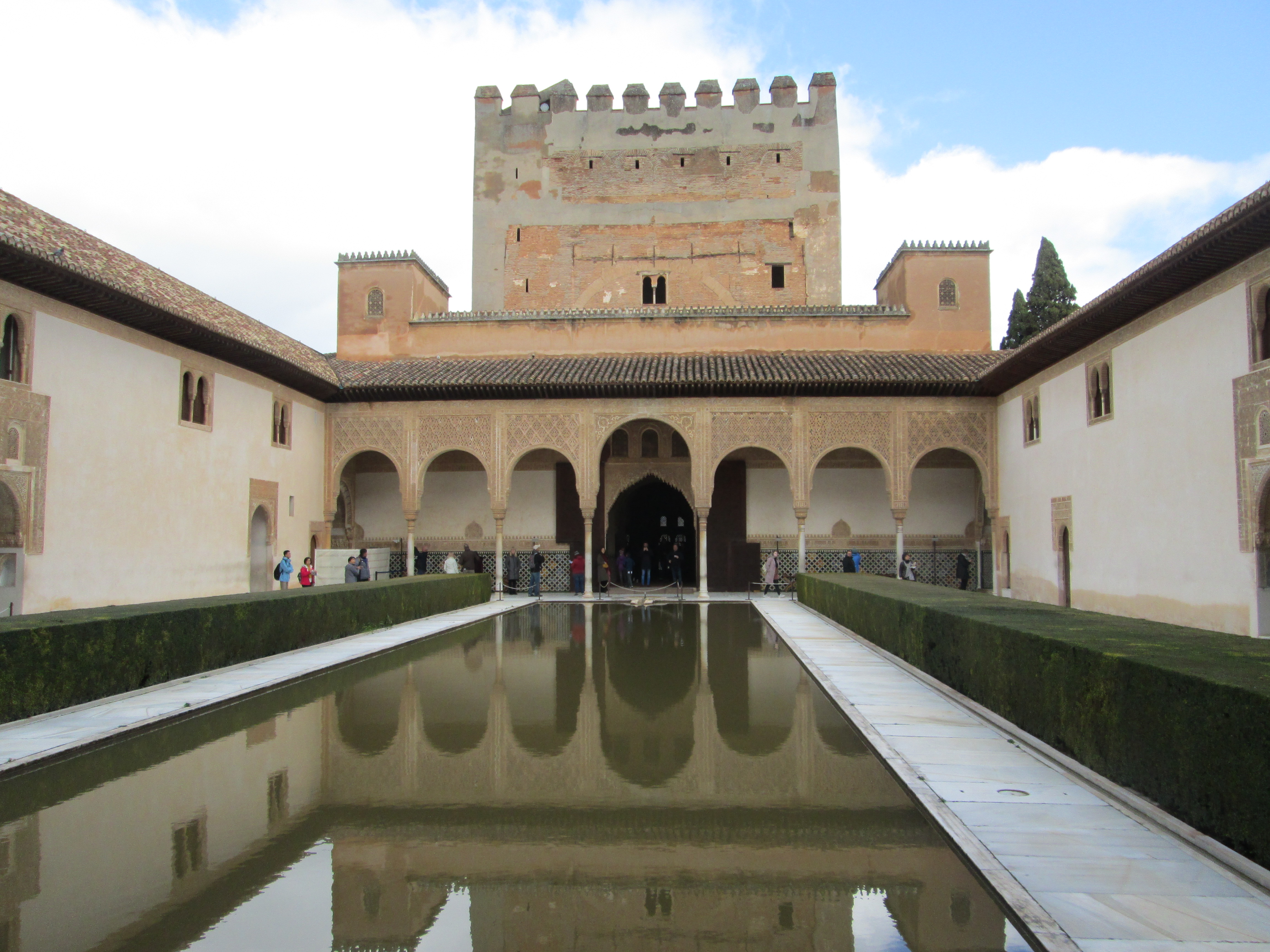
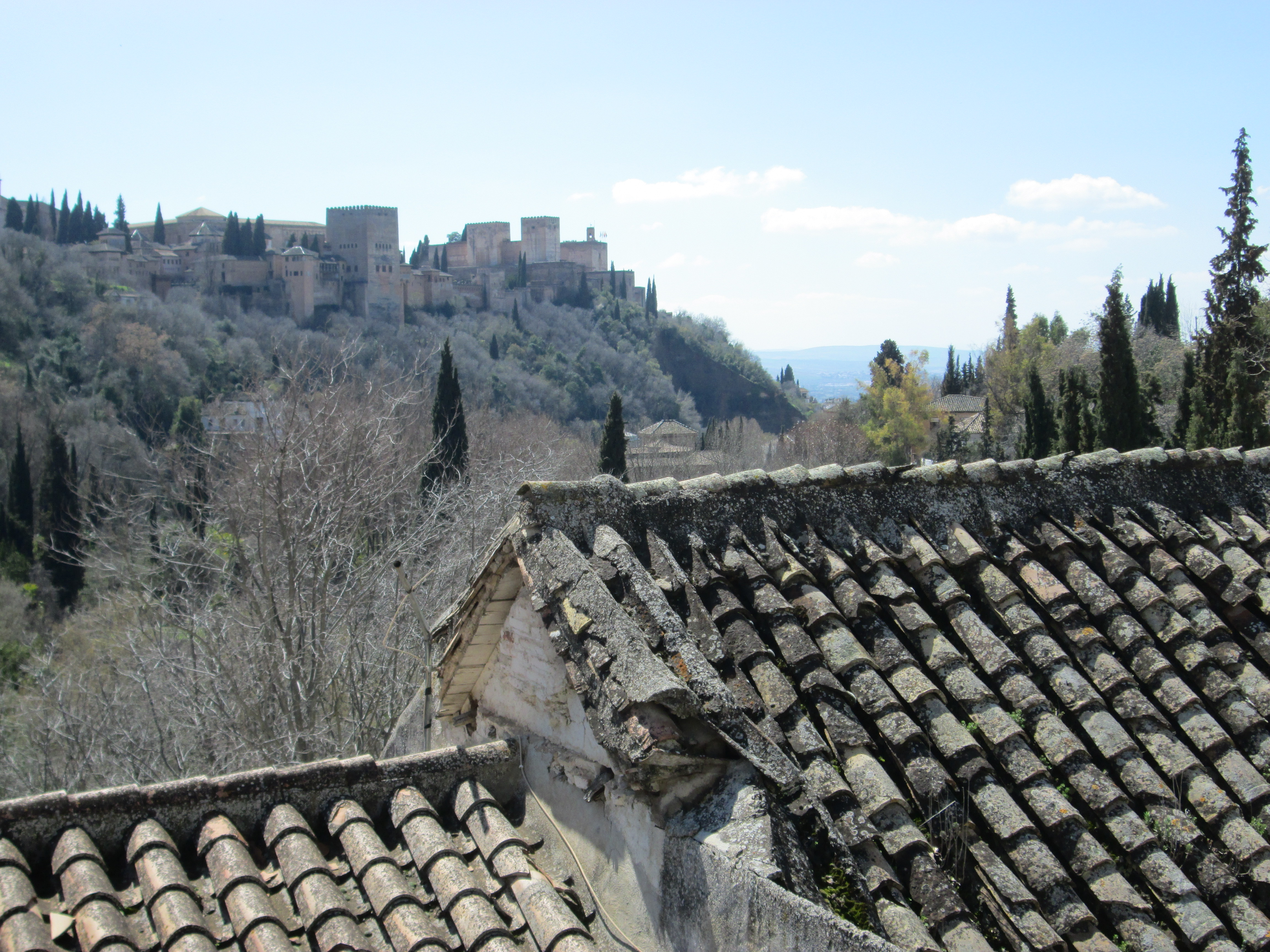
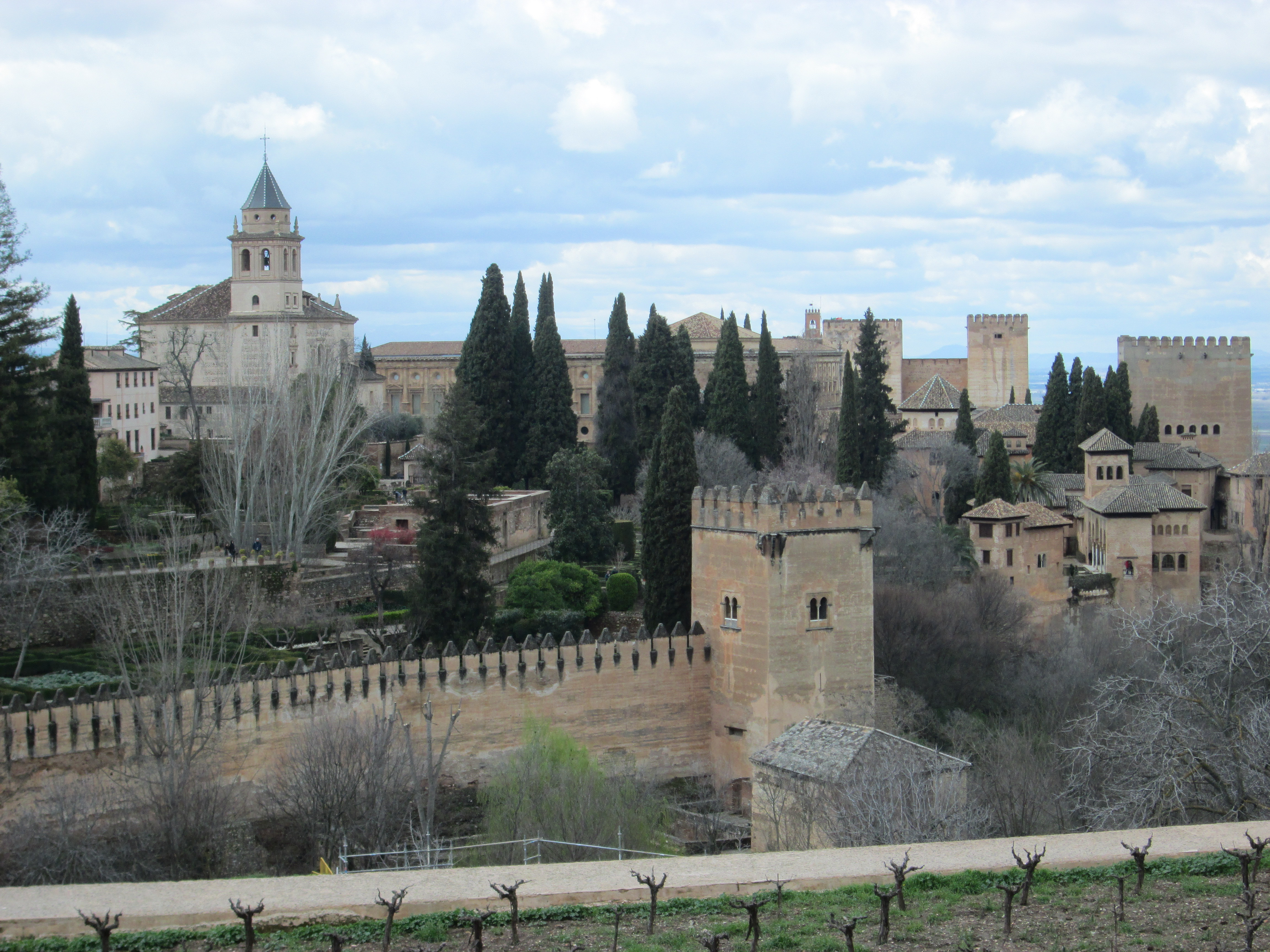
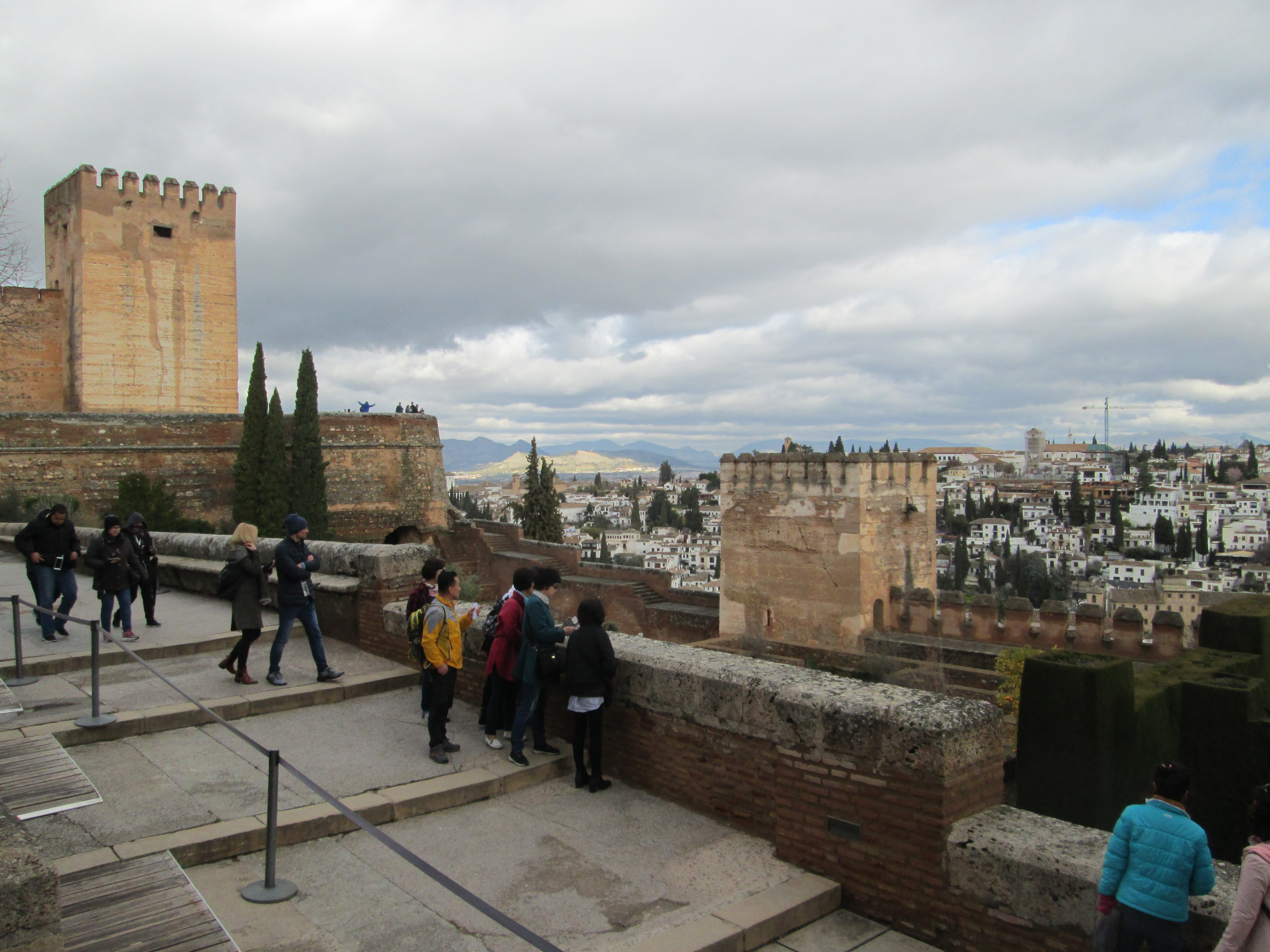
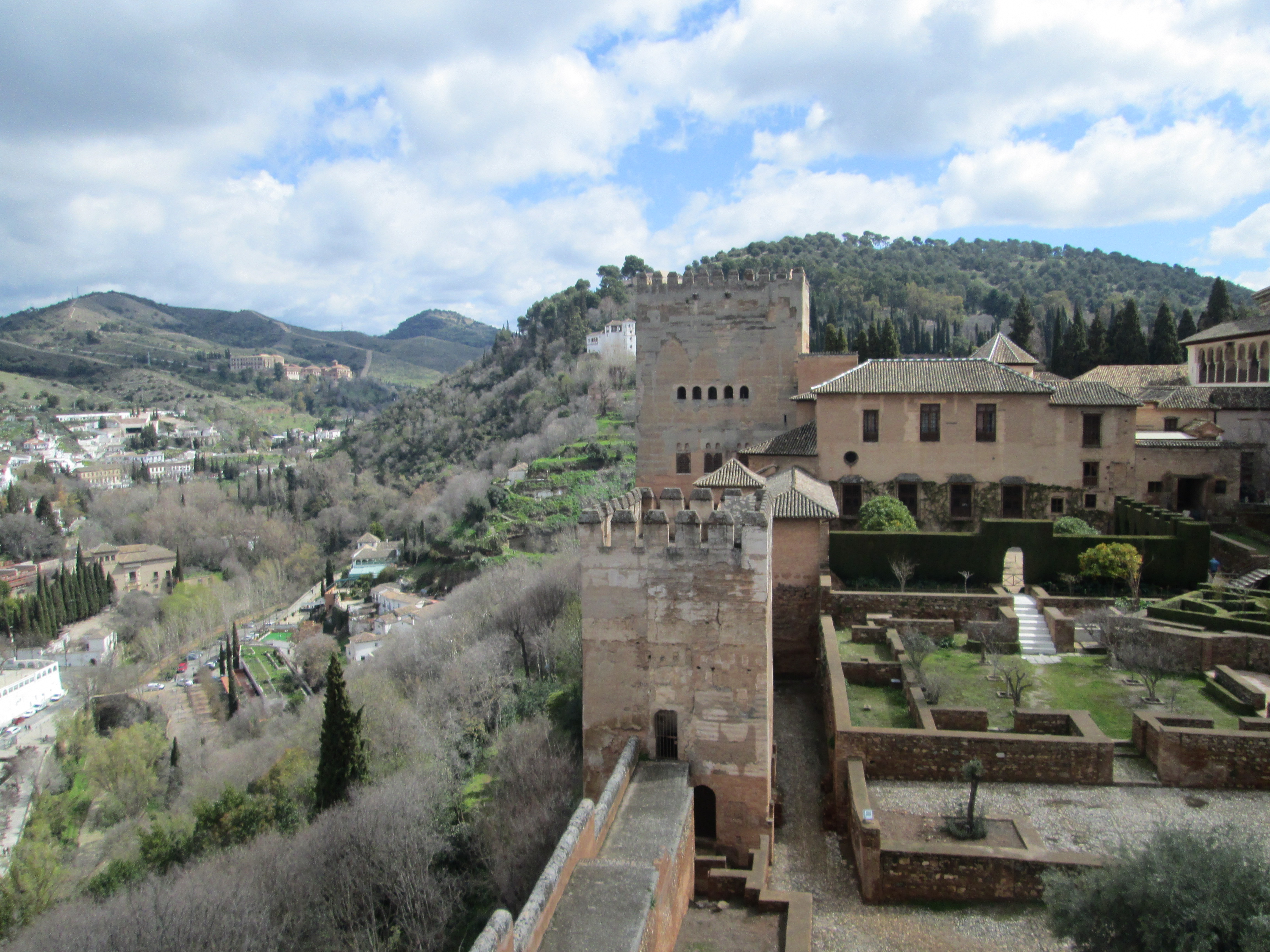
It is a huge complex with many different facets, including palaces, gardens, two hotels and other services. The Alcazaba fortress on the west side overlooks Granada. There are several towers giving great panoramic views over the city and mountains and the complex itself. The Generalife is a garden estate just outside the walls to the east. The Nasrid Palace is the jewel of the Alhambra, a glorious medley of rooms and courtyards, pools and fountains, featuring the best of Mudejar craft and design. Access to the Nasrid Palace requires a specific ticket. This was fine on my first visit but this time, though I tried some three months in advance, tickets were sold out. So shop early. It’s a treasure indeed. Nevertheless, there is an awful lot to see with a general admission ticket. From morning till late aternoon, we had our time in paradise.

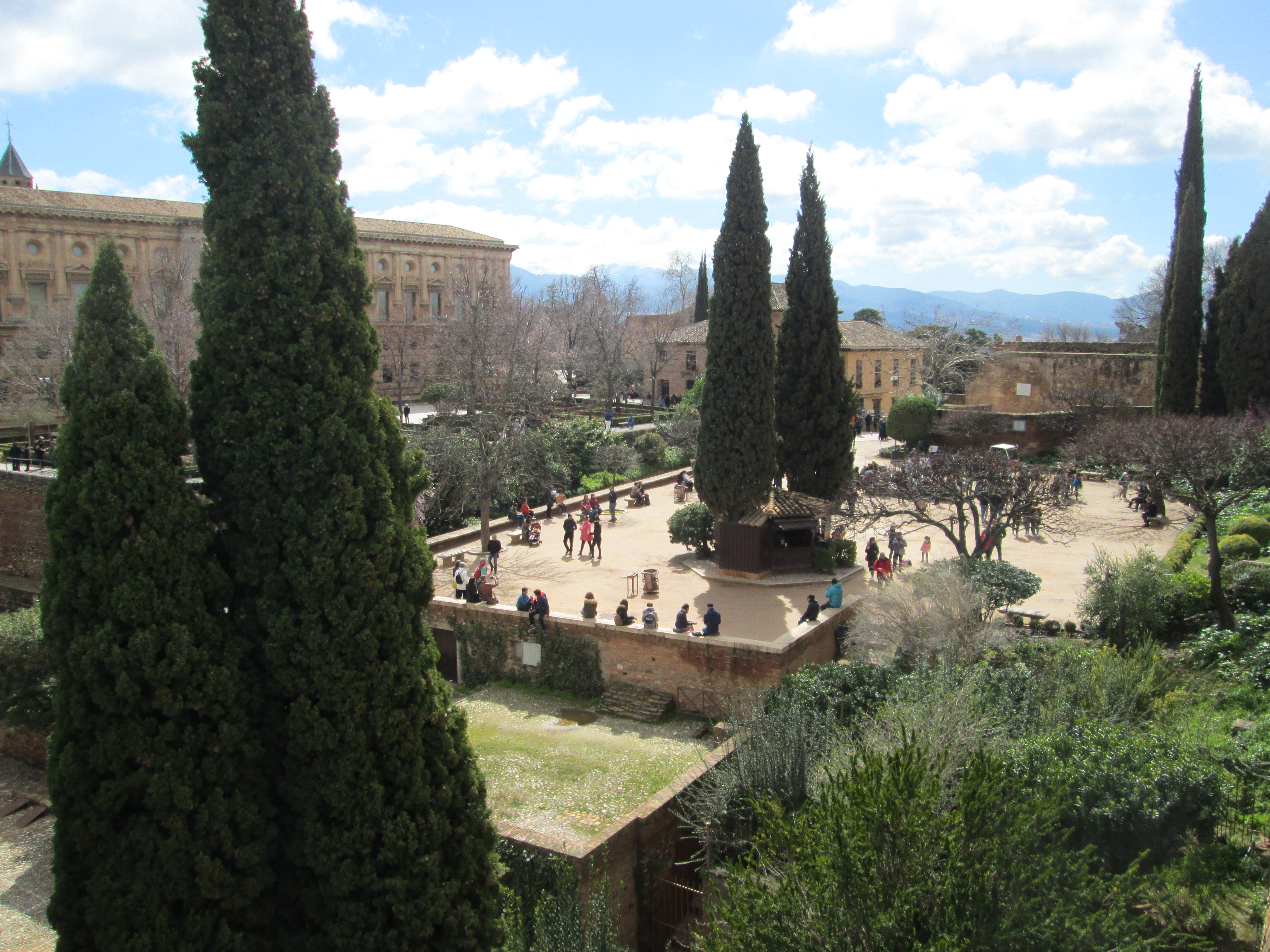
At the business end of the complex is the Alcazaba. Plaza Aljizibes alongside forms something of a town square, a public access area with services and refreshment stalls. The Renaissance Palace of Carlos V lines the other aide of the square. This was begun in 1527 but only completed four hundred years later. The Renaissance building encloses a circular courtyard, with a collonaded terrace on the upper floor. The Museum of Fine Arts there houses a collection of Spanish art from the 17th to the 19th century. The Alhambra Museum is on the ground floor.
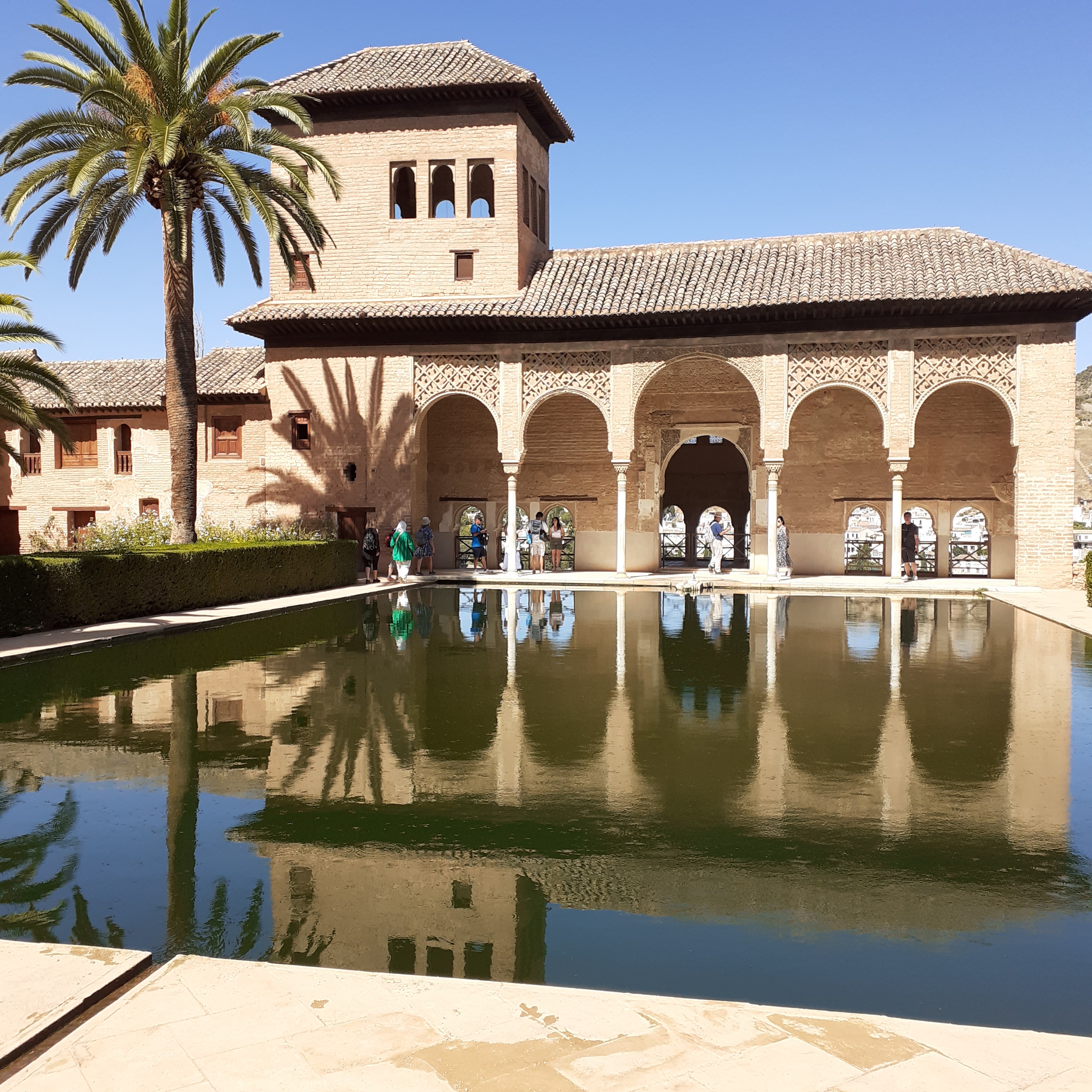
Just past the Nazrid Palace, the Partal Palace is accessible, This is the oldest surviving palace with an elegant pavillion overlooking a reflective pool. Calle Real is a public street near the southern wall. Along here is the Church of Santa Maria built on the old mosque. Further on is the American Hotel, with a cafe in its pleasant courtyard. I had stopped here before for some coffee and heat. Today we go for the Parador de Granada, a larger hotel. We stopped for a drink on its terrace, a perfectly relaxing conclusion to the day

Beyond the gardens of Partal and Secano we leave the Alhambra for the Generalife. This lies across a narrow ravine with beautiful gardens leading up to an attractive villa. Built as a retreat for the Royal Household free from the travails of the Palace, it offers some of the best views of the Alhambra, Granada and Sierra Nevada
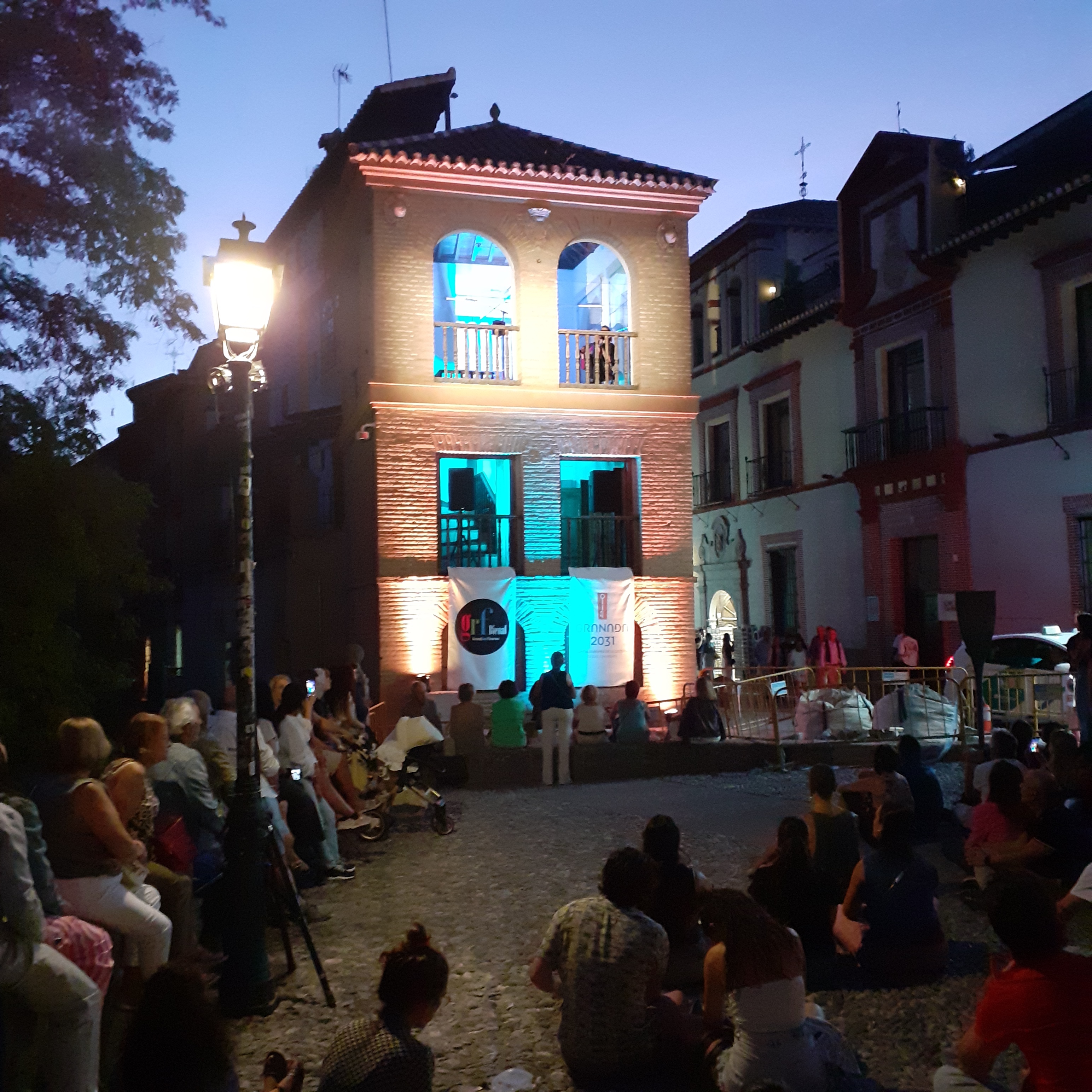
We left the Alhambra by way of Carretera de los Chinos, a long downhill saunter below the castle walls. This led us down to the Darro and Puenta del Rey Chico. There was a music concert that evening where the riverside street broadens into an esplanade with the floodlit Alhambra towering over the far bank. Crowds sat on the plaza, while a singer and guitarist serenaded from the tower at one end. 
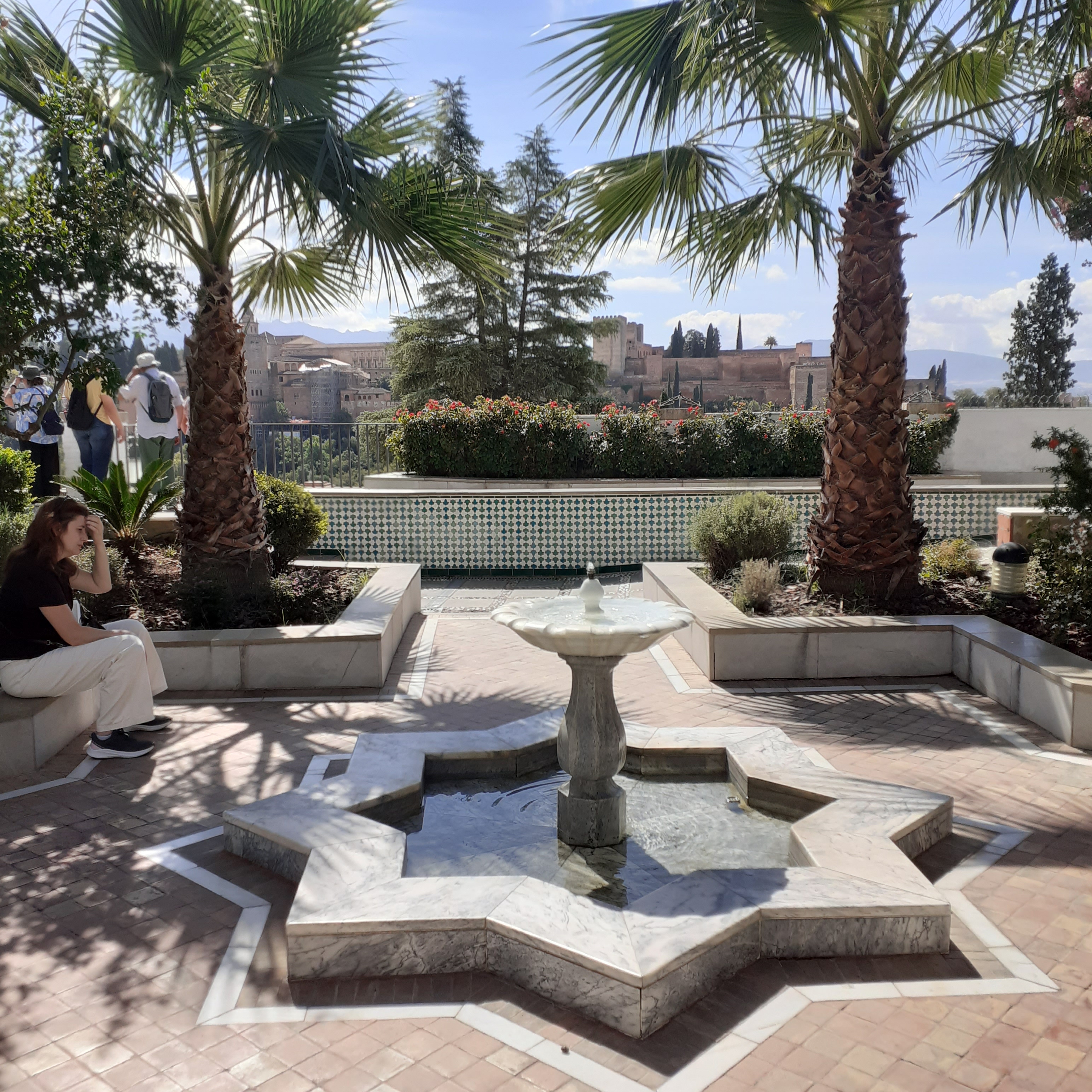
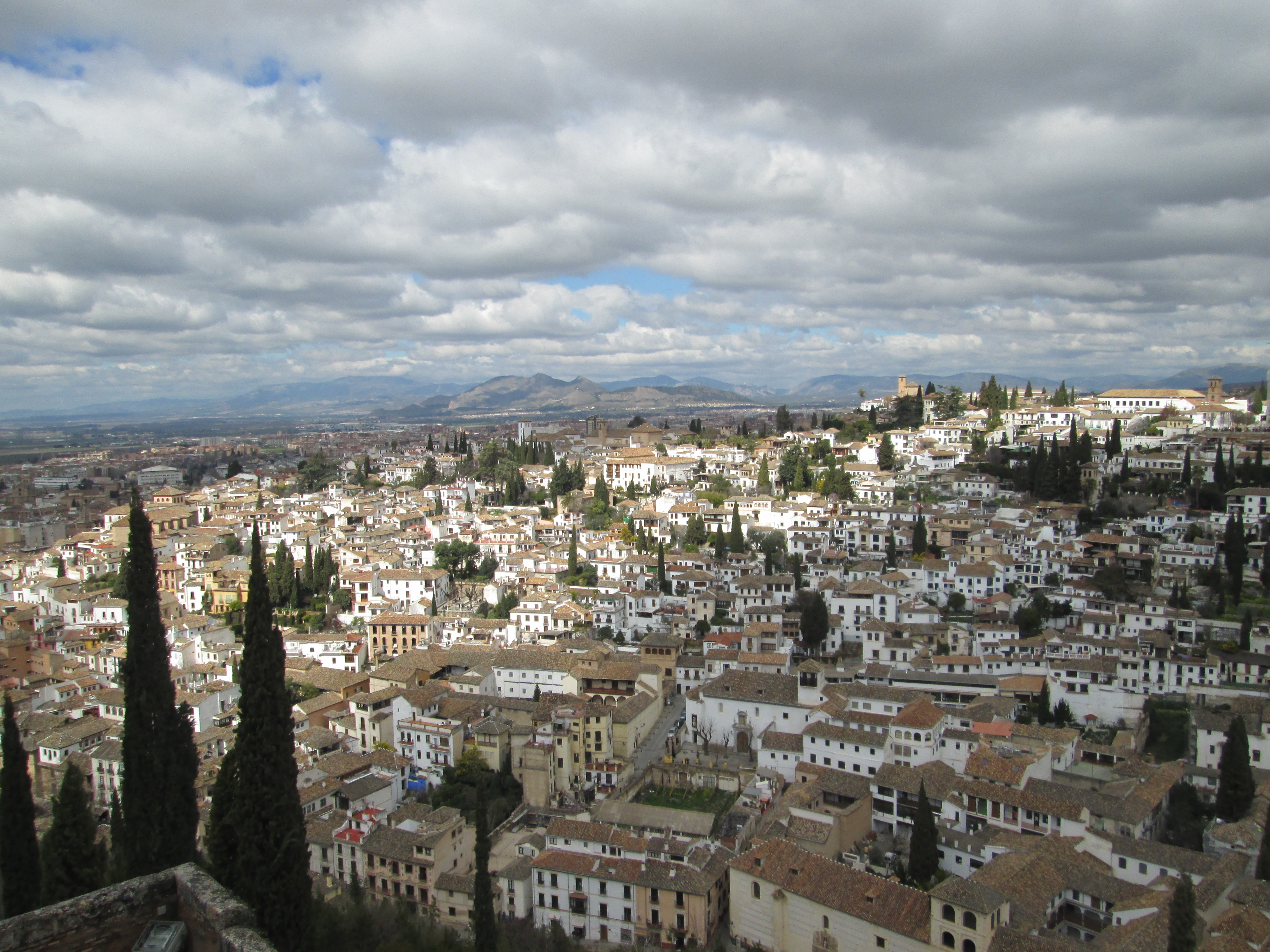
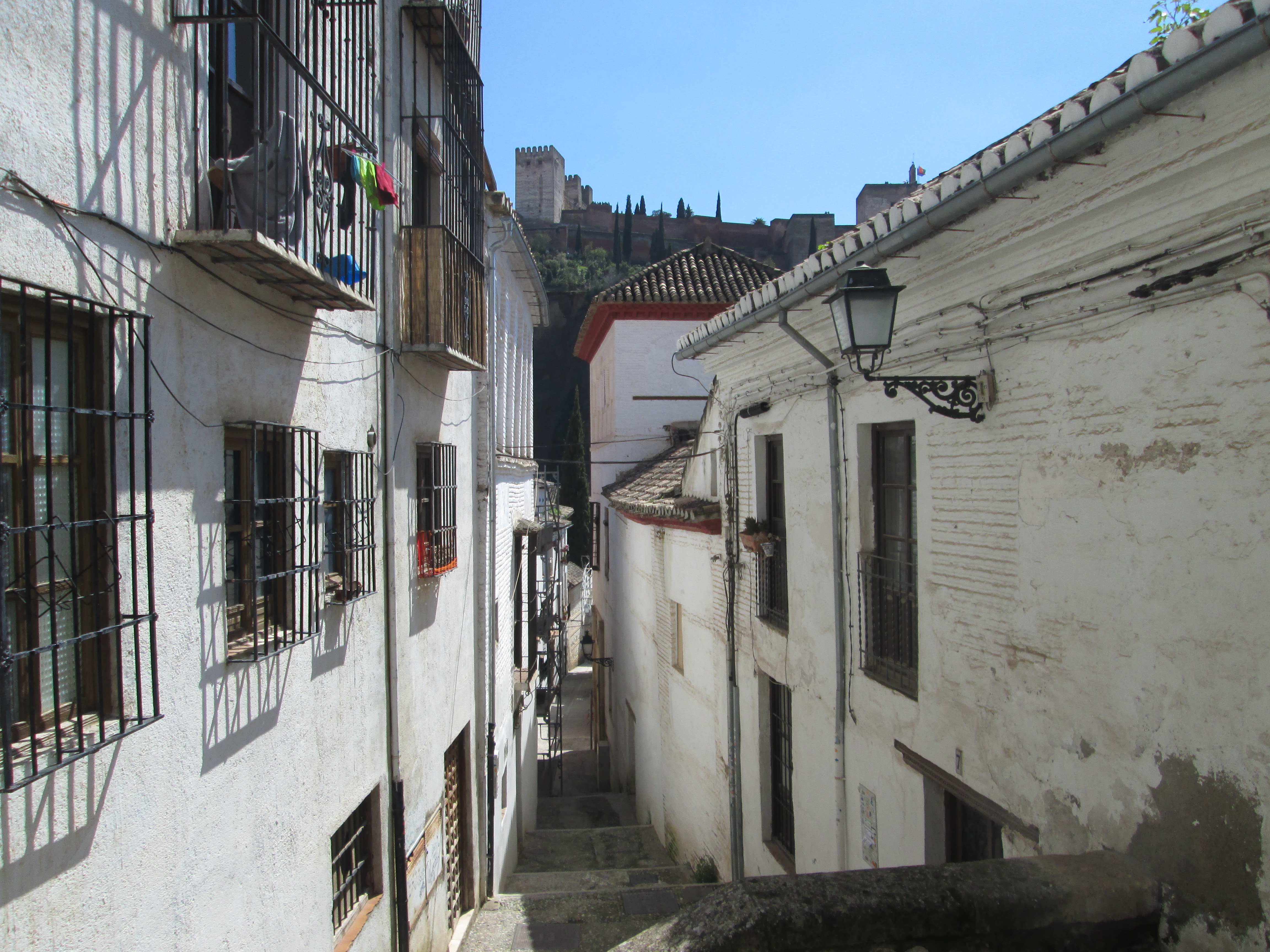
Facing the heights of the Alhambra is the steep ancient neighbourhood of Albaicin, and Sacromonte, the Sacred Mountain. From near the foot of Elvira there’s a sharp uphill to Plaza San Gregorio. The white church was built in the late sixteenth century, becoming deeply embedded in the  community. We stopped adjacent for good food on a terrace at the edge of the commercial sector. From here the narrow street climbs up through the Alcaibin to the Mirador St Nicholas. The Mirador hosts such a view over sierra and castle that it must elicit an aching sigh or two. The grounds of the mosque next door offer respite, heat and throng dispelled in its subtle shade and soft fountains.
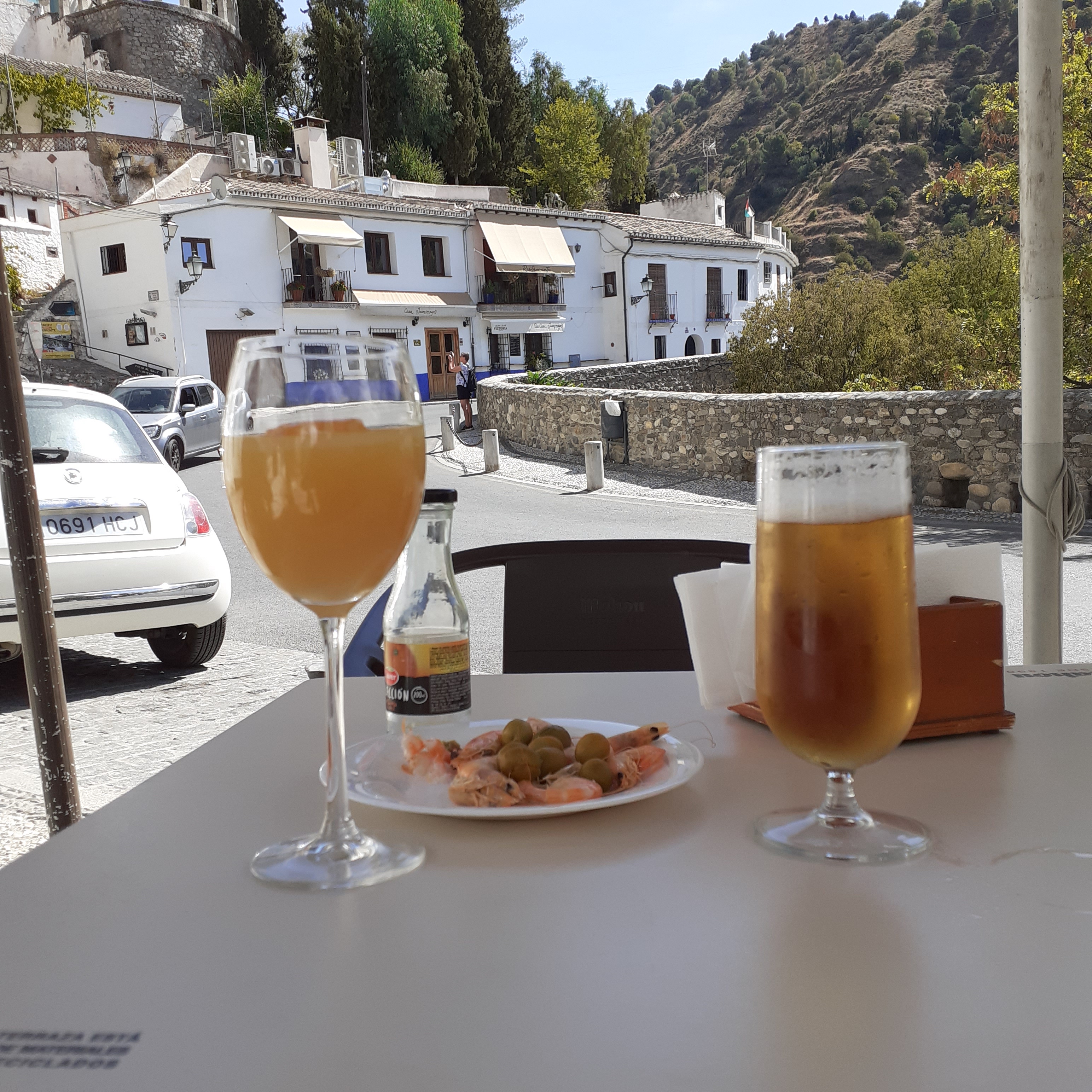
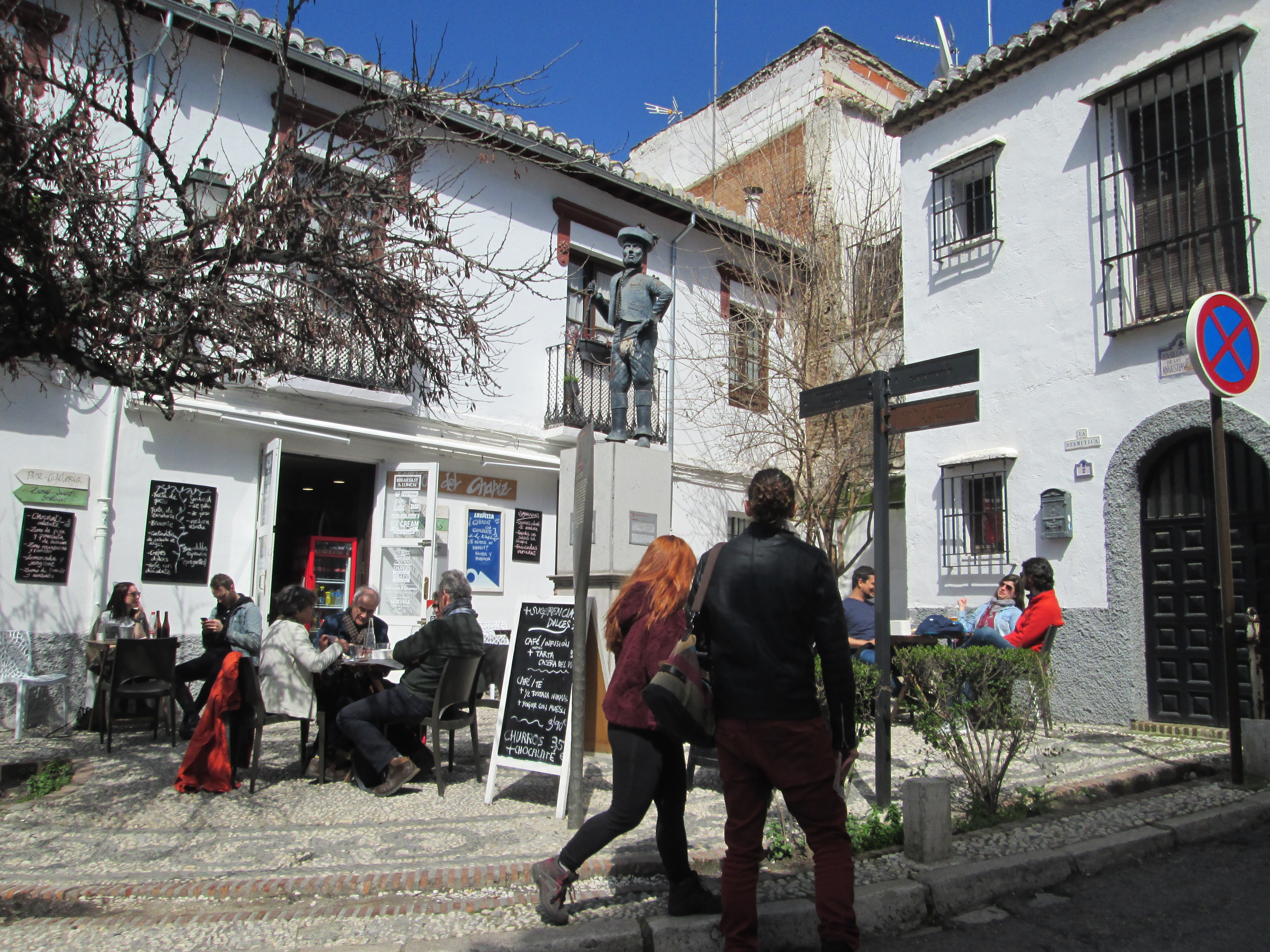
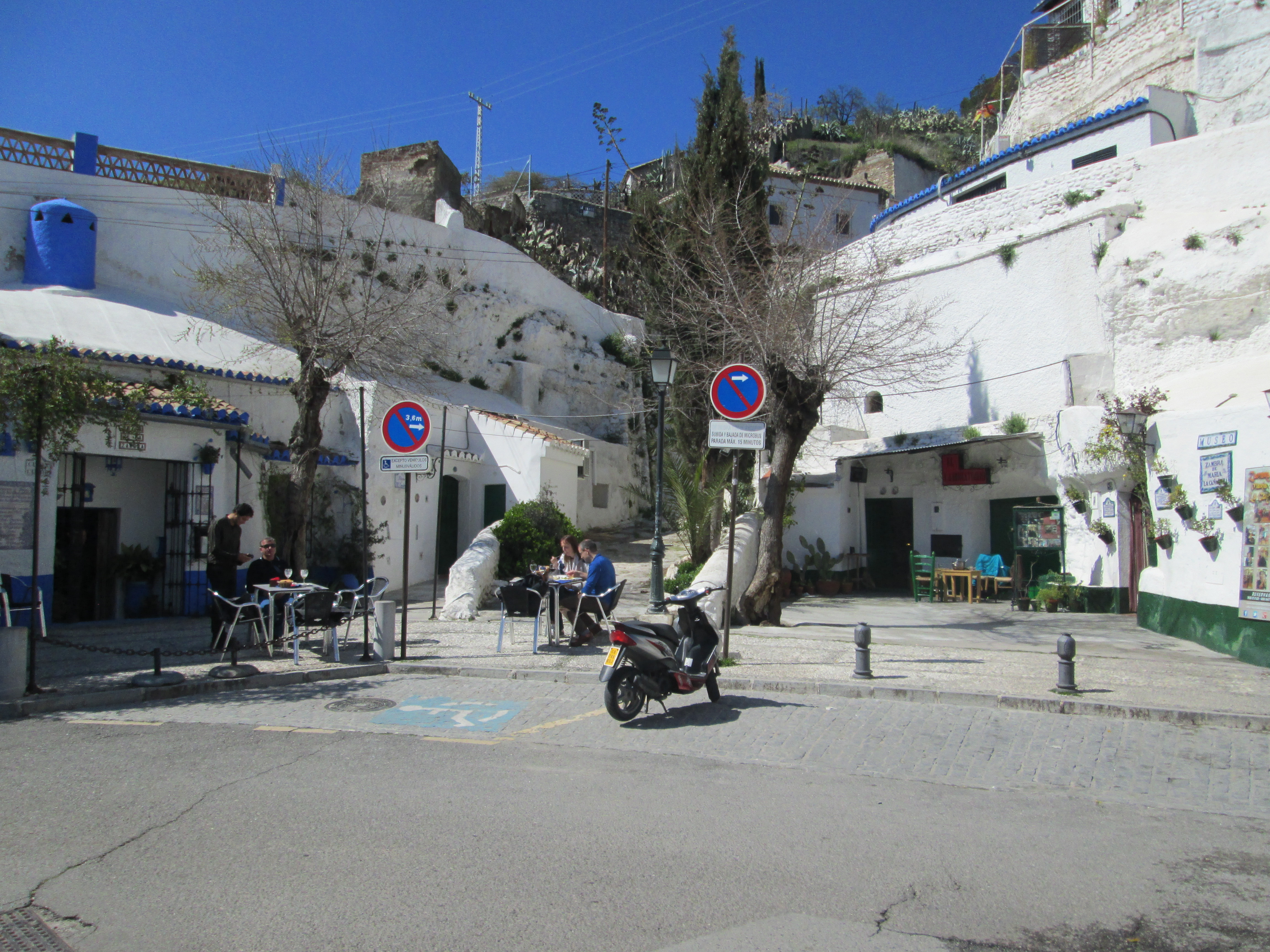
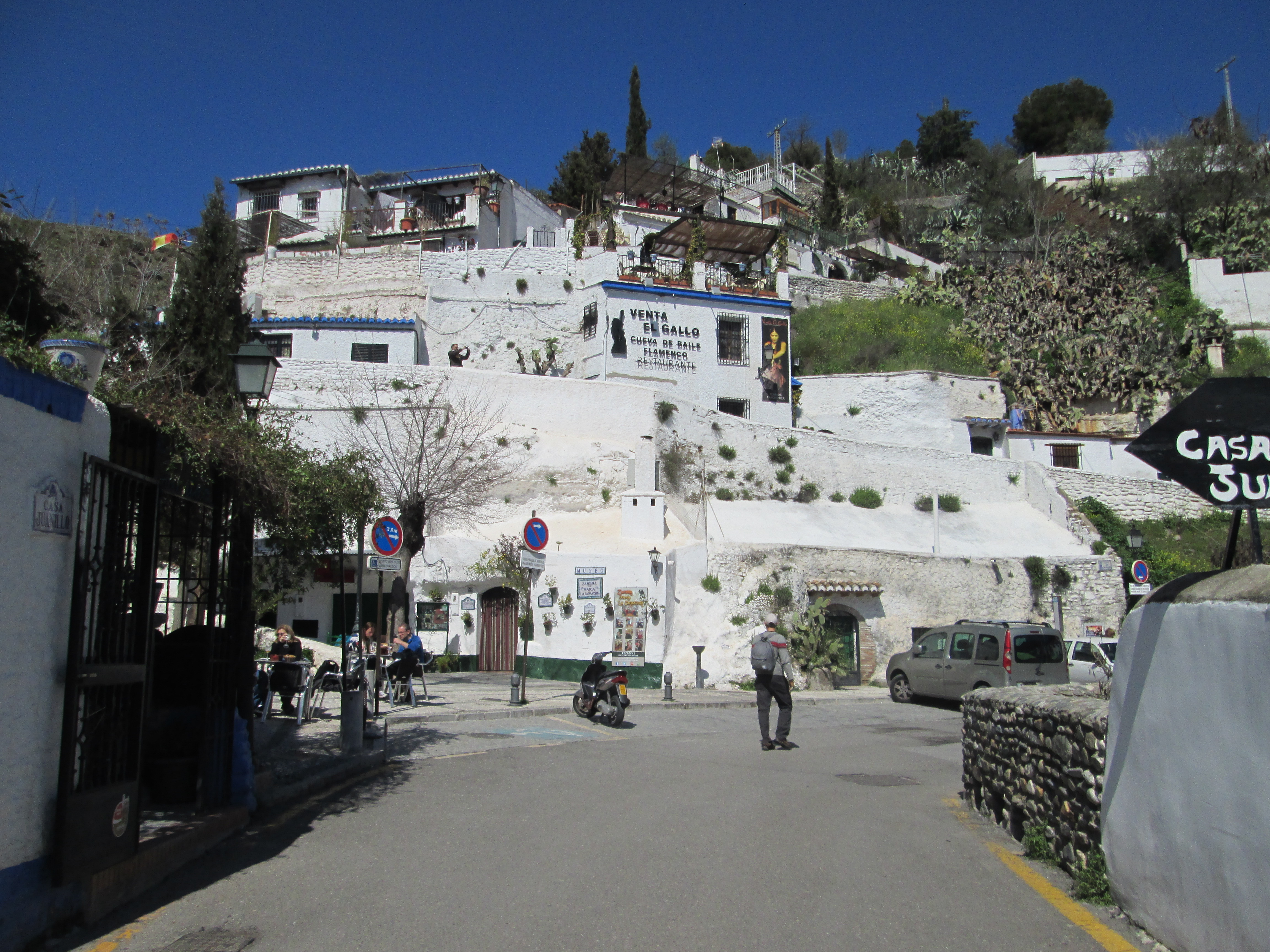
Beyond the Albaicin the steep hill descends to the Darro. There’s a turn at a picturesque, even picaresque, taverna, El Rincon del Chapiz. Take this turn to visit the Sacred Mountain. With our first step into Sacromonte, we are in a different world. The city evaporates and a mirage of a mountain top village rises before us. Winding up above the Darro Ravine, white houses cling to the slopes and the Sierra Nevada embraces all. We stop for a drink and tapas at Casa Juanillo, wondering how we have found ourselves in the middle of nowhere, and the centre of everything. This was originally the Gitanos quarter, and a mainspring for the source of flamenco music. Dotted all around are music venues; hold your whisht and you can hear the music echo from the stones and trees.

Fly away on my zephyr

I feel it more than ever

And in this perfect weather

We’ll find a place together

For old time’s sake, The Red Hot Chilli Peppers Zephyr Song (from By the Way 2002) to take us out, and up.
Andalusia – 2. Granada and Alhambra

When I took up the guitar in my early teens, it was to flamenco that I turned. I was thinking a lot about the paintings of Salvador Dali in those days and I also became immersed in Spanish history. The Alhambra was a particular fascination, a red castle ringed by snow capped peaks, above the city of Granada. So, some fifty years later, I at last made my pilgrimage. An early Easter was approaching and a blanket of snow lay over Dublin. The plane was a while on the tarmac as workers chipped ice off the wings. At least we were off to sunny Spain.

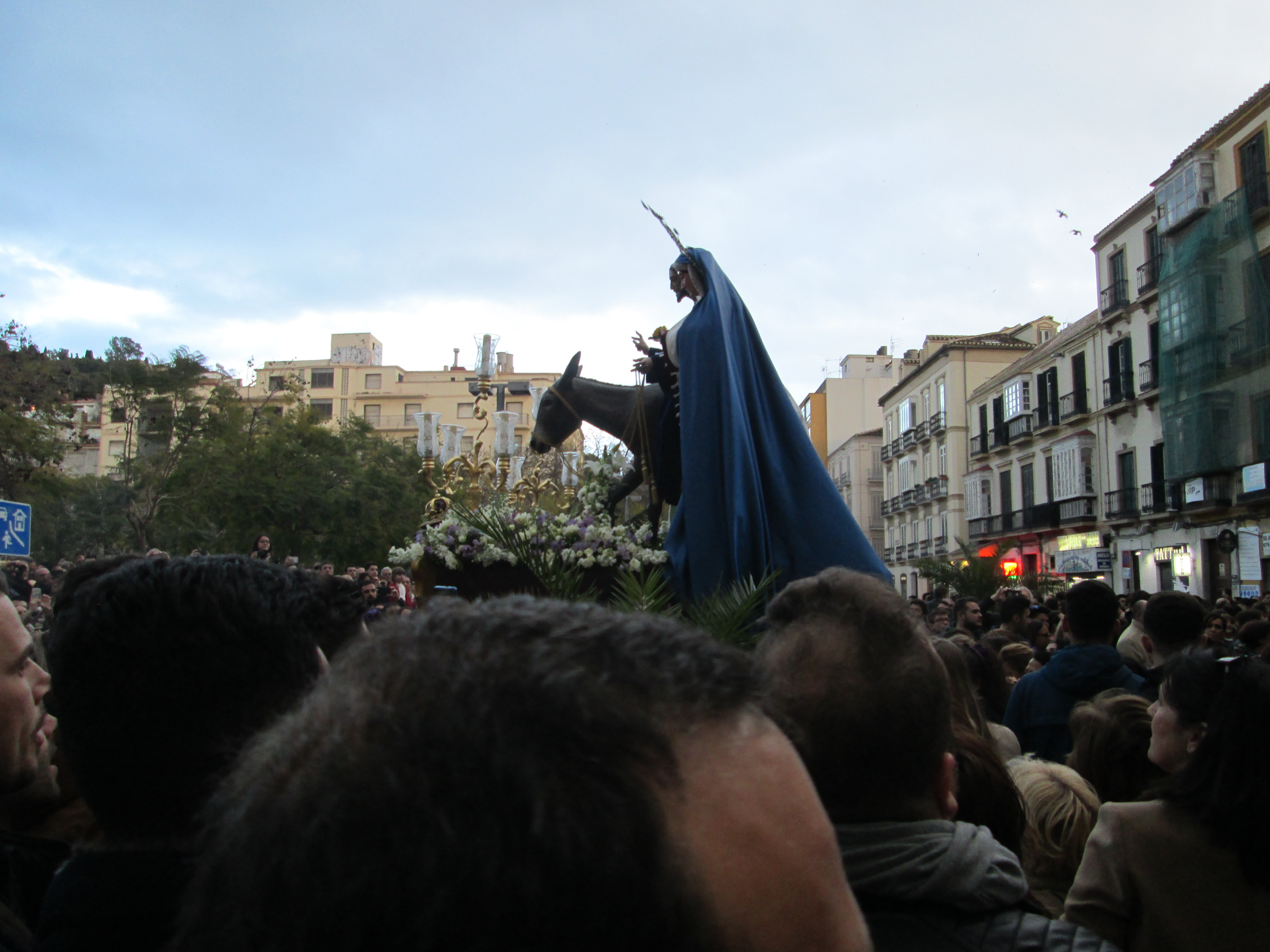
There was a bleak sun on Malaga when I landed, but it was cold and the sidewalk bars huddled behind plastic awnings with heaters ablaze. It’s a two hour bus ride up to Granada, but I had an overnight and aimed to get a taste of Malaga in a day. Relaxing over a wine, I noticed that crowds of people were heading towards the city centre and figured there was something on. It being Holy Week, a procession by one of the Brotherhoods passes each day. I quickly succumbed to its hypnotic magnetism. Solemn music accompanies towering floats, or tronos, one of the Christ and the other, typically more exuberant, is of the Virgin.

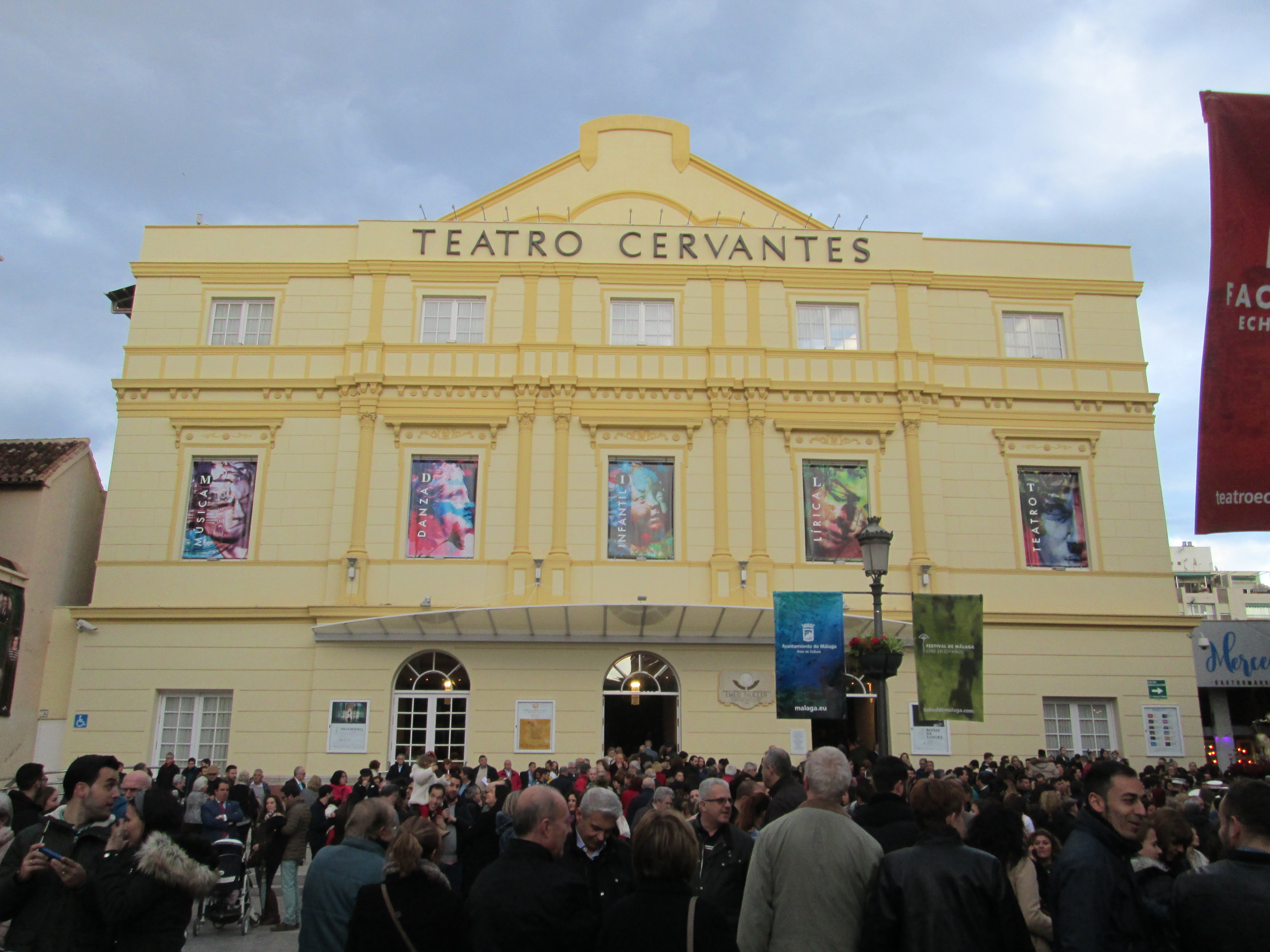
Each weighs several tons and are carried, very slowly, by members of the Brotherhood from their parish church through the city centre, past the Cathedral and on to the Plaza before Teatro Cervantes. Which is where to relax as the solemn spell wanes.

The Teatro Cervantes was built in 1870 and named for Miguel de Cervantes. Cervantes is well commemorated throughout Andalusia. His writing pervades the entire Spanish consciousness. As is Shakespeare to English, he is central to Spanish. Don Quixote is regarded as the first novel in the modern sense, and has become, after the Bible, the most translated book in the world. We all know its eponymous hero, hopeless and heroic, forever tilting agaist the hostility of life. Cervantes came to embody his own maxim, that the pen is the language of the soul

My own pilgrimage took me to Malaga Bus Station to the west of the city early the next morning. Granada, just over ninety miles distant, is a two hour bus journey through coastal mountains, the snow capped Sierra Nevada ultimately embracing the city as we reach our destination. Granada’s Bus Station is a good bit out of town and I took a taxi to the centre and my hotel.

Granada, a place of dreams, where the Lord put the seed of music in my soul. (Andres Segovia)

The fabulous castle overlooking it all, the Alhambra, was the last fortress the Moors. Alhambra signifies the Red Castle, from the blood toned colour of its stone. The Moors built their first fortress in the ninth century but the existing complex dates to 1333 when Yusuf I was Sultan of Granada. In 1492 the Catholic Monarchs, Ferdinand and Isabella, defeated the Emirate of Granada. 1492 was also the year when Italian explorer Christopher Columbus came here to receive the support of the Monarchs in his ambition to sail to the New World. This is when the Western World was born. An early history of Columbus was written by Washington Irving, American author and ambassador to Spain. He, in tur, rediscovered the Alhambra for the modern world. His Tales of the Alhambra was published in 1842. In 2009, on the 150th anniversary of his death, a bronze statue was erected on the wooded approach to the citadel.

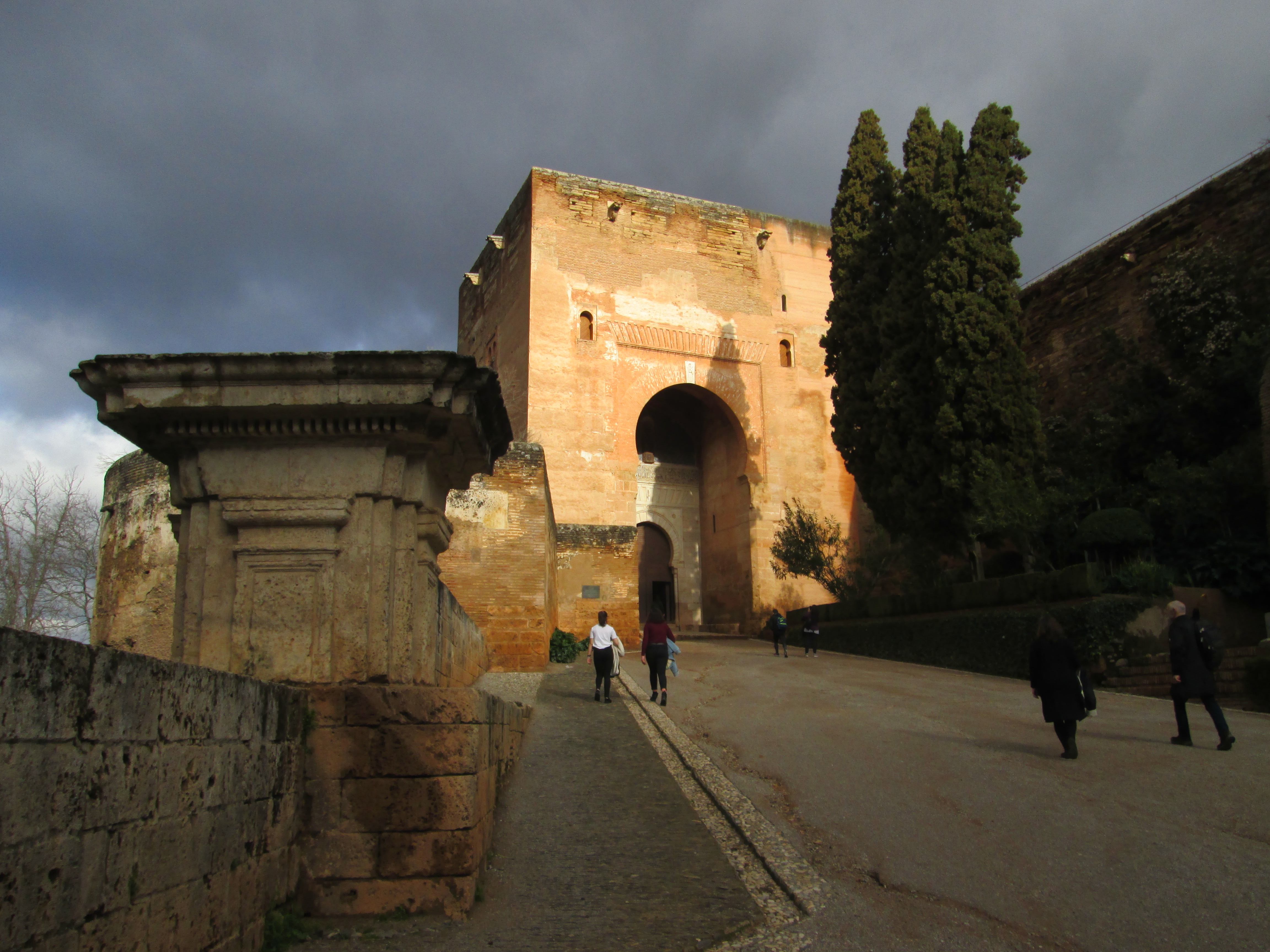
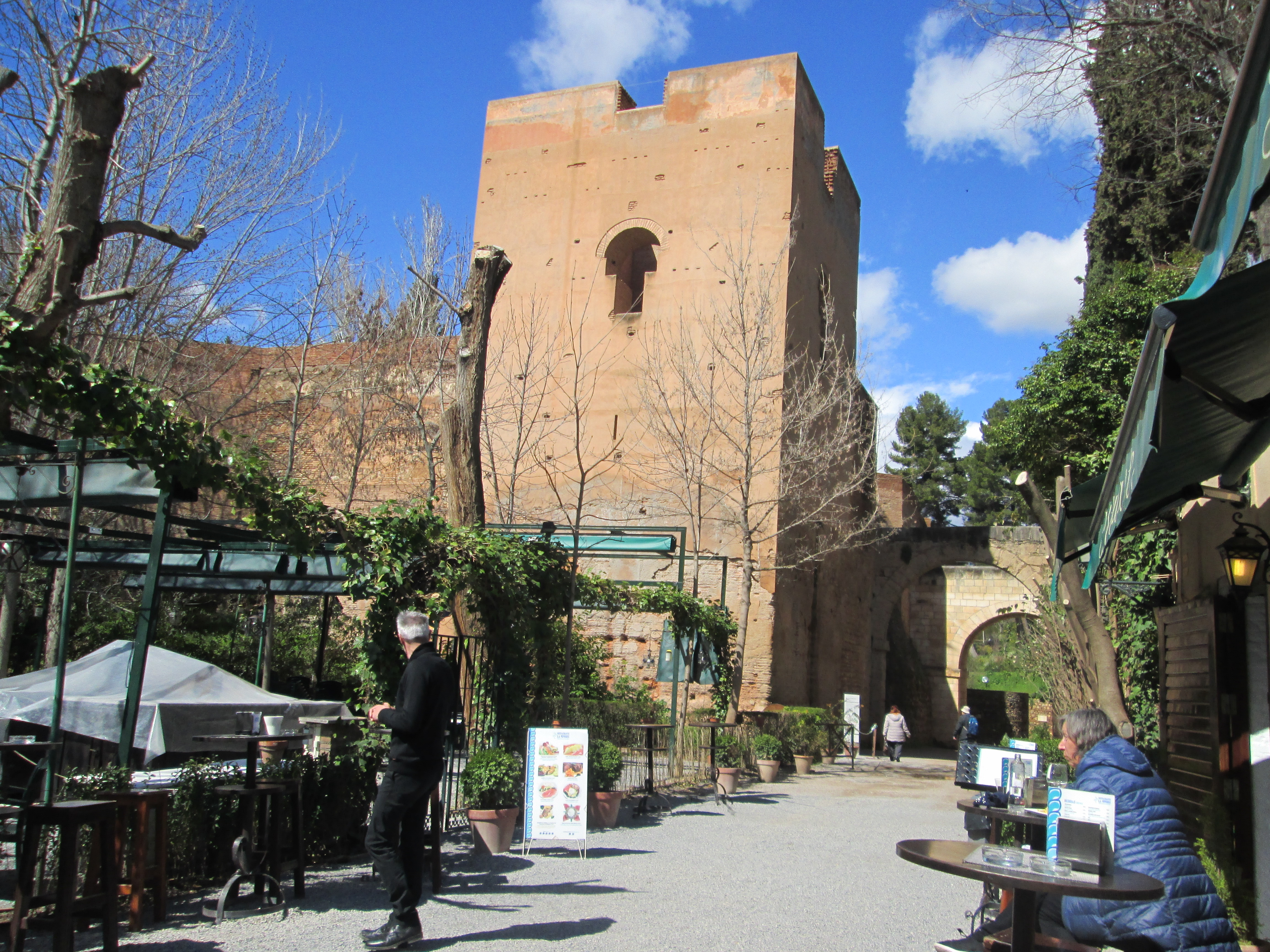
I entered through Puerta de la Justicia under its Moorish horseshoe arch. From the ramparts there’s a great view over Granada framed by the Sierra Nevada. When the Moor last looked out from here, the Alhambra was entirely a construct of the Islamic culture of northern Africa. Within a couple of decades a more European style spread. The Palace of Carlos V was built by order of the Emperor in 1527 in the Renaissance style. The entrance patio is a startling homage to Classicism, with its two story colonnade forming an entrancing circle. 

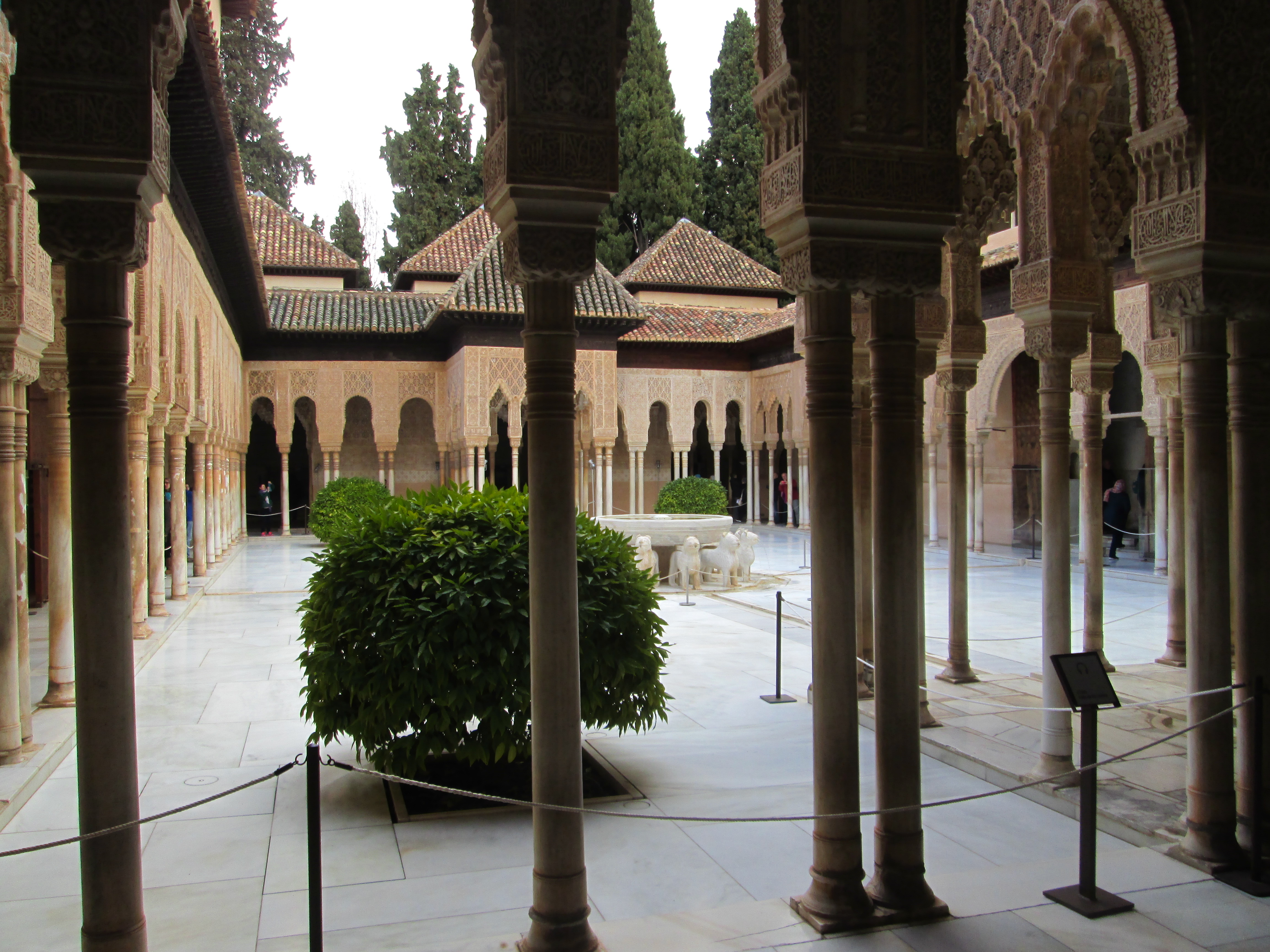
The Nazaries is the showpiece of the Alhambra, a magnificent palace for the Kings. A separate ticket is required for visitors, and well worth it. Guide books caution to come prepared for the heat, but my visit coincided wih a severe cold snap. Four degrees and falling I was frozen blue in the long entrance queue. The Nazaries unfolds on entering, a stone flower opening into more spaces than anticipated from the outside. There are three palaces within the complex. First, the public area dealing with justice and administration. Then the Camares Palace which was the royal residence. Finally, the Palace of the Lions, where the harem was located. A magnificent centrepiece is the Court of the Lions with its sculptured lions forming a circle within delicately rendered cloisters. 

For a short break, I took a table in the tiny tearoom of the American Hotel. A Tuna Sandwich and two hot Americanos got me back to room temperature. A friend had recommended a visit to the terrace at the Parador Hotel but it was not a patio day and the interior had that lowrise furniture peculiar to hotels and inimicable to relaxation.

The Alcazaba is the fortress at the business end of the Alhambra, its towers giving majestic views over Granada. It is the oldest part of the complex, dating to the thirteenth century. From there, I made my way down towards the entrance through beautiful gardens. The first blooms were appearing but had not quite come to life. Across a ravine there’s a stiff climb to the Generalife, the Gardens of the Architect. These beautiful gardens surmounted by an elegant villa provided a retreat for the Royal Household from the travails of the Alhambra and give glorious views of the Alhambra.

On exit, I put into the first available bar. Below the walls there was shelter  and sufficient warmth from the sun to allow me enjoy a beer and tapas al fresco. Heading downhill past the northern walls alongside a rapid stream, I emerged onto the banks of the Darro river following it back towards Plaza Nueva in the city centre.

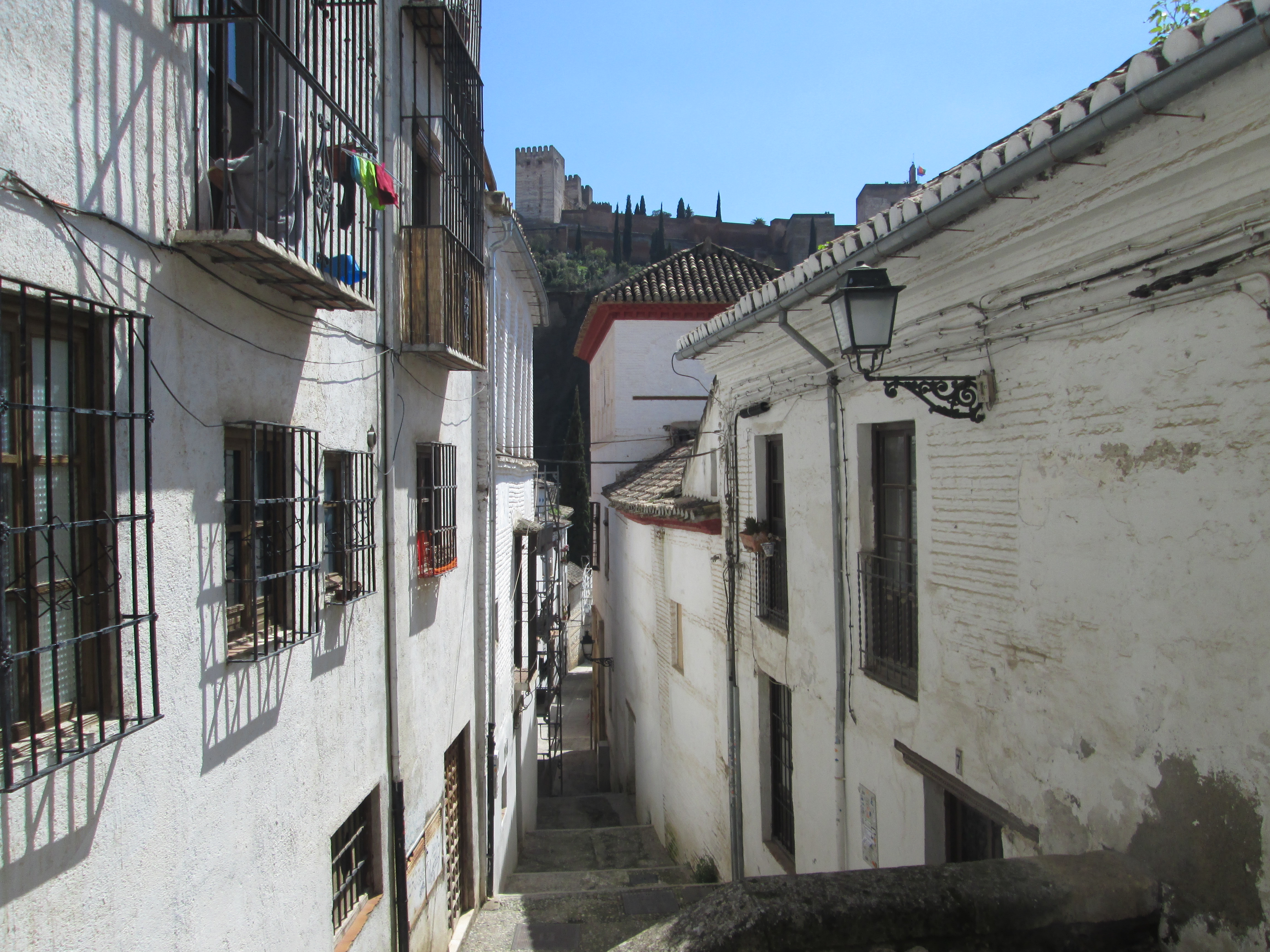
Overlooking the Darro is the Albaicin, dating back to the 13th century and rich in Moorish heritage. The streets meander past high walled villas with white washed walls, towering palms and pines. Quiet and weird; at times I felt I had strayed into a Dali painting. Stranger still, it darkened off to the west and a sudden storm came upon us. Snow fell in curtains across the backdrop of the Alhambra.

Plaza Nueva merges into the Plaza de Santa Ana and on into the modern city centre. I had planned on a flamenco evening in Sacromonte, but the weather closed off that particular avenue of pleasure. I did spend much of my second day in Sacromonte, a bleached enclave clinging to the steep hill at the edge of Grenada, This was originally home to the gypsy, or Gitanos population, and is rich in the heritage of guitar and Flamenco. There are tiny taverns and homespun museums, and a feeling of being remote from the big city. 

At night I’d spend some time in Hannigan’s Irish Bar, not far from the Cathedral of the Incarnation. Hannigan’s does not do the complementary tapas that are a feature of local establishments. It’s a wonderful custom, but there is a time to stop eating and sit in splendid isolation over a drink and contemplate the sound and stories that permeate the city. Hannigan’s seemed to share my fondness for the Red Hot Chili Peppers, whose music, to me, carries some echo of the spirit of the Andalusian guitar. 

Fly away on my zephyr

I feel it more than ever

And in this perfect weather

We’ll find a place together

from the 2002 album By the Way, a favourite of mine, and yes, I remember in Granada smiling at the mention of perfect weather; but in a strange way it was. In sunshine or snow, the magic of the Alhambra endures. The winding way to the citadel begins near the Fontana del Toro on the Plaza de Santa Ana. It is said that a drink from its waters has magical qualities. Drink once and you will return forever. I hope to, some day. Meanwhile, Christmas is around the corner and this is likely to be my last post for the year. Happy Christmas to yous all! 

Oh the weather outside is frightful

But the fire is so delightful

And since we’ve no place to go

Let it snow, let it snow, let it snow!

Granada After the Rain

It’s on my mind, these days, to walk again in Europe after the rain. There are places to go and others to revisit. Granada in Andalusia, in southeastern Spain, is one that is calling me back. When I go back to Granada I will have a night in the white city of Sacromonte and listen to the strumming of Flamenco guitars. Last time I was there, it was a silver springtime, the Sierra Madre spiked with snow. It was cold, very beautiful, but not very conducive to flamenco nights. I explored the Alhambra and roamed through the various sectors of the city of Granada, high and low. There were even times where I could bask in the midday sun, with a drink and, as is the custom, a tapas; free, gratis and for nothing. The scattered sunshine was well seasoned with showers. Afterwards, the city gleamed anew.

Here comes the rain again
Falling on my head like a memory
Falling on my head like a new emotion

Annie Lennox and Dave Stewart, of Scottish band Eurythmics, wrote this song in 1983 as rain swept over Manhatten. It captures the melancholy and optimism that crackle in a rainy street. I might be singing, softly, in the rain.

I want to walk in the open wind
I want to talk like lovers do
I want to dive into your ocean
Is it raining with you

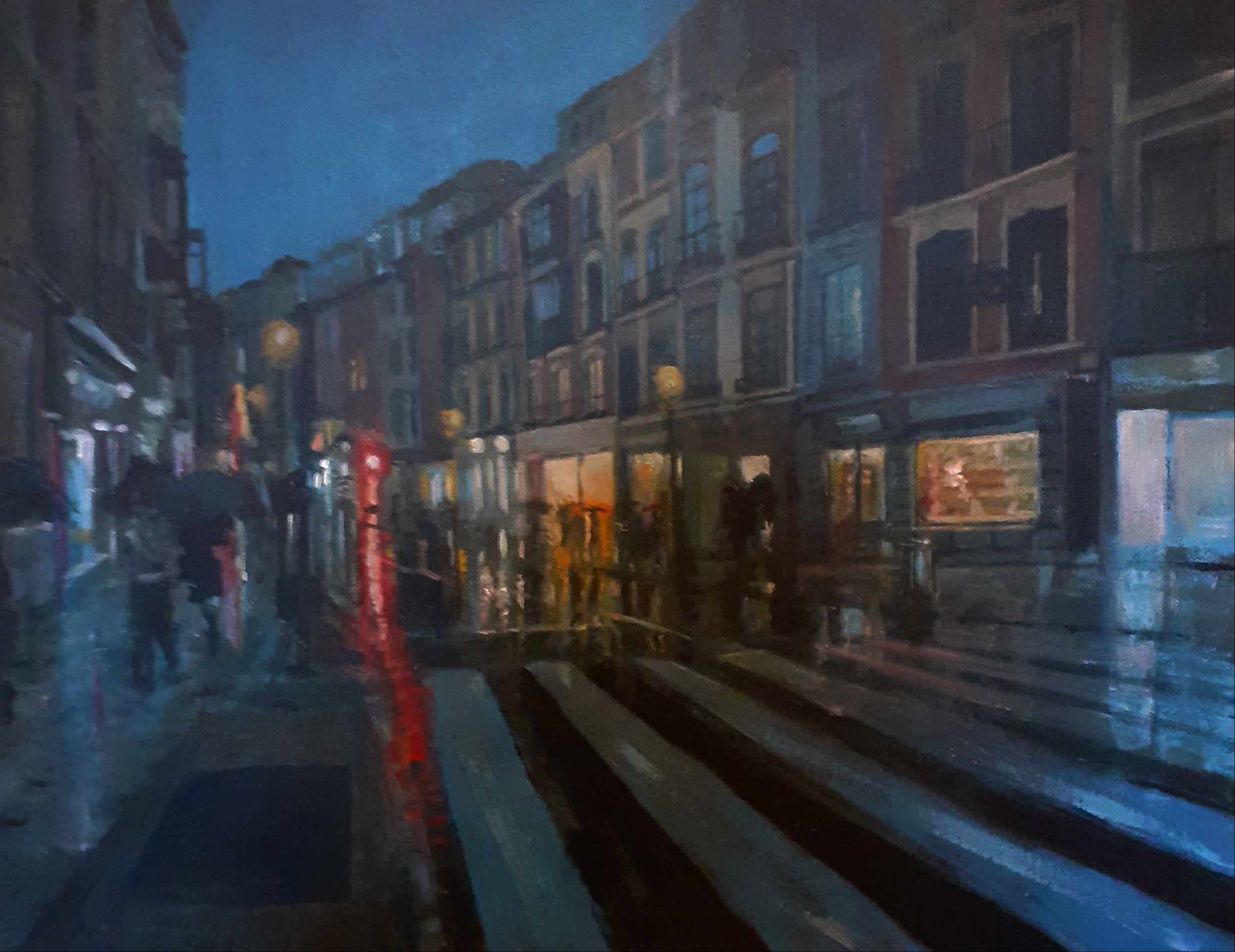
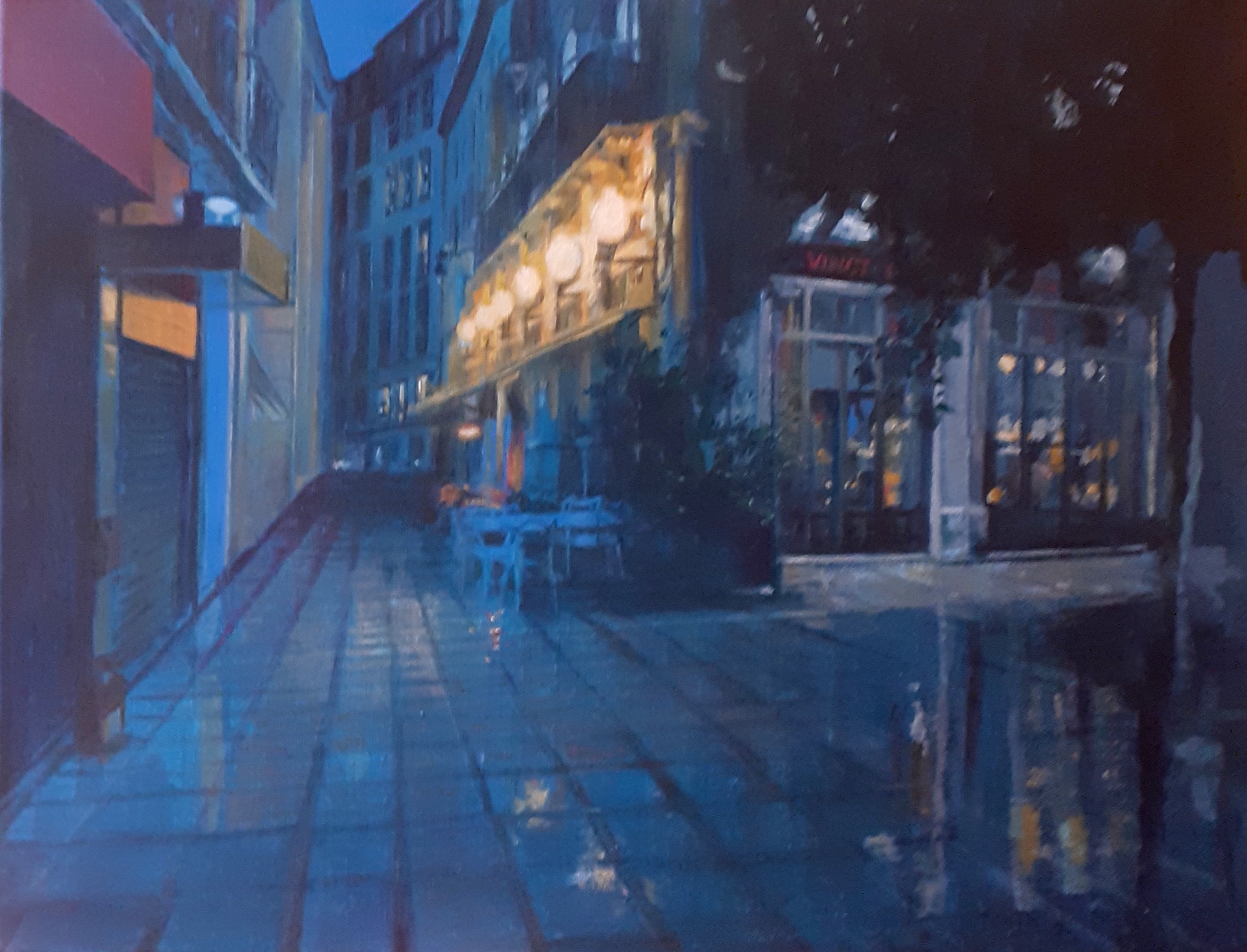
In this painting, I am crossing a small city square after a nighttime stroll, and a few stops to shelter for refreshment. The hour has grown late and I am making my way back to my hotel. I know the way ahead through the backstreets. There are places I might stop, such as Hannigan’s Irish Bar, or save for another day.

You might notice a nod here to Vincent Van Gogh’s Cafe Terrace at Night. I have it at home in a set of tablemats. Not the original. This is more lonely, the streets washed clean by the rain. But I sometimes think that the reflections beneath my feet, on nights such as these, are persistent echoes of the city tunneling back through time. Who knows, maybe I will get a more Mediterranean night to sink into this city, if ever I go back again.

The official anthem of Granada will be ninety years old next year. It was actually written by Mexican composer Agustin Lara. Jose Carreras fair belts it out in the original Spanish. There are English versions by Frank Sinatra, Frankie Laine and Catarina Valente.

When the day is done and the sun starts to set in Granada
I envy the blush of the snow clad Sierra Nevada
For soon it will welcome the stars
While a thousand guitars play a soft Habanera

Snowy Night in Granada

I heard your voice through a photograph

I thought it up it brought up the past

I am in the high city of Granada as Easter blooms and snow falls. The white teeth of the Sierra Nevada gash the underbelly of a dark blue sky. I had planned on a Flamenco evening up in Sacromonte, on an outdoor terrace in the tiled roofscape, looking across a valley of cypress trees to the glowing Alhambra. But rising into the night I meet the snow flakes descending and the brittle beauty is achingly cold. 

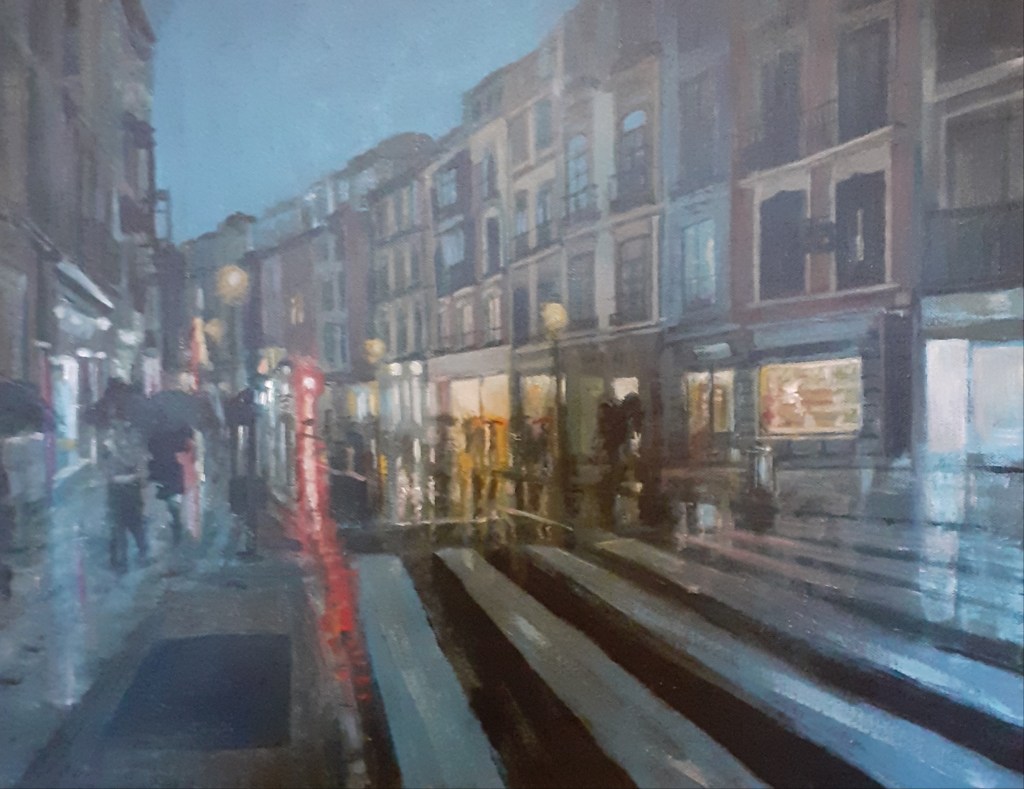
I am alone in the city of the guitar as the snow turns to sleet and commuters and revellers do that dance of the umbrellas city people do so well. At the zebra crossing a charge pulses the wet streets and I see this is still the city of the guitar. The zebra pattern turns to strings on a fretboard and rises like a magic carpet into the night connecting to all the cities at night where music throbs and guitarists strum.

I am walking home up Main Street at closing time, I am crossing Republic Square in Belgrade on a secret assignation, I am hearing whispered tales from the top of Grafton Street, I am crossing a rainy street in Soho with M and Davin, flashing tickets for Marcus Bonfanti to the man at the door of Ronnie Scott’s. 

Here I am, on Calle Reyes Catolicos. I am bound for Hannigan’s Irish Bar, where drink flows in the quiet of the night, with a mix tape of all the songs rattling around my head, and a good sprinkling of the Red Hot Chilli Peppers to keep the cold at bay. 

How long, how long will I slide

Separate my side

I don’t, I don’t believe it’s bad

Slit my throat, it’s all I ever …

The song is Otherside, by the Red Hot Chilli Peppers, from their album released in 1999, Californication.

The City at Night

Belgrade

A blog I follow, Danventuretravels, posed the question of what characterises a visit to a city. Well, it goes without saying that you should at least leave the port area, whether ship or plane. And purchase something to consume at a public place, coffee, beer or snack. 

A young man I know, who shall be nameless, took a Mediterranean cruise with some stunning city visits: Rome, Barcelona, Athens etcetera. Asking for a report I got the view from the deck as the port hove into view, the weather and the distant skyline. It turned out that Mark (oops) hadn’t managed to get ashore so beguiling was life on board ship.

For most, though, the advantage and disadvantage of cruises are: you see the sights, but you don’t get the full deal. I have written pieces on cities from such daytrips. Talinn, Helsinki and Stockholm are a few. I saw enough to want to return and sample the nightlife of Talinn and Helsinki. I wouldn’t hurry back to surly Stockholm, though it is an impressive regal city. I would think that you need to see the city at night to get the full picture.

Most paintings I do of places I have been are night time scenes. I do daytime paintings too, and I do go out during the day; I am not a vampire. It does strike me though, that the city comes into its own at night.

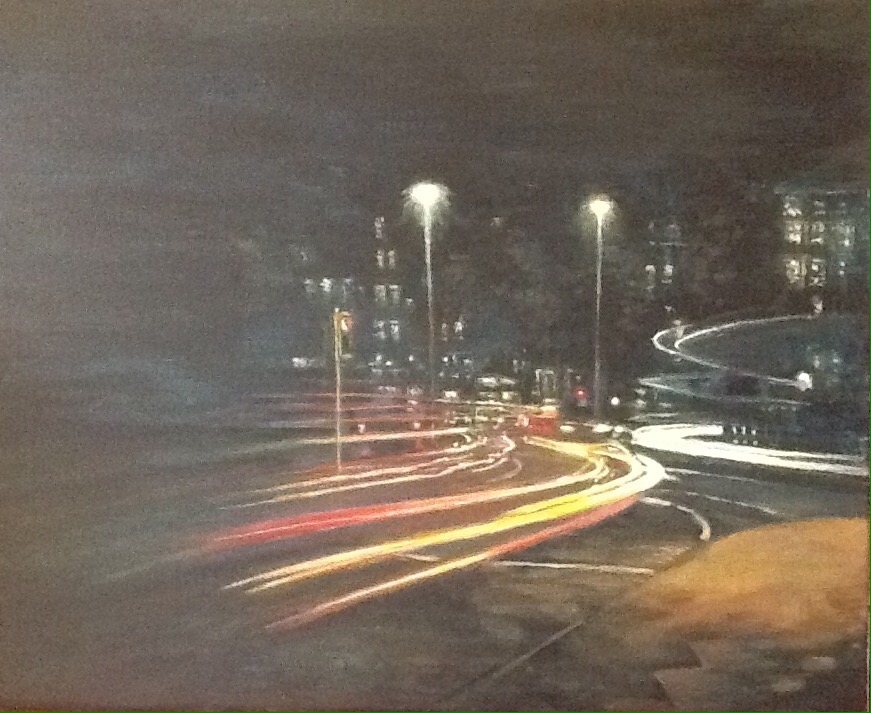
This scene suggested itself at the start of our great isolation. It called to mind many things urban and attractive, and even a little bit alienating. The umbrellas recalled Renoir’s Les Parapluies. Bunking off school, I’d take a 50something bus across Dublin’s slate sea to the city centre, hiding out at the movies or in Dublin’s Municipal Gallery, now the Hugh Lane. My favourites there were Harry Clarke’s Geneva Window and Renoir’s painting. The painting is specific to its time and place, it manages also to be universally evocative. Those shades of blue and grey, the dappling effect of rain and greenery, the pale complexioned lady and her russet hair, could be captured in a park in Dublin in the rain. The Window breathed with the life and fire of the city at night.

The focus of city centre, swirling lights and traffic, hurrying pedestrians, the language of traffic lights and zebra crossings are of modern times. They are everywhere. I posted a painting of Dublin’s equivalent nexus, College Green last year.

Col Grn

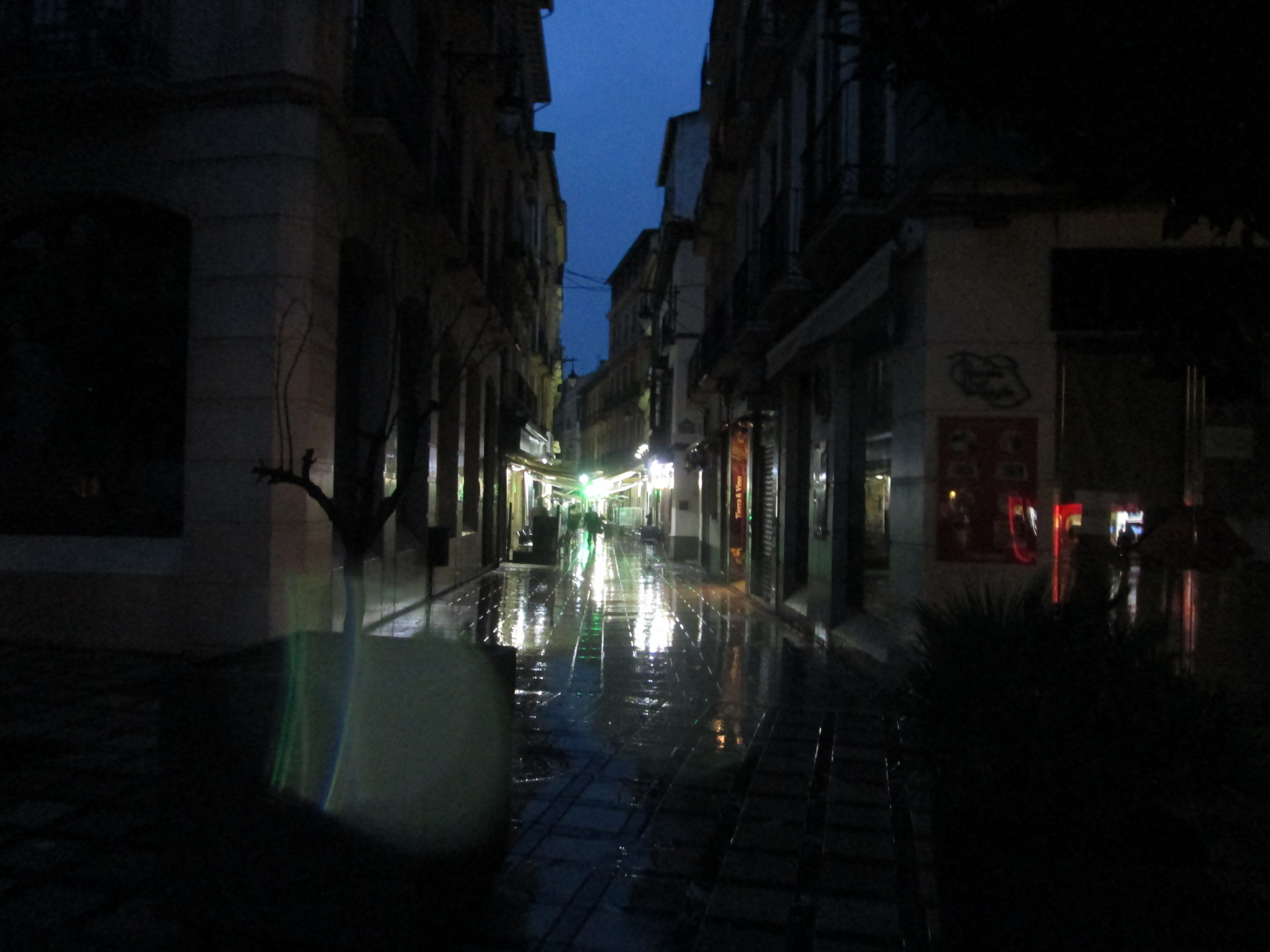
I’m also reminded of a visit to Granada in the rain and snow. Although the Alhambra and Sacromonte are indelible memories, an abiding image of the city came from its streetscapes at night in the rain. I wandered amongst those endless reflections that plunge from the sky to pass through the pavements, no longer solid but a membrane between different worlds. 

What do they do down there? They do much the same as us. Travelling through the city at night. But with a different perspective. The lights have their language, the stained glass sings and silent movies play across gabled ends. 

Jim Morrison sang, more or less, on LA Woman:

Are you a lucky little lady 

in The City of Lights?

Or just another lost angel

in the city at night, City of Night.

Like many drivers, for me the city and the road are often refracted through the music of the Doors. I can think of myself as a fellow traveller. The first time I went overseas was with my parents to Paris in 1971. Going home from Le Bourget my eyes fell across a newspaper in the departure lounge. Front page news of the death of Jim Morrison in the city early that morning. He was twenty seven. I was fifteen. And I was getting out alive.

Whatever memories the photo provoked, however, this particular city was anonymous. Not just in the sense that the city offers perfect anonymity, all the more so at night. But this was a scene I did not know, could not place the photograph. I had never been. Neither I, nor anyone within my ken. All the more reason then, to plunge in and make this the model for my city at night.

As I painted, songs filtered in and out. I wanted to convey that sense of movement and impermanence. That everything is nothing but light. I could be driving through the city at night, or being driven; a passenger without a destination. Iggy Pop wrote the Passenger under the influence of a poem by Jim Morrison, amongst other things. 

Get into the car

we’ll be the passenger

we’ll ride through the city tonight

we’ll see the city’s ripped back sides

we’ll see the bright and hollow sky

we’ll see the stars that shine so bright

the stars made for us tonight

Okay, for peace of mind then, the city lies on the banks of the Danube but is downstream of Budapest. Its name translates as the White City. We call it Belgrade, once capital of Yugoslavia, now capital of Serbia. This is Republic Square, the National Theatre on the right, the National Museum facing us.Will I ever go there? Perhaps someday, when I visit Europe, after the rain.


Granada – Sacromonte 2


Darro2

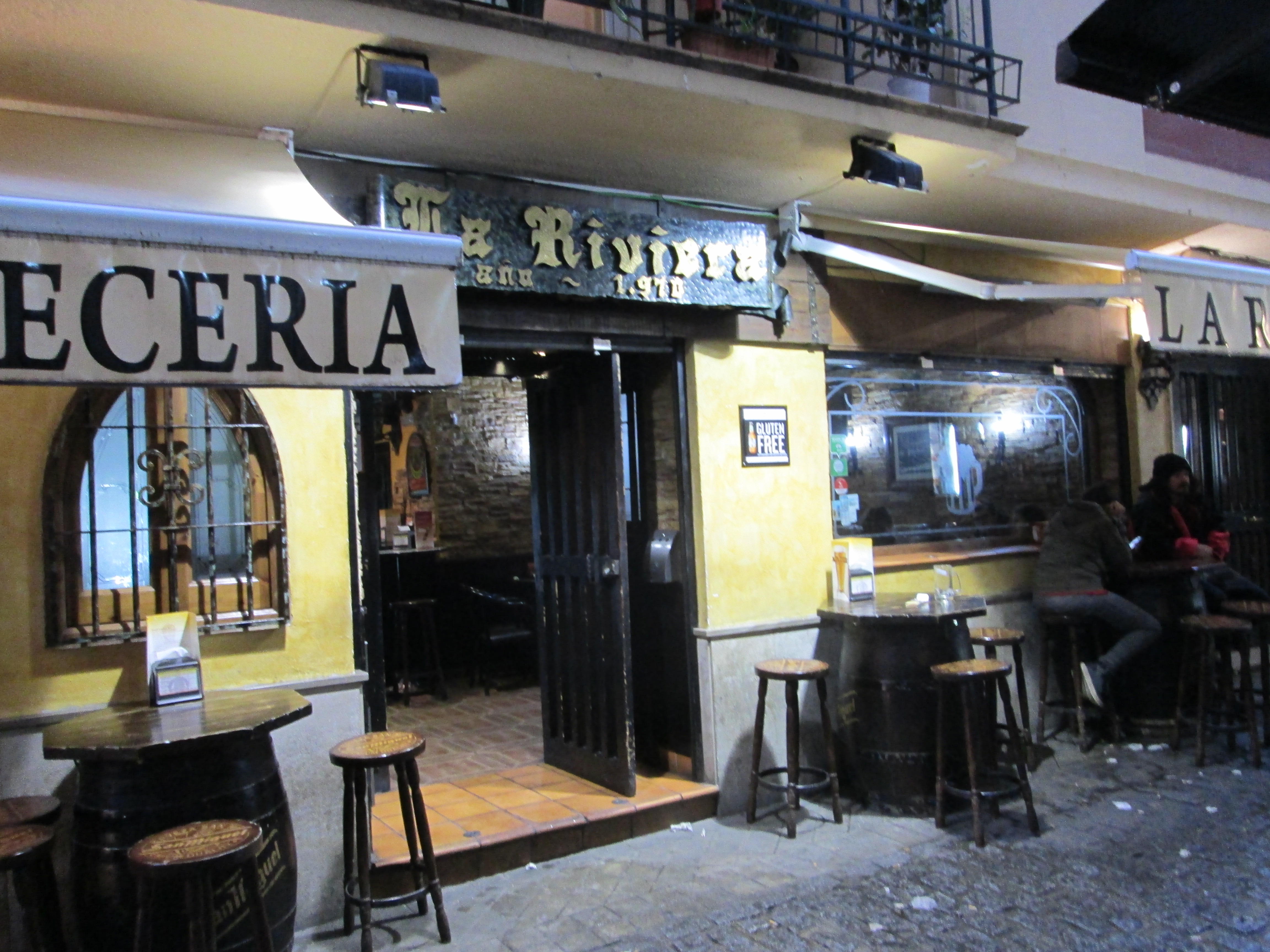
Floating back down to Granada, down to the Darro River, the sky hardens, then turns brittle in the waning light, and falls whitely on the city. I seek sanctuary from the cold. Bar La Riviera is hidden down an alley east of the Gran Via, not far from the Cathedral of the Incarnation. It is crowded at the bar and I feel I am in a normal pub. The man serving, according to house custom, asks which complementary tapas I want. Distracted, I say no gracias. A terrible hush falls over the bar, easing into some scornful laughter and pointing. The mystified barman evaporates, while I try to make myself invisible at the corner of the counter.

La Riviera

I get into a conversation with an English woman, well travelled and canny enough to have lost her husband in a nearby hotel. She wonders if I, as a Catholic – me being Irish and all – can explain the local cult of the Virgin. I wonder don’t they have virgins in England, but address the question all the same. I was at a Holy Week parade in Malaga, part of the crowd sucked in by its hypnotic magnetism. The solemn thump of the music leads us on step by step as the Brotherhood carry their towering floats, or tronos, from the port through the city centre to the Plaza before Teatro Cervantes. One tronos is of the Christ and the other, typically more exuberant, is of the Virgin. In part it brought me back to distant days as a child participating in the May Day procession, one of a multitude of child brides and grooms carrying the colours of the Virgin, the blue and white matching the brisk sky and streaming blossoms of Spring. The plain streets of Walkinstown sang and all roads led to the red brick monolith of Our Lady of the Assumption, all in the glass bubble of a perfect day. 

Oh Mary we crown you with blossoms so gay

Queen of the Angels and Queen of the May

IMG_3380

Holy Week, Malaga.

But this Andalusian devotion is a stronger manifestation of the spiritual flame; adult and profoundly solemn, yet infusing everyone with a communal joy.  If we didn’t have this, we would need to invent it. Caught in the austerity of a Free State, we might have sacrificed something in the public manifestation of shared spirituality. Passion is also a tender flame. 

The Teatro Cervantes recalls another ancient, or early modern devotion. Cervantes is well commemorated throughout Andalusia. In Granada a barrio to the south of the city centre is named for him. His writing pervades the entire Spanish consciousness. As with Shakespeare and English, he is central to Spanish.

IMG_3373

Teatro Cervantes, Malaga

Miguel de Cervantes Saavedra was born in 1547 near Madrid, where he died in 1616. But he had a peripatetic life, his boyhood spent wandering Spain with his family, the father Rodrigo being a barber surgeon.Exiled from Castile, in his early twenties he travelled to Italy where he absorbed the art of the Italian Renaissance.

In 1570 he enlisted as a soldier in the Spanish Navy and served at the Battle of Lepanto, where the Holy League inflicted defeat on the Ottoman empire. Returning to Spain, he was captured by pirates when bound for Barcelona and spent five years as a slave in Algiers from 1875. Back in Spain, he worked as an accountant and tax collector to support his writing. A bankruptcy in Andalusia saw him wind up in jail in Seville for a few months. He put the imprisonment to good use. It was there that he conceived of Don Quixote-which was published in 1605.

Don Quixote is regarded as the first novel in the modern sense, and has become, after the Bible, the most translated book in the world. Its influence is immense and global. The human character is carved from the words, Don Quixote, hopeless and heroic against the backdrop of hostile reality. Meanwhile his long suffering squire, Sancho Panza, can speckle the red soil with spitfulls of caustic wit. It seems so modern because humanity is so permanent. Cervantes embodied his own maxim, that the pen is the language of the soul

Granitelite

Granada by night.

Meanwhile, our musicians and writers have not been so remembered in Irish street names. Though in Walkinstown, where I grew up, some fame is secured for the creative heart. In the Melodies estate, with nineteen streets named for musicians and composers, one street there is named for Michael Balfe, whose fame owes something to Cervantes. Michael William Balfe (1808-1870) was born in Dublin, son of a violinist and dancing master. When his father died he took his precocious musical talent to London. Deciding to pursue the career of an opera singer he travelled to Italy for tuition between 1825 and 1835. He returned to London and quickly achieved success as a composer. In 1843 he wrote The Bohemian Girl based on a Cervantes story, La Gitanella, from Novellas Ejemplares, the Exemplary Novels. 

La Gitanella tells of a fifteen year old gypsy girl, Preciosa, who captures the heart of a nobleman, Don Juan, but to marry her he must spend two years as a gypsy. The story examines the nature of stereotypes, truth and lies. The twist in the tale is that Preciosa had been kidnapped by the gypsies as a child. Balfe’s version, with libretto by Alfred Bunn, is rather more melodramatic. It was hugely successful and is by far his best known work, in particular the Aria I dreamt I dwelt in Marble Halls. Here Arlene, the gypsy girl of the title, recalls her almost forgotten earlier life.

I dreamt I dwelt in marble halls

With vassals and serfs at my side

And of all who assembled within those walls

That I was the hope and the pride

And I hunger and thirst enough, for company and sustenance, that I call another. The barman fixes me with a steely eye, daring me. I order skewered pork, as though it were so familiar that I had almost forgotten. I was rewarded in minutes, the steaming tapas carried aloft through the bar, the whole pig on a forest of spikes on a golden field of french fries. They don’t do things by halves. 

Hannigans

It is only a short sashay to the Irish Bar in the City of Grenada, where I plan to have a digestif. Hannigan’s Irish Bar is remote from the complementary tapas that are de rigueur everywhere else. Here I can sit in splendid isolation, and contemplate the sound and stories that permeate the city. In truth, there is a very good music mix, so that sometimes it seems to follow the song that has just occurred in my head.

Rain Alley

Wending my way home to Plaza de los Campos, the snow has turned to rain. The streets glisten. Assassins shimmer in the alleyways, hats aslant and opal eyed. They drift like vapour through the nightlife crowds, settle in silence in darkened doorways, watching, waiting for their time to arrive. 

Your elegy, Grenada

is spoken by the stars

which from the heavens

perforate your black heart.

 (Federico Garcia Lorca)

Granada – Sacromonte 1

AL 13 Nazgdn

A place of dreams, where the Lord put the seed of music in my soul.

(Andres Segovia)

Granada is a name so rhythmic it positively strums. Strung beneath the glistening peaks of the high Sierra Nevada, it has long balanced on the fulcrum of Europe and Africa. Here, the stones are alive, the streets and spires straddle the Medieval and the Renaissance, the Gypsy tangos and strums, the poetic knight tilts at shapeshifting windmills.

The fabulous castle overlooking it all, the Alhambra, dates from the Moslem kingdoms of the high Middle Ages. At the start of the Early Modern, the Reconquista returned the city to the Catholic faith. Before, during and after all those upheavals, Granada has been the focal point of travellers who have left their dust of cultural diversity in the stones, in the air, in the rivers of the town.Little wonder that the guitar is said to have been born here.

The weeping of the guitar begins, 

The goblets of dawn are smashed,

Useless to silence it.

(Federico Garcia Lorca)

Plaza

Plaza Nueva is my base camp. It merges into the Plaza de Santa Ana. A step beyond the modern city centre, it distends with eerie vagueness into the cramped ravine of the Darro River. The winding way to the Alhambra begins near the Fontana del Toro. A drink from its waters has magical qualities. Drink once and you will return forever. I have had my day there, in the soft redness of the Alhambra, that lasted forever and never and within my formation. This day I will walk along the clefs and staves and the surging river, carried forward note by note to the Sacred Mountain.

Darro1

Climbing up from the Darro River, through the bleached alleyways of Alcaibin, the houses melt into an ancient silence. The winding streets flirt with Surrealism, the hush of desertion somehow expectant. I sense the outskirts of paranoia, cross diagonally a deserted square beneath an abandoned church, pause enigmatically with a smouldering Gitanes to notice a slice of the Alhambra between the shuttered Moorish villas. At last the route regains its connection with all other routes. Footfall swells, the whine of mopeds rises and a car is glimpsed. The road meets a t junction, where I turn steeply upwards by way of Cuesta del Chapiz. 

AL 22 Alca

At the apex of a punishing climb, the road veers right at a taverna, El Rincon del Chapiz. A gnarled tree and an eccentric statue preside over the small terrace. Here, the city of Grenada abruptly ends, and morphs into an ancient hilltop village, houses scattered like pearls on the steep hillside. Across the Darro ravine, the Alhambra and Generalife shimmer in the afternoon haze, while ahead the distant Sierra are snowcapped beneath the virgin blue sky. I choose to be lost in this view: red gold palaces set in viridian, purple mountains with their sharp white summits, the blue sphere of the relentless sky. 

El Chapiz

The transition from urban to bucolic is a volte face of all the dialogue transacted this day in the city. The history, the fabric, the setting still run, but parallel, their projections and perspectives distorted. The Sierra Nevada hem the horizon which seems close enough to touch. If you sense a breath descend it may be from the Puerto del Suspiro del Moro where Granada’s last Moslem ruler, Mohammad XII, Boabdil, looked back in anguish at the Alhambra, exhaling that famous final sigh. This was the pinnacle of the Reconquista, in the year 1492, when the Catholic Monarchs, Ferdinand of Aragon and Isabella of Castile took Granada and the modern idea of Spain took shape. 

Sacroalham

Now I stand on Sacromonte, the sacred mountain. This was the haven of the Gypsy, when first they came to Granada in that same year, 1492. They hollowed caves from the soft rock, out here on the periphery. The culture that flowered fed the rivers of the new Spanish identity, a step beyond the rationalist identities of western Europe. And a stepping stone, also that year, to the American continents across the pond. These first rooted in our consciousness with the expedition of Christopher Columbus, an Italian in the service of the Catholic Monarchs. The popular conception of the world was limited. After Columbus, European isolation would fade. 

Sacro3

The term, Gitanos, is synonymous with Gypsy, derived from Egyptian. According to popular myth, they came from Egypt but are, in fact, Romany, an Indo-Aryan group from northwest India. Romany identity has persisted through half a millennium, with its bloodline and culture, but there is much disparity between their far flung settlements. In Andalusia, Gitanos are particularly immersed in local culture, to the point that they’re seen as embodying quintessential Spanish traditions, with Flamenco to the fore. Flamenco, the form of music and dance, derives from a synthesis of Moorish and Christian influences, Jewish folk music and dance, infused with the Oriental spice of the Gitanos. Itself an illustration of a particular social and emotional stance, from Flamenco springs those rhythms of sex and seduction, sorrow and grieving, suffusing the Latin world from Valparaiso to Valencia

Sacro2

In Andalusia there is little to be gained by dissecting its identity. It is more than the sum of its parts, a rare blossom that could only grow in this red soil, from such scattered seeds. Yet, here is a culture that is not perplexing, not a thing to be admired within a hard carapace. It has travelled well, it is well known. Here is something we all understand, whether or not we have done it yet. Here is something we know of the human condition. We are all Gypsies, spinning like dandelion seeds through the air. I have travelled, dipped a toe in different oceans, felt the heat of the desert, the swell of mountain and the cool air of forests. Through all of that runs the constant soundtrack of the music of Christian, Moslem, Gypsy and Jew.

I heard your voice through a photograph

I thought it up it brought up the past

Once you know you can never go back

I’ve got to take it on the otherside

Sacro1

So I sit on a wall in sunshine cold, amidst glare of white houses and sauntering travellers and do nothing. Inside I’m spinning slowly, breathing every song I’ve ever heard. I feel I should do something, enter a museum, buy a souvenir, take out my sketch book and submerge in the quirky scenery. I think of other things, returning to that bold truth, that here was first fashioned the guitar. 

Antonio de Torres (1817-1892) was a carpenter by trade. In his twenties he came to work in  Granada where he learned the craft of guitar building. He returned to set up shop in Seville and in 1850 began to develop the guitar which we recognise today. Torres’s guitar was symmetrical, larger and lighter than previous instruments. Their distinctive sound and greatly improved volume made de Torres’s guitar the standard from which modern guitars derive.

How long, how long will I slide

Separate my side

I don’t, I don’t believe it’s bad

Slit my throat, it’s all I ever …

(Otherside, Red Hot Chilli Peppers)

In its shape the guitar is a key to unlock the secrets of sound. More suggestive still, the guitar is personified as woman. My Graphics maestro at Rathmines College in the seventies was Martin Collins. One evening our class gathered before a still-life assembled by Martin: a guitar, a wine bottle, a bowl of fruit. As we set about our task, he hovered, waiting to pounce with advice. One unfortunate was having difficulty. Martin’s voice boomed through the hush: “A guitar is like a woman. You cradle her on your lap and stroke her.”

Sacromir

In the Art of Spain it is a signature motif.The paintings of Picasso and Juan Gris pay homage to those curves, sinuously evoking its music and mood. With grapes and fine wine, its shape settling in city and skin, with a knife, a fork, a bottle and a cork. From Andalusia to New York, Troubadours have trooped with guitar slung rakishly over shoulders.

 Lovers, fools, thieves and pretenders, and all you’ve got to do is surrender!

(The Waterboys)

, 

Andres Segovia, Hank Williams, Bo Diddley, Paco de Lucia, Bob Dylan, and Jimi Hendrix towering over the close of Woodstock, a beautiful ghost. The muse has manifested her reflection too: Gabriela Quintero, KT Tunstall, Patti Smith, Chrissie Hynde. Joan Osborne. In cherry red or ebony, sunburst finish or sultry blue, this is the emblem of our time.

Granada – The Alhambra

Al 18 Alview

When I was thirteen, I picked up the flamenco guitar and dreamt of Spain. The intricacies eluded me, but within my head the music sang loud and true. I was a better painter than musician, and here too a fantastical world formed, inspired by Salvador Dali’s visions, mindscape merging with landscape. Crowning this dreamworld was an ancient palace of a vanished kingdom: the Alhambra. Someday I would go there, blend with its mystery in the shimmering heat of southern Spain. Almost fifty years later it comes to pass.

It’s my second day in the high city of Granada. Man, it’s cold. I had intended taking the bus to the main entrance but wandered instead down winding alleys from Plaza De Campos to Plaza Nueva close to the high western edge of the Alhambra. Beyond Plaza Nueva the city of Granada begins to shimmer and fade, blending into the landscape and replaced by a chimera of imagination and folk memory centred on the Alhambra, red bastion rising on its green and rugged plinth.

Al 16 AlcaAlhambra signifies the Red Castle, from the blood toned colour of its stone. The Moors had built a fortress here in the ninth century but the existing complex dates to 1333 when Yusuf I, Sultan of Granada, established his royal palace. It was to be the last bastion of the Moor in Spain, In 1492 the Catholic Monarchs, Ferdinand and Isabella, completed the Reconquista when they defeated the Emirate of Granada. The two monarchs entered Granada clad symbolically as Moslems, promising friendship and tolerance of religion. It was short lived. The Moors rebelled in 1500 and the treaty lapsed. Moslem and Jew were required to convert or leave. The institution of the Spanish Inquisition was set up to police this law.

1492 was also the year when Italian explorer Christopher Columbus came here to receive the support of the Monarchs in his ambition to sail to the New World. This is when the Western World was born. An early history of Columbus was written by an Alhambra resident in the 1820s. Washington Irving, joker that he was, is responsible for perpetuating the myth that, pre Columbus, Europeans thought the earth was flat.

Al gate

The entrance is through the Puerta de las Granadas, or Pomegranates, which gives the city its name. Inside the grounds the Alhambra reveals itself, tantalisingly peeking above the trees. With the gathering pilgrims, I push uphill. A fountain sprouts. The Pillar of Charles V dates from 1554. The ubiquitous Carlos V was a mere Carlos I until his elevation to Holy Roman Emperor. He didn’t even speak Spanish, to begin with, but his subjects warmed to him as he learned.

Al 2 Irving

I rest on a bench. A quaintly dressed man stands nearby. He gestures to the glories spread above and wonders is it possible to capture the beauty and intensity of the place. I show him my camera and the shots I’ve taken, which he finds interesting, perplexing too. It’s words he means. How unworthy is my scribbling of the place, he says, and tells me of his Tales of the Alhambra, a history woven with imagined tales the walls must hold. What a great idea that is! Unfortunately the man must return to his home in America, but vows to come back to this most picturesque and beautiful city. I hope he does. I would wish to also, in warmer days. Again there is that faint shimmer in the air, and I find myself fading upwards along the path, past the statue of a writer I feel I must know.

Al 3.Jstgatejpg

I enter through Puerta de la Justicia, imposing russet tower with its distinctly Moorish horseshoe arch. The procession of pilgrims has melted away and I am left alone. From the ramparts, I see Granada tumble from the hillsides across the plain, the Sierra Nevada shining white across the horizon. When the Moor last looked out here, the Alhambra was entirely a construct springing from the Islamic culture of northern Africa. Within a couple of decades there was a notable intrusion of European style. The Palace of Carlos V was built by order of the Emperor in 1527 in the Renaissance style. Newly confidant Europe had rediscovered the glories of Greco-Roman antiquity and honed it into the distinctly modern style of the merging continent. The entrance patio is a startling homage to Classicism, with its two story colonnade holding us in its entrancing circle.

Al 6 CVpatio

The temperature has dropped and I have forty five minutes before my appointment at Nazaries. A sign for coffee and services is misleading. This leads to a modernist concrete shack, cold and crowded, with one scabby machine offering hot beverages. The instructions are less than helpful. Yes, it takes money and credit cards, but how much? None of mine, for sure. I buy water and Doritos off a nearby Gypsy. The queue for the Nazaries is long but not long enough and when I reach the head ten minutes early I must stand to the side. I’m frozen blue, four degrees and falling. Global warming my ass!

Al 7 Qnaz

The Nazaries unfolds on entering, a stone flower opening into more spaces than anticipated from the outside. Stone becomes fire and flickers to intricate tracery; water turns to glass and beckons to a perfect nether world. What paradise this must be in heat; water stone and plants working to scent and quieten the air. This cold emphasises its abandonment and defeat; its very existence a time capsule of a vanished age.

Al 10 Nazpool

There are three palaces within the complex. First, the public area dealing with justice and administration. Then the Camares Palace which was the royal residence. Finally, the Palace of the Lions, a harbinger of heaven where the harem was located. A magnificent centrepiece is the Court of the Lions with its sculptured lions forming a circle within magnificent, delicately rendered cloisters. There is an abiding sense of harmony between the ancient Islamic order and the newly flowering Christian Renaissance. You could float on this river forever and ever.

Al 11 Nazlion

Having exited inadvertently I slip back in. A female guard calls after me. However, she is hugging a heater in her sentry post, and indisposed to follow me. In truth, I’m prone to quitting. The absence of a decent cafe, or any place of warmth erodes my will. I come across the American Hotel and find a seat in its tiny tearoom. A sturdy Tuna Sandwich and two hot Americanos later and I’m suitably fortified. A friend had recommended a visit to the terrace at the Parador Hotel with splendid views of the Alhambra. But it’s not a patio day and the interior has that lowrise furniture peculiar to hotels and innimmicable to relaxation.

Al 15

The Alcazaba is the fortress at the business end of the Alhambra, its towers giving the most majestic views over Grenada. I find myself earwigging a conversation between a Gypsy and two Americans. The Gypsy gives a brief account of their origin, relating the reasonable alternatives. Origination was somewhere in the near east, or refugees from the margins of the crumbling Roman empire. Some say we came from Egypt to wander the margins of empire. If people asked from whence we came, the answer was Egypt, which half heard, sounds like Gypsy.

Al 14 CV

From here, I take the path that fades down towards the entrance through beautiful gardens. The first blooms are appearing but t’s not quite come to life just yet. Across a ravine and climbing the next hill takes us to the Generalife, the Gardens of the Architect. Beautiful gardens surmounted by an elegant villa provided a retreat for the Royal Household from the travails of the Alhambra. And provides glorious views of it too.

Al 20 Bar

On exit, I put into the first available bar. Below the walls of the western Alhambra, there is shelter and sufficient warmth from the sun to allow me bask outside with a beer and tapas. I walk back downhill past the northern walls alongside a rapid stream. I emerge onto the banks of the Darro river which heads back towards Plaza Nueva.

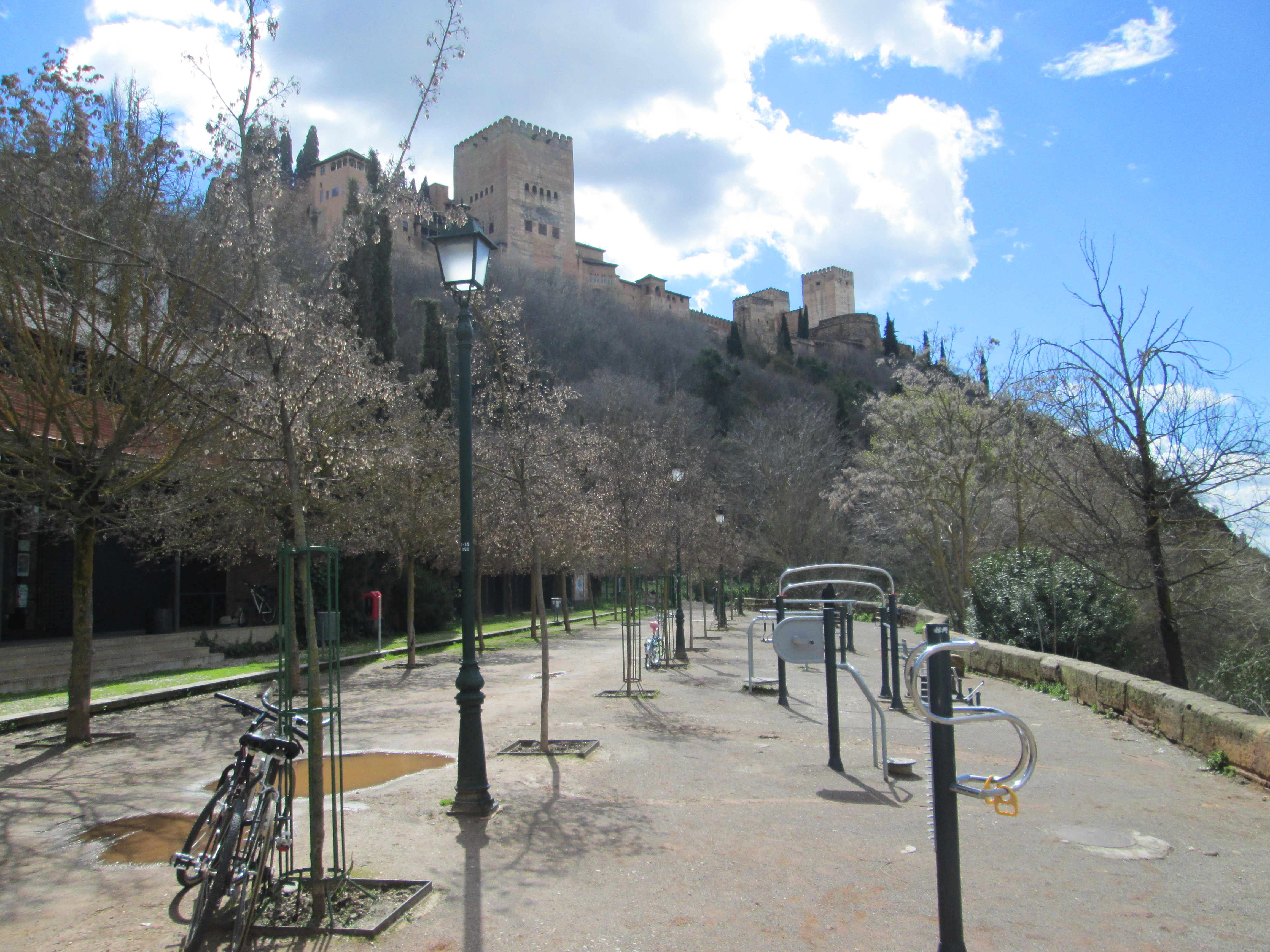
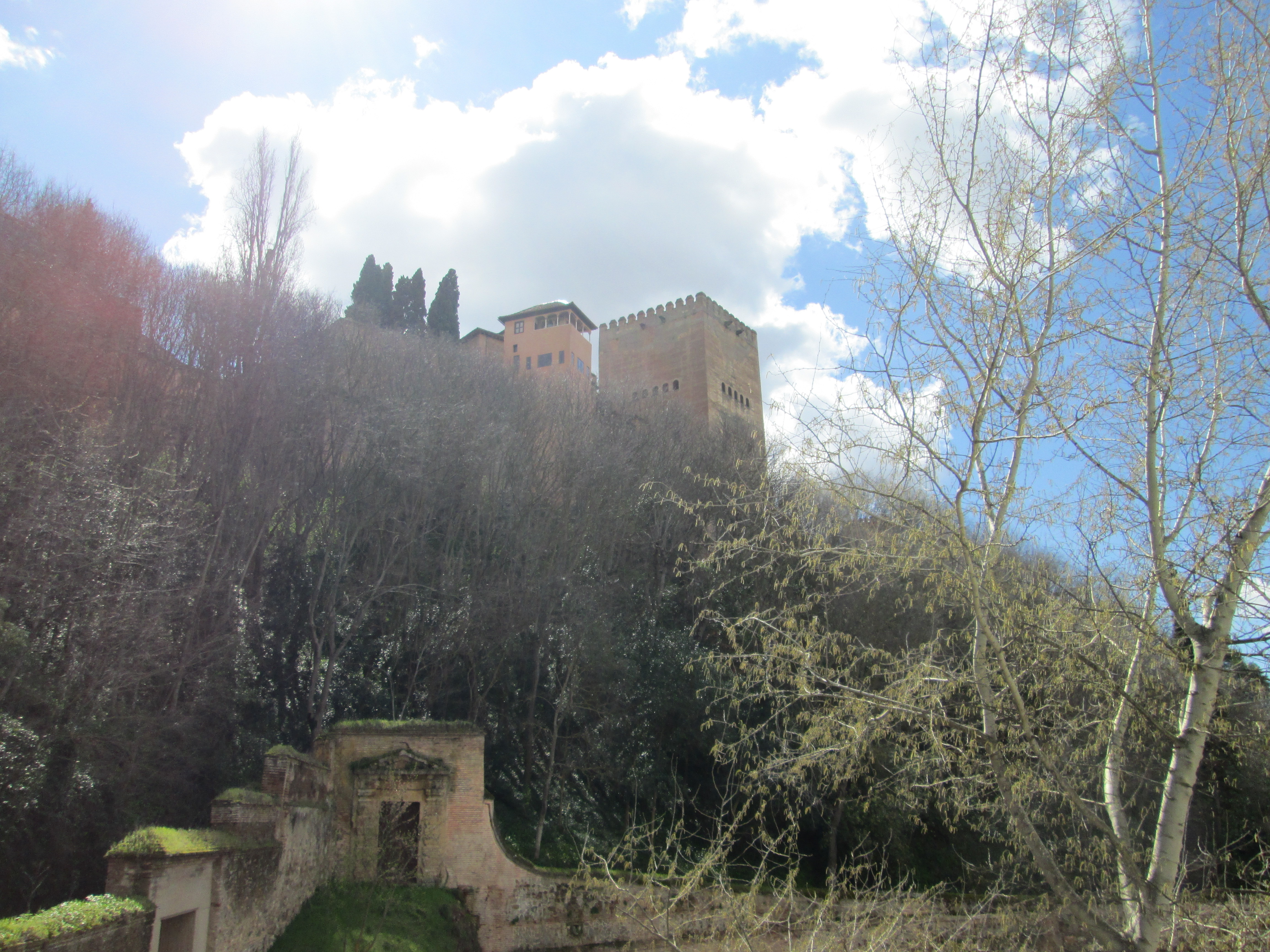
AL 22 AlcaThis area overlooking the Darro is the Albaicin, dating back to the 13th century and rich in Moorish heritage. The streets meander past high walled villas, dazzling white washed walls and towering palms and pines. Becoming impossibly narrow so you feel you must turn back, then widening unexpectedly into sparsely imposing squares. Quiet and weird; at times I feel I’ve strayed into a Dali scenario; Outskirts of the Paranoiac, perhaps.
AL 21

Stranger still, lounging by the riverside cafe terrace with another beer and tapas, soaking in the first true warmth of the day, the waiter hurries by, imploring us to retreat under the canopy. It had certainly darkened off to the west, and a smudge of rain was sensed. Then it came upon us. The sky scowled and snow fell in curtains across the backdrop of the Alhambra.

Al 20