Bray Main Street follows the line established by the old manorial village as it straggled uphill from the Dargle River crossing to the manor estate at Kilruddery. Kilruddery is the Anglo rendition of Cill Ridire, the Church of the Knight. The Knight in question was Walter de Riddlesford who, after the Norman invasion of 1169, was granted the estate on the northern slopes of Bray Head and Giltspur, or the Little Sugarloaf. The Brabazon family were owners of the estate by the by the mid 16th century, and Charles 1st granted William Brabazon the title Earl of Meath in 1627. By then the village was well established on the south bank of the Dargle just to the west of the bridge with a church, a small castle, and industries including brewing and a river fishery. At its southern end, the Main Street bifurcates with the eastern route heading for Kilruddery, continuing on to form the coastal road to Kilcoole and Newcastle. This is known as the Vevay Road while the western fork is known as Killarney Road, an Anglification of Cill Sarain, the Church of (Saint) Saran.
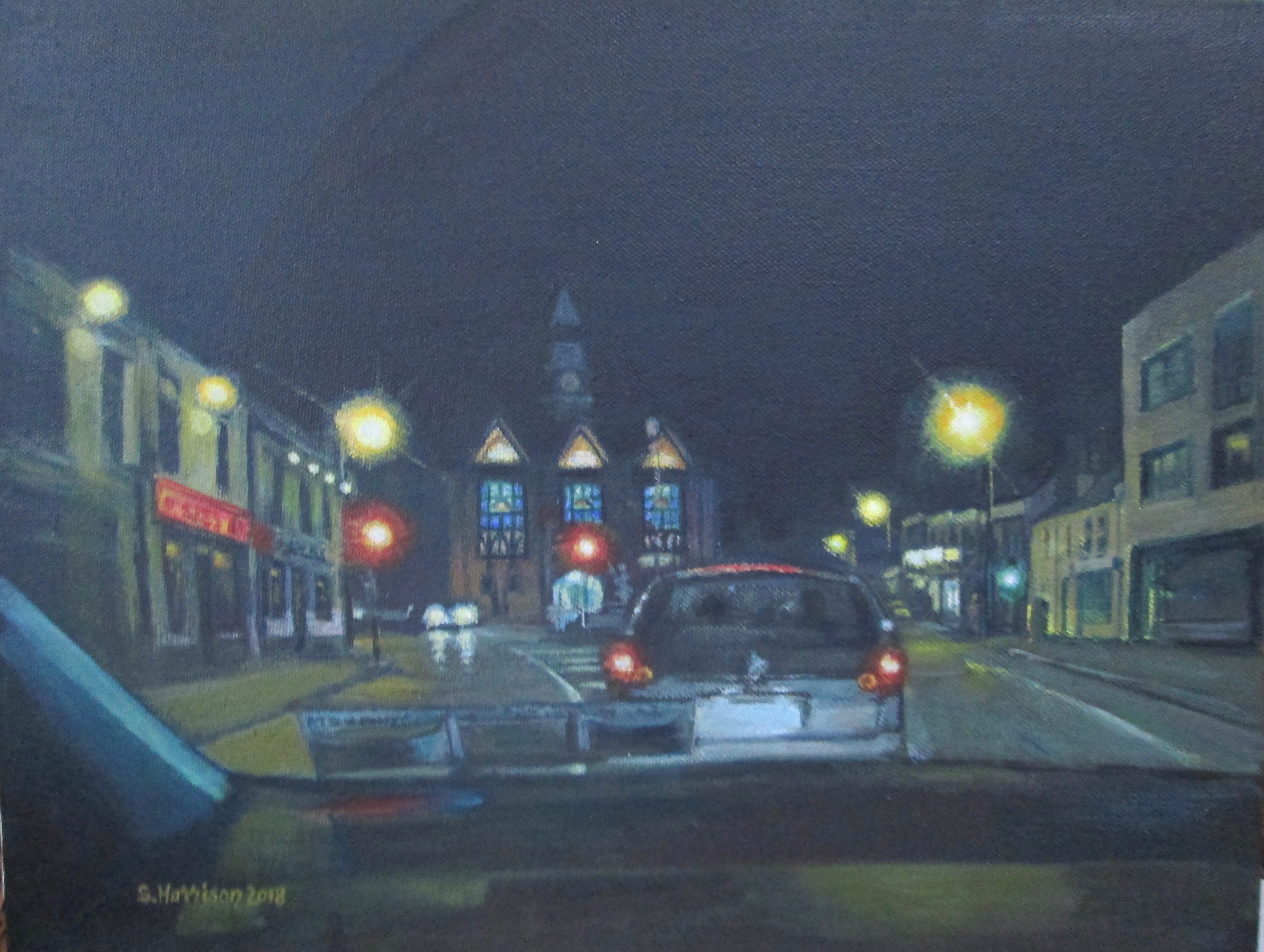
This view of Main Street is at this southern extreme, looking south towards Bray’s Old Town Hall. This ornate Victorian masterpiece from 1881 was built in the Tudor Revival style and originally incorporated a covered market and the Chamber of Bray Town Council. It was granted to the people by Lord Meath.
The statue with fountain guarding the entrance is of a Wyvern, a fearsome, mythical winged beast, resembling a dragon. A local yarn insists that Lord Meath, anxious that a statue be acceptable to all townsfolk, asked them to choose what they would most wish. Unfortunately, the townsfolk, divided equally along religious lines, Catholic and Protestant, were at odds on the issue. The Protestants wanted a statue of Queen Victoria while the Catholics insisted the statue should honour the Virgin Mary. Vexed at the impasse, Lord Meath, in a fit of pique, presented the locals the diabolical beast we see today. Amusing, though hardly true. Interdenominatonal relations were unusually good. Protestants had contributed generously to the construction of the Catholic Church of the Most Holy Redeemer, prominently positioned halfway up Main Street, earlier in the century.The Wyvern is prominent on the Brabazon coat of arms.
In the painting you can just discern the creature to the right of the entrance doorway. The old market was converted, after a long period of disuse, to a McDonalds Fast Food towards the end of the twentieth century.
The modern building on the right immediately predated the crash of 2008 and still wants for business tenants on its ground floor. It replaced a row of plain two story edge of town constructions including Lenehan’s pub which, fascinatingly, had paintings of mine on the wall. They were on a sporting theme; Gaelic Games and Horse Racing, believe it or not. It was the nearest pub to my house, just a mile to the south at Ripley Hills. Believe it or not, again. The honour for proximity now falls to Frank Duff’s, featured here on the left. Duff’s is fairly unique in being without television and has a fine, old style, conversational ethos. With a good pint and old school hospitality, it often appears as an eclectic pick on Ireland’s Best Pubs lists. More eclectic still is the theme: cycling. The pub commemorates the passage of the Tour de France through the town in 1998.
This painting is in acrylics and captures a moment around nine or ten at night. McDonald’s is open, and there’s a welcoming glow from the windows of Duff’s. This night I’m heading home, but I’ll be back out of another evening.
 xxharrison