Cloudburst on Florence Road

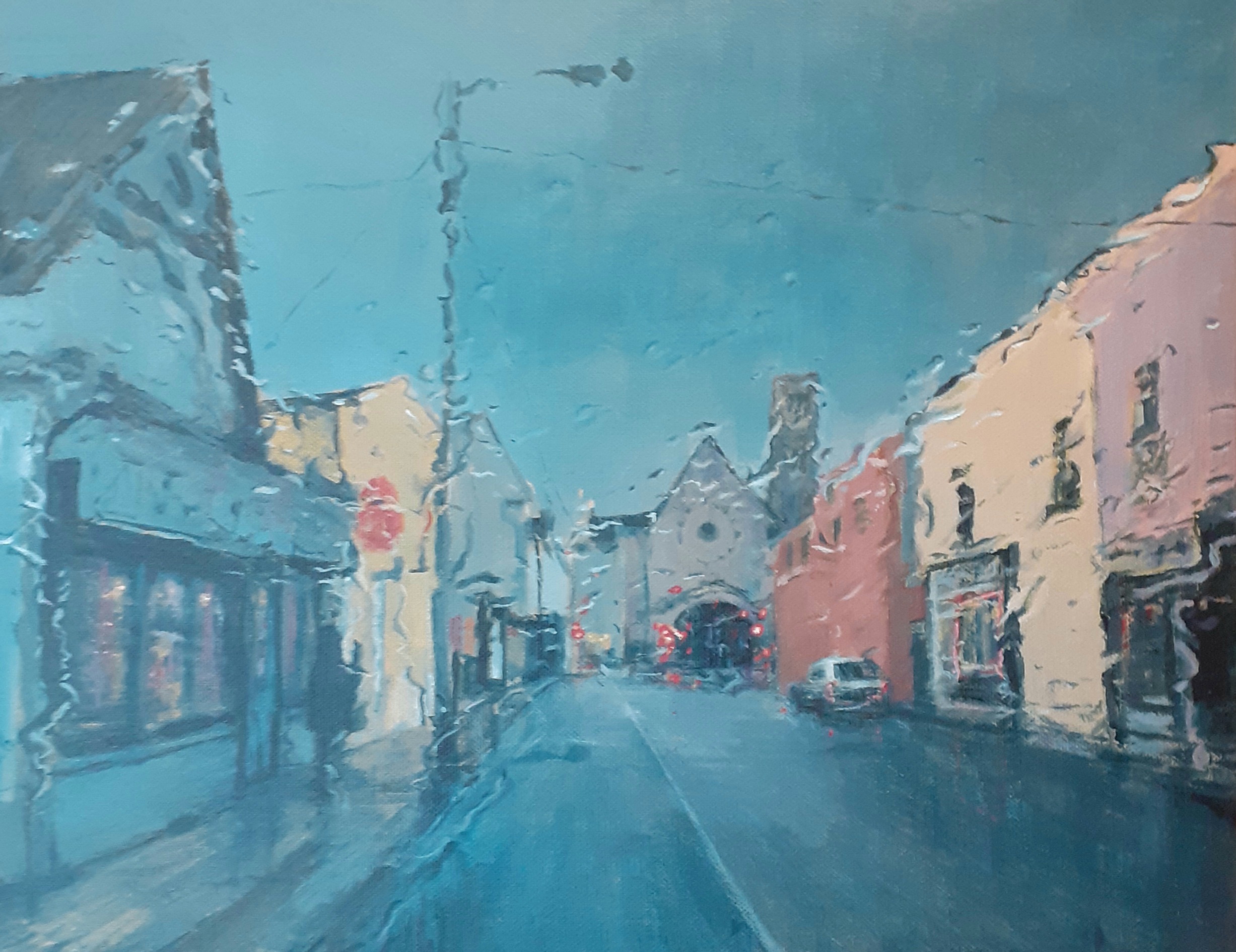
This has been a wet summer, even by Irish standards. It is a constant perspective here to view life through rain streaked glass; huddled in a cafe shopfront, looking out the kitchen window, scenery rushing through the windscreen of a car. I’ve painted Connemara driving through the rain and more recently, a sodden rush hour from the upstairs front seat of a bus on Amiens Street. The latter I took from a friend’s photo (thanks Paula Nolan!) but this one is all me own work. Taken through the windscreen of our car parked on Florence Road, Bray, looking up towards Main Street and the Church of the Most Holy Redeemer. We are dropping in to Florence Furniture and Antiques in the left foreground. A good antiques shop is a treasure chest of the past, and more. An alternative universe where it is possible to imagine each artefact a living thing, a receptacle for history and craft, and love, and much, much more; hopeful, awaiting its future in another setting. The stories they could tell. The building was previously an art shop, and a printworks before that.

Across the street is Hayes Butchers Shop, a long established family business and friendly with it. Stories and gossip are exchanged here in the old fashioned way. It’s where I get all the beef; if you catch my drift. The Church was established in 1843, funded by subscription including generous donations from Bray’s sizeable Protestant community. It was remodelled in the 1890s by WH Byrne who, around the same time, was supervising the reconstruction of Dublin City Markets on Sth Great George’s Street to the magnificent building we see today. The Holy Redeemer, however, looks very different now to the nineteenth century structure. The mid sixties saw the facade altered to a modernist gabled front with a new plain, soaring bell tower. Surprisingly, you will find the nineteenth century interior remains. The old within the new.

Bray’s Florence Road

Florence Rd

Alighting from the DART, the main route home, whether by bus, taxi or shank’s mare, leads up Florence Road. Past the delights of Albert Walk and Henry and Rose fish n chipper, the road is straight, mostly residential and lined with pollarded sycamores. There’s a manicured bowling green to the South and a grand Victorian terrace, Florence Terrace along the entire block to the North. Otherwise, the housing mostly consists of detached bungalows with an Arts and Crafts feel and distinctive orange tiled roofs. These date to the 1920s and also feature in other streets around the town centre. 

As with much of Bray there is a whiff of merry olde England, but not quite. It’s as if you turned your back for an instant and all the trees and undergrowth took a surreptitious step forward, encroaching on the serenity just that little bit too much. This alternative spooky ambience is emphasised by  a few fin de siecle detached Gothic houses. At the crossing with Wyndham Park, Florence House and Arno House from the late 1880s form an imposing gateway to the shaded sylvan area beyond. Further on is Bray Library, a granite Carnegie library from the early twentieth century. 

Crossing Eglinton Road, the rational straight lines of Dargan’s planning bend somewhat towards the lines of the original old manor town. The methodist church is to the left and beyond that the street dons its working clobber as it heads up to meet Main Street at the t-junction. The Church of the Most Holy Redeemer closes the vista spectacularly. In fact, Florence Road didn’t push through to the Main Street until 1903; a date commemorated on the gable of Bannon’s Jewellers.

This view, in acrylics, is from the eastern stretch of road approaching Wyndham Park, looking southwest. Florence Terrace is behind us. Ahead we see the silhouette of Arno House, built in 1889. It is late winter after work, tea time. The sun has just set in the West and the lights are fading on.