Andalusia – 8. Seville on Another Day

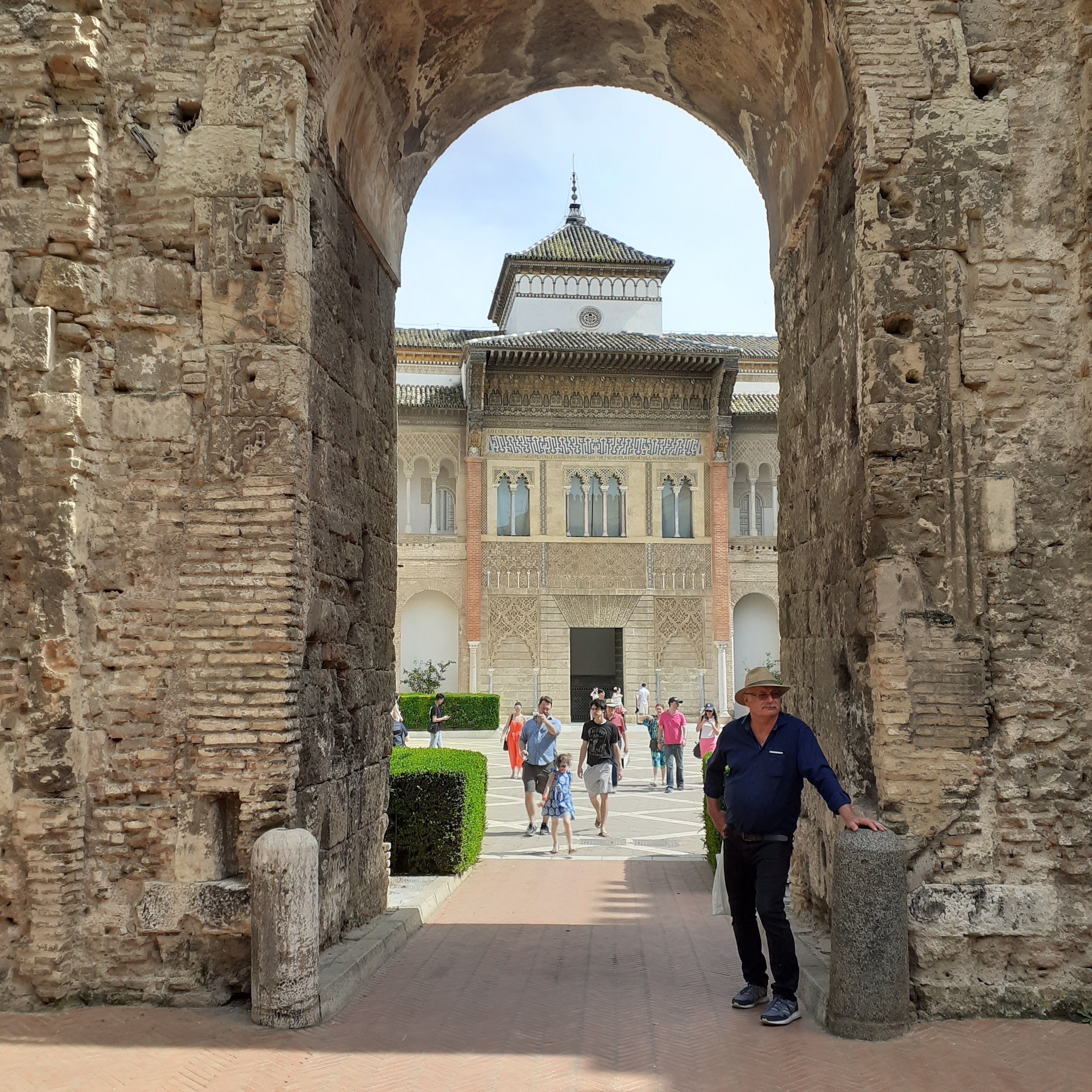
The Alcazar is Seville’s fortress and royal palace, established in Moorish times. The fort here dates to the early tenth century. The Moors ruled from the early eight century until 1248 when conquered by Ferdinand III of Castile. Significant reconstruction began and continued through the centuries. Although little of the original palace remains, the original style persists in the many ornate courtyards and the Mudejar architecture. Mudejar means those who remained, referring to Muslims in Spain after the Reconquista. It is a fusion of Christian and Islamic art and architecture, a heady mix of Gothic, early Renaissance and the flowing tracery and distinctive detail of Muslim crafts. After 1492, the Catholic Monarchs Ferdinand and Isabella renovated the palace as their main residence and it is still a royal residence today.

We queued in the morning for early afternoon tickets. Visits are restricted by number and entrance is on the hour. It costs thirteen euro, seven for over 65s. Entrance is through the Puerta del Leon (Gate of the Lion) which leads on to the Patio de la Monteria, the Courtyard of the Hunters who used to meet here before their hunts. The courtyard is dominated by Pedro’s Palace, which forms the focal point of the complex and includes the mighty Hall of the Ambassadors
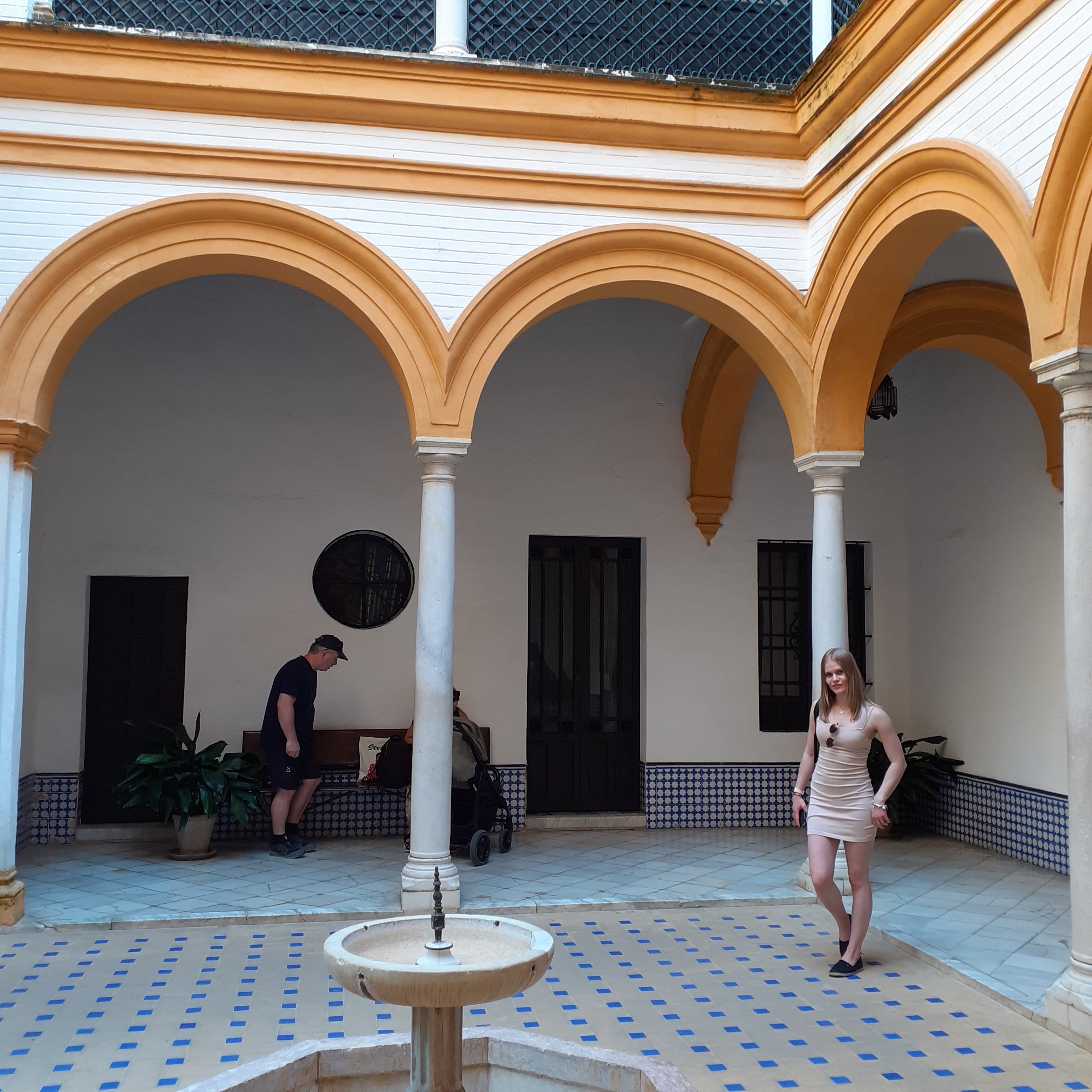
Don Pedro’s Palace was built in alliance with the Moorish kingdom of Granada in the 1360s Pedro’s ally, Muhammad V, was the Nasrid ruler of Granada and supplied designers and craft workers who had also worked on the Alhambra. The Patio of the Maidens is a particularly fine example of Mudejar architecture. Formal gardens with fountains and pools were a notable feature of Moorish palaces, with greenery and shining water cooling the sunbaked setting, literally and aeshetically. The Gardens are truly an earthly delight, lying between the palace and the city walls. The Grotto gallery gives a great view over the gardens built above a stretch of the Moorish defensive wall in the 16th century. There’s a Garden of the Dance, and a Garden of the Poets alluding to the various arts that settled amidst the shading landscape. Further gardens have been added up to the twentieth century.

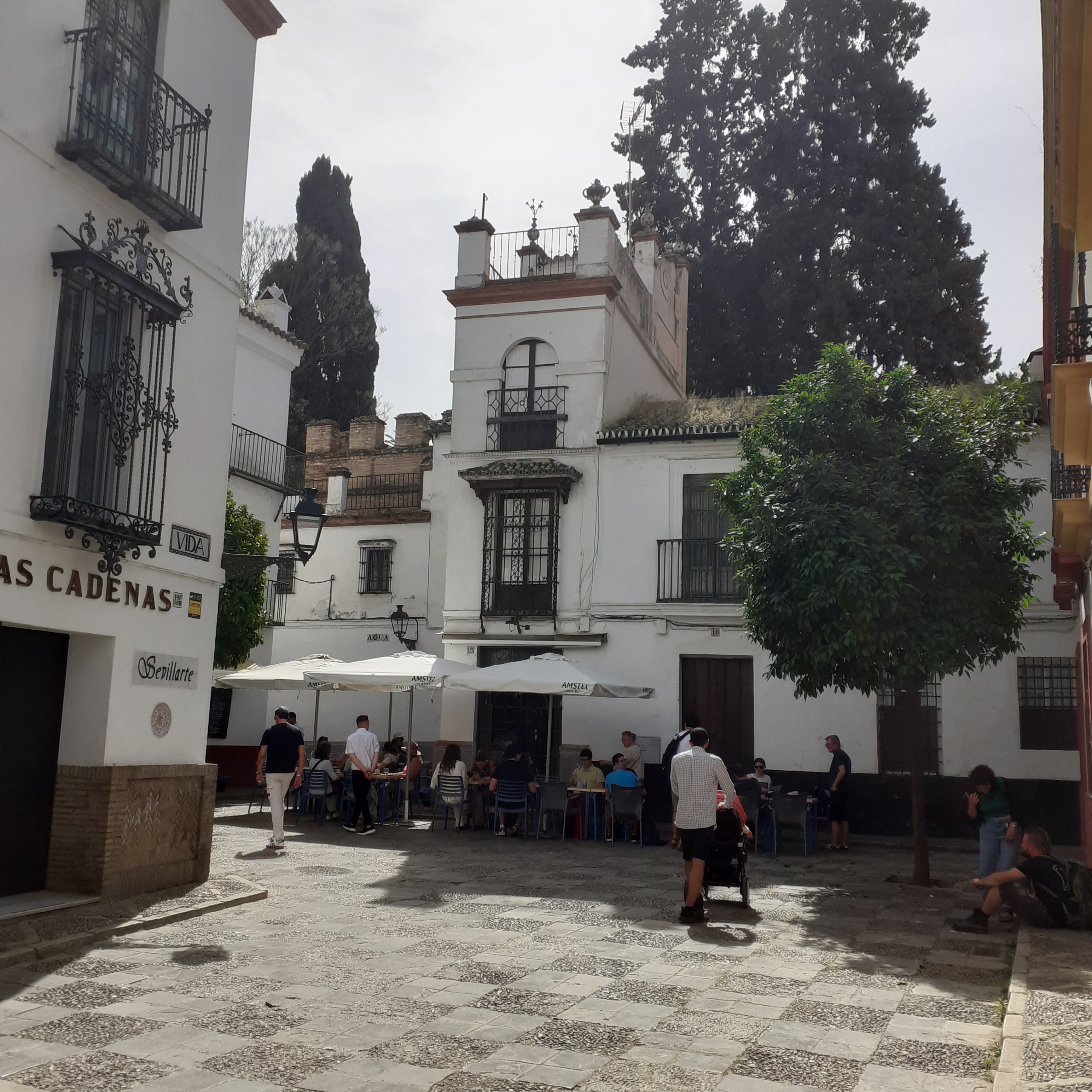
Leaving, we follow the palace walls through a charming ramble of ancient streets in this picturesque part of Santa Cruz. Sunburnt but softly rendered in pastels, there are welcoming intimate bars and cafes with the promise of music later on. The route leads on to the Murillo Gardens, named for the artist whose work is such a ubiquitous feature of Seville’s holy places. Bartolome Esteban Murillo was born in Seville in 1617 and became a leading painter of religious imagery. He is also well known for his informal paintings of contemporary street life, featuring a cast of flower girls, fruit sellers and street urchins. His paintings feature in major museums across the globe including the Prado, the Louvre, the Hermitage and the London National Portrait Gallery. He died in Seville in 1682
His park continues parallel to the Avenue Menendez Pelayo and there’s a monument for Columbus halfway along. Meanwhile the ornate carriages of La Feria’s finely clad aficionados trot past. We head for the Parque Maria Luisa, a huge green wedge of the city’s southside on the banks of the Guadalquivir. This was where the Ibero American Exposition of 1929 was held. The main pavillion at Plaza de Espana showcased Spain’s industry and technology. One of Seville’s signature buildings, it was designed by local architect Anibal Gonzales. Arranged in a semi-circle, it forms a fantastical montage of architectural styles facing onto a scenic moat. Here you can take a pleasure trip in a dinky rowing boat.
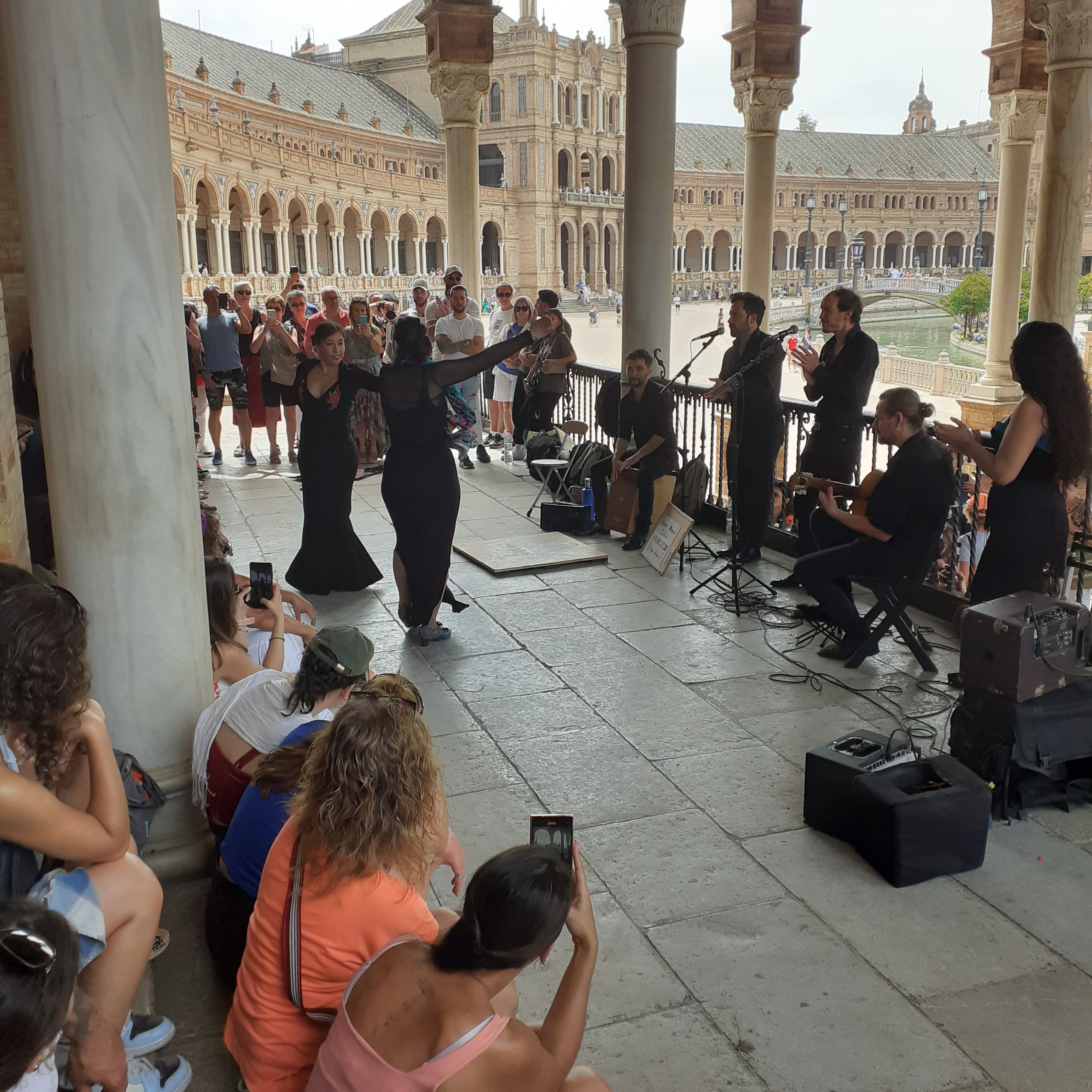
The arcades are packed with tourists, foreign and local, and a host of buskers and vendors. There’s a wedding party in full La Feria dress around the central fountain. In fact, the Exposition of 29 helped establish the traje de flamenco as a ‘traditional’ garb for the ladies of Spain. A young Flamenco group of musicians and dancers performs on the ground floor gallery at the main entrance. They are modern in style and substance, clad in uniform black, though this is a stylish mufti in the modern mode. The accousitcs are ideal for the percussive clapping and full bodied rhythm of the guitar

Returning through Arenal, we pass the famous Tobacco Factory. Seville was the first European centre for tobacco, the Spaniards spotting its benefits the moment Columbus stepped ashore in the Americas in 1492. The Royal Tobacco Factory is an 18th century building, bringing the various tobacco manufacturers under one roof, and one ruler. Since the 1950s the building has been the seat of the Rector of the University of Seville. Carmen, titular lead of Bizet’s opera, was a cigarrera here. Women were renowned for their skills as cigar rollers, and they replaced the male workforce in 1813. The fiery Carmen was a Gitano who lead the young soldier Don Jose astray, before dumping him for the dashing toreador Escamillo. The opera was first performed in Paris in 1875. Amongst its best known songs are L’amour est un oiseau rebelle, and the Toreador Song.
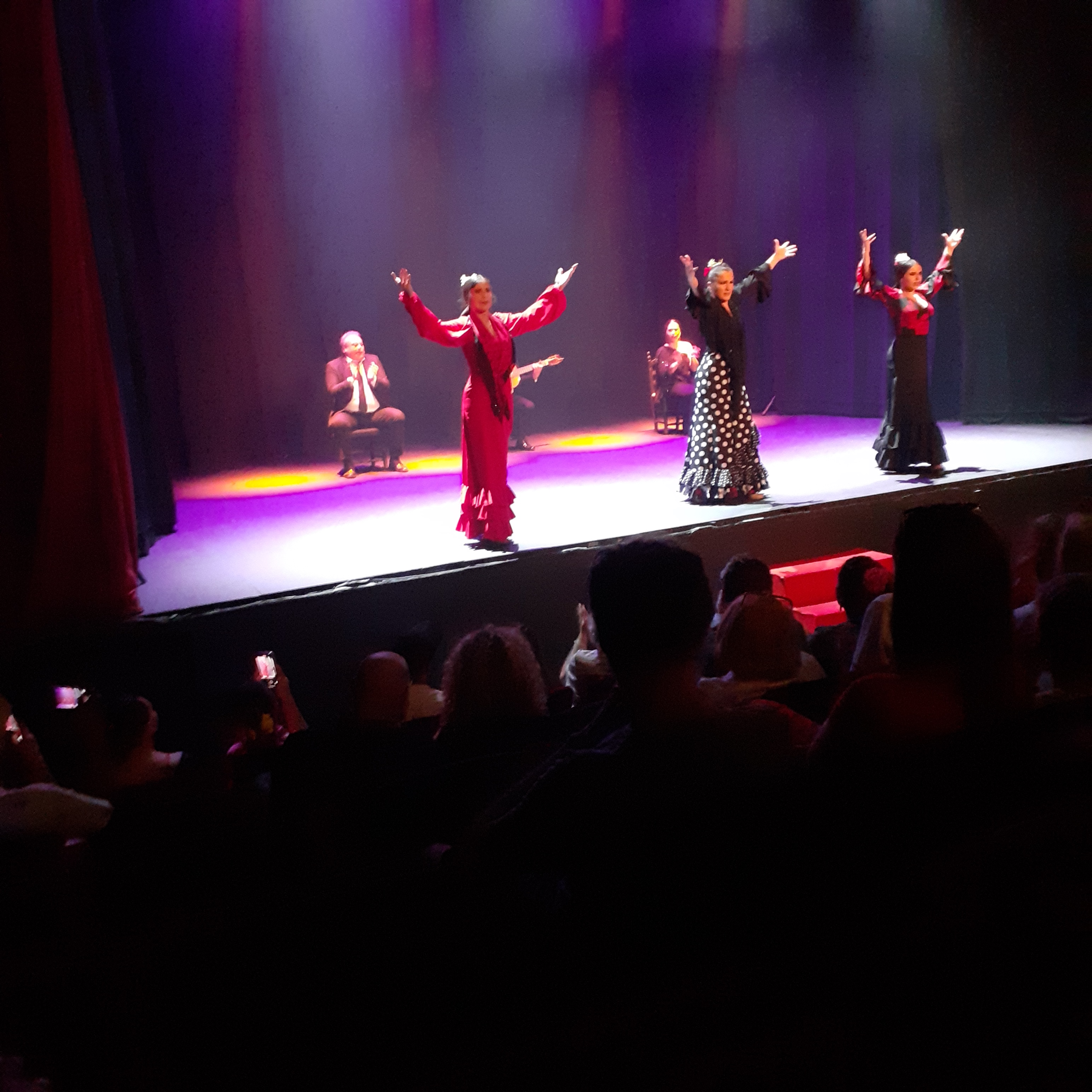
For early evening, we have booked a Flamenco show in Calle Cuna which runs parallel to Calle Sierpes close to Plaza Del Salvador. Teatro Flamenco Sevilla is an intimate theatre seating about three hundred people. They run several hour long shows daily. Flamenco grew out of the Gitano Barrio of Triana, on the west bank of the Guadalquivir. The folk form is internationally famous, a definitive Spanish culture. The singing is expressive, the guitar rhythms hypnotic, the interpretation of the dancers seductive, the whole making for a sensually charged and dramatic performance, felt as much as it is seen and heard. Traditionally, Flamenco was more of an ad hoc expression, similar to an impromptu Irish Folk session. The first flamenco cabaret bar was opened in Seville in 1842 and known as the Cafe Sin Nobre, No Name Cafe. These days Flamenco is more usually presented as a tablao, or show. Tablao refers to the stage floorboards. On the Boards, as Rory Gallagher would sing.
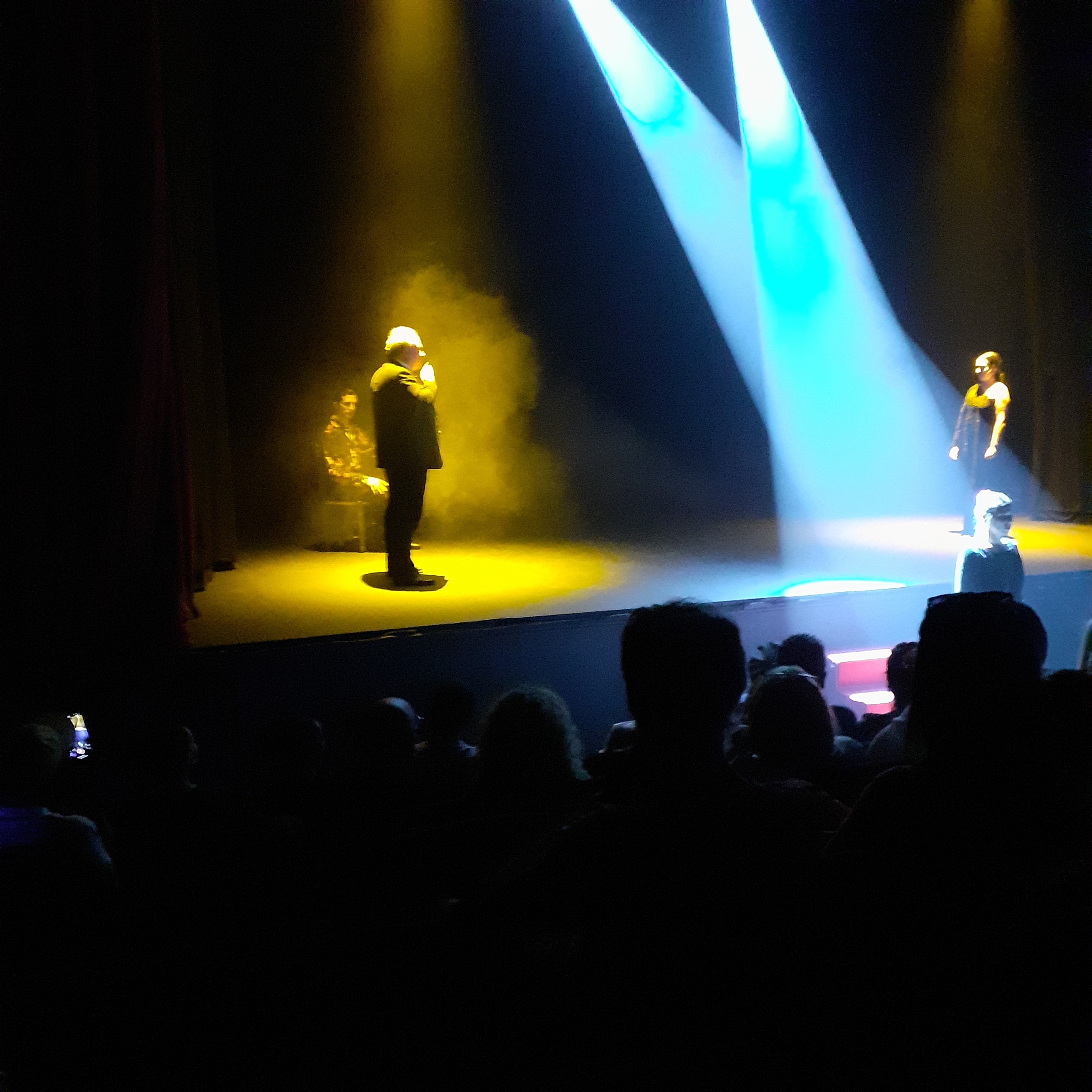
Our performance was at 7.30 and featured five dancers, one male, and a male and female vocalist. The guitarist was the natural leader of the troupe, although leading from the rear. The vocals were visceral. I couldn’t believe how their singing seemed to explode from inside my head. All performers contributed to the stacatto percussion, another startling feature of Flamenco. Talent, spectacle and a genuine passion permeated the performace. On the last few numbers, they and the audience got carried away, with plenty of high good humour, particularly the manic and brilliant guitarist. A great gig.
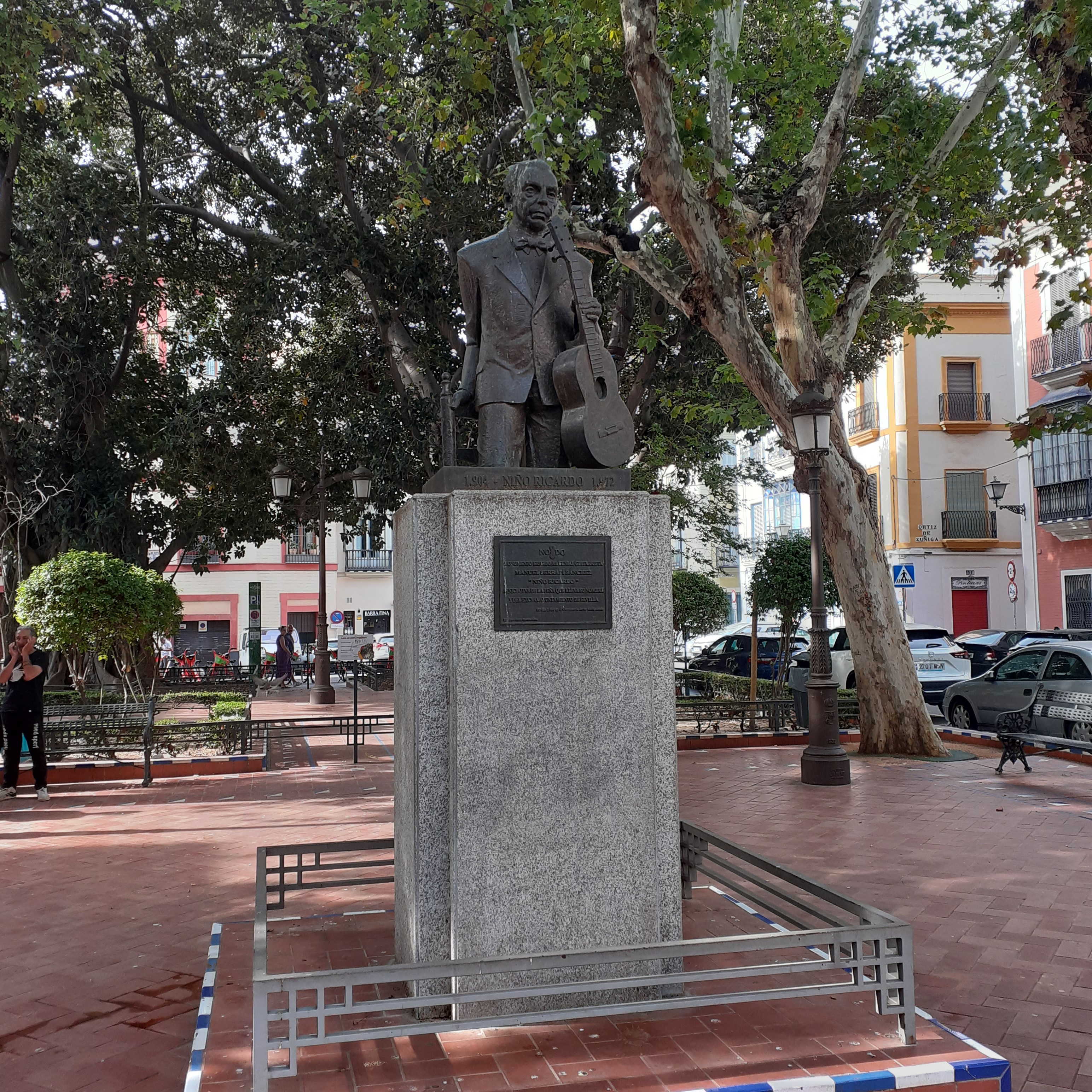
Afterwards we have a decent tapas at Plaza Alfalfa nearby. Around the corner from our hotel is the curiously named Plaza Cristo de Burgos. We decide to take a look, mindful that tomorrow we take a Spanish Train to Cadiz; but that’s another story. The small park has a statue of the great guitarist. The great guitarist being flamenco guitarist Manuel Serrapi Sanchez and known as Nino Ricardo. He was born in this square in 1904 and became a major influence on flamenco guitar technique. Paco de Lucia hailed him as the Godfather of guitar.
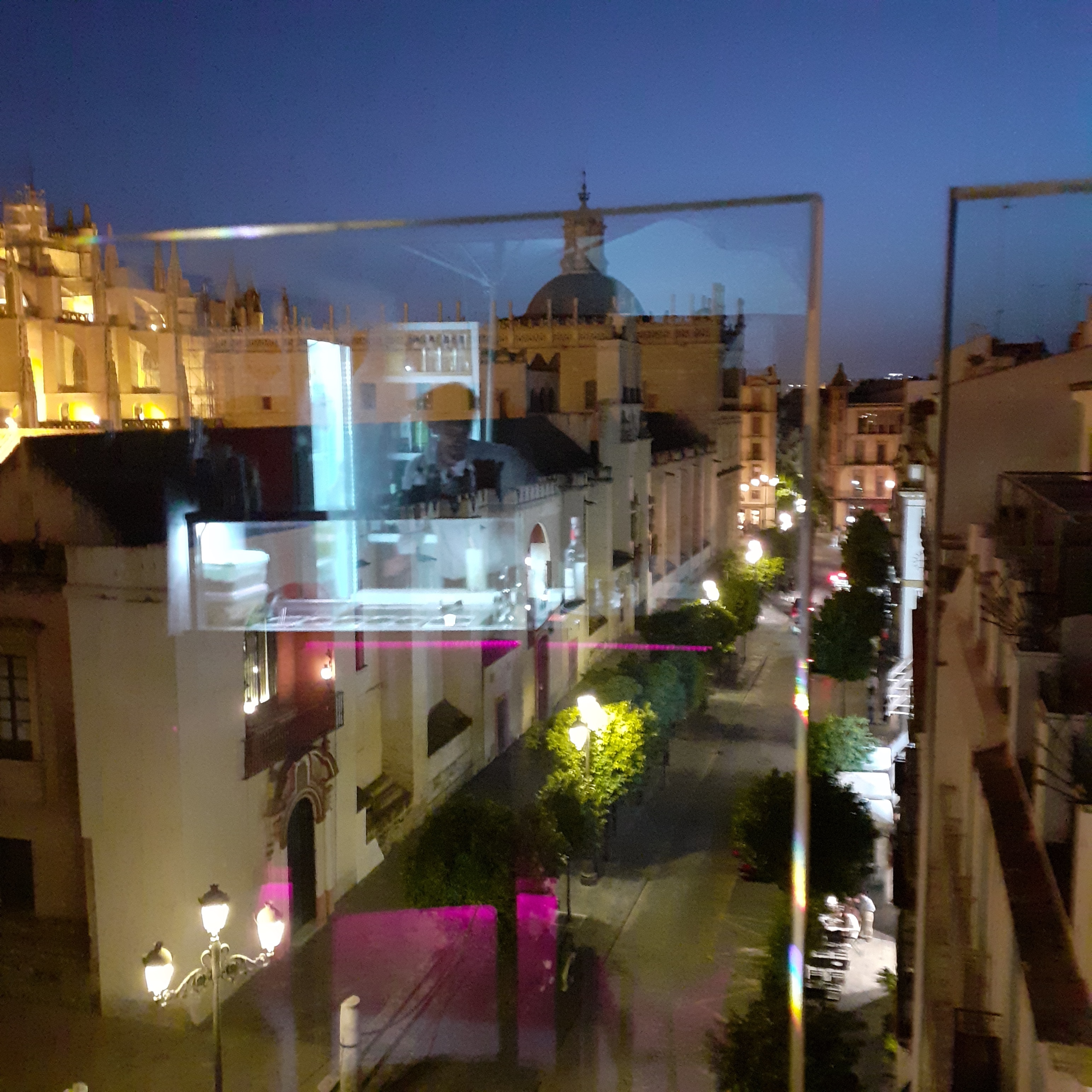
We say goodbye to Seville, from a rooftop bar above the Cathedral. The illuminations shimmer in the warm night air and it feels as if we ride above the city on a magic carpet. It all suggests a shot of Colombian espresso, a square of dark chocolate, the air scented with the smoke of a long Havana. Open a bottle of Osborne Sherry and enjoy the company of Compay Segundo and the sound of Guantanamera.

Yo soy un hombre sincero,

De donde crece la palma.

Y antes de morir yo quiero

Cantar mis versos del alma.

Guantanamera, guajira guantanamera,

Guantanamera, guajira guantanamera.

Guantanamera is a Cuban song from the poem by Jose Marti set to the music of Joseito Fernandez (probably). Look up the version by Compay Segundo with video of the noted guitarist enjoying the benefits of tobacco and drink in his native Havana.

Granada – Sacromonte 1

AL 13 Nazgdn

A place of dreams, where the Lord put the seed of music in my soul.

(Andres Segovia)

Granada is a name so rhythmic it positively strums. Strung beneath the glistening peaks of the high Sierra Nevada, it has long balanced on the fulcrum of Europe and Africa. Here, the stones are alive, the streets and spires straddle the Medieval and the Renaissance, the Gypsy tangos and strums, the poetic knight tilts at shapeshifting windmills.

The fabulous castle overlooking it all, the Alhambra, dates from the Moslem kingdoms of the high Middle Ages. At the start of the Early Modern, the Reconquista returned the city to the Catholic faith. Before, during and after all those upheavals, Granada has been the focal point of travellers who have left their dust of cultural diversity in the stones, in the air, in the rivers of the town.Little wonder that the guitar is said to have been born here.

The weeping of the guitar begins, 

The goblets of dawn are smashed,

Useless to silence it.

(Federico Garcia Lorca)

Plaza

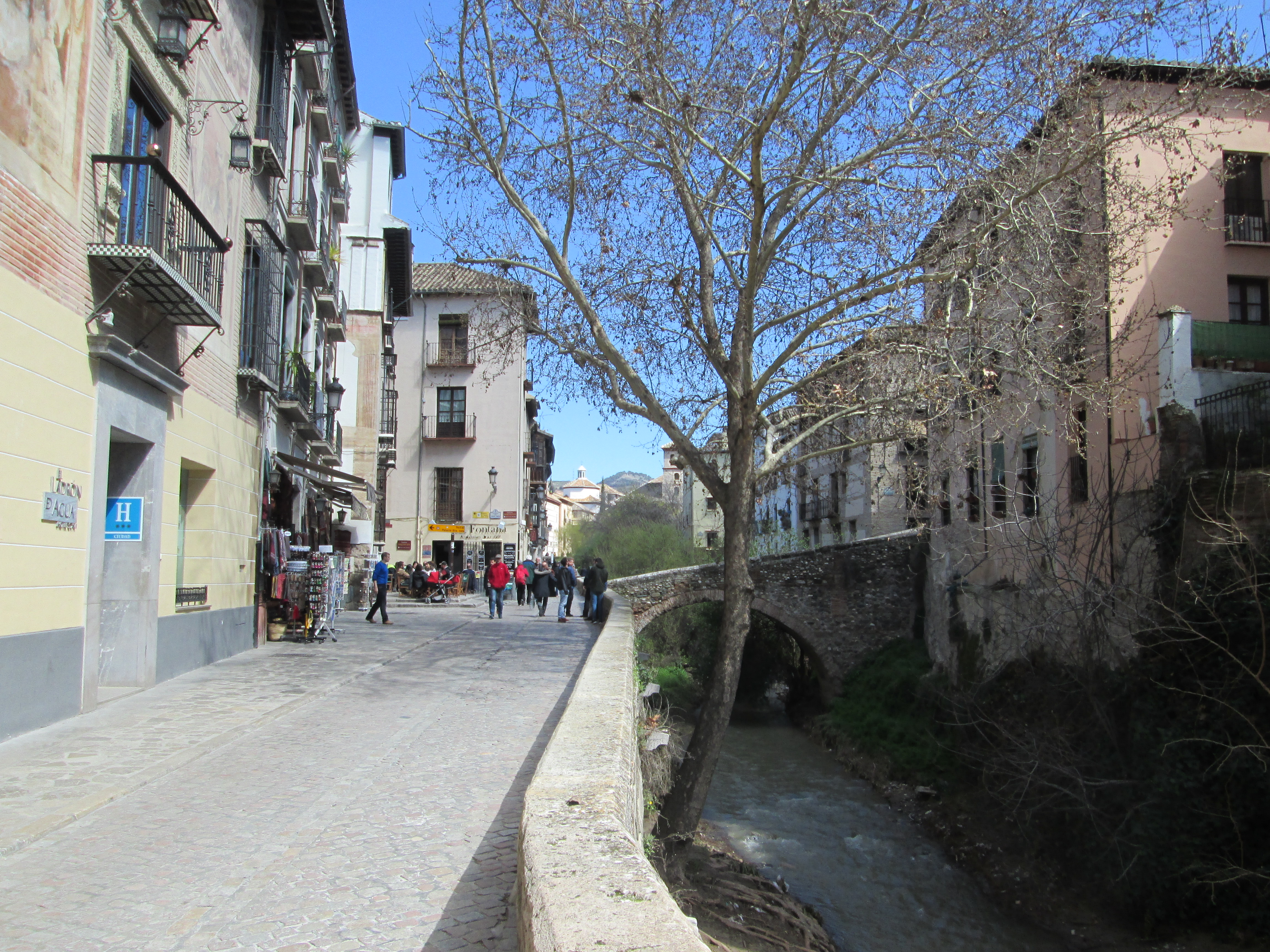
Plaza Nueva is my base camp. It merges into the Plaza de Santa Ana. A step beyond the modern city centre, it distends with eerie vagueness into the cramped ravine of the Darro River. The winding way to the Alhambra begins near the Fontana del Toro. A drink from its waters has magical qualities. Drink once and you will return forever. I have had my day there, in the soft redness of the Alhambra, that lasted forever and never and within my formation. This day I will walk along the clefs and staves and the surging river, carried forward note by note to the Sacred Mountain.

Darro1

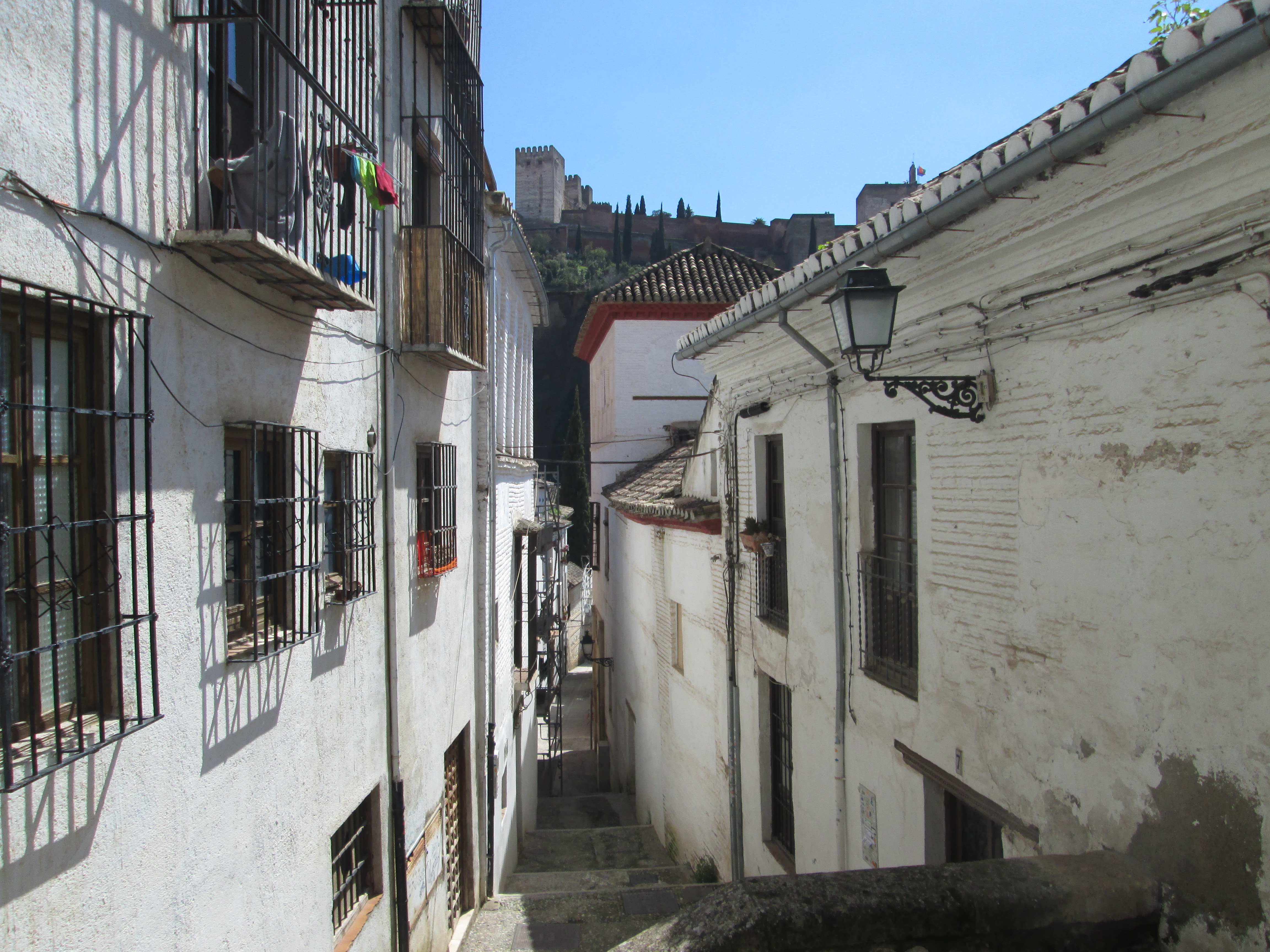
Climbing up from the Darro River, through the bleached alleyways of Alcaibin, the houses melt into an ancient silence. The winding streets flirt with Surrealism, the hush of desertion somehow expectant. I sense the outskirts of paranoia, cross diagonally a deserted square beneath an abandoned church, pause enigmatically with a smouldering Gitanes to notice a slice of the Alhambra between the shuttered Moorish villas. At last the route regains its connection with all other routes. Footfall swells, the whine of mopeds rises and a car is glimpsed. The road meets a t junction, where I turn steeply upwards by way of Cuesta del Chapiz. 

AL 22 Alca

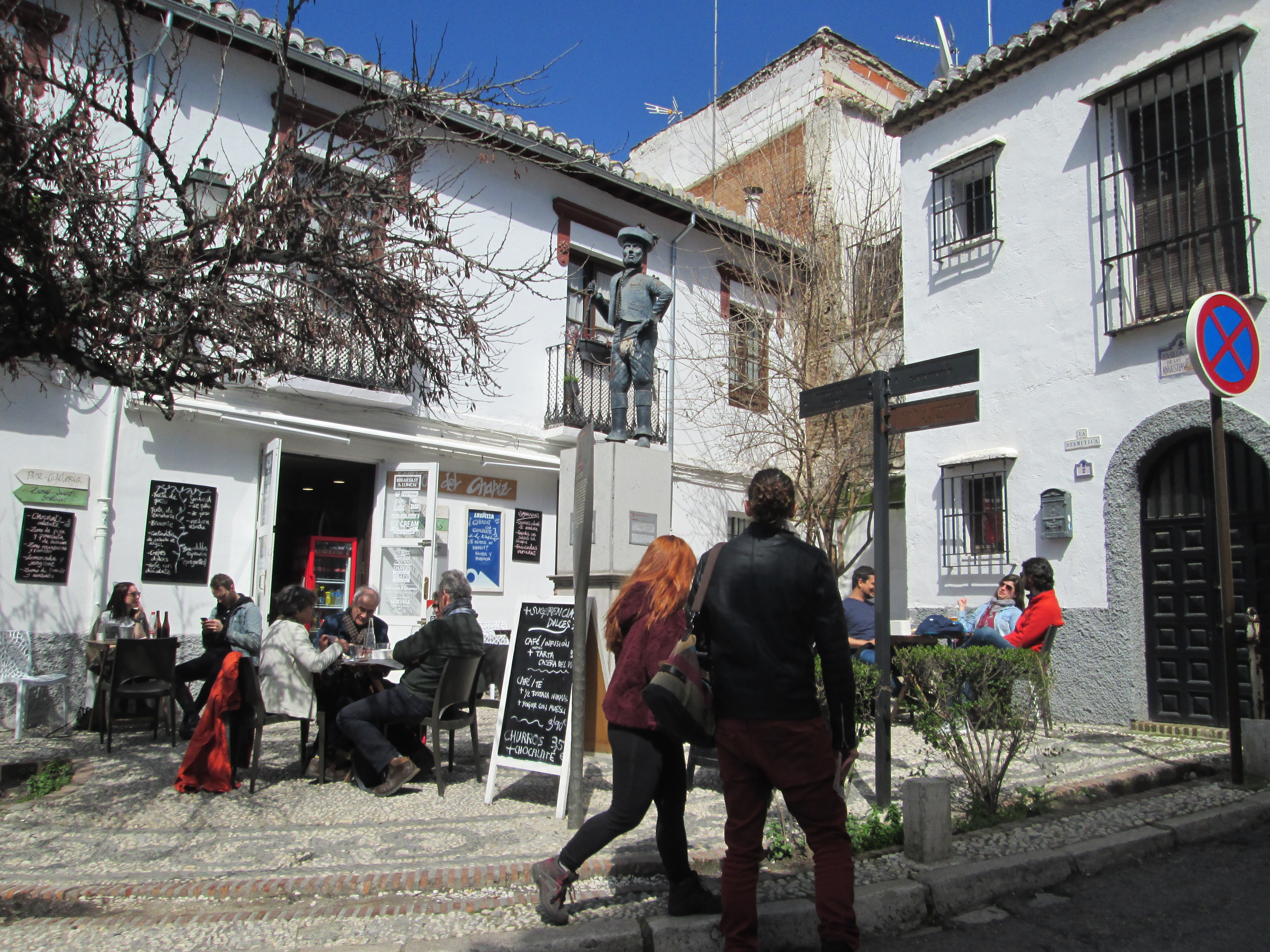
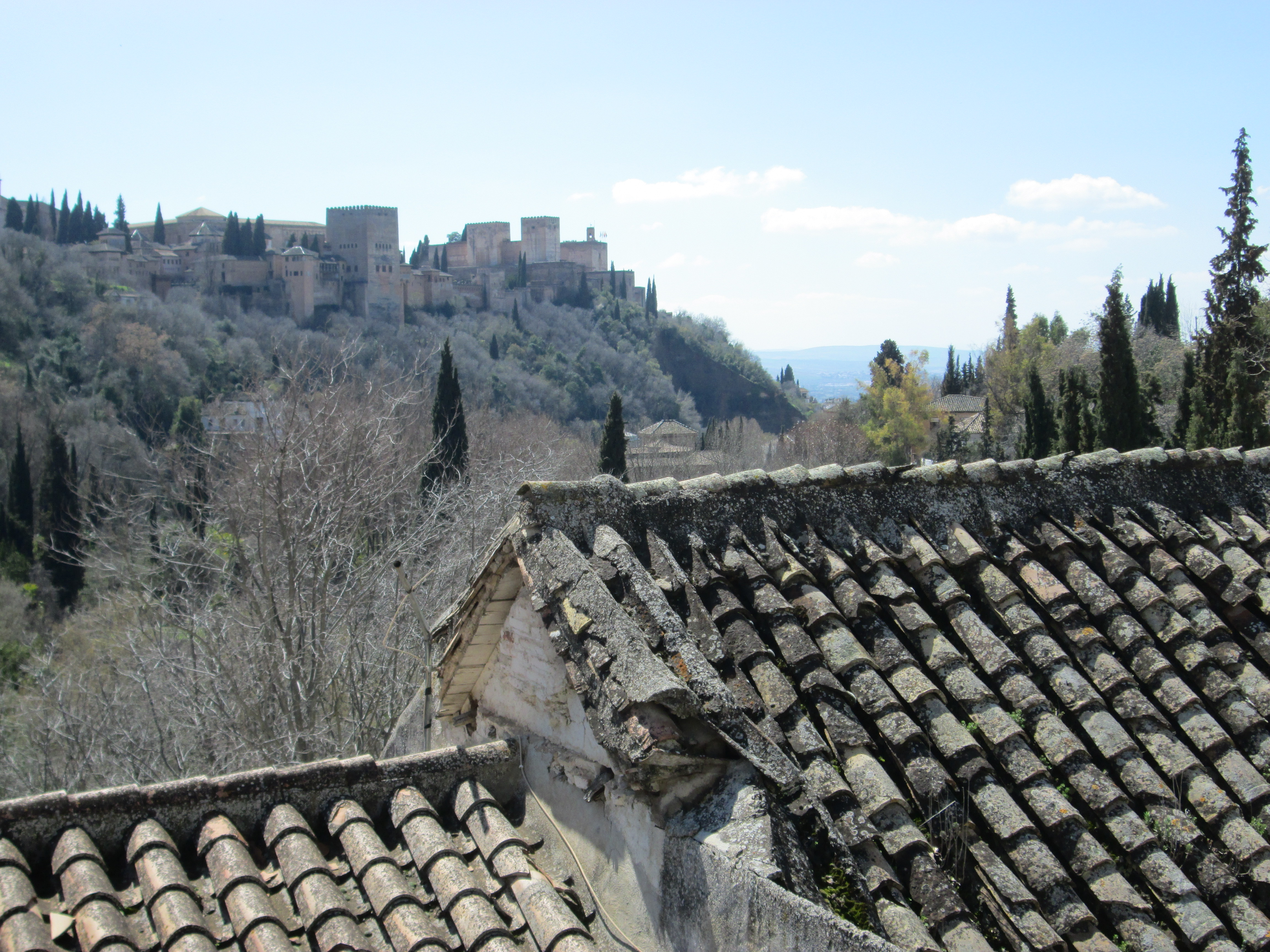
At the apex of a punishing climb, the road veers right at a taverna, El Rincon del Chapiz. A gnarled tree and an eccentric statue preside over the small terrace. Here, the city of Grenada abruptly ends, and morphs into an ancient hilltop village, houses scattered like pearls on the steep hillside. Across the Darro ravine, the Alhambra and Generalife shimmer in the afternoon haze, while ahead the distant Sierra are snowcapped beneath the virgin blue sky. I choose to be lost in this view: red gold palaces set in viridian, purple mountains with their sharp white summits, the blue sphere of the relentless sky. 

El Chapiz

The transition from urban to bucolic is a volte face of all the dialogue transacted this day in the city. The history, the fabric, the setting still run, but parallel, their projections and perspectives distorted. The Sierra Nevada hem the horizon which seems close enough to touch. If you sense a breath descend it may be from the Puerto del Suspiro del Moro where Granada’s last Moslem ruler, Mohammad XII, Boabdil, looked back in anguish at the Alhambra, exhaling that famous final sigh. This was the pinnacle of the Reconquista, in the year 1492, when the Catholic Monarchs, Ferdinand of Aragon and Isabella of Castile took Granada and the modern idea of Spain took shape. 

Sacroalham

Now I stand on Sacromonte, the sacred mountain. This was the haven of the Gypsy, when first they came to Granada in that same year, 1492. They hollowed caves from the soft rock, out here on the periphery. The culture that flowered fed the rivers of the new Spanish identity, a step beyond the rationalist identities of western Europe. And a stepping stone, also that year, to the American continents across the pond. These first rooted in our consciousness with the expedition of Christopher Columbus, an Italian in the service of the Catholic Monarchs. The popular conception of the world was limited. After Columbus, European isolation would fade. 

Sacro3

The term, Gitanos, is synonymous with Gypsy, derived from Egyptian. According to popular myth, they came from Egypt but are, in fact, Romany, an Indo-Aryan group from northwest India. Romany identity has persisted through half a millennium, with its bloodline and culture, but there is much disparity between their far flung settlements. In Andalusia, Gitanos are particularly immersed in local culture, to the point that they’re seen as embodying quintessential Spanish traditions, with Flamenco to the fore. Flamenco, the form of music and dance, derives from a synthesis of Moorish and Christian influences, Jewish folk music and dance, infused with the Oriental spice of the Gitanos. Itself an illustration of a particular social and emotional stance, from Flamenco springs those rhythms of sex and seduction, sorrow and grieving, suffusing the Latin world from Valparaiso to Valencia

Sacro2

In Andalusia there is little to be gained by dissecting its identity. It is more than the sum of its parts, a rare blossom that could only grow in this red soil, from such scattered seeds. Yet, here is a culture that is not perplexing, not a thing to be admired within a hard carapace. It has travelled well, it is well known. Here is something we all understand, whether or not we have done it yet. Here is something we know of the human condition. We are all Gypsies, spinning like dandelion seeds through the air. I have travelled, dipped a toe in different oceans, felt the heat of the desert, the swell of mountain and the cool air of forests. Through all of that runs the constant soundtrack of the music of Christian, Moslem, Gypsy and Jew.

I heard your voice through a photograph

I thought it up it brought up the past

Once you know you can never go back

I’ve got to take it on the otherside

Sacro1

So I sit on a wall in sunshine cold, amidst glare of white houses and sauntering travellers and do nothing. Inside I’m spinning slowly, breathing every song I’ve ever heard. I feel I should do something, enter a museum, buy a souvenir, take out my sketch book and submerge in the quirky scenery. I think of other things, returning to that bold truth, that here was first fashioned the guitar. 

Antonio de Torres (1817-1892) was a carpenter by trade. In his twenties he came to work in  Granada where he learned the craft of guitar building. He returned to set up shop in Seville and in 1850 began to develop the guitar which we recognise today. Torres’s guitar was symmetrical, larger and lighter than previous instruments. Their distinctive sound and greatly improved volume made de Torres’s guitar the standard from which modern guitars derive.

How long, how long will I slide

Separate my side

I don’t, I don’t believe it’s bad

Slit my throat, it’s all I ever …

(Otherside, Red Hot Chilli Peppers)

In its shape the guitar is a key to unlock the secrets of sound. More suggestive still, the guitar is personified as woman. My Graphics maestro at Rathmines College in the seventies was Martin Collins. One evening our class gathered before a still-life assembled by Martin: a guitar, a wine bottle, a bowl of fruit. As we set about our task, he hovered, waiting to pounce with advice. One unfortunate was having difficulty. Martin’s voice boomed through the hush: “A guitar is like a woman. You cradle her on your lap and stroke her.”

Sacromir

In the Art of Spain it is a signature motif.The paintings of Picasso and Juan Gris pay homage to those curves, sinuously evoking its music and mood. With grapes and fine wine, its shape settling in city and skin, with a knife, a fork, a bottle and a cork. From Andalusia to New York, Troubadours have trooped with guitar slung rakishly over shoulders.

 Lovers, fools, thieves and pretenders, and all you’ve got to do is surrender!

(The Waterboys)

, 

Andres Segovia, Hank Williams, Bo Diddley, Paco de Lucia, Bob Dylan, and Jimi Hendrix towering over the close of Woodstock, a beautiful ghost. The muse has manifested her reflection too: Gabriela Quintero, KT Tunstall, Patti Smith, Chrissie Hynde. Joan Osborne. In cherry red or ebony, sunburst finish or sultry blue, this is the emblem of our time.