The Dublin to Cork train leaves Dublin Heuston every hour on the hour. The journey takes two and a half hours via Portlaoise, Thurles, Limerick Junction and Mallow. I took it last year, celebrating my recent elevation to the free Travel Pass. We barrel through west and south Leinster before leaving County Laois past Portlaoise and crossing into Munster
To the south east the mountains of Slievenamon mark the moutainy territory beyond Ireland’s Central Plain. Slievenamon itself rises 2,365 feet above the floor of County Tipperary. The name is from the Gaeilic for Mountain of the Women. Legend is that Fionn Mac Cumhail, mighty warrior and fierce popular with the women, decreed his pursuers should race to the top of the mountain in order to claim God’s gift, as it were. Grainne won, at least as far as Fionn was concerned. She herself might have preferred a leisurely stroll, or cable car ride, and she eloped with more youthful hero Diarmuid during the marriage feast.
The Pursuit of Diarmaid and Grainne is the epic love tale depicting Fionn’s pursuit of the young lovers. I read it in the Gaelic, Toraiocht Diarmuid agus Grainne, for my Leaving Cert fifty years before. I spent a lot of time looking out windows then, too.
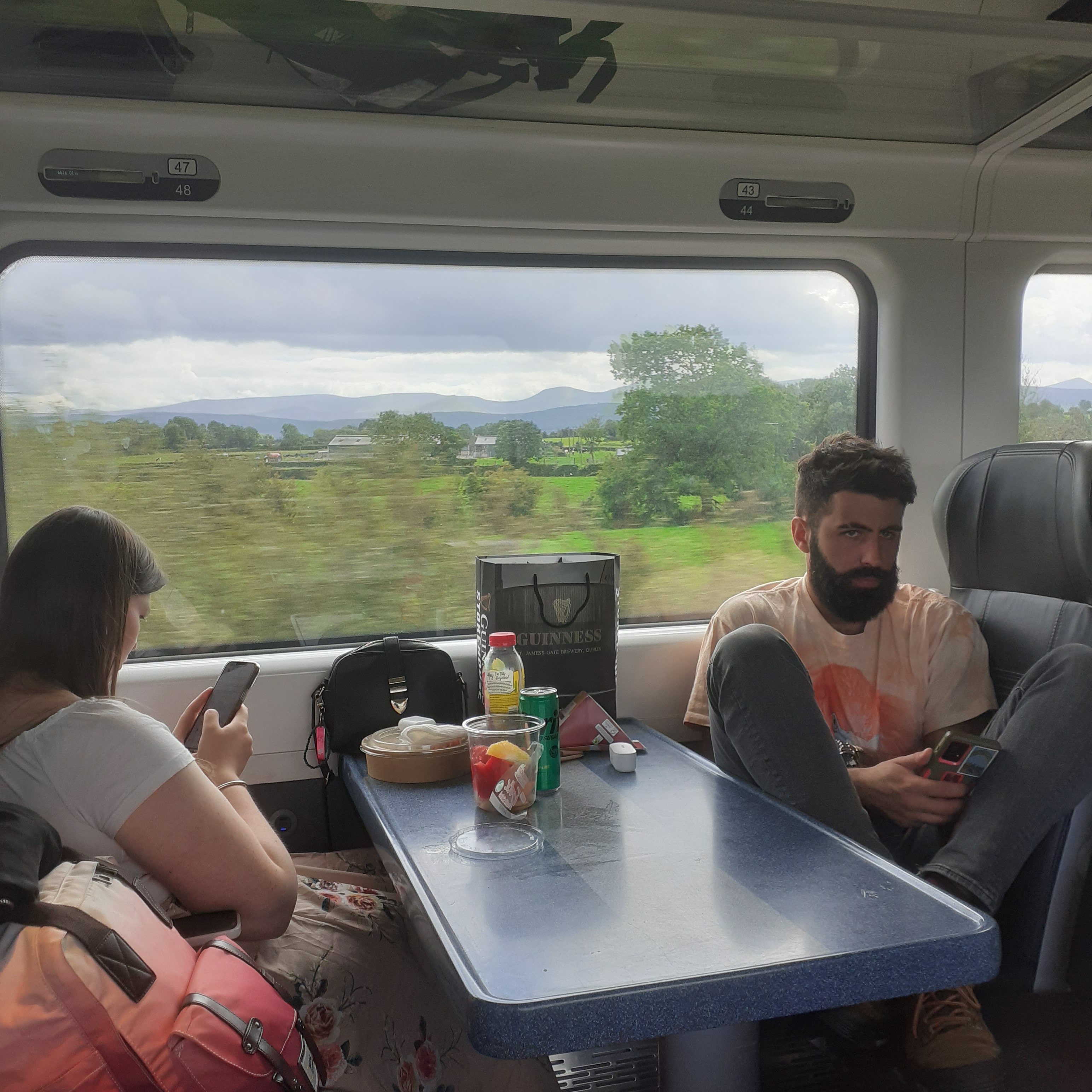
This is a painting of two young lovers lounging on the train as it passes the famed mountain. I tried to be discreet in taking the reference photograph, but typically was spotted. The man, ever on guard, has raised his eyes from his mobile device and is looking at me daggers. She is oblivious. In a way it is a meditation on modern love, neither sweet nothings nor spooning intruding on the current obsession with the smartphone. Still, there is an obvious sense of comfort amongst the duo; striking a tableau worthy of Venus and Mars. The two are well cast in their roles, Mars worryingly so. And I am old with wandering, through hollow lands and hilly lands.
The mountain and the moment passes. I can play with the lover scenario in my head. Are they heroes? Are they pursued? Will they change at Limerick junction, or accompany me to Cork, and all other matters arising? Such questions should stall, allowing myth to arise.
The acrylic painting is, as usual, a labour of love. The subjects classically beautiful and statuesque. An intriguing still life is briefly grouped on the table. Beyond, the world whips by at dizzying speed.We are suspended in a fragile bubble in the vast explosion of life.
Well, pistons keep on churnin’
And the wheels go ’round and ’round
And the steel rails lie cold and hard
On the mountains they go down
Without love
Where would you be right now
Without love, oh -oh.
Long Train Running by the Doobie Brothers from their 1973 album The Captain and Me. Tom Johnston wrote it, providing vocals, harmonica solo and the distinctive rhythm guitar backing. I first heard the song after my Leaving Cert that year, covered by Irish band Rodeo at Kevin Street Tech. About that time I figured why the American Band didn’t actually feature siblings with the surname Doobie.
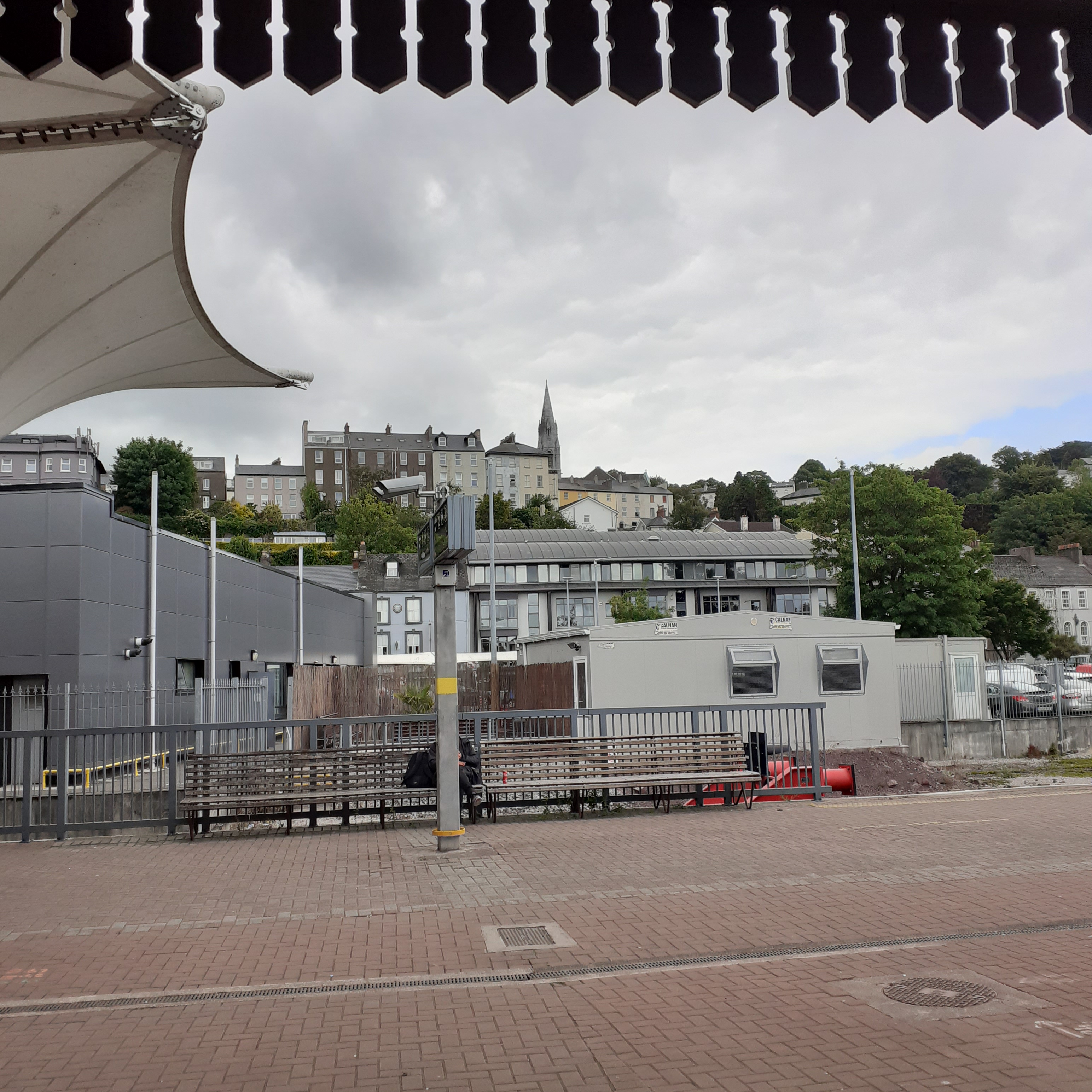
Dublin to Cork is two and a half hours by rail. There’s a train every hour on the hour leaving from Dublin Heuston. The train barrels through the south midlands to Limerick Junction before veering due south through Cork, Ireland’s largest county and on to the Republic’s second city, Cork. The train arrives at Cork Kent station to the north east of the city on the Glanmire Road. It’s a short walk from there to my accommodation at Isaacs Hotel on McCurtain Street.
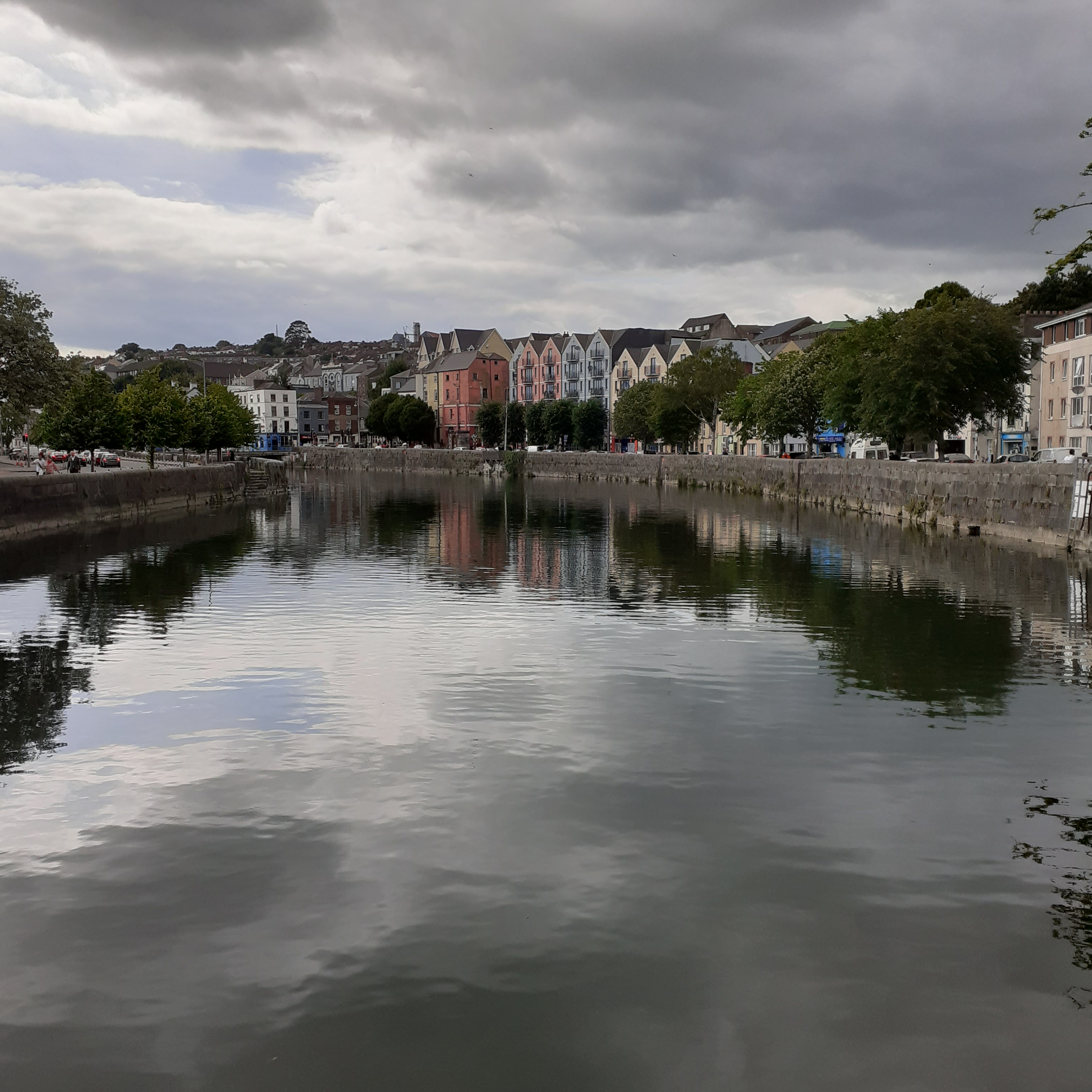
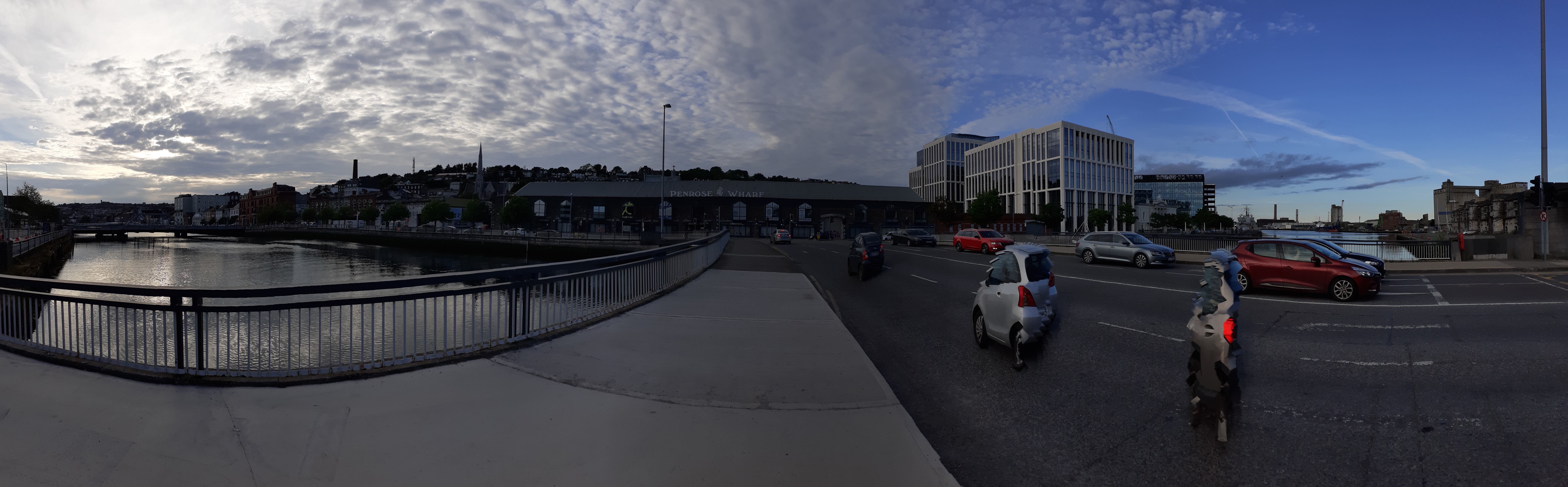
McCurtain Street is being ripped up at the moment but there’s plenty of restaurants, cafes and bars on this busy thoroughfare. Following the main road takes you down to the River Lee, and the city centre lies on the low lying island formed by the division of the river. The division in the River Lee happens well west of the city, past the University campus. The northern branch is the major; wide and relatively straight. The southern branch is narrower and windier, giving a quirky, intimate and scenic aspect to the city.
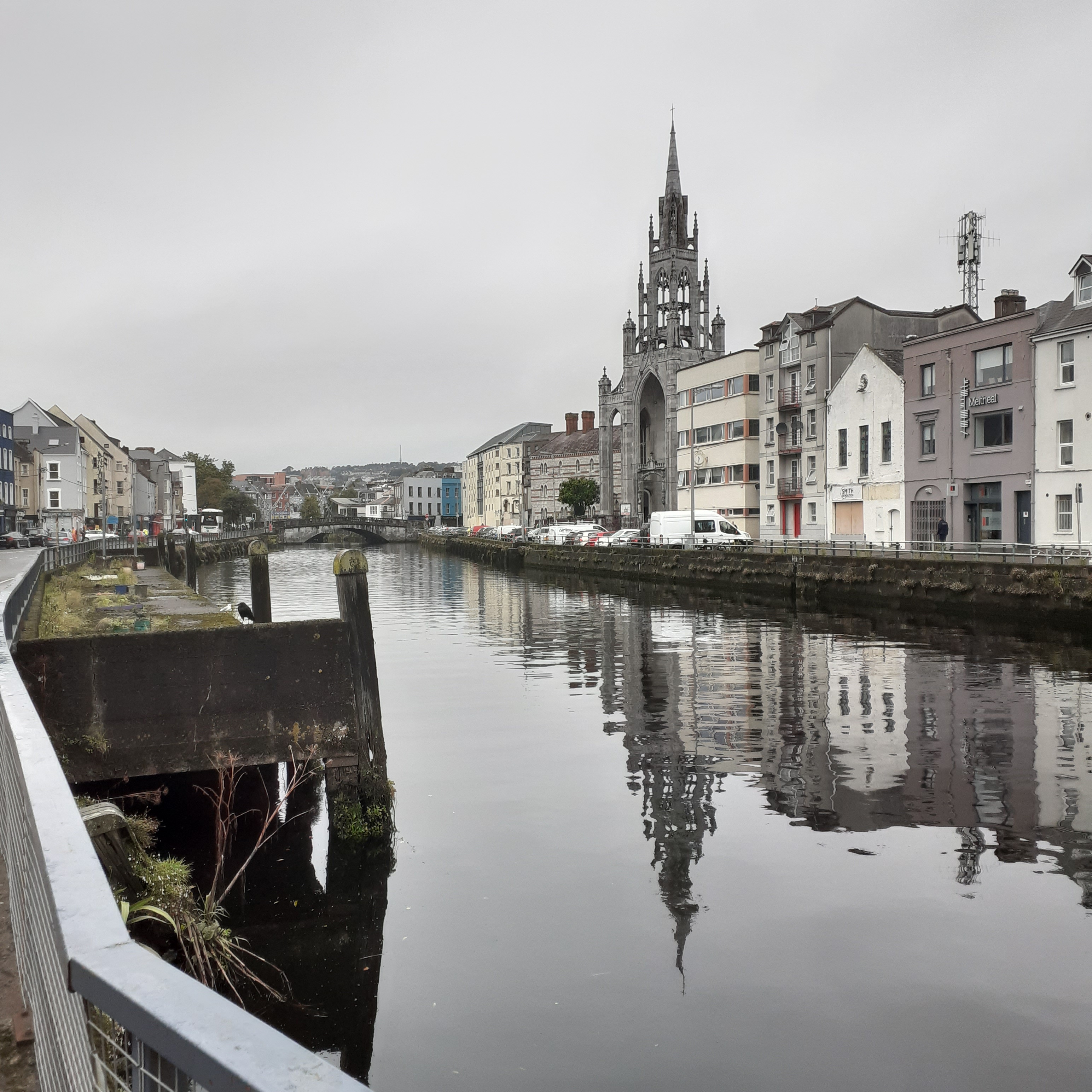
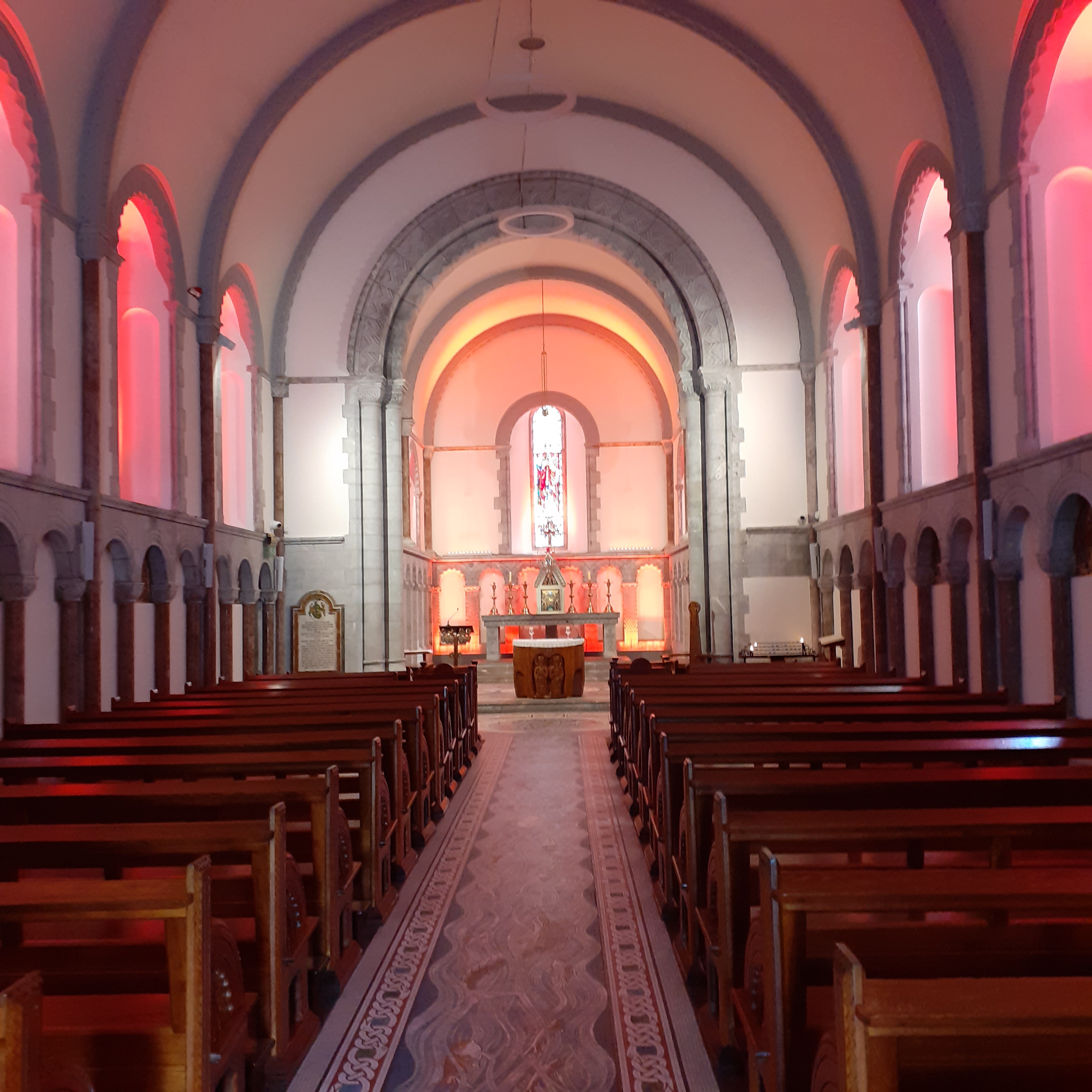
Union Quay takes you past the City Hall and the College of Music. On the opposite bank there’s the Cork studios of national broadcaster, RTE. A few doors up the distinctive ornate Neo Gothic spire of the Holy Trinity Church soars above Father Mathew Quay. Begun in the 1830s, it was not completed until the 1890s, construction having been delayed by the Famine. The design was chosen by competition, the winner being English architect John Pain, who also designed Blackrock Castle and the Courthouse on Washington Street. The interior includes three windows by Harry Clarke, and the window behind the High Altar is dedicated to Daniel O’Connell,
The spire and facade were the last element completed, and were somewhat scaled down from Pain’s original plans. Still very impressive though, facade and spire combining in a unified statement, the entire structure tapering to its peak while the use of flying buttresses and cast iron supports give the building the lightness of lace, as an observer put it: more air than stone. The church belongs to the Capuchins, an order of Fransiscan friars, and is also dedicated to the memory of Father Matthew who commissioned the church, and otherwise devoted himself to helping the poor, becoming also a notorious campaigner against the demon drink.
South Parish occupies the steep river banks, and like Shandon on the north bank, was an early suburb of the ancient walled city. The streets hereabouts go back a long way, with many colourful names. Whether Father Matthew had anything to do with Sober Lane, I can’t say, but it boasts one of Cork’s best beer gardens and an ironically named bar on Sullivan’s Quay. Uphill, we passSt Finbarr’s South, which dates from 1766 and is the oldest Catholic Church in the city. Sculptor John Hogan contributed the sculpture of the Dead Christ on the High Altar in 1832, carved from the same white marble from the Carrara Quarry used by Michelangelo. Farther up, the Red Abbey is one of Cork’s oldest structures, an early fourteenth century Augustinian abbey. The friars persisted, even after the Dissolution of the Monasteries in 1541, for another century until the Catholic Rebellion of 1641. Only the church tower remains,
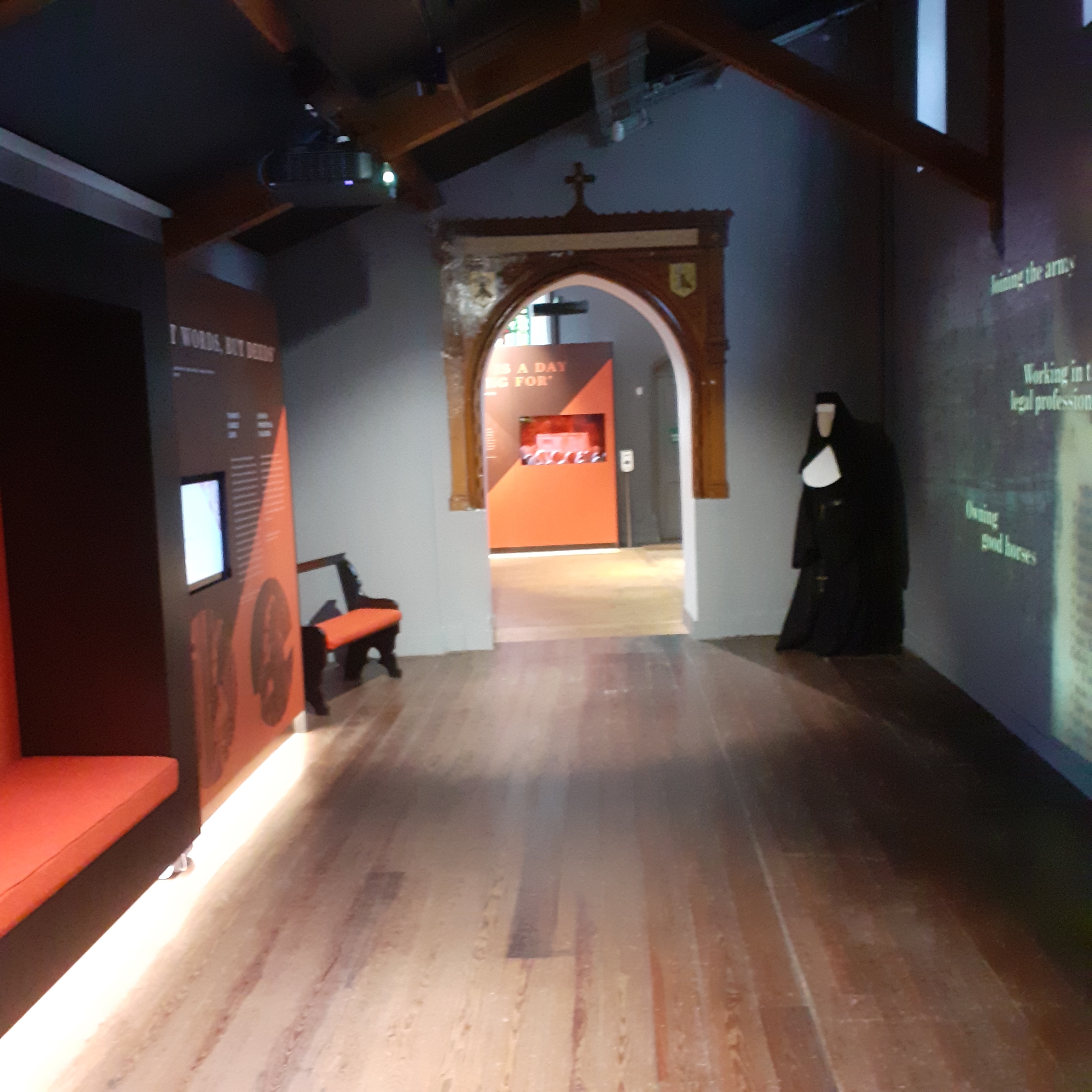
Nano Nagle Place is situated further up on Douglas Street. Born in 1718 Honora Nagle was from a well to do Catholic family in Penal days. The Catholic population then was poor and uneducated, something which Nagle determined to address. Her Uncle Joseph mantained a Protestant front to safeguard the family’s fortune. This allowed for Honora’s education in in Paris. While there she noticed the contrast between her life of privelege and the misery endured by the city’s poor. This she compared to the plight of her own Catholic community back home. She returned to Ireland and established seven schools, for boys and girls, the first in the ghetto where she grew up on Cove Street. She also established a convent for the Ursuline Sisters, a French order of nuns. Being enclosed kept them remote from the community, so Nagle went on to found her own, outgoing order. The convent she founded in 1771 forms the nucleus for Nano Nagle Place, with a museum, bookshop, gardens and her tomb. The award winning museum gives a lively, animated tour through Nagle’s life and work and also illustrates the parallel development of Cork city in the eighteenth century.
Fionnbarra’s Bar farther down Douglas Street, is a good place to slake your thirst with an eccentric beer garden out back. Brightly painted statuary serves to further tilt the axis of reality off the vertical, although a few pints of the brew would contribute to such effects also.
I take the Nano Nagle footbridge across the river on to Grand Parade. Triskel Arts Centre is within the old walled city of Cork. A fragment of these walls remain in the Bishop Lucy Park next door, on the west side of Grand Parade. There’s a short but very useful account of ancient Cork and its early viking origins. Christchurch is a restored eighteenth century church once the main Church of Ireland place of worship in the city. It dates back to the eleventh century when a Hiberno Norse church was built on this site, this becoming a focal point for the developing city. You can view the ancient crypt beneath the current structure. Today the building is an intrinsic part of the Triskel and features regular music, arthouse cinema and literary events. There are regular exhibitions. My visit coincided with Then I Laid the Floor, featuring the work of three artists. The exhibition references a house built by relatives of Sao Paolo based Irish artist James Concagh, providing an interesting if vague visual narrative. Contributory work is provided by Brian Maguire whose art from all corners of the globe is consistently samey and shouldn’t detain you too long.
Farther along we reach the Cornmarket and the North branch of the river appears. The Shandon Footbridge takes us across the river and the climb up Widderling’s Lane leads to the heart of Shandon. This working class area has its own unique inner city feel. I had my eyes set on a Middle Eastern restaurant in the shadow of the bell tower of St Anne’s and sitting outside on a warm evening in the labyrinth of backstreets certainly had a Mediterranean feel to it. The restaurant even supplied a hookah pipe to an adjoining table to enhance the ambience. Unfortunately, my order resembled dessicated goat dipped in vinegar and I didn’t stay long. I resolved on a pint to wash away the lingering taste and hurried back to Son of a Bun, a good American Hamburger restaurant on McCurtain Street with which I’m familiar.
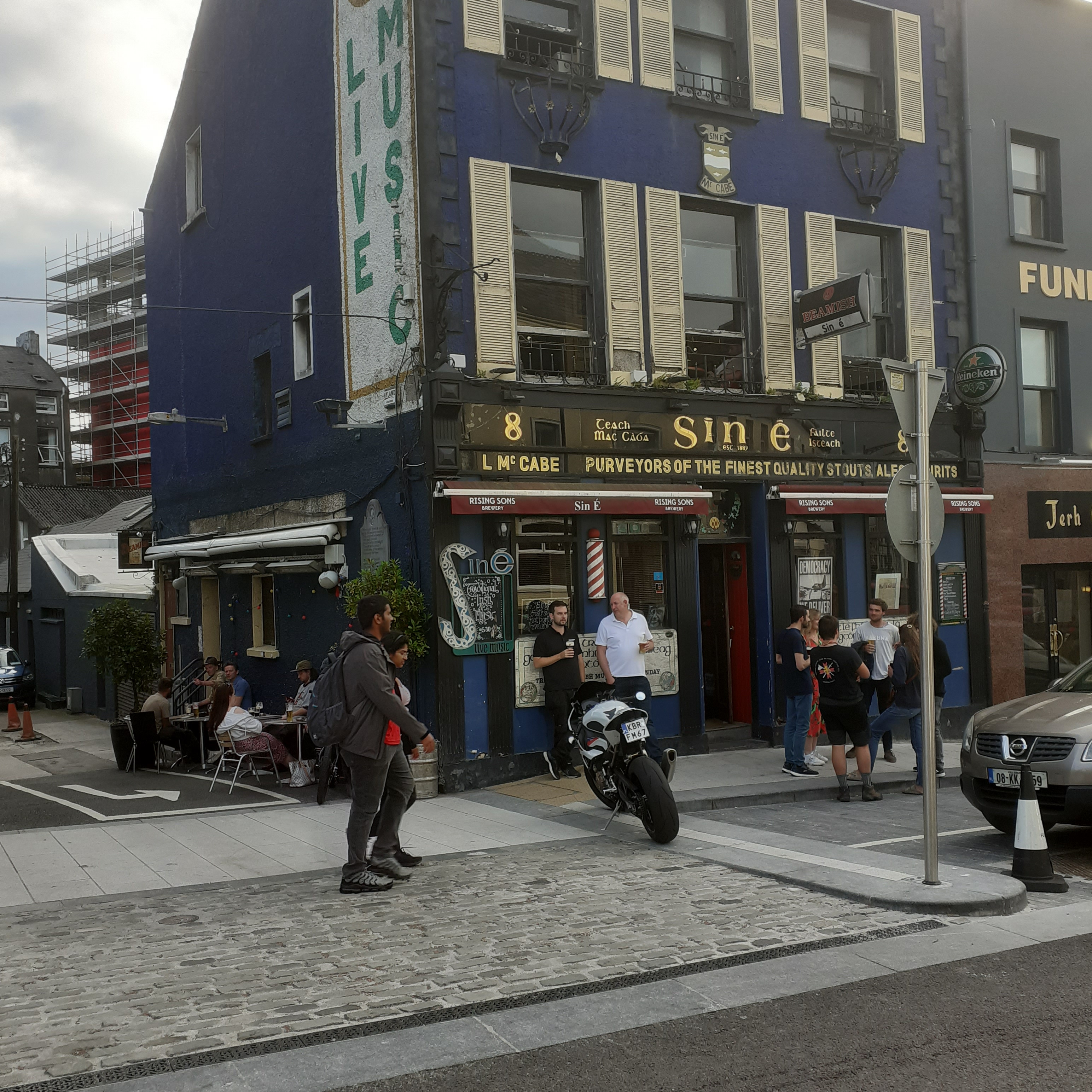
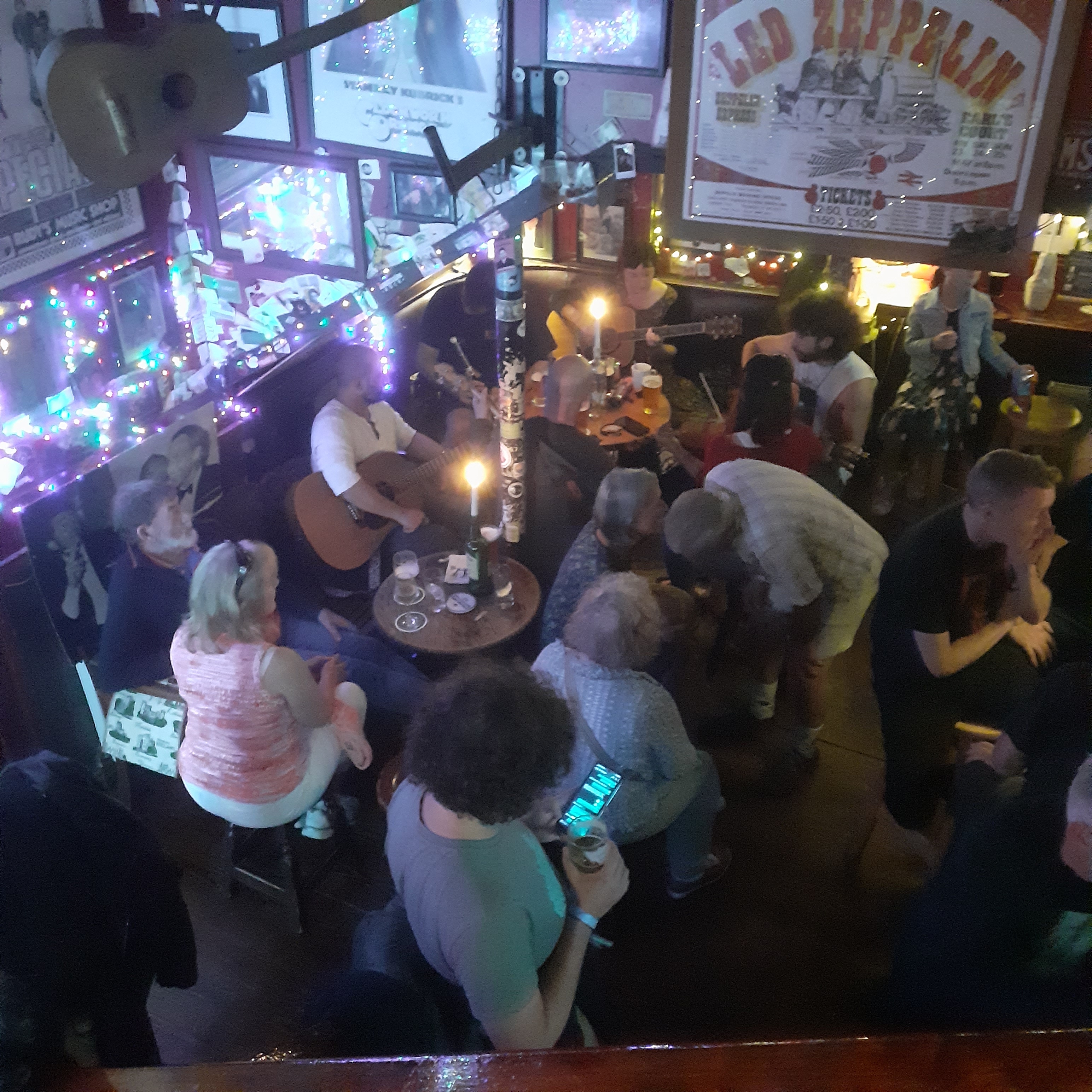
On the way I noticed one of Cork’s best loved bars. Sin É, Irish for that’s it. This is a busy spot with regular traditional and ballad music. The packed interior is a gem, and upstairs there’s a more reflective spot with candlelit tables where I grab a window seat. And thereby hangs a tale. The candles are not yet lit, and though on my ownio, I decide to light up for a little atmosphere. This attracted a tourist, German I think, who asked for a light for his own unlit candle. I obliged. Thus the light was spread troughout the world. I spent a happy half hour writing in my notebook and a few more moments reflection before heading off down the city centre. I got as far as the Oliver Plunkett, on the eponymous street, where outdoor seating allows for relaxed people watching. Looking for the notebook again, I find that it’s gone. It can only be back in Sin E, so I must return. The place is truly hopping, and I am none too optimistic approaching the upstairs table now occupied by a young woman. She has stowed my notebook on an adjacent shelf. It is a small thing of no great value, but I am delighted to be reunited with it again. Downstairs, I decide to celebrate with a pint. In an alcove, I take out a fistful of change and begin to count out the money required. Suddenly, the German tourist from before is at my shoulder. I will buy you a pint, he says, for earlier you gave me fire. Don’t you just love it. I had to laugh. I wasn’t sort of money, but had typically accumulated a lot of shrapnel and wanted to lighten the load. What goes around comes around. I see out the evening with pints and pleasant company. That’s Cork for ye; Sin É.
Cork is very much defined by the River Lee, flowing both through and around the city centre. It rises in the Shehy Mountains in West Cork, feeding the beautiful lake of Gougane Barra, named for Saint Finbar, and from there to Cork City. West of the city it divides, holding the centre city in its embrace before uniting again to the east where it flows into Cork harbour.
On a glorious Spring morning, we head out West. Washington Street leads through what was once medieval Cork. It was laid out in the 1820s and named George’s Street for King George III who had just died. A century later, blood running high in the fight for liberty, it was decided that another George, America’s revolutionary leader George Washington, made a worthier focus for honour. Cork Courthouse was built in the 1830s by George and James Pain, in the neo classical style as a ‘temple suitable for the solemn administration of justice’. It certainly looked the part, but was notoriously cold and draughty within. Ironic then, that a malfunction in the heating system virtually destroyed the building in a blaze on Good Friday, 1891. Local architect William Henry Hill designed the reconstruction, retaining the intact portico and facade, adding a copper dome.
Further on leads to Lancaster quay, the leafy river banks lined with gleaming apartments. It’s a pleasant walk along the Western Road to University College Cork. UCC campus occupies a scenic wooded parkland with the South Branch of the river framing its northern rim. The College was founded in 1845 as one of three Queens Colleges of Ireland, with Galway and Belfast. In the twentieth century, Cork became part of the National University of Ireland, along with Galway (UCG), Dublin (UCD) and Maynooth.
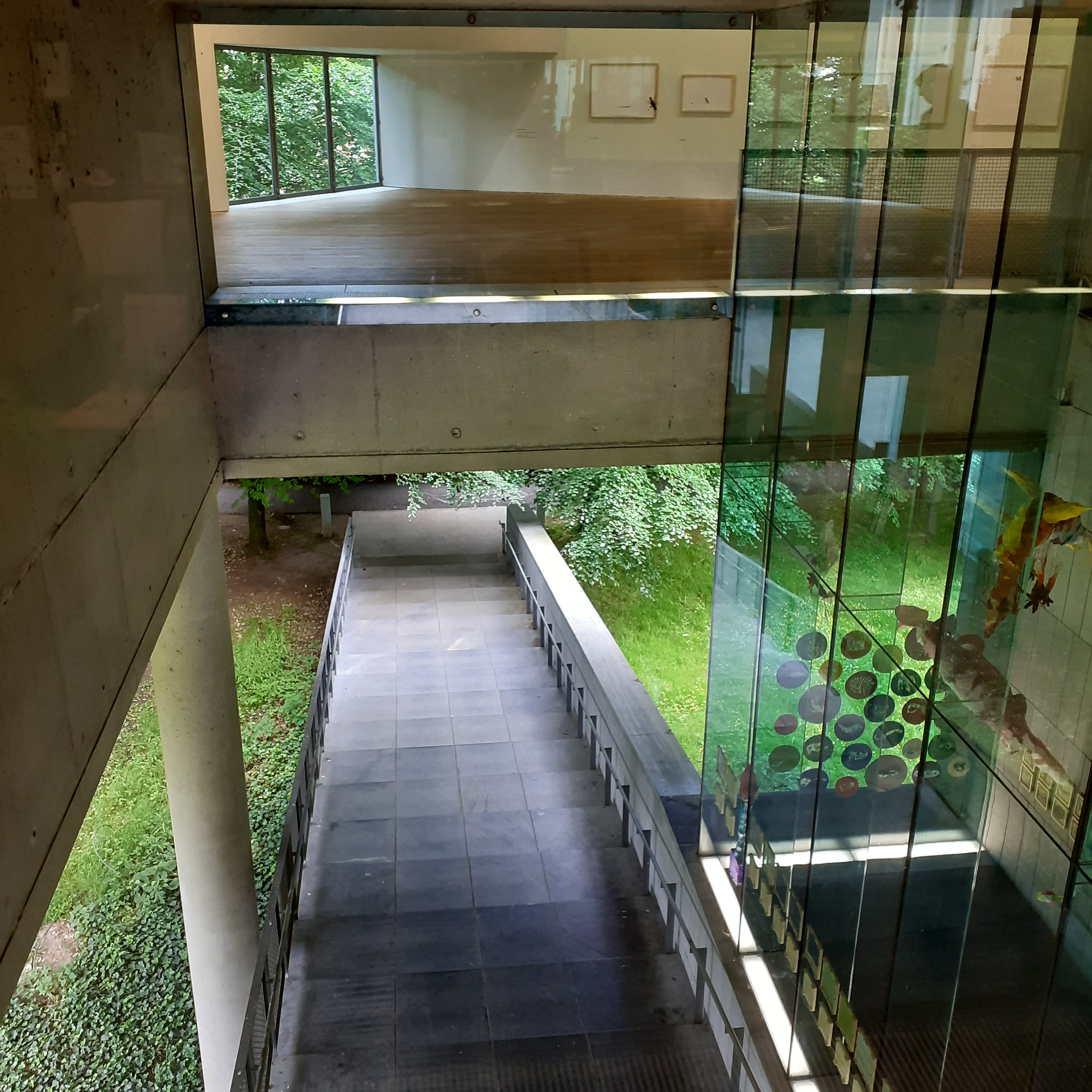
Near the entrance, amongst the trees, is the Glucksman Gallery. The Glucksman was opened in 2004, in an award winnning design by Irish architects O’Donnell and Tuomey. Truly a floating modernist statement with three floors of display, including themed temporary exhibitions. Whatever’s on show, the building is a sublime experience in itself. It is named for Lewis Glucksman, American financier and chairman of Lehmann Bros. He was a generous patron of culture in Ireland including the Millenium Wing of the National Gallery. Glucksman lived in Cork for the last twenty years of his life, and died there in his house in Cobh in 2006.
At the centre of the university, the buildings are grouped around a Gothic Tudor quadrangle. Architects, Thomas Deane and Benjamin Woodward designed much of these early buildings. As we dally in the cloisters, soaking in the history and the atmosphere, Government ministers flit through the arcades discussing affairs of state. Current Taoiseach, Michael Martin, would be amongst them, a graduate of these groves. Honan Collegiate Chapel dates from the early twentieth century. In the the Celtic Revival style of the time, it harks back to starry times of saints and scholars. Isabella Honan, a wealthy Corkonian, was the Church’s benefactor. The interior is particularly alive with Irish arts and crafts, Eleven of its nineteen stained glass windows are by Harry Clarke.
We return along College Road via St Fin Barre’s which is worth a visit. Its three spires are a dominant feature of the city skyline. The interior includes a small exhibition of the church’s history. The Cathedral grounds make a calm retreat from the city’s embrace.
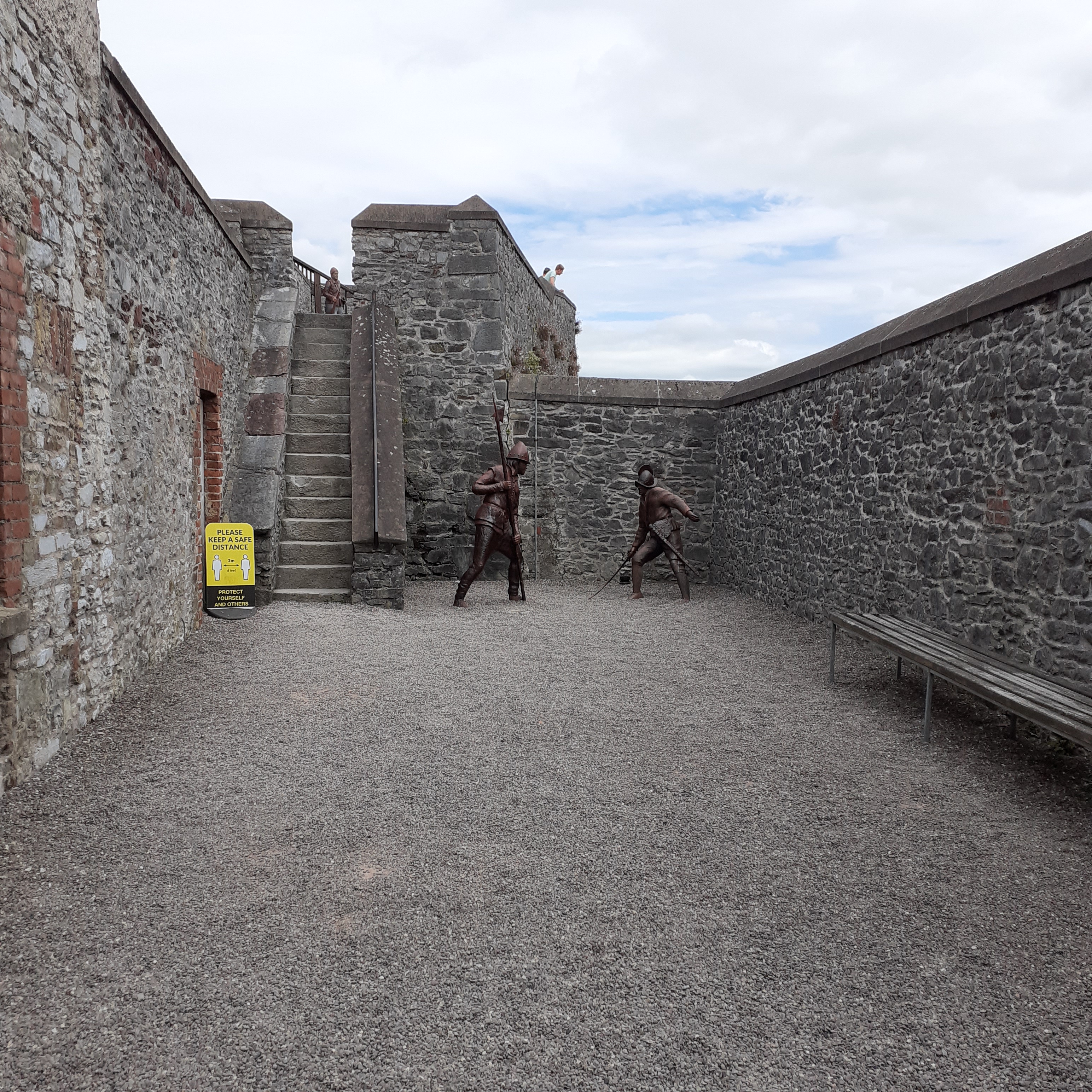
Nearby is Elizabeth’s Fort. Looming over the south branch of the Lee, it was built in 1601 by Sir George Carew. On the death of Elizabeth, the Mayor led a revolt and a force of 800 men siezed the fort and demolished it to thwart the forces of James I. Lord Mountjoy retook the city and ordered it rebuilt. The star design dates from its rebuild in 1626. Cromwell also added to it in 1649. It became a Jacobite stronghold in the Williamite wars. When the city was taken by William’s forces in the Siege of Cork, the fort held out but the city walls were breached after a week of bombardment. From 1719 to1817 it functioned as a barracks and subsequently a prison for those awaiting transportation to Australia. It reverted to military use, became a Royal Irish Constabulary barracks and hosted the Black and Tans during the War of Independence. It was burned by anti treaty forces in the Civil War and was afterwards a Garda Station until 2013. Now open to the public, entrance is free and you must run the gauntlet of cheerful meet and greeters. This, in fairness, does make for a good introduction to a historical site and our Cork hosts were excellent. There are guided tours at one o’clock each day for a couple of euro, but you can self guide as we did. Lifesize action figures guard the spaces giving scale and context to the visit. There’s a small museum which maps the historical development of Cork City and the Fortress, and a picnic area too.
Nano Nagle footbridge crosses the southern branch of the river back to Grand Parade in the city centre. The Lady of the Lantern was born as Honora Nagle in 1718. She was smuggled abroad for an education, as that particular avenue was closed to Catholics then. Returning to Ireland she resolved to remedy the situation. She opened her first school for the poor in 1754 in a mud cabin in Cove Lane in defiance of the Penal Laws. At night, by lantern light, she’d bring food and medicine to the poor. Nagle founded the Presentation Sisters order and took vows in 1775. Ten years later, she died of TB.
The South Mall is the city’s financial zone, wide; tree-lined and elegantly austere. We rejoin the river at Parnell Bridge. On the opposite bank, Cork City Hall on Albert Quay resembles Dublin’s Custom House both in its structure and its placement, floating serenely over the city quayside. This particular building is of more recent vintage. Designed by Jones and Kelly, it was built in 1936 to replace the old city hall. That building, originally the cornmarket, dated from the mid nineteenth century, and Jones and Kelly sought for a grander reflection of the original which was destroyed during the War of Independence when the Black and Tans burnt Cork in reprisal for the Republican activities of the natives. However, the term Rebel City goes back much further to the War of the Roses in the fifteenth century, when Cork backed the doomed Yorkist cause.
Running parallel to the Mall is Oliver Plunkett Sreet, the first street to be laid out to the east of Grand Parade in the early eighteenth century. It became a thriving shooping street, pedestrianised by day, and a nightlife hotspot into the wee small hours. Long and low lying, it is the street most likely to turn into a canal when the nearby river rises. We return along the north branch of the river, past the modernist bus station. This evokes memories of catching the bus to Kinsale; whether the two of us or more, impossibly young, rucksacks and tent rolled up tight and heads full of songs and hope.
The Hotel Isaacs garden makes a good spot for an afternoon drink. An attractive nineteenth century gothic redbrick on McCurtain Street, the bar is accessed through a discreet archway. Within, the enclosed hotel terrace is framed by a jungle of plants and an impressive cliff face with water feature. The resident family of ducks peek out at us. Used to human company not to make strange, they are exceptionally cute. The hotel restaurant is stylish with a good menu, though we fancy a more informal atmosphere on our last night. We’ve noticed a burger joint farther down the street. Son of a Bun serves good burgers, good foaming beer, with a cheerful vibe and a sidewalk terrace to take the fresh air and watch the world go by.
A knife, a fork, a bottle and a Cork,
That’s the way we spell New York, right on
A knife, a fork, a bottle and a Cork,
That’s the way we spell New York, right on
Cocaine on m’Brain was a hit for Dillinger from his album CB 200, in 1976. Sung, spoken really, in a strong Jamaican accent, not a million miles from the local patois. Only a pond separates us. Which all goes to show, you can take the man out of Cork, but can you get the cork out of the bottle?
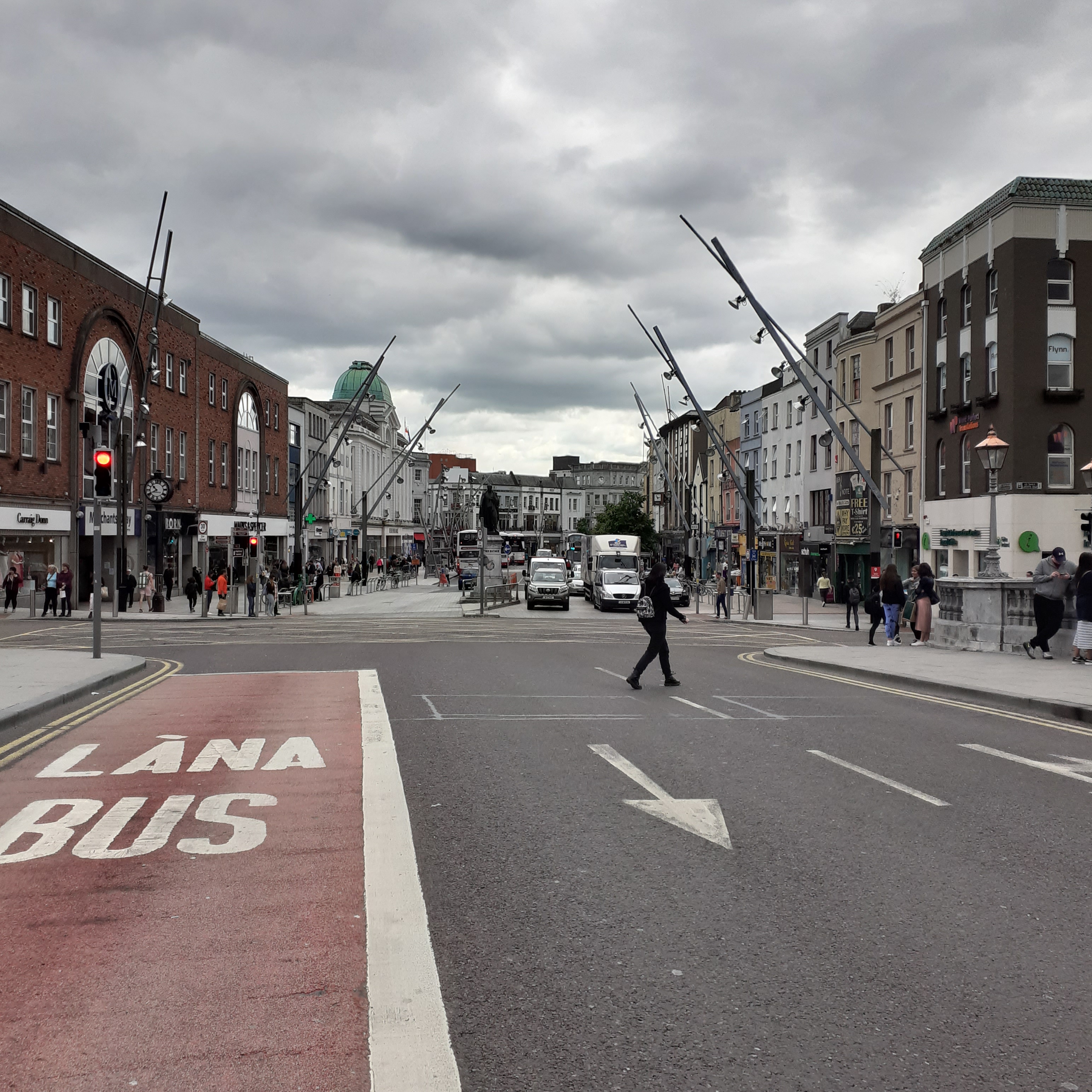
As a medieval settlement, Cork was a walled town west of Grand Parade, centred on what is now known, somewhat misleadingly, as Main Street. The official, and actual, main street, Patrick Street, is wide, but spectacularly curved. This actually follows the line of an old river channel in medieval times, the modern street being built on vaults over the water.
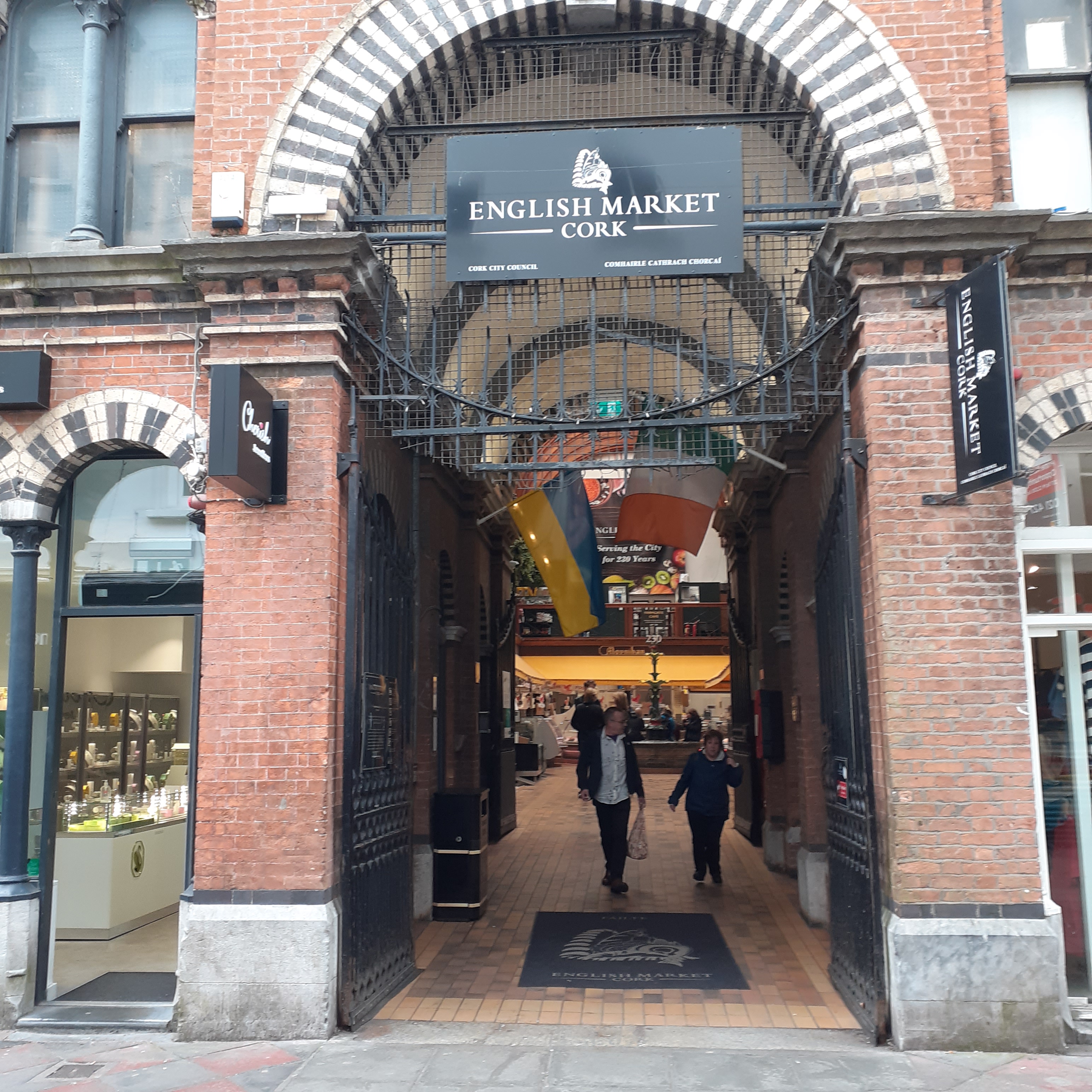
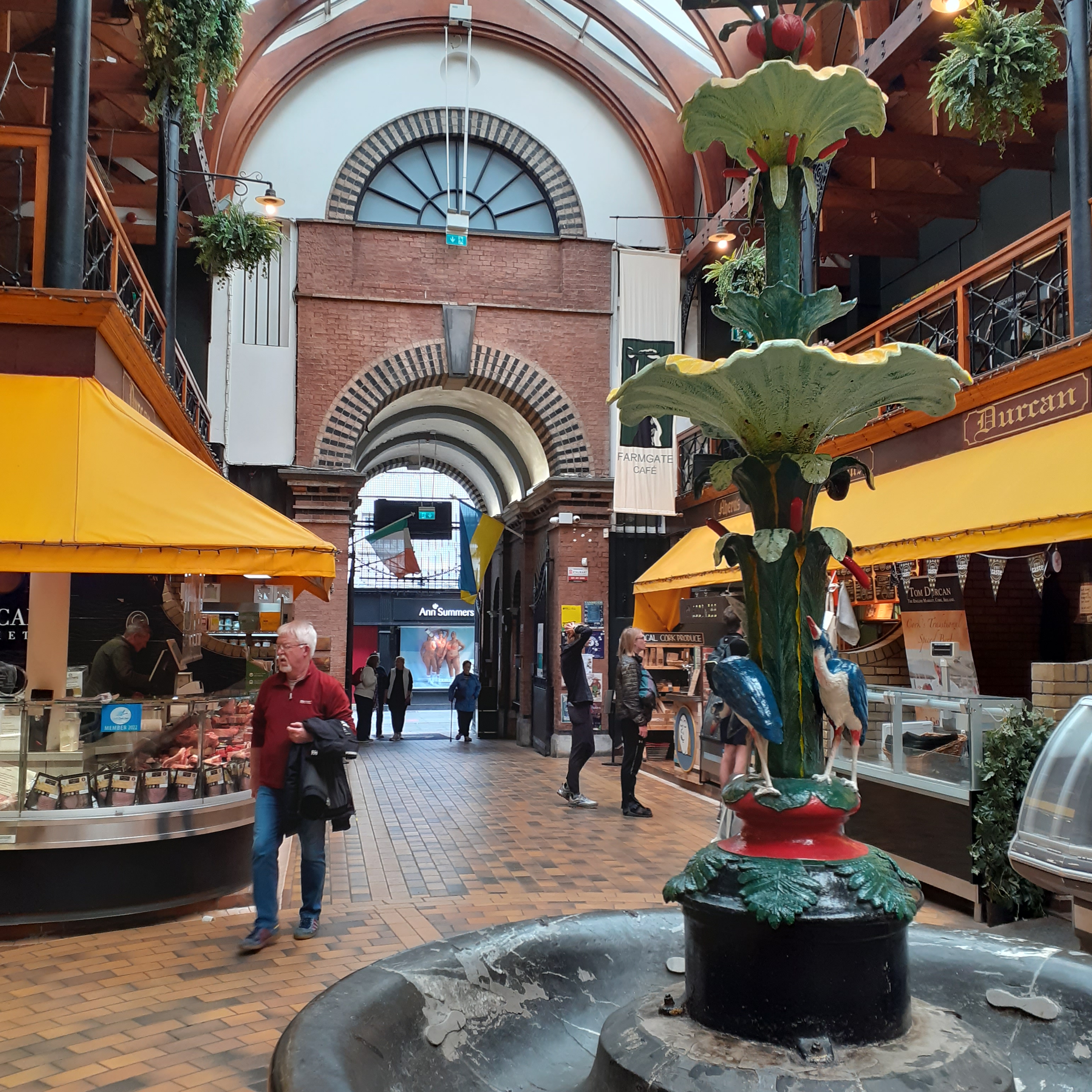
Just off the west end of the street, you’ll find the English Market. With its butchers and bakers and candlestick makers this is a perfectly preserved urban market in the Victorian style. It actually dates back to 1610 when first established by the Protestant city council. The name evolved to distinguish it from the old Irish Market on Cornmarket Street nearby, now the Bodega. The present building complex dates from 1786, though it has had further significant alterations since. The main entrances at Patrick Street and Grand Parade were part of a Victorian makeover. The Grand Parade ornamental entrance was designed by John Benson in 1862. Within the covered market, the arcades converge at a central cast iron fountain ringed by a raised mezzanine with restaurants and cafes.
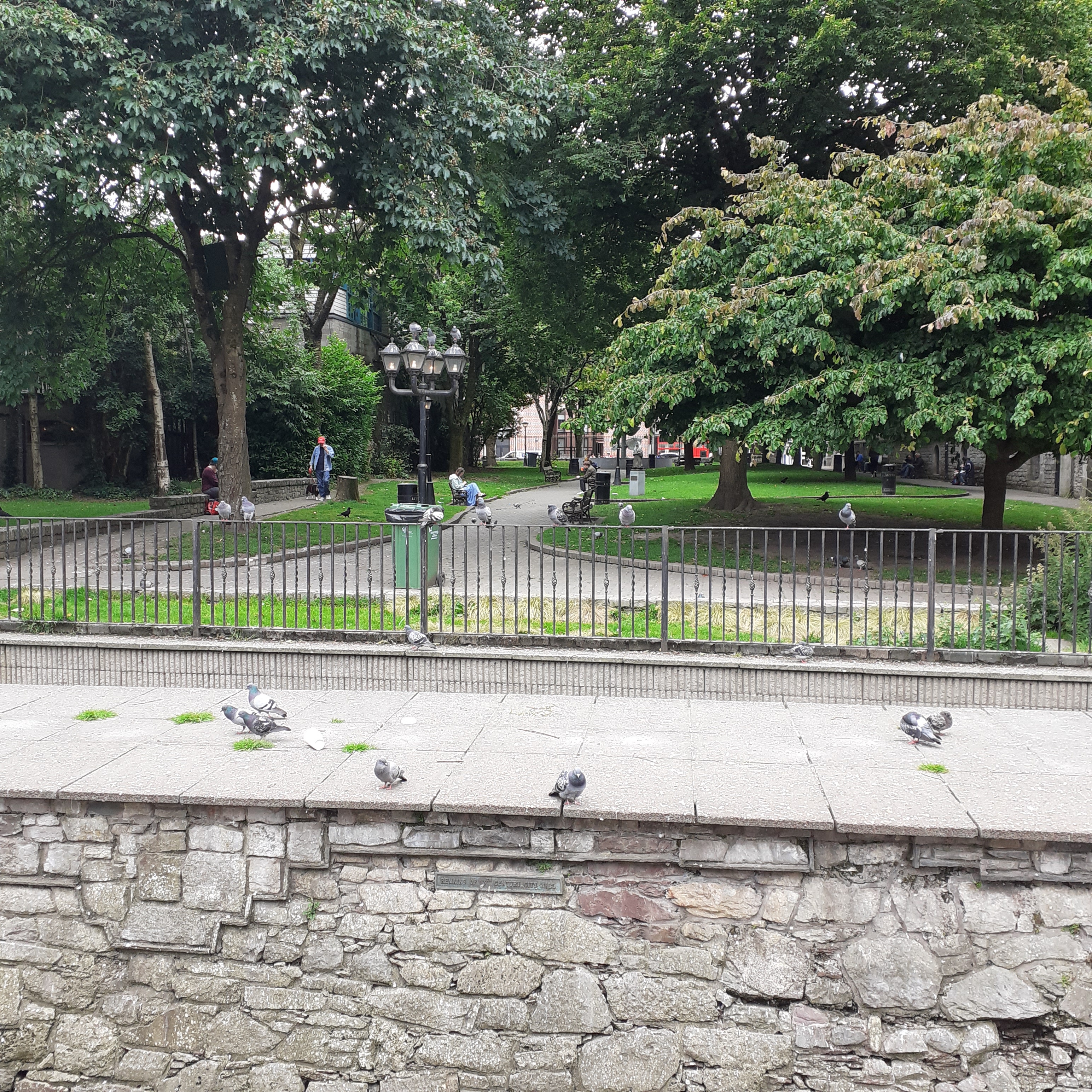
Patrick Street loops to an end at Grand Parade which is broad and straight. Like Patrick Street, it was once a water channel, the ancient settlement of Cork growing up on its west bank. Evening rush hour was approaching so we stopped for coffee and a snack at a place nearby, the Bean and Leaf, with a pleasant terrace from which to watch the world go by. On the far bank is Bishop Lucy Park, with remnants of the medieval citywall visible inside the entrance. It’s one of few parks in the city centre and dates only to 1985, when it was built to celebrate eight hundred years of city status. Around that time, myself and M holed up in Cork again at the end of a significant adventure.
It was our honeymoon, many moons ago. We stayed some days in Adare, County Limerick. Having left that frostbitten fantasy, we headed south on the midwinter roads. By Cork all had thawed and rain fell constantly on the rising waters of Cork city. We hadn’t a place to stay and booked into, and quickly out of, a dump on the outskirts of the city. Driving on into the rain and the city centre, we parked the car in Grand Parade and sought out a hotel there. They said they were full, as places tend to be in midwinter when two drenched hippies materialise in the foyer. We explained the situation and they clicked into gear. We got a nice room to the rear of the hotel. From the window, the illuminated cathedral of Saint Fin Barre sailed like a galleon across the night horizon. We would look at it occasionally through the rainsoaked pane. The hotel is now, I think, the Library.
But every time it rains
You’re here in my head
Like the sun coming out
Ooh, I just know that something good is gonna happen
I don’t know when
But just saying it could even make it happen
Cloudbusting by Kate Bush is from her 1985 album The Hounds of Love. It concerns a son’s love for his father, inspired by Peter Reich’s biographical Book of Dreams. But expressions of love can be appropiated to one’s own desire.
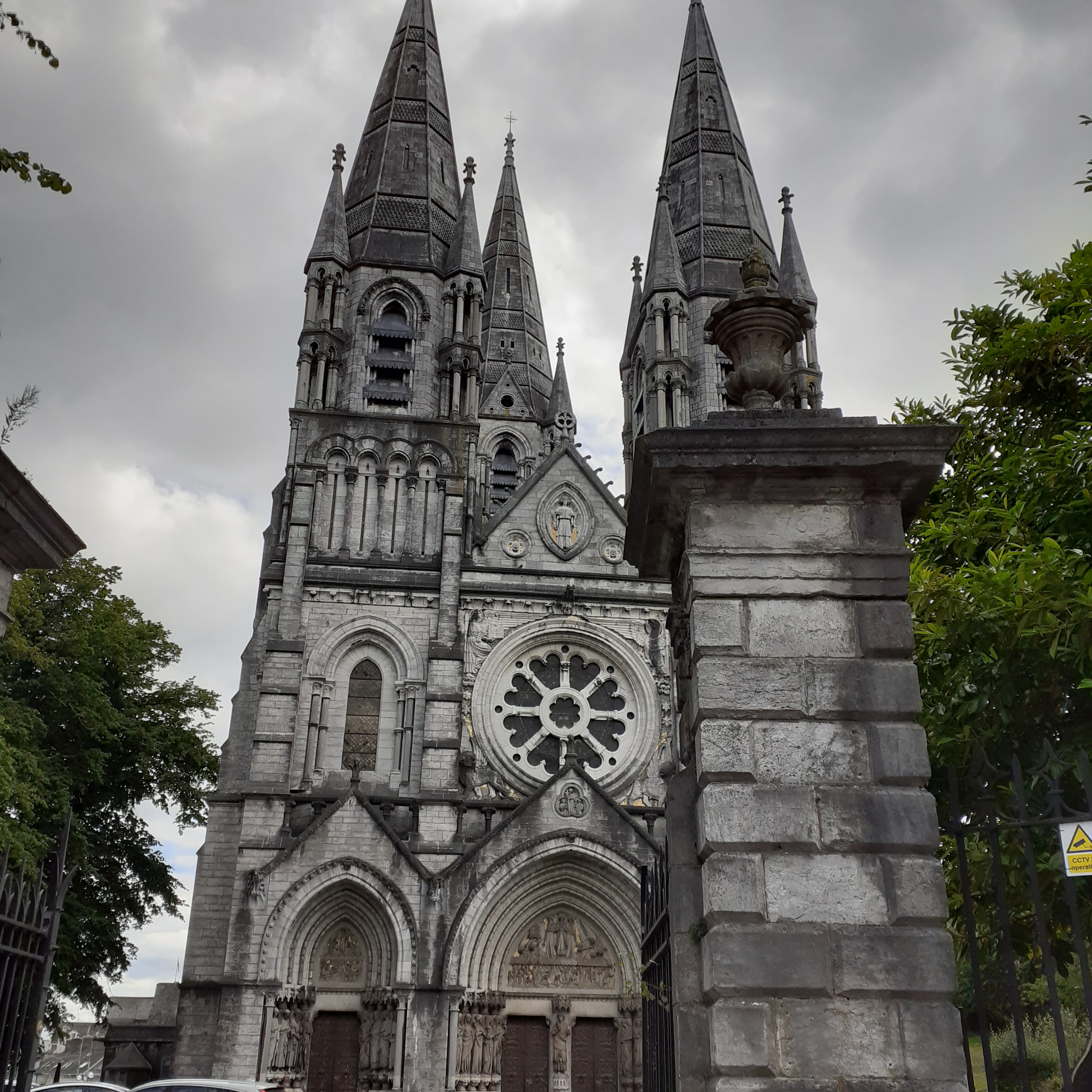
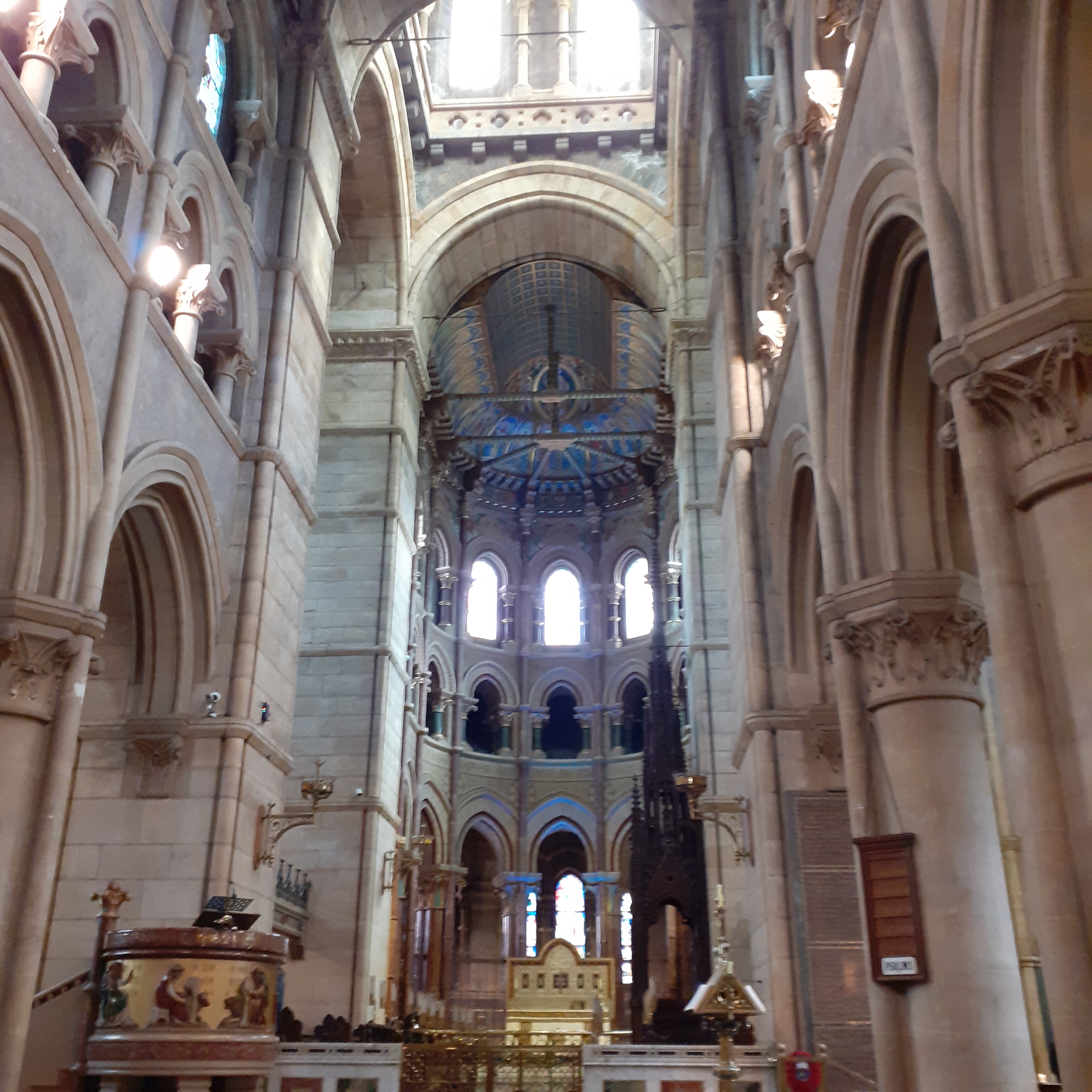
Saint Fin Barre’s lies just across the south branch of the Lee. It is the Church of Ireland Cathedral for Cork. Begun in 1863 and designed by English architect William Burges. It is a Gothic Revival masterpiece. Twin spires frame the entrance and the massive central spire towers above the nave. The exterior creates an impression of grand scale despite a relatively small interior. It replaced the eighteenth century building, long derided as ‘a shabby excuse for a cathedral.’ Finbarr is the patron saint of Cork city, born in the mid sixth century, he was based at Gougane Barra, some miles to the west at the source of the River Lee.
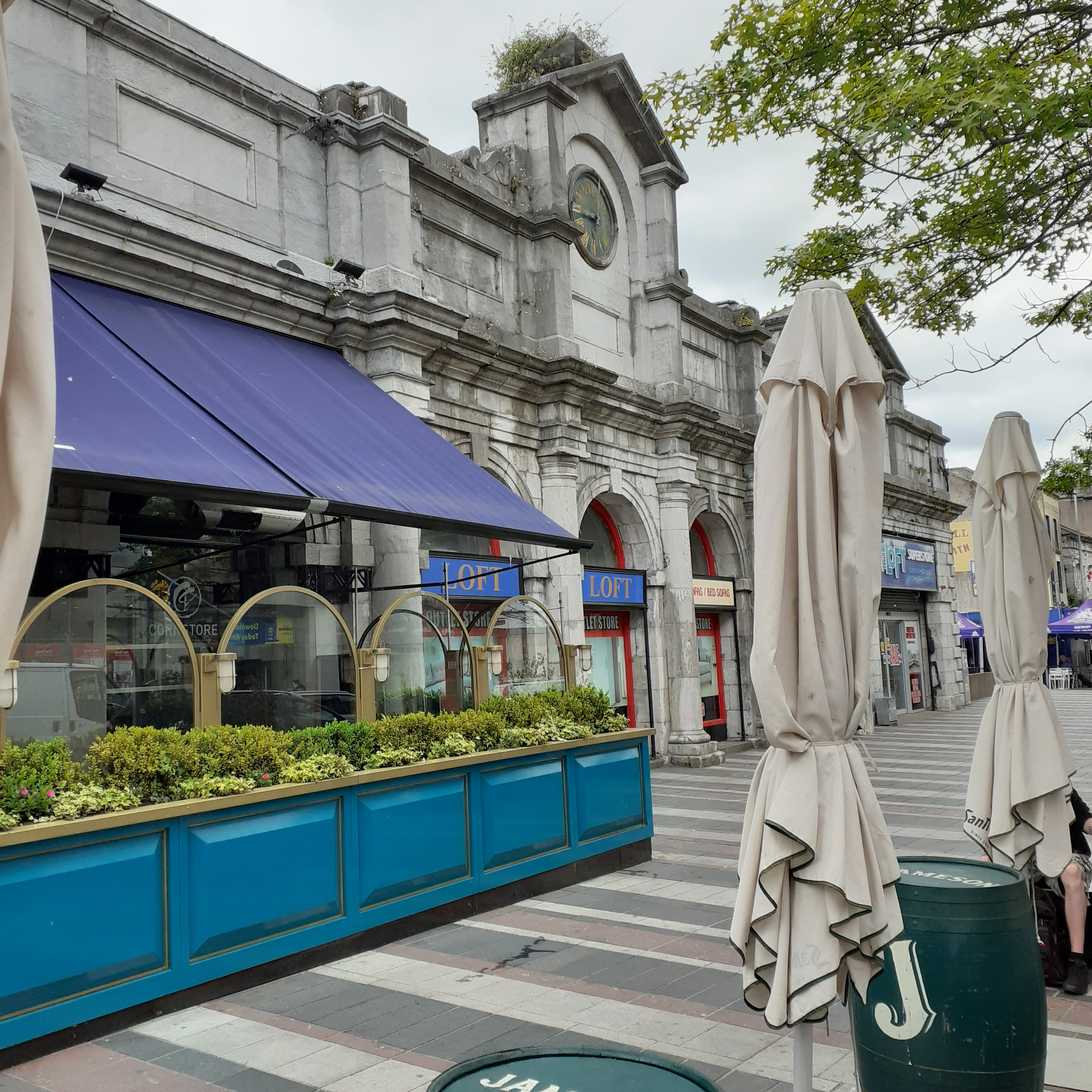
North of the junction with Patrick Street leads into Cornmarket Street. This is sometimes referred to as Coal Quay, as it was once a quayside on a short canal leading out to the River Lee. The grand old Victorian building along the western side housed the original Cornmarket. This was converted to a corporation bazaar in 1843. Known as St Peter’s Market it occupied a half acre site with hundreds of market stalls. It now houses a food and drink complex, the Bodega, including the Old Town Whiskey Bar and several craft and retail outlets. There’s a vibrant street market on Saturday mornings
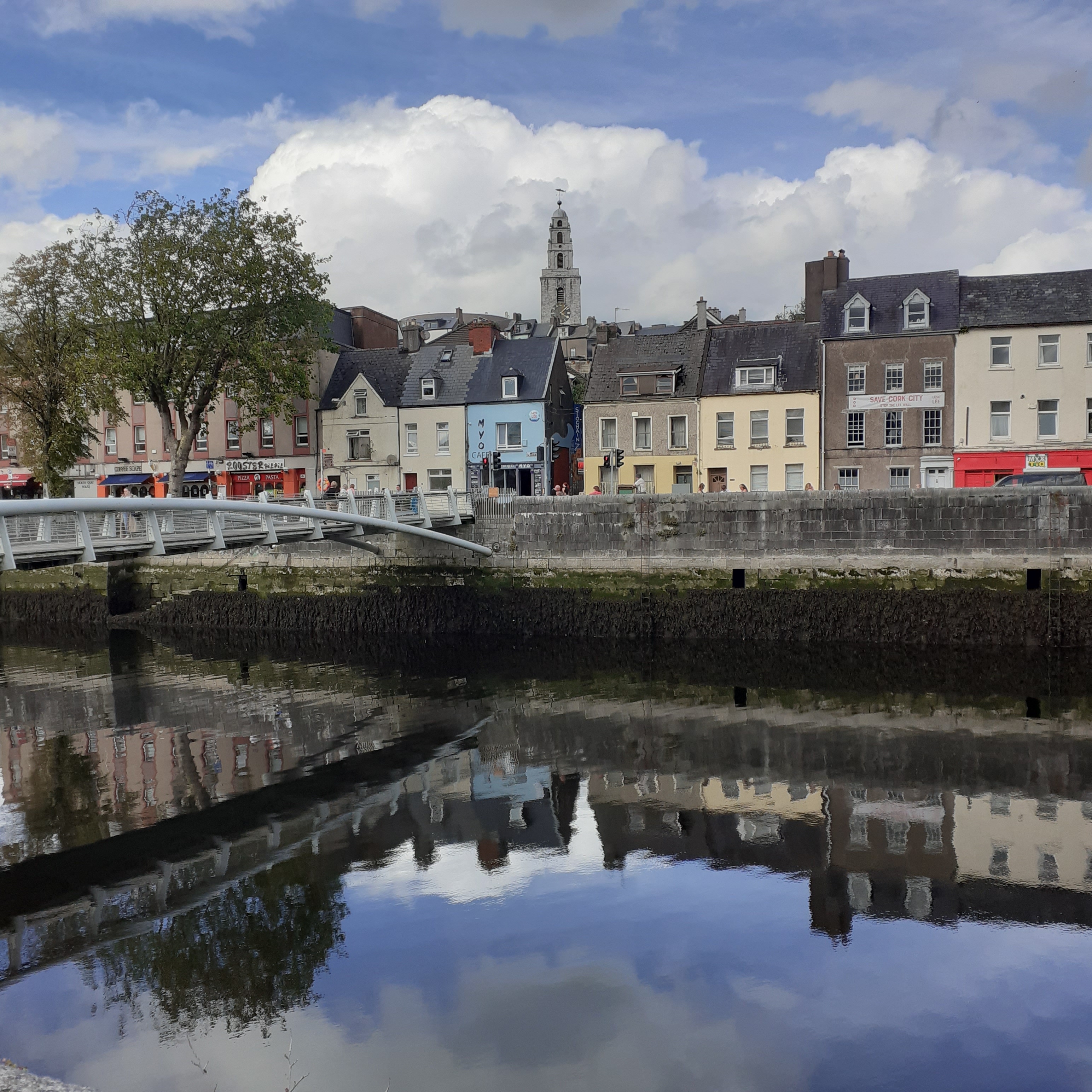
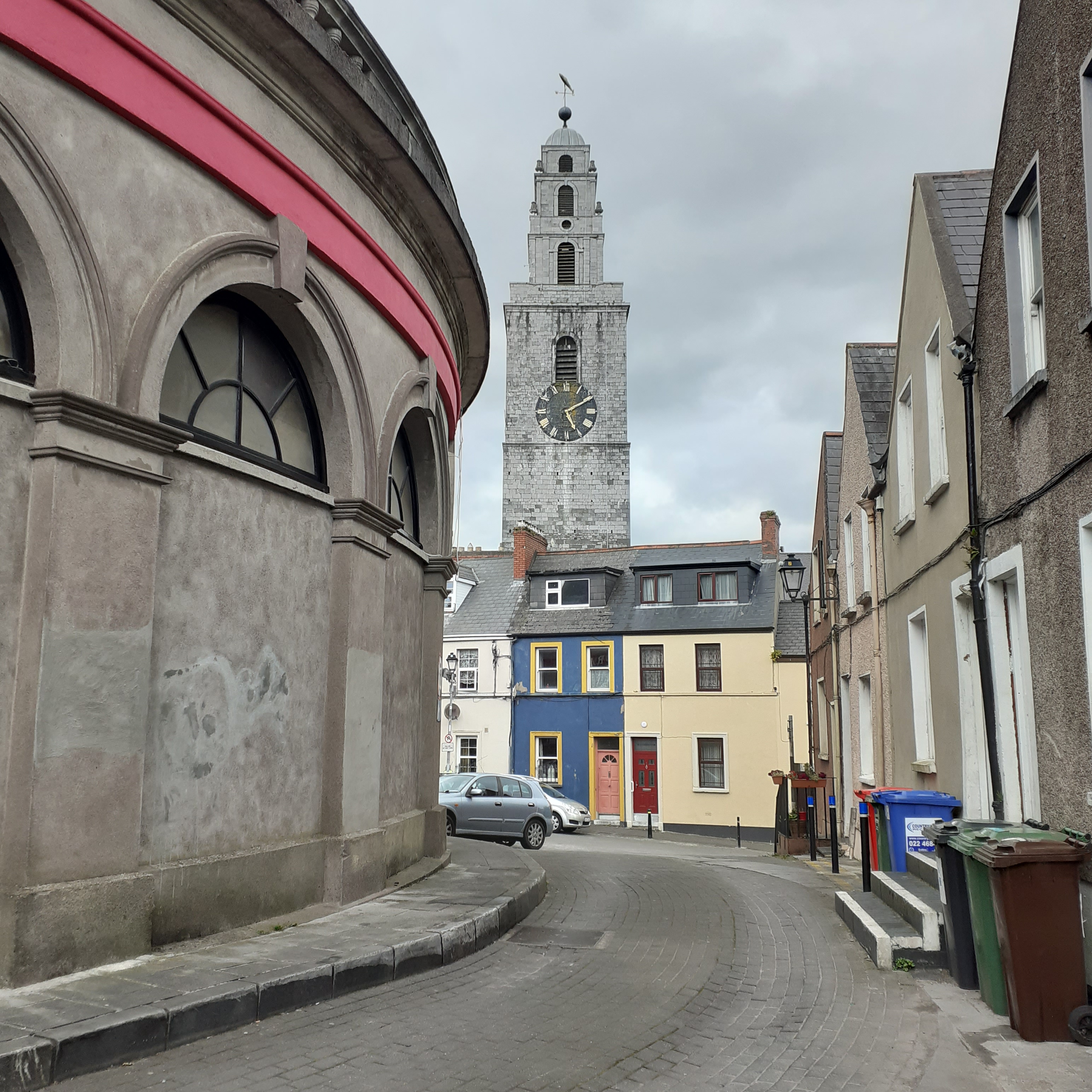
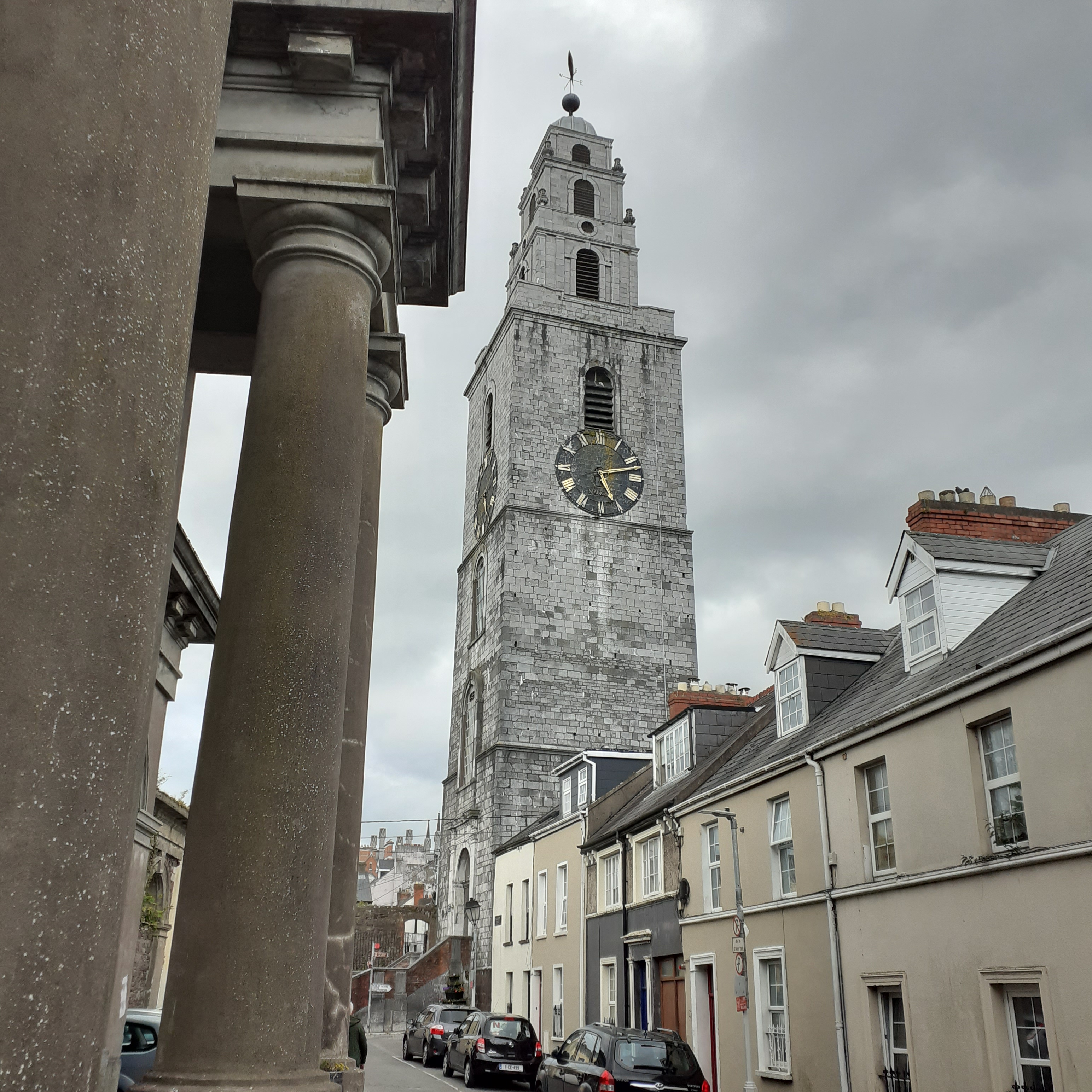
Cornmarket Street leads us back to the north branch of the river where we can cross to Shandon, its packed slopes crowned by Shandon Church with its famed belfry. This is a Cork icon, its distinctive stepped spire rising above the north banks of the Lee. A steep climb up Widderling’s Lane brings us to Dominic Street. The area maintains its ancient atmosphere, almost Mediterranean, with the packed housing streets set atop each other.
The Firkin Crane Arts Centre occupies its own little island. The distinctive rotunda was designed by John Benson in 1835 for the Cork Butter Exchange and now operates as a centre for theatre and dance. The Butter Museum is across the road. In the early evening, the empty urban space was oddly rememiscent of De Chirico’s haunted paintings. At one end of square there was an attractive Syrian restaurant, a few haphazard tables strewn outside, awaited the evening’s custom.
The Church of St Anne (CofI) nearby was built between 1722 – 26. The Church’s carillion is famous, and visitors can contribute from a choice of melodies. The eight bells were cast in Gloucester and have been ringing out over the city since 1752. As with kissing the Blarney Stone, ringing the Bells of Shandon is something of a rite of passage for any visitor to Cork. We did so on a visit in the nineties. Myself and M, and the boys, camped in Blarney and took the opportunity for a quick trip to Cork which is just 8km away. The road to Bantry connects directly to Shandon.
The Church is set village style on its own grounds and built in red and white sandstone, the Cork colours. The tower rises to 120 feet, surmounted by a further fifty foot with its pepper canister topping. Climbing through the rafters we emerged atop the bell tower to sway above the dizzying streetscape. I still get vertigo just thinking of it. The main object, of course, is to ring the Bells of Shandon. The ringing apparatus is located below on the first floor, and a nice man called Alex introduced us to our simple task. A varied popular repertoire is supplied, and, if my memory serves me well, my contribution was the Beatles, All You Need is Love (Lennon/McCartney, 1967)
Cork was built on an island between two branches of the River Lee. It means marshy place and is very prone to flooding. There were monastic and Viking settlements here, but is first noted as a city in the reign of King John, Lord of Ireland, in the late twelfth century. I regularly passed through on the way to family holidays on the south coast, and later with friends in those halcyon days; heading for Kinsale, or other vague destinations, by Hook or by Crooke. We once camped near Shandon, but more salubrious accommodation would come.
I stayed here in 1980 for the Jazz Festival and the Labour Party Conference. We stayed up late at the Metropole which had formed into one of those festival club montages, wandering from room to room as different jazz performances floated from doorways – solo piano, bebop combos and goodtime trumpet playing band. The Jazz Festival was born in 1978 when Jim Mountjoy, marketing manager of the Metropole, was looking for something to coincide with the new October bank holiday introduced by Labour minister Michael O’Leary the previous year. This often coincides with Hallowe’en, the ancient Celtic festival of the dead. Wild and windy, and wonderfully spooky, what better time for a festival of the devil’s music in a southern delta. The sponsors then were John Player whose cigarettes provided an excellent companion to all forms of music, though perhaps forever associated with Procol Harum’s A Salty Dog.
We sailed for parts unknown to man
where ships come home to die
no lofty peak nor fortress bold
could match our captain’s eye
Ella Fitzgerald headlined at the Cork Opera House that year, and for forty five years the festival has featured the cream of local and international jazz, and its children too.
Our accommodation then was more modest than the Met. When the last note sounded in the wee small hours, we got our car and headed south of the river. Darkness still reigned though the rain had ceased. However, that most Corkonian of downpowers must have burst the dykes and the streets turned to waterways. Back in Venice again, at the wheel of my own motor launch, a Renault 4 to be precise, I drove milk float slow with water halfway up the hub caps.
This time we take the train. There’s a train every two hours from Dublin Heuston, and the journey takes about two and a half hours. The frequency ensures it’s not too crowded. I avail of my free travel pass, with M being my designated minder. We arrive in Cork Kent and make for McCurtain Street. The Isaacs Hotel is opposite the larger Metropole hotel. McCurtain Street itself is north of and parallel to the River Lee.
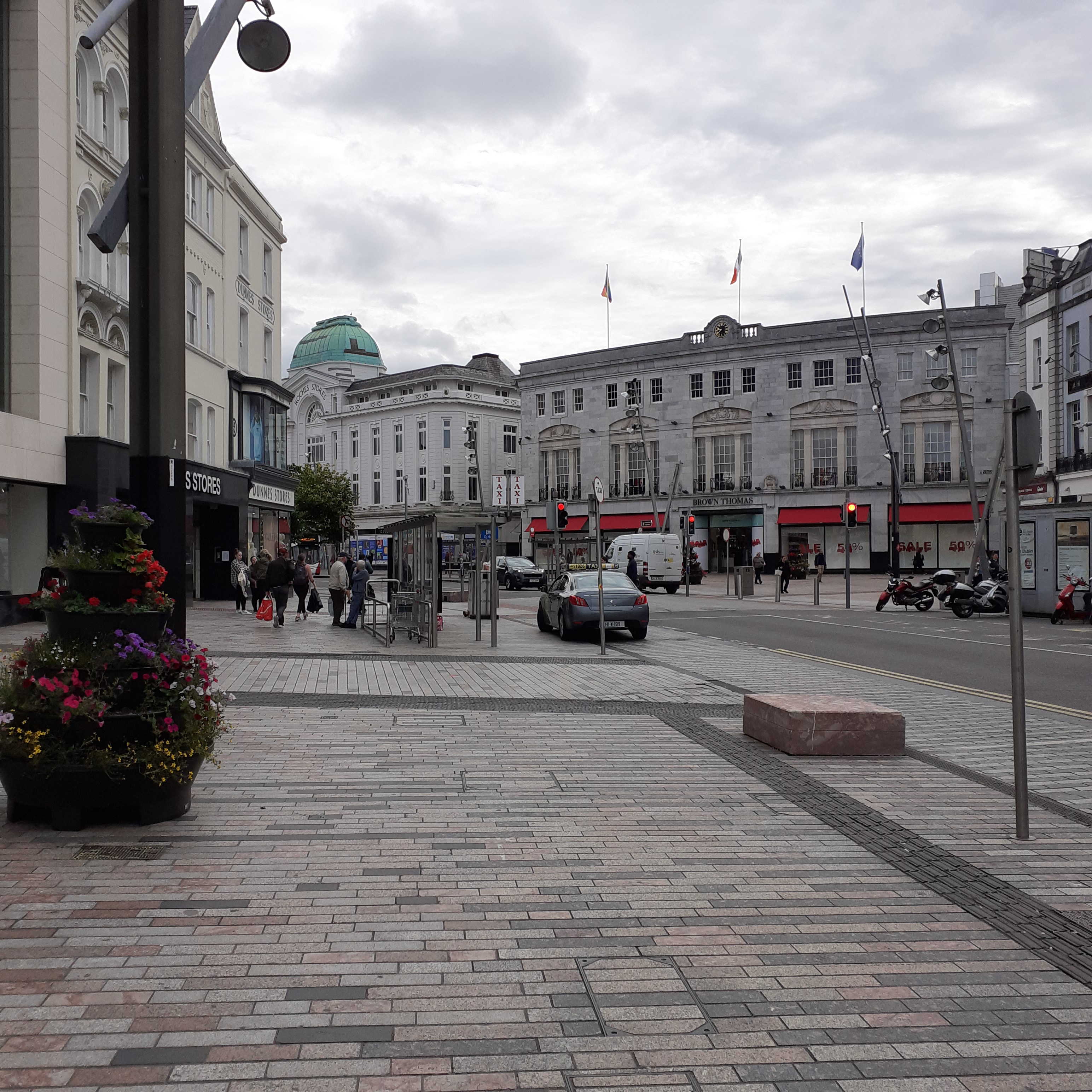
At the foot of McCurtain Street, St. Patrick’s Hill takes us down to the river. This is the north branch of the River Lee, embracing Cork city centre on its low lying island. Patrick Street, across the bridge, is the wide and winding principal street. It has the most ugly street lighting you are likely to see, a deranged bundle of oblique scaffolding and spotlights which clash with the elegant streetscape.
Cork is Ireland’s second city. Recent boundary changes have seen its population surge towards the quarter million mark. Back in the day, in the seventies and eighties, it held barely a hundred thousand souls. Walking the city streets in late summer, that increase is palpable. There’s a buzz abroad.
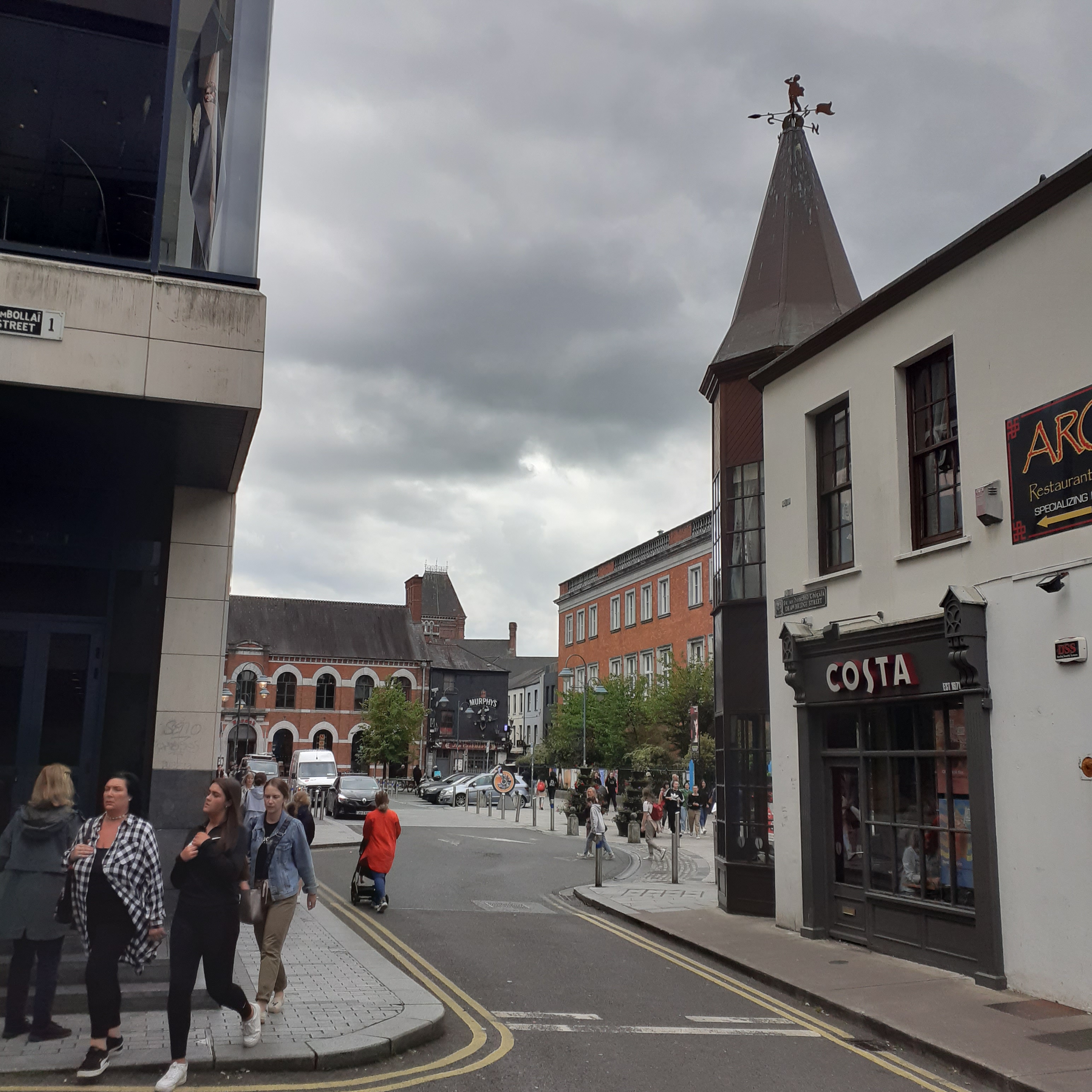
Narrow lanes lead off Patrick Street, boasting such colourful names as Drawbridge Street, Bowling Green Street and Half Moon Street. The names evoke an olden atmosphere and this pervades much of the streetscape too. There are plenty of cafes and bars with outdoor seating, bohemians, students and tourists mingling with the ever growing throngs of modern shoppers.
The Crawford Municipal Gallery is within this warren. The Crawford is always a port of call for myself and M when in Cork. William Horatio Crawford, brewer and philanthropist (a good mix) funded the art college here. Beamish and Crawford produce the famous Beamish stout, a black ale with creamy head just like Guinness. Originally the building was the Custom House for Cork, built in 1724, it later was home to the Royal Cork Institution. The Art School was rechristened for its benefactor in 1885 and became the Crawford Municipal Gallery in 1979 with the relocation of the art college to new premises.
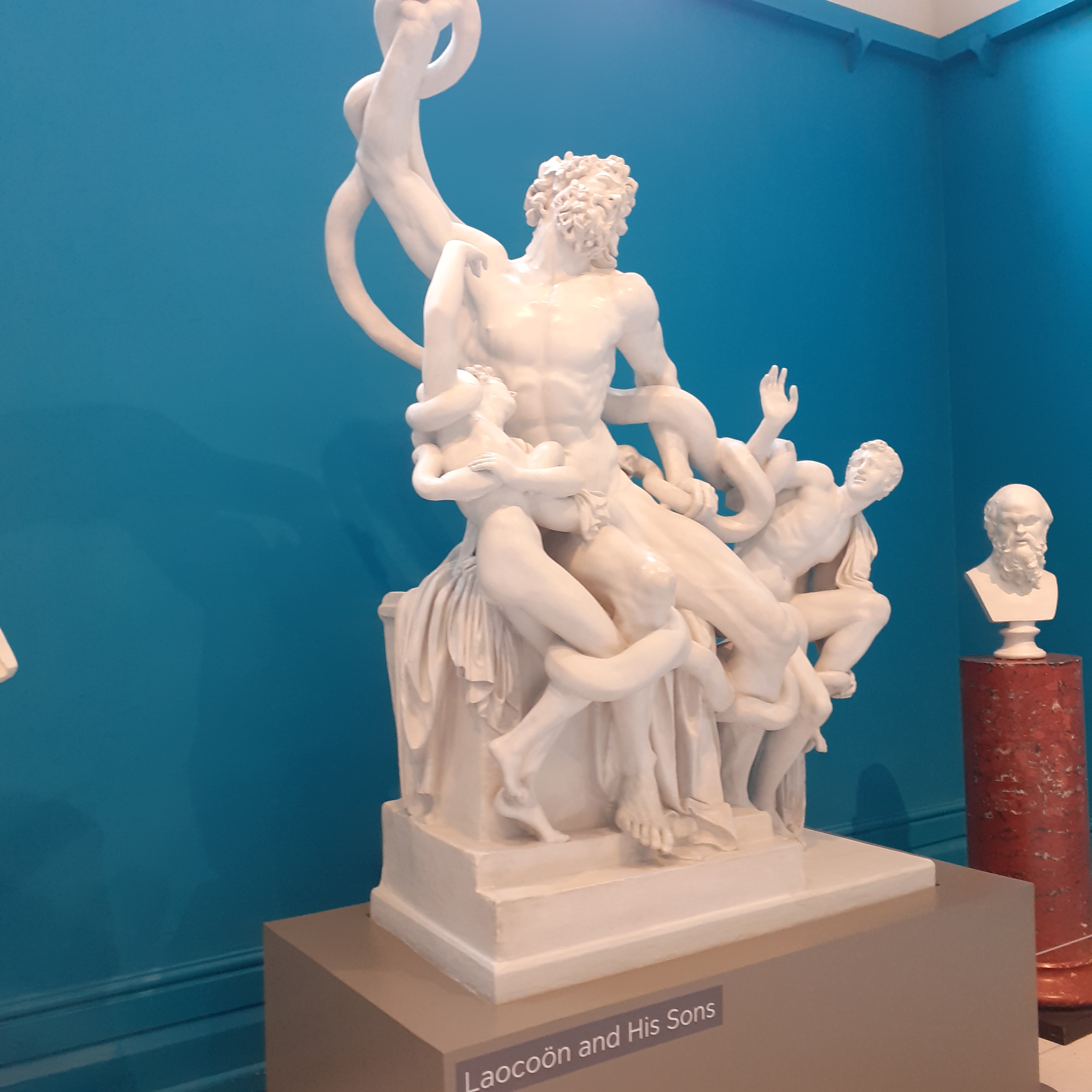
We are returned to our own college days inside the door where there’s a permanent display of casts of classical Greek and Roman statues by Italian Antonio Canova. Donated by George IV (as Regent) these came originally from the Vatican. Most spectacular is Laocoon and His Sons, which was also an emblem of our own college. It dominated the entrance to NCAD, then in Kildare Street alongside that other parcel of rogues, the Dail or Parliament. The Crawford also includes work by leading Irish artists: the stained glass of Harry Clarke and Evie Hone and paintings by William Orpen, Jack B Yeats and Nano Reid. Crawford College painters, James Brennan, Henry Jones Thaddeus, and William Barry also feature. The Zurich Prize Portrait exhibition was the main visiting attraction. We had seen it in Dublin but it was well worth seeing again.
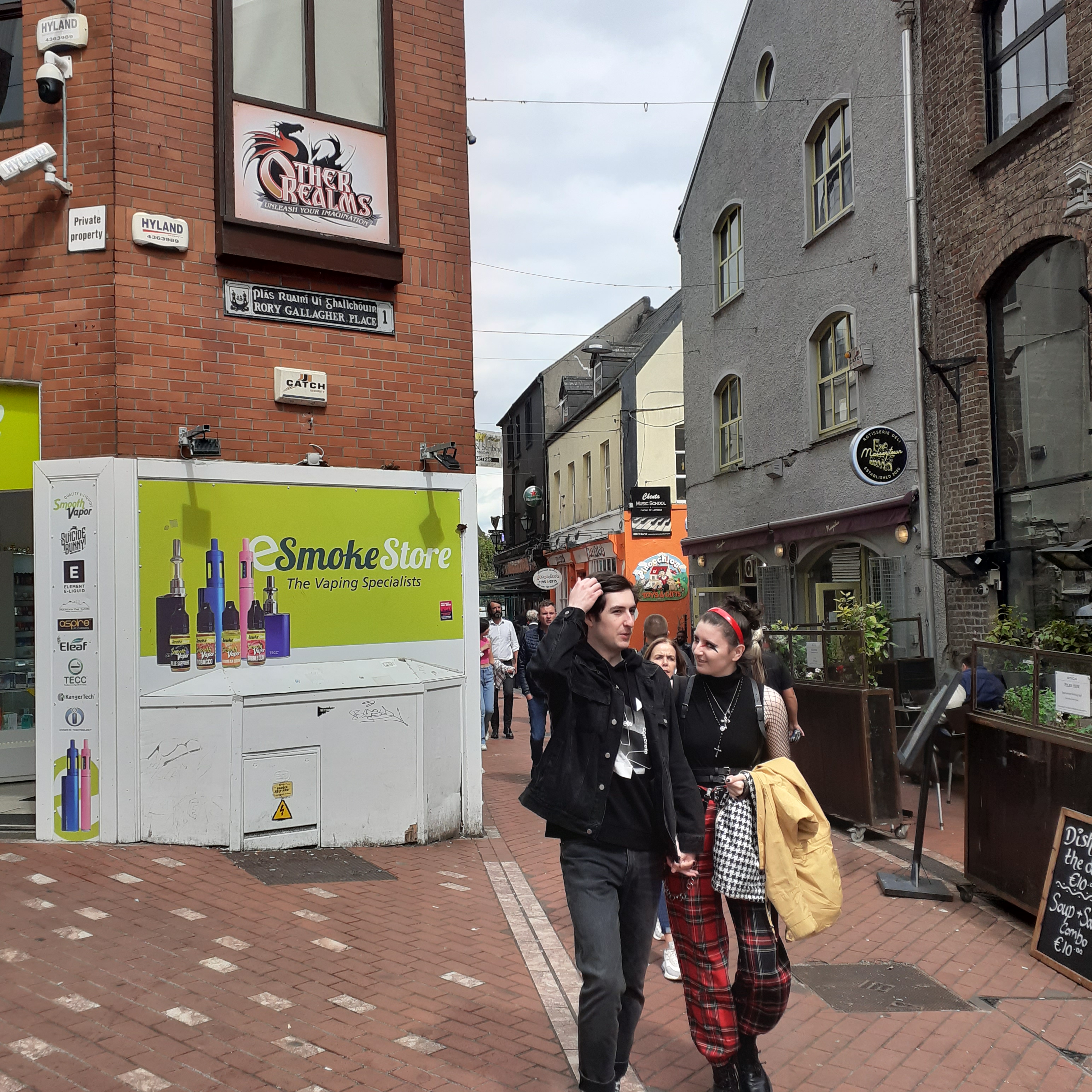
From the Crawford on Emmet Place, we head along Paul Street to a small plaza ooutside the shopping centre: Rory Gallagher Place. There’s a sculpture by Geraldine Creedon which depicts a swirling guitar emitting streams of Gallagher songs. Gallagher is the much loved blues guitarist who founded Taste in the sixties. For my generation, seeing Gallagher play was an early rite of passage. Always on the road, his annual stadium gig, and the odd festival appearance were a must for the young rock fan. Gallagher was actually born in Donegal, in the later forties, but his family moved to Cork when he was five. As a teenager he played with the Fontana showband, but was ever moving towards the Blues-rock scene. With the power trio Taste, he enjoyed live success in Belfast clubs, and achieved chart success with their first two albums, Taste and On the Boards. His solo career brought him guitar hero status, but his fame waned in the eighties. He died in 1995, aged forty seven and is buried at St Oliver’s Cemetary in Ballincollig on the city outskirts.
On the Boards is Gallagher at his best. There’s a jazz sensibility in his playing and arrangements. Saxaphone, played by Rory, adds a particularly moody dimension. Released in 1970, it was their last album as Gallagher went solo after the Isle of Wight festival. What’s Going On was a hit single. Gallagher’s disregard for such fame didn’t help his career, or indeed musical development. Railway and Gun is another number that showcases his range as a guitarist and composer.









 xxharrison