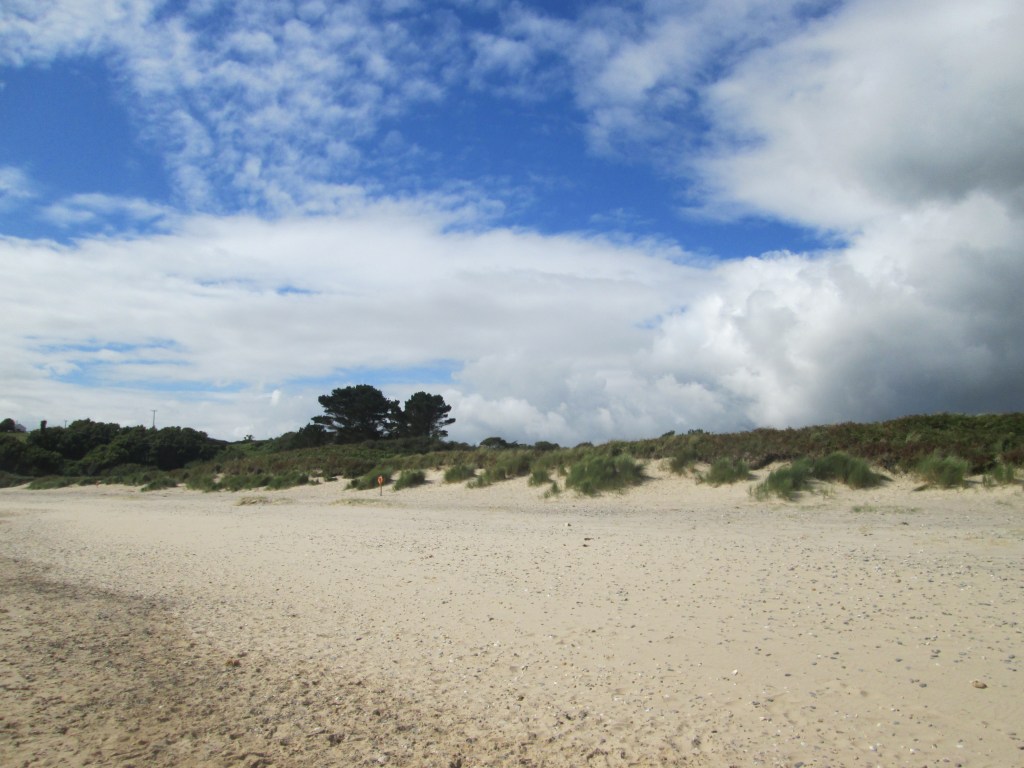
Summer is here, and amongst my favourite activities is doing nothing on a beach. Not exactly an activity so. Brittas Bay is a regular haunt. Thanks to good friends, we can spend a few weeks in a mobile on Wicklow’s wonderful coast. The mobile park is separated from the rising coast by a small river, and from the bay itself by a range of high sand dunes.
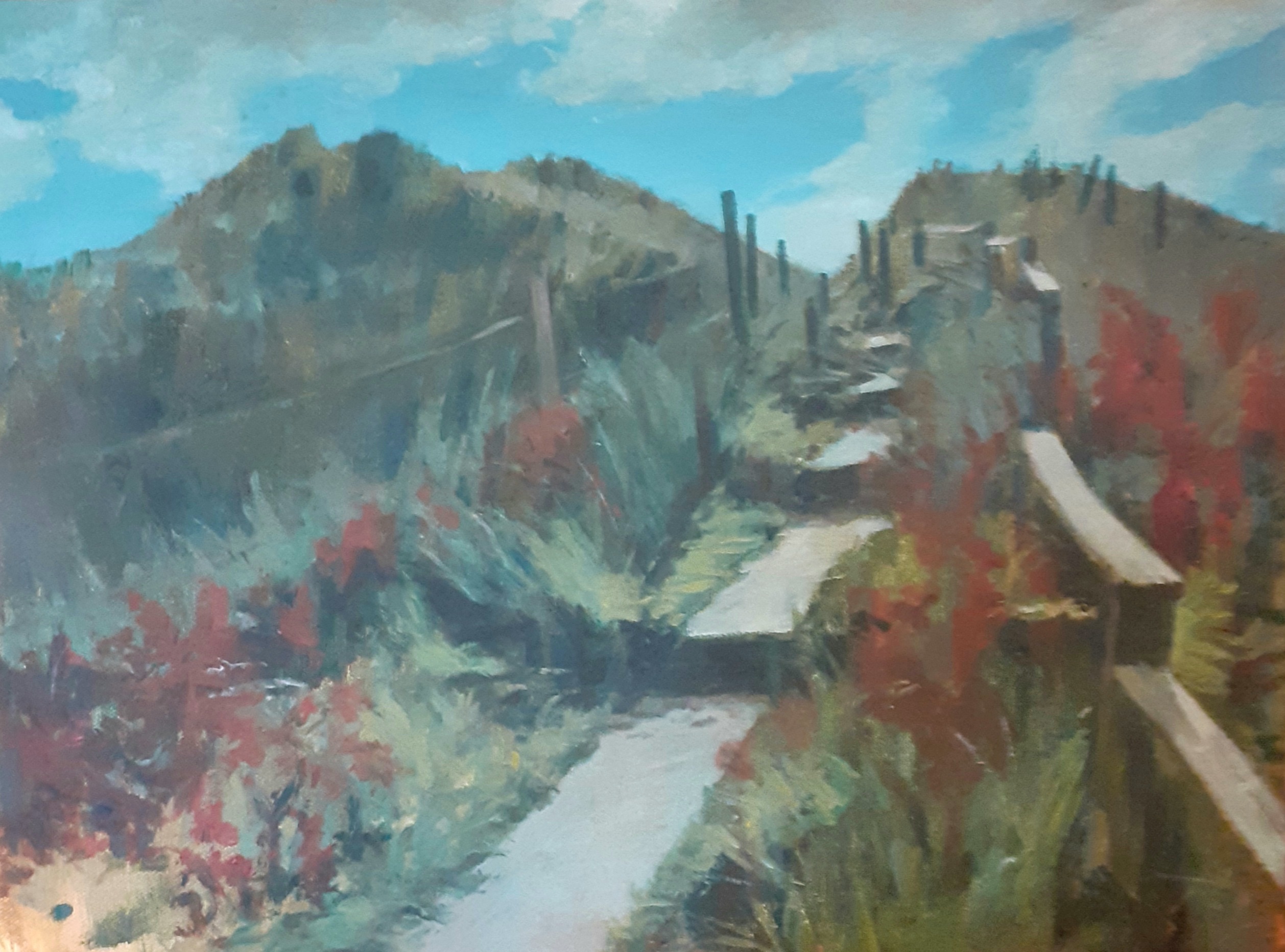
In this painting, we are approaching the beach through the dunes along one of several stepped ways. It’s something of an oasis of isolation and quiet, between the domestic suburbia of the mobile park and the windswept leisure activity of the beach.
This time I am using oils, which I have not done in a long long time. Since I went to art college in the summer of 77 I have tended towards faster graphic media such as watercolour, gouache and acrylics. One Dublin cityscape and a mountain landscape is all I can recall. So it was a bit of a struggle to begin with, and I was as much absorbed in the physicality of the whole thing, the texture and smell of the materials as I would normally be in the detail and composition of the finished work. There’s something of the wild and unkempt in this and the process. A sensual saturation that takes its own form.
And so the song that suggests itself is rough and ready too. It’s from the summer of 77 which I remember for sandy days with M in Llandudno, Wales and a holiday hut on the beach in Skerries, North Dublin. It kicks off with a to-die-for bass riff. What follows is a young ruffian gorging himself on the visual pleasures of the beach. It’s called Peaches and was the first hit for the Stranglers from their debut album Rattus Norvegicus. You might also know it from the opening credits of the 2000 geezer flick Sexy Beast, where reformed lout, Ray Winstone, soaks up the sun in a villa in Spain. Oh, I can relate to it in all sorts of ways.
Well there goes another one just lying down on the sand dunes
I’d better go take a swim and see if I can cool down a little bit
Coz you and me woman, we got a lotta things on our minds
The walk from the Dargle River to Arklow on the Avoca is about 54k, taking in, near enough, the coastline of County Wicklow. After Arklow, there is a short stretch to Clogga Beach after which Kilmichael Point marks the border with Wexford. I haven’t done that yet, but it’s on my list.
All the way to Wicklow Town we kept to the coast, though after that access was restricted to select entry points. It’s been an epic in seventeen parts. The first seven were in Bray which certainly offers plenty, though we had barely covered a mile of our journey before embarking on the cliff walk to Greystones. That’s about a 7k stretch and you’d do it easily in ninety minutes. If you want to do it via Bray Head and Summit, it will take a bit longer with a climb to 240 metres. You can make it a loop walk or go station to station and take DART in one direction.
Greystones all the way to Wicklow is along the beach for a little over 20k. Detours to Newcastle and the East Coast Bird Sanctuary were taken. The Bird Sanctuary is a good outing of itself. Greystones to Newcastle is around 8k, and it’s another 13k to Wicklow.
Wicklow was good for a bit of exploration. South of the town you can navigate the headland by way of the Black Castle and join the Glen Beach Cliff Walk as far as the Lighthouses. Wicklow to Arklow is a distance of about 25k, but there’s no one coastal path. We drove it and dropped into Magheramore Beach and Brittas Bay, the latter a splendid walk end to end of about 5k. After Mizen Head, the road runs close to the sea for 12k all the way into Arklow.
And of course, what kept us going was the travellers tales, the myths and legends, and the songs playing in our heads. Much of the playlist is provided by local artists, some a bit further afield.
Double Cross, (Fintan Coughlan), Tired and Emotional/Mary Coughlan (1985)
Telstar, (Joe Meek) The Original Telstar – The Sounds of the Tornados/The Tornados (1962)
Between Wicklow Town and Arklow, the coast is intermittently accessible. There is no continuous coastal walk other than the roadway. But, if you have use of a car, you can access a fair portion of the coastline, and enjoy a number of wonderful beaches and secret coves.
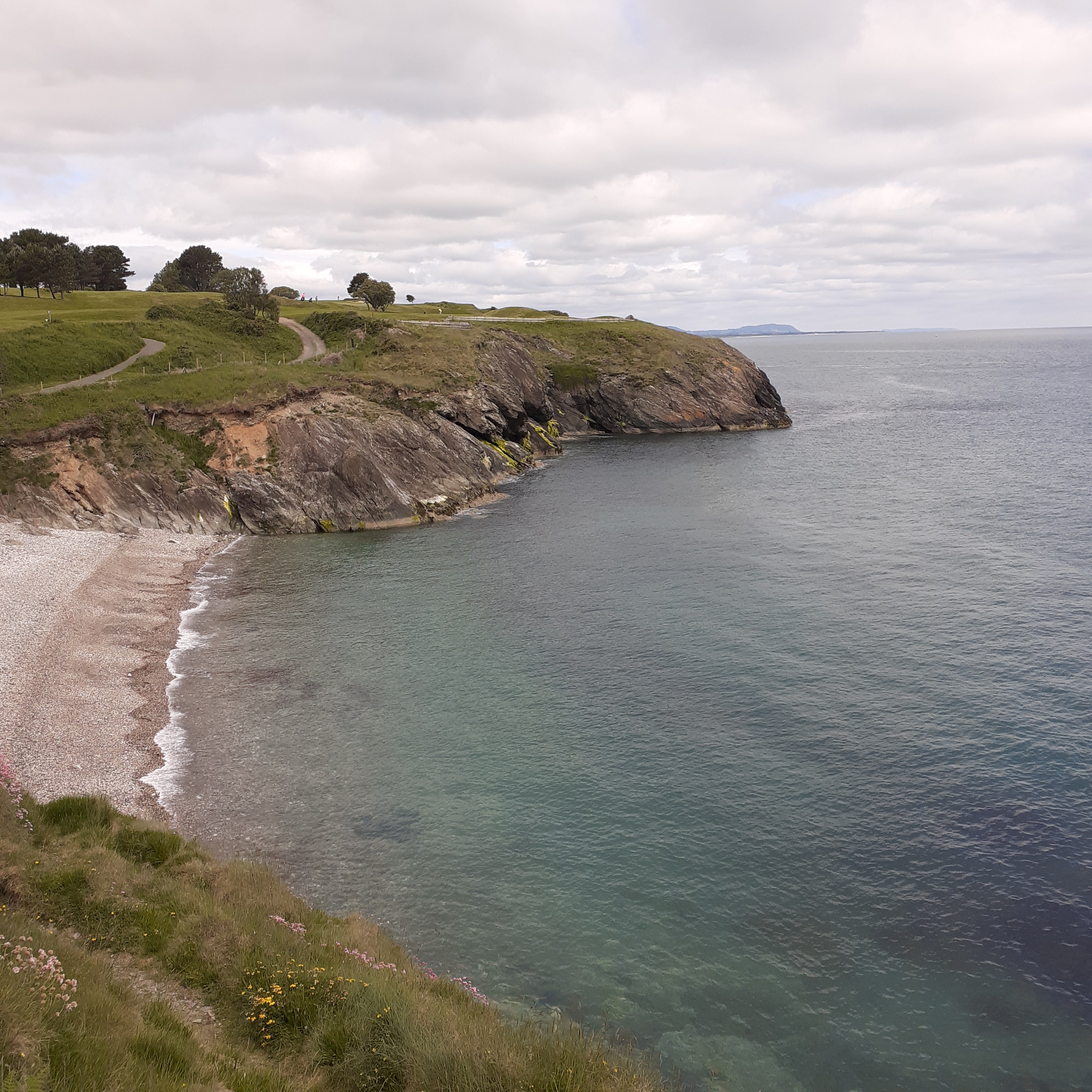
Immediately south of the Black Castle, there’s an excellent short walk that will take you out to the extremity of Wicklow Head. From the Castle head south along Castle Field until you find yourself back on the main road. The Wicklow Golf Club will be to your left, and after you pass the Clubhouse, you will reach the Glen Beach Cliff Walk Car Park, perched above a picturesque ravine. Head down to Glen Beach, and follow the markers to pick up the walk along the headland.
At first the walk is intertwined with the golf course, but crucially separated from it. If golf is a good walk spoiled, then this is a good walk. To be fair, it looks an attractive course. I hear good reports too about the Clubhouse, with a bar and restaurant open to all.
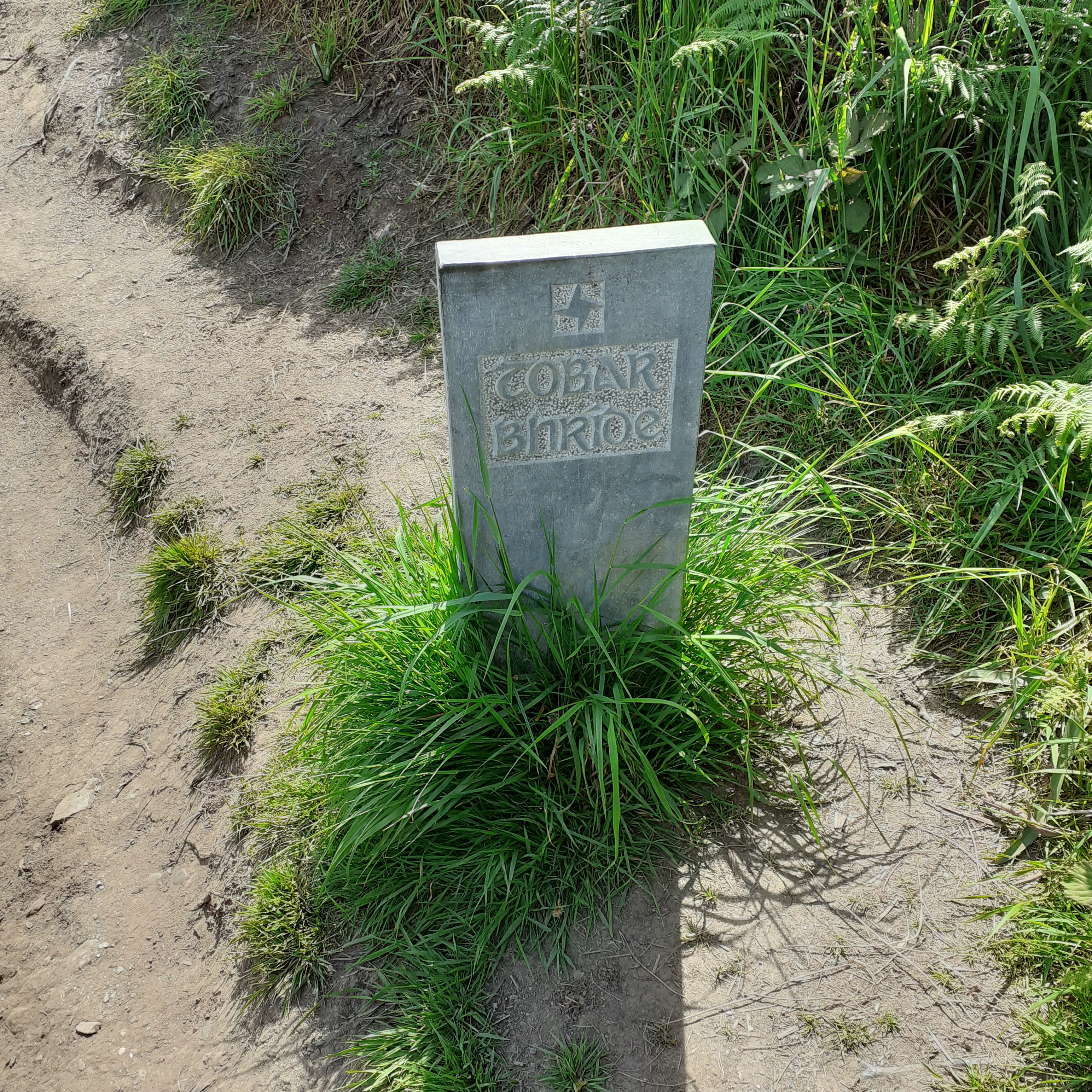
The walk leads up past Lover’s Leap and on to Tobar Bride, a holy well sacred to sailors. There is a stone marker inscribed with the Saint Brigid’s Cross, a well known Irish emblem, for long the logotype of the national broadcaster, RTE. Bride, pronounced Breda, is the Gaelic for Brigid. Saint Brigid was born in the mid fifth century and became Abbess of Kildare, and conferred with the authority of a bishop. Successive abbesses of Kildare remained vested with this authority until removed by the (male) clergy in the mid twelfth century.
In pre-Christian times, the name Brigid denoted a Celtic pagan goddess. Brigid’s feastday is the first of February, as is her pagan namesake’s. It marked a Celtic feast of fertility, along with the onset of Spring. Saint Brigid died in 525. She is a patron saint of Ireland, alongside Patrick from the previous generation. She is also sacred to certain groups: babies, blacksmiths and boatmen, poets too, and scholars.
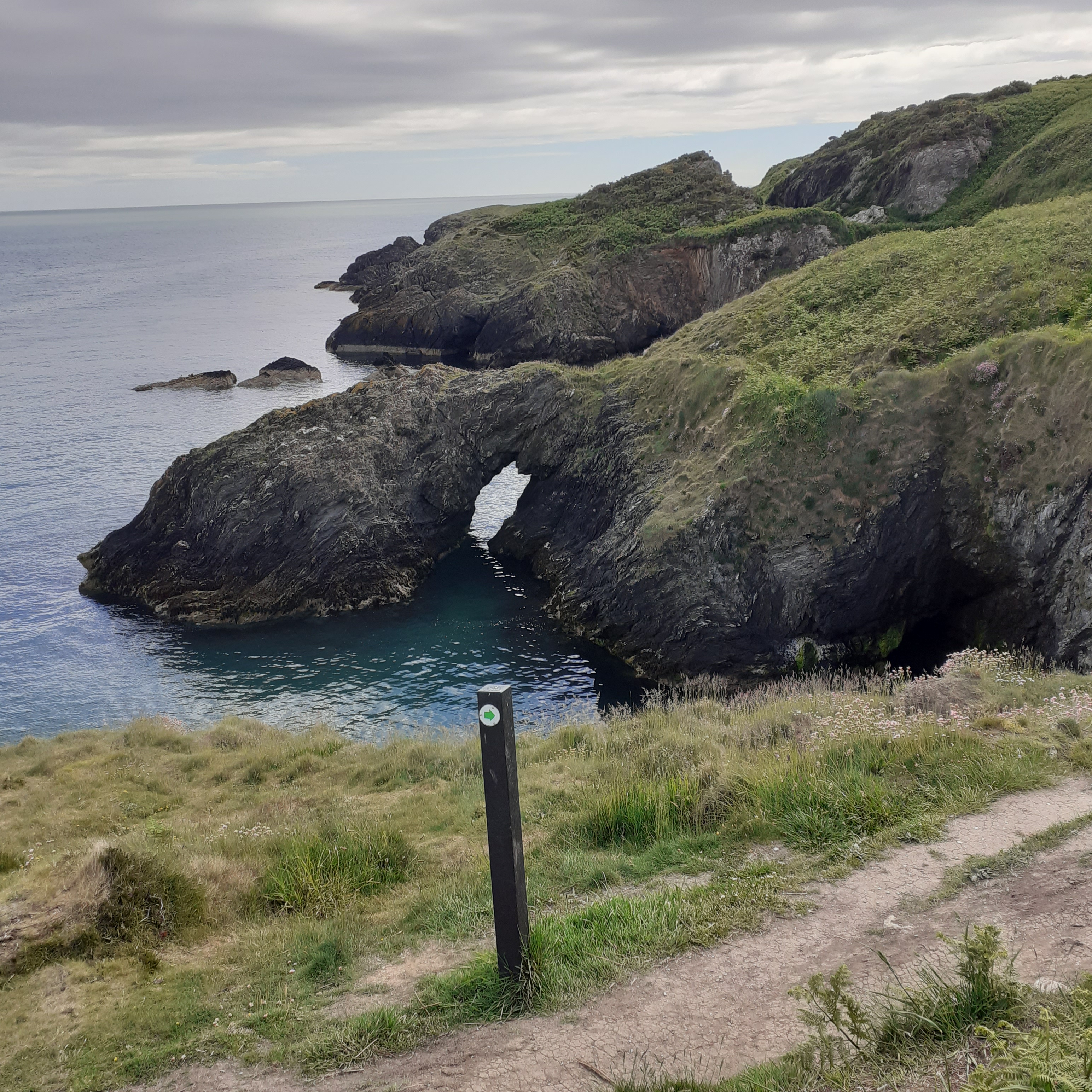
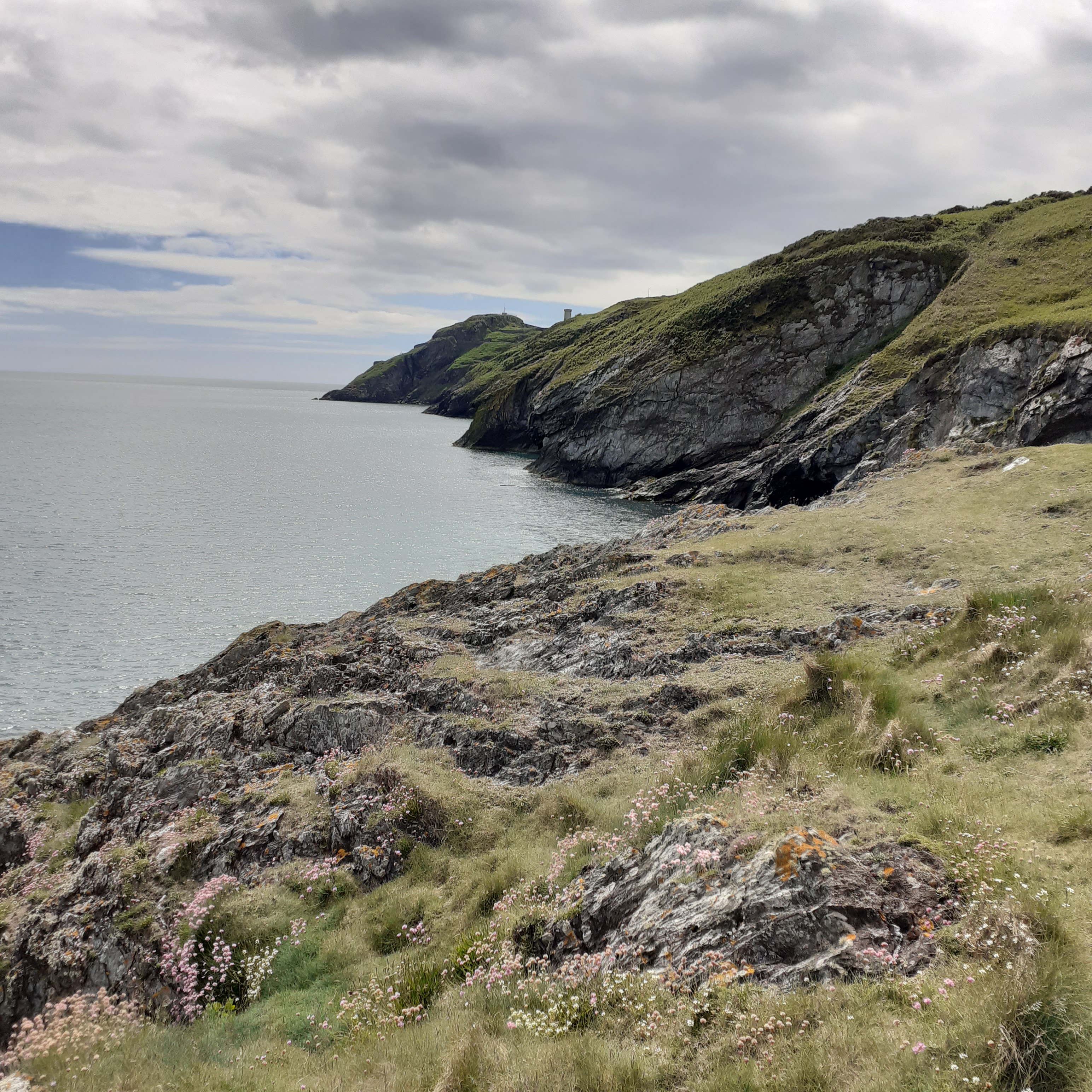
After Tobar Bride, the landscape grows craggy and beautiful. The path forks above a deep, rocky inlet. The inland path leads through a cleft in the rocks. A church was hidden here in penal times. An outer loop leads to Bride’s Head. The rugged coast below is riddled with small coves and sea arches, lapped by crystal water and thronged by a variety of seabirds. Peregrine falcons, ravens, gulls, guillemots, oyster catchers, shags and kittiwake jostle for supremacy, and survival.
From Bride’s Head there’s a spectacular ocean panorama: to the north the Wicklow Mountains step down to the Sugarloafs and Bray Head. Away to the east, the coast of Wales is a sporadic chimera when conditions rhyme. Southwards, and the higher crag of Wicklow Head frames the view, crowned by its lighthouses.
The two paths meet again at Limekiln Bay. There are ruins of an ancient kiln house nearby. Grey Seal breed at Limekiln Bay and other coves on this headland from September through to April and you should keep your distance, and peace, over these crucial months. Dolphins and porpoises have also been seen frolicking in the water.
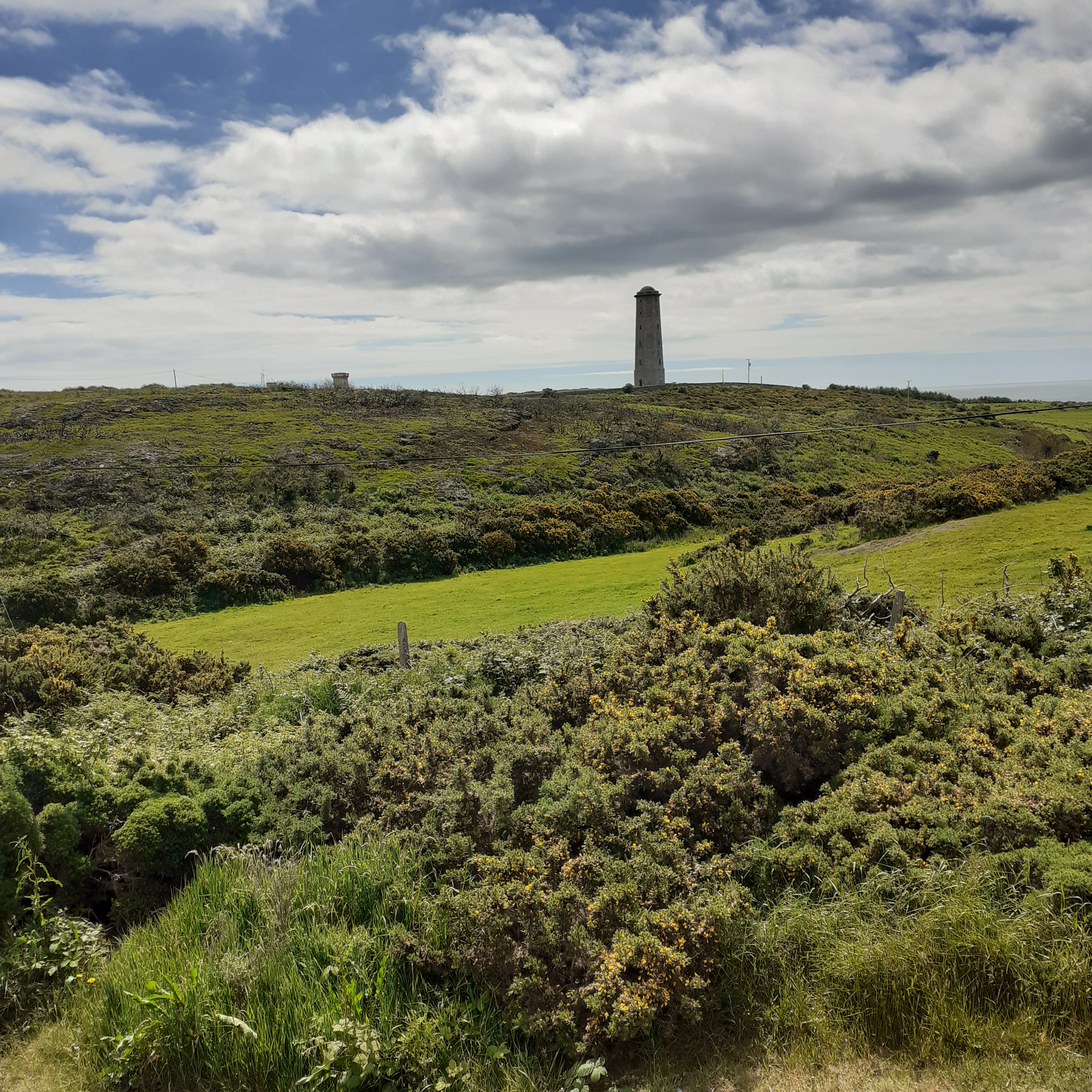
At the southern extreme of the walk, you will see an array of lighthouses. The stark granite tower crowning the headland is the original, built in 1779. The octagonal tower of six storeys rises thirty meters with walls one metre thick and was originally topped with an eight sided lantern. There was a lower tower nearby. The idea of twin towers was to distinguish Wicklow Head from other major headlands on the East Coast. But within thirty years it was realised that the towers were prone to losing their heads in the clouds and fog. A new lighthouse complex, again with twin towers, was constructed lower down and remains in use today. It was decided to keep the higher of the original towers as a daytime landmark, it was so well recognised by mariners. The high tower was struck by lightning in 1836. The strike left it a shell, with the lantern destroyed, and a protective dome was inserted some thirty years later, lending it a distinctive profile. More recently, the building has been renovated as holiday accommodation; quite an inspiring love nest, I’d say.
Usually, the headland is accessible, but it was closed and guarded this weekend. From here you can loop back to the carpark via a higher path or you can take the track to the main road and follow that back towards town. As a loop walk this is marked at four kilometres if starting from the Glen Beach car park and is doable in an hour. Taking available detours it was a bit longer by my watch. The weather was fine and there was plenty to take in. All sorts of wildlife, including humans, but such a spacious and spectacular setting that we were reluctant to leave. Back at Glen Beach we saw a seal swimming no more than fifty meters offshore from the human bathers. All having a wonderful time. Wales winked obligingly above the horizon.
Beyond Wicklow Head, the coast is renowned for its fine beaches. The first of these is Silver Strand. Formed around a small cove, beneath low cliffs which house a caravan park, it is relatively quiet and a most pleasant oasis on a sunny day. Further on, past another golf course, a straight tree lined private road leads to Magheramore Beach.
Magheramore beach is attached to the nearby convent wherein reside the Columban Sisters. These are a teaching order dedicated to foreign missionary work in Asia and the Americas. A portion of the beach was traditionally reserved for the sisters although they had sold their interest in the eighties. The order was founded in the 1920s and in 1957 the Motherhouse moved here. Set in specimen woodland, it encompasses a residence, nursing retirement home and retreat centre.
Another sisterhood broke the world record for the largest skinny dip in 2018. The Dip in the Nip saw 2,505 women brave the elements wearing nothing but a smile in aid of chidren’s cancer charity. The cove is popular with surfers too. Turning left at the t-junction, the main road meanders down the coast to Arklow. About halfway along there’s a section known as Brittas Bay.
It’s automatic when I
Talk with old friends
The conversation turns to
Girls we knew when their
Hair was soft and long and the
Beach was the place to go
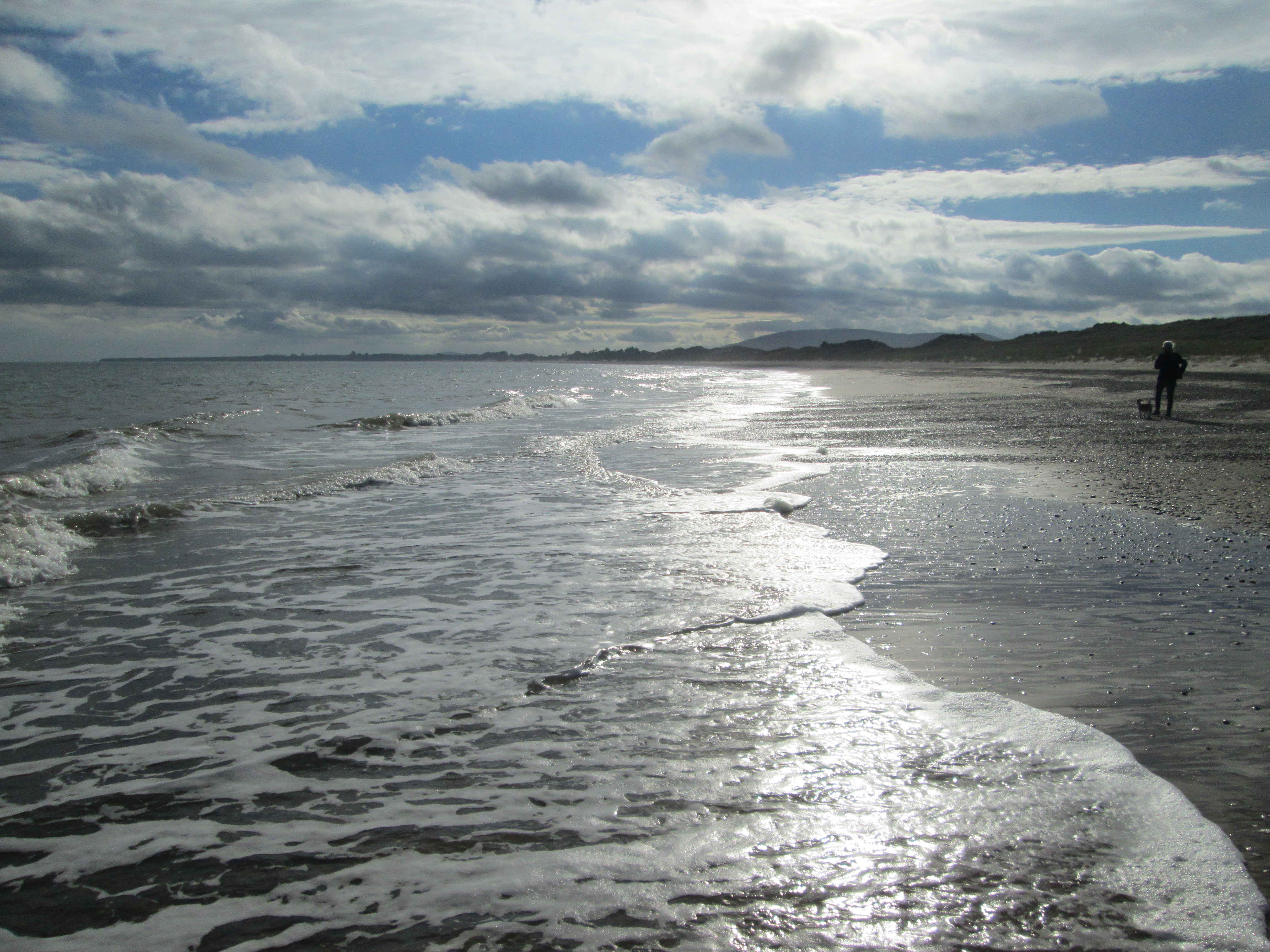
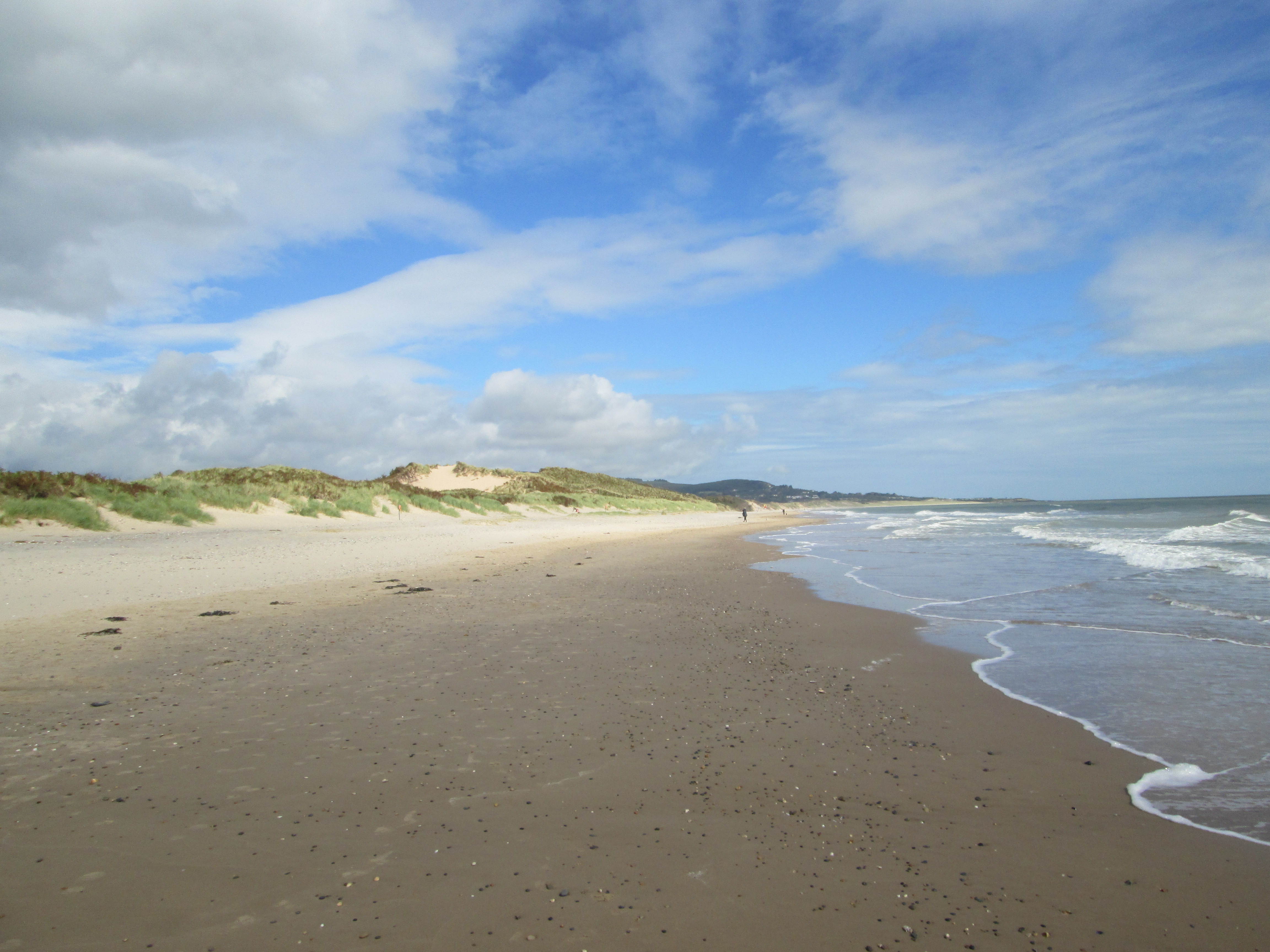
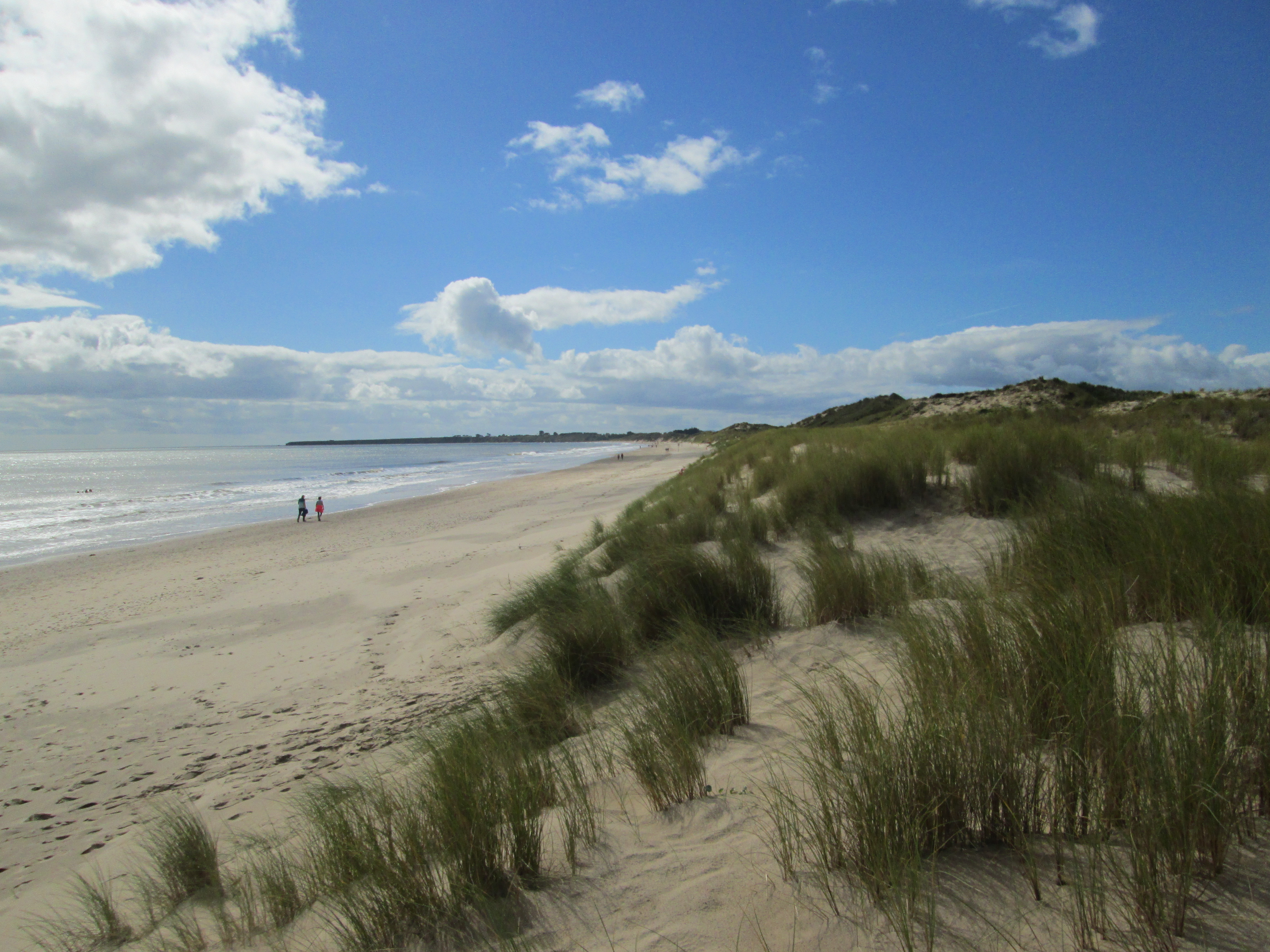
Of all the beaches, Brittas is the biggest and the best. Five kilometres of golden, silken sand, backed by enormous dunes and a mixed wilderness of grass, ferns and woodland. If you want to walk the beach you’ll need to go to the public car park which is at the southern end of the bay, beside the road inland connecting to the N11 at Jack White’s. At the main public access point, the beach is often busy, particularly in July and August. But it’s a big beach with plenty of room, and acres and acres of high dunes to lose yourself in.
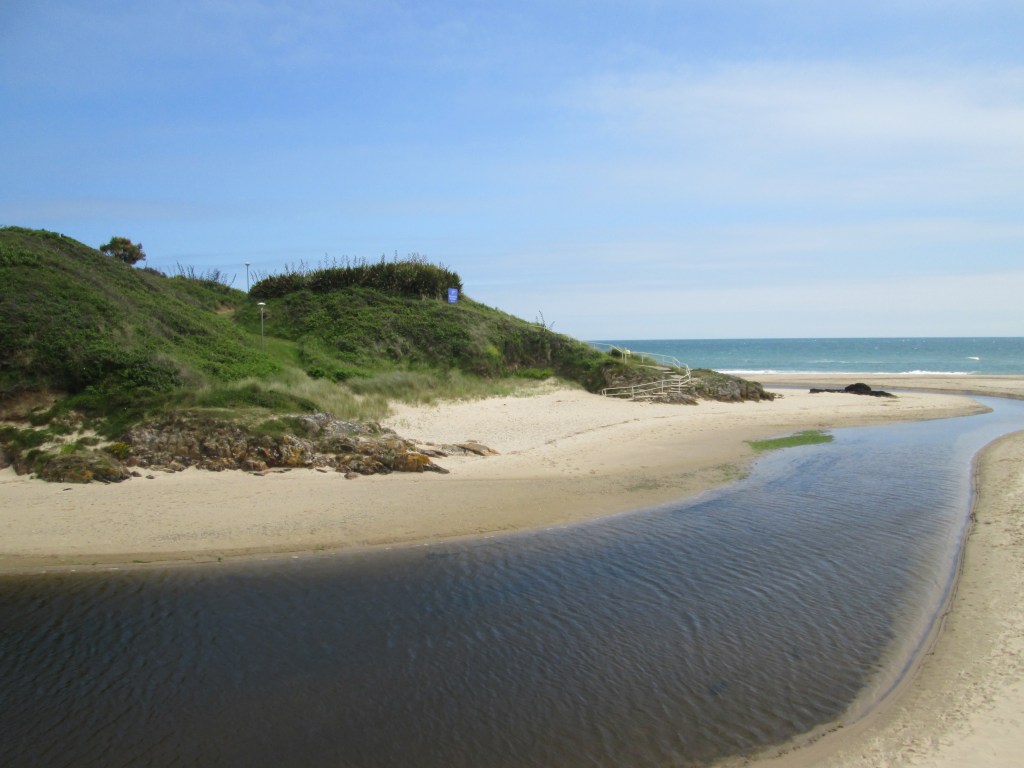
At the far north of the bay, a small river enters the sea beneath the rocky promontory. The river winds through a variety of scenery, from the parched spectacle of high sand dunes, through marshland and into a sylvan setting, before crossing under the road and making for the hills. Here at its estuary it is sheer perfection, and I am forever new to its beauty each time I see it.
With suntanned bodies and
Rays of sunshine the
California girls and a
Beautiful coastline
Warmed up weather
Let’s get together and
Do it again
Do It Again by the Beachboys was released in 1968 and was a UK number one. Written by Brian Wilson and Mike Love, it formed a particular soundtrack for that coming of age year, the one where I’m cresting the first wave of the teenage years. There are echoes of the Beachboys surfing halcyon days, honed by the musical sophistication of Pet Sounds while rippling with the simple solidity of a riff that chimes with the zeitgeist. Songs of summer keep simmering when you plant your toes on Wicklow’s wonderful coast.
South of Wicklow Town, the coastline boasts some magnificent sandy beaches. Whether you call these gold or silver strands, there’s no arguing that they exert a strong pull on people. Nothing defines the notion of escape from the workaday world like a summer day on a sun soaked beach. Indeed, in all sorts of weather, throughout the year, there’s a particular feeling of release to be had on the shoreline, solo or duet, amongst a full ensemble of friends, or strangers too.
Something is released into our souls and we are at one; maybe even at one with the universe. ‘T’were not ever thus. Once the sea spelt danger, and it took the Romantic era around the early nineteenth century, for the beneficial aspects of the sea to be appreciated: healthy, inspirational, spiritually uplifting, and fun.
At this time of year we make our annual pilgrimage to Brittas Bay. Thanks to our good friends, Maria and Larry, we have the use of a mobile in the dunes, between river and sea. I am inspired to think of Thomas Moore, again, and his ode to friendship, The Vale of Avoca.
Sweet Vale of Avoca how calm could I rest,
In thy bosom of shade with the friends I love best,
Where the storms that we feel in this cold world should cease,
And our hearts, like thy waters, be mingled in peace.
.
The Avoca is another Wicklow gem, in a county where we’re spoiled for choice. Brittas Bay is a slice of heaven from the limbo where we wait. The sea can be wild or welcoming, or both together. At the far north of the bay, a small river enters the sea beneath the rocky promontory. This river winds along the western edge of Staunton’s site, going right past the back door of where we stay. In its short span it holds a wonderful variety of scenery, from lush woodland to the parched spectacle of high sand dunes. At its estuary it is sheer perfection, and I am forever new to its beauty each time I see it.
Sunlight segues into evening, and then heaven releases its stars into the night. Life goes on, in darkness and in dark times. And fun too. When I hear music from neighbouring homes, and as we make it ourselves, they hold an echo of nights gone by. Bonfires ablaze, barbecue aglow, cans and laughs to share with friends. A mixture of the real and imaginary; and the beat going on.
Somehow, the concept of limbo rock is tied up with all the aspects of beach lore. Sun drenched and sand blasted, surfs up and a bevy of California Girls, drinking the zombie from the cocoa shell, and as smoke billows into the night, the sinuous sounds of guitar and bongos beget the need to dance, The big thing is, in this company: how low can you go.
Once, a long time ago, I was wingman for a dj friend at a disco in Crumlin’s parish hall. We were in our early teens and our advanced taste in Rock, providing such excellent fare as Cream, Taste and local heroes Thin Lizzy, was not sufficiently chart orientated for the small gaggle of teenage girls who had gathered around the floor, and were beginning to drift away. We were dying a death when the old chaw doing security had a word in our ears. “Listen, I thought yous were struggling, like. So, I popped home to get some music, thought yis might use it, spark things up a bit.” And there it was: one record. Count it. One.
Well, DJ Vin put it on, if reluctantly. And you know how it goes:
Get yourself a limbo girl
Give that chic a limbo whirl
There’s a limbo moon above
You will fall in limbo love
Jack be limbo, Jack be quick
Jack go unda limbo stick
All around the limbo clock
Hey, let’s do the limbo rock
Limbo Rock, penned by Jan Sheldon and Billy Strange, was a hit for Chubby Checker in 1962. Checker’s 1960 single The Twist, written by Hank Ballard, initiated the dance craze which became emblematic of the swinging sixties, and beyond. Checker was born Ernest Evans, his stage name is a pun on Fats Domino whom he impersonated.




 xxharrison