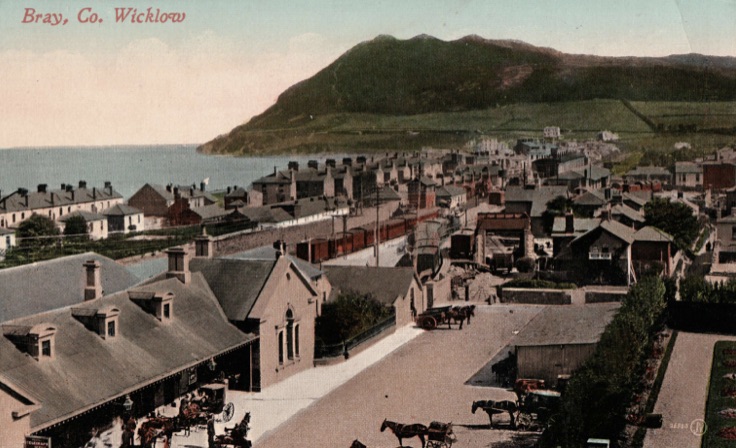
The Dart has been taking commuters, daytrippers and various wanderers around the Bay for forty years. Dart is a clever acronym for Dublin Area Rapid Transit. It runs from Malahide or Howth in the north to Greystones in the south. The last two stops are outside of County Dublin. Reaching the Dargle River we are in County Wicklow. The town of Bray has been established here since the Norman invasion, building on earlier Gaelic settlements.
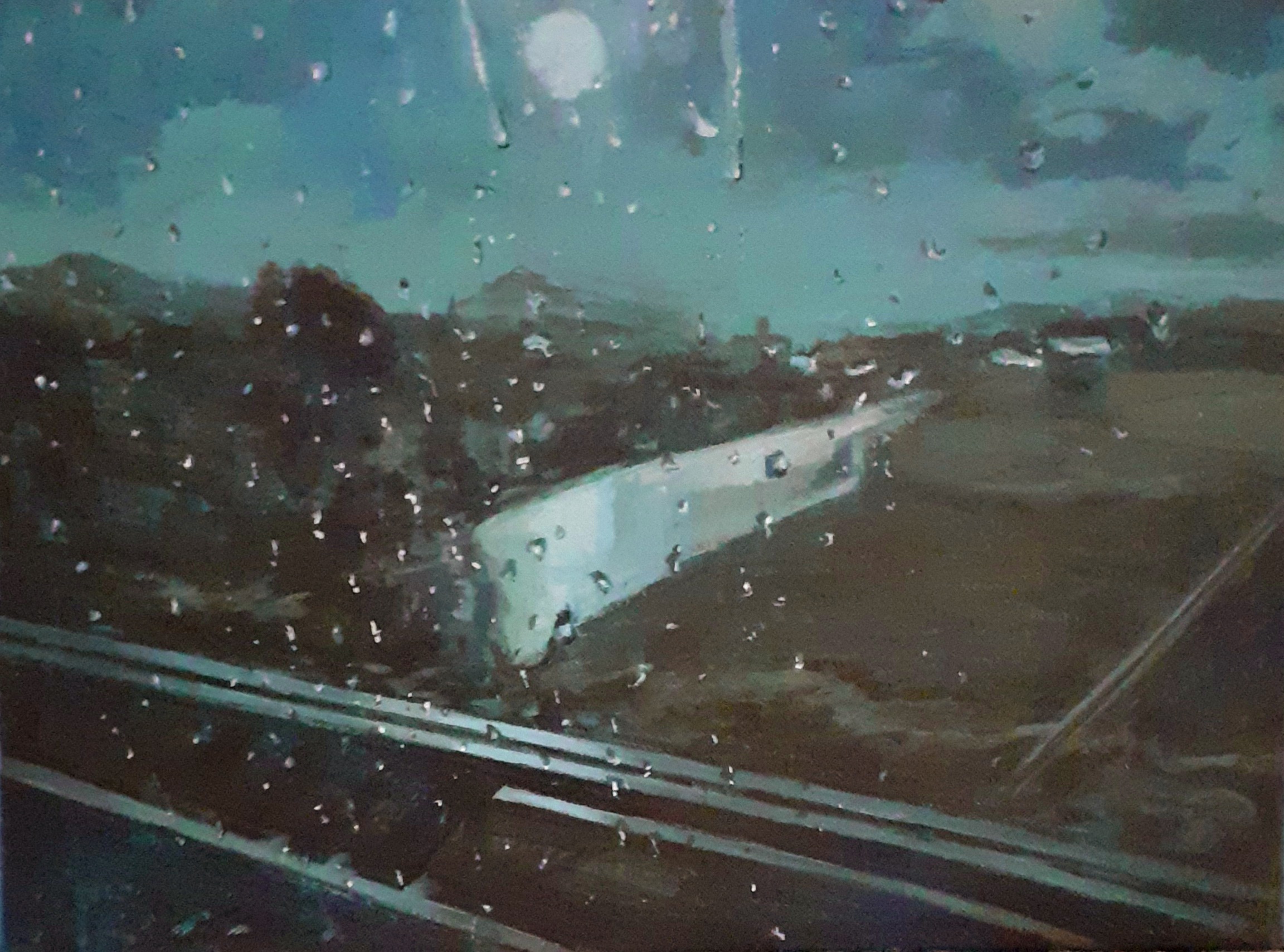
This view is taken from the window of a southbound Dart, about to cross the bridge over the Dargle. I am returning from Dublin city where it has been raining, but now the sun’s coming out and Bray rises steaming out of the gloom. The Sugarloaf Mountains appear on the horizon, and the land is marked by the tower of the Catholic Church of the Most Holy Redeemer, and the spire of Christchurch (CofI). Bray Daly Station is my stop. Opened in 1854, the line was quickly extended to Greystones and runs parallel to the seafront behind the hotels and houses lining the Esplanade which was newly established then.
This painting is acrylic on canvas and has been accepted by the Signal Open Art Exhibition of 2024. I am delighted to be chosen and looking forward to seeing all the other works on show. The exhibition runs from Tuesday 6th August until Sunday 18th August. Should be fun. Give it a dekko!
Every time it rains
You’re here in my head
Like the sun coming out
I just know that something good is going to happen
I don’t know when
But just saying it could even make it happen
Cloudbusting by Kate Bush is guaranteed to lift the heart, without reneging on past sadness. It is on her 1985 album Hounds of Love.
And when I find myself a-fallin’ for some girl, yeah
I hop right into that car of mine and ride around the world
Yeah I’m the wanderer, yeah the wanderer
I roam around around around
written by Ernie Maresca and originally a hit for Dion in 1961, The Wanderer has been covered by the Beachboys and Bruce Springsteen, amongst others.
There are swans in the harbour, seagulls on the seafront, and starlings just about everywhere. It nearly takes me back to Cornwall, shielding sandwiches from savage gulls on beach picnics all the way from Penzance to Mousehole. There I understood where Daphne Du Maurier got her inspiration for The Birds. Wisely, Irish people are not inclined to throw food away, other than to the odd swan. Outdoor eateries discourage the habit. Bray’s birds are to be enjoyed, and left to their own devices. Seagulls, for their own part, may wander inland, as may we, making our way along Wicklow’s Wonderful coast. Beyond the level crossing, the Carlisle Grounds are home to Bray Wanderers. The soccer team has twice lifted the FAI Cup, in 1990 and 1999. For most of this century they have played in the top division of Irish soccer, but were recently relegated. Small crowds still huddle in its stand, sending up samba beats and the mournful call: Seagulls!
Across from the Carlisle Grounds stands Bray Bowl. Originally this site was occupied by the International Hotel, the largest in Ireland when it was built in 1862, reflecting Dargan’s optimism about Bray’s development as a resort. The Hotel ran into hard times during the Great War and after independence it remained derelict for a while. During the Emergency, it was garrisoned by the Irish Army and returned to the hotel trade afterwards. Although Bray boomed again as a tourist resort in the fifties and sixties, good fortune would not smile on the International. The new tourist boom was more downmarket from Dargan’s day. There were plenty smaller, less expensive hotels in the town. Nearby, the Arcadia rocked to the sounds of Roy Orbison and Brendan Bowyer, but the International was suspended in amber, an album of monochrome photographs of a fading past. On a night in June, in 1974, fire broke out. The few remaining residents escaped but the building was gutted. Development took another fifteen years, before completion of the bowling alley and games arcade.
Bray Railway Station was built in 1854 when the line connecting to Dublin opened. Designed by George Wilkinson, designer of Harcourt Street station, the original Dublin terminus for Bray which closed in 1959. It is a long, single storey Italianate building facing onto a haphazard plaza. To the rear, the original roof sweeps into a huge overhang to shelter passengers. Although the track had pushed on to Greystones by 1855, the East platform was not added until 1928. It is laid out beneath a glass canopy on caste iron supports.
DART, for Dublin Area Rapid Transit, arrived in 1984. DARTs average every fifteen minutes, taking forty minutes to reach central Dublin. The fast and frequent commuter service facilitated a population boom. By the end of the century Bray’s population doubled to over thirty thousand people, including yours truly. Bray station remains a busy hub, perhaps at last fulfilling Dargan’s expectations for the town.
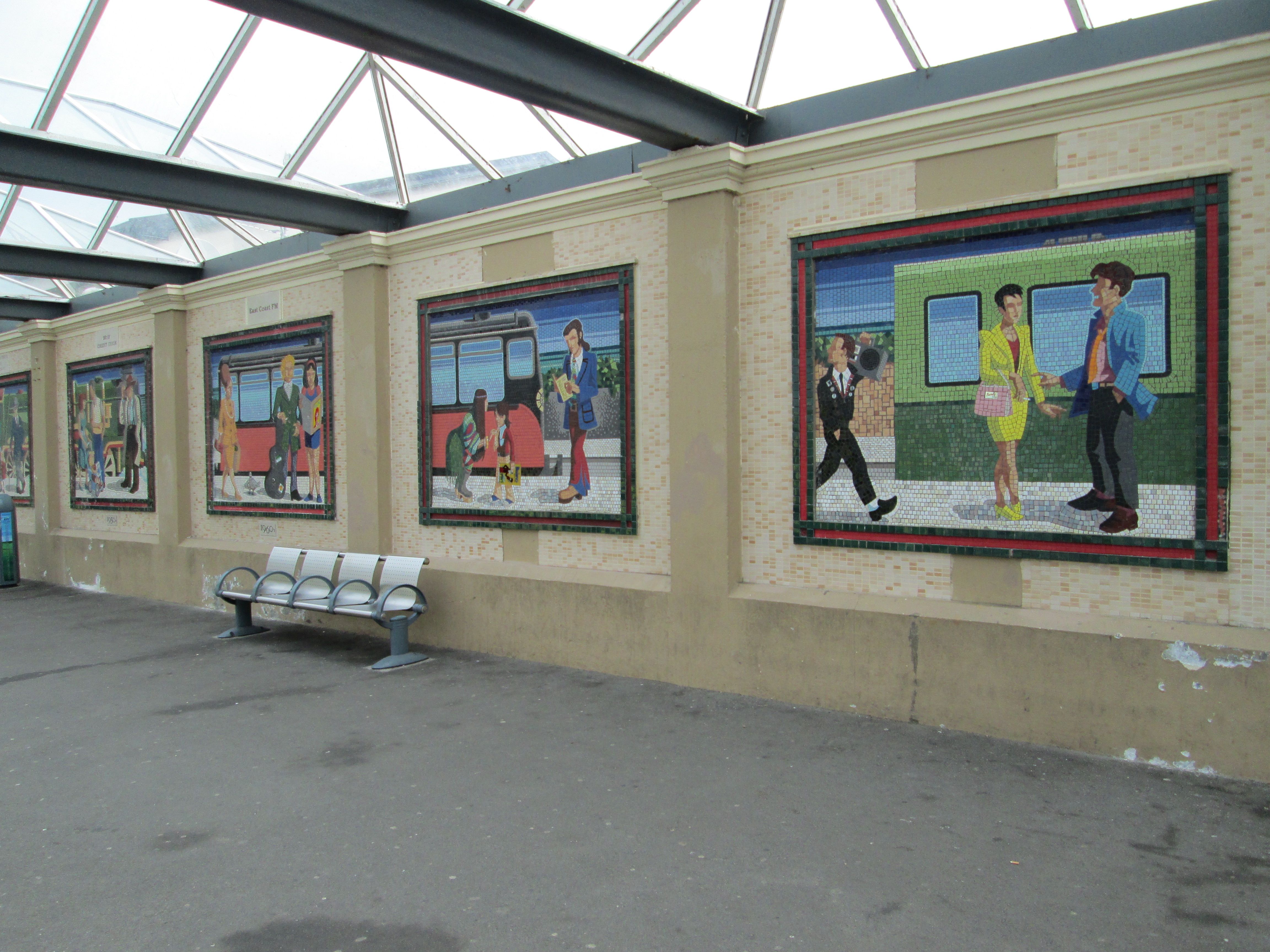
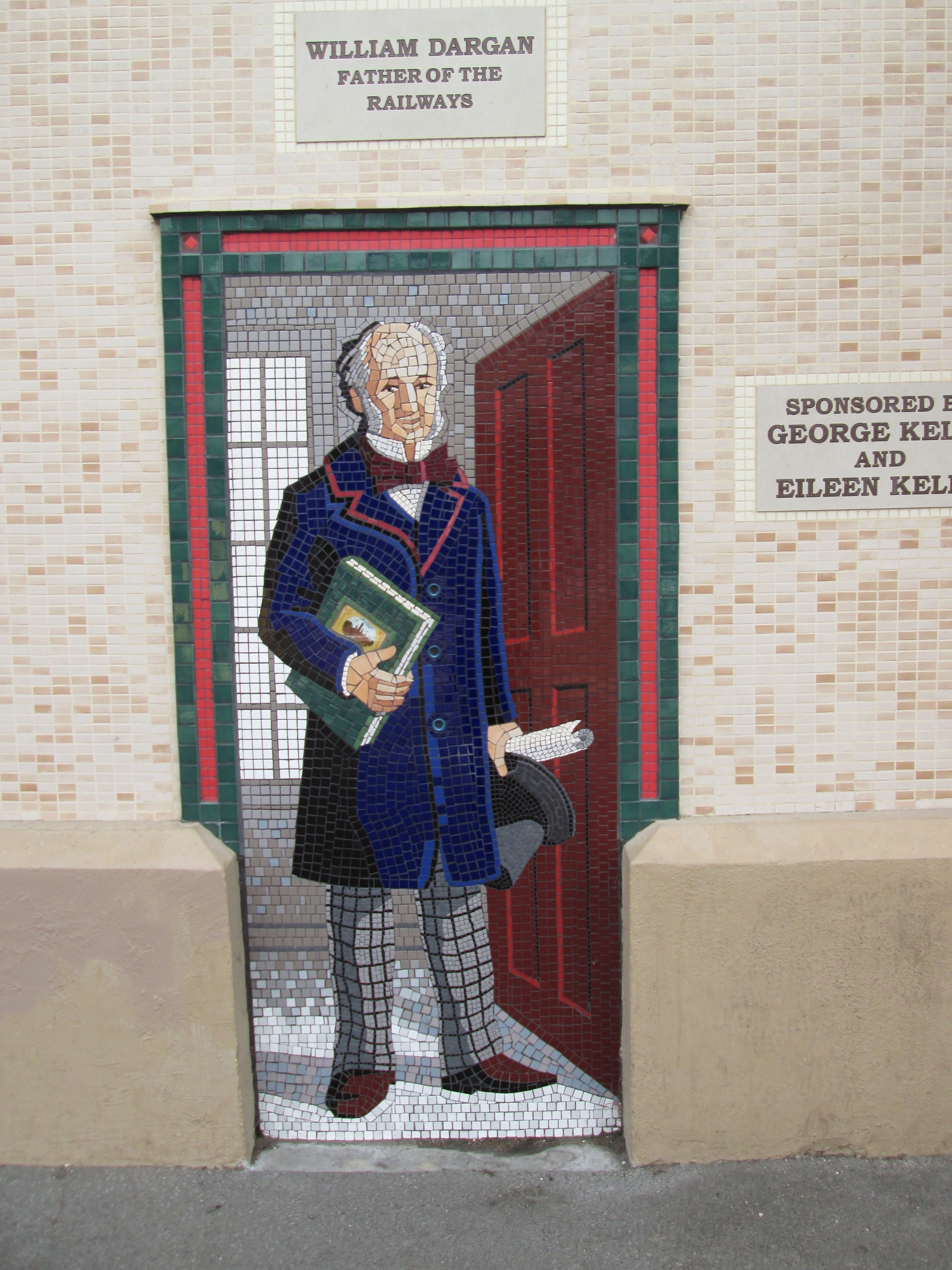
The station is distinguished by a fine mural along the length of the eastern platform. The project was initiated by the Bray Community Arts Group in 1987. The group, formed to foster art activity and push for greater facilities including an arts centre, sponsored the competition to design a mural for the station. Jay Roche and John Carter, then students at Dun Laoghaire College of Art, won the competition by popular vote with their proposal for an illustrative sequence of Bray since the Steam Age. They painted nineteen panels commemorating the history of the station from its foundation in 1854 up until the 1980s. Every picture tells a story, from retreating British soldiers after the War of Independence, to mods, rockers and hippies heading off to Rock Festivals.
Well known faces include Eamon DeValera, James Joyce and Oscar Wilde. It was Sir William Wilde who owned property at the southern end of the seafront and after his death, caused Oscar to be summoned to Bray Courthouse when dispute arose over his inheritance. That went poorly, but other more ruinous courts awaited him. And, of course, there’s panels devoted to the main men of the railway: Isambard Kingdom Brunel and William Dargan.
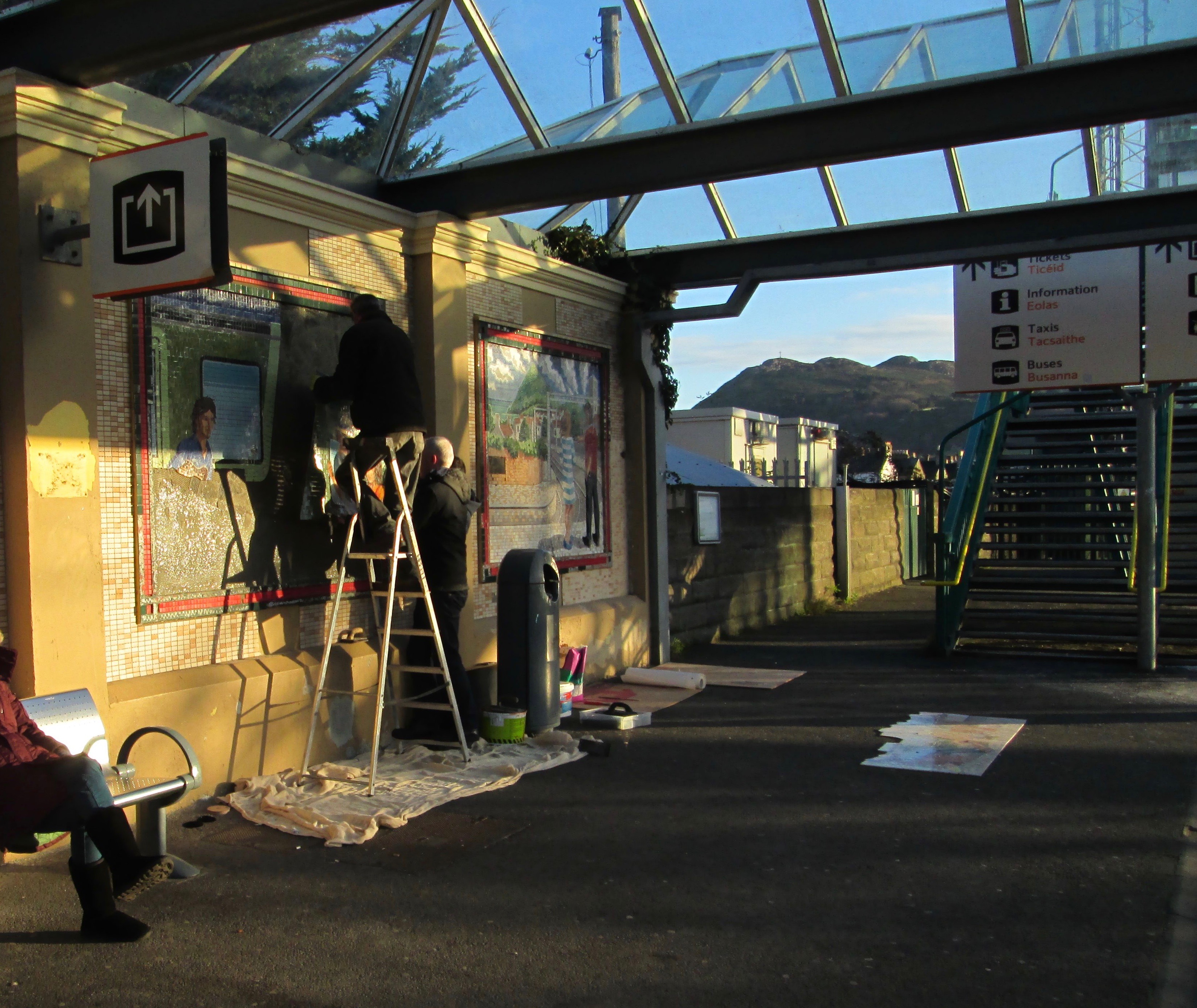
The briny sea air meant that the painted mural had badly deteriorated by 2010. The original artists had formed the company Triskill Design and built up an impressive portfolio of commercial murals and interior design. They took on the Mural to Mosaic project, instating tiled mosaics for the faded originals.
Walk along its length and see the story start with a photograph – how modern can you get! – then move on through the leaves of time to finish, brightly, with a panorama of Bray and its big green mountain. There are battles and love affairs, and many’s the song to sing.
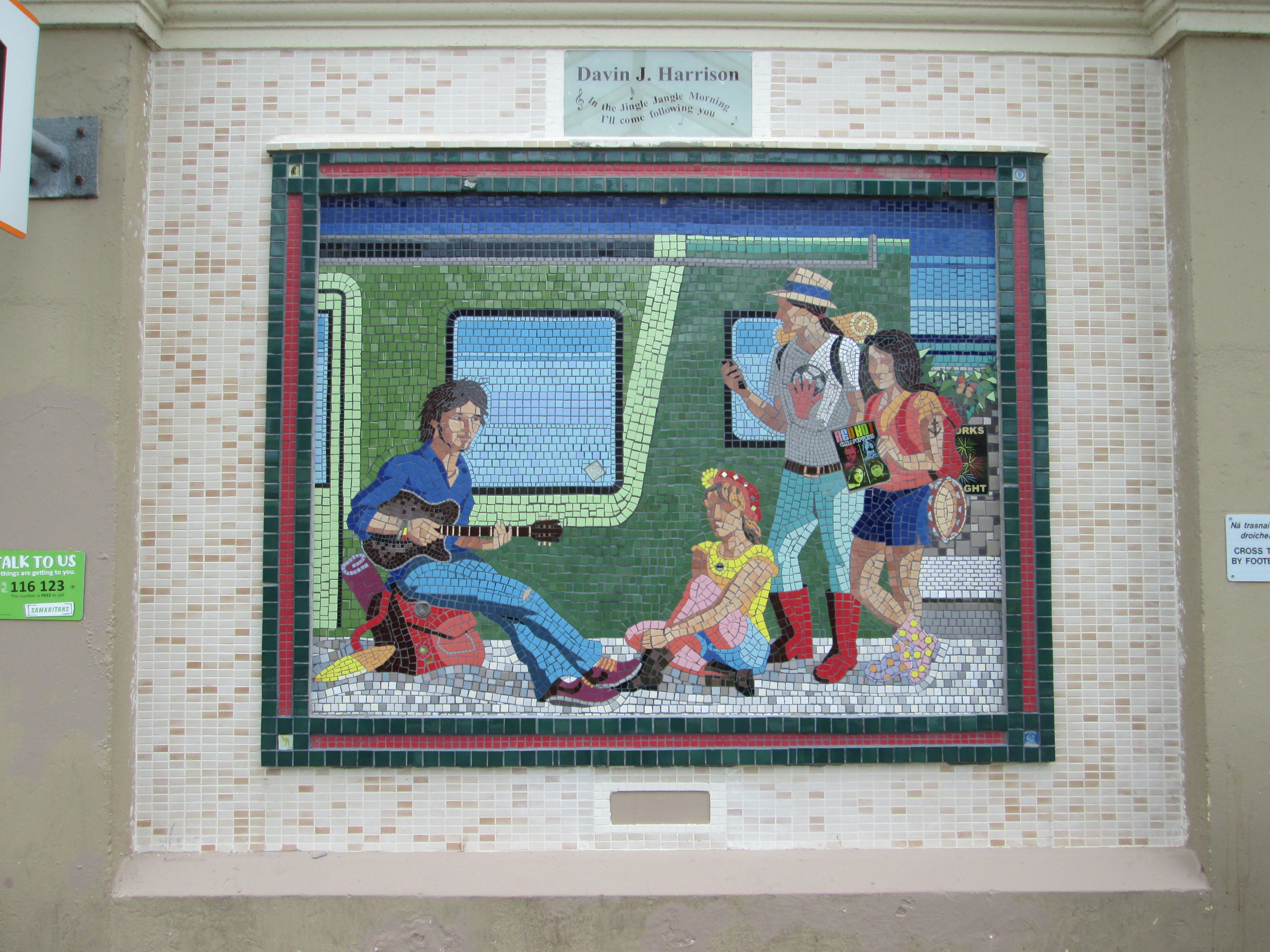
At the southern end, as we step into the future, the mural features the opening lines of Bob Dylan’s Mr Tambourine Man, from the album Bringing it all Back Home, of 1965. A shorter, electrified version was made by The Byrds. It was their debut single and a huge hit, credited with kickstarting the folk rock boom, the very initiator of the term The startling twang of guitar and heavenly choir vocals are echoes of a different time, but are for all time.
Hey, Mr. Tambourine Man, play a song for me
I’m not sleepy and there is no place I’m going to
Hey, Mr. Tambourine Man, play a song for me
In the jingle jangle morning I’ll come following you
If I should be waiting on the platform, this is where I’d be sitting. The Southeasternmost seat, in the rays of the setting, or rising, son. Hat pulled low but eyes wide open. Sparking up a cheroot with the sharp glance of a lucifer to the sole of a western boot, and thinking. Byrds or Dylan, what’s my favourite version? The answer’s right here. The penultimate panel features Davin Harrison, guitar at the ready and friends in tow, heading off from the platform to some festival or whatever awaits in the wild blue yonder. Mr Tambourine Man was the first song he sang, but you’re never going to hear it unless you heard it before. Who knows though? Sometime when you’re alone, isolated on a windy day, and you hear some song singing in the high tension wires. Who knows what it is? Who knows who’s singing?

 xxharrison