Back to Andalusia – Almunecar by Bus

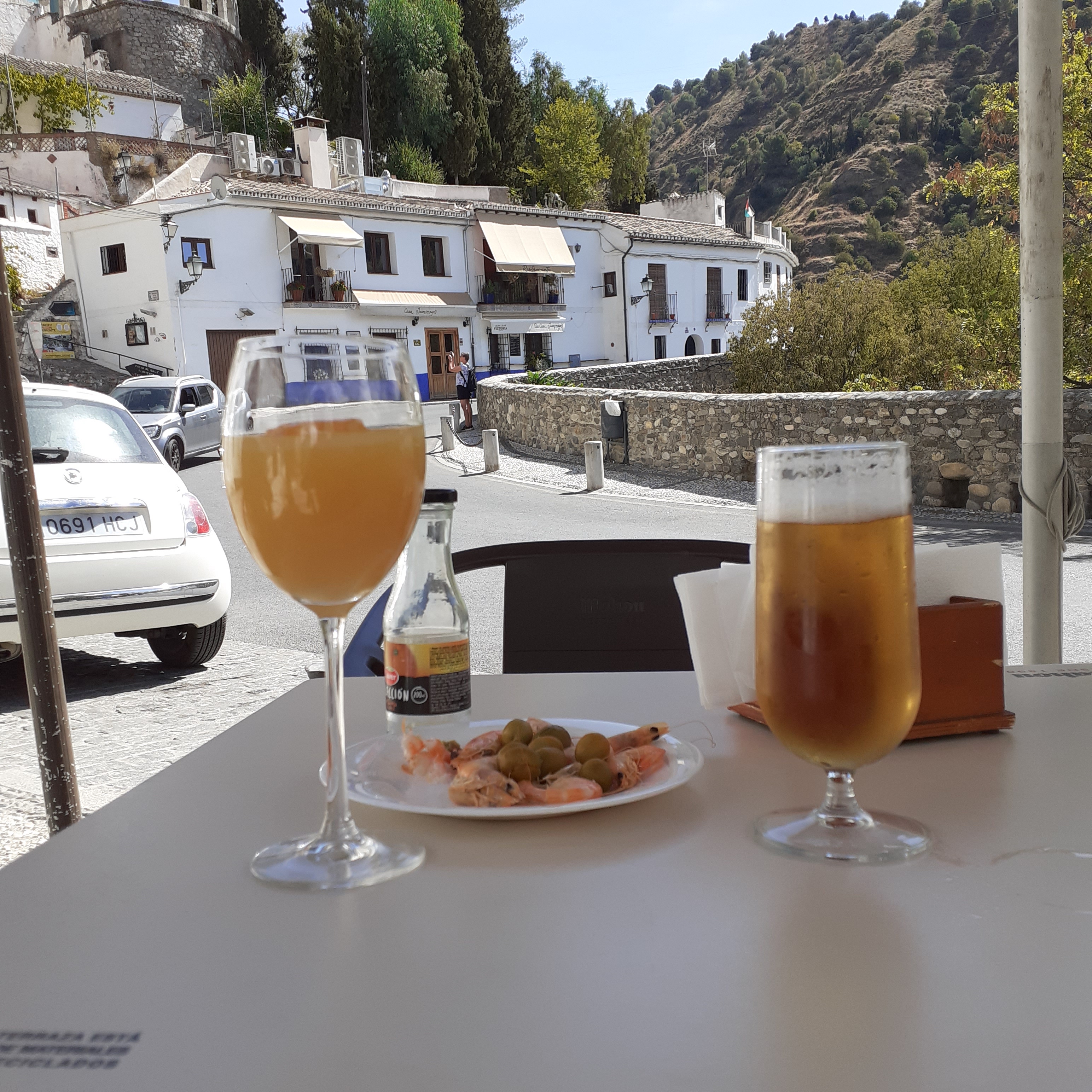
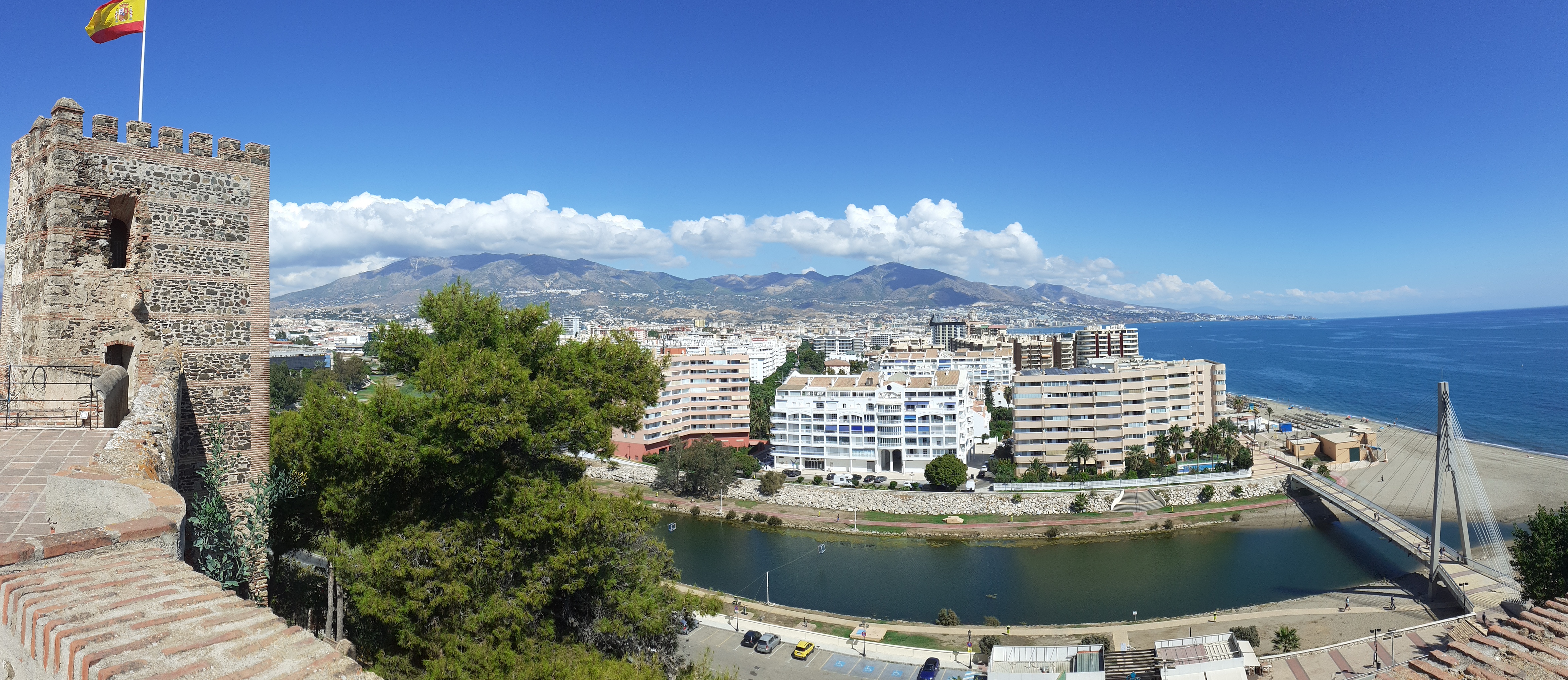
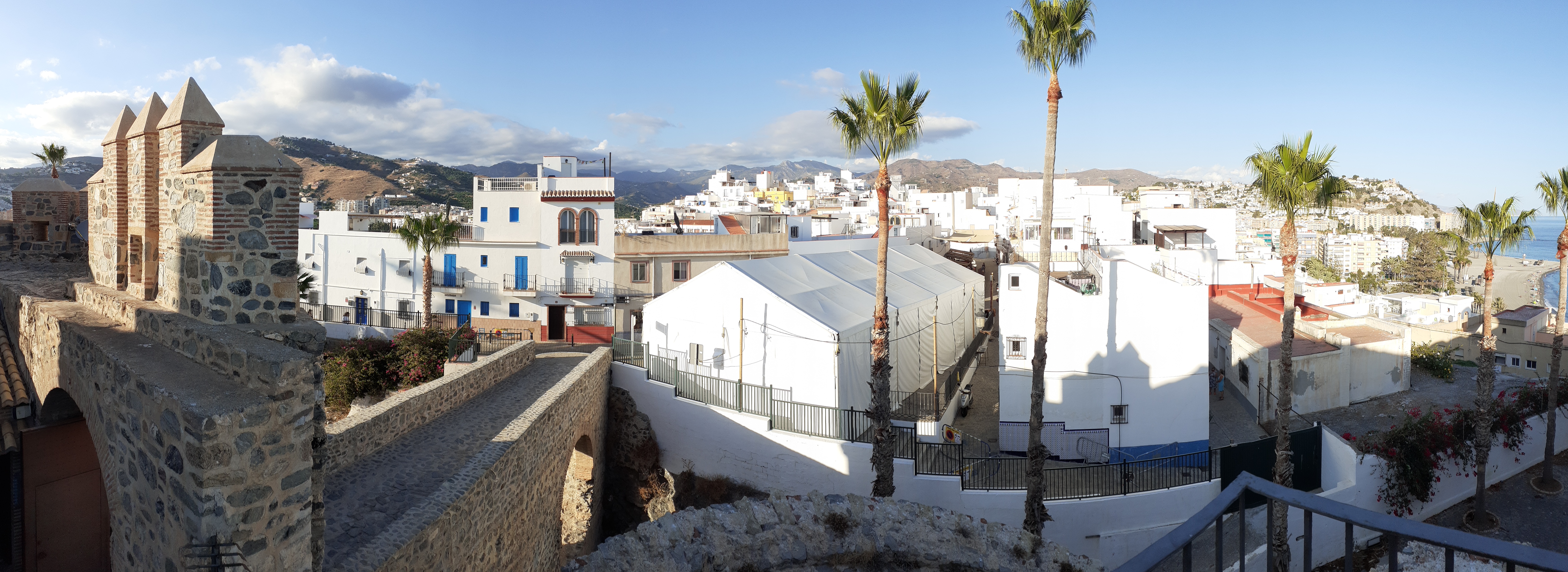
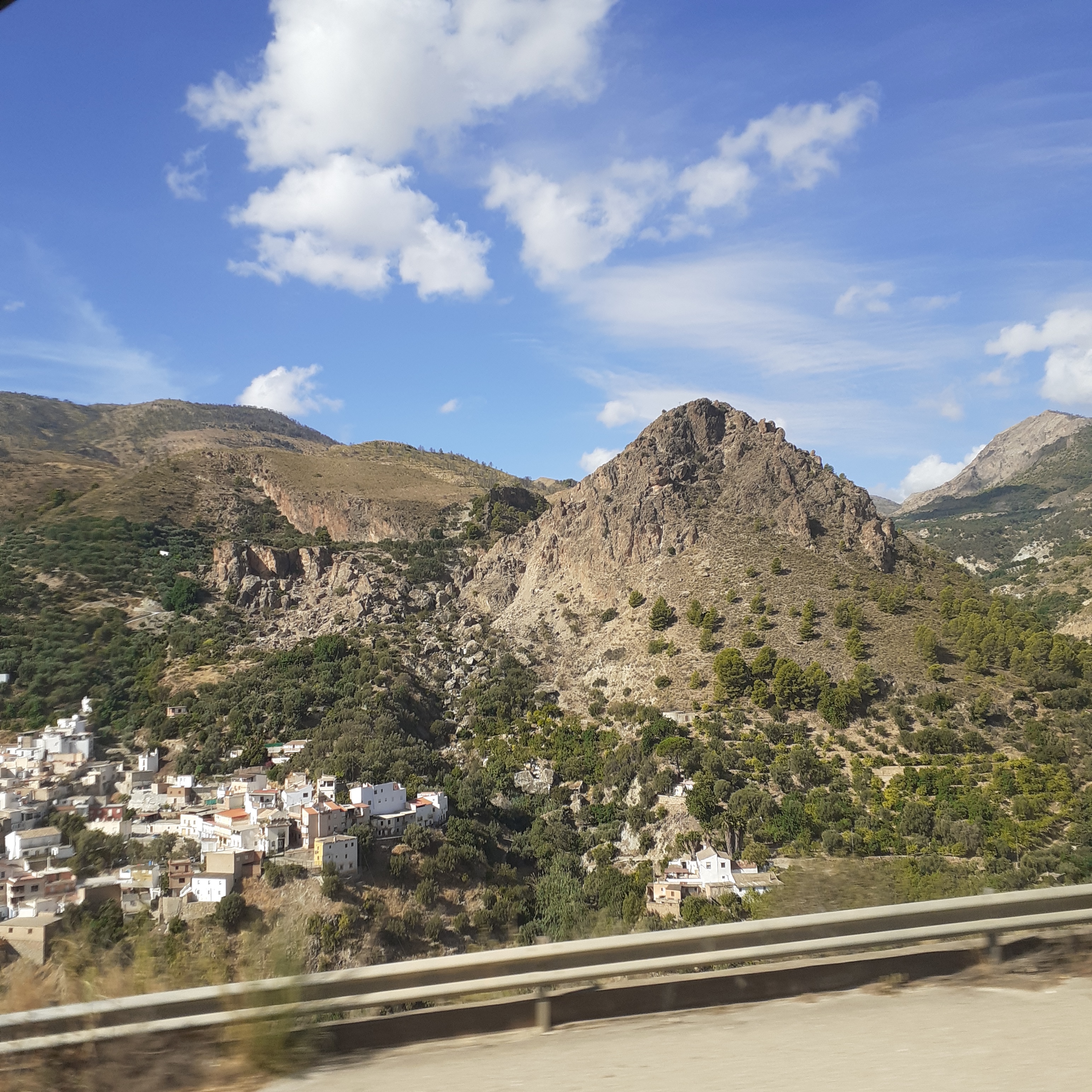
The bus from Grenada to Almunecar heads due south through the Sierra Nevada. We get an eyeful of high mountain scenery. As a designated driver, it is such a pleasure to sit back on the bus and soak in the beautiful views. Almunecar is on the Grenada region’s short coast. The bus station is at the high end of town. Disembarking, we cross the busy thoroughfare and take a sidewalk seat at the first available cafe bar, Casablanca by name. Though it doesn’t resemble Rick’s Bar; I am sure a lot of people come here, with welcome refreshments and a terrace panorama of busy town life. When we orient ourselves, we take a fifteen minute walk seawards along Avenida Europa to our hotel. Hotel Goya is a small family run affair, between the main lower town and the seafront. Above all, is the castle; Castillo de San Miguel.
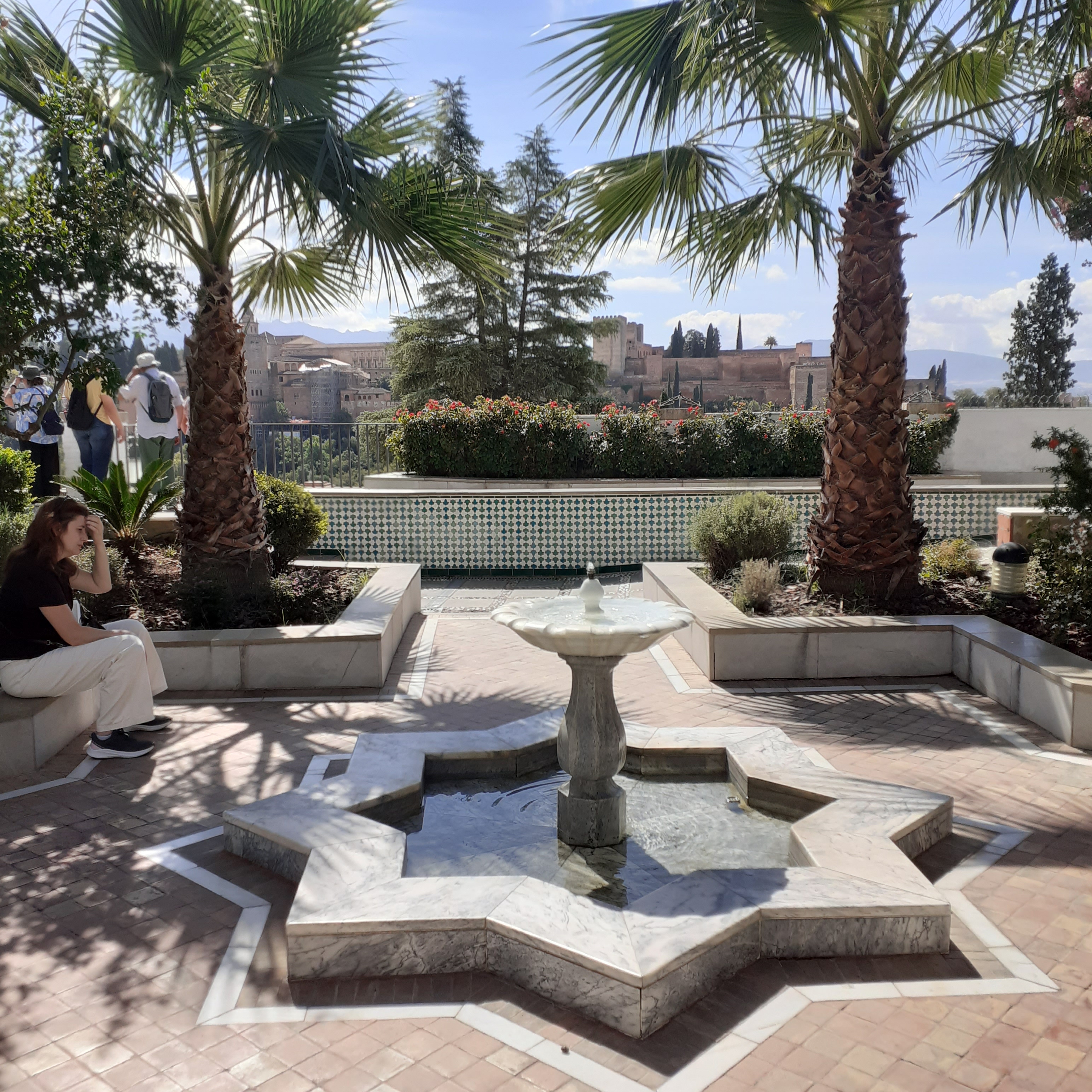
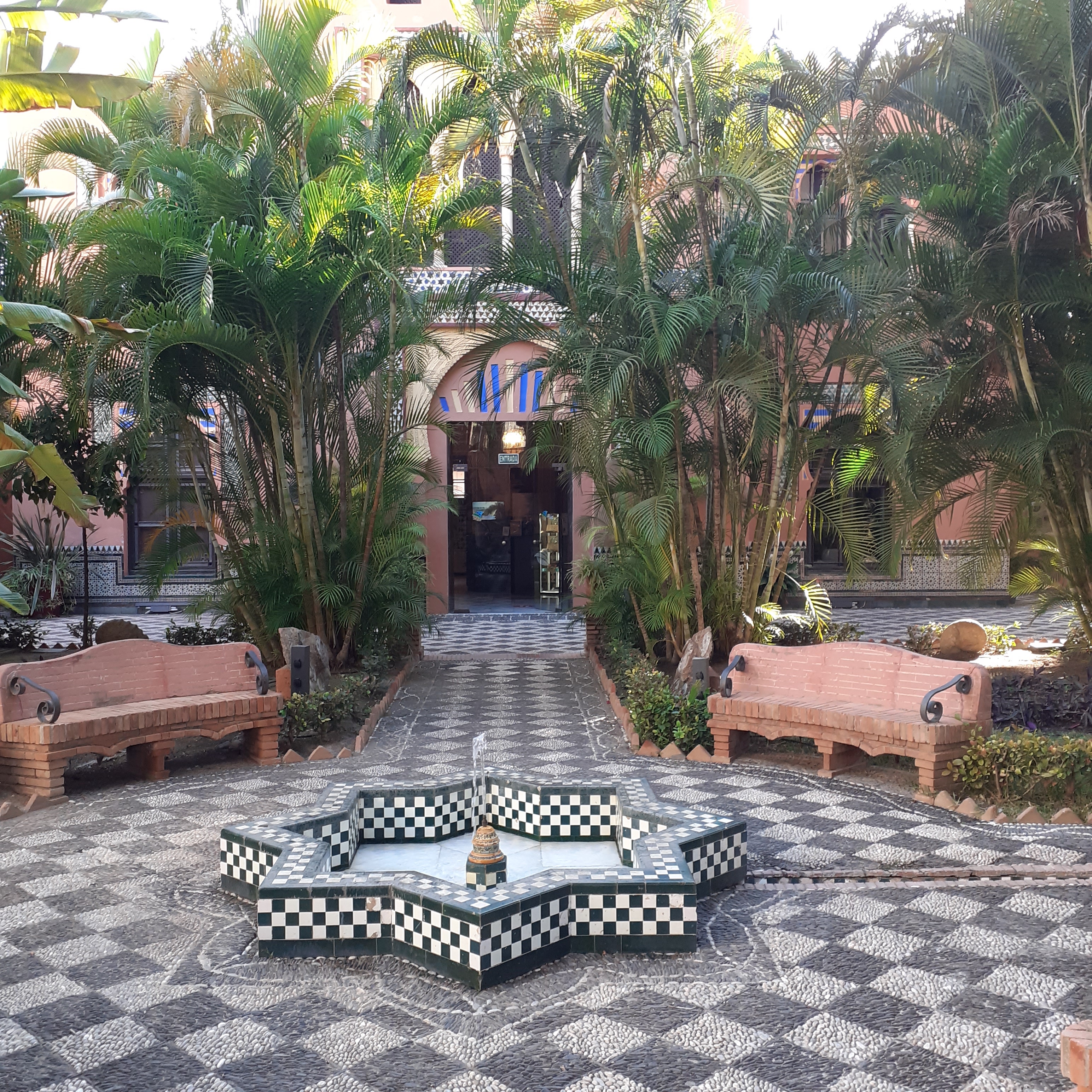
Near our hotel, the Botanical Gardens contain the ruins of the ancient Phoenician fish salting factory. The Phoenicians were settled on this coast from 800BC and their name for the town was Sexi. The natives might still refer to themselves as Sexitanos. Just so you know. The tourist office is right across the road. Housed in the La Najarra Palace, a nineteenth century building in the Mudejar style. Set amidst a wonderful garden, with towering palms, chequerred walkways and a central pool, it is an Eden of relaxation on a hot day. There’s a child sized house at one end. We spent a late afternoon sketching there, with no end product but pleasure.
The town name is derived from the Arabic, meaning surrounded by mountains. Indeed it is. The Costa Tropical collides with steep mountains to spectacular effect. Almunecar has a population of just over twenty five thousand. It is more a Spanish than a foreign tourist resort. Less busy than Nerja just a few miles west along the coast, it is intimate and relaxed. 

Almunecar may ring a bell for literature fans, featuring in Laurie Lee’s book, As I walked Out One Midsummer Morning, 1969. This formed the second installment of his memoirs, a few years after Cider with Rosie. From 1934, Lee travelled the length of Spain. He made his way taking casual jobs and busking; he played violin. He arrived in Almunecar, which turned out to be his last stop in Spain. Here, he worked in a hotel, and as a tourist guide. The Spanish Civil war broke out in 1936 and Lee was evacuated by a British warship sent from Gibraltar. He would return to Spain the following year to fight for the Republicans. In Lee’s account, the town is referred to as Castillo.
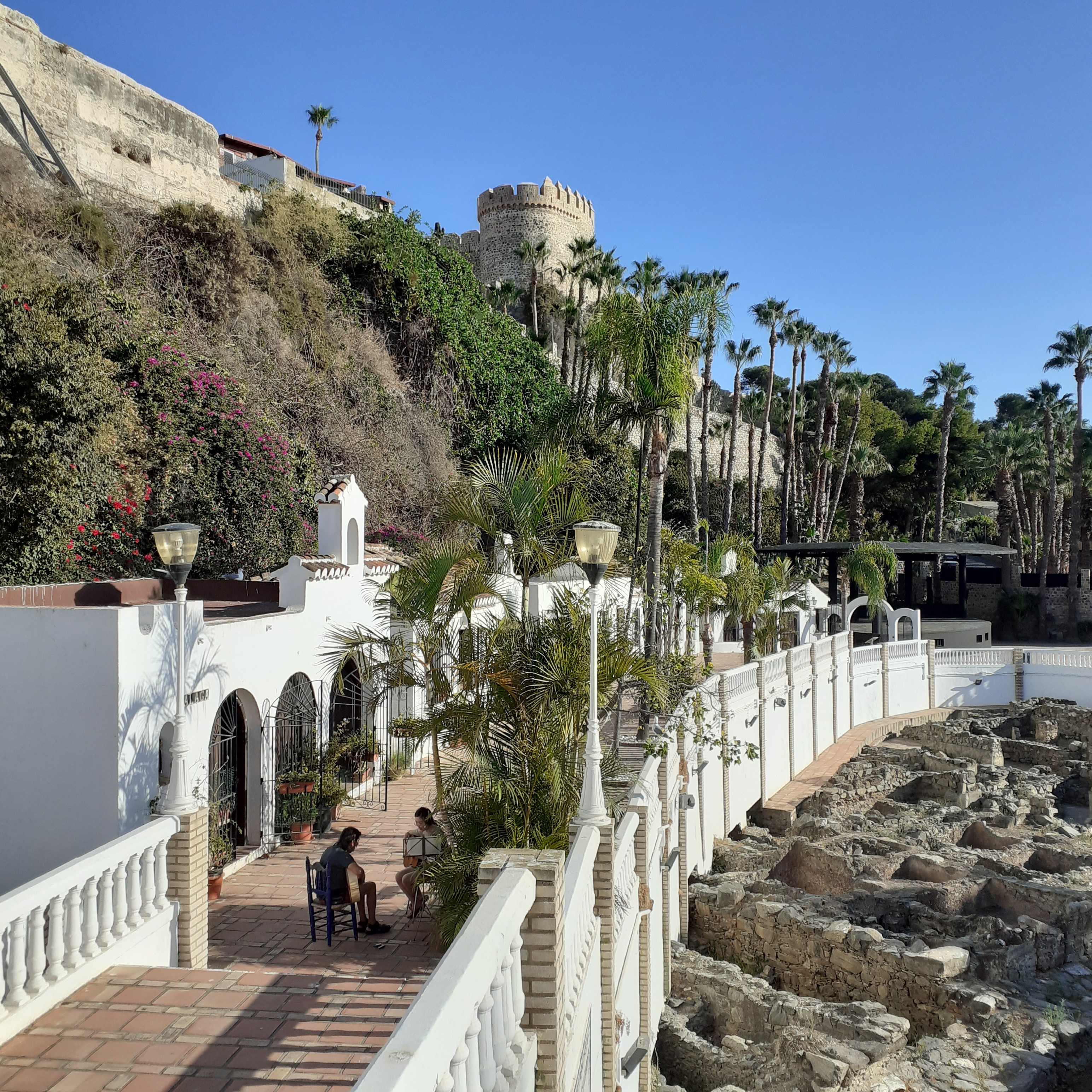
The Castillo de San Miguel certainly defines the town. It was first established by the Romans in the times of the Punic Wars, two centuries BC.  Subsequent alterations now prevail. The fortress prosperred in Moorish times, ultimately surrendered in 1488. During the Napoleonic Wars, the Castle last operated under control of the French. The English, with Spanish support, seriously damaged the complex, although the outer defenses were reletavily unscathed. For a while it was used as the town cemetery, until the rise of tourism prompted restoration work to begin in the 1980s

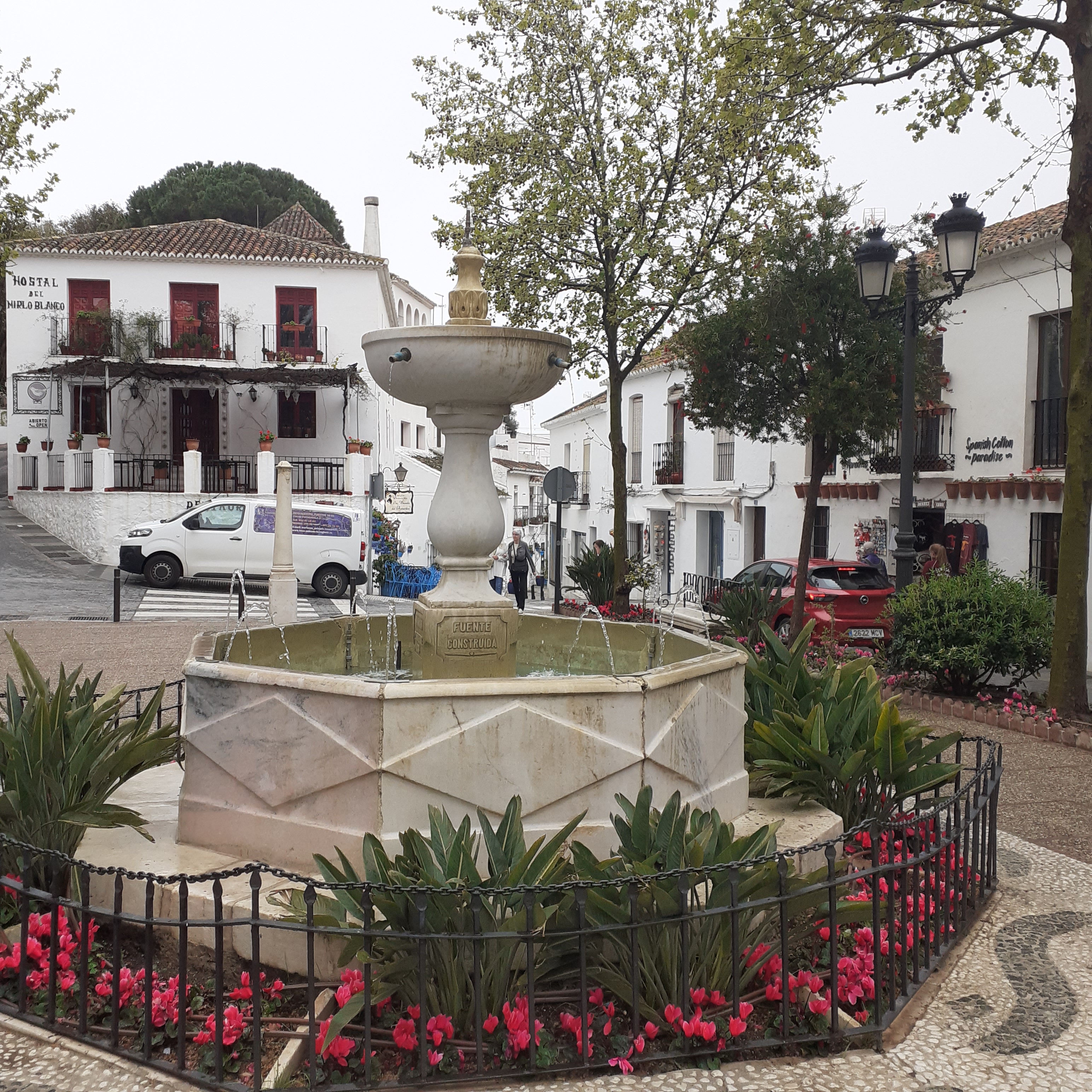
Visiting the castle is a must. The old town is a serpentine maze, constantly rising. Just off the main drag, Plaza Higuitos provides an oasis. While the eponymous establishment is beseiged by growing queues, across the tiny square there’s room at Bodegas Manuel Callejas The tapas here are good too, not just the automatic default; as we have eaten enough olives throughout Grenada to turn green and start a pip factory

Higher up, the narrow street widens into Plaza de la Constitucion, with the Ayuntamiento (Town Hall). along one side. There are two good restaurants at each end; and we fortify ourselves with drinks and tapas. The Church of the Incarnation is on a hill behind the town hall. It dates from the 16th century and has a stern imposing facade. This is the centre for the Semana Santa processions, and the street is tellingly named Calle Jesus Nazareno. Behind the church is Casa de la Cultura with a museum and theatre.
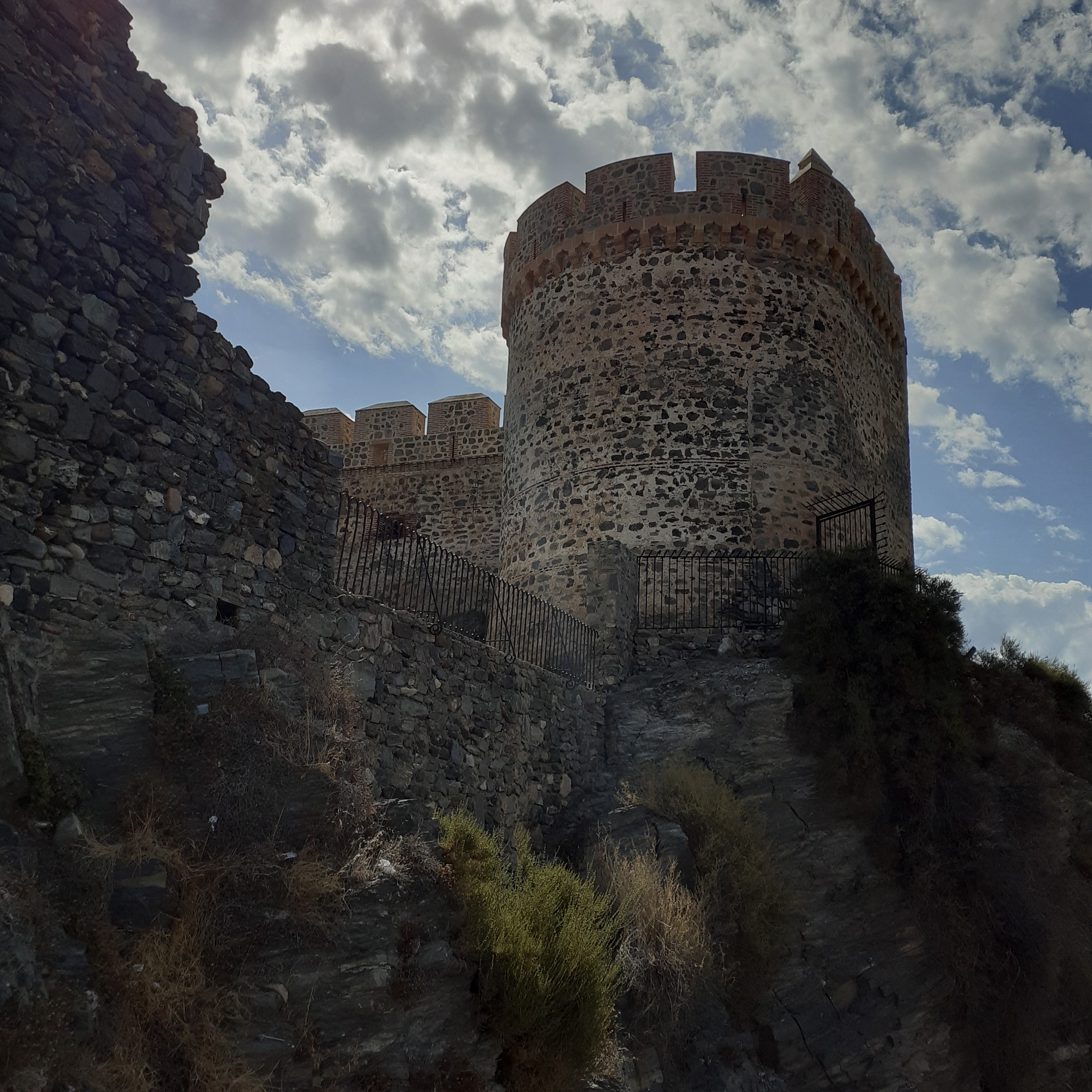
The orienteer within eventually guides us to the high esplanade of San Miguel. The saint’s festival is getting underway and everyone is gearing up for the nights festivities, setting up stalls and quaffing a few aperitifs. So, it’s getting into evening by the time we reach the castle. The lady at the door obligingly gives us a pass for the next day as we stop our visit abruptly owing to a sudden onset of starvation. Returning early the next day we are rewarded with a relaxed time amongst the ruins, and breathtaking views from the ramparts. There’s a good exhibition at the on site museum showing the castle’s evolution through the ages.. From the southern ramparts, the view downwards to the coast overlooks the cross at Penon del Santo. This was once connected to the castle by viaduct.
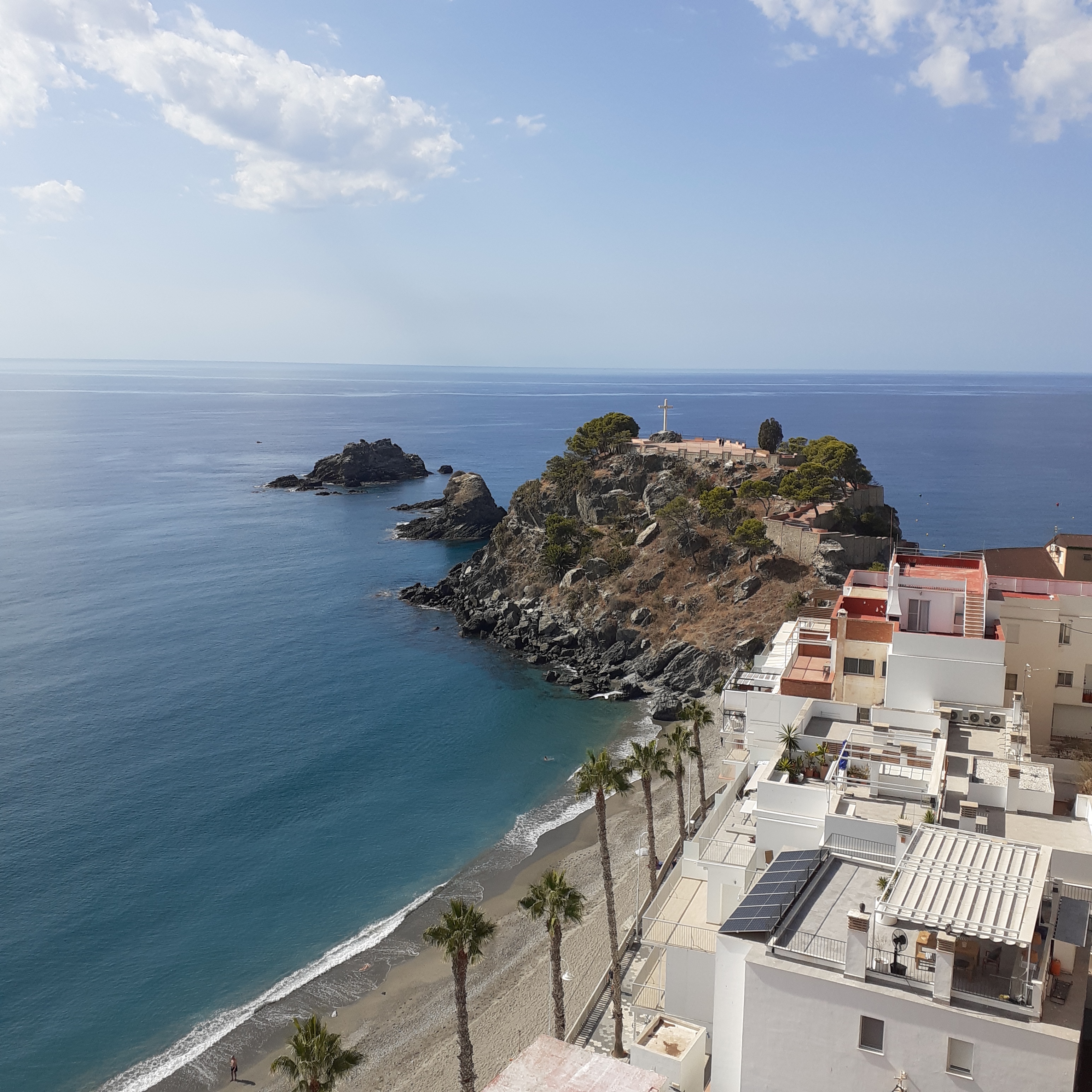
We take the rapid descent route back down. This winds down beneath towering castle wallls, touching earth beside our Botanical Gardens. Heading on to the searfront, Penones de San Cristobal are three rocky crags, dividing the searont at Almunecar. The highest crag, Penon Del Santo, is marked by a tall cross, a modernist structure from 1900. Guarding the base of this rock, there’s a monument to Abdalrahman I, the founder of the Emirate of Cordoba in 756. 

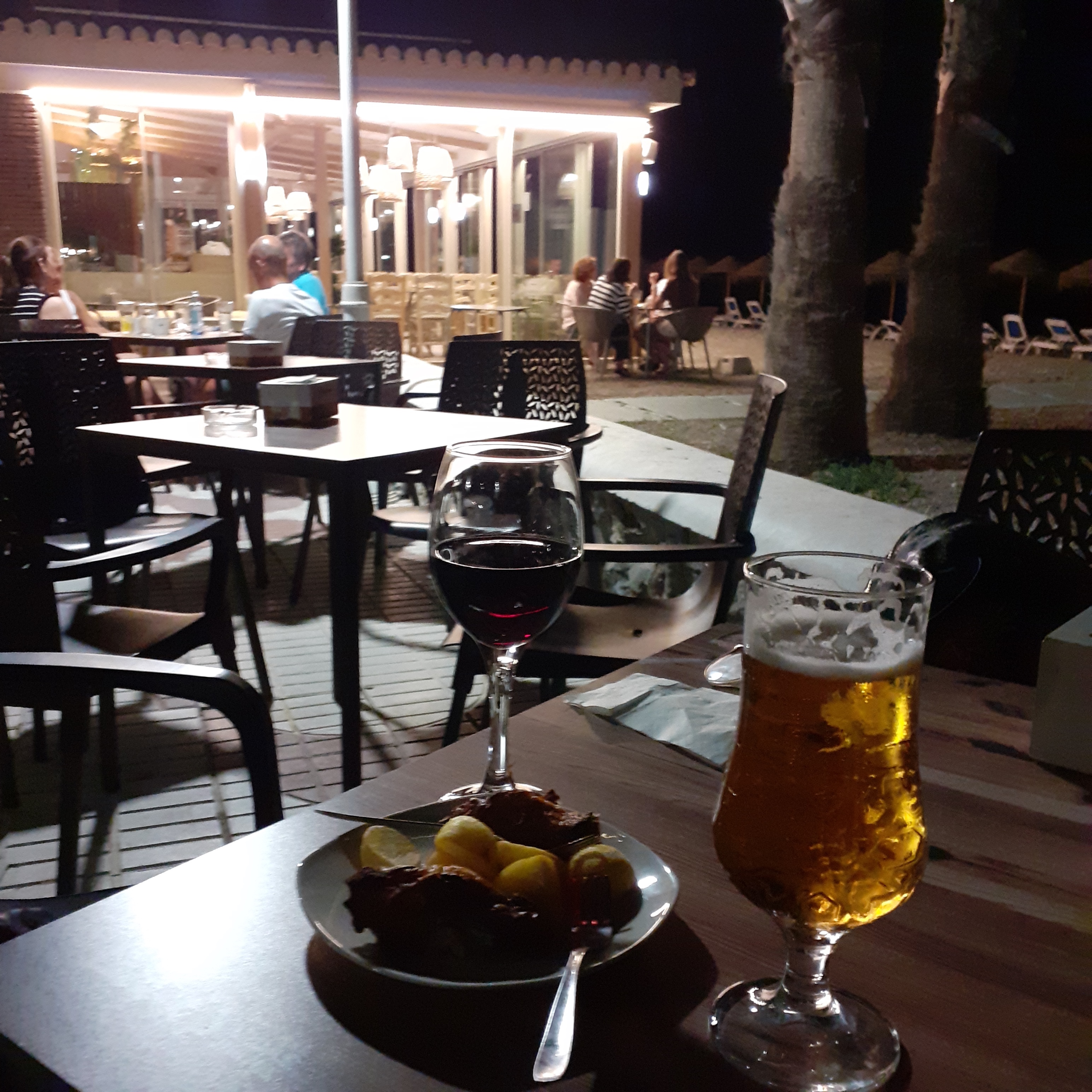
Puerta Del Mar to the east is the main bay of the old town while Playa Del Cristobal is a long straight esplanade heading into the west. Chirinquito El Pilici and Bar La Cana are amongst the many beach bars lining the seafront, offering a large selection of food, many with charcoal grills. We stop streetside at Restaurant Sabina. Sabina Schumacker herself greets us. A German lady, she makes a superb menu guide. Though I am not always a fish fiend, other than my chipper favourite of battered cod and chips, Sabina guides us towards the Monkfish and it is as superb as promised. Next door is the Helios Costa Tropical, the largest hotel on the seafront. This boasts a rooftop bar with great sea views, the prime place to bask in the setting sun.
Another night we eat at Elysium Restaurant farther on. It radiates a relaxed Bohemian air. The manager, laid back and friendly, tells us about the cuisine prepared by her husband from Aghanistan. The couple moved here last year from Austria and are enjoying the sun and sea air. We enjoy the food immensely. Ad hoc entertainment is provided by an English woman shellacing her errant husband, first on mobile phone (aren’t mobile phones wonderful!) and then in person. As we sneak out she comments loudly on our Irishness. We fade to black.

From here, the long seafront winds away to a beautiful emtiness, darkness on the edge of town, lights at the edge of the next twinkling with distance. The sun has set, but will rise again tomorrow. For many, in fact, the night never really ended. The Spanish know how to do festivals, and with the festival of San Miguel in full swing, the hilltop revelry goes on long into the night. Its a pleasant distant soundtrack, cushioning the fall into sleep.

After check out we head out for breakfast and towards the bus station. Churreria Picasso opens early, and is a popular start to the day for locals. Churros are made with choux pastry dough, fried till crispy on the outside and cut in long lengths. Taken with coffee for breakfast, or dipped in hot chocolate, they are popular throughout the Spanish speaking world. 
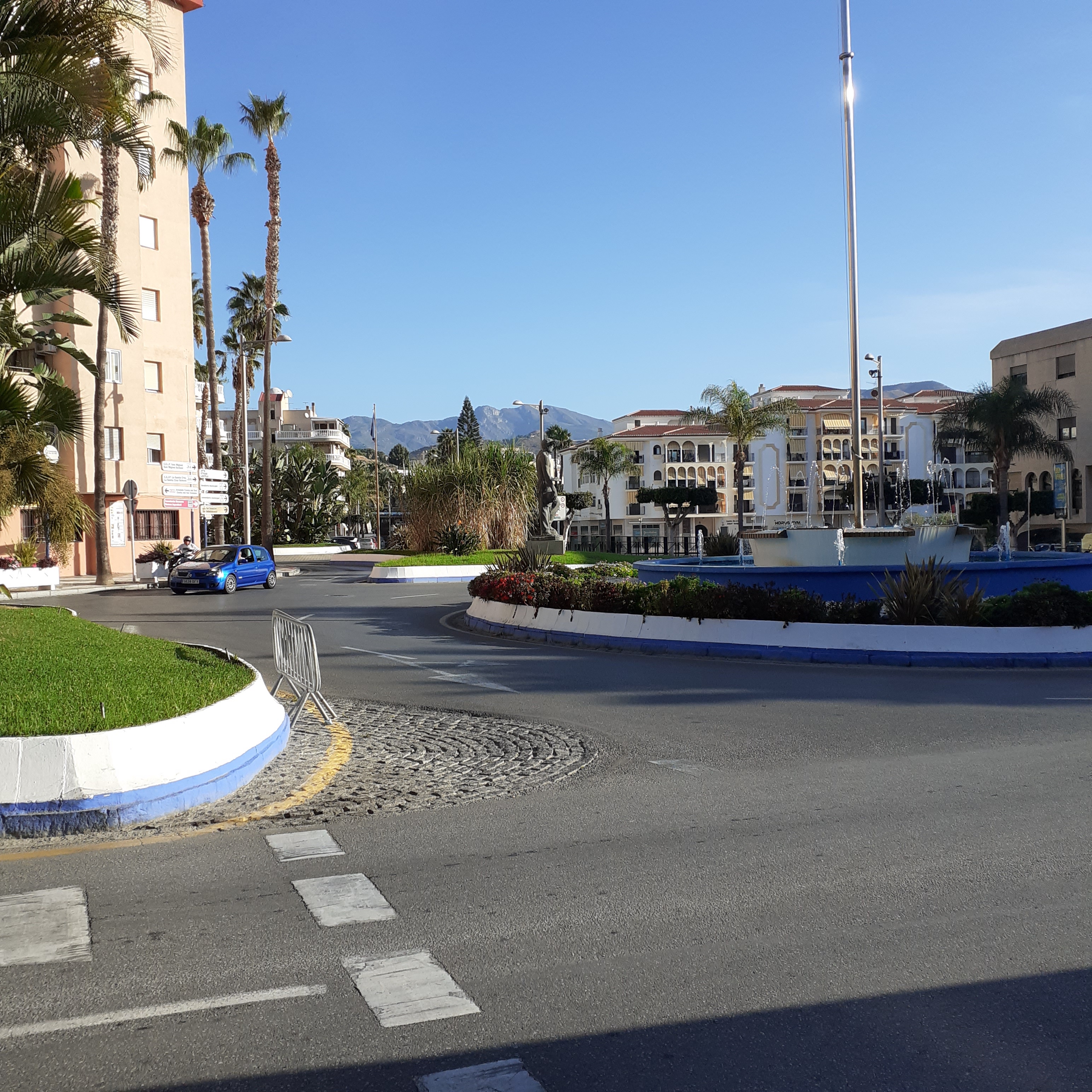
We have time for one last coffee at Casablanca and watch the time go by, again. There’s a crush of coaches at 11 o’clock, but a friendly German expat puts shows us to the right one. It’s just over an hour along the coast to Malaga and we close the circle of our magical bus tour. 

I know I’ve played this before, but I…. I’m not going to say it; and neither did Humphrey Bogarde. As Time Goes By was written by Herman Hupfield in 1931 and rose to fame when sung by Dooly Wilson (playing Sam) in the film Casablanca in 1942.

You must remember this

A kiss is still a kiss

A sigh is just a sigh

The fundamental things apply

As time goes by
Back to Andalusia – Granada by Bus

We took the bus direct from Malaga airport to Granada some sixty miles northeast. The journey takes about an hour and a half which brought us into late afternoon. The road rises through the  coastal mountain range before falling to La Vega de Granada, the fertile green basin leading into the city. The Sierra Nevada soar to the south. Spain’s highest peaks make an impressive backdrop as we alight at the terminus, Grenada with a population of over two hundred thousand sits two and a half thousand feet above sea level. Higher still, the magical Alhambra floats above the city.

I visited Grenada before, around Semana Santa in late March, and the Sierra were snow capped on the horizon. Grenada shivered, showers of snow and sleet washing across the limpid Spring air. That was my pilgrimage to the Alhambra, visions of Spain caught in a curious snow globe. It was brought about by my first guitar, an Alhambra, and my ambition to play flamenco. Now I’m back.Fying solo’s fine, but with M in tow I have a shoulder to lean on and an ear to burn and boast to.

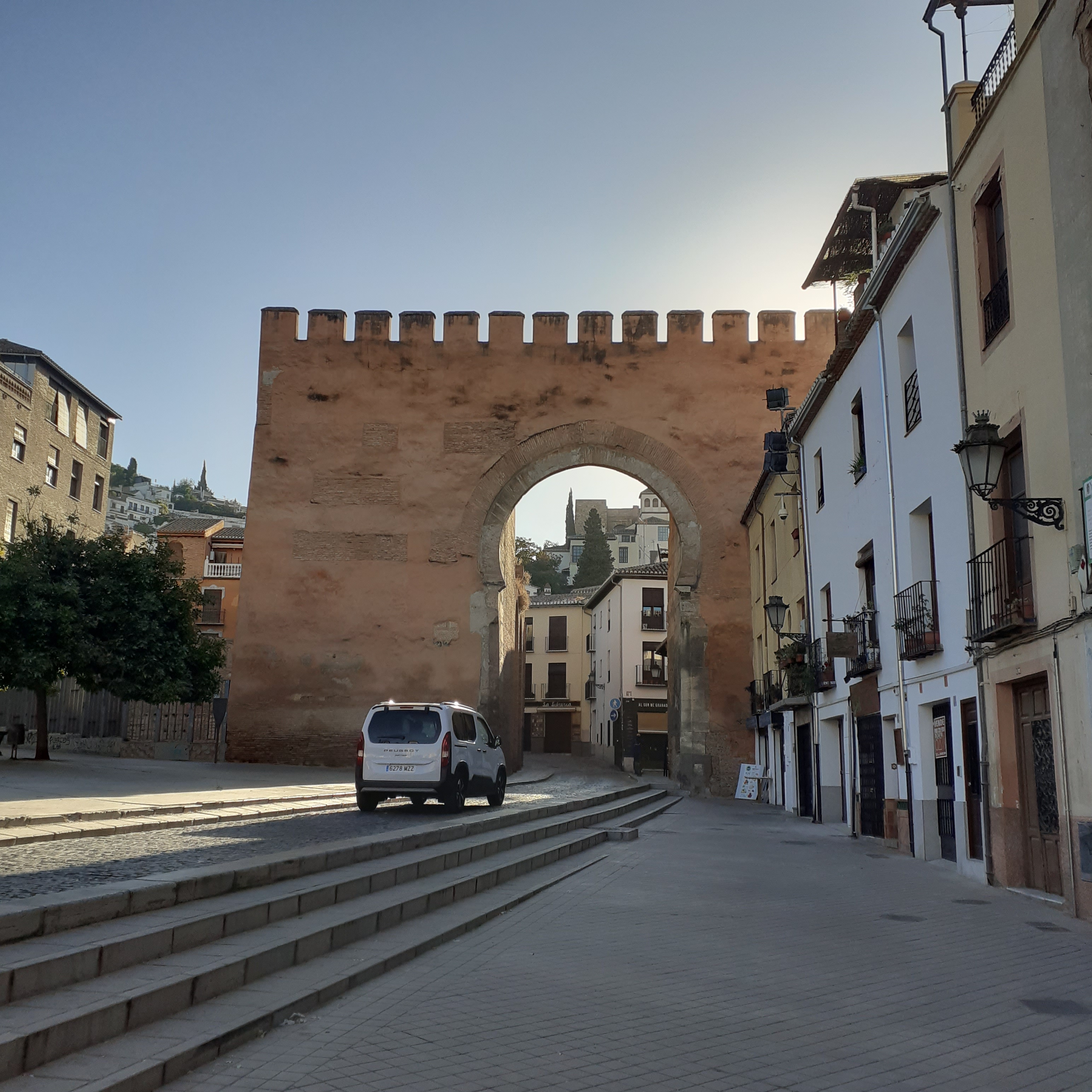
Granada bus station is a good bit out of the city centre and we take a taxi to our hotel. We are staying in the Exe Triunfo Hotel off the top of the main avenue, Gran Via de Colon. The receptionist is a fountain of knowledge and our three days in Granada are well mapped out. The hotel is next door to an ancient entrance gate of the city. The Gate of Elvira, a russet fortified archway, presides over the square. Passing through, we enter the labyrinth of the Old Town winding down to the city centre. Gran Via de Colon to one side and a steep hillside forming the other bracket.

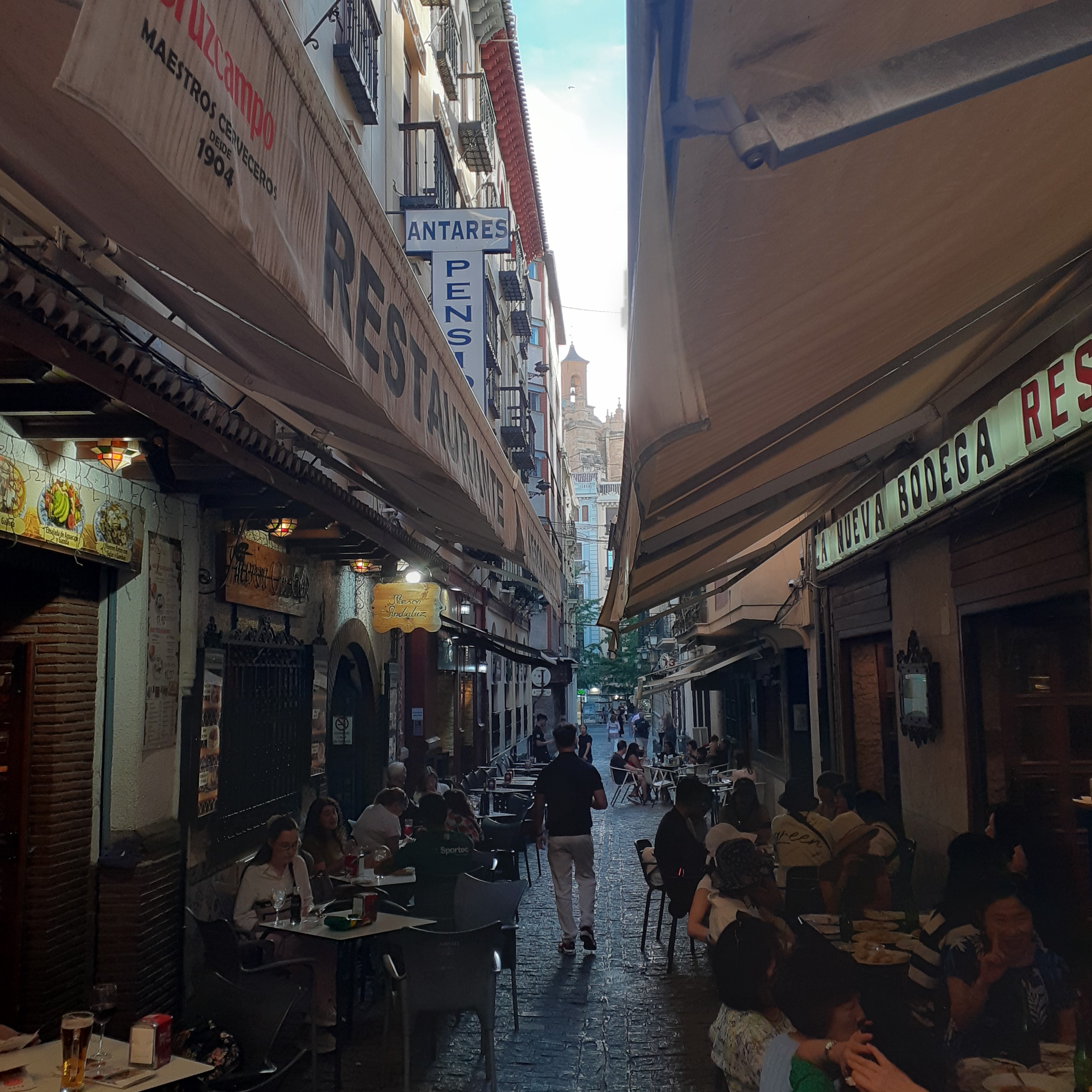
Calle Elvira itself is the main drag of the Old Town. The name is a curious echo of our friend’s villa in Elviria near Marbella where we will be heading next week.. But this is a slice of ancient urban Spain. Rambling, rickety and full of character. It is lined with quirky shops, cafes and casual eateries. Elvira leads to the city centre where the Plaza Nueva spans the Darro River.  Before that, the street branches into a few vibrant city lanes. Caldereria Nueva leads uphill into the Albaicin. Towards Gran Via, Cetti Meriem has a cluster of clubs and eateries. We eat at a few of these, the food and the atmosphere are great. This area had been a haunt of mine in the cold times of old. Hennigan’s Irish bar to be precise. Nights spent amidst copious pints and a vivid soundtrack of suitable rock including the Red Hot Chilli Peppers and Iggy Pop.

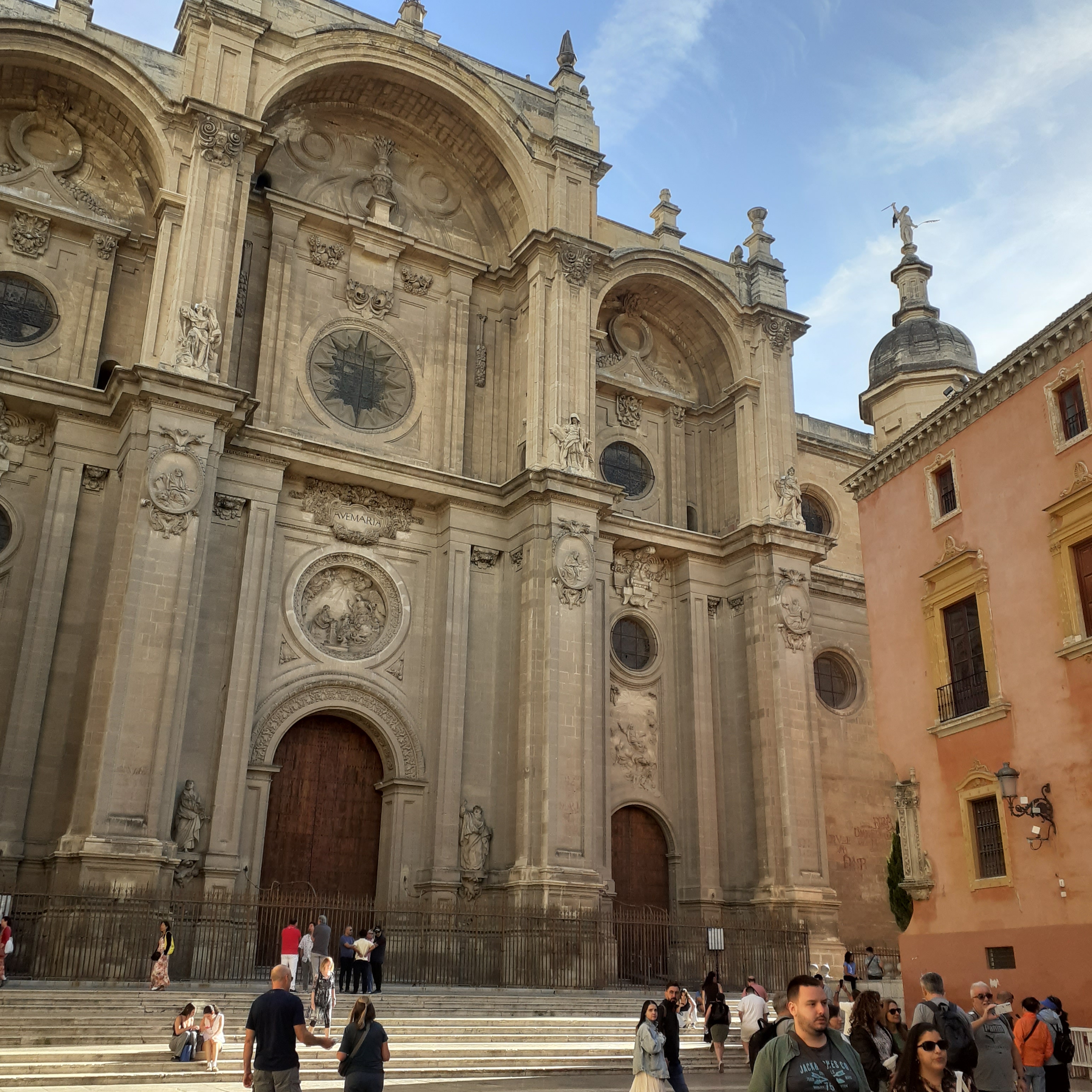
At the far end of Cetti Meriem, the Cathedral soars above the pediment. The Cathedral was begun in the sixteenth century, replacing the existing mosque within the Moorish medina. It is a montage of architecture, the end backing onto Gran Via a packed ornate gothic, the frontage an imposing Baroque facing Plaza Pasiegas. The massive towers on the north were never completed. I recall how its white interior perfectly mirrored the cold exterior in that cruel April. More comforting, the vast dome with gold stars scattered across a deep blue sky. 

Elvira ends at Plaza Nueva with its lively bars and restaurants. Despite its name it’s an old square, being built over the Darro River in 1500. The Royal Chancery flanks the north side while the Church of Santa Ana closes the square with the Darro visible beyond. Nearby there’s a fountain and beyond there’s access to the Alhambra via parkland. Alternatively, you can take a bus. It’s a punishing uphill climb, especially in the heat, so that’s what we did this time.

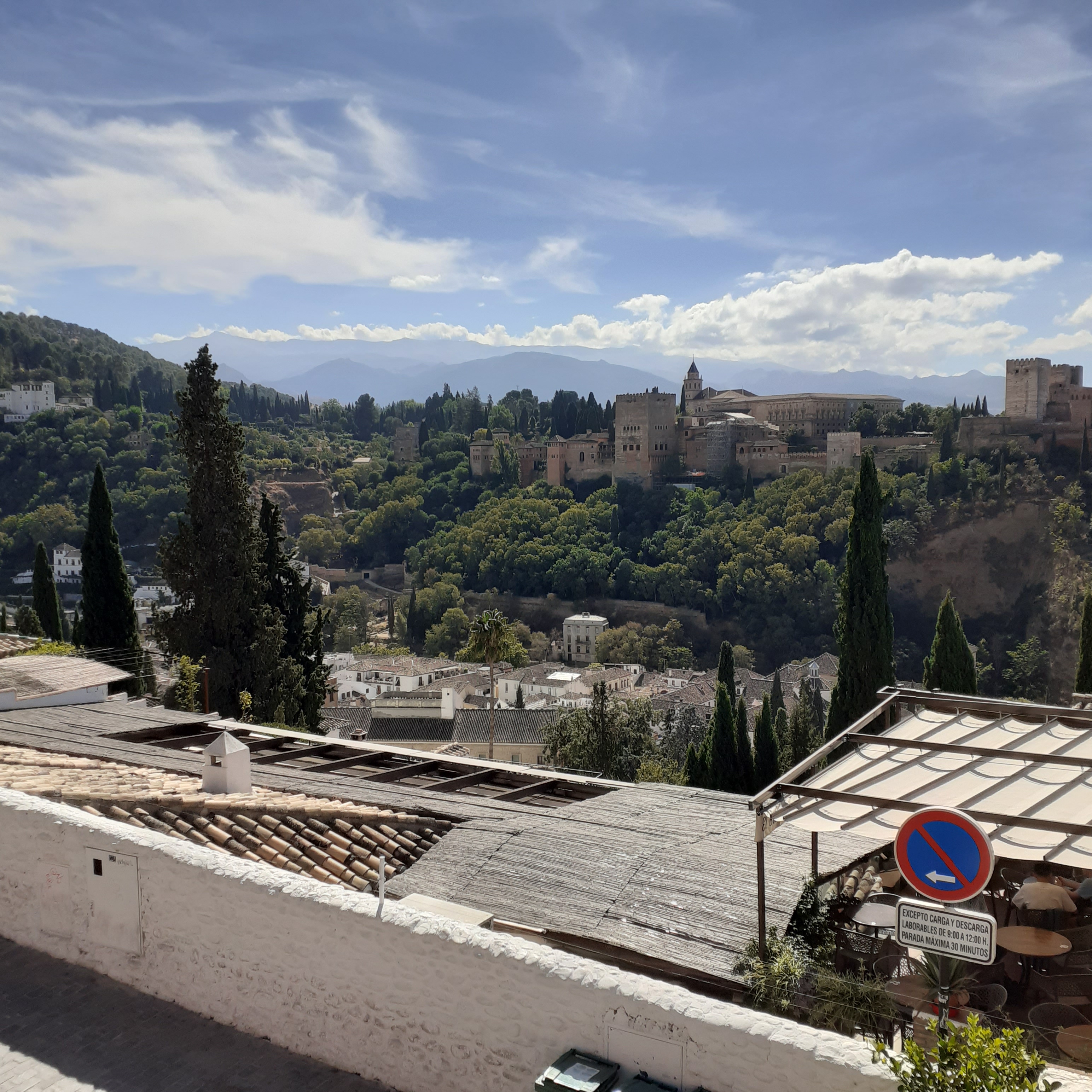
The Alhambra for five centuries was home to the Moors who had occupied much of Iberia in the 8th Century. Grenada would be their last stronghold. The Nasrid dynasty ruled Grenada from 1232 until the Reconquista of 1492. They built the Alhambra on the site of an 11th century fortification. In fact that had been the palace of Samual the Prince, a Jewish leader in a Moslem state. Muhammed I founded the complex we see today, greatly enlarged and embellished over the two hundred and sixty years of Nasrid rule. Ultimately, Muhammad XII, aka Boabdil, was defeated by the combined monarchs of Castile and Aragon and forced to surrender Granada to them. As he left for the coast through the Sierra Nevada, he took one last look back at what had long been his, and his people’s home.

The mountain pass where this happened is now called Suspiro del Moro, the Moor’s Sigh. Salman Rushdie’s book, the Moor’s Last Sigh 1995, refers a few times to the episode. In a story of identity and memory, Boabdil’s action provides apt illustration. It was Rushdie’s first book since the Satannic Verses of 1988. Fanatical reaction to that resulted in the fatwa issued by Ayatollah Khomeini, leader of Iran. Similarly aligned groups such as Hezbollah and Al Quaeda have persisted in the fatwa into the current century. Rushdie lost an eye in a knife attack in New York three years ago. He still lives, and writes and thinks.

The Alhambra became the court of Ferdinand and Isabella. Christopher Columbus was witness to Boabdil’s handover and was received at court by the Monarchs as they approved his voyage to the Americas. There is symmetry therefore in that it was an American, Washington Irving, who established the Alhambra in the modern imagination. He lived in the complex in 1830 and published Tales of the Alhambra 1832. This contributed hugely to the preservation and restoration of the Alhambra over the last two hundred years.

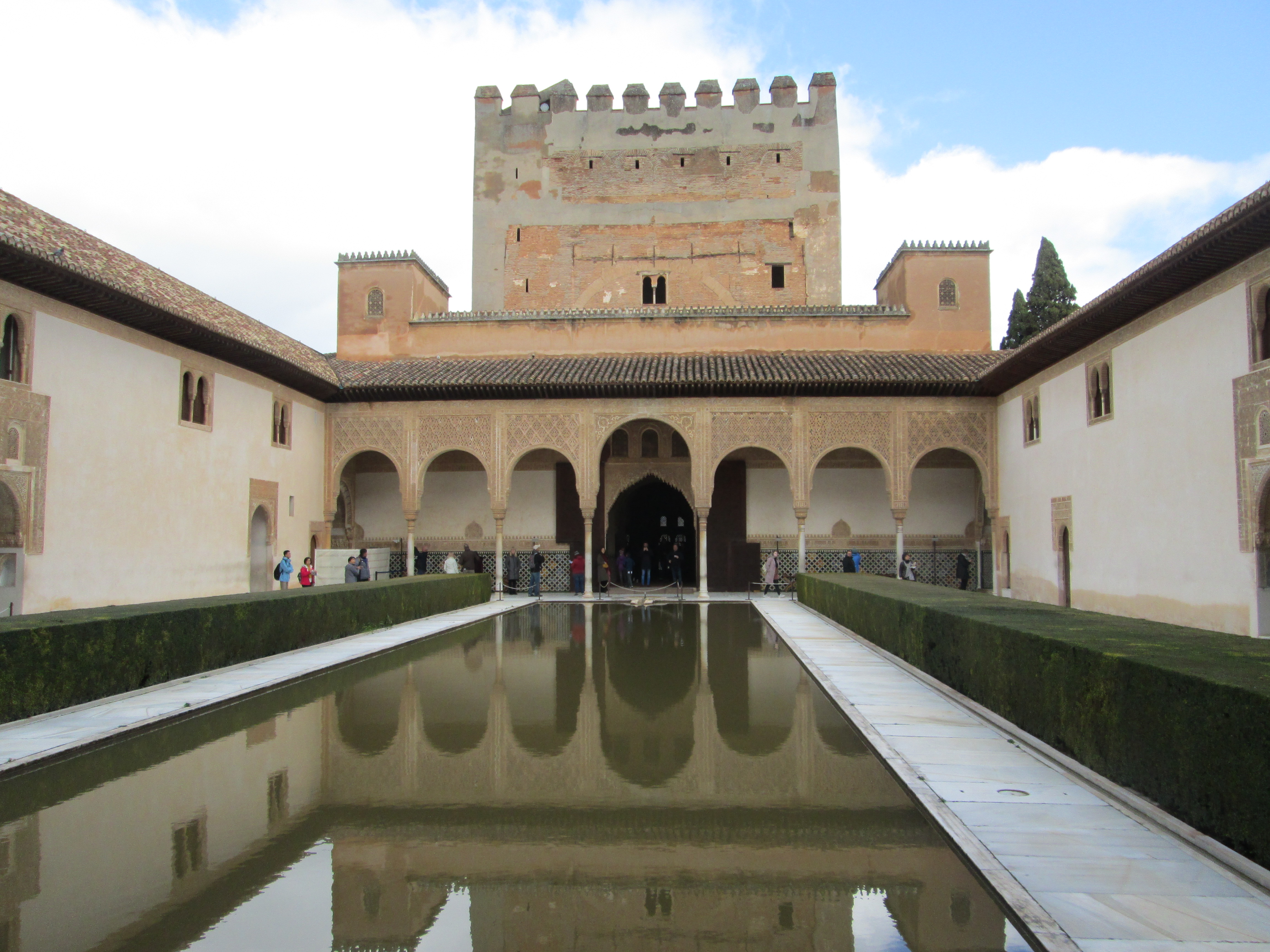
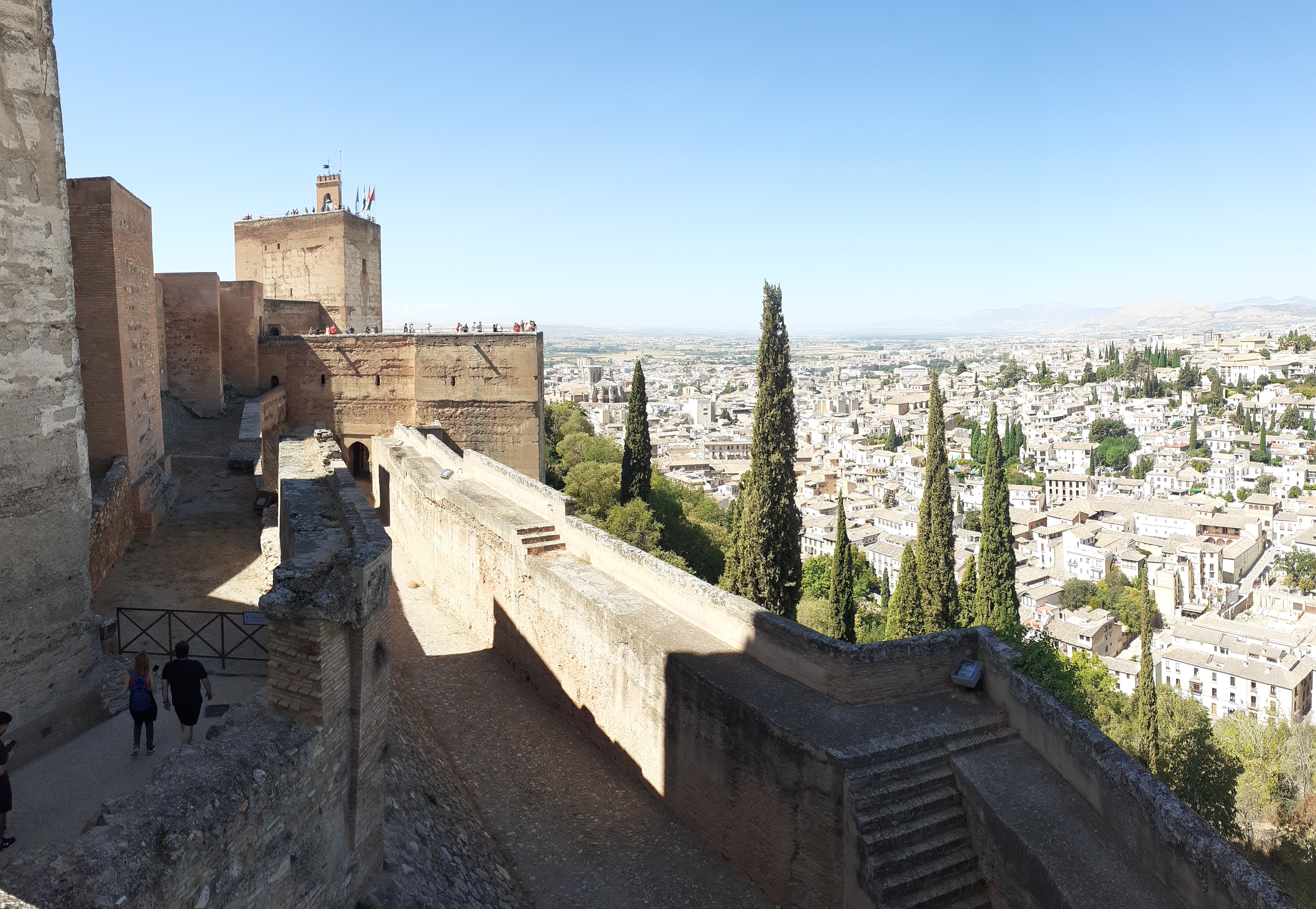
It is a huge complex with many different facets, including palaces, gardens, two hotels and other services. The Alcazaba fortress on the west side overlooks Granada. There are several towers giving great panoramic views over the city and mountains and the complex itself. The Generalife is a garden estate just outside the walls to the east. The Nasrid Palace is the jewel of the Alhambra, a glorious medley of rooms and courtyards, pools and fountains, featuring the best of Mudejar craft and design. Access to the Nasrid Palace requires a specific ticket. This was fine on my first visit but this time, though I tried some three months in advance, tickets were sold out. So shop early. It’s a treasure indeed. Nevertheless, there is an awful lot to see with a general admission ticket. From morning till late aternoon, we had our time in paradise.

At the business end of the complex is the Alcazaba. Plaza Aljizibes alongside forms something of a town square, a public access area with services and refreshment stalls. The Renaissance Palace of Carlos V lines the other aide of the square. This was begun in 1527 but only completed four hundred years later. The Renaissance building encloses a circular courtyard, with a collonaded terrace on the upper floor. The Museum of Fine Arts there houses a collection of Spanish art from the 17th to the 19th century. The Alhambra Museum is on the ground floor.

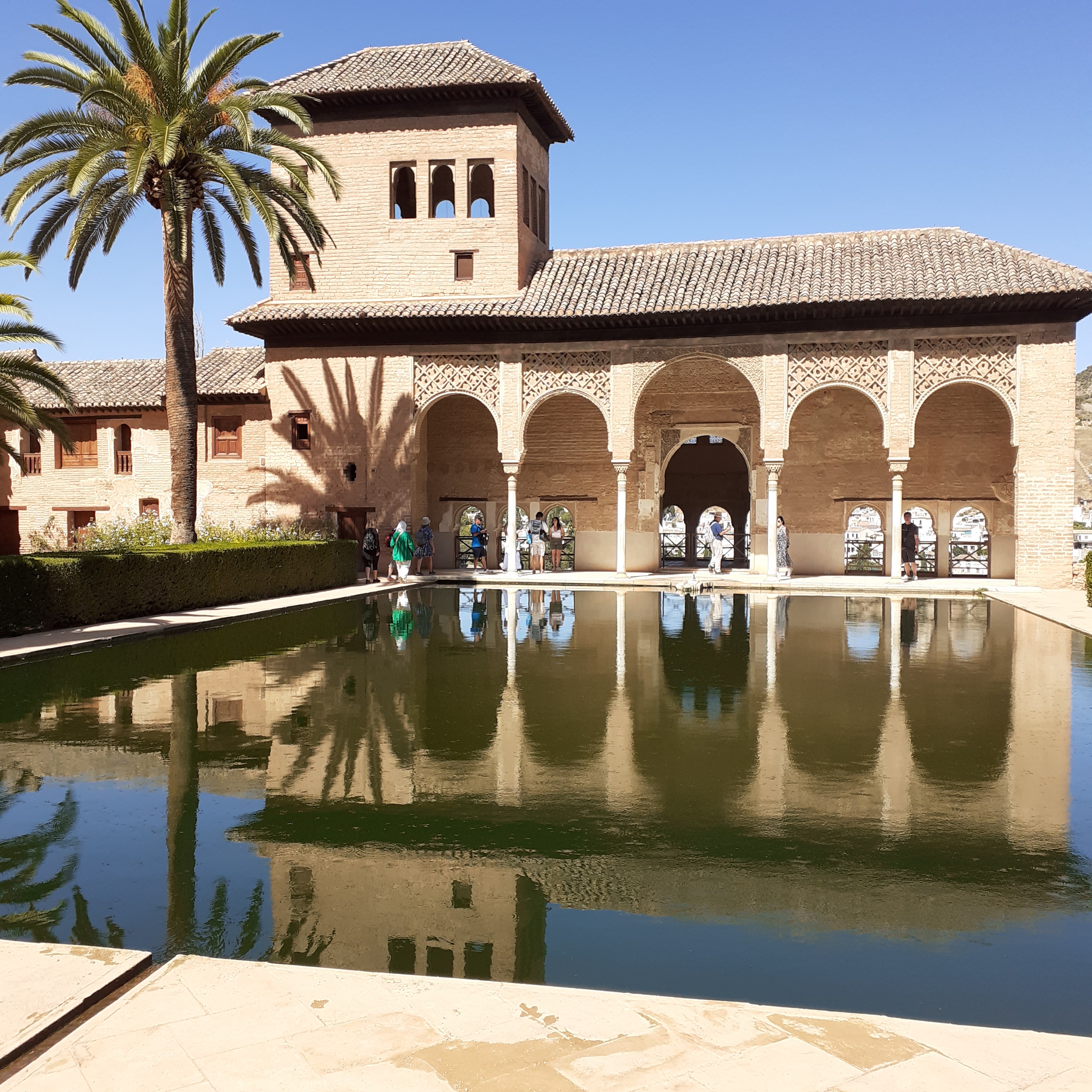
Just past the Nazrid Palace, the Partal Palace is accessible, This is the oldest surviving palace with an elegant pavillion overlooking a reflective pool. Calle Real is a public street near the southern wall. Along here is the Church of Santa Maria built on the old mosque. Further on is the American Hotel, with a cafe in its pleasant courtyard. I had stopped here before for some coffee and heat. Today we go for the Parador de Granada, a larger hotel. We stopped for a drink on its terrace, a perfectly relaxing conclusion to the day

Beyond the gardens of Partal and Secano we leave the Alhambra for the Generalife. This lies across a narrow ravine with beautiful gardens leading up to an attractive villa. Built as a retreat for the Royal Household free from the travails of the Palace, it offers some of the best views of the Alhambra, Granada and Sierra Nevada

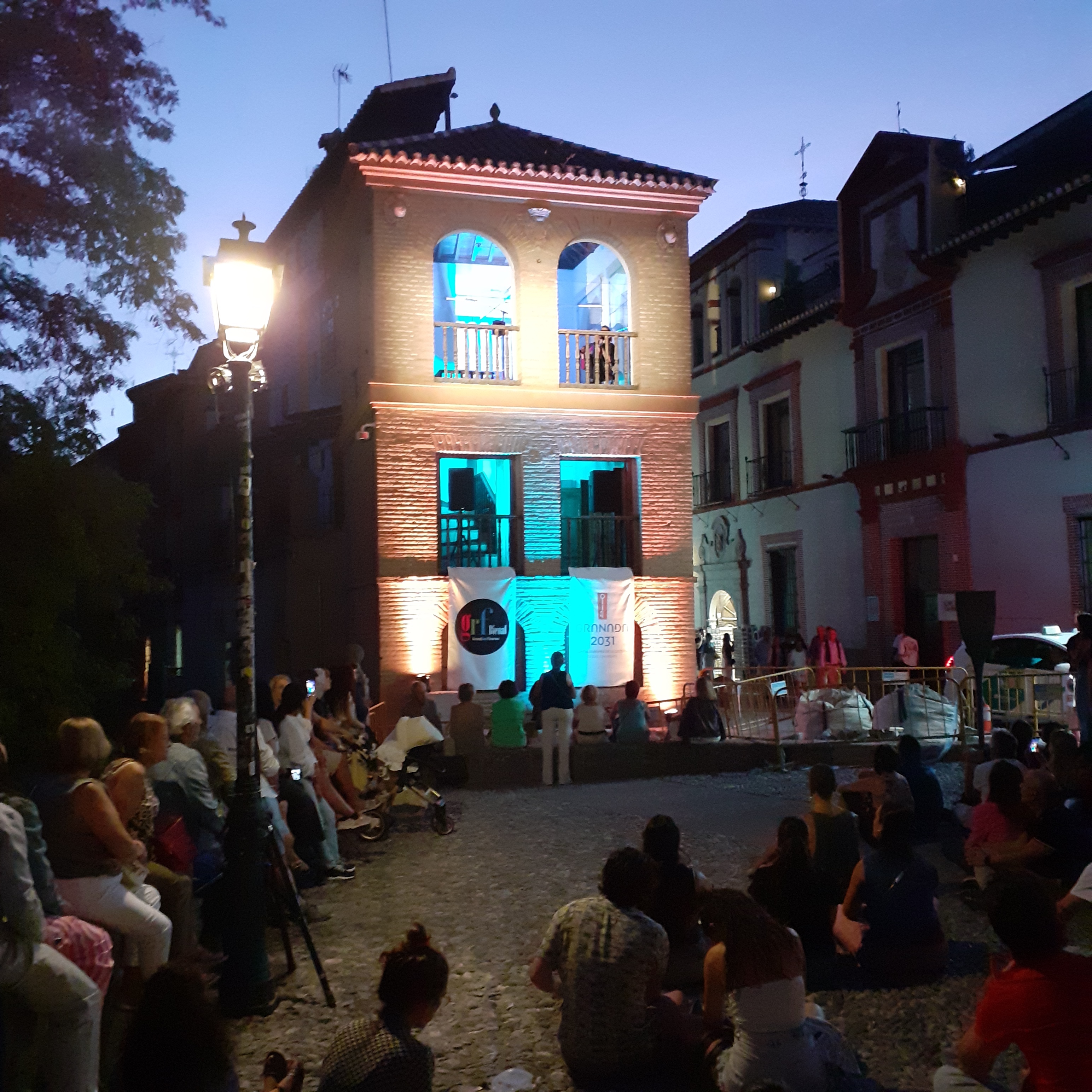
We left the Alhambra by way of Carretera de los Chinos, a long downhill saunter below the castle walls. This led us down to the Darro and Puenta del Rey Chico. There was a music concert that evening where the riverside street broadens into an esplanade with the floodlit Alhambra towering over the far bank. Crowds sat on the plaza, while a singer and guitarist serenaded from the tower at one end. 

Facing the heights of the Alhambra is the steep ancient neighbourhood of Albaicin, and Sacromonte, the Sacred Mountain. From near the foot of Elvira there’s a sharp uphill to Plaza San Gregorio. The white church was built in the late sixteenth century, becoming deeply embedded in the  community. We stopped adjacent for good food on a terrace at the edge of the commercial sector. From here the narrow street climbs up through the Alcaibin to the Mirador St Nicholas. The Mirador hosts such a view over sierra and castle that it must elicit an aching sigh or two. The grounds of the mosque next door offer respite, heat and throng dispelled in its subtle shade and soft fountains.

Beyond the Albaicin the steep hill descends to the Darro. There’s a turn at a picturesque, even picaresque, taverna, El Rincon del Chapiz. Take this turn to visit the Sacred Mountain. With our first step into Sacromonte, we are in a different world. The city evaporates and a mirage of a mountain top village rises before us. Winding up above the Darro Ravine, white houses cling to the slopes and the Sierra Nevada embraces all. We stop for a drink and tapas at Casa Juanillo, wondering how we have found ourselves in the middle of nowhere, and the centre of everything. This was originally the Gitanos quarter, and a mainspring for the source of flamenco music. Dotted all around are music venues; hold your whisht and you can hear the music echo from the stones and trees.

Fly away on my zephyr

I feel it more than ever

And in this perfect weather

We’ll find a place together

For old time’s sake, The Red Hot Chilli Peppers Zephyr Song (from By the Way 2002) to take us out, and up.

Back to Andalusia – Mijas and Fuengirola

Southwest of Malaga the A7 highway flows past the strip of beach resorts that have become synonymous with holidays on the Costa del Sol. Torremolinos, Benalmedina and Fuengirola form a densely populated highrise urbanisation along the sun blasted coast. A little farther on is La Cala de Mijas which retains much of the feeling of the whitewashed Andalusian fishing village. Mostly lowrise and home to about ten thousand people, this is a different world from the crowded developments nearer Malaga. The modern commercial centre fronts the A7 and there’s a weekly open market here. Behind that the old town meanders down to the searont. 

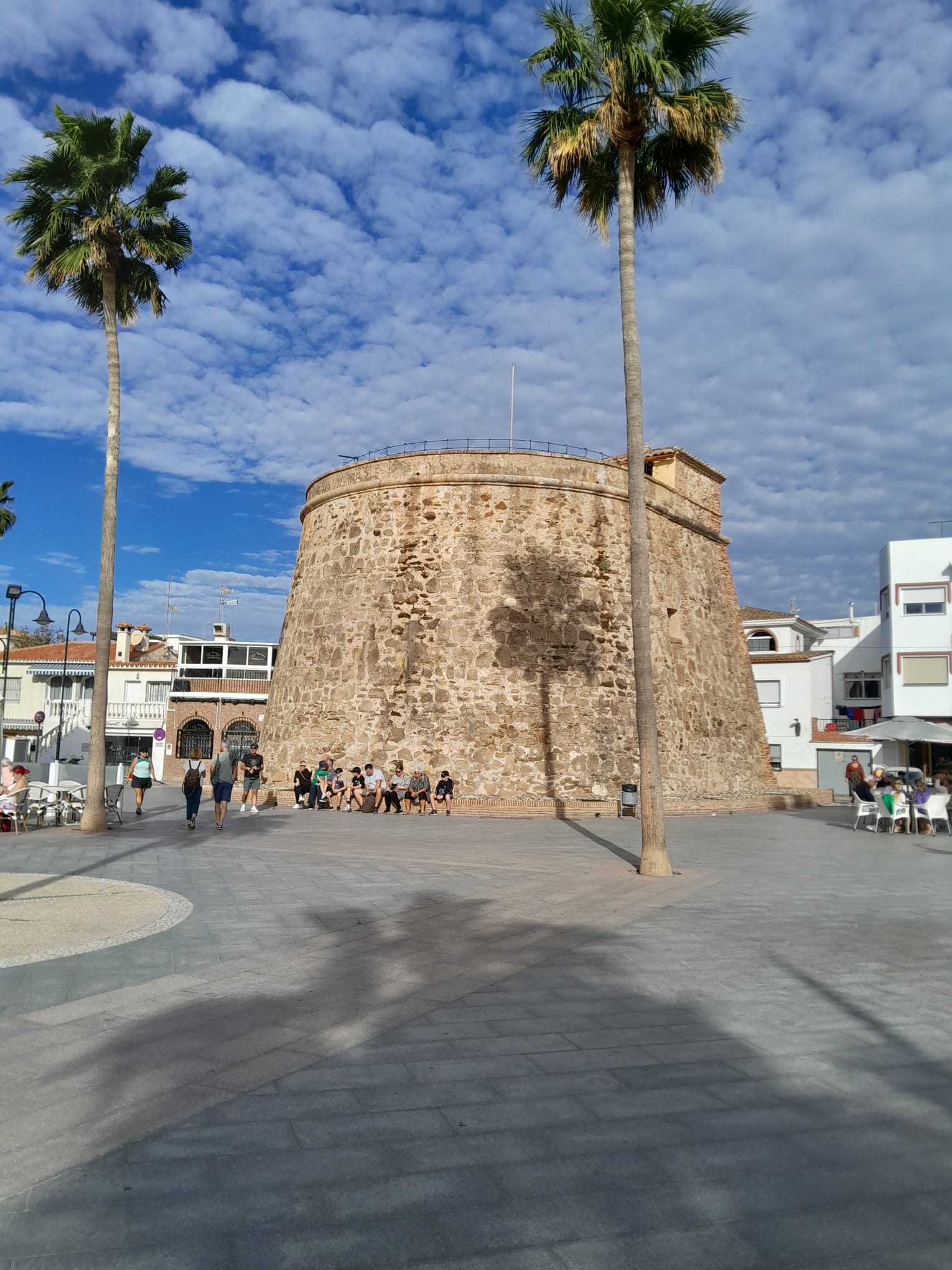
A small plaza with plenty of restaurants and bars is laid out around the historic watchtower. This resembles our Martello towers, and is of similar function and era. Its official title – Torre Vieja de La Cala de Moral, derives from the original name for the town, referring to the area’s abundant mulberry trees. The tower was built in the late eighteenth century as a watchtower guarding against Berber pirates, still prevalent along the coast. Built on a hoof shaped plan, the wall curves around three sides with the linear fourth side rising sheer to the ramparts. The building contains a museum, and the top is accessible for visitors to admire an impressive panorama.

We stopped at an adjacent restaurant for lunch, the busy waiter doing well to cater to the midday trade. No better place for a postprandial stroll; the coastal boardwalk connects to Cabopino, Marbella’s eastern outpost, 6km farther on. La Cala is pleasantly remote from the hectic holiday world, while still conveniently close to it.

The Romans called the area Tamisa which the Moors shortened to Mixa leading to Mijas when the Catholic Monarchs took over. The municipality of Mijas also includes Calahonda and La Rivera farther along the coast. Collectively known as Mijas Costa, it is something of a golfer’s heaven. Though I’m more keen on nineteenth hole pursuits myself.

There’s a more authentic experience a couple of miles inland. The settlement of Mijas Puebla teeters atop the high coastal hills. Sierra de Mijas rise to a height of 1,150 metres. Mijas Puebla itself sits at 1,476 feet above sea level. Once across the A7, it’s a zig zag drive to reach the town and there’s a multi storey carpark right in the centre. We called into the  tourist office at the pedestrian entrance and talked to the friendly lady there. She gave us a street map of the town and some good pointers. We visited on a rainy morning and, as the rain cleared, the clouds still clung to the high altidude village, lending it a remote grandeur.

A small grotto nearby teeters above the drop to the coast. The candles glow invitingly, in contrast with the rain outside. A place for pause and a prayer. The tiny streets pack in a surprising amount of commercial variety with good shopping and services. The precarious position of the town frequently allows for some spectacular views. Into the maze of backstreets the quirky charm persists. We come across the town’s tiny bullring. Built, uniquely, in an oval, as distinct from a circle, it is Spain’s smallest bullring; probably.

There’s a bar with Picasso sitting outside, in full artist regalia. Waiting no doubt for a passing Joyce or Beckett. I’m sure they’d have got on fine here. We find an outside table balanced at a steep corner. The proprietor was keen to get us indoors but we stuck to our guns and had a pleasant coffee and tortilla while the street crowds began to peek out again after the rain.

Fuengirola is spread out below the hills. It is the last stop on the Malaga coastal train line. From here we have, in previous visits, taken that train from the airport and got a bus on towards Marabella. A previous drive through from Malaga, via Torremolinos and Benalmedina, was rushed and a bit chaotic. I am more orientated now, at home on the Spanish highway, and we took the short drive up from Marbella to have a deco. There’s convenient parking near the Moorish fortress at the southern end of town; though we skipped this and parked in the centre in an outdoor lot beside the port.

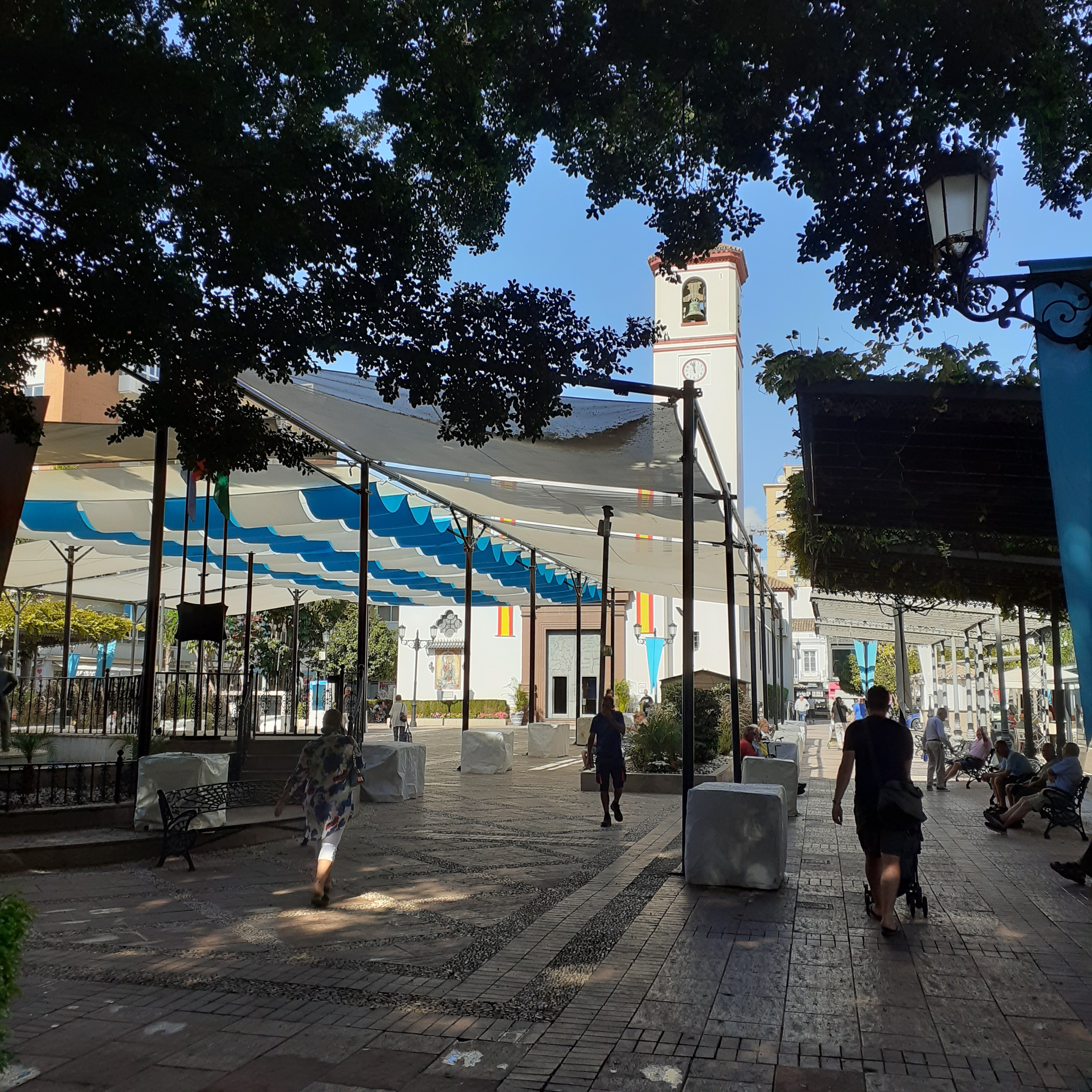
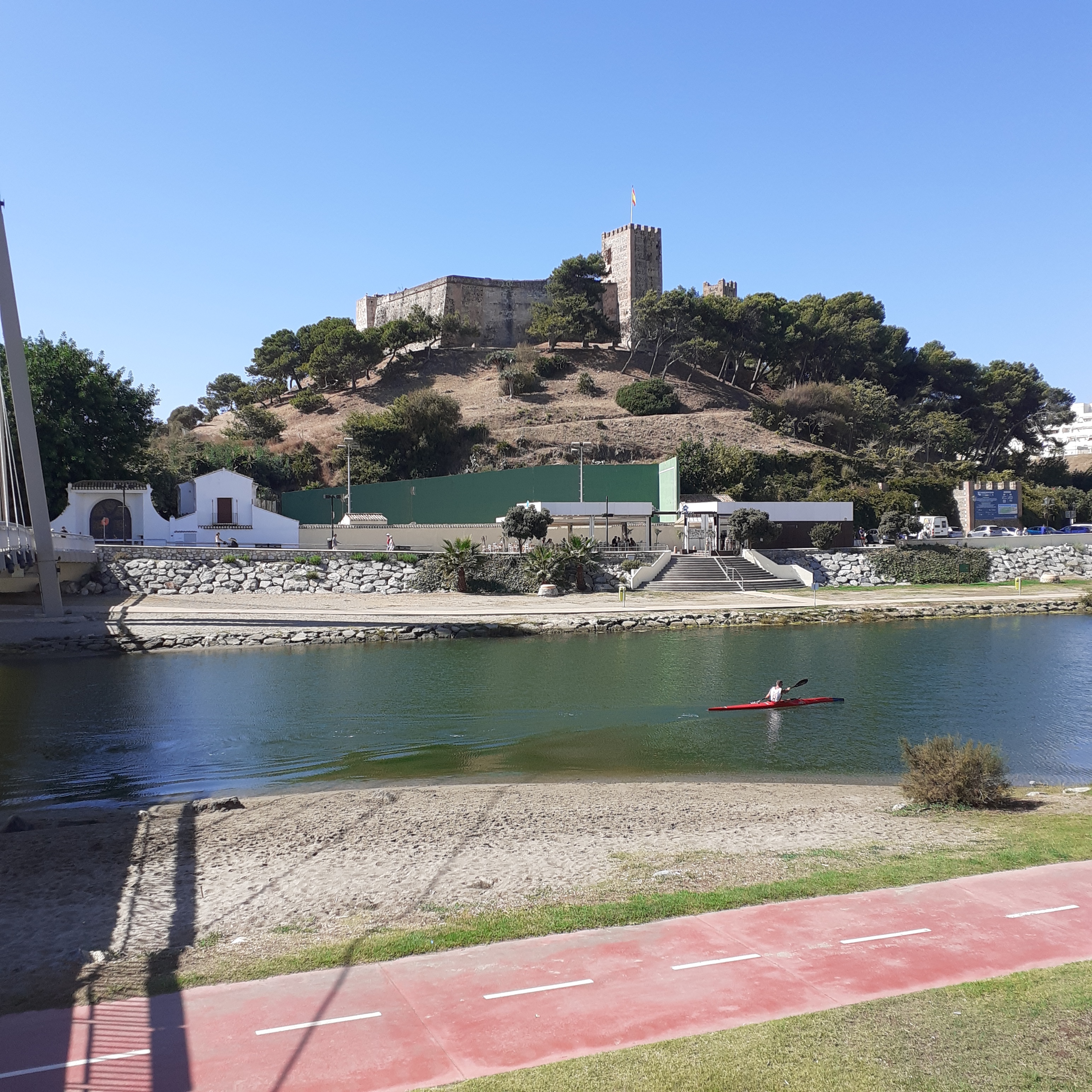
The string of resorts along this stretch of coast isn’t exactly a pearl necklace, but it does its trick and has its moments. It’s a scorching day in mid September and the beachfront is thronged with strollers and swimmers. Just a few blocks inland is the older part of town leading up to the Plaza de la Constitucion. This tiled square faces the church of Our Lady of the Rosary, its clean, white facade topped by a high belltower. Plaza del Ayuntamiento is nearby along the main thoroughfare. To the side, narrow streets lined with bars and cafes take us through a more intimate environment. Calle Dr. Maranon is part of an enclave of low, white terraces, welcome relief from the highrise norm. We catch a glimpse of the Central Mosque beneath its daylight sickle moon. The Rio Fuengirola marks the southwestern end of town. On the far bank the fort stands atop a rocky outcrop.A friendly visitor, German I think, falls into conversation before striking out enthusiastically for the summit. We opt first for the shade. Bar La Terraza is a small cafe bar on the far bank where we stop for coffee and a snack..

Sohail Castle was built by the Moors at the end of the tenth century. It is likely the site was used before by Phoenicians and Romans, but it is the Moorish structure that remains. The imposing, red fortress consists of four corner towers connected by curtain walls. From the parapets there are dizzying views of the coast and town. A Festival of Music and Dance is held here in June

The Catholic Monarchs conquered at the close of the fifteenth century. Later the Castle was extensively damaged during the War of the Spanish Succession. It was back in use again for the Peninsular War, but was deserted by the start of the twentieth century, only recently being repaired as a visitor attraction

Fuengirola was mostly uninhabited after the Reconquista, Mija being the largest settlement hereabouts. By the 17th century a small town had grown around fishing and farming. A lone inn catered for travellers. It was not until the 1960s that Fuengirola was transformed into a top resort. Today the population is 85,000. of whom a quarter are foreign born. Many of these are Irish, British and Scandinavian with immigration too from Morocco and Latin America. High season sees an influx of visitors, and high season here spans at least six months. You can see why. It’s mid September and the mercury’s touching thirty.

Local business and employment has benefitted and expanded hugely from tourism, but there are problems too. Spain has been in the news recently for anti tourism protests. While these may give rare opportunities for lefties to shout abuse at foreigners, there is a real issue. The steeply rising population further swelled with visitors, puts pressure on amenities and accommodation. Not just here, mind, but all around the world. Governments need to strive for balance. Locals and visitors need to treat each other with mutual respect, preserving the integrity of the places where we live and play. For us and future generations.

Mana are a Mexican rock band. Donde Jugaran los Ninos? (Where Will the Children Play?) is the title track of their third album from1992. It remembers an idyllic childhood, setting it against the overcrowded modern world. Nostalgic, naieve, still it chimes with us all. An echo of Joni Mitchell’s Woodstock: how to get ourselves back to the garden? It is a universal concern. The world keeps on turning, with more and more people in it. We need to spread our wings and fly. And use the broadened mind that travel bequeaths. 

Cuenta el abuelo que de niño él jugó

Entre árboles y risas, y alcatraces de color

Recuerda un río transparente y sin olor

Donde abundaban peces, no sufrían ni un dolor

Cuenta el abuelo de un cielo muy azul

En donde voló papalotes que él mismo construyó

El tiempo pasó, y nuestro viejo ya murió

Y hoy me pregunté, después de tanta destrucción

¿Dónde diablos jugarán

Los pobres niños?

Nerja by Bus

While inland Andalusia is well served by rail, the coastal region is not. Malaga connects to Fuengirola, but for other destinations you take a bus. Alsa bus service is pretty good. We returned to Malaga from Cordoba by train and walked across the road to the Bus Station to buy tickets from there to Nerja. There’s a regular service, and the fifty mile journey takes an hour and a quarter. The bus passes along Malaga’s seafront, before heading into the rugged rural countryside towards Motril.

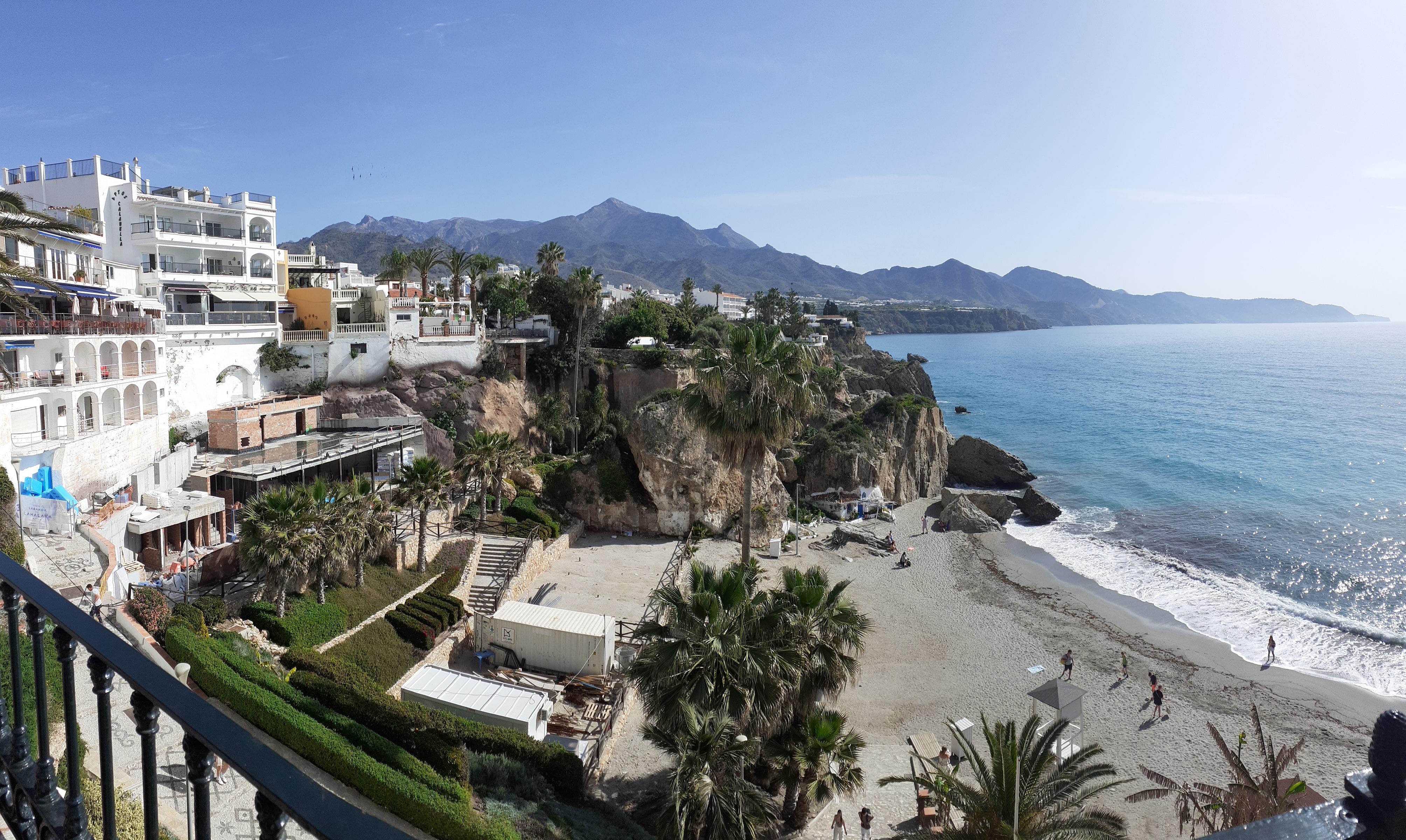
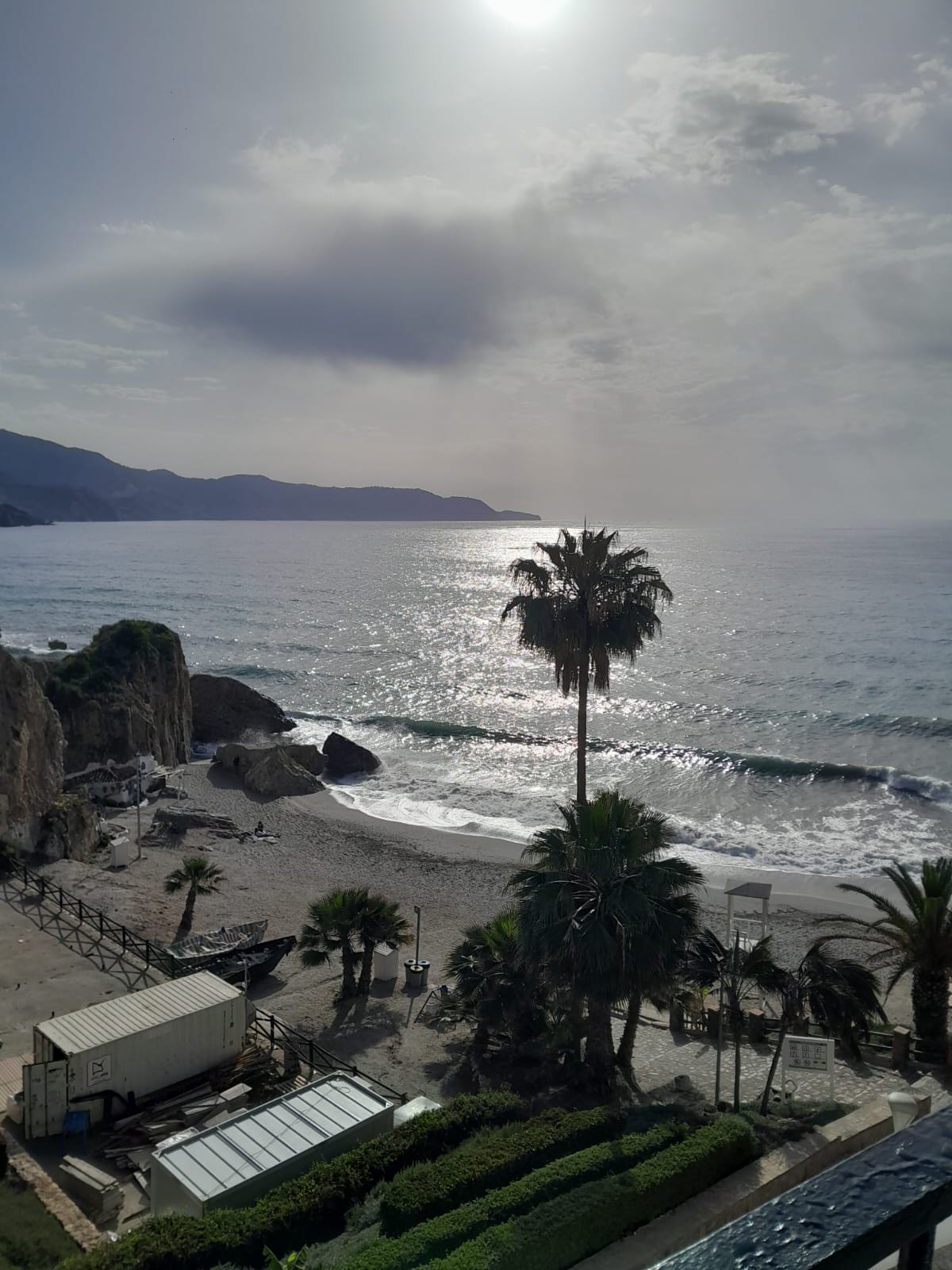
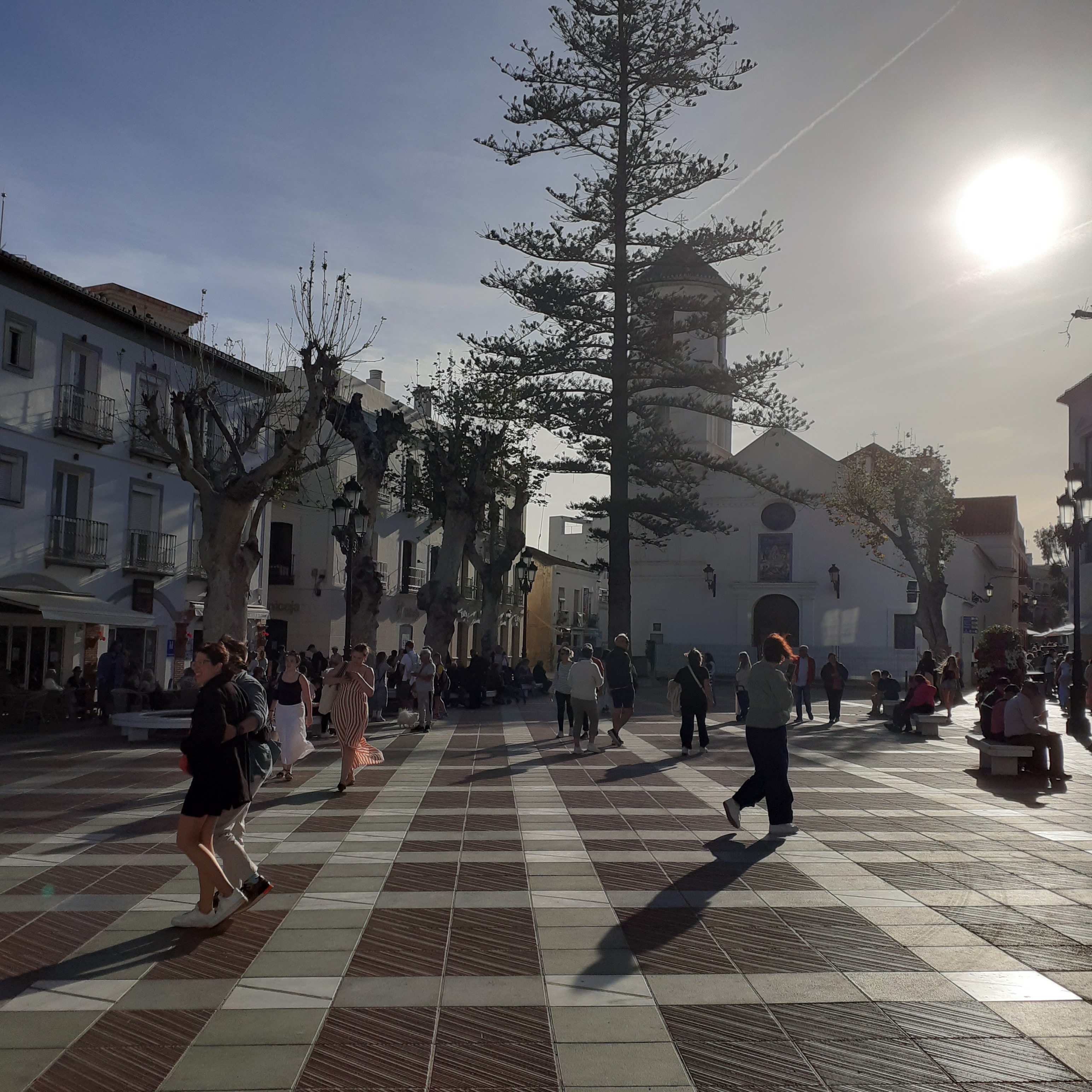
Nerja, lies at the eastern extremity of the Costa Del Sol. It has a population of twenty thousand, though that swells considerably in the summer months. We are deposited on High Street, the main thoroughfare north of the town and take a taxi to our hotel. The Marisol is an online hotel, trading tradition hotel service for tempting low price. But there is a receptionist available until four pm when we arrive. It couldn’t be more central. It faces onto a square with the sea to one side and the narrow pedestrianised streets leading back uphill. There is a picturesque church to one side of the square and sheltering trees dappling the sunshine. The Balcon de Europe, Nerja’s nickname and lure, lies along the southern edge, presiding over an awesome sea view.

The phrase is attributed to Alfonso XII, King of Spain who visited the village in 1884 after an earthquake had struck the region. Admiring the view, he said “this is the balcony of Europe”. Alonso himself died just a year later, at the age of twenty seven. The area around the Balcon once held an artillery battery and a fort which was destroyed during the Peninsular War in1812. A few guns survive on the Balcony, and remnants of the fort litter the sea below. It is an impressive view. There are beaches to each side of the promintory.

The square is thronged when we arrive. The Marisol’s gelateria is giving out free ice cream, adding to the happy hubbub. I get a long awaited beer at the attached bar, so we are both happy. Evening falls and the square and surrounding narrow streets fill up some more. Towards the west of town, the neighbourhood is known as El Barrio, which has a pleasantly homey feel as the name suggests. We get a good meal there in an unscenic restaurant that is friendly, with affordable and excellent main plates. Lasagne for me. The bars are filling up and we grab stools at the counter to catch the Champions League quarter final where Arsenal stuff Real with two glorious strikes from Declan Rice. M is most impressed, though I’m in two minds myself.

Nerja was settled by the Romans, and the Moors after that; but they were modernist blow ins. The Nerja Caves, a couple of miles east of town, were host to human settlement as far back as thirty thousand years ago. A visit to the caves is a must. A ticket to the caves includes a street train to the site, with admission and virtual visual tour too, plus admission to Nerja’s excellent town centre museum.

We took an early train and the crowds were sparse, giving more time and space to enjoy the experience. We took about two hours exploring, by which time lunchtime crowds were beginning to swell. It’s probably a better idea to do the virtual tour first, but we found ourselves inside the caves and decided to continue. As guidance, we had to download the ap, which worked well for M’s phone, but mine lost it as we descended.

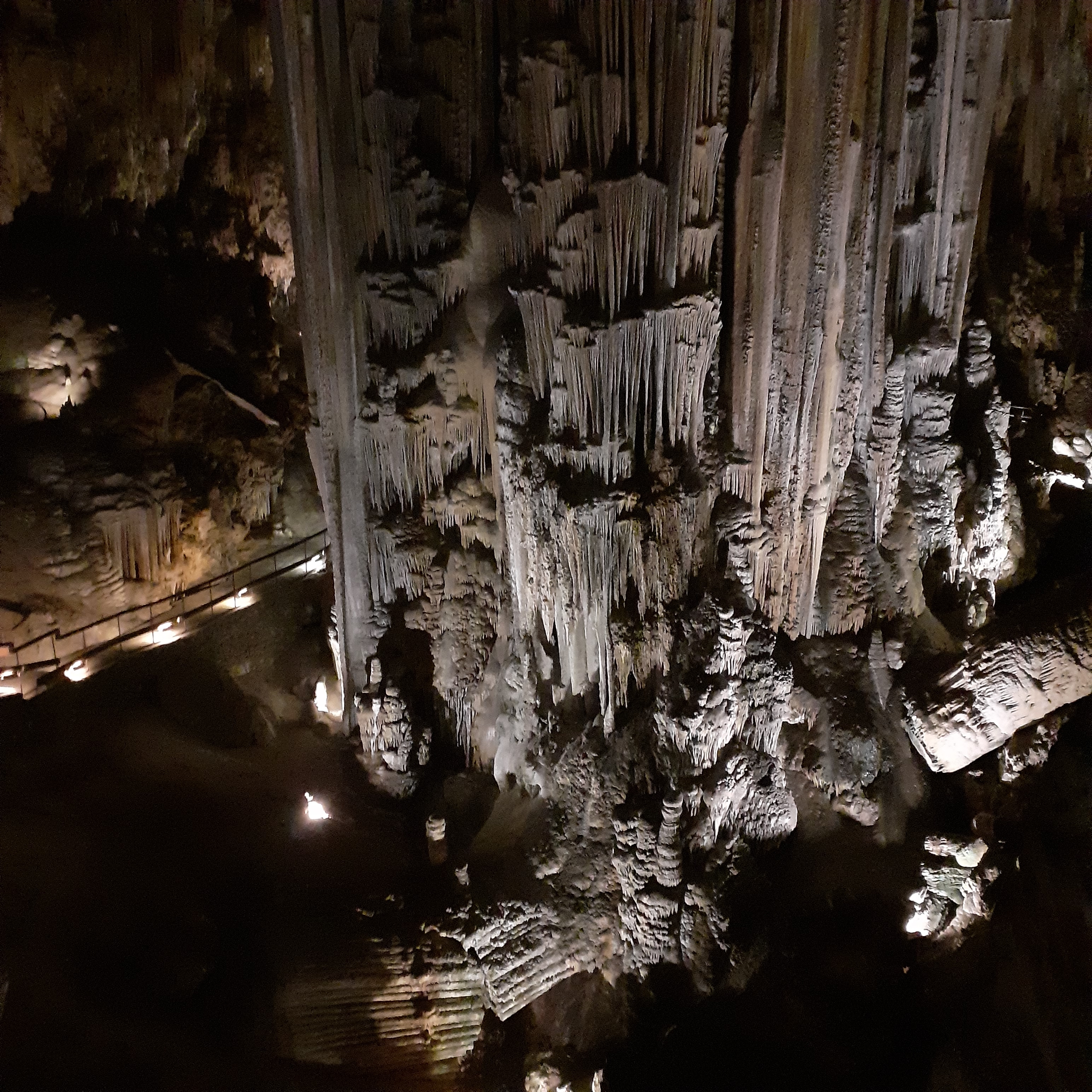
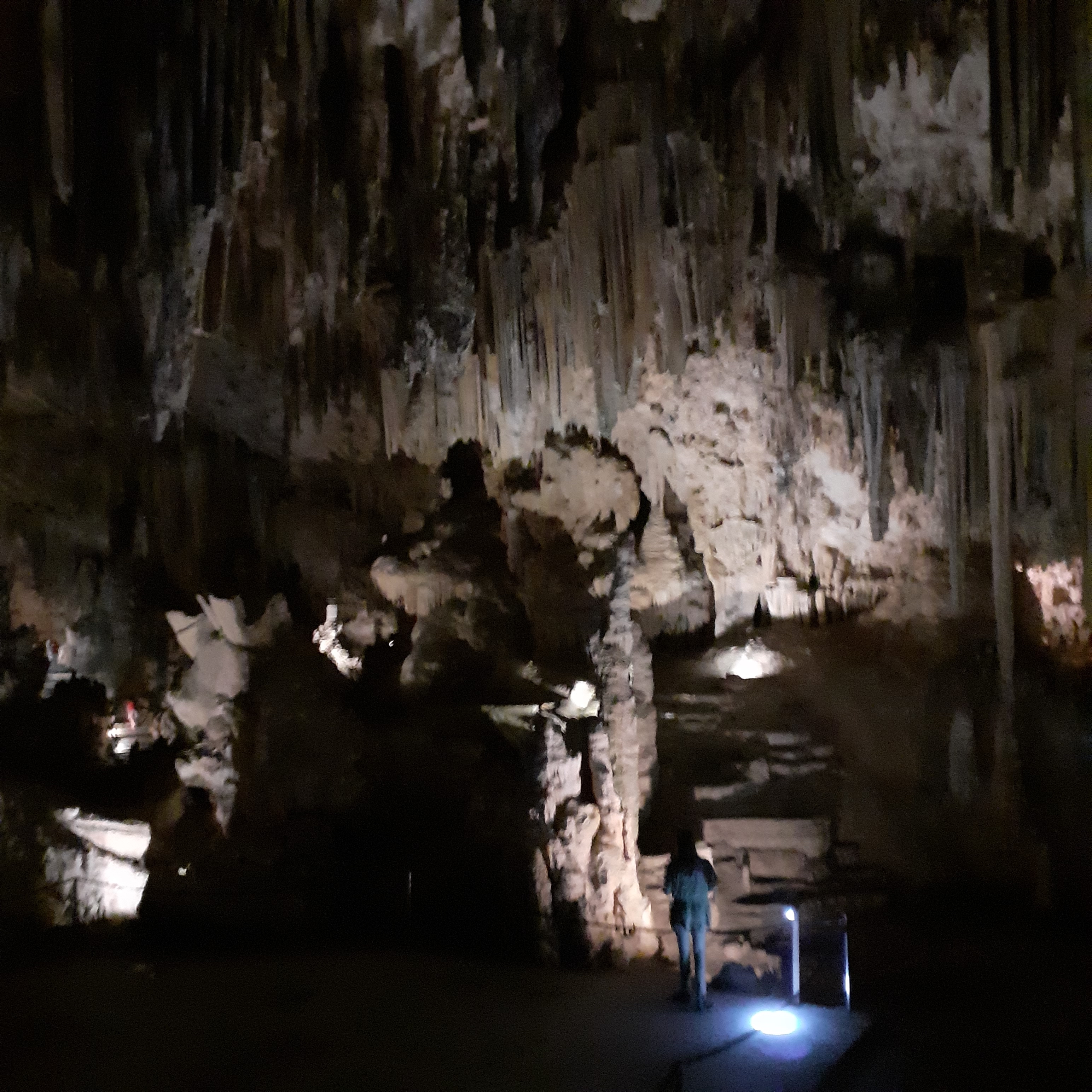
Such idea I have of prehistoric cave dwelling is of a small group of people living in an alcove on a cliff face. They may paint matchstick men, cats and dogs, on the back wall, or huddle back there any time a leopard passes. The Nerja caves paint a different picture. These are vast linked caverns, resembling cathedrals in both space and glorious formations. Stalactites, stalagmites and columns soaring into the inner space.

The different areas are given evocative titles: Hall of the the Nativity, Hall of Phanthoms, Hall of Cataclysm, the Hall of the Waterall, also known as the Hall of the Ballet. Cataclysm is named for a major rock fall, wonderfully illustrating the forces of narture at work to build this natural phenomenon. The largest column is nearby, soaring more than thirty metres from floor to ceiling.

The modern discovery of the caves happened in 1959. A group of five local boys, Jose Barbero, Francisco Navas, Jose Torres and brothers Manuel and Migual Munoz, had noticed bats escaping through a gap in the hillside and found their way inside. There they chanced upon a skeleton and believing it to be, like them, a casual explorer who had been trapped, they beat a hasty retreat to avoid his fate. The following day, however, they informed their teacher, whom they took back to the caves. Word spread, photographs in the Malaga Press stirred public interest. and within eighteen months the caves were opened as a visitor attraction, and crucially a centre for archeological research

In June 1960 the gala opening featured. a ballet accompanied by the Malaga Symphony Orchestra within the natural theatre underground since dubbed the Hall of Ballet. This started the annual performances of the Nerja Music and Dance Festival. After almost sixty years the caves ceased to be used as a venue and performances have been moved to an outdoor auditorium nearby.

On exit, we discovered the theatre for the virtual tour. We had to queue for half an hour as a bus tour had beaten us to it. Worth the wait. We gathered in an interior room with a few dozen others, put on the headgear and set off for a tour inside our heads. This barrels through the millennia, good on the necessary detail, witty in its use of a Woodyesque guide. Along with the cave itself, and the visit to the Museum next day, we got quite a detailed picture of a fascinating part of European human history; pre-history to be correct.

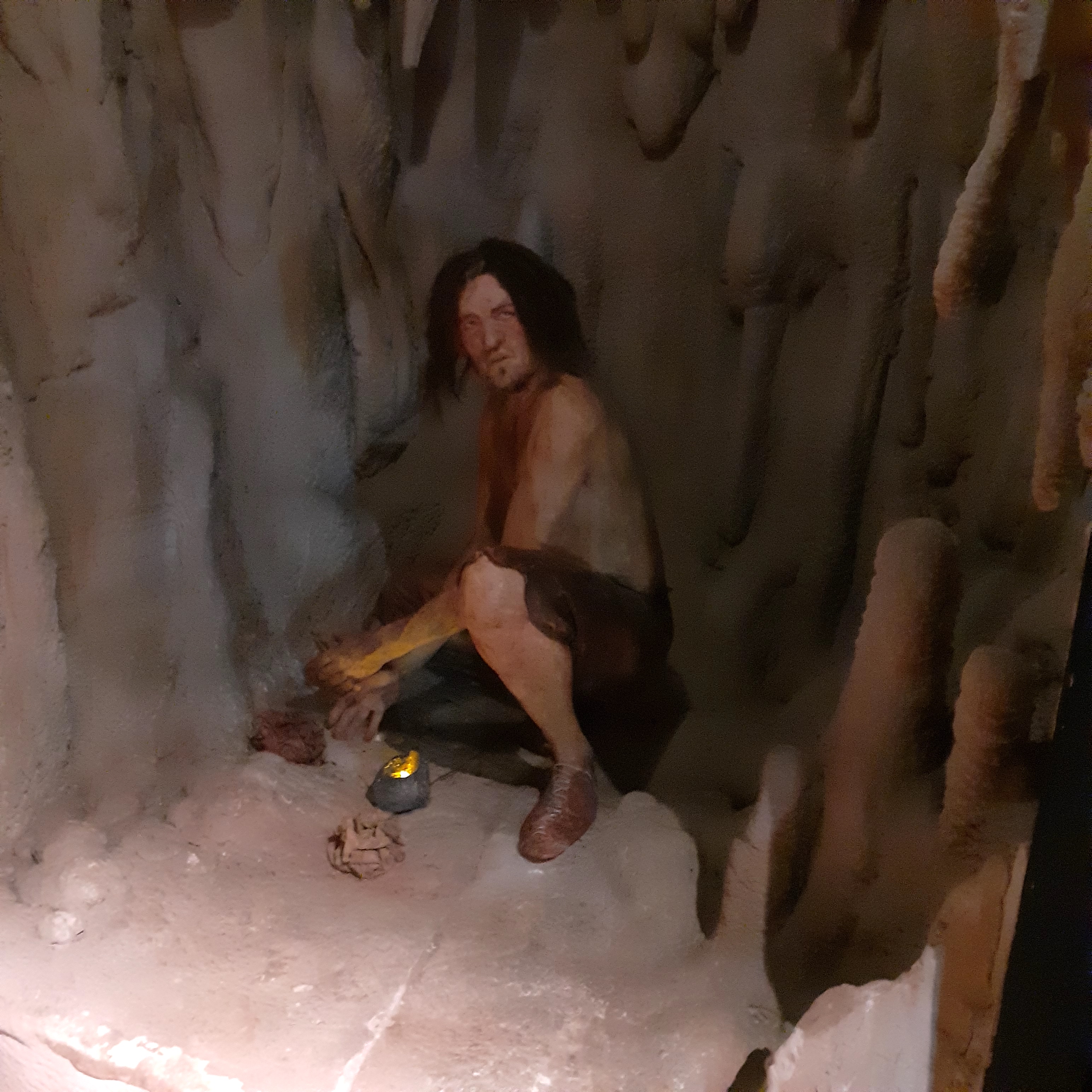
Neanderthals lived in the region until the race died out over thirty thousand years ago, just before the last Ice Age. There is evidence that they lived here, and made cave art dating back forty thousand years. Passing humans and hyenas occupied the caves for five thousand years from about 25,000BC. Though not at the same time, and if so, not for long. After 20,000 BC humans took up permanent residency. As the Ice Age waned, the hunter gatherer culture expanding to animal husbandry and agriculture. Textiles and pottery were developed by the dawn of the Bronze Age. Wandering through the caves you can see how several large groups could be housed. This culture were some of Europe’s earliest artists. Cave paintings were discovered here, which can be understood with representations and explanations in Nerja’s museum. The actual paintings are inaccessible to civilian explorers.

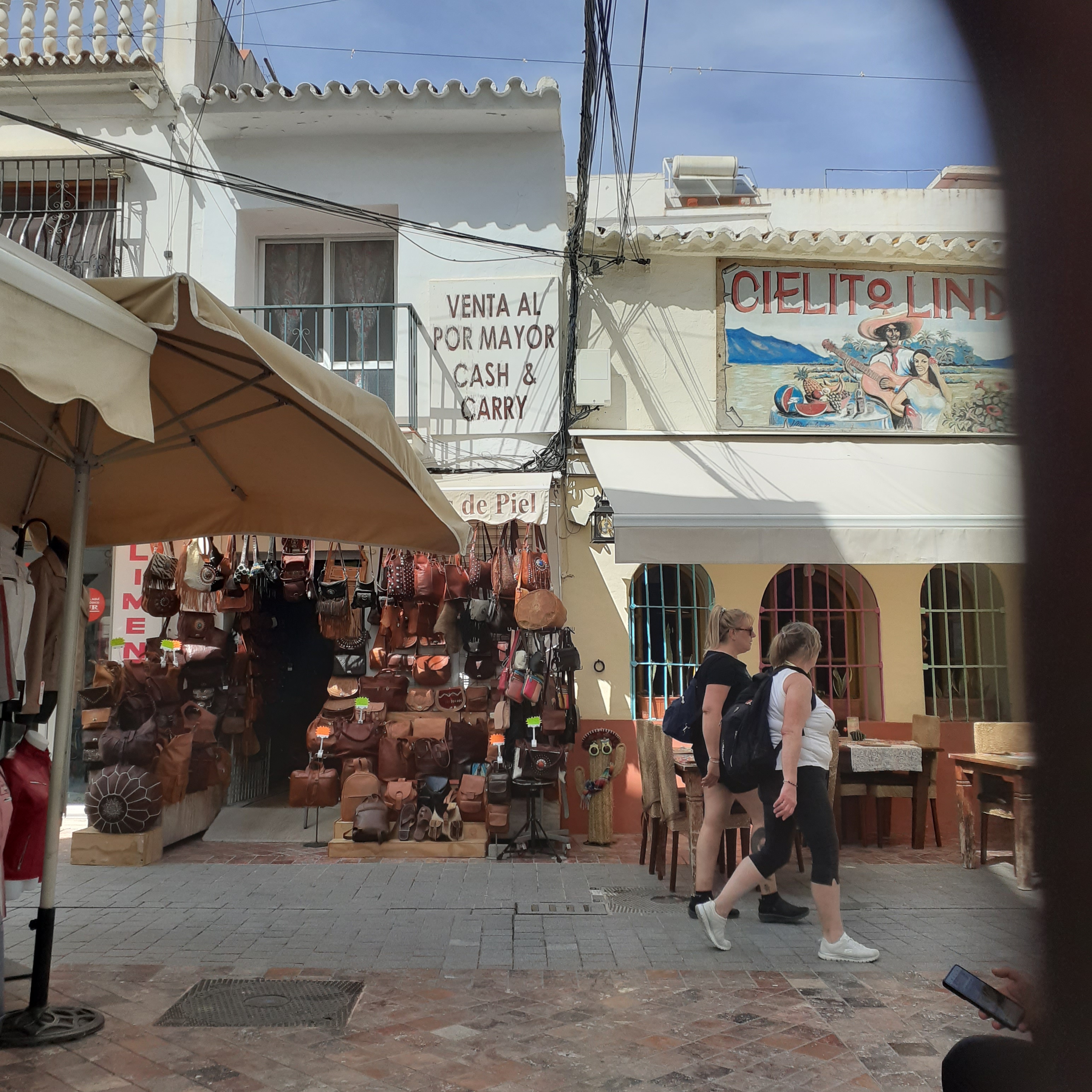
The Museum is located in a modern, quiet square in Nerja, the Plaza de Espana. This gives an excellent account of the town and the region, as well as the Caves. Outside the door, Nerja itself offers much to enjoy. The beaches are small and scenic, and the sea is a vibrant, often spectacular presence. The town is lively with shoppers and strollers all day and continuing into a busy nightlife with a great choice of bars and restaurants. You can eat well and very reasonably here. We had a glorious Thai curry at Asian Ben near the Balcon and there’s a lively Little Italy Restaurant along Calle Carabeo for pizza, pasta, birra; for almost nothing at all. Nerja’s noisy for sure, but good fun, good looking and, of course, the best caves ever. Yabba dabba do!

In the morning we took a bus direct to the airport. There are good breakfast spots near the ‘station’ ( a kiosk in fact). La Nube was our go-to venue. The bus leaves at eleven and takes about ninety minutes.

I recall when I was small

How I spent my days alone

The busy world was not for me

So I went and found my own

I would climb the garden wall

With a candle in my hand

I’d hide inside a hall of rock and sand

The Caves of Altamira is an appropriate song to finish on. Altamira is in northern Spain, the first and formative example of prehistoric cave art discovered. The Nerja caves provide another piece of the jigsaw. The song was written by Steely Dan’s dynamic duo, Walter Becker and Donald Fagen. It is on their 1976 album, The Royal Scam. I relate very strongly to the lyrics here. A hymn to the power of Art. A silent power, free of needless noise. These artists, these Painters, were not being intellectual, they were painting what they saw. Very good they were too. The first masters of realist painting, which is the best type of painting there is. So there.

Cordoba by Train

Cordoba lies just over a hundred miles miles north of Malaga. We took the high speed train from Maria Zambrano station. The station connects with the Malaga metro system from Fuengirola to Almeria in the east, and just fifteen minutes from the airport every twenty minutes or so. The station includes a large shopping centre and there are plenty of places for a drink and snack. The bus station is right next door. We had snacks and coffee at an outdoor kiosk, the sort of atmospheric and affordable feature that’s such a loveable part of Continental cities.

Maria Zambrano gave her name to Malaga’s main station in 2007 when the Malaga to Madrid high speed rail line opened. She was an essayist and philosopher who was born in Velez a couple of miles east of Malaga in 1904. She went into exile after the fall of the Republic at the end of the Spanish Civil War, only returning when Franco died in 1984. She died six years later and is buried in Velez.

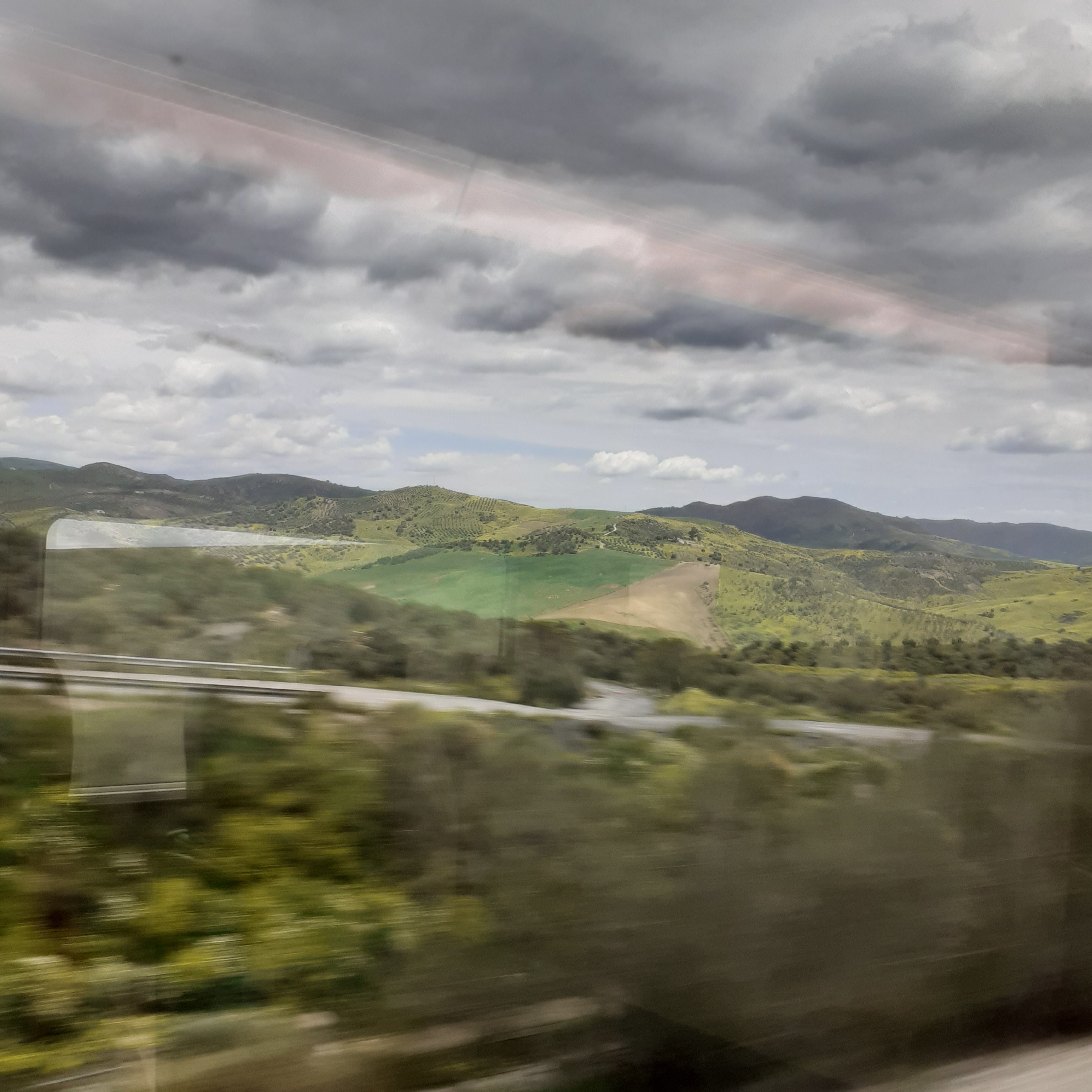
The train journey to Cordoba takes just an hour and runs about every hour. It’s a rocket into Spain’s inner space. We climb beyond Malaga city limits, heading ever upward into the coastal mountains. The Montes de Malaga rise to over a thousand metres and are surrounded by a large Natural Park. Jagged peaks form a scenic backdrop to the well cultivated hills and valleys of olive farms.

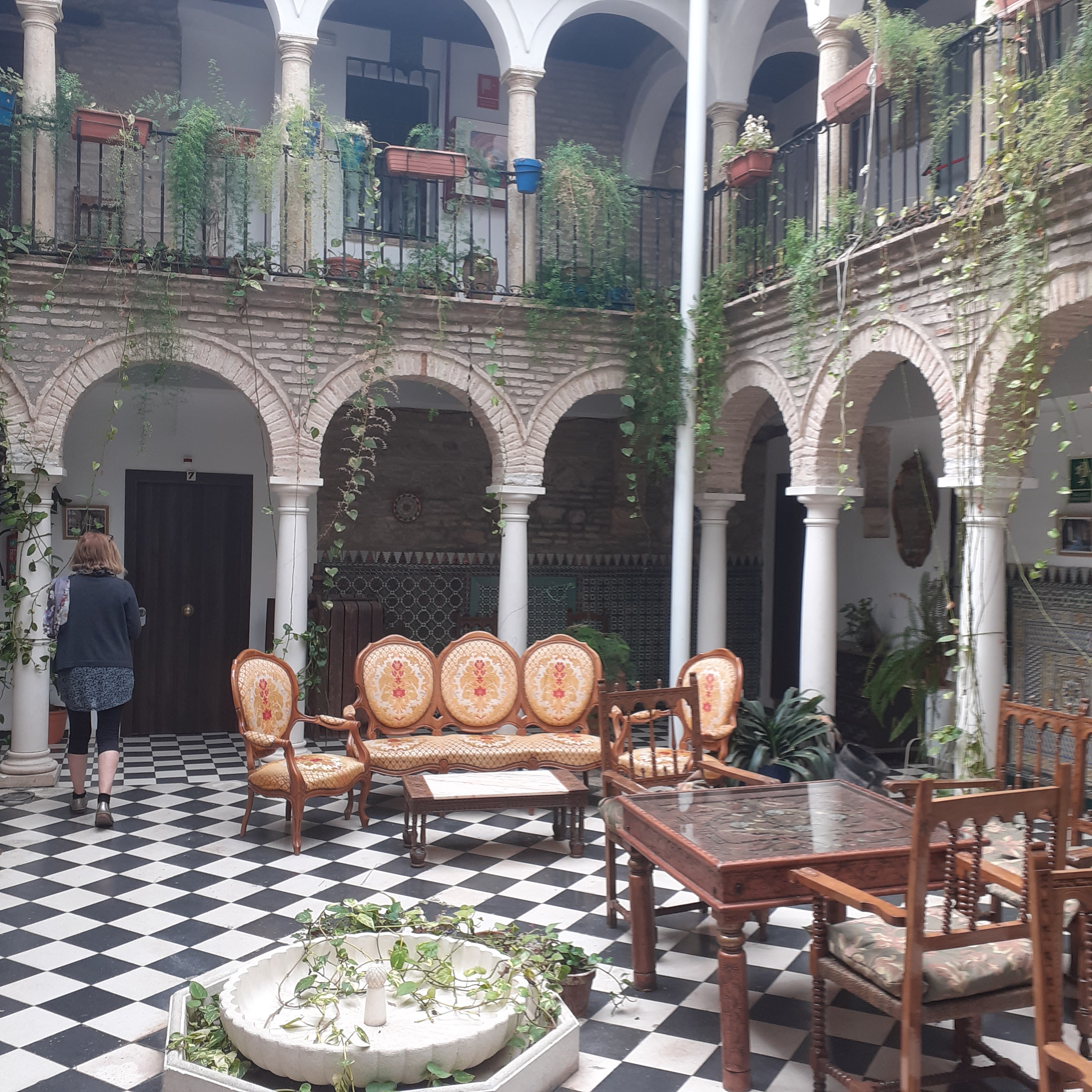
We finally descend into the valley of the Guadalquivir, leaving the train at Cordoba before it heads on to Madrid. Cordoba’s modern station is bright and efficient. We take a taxi into the labyrinthine Old Town. This area is largely pedestrianised, but our driver takes us with dizzying pinball eccentricity through narrow laneways to our destination. Our hotel, Palacio del Corregidor, has a wonderful tiled courtyard echoing the Moorish style knitted into the fabric of the city. 

Nearby is Plaza Corredera, a colourful square built in the 17th century. There is a daily market, and bars and cafes flow from its arcades into the open air. The atmosphere is pleasantly informal and cocooned from the brash modernity of city life. We dine and drink there regularly, afternoons and evening. It’s convenient and inexpensive. The street performers are a varied bunch. One dire performer is clad in cheap tigerskin and you’d pay him to go away. Good juggler though. On another night, with stars and streetlights merging, the glow is enhanced by a guitarist with a modern reportoire including Pink Floyd’s Wish You Were Here; which, of course, read my thoughts.

A maze of lanes ambles south towards the river. Plaza del Potro is a hidden treasure, and just beyond a short avenue is shaded under trees. There are a number of bars and restaurants along here, so relaxed that time stops still, as it often does in the best of Spain. Along the river into the ancient city centre streetlife resumes. The Guadalquivir marks the southern edge of town. Andalusia’s mighty river rises in the Sierra de Cazorla, about two hundred miles to the east. Already mighty by the time it reaches Cordoba, it meanders west towards Seville and then south to meet the Atlantic at Cadiz. It is over four hundred miles long. In Roman times the Guadalquivir was navigable as far upstream as Cordoba and remained so into the Middle Ages. Today, only as far as Seville 

The Romans established Cordoba around 200BC. By the turn of the Millennium it was a major city of Roman Hispania. A few of its remnants survive. The remains of the Roman Temple were unearthed in the 1950s with the expansion of the City Hall on Calle Claudio Marcello, a busy commercial thoroughfare dividing ancient and modern Cordoba. The Temple was built in the reign of Claudius in the first century AD. A magnificent marble structure in its day it stood proud on a high plinth. Its platform and a few columns are preserved; development of the site is ongoing

The Roman Bridge crosses the river at the entrance to the city. Initially built in the 1st Century BC, this was the only city bridge spanning the river until the mid twentieth century. The Moors undertook a major reconstruction in the 8th Century AD. There are sixteen arches spanning the 250 metres to the far bank. The Puerta del Puente on the city side and the Tower of Calahorra on the far side were added in Medieval times as fortified city gates.

The river banks are lined with ruins of ancient watermills dating back to Moorish times. These were used variously for irrigation, to ground flour and as cotton mills. They persisted into medieval and modern times where some saw use in electricity generation. The last were extinguished in the 1940s. The Albolafia Mill is the nearest to the bridge, and there are eleven mills in all.

With Cordoba it is best to let the lanes lead you where they want to go. A vague detour leads us to a courtyard fronting the Church of San Francisco. People are gravitating towards it by some strange magnetism. Groups congregate in the little square, chat and smoke before disappearing within. Inside, excitement mounts. A large group of musicians fills the chancel, facing the body of the church now packed. Then the music begins. It is the week before Semana Santa and the Brotherhood rehearse the music they will play to accompany the Thronos they will carry through the city on the big day. Two thronos are installed along the Nave. The massed brass instruments strike a tone that is sombre but uplifting. I feel united with all here, rising with the intense emotion of the music. When it finishes there is a breath, applause filling its emptiness like thunder. 

We are struck by how lucky we were to chance upon this. Yet it is unremarkable in a way. Throughout Spain local communities have been persistent in their unique commemmoration of Holy Week and Catholic feasts for eight centuries

Cordoba is now a city of 350,000 people. It was once one of the largest cities in Europe, under the Moorish rulers of the Ummayad dynasty. The Caliphate of Cordoba controlled almost all of Iberia from 750 until 1031when it split into several kingdoms. The Reconquista of 1236 brought the city under the crown of Castille. Alcazar de los Reyes Cristianos lies just past the Bridge and served as residence of Ferdinand and Isabell as they pushed towards the final expulsion of the Moor at Granada in 1492. It was built in 1358, by King Alfonso, and though a military fortress initially, it also embraces a more flamboyant Mudejar style in its magnificent gardens, ponds and courtyards. 

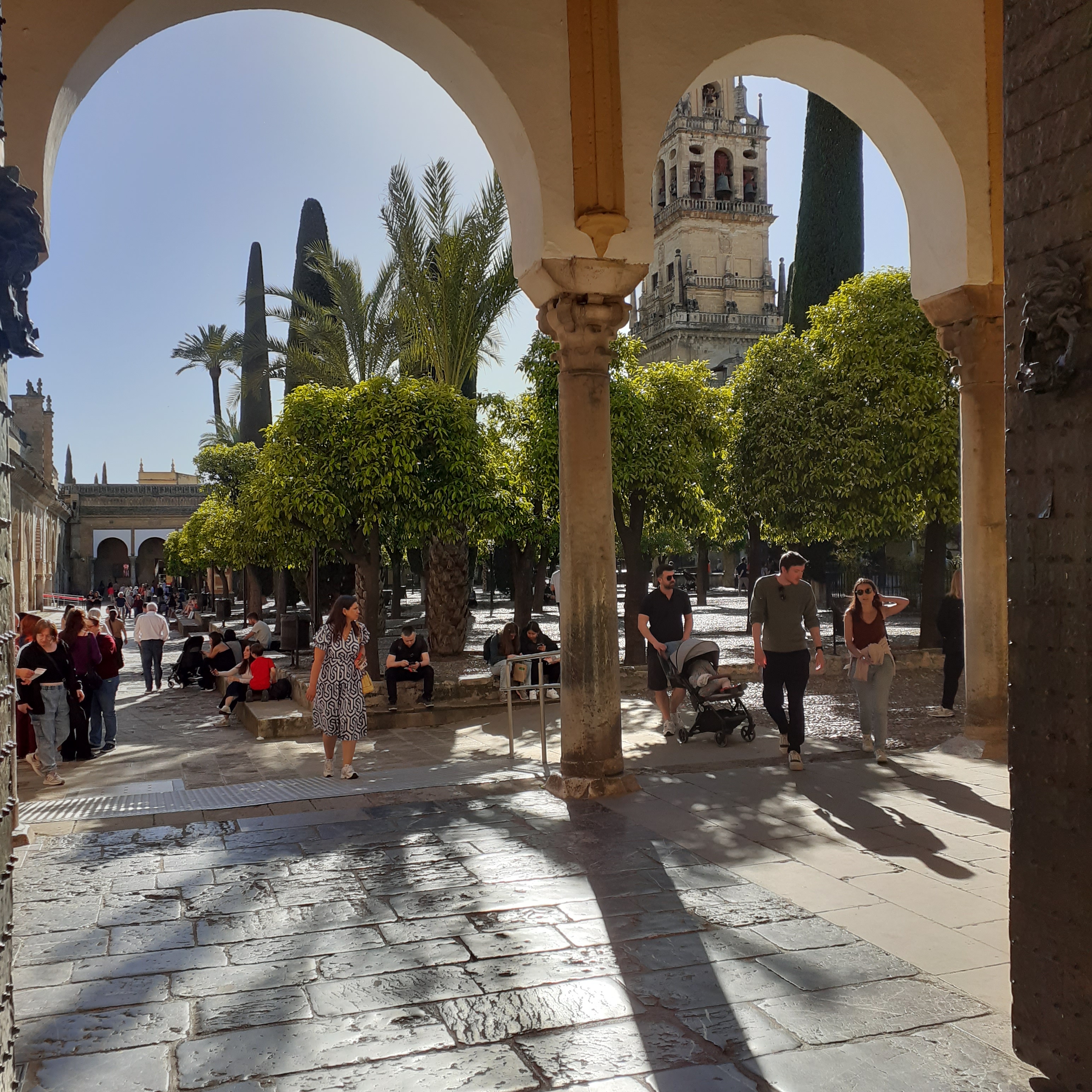
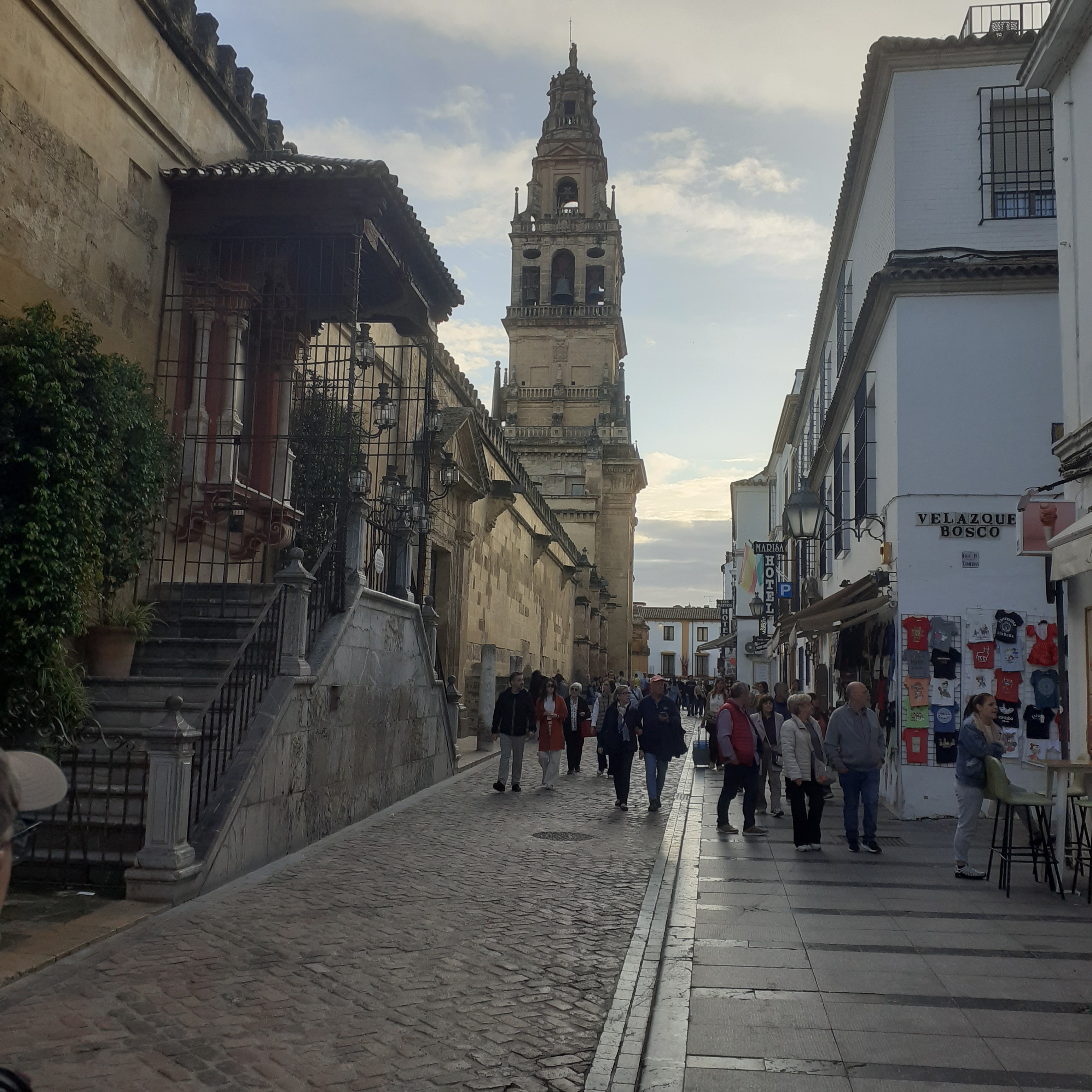
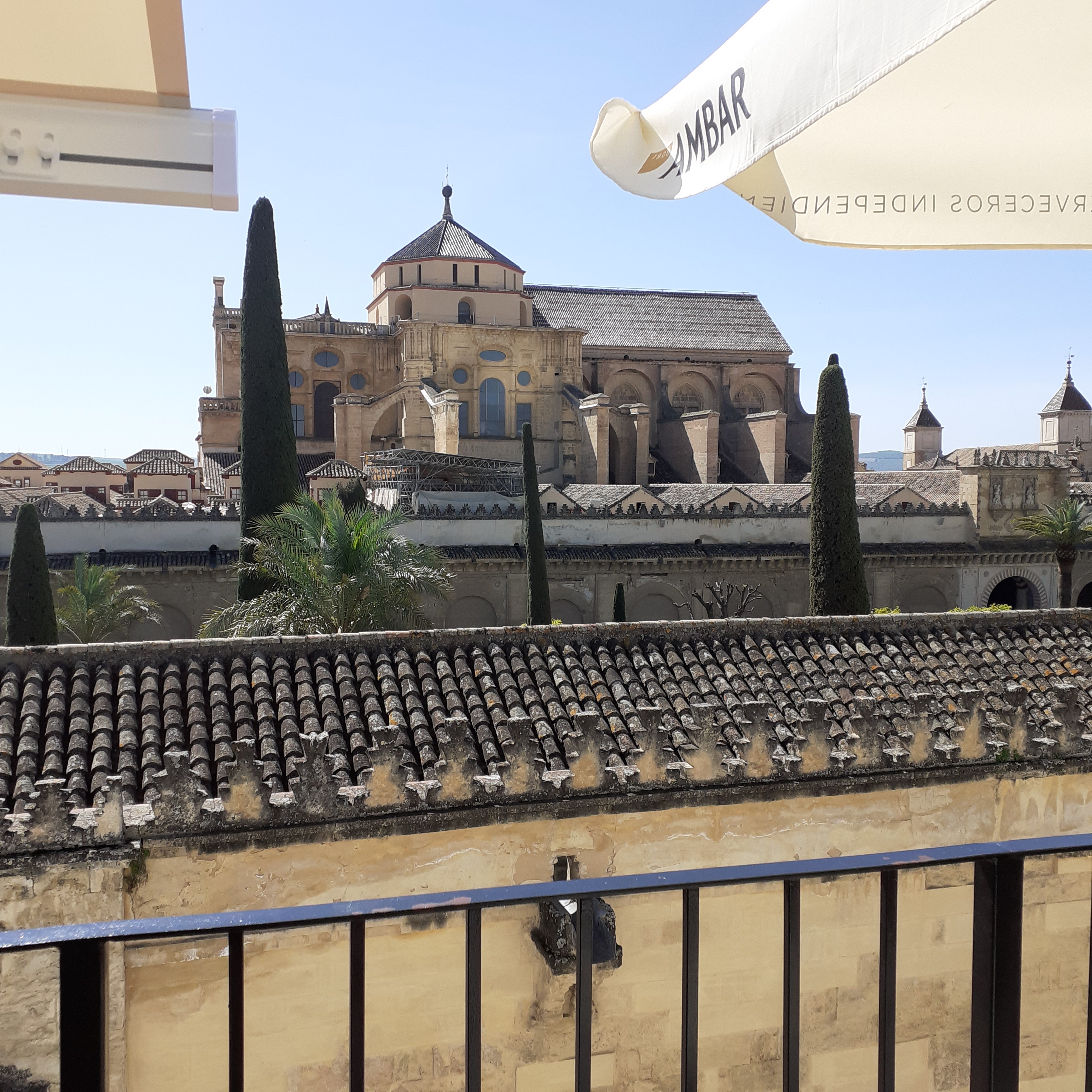
Mudejar refers to the art and design of Islamic craftsmen who remained following the Reconquista. It is a distinctive feature of much that is wonderful in Spanish architecture of the era. The Mezquita Catedral is a shining jewel forged in the collision of two cultures. The Great Mosque was begun in 784 and was for long the largest mosque in the world. After 1236 it was appropriated for Christian use. It is remarkable that so much of the fabric of the ancient building remains. The three hundred foot tall bell tower was developed from the old Minaret with an entrance gate beneath in the Mudejar style. An open square runs the length of the complex, shaded by orange trees with pools and fountains where the Moslem faithful washed before prayer. The single story interior is supported by a forest of ornate columns, eight hundred in all, creating an effect close to infinity; or heaven, I suppose. Around the outer walls many chapels have been added over the centuries, the first in 1371. The Cathedral itself was begun in the early sixteenth century, rising as if organically from the low lying mosque. It is topped by an Italianate dome. 

Asides from being a place of prayer, the Mezquita Catedral is a huge draw for tourists. The crowds gather early, though the space is so large that it was not too hectic during our visit. We got tickets online the day before. Be warned though. Numbers pick up in high season, and even a few days later we noticed the crowds grown bigger.

Another major attraction in Cordoba is the Festival de los Patios held during the first fortnight in May. Private patios are opened for view, and the city is particularly packed. But there are always spaces in Cordoba to allow one step into a different time. The Jewish Quarter is a wonderful maze of white streets west of the Mezquita. There’s a museum and the old synagogue from the fourteenth century survives. Another culture woven into the rich fabric of Andalusia. Muslim, Christian, Jew and Gitano leave their mark not just in the stone and style, but in the music and the mind, and deep in the heart of us all.

Rocking to Gibraltar

Lido Beach Bar, Elviria

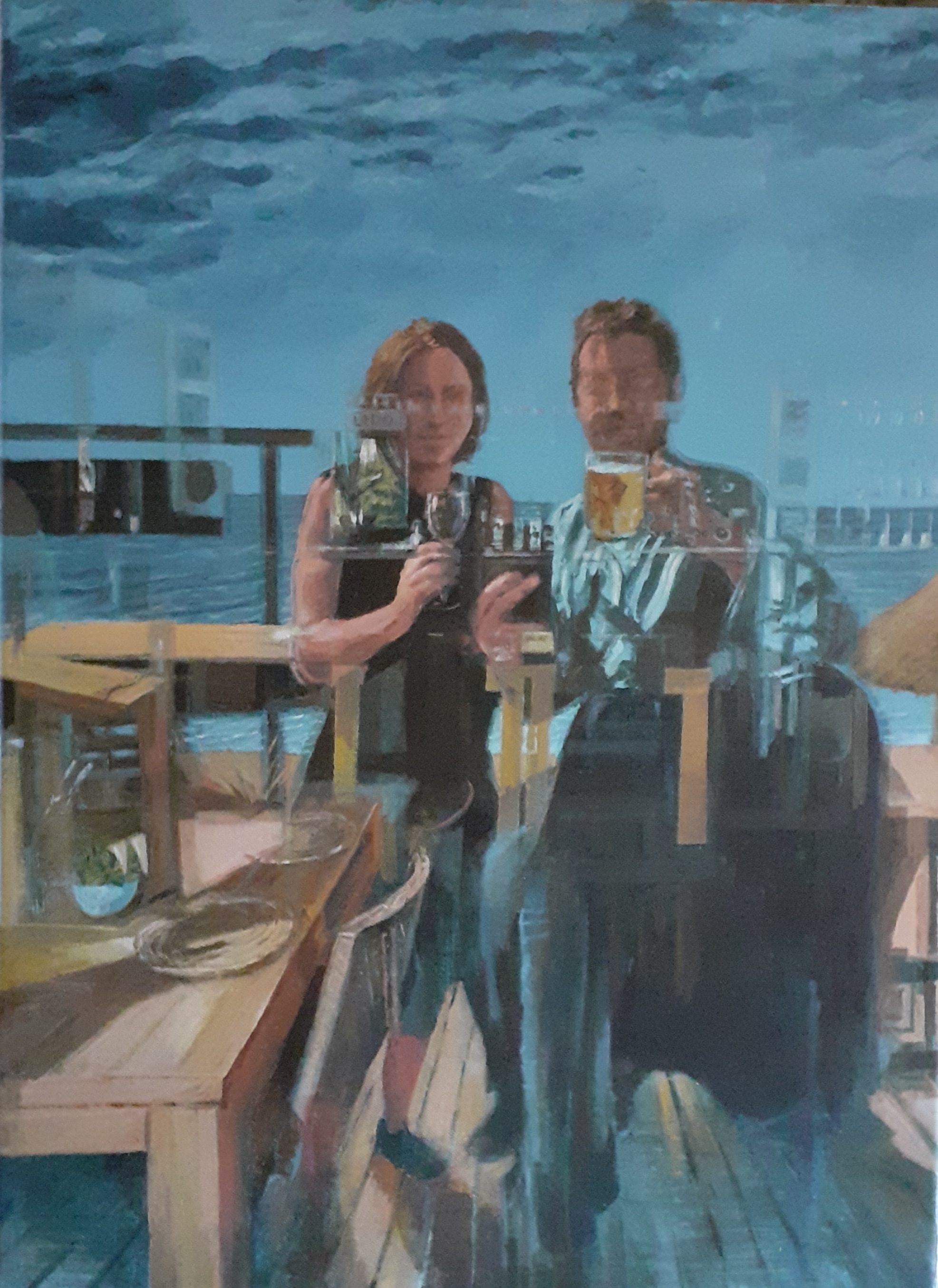
Part of my purpose, and pleasure, in visiting Andalusia, is to paint it. Sometimes we make sketches, though mostly photography forms the record of places we visit. My Spanish paintings contrast with my Irish paintings. Climate is a decisive factor. Spain is hot and demands a hot palette. Ireland is wet and wild, its palette cool. Every place is different. Every day is different.

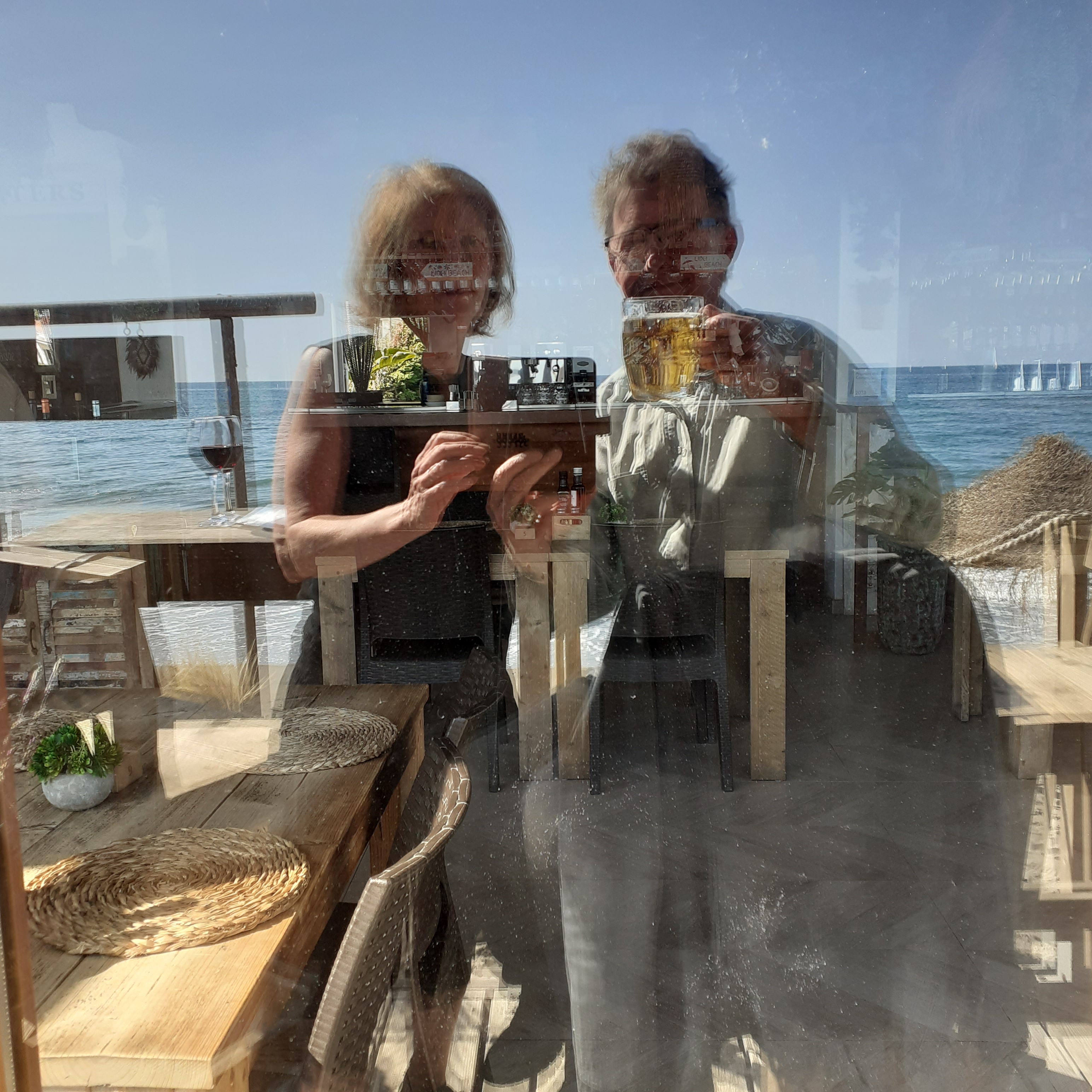
In taking photos I usually exclude ourselves. There are times when a tourist snap is required. I no longer corral innocent bystanders. It happens, but mostly volunteers. Some years back I recall waylaying a handsome young couple swanning into the Casino in Monte Carlo. I indicated the camera, gestured to the debonair male. Of course, he said, and promptly posed for us. His companion put things right. A mysterious lady in Lisbon is another fond faux pas. Reluctantly she took off her gloves on what she clearly regarded as a cold day. It was mid teens; but she obliged with a warm smile. Selfies are an obvious solution, but they don’t really work for me. There’s something awkward about doing them and I usually get it wrong, with my nostrils and ears featuring too prominently. So, M and I have evolved a habit of catching ourselves in reflective surfaces. These mirrored images have the extra advantage of being pleasantly anonymous. 

This method is seen at its best on this recent shot taken on Elviria Beach near Marbella. Our favourite bar is on the beach and a regular stop for our pre dinner drink. The Lido Bar also serves food during the day. Sitting out on deck, the beach sweeps away south towards Gibraltar funneling the Mediterranean into the Atlantic. Africa lies just over the horizon. 

Painting this picture, I was struck by the shifting points of view within the tableau. We were photographing ourselves photographing ourselves. The observer, and author of the painting, is observed. It’s a self portrait, a still life and a landscape. The reflection itself is a double image due to the glazing. This gives a liveliness, a kind of shaky quality too. We are a blur against the immense physicality of the Med. There, but not there. A snapshot in time. Then gone.

Lido missed the boat that day, he left the shack

But that was all he missed, and he ain’t comin’ back

At a tombstone bar in a juke joint car, he made a stop

Just long enough to grab a handle off the top

Written by Boz Scaggs and David Paich, Lido Shuffle featured on the album Silk Degrees in 1976. Sing along!

Lido, whoa, oh-oh-oh, oh-oh

He said, “One more job oughta get it

One last shot ‘fore we quit it

One more for the road”

And now for a pint.

Andalusia – 10. Cadiz to Marbella by Bus

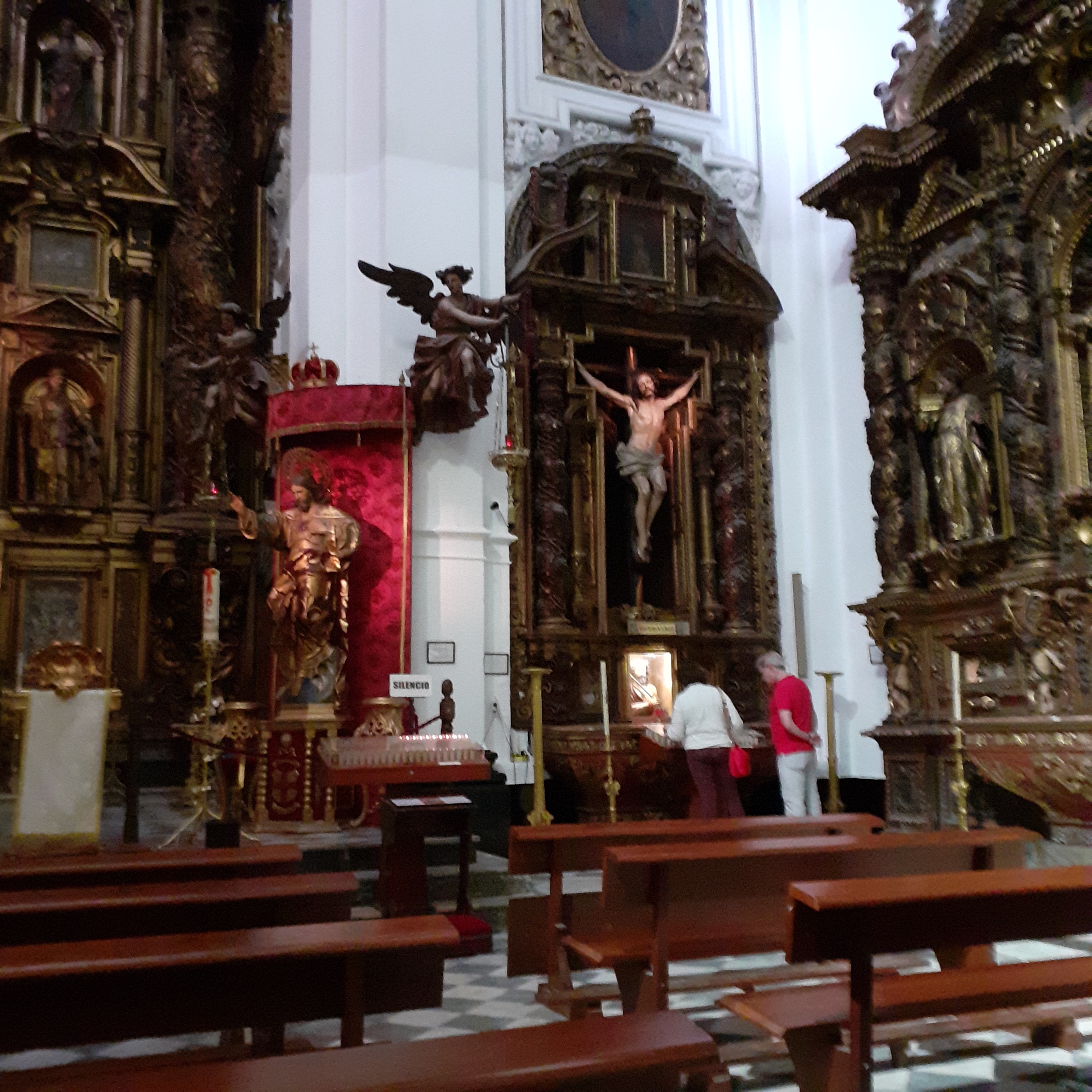
Our recent tour of western Andalusia took us from Seville to Cadiz by train, and we then got a bus from Cadiz to Marbella. This was a three and a half hour journey with a number of stops on the way. There are usually two or three busses per day and it cost €56 for the two of us. We booked for the two o’clock departure giving us a relaxed final morning in Cadiz. We had breakfast in Cathedral Square and strolled around a bit, visiting the Church of Santiago across from the Cathedral. This was a Jesuit church built in 1563 but destroyed by English and Dutch invaders at the end of that century. Rebuilt in the Baroque style it eatures exuberant interior decoration with ornate baroque altarpeices from the seventeenth century populated by lifelike clothed statuary. We dallied on the main square before picking up our bags and one last cup of coffee for the road, near the statue of the Pearl of Cadiz. 

Your sister sees the future like your mama and yourself

You’ve never learned to read or write, there’s no books upon your shelf

And your pleasure knows no limits, your voice is like a meadow lark

But your heart is like an ocean, mysterious and dark

One more cup of coffee for the road

One more cup of coffee ‘fore I go

To the valley below

One More Cup of Coffee is from Dylan’s 1976 album Desire, also featuring Emmylou Harris on vocals. There is a strong Gypsy inluence in the narrative, and Dylan’s vocal style borrows from traditional Jewish singing. Meanwhile the Valley Below is common to all travellers who find themselves moving on.

The bus station is beside the rail station so it was a short walk. The weather is wet and cool, a bit like home. The bus heads on through the modern extension to the city of Cadiz, then along the connecting isthmus to the mainland. This part of the city is built up with medium rise hotels lining a long sequence of beaches such as Playa de la Santa Maria and Playa de la Victoria. Farther on is a grubby industrial area. The urbanisation extends to Chiclana de la Frontera famous for La Barrossa beach. It has a population of 80,000 and is also on the railway line connecting to Cadiz, Jerez, Sevilla and Madrid. After that there’s Conil de la Frontera a traditional white town of about twenty thousand people. This too is famous for its beaches and is a popular destination for Spanish holidaymakers.

Then we head towards Tarifa on the Costa de la Luz. Spain’s southernmost point is a magnet for windsurfers. It is very windy owing to the Venturi effect which funnels the wind passing through the Strait of Gibraltar separating Spain from Africa. Algeciras is next. With a population of 120,000 it is one of the largest ports in Europe. It is also a ferry port for Tangier and other North Arican ports, and the Canaries too.

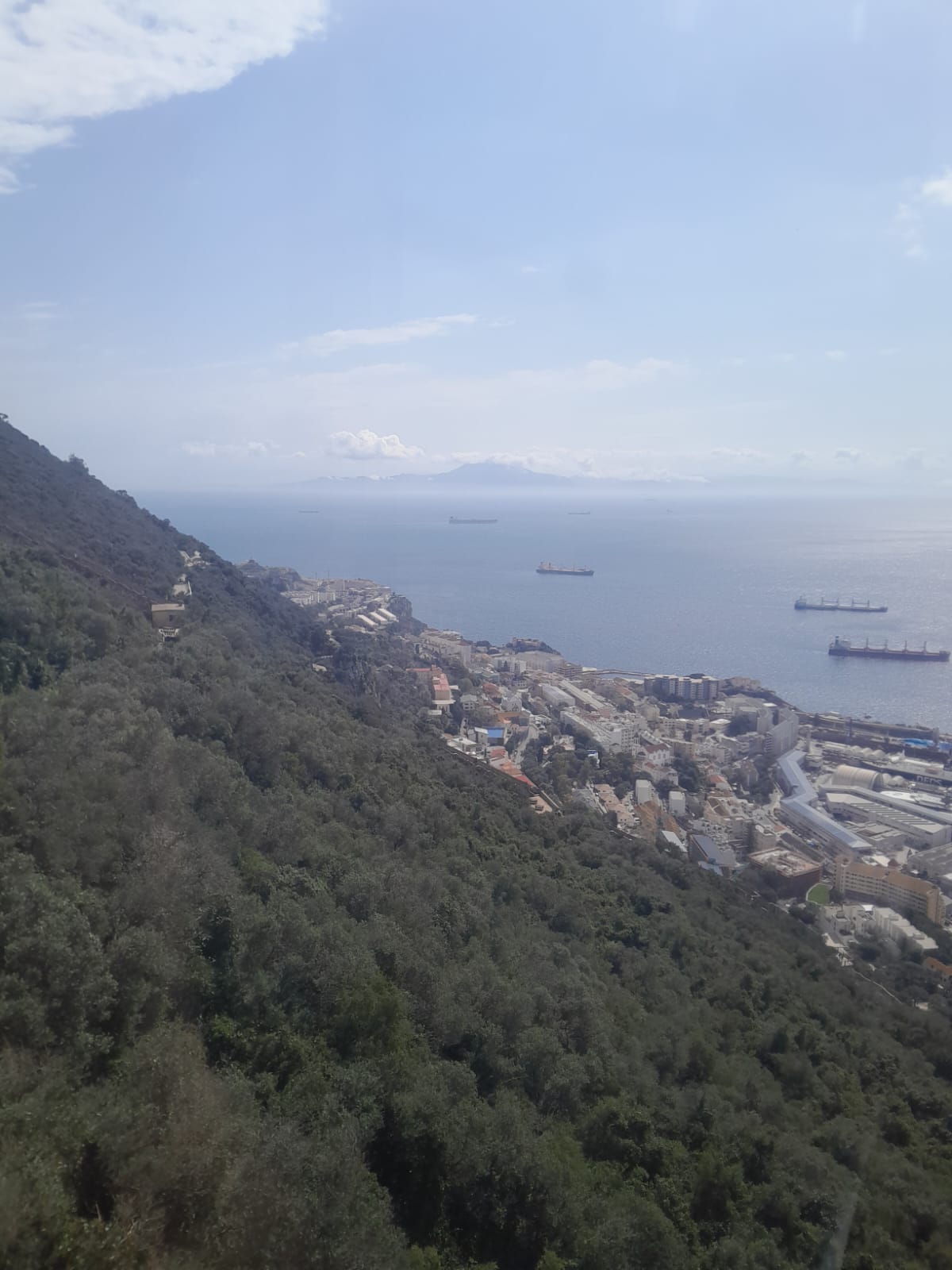
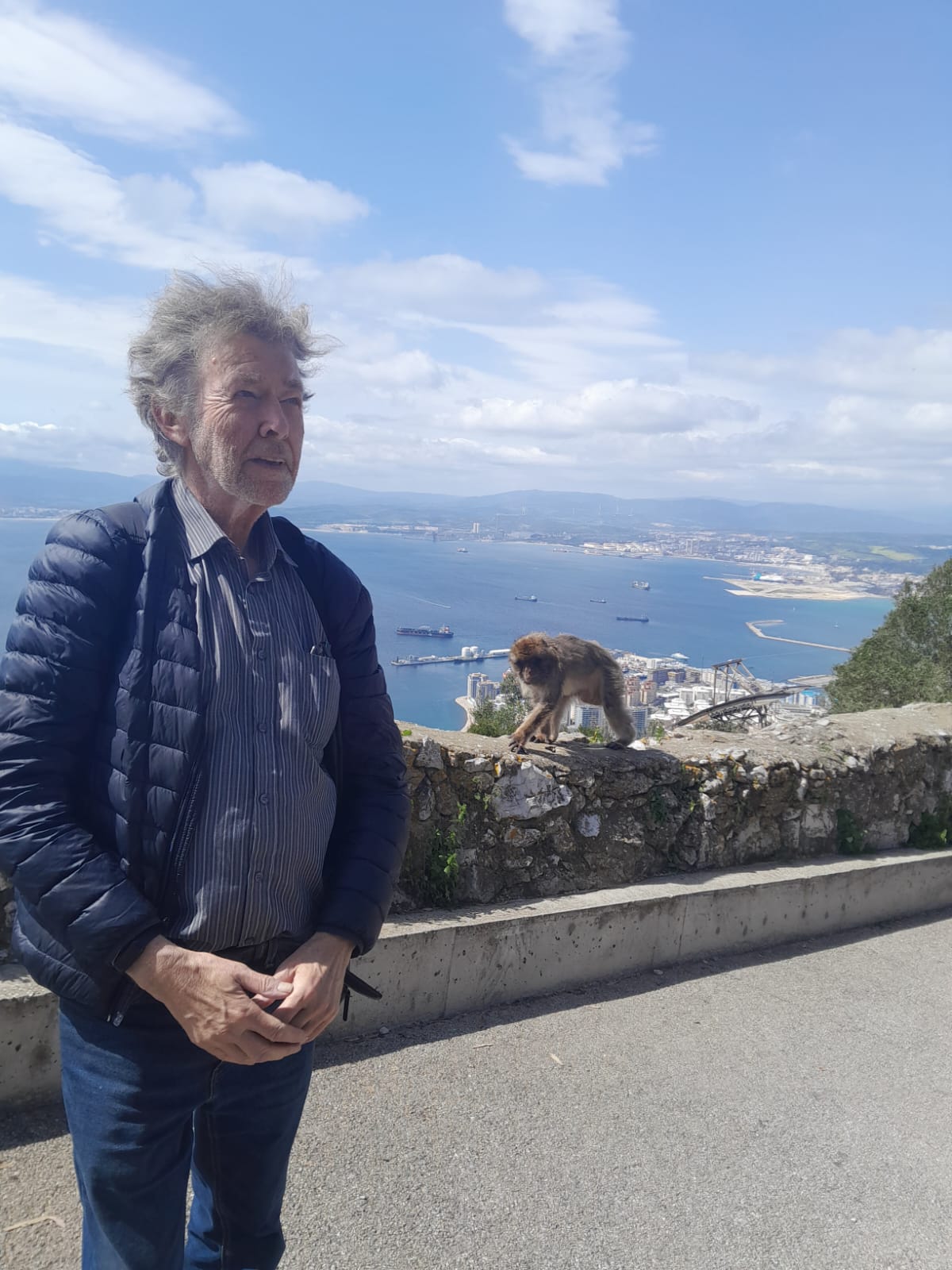
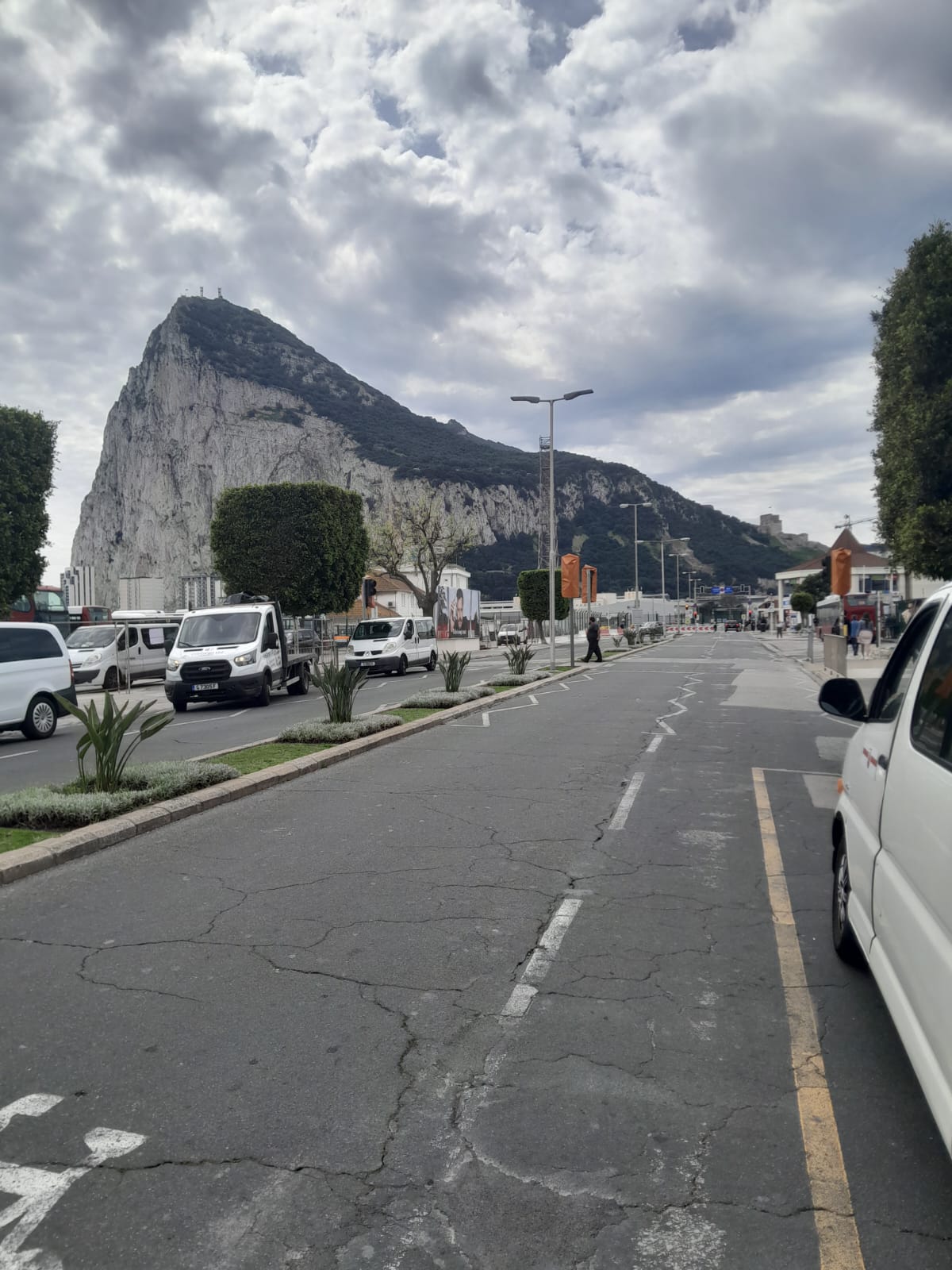
Leaving Algeciras we pass Gibraltar, the high Rock suspended in the clouds. Gibraltar was captured by an Anglo Dutch fleet during the War of the Spannish Succession, it was granted to Britain in 1713 at the Treaty of Utrecht. Besides the British, Gibraltar is occupied by monkees. These are Barbary macaques, numbering about three hundred and the only European wild monkees, not counting ourselves. The scenic coastal mountains rear out of the gloom, scratching some welcome blue swathes in the sky. Estepona is the last stop before Marbella.

The way it is long but the end is near

Already the fiesta has begun

The face of God will appear

With his serpent eyes of obsidian

Marbella bus station is outside the city centre. We had originally booked a hotel, but cancelled and opted to head straight for the villa. The taxi from the station cost €20 and deposited us in Elviria central. The sun made a welcome appearance and after shopping we had pizzas and pints outdoor on the square. We did make a trip into Marbella the next day taking the local bus and spending a leisurely few hours walking up the coast towards Puerto Banus, where the rich folk go. We returned to eat at Canuto in Marbella with good local tapas. We walked the six miles home along the beach in hot sunshine and high waves. At last we reached our favourite stop in Elviria. The Lido Bar along the beach has become our sunset bar, the perfect place to relax over a few drinks, or a bight to eat. We fade into the spectacular coastal scenery looking out over the Mediterranean, Africa beckoning just beyond the lip of the horizon.

No llores, mi querida

Dios nos vigila

Soon the horse will take us to Durango

Agarrame, mi vida

Soon the desert will be gone

Soon you will be dancing the fandango

Romance in Durango is also on Dylan’s album Desire.

Andalusia – 9. Cadiz by Train

We take the train from Seville to Cadiz. There’s a train every hour or so and the hundred kilometre journey takes an hour and a half. Santa Justa Station is an ugly carbuncle on unkempt wasteland on the edge of the city. But once inside it is clean and functional and there are plenty of seats on the main concourse with cafes and eateries. We travel along the eastern Guadalquivir valley heading south through Sherry country. The fortified wine takes its name from Jerez de la Frontera, close to our destination. Further on, we enter the swamplands on the Bay of Cadiz and standing proud in the sea, the city of that name. 

There’s a Spanish Train that runs between

Guadalquivir and old Seville

at dead of night the whistle blows

and people fear she’s running still

Spanish Train and Other Stories, Chris De Burgh’s 2nd album from 1975.

Cadiz occupies a small peninsula jutting into the Bay. Initially it consisted of two islands but over the years they have joined and connect to the mainland via bridges and an isthmus. The spectacular La Pepa Bridge looms over the port. It is the longest cable stayed bridge in Spain at five kilometres. It was named as the Constitution of 1812 Bridge, planned for completion on the bicentenary of the launch of Spain’s first constitution in Cadiz. This briefly established a democracy which was crushed by the monarchy two years later. As for the bridge, the economic crisis added another three years before completion in 2015.

Cadiz is often touted as Europe’s oldest city. As with Seville, Hercules is claimed as the mythical founder, his name also used for the Pillars of Hercules guarding the entrance to the Mediterranean  farther East. More historically, three thousand years ago the Phoenicians set up shop here. They came from Tyre, in modern Lebanon, and named the settlement Agadir, derived from their word for wall, signifying a stronghold. Agadir is also the name of a Moroccan city, although the Spanish port’s name has mutated to Cadiz over the years.

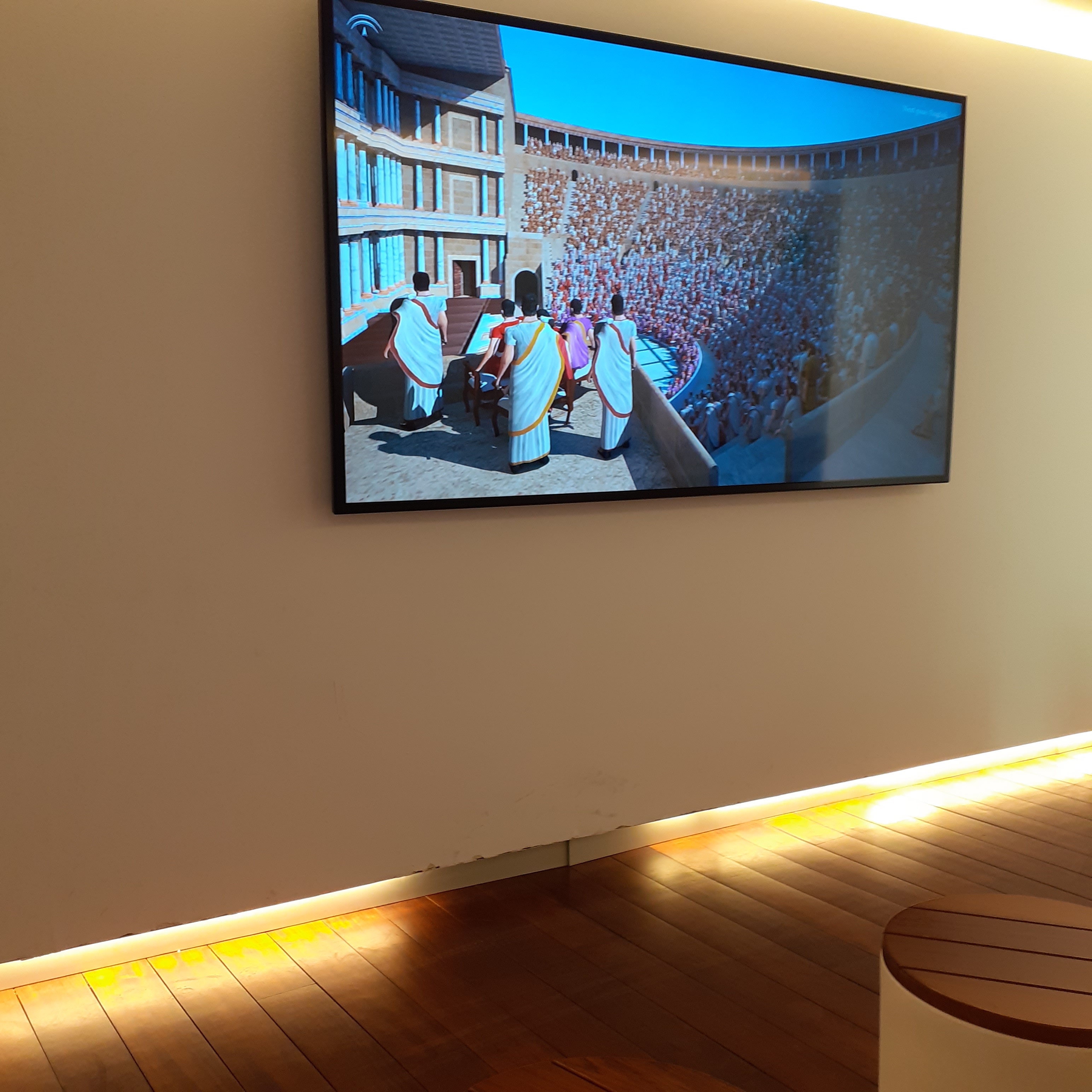
Carthaginians and Romans followed. The Roman city of Gades was established on the southern island. Remnants of its ancient theatre survive and there is an excellent visitor centre showing a visual reconstruction, with ancient artefacts and a fascinating historical narrative. The Theatre was founded by Lucius Cornelius Balbus in the first century BC and only rediscovered in 1990. It is the largest known outside Pompeii and housed up to ten thousand spectators. Entrance is free for EU residents. It is close to the Plaza de la Catedral, via the Arco de la Rosa, one of the ancient gates of the city.

Cadiz fell under Muslim control between 711 and 1262 when the Reconquista confined the Moors to the Nasrid Kingdom of Granada. The fall of Granada in 1492 coincided with Columbus’s adenture in America, and the Conquistadors who followed established a lucrative transatlantic trade for the Spanish crown. Cadiz thrived during the eighteenth century as Spain’s designated transatlantic port.

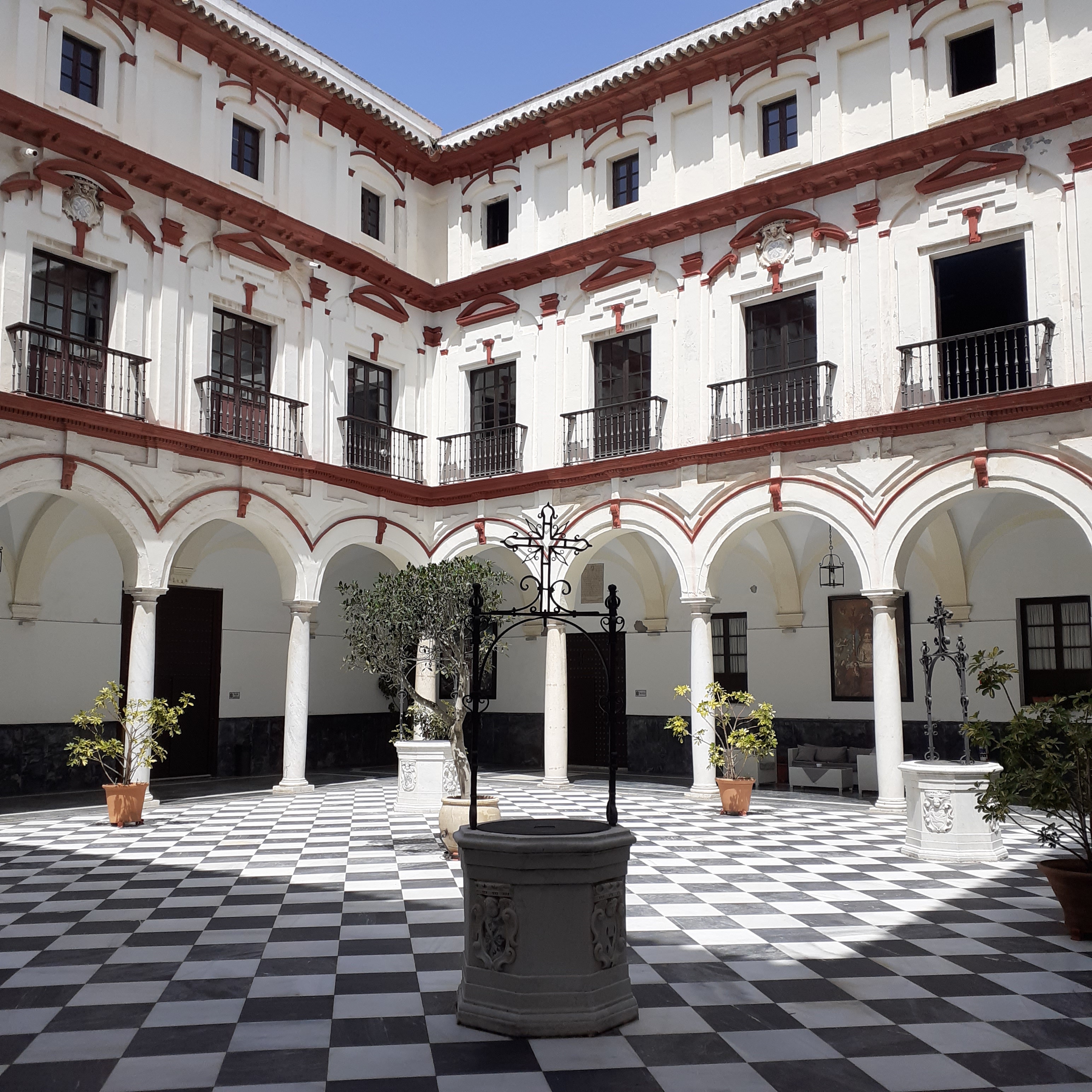
The train terminates at the port, adjacent to the city centre. Our hotel, Convento Santo Domingo, is only a hundred yards or so from the station entrance. Convento Domingo is a seventeenth century Dominican convent. It is a sight worth seeing itself, a priveledge for hotel guests. Inside, cloisters surround a tiled plaza, with an eerie soundtrack of Gregorian chanting monks adding to the atmosphere.

Then the door was open and the wind appeared

The candles blew and then disappeared

The curtains flew and then he appeared

Saying don’t be afraid

The singing monks, and some wine, suggest the song of the Blue Oyster Cult: Don’t Fear the Reaper. Written by Donald Roeser, it’s on their 1976 album Agents of Fortune.

Music persists outside the convent where we encounter a statue to La Perla de Cadiz. Antonia Gilabert Vargas was a Gitana flamenco singer. Born in Cadiz in 1924 she became famous throughout Spain for her voice of power and softness. She died in 1975. A club on the nearby seafront trades under her name

A few hundred yards further on through the Barrio we find Puertas de Tierra, a monument built in the eighteenth century along a remnant of the sea defenses which repulsed Napoleon in the Peninsular War of the early nineteenth century. Today it marks the border between the Old Town and Puerta Tierra, the modern city resort sprawling along the isthmus.

The weather is sunny but with a bracing sea breeze making it cooler than Seville. A couple of narrow, straight streets run lengthwise, Calle San Francisco and Sacramento being the main ones, with winding medieval lanes connecting. Many junctions broaden into small plazas, allowing people to congregate in comfort within the dense maze of streets. A roadway circles the Old Town, and broad footpaths and several sizeable green parks make for an easy escape from urban claustrophobia.

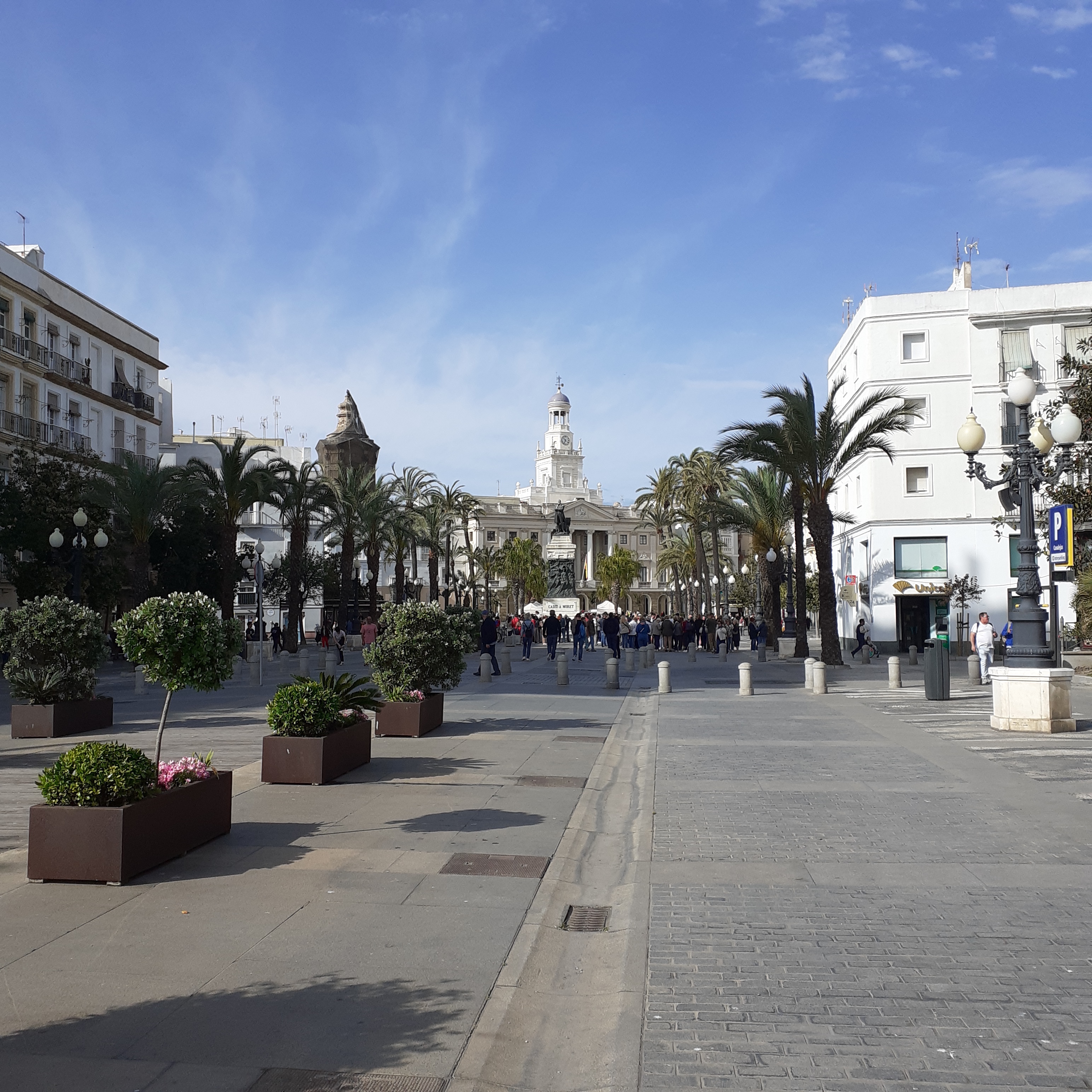
A short esplanade divides the port from the main square. Plaza San Juan de Dios is fringed with palm trees, bars and restaurants and focussed on the Old Town Hall, a fine Neo-Classical building from 1799. Taking Calle San Francisco we browse the shops all the way up to the Plaza San Francisco. We enjoy ice cream cones from a perch beside the hatch, where we can watch the world go by and youngsters playing ball against the walls of the church. 

The next square up is the Plaza de Mina with the Museum of Cadiz. This includes an art gallery with works by Rubens and Murillo. Unfortunately the gallery was closed, something too frequently the case these days. Recent visits to Porto, Budapest and Edinburgh suffered from such partial or total closures. The Museum itself has a good display showing Cadiz’s history, with Roman statues and other archeological exhibits back to the Phoenicians.

A woman on the train advised us to seek out the Taverna Casa Manteca for lunch. We arrived in the evening when it is closed but chose instead a nearby taverna. The woman serving gave us a tour of the dishes on display so we could choose by a combination of pointing and miming. A bit like a game of charades, but without a definite resolution. I wondered what Pulpo was. Our host translated by flailing her arms while saying pulpo repeatedly. We decided against, but were given it anyway. It is Octopus, by the way, although sufficiently buried in its preparation and sauces as to give no hint of waving tentacles. It’s fine, shellfish are out for me but I can eat fish or squid. We liked it, and the generous mixed salad to accompany it. 
We returned the following day to Casa Manteca, which means the House of Butter. It opened in 1953 and is dense with atmosphere, history and the aroma of good food. For Siesta it is thronged with people enjoying tapas and drinks. We try hake, and tortilla, which promptly arrives. The staff, though very busy, are good. Something of an old style pub atmosphere pervades. Wood pannelling throughout, the walls covered with flamenco and bullfighting photos and mementos.

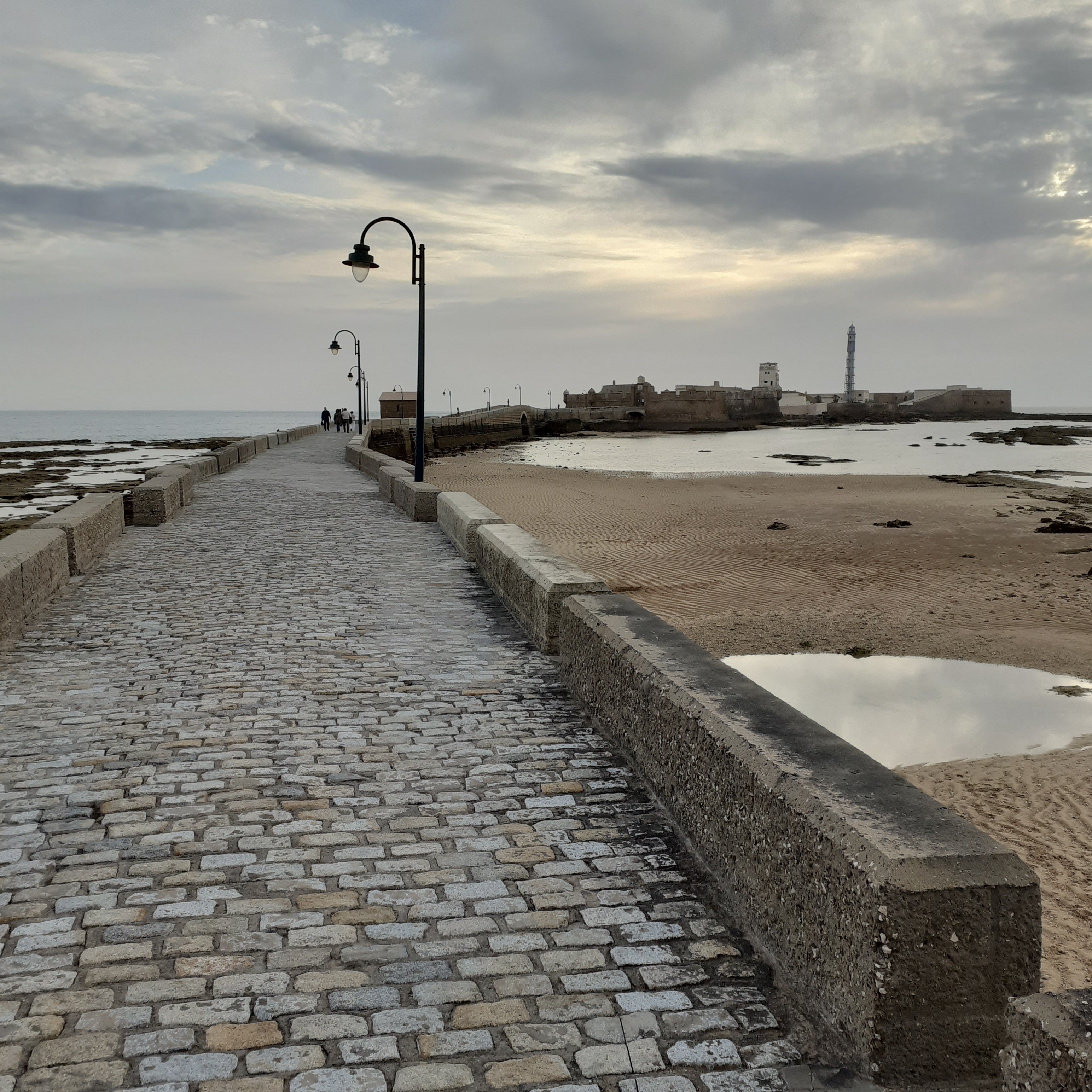
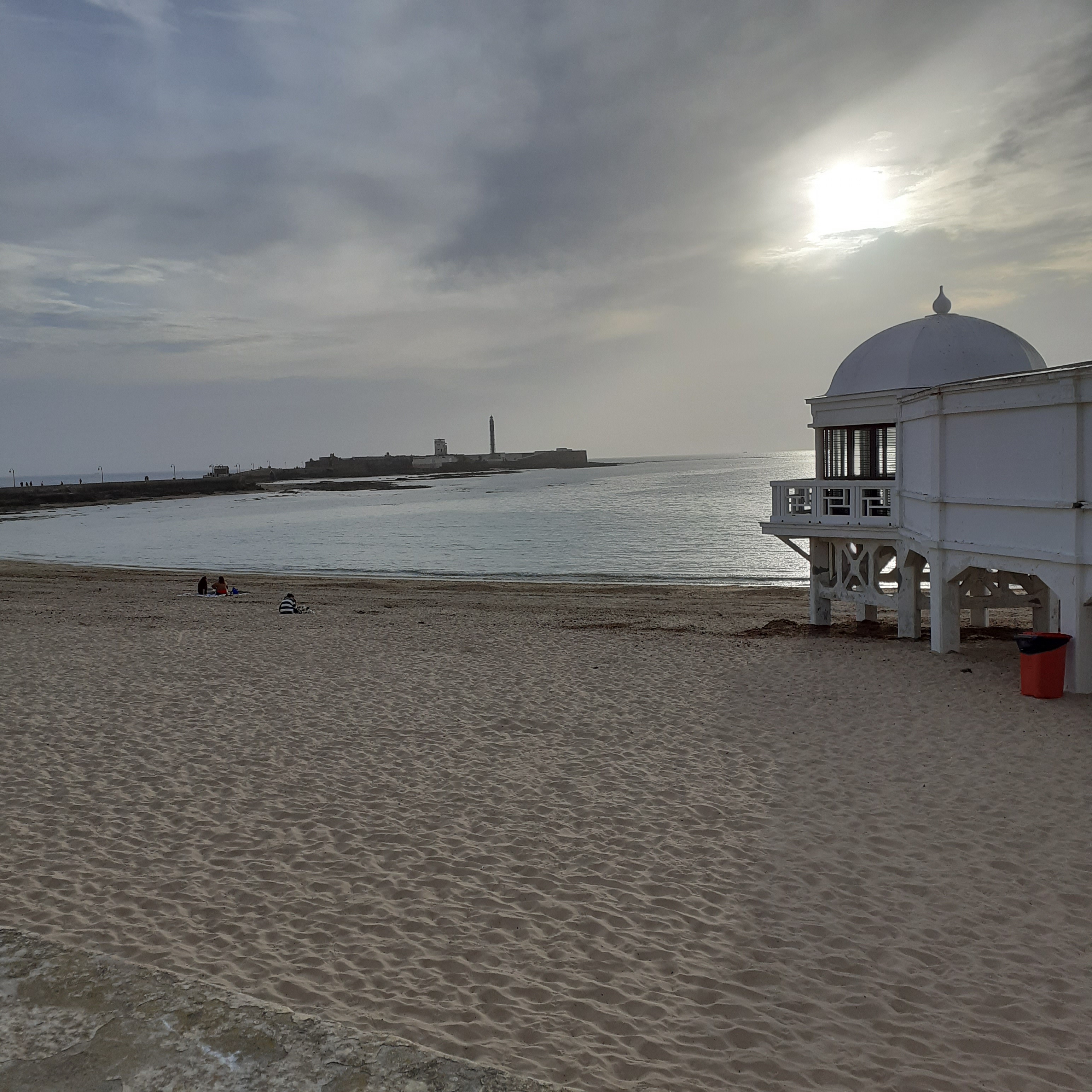
Nearby, the Playa de la Caleta, the city’s famous beach forms an arc between two fortified promintories. The longest terminates in Castillo San Sebastian, where the Phoenicians established their base three thousand years ago. The modern castle was built in 1700. Still a small island, it connected to the mainland by a stone causeway in 1860. A metal lighthouse was built in 1906, and soars to over forty metres. Unfortunately, the Castle and compound is closed to the public for renovations. The causeway is a recommended spot to view the sunset. It was cloudy when we arrived, but none the less scenic for that.

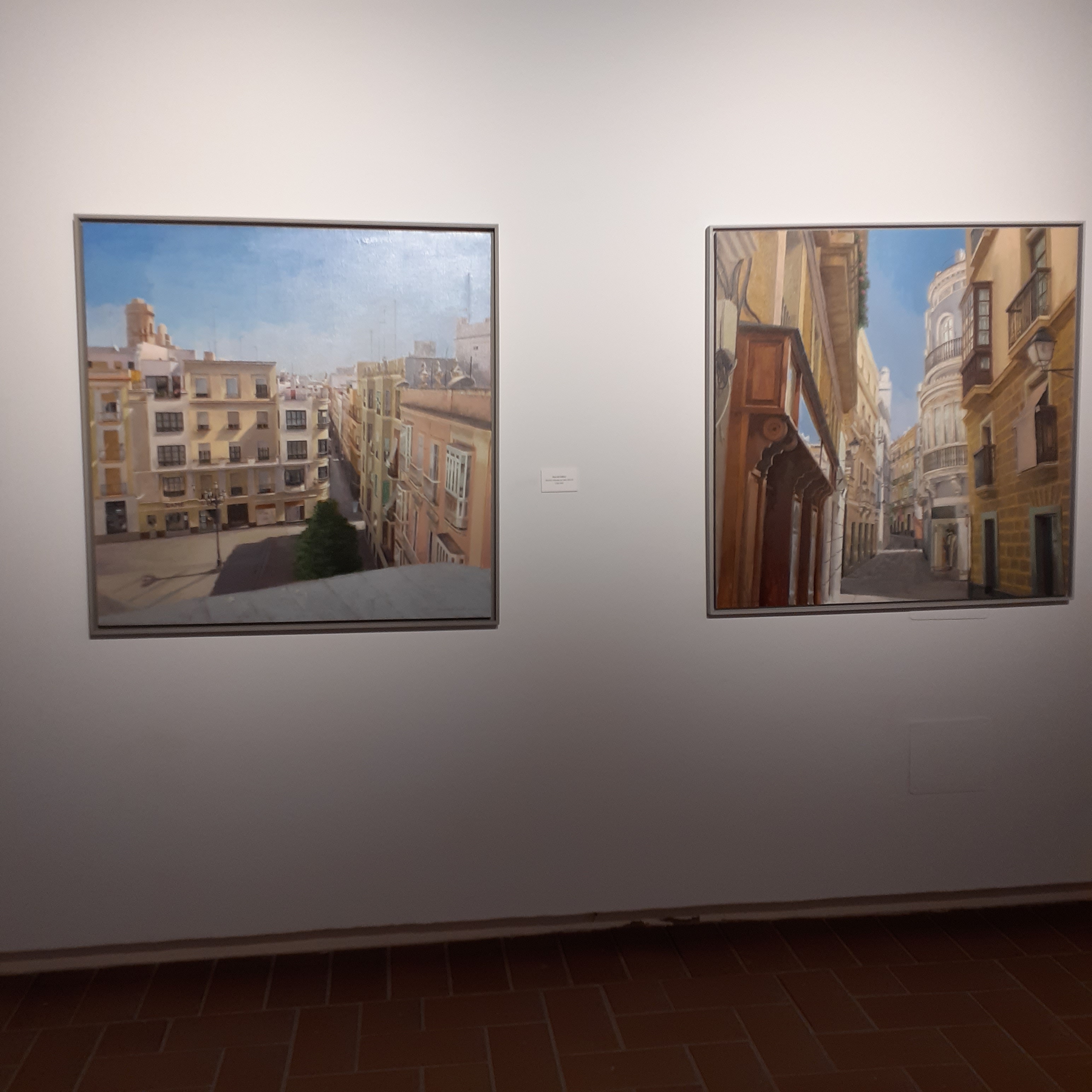
Castillo de Santa Catalina is Cadiz’z oldest fortress, built at the end of the sixteenth century. The small chapel came a century later. Inside the walls we step into another world. The past, for sure, but I also felt the thrill of being in a Salvador Dali townscape: Outskirts of the Paranoiac-Critical Town. Meanwhile, I half expected to see Clint Eastwood step out from a doorway and spark up a cheroot. The Castle was repurposed as a military prison for over two centuries until donated to the City in 1991. Now the buildings house art and cultural exhibitions. We were fortunate that our visit coincided with an exhibition by Fernando Devesa, La Verdad Sea Pintada, comprising stunning views of Cadiz and more intimate interiors. Fernando Devesa Molina is a local painter in his forties.His realist paintings are masterful, not just an exercise in rendering but full of warmth and vision; the truth is clear to see.

The beach centers on the nineteenth century baths. La Palma Spa gives an aura of Fin de Siecle opulence, though they are now a Nautical college. We walk all along the City coast, lined by parks and remnants of the ancient sea walls. Genoves Park is the largest, though we had to climb in over the railings. Nearby, the Murallas de San Carlos is one of the most scenic stretches of the sea fortifications. Alameda Park, known for its vast dragon trees, is a cool oasis of chequerboard tiles and shade. Stepping down from the walls, the Plaza de Espana is dominated by a monument to the 1812 Cadiz Constitution, erected a century later. We are back to the port and just a short walk from Plaza San Juan de Dios.

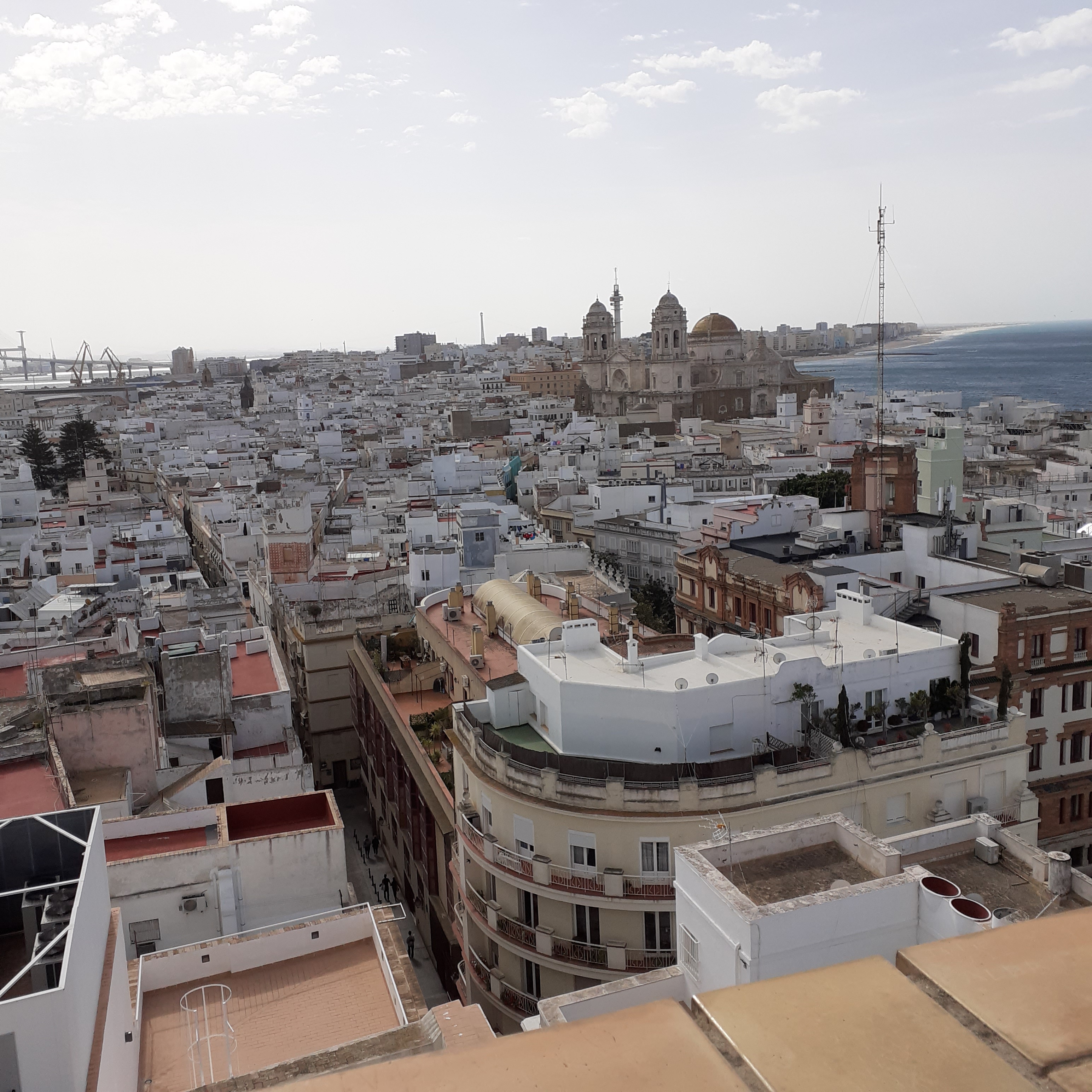
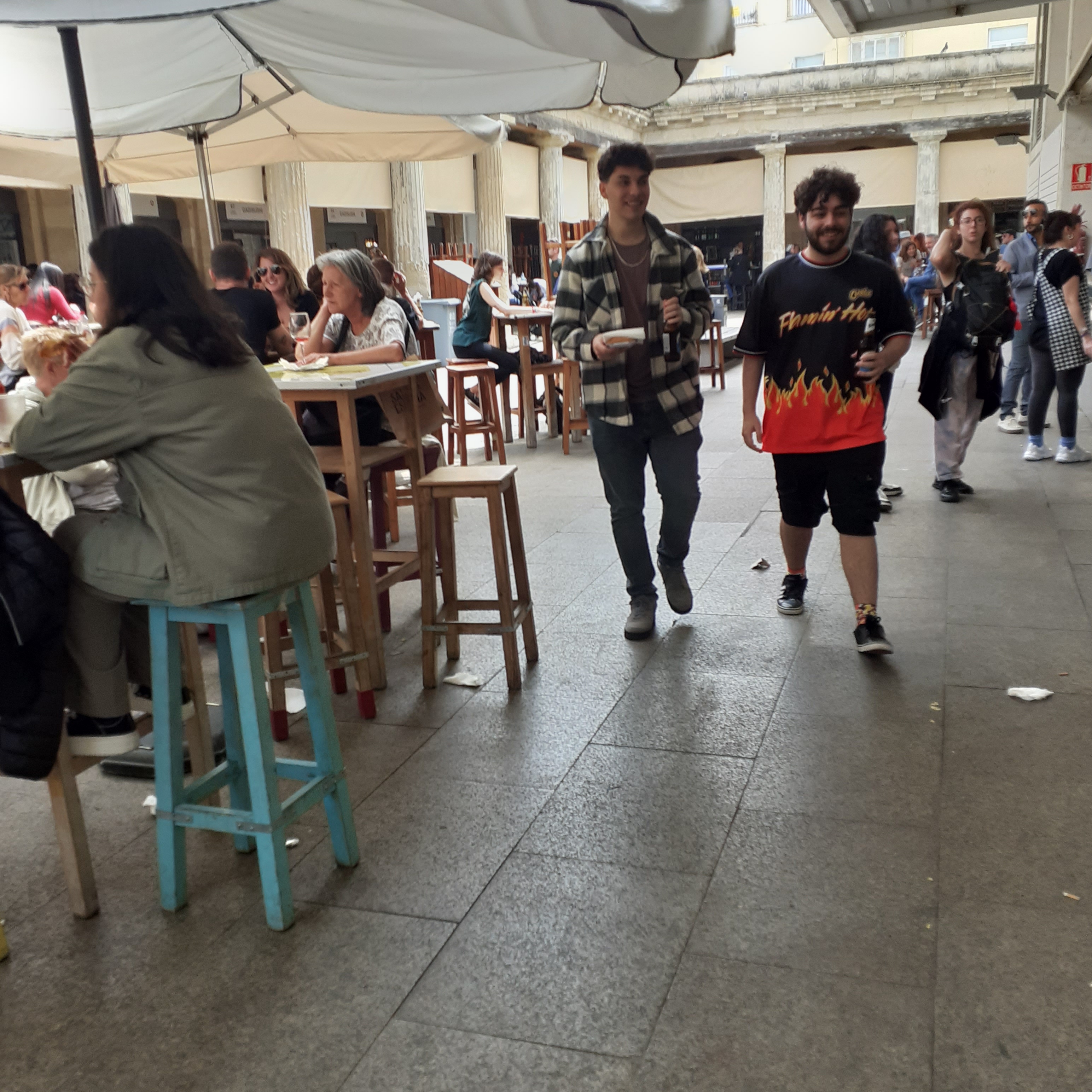
Calle Sacramento, another long shopping street that cuts through the centre of the Old Town can be reached via Catedral Square and Plaza de las Flores. The Central Market there is thronged with locals enjoying drinks and snacks from its many stalls. Nearby is the Tavira Tower. Built in the mid eighteenth century in a Baroque style, there are maybe a hundred such lookout towers dotting the skyline. Only this one is open to the public and is the highest vantage point in the Old Town at 150 feet. There’s a wonderful panorama from the roof. It was very windy when we visited, which only added to the spectacle. I could have done with guy ropes as I crept across the roof taking photos which I hoped would not be shaky. The Camera Obscura, just below, was far more calm, and the excellent guide gave a good account of the camera. She performed amusing tricks with the people passing through the busy market below and we wondered would we feature in one of her shows later on. 

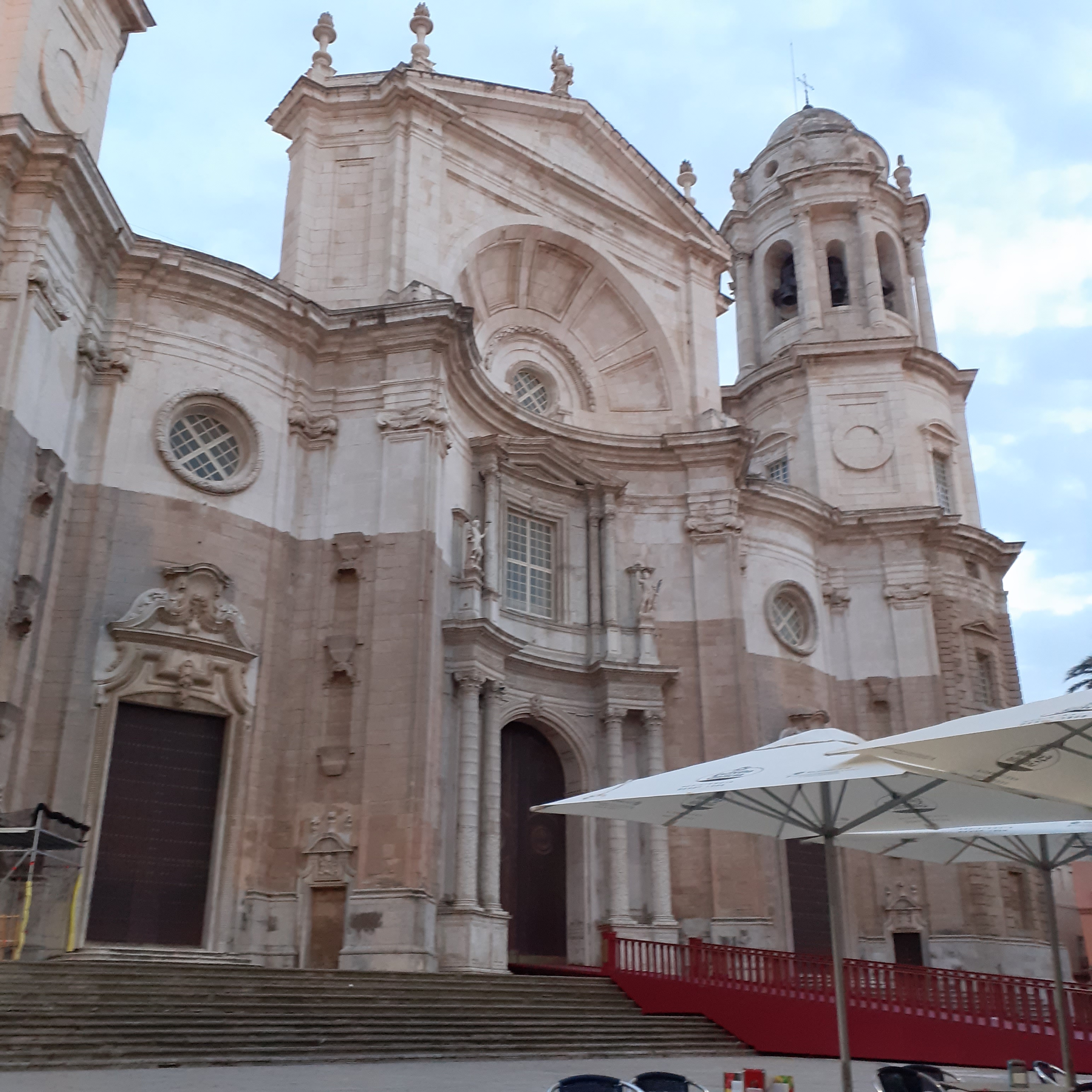
The Cathedral is Cadiz’s most iconic building, an impressive collage of different styles. It is known as the New Cathedral. The original Old Cathedral, near the Roman Theatre, was burnt down in the Anglo Dutch attack of 1598 and replaced in situ. Prosperity and population growth caused the city to propose a bigger cathedral and work began in the early 1700s. It took over a century to build, with several different architects, so the style shifts from Baroque to Rococo to Neo Classical. Its dome is clad in yellow tiles giving an impression of gold under the bright Andalusian sun.

Catedral Square on its inland side has a variety of bars and eateries. On the corner 100 Montaditos is useful for the budget conscious, with tapas and drink served at the counter. All are well thronged with diners, drinkers, passing tourists and locals, enjoying the wonderful vista, and each other. Cadiz seems to have achieved a reasonable balance between visitors and residents. The city feels lived in, enchanting and relaxed. Very friendly too, we found. 

Andalusia – 8. Seville on Another Day

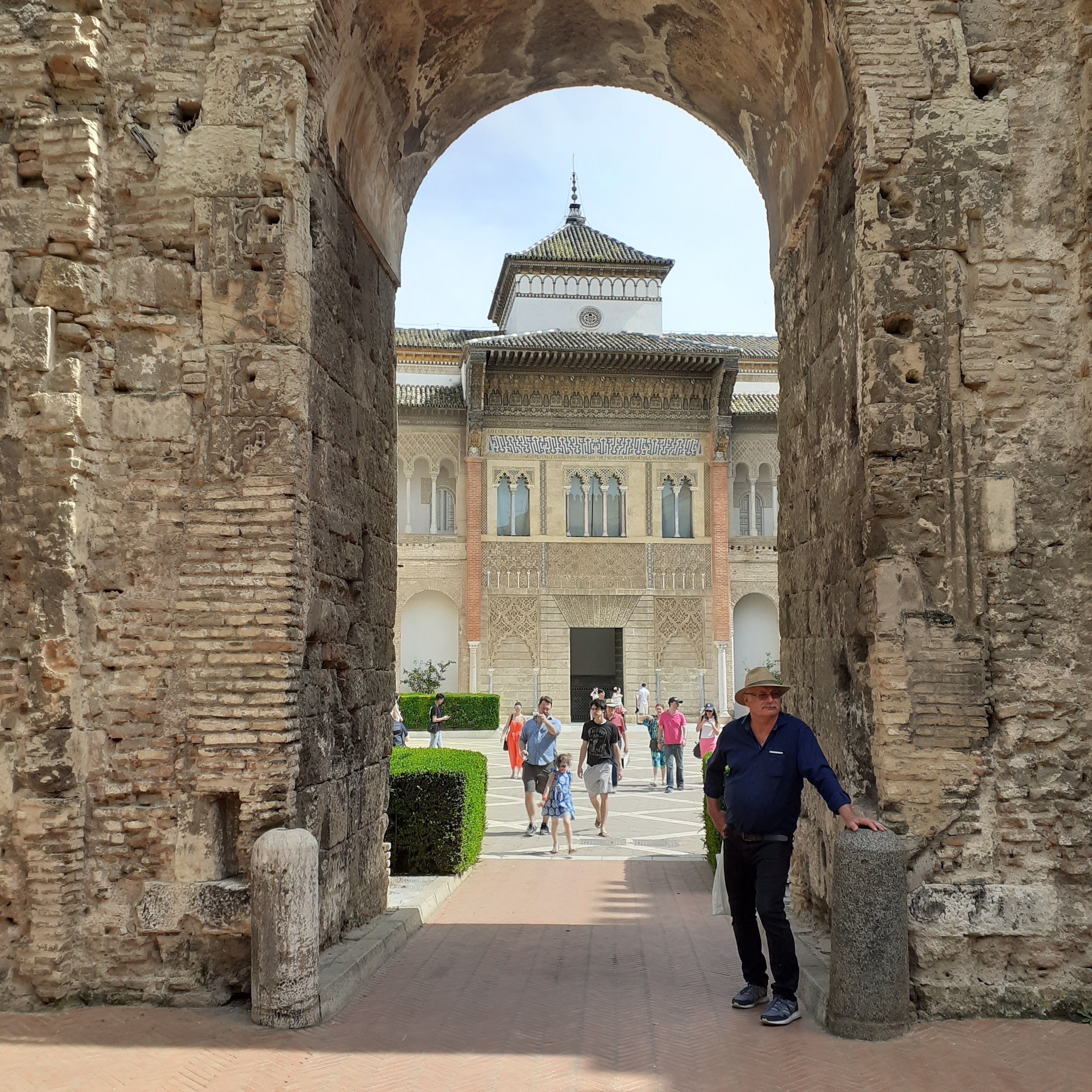
The Alcazar is Seville’s fortress and royal palace, established in Moorish times. The fort here dates to the early tenth century. The Moors ruled from the early eight century until 1248 when conquered by Ferdinand III of Castile. Significant reconstruction began and continued through the centuries. Although little of the original palace remains, the original style persists in the many ornate courtyards and the Mudejar architecture. Mudejar means those who remained, referring to Muslims in Spain after the Reconquista. It is a fusion of Christian and Islamic art and architecture, a heady mix of Gothic, early Renaissance and the flowing tracery and distinctive detail of Muslim crafts. After 1492, the Catholic Monarchs Ferdinand and Isabella renovated the palace as their main residence and it is still a royal residence today.

We queued in the morning for early afternoon tickets. Visits are restricted by number and entrance is on the hour. It costs thirteen euro, seven for over 65s. Entrance is through the Puerta del Leon (Gate of the Lion) which leads on to the Patio de la Monteria, the Courtyard of the Hunters who used to meet here before their hunts. The courtyard is dominated by Pedro’s Palace, which forms the focal point of the complex and includes the mighty Hall of the Ambassadors

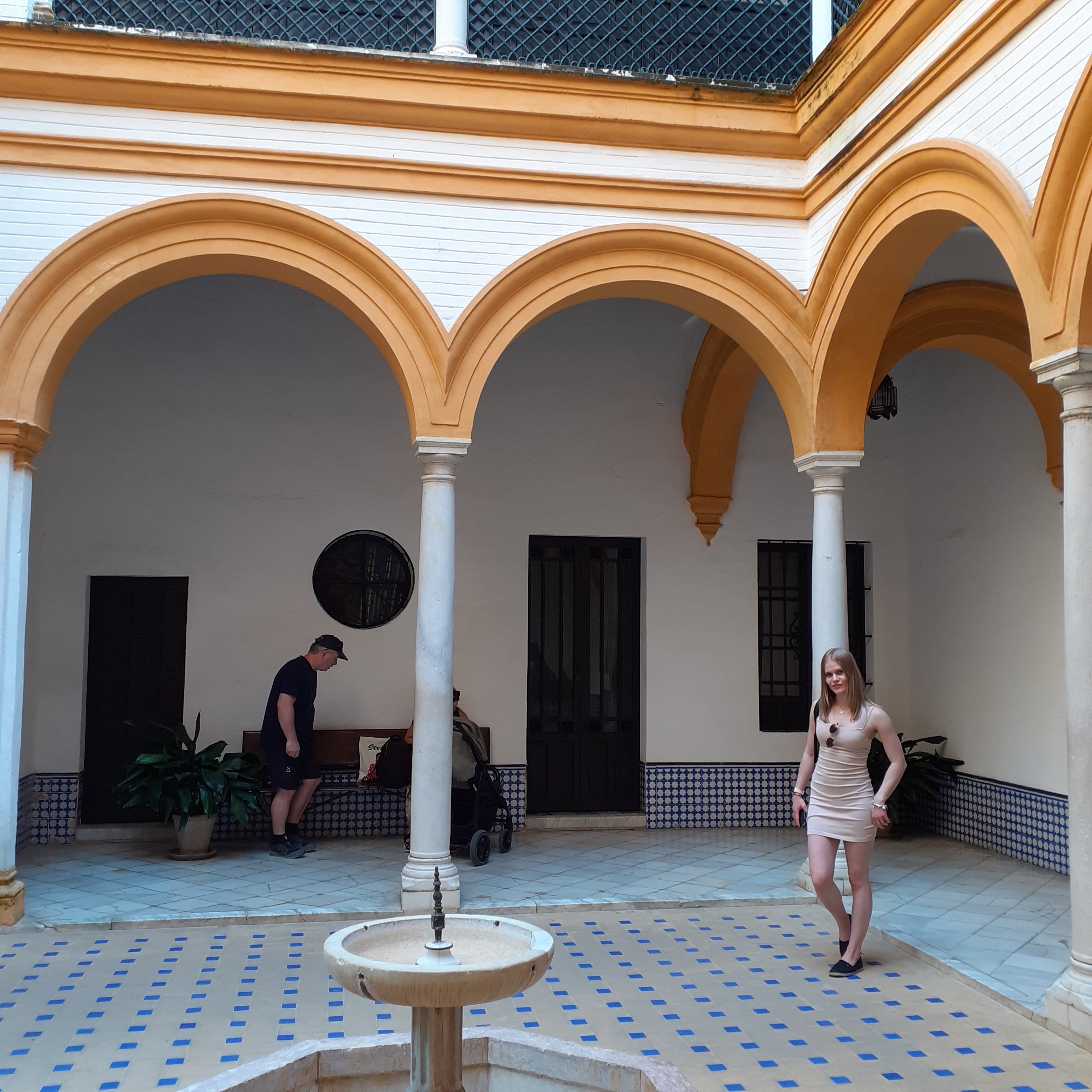
Don Pedro’s Palace was built in alliance with the Moorish kingdom of Granada in the 1360s Pedro’s ally, Muhammad V, was the Nasrid ruler of Granada and supplied designers and craft workers who had also worked on the Alhambra. The Patio of the Maidens is a particularly fine example of Mudejar architecture. Formal gardens with fountains and pools were a notable feature of Moorish palaces, with greenery and shining water cooling the sunbaked setting, literally and aeshetically. The Gardens are truly an earthly delight, lying between the palace and the city walls. The Grotto gallery gives a great view over the gardens built above a stretch of the Moorish defensive wall in the 16th century. There’s a Garden of the Dance, and a Garden of the Poets alluding to the various arts that settled amidst the shading landscape. Further gardens have been added up to the twentieth century.

Leaving, we follow the palace walls through a charming ramble of ancient streets in this picturesque part of Santa Cruz. Sunburnt but softly rendered in pastels, there are welcoming intimate bars and cafes with the promise of music later on. The route leads on to the Murillo Gardens, named for the artist whose work is such a ubiquitous feature of Seville’s holy places. Bartolome Esteban Murillo was born in Seville in 1617 and became a leading painter of religious imagery. He is also well known for his informal paintings of contemporary street life, featuring a cast of flower girls, fruit sellers and street urchins. His paintings feature in major museums across the globe including the Prado, the Louvre, the Hermitage and the London National Portrait Gallery. He died in Seville in 1682

His park continues parallel to the Avenue Menendez Pelayo and there’s a monument for Columbus halfway along. Meanwhile the ornate carriages of La Feria’s finely clad aficionados trot past. We head for the Parque Maria Luisa, a huge green wedge of the city’s southside on the banks of the Guadalquivir. This was where the Ibero American Exposition of 1929 was held. The main pavillion at Plaza de Espana showcased Spain’s industry and technology. One of Seville’s signature buildings, it was designed by local architect Anibal Gonzales. Arranged in a semi-circle, it forms a fantastical montage of architectural styles facing onto a scenic moat. Here you can take a pleasure trip in a dinky rowing boat.

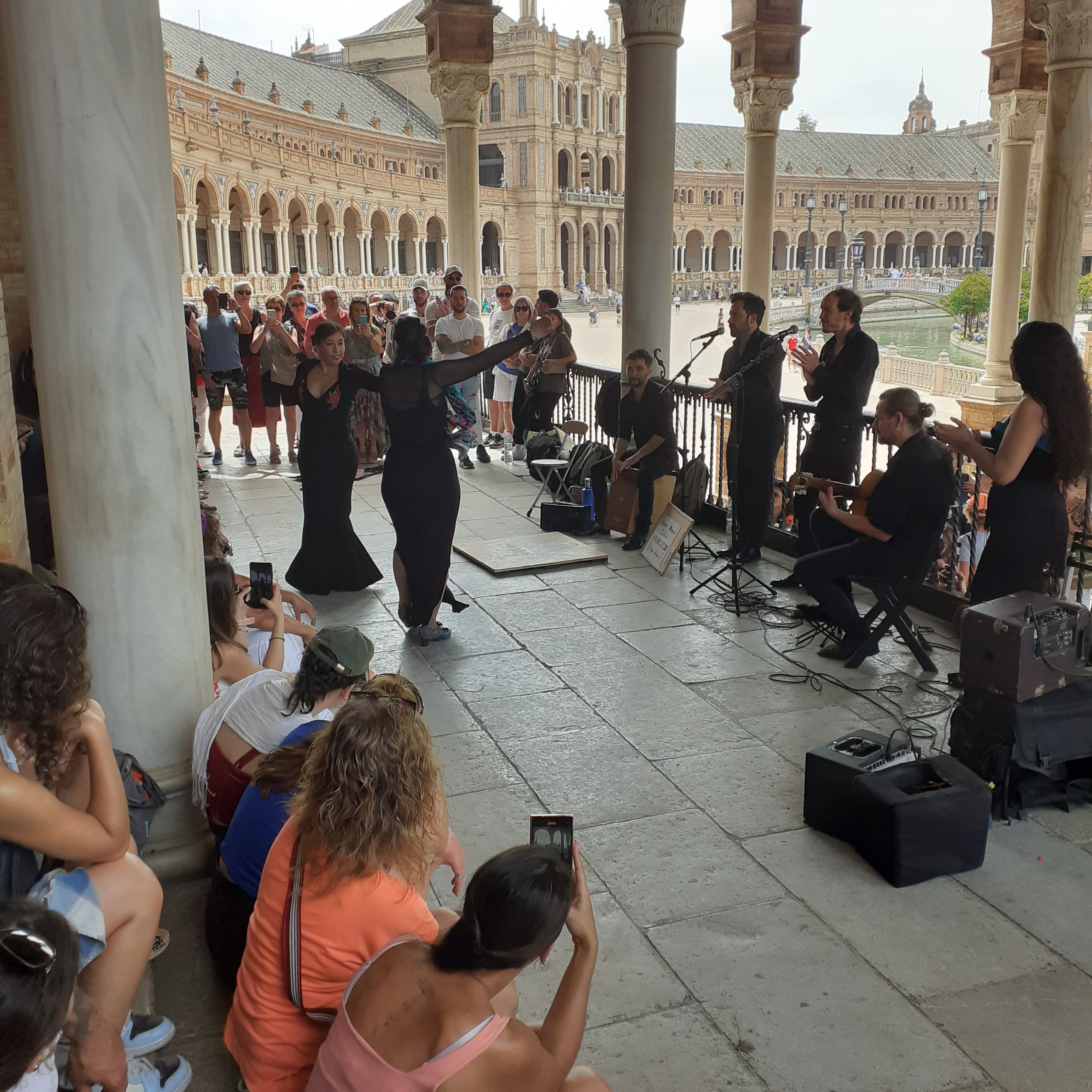
The arcades are packed with tourists, foreign and local, and a host of buskers and vendors. There’s a wedding party in full La Feria dress around the central fountain. In fact, the Exposition of 29 helped establish the traje de flamenco as a ‘traditional’ garb for the ladies of Spain. A young Flamenco group of musicians and dancers performs on the ground floor gallery at the main entrance. They are modern in style and substance, clad in uniform black, though this is a stylish mufti in the modern mode. The accousitcs are ideal for the percussive clapping and full bodied rhythm of the guitar

Returning through Arenal, we pass the famous Tobacco Factory. Seville was the first European centre for tobacco, the Spaniards spotting its benefits the moment Columbus stepped ashore in the Americas in 1492. The Royal Tobacco Factory is an 18th century building, bringing the various tobacco manufacturers under one roof, and one ruler. Since the 1950s the building has been the seat of the Rector of the University of Seville. Carmen, titular lead of Bizet’s opera, was a cigarrera here. Women were renowned for their skills as cigar rollers, and they replaced the male workforce in 1813. The fiery Carmen was a Gitano who lead the young soldier Don Jose astray, before dumping him for the dashing toreador Escamillo. The opera was first performed in Paris in 1875. Amongst its best known songs are L’amour est un oiseau rebelle, and the Toreador Song.

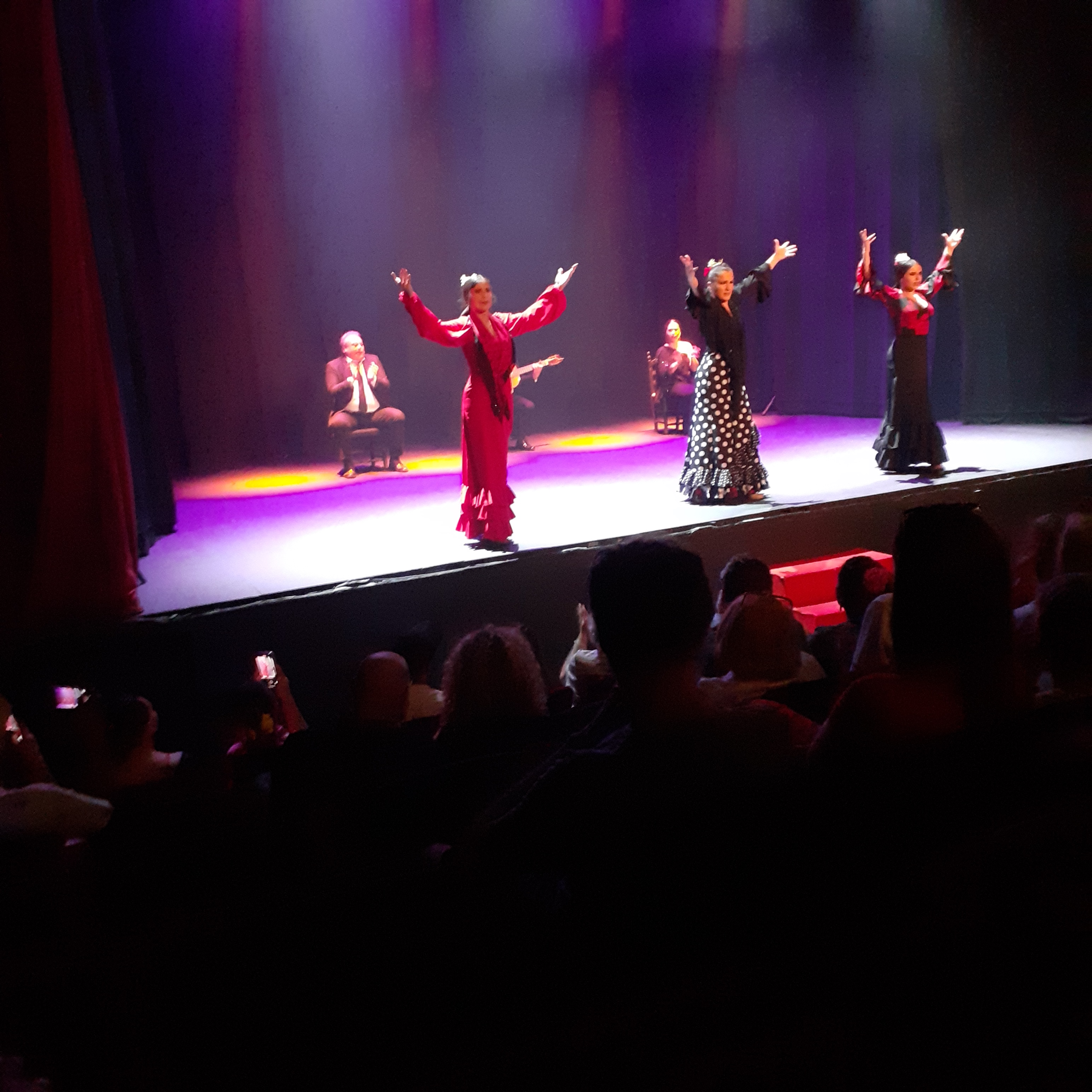
For early evening, we have booked a Flamenco show in Calle Cuna which runs parallel to Calle Sierpes close to Plaza Del Salvador. Teatro Flamenco Sevilla is an intimate theatre seating about three hundred people. They run several hour long shows daily. Flamenco grew out of the Gitano Barrio of Triana, on the west bank of the Guadalquivir. The folk form is internationally famous, a definitive Spanish culture. The singing is expressive, the guitar rhythms hypnotic, the interpretation of the dancers seductive, the whole making for a sensually charged and dramatic performance, felt as much as it is seen and heard. Traditionally, Flamenco was more of an ad hoc expression, similar to an impromptu Irish Folk session. The first flamenco cabaret bar was opened in Seville in 1842 and known as the Cafe Sin Nobre, No Name Cafe. These days Flamenco is more usually presented as a tablao, or show. Tablao refers to the stage floorboards. On the Boards, as Rory Gallagher would sing.

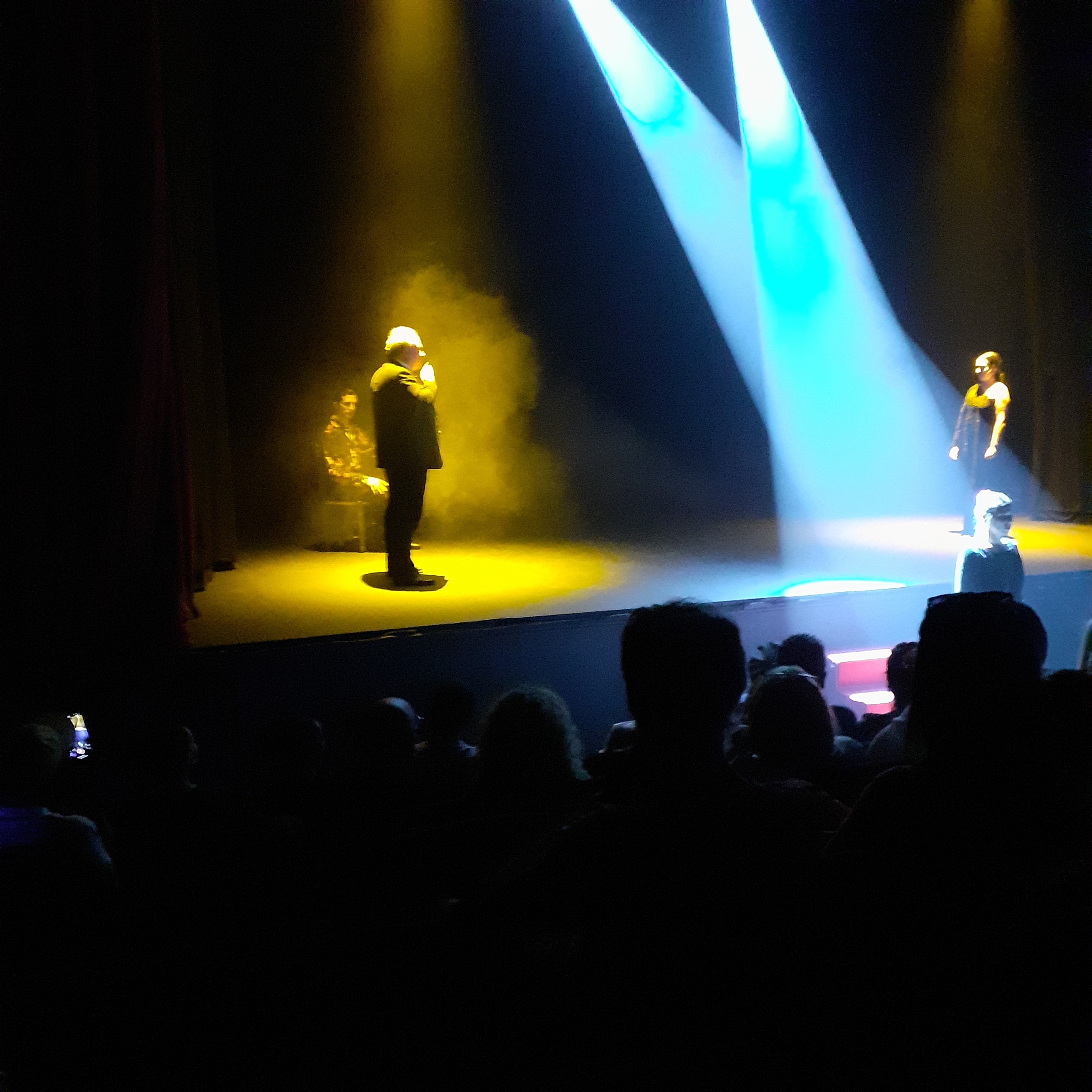
Our performance was at 7.30 and featured five dancers, one male, and a male and female vocalist. The guitarist was the natural leader of the troupe, although leading from the rear. The vocals were visceral. I couldn’t believe how their singing seemed to explode from inside my head. All performers contributed to the stacatto percussion, another startling feature of Flamenco. Talent, spectacle and a genuine passion permeated the performace. On the last few numbers, they and the audience got carried away, with plenty of high good humour, particularly the manic and brilliant guitarist. A great gig.

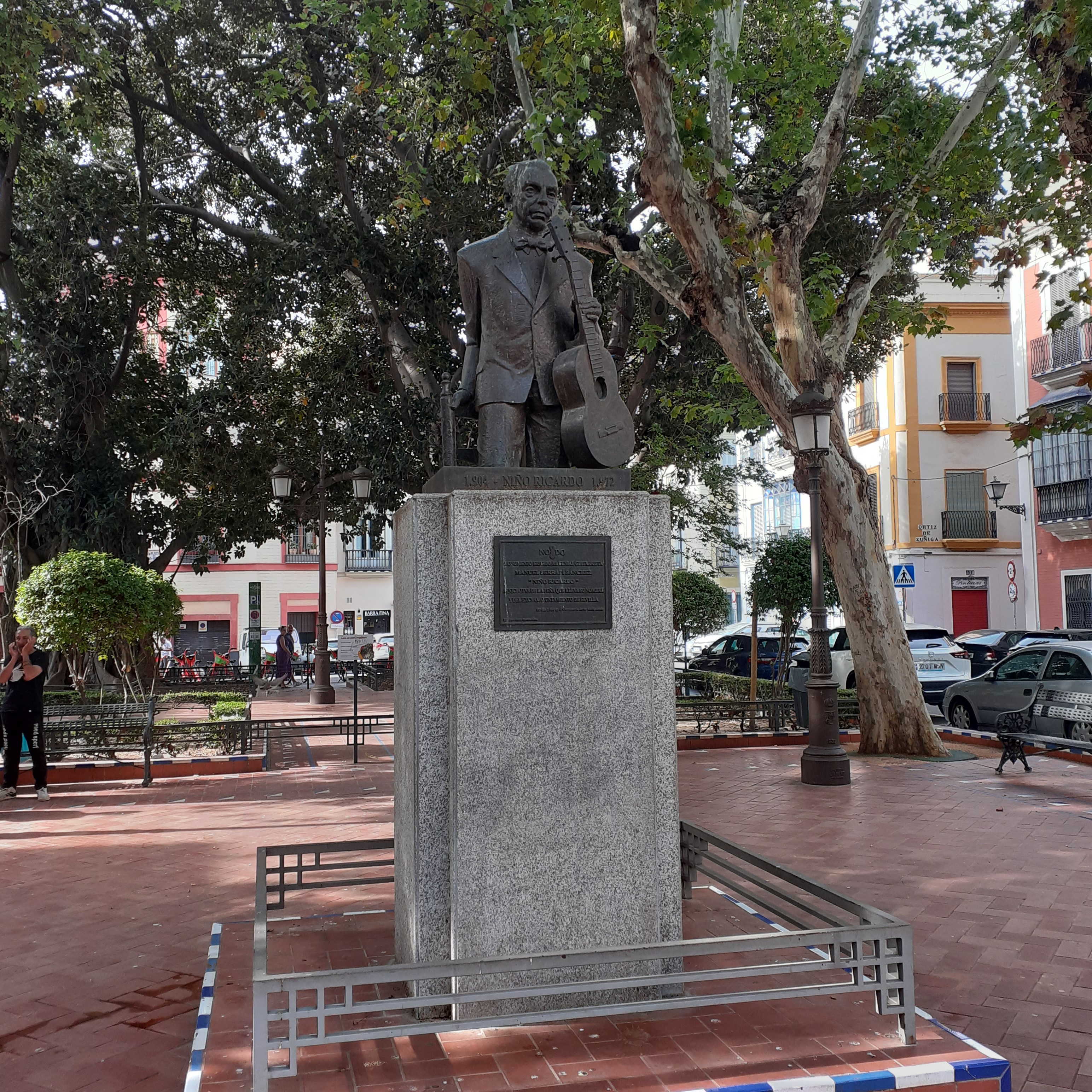
Afterwards we have a decent tapas at Plaza Alfalfa nearby. Around the corner from our hotel is the curiously named Plaza Cristo de Burgos. We decide to take a look, mindful that tomorrow we take a Spanish Train to Cadiz; but that’s another story. The small park has a statue of the great guitarist. The great guitarist being flamenco guitarist Manuel Serrapi Sanchez and known as Nino Ricardo. He was born in this square in 1904 and became a major influence on flamenco guitar technique. Paco de Lucia hailed him as the Godfather of guitar.

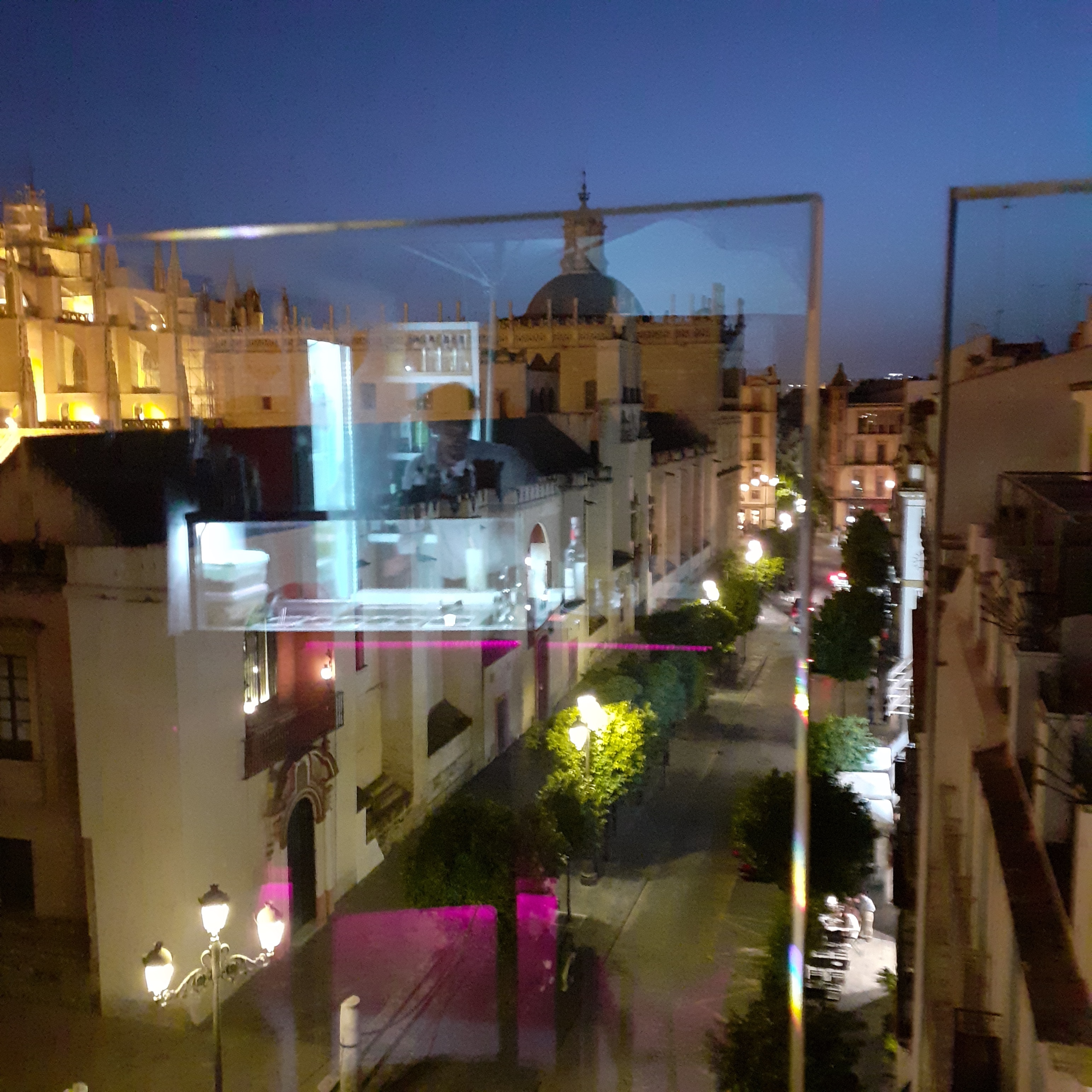
We say goodbye to Seville, from a rooftop bar above the Cathedral. The illuminations shimmer in the warm night air and it feels as if we ride above the city on a magic carpet. It all suggests a shot of Colombian espresso, a square of dark chocolate, the air scented with the smoke of a long Havana. Open a bottle of Osborne Sherry and enjoy the company of Compay Segundo and the sound of Guantanamera.

Yo soy un hombre sincero,

De donde crece la palma.

Y antes de morir yo quiero

Cantar mis versos del alma.

Guantanamera, guajira guantanamera,

Guantanamera, guajira guantanamera.

Guantanamera is a Cuban song from the poem by Jose Marti set to the music of Joseito Fernandez (probably). Look up the version by Compay Segundo with video of the noted guitarist enjoying the benefits of tobacco and drink in his native Havana.