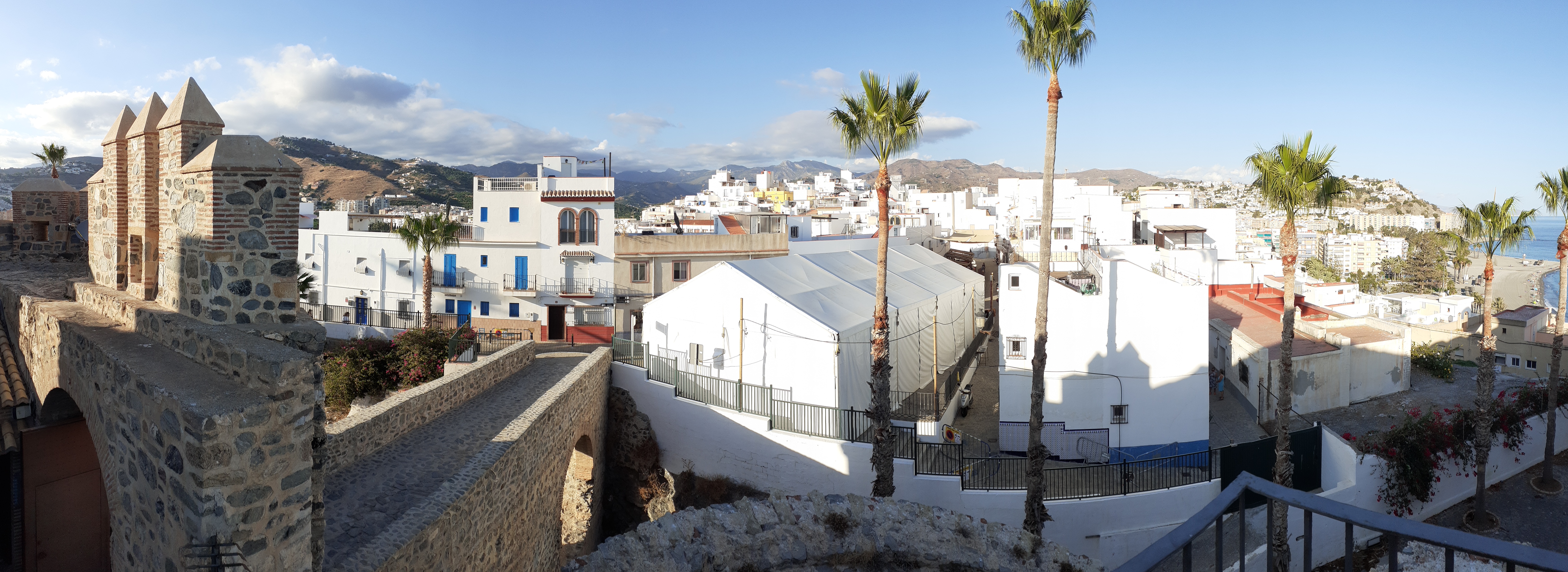
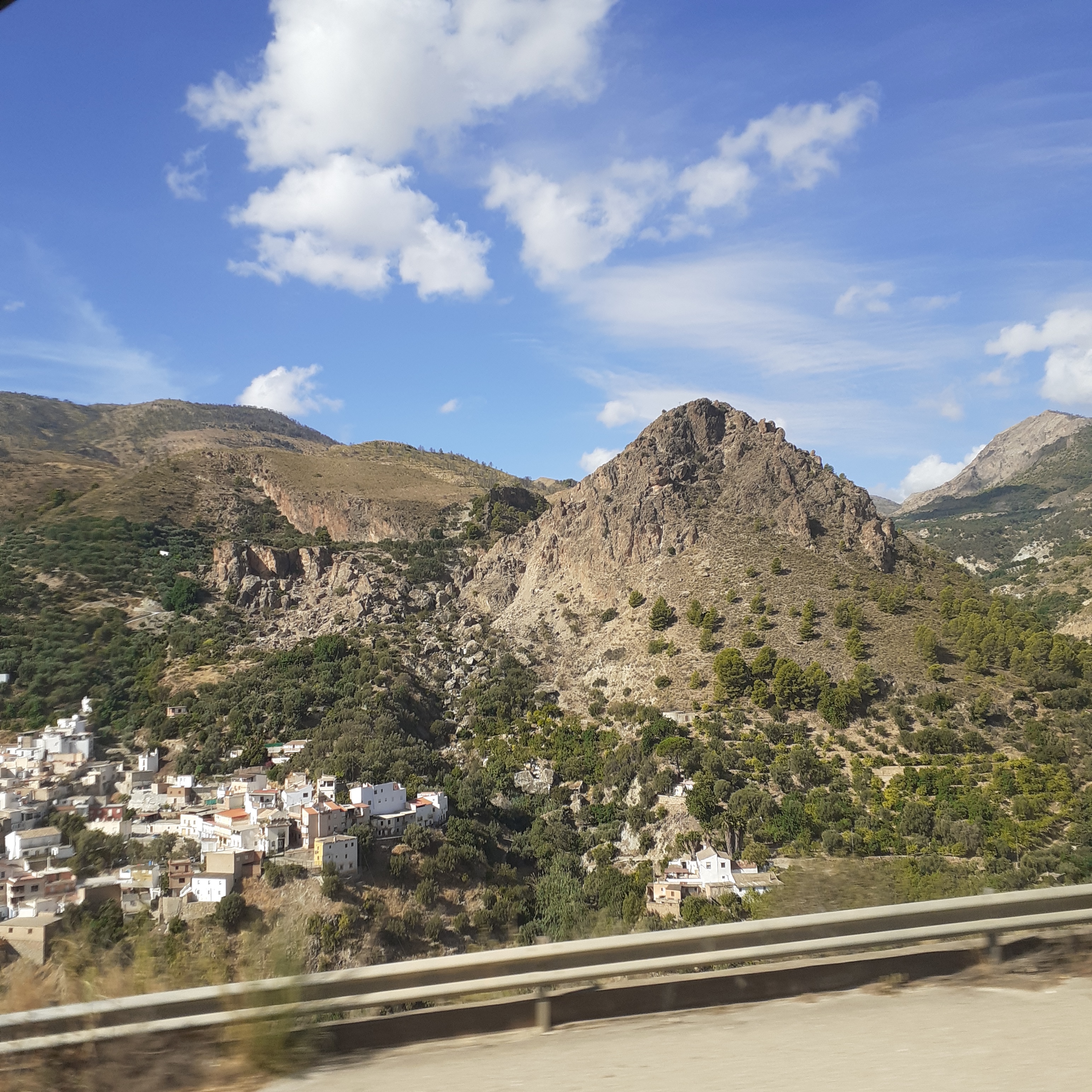
The bus from Grenada to Almunecar heads due south through the Sierra Nevada. We get an eyeful of high mountain scenery. As a designated driver, it is such a pleasure to sit back on the bus and soak in the beautiful views. Almunecar is on the Grenada region’s short coast. The bus station is at the high end of town. Disembarking, we cross the busy thoroughfare and take a sidewalk seat at the first available cafe bar, Casablanca by name. Though it doesn’t resemble Rick’s Bar; I am sure a lot of people come here, with welcome refreshments and a terrace panorama of busy town life. When we orient ourselves, we take a fifteen minute walk seawards along Avenida Europa to our hotel. Hotel Goya is a small family run affair, between the main lower town and the seafront. Above all, is the castle; Castillo de San Miguel.
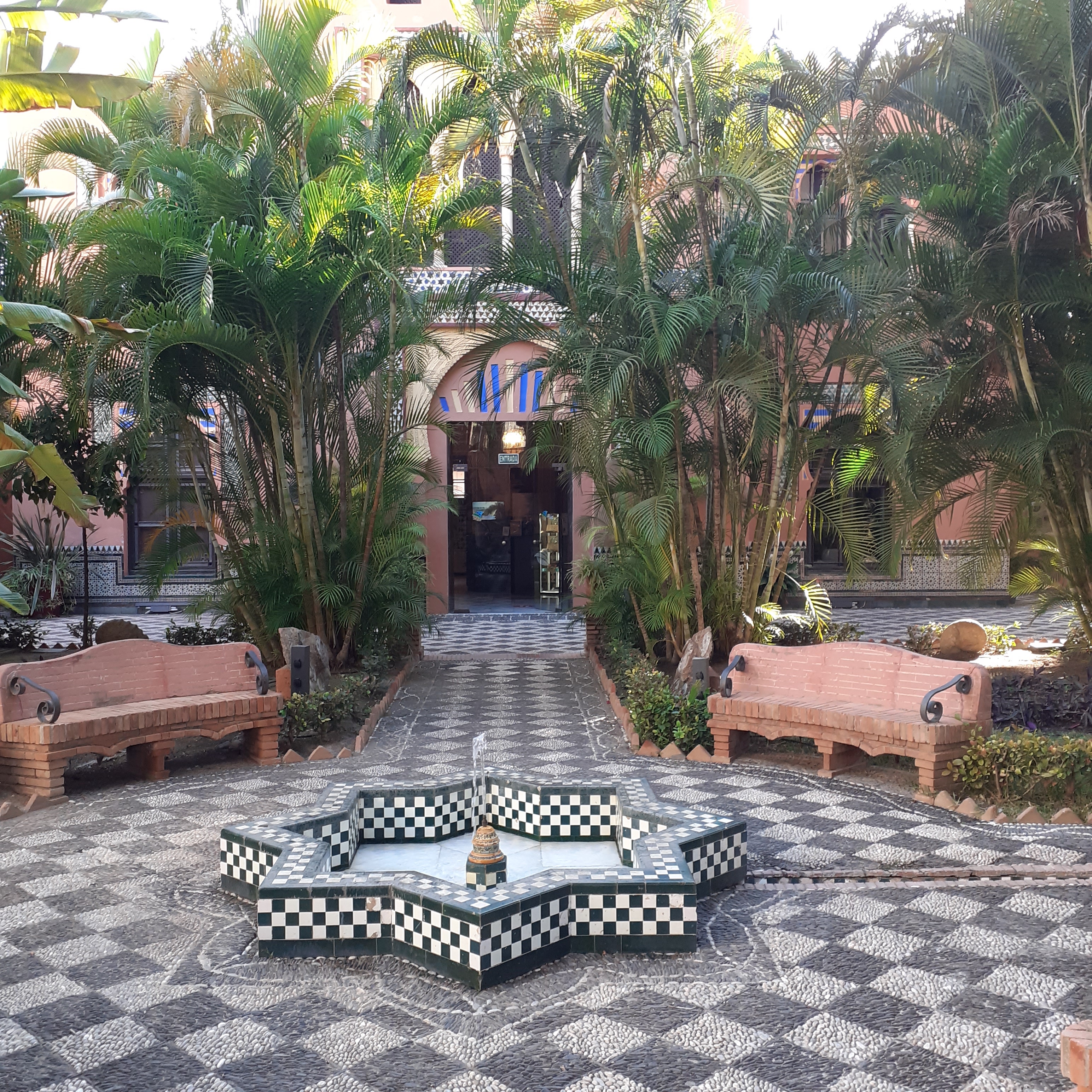
Near our hotel, the Botanical Gardens contain the ruins of the ancient Phoenician fish salting factory. The Phoenicians were settled on this coast from 800BC and their name for the town was Sexi. The natives might still refer to themselves as Sexitanos. Just so you know. The tourist office is right across the road. Housed in the La Najarra Palace, a nineteenth century building in the Mudejar style. Set amidst a wonderful garden, with towering palms, chequerred walkways and a central pool, it is an Eden of relaxation on a hot day. There’s a child sized house at one end. We spent a late afternoon sketching there, with no end product but pleasure.
The town name is derived from the Arabic, meaning surrounded by mountains. Indeed it is. The Costa Tropical collides with steep mountains to spectacular effect. Almunecar has a population of just over twenty five thousand. It is more a Spanish than a foreign tourist resort. Less busy than Nerja just a few miles west along the coast, it is intimate and relaxed.
Almunecar may ring a bell for literature fans, featuring in Laurie Lee’s book, As I walked Out One Midsummer Morning, 1969. This formed the second installment of his memoirs, a few years after Cider with Rosie. From 1934, Lee travelled the length of Spain. He made his way taking casual jobs and busking; he played violin. He arrived in Almunecar, which turned out to be his last stop in Spain. Here, he worked in a hotel, and as a tourist guide. The Spanish Civil war broke out in 1936 and Lee was evacuated by a British warship sent from Gibraltar. He would return to Spain the following year to fight for the Republicans. In Lee’s account, the town is referred to as Castillo.
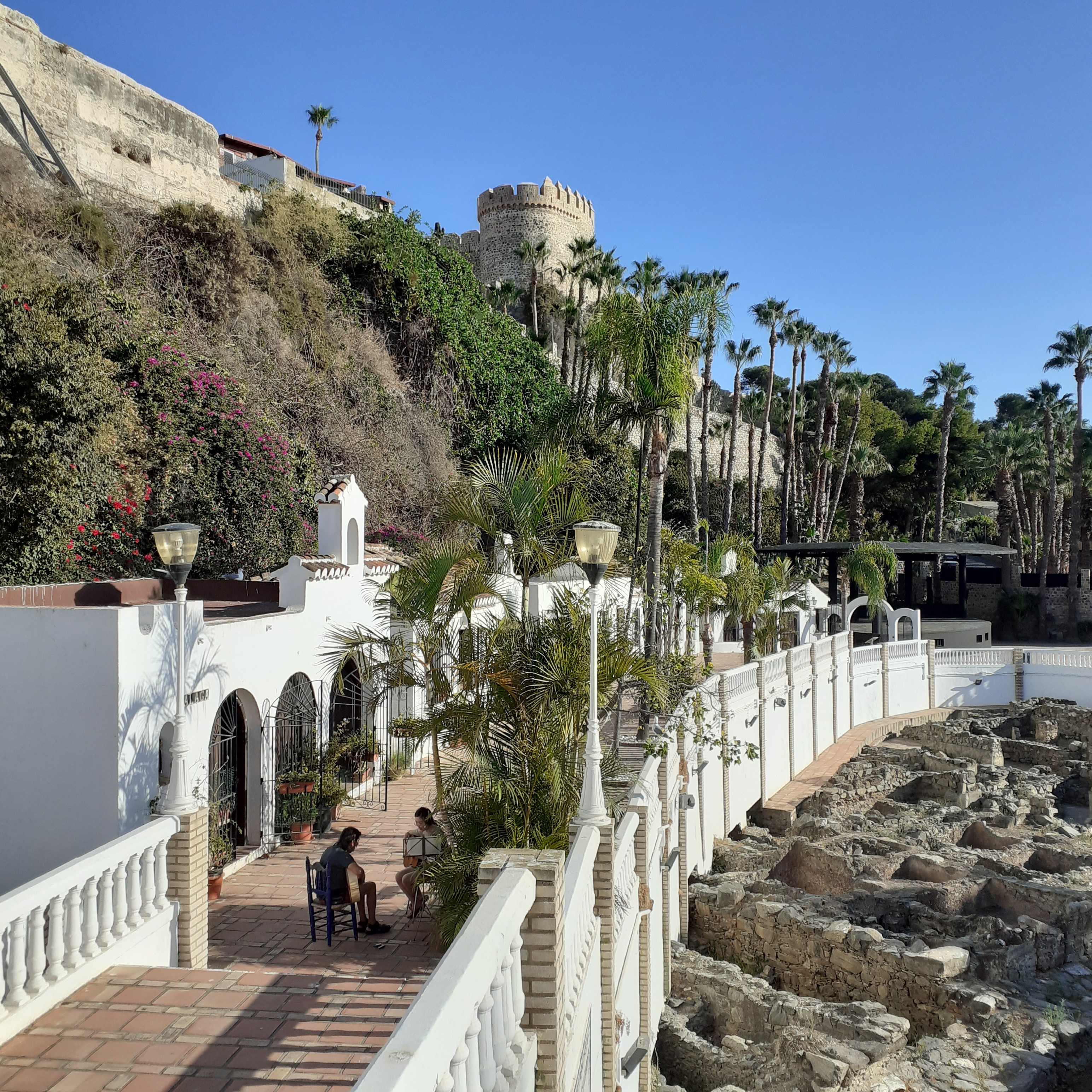
The Castillo de San Miguel certainly defines the town. It was first established by the Romans in the times of the Punic Wars, two centuries BC. Subsequent alterations now prevail. The fortress prosperred in Moorish times, ultimately surrendered in 1488. During the Napoleonic Wars, the Castle last operated under control of the French. The English, with Spanish support, seriously damaged the complex, although the outer defenses were reletavily unscathed. For a while it was used as the town cemetery, until the rise of tourism prompted restoration work to begin in the 1980s
Visiting the castle is a must. The old town is a serpentine maze, constantly rising. Just off the main drag, Plaza Higuitos provides an oasis. While the eponymous establishment is beseiged by growing queues, across the tiny square there’s room at Bodegas Manuel Callejas The tapas here are good too, not just the automatic default; as we have eaten enough olives throughout Grenada to turn green and start a pip factory

Higher up, the narrow street widens into Plaza de la Constitucion, with the Ayuntamiento (Town Hall). along one side. There are two good restaurants at each end; and we fortify ourselves with drinks and tapas. The Church of the Incarnation is on a hill behind the town hall. It dates from the 16th century and has a stern imposing facade. This is the centre for the Semana Santa processions, and the street is tellingly named Calle Jesus Nazareno. Behind the church is Casa de la Cultura with a museum and theatre.
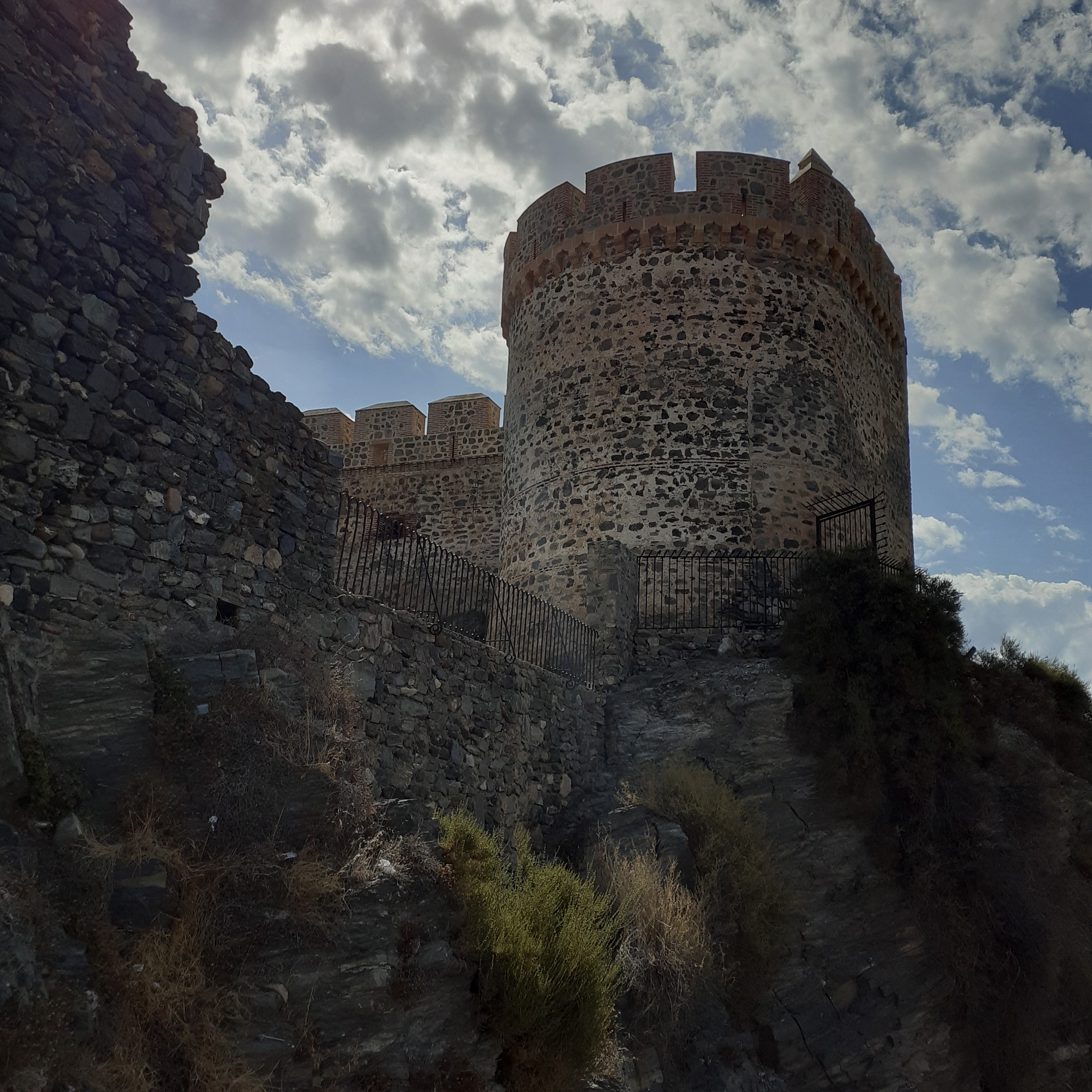
The orienteer within eventually guides us to the high esplanade of San Miguel. The saint’s festival is getting underway and everyone is gearing up for the nights festivities, setting up stalls and quaffing a few aperitifs. So, it’s getting into evening by the time we reach the castle. The lady at the door obligingly gives us a pass for the next day as we stop our visit abruptly owing to a sudden onset of starvation. Returning early the next day we are rewarded with a relaxed time amongst the ruins, and breathtaking views from the ramparts. There’s a good exhibition at the on site museum showing the castle’s evolution through the ages.. From the southern ramparts, the view downwards to the coast overlooks the cross at Penon del Santo. This was once connected to the castle by viaduct.
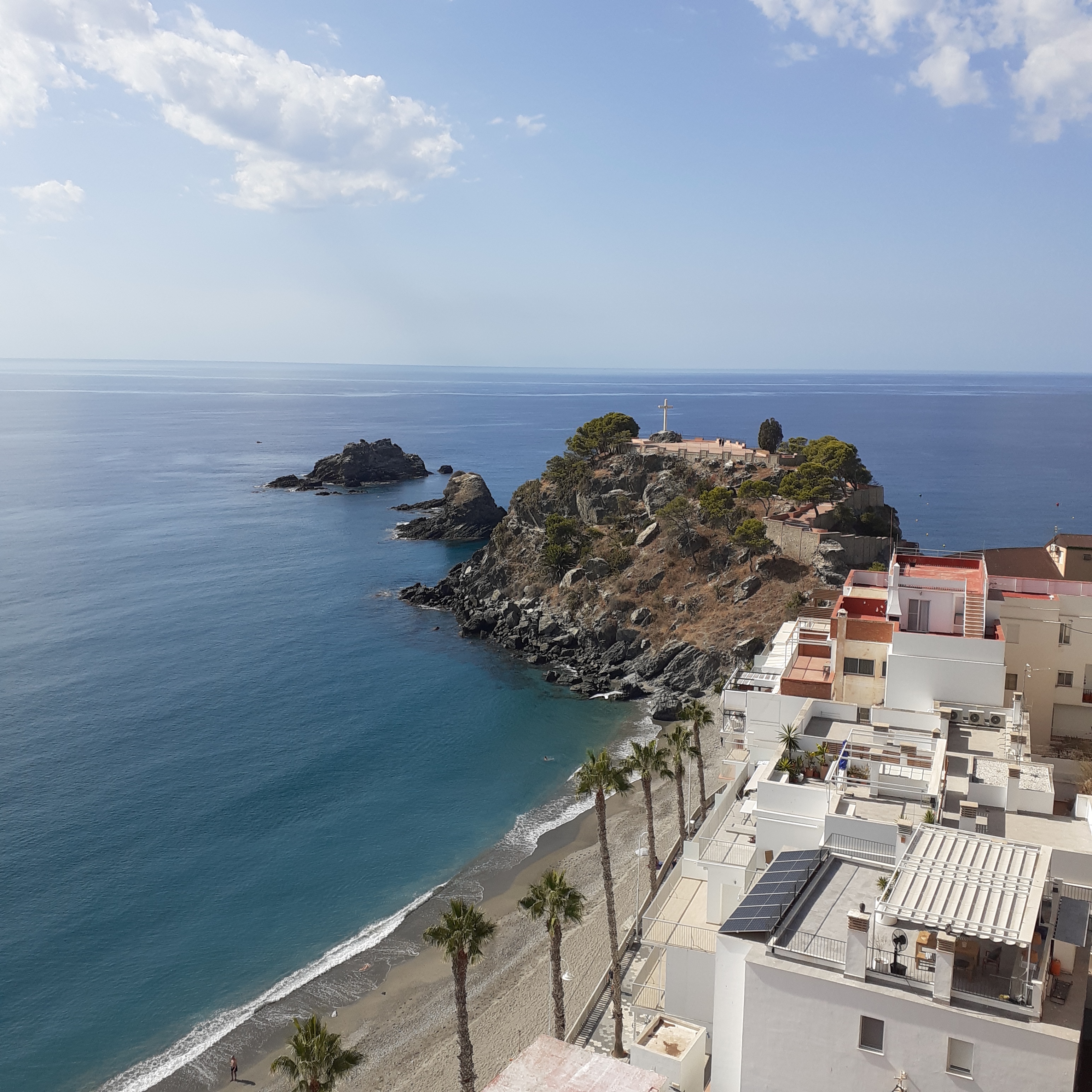
We take the rapid descent route back down. This winds down beneath towering castle wallls, touching earth beside our Botanical Gardens. Heading on to the searfront, Penones de San Cristobal are three rocky crags, dividing the searont at Almunecar. The highest crag, Penon Del Santo, is marked by a tall cross, a modernist structure from 1900. Guarding the base of this rock, there’s a monument to Abdalrahman I, the founder of the Emirate of Cordoba in 756.
Puerta Del Mar to the east is the main bay of the old town while Playa Del Cristobal is a long straight esplanade heading into the west. Chirinquito El Pilici and Bar La Cana are amongst the many beach bars lining the seafront, offering a large selection of food, many with charcoal grills. We stop streetside at Restaurant Sabina. Sabina Schumacker herself greets us. A German lady, she makes a superb menu guide. Though I am not always a fish fiend, other than my chipper favourite of battered cod and chips, Sabina guides us towards the Monkfish and it is as superb as promised. Next door is the Helios Costa Tropical, the largest hotel on the seafront. This boasts a rooftop bar with great sea views, the prime place to bask in the setting sun.
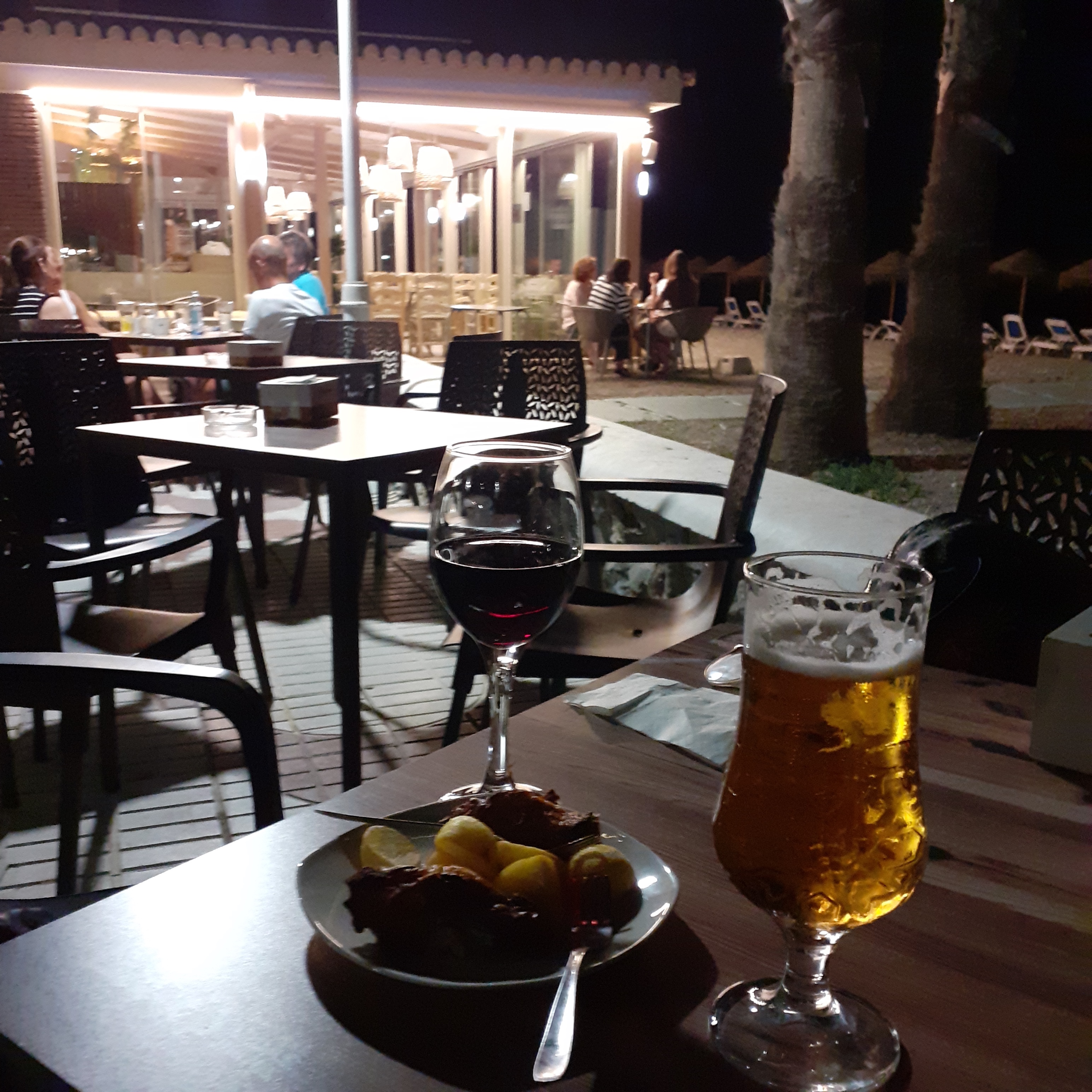
Another night we eat at Elysium Restaurant farther on. It radiates a relaxed Bohemian air. The manager, laid back and friendly, tells us about the cuisine prepared by her husband from Aghanistan. The couple moved here last year from Austria and are enjoying the sun and sea air. We enjoy the food immensely. Ad hoc entertainment is provided by an English woman shellacing her errant husband, first on mobile phone (aren’t mobile phones wonderful!) and then in person. As we sneak out she comments loudly on our Irishness. We fade to black.
From here, the long seafront winds away to a beautiful emtiness, darkness on the edge of town, lights at the edge of the next twinkling with distance. The sun has set, but will rise again tomorrow. For many, in fact, the night never really ended. The Spanish know how to do festivals, and with the festival of San Miguel in full swing, the hilltop revelry goes on long into the night. Its a pleasant distant soundtrack, cushioning the fall into sleep.
After check out we head out for breakfast and towards the bus station. Churreria Picasso opens early, and is a popular start to the day for locals. Churros are made with choux pastry dough, fried till crispy on the outside and cut in long lengths. Taken with coffee for breakfast, or dipped in hot chocolate, they are popular throughout the Spanish speaking world.
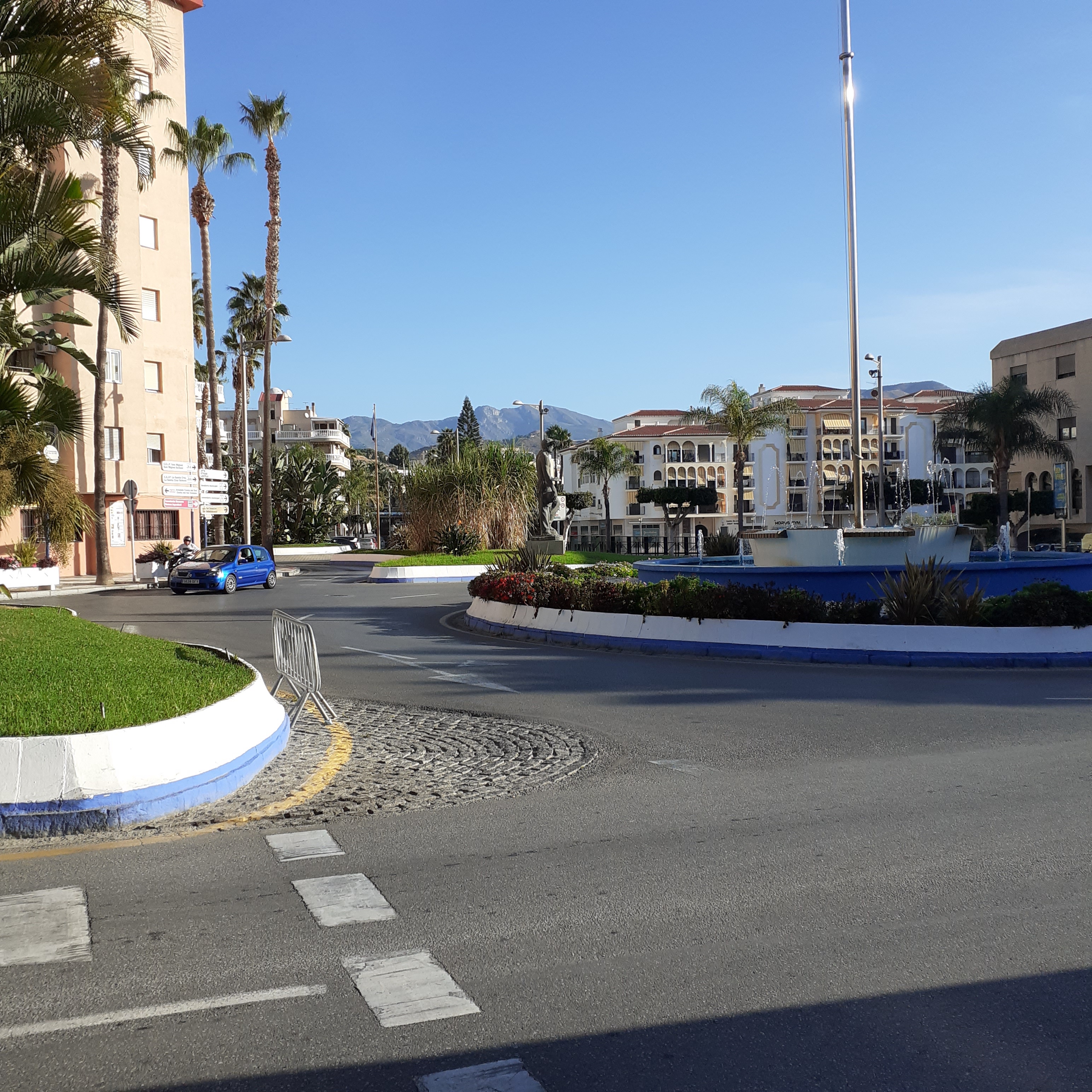
We have time for one last coffee at Casablanca and watch the time go by, again. There’s a crush of coaches at 11 o’clock, but a friendly German expat puts shows us to the right one. It’s just over an hour along the coast to Malaga and we close the circle of our magical bus tour.
I know I’ve played this before, but I…. I’m not going to say it; and neither did Humphrey Bogarde. As Time Goes By was written by Herman Hupfield in 1931 and rose to fame when sung by Dooly Wilson (playing Sam) in the film Casablanca in 1942.
You must remember this
A kiss is still a kiss
A sigh is just a sigh
The fundamental things apply
As time goes by
 xxharrison