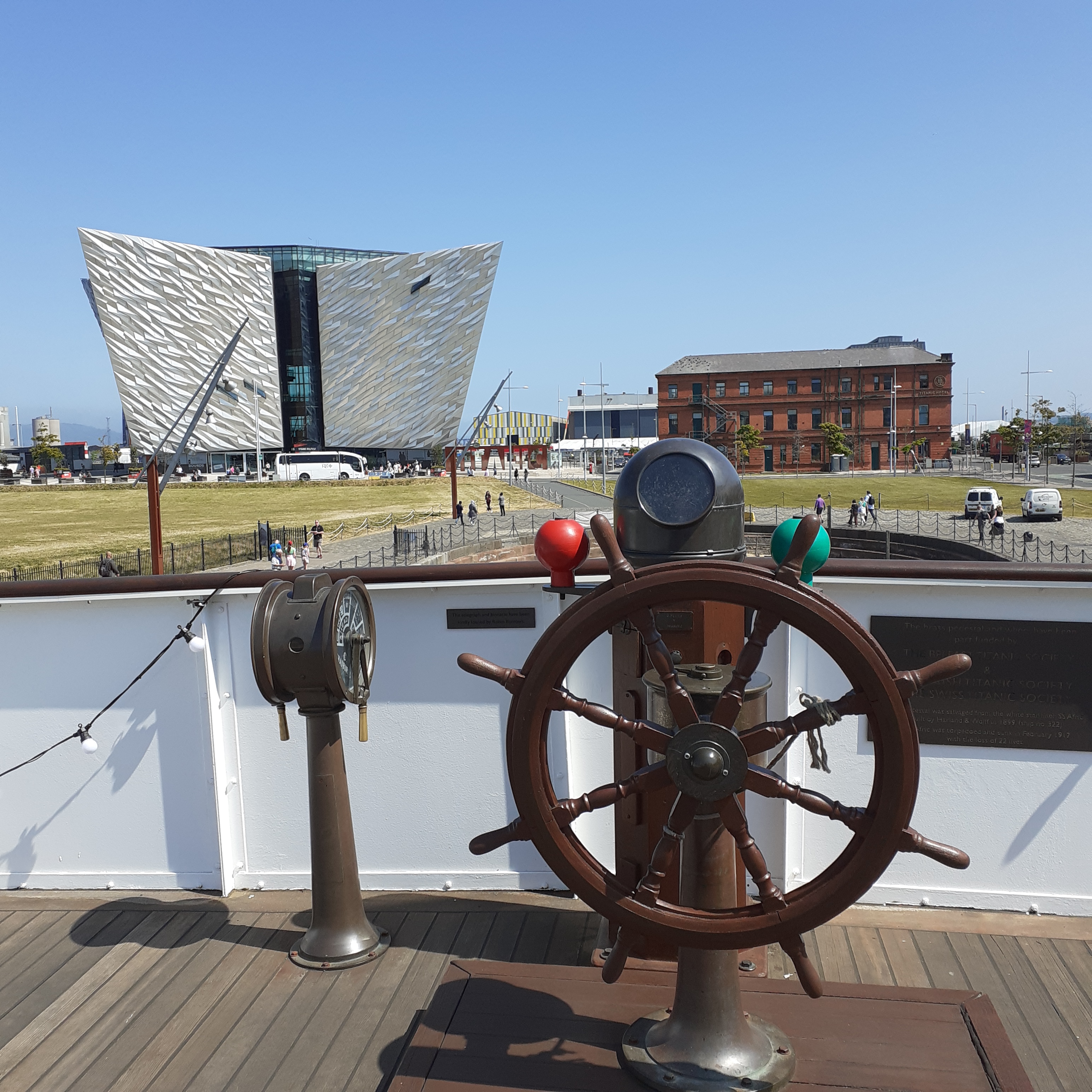
We’re staying in the Titanic Quarter, practically next door to the eponymous attraction. The tall gleaming building is a landmark in itself, embodying in its design a suggestion of the famous liner built at the Harland and Wolff shipyard nearby. Edward James Harland was born in Yorkshire in 1831 and moved to Belfast in 1854 to manage Robert Hickson’s shipyard on Queens Island. In 1858 Harland bought the shipyard from Hickson. Gustav Wilhelm Wolff from Hamburg had worked as Harland’s assistant, and soon was made a partner. Harland and Wolff prosperred, forging a lucrative partnership with the White Star shipping line. White Star exemlified high quality service for the transatlantic passenger trade. The Belfast shipyard became exclusive builders for them, providing ships on an ever more grandiose scale, culminating in the Titanic in 1912.

The decline of Belfast shipbuilding saw Queens Island left derelict. A handful of structures were listed for preservation, including the Titanic slipway and the iconic Samson and Goliath gantry cranes. These were only built in 1969 and 74, and are still in use as part of the dry dock operations of the yard. The Titanic Quarter development was proposed in the mid nineties. The Odyssey Complex was an early development which opened in the new millennnium. The Arena hosts the Belfast Giants hockey team, and is also a venue for music gigs. The Premier Inn, our hosts, was the first hotel opened here in 2010.
The Titanic Belfast visitor attraction was proposed as a focus for the site. It was intended to emulate Frank Gehry’s Guggenheim museum in Bilbao as a prestige scheme which would inspire a regeneration of the area itself and the wider city. Overseeing the project, Dublin firm Harcourt Developments enlisted American architect Eric Kuhne and London firm Event Communications. The building echoes the outline of the huge White Star ships, standing as high as the Titanic hull on completion. Locals have given the nickname the Iceberg. The silver sheen of the building comes from its aluminium cladding, whose jagged finish also isuggest ice crystals. The visitor centre stands on the slipway where the Titanic was launched.

The Titanic Experience will take a few hours. It first immerses the visitor in the rapidly growing nineteenth century city of Belfast, then takes you from the ship’s conception, through gestation and birth, and on to that fateful voyage, and beyond. It is a story of dockland and street, nuts and bolts, the savage vastness and caprices of the sea, and of course people. The people who designed her, who toiled to make her, who were charged with sailing her, who paid to sail in her, who survived or perished, as the die would have it.
Titanic is the most famous ship ever, though it never completed its maiden voyage. Carrying 2,224 passengers and crew, she set off from Southampton to New York by way of Cherbourg and Cobh, then known as Queenstown. Hopes would have been high. Here was a voyage into a new world, upon the greatest ship afloat, proclaimed unsinkable with the best in modern safety technology. Allegedly. Third Class were better catered for by White Star than they would have been elsewhere, with cabins instead of open dormitories, their own dining rooms, a smoking room, reading room and an assembly hall. Facilities in first class were luxurious, based on the quality of the Ritz, with restaurants, gymnasium and turkish baths, A glorious Grand Staircase swept up through seven decks topped by a metal and glass dome.
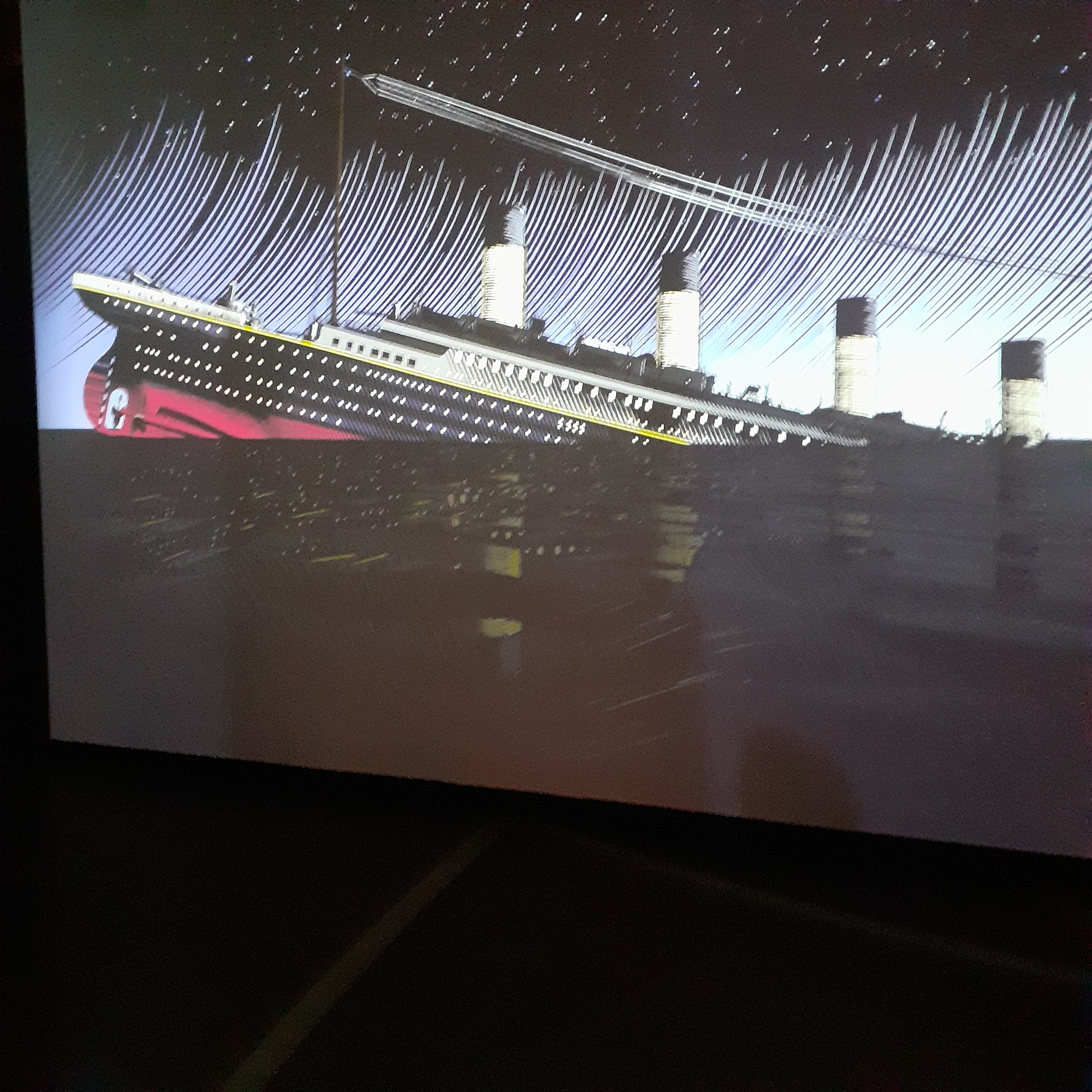
She sank on 15th April 1912 off the coast of Newfoundland. Capt Edward Smith went down with the ship. One thousand five hundred people died. The names of all the dead are displayed on a huge wall as we begin our descent from the exhibition’s top floor. Stories abound, ranging from modest steerage to those of great wealth and fame. There was the unsinkable Molly Brown, who survived. Born Margaret Tobin in 1867 to Irish immigrants in Missouri. She moved to Leadville, Colorado, in her teens and married mining engineer James Brown who became wealthy through his work. A wealthy socialite, Margaret didn’t forget her poor background, and applied herself to philanthropy in the cause of women and workers. Her survival became the stuff of legend and led to her posthumous nickname
Fate smiled on others who either missed the boat or got off. Amongst those who disembarked at Cobh was Fr Francis Browne, an Irish Jesuit and photographer. He received a first class ticket from Southampton to Cobh as a gift from his uncle. On board he befriended a rich American couple who offered to pay his passage to New York. He telegraphed the bishop and the reply was swift, and negative: Get off that ship! Browne studied at Dublin’s University College with James Joyce who remembered him with a walk on part in Finnegans Wake. Even more unsinkable than his namesake Molly, he was a chaplain in the Great War and survived the Battle of the Somme, Passchandaele and many other fierce battles. Wounded five times, he was awarded the Military Cross and the Crois de Guerre. The survival of Browne’s photographs form an enduring legacy of life in the twentieth century. His photographs chronicle life in Ireland and abroad, while his record of the Titanic, its passengers and crew before their date with fate, is invaluable.
Nearing the end, with the weight of the dead above us, we descend to the depths. The Titanic rested undisturbed for more than seventy years. In 1985 Robert Ballard and Jean Luis Michel found the wreck. Celebration was spontaneous, though Ballard quickly saw the problem of joy in what was, is in effect a mass graveyard. A film by James Cameron in 1997 featured Leonardo de Caprio, a steerage passenger forging a love affair with Kate Winslet. Their celebration of life at the ship’s prow gives a photoshoot moment for visitors seeking to recreate the moment starring themselves. My companions oblige, though I must draw a veil over that.

After the full emotional experience of the Titanic spend some time on the Nomadic, parked adjacent to the visitor centre and included in the admission. The Nomadic is the Titanic in miniature. It was used as a ferry for passengers from the dockside to the Titanic anchored offshore. The interior is lovingly preserved, with some ghostly projections taking us back to the days.

After all of that, it was time to sink a few cold ones. There are few oases this side of the Lagan. It’s a ten minute hike across a selection of bridges to the city centre. We took the Lagan Weir Bridge which curves to the west bank where it is guarded by the Big Fish. This sculpture by John Kindness was commissioned at the end of the last century as part of the urban regeneration along the riverbank. The fish is clad in ceramic scales, many with texts and images illustrating the city’s history. Aptly, it stands at the confluence of the Farset and Lagan rivers.
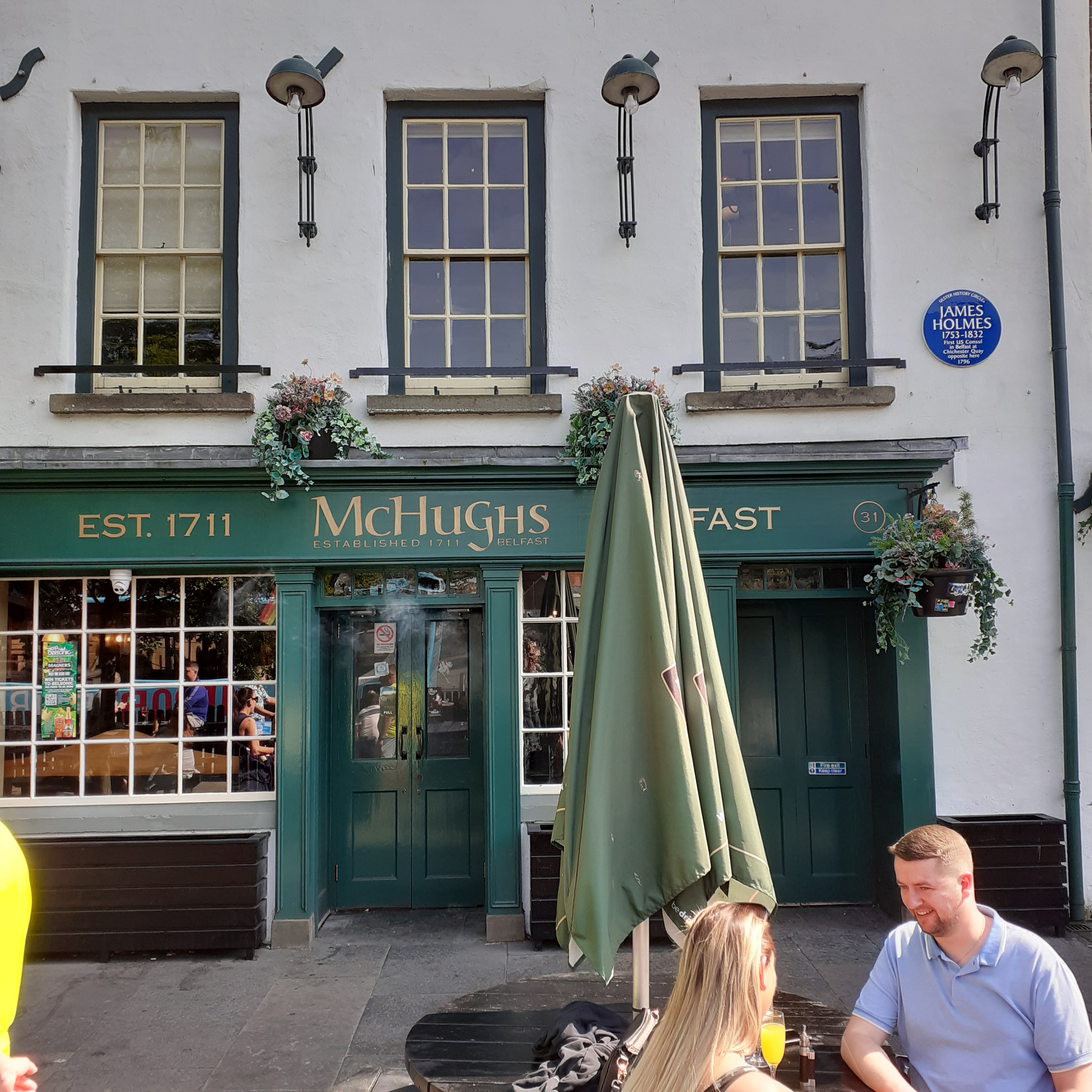
The Farset is the river that gave Belfast its name: the mouth of the Farset, Beal Feirste in Gaelic. The original settlement was here, and a small dockland grew up. This was covered over in the eighteenth century and is now Queen’s Square. The buildings on the south side of the square would once have faced the quayside of the old town dock. The oldest building in Belfast survives here, and houses McHugh’s Bar. It was built as a private residence in 1711 and by the following decade a public house was in operation. McHugh’s serves food and drink and there are lively evening music sessions. Its large outdoor terrace facing the square was perfect for a perfectly sunny day. Our own trio was augmented by a trio of friendly locals and we fell into the heaven of lively conversation and chilled beer in the afternoon sun.

The Albert Memorial Clock dominates the square. Built to honour the Queen’s Consort who died in 1861, it is Belfast’s very own leaning tower. Being built on land reclaimed from the River it leans four feet off the vertical and stands, if precariously, over a hundred feet tall. It was once a haunt of prostitutes. Perhaps it was a form of sympathetic magic, or just that they, like the tower, had the time and the inclination.
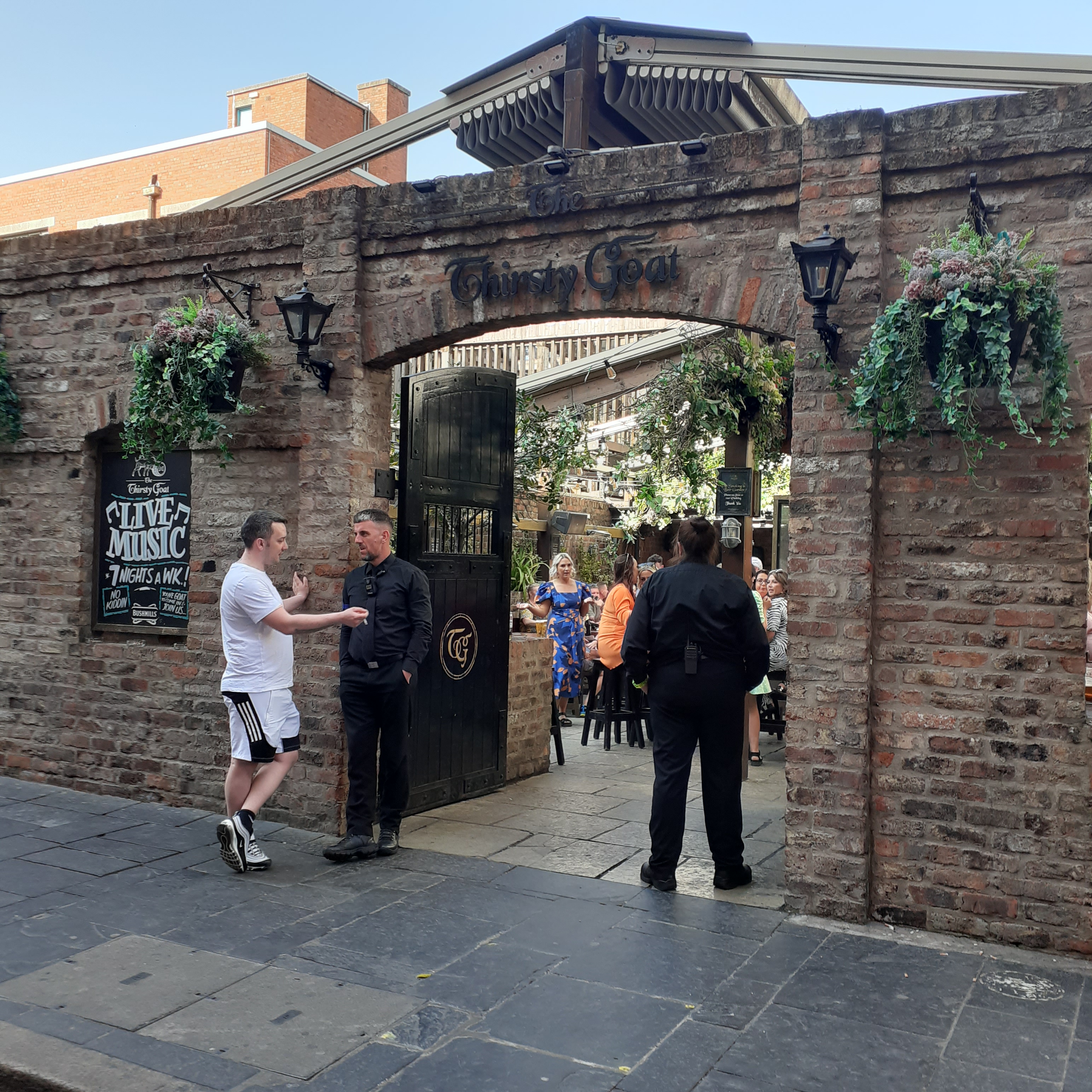
The area has moved upmarket in recent times. The Cathedral Quarter is named for St Anne’s Cathedral nearby. Once a warehouse zone this warren of cobblestone lanes is the go to area for city nightlife. Such colourful names as the Thirsty Goat, the Cloth Ear, the Chubby Cherub and Bunsen Burgers clamour for your drinking and dining pleasure. We wander for a time in the summer haze of evening through a long narrow laneway beneath neon umbrellas with a caption saying there’s only seven types of rain in Belfast, all seven days a week. But not this weekend.
 xxharrison