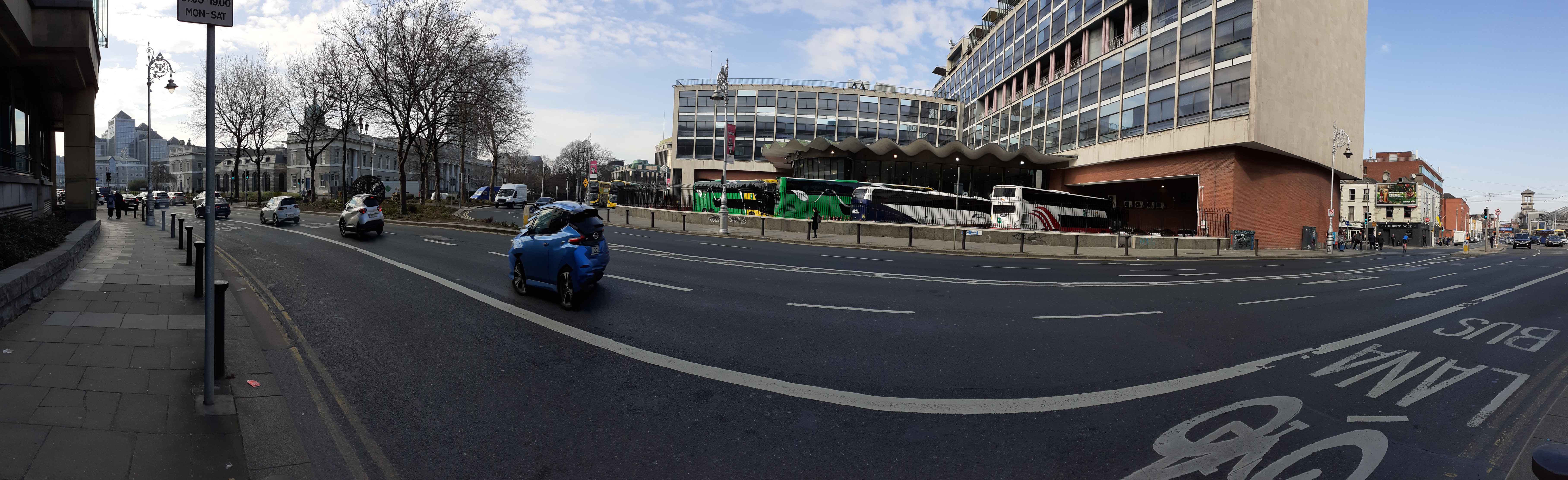
Good Day in Blackrock

Blackrock has been, since Early Modern times, the first settlement you hit south of Dublin city. It perches above the rocky shore along the rocky road to Dublin. Whack fol dol de day. From where we pass Blackrock College the town begins to emerge. The main road, which for long wound through the old village, was rerouted along the western fork at Blackrock Shopping Centre in the 1980s. This new route, Frescati Road, takes traffic towards Dun Laoghaire and the N11. Veer left and downhill for the town centre.

In olden days, the entrance to Blackrock was presided over by Frescati House. This was a grand Georgian mansion built in 1739 as Dublin’s upper classes sought property outside the teeming city. The FitzGeralds, Ireland’s largest landowners, acquired it as their summer residence from Leinster House and Carton House, Kildare. It became the home of Lord Edward Fitzgerald, a leader of the 1798 rebellion.

Lord Edward had been a veteran of the American War of Independence (fighting for the British), but later took inspiration from the French Revolution and lived in France in 1792, where he repudiated his own title and was dismissed from the army. Returning to Ireland, Fitzgerald hosted meetings of the United Irishmen at Frescati, entertaining the likes of Tom Paine, writer of the Rights of Man, and Lord Cloncurry, a neighbouring landowner. However, the movement was riddled with spies and FitzGerald was betrayed by Thomas Reynolds and forced into hiding. On the eve of the planned uprising he was captured after a gunfight on Thomas Street. FitzGerald killed an arresting officer but sustained gunshot wounds and was taken. He died from his wounds in Newgate Prison in Smithfield in 1798 at the age of thirty four.

In the late sixties, the glare of development fell upon Frescati. The unremarkable exterior may have harmed its case for preservation, still, preservationists fought a thirteen year campaign before the house was demolished to make way for Roche’s Stores shopping centre in 1983.

The town itself was first noted in the late fifteenth century and was named, prosaically, Newtown. By 1610 Newtown became Blackrock. The black rock in question is limestone calp, which appears black in the rain. With the well-to-do colonising the coast in increasing numbers. Blackrock was booming by the eighteen thirties and provided a ready customer basis for the new Dublin Kingstown railway line. The construction of the railway causeway created something of a swamp north of the town, all the way up past Booterstown. In the 1870s the town commissioners tamed the part adjacent to Blackrock and turned it into a park.

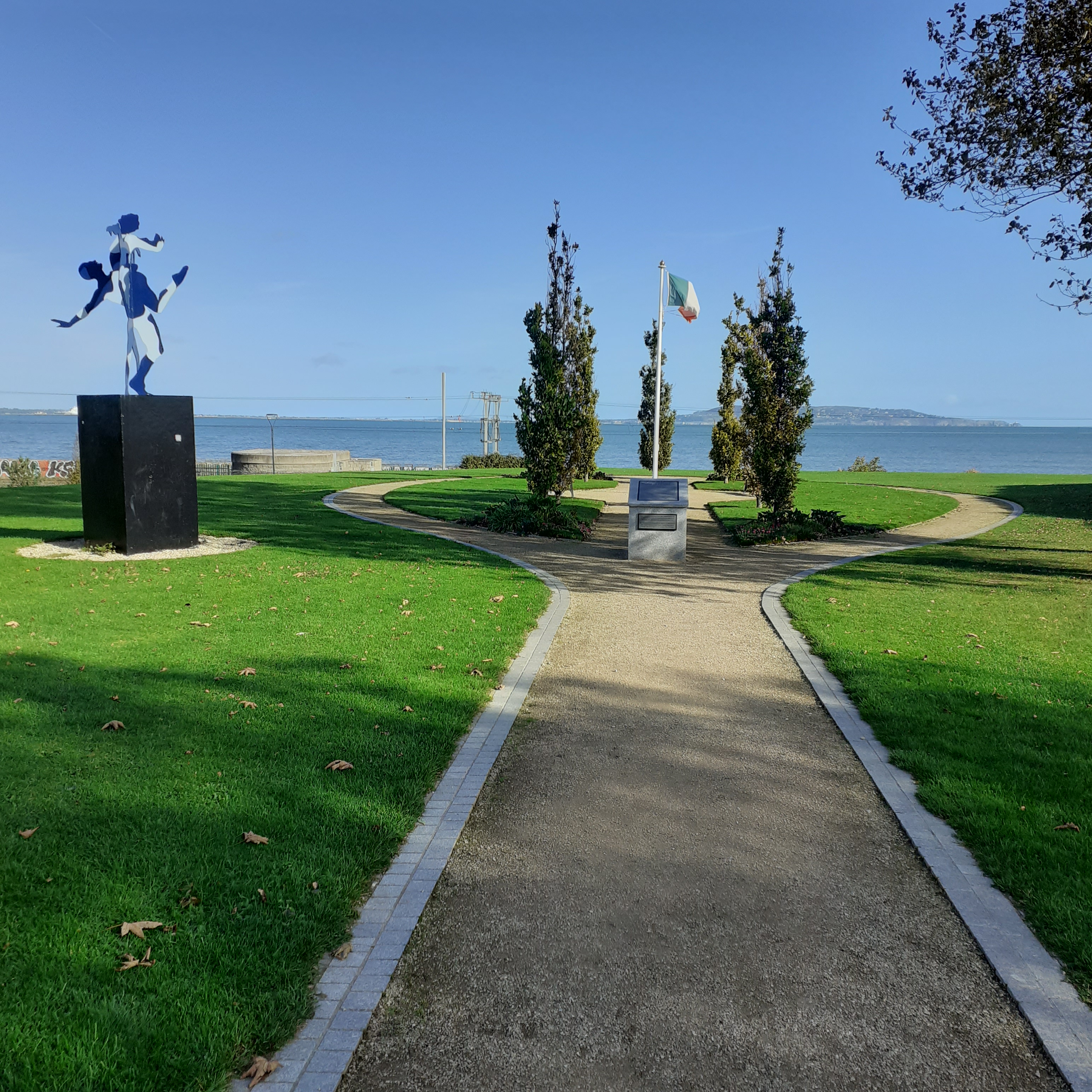
Blackrock Park provides a scenic route into town and connects to the linear coastal park by way of Williamstown Martello Tower. The Rock Road entrance takes us across a rising green lawn which culminates in a twin pillar entrance against the eastern sky. To the left of this is a monument to Irish nationalism. The commemorative garden was opened in 2016 on the centenary of the 1916 Rising. The coastal views from here are splendid. Meanwhile, to our right, entrance through the twin piers takes us into the Park proper.

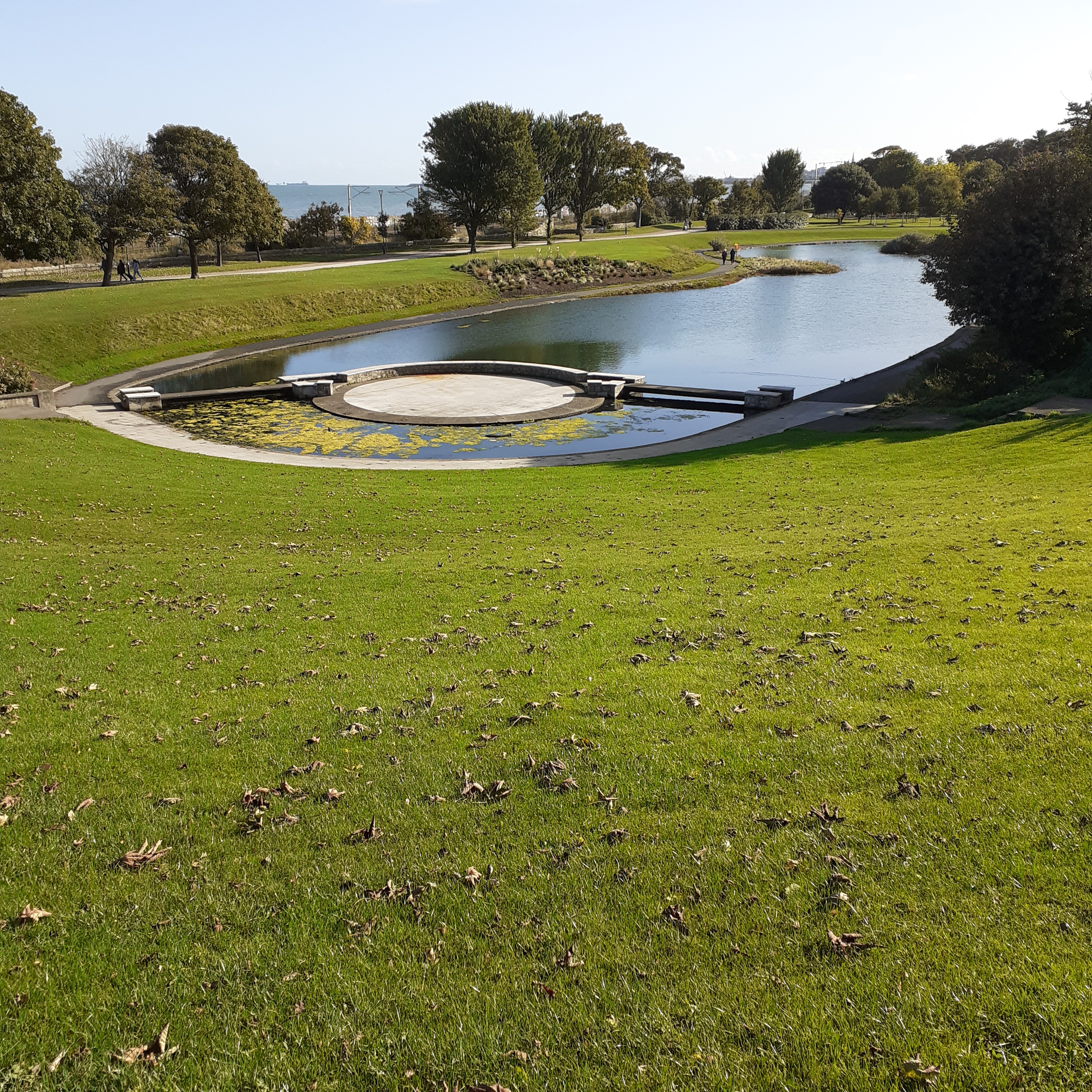
The ground plunges down to an attractive pond. This forms a naturalesque amphitheatre with the sloping green sward rising above the placid water. A small circular island provides an open bandstand. Time was, my friends and I would make our way here of a weekend, where we basked in those golden days with Thin Lizzy, Mellow Candle, Horslips, and, em, Chris De Burgh. That line up played here in August 1971.

What could beat a summer’s day, full of sunshine and flower power, and a vague scented mist settled over the hollow? Mellow Candle in one of their less mellow moments would launch into the manic vocalisation: toor a loor a loor a laddy, toor a loor a lay! Leading to the refrain:

I know the Dublin pavements will be boulders on my grave
I know the Dublin pavements will be boulders on my grave!

That number finished their album Swaddling Songs, released the following year, and brought their set to a close with audience and band taking a communal plunge into the pond. The waters are still and lily padded now with visual suggestions of Pre-Raphaelite paintings, mythology and rebirth. But if I hunker down here, I swear I can detect an echo of those soundwaves rippling the leaves and water like restless ghosts.

As a designated route linking Blackrock to Booterstown, the park is open all hours. There’s a children’s playground, designated cycle path, and an outdoor gym area. Heading around the pond, there’s a folly on the larger island to the south and here the terrain is softened and shaded by mature woodland. Farther on there’s a traditional bandstand. You can exit the park uphill at an entrance taking you to Main Street, or, as I did, through a narrow lane along the railway line, emerging at the Station.

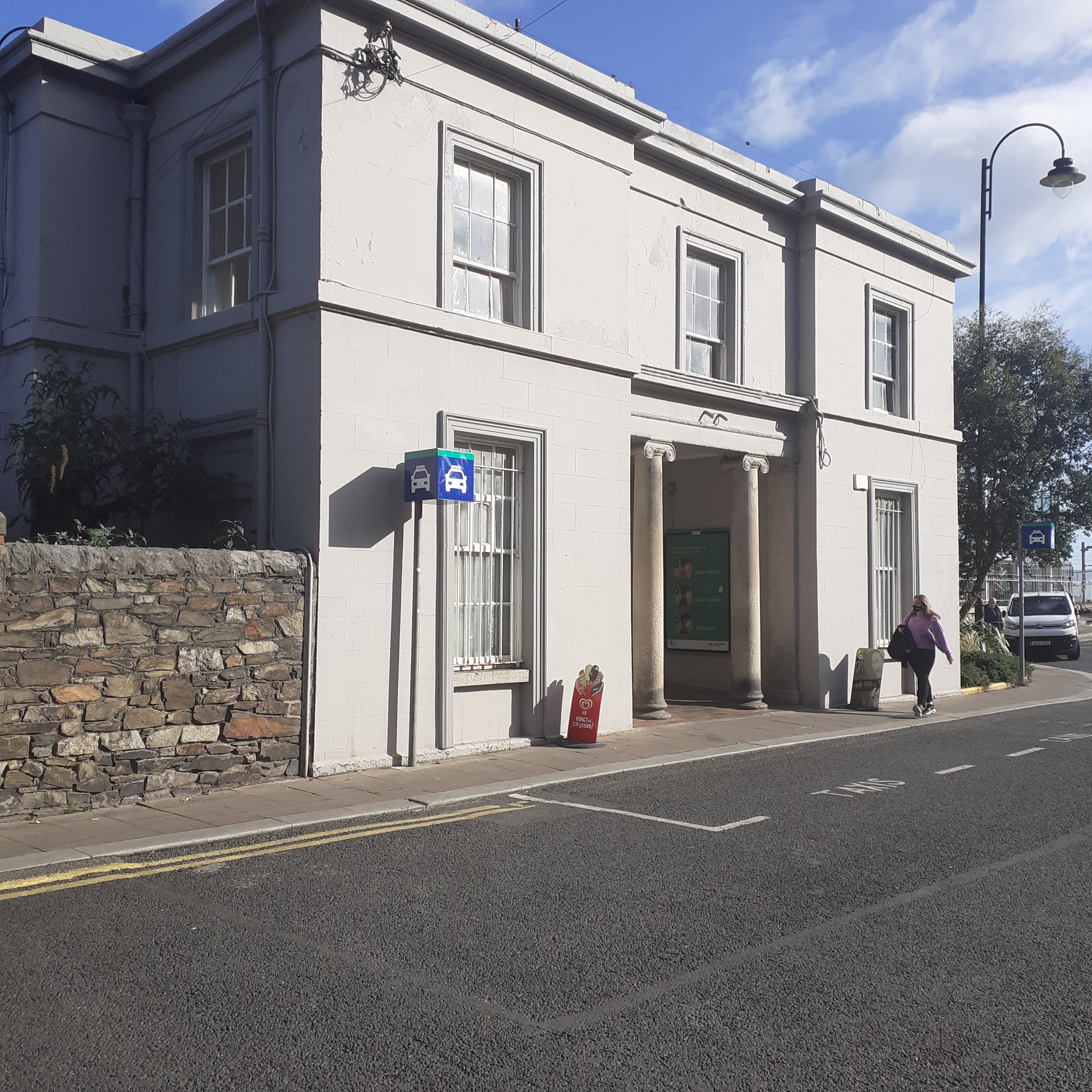
Blackrock Station is a grand two storey structure with a portico. The Railway Station opened for business in 1834, being the one stop on the original Dublin to Kingstown line, twixt Westland Row in the city and the terminus at Kingstown.

Seaward of the far platform stood the baths and swimming arena. Blackrock Baths were built by the Railway Company in 1839. Fifty years later they were enlarged, with designated bathing for men and women in separate pools. In 1928 they were used in the Tailteann Games, an Irish Olympics after Independence, with a fifty metre pool and a stand for a thousand spectators. Usage declined in the seventies, leading to closure in the eighties. Sadly, the Baths were demolished in 2013. You can still see their outline from the pedestrian bridge over the tracks to the south of the station.

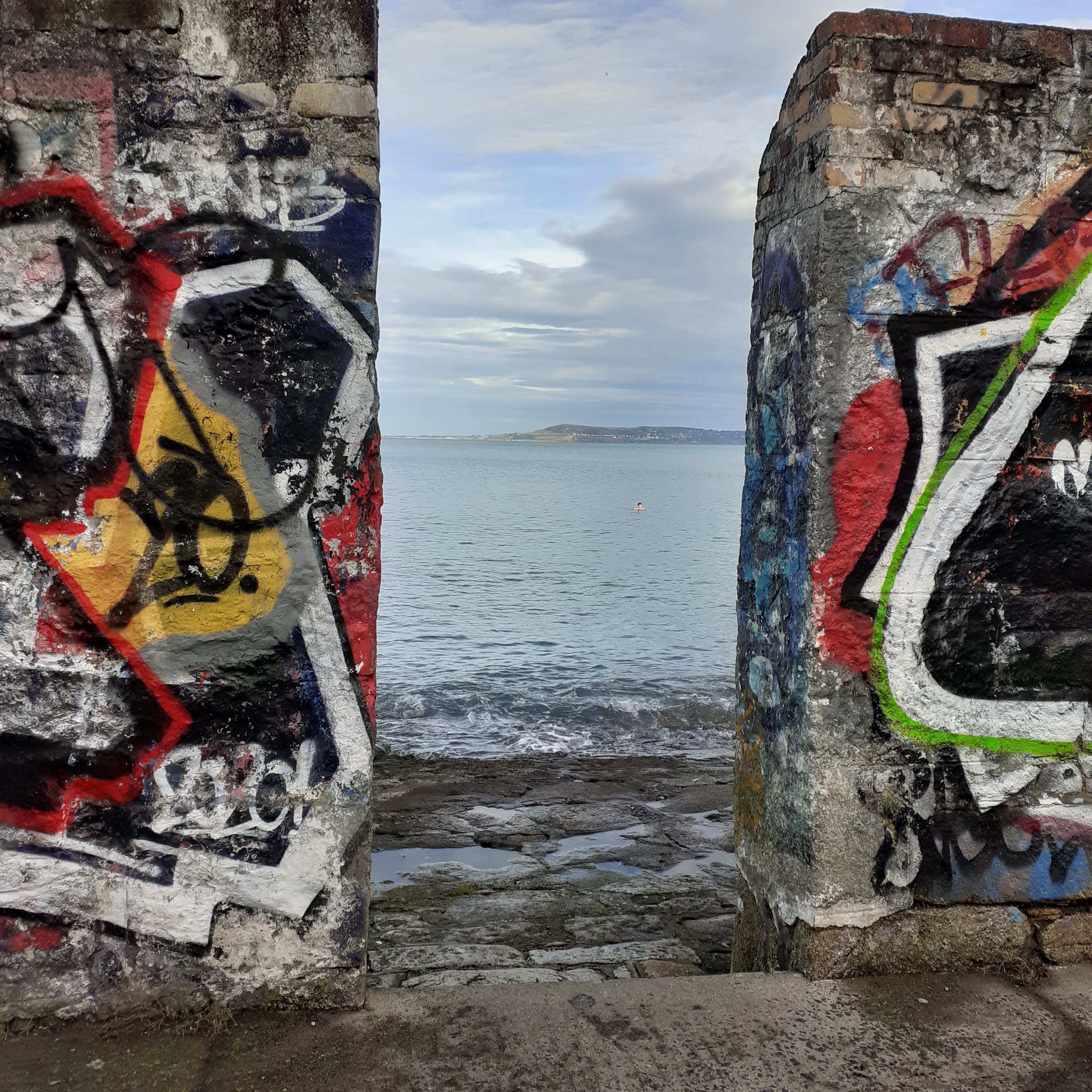
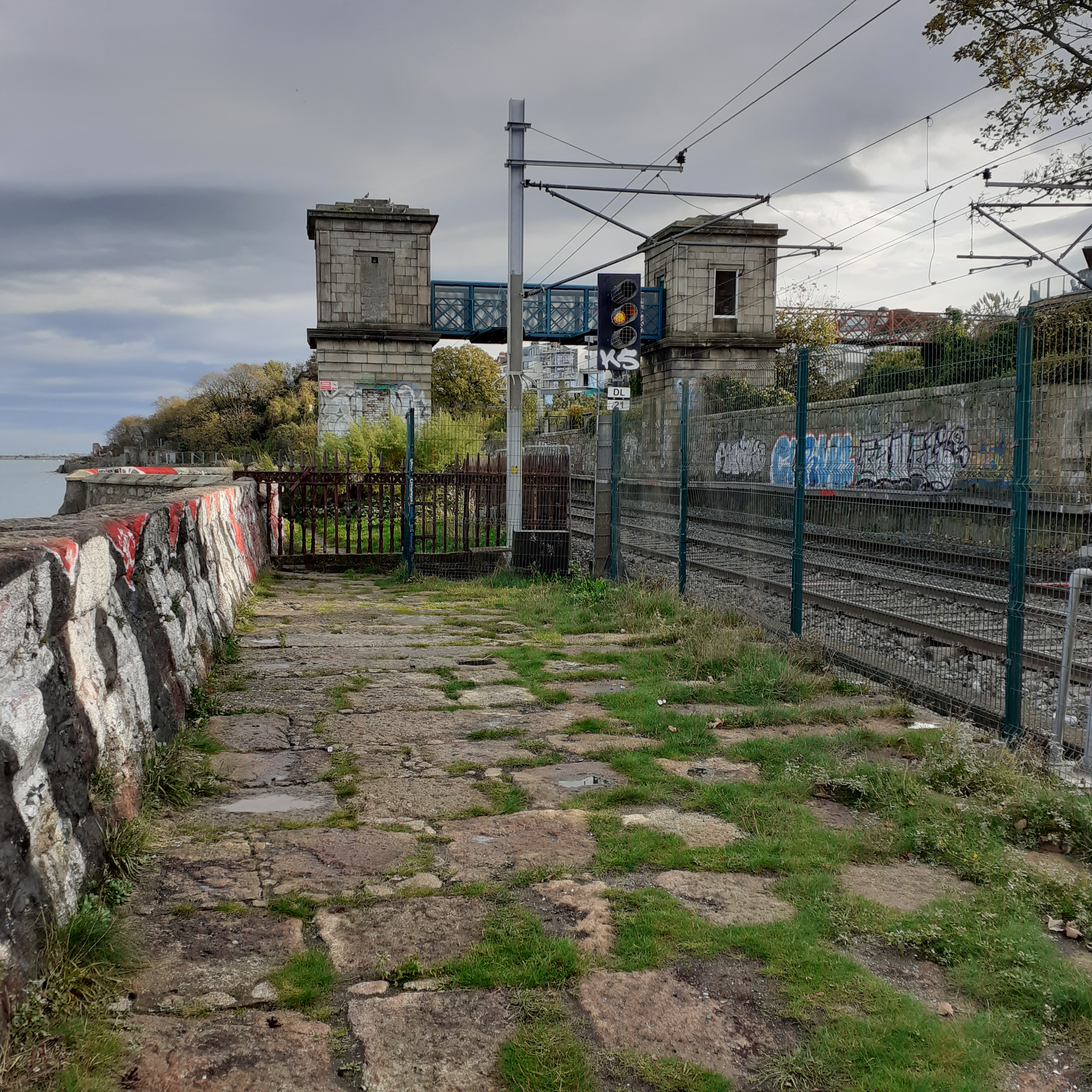
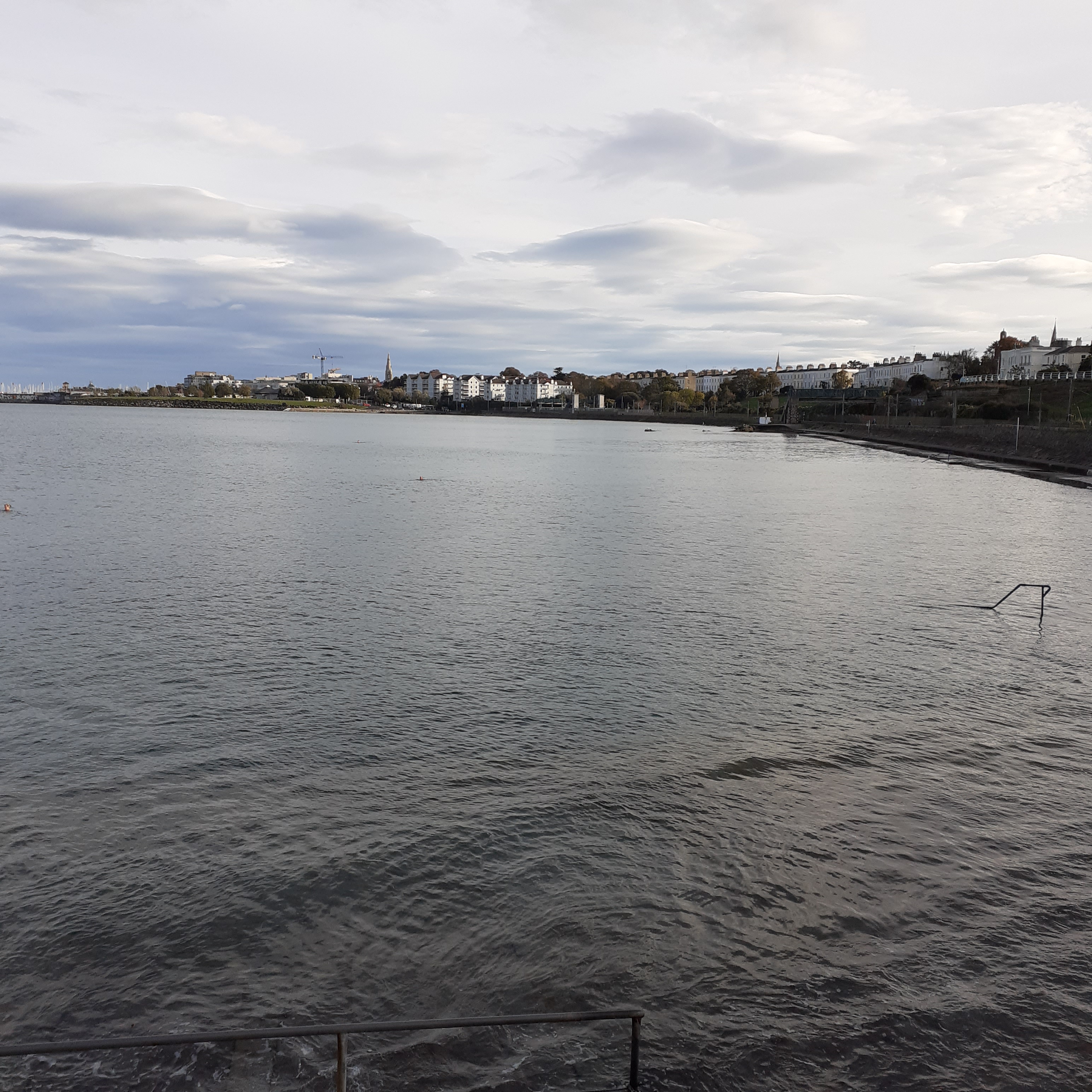
There’s still bathing along the coast from a narrow strip walled off from the railway. This culminates a hundred metres or so on at an imposing structure. The new railway crossed the private beach of Maretimo House, property of Valentine Lawless, Lord Cloncurry. By way of compensation, a grandiose bridge and private harbour were constructed. Up until recently, the harbour included a small shelter, rendered mythic by its classical portico, but this has been demolished. The bridge itself with its walkway strung between two elegant towers, has been allowed to fall into disrepair and access is fenced off. Lawless, appropriately named in his younger years, had fallen in with Lord Edward and was imprisoned for sedition in the Tower of London in 1798. He fled to Europe upon his release and settled for a time in Rome. Ultimately he reconciled himself with British authority in Ireland, becoming a Viceregal advisor and a magistrate.

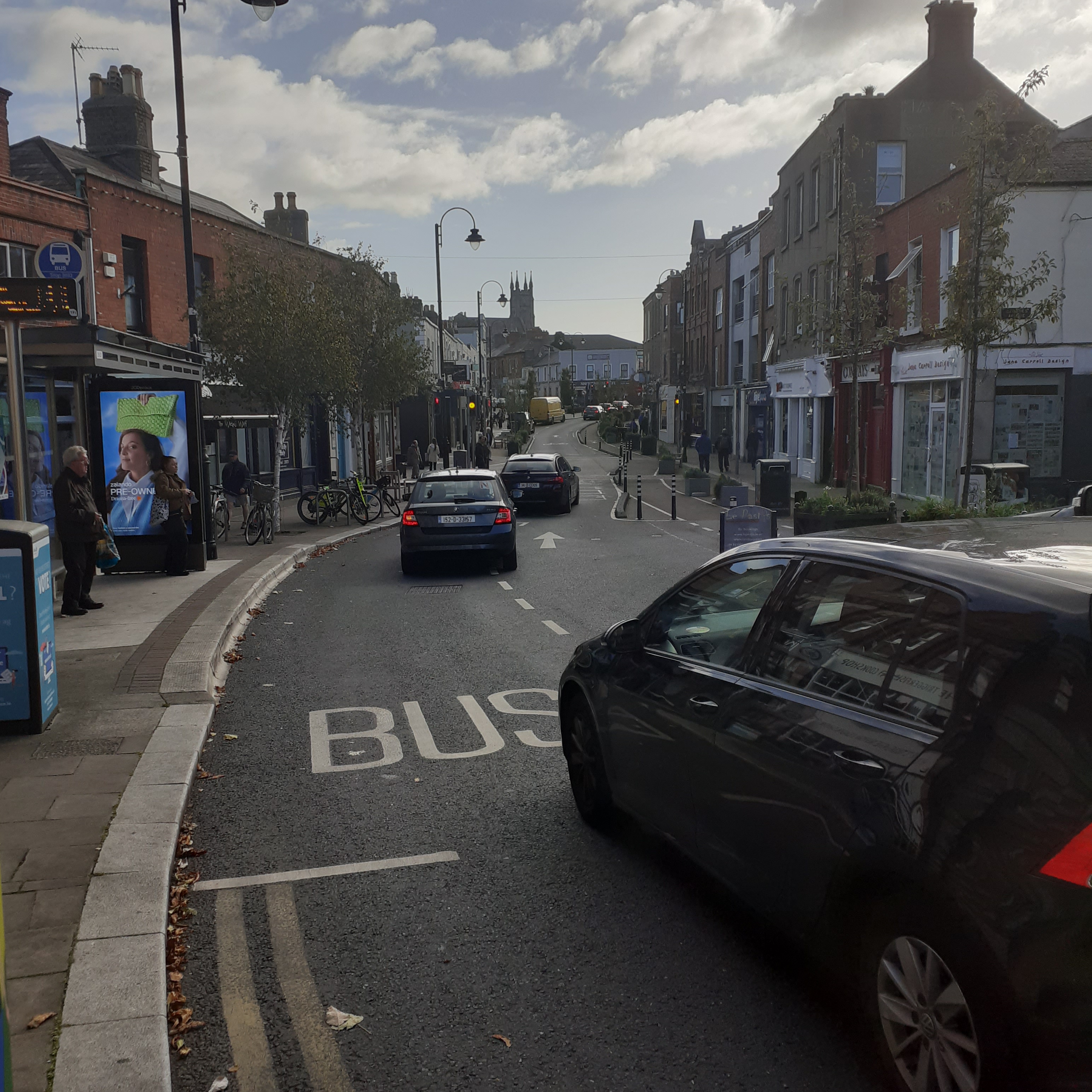
This is the end of the line for the coastal path, though it resumes shortly past Seapoint Dart Station. In between, we must return towards Blackrock station, overlooked by the elegant Idrone Terrace to our left, and climb up to Blackrock Main Street. Our route takes us through the village and along Newtown Avenue and Seapoint Avenue.

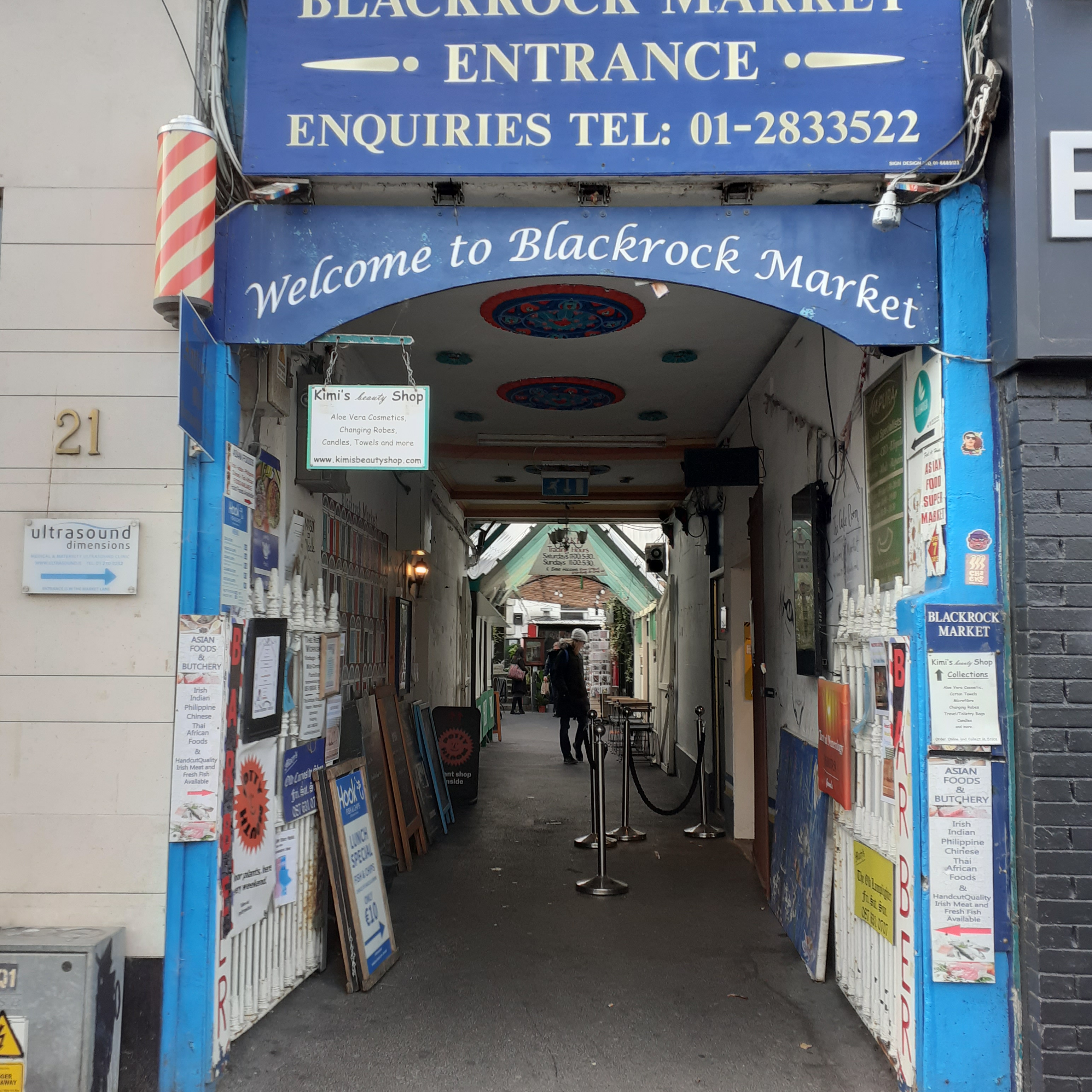
The main street is busy, with several coffee shops spilling onto the pavement. Blackrock Market is entered through an archway where it opens into a sizeable maze of stalls offering a cornucopia of fashion, furniture, arts and crafts, food and drink. While many such markets have been squeezed out of the marginal properties they occupy, Blackrock has clung on since its establishment in 1986.

I take a pint of Guinness at Jack O’Rourke’s, the brew being a malty response to the changing of the season. And very good it is too, savoured in a slice of sunlight that chanced upon the lane to the side of the boozer. Blackrock’s bars also include the Breffni, the Wicked Wolf, Flash Harry’s and the Ten Tun Tavern. There is little concession to the drift towards al fresco in the bar trade, though you can perch on the pavement outside the Ten Tun at the southern end of Main Street.

Near the top of the town, there’s a 9th century cross. This was probably a burial marker to begin with, becoming a property marker and then from the eighteenth century the focus of a tradition marking the boundary of Dublin City. Every three years, the Mayor of Dublin and his Sheriffs would journey here formally acknowledging the cross as the southern limits of the jurisdiction of Dublin Corporation.

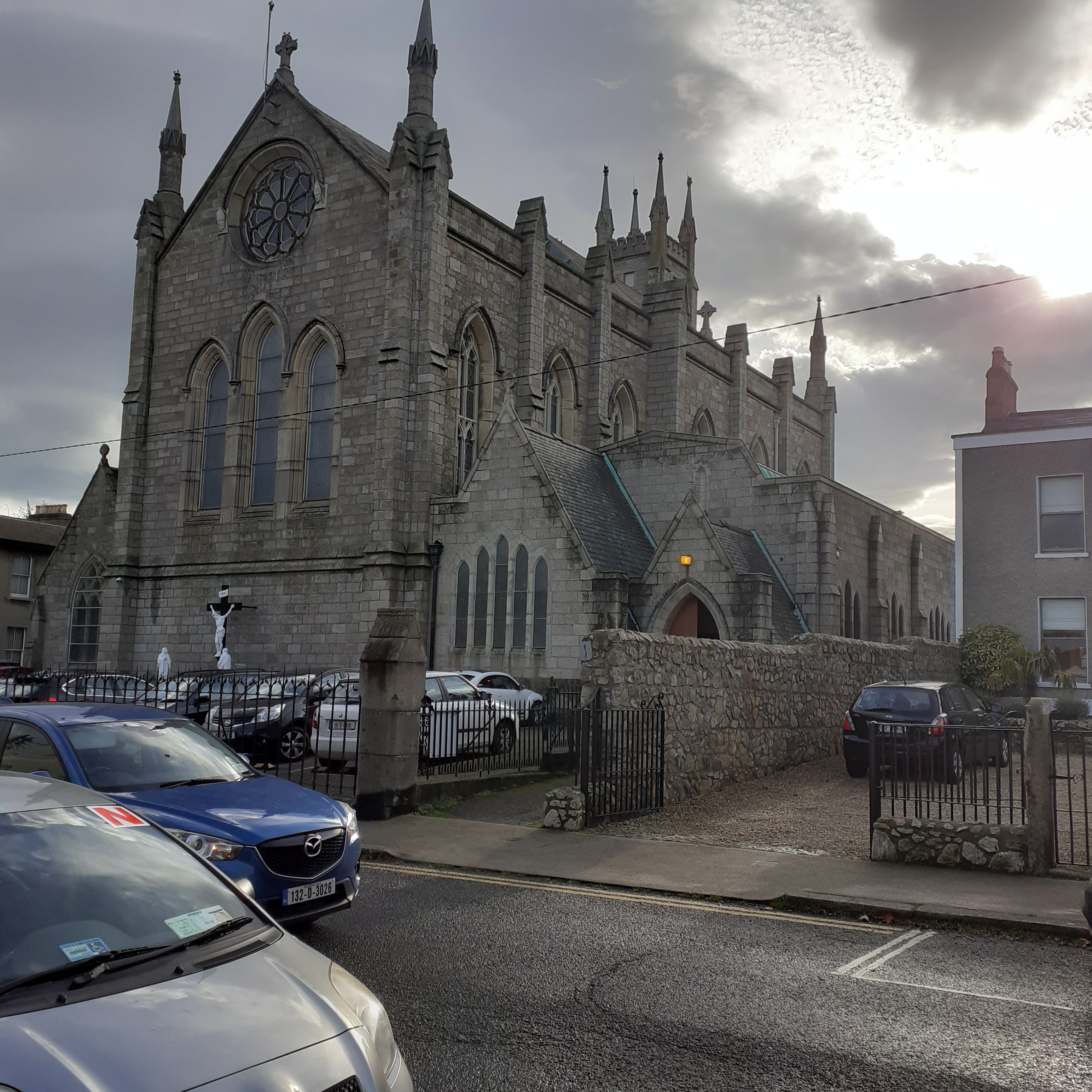
Main Street divides into Temple Road and Newtown Avenue. Along Temple Road, the right hand fork, we come across Blackrock Dolmen. This sculpture by Rowan Gillespie is evocative of ancient days and teeters near the entrance to the Church of Saint John the Baptist. The church was built in 1845 on land donated by Valentine Lawless and designed by Patrick Byrne, an early example of Gothic Revival, inspired by Augustus Pugin. The interior holds stained glass windows by Ireland’s two masters of the form, Harry Clarke and Evie Hone.

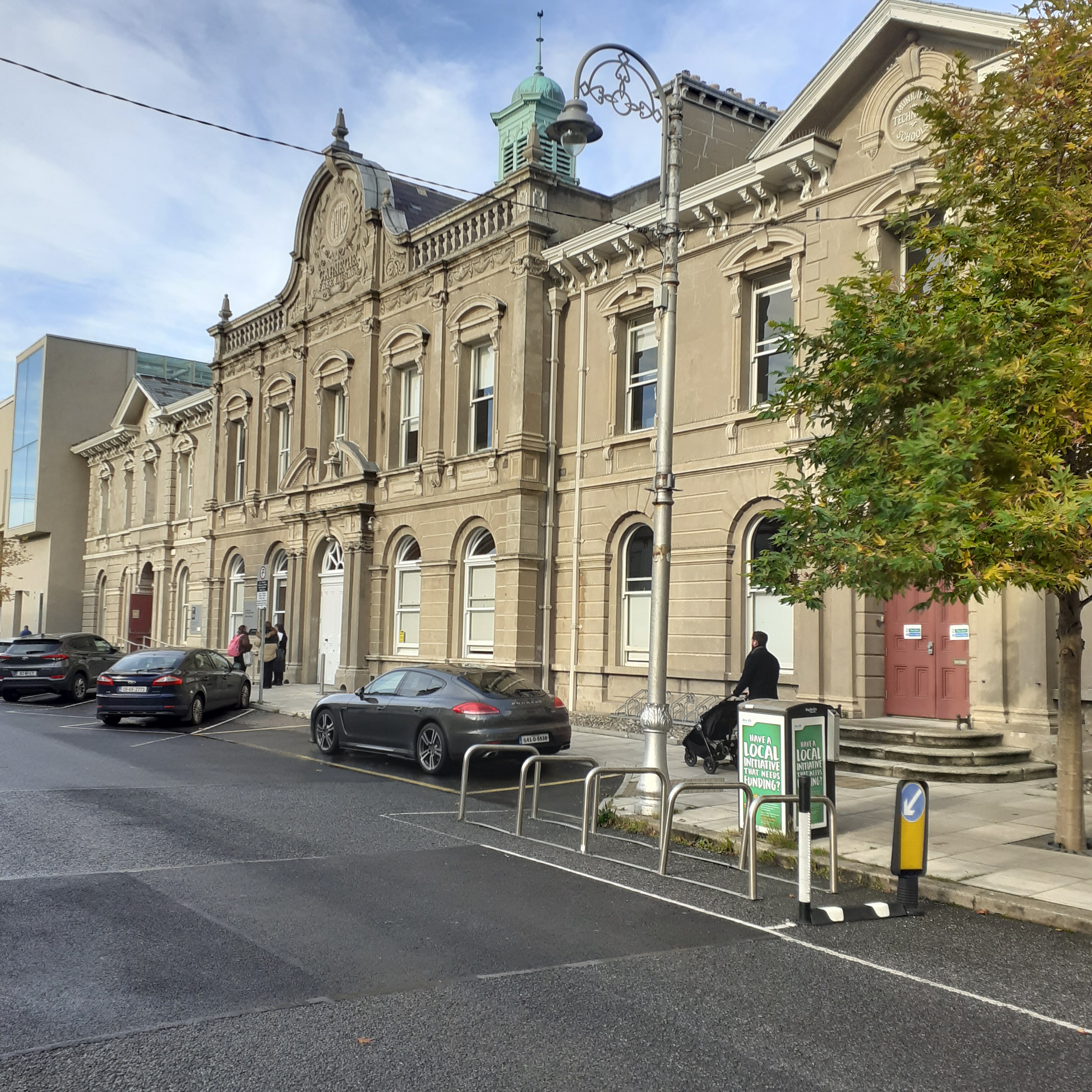
The left fork is Newtown Avenue, which keeps us to our coastal route. The Town Hall was completed in 1865 with the formation of the Town Commission a few years earlier. Next to the Town Hall, and forming a unified three piece, the Carnegie Library and Technical Institute were built in 1905.

Newtown Avenue leads to a sharp dogleg right, to avoid running into the front porch of Newtown House. Blackrock House from 1774 is adjacent, distinguished by its two storey brick porch. The next sharp left takes us down Seapoint Avenue. There’s a narrow laneway leading to Seapoint station. This opened in 1860 when it was called Monkstown and Seapoint. To access the coast, take the next laneway on the left which leads down to Brighton Vale, a pleasant row of bungalows nestled on the shore. A few yards further on is Seapoint Martello Tower, overlooking the popular bathing place. From here the walkway curves along the lower lip of Dublin Bay to its end.

The next station is called Monkstown and Salthill. Salthill Station dates from 1837, closed in 1960, but was reopened with the electrified Dart service in 1984. This was the site of the original terminus before it moved farther east to the current location of Dun Laoghaire station in 1837. On reaching the West Pier, we begin retracing the steps we trod on South Dublin’s Rocky Shore. So, it is possible, and very enjoyable, to walk from the Liffey estuary, all the way down to beautiful Bray, County Wicklow. From Raytown to Bray town; and beyond.

Granada After the Rain

It’s on my mind, these days, to walk again in Europe after the rain. There are places to go and others to revisit. Granada in Andalusia, in southeastern Spain, is one that is calling me back. When I go back to Granada I will have a night in the white city of Sacromonte and listen to the strumming of Flamenco guitars. Last time I was there, it was a silver springtime, the Sierra Madre spiked with snow. It was cold, very beautiful, but not very conducive to flamenco nights. I explored the Alhambra and roamed through the various sectors of the city of Granada, high and low. There were even times where I could bask in the midday sun, with a drink and, as is the custom, a tapas; free, gratis and for nothing. The scattered sunshine was well seasoned with showers. Afterwards, the city gleamed anew.

Here comes the rain again
Falling on my head like a memory
Falling on my head like a new emotion

Annie Lennox and Dave Stewart, of Scottish band Eurythmics, wrote this song in 1983 as rain swept over Manhatten. It captures the melancholy and optimism that crackle in a rainy street. I might be singing, softly, in the rain.

I want to walk in the open wind
I want to talk like lovers do
I want to dive into your ocean
Is it raining with you

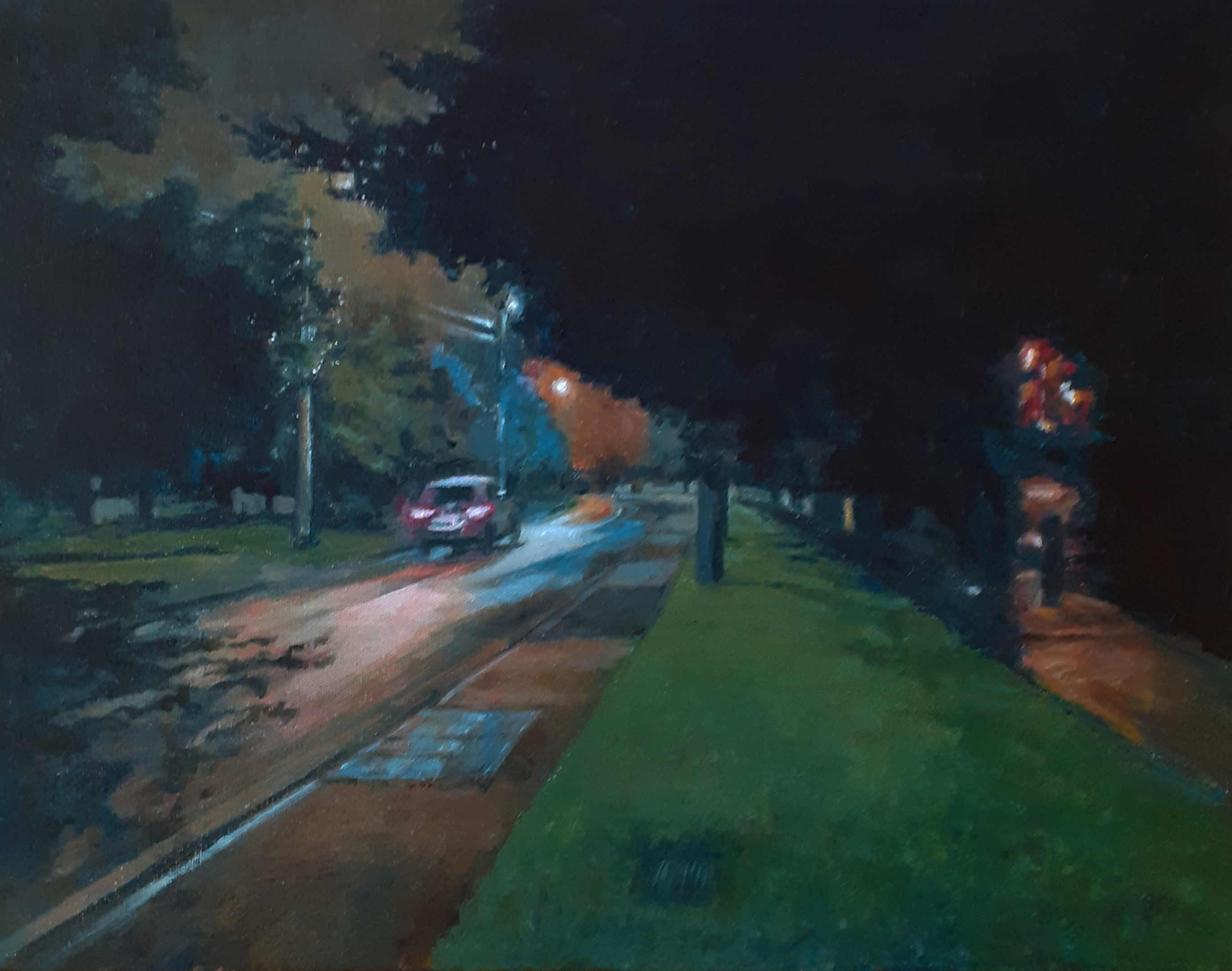
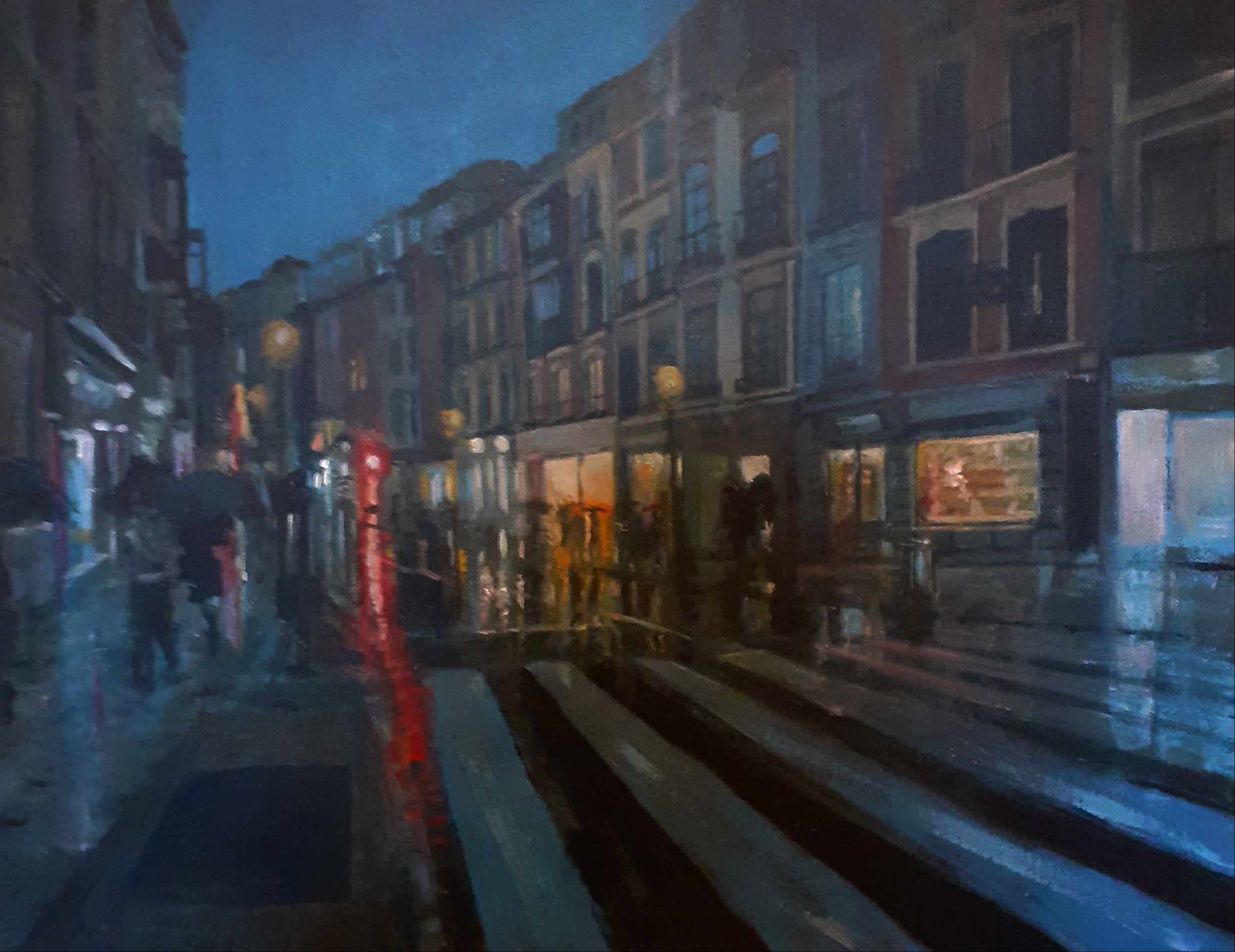
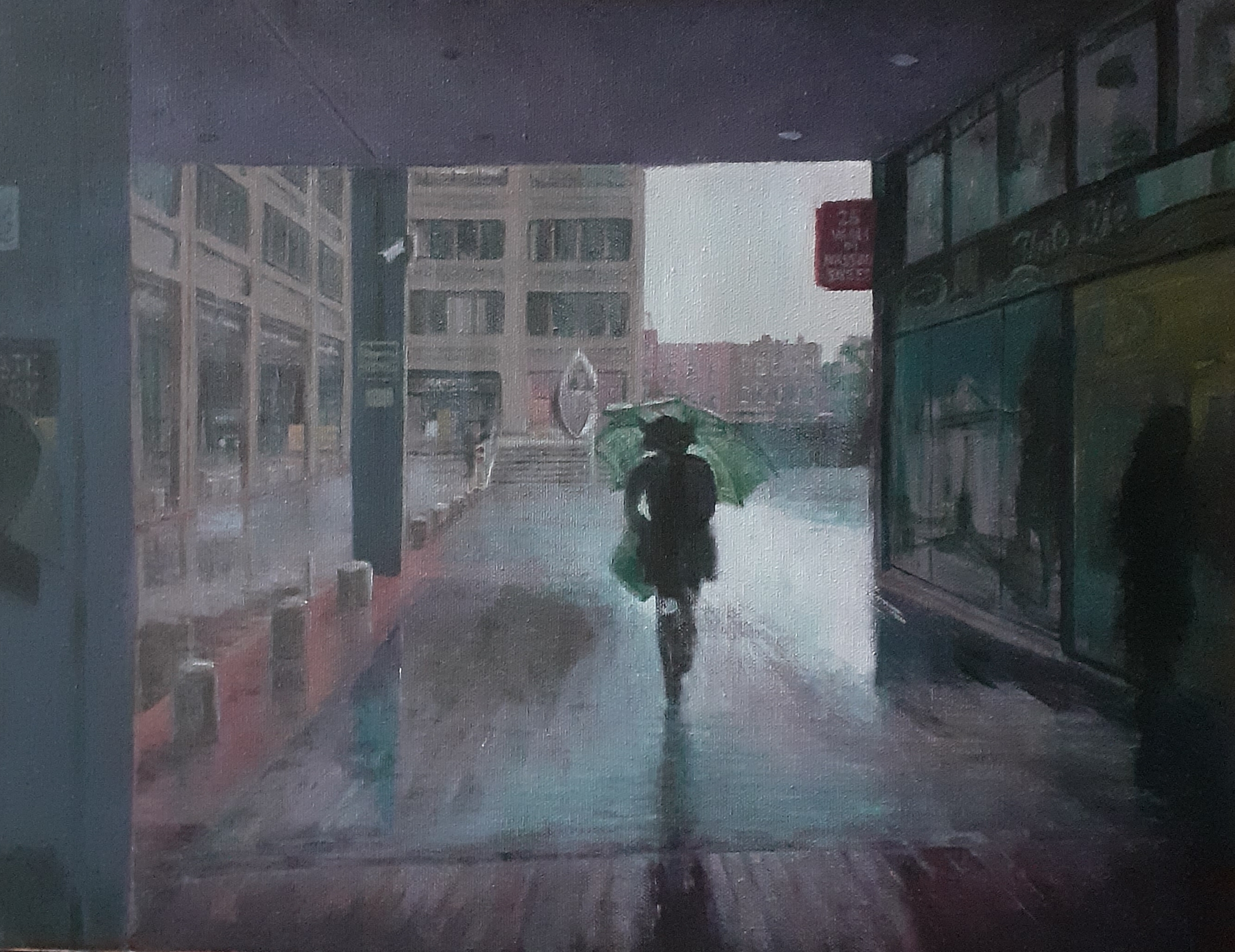
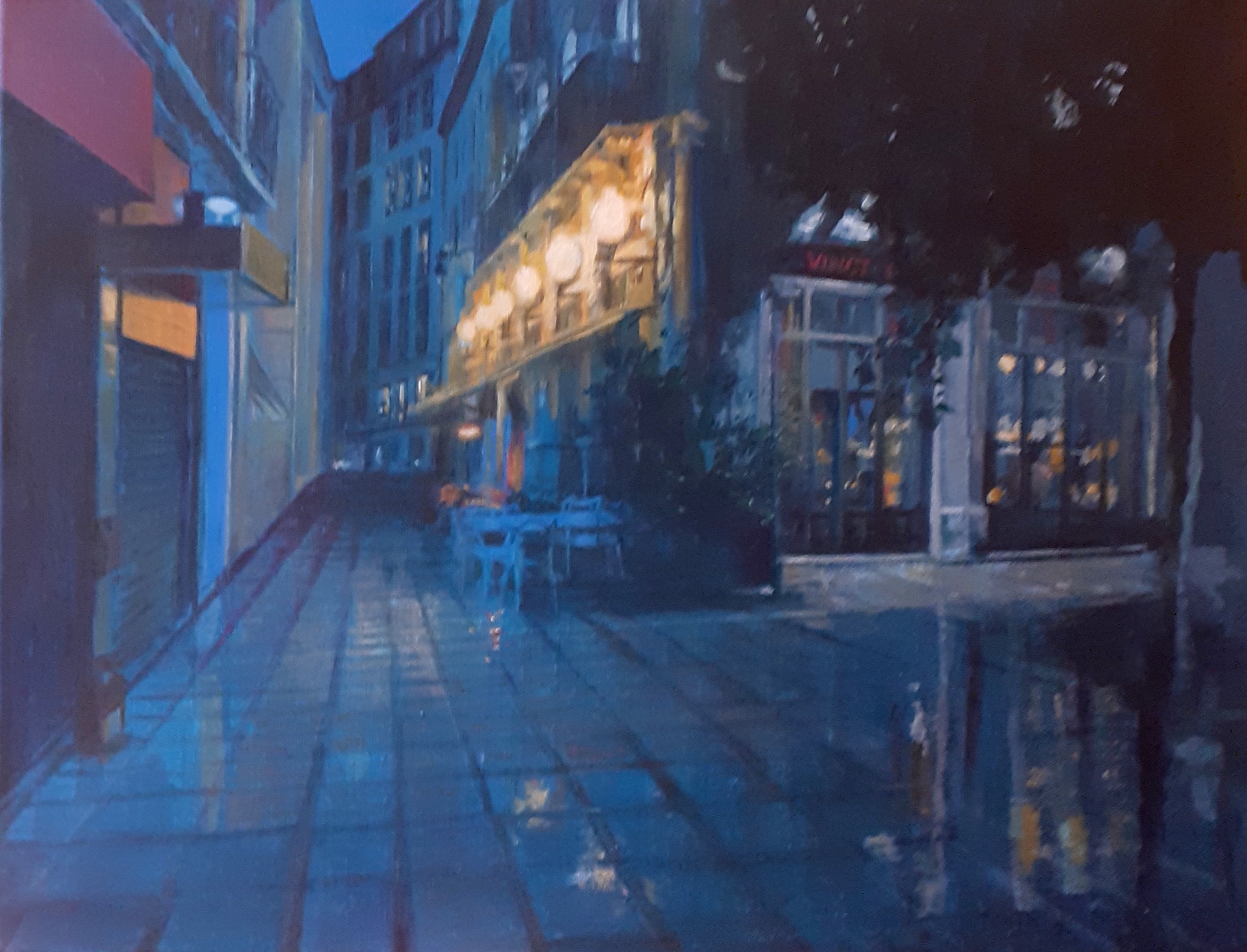
In this painting, I am crossing a small city square after a nighttime stroll, and a few stops to shelter for refreshment. The hour has grown late and I am making my way back to my hotel. I know the way ahead through the backstreets. There are places I might stop, such as Hannigan’s Irish Bar, or save for another day.

You might notice a nod here to Vincent Van Gogh’s Cafe Terrace at Night. I have it at home in a set of tablemats. Not the original. This is more lonely, the streets washed clean by the rain. But I sometimes think that the reflections beneath my feet, on nights such as these, are persistent echoes of the city tunneling back through time. Who knows, maybe I will get a more Mediterranean night to sink into this city, if ever I go back again.

The official anthem of Granada will be ninety years old next year. It was actually written by Mexican composer Agustin Lara. Jose Carreras fair belts it out in the original Spanish. There are English versions by Frank Sinatra, Frankie Laine and Catarina Valente.

When the day is done and the sun starts to set in Granada
I envy the blush of the snow clad Sierra Nevada
For soon it will welcome the stars
While a thousand guitars play a soft Habanera

Dublin’s Rocky Road

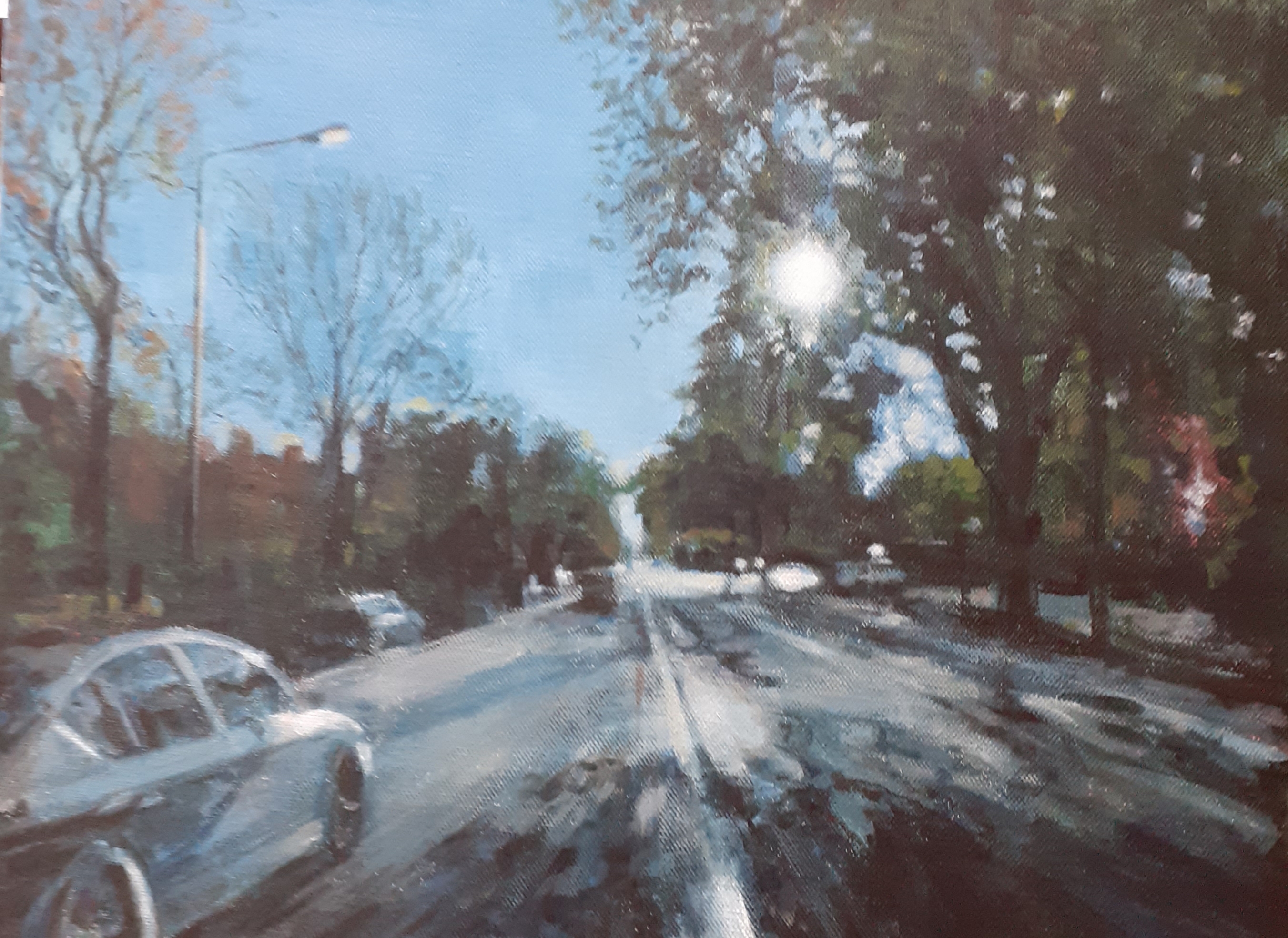
From Sydney Parade, Aylesbury Road heads west through the posher parts of Dublin 4. On a sunny autumn day the tree lined avenues are a slice of heaven. Veering left we’re on the Merrion Road with the Merrion Centre on the far side. The walk to Blackrock keeps to the coast for three and a half a kilometres, a forty minute walk, or four minutes if you take the Dart.

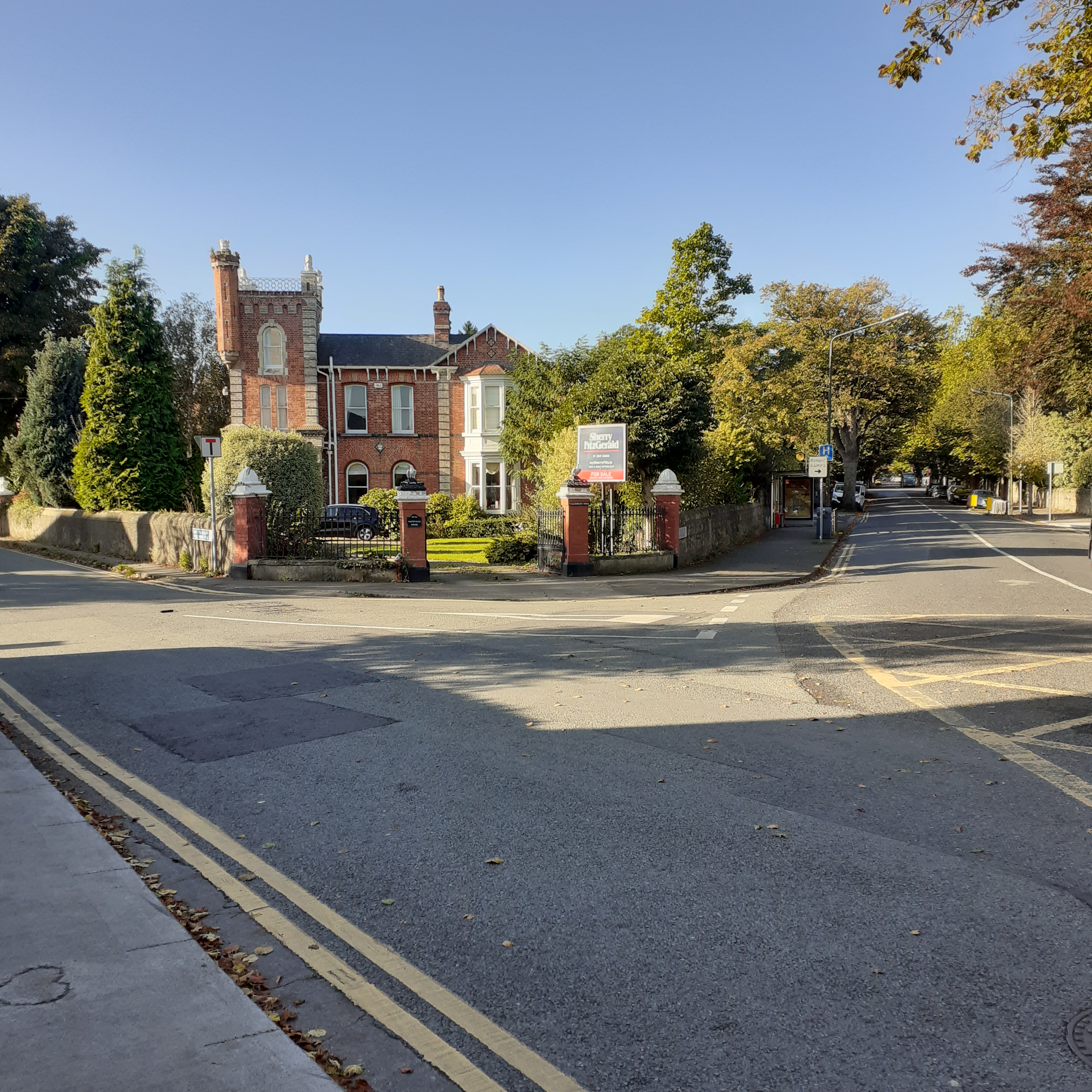
St Vincent’s University Hospital occupies a large campus at the junction of Merrion and Nutley. Mother Mary Aikenhead, founder of the Sisters of Charity in 1815, set up the original hospital at the Earl of Meath’s town house on Saint Stephen’s Green in 1834. It moved to its current site in 1970, and became associated with UCD who had moved to Belfield, just up the road, in the previous decade. It is a training centre for nurses, doctors, physiotherapists and radiographers. Ownership transferred from the Sisters to the State in 2020. Further on, Caritas Convalescent home was also established by the Sisters of Charity. It occupies four landscaped acres and the main convent building was refurbished at turn of the century.However, it has fallen victim to the Covid Pandemic and a liquidator was appointed last year, 2020.

Our Lady Queen of Peace church lies this side of the road. Its free standing spire is in the style of a Celtic round tower. Inside there is a magnificent rose window. The church was opened and blessed by Archbishop John McQuaid in 1953.

At the Merrion Gates we are poised on the cusp between city and suburb. Coast, railway and the hectic thoroughfare of the Rock Road converge. The landward side is well peppered with modern developments. To our left is mostly parkland and marsh with the Dartline along a narrow causeway and Dublin Bay beyond.

Booterstown is appropriately named. The Irish, Baile an Bhothair simply means the town of the road. Booterstown is said to be part of the ancient highway system of Gaelic Ireland. The routes connected Tara, seat of the High King, with the various kingdoms. Sli Chualann, connecting with Cuala, in south Dublin and north wicklow, is said, by some, to have passed by here. In later times it was a notorious spot for highwaymen. These days it is humming with traffic. The Rock Road practically rocks with the volume of it. Where are they all going? Where are they all coming from? The surge of metal and migrant is so constant, so everlasting that the beat becomes a bodhran, You could practically sing to it.

In Dublin next arrived, I thought it such a pity
To be soon deprived a view of that fine city
Well then I took a stroll, all among the quality
Bundle it was stole, all in a neat locality
One two three four five
Hunt the Hare and turn her down the rocky road
And all the way to Dublin, Whack fol lol le rah!

The Rocky Road to Dublin was written by Irish poet D.K. Gavan in the nineteenth century and popularised by English music hall performer, Harry Clifton. The story is about a Galway man who seeks his fortune setting off on the road to Dublin, bound for Liverpool. It was re-energised during the ballad boom of the sixties, particularly with performances by the Dubliners and Luke Kelly solo. It has, the details of its theme notwithstanding, transformed into something of a theme for Dublin Jacks. And for emphasis, Dublin has three syllables.

Something crossed me mind, when I looked behind
No bundle could I find upon me stick a wobblin’
Enquiring for the rogue, said me Connaught brogue
Wasn’t much in vogue on the rocky road to Dublin
Whack fol dol de day!

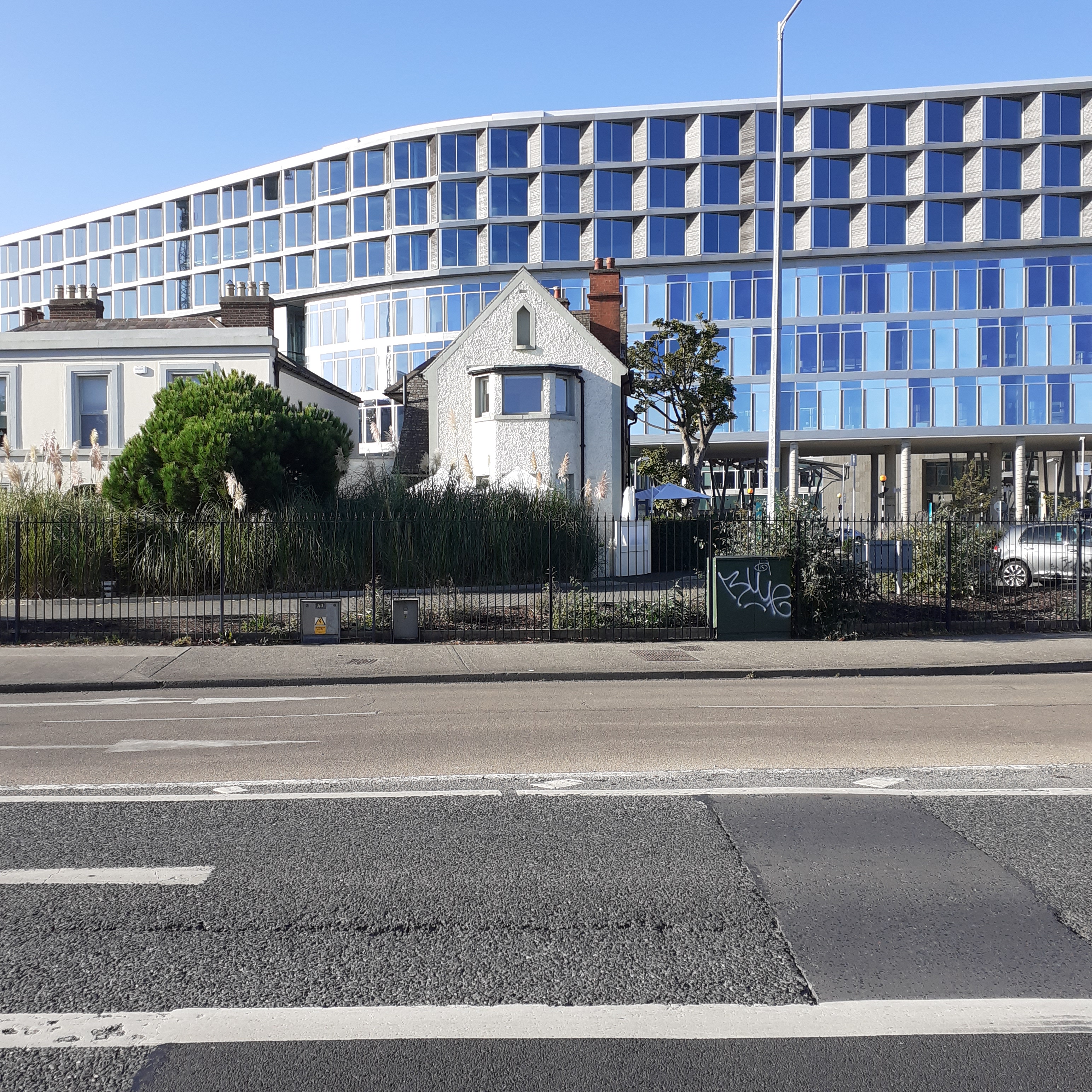
The ghost of identity with the ancient Sli Chualain might have inspired the naming of The Tara Towers Hotel. Considered a modern highrise (no, really), it cast its seven storey shadow over the coast until 2019, when it joined the rubble club. When I tied the knot with M in 83, we considered the Tara for our honeymoon night, but thought better of it, choosing the Montrose at Belfield instead. A new hotel, the Maldron, is under construction. With 4 stars, 140 rooms and 60 apartments, it will rise to a dizzying eight storeys. The Seamark Building next door also tops out at eight storeys. Like a long and shiny snake, it masks out the vista to the north west.

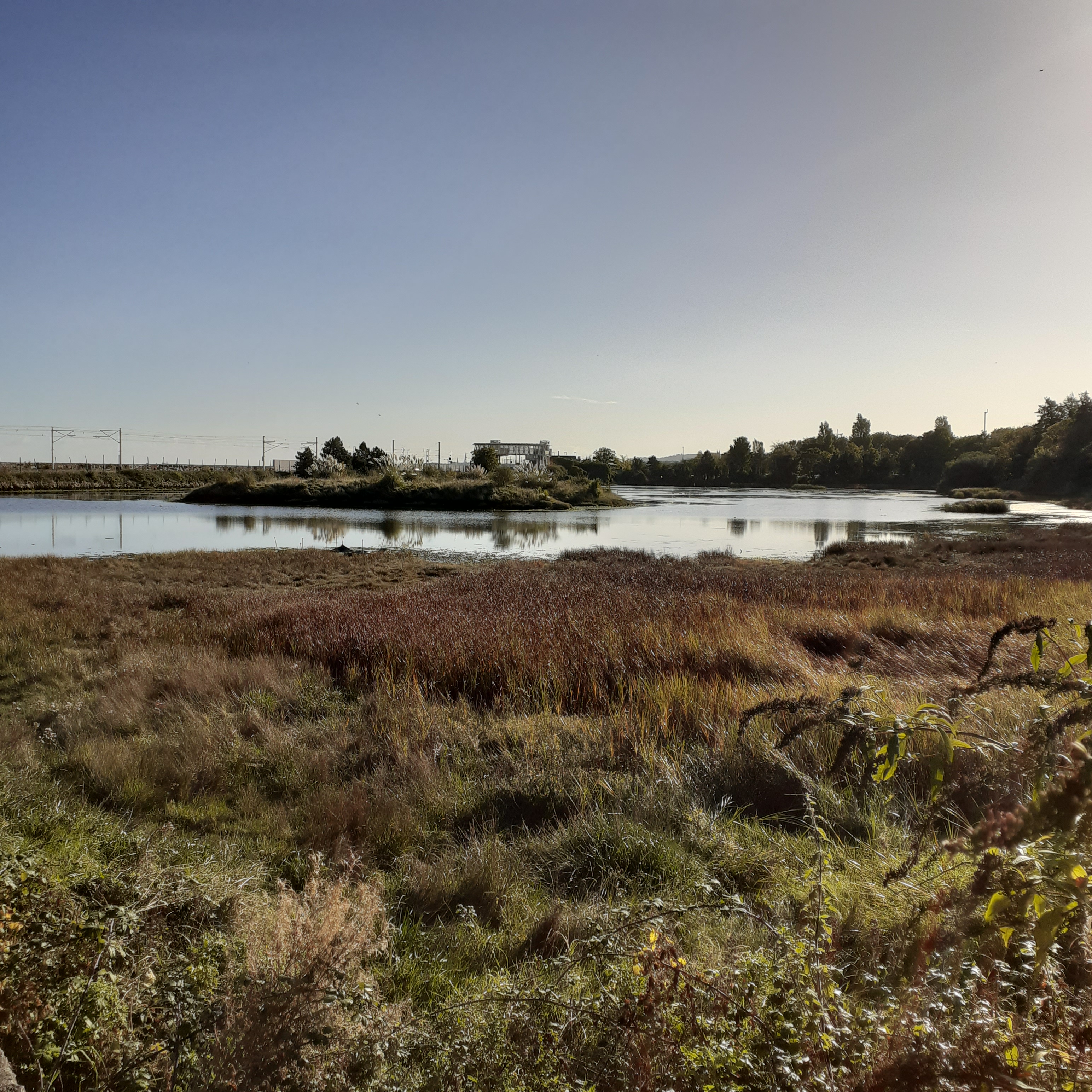
Booterstown Marsh emerges on our left. Defined by the building of the railway in the nineteenth century, the southern end was landscaped into Blackrock Park in 1870. Here at the northern end it remains a brackish marshland. An Taisce maintains the area as Booterstown Nature Reserve, particularly as a sanctuary for birds. While the Rock Road is the human highway, the Reserve is likened to an international airport for avian visitors. Brent Geese migrate in winter from the Canadian Arctic via Greenland while Swallows come all the way from Africa to summer here.There are Grey Herons, Kingfishers, Oyster Catchers, Coots, Mallard, Gulls and more. A small green area with benches allows you to admire this wild enclave. However, it’s best not to trample all over the wilderness itself. Otherwise, it wouldn’t be a wilderness.

Next door, Booterstown Station is an original station from the 1835 Dublin to Kingstown railway, standing aloof on the causeway linking Merrion and Blackrock. Across the road the house, Glena, has an interesting heritage. John McCormack died here in 1945. Born 1884 in Athlone, McCormack was Ireland’s top tenor of the twentieth century. His fame spread across the water, bolstered during the Great War by his renderings of such patriotic British ditties as Keep the Home Fires Burning and Long Way to Tipperary. He was keen to project his Irish patriotism too. His repertoire included The Wearing of the Green and other folksy numbers as well as a sizeable chunk of the songs of Thomas Moore, including The Harp that once Through Tara’s Halls and the Minstrel Boy.

His first farewell concert was in the Albert Hall in 1938, but with the outbreak of WWII he resumed fundraising concerts for the Red Cross and the war effort. Poor health forced him to retire to his house by the sea. Perhaps he sank a few a couple of doors up in the Old Punchbowl Pub which dates from 1779. It was opened by William Skully and played host to the local lords of Merrion and Pembroke, to notorious highwaymen and, most likely, their victims. There’s Traditional music sessions on Tuesday and Bluegrass on Saturday. The atmosphere is welcoming and warm, so no need to bring a heavy sweater, although Christy Moore has played here.

Past the Dart station, there’s treasure on the wasteland, twice a year. The Circus Field hosts Duffy’s Circus in Summer and Fossett’s in late Autumn. One winter, late in the last century, we took our wide eyed youngster to Il Florilegio, performed by Circo Darix Togni, an Italian Circus who were touring. We walked a guard of honour of performers, clowns, giants, grotesques and golden winged angels. We were enthralled, if in a strangely strange sort of way. At least, myself and M were, my young son less so. Looking up he wailed: Why did you bring me to this place? At least I knew that he was never going to run away to join the circus. Mind you, all fear evaporated during the performance which was a weird and wonderful trip in time, and to a different realm.

Il Florilegio alludes to a collection of flowers, in a literary sense, a miscellany. Founding father, Darix Togni, was a major circus star in his native Italy in the forties and formed the Circus with his brother in 1953. He died in 1976, aged only fifty four, but his sons and nephews revived Circo Darrix Togni which tours internationally. That night we were part of a medieval carnival, along with performers who merged theatre and spectacle across a spectrum of moods.

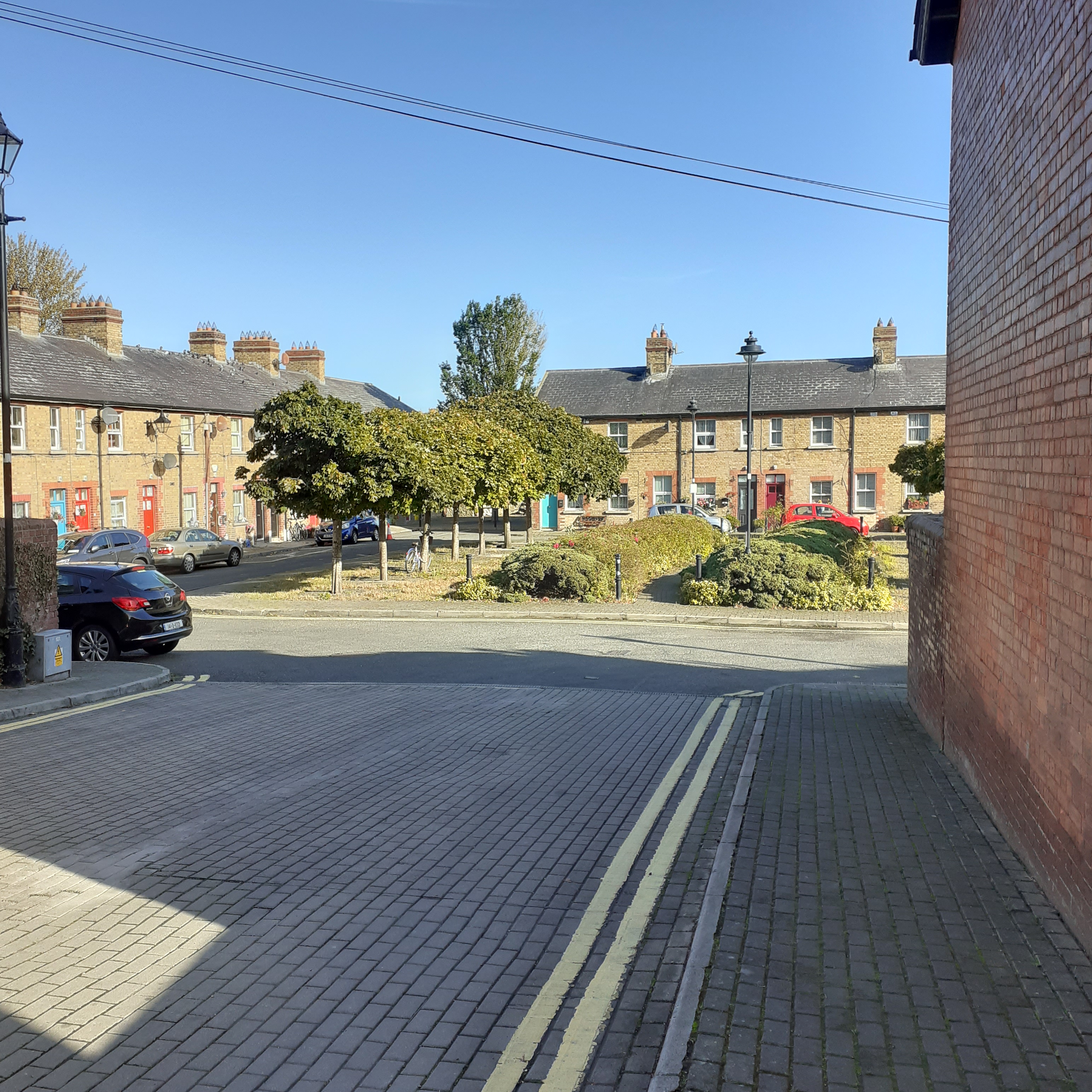
From here there’s respite from the road with a linear stretch of parkland leading on to Blackrock Park. Along the way is Williamstown Martello Tower. When built in the early nineteenth century it was lapped by the sea until cut off by the railway causeway. The construction of the Park to the south further marooned it. Its rather stubby appearance results from the fact that the ground floor is now largely buried. The tower is backed by a small estate of period redbricks, Emmet Square. There’s a good looking old style bar and a take-away on the main road, but behind the busy front, neat terraces are gathered around cobbled squares. This is a small, attractive estate with the aura of a close knit community. With posh Blackrock College right across the road, it looks like something of a working class enclave.

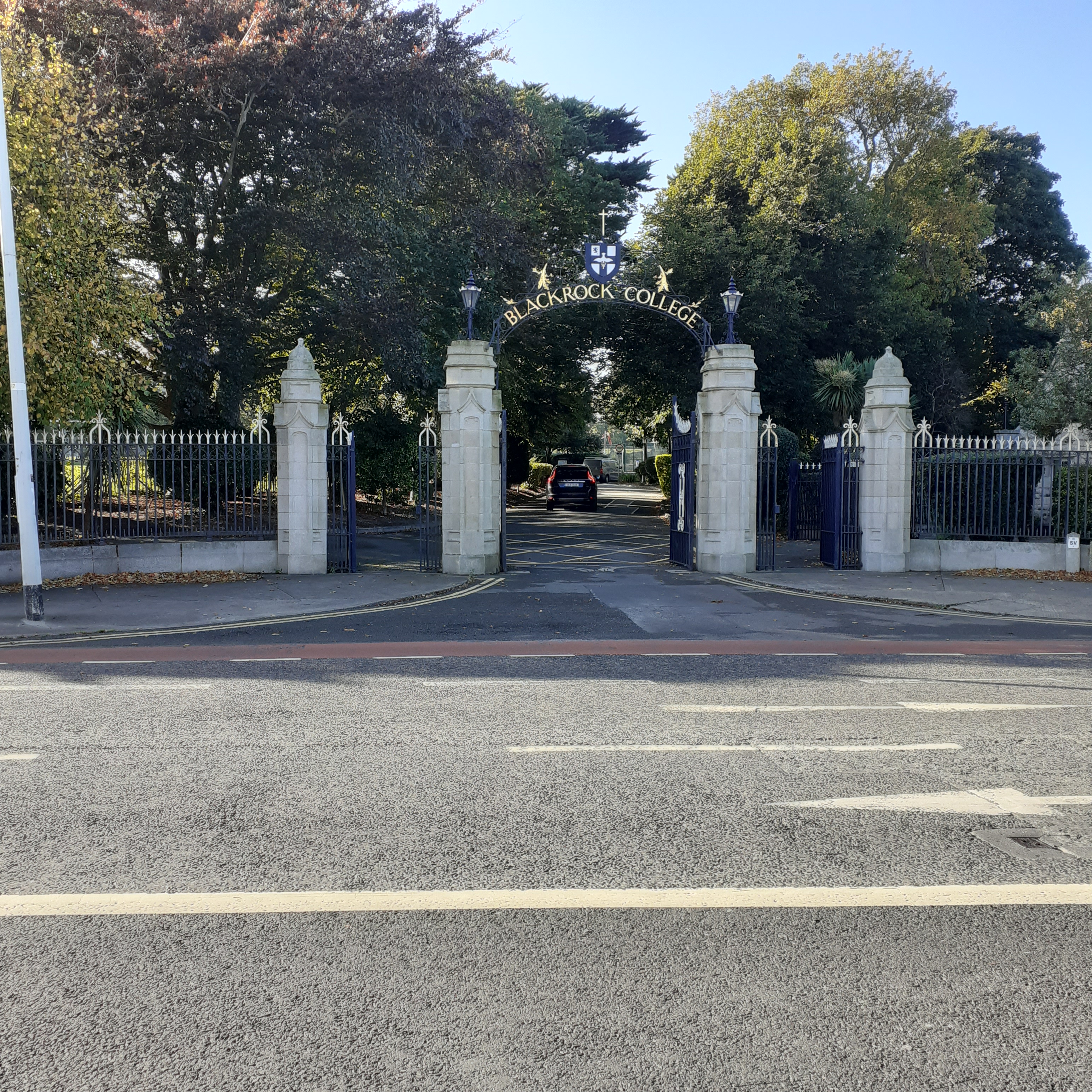
Blackrock College is a leading secondary school for boys situated on over fifty acres of parkland. It was founded in 1860 by the Holy Ghost Fathers. Besides its high achievements and regular supply of the topdogs in politics, culture and commerce, Blackrock is possibly most characterised as a renowned rugger school. It is for this aspect of its image that its denizens, indeed most everyone in the general locale, are roundly slagged in the Ross O’Carroll Kelly books written by Paul Howard. In the media, these are the people responsible for the Dartline accent. Mind you, Howard lives in Greystones so he hardly needs to take the Dart to mine a rich vein of bourgeoisie accent and attitude. Apparently the pupils regard Ross as their hero all the same. Student boarders stay at Williamstown Castle. This was originally an eighteenth century pile whose gothic flourishes were later added by Daniel O’Connell’s election agent Thomas O’Mara. Past pupils from these pages include Bob Geldof, Flann O’Brien and Robert Ballagh, and of course Brian O’Driscoll. In BOD we trust.

And on to Blackrock Park proper and the prospect of a good day in Blackrock. But another day.

The Road to Belfield

From the Merrion Gates we can follow the Rock Road to continue our coastal trek through Booterstown and on to Blackrock. But first a detour to take us deeper into D4. Dublin 4 is a varied slice of Dublin. While the simple-minded think of it as the epitome of upper middle class arrogance, D4 does, as we’ve seen, include dockland and traditional working class communities around the Liffey estuary and the lower reaches of the Dodder. Heading south things go significantly upmarket. Shrewsbury and Aylesbury Road, in particular, are renowned for redbrick mansions, the homes of the great and the good, the site of many impressive embassies, and being the purple patch on Irish Monopoly boards. In the early twenty first century the French Embassy was sold for €60 million, topping a Shrewsbury €58m price tag from the previous year. That property, Walford, an Edwardian era mansion, more recently went for under €15m and is scheduled for demolition to make way for a newer, bigger mansion. Snakes and property ladders. Aylesbury Road cuts a straight tree lined avenue from Sydney Parade station to the Church of the Sacred Heart, Donnybrook.

A more direct route from the Merrion Road to the N11 is Nutley Lane, leading up from St Vincent’s Hospital along Elm Park golf course on our left to RTE studios. The television mast is the beacon of Donnybrook, beaming out the waves of the national television service since New Years Eve 1961. The buildings were designed by Ronnie Tallon, of Scott Tallon Walker firm of architects. Begun in 1960, they would form a gleaming glass and steel complex set in manicured parkland campus.

At the Junction with Nutley you’ll notice another startling landmark, the Belfield water tower, a stone tulip rising above suburbia. It was built in 1972 as part of the growing university campus laid out along the West bank of the N11. UCD originated as Dublin’s Catholic college, in opposition to Protestant Trinity College. It was founded by Cardinal John Henry Newman in 1854 and based on St Stephen’s Green. Newman House, as it became known, had been built in 1738 by Richard Cassels. Expanding into adjoining properties, the college thrived, though it had its detractors. John Mahaffy, Trinity Provost, charmingly contended it was a mistake to establish a separate university for the aborigines of this island, as he put it. He cited the existence of James Joyce, a BA graduate in 1902, as proof of this folly, calling him the leader of the corner boys who spit in the Liffey. Mahaffy was a tutor of Oscar Wilde who would at least equal him in wit, but surpass him in charm. Indeed Wilde went further still, converting to Catholicism on his deathbed in Paris.

By 1908 the National University of Ireland was formed with University College Dublin a constituent part. The austere neo-classical building facing Earlsfort Terrace was acquired as their main building in 1914, after a competition won by architects Doolin and Butler. Politicians, artists, revolutionaries have passed through its portals. Edna O’Brien, Brian O’Nolan (aka Flann O’Brien) and Maeve Binchy are amongst its other famed literary graduates.

The site was once known as Leeson Fields. John Scott, first Earl of Clonmel, bought eleven acres for his private gardens in the late eighteenth century. In 1817 they became the Coburg Gardens and featured grand evening shows, often celebrating the glories of empire. Later bought by Benjamin Guinness, he developed the site as a recreational garden in the Victorian style, incorporating the Dublin Exhibition Palace and Winter Gardens. The Great Exhibition of 1865 attracted almost a million people. Popularity declined however, and in 1883 they reverted to the private gardens of the Guinness’s Iveagh House on St. Stephen’s Green. Lord Iveagh donated them to the University in 1941, with the stipulation that they not be built upon and would remain a lung for the city.

They became Dublin’s hidden gardens. As art students in the 80s we would explore their ruined delights. With camera and sketch pad, we depicted the fascinating feud between nature and statuary. In the imagination these were ancient temples, or a brief manifestation of the faerie world. I mean, what was in that orange juice? They came under state care in 1991, and have since been restored to some of their original splendour. There are live rock gigs in summer, and, in a quieter corner, a statue of John McCormack poised to sing. The park radiates an eerie, gothic ambience off season.

By 1960 the Earlsfort Terrace site was not enough to contain Dublin’s academic flower. Respecting the stipulation that the gardens would not be built upon, UCD began relocating to the huge Belfield campus in D4. The Earlsfort Terrace building was converted into the National Concert Hall; Dublin never having got around to building a dedicated Opera House. Classical, Opera and Jazz all feature, with summer outdoor recitals in the Iveagh Gardens. Newman House, meanwhile became MoLI, the Museum of Literature Ireland.

Oh Molly, my Irish Molly, my sweet macushla dear,
I’m fairly off my trolley, my Irish Molly, when you are near
Spring time is always ring time, come dear now don’t be slow
Change your name, go on be game, Begor I’ll do the same
My Irish Molly O!

My Irish Molly is an American vaudeville song; lyrics written by Irish American William Jerome Flannery and music by Hungarian born Jean Schwartz in 1905. A big hit in its day, it was revived by Irish band De Danann in 1981 with Maura O’Connell on vocals. It’s included on the album The Star Spangled Molly.

Belfield made for a startling contrast with Earlsfort Terrace and the Iveagh Gardens. Sleek modernity in the buildings, a hard edged focal lake, the assertive debris of modernist sculpture. Yet, it is the same garden seen with different eyes. The stone and steel idea of the future has softened with time, and become heavy with memories that evoke the past.

Of course, Belfield was modelled in my own youth, so it is all a bit deceptive. When it was decided to move UCD, a competition was launched to find the best design. There were 120 entrants from 46 countries. In Warsaw, a young graduate architect Andrzej Wejchert, swept the table clear in his mother’s kitchen, and sketched out the plan for what would become the Belfield Campus. When informed of his win, he was on his way to Paris to rendezvous with his wife to be, Danuta, but quickly changed course for Dublin with a suitcase full of books, a one way ticket and the clothes on his back. It was 1964, and he was only twenty seven.

His outline for the campus has withstood the test of time. Futuristic and radical in concept, it was determinedly pro student and remote from worn out notions of stern authority. In some lights, especially early on, it could seem a bit harsh, but the blend of parkland and hard edge modernity endures. There is a variety of architecture on show, with Scott Tallon Walker and Wejchert supplying a significant amount over the first couple of decades. Wejchert is responsible for the regular artificial lake at the university’s heart. He also designed the Arts Block (Newman Building) in 69 and the Administration building of 72 which was awarded the RIAI Gold Medal. Above all soars the sixty metre octagonal concrete water tower landmark with its pentagonal stem and duodecahedral tank. Pure science fiction for me, when first I saw it on a star spangled Saturday night, head throbbing with the music of the Belfield gig, soul alive to the touch of young love and friendship.

The campus is open to all and there are trails to take you through woodland, modern architecture and a rich collection of sculpture. Amongst the best statues here are Rendezvous beside the main lake. A woman is poised expectantly on a bench, a disconcerting presence if you choose to sit there. Sculptor Bob Quinn, originally a graphic designer made this in bronze and stone in 2008.

The irregular lake south of the main complex is a more naturalistic setting. My favourite piece stands here. An exuberant dancing couple is cast in bronze but appear to be in perpetual motion. Wind and Water is the title. The stated intention is to evoke the harmony of the elements though the work may be interpreted as you wish. It is by Irish sculptor, Paddy Campbell, based in Florence,

UCD is now the largest university in Ireland with over thirty thousand students spread over a 330acre site; often quite literally, especially in sunny weather. Whatever the weather, enjoy a stately garden of aesthetic delight, an oasis of learning, or simply a walk in the woods. Modern but in harmony with the ages, a city of dreaming spires that is accessible to all.

Sandymount

South of Irishtown we enter Sandymount, with a famed and rather amazing beach. Sandymount Strand is formed in the lee of the Poolbeg Peninsula. It is something of a mirror of the Bull Island north of the Liffey, but unlike that it directly abuts the shoreline. With the tide out, Sandymount Strand is a vast, flat expanse of golden sand nestled into the curve of Dublin Bay. Away to the north and east the panorama is framed by the spiky contrast of the docklands, with the twin chimneys of the Pigeon House and the gleaming Poolbeg Incinerator dominating. The sea is reduced to a blue score along the horizon. It has the feel of a Surrealist painting when dotted with people on a blue sky day. Walking out there is to be at one with the world. You might well ask yourself: Am I walking into eternity along Sandymount strand? Just as Stephen Dedalus mused of a morning here in James Joyce’s Ulysses. And you might well be. Then the tide will come in and cover it all.

Within all this nothingness there’s the odd intrusion of a low, stone structure. These are the ruins of Sandymount Baths. They were built in 1883 by the Merrion Promenade Pier and Baths Company. The baths measured forty metres square with segregated bathing for men and women. Stretching out from the shoreline was a 75 metre lattice work pier with wooden decking. There was a bandstand half way along with Summer concerts twice a week. The adjoining Strand Road promenade was lined with kiosks selling, amongst other things, cockles and mussels alive alive oh! The good times of the Belle Epoque were not to last, and the pier fell into disrepair and was demolished in 1920.

A modern promenade with a linear park spans much of the seafront. It is immensely popular with walkers, joggers and all shades of flaneurs. There are benches if you want to simply sit and watch the world go by. Situated at the northern end, opposite Gilford Avenue, stands a twenty foot high metal sculpture, by Mexican Sculptor Sebastian unveiled by the Mexican President in 2002. Originally named an Cailin Ban, before becoming Awaiting the Mariner, it evokes those times when women would wait on the shore for their seafaring sons and husbands.

About midway along the Promenade, there’s a Martello Tower. A string of twenty eight of these towers were built along the Dublin coastline from Balbriggan to Bray beach during the Napoleonic Wars. This one was built in 1804. A century later it became, for a while, office of the Dublin United Tramways Company. There’s a disused modern building attached, once functioning as tearooms and a restaurant. The tower itself forms a chicane where it butts onto the main road.

Despite the local associations with Ulysses, this is not Joyce’s Tower. That’s in Sandycove, south past Dun Laoghaire . I once did a painting of Sandymount tower festooned in Billboards above the tacky shop and cafe as then was. My college tutor was outraged by the fact that Joyce’s tower, as I may have implied it was, should have been so degraded. I thought the association, given Bloom’s job as an ad-man, was quite apt. All those Mad Men on the strand, Napoleon and Bloom, Joyce and I, my choleric tutor.

Two episodes of Ulysses were set along the strand. In the third episode Proteus, Stephen Dedalus walks the morning strand. In Nausicaa Leopold Bloom isn’t walking, though the word is similar, as he watches a group of young ones. Gerty McDowell gives him the eye, but while the flesh is willing, the spirit is weak, and Bloom makes do with strangling his pet snake. It finishes with fireworks and caused a furore, being banned in the States for this very episode.

Joyces Ulysses sprang from Homer’s Odyssey. Nausicaa was the young lady whose love of the hero was unrequited. She first saw Odysseus leaping amongst the rocks on the shore in the nip and developed an instant attraction. Our hero, though, was more focussed on getting a ship to sail him home. She was young and pretty, but the fact that her name Nausicaa means Burner of Ships, might have been a passion killer.

Bring snowy lady with the laughing, spread your sailing angels over me
Tell a tale of old sinfuls, look for you to change their face
Bleed your soul for my silvered fate, take the ageing cross to bury days gone by
Receive my own into your Heaven Heath towards my waiting bed to lie

Heaven Heath which opens Mellow Candle’s Swaddling Songs emits, like much of their work, an ethereal nautical mood, making for a suitable theme. Group founders, Clodagh Simonds and Alison Williams were themselves born of this very coast, in Killiney a little further south. Clodagh plays the harpsichord on this, while Alison composed. She was born Alison Bools and married Dave Williams while both were with Mellow Candle. She now uses her mother’s name, O’Donnell.

4k from Dublin City centre, Sandymount is part of Dublin 4, just south of Ringsend and Irishtown. The River Dodder borders on the north west with Landsdowne Road (the Aviva Stadium) on the far bank. It is bounded by the bay to the east and the railway line to the west, on down to where they intersect at Merrion Gates. Sandymount was originally named Scald Hill, though the meaning is obscure. There is nothing resembling a hill on this flat stretch of coastline. It would be nice if it derived from the Old Norse term for a writer of poems honouring heroes and their deeds, since Sandymount is credited as the birthplace of WB Yeats, and has also been home to such poets as Brendan Kennelly and Seamus Heany. More prosaically, it was later known as Brickfield Town after Lord Merrion’s brickworks which in the 18th century provided the materials for Dublin’s Georgian building boom.

When the sea wall was built at the start of the nineteenth century, the area became safe for development as a suburb for Dublin’s middle class. Development accelerated with the opening of the Dublin Kingstown Railway in 1834. This was a very early example of a commuter line, and there were two stops in Sandymount. The electrification of the rail and the DART service in the 1980s saw both stations reestablished. Sandymount is nearer the city, the stop for events in the RDS, Royal Dublin Society. Sydney Parade is near Merrion Gates.

The number 18 bus is one of the bus routes serving the area. This weird route zigzags through south Dublin along an orbit remote from the city centre beginning far to the west in Palmerston. At the bottom of my road, Bunting Road in Walkinstown, I could catch the 18 to take me to Rathmines where I took classes in art and design. It was also the route to leave us near the startlingly modernist Belfield UCD campus and their weekend gigs. If I dozed off and woke at the end of the route, I’d find myself in Sandymount, if not Donnybrook Garage.

Sandymount Green is a pleasant triangular park at the centre of the village. So close to the city centre, the aura of the village green still pervades. There’s a plinth and bust commemorating WB Yeats, born here on the 13th of June,1865. The houses to the south were part of Sandymount Castle, in truth a Victorian castellated villa. Local watering holes include Ryan’s Sandymount House, prominently placed at the northern apex of the Green, Mulligan’s, and O’Reilly’s around the corner on Seafort Avenue which has a beer garden at back. On the west of the Green is Browne’s, an attractive stop for food fare, with sidewalk cafe, quality coffee, cakes, wraps, sandwiches and burgers.

Food for the soul is available at Christ Church set back in its own lawns. This is a united Methodist and Presbyterian church occupying what was originally the Methodist Church, built in 1864. Following Guildford Road out of the village, it merges with Park Avenue, as impressively lined with trees and fine houses as the name implies. Standing on an island site is the Church of Saint John the Evangelist serving the Anglican communion. It was founded by Sydney Herbert, brother of the Earl of Pembroke in 1850. It was designed byBenjamin Ferrey, biographer of Pugin, in early Romanesque style and built in rubble stone with features in Bath Stone. The honey coloured and very weathered material give it a more ancient look than its age.

Park Avenue leads on to Parade Avenue, connecting Merrion Road and Strand Road. Sydney Parade station is nearby. At Merrion Gates all routes connect. The main road southwards is the surging thoroughfare of the Rock Road.

The International Bar Revisited

I have a soft spot for the International Bar in Wicklow Street. It was a regular haunt of mine in my Post and Telegraph days. Wicklow Street is a busy shopping street connecting Grafton Street and Sth Great George’s Street. It was developed as part of Exchequer Street in 1776 having previously been a lane. This eastern branch was renamed Wicklow Street in 1837.

The International Bar dates from 1838 and is housed in a fine, early Victorian, gothic redbrick four storey on the corner of Andrew’s Street, which continues as South William St south of the junction. This was the venue I chose for my twenty first birthday party. Friends and workmates gathered round, and, of course, the divine Ms M. Gifts, besides copious pints, checked shirts and scabrous greeting cards, included some music of the day: Horslips second Celtic symphony the Book of Invasions, AC/DC’s debut High Voltage and Thin Lizzy’s breakthrough album, Jailbreak.

I’d imagine these were played full volume and the final verse of The Boys Are Back in Town lingers strongly in the memory. 

That jukebox in the corner blasting out my favourite song

The nights are getting warmer, it won’t be long

Won’t be long till summer comes

Now that the boys are here again

Near enough seven years since they were formed in Dublin, Thin Lizzy had at last scaled the dizzy heights of international fame. Jailbreak was Lizzy’s first album to go gold in the USA. Phil Lynott had adapted his poetic muse to powerhouse rock with spectacular effect. The following summer, myself and M would be amongst the tens of thousands at Dalymount Park to give the heroes a memorable return to Dublin town. The Boys Are Back! 

Happy days. I remember a wall poster that night in the International advertising Billy Connolly, the comedian posed in front of a Scottish Flag. Suitable backdrop, as my birthday falls on Saint Andrew’s Day, and I’m half Scottish; probably three quarters Scotch that night. The International would go on to host nightly comedy shows since the 1990s with live music downstairs. Dara O Briain from Bray is one of a generation of comics to cut their teeth there. Outside of the music and laughter, life at the International goes on as always, a jewel of an oasis, the best of times suspended in amber. 

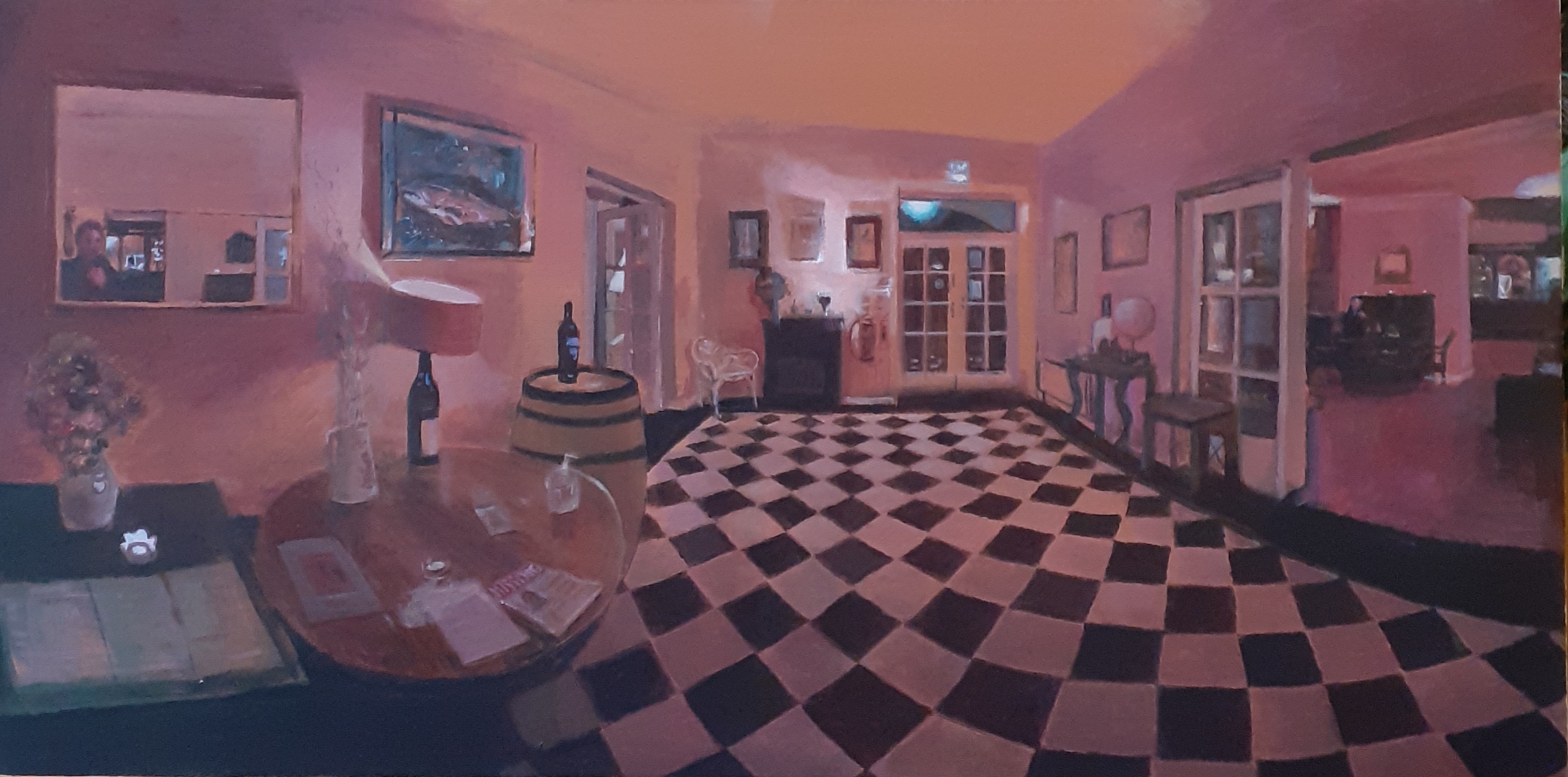
Walk in off the street to the high ceilinged narrow room. The bar is spectacularly set off by an ornate hand carved mahogany reredos. Brass fittings, mirrors and optics are set ablaze by light streaming in the large windows. When the canopies are out, high arched transom windows allow solid shafts of light to stream diagonally onto the bar.

This scene captures that snapshot of heaven, and perhaps some of the more subdued stories in the weave. There is a slight allusion to a painting by Degas, In a Cafe, in the couple seated to the right. But this painting is phrased to convey a sense of warmth, and our heroes may be enjoying a moment of easy silence. Remembering those golden days.

Dublin Fields

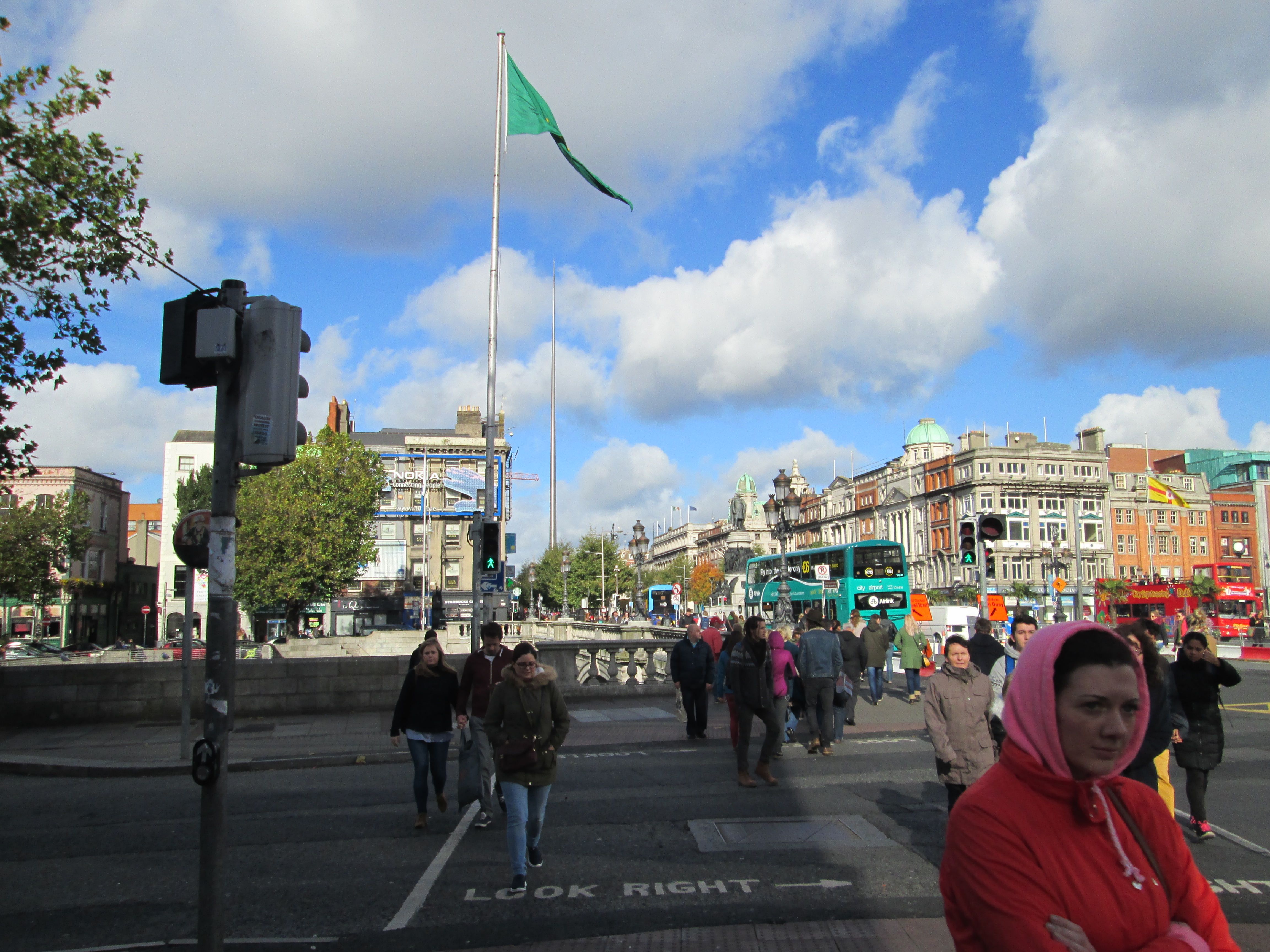
A scene that might have happened had James Joyce and Nora Barnacle married in Dublin, and not London, and walked out on O’Connell Bridge. There, they may have been accosted by photographer Arthur Fields, the Man on the Bridge. Fields, a Dublin fixture for fifty years, would have had a thing or two in common with Joyce, and indeed his best known character, Leopold Bloom. 

Arthur Fields was born in Dublin in 1901. His family fled antisemitism in Ukraine in the 19th Century and came to settle in Ireland. He lived in Raheny and used to walk into the city centre each morning to ply his trade. He would stand on O’Connell bridge, taking photographs of passersby, then offer a ticket. The prints were made by his wife in their home darkroom and those who chose could pick them up later. This created a snapshot history of the bridge from the early thirties to his retirement in 1984. A half century of snaps, up to a hundred and fifty thousand in all. Within this great parade, the bridge also became, in many ways, Dublin’s gondola; where young love, even older love, was displayed and immortalised against the dramatic backdrop of the city.

James Joyce and Nora had long gone by Fields’ day. Joyce the young boulevardier, the ultimate flaneur, had first seen Nora in June 16, 1904. The date has since been immortalised as Bloomsday, the twenty four hours in the life of fictional Dubliner Leopold Bloom, in Joyce’s humdrum epic Ulysses. Bloom, though actually (albeit fictionally) an Irish born Catholic, is cast as the Wandering Jew, his father having been a Central European immigrant. In reality, Joyce and Nora went to Ringsend, where Nora gave him a hand with a recurrent problem.

They left for Trieste later that year. Joyce returned to Dublin to manage the city’s first Cinema, the Volta, in 1909. The venture failed and he returned to Trieste. There was one brief return to Dublin in 1912 to fight with the publisher of Dubliners. Nora and Joyce lived together in Italy, France and Switzerland and had two children, Giorgio and Lucia., but they only married in 1931 in London. Ten years after, Joyce died in Zurich, aged fifty eight. 

Amongst those who were captured by Fields’ lens are writer Brendan Behan, boxer Jack Doyle and musician George Harrison. With George it was the portrait of the artist as a young man. He was photographed in the early fifties with his mother Louise (nee French) whose family lived in Drumcondra. George was obsessed with the guitar, and his parents bought him an Egmond Toledo guitar on his thirteenth birthday. The rest, as they say, is history. I have something in common with George so, beyond a shared surname. My parents also bought me an Egmond for my thirteenth birthday, and the rest is three chords and a lot of strangled roaring. Within three years, however, George was playing guitar with The Beatles. Following their breakup, his success continued as a singer and songwriter until the end of the century. George Harrison died on 29th November, 2001 aged 58. 

I look from the wings

At the play you are staging

While my guitar gently weeps

As I’m sitting here

Doing nothing but ageing

Still my guitar gently weeps

While My Guitar Gently Weeps was recorded in 1968 for the double album, the Beatles, or the White Album as it’s known. There is a deeply personal thread woven through the song, including the personification of the guitar which acts both as Harrison’s alter ego and lover. The guitar featured was a red Gibson Les Paul, called Lucy. It was a gift from Eric Clapton, who played it on the recording.  

Dublin’s South Bull Wall

Dublin Bay has long thrown its arms wide to embrace the incoming voyager. Howth Head curves around to the north while the southern arc is framed by the Dublin Mountains to the rocky conclusion of Killiney Head at Sorrento Point. It is a spectacularly beautiful embrace, though it often proved treacherous for the unwary mariner. The silting of Dublin Bay, specifically across the mouth of the Liffey estuary, meant that medieval Dublin had to outsource its port to Dalkey at the southern tip of the bay. Two major sandbanks formed on each side of the estuary, the North Bull and the South. A sand bar frequently connected the two, hampering access to the Dublin quays. At low tide the South Bull formed an extensive sandbank enclosing a tidal pool known as the Poolbeg, from the Gaelic for ‘small pool’. 

In the early eighteenth century it was decided to remedy this situation. Sir John Rogerson funded a quay extending from the city centre to the confluence of the Dodder and Liffey. Further east, construction began on a barrier of oaken piles which effected reclamation of land to the south around Ringsend and Irishtown. The Piles was completed in 1730 but while it helped reclamation and navigation, it quickly showed signs of decay. It was decided to install a wall, using granite from Dalkey quarry. The wall connected Ringsend with the lighthouse, Poolbeg, which had previously been a floating lighthouse. The stone lighthouse was completed in 1767, although replaced in 1820 with the current structure, and painted bright red.

At the start of construction a house was built for the caretaker, John Pidgeon. Pidgeon opened a restaurant for construction workers which proved very popular amongst mariners and visitors. A hotel was established later and this became known as the Pigeon House. The great wall was completed in 1796, at which stage it was the longest sea wall in the world at three miles long. The resulting formation of the Poolbeg Peninsula and its development as a major industrial area means the remaining sea wall is now just a mile long. Following the rebellion of 1798 there was military development with the installation of a gun battery known as the Half Moon, owing to its shape. The fact that this name now applies to a swimming club probably conjures a different sense of meaning. A fort was constructed in the 1840s, its remains still visible. The Half Moon Swimming and Water Polo Club, founded in 1898, is still alive and kicking.

By the twentieth century development concentrated on industry. The first generating station was built in 1903 and has since been attached to the Pigeon House name. The new station in the sixties came with the two iconic chimneys. Over two hundred metres tall, they remain the tallest structures in Ireland and are visible from all over the county. Being tall, the authorities were determined to demolish them when decommissioned this century, but fortunately they’ve been listed for preservation and the ESB has undertaken to maintain them.

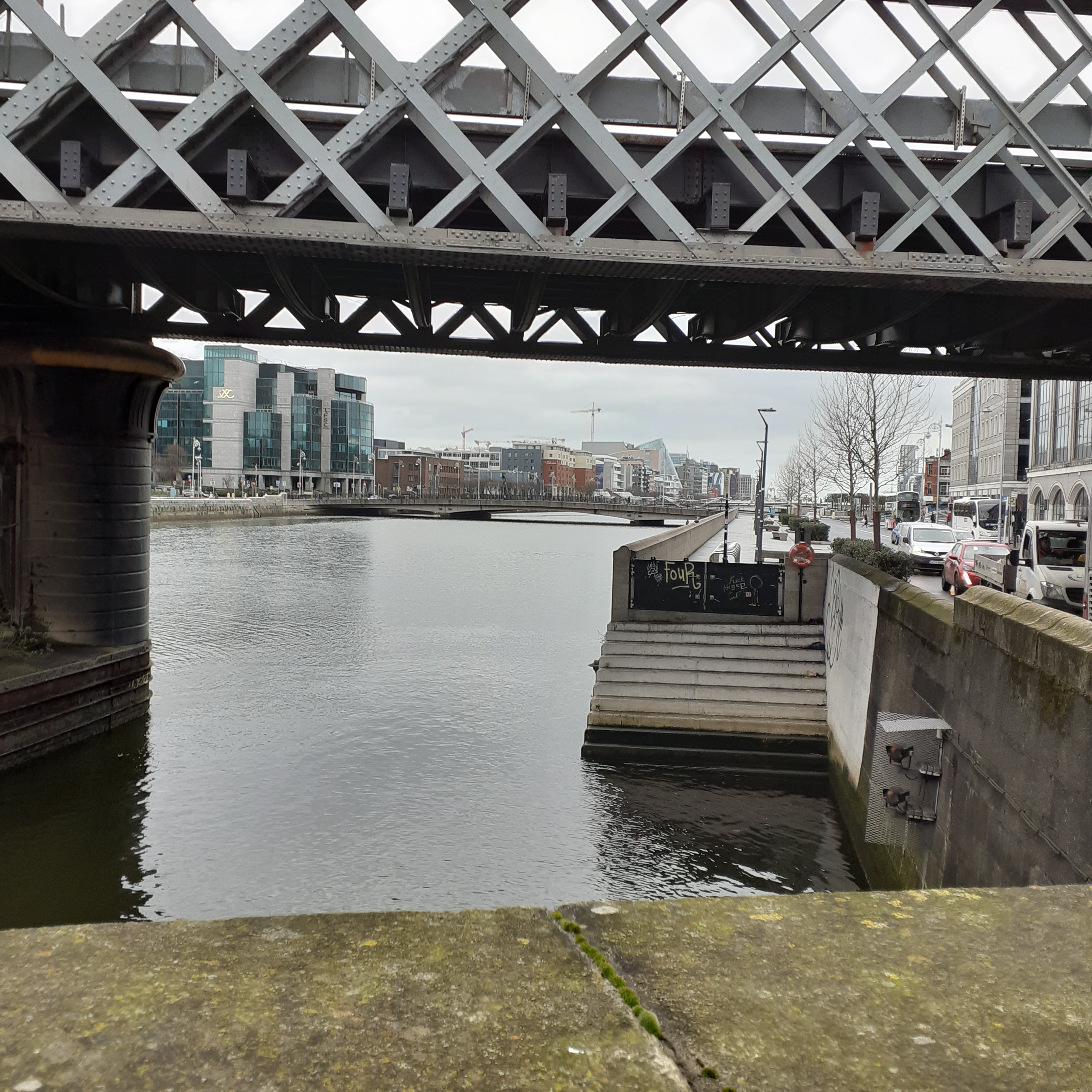
Three centuries of development crowd and clash in this fascinating urban area. In around 1640 the first bridge crossed the Dodder to connect Dublin and Irishtown, which was then the native ghetto. Cromwell landed for his Irish tour and it’s been full steam ahead ever since with this the setting for surging industrial and architectural modernity. Standing in the lee of the East Link Bridge, looking west to wards the city you’ll note, at the end of Sir John Rogerson’s Quay, the Capital Docks building. This is Ireland’s tallest storeyed building at sixty nine metres. It is very much an exclamation of the city, a portal of sorts; right where the Dodder River, the Grand Canal and the Liffey join with the sea. 

Nearby lies the ancient urban village of Ringsend. Also known colloquially as Raytown, being the source of the famed fish supper of Long Ray and Chips, A maritime atmosphere still pervades with such pubs as the Oarsman, the Yacht and the South Dock which I’d bet shelter the stray salty dog. While one can still imagine the port of old, it has been overlaid by blocks of Art Deco flats from the thirties. Past the library, another Art Deco gem from 1937, Ringsend merges into Irishtown and on to the Poolbeg peninsula. This was the Waxies Dargle in the nineteenth century. The name derives from Waxies, a nickname for shoemenders, while Dargle is the river of Bray, then a posh resort. The workers couldn’t afford the trip to Bray so the seashore hereabouts was the alternative. 

Breaking out onto the seafront at Sean Moore Park is to feel the heart lift. Sandymount curves away to the south, on out to Dun Laoghaire. The strand at low tide is a huge panorama of flat sand, reclaimed at intervals by the shallow sea. We can follow the shore all the way out to the Poolbeg Generating Station and it majestic twin towers. Alternatively, you can follow a more northerly route through the industrial heart of the peninsula. Either way, both roads meet at the Pigeon House, and when you get to the east of the generation station, the remaining mile of the sea wall points out into the open sea. Overall, the route is about five and a half kilometres from Ringsend to the lighthouse, an 11k roundtrip.

A walk along the South Bull gives a bracing snapshot of Dublin city and is a means by which Ireland’s capital can best be understood. This is the port, ancient and modern; from when Claudius Ptolemy of Alexandria pinned it to the map of Europe in the 2nd century, to the growing nest of spires of twentieth century Dublin. Walk along its narrow causeway, you’ll sometimes literally be walking on water. All around the ships sail in and out, passengers and cargo and pleasure sailers, all part of the ceaseless throbbing heart of Dublin.

Sittin’ in the mornin’ sun

I’ll be sittin’ when the evenin’ comes

Watching the ships roll in

Then I watch ’em roll away again, yeah

I’m sittin’ on the dock of the bay

Watchin’ the tide roll away, ooh

I’m just sittin’ on the dock of the bay

Wastin’ time

Sitting in the dock of the bay was written by Otis Redding and Steve Cropper. Redding was inspired to write the song while staying in a houseboat in Sausilito on San Francisco Bay. He recorded it days before he died in a plane crash over Lake Minona, Wisconsin in December 10, 1967. It became a posthumous number one for him in America. The song fades evocatively into a lonesome whistler heard over the sound of seagulls and waves. If you stand alone on the South Bull Wall you can hear it, and whistle along. 

Heading for Grogan’s

Evening is falling and the lights are flickering on. We make our way from Grafton Street via Johnson’s Court, across Clarendon Street and straight on through Coppinger Row to South William Street. Facing us is the Castle Inn, Grogan’s Castle Lounge. It is a pub like any pub, being only really like itself. A literary pub, a boozer, a haunt of artists, buskers and assorted ne’er-do-wells. There’s an interesting mural on the far wall featuring chancers and characters who have frequented the joint.

Dave O’Hara is in there somewhere. He told me once of this immortality, conferred when he held his stall in the nearby Arcade, peddling ancient books, modern posters and timeless yarns. By the half light he’d be in Grogan’s sinking pints, reciting his poetry. He’d sell it too, his books including Heartstrung, Headstrung and Rainbows and Stone. Dave joined our writers group in Bray and helped flog our collection Wednesday at Eight, though he wasn’t included. One buyer was a columnist at the Evening Press who wrote a very nice review, surmising that we were ‘of tender years’. I suppose we were; raw certainly. Dave stayed in Bray for a while, until he came adrift, and was lost out there in Dublin Bay. A long time gone but too short a time here.

Brian O’Nolan is most famed amongst regulars. He would find his way here from Dublin Castle, and the pub appears in the pages of At Swim Two Birds. There’s an ever changing display of art on the walls too, works by contemporary artists sold commission free. Dating back to 1899, the pub remains mercifully free of television and piped music.

There’s a seating area outside where I like to perch, glowering with menace at passersby. People watching is always a pleasure on William Street, where all the chaotic comings and goings of the crowd provide a continuous performance.

The South Dublin City Markets lie just beyond. The gabled building to the right is an outlier, echoing the style of the main building which is a delightful Victorian Gothic palace from 1881, blood red and topped by swirling turrets. Castle Market, the short street with canopies centre frame, leads to this, Dublin’s first shopping centre. Generally referred to as George’s Street Arcade, the central arcade pushes through the building from Castle Market to emerge onto South Great George’s Street beyond. It is lined with stalls selling jewellery and art, books and vinyl, all the paraphernalia that’s a little bit out there, antique, retro or cutting edge. I might find a stool a counter, grab a burger and chips, proper food with copious sauce and of course, salt, all the better to encourage a return trip to Grogan’s.

So perhaps it’s that time of day, summer or winter at the fulcrum when the sky turns deeper blue and the lights flicker on. There’s a purpose to the human crush again, going home, going out, heading for Grogans.

Wicklow’s Wonderful Playlist

The walk from the Dargle River to Arklow on the Avoca is about 54k, taking in, near enough, the coastline of County Wicklow. After Arklow, there is a short stretch to Clogga Beach after which Kilmichael Point marks the border with Wexford. I haven’t done that yet, but it’s on my list.

All the way to Wicklow Town we kept to the coast, though after that access was restricted to select entry points. It’s been an epic in seventeen parts. The first seven were in Bray which certainly offers plenty, though we had barely covered a mile of our journey before embarking on the cliff walk to Greystones. That’s about a 7k stretch and you’d do it easily in ninety minutes. If you want to do it via Bray Head and Summit, it will take a bit longer with a climb to 240 metres. You can make it a loop walk or go station to station and take DART in one direction. 

Greystones all the way to Wicklow is along the beach for a little over 20k. Detours to Newcastle and the East Coast Bird Sanctuary were taken. The Bird Sanctuary is a good outing of itself. Greystones to Newcastle is around 8k, and it’s another 13k to Wicklow.

Wicklow was good for a bit of exploration. South of the town you can navigate the headland by way of the Black Castle and join the Glen Beach Cliff Walk as far as the Lighthouses. Wicklow to Arklow is a distance of about 25k, but there’s no one coastal path. We drove it and dropped into Magheramore Beach and Brittas Bay, the latter a splendid walk end to end of about 5k. After Mizen Head, the road runs close to the sea for 12k all the way into Arklow.

And of course, what kept us going was the travellers tales, the myths and legends, and the songs playing in our heads. Much of the playlist is provided by local artists, some a bit further afield. 

Double Cross, (Fintan Coughlan), Tired and Emotional/Mary Coughlan (1985)

Telstar, (Joe Meek) The Original Telstar – The Sounds of the Tornados/The Tornados (1962)

The Wanderer, (Ernie Maresca ), Dion (1961)

Mr Tambourine Man, (Bob Dylan), Mr Tambourine Man/The Byrds (1965)

Teenage Kicks, (John O’Neill), Teenage Kicks/The Undertones (1978)

Nothing Compares 2U, (Prince), I do not want what I haven’t got/Sinead O’Connor (1990)

Meetings of the Waters (Fionn Regan), Meetings of the Waters/Fionn Regan (2017)

Sloop John B, (Trad,. Arr. Brian Wilson), Pet Sounds/The Beachboys (1966)

Candle in the Wind, (John/Taupin), Goodbye Yellow Brick Road/Elton John (1973)

Wish You Were Here, (Gilmour/Waters), Wish You were Here/Pink Floyd (1975)

Holy Moses (Slattery/McCabe), The Cujo Family/The Cujo Family (2010)

The Herring (Trad), Drinkin’ and Courtin’/The Dubliners (1968)

Girls Just Wanna Have Fun (Robert Hazzard), She’s So Unusual/Cyndi Lauper (1983)

Zephyr Song (Balzary/Fruscianti/Kiedis/Smith), By the Way/Red Hot Chilli Peppers (2002)

Come Fly With Me (Cahn/Van Heusen), In the Wee Small Hours/Frank Sinatra (1955)

The Parting Glass (Trad), Hozier (2021)

Anchorage (Michelle Shocked), Short, Sharp, Shocked/Michelle Shocked (1988)

Suzanne (Leonard Cohen) Songs of Leonard Cohen/Leonard Cohen (1967)

Follow Me Up to Carlow (P.J. McCall), Planxty/Planxty (1973)

Do It Again (Brian Wilson/Mike Love), The Beachboys (1968)

The Meeting of the Waters (Thomas Moore), John McCormack.

The Streets of Arklow (Van Morrison), Veedon Fleece/Van Morrison (1974)