Part of my purpose, and pleasure, in visiting Andalusia, is to paint it. Sometimes we make sketches, though mostly photography forms the record of places we visit. My Spanish paintings contrast with my Irish paintings. Climate is a decisive factor. Spain is hot and demands a hot palette. Ireland is wet and wild, its palette cool. Every place is different. Every day is different.
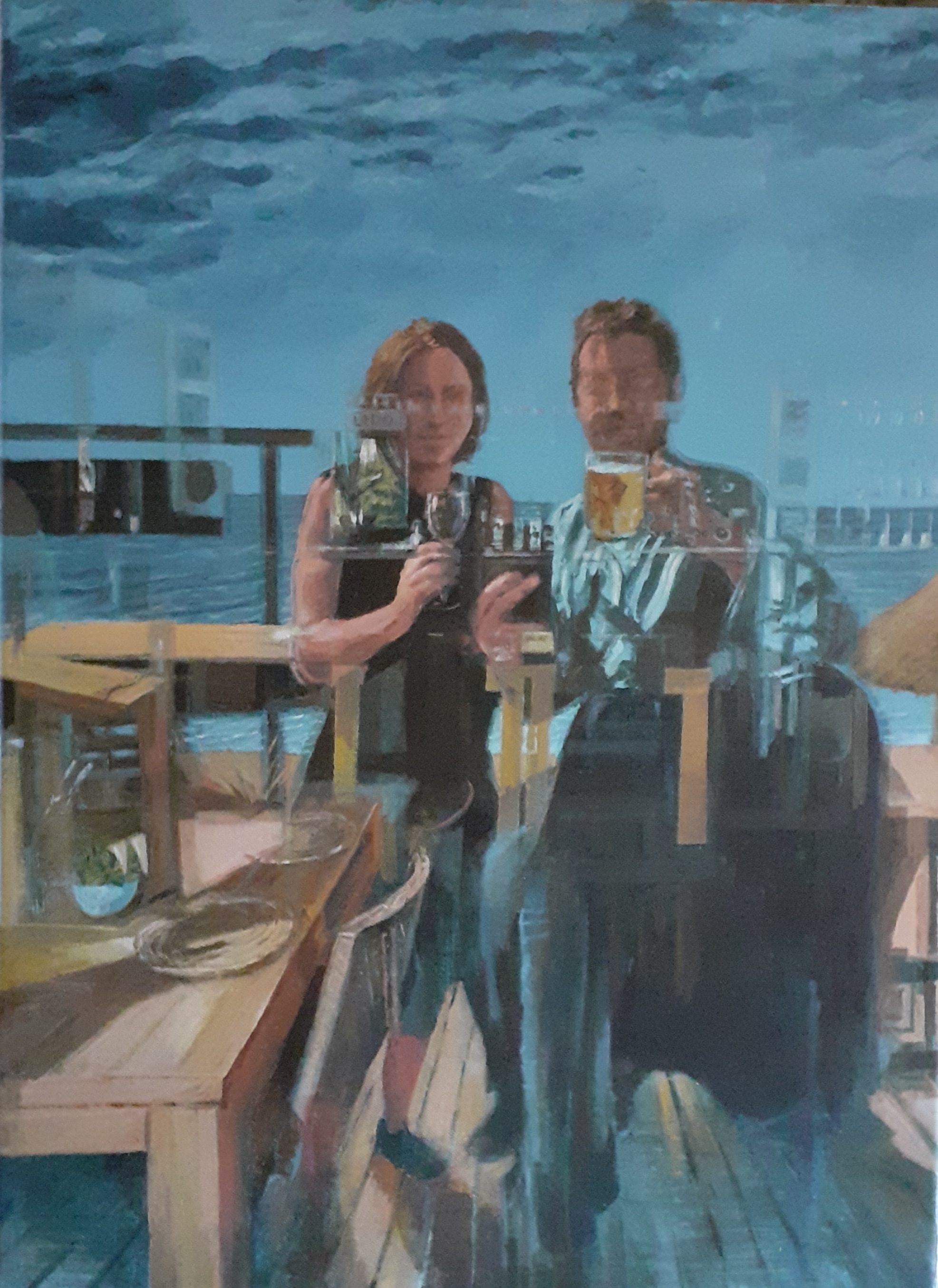
In taking photos I usually exclude ourselves. There are times when a tourist snap is required. I no longer corral innocent bystanders. It happens, but mostly volunteers. Some years back I recall waylaying a handsome young couple swanning into the Casino in Monte Carlo. I indicated the camera, gestured to the debonair male. Of course, he said, and promptly posed for us. His companion put things right. A mysterious lady in Lisbon is another fond faux pas. Reluctantly she took off her gloves on what she clearly regarded as a cold day. It was mid teens; but she obliged with a warm smile. Selfies are an obvious solution, but they don’t really work for me. There’s something awkward about doing them and I usually get it wrong, with my nostrils and ears featuring too prominently. So, M and I have evolved a habit of catching ourselves in reflective surfaces. These mirrored images have the extra advantage of being pleasantly anonymous.
This method is seen at its best on this recent shot taken on Elviria Beach near Marbella. Our favourite bar is on the beach and a regular stop for our pre dinner drink. The Lido Bar also serves food during the day. Sitting out on deck, the beach sweeps away south towards Gibraltar funneling the Mediterranean into the Atlantic. Africa lies just over the horizon.
Painting this picture, I was struck by the shifting points of view within the tableau. We were photographing ourselves photographing ourselves. The observer, and author of the painting, is observed. It’s a self portrait, a still life and a landscape. The reflection itself is a double image due to the glazing. This gives a liveliness, a kind of shaky quality too. We are a blur against the immense physicality of the Med. There, but not there. A snapshot in time. Then gone.
Lido missed the boat that day, he left the shack
But that was all he missed, and he ain’t comin’ back
At a tombstone bar in a juke joint car, he made a stop
Just long enough to grab a handle off the top
Written by Boz Scaggs and David Paich, Lido Shuffle featured on the album Silk Degrees in 1976. Sing along!
The Dart has been taking commuters, daytrippers and various wanderers around the Bay for forty years. Dart is a clever acronym for Dublin Area Rapid Transit. It runs from Malahide or Howth in the north to Greystones in the south. The last two stops are outside of County Dublin. Reaching the Dargle River we are in County Wicklow. The town of Bray has been established here since the Norman invasion, building on earlier Gaelic settlements.
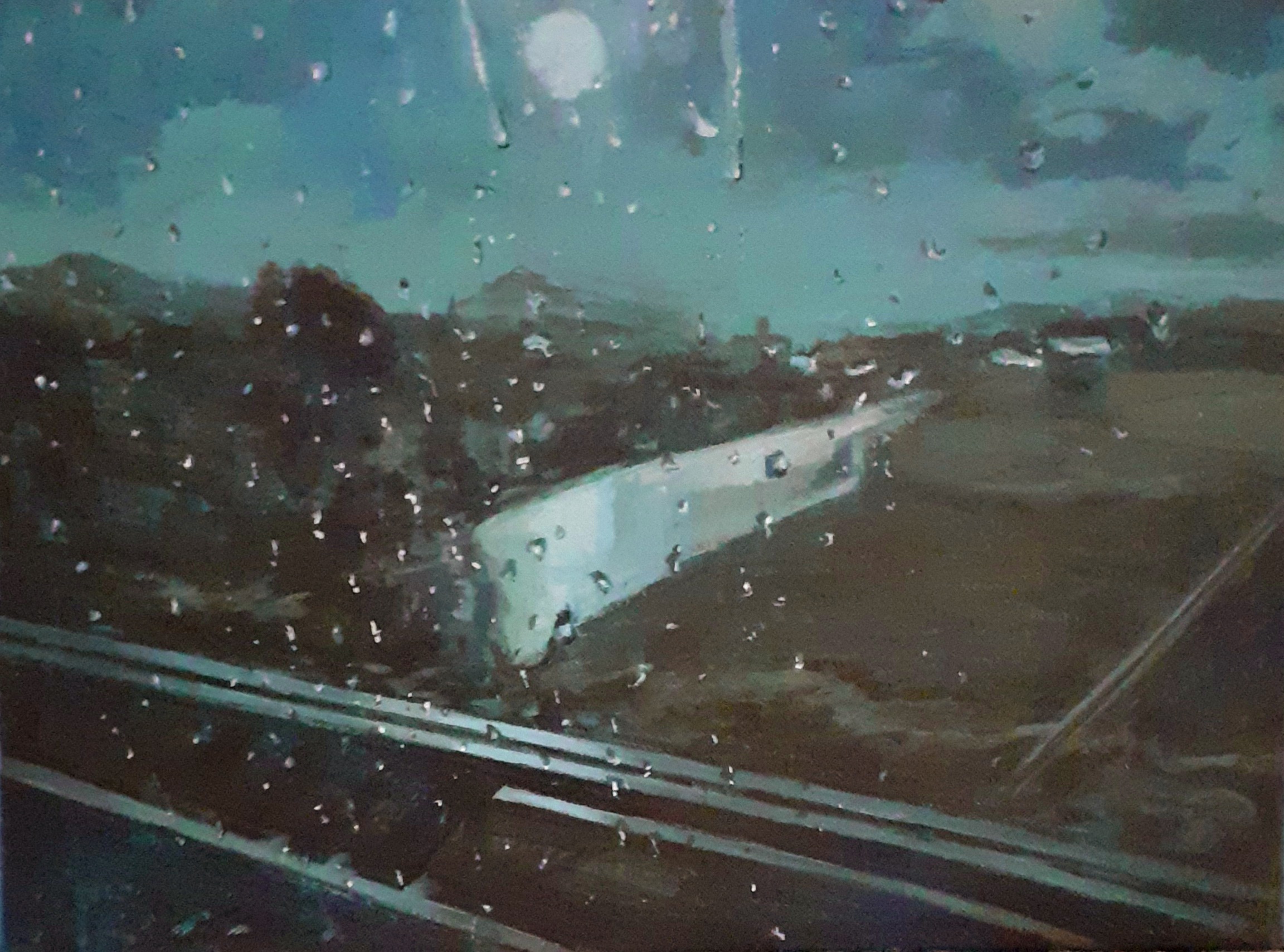
This view is taken from the window of a southbound Dart, about to cross the bridge over the Dargle. I am returning from Dublin city where it has been raining, but now the sun’s coming out and Bray rises steaming out of the gloom. The Sugarloaf Mountains appear on the horizon, and the land is marked by the tower of the Catholic Church of the Most Holy Redeemer, and the spire of Christchurch (CofI). Bray Daly Station is my stop. Opened in 1854, the line was quickly extended to Greystones and runs parallel to the seafront behind the hotels and houses lining the Esplanade which was newly established then.
This painting is acrylic on canvas and has been accepted by the Signal Open Art Exhibition of 2024. I am delighted to be chosen and looking forward to seeing all the other works on show. The exhibition runs from Tuesday 6th August until Sunday 18th August. Should be fun. Give it a dekko!
Every time it rains
You’re here in my head
Like the sun coming out
I just know that something good is going to happen
I don’t know when
But just saying it could even make it happen
Cloudbusting by Kate Bush is guaranteed to lift the heart, without reneging on past sadness. It is on her 1985 album Hounds of Love.
It’s a long way to Tipperary, they say, but the roads are good. We left Bray late morning, arranging to hook up with our travelling companions in Cahir. The simplest route from Bray is to take the M50 through south Dublin, turn southwest along the M7 then veer on to the M8 down to Cahir. It’s a distance of two hundred kilometres which Google reckons can be done in two hours. But what’s the rush?
We’re staying near Bansha, on the N24 along the railway line heading for Tipperary town and Limerick beyond. Bansha is familiar to us from olden days and the area is always worth visiting for its heritage and wonderful scenery. We booked three days in Aherlow Cottage, a three bedroom self catering accommodation adjacent to a farm. All mod cons, and many older ones, with a traditional hearth and a private garden flanked by trees and a river.
Bansha itself is a pleasant village. Nellie’s Bar on Main Street is the place to go, packed when we arrive on a Sunday when crowds gathered to watch the football. Hurling is more the sport of choice about here. Tipperary are the third most successful team in the country, with twenty eight titles, behind Kilkenny and Cork though, like everyone else, trailing in Limerick’s wake right now. Tipp were last All Ireland hurling champions in 2019. Throughout the week the pub’s quiet; plenty of space and time to dwell over a pint or two, and study the photographs and clippings on the wall of the bar.
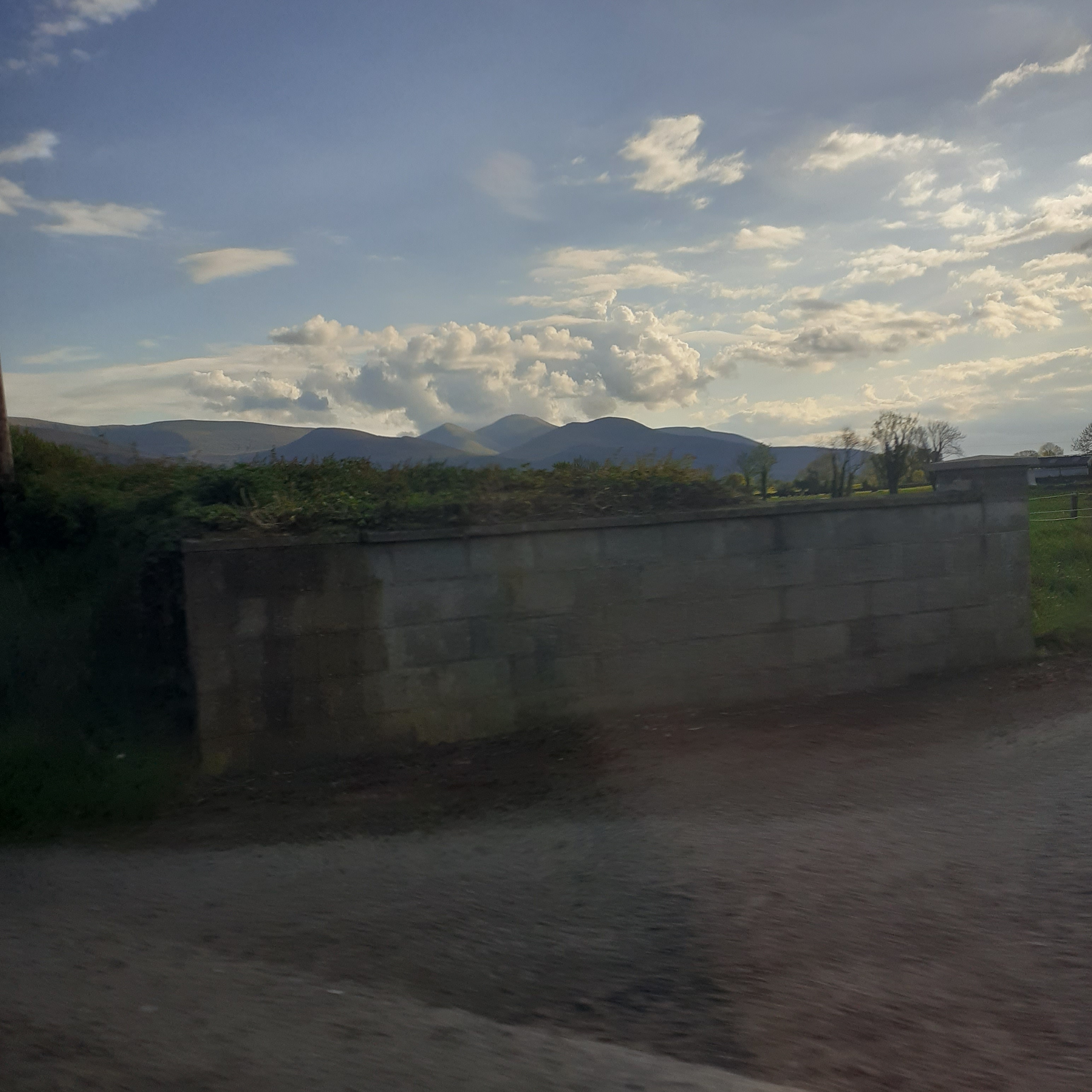
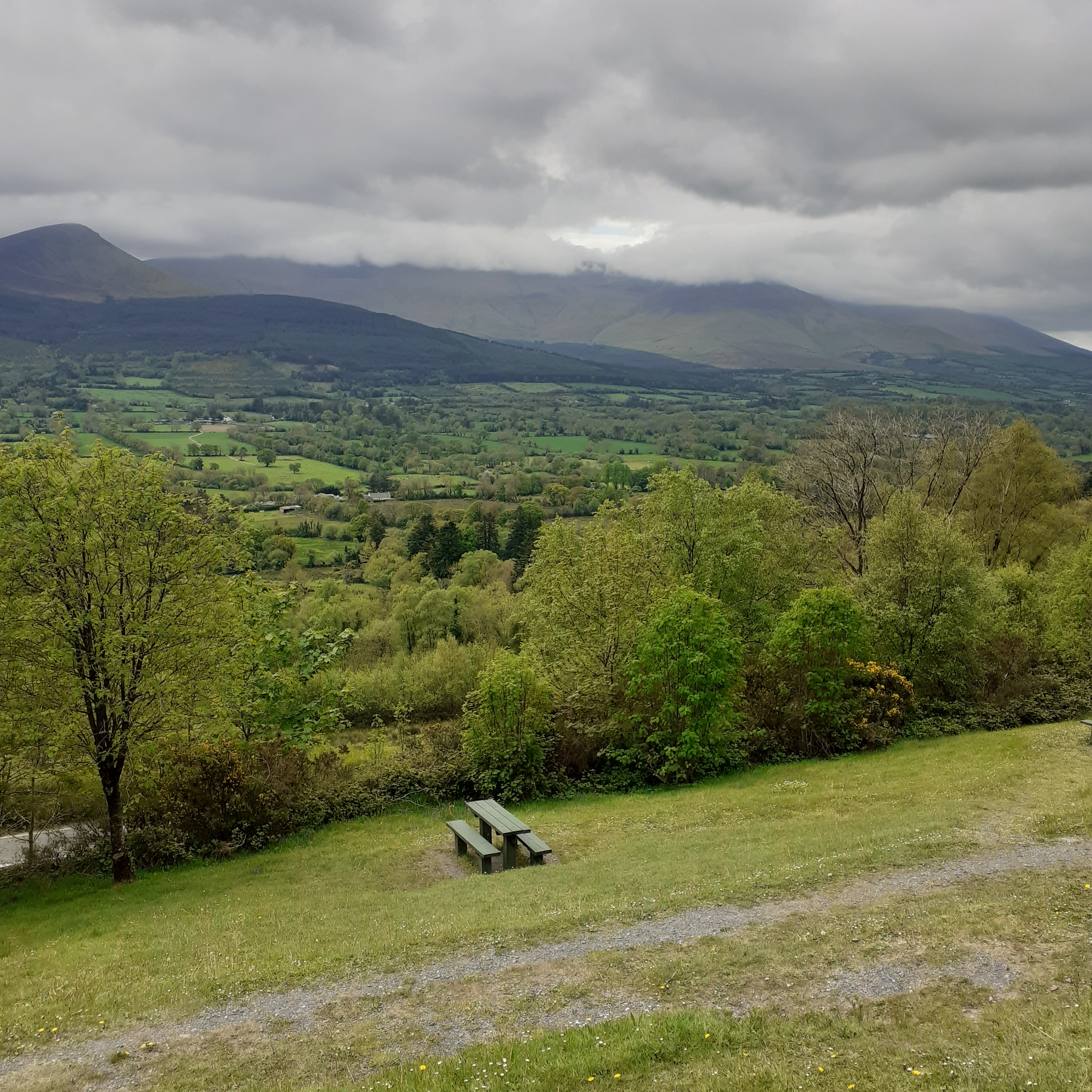
The Glen of Aherlow has a number of marked trails amidst a panorama of wonderful scenery. To the south the Galty Mountains rear into a blue sky and Slievenamuck shelter the valley to the north. The Galty Mountains rise to over three thousand feet and are the highest inland range in Ireland with Galtymore the highest peak outside of Kerry. Slievenamuck means mountain of the pig in Gaelic, referring to a notorious wild boar who once haunted the slopes. He’s long gone and, if you’ll pardon the pun, the place is just as interesting in his absence. The Slievenamuck range features loop walks of varying degrees of difficulty.
We took the trail from the statue of Christ the King heading uphill through Bansha Woods with fabulous panoramic views across the county rewarding us at the summit. Tipperary town is visible in the middle distance. We make downhill through rushing streams and forest paths. It’s well marked and you won’t go astray. There’s a picnic area near the statue where you can enjoy the scenery in a more leisurely fashion
The main town hereabouts is Cahir on the River Suir. The town has a population of three and a half thousand people. Most of it is built on the south bank of the river, centered on a main square. Such squares are a feature of Protestant plantations in Elizabethan and Jacobean Ireland. Quakers established themselves in Ireland in the mid seventeenth century. Cahir and Clonmel became their main centres in south Tipperary where they were prominent in milling and other businesses. Cahir and Clonmel were the first towns in Ireland to be linked by Charles Bianconi’s coach service in 1815. Up till then, the journey could take six hours or more by river. With the coach it could be done in two hours, though Google might claim even less. Charles Bianconi was born in Italy, near Lake Como, in 1786, and moved to Ireland when he was sixteen, fleeing Napoleon’s invasion. He worked in Dublin as an engraver before moving to Clonmel where he set up his transport business.
Screenshot
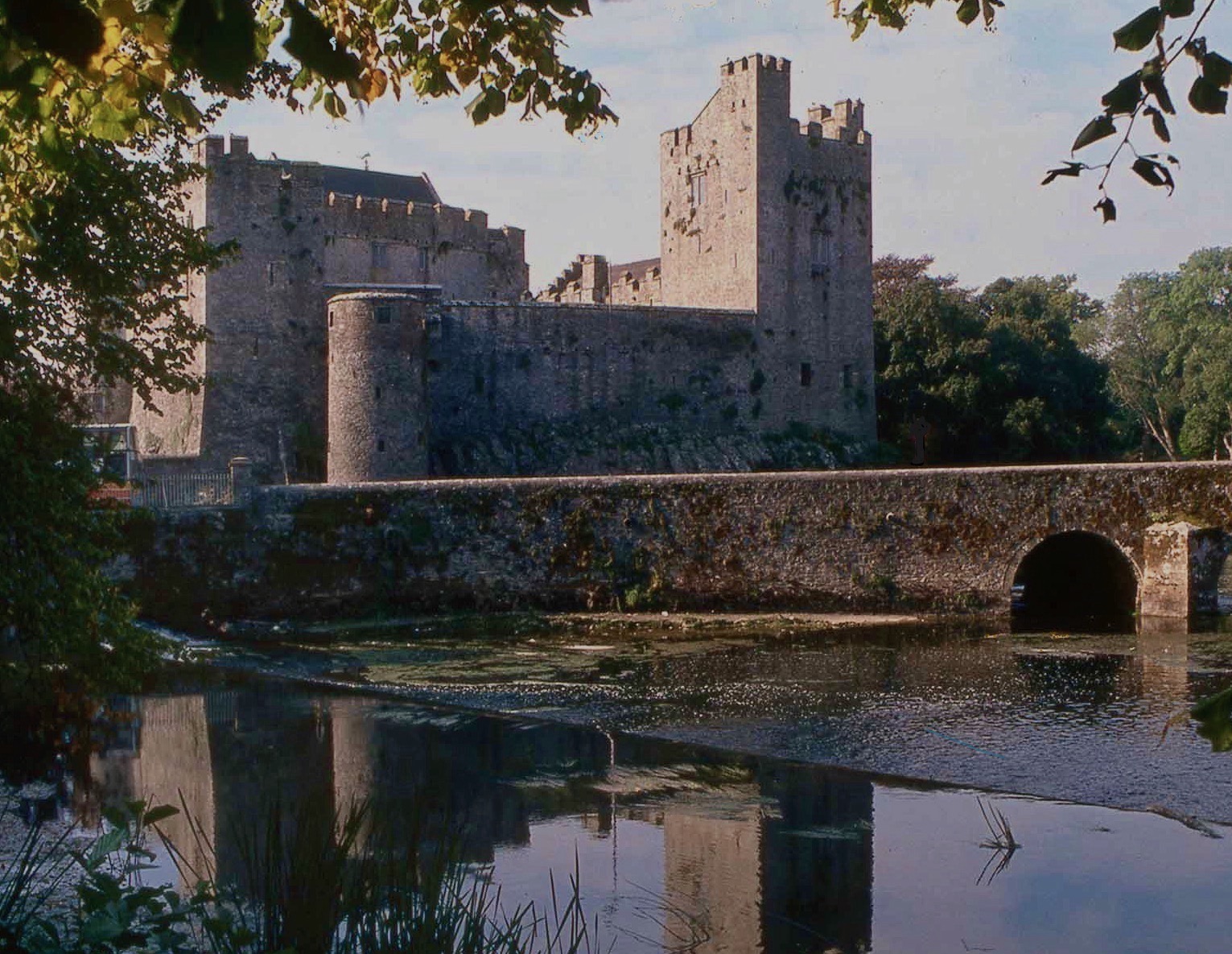
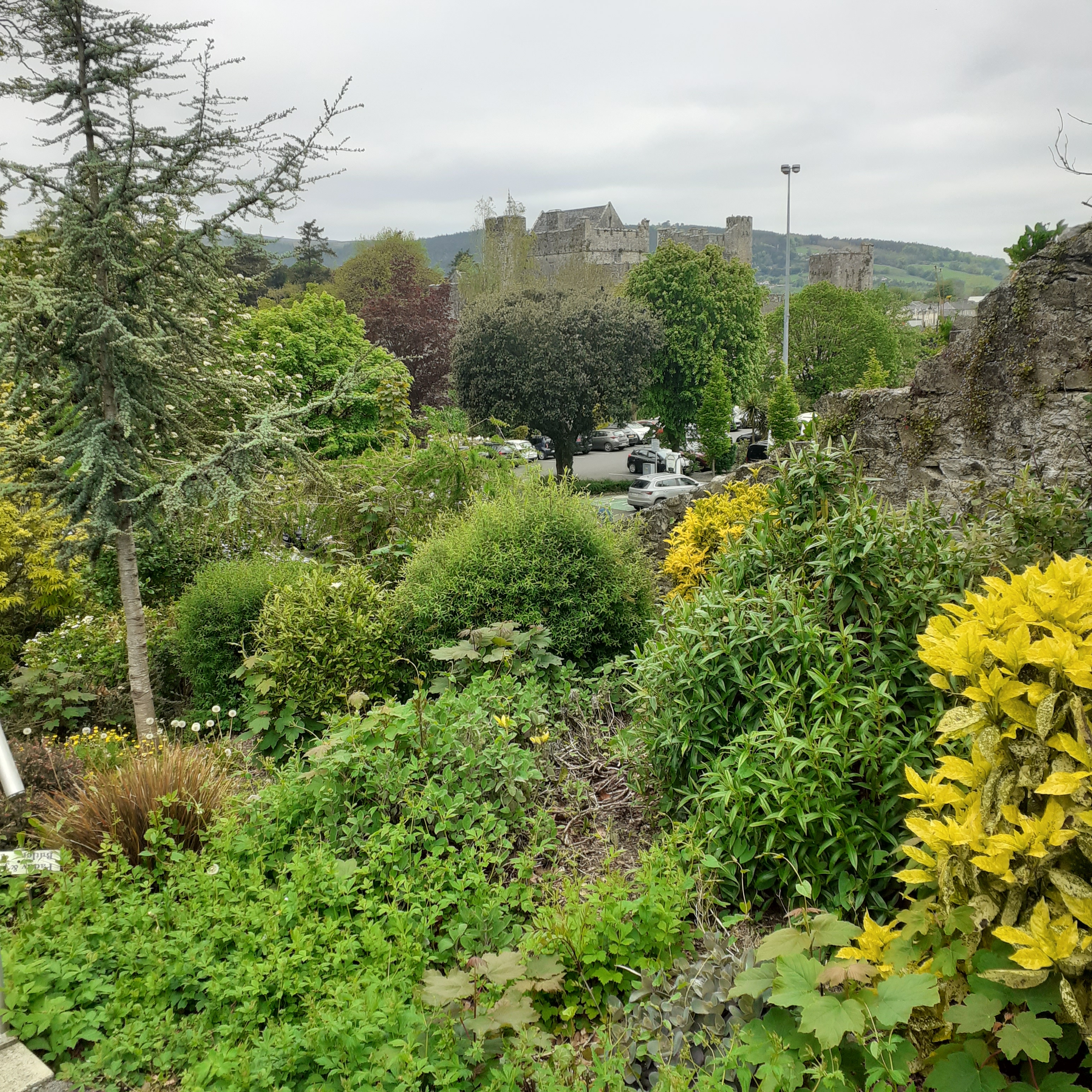
The most spectacular feature of Cahir is its castle. Cahir Castle is built on a small island in the river. It was first built in the mid twelfth century by the King of Thomond (North Munster) Conor O’Brien. This dynasty was established by Brian Boru, of Battle of Clontarf fame. This was the original stone fort, An Cathair, which gave the town its name. The Butlers of Ormond (East Munster) took over when in1375 James Butler was granted the castle estate as reward for his loyalty to Edward III. Munster, Ireland’s southern province, was then divided into three earldoms Ormond, Thomond and Desmond (South Munster). The new Castle had formidable walls rising sheer from the river, with a towering central keep all guarded by an array of sturdy towers. It was considered impregnable but in the three day siege of 1599 during the Nine Years War the Castle was taken by Robert Devereux, the Earl of Essex.and his ally Christopher St Lawrence, Lord Howth. This is the same Howth who, as a boy was kidnapped by pirate queen Grace O’Malley. Eventually released, he grew up to become a renowned warrior, albeit with anger management issues.
Since the death of the last Lord Cahir in the 1960s, the Castle has been the property of the Irish State. Entrance is €5 and there are guided tours. It is free to walk the Inch Field public park which embraces the castle on three sides. In modern times the Castle is much in demand for period productions in the film and tv business. Famous films are noted on a plaque outside. Amongst the roll call are John Boorman’s Excalibur from 1981, TV drama The Tudors and most recently The Last Duel in 2020. The Last Duel was directed by Ridley Scott and based on a nonfiction work by Eric Jager. Matt Damon is producer, co-writer and took the main lead of Jean de Carrouges fighter of the last Judicial Duel in France in the fourteenth century. Filming was delayed with the outbreak of covid and Damon found himself marooned in Dalkey, south of Dublin. The bould Matt didn’t mind, going for swims and coffee and hobnobbing with the locals. What’s not to like about being marooned in Dalkey, rubbing shoulders with Bono, Enya and Van Morrison?
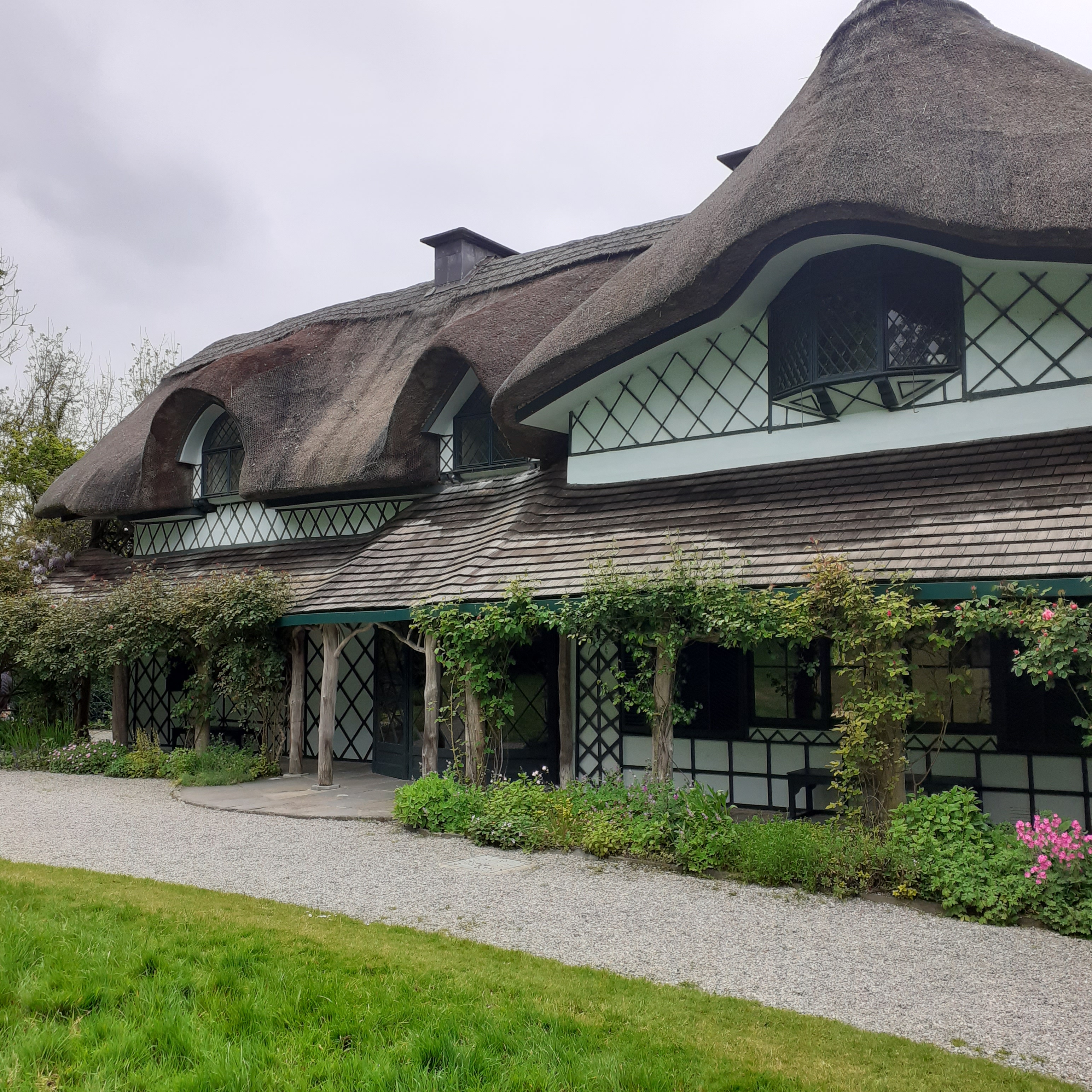
A 2 km riverside walk will take you to the Swiss Cottage. This early nineteenth century ornamental cottage is attributed to John Nash, the Regency architect who also designed the Cahir Parish church in 1817. Thatched and deliberately asymmetrical, it is a fabulous mimicry of what it was assumed an Alpine cottage might be. Such follies were for entertaining guests, who dressed, or even undressed, in rustic gear to let it all hang out, as it were. Downstairs there’s a music room to one side and beyond the central staircase the Dufour Room, named for its startling French Dufour wallpaper. This original wallpaper makes a fantastical backdrop, depicting a pleasure ground surrounding the Bosphorus. There’s an excellent guided tour to bring you around the interior which costs just €5, €4 seniors. Here we learned, amongst other things, Richard Butler’s own story which is itself outrageously romantic. He was an obscure teenager with only distant family connections until an unlikely string of aristocratic deaths meant the Cahir lordship became his inheritance. Grasping relatives abducted him to the continent but the plot was foiled by Arabella Jefferys. She rescued Richard and brought him to her home at Blarney Castle in County Cork, where he came of age and married her daughter, Emily in 1793. It was this happy loving couple that commissioned the Swiss Cottage.
Say you don’t need no diamond rings
And I’ll be satisfied
Tell me that you want the kind of things
That money just can’t buy
I don’t care too much for money
Money can’t buy me love
Ow!
Can’t Buy Me Love is a Lennon McCartney song from the Beatles album, A Hard Day’s Night in 1964. McCartney wrote the song in Paris and later mused if the ’t might be omitted.
Myself and M took a couple of days in Leitrim in the middle of June. We booked into the Riversdale B&B just outside Ballinamore. It’s a lovely old house along the Shannon Erne Waterway with moorings for watercraft where there’s a boatyard for barge building and repairs. The property is on a farm with horses gambolling in the nearby fields.There’s a heated swimming pool, a gym, table tennis and a grand piano offering us a diverse range of pursuits. The drive took us about two and a half hours from Bray, with coffee and a snack in Edgeworthstown. We followed the main road as far as Dromod, turning off for Mohill and Fenagh, which is more direct than the backroad route proposed by Google.
In terms of population, Leitrim is Ireland’s smallest county with a population of thirty five thousand people. In pre famine times there were a hundred and fifty thousand people and a thriving mining industry. Ore mining continued from the sixteenth to the eighteenth century, with coal mining to the fore in the nineteenth century. The Arigna Mines across Lough Ree in County Roscommon are now a visitor centre. The last mine there closed in 1990. The population had dwindled to a mere twenty five thousand in the 1990s. So things are picking up.
A main attraction for us was the Ballinamore Walkway and Cycling trail, a four and a half kilometre walk to the town, taking about an hour. It’s mostly flat, being along a canal, and is an extremely pleasant route through woodland and farm. Near Ballinamore there’s a weir and lock with an attractive expanse of placid water in the shade of the trees. We come into the town through a small parkland circling the mooring spot for river craft, framed by its multi-arched stone bridge and quayside.
Ballinamore lies on the Yellow River, its main street rising up from the bridge. On the other side there’s a fine modern theatre, The Island, which as the name says occupies an island on the Shannon Erne waterway. The theatre hosts dramatic and musical events. Along Main Street, Smyth’s Pub, Siopa Ol as Gaeilge, is a traditional old pub serving good food and drink; and a lot of it. With friendly service and a relaxed atmosphere, it made for the perfect oasis at the midpoint of our walks along the waterway.
The Shannon Erne waterway connects the Irish and Northern Irish canal and river network. The Shannon thereby becomes part of a navigable network through the midlands and connecting Dublin with Lough Erne and Enniskillen in Northern Ireland. It was built in 1840 but fell into disuse after the coming of the railway and the automobile. The railway once ran through here connecting the Dublin Sligo line to Ulster. It operated from the 1880s to 1959, when much of Ireland’s secondary rail network was decommissioned. The canal, however, came back and the restored waterway reopened in 1994.
It’s a short drive from here to Enniskillen in Northern Ireland. Enniskillen is situated between Lough Enrne Upper and Lower and is located on an island. Enniskillen Castle stands on the Lough shore. It was built in the early fifteenth century by the local chieftains, the Maguires, but fell into English hands at the start of the seventeenth century with the occupation and plantation of Ulster. There is substantial free parking on the edge of town and it’s a short walk up to the main street marked by the spires of the main denomination churches.
The Catholic St Michael’s dates from the 1870s and is built in the Gothic Revival style. It is preparing for mass, and the huge organ blasts into life as we enter, which is very exhilarating. Right across the street, the Protestant (CofI) church is smaller and looks older. St Macartin’s Cathedral is on the site of the first Protestant church built here in 1627. The current building dates from 1842. The main street follows the line of Chruch Street, High Street and Town Hall Street.the Town Hall crowns the island’s highest point. It was built in the 1880s replacing its dilapidated predecessor. The six storey copper domed tower forms a distinct landmark. The Clinton building marks the end of town, built overlooking the site of the Remembrance Day bombing by the IRA which killed twelve people in November 1987. The bombing further alienated the IRA and is often seen as a watershed of the Troules with democratic processes coming to the fore.
There are plenty of bars, cafes and eateries on or off the main street including William Blakes, Crowe’s Nest and Granny Annie’s. We eat at the Firehouse, which is as warm as the name implies and friendly. They serve us from the lunch menu too, although we were late.
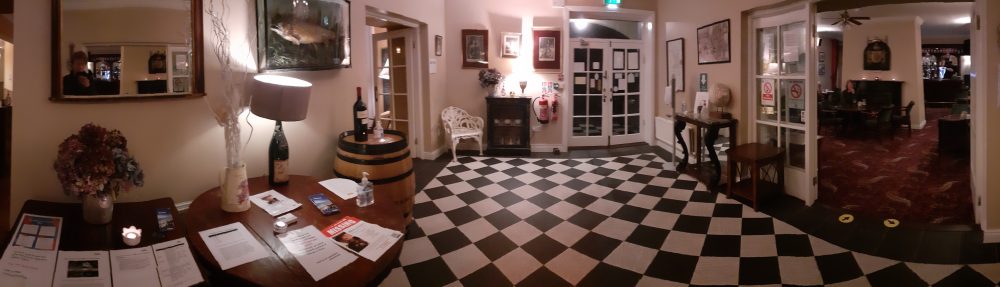
Next door to Riversdale, is the Glenview Folk Museum. This was founded at the start of the century and is run by the Kennedy family. It houses a wonderful collection of social and cultural paraphernalia. We popped over in the morning and ran into Brian Kennedy who gave us a personal tour with a few other couples. The collection is grouped around such community focal points as the pub, the general store, transport and farming life. I can actually remember some of these ancient displays, forgotten brands quaint production methods emerging from my X files. For younger viewers it must be mind bogglingly weird. Brian is an affable host, rich in anecdote and with all the enthusiasm you would expect from someone who has so loveingly and skillully prepared these displays.
A section is devoted to writer John McGahern. Born near Ballinamore in 1934, by the end of the century he was seen as one of Ireland’s greatest living authors. But, as Brian points out, it had not always been so. McGahern became a primary school teacher, teaching at Clontarf in Dublin. When his second novel The Dark was banned, he was fired from his post by Archbishop McQuaid. For writers, being banned was something of a badge of honour, Brian O’Nolan complainerd that his career suffered due to the ignominy of never being banned. For Mcahern though, censorship of his book meant that he lost his job. He actually was cancelled. He returned to Leitrim, buying a farm near Fenagh. His last two books Amongst Women and That They May Face the Rising Sun(2002) secured his reputation at home and abroad. He died in 2006.
Brian Kennedy dwells on his marginalisation as a literary figure. A poster on display includes the usual suspects Joyce, Beckett, Yeats and Behan, though not McGahern. As with much artistic pursuits such perspectives change with time, and I imagine most literary fans would include McGahern on their own Rock Dreams poster.
We pass through Carrick on Shannon on our drive home. Carrick is Leitrim’s county town, with a population of 4,700 people. It is one of the fastest growing towns in the country, developng a thriving tourist industry based on the amenity of the River Shannon. There is a palpable buzz about the town during the summer. We stop for a coffee at a colourful pavement cafe, VDA. Down the street we notice a fine gable end mural of the county’s literary heritage. Painted by artist Nik Purdy in 2020 it includes such writers as Susan Mitchel, Canon Slator, Nora Murray, M.J.McManus and, of course, John McGahern.
Our recent tour of western Andalusia took us from Seville to Cadiz by train, and we then got a bus from Cadiz to Marbella. This was a three and a half hour journey with a number of stops on the way. There are usually two or three busses per day and it cost €56 for the two of us. We booked for the two o’clock departure giving us a relaxed final morning in Cadiz. We had breakfast in Cathedral Square and strolled around a bit, visiting the Church of Santiago across from the Cathedral. This was a Jesuit church built in 1563 but destroyed by English and Dutch invaders at the end of that century. Rebuilt in the Baroque style it eatures exuberant interior decoration with ornate baroque altarpeices from the seventeenth century populated by lifelike clothed statuary. We dallied on the main square before picking up our bags and one last cup of coffee for the road, near the statue of the Pearl of Cadiz.
Your sister sees the future like your mama and yourself
You’ve never learned to read or write, there’s no books upon your shelf
And your pleasure knows no limits, your voice is like a meadow lark
But your heart is like an ocean, mysterious and dark
One more cup of coffee for the road
One more cup of coffee ‘fore I go
To the valley below
One More Cup of Coffee is from Dylan’s 1976 album Desire, also featuring Emmylou Harris on vocals. There is a strong Gypsy inluence in the narrative, and Dylan’s vocal style borrows from traditional Jewish singing. Meanwhile the Valley Below is common to all travellers who find themselves moving on.
The bus station is beside the rail station so it was a short walk. The weather is wet and cool, a bit like home. The bus heads on through the modern extension to the city of Cadiz, then along the connecting isthmus to the mainland. This part of the city is built up with medium rise hotels lining a long sequence of beaches such as Playa de la Santa Maria and Playa de la Victoria. Farther on is a grubby industrial area. The urbanisation extends to Chiclana de la Frontera famous for La Barrossa beach. It has a population of 80,000 and is also on the railway line connecting to Cadiz, Jerez, Sevilla and Madrid. After that there’s Conil de la Frontera a traditional white town of about twenty thousand people. This too is famous for its beaches and is a popular destination for Spanish holidaymakers.
Then we head towards Tarifa on the Costa de la Luz. Spain’s southernmost point is a magnet for windsurfers. It is very windy owing to the Venturi effect which funnels the wind passing through the Strait of Gibraltar separating Spain from Africa. Algeciras is next. With a population of 120,000 it is one of the largest ports in Europe. It is also a ferry port for Tangier and other North Arican ports, and the Canaries too.
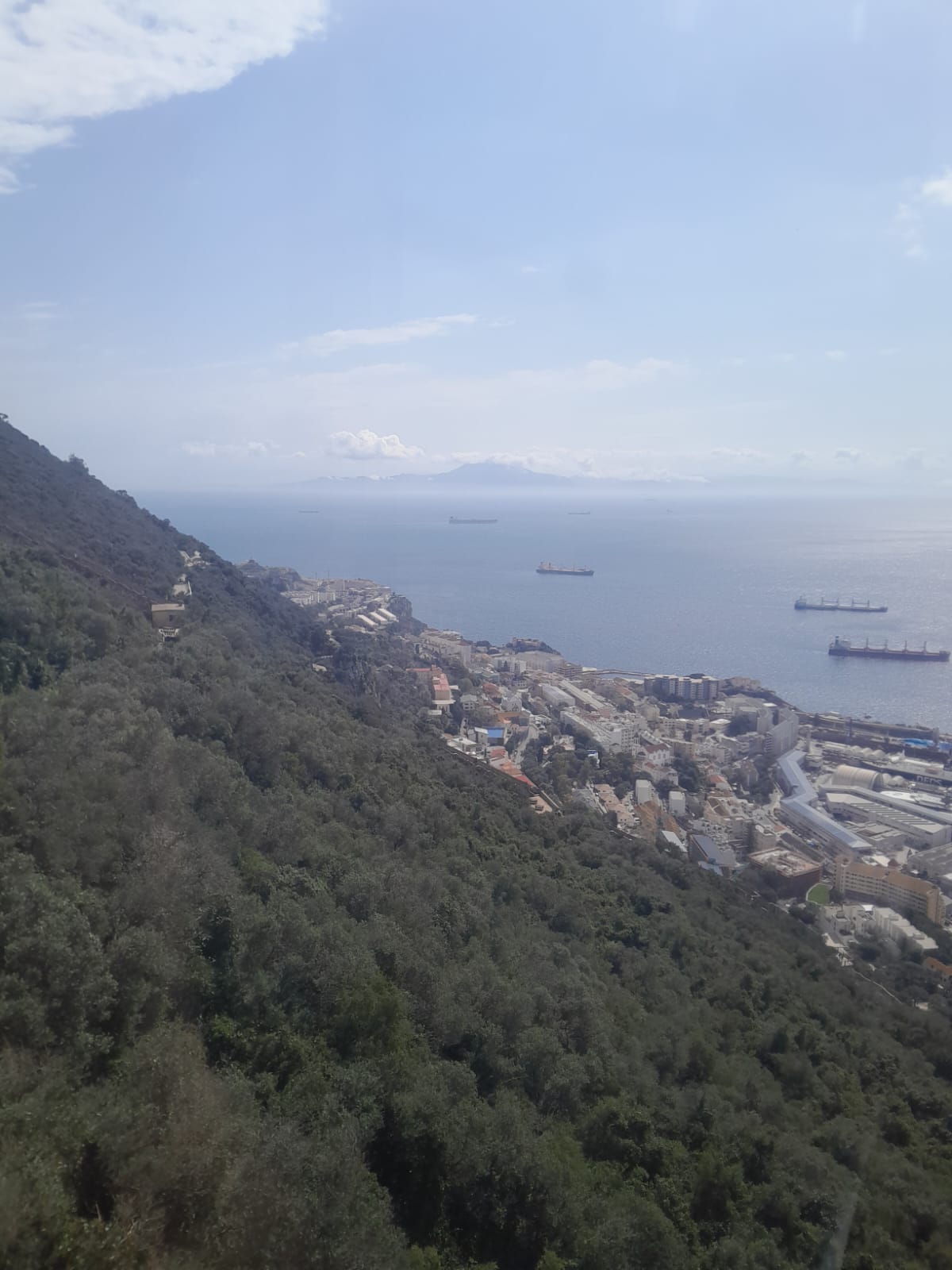
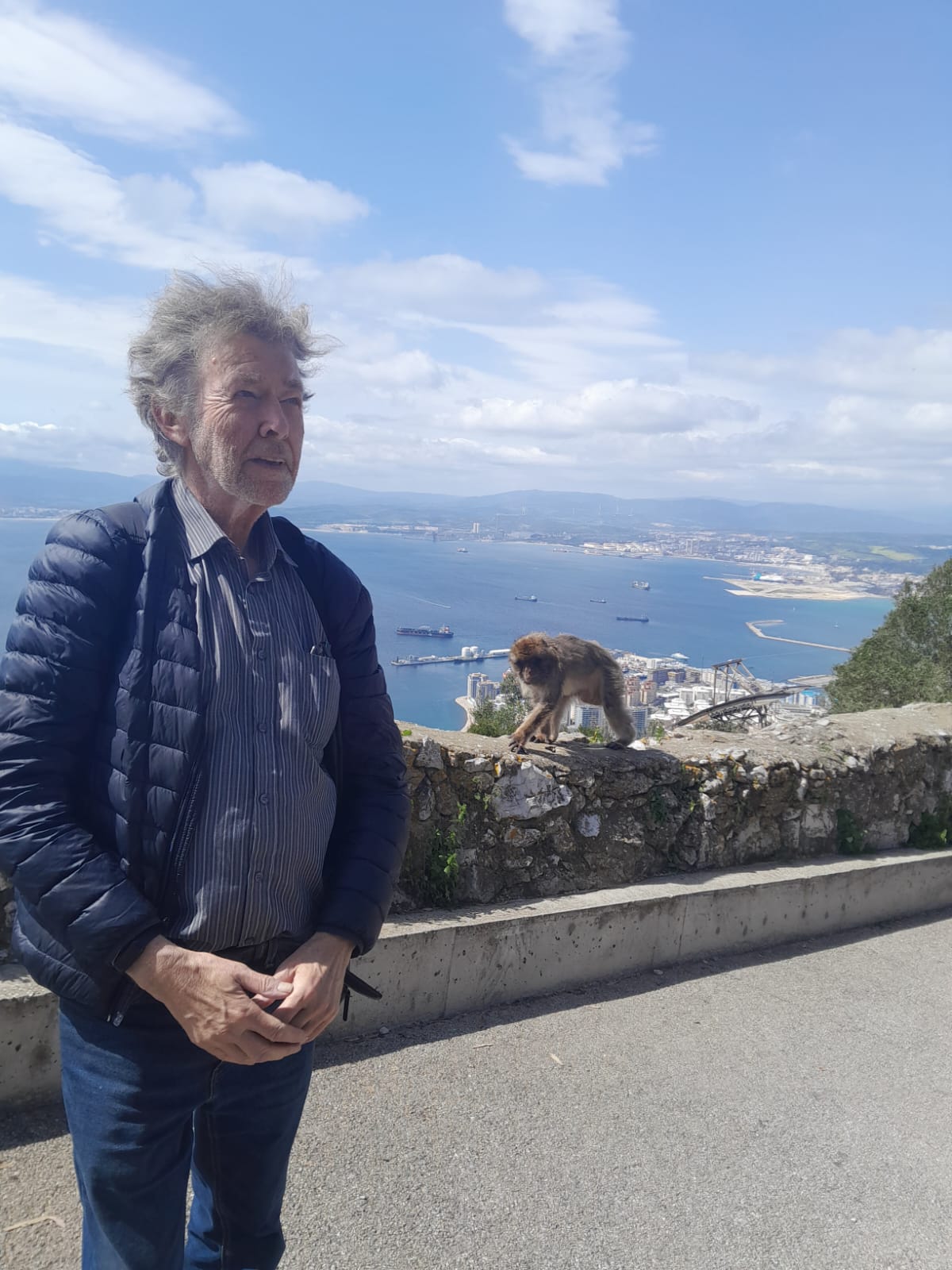
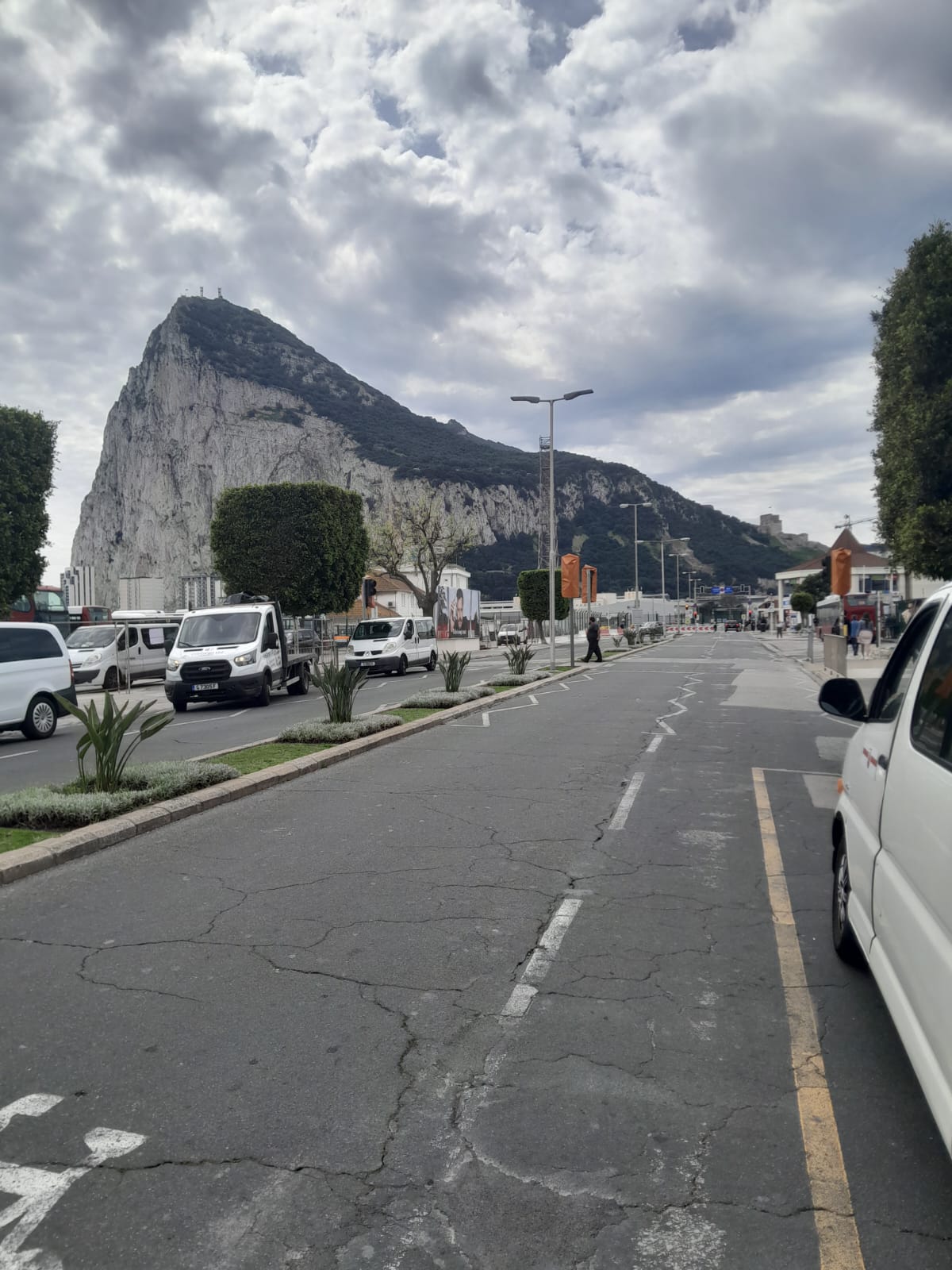
Leaving Algeciras we pass Gibraltar, the high Rock suspended in the clouds. Gibraltar was captured by an Anglo Dutch fleet during the War of the Spannish Succession, it was granted to Britain in 1713 at the Treaty of Utrecht. Besides the British, Gibraltar is occupied by monkees. These are Barbary macaques, numbering about three hundred and the only European wild monkees, not counting ourselves. The scenic coastal mountains rear out of the gloom, scratching some welcome blue swathes in the sky. Estepona is the last stop before Marbella.
The way it is long but the end is near
Already the fiesta has begun
The face of God will appear
With his serpent eyes of obsidian
Marbella bus station is outside the city centre. We had originally booked a hotel, but cancelled and opted to head straight for the villa. The taxi from the station cost €20 and deposited us in Elviria central. The sun made a welcome appearance and after shopping we had pizzas and pints outdoor on the square. We did make a trip into Marbella the next day taking the local bus and spending a leisurely few hours walking up the coast towards Puerto Banus, where the rich folk go. We returned to eat at Canuto in Marbella with good local tapas. We walked the six miles home along the beach in hot sunshine and high waves. At last we reached our favourite stop in Elviria. The Lido Bar along the beach has become our sunset bar, the perfect place to relax over a few drinks, or a bight to eat. We fade into the spectacular coastal scenery looking out over the Mediterranean, Africa beckoning just beyond the lip of the horizon.
No llores, mi querida
Dios nos vigila
Soon the horse will take us to Durango
Agarrame, mi vida
Soon the desert will be gone
Soon you will be dancing the fandango
Romance in Durango is also on Dylan’s album Desire.
We take the train from Seville to Cadiz. There’s a train every hour or so and the hundred kilometre journey takes an hour and a half. Santa Justa Station is an ugly carbuncle on unkempt wasteland on the edge of the city. But once inside it is clean and functional and there are plenty of seats on the main concourse with cafes and eateries. We travel along the eastern Guadalquivir valley heading south through Sherry country. The fortified wine takes its name from Jerez de la Frontera, close to our destination. Further on, we enter the swamplands on the Bay of Cadiz and standing proud in the sea, the city of that name.
There’s a Spanish Train that runs between
Guadalquivir and old Seville
at dead of night the whistle blows
and people fear she’s running still
Spanish Train and Other Stories, Chris De Burgh’s 2nd album from 1975.
Cadiz occupies a small peninsula jutting into the Bay. Initially it consisted of two islands but over the years they have joined and connect to the mainland via bridges and an isthmus. The spectacular La Pepa Bridge looms over the port. It is the longest cable stayed bridge in Spain at five kilometres. It was named as the Constitution of 1812 Bridge, planned for completion on the bicentenary of the launch of Spain’s first constitution in Cadiz. This briefly established a democracy which was crushed by the monarchy two years later. As for the bridge, the economic crisis added another three years before completion in 2015.
Cadiz is often touted as Europe’s oldest city. As with Seville, Hercules is claimed as the mythical founder, his name also used for the Pillars of Hercules guarding the entrance to the Mediterranean farther East. More historically, three thousand years ago the Phoenicians set up shop here. They came from Tyre, in modern Lebanon, and named the settlement Agadir, derived from their word for wall, signifying a stronghold. Agadir is also the name of a Moroccan city, although the Spanish port’s name has mutated to Cadiz over the years.
Carthaginians and Romans followed. The Roman city of Gades was established on the southern island. Remnants of its ancient theatre survive and there is an excellent visitor centre showing a visual reconstruction, with ancient artefacts and a fascinating historical narrative. The Theatre was founded by Lucius Cornelius Balbus in the first century BC and only rediscovered in 1990. It is the largest known outside Pompeii and housed up to ten thousand spectators. Entrance is free for EU residents. It is close to the Plaza de la Catedral, via the Arco de la Rosa, one of the ancient gates of the city.
Cadiz fell under Muslim control between 711 and 1262 when the Reconquista confined the Moors to the Nasrid Kingdom of Granada. The fall of Granada in 1492 coincided with Columbus’s adenture in America, and the Conquistadors who followed established a lucrative transatlantic trade for the Spanish crown. Cadiz thrived during the eighteenth century as Spain’s designated transatlantic port.
The train terminates at the port, adjacent to the city centre. Our hotel, Convento Santo Domingo, is only a hundred yards or so from the station entrance. Convento Domingo is a seventeenth century Dominican convent. It is a sight worth seeing itself, a priveledge for hotel guests. Inside, cloisters surround a tiled plaza, with an eerie soundtrack of Gregorian chanting monks adding to the atmosphere.
Then the door was open and the wind appeared
The candles blew and then disappeared
The curtains flew and then he appeared
Saying don’t be afraid
The singing monks, and some wine, suggest the song of the Blue Oyster Cult: Don’t Fear the Reaper. Written by Donald Roeser, it’s on their 1976 album Agents of Fortune.
Music persists outside the convent where we encounter a statue to La Perla de Cadiz. Antonia Gilabert Vargas was a Gitana flamenco singer. Born in Cadiz in 1924 she became famous throughout Spain for her voice of power and softness. She died in 1975. A club on the nearby seafront trades under her name
A few hundred yards further on through the Barrio we find Puertas de Tierra, a monument built in the eighteenth century along a remnant of the sea defenses which repulsed Napoleon in the Peninsular War of the early nineteenth century. Today it marks the border between the Old Town and Puerta Tierra, the modern city resort sprawling along the isthmus.
The weather is sunny but with a bracing sea breeze making it cooler than Seville. A couple of narrow, straight streets run lengthwise, Calle San Francisco and Sacramento being the main ones, with winding medieval lanes connecting. Many junctions broaden into small plazas, allowing people to congregate in comfort within the dense maze of streets. A roadway circles the Old Town, and broad footpaths and several sizeable green parks make for an easy escape from urban claustrophobia.
A short esplanade divides the port from the main square. Plaza San Juan de Dios is fringed with palm trees, bars and restaurants and focussed on the Old Town Hall, a fine Neo-Classical building from 1799. Taking Calle San Francisco we browse the shops all the way up to the Plaza San Francisco. We enjoy ice cream cones from a perch beside the hatch, where we can watch the world go by and youngsters playing ball against the walls of the church.
The next square up is the Plaza de Mina with the Museum of Cadiz. This includes an art gallery with works by Rubens and Murillo. Unfortunately the gallery was closed, something too frequently the case these days. Recent visits to Porto, Budapest and Edinburgh suffered from such partial or total closures. The Museum itself has a good display showing Cadiz’s history, with Roman statues and other archeological exhibits back to the Phoenicians.
A woman on the train advised us to seek out the Taverna Casa Manteca for lunch. We arrived in the evening when it is closed but chose instead a nearby taverna. The woman serving gave us a tour of the dishes on display so we could choose by a combination of pointing and miming. A bit like a game of charades, but without a definite resolution. I wondered what Pulpo was. Our host translated by flailing her arms while saying pulpo repeatedly. We decided against, but were given it anyway. It is Octopus, by the way, although sufficiently buried in its preparation and sauces as to give no hint of waving tentacles. It’s fine, shellfish are out for me but I can eat fish or squid. We liked it, and the generous mixed salad to accompany it.
We returned the following day to Casa Manteca, which means the House of Butter. It opened in 1953 and is dense with atmosphere, history and the aroma of good food. For Siesta it is thronged with people enjoying tapas and drinks. We try hake, and tortilla, which promptly arrives. The staff, though very busy, are good. Something of an old style pub atmosphere pervades. Wood pannelling throughout, the walls covered with flamenco and bullfighting photos and mementos.
Nearby, the Playa de la Caleta, the city’s famous beach forms an arc between two fortified promintories. The longest terminates in Castillo San Sebastian, where the Phoenicians established their base three thousand years ago. The modern castle was built in 1700. Still a small island, it connected to the mainland by a stone causeway in 1860. A metal lighthouse was built in 1906, and soars to over forty metres. Unfortunately, the Castle and compound is closed to the public for renovations. The causeway is a recommended spot to view the sunset. It was cloudy when we arrived, but none the less scenic for that.
Castillo de Santa Catalina is Cadiz’z oldest fortress, built at the end of the sixteenth century. The small chapel came a century later. Inside the walls we step into another world. The past, for sure, but I also felt the thrill of being in a Salvador Dali townscape: Outskirts of the Paranoiac-Critical Town. Meanwhile, I half expected to see Clint Eastwood step out from a doorway and spark up a cheroot. The Castle was repurposed as a military prison for over two centuries until donated to the City in 1991. Now the buildings house art and cultural exhibitions. We were fortunate that our visit coincided with an exhibition by Fernando Devesa, La Verdad Sea Pintada, comprising stunning views of Cadiz and more intimate interiors. Fernando Devesa Molina is a local painter in his forties.His realist paintings are masterful, not just an exercise in rendering but full of warmth and vision; the truth is clear to see.
The beach centers on the nineteenth century baths. La Palma Spa gives an aura of Fin de Siecle opulence, though they are now a Nautical college. We walk all along the City coast, lined by parks and remnants of the ancient sea walls. Genoves Park is the largest, though we had to climb in over the railings. Nearby, the Murallas de San Carlos is one of the most scenic stretches of the sea fortifications. Alameda Park, known for its vast dragon trees, is a cool oasis of chequerboard tiles and shade. Stepping down from the walls, the Plaza de Espana is dominated by a monument to the 1812 Cadiz Constitution, erected a century later. We are back to the port and just a short walk from Plaza San Juan de Dios.
Calle Sacramento, another long shopping street that cuts through the centre of the Old Town can be reached via Catedral Square and Plaza de las Flores. The Central Market there is thronged with locals enjoying drinks and snacks from its many stalls. Nearby is the Tavira Tower. Built in the mid eighteenth century in a Baroque style, there are maybe a hundred such lookout towers dotting the skyline. Only this one is open to the public and is the highest vantage point in the Old Town at 150 feet. There’s a wonderful panorama from the roof. It was very windy when we visited, which only added to the spectacle. I could have done with guy ropes as I crept across the roof taking photos which I hoped would not be shaky. The Camera Obscura, just below, was far more calm, and the excellent guide gave a good account of the camera. She performed amusing tricks with the people passing through the busy market below and we wondered would we feature in one of her shows later on.
The Cathedral is Cadiz’s most iconic building, an impressive collage of different styles. It is known as the New Cathedral. The original Old Cathedral, near the Roman Theatre, was burnt down in the Anglo Dutch attack of 1598 and replaced in situ. Prosperity and population growth caused the city to propose a bigger cathedral and work began in the early 1700s. It took over a century to build, with several different architects, so the style shifts from Baroque to Rococo to Neo Classical. Its dome is clad in yellow tiles giving an impression of gold under the bright Andalusian sun.
Catedral Square on its inland side has a variety of bars and eateries. On the corner 100 Montaditos is useful for the budget conscious, with tapas and drink served at the counter. All are well thronged with diners, drinkers, passing tourists and locals, enjoying the wonderful vista, and each other. Cadiz seems to have achieved a reasonable balance between visitors and residents. The city feels lived in, enchanting and relaxed. Very friendly too, we found.
The Alcazar is Seville’s fortress and royal palace, established in Moorish times. The fort here dates to the early tenth century. The Moors ruled from the early eight century until 1248 when conquered by Ferdinand III of Castile. Significant reconstruction began and continued through the centuries. Although little of the original palace remains, the original style persists in the many ornate courtyards and the Mudejar architecture. Mudejar means those who remained, referring to Muslims in Spain after the Reconquista. It is a fusion of Christian and Islamic art and architecture, a heady mix of Gothic, early Renaissance and the flowing tracery and distinctive detail of Muslim crafts. After 1492, the Catholic Monarchs Ferdinand and Isabella renovated the palace as their main residence and it is still a royal residence today.
We queued in the morning for early afternoon tickets. Visits are restricted by number and entrance is on the hour. It costs thirteen euro, seven for over 65s. Entrance is through the Puerta del Leon (Gate of the Lion) which leads on to the Patio de la Monteria, the Courtyard of the Hunters who used to meet here before their hunts. The courtyard is dominated by Pedro’s Palace, which forms the focal point of the complex and includes the mighty Hall of the Ambassadors
Don Pedro’s Palace was built in alliance with the Moorish kingdom of Granada in the 1360s Pedro’s ally, Muhammad V, was the Nasrid ruler of Granada and supplied designers and craft workers who had also worked on the Alhambra. The Patio of the Maidens is a particularly fine example of Mudejar architecture. Formal gardens with fountains and pools were a notable feature of Moorish palaces, with greenery and shining water cooling the sunbaked setting, literally and aeshetically. The Gardens are truly an earthly delight, lying between the palace and the city walls. The Grotto gallery gives a great view over the gardens built above a stretch of the Moorish defensive wall in the 16th century. There’s a Garden of the Dance, and a Garden of the Poets alluding to the various arts that settled amidst the shading landscape. Further gardens have been added up to the twentieth century.
Leaving, we follow the palace walls through a charming ramble of ancient streets in this picturesque part of Santa Cruz. Sunburnt but softly rendered in pastels, there are welcoming intimate bars and cafes with the promise of music later on. The route leads on to the Murillo Gardens, named for the artist whose work is such a ubiquitous feature of Seville’s holy places. Bartolome Esteban Murillo was born in Seville in 1617 and became a leading painter of religious imagery. He is also well known for his informal paintings of contemporary street life, featuring a cast of flower girls, fruit sellers and street urchins. His paintings feature in major museums across the globe including the Prado, the Louvre, the Hermitage and the London National Portrait Gallery. He died in Seville in 1682
His park continues parallel to the Avenue Menendez Pelayo and there’s a monument for Columbus halfway along. Meanwhile the ornate carriages of La Feria’s finely clad aficionados trot past. We head for the Parque Maria Luisa, a huge green wedge of the city’s southside on the banks of the Guadalquivir. This was where the Ibero American Exposition of 1929 was held. The main pavillion at Plaza de Espana showcased Spain’s industry and technology. One of Seville’s signature buildings, it was designed by local architect Anibal Gonzales. Arranged in a semi-circle, it forms a fantastical montage of architectural styles facing onto a scenic moat. Here you can take a pleasure trip in a dinky rowing boat.
The arcades are packed with tourists, foreign and local, and a host of buskers and vendors. There’s a wedding party in full La Feria dress around the central fountain. In fact, the Exposition of 29 helped establish the traje de flamenco as a ‘traditional’ garb for the ladies of Spain. A young Flamenco group of musicians and dancers performs on the ground floor gallery at the main entrance. They are modern in style and substance, clad in uniform black, though this is a stylish mufti in the modern mode. The accousitcs are ideal for the percussive clapping and full bodied rhythm of the guitar
Returning through Arenal, we pass the famous Tobacco Factory. Seville was the first European centre for tobacco, the Spaniards spotting its benefits the moment Columbus stepped ashore in the Americas in 1492. The Royal Tobacco Factory is an 18th century building, bringing the various tobacco manufacturers under one roof, and one ruler. Since the 1950s the building has been the seat of the Rector of the University of Seville. Carmen, titular lead of Bizet’s opera, was a cigarrera here. Women were renowned for their skills as cigar rollers, and they replaced the male workforce in 1813. The fiery Carmen was a Gitano who lead the young soldier Don Jose astray, before dumping him for the dashing toreador Escamillo. The opera was first performed in Paris in 1875. Amongst its best known songs are L’amour est un oiseau rebelle, and the Toreador Song.
For early evening, we have booked a Flamenco show in Calle Cuna which runs parallel to Calle Sierpes close to Plaza Del Salvador. Teatro Flamenco Sevilla is an intimate theatre seating about three hundred people. They run several hour long shows daily. Flamenco grew out of the Gitano Barrio of Triana, on the west bank of the Guadalquivir. The folk form is internationally famous, a definitive Spanish culture. The singing is expressive, the guitar rhythms hypnotic, the interpretation of the dancers seductive, the whole making for a sensually charged and dramatic performance, felt as much as it is seen and heard. Traditionally, Flamenco was more of an ad hoc expression, similar to an impromptu Irish Folk session. The first flamenco cabaret bar was opened in Seville in 1842 and known as the Cafe Sin Nobre, No Name Cafe. These days Flamenco is more usually presented as a tablao, or show. Tablao refers to the stage floorboards. On the Boards, as Rory Gallagher would sing.
Our performance was at 7.30 and featured five dancers, one male, and a male and female vocalist. The guitarist was the natural leader of the troupe, although leading from the rear. The vocals were visceral. I couldn’t believe how their singing seemed to explode from inside my head. All performers contributed to the stacatto percussion, another startling feature of Flamenco. Talent, spectacle and a genuine passion permeated the performace. On the last few numbers, they and the audience got carried away, with plenty of high good humour, particularly the manic and brilliant guitarist. A great gig.
Afterwards we have a decent tapas at Plaza Alfalfa nearby. Around the corner from our hotel is the curiously named Plaza Cristo de Burgos. We decide to take a look, mindful that tomorrow we take a Spanish Train to Cadiz; but that’s another story. The small park has a statue of the great guitarist. The great guitarist being flamenco guitarist Manuel Serrapi Sanchez and known as Nino Ricardo. He was born in this square in 1904 and became a major influence on flamenco guitar technique. Paco de Lucia hailed him as the Godfather of guitar.
We say goodbye to Seville, from a rooftop bar above the Cathedral. The illuminations shimmer in the warm night air and it feels as if we ride above the city on a magic carpet. It all suggests a shot of Colombian espresso, a square of dark chocolate, the air scented with the smoke of a long Havana. Open a bottle of Osborne Sherry and enjoy the company of Compay Segundo and the sound of Guantanamera.
Yo soy un hombre sincero,
De donde crece la palma.
Y antes de morir yo quiero
Cantar mis versos del alma.
Guantanamera, guajira guantanamera,
Guantanamera, guajira guantanamera.
Guantanamera is a Cuban song from the poem by Jose Marti set to the music of Joseito Fernandez (probably). Look up the version by Compay Segundo with video of the noted guitarist enjoying the benefits of tobacco and drink in his native Havana.
Touchdown at midnight in Seville airport. Step into a warm Spring night as taxis cruise conveniently to the kerb. It’s thirty five euro to the city centre, which is a bit steep; but it’s Feria, and you now how festivals eat money. Our city centre hotel is near six hundred euro for three nights, so we’re prepared. Feria is Seville’s biggest festival, where locals let there hair down, or tie it up, a fortnight after the serious religious and cultural devotion of Semana Santa.
Our accommodation, La Pila De Pata is in the Old Town, Santa Cruz, within walking distance of the city’s main attractions. The room is attractive, with a timber ceiling, old style shutters, and a gigantic fan. There’s a small wrought iron balcony overlooking the narrow street, Calle Aldohinga. There are noisy neighbours across when we arrive, but hey, it’s Feria, and we’re dog tired and sleep easy.
Seville is the capital and largest city in Andalusia. Almost seven hundred thousand people live here on the banks of the mighty Guadalquivir River. Founded by the Romans and ruled by the Moors for five centuries from 700AD, in 1248 Castile conquered the Moors in the Reconquista. NO8DO is the city’s emblem. It is a rebus for No me ha dejado: she (Seville) has not abandoned me. Pronounced No ma dejado, the symbol 8 represents the trio of syllables madeja; a skein of wool. The legend is that King Alfonso X used the phrase thanking the citizens for standing by him against attempts by his son Sancho to usurp the throne. Alfonso ruled from 1252 till his death in 1284.
Seville lies fifty miles inland from the Atlantic and flourished as a river port in the late middle ages, particularly for imports from the New World. Silting of the river and other factors saw it decline in the eighteenth century and maritime power passed to Cadiz on the Atlantic coast further south. Ancient Seville lies largely within Santa Cruz. a warren of streets and lanes spreading north from the central area around the ancient fortress. Here you’ll find a cluster of magnificent buildings including the Alcazar, and the spectacular Cathedral.
On our first day, we shimmy down from Aldohinga to Plaza Virgen de los Reyes. The Cathedral of Saint Mary of the See is six hundred years old and the largest gothic church in the world. The bell tower of La Giralda soars above. There’s a short queue for entrance, with a generous discount, almost fifty per cent for aul lads like me. Younger folk, like M, pay the full thirteen euro. The Giraldillo, the bronze statue depicting the victory of the Catholic Faith stands here, a replica of the weathervane at the top of the tower. La Giralda was originally the minaret of the Mosque, with Christian symbols added after the Reconquista. The Renaissance belfry and weathervane were added in 1598. The climb to the top is relatively easy, a ramp zig zags upwards at a moderate incline. The views are truly majestic. Even more exciting, the bells broke into full peal causing some to clutch their ears. The bells. The bells!
The Cathedral interior is mind bogglingly cavernous, on a scale that hints at science fiction besides a supreme exhaltation of faith. The crowds are well dispersed around its many treasures. Amongst these are the tomb of Christopher Columbus. He set sail in 1492, forging the route to the New World and making his first landfall on the island of Guanahani which he named San Salvador. Columbus was thus instrumental in the initiation of the lucrative trans Atlantic trade and more. A new world order grew, and such benefits as tobacco, potatoes and turkeys first came to Euope. Gold and silver too; and coffee, jazz and rock n roll.
Columbus’s remains were interred in the Cathedral in 1513, seven years after his death. They had an appropriately peripatetic existence, being further interred in Hispaniola and Cuba before making their way back to Seville in 1898. The tomb is a catafalque, depicting a casket borne aloft by the Kings of Leon, Castille, Aragon and Navarre.
The Vision of Saint Anthony by Bartolome Esteban Murillo from 1656 is in the Saint’s chapel nearby. There are eighty chapels within the Cathedral each host to a story, an ambience to absorb and admire. Outside, the Patio de los Naranjos is the courtyard of the original Mosque centered on a fountain. Here, the Muslim devotees would wash before prayer. It is a restful oasis after the sensory overload of the interior.
Back towards the Old Town, we stop in San Francisco Square for lunch. The Ayuntamiento, City Hall, lines the western side. This was built in 1534 and upgraded in the Neo Classical style in 1891. Over a drink we await our tapas, including Tortilla. But while the guide book refers to it as the ubiquitous Spanish Tortilla, we finish our drinks without it arriving. Moving on to Calle Sierpes, the street of the snakes, we get pizza slices for nourishment. Sierpes is a pedestrianised shopping street and perfect for the Spanish Stroll of early evening.
Hey Rosita! Donde vas con mi carro Rosita?
tu sabes que te quiero
pero ti me quitas todo
ya te robasta mi television y mi radio
y ahora quieres llevarse mi carro
no me haga asi, Rosita
ven aqui
ehi, estese aqui al lado Rosita
Spanish Stroll was a hit single in 1977 for Mink Deville, Willy Deville’s band, from their 1976 debut album Cabretta, a jacket of soft leather. Derived from the Spanish word for goat, it is in fact sheep leather. Bass player Ruben Siguenza did the spoken bit.
By early evening we follow the crowds across the San Telmo bridge over the Guadalquivir to Triana. Triana is said to be the cradle of Flamenco being originally the barrio for the Gitano community. Today it is a lively traditional area with riverfront bars giving great views of the city. To the south is Los Remedios, a more modern area which hosts another exuberant expression of tradition. The Feria de Abril is a week long fair held a fortnight after the Semana Santa. The locals don traditional attire and let their hair down, or tie it up, in a spree of drinking and dancing. The fairground is at the top of long, straight Calle de Asuncion.
The throng is going one way in early evening, and we are pushed along to enter through a huge gateway, bringing us into a garden of earthly delights. It is quite overpowering, a feeling the whole world is here, balanced between chaos and the vast underlying structure of community. There are a thousand tents or casetas for drinking, dining and dancing, welcoming a half million visitors per day. The casetas are mostly restricted access, for various clubs, associations and families but some are open to the general public and visitors. There is a horse and carriage parade making a colourful, traditional spectacle and further on is an amusement park known as La Calle del Infierno, or Hell Road. The week coincides with the start of the bullfighting season across the river at Real Maestranza, the twelve thousand seater bullring and one of the most iconic in Spain.
The evening serenity of Old Seville beckons. and we return across the river where the Torre del Oro guards the far bank. The tower dates from Moorish times when it was part of the city’s defensive walls. Built in 1220 the turret was added in 1760. There was once a twin tower across linked by a mighty chain to thwart enemy shipping. We find space at a restaurant on Calle Almirante Lobo, Admiral Wolf as we might say, and enjoy our meal al fresco as the sun sets behind the Tower of Gold. The sun sinks and illuminations blossom over the city. Later, we find the rooftop bar at the Cathedral Hotel to bask in the moon over magical Seville and raise a glass or two.
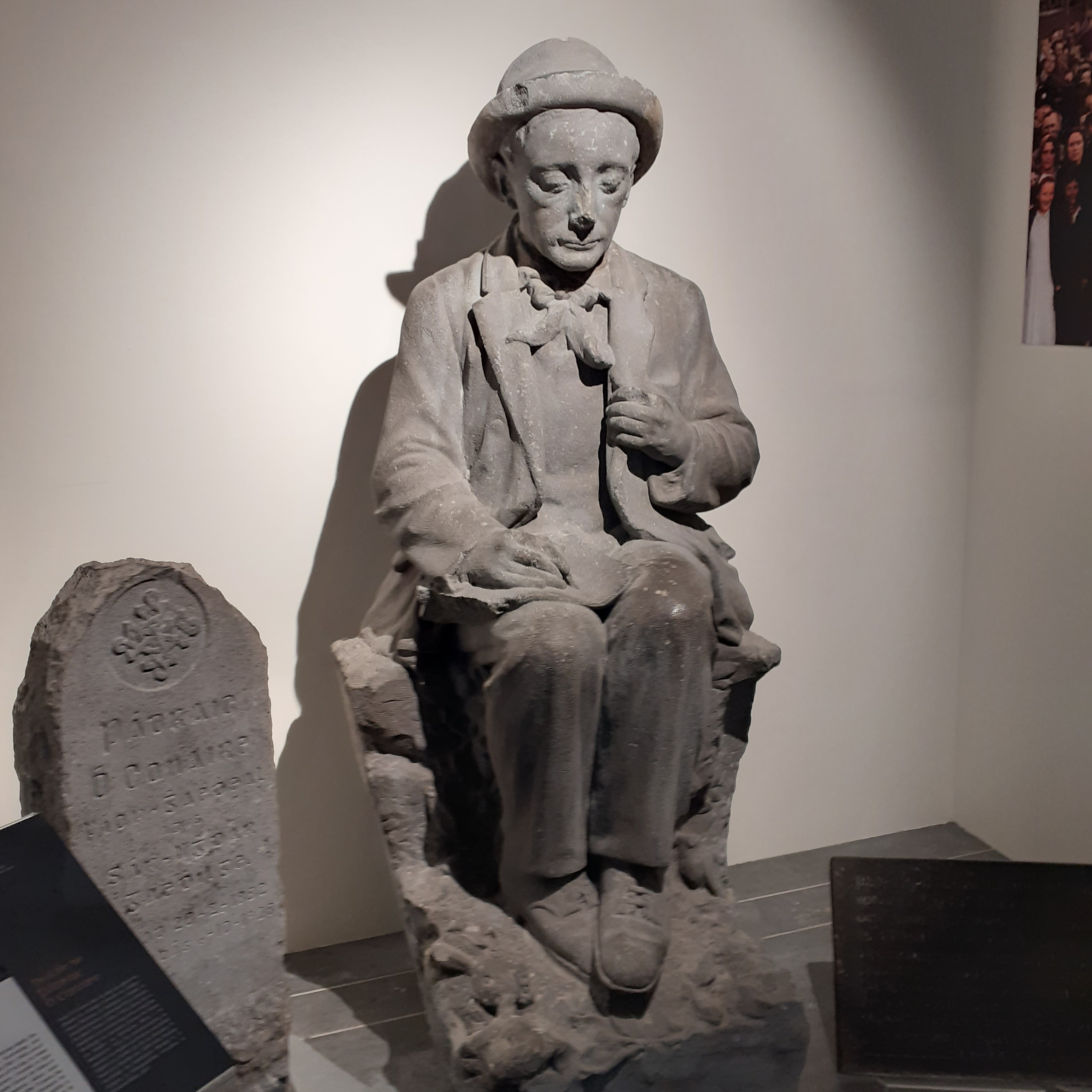
Athlone lies bang in the centre of Ireland, straddling the mighty River Shannon. It is just a hundred and twenty five kilometres west of Dublin, and about halfway between Dublin and Galway. The railway line opened in the 1850s; the station here dates from 1859. There’s a train every forty minutes from Dublin’s Heuston Station and the trip takes an hour and a half. Galway is just under ninety kilometres further on, a little over an hour by rail. The western expansion of the railway system connects to Galway City and to Westport and Ballina in County Mayo. Athlone station lies north east of the town and it’s a pleasant walk into the centre via the Civic Centre. This is a sleek modernist campus built in 2005, a combination of civic buildings including the town hall and library, retail and housing. Seated at its focal point is a bronze statue of Athlone’s most famous son, Count John McCormack. It was made by Irish artist Rory Breslin in 2014, and very good it is too.
Born in Athlone in 1884 McCormack became Ireland’s most renowned tenor whose repertoire ranged from Classic Italian Opera to Irish popular folk songs. Moving to Dublin, in his early twenties he nurtured James Joyce’s singing ambitions, persuading him to enter the Feis Ceoil in 1904 where Joyce got a bronze medal. Though Joyce would follow a different muse, McCormack became a hugely successful concert and recording artist. The songs of Thomas Moore feature strongly in his recordings, as well as patriotic airs and sentimental Irish ballads. He starred in the film Song o’ My Heart with Maureen O’Sullivan in 1930 and lived in a large estate in Hollywood.
He retired in 1938, but returned to live performance in support of the British and Allied war effort in WWII. Ill health forced his final retirement from the stage and he died at his home in Booterstown in 1945.
There’s a bright gleaming light, guiding me home tonight,
Down the long road of white cobble stone,
Down the road that leads back, to that tumble down shack,
To that tumble down shack in Athlone.
This song was recorded by McCormack in 1919. Penned by Richard Pascoe, Monte Carlo and Alma Sanders it was also recorded by Bridie Gallagher and Bing Crosby
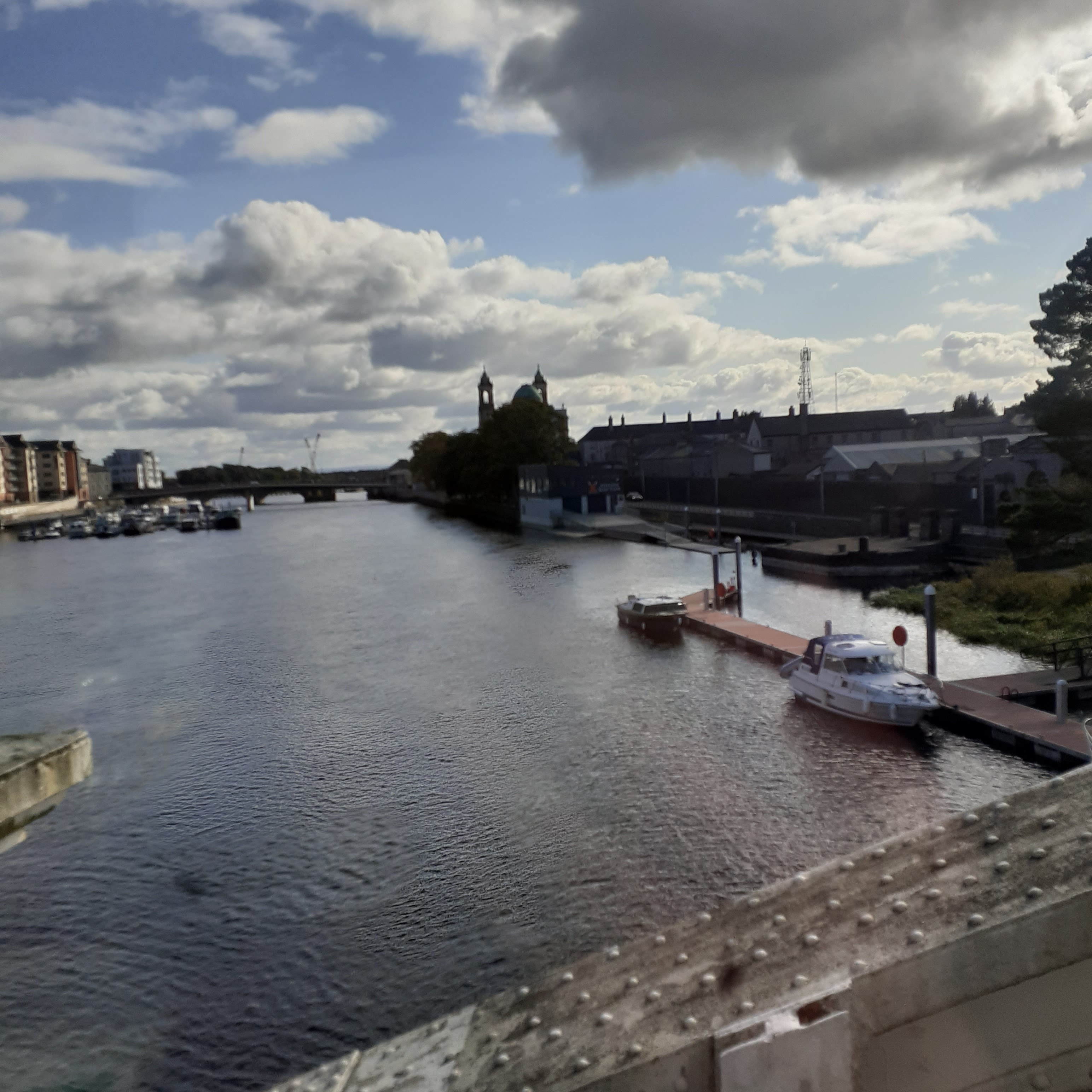
The Town Centre development opens onto Dublin Gate Street, part of the narrow main axis on the East bank leading on to Church Street. Here it contrasts charmingly with St Mary’s Church,(Church of Ireland). The Catholic St Mary’s is farther east heading out of the town. The street winds down to the bridge across the Shannon, the focal point of the town. Lough Ree, the largest lake on the Shannon, lies a few miles upstream to the North. Clonmacnoise, a major monastic site of the Middle Ages, is downriver. Built in the sixth century it flourished until the coming of the Normans, eventually abandoned in the 13th century with the development of Athlone as a defendable settlement. There are boat cruises you can take to visit.
Athlone has a population of twenty three thousand people. The name means Ford of Luan, from it’s founder, a shadowy figure. The Gaelic word Luan translates as Monday and may, perhaps, refer to the Moon. The idea of this fording place, midway along the great river, as the ford of the moon is poetic; but I am being fanciful. County Westmeath stretches along the East bank of the Shannon, however Athlone extends onto the West bank. It’s central location has long made Athlone strategically important
Brian Boru massed his forces here and accepted the submission of the High King, Malachy II in 1001. This was the start of Brian’s push for power, culminating in his defeat of the Danes and their Leinster allies. He was killed in the battle’s aftermath, and his crown returned to Malachy. The first bridge was built in the twelfth century and the King Turlough O’Connor established a fort to defend it. The stone fort followed in 1200 in the reign of King John. The twelve sided Donjon, or central tower, survives. The rest of the current castle dates from a reconstruction following he Siege of Athlone in 1691. Then, Athlone Castle was a Jacobite stronghold defending Connaught against the Williamites. Besieged twice, it repulsed the first onslaught of ten thousand men following the defeat of James at the Battle of the Boyne in 1690, but fell to William and Mary’s army in July 1691. The invaders were under command of Dutch General Godard Ginkel with Jacobite forces under Patrick Sarsfield and French General St Ruth. One of the defenders, killed in defence of the bridge, Sergeant Custume, is commemorated in the naming of the local army barracks.
The castle is well worth a visit, with a museum covering the area’s rich history, including John McCormack, and interactive exhibits and models in period dress. Fabulous views over the river and town from the top of the tower.
Saints Peter and Paul’s Church is an impressive Athlone landmark on the West bank. Built in the 1930s in the Baroque Revival style by architect Ralph Byrne. The neo classical entrance is framed by twin stepped belltowers and the church is topped with a central copper clad dome. Inside are five stained glass windows from the Harry Clarke studio, made by Richard King after Clarke died in 1931. Adjacent is the Luan Art Gallery, a publicly owned contemporary gallery hugging the western bank of the Shannon below street level.
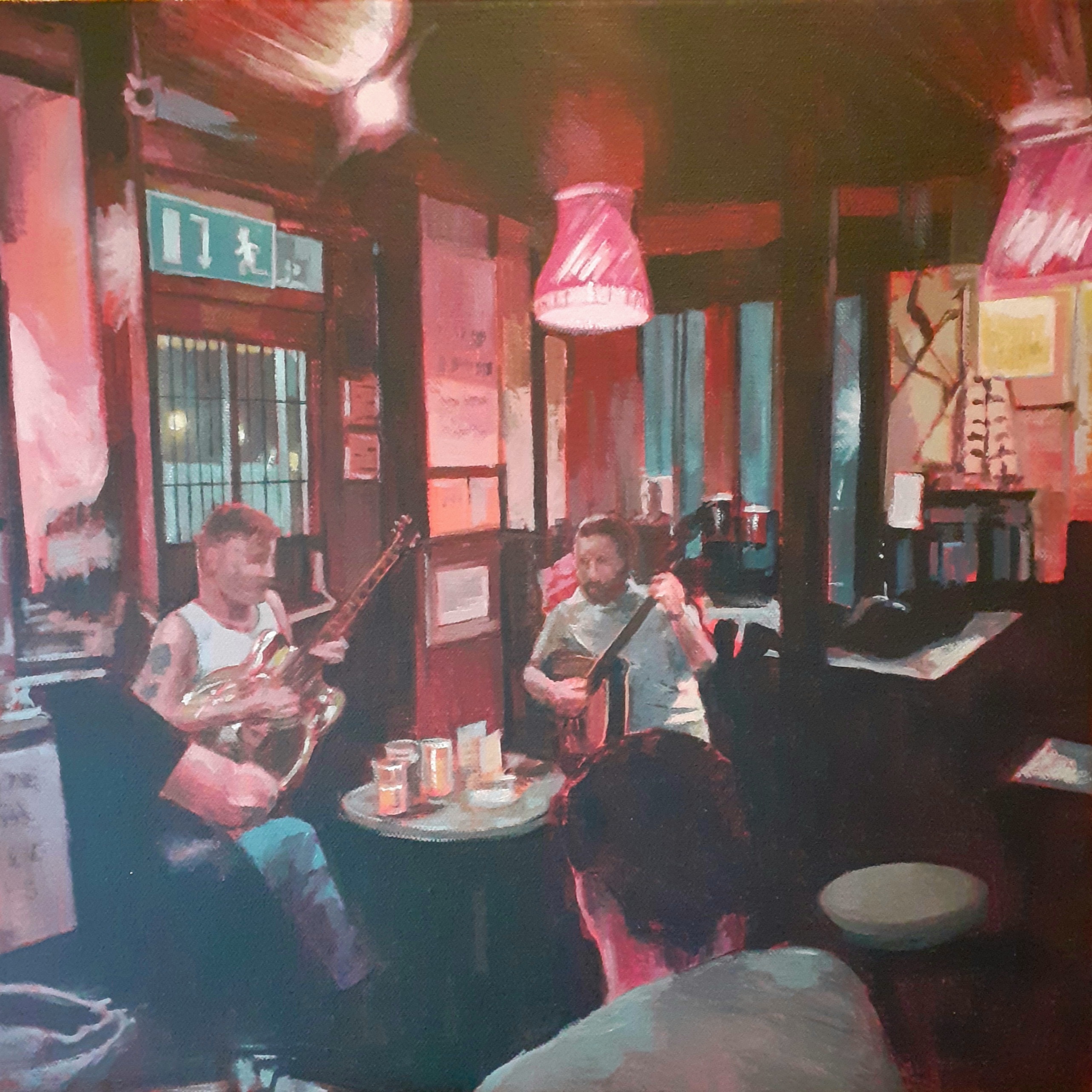
On the other side of the Castle, Sean’s Bar claims to be the oldest pub in Ireland. A 1970s renovation uncovered a wall of wattle and daub from the tenth century. Artefacts found there including coins have been dated back to 900AD. Apparently Brian Boru used to pop in for the odd pint. Mind, the price of the pint has gone up a bit in the meantime, so if you leave any change lying around it won’t lie around for a millennium. The current building dates back three hundred years. It’s a pleasant, cosy old style bar and a popular music venue. The entrance is in the shadow of the Castle and there’s pavement seating in the summer. The bar steps down a few levels towards the back of the premises, where there’s a beer garden which exits onto the quayside.
Navigation on the Shannon was facilitated by the building of a canal in the eighteenth century. This was replaced by the current system of a weir and lock gates, south of the bridge in the town centre in the 1840s. The line of the old canal forms the western border of the town, and County Westmeath, but the canal itself is no more. The winding streets of the old town are pleasant to poke around and we came across a fine old house once home to the Count himself. It’s a long way from a tumbledown shack.
Returning to the East bank, the town’s gearing up for evening rush hour, comparatively speaking. We make our way out to the Golden Island Shopping Centre which opened in 1997. Nearby, Burgess Park beckons with woodland, walking trails, a playground and memorial garden. Sloping down to the Shannon, it is the ideal urban oasis. Sitting there in the early evening sunshine as people promenaded and relaxed, I was put in mind of Seurat’s great painting the Isle de la Grande Jatte. It just shows, that through the ages and across longitudes, people maintain a continuity, enjoying the pleasure of harmony amongst trees and flowing rivers, in the company of themselves or others.
Time to get the train back to Heuston. As a three hour round trip, the railway trip gives you time for a full day in Athlone. There are plenty of hotels too, and I must stay over sometime. Later in the year I plan to go all the way to the end of the line: Galway. Wow, I feel a song coming on.
Maybe somewhere down the road aways (end of the line)
You’ll think of me, wonder where I am these days (end of the line)
Maybe somewhere down the road when somebody plays (end of the line)
Purple Haze
This song radiates sunshine and love, and time. Most of the ingredients you need. End of the Line was written by George Harrison, and included on the Travelling Wilburys’ eponymous debut album in 1988.
Well, it’s alright (alright), riding around on the breeze
Well, it’s alright (alright), if you live the life you please
Well, it’s alright, even if the sun don’t shine
Well, it’s alright (alright), we’re going to the end of the line
Myself and my friend Paula booked a trip across to Ireland’s Eye. It’s something I had long wanted to do. In fact, I once harboured (ha ha) the ambition to visit all islands off the Irish coast, but that hasn’t happened and probably won’t. Still, it might make a good series. I’ve been on the Aran Islands (Inis Mor and Inis Oir), the Great Blasket, Garnish Island, Achill and Valentia. Attempts on the Skelligs have been jinxed, though I’ve sailed to within touching distance.
Howth is served by Dublin Bus and Dart. The train station is adjacent to the harbour. Beneath the station is a pub, the Bloody Stream, serving good food and drink in its traditional interior, or al fresco on patios to front and side. The Bloody Stream plays host to annual birthday celebrations for Phil Lynott. Born on August 20th, 1949, he grew up in Crumlin, Dublin 12. As leader of Thin Lizzy, and sometimes solo, his singing and songwriting made him the top Irish rock star of the seventies. By the early eighties it all began to fade. Thin Lizzy disbanded in 1983. Philip’s solo career didn’t ignite, though the song Old Town, and its Dublin based video became iconic; something of a celebratory epitaph besides. He died in January 1986 and is buried at St Fintan’s Cemetery in nearby Sutton. The next bithday bash will be his seventy fifth.
Ireland’s Eye beckons. The island lies north of the Howth Peninsula, about midway along the coast of County Dublin. The name comes from the Danish for Ireland’s island. Monks built a church there in the eight century and for five hundred years this was the parish church for the inhabitants of Howth. Later a Martello Tower was built in 1803 to protect the coast from Napoleon. These days it’s for the birds, and day trippers.
Ferries to the island, and across the bay to Dun Laoghaire, leave from the West Pier. You can book ahead to secure your seats. The crossing takes ten minutes or so, and sailings are every hour. There are a number of options with different operators, averaging about twenty five euro, but if the weather’s fine plump for landing on and exploring the island.
The sun is shining, the wind is blowing, and Ireland’s Eye is truly an emerald isle sparkling in the choppy waters of the Sound. My friend Paula is waiting, and a busker is playing So Long Marianne as we get on board. Paula is a photographer and it’s amazing how a professional can organise the arbitrary molecules of life into coherent and somehow meaningful visual tableaux. So, I emerge from the pixels looking somewhat mercantile and derring do. There’s no hint of that inner fear in being suspended above a watery chasm while the descendants of predatory dinosaurs circle and dive from the skies. There’s Scandinavian blood in me for sure. Well, Scottish in truth.
I wish I was a fisherman
Tumblin’ on the seas
Far away from dry land
And it’s bitter memories
We transfer to a smaller craft for landing. It’s surprising how much larger the island seems when you set foot on it. Although several disembarked, we were quickly alone. We made for higher ground. It’s a good climb to the top and, once elevated, you get that giddy feeling of being marooned on a small island. We attempted to scale the heights but this old goat wasn’t as sure-footed as of yore. I nearly took the fast route down to the beach. The weather was good for our visit, though not exactly desert island disc good. There are beaches and coves, wonderful views, cliffs and plenty of birds. The enthusiast can search for guillemots, razorbills, kittiwakes, cormorants, puffins, gannets and gulls. Remember, this is their territory, and they know it.
We make it back to the jetty in time to catch the return boat. We’re in an envelope of peaceful blue and sunshine; it feels like floating on forever. There’s grey seals in the sound and the harbour doing just that. Back on dry land, or land anyway, there are plenty opportunities for your drinking and dining pleasure along the West Pier. You can go for the basic, yet always beguiling, fish n chips with a bottle of suds, or perhaps go for more exotic seashell confections. There’s Beshoff’s, Crabby Jo’s, the Brass Monkey, Octopussy’s, the Helm, Baily Bites and Aqua. Howth can be your oyster, quite literally.
Castin’ out my sweet line
With abandonment and love
No ceiling bearin’ down on me
Save the starry sky above
With light in my head
With you in my arms
Fisherman’s Blues was written by Mike Scott and Steve Wickham in early 1986. A busker’s favourite, and one of my own, it was the title track of the Waterboys’ 1988 album.