Summer is here, and amongst my favourite activities is doing nothing on a beach. Not exactly an activity so. Brittas Bay is a regular haunt. Thanks to good friends, we can spend a few weeks in a mobile on Wicklow’s wonderful coast. The mobile park is separated from the rising coast by a small river, and from the bay itself by a range of high sand dunes.
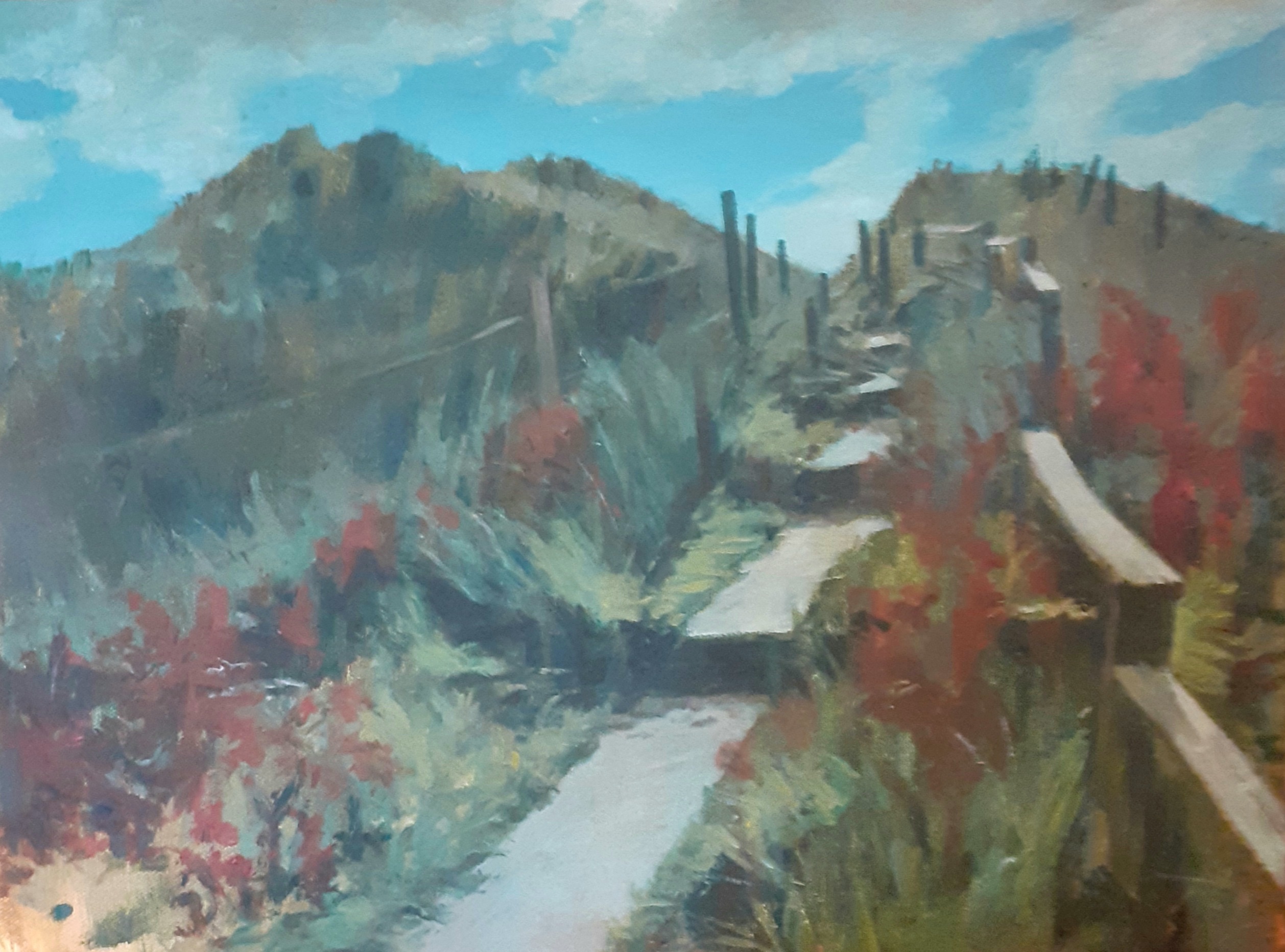
In this painting, we are approaching the beach through the dunes along one of several stepped ways. It’s something of an oasis of isolation and quiet, between the domestic suburbia of the mobile park and the windswept leisure activity of the beach.
This time I am using oils, which I have not done in a long long time. Since I went to art college in the summer of 77 I have tended towards faster graphic media such as watercolour, gouache and acrylics. One Dublin cityscape and a mountain landscape is all I can recall. So it was a bit of a struggle to begin with, and I was as much absorbed in the physicality of the whole thing, the texture and smell of the materials as I would normally be in the detail and composition of the finished work. There’s something of the wild and unkempt in this and the process. A sensual saturation that takes its own form.
And so the song that suggests itself is rough and ready too. It’s from the summer of 77 which I remember for sandy days with M in Llandudno, Wales and a holiday hut on the beach in Skerries, North Dublin. It kicks off with a to-die-for bass riff. What follows is a young ruffian gorging himself on the visual pleasures of the beach. It’s called Peaches and was the first hit for the Stranglers from their debut album Rattus Norvegicus. You might also know it from the opening credits of the 2000 geezer flick Sexy Beast, where reformed lout, Ray Winstone, soaks up the sun in a villa in Spain. Oh, I can relate to it in all sorts of ways.
Well there goes another one just lying down on the sand dunes
I’d better go take a swim and see if I can cool down a little bit
Coz you and me woman, we got a lotta things on our minds
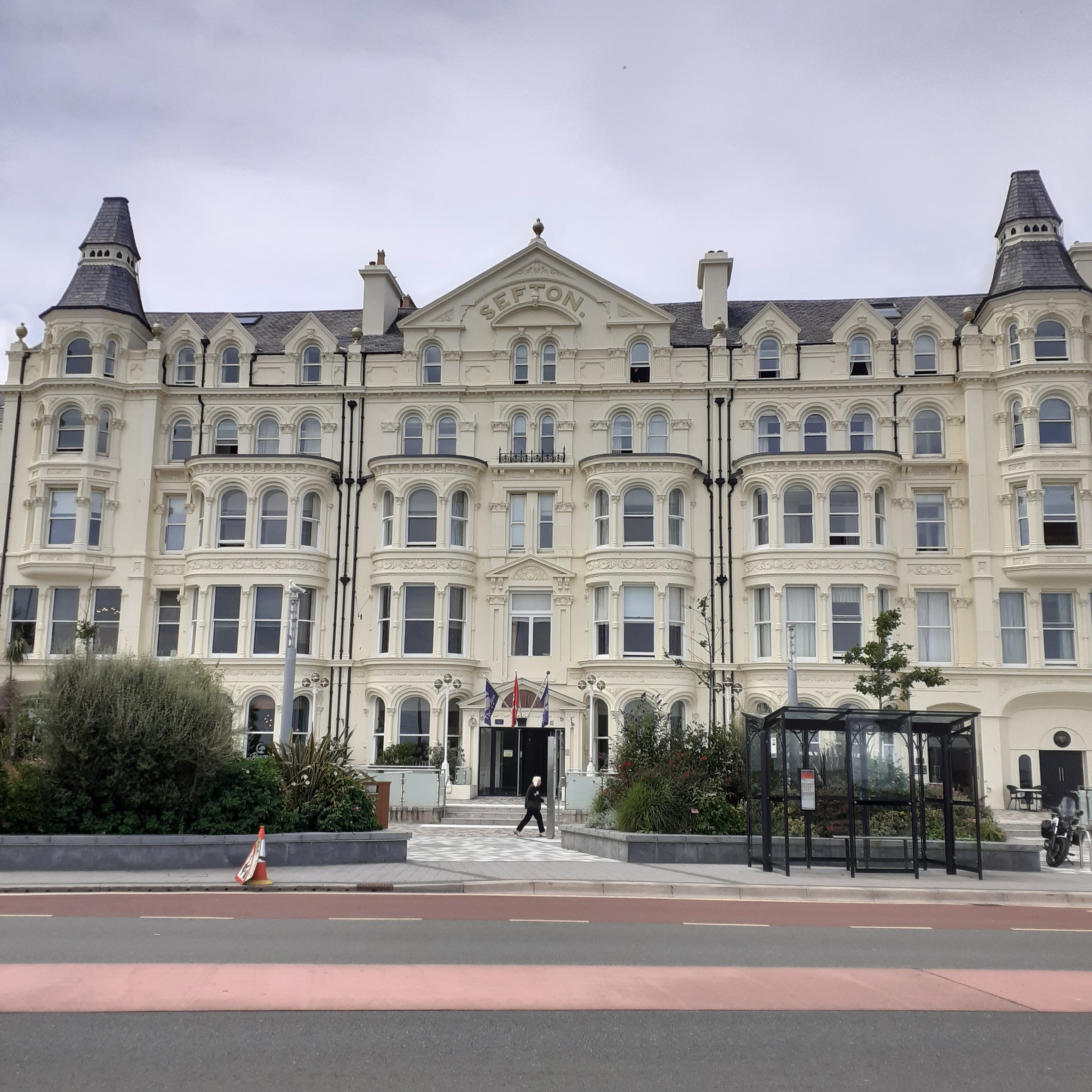
While inland Andalusia is well served by rail, the coastal region is not. Malaga connects to Fuengirola, but for other destinations you take a bus. Alsa bus service is pretty good. We returned to Malaga from Cordoba by train and walked across the road to the Bus Station to buy tickets from there to Nerja. There’s a regular service, and the fifty mile journey takes an hour and a quarter. The bus passes along Malaga’s seafront, before heading into the rugged rural countryside towards Motril.
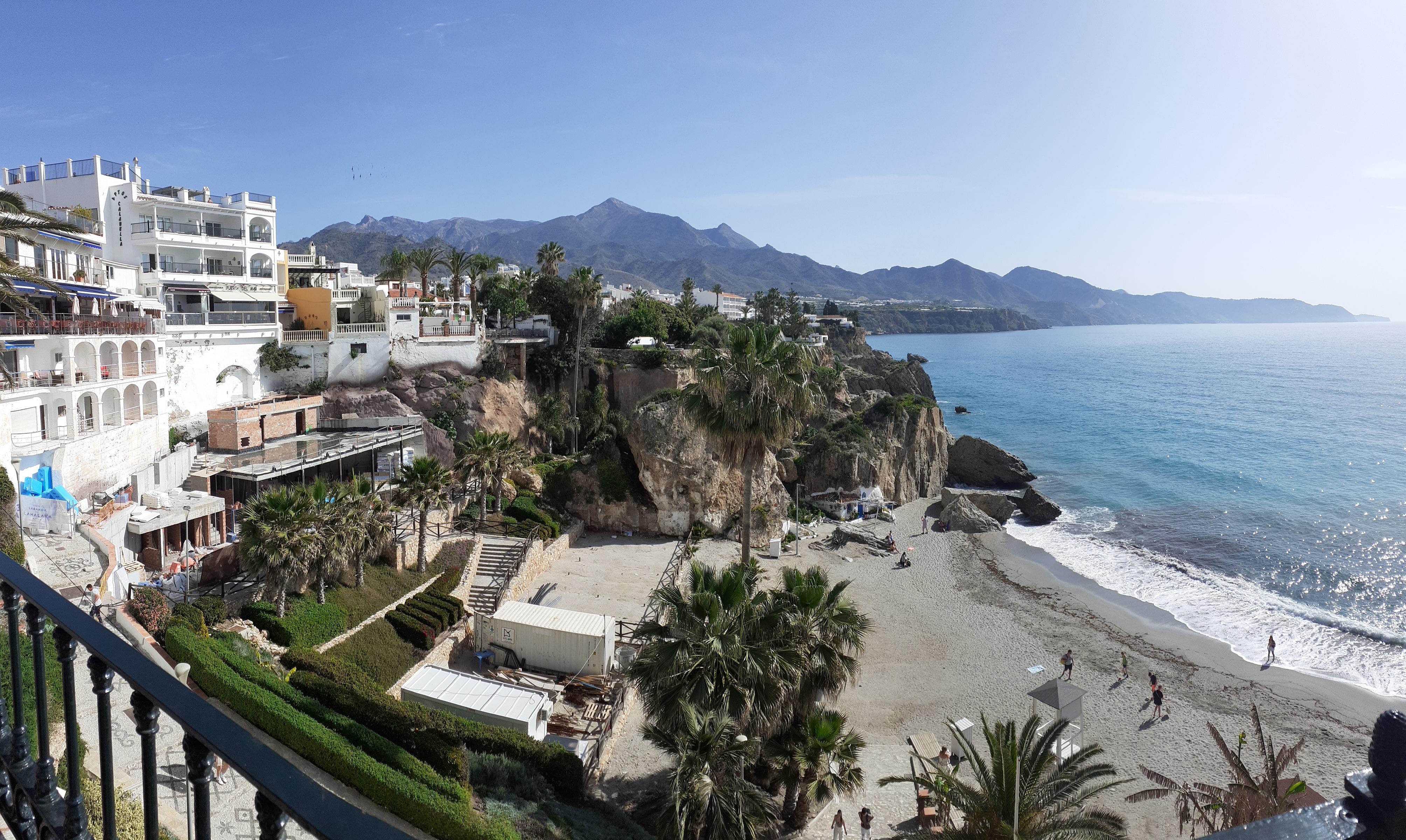
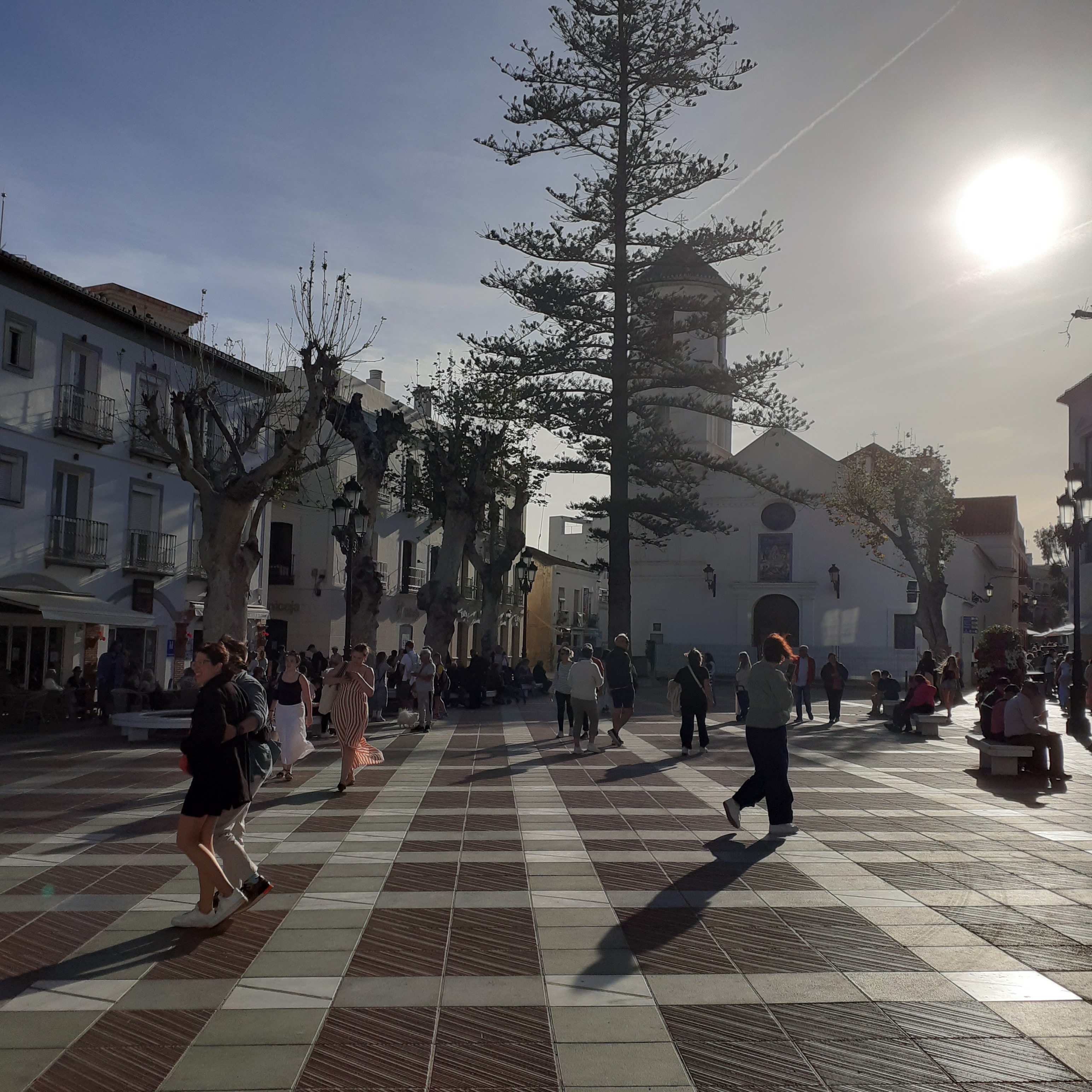
Nerja, lies at the eastern extremity of the Costa Del Sol. It has a population of twenty thousand, though that swells considerably in the summer months. We are deposited on High Street, the main thoroughfare north of the town and take a taxi to our hotel. The Marisol is an online hotel, trading tradition hotel service for tempting low price. But there is a receptionist available until four pm when we arrive. It couldn’t be more central. It faces onto a square with the sea to one side and the narrow pedestrianised streets leading back uphill. There is a picturesque church to one side of the square and sheltering trees dappling the sunshine. The Balcon de Europe, Nerja’s nickname and lure, lies along the southern edge, presiding over an awesome sea view.
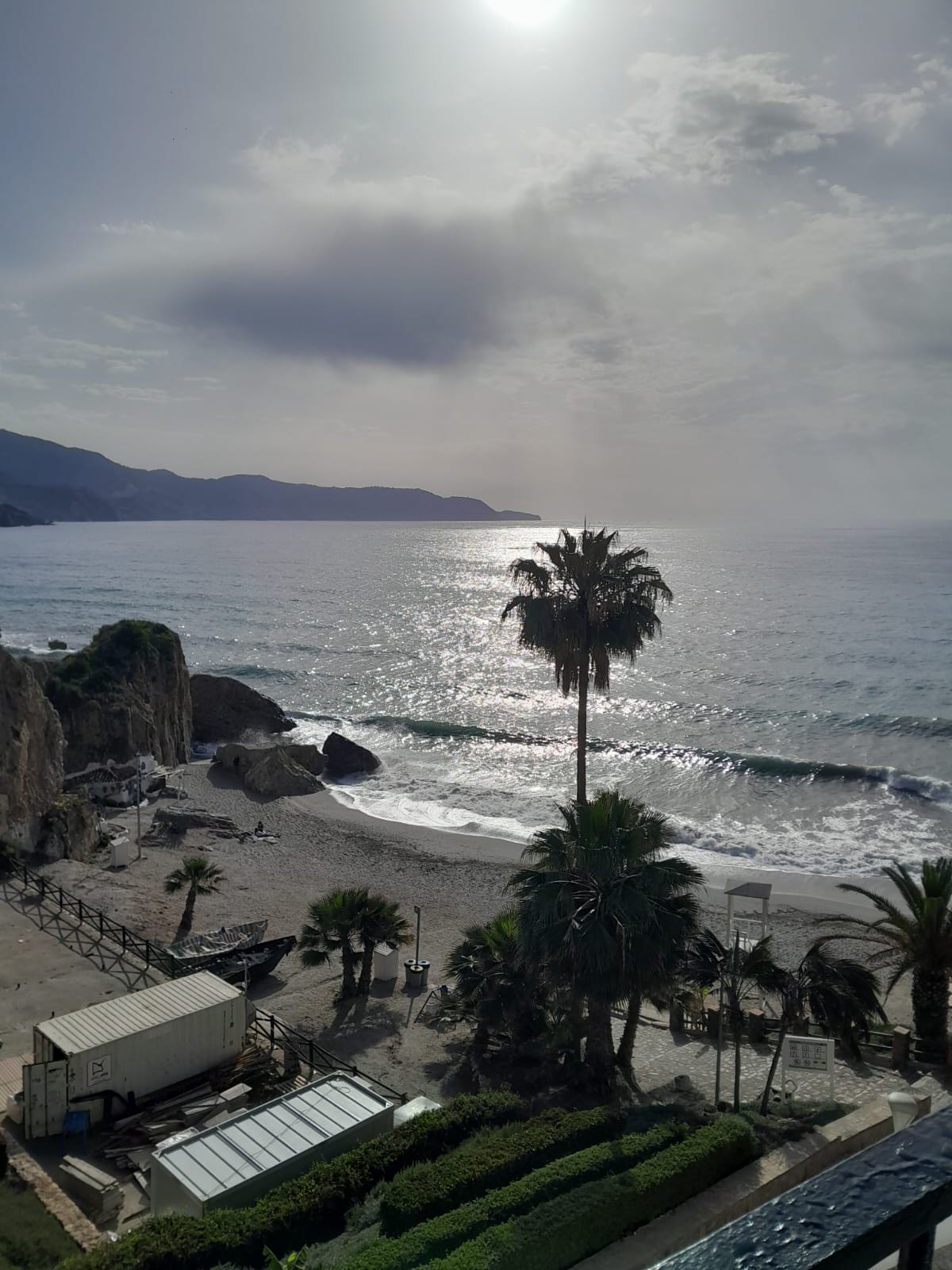
The phrase is attributed to Alfonso XII, King of Spain who visited the village in 1884 after an earthquake had struck the region. Admiring the view, he said “this is the balcony of Europe”. Alonso himself died just a year later, at the age of twenty seven. The area around the Balcon once held an artillery battery and a fort which was destroyed during the Peninsular War in1812. A few guns survive on the Balcony, and remnants of the fort litter the sea below. It is an impressive view. There are beaches to each side of the promintory.
The square is thronged when we arrive. The Marisol’s gelateria is giving out free ice cream, adding to the happy hubbub. I get a long awaited beer at the attached bar, so we are both happy. Evening falls and the square and surrounding narrow streets fill up some more. Towards the west of town, the neighbourhood is known as El Barrio, which has a pleasantly homey feel as the name suggests. We get a good meal there in an unscenic restaurant that is friendly, with affordable and excellent main plates. Lasagne for me. The bars are filling up and we grab stools at the counter to catch the Champions League quarter final where Arsenal stuff Real with two glorious strikes from Declan Rice. M is most impressed, though I’m in two minds myself.
Nerja was settled by the Romans, and the Moors after that; but they were modernist blow ins. The Nerja Caves, a couple of miles east of town, were host to human settlement as far back as thirty thousand years ago. A visit to the caves is a must. A ticket to the caves includes a street train to the site, with admission and virtual visual tour too, plus admission to Nerja’s excellent town centre museum.
We took an early train and the crowds were sparse, giving more time and space to enjoy the experience. We took about two hours exploring, by which time lunchtime crowds were beginning to swell. It’s probably a better idea to do the virtual tour first, but we found ourselves inside the caves and decided to continue. As guidance, we had to download the ap, which worked well for M’s phone, but mine lost it as we descended.
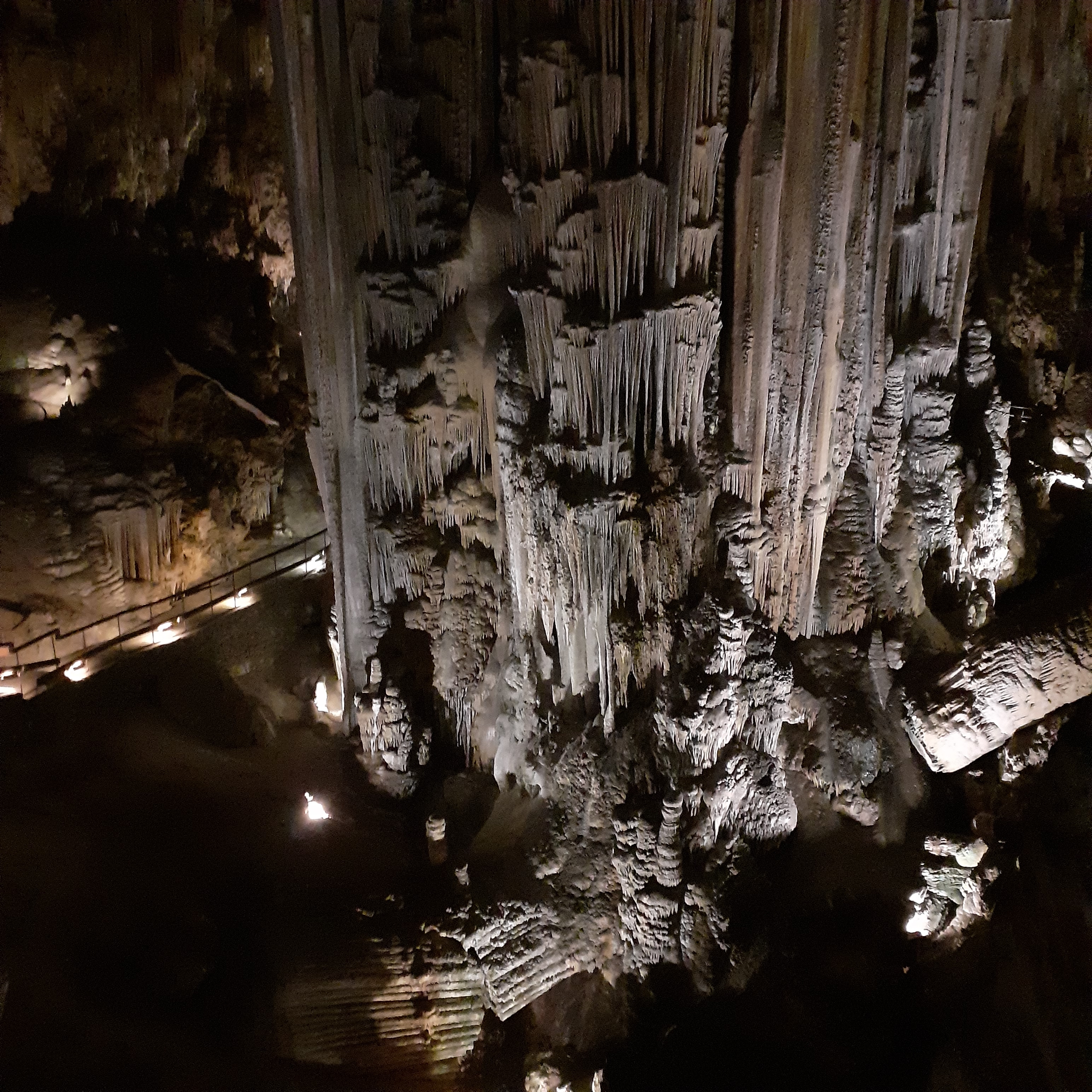
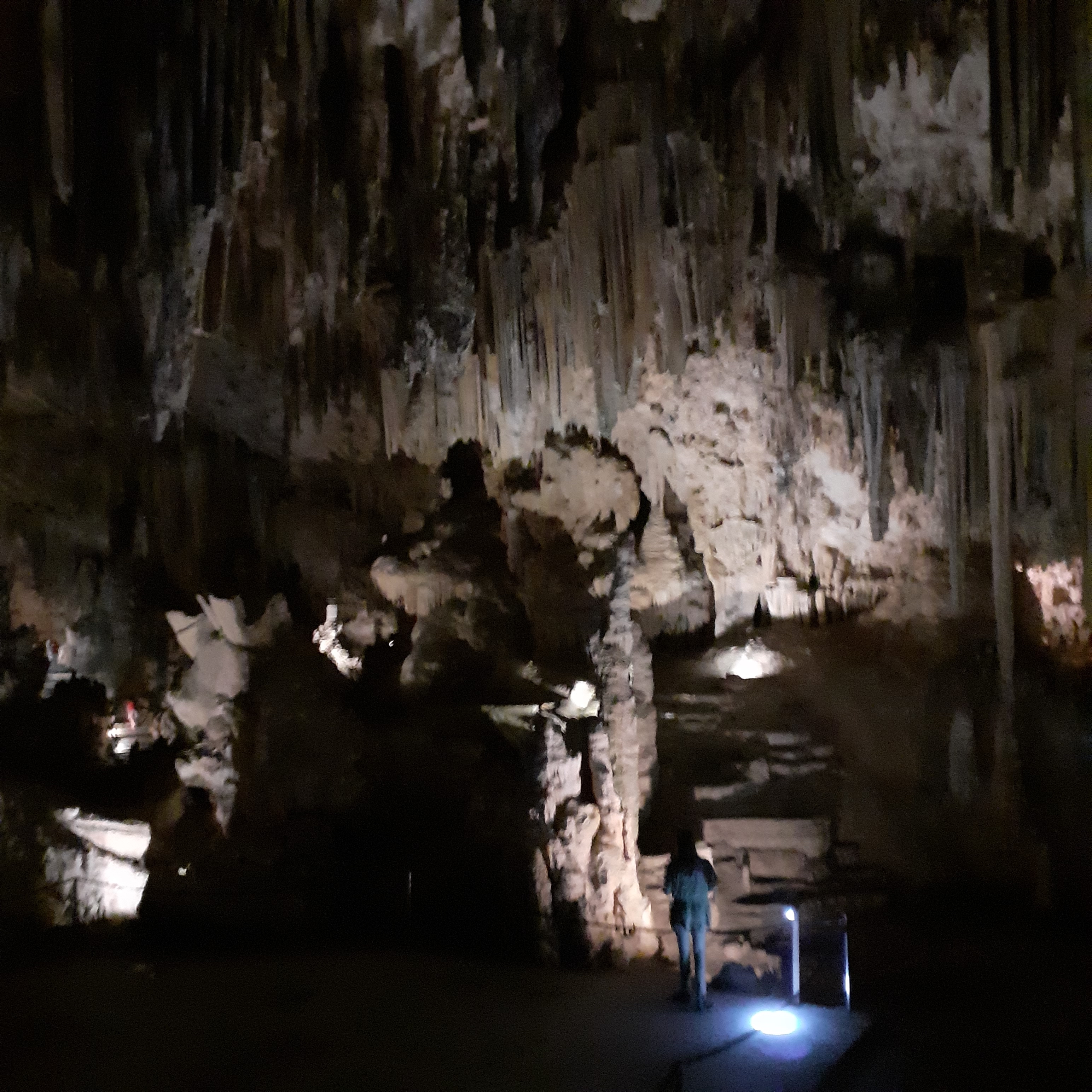
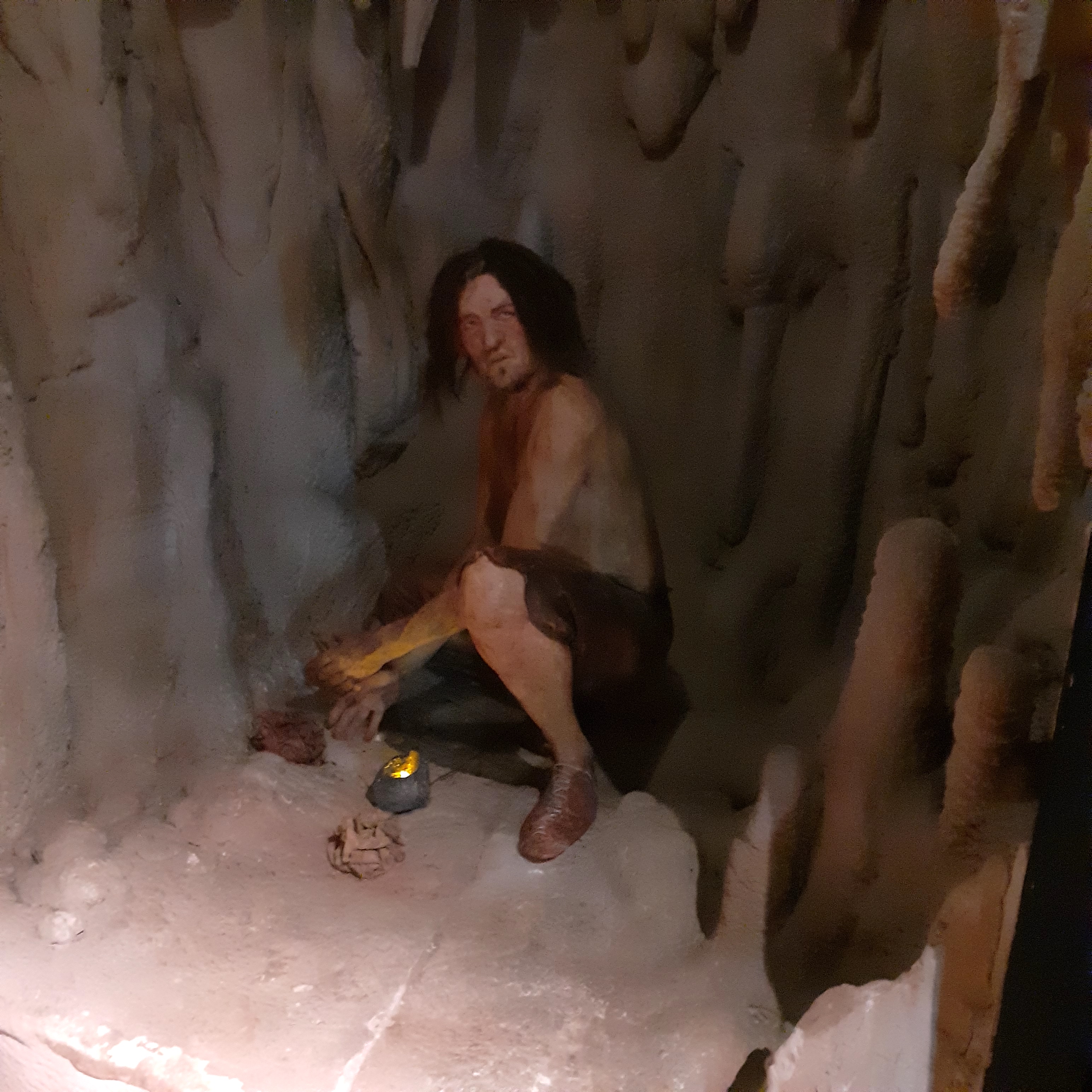
Such idea I have of prehistoric cave dwelling is of a small group of people living in an alcove on a cliff face. They may paint matchstick men, cats and dogs, on the back wall, or huddle back there any time a leopard passes. The Nerja caves paint a different picture. These are vast linked caverns, resembling cathedrals in both space and glorious formations. Stalactites, stalagmites and columns soaring into the inner space.
The different areas are given evocative titles: Hall of the the Nativity, Hall of Phanthoms, Hall of Cataclysm, the Hall of the Waterall, also known as the Hall of the Ballet. Cataclysm is named for a major rock fall, wonderfully illustrating the forces of narture at work to build this natural phenomenon. The largest column is nearby, soaring more than thirty metres from floor to ceiling.
The modern discovery of the caves happened in 1959. A group of five local boys, Jose Barbero, Francisco Navas, Jose Torres and brothers Manuel and Migual Munoz, had noticed bats escaping through a gap in the hillside and found their way inside. There they chanced upon a skeleton and believing it to be, like them, a casual explorer who had been trapped, they beat a hasty retreat to avoid his fate. The following day, however, they informed their teacher, whom they took back to the caves. Word spread, photographs in the Malaga Press stirred public interest. and within eighteen months the caves were opened as a visitor attraction, and crucially a centre for archeological research
In June 1960 the gala opening featured. a ballet accompanied by the Malaga Symphony Orchestra within the natural theatre underground since dubbed the Hall of Ballet. This started the annual performances of the Nerja Music and Dance Festival. After almost sixty years the caves ceased to be used as a venue and performances have been moved to an outdoor auditorium nearby.
On exit, we discovered the theatre for the virtual tour. We had to queue for half an hour as a bus tour had beaten us to it. Worth the wait. We gathered in an interior room with a few dozen others, put on the headgear and set off for a tour inside our heads. This barrels through the millennia, good on the necessary detail, witty in its use of a Woodyesque guide. Along with the cave itself, and the visit to the Museum next day, we got quite a detailed picture of a fascinating part of European human history; pre-history to be correct.
Neanderthals lived in the region until the race died out over thirty thousand years ago, just before the last Ice Age. There is evidence that they lived here, and made cave art dating back forty thousand years. Passing humans and hyenas occupied the caves for five thousand years from about 25,000BC. Though not at the same time, and if so, not for long. After 20,000 BC humans took up permanent residency. As the Ice Age waned, the hunter gatherer culture expanding to animal husbandry and agriculture. Textiles and pottery were developed by the dawn of the Bronze Age. Wandering through the caves you can see how several large groups could be housed. This culture were some of Europe’s earliest artists. Cave paintings were discovered here, which can be understood with representations and explanations in Nerja’s museum. The actual paintings are inaccessible to civilian explorers.
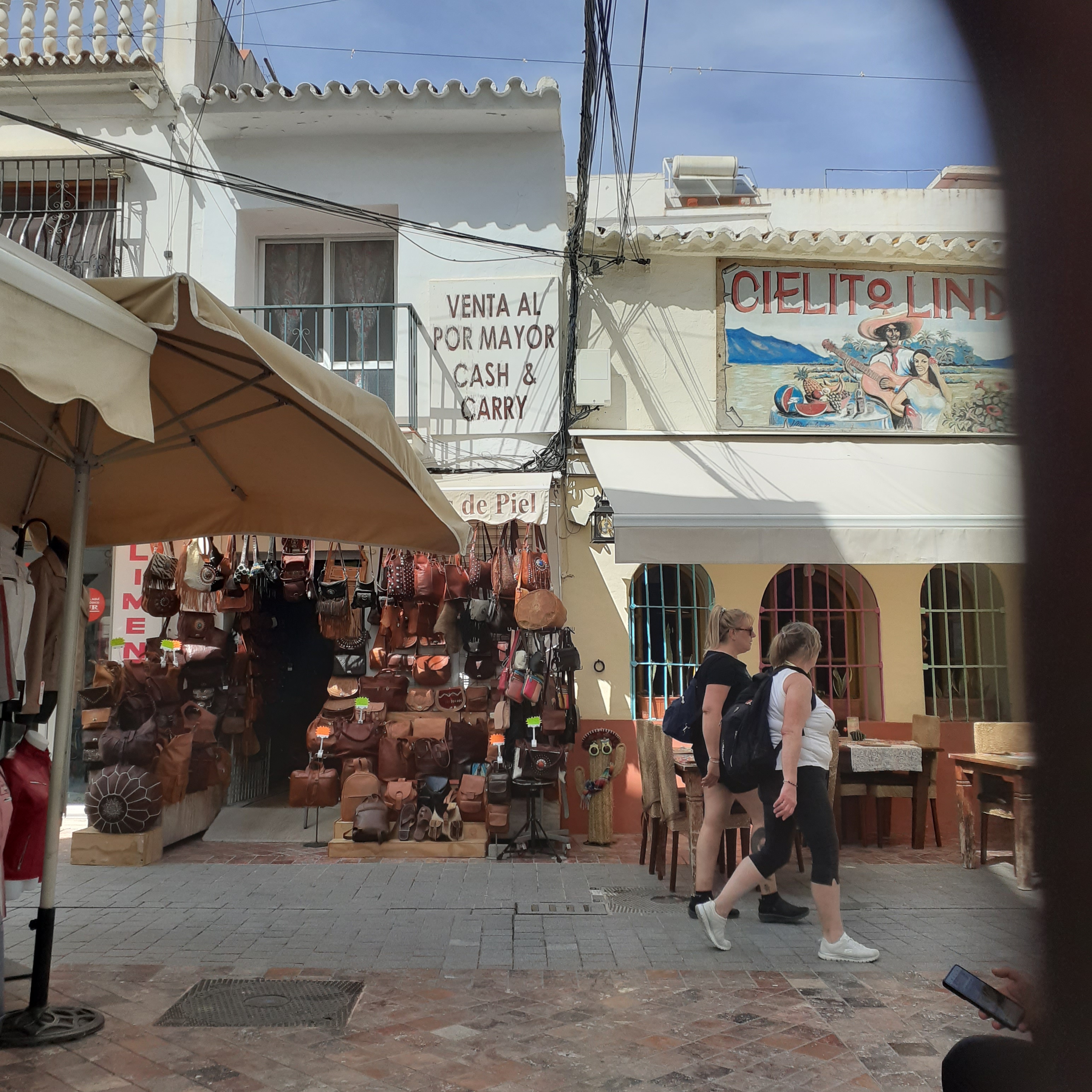
The Museum is located in a modern, quiet square in Nerja, the Plaza de Espana. This gives an excellent account of the town and the region, as well as the Caves. Outside the door, Nerja itself offers much to enjoy. The beaches are small and scenic, and the sea is a vibrant, often spectacular presence. The town is lively with shoppers and strollers all day and continuing into a busy nightlife with a great choice of bars and restaurants. You can eat well and very reasonably here. We had a glorious Thai curry at Asian Ben near the Balcon and there’s a lively Little Italy Restaurant along Calle Carabeo for pizza, pasta, birra; for almost nothing at all. Nerja’s noisy for sure, but good fun, good looking and, of course, the best caves ever. Yabba dabba do!
In the morning we took a bus direct to the airport. There are good breakfast spots near the ‘station’ ( a kiosk in fact). La Nube was our go-to venue. The bus leaves at eleven and takes about ninety minutes.
I recall when I was small
How I spent my days alone
The busy world was not for me
So I went and found my own
I would climb the garden wall
With a candle in my hand
I’d hide inside a hall of rock and sand
The Caves of Altamira is an appropriate song to finish on. Altamira is in northern Spain, the first and formative example of prehistoric cave art discovered. The Nerja caves provide another piece of the jigsaw. The song was written by Steely Dan’s dynamic duo, Walter Becker and Donald Fagen. It is on their 1976 album, The Royal Scam. I relate very strongly to the lyrics here. A hymn to the power of Art. A silent power, free of needless noise. These artists, these Painters, were not being intellectual, they were painting what they saw. Very good they were too. The first masters of realist painting, which is the best type of painting there is. So there.
Cordoba lies just over a hundred miles miles north of Malaga. We took the high speed train from Maria Zambrano station. The station connects with the Malaga metro system from Fuengirola to Almeria in the east, and just fifteen minutes from the airport every twenty minutes or so. The station includes a large shopping centre and there are plenty of places for a drink and snack. The bus station is right next door. We had snacks and coffee at an outdoor kiosk, the sort of atmospheric and affordable feature that’s such a loveable part of Continental cities.
Maria Zambrano gave her name to Malaga’s main station in 2007 when the Malaga to Madrid high speed rail line opened. She was an essayist and philosopher who was born in Velez a couple of miles east of Malaga in 1904. She went into exile after the fall of the Republic at the end of the Spanish Civil War, only returning when Franco died in 1984. She died six years later and is buried in Velez.
The train journey to Cordoba takes just an hour and runs about every hour. It’s a rocket into Spain’s inner space. We climb beyond Malaga city limits, heading ever upward into the coastal mountains. The Montes de Malaga rise to over a thousand metres and are surrounded by a large Natural Park. Jagged peaks form a scenic backdrop to the well cultivated hills and valleys of olive farms.
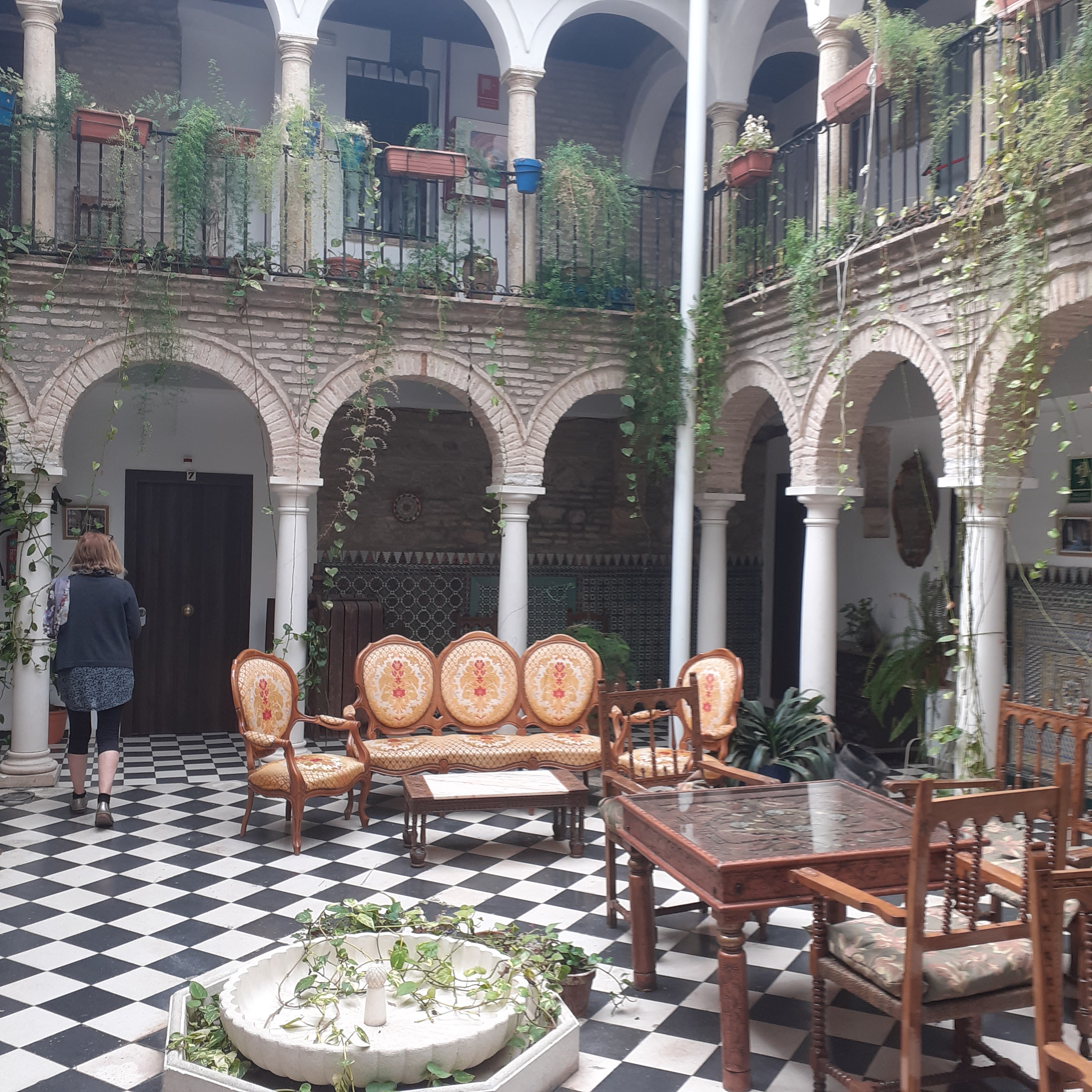
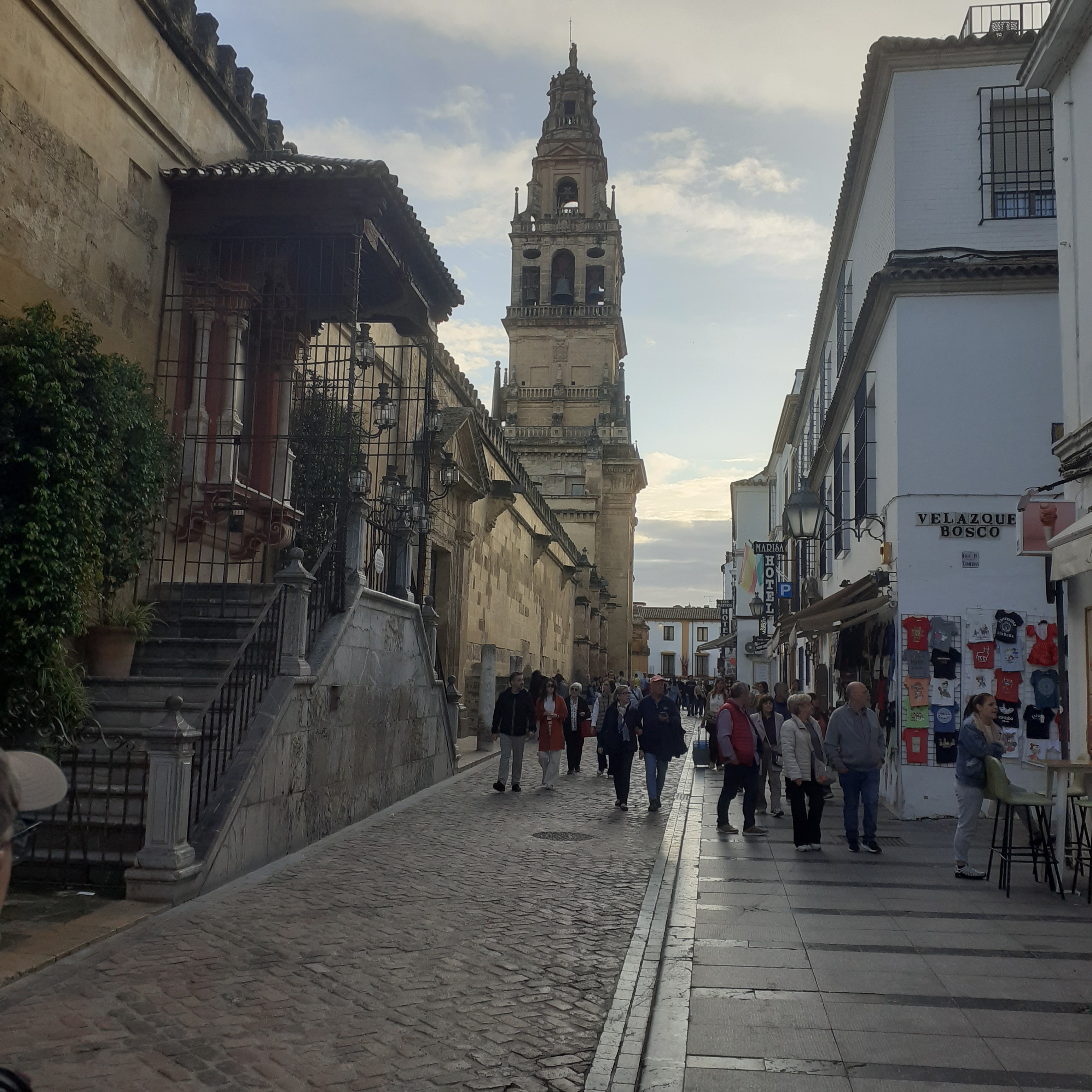
We finally descend into the valley of the Guadalquivir, leaving the train at Cordoba before it heads on to Madrid. Cordoba’s modern station is bright and efficient. We take a taxi into the labyrinthine Old Town. This area is largely pedestrianised, but our driver takes us with dizzying pinball eccentricity through narrow laneways to our destination. Our hotel, Palacio del Corregidor, has a wonderful tiled courtyard echoing the Moorish style knitted into the fabric of the city.
Nearby is Plaza Corredera, a colourful square built in the 17th century. There is a daily market, and bars and cafes flow from its arcades into the open air. The atmosphere is pleasantly informal and cocooned from the brash modernity of city life. We dine and drink there regularly, afternoons and evening. It’s convenient and inexpensive. The street performers are a varied bunch. One dire performer is clad in cheap tigerskin and you’d pay him to go away. Good juggler though. On another night, with stars and streetlights merging, the glow is enhanced by a guitarist with a modern reportoire including Pink Floyd’s Wish You Were Here; which, of course, read my thoughts.
A maze of lanes ambles south towards the river. Plaza del Potro is a hidden treasure, and just beyond a short avenue is shaded under trees. There are a number of bars and restaurants along here, so relaxed that time stops still, as it often does in the best of Spain. Along the river into the ancient city centre streetlife resumes. The Guadalquivir marks the southern edge of town. Andalusia’s mighty river rises in the Sierra de Cazorla, about two hundred miles to the east. Already mighty by the time it reaches Cordoba, it meanders west towards Seville and then south to meet the Atlantic at Cadiz. It is over four hundred miles long. In Roman times the Guadalquivir was navigable as far upstream as Cordoba and remained so into the Middle Ages. Today, only as far as Seville
The Romans established Cordoba around 200BC. By the turn of the Millennium it was a major city of Roman Hispania. A few of its remnants survive. The remains of the Roman Temple were unearthed in the 1950s with the expansion of the City Hall on Calle Claudio Marcello, a busy commercial thoroughfare dividing ancient and modern Cordoba. The Temple was built in the reign of Claudius in the first century AD. A magnificent marble structure in its day it stood proud on a high plinth. Its platform and a few columns are preserved; development of the site is ongoing
The Roman Bridge crosses the river at the entrance to the city. Initially built in the 1st Century BC, this was the only city bridge spanning the river until the mid twentieth century. The Moors undertook a major reconstruction in the 8th Century AD. There are sixteen arches spanning the 250 metres to the far bank. The Puerta del Puente on the city side and the Tower of Calahorra on the far side were added in Medieval times as fortified city gates.
The river banks are lined with ruins of ancient watermills dating back to Moorish times. These were used variously for irrigation, to ground flour and as cotton mills. They persisted into medieval and modern times where some saw use in electricity generation. The last were extinguished in the 1940s. The Albolafia Mill is the nearest to the bridge, and there are eleven mills in all.
With Cordoba it is best to let the lanes lead you where they want to go. A vague detour leads us to a courtyard fronting the Church of San Francisco. People are gravitating towards it by some strange magnetism. Groups congregate in the little square, chat and smoke before disappearing within. Inside, excitement mounts. A large group of musicians fills the chancel, facing the body of the church now packed. Then the music begins. It is the week before Semana Santa and the Brotherhood rehearse the music they will play to accompany the Thronos they will carry through the city on the big day. Two thronos are installed along the Nave. The massed brass instruments strike a tone that is sombre but uplifting. I feel united with all here, rising with the intense emotion of the music. When it finishes there is a breath, applause filling its emptiness like thunder.
We are struck by how lucky we were to chance upon this. Yet it is unremarkable in a way. Throughout Spain local communities have been persistent in their unique commemmoration of Holy Week and Catholic feasts for eight centuries
Cordoba is now a city of 350,000 people. It was once one of the largest cities in Europe, under the Moorish rulers of the Ummayad dynasty. The Caliphate of Cordoba controlled almost all of Iberia from 750 until 1031when it split into several kingdoms. The Reconquista of 1236 brought the city under the crown of Castille. Alcazar de los Reyes Cristianos lies just past the Bridge and served as residence of Ferdinand and Isabell as they pushed towards the final expulsion of the Moor at Granada in 1492. It was built in 1358, by King Alfonso, and though a military fortress initially, it also embraces a more flamboyant Mudejar style in its magnificent gardens, ponds and courtyards.
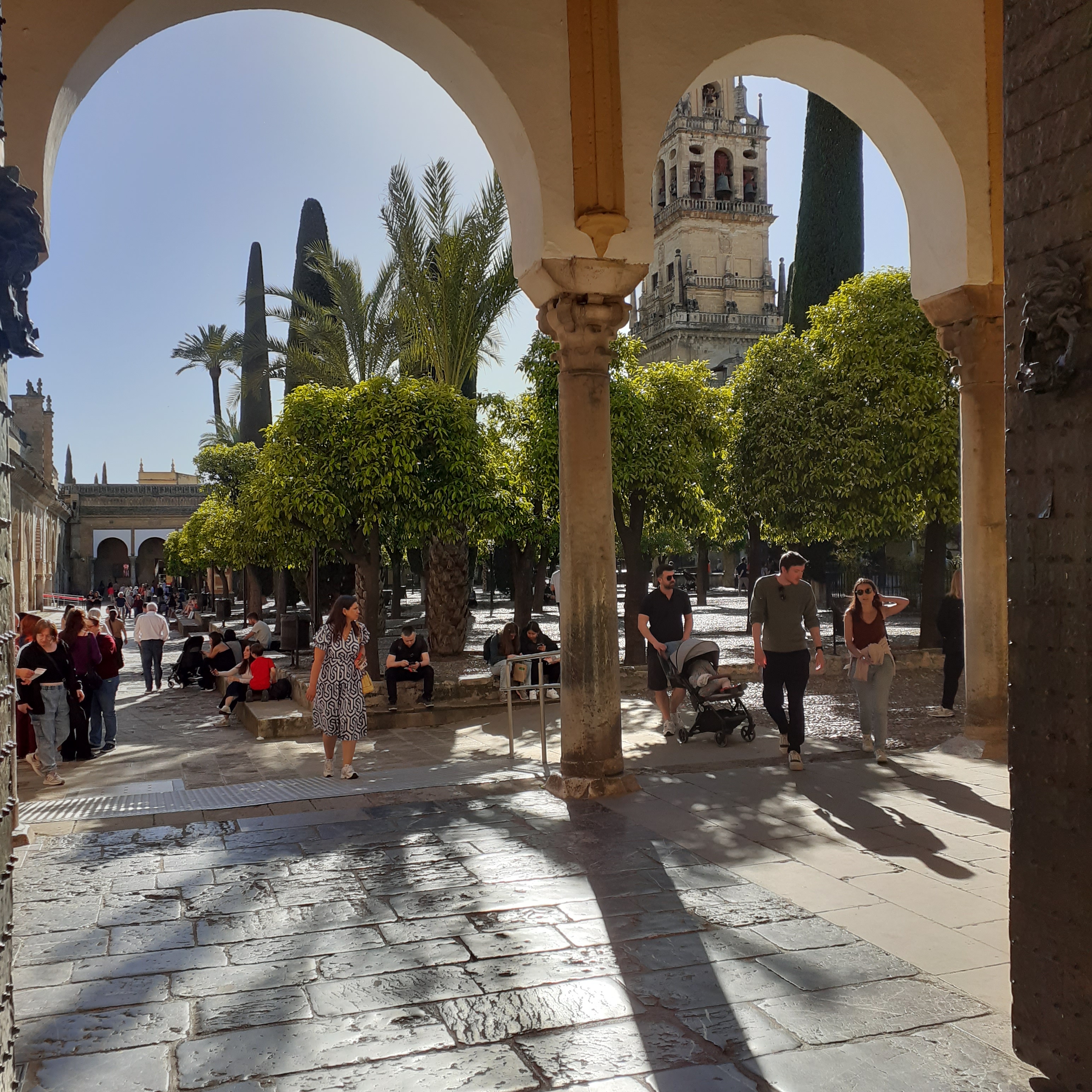
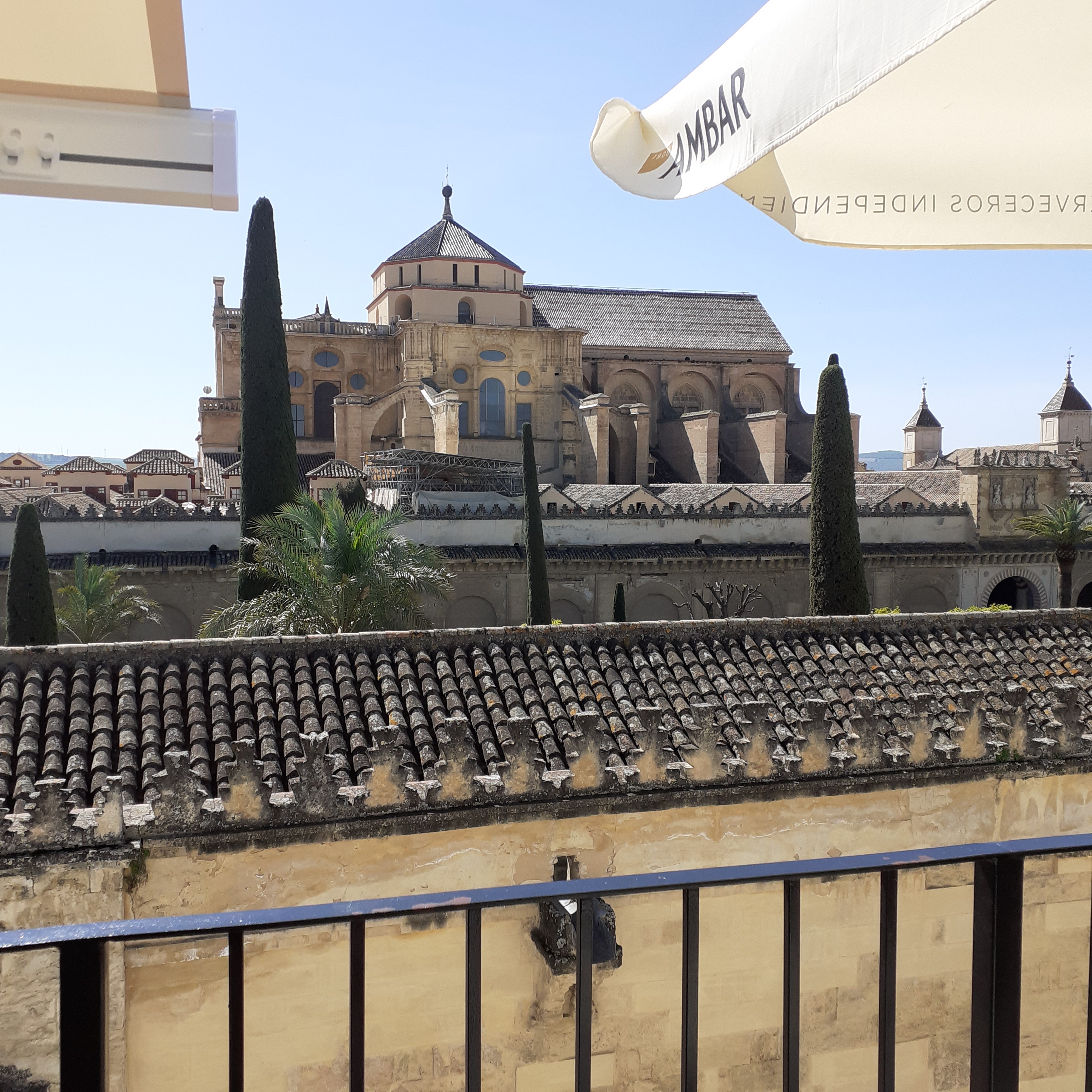
Mudejar refers to the art and design of Islamic craftsmen who remained following the Reconquista. It is a distinctive feature of much that is wonderful in Spanish architecture of the era. The Mezquita Catedral is a shining jewel forged in the collision of two cultures. The Great Mosque was begun in 784 and was for long the largest mosque in the world. After 1236 it was appropriated for Christian use. It is remarkable that so much of the fabric of the ancient building remains. The three hundred foot tall bell tower was developed from the old Minaret with an entrance gate beneath in the Mudejar style. An open square runs the length of the complex, shaded by orange trees with pools and fountains where the Moslem faithful washed before prayer. The single story interior is supported by a forest of ornate columns, eight hundred in all, creating an effect close to infinity; or heaven, I suppose. Around the outer walls many chapels have been added over the centuries, the first in 1371. The Cathedral itself was begun in the early sixteenth century, rising as if organically from the low lying mosque. It is topped by an Italianate dome.
Asides from being a place of prayer, the Mezquita Catedral is a huge draw for tourists. The crowds gather early, though the space is so large that it was not too hectic during our visit. We got tickets online the day before. Be warned though. Numbers pick up in high season, and even a few days later we noticed the crowds grown bigger.
Another major attraction in Cordoba is the Festival de los Patios held during the first fortnight in May. Private patios are opened for view, and the city is particularly packed. But there are always spaces in Cordoba to allow one step into a different time. The Jewish Quarter is a wonderful maze of white streets west of the Mezquita. There’s a museum and the old synagogue from the fourteenth century survives. Another culture woven into the rich fabric of Andalusia. Muslim, Christian, Jew and Gitano leave their mark not just in the stone and style, but in the music and the mind, and deep in the heart of us all.
Gibraltar is one of those quaint appendages that persist, jutting out from a murky past into the modern age. The UnionJack flies over it, denoting British ownership. Travel squibs proclaim red phone boxes, fish and chips and Bobbys on the beat as an abiding signature of the place. Only partly true. It is a British Overseas Territory. British, but weirdly so. Red, white and blue, but bathed in sunshine, a babel of Spanish and foreign patois, with monkees thrown in.
The Rock of Gibraltar is one of the Pillars of Hercules, the mythological portal to the Mediterranean Ocean, an implied northern tower anchoring an imagined bridge between Europe and Africa. It rises sheer from the sea to an impressive fourteen hundred feet with a land area of under three square miles and a twelve km coast. The population of thirty four thousand, the same as my hometown, Bray, is a mixture of British, Spanish, Portoguese, Maltese Italian and Jewish. English and Spanish are spoken, the local dialect Llanito being similar to Andalusian.
In the early eight century, Tariq Ibn Zayid began the Muslim conquest of Iberia by landing here, bestowing his name on the peninsula, Jabal Tariq. His army of Berbers and Arabs advanced over two thirds of Iberia, defeating the Visigoths and delivering Iberia to Islamic Rule for five hundred years. Juan Alonso de Guzman regained Spannish control in 1462 towards the end of the Reconquista. An Anglo Dutch fleet captured Gibraltar during the War of the Spanish Succession, and at the Treaty of Utrecht, 1713, it was granted to the British crown. The Spanish have tried to reclaim it, most determinedly in the Great Siege during the American War of Independence, but the British held on. Well, they lost America, but you win some … It has been of considerable strategic value especially during the Napoleonic Wars and the Second World War.
La Linea de la Concepcion is on the Spanish frontier. A somewhat neglected sprawl. The bockety approach roads give some hint of the absence of territorial certainty hereabouts. We park here on the seafront, a short walk to the isthmus leading out to Gibraltar. Passing through Spanish and British border control with little ado, the visitor must first cross the airport runway at right angles to the isthmus. A photo opportunity straddling the runway’s central line is thought to verify the line between two jurisdictions; though of course both feet are on British ground. The modern outskirts are highrise and busy with traffic. Entrance to the Old City is discrete, through a narrow laneway and unimposing gateway.
We come into a lively square, the Lord Nelson pub at one end. Premises on Casemate’s Square proclaim an archetypal Britishness, beer and fish n chips abound. We stop for this, of course, and the battered cod and chips are very good indeed. The Main Street unrolls from the far corner though we miss it the first time and end up on Line Wall Road, a blank thoroughfare which as the name suggests runs atop the defensive walls. Irishtown runs parallel to the Main Street. The narrow pedestrianised street was once an area of disrepute, and it now houses the Central Police Station. Its Irishness probably derives from an Irish Regiment stationed here in the nineteenth century.
The old town of Gibraltar was largely constructed following the Great Siege. Givanni Boschetti, an Italian architect, arrived in 1783 and is responsible for much of the reconstructed city’s style, combining British and Mediterranean aspects. Visually it looks typically Mediterranean, a collage of souvenir and craftshops, high street outlets, with plenty of gelaterias , cafes and bars crowding the pavements.
We stop for ice cream in the shadow of the Catholic Cathedral of Santa Maria La Coronada. This was originally built in 1462. Also predating the British takeover, the Southport Gates, formerly the Africa Gate, is a three arched gateway built into the Charles V Wall, defending the southern end of the old town. John Mackintosh Square nearby has the Parliament House and City Hall. King’s Chapel and the Convent is now the Governor’s Residence. It was originally home to Franciscan Friars. The British Governor set up house in 1728, the building remodelled a century later.
We continue past the Courthouse, an old Spanish villa set back and fronted by an exuberant garden. It’s not far to the Cable Car that takes you to the top of the Rock. Admission can be either return journey or include a pass to the nature reserve occupying much of the uplands and a number of tourist attractions up there. We opt for the return as we don’t have enough time to devote to an extensive exploration. Ticket queue and wait occupies a half hour or so and the trip takes five minutes. At the top is a modernist cafe with stunning views from its terraces. Africa floats beyond, the other Pillar of Hercules almost within touching distance across the strait. A stunning panorama includes the city below, Gibraltar’s peak nearby and mainland Spain stretching off to Algeciras in the distance. Gulls and cormorants swirl above, and then there are the monkeys.
The Rock’s colony of two hundred and fifty Barbary Macaques, are the only wild monkeys in Europe. Brought over from Africa by the Moors, they abide five centuries on. Well used to gawking tourists, they pose helpfully for shots, and the chance of food. They may not just wait for it either. As I posed for a photo before a seemingly disinterested simian, the chancer snuck up and grabbed at my backpack to the great consternation, or amusement more like, of onlookers. I won the tussle, persuading the rogue to desist. Note, visitors are supposed to wear their backpacks to the front. Note too, these are wild animals, though used to tourists they may become agitated where too many get too close. Stretching and yawning, impressive yawns by the way, are a caution. In case of confrontation, try speaking Simian. The phrase Aieeeee!, which means just about everything in their language, usually works, and comes naturally in such situations I can assure you.
Hey, hey, we’re the Monkees and people say we monkey around
But we’re too busy singing to put anybody down
… We’re just tryin’ to be friendly, come and watch us sing and play
We’re the young generation, and we’ve got something to say
Written by Bobby Hart and Tommy Boyce, this was the theme to the mid sixties tv series featuring what was originally a fictional band the Monkees. It featured on their eponymous debut album. Micky Dolenz sang vocals, but the other Monkees, Davy Jones, Mike Nesmth and Peter Tork didn’t feature. The foursome eventually wrestled control of their own material but when the series was cancelled ater two seasons their star began to wane. Perhaps. For people of my vintage they too abide. Our introduction to rock and roll, an original garage band in fact. Here’s to Monkeeing around!
There are a number of arbitrary hooks which snared me as regards London. I loved pictorial history books as a kid and these being Anglocentric featured much on the development of English culture and society, with London at its centre. The Tower of London, St Paul’s and the Thames were familiar to me, as illustrations of their place through history.
Pop music too, of course. In 1968 my soul spun upon hearing Last Night in Soho by Dave Dee, Dozy, Beaky, Mick and Tich. Dave Dee was sometimes known, ominously, as the singing policeman having once been a cadet in the Wiltshire Police; one of those boys in blue. Here, he’s one of the bad boys we love. It was my first single, and also, I’ve just read, Waterboy Mike Scott’s. Great minds, Mike, great minds.
You came into my life like rain upon a barren desert
Just one smile and I was born again
I felt sure it wasn’t too late
I’d find strength to make me go straight
I had love and threw it away
Why did they lead me astray
For last night in Soho
I let my life go
Last Night in Soho was written by Ken Howard and Alan Blaikely and released on the Fontana label, which used attractive deep blue graphics. The song is a cautionary tale, melodramatic but seductive. London is cinematically rendered, in a collage of crime and romance. How dangerous and attractive this place Soho sounded! I had a fondness for maps, and a London street guide was thumbed close to invisibility, as I traced my path through Soho and the wild West End.
As a football fan, the towers of Wembley loomed large in my youth. FA cup finals provided a rare chance to see a full televised match. My first featured West Ham and Preston North End. But I lost my heart to the boys in blue, Chelsea, although losing the final to Spurs in 1967. I had built many memories of London by the end of the twentieth century, physically stepping onto the streets of London, seeing the sights, the galleries, eating, drinking, going to the movies, music gigs and theatre shows. But it would be 2005 before I actually went to a Chelsea game. As a treat for my fiftieth birthday, M and Sons brought me to the Hotel Chelsea right in their home ground. Chelsea were turned a hundred years old then having been founded in 1905 to occupy Stamford Bridge, an athletics stadium in Fulham. That’s a different Stamford Bridge to the one up near York that hosted King Harold’s semi final victory over the Norwegians in 1066. Harold lost the final to the Normans at Hastings, led by William, since known as the Conqueror.
Chelsea FC were admitted immediately to the Football League, though it would take another fifty years to win it, which they did in the year of my birth, 1955. Another fifty years later at the end of November I saw them play at the Bridge, as defending League Champions, having triumphed again the season before. They played Wigan Athletic, John Terry scoring the only goal of the game. They would go on to win the Premiership that season.
Earlier, with M and the boys, I met star players Peter Bonetti and Bobby Tambling. Tambling was the Blues star striker of the sixties scoring over two hundred goals. Bonetti was their goalkeeper, known as The Cat. I fancied myself as a goalie in my youth, but was known as the Vampire, as I couldn’t deal with crosses. Bonetti had played in Chelsea’s first FA Cup winning team, in 1970, beating Leeds Utd in a glorious mudbath at Wembley. Kicking and a gouging in the mud the blood and the beer, as Johnny Cash ‘sang’.
The Fox and Pheasant is the oasis of choice, out in the beer garden oiling the tonsils for the afternoon ahead. I sank a few with my boys here on an Easter weekend before seeing Chelsea beating Arsenal two nothing with a brace by Didier Drogba, later marching down the Fulham Road singing Didier Drogba, la le la le la. The day after seeing Henry IV at the Globe, Davin and I attended the first game of the season to enjoy Chelsea beating West Brom 6 – 0. Drogba scored a hat trick. Visiting the Chelsea Museum, we got to lift the Premier League trophy and the FA Cup, the benefit of a double winning year. Been there, done that, even bought a souvenir teeshirt.
Woke up, it was a Chelsea Morning
And the first thing that I heard
Was a song outside my window
And the traffic wrote the words
It came ringing up like Christmas Bells
Rapping up like pipes and drums
Chelsea!
Joni Mitchell’s song from 1969 is a song of joy. Oh, to feel like that of a morning! It appeared on her album Clouds.
You can head back east to the Borough of Kensington and Chelsea by Fulham Road or King’s Road nearer the River Thames. The crossing is bracketed by World’s End and Brompton Cemetery, which sound more cheerful on a matchday. Along the river I can stroll along Cheyne Walk and think at least something sounds like it’s named after me. Chelsea Bridge is further on. The current structure dates from 1937, replacing an earlier one originally known as Victoria Bridge. Like its predecessor it is a suspension bridge, though much wider, and while plain enough, pleasantly illuminated at night.
A landmark across Chelsea Bridge is the Battersea Power Station. This massive coal fired power station was designed by engineer Leonard Pearce with architects Giles Gilbert Scott and Theo Halliday. Construction began in 1929. It was paused during the Second World War; the complex ultimately completed in 1955. In the late seventies decommissioning began and the building became derelict for thirty years until redevelopment in 2012. Numerous bids included Chelsea’s plan to convert the station into a football stadium. But that didn’t fly. Frank Gehry and Norman Foster were amongst the leading architects redesigning the forty acre site along with restoring the original buiding on a project incorporating residential, retail, leisure and entertainment. The complex was opened in 2022.
Battersea Power Station is a combination of awe inspiring scale and art deco elegance. One of London’s most iconic buildings, it is also a cultural landmark in its evocation of both utopian and dystopian themes. Pink Floyd fans will know this from the cover of their 1977 album, Animals. The cover photo, by Hipgnosis, was not collaged or manipulated, no Photoshop back then. A giant inflatable pig was hoisted into place for the shoot. Unfortunately, the monster broke free, terrorising the population of West London and Heathrow Airport before landing in Kent. You can’t get more Orwellian than that.
Leaving London back in ’73, we made our winding way back to Holyhead via Stratford on Avon, hometown of the Bard, William Shakespeare. He was born there in 1564 and the town has become a mecca for Bardolators. Stratford is suitably picturesque, packed with tourists and Tudor style buildings. From our ad hoc camp by the river our trio wondered if we could swim across the Avon and bunk into the rere of the theatre for a show. A Midsummer’s Nights Dream, most likely. We visited Anne Hathaway’s Cottage, a sizeable thatched timber-framed building with a museum. Anne Hathaway was twenty six and with child when she married eighteen year old Will. Daughter Susanna was born six months later, and another year on Anne gave birth to twins Judith and Hamnet.
In his early twenties, Shakespeare moved to London and became part of the theatre scene. He acted and wrote with a group called the Lord Chamberlain’s Men and in 1599 they established their hq at the Globe Theatre in Southwark. The first Globe burned down in 1613 during a performance of Shakespeare’s Henry VIII. A pyrotechnic flourish misfired, and sparks ignited the thatched roof. There were no injuries, other than a man whose breeches caught fire which helpful spectators extinguished with their tankards of ale. A rare occasion of a punter being obliged to buy a round for the people who had just drenched his crotch with beer. The theatre was rebuilt but the flame of drama was extinguished during the Civil War period from 1642. The Commonwealth under Oliver Cromwell. were against the brazen licentiousness of the world of theatre. The Globe was ultimately demolished. Although the Restoration saw the return of theatre, staging had changed to a more refined, and subdued form, indoors and viewed through the Proscenium Arch. Actresses, forbidden in Tudor and Jacobean days, were now allowed. Shaskespeare’s popularity was reignited and his plays revived.
The modern version, Shakespeare’s Globe, was built in 1997, the culmination of a long campaign by Sam Wanamaker, American born actor and director for film and stage. It is located just over two hundred metres from where the original stood, and is a very realistic rendition of how the outdoor Elizabethan theatre would have looked. Daily tours explain its setting and heritage, and what you might have experienced back in the day; theatre in the round, outdoors with a rumbuxtious audience drawn from the broad social spectrum of city life. More rock gig or football crowd than the genteel theatre of today, with plenty of two way rapport; but there was poetry and message in the medium too. Drinking, smoking and heckling were not so much tolerated as encouraged. It was a daytime thing, and not well thought of by the great and the good. Though, of course, many from that sector did attend, and indeed sponsor the enterprise.
Best of all, book seats for a performance. On a family trip in 2010, we booked seats for Henry IV, Part 1. This features the notorious Falstaff, chief amongst the company of the young dissolute Hal, future king, here depicted as dedicated to life on the raz. Young Will perhaps drawing on memories of his own misspent twentysomething back in the eighties. My son, Davin, was dubious of the joys of an afternoon of Shakespearean theatre. I impressed upon him that the following day, Saturday, we would go to Stamord Bridge to watch Chelsea trounce West Brom by six goals with Didier Drogba scoring a hat-trick; an astonishingly accurate prediction as it turned out. He got fully immersed in the experience. Most cheerful he was relaxing in the bar. afterwards, as he thought, less so on being informed that was merely the intermisssion.
London’s modern theatre district flourishes on the other side of the river. The West End denotes the main commercial centre of London. It stretches north of the river up to Regent Street to the west of the ancient walled city. The areas of Soho and Covent Garden are central to London nightlife, with Leicester Square and Picadilly Circus its focal points.
Leicester Square is the place to go for tickets for silver screen or show. Myself and M got tickets here for the fun dance show Top Hat ten years ago, front row seats which were quite startling. Cinema remains a a draw for us even though films are not so frequently banned in Ireland as before. Myself and M visited back in the mid seventies on our way to Greece, and took in an afternoon showing of the Life of Brian. Monty Python’s satire on zealotry and mass hysteria was set at the time of Christ and caused a muttering of modern zealots to chant: Down with that sort of thing! Still, we emerged into the afternoon sunlight happily singing always look on the bright side of life.
West End, of course, is synonymous with theatre. Alongside New York’s Broadway it is the main theatre zone of the English speaking world. There are about forty venues showing musicals, classic and modern theatre. Other, non commercial theatres, including the Globe, Covent Garden Opera House and the Old Vic feature classic repertoire and the work of contemporary and acclaimed modern playwrights.
The longest running show in West End history is The Mousetrap. Written by Agatha Christie it was first performed in 1952 and is now approaching thirty thousand performances. A whodonit with a twist, it’s a typical scenario for the author. Born Agatha Miller in 1890, by her death in 1976 she had published sixty six novels and over a dozen collections of short stories. Her most famous creation is the fastidious Belgian sleuth Hercule Poirot. The Mousetrap was originally a radio play called Three Blind Mice, and then a short story. The title had to be changed for the stage as another play called Three Blind Mice had been produced in the thirties by Emile Littler. The name the Mousetrap was taken from Shakespeare’s Hamlet, it being Prince Hamlet’s smartarse reply to Polonius concerning the title of the play at court. Hamlet had hijacked the play to let off his own grenade. “The play’s the thing wherein to catch the conscience of the King,” he mused.
On a family visit in the Noughties we took in a performance at St Martin’s Theatre which has hosted the play since 1974. We four at home often enjoyed an elaborate murder mystery on the telly. Theatre, by its nature, brings you into the box itself. You are sharing atoms with these people. The famous twist is a major subversion of the mystery genre. I have often wondered since if anyone has ever thought of suspecting Poirot for causing the puzzles he so brilliantly solves. After all, he is a common thread throughout so many killings. The play was just the thing, so, to be followed by convivial food and drink.
St. Martin’s is on West Street, just off Shaftesbury Avenue and close to the Seven Dials. This is an intersection of seven straight streets, giving the small plaza an incongruous centrality in the great scheme of things. From here, you can go anywhere. Eateries abound, though we took the quaint decision to go for a fish and chips nearby. Well, it was my fiftieth birthday, and the One and One is my favourite food. Why not have it here at the centre of Chipperdom? There was a bench outside and we watched the world go by. Nearby, Shaftesbury Avenue seethes with life. Across the street Soho embraces the divine vices. Musicians strum and dancers strut, and wining, dining and dancing pleasures galore stretch into the wee small hours. In all the darkness and joy, what better time to join the vamps and werewolves of London.
I saw a werewolf with a Chinese menu in his hand
Walking through the streets of SoHo in the rain
He was looking for the place called Lee Ho Fook’s
Gonna get a big dish of beef chow mein
Ah-hoo, werewolves of London
Ah-hoo
Ah-hoo, werewolves of London
Ah-hoo
Werewolves of London was written by Warren Zevon, Waddy Wachtel and Leroy Marinell. It is included on Zevon’s third album, Excitable Boy, from 1978 and was its lead single. Fleetwood Mac provide the rhythm section, in case you wonder why it’s so good. Phil Everly suggested the idea to Zevon having seen the 1930s film Werewolf of London. Lee Ho Fook’s was London’s best known Chinese Restaurant, located on Gerrard Street in Chinatown, at the south end of Soho. The name itself suggests the sort of ribaldry that chimes with the suggestive comedy of the song’s lyrics. The restaurant closed in 2008. Zevon died in 2003, but the music lives on.
London is my most visited foreign city, a favourite place of mine for over fifty years. I haven’t posted much on it; only an account of a trip up the Thames to Greenwich that I can think of. So, time to put that right. Here’s the first in a compendium of memories of this great city.
The first I saw of London was in the summer of 1973. I was only seventeen and with a couple of friends crowded into a Renault 6 set off on an epic voyage to the neighbouring island. There was a Rock festival at London’s Alexandra Palace, with Ten Years After and Wishbone Ash headlining. Ten Years After were one of my favourites in those days. The late sixties and early seventies gave us Rory Gallagher, Thin Lizzy, Led Zeppelin, Pink Floyd and many more. Dublin was not a major stop on the global concert circus. Other than Ireland’s own, Taste, Lizzy and Horslips, it was slim pickings, though the Doors and Zep did play Dublin’s National Stadium around that time. So, when Ally Pally came up it was the perfect option to tap into the Rock zeitgeist.
The car ferry left from Dun Laoghaire, a four hour crossing to Holyhead in Wales. From there it was a long drive to London, meandering through Wales before passing by Birmingham. We overnighted near Leicester. Looking for a bite to eat, we asked a passing Bobby, as you do, for his recommendations. It was an amusing scene. My two friends were six four, and the policeman might just have equalled minimum height requirements. He recommended a nearby Indian, alien to lads from Dublin, but establishing a lifelong favourite. Who needs halucinatory drugs when you can have a mindbending vindaloo. My companions notable altitude caused panic beyond the forces of law and order. Indeed, febrile hippies, amongst whom we parked overnight, imagined the long arm of the law had found them in the hazy light of morning. Tom and Vin wore their hair short, whereas my flowing locks and mustachios helped ease the situation somewhat. Or maybe I was just the undercover guy.
Another time, another place. Three Men in a Car, me with my boys, Oran and Davin, US 2007.
We parked at Potter’s Bar on London’s outskirts, and then stayed with Vin’s cousin Evelyn near Ealing. Our explorations of the great city were limited. We took a jaunt into the centre to pose in Picadilly Circus and swan around Leicester Square. It was decided to take in a film, ideally something along the lines of those banned back home. We got into the x-rated Heavy Traffic. The American film was a mixture of animation and live action, centering on a cartoonist, name of Michael Corleone, navigating the dingier side of New York. As much scabrous and surreal as salacious, it was, I suppose, a hazy premonition for the graphic artist within me. And it was unlikely such a film would ever go on general release in Ireland. Of course, Heavy Trafic is best followed with a plate of spaghetti Bolognese.
Picadilly, some years later.
We also took a saunter along Ealing Broadway. Ealing is famous for its film studios, the oldest in the world. Home to the Ealing comedies, natch, while the surrounding area has featured in scenes from Doctor Who and Monty Python. Ealing was something of an Alma Mater to Rock Music too. The Ealing Club had been a jazz venue until Alexis Korner’s Blues Incorporated played the basement in 1962, The band included drummer Charlie Watts, Brian Jones and pianist Ian Stewart with Mick Jagger and Keith Richards amongst the audience. Thus the Rolling Stones were gathered. In January 63 they played their first gig with the classic line up including Bill Wyman and Charlie Watts. The Who, Mannred Mann, Eric Burdon and Rod Stewart were also amongst the club’s alumnii. It was a short, but impressive, solar flare; the club closing in 1966.
Alexandra Palace lies further north, about five miles out of town near Muswell Hill. Alexandra Palace was conceived by architect and designer Owen Jones, who planned a Crystal Palace style glass building. It was built instead to the design of John Johnson and Alfred Meeson. From inception in 1873 it has been a people’s palace, built to provide leisure and entertainment for the great unwashed. And there would have been few that weekend more unwashed than ourselves. You could almost hear us hum. Fortunately, our stay in Ealing gave us a chance to clean up.
Instead of People’s Palace, it was named for Alexandra of Denmark,the Princess of Wales, and future Queen from 1901 to 1910. Her husband, Albert Edward, would become Edward VII. Speaking of; there’s a fair few streets named after him in my hometown, Bray: King Edward Road, Albert Walk amongst them. English tenor, John Sims Reeves sang to a crowd of a hundred thousand at the opening on 24th May 1873. Sixteen days later it all burnt down. it was rebuilt and reopened on Mayday 1875. The Palace became home to the first decades of television. BBC’s television service broadcast from there between1935 and 1955, with a break for the war. It burned down again in 1980, but phoenix like, rose from the ashes once more. And yes, Wishbone Ash did play Phoenix at their gig.
The London Music Festival of August 1973 was an annual event and we had a two day ticket. The complex was alive with freaks and hairies like myself, and my two bodyguards. Fumble were playing some ear shattering rock and roll in the bar, while everywhere a strangely Catholic tang of incense hung in the air. I was sufficiently exalted to welcome my heroes to the stage on the second night.
Barclay James Harvest were supporting and very good they were too. But my pulse was racing for the arrival of guitar hero Alvin Lee and his band. Ten Years After came from Nottingham. Alvin Lee, born Graham Barnes in 1944, with Leo Lyons on base, were known for a while as Ivan Jay and the Jaybirds. The name Ten Years After came in 1966, referring to Elvis Presley’s breakthrough year. They were renowned as a live band, their set from Woodstock, playing I’m Going Home, was a highlight of the film. And evermore. I had all the band’s albums. My favourite was A Space in Time from 1971, more complex and introspective than their other albums. It includes one of their few commercial hits, I’d Love to Change the World.
Everywhere is freaks and hairies
Dykes and fairies, tell me, where is sanity?
Tax the rich, feed the poor
‘Til there are no rich no more.
I’d love to change the world
But I don’t know what to do
So I’ll leave it up to you
The lyrics are probably not authorial, Lee and his fanbase would have identiied as ‘freaks and hairies’. The fast paced verse mimics the sloganeering of public discourse, the laid back chorus is more personal, and if anything, rejects the notion of rock star as the go-to person to free the world from its state of chassis.
Marcus Bonfanti at Ronnie Scott’s, 2010.
Another time, London circa 2010, we booked a table at Ronnie Scott’s for a blues night. Ronnie Scott’s, the famed Jazz and Blues venue was founded in a Soho basement in 1959 by Scott and Pete King, both saxaphonists. In 1965 it moved to its current larger premises on Frith Street, Soho. Scott died in 1996 but the soul plays on. Jimi Hendrix’s last gig was here in 1970, so what better place for Pilgrimage. Yes, another Wishbone Ash reference.
The party comprised myself and M, with our younger son Davin, a budding rock guitarist himself, and the same age I had been on my first London visit. With suitable flourish I led us across the road, past the queue and through the doors to the sacred sanctum of Jazz and Blues. Amongst the players that night was Marcus Bonfanti, a fine guitarist. Myself and Davin went to the desk at the break and bought his cd. What Good Am I to You. After Alvin Lee died in 2013, Bonfanti joined a new line up of Ten Years After.
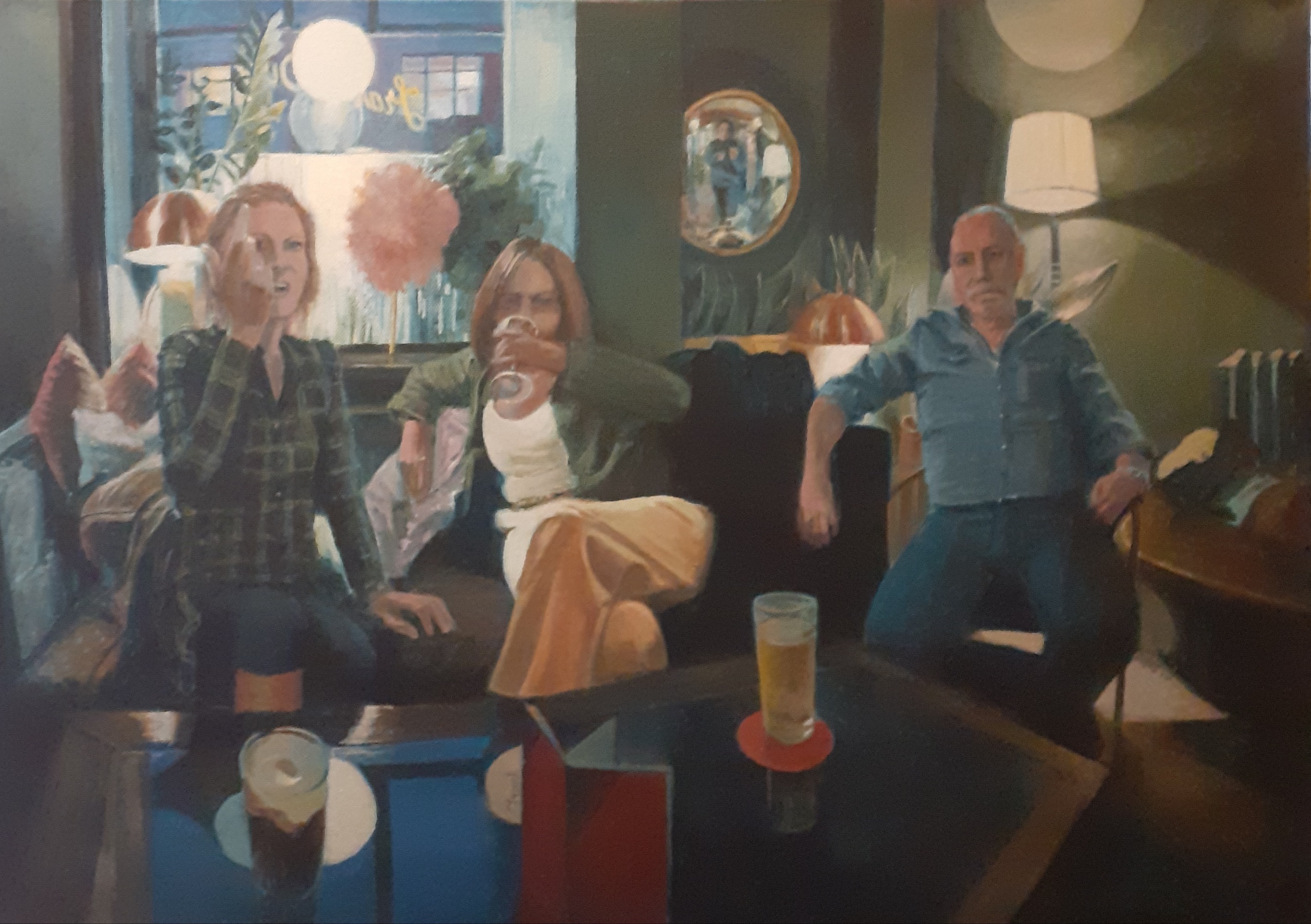
Bray’s Harbour Bar is a favourite watering hole, and I have posted on it before. Drinking Outside the Harbour Bar was painted in the bright sunshine of a summer’s evening. Here, we are huddled inside the original bar in early November. There’s a music session, with three hombres giving it yards. Ballads and folk in the bar, with rock off in the back lounge. I’m in the snug, in between, swaying from one to the other.
This was originally the Harbourmaster’s cottage when built in 1831. The harbour itself was only a small dock then, the full harbour arriving in the 1890s. The bar has been licensed since the 1860s or so. The O’Toole Bros ran the show until ten years ago when the Duggan family added it to their fleet. Throughout its century and a half, it has kept its traditional vibe; seafarin’, rough hewn, crammed with bric a brac and all the ancient, and tyro, mariners adrift on the sea of life. It’s cosy in winter, with the log fires lit and the mellow glow of lights in the timbered shadows. And the music starts to play.
Tonight, I might get loaded
On a bottle of wine, on a bottle of wine,
Gonna feel alright, gonna feel alright,
Yeah, I feel alright!
I Got Loaded is a song for the good times. Listen to Los Lobos howling. Spanish for ‘the wolves’, the band formed in East LA in the mid seventies. Their second album, How Will the Wolf Survive, appeared in 1984 and includes this track. It was written by Camille Bob, and was first released in 1965 by his band L’il Bob and the Lollipops.
At Heuston Station I flash my ticket for the guard. Where to? Galway, I say. Ceannt? Ah, there’s no call for that now.
The journey from Dublin to Galway takes about two and a half hours. Passing through the midlands via Athlone, we cross the Shannon into the West, heading on to Galway by way of Ballinasloe and Athenry. Galway Ceannt is under renovation. Trains are operating normally, but otherwise it is a building site. I have a pint at O’Connell’s on Eyre Square, from where it’s just a ten minute walk to my BnB on College Road.
Galway was founded by Norman adventurer Richard de Burgh in the early thirteenth century. It is known as the City of the Tribes. The Tribes in question were not the Wilde Irishe, but Norman merchant families who rose to prominence from the thirteenth century on. Blake, French, Browne, Bodkin, Deane, Font, Joyce, Lynch, Martin, Morris and Skerrit are Norman French in origin. D’Arcy, though it looks French, was an affected spelling of an Irish clan, O Dorchaidhe, dressed up as posh. Kirwan were another tribe of Gaelic ancestry. Their power waned after Cromwell took the city in the seventeenth century; from whence the term tribes was applied, disparagingly, at first.
I learned all of this at the Galway City museum, by the Spanish Arch on the quayside. It’s an excellent museum outlining the colourful history of the city, its people and its many idiosyncrasies. It is flooded with light, and upstairs there are panoramic views across the city and bay. A large Galway Hooker dominates the central atrium, and is a constant reminder that you are in a city floating on water. There’s an account of the Claddagh, a history of the Claddagh Ring and a section on the Independence and Civil War era.
Entrance is free. In the lobby is the Padraic O Conaire statue. This originally stood, or sat, in Eyre Square. Decapitated at the Millennium, it is stored here for safekeeping. A bronze replica now presides over the square. An author and journalist, O Conaire wrote mostly in Irish. He was a figure in the Gaelic League in London before the Great War and then back in Ireland. He was only forty six when he died in 1928, although somehow the statue always seems of an older man to me. His story, M’asal Beag Dubh, concerns a chancer looking for big bucks for his shiftless donkey. It inspired an ornate hoax by Irish journalist Declan Varley. In satirising the soccer transfer market he created Masal Bugduv, a Moldovan prodigy who attracted outrageous bids from top premiership clubs. One imagines the mythical youth telling the bidders, it will take a few dollars more to shift Masal Bugduv.
The award winning building was designed by OPW architects, Ciaran O’Connor and Ger Harvey. It’s a bright, three story L-shaped building, forming an attractive, varied plaza with the Arch and Comerford House. Comerford House, a late eighteenth century residence, housed the original city museum from 1976 until the new building thirty years later. The Spanish Arch itself is notoriously underwhelming. There are two arches; the outer one closed, the inner being the Spanish Arch itself. Overall, this is an extension of the city walls built along the old fish market in 1584. The quayside was then extended to form the Long Walk, and the arches were added to give access from the city to the new quays. Originally Eyre’s Arch, it was later named the Spanish Arch to note the extensive contact between Galway and Spain in medieval times.
A couple of town castles of the period remain in the city centre. At the foot of Quay Street, Blake’s Castle looks out on the Corrib. Built in 1470 it is a typical medieval tower house. For a time it was used as the city jail, later a grainstore, and then a coffee house. The Blakes descended from Richard Caddell, Sheriff of Galway in 1300. His nickname, Negar, for his dark complexion, was Black in English, from which the Blake name derives.
Lynch’s Castle, further on, is another fine remnant of medieval Galway. A four storey Gothic tower from the late fifteenth century, its facade is adorned with ornate stone carvings. It is now a bank. Lynch’s window is nearby, outside St Nicholas Collegiate Church. And thereby hangs a tale, if you pardon the pun. The window commemorates James Lynch Fitzstephen, Galway mayor in 1493. One version has it that Walter his son admitted to killing a Spanish merchant called Gomez in a dispute over the favours of a girl. Failing to find a hangman willing to carry out the sentence, the Mayor carried it out himself from the upstairs window of his own residence. Three and a half centuries later, the window was installed here as a memorial to stern justice showing neither fear nor favour. The word Lynch since became synonymous with ad hoc hanging, though this doesn’t quite tally with the story.
The church dates back to 1320 and is dedicated to St Nicholas of Myra, the patron saint of seafarers. Christopher Columbus is said to have attended mass here in 1477. Whether or no he also called into the Quays Bar, I always do. It traces its history back to the 13th century when it was a banqueting hall. Upstair is the Music Hall, dominated by a raised stage with a piped organ backdrop. On a seat outside sits a bronze statue known as the Galway Girl. The young woman wears traditional Irish garb so is not the same girl of the famed song. Or songs.
I took a stroll down the old Long Walk
Of the day I-ay-I-ay
I met a little girl and we stopped to talk
On a grand soft day I-ay
Written by American Country Rock musician, Steve Earle, the version by Mundy (Edmond Enright) and Sharon Shannon in 2006 became one of the best selling singles of all time in Ireland. In fact, the Galway Girl is Joyce Redmond, from Howth in Dublin, who plays bodhran on Earle’s original version on his 2000 album, Transcendental Blues.
And I ask you friends, whats a fella to do?
Because her hair was black and her eyes were blue
And I knew right then, I’d be takin a whirl
Down the Salthill Prom with a Galway Girl.
In Ed Sheeran’s song, from his 2017 album +, the Galway Girl is met in Dublin where she plays a fiddle on Grafton Street. Sheeran before his fame had busked the streets of Galway. Across the street is another famed pub, Tigh Neachtain’s, with its traditional interior and terrace seating to front and side. The junction forms a small plaza for a succession of buskers to entertain. Good busking is a notable feature of Galway’s Latin Quarter and the area is thronged with a happy promenade of local and visitor from morning till night.
The fast flowing Corrib marks the edge of the medieval city. It pours down from Lough Corrib, just 6K inland. Besides the powerful main channel, there are other branches winding through the west of the city. Crossing the Wolfe Tone Bridge, the Claddagh and Salthill are off to your left. Further upstream there’s a tangle of riverside walks leading to the open surrounds of the Cathedral and University.
Galway Cathedral, or Our Lady Assumed into Heaven and St Nicholas as it’s officially known, was designed by John J. Robinson. Work began in 1958 and it was completed in 1965. Grimly imposing, the massive structure of limestone blocks attempts to evoke a more ancient age. Its central dome, rising to 145 feet, is its most attractive feature. Within, the bare blocks make for a Stygian atmosphere, encouraging prayers of escape. There is a Marian shrine to the side, and I light a candle there.
Galway University, across from the Cathedral, was founded in 1845. Its original, signature building, the Quadrangle, is a replica of Christ Church College, Oxford in the Tudor Gothic style. The campus expanded in the seventies, with a modern complex designed by Scott Tallon Walker and is growing still. It now has twenty thousand students, almost a quarter of the city’s population. Entering the campus there’s a cluster of building’s from Galway’s industrial past including a disused distillery. A branch of the Corrib here has moorings for river craft and there’s a lively bar along the bank.
The cloisters are strangely deserted but then the rain is falling and this is something of an island in time. The student population is a vibrant force in the pervasive exuberance of Galway. Also, Irish culture is more pronounced here than in other cities, we are way out West, after all. But, while careful to cultivate and preserve the ancient, even invent it, Galway is also modern and receptive; a true melting pot of cultural heritage, ideas and expression. The perfect place to find your tribe, or form a new one.
The Dublin to Cork train leaves Dublin Heuston every hour on the hour. The journey takes two and a half hours via Portlaoise, Thurles, Limerick Junction and Mallow. I took it last year, celebrating my recent elevation to the free Travel Pass. We barrel through west and south Leinster before leaving County Laois past Portlaoise and crossing into Munster
To the south east the mountains of Slievenamon mark the moutainy territory beyond Ireland’s Central Plain. Slievenamon itself rises 2,365 feet above the floor of County Tipperary. The name is from the Gaeilic for Mountain of the Women. Legend is that Fionn Mac Cumhail, mighty warrior and fierce popular with the women, decreed his pursuers should race to the top of the mountain in order to claim God’s gift, as it were. Grainne won, at least as far as Fionn was concerned. She herself might have preferred a leisurely stroll, or cable car ride, and she eloped with more youthful hero Diarmuid during the marriage feast.
The Pursuit of Diarmaid and Grainne is the epic love tale depicting Fionn’s pursuit of the young lovers. I read it in the Gaelic, Toraiocht Diarmuid agus Grainne, for my Leaving Cert fifty years before. I spent a lot of time looking out windows then, too.
This is a painting of two young lovers lounging on the train as it passes the famed mountain. I tried to be discreet in taking the reference photograph, but typically was spotted. The man, ever on guard, has raised his eyes from his mobile device and is looking at me daggers. She is oblivious. In a way it is a meditation on modern love, neither sweet nothings nor spooning intruding on the current obsession with the smartphone. Still, there is an obvious sense of comfort amongst the duo; striking a tableau worthy of Venus and Mars. The two are well cast in their roles, Mars worryingly so. And I am old with wandering, through hollow lands and hilly lands.
The mountain and the moment passes. I can play with the lover scenario in my head. Are they heroes? Are they pursued? Will they change at Limerick junction, or accompany me to Cork, and all other matters arising? Such questions should stall, allowing myth to arise.
The acrylic painting is, as usual, a labour of love. The subjects classically beautiful and statuesque. An intriguing still life is briefly grouped on the table. Beyond, the world whips by at dizzying speed.We are suspended in a fragile bubble in the vast explosion of life.
Well, pistons keep on churnin’
And the wheels go ’round and ’round
And the steel rails lie cold and hard
On the mountains they go down
Without love
Where would you be right now
Without love, oh -oh.
Long Train Running by the Doobie Brothers from their 1973 album The Captain and Me. Tom Johnston wrote it, providing vocals, harmonica solo and the distinctive rhythm guitar backing. I first heard the song after my Leaving Cert that year, covered by Irish band Rodeo at Kevin Street Tech. About that time I figured why the American Band didn’t actually feature siblings with the surname Doobie.