College Green, Dublin

Kings College Gr

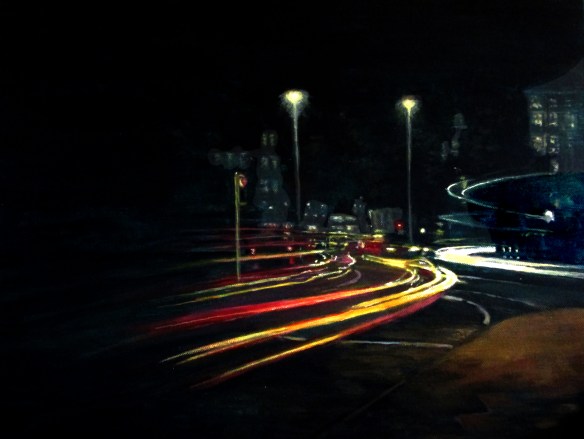
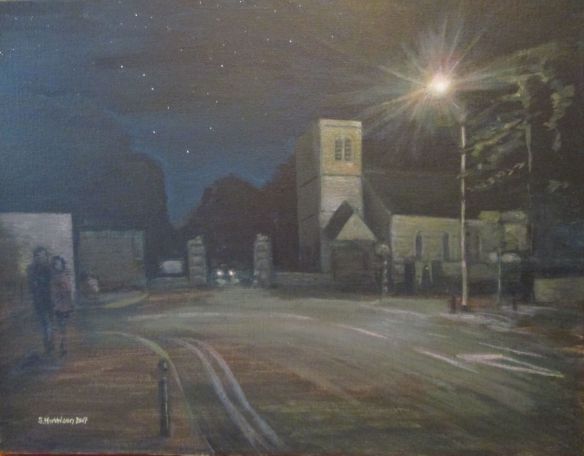
The dazzling and hectic firefly fight that is College Green at night might soon be no more. The plaza, a nexus for cross city traffic, is to be pedestrianised. It is a pity really. The necessity for keeping parts of the city for pedestrians is recognised, but it needn’t become an obsession. Cities thrive on traffic; the loud, energetic, electrical surges so evident in the city at night. That is their poetry.

This is a painting of a time exposure looking south towards College Green at the height of Dublin’s late night rush. We stand on the island opposite the Bank of Ireland, originally the Parliament Buildings until the Act of Union of 1801. Westmoreland Street and Temple Bar are towards the right, Trinity College and Grafton Street to the left.

Parliament House was designed in 1729 by Edward Lovett Pearce in the Palladian style. It was a confident and modern statement marking the centre of the Irish Capital. With Trinity College it delineated College Green as the focal point of the developing Georgian city. James Gandon contributed to the extension of the building later in the century. The resulting sweeping curve joins Dame Street and Westmoreland Street. Connecting with Dublin’s. main street, O’Connell Street (formerly Sackville Street), it forms the central thoroughfare of the city.

This is the beating heart of Dublin. Whenever you stand there, you will experience the rattle and hum of the city. The song it makes is of all the songs that have been sung here, all the words written and spoken, the history of centuries and recent seconds. At night I find it something special, intimate in its inkiness, dangerous and comforting in that non stop firefly display. Stand and watch the lights of passing traffic going everywhere, fast, at the same time. That’s city life. Or was.


Granada – The Alhambra

Al 18 Alview

When I was thirteen, I picked up the flamenco guitar and dreamt of Spain. The intricacies eluded me, but within my head the music sang loud and true. I was a better painter than musician, and here too a fantastical world formed, inspired by Salvador Dali’s visions, mindscape merging with landscape. Crowning this dreamworld was an ancient palace of a vanished kingdom: the Alhambra. Someday I would go there, blend with its mystery in the shimmering heat of southern Spain. Almost fifty years later it comes to pass.

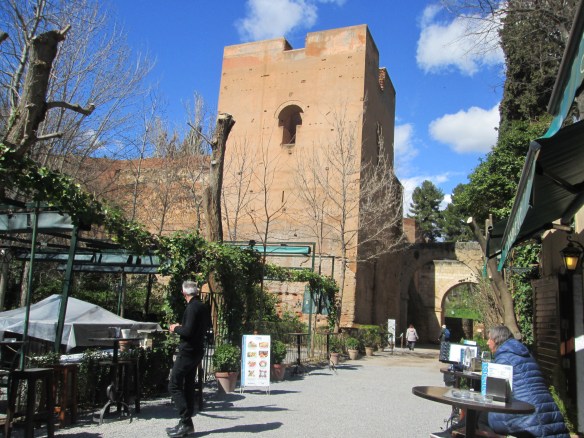
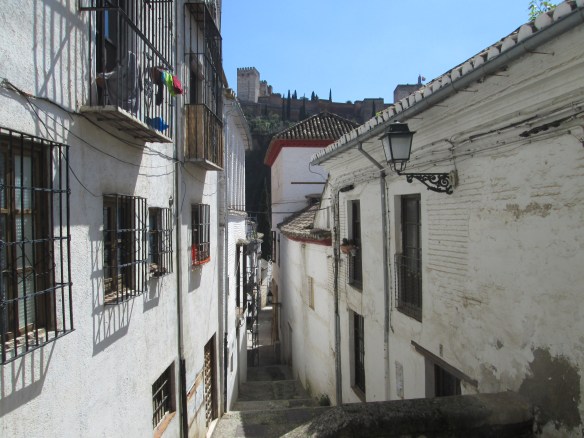
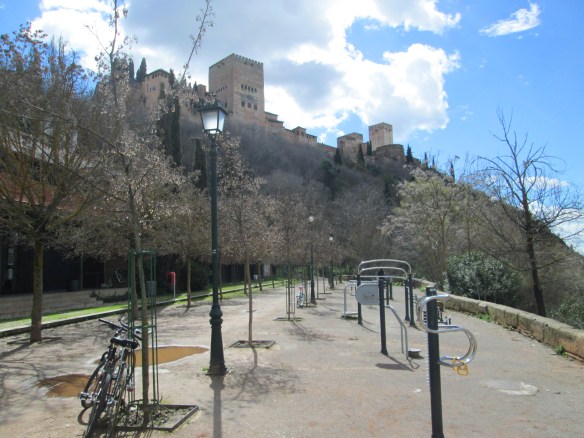
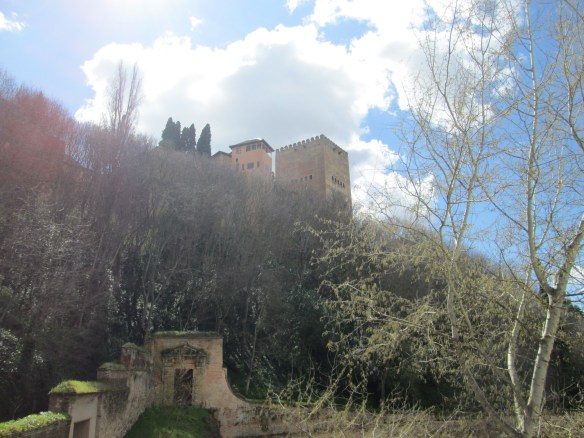
It’s my second day in the high city of Granada. Man, it’s cold. I had intended taking the bus to the main entrance but wandered instead down winding alleys from Plaza De Campos to Plaza Nueva close to the high western edge of the Alhambra. Beyond Plaza Nueva the city of Granada begins to shimmer and fade, blending into the landscape and replaced by a chimera of imagination and folk memory centred on the Alhambra, red bastion rising on its green and rugged plinth.

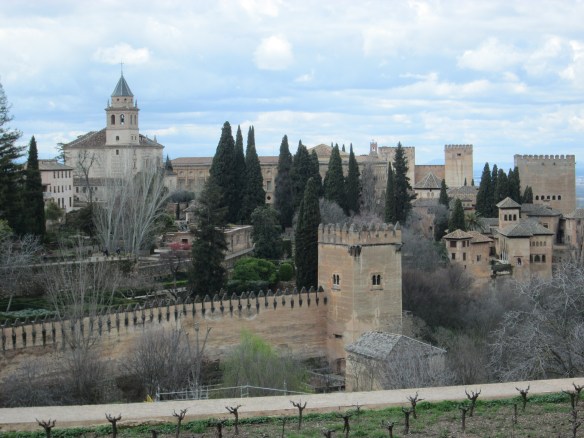
Al 16 AlcaAlhambra signifies the Red Castle, from the blood toned colour of its stone. The Moors had built a fortress here in the ninth century but the existing complex dates to 1333 when Yusuf I, Sultan of Granada, established his royal palace. It was to be the last bastion of the Moor in Spain, In 1492 the Catholic Monarchs, Ferdinand and Isabella, completed the Reconquista when they defeated the Emirate of Granada. The two monarchs entered Granada clad symbolically as Moslems, promising friendship and tolerance of religion. It was short lived. The Moors rebelled in 1500 and the treaty lapsed. Moslem and Jew were required to convert or leave. The institution of the Spanish Inquisition was set up to police this law.

1492 was also the year when Italian explorer Christopher Columbus came here to receive the support of the Monarchs in his ambition to sail to the New World. This is when the Western World was born. An early history of Columbus was written by an Alhambra resident in the 1820s. Washington Irving, joker that he was, is responsible for perpetuating the myth that, pre Columbus, Europeans thought the earth was flat.

Al gate

The entrance is through the Puerta de las Granadas, or Pomegranates, which gives the city its name. Inside the grounds the Alhambra reveals itself, tantalisingly peeking above the trees. With the gathering pilgrims, I push uphill. A fountain sprouts. The Pillar of Charles V dates from 1554. The ubiquitous Carlos V was a mere Carlos I until his elevation to Holy Roman Emperor. He didn’t even speak Spanish, to begin with, but his subjects warmed to him as he learned.

Al 2 Irving

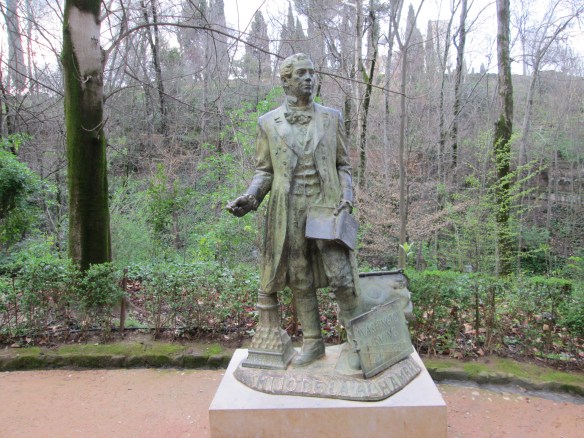
I rest on a bench. A quaintly dressed man stands nearby. He gestures to the glories spread above and wonders is it possible to capture the beauty and intensity of the place. I show him my camera and the shots I’ve taken, which he finds interesting, perplexing too. It’s words he means. How unworthy is my scribbling of the place, he says, and tells me of his Tales of the Alhambra, a history woven with imagined tales the walls must hold. What a great idea that is! Unfortunately the man must return to his home in America, but vows to come back to this most picturesque and beautiful city. I hope he does. I would wish to also, in warmer days. Again there is that faint shimmer in the air, and I find myself fading upwards along the path, past the statue of a writer I feel I must know.

Al 3.Jstgatejpg

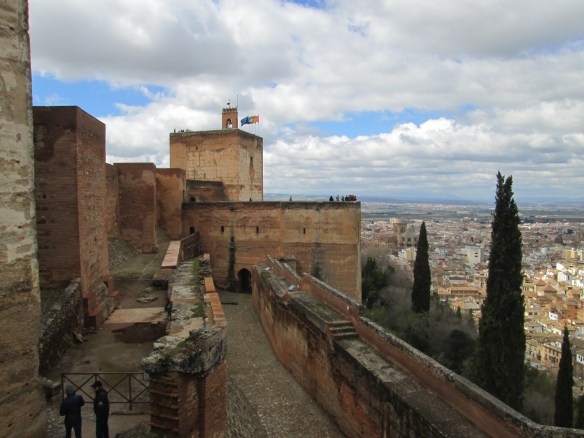
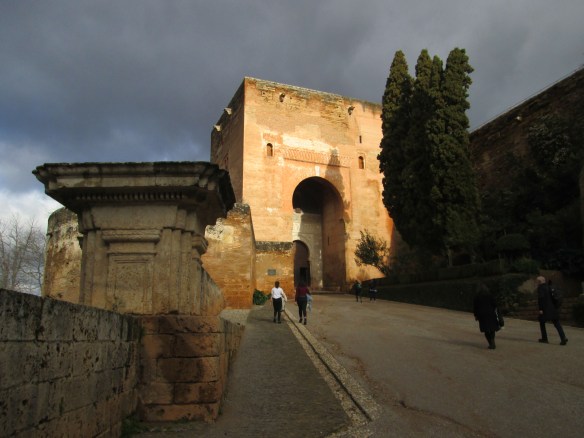
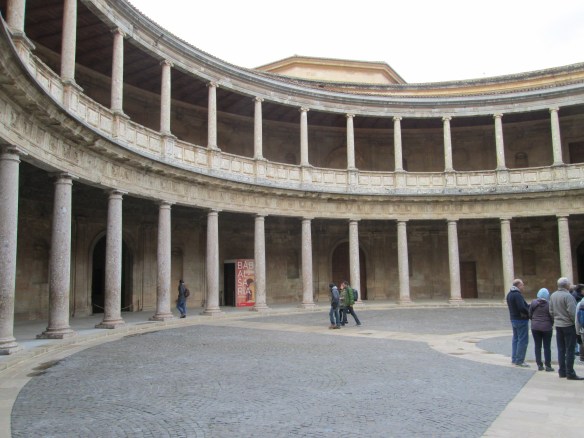
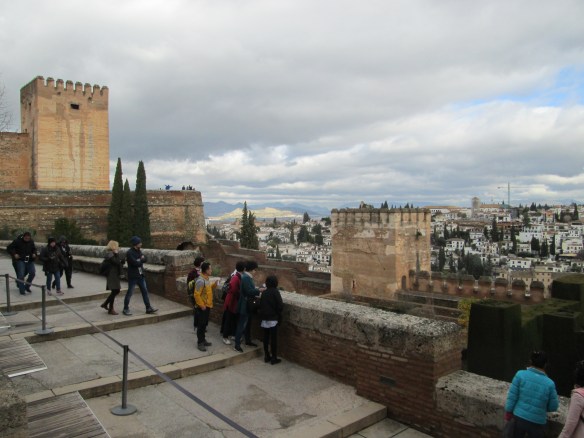
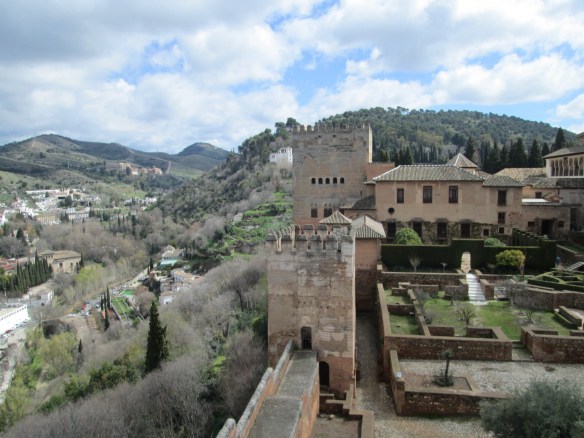
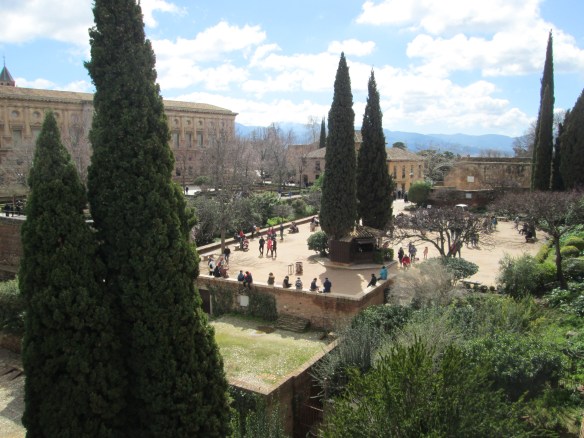
I enter through Puerta de la Justicia, imposing russet tower with its distinctly Moorish horseshoe arch. The procession of pilgrims has melted away and I am left alone. From the ramparts, I see Granada tumble from the hillsides across the plain, the Sierra Nevada shining white across the horizon. When the Moor last looked out here, the Alhambra was entirely a construct springing from the Islamic culture of northern Africa. Within a couple of decades there was a notable intrusion of European style. The Palace of Carlos V was built by order of the Emperor in 1527 in the Renaissance style. Newly confidant Europe had rediscovered the glories of Greco-Roman antiquity and honed it into the distinctly modern style of the merging continent. The entrance patio is a startling homage to Classicism, with its two story colonnade holding us in its entrancing circle.

Al 6 CVpatio

The temperature has dropped and I have forty five minutes before my appointment at Nazaries. A sign for coffee and services is misleading. This leads to a modernist concrete shack, cold and crowded, with one scabby machine offering hot beverages. The instructions are less than helpful. Yes, it takes money and credit cards, but how much? None of mine, for sure. I buy water and Doritos off a nearby Gypsy. The queue for the Nazaries is long but not long enough and when I reach the head ten minutes early I must stand to the side. I’m frozen blue, four degrees and falling. Global warming my ass!

Al 7 Qnaz

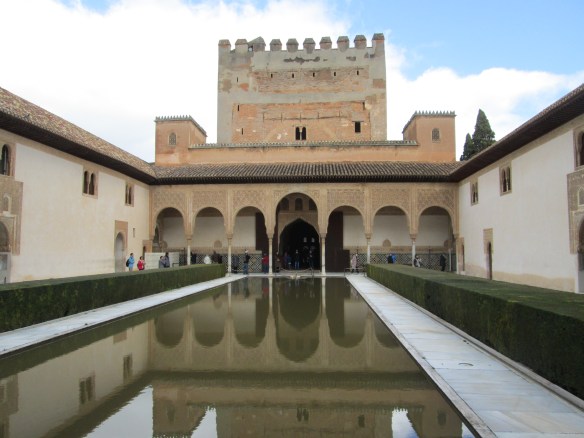
The Nazaries unfolds on entering, a stone flower opening into more spaces than anticipated from the outside. Stone becomes fire and flickers to intricate tracery; water turns to glass and beckons to a perfect nether world. What paradise this must be in heat; water stone and plants working to scent and quieten the air. This cold emphasises its abandonment and defeat; its very existence a time capsule of a vanished age.

Al 10 Nazpool

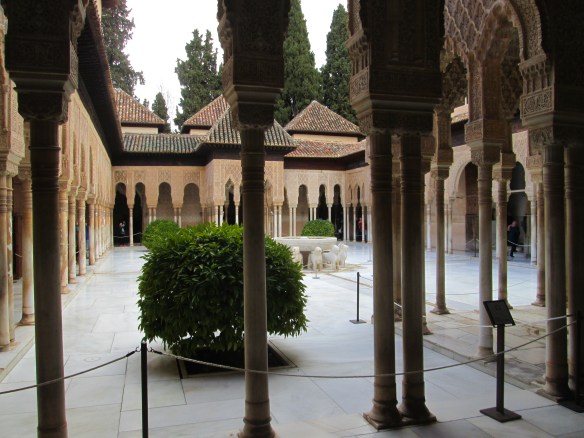
There are three palaces within the complex. First, the public area dealing with justice and administration. Then the Camares Palace which was the royal residence. Finally, the Palace of the Lions, a harbinger of heaven where the harem was located. A magnificent centrepiece is the Court of the Lions with its sculptured lions forming a circle within magnificent, delicately rendered cloisters. There is an abiding sense of harmony between the ancient Islamic order and the newly flowering Christian Renaissance. You could float on this river forever and ever.

Al 11 Nazlion

Having exited inadvertently I slip back in. A female guard calls after me. However, she is hugging a heater in her sentry post, and indisposed to follow me. In truth, I’m prone to quitting. The absence of a decent cafe, or any place of warmth erodes my will. I come across the American Hotel and find a seat in its tiny tearoom. A sturdy Tuna Sandwich and two hot Americanos later and I’m suitably fortified. A friend had recommended a visit to the terrace at the Parador Hotel with splendid views of the Alhambra. But it’s not a patio day and the interior has that lowrise furniture peculiar to hotels and innimmicable to relaxation.

Al 15

The Alcazaba is the fortress at the business end of the Alhambra, its towers giving the most majestic views over Grenada. I find myself earwigging a conversation between a Gypsy and two Americans. The Gypsy gives a brief account of their origin, relating the reasonable alternatives. Origination was somewhere in the near east, or refugees from the margins of the crumbling Roman empire. Some say we came from Egypt to wander the margins of empire. If people asked from whence we came, the answer was Egypt, which half heard, sounds like Gypsy.

Al 14 CV

From here, I take the path that fades down towards the entrance through beautiful gardens. The first blooms are appearing but t’s not quite come to life just yet. Across a ravine and climbing the next hill takes us to the Generalife, the Gardens of the Architect. Beautiful gardens surmounted by an elegant villa provided a retreat for the Royal Household from the travails of the Alhambra. And provides glorious views of it too.

Al 20 Bar

On exit, I put into the first available bar. Below the walls of the western Alhambra, there is shelter and sufficient warmth from the sun to allow me bask outside with a beer and tapas. I walk back downhill past the northern walls alongside a rapid stream. I emerge onto the banks of the Darro river which heads back towards Plaza Nueva.

AL 22 AlcaThis area overlooking the Darro is the Albaicin, dating back to the 13th century and rich in Moorish heritage. The streets meander past high walled villas, dazzling white washed walls and towering palms and pines. Becoming impossibly narrow so you feel you must turn back, then widening unexpectedly into sparsely imposing squares. Quiet and weird; at times I feel I’ve strayed into a Dali scenario; Outskirts of the Paranoiac, perhaps.

AL 21

Stranger still, lounging by the riverside cafe terrace with another beer and tapas, soaking in the first true warmth of the day, the waiter hurries by, imploring us to retreat under the canopy. It had certainly darkened off to the west, and a smudge of rain was sensed. Then it came upon us. The sky scowled and snow fell in curtains across the backdrop of the Alhambra.

Al 20


Dublin’s Circular Roads – 6

The Phoenix Park.

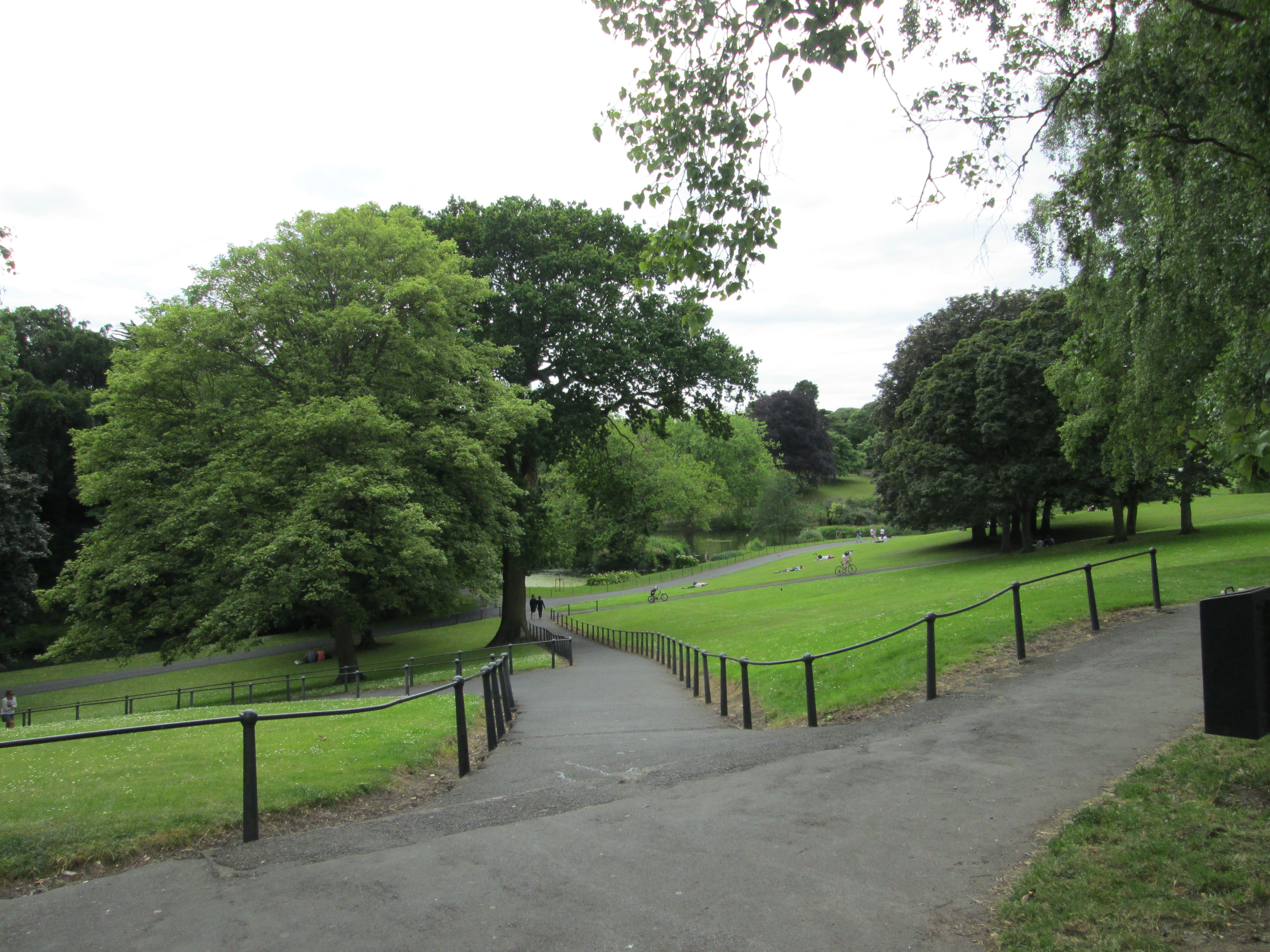
Where the arc of the North Circular declines, the road swerves south and dips steeply towards the Liffey by way of Infirmary Road. Straight ahead the Phoenix Park beckons, spreading its serene blanket of greenery on the western periphery of Dublin. Once remote, it is now a playground for its urban and suburban surrounds.

Phoenix connotes birth from fire, or revolutionary rebirth, concepts not without echo in the park’s historical fabric. In fact, the name derives from the Irish Fionn Uisce, meaning clear water. This refers to the Liffey along the southern edge, where the waters run clear above the muddy waters of the tidal estuary.

In Norman times, this was part of the demesne of the Knights Hospitalier based at their abbey south of the river at Kilmainham. The dissolution of the monasteries by Henry VIII in 1537 dispossessed the monks of their lands. At the Restoration more than a century later, Lord Lieutenant James Butler, the Duke of Ormond, established the lands as a royal hunting park. A herd of fallow deer was imported and is still in occupation. In 1680 the lands were split each side of the Liffey. The Royal Hospital was built at Kilmainham to cater for retired army soldiers and is now the Irish Museum of Modern Art.

In 1745 the Phoenix Park became a public park, one thousand seven hundred and fifty acres enclosed by an eleven kilometre wall, reputed to be the largest urban park in Europe. It is twice the size of New York’s Central Park and more than four times the size of London’s Regent’s Park.

The Park is a significant city thoroughfare. The main drag, Chesterfield Avenue, ascends in a neatly dividing diagonal between Conyngham Road and the Castleknock Gate. It bisects a vast expanse of manicured nature. There’s grassland and woodland, the brazen herd of deer, pitches for football, cricket and polo grounds, the dog pond for our four legged friend and the Zoo for more exotic critters There is a sprinkling of monuments and hidden amongst trees, some significant buildings.

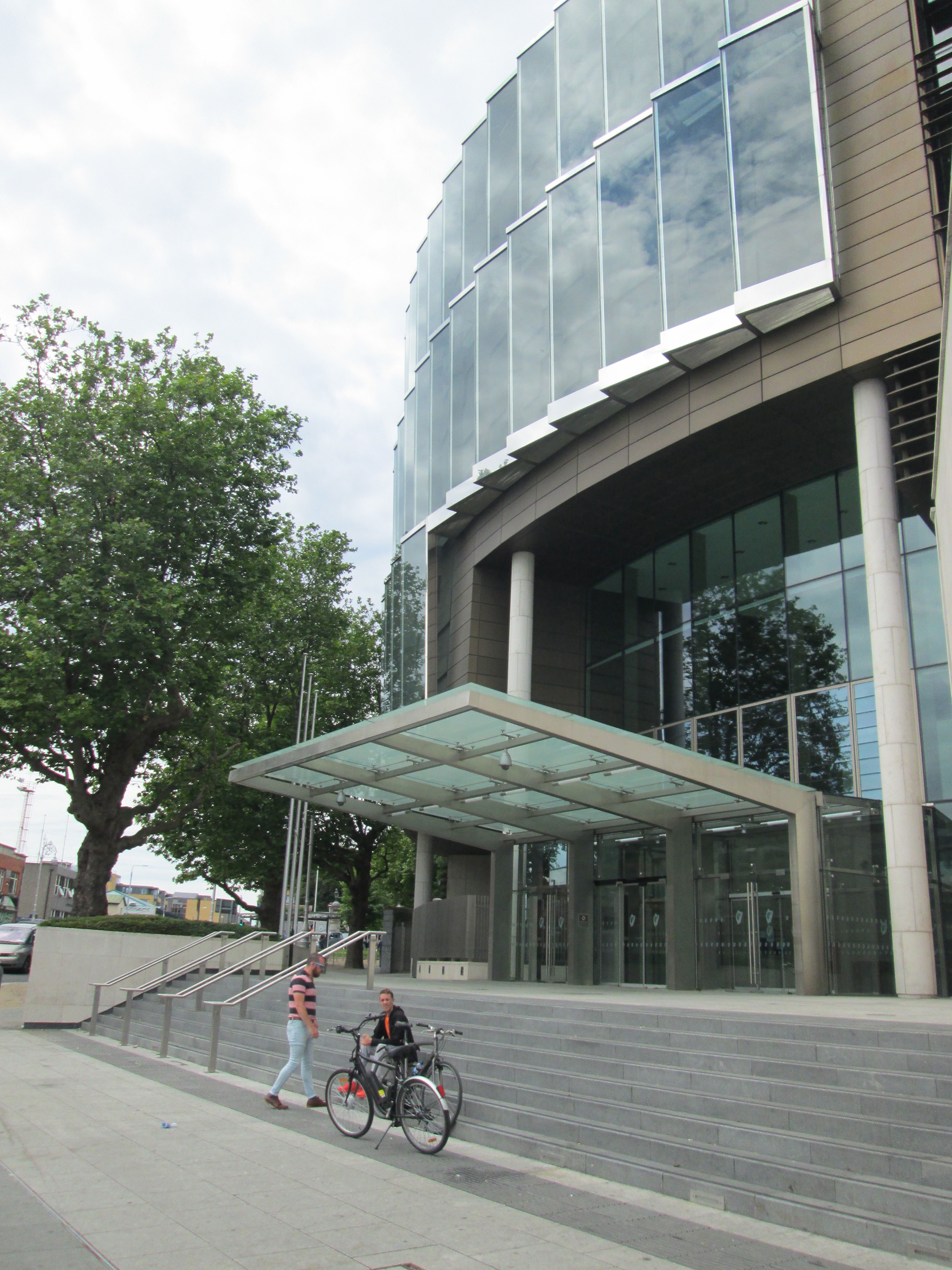
The Garda headquarters are to the right near the Park Gate, the NCR entrance. To the south is the Office of the Director of Public Prosecutions and the Criminal Courts of Justice. Not the best spot for loitering criminals so. Mind you, Bohemians Football Club was founded by a group of young men at the Gate Lodge in 1890. They’re the oldest soccer club in Ireland, and played their first games at the Polo Grounds.

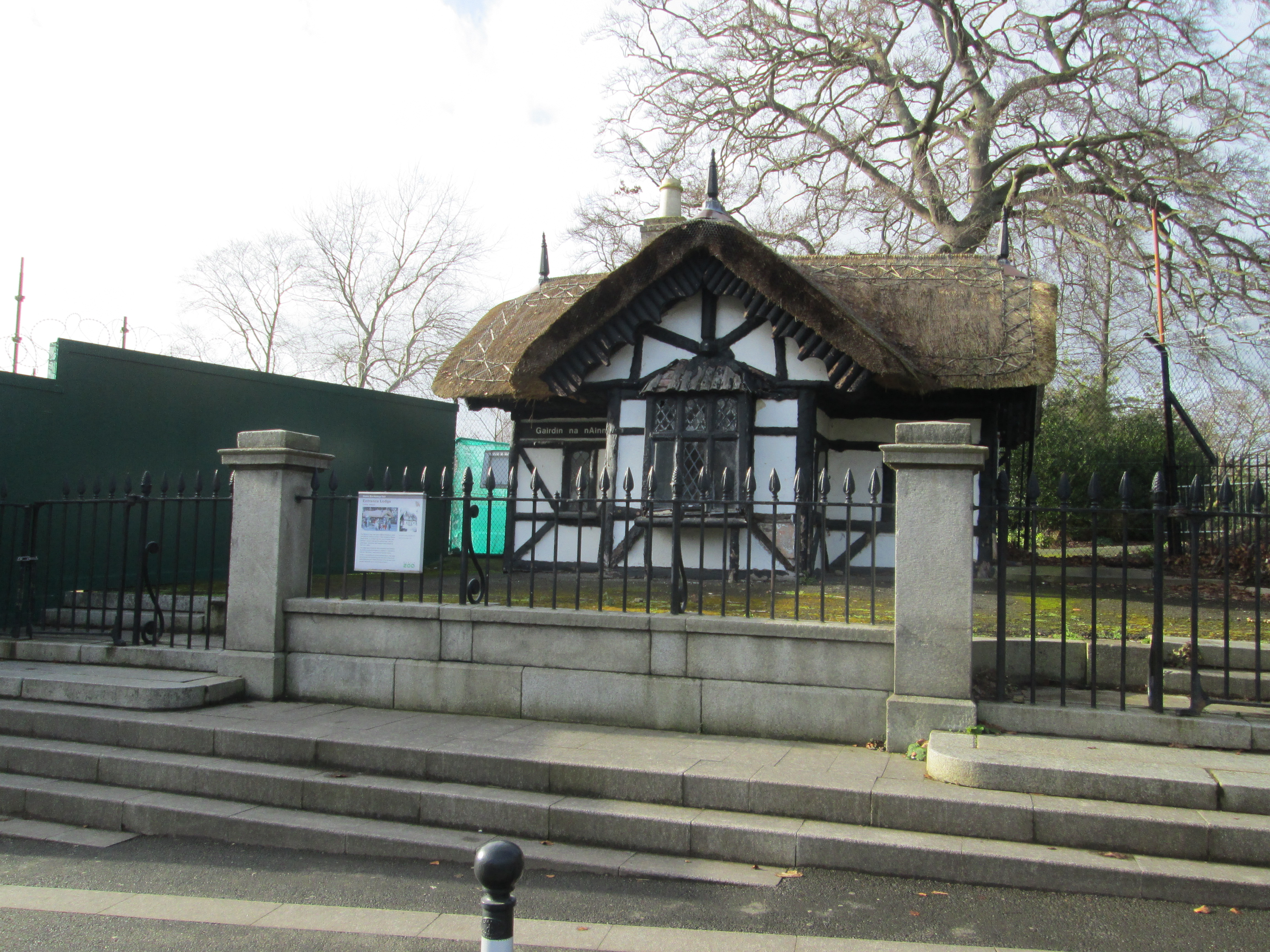
Dublin Zoo is nearby. The quaint entry post survives, a charming thatch out of Africa and another era. The large modernist entrance is adjacent. The Zoo is picturesquely constructed around ornamental lakeland. A more enlightened policy these days gives the animals some room to roam. Monkeys and chimps have their islands, predator and prey of Serengeti and beyond have large outdoor compounds. The Zoo was opened in 1831 and quickly became a popular destination for Sunday day-trippers. Still is today.

Nearby are the quaint circular tearooms. A place where I like to catch a coffee and lounge on its outdoor terrace. Of a morning in Spring or early summer a perfect moment is possible, with the air hanging like gauze from awakening trees. It’s busy today though, despite the wintry cold, and I pass on.

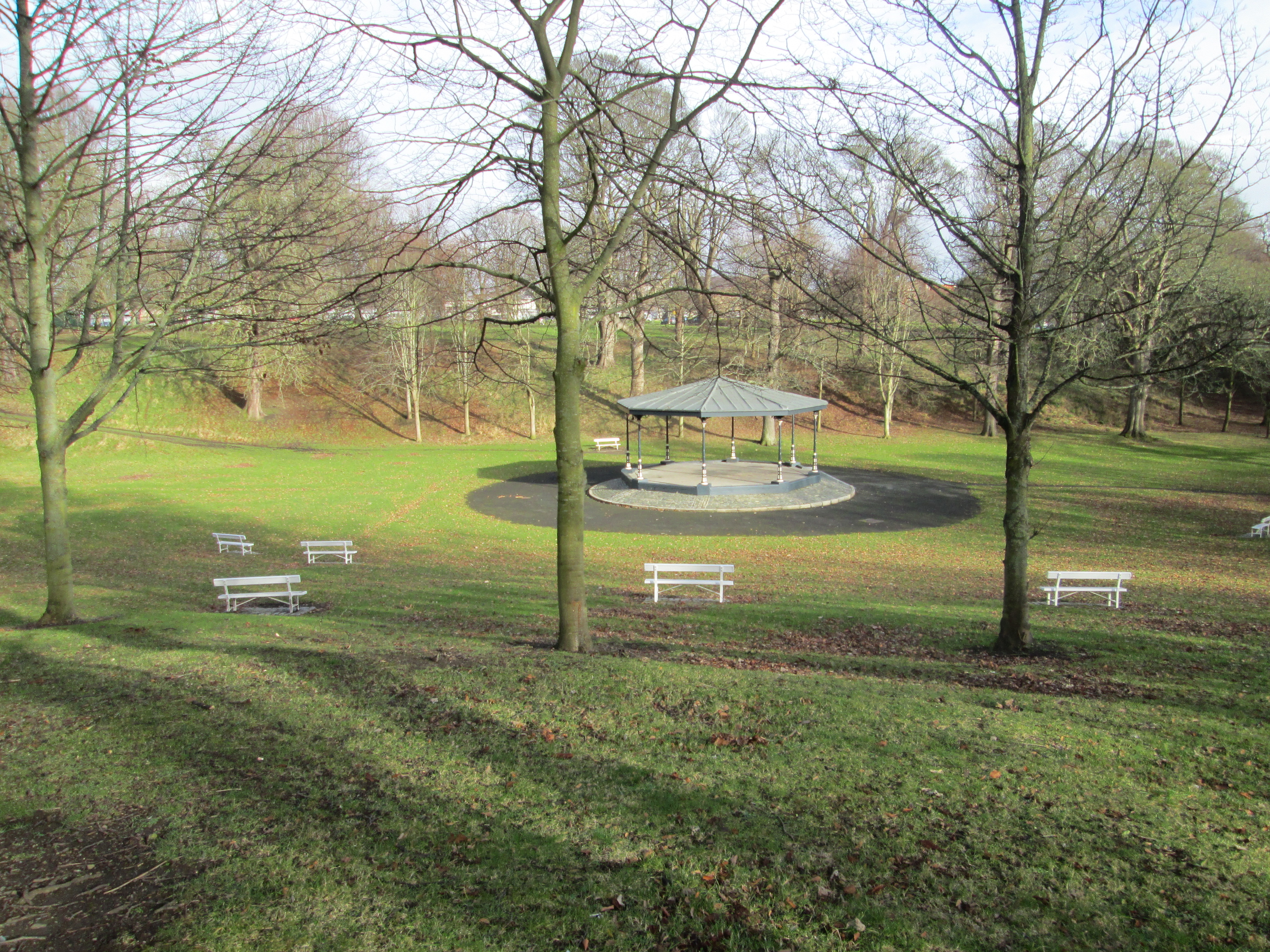
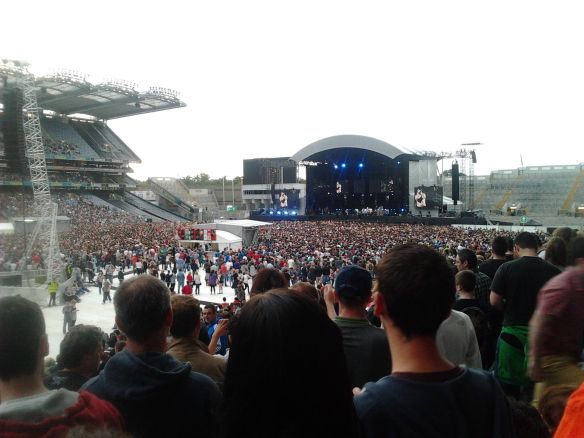
The ground falls steeply away to the east, falling away towards the Hollow. The Hollow has long been an occasional outdoor music venue, whether for formal brass band or a bit of good old time rock and roll. The ornate bandstand from 1890 provides the focus. I was a frequent flier in the mid seventies, with that hippy coterie and Mary Rose. I should namecheck the playlist, but then I smoked the green, green grass of home. The Park holds memories of greater gigs. They vary from the visit of Pope John Paul II in 1979 to the Red Hot Chilli Peppers some years later. The Pope attracted a million to his gig, the Chillies somewhat less; though they were rowdier and louder, including me and my teenage son, singing and sweating through a summer day.

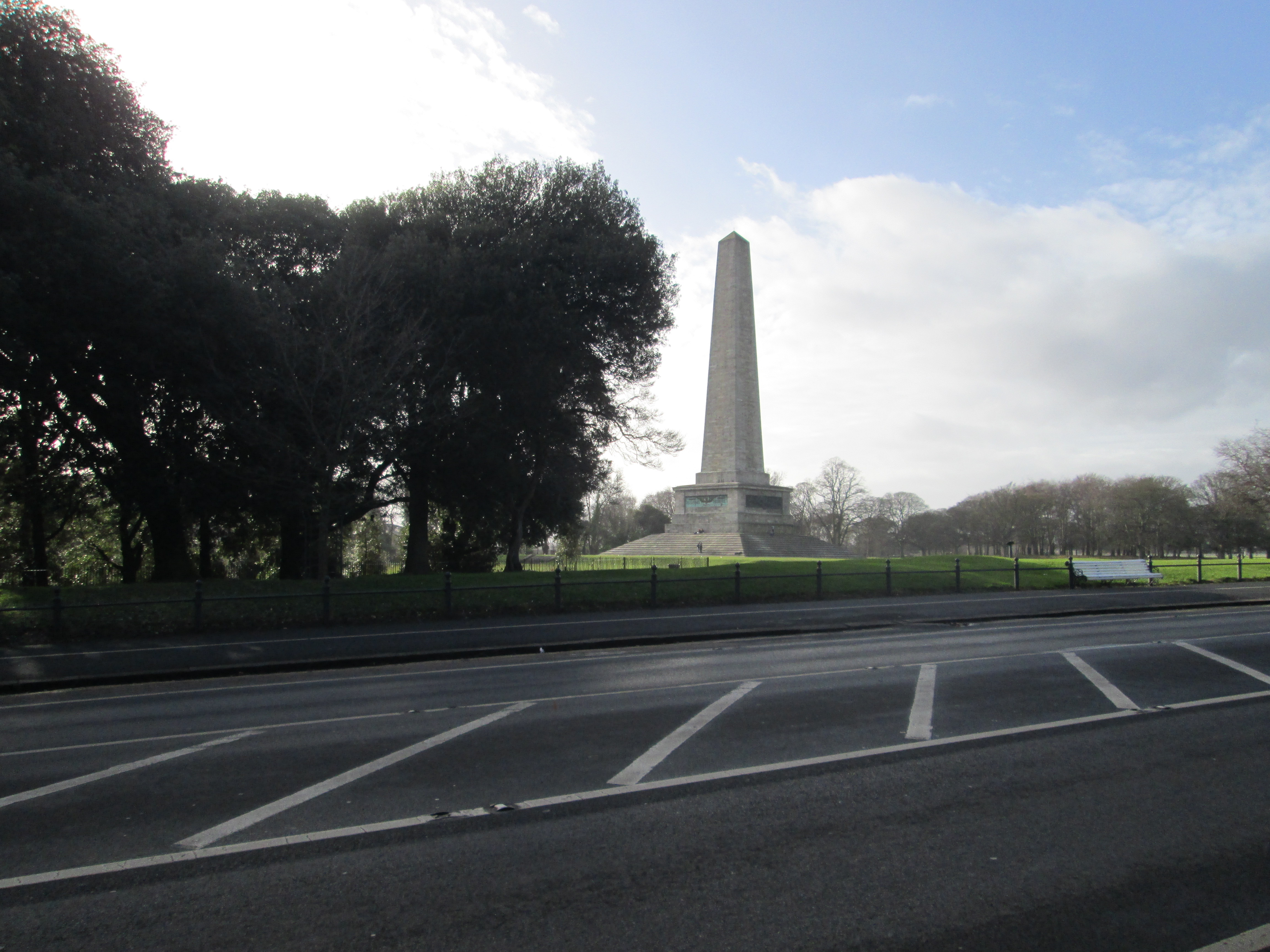
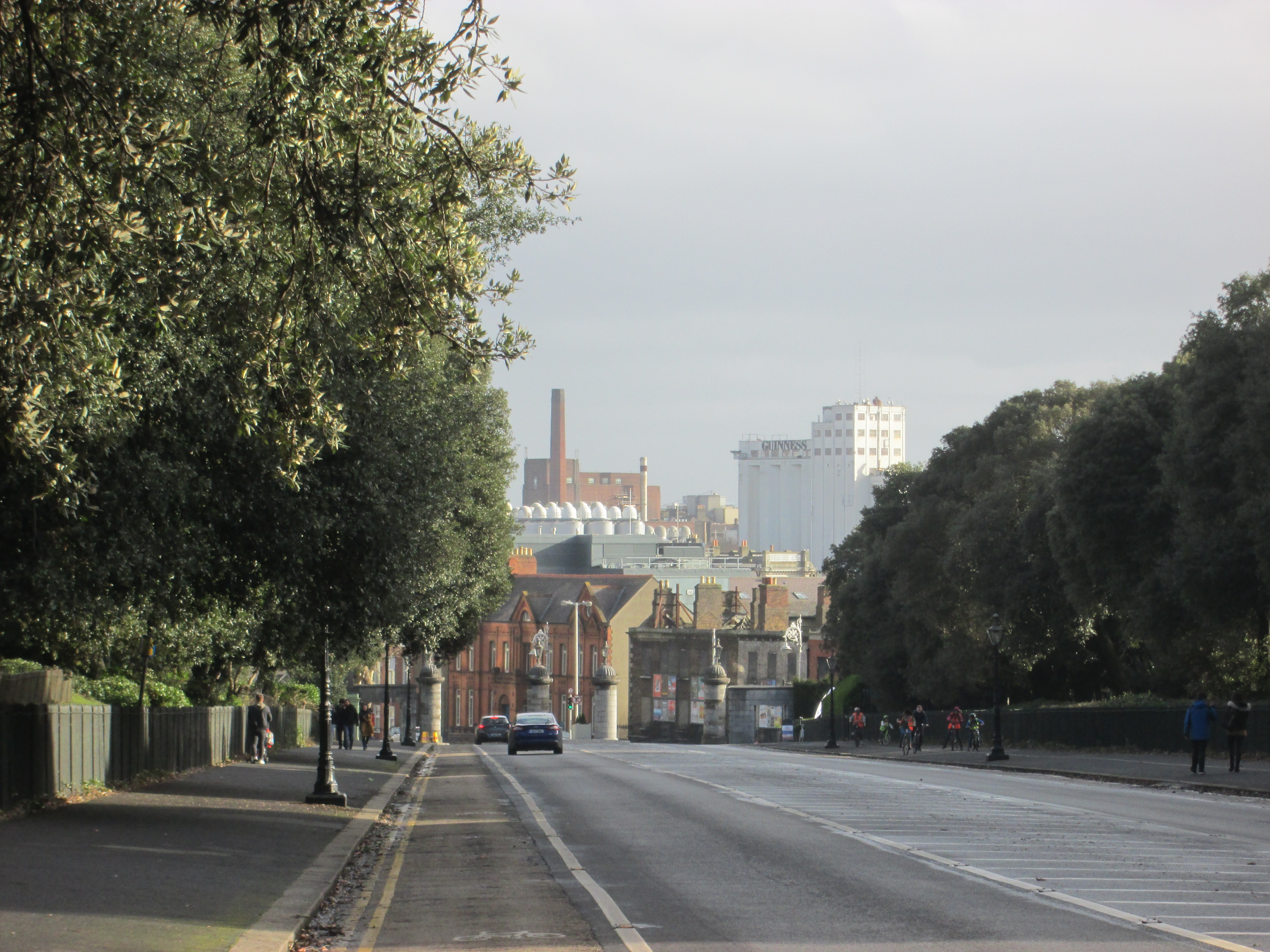
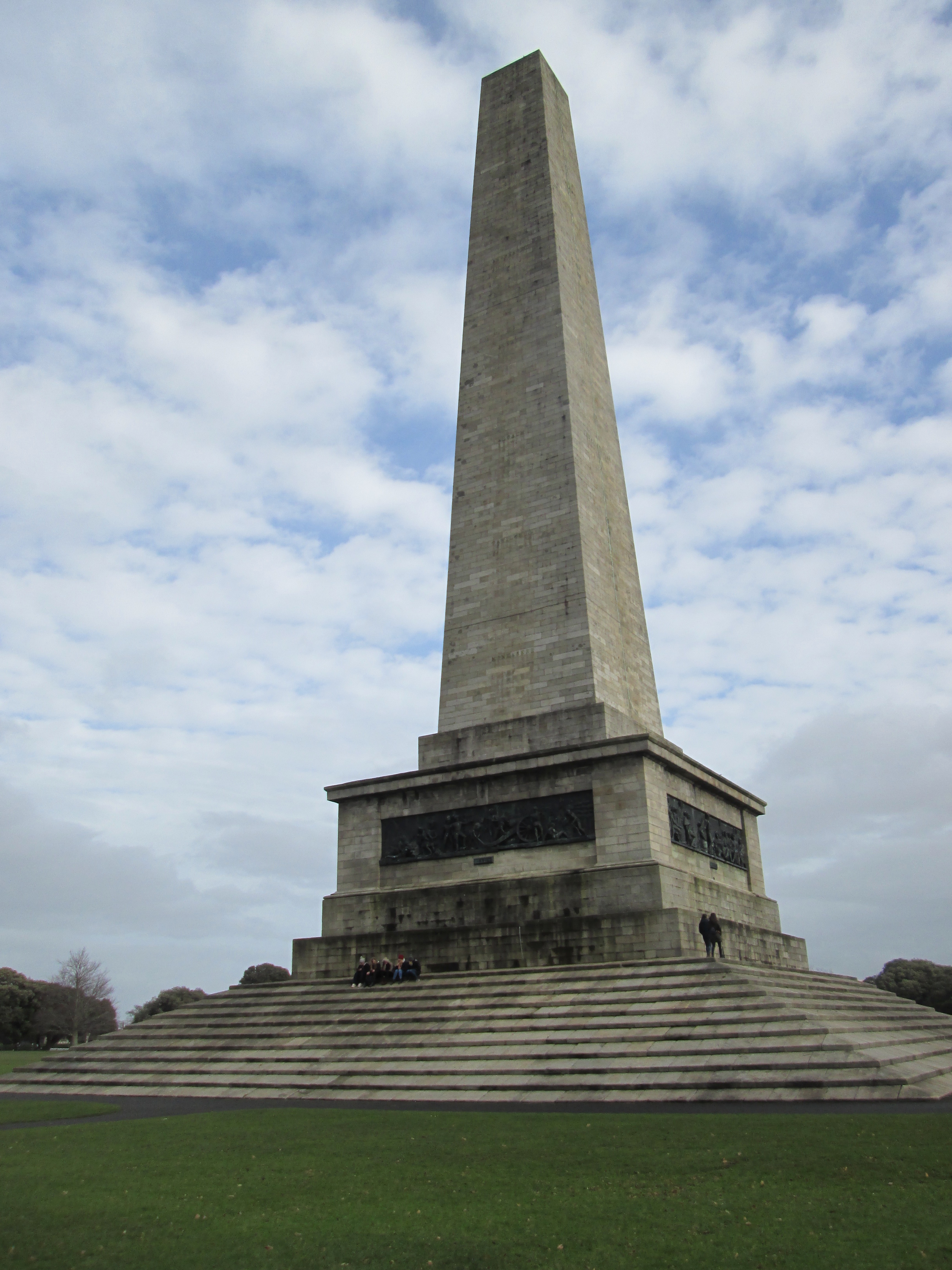
This quadrant of the Park is marked by the stone finger of the Wellington Monument. Crossing the main road there’s an iconic view of Dublin to your left. As the road falls towards the Parkgate Street entrance, the stacks and towers of the Guinness Brewery rise up with the city, a throbbing urban wall against the sublime greenery of the park.

Off track to our right is Aras an Uachtaran, the residence of the Irish President. It was built in 1750 by the Chief Ranger, Nathaniel Clements. Clements was a property developer and politician, who lived in Henrietta Street, the first grand Georgian streetscape. The Aras, viewed across the lawns, is oddly resonant of the White House in Washington, although the resemblance is coincidental. Neo-classical architecture doesn’t vary all that much at first glance.

Before Independence it was the Viceregal Lodge and witnessed one of those darker incidents that form a contrast to the Park’s bucolic idyll. In May 1882 the newly appointed Chief Secretary Lord Cavendish was walking in the vicinity with Under Secretary Thomas Burke when they were stabbed to death by two members of The Invincibles. The assassins were spirited away by getaway man James Fitzharris, more colourfully known as Skin the Goat.

When Carey told on Skin the Goat
O’Donnell caught him on the boat
He wished he’d never been afloat

George Hodnett’s mock trad spoof, Monto, gives a scabrous and partial account. Cavendish had just replaced Forster, known as Buckshot for his hardline attitude to the Land League.

You’ve heard of Buckshot Forster
the dirty auld imposter
He took his Mott and lost her up the Furry Glen.

Forster resigned over Parnell’s release from Kilmainham Jail, and Cavendish’s first day in the post proved to be his last. After the outrage, Carey, leader of the Invincibles ratted out the perpetrators, but paid a high price when assassinated on a ship out of Cape Town.

It wasn’t very sensible
To tell on the Invincibles
They stand up for their principles, day and night.

I skirt the Wellington Monument, its plinth gained by sloping steps and today occupied by happy loving couples taking in the view, being kings of their castle. Wellington Road branches left off Chesterfield and descends towards the Islandbridge Gate.

Exactly a century on from the Invincibles outrage, Malcolm McArthur, an effete, financially straightened socialite, hatched a convoluted plot to stage a solo armed robbery. Determined to steal a car, in July 1982 he loitered in the woodland nearby. He identified a target, a young nurse, Bridie Gargan, who parked her car and left it to take the summer sun.

Spring was never waiting for us girl
it ran one step ahead as we followed in the dance.
Between the parted pages we were pressed
in love’s hot fevered iron, like a striped pair of pants.

The plan was not best laid. MacArthur dragged her to the car and violently assaulted her, driving out of the park with her dying in the back seat. His escape took him towards James’s Street Hospital where, bizarrely, an ambulance, its driver thinking MacArthur was a doctor with a patient, escorted him through the grounds of the Hospital with siren blaring. MacArthur kept going, eventually depositing the car and its victim in Rialto.

I recall the yellow cotton dress
foaming like a wave on the ground around your knees.
The birds like tender babes in your hands
and the old men playing checkers by the trees.

Days later he murdered farmer Donal Dunne while posing as a purchaser for his shotgun. MacArthur was run to ground in his hideout; the residence of the Attorney General in Dalkey. You couldn’t make this stuff up. John Banville tried with the Book of Evidence but it’s not nearly so bizarre as the fact. The AG, meanwhile, headed off on holiday, it was booked after all. Taoiseach Charles Haughey ordered him home. Haughey’s expression of disbelief resulted in the coining of the acronym, so descriptive of the era, by Conor Cruise O’Brien; GUBU: Grotesque, unprecedented, bizarre and unbelievable.

MacArthur’s Park is melting in the dark
All the sweet green icing flowing down.

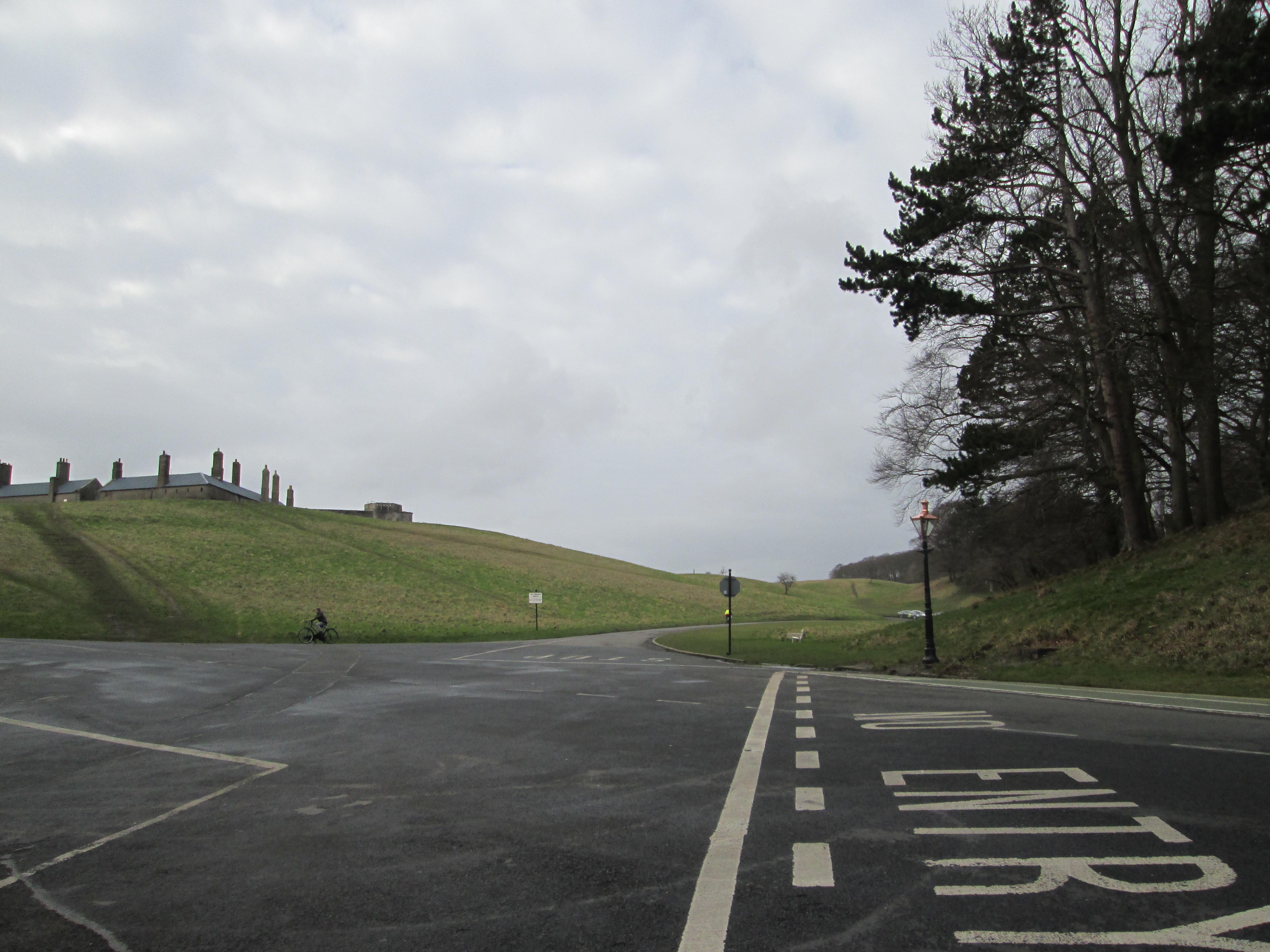
The Magazine Fort stands guard over Islandbridge Gate. It dates to 1734, a star fort dominating this undulating, lonely south-western section of the Park. It featured in the overture for the 1916 Rising. A group of Volunteers, posing as footballers, gained entry to the fort claiming they needed to retrieve their ball. I have no idea if any were members of Bohemians, but they managed to disarm the guards. However their plan to blow up the fort by way of signalling the onset of the Rising was something of a damp squib.

Exiting by the pretty Gate Lodge, a short left takes us to the Liffey bridge. Rising up to the south is the first stretch of the South Circular Road and the second part of our odyssey. Conyngham Road heads east, a short stroll along the southern wall of the Park to the Luas line at Kingsbridge connecting to the city centre. A halfway house, if you like.


Celbridge

Celbridge 5

This is my most recent painting, done over December just passed. It is a view of Celbridge, looking north towards Castletown Hose, the view centered on Christ Church and the estate entrance gates. It is around midnight, and some stragglers linger as the town’s nightlife disperses homewards. The stars are out, and for all the quiet of the country, there’s a certain timeless magic in the air. And all the ghosts that ever passed this way.

Celbridge lies on the River Liffey in County Kildare. The name, a pidginised Anglo-Gaelic, means church by the bridge. It was previously called by the phonetic version of the original Gaelic, Kildrought, from Cill Droichead.

These days, it skirts the outer edge of Dublin’s conurbation. Its most famous son is Arthur Guinness, born here in 1725, who established his brewery in 1759. The rest is history, though a lot of it rather hazy. A statue of the great man stands on Main Street.

Despite the ever growing population, with more than twenty thousand people calling it home, a village atmosphere still pervades at its centre. There are several good pubs and a few eateries from the Liffey bridge and along the Main Street. The lands of Castletown estate have now been divided between public parkland and suburbia.

Christ Church marks the end of Main Street, just within the gates of Castletown House. Lady of the manor, Louisa Connolly, funded the building for the Church of Ireland community. It’s an attractive, if stern structure dating from 1813. It was extensively remodelled in 1883 as the original had fallen into ruin. The tower over the western entrance is imposing, its Normanesque style lends the view an antique quality.

The long tree lined driveway heading due north leads to Castletown House, a glorious Palladian Palace built for William, the Speaker, Connolly in 1722. He was the Speaker of the Irish House of commons, the most powerful elected position in Ireland. The Palladian style was in vogue, with all things Italian, in the early days of Neo-Classicism. Connolly employed leading Italian architect Alessandro Galilei and Irish architect Edward Lovett Pearce to achieve one of Ireland’s most dramatic stately homes. It is open to the public and the focus for weekend craft fair and the promenade of visitor and local throughout the year.

Celbridge 1

Celbridge 2

Dublin’s Circular Roads – 5

Phibsborough to the Phoeno.

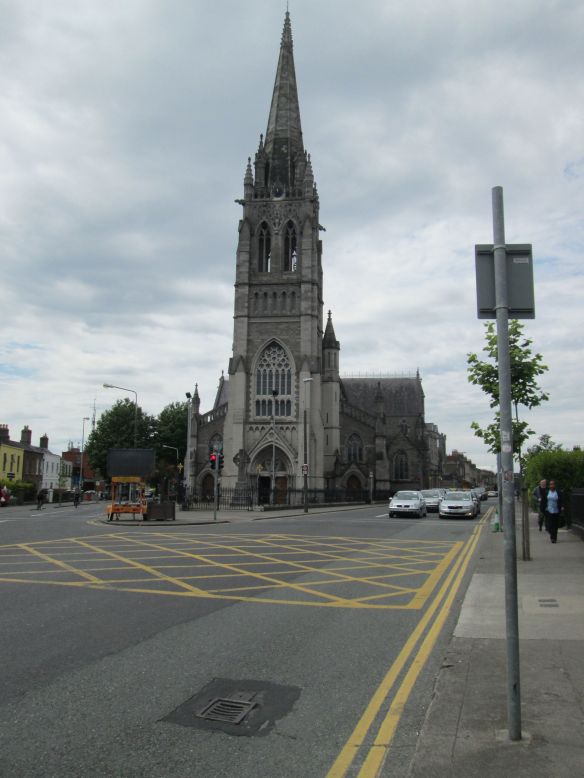
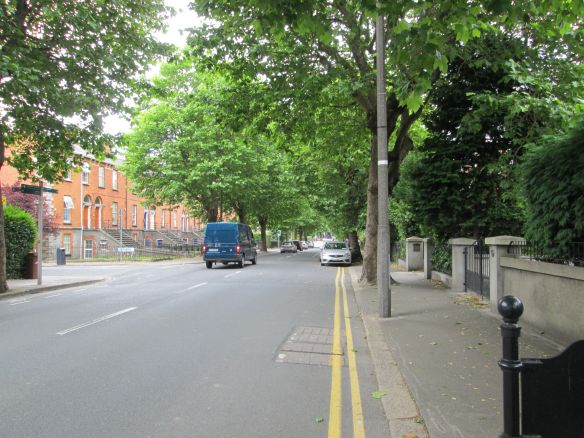
Phib ChurchHeading west from Phibsborough, we keep left at St. Peter’s Church. This was built piecemeal from the 1830s as Catholicism asserted itself in post Emancipation Dublin. The present grand gothic structure incorporates the original Catholic school, betrayed by its more fortress like design. The imposing tower, rising two hundred feet, brought the project to fruition in 1910. The splendour of the interior is enhanced by the stained glass windows, including a Harry Clarke from 1919. From here, the North Circular takes on a more salubrious appearance. The street is tree lined and this lazy Sunday afternoon the dappled light grants the illusion of passing through a painting. It is an elegant, if shabby genteel, avenue from here to the Phoenix Park.

I’m just a Cowboy, lonesome on the trail,

Lord, I’m just thinking about a certain female.

Further on, we cross the railway track, laid in the late 1840s connecting Broadstone Station nearer the city with Galway and Sligo out in the wild west. The railway conveyed people and cattle from country to capital (and beyond) for ninety years. Few of either species made the return journey. Inevitably the well grew dry and the railway went into decline. The line closed in 1937, Broadstone station, a neo-Egyptian Victorian pile, remaining as offices and depot for CIE, the transport authority. Eighty years on, the cross-city Luas tramway at last came into being, and this portion of rail line is once more in use.   

NCR W1To the south is the extensive area of Grangegorman. This was a manor estate during the middle ages with extensive orchards. Dublin city has crept around it but oddly not through it. Grangegorman remains as a large undeveloped slice of the crowded capital. The population of Dublin’s dowdy westside was largely poor and so the area was seen as suitable for siting a variety of the more sombre Victorian institutions. A House of Industry, basically a poorhouse, was established here and around this sprouted the Richmond Lunatic Asylum, the Richmond Hospital and a penitentiary. The area persisted under this cautionary cloud until recently. St Brendan’s Psychiatric Hospital, the largest such facility in Ireland closed its doors in 2013 after nearly two centuries. Major development is underway, incorporating a campus for DIT (Dublin Institute of Technology, or Didn’t get Into Trinity as the joke goes).

IMG_3032Oxmantown and Stoneybatter were other ancient settlements beyond the city walls. How ancient you can tell by the fact that Oxmantown rejoices in a weirdly Viking nomenclature.  A cluster of streets with such names as King Citric, St Olaf and more, hint that this was once the haunt of the Dane. Oxmen denotes East-men, which relative to these latitudes is from whence they came.

For all the Nordic associations, the area’s one mention in song is more Mediterranean.

I’ve wandered north and I’ve wandered south,

Through Stoneybatter and Patrick’s Close,

Up and around by the Gloucester Diamond,

Back by Napper Tandy’s House.

The song is The Spanish Lady and it’s sung by the usual suspects. There’s a touch of the salacious in the places namechecked. The Gloucester Diamond was in Monto, the notorious red-light district back east beyond Summerhill. Stoneybatter has always been edgy in name and nature. Whack for the too-rye, too-rye, lady – indeed. As for Napper Tandy’s house, this was hardly a fixed abode, the eighteenth century revolutionary being inclined to change address a lot to evade the authorities. He was eventually run to ground in Hamburg, taken back to Ireland and sentenced to be hanged. However, at the intervention of Napoleon, he was allowed flee to France, and died in Bordeaux in 1803. 

GlimmermanA detour at Prussia Street, along Manor Street takes us to Stoneybatter. This is a bilingual stew of the original Irish: Bothar na gcloigh. This means Road of Stones, mangled over time to become Stoney-Batter. The irish word for road, bothar, also tells a tale. It literally means cow-path

When I was a cowboy out on the western plain

I made a half a million, working on the bridle reins

Come a cow-cow, yicky come a cow-cow, yicky, yicky, yea!

The area is also known as Cowtown, the Dublin City Cattle Market being held here for over a century until 1973. I fancy there’s a wild west ambience here, if you just squint your eyes, suck on yer cigarillo and tie your horse to the sidewalk rail. Saloon of choice for me is the Glimmer Man. Full of quirks, niches and western charm, there’s a good yard at the back to spark a lucifer and wallow in the ambient gloom of an Irish pub.

The glimmerman of old was a dreaded functionary of the Gas Company in the Emergency years. He could check if the gas was being abused in defiance of wartime rationing. The prevalence, indeed the existence, of this ogre is probably greatly exagerrated in Dublin legend. The reference has expanded to include all types of unwelcome bureaucratic intrusion. Listen to the Radiators sing:

Rattled by the glimmer man, the boogie man, the holy man.

Living in the shadows, in the shadow of a gunman.

This particular oasis abounds in more moderate paraphernalia, from the Labour Party to Players Navy Cut and a suitably retro soundtrack. I’ll drink to that. I prefer to think of the more hopeful implications of the name. A glimmer of hope.

NCR W'tonLeaving the Glimmer Man, we return to our circular path. The final section is sylvan and suburban as far as the Phoenix Park. The avenue, lined by elegant if well worn Victorian houses, stops at the park gates, but the vista culminates further on at the Wellington memorial. The giant obelisk, rising to over two hundred feet, is a notable landmark of the city. It was built in homage to the Duke of Wellington, Arthur Wellesley, after his success against Napoleon at Waterloo. Wellington is alleged to have disparaged his birthplace by saying that being born in a stable doesn’t make one a horse. The phrase derives from Daniel O’Connell by way of lampooning the Duke’s pretensions. I imagine the thought must have crossed Wellesley’s mind once or twice, all the same.

NCR Pk1Bringing the northern semi-circle of our odyssey to a close offers a few alternatives. Technically, the route descends via Infirmary Road to Parkgate Street, where a sharp right onto Conyngham Road takes us along the walls of the Park, above the Liffey valley to Islandbridge. Alternatively, a meander through this quadrant of the Park is very pleasant. The Phoeno is worth a section to itself, so I’ll leave that for another day. I’ll finish with Philo:

Roll me over and turn me around,

let me keep a-spinning till I hit the ground.

Roll me over and set me free,

the cowboy’s life is the life for me.

Bordeaux

Bordeaux vistaOn the bend of a great river, over which is built an endless bridge, you will find the Harbour of the Moon. There I observe a middle eastern girl twirling beneath a coloured scarf, a vista across slated rooftops to a giddy spire, a couple arm in arm in an ochre laneway. Or maybe I’m not seeing things quite right. The taxi driver looks back over his shoulder and gives me the fare. He says, for you, I think, or for two. I struggle with the language. It’s been a long time.

Bordeaux airport is reassuringly intimate. I take a small drink to the outside tables and relax. I decide on the taxi into town although this is not a great idea. It is rush hour and the journey is expensive. Fifty euro. I attampt some French with the driver who is from Le Havre. I make up stories from my interesting fictional self.

Marche des Capucins

I arrive in central Bordeaux at the entrance to Capuchins Market. This lies along Cours de la Marne, a long grubby thoroughfare linking the rail station and Place de la Victoire. Walking here at night is edgy and weird. There are an unusually large amount of hairdressers which I won’t be wanting, and internet cafes which I will since my phone is kaput.

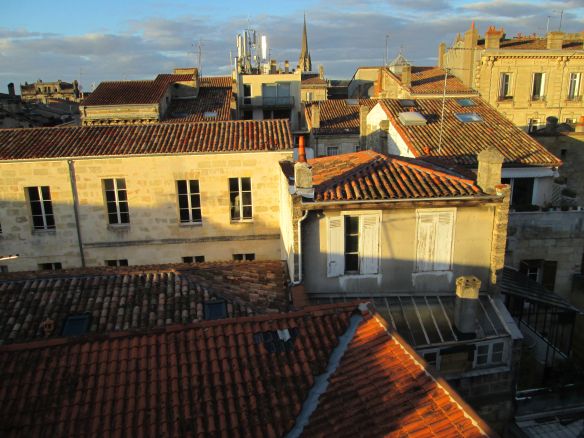
My apartment is on Rue Beaufleury, a lane that doesn’t live up to its pretty name. The apartment itself is great. I have a large terrace on the top of the building. It offers that most typically French urban view, cascading slate roofs into the distance, the horizon punctured by the mighty spire of St. Michel.

St. Aubin’s Pub is one of many on the wide cobbled expanse of Victoire. The waiters wear black kilts, creating its own culture bubble; a sort of Caledonian Gallic. I enjoy a drink here at night. To one side, motor traffic streams relentlessly into the plaza. All around nightbirds display their plumage. The university is scattered nearby and this is a major student venue, so it’s lively and pleasant.
St Catherine Jour

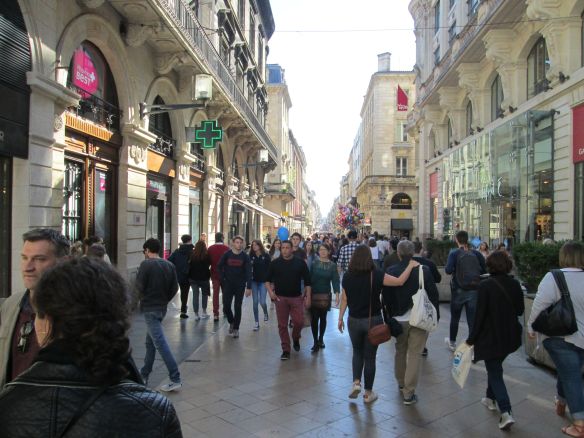
Rue St Catherine links the plaza and the city centre. The longest street in the city maintains the straight line of the original Roman Road. The Emperor Augustus established Bordeaux as the centre of the new province of Aquitania in 16AD. Some vestiges of Rome remain, the idea of empire persisting in the flourishes of later regimes.

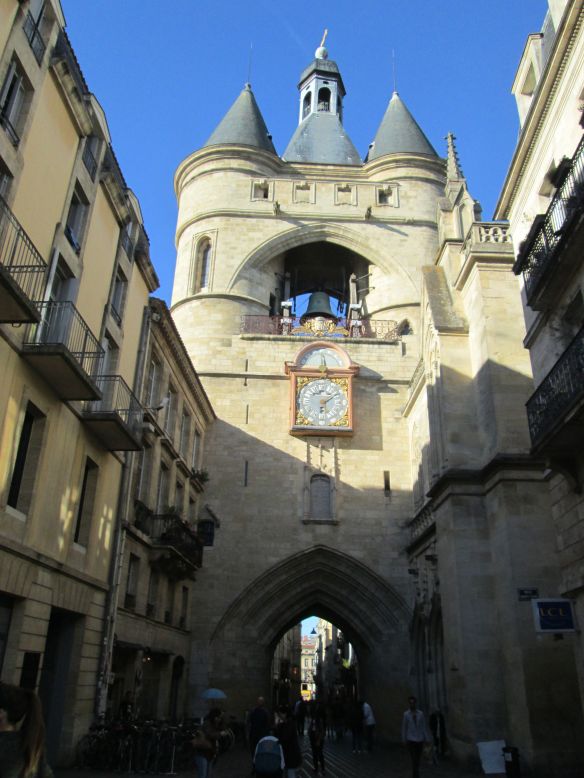
Bordeaux’s medieval walls are traceable if not extant. Some portals remain. The Grosse Cloche straddling Rue St. James, just off Cours Victor Hugo, is an extravagant gothic tower dating from the fifteenth century. Such structures provoke the imagination into visions of love and death, the spinning coin of chivalry.
Bell tower

St Catherine, ancient in origin, is well suited as the artery of commerce, thronged with the constant footfall of shoppers. The back streets weave more intricate and seductive patterns, hiding a medieval heart. Bordeaux boomed in the eighteenth century, the Age of Enlightenment, becoming a preferred port of trade with the West Indies, importing cotton, sugarcane and those elixirs of life; coffee and tobacco. Prosperity reformed the city in the modern, rationalist manner. Fine mansions lined grand boulevards to create a unified triumph of Neoclassical architecture. Most of it remains and Bordeaux has been spared the depredations of unsympathetic development.
Pl Victoire

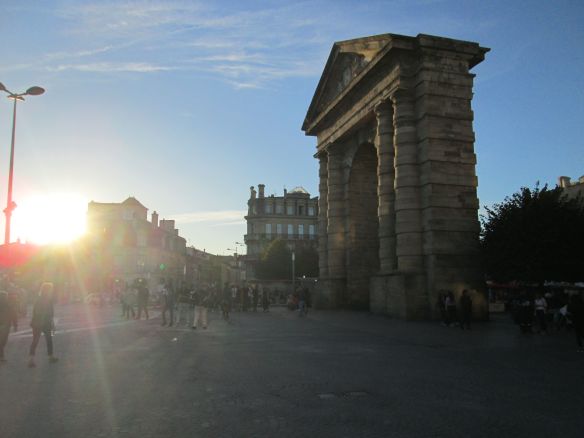
St Catherine is entered through a triumphal-style arch. Porte d’Aquitaine was built in 1750 and was a functioning modern city gate with a toll lodge attached. The grand arch remains in isolation, fulfilling its function of landmark. Within this parameter, the city is largely pedestrianised. Crowded too. Rarely did I find myself alone at cafe or bistro. On the street there is a constant charge.
Hotel de Ville

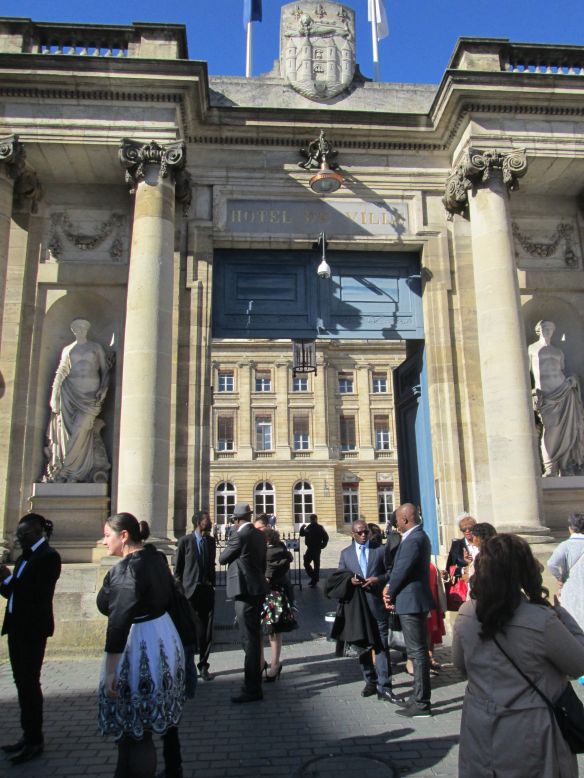
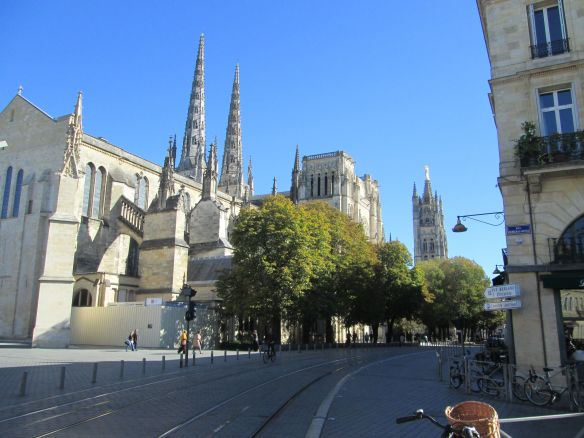
This bright sunny morning, I step off life’s merry-go-round onto Cours Alsace Lorraine leading to the relaxed Civic and Museum quarter. The Cathedral St. Andre dominates an expansive yet intimate square framed also by the Hotel de Ville. Outside a Bistro I sip a cool one, watch congregations ebb and flow in the sunshine. The Hotel de Ville is open and welcoming, with an ever changing rota of wedding groups. Built on the cusp of revolution in 1784, it set the tone for the wave of elegant Neoclassicism that swept Bordeaux.
St Andre

The Cathedral meanwhile, is sharply imposing. Twin steeples soar above the square. Circling clockwise, the heavily buttressed west wall dates back to the church’s foundation in the eleventh century. It has been madeover many times since. Most striking feature of this ancient stone tableau, the free-standing 15th century Tour Pey-Berland is topped by a golden statue of Our Lady of Aquitaine. Within, ornate vaulted ceilings sweep up to literal and metaphorical heaven. One end wall is occupied by the magnificent organ. It is surprisingly bright, slanted sunlight a solid presence in the interior space. There is a small exhibition of selected icons in an ante room, including another suggestion of Scotland in St Andre’s crucifixion on a saltire, and the Crucifixion of Christ by Rembrandt.    St Andre W
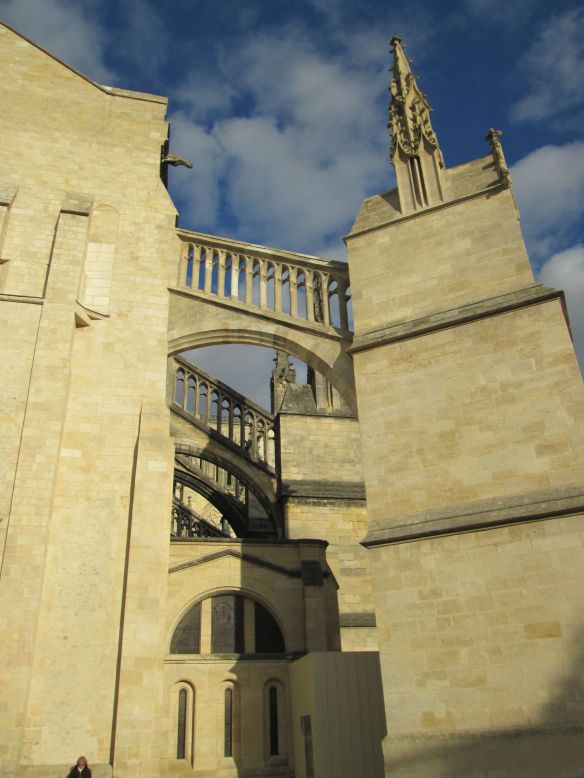
The Musee des Beaux Artes is hidden behind the Hotel de Ville in twin buildings each side of a quiet green. It hosts a quirky, piecemeal slant on Bordeaux’s place in French Art. Breughel, Rubens and Titian feature amongst the earlier European painters. Romanticism is to the fore: ships savaged by boiling seas, seductive nudes on storm tossed sheets, and of course Delacroix. Calmer, if no less passionate, Impressionist souls include Renoir and Morisot. I exit through the surreal screened walkway linking the buildings; a trompe l’oeil collage of art through time.   

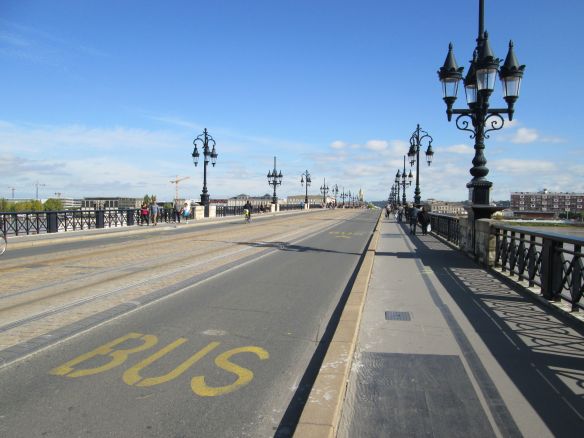
Beaux ArtesBordeaux is a river port. The Garonne snakes  northwest heading for the Bay of Biscay. Parks and esplanades have been laid out here, but nowhere to put in for refreshment nor much, beyond the vista, by way of visitor attraction. The Pont de Pierre, built by Napoleon Bonaparte to facilitate his Spanish campaigns, became the first city bridge to span the Garonne. Few followed, the river simply too wide for the far bank to be included in the definition of Bordeaux. There’s something strange about walking a bridge, which in its detail is a typical nineteenth century succession of arches, seventeen in all, but in its scale seems endless. It suggests a bridge to the afterlife, the almost banal familiarity subverted by the eerie suggestion of infinity.Pont Pierre
I remain on the South Bank. An eighteenth century ornamental arch, Porte de Bourgogne, marks the entrance to the city. The bridge terminal connects to Cours Victor Hugo, a wide, curving crosstown thoroughfare that fair crackles with all the quirks and cultures of city life.  I experience that redolent sense of nostalgia. Something about the bustle, the flea market ambience, the hodge podge of immigrant shops and exotic food outlets. There’s maybe a whiff of patchouli, or something stronger, so’s I’m back in the day, a young adult at large, hair blowing wild, eyes like headlamps seeing wonder in the everyday.
St Michel

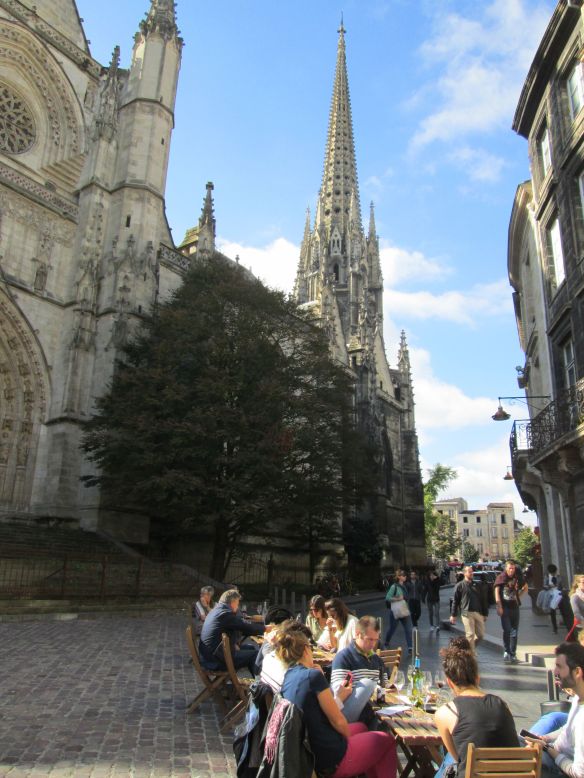
I return to the buildings on the riverfront. This is an Arab quarter, and the cafes are packed with men sinking strong coffee, smoking and talking. The tower of St Michel guides me on. One of the tallest in France, it is a masterpiece of fabulous Gothic, standing free of the church, as is common here. The fifteenth century original was destroyed in a lightning storm in 1760. Reconstruction only began a century later.

This Sunday morning, with the street market in full swing all around Place Canteloupe, it is even more separate, a focal point around which stalls and entertainers set up, while groups lounge and laugh on its steps and under its arches. There is a bewildering swirl of scents and sounds, a throbbing sensuality rising with the tower to the blue heavens. The sidewalk restaurants are crammed and I note with mouth watering intent the generous and varied Moroccan dishes: tempting tagines, rack of lamb, soft beds of couscous, steaming stew, chick peas and spicy sauces.
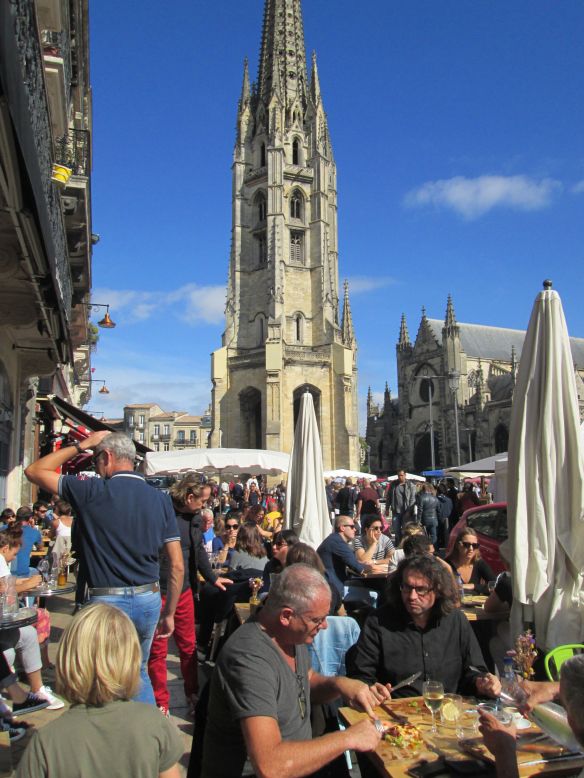
Canteloupe CousWithin the church it is surprisingly calm despite a good crowd of devotees. The churches here do not have pews but individual seats. Unfortunately, some resident idiot has decided to move them all loudly a foot to the right as I sit in attempted prayer. Time to weather the human storm again so.

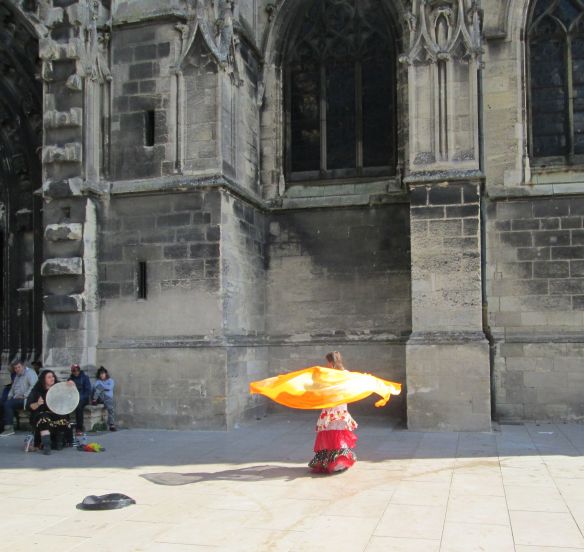
Outside the plaza still swirls like a calliope. A young woman dances and spins beneath coloured scarves to a woman playing a bodhranesque drum. There is an African or Middle Eastern beat, insistent with familiarity. I know this song. It has a place on my car stereo. Deva Pravel chanting the Moola Mantra:   
Bordx Dancer


Om

Sat Chit Ananda Paraprahma

Purushothama Paramatma

Shri Bhagavathu Sametha

Shri Bhagavatha Namaha

Hare Om tat sat Hare Om tat sat

Hare Om tat sat

Hare Om tat sat

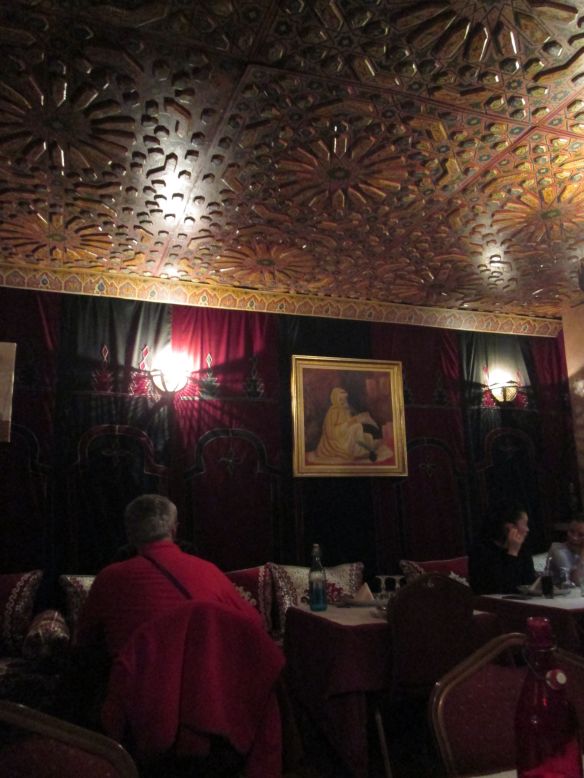
I determine on a couscous having been assailed by that African aroma throughout San Michel. Restaurant Le Marrakech on Rue St Remi is quiet; lush red velvet drapes and subdued lighting  striking just the right tone. The couscous is superb, generous and varied in every sense. The friendly waiter, who is from Pakistan, stands me a sizable digestif. Down the hatch!
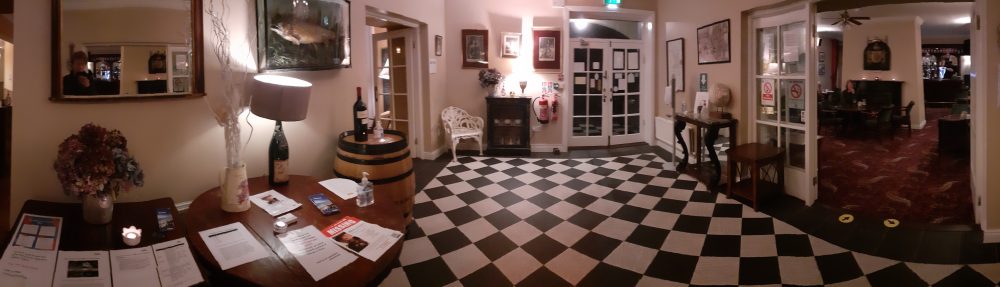
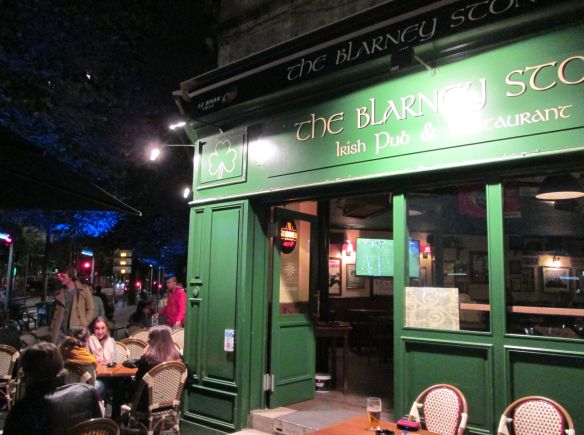
MarakeshHeading home by St Catherine, i spot The Blarney Stone Bar crossing Victor Hugo. It is good to sink an Irish Pint at the end of the night. I had been drinking earlier with the other side. The English flagged Houses of Parliament serves Carlsberg Elephant. The Blarney’s barman tells me that’s seven per cent. No wonder I was elephants. I compliment the barman on his creamy head. And the pint was good too.
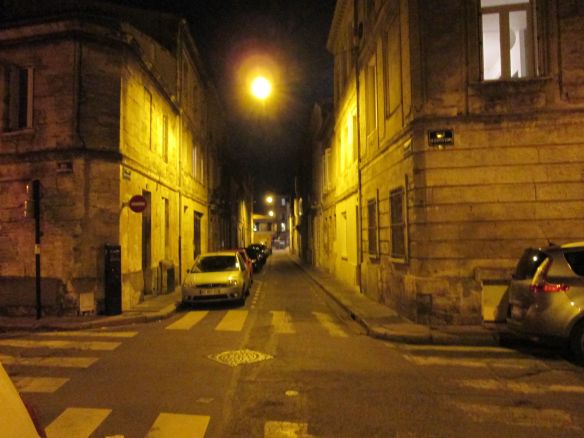
BlarneyNight falls, streetlights bloom and Rue Beaufleury waxes to its name. In the blue doorway of the ochre lane, a woman lounges. She holds her cigarette upright and blows it aflame. There is a heavy scent in the air, like patchouli oil. She gestures by that slight inclination of head. If you want, she says, there is a place the far side of Capucins. The market is ferme. But beyond you will see young men drinking and beside the bar there is a doorway. There you can get some. If you want.
 Beaufleury

There is no movement in the street. The graffiti says in English: Death to Graffiti Artists. A taxi drifts past. A face I recognise swivels towards me on passing. I nod. The tail lights take red serpents along the lane. A chimera persists on the alley’s horizon: an indeterminate couple arm in arm beneath a perfect lunar sickle. In the Harbour of the Moon, the old nestles in the new moon’s arms.Night traffic

Dublin’s Circular Roads – 4

Mountjoy to Phibsborough

Phib memo

Independence memorial at Phibsborough

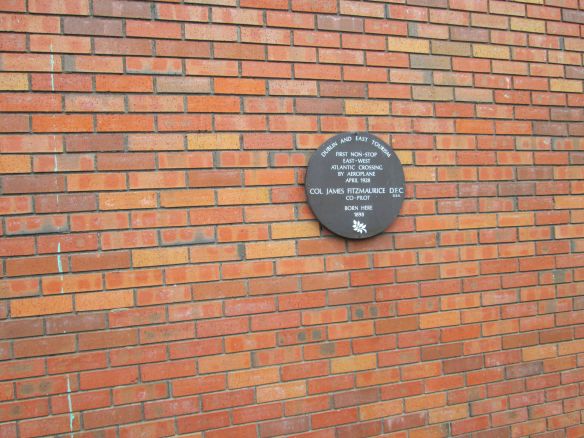
Flying with the jailbirds west from Mountjoy, we approach the top of the clock in Dublin’s circular tour. High noon, do not forsake me now. In the shadow of the jail, there are some small terraces of redbrick cottages. A plaque commemorates local boy, aeronaut Colonel James Fitzmaurice, navigator of the first flight to cross the Atlantic from East to West. Fitzmaurice had enlisted in the Irish Volunteers aged sixteen, but his da, a prison officer, found out and hauled him home. Towards the end of the war, Fitzmaurice joined the RAF. With Irish Independence in 1921, he returned home to join the nascent Irish Air Corps, rising to Commandent by 1927.

With the birds I share this lonely view …

Pilot born here

In April 1928, Fitzmaurice was taken on as part of the three man crew of the Bremen, joining two Germans, Captain Herman Kohl and Baron Von Hunefeld. The plane landed on the icebound island of Greenly in Quebec after a flight lasting thirty six hours. The men were hailed as heroes, here and in America, but the fame was transient and Fitzmaurice died, forgotten, in 1965. Seventy years after the event, in 1998, his daughter and granddaughter unveiled a plaque marking his birthplace here on the North Circular Road.

Mater 1

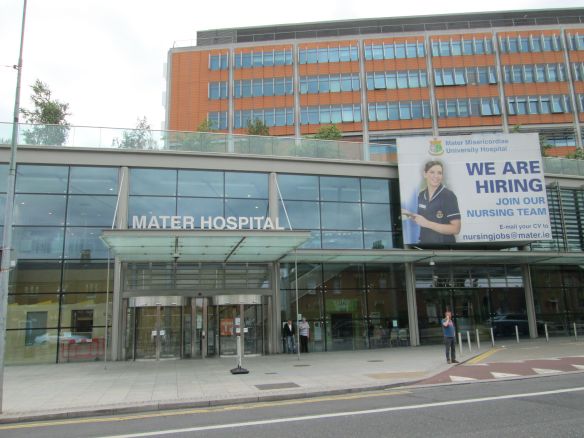
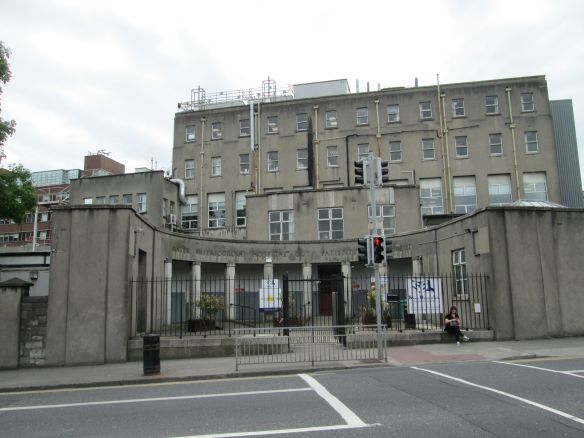
Across the road is the Mater Misericordiae hospital. The Hospital was founded in 1867 and is a major teaching hospital. The name, Mother of Mercy, refers to Our Lady and derives from the hospital founders, The Sisters of Mercy. The Sisters were founded by Catherine McCauley,  (1778 – 1841) who determined to use a large inheritance to care for homeless women and children. Originally a lay order, pressure from the Church resulted in it becoming a religious community in 1831.

Oh the Sisters of Mercy they are not departed or gone,

they were waiting for me when I thought that I couldn’t go on,

they brought me their comfort and later they brought me this song,

I hope you run into them, you who’ve been traveling so long.

McCauley featured on the last Irish fivers, designed by Robert Ballagh, who lives nearby in Broadstone. The Mater’s main Eccles Street elevation also features on the note which was withdrawn from circulation after ten years in 2000 with the advent of the Euro. Ballagh, asides from his fame as an artist, also had a hand in the saga of Irish rock. A face with the Chessmen beat group, he quit the music scene in the late sixties and sold his bass guitar to a young Crumlin lad by the name of Phil Lynott.

Mater 2

If your life is a leaf that the seasons tear off to condemn,

they will bind you with love that is graceful and green as a stem.

Phib cinema

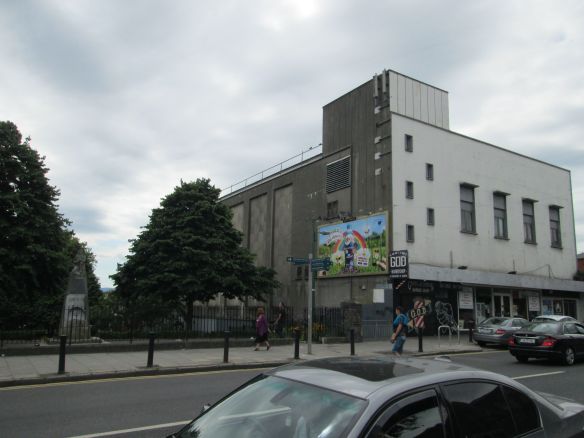
The old State Cinema beside the park.

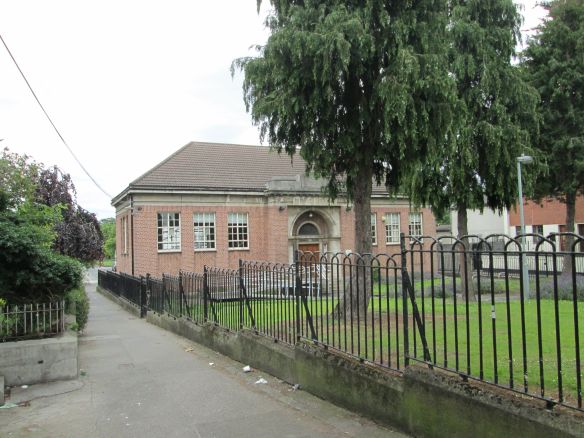
Entering Phibsborough, the North Circular crosses what was once a lively city artery. In the late eighteenth century, Dublin’s two canals, the Royal to the north and the Grand to the south, were Ireland’s principal national highways. The Royal Canal initially flowed north south here, passing Blessington Street Basin before terminating at Broadstone. The Royal pushed through to the sea in the early nineteenth century and this branch was ultimately abandoned. A linear park has been laid out along the original route. Looking north, you’ll see Phibsborough Library from the 1930s. You can imagine it as an island, it is in a sense; a concise red brick art deco in a river of grass.

Phib lib

Phibsborough Library

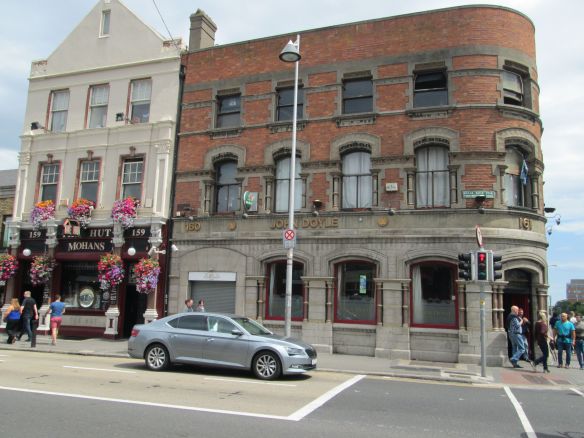
Phibsboro, you can drop the ‘ugh’, has plenty by way of cafes, at least after the semi-desert of Mountjoy. There’s a queue outside Two Boys so it could do with more. I could do with a caffeine or beer hit myself, but feeling Beckettian, I must go on. There’s a few decent pubs. Doyle’s, I remember, used to attract us over to gigs in the mid seventies. The 23 bus was a cross town service and conveniently linked Drimnagh and Phibsboro. In popular parlance the name of this nexus is always Doyle’s Corner.

Phib Doyles

Doyle’s Corner

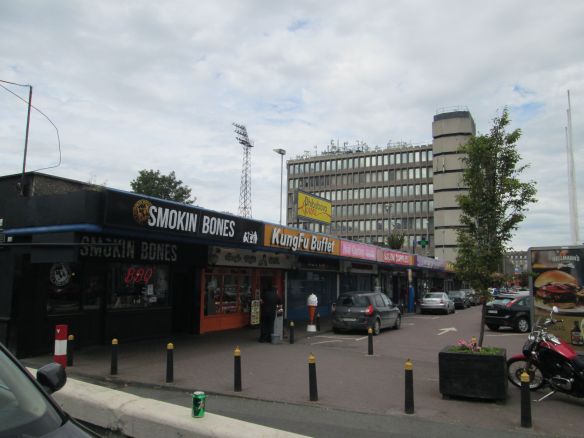
Phibsboro is a place where universes collide in time and space. Fin de siecle sylvan redbrick terraces intersect with the brutalism of seventies urban excess. The concrete low rise of the shopping centre still endures. The sixties office tower has long made a curious exclamation mark on the vista from inside Dalymount Park.

Dalymount is home to Bohemians Football Club. Once considered the home of Irish soccer, internationals and FA cup finals were played here until the seventies when Landsdowne Road became the venue. I have strong memories of ancient match days at Dalymount, most with my friend Bill and his dad. That was Billy Mulville, a player of renown during the Emergency. He graced the pitch for Bray Unknowns, St. Patrick’s Athletic and Drumcondra. He transferred his love of soccer on to our generation. The walk through the redbricks and into the stadium in the gathering roar is a deeply embedded montage.

Phib Daly

Dalymount Park and the joys of sixties architecture

Bohemians were, along with Shelbourne, the founders of the league of Ireland when, after Independence, it broke away from the northern dominated Irish League. The club is nick-named the Gypses, speaking of earlier unsettlement. They’ve been established here a century, but a sense of desperately hanging on pervades. The stadium looks sadly dilapidated. Bohs supporters are a loyal bunch, and packed houses are assured in Dublin derbies against main rivals Shamrock Rovers, a more peripatetic club who have roved from Ringsend to Tallaght, via Milltown.

Classmates Kevin Moran and Gerry Ryan were league winners here in the seventies. Moran was one of the first players to escape the GAA ban, playing both codes to the pinnacle of national success. With Bohs and Dubs they took the League and Sam Maguire trophies on tour, and I drank from both in the Submarine Bar beyond in Walkinstown.

Guess who just got back today?

Those wild eyed boys that’ve been away

Haven’t changed, haven’t much to say

but man I still think them cats are crazy!

Dalymount began hosting concerts in the late seventies. In 1977, Thin Lizzy had at last hit the big time and headlined here with such varied support as Fairport Convention, Graham Parker, Boomtown Rats, the Radiators and Stagalee. Up the road in Croke Park on that day, Dublin defeated Kerry in a famous semi-final on their way to All Ireland glory in the days of Heffo’s Army. The news brought on the Dalymount roar, and the new wave in the old wave’s arms, got ready for the sundown, and some serious Dancing in the Moonlight.

Friday night they’ll be dressed to kill,

Down at Dino’s Bar and Grill,

The drink will flow and the blood will spill,

And if the Boys want to fight you’d better let them.

This is the image of Philo the ruffian, all leathers and switchblades, freeze-framed under flashing neon. It was the image to which young guns cleaved, that typical rock and roll catharsis giving us license to be heroes, in our dreams at least. But Lynott also waxed poetic, was truly the romantic at heart. He was our king, whichever suit he wore. King of the world that night in Phibsboro, as universes collided in time and space.

Phib Church

St Peter’s Church

We’re top of the clock here. About a quarter way around our circular tour. The North Circular begins to arc south westward, heading past the imposing Catholic gothic of St. Peter’s Church, into a more sylvan, suburban environ.

Dublin’s Circular Roads – 3

From the Five Lamps to Mountjoy   

Amiens St

Crossing Amiens Street

When we’ve finished hanging around the Five Lamps we head north by northwest along Portland Row. The route picks up some of that ol’ Georgian charm, much tarnished now by urban grime and shifts in demographic fortune. At Summerhill, we intersect with the well-worn artery connecting the city centre with Ballybough, further out to the north. This is Poor Town in Irish. Some other names in the vicinity are more optimistic: Mountjoy, Summerhill. But the feeling of Poor Town is all pervasive.

Summerhill

Summerhill

I recall sitting in a car in Ballybough back in the early nineties, waiting for a girl that worked with us. My companion says to me, apropos a dog balanced on three legs by a lamppost: “See that dog? That’s Tony Gregory’s brother’s dog.”

I’m working at Industrial etching on East Wall Road, smoking Players Navy Cut, sweaty and stubbled, jeans and skin stained with acid. Yet, if I were to scratch that mutt behind the ears, that would establish five degrees of separation between me and the apex of power. Me, the dog, Tony Gregory’s Brother, Tony Gregory and Taoiseach Charles J. Haughey. Tony was the eponymous focus of the Gregory deal in 1982, wherein, by guaranteeing support for Haughey’s Fianna Fail government, Ballybough would be guaranteed a tranche of funds. Hey, look at the place now!    

NCR to CrokerThese are the approaches to Croke Park, headquarters of the Gaelic Athletic Association. The GAA, founded in 1884, fostered a notion of Gaelic sport as a distinct entity. The codification of team sports was a recent phenomenon. Gaelic Football codified the traditional line of football as played here. Fielding (catching) was a feature, a high degree of physicality was allowed along with limited ball carrying, though kicking remained paramount. There was no offside, resulting in an allover hectic game. 

Hurling is akin to hockey, but more physical and expansive. The ball may be caught and carried and propelled aerially. The Scottish version, Shinty, is more earthbound but offers a slight international angle. Burly Australian Rules gives Gaelic Football an international outlet in Compromise Rules. Its success is debatable, but there are some good punch-ups so we won’t give up on it yet.

On match days approach roads become rivers of humanity in high flood. The huge stadium is masked by red brick houses. It’s an impressive confection when it reveals itself. Madeover at the turn of the century, it holds eighty two thousand and is the third largest sports stadium in Europe. All Ireland finals are hosted in September. The Dubs, at time of writing, have just won their third football title in a row. The Cats of Kilkenny have been lords of hurling for an age, though fading now. Galway are current champs.

There are tours of the stadium, encompassing the history of the GAA and an impressive sky walk where Dublin is spread at your feet. The history is deeply entwined with the Nation’s. During the War of Independence, Croke Park was the setting for Bloody Sunday, November 1920.  Following Michael Collins’s strike against Castle spies, the Cairo Gang, British Auxiliary forces and RIC attacked killing two players and twelve spectators including women and children.  Another massacre almost fifty years later would also claim the title Bloody Sunday. The British Army killing of thirteen civilians in Derry in 1969 informed U2’s song. Bono’s intent is stringently non-violent though.

I can’t believe the news today

I can’t close my eyes and make it go away

How long, how long must we sing this song?

I’m more inclined to visit Croke Park for the music. I once walked all the way from Crumlin with several hundred to see Thin Lizzy play a free concert, footing the bill for Dickie Rock. I’ve swam the streets with the rivers of thousands to hear U2, the Red Hot Chili Peppers and Bruce Springsteen pound it out under floodlights and soaring stands.

Chillies Croker 2012

Red Hot Cilli Peppers at Croker

Soft spoken with a broken jaw

step outside but not to brawl

Autumn’s sweet we call it fall

I’ll make it to the moon if I have to crawl

Crossing Summerhill we step onto the North CIrcular Road proper. Despite the occasional rivers of people this is no paradise for winers and diners. Casting around, I notice the Brendan Behan Pub. Once the Sunset, scene of a notorious gangland murder, local family, the Gannons, have given it a once-over and a new name. No chance that Brendan ever popped into his eponymous pub, but it’s pretty certain he would have had it been there in his day. The Hogan Stand is further on, and the BigTree, at the junction of Dorset Street, is a renowned rumbustious meeting spot for Culchie and Jackeen alike.

NCR Mjoy

Crossing Dorset Street

Mountjoy gives its name to the surrounding area. You can see the edge of Mountjoy Square from the North Circular. Mountjoy is the only Georgian Square that is actually square. The land was developed in the late eighteenth century by Luke Gardiner, Viscount Mountjoy, a banker, developer and MP (all the things we so admire these days). When completed in around 1818, it was considered the acme of the new suburban style. The great and the good could escape the cramped conditions of the teeming medieval city, for life in a Rationalist paradise. Dublin’s urban development was at the cutting edge for the times: long straight boulevards, rectangular sylvan squares.

By the end of the nineteenth century the district had gone downmarket. Sean O’Casey drew heavily on the atmosphere of Mountjoy in his plays Juno and the Paycock and The Plough and the Stars.     

M'joy Benedict Gdns

Benedict Gardens

By the twentieth century northside Georgian Dublin was in decline, the fashion for suburban development leeching the life out of the inner city.  Mountjoy Square was half demolished by the nineteen sixties. The situation was halted and reversed as Dubliners acquired more appreciation of their architectural heritage. Thanks to the work of the Georgian Society, founded in 1966, and activists like David Norris, Ireland’s stateliest Homo himself, Georgian Dublin reasserted itself as a defining factor of the city. Although there is a danger this is becoming a little too precious, it is a vast improvement on the near bombsite landscape of Dublin’s sixties and seventies development.

A hungry feeling came o’er me stealing

and the mice were squealing

in my prison cell

Mountjoy

Mountjoy Prison is sandwiched between the North Circular and the Canal. Referred to by residents and potential clients with some irony as ‘The Joy’. Built in 1850, it originally accommodated prisoners bound for Van Dieman’s Land. Such had been the condition of Ireland in the Famine years that they might have been considered the lucky ones. Built in the style of Britain’s Pentonville, it became Ireland’s largest prison, adopting a bleak, isolationist regime. Forty six prisoners were exectued before the abolition of the death penalty. Kevin Barry is perhaps the best known. He was hanged in 1920, aged eighteen, during the Irish War of Independence.

And the Auld Triangle

Goes jingle jangle

All along the banks of the Royal Canal

Famous residents include Brendan Behan, who was born nearby in 1923 and incarcerated during the Troubles as an IRA member. He was released in 1946. His play, The Quare Fellow, from 1954, is  set in the prison, taking place on the day leading up to the execution of an inmate. It evokes a strong stance against capital punishment. The last hanging in Ireland happened the same year. Behan himself was overfond of the Drop and his waxing artistic success was offset by declining health. He died aged only forty one in 1964, the year capital punishment was abolished. Still, his ghost can be heard whistling softly hereabouts.

Scar tissue that I wish you saw

sarcastic Mister know it all

close your eyes and I’ll kiss you cause

With the birds I’ll share this lonely view

Dublin’s Circular Roads – 2

From Spencer Dock to the Five Lamps.

Spencer DockHeading north on Guild Street, the Royal Canal to our right seeps towards the Liffey. A new city, linear and rational is being stamped over the old North Wall docklands. That’s the feeling crossing Mayor Street where the Luas Red Line takes passengers arrow straight from Connolly Station to the Point Village. The Point Depot at the eastern end of the Docks is the major venue for indoor concerts. I saw Bob Dylan there some years back. A man with a hat playing piano. I could have spent the evening out in the real world, where the Liffey melts into the sea. I could have sat contentedly and watched the river flow, the memory of Bob’s music stronger in my blood.

FerrymanAt Ferryman’s Crossing, a rusty reminder of the old days rises in the form of a decrepit crane. The old docklands peep through, first the palimpsest, then the ancient script itself. It’s still being written. Often the same old story. Sheriff Street runs parallel to the quays but remains remote from the modern narrative there. The area has a rough inner city reputation.

Lorcan OThe Church of St. Laurence O’Toole marks the start of Seville Place. It was built in the Famine years and opened in 1850. Along Seville Place, the grandly named First to Fourth Avenues suggest New York. In fact, these are short, cottage lined cul de sacs. Under the railway bridge we reach Amiens Street.
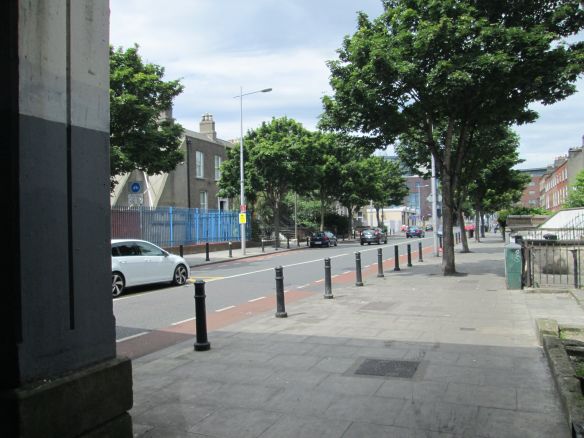
Seville 2This street provides Dublin’s main transport and communications hubs. Connolly Station, topped by an ornate Italianate tower was opened in 1944 as Dublin station, later named Amiens Street. By 1853 it served the rail link to Belfast. Madigan’s Pub, on the main concourse, was a Mecca for thirsty travelers on long, dry, Good Friday. It is the most central of all bonafide pubs. You would need a train ticket to deserve a pint, of course; a small price to pay. Such quaint customs are now consigned to the slop tray of history, as Ireland’s Good Friday prohibition has been lifted.
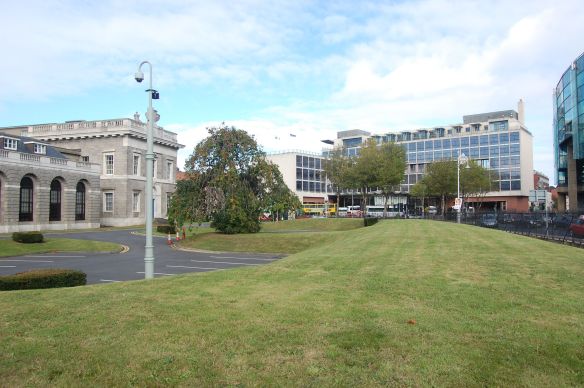
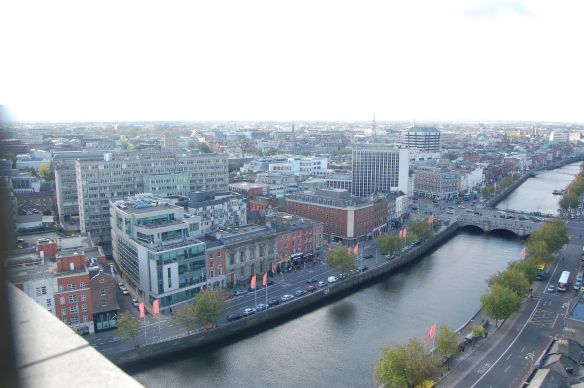
BusarasA little further off track, Bus Aras, nearer the river, was an early modernist pile. Designed by Michael Scott and completed in 1955, from here you can take a bus to anywhere in Ireland, or all the way to London. Bus Aras and Connolly combine to form a startling urban portal, full of the contrasts of history and architecture. At just the right spot, the panorama includes Victorian Connolly Station, Georgian Custom House, the International Financial Services Centre and the Ulster Bank HQ across the river.
The area is rich in memories from when I worked in Sheriff Street Sorting Office beside Connolly back in the day. This is Ireland’s main sorting office with a constant flow of post by day and by night. Working shift meant being on the Gravy train, one week in three doing all-nighters. Maintenance involved clearing blockages on the various belts and chutes forming the working innards of the building. A blockage was often a good excuse for shop floor workers to decamp to a nearby early opener for a pint. So, having cleared the blockage I’d have to hike off to the North Star or Grainger’s and clear the bar. Later, at dawn, a smoke break on the roof gave a view across the waking city to the mountains beyond.

… back then when everything seemed possible, even there in the Sorting Office, in the bowels of that clanking beast, amongst the trolls and elves of the workaday world. We’d climb onto the high gantry and up the fixed ladder to the roof, Alex, the Bishop and I. We were kings of the world up there, with Dublin spread out beneath us, above us only a rippling sky. (from Kings on the Roof by Shane Harrison)

DSC_0365At more civilised hours we could repair to Cleary’s pub, beneath the bridge, shuddering under the weight of passing trains. Old style boozer of dark wood, sparse light on glinting glasses being raised at the long bar. One more toast before boarding the Gravy Train. Last wet my whistle here with Davin, on our way with to the Red Hot Chilli Peppers at Croke Park farther north.
Monto, bordered by Amiens Street and Talbot Street, was the name of the area in Victorian days. This was Dublin’s red light district until cleaned up by the authorities after Irish Independence. In James Joyce’s novel Ulysses, the area appears as Nighttown, where Leopold Bloom and Stephen Dedalus visit a brothel. Joyce has a nearby street names after him. You can hear his ghost whistle there, maybe catch his silhouette, some foggy night.

The area lives on in song and ribaldry. George Hodnett imagined it for us in his song Monto, immortalised by the Dubliners. The first line name-checks Ringsend, south east in the saltier part of Dublin 4. 

If you’ve got a wing-o, take her up to Ring-o

Where the waxies sing-o, All the day.

If you’ve had your fill of porter, and you can’t go any further

Give your man the order: Back to the quays!

And take her up to Monto, Monto, Monto,

Take her up to Monto, langer-oo! To you!

5 LampsAt the junction of Seville Place and Amiens Street, we’re back on track. Heading North by Northwest is Portland Row, leading to the North Circular proper. Amidst the grimy urban bustle sits the landmark of the Five Lamps, delicate and redolent of a bygone age. It sits on a junction of five streets. Again weirdly suggestive of Old New York’s Five Points, notorious focus for Irish gangs in the mid nineteenth century. The eponymous, though fictional, Dublin gang appear in Bob Geldof’s Rat Trap: 
Just pass the Gasworks, by the meat factory door

the Five Lamp Boys were coming on strong.

Rat Trap is practically the theme song for The Boomtown Rats. Alive with eastside docklands imagery, still it chimes with many listener’s folk memory, namechecking Top of the Pops, the universal Italian cafe and signs that say: walk, don’t walk. Geldof was an alumnus of the International Meat Packers south of the river, near the old gasworks and near our journey’s end. I take it the Five Lamp boys were out of area. Looking for a pint perhaps.

The Five Lamps structure itself was erected with a drinking fountain for the area’s poor. Besides providing potable water the fountain was also intended as an encouragement for sobriety. That was back in 1880. They survived the German bombing of the adjacent North Strand in May 1941. Three hundred houses were destroyed and twenty eight people died. Almost eighty years on the area struggles against less fatal if more persistent misfortune.

There’s screaming and crying in the high rise blocks,

It’s a rat trap Billy but you’re already caught.

The high density housing hereabouts doesn’t actually soar but makes for a queasily crowded environment. It’s time to push on. We’re one kilometer into our epic, only thirteen to go.

Dublin’s Circular Roads – 1.

Walk around Dublin in a day.


It is often trotted out that you can walk around Dublin in a day. This derives partly from a tendency to miniaturise Ireland at every hand’s turn. Little people abound, it’s a small island, a tiny population, Dublin a mere village. Etcetera, etcetera, etcetera. In truth, most cities can be ‘walked around’ in a day. The nature of cities is to have centres, Los Angeles notwithstanding, and these tend to be reasonably condensed. Megacities like Paris or London can be more daunting, but even there you could plot a route to encircle its core in a day. New York’s core, Manhattan, is about thirty miles around its rim, an eight hour hike.

Looking west from Liberty Hall

I’m taking it a bit literally here. I know Dublin is no megacity, but nor is it a village. Perhaps figuratively it could be, as in the literary or artistic cliques of the fifties or sixties. But this is a city of a million souls, a millennium’s history. Do you think that can be done in a day? Let’s give it a shot.

Looking east from Liberty Hall

Dublin is fortunate in that it has the Circular Roads, providing a neat route to circumnavigate the city. Conceived in the late eighteenth century, these are residential thoroughfares, well proportioned but almost two centuries removed from the notion of motorway ring roads. Horse drawn coaches and carts were the vehicular traffic, the Circular roads inscribing the old city, providing a clear line, which still persists, between urban and suburban.

The canals date to the same era. These were the inland trade routes, linking Dublin with the Shannon basin and beyond. Originally conceived as terminating in the west of the city, ultimately each followed a curve to the docklands of the east. They thereby provided an encircling arc, almost forming a moat around the city. The Royal to the north, was first bound for Broadstone, now intersects with the Liffey at Spencer Dock. It was completed in 1817. The Grand Canal to the south, first reached the Basin near Guinness’s Brewery. The extant route arcs east to meet the port at Grand Canal Docks near Ringsend. The navigable route to the Shannon was complete in 1804. The canals were the super-highways of their day, superseded by the railways of the mid nineteenth century on. 

The circular route is fourteen kilometres long and, without pausing for distractions, could be walked in three hours. Still, what’s the rush? There are pints to sink, coffees to sip and a few interesting stops along the way.

Riverrun, past Eve and Adam’s, from swerve of shore to bend of bay, brings us by a commodious vicus of circulation back to … 

well, back to where we began.

I’ll take it from the east, near the city centre and the main transport hubs, travelling anti-clockwise with an eye to finishing later in the more socially exuberant south east. Up until the turn of the century the grimy docklands of Dublin were forgotten and decayed. I attended Art College on the south bank of the river in the late seventies. I was one of that itinerant generation of art students sent from the ancient environs of Kildare Street to wander the wilderness while the promised land was constructed at Power’s Distillery up on Thomas Street. Elegant boulevardiers on cobbled quaysides, slouching and smoking amongst the ruins of factories and freight yards. We became parishioners of City Quay, habitues of Conaty’s, the Elbow and the Windjammer, jostling stevedores on the oche as we honed our skills at art and darts.

I was on the inside when they pulled the four walls down

I was looking through the window, I was lost, I am found.

It’s all changed now, of course. U2 were early colonists of the new era, establishing their base camp for world domination at Windmill Lane. Die Mauer, of a different sort, tells many the garbled tale. Achtung Baby! Seeds planted, the area grew ripe for development.

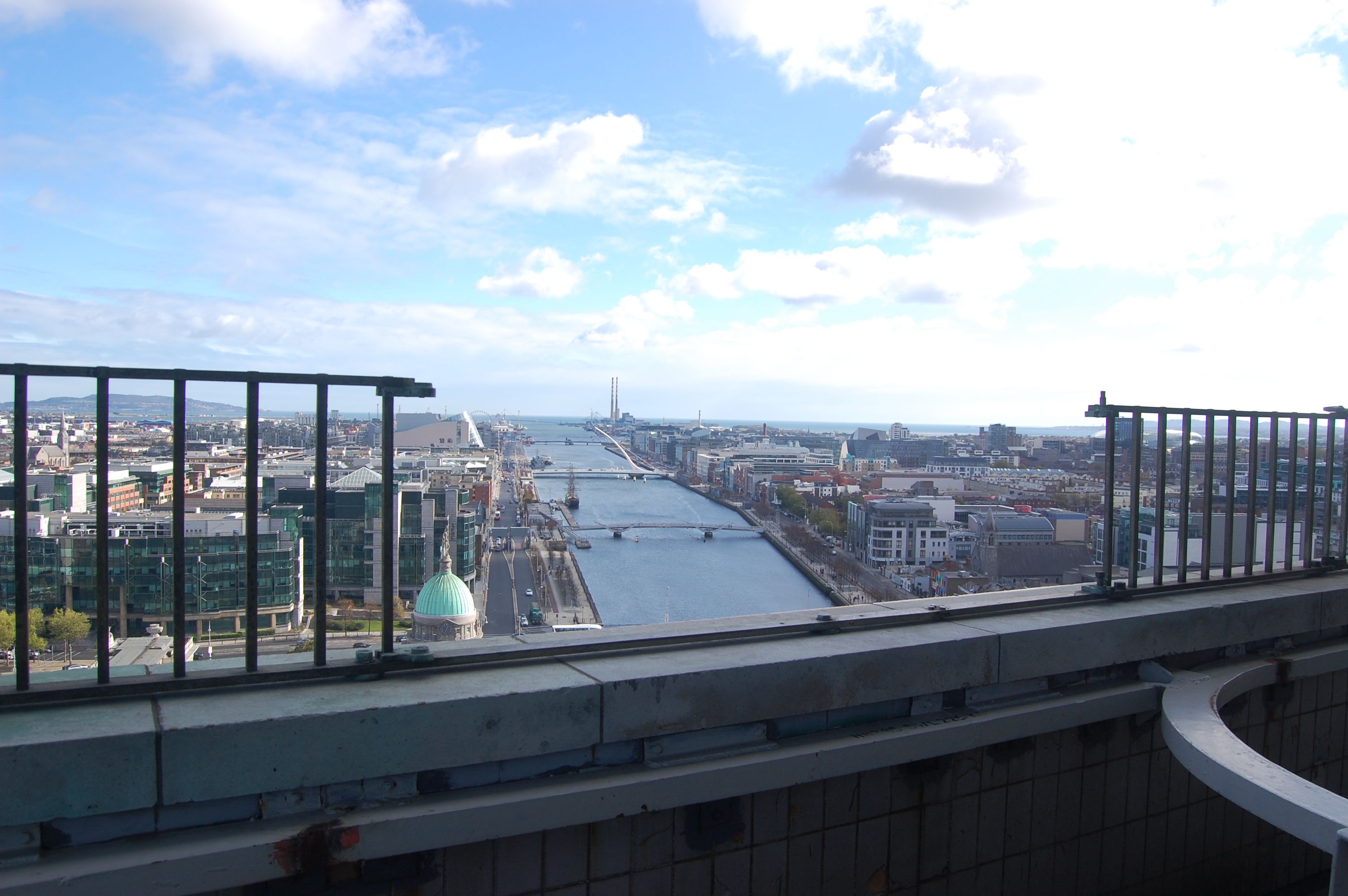
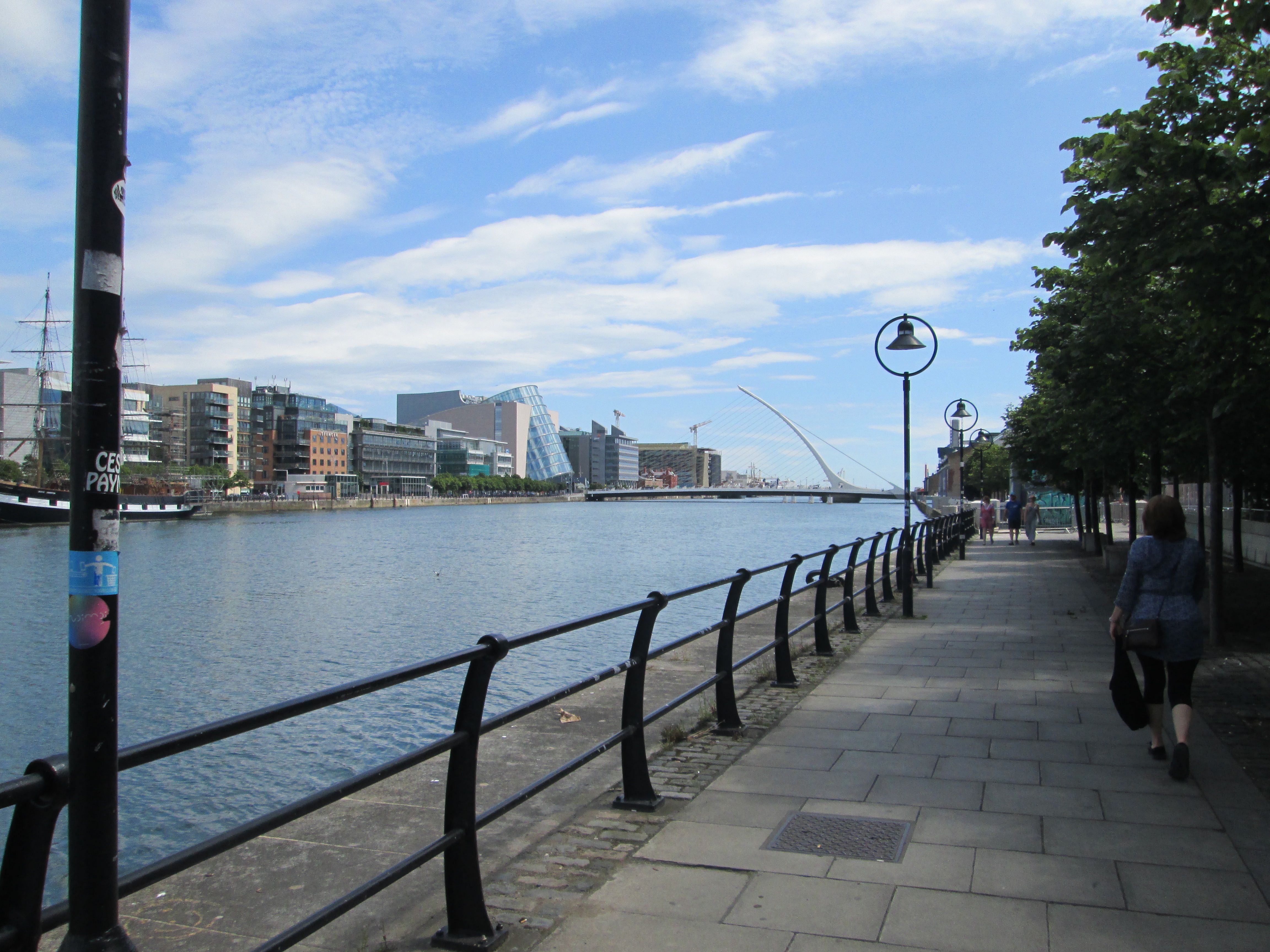
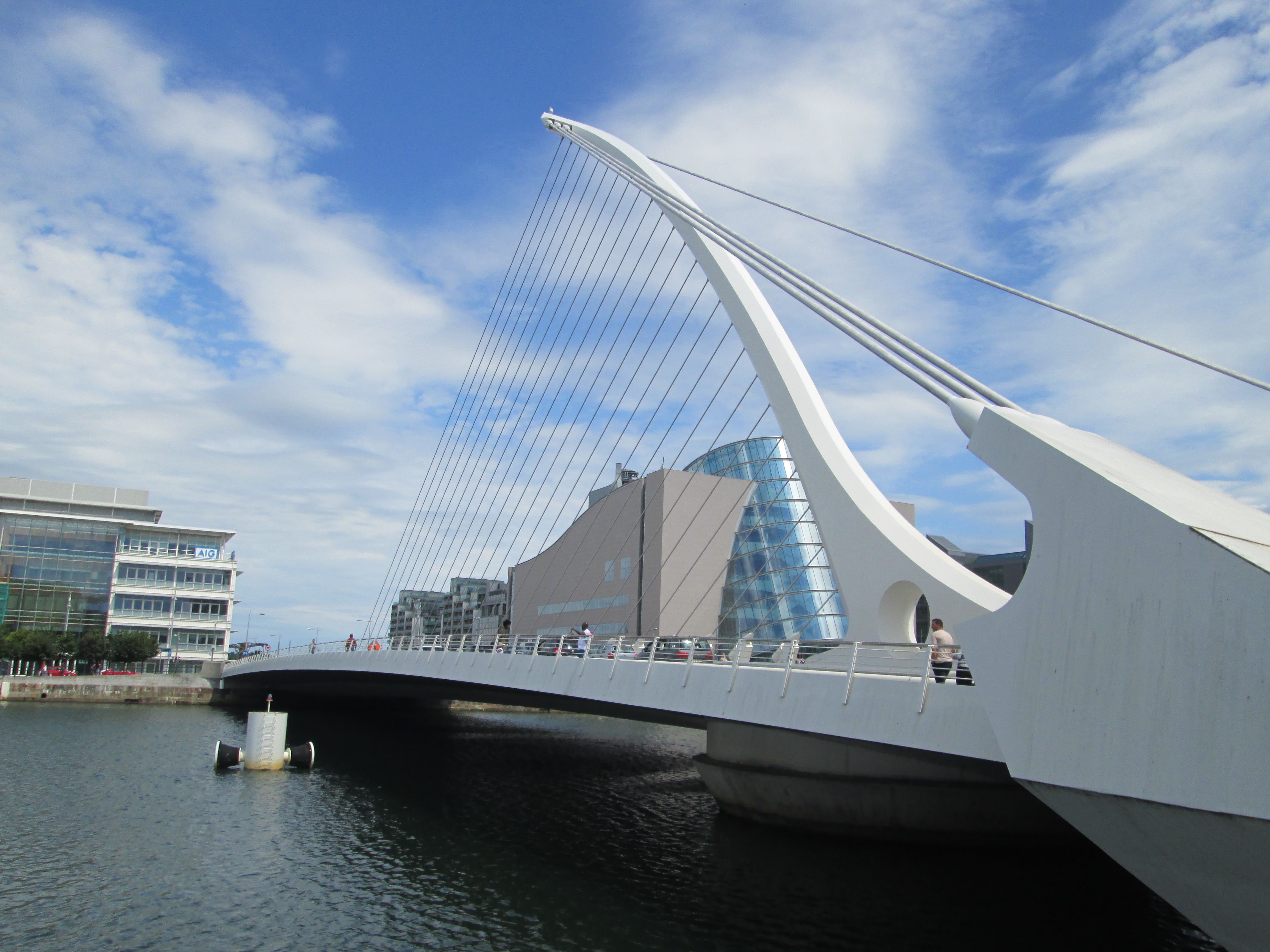
North and South docks have given way to the glam and gleam of apartment living and the commercial sturm und drang of the late, lamented Celtic Tiger. Where once the Miranda Guinness docked and loaded cargo facing open sea, now an elegant, lyre-like bridge joins the two spangled arms of the inexorably eastward bound city. Samuel Beckett Bridge was built in 2009. Designed by Santiago Calatrava, also responsible for James Joyce Bridge upstream, the bridge swivels to allow ships to pass.  The design speaks more of music than Beckett’s bleak interior landscape but its beauty is somehow appropriate all the same. I imagine Beckett sailing through here, leaving Dublin in the late 1920s; standing astern in reefer jacket and cable knit, seeing a grey and gloomy vista sink in his ship’s wake.

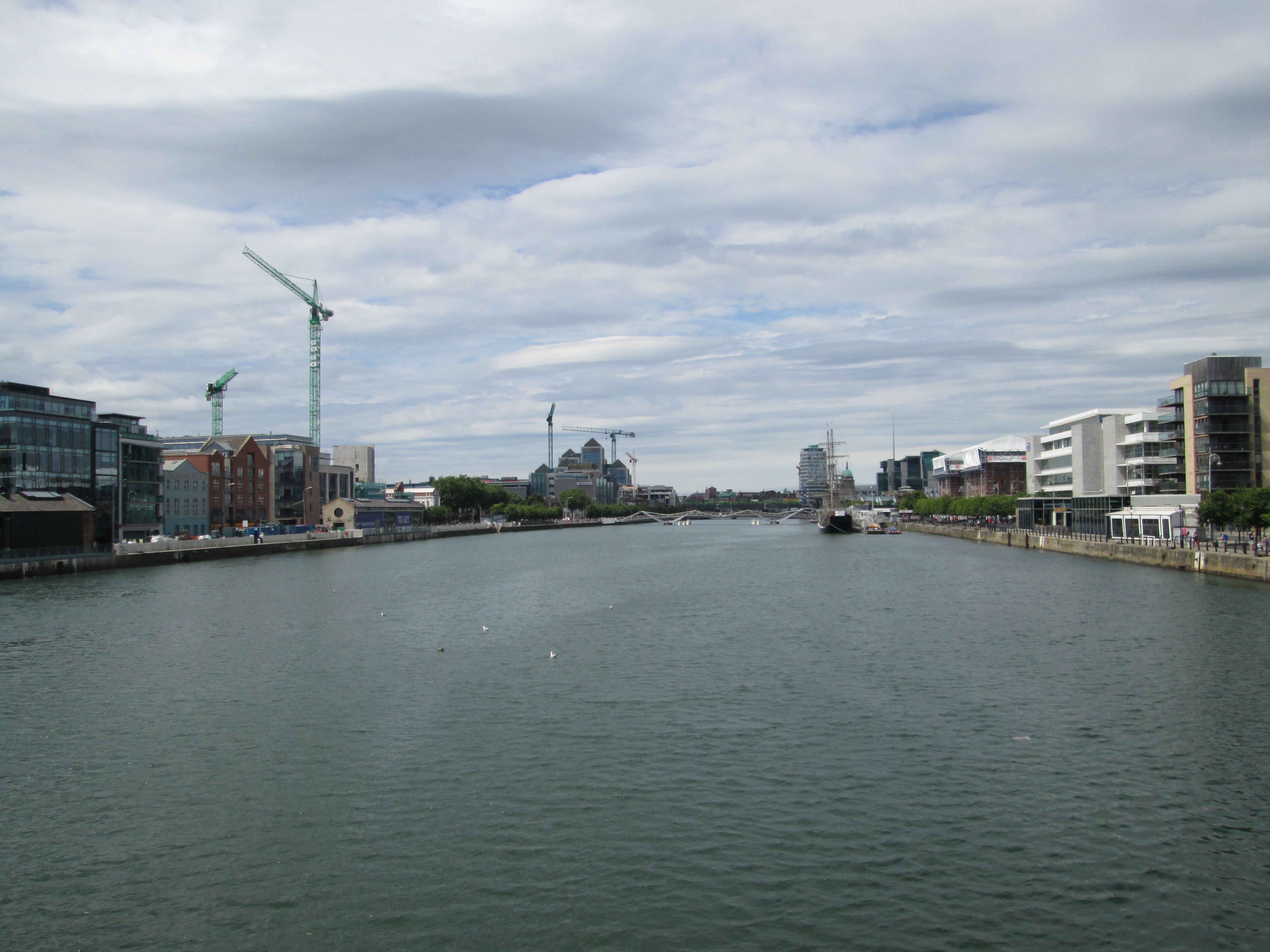
These days, the Docklands development on each side gleams with commerce and stylish accommodation. Upstream the view towards the city centre features Gandon’s Custom House on the north quays dating from 1791, and the crystalline towers of the Ulster Bank HQ south of the river two centuries later. Nearby, the Jeannie Johnson is docked. This three masted barque originally carried Irish emigrants from Kerry to America during the Famine years and on through the 1850s. It was a journey of about seven weeks and the Jeannie Johnson never lost a soul. The reconstructed vessel functions as a training ship and as a museum of Irish emigration.

Past the Custom House you can see the Loop Line Bridge. The Loop Line was built in 1891, joining Westland Row (Pearse) and Amiens Street (Connolly) rail stations and spanning the River Liffey. This completed Dublin bay’s commuter railway, enabling the Dart almost a century later. It was less of an aesthetic triumph, the heavy iron bridge masking off the elegant river vista east of O’Connell Bridge to the Custom House. From our perspective it blocks the city centre quays and old Dublin. Liberty Hall peeks above it. This sixties tower was seen as a skyscraper, a harbinger of a soaring modernist future. Five decades on, it remains one of Dublin’s tallest buildings, though scheduled for demolition.

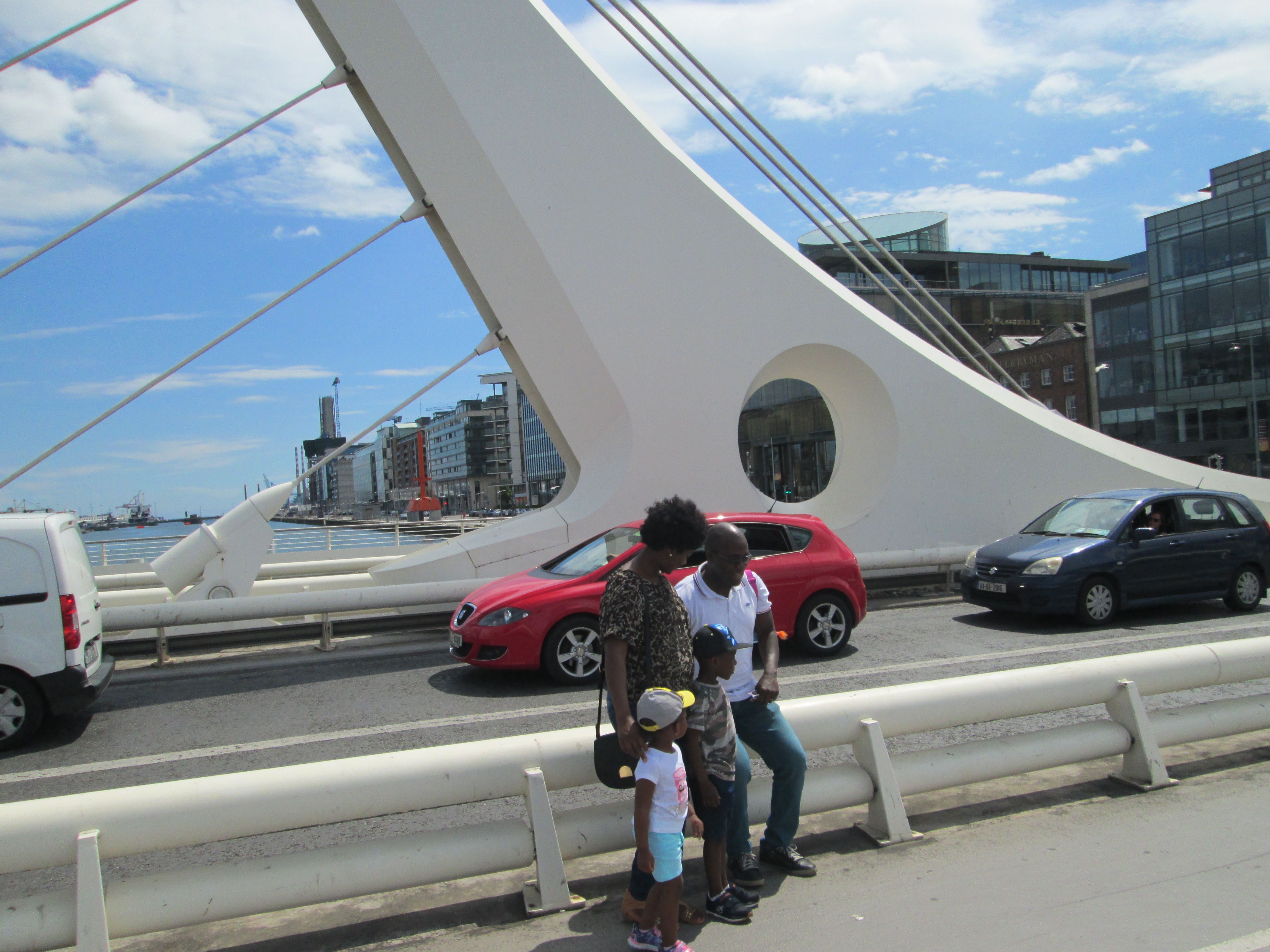
As I contemplate the beauty of Anna Livia, herself frames a tourist family against the backdrop of the bustling estuary and Kevin Roche’s Convention Centre. Our route heads north along Guild Street, the Royal Canal entering the Liffey to the right. Beyond is the Spencer Dock development. The original plan was to provide a high-rise sector for the capital designed by Irish architect Kevin Roche. Roche, a leading architect of postwar America, had no buildings in his native country. Adding to New York’s skyline is one thing, intruding on preciously protected Dublin’s is another. The Irish have a quaint attitude to tall buildings. Residents objected to the heights of Roche’s design, understandably for them, but peculiar in the context of a large city. Ultimately, it was the disruption of a sightline from distant Fitzwilliam Street to the south which did for the highrise plan. Curioser and curioser.

Nevertheless, the National Conference Centre went ahead. Completed in 2010 it has quickly established itself as an icon of modern Dublin. It’s tilted glass atrium somehow suggests an activity of which I am fond. Hmmm, what could that be now? There are fourteen kilometers to go. I’m treading water here. But, as Sam Beckett would say: I will go on.