Bruges – 3, To the Lake of Love.

IMG_4789

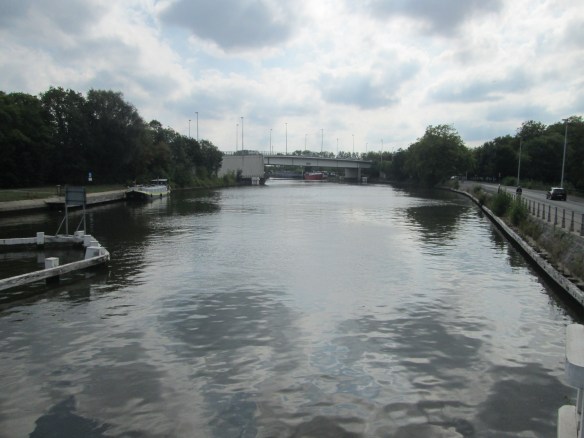
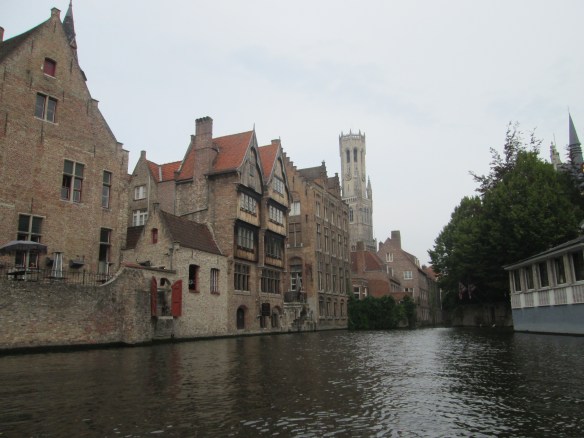
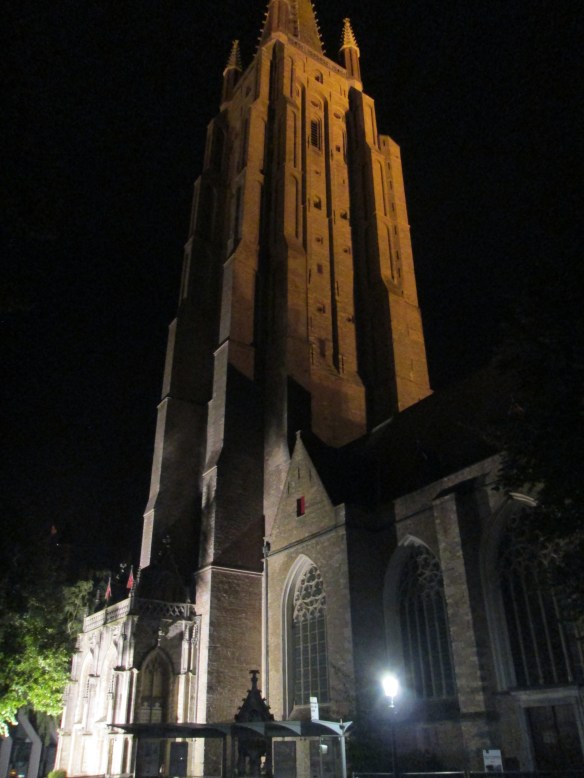
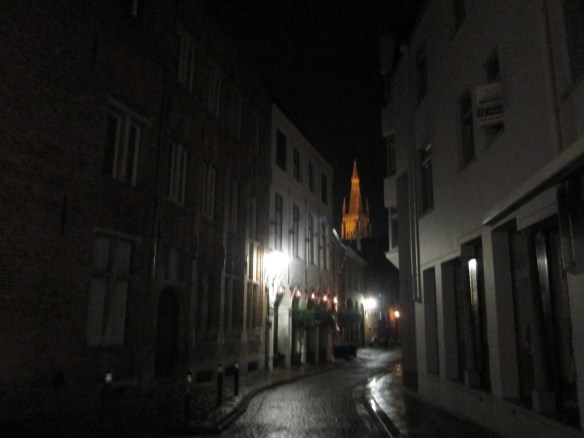
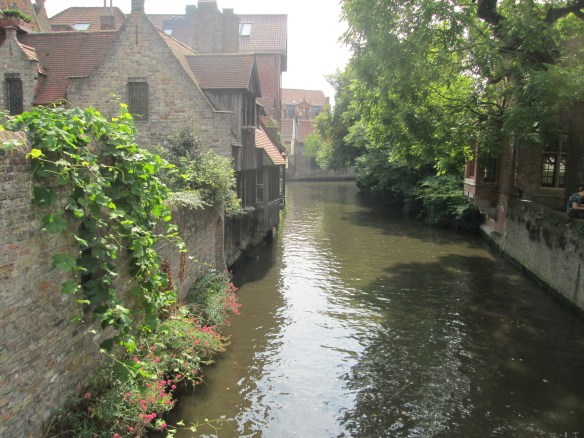
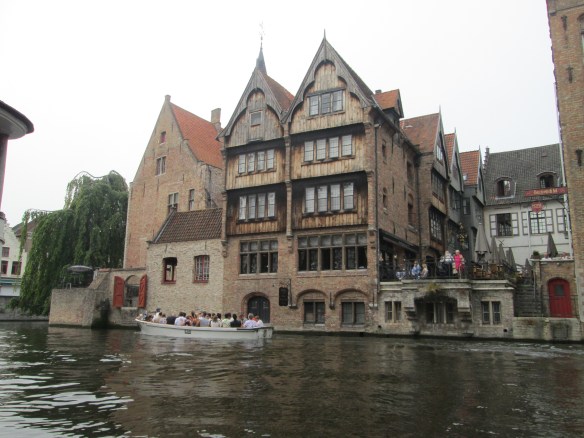
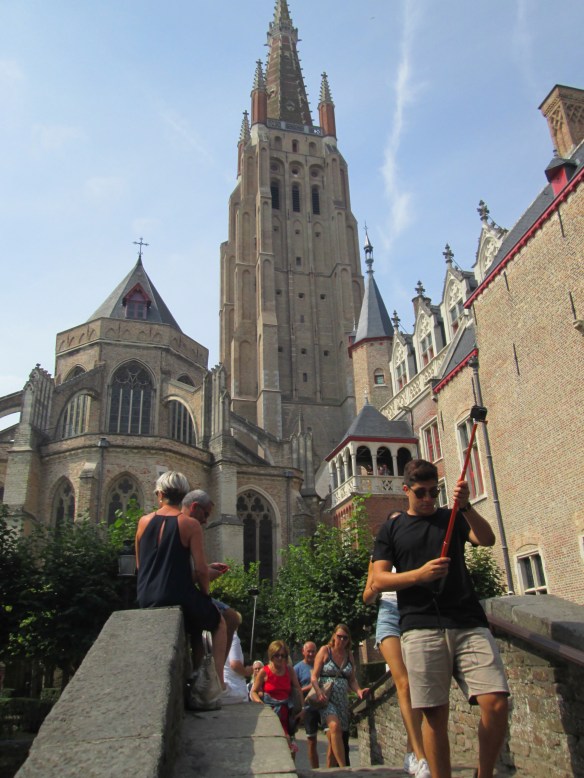
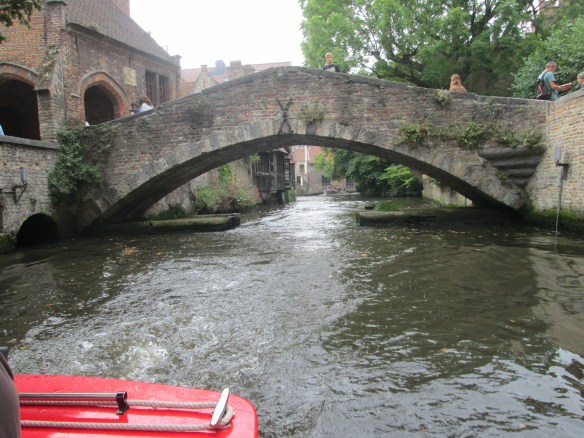
The distinctive Gothic shape of the Boniface Bridge is quietly emblematic of Bruges, the city of reflection. It embodies that melancholy meditation of memory and love, that perfect moment when all time flows through an ostensible cusp, briefly and sharply experienced. Just beyond, the Church of Our Lady soars heavenward. Its one hundred and fifteen metre brick spire is the second tallest in the world. The church dates back to the thirteenth century and took two centuries to complete, encompassing a variety of styles from Gothic to Baroque.In the sixteenth century Our Lady’s acquired a statue by Michelangelo, Madonna and Child, a rare example of the artist’s work travelling beyond his homeland during his lifetime.

IMG_4846

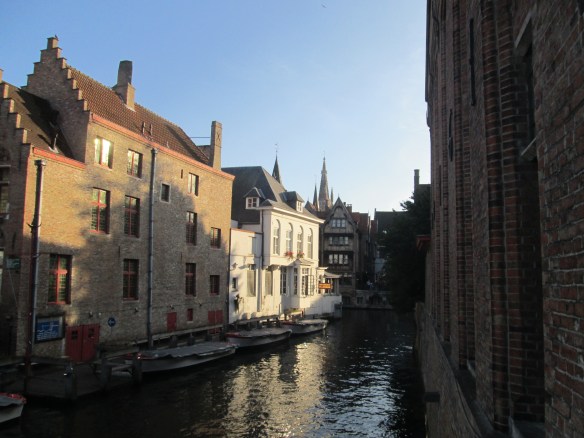
Bruges is a storybook of bridges and towers. After the initial frenzy of photography, the city re-establishes its quiet beauty on the soul. You find yourself within a photograph that is centuries old, enduring and subtly changing, captivating and offering profound release. Beyond the Boniface Bridge, and heading south, the crowds thin somewhat. 

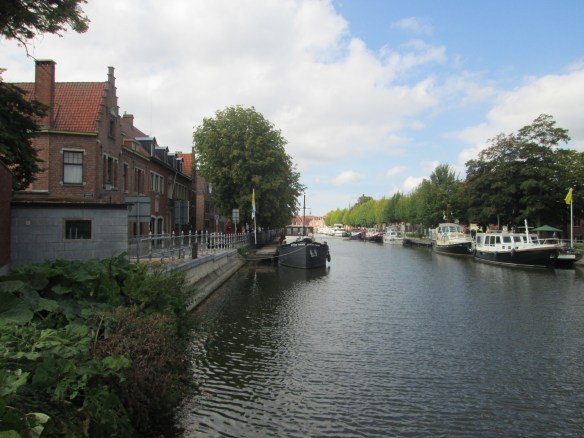
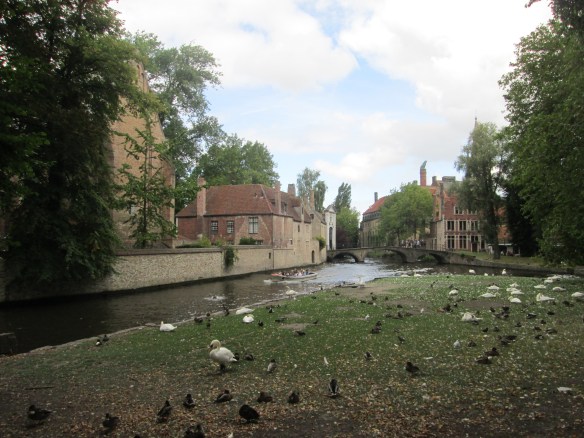
The Canal shimmies away from the quaysides and is bordered by the serene Beguinage. The Beguinage was a walled area within the city which offered a retreat for the Beguines, a lay sisterhood founded in 1245. These lived and dressed as nuns but did not take the vows, so they could return to the real world at any time.This location was crucial in Bruges La Morte. The cover features an illustration of the bridge. Floating on the waters that flow beneath, the figure of Hugue’s late wife is modelled on John Everett Millais’s Ophelia. It was drawn by Fernand Khnopff, whose work Secret Reflection hangs at the Groeninge Museum. Khnopff was a leading Symbolist painter who spent his childhood in Bruges. The mystique of the floating city would inform his later work which influenced the Belgian Surrealists, Rene Magritte and Paul Delveaux.

IMG_4855

The Beguines are suggested in the role played by Jane as she snares Hugue’s desire when he attends a performance of Robert the Devil. Jane dances the lead role in a sequence known as the Ballet of the Nuns. Robert the Devil is an actual Opera by Giacomo Meyerbeer, with a libretto by Eugene Scribe. It was a triumph of the visual power of stagesetting when first performed in Paris in 1831. The story gives a nod to the historical character, Robert the Magnificent of Normandy, father of William the Conqueror, who was known by some as the Son of the Devil. Jane plays the role of Abbess Helena who returns to life with her nuns and arise from the graveyard. They divest themselves of their habits and, shaking off the dust of death, dance a celebration of the physical joys of life. Scandalous, and sensational, the Ballet of the Nuns was a huge influence on the development of dance, transcending its classical constraints to push towards the more sensual artform of modern times.

Rodenbach adapted his novel for the stage and it received a German translation by Siegfried Trebitsch called Die Stille Stadt, the Silent City. Trebitsch was a friend of Julius Korngold and the two discussed the potential of turning the story into an opera. Julius’s son, Erich, in his early twenties was enthusiastic about the project, collaborating with his father on the libretto under the pseudonym Paul Schott. He composed the opera giving it the title Die tote Stadt, the Dead City. In this version, the melodramatic and crazed climax occurs within a dream, softening its impact.

IMG_4856

The original German title brings to my mind Thomas Moore’s melancholy Oft in the Stilly Night. Where Moore’s Vale of Avoca puts friendship at the centre of happiness, conjuring a perfect day in an idyllic landscape, Oft in the Stilly Night is melancholic, a lonesome voice leaking into the darkness.

Oft in the stilly night, ere slumber’s chains have bound me,

fond memory brings the light of other days around me.

Like Hugue, or any solo traveller at that certain moment of reflection, the environment is a multifaceted construct, built of memories and moods as much as its physical components. Within the crowds and chaos of the city there will be an isolated being, channeling the ancient history of the space throughout time, and through the prism of their own memory.

The smiles the tears of boyhood’s years,

the words of love then spoken,

the eyes that shone now dimmed and gone,

the cheerful hearts now broken.

Into these vacuums of darkness and solitude there is a welcoming space for those manifestations of the Muse, for music, poetry and art. For Rodenbach, art was a kind of religion.

Thus in the stilly night ere slumber’s chains hath bound me,

sad memory brings the light of other days around me.

IMG_4795

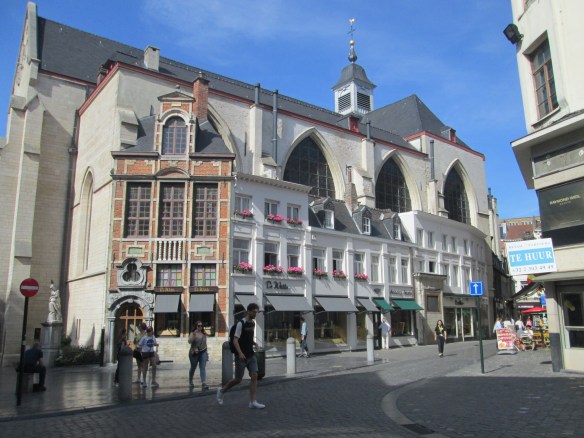
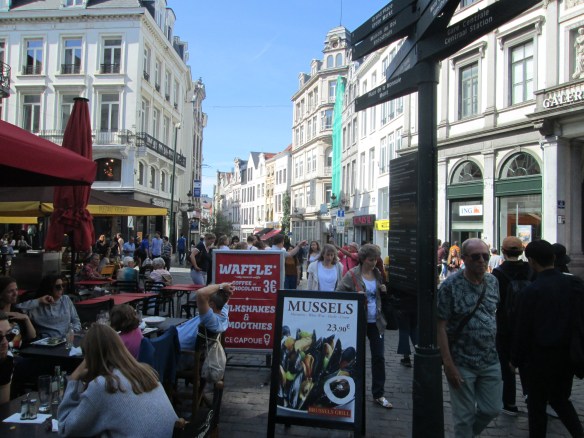
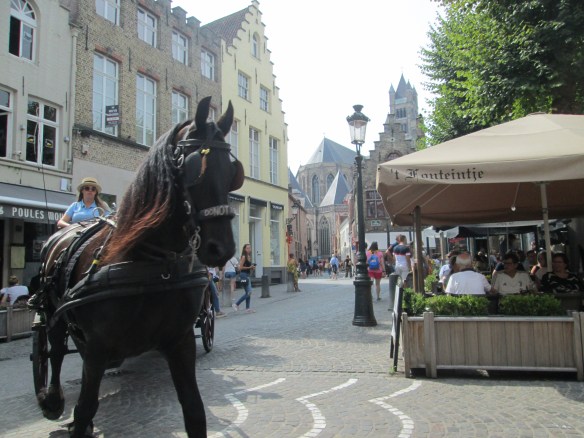
Bruges, being a city of reflections, can quickly shift. From melancholy to gaiety, it’s seldom more than a step away from a changing atmosphere. Ancient and beautiful, but also busy. Visitors cloud its atom like electrons, a dusty swirl by boat or boot or horse and cart. I balance precariously at a sidewalk bar, and the horses turning their carriages pass close enough to touch. The crowded small square is festooned with art and crafts and above it all the teetering spires of the sky.

IMG_4859

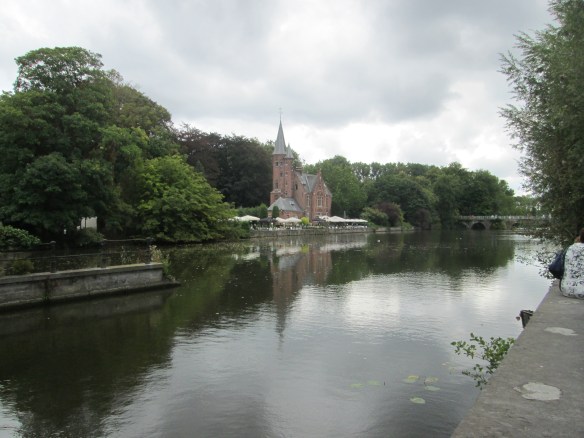
But, you can always find a place to be alone, whatever timeframe you inhabit. Further along, lies the Minnewater, a regular artificial lake where the waters feeding the canal system lie waiting, a few metres above the city waterways. The Minnewater is known as the Lake of Love. Passing the lock gatehouse is to enter a calmer sphere. A quiet park enfolds the lake with a relaxed residential area surrounding that and the adjacent Beguinage. At the far end there is the Lovers Bridge, though all bridges in Bruges are magnets for lovers. This one is named for the doomed lovers of myth, the beautiful young Minna and Stromberg, a warrior of a rival tribe. It is a variant of Romeo and Juliet. Of love and death. Standing guard is the Powder Tower, part of the old city’s outer fortifications. 

IMG_4863

Returning to the park, modern music beckons me to the water where a quartet of hedonists have established their own milieu and are dancing in a sea of ganja mist. In the quiet of the park once more, a hostelry looms out of the trees. In the afternoon heat and the deserted ambience, I feel I may have stumbled on the source of the Golden Fountainhead. The bar is to the rear of the Gothic building, where a matronly woman serves me. I take my beer onto the extensive and deserted terrace and sit a while contemplating the stillness of the waters. Minnewater, my solo pastime, a quiet conversation with an intelligent shade of the colour blue.IMG_4867

Bray Harbour Blues

IMG_0070 

The guide book description of Bray as “a small fishing village before the coming of the railway,” is a bit misleading. There was fishing in Bray for sure, both inland and offshore, but there was no harbour until the end of the century. What sea traffic there was used a small dock south of the mouth of the Dargle river, occupying what is now the roadway between Martello Terrace and the Harbour Bar. This traditional pub was established in 1831 and is a lively spot, full of music and good cheer. Meanwhile, the harbour itself is home to a large flock of swans and is used mostly by small pleasure craft.

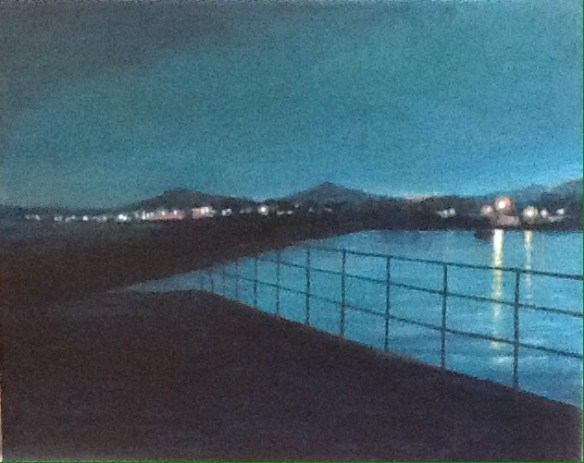
In this acrylic, we stand on the south wall of the harbour, with the lights of the seafront beckoning off to the left. There was once a lighthouse at the end of this pier, but that was swept into the sea in a storm long ago. Now, we are set in darkness, but for the glow of the sunset over the Wicklow Mountains, reflected in the swollen high tide at our feet. Before us is a scattering of harbour lights around the jetty but the Harbour Bar is obscured from us by the dark hulk of intervening buildings centre frame.

But I know it’s there, waiting while I linger a moment, whistling the Bray Harbour Blues.

Bruges – 2. Morning Reflections

Bruges Boat

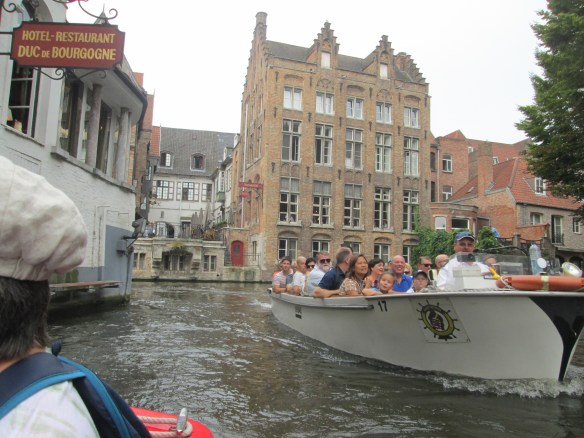
The boat trip is a recommended introduction to the city. Available at most quays in the centre, it costs ten euro for the half hour trip and is well worth it. The boats are small, slung low in the water  and fit a dozen or so. Close your mind to the cameras and apparel, drag a finger through the water and see the brick rise up from the canal, glowing with the centuries. Merchant palaces and church spires soar like impossible crystals above the reddish brick. A couple converse with a woman beside me, they in English, she in French. There is understanding and mystery, smiles and photographs. If you are a participant in the permanently picturesque, you harmonise with the painting that is emerging. The French woman is young or old, depending on the quaysides that we pass. The English couple are occasionally dappled with the shadows of Flemish dress, awaiting the caress of the artists brush. On disembarking, my companions are puzzling over arrangements for a place to dine, caught in a pantomime of gestures and smiles. 

IMG_4746

I drift off to a cafe promising a hearty breakfast. The next half hour or so is rich in elements of Monty Python’s cheese shop sketch. There were no sausages, and the rashers dematerialised too. Egg and bread remained, however, and a cup of tepid coffee. 

From the 14th century Brugge attained a prominent position as the capital of Flanders. The world’s first stock exchange was set up here by the Van Der Bourse family, attaching their name to the trade ever since. The 15th century became the city’s golden age, commerce and art flourished and Bruges produced such artists as Hans Memling and Jan Van Eyck; the Flemish Primitives. The name Primitives is a bit misleading. These were pioneers in the art of oil painting and were stunning, meticulous representationalists. There is an excellent collection of their work, and other later Flemish and Belgian masters at the Groeninge Museum off Rozenhoed Quay.

IMG_4758

Brugge went into decline in the 16th century as neighbouring Ghent prospered.The city became a sleepy backwater, ironically a fact which contributed to the preservation of its medieval charm. The isolation and stagnation inspired the Symbolist novel Bruges La Mort by George Rodenbach in 1892. This lit the flame of its revival as a tourist destination, though Bruges is gloomily characterised as the city of death. The story tells of a man, Hugues, who mourns the death of his young wife. He keeps a Temple of Memories including paintings, photos and a long lock of her hair. Within his grief he also becomes obsessed with a dancer he sees at the opera, Robert Le Diablo, Robert the Devil. The dancer, Jane, bears a close resemblance to his wife and after some awkward courting he invites her home.

More recently, the film In Bruges, written and directed by Martin McDonagh, with Colin Farrell and Brendan Gleeson, sets Bruges as a noirish backdrop against a tragi-comedy of love and death. This more than anything was a factor in my resolution to visit.

IMG_4759

Certainly, these days Bruges in summer is thronged by visitors, but it isn’t overrun. There’s so much to see, and room to see it, that it is a flaneuers dream. Up, down and sideways, you can bathe your eyes pleasantly in Bruges. And, as in any city worth its salt, that includes a visit to the premier art gallery for a journey into the past. The 18th century was the city’s Austrian period and this era saw the foundation of the Academy of Fine Arts which formed the basis for the collection in the Groening Museum. This museum, within a maze of gardens and courtyards, seems small from without, but within holds a wealth of material. Headphones are free, and give an excellent account, free of the artspeak that often bedevils these devices.

IMG_4760

On entering the Groeninge, first up is a painting by Antoon Claessens: Mars, Surrounded by the Arts and Sciences. Here, the painter exhorts the liberal arts above ignorance, with Mars centre stage, trampling on a donkey-eared ignoramus as the muses of the various arts gather around. The painting pitches for the inclusion of painting and drawing on this exalted platform. 

Van Eyck’s Madonna with Canon from 1436, shows all the mastery of detail and rendering, while unifying the work in serene and bold composition. Stepping into these paintings is a journey back in time to the heyday of Brugge, its dreaming spires and palaces, its surging commercial life, and most importantly its people. Religion is to the fore, with strong connections to the spirit world. Sitters are accompanied by their patron saint.

IMG_4769

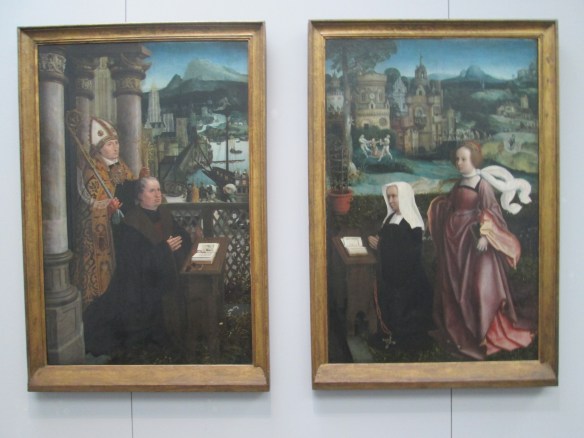
In Jan Provoost’s triptych only the outer wings remain, telling an intriguing, if partial story of the donor and his wife. As was the custom, the sitters are portrayed with their patron saints in tow. Here, the Donor is accompanied by Saint Nicholas, his wife by Saint Godalieve. Godalieve is a patron saint of Bruges itself and here she appears in the foreground with a scarf wound around her neck. In the background, she is pictured being strangled with this scarf by henchmen of her husband. This story is echoed in Rodenbach’s novel. As Jane tires of her lover’s obsession with his dead wife, she teases him and mocks his Temple of Memories, finally taking a step too far as she dances with the lock of Hugue’s wife’s hair. Hugue, enraged, descends into delirium, and strangles Jane with the lock of hair. On the reverse, a different narrative unfolds. This stark, graphic tableau portrays the man exchanging money with a live skeleton. A faustian deal, perhaps, buying time from death. In the backgeound, the artist is portrayed in stern disapproval.

IMG_4768

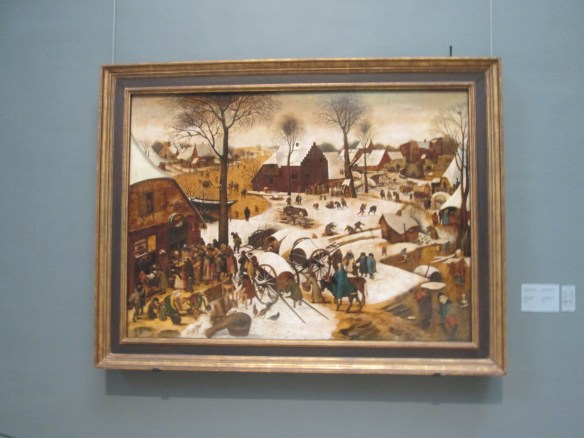
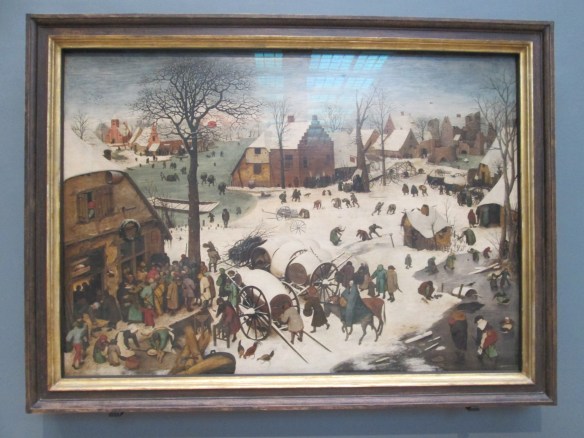
Much of the work of the Flemish masters depicts the ethical conflicts in life. Cautionary tales of terrible retribution on corrupt persons in trade and law. One judge gets flayed alive in graphic detail for taking bribes. In Bosch’s Last Judgement, the retribution comes from God, the consolations of the good life being the reward of paradise, the punishment for venality the horrors of hell. The Breughel’s, Pieter the Elder and Younger, root their work in the daily struggles, and celebrations of life. In such startling detail and vivacity that we’d swear they smelt of brewing and woodsmoke, of crackling snow and glowing ovens, our bellies full or empty but all the time throbbing with the stuff of being alive. 

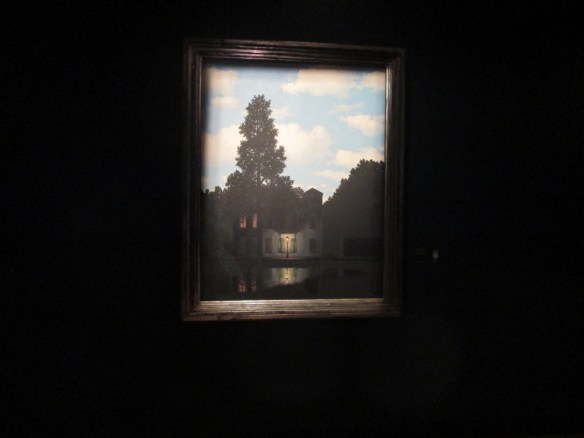
The ages slip away as I float through the gothic and romantic, and glimpse the seductive reefs of surrealism. Paul Delveux and Rene Magritte paint mindscapes in appropriate reflex of our modern condition.

IMG_4786

Outside the brackets of the museum, that wondrous timewarp, the world throbs and whirls in its relentless mayhem. But there is solace too. I might search for love or happiness, and all the contradictions that quest embodies. I might search for myself but will need first to become lost. There might be a perfect moment, or even a chance to find the Golden Fountainhead. Anything seems possible here. Without a route to take me, I flow with the human river, and come to the Boniface Bridge. This is a magnet for lovers, and they pose at its apex anxious to draw down its benign influence, and that somehow a photograph might capture their soul in all the timeless ambience it generates.

IMG_4754 

Bruges – 1. Arrival

IMG_4712

A long overnighter, taking the red-eye into Brussels where I have a vexed transfer to the train system. The postings are a bit opaque, but I stumble on the 11.03 to Ostend, via Brugge. Escaping the embrace of the city’s glass and steel, the Atomium glints in the distance as the train crosses the Maritime Canal. Flat Flanders fields shimmer in the morning heat. After Ghent, I almost alight at the wrong stop, thanks again to poor onboard postings, but a young Frenchman intervenes and at last I gain Bruges.

Or, as they call it here, Brugge. Brussels may be Francophone Belgium, but here we are in the Flemish speaking region. The language is a regional variation of that spoken throughout the Netherlands. The name Brugge derives from the old German for mooring place, and there is certainly much of that about here. A spiders web of waterways marks the region, falling ever so slowly towards the North Sea. Brugge is more than a thousand years old, a fortification against marauding Vikings and Norsemen, settling into a vital trading port to become a commercial and cultural capital in late medieval times.

The railway station is a large modern building, but pleasant and navigable, on the southwestern periphery of the city centre. I can see the city beyond the trees across the busy circular highway. Google tells me it’s a twenty minute walk, which proves to be an accurate assessment. Full laden with heavy bag, my sweat bouncing off the cobbles with the blaring heat, I zigzag my way to the centre.

Bruges Vismarkt

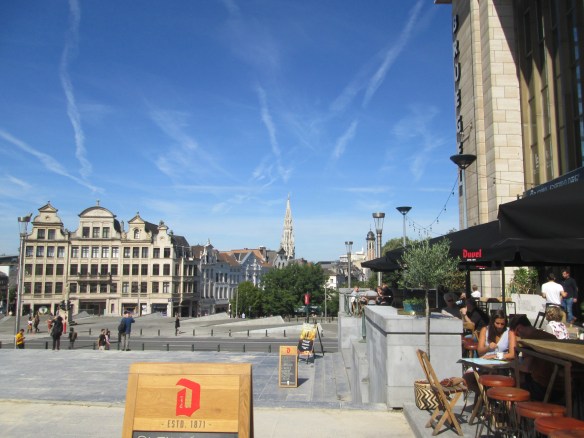
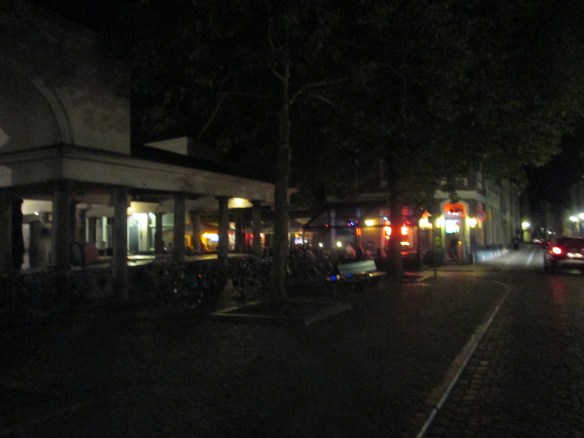
By Rozenhoed Quay I am at the touristic focus. Bruges bustles, watercraft laden with sightseers plough the canal, craft stalls blossom beneath the trees, the clip clop of horse drawn carriages punctuates the buzz, and above it all a wonderland of spires and towers grow like stone crystals into the clear blue sky. At the end of Rozenhoed, the canal dog legs through ridiculously picturesque architecture; terraces with cafes, bars and shops are thronged, all reflected to infinity in the waters. My place is a few yards on. Apartment Breydelhof is certainly central, I can see it from here but it is just turned two o’clock, not quite check in time. I plonk down on a stone bench by Vismarkt. This rectangular fishmarket is ringed by a classical colonnade. It operates every morning and by afternoon the north end is occupied by art and craft stalls. Sporadic social events arise; I would see a jovial dance class there the next evening.

I wonder if, in times of waiting like this, in places like this, if the ancient church spires might set their clocks to flip through the centuries. Say, pick a time, any time, and with just one Rip Van Winkle snooze, find yourself transported there. The tranquility of canals forms the perfect mirror for those of vacant and reflective mood. They are slow glass, allowing the centuries to fall in and be released again to the receptive eye. I dream I am in a field of slow glass and loose what grip I have of time. Oh to haunt the city like a ghost, from the waving water reeds to the dreaming spires. But I must stir myself as the sun angles through the colonnade.

IMG_4714

My apartment is rich with the character of age. An atmospheric room with a vastly high ceiling, allowing an upstairs loft for sleeping. There’s a shared terrace outside the windows. Unfortunately the windows, for all their height are not French, so a certain undignified clambering is called for each time I want to take advantage; but well worth it just the same. Old brick succumbing to the invasion of greenery, overlooked, but discreetly, by redbrick two storeys. A glass of wine to gather my wits, recharge my batteries and prepare.  I have things to see, visions to source, and resolve my quest to find in Brugge the Golden Fountainhead!

Bruges Blind Ass

On an early evening stroll through the city, the sun is slanting and the crowds thinning. From Vismarkt a bridge leads to Blind Donkey Street, a narrow medieval alley passing under an archway where the vista opens up to the Burg.  This grand civic square is dominated by the magnificent town hall, stadhuis, dates back to the year 1376. Nearby is the Basilica of the Holy Blood, where a phial of blood from the body of Jesus Christ is its most treasured relic. One side of the square is occupied by busy bars and restaurants, and I find a space there in the last rays of the sun.

Bruges Stadhuis

The Main Square of the old city is a hundred yards or so further on. The Market Square is vast and above it soars the eighty three meter tower of the Belfort. This civic building was built between the thirteenth and fifteenth centuries and the distinctive tower is very much the symbol of the city. The outdoor terraces are crowded with football supporters. Exuberant Austrians in vertical stripes which, for once, don’t make them look thinner. Loud and happy, I wish I could join them, but feel a fondness for the local side whom they face in a crunch Euro qualifier tonight.

Bruges Belfort

I loop back to the Burg. At its leafy northern extreme is hidden Delany’s Irish Bar. Obviously not hidden from me. Something to do with magnetism I think. A pint of Leffe, or two, and the world is glowing golden. But perhaps not quite the Golden Fountainhead. Meanwhile, a last minute goal gives Brugge victory over Lask and progress to the group stages of the Champions League. Everyone’s happy. Even I’m having a Leffe.

IMG_4730

Bray’s Florence Road

Florence Rd

Alighting from the DART, the main route home, whether by bus, taxi or shank’s mare, leads up Florence Road. Past the delights of Albert Walk and Henry and Rose fish n chipper, the road is straight, mostly residential and lined with pollarded sycamores. There’s a manicured bowling green to the South and a grand Victorian terrace, Florence Terrace along the entire block to the North. Otherwise, the housing mostly consists of detached bungalows with an Arts and Crafts feel and distinctive orange tiled roofs. These date to the 1920s and also feature in other streets around the town centre. 

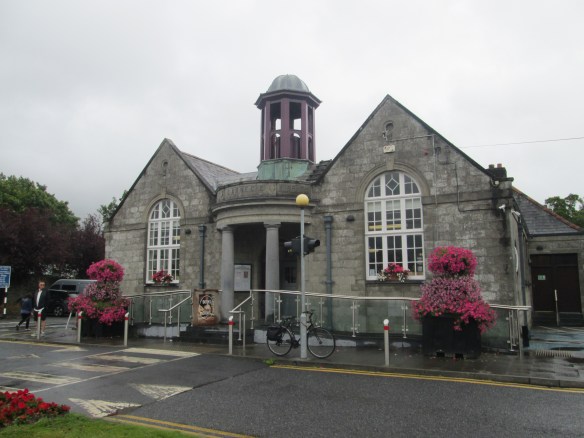
As with much of Bray there is a whiff of merry olde England, but not quite. It’s as if you turned your back for an instant and all the trees and undergrowth took a surreptitious step forward, encroaching on the serenity just that little bit too much. This alternative spooky ambience is emphasised by  a few fin de siecle detached Gothic houses. At the crossing with Wyndham Park, Florence House and Arno House from the late 1880s form an imposing gateway to the shaded sylvan area beyond. Further on is Bray Library, a granite Carnegie library from the early twentieth century. 

Crossing Eglinton Road, the rational straight lines of Dargan’s planning bend somewhat towards the lines of the original old manor town. The methodist church is to the left and beyond that the street dons its working clobber as it heads up to meet Main Street at the t-junction. The Church of the Most Holy Redeemer closes the vista spectacularly. In fact, Florence Road didn’t push through to the Main Street until 1903; a date commemorated on the gable of Bannon’s Jewellers.

This view, in acrylics, is from the eastern stretch of road approaching Wyndham Park, looking southwest. Florence Terrace is behind us. Ahead we see the silhouette of Arno House, built in 1889. It is late winter after work, tea time. The sun has just set in the West and the lights are fading on. 

The Dart Player of Temple Bar

Dart Player1

Dublin’s Temple Bar is a small enclave bordered by the Liffey, Westmoreland Street and Dame Street. The main drag is a cramped, erratic thoroughfare beginning at Fleet Street in the east, on into Temple Bar and finally as  Essex Street meeting Parliament Street at the western extreme.

Fleet Street, when I first knew it in the sixties, was where you got the bus. It was crammed with waiting busses and passengers, diesel fumes and cigarette smoke, steam rising from raincoats as the sun split the louring clouds. Too narrow and decrepit for its purpose, growing even more narrow as busses shimmied westward through Temple Bar, it was earmarked for development. A great bus terminal would arise to serve the metropolis, and this windy, cobbled backwater would be swallowed in the smog of time. 

Dublin was old and grey, even on a summer day and, like every generation before and since, it was my generation would blow the cobwebs away. Flower power was planted and the Dandelion sprouted by Stephen’s Green. The bees swarming into the hollowed core of the city causing such hives of activity as the Project Arts Centre. I snuck off school many’s the afternoon for the smell of patchouli oil and other exotic substances and a stroll around the Project gallery to gaze in awe at the creations of Fitzpatrick and Ballagh and others. 

The Project would migrate to the neglected quarter of Temple Bar in the early seventies. The Granary, just around the corner, was the early flowering of the Health Food Shop. Not far away was the Alchemist’s Head, a shop for all the comic book guys. In seventies Ireland, such flowers were weeds, but weeds will always proliferate. I used wander the cobbled streets, linger in the music shops, antique shops, the stamp collectors place on Fownes Street, in the shadow of the emerging hulk of Stephenson’s Central Bank, haunt the Project for plays by Sheridan and late night gigs.  

But Temple Bar was doomed, the spaceships of seventies commerce circling ominously. And then it all changed, changed utterly. The growing community of hippies and ne’er-do-wells somehow convinced our esteemed leader, Charles J Haughey, that there was merit in the madness of the crumbling slum. Thoughts of WAAMA no doubt, Flann O’Brien’s Writers, Artists, Actors and Musicians Association, might fit with the denizens, and Charlie was after all a patron of the arts. Thus, reprieve, and the Great Bus Station in the sky went off to orbit another planet. 

Temple Bar has been proposed as many things, principally as Dublin’s cultural quarter, its Left Bank. It is also the night life focus, the funzone for wining, dining and dancing till dawn. And it even has residents to participate or complain about the whole damned thing. Overpriced, overcrowded, noisy and hokey it might be, but it is also real, full of all the variety, quirk and charm you need in a city centre. 

I pass through when I can, hopefully stopping at a watering hole en route. The Palace at Fleet Street is my favourite. A rael olde Dublin pub, narrow, high ceilinged with darkened wood interior and a well established literary theme. It plays host to the Flann O’Brien festival on the first of April. Flann the Man, who also gave us Bloomsday.

Further in, there’s plenty of boozers and eateries. Take your pick. In this painting, I’ve chosen the Hard Rock Cafe, a good joint for burgers and beer, with a good rock soundtrack to boot, as you would expect. In this painting, I’ve paused between courses, or pints, to gaze out onto Fleet Street. There’s a tattoo parlour across the street, and the tattooist, between customers, is practicing his skills on a dart board. There’s something quite still and serene about that, I think, all going unnoticed in the midst of the madding crowd. I was thinking of calling it The Dart Player.

One Night in Shankill

Shankill

Shankill is Dublin County’s southernmost town. It has a population of just over 14,000, most moving in over the last forty years around what was once a small village. The bridge at the north end of the Main Street (Dublin Road), crosses the defunct Harcourt Street Line, which closed in 1958. This was the original rail connection between Bray and Dublin in 1854. A little later, the coastal route pushed through to Dun Laoghaire and on to Westland Row. This is the surviving route, running all the way north to Belfast and south to Wexford. It provides the  Dartline electrified commuter rail service from Greystones to Howth and Malahide in North Dublin.  

Until the M11 bypass in 1991, Shankill lined the main road from Dublin to Bray. It’s still a busy route, but more pleasant with enhanced village life. Once past the village Main Street an avenue of trees forms a green tunnel from Woodbrook to Bray and the Wicklow border. The village trees are endangered by a recent public transport plan which, whatever its practical benefits, could have dire consequences for the visual amenity. 

For this painting, I’ve stopped on the southern carriageway of the Main Street, heading home from Dublin. Our Ford Focus seems blue in the glare of the green traffic lights behind me. Across the road the main glow of lights marks Brady’s Pub. In the dark is the Street Food outlet, best viewed by day with a lively sidewalk scene. Bernardo’s chipper is out of frame. A couple of pedestrians wander between pub and chipper. Decisions, decisions. A bus heads into the distance towards Bray. 

Walkinstown’s Musical Roads – 5


Shaneposter

A sting for the Alan Ladd western, Shane, from Jack Schaefer’s book, announced my pending arrival. Shane is Coming, Shane is coming, Shane is here! My mother claims this was a signal element in my Christening. My father opts for the more Nationalistically appropriate association with the rebel prince of Tyrone, Shane O’Neill. I will take both. They made a film of the fictional Shane of the Wild West, which I witnessed in the local cinema, an eery experience of identification and dismay at hearing my own name whispered hugely in the crowded, dark auditorium. I was being talked about and not being talked about. I was the hero in buckskins and the outlaw dressed in black. I was the star and I was dying at sunset. Nothing like seeing your life written large on a silver screen. Our metaphysical lives were being told beyond the aural dimensions of old. Images, from distant alien sources were painting new pictures for us. The picture house in question was at the far end of Bunting Road, central to the short stub of Harty Avenue.

2018-08-17 18.10.12 copy

Bunting Road

There many venues in Dublin 12 in the fifties. Suburbs are suburbs and have long functioned as dormitories, particularly where, as with Walkinstown, there had been little or no village nucleus prior to development. There was the Moeran Hall and there was the cinema, the Apollo. Since Apollo is the Greek God of music, the name was wisely chosen. He was also leader of the Muses, and God of poetry and light. All one might require of a cinema, so. The Apollo hosted the occasional variety show with bird warblers, yodellers, hypnotists and the like. For the most part though it was Movies, Movies, Movies! The Saturday afternoon matinee was a riot of screaming kids, acting out every action scene on the way home; a swift torrent of noise flowing up Bunting Road towards the Scheme and Greenhills. All those magnificent films: The Searchers, The Magnificent Seven, The Longest Day, The Haunted House, a jumble of Westerns, World War Two drama and British farce. The cartoons kicked off with Bugs Bunny or Woody Woodpecker, romantic interludes were lustfully whistled and booed, there were the folley-n-uppers, and action heroes of such sartorial elegance as Batman and Robin. Action scenes demanded audience participation which often developed independent of the silver screen.

2018-08-17 18.07.40 copy

Harty Avenue, looking towards where the Apollo used to be.

Within the walls was mayhem. Willie the bouncer ran as tight a ship as was possible; a ship of riotous pirates all the same. Willie was The Man. In truth, he was no more than a few years older than us, a wiry youth who modelled himself on Elvis. Elvis had been a cinema usher too, back in Memphis in the early fifties, with long sideburns and oiled back hair. Not a redhead like Willie. Willie did have the occasional horde of girl screamers though. Much famed for breaking up a fight in the girls toilet, his intrusion provoking an exodus of screaming pre teens. In the retelling, his name didn’t prove too helpful to his cause.

More mature fare beckoned as we turned into teenagers towards the later sixties. The Apollo was moving towards the light. There was the weirdly perverse 2001 – A Space Odyssey with its booming opening of Richard Strauss’s Also Sprach Zarathustra, and that  incongruous cosmic dance to Johann Strauss’s Blue Danube. I remember darkening stubble on my upper lip to bluff my way into the Graduate. Then there was Woodstock. I was fourteen or fifteen when the film came to the Apollo. Already, the cordite scented Rock of the late sixties had entered our blood. Our big brothers and sisters had Beatlemania, and the Rolling Stones. The Monkees were our teenybopper treat. Then came Flower Power and Freaks, free festivals of music and love. Drugs were a few steps down the road. These happy, hairy people were powered by more than a cup of Irel and a bottle of stout. They weren’t passing around Woodbines. But, the music was the message, after all.

Screen Shot 2019-08-01 at 18.45.28

Henry McCullough

The only Irish performer at Woodstock was Henry McCullough, guitarist with Joe Cocker’s Grease Band. Cocker was a mover and shaker, literally, in the British Blues Boom. Always a fiery performer, he was renowned for his throaty voice and his unique, spastic air guitar. At Woodstock, he performed the Beatles’ I Get By with a Little Help from My Friends.

What would you do if I sang out of tune?

Would you stand up and walk out on me?

Lend me your ears and I’ll sing you a song,

I will try not to sing out of key.

I get by with a little help from my friends!

Autosave-File vom d-lab2/3 der AgfaPhoto GmbH

Alvin Lee with his iconic guitar Big Red.

Another Blues Boom light, Alvin Lee of Ten Years After actually had a guitar. In the nighttime climax of the movie, Lee launched into the frenetic finale, I’m Going Home, a headbanging celebration and a trip down the memory lane of good old time Rock n Roll. And then a divine spirit materialised from the Purple Haze to play us out. Jimi Hendrix coaxed magic from his upside down guitar. Excuse me while I kiss the sky! This was a different planet altogether.

All those kids screaming their way home from the Matinee in the fifties were playing Batman or Cowboys ’n’ Indians in their heads; ten years later they were playing air guitar a la Joe Cocker, reliving the solos of Lee and Jimi Hendrix, dreaming of Rock Stars and the seductive release of sound and substance.

For years thereafter, passing down the gloom of Walkinstown Avenue, a regular tableau unfolded. With smog softening buildingd and streetlights, cloaking loitering figures in dangerous mystique, young men walked meaningfully, guitar cases slung across shoulders or held by the handle; Prohibition Era gangsters making for a hit.

The Musical Roads did not, so far as I know, yield more fledgling musicians or music stars than other more prosaically named estates. Amongst my classmates were a Frank(ie) Vaughan, and a John Lennon. Others included traditional musicians Eamon Lane and Sean O’Connell. Dublin 12 has produced an interesting spectrum of talented musicians. Fifties opera singer Dermot Troy, singer of modern folk, Rita Connolly, and that most musical ghost, our very own shadow of Jimi Hendrix, Philip Lynott. I wonder will he merit a road in his capital being named for him anytime soon. I don’t see why not.

Lynott

Statue of Phil Lynott outside Bruxelles in Dublin.

In the later forties

When Diddy Levine lived with Eunice King,

He gave her the ring that she wore.

See Philip Parris Lynott, caught improbably in a sepia snap, walking the streets of Crumlin where he came to live as a child, in the fifties. All those genes jiggling there, just bursting to get out, and delivering something that is eternally the black man’s Blues, and quintessentially Irish too.

Inheritance you see,

Runs through every family,

Who is to say what is to be,

Is any better.

Over and over it goes,

The good winds and the bad winds blow,

Over and over, over and over and over …

Thin Lizzy lit a fire for a generation of Dubliners. As Beat merged with Blues Boom, a new strand of Rock was forming, merging American roots with localised experience. Kids in Dublin’s suburbs in the sixties were well in tune with this. Frank Murray, who grew up on Crotty Avenue, was one, becoming an important contributor to Dublin’s river of sound. Late in the sixties he saw a group called the Black Eagles play the Moeran Hall. Lead Eagle was Phil Lynott. They became friends and Murray went on to manage Thin Lizzy and, later the Pogues. Murray was a main mover behind the recording of Fairytale of New York, that perennial Christmas favourite from the Pogues and Kirsty McCall.

Screen Shot 2019-08-01 at 20.26.11

Frank Murray (right) with friend Declan Collinge on Crotty Avenue.

Christmas in Walkinstown is depicted in Youtube video: The Apollo Gang. Here Murray and friends ham it up, Beatles style, on a snowblown day in 1965 on Harty Avenue, to the refrain of the Animals’s House of the Rising Sun. This song must find a soft spot in the hearts of Walkinstown gangs. Our own crowd, hanging around the Cross, also used it, amending the lyrics to suit. There is a house in Walkinstown … to begin with, and becoming more unprintable thereafter. Yes, it’s been the ruin of many a poor boy, and (thank) God, I know I’m one.

Walkinstown’s Musical Roads – 4

Walkinstown Lib

Walkinstown Library

Go far enough east along Cromwellsfort Road and you reach Crumlin. At the junction, the Submarine Bar was seen as Walkinstown’s last outpost, though Crumlin and Kimmage might have said the same. Now defunct, I’ve slurped from silver cups there, the Sam Maguire and the League of Ireland trophy, courtesy of schoolfriends Kevin Moran and Gerry Ryan, of Dubs and Bohemians fame. The road name derives from Oliver Cromwell, who stalked the area between here and Drimnagh Castle back in the mid seventeenth century. Before gaining the art deco joys of the crossroads, one last turn at Moeran Road leads back to the Melodies.

First thing you see is Walkinstown Library, giving its name to this subsection of the area. Lured in by the music, you stay for the words. Situated on a green island on Percy French Road, the library opened in 1961. A third of the stock and premises was devoted to children. My first attempt to borrow was a giant atlas, which I horsed to the desk like a surfer hitting the wave. The librarian kindly, but firmly, pointed out the tag For Reference Only, explaining I could not take it home. Well, feck that for a game of cowboys, I thought. I would, in time, borrow many books, mostly a diet of Blyton, Biggles and Bunter, the very British fare available to children then. Richer veins of storytelling followed, according to the prompts of siblings and peers, teachers, parents or simply whims. From Emily Bronte to Kurt Vonnegut, and a fair few manifestations of Brian O’Nolan, I’d keep on keeping on. One group of stories, set in song, was already well established in my soul, the writer’s name graces the road on which the library stands.

Percy_French

Percy French in Ballyjamesduff, Co. Cavan.

If Moore was seen as the Bard of Ireland, Percy French was more for the plain people. Born in Roscommon in1854, he studied at Trinity College and it was there that he wrote his first major song: Abdulla Bulbul Amir, for a men only event called a smoking concert. Ah, those were the days! As many an artist has found, a work sold cheaply is as good as stolen and French was long denied credit for the song. 

RTE were fond of spinning Brendan O’Dowda’s album of Percy French favourites and Abdulla was a standout for me. For some reason I sided with the Russian, Ivan Stravinsky Stravar. It is he who strode arrogantly into town to tread on the toe of his foe and ignite a colourful duel; although the tale ends tragically for both. A cautionary tale on the excesses of male pride.

They fought all that night neath the pale yellow moon,

The din it was heard from afar,

And great multitudes came, so great was the fame

Of Abdul and Ivan Skivar.

French was in his thirties before going full time as writer and entertainer. His songs, often comic and with a twist of satire were easily taken to heart by the public, but there is a solid and genuine core to his work also. He captures universal human qualities, all the fun and foibles, giving us more than just a picture of a bygone age. He is at his best in the Mountains of Mourne, where there is something of a sadness, and certainly a beauty, in the simplicity of the emigrant’s view of an alien world, and the deep longing for the simpler land, and fairer lass, he’s left behind.

Oh Mary, this London’s a wonderful sight

With the people here working by day and by night,

They don’t sow potatoes, nor barley, nor wheat

But there’s gangs of them digging for gold in the street.

The narrator keeps a promise to his girl back home, informing her of the latest fashions in London. Perhaps he notices the beauty of the girls a bit much, to begin with. The beautiful shapes nature never designed, their lovely complexions “all roses and cream”. But then:

If of those roses you ventured to sip,

The colour might all come away on your lip.

So I’ll wait for the wild rose that’s waiting for me,

Where the Mountains of Mourne sweep down to the sea. 

IMG_0008

Errigal Road, Drimnagh

Drimnagh, with its roads named for mountains, pays tribute to the Mournes. Moeran Road, meanwhile, is named for Ernest Moeran who was London born, though his father was Irish. This connection led him to Ireland in the 1930s. He settled in Kenmare, County Kerry, finding the landscape there a profound influence on his music until his untimely death in 1950, as building continued on the Musical Estate. The Moeran Hall, on the Crumlin Walkinstown border, became the main venue for dances and gigs as the youth population boomed in the sixties. Amongst the talents that burned brightly, if briefly there, were local band The Black Eagles, fronted by a certain Philip Lynott. More of that anon.

Where Balfe Road ends, a meandering road takes up the journey east. Viewed from the air it vaguely resembles a lute, and is named for John Dowland, top lutenist in Shakespearean days. Dowland’s place of birth is unknown, but it was probably Ireland. He dedicates his work From Silent Night to “My loving countryman Mr John Forster the younger, merchant of Dublin, Ireland.” Dalkey has been claimed, though it’s disputed.

Colliemore

Colliemore Harbour, Dalkey

He studied in Paris from 1580 where he converted to Roman Catholicism, which may have been a factor in him being passed over at Elizabeth’s court. He took his talent elsewhere, travelling in Germany and Italy to great acclaim. He was dubbed the English Orpheus. In 1598 he gained a position as lutenist to the Danish Court of King Christian IV for a fabulous salary. Dowland may have dabbled in espionage. He was tapped up by English Catholics plotting to overthrow the Protestant Elizabeth. Accusations of his spying for the papacy were denied. He wrote to Sir Robert Cecil, the Secretary of State, pledging loyalty to Queen Bess. 

He was a friend and contemporary of Shakespeare, and it is inferred that his knowledge of the Danish Court was used by the Bard in Hamlet. Christian was notoriously fond of the sauce, and at Shakespeare’s Elsinore, the gloom laden prince opines of the courtier’s tendency to “keep wassail”. Some have even found an eerie similarity between Colliemore and Elsinore as described in the play. I’m taken with the giddy scenario of Will setting sail for Colliemore Harbour, there to team up with his good mate John to trade gossip and sink some Carlsberg down at the Queens. In truth, it’s more likely they met in London, where Dowland lived from 1606 having been dismissed by Christian. Then, as with Shakespeare, he gained favour at the court of King James I (James VI of Scotland).

As a formative influence on the guitar, Dowland’s lute playing and compositions have been revived by such as Julian Bream and Sting. Sting’s Songs from the Labyrinth gives a good account of the music of the man, exquisitely lachrymose for the most part, but also of great energy and wit. Sting cites him as the first example of the archetype of the alienated singer songwriter. You might also say Dowland was the first guitar hero, a rock star who left Dalkey to seek fame and fortune, the reverse of the current procedure. There’s a plaque by Sarah Purser at Sorrento Park, at the very edge of my map of Dublin. It has been defaced, further deepening the mystery. But in Dalkey and Walkinstown, this great musician’s name lives on.

Dowland

John Dowland, by Sarah Purser

Flow My Tears was his most famous piece, evoking the bittersweet gloom of the exile. There is perhaps a pre echo of the Beatles, Blackbird, in mood and lyric. 

Flow my tears, fall from your springs,

Exiled forever let me mourn,

Where nights blackbird her sad infamy sings,

There let me live forlorn.

He died in 1626 and is buried in London. 

Walkinstown’s Musical Roads – 3

Castle Horse

Drimnagh Castle CBS  on the Long Mile Rd.

Home is where the heart is. Home is the streets and fields where we played. Out there in the newly named suburban segment of Dublin 12, it was mostly tar and cement. We could make out the gentle curves of the Dublin and Wicklow Mountains way down south past Tallaght, but the idyllic scenery and rollicking country fairs singing from our street signs were more our parents baggage then our own. 

I was born in 1955, in the first flowering of rock and roll. Bill Haley and His Comets had charted with Rock Around the Clock. Elvis was putting the finishing touches to Heartbreak Hotel. Carl Perkins was lacing up his Blue Suede Shoes. It was all very distant from Walkinstown’s Musical Roads. The popular opera of our musical patron saints held sway. 

John McCormack, born in Athlone in 1884, still loomed large in the public consciousness. He was regarded as the Voice of Ireland over the first few decades of the state. He moved from a singer in the Italian Classical tradition to plant a foot in the Irish folk tradition, becoming a peerless interpreter of Moore and French. This was the soundtrack of our youth, as the mortar in the Melodies dried, and the trees first blossomed and sang.

McCormack

Statue of McCormack in the Iveagh Gardens, Dublin.

Perhaps McCormack’s wilful folksiness tarnished his reputation as a classical vocalist, but it fuelled his popularity. And the great artist is as much personality and fame as it is quality and depth.His extraordinary voice and charisma earned him a career as a top selling recording artist and international concert performer. He became a naturalised American citizen in 1917. His success funded a rich lifestyle and he had extensive property in the US, Britain and Ireland. In 1928, in recognition of his charitable work, he was awarded a Papal title by Pope Pius XI. Thus he’s often styled Count John McCormack. His repertoire was well larded with religiosity too. He sang Panis Angelicus at the Eucharistic Congress of 1932 for an estimated half a million people. His last big gig was at the Royal Albert Hall in 1938, though he toured and recorded over the next five years in support of the Allied war effort. Finally retiring to a house in Booterstown, looking out on Dublin Bay, he died in 1945.

His avenue runs parallel to Bunting Road. Running north from a cul de sac, it merges with Balfe Avenue and then into Balfe Road East skirting Crumlin’s border. There are two right turns off John McCormack. The first, Crotty Avenue, is named for Elizabeth Crotty (1885-1960) who is the only woman commemorated. She was an Irish traditional musician from County Clare. Born Elizabeth Markham, she married Miko Crotty and established Crotty’s Pub in Kilrush. Her instrument was the concertina and she achieved some national fame through the programmes of Ciaran MacMathuna on RTE from 1951. This was a couple of years after building commenced on the Walkinstown estate, so she must have been a late addition.

The second is Esposito Road, most exotic sounding of the Musical Roads. Surely the sound of the Samba, of Latin Jazz, must permeate the bricks here, dangerous gauchos posing in the laneways. Well, not quite. Michele Esposito was an Italian composer and pianist who spent much of his life in Ireland, regenerating the neglected classical music system. Esposito founded and directed the Dublin Orchestral Society and was Professor of Composition at the Royal Irish Academy of Music, dominating the musical landscape from his arrival in 1882 until his death in 1929. His career overlapped with the great resurgence of Irish culture and Nationalism. In 1902 he scored the opera, the Tinker and the Fairy, from Douglas Hyde’s play, evoking a mythical Ireland emerging from the Celtic Twilight.

This little warren of roads also includes Bigger Road, O’Dwyer Road and O’Brien Road.

Francis Joseph Bigger (1863-1926) was born in County Antrim, the seventh son of a seventh son. He was a lawyer, antiquarian and Irish language revivalist, imbued with rural, De Valeran ideals. A big wheel in the Irish Cultural Revival, Bigger was a mentor of Herbert Hughes in the compilation of Songs of Uladh and Irish Country Songs. Living the life of a colourful laird, Bigger renovated Jordan’s Tower in County Down, which he renamed Castle Shane. This was in honour of Shane O’Neill, a troublesome Earl of Tyrone in Elizabeth’s reign. Shane occupied the fortress in 1565 in a complicated struggle with the MacDonnells of Scotland and the English. Dubbed Shane the Proud, by his detractors initially, though the name stuck with a positive association, he found himself locked in rebellion against the English and ended up with his head on a spike outside Dublin Castle in 1567. This fact filled everyone in my history class with glee at my expense. Perhaps then I decided to dispense with the O’Neill in my name, and become simply Shane Harrison. Meanwhile, Bigger, no musician, got a road named for him in Walkinstown’s Melodies.

shane3

Shane O’Neill Harrison poses as a Laird

Robert O’Dwyer (1862 – 1949), born to Irish parents in Bristol, moved to Dublin in 1897. He taught music at the Royal University of Ireland, a precursor of the National University and conducted the Gaelic League choir. With the spirit of the times, he turned towards Irish Nationalism which found voice in his composition. His three act opera, Eithne, was published in 1909, and vies for consideration as the first Irish language opera. Muirgheas by Thomas O’Brien Butler was a couple of years earlier, as was Esposito’s and Hyde’s the Tinker and the Fairy, though these were first performed in English. 

Vincent O’Brien (1871-1948) was born in Dublin and gave his first piano recital in 1885. Shortly afterwards, he became organist in Rathmines Church of Mary Immaculate, Refuge of Sinners before graduating to the Pro Cathedral in Marlborough Street. He initiated the Cecilian Movement in reaction to Enlightenment philosophy and founded the Palestrina Choir in 1898. Such devout Catholicism made him an obvious choice as musical director for the Eucharistic Congress of 1932. He was the first musical director of Radio Eireann, holding the office until 1941. His influence transcended narrow religious affiliation. He was a vocal coach for John McCormack, Margaret Burke Sheridan and James Joyce. The first two would achieve great fame with their singing voice, the third would infuse world art with an altogether different type of voice. Dubliners, Portrait of the Artist and Ulysses unite song and story in a way that effected a transformation of literature. 

Revolutionary_Joyce

James Joyce – Writer as Revolutionary

What would Vincent O’Brien make of it all? Perhaps he was misguided by Flann O’Brien’s fabulous assertion in the Dalkey Archive, that Joyce lived on happily in hiding, repairing semmets for the Jesuits in anticipation of their favour. But if he looked up from his road, he would see Walkinstown Library loom, repository of books and all the dangerous ideas they hold.