The City at Night

Belgrade

A blog I follow, Danventuretravels, posed the question of what characterises a visit to a city. Well, it goes without saying that you should at least leave the port area, whether ship or plane. And purchase something to consume at a public place, coffee, beer or snack. 

A young man I know, who shall be nameless, took a Mediterranean cruise with some stunning city visits: Rome, Barcelona, Athens etcetera. Asking for a report I got the view from the deck as the port hove into view, the weather and the distant skyline. It turned out that Mark (oops) hadn’t managed to get ashore so beguiling was life on board ship.

For most, though, the advantage and disadvantage of cruises are: you see the sights, but you don’t get the full deal. I have written pieces on cities from such daytrips. Talinn, Helsinki and Stockholm are a few. I saw enough to want to return and sample the nightlife of Talinn and Helsinki. I wouldn’t hurry back to surly Stockholm, though it is an impressive regal city. I would think that you need to see the city at night to get the full picture.

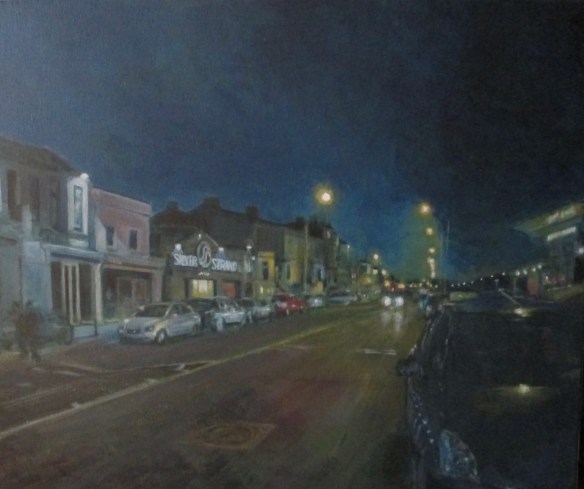
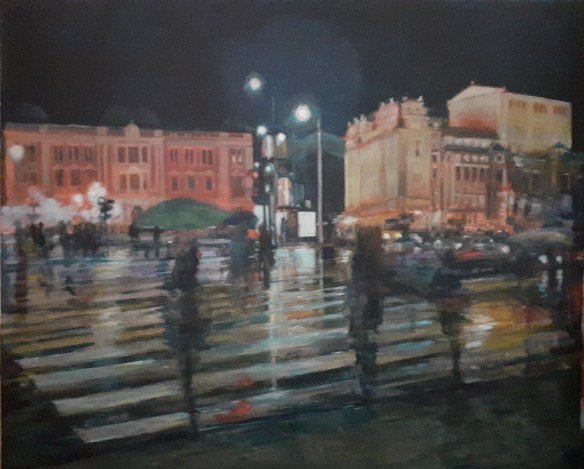
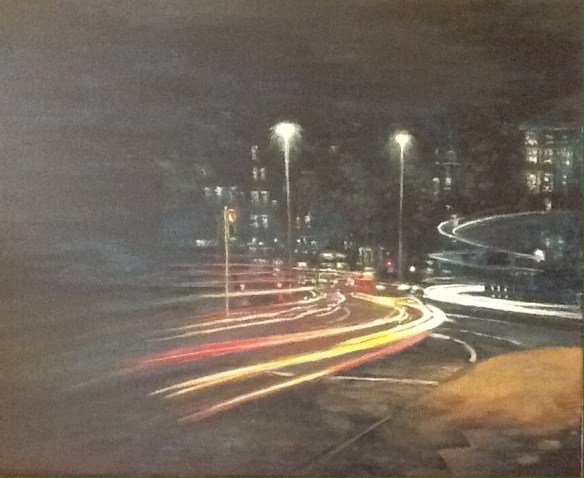
Most paintings I do of places I have been are night time scenes. I do daytime paintings too, and I do go out during the day; I am not a vampire. It does strike me though, that the city comes into its own at night.

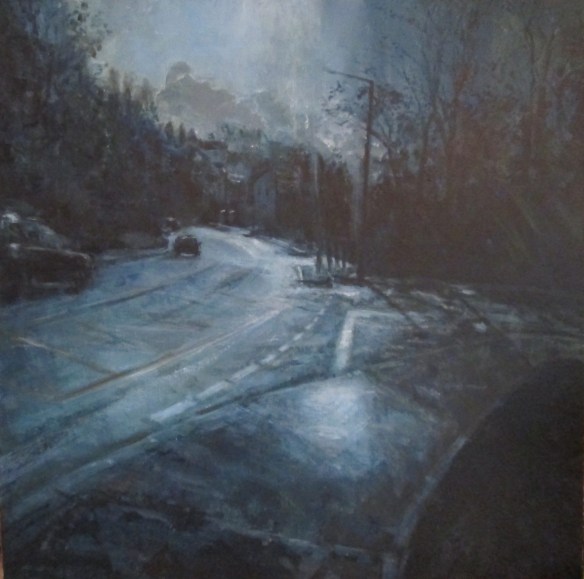
This scene suggested itself at the start of our great isolation. It called to mind many things urban and attractive, and even a little bit alienating. The umbrellas recalled Renoir’s Les Parapluies. Bunking off school, I’d take a 50something bus across Dublin’s slate sea to the city centre, hiding out at the movies or in Dublin’s Municipal Gallery, now the Hugh Lane. My favourites there were Harry Clarke’s Geneva Window and Renoir’s painting. The painting is specific to its time and place, it manages also to be universally evocative. Those shades of blue and grey, the dappling effect of rain and greenery, the pale complexioned lady and her russet hair, could be captured in a park in Dublin in the rain. The Window breathed with the life and fire of the city at night.

The focus of city centre, swirling lights and traffic, hurrying pedestrians, the language of traffic lights and zebra crossings are of modern times. They are everywhere. I posted a painting of Dublin’s equivalent nexus, College Green last year.

Col Grn

I’m also reminded of a visit to Granada in the rain and snow. Although the Alhambra and Sacromonte are indelible memories, an abiding image of the city came from its streetscapes at night in the rain. I wandered amongst those endless reflections that plunge from the sky to pass through the pavements, no longer solid but a membrane between different worlds. 

What do they do down there? They do much the same as us. Travelling through the city at night. But with a different perspective. The lights have their language, the stained glass sings and silent movies play across gabled ends. 

Jim Morrison sang, more or less, on LA Woman:

Are you a lucky little lady 

in The City of Lights?

Or just another lost angel

in the city at night, City of Night.

Like many drivers, for me the city and the road are often refracted through the music of the Doors. I can think of myself as a fellow traveller. The first time I went overseas was with my parents to Paris in 1971. Going home from Le Bourget my eyes fell across a newspaper in the departure lounge. Front page news of the death of Jim Morrison in the city early that morning. He was twenty seven. I was fifteen. And I was getting out alive.

Whatever memories the photo provoked, however, this particular city was anonymous. Not just in the sense that the city offers perfect anonymity, all the more so at night. But this was a scene I did not know, could not place the photograph. I had never been. Neither I, nor anyone within my ken. All the more reason then, to plunge in and make this the model for my city at night.

As I painted, songs filtered in and out. I wanted to convey that sense of movement and impermanence. That everything is nothing but light. I could be driving through the city at night, or being driven; a passenger without a destination. Iggy Pop wrote the Passenger under the influence of a poem by Jim Morrison, amongst other things. 

Get into the car

we’ll be the passenger

we’ll ride through the city tonight

we’ll see the city’s ripped back sides

we’ll see the bright and hollow sky

we’ll see the stars that shine so bright

the stars made for us tonight

Okay, for peace of mind then, the city lies on the banks of the Danube but is downstream of Budapest. Its name translates as the White City. We call it Belgrade, once capital of Yugoslavia, now capital of Serbia. This is Republic Square, the National Theatre on the right, the National Museum facing us.Will I ever go there? Perhaps someday, when I visit Europe, after the rain.


Skerries in Time

Skerries S&M2

Heading north from Connolly, the city slips behind by way of Amiens Street and North Strand. On childhood excursions this would be the route to Howth, holidaying in that exotic locale sometime in the early sixties. The line splits at Howth Junction, heading for Malahide via Portmarnock. The Dartline’s full extent runs from Greystones in the south to Malahide. Beyond that you’re on the intercity rail connecting Dublin to Belfast, a route that was initiated in 1845. 

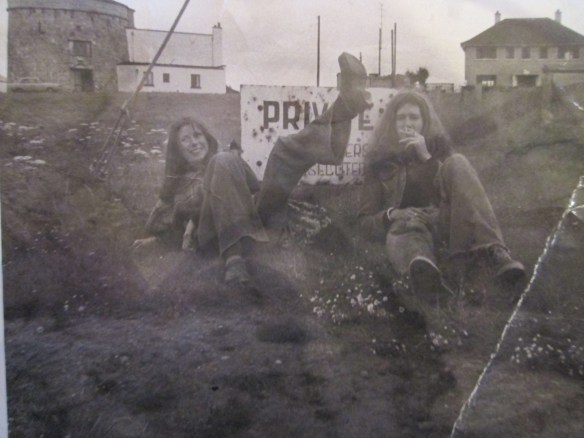
Stops in north County Dublin, or Fingal, are Lusk/Rush, Skerries and Balbriggan. I was familiar with this coastline up until my mid twenties, but other than a few DART trips to Howth and Malahide, and zipping through on a few excursions to Belfast, I haven’t given it much thought since. Recent outings in Drogheda and Swords have brought memories flooding back. Family picnics of old, by bus, train or Morris Minor, turned to teenage joyrides by whatever means possible. Bus train and whatever motorbike or banger we’d managed to hammer into a serviceable condition. Such bright ideas as we have in youth. Swimming with our clothes off. Swimming with our clothes on. There was, I suppose, an anonymity about the North County back then.

IMG_5165A little tweak of memory and these lines occur:
If you’re travelling in the North Country fair,

Where the winds hit heavy on the borderline,

Remember me to one who lives there,

She once was a true love of mine.

Bob Dylan wrote Girl From the North Country in 1963 after hearing Martin Carthy sing Scarborough Fair. I am travelling inside, back to my own North Country. I am scribbling my list of places to revisit when all the hard times are past. Here’s hoping. But, I can haunt Skerries as much as it can haunt me on this retro trip. 

Skerries is every inch the old fishing village, it sits within a ragged coast of inlets and rocky islands. These islands gave the town its name which is of Viking origin. There’s Shenick Island with its Martello Tower, St Patrick’s, Colt, Red Island and another Martello, and most famously Rockabill, really two islands, the cow and the calf, with its lighthouse.

With a name like that, little wonder that Skerries has a musical twang for me. I might make up a past of ducktails and sideburns, hair-oil, drainpipes and blue suede shoes. There’s be mods and rockers in some terrible tableau along an endless boardwalk. And maybe it would all segue into Springsteen and some love wrought beat ballad with a backdrop of carnival lights reflecting in the chrome of a convertible. But, to be honest, I’m back in the seventies, and there wasn’t that much colour and light. But there was some.

IMG_5162

Red Island Holidays Camp was as wild as it got.  It was built in 1947 by Eamonn Quinn who later established the Superquinn chain. Quinn also built the Bray Head chair lift in 1950. Red Island mirrored Butlin’s at Mosney a few miles up the coast. The camp had two hundred and fifty bedrooms. Business faded in the late sixties and the holiday operation closed in the early seventies, though the ballroom continued as a venue into the eighties. 

By the time we hit Red Island, its lustre was fading. There was a New Year’s gig we somehow got to with Horslips playing and Larry Gogan as MC. Larry Gogan had been the Pop DJ fixture for our lives since the Beatles first LP. His patter that night included the phrase: “Hey, it’s great to be young,” which I suppose is relative. I reckon Larry would have been pushing forty just then, and maybe didn’t quite have complete identity with the teens and twentysomething hippies and freaks reeling and rocking to Horslips. But the vibe was good. Gogan, in a later interview, mentioned the night which was broadcast live on Radio na Gaeltachta, but omitted Larry’s patter for being in a foreign tongue. Quel Dommage. 

All the camp buildings were demolished in the 1980s, so only the Martello Tower remains in a parkland setting. Just a memory then. Another memory fades in: a carpark on a warm midsummers night. The Yacht Club was open for business but packed. However the music played full blast into the night to where the crowd had spilled outdoors. The song, Steely Dan, Haitian Divorce, soaked into the deep blue sky and over the sailboats bobbing in the harbour; as we danced till dawn in the seabreeze.

She takes the taxi to the good hotel,

Bon marche as far as she can tell

She drink the zombie from the cocoa shell

She feels alright, she get it on tonight,

Mister driver, take me where the music play.

Papa say: Oh -oh, no hesitation,

No tears and no hearts breaking no remorse.

Oh -oh, congratulations,

This is your Haitian Divorce.

The girl I danced with would be my wife. Still is. The number appeared on the Royal Scam, one of my favourites. Incidentally, Larry’s favourite album was the Dan’s Katy Lied.

IMG_5169

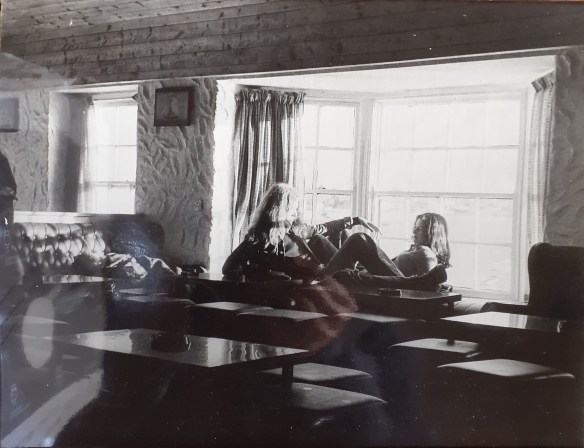
There were times when groups of us took holiday cottages in Skerries. Friends of ours took one for the summer, commuting to Dublin for work on weekdays. Weekends were party time. A favourite haunt was Joe May’s pub. Upstairs, we could lounge in the great bay window looking out at the harbour. Going through these old seventies photographs I’m struck by how empty the place seemed. I remember the pubs being packed at night, but during the day, here as elsewhere, we might have had the world to ourselves.

Skerries S&J

Greystones Station

Greystation

South of Bray Head, Greystones village developed with the coming of the railway in the 1850s. The line opened in 1855, connecting the area, via the spectacular cliff route, to Bray. From there, two lines connected to Dublin: the coastal route to Westland Row, and the now defunct Harcourt Street Line.

The stop was originally named for Delgany, which was then the larger settlement further inland. The Station became Delgany and Greystones and by the turn of the century, finally, just Greystones. By this stage Church Road had developed as the growing town’s Main Street between St Patrick’s Church of Ireland at the North extreme and the Station, situated at the slight bend where the descending street almost meets the coast. From here on, the thoroughfare becomes Mill Road, with the Burnaby Park to one side, and the railway line and the beach to the other. Squeezed in between are the Carnegie Library from 1910 and two modern terraces with cafes and shops. 

The Station was designed by George Wilkinson, also responsible for Bray Station and the Harcourt Street Terminus. Completed in 1859, as a two storey building it is larger than most rural stations. The entrance porch with its three high glass fronted bays, is attractive and opens onto a small plaza. Connection to the DART service was completed in 2000.

In this acrylic, crowds mill about the entrance on a night in late Autumn. Church Road is behind us, and, beyond the station to the right, Mill Road heads south towards the beach and Delgany. It’s about 8.30, and I am in fact coming out of the station. I will turn and enter the Burnaby Pub, established in 1881, where I will have a few beers with my friend Bill, (Hi Bill!). This is a thing I am looking forward to doing again, a lot. Meanwhile the painting will be a compensation, of sorts.

Kilkenny

KKcanice1

Kilkenny, with a population of twenty six thousand, is Ireland’s smallest city, but packs enough history and spectacle to compensate. St Canice established the name in the 6th century. His monastery was built on a rise by the Breagagh River, near its confluence with the River Nore. By the Norman invasion of the twelfth century, this had become a significant settlement. Kilkenny was granted its city charter by King James I (VI of Scotland) in 1609. The term city is vexed; it has not been administered as a city under local government law since the mid nineteenth century. Locals are touchy on the subject, however, so city it is.

KK Lib

We park on John’s Quay, on the eastern bank of the River Nore, near the library, a quaint compromise of the grand and the dainty. It’s a short walk up the river banks before crossing John’s Bridge, with views of mighty Kilkenny Castle downstream.

In Kilkenny, it is reported

on marble stones there as black as ink,

with gold and silver I will support her,

but i’ll say no more now, till I’ve had a drink.

Across the river to the right is Tynan’s Bridge House, one of my favourite watering holes here. Established in 1703 as a grocers and pharmacy, it has concentrated on the licensed trade for the last hundred years. Retaining much of the traditional store paraphernalia, Tynan’s is a richly atmospheric time capsule. In Kilkenny, there’re so many fine pubs to choose from. Just enjoy.

KKcats

More than beer, even more than history, Kilkenny prides itself on its prowess in the most Irish of sports: hurling. Played by wild, skilful men with curved wooden sticks, at its best by men in black and amber striped shirts, a statue to the art of hurling stands at Canal Square nearby. The sculpture by Barry Wrafter, a Clareman, was unveiled by Brian Cody, Kilkenny hurling manager, in 2016.

KK almshs

Rose Inn Street curves up from the river, passing the ancient gable fronted Shee Almshouse. Built in 1582 by powerful merchant, Richard Shee, to accommodate twelve poor people of the city, it operated as an almshouse until the eighteen thirties. It became a hospital, and later a shop. It is now the tourist office for the city.

Topping the rise, the vista opens onto a central square of sorts. The Parade forms the main esplanade leading to the Castle. The original castle was built by Richard De Clare, or Strongbow, in 1173, on the site of the kings of Ossory. The Fitzpatricks. despite the Fitz, were Gaels, not Normans. Fitz was a later affectation, their original name being Mac Giolla Phadraig, servants of St Patrick. The first stone castle was built in 1260, and three of the original towers survive.

KKcastl

The Butler family took control in 1391. James Butler, first Duke of Ormond, inherited the Ormond title in 1634 when the senior line became extinct. He was a Protestant, trumping Catholic claimants. The Duke commanded Royalist forces in Ireland during the Civil Wars of the mid seventeenth century. Butler was caught between Cromwell’s forces on one side, and the Catholic Confederates on the other. These included Butler’s Catholic kinsmen, with whom he would eventually find common cause in opposition to Cromwell. 

Cromwell would prevail. He besieged Kilkenny, the Confederate capital, his forces destroying the east wall and north eastern tower of the Castle. Butler, reinstated after the Restoration, became Lord Lieutenant of Ireland. He was responsible for the modernisation of Dublin, initiating the construction of the Liffey Quays. He remodelled Kilkenny Castle as we see it today. Cromwell’s own remodelling was thus adapted and dismissed, the structure no longer thought of as a fortress but reimagined as a grand chateau.

KKtholsel

High Street is the main drag. Bustling and hectic, it is visually distinguished by the intrusion of the Tholsel into the thoroughfare. Built in 1761 as a tollhouse, it later became the courthouse. The distinctive arcade straddles the pavement, providing a cover for buskers and traders, lending a European ambience to the place. It functions today as the City Hall.

Behind the Tholsel, St Mary’s Lane provides a detour, encircling St Mary’s Church with its medieval museum. We pick our way through to St Kieran’s Street, a narrow laneway lined with trendy boutiques and bistros. Time for a caffeine hit and there’s a good sheltered outdoor perch at the Yard Cafe.

KKlane

Opposite the Yard is Kyteler’s Inn, with a colourful history dating back to the fourteenth century. Its original proprietor was Alice Kyteler, who amassed a fortune and a foursome of deceased husbands. To misquote Wilde: to lose one husband may be regarded as a misfortune, to lose four looks like carelessness.

Her first husband was the charmingly named William Outlaw. She then married Adam le Blund, a moneylender, and with him was accused of killing Bill. The case failed, though the reputation stuck. Not that it discouraged hubby number three, Richard Valle, a landowner, nor John Poer, who filled the role of number four.for eight years. It was he who expressed the suspicion that he was being poisoned and on his death in 1324 progeny of the Dead Husbands’ Club filed proceedings against Alice for murder and witchcraft. In this they were enthusiastically supported by Richard De Ledrede, Bishop of Ossory.

Ledrede, as the name implies, was no barrel of laughs. In the Red Book of Ossory he advised his priests that: their throats and mouths, sanctified to God, might not be polluted with theatrical, indecent and secular songs. He lived to be a centenarian, Best known through his connection with trials for heresy and witchcraft.

Alice was not without connections. Arnold le Poer, Seneschal of Kilkenny, imprisoned the bishop thus hampering the case. Then, the Lord Chancellor Roger Outlaw, her brother in law, shielded her from Ledrede and she was spirited away.

Her servant Petronella De Meath was less fortunate. She was burned at the stake. Under torture, she claimed to have witnessed Alice have intercourse with a demon, Robin Artisson, following an obscene ritual. WB Yeats alludes to this in his poem, Nineteen Hundred and Nineteen.

Under the shadow of stupid straw pale locks

that insolent fiend Robert Artisson,

to whom the love lorn Lady Kyteler brought

bronzed peacock feathers, red combs of her cocks.


KKkytl

St Kieran’s Street merges with High Street to become Parliament Street. Nearby, the Smithwick’s Experience is the home of Smithwick’s Ale, whose red beer was my first tipple. Take the full tour, or sample the product in a nearby bar. The Marble City Bar and Tearooms makes an appropriate choice. Kilkenny once rejoiced in an annual beer festival and while that’s long gone, the aroma lingers on.

KKcanice2

We cross the palimpsest of the old city walls and into the shadow of St Canice’s Cathedral, a thirteenth century gothic fortress of god, with high crenellated walls and a stout central tower resting on black marble columns. All this augmented by a 9th century round tower, a hundred feet tall. The top is accessible by steps, one of only three such in Ireland. We stay earthbound, amongst the graves and greenery at its base, our eyes drawn heavenward.

Back in the real world, we zig zag our descent to the Nore. Another ancient landmark, Rothe House, was built in the English Renaissance style by merchant John Rothe Fitz-piers, between 1595 and 1610. It consists of three houses with the city walls forming part of their curtilage. The facade features a recessed arcade and a high gabled central bay. Today it houses a museum.

KKRothe

There’s time for a coffee and a snack before the drive home. We find Kafe Katz as the rains come down. The atmosphere is sublime. Here in Kilkenny, it’s raining cats and dogs.

Well I’m drunk today, I am seldom sober,

A handsome rover from town to town.

Ah but i’m sick now, my days are numbered,

Come all ye young men and lay me down.

The traditional song, Carrickfergus, which mostly concerns Kilkenny, comes to us via Peter O’Toole and Dominic Behan. Bryan Ferry supplies a favourite version on his album: The Bride Stripped Bare.


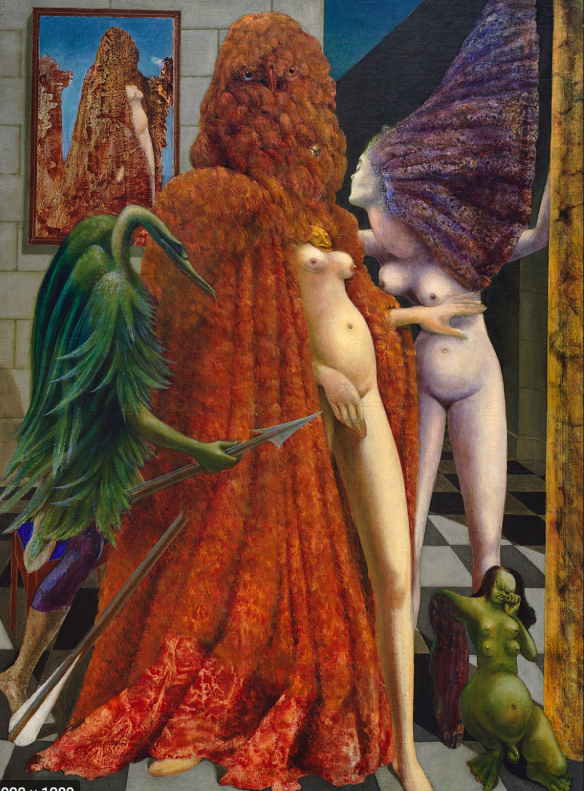
By her bachelors even?

Drogheda

IMG_4564

Drogheda guards the mouth of the Boyne, just thirty miles north of Dublin city centre. With a population of forty thousand it is Ireland’s largest town, the sixth largest urban centre after the major cities. It is one of Ireland’s most ancient towns. Although myth persists that it developed in Celtic times, there is no solid evidence of this. Nor, unlike other large settlements like Dublin and Waterford, were the Danes prominent. It fell to their cousins the Normans to establish the place.

In Ireland’s ancient east, the Boyne valley has long been a crucial axis. Newgrange is situated just five miles to the west, indicating that the area was well settled by neolithic times, c. 3000BC. The hinterland of County Meath terminates at this coastal appendage. Meath in Gaelic denotes the middle, and this was the centre of Celtic power radiating from Tara. This centrality formed a constant thread in much of the tapestry of Irish history. 

We drive in early of a morning from Dublin airport, under a polished abalone sky. We’re taking the coastal route, via the growing conurbation of Laytown – Bettystown – Mornington.  This is coastal County Meath, an area with a whiff of the ancient art of seaside holidays. The behemoth of the Butlin’s holiday camp at Mosney is nearby. Once the focal point for Irish families relentless pursuit of fun, it is now a centre for asylum seekers.

I am just a poor boy though my story’s seldom told

I have squandered my resistance for a pocketful of mumbles 

such are promises

Drogbridge

A sharp turn at the mouth of the River Boyne takes us barrelling towards Drogheda. The railway viaduct dominates the scene. Designed by Irish engineer, Sir John Benjamin McNeill, using radical new techniques in its construction in1853, on its completion it was regarded as something of an engineering wonder. It is a hundred feet high with twelve soaring stone arches on the southern bank, and three on the northern, linked by three iron truss spans. Prior to completion, passengers on the Dublin Belfast line were required to hike through Drogheda to make their connection.

Drogship2

In the shadow of the southern arches, we pause at Ship Street, a quaint terrace of nineteenth century industrial houses at right angles to the river. All quiet at this hour, but just as obviously occupied. There’s a homely scattering of toys and street furniture, paraphernalia waiting for another day. A rich atmosphere of story and history pervades, emitting its own rugged urban charm.

Drogmlmt

We find a convenient parking space on South Quay. The old town and County Louth lie across the river. Along the once green, grassy slopes of the Boyne, the modern town pushes through. The fording point is dominated by an ancient defense. The motte and bailey castle, Millmount Fort, was built by Hugh De Lacy, the Norman Lord of Meath in 1189 atop a large mound on the southern bank. It has featured in Cromwell’s siege of 1649 and during the Irish Civil War of the 1922. Cromwell’s sacking of the town is one of the most traumatic events in Irish history. Cromwell decimated the garrison but also massacred hundreds of citizens, especially Catholics, in what remains a serious stain on his reputation. Today, Millmount is crowned with a Martello Tower, a link in the coastal defence chain from the Napoleonic Wars. Its appearance means locals oft refer to it as the Cup and Saucer,

DrogShopst

It’s early morning as we wend our way uptown from South Quay. There’s a beguiling mix of smalltown and bigtown, as morning deliverymen trade banter. We are included without demur. I see you’re a visitor, says one. Camera gave it away, did it? People here don’t seem shy of interaction. Topping the rise of Shop Street, another cup and saucer suggests itself with the aromatic beckoning of coffee, courtesy of Cafe Ariosa. We sit at slanted pavement tables on St Laurence Street and charge our batteries on weak sun and strong caffeine.

Drogstpete

St Peter’s RC church is the towering feature on West Street, which could be described as the town’s Main Street. Designed by J O’Neill and WH Byrne in the French Gothic Revival Style in 1884, it spears the heavens with its dazzling spire. An earlier church of 1793, designed by Francis Johnson, architect of Dublin’s GPO, is incorporated into the new church. St. Peter’s is a renowned repository of relics. It boasts a relic of the True Cross, gifted by Ghent Cathedral on account of their shared connection with Saint Oliver Plunkett. St Peter’s is famously where one can view the head of the Saint. 

Drogtrux

Plunkett was the bishop of Armagh and Primate of Ireland, beatified in 1920 and canonised in 1975, the first Irish saint for seven centuries. He was born in 1625 in Loughcrew, that most ancient of spiritual sites in Meath. In 1681 Plunkett was implicated in intrigue following the Popish Plot of Titus Oats. Attempts to try him for treason in Ireland collapsed and the authorities removed him to England to expedite conviction. Although King Charles II knew him to be innocent, he dared not intervene, out of concern for his own head, one supposes. The accusers had their way, and Plunkett became the last Catholic martyr in England, on his execution at Tyburn in 1681. His remains were exumed and moved to Germany, with the head first taken to Rome , on to Armagh and then to Drogheda in 1921, where it is housed in an ornate shrine at St Peter’s.

Droghead

By implication, West Street is mirrored by East Street across town. Now called St Laurence Street, it culminates in the former East Gate, now St. Laurence Gate. This is a barbican gate from the thirteenth century. Two huge four storey towers are joined by a viewing bridge, giving excellent views of the Boyne estuary. and at street level by a crenellated archway.

Drogate

St. Laurence’s Gate features on the coat of arms with three lions and a ship emerging from each side, illustrating the significance of mercantile trade in the town’s fortunes.The association with England, three lions and all, is also notable. None of which elements saved the town from the wrath of Cromwell. But, it survived and  prospered once more.

Returning down Constitution Hill, we cross the elegantly modern Hugh De Lacey pedestrian bridge to our car at South Quay. At this crux of the modern town, it is interesting that the featured monument is a lifesize figure of Tony Socks Byrne, who won a boxing bronze at the Melbourne Olympics in 1956. Rendered by French born sculptor Laury Dizengremel, there is something in its quiet realism that embodies the human spirit.

Drogboxr

Outside Ariosa Cafe, teetering on the sidewalk as the growing stain of autumn morning sun seeps into the monochrome. At the adjacent table an amiable gent engages passersby in verbal exchange, familiar and casual. He is, I presume, a notary of sorts, and this high street village rapport has an appropriate touch of the medieval about it. You close your eyes, and open them again. And nothing much changes through the ages. People, in whatever manifestation, in times of plenty or times of interest, are resilient. They are the essence of any place.

In the clearing stands a boxer and a fighter by his trade

and he carries the reminders of every glove that laid him down

or cut him till he cried out in his anger and his shame

I am leaving, I am leaving, but the fighter still remains

(The Boxer/ Paul Simon)

Heroes – at Butlin’s Mosney

Bob Mosney

Mosney, on the narrow tongue of Meath that  licks the Irish sea, was chosen as the site for Butlin’s first holiday camp outside the UK. It was opened in 1948 and operated as a Butlin’s camp for thirty five years. Throughout the eighties and nineties after Butlin’s pulled out it operated as the Mosney Holiday Centre. Since the turn of the century, with the holdliday camp thing becoming a thing of the past, it has been put into use as a centre for asylum seekers.

I holidayed at Mosney a couple of times, first in the seventies with my then girlfriend whose family had been regulars. Later, we took our own family, parking our caravan on site. Even back in the nineties, it was something of a blast from the past. There was a joke poster at the time for Butlitz holiday camp, a pun on Colditz. There were always jokes about forming an escape committee, and tunnelling out. But it was fun. Working class people in chalet accommodation, the swimming pool and underwater viewing saloon, ballroom dancing and music hall entertainment, bars and restaurants, the eversmiling redcoats determinedly dragooning kids and adults in bouts of organised fun. Yeah, we all loved it too. 

I remember on my first visit, in the mid seventies, where we weren’t satisfied with our chalet. We went to the complaints counter and joined the queue. Who should we be queued with only Bernadette McAliskey (nee Devlin). She was complaining too. I kid you not. In truth, she was very pleasant, and no doubt relaxed to be out of the cauldron of Northern Ireland. This was only ten or so years after the eruption of the troubles and her enfant terrible days and the Battle of the Bogside. We had a laugh, and were accommodated in our demands. Would that life were always so simple.

I drink a whiskey drink, I drink a vodka drink, I drink a lager drink, I drink a cider drink.

I sing the songs that reminds me of the good times, I sing the songs that remind me of the best times

(Oh, Danny Boy, Danny Boy …) 

This view in acrylics captures a tableau in the swimming pool. John Hinde made a famous photographic image with the vast interior caught in all its sun-blasted glory. The massive glass wall letting in the light on a feast of visual exuberance, and also conveying the everpresent cacophony of noise and motion.

My source is from a private photographic image and, I hope, captures both the crowded mayhem, and the personal intimacy at its heart. The central figure here is my father-in-law, Robert Osborne. One of life’s gentlemen, he was hewn of the old world granite of Wicklow and the grit and grime of Dublin. A Guinness man, a decent man and a family man. There is something heroic in his pose as he helps his kids into the intimidating world of the swimming pool. We can all be heroes in the most ordinary of moments.

I get knocked down, but I get up again, you’re never going to keep me down

I get knocked down, but I get up again, you’re never going to keep me down

I get knocked down, but I get up again, you’re never going to keep me down

I get knocked down, but I get up again, you’re never going to keep me down

Tubthumping by Chumbawamba. 1997.

M50 – Another Story for the Road

IMG_0072

In this painting I am returning to the Sandyford intersection on the M50, a favourite haunt of mine. Heading south towards Bray, the city expands wave by wave away to the left, the dark hills of Dublin stand sentinel to the right. The motorway sign points to the exit for Stillorgan and Dun Laoghaire.

The name Stillorgan is thought to be a Danish corruption of the Gaelic for Lorcan’s House, referring to Saint Laurence O’Toole, archbishop of Dublin at the time of the Norman invasion. Stillorgan is best known as the home of Ireland’s first bowling alley, opened in 1963, and Ireland’s first shopping centre launched in 1966. Make of this what you will. Boland’s pub at the crossroads is of the old school, and was once a haunt of Brian O’Nolan (aka Flann O’Brien and Myles na gCopaleen). I can see that.

The Orchard nearby is an attractive thatched building. I was refused service here on one occasion, singled out for my long hair amongst a party of more coiffured acquaintances. Although they stood by me, the affair rankled. Some time later, besuited, hair well cropped, I returned with a group of work associates to spend a long lunchtime wining and dining.The place being packed, I told the others I’d settle up at the counter, if they’d bring the car to the front and park on the kerb. Immediately the car pulled up, I promptly hopped in. Later, I explained why nobody needed to fix up with me. One of the best meals I ever had, there was something so satisfying about it. Which goes to show that revenge is sometimes best not served cold, but over several courses with wine.

Brussels – 2

Brus Esp

After exit, I return to the lower city by way of the sloping plaza, past an exhibition on Breughel  through the ages to a busy cafe where I claim the one unoccupied seat on the terrace. I must eat, though I am still a bit hungover from Bruges and don’t feel particularly hungry. I order a small falafel as a concession to healthy eating and shrinking wallet. My waiter is both friendly and forgetful, bringing me the large falafel and, perhaps noticing my consternation at the size of it, immediately offering it at the lower price. There’s something of a Mr Bean moment here, as I scan furtively for places to hide parts of the feast, which, in truth, is rather stodgy. But the terrace is full, and empty of seagulls and other scavangers, just when you need them, so I must soldier on.

Well stuffed, I roll down the hill and enter the picturesque and winding Lower Town. An irregular square below the station, Place de l’Albertine, is thronged with people, entertained or ensnared by street performers, hawkers and other importuners. To one side, a more elegant and ordered avenue of pleasure and commerce gives shelter.

Brus Arc

Galleries St Hubert opened in 1847 and was the first shopping arcade in Europe. Victor Hugo attended lectures here. Creator of Les Miserables and the Hunchback of Notre dam, he was a Brussels resident, exiled from Louis Napoleon’s France. Another contemporary exile was Alexander Dumas who was also an habituee of the Gallerie. Designed by Jean Pierre Cleysenaar in Neo-Renaissance style, the complex comprises three galleries, soaring impressively to a high, vaulted glass roof. It remains a popular venue after a hundred and seventy years, with luxury shops, a cinema, theatre, cafes and restaurants.

My bag is a cross to bear in the heat and the crowds. This boy is cracking up, this boy needs to sit down. I hobble through thronged ancient streets to the Grand Place where the buildings are spiked like stone meringues and tinted gold to boot. The Grand Place is well named. As the civic centre of Brussels, the square dates back eight hundred years or more. Around it have grown this selection of ornate Flemish buildings, civic, commercial and private. Most date back to the 17th century. Grandest of all amongst this jewelled crown of architecture is the Hotel de Ville with its teetering spire rising to almost a hundred metres.

Brus HdV

There are numerous bars and cafes but even more numerous people sadly, or happily for them. The secret of bars: drink early, drink often is being well observed. However, an articulated vehicle like me needs room to park. I walk on by lively hostelries with no room to spare. I find the Church of St Nicolas which honours the patron saint of merchants. I’ll bet. Shops and houses cling to its outer walls, these, more than its modern gothic facade, manage to hint at the church’s ancient origins in the twelfth century.

Brus St Nic

At the edge of this medieval labyrinth, the modern, neo-classical city emerges. The Belgian Stock Exchange, La Bourse, is an impressive Palladian palace from the 1860s. Designed by Leon Suys, the facade features an extensive frieze extolling the virtues of international trade. The French artist, Albert Carrier-Belleuse was responsible. His Brussels studio was a refuge for Auguste Rodin following the collapse of the Paris Commune in 1871, and many credit him with the section on the south wall representing Asia and Africa. However, local artist Antoine Van Rasbourgh is officially credited. Today, the building stands amidst a chaos of construction, which somewhat mute the joys of pedestrianisation.

Brus Lr Tn1

I turn south on to Boulevard Anspach where I find O’Reilly’s Irish Bar with room to sit over a pint. Much put upon barman is commandeered by a pillock ordering eight Irish Coffees in a heatwave. More absurd still, there is only one barman. The street itself is edgy and crowded, though with that life and lust in its inhabitants to suggest the defining purpose of Brussels over centuries. There is all the mixture one would expect in the melting pot of Europe, a vibrant, if not always elegant, reflection of the sculptures on the Bourse.

Lone barman, dopey clients or no, I find my seat in the sunshine, and I force in two pints before five thirty when I must make my way back to Central Station to make my connection for the airport, and home to Dublin.


Lynott

Phil Lynott awaits me in Dublin, outside Bruxelles.

Brussels – 1

Brus Bldng

Took the train to Brussels in the morning, a one way ticket costing 14 euro. Bruges station is neat and modern, but again I’m flummoxed by Belgian Rail time and platform postings. A certain amount of questioning and haggling is required before I get the intended train. I nick into the first class carriage and the ticket men don’t seem to mind. Still, arrive in Brussels hot and bothered.

A bag is always heavier on the journey home. And the sun hotter. Sweating out of Brussels Central, I put into the first bar for a healing Stella. Reassuringly expensive. The bar is a rudimentary affair, at the apex of a triangular city block and of a steep climb from the station. I hadn’t thought of there being hills in Belgium, but nonetheless they are there. The capital is riven by a pronounced escarpment. The old town lies on the low level, the new town, in all its quasi imperial grandeur, occupies the higher ground. Literally, at least. Figuratively, the infrastructure of the European capital must always imagine itself on higher ground than its chaotic and oft implacable citizenry. Twas ever thus throughout empire and federation.

With a day to kill, I’ve opted to explore the Musee des Beaux Arts, and that precinct of museums and galleries known as the Hill of Arts. There’s a whole forest of museums and galleries lodged in Neo-Classical palaces up there. To see them all would demand a longer trip.

Brus Sax

A pleasant sloping esplanade leads uphill. At the top, a busker has nabbed a small amphitheatre provided by the topmost flight of steps. To a jazz backing track, he’s blowing out some wonderful saxophone. No better place. This is the hometown of Adolphe Sax, who invented an instrument which allows musicians to leak their soul directly into the air. Sax was born in 1814 to parents who were themselves instrument designers. His innovations were greatly praised by Hector Berlioz. Berlioz composed Symphonie Fantastique under the influence of opium, later claimed to be the first essay in psychedelia, so there is something prescient here considering the future influence of Sax’s instruments. His crowning achievement, the saxophone, was developed in the 1840s. Never popular with orchestras, its use for long was confined to brass bands. The jazz era brought its heydey as a sublime instrument for the soloist. It’s hard to imagine music of the jazz/blues/rock genre without it. He died in 1894, in Paris and in poverty.

Learn to work the saxophone

I play just what I feel

Drink Scotch whisky all night long

And die behind the wheel.

Brus Ol Eng

Nearby, as Rue Ravenstein curves into Place Royale, an Art Nouveau masterpiece houses the Museum of Musical Instruments. Old England, was designed by Paul Saintenoy in 1899 to house the eponymous department store. It is a gorgeous confection of swirling metal and glass, but structurally and functionally pragmatic. The use of steel frame allowed curtain walls of glass, flooding the interior with light, indeed dissolving the divide between exterior and interior. Old England exemplifies an architecture that conjures the sinuous art and music, and sociological revolution of its era. Appropriate therefore that it provides a new home for the Museum and its extensive collection of instruments, wind, string and keyboard, from medieval times to the present. There are, of course, several prototypes of the work of Adolphe Sax.

They got a name for the winners in the world

I want a name when I lose

They call Alabama the Crimson Tide

Call me Deacon Blues

(Deacon Blues, Steely Dan)

The Musee des Beaux Arts is divided into three parts, with inclusive entrance at 15 euro. Occupying the main Grand Palace are the Old Masters while below stairs you’ll find art from the Fin de Siecle. In a building all to itself, linked by an underground passage, is the life and work of Rene Magritte. I purchase an audio guide for a fiver, but it wasn’t really worth it. Artspeak linked with stating the bleeding obvious, as: here we see a man looking out a window. Well, yes.But the exhibitions are well worth it, and informatively captioned. It’s stocked to the eyeballs with Brueghels, Reubens to the rafters, and every Van the Man you might desire. 

Brus Bru2Brus Bru1

Particularly fascinating are the cover versions of Peter Brueghel the father by his son. Winter Landscape with Bird Trap is lovingly rendered by the son. The Census at Bethlehem is another example of the Younger’s faithful reproduction of the Elder. I play spot the difference to little avail. The palette is slightly different, but they may as well be photographic reproductions. Perhaps, with a few more hours to spare … Hieronymous Bosch is another favourite featured here, and oportunity too, to swim in the paint of titanic Peter Paul Rubens. In the Assumption of the Virgin from 1610, Our Lady in blue sails majestically heavenwards. It’s a fine example of the Baroque, Rubens grafting his Flemish precision with Mediterranean passion.

Brus Rub

Below stairs, the Fin de Siecle collection is housed in pleasantly weird serenity. Ever descending spirals of cool and dark and increasing loneliness. There’s a Sisley amongst several shimmering landscapes and cityscapes as the years fal like leaves towards modernity. I rest for a bit in this ambience, before confronting the eye bombs of Magritte to come. 

There’s a lot of Rene, with a concise chronology of his life and work. A strong focus on his graphic work, which is not surprising for an ex dadaist. A communist too, with many other Surrealists, though I recall he took exception to the public disparagement of his wife Georgette’s Catholicism, which distanced him from the movement.

Brus Mag Emp

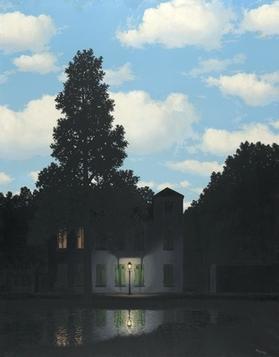
I finish with the Empire of Light. This series of large paintings features a nighttime suburban street beneath a daytime sky. There are a dozen or so versions, each subtly different. The design of the house, the street furniture, the surrounding trees; but the composition is always a flat representation, with one streetlight, a window or two dimly let, all wonderfully serene and deserted. Standing amongst several versions here, gives the feeling of actually inhabiting Magritte’s street, his very imagination. You can relax with a Magritte, though perhaps as one might lie with a sleeping tiger, but soon both will awake. Reluctantly I leave behind a weird and terrible beauty. Interestingly, the Empire of Light was cribbed for a scene and the poster for the sensational 1973 horror film, The Exorcist.

Just walk away Rene

you won’t see me follow you back home

the empty sidewalks on my block are not the same

you’re not to blame.

(A first hit for baroque pop group, Left Banke, and a cover version by the Four Tops.)

Bruges – 4. City of Light

Brug4coup1

The French under Napoleon ruled Bruges from 1795 until 1814 when the area became part of the Kingdom of the Netherlands. That only lasted until Belgium gained its independence in 1830. French was initially the official language, but Flemish was recognised by the start of the twentieth century. It is the principal language of Brugge and northern Belgium. 

Bruges makes a fine character in a novel. The quays, the labyrinth of streets and canals, the Beguinage, churches and belfries, the real and reflected appear simultaneously in the visual and written world. In Rodenbach’s novel, photographs are used to add an extra dimension to this identity.

IMG_4756“Bruges was his dead wife. And his dead wife was Bruges. The two were united in a like destiny. It was Bruges La Morte, the Dead City, entombed in its stone quays, with the arteries of its canals cold once the great pulsing of the sea had ceased beating in them.”

Words, image and mood melt into a form of music. Stand anywhere in Bruges and sense the still water of the canals, search for the distant pulsing of the ocean. Look into the depths, and see them stare brazenly back. Hugue is smitten with Jane, the dancer. who, as in a mirror, is a reflection of his late wife. An actress is but a mirror, fashioning the face of your heart’s desire. You have used that mirror and, when you think of it, everyone loves themselves. Narcissus is portrayed, too ardent by far, mesmerised by his own reflection in a pool. So, when Hugue commutes with his wife through a mirror, with whom is he really talking? And when Hugue strangles Jane, his wife’s reflection, who is it that he kills?

Brug4eve

On the second evening I dine in a place called the Old Bruges. One side looks onto a little square where the canal turns, the other onto the now quiet Vismarkt. I order Flemish Stew which is a goulash equivalent, and a few steins of beer. Beer is expensive, but it’s strong, with a rich variety available throughout the city. And, I suppose, a certain unreliability of narration may ensue, here or there.

Nearby, a young Australian holds court. I overhear most of the conversation, without committing it to memory all that accurately. It was enjoyable more in the manner of an abstract painting, or a drum solo. The story includes a dwarf and a prostitute. The narrator’s acquaintance prompts, jovially, that the line should read: a dwarf and a prostitute walk into a bar. Who knows where this is heading. Who shall give and who receive? Does someone call them a pink lady and a small one? 

IMG_4834

The story merges in my head with McDonagh’s narrative In Bruges, wherein Colin Farrell’s character befriends a vertically challenged actor during a Bacchanalian interlude. The dwarf will intervene with devastating and ironic effect in the film’s denouement. Farrell has, after all, killed a small boy, an altar boy, in his botched assignment. This macabre dance with death circles the dizzying spire of Our Lady’s, where love and sacrifice are given expanded meaning. Farrell, no more enamoured of the city, complains he doesn’t ‘want to die in Bruges’.Or perhaps he’s just curious for more. 

Later, I am in Delaney’s Bar, seated next to a couple from the nearby Dutch town of Breda, a place I know of vaguely. There was a battle there, long, long ago. It features in a book by Carlos Perez Reverte. They have a festival based on the colour orange, which probably dates back to King Billy. As the dry heat of the day wanes to a cooler humidity. It will rain, says the young man. But when? Oh, give it ten minutes. In his hand, the screen on his phone shows a jagged peak within the next ten minutes. We wait, and it comes to pass. These are the days of miracle and wonder, so it is no surprise that people can capture electricity in their hands and with it arrogate the magic power of prediction. Here was a man with the power of rain in his hands. I asked him could he make it stop, as I was about to make my way home. But he laughed and said that no, he could not.

Brug4str

I sloped off by way of colonnades and the shelter of trees, the cobbles slick with rainwater and electric light. That was when I found myself lost, if you catch my drift. In the giddy valley of cathedral spires and teetering turrets, the alleys threw themselves into ever increasing spirals, farther and farther away. I asked directions of a waiter, who had retreated from the heat of the kitchen for the balm of a well earned smoke. He pointed me back the way I had come. Reluctant to accept this defeat, I returned to where I had spied a sliver of canal slip behind some buildings and took what I judged to be a parallel lane. Dark, deserted, and eminently paranoia inducing, it twisted and turned before curving at last onto Rosenhoedkai. I was no longer lost, but not quite found.

Brug4dklane

A love struck Romeo sings the streets a serenade,

laying everybody low, with a love song that he’s made,

finds a convenient streetlight, steps out of the shade,

says something like, you and me babe, how about it ,,,

Stars spring from the canal depths. Along the quays, nighttime beckons. I’ve been whistling past the graveyard so that the melody haunts me still. An opera for our age, terse and tunnelling through our formation. Mark Knopfler singing, as an aria should, of love and an Italian girl.


All I do is miss you, and the way we used to be,

all I do is keep the beat and the bad company,

all I do is kiss you, through the bars of a rhyme,

Julie, I’ll do the stars with you, anytime.

The next day I return to the old city walls to complete my semi-circling of the city. The eastern precinct includes the Coupure and the outer canal. This houses larger and more long haul canal craft. You can book canal tours here but the atmosphere is distinctly local and feels remote from the bustling tourist scene at the centre. My camera battery went kaput at the same time, so I’ve only my soul and memory to call upon, which seems about right.

brug4coup4

I had intended availing of the Breydelhof’s free bicycle, but these boots are made for wandering, and who knows where they’ll take me. Last night I was lost in Bruges, and today I try for a similar state in daylight. With some success. Crossing old tracks I experience the pleasure of recognition, the uncertain traveller’s concept of home.

Mainly, I was distracted by my own meditations. As evening waxed, I had been thinking of the possibility of finding God in a bar, as Joan Osborne might have speculated.

If God was one of us

just a stranger on the bus, just a slob like one of us,

trying to make his way home.

I must find my way back up to heaven all alone. God might be in the next bar, which is pulsing unsteadily across the Vismarkt. Slouched there at the corner peering into the shrinking muniscus of his pint, apart from the crowd and not exactly pleased to see me. Catching him there, I could ply him with drink, insist on answers to those great questions: why are we born to suffer and die, where might I find the Golden Fountainhead. It must be here somewhere, in this city of chocolate, waffles, and fine beers. 

Brug4vismk

There is an Argentine restaurant on Flammingstraat, north of the Market Square. They serve steak, grilled to perfection. Within the darkwood interior, evening sunlight intrudes in a solid shaft, a slant off the horizontal. We are all reduced to silhouettes. It is the perfect condition for the near slumber of after dinner. My stein of beer still froths. I look down the room towards the window. Other diners dance mellowly in the glare while theatrical gauchos flit in attendance or ennuie. I am briefly blinded by the glare, abruptly occluded by my waiter. We share an acknowledgement, and as he moves aside, I see at last, the Golden Fountainhead.brug4fhead