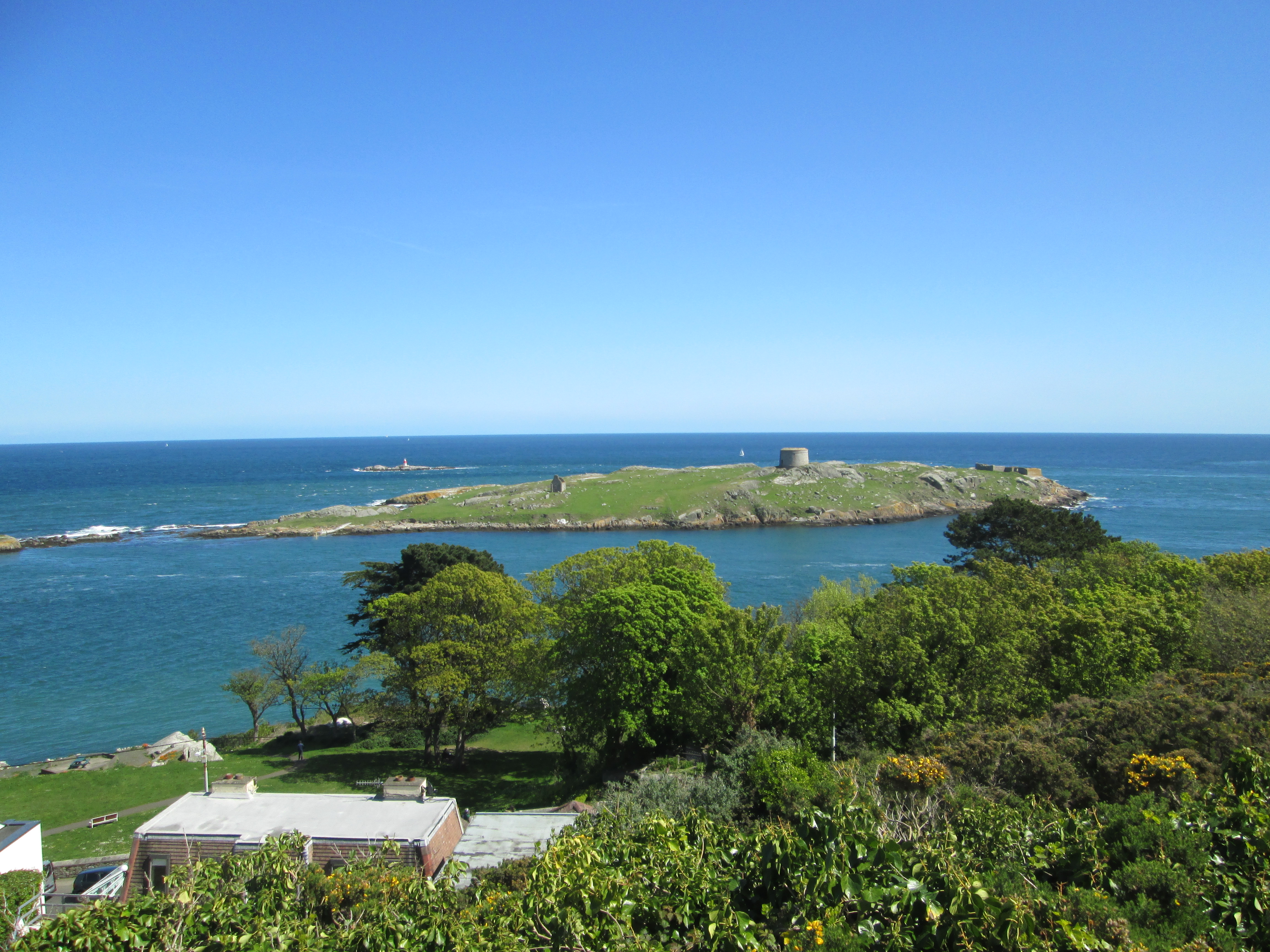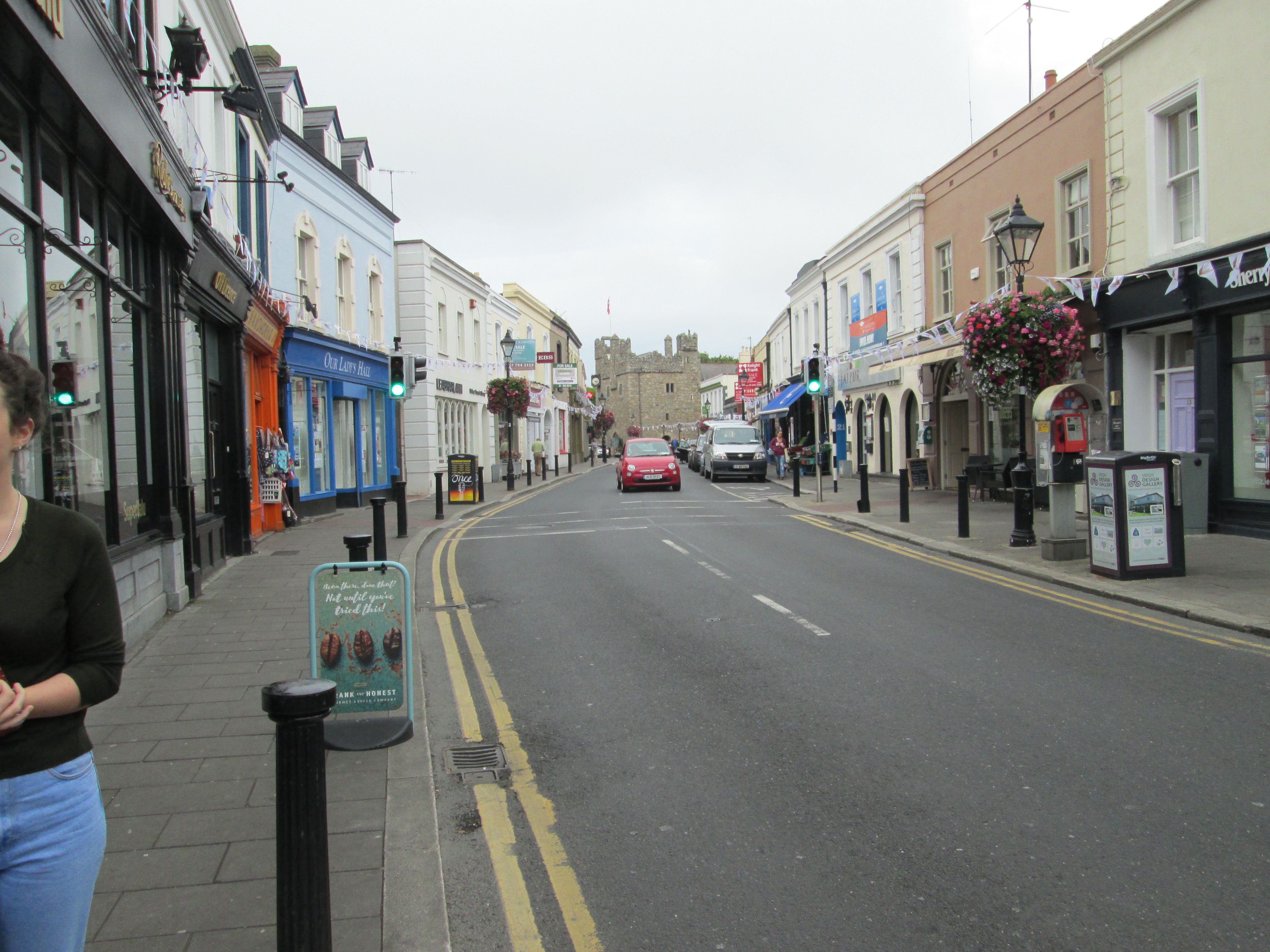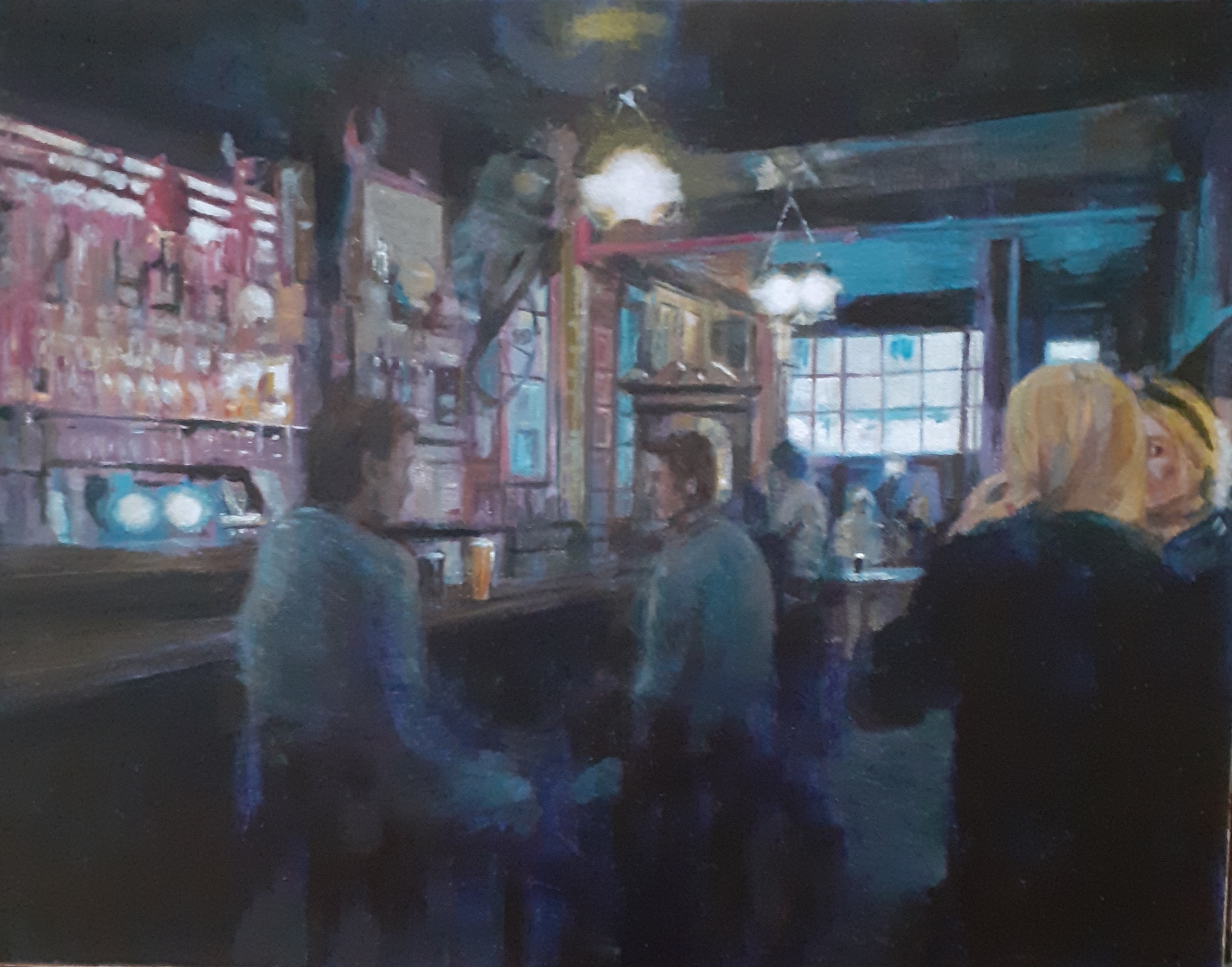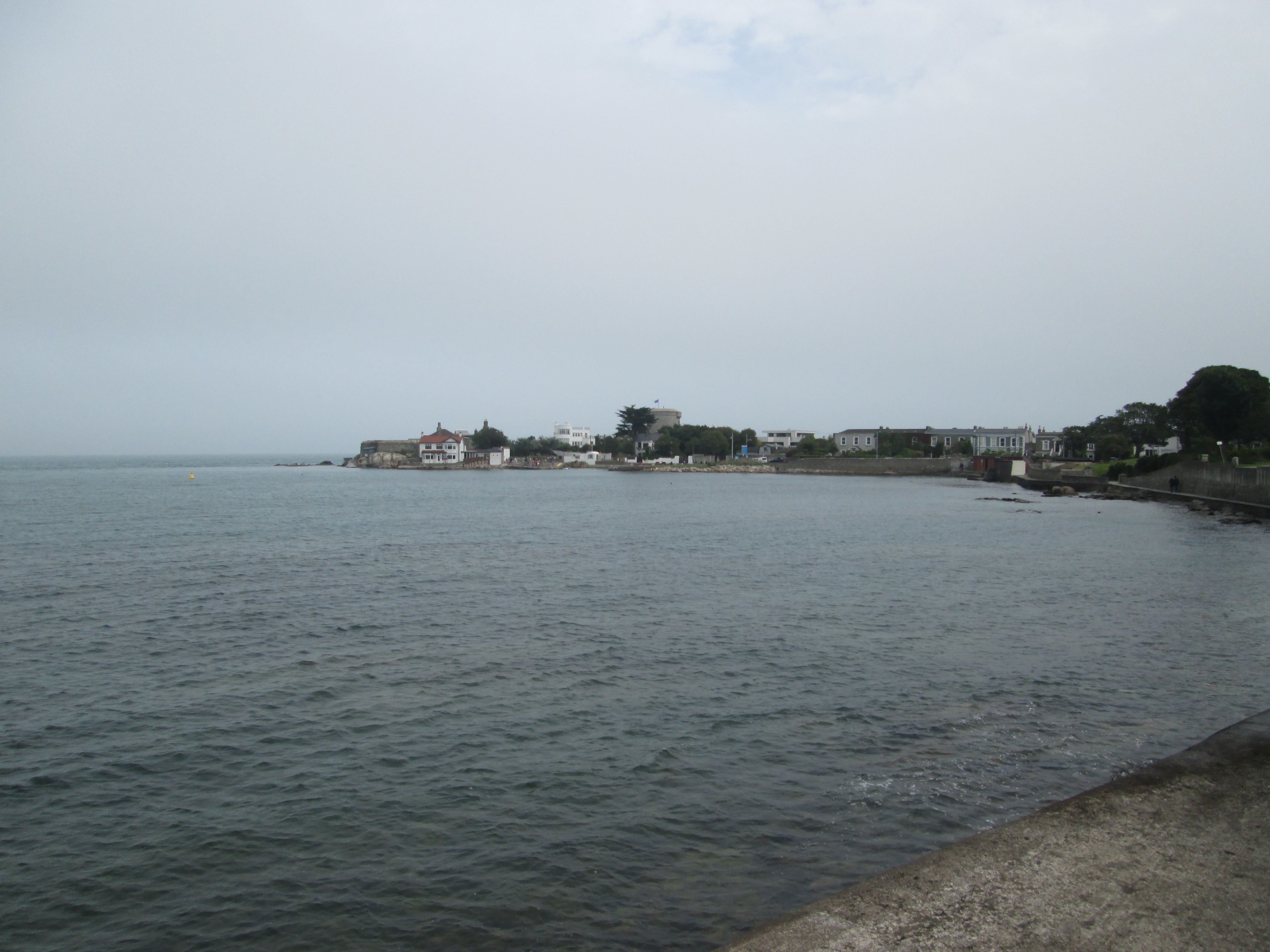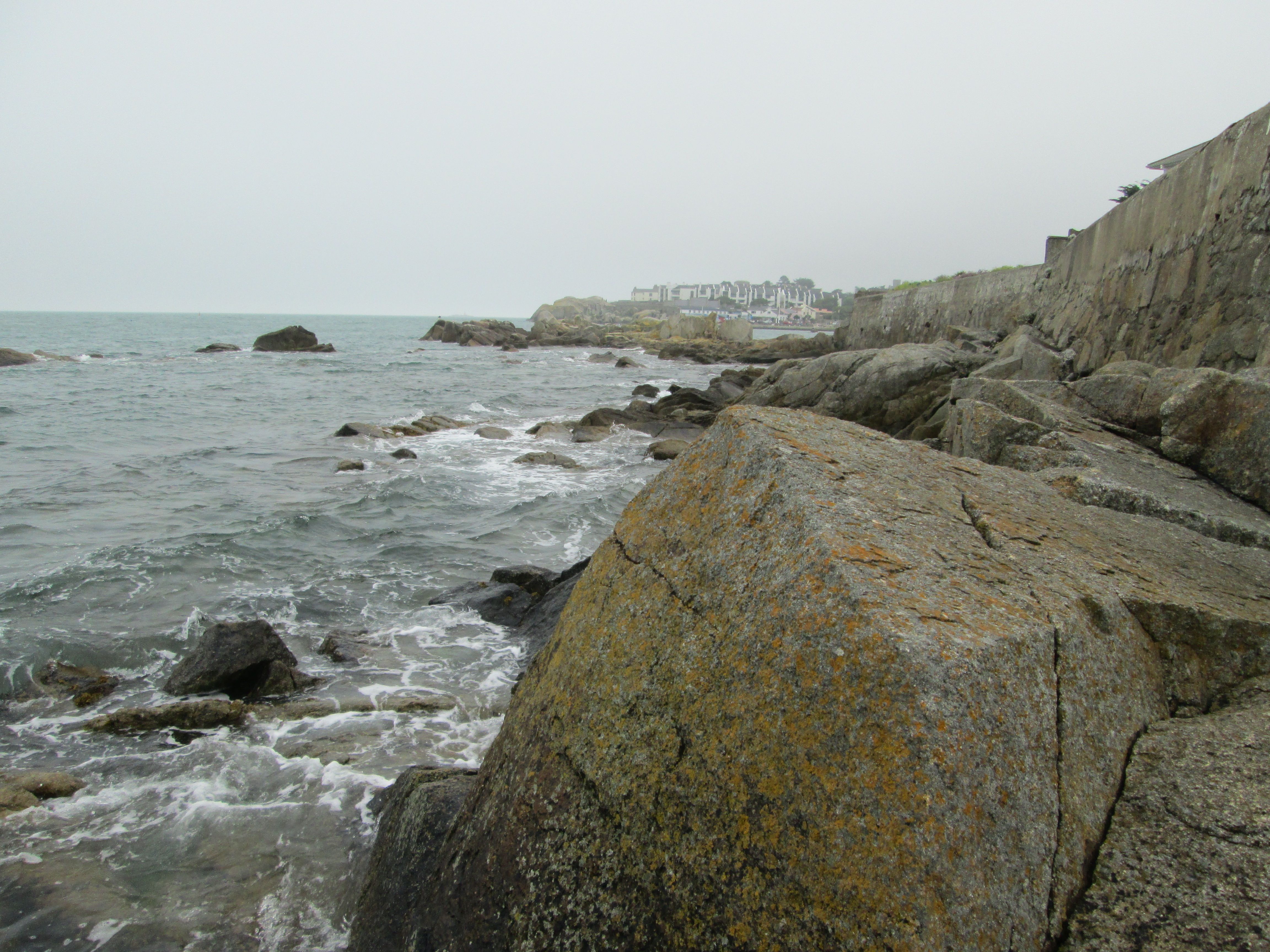
South Dublin’s Rocky Shore – 5

Back to Old Dun Laoghaire

I was singing a song I heard somewhere

called Rock and Roll never forgets

when my humming was smothered by the 46a

and the scream of a low flying jet

The railway rumbles on beneath our feet. Ghost ships sail into the harbour. The 46a is due. Dun Laoghaire  grew out of this nexus of travel and communication. The Harbour was born from a suggestion of William Bligh, who picked Dunleary as the site for a harbour of refuge. Bligh had been brought in to address the problem of silting in Dublin Bay. His year long survey of the bay led to the building of the North Bull Wall, though the eventual project differed from his original suggestions. He recommended the need for a second great wall from the north shore of the bay to complement the South Bull. Work began in 1818 and was completed in 1824 to a length of 3,000 metres, a third longer than originally planned. 

Bligh served under Captain James Cook in the Pacific, and saw war service against Dutch and French. He commanded the Bounty on its voyage to Tahiti in 1787. On the return, his crew, led by Bligh’s young friend and protege Fletcher Christian, mutinied. Bligh and some loyal crew were set adrift in the Pacific with a few days supply of food and water. Under Bligh’s astonishing leadership, they survived the 47 day, 3,618 mile journey.  

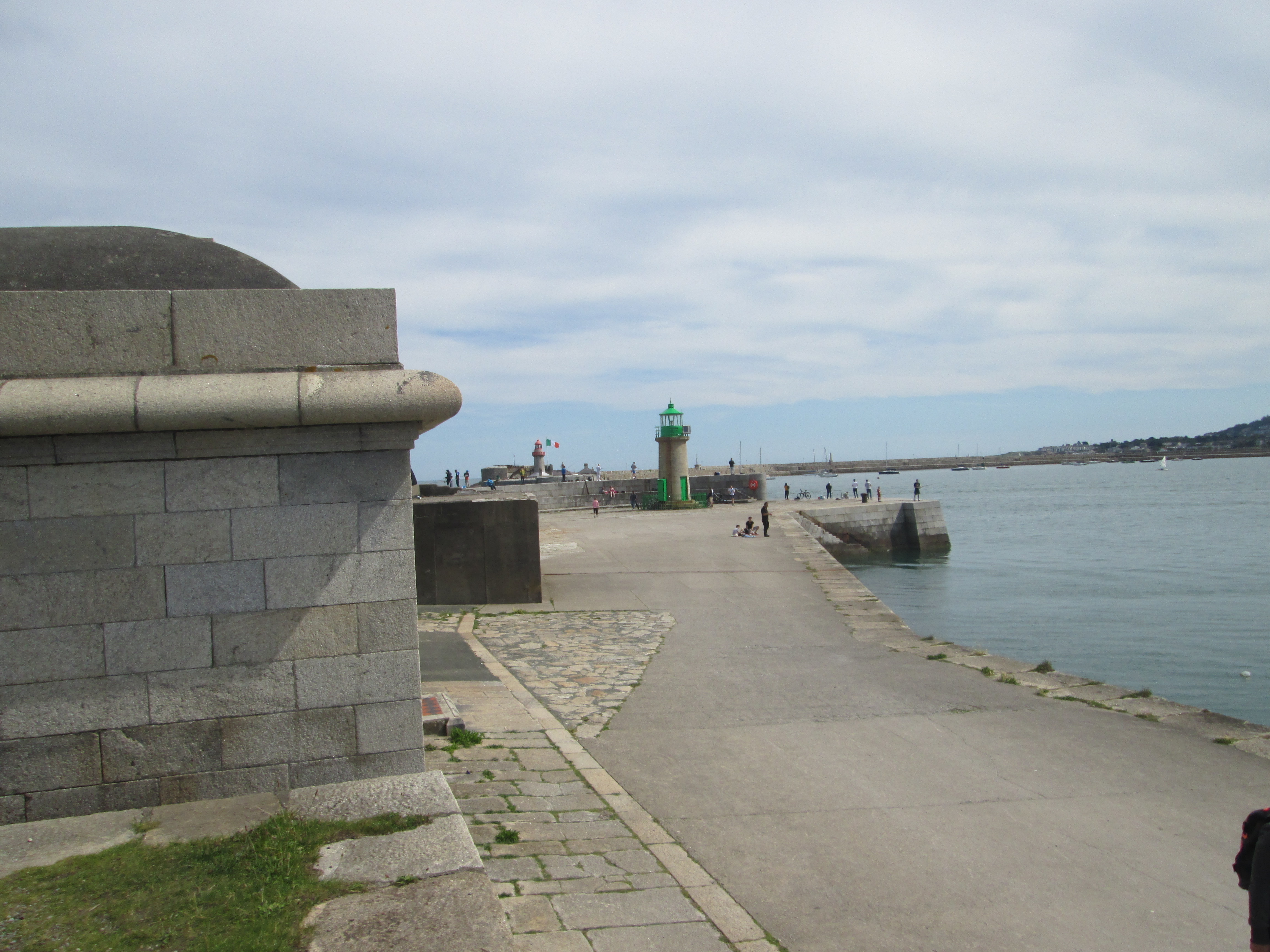
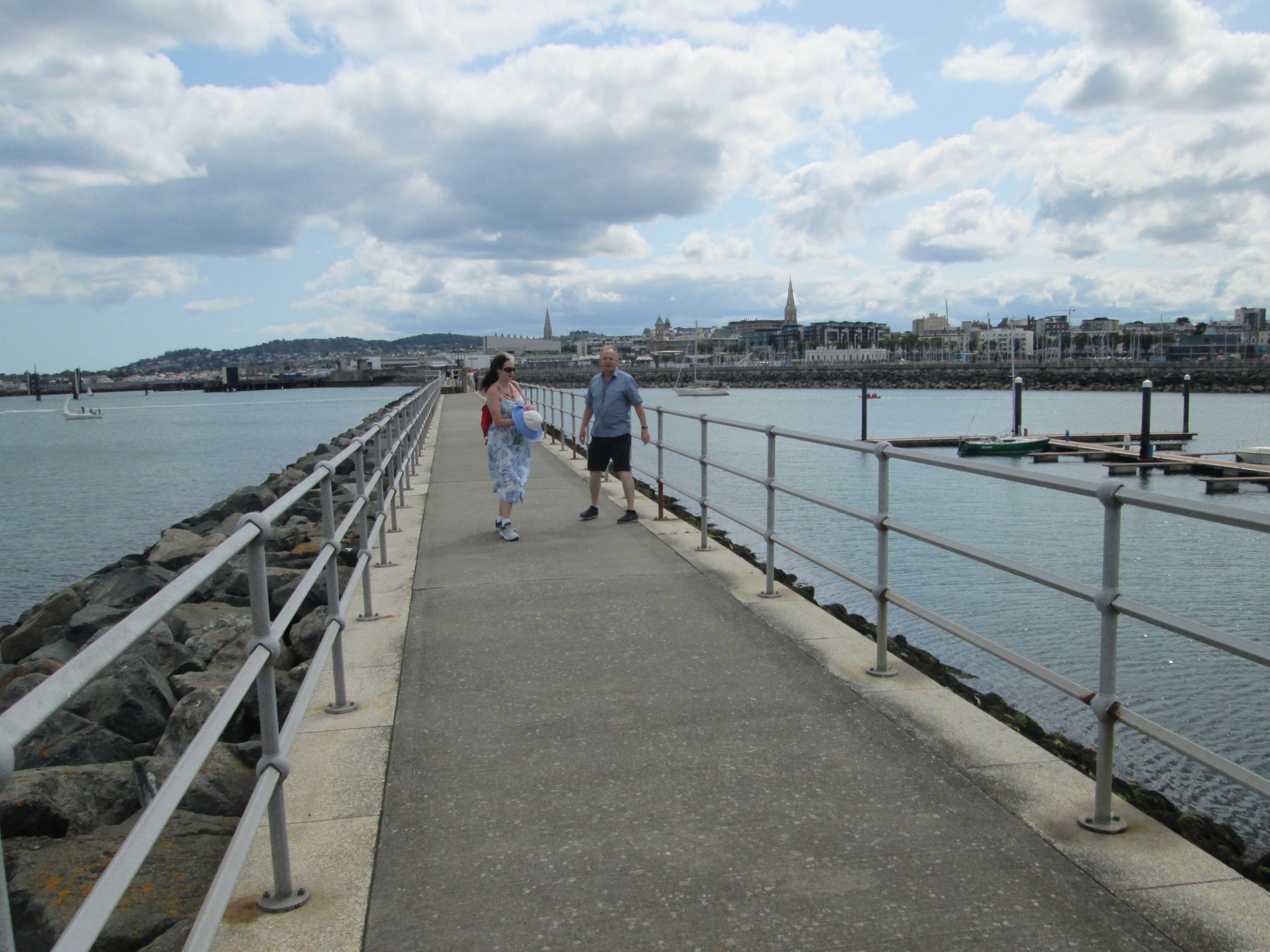
Scottish engineer John Rennie masterminded the building of Dunleary’s huge harbour, the largest constructed harbour in Europe when completed in 1842. Rennie was also responsible for Howth Harbour and the Custom House Docks and Tobacco Store (now the CHQ Building) in Dublin. He insisted on the addition of the West Pier. The two piers embrace two hundred and fifty acres of water. The East Pier, slightly the shorter, is the most popular promenade. Two paved walkways, upper and lower, convey a constant flow of people along its kilometre length. There’s a Victorian bandstand a quarter way along and the pier culminates in an impressive granite lighthouse. The West pier, slightly longer at almost a mile, has a wilder, less urbane air. From this you have a closer vantage point of the Liffey estuary, with ships passing against the backdrop of the city, while, paradoxically, its relative isolation gives more space for reflection.

In recent years, the harbour has fallen on hard times as a passenger port. All major passenger services were gone by 2015. The harbour remains busy with its marina and a plethora of pleasure craft. It also hosts the occasional cruise ship.

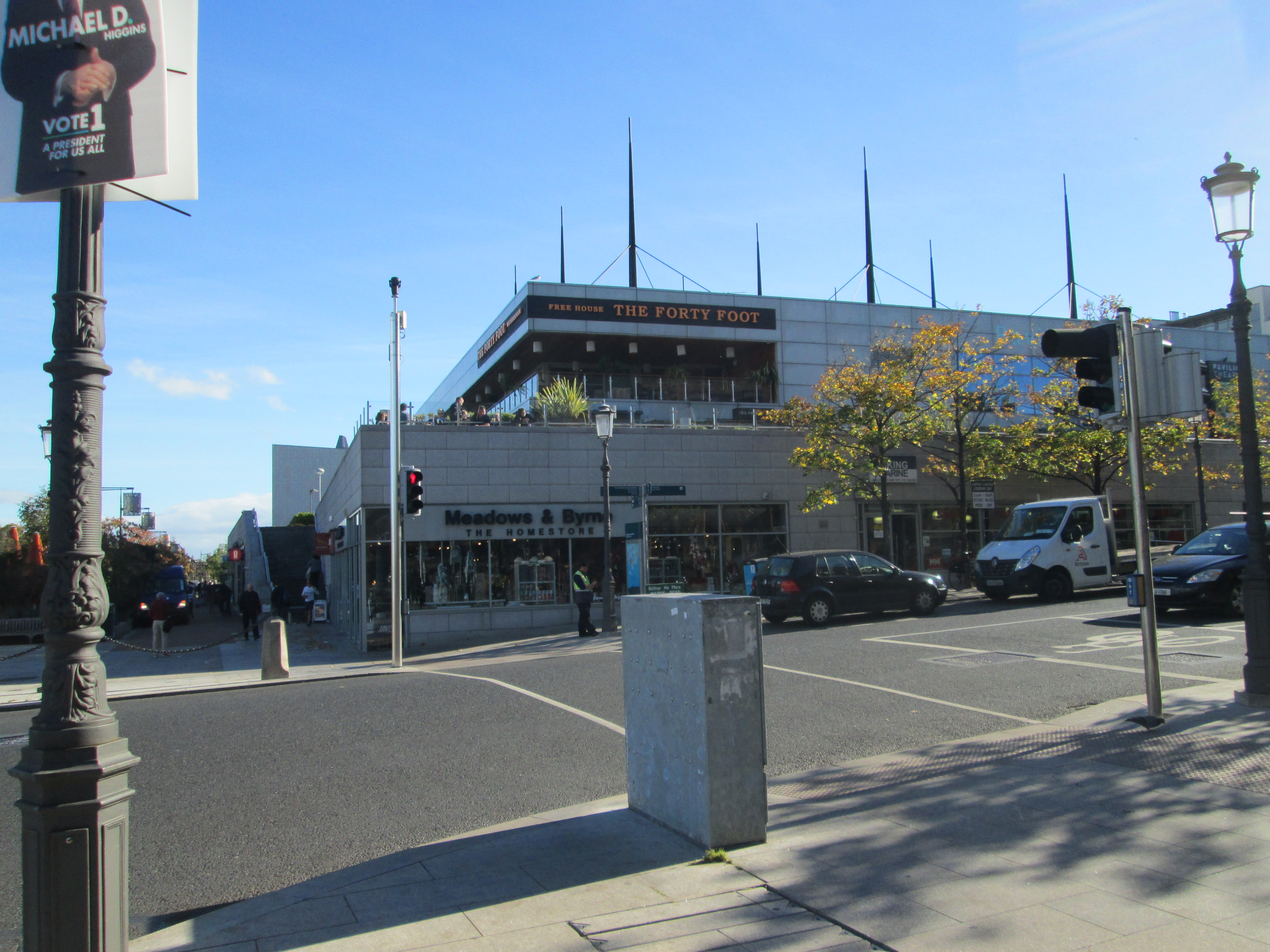
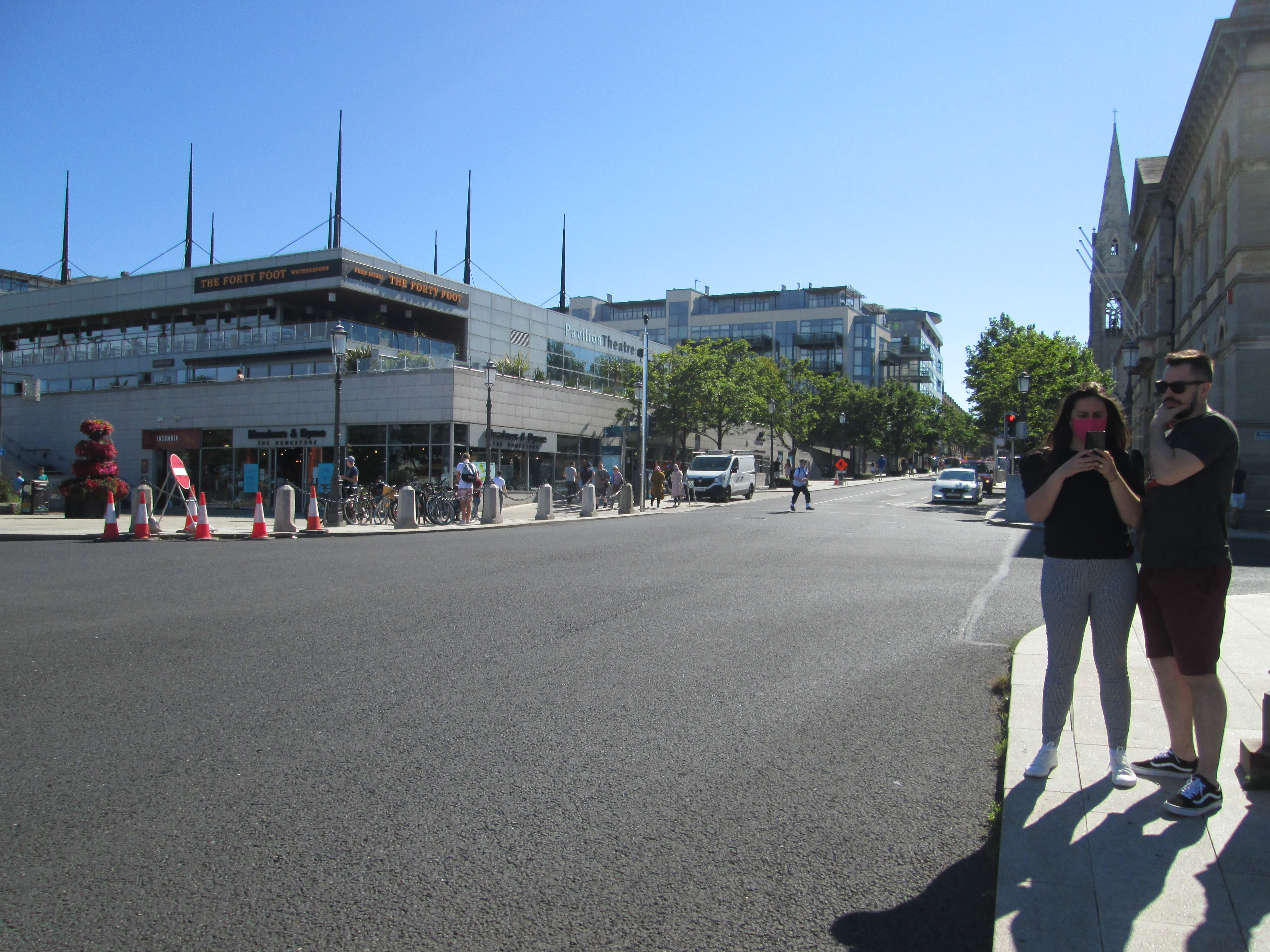
Forty Foot is a name that crops up a lot in these parts. The original bathing spot is just south of here in Sandycove. From this local poet, Anne Fitzgerald, derived the name for the publishing house, Forty Foot Press. If bathing and bardic pursuits should raise a thirst, and what doesn’t, then repair to the Forty Foot, Wetherspoon’s franchise housed atop the Pavilion Centre. I was there for the launch a couple of years back. It was invitation only, but, determined on a pint, I remembered the beanie I was wearing. Given me by Anne Fitzgerald and emblazoned with the publisher’s name, the bouncer could hardly refuse admission. Is there anything more pleasant than a pint blagged, to be savoured in the sunshine with a view of the sea? Indeed, a pint at the Forty Foot costs less than elsewhere, and there’s an extensive menu of craft brews and good bar food besides.

The original pavilion was a timber and glass structure one hundred and fifty feet long. Opened in 1903, it was designed to resemble a ship. The top deck, thirty foot above ground level, consisted of a promenade giving three hundred and sixty degree views of mountain, sea and town, crowned by a landmark Belvedere. On the ground floor, there were reading rooms, tea rooms, a smoking room and a concert hall.

Four acres of gardens were landscaped by William Shepherd, whose cv included Dublin Zoo and St. Stephen’s Green, with bandstand, tennis courts, ornamental pond and a waterfall. In 1915 the Pavilion burnt down. Refurbished in the twenties it then featured a cinema and dance hall. It burned down again in 1940. Rebuilt for the third time, and taking a lesson from the three little pigs, rebuilt in concrete, the Pavilion’s Art Deco facade was a true picture palace of its day. Cinema’s popularity waned in the seventies and the venue returned to a more traditional ethos, with music, theatre and ballet. The building became derelict in the eighties 

This century a new incarnation of the Pavilion emerged. Shops and restaurants line the lower level facing Queen’s Street and the Harbour, while the upper deck houses a new Pavilion Theatre and the Forty Foot Bar.

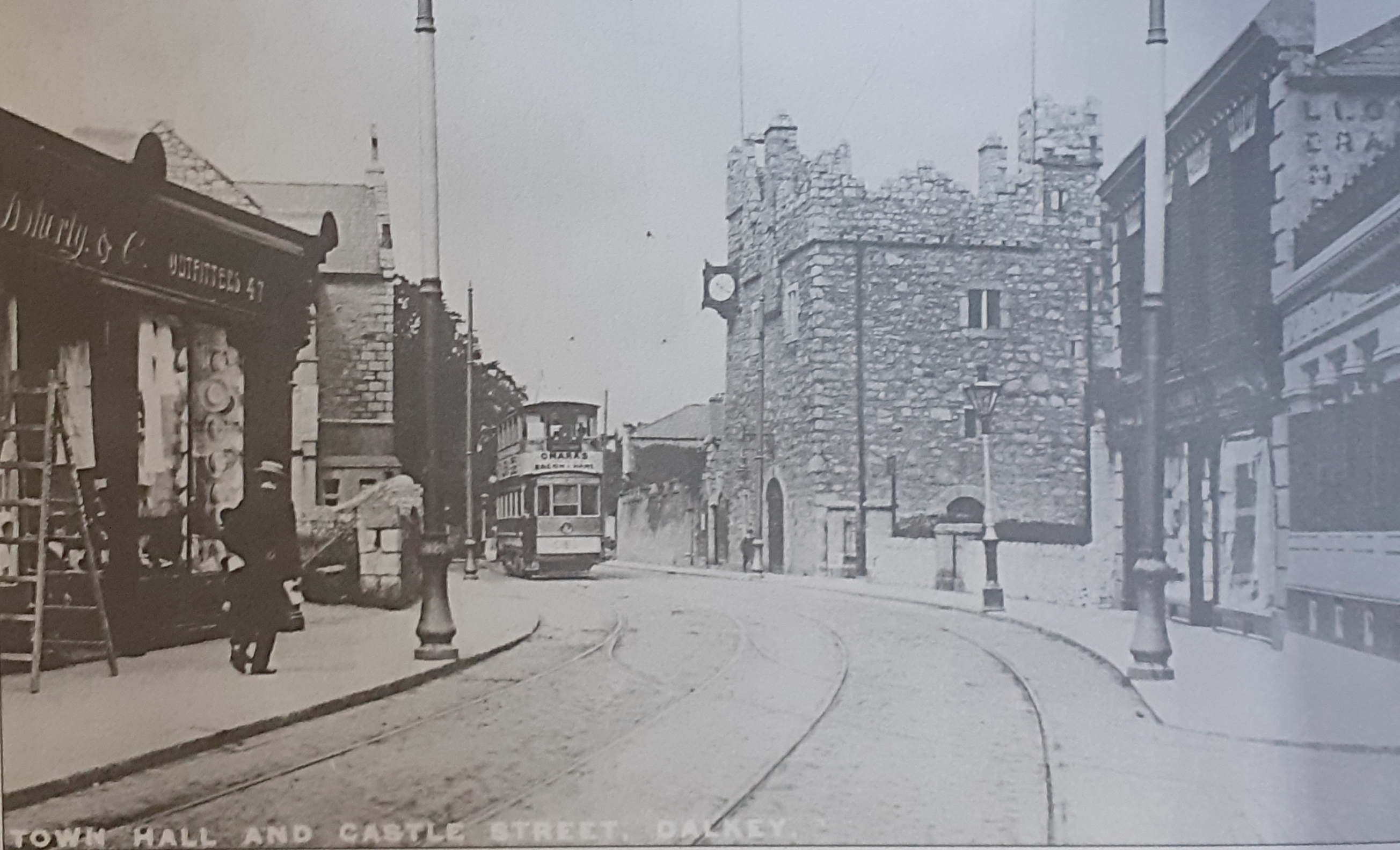
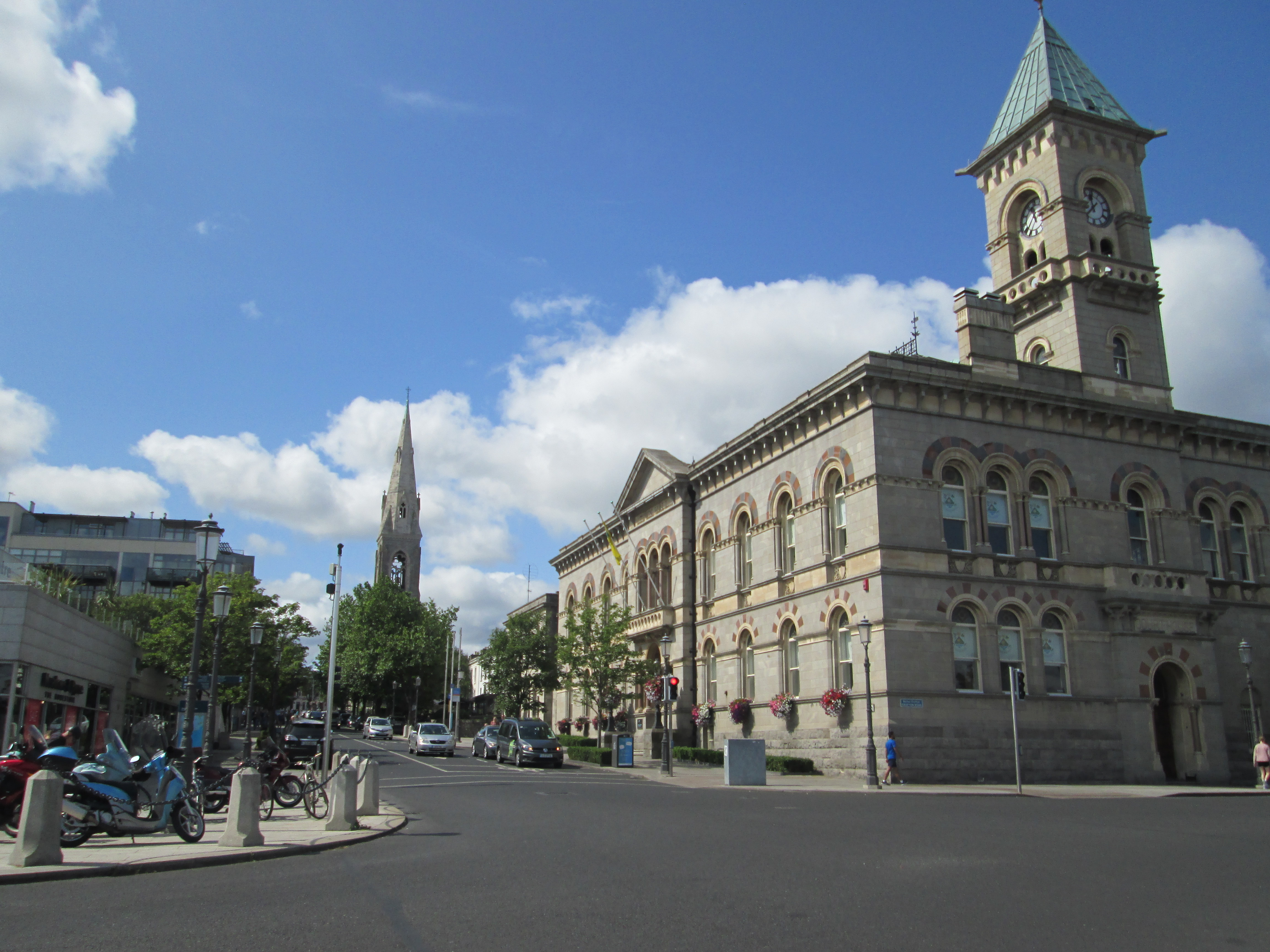
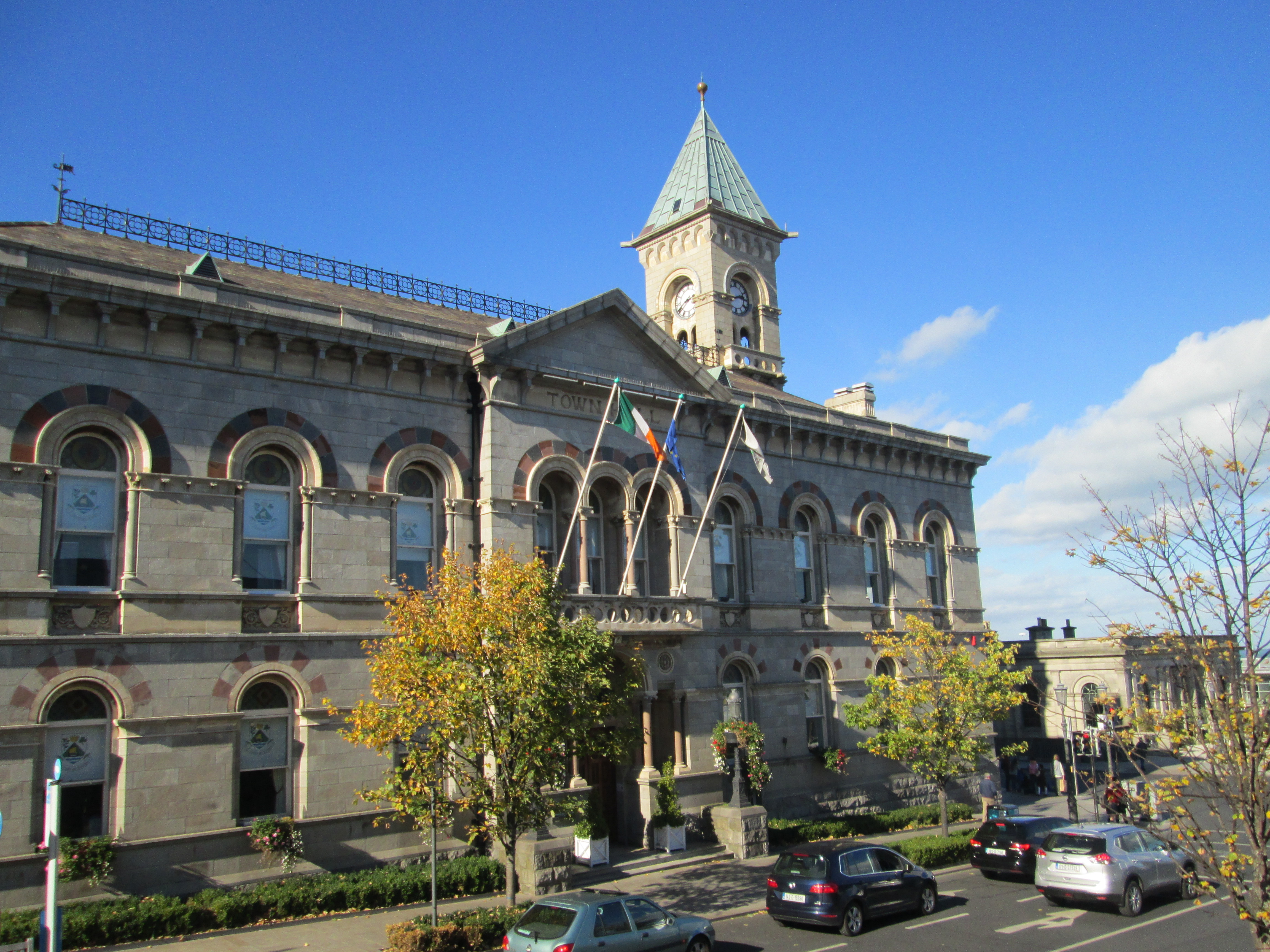
The Town Hall, across the road, is an attractive building in the style of an Italian palace with high slender clocktower and coloured brickwork. Designed by John Loftus Robinson in 1879, it incorporated the courthouse, municipal offices and a public hall. Perfectly preserved, it now forms part of the County Hall for Dun Laoghaire Rathdown.

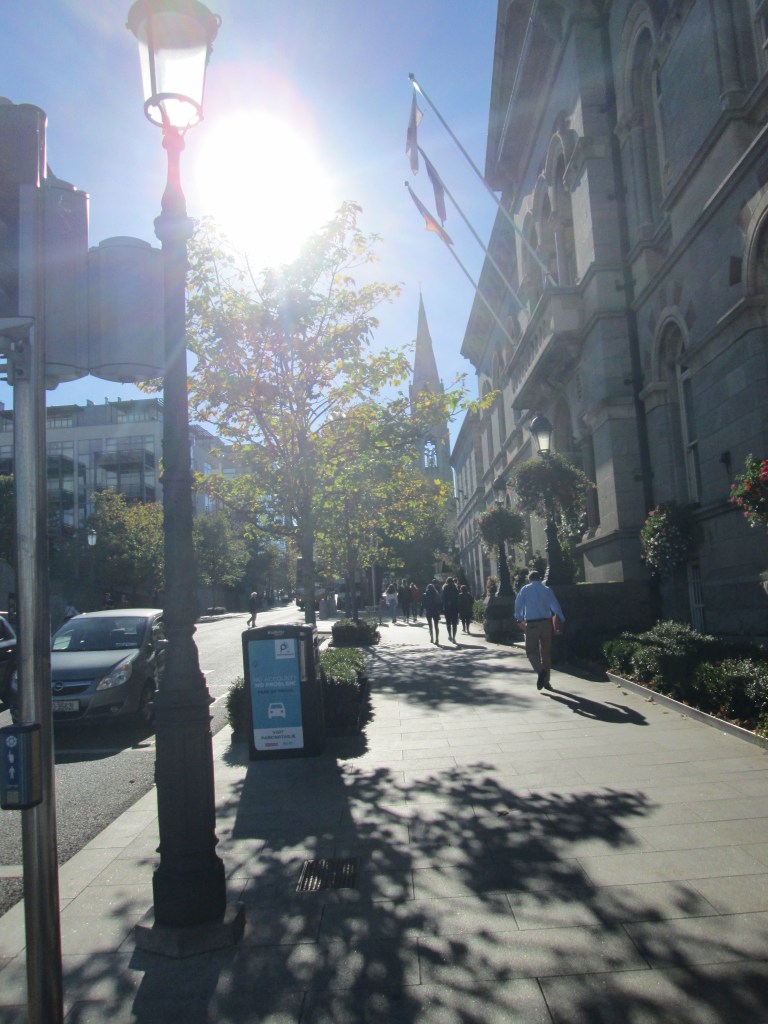
The vista up Marine Road is crowned by the spire of St Michael’s Church. This is all that remains of the original Gothic church which was destroyed by fire in 1965. The church dated back to the 1820s. The present structure is a plain modernist cube. Heading back downhill, a pleasant Victorian block is shaded by trees. Passing Nando’s, the dappled light whispers: Momma told me there’d be days like these, nothing shaking but the leaves on the trees. There was once a hotel there, the Mellifont, if my memory serves me well. Here, the legendary Nothin’ Shakin’ had their first gig back in the eighties. The man who stepped up to the microphone was Brian Hogan, Crocodile Dunleary himself. Brian was last seen, standing astern on a departing P&O liner bound for Australia. 

Ireland’s Age of Steam was born in Dun Laoghaire..The passenger rail connection between Kingstown and Dublin was one of the first commuter rails in the world when established in 1834. The railway further stimulated population growth and Kingstown became a fashionable Victorian resort and well to do suburb, separate from the seething city of Dublin, but only a half hour away by train. The railway obliterated much of the Old Harbour and the fishing village of previous centuries. The original stop was in Old Dun Laoghaire, by the West Pier, but was extended to the present station nearer the East Pier three years later to be closer to the Mail Boat.

The railway station is built on a bridge over the cutting. It was designed by John Skipton Mulvaney in 1853 in a neo-classical style. The grand old station is now a restaurant. Mulvaney was a follower of Gandon, and designed several stations for the rail network of the nineteenth century, most notably the Egyptian inspired neo-classical Broadstone Station in Dublin. He’s also responsible for the Royal Irish Yacht Club to the west and the Royal St George Yacht Club visible nearby.

The northern leg of our loop of South Dublin’s Rocky Shore, follows the Dartline to the West Pier. That promenade is popular with the boys and girls of the Forty Foot publishing house, and is ideal on a brisk sunny day. Back on dry land, a short walk uphill brings us to the Purty Kitchen, an atmospheric spot for food and drink and good music. It was founded almost three hundred years ago, the nucleus of the now vanished fishing village from which modern Dun Laoghaire sprang.

So, I jumped on a bus to Dun Laoghaire

stopping off to pick up my guitar

and a drunk on the bus told me how to get rich

I was glad we weren’t going too far

Summer in Dublin was a big hit for Bagatelle in 1980. The band formed in Bray in 1978, with Liam Reilly as singer/songwriter. The song mixes rose-tinted nostalgia with the clash of modern reality. Catchy too. Though specifically a Dublin theme song, Dun Laoghaire features strongly. The 46a is the local bus.

Snowy Night in Granada

I heard your voice through a photograph

I thought it up it brought up the past

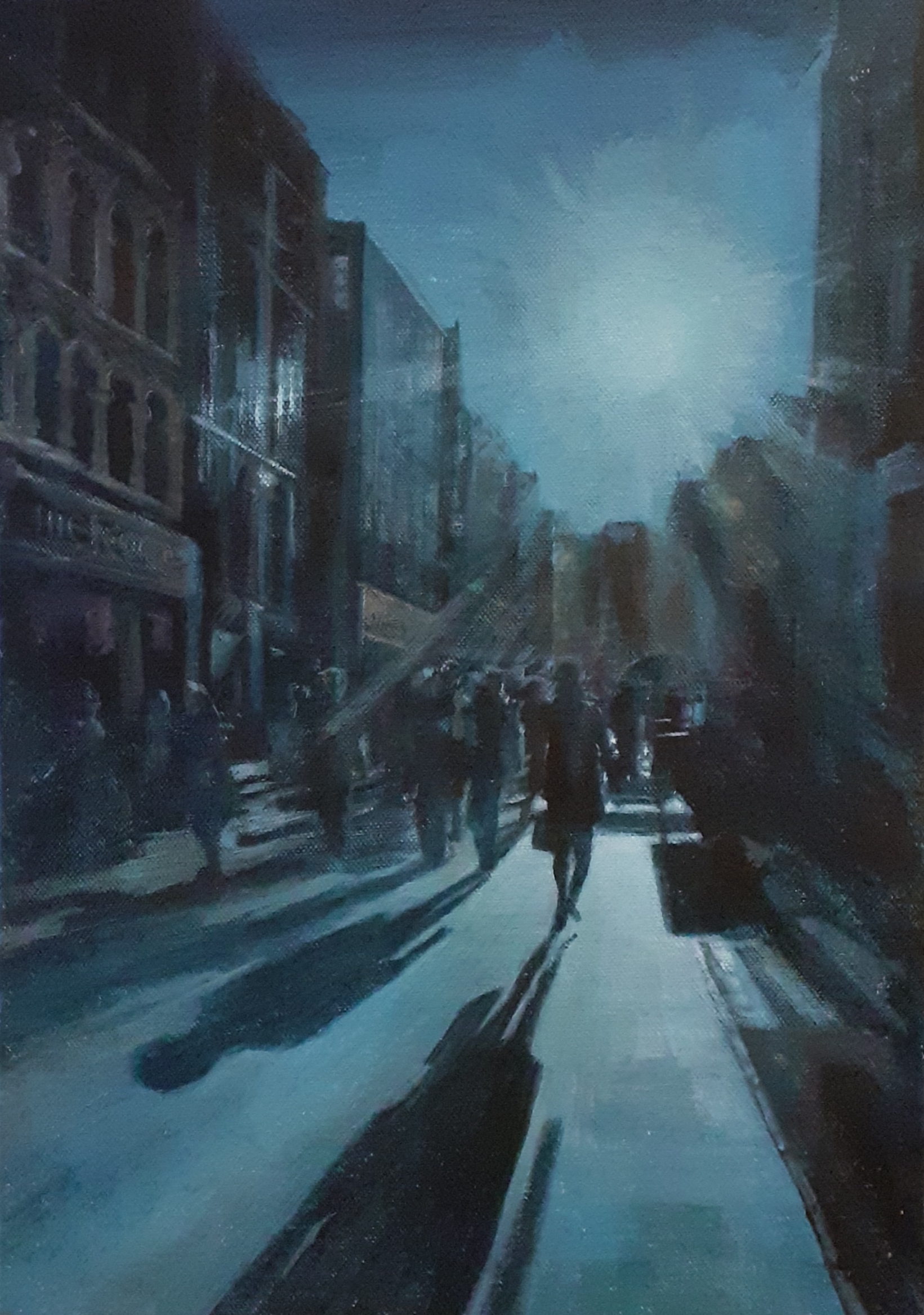
I am in the high city of Granada as Easter blooms and snow falls. The white teeth of the Sierra Nevada gash the underbelly of a dark blue sky. I had planned on a Flamenco evening up in Sacromonte, on an outdoor terrace in the tiled roofscape, looking across a valley of cypress trees to the glowing Alhambra. But rising into the night I meet the snow flakes descending and the brittle beauty is achingly cold. 

I am alone in the city of the guitar as the snow turns to sleet and commuters and revellers do that dance of the umbrellas city people do so well. At the zebra crossing a charge pulses the wet streets and I see this is still the city of the guitar. The zebra pattern turns to strings on a fretboard and rises like a magic carpet into the night connecting to all the cities at night where music throbs and guitarists strum.

I am walking home up Main Street at closing time, I am crossing Republic Square in Belgrade on a secret assignation, I am hearing whispered tales from the top of Grafton Street, I am crossing a rainy street in Soho with M and Davin, flashing tickets for Marcus Bonfanti to the man at the door of Ronnie Scott’s. 

Here I am, on Calle Reyes Catolicos. I am bound for Hannigan’s Irish Bar, where drink flows in the quiet of the night, with a mix tape of all the songs rattling around my head, and a good sprinkling of the Red Hot Chilli Peppers to keep the cold at bay. 

How long, how long will I slide

Separate my side

I don’t, I don’t believe it’s bad

Slit my throat, it’s all I ever …

The song is Otherside, by the Red Hot Chilli Peppers, from their album released in 1999, Californication.

South Dublin’s Rocky Shore – 4

Dun Laoghaire

Dun Laoghaire is part of Dublin’s sprawling conurbation, but is a large town in its own right. Capital of the county, Dun Laoghaire Rathdown, it has been Dublin’s main passenger port for two hundred years. Originally named for Laoghaire Mac Neil, sixth century high king, or pirate if you prefer, Laoghaire’s status is somewhat mythological, and his connections with this region rather nebulous. Some reports say he feared the sea, a prophesy foretelling that he would drown in it should he invade Leinster. But, whether ironic or not, the name stuck. Later Anglicised to Dunleary it remained an insignificant fishing village until the early nineteenth century when plans were put in train to establish a safe haven for shipping along what had become a treacherous stretch of coast. 

Construction began in 1817, stimulating the urban development of Dunleary’s hinterland.  The growing modern town’s name was changed to Kingstown when the British King, George IV visited in 1821. George IV was the first British monarch to visit without an army in tow, the first in four centuries or so. An extravagant spendthrift, a serial accumulator of monstrous dept, a drunk, a glutton and a womaniser, there wasn’t always a queue to honour him. His appalling treatment of his wife, Princess Caroline of Brunswick excited public distaste with his attempts to divorce and humiliate her. She was refused entry to his coronation and died, suspiciously, days later. George celebrated with his Irish trip, and taking up with a new mistress, Elisabeth, Lady Conyngham of Slane Castle. For the next decade till his death, Lady Conyngham would suffer the waning charms of the last monarch of the Georgian era. 

His legacy adheres mostly to his Regency, those first two decades when his father had succumbed to madness. Regency style tilted our world towards the recognisably modern. George for all his faults, was a renowned patron of arts and architecture, and an early populariser of the notion of the formal seaside resort, with its pavilions and promenades, its designated bathing, grand hotels and elegant terraces. From Brighton to Dun Laoghaire, and on to Bray, the seaside resort town was the coming thing.

George’s Street is the main drag, while the name Kingstown stuck for a century until Independence, when it reverted to the Gaelic, Dun Laoghaire, pronounced Doon Lair-eh. But everyone uses the anglicised pronunciation that applied in its village days: Dunleary.

Our journey, following the route of South Dublin’s Rocky Shore, takes us from the People’s Park along the seafront. We will follow the railway past the Harbour to the West Pier, and back again. Queens Road is a busy thoroughfare on the seaward side, Marine Terrace and Haddington Terrace are slightly elevated on the inland side. The railway line itself passes through a cutting below our sightline. The two terraces comprise fine old Victorian houses and hotels. One particular hotel, the Hotel Pierre, is the place where myself and M had our wedding feast in the ringing cold of a December day in 1983. The name Pierre, I believe, is something of an affectation, the place previously known as the Pier Hotel, catering particularly for those who used the Mail Boat, in leaving, or even visiting, Ireland. 

The terrace vista terminates with a startling intrusion. Like a giant ocean liner cast in stone, Dun Laoghaire’s new library, The Lexicon, seems set to sail. The Lexicon excited outrage outrage amongst the guardians of our skyline. Who needs all them books, they cried. Why build a library so large when there’s a perfectly good Carnegie from 1900. A fine thing, the Carnegie Library, but Dun Laoghaire is a lot bigger now than it was then. DLR’s population is over two hundred thousand, about ten times its population at Independence. The expansion of the library service demands a lot of space for a lot of disparate activities. Reading and study areas, public computer access, meeting rooms and children’s library, Space too to retain its core function of book stock for browsing and borrowing. Yes, we do need large modern libraries and we build them because we can. Have a coffee on the lower deck or climb to the top deck to admire the view across the harbour to Howth Head.

Next door is the Maritime Museum, housed in the old C of I Mariner’s Church built in 1837. Exhibits feature Ireland’s lighthouses and Dun Laoghaire’s Mail Boat fleet from the era when the four ships were named for the provinces. Most famed and sorrowful is the fate of the Leinster, sunk by a German UBoat in 1918; Dun Laoghaire harbour and indeed the end of the war in sight, with the loss of 500 souls. A prime exhibit focusses on the Great Eastern, Isambard Kingdom Brunel’s massive folly. The giant steamship was the largest ever built when launched in 1854. Accident prone and a failure as a passenger liner, it left a more telling legacy in the laying of telegraph cables, becoming very much the origin of the information age. Robert Halpin, born in Wicklow, in that most nautical of pubs the Bridge Tavern, was chief engineer when the cable was laid from Valentia Island to Newfoundland. Rising to captain, Halpin would earn his nickname the Cable Man, laying enough cable to girdle the globe. 

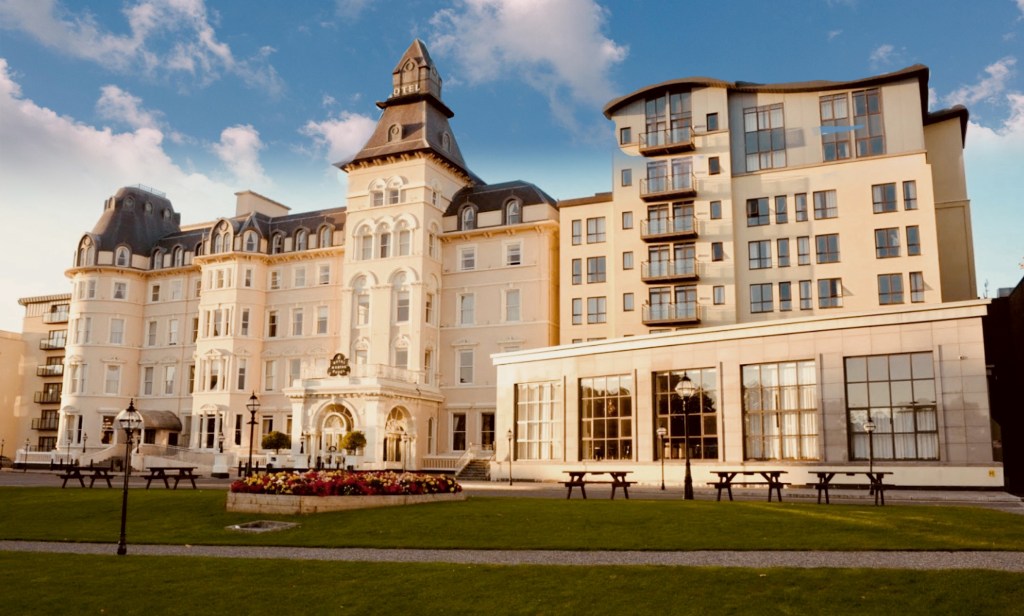
Towards the town centre, holding the high ground, the Royal Marine Hotel embodies what Kingstown was originally about. It was designed in 1860 by John McCurdy for William Dargan, the great railway entrepreneur. McCurdy’s original concept envisioned a stately chateau in the French manner. With its mansard roof and french pavilions surmounted by a tower and dome, this was to be the epitome of the nineteenth century Grand Hotel. Running over budget, the west wing was not completed, with a more modest construction in its place. This asymmetry persists. The building struggled to survive and was forced to shed many of its period features, but its most recent version has restored the mansard roofs and central tower, the traditional east wing forming a curious hybrid with the modern and ultra modern west wing. 

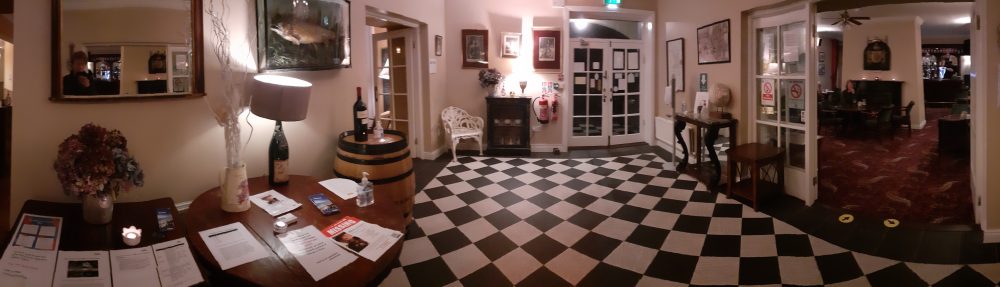
Despite the arbitrary depredations of time, I think you can still gauge the original effect. Squint and you will see The Royal Marine set out its stall in Victorian splendour. Here was the bastion of the civilising project of empire; it still radiates a haughty Britishness. Breeze jauntily into the lobby and make for the bar. Duty bound to look like you own the place, and growl the words to The Captains and the Kings, Brendan Behan’s meditation on the essence of being English.

I stumbled in a nightmare all around the People’s Park

And what do you think I found there as I wandered in the dark?

‘Twas an apple half-bitten, and sweetest of all things

Five baby teeth had written of the Captains and the Kings

Five baby teeth had written of the Captains and the Kings

The Dubliners, with Ronny Drew’s gravelly vocal, provide the classic version of the song. The correct words are ‘all around Great Windsor Park’.

South Dublin’s Rocky Shore – 3

To Dun Laoghaire via the Metals.

Keeping the railway as our guide, we are walking towards Dalkey. We’ll return later to explore, but our path dictates we must leave it for now and cross the tracks to Ardeevin Road which reaches a point just above the rail station’s northbound platform. Dalkey Station was built in 1854 when, after twenty years, Ireland’s first railway the Dublin to Kingstown (Dun Laoghaire) line was extended through to Bray. For ten years prior to that the Atmospheric Railway provided a connection to the Dublin Kingstown line.

A left turn at the end of Ardeevin Road leads uphill, and the second turn right along Cunningham Road emerges at the foot of Dalkey Hill with its disused quarry. This supplied the granite for the construction of Dun Laoghaire Harbour in the early nineteenth century. A metal tramway connected the two sites, some of which was converted into the Atmospheric Railway of the 1840s, developing into the modern railway line and since 1984 the electrified Dartline.

The Metals is a marked walk along the route of the old tramway. We start at the quarry and pick up the route of the Dartline heading north to Sandycove and Glasthule station. The Metals walk runs for a distance of three kilometres. It’s an easy, flat walk, very well marked, through tree lined lanes for the most part. It took us about thirty minutes; the estimated times on the signposting being a tad more pessimistic.

We pass above Glenageary Dart station, crossing the neat park bordered by Victorian terraces that I’ve only previously admired, and partially glimpsed, from the train. Glenageary means the valley of the sheep in Gaelic, but that was then, this is now. The sheep are long gone.

Winding up a hillside where the shepherds roam

Counting their flocks in the gloaming

Shining the sea, winking its light to the froth and the foam

Sheep Season/Mellow Candle 

Sandycove and Glasthule station is a modern structure straddling the tracks. It holds a certain mystique for me, my own creation entirely. It becomes, in that half sleep induced by the rhythms of the railway, the imagined setting for some beautiful liaison that’s yet to happen, or that has happened without marking the memory. The scene is populated with wide shoulders and fedoras, a silvered monochrome wreathed in pulsing smoke. Blinking into the sunblasted reality, we emerge onto the prosaic rush hour of the main road. To the west, the arrow straight thoroughfare is the spine of Dun Laoghaire, to the east Glasthule asserts its own urban village identity. The sylvan tunnel we’ve left behind fades as if it too were an unlikely memory, and I cross the heavy traffic of the main drag to be drawn inexorably towards the sea, 

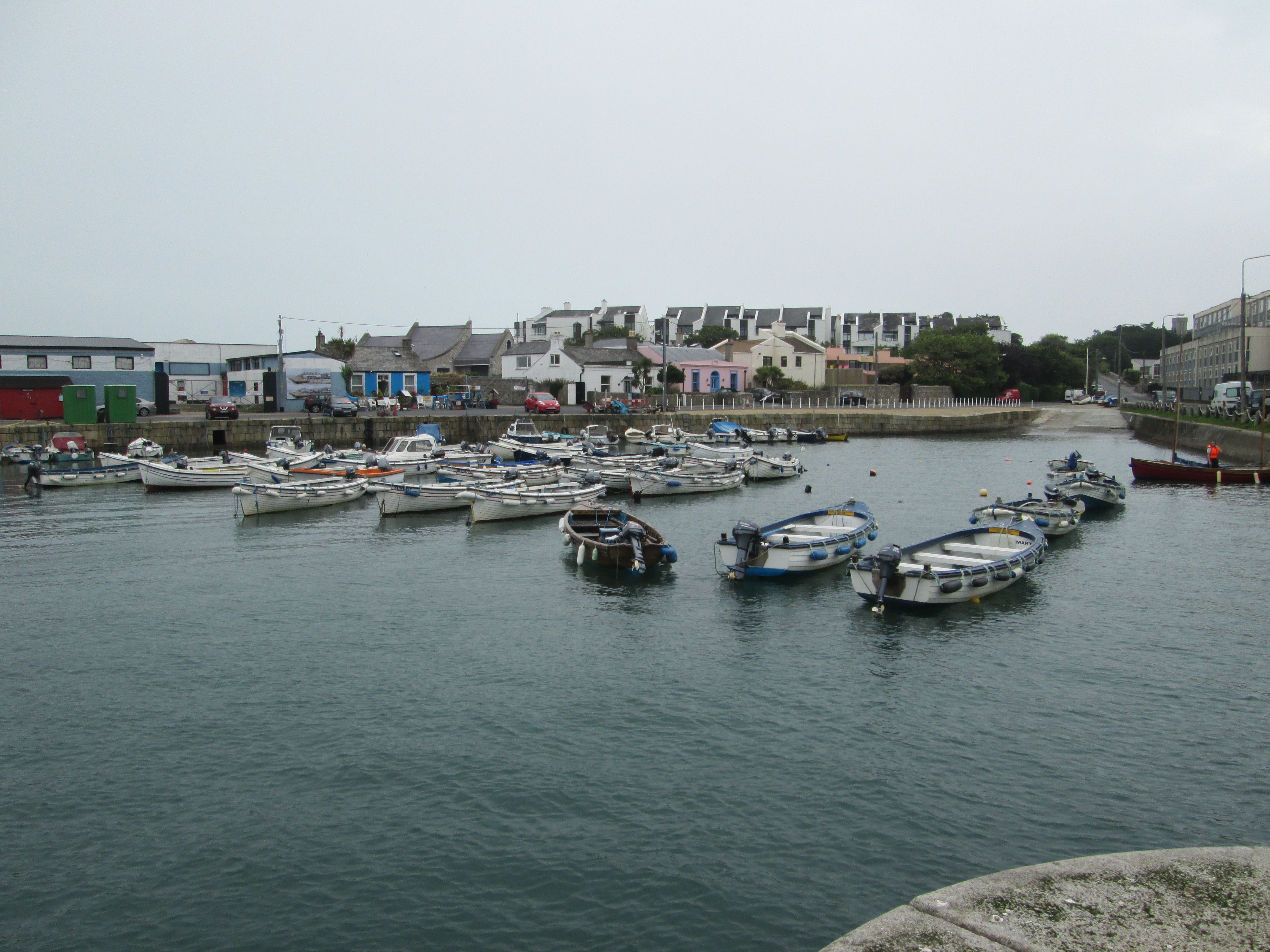
A lane leads down to Scotsman’s Bay. The bay is enthusiastically rendered in vivid blue, small craft daubed across its surface, the giant harbour and Dublin Bay are laid out beyond. The Metals veers west towards its conclusion.

To our right there is a magnetic pull that can’t be ignored.  An Ice Cream at Teddy’s is more than just a treat, it is practically a custom when I visit with M. A Ninety Nine, gorgeous as it may be, is not something for the solo wanderer. Unless you’re in love with yourself. In which case: go for it! Still, I persist in the higher pleasure of sharing ice cream cones in briny summer air.

Stepping out onto the seafront, the eras collide, and two centuries of power and glory jostle for attention across this wonderful tableau. It can be hard to grasp how quickly all this sprang up. While Dublin is an ancient city, Dun Laoghaire in the late eighteenth century was a small coastal village north of here, clustered in the vicinity of the Purty Kitchen. 

Then came the construction of the harbour. Dunleary, as then known, was proposed as a refuge harbour for Dublin Bay following a litany of shipwrecks. The harbour was completed in the eighteen twenties and managed to nick the franchise for the mail packet service to Britain from Howth in north Dublin. The Mail Boat became established as an Irish icon, synonymous with the sadness of high emigration.

Thousands are sailing

Again across the ocean

Where the hand of opportunity

Draws tickets in a lottery

But we dance to the music

And we dance

The song, Thousands are Sailing by the Pogues, was written by Phil Chevron (Philip Ryan) who had previously played with Irish punk rockers The Radiators From Space. The song was Chevron’s first for the Pogues and included on their album If I Should Fall From Grace with God. This album showed a thematic shift for the group, with a more serious focus on the heritage of Irish emigration. Fairytale of New York was their top selling single, a mini opera of dreams and delirium for a struggling Irish couple in New York.The immigrant position is always shifting, of course. When Chevron writes, thousands are sailing again, he knows that they are flying, often in hope more than necessity; but there is a continuum. In that respect, the Mail Boat is a persistent icon, and if the now diminished service is more by way of transport and tourism, bitterwsweet memories abide.

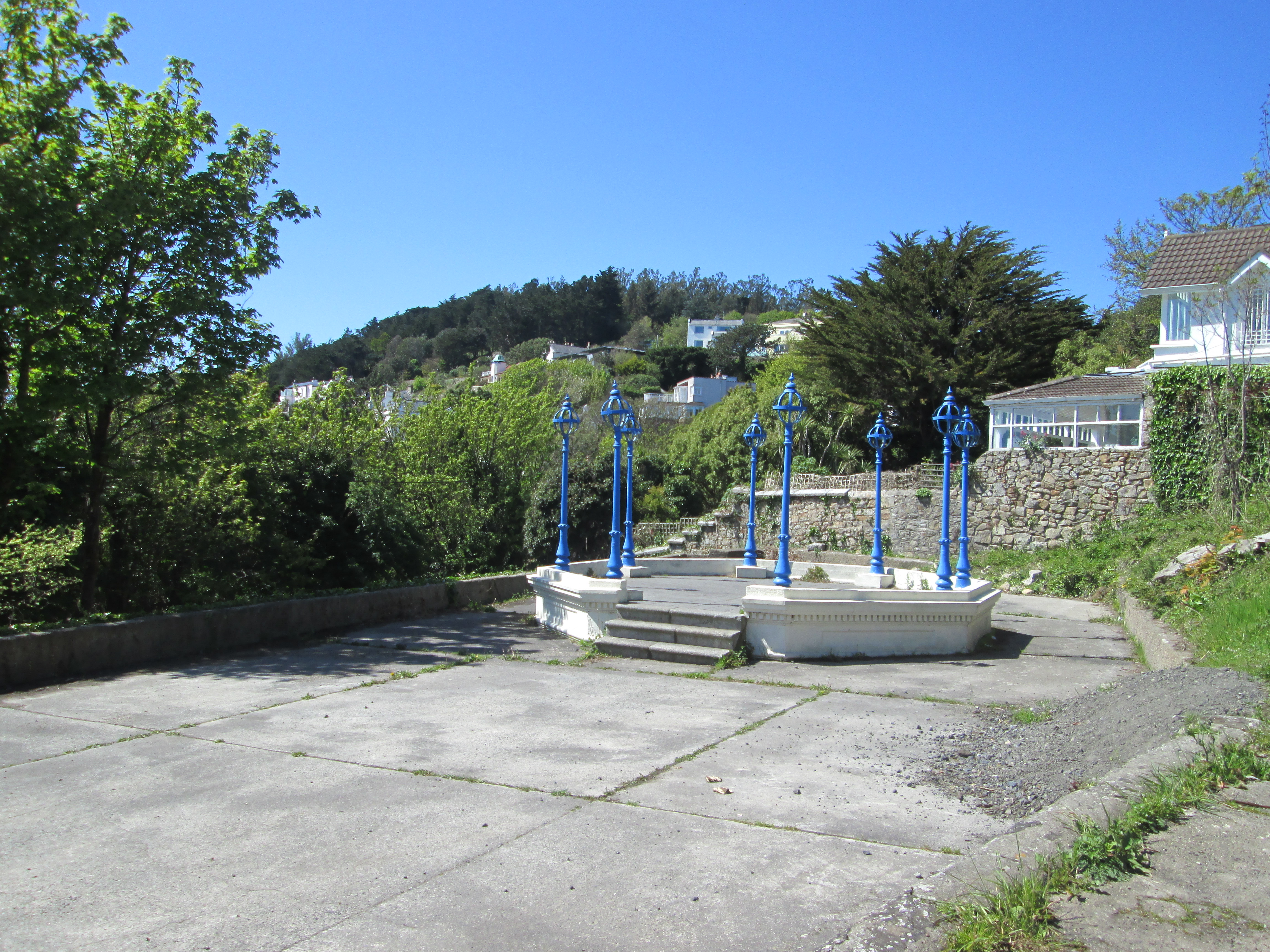
The modern rail connection passes through the cutting below, that will travel the full length of Modern Dun Laoghaire’s seafront. For us, the Metals ends nearby, for now. The People’s Park stretches between the seafront and George’s Street, Dun Laoghaire’s main thoroughfare. On the site of a disused quarry, it was opened in 1890 along a formal design by J.L. Robinson. There’s a gate lodge, an ornate bandstand and an impressive central fountain. Along the western flank, near George’s street, the lovely restored pavilion houses an elegant cafe; Fallon and Byrne’s. At the end of our walk, it is time for, another, reward. Really, at any time, one must seize the pleasure of a leisurely half hour or so, in sunshine on the veranda with an aromatic cup of coffee, and more besides, looking out over the park, as children play and people pass, as seabirds swirl and time stands still.

Crossing Morehampton Road

Heading out of Dublin City by way of Leeson Street, we cross the Grand Canal into Dublin 4. This is the main road to Wexford via Donnybrook and the N11. Leeson Street was originally called Suesey Steet, with something of a sleazy reputation. In the early eighteenth century it was renamed for the Leeson family, local brewers and property developers. The Georgian development of the area came towards the end of the century and has come to represent the high watermark of the Neo Classical era. The canal established Dublin city’s southern border a decade or so later. 

Leeson street continues as Upper Leeson Street heading south. The area hereabouts was known as Pembroke, from the estate occupying most of the land. By the middle of the nineteenth century Pembroke had developed into a sizeable middle class suburb. Further on, the village of Donnybrook was famous, or infamous, for its annual fair. First licensed by King John in 1204, the Fair, lasting a full fortnight, came to be regarded as a cauldron of brawling, drunkenness and vice. All the good things in life. As the suburbs seeped into this oasis on the periphery, respectable citizens campaigned against the Fair, and it was finally extinguished in 1855. However, though Donnybrook and environs might have become the home of the great and the good, the pot of Route Eleven continued to simmer.

In this acrylic I am crossing the route where it is known as Morehampton Road. Donnybrook glows in the distance. To the right, the Hampton Hotel was once called Sachs, a name resonating with its notorious nightclub, and weekend jazz sessions. On a Sunday morning, Chris Lamb and the Black Sheep would be doing their thing, when a white Rolls Royce would pull up outside. A heavy set man, black mane and moustache, would alight, steam into the joint and take his place behind the drum kit. Turning the volume up to eleven, he would just as enigmatically depart in a haze of cigar smoke. The Sultan of Rock and Roll. 

The Leeson Strip has never lost its patina of vice. More red brick than red light, but there’s always the whiff of discreet abandon, as notes and aromas waft up from basements. 

Loneliness is a crowded room

Full of open hearts turned to stone

All together, all alone

All at once my whole world had changed

Now I’m in the dark, off the wall

Let the strobe light up the wall

I close my eyes and dance till dawn

On a sunny morning, beneath the towering trees, life is a dappled mirage, the light above all the better for the shadows below. 

Dance away the heartache

Dance away the tears

Dance away the heartache

Dance away the fear

Dance Away was written by Bryan Ferry in 1977 and was included on Roxy Music’s Manifesto album in 1979. It became one of the band’s biggest singles and reached Number one in the Irish charts, in the wake of Blondie’s Sunday Girl.

South Dublin’s Rocky Shore – 2

Killiney to Dalkey.

Beyond Killiney Dart station, a tunnel under the track leads from the beach to Strathmore Road, which climbs steeply to join with Vico Road. Alternatively, and depending on the vagaries of the tide, you can follow the strand farther north to the high cliffs of the headland. This fine day, I took the latter option as far as the footbridge across the Dartline, and wound my way up through an overgrown laneway of honeysuckle, honeyed bricks and honey bees.

I emerge onto tarmac that swirls through the high walls and higher trees marking the properties of the topmost echelon of Irish society, and indeed Irish Rock royalty. Van Morrison and Bono Vox have their mansions here, though the prize for princess in her palace must go to Enya, whose residence, Manderley Castle, peeps its high gothic turrets above the walls farther up the hill towards the village of Killiney. The fanciful nineteenth century residence was originally dedicated to Queen Victoria, but Enya, keen fan of Daphne Du Maurier, took Manderley from Rebecca’s memorable opening line.

Last night I dreamt I went to Manderley again…

Eithne Ni Bhraonnain, Anglicised as Enya Brennan, is one of the Brennan family Rock group, Clannad, from Gweedore in County Donegal. Enya embarked on her solo career in the mid eighties, teaming up with producer Nicky Ryan and his wife, lyricist Roma Ryan. Her first, eponymous, album made some waves, but it was her second, Watermark, which made the international commercial breakthrough. Orinoco Flow from the album established Enya’s reputation and her multi layered, ambient New Age sound. 

From the North to the South Ebudae unto Khartoum

From the deep Sea of Clouds to the Islands of the Moon

Carry me on the waves to the land I’ve never been

Carry me on the waves to the lands I’ve never seen

Orinoco Flow/Enya

This is more a sound painting than a poetic lyric, but there’s something in its vision that elevates the soul, and chimes with the landscape hereabouts. Subsequent albums sold by the million. Enya’s best-of collection was titled Paint the Sky with Stars. There are plenty of them around here.

Killiney village developed around an 11th century chapel, marking the footprint for its more modern successor. At the crossroads topping the rise, the village pub, the Druid’s Chair, has a suitably new age moniker for the locale. It is a long established family hostelry which takes its name from an ancient stone oddity in the woods nearby. The artefact is a mystery in itself, variously described as a Mass Rock, an Iron Age altar or a Victorian folly. Make for the bar and mine’s a Carlsberg. Probably.

Besides the lush enclaves and sprawling mansions, much of Killiney Hill consists of parkland. This park was opened in honour of Queen Victoria’s Golden Jubilee in 1887. The Obelisk on the summit dates back much further to1741 and was a famine relief work. The eighteenth century famine being just as severe, proportionately, as its more famous nineteenth century successor. You could spend a day poking about Killiney Park. The views over the coastline are magnificent. Drape yourself on its lawns or obliging monuments, and let the day go by.

On the way back home we sang a song

But our throats were getting dry

Then we saw the man from across the road

With the sunshine in his eyes

Trace your way back by granite walls under shading trees to Vico Road. Bask, briefly, in the dappled luxury of the rich and famous. Bono’s house is nearby. The U2 frontman previously lived in a Martello Tower in Bray, to the South across the bay. His current abode is less obvious. Guitar man, The Edge, is a neighbour. Tetchy ex-Them frontman, Van Morrison is also a person in the neighbourhood. Back in sixties Belfast, Them fashioned the formative artefacts of Irish Rock. Baby Please Don’t Go, Here Comes the Night and Gloria are classics. Since leaving Them, he has ploughed an individual furrow in the music world. Morrison might quibble at his inclusion in the Rock world, preferring R and B as a label, but elements of jazz and soul, funk and folk weave through his repertoire and it’s futile to try and bracket him. 

Morrison, elder bitter lemon in his dealings, is all sweetness and light in his music. And it Stoned Me, from his third solo album, Moondance, embodies the joys of halcyon youth, particularly a young boy’s pursuit of the important things in life: fishin’, swimmin’ and simply playin’ 

Later, as I find myself suspended above the turquoise bathing pools far below on the rocky shore, I realise that its joyful narrative of life in the moment has invaded my own personal narrative, that it has become a tangible memory of something that wasn’t, but, somehow, eternally is.

Oh the water, let it run all over me

And it stoned me to my soul

Stoned me just like going home

And it stoned me

Van Morrison

On the high Vico Road we can shake the stardust off our feat and gaze down at heaven. The day is positively Mediterranean. Villas sprout crystalline from the rock. Cars string like pearls along the kerb and sightseers sit with such photo savvy conceit, they must be auditioning for some Hollywood pastiche, or maybe a retro poster of John Hinde’s graphic delights. The walk is easy, it’s tearing yourself away from the view that’s difficult.

A last lingering look at the bay, and the road descends to the junction of Sorrento and Colliemore. Both roads lead to Dalkey, Colliemore along the coast; but today I’m continuing North, by way of Sorrento Road running parallel to the railway track which eats through the granite twenty feet below. We are bound for Dun Laoghaire via the Metals.

Brittas Bay

South of Wicklow Town, the coastline boasts some magnificent sandy beaches. Whether you call these gold or silver strands, there’s no arguing that they exert a strong pull on people. Nothing defines the notion of escape from the workaday world like a summer day on a sun soaked beach. Indeed, in all sorts of weather, throughout the year, there’s a particular feeling of release to be had on the shoreline, solo or duet, amongst a full ensemble of friends, or strangers too. 

Something is released into our souls and we are at one; maybe even at one with the universe. ‘T’were not ever thus. Once the sea spelt danger, and it took the Romantic era around the early nineteenth century, for the beneficial aspects of the sea to be appreciated: healthy, inspirational, spiritually uplifting, and fun.

At this time of year we make our annual pilgrimage to Brittas Bay. Thanks to our good friends, Maria and Larry, we have the use of a mobile in the dunes, between river and sea. I am inspired to think of Thomas Moore, again, and his ode to friendship, The Vale of Avoca. 

Sweet Vale of Avoca how calm could I rest,

In thy bosom of shade with the friends I love best,

Where the storms that we feel in this cold world should cease,

And our hearts, like thy waters, be mingled in peace.

.

The Avoca is another Wicklow gem, in a county where we’re spoiled for choice. Brittas Bay is a slice of heaven from the limbo where we wait. The sea can be wild or welcoming, or both together. At the far north of the bay, a small river enters the sea beneath the rocky promontory. This river winds along the western edge of Staunton’s site, going right past the back door of where we stay. In its short span it holds a wonderful variety of scenery, from lush woodland to the parched spectacle of high sand dunes. At its estuary it is sheer perfection, and I am forever new to its beauty each time I see it.

Sunlight segues into evening, and then heaven releases its stars into the night. Life goes on, in darkness and in dark times. And fun too. When I hear music from neighbouring homes, and as we make it ourselves, they hold an echo of nights gone by. Bonfires ablaze, barbecue aglow, cans and laughs to share with friends. A mixture of the real and imaginary; and the beat going on.

Somehow, the concept of limbo rock is tied up with all the aspects of beach lore. Sun drenched and sand blasted, surfs up and a bevy of California Girls, drinking the zombie from the cocoa shell, and as smoke billows into the night, the sinuous sounds of guitar and bongos beget the need to dance, The big thing is, in this company: how low can you go.

Once, a long time ago, I was wingman for a dj friend at a disco in Crumlin’s parish hall. We were in our early teens and our advanced taste in Rock, providing such excellent fare as Cream, Taste and local heroes Thin Lizzy, was not sufficiently chart orientated for the small gaggle of teenage girls who had gathered around the floor, and were beginning to drift away. We were dying a death when the old chaw doing security had a word in our ears. “Listen, I thought yous were struggling, like. So, I popped home to get some music, thought yis might use it, spark things up a bit.” And there it was: one record. Count it. One. 

Well, DJ Vin put it on, if reluctantly. And you know how it goes:

Get yourself a limbo girl

Give that chic a limbo whirl

There’s a limbo moon above

You will fall in limbo love

Jack be limbo, Jack be quick

Jack go unda limbo stick

All around the limbo clock

Hey, let’s do the limbo rock

Limbo Rock, penned by Jan Sheldon and Billy Strange, was a hit for Chubby Checker in 1962. Checker’s 1960 single The Twist, written by Hank Ballard, initiated the dance craze which became emblematic of the swinging sixties, and beyond. Checker was born Ernest Evans, his stage name is a pun on Fats Domino whom he impersonated. 

Don’t move that limbo bar

You’ll be a limbo star

How low can you go

South Dublin’s Rocky Shore

1414239148621

-1 Shankill to Killiney.

Right now, we are caught in something of a bubble, constrained to our particular bailiwick. But bubbles are the thinnest of membranes, we can see with our minds and soar with our imaginations. Often, we can find paradise on our doorstep. Living along the east coast is a boon in many ways. The view is an ever open doorway, unlocking life’s treasure chest. The sea is a conduit for our dreams and adventures, a balm on life’s troubles and constraints. The sea alone, this side of space, coats the orb on which we balance, and the means, this side of flight, by which we can traverse it.

I find myself hugging the coast. Wicklow and Dublin are my usual stomping grounds. That’s a good stretch of coast from the Boyne estuary and Drogheda to the Avoca River and the port of Arklow. I’ve written recently on Drogheda (Counties Louth and Meath, I know), Malahide, and Swords. Howth and Raheny await my attentions. Here, I intend to map out the joys of Dublin’s south coast.

I was recently atop Bray Head, and the view looking north is an inspiration. From soul to sole; the plan formed for a good walk, or series of walks, from Shankill along the sea shore to Killiney, ascending to the Vico Road and on to Dalkey, then downhill via the Metals to Dun Laoghaire. Then, or another time, pick a way back along the rocky shore via Bullock Harbour, Dalkey and the Colliemore, returning by the Vico to Shankill.

2017-01-21 10.36.46Shankill (from the Irish ‘old church’) is Dublin County’s southernmost town. It has a population of just over 14,000, Dublin’s suburban expansion transforming what was once a small village. The bridge at the north end of the Main Street, the old Dublin Road, crosses the now defunct Harcourt Street Line, the original rail connection between Bray and Dublin in 1854. A little later, the coastal route pushed through to Dun Laoghaire and on to Westland Row. Today, this route provides the Dartline commuter rail service from Greystones to Howth and Malahide in North Dublin. 

A long suburban road falls from the bridge towards the beach, passing Shankill Dart station on the way. Shankill beach is a thin strip of shingle slung below low, rapidly eroding cliffs. I parked at Corbawn Avenue, just north of the entrance to the beach and, with the sun on my back, hiked along the playing fields to gain the pathway leading down to Killiney Strand.

Killiney Bay

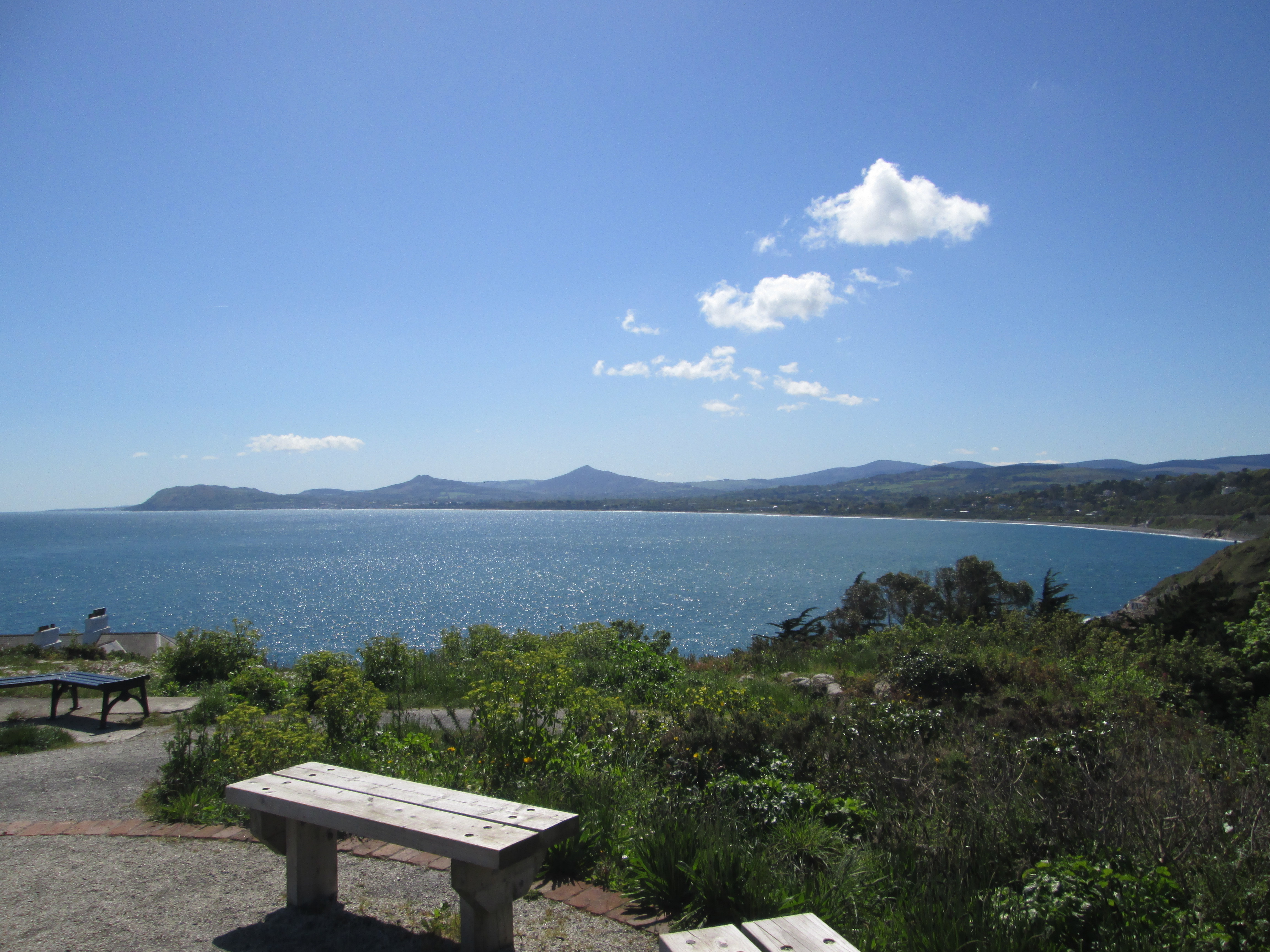
Killiney Bay has excited comparison with the Bay of Naples, and though such comparisons are often strained, on a glorious day such as this you can see the connection. The bay is framed to the south by Bray Head and the Sugarloaf Mountains, attractively conical peaks the larger of which gives a passable imitation of a volcano. The names of the roads mirror the conceit: Vico, Sorrento, Capri and San Elmo. Above, Killiney Hill stands sentinel, crowned by its obelisk. The craggy coast is clad in woodland and expensive villas, this is the address for the rich and famous.

Snaking along the lower reaches of the headland, the Dartline hugs the coast to Dublin. The views it offers of the bay are worth the fare, in spades. Strand Road runs the far side of the track, a connection between the high road and Killiney Dart Station. At the southern end is Holy Child College, a fee paying Catholic secondary school for girls founded in 1947. It is run by The Society of the Holy Child Jesus, an international community of Roman Catholic sisters which was formed in England in 1946 by Cornelia Kennedy.

Born Cornelia Peacock in Philadelphia in 1809, she married an Episcopalian minister, Pierce Connelly with whom she had five children. The couple converted to Catholicism, but Pierce pushed on towards the priesthood. Cornelia took vows of permanent chastity and in 1847 became a nun. but a long and bitter legal dispute with her estranged husband followed. He, ironically, had grown jealous of her attachment to the faith.

For all her sorrows, the order Cornelia established was run along the lines of the Jesuits and encouraged its students to express themselves through Art, Music and Drama. In that respect, they encouraged a glitterati of artistic alumnii: writers Eavan Boland and Maeve Binchy amongst the best known.

Reverend Sisters, I remember were it yesterday

standing young and green before the wisdom age and your black habits wrought

The sisters also fostered the talent of a trio of girls: Alison Bools, Clodagh Simonds and Mary White, together known as Mellow Candle. In their mid teens they put together demo tapes and in 1968, aged just fifteen, they cut their first single Feeling High in London. As with much of the band’s work, commercially it disappeared without trace. Two years later, Alison, at art college, and Clodagh, returned from a sojourn in Italy, or perhaps just Vico Road, reformed Mellow Candle augmented by two guitarists. 

Reverend Sisters I remember everything you see

all your words and teaching left some imprint on my memory

though I’m sad it had to be this way

as you said we change with every day

Reverend Sisters though I hate to say it

now the veils are lifted from my eyes and I can see

Reverend Sisters/Mellow Candle

Mellow Candle

These merry pranksters went on trips around the bay, played in the company of Doctor Strangely Strange, Thin Lizzy and Horslips, and signed with Deram records. The fully electric quintet that cut their only album, Swaddling Songs, comprised the twin female vocal with Clodagh on keyboards, guitarist Dave Williams who married Alison at a ragged Lizzy stadium gig, ex-Creatures bassist Frank Boylan and drummer William Murray. Swaddling Songs is a gem, a shining example of music transcending genres and time. In its own time it was completely ignored. 

I was one of a handful who bought it, as fans do, but weirdly it attained cult status two decades later and is now a collectors item. Mellow Candle’s music is unclassifiable. When ascribed genre, they were often labelled folk-rock, or Celtic-rock, neither being particularly accurate. They were a genre unto themselves: Breton sea shanties, renaissance music, choral, folk, and prog rock in a joyful collision – baroque and roll perhaps; their sound poised forever on the event horizon in some other universe.

I suppose, life and school in such a locale would tend to lead the soul towards all things maritime and wild. One can imagine Simmonds out on the strand, or bathing off shore. My younger self tended a lot towards such imaginings, but dreams can come true. 

At a summer gig in the summer of seventy one, Mellow Candle played support to Thin Lizzy in Blackrock Park. The park made a natural amphitheatre sloping down to a pond, with the bandstand an island in the water. Not being ones to hold back, and it being a glorious day, the girls plunged into the water for the finale and formed a pre-Raphaelite tableau of bathing nymphs. But then, on such a day, who could resist the urge to join them? So, here’s to swimmin’ with Clodagh Simonds.

gravity

Pity the poet who suffers to give

sailing his friendship on oceans of love 

strange harbour soundwaves break out of his reach

love is a foreigner to the queen of the beach 

The Poet and the Witch/Mellow Candle 

Rainy Night in Ripley Hills

Ripley 1

Where Killarney Road reaches its apex, a copse of fir trees guards an ancient stone marker, Saint Saran’s Cross. This mystery-laden oasis atop the hill is surrounded by a modern housing estate called Fairyhill. On the falling eastern slopes is another estate, Ripley Hills, which I call home. It was built in 1983 beside two grand houses of the nineteenth century, which were curiously conjoined: Rahan and St. Helen’s. Rahan House was once the abode of writer Arthur Conan Doyle. During his stay he developed an interest in the supernatural and wrote a book called The Coming of the Fairies.

Rahan and St Helen’s were destroyed by fire shortly after I took up residence nearby and I witnessed the sad event from my rear window.  They took their mysteries with them, and their only vestige is a calm green space in Ripley Court. While the urban environment continues to grow, the landscape continues to give. Fabulous views of Bray Head and the Sugarloaf Mountains are always a reward for a walk around Ripley Hills and environs. The estate itself, sylvan and landscaped is a suburban pleasure too. I have been there long enough to witness it beneath blue skies and blankets of snow. But in the dark of night, with rain falling, it is sometimes more magical still.

Something’s gotten hold of my heart

Keeping my soul and my senses apart

Something’s gotten into my life

Cutting its way through my dreams like a knife

Turning me up and turning me down

Making me smile and making me frown

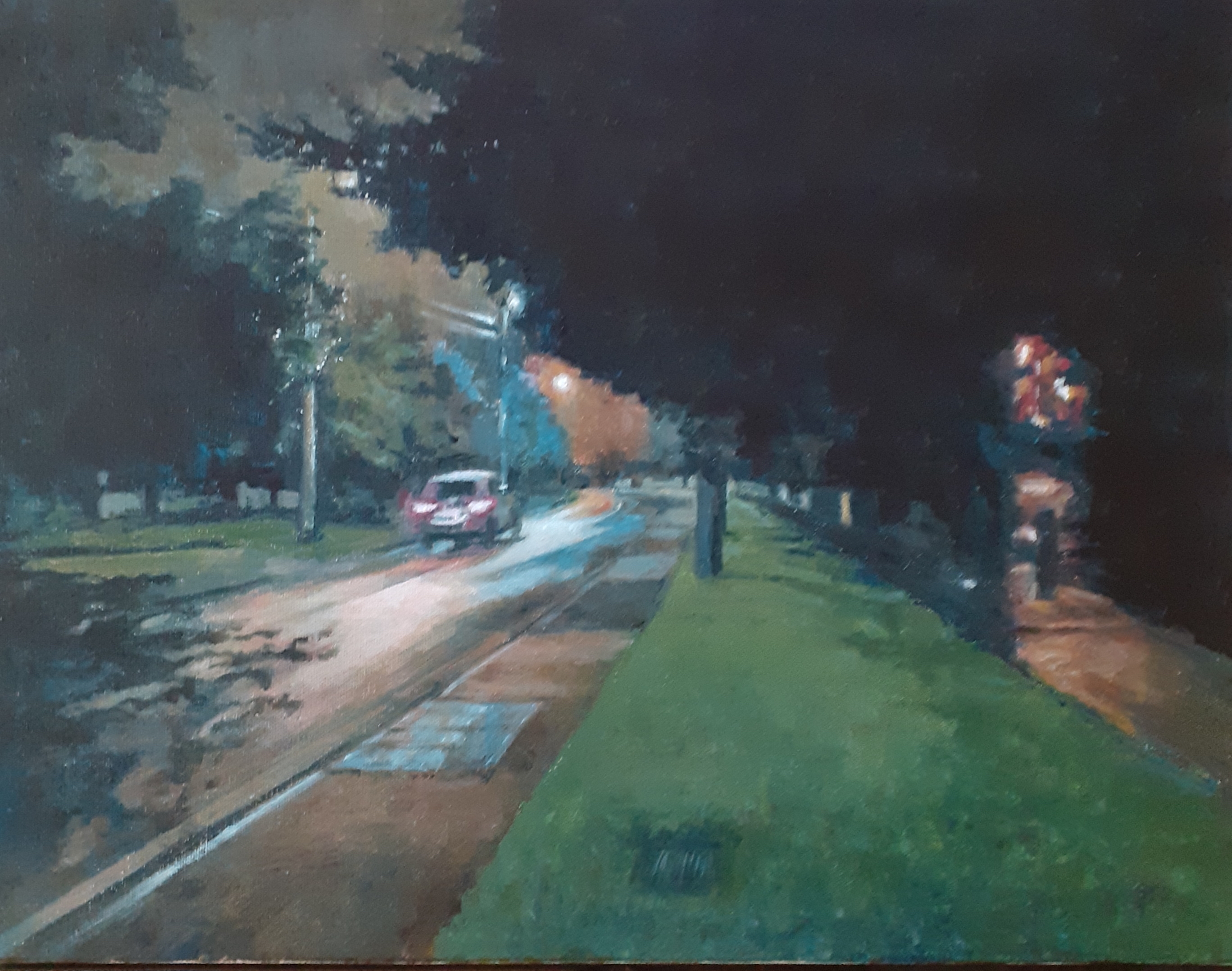
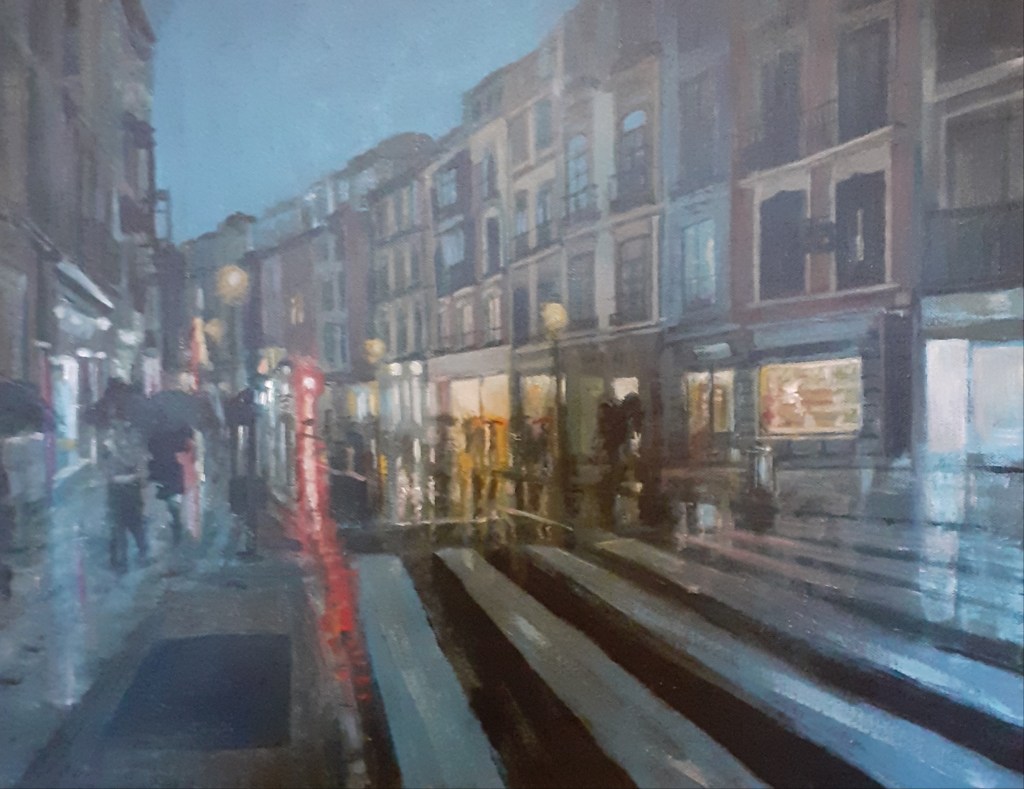
You know the feeling you get when the rain is falling and falling and you stand to look up into it and feel yourself rising up until you reach that point of equilibrium where the rising spirit and the falling water are as one, poised together in endless stasis. A moment like that, held in the sodium glow of the streetlamps, is what this painting is about. Trying to capture it, I reached for a palette richer and more varied than my dark blues and greys. 

Something’s gotten hold of my hand

Dragging my soul to a beautiful land

Something has invaded my mind

Painting my sleep with a colour so bright

Changing the grey and changing the blue

Scarlet for me and scarlet for you

Something’s Gotten Hold of My Heart, was written by Roger Greenaway and Roger Cook and was a hit for Gene Pitney in 1967. Born in 1940, Pitney was a singer songwriter who first achieved fame in the early sixties with movie theme songs. Perhaps his best known hit was the intense narrative Twenty Four Hours from Tulsa, a Bacharach David song in1963. His songwriting credits include Hello Mary Lou which was a hit for Ricky Nelson. In 1989 Pitney scored again with Something’s Gotten Hold of My Heart in a duet version with Mark Almond. He died in 2006.

In a world that was small

I once lived in a time there was peace with no trouble at all

But then you came my way

And a feeling unknown shook my heart, made me want you to stay

All of my nights and all of my days

Climbing Bray Head

B.Woods Aug20

Bray Head is the defining geographical feature of the town. Rising sheer eight hundred feet from the Irish Sea, the headland is capped by a large stone cross, erected for the Holy Year of 1950. The headland is a sizeable upland area. Its ridge consists of five or so mounds of exposed quartzite, like the knuckles of a fist. While the cross marks the headland, the summit is a couple more humps inland. 

The climb to the Cross is a must for visitors, and a regular pastime for locals. The route from the seafront is steep, though the incline can be tempered by zigzags through natural woodland. A longer but more gradual climb runs from the junction of the Southern Cross and Greystones Road, adjacent to Bray Golf Course. 

B.Golf Aug20

The lower entrance, through the gates, makes for a lovely start through dense deciduous woodland. Dappled green and umber, but allowing the occasional patch of sunlight through, this is a cool and mesmeric way to disguise the climb. Merging with the golf course path, the incline hardens, but compensates with fabulous views over the Sugarloaf Mountains, to the Wicklow Mountains beyond, with Bray’s urban landscape leading down to a blue sea, and South County Dublin’s rocky bays and inlets leading the eye on to the distant city. 

B.View Aug20

At the top of the path there’s a short, stiff clamber over rocks just above the treeline before the path resumes. Another option, is to veer right for a longer, smoother ascent, with some wonderful rugged scenery above the manicured golf course. Emerging from the scrubland, there’s a smooth path leading up to. the Cross. The headland offers dizzying views over ocean, coast and townscape, framed by the majesty of the Wicklow Mountains. 

B.Cross Aug20

The hummock is often thronged, but often not. People come and go, and you can linger as long as you like to get the best from the experience. And there’s a surprisingly large expanse of wilderness up here to explore, or just to be away from it all. We take the path towards the stile, but leave it to ensconce ourselves beneath the second knuckle in, and sitting on grass with the rock guarding our backs, relax for a while and bathe our eyes with sunshine and the blue and glinting Irish Sea.

It doesn’t take long before I feel a song coming on.

Somewhere beyond the sea

Somewhere waiting for me

My lover stands on golden sands

And watches the ships that go sailing

La Mer was written by Charles Trenet, a homage to the view of the Etang de Thau, a lagoon he passed on the train between Montpellier and Perpignan in the South of France. Jack Lawrence’s Anglo version gives a romantic twist to the descriptive thrust of the original. It was a major hit for Bobby Darin, which is how I know it. It features on his 1961 compilation, the Bobby Darin Story, the oldest, probably, and most bedraggled album in my collection.

B.Sea Aug20

Somewhere beyond the sea

She’s there watching for me

If I could fly like birds on high

Then straight to her arms I’d go sailing.