
Andalusia – 4. Marbella

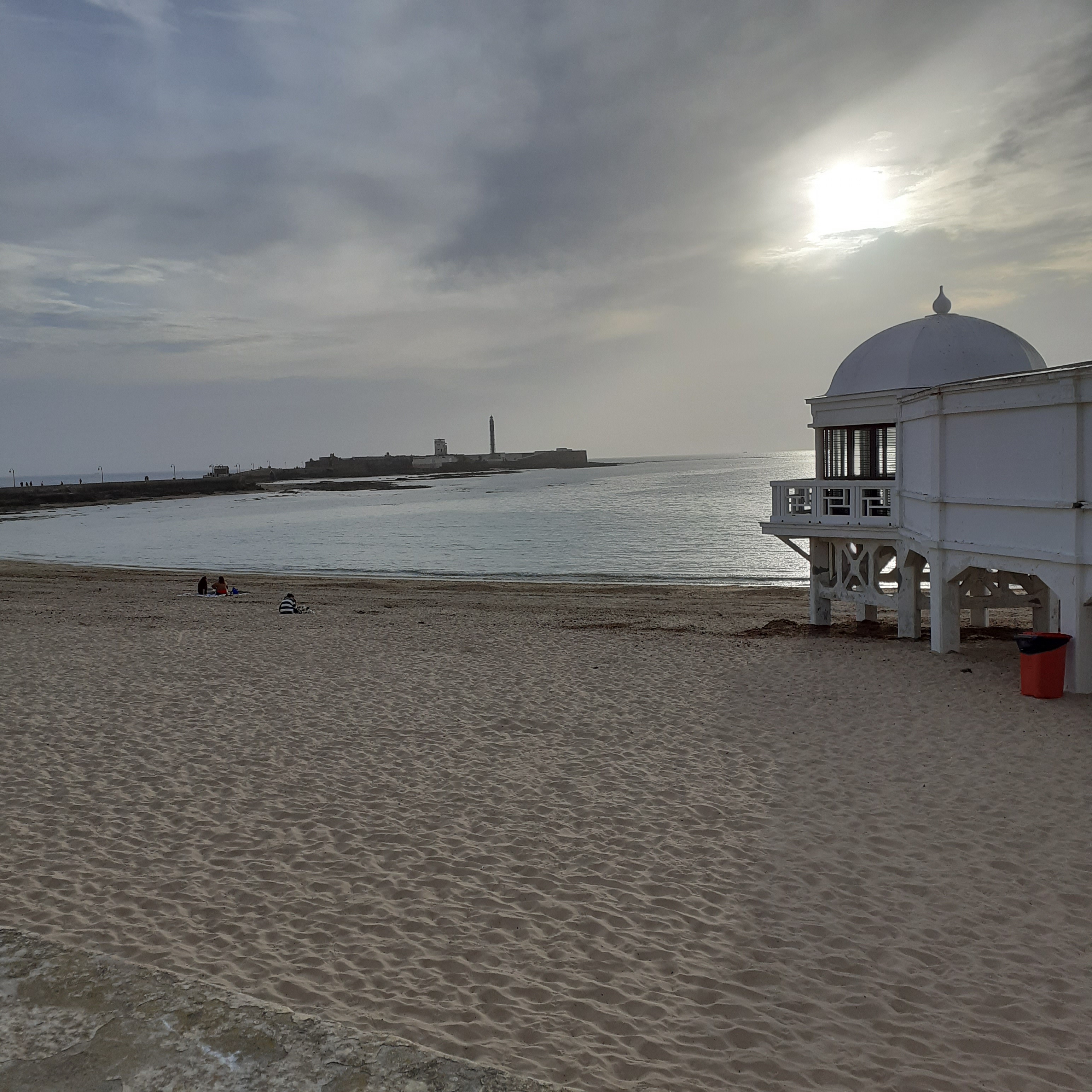
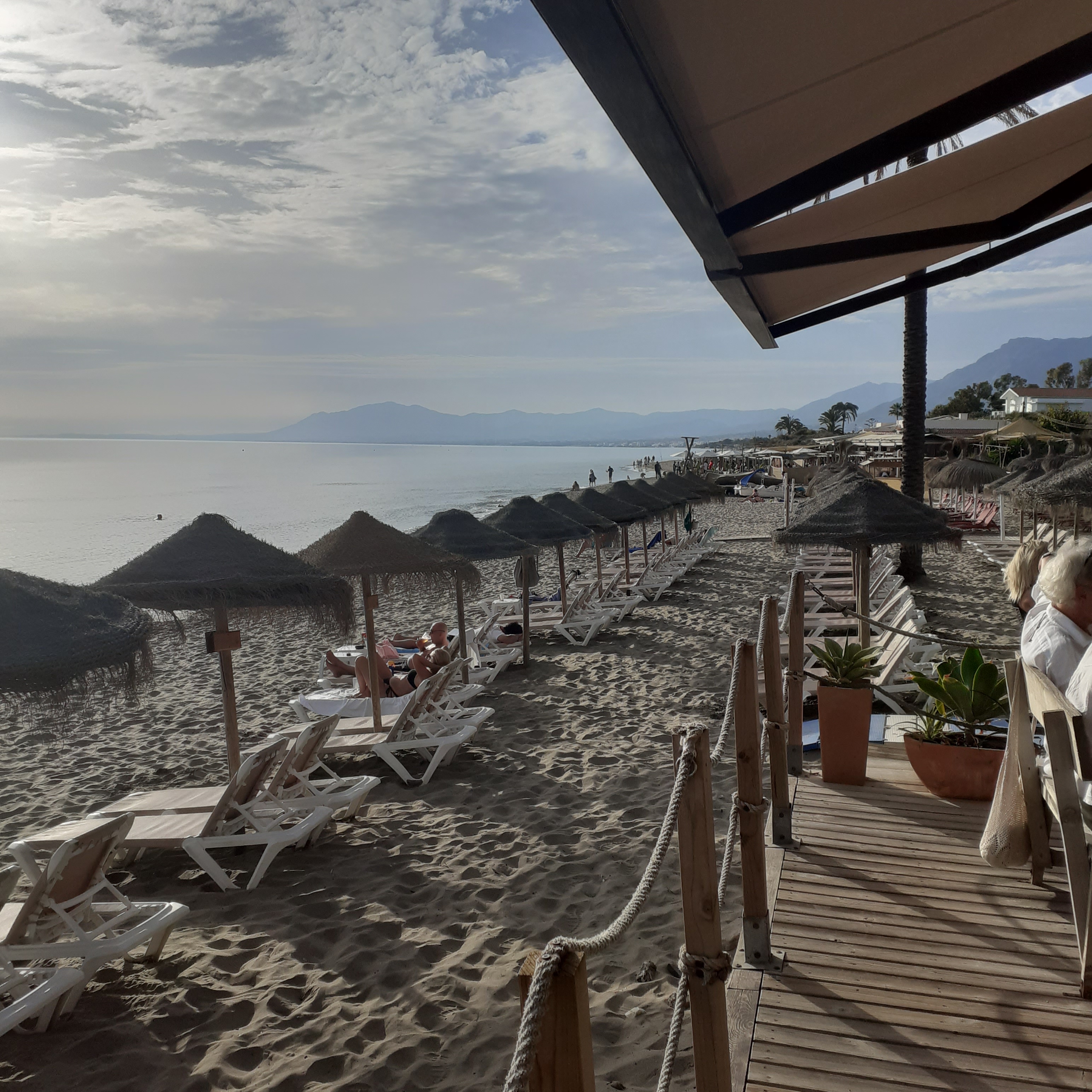
We walked to Marbella along the beach one morning. It’s about 6 miles from Elviria, and I was feeling the heat near the end. Still Spring, but climbing into the mid twenties by mid-day. Approaching the city outskirts there are a number of rugby pitches, and we are in the city proper when we reach Playa de Venus adjacent to the port. Puerto Deportiva with its modern green lighthouse lies beyond. On more sedentary days, there are regular busses along the coastal highway, the A7, for a more leisurely trip into town. It takes under half an hour. 

Marbella has long been a resort for the quality. Meaning well to do, and sometimes more quantity (of cash) than quality. The resort was an early example of Costa Del Sol tourism, established just after the Second world war. The city population today numbers 140,000 people, though that can treble during the holiday season. North western Europeans, including a lot of British and Irish, swarm for the guaranteed heat and sunshine. A long, long time ago it was popular with southern visitors of a different sort. The Moors colonised Iberia from the eight century, the name Al Andalus was then applied to the whole Iberian peninsula. Andalusia persists in the name of the Moors last redoubt.The Moors established a citadel here in Marbella, the Alcazaba, fragments of which survive, and a Mosque. 

There are two parts to Marbella. The bustling well serviced seafront where we arrived after our walk is the modern resort. The Old Town, a little farther inland, is a warren of lanes and quaint squares sloping ever upwards. After the conquest of the Catholic Monarchs in the late fifteenth century there was significant development in this walled, medieval town. The Plaza de los Naranjes was built as the centrepiece of the Old Town. It remains a picturesque antique square with some fine public buildings. The town hall was built in 1568 and the Mayor’s House nearby. At the south west corner is the Chapel of Santiago from the fifteenth century; the oldest building in the city. It predates the square, which explains why it is set at an odd angle to it.

The square itself is regular, tree shaded and ringed with restaurants and bars. Nearby is another ancient church. The Church of Santa Maria de la Encarnacion is a Baroque building of the seventeenth century, built over the existing mosque. Painted white and with an imposing bell tower it stands out as the old city’s grandest church.

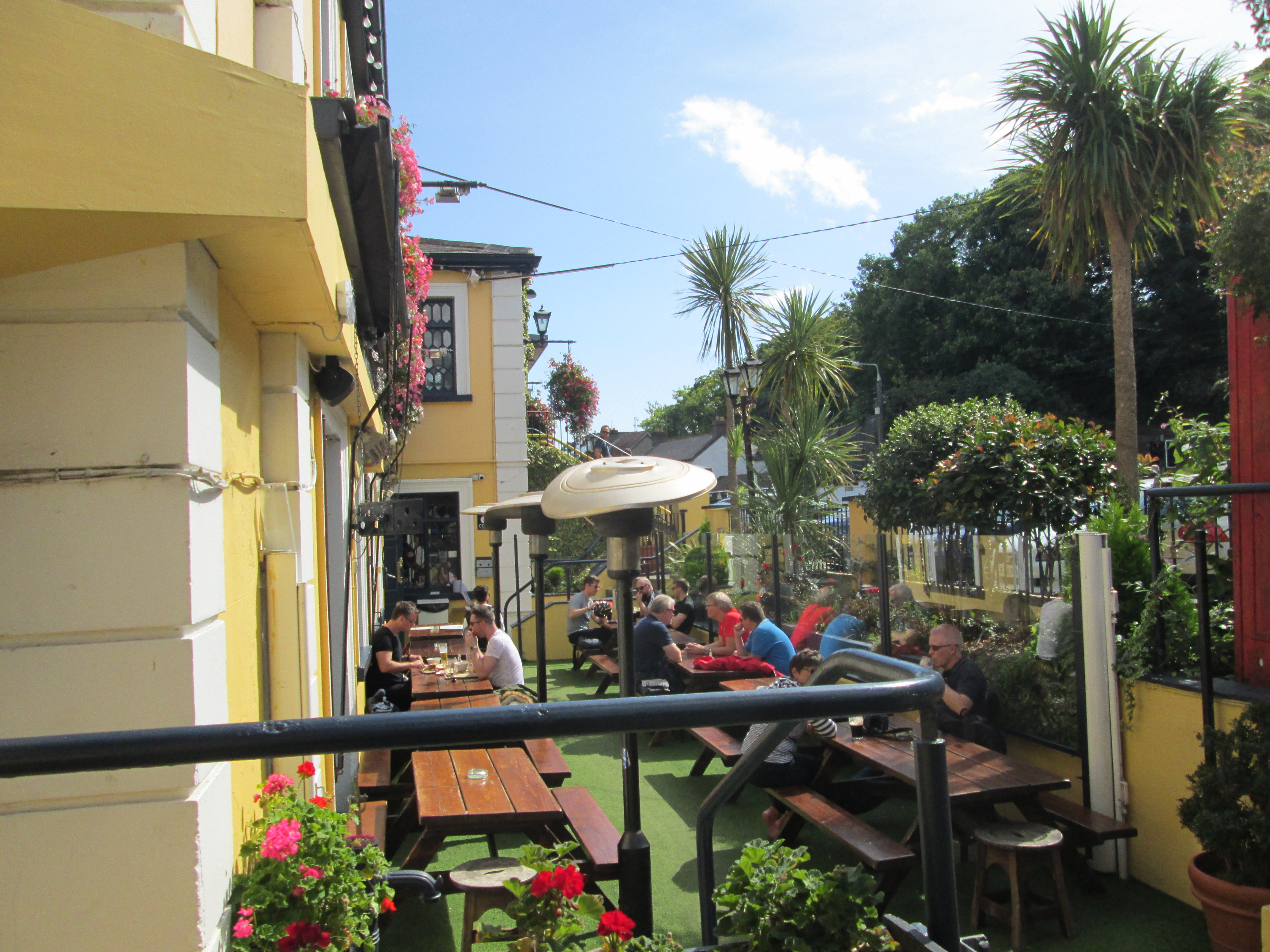
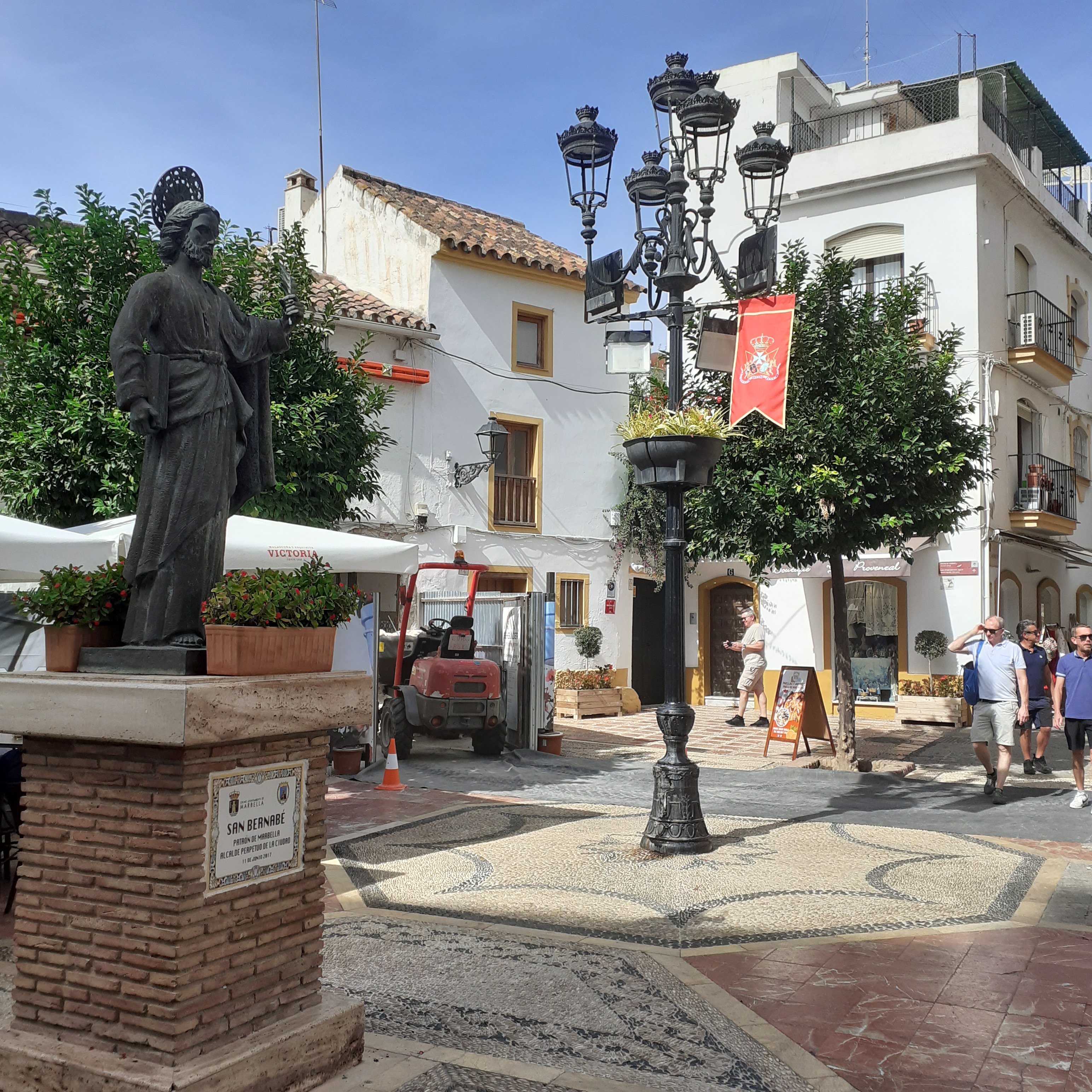
Heading further uphill the streets tunnel back to their medieval origins. The Castillo de Marbella, the remains of the Moorish Castle, lies to the north east of the square. From here, following the line of the walls back down to the modern commercial centre, we come to Plaza de la Iglesia with its statue of Saint Bernabe, the town’s patron saint. His festival is on the 11th June, ushering in a week of dancing and carousing in the Spanish way. Festivities are rarely remote from Marbella at any time though this, we hear, is particularly wild. Our ambitions for earthly delights are not particularly Bacchanalian today and we make do with an easygoing hour or two in Plaza Manuel Cantos, where the Irishman Pub and Luigi’s Italian Restaurant provide sufficient for our drinking and dining pleasure. Other soirees might include El Balcon de la Virgen and Patio Marbella in the labyrinth of the old town. 

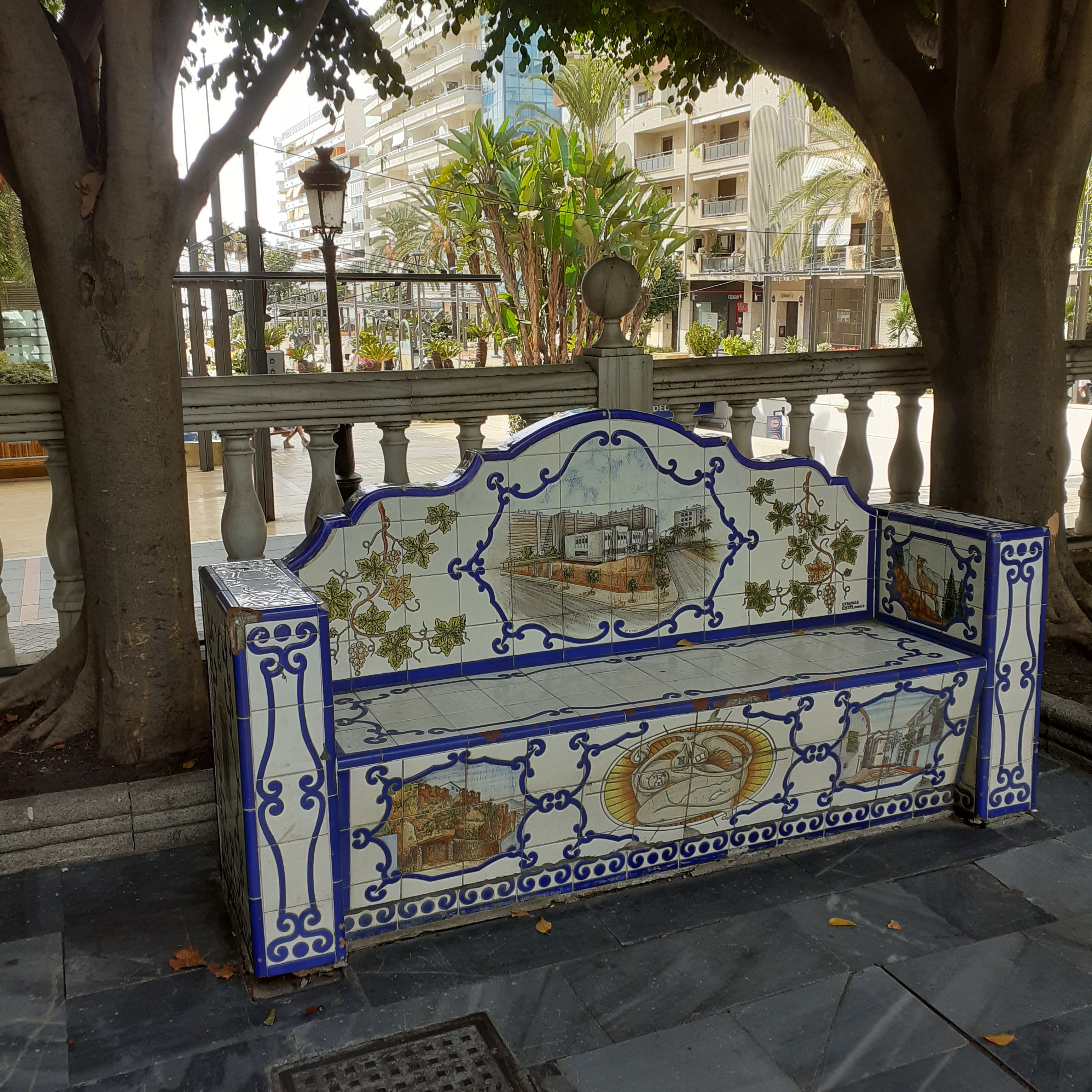
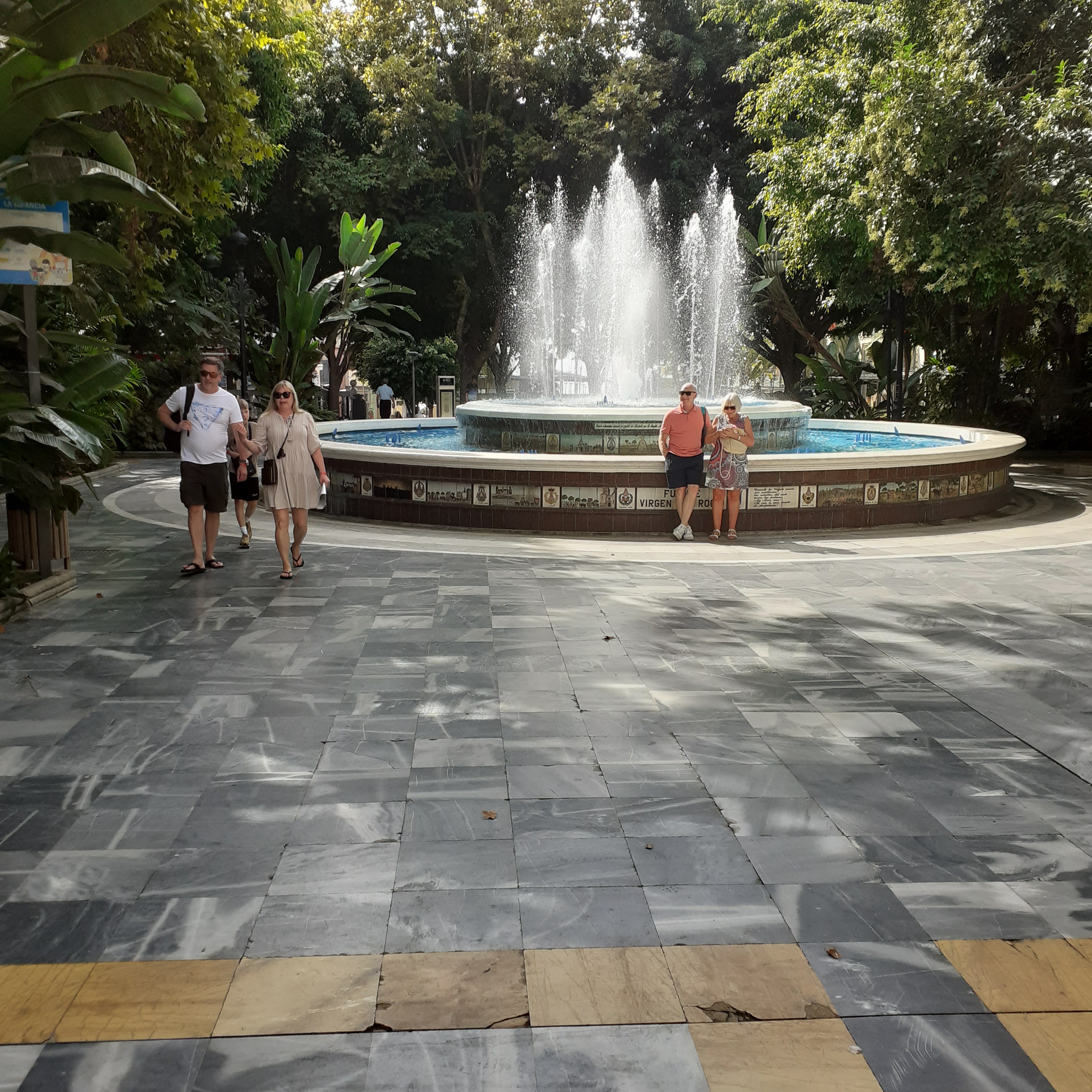
Between the Old Town and the modern seafront, Ensanche Historico, the Historic Extension, is laid out to ease transition between the two. Across the busy thoroughfare of Paseo de Alameda, Alameda Park is an elegant formal park, richly planted and decorated in colourful tiles. All of this radiating out from a historic fountain. It’s a glorious place to hang out, the setting luminous under the shade of palm trees.

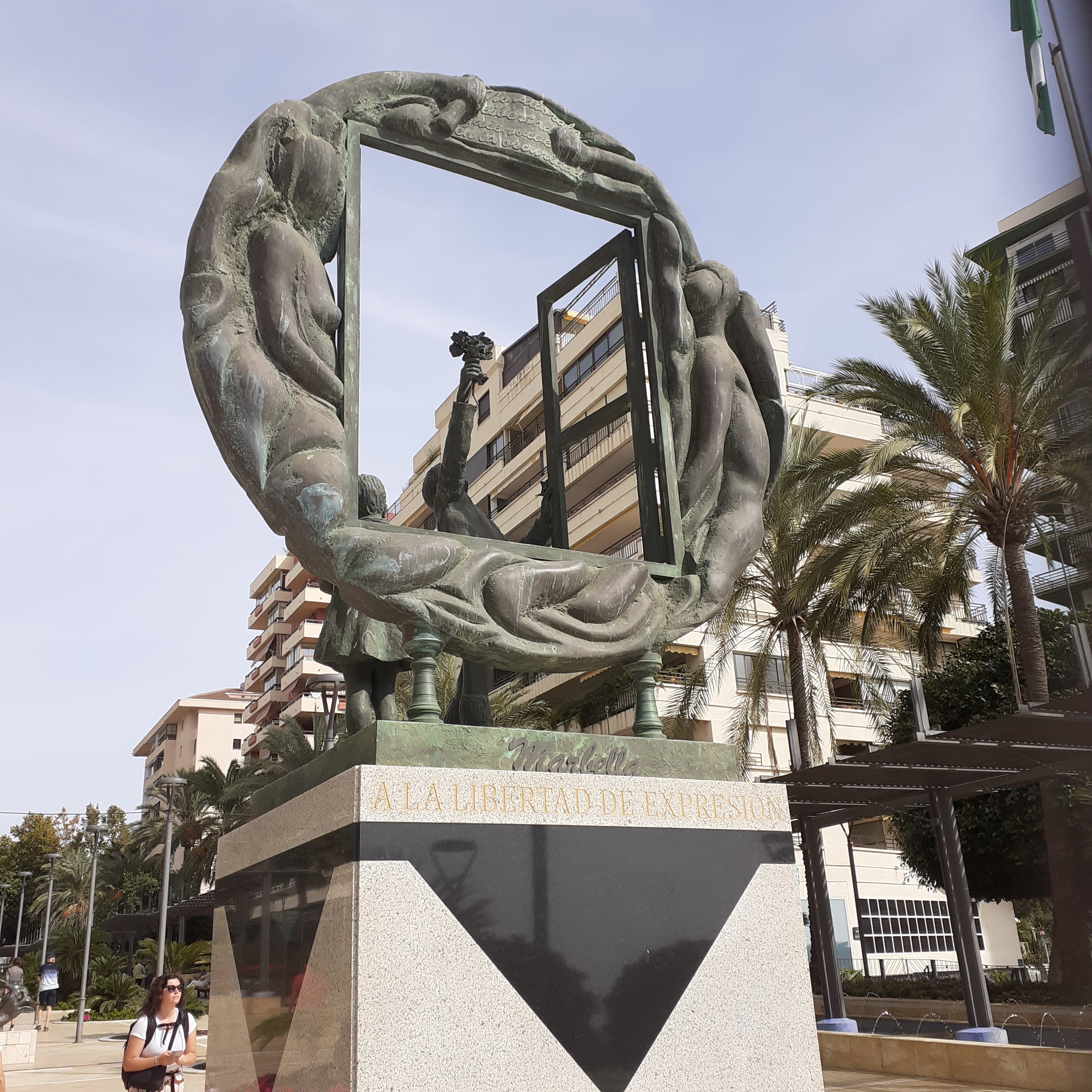
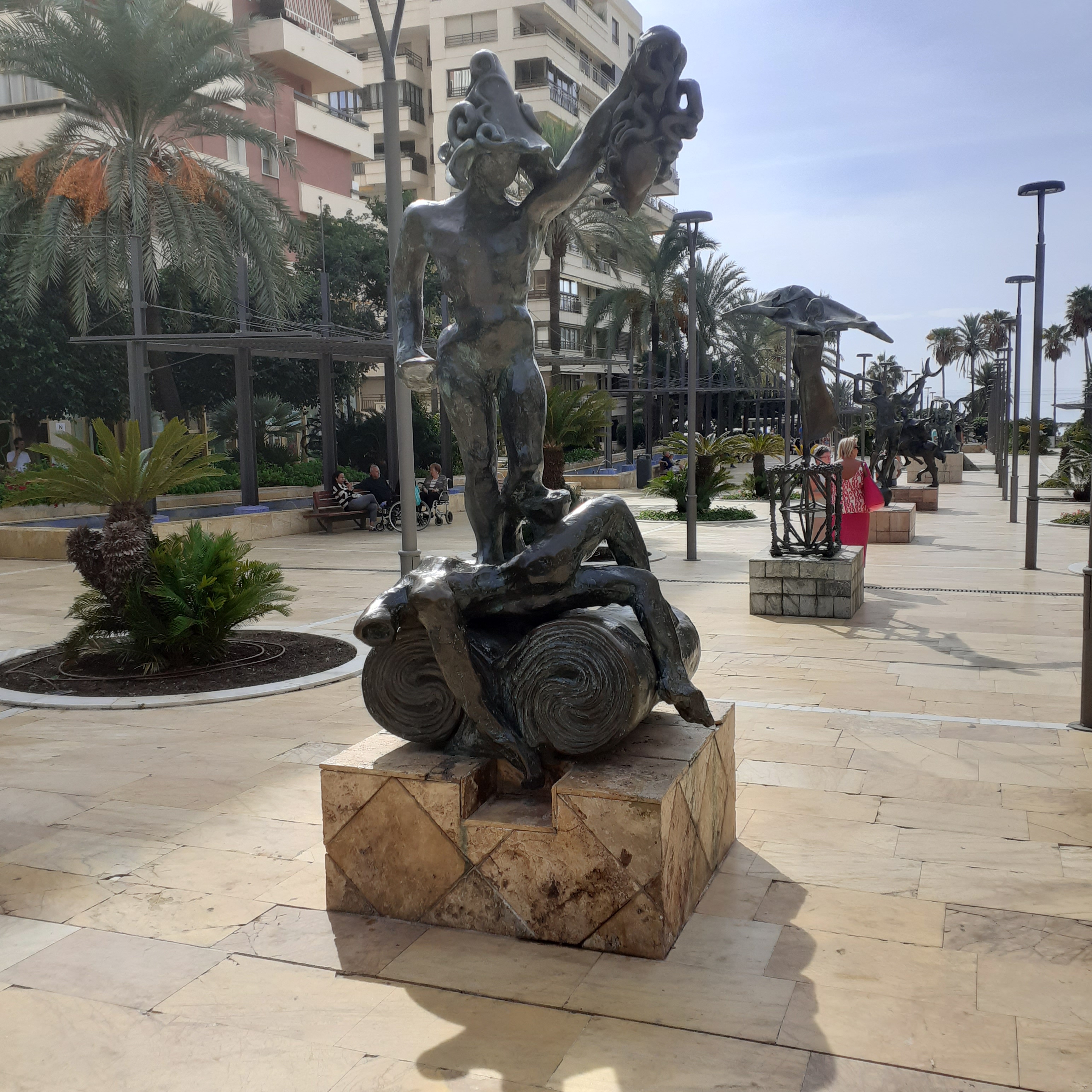
Beyond the park, The Avenida del Mar, as its name suggests, forms a wide esplanade sloping down to the seafront. It is lined with sculptures by Salvador Dali and others. Eduard Soriano is a notable other, his Monument to the Freedom of Expression overlooks the seafront promenade. This shows two figures at an open window surrounded by apt quotations, including the sculptor’s: Freedom does not die, it is born and sleeps daily.

Dali’s ten bronze sculptures were cast in Verona and acquired in 1998. They feature a range of hallucinogenic imagery as one would expect from such a major Surrealist. Some are drawn from Classical mythology including figures of the god Mercury and of Greek hero Perseus beheading Medusa. There are metamorphoses of nature with Man on a Dolphin and Cosmic Elephant, and inevitably Dali’s wife and  muse, Gala, who is depicted leaning out a window.

Dali has no specific connection with Marbella. He hailed from Catalonia, born in 1904 in Figueras, near the French border. As for Andalusia, he was in his younger years very friendly with Federico Garcia Lorca, one of Spain’s leading poets. Then there is the film, Un Chien Andalou. Lorca, whose advances were rejected by Dali, interpreted the film’s title as a swipe at him and became further alienated from the Surrealist movement.

Lorca may simply have been paranoid, though the title does intrigue. It is taken from the Spanish saying: an Andalusian dog howls – someone has died. The idea sprang from an exchange of dreams with filmmaker Luis Bunuel and the two collaborated on the 1929 silent film which was directed by Bunuel and co-written with Dali. It ran to just sixteen minutes. The notorious opening scene begins with the reassuring caption, once upon a time, but quickly becomes ominous. A man sharpens his razor while a thin cloud bisects the moon, He restrains a seated young woman and brings the razor to her staring eye. Provocative, repulsive and outrageous, the film went down well which was something a disappointment to its writers who were prepared for a riot. It echoes forever through avant garde film. David Lynch would be a good example. Think Blue Velvet for one, and many’s the rock video.

Marbella promenade stretches from the port for a further seven kilometres to Puerto Banus in the west. Puerto Banus marina, with its luxury yachts is an upmarket nightspot and includes, amongst other delights, O’Grady’s Irish Pub. There are plenty of opportunities for refreshment at this end of the boardwalk, and plenty of time, which seems to grow profusely in the sunshine of Andalusia. That day we took a bus back to base camp. We were helped by a lovely Norwegian couple who come here every year. And why not. Folk from frozen fjords and rain dirty valleys need some time to gaze at the actual heavens.

To everything – turn, turn, turn

There is a season – turn, turn, turn

And a time to every purpose under heaven

A time to be born, a time to die

A time to plant, a time to reap,

A time to kill, a time to heal,

A time to laugh, a time to weep.

This version by the Byrds, from 1965, surfaces whenever joy is required. Pete Seeger wrote it in 1959, setting the words from the Book of Ecclesiastes to a major chord sequence. Those words from the Bible are attributed to King Solomon of the 10th century BC. Very old school. Seeger supplied the “turn, turn, turn” and the Byrds took it to No 1 with their characteristic jangling guitars and sublime vocal harmony.

Andalusia – 3. Costa Del Sol

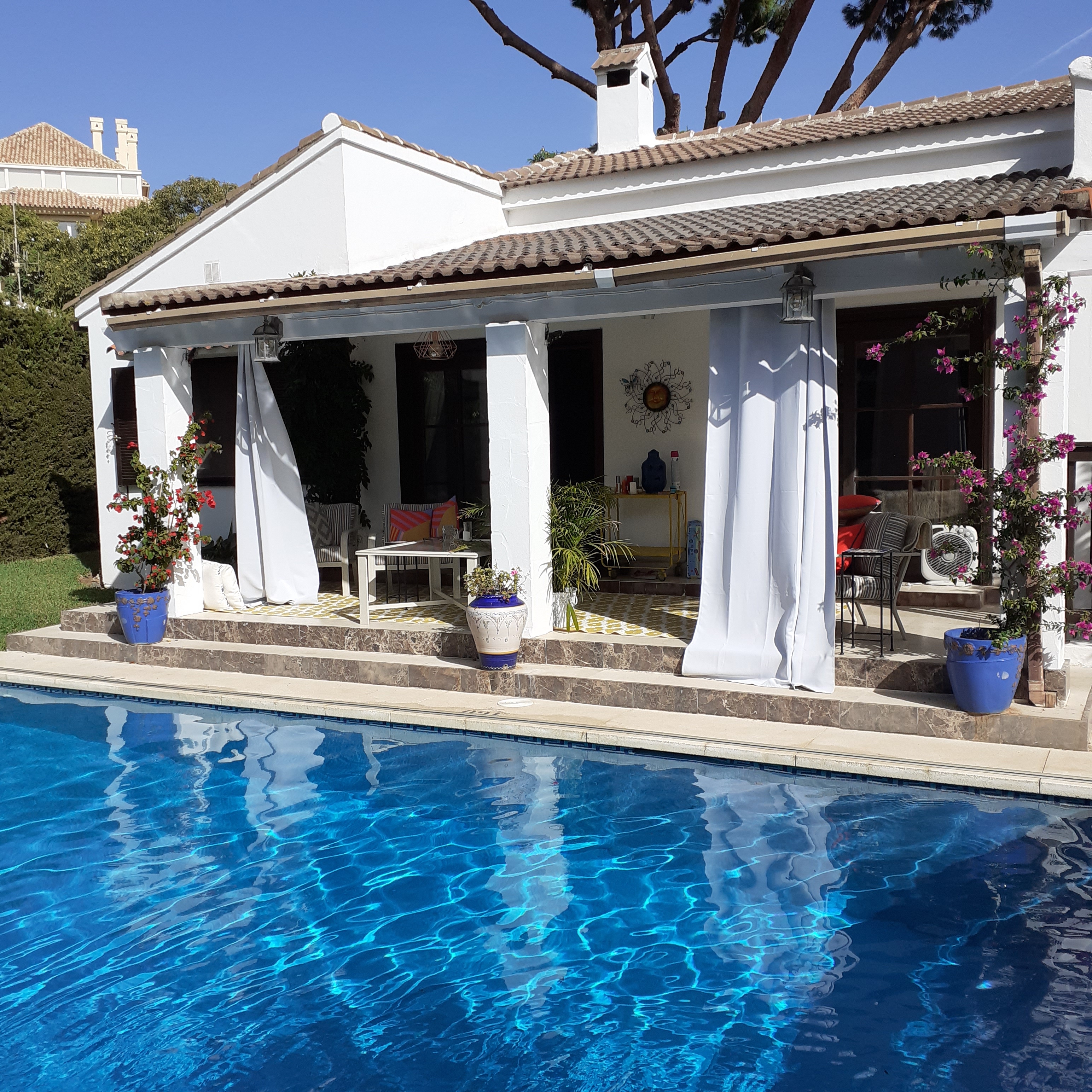
At times we stay in the villa of a friend on the outskirts of Marbella. It is just a short drive from Malaga airport, all going well. The use of satnav is recommended on Spanish roads, otherwise you, like us, will get lost. It looked the height of simplicity to get from airport to front porch, but born as I was to have adventure, it took me over two hours. The A7 highway was my intended route, not to be confused with the AP 7 which runs beside it, the two often intertwining. Confuse is exactly what I did, but first I took the random decision on our first visit to make a quick flythrough of the famous, or infamous, resorts on the southern extremes of Malaga.

The Costa del Sol is well named and stretches from Nerja, just east of Malaga, to La Linea near Gibraltar. A prosperous commercial and industrial area in the 19th century, it declined in the early twentieth and after World War 2 turned to attracting visitors as a way to halt the economic decline. Where the coast was once a string of fishing villages, it is now mostly urbanised and has grown to be Spain’s most frequented tourist location with around seventeen million overnight stay.

Torremolinos golf course marked the beginning of the boom way back in 1928, The development of Malaga as resort town followed. The Spanish Civil War intervened, with World War two kicking off just as it ended, but by the fifties the fame of the region spread for its climate and facilities. Marbella, a village of 900 people, saw the establishment of the El Rodeo resort and Marbella Club hotel, and attracted film stars and the rich and famous. Mass tourism exploded in the sixties and seventies leading to overdevelopment, often submerginfg the culture which was a major part of the attraction in the first place.

Torremolinos, Benalmadena and Fuengerola are packed together. once a poor fishing village, is now a town of seventy thousand people just 8miles from Malaga. It has the largest concentration of golf courses in Spain. Fore! I am sure there are more. The climate makes this one of the most enjoyable places to play, if Golf could be considered a pleasure, or a good walk spoiled.

The resorts were developed without much concern for aesthetic or social planning and became a notorious highrise jungle. While the serious tourist demurred, many more voted with their boarding pass. A cocktail of sun, sea and sex with two weeks determined indolence offered an antidote to the humdrum of work slaves from the temperate zone.

The urban landscape ultimately reflects its own purpose; a modern, commercial open holiday camp. Which is fine if you like that sort of thing. M and I were more of the island hopping hippy type, back in the day; though our once ad hoc holiday season is a bit more planned now. Spain, of course, accommodates much more than the cartoon holidaymaker. We’ve oft visited over the years, mostly Barcelona, also Madrid and Malaga, and the kaleidoscope of culture and moods that is Andalusia.

Driving through the tourist hub from Torremolinos to Fuengerola is a sample of the sun soaked brochures we’ve perused. We gained a startling glimpse of the giant black Bull on its mound, which adorns my travel book of Spain. This is the famous advertisement for Osborne Brandy. The concept was conceived by Manolo Prieto in an advertising campaign in the 1950s for Osborne. The giant metal bull silhouette bore the Osborne brand and appeared at roadsides throughout the country. Some are 40 feet high and there are almost a hundred all over Spain, though not in Catalonia.

Roadside advertising was progressively curtailed over the next few decades and eventually banned altogether, but campaigners fought to keep their bull. In Andalusia, the authorities ruled that they were part of the cultural and artistic heritage of the nation in 1997 and remained, minus the branding, though Osborne still pays for their upkeep. Some controversy remains, especially amongst opponents of bullfighting; hence the exception of Catalonia.

Osborne, you might know, goes hand in hand with Harrison, so it was a sight dear to our eyes to see the bull standing proud. Thomas Osborne, mind, had no direct connection with our kin. They came to Wicklow in the seventeenth century I think, and were stonemasons. Thomas was an Englishman who arrived in Cadiz in 1772 and exported sherry to begin with The brandy came some time later.

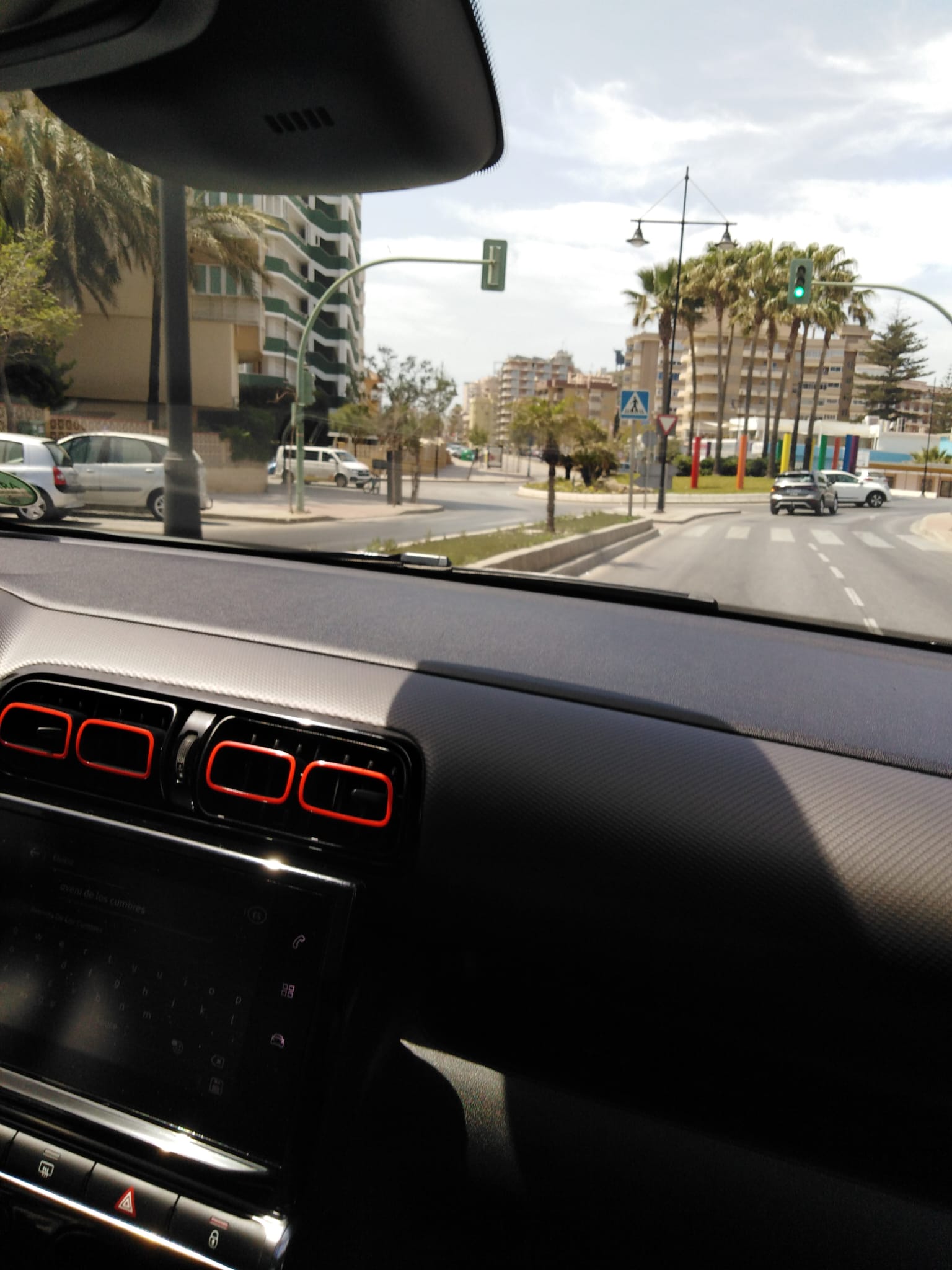
We figured that after Fuengirola we would be nearing our destination. Unfortunately, coming off the seafont there was a fork in the road and the sign offered Marbella in either direction. Eenie, meenie, minie, mo. Wrong choice, I’m afraid. We found ourseves headed back towards Malaga, then taking an exit, we wound up on the AP 7, which is a toll road, and ended up in Canada. Canada, in this case is a shopping centre in Haute Marbella. The town centre was downhill from there but by this stage our satnav was even more confused than us and would stop at nothing to get us back to Canada again. Eventually we found the coastal branch of the A7 after a chaotic tour of Marbella centre, including rapidly reversing before an oncoming tram. Our destination, Elviria, was just five miles out of town.

Fuengirola is in fact the last rail stop along this stretch of coast. The commuter line to Malaga has three trains an hour, the journey taking forty five minutes. It stops at the airport which takes thirty minutes. From Malaga, there’s a railway connection to Algeciras (past Gibraltar) via Ronda, and connections also to Seville and on to Cadiz.

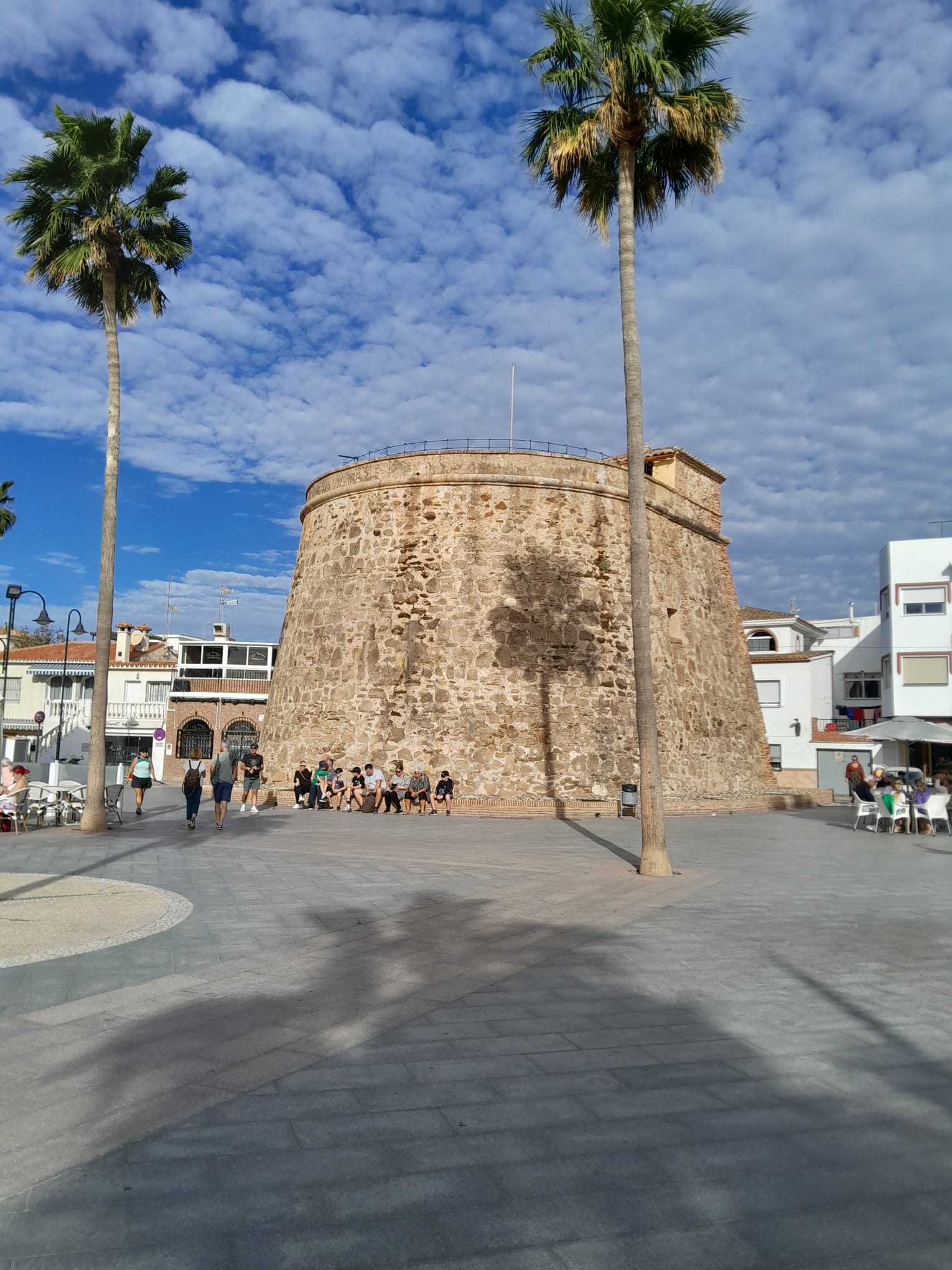
The coastal highway, meanwhile, leaves Malaga city environs behind and rounds the corner to follow the coastline to Marbella. La Cala de Mijas is the first stop. This is a small settlement of five thousand people which maintains much of the feeling of the whitewashed Andalusian fishing village. There were four towers defending it from Berber invaders, one of which forms the centrepiece of its attractive seafront. Dating from the sixteenth century it is one of the oldest on the coast and has a museum within. There are sensitive modern developments along the coast, lowrise and white, a tiny, winding old town, a wide commercial plaza just off the highway, a long promenade and a twice weekly market.

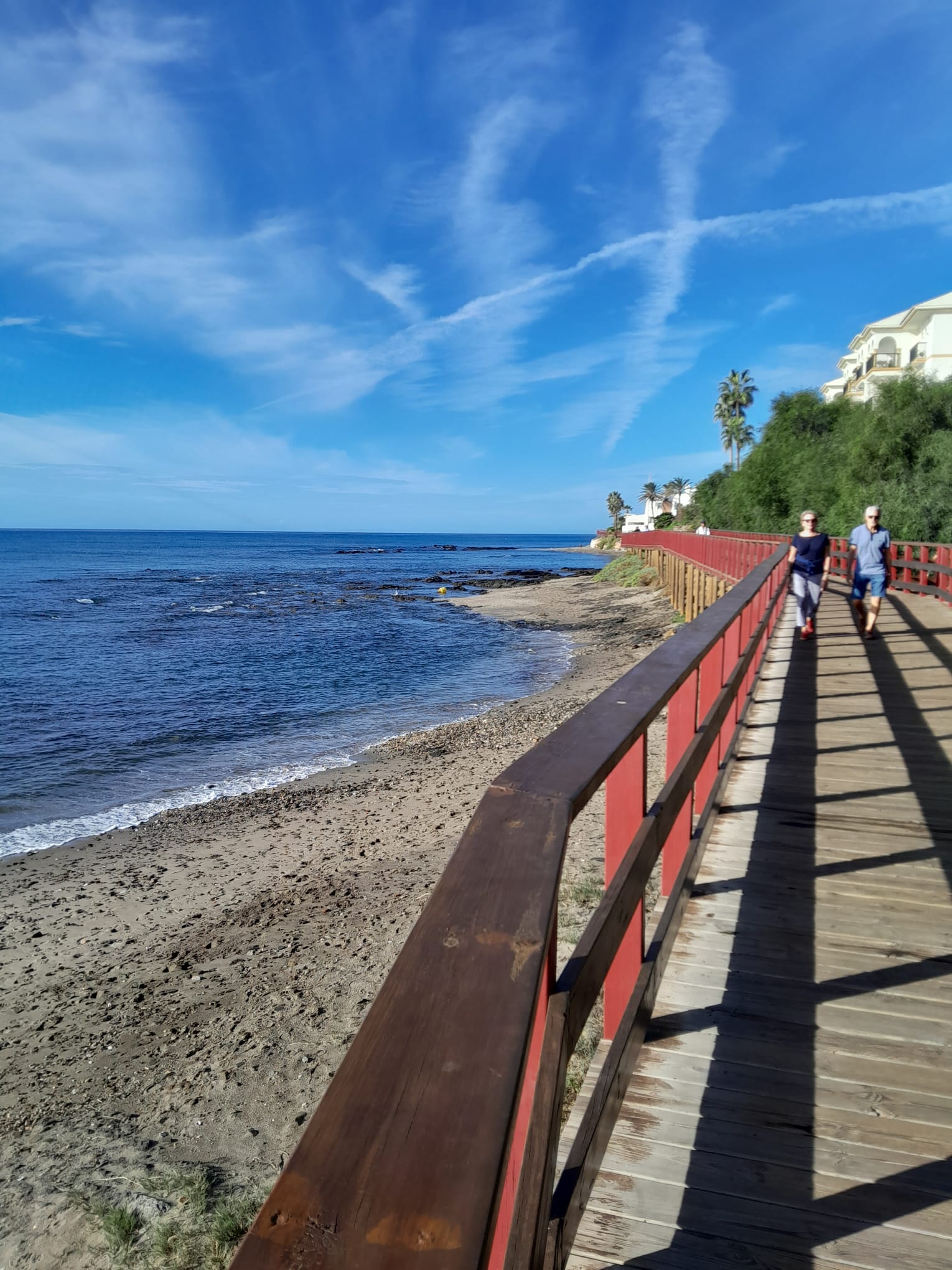
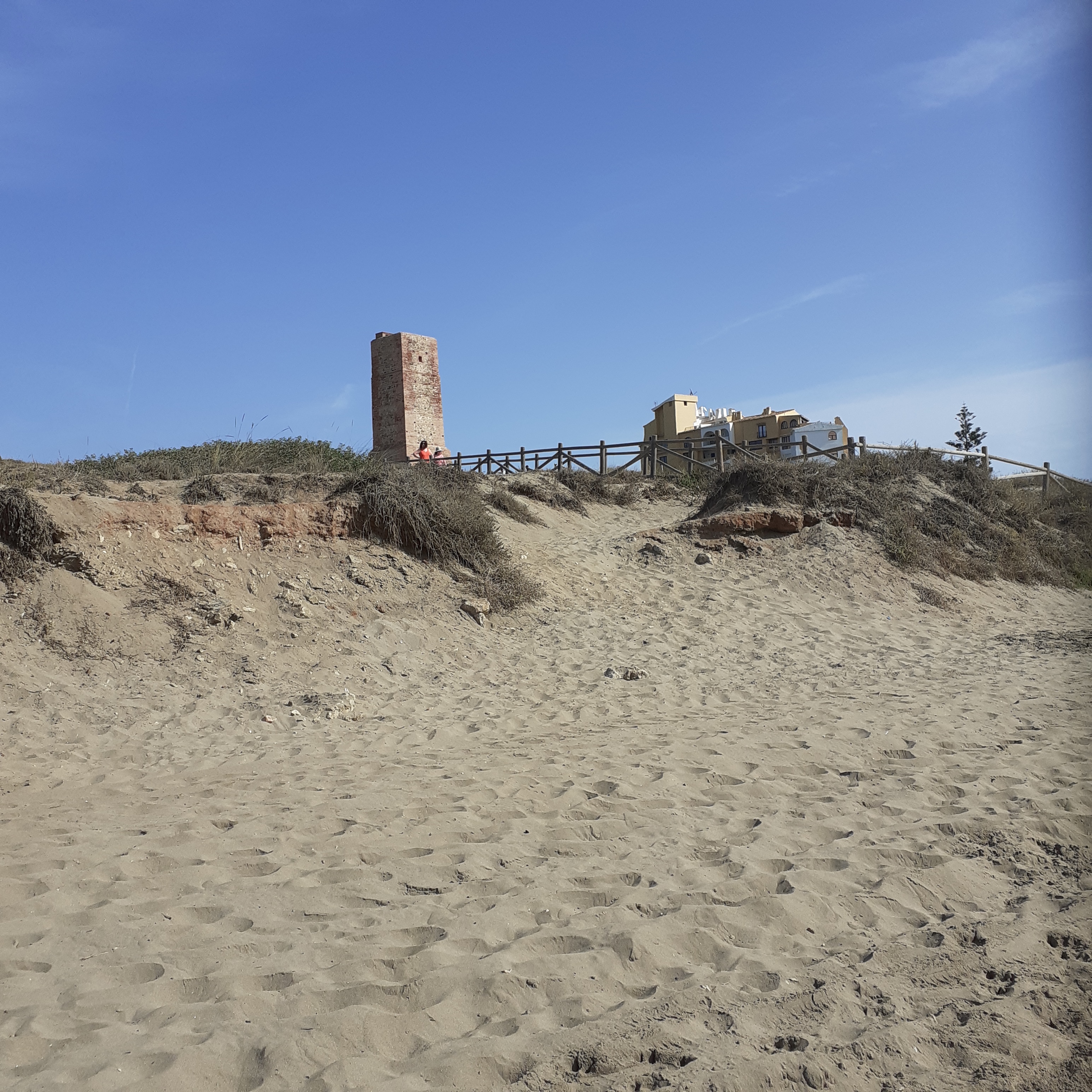
A boardwalk extends along the beach heading west stretching almost the 6 kilometres to Cabopino. This is a small resort around a pleasant harbour where we stopped for lunch on a coastal walk. There’s a large private resort hotel, while bars, souvenir stalls and eateries colonise the beach. Farther on the nudist beach is marked by a large stone erection, but we pretended not to notice. Torre Ladrones, the thieves tower, is a much visited landmark. At fifteen metres tall it is the highest tower along this stretch of coast. It was built during Moorish rule up to the late fifteenth century. Artola Beach is backed by dunes which have been designated an environmental reserve, making it a rare stretch of beach not developed as accommodation.

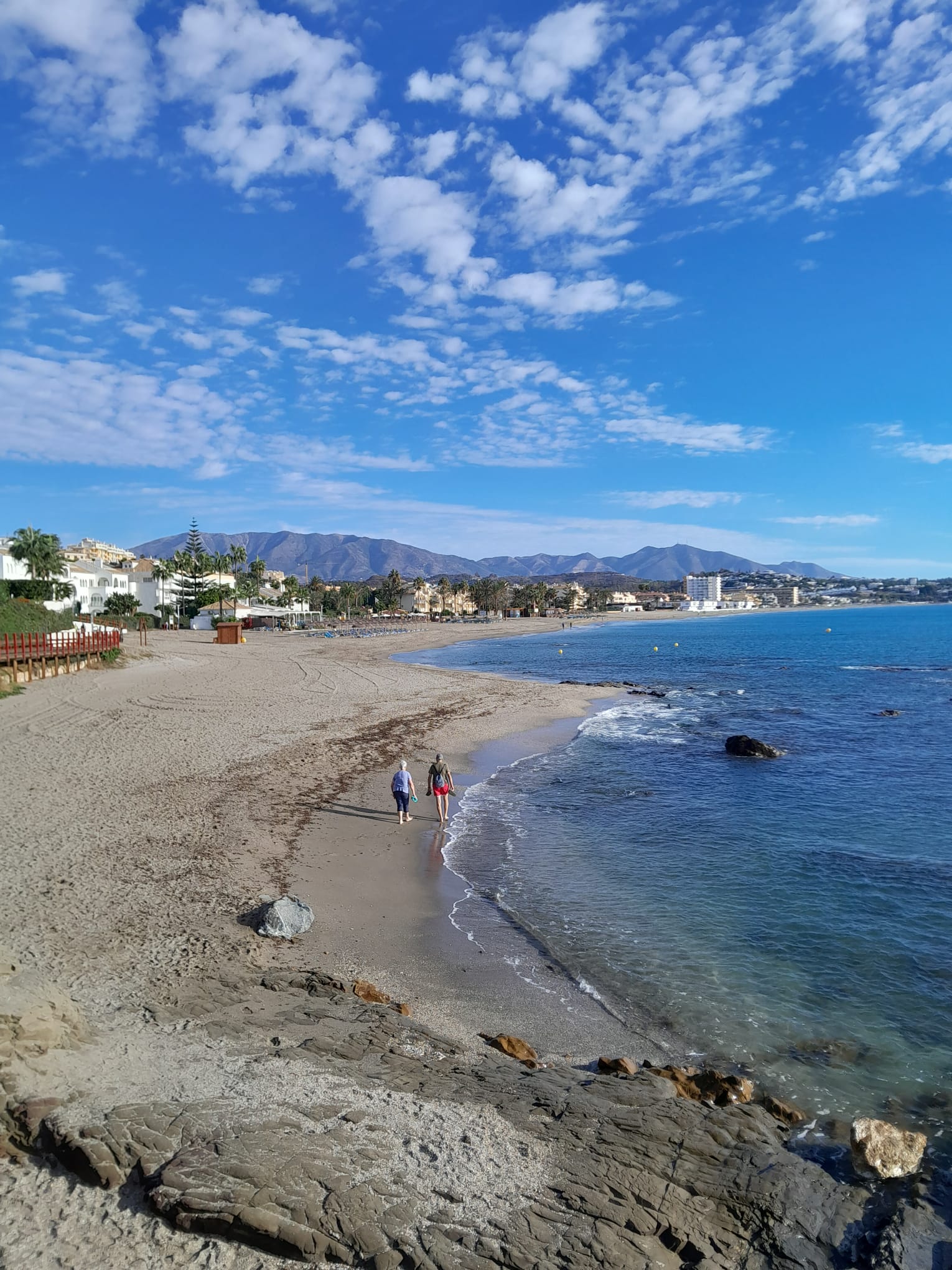
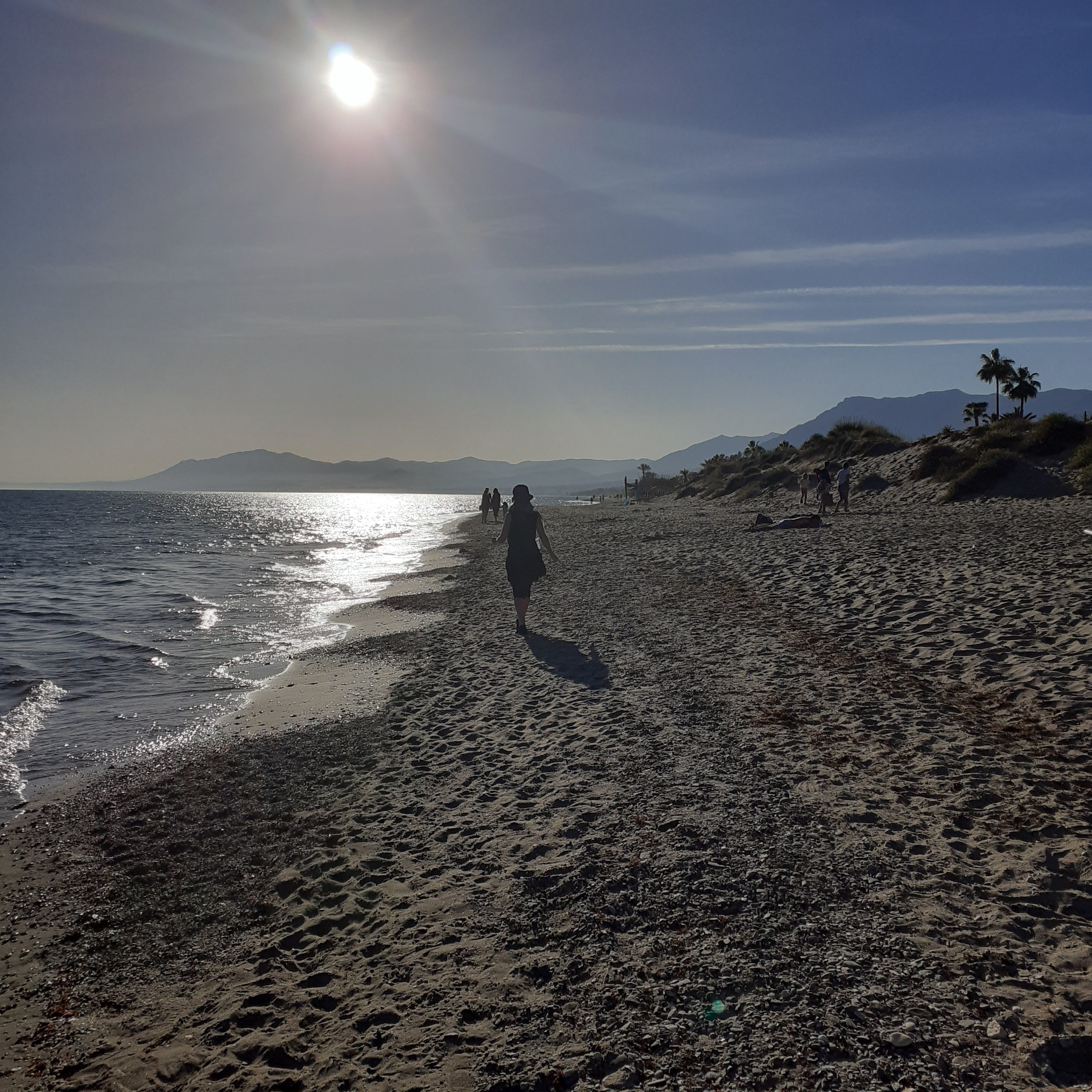
It is a farther six kilometres to our own base in Elviria. There are plenty of good beach bars and eateries along here, and a lovely view of the curving coast down to Marbella; backed by high mountains, Gibraltar shimmering off the coast in the far distance.

So, it’s time to step off the humdrum, relax and enjoy our cocktail by the pool. One theme song suggests itself. Massiel singing El Amor. Though it’s hardly relaxing, what with the veins on her forehead snapping like high tension wires in a gale as she reaches, um, crescendo. It chimes with the mood, though.

El amor es un rayo de luz indirecta

Una gota de paz, una fe que despierta

Un zumbido en el aire, un punto en la niebla

Un perfil, una sombra, una pausa, una espera

El amor es un suave, rumor que se acerca

Un timbre a lo lejos, una brisa ligera

Una voz en la calma, un aroma de menta

Un después, un quizá, una vez, una meta

Massiel, Maris de los Angeles Santamaria Espinosa, is a well known Spanish singer. She covers a broad range in her repertoire, from popular to Brecht/Weil, and protest songs which annoyed Franco and Pinochet. She sang the winning song for Spain, La La La in Eurovision 1968, after the original singer Joan Serrat withdrew when not allowed to sing in Catalan. Congratulations!

Andalusia – 2. Granada and Alhambra

When I took up the guitar in my early teens, it was to flamenco that I turned. I was thinking a lot about the paintings of Salvador Dali in those days and I also became immersed in Spanish history. The Alhambra was a particular fascination, a red castle ringed by snow capped peaks, above the city of Granada. So, some fifty years later, I at last made my pilgrimage. An early Easter was approaching and a blanket of snow lay over Dublin. The plane was a while on the tarmac as workers chipped ice off the wings. At least we were off to sunny Spain.

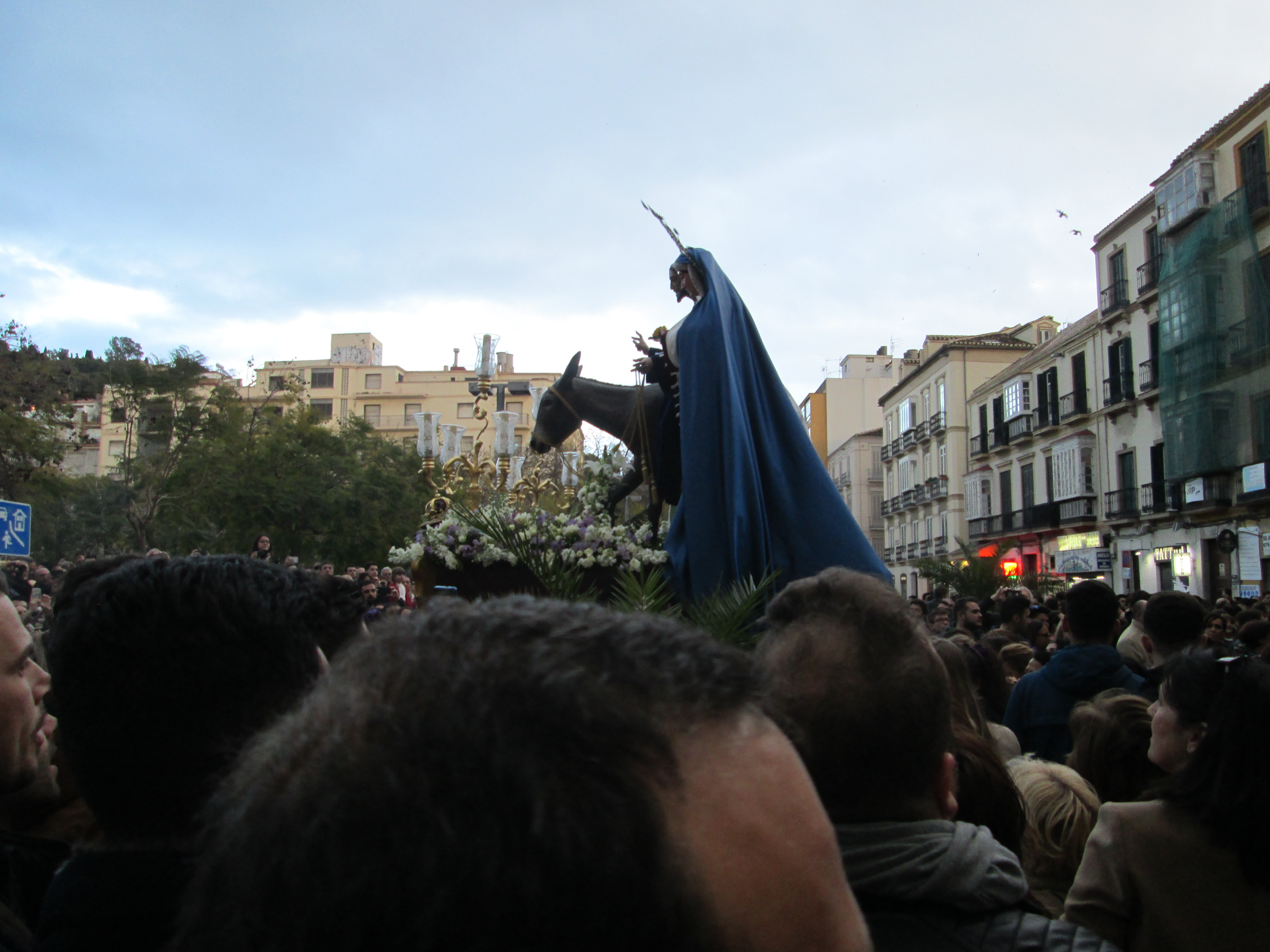
There was a bleak sun on Malaga when I landed, but it was cold and the sidewalk bars huddled behind plastic awnings with heaters ablaze. It’s a two hour bus ride up to Granada, but I had an overnight and aimed to get a taste of Malaga in a day. Relaxing over a wine, I noticed that crowds of people were heading towards the city centre and figured there was something on. It being Holy Week, a procession by one of the Brotherhoods passes each day. I quickly succumbed to its hypnotic magnetism. Solemn music accompanies towering floats, or tronos, one of the Christ and the other, typically more exuberant, is of the Virgin.

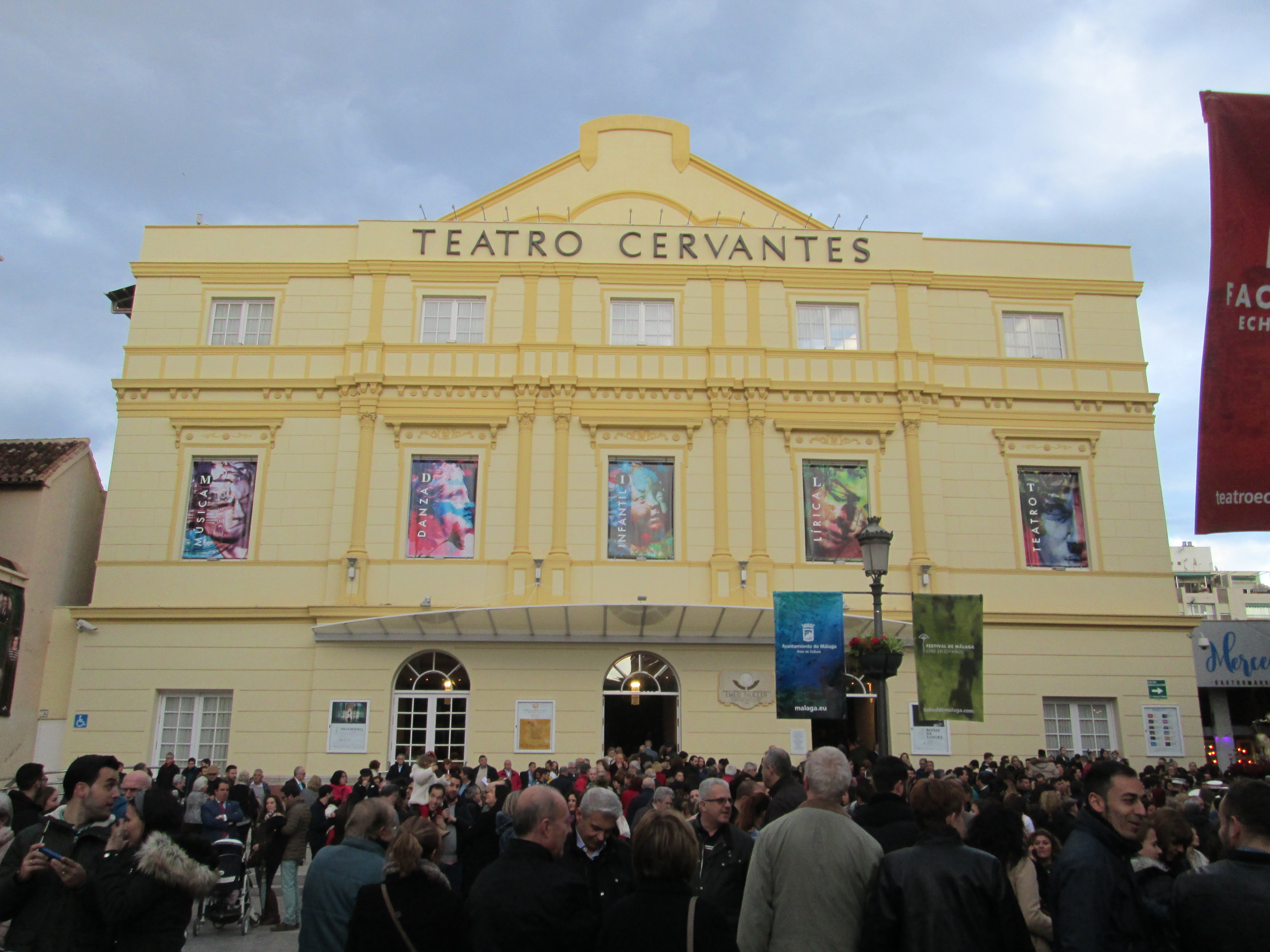
Each weighs several tons and are carried, very slowly, by members of the Brotherhood from their parish church through the city centre, past the Cathedral and on to the Plaza before Teatro Cervantes. Which is where to relax as the solemn spell wanes.

The Teatro Cervantes was built in 1870 and named for Miguel de Cervantes. Cervantes is well commemorated throughout Andalusia. His writing pervades the entire Spanish consciousness. As is Shakespeare to English, he is central to Spanish. Don Quixote is regarded as the first novel in the modern sense, and has become, after the Bible, the most translated book in the world. We all know its eponymous hero, hopeless and heroic, forever tilting agaist the hostility of life. Cervantes came to embody his own maxim, that the pen is the language of the soul

My own pilgrimage took me to Malaga Bus Station to the west of the city early the next morning. Granada, just over ninety miles distant, is a two hour bus journey through coastal mountains, the snow capped Sierra Nevada ultimately embracing the city as we reach our destination. Granada’s Bus Station is a good bit out of town and I took a taxi to the centre and my hotel.

Granada, a place of dreams, where the Lord put the seed of music in my soul. (Andres Segovia)

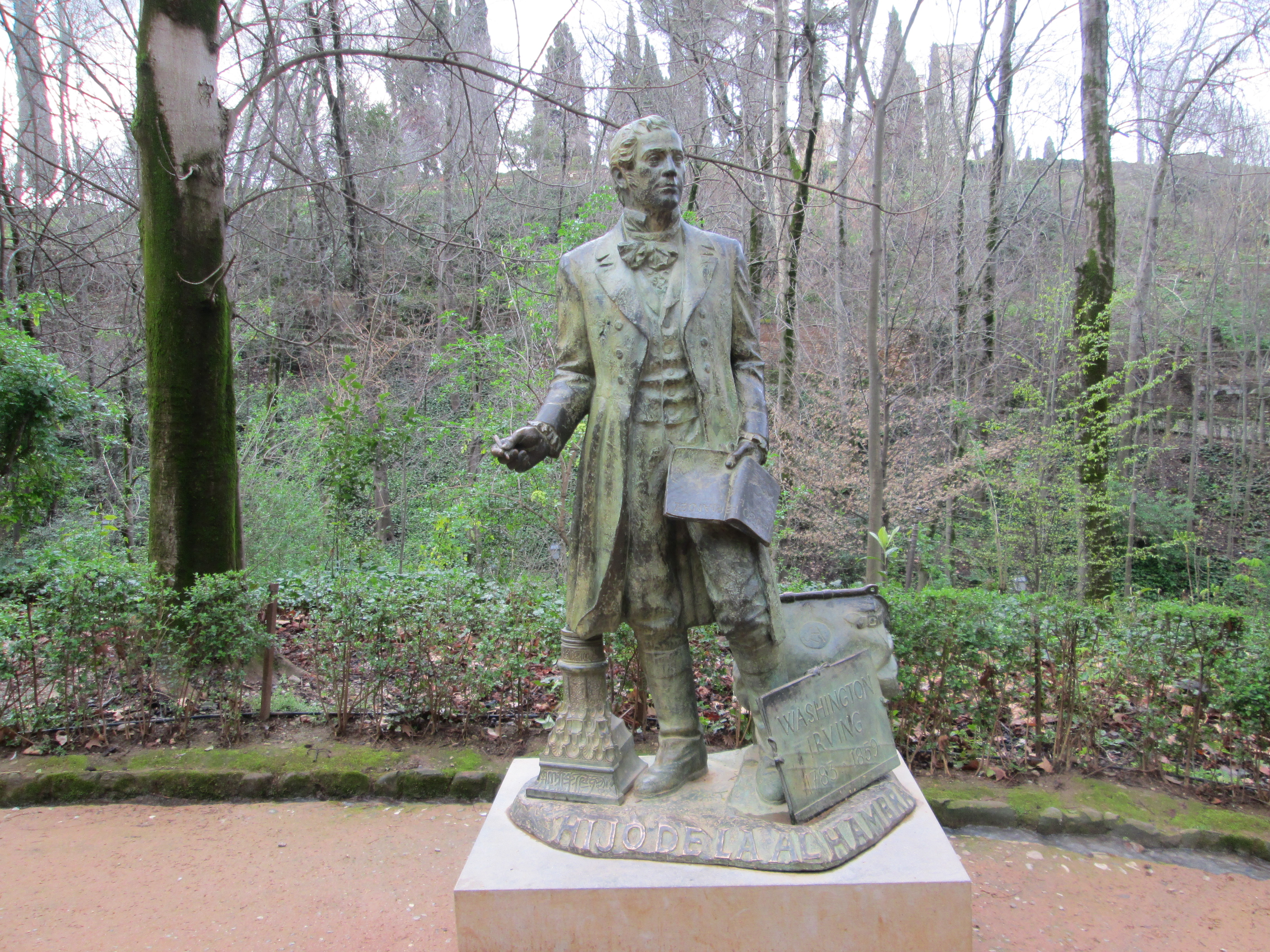
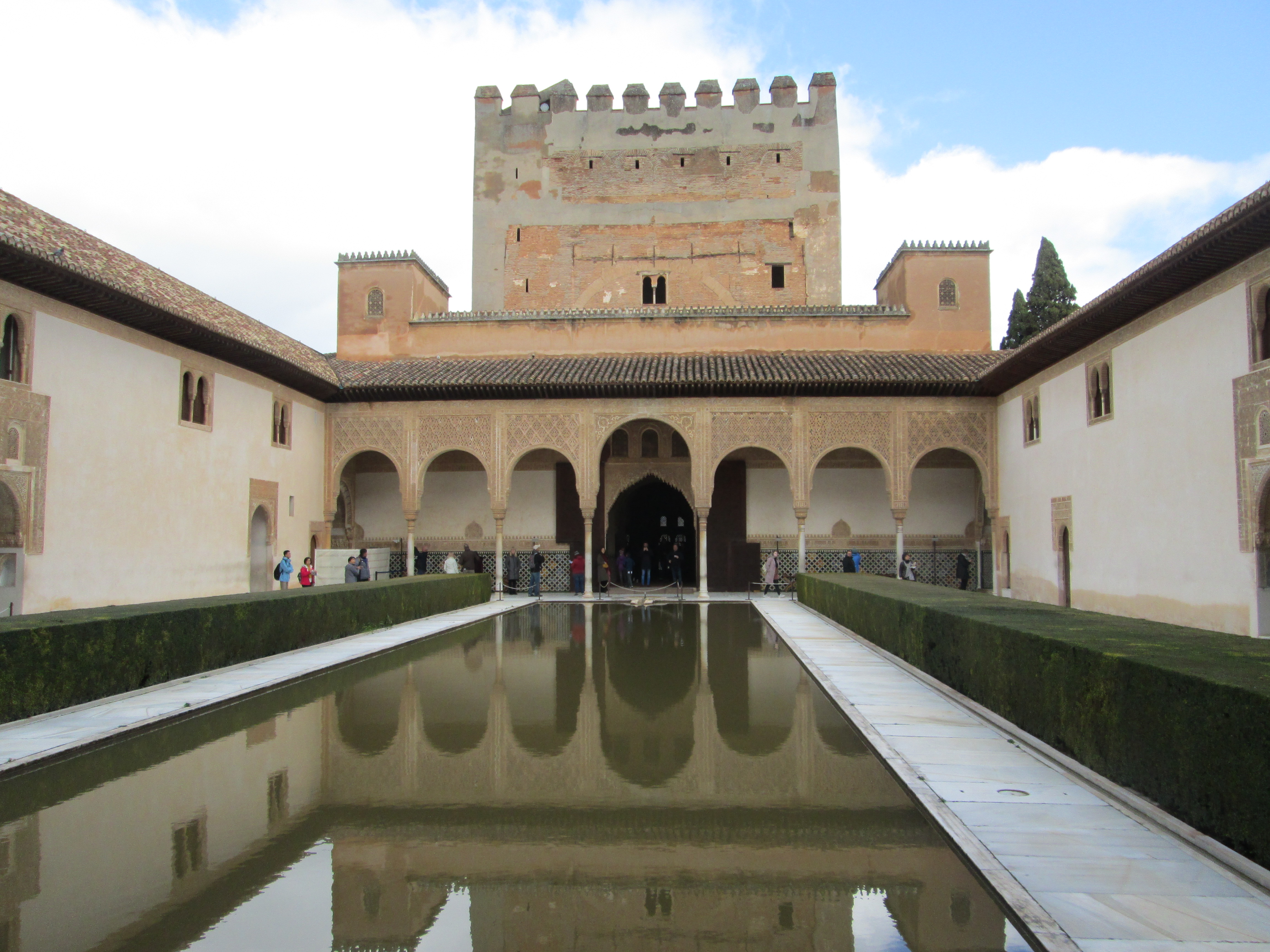
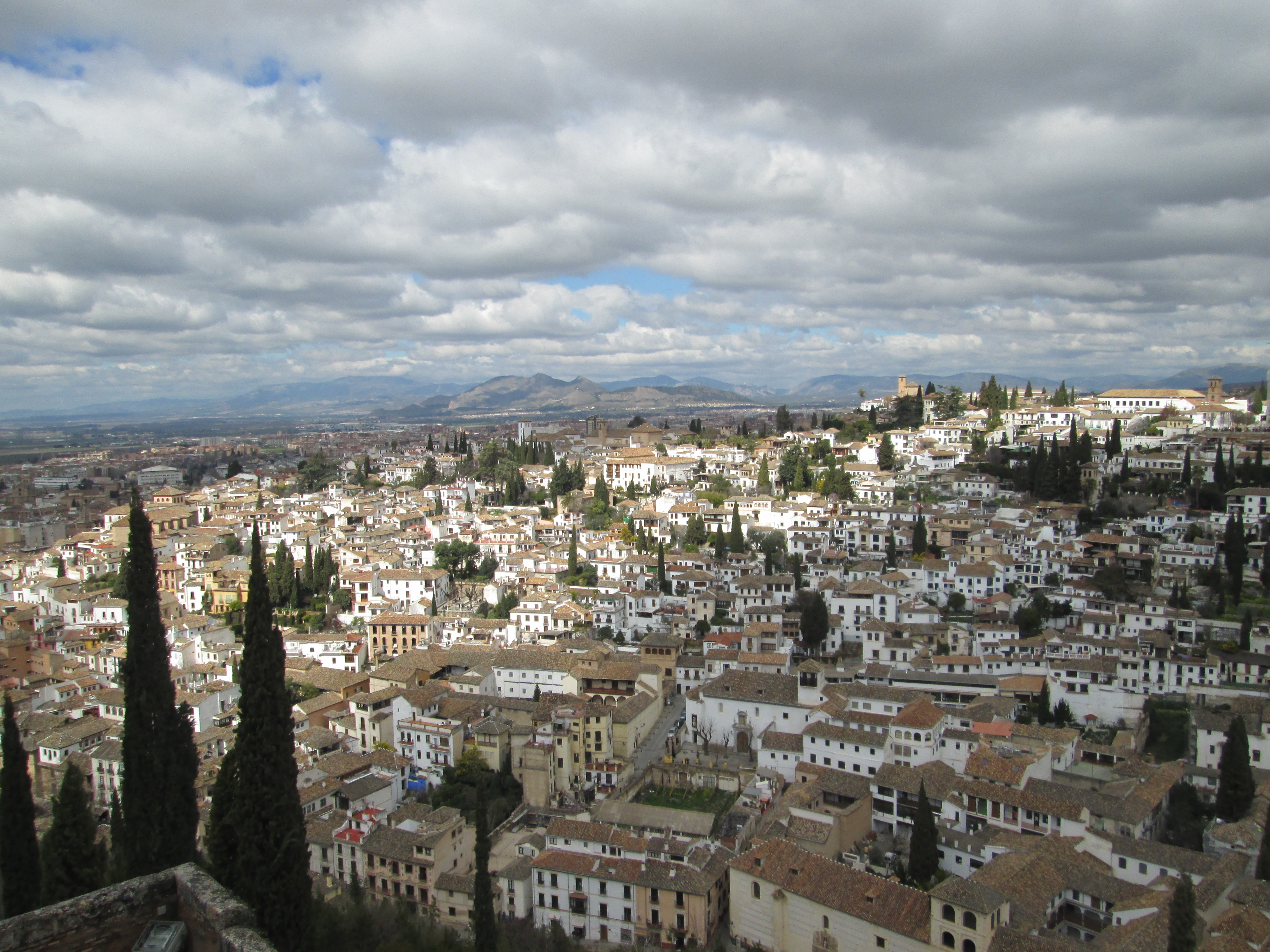
The fabulous castle overlooking it all, the Alhambra, was the last fortress the Moors. Alhambra signifies the Red Castle, from the blood toned colour of its stone. The Moors built their first fortress in the ninth century but the existing complex dates to 1333 when Yusuf I was Sultan of Granada. In 1492 the Catholic Monarchs, Ferdinand and Isabella, defeated the Emirate of Granada. 1492 was also the year when Italian explorer Christopher Columbus came here to receive the support of the Monarchs in his ambition to sail to the New World. This is when the Western World was born. An early history of Columbus was written by Washington Irving, American author and ambassador to Spain. He, in tur, rediscovered the Alhambra for the modern world. His Tales of the Alhambra was published in 1842. In 2009, on the 150th anniversary of his death, a bronze statue was erected on the wooded approach to the citadel.

I entered through Puerta de la Justicia under its Moorish horseshoe arch. From the ramparts there’s a great view over Granada framed by the Sierra Nevada. When the Moor last looked out from here, the Alhambra was entirely a construct of the Islamic culture of northern Africa. Within a couple of decades a more European style spread. The Palace of Carlos V was built by order of the Emperor in 1527 in the Renaissance style. The entrance patio is a startling homage to Classicism, with its two story colonnade forming an entrancing circle. 

The Nazaries is the showpiece of the Alhambra, a magnificent palace for the Kings. A separate ticket is required for visitors, and well worth it. Guide books caution to come prepared for the heat, but my visit coincided wih a severe cold snap. Four degrees and falling I was frozen blue in the long entrance queue. The Nazaries unfolds on entering, a stone flower opening into more spaces than anticipated from the outside. There are three palaces within the complex. First, the public area dealing with justice and administration. Then the Camares Palace which was the royal residence. Finally, the Palace of the Lions, where the harem was located. A magnificent centrepiece is the Court of the Lions with its sculptured lions forming a circle within delicately rendered cloisters. 

For a short break, I took a table in the tiny tearoom of the American Hotel. A Tuna Sandwich and two hot Americanos got me back to room temperature. A friend had recommended a visit to the terrace at the Parador Hotel but it was not a patio day and the interior had that lowrise furniture peculiar to hotels and inimicable to relaxation.

The Alcazaba is the fortress at the business end of the Alhambra, its towers giving majestic views over Granada. It is the oldest part of the complex, dating to the thirteenth century. From there, I made my way down towards the entrance through beautiful gardens. The first blooms were appearing but had not quite come to life. Across a ravine there’s a stiff climb to the Generalife, the Gardens of the Architect. These beautiful gardens surmounted by an elegant villa provided a retreat for the Royal Household from the travails of the Alhambra and give glorious views of the Alhambra.

On exit, I put into the first available bar. Below the walls there was shelter  and sufficient warmth from the sun to allow me enjoy a beer and tapas al fresco. Heading downhill past the northern walls alongside a rapid stream, I emerged onto the banks of the Darro river following it back towards Plaza Nueva in the city centre.

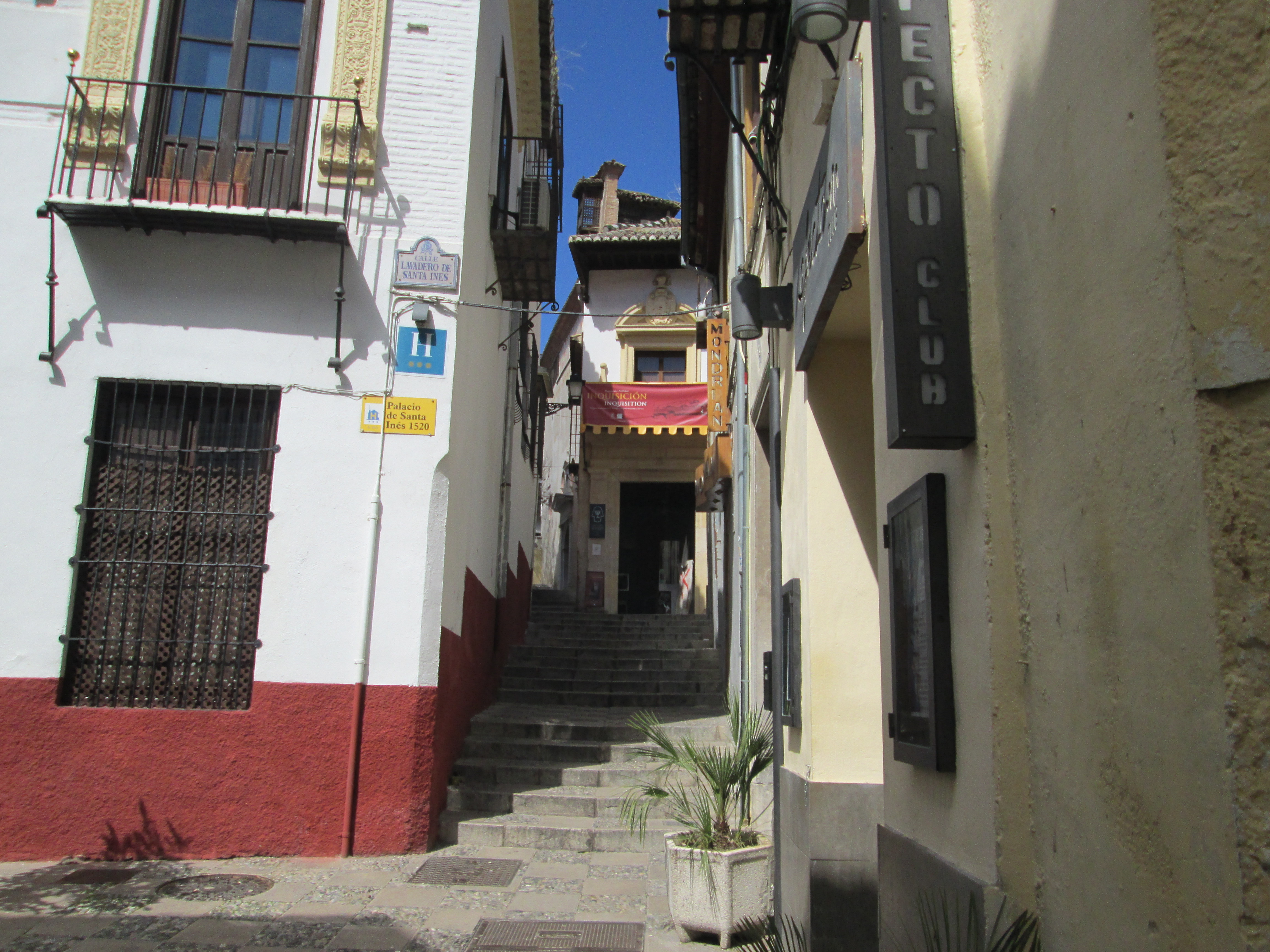
Overlooking the Darro is the Albaicin, dating back to the 13th century and rich in Moorish heritage. The streets meander past high walled villas with white washed walls, towering palms and pines. Quiet and weird; at times I felt I had strayed into a Dali painting. Stranger still, it darkened off to the west and a sudden storm came upon us. Snow fell in curtains across the backdrop of the Alhambra.

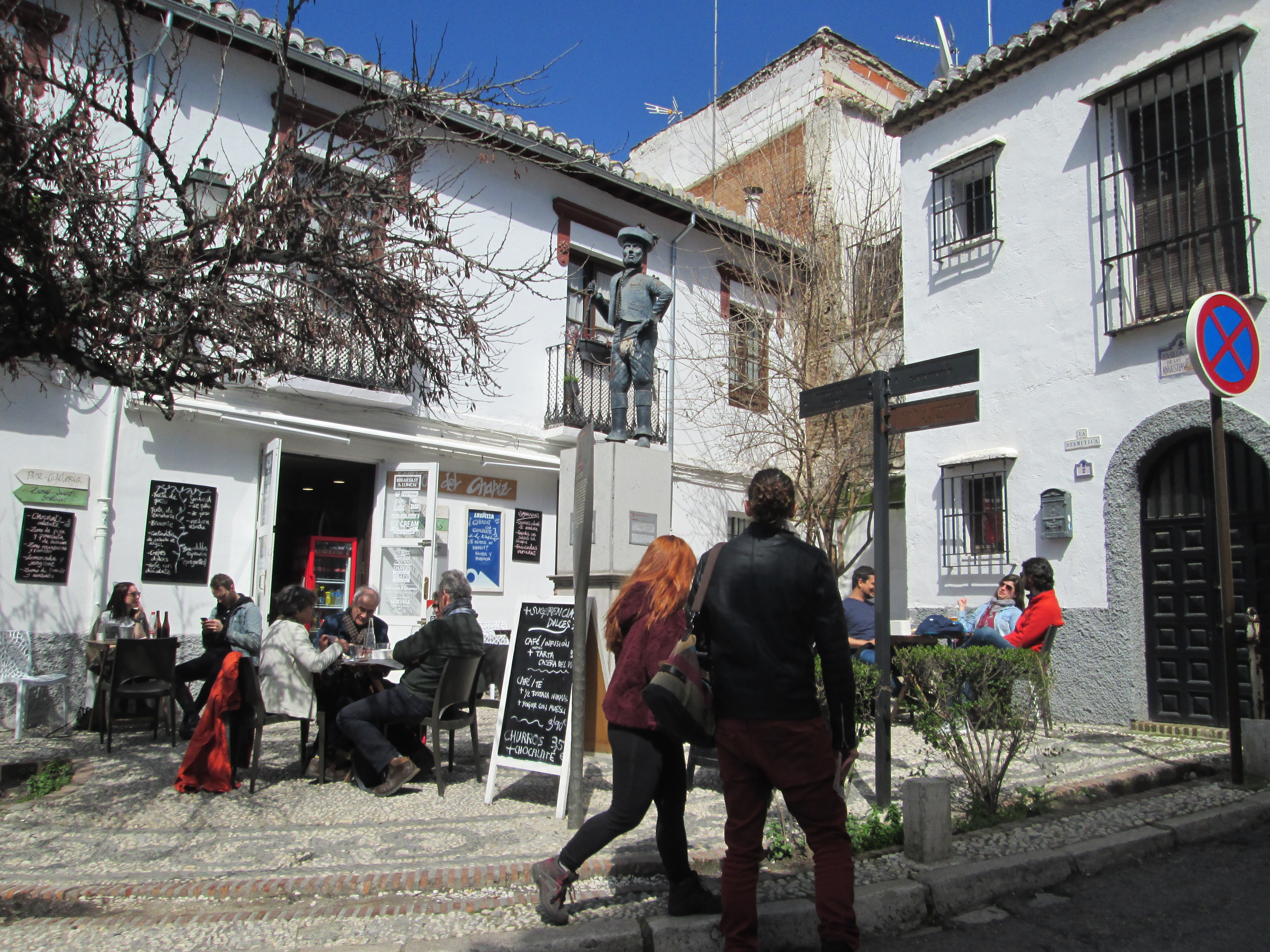
Plaza Nueva merges into the Plaza de Santa Ana and on into the modern city centre. I had planned on a flamenco evening in Sacromonte, but the weather closed off that particular avenue of pleasure. I did spend much of my second day in Sacromonte, a bleached enclave clinging to the steep hill at the edge of Grenada, This was originally home to the gypsy, or Gitanos population, and is rich in the heritage of guitar and Flamenco. There are tiny taverns and homespun museums, and a feeling of being remote from the big city. 

At night I’d spend some time in Hannigan’s Irish Bar, not far from the Cathedral of the Incarnation. Hannigan’s does not do the complementary tapas that are a feature of local establishments. It’s a wonderful custom, but there is a time to stop eating and sit in splendid isolation over a drink and contemplate the sound and stories that permeate the city. Hannigan’s seemed to share my fondness for the Red Hot Chili Peppers, whose music, to me, carries some echo of the spirit of the Andalusian guitar. 

Fly away on my zephyr

I feel it more than ever

And in this perfect weather

We’ll find a place together

from the 2002 album By the Way, a favourite of mine, and yes, I remember in Granada smiling at the mention of perfect weather; but in a strange way it was. In sunshine or snow, the magic of the Alhambra endures. The winding way to the citadel begins near the Fontana del Toro on the Plaza de Santa Ana. It is said that a drink from its waters has magical qualities. Drink once and you will return forever. I hope to, some day. Meanwhile, Christmas is around the corner and this is likely to be my last post for the year. Happy Christmas to yous all! 

Oh the weather outside is frightful

But the fire is so delightful

And since we’ve no place to go

Let it snow, let it snow, let it snow!

Cork and Limerick by Rail – Limerick

From Cork Kent, the train to Limerick takes about an hour and twenty minutes. You change at Limerick Junction with a couple of minutes changeover to a feeder train. Limerick Colbert is on the south eastern rim of the city. It’s about a ten minute walk into the city centre along Parnell Street, or a block over via the more salubrious Catherine Street, as I did. 

Limerick’s population is over ninety thousand, making it the third largest city in the country. The original settlement was on King’s Island, north of the present city centre. The Vikings settled here in the ninth century, marking the western extent of their Irish invasion. The Vikings were subjugated by the leading local Gaelic clan, the Dalcassians of County Clare, in 943. The Dalcassians would subsequently come under the leadership of Brian Boru, whose campaigns in the late tenth and early eleventh century signalled the waning of Danish power in Ireland. The Limerick Vikings were enlisted by Brian in his struggle against Leinster Gaels and Dublin Danes. After the Battle of Clontarf Danish power withered outside of Dublin before being completely obliterated by the Normans.

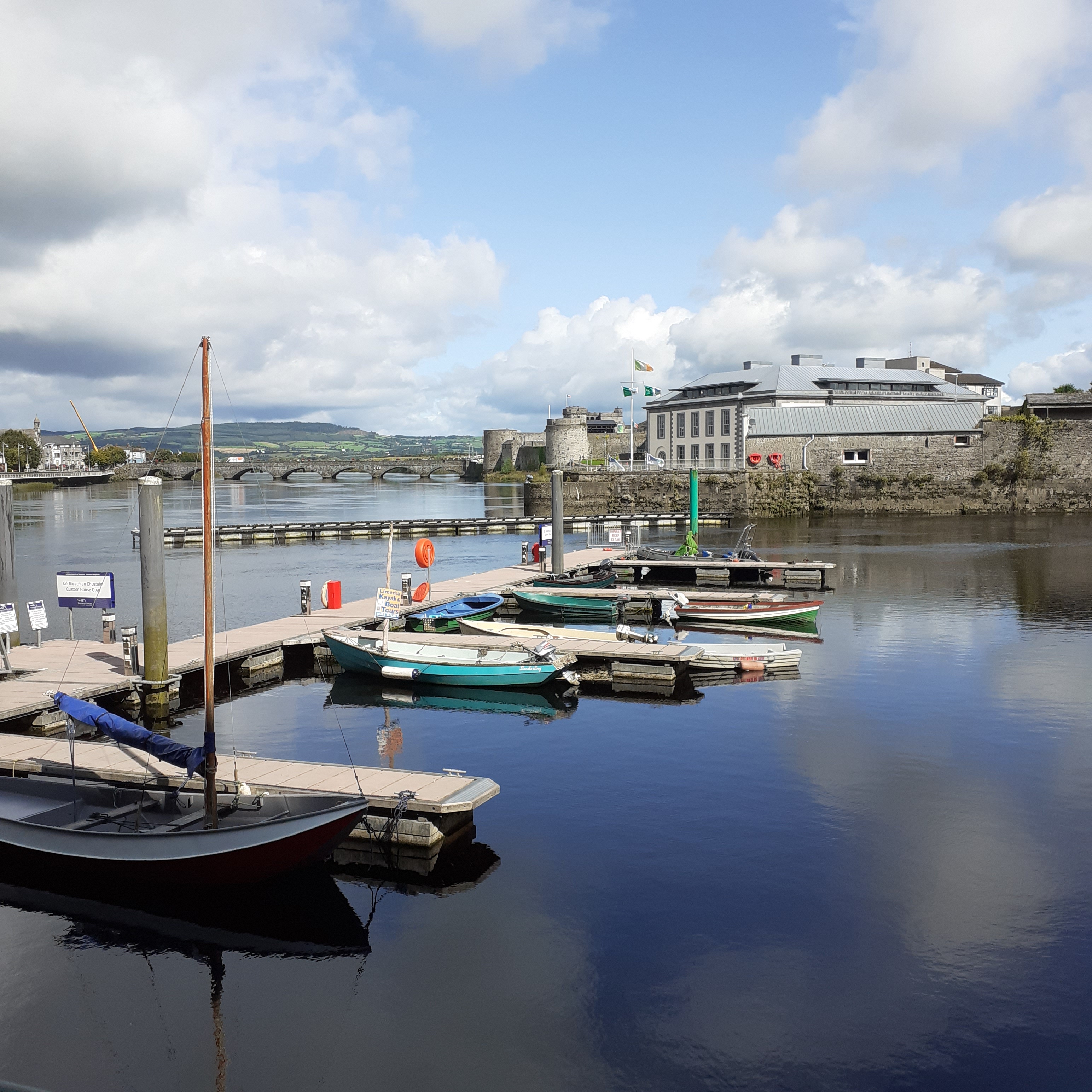
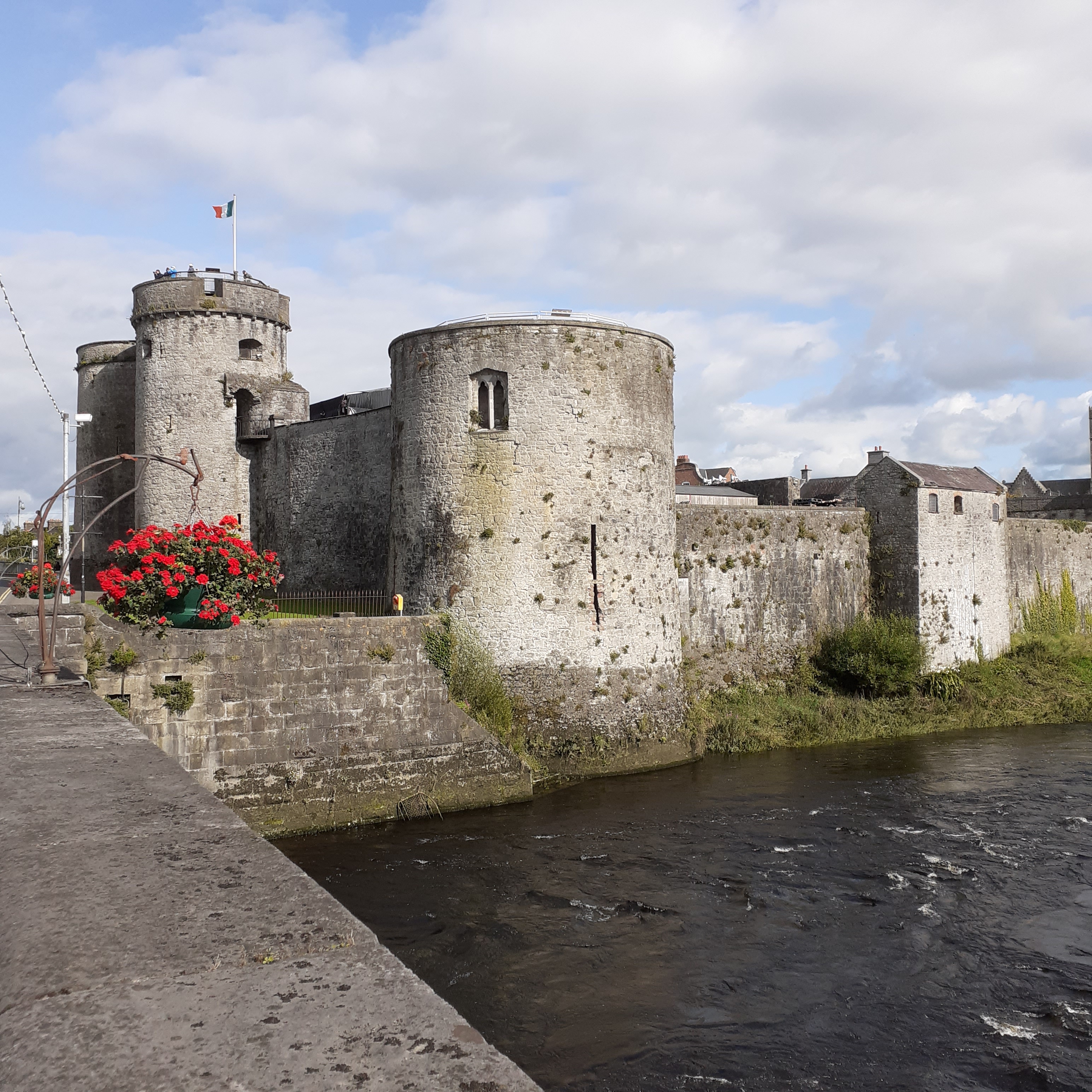
The Normans were keen to establish a power base here. King John’s Castle is one of the many established by that King in Ireland. Dublin was another, Trim and Carlingford also. Begun in 1200, it was completed a dozen years later and is today one of the best preserved Norman castles you’ll see. It is Limerick’s most renowned landmark. The modern reception area makes for an odd introduction to the traditional Norman style castle of a large courtyard surrounded by curtain walls. The massive gate house and three corner towers remain. The eastern wall is missing, occupied by the modernist visitor centre. This offers interactive exhibitions, while the courtyard is haunted by garrolous actors. Visitors can try their hand at ancient pursuits such as archery and fencing, but no, there’s no chance of actually killing anything. Weirdly, there was once a small modern housing estate within the walls until the end of the last century. What a strange address to have. Despite eight hundred years of often violent history, including the violence of unsympathetic urban planning, the castle is in a high state of repair.

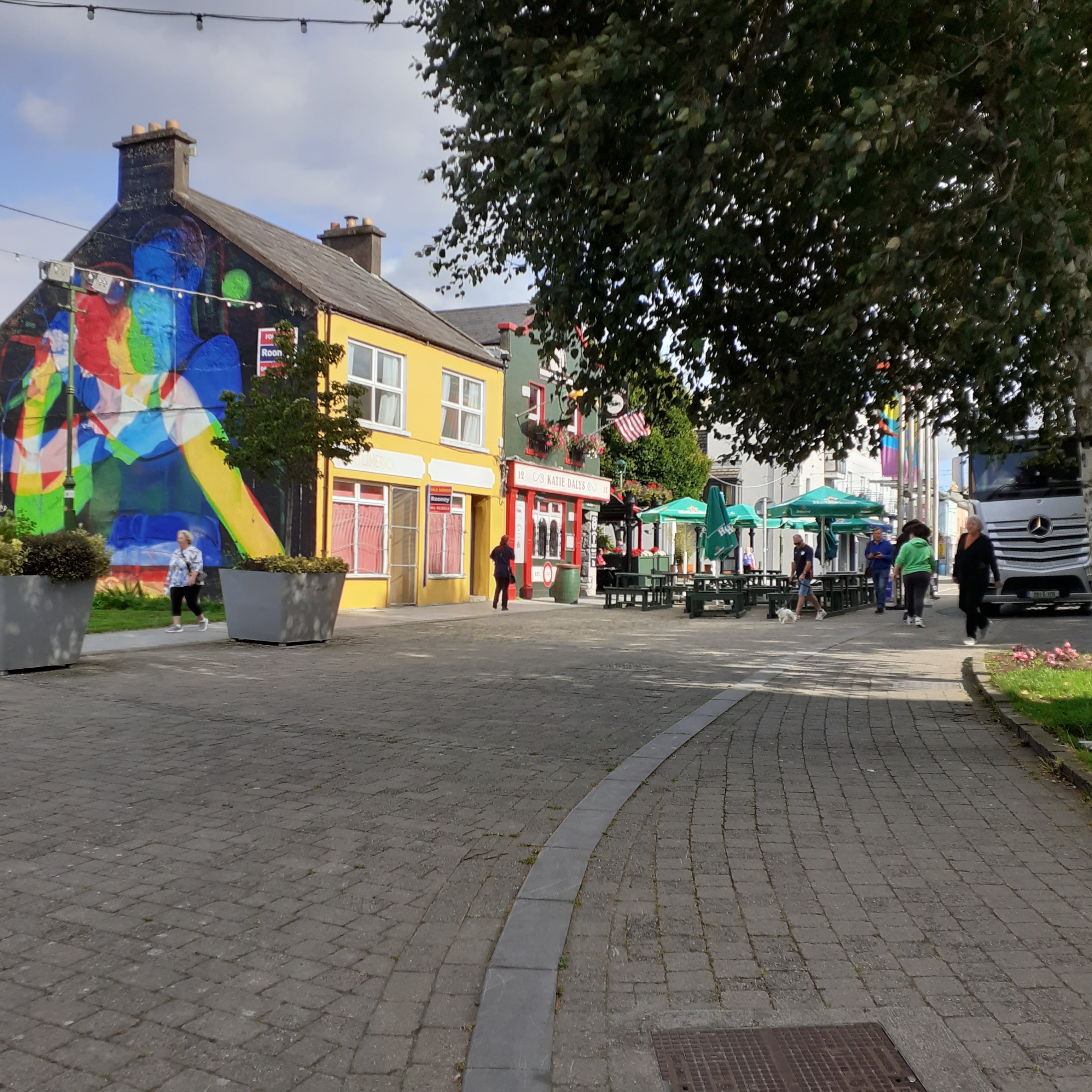
Katy Daly’s is situated across from the Castle entrance, on the Parade, an ancient historic street. A tavern in the old style, it’s ideal for a refreshing pint, or a meal, after the exertions of a castle visit. With sunshine spread over its front of house terrace, I had a pleasant time, accosted in the most friendly fashion by a couple of locals. Daly’s lays claim to being the oldest pub in Limerick. A pub, the Red Lion is recorded here in 1600, while the license can be traced back to the Halpin family in 1789. It takes its name from Prohibition era moonshiner, Katie Daly, born in California of Tipperary immigrants in 1872. Her father Bill was killed in a shootout with Wyatt Earp and his recipe for Poitin would endure thanks to his enterprising daughter. By the Prohibition Era, Katie operated out of Chicago were she fell foul of Al Capone, but escaped to the relative safety of San Francisco. However her enterprise came to the attention of the FBI and ended with her incarceration in Alcatraz, the island prison in the Bay. The only female prisoner there, she died before her fifteen year stretch was out.

King’s Island is Limerick’s fortified core. It is formed by the branching of the River Shannon. The main river delineates its western shore. The eastern branch is referred to as the Abbey River; the two meeting again farther south near the city centre. The walled city of Limerick grew in the shadow of the castle. After the Norman invasion this was referred to as Englishtown. Irishtown grew across the Abbey River in what’s now called the Old Quarter. The medieval city axis was along Nicholas Street, and the area drew comparison with medieval European cities such as Rouen and was greatly renowned for its beauty and prosperity. 

Limerick suffered badly in the wars of the 17th century. There were at least four Sieges of Limerick. In the Cromwellian invasion the city was eventually starved into surrender. Fifty years later In 1690 there were further sieges as Jacobites, retreating after the Battle of the Boyne, held out against the Williamites. The Jacobites inflicted a heavy defeat on William’s forces, but were forced to surrender the following year. Patrick Sarsfield, commander of Limerick’s defenders, signed the Treaty of Limerick in 1691. He lead his forces – nineteen thousand troops and about a thousand women and children, into exile in what has become known as the Flight of the Wild Geese. The Treaty Stone stands on the western side of Thomond Bridge, the ancient bridge connecting the Kings Island to the west bank and on to Thomond Park, Munster’s Rugby stadium.

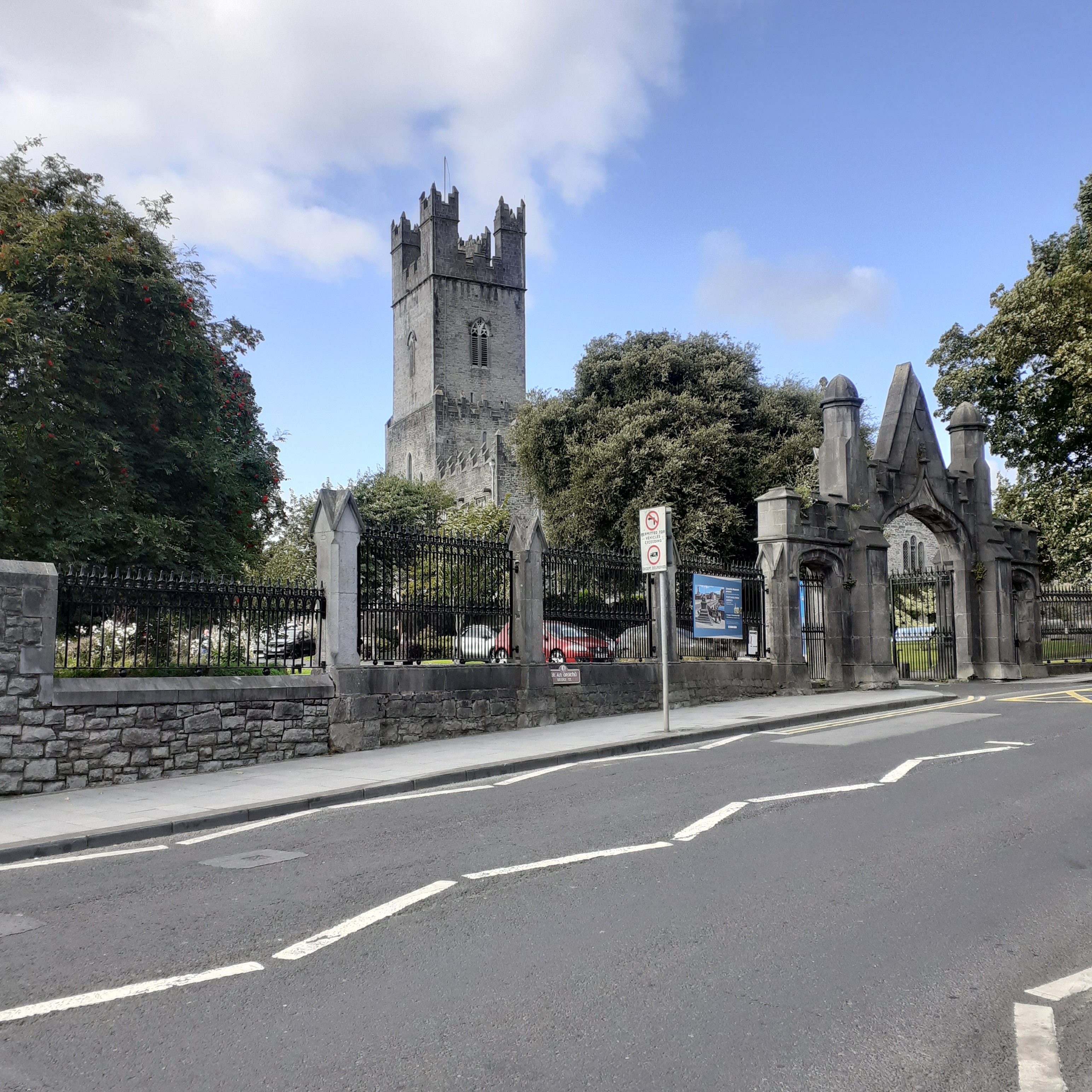
St Mary’s Cathedral, just south of the castle, is the oldest building in Limerick. Dedicated to the Blessed Virgin Mary, it was founded in 1168 by Donal Mor O’Brien, the last King of Munster, and built on the Viking Thingmote, or Parliament. Donal died in 1194 and his tomb lies within the cathedral. The Romanesque building has been much added to over the years with Gothic and Victorian embellishments but retains its stern and ancient air. Its distinctive square tower with turretted corners is from the fourteenth century and soars above the western entrance.

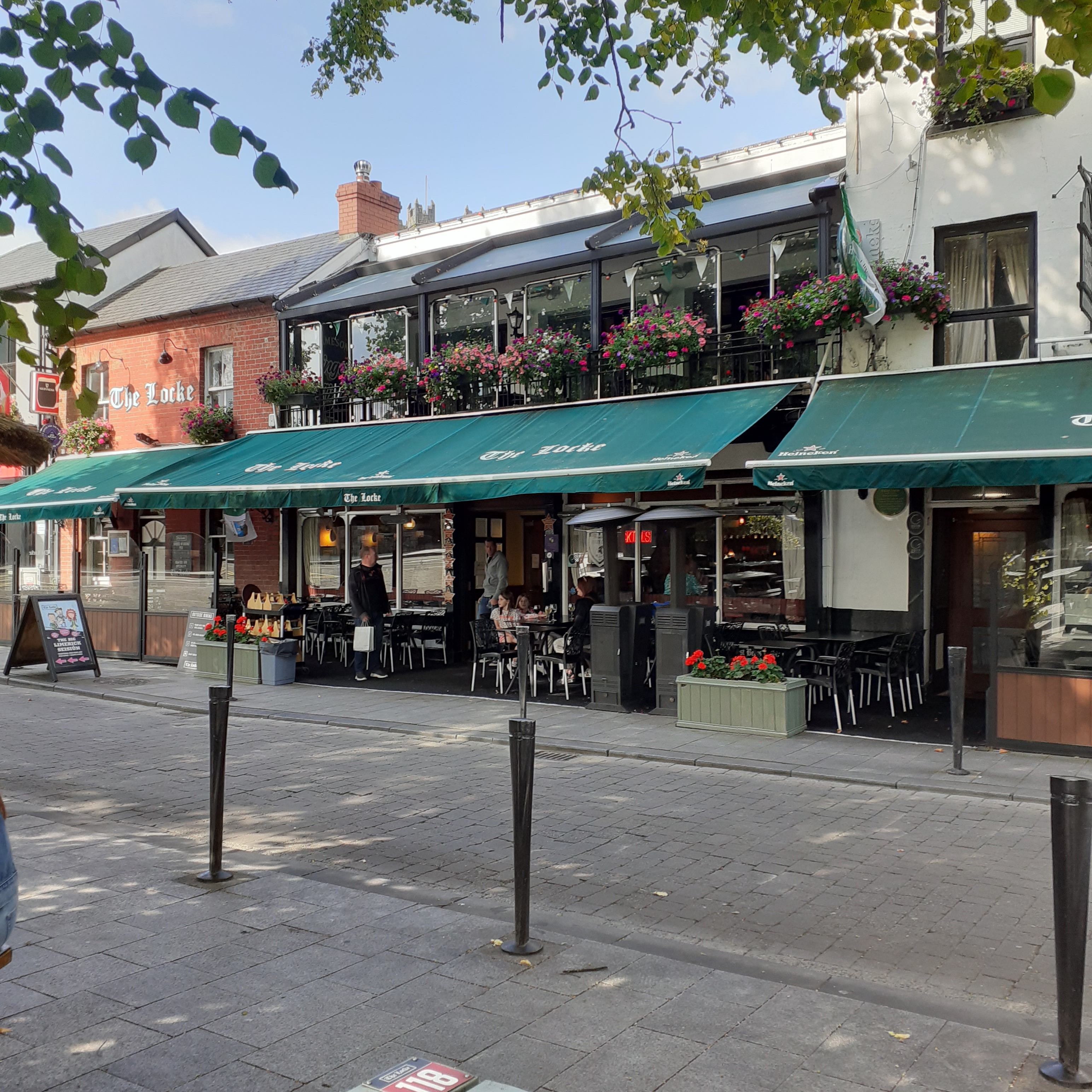
Vestiges of the Walls of Limerick, appear along busy Island Street, though Nicholas Street is more evocative of the ancient city. Left untouched by the modern development in the eighteenth century, the old city was gradually abandoned, and few buildings remain. Near the confluence of the Abbey and Shannon, just below the Cathedral gates, is the end of English Town. George’s Quay hugs the river bank, and here you’ll find the Locke Bar at the Bridge. The original pub site dates back three hundred years. There’s traditional music sessions and dancing every night. The lounge area is large, flooded with the late afternoon light. Outside, there’s a wide beer garden on the tree lined river banks. The garden often features summer barbecues, and good food fare is available throughout, including seafood, burgers and Irish Stew.

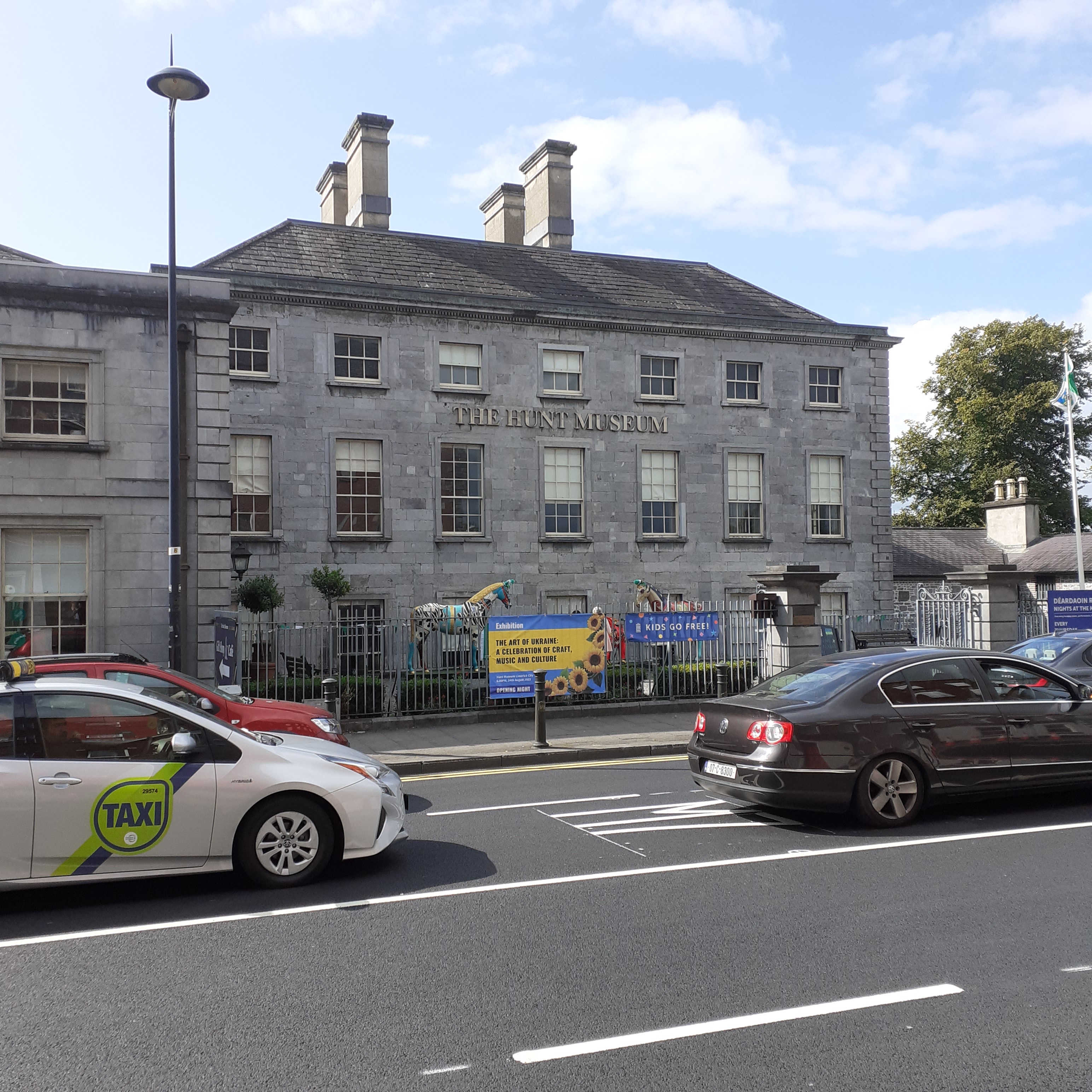
Across the river Irish Town, or the Old Quarter, occupies the south bank to your left. On the right is a pleasant riverside parkland, with the Hunt Museum prominent on the streetfront. The Hunt Museum was originally the Custom House, designed by Italian Davis Ducart. It’s a limestone Palladian building from 1765, three stories tall. The museum features the collection of John and Gertrude Hunt, housed in the current building since 1997. The Hunts collected collected art from neolithic Ireland to ancient Egypt, medieval Christian artefacts from Ireland and Europe. There’s also dresses by Sybil Connolly and work by Picasso, Renoir and Jack B Yeats. The Horse Outside art installation are fibreglass sculptures from 2010, painted by children and inspired by the Rubberbandits hit. They are the local comedy hip hop duo of Mr Chrome and Blindboy Boatclub.

A century after the Treaty, Limerick moved south. Landowner, Edmund Sexton Pery commissioned Irish engineer Christopher Colles to design a new town in 1769. Newtown Pery is an outstanding example of Georgian city planning. Being built on one owners lands allowed for a regular grid system making for an architecturally unified, elegant streetscapes which is very modern, and most unusual in Ireland.

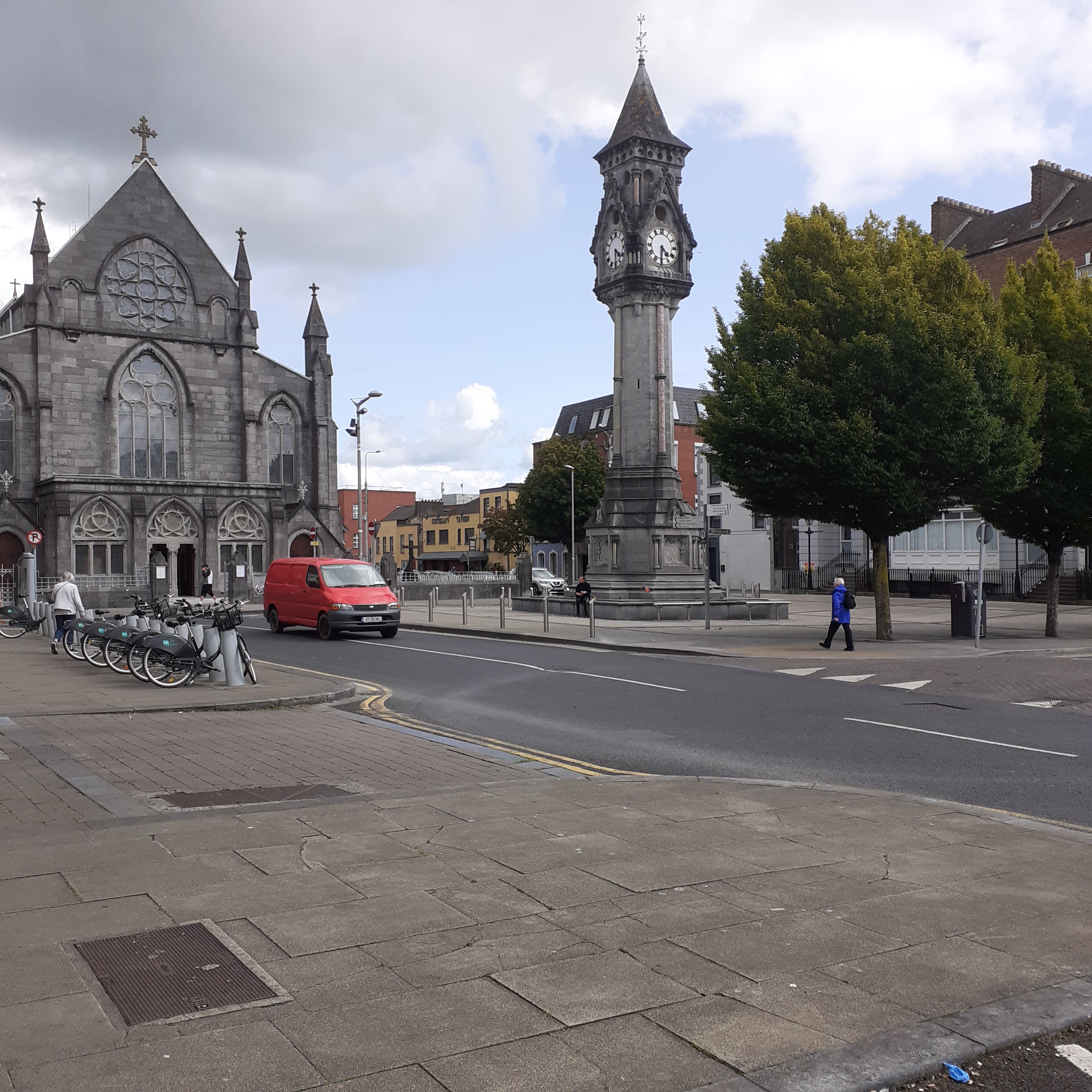
Building came to an abrupt end after the Famine. The expanding city finally ebbed to the shores of Pery Square to the south. Originally intended as a Grand square in the mode of Dublin’s Merrion Square, you can judge the intent along the northern side. The People’s Park is a wonderful green oasis within its embrace. Limerick Art Gallery is at the northern corner quite near the train station. Wonderful landscapes of the nineteenth century comprise the bulk of the collection, with some contemporary work and visiting exhibits. Nearby, you will also find the urban oasis of Baker Place with St Saviour’s Dominican Church church and the picturesque Tait’s Clock Tower.

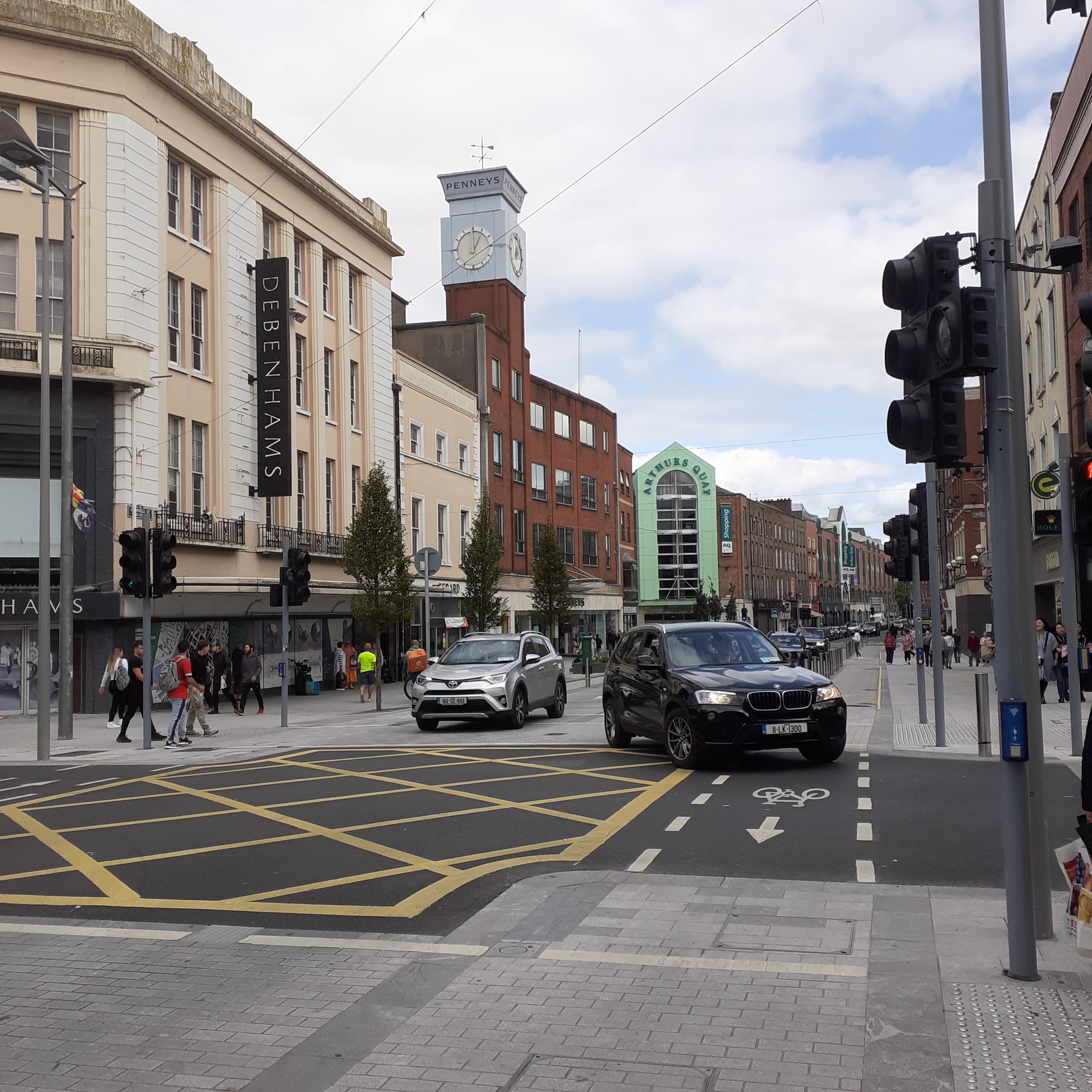
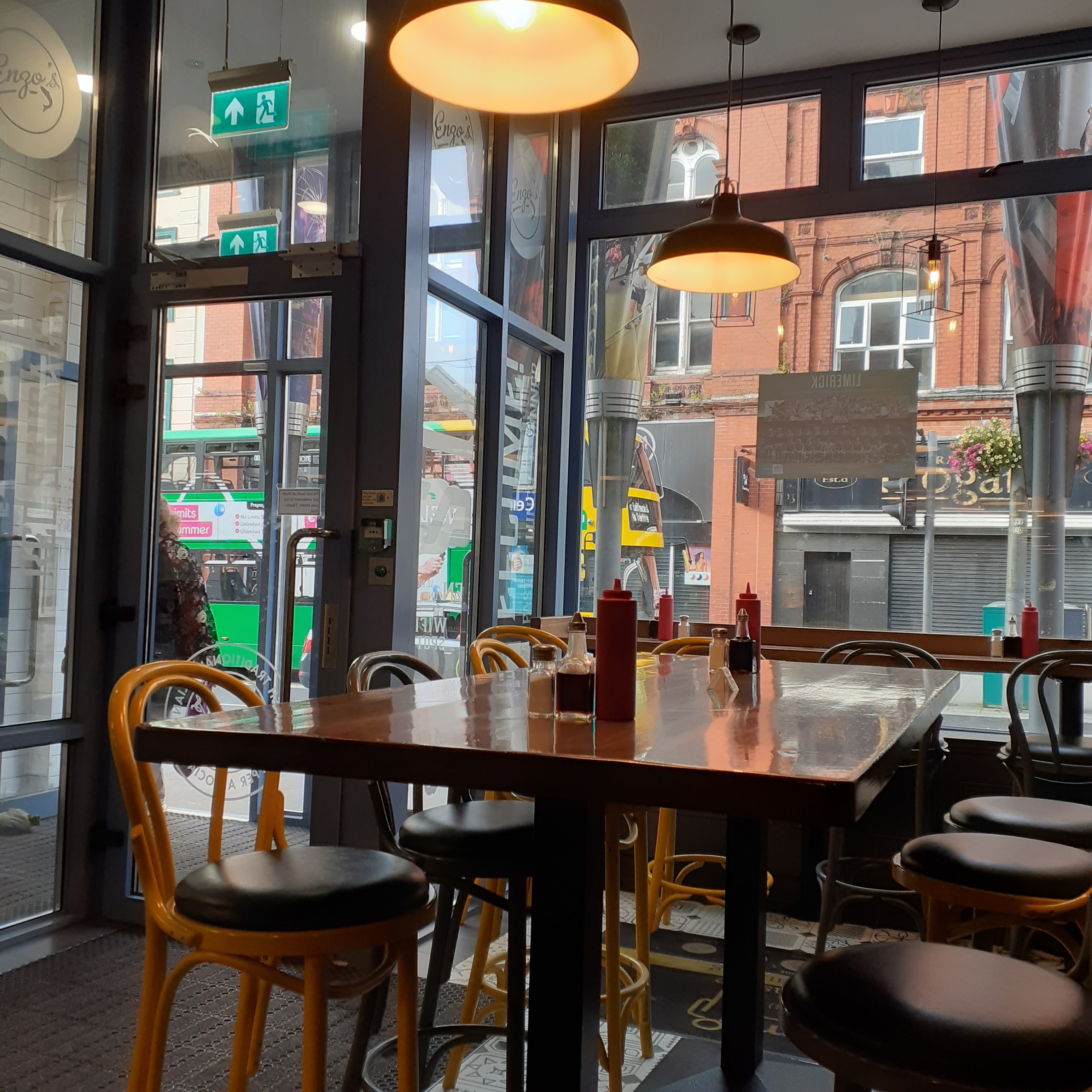
Back to the commercial city centre, William Street aligns with the major Shannon crossing. In 1835 a new bridge called Wellesley Bridge spanned the river. The five arched bridge incorporated an artificial island, home to a club house for the Rowing Club. It was renamed for Patrick Sarsfield in 1882. At right angles is O’Connell Street, originally George’s Street, which is the principal street of the modern city. Along William Street you’ll find a traditional table service fish and chipper, Enzo’s. Enzo Rocca arrived from Italy fifty years ago and set up shop in Newcastle West with his brother Franco in the Golden Grill chipper. The city restaurant he established in 1984 was a seafood restaurant to begin with. Enzo’s has become a much loved institution in Limerick, a time capsule for a halcyon age, with a battered cod and chips to adore. Sadly Enzo passed away on the first of September at the age of seventy seven

The grid of Newtown Pery merges into the narrow winding streets of the Old Quarter, where I am staying at the eponymous hotel. It’s an interesting warren of streets, merging with cafe society where the city centre shoppers spill over, spent from a hard day at the retail coalface. Nancy Blake’s on Denmark Street is an intimate old style pub with a beer terrace out the back. There’s a late bar and live music five nights a week. I spend some time here on my last night, in the balm of neon and cobblestones, with appropriately classic rock tracks seeping out of the sound system. 

It’s a pity I haven’t given myself more time. A day is seldom enough for a city, and certainly not here. Thanks to Niamh Mulville for her itinerary which informed my visit. There are some visits that I did not make. A mecca for rock tourists, Dolan’s Pub in the docklands area is where the Cranberries started on their path to world domination. Their second album No Need to Argue (1994) was a huge iternational hit. The lead single off that , Zombie became a signature number. Writer Dolores O’Riordan was born in Ballybricken, about ten miles south of Limerick in 1971, and died in 2018. I have quoted the song before and recently it has been given a rousing rendition by the supporters of the Irish Rugby team at the World Cup. The Munster contingent are responsible for this and the reasons are obvious. Thomond Park, out past the Treaty Stone is their own particular Mecca and so local heroes the Cranberries might be expected to provide the occasional theme song. All provinces have joined in and of course all of us back home will be wishing the furious wind will fill their sails and bring victory to the men in green. Truly, they are fighting. 

Cork and Limerick by Rail

1. Cork

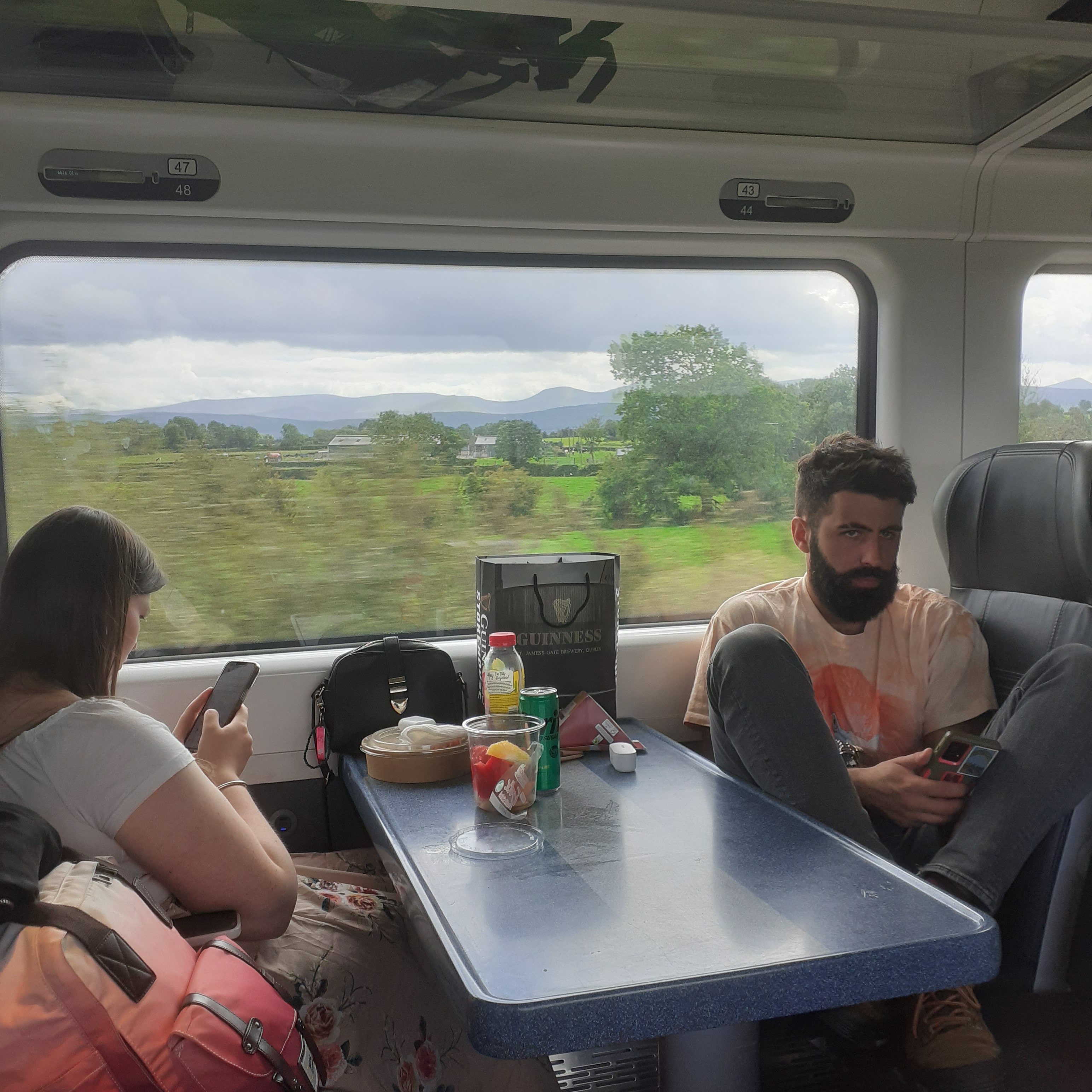
Dublin to Cork is two and a half hours by rail. There’s a train every hour on the hour leaving from Dublin Heuston. The train barrels through the south midlands to Limerick Junction before veering due south through Cork, Ireland’s largest county and on to the Republic’s second city, Cork. The train arrives at Cork Kent station to the north east of the city on the Glanmire Road. It’s a short walk from there to my accommodation at Isaacs Hotel on McCurtain Street.

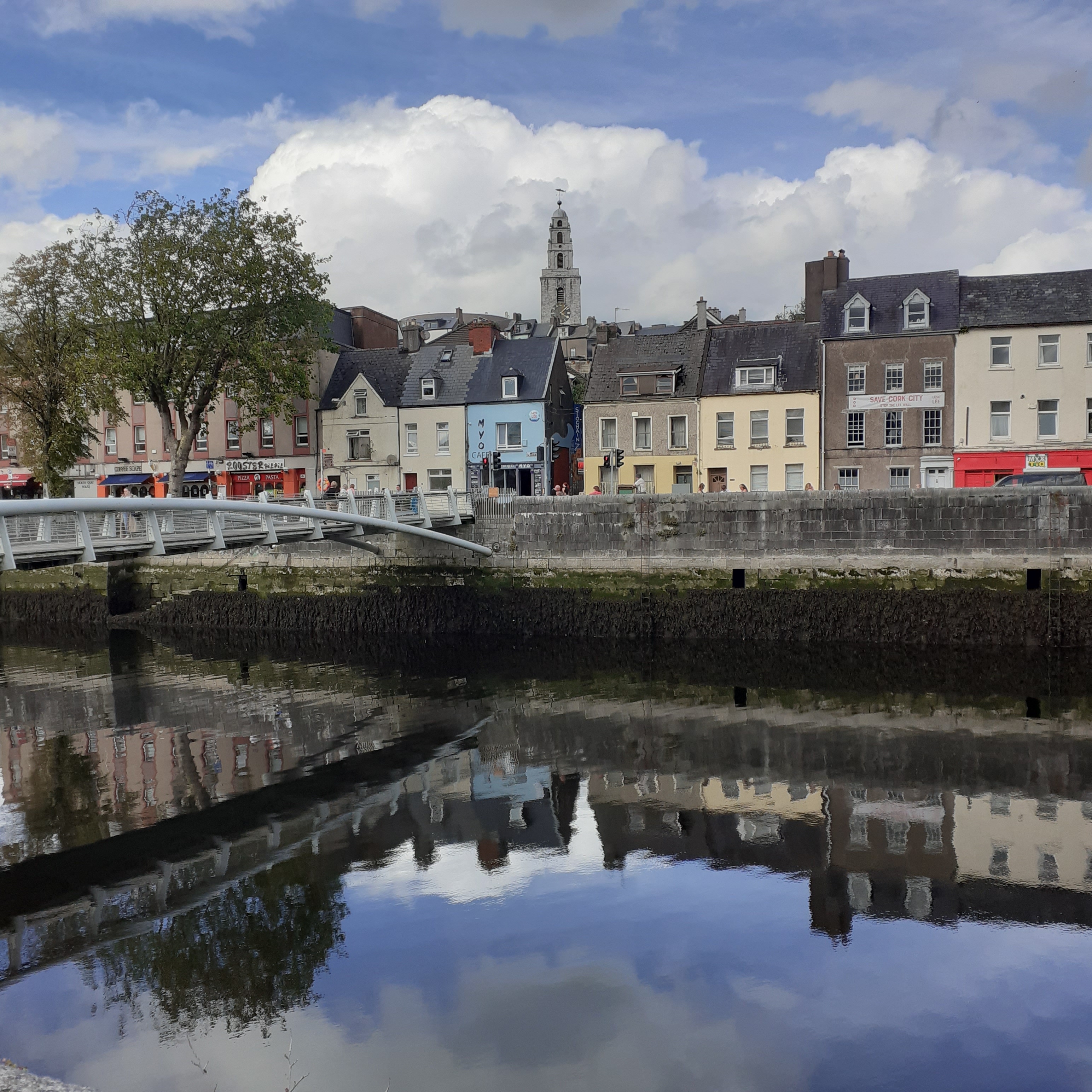
McCurtain Street is being ripped up at the moment but there’s plenty of restaurants, cafes and bars on this busy thoroughfare. Following the main road takes you down to the River Lee, and the city centre lies on the low lying island formed by the division of the river. The division in the River Lee happens well west of the city, past the University campus. The northern branch is the major; wide and relatively straight. The southern branch is narrower and windier, giving a quirky, intimate and scenic aspect to the city. 

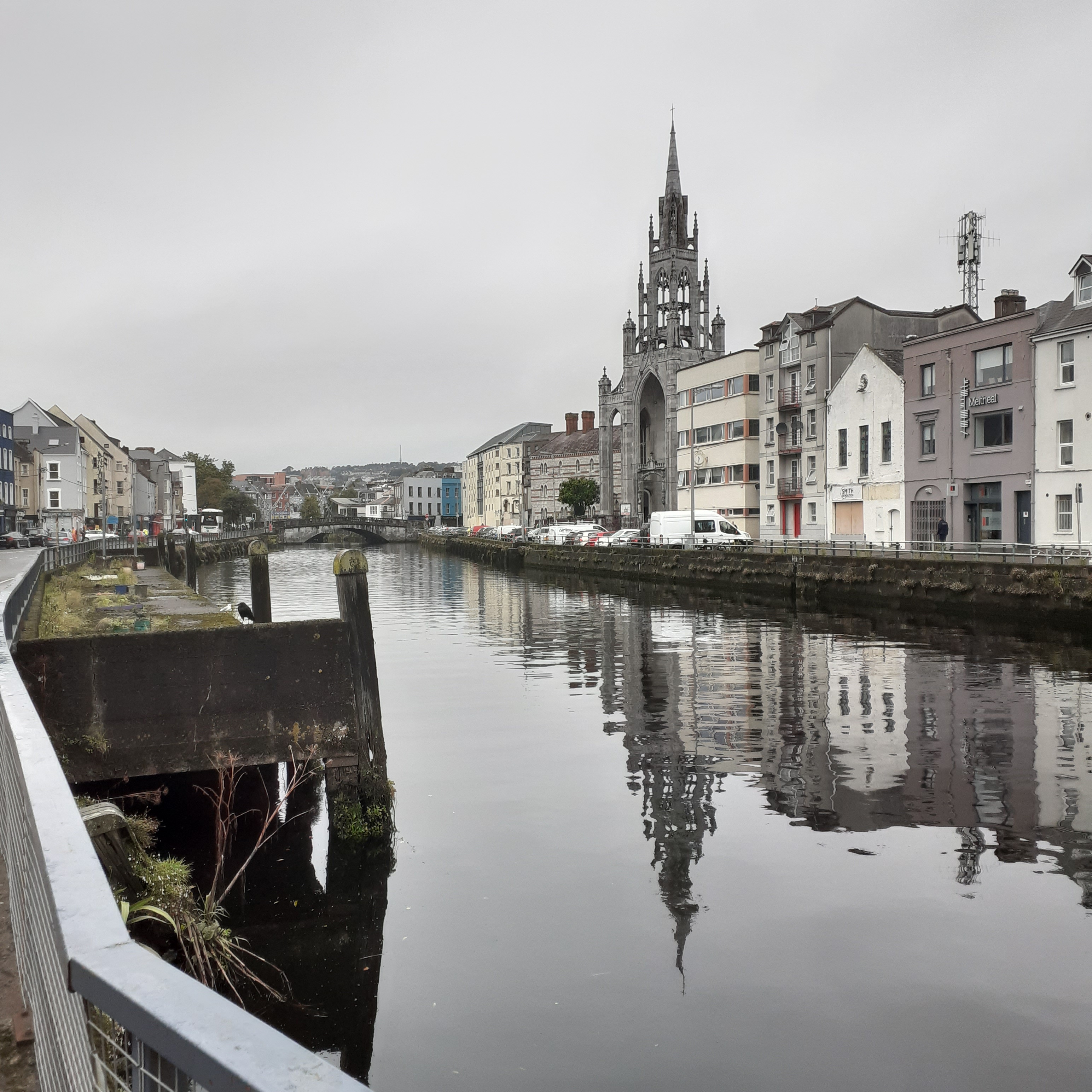
Union Quay takes you past the City Hall and the College of Music. On the opposite bank there’s the Cork studios of national broadcaster, RTE. A few doors up the distinctive ornate Neo Gothic spire of the Holy Trinity Church soars above Father Mathew Quay. Begun in the 1830s, it was not completed until the 1890s, construction having been delayed by the Famine. The design was chosen by competition, the winner being English architect John Pain, who also designed Blackrock Castle and the Courthouse on Washington Street. The interior includes three windows by Harry Clarke, and the window behind the High Altar is dedicated to Daniel O’Connell, 

The spire and facade were the last element completed, and were somewhat scaled down from Pain’s original plans. Still very impressive though, facade and spire combining in a unified statement, the entire structure tapering to its peak while the use of flying buttresses and cast iron supports give the building the lightness of lace, as an observer put it: more air than stone. The church belongs to the Capuchins, an order of Fransiscan friars, and is also dedicated to the memory of Father Matthew who commissioned the church, and otherwise devoted himself to helping the poor, becoming also a notorious campaigner against the demon drink. 

South Parish occupies the steep river banks, and like Shandon on the north bank, was an early suburb of the ancient walled city. The streets hereabouts go back a long way, with many colourful names. Whether Father Matthew had anything to do with Sober Lane, I can’t say, but it boasts one of Cork’s best beer gardens and an ironically named bar on Sullivan’s Quay. Uphill, we passSt Finbarr’s South, which dates from 1766 and is the oldest Catholic Church in the city. Sculptor John Hogan contributed the sculpture of the Dead Christ on the High Altar in 1832, carved from the same white marble from the Carrara Quarry used by Michelangelo. Farther up, the Red Abbey is one of Cork’s oldest structures,  an early fourteenth century Augustinian abbey. The friars persisted, even after the Dissolution of the Monasteries in 1541, for another century until the Catholic Rebellion of 1641. Only the church tower remains, 

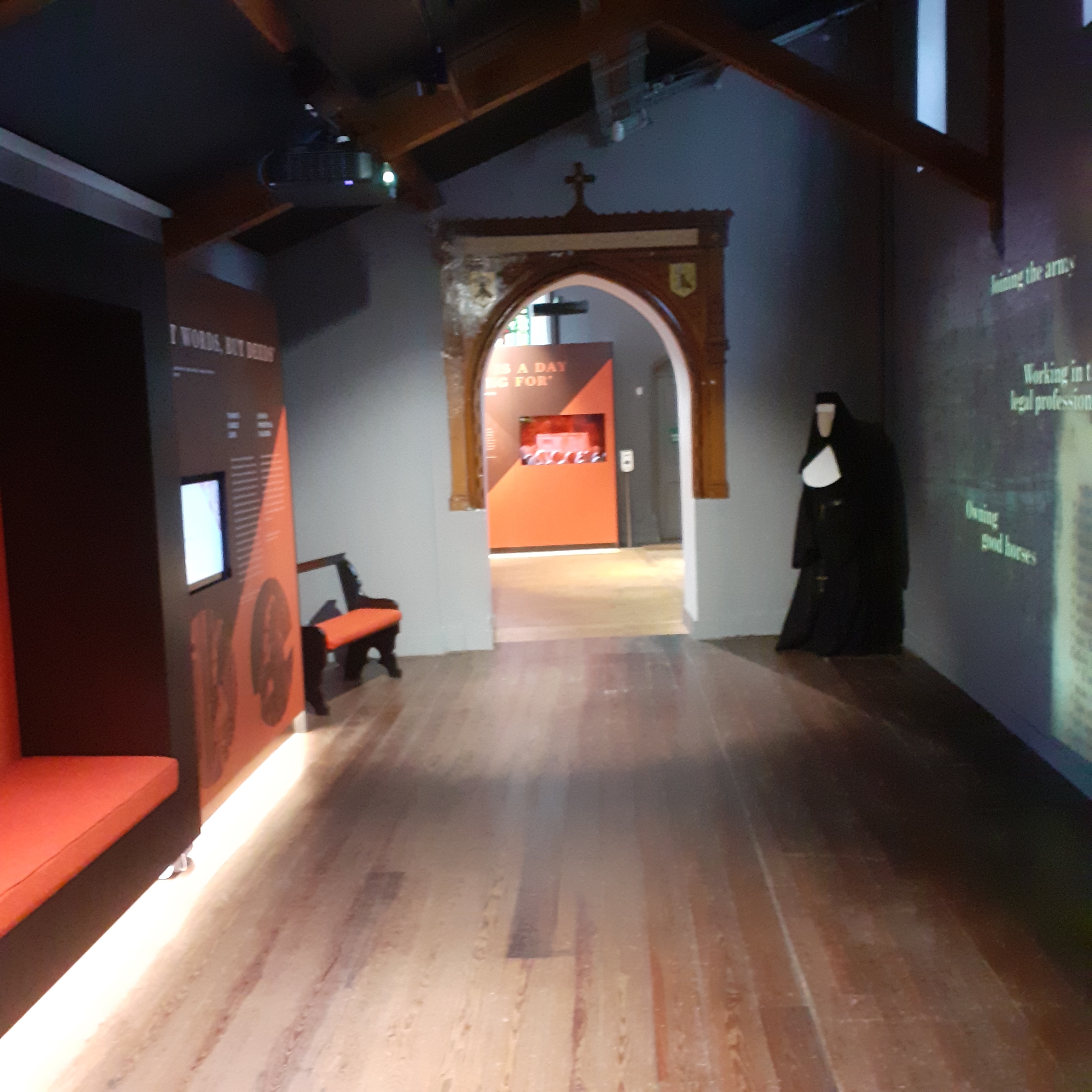
Nano Nagle Place is situated further up on Douglas Street. Born in 1718 Honora Nagle was from a well to do Catholic family in Penal days. The Catholic population then was poor and uneducated, something which Nagle determined to address. Her Uncle Joseph mantained a Protestant front to safeguard the family’s fortune. This allowed for Honora’s education in in Paris. While there she noticed the contrast between her life of privelege and the misery endured by the city’s poor. This she compared to the plight of her own Catholic community back home. She returned to Ireland and established seven schools, for boys and girls, the first in the ghetto where she grew up on Cove Street. She also established a convent for the Ursuline Sisters, a French order of nuns. Being enclosed kept them remote from the community, so Nagle went on to found her own, outgoing order. The convent she founded in 1771 forms the nucleus for Nano Nagle Place, with a museum, bookshop, gardens and her tomb. The award winning museum gives a lively, animated tour through Nagle’s life and work and also illustrates the parallel development of Cork city in the eighteenth century.

Fionnbarra’s Bar farther down Douglas Street, is a good place to slake your thirst with an eccentric beer garden out back. Brightly painted statuary serves to further tilt the axis of reality off the vertical, although a few pints of the brew would contribute to such effects also. 

I take the Nano Nagle footbridge across the river on to Grand Parade. Triskel Arts Centre is within the old walled city of Cork. A fragment of these walls remain in the Bishop Lucy Park next door, on the west side of Grand Parade. There’s a short but very useful account of ancient Cork and its early viking origins. Christchurch is a restored eighteenth century church once the main Church of Ireland place of worship in the city. It dates back to the eleventh century when a Hiberno Norse church was built on this site, this becoming a focal point for the developing city. You can view the ancient crypt beneath the current structure. Today the building is an intrinsic part of the Triskel and features regular music, arthouse cinema and literary events. There are regular exhibitions. My visit coincided with Then I Laid the Floor, featuring the work of three artists. The exhibition references a house built by relatives of Sao Paolo based Irish artist James Concagh, providing an interesting if vague visual narrative. Contributory work is provided by Brian Maguire whose art from all corners of the globe is consistently samey and shouldn’t detain you too long.

Farther along we reach the Cornmarket and the North branch of the river appears. The Shandon Footbridge takes us across the river and the climb up Widderling’s Lane leads to the heart of Shandon. This working class area has its own unique inner city feel. I had my eyes set on a Middle Eastern restaurant in the shadow of the bell tower of St Anne’s and sitting outside on a warm evening in the labyrinth of backstreets certainly had a Mediterranean feel to it. The restaurant even supplied a hookah pipe to an adjoining table to enhance the ambience. Unfortunately, my order resembled dessicated goat dipped in vinegar and I didn’t stay long. I resolved on a pint to wash away the lingering taste and hurried back to Son of a Bun, a good American Hamburger restaurant on McCurtain Street with which I’m familiar.

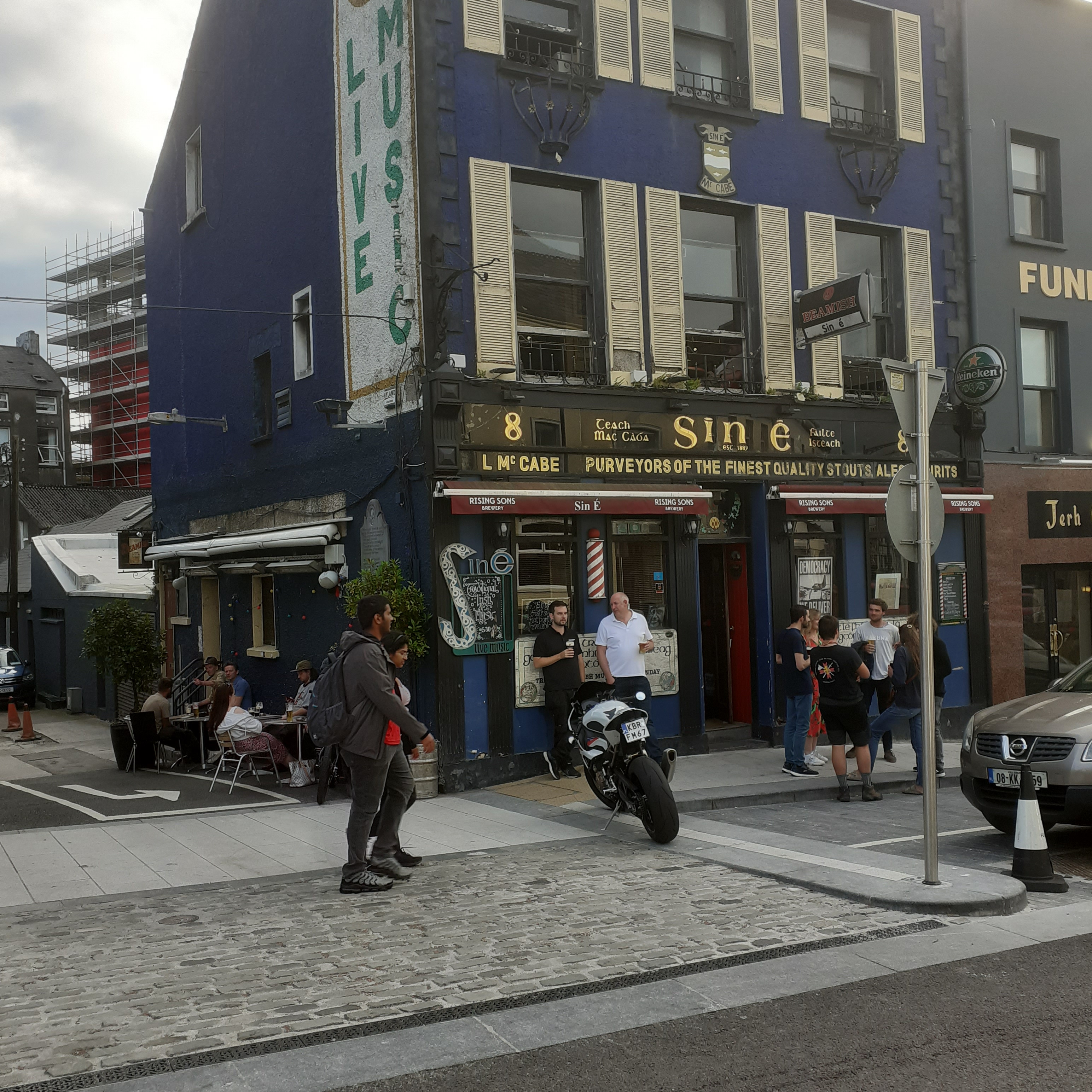
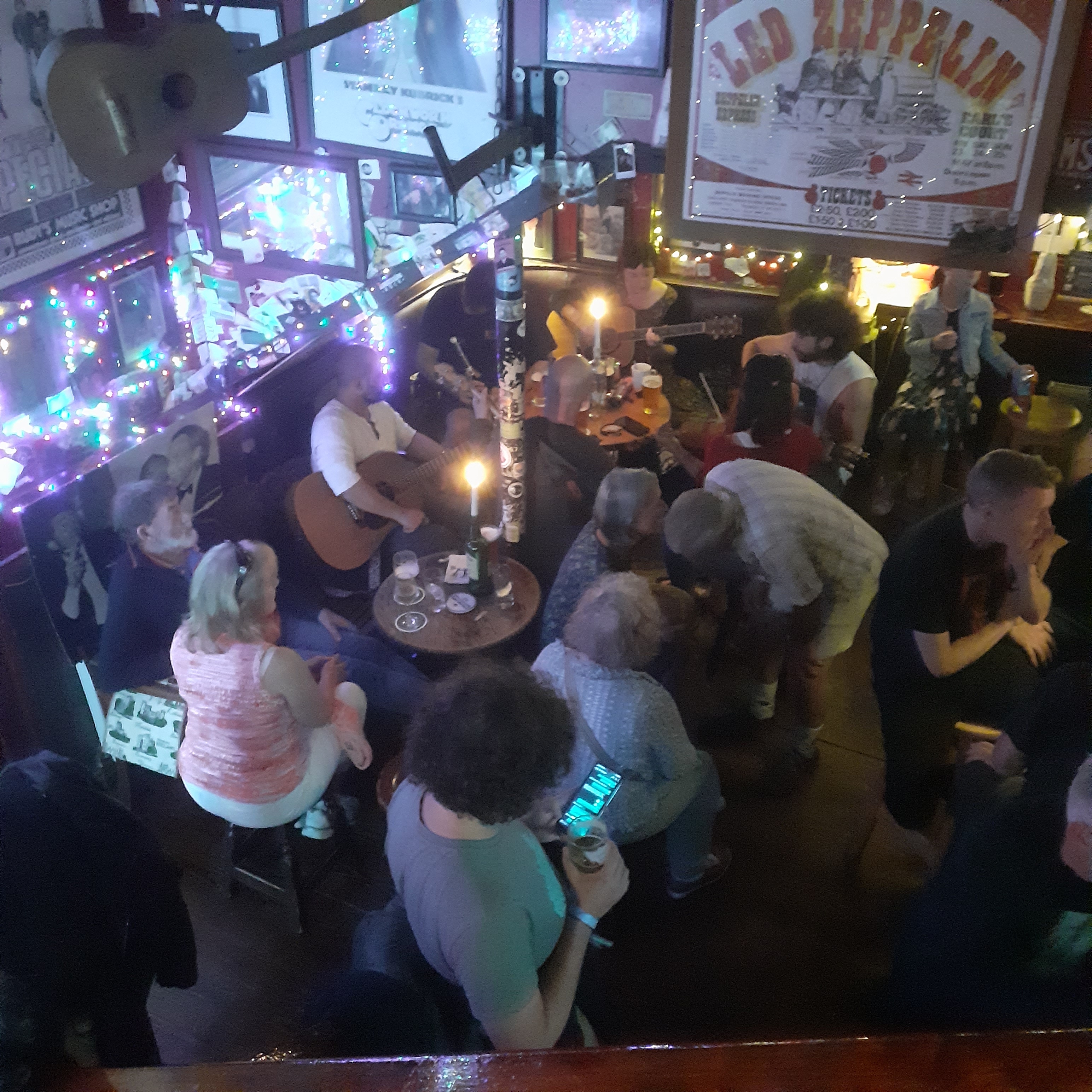
On the way I noticed one of Cork’s best loved bars. Sin É, Irish for that’s it. This is a busy spot with regular traditional and ballad music. The packed interior is a gem, and upstairs there’s a more reflective spot with candlelit tables where I grab a window seat. And thereby hangs a tale. The candles are not yet lit, and though on my ownio, I decide to light up for a little atmosphere. This attracted a tourist, German I think, who asked for a light for his own unlit candle. I obliged. Thus the light was spread troughout the world. I spent a happy half hour writing in my notebook and a few more moments reflection before heading off down the city centre. I got as far as the Oliver Plunkett, on the eponymous street, where outdoor seating allows for relaxed people watching. Looking for the notebook again, I find that it’s gone. It can only be back in Sin E, so I must return. The place is truly hopping, and I am none too optimistic approaching the upstairs table now occupied by a young woman. She has stowed my notebook on an adjacent shelf. It is a small thing of no great value, but I am delighted to be reunited with it again. Downstairs, I decide to celebrate with a pint. In an alcove, I take out a fistful of change and begin to count out the money required. Suddenly, the German tourist from before is at my shoulder. I will buy you a pint, he says, for earlier you gave me fire. Don’t you just love it. I had to laugh. I wasn’t sort of money, but had typically accumulated a lot of shrapnel and wanted to lighten the load. What goes around comes around. I see out the evening with pints and pleasant company. That’s Cork for ye; Sin É.
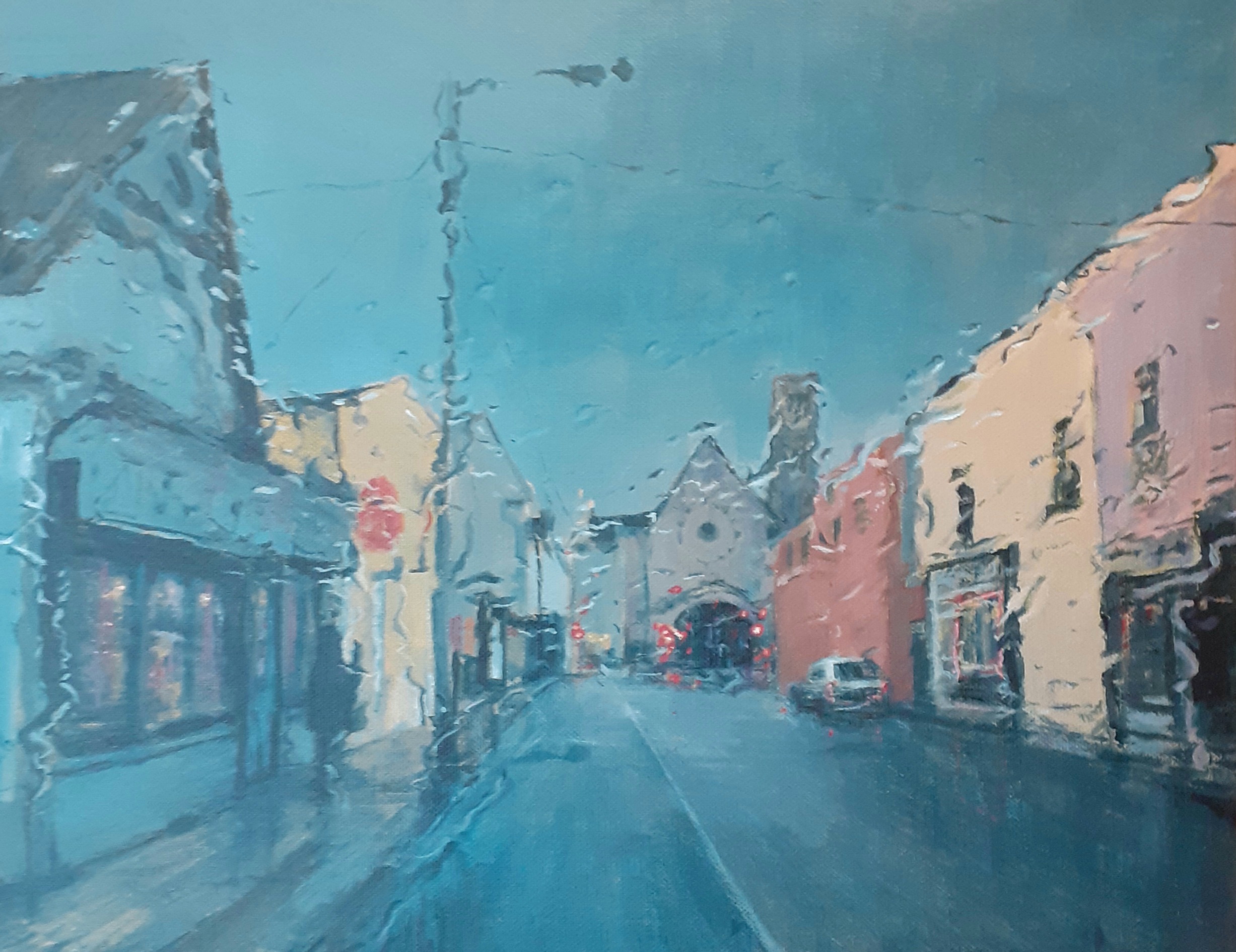
Cloudburst on Florence Road

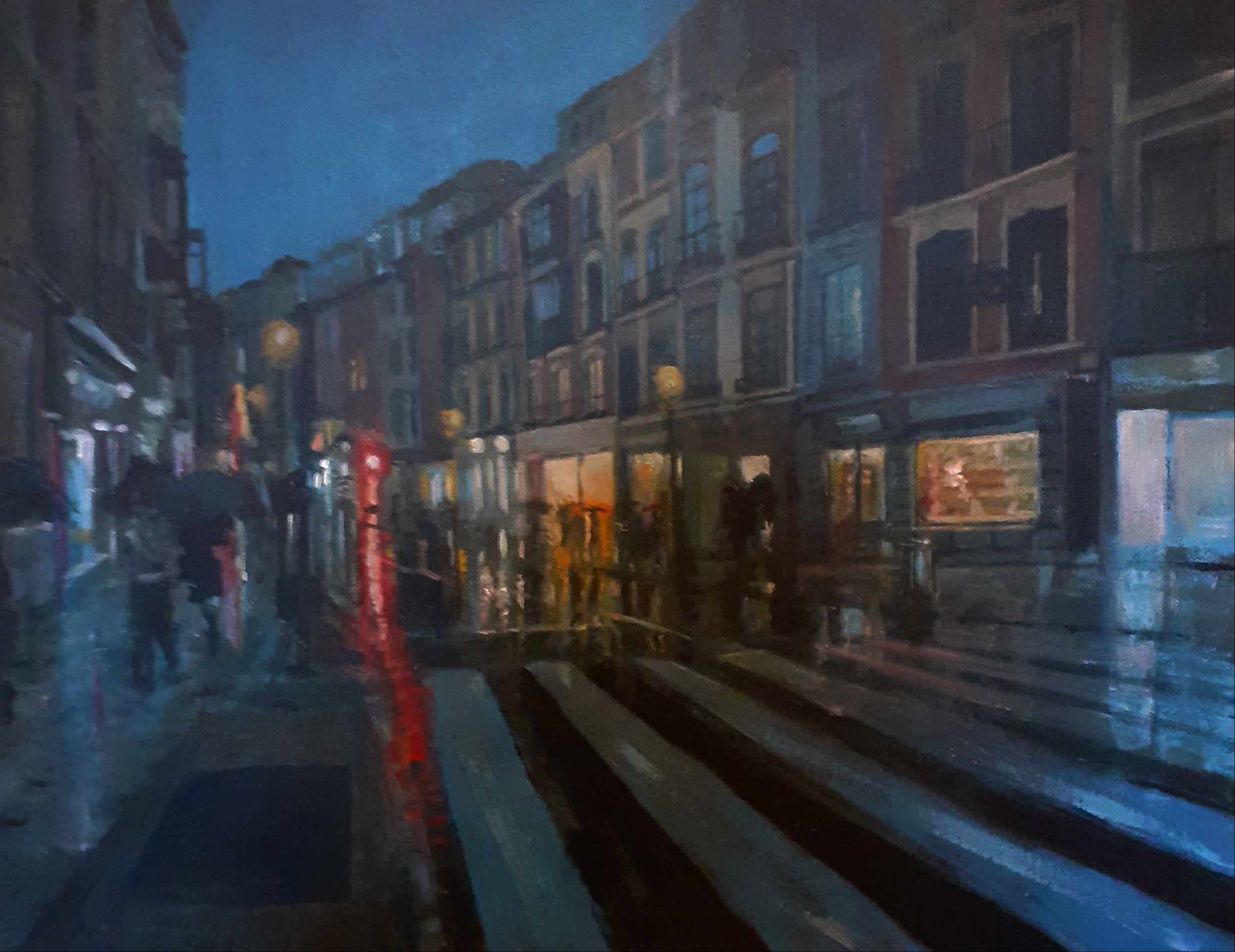
This has been a wet summer, even by Irish standards. It is a constant perspective here to view life through rain streaked glass; huddled in a cafe shopfront, looking out the kitchen window, scenery rushing through the windscreen of a car. I’ve painted Connemara driving through the rain and more recently, a sodden rush hour from the upstairs front seat of a bus on Amiens Street. The latter I took from a friend’s photo (thanks Paula Nolan!) but this one is all me own work. Taken through the windscreen of our car parked on Florence Road, Bray, looking up towards Main Street and the Church of the Most Holy Redeemer. We are dropping in to Florence Furniture and Antiques in the left foreground. A good antiques shop is a treasure chest of the past, and more. An alternative universe where it is possible to imagine each artefact a living thing, a receptacle for history and craft, and love, and much, much more; hopeful, awaiting its future in another setting. The stories they could tell. The building was previously an art shop, and a printworks before that.
Across the street is Hayes Butchers Shop, a long established family business and friendly with it. Stories and gossip are exchanged here in the old fashioned way. It’s where I get all the beef; if you catch my drift. The Church was established in 1843, funded by subscription including generous donations from Bray’s sizeable Protestant community. It was remodelled in the 1890s by WH Byrne who, around the same time, was supervising the reconstruction of Dublin City Markets on Sth Great George’s Street to the magnificent building we see today. The Holy Redeemer, however, looks very different now to the nineteenth century structure. The mid sixties saw the facade altered to a modernist gabled front with a new plain, soaring bell tower. Surprisingly, you will find the nineteenth century interior remains. The old within the new.

Belfast – 3: Troubles

Most cities offer an open-top, hop-on hop-off bus tour. Mostly I can take or leave them. It does make for a particularly useful introduction to Belfast. Much of the city’s fame is steeped in the Troubles, interesting times to be sure. The suburbs featured even more than the city centre. The Falls and the Shankill were the capitals of the troublesome antagonists. There’s something slightly weird being a tourist on an open top bus, cruising through mundane working class residential areas, safe but with a frisson of danger. Perhaps weirder still to be a resident going about your business, yet at any time grabbed in the lens of visitors cameras. Though it could be worse, and once was. A loop through the docklands is also useful, stopping of course outside the Titanic exhibition.

The tour guides each have their own patter, a comedy routine in the making, a mixture of historical details and lurid anecdotes. The latter may be shaggy dog tales, but the history is convincing. We took a couple of jaunts, and so were treated to a variety of routines. Most were racy and jocular, and one who did a drearily hilarious comic turn. 

The first stop was at St George’s Market on May Street, close to the Waterfront. This is an attractive redbrick Victorian Market from the end of the nineteenth century. Enter through the main archway into a hive of trading activity with hundreds of stalls selling books, clothes, art, antiques, hot food and snacks from friday through to sunday. The friday market dates back to the city’s formation in 1604, with fruit and veg, antiques, crafts, clothes and books. Saturday devotes itself to being specifically a food and craft fair, then sunday brings both elements together with live music thrown in. St George’s Market doubles as a music and arts venue with events ranging fron the World Irish Dance Championship to Deep Purple. 

Next door is a pub that honours a singer of my own city, Ronnie Drew. It’s disconcerting to see his face around here, but consoling. Born in Dun Laoghaire in 1934, he founded his own group with Luke Kelly and others. The Dubliners first played in O’Donoghue’s in Dublin’s Merrion Row, a favourite haunt of mine. It’s good to see them commemorated in Ireland’s second city. Ronnie Drew’s is an ornate old style bar from the 1920s, with five large snugs along the huge arched windows at the front. Once called McGettigan’s, it was renamed for Drew following his death in 2008

The next bus takes us via City Hall and on to Great Victoria Street. From the city centre we head into the leafy suburbs of the University Quarter. This quarter includes the Ulster Museum, the Botanic Gerdens and of course Queens University, Belfast. The university was founded in 1845 as an associate college of the Queens University of Ireland, along with Cork and Galway. It was intended to be a learning centre for Catholics and Presbyterians as distinct from the Anglican Trinity College Dublin. Queens is enjoying its summer hiatus at the moment. I recall Freshers week, many moons ago, where the rag mag profiled a hopeful candidate in the student elections. He was running on the surprising platform of a Gay Paisleyite, with the ne’er to be forgotten slogan: Better Gay than Taig. Taig, from the common Gaelic name Tadhg, being the Loyalist slang term for their Nationalist foe.

The main building fronting onto University Road was designed by the English architect Charles Lanyon. It is an impressive gothic redbrick with a central tower inspired by Magdalen College in Oxford. Lanyon also designed the Campanile at Trinity College Dublin and many Belfast landmarks, including the Palm House at the Botanic Gardens nearby, Belfast Castle and Crumlin Road Courthouse and Gaol. Lanyon Place is named in his honour, though the modernist slab of a railway station seems somewhat ironic.

The tour heads west towards the Falls Road, a two mile long thoroughfare heading from the city centre to Andersonstown. The area is home to the Catholic community of West Belfast. We stop at the Bobby Sands mural, one of the most famous of Belfast’s many political murals. It dates from 1998, around the corner of the Falls at Sevastapol Street, on the gable end of the Sinn Fein hq. Sands was sentenced to fourteen years in the H-Block at Long Kesh for possession of a firearm in 1981. He went on hunger strike to campaign for political prisoner status and was elected MP for Fermanagh South Tyrone. After sixty six days he died at the age of twenty seven, in May. A further nine men died before the hunger strike was called off in October. 

Further down the Falls we glimpse Divis Tower, a twenty storey residential block from the sixties. Standing 200 foot tall it was a significant landmark of the Troubles. The British army occupied the top two floors as an observation post, though they could only access it by helicopter. Residents moved back in fifteen years ago.

Turning left off the Falls, a row of murals occupies the Solidarity Wall along Northumberland Street. Alongside national and local heroes, other international revolutionaries favoured by Republicans are commemmorated. These include Palestinian, Basque and South African activists, with Nelson Mandela prominent amongst them.

Through a double gate, we leave the Falls and enter the Shankill area, a Loyalist enclave. Murals now switch to assertions of Britishness with the Union Jack and King Billy (William of Orange) signifying that you’ve crossed the divide. That divide is demarcated by the Peace Wall on Cupar Way. This was erected by the British Army in 1969 to prevent inter community strife between Nationalists and Loyalists. 

There are thirty km of walls in total, in various areas throughout Belfast. The Good Friday Agreement of 1998, following the IRA ceasefire of four years earlier, effectively brought an end to hostilities. The Peace Wall could at last live up to its name. The barrier has evolved into an open page for the amateur graffitti artist. A litany of hopes and dreams scribbled by the great unwashed, and the great and the good. National and international leaders have made their mark. Bill Clinton, a significant force in the Peace Process was here. According to our guide he contributed the quote: I never slept with that woman! I doubt it. Ironically, the symbolic importance of the wall has itself become a barrier to taking the thing down. It’s longer now than at the end of the Troubles  

Andre has a red flag, Chiang Ching’s is blue

They all have hills to fly them on except for Lin Tai Yu

Dressing up in costumes, playing silly games

Hiding out in treetops, shouting out rude names

Whistling tunes, we hide in the dunes by the seaside

Whistling tunes, we piss on the goons in the jungle

It’s a knockout

If looks could kill, they probably will

In games without frontiers

War without tears

(Games Without Frontiers is a Peter Gabriel song from his third solo album Peter Gabrel. The title is taken from a Trans European tv show of the sixties and beyond: Jeux Sans Frontiers. That line is sung by Kate Bush as an alternate chorus. British tv used the more combative title: It’s a Knockout.)

We stop along the Shankill Road where the atmosphere is muted and rather grim. I wonder if we should strike up a few verses of We’re on the One Road. But perhaps its message of togetherness might be misconstrued along here. Returning to the city centre, the bus deposits us at Donegall Square and the City Hall.

Our last night on the town brings us to Bittles Bar. Occupying a flatiron wedge at the junction of Victoria Street and Church Lane, it dates from 1868, when it was known as the Shakespeare. The literary theme continues inside the small triangular bar. A great selection of paintings are crammed into every available space with group portraits of Irish literary and sporting heroes enjoying a few pints. There’s a large canvas of Yeats, Behan, Beckett, Wilde and Joyce, while peace era iconography brings together erstwhile combatants of the Troubles, Adams and Paisley sharing a joke. The pub’s most popular poet seems to be Padraic Fiacc who gazes down, not quite benignly, at the bar. A spiky quote: Screeching gulls in a smoky bacon sky, hints at a spiky character. Christened Patrick O’Connor, he was born in Belfast, the son of a barman. His family lived in the Markets area nearby, having been burned out of their home in Lisburn. They moved to New York and Padraic grew up in the notorious Hell’s Kitchen area. A case of out of the frying pan and into the fire. He connected with his Belfast roots in the forties and returned to live here in 1956. A member of Aosdana, he died only recently, in 2019 at the grand age of 95.

Meanwhile, although the night is still young, last orders are called. I had just been extolling the benefits of Belfast in peacetime only to be made aware that we were caught in an unfree state, with antediluvian licensing hours. Ten o’clock on a Sunday night on a Bank Holiday weekend and we’re out on the street.  So it looks like I’m going to wake up in the city that does sleep. However, a stiff, and anxious, walk back to the Titanic quarter, and the wonderful Premier Inn provides a pint of Harp, or two, to take us to the midnight hour.

Belfast – 2: Titanic

We’re staying in the Titanic Quarter, practically next door to the eponymous attraction. The tall gleaming building is a landmark in itself, embodying in its design a suggestion of the famous liner built at the Harland and Wolff shipyard nearby. Edward James Harland was born in Yorkshire in 1831 and moved to Belfast in 1854 to manage Robert Hickson’s shipyard on Queens Island. In 1858 Harland bought the shipyard from Hickson. Gustav Wilhelm Wolff from Hamburg had worked as Harland’s assistant, and soon was made a partner. Harland and Wolff prosperred, forging a lucrative partnership with the White Star shipping line. White Star exemlified high quality service for the transatlantic passenger trade. The Belfast shipyard became exclusive builders for them, providing ships on an ever more grandiose scale, culminating in the Titanic in 1912.
The decline of Belfast shipbuilding saw Queens Island left derelict. A handful of structures were listed for preservation, including the Titanic slipway and the iconic Samson and Goliath gantry cranes. These were only built in 1969 and 74, and are still in use as part of the dry dock operations of the yard. The Titanic Quarter development was proposed in the mid nineties. The Odyssey Complex was an early development which opened in the new millennnium. The Arena hosts the Belfast Giants hockey team, and is also a venue for music gigs. The Premier Inn, our hosts, was the first hotel opened here in 2010. 
The Titanic Belfast visitor attraction was proposed as a focus for the site. It was intended to emulate Frank Gehry’s Guggenheim museum in Bilbao as a prestige scheme which would inspire a regeneration of the area itself and the wider city. Overseeing the project, Dublin firm Harcourt Developments enlisted American architect Eric Kuhne and London firm Event Communications. The building echoes the outline of the huge White Star ships, standing as high as the Titanic hull on completion. Locals have given the nickname the Iceberg. The silver sheen of the building comes from its aluminium cladding, whose jagged finish also isuggest ice crystals. The visitor centre stands on the slipway where the Titanic was launched.

The Titanic Experience will take a few hours. It first immerses the visitor in the rapidly growing nineteenth century city of Belfast, then takes you from the ship’s conception, through gestation and birth, and on to that fateful voyage, and beyond. It is a story of dockland and street, nuts and bolts, the savage vastness and caprices of the sea, and of course people. The people who designed her, who toiled to make her, who were charged with sailing her, who paid to sail in her, who survived or perished, as the die would have it.

Titanic is the most famous ship ever, though it never completed its maiden voyage. Carrying 2,224 passengers and crew, she set off from Southampton to New York by way of Cherbourg and Cobh, then known as Queenstown. Hopes would have been high. Here was a voyage into a new world, upon the greatest ship afloat, proclaimed unsinkable with the best in modern safety technology. Allegedly. Third Class were better catered for by White Star than they would have been elsewhere, with cabins instead of open dormitories, their own dining rooms, a smoking room, reading room and an assembly hall. Facilities in first class were luxurious, based on the quality of the Ritz, with restaurants, gymnasium and turkish baths, A glorious Grand Staircase swept up through seven decks topped by a metal and glass dome.

She sank on 15th April 1912 off the coast of Newfoundland. Capt Edward Smith went down with the ship. One thousand five hundred people died. The names of all the dead are displayed on a huge wall as we begin our descent from the exhibition’s top floor. Stories abound, ranging from modest steerage to those of great wealth and fame. There was the unsinkable Molly Brown, who survived. Born Margaret Tobin in 1867 to Irish immigrants in Missouri. She moved to Leadville, Colorado, in her teens and married mining engineer James Brown who became wealthy through his work. A wealthy socialite, Margaret didn’t forget her poor background, and applied herself to philanthropy in the cause of women and workers. Her survival became the stuff of legend and led to her posthumous nickname

Fate smiled on others who either missed the boat or got off. Amongst those who disembarked at Cobh was Fr Francis Browne, an Irish Jesuit and photographer. He received a first class ticket from Southampton to Cobh as a gift from his uncle. On board he befriended a rich American couple who offered to pay his passage to New York. He telegraphed the bishop and the reply was swift, and negative: Get off that ship! Browne studied at Dublin’s University College with James Joyce who remembered him with a walk on part in Finnegans Wake. Even more unsinkable than his namesake Molly, he was a chaplain in the Great War and survived the Battle of the Somme, Passchandaele and many other fierce battles. Wounded five times, he was awarded the Military Cross and the Crois de Guerre. The survival of Browne’s photographs form an enduring legacy of life in the twentieth century. His photographs chronicle life in Ireland and abroad, while his record of the Titanic, its passengers and crew before their date with fate, is invaluable.

Nearing the end, with the weight of the dead above us, we descend to the depths. The Titanic rested undisturbed for more than seventy years. In 1985 Robert Ballard and Jean Luis Michel found the wreck. Celebration was spontaneous, though Ballard quickly saw the problem of joy in what was, is in effect a mass graveyard. A film by James Cameron in 1997 featured Leonardo de Caprio, a steerage passenger forging a love affair with Kate Winslet. Their celebration of life at the ship’s prow gives a photoshoot moment for visitors seeking to recreate the moment starring themselves. My companions oblige, though I must draw a veil over that.

After the full emotional experience of the Titanic spend some time on the Nomadic, parked adjacent to the visitor centre and included in the admission. The Nomadic is the Titanic in miniature. It was used as a ferry for passengers from the dockside to the Titanic anchored offshore. The interior is lovingly preserved, with some ghostly projections taking us back to the days. 

After all of that, it was time to sink a few cold ones. There are few oases this side of the Lagan. It’s a ten minute hike across a selection of bridges to the city centre. We took the Lagan Weir Bridge which curves to the west bank where it is guarded by the Big Fish. This sculpture by John Kindness was commissioned at the end of the last century as part of the urban regeneration along the riverbank. The fish is clad in ceramic scales, many with texts and images illustrating the city’s history. Aptly, it stands at the confluence of the Farset and Lagan rivers.

The Farset is the river that gave Belfast its name: the mouth of the Farset, Beal Feirste in Gaelic. The original settlement was here, and a small dockland grew up. This was covered over in the eighteenth century and is now Queen’s Square.  The buildings on the south side of the square would once have faced the quayside of the old town dock. The oldest building in Belfast survives here, and houses McHugh’s Bar. It was built as a private residence in 1711 and by the following decade a public house was in operation. McHugh’s serves food and drink and there are lively evening music sessions. Its large outdoor terrace facing the square was perfect for a perfectly sunny day. Our own trio was augmented by a trio of friendly locals and we fell into the heaven of lively conversation and chilled beer in the afternoon sun.

The Albert Memorial Clock dominates the square. Built to honour the Queen’s Consort who died in 1861, it is Belfast’s very own leaning tower. Being built on land reclaimed from the River it leans four feet off the vertical and stands, if precariously, over a hundred feet tall. It was once a haunt of prostitutes. Perhaps it was a form of sympathetic magic, or just that they, like the tower, had the time and the inclination.

The area has moved upmarket in recent times. The Cathedral Quarter is named for St Anne’s Cathedral nearby. Once a warehouse zone this warren of cobblestone lanes is the go to area for city nightlife. Such colourful names as the Thirsty Goat, the Cloth Ear, the Chubby Cherub and Bunsen Burgers clamour for your drinking and dining pleasure. We wander for a time in the summer haze of evening through a long narrow laneway beneath neon umbrellas with a caption saying there’s only seven types of rain in Belfast, all seven days a week. But not this weekend.

Belfast – 1

Belfast is Ireland’s second city, and the capital of Northern Ireland. It is a two hour train ride from Dublin Connolly on the Enterprise; all going well. I was last here just over ten years ago, taking another jaunt north with my younger son to see the Belfast Giants ice hockey team at the Odyssey Arena. Images of the frozen north were amplified within the confines of the ice rink, and in truth were not dispelled in the great outdoors; but this time Belfast was caught in the embrace of a big blue sky, and it was sweltering.

I went up with two friends and we booked into the Premier Inn for two nights. It’s just across the Lagan river in the Titanic Quarter, a new development growing around the dockside and the famous shipyards, and adjacent to the Odyssey Complex. Technically, we’re staying in County Down, and this will be the first time I’ve overnighted in that particular county. Most of Belfast is in County Antrim.

As it turned out, the Enterprise didn’t boldly go where it was supposed to, instead depositing us at Lisburn, nine miles short. The rail service put on a few busses to ferry us into the city. It was a cheerful, if cramped half hour, us southern sardines standing and swaying as the cheerful driver kept his foot to the floor and an entertaining patter going with those of us nearby. He delivered us to the terminal on Great Victoria Street on the west side of the city centre.

We first put into The Crown Liquor Saloon, it being on our hit list and also being the first pub we saw. Travelling on a hot day is thirsty work. Originally this was called the Railway Tavern for the principal Railway station across the road. The first station was built in 1848 in the first flowering of Irish railroads. Glory days are made to pass and it was closed in 1971, and demolished to make way for a modern block. A new station openend in 1995 adjoining the Great Northern Mall shopping centre. The name Great Northern here alludes to the Great Northern Railway which absorbed the original Ulster Railway of 1838. 

Meanwhile, the pub was renovated and renamed the Crown in 1885. It was conceived as a Victorian gin palace, as the lavishly ornate bars of the era were known. Publican Patrick Flanagan employed Italian craftsmen who were engaged in the construction of Catholic churches, enjoying a boom in Belfast at that time. The Italians certainly stamped the Crown with their exuberance. The colourful tiled exterior is eye catching and the effect continues in the glowing interior, also decorated with tiles and illuminated by gas lamps. Stained glass partitions separate a total of ten snugs with original antique fittings. So it was that we three amigos collapsed into the Crown and took possession of a snug.

Belfast city centre is laid out in grid form indicating its relatively modern conception. Its population stands at 350,000 in the urban area, with 650,000 in the wider metropolitan area. Yet two hundred years ago the city population was barely a tenth of that. It may have had a castle in Norman times, but the largest castle of note in the vicinity was Carrickfergus, still is, ten miles north on the shores of the Lough. Carrickfergus was essentially the capital of Ulster since 1177 when John De Courcy established Norman power there shortly after Strongbow’s invasion and Henry II’s assertion of overlordship. English power was stalled by Edward de Bruce’s campaign in the fourteenth century. Edward was the brother of Robert the Bruce, King of Scotland, and was himself proclaimed King of Ireland in 1315. He captured Carrickfergus but three years later he was defeated and slain by Anglo Irish forces at the Battle of Faughart, near Dundalk. Edward’s reign was brief, and rarely extended past Ulster, but English rule remained stalled for a further three centuries. 

It wasn’t until 1615 that Sir Arthur Chichester founded Belfast as a town. Belfast Castle was established, built on the ruling O’Neill’s tower house and becoming a focal point as the Plantation of Ulster took off. That castle burnt down a century later. The current Belfast Castle is physically remote from the ancient castle which fell into ruin and then oblivion. It was built in 1870 on the Donegall family’s deerpark on the outskirts of Belfast at Cave Hill. It is actually a grand Victorian residence, in the Scots Baronial style, though in the hands of Belfast City Council for the last century and is open to the public and may also be booked for events and weddings. 

English, Manx and Huguentot settlers predominated in the early colonisation of Belfast. It was the Huguenots and Scottish Presbyterians who introduced the linen trade which fuelled the increasing growth of the town. Through the 19th century, Belfast establsihed itself as one of the major linen producers in the world and acquired the nickname Linenopolis. Try saying that after a few jars.

Our cross city navigation was easy enough. Great Victoria Street is a busy thoroughfare lined by tall buildings running north south and defining the western edge of the city centre. Next door to the station is the Europa Hotel, once dubbed the most bombed hotel in world, having suffered  thirty six bomb attacks during the Troubles; being the conflict in Norrthern Ireland that lasted for thirty years until 1998. Yet the Europa endures. It was built on the site of the original railway station and was the popular haunt for journalists in those troubled times. Today the twelve stoey tower is a four star luxury hotel with two hundred and seventy bedrooms, and promises a quiet night’s sleep. 

Adjacent is the Grand Opera House. This opened in 1895 with a thousand seater auditorium hosting variety shows and musicals. Over the years performers have included Sarah Bernhardt, Charlie Chaplin, Laurel and Hardy, Orson Welles and Luciano Pavarotti. The onset of the Troubles saw a decline in fortunes and developers wanted to pull it down. Sense prevailed, and the building was bought by the Arts Council and listed in 1974. A recent refurbishment has restored the plush ambience of its glory days. Theatre tours can be booked and the upcoming programme includes a heady mix of musical entertsinment, with Oliver, the Rocky Horror Show and the Buddy Holly Story on the bill.

At right angles, the parallel avenues of Chichester Street and May Street head due east, reaching the Lagan River and Belfast Lough just beyond another Victoria Street, which must cause some confusion. Mind you, there is something of an obsession with that particular monarch hereabouts, so inextricably is the city linked to the Victorian age.

Either route takes us through the busy commercial centre of Belfast, and midway along we find City Hall. Belfast City Hall does what a city hall should, providing the centre point and pivotal landmark for the city it serves. It was conceived in 1888 when Belfast, at last, was granted city status by the Queen, Queen Victoria of course. From a population of only twenty thousand in 1800 it was the largest city in Ireland by then, passing the three hundred thousand mark, so it was not before time that it was recognised as a city. 

The City Hall and grounds occupies Donegall Square, named in honour of the Chichester family, founders of the city. Arthur Chichester was made Earl of Donegall in 1647 and the family castle once stood nearby. The county itself is now spelt with one l: Donegal. The building was designed by Alfred Brumwell Thomas, an English architect. Completed in 1906 it is faced in white Portland stone, a shining palace in Neo Baroque style. There are echoes of the phanthom fortress long gone, with a tower in each corner and a soaring copper dome capping the centrepiece column. The grounds are strewn with monuments to Queen Victoria (again), Edward James Harland of shipyards fame and those who sailed on the Titanic. There is also the Garden of Remembrance and Cenotaph. The extensive lawns accomodate the public. They are out in force on this most glorious of days, but can relax here on any day, to take the sunsine and forget such cares that life, and history can bring.

Edinburgh – The Writers’ City – 4

At the end of Grassmarket the road divides. Straight on and you pass under the bridges that buttress the Old Town. Candlemaker Row slopes upward to join George IV Bridge with the wall of Greyfriars Churchyard along one side. The Grey Friars themselves were Franciscans whose monastery was dissolved in 1560 as Scotland was gripped by the Reformation. The cemetery was a replacement for the St Giles Cathedral churchyard up on the Royal Mile. It was a place of free assembly and The Covenanters signed the National Covenant here in 1638. This asserted the primacy of the Scottish Presbyterian Church but their revolt was soon defeated in the Battle of Bothwell Bridge. Following the battle, four hundred prisoners were held in a section of the churchyard, and it became known as the Covenanters Prison.

Most famous of the kirkyard’s  former residents is a wee dog. Greyfriars Bobby. A Skye Terrier, he belonged to a nightwatchman with the city police, John Gray. When Gray died in 1858, it is said that Bobby, his watchdog, kept watch at the graveside until its own death fourteen years later. By this time he had become well known, to the extent that Edinburgh’s Lord Provost, William Chambers had the dog licensed and collared. A year after Bobby died, English philanthropist, Lady Angela Burdett-Coutts was so touched by the story that she had a statue erected in is memory. Outside the gates you’ll find the granite fountain surmounted by a lifesize bronze statue of Bobby. 

The legend has grown. I saw the Disney film back in the early sixties. This was based on Eleanor Atkinson’s novel of 1912 and has a different version of events. Here, John Gray is a farmer who comes to Edinburgh and dies. A major character is Mr John Traill, of Trail’s Temperance Coffee House, who in real life claimed Jock and Bobby were regular visitors. As the coffee house was opened four years after Gray’s death, it may be something of a shaggy dog story. A more recent film in 2005 controversially starred a West Highland Terrier playing Bobby, an example of cultural appropriation. The Temperance Coffee House was located outside the gates, and is now, thankfully a bar. Greyfriars Bobby’s Bar is an old style pub, with outside tables to catch the midday sun

Around the corner on Forrest Road is Sandy Bell’s, another pub on the Rankin Rebus Pub Crawl. This is a folk bar with evening sessions featuring Irish and Scottish traditional music. It’s a century old and was first known as the Forrest Hill. Blossoming in the folk heyday of the sixties, Barbara Dickson, Billy Connolly and Gerry Rafferty are amongst its alumni. In the 80s a landlord installed a puggie or slot machine, bane of British pubs, but the regulars delivered an ultimatum, either it goes or we go, and it lasted all of a day. Sandy Bell’s became the official name in the nineties, as that’s what everyone called it, dating back to the twenties when the pub was owned by a Mrs Bell.

Across the street is the Scottish Museum. This is two buildings. The Royal Museum was built in the 1860s and houses displays of industry, science, technology and natural history. The modern building from 1998 is a formidable and concrete slab in the Le Corbusier style, which paradoxically concentrates on history and antiquities. Admission is free. The old building has that Great Exhibition air to it; the Grand Gallery of cast iron and light was inspired by the Crystal Palace.

The Discoveries Gallery features the world of adventure and invention.You can meet Dolly the Sheep. Born in 1996, she was the first mammal cloned from an adult cell, and kept at the Roslin Institute for animal research where she died in 2003 from lung cancer. Ian Wilmut leader of the research group derived the name from the fact that Dolly was cloned from a mammary gland cell and, sez he, “There’s no more impressive pair of mammary glands than Dolly Parton’s.”

There’s exhibitions on Ancient Egypt and East Asia, and the arguably more ancient Elton John’s suit is amongst the fashion artefacts on display. In the new building Scotland is investigated through the ages. This is rich in detail but challenging. Some years back I visited Stirling Castle, which had an excellent guided tour, along with permanent displays that clearly mapped the heritage of Scottish Kings and Queens. I didn’t really get that clear a narrative here, perhaps I was tiring. It’s a vast museum, and hard to take in everything in one day. Worth a visit, or two.

The statue guarding the entrance is of William Chambers, who asides from his love of dogs, had a notable career. Born in 1800, he opened his first bookshop at nineteen and established a publishing empire with his younger brother Robert. As Lord Provost of Edinburgh in the 1860s he initiated major street construction projects hereabouts.

Chambers Street connects to the North and South Bridges joining Old and New Towns and bisected by the Royal Mile. I’m searching for the Royal Oak, another stop on the Rebus Pub Crawl. Hidden down Infirmary Road, its modest entrance leads to a welcoming traditional bar. The pub is two centuries old and is long established as an informal folk music venue. It features in Rankin’s Set in Darkness, eleventh in the Rebus series set during the birth of Scottish devolution. A duo discusses politics at the upstairs bar while I am engaged by the young lady serving. She tells me tales of growing up on Scotland’s east coast and I can thread in vague experiences of my own including Inverness and the shores of Lough Ness. There be monsters and dragons, and bagpipe festivals, and ancient standing stones where you might catch a glimpse of Catriona Balfe flitting through timezones in a diaphanous shift. But I digress. The lady merges the two conversational groups and now we argue over the travails of Mister Trump and his chances of reelection. There’s a  smoke break, and I’m left alone with the mirrors and memories, and haunting lines of musicians who have gone or yet to visit. 

Last on Rankin’s list is Bennetts, another old style pub on the southern approaches. It’s on my route home to Morningside, retracing my steps back to Tollcross and onto Leven Street. Bennetts is next door to the King’s Theatre, currently closed for renovations. There’s been a pub here since 1839, its current incarnation dates to the start of the twentieth century, about the time the theatre first opened. It’s a beautiful Victorian bar with high windows, wood and brass fittings, an open fire and snug. Here I spy the bagpipe busker from outside the Academy, his weaponry laid out on the table on his LGBQT flag. The barman proposes a chocolate flavoured stout which hails, I think, from Skye. Meanwhile, beyond Bennett’s huge windows, the sky above has opened and the deluge pours upon all without. I should stay sheltered I suppose.

Further on, Bruntsfield Place rejoices in the high, neo-gothic architecture typical of the city. Bruntsfield is birthplace of Muriel Spark. Her novel the Prime of Miss Jean Brodie was published in 1961. It was filmed in 1969 starring Maggie Smith. The film depicts Jean living in this area with the school based on nearby Morningside. On one of my all too many days off school I snuck into a Dublin cinema to catch this, becoming lost in a world of Scottish schoolgirls, bohemian art and some challenging social political theory. Maggie Smith won an Oscar. I’m in m’prime!

Bruntsfield Links provides a welcome slice of greenery on the city’s edge. It is, perhaps, the founding place for the ancient game of golf. The Golf Tavern boasts of dating back to 1456. Certainly, the Links were the playground of the Edinburgh Burgess Golfing Society, now known as the Royal, which claims to be the oldest golf society in the world, formed in 1735. They became a club and moved to their own course in 1890. There is still a pitch and putt course on the Links, but most is now a public park.

From the seats outside I have a view across the links to Arthur’s Seat. Arthur’s Seat is a remnant of the ancient volcano, along with Calton Hill, and the Castle Crag. It has featured frequently in the city’s literature, with many appearances in the Rebus series. One particularly evocative scene occurs in James Hogg’s fantastical novel the Confessions of a Justified Sinner of 1824. A broken spectre on the misty mountain makes for an eerie culmination in the struggle between the two sibling protagonists, George and Robert. Robert and his evil alter ego, Gil Martin is another inspiration for Jekyll and Hyde.

The Arthur in question is said to be the legendary king of the Britons who halted the AngloSaxon advance in the sixth century. Those events and their people are lost in the mists of time. Rather as Arthur’s Seat is now. A fog, or haar, has swept over the Old Town, so that as I turn to say farewell, the spires and peaks and castle of Auld Reikie float on its murky cushion, slipping off towards the horizon. And are gone.