The Hunt Museum Limerick hold their first Open Submissions Exhibition between Friday 5th December 2025 and Saturday 28th February 2026. I am delighted to have been chosen for the exhibition. My painting, Lovers on a Train, is taken from a train trip between Dublin, Cork and Limerick. I noticed the couple sitting across from me were an island unto themselves. Touring Ireland, their purchases spread between them on the table, while they were absorbed in their screens. So, the tableau involves a still life, a classical composition– like Venus and Mars, and a landscape whizzing by beyond the window. The perfect composition for me. I like to capture the moment to make a visual short story in a particular time and space. People together and all alone; in trains, bars, cafes and cars. I enjoy doing it and hope that others enjoy looking at it. I’m looking forward to heading back down to Limerick. By train, of course.
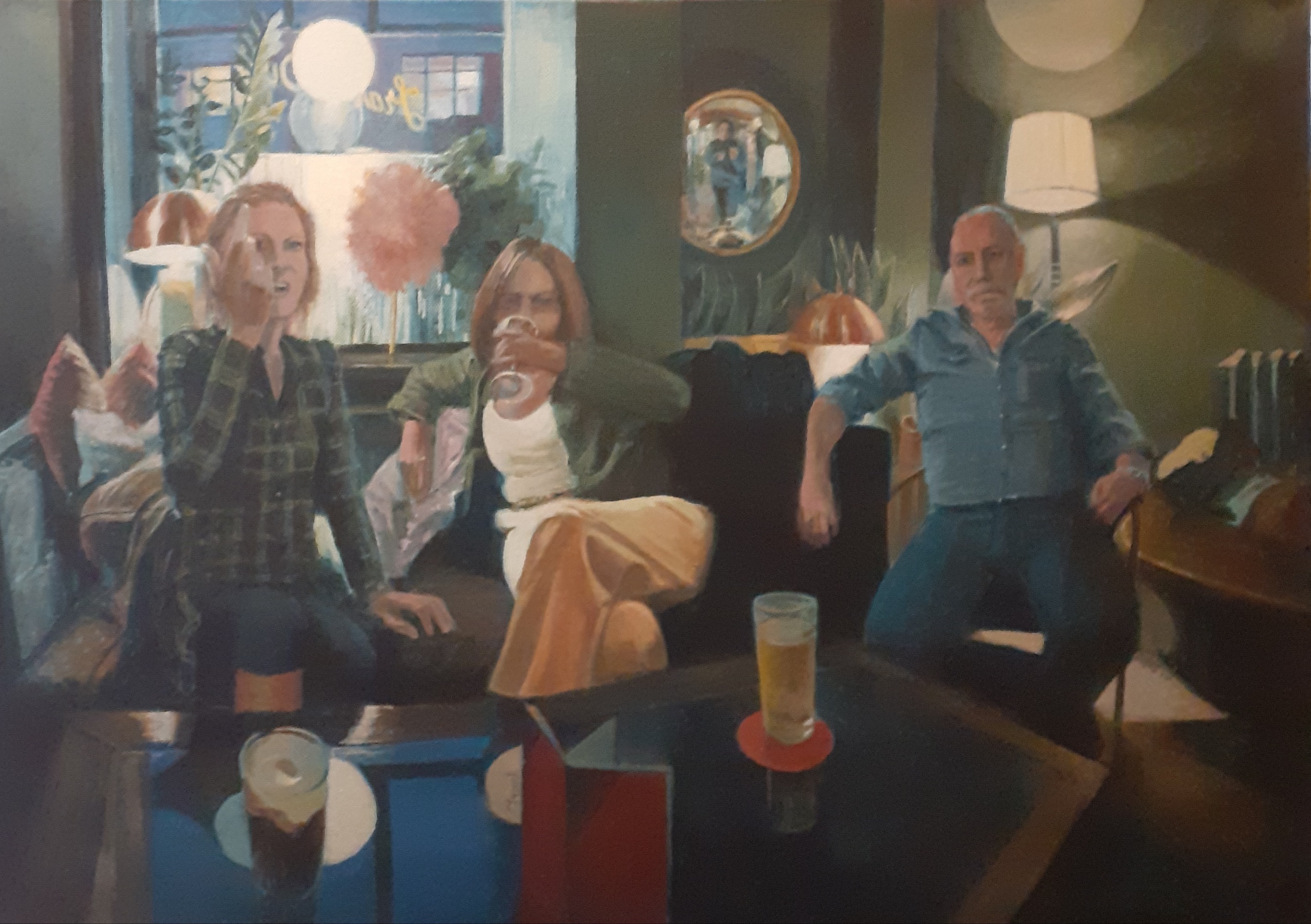
I have been slowing down of late on the art front. The pain thing. Slowing down on all fronts, truth be told. Still, I did squeeze out this spark, in the realm of friends and family. The best place to be. As before, the location is Frank Duff’s pub at the top end of Main Street, Bray. It’s last orders at the end of a great night out; drink and conversation flowing. You’ll catch me standing in the mirror. I suppose I could be singing The Parting Glass, although that’s a tad melancholy in the contecxt.
Songs of love and friendship have tumbled down to us since the time of Thomas Moore. And ever on into the future; here’s hoping. This night in Duff’s was recent, but takes me back to the days o the foreign telegram. So, I tunnel back to the early seventies and Mellow Candle’s only album Swaddling Songs. While the focal, and vocal, point of the group was the sparkling duo of Alison O’Donnell and Clodagh Simonds, this song was written by guitarist Dave Williams. The lyrics are cut from the same cloth though, and sung with gusto by the female leads. There’s a hint of winter and its globe of interior warmth in this verse, evoking that familiarity amongst friends and lovers caught in the moment.
Sell me heat-haze sell me rain sell me wet and dry
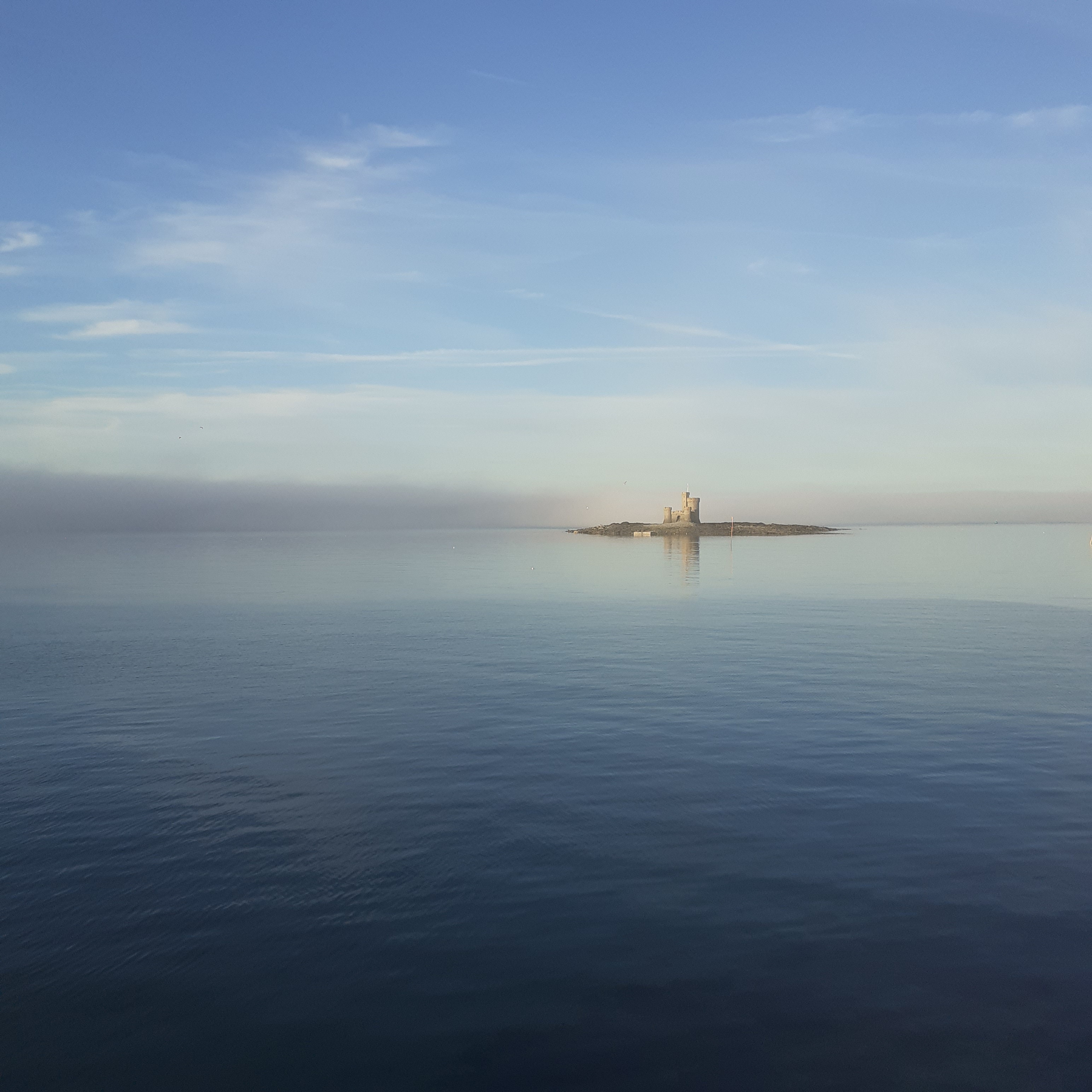
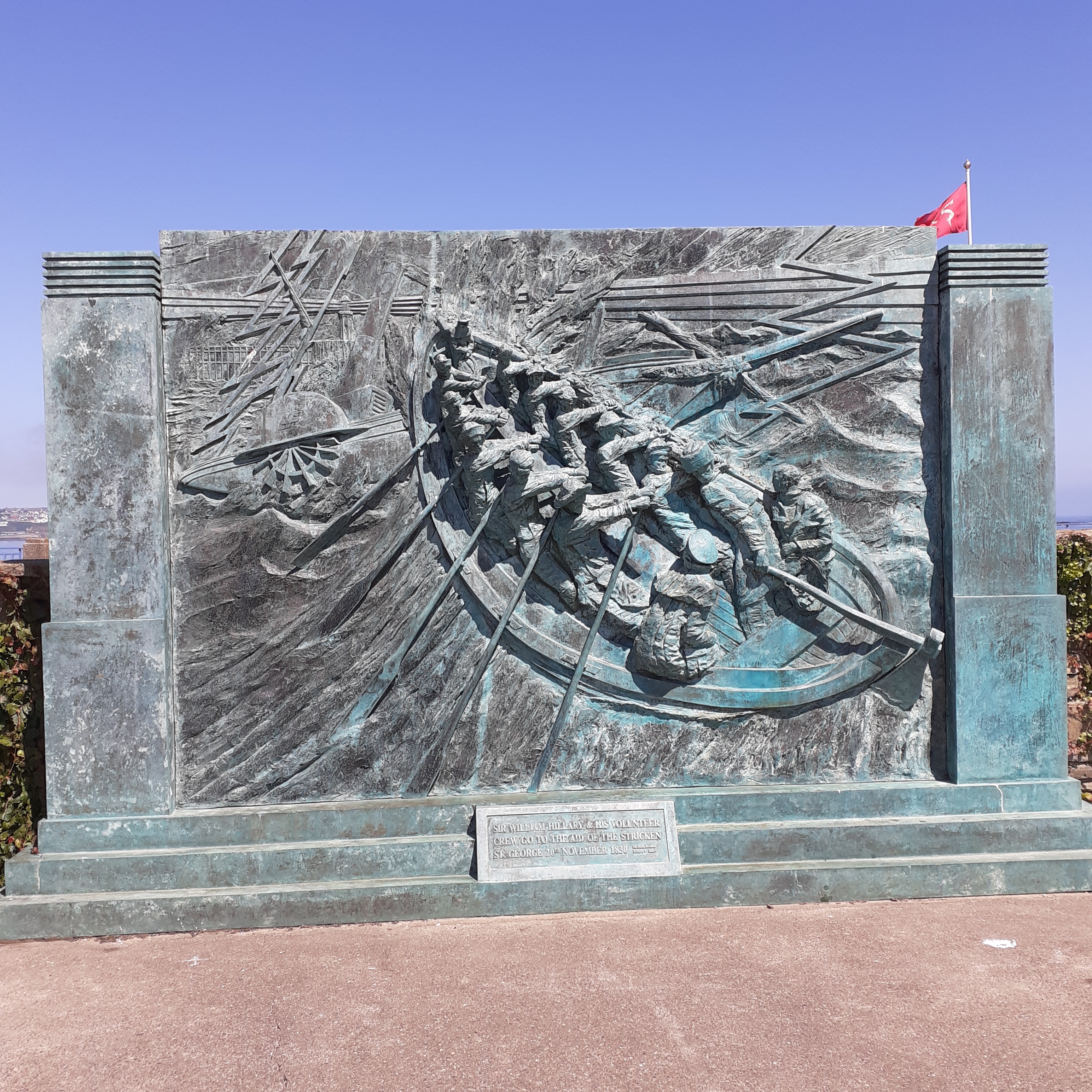
The morning is warm and hazy, sea, sky and promenade merge in the glaring whiteness. Out in the bay, the Tower of Refuge makes a magical sandcastle apparition; at once real, but not real. The Tower occupies the small St Mary’s Island just offshore. It was built as a refuge, and guide, for sailors suffering shipwreck on the notorious reef. Sir William Hillary, founder of the Royal National Lifeboat Institution initiated the project in 1830, following the sinking of the St George. The ship of the St George Steam Packet Company was landing its cargo from Liverpool when it ran aground on a stormy November night. Hillary himself commanded the rescue and was injured when swept overboard. There is a memorial to the rescue on the Loch Promenade. A bronze relief vividly depicts the danger and daring of this heroic episode. The Tower was completed in 1832, William Wordsworth wrote a poem in its honour during a visit the next year. A statue was erected to Hillary on the headland beyond the port and he is buried here in Douglas at St George’s Churchyard
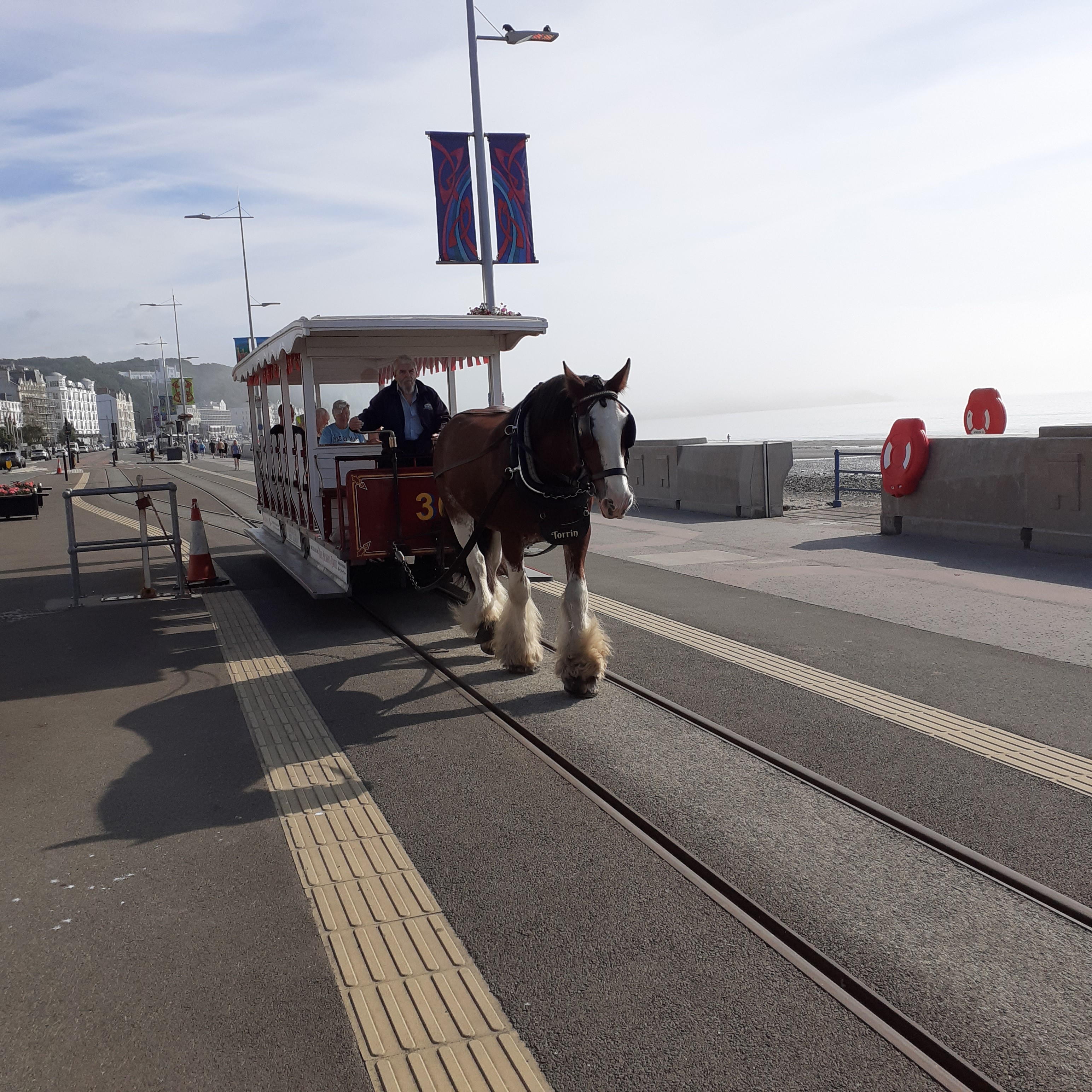
The perfect way to see the beautiful island of Mannin is to use its excellent public trasport system. £21 will get you an all day ticket usable on all trains, trams and busses. We got full value from it on a hectic day whizzing about the island’s sights. From Villa Marina, towards the southern end of the Douglas Promenade, we took a horse drawn tram to the Electric Railway terminal at the far end of the seafront. The service was built and run by Thomas Lightfoot from 1876, who sold it on in 1882. It operates during the summer months.
The Electric Railway was established in 1893. The terminus is called Derby Castle which was also the name of the large amusement park that once stood nearby until the end of the 1960s. The original tiny picturesque rustic ticket office survives while the Terminus Tavern adjacent also dates back to the 1890s.
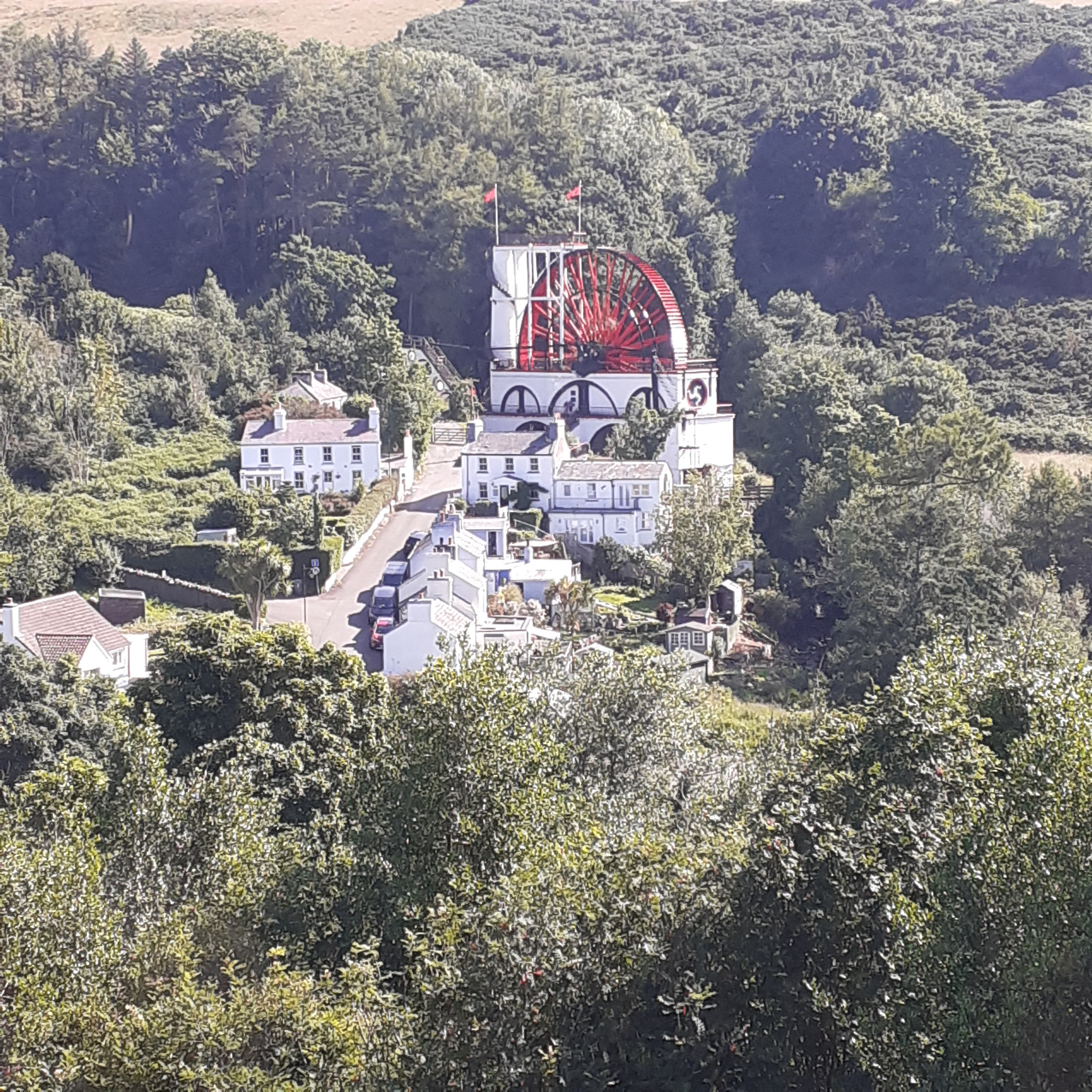
The Electric Railway travels north to Ramsay. It makes its discreet way through the suburbs of north Douglas into open green countryside and woodland. At Laxey there’s a connection with the line leading to the top of Snaefell, the island’s highest point. Laxey itself is a pleasant winding village tumbling down a valley from the highlands to the sea. Its fame rests on the Laxey Wheel, a short uphill stroll from the tramstop. The Laxey wheel is the largest working waterwheel in the world with a diameter of over 72 feet. It was built in the 1850s for the local lead and zinc mines.
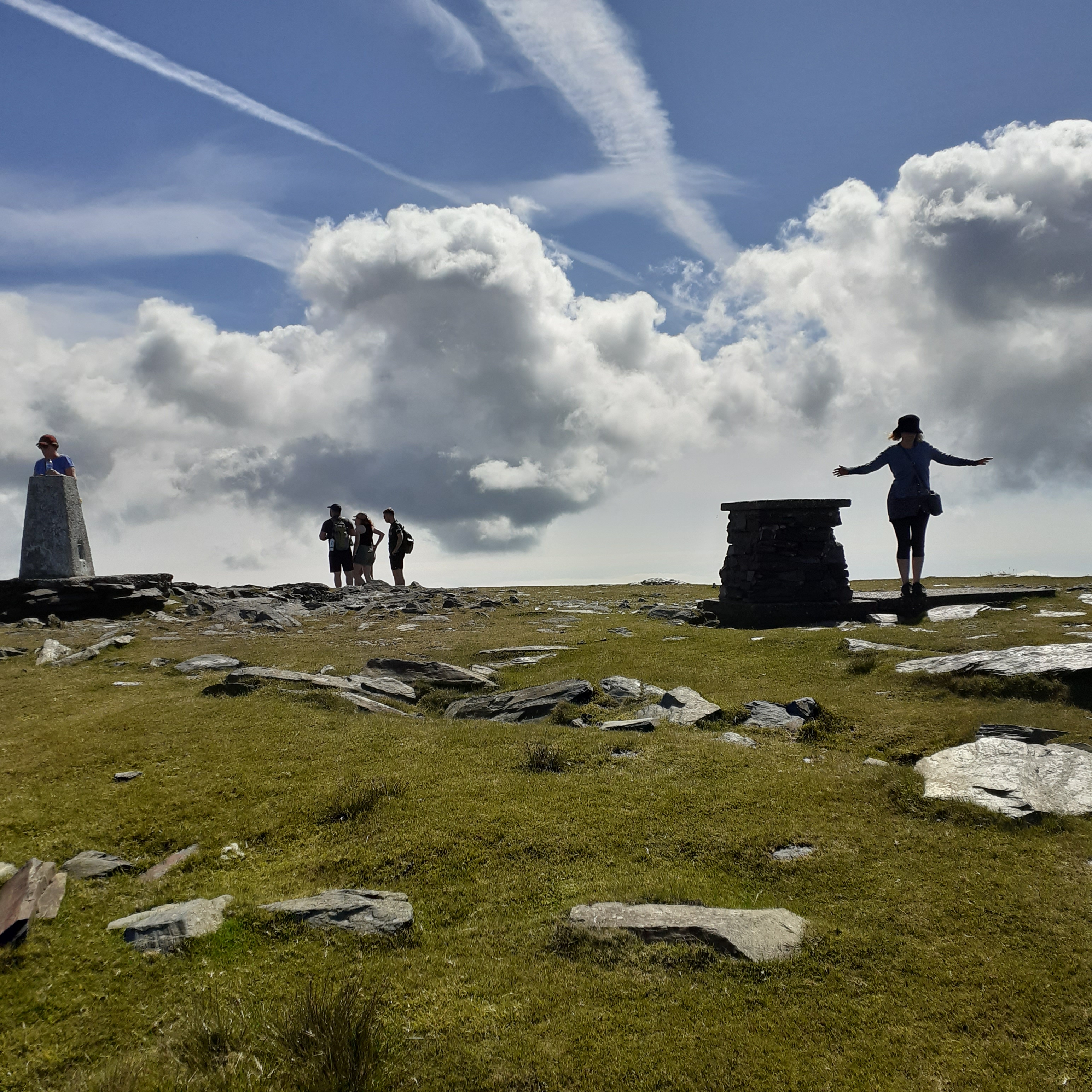
Snaefell Mountain railway climbs to the top of Snaefell, near enough, at just over two thousand feet. The five mile journey takes about half an hour. There’s a pelasant cafe for refreshments and snacks with seating outside to take advantage of the spectacular panorama. The view boasts that it takes in seven kingdoms: the Isle of Man, England, Ireland, Scotland and Wales. The other two kingdoms being the Kingdoms of Heaven and of the sea. This last being ruled by Mannanin Mac Lir, so closely associated with the island. We summit in complete calm under hot sunshine, even at this altitude.
Back at Laxey we have coffee at the tramstop and explore downstream towards the sea. We catch a bus from Laxey back to Douglas. The main bus station in Douglas is at the southern end of town and it is only a short walk from here to the Railway Station for steam trains. The Steam Railway goes south to Castletown and Port Erin. Also passing near the airport at Ronaldsway.
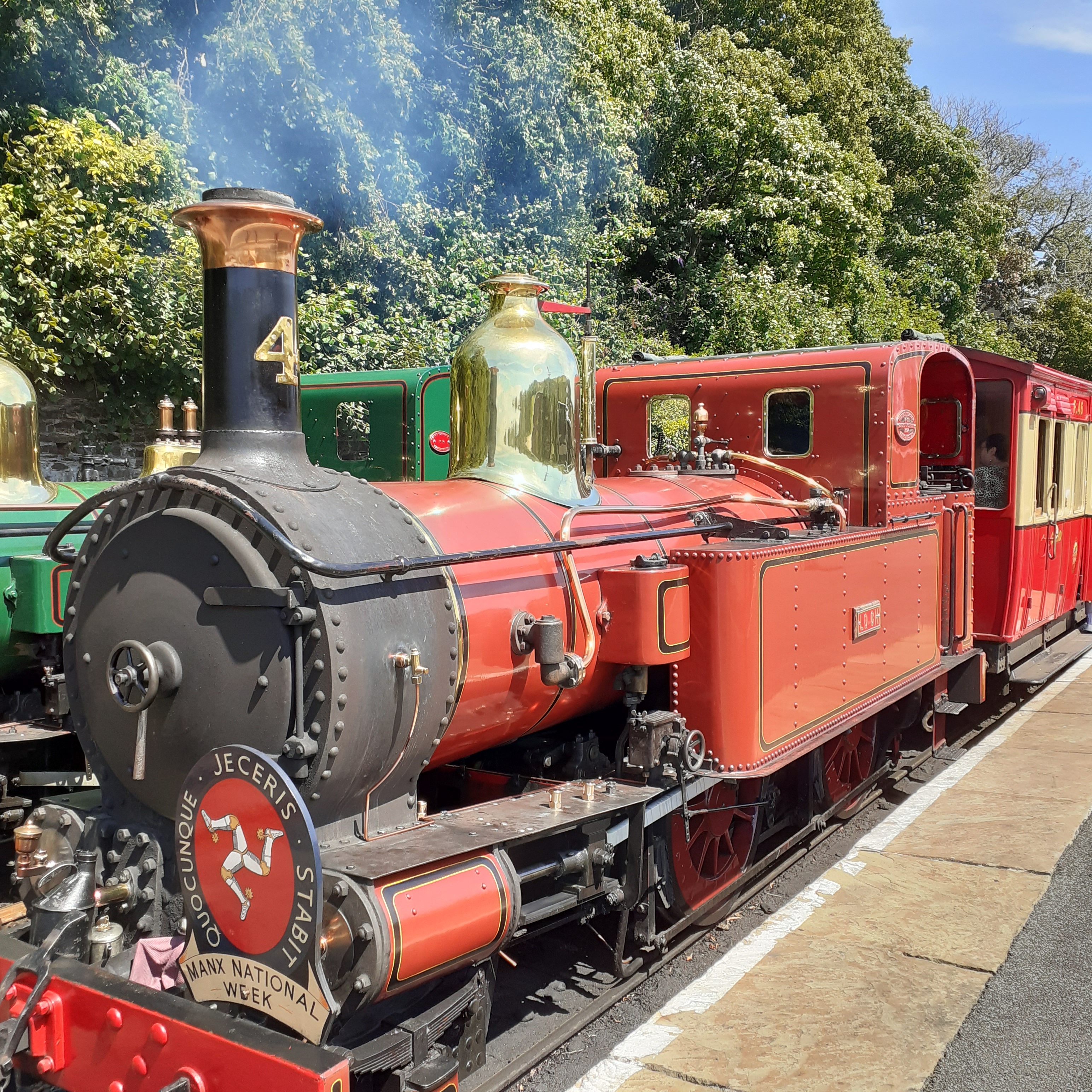
The Steam Railway is a most colourful way to see the island. It was set up in 1873. The traditional rolling stock is quaint and dinky, the timber clad compartments with facing banquettes seating six people. It’s about an hour to the terminus at Port Erin, with Castletown a little over halway along.
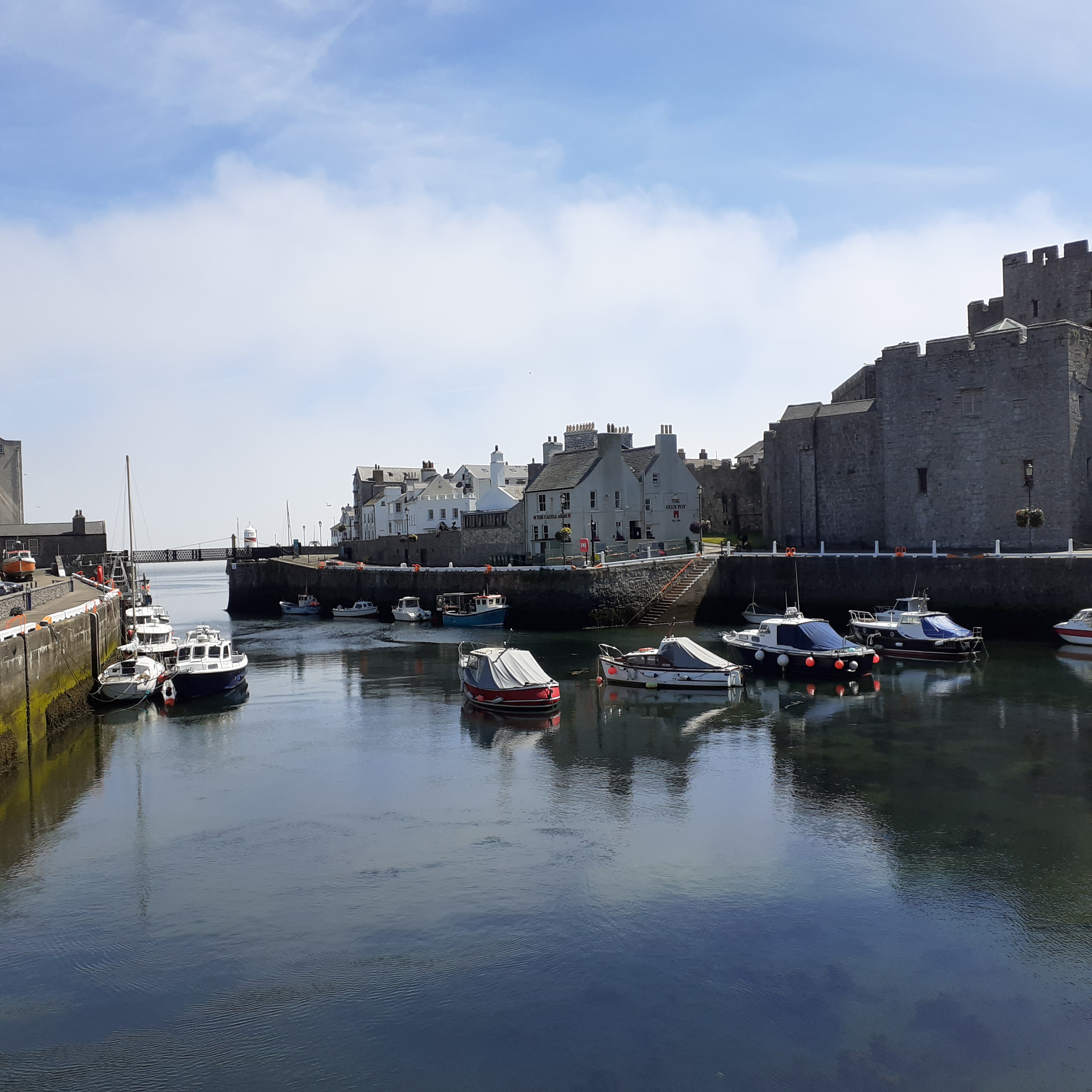
Castletown was the island’s original capital until 1869, the Tynwald meeting here until moving up the road to Douglas. It lies on the river estuary of the Silver Burn south of a small harbour. A majestic medieval castle rises in the town centre. Castle Rushen is a well preserved fortresss dating from the thirteenth century when the Kings of Mann and the Isles reigned. It was later the scene of the century long tug of war between the English and Scots for control of Mann. Robert the Bruce capturing the castle three times, though ultimately the English would prevail.
It’s a short walk along the river into town. A giant heron sculpture guards the bridge. Above the quayside is the castle entrance. The Arts and Crafts Police Station blends well with the Gothic feel of the place. The main town square, Market Square, has become an occupied fan zone for bikers, gathered about a giant screen with food and drink from local hostelries and mobile outlets. Our visit is a fortnight after the TT Races, but another major event, The Southern 100 is on nearby, with such biker heroes as Dean Harrison. Five times TT, Dean is English but lives in Laxey. Then there’s local lad Nathan Harrison. You can’t keep up with the Harrisons! Whatever about the Castle, and the hectic world of motorbikes, we’re not rushing (pun intended) and we have plenty of time for a snack and a pint of beer in the glorious sunshine we’ve enjoyed throughout our stay on Mannin.
The steam train service tails off around half four, although busses still go into the night. We return to Castletown station which has a model railway display and the same cheerful traditional ambience as elsewhere on the isle. The train is quite packed and some compartments are fully booked but we get seats and head off in smoke and sunshine.
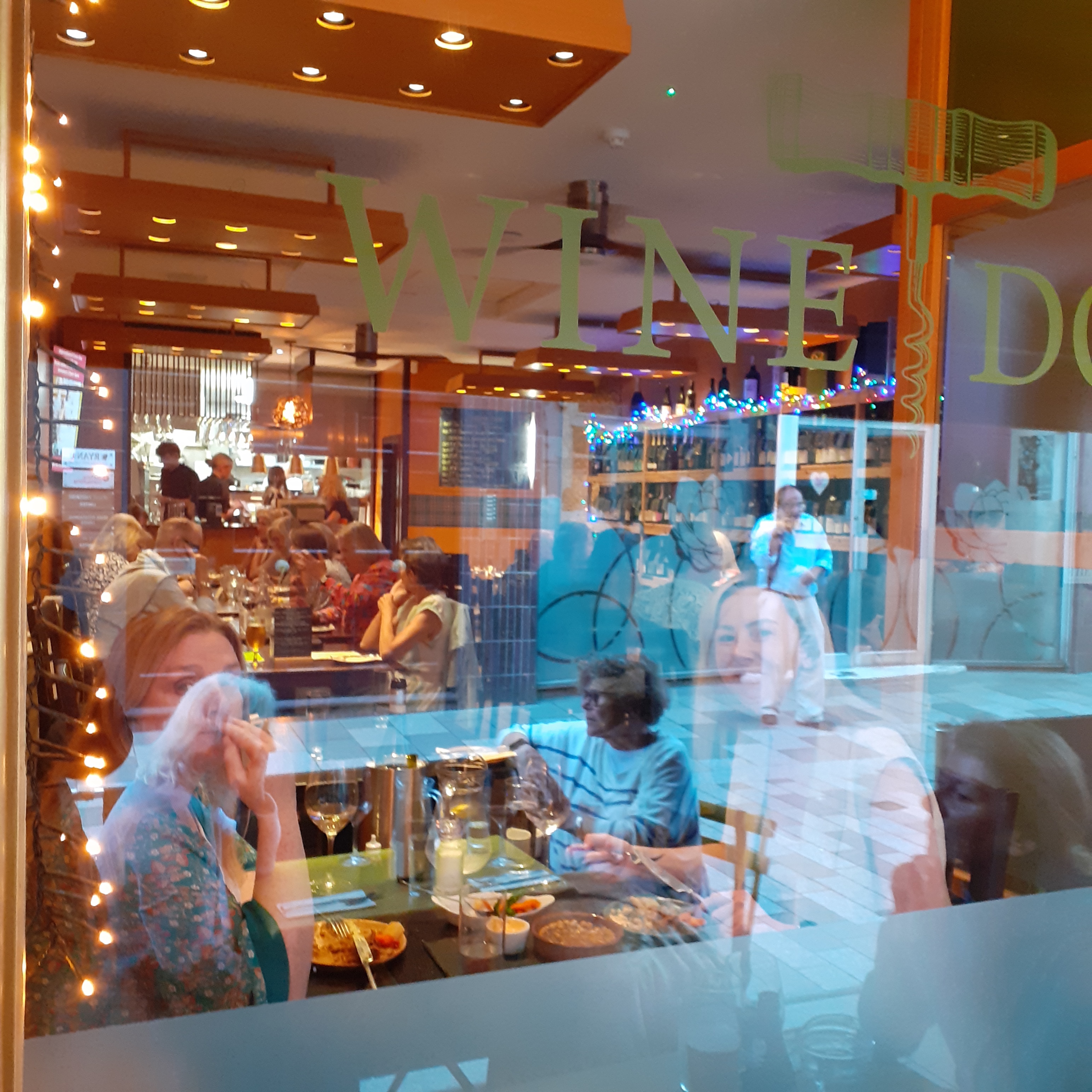
Back in Douglas we enjoy an evening stroll along Loch Promenade shrouded in an eerie and intermittent mist. The Tower of Refuge is a magical mirage in the bay. We dine in Duke Street, on the front outdoor patio of Wine Down. The interior is crowded, perhaps because the restaurant is very good. Heaters on the patio dilute the misty evening chill, and the wine and good food help too.
Tomorrow we’re leaving Man and taking the ferry across to Liverpool. For a farewell song I’ll take one that evokes our stop in Laxey, sort of. Apt too for our ongoing ferry odyssey. Proud Mary was written by John Fogerty for his band Creedence Clearwater Revival. One of my favourites. It was a big hit single and appeared on their second album, Bayou Country in 1969.
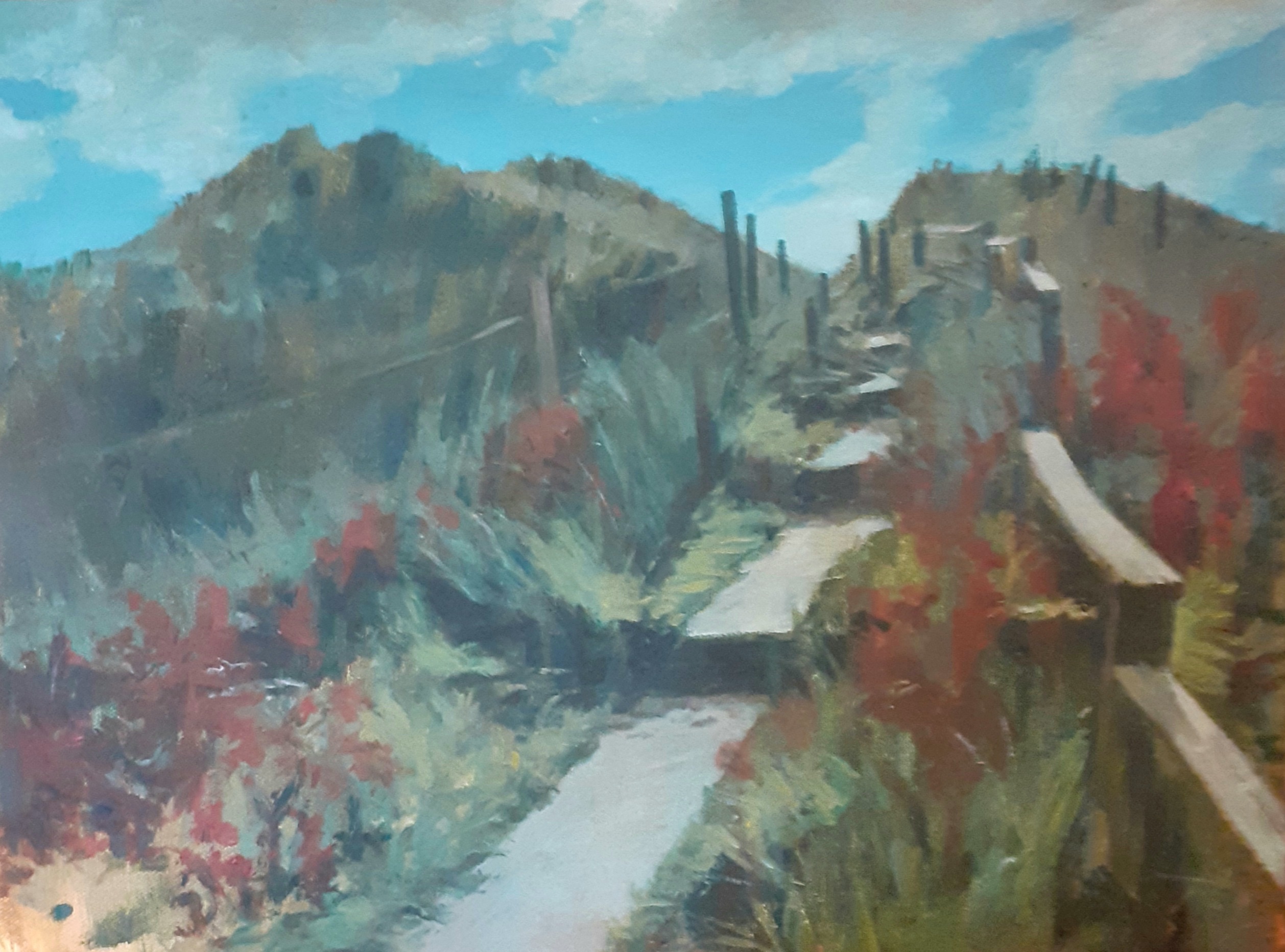
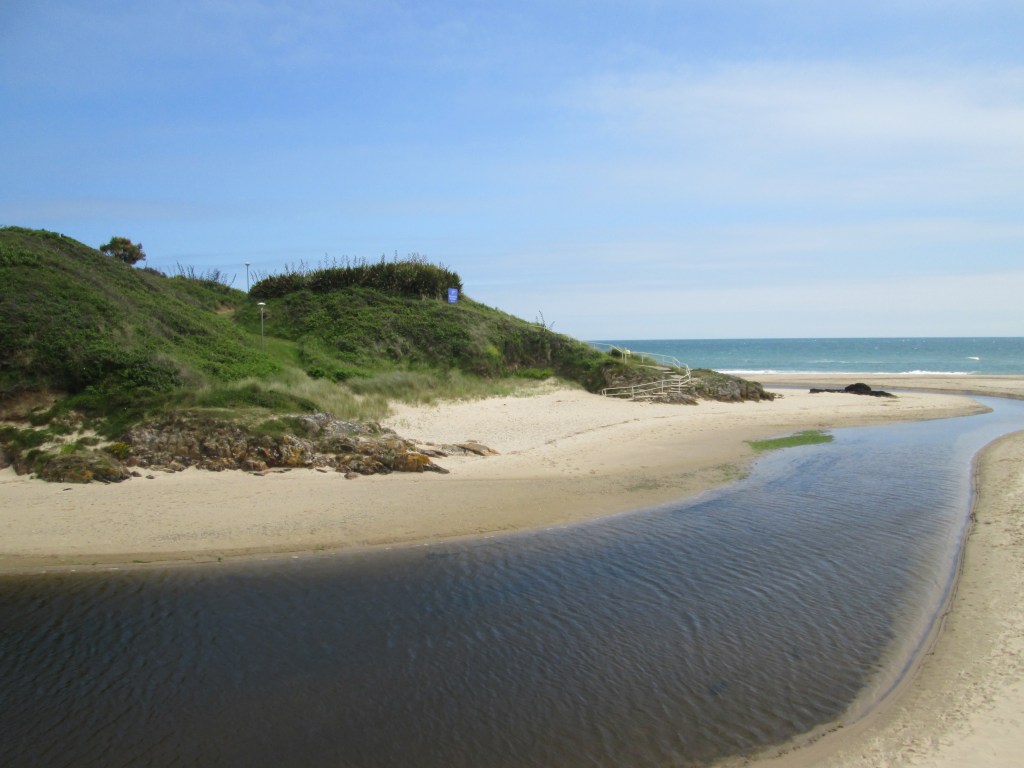
Summer is here, and amongst my favourite activities is doing nothing on a beach. Not exactly an activity so. Brittas Bay is a regular haunt. Thanks to good friends, we can spend a few weeks in a mobile on Wicklow’s wonderful coast. The mobile park is separated from the rising coast by a small river, and from the bay itself by a range of high sand dunes.
In this painting, we are approaching the beach through the dunes along one of several stepped ways. It’s something of an oasis of isolation and quiet, between the domestic suburbia of the mobile park and the windswept leisure activity of the beach.
This time I am using oils, which I have not done in a long long time. Since I went to art college in the summer of 77 I have tended towards faster graphic media such as watercolour, gouache and acrylics. One Dublin cityscape and a mountain landscape is all I can recall. So it was a bit of a struggle to begin with, and I was as much absorbed in the physicality of the whole thing, the texture and smell of the materials as I would normally be in the detail and composition of the finished work. There’s something of the wild and unkempt in this and the process. A sensual saturation that takes its own form.
And so the song that suggests itself is rough and ready too. It’s from the summer of 77 which I remember for sandy days with M in Llandudno, Wales and a holiday hut on the beach in Skerries, North Dublin. It kicks off with a to-die-for bass riff. What follows is a young ruffian gorging himself on the visual pleasures of the beach. It’s called Peaches and was the first hit for the Stranglers from their debut album Rattus Norvegicus. You might also know it from the opening credits of the 2000 geezer flick Sexy Beast, where reformed lout, Ray Winstone, soaks up the sun in a villa in Spain. Oh, I can relate to it in all sorts of ways.
Well there goes another one just lying down on the sand dunes
I’d better go take a swim and see if I can cool down a little bit
Coz you and me woman, we got a lotta things on our minds
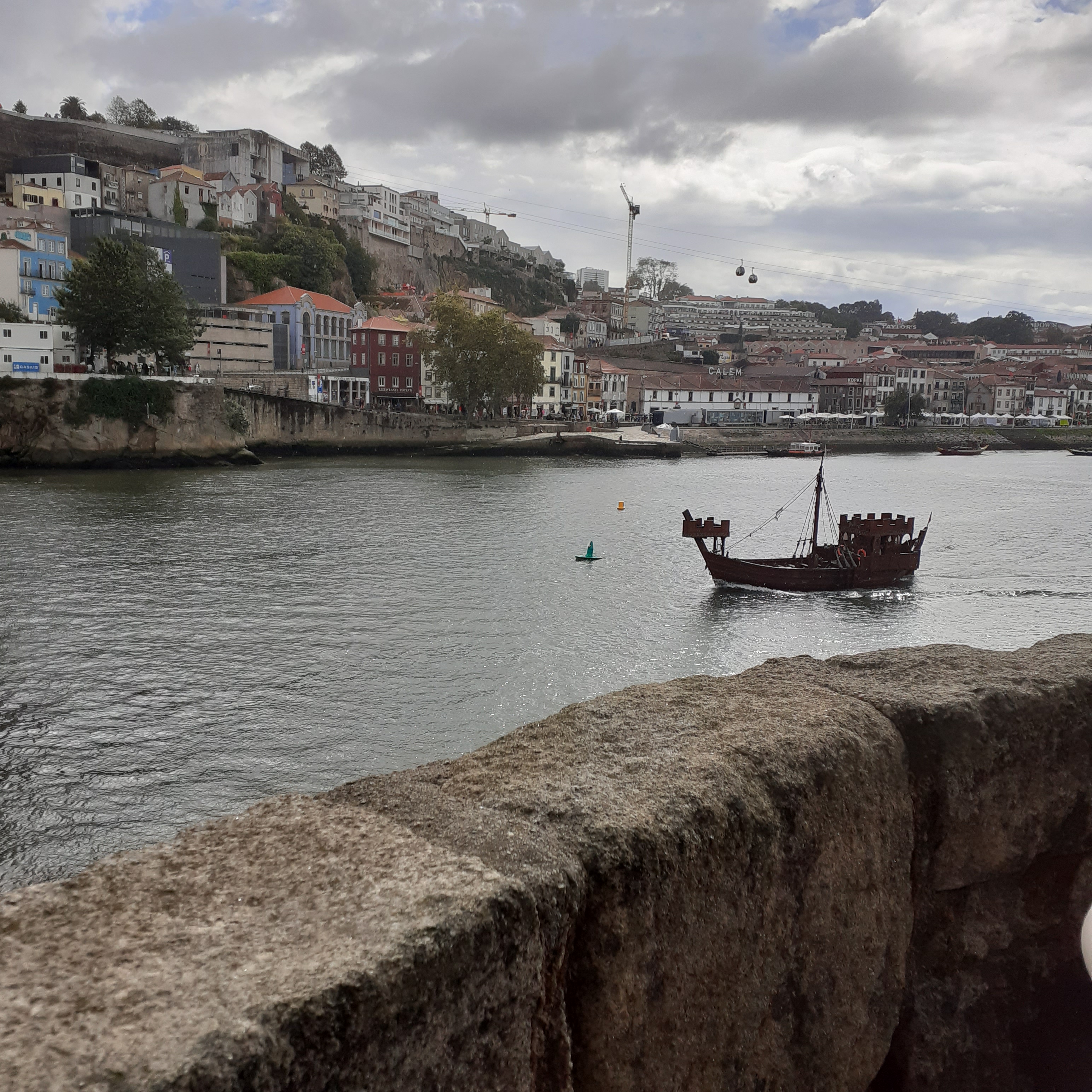
A major attraction in Porto is a visit to Vila Nova de Gaia, home of the Port Wine trade, established in the late 17th century. The wine was named, of course, for the city. Designated a wine region in 1756, it is the second oldest in the world, after Chianti. It’s a fortified wine, usually sweet and viscous, stronger than regular wine, being up to 20% alcohol. The most common Port is Ruby.
In 1678 Liverpool merchants first visited. War with France meant French wine was in short supply and Port filled the gap. British brand names such as Cockburns, Croft, Osborne and Sandeman proliferated. Brothers George and David Sandeman from Perth, in Scotland, founded their company in 1790. The distinctive logo features the Don, a somewhat sinister figure draped in a cape with a wide brimmed Iberian hat.
At Sandeman, where tours and a free exhibition hall are promised, the door is blocked by a liveried man, who, upon enquiry had two words: No Inglesi. Enquiring about the exhibition I get the same two words. No Inglesi! No Irish neither, and I didn’t stick around to ask about the dogs. Much as I love the personal touch, it might have been better to put up a sign. I took a stroll around the neighbourhood and came upon a nearby restaurant offering sampling trays. I thought I’d try this in the pleasant noon sunshine. Unfortunately, after a long rest on the terrace, service was not coming my way, and only the odd glimpse of waiters at a distant table hinted that it was there at all. Perhaps the life of the Port connoisseur is not for me.
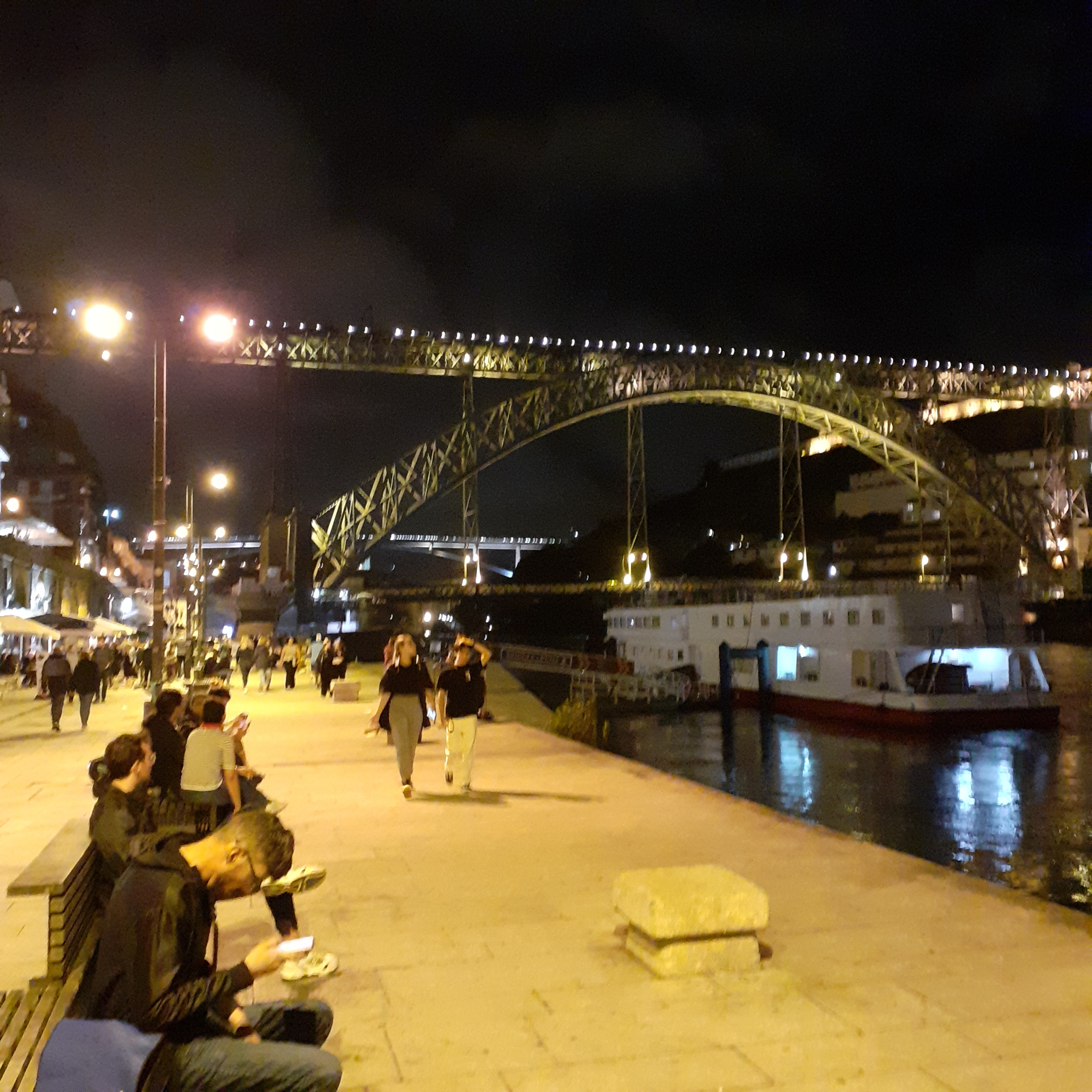
The Gaia quayside leads me back beneath the Ponte Dom Luis I, and I take the bridge’s lower deck back to Ribiera. The Gaia side resounds to the all too frequent music of heavy construction and maintenance, the noise not much contained by plastic drapes. On the Porto side there is some lessening of the torture.
Immediately beside are the remains of Ponte Pensil, a suspension bridge built in 1843 but dismantled for the construction of the Dom Luis I. The supporting posts remain and the riverside plinth now functions as a bar. As clouds rolled in and the din softened with distance, I decided to try it out. The terrace is the perfect place to watch the constant river traffic, and well sheltered from the spectacular cloudburst that follows, thunder forming a neat counterpart to the screaming metal on the far bank. A funicular runs up to the high city. It’s rather a long wait as one of the two cars is damaged and we can only board every second trip. The journey takes us past ancient city walls ending not far from Se Cathedral to complete a conveniently circular trip.
On my last morning in Porto, It’s bucketing down outside, but the vertical rain leaves my balcony dry and I breakfast there with a Nespresso and wait for the deluge to pass. I take a walk to Boavista when the rain clears. The street is straight but more narrow and dingy than I had reckoned. About a kilometre later, it widens at a huge circular plaza. Bovista plaza is nailed to the map with a mighty palm tree. The central sculpture is the Monument to the Heroes of the Peninsular War where Portugese and British defeated Naploleon from 1808 to 1814.
The Casa da Musica is a polished asteroid of hard angles and soaring slants. It was designed by Dutch architect Rem Koolhaas and opened in 2005. Entering it via a sleek flight of steps has been compared to boarding an alien spacecraft. The feeling doesn’t evaporate on steeping inside. It is polished and sparse. I make my way up several flights of stairs, curving from view but with the promise of the roof garden and cafe which is said to have great views over the city. Unfortunately the steps lead eventually to a closed door. Oh well, it’s raining again so a rooftop garden might not have been the best idea.
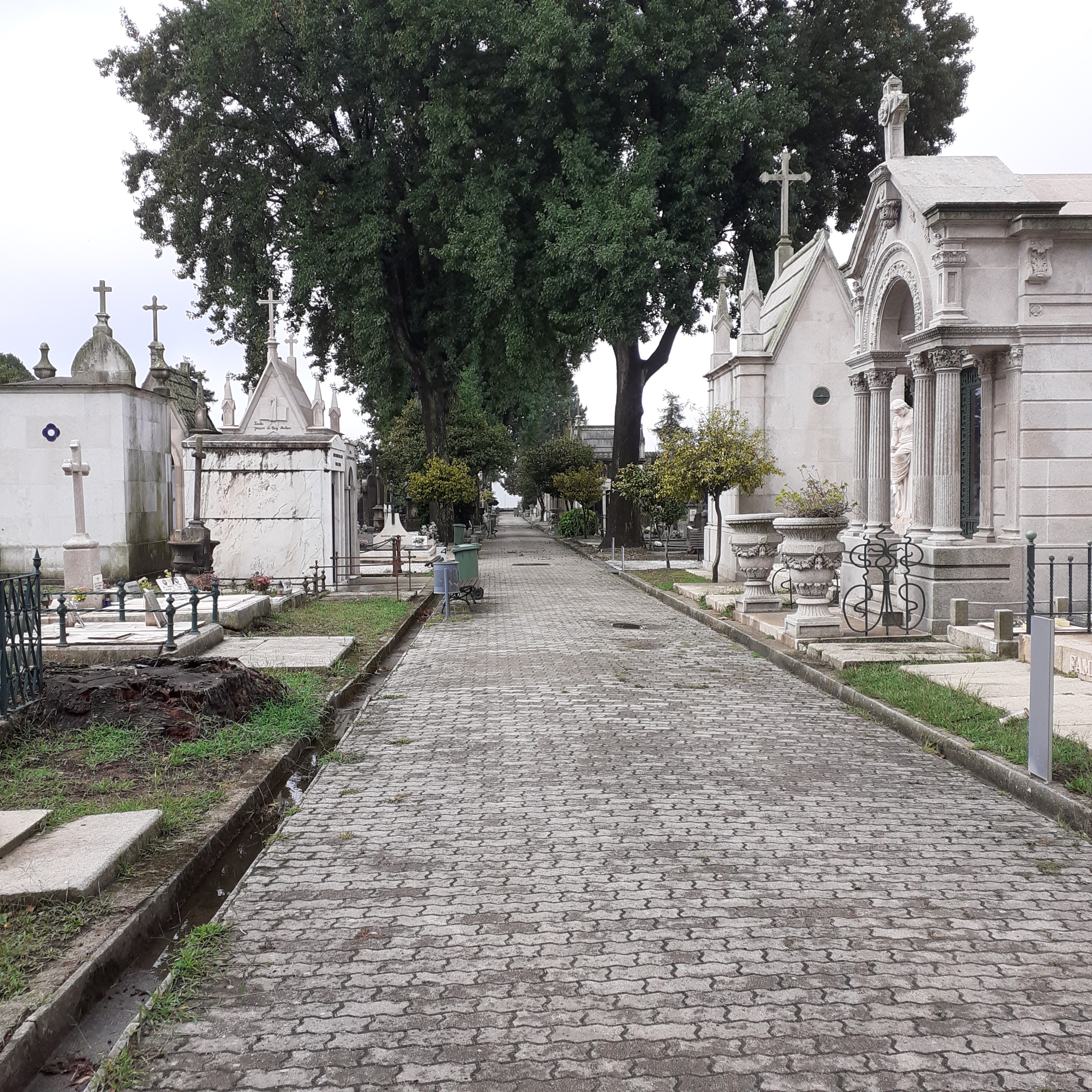
Boavista is busy but lacking in oases. South of the Avenue is the Agramonte Cemetary. This dates to 1855 and is the last home of the city’s wealthy residents. Mausoleums line the avenues of this city of the dead, decorated with sculptures by Soares Dos Rios amongst others. The sun is out and some refreshment on an outdoor terrace is called for. I find a pokey bar and order from the waitress. Ten minutes later there’s no sign, so I have to go in. The waitress breaks off from her phone call to point to an elderly gentleman behind the bar. I explain to the ancient how to pull which drink for me and carry it out myself, wondering if I’ll get to finish it before the barman is himself carried off to nearby Agromonte.
The Rua de Julio Denis travels due south and leads to the Crystal Palace Gardens, a landscaped park with fine views over the city. The orginal Crysal Palace was built in 1865 for the International Exhibition. The oriinal iron and glass structure was replaced in 1950 by the modernist dome of the Rosa Mota Pavillion. This is named for Olympic marathon runner, and hosts concerts and sporting events.
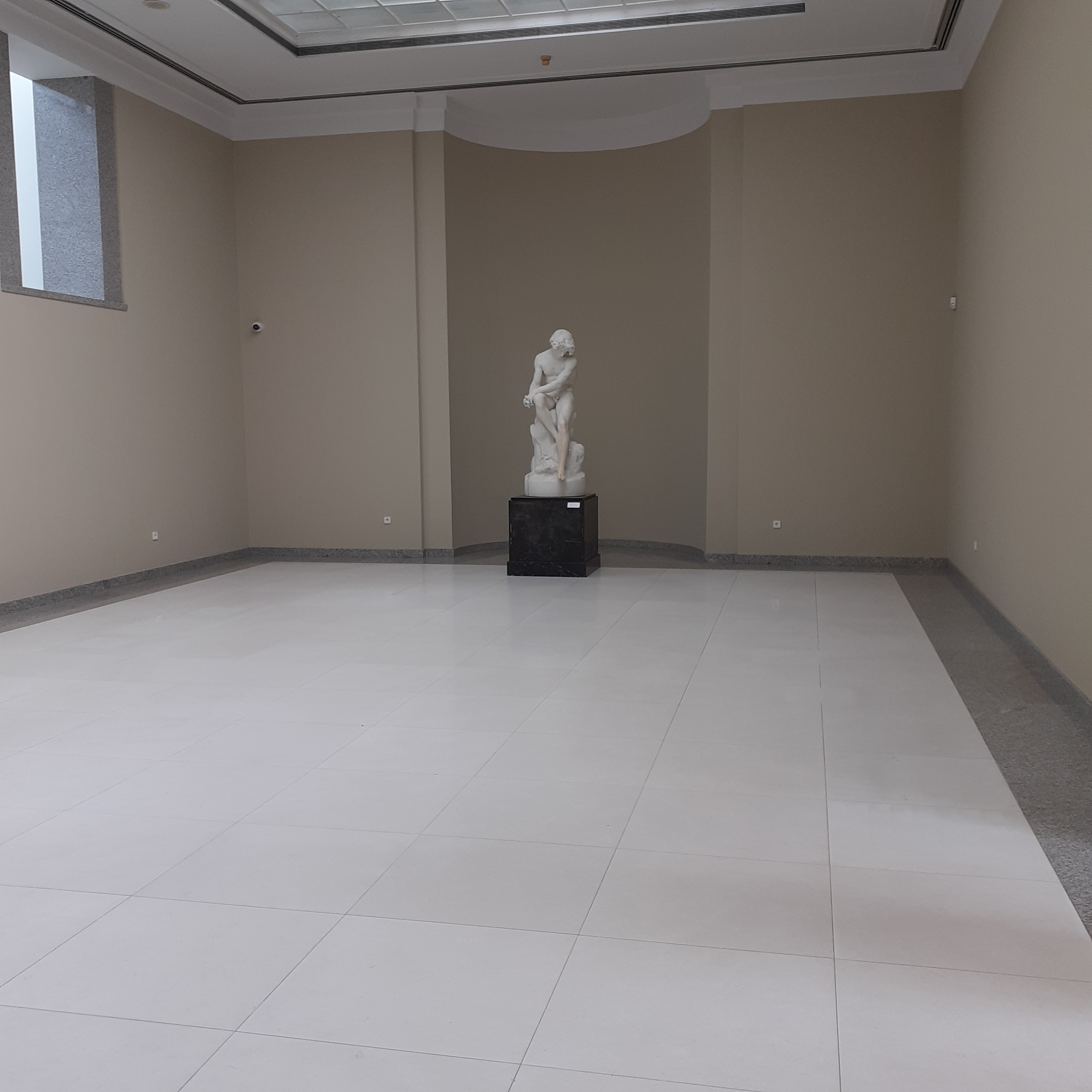
Towards the city centre is the National Museum of Soares dos Rios. The neo-classical facade is distinguished by its red stucco upper storey. Formerly the Palace of the Carancas, the frowners, noting the disapproving atitude of the resident family Moraes e Castro. Soares dos Rios, the sculptor, was born in Gaia in 1847. He studied in Paris and Rome and returned to Porto to become the Professor of the Academy of Fine Arts, and committed suicide aged just 42. His most famous sculpture is The Outcast, which might be a window to his soul.
Having paid, I found that much of the exhibiton rooms were closed for renovation. The remainder was eerily vacant of artworks. Perhaps it’s meant to be an installation, signifying absence. There was an exhibition of Magellan’s explorations, featuring charts and maps that looked interesting but the text was only in Portugese.
The eerily vacant gardens to the rear allow me time as an outcast. Although shadowed by a security guard, he’s drawn away by two tourists trying to escape over the back wall. There is something of a cycling heritage, with an early velodrome cited here. Of all the galleries I’ve ever visited, this was the one with least art in it. Climate activists would be forced to eat their own soup. Perhaps it would have been better to close altogether, as this was a waste of time.
The Lello Bookshop on Rua das Carmelitas is famed amongst fans of Harry Potter, it’s magical interior. filtered through the imagination of JK Rowling. Lengthy queues had formed as fans paid homage to the Scottish author. Nearby, two churches, Igreja do Carmo, and the Carmelites church stand, almost, side by side. The Carmelites Church dates to the 17th century, and was originally a convent. Next door is the more exuberant Baroque facade of the Igreja do Carmo. Between them, Porto’s narrowest house forms a wedge a metre wide. The narrow building was to keep the convent nuns separate from the monks. As the clergy would caution us at the school dance on a saturday night, during the slow set: leave enough room for the Holy Ghost.
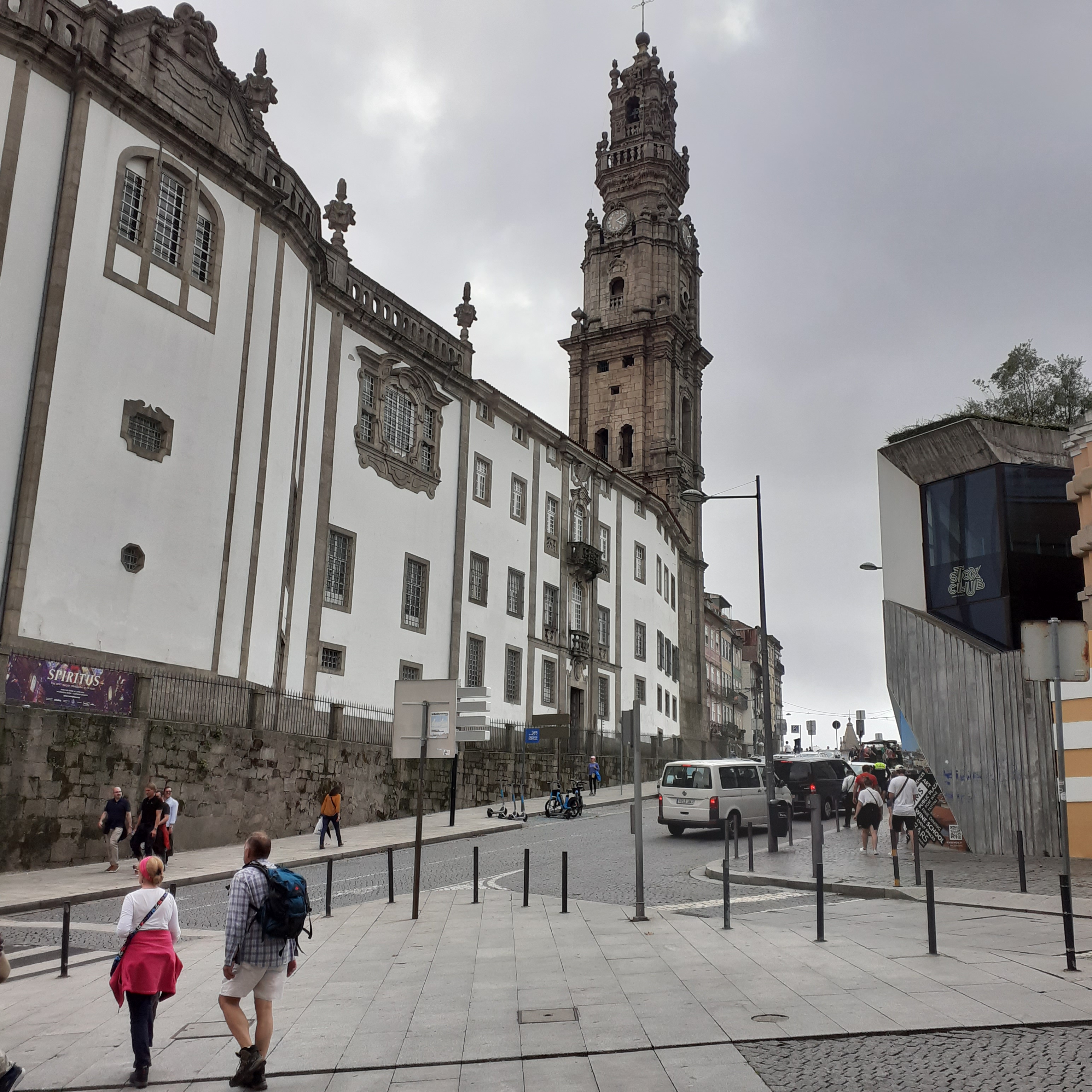
Clerigos church and tower, rising to 250 feet, is a major landmark of the city. Designed by Italian architect, Nicolau Nasoni, the church was built for the Brotherhood of the Clerics, and occupies a dominant island position where the street drops sharply towards the city centre. The tower can be climbed, if you’ve the breath for it, and the views from the top are said to be breathtaking.
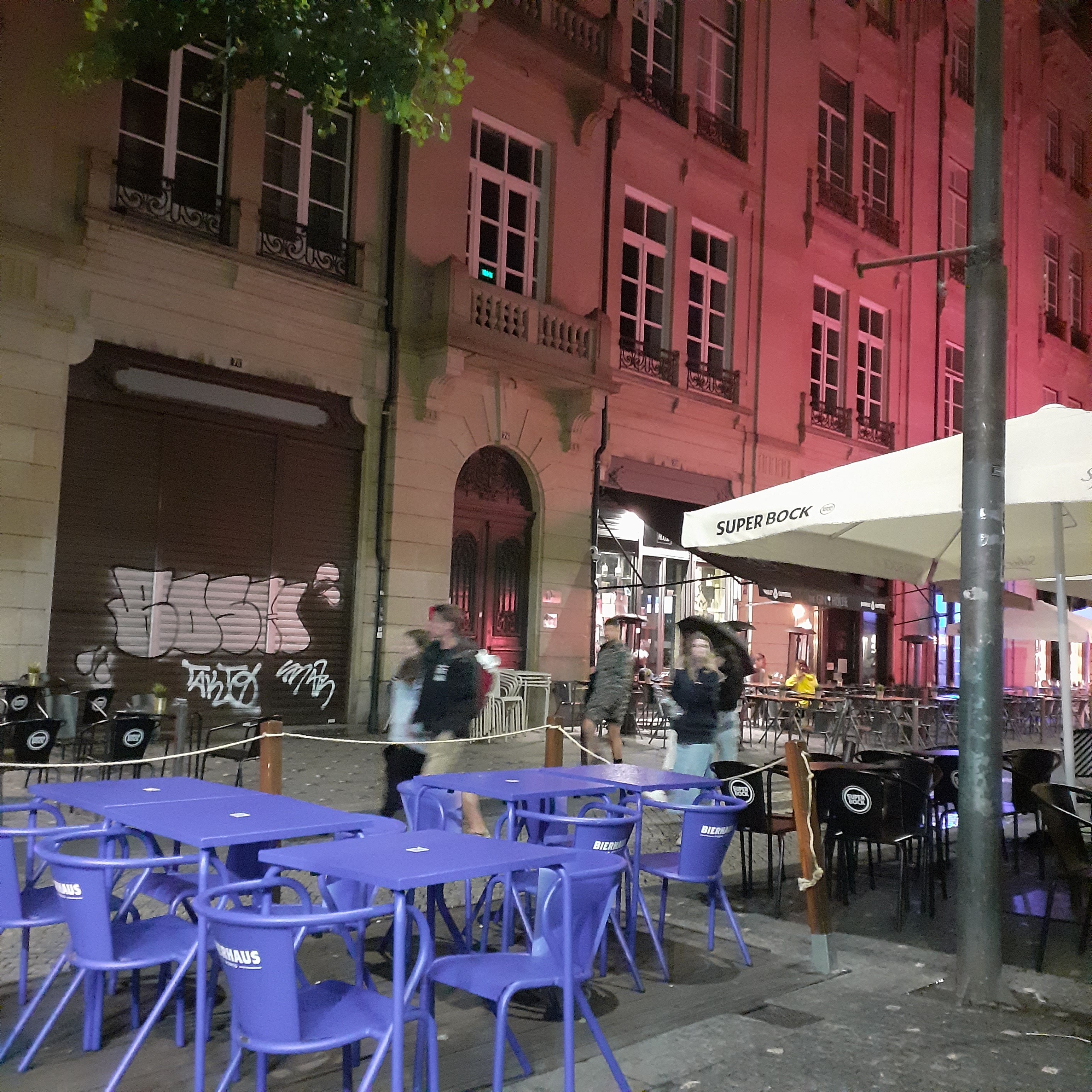
The city centre is, sadly, off limits, and I pick my way back uphill through the labyrinth of alleyways.Somewhere off Rua Almada I find a bar with blue tables, the perfect colour to enjoy the sinking light of evening. The bar is one where you order and carry, which is an improvement on the prevailing level of service. Outside it’s raining so I wait within while the sound system plays Iggy Pop lsinging the Passenger. Ignatius wrote this with Ricky Gardiner for his second solo album Lust for Life in 1977. David Bowie is on piano and backing vocals.
I am the passenger, I stay under glass
I look through my window so bright
I see the stars come out tonight
Over the city’s ripped back sky
And everything looks good tonight
Singin’ la la la la la le lah
La la la la la le lah
La la la la la le la, le la la.
It’s time to say good bye. Any finish to a day in Porto is best with a nighttime wander about the Ribiera. The quayside takes on a magical quality with lights illustrating the dizzy combination of street stacked on street, tumbling down to the river, and above, bridges criss crossing the sky. It’s busy, of course, and there are few vacant seats at the riverside bars, but I find a place and the service, for a change, is swift and friendly. It’s a long uphill home, but on a night like tonight, I could grow wings. I’ll just take my time.
The railway rumbles on beneath our feet. Ghost ships sail into the harbour. The 46a is due. Dun Laoghaire grew out of this nexus of travel and communication. The Harbour was born from a suggestion of William Bligh, who picked Dunleary as the site for a harbour of refuge. Bligh had been brought in to address the problem of silting in Dublin Bay. His year long survey of the bay led to the building of the North Bull Wall, though the eventual project differed from his original suggestions. He recommended the need for a second great wall from the north shore of the bay to complement the South Bull. Work began in 1818 and was completed in 1824 to a length of 3,000 metres, a third longer than originally planned.
Bligh served under Captain James Cook in the Pacific, and saw war service against Dutch and French. He commanded the Bounty on its voyage to Tahiti in 1787. On the return, his crew, led by Bligh’s young friend and protege Fletcher Christian, mutinied. Bligh and some loyal crew were set adrift in the Pacific with a few days supply of food and water. Under Bligh’s astonishing leadership, they survived the 47 day, 3,618 mile journey.
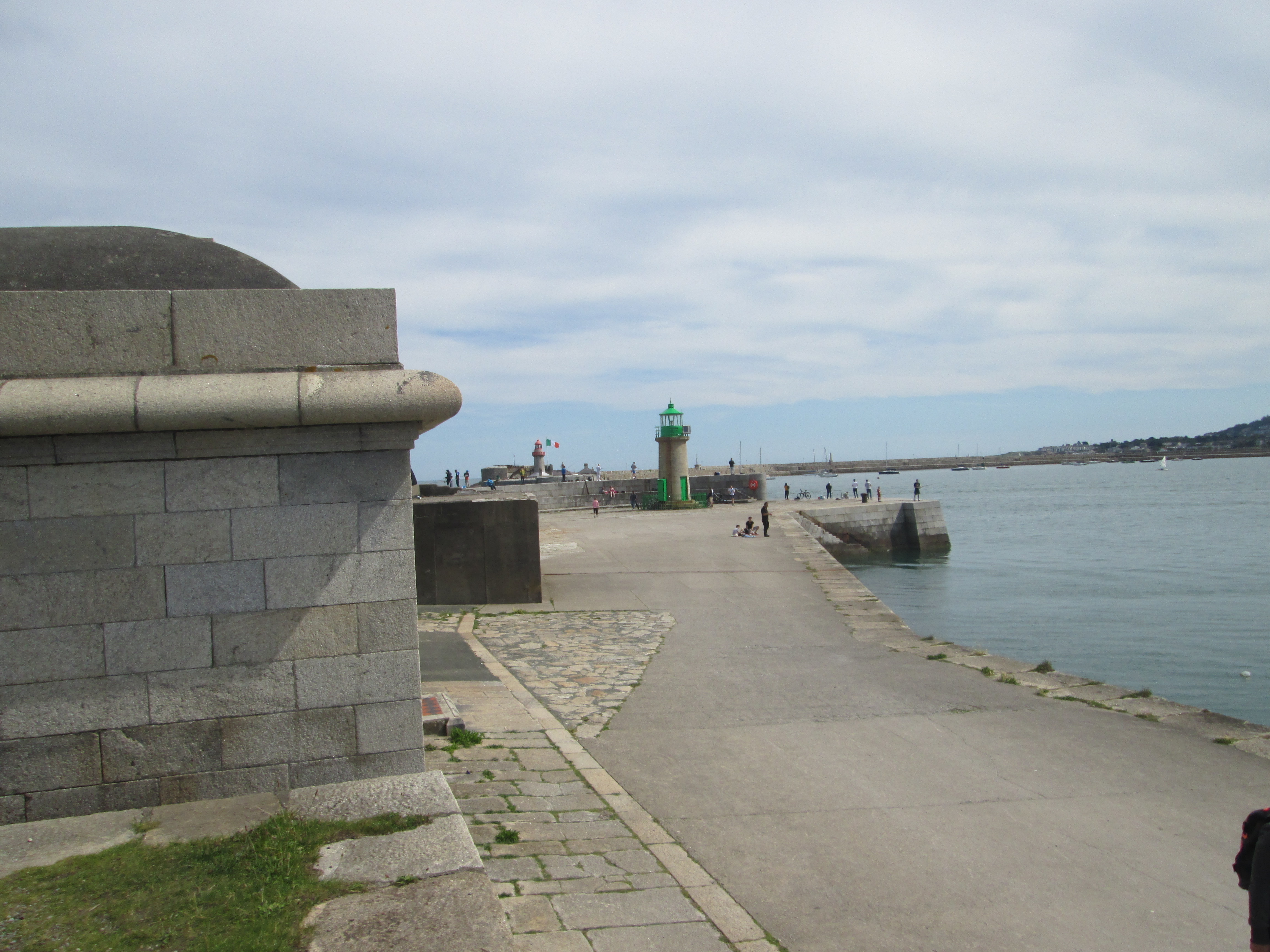
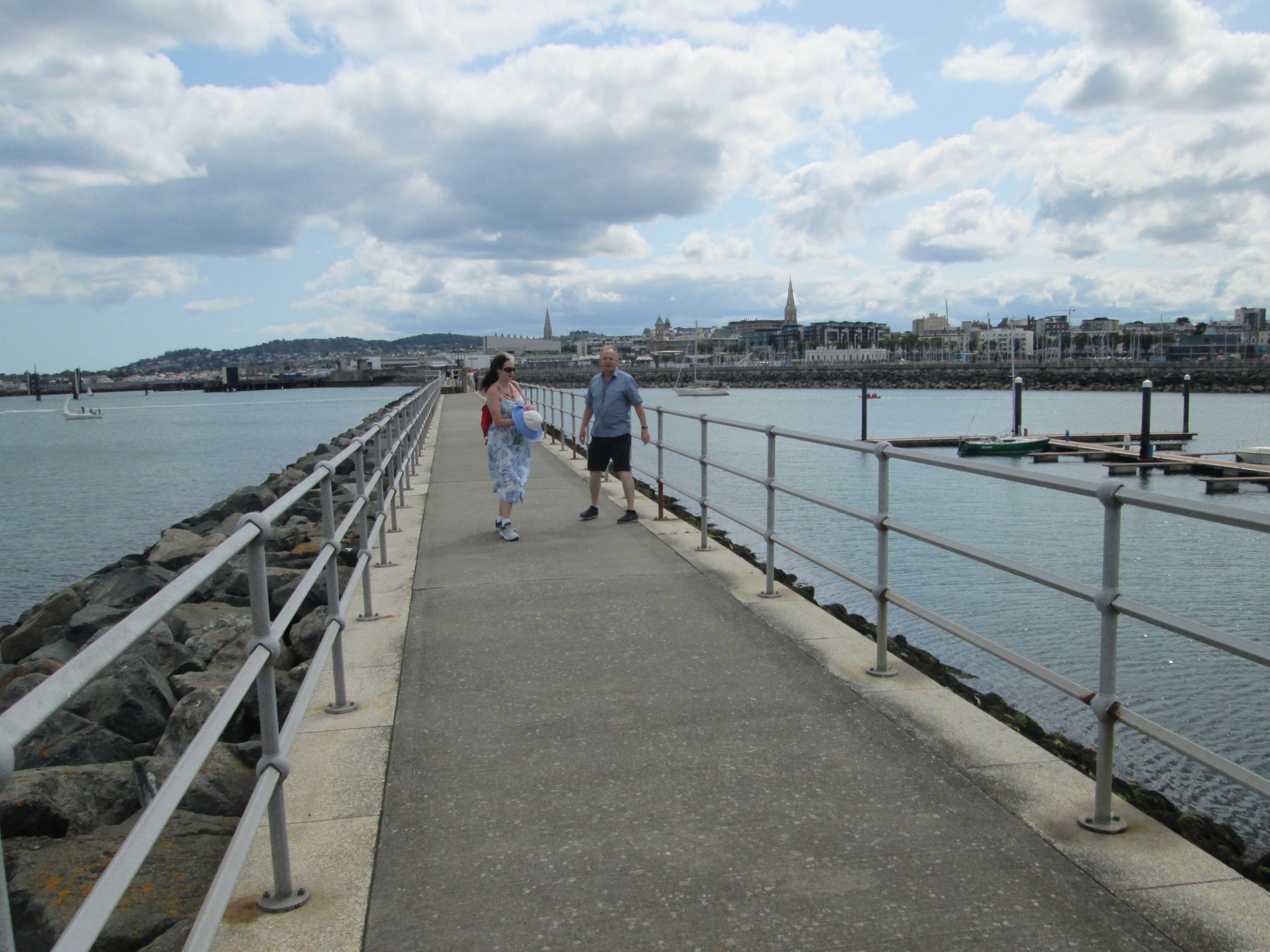
Scottish engineer John Rennie masterminded the building of Dunleary’s huge harbour, the largest constructed harbour in Europe when completed in 1842. Rennie was also responsible for Howth Harbour and the Custom House Docks and Tobacco Store (now the CHQ Building) in Dublin. He insisted on the addition of the West Pier. The two piers embrace two hundred and fifty acres of water. The East Pier, slightly the shorter, is the most popular promenade. Two paved walkways, upper and lower, convey a constant flow of people along its kilometre length. There’s a Victorian bandstand a quarter way along and the pier culminates in an impressive granite lighthouse. The West pier, slightly longer at almost a mile, has a wilder, less urbane air. From this you have a closer vantage point of the Liffey estuary, with ships passing against the backdrop of the city, while, paradoxically, its relative isolation gives more space for reflection.
In recent years, the harbour has fallen on hard times as a passenger port. All major passenger services were gone by 2015. The harbour remains busy with its marina and a plethora of pleasure craft. It also hosts the occasional cruise ship.
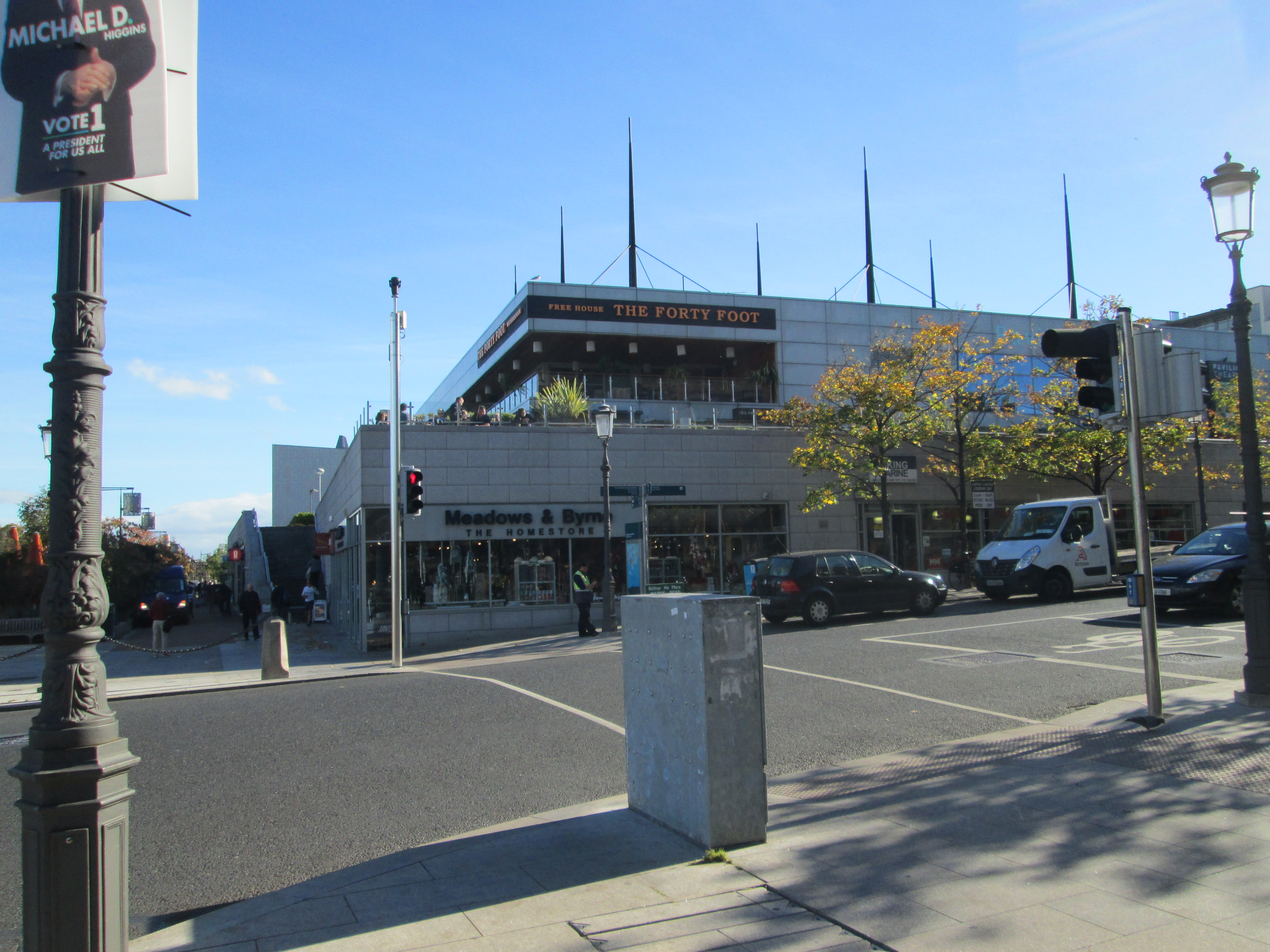
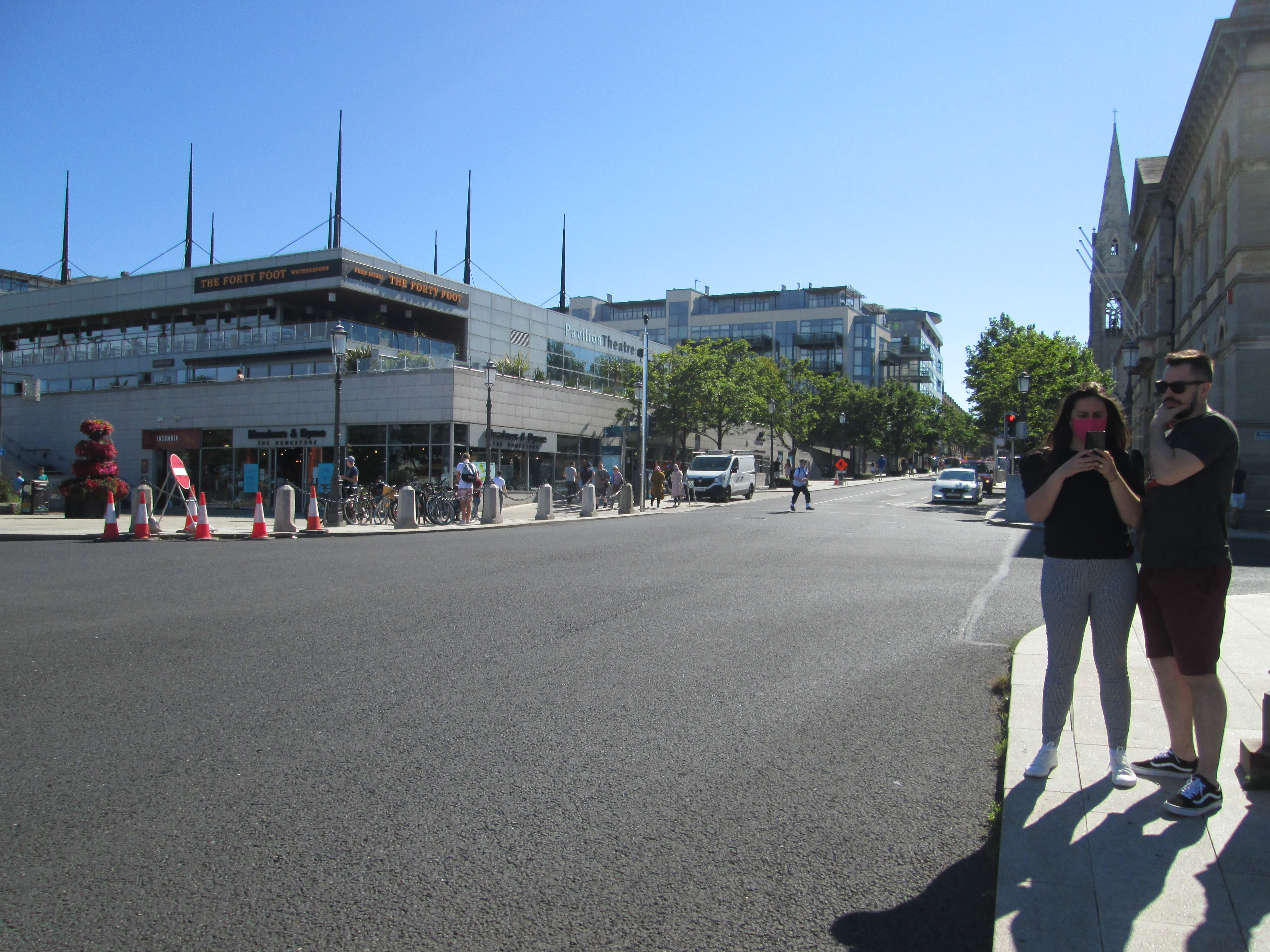
Forty Foot is a name that crops up a lot in these parts. The original bathing spot is just south of here in Sandycove. From this local poet, Anne Fitzgerald, derived the name for the publishing house, Forty Foot Press. If bathing and bardic pursuits should raise a thirst, and what doesn’t, then repair to the Forty Foot, Wetherspoon’s franchise housed atop the Pavilion Centre. I was there for the launch a couple of years back. It was invitation only, but, determined on a pint, I remembered the beanie I was wearing. Given me by Anne Fitzgerald and emblazoned with the publisher’s name, the bouncer could hardly refuse admission. Is there anything more pleasant than a pint blagged, to be savoured in the sunshine with a view of the sea? Indeed, a pint at the Forty Foot costs less than elsewhere, and there’s an extensive menu of craft brews and good bar food besides.
The original pavilion was a timber and glass structure one hundred and fifty feet long. Opened in 1903, it was designed to resemble a ship. The top deck, thirty foot above ground level, consisted of a promenade giving three hundred and sixty degree views of mountain, sea and town, crowned by a landmark Belvedere. On the ground floor, there were reading rooms, tea rooms, a smoking room and a concert hall.
Four acres of gardens were landscaped by William Shepherd, whose cv included Dublin Zoo and St. Stephen’s Green, with bandstand, tennis courts, ornamental pond and a waterfall. In 1915 the Pavilion burnt down. Refurbished in the twenties it then featured a cinema and dance hall. It burned down again in 1940. Rebuilt for the third time, and taking a lesson from the three little pigs, rebuilt in concrete, the Pavilion’s Art Deco facade was a true picture palace of its day. Cinema’s popularity waned in the seventies and the venue returned to a more traditional ethos, with music, theatre and ballet. The building became derelict in the eighties
This century a new incarnation of the Pavilion emerged. Shops and restaurants line the lower level facing Queen’s Street and the Harbour, while the upper deck houses a new Pavilion Theatre and the Forty Foot Bar.
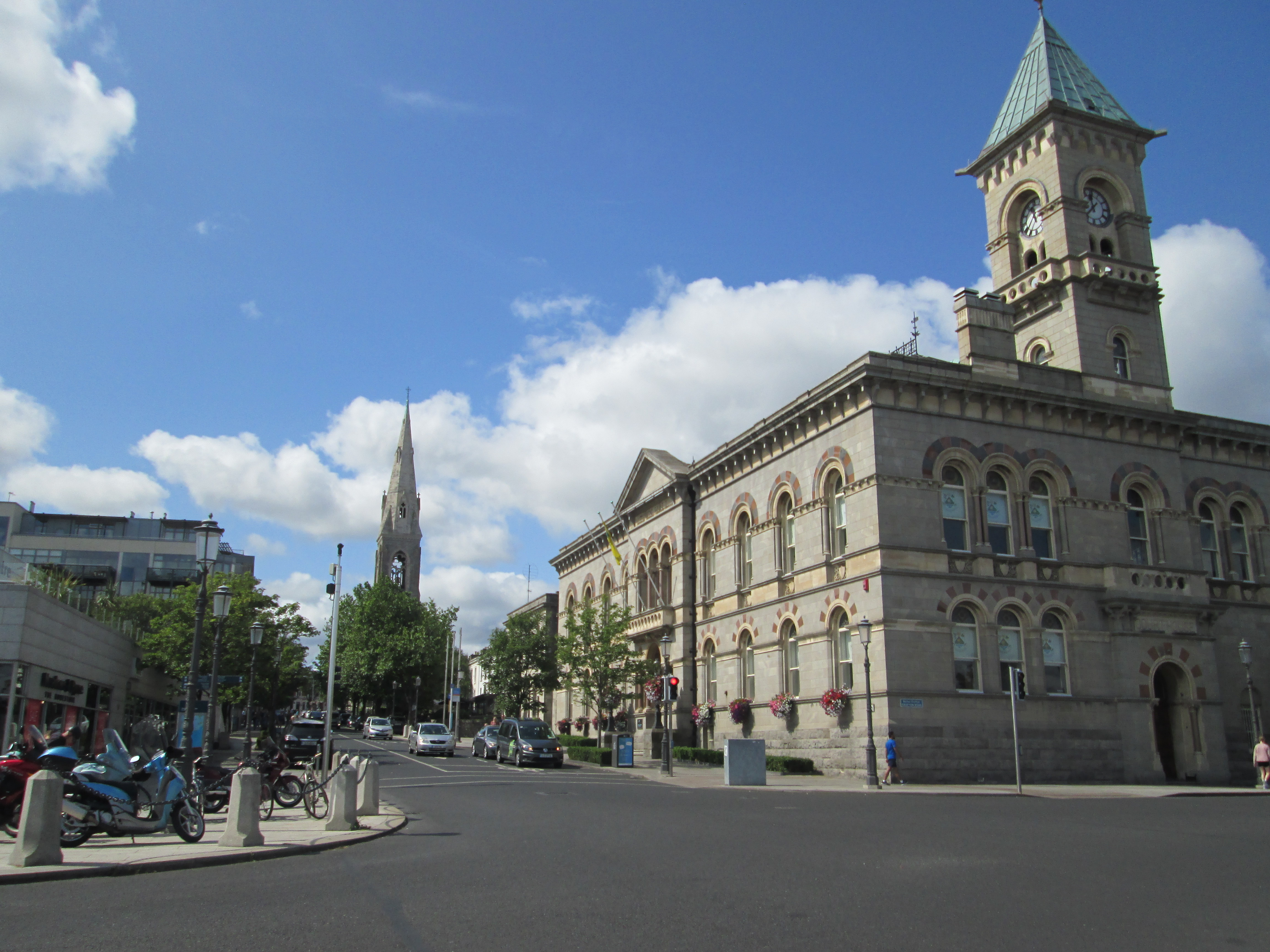
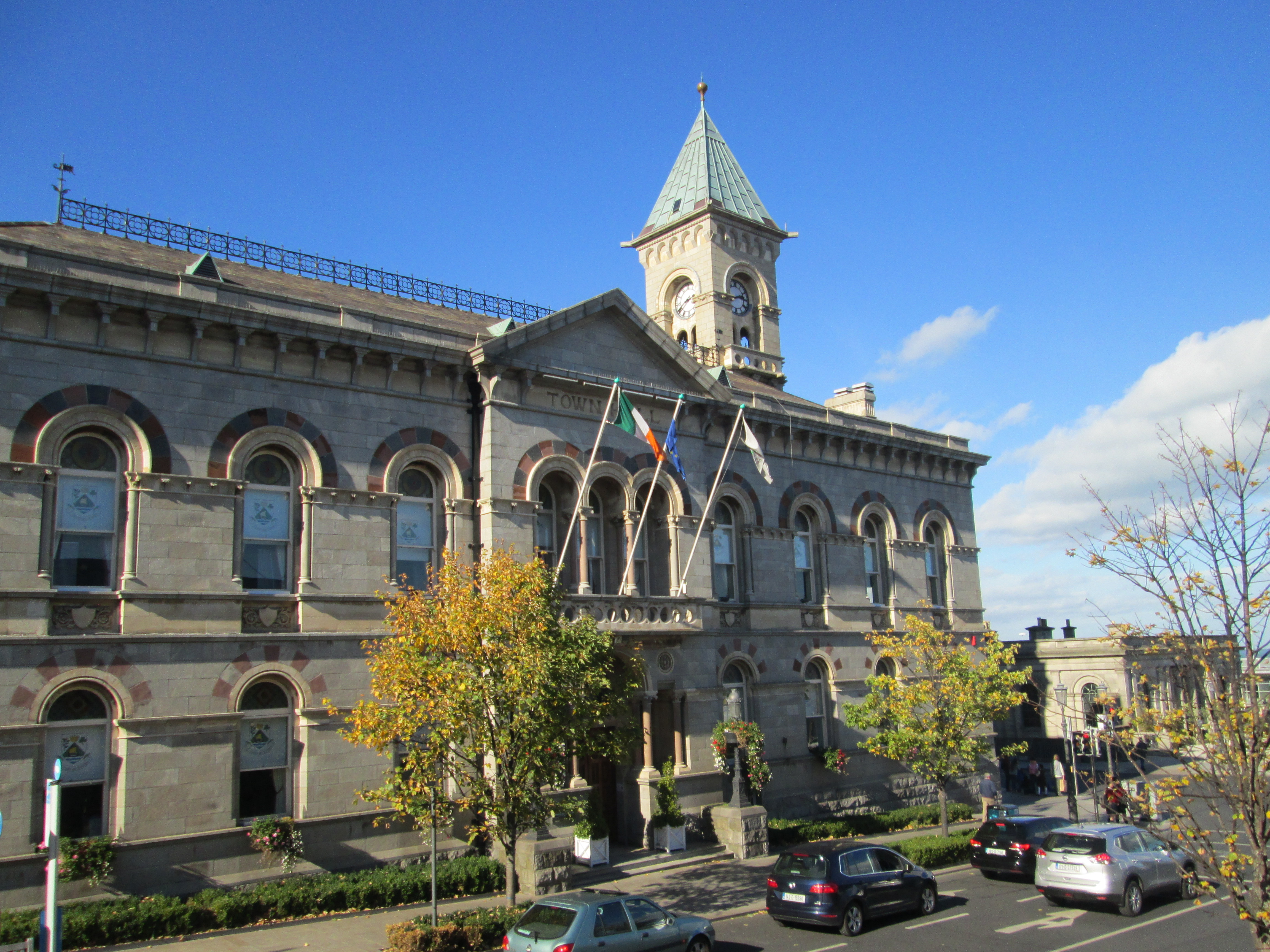
The Town Hall, across the road, is an attractive building in the style of an Italian palace with high slender clocktower and coloured brickwork. Designed by John Loftus Robinson in 1879, it incorporated the courthouse, municipal offices and a public hall. Perfectly preserved, it now forms part of the County Hall for Dun Laoghaire Rathdown.
The vista up Marine Road is crowned by the spire of St Michael’s Church. This is all that remains of the original Gothic church which was destroyed by fire in 1965. The church dated back to the 1820s. The present structure is a plain modernist cube. Heading back downhill, a pleasant Victorian block is shaded by trees. Passing Nando’s, the dappled light whispers: Momma told me there’d be days like these, nothing shaking but the leaves on the trees. There was once a hotel there, the Mellifont, if my memory serves me well. Here, the legendary Nothin’ Shakin’ had their first gig back in the eighties. The man who stepped up to the microphone was Brian Hogan, Crocodile Dunleary himself. Brian was last seen, standing astern on a departing P&O liner bound for Australia.
Ireland’s Age of Steam was born in Dun Laoghaire..The passenger rail connection between Kingstown and Dublin was one of the first commuter rails in the world when established in 1834. The railway further stimulated population growth and Kingstown became a fashionable Victorian resort and well to do suburb, separate from the seething city of Dublin, but only a half hour away by train. The railway obliterated much of the Old Harbour and the fishing village of previous centuries. The original stop was in Old Dun Laoghaire, by the West Pier, but was extended to the present station nearer the East Pier three years later to be closer to the Mail Boat.
The railway station is built on a bridge over the cutting. It was designed by John Skipton Mulvaney in 1853 in a neo-classical style. The grand old station is now a restaurant. Mulvaney was a follower of Gandon, and designed several stations for the rail network of the nineteenth century, most notably the Egyptian inspired neo-classical Broadstone Station in Dublin. He’s also responsible for the Royal Irish Yacht Club to the west and the Royal St George Yacht Club visible nearby.
The northern leg of our loop of South Dublin’s Rocky Shore, follows the Dartline to the West Pier. That promenade is popular with the boys and girls of the Forty Foot publishing house, and is ideal on a brisk sunny day. Back on dry land, a short walk uphill brings us to the Purty Kitchen, an atmospheric spot for food and drink and good music. It was founded almost three hundred years ago, the nucleus of the now vanished fishing village from which modern Dun Laoghaire sprang.
So, I jumped on a bus to Dun Laoghaire
stopping off to pick up my guitar
and a drunk on the bus told me how to get rich
I was glad we weren’t going too far
Summer in Dublin was a big hit for Bagatelle in 1980. The band formed in Bray in 1978, with Liam Reilly as singer/songwriter. The song mixes rose-tinted nostalgia with the clash of modern reality. Catchy too. Though specifically a Dublin theme song, Dun Laoghaire features strongly. The 46a is the local bus.
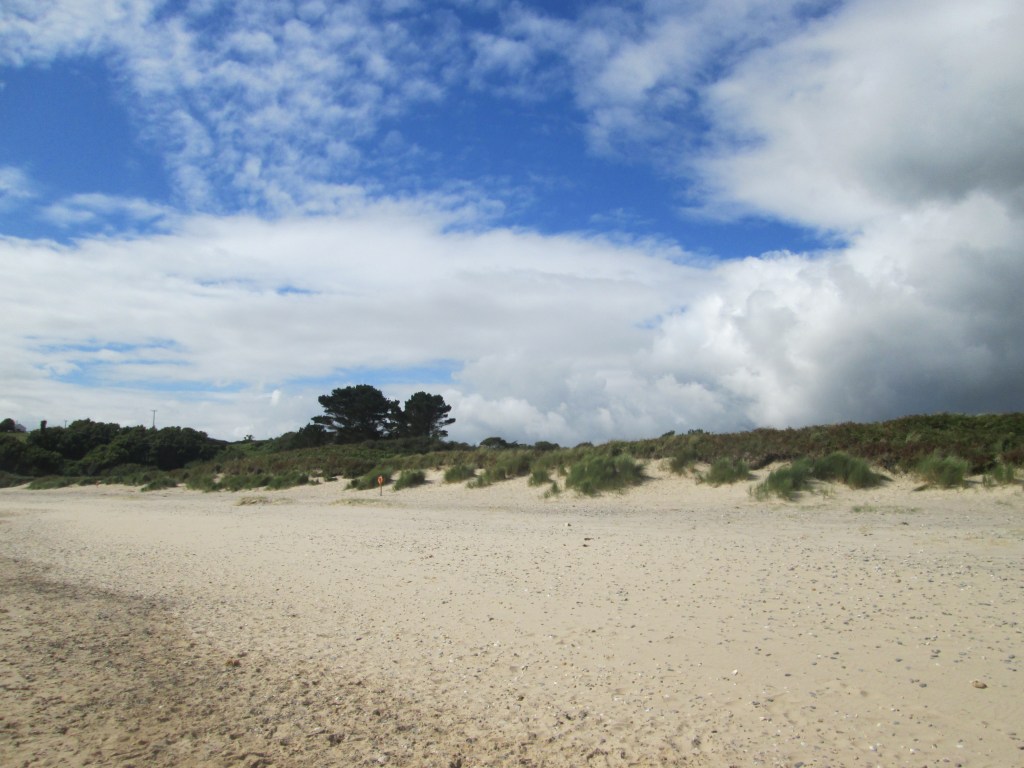
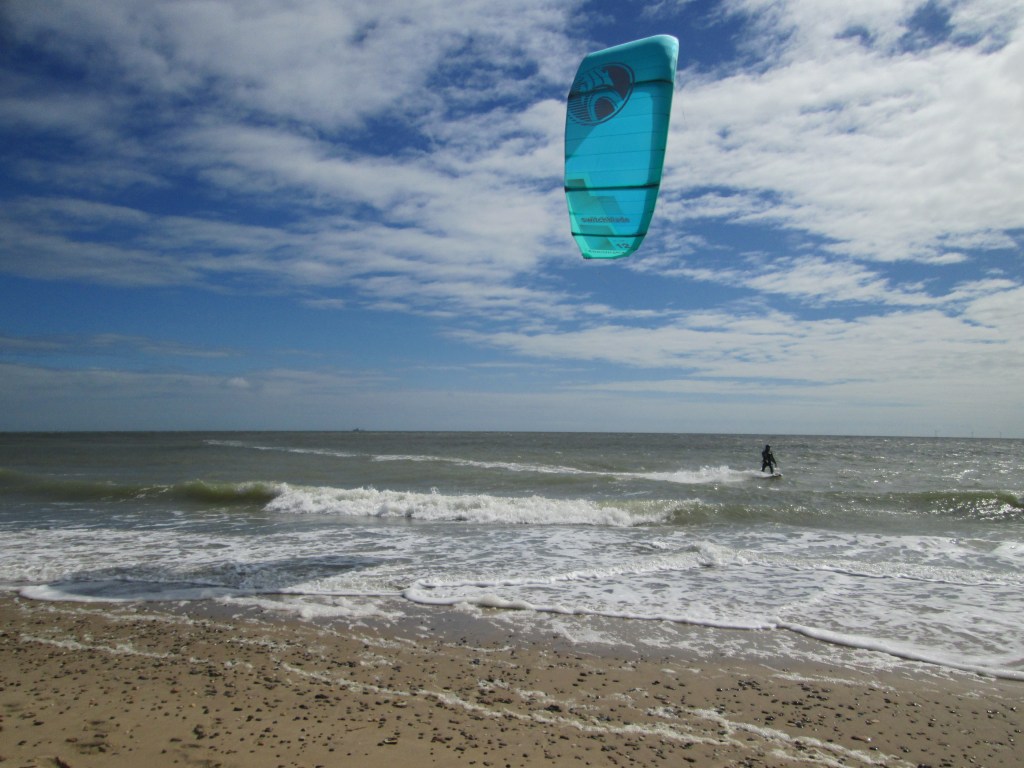
South of Wicklow Town, the coastline boasts some magnificent sandy beaches. Whether you call these gold or silver strands, there’s no arguing that they exert a strong pull on people. Nothing defines the notion of escape from the workaday world like a summer day on a sun soaked beach. Indeed, in all sorts of weather, throughout the year, there’s a particular feeling of release to be had on the shoreline, solo or duet, amongst a full ensemble of friends, or strangers too.
Something is released into our souls and we are at one; maybe even at one with the universe. ‘T’were not ever thus. Once the sea spelt danger, and it took the Romantic era around the early nineteenth century, for the beneficial aspects of the sea to be appreciated: healthy, inspirational, spiritually uplifting, and fun.
At this time of year we make our annual pilgrimage to Brittas Bay. Thanks to our good friends, Maria and Larry, we have the use of a mobile in the dunes, between river and sea. I am inspired to think of Thomas Moore, again, and his ode to friendship, The Vale of Avoca.
Sweet Vale of Avoca how calm could I rest,
In thy bosom of shade with the friends I love best,
Where the storms that we feel in this cold world should cease,
And our hearts, like thy waters, be mingled in peace.
.
The Avoca is another Wicklow gem, in a county where we’re spoiled for choice. Brittas Bay is a slice of heaven from the limbo where we wait. The sea can be wild or welcoming, or both together. At the far north of the bay, a small river enters the sea beneath the rocky promontory. This river winds along the western edge of Staunton’s site, going right past the back door of where we stay. In its short span it holds a wonderful variety of scenery, from lush woodland to the parched spectacle of high sand dunes. At its estuary it is sheer perfection, and I am forever new to its beauty each time I see it.
Sunlight segues into evening, and then heaven releases its stars into the night. Life goes on, in darkness and in dark times. And fun too. When I hear music from neighbouring homes, and as we make it ourselves, they hold an echo of nights gone by. Bonfires ablaze, barbecue aglow, cans and laughs to share with friends. A mixture of the real and imaginary; and the beat going on.
Somehow, the concept of limbo rock is tied up with all the aspects of beach lore. Sun drenched and sand blasted, surfs up and a bevy of California Girls, drinking the zombie from the cocoa shell, and as smoke billows into the night, the sinuous sounds of guitar and bongos beget the need to dance, The big thing is, in this company: how low can you go.
Once, a long time ago, I was wingman for a dj friend at a disco in Crumlin’s parish hall. We were in our early teens and our advanced taste in Rock, providing such excellent fare as Cream, Taste and local heroes Thin Lizzy, was not sufficiently chart orientated for the small gaggle of teenage girls who had gathered around the floor, and were beginning to drift away. We were dying a death when the old chaw doing security had a word in our ears. “Listen, I thought yous were struggling, like. So, I popped home to get some music, thought yis might use it, spark things up a bit.” And there it was: one record. Count it. One.
Well, DJ Vin put it on, if reluctantly. And you know how it goes:
Get yourself a limbo girl
Give that chic a limbo whirl
There’s a limbo moon above
You will fall in limbo love
Jack be limbo, Jack be quick
Jack go unda limbo stick
All around the limbo clock
Hey, let’s do the limbo rock
Limbo Rock, penned by Jan Sheldon and Billy Strange, was a hit for Chubby Checker in 1962. Checker’s 1960 single The Twist, written by Hank Ballard, initiated the dance craze which became emblematic of the swinging sixties, and beyond. Checker was born Ernest Evans, his stage name is a pun on Fats Domino whom he impersonated.
Vancouver is on the same latitude as Ireland and suffers nominally the same marine temperate climate. It rains, man, it pours. The city is set on a peninsula against a dramatic backdrop of snow capped peaks.
Vancouver began to form in the 1860s around a sawmill. Nearby, a bar was established, thirsty work after all, by a certain Jack Deighton. Deighton earned the nickname Gassy Jack for his voluble espousal of any worthy cause in the growing city. He died in 1875 and his body lies in an unmarked grave, but there’s a statue to him on Water Street standing atop a beer barrel. The surrounding area is still known as Gastown.
In 1870 the expanding settlement became known as Granville, honouring Granville Leveson Gower, who was the British Secretary of State for the Colonies. It was incorporated as a city in 1886 with the arrival of the trans continental railway, and named Vancouver. This was for George Vancouver who, a century earlier, had explored the coast from Alaska to Oregon with James Cook.
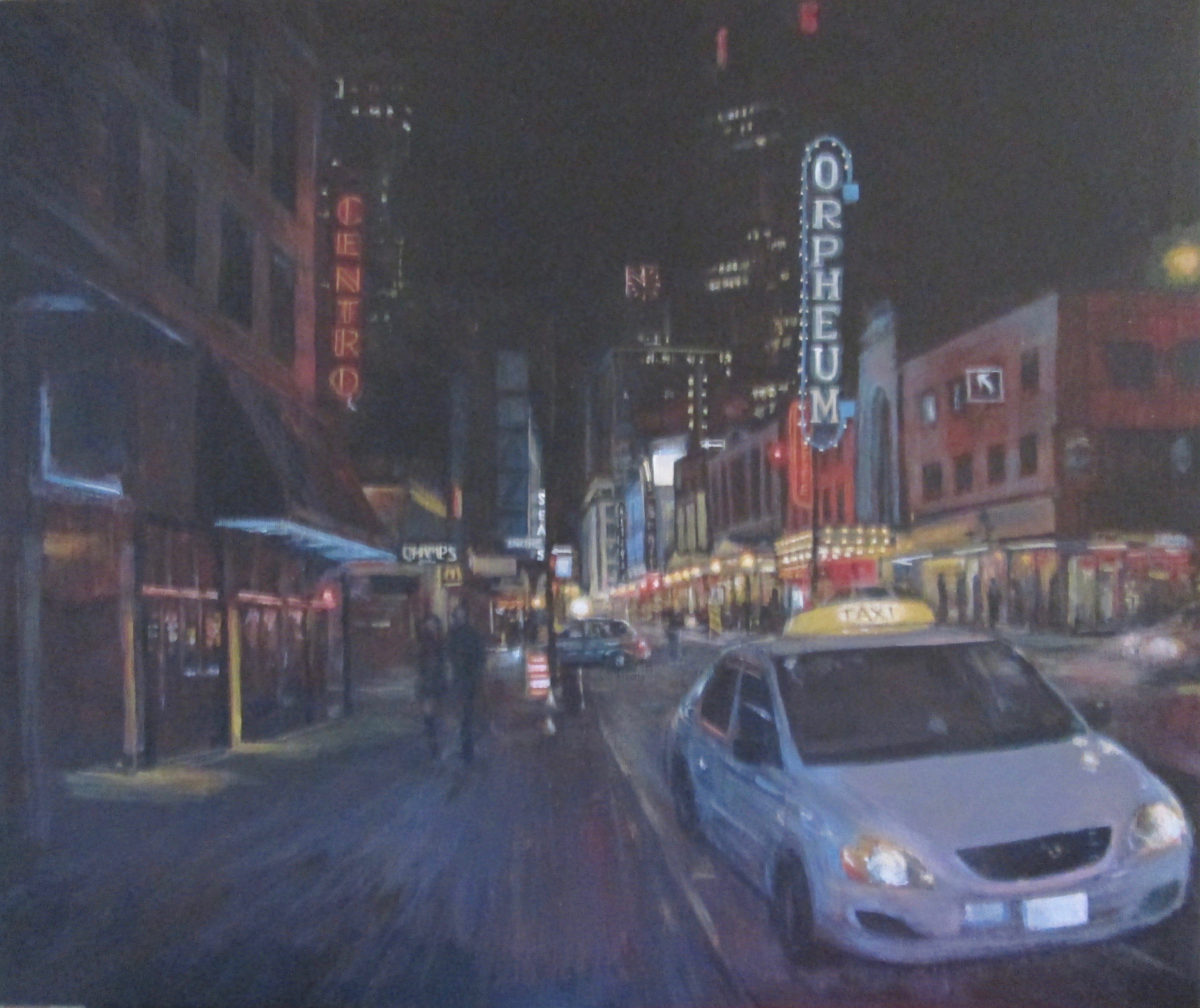
The name Granville persists in one of the city’s main streets. Granville Street has been the centre of the city’s entertainment area for over a century. Theatre Row developed with such major theatres as the Orpheum and Vogue. There were also amusement arcades, pawn stores porn shops and strip joints. Granville Street boasted the world’s largest display of neon signs in the 1950s
While much of Downtown gleams new, Granville Street remains a shabby but seductive slice of fifties Americana. Glorious old film theatres jut into the street which is low-end shopping by day and thronged with rough edged nightlife after dark. And there are bars, bars and more bars. It’s still thirsty work.
It’s ten years back that I visited Vancouver. Granville Street at night is the sort of wonderland I like. Edgy, but never dull. This scene, looking north, features the Orpheum and that neon nirvana for which the area’s famed. Across the road Dublin’s Calling, and I’ve got a thirst that’s raging. Slainte.
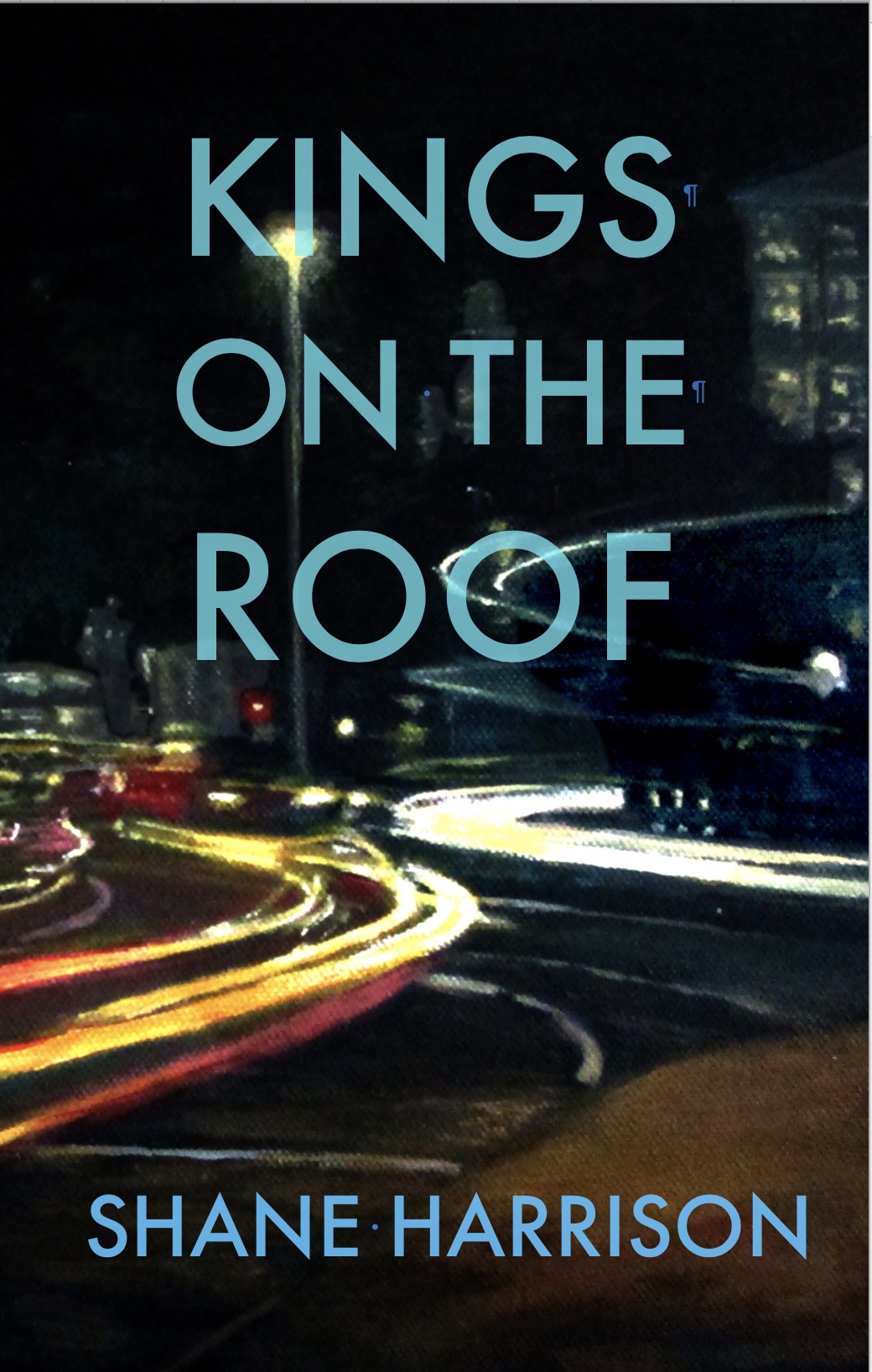
You’ll know me, that I mostly write on travel, posting that topic with photographs and the odd painting. History, art appreciation, personal reflections and music are all part of the mix. But there’s another me that writes fiction. Again, personal reflection and travel are part of the mix, sound and vision too. It’s a different world, but which is real or ideal I can’t say. This is something that happens every seven years or so, and it’s happening again. My latest collection of short stories, Kings on the Roof, is about to go live. Published by Forty Foot Press, it has eleven stories drawn from all across my universe. The title story is set around Dublin’s Amiens Street, with Sheriff Street Sorting Office and Cleary’s Pub beneath the railway bridge featuring. An extract from this story appeared in the second part of my series, Dublin’s Circular Roads.
… back then when everything seemed possible, even there in the Sorting Office, in the bowels of that clanking beast, amongst the trolls and elves of the workaday world. We’d climb onto the high gantry and up the fixed ladder to the roof, Alex, the Bishop and I. We were kings of the world up there, with Dublin spread out beneath us, above us only a rippling sky.
There’s an autobiographical element to this story, as I worked in Sheriff Street with the P7T in the late seventies. A more mythic Dublin features in The Secret Lover of Captain Raymondo D’Inzeo. Set in the sixties in the Liberties, the narrative includes fanciful versions of Marconi, the Easter Rising, the Theatre Royal and the magnificent Italian showjumping team winning the Aga Khan. There were extracts in part eight of Dublin’s Circular Roads.
Just past Cassoni’s I see the car, a red Alfa Romeo with the roof rolled down. Graciano is at the wheel, la Contessa Rossi languishing in the passenger seat.
“You,” she says, “you have set your sight on the Captain. You are good. A young girl with well turned calf. But would he set his cap for you, the Captain? In all probability. He can acquire what he likes.”
I can’t think what to say. “Will Italy win the Aga Khan?” I stammer.
La Contessa puts her head to one side, like a bird looking at a worm. When she speaks, it is not by way of a reply. “I see your man there. He is within your reach. Don’t take me wrong for, believe me, we both have love in our hearts. And yes, we will win.”
Meanwhile, a more recognisable Dublin appears in the stories A Man Walks into a Bar and the Black Moon. Both are contemporary but, suspended in their own gothic fog, drift to and fro in time. The cover illustration is realistic enough, based on a photographic time exposure of city traffic at College Green, Dublin’s dizzy fulcrum. Both the acrylics painting and prose featured on this blog about two years ago.
… this is the beating heart of Dublin. Whenever you stand there, you will experience the rattle and hum of the city. The song it makes is of all the songs that have been sung here, all the words written and spoken, the history of centuries and recent seconds. At night I find it something special, intimate in its inkiness, dangerous and comforting in that non stop firefly display. Stand and watch the lights of passing traffic going everywhere, fast, at the same time. That’s city life.
Kings on the Roof is published by Forty Foot Press, and is available on Amazon.
South of Bray Head, Greystones village developed with the coming of the railway in the 1850s. The line opened in 1855, connecting the area, via the spectacular cliff route, to Bray. From there, two lines connected to Dublin: the coastal route to Westland Row, and the now defunct Harcourt Street Line.
The stop was originally named for Delgany, which was then the larger settlement further inland. The Station became Delgany and Greystones and by the turn of the century, finally, just Greystones. By this stage Church Road had developed as the growing town’s Main Street between St Patrick’s Church of Ireland at the North extreme and the Station, situated at the slight bend where the descending street almost meets the coast. From here on, the thoroughfare becomes Mill Road, with the Burnaby Park to one side, and the railway line and the beach to the other. Squeezed in between are the Carnegie Library from 1910 and two modern terraces with cafes and shops.
The Station was designed by George Wilkinson, also responsible for Bray Station and the Harcourt Street Terminus. Completed in 1859, as a two storey building it is larger than most rural stations. The entrance porch with its three high glass fronted bays, is attractive and opens onto a small plaza. Connection to the DART service was completed in 2000.
In this acrylic, crowds mill about the entrance on a night in late Autumn. Church Road is behind us, and, beyond the station to the right, Mill Road heads south towards the beach and Delgany. It’s about 8.30, and I am in fact coming out of the station. I will turn and enter the Burnaby Pub, established in 1881, where I will have a few beers with my friend Bill, (Hi Bill!). This is a thing I am looking forward to doing again, a lot. Meanwhile the painting will be a compensation, of sorts.









 xxharrison