San Francisco

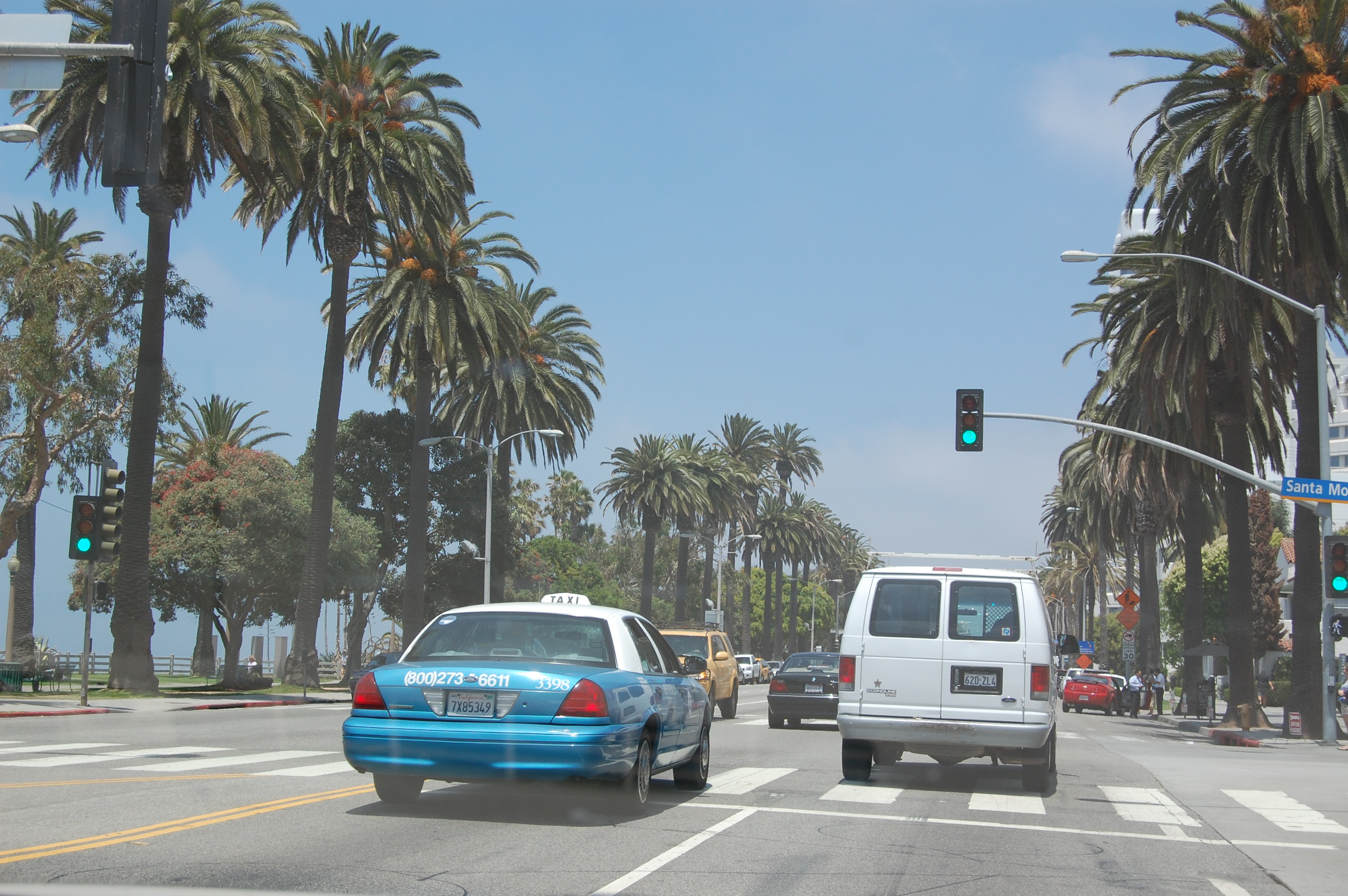
We head out of Santa Monica along the coast and I feel I’m struggling beneath forces more pervasive than the damp Pacific air. The highway is hectic past Malibu where we become snared in our first major traffic jam as we cut in from the coast. It takes a long time snaking past Pasadena and eventually we stop on the outskirts of Santa Barbara at an empty, rustic restaurant.
Leaving LA

Leaving LA

There’s pleasant rolling countryside all the way to San Luis Obispo. The atmosphere of Steinbeck Country is suggested in sun-drenched farmland strung between the coastal hills. We leave the main road for Morro Bay to find the dingy Motel 6 just south of the town.The view is a strange combination of industrial and scenic – El Capitan, the giant rock dome in the bay is visible and we’re also in the lea of an impressive power station with its phalanx of chimneys. The route to town bisects an unpromising wilderness where we surprise a courting couple (oops), before finding ourselves at Morro Bay’s Embarcadero. This really is Californian coastal quaint, the wooden buildings on the wharf housing plenty of restaurants, cafes and bars with live music. I’m not feeling too well and I go back to collect the car while the others go for food. The walk back along the coast is not so straightforward as I had imagined but the falling sun lifts the spirits before sinking into darkness.

The night is bad and herself handles the driving chores for the run up to Monterrey. We wind along the bulky coast with the temperature skimming the low sixties. There are few cars on the road and very little by way of houses or pitstops off it. By midday we reach Monterrey and the motel looks good with a curvy Hockneyesque swimming pool. The Missus goes in search of a chemist while I bed down. She is met with sympathy as the chemist girl wonders if the holiday has been spoiled. It’s not really like that. It is unfair to be struck down on a journey I had been looking forward to but that’s the way it goes – better near the end than at the start.

After medication time (don’t ask) it’s down to Fisherman’s Wharf for a slice of Monterrey. There’s loads happening here and, if a bit touristic, it’s bright and cheerful. We spend some time with a man displaying his colourful menagerie of parrots and macaws. Most places offer the local delicacy of seafood chowder served in a bread bowl. Later we wander on towards Cannery Row although we don’t have time to investigate the Steinbeck connection further. There are pelicans aplenty in the cove, very much the pet bird of the town. At the harbour too is the site where the Americans first came ashore to claim California in the 1840s. Monterrey was the regional capital then but by 1849 all eyes turned to San Francisco.

I attempt driving but can’t get back into it so herself takes us into San Francisco. There’s a rollercoaster entry into the city from off the freeway as the centre lane goes airbound before hooking up to the grid. The grid itself never took account of the hills of the peninsula so the rollercoaster continues through the streets heading downtown. Leaving the boys and the baggage off at the Hilton, I take the Cadillac the last few blocks to the drop off. Fun, in a mildly terrifying way, as streets disappear into the sky and the skyline plunges up and down over the bonnet like a wave. I follow a cable car – a no-no, apparently – before getting blasted for sawing across two lanes in my last on-street manoeuvre. The garage hands are impressed with the car but as nonplused as we by the plastic thingies which have taken up space in the boot since Denver. We say our fond goodbyes to 300 OXT.

The cable car terminus on Market street is only a couple of blocks away and after life on the road it’s a pleasure to take public transport. The boys are on the runner board as we take the trip over to Fisherman’s Wharf. This proves to be our main centre of exploration for the duration, with boat trips and bikes for hire while shops, restaurants and panhandlers abound. Regarding the latter, it’s best to keep eyes averted or purposefully focussed to avoid parting with your cash to the many needy, and probably not-so-needy, beggars that infest the city. At the cable car terminus the couple ahead of us in the queue asked directions from a passerby and found themselves charged for the privilege. At the Wharf a beggar basks in the honesty of his pitch with a sign asking for money but admitting that he’ll probably blow it all on booze.

Oran is briefly snared by a panhandler with the line – ten bucks says I can tell you where you got your shoes. Oran knows he’s got them on his feet – “You’re the guy who got money off my Uncle Brendan last year,” he says. Your man still wants payment but we think he should invest in a new line.

We eat at a Rainforest where the waitress is keen to regale us with details of her workbreaks. “Hi, I’m Debbie, I’ll be your waitress this evening;” but then again – “Hi, this is Brenda, she’ll be standing in for me while I take my break;” and then – “Hi, I’m back from my break….” This is all very well, but any chance we might get a break, some food, even?

The lads discover a sudden yen to see Alcatraz, the mothership is, I suppose, calling them home. We get tickets for three from a laconic Hispanic in a sidewalk stall who enthuses about Frisco’s chill and fog. It’s part of the city’s charm, he says. In fact the only time we see the notorious fog is picturesquely from the comfort of our hotel room. It is spectacular, rolling in and rolling away, taking bits of the city with it, illuminating other parts against its soft backdrop. I am happy not to be caught in it – I have improved but still feel a bit foggy myself.

Next morning we hike up through Union Square, Chinatown, North Beach and on down to Fisherman’s Wharf for the boat. Chinatown is everything you would expect, bustling and bright and entirely Chinese. The financial district forms a jagged, incongruously modern backdrop to the area which was the original settlement of Yerba Buena, holding its old world soul within the ethnic brashness. As is often the way, Chinatown segues into little Italy (viz New York, Bray etc.). North Beach takes the top of the rise before falling away to the coast by way of Columbus Avenue. There’s a pleasant collection of Italian restaurants near Washington Square where we eat later.
Bad boys at Alcatraz

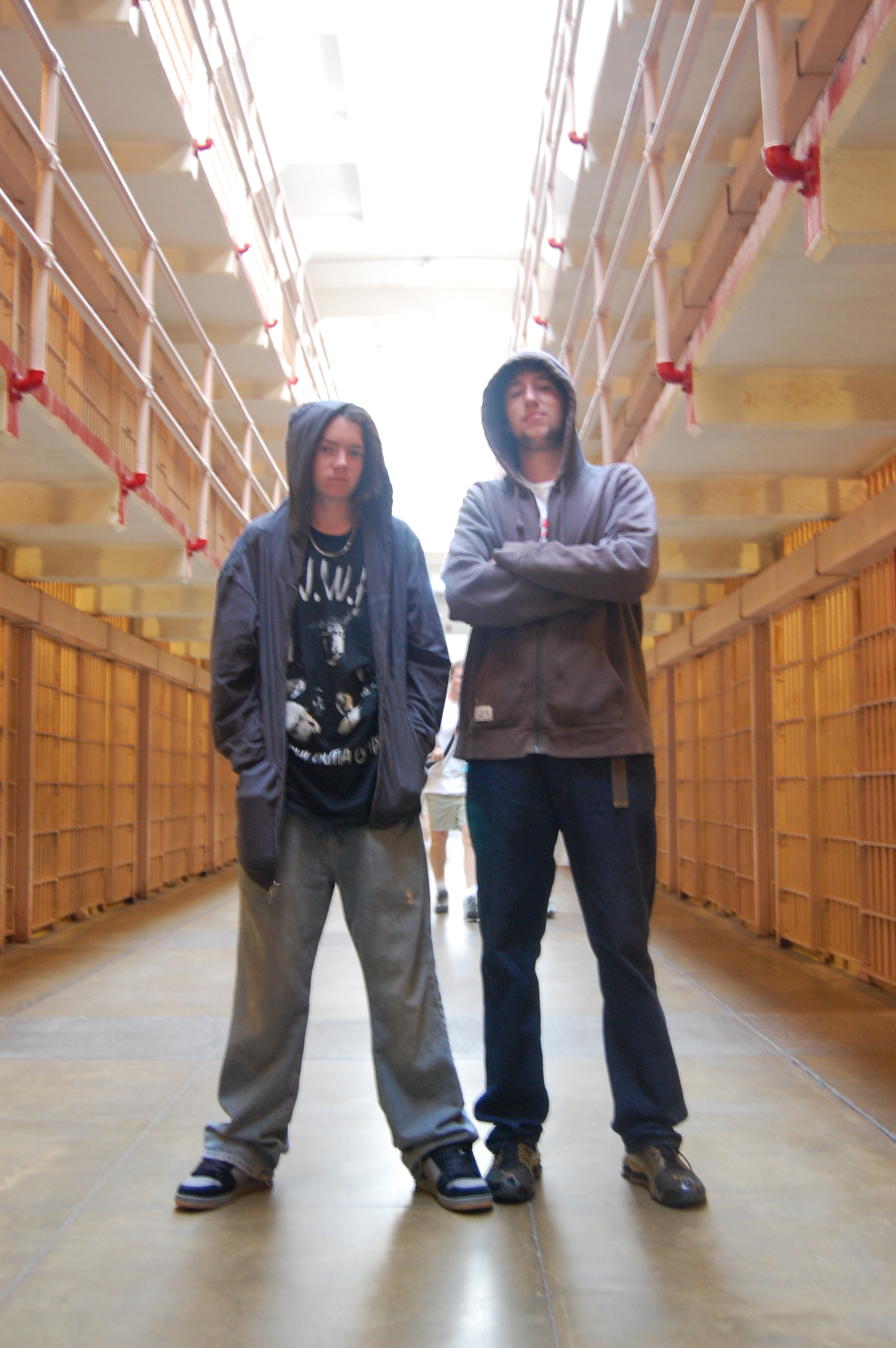
Bad boys at Alcatraz

Meanwhile it’s time for the trip to the island. Alcatraz is the city’s big tourist attraction and tickets are at a premium in high season. It’s worth it. The bay is blustery and the fortress forebodingly dramatic, its haunting familiarity due to Hollywood’s pervasive heritage. Oran and Davin get into some serious posing here as we follow in the footsteps of the Bird Man and other badguy heroes refracted from reality through the silver screen. But this was a real place with real stories stained into its walls and fittings. It’s eerie and moving. Strange that, on this of all islands, a sense of freedom prevails.

We return to North Beech and a sleekly traditional Italian restaurant, Volare, where we eat excellent pasta by an open window. That’s not necessarily the best idea in San Francisco as Davin is manhandled by a passing tramp, albeit in a reasonably goodspirited way. The event breaks the social ice with our dining neighbours and we fall into conversation with them for the evening. Joe Donohue and his wife were here before back in the halcyon sixties and they’ve returned from their home in Farmington, New Mexico, to touch base with those good old times. They’ve been coast to coast in the US throughout their lives and he travels extensively worldwide too. He tells me he does business with David Hay of Celtic and Chelsea fame. He is ‘Irish’, you can tell, and I had seen them giving us the eye before we fell into conversation.

On the last day of our summer vacation we rent bikes and cycle across the Golden Gate bridge to Sausalito. The cycle route is well delineated and mostly flat. It passes through the Praesidio, an extensive parkland along the north of the peninsula. The place is packed as this is the 4th of July and all of Frisco, his wife and kids are out lounging, playing ball and barbecuing. There’s a sweaty climb up to the bridge and the cycle track is too hectic with that serious breed of cyclist who make car drivers seem comparatively relaxed.
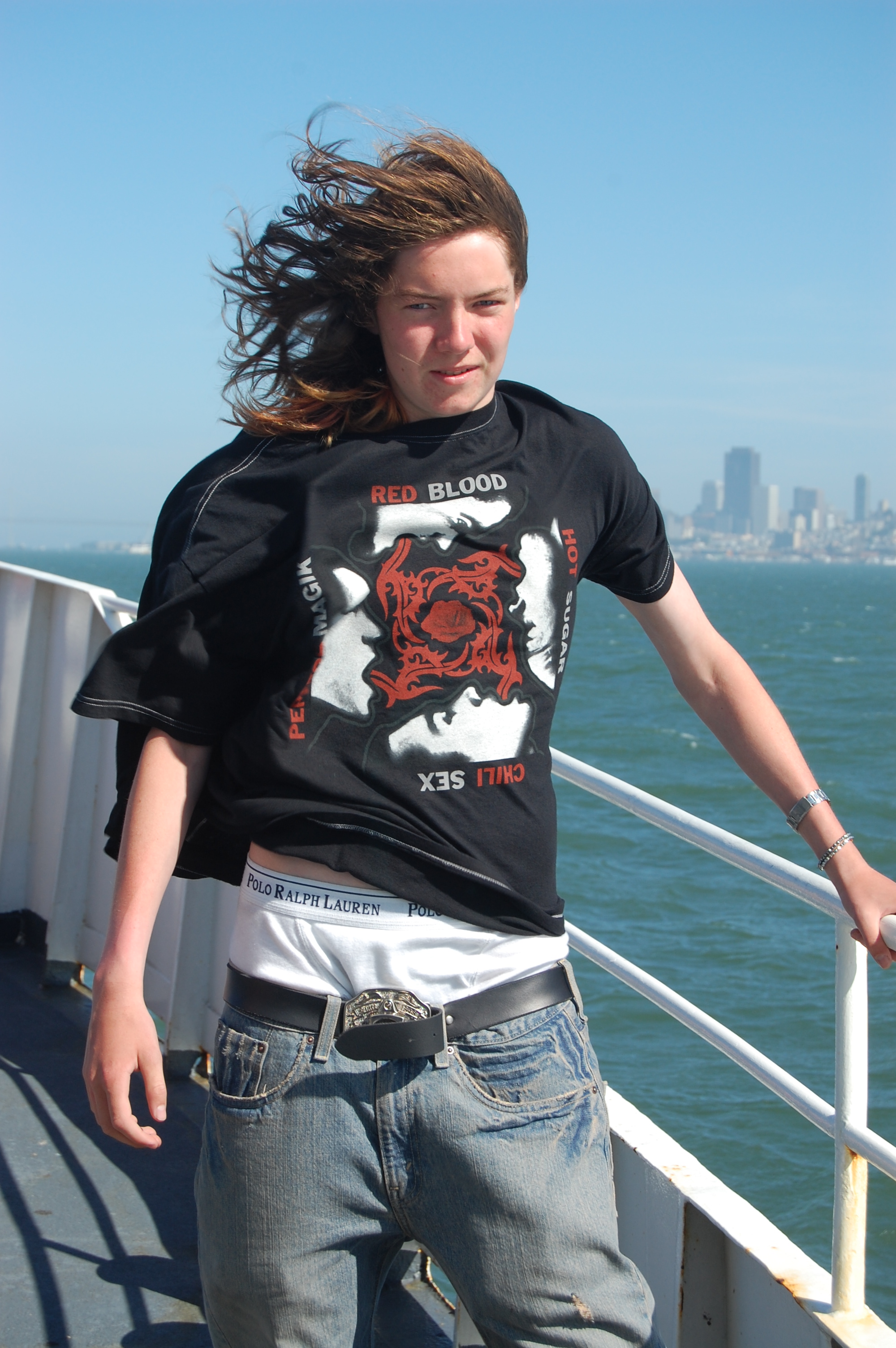
San Francisco Bay

San Francisco Bay

The signage disappears on the far side of the bridge causing a bit of speculative exploration through a village in the cove before a policeman points us on the rocky road to Sausalito. This is a pretty but packed seaside town and we just manage to get a table on the cramped veranda of a snack bar overlooking the water. We take the ferry back which is a welcome relief from pumping pedals. It’s pleasantly cool and blustery on the bay after the exertions of a hot afternoon. You can’t get a trolley bus back from the wharf with all the holiday crowds so we hail a cab and get another switchback tour of the streets of San Francisco. The driver senses our tourist desires and takes us to the base of Lombard Street before the breathtaking plunge back to O’Farrell Street and the Hilton.

Tonight we have decided to go out in style, dining at the Hilton’s rooftop restaurant on the fortieth floor. We’re dizzy up here in the spires of the city and the fourth of July fireworks are all set to go off by dessert. A group of Americans nearby is getting emotional. As the sun goes down and fireballs burst out over the skyline they launch into a ragged version of God Bless America.
DSCF1549

Las Vegas

It’s a long drive from the Grand Canyon to Las Vegas, from the wilderness world to the land of fabrication. We’re up early and heading south to pick up Route 66 again, then turn to head west through Seligman and Kingman. At Seligman, birthplace of the Mother Road, there’s a long and lonely train strung along the horizon, and a cowboy in a pickup turning on to the range by a gateway. We stick to the freeway while the old route bumps off to our right. There’s a camper van parked in isolation with two waifs, Thelma and Louise, in halter tops and shorts posed on the roof staring off into the shimmering distance.

Kingman is off the highway but doesn’t originally reveal the tacky charm I had anticipated. We’re lost in the fast food outskirts before finding a Burger King off what could be the Naas Road Industrial estate where we pore over the maps again. This is always a good way to attract an American. A man folds up his mobile phone mid sentence to come, unbidden, to our assistance. With his help we’re back on Route 66, cruising by the amazing pink motels of ‘historic’ Kingman before picking up the highway again towards Las Vegas.

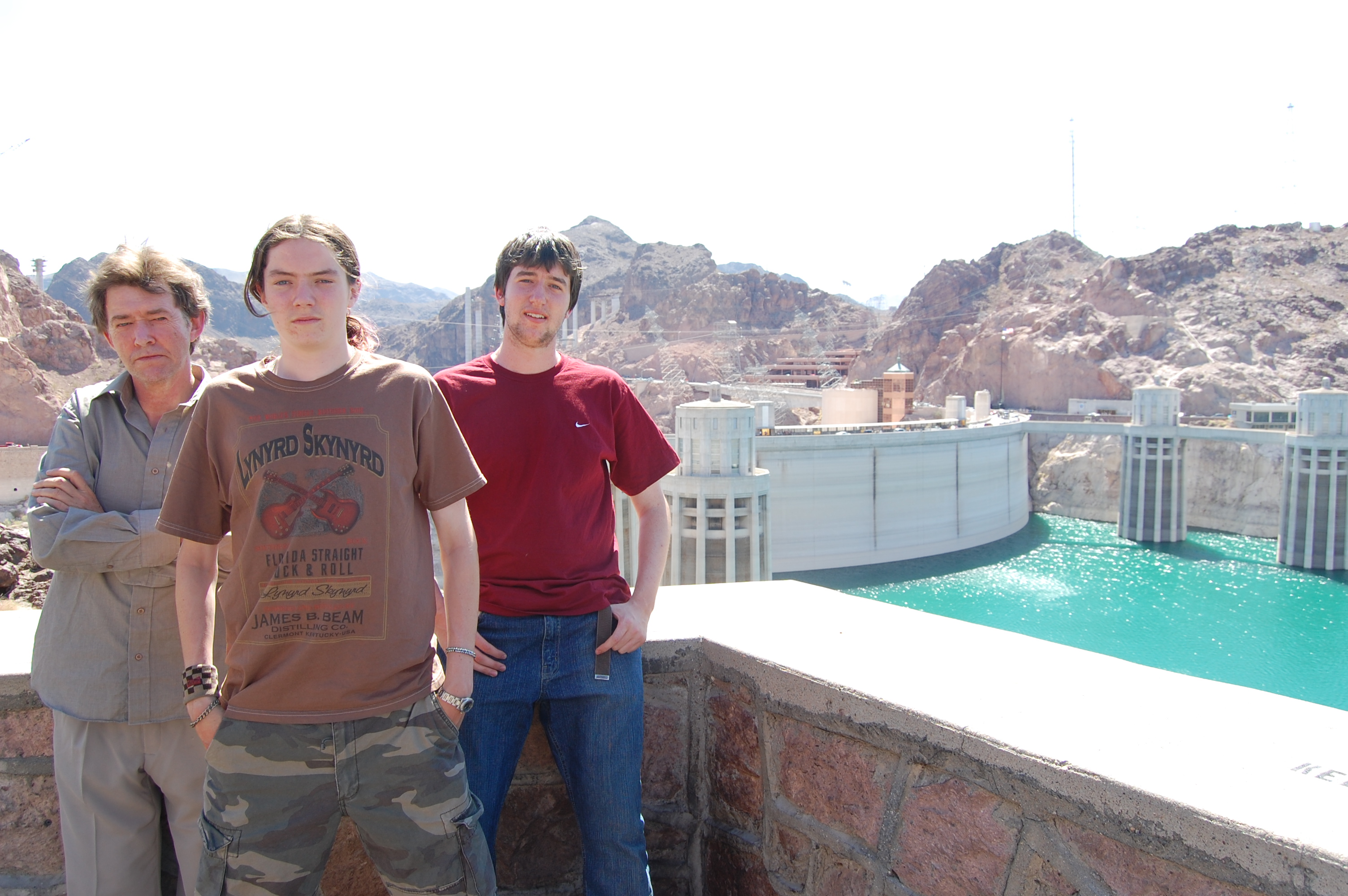
We head north on 93 with dust devils dancing off the road to the sounds of Sheryl Crow and Michelle Shocked on the stereo. Isolated trailers and shacks pin down handkerchief plots of minor cultivation in the arid landscape. We rise and rise until we come to the cooling variety of a maze of black rock hills. The troopers welcome us to Nevada and when we come to the edge of the plateau, there’s Lake Mead in its impossible cool blue, a fake lake held in the heat by the miracle of the Hoover Dam. Constructed during the Great Depression of the 1930s, it is surely one of the engineering marvels of the world, transforming the desert beyond into an Eden, of sorts.

DSC_0395


The car is now recording one hundred and ten degrees and outside the souvenir store the heat blasts at us as from an open oven. A wiry old-timer plays lock-hard in the narrow car park. British or Australian, he loves the heat but for us it’s life in the oven with the thermostat flipped. A meaty black family from New York must be shedding pounds passing over the dam from Arizona into Nevada, but they’re permanently happy with it all. Golden rest rooms offer brief respite from the heat before we head off into the desert.

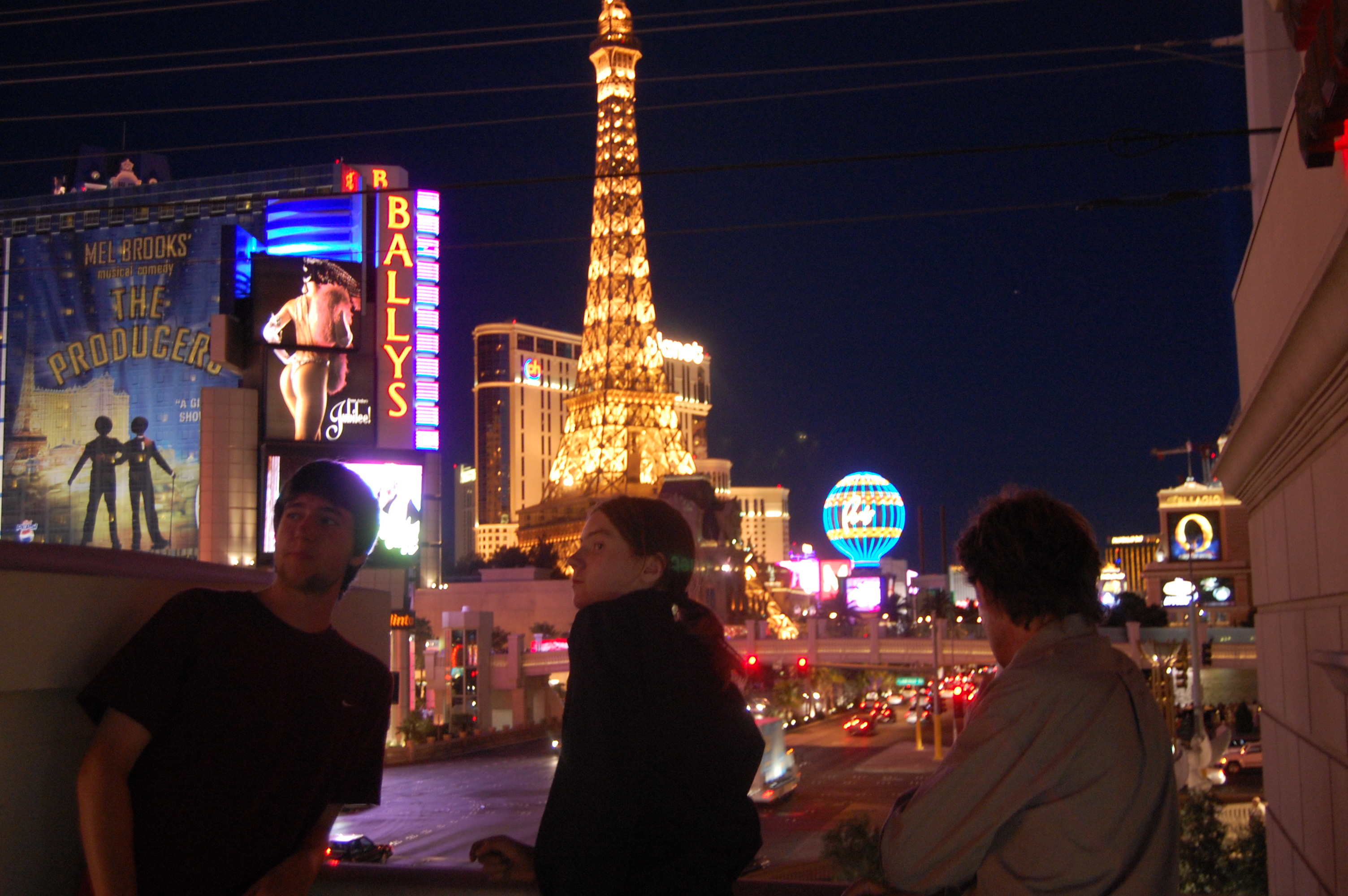
There are glimpses of Lake Mead against the desiccated landscape, then there’s a sudden pulse in the traffic and we’re flying into the Las Vegas freeways. Oran navigates us well through some tense moments and dizzy junctions but pretty soon we’re heading in city traffic towards the strip. We do an impressive swerve in the empty forecourt of Caesar’s Palace before finding the right route to the multi story. Then we’re bound for the gilded lobby of the hotel. Our room is very impressive with jacuzzi in the bathroom and telephone in the toilet. We can see the Eiffel Tower from our window and more of the unreliable skyline of Las Vegas.

Time for a swim to take off the desert heat. I could get to like the pool at Caesar’s Palace. You lounge there and call a barely clad waitress to bring you an overpriced, but well chilled and welcome, beer. Mind you, the prat at the next lounger has decided to try out his chat-up lines on her which she attempts to fend off with chillingly white, but all too polite smiles. My beer is warming.

Out on the street it’s hotter than you expect out-on-the-street to be. The heat brings a peculiar stillness to the air and with the banks of neon it feels like walking through a vast arcade. There are fine water sprays on the street to give some humidity to the desert air, but already my Mick Jagger lips are in need of a remould. Further on up and we’re on the Rialto bridge, with gondolas waiting expectantly. We stroll up the strip in the evening to see the pirate pantomime at the Treasure Island. I thought the desert heat dissipated at night but if anything it’s hotter and heavier in the milling crowds.

DSC_0406

Las Vegas is not a place you either love or loathe – you can do both. It is terribly fake. The sights of the world, the Eiffel Tower, Venice, New York, ring hollow as hardboard and will be gone again in a few seasons; but it’s fun. There is beauty in imitation and glitz has its own romance. The Belaggio and Cesar’s Palace provide their own version of grandeur and perfection at a reasonable price and, for a night or two, you can maybe feel like a high-roller or an elegant courtier.

We take the monorail on the second day and sit beside a Colorado couple who are regulars here. They are from Grand Junction – before I die, I gotta see that town- and they recommend the original strip but it’s a bit far for us. Historical Las Vegas! We walk back through baking sunshine with occasional detours into the various casinos. Circus is tacky and weird, and it echoes some childhood feeling of Fossett’s, or Bray in the fifties. And besides, herself can attempt to catapult rubber chickens into a pot. Another casino with a western theme, vaguely nineteen seventy-ish is getting ready to shut down. We eat at a chrome diner and try to cool down a little.

The pool beckons again, a better place to while away the hours than in the relentless ching ching of the interior. We splash out on the Caesar’s Palace buffet tonight and this really is a meal you can shake hands with in the dark. I dream of it still but to describe it is probably too close to food porn – eat your heart out Homer Simpson!

The Boss and Davin continue on down to Luxor tonight, but Oran and I double back at New York. I’ve seen as much of the world as I can possibly take in forty eight hours. Hispanic men flick cards with sexual services all along the strip, while families and couples gawp at the Belagio fountains and the neon show goes on and on into the night.

Later, I make my own way through Caesar’s Palace casino into the wee small hours. The arcade shops are all closed, more like a mall now than the surreal, almost Italian city it has been impersonating. Some still gather at the Trevi fountain but more are pulled towards the blackjack and roulette tables. If I wanted to be distracted I could take my place at a table where lingerie clad croupiers would take my chips and maybe spin a wheel or two, or I could just play it quietly from the bar, where it’s quiet and almost empty.

Oxford

Oxford is honey-coloured, gothic and ancient. There are thirty eight colleges in the University, all orbiting within this city of dreaming spires. Most of the buildings are of Victorian vintage, some Georgian, many built on institutional foundations that go back to medieval times. The blueprint is time honoured: college buildings clustered around a quadrangle forming a self contained unit. Student accommodation, dining halls and library are on site, most colleges have their own church attached. It is one of those places, like New York, or Venice, or Paris, that we know without ever having to visit. It looms large in literature and learning, has become a historical constant, and, of course, a television star in its own right. We have decided to filter the city through the lens of the Inspector Morse television series, itself drawn from the books of Colin Dexter.

Oxford is just an hour’s train ride from London. The Thames has shaken off its city suit this far upstream where we enter the more bucolic side of the Home Counties. That startling skyline is revealed at a bend in the river a couple of miles out. That the place lives up to expectations is almost a surprise, Oxford being at the centre of a metropolitan are of a quarter of a million people. However, the ancient University is all-pervasive, dominating all aspects of the city.

After coffee at the Buttery on Broad Street, we make a quick reconnoitre before convening for the Morse tour. It’s a pleasant walk around the periphery of the city centre, through the busy main shopping precinct along Cornmarket Street, then past Christchurch and Merton Colleges into peaceful parkland and along the cheerfully named Deadman’s Walk.

Back at Broad Street, we assemble close by the original Oxfam shop. Directly opposite is Balliol College; dating from the thirteenth century, its frontage a picture-perfect slice of Victorian gothic. Further along, the Museum of Science History strikes a classical chord. Although its plinth mounted busts stand guard sternly at the entrance, its mission has always been to provide access. Established in the late seventeenth century to nurture the growing Enlightenment, it boasts that it is the oldest purpose built museum in the world.

The Morse tour is lead by Linda, an affable Liverpudlian who understands the guide’s mission: to inform and entertain. The city is counterpointed against the unfolding story of Endeavour Morse and longtime sidekick, Robbie Lewis. We learn the truth and truth-tweaking of some fictional episodes, of actor John Thaw’s preference for brandy, and, should real ale be your preference, where to drink the Morse way. We barrel through back lanes in the shadow of the city wall, with only enough time to sniff and take note of a few rambling, olde pubs.

Facts and foibles of the city are teased out. We learn about the examination undergraduates and the connotations of their dress, down to the significance of their carnations. It sounds formal and traditional but somehow seems such fun. There’s the constant whirr of spokes as students cycle by. There are end of exam celebrations, with much throwing of confetti, amongst other debris. Typically Oxford, such things are both picturesque and real. Looked at rationally, what better way for a self contained city of learning to conduct itself.

Oxford has been the fulcrum of England’s intellectual life for centuries, but it is also metropolitan, political, a microcosm of elite society. Prime ministers and poets, sportsmen and soldiers have all passed through these hallowed halls, haunt them still as ghosts, no doubt. The art and science launched from here still endures, weathering each and every stone with significance.

Tolkein and Lewis – that’s CS – also intrude, their elves and fabulous kingdoms spun from homely surrounds – the clink of glasses in a pub, the swirls of tobacco smoke. There’s more than a hint of Hobbiton about. Wonderland too, as episodes of Alice peek out from the masonry. It was here that Charles Dodgson first conjured the story of Wonderland, as he entertained his three child friends on the river. Punting and rowing can be arranged, with river cruises on the Thames just south of Christ Church Meadow. Perhaps another day.

The most iconic collection of buildings are grouped around Radcliffe Square. The Bodleian Library, a repository for all books published in Britain and Ireland, has expanded beyond its original buildings. It now includes the distinctive classical confection of the Radcliffe Camera, dominating the square. To the south is the place where it all began, the University Church of St. Mary the Virgin, its elegant tower accessible for views of the city centre. Emphasising the theme of our tour, we have to wait while a film crew gets its shot, but that’s to be expected here.

We finish with a visit to the more day-to-day environment of the Covered Market. This is a fine example of the traditional markets that flowered in the eighteenth century and survive today. A colourful mixture of small businesses, whether food, fruit or fashion, forming a commercial counterpoint to the academic atmosphere all around.

In order to complete our quest, with an al fresco drink a la Morse, Linda advises us to go to the Trout Pub in Wolvercote for a sup by the river. It is a short excursion on the bus to Woodstock – but not the last one. Then we walk through a village hewn from times past, a rambling slice of Old England. We pass twin pubs set either side of the green, inevitably named: The White Hart and the Red Lion, then across the Common where the English typically protest their right of way. At last the Trout leaps into view. Time to take a bench on the terrace and sample the local cask ales. This is a drink that northerner Lewis – Robbie, that is – dismisses as ‘warm beer’. So does my companion, I’m afraid. For me it provides something of a perfect moment; to sit by a river between bridge and weir, in good company, far from the madding crowds, with a pint of traditional ale further reddened by the setting sun.

Copenhagen

I may as well write it: wonderful, wonderful Copenhagen, it really is. It’s way out east on the Danish archipelago, at the eastern tip of Zealand, glowering across the Oresund strait at Malmo. Sweden and Denmark have their issues, always have. So close to identity in race and language, in history and culture that surely they should be one. It is not so, that narrow stretch of Baltic is an uncanny valley dividing the twain. You can take a trip to Sweden by train, twenty minutes or so, we’ll cross that bridge when we come to it.

Copenhagen is formed by the sea, its lifeblood the water that flows through it. The Inderhavn snakes through the centre. At the northern end, the tiny figure of the Little Mermaid watches over the harbour. Hans Christian Anderson’s character seems oblivious to the sea, looking slightly stranded on a rock close to the shore. She is a most modest icon for a large city. Yet it encapsulates a larger story in its tiny form. She was a mermaid who rescued a drowning man, aren’t we all, but her pursuit of love was her tragic demise. The statue, erected by Carl Jacobsen of Carlsberg fame, has been decapitated and defaced many times, but survives. The smallest landmark of a major city, and the toughest, probably.

Copenhagen excites the fairy tale within. Slender spires touch the eggshell sky, gargoyles gambol on parapets, turrets host damsels awaiting deliverance. To walk through its streets is to court heroics, to become part of storyville. But it’s no Disneyland, wide streets turn to traffic canyons, commerce blares in all its seedy attractions. The city in parts can grow shabby with age and overuse. The ambition of an enhanced metro line is also disruptive. At times you get the feeling of a city with a glorious ruined past, hosting a modern, bustling parasite. It will be fine when it’s finished, if ever.

Olden oases persist. Age and beauty are respected. Stepping off the treadmill we take a boat tour from Nyhavn. This canal was built in the 17th century to enable ships sail into the centre of Copenhagen. Once a notorious red light district now it’s more up-market, but Nyhavn is still a sprinkling of the old salt. Gable fronted houses teeter on the pier, drinkers and diners carousing with gusto at quayside bars and stalls. There are different strata in the society of drinkers but they gel very well. Prices are prohibitively expensive so follow the local habit of buying cheap take aways and socialising around a fountain or on the banks of a canal.

There are hints of old Amsterdam. Across the Inderhavn, Christianshavn is formed around quiet canals, treelined streets carry cyclists and pedestrians, many commute by water. Bars cling to barges where punters watch the world float by. At times I am reminded of the Grand Canal back home, or what it could be.

The area merges with Christiania. The old disused army barracks was garrisoned by hippies in the late sixties and the culture persists. Dire warnings of drug crazed weirdos and overflowing garbage are wide of the mark. If anything, Christiania is cleaner than the city that surrounds it. You’ll see the stoner, early morning drinker and layabout, but enough about me, this is a quirky and fun exemplar of alternative living. The sun beams down on individualistic housing, creativity peeks through everywhere, smiling people crowd the cafes, the smell of new mown grass wafts through. On the main drag, the green light district, the mission statement is proclaimed in posters. No hard drugs or weapons, no cars or photos (oops, no-one told me). Meanwhile residents and visitors mingle, happy as hash and tobacco.

Back in the EU the world cycles on. We return across the Inderhavn to the city centre. The Stroget is a serpentine walkway through Copenhagen’s medieval heart. Thronged with strollers, lined with hostelries and shops, it seems all Copenhagen is here for the evening, anticipating the nighttime revelry. At the southern end is Radhuspladzen, dominated by the City Hall, This early twentieth century structure echoes Nordic medieval architecture, topped off by a 100 metre clock tower. The square itself is, typically I’m afraid, a cordoned off building site. Those Danes keep digging.

Night falls and the rare Baltic heat persists. The Tivoli Gardens are a step back in time and a step off the urban treadmill. Fun park, theme park, palace of recreation, it was opened in 1843 and its popularity continues to grow. The sculpted parkland is woven into an amusement park with a plethora of death defying, fantastical rides. There are restaurants, bars, concert halls and theatres, conceived in architectural styles from around the globe. As the illuminations come on it is transformed into a true wonderland.

Fortified on Danish courage, we seek the most spectacular ride. The chair-o-plane ascends to ridiculous heights. In the cooling night air we are side by side, flying above the fairytale towers, lit by magic lanterns. The stars swirl in harmony, the two of us turn to angel dust.

St Petersburg …

St Petersburg

St Petersburg is the epitome of the early modern idea of what a city should be. It grew out of the mind of that harbinger of enlightened despotism,Tsar Peter the Great, becoming a focal point of an empire straddling Europe and Asia. East may be east, west may be west, but there is a meeting of sorts here.

Peter was looking west when he founded St Petersburg. Paris provided something of a template, its triumphal arches and long wide boulevards harking back to ancient Rome. The city is built on the marshy delta of the Neva River where it meets the gulf of Finland. This watery environment allowed St Petersburg to be fashioned as something of a northern Venice, it was envisioned its citizens would commute by an extensive grid of canals. This plan didn’t come to fruition, freezing winters making canal travel impossible for half the year. But the city established itself as a trading port, its merchants ensconced in fabulous palaces, retaining enough rivers and canals to make the comparison valid.

Approaching St Petersburg by sea seems appropriate and alluring, but is rather more banal these days. Communist ideals established rudimentary living conditions with rows of shabby tower blocks ringing the city. Soviet Russia may be gone but it is not yet buried. Commerce is something of a delicate flower, restaurants, bars and stores are beginning to pop up amongst the crumbling fabric of its streets. There should certainly be call for it, main street Nevsky Prospect throbs with streetlife, cars and pedestrians hurrying along in a constant torrent.

Citizens pour in from the suburbs through the impressive metro system. Stalin saw the stations as palaces for the workers, kitting them out with chandeliers and artistic mosaics. Though multitudes descend into the bowels of the earth, an eerie sense of calm prevails. Brash consumerism or panhandling do not intrude here, nor are we advised to take photographs. Petersburghers do not take fondly to strangers, and westerners setting off cameras in their faces is too invasive by far.

There is something futuristic in all this, in an old-fashioned way, as in Fritz Laing’s Metropolis or Orwell’s Nineteen Eighty Four. Nevertheless the fabric is real enough, some facades decay where others are gilded, golden spires punctuate the skyline speaking of great wealth in bygone days. St Petersburg is a peculiarity in Europe, it is new, rather like an American city in that respect, yet there are ancient echos in its churches with their Byzantine faith, while arcane elements of empire and sovietism still persist.

By the mid 18th century St Petersburg was achieving its golden age under the guidance of Catherine the Great. German by birth she came to embody her adoptive city. Enlightened at first, she believed rulers were called to serve, founding hospitals and schools for the betterment of her people.

Such high idealism would fade, but her most enduring legacy is housed in the sprawling Hermitage, an array of four palaces on the Neva River. Catherine occupied the Winter Palace in person, also in mind and spirit. She initiated the acquisitions that would see the Hermitage Museum become one of the world’s greatest art museums. The range of work is astonishing, spanning the history of visual art from ancient Egypt to the twentieth century. A roll call of old masters is on show, Leonardo, Michelangelo, Botticelli, El Greco, Durer and Renoir to name a very few. Most captivating is a fine selection of Rembrandt’s, exhibiting a majestic range of skill and emotion from the erotic Danae to the deeply moving Return of the Prodigal Son.

Awe inspiring as the collections are, they are almost upstaged by the opulence of the interiors. The baroque Jordan Staircase at the entrance is a hard act to follow, yet still to come are the State Rooms, the Malachite Hall and the Hall of Twenty Columns, amongst other delights.

The Hermitage hosts three million visitors a year, it is as busy as the Metro stations at rush hour. Our guide, Irina, marshals us well. Holding a delphinium aloft, we acquire a sense of identity with her. We can even take turns at the delphinium. She exhorts us not to be shy. Later, on a tour of the Cathedral on Spilled Blood, she makes us push through other groups to ensure we see everything – it’s a jungle out there in tourist land.

What a name that is, the Cathedral on Spilled Blood. One of the few quintessentially eastern buildings in a neoclassical city, it was built as a shrine to the reforming Tsar, Alexander II, assassinated on this spot by a terrorist bomb. Alexander III, was, not surprisingly, less keen on reform. If anything, the old Russian style of the church was a reassertion of traditional values, its swirling golden domes rising above an exuberant confection clad in mosaics. The interior is no less impressive, covered in mosaics on religious and historic themes, pervasively blue, almost a calming influence on the constant throng of visitors.

Spilled blood has been a constant theme in this city. Pushkin, who died following a duel to uphold the honour of his wife, died in a house nearby that is now a museum. There is also a monument to the ‘Russian Shakespeare’ in the Square of the Arts.

Rasputin’s  baleful influence on the doomed Romanovs caused Royalists to plot his demise. The monk was plied with poison, enough to kill a horse it is said, yet remained unaffected. A bullet to the head was no more lethal and several shots and stabbings later the assassins dumped a trussed Rasputin in the icebound river. That did it, although he still managed to undo his bonds before drowning.

The Great War was exacting untold misery as the country lurched towards revolution. Trotsky’s plot was to occupy strategic buildings in the capital, now called Petrograd, effecting a coup d’etat with minimal fuss. With the empire disintegrating he was pushing an open door and the, misnamed, Bolsheviks came to power. Civil war followed as the capital shifted back to Moscow. Renamed Leningrad the city once more rose from the ashes. World War Two would visit more horror and Leningrad would withstand an epic nine hundred day siege where over half a million died.

So good they named it thrice, it finally reverted to its original name following the fall of the communist regime. These days it struggles to again wear the mantel of sophisticated European city. New shoots of culture are blooming, yet those shabby clothes of paranoia and conservatism are hard to shake off. Buskers, street artists, even some graffiti are invading the streets and alleys. Canal boats ferry tourists about the city’s waterways and sidewalk cafes are sprouting, Europe is coming back.

The floating world, the dreaming spires, are infected by a riotous gothic. A dangerous energy seeps through the streets and canals. Sordid and sacred history is never far from the surface. The spilling of blood, the swelling of symphonies, poetry and polemic are in the spit of the citizens. This city has always been central to the conveyance of ideas, the creation of art, music and literature. They flowed as ink on a page or flame from a torch, ultimately engulfing the globe for good and ill. Dostoevsky called St Petersburg “the most abstract and imaginary city.” So it was in Peter’s conception that raised it from a swamp, so it remained through its achievements and intrigues. After leaving, long after passing through the jaws of the sea locks at Kotlin Island, it lingers in that special place in the mind where cities form, attaching themselves to endless convoluted dreams. St Petersburg floats on, within your presence or beyond.

Vancouver

Vancouver.

Vancouver is on the same latitude as Ireland and suffers nominally the same marine temperate climate. It rains, man, it pours. The city is set on a peninsula against a dramatic backdrop of snow capped peaks. Not that we can see them on the first day as it lives up to its sodden image with a welcoming downpour. By the next day however the clouds have lifted to reveal the highrise city and the Coastal Range across the bay.

Vancouver’s population density is said to be second only to Hong Kong and has all the rich and varied hum of city life which that implies. It is very modern and preserves only isolated scraps of its heritage. Even the landmark monoliths of the early twentieth century are dwarfed amongst the skyscrapers, they’re still impressive though. The Fairmont Hotel is in the signature Canadian style with a steep bronze roof like a French chateau. The Marine Building is an exuberant art deco building from 1929, designed to appear like a ‘great crag rising from the sea.’

Something of a coherent urban heritage survives in Gastown. The area takes its name from English adventurer Jack Deighton who established the first saloon here in 1867. Deighton earned the nickname Gassy Jack for his voluble espousal of any worthy cause in the growing city. He died in 1875 and his body lies in an unmarked grave but there’s a statue to him on Water Street standing atop a beer barrel.

Gastown remains a picturesque enclave of late nineteenth century buildings with a good concentration of bars, restaurants and clubs.

Chinatown is nearby. The second largest Chinatown in North America after San Francisco, Vancouver’s is more downbeat and edgy. Tens of thousands of Chinese arrived in the eighteen eighties to build the Trans-Canada railway and formed a shantytown here. The Chinese community was ghettoised for decades but, as builders of Vancouver, they cleverly constructed a network of tunnels allowing them quick access to the city from which they were forbidden. An ornamental, traditional gate now marks the entrance to Chinatown but it is the streets between here and Downtown that have developed into a modern ghetto. The area is reminiscent of Dawn of the Dead, with crowds of those who have fallen through the bottom of society congregating, zombie-like, in the streets and squares.

While much of Downtown gleams new, Granville Street remains a shabby but seductive slice of fifties Americana. Glorious old film theatres jut into the street which is low-end shopping by day and thronged with rough edged nightlife after dark. Where the street crosses False Creek Granville Island is an oasis off the city grid, a maze of markets, restaurants and cafes. There are art galleries and buskers and along by the Creek is a great place to admire the city skyline.

Modern Vancouver is more than highrise Condo heaven. The library at Robson Street resembles Rome’s Coliseum, but its nine floors are devoted to more intellectual pursuits. Entrance through an outer spiral arm leads into an impressive concourse with several cafes. Light pours in through an atrium six stories overhead. The library itself is airy and spacious, creating an overall effect of calm within a busy maelstrom of human traffic.

After feeding your head you won’t need to go far in Vancouver to feed the body. The rich ethnic mix means there’s no shortage of variety and, not surprisingly given that it is the Pacific out there, there’s plenty of Chinese and Japanese cuisine. Davie Street is Vancouver’s Castro and lined with restaurants and clubs. It is friendly and unapologetic, self-contained to an almost parochial degree.

Granville Street at night is more hetro and there’s an even more butch option at GM place which is home to the Canucks ice hockey team. Canada’s national sport is incredibly fast and skillful, but there’s more than that, you’re guaranteed a night of beer, loud music and regular punch ups. What more could you ask for? Well, the Stanley Cup, hockey’s premier prize, would be nice, but as yet it has eluded the grasp of the boys in blue.

More natural and timeless pleasures can be found in Stanley Park on the northern tip of the city. The thousand acre expanse of parkland is in sharp contrast to the metropolis looming over it. Vancouverites and visitors flock here for sport and recreation and its many attractions include a vivid reminder of the areas origins. The Totem Park is a startling collection of totem poles by local ‘Indian’ tribes. The Canadian term is First Nation, after all, they were here first. They’re still here, and the timeless visual narratives of the totem poles is a fascinating counterpoint to the exclamation mark of modern humanity, the two facing each other across a short stretch of grass and water.

Reykjavik

Iceland loomed large last year, not so much as a destination – more a roadblock. Eyjafjallajokull sent a pall of ash over the North Atlantic disrupting flight services all over Europe. It’s not the first time Icelandic volcanoes have had a baleful effect on Europe. Three thousand years ago the explosion of mighty Hekla contributed to the eclipse of the early Mediterranean civilisations of Minoa and Mycenae. It won’t be the last.

Iceland straddles the continental divide between Europe and America. The faultline is visible in the region of Thingvellir where the continental plates rear in sheer walls above a steaming plain. It is the site of the world’s oldest parliament, the Althing. Here, in 930 AD, ancient Icelanders gathered to hold court and elect their parliament. Irish monks were the first people to reach Iceland but the Vikings would supplant them and become the were the first Europeans to colonise the North Atlantic and ultimately reach America.

Four hundred years before Columbus, Leif Eriksson founded Vinland (Greenland) and the colony lasted a couple of centuries before fading from sight and memory. In the 1930s the Americans commemorated the explorer with the donation of a dramatically heroic statue which guards the plaza before Reykjavik’s landmark Hallgrimskirkja. The church is named for Hallgrim, a 17th century devotional poet. He married Goethron, a Westland Islander captured by Algerian pirates in 1620. She was amongst a fortunate few to be ransomed by the Danish king and Hallgrim was dispatched to reacquaint the freed captives with Christianity – thus do love stories begin.

At the top of Hallgrimskirkja’s immense spire you can see all of Reykjavik neatly laid out below. There’s a palpable sense of drama and contrast on this fulcrum between the old world and the new, where Europe meets America. Powerful organ music pushes up from the stark church full of gothic power, while the modernist spire feels like a spaceship to heaven. Meanwhile, the city far below has a feeling of toy town. The buildings are clad in corrugated iron, painted in primary colours tumbling down to the harbour, beyond which jagged snow-capped  mountains pin down the deep blue horizon.

Iceland’s modern parliament building dates from 1880 and is set in a pleasant square in the city centre with the small Cathedral, Domkirkjan, nearby. I shelter from the cold in a pleasant bar opposite the park and enjoy a pint of the local brew, Gull, the rim of the glass frosted with ice. There are large photos on the walls of the recent disturbances after the financial crash. The black and white prints give a feel of ancient history, the scenes themselves, featuring police in riot gear, look improbable in such a placid square amongst an amiable people. The crash and the anger were real enough though.

There is political fire too in the work of Erro at the City Arts Museum. Iceland’s most significant visual artist was a prolific exponent of the collage, depicting a strange synthesis of propaganda, sex and consumerism. His most appealing series shows Mao and the Red Army leading a communist invasion of Europe and the USA. There is much reference to classical painting and iconic advertising such as the Rothman’s ad. Perhaps the east will rise, as Erro hints, or perhaps the twain should never meet. Iceland itself is finely poised, ever growing, ever changing.

Madrid

The Irish Celts are supposed to have come from Spain, the Milesians setting out from that land of the dead to the fabled isle of destiny in the western ocean. It would not be the last time a great voyage of discovery initiated in Iberia. It is in a state of constant change, sending voyagers outwards, receiving the insanely talented too. Columbus, the Italian, sought out Spain to back his ambitions. El Greco found acceptance for his otherworldly paintings here. There were the Conquistadors, the doomed Armada of  King Philip, poets, artists, and the ubiquitous Spanish student.

Madrid is central to this country, this fulcrum between Europe and Africa, stepping stone to the new world. The joining of the thrones of Aragon and Castille under Isabella and Philip brought Spain into being and the King chose Madrid as the capital for its central location. What had been little more than a small town on a bleak plateau became the capital city of the greatest empire of the early modern world. The city is built in overlaid layers, medieval lanes merge into grand boulevards, spacious squares are hidden amongst warrens of tiny streets, there are regular, elegant streetscapes in the European mode and sudden eruptions of art deco highrises in the American style. The stroller is rewarded with interesting shops and intimate taverns and the city plan is sufficiently confusing to make walking a pleasant adventure.

In terms of fine art Madrid ranks with the best. The Museo del Prado at the edge of is the most famous with an enormous collection of art from Spain and its colonies. The exuberance and hot colours of Spanish art are immediately addictive as is the passionate, baroque take on faith. The Cretan immigrant, El Greco, most captures the heart. Sinuous figures wave upwards like flames flickering in adoration. A more cautionary take on life is embodied in the work of Hieronymous Bosch, it is also more fantastical than one would think possible. My fevered teenage brain had been captured in a pocket-sized book on El Bosco, how great it is to stand before the original triptych of the Garden of Earthly Delights.  Goya also spanned the worlds of horror and sumptuous wealth, his truth and disturbing vision reaching deep into the soul. To simply enumerate the other artists would fill this article and the Prado could sustain a whole week’s visit, but there is more too see.

The Centro de Arte Reina Sofia is the place to see modern art. The collection includes Dali, Juan Gris and Miro. Picasso’s Guernica is understandably a powerful magnet; passionate, rough hewn, it appears incomplete, as if it were an emergent apparition about to engulf us. He is otherwise not my favourite, I must say, but this is the real thing. That other Catalan, Salvador Dali, moves us in a different way, the landscape of madness that he depicts is within us, his stunning technique inspiring awe and making the impossible certain.

The Museo Thyssen Bornemisza is a private collection bringing both strands together. Eclectic and extensive it spans five hundred years of Western art, ricochets amongst cubism and surrealism, explores Russian graphics and dazzles with the American Hyperrealists. So, here I stand in a gallery in Spain looking in through the reflections in the window of a New York diner conjured up by Richard Estes.

There are other theatres of art. At the Santiago Bernabeu stadium we bear witness to the stoic resistance of  Real Madrid to the wizardry of Barcelona FC. One hundred thousand passionate Spaniards are packed to the rafters, a sea of banners waving to the beat of drums, chants and songs. The great masters of the game, Messi and Ronaldo supply a goal apiece, honours are shared, the war goes on.

At night La Latina is the place to go. Narrow winding streets are packed with revellers, there are ornate bars and fragrant restaurants. We searched for Flamenco but found the blues instead at a hopping little club on the Calle de los Huertas. There are other delights to dip into. Deli food and wine are an excellent start to the evening at the lively Mercado de San Miguel. The Plaza Mayor is a signature for the city, but everywhere you emerge into magical plazas – Sol, Angel and Santa Anna thronged with diners, buskers, performers and hustlers. Art Deco architecture draws the eye upwards in delight. The Circulo de Bellas Artes is a particular gem – a slice of 1930’s New York containing a cultural foundation with a beautiful café. On our last morning we enjoy the ambience and watch the bustle of Gran Via  and Calle de Alcala pass by.

Our Easter vacation started with the sombre gaiety of Holy Week. Processions redolent of medieval intensity mark the days, the bond of spirituality runs deep. Religion, art, sport and society are entwined. This is the land of Death but so full of life. You can be seduced  to look at reflections in the glass of a shop window and pass through into a hyper-realist vision and see the possibilities of the whole world.

Lisbon

From Lisbon the lines radiate around the globe – Africa, South America and Asia – a web of names heavy with history and adventure: Vasco Da Gama, Pedro Alvares Cabral, Magellan. The Tagus estuary is a tongue of the Atlantic, licking the feet of Lisbon’s hills. It laps against the southern flank of the Praca do Comercio which has traditionally been the grande entrance to the city. This huge square was the site of Portugal’s royal palace for four centuries until the revolution of 1910. Framed on three sides three by elegant arcades here we find Lisbon’s oldest cafe, Martinho de Arcada, a favourite with the literati it seems. This is the place to start, so, in cool spring sunshine I relax over a drink and watch the world go by.

The towering triumphal arch on the northern side is the gateway to the city’s commercial hub, the Baixa. The cobbled streets are lined with craft shops, boutiques and cafes, abuzz with musicians and hawkers. A swarthy man sidles up to me selling sunglasses. There’s more besides, hashish he whispers, and whips off his shades to eyeball me earnestly. The best of Moroccan, I am assured. Some time later, I make my excuses and leave.

The filigreed iron tower of Elevador de Santa Justa rises from the regular streets of Baixa. It carries a lift up one hundred feet to the Bairro Alto, giving the walker a welcome break from climbing Lisbon’s steep streets. After the lift, there’s one steep flight of spiral steps leading to a dizzying platform, open to the sky and with a stunning panorama of the city.

The platform floats in tourist photo-heaven and I take the essential shots. A girl stands in my frame, dividing it according to the Golden Mean. Her eyes, obscured behind dark glasses suggest depth, amusement. Still, I can’t be certain; they are shadows, yet a reflection of the life and gaiety of this city. I sense that her iris will glimmer the blue of the globe, that lines of navigation will radiate from the infinite depth of the pupil, like a spider’s web connecting all places and times.

After a beer on the giddy heights of the causeway, I enter the Bairro Alto by the ruined Carmelite church, destroyed in the earthquake of 1755. Human rivers join and divide along winding streets. The famous yellow trams provide a good way of navigating this undulating city, on a rollercoaster ride through swirling streets. I go where they take me, alighting at stops where I can surprise myself and explore. Clinking and clattering through the Bairro Alto, my first voyage deposits me at the Jardim da Estrela, where I take a burger and a glass of wine at a kiosk by the pond. Nearby, the grave of Henry Fielding, eighteenth century English novelist and satirist, came here to die, at the age of forty seven. I’m a bit worried about the burger, to be honest.

Taking a stroll down the grimy thoroughfare of Avenida Infante Santo I arrive at Avenida Da India. This hectic motorway mars much of Lisbon’s coast, forming a barrier between the city and its lifeblood – the riverfront. This is Alcantara, the port area, a bustling, edgy zone, built for passing through. The upper frame of this streetscape is the magnificent Ponte 25 de Abril, modeled on the Golden Gate, stretching across the Tagus like a bridge across the sky.

Further west is Belem, point of departure for Portugal’s great navigators. From the mouth of the Tagus they sailed across the Atlantic and carved a new world. They crowd the carved pedestal of the Monument to the Discoveries: Henry the Navigator, Vasco da Gama, Cabral, the discoverer of Brazil – illuminators of a once darkened globe.

Belem is fronted by a beautiful urban park, overlooked by the Jeronimos Monastery. Dating from 1501 it is the jewel of Portugal’s golden age. Funded through tax on the rich bounty of empire, spices, precious stones and gold, it is a masterpiece of exuberant architecture. The interior of the church of Santa Maria is a serene forest of pillars, drawing the soul upwards in elation. Here we find that most restless of seafarers, Vasco Da Gama who established the sea routes to India and the Orient in the early 16th century.

The Maritime Museum showcases Portuguese shipping through the ages. From ancient barks to the lateen rigged caravels and on to faster, sleeker ships, the story is told in beautifully constructed replicas. 16th Century maps show the world as then known, complementing the world chart at the entrance which encapsulates the awesome scale of the exploration. This is a window to the Portuguese soul, a people with a deep affinity for the sea and a heart hungry for discovery.

I stand at last on the roof of the Tower of Belem, built as a fortress to defend the port in 1515. I can smell the Atlantic here, feel its pull. Buildings ancient and modern crowd the hills and sky to the north. To the east, the great bridge spans the river. Looking south to the Outra Banda, I see the figure of Christ, Cristo Rei, arms outstretched, give His benediction to the city of Lisbon.