Salzburg – Sights and Sounds

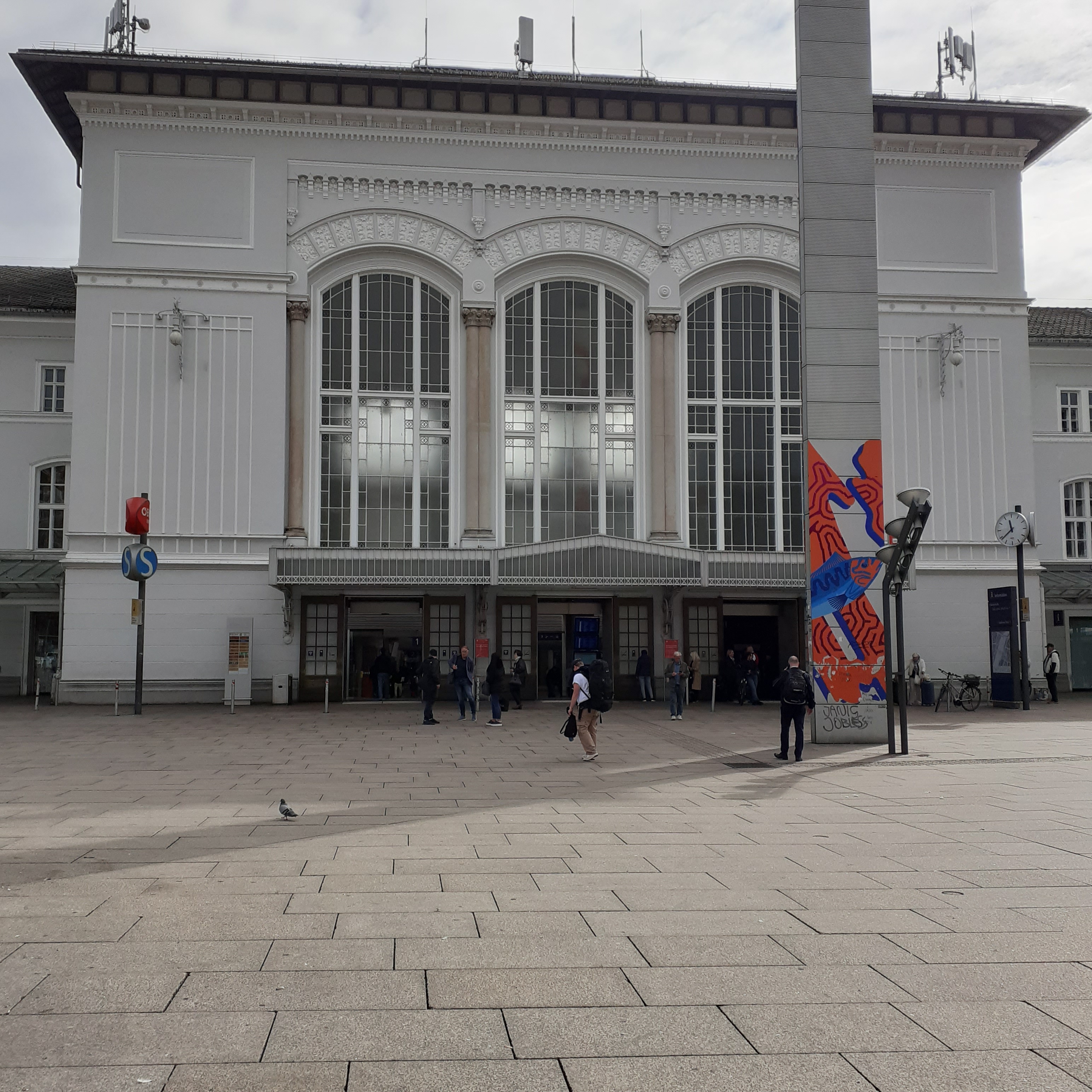
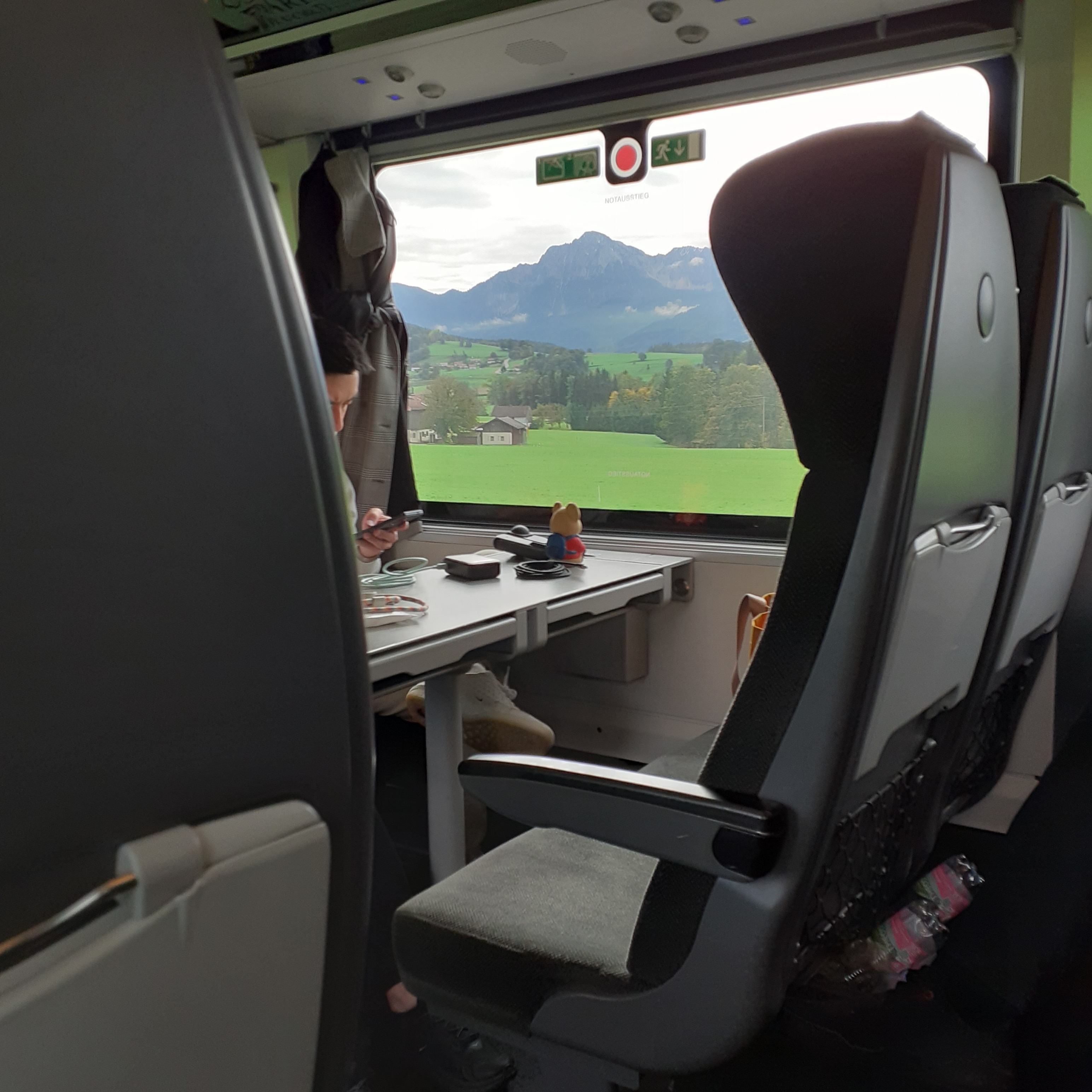
Salzburg is not directly accessible from Dublin outside the Christmas season, so I took an Aer Lingus flight to Munich and a train on to Austria. Salzburg nestles just across the border, ringed by jagged Alpine peaks. Low cloud obscures the Alps on my October visit, which is a pity. The rail route is spectacular, and I did get glimpses on my return. While the Hautbanhof in Munich, efficient hub that it is, visually equates to Hell’s anteroom, Salzburg’s station is sleek, modern and airy, with good refreshment oases. It opens onto a modern square which is a terminus for the city’s tram and bus services. Without sun or shadow to guide me I find myself a bit disorientated but eventually manage to pinball my way to the hotel. 

Hotel Scherer is less than a ten minute walk from the station, a bit more when winging it like me. I find it set in a quiet residential quarter that emerges from the edgy periphery of the railway overpass. Such structures are inevitably ugly, though this one serves to make Dublin’s unloved Loopline positively handsome by comparison. It also demarcates the city centre from the inner suburbs. I arrived at four o’clock for check in and then take a short walk down to the river. 

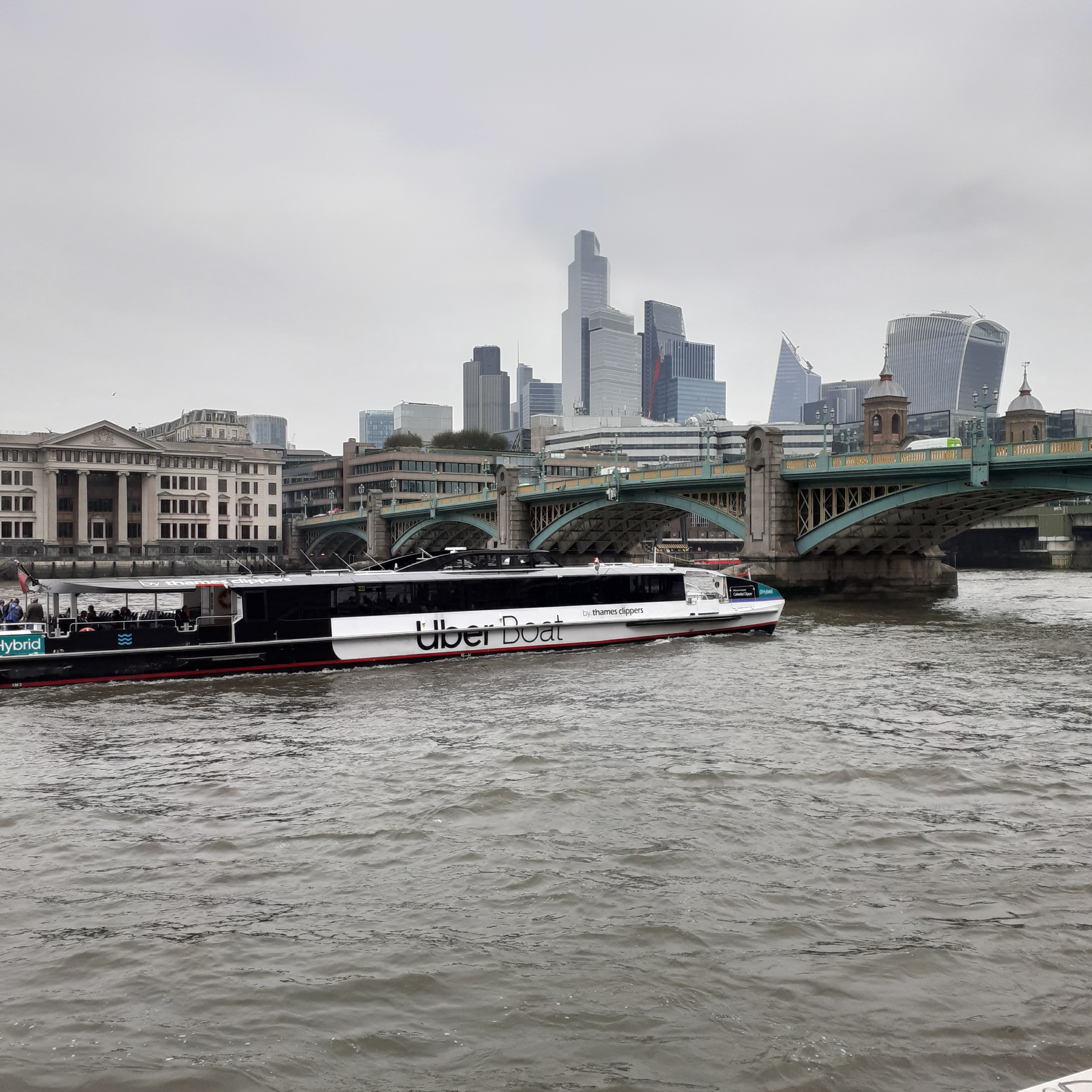
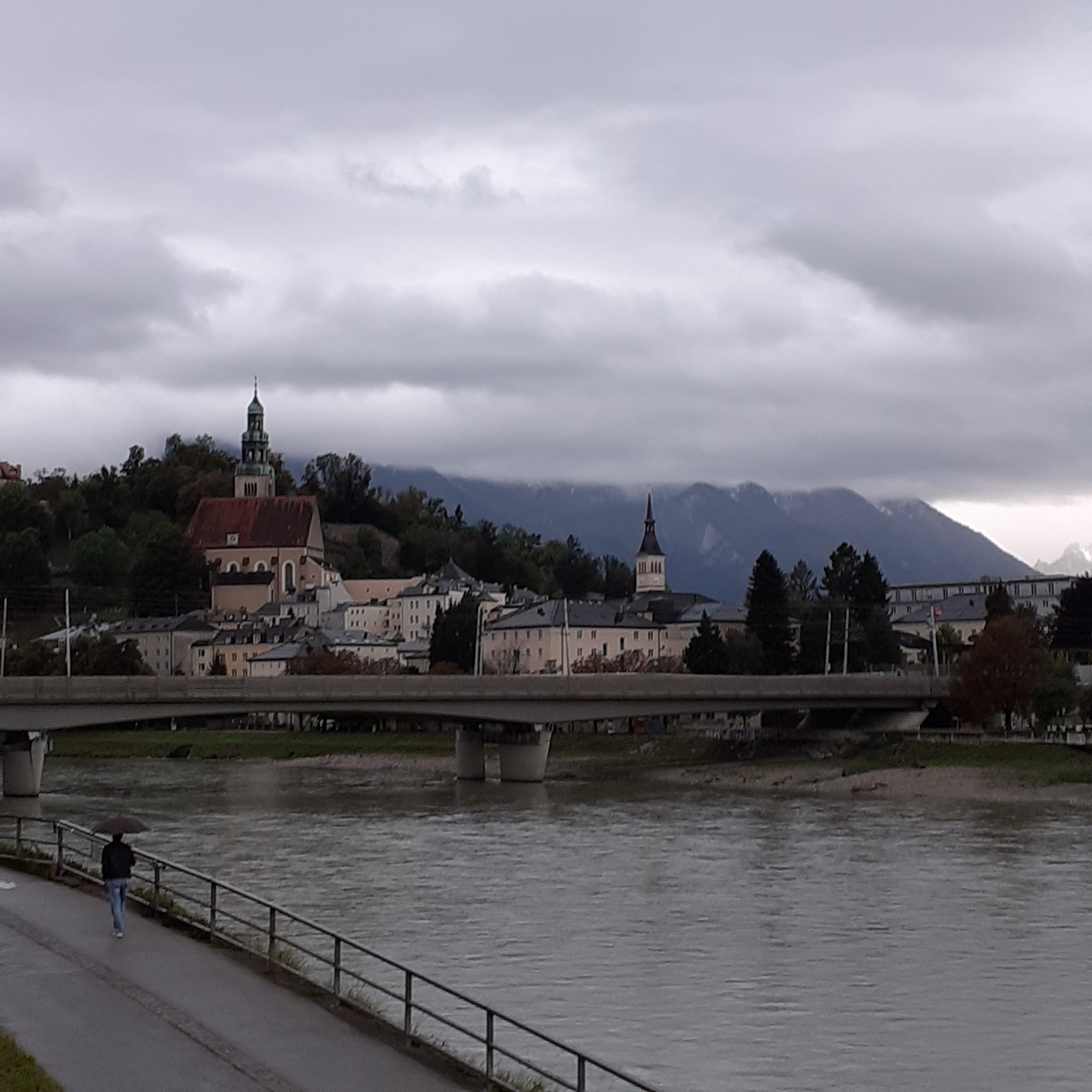
The River Salzach powers through the city, its swift flow channelled between attractive quaysides on both banks. Elizabeth Kai leads all the way into the city centre, a fifteen minute walk or so. Nearby, just past the railway, the Mirabellgarten is laid out on the north bank. This is an attractive rectangular park flowing around the Mirabell Palace, well sprinkled with statues and fountains. Beyond the buildings, I catch fleeting hints of mountain peeping through the clowd. Night is falling with the rain as I sail into Franz Josef Strasse

I have my evening meal at Lazart im Cafe Wernbacher. Its modern, slightly Deco facade wraps a warm inner ambience. It looks European, but it is in part a Peruvian Restaurant, mixing Alpine and Andean fare. Two American couples at nearby tables talk and enthuse; one couple obviously regulars. Good food in a comfortable, colourful setting. 

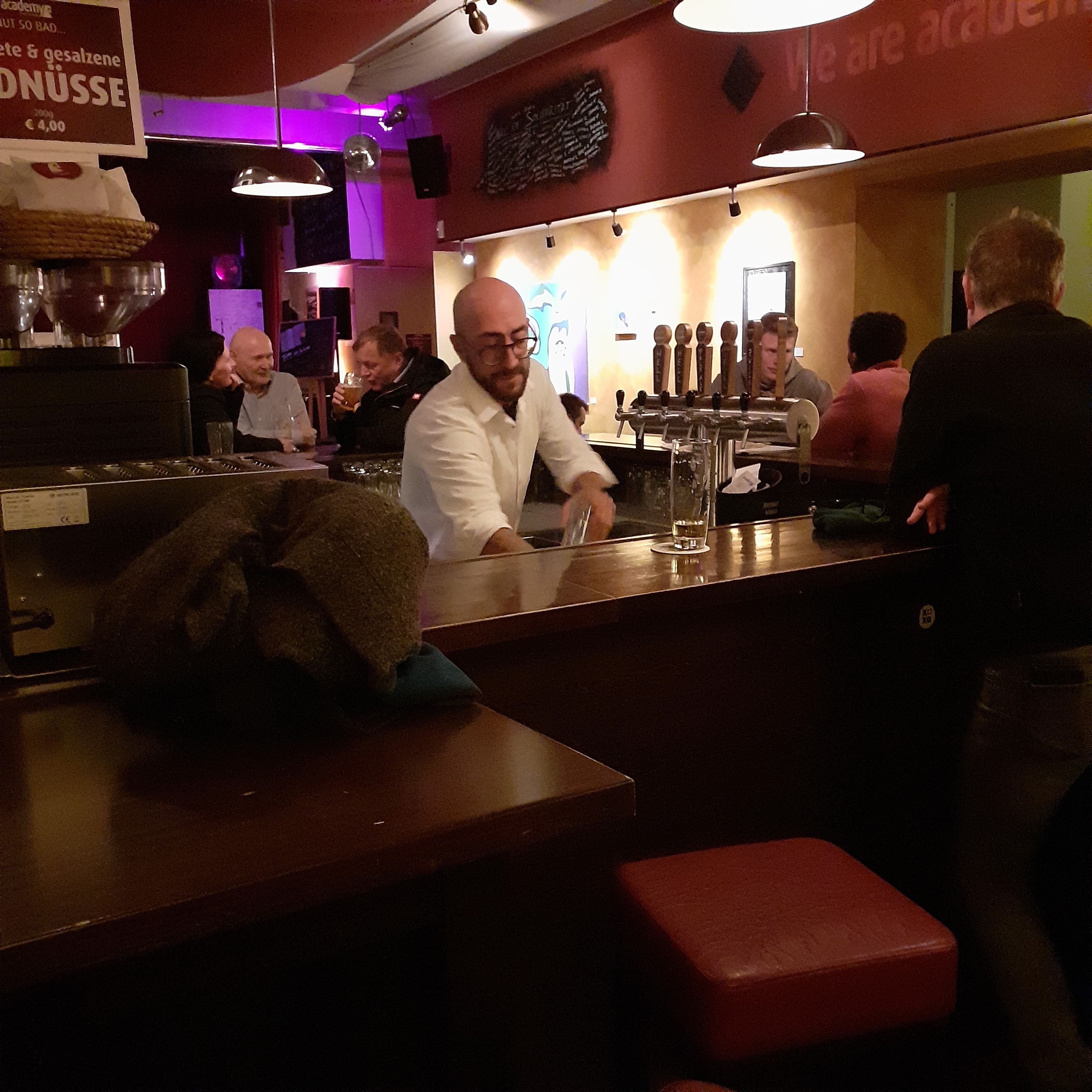
Across the road is the Academy Cafe Bar, with a haphazard, vaguely Bohemian ambience and featuring the Best Barman in the World! I kid you not. One man serving maybe fifty customers scattered through several rooms with panache, unflapable good humour, and speed. How does he do it? He even keeps tabs on my cavalier attitude to beermats, frisbeeing them across the lounge whenever I neglect my duty. But most pleasantly done. I returned the next night but he wasn’t there. The staff, all two of them, were excellent.

That night, I talk to a French Canadian lady on the hotel terrace. She is guiding a group of tourists who have put into port here. Salzburg does seem particularly popular with North Americans. Talk is travel too, and soon we are amongst red maple leaves in the Fall. There’s a good friendly vibe around the hotel lobby and bar which should hasten the approach of sleep. But doesn’t. Later I watch Midsommer Murders in German. Subtitles seem to have disappeared from hotel tvs since covid though the cosiness of the friendly English murder pervades.

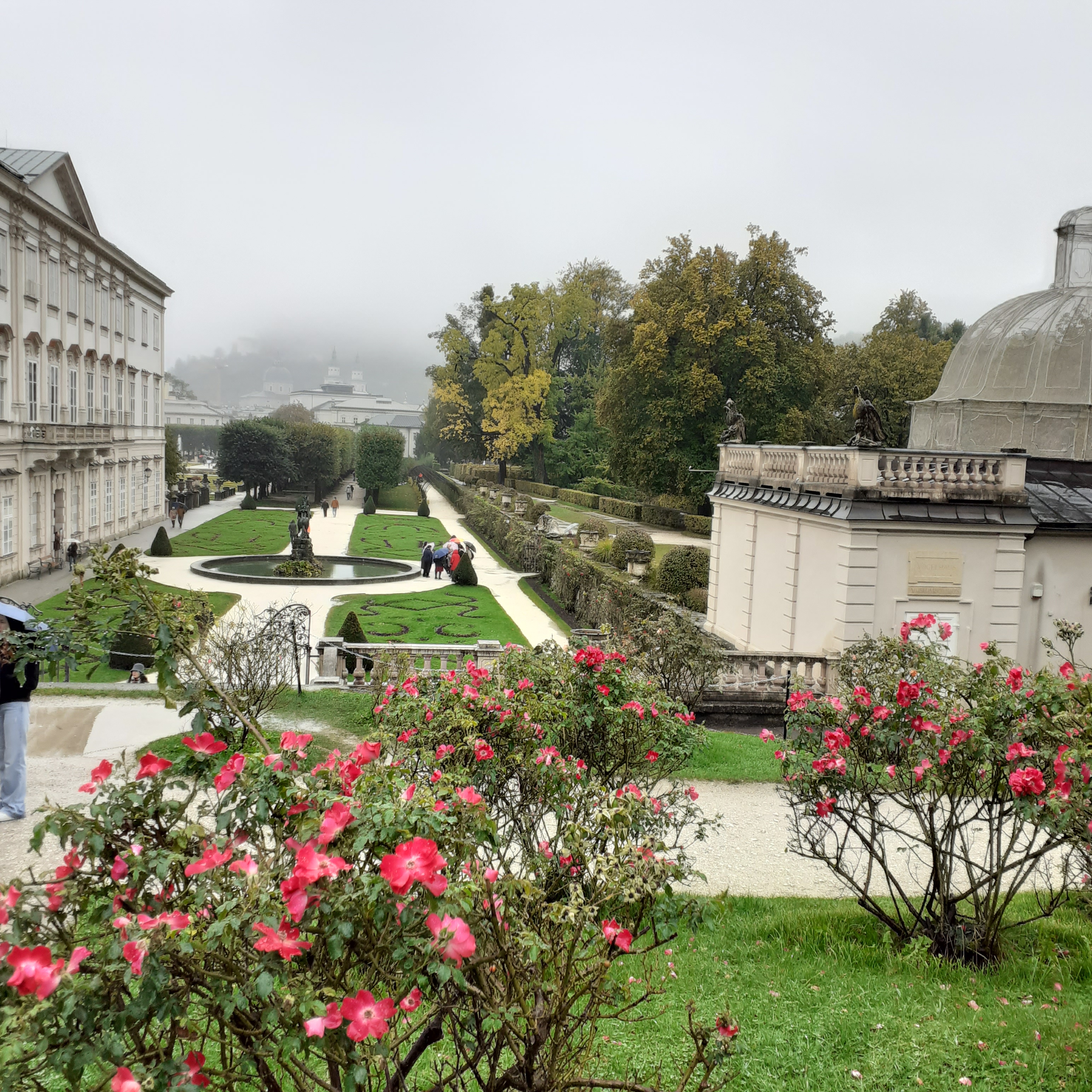
Tuesday is even greyer on my way to the city centre. First a stop for a caffeine spark at Cup & Cino, calmly presiding over a busy intersection within the loopline. I return to Mirabell Park in daylight. The compact park skillfully blends centuries of building, ornament and greenery. Mozarteum Univercity was founded in 1841 and is a college of the dramatic arts with two concert halls. Mirabell Palace along one side was originally home to the reigning archbishop in the late sixteenth century, Wolf Dietrich Raitenau and his mistress Salome Alt. It was an open affair, celibacy then being regarded as a temporary abberration. The loving duo were later expelled. The palace name was coined by conjoining wonderful and amazing; adjectives you’ll use a lot in Salzburg.

Makartplatz at the base of the gardens has the Mozart Museum at the composer’s residence. Across the bridge the Altstadt, Old Town, clings to the far bank, as scenic as you could hope for with the lofty fortifications of Hohensalzburg Castle forming the icing on the cake. The view affirms the guide book witticism regarding Salzburg: if it’s Baroque, don’t fix it. 

Salzburg ranks fourth in size of Austrian cities. It is not a particularly large city with a population just over 150,000 people. It sits about 1,400 feet above sea level with the Alps touching the sky all around. The peak of Untersberg climbs to 6,470 feet and is only ten miles from the city centre. It makes a popular day trip for visitors, with a cable car taking one to within five hundred feet of the summit. The mountain featured in the 1965 musical The Sound of Music. The hills are indeed alive to that.

Of even more note musically is Wolfgang Amadeus Mozart, born here in 1756. At seventeen (going on eighteen) he was a court musician in the city but sought fame further afield and settled in Vienna in 1781. His writing across a wide range of musical genres is seen as a pinnacle of classical composition. Operas such as Don Giovani, The Magic Flute, Eine Kleine Nacht Musik and the Marriage of Figaro remain at the top of the Classical repertoire.

He died at thirty five in Vienna, leaving his wife and two sons, and a body of work to console the whole world through the centuries. And beyond. He is well remembered in Salzburg. His birthplace and later residence are preserved in museum and concert hall, by way of fridge magnets and chocolate treats.

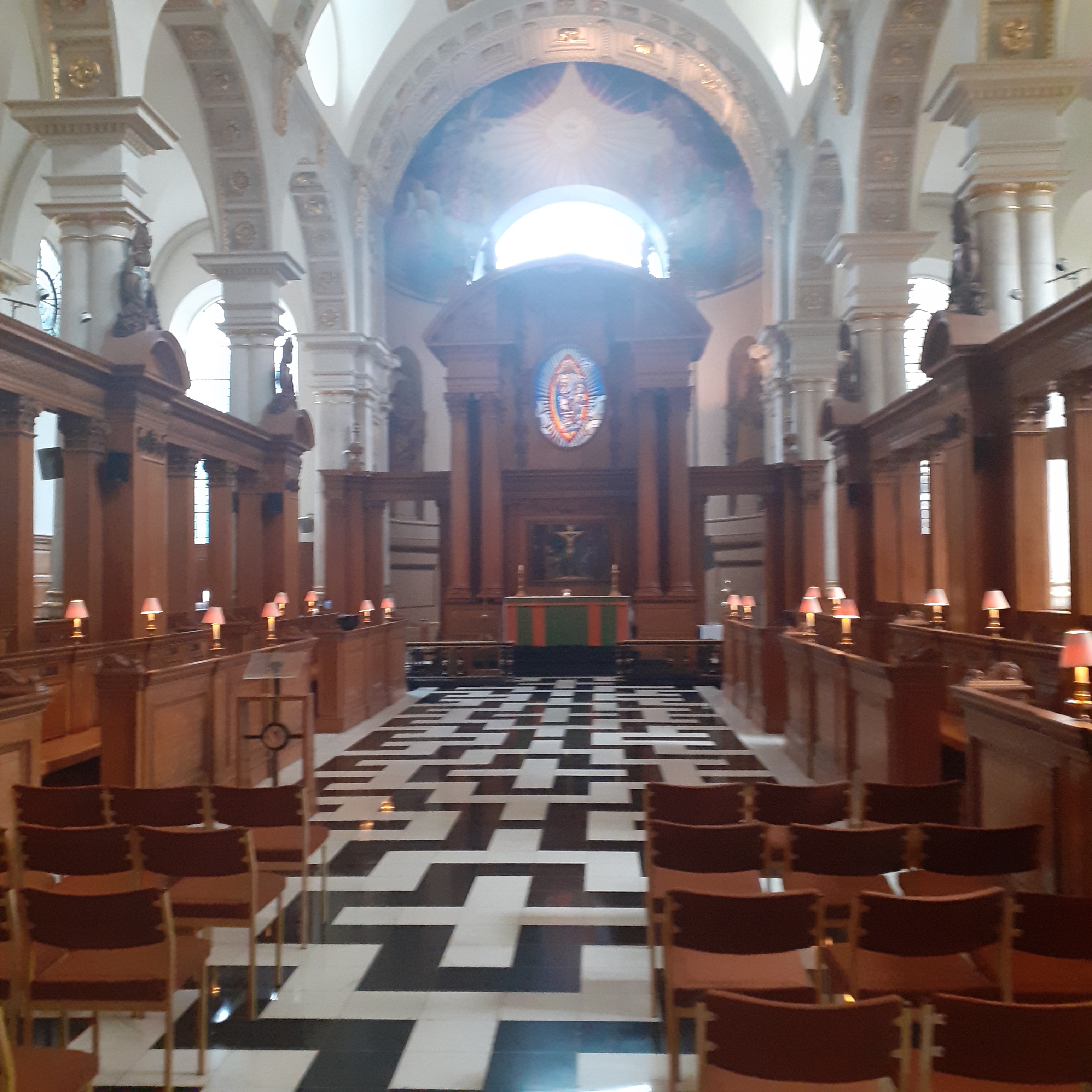
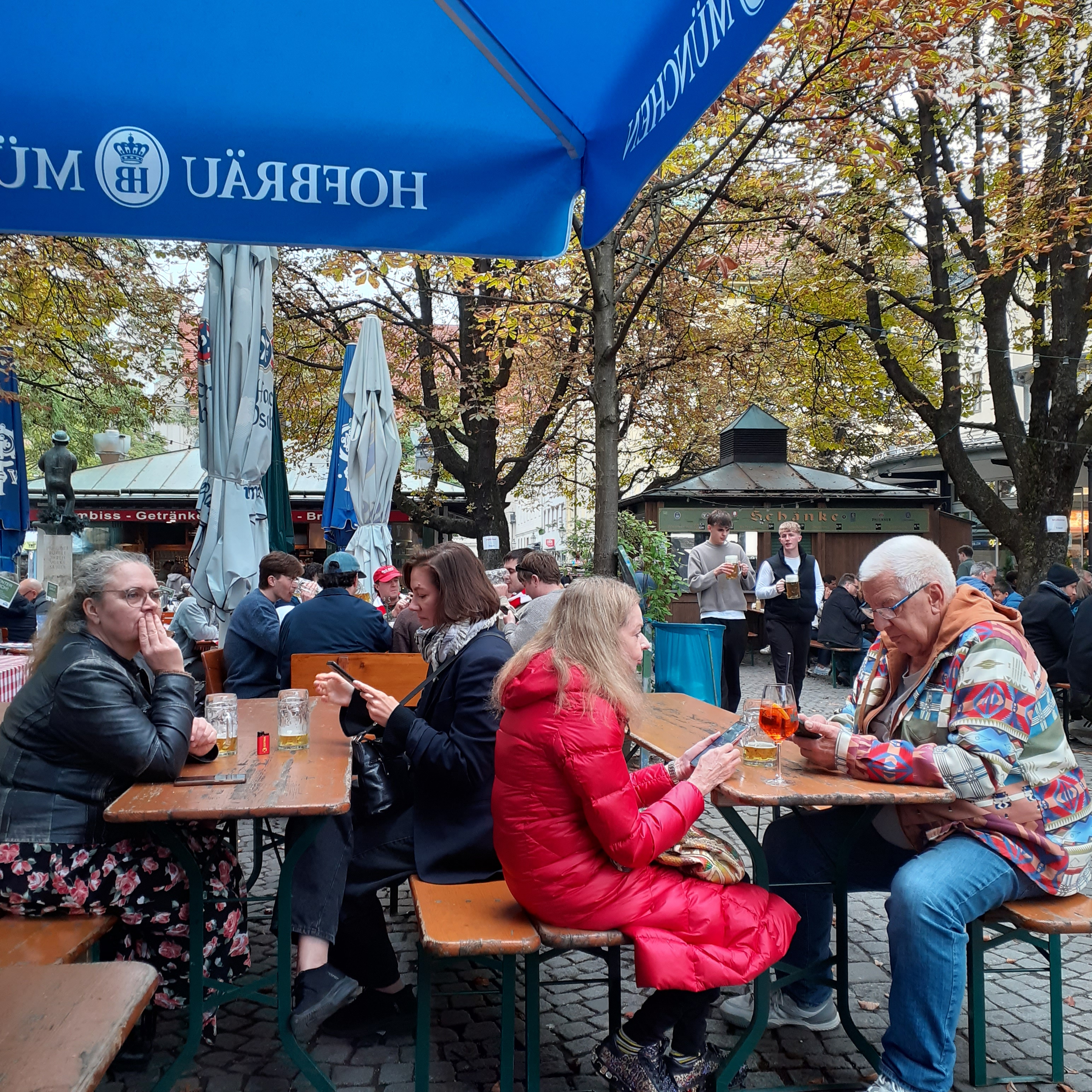
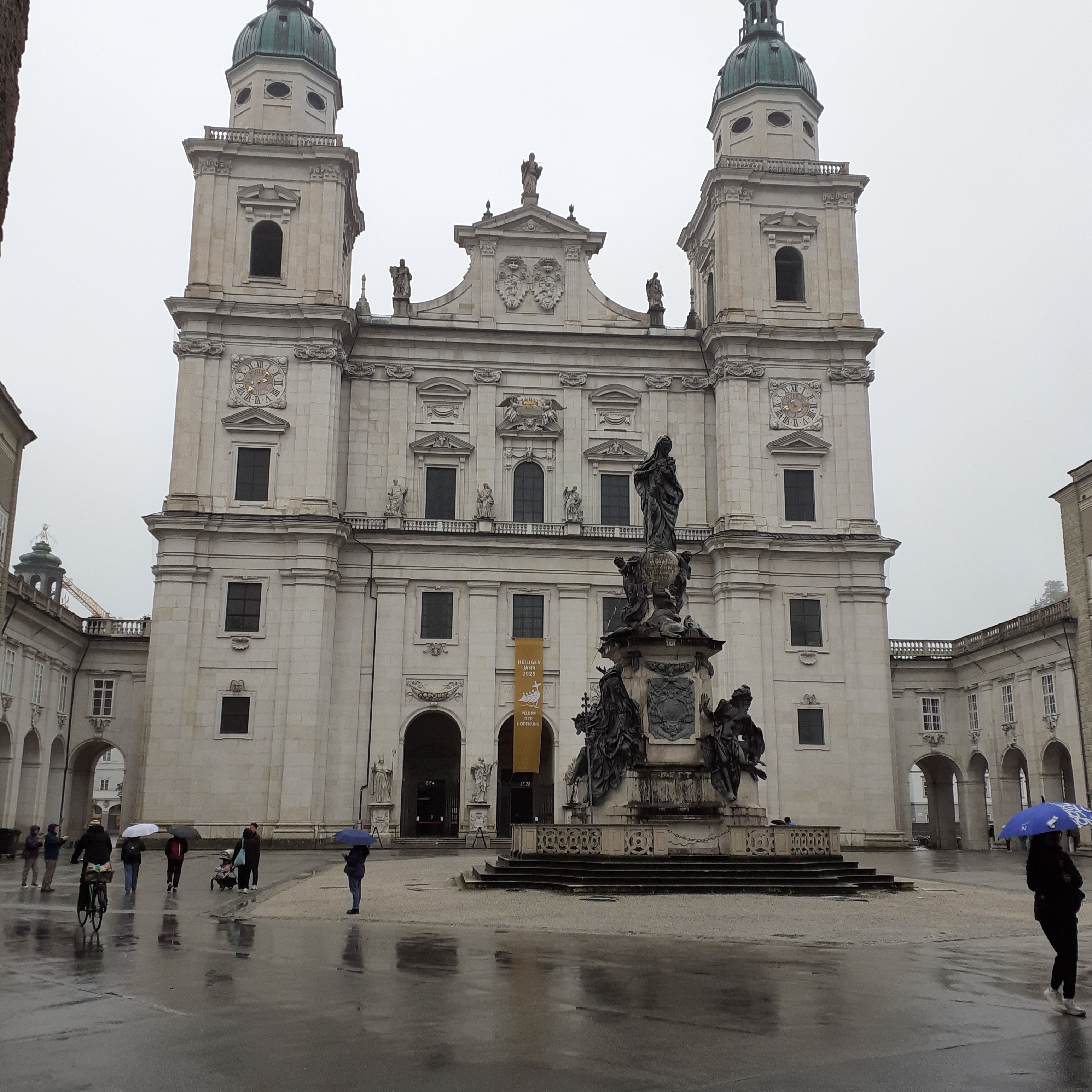
Across the river I stop at Cafe Glockenspiel on Mozartplatz (of course) for their Happy Eggs breakfast. I drape myself on a seat on the heated terrace looking out at a statue of the man himself. Happy indeed. The Dom Cathedral backs on to this square and is a powerful and distinctive landmark of the city. It was designed in the late 16th century in the reign of Raitenau. He was a fan of Italian Baroque, and also responsible for the Old Residence building attached. It was not until 1614 that the foundation stone was laid, the final design by Swiss architect Santino Solaridom 

The entrance fee costs me €5 although I thought the sign read €9, and that with a Salzburg card. Cheap at half the price and rewarding with an interior that is peaceful and inspiring. I stop for prayer at the first available altar, lighting the essential votive candle. I had to repeat the process at the final altar too. Its icon to Mary, in the Orthodix style, was the same as one we had in our childhood home where my mother and my sister dressed a daily altar on the landing. That’s worth a candle at least. Mind, by the time I had lit two candles I was nearing €7 and then …

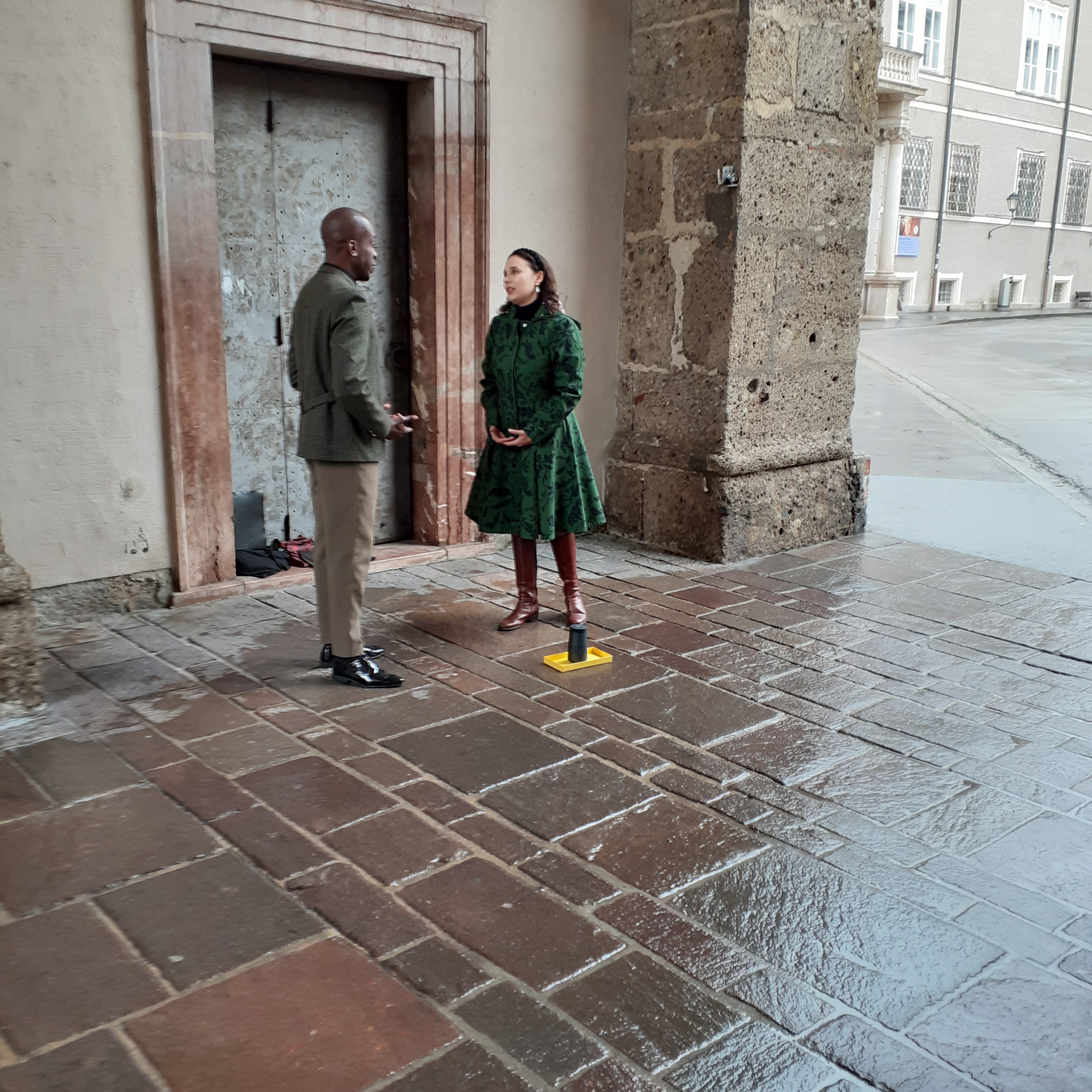
I exit with a calm energy. The front of the cathedral faces on to Domplatz, an enclosed square centred on an impressive Marian column. The square is accessed through three arches. I am leaving the square through the western arch when a duo pop out of an alcove to serenade us. The couple, who I think are English, give voice to the magical music of Salzburg. I am caught in their web for three or four numbers. Culminating in the Magic Flute, where heroine Pamina and comic everyman Papageno sing:

Bie mannern welche liebe fuhlen

fehlt auch ein gutes herze nicht

(men who hear the call of love 

do not lack a gentle heart)

The duet is in praise of love and the marriage of man and woman. It links love with the divine, expressed in music that is spiritual and sensual. Hearing such music live, red and raw, is elevating. Soul swooning upwards left me dizzy. Lighter financially, of course; they are buskers after all. The coexistence of spirit and senses inside and outside the Dom had set me back a tenner, but was truly priceless. I walk on air, feeling like a character in a painting by Marc Chagall. Excuse me while I kiss the sky.

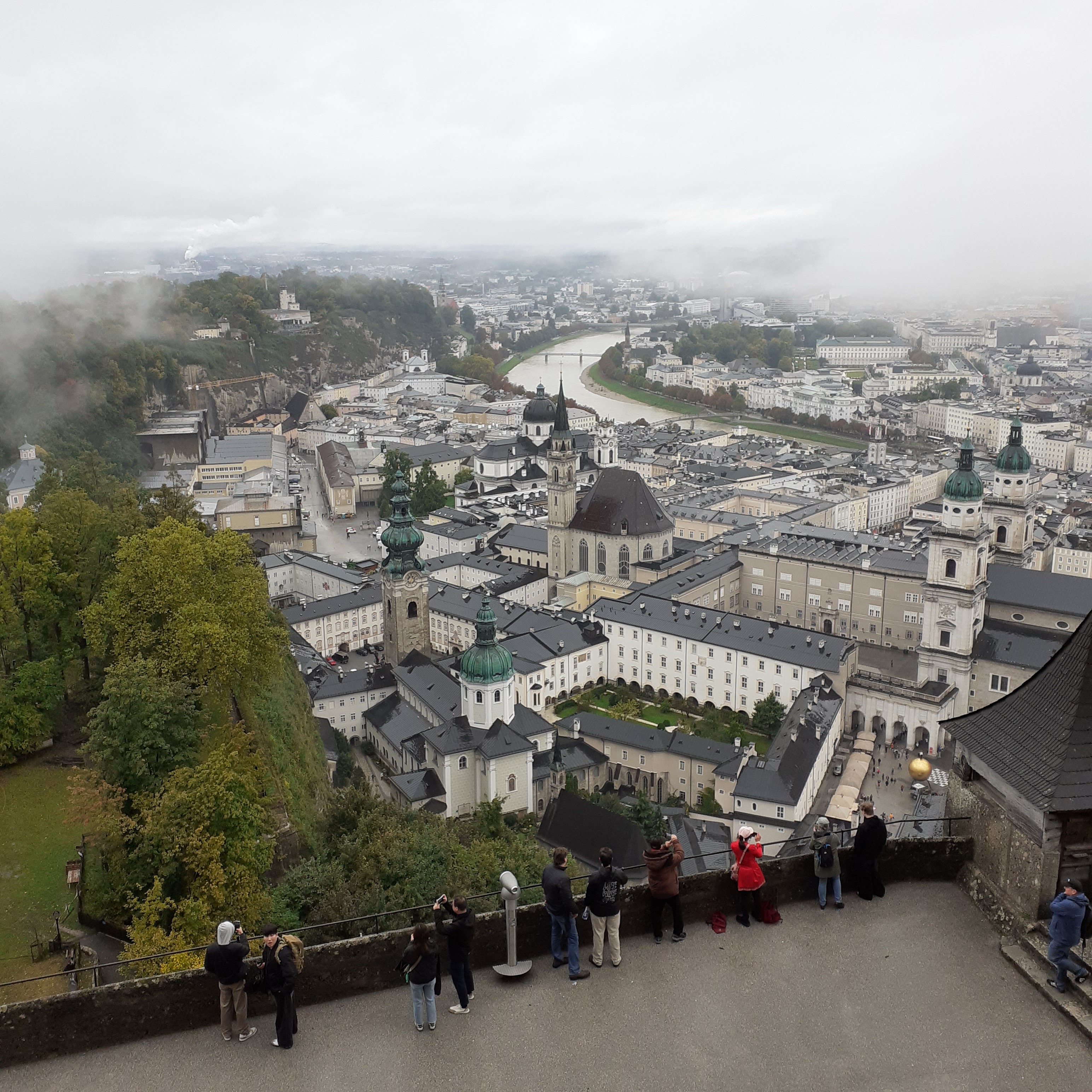
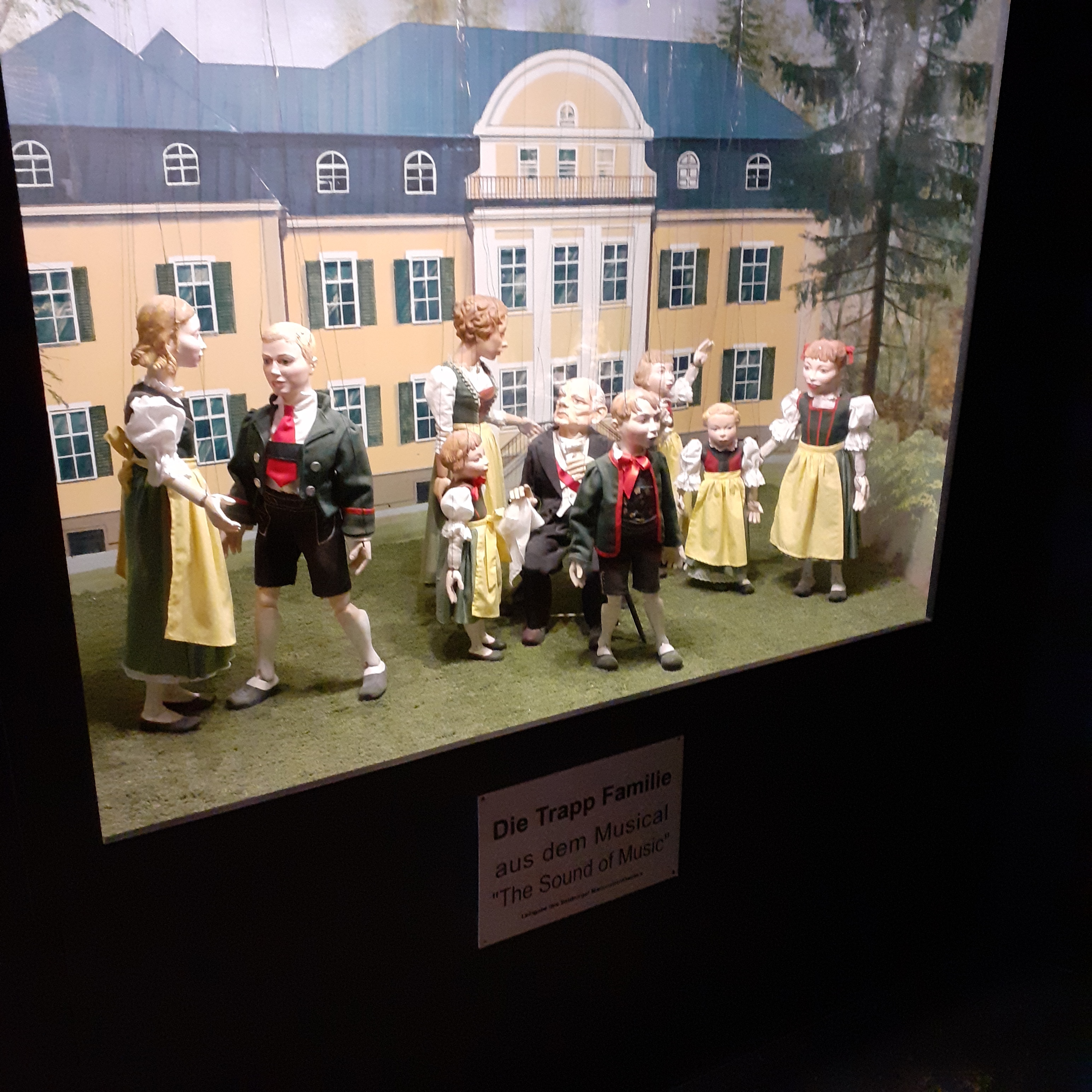
To get truly high in Salzburg take the funicular to the castle. A true ice cream castle in the air, for centuries it was the bastion or the ruling archbishop. The fort was first established around 1077 and has been embellished over the centuries. The funicular was built in 1892 as tourism grew. It beams us up through building, forest and cloud to deliver us to giddy heights. Whether the clouds cushioned or contributed to the sense of vertigo is hard to say.  A biergarten balanced on the cliff edge is not open, while the battlements offered leeting apertures of the city far, far below. There’s much to see within the walls. A museum of puppets includes an animation of the peasant’s siege of the sixteenth century. And the Von Trapp family in miniature. The castle museum has models of the fortress through the centuries. There’s much of miltary and political interest. History never rests, but persists.

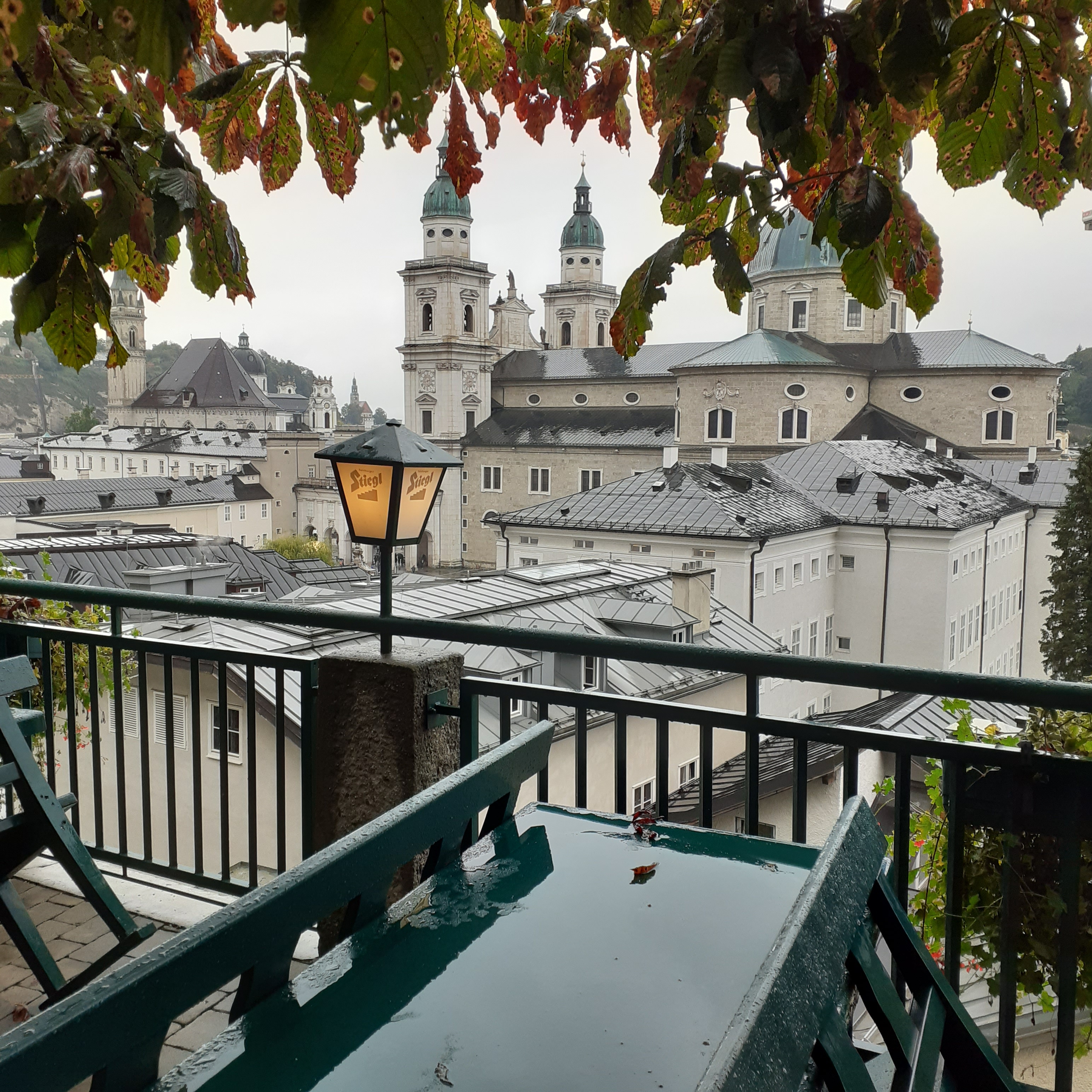
i’m walking on air again as I make my way back via the funicular. Touching ground, I consider this the perfect time to fortify myself with a pint. Stiegkeller is a large building beside the funicular, with cavernous old style bars, restaurants and a rooftop garden. From the garden terrace there’s an excellent view over the city, dominated by the Dom. Service is straightforward scoop and go, a lady pulls your pint and you carry it off. This is music to my heart, dispensing with the middleman, the waiter so beloved, mysteriously, of continentals. Still, such delaying tactics, and indeed food, are available here. But bah! I decide on another self service pint.

Back to Andalusia – Almunecar by Bus

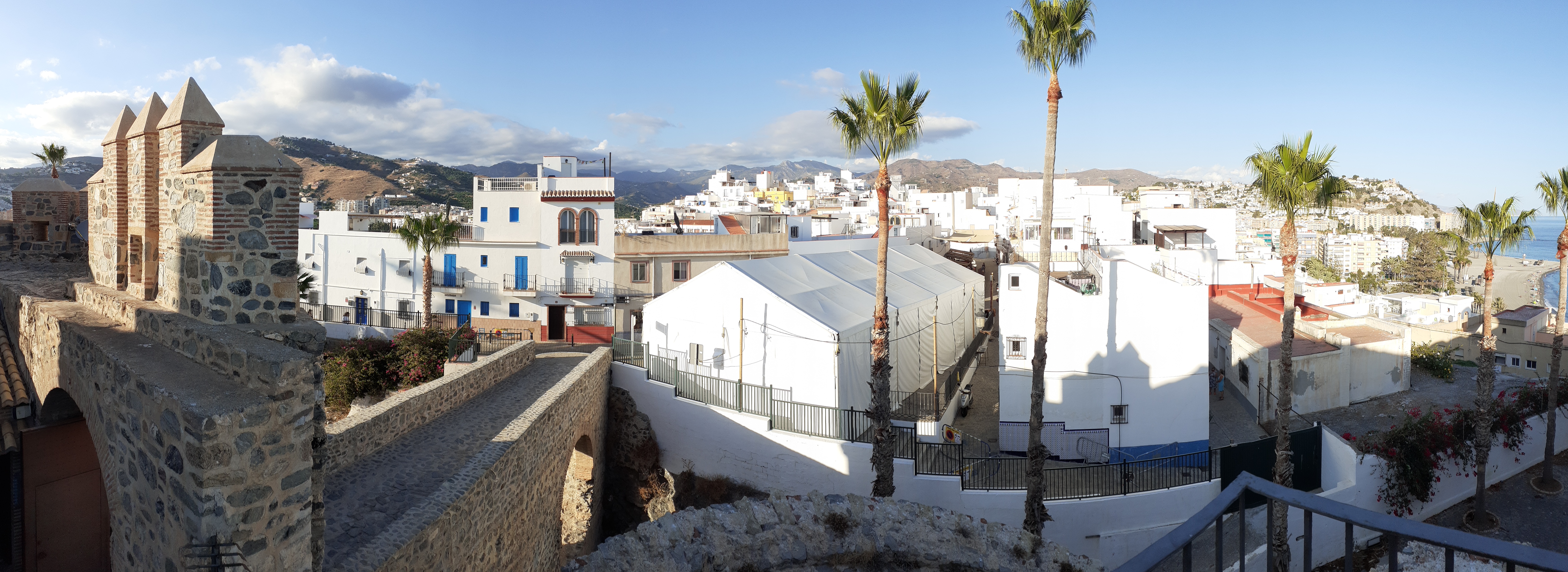
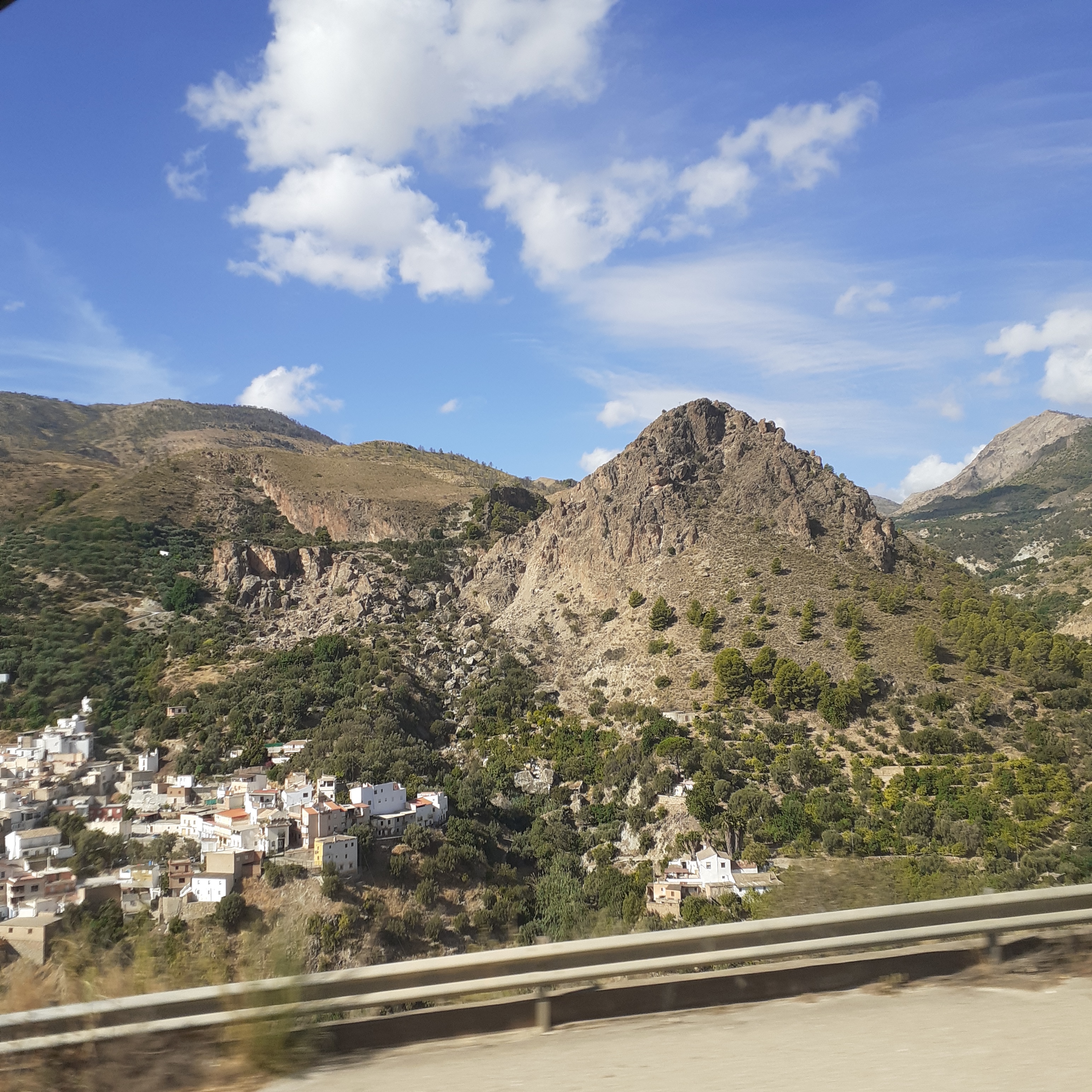
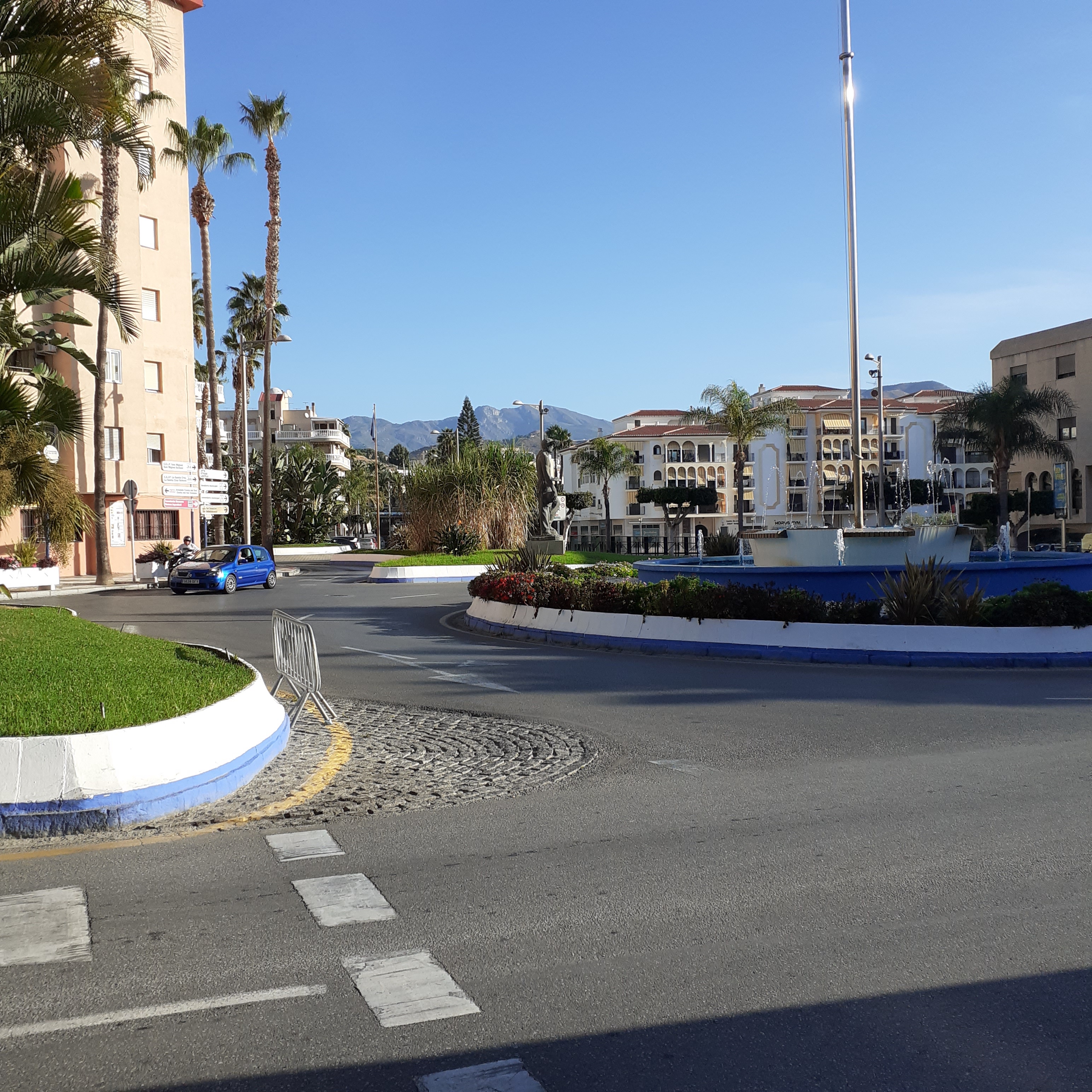
The bus from Grenada to Almunecar heads due south through the Sierra Nevada. We get an eyeful of high mountain scenery. As a designated driver, it is such a pleasure to sit back on the bus and soak in the beautiful views. Almunecar is on the Grenada region’s short coast. The bus station is at the high end of town. Disembarking, we cross the busy thoroughfare and take a sidewalk seat at the first available cafe bar, Casablanca by name. Though it doesn’t resemble Rick’s Bar; I am sure a lot of people come here, with welcome refreshments and a terrace panorama of busy town life. When we orient ourselves, we take a fifteen minute walk seawards along Avenida Europa to our hotel. Hotel Goya is a small family run affair, between the main lower town and the seafront. Above all, is the castle; Castillo de San Miguel.

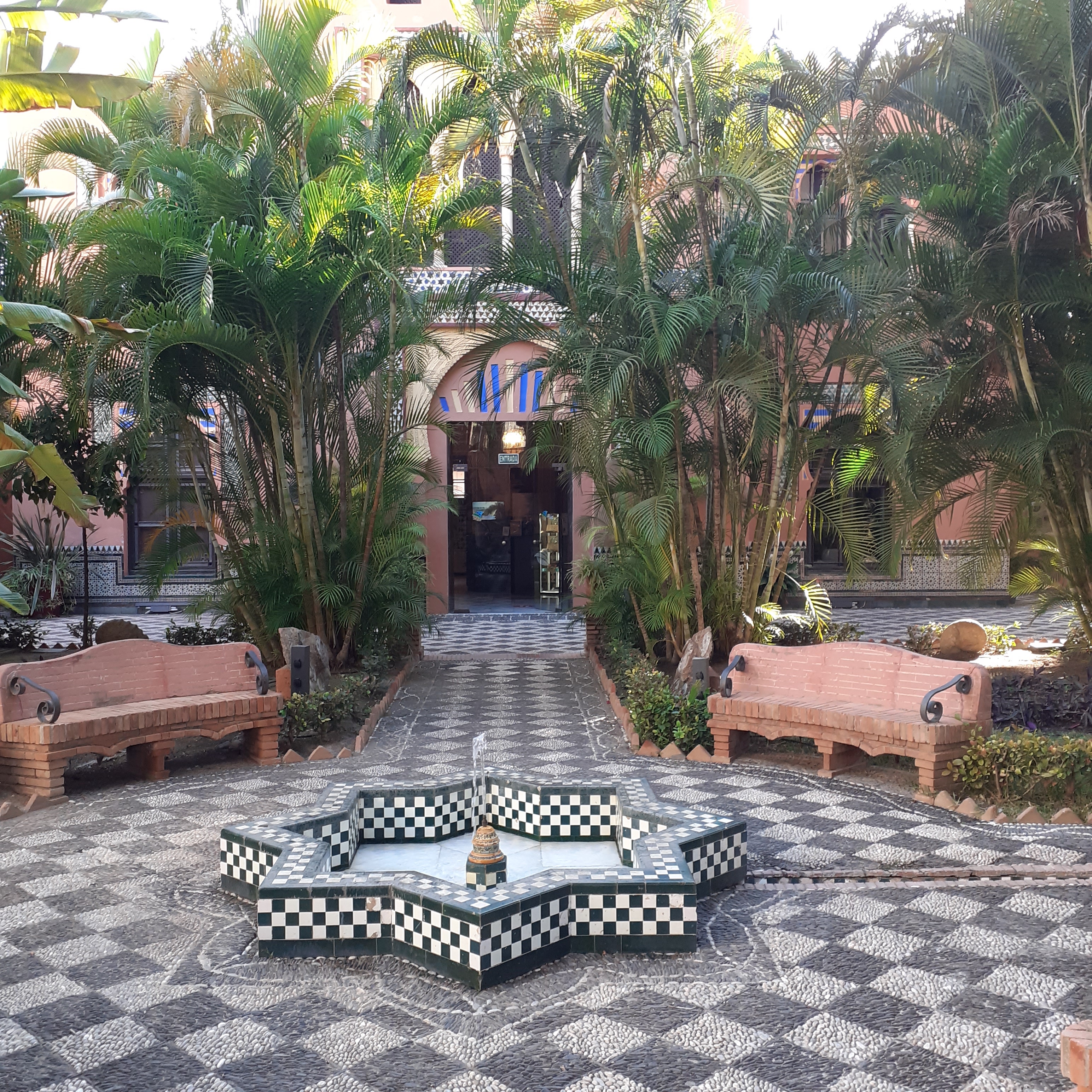
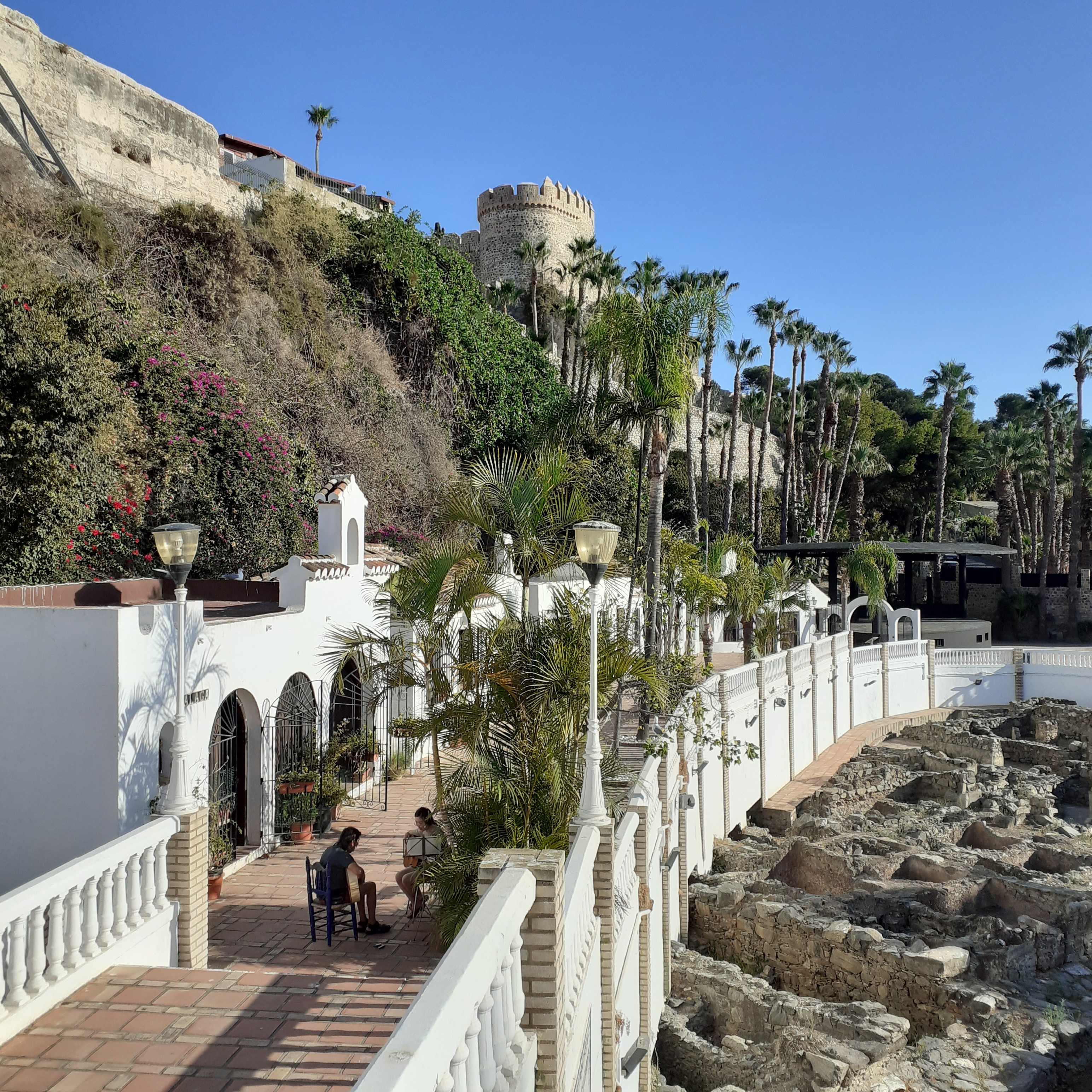
Near our hotel, the Botanical Gardens contain the ruins of the ancient Phoenician fish salting factory. The Phoenicians were settled on this coast from 800BC and their name for the town was Sexi. The natives might still refer to themselves as Sexitanos. Just so you know. The tourist office is right across the road. Housed in the La Najarra Palace, a nineteenth century building in the Mudejar style. Set amidst a wonderful garden, with towering palms, chequerred walkways and a central pool, it is an Eden of relaxation on a hot day. There’s a child sized house at one end. We spent a late afternoon sketching there, with no end product but pleasure.

The town name is derived from the Arabic, meaning surrounded by mountains. Indeed it is. The Costa Tropical collides with steep mountains to spectacular effect. Almunecar has a population of just over twenty five thousand. It is more a Spanish than a foreign tourist resort. Less busy than Nerja just a few miles west along the coast, it is intimate and relaxed. 

Almunecar may ring a bell for literature fans, featuring in Laurie Lee’s book, As I walked Out One Midsummer Morning, 1969. This formed the second installment of his memoirs, a few years after Cider with Rosie. From 1934, Lee travelled the length of Spain. He made his way taking casual jobs and busking; he played violin. He arrived in Almunecar, which turned out to be his last stop in Spain. Here, he worked in a hotel, and as a tourist guide. The Spanish Civil war broke out in 1936 and Lee was evacuated by a British warship sent from Gibraltar. He would return to Spain the following year to fight for the Republicans. In Lee’s account, the town is referred to as Castillo.

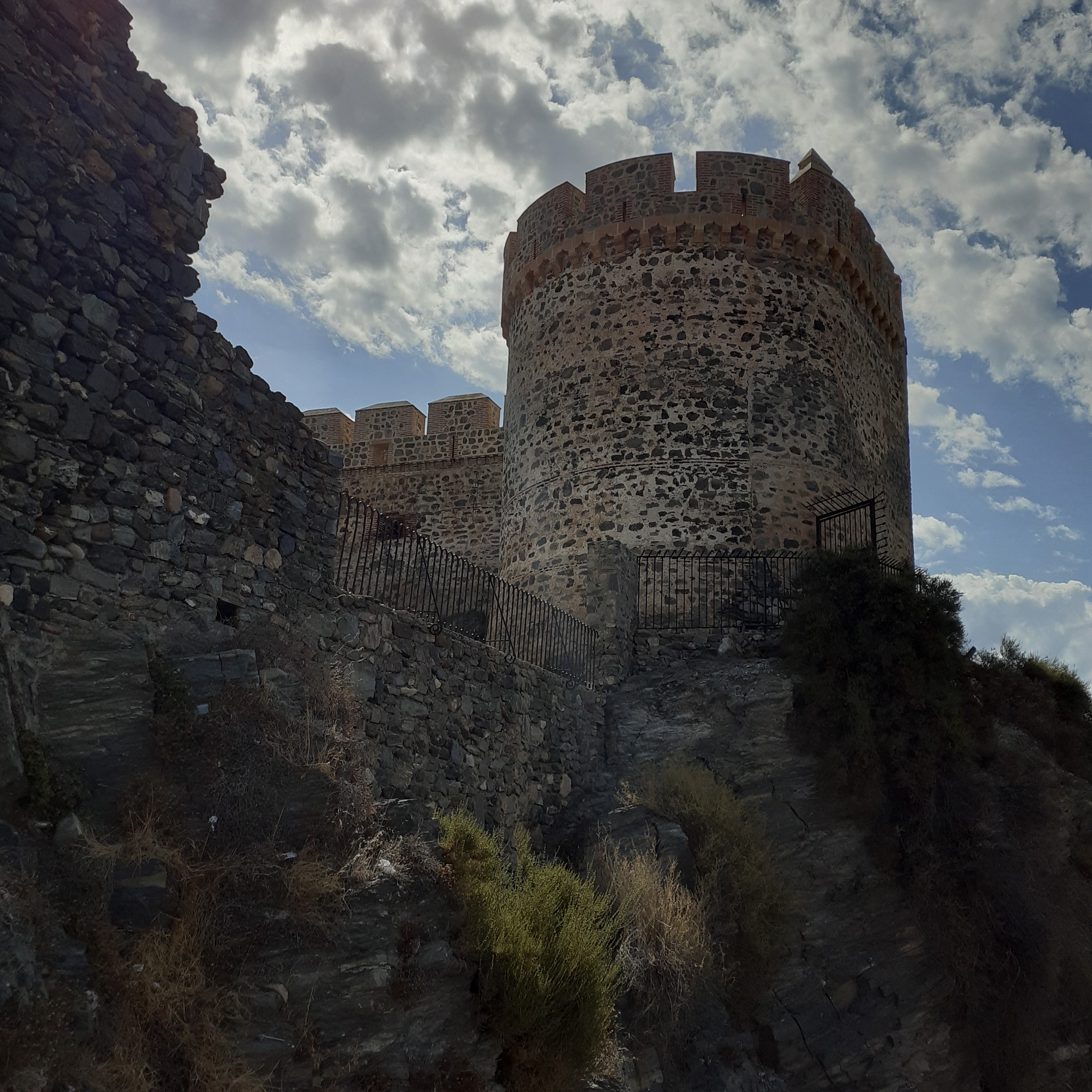
The Castillo de San Miguel certainly defines the town. It was first established by the Romans in the times of the Punic Wars, two centuries BC.  Subsequent alterations now prevail. The fortress prosperred in Moorish times, ultimately surrendered in 1488. During the Napoleonic Wars, the Castle last operated under control of the French. The English, with Spanish support, seriously damaged the complex, although the outer defenses were reletavily unscathed. For a while it was used as the town cemetery, until the rise of tourism prompted restoration work to begin in the 1980s

Visiting the castle is a must. The old town is a serpentine maze, constantly rising. Just off the main drag, Plaza Higuitos provides an oasis. While the eponymous establishment is beseiged by growing queues, across the tiny square there’s room at Bodegas Manuel Callejas The tapas here are good too, not just the automatic default; as we have eaten enough olives throughout Grenada to turn green and start a pip factory

Higher up, the narrow street widens into Plaza de la Constitucion, with the Ayuntamiento (Town Hall). along one side. There are two good restaurants at each end; and we fortify ourselves with drinks and tapas. The Church of the Incarnation is on a hill behind the town hall. It dates from the 16th century and has a stern imposing facade. This is the centre for the Semana Santa processions, and the street is tellingly named Calle Jesus Nazareno. Behind the church is Casa de la Cultura with a museum and theatre.

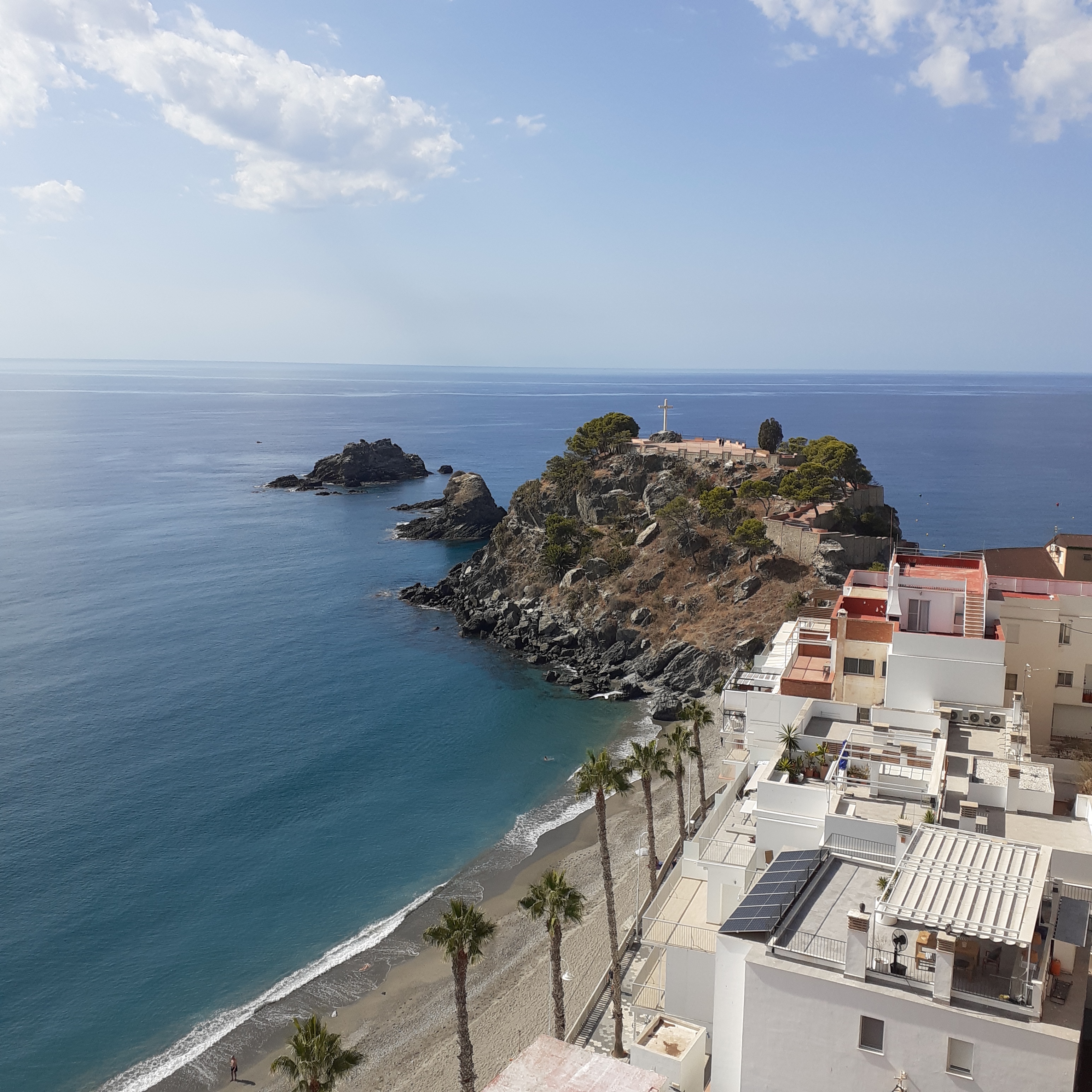
The orienteer within eventually guides us to the high esplanade of San Miguel. The saint’s festival is getting underway and everyone is gearing up for the nights festivities, setting up stalls and quaffing a few aperitifs. So, it’s getting into evening by the time we reach the castle. The lady at the door obligingly gives us a pass for the next day as we stop our visit abruptly owing to a sudden onset of starvation. Returning early the next day we are rewarded with a relaxed time amongst the ruins, and breathtaking views from the ramparts. There’s a good exhibition at the on site museum showing the castle’s evolution through the ages.. From the southern ramparts, the view downwards to the coast overlooks the cross at Penon del Santo. This was once connected to the castle by viaduct.

We take the rapid descent route back down. This winds down beneath towering castle wallls, touching earth beside our Botanical Gardens. Heading on to the searfront, Penones de San Cristobal are three rocky crags, dividing the searont at Almunecar. The highest crag, Penon Del Santo, is marked by a tall cross, a modernist structure from 1900. Guarding the base of this rock, there’s a monument to Abdalrahman I, the founder of the Emirate of Cordoba in 756. 

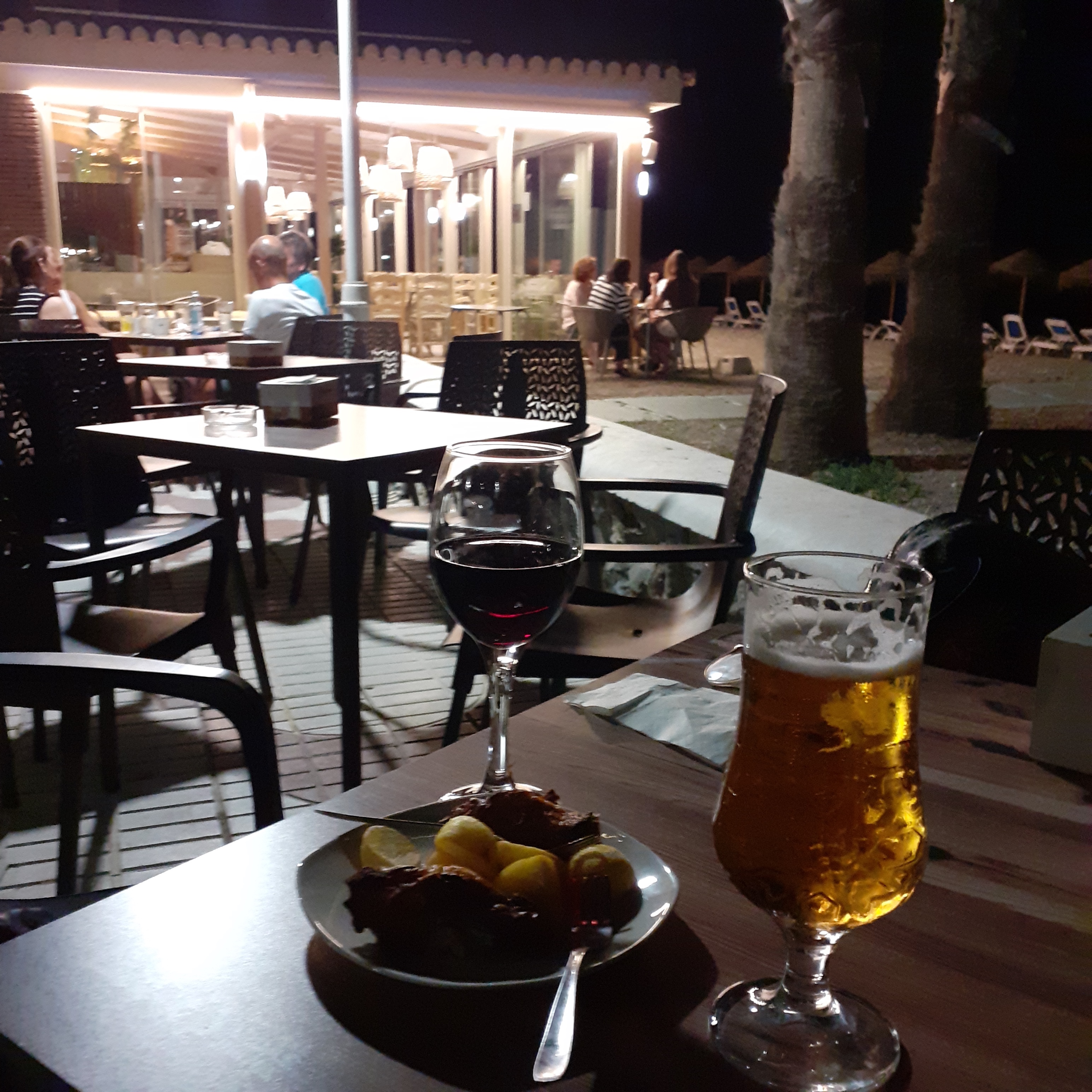
Puerta Del Mar to the east is the main bay of the old town while Playa Del Cristobal is a long straight esplanade heading into the west. Chirinquito El Pilici and Bar La Cana are amongst the many beach bars lining the seafront, offering a large selection of food, many with charcoal grills. We stop streetside at Restaurant Sabina. Sabina Schumacker herself greets us. A German lady, she makes a superb menu guide. Though I am not always a fish fiend, other than my chipper favourite of battered cod and chips, Sabina guides us towards the Monkfish and it is as superb as promised. Next door is the Helios Costa Tropical, the largest hotel on the seafront. This boasts a rooftop bar with great sea views, the prime place to bask in the setting sun.

Another night we eat at Elysium Restaurant farther on. It radiates a relaxed Bohemian air. The manager, laid back and friendly, tells us about the cuisine prepared by her husband from Aghanistan. The couple moved here last year from Austria and are enjoying the sun and sea air. We enjoy the food immensely. Ad hoc entertainment is provided by an English woman shellacing her errant husband, first on mobile phone (aren’t mobile phones wonderful!) and then in person. As we sneak out she comments loudly on our Irishness. We fade to black.

From here, the long seafront winds away to a beautiful emtiness, darkness on the edge of town, lights at the edge of the next twinkling with distance. The sun has set, but will rise again tomorrow. For many, in fact, the night never really ended. The Spanish know how to do festivals, and with the festival of San Miguel in full swing, the hilltop revelry goes on long into the night. Its a pleasant distant soundtrack, cushioning the fall into sleep.

After check out we head out for breakfast and towards the bus station. Churreria Picasso opens early, and is a popular start to the day for locals. Churros are made with choux pastry dough, fried till crispy on the outside and cut in long lengths. Taken with coffee for breakfast, or dipped in hot chocolate, they are popular throughout the Spanish speaking world. 

We have time for one last coffee at Casablanca and watch the time go by, again. There’s a crush of coaches at 11 o’clock, but a friendly German expat puts shows us to the right one. It’s just over an hour along the coast to Malaga and we close the circle of our magical bus tour. 

I know I’ve played this before, but I…. I’m not going to say it; and neither did Humphrey Bogarde. As Time Goes By was written by Herman Hupfield in 1931 and rose to fame when sung by Dooly Wilson (playing Sam) in the film Casablanca in 1942.

You must remember this

A kiss is still a kiss

A sigh is just a sigh

The fundamental things apply

As time goes by

Back to Andalusia – Granada by Bus

We took the bus direct from Malaga airport to Granada some sixty miles northeast. The journey takes about an hour and a half which brought us into late afternoon. The road rises through the  coastal mountain range before falling to La Vega de Granada, the fertile green basin leading into the city. The Sierra Nevada soar to the south. Spain’s highest peaks make an impressive backdrop as we alight at the terminus, Grenada with a population of over two hundred thousand sits two and a half thousand feet above sea level. Higher still, the magical Alhambra floats above the city.

I visited Grenada before, around Semana Santa in late March, and the Sierra were snow capped on the horizon. Grenada shivered, showers of snow and sleet washing across the limpid Spring air. That was my pilgrimage to the Alhambra, visions of Spain caught in a curious snow globe. It was brought about by my first guitar, an Alhambra, and my ambition to play flamenco. Now I’m back.Fying solo’s fine, but with M in tow I have a shoulder to lean on and an ear to burn and boast to.

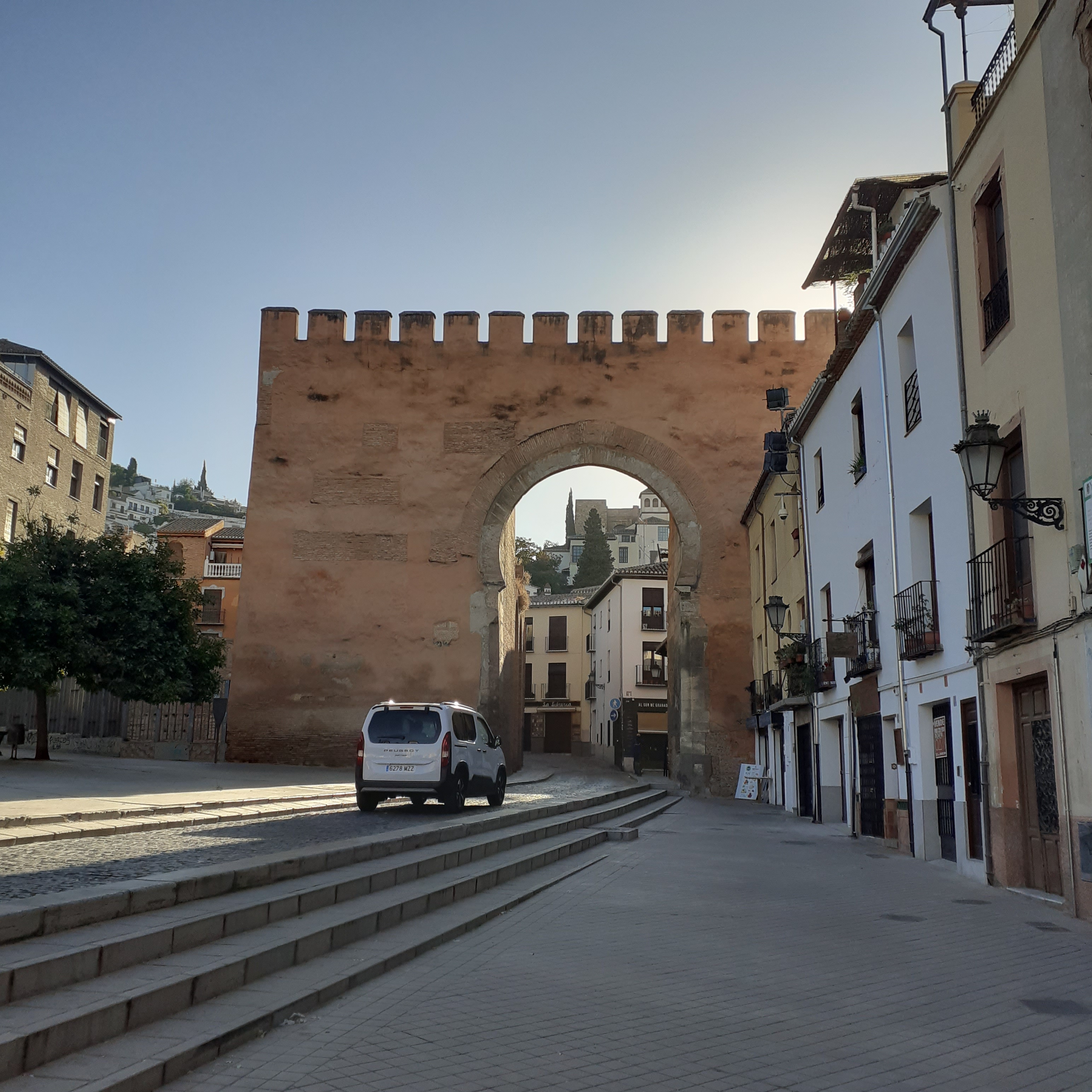
Granada bus station is a good bit out of the city centre and we take a taxi to our hotel. We are staying in the Exe Triunfo Hotel off the top of the main avenue, Gran Via de Colon. The receptionist is a fountain of knowledge and our three days in Granada are well mapped out. The hotel is next door to an ancient entrance gate of the city. The Gate of Elvira, a russet fortified archway, presides over the square. Passing through, we enter the labyrinth of the Old Town winding down to the city centre. Gran Via de Colon to one side and a steep hillside forming the other bracket.

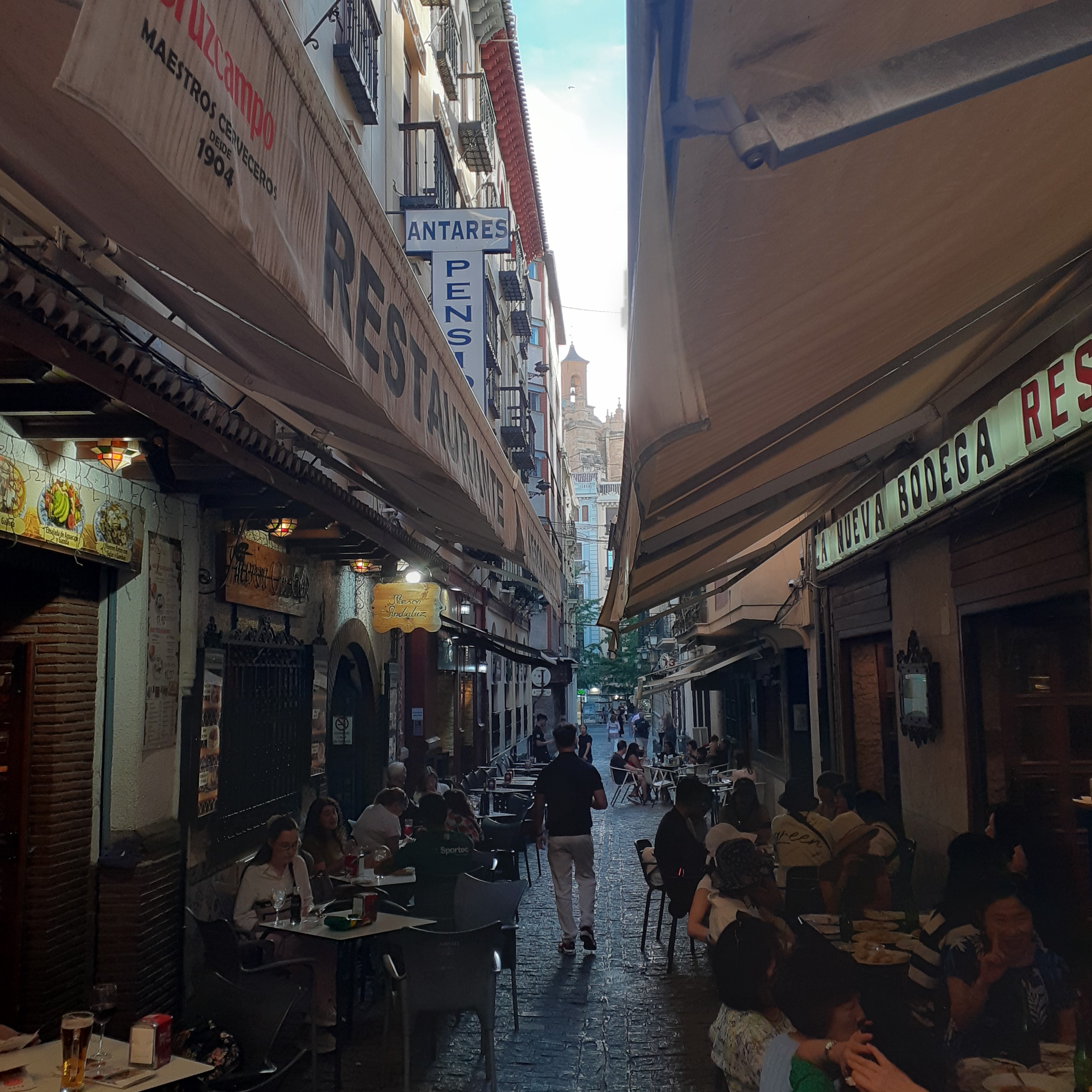
Calle Elvira itself is the main drag of the Old Town. The name is a curious echo of our friend’s villa in Elviria near Marbella where we will be heading next week.. But this is a slice of ancient urban Spain. Rambling, rickety and full of character. It is lined with quirky shops, cafes and casual eateries. Elvira leads to the city centre where the Plaza Nueva spans the Darro River.  Before that, the street branches into a few vibrant city lanes. Caldereria Nueva leads uphill into the Albaicin. Towards Gran Via, Cetti Meriem has a cluster of clubs and eateries. We eat at a few of these, the food and the atmosphere are great. This area had been a haunt of mine in the cold times of old. Hennigan’s Irish bar to be precise. Nights spent amidst copious pints and a vivid soundtrack of suitable rock including the Red Hot Chilli Peppers and Iggy Pop.

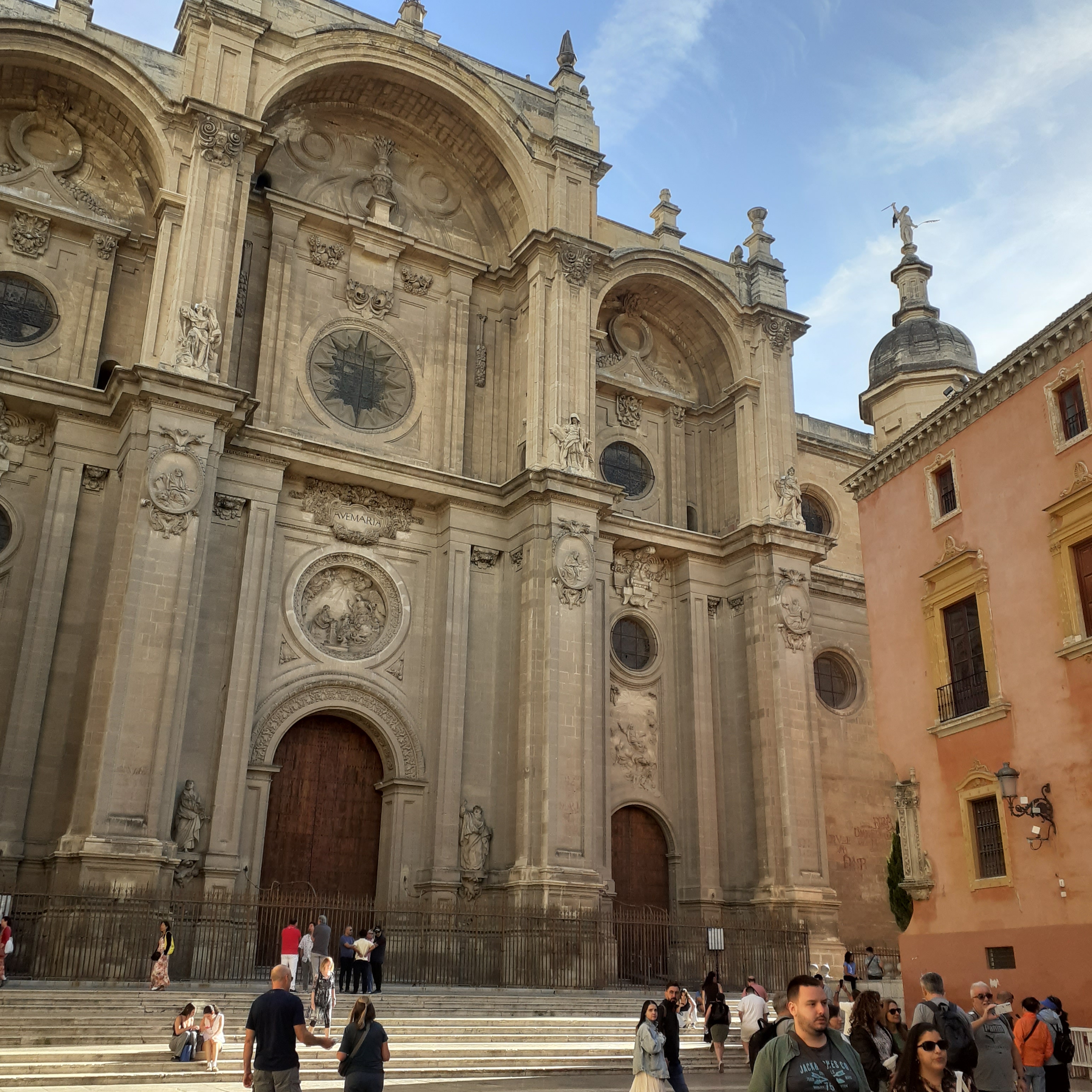
At the far end of Cetti Meriem, the Cathedral soars above the pediment. The Cathedral was begun in the sixteenth century, replacing the existing mosque within the Moorish medina. It is a montage of architecture, the end backing onto Gran Via a packed ornate gothic, the frontage an imposing Baroque facing Plaza Pasiegas. The massive towers on the north were never completed. I recall how its white interior perfectly mirrored the cold exterior in that cruel April. More comforting, the vast dome with gold stars scattered across a deep blue sky. 

Elvira ends at Plaza Nueva with its lively bars and restaurants. Despite its name it’s an old square, being built over the Darro River in 1500. The Royal Chancery flanks the north side while the Church of Santa Ana closes the square with the Darro visible beyond. Nearby there’s a fountain and beyond there’s access to the Alhambra via parkland. Alternatively, you can take a bus. It’s a punishing uphill climb, especially in the heat, so that’s what we did this time.

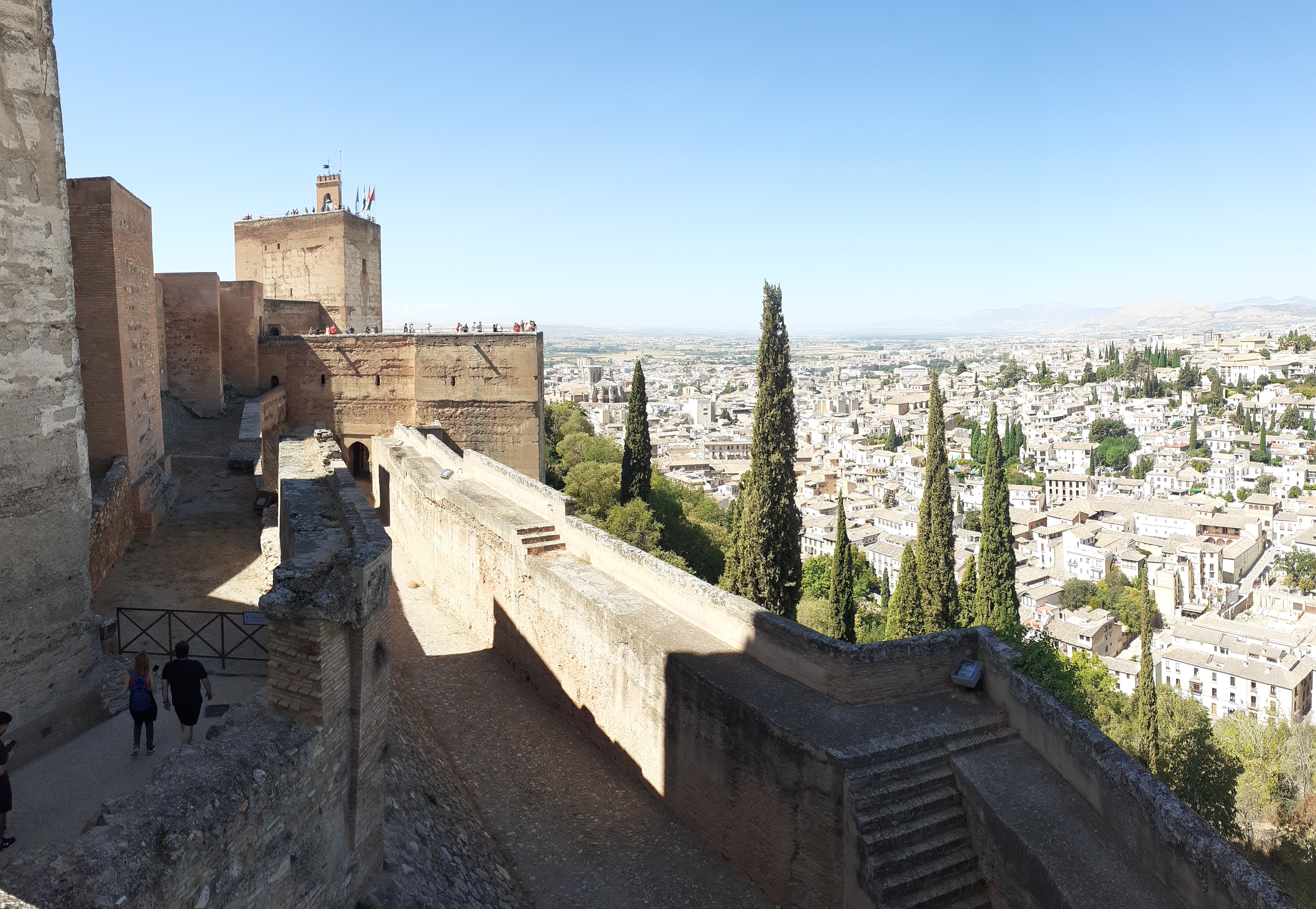
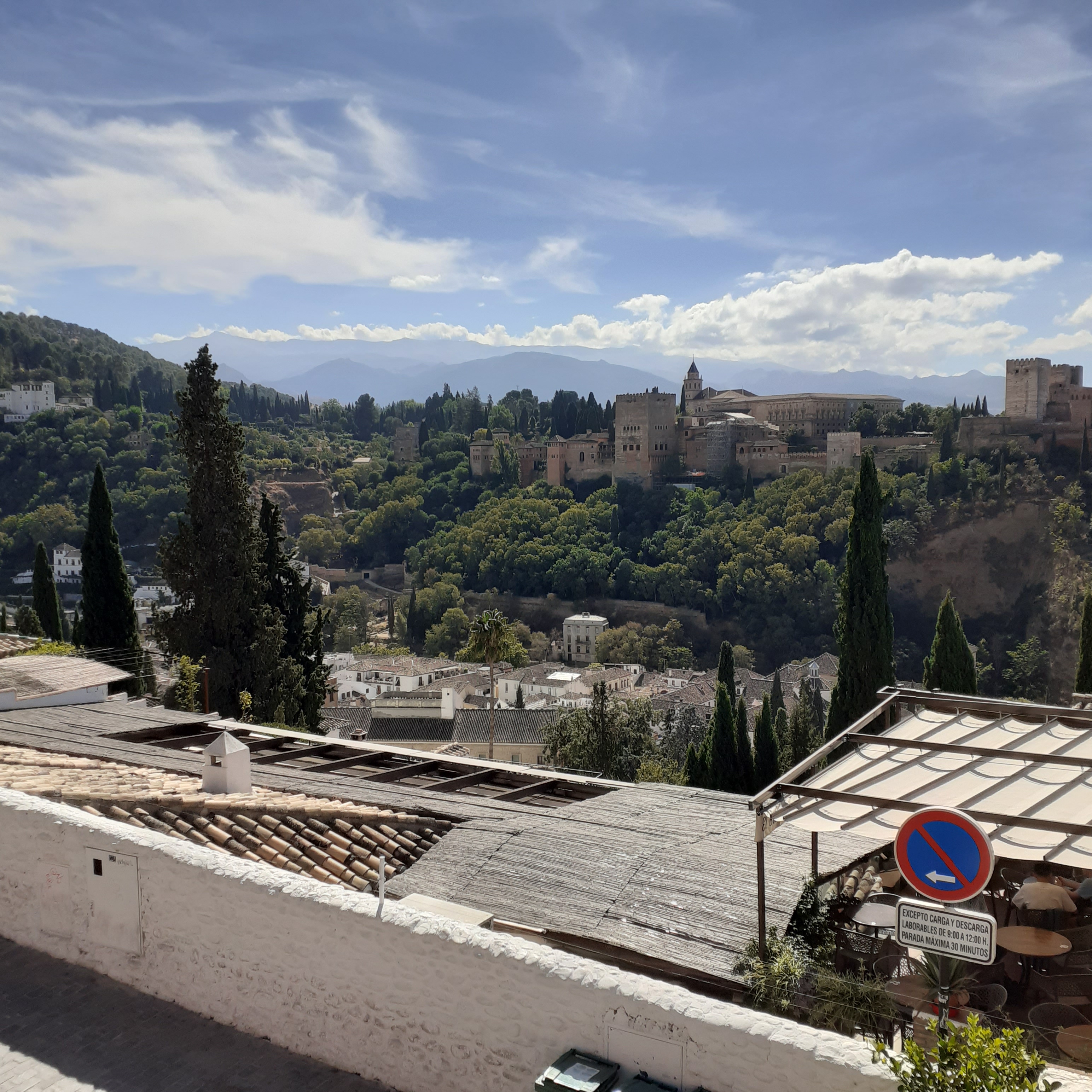
The Alhambra for five centuries was home to the Moors who had occupied much of Iberia in the 8th Century. Grenada would be their last stronghold. The Nasrid dynasty ruled Grenada from 1232 until the Reconquista of 1492. They built the Alhambra on the site of an 11th century fortification. In fact that had been the palace of Samual the Prince, a Jewish leader in a Moslem state. Muhammed I founded the complex we see today, greatly enlarged and embellished over the two hundred and sixty years of Nasrid rule. Ultimately, Muhammad XII, aka Boabdil, was defeated by the combined monarchs of Castile and Aragon and forced to surrender Granada to them. As he left for the coast through the Sierra Nevada, he took one last look back at what had long been his, and his people’s home.

The mountain pass where this happened is now called Suspiro del Moro, the Moor’s Sigh. Salman Rushdie’s book, the Moor’s Last Sigh 1995, refers a few times to the episode. In a story of identity and memory, Boabdil’s action provides apt illustration. It was Rushdie’s first book since the Satannic Verses of 1988. Fanatical reaction to that resulted in the fatwa issued by Ayatollah Khomeini, leader of Iran. Similarly aligned groups such as Hezbollah and Al Quaeda have persisted in the fatwa into the current century. Rushdie lost an eye in a knife attack in New York three years ago. He still lives, and writes and thinks.

The Alhambra became the court of Ferdinand and Isabella. Christopher Columbus was witness to Boabdil’s handover and was received at court by the Monarchs as they approved his voyage to the Americas. There is symmetry therefore in that it was an American, Washington Irving, who established the Alhambra in the modern imagination. He lived in the complex in 1830 and published Tales of the Alhambra 1832. This contributed hugely to the preservation and restoration of the Alhambra over the last two hundred years.

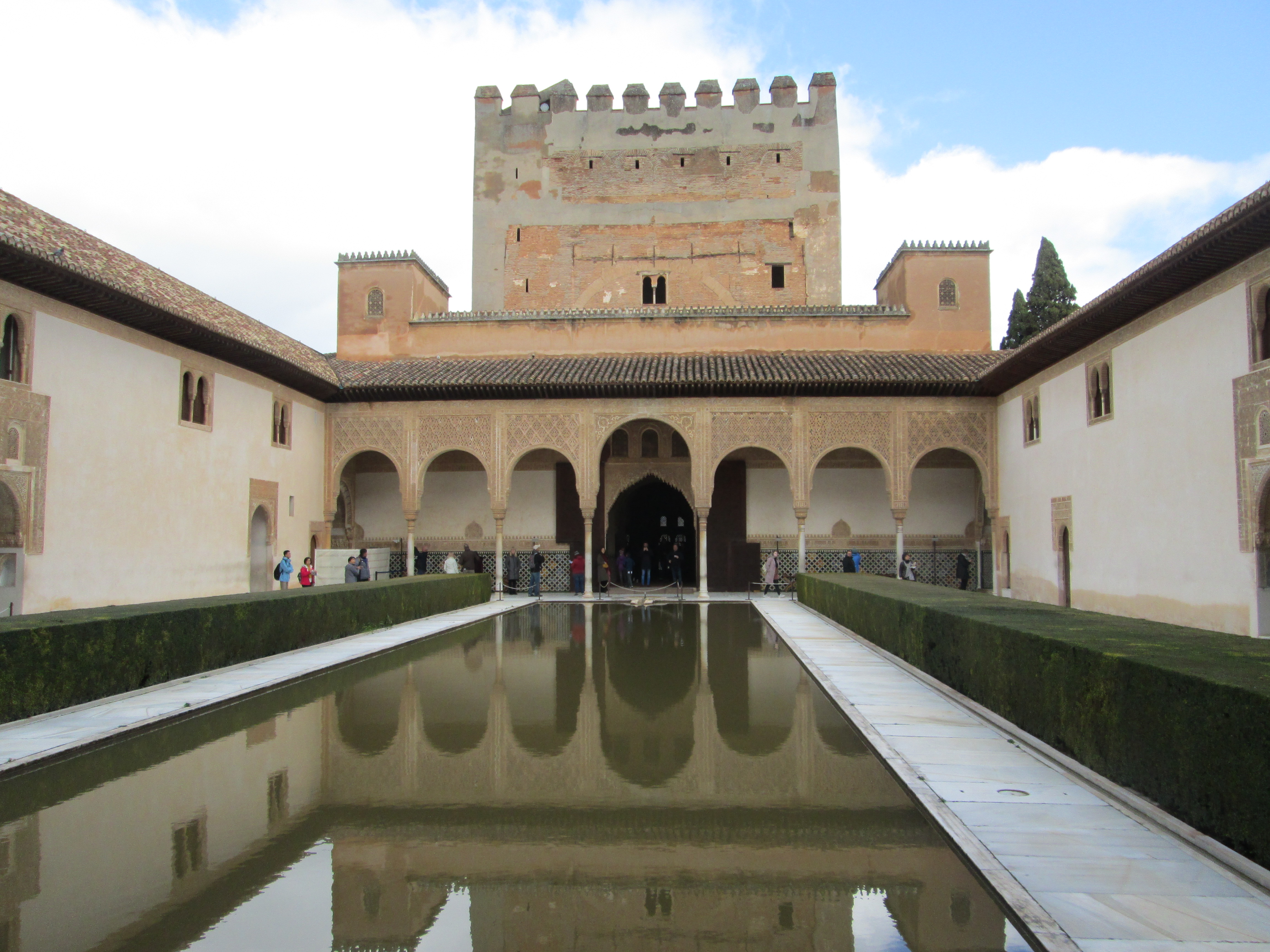
It is a huge complex with many different facets, including palaces, gardens, two hotels and other services. The Alcazaba fortress on the west side overlooks Granada. There are several towers giving great panoramic views over the city and mountains and the complex itself. The Generalife is a garden estate just outside the walls to the east. The Nasrid Palace is the jewel of the Alhambra, a glorious medley of rooms and courtyards, pools and fountains, featuring the best of Mudejar craft and design. Access to the Nasrid Palace requires a specific ticket. This was fine on my first visit but this time, though I tried some three months in advance, tickets were sold out. So shop early. It’s a treasure indeed. Nevertheless, there is an awful lot to see with a general admission ticket. From morning till late aternoon, we had our time in paradise.
At the business end of the complex is the Alcazaba. Plaza Aljizibes alongside forms something of a town square, a public access area with services and refreshment stalls. The Renaissance Palace of Carlos V lines the other aide of the square. This was begun in 1527 but only completed four hundred years later. The Renaissance building encloses a circular courtyard, with a collonaded terrace on the upper floor. The Museum of Fine Arts there houses a collection of Spanish art from the 17th to the 19th century. The Alhambra Museum is on the ground floor.

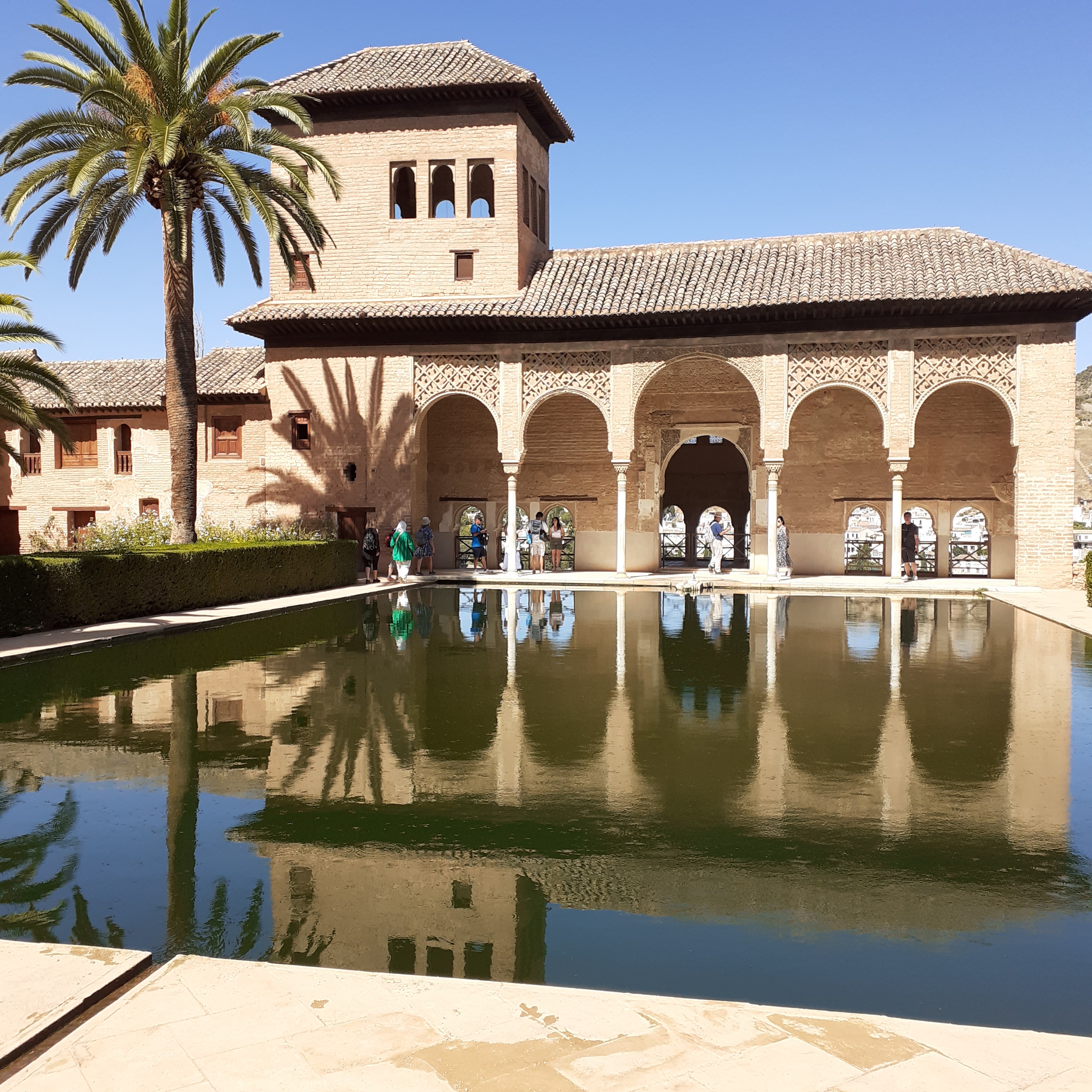
Just past the Nazrid Palace, the Partal Palace is accessible, This is the oldest surviving palace with an elegant pavillion overlooking a reflective pool. Calle Real is a public street near the southern wall. Along here is the Church of Santa Maria built on the old mosque. Further on is the American Hotel, with a cafe in its pleasant courtyard. I had stopped here before for some coffee and heat. Today we go for the Parador de Granada, a larger hotel. We stopped for a drink on its terrace, a perfectly relaxing conclusion to the day

Beyond the gardens of Partal and Secano we leave the Alhambra for the Generalife. This lies across a narrow ravine with beautiful gardens leading up to an attractive villa. Built as a retreat for the Royal Household free from the travails of the Palace, it offers some of the best views of the Alhambra, Granada and Sierra Nevada

We left the Alhambra by way of Carretera de los Chinos, a long downhill saunter below the castle walls. This led us down to the Darro and Puenta del Rey Chico. There was a music concert that evening where the riverside street broadens into an esplanade with the floodlit Alhambra towering over the far bank. Crowds sat on the plaza, while a singer and guitarist serenaded from the tower at one end. 

Facing the heights of the Alhambra is the steep ancient neighbourhood of Albaicin, and Sacromonte, the Sacred Mountain. From near the foot of Elvira there’s a sharp uphill to Plaza San Gregorio. The white church was built in the late sixteenth century, becoming deeply embedded in the  community. We stopped adjacent for good food on a terrace at the edge of the commercial sector. From here the narrow street climbs up through the Alcaibin to the Mirador St Nicholas. The Mirador hosts such a view over sierra and castle that it must elicit an aching sigh or two. The grounds of the mosque next door offer respite, heat and throng dispelled in its subtle shade and soft fountains.

Beyond the Albaicin the steep hill descends to the Darro. There’s a turn at a picturesque, even picaresque, taverna, El Rincon del Chapiz. Take this turn to visit the Sacred Mountain. With our first step into Sacromonte, we are in a different world. The city evaporates and a mirage of a mountain top village rises before us. Winding up above the Darro Ravine, white houses cling to the slopes and the Sierra Nevada embraces all. We stop for a drink and tapas at Casa Juanillo, wondering how we have found ourselves in the middle of nowhere, and the centre of everything. This was originally the Gitanos quarter, and a mainspring for the source of flamenco music. Dotted all around are music venues; hold your whisht and you can hear the music echo from the stones and trees.

Fly away on my zephyr

I feel it more than ever

And in this perfect weather

We’ll find a place together

For old time’s sake, The Red Hot Chilli Peppers Zephyr Song (from By the Way 2002) to take us out, and up.

Back to Andalusia – Mijas and Fuengirola

Southwest of Malaga the A7 highway flows past the strip of beach resorts that have become synonymous with holidays on the Costa del Sol. Torremolinos, Benalmedina and Fuengirola form a densely populated highrise urbanisation along the sun blasted coast. A little farther on is La Cala de Mijas which retains much of the feeling of the whitewashed Andalusian fishing village. Mostly lowrise and home to about ten thousand people, this is a different world from the crowded developments nearer Malaga. The modern commercial centre fronts the A7 and there’s a weekly open market here. Behind that the old town meanders down to the searont. 

A small plaza with plenty of restaurants and bars is laid out around the historic watchtower. This resembles our Martello towers, and is of similar function and era. Its official title – Torre Vieja de La Cala de Moral, derives from the original name for the town, referring to the area’s abundant mulberry trees. The tower was built in the late eighteenth century as a watchtower guarding against Berber pirates, still prevalent along the coast. Built on a hoof shaped plan, the wall curves around three sides with the linear fourth side rising sheer to the ramparts. The building contains a museum, and the top is accessible for visitors to admire an impressive panorama.

We stopped at an adjacent restaurant for lunch, the busy waiter doing well to cater to the midday trade. No better place for a postprandial stroll; the coastal boardwalk connects to Cabopino, Marbella’s eastern outpost, 6km farther on. La Cala is pleasantly remote from the hectic holiday world, while still conveniently close to it.

The Romans called the area Tamisa which the Moors shortened to Mixa leading to Mijas when the Catholic Monarchs took over. The municipality of Mijas also includes Calahonda and La Rivera farther along the coast. Collectively known as Mijas Costa, it is something of a golfer’s heaven. Though I’m more keen on nineteenth hole pursuits myself.

There’s a more authentic experience a couple of miles inland. The settlement of Mijas Puebla teeters atop the high coastal hills. Sierra de Mijas rise to a height of 1,150 metres. Mijas Puebla itself sits at 1,476 feet above sea level. Once across the A7, it’s a zig zag drive to reach the town and there’s a multi storey carpark right in the centre. We called into the  tourist office at the pedestrian entrance and talked to the friendly lady there. She gave us a street map of the town and some good pointers. We visited on a rainy morning and, as the rain cleared, the clouds still clung to the high altidude village, lending it a remote grandeur.

A small grotto nearby teeters above the drop to the coast. The candles glow invitingly, in contrast with the rain outside. A place for pause and a prayer. The tiny streets pack in a surprising amount of commercial variety with good shopping and services. The precarious position of the town frequently allows for some spectacular views. Into the maze of backstreets the quirky charm persists. We come across the town’s tiny bullring. Built, uniquely, in an oval, as distinct from a circle, it is Spain’s smallest bullring; probably.

There’s a bar with Picasso sitting outside, in full artist regalia. Waiting no doubt for a passing Joyce or Beckett. I’m sure they’d have got on fine here. We find an outside table balanced at a steep corner. The proprietor was keen to get us indoors but we stuck to our guns and had a pleasant coffee and tortilla while the street crowds began to peek out again after the rain.

Fuengirola is spread out below the hills. It is the last stop on the Malaga coastal train line. From here we have, in previous visits, taken that train from the airport and got a bus on towards Marabella. A previous drive through from Malaga, via Torremolinos and Benalmedina, was rushed and a bit chaotic. I am more orientated now, at home on the Spanish highway, and we took the short drive up from Marbella to have a deco. There’s convenient parking near the Moorish fortress at the southern end of town; though we skipped this and parked in the centre in an outdoor lot beside the port.

The string of resorts along this stretch of coast isn’t exactly a pearl necklace, but it does its trick and has its moments. It’s a scorching day in mid September and the beachfront is thronged with strollers and swimmers. Just a few blocks inland is the older part of town leading up to the Plaza de la Constitucion. This tiled square faces the church of Our Lady of the Rosary, its clean, white facade topped by a high belltower. Plaza del Ayuntamiento is nearby along the main thoroughfare. To the side, narrow streets lined with bars and cafes take us through a more intimate environment. Calle Dr. Maranon is part of an enclave of low, white terraces, welcome relief from the highrise norm. We catch a glimpse of the Central Mosque beneath its daylight sickle moon. The Rio Fuengirola marks the southwestern end of town. On the far bank the fort stands atop a rocky outcrop.A friendly visitor, German I think, falls into conversation before striking out enthusiastically for the summit. We opt first for the shade. Bar La Terraza is a small cafe bar on the far bank where we stop for coffee and a snack..

Sohail Castle was built by the Moors at the end of the tenth century. It is likely the site was used before by Phoenicians and Romans, but it is the Moorish structure that remains. The imposing, red fortress consists of four corner towers connected by curtain walls. From the parapets there are dizzying views of the coast and town. A Festival of Music and Dance is held here in June

The Catholic Monarchs conquered at the close of the fifteenth century. Later the Castle was extensively damaged during the War of the Spanish Succession. It was back in use again for the Peninsular War, but was deserted by the start of the twentieth century, only recently being repaired as a visitor attraction

Fuengirola was mostly uninhabited after the Reconquista, Mija being the largest settlement hereabouts. By the 17th century a small town had grown around fishing and farming. A lone inn catered for travellers. It was not until the 1960s that Fuengirola was transformed into a top resort. Today the population is 85,000. of whom a quarter are foreign born. Many of these are Irish, British and Scandinavian with immigration too from Morocco and Latin America. High season sees an influx of visitors, and high season here spans at least six months. You can see why. It’s mid September and the mercury’s touching thirty.

Local business and employment has benefitted and expanded hugely from tourism, but there are problems too. Spain has been in the news recently for anti tourism protests. While these may give rare opportunities for lefties to shout abuse at foreigners, there is a real issue. The steeply rising population further swelled with visitors, puts pressure on amenities and accommodation. Not just here, mind, but all around the world. Governments need to strive for balance. Locals and visitors need to treat each other with mutual respect, preserving the integrity of the places where we live and play. For us and future generations.

Mana are a Mexican rock band. Donde Jugaran los Ninos? (Where Will the Children Play?) is the title track of their third album from1992. It remembers an idyllic childhood, setting it against the overcrowded modern world. Nostalgic, naieve, still it chimes with us all. An echo of Joni Mitchell’s Woodstock: how to get ourselves back to the garden? It is a universal concern. The world keeps on turning, with more and more people in it. We need to spread our wings and fly. And use the broadened mind that travel bequeaths. 

Cuenta el abuelo que de niño él jugó

Entre árboles y risas, y alcatraces de color

Recuerda un río transparente y sin olor

Donde abundaban peces, no sufrían ni un dolor

Cuenta el abuelo de un cielo muy azul

En donde voló papalotes que él mismo construyó

El tiempo pasó, y nuestro viejo ya murió

Y hoy me pregunté, después de tanta destrucción

¿Dónde diablos jugarán

Los pobres niños?

Leaving Liverpool

Back in the seventies, on our daytrip to Liverpool we visited the modernist Roman Catholic Cathedral. Known as the Metropolitan Cathedral, or Paddy’s Wigwam to some, it is at the North end of Hope Street. The Anglican Cathedral lies near the street’s southern end forming something of a heavenly bracket. However, the naming of the street isn’t a reflection of this ecclesiastical nature. Neither faith, hope nor charity are invoked; Hope Street is named after William Hope, a merchant who once lived here in the late eighteenth century.

Hope Street also hosts the Liverpool School of Art building from 1883. John Lennon and Stuart Sutcliffe studied here in the early sixties. In 2008 the Art School moved, though the memory of Lennon remained. The new school is housed in the John Lennon Art and Design Building nearby. Meanwhile, the Liverpool Institute for the Performing Arts is now based in the old building.

The Metropolitan Cathedral was completed in 1967. It was a long time coming. During the Great Famine in the 1840s, Liverpool saw a huge influx of Irish Catholics. Many passed through the port, heading for America or elsewhere in Britain and Empire. Many stayed. By the 1850s a Cathedral was planned. Edward Pugin was the first commissioned for this, but only a local parish church resulted. In 1930 Edwin Lutyens was chosen, producing designs for a massive cathedral on Hope Street, to rival the also massive Anglican Cathedral. It would have been one of the largest churches in the world, with the largest dome. But it wasn’t to be. The strictures of World War Two put a halt to such grandiose plans. Only the crypt was completed in the late fifties. This, strangely, plays host annually to the Liverpool Beer Festival. Or perhaps that’s not so strange.

And if life is a bar room in which we must wait

‘Round the man with his fingers on the ivory gates

Where we sing until dawn of our fears and our fates

And we stack all the deadmen in self addressed crates

Heaven knows no frontiers

And I’ve seen heaven in your eyes

No Frontiersthe is a song written by Jimmy MacCarthy, becoming the title track of Mary Black’s 1989 album.

At last, sometime between Lady Chatterly and the Beatles first LP, Frederick Gibbert’s radical modern design went ahead. Built on top of the crypt, it forms a flared conical structure above a circular plan with the altar central. Sixteen curved concrete trusses frame the building, forming flying buttresses at the lower level and rising into a pinnacled crown at its height. The rushed and economical construction practices of the time resulted in flaws appearing early, and extensive rapairs and alterations were required in the 90s.

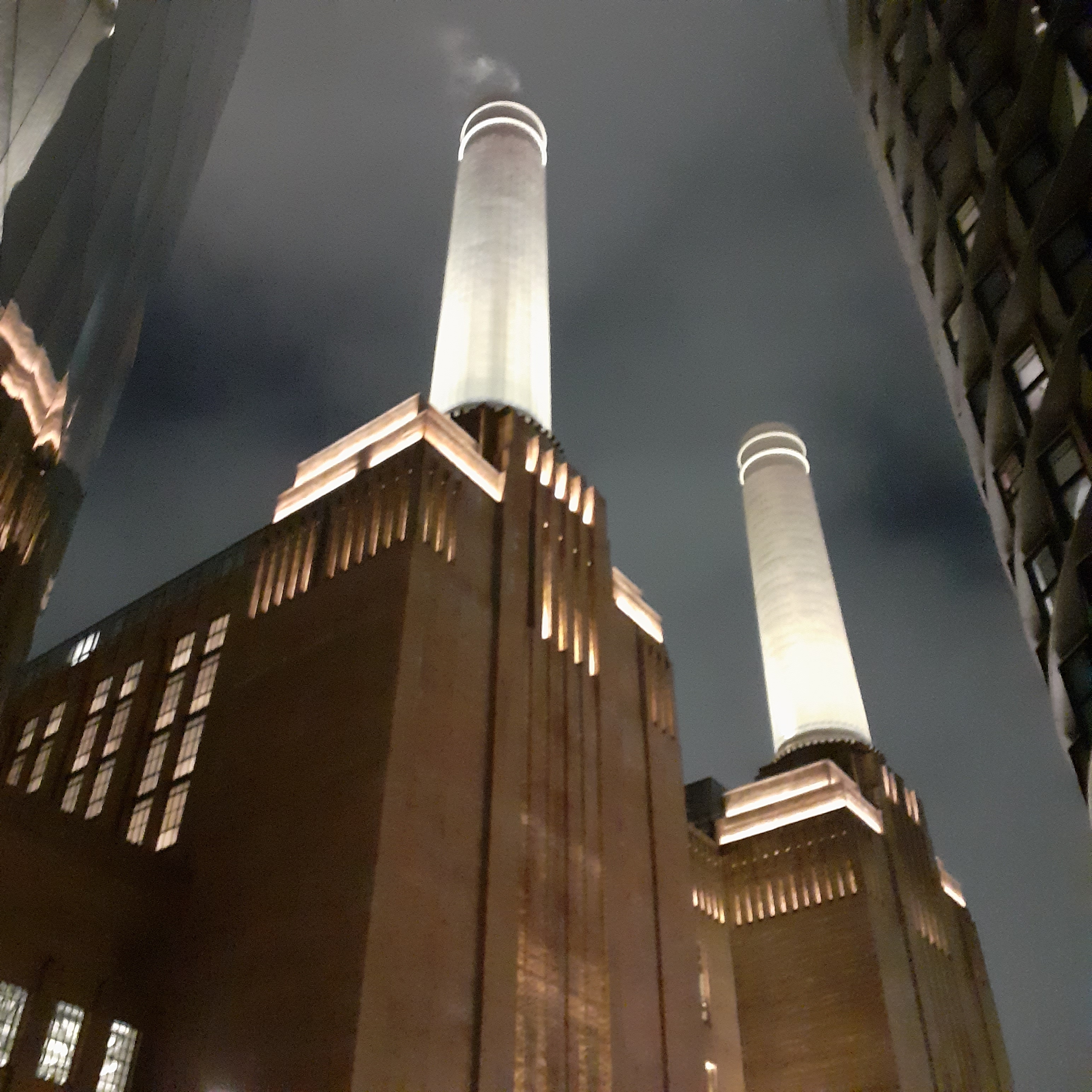
The Protestant Cathedral is more traditionalist, though it is also a twentieth century building. Begun at the start of the century, it is the largest cathedral in Britain. Giles Gilbert Scott was a student in his early twenties when he won the design competition. More contentious still, he was a Catholic. But, maybe that brought a certain flourish to the interior, particularly the Lady Chapel. Scott was a versatile architect and designer, his notabe works including Battersea Power Station, and the iconic red telephone box.

Overall, his design for the Cathedral draws on gothic tradition with a more pared down modernist finish. It was greatly modified early on towards a simpler, bolder statement. The central tower rises to over a hundred metres, immediately establishing the church as a city landmark, already in a strong position occupying the high ground south of the centre. 

The vast interior is a perfect place to top up on spiritual awe. We’re hungry too, having skipped breakast, and that physical yearning was also catered for. On the terrace there’s a licensed bistro, good for breakfast, lunch, a coffee and a snack. You can even relax with a beer. Hitherto, my only experience of drinking alcohol in a concecrated building has been the odd communion with two substances. Liverpool is more liberal, whichever foot you kick with. Whether down at the Crypt or up on the High Church. So it’s something of an Ecumenical matter to go boozing with the Anglicans. I’ll drink to that! Later we ell in with a friendly vicar and talked about this and other things, including the various works off art the cathedral has accumulatied in its time. 

Heading downhill towards the Port, we pass through the gate of Chinatown. The spectacular arch was transported from Shanghai at the Millennium and reassembled here. It is one of the largest such arches outside of China itself. Liverpool’s Chinatown is the oldest established in Europe, develpoing back as far as the mid nineteenth century.

A familiar focus of travellers to Liverpool is Lime Street. When laid out in the eighteenth century it was on the city’s periphery, but the coming of the railway in 1836 brought it to the centre.The Rail Station is famous, fronted by the Great Northwestern Hotel built in 1871in spectacular Renaissance style. This was originally the Railway Hotel, and closed in the 1930s. Subsequently it was used for office and accommodation returning recently to the hotel business, operating as the Radisson Red.

Lime Street gushes with colonial and mercantile pride. Statues stand guard; of Prince Albert, Disraeli and of course Nelson atop his column. St George’s Hall dominates the plaza opposite the station. It was opened in 1854 and contains a Concert Hall and law courts  Behind the Hall are St John’s Gardens, a welcome green space on a scorching day. Then its back into the throng heading downhill through Liverpool’s main shopping precinct, completing our circle on the Waterfront.

Our hotel, the Ibis, is beside Albert Dock, so the city centre and major sights are nearby. Albert Dock was built in 1846 of cast iron, redbrick and stone, a state of the art facility in its day, machinelike in its eficiency and fireproof too. The changing patterns of world trade and technology made it derelict just over a century later. In the early seventies, redevelopment could have meant removal, however sympathetic redevelopment won out preserving the majority of the buildings in a waterways setting. Apartments, shops, bars, restaurants and visitor centres line the waterfront, and this is the go to part of Liverpool, where it was once the place for leaving.

The Tate Liverpool opened in 1986 adding to the city’s prestige. Unfortunatey, the Tate was closed during our visit due to major renovations. My love of art galleries has been thwarted by such closures in recent years, so this is just another in a long list. The RIBA, Royal Institute of British Archotects, hosts a selection of the Tate collection in the meantime. The Liverpool Maritime Museum, the modern Museum of Liverpool, and the Beatles Story are other major attractions. There’s a funfair into the night, and everywhere the madding crowds strolling and going out to the many hostelries onstreet and off, and floating in the dock for that matter.

We frequented the Pump House for a few drinks. It’s set in a converted redbrick beneath a soaring chimney. There’s seating outside looking over Canning Dock and Mann Island, with the Tate Liverpool making a sharp modernist statement beyond. Later, we head through the Colonnades around Albert Dock browsing its shops and restaurants. We dine at the Panam Restaurant and Bar, its glass frontage giving a fabulous view over the dock as night falls. It’s an early rise in the morning and we catch a bus to the airport from the station next door. The airport is another major building named for the Beatles John Lennon. Originally Speke airport, it was renamed in 2001. It now sings.

Oh Liverpool Lou, lovely Liverpool Lou

Why don’t you behave just like other girls do?

Why must my poor heart keep following you?

Oh, stay home and love me my Liverpool Lou

Liverpool Lou was written by Dominic Behan in 1964. Ten years later the Scaffold did a cover, attributing it to Paul McCartney. McCartney later apologised and correced the attribution. On Desert Island Discs in 2007, Yoko Ono picked Behan’s song, saying that Lennon had sung it as a lullaby to their son, Sean.

Ferry to Liverpool

There are daily ferries from Douglas to Liverpool, the crossing taking three hours. The boat, the Mannanin again, is packed. Mostly bikers returning from their Isle of Man TT pilgrimage. We breakast on the boat. It’s a full English, or Irish, or Manx; you know what I mean. I was once in Liverpool, back in the early seventies on a daytrip by boat. I bought myself a portable typewriter and an airbrush, fuelling my twin ambitions to be a writer and an illustrator. It’s a long story. Or, several short stories and a novel, some slick illustration too, though I’ve abandoned that technique for the paintbrush. 

Our day in 70s Liverpool was shrouded in drizzle, the city providing a gothic silhouette to our shopping adventure. This time, it’s baking in blue heat. The ferry berths on the northern end of the waterfront. The majestic dockside running south has been beautifully developed into a vibrant showpiece for the city, dotted by landmarks with a host of visitor attractions. It absolutely throbs with life under the hot sun.

We walk the mile or so to our hotel, the Ibis, at Albert Dock. This stretch of dockland along the Mersey River is very much the heart and soul of the city. Pier Head provides a stunning architectural panorama. This area was called George’s Dock until the end of the nineteenth century. Liverpool Corporation bought the site with the Mersey Port and Docks Board retaining a portion for its new headquarters. The Port of Liverpool Building was completed in 1907. A typically Edwardian building in a Neo Baroque style, its central tower and dome was the tallest in Liverpool when built, very much the city landmark. This was surpassed in 1911 by the Royal Liver Building, the true Liverpool icon. In 1916 the Cunard Building came in between. Built to a modernist version of an Italaian Renaissance palace it completes the trio known as the Three Graces. Behind this trio is a fourth grace, perhaps, the George’s Dock building from the 1930s. This is an Art Deco building with a high central tower used as a ventilation shaft for the Mersey Tunnel. The reliefs on the top half of the tower resemble a sleeping face.

The Liver Building was designed by local architect Walter Aubrey Thomas for the Royal Liver Friendly Society. It’s one of the first major buildings I knew. My mother was a customer and her insurance book featured a line drawing on the cover The Liver Man came every month in his fancy Austin Cambridge to do the account thing. Exotic times. England’s first skyscraper is built of white reinforced concrete. Its twin towers climb to almost a hundred metres. The Liver Birds perch atop, eighteen feet tall. The mythical birds have been named Bella and Bertie. Taken from the ancient city’s coat of arms they are, officially, cormorants. Since Liverpool received its charter from King John in 1207, it’s likely that the bird first featured in the city arms, in homage to the king, was meant to be an eagle. Just badly drawn. It became a cormorant by the late eighteenth century, on the blazon for the coat of arms granted by Norroy King of Arms,the authority for northern England and Ireland, a certain George Harrison. The bird, whatever it is, has become the emblem of Liverpool itself and the football club Liverpool FC, though local rivals Everton, the older club, originally used it. Anyhow, a hundred metres up, Bertie looks inland, Bella to sea. It is said she keeps an eye out for the sailors, while he checks to see if there’s a pub open.

The Liver Birds was also the name of a BBC tv series from the early seventies, written by Carla Lane and Myra Taylor, two local housewives. It featured Polly James and Pauline Collins, and later Nerys Hughes, as the girls, or birds, in question. Something of a female equivalent of another north of England comedy the Likely Lads. The theme song was sung by the Scaffold, a comedy folk group including John Gorman, Roger McGough and Mike McGear, nee McCartney, brother of Paul. It is now possible to take a trip to the top of the Liver Building and with the birds to share this lovely view.

Even more famous than the two birds are the four lads, the Fab Four. Their statue at Pier Head provides the perfect photo opportunity. You can insert yourself amongst the foursome as they, slightly larger than life, stride out towards the Mersey. John, Paul, George, Ringo and yourself. Become your own fifth Beatle.

The Beatles form a good proportion of our mission. or pilgrimage, to Liverpool with a visit to the Beatles Story on Albert Dock. The Beatles Story opened in 1990 and has been a flagship of the growing Beatles tourist industry. Housed in a 19th century warehouse, the exhibition takes visitors through a chronological tour of the Beatles phenomenon. The group were one of many beat groups who flourished at that time, inspired by the first lowering of rock and roll across the Atlantic. Beatles was a clever pun, with a nod to Buddy Holly’s Crickets. The original trio of Paul McCartney, John Lennon and George Harrison, were augmented by drummer Pete Best and bassist Stuart Sutcliffe. The band played locally and for a few seasons in Hamburg, Germany. Sutcliffe stayed in Germany to pursue a career in art but less than a year later in April 1962, he tragically died of a brain haemorrhage. Pete Best was dismissed during their first London recording sessions with George Martin and Ringo Starr was drafted in. Then they had a hit with Love Me Do and the rest is history, with a fair bit of hysteria thrown in.

The Beatles Story constructs a sequence of imaginative tableaux and actual paraphernalia by way illustration. Brian Epstein’s crowded office, George Harrison’s first guitar, John Lennon’s specs and a room devoted to Sgt Pepper’s Lonely Hearts Club Band. Each of the four have their own room and there’s a touching note at the end with John Lennon’s piano room from Imagine. 

There’s also a recreation of the Cavern Club. The Cavern Club itself is a focal point of the Cavern Quarter up on Mathew Street. It opened as a jazz club in 1957. By the early sixties, beat groups were knocking on the door. The Beatles most persistently. Between February 61 and August 63 the group made almost 300 appearances there, but by then they had outgrown such a small venue. Ten years after, the Cavern shut up shop. Then the zeitgeist moved towards restoration. Developers originally hoped to excavate the original cellar but instead had to make a reconstruction with a lot of the original material

M and I make our way up there on friday night when the quarter is at its most raucous and exuberant. Weaving through the crowds in a mixed musical din has a certain spice to it. Sometimes weaving won’t quite work. A sequined lady from a time machine lurches to grab me. She is a doppelganger for the Cilla Black statue nearby on Mathew Street, if rather more aggressive. M and I decided to return on Saturday afternoon. Still loud and fun, but more relaxed. A fiver will get you in, card only, to walk a few flights down into the actual Cavern Club. Okay a reconstruction but it’s as real as it gets, and that’s fine by me. An amiable troubadour, somewhere west of Bill Bailey, takes us through a field of memories. The repertoire was a mixture of Beatles and Monkees, with some Oasis thrown in too, their comeback tour looming large in late July;

The Monkees were the American TV Beatles, and the band for my age group. Daydream Believer was amongst their best, and enjoyed a second coming with a later generation of Macams. Alternative lyrics came from a lively party of Sunderland lassies in the Cavern that day. Cheer up Peter Reid! Who, by way of connection, is a Scouser dressed in blue. Everton, in other words. As regards alternatives, it wouldn’t have been appropriate to shout for my Monkees favourite: Randy Scouse Git.

The Cavern has branched out, with a theatre hall set up and a dining area part of the labyrinth we explored. We stuck with the original, enjoying a couple of drinks before finishing with the Searchers, or five rocking old geezers in suits playing their stuff. Then we walk, tired and emotional, happy really, up many flights of steps and into the sun. We’re in the home the Merseyside sound; Gerry and the Pacemakers, the Merseybeats, Cilla Black and the Searchers. The Beatles, of course. The people who made teenage living fun, made us what we are today, and made too many damn fine records to mention.

There can be only one choice to play us out. On first setting foot in the Cavern, the opening song our troubadour played was Here Comes the Sun. It appeared on 1969s Abbey Road, the last album recorded by the Beatles. It was written by George Harrison in the April of that year. Harrison was oft referred to as the Quiet Beatle. Though he wasn’t quiet. He was, however, the most Irish of the Beatles, as you can tell from the lyrics of this song; ha ha. In fact his mother Louise, nee Ffrench, would often take him home to visit her ancestral family in Drumcondra, Dublin. In the early fifties, George with mother and brother was photographed on O”Connell Street, Dublin, by Arthur Fields, the famous Man on the Bridge. Curiously, my own mother, Veronica, was from Drumcondra. An O’Flanagan she would go on to marry a Harrison, from Blantyre, Scotland. She loved the Beatles too. Get Back was her favourite.

Little darlin’

It’s been a long, cold, lonely winter

Little darlin’

It feels like years since it’s been here

Here comes the sun, doo-doo-do

Here comes the sun

And I say, “It’s all right”

Isle of Man by Rail

The morning is warm and hazy, sea, sky and promenade merge in the glaring whiteness. Out in the bay, the Tower of Refuge makes a magical sandcastle apparition; at once real, but not real. The Tower occupies the small St Mary’s Island just offshore. It was built as a refuge, and guide, for sailors suffering shipwreck on the notorious reef. Sir William Hillary, founder of the Royal National Lifeboat Institution initiated the project in 1830, following the sinking of the St George. The ship of the St George Steam Packet Company was landing its cargo from Liverpool when it ran aground on a stormy November night. Hillary himself commanded the rescue and was injured when swept overboard. There is a memorial to the rescue on the Loch Promenade. A bronze relief vividly depicts the danger and daring of this heroic episode. The Tower was completed in 1832, William Wordsworth wrote a poem in its honour during a visit the next year. A statue was erected to Hillary on the headland beyond the port and he is buried here in Douglas at St George’s Churchyard

The perfect way to see the beautiful island of Mannin is to use its excellent public trasport system. £21 will get you an all day ticket usable on all trains, trams and busses. We got full value from it on a hectic day whizzing about the island’s sights. From Villa Marina, towards the southern end of the Douglas Promenade, we took a horse drawn tram to the Electric Railway terminal at the far end of the seafront. The service was built and run by Thomas Lightfoot from 1876, who sold it on in 1882. It operates during the summer months.

The Electric Railway was established in 1893. The terminus is called Derby Castle which was also the name of the large amusement park that once stood nearby until the end of the 1960s. The original tiny picturesque rustic ticket office survives while the Terminus Tavern adjacent also dates back to the 1890s.

The Electric Railway travels north to Ramsay. It makes its discreet way through the suburbs of north Douglas into open green countryside and woodland. At Laxey there’s a connection with the line leading to the top of Snaefell, the island’s highest point. Laxey itself is a pleasant winding village tumbling down a valley from the highlands to the sea. Its fame rests on the Laxey Wheel, a short uphill stroll from the tramstop. The Laxey wheel is the largest working waterwheel in the world with a diameter of over 72 feet. It was built in the 1850s for the local lead and zinc mines. 

Snaefell Mountain railway climbs to the top of Snaefell, near enough, at just over two thousand feet. The five mile journey takes about half an hour. There’s a pelasant cafe for refreshments and snacks with seating outside to take advantage of the spectacular panorama. The view boasts that it takes in seven kingdoms: the Isle of Man, England, Ireland, Scotland and Wales. The other two kingdoms being the Kingdoms of Heaven and of the sea. This last being ruled by Mannanin Mac Lir, so closely associated with the island. We summit in complete calm under hot sunshine, even at this altitude.

Back at Laxey we have coffee at the tramstop and explore downstream towards the sea. We catch a bus from Laxey back to Douglas. The main bus station in Douglas is at the southern end of town and it is only a short walk from here to the Railway Station for steam trains. The Steam Railway goes south to Castletown and Port Erin. Also passing near the airport at Ronaldsway.

The Steam Railway is a most colourful way to see the island. It was set up in 1873. The traditional rolling stock is quaint and dinky, the timber clad compartments with facing banquettes seating six people. It’s about an hour to the terminus at Port Erin, with Castletown a little over halway along. 

Castletown was the island’s original capital until 1869, the Tynwald meeting here until moving up the road to Douglas. It lies on the river estuary of the Silver Burn south of a small harbour. A majestic medieval castle rises in the town centre. Castle Rushen is a well preserved fortresss dating from the thirteenth century when the Kings of Mann and the Isles reigned. It was later the scene of the century long tug of war between the English and Scots for control of Mann. Robert the Bruce capturing the castle three times, though ultimately the English would prevail.

It’s a short walk along the river into town. A giant heron sculpture guards the bridge. Above the quayside is the castle entrance. The Arts and Crafts Police Station blends well with the Gothic feel of the place. The main town square, Market Square, has become an occupied fan zone for bikers, gathered about a giant screen with food and drink from local hostelries and mobile outlets. Our visit is a fortnight after the TT Races, but another major event, The Southern 100 is on nearby, with such biker heroes as  Dean Harrison. Five times TT, Dean is English but lives in Laxey. Then there’s local lad Nathan Harrison. You can’t keep up with the Harrisons! Whatever about the Castle, and the hectic world of motorbikes, we’re not rushing (pun intended) and we have plenty of time for a snack and a pint of beer in the glorious sunshine we’ve enjoyed throughout our stay on Mannin.

The steam train service tails off around half four, although busses still go into the night. We return to Castletown station which has a model railway display and the same cheerful traditional ambience as elsewhere on the isle. The train is quite packed and some compartments are fully booked but we get seats and head off in smoke and sunshine.

Back in Douglas we enjoy an evening stroll along Loch Promenade shrouded in an eerie and intermittent mist. The Tower of Refuge is a magical mirage in the bay. We dine in Duke Street, on the front outdoor patio of Wine Down. The interior is crowded, perhaps because the restaurant is very good. Heaters on the patio dilute the misty evening chill, and the wine and good food help too. 

Tomorrow we’re leaving Man and taking the ferry across to Liverpool. For a farewell song I’ll take one that evokes our stop in Laxey, sort of. Apt too for our ongoing ferry odyssey. Proud Mary was written by John Fogerty for his band Creedence Clearwater Revival. One of my favourites. It was a big hit single and appeared on their second album, Bayou Country in 1969.

Left a good job in the city

working for the man every night and day

and I never lost one minute of sleeping

worrying about the way things might have been

Big wheel keep on turning

Proud Mary keep on burning

Rolling, rolling, rolling on a river.

Isle of Man by Ferry.

Downtown Douglas

I have never been to the Isle of Man before. It seems a strange omission, as there’s no foreign soil closer to my home than this island cooling in the Irish Sea. It was once a popular holiday destination for people from Britain and Ireland back in the 1960s and beyond. M visited regularly in the late sixties and early seventies so something of a stroll down memory lane for her then. In keeping with the zeitgeist so, we opted to take the ferry from Dublin as most did back in the day. The Isle of Man Steam Packet Company makes weekly sailings between Dublin and Douglas during the summer months. As we were planning a two day stopover, we decided on taking a ferry onward to Liverpool. A voyage of sorts, in the old fashioned way.

The IoM Steam Packet Company was founded almost two hundred years ago (1830) making it the oldest passenger ship company in the world. We booked Manannan, the high speed catamaran which is named for Manannan Mac Lir, sea god of the Gaels. From Connolly Station we took a taxi at the adjacent rank to the ferry port at the end of the East Wall. The Steam Packet shares the terminal with Irish Ferries who operate to Holyhead. There’s a pleasant coffee bar at the top with glorious views over Dublin port on a clear sunny morning. The good vibes have spread to the terminal staff who are friendly and jocular.

Manannan set sail at half ten. The crossing takes just three hours, with Ireland barely dipping below the horizon as Mannin rises from the blue ocean. The Isle of Man is a British Crown Dependency. Charles III is head of state and the UK looks after defence and foreign affairs, but it is otherwise a self governing independent state. The parliament, the Tynwald, was founded by the Norse in 979 and claims to be the oldest continuously operating parliament in the world. It is bicameral; the House of Keys being the Lower House.

The name Man is thought to be derived from mountainous island in Welsh, or else refers to Manannin Mac Lir. In Manx it is phrased Ellan Vannin (as Oilean Mhannin in Irish Gaelic). The Manx language is Celtic, related to the Gaelic languages of Scotland and Ireland. It is being enthusiastically revived and features prominently on street signs and many businesses. The Manx themselves are longtime English speakers, their speech rhythms and demeanour more closely resembling the North of England. There’s a hint of the Welsh or Cornish about their heritage, Mannin was a haven for pirates and splendid castles, but they are actually Gaelic rather than Britonic.

Manx was spoken until the early twentieth century. The island was Celtic up until the tenth century when Norse invaders took over. The Scottish followed in the thirteenth century when Man was grouped with the Western Isles. Control passed between the English and Scottish for the century up until 1346 when English lordship won out.

The island is thirty three miles long and about thirteen wide and has a population of eighty five thousand. Douglas, where we land, is the capital. From the terminal, the seafront formas a shallow arc of two miles around much of the bay. It is fronted by an impressive array of tall Victorian terraces and a Promenade. Our hotel, the Sefton was a ten minute walk by way of an attractive sunken park. We come across the Bee Gees walking in the same direction. Set in bronze, the trio are slightly larger than life. The brothers Gibb; Barry, Robin and Maurice, were born here in the 1940s before moving to Manchester and in 1958 to Australia. Ten years later they had a string of hits including Massachussets featuring their plaintive vocal harmonies. While that success soon faded, they reemerged in the late seventies with the soundtrack for Saturday Nite Fever, one of the biggest selling albums ever.

Man’s seafront heyday began in the 1950s. The seafront was the ultimate experience for families and strutting youth. That attraction has gone. The Manx Museum on higher ground above the old town, is the only place you can revisit it. It’s an interesting and eclectic display. Exhibits lead us through ancient history, into the world of Viking and Celt, through the complex political weave of the early modern and on to the often brash commercialism of the twentieth century. One picture shows a thronged seafront evoking those great seaside days of youth, the boardwalks and amusement arcades, candyfloss, rock n roll and Mods and Rockers.

George Formby is included in the mix. Formby’s comedy No Limit from 1935 was his breakthrough hit, based on the TT races. Formby, once a jockey, played a star motorbiker. The film ignited his career as the cheeky chappie, provoking laughter with inuendo laden ditties accompanied on ukelele. His heyday was in the thirties and forties. though a decade later George Harrison noted him as an early influence. There’s a state to Formby near the railway station, at the southern end of Douglas.

The Tourist Trophy was first staged in 1907, the Isle of Man being chosen as Britain’s restrictive speed limit disallowed road racing. It has become an iconic race meet for motorbikers. A high proportion of visitors to Man are from the biking fraternity. The island is a point of pigrimage, or the scene for a last sunset drive. There’s a large section in the Museum devoted to the race, with some fun interactive displays.

Walking along Dougas’s seafront in a summer heatwave, it was a surprise to find only one bar and a cafe with outdoor seating. The beach was as deserted as a surrealist painting. The tide had gone out in more ways than one. Matcham’s Bar and the cafe next door supplied the only refreshment terrace I could see, against an urban backdrop that was impressively Mediterranean. These hostelries front the Villa Marina, a seafront complex with old world theatre and arcade framing a pleasant public park with a few food outlets. The Sefton supplied chairs and tables outside Sir Norman’s bar which I also enjoyed later in the day. Norman Wisdom is the Norm in question, the comedian’s grinning statue occupying a bench at the door.

Douglas’s main shopping area meanders behind the seafront in the old fashioned way. Pedestrianised Strand Street leads on to Duke Sreet and farther on is the Quay, a picturesque inlet crammed with sailing craft. The south headland rises sharply behind and the quaysides are lined with period buildings housing bars and restaurants. The British Hotel and the Barbary Coast give something of a snapshot of Manx identity conflict. Pirates or patriots? There’s a pizzeria and a Chinese besides, with a selection of places to sit outside and enjoy the view. At last, our place in the setting sun, to raise a glass or two in memory of broken hearted pirates, motorbike heroes and our Celtic islands in the sun.

On an island in the sun

We’ll be playing and having fun

And it makes me feel so fine

I can’t control my brain

Thought I’d share that one. Its memory came back to me recently when it popped up in one week on a travelogue tv soundtrack, on the car radio, as a highlight at Glastonbury. Then, while walking along Nassau Street, I spied Weezer themselves playing live to a sunkissed throng on the TCD campus. Happy days indeed. Appropriate words, too. Island in the Sun was written by Weezer’s singer guitarist Rivers Cuomo and first appeared on their 2001 album, Weezer, aka The Green Album.
We’ll run away together

We’ll spend some time forever

We’ll never feel bad anymore

Hip-hip

Hip-hip

Hip-hip

Nerja by Bus

While inland Andalusia is well served by rail, the coastal region is not. Malaga connects to Fuengirola, but for other destinations you take a bus. Alsa bus service is pretty good. We returned to Malaga from Cordoba by train and walked across the road to the Bus Station to buy tickets from there to Nerja. There’s a regular service, and the fifty mile journey takes an hour and a quarter. The bus passes along Malaga’s seafront, before heading into the rugged rural countryside towards Motril.

Nerja, lies at the eastern extremity of the Costa Del Sol. It has a population of twenty thousand, though that swells considerably in the summer months. We are deposited on High Street, the main thoroughfare north of the town and take a taxi to our hotel. The Marisol is an online hotel, trading tradition hotel service for tempting low price. But there is a receptionist available until four pm when we arrive. It couldn’t be more central. It faces onto a square with the sea to one side and the narrow pedestrianised streets leading back uphill. There is a picturesque church to one side of the square and sheltering trees dappling the sunshine. The Balcon de Europe, Nerja’s nickname and lure, lies along the southern edge, presiding over an awesome sea view.

The phrase is attributed to Alfonso XII, King of Spain who visited the village in 1884 after an earthquake had struck the region. Admiring the view, he said “this is the balcony of Europe”. Alonso himself died just a year later, at the age of twenty seven. The area around the Balcon once held an artillery battery and a fort which was destroyed during the Peninsular War in1812. A few guns survive on the Balcony, and remnants of the fort litter the sea below. It is an impressive view. There are beaches to each side of the promintory.

The square is thronged when we arrive. The Marisol’s gelateria is giving out free ice cream, adding to the happy hubbub. I get a long awaited beer at the attached bar, so we are both happy. Evening falls and the square and surrounding narrow streets fill up some more. Towards the west of town, the neighbourhood is known as El Barrio, which has a pleasantly homey feel as the name suggests. We get a good meal there in an unscenic restaurant that is friendly, with affordable and excellent main plates. Lasagne for me. The bars are filling up and we grab stools at the counter to catch the Champions League quarter final where Arsenal stuff Real with two glorious strikes from Declan Rice. M is most impressed, though I’m in two minds myself.

Nerja was settled by the Romans, and the Moors after that; but they were modernist blow ins. The Nerja Caves, a couple of miles east of town, were host to human settlement as far back as thirty thousand years ago. A visit to the caves is a must. A ticket to the caves includes a street train to the site, with admission and virtual visual tour too, plus admission to Nerja’s excellent town centre museum.

We took an early train and the crowds were sparse, giving more time and space to enjoy the experience. We took about two hours exploring, by which time lunchtime crowds were beginning to swell. It’s probably a better idea to do the virtual tour first, but we found ourselves inside the caves and decided to continue. As guidance, we had to download the ap, which worked well for M’s phone, but mine lost it as we descended.
Such idea I have of prehistoric cave dwelling is of a small group of people living in an alcove on a cliff face. They may paint matchstick men, cats and dogs, on the back wall, or huddle back there any time a leopard passes. The Nerja caves paint a different picture. These are vast linked caverns, resembling cathedrals in both space and glorious formations. Stalactites, stalagmites and columns soaring into the inner space.

The different areas are given evocative titles: Hall of the the Nativity, Hall of Phanthoms, Hall of Cataclysm, the Hall of the Waterall, also known as the Hall of the Ballet. Cataclysm is named for a major rock fall, wonderfully illustrating the forces of narture at work to build this natural phenomenon. The largest column is nearby, soaring more than thirty metres from floor to ceiling.

The modern discovery of the caves happened in 1959. A group of five local boys, Jose Barbero, Francisco Navas, Jose Torres and brothers Manuel and Migual Munoz, had noticed bats escaping through a gap in the hillside and found their way inside. There they chanced upon a skeleton and believing it to be, like them, a casual explorer who had been trapped, they beat a hasty retreat to avoid his fate. The following day, however, they informed their teacher, whom they took back to the caves. Word spread, photographs in the Malaga Press stirred public interest. and within eighteen months the caves were opened as a visitor attraction, and crucially a centre for archeological research

In June 1960 the gala opening featured. a ballet accompanied by the Malaga Symphony Orchestra within the natural theatre underground since dubbed the Hall of Ballet. This started the annual performances of the Nerja Music and Dance Festival. After almost sixty years the caves ceased to be used as a venue and performances have been moved to an outdoor auditorium nearby.
On exit, we discovered the theatre for the virtual tour. We had to queue for half an hour as a bus tour had beaten us to it. Worth the wait. We gathered in an interior room with a few dozen others, put on the headgear and set off for a tour inside our heads. This barrels through the millennia, good on the necessary detail, witty in its use of a Woodyesque guide. Along with the cave itself, and the visit to the Museum next day, we got quite a detailed picture of a fascinating part of European human history; pre-history to be correct.

Neanderthals lived in the region until the race died out over thirty thousand years ago, just before the last Ice Age. There is evidence that they lived here, and made cave art dating back forty thousand years. Passing humans and hyenas occupied the caves for five thousand years from about 25,000BC. Though not at the same time, and if so, not for long. After 20,000 BC humans took up permanent residency. As the Ice Age waned, the hunter gatherer culture expanding to animal husbandry and agriculture. Textiles and pottery were developed by the dawn of the Bronze Age. Wandering through the caves you can see how several large groups could be housed. This culture were some of Europe’s earliest artists. Cave paintings were discovered here, which can be understood with representations and explanations in Nerja’s museum. The actual paintings are inaccessible to civilian explorers.

The Museum is located in a modern, quiet square in Nerja, the Plaza de Espana. This gives an excellent account of the town and the region, as well as the Caves. Outside the door, Nerja itself offers much to enjoy. The beaches are small and scenic, and the sea is a vibrant, often spectacular presence. The town is lively with shoppers and strollers all day and continuing into a busy nightlife with a great choice of bars and restaurants. You can eat well and very reasonably here. We had a glorious Thai curry at Asian Ben near the Balcon and there’s a lively Little Italy Restaurant along Calle Carabeo for pizza, pasta, birra; for almost nothing at all. Nerja’s noisy for sure, but good fun, good looking and, of course, the best caves ever. Yabba dabba do!

In the morning we took a bus direct to the airport. There are good breakfast spots near the ‘station’ ( a kiosk in fact). La Nube was our go-to venue. The bus leaves at eleven and takes about ninety minutes.

I recall when I was small

How I spent my days alone

The busy world was not for me

So I went and found my own

I would climb the garden wall

With a candle in my hand

I’d hide inside a hall of rock and sand

The Caves of Altamira is an appropriate song to finish on. Altamira is in northern Spain, the first and formative example of prehistoric cave art discovered. The Nerja caves provide another piece of the jigsaw. The song was written by Steely Dan’s dynamic duo, Walter Becker and Donald Fagen. It is on their 1976 album, The Royal Scam. I relate very strongly to the lyrics here. A hymn to the power of Art. A silent power, free of needless noise. These artists, these Painters, were not being intellectual, they were painting what they saw. Very good they were too. The first masters of realist painting, which is the best type of painting there is. So there.

Cordoba by Train

Cordoba lies just over a hundred miles miles north of Malaga. We took the high speed train from Maria Zambrano station. The station connects with the Malaga metro system from Fuengirola to Almeria in the east, and just fifteen minutes from the airport every twenty minutes or so. The station includes a large shopping centre and there are plenty of places for a drink and snack. The bus station is right next door. We had snacks and coffee at an outdoor kiosk, the sort of atmospheric and affordable feature that’s such a loveable part of Continental cities.

Maria Zambrano gave her name to Malaga’s main station in 2007 when the Malaga to Madrid high speed rail line opened. She was an essayist and philosopher who was born in Velez a couple of miles east of Malaga in 1904. She went into exile after the fall of the Republic at the end of the Spanish Civil War, only returning when Franco died in 1984. She died six years later and is buried in Velez.

The train journey to Cordoba takes just an hour and runs about every hour. It’s a rocket into Spain’s inner space. We climb beyond Malaga city limits, heading ever upward into the coastal mountains. The Montes de Malaga rise to over a thousand metres and are surrounded by a large Natural Park. Jagged peaks form a scenic backdrop to the well cultivated hills and valleys of olive farms.

We finally descend into the valley of the Guadalquivir, leaving the train at Cordoba before it heads on to Madrid. Cordoba’s modern station is bright and efficient. We take a taxi into the labyrinthine Old Town. This area is largely pedestrianised, but our driver takes us with dizzying pinball eccentricity through narrow laneways to our destination. Our hotel, Palacio del Corregidor, has a wonderful tiled courtyard echoing the Moorish style knitted into the fabric of the city. 

Nearby is Plaza Corredera, a colourful square built in the 17th century. There is a daily market, and bars and cafes flow from its arcades into the open air. The atmosphere is pleasantly informal and cocooned from the brash modernity of city life. We dine and drink there regularly, afternoons and evening. It’s convenient and inexpensive. The street performers are a varied bunch. One dire performer is clad in cheap tigerskin and you’d pay him to go away. Good juggler though. On another night, with stars and streetlights merging, the glow is enhanced by a guitarist with a modern reportoire including Pink Floyd’s Wish You Were Here; which, of course, read my thoughts.

A maze of lanes ambles south towards the river. Plaza del Potro is a hidden treasure, and just beyond a short avenue is shaded under trees. There are a number of bars and restaurants along here, so relaxed that time stops still, as it often does in the best of Spain. Along the river into the ancient city centre streetlife resumes. The Guadalquivir marks the southern edge of town. Andalusia’s mighty river rises in the Sierra de Cazorla, about two hundred miles to the east. Already mighty by the time it reaches Cordoba, it meanders west towards Seville and then south to meet the Atlantic at Cadiz. It is over four hundred miles long. In Roman times the Guadalquivir was navigable as far upstream as Cordoba and remained so into the Middle Ages. Today, only as far as Seville 

The Romans established Cordoba around 200BC. By the turn of the Millennium it was a major city of Roman Hispania. A few of its remnants survive. The remains of the Roman Temple were unearthed in the 1950s with the expansion of the City Hall on Calle Claudio Marcello, a busy commercial thoroughfare dividing ancient and modern Cordoba. The Temple was built in the reign of Claudius in the first century AD. A magnificent marble structure in its day it stood proud on a high plinth. Its platform and a few columns are preserved; development of the site is ongoing

The Roman Bridge crosses the river at the entrance to the city. Initially built in the 1st Century BC, this was the only city bridge spanning the river until the mid twentieth century. The Moors undertook a major reconstruction in the 8th Century AD. There are sixteen arches spanning the 250 metres to the far bank. The Puerta del Puente on the city side and the Tower of Calahorra on the far side were added in Medieval times as fortified city gates.

The river banks are lined with ruins of ancient watermills dating back to Moorish times. These were used variously for irrigation, to ground flour and as cotton mills. They persisted into medieval and modern times where some saw use in electricity generation. The last were extinguished in the 1940s. The Albolafia Mill is the nearest to the bridge, and there are eleven mills in all.

With Cordoba it is best to let the lanes lead you where they want to go. A vague detour leads us to a courtyard fronting the Church of San Francisco. People are gravitating towards it by some strange magnetism. Groups congregate in the little square, chat and smoke before disappearing within. Inside, excitement mounts. A large group of musicians fills the chancel, facing the body of the church now packed. Then the music begins. It is the week before Semana Santa and the Brotherhood rehearse the music they will play to accompany the Thronos they will carry through the city on the big day. Two thronos are installed along the Nave. The massed brass instruments strike a tone that is sombre but uplifting. I feel united with all here, rising with the intense emotion of the music. When it finishes there is a breath, applause filling its emptiness like thunder. 

We are struck by how lucky we were to chance upon this. Yet it is unremarkable in a way. Throughout Spain local communities have been persistent in their unique commemmoration of Holy Week and Catholic feasts for eight centuries

Cordoba is now a city of 350,000 people. It was once one of the largest cities in Europe, under the Moorish rulers of the Ummayad dynasty. The Caliphate of Cordoba controlled almost all of Iberia from 750 until 1031when it split into several kingdoms. The Reconquista of 1236 brought the city under the crown of Castille. Alcazar de los Reyes Cristianos lies just past the Bridge and served as residence of Ferdinand and Isabell as they pushed towards the final expulsion of the Moor at Granada in 1492. It was built in 1358, by King Alfonso, and though a military fortress initially, it also embraces a more flamboyant Mudejar style in its magnificent gardens, ponds and courtyards. 

Mudejar refers to the art and design of Islamic craftsmen who remained following the Reconquista. It is a distinctive feature of much that is wonderful in Spanish architecture of the era. The Mezquita Catedral is a shining jewel forged in the collision of two cultures. The Great Mosque was begun in 784 and was for long the largest mosque in the world. After 1236 it was appropriated for Christian use. It is remarkable that so much of the fabric of the ancient building remains. The three hundred foot tall bell tower was developed from the old Minaret with an entrance gate beneath in the Mudejar style. An open square runs the length of the complex, shaded by orange trees with pools and fountains where the Moslem faithful washed before prayer. The single story interior is supported by a forest of ornate columns, eight hundred in all, creating an effect close to infinity; or heaven, I suppose. Around the outer walls many chapels have been added over the centuries, the first in 1371. The Cathedral itself was begun in the early sixteenth century, rising as if organically from the low lying mosque. It is topped by an Italianate dome. 

Asides from being a place of prayer, the Mezquita Catedral is a huge draw for tourists. The crowds gather early, though the space is so large that it was not too hectic during our visit. We got tickets online the day before. Be warned though. Numbers pick up in high season, and even a few days later we noticed the crowds grown bigger.

Another major attraction in Cordoba is the Festival de los Patios held during the first fortnight in May. Private patios are opened for view, and the city is particularly packed. But there are always spaces in Cordoba to allow one step into a different time. The Jewish Quarter is a wonderful maze of white streets west of the Mezquita. There’s a museum and the old synagogue from the fourteenth century survives. Another culture woven into the rich fabric of Andalusia. Muslim, Christian, Jew and Gitano leave their mark not just in the stone and style, but in the music and the mind, and deep in the heart of us all.