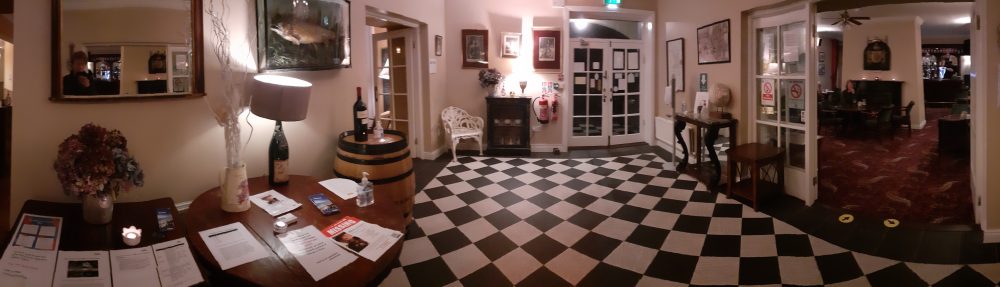
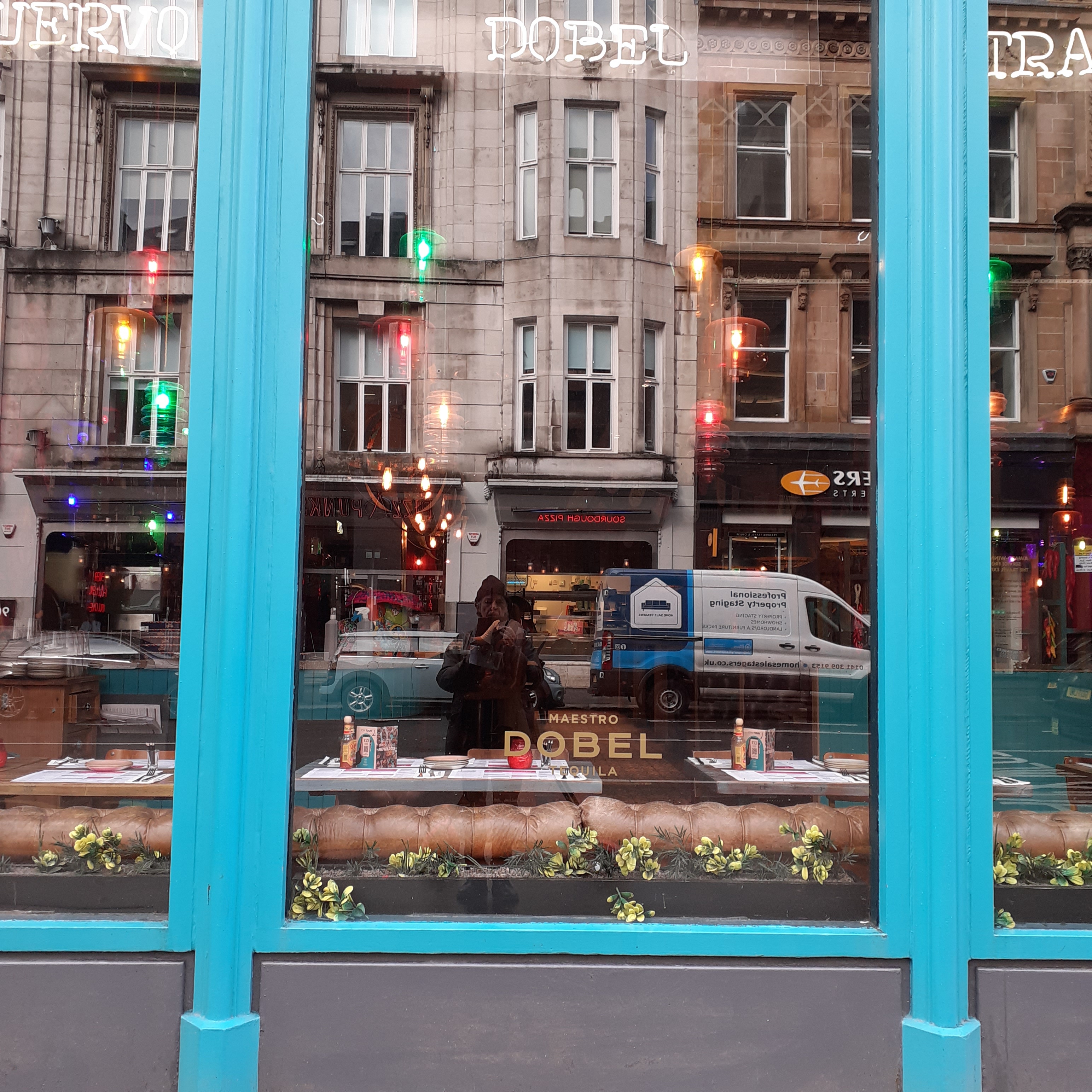
Glasgow is an hour’s flight from Dublin. The airport is south of the city and the bus takes us there in thirty minutes for £11. The driver doesn’t have change of a fifty, Britain being weirdly averse to high denominations, but my friend obliges and pays the fare with his magic phone. We are dropped off just below Blythewood Square, close to our hotel. When I say below, I mean below, remembering now how hilly Glasgow is. The city’s modernist grid system accentuates this, with a quite San Franciscan undulation of steeply sloping sidewalks and buildings.
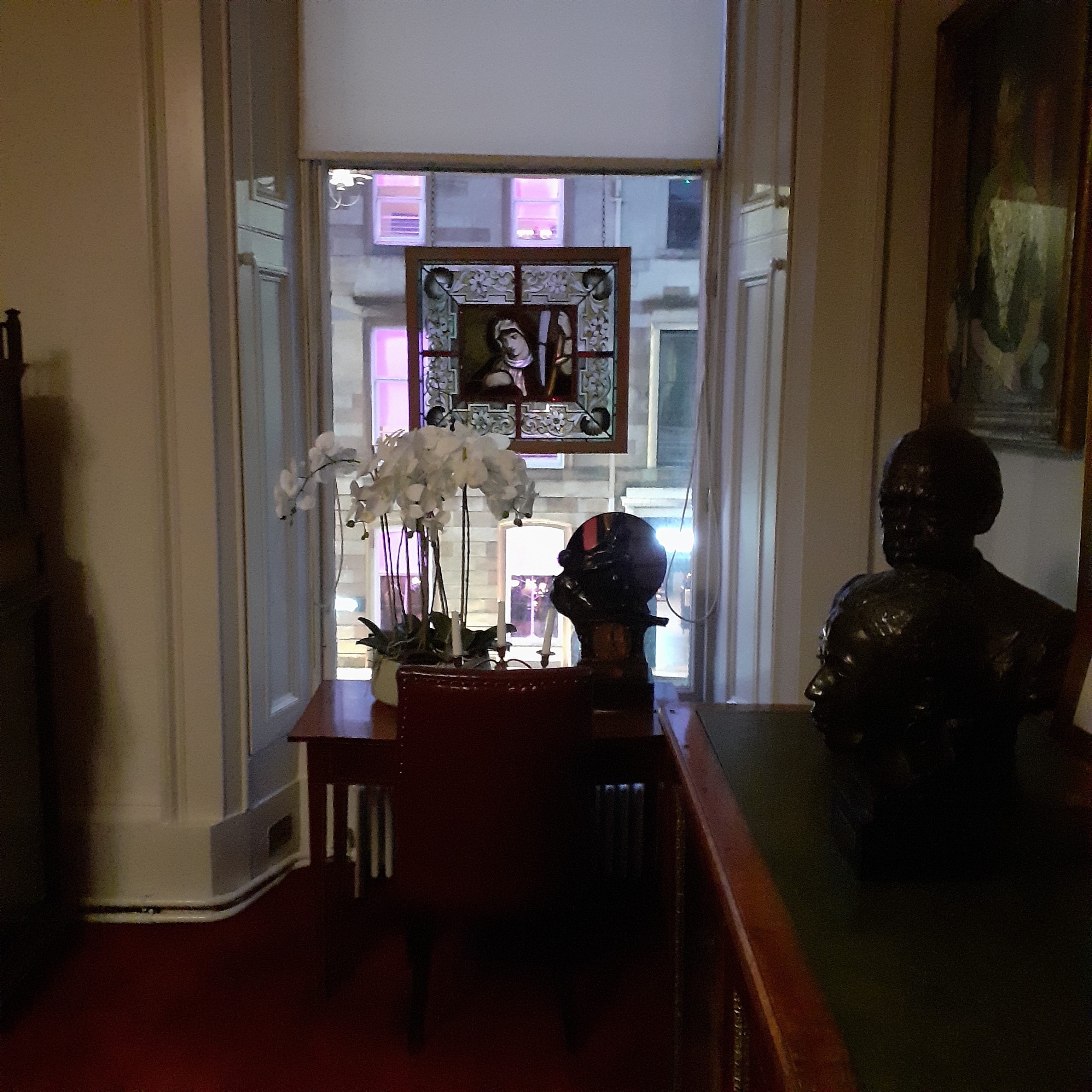
The Sandman Hotel is on West George St. The desk is excellent and we are given comprehensive guides and recommendations for our wining, dining and cultural pleasure. Plenty of that in Glasgow for sure. A short walk around the neighbourhood brings us past the Glasgow Art Club. But why pass when there’s people wandering in with paintings under their arm? We figured to blag our way in, though in fact it’s open to public callers; simply ring the bell. Eslyn Barr of the Paisley Art Institute, fellow inmates of the building, gave us a fascinating tour. The Club has occupied these premises on Bath Street since 1893 when a gallery was added. Architect John Keppie designed this and was assisted by his draughtsman and future partner Charles Rennie Mackintosh. Eslyn shows us the Mackintosh frieze and the beautiful paintings and artefacts accumulated over the years. The members exhibition is also going up, a continuation of such predecessors as John Lavery, George Pirie and James Paterson. These artists would feature prominently on our trip.
The next morning we breakfast at Wetherspoon’s. This becomes a habit, as it had on a previous trip. What’s not to like? Full Scottish with Haggis and copious cups of coffee. My friend’s magic phone isn’t accepted here so my cash is king. This branch on Sauchiehall Street is called Hengler’s Circus after the circus which perfpormed nearby in the early twentieth century. Iillustrations on the walls tell the history of Hengler’s, the Empire Theatre and other aspects of Glasgow history, including the Glasgow Boys. And you can drink till the wee small hours.
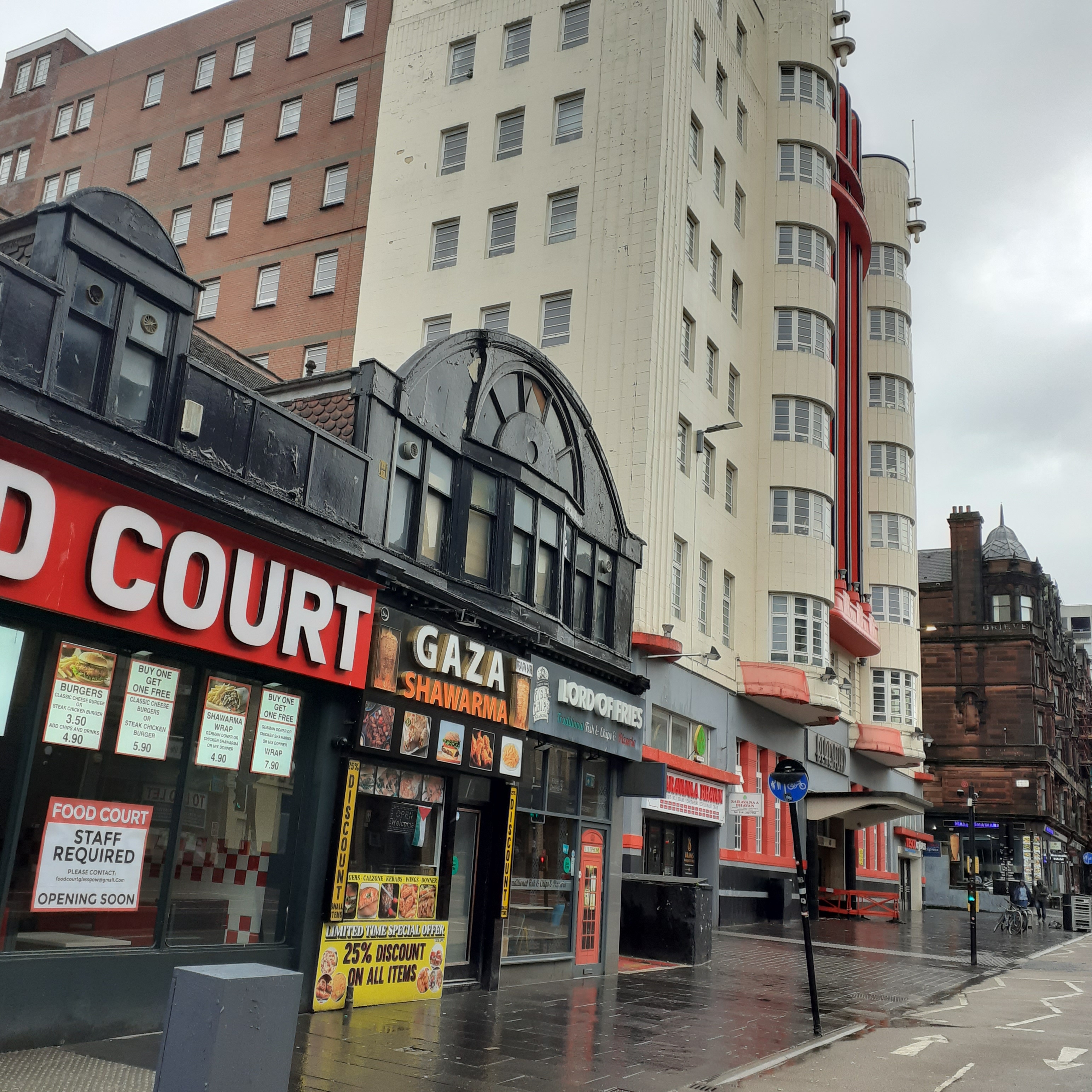
We aim for the open top bus tour and a stroll down Suachiehall Street. The street makes for a good point of orientation. It cuts east west through almost the entre city. Towards the city centre it’s pedestrianised and a bustling shopping precinct. The name comes from the Scots for Willow Meadow, as the area once was before the city expanded in the boomtimes of the nineteenth century. It was first the haunt of the well to do in fine Victorian townhouses. The Art Deco Beresford Hotel was built in 1938 for the Empire Exhibition. Rising to eight stories it was referred to as Glasgow’s first skyscraper. A student residence and briefly a casino, it is now an apartment block, while newer, higher skyscrapers abound. A browsing highlight was poster shop On a Wall Near You. A world of iconic images, stone age, rock age space age, you name it. Picture heaven, and paraphernalia besides, with teeshirts, tote bags and, my addiction, fridge magnets. Smiles all round.
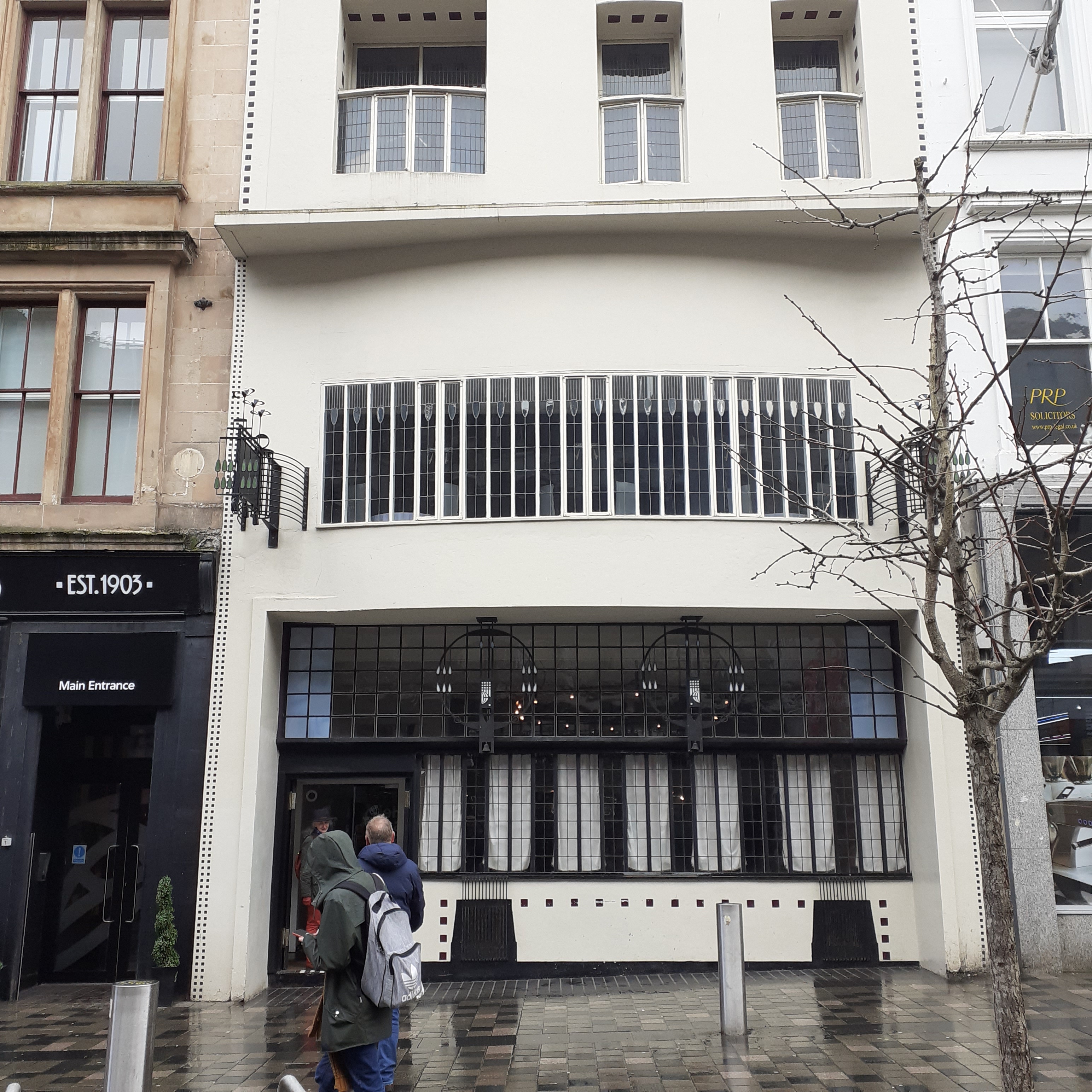
I lead a short detour to the School of Art on Renfrew Street, Mackintosh’s most famous architectural work. Seriously damaged by fire in 2014, it was undergoing extensive reconstruction when last I visited. It burned down again in 2018, The School was founded in 1845 and gives degrees in Architecture, Fine Art and Design. In 1909 Mackintosh’s building was completed and became a testament to the genius of its creator. Hopes are to have it reinstated by 2030. In consolation, back on Sauchiehall we made for the Mackintosh Tearooms. Miss Cranston’s project for sober sipping saw her open four tearooms in the city. Tea Rooms were an intrinsic part of Glasgow life in the late Victorian age. Miss Cranston commissioned Mackintosh to design her Willow Tearooms on Sauchihall Street in 1903. He created an elegant Art Nouveau merger of modern glass and steel craft with the exotic aesthetic of the Orient.
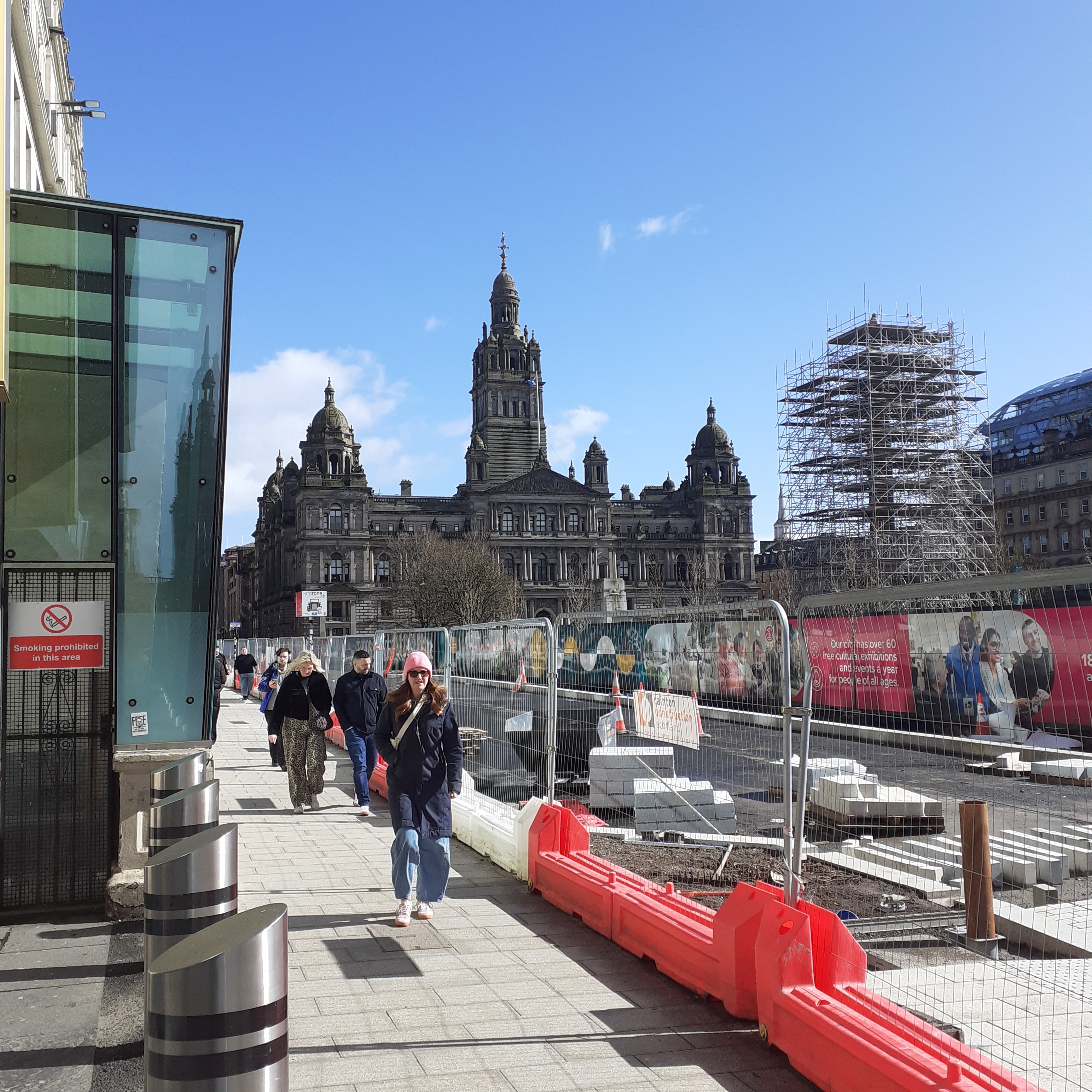
The open top bus eludes us. It should be based on George Square but that whole area was suffering from excessive repair and the bus was diverted elsewhere. Instead we spent the evening recuperating with food and drink in a variety of downtown bars including Malone’s Irish Bar. We saw Scotland suer a one goal deeat to Japan in a friendly at nearby Hamden Park. Indeed, Glasgow does boast that its the friendliest city in the world. For us it held true. It can be a bit like a thistle curry at times; spiky to begin with, but guaranteed enduring warmth.
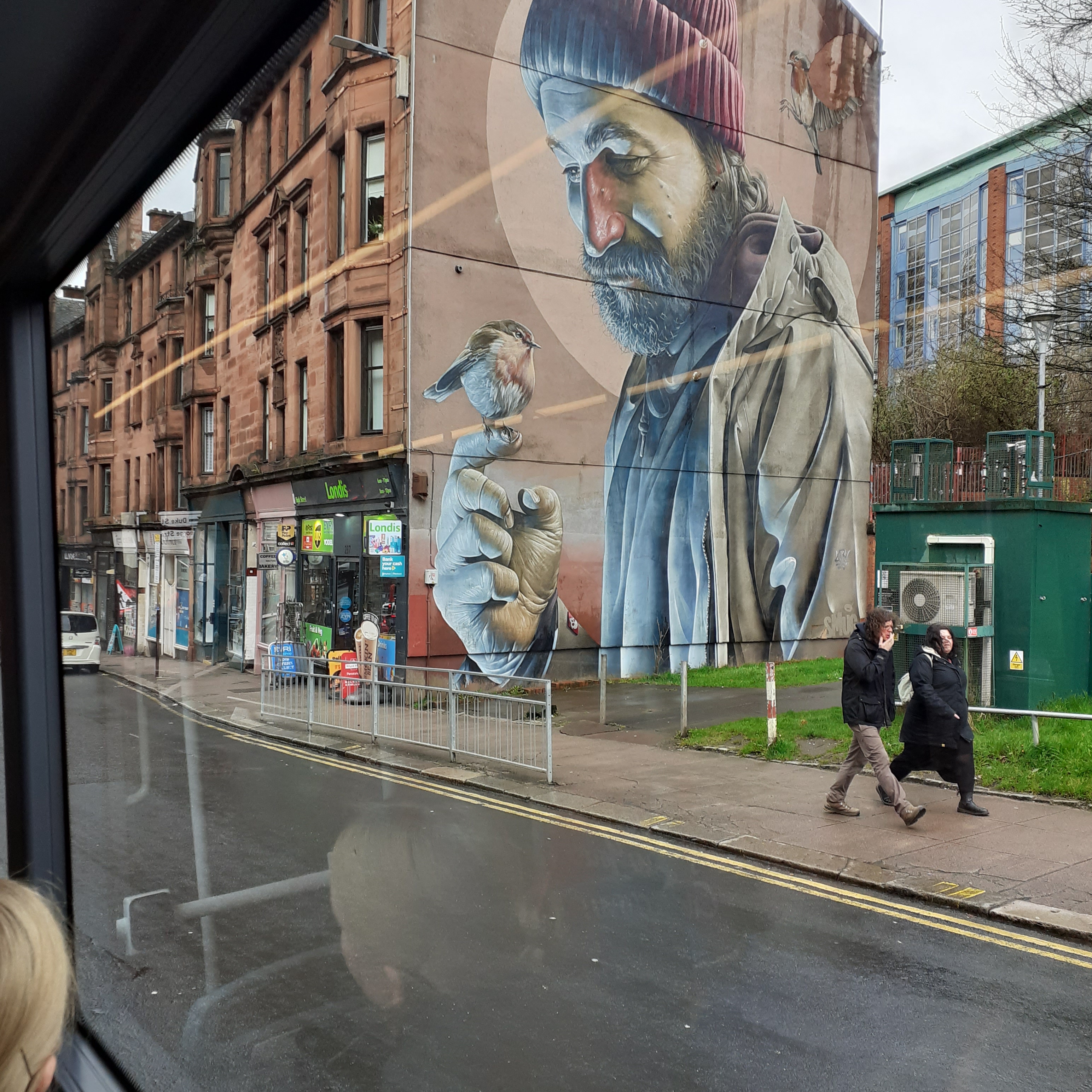
Tomorrow is another day and we find the bus actually departs from Cathedral Street. The audio guide gives a good chronological account of the city. Glasgow Cathedral is dedicated to St Mungo who founded the city in the 6th century. His four miracles of Glasgow are formed into a rhyme: Here is the bird that never flew, here is the tree that never grew, here is the bell that never rang and here is the fish that never swam. The bird he saved is illustrated by a startling mural on a gable nearby The Cathedral was begun in 1136 and the city grew around it. High Street and Trongate are a couple of the medieval streets remaining on the East side.
This town was built on muscle and blood. Tobacco, cotton and slavery saw its port prosper in the eighteenth century. It became a gateway to the new world. With the Industrial Revolution, Glasgow became a European leader in industry and engineering, particularly as a centre of shipbuilding. The Clyde made Glasgow and Glasgow made the Clyde. Our tour takes us along the north bank of the river passing through scattered parkland and ambitious modern developments including the SEC Armadillo Arena and the Riverside Museum with the tall ship Glenlee.
Beyond the ring road motorway we enter the West End with its grand terraces and parkland. The area is famed for its restaurants and bars and home to some of Glasgow’s top sights. The scenic Kelvingrove Park is a central feature. Sylvan and sublime it is bisected by the River Kelvin The river’s name was appropriated for Baron Kelvin. The famous Irish physicist William Thomson was born in Belast in 1824 and for fifty years was professor of Natural Philosophy at the University of Glasgow. Here he figured that the coldest temperature possible, absolute zero, was -273 degrees Celcius. Even in Glasow.
The University of Glasgow sits atop Gilmore Hill. Its majestic spire dominates the city. Across the road the Hunterian Museum has a large exhibition on Charles Rennie Mackintosh and his group, The Four. He and friend Herbert McNair and the sisters, Margaret and Frances MacDonald met at the Glasgow School of Art and later married; Charles to Margaret. She was a renowned decorative artist and worked in collaboration with her husband on many projects. The sisters flowing art style was influenced by Aubrey Beardsley, leading to the group being dubbed the Spook School.
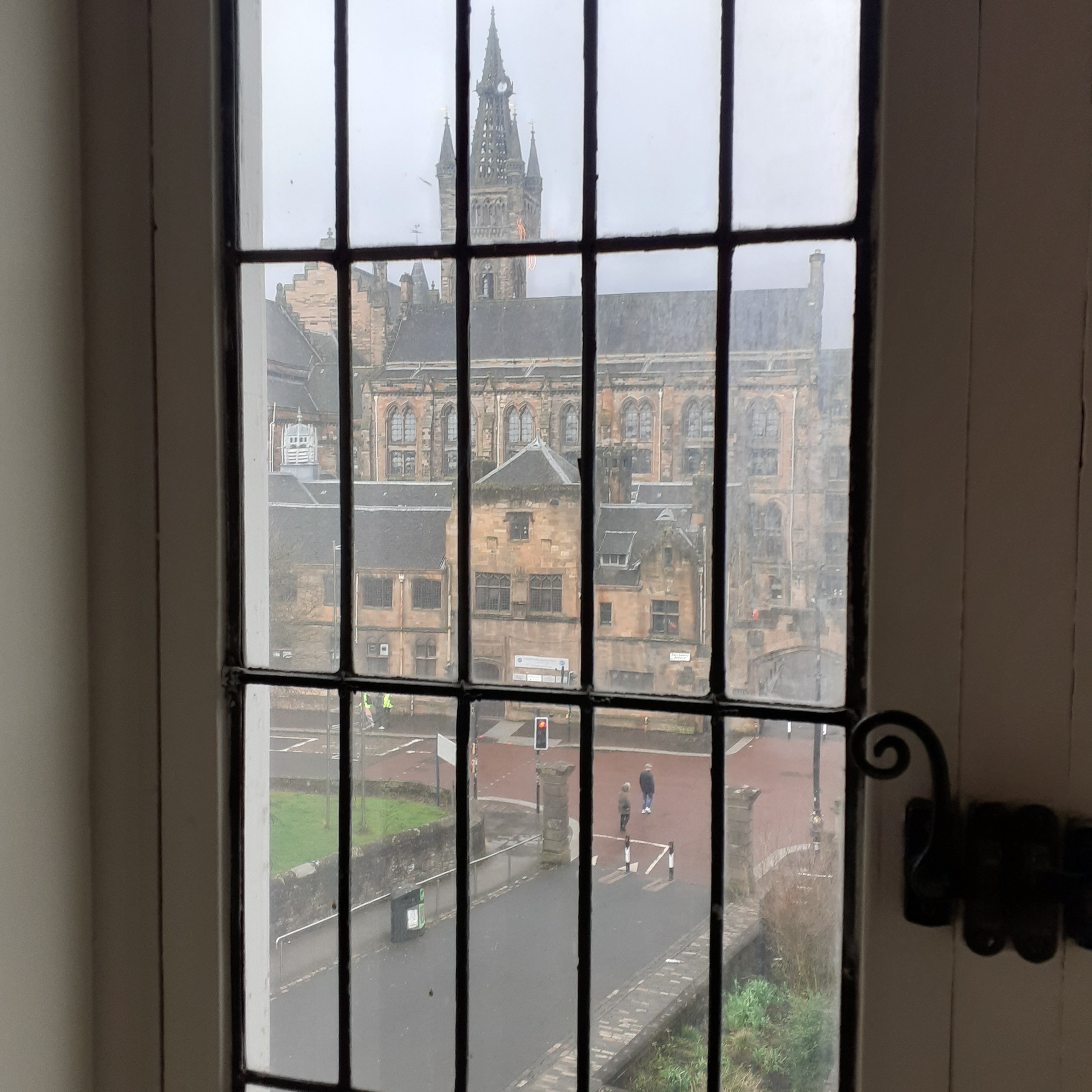
The Mackintosh’s lived right here. The modern museum was built on top of their terrace. The interior has been skillully recreated within the modernist building, preserving its aspect and most importantly the wonderful interior design Mackintosh imposed on the Victorian house. The Hunterian boasts a huge collection of Scottish and internastional paintings. The Glasgow Boys feature strongly with work by Patterson and Lavery amongst others. American artist James MacNeill Whistler is well represented, the University receiving a large body of his work by bequest. Whistler’s Scottish ancestry, the actual Whistler’s Mother, and the admiration of the Glasgow Boys helped bring this about.
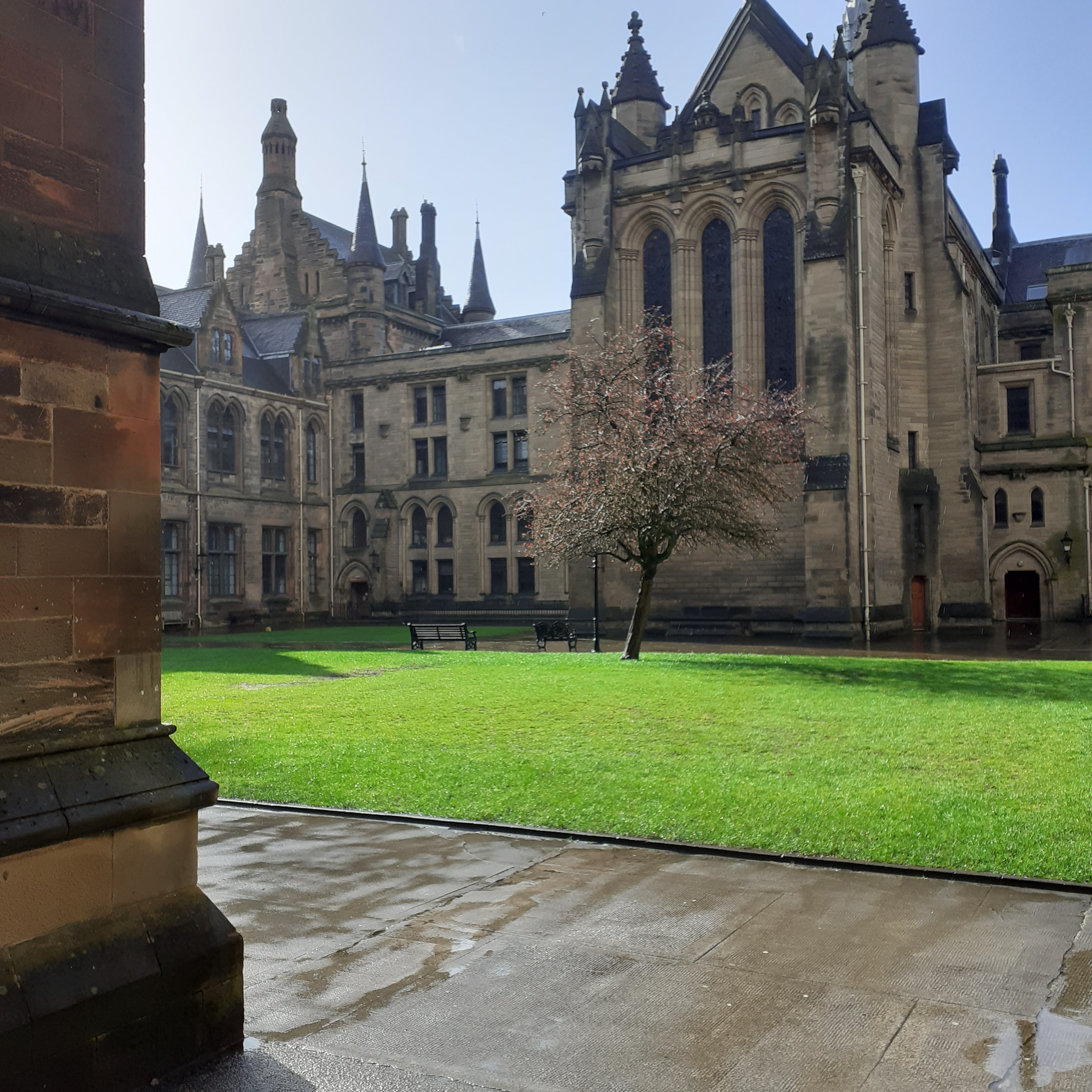
Rain falls as we cross the road to the University. We ghost through the quads and cloisters, evoking magical worlds, including Hogwarths it seems. The University was ounded in 1451 and moved here in 1870. The Gothic Revival spectacle was designed by George Gilbert Scott, crowned with the eighty five metre bell tower in 1887.
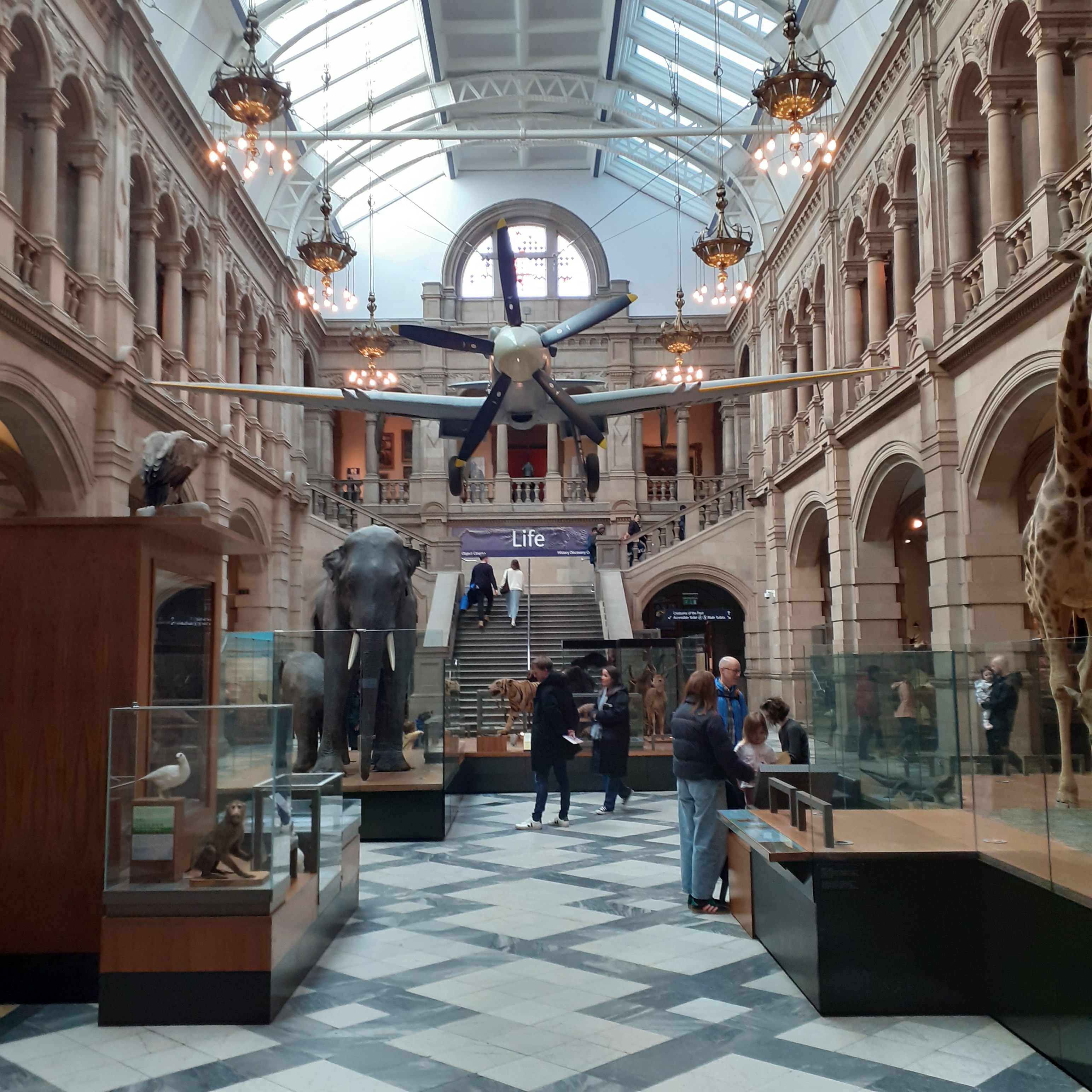
Downhill through parkland and over the Kelvin River brings us to the Kelvingrove Museum. Completed at the start of the twentieth century, the red sandstone Baroque temple houses a richly varied collection of art and artefact. The main concourse is dominated by the classical pipe organ which booms into life at lunchtime when there is a regular recital. It is blasting out music to a lively throng of all ages as we arrive. The ground floor houses an eclectic and dynamic exhibition, including an Elephant and a Spitfire, a vernacular history of Glasgow and an Egyptian collection. The art again features the Glasgow Boys, Mackintosh, Scottish Colourists and French Impressionists. Floating above all is Salvador Dali’s most coherent masterpiece, Christ of Saint John of the Cross. This famous work places us, the viewers, at a vertiginous angle. Along with the painting we find ourselves being borne heavenwards. But heaven must wait and we take the bus back to the hotel. Time for rest and recreation, and another night tossed about on the waves of Glasgow’s undulating streetscape. Pure magic.
When I look out my window many sights to see
When i look in my window so many different people to be
That it’s strange, so strange
You’ve got to pick up every stitch
You’ve got to pick up every stitch
Must be the season of the witch
Donovan Leitch is a local boy, as is apparent on his song Season of the Witch from his third album Sunshine Superman (1966). The song is soaked in urban paranoia and possibility. Its timeless span reaches from Celticism to modern gothic. It is almost an obligitory soundtrack; in the last month I’ve heard it on three or more tv series, including Australia’s The Twelve and Norway’s Harry Hole series. Strange indeed.










 xxharrison