Climbing Bray Head

B.Woods Aug20

Bray Head is the defining geographical feature of the town. Rising sheer eight hundred feet from the Irish Sea, the headland is capped by a large stone cross, erected for the Holy Year of 1950. The headland is a sizeable upland area. Its ridge consists of five or so mounds of exposed quartzite, like the knuckles of a fist. While the cross marks the headland, the summit is a couple more humps inland. 

The climb to the Cross is a must for visitors, and a regular pastime for locals. The route from the seafront is steep, though the incline can be tempered by zigzags through natural woodland. A longer but more gradual climb runs from the junction of the Southern Cross and Greystones Road, adjacent to Bray Golf Course. 
B.Golf Aug20

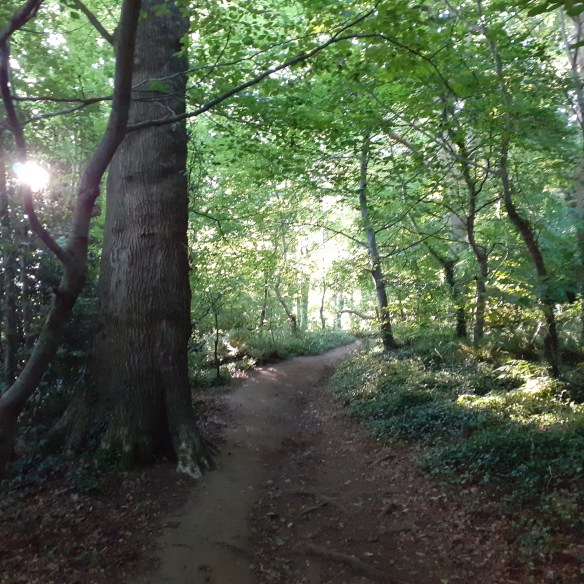
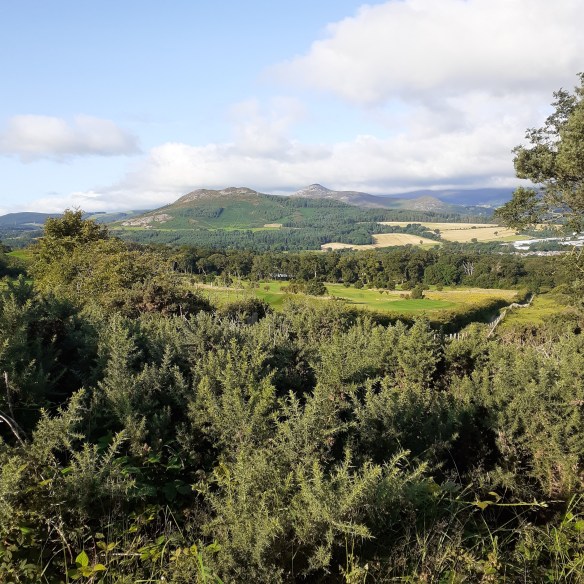
The lower entrance, through the gates, makes for a lovely start through dense deciduous woodland. Dappled green and umber, but allowing the occasional patch of sunlight through, this is a cool and mesmeric way to disguise the climb. Merging with the golf course path, the incline hardens, but compensates with fabulous views over the Sugarloaf Mountains, to the Wicklow Mountains beyond, with Bray’s urban landscape leading down to a blue sea, and South County Dublin’s rocky bays and inlets leading the eye on to the distant city. 
B.View Aug20

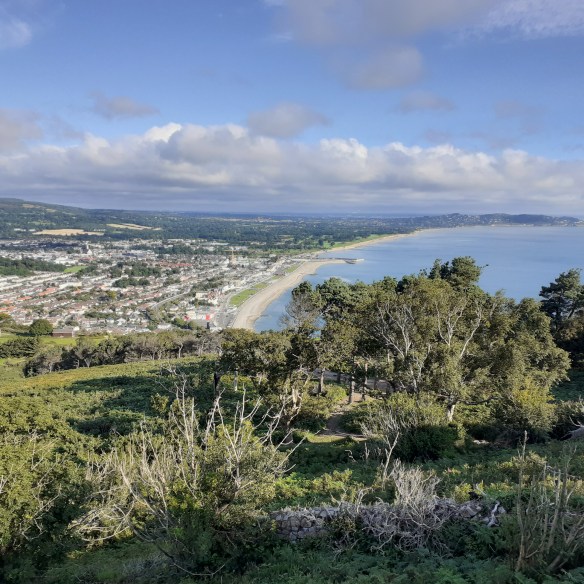
At the top of the path there’s a short, stiff clamber over rocks just above the treeline before the path resumes. Another option, is to veer right for a longer, smoother ascent, with some wonderful rugged scenery above the manicured golf course. Emerging from the scrubland, there’s a smooth path leading up to. the Cross. The headland offers dizzying views over ocean, coast and townscape, framed by the majesty of the Wicklow Mountains. 
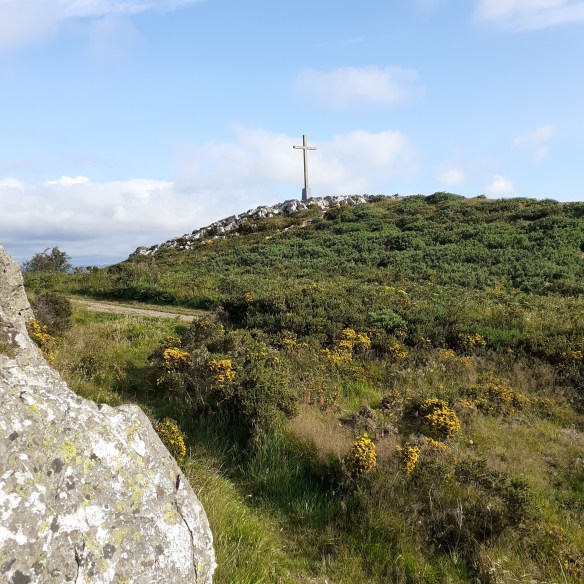
B.Cross Aug20

The hummock is often thronged, but often not. People come and go, and you can linger as long as you like to get the best from the experience. And there’s a surprisingly large expanse of wilderness up here to explore, or just to be away from it all. We take the path towards the stile, but leave it to ensconce ourselves beneath the second knuckle in, and sitting on grass with the rock guarding our backs, relax for a while and bathe our eyes with sunshine and the blue and glinting Irish Sea.

It doesn’t take long before I feel a song coming on.

Somewhere beyond the sea

Somewhere waiting for me

My lover stands on golden sands

And watches the ships that go sailing

La Mer was written by Charles Trenet, a homage to the view of the Etang de Thau, a lagoon he passed on the train between Montpellier and Perpignan in the South of France. Jack Lawrence’s Anglo version gives a romantic twist to the descriptive thrust of the original. It was a major hit for Bobby Darin, which is how I know it. It features on his 1961 compilation, the Bobby Darin Story, the oldest, probably, and most bedraggled album in my collection.

B.Sea Aug20

Somewhere beyond the sea

She’s there watching for me

If I could fly like birds on high

Then straight to her arms I’d go sailing.
In Killruddery Woods

Kilruddery woods

From our last stop, the Bus Stop, Killarney Road makes for the M11 to the southwest. The road to the left is officially known as Oldcourt Park, but known locally as the Soldiers Road.  It runs alongside the ravine carved by the Swan River. Lost amongst the trees, the ancient tower house of Oldcourt Castle looms above, forever beyond reach. The river slithers through Wheatfield, past Swiss Cottage, across the Boghall, up to Southern Cross and on to Killruddery where the brook drains off Giltspur, or the Little Sugarloaf. 

These lands south of Bray were granted to Walter de Riddlesford, one of Strongbow’s loyal adventurers in the invasion of 1169. The large demesne is centred on Killruddery, the Church of the Knight. The Brabazon family came into ownership of the estate in the early 16th century through William Brabazon, Lord Justice of Ireland. The title Earl of Meath was granted to his great-grandson William in 1623. Killruddery House had to be rebuilt following destruction in the Cromwellian wars of the mid century. The current building is largely an 1820s reconstruction in the Tudor revival style. The original gardens remain. Designed by the French gardener Bonet, they are a unique example in Ireland of seventeenth century design, haunted with an exquisite Gothic gloom. Classically inspired additions blossomed in the eighteenth and nineteenth centuries.

The house and gardens are a popular attraction, with coffee shop, farmers market, garden centre and regular music and art events. There’s an adventure playground and Ireland’s largest obstacle course. Best of all are the walks through the estate, beyond the walls where nature wrestles amiably with farmland and forest. I have variously met friends and strangers, no one at all, amiable vikings and post apocalyptic hippies (these later visions being on film set).

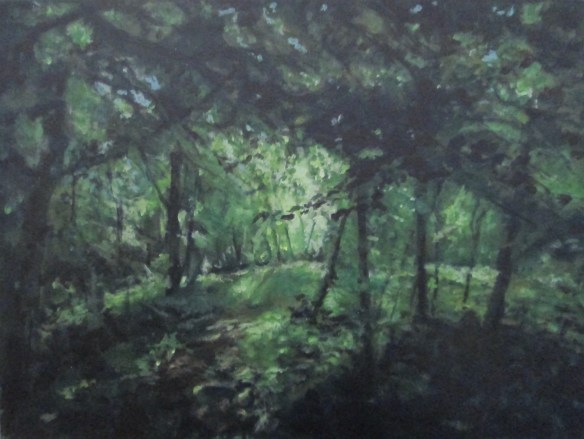
I recently took a path less travelled on the borderline between Killruddery and Belmont. In natural woodland on a sunny day there’s a tangible frisson in the air as light and dark dance with uninhibited abandon, together all alone, but for me. This acrylic is unusual for me in the choice of palette, which is very, very green.

But most of all I miss a girl in Tipperary town

and most of all I miss her lips as soft as eiderdown

again I want to see and do the things we’ve done and seen

where the breeze is sweet as shalimar and there’s Forty Shades of Green 

This song became such an iconic evocation of the Emerald Isle that it is presumed to have originated here. In a way it did. Johnny Cash wrote the song when touring Ireland in the late fifties. Once, after performing the song, a fan thanked him for his respect in singing a grand old Irish traditional air.

Bus Stop

Bustop1

Bus stop, wet day, she’s there, I say

Please share my umbrella

Bus stops, bus goes, she stays, love grows

Under my umbrella

All that summer we enjoyed it

Wind and rain and shine

That umbrella we employed it

By August she was mine

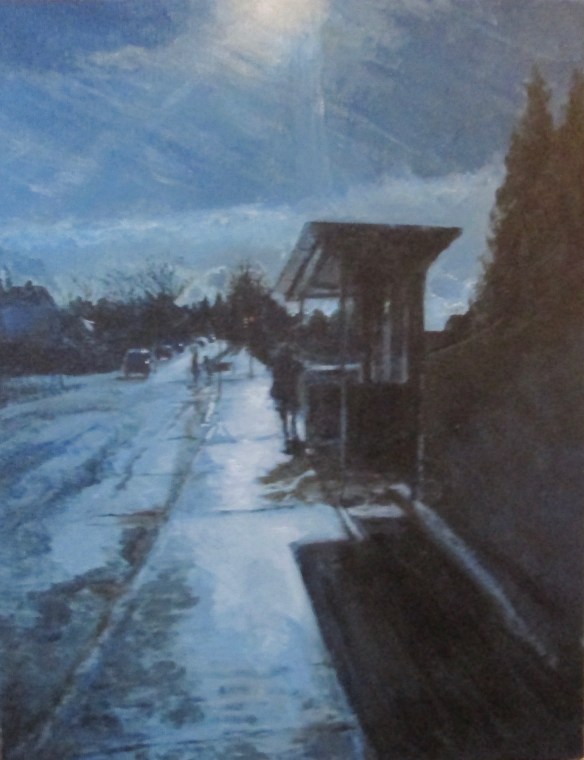
From the Swan River, Killarney Road keeps rising until it tops Fairyhill. Small estates line  the road, most dating from the nineteen eighties. The 145 bus route takes an unexpected right turn at Killarney Lane and the stops before the junction are mine. Across the road, the Nurseries lie beyond a triangular green planted with a copse of silver birch and sycamore. On this side, the western, the footpath runs continuously from the town to the M11. The covered bus stop here is a morning refuge for northbound commuters, whether heading for Bray Dart or Dublin. The 145 connects as far as Huston Station via the N11 and Dublin City Quays. I usually hike to the Dart on my northbound excursions, but the bus has its own consolations. More quaint and communal, and the serpentine route gives a scenic tour of south Dublin. There’s an intimacy too in the bus stop mythology. At least, that was the experience of my generation back in the day. The anticipation, the tension, the longing; and that was just for the vehicle. Love might also blossom, in wind and rain or shine. 

That’s the way the whole thing started

Silly but it’s true

Thinking of our sweet romance

Beginning in a queue

In this acrylic, we approach the bus stop after a heavy shower. The sky is clearing and the surface below us glares painfully, but beautifully. At the junction, the Oldcourt is off to our left, and the nearby right turn heads towards the Ardmore Film Studios on Herbert Road. Ahead, the Killarney Road weaves steeply upwards through a portal of oak trees towards Ripley Hills, and the apex at Fairyhill, crowned with its stand of pines.

Every morning I would see her

Waiting at the stop

Sometimes she’d shop

And she would show me what she’d bought

Other people stared

As if we were both quite insane

Someday my name and hers

Are going to be the same

Bus Stop was written by Graham Gouldman who would later form 10cc. He credits his father with starting  the lyrics from Graham’s own idea. Getting started is the thing. “It’s like finding your way onto a road and when you get onto the right route you just follow it.” A bit like Killarney Road, then. Bus Stop was the breakthrough US hit for Mancunian group, The Hollies, in 1966. I heard it on my first long playing album Hollies’ Greatest Hits (Parlophone) which I got for my thirteenth birthday. 

Visions of Scotland – 2

Fort William to Kyle of Localsh


Glen Nevis

Glen Nevis

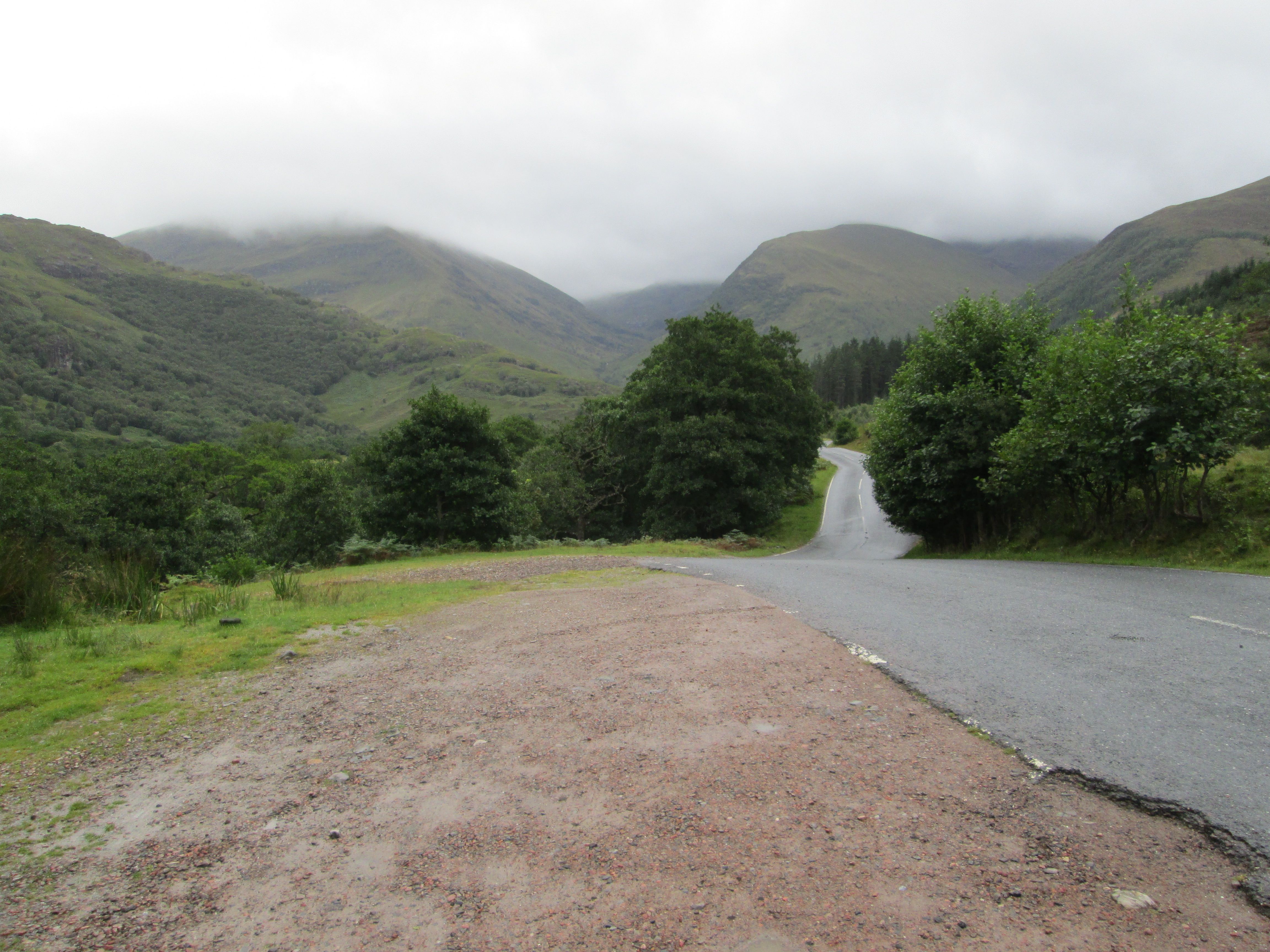
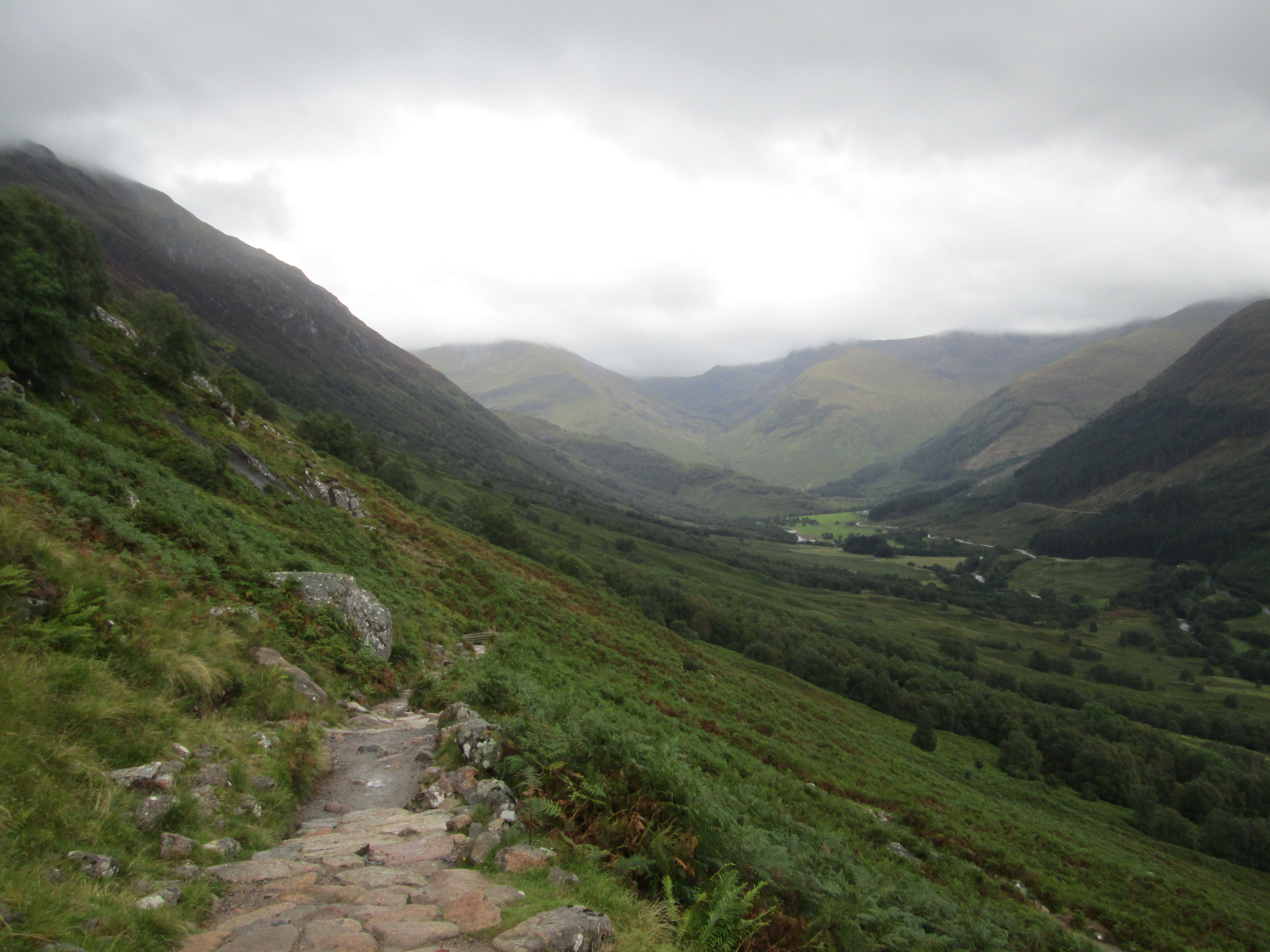
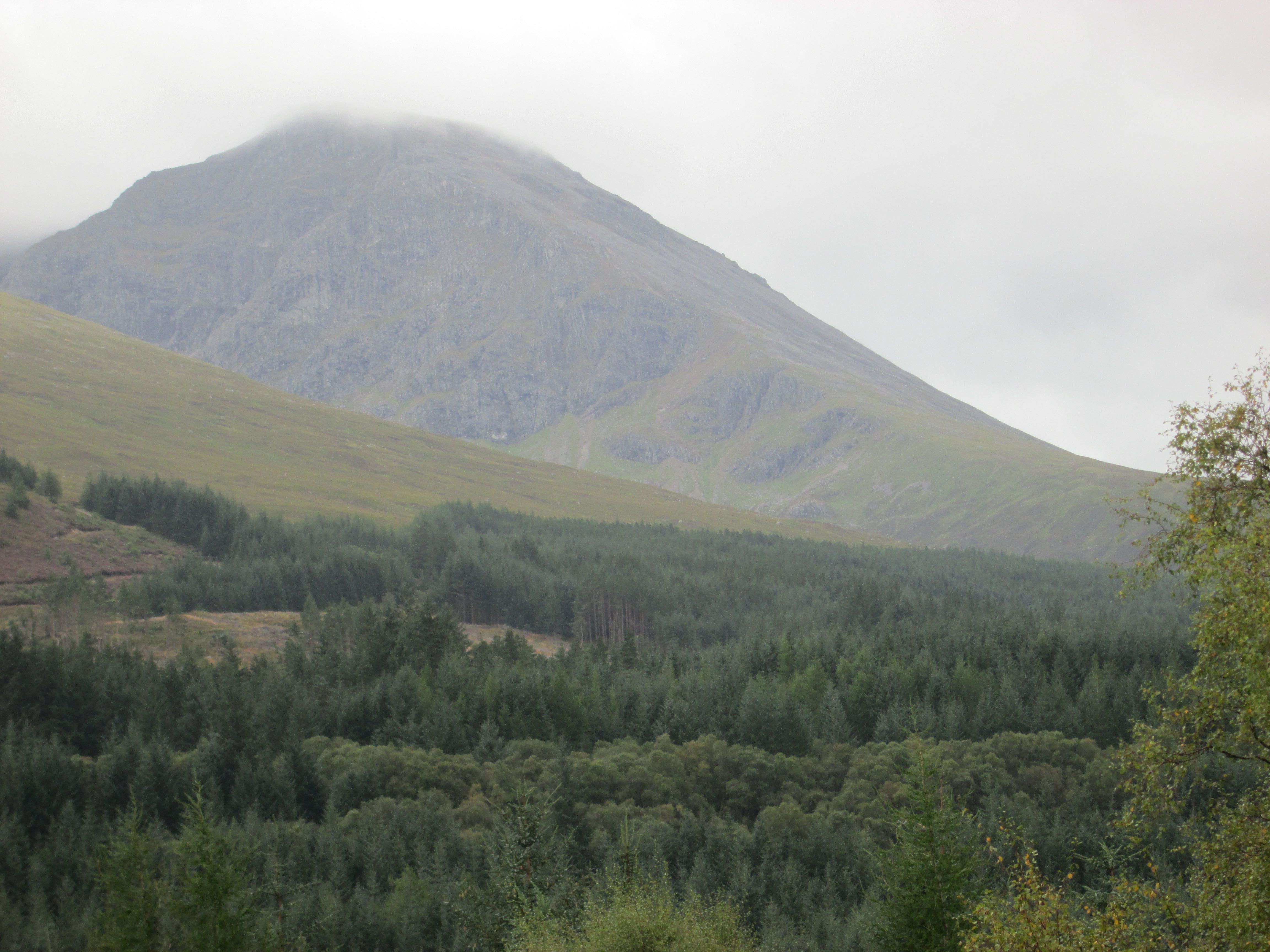
Before leaving Fort William, we must first set foot on Ben Nevis, mightiest mountain in the Celtic Isles. The mountains are obscured by clouds, but that’s just Scotland’s version of the dance of seven veils; the veils being various forms of mist and rain and translucent light. Glen Nevis is only yards from the town, but plunges immediately into giddy wilderness. We could be singing ‘I saw the rain-dirty valley, you saw Brigadoon’, indeed we probably did.

Climbing Ben Nevis

Climbing Ben Nevis

We make an assault from base camp, knowing that we lack the time to summit. Estimates of four hours up and a little less down are probably a tad conservative. Our calculations put us half way there in ninety minutes, reaching two thousand feet where a wooden bridge spans spectacular falls. And we were dawdling. Another time we’ll make it to the top. It’s a pleasant, well worn path with plenty of friendly banter from fellow travellers. The zig-zag climb is moderate, the views, slowly revealed in the waxing day, uplifting, heartstopping.

Big Ben himself

Big Ben himself

At last we hit the road, travelling up the rift valley parallel to the Caledonian Canal. At Invergarry we turn into the Highlands proper. Habitation recedes into heathland and scattered forest. We find a roadhouse at Cluanie. As we pull in, a convoy of trucks passes us uphill, each bearing a windmill propellor. What an odd juxtaposition out here! The roadhouse is sufficient for coffee and chowder, the service sporadic and homely.

Eiiean Donan

Eilean Donan

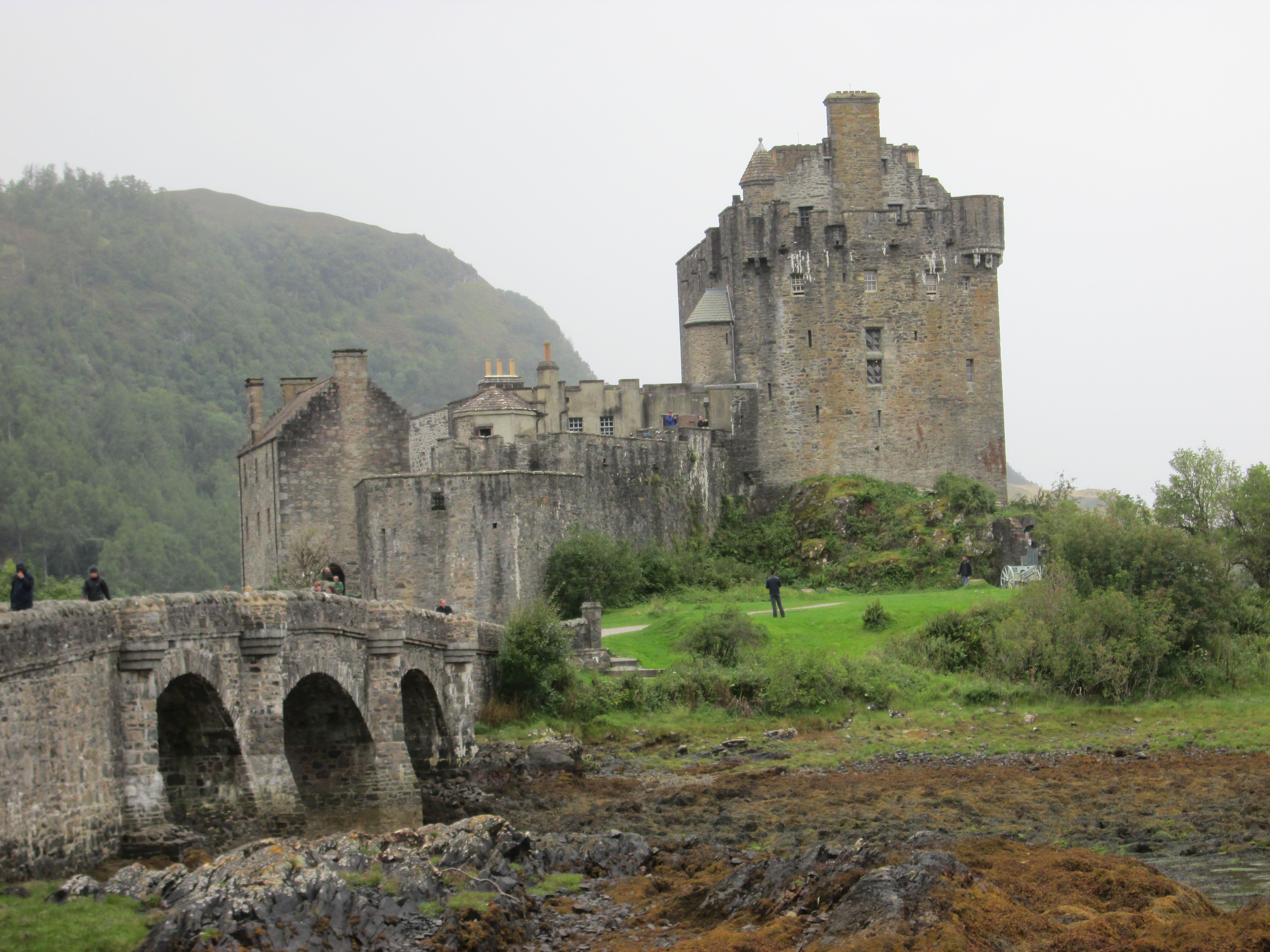
Evening approaches as we descend Glen Shiel. The castle at Oilean Donan stands proud at a craggy confluence of lochs. It’s crowded but worth the visit. The castle is well preserved and fitted, still functioning as a residence. Displays include lifesize tableaus from history creating an illusion of all time seeping through these walls. Real life folk are dotted around too, willing to converse on all aspects of the castle’s past and present. A whiskey fragrant guide in full highland garb leans casually on a waxen laird as he imparts words of wisdom. Good luck to him, he’s jovial and true. Scotland’s history is beginning to seep into me too. Half familiar but in a way that’s more storied, and sung, than factually held. So close to us also, it’s surprising it’s not more familiar back home. Only a visit can put that right. Places themselves are the living book.

Nightlife in Kyle

Nightlife in Kyle

Our destination, Kyle of Lochalsh is a couple of miles further on. I’d picked it without reference to Google Earth. I’d remembered the series, Hamish MacBeth which I thought was set here. Memory deceives, I’m afraid. Kyle’s a bit of a dump, a main road bisecting a scattered settlement, a rail terminal and a functional dockside. The Main Street is mundane, dominated by two banks with our hotel the most pleasant point at its summit. Something of a stereotype to report that while Irish main streets are lined with pubs, Scottish main streets are lined with banks. Perhaps here, men are really born to pray and save.

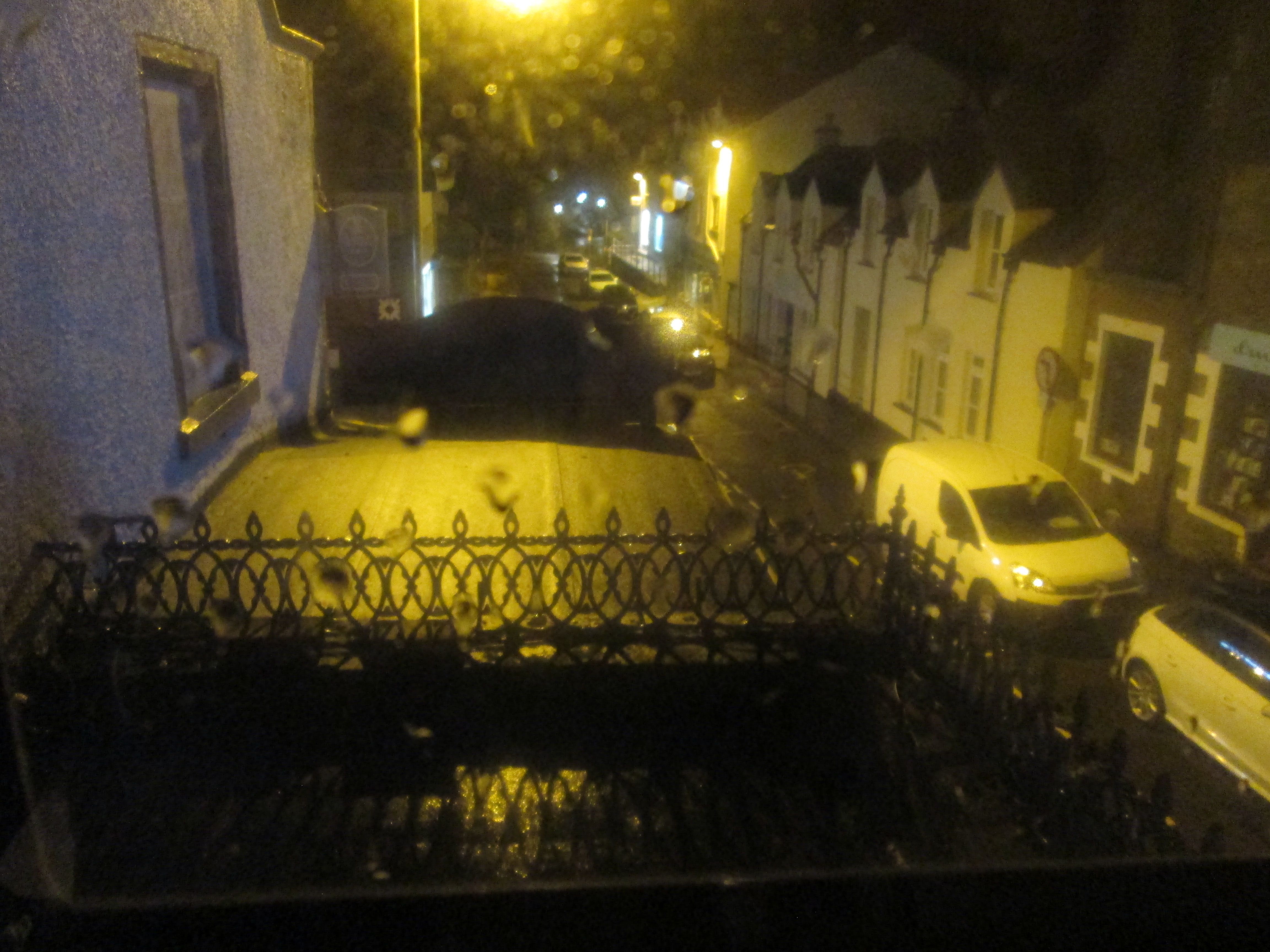
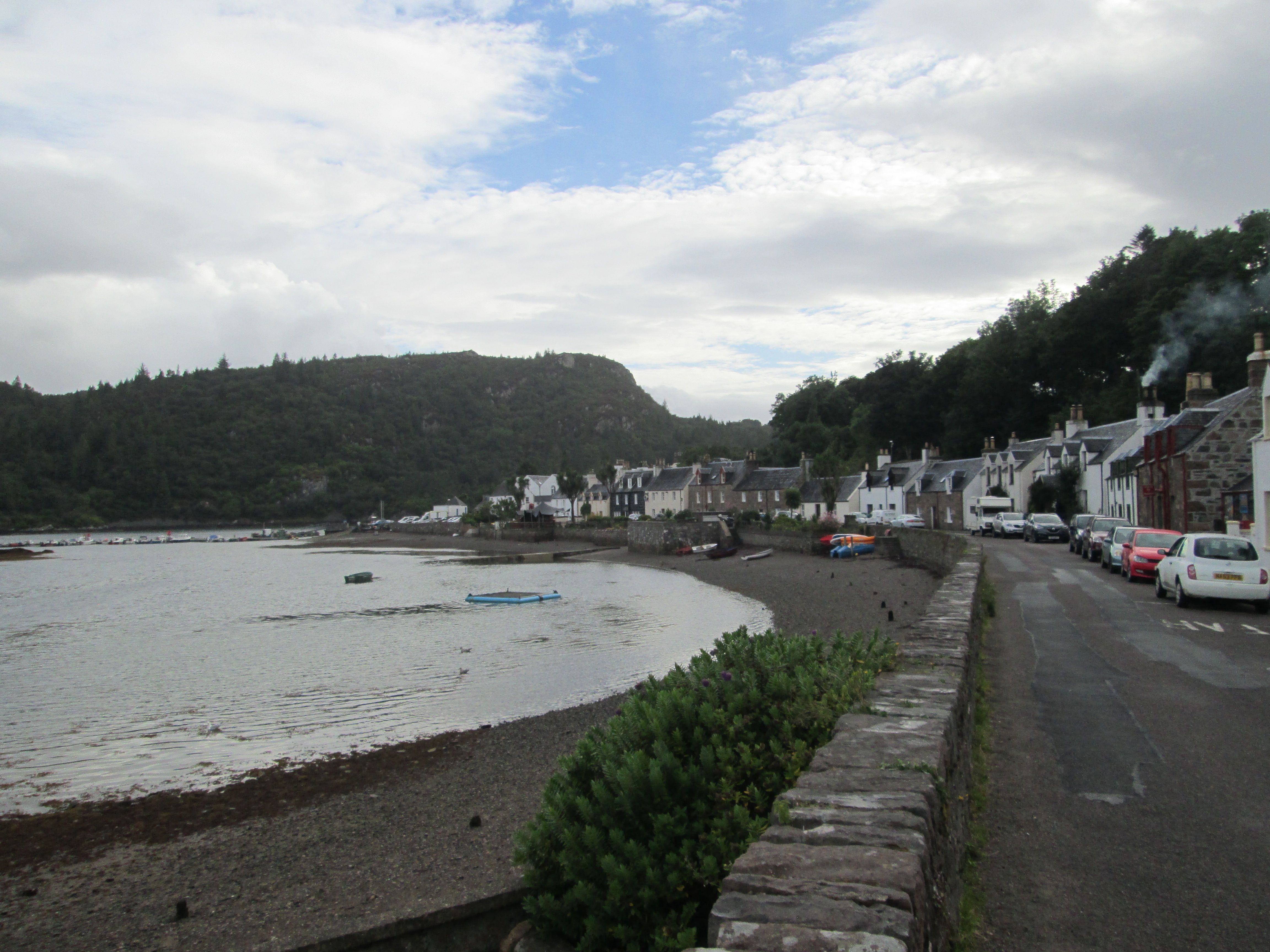
Still, the hotel is fine and we wave a decent meal of fish and chips in the bar. Our room is cosy old style, with a view down Main Street to the water. Raindrops mottle the window pane as the streetlights come on. Tomorrow, it’s on to Skye which is visible just across the water. We will discover too that nearby Plockton was the village I had imagined, a picture book perfect collage of mountain, woodland and water with atmospheric eateries and hotels. Look forward to telling you more.

Plockton

Plockton