During the recent hot spell I would, between a few leisurely lengths of our Hockneyesque pool, retreat through the sliding doors and return to my latest painting on rain and gloom. No better way to cool down. Well, there are some, but there’s only so much one’s allowed.
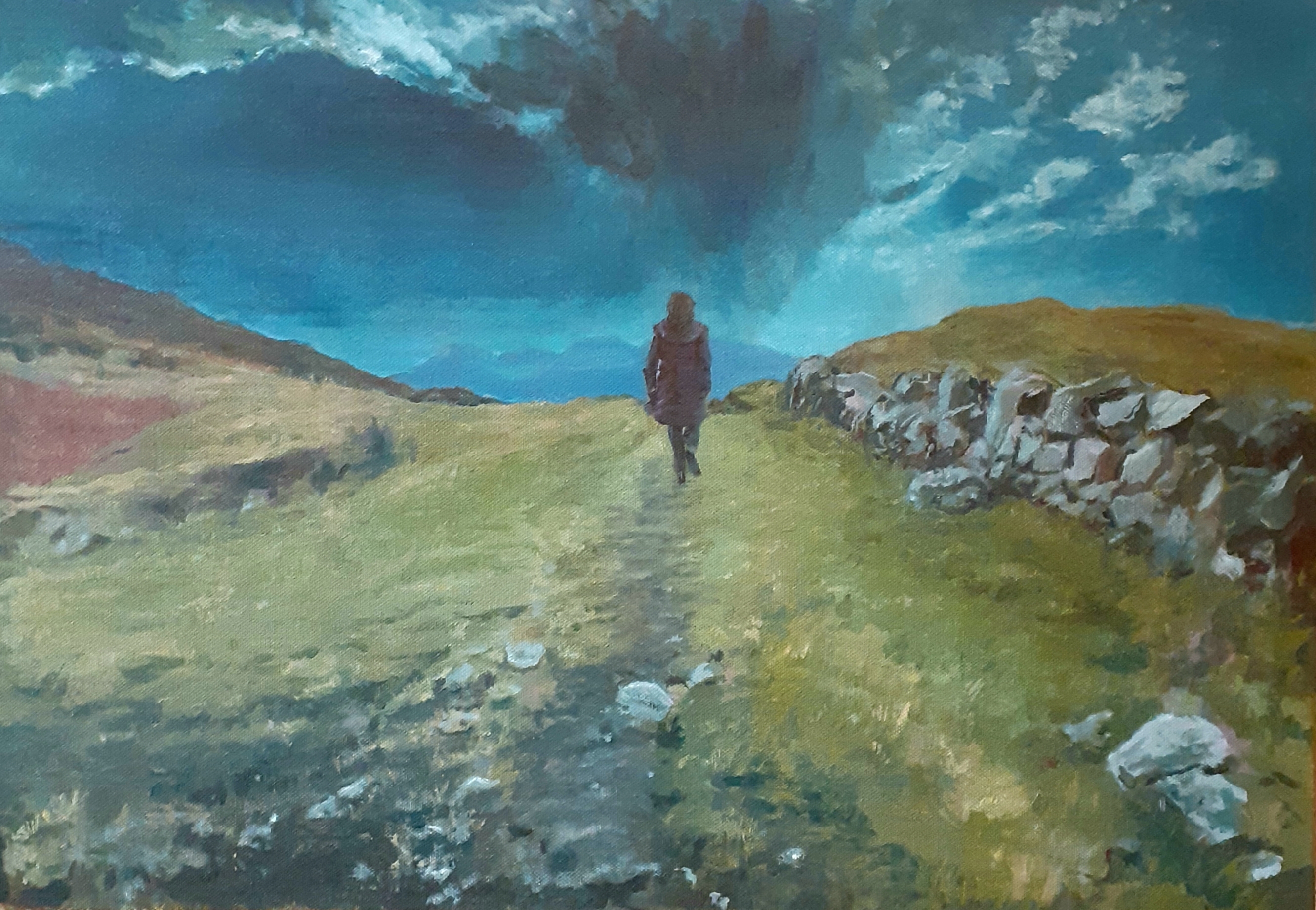
The road has risen from Killary Harbour behind us and cresting the pass the jagged profile of the Twelve Bens spreads along the horizon. We’re heading for Letterfrack and an assault on Diamond Hill, a standalone peak, or Marilyn, on the western edge of the Bens. We’re on a switchback road through the stark paradise of Connemara. It’s low noon in midwinter and the sky is striped with sudden storms. Raindrops spatter the widscreen and the radio plays.
Someone told me long ago, there’s a calm before the storm,
I know – it’s been coming for sometime.
When it’s over so they say, it will rain a sunny day,
I know – shining down like water.
This painting is acrylic on board, a harder surface than is usual for me. Which seems appropriate given its atmosphere. Off to our left is Lough Inagh. I stayed at the Lodge there over ten years ago, on a midweek course in Spring for watercolour painting. The few days, the fine tutelage and setting rekindled my enthusiasm for landscape painting. Most renowned landscape painter of Connemara would be Paul Henry. Belfast born in 1877, Henry lived in Achill for a decade up until 1919. His bleached landscapes have lodged in the collective view of how the west should look. He was colour blind, and lost his sight completely in 1945. He died at Sidmonton Square in Bray, in 1958.
Imagine the song on the stereo. The song that most sums up the feeling of rain, both positive and negative, was written in 1970 by John Fogerty, and included on the album Pendulum, released in December of that year. Fogerty was looking on the negative side, alluding to the growing disaffection within Creedence Clearwater Revival, despite enjoying success beyond their wildest dreams. But the lyrics and jangling guitar encourage a more consoling take on precipitation. There’s a peculiar exhaltation in sunshowers. Mind, our Connemara trip was midwinter, so the sun was slanting and cool, the rain sharp and hard. Beautiful though, within the bubble of a speeding car.
Yesterday and days before, sun is hard and rain is cold,
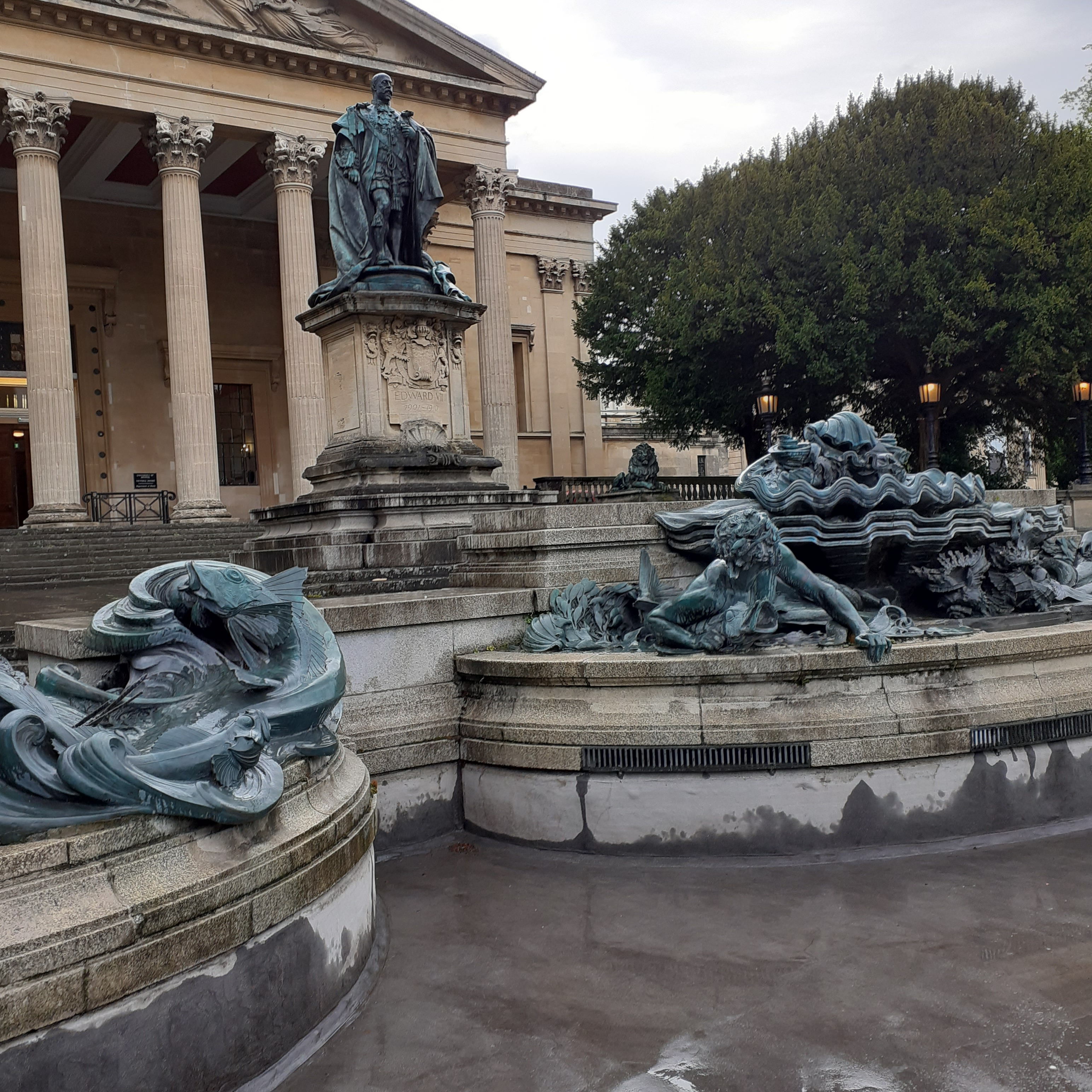
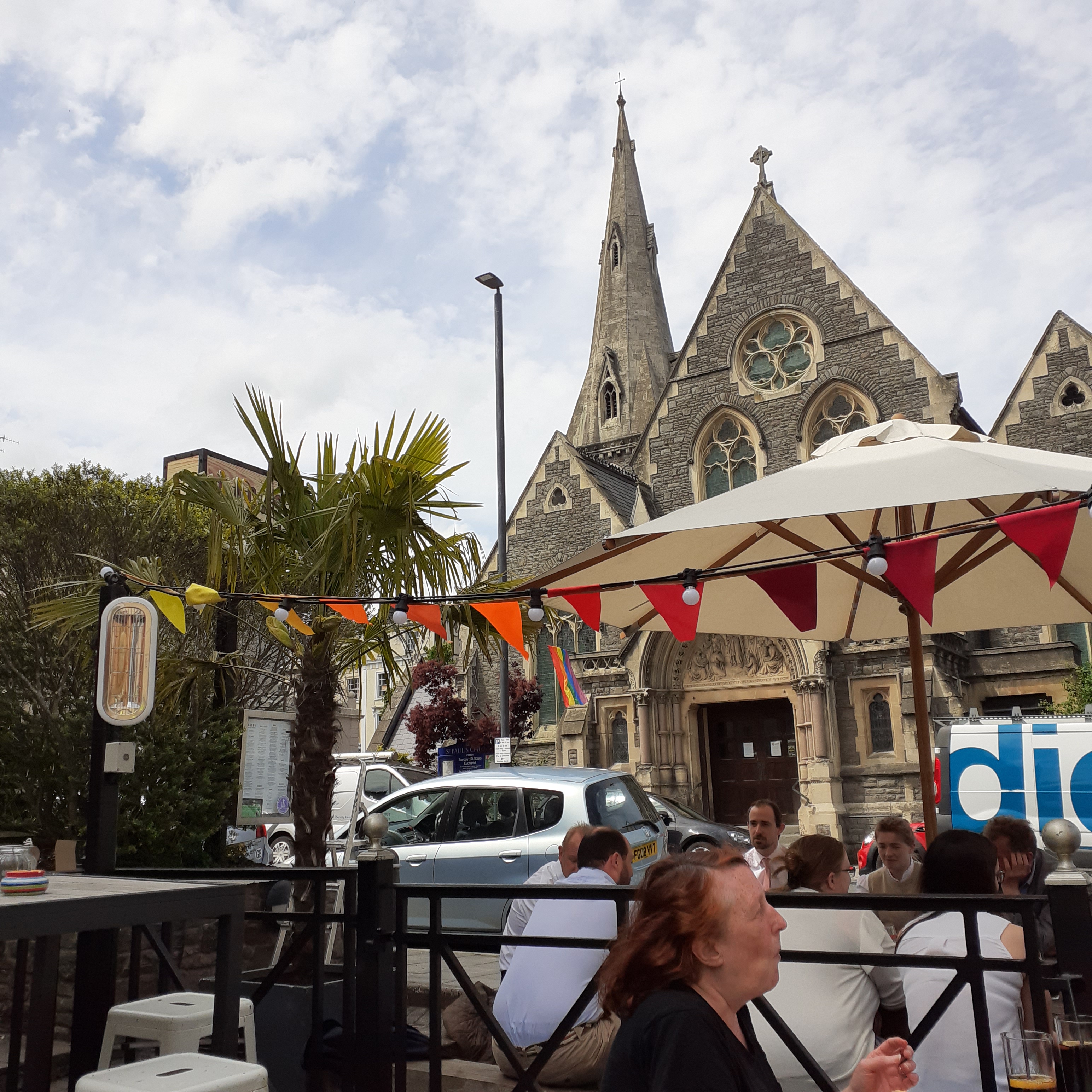
I’m staying at the Clifton Hotel on St Pauls Road and Sunderland Place. The latter is a short cul de sac at the back of the Victoria Rooms accessible by gate during daylight hours. The Victoria Rooms were built in 1838 and named for Queen Vic on whose nineteenth birthday the foudation stone was laid. She had been coronated the previous year. The building, designed by Charles Dyer, is in the Greek Revival style. Its Corinthian portico frames a forecourt which features an impressive array of art deco fountains, with crouching beasts and statuary about a curved pool with steps and balustrades. It functioned as assembly rooms, hosting concerts, lectures and exhibtions. Still does today, although the building became part of Bristol University in 1920 and houses the Department of Music.
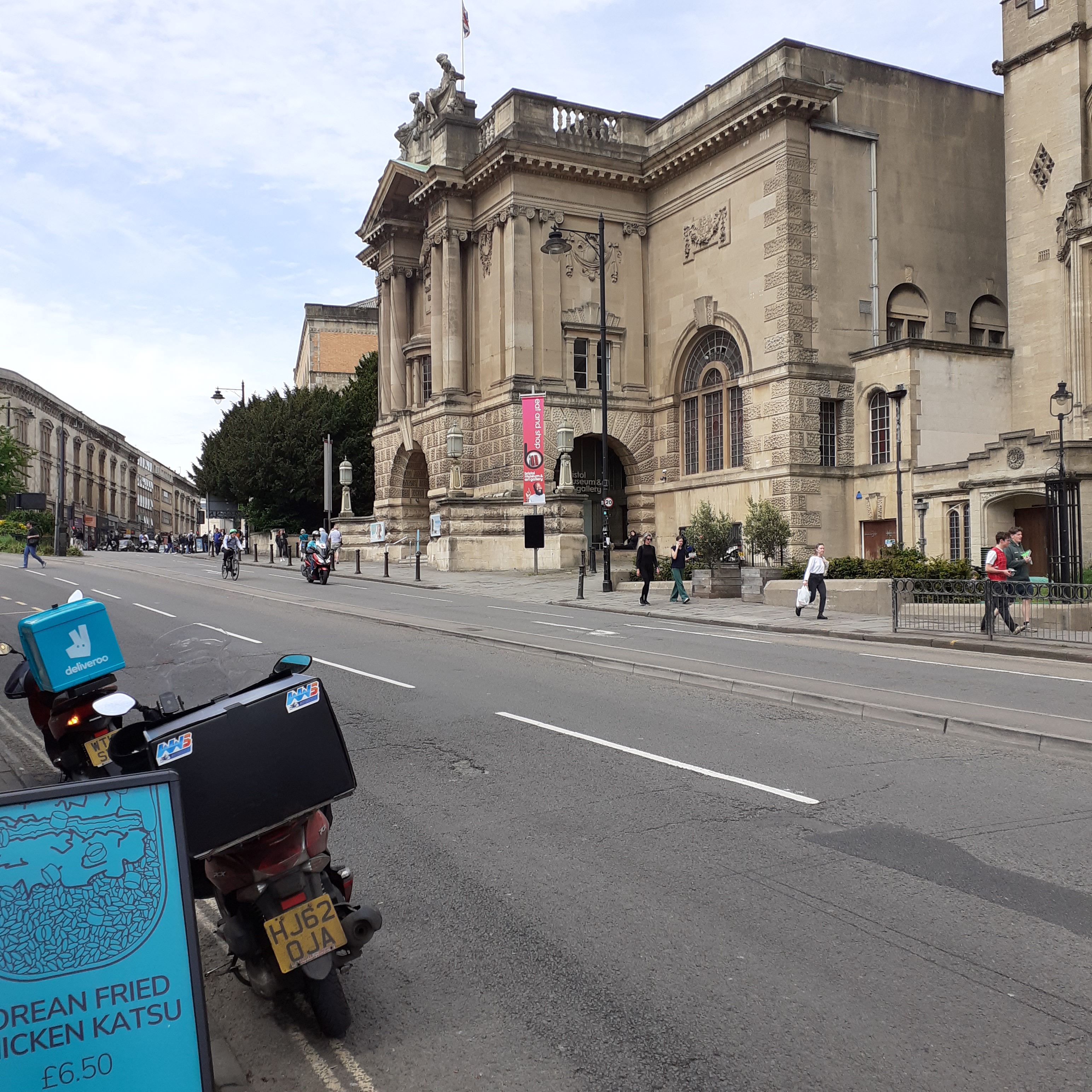
Below the Victoria Rooms is Bristol Museum and Art Gallery. This is part of a set of imposing buildings at the top of Park Street, a main city artery set on an impressively steep incline. The building was designed by Frederick Wills in the Edwardian Baroque style, in 1905. Permanent exhibitions include local art, oriental art, geology, archaeology, natural history and local history.
The current exhibition features Grayson Perry whose lockdown era show I have been following on television. To be close to Grayson is to be close to the coalface of art and so it happens here, with all the delirium of variety brought by open access art. Perry’s imprimature is populist; if everybody else is doing it, why can’t you. But dont be deceived into thinking that such immediacy lacks merit, there’s fine stuff here.
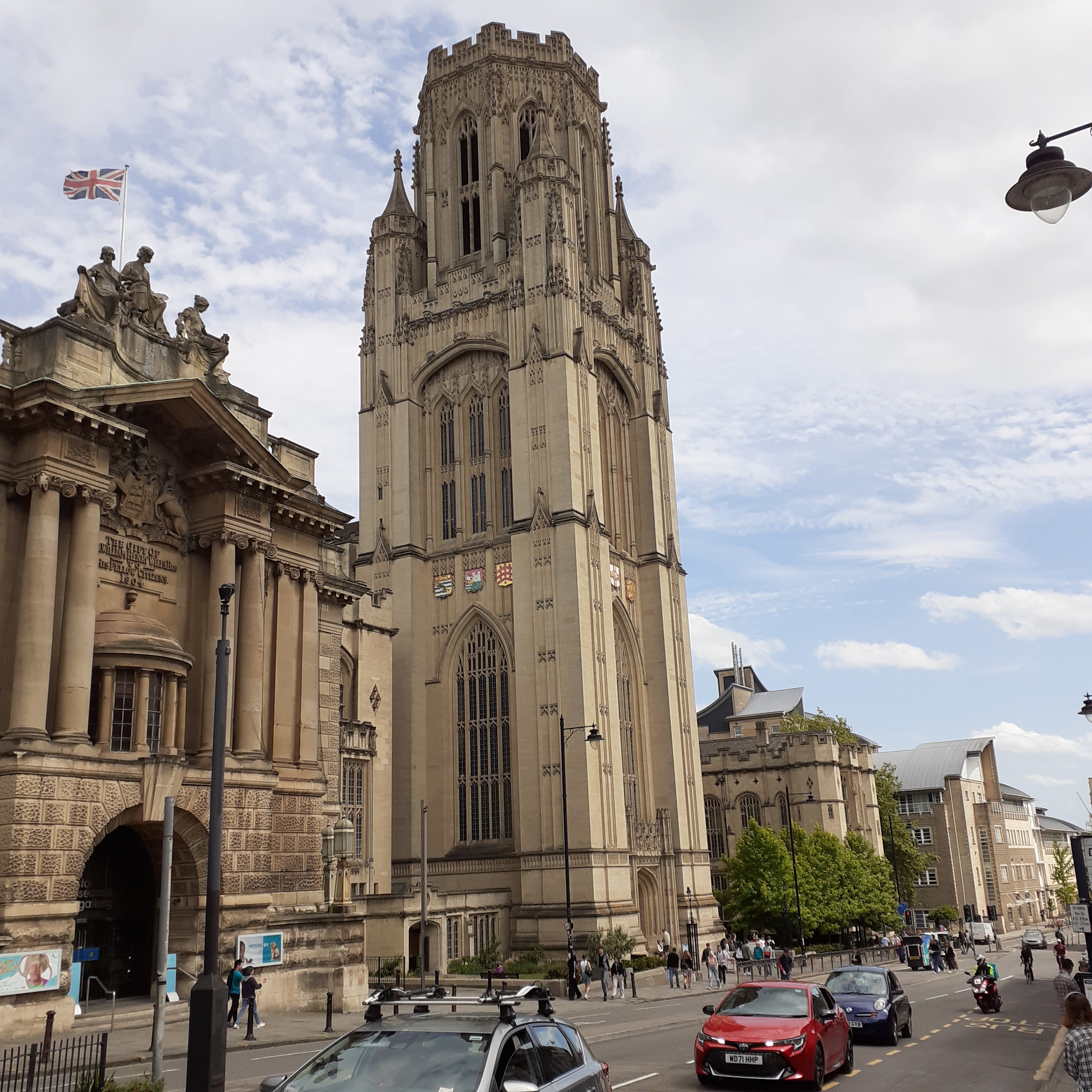
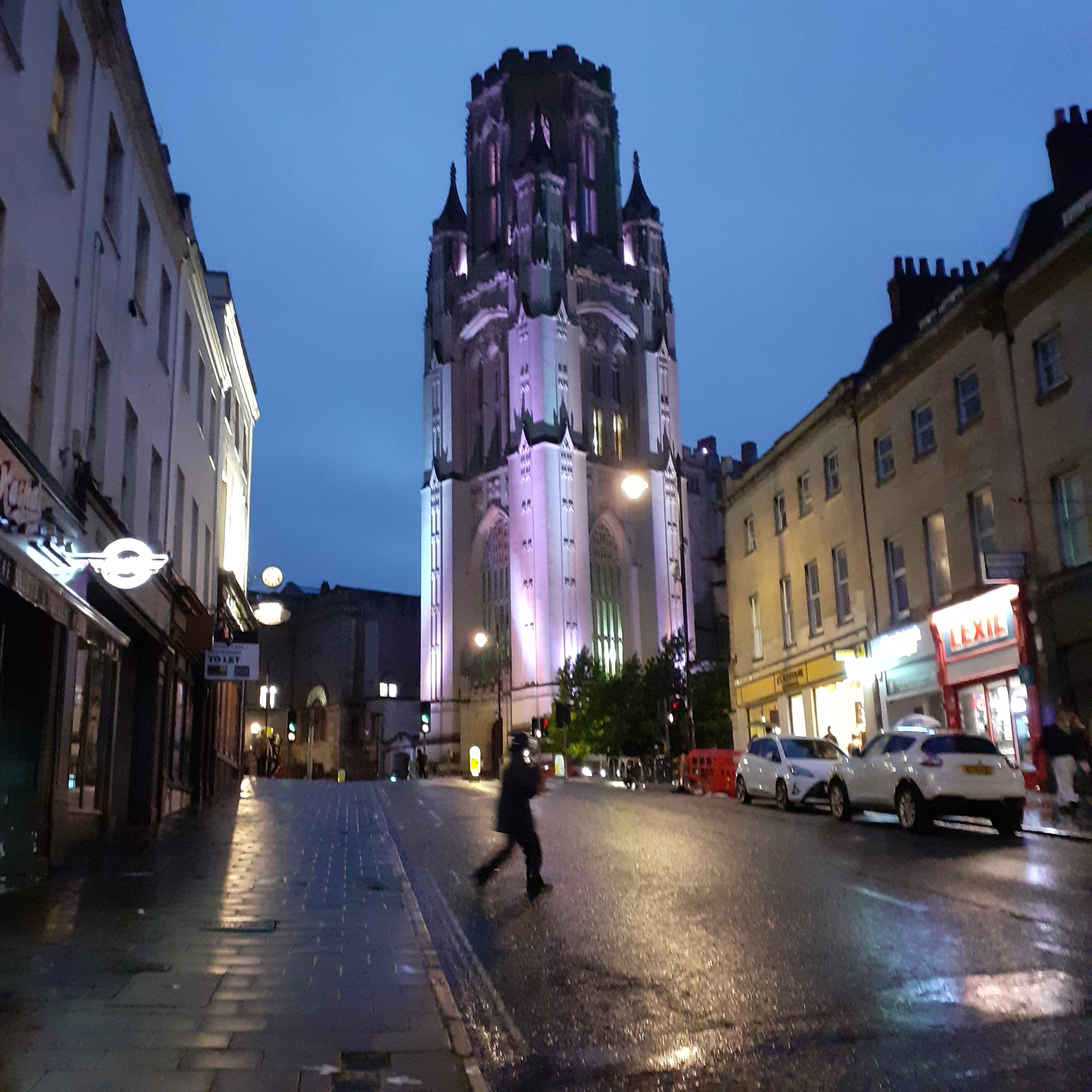
Adjoining the Museum, the Wills Memorial Tower is a significant landmark crowning the top of Park Street. A stunning neo Gothic tower rising over two hundred feet, it was designed by George Oatley as an exclamation mark of perpendicular gothic, mimicking the ancient universities of Oxford and Cambridge. It was built between 1915 and 1925.
The University College itself was established in 1876. University of Bristol, chartered in 1909, received generous funding from Henry Overton Wills III, who became the first Chancellor. The Wills Tobacco business was founded in Bristol in the late eighteenth century. Family members became prominent in building Victorian and late Edwardian Bristol. The Museum was funded by Sir William Wills, another tobacco baron and cousin of Henry. Architect, Frederick, was Henry’s younger brother. It is Henry who is commemorated by the tower.
While the Museum has also hosted Banksy, the city’s home grown art hero, or anti-hero, Banksy’s natural milieu is outside the confines of a gallery’s walls. Banksy was born in Bristol in 1974. He took to the shadowy world of the Graffitti artist in his teens. There are trails to follow or you can be prepared for ambush. Well Hung Lover is a startling example on a gable at Frogmore Street where it passes beneath Park Street. It’s a sleazy film noir tableau of the suited cuckold glaring out the window as his wife, deshabille, pouts wounded innocence behind him. The well hung lover himself clings to the window sill by his fingertips. Another, Girl with the Pierced Eardrum is in the Harbourside. Painted in 2014, it tips a wink to Vermeer, the pearl being replaced with an alarm box.
At the bottom of Park Street is College Green, a traditional civic park flanked by its ancient Cathedral and the Town Hall. City Hall is an impressive redbrick behind a crescent pond. It was designed in the 1930s though had to wait till after the end of WWII for its completion, eventually opened by Queen Elizabeth II in 1956.
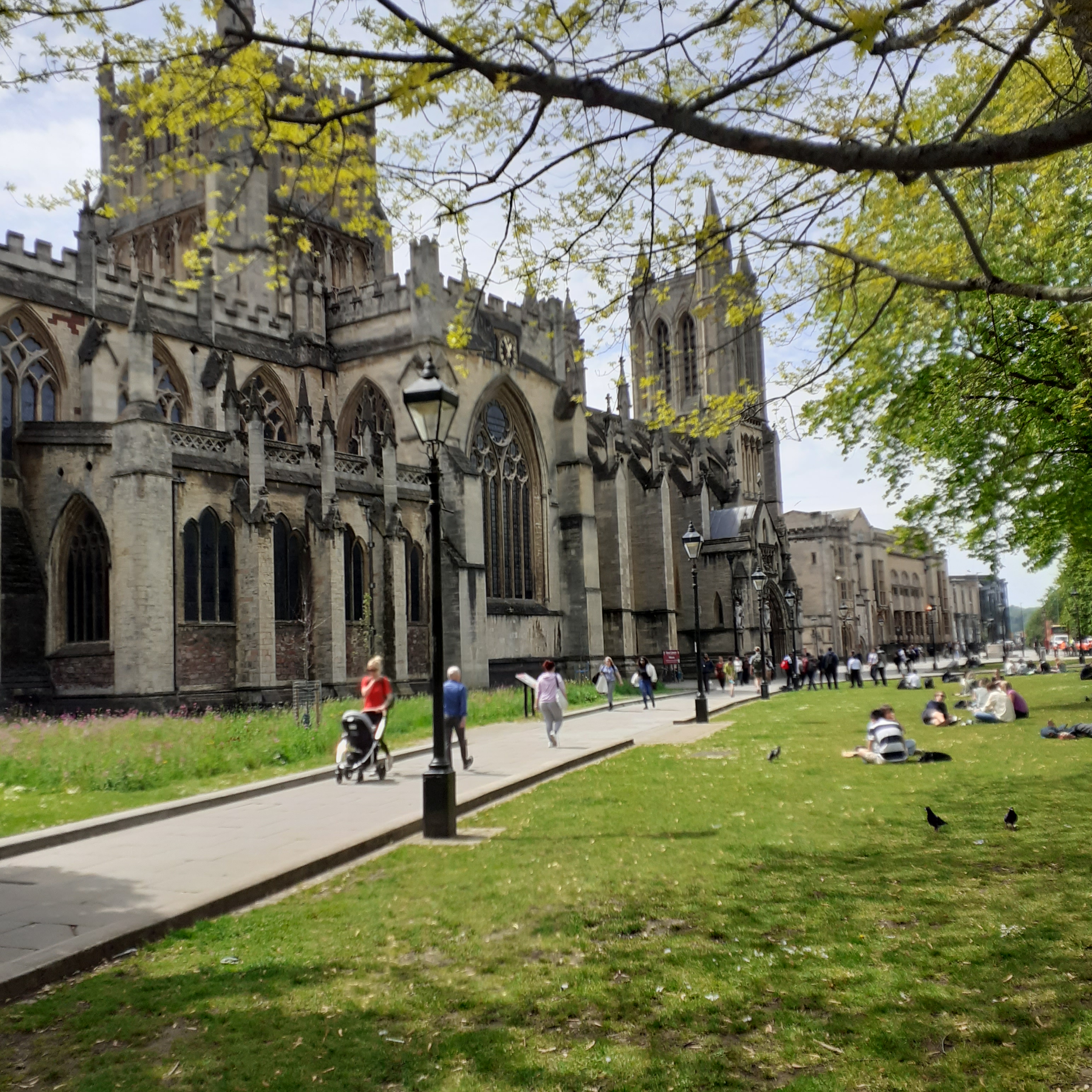
Bristol Cathedral, the Church of the Holy and Undivided Trinity, was founded in 1140 and was for four centuries St Augustine’s Abbey. After the Dissolution of the Monasteries it became a cathedral for the city. It is always growing. The most recent addition is the west front with its twin towers added in the nineteenth century. In the Gothic revival style then popular, it makes a good fit with the older parts from the fourteenth century with their ornamental pinnacles, and the decorated gothic of the central tower from the fifteenth century. The coffee shop, through the cloisters, has a lovely garden, a good place to reflect over a hot brew
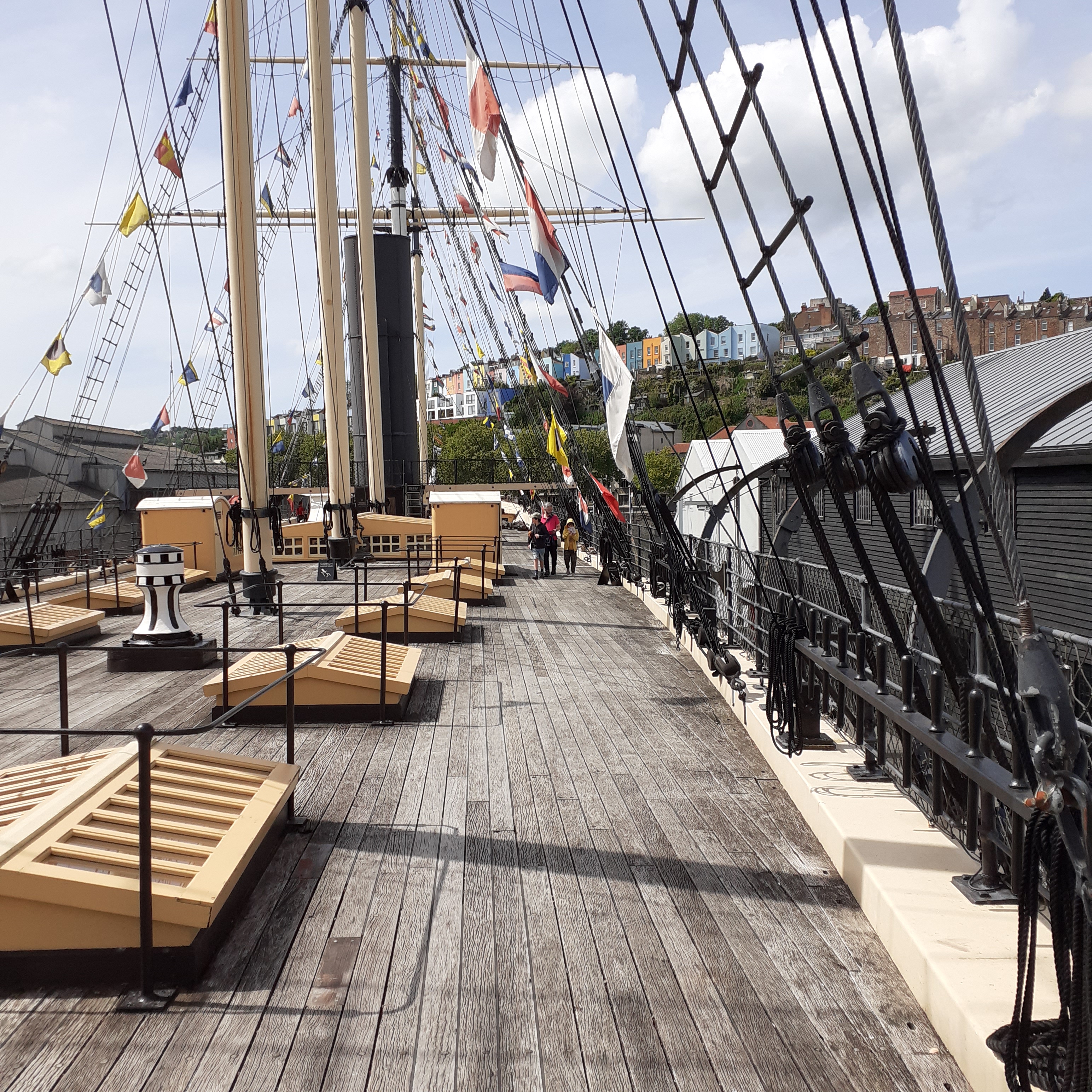
Ultimately I must do the thing to do in Bristol, which is float. And, of course, visit the top of all recommendations which I received on my first day in St Mary Radcliffe, top of my list to begin with. I take a ride in a small ferry boat that plies the Avon. The water is just an arms length away. We skate into this bustling thoroughfare out to the SS Great Britain. Isambard Kingdom Brunel’s ship launched in 1843 as the largest vessel in the world, and the most innovative. Both iron hulled and powered by screw propellor, she crossed the Atlantic as the first steamship in 1845. The transatlantic route wasn’t longlasting and the ship instead ferried thousands of emigrants to Australia until 1881 when she became a coal ship. Five years later her last voyage saw her marooned in the Falklands as a coal storage bunker. Scuttled in the Falklands in 1937, it seemed she was to be no more than a rusting hulk, but thirty three years later she was raised and returned home to Bristol and fitted out to recreate her historical existence in lucid detail.
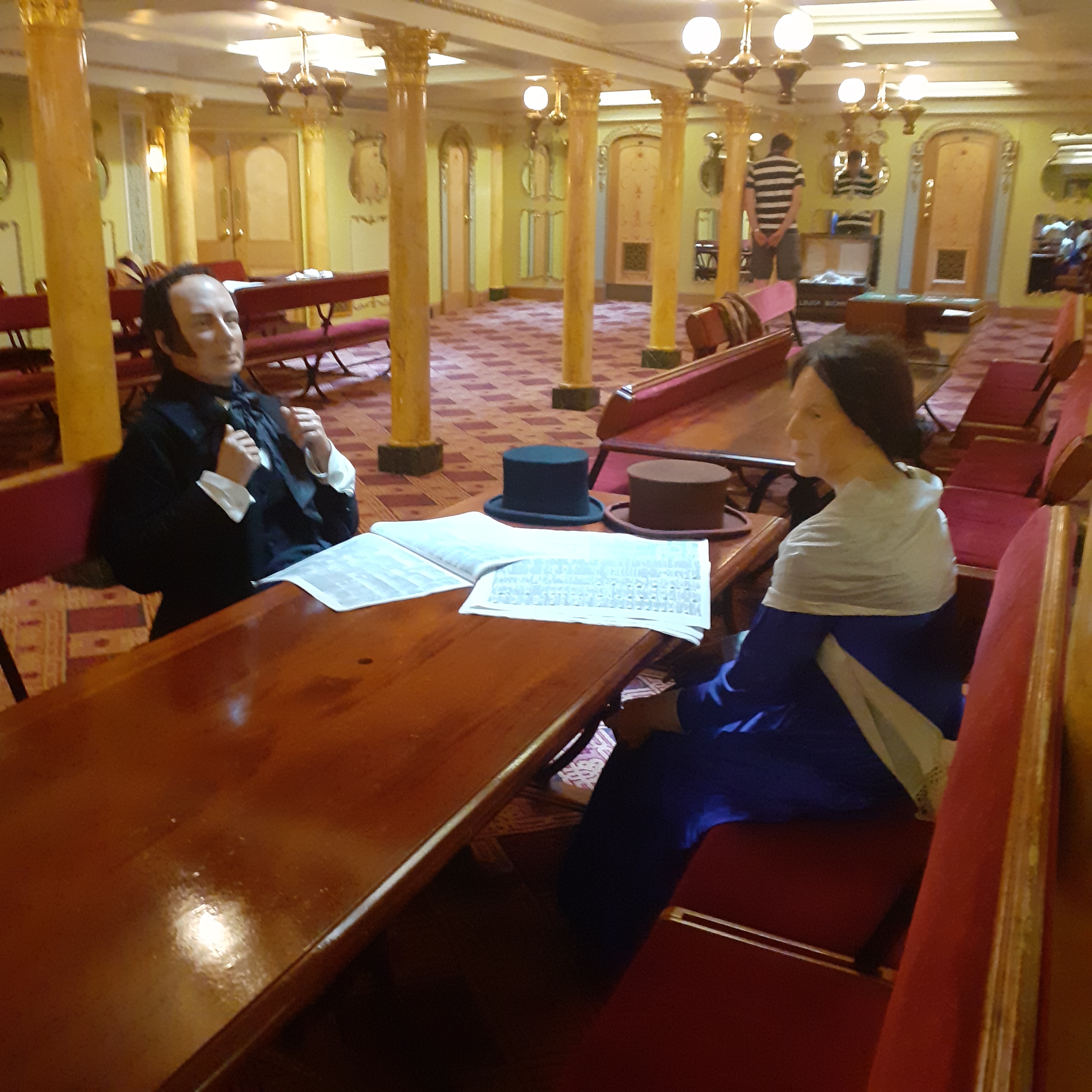
Within the exhibition, the ship is suspended in time. The underwater entry is both airy and eerie and I felt strangely elated walking beneath the ship’s enormous hull. The deck is vast with only funnel and masts protruding and all accommodation below. I was happy to be alone on dack, allowing that dreamtime of immagination which is so rare in a public exhibit. The accommodation varied according to social status. Amongst the great and the good there was the illusion of the grand hotel, which is impressive in the flesh, though being a time capsule gave some weird prompts of the Shining. Farther down the scale things became more cramped. Cabins gave way to bunks, with models glimpsed in boozy punch ups while smoke and unhealthy coughing spiced the atmosphere. I even began to feel sympathetically seasick.
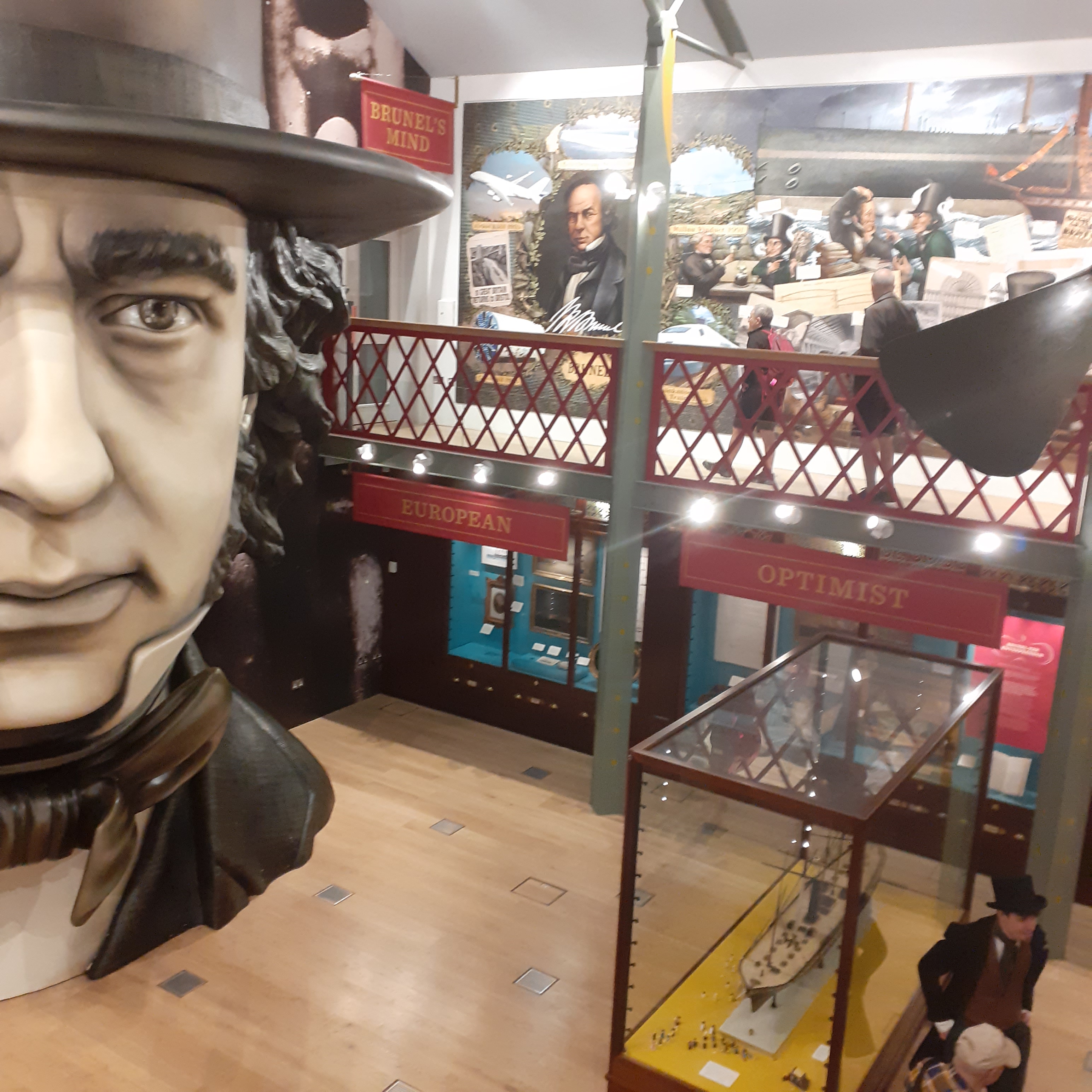
Leaving the vessel, there’s a large exhibition on Brunel, presided over by a larger than life Brunel. Being Brunel, opened in 2018, provides a detailed account of his achievements and idiosyncracies, including Brunel’s drawing office and his dining room. Finally leaving by the shop, I wondered would I enquire after a souvenir box of cigars (my imagination) but instead made for the fridge magnets. It’s a fine shop for souvenirs, don’t mind me.
The return along the quayside takes you past the MShed, another outpost of the Bristol Museum. Moored outside is another significant ship. The model of the Matthew remembers Bristol’s early entry in the golden years of European maritime exploration. It was on such a small ship, the original Matthew, that John Cabot sailed to the shores of North America in 1497.
I have a pint outside the Arnolfini Gallery in a beergarden by the river. I have ticked a fair number of boxes, but there’s only so much you can do of a city over three days. Evening will be a time to feed the appetites. Returning to Clifton, it’s time to contemplate my last night on the town. Clifton floats serenely above the teeming city, not far from the city centre. For eating out it’s a handy roll down the hill. I’ve decided on Indian tonight, without doing any recce, but hey, it’s England, can’t be too far.
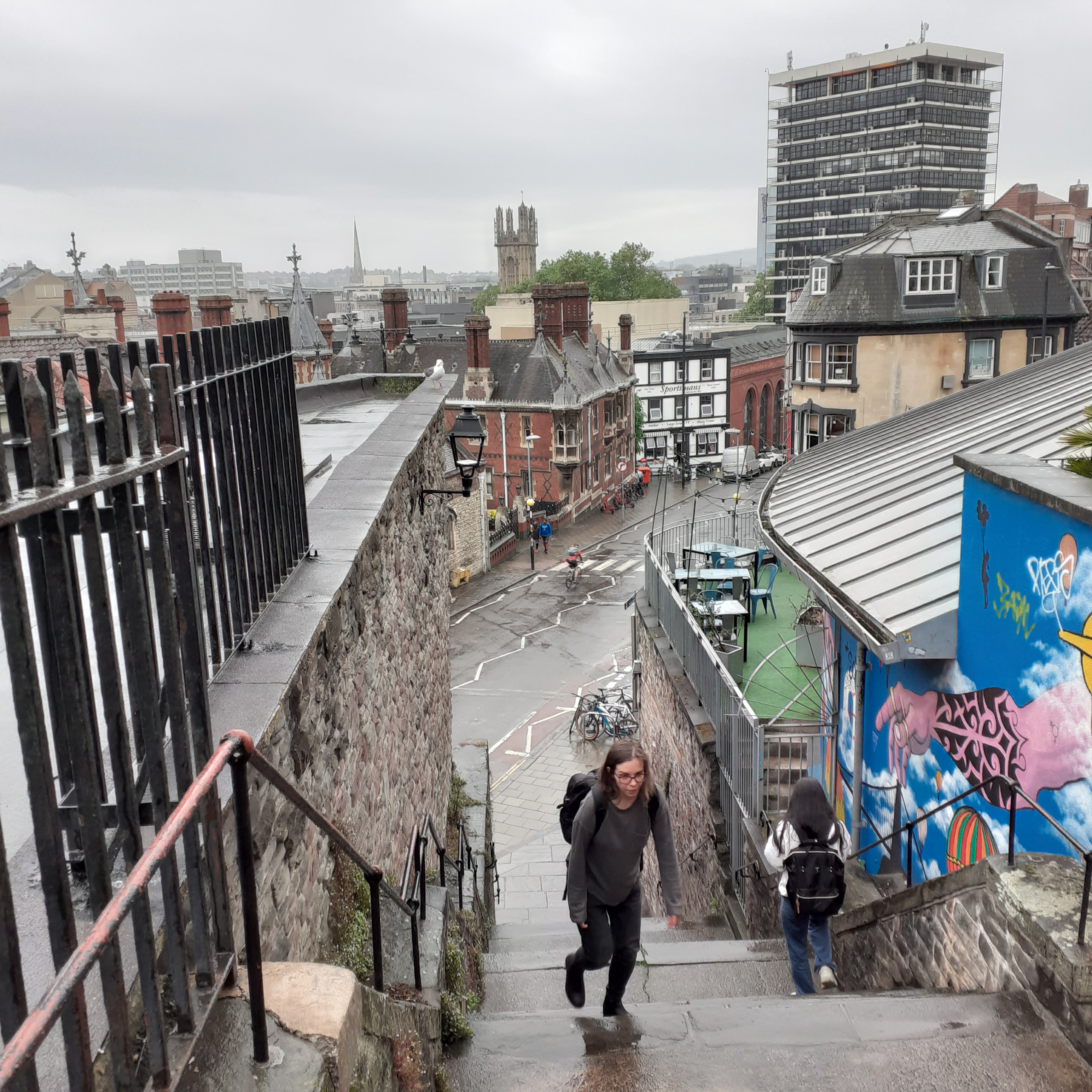
It’s raining and I shelter in Browne’s, a large and long established bistro at the top of Park Street. Brown’s Brasserie is adjacent to the University tower and was originally part of the University. I’d eaten at Browne’s another evening, plumping for the Beef Pie which seemed appropriately English fare to begin with. An extravagant puff pastry top is pierced to explore the dark joys beneath. Tonight, I take a drink on the patio and wait for the shower to sweep on by. English rain is more occasional than Irish, but no less wet. After my drink the shower has passed and I continue my exploration along Park Row. This goes past the Synagogue and King David’s Hotel, where at last I reach the promised land. The Christmas Steps are shining with new rain. They make for an old world antique descent from the heights to depths of the city.
I stumble across the Haveli Bar, The Yard, on Maudlin Street, at the top of the Christmas Steps. I am looking for Indian quisine and this is it. I am alone but for the gentleman serving me; the manager I think. So he has time to hover and we both surf the waves of ethnic music that is part of the ambience. Outside it’s raining again. Inside we talk Bollywood over an evil Vindaloo. Most excellent.
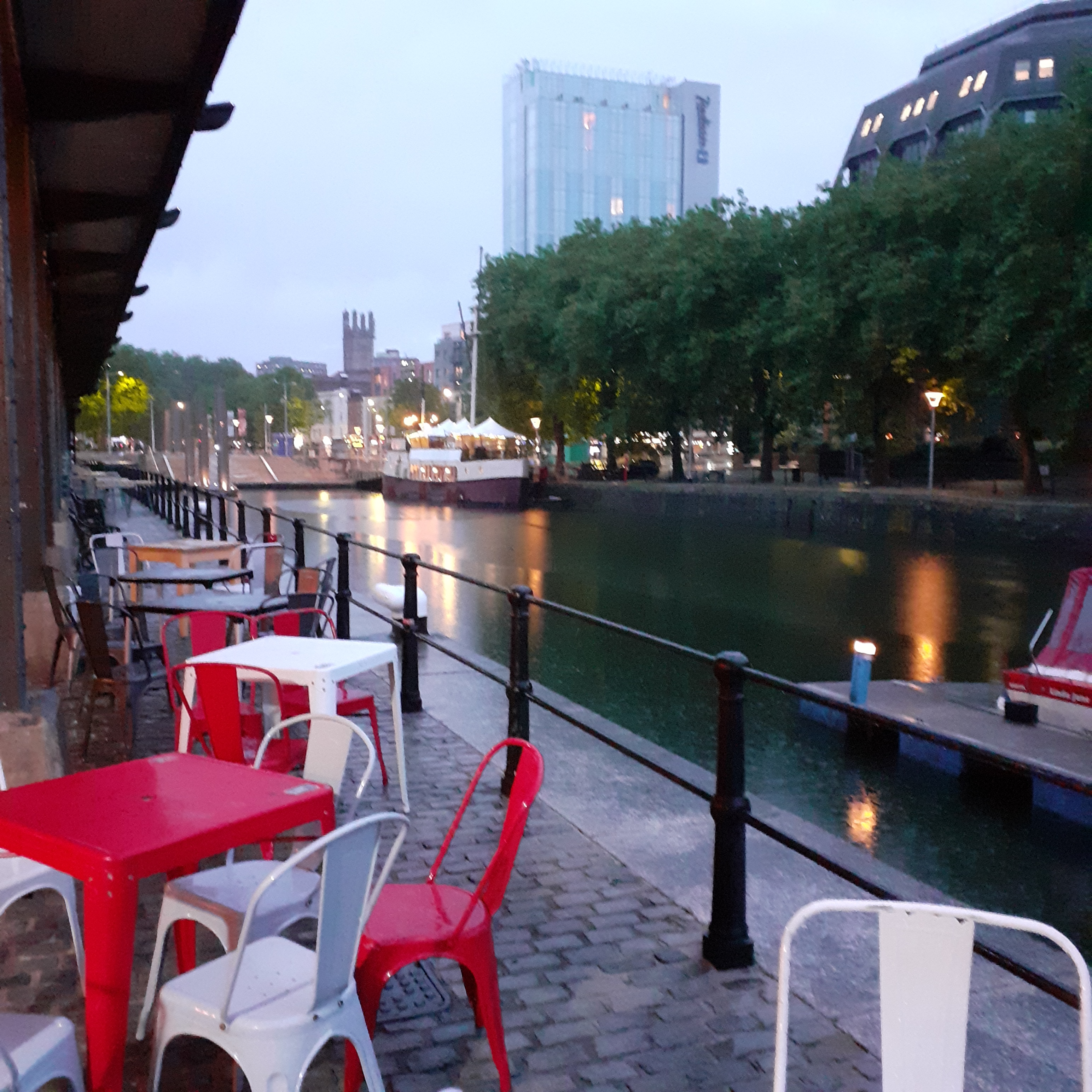
I roll downhill to the Centre, and sit along the boardwalk of the Floating Harbour. Cities at night are particularly good by the waterside, you get two for the price of one with reflections plunging into the harbour water, while above the lights of soaring buildings merge with starlight. The solace of a swirling world. I’m well fortified for my second assault on the slopes of Park Street on my return to base camp. The Will’s Memorial Tower is now an illuminated sentinel over the City, a stone flame within a million rods of late evening rain.
My first day’s excursion has to be around Clifton. The Clifton Suspension Bridge is top of my list of things to see. The stroll through Clifton in the morning sunshine is very pleasant. Clifton developed into an affluent suburb in the late eighteenth century. It occupies the high ground above the city between Whiteladies Road at the top of Park Street and the Avon Gorge to the west. It’s a pleasant, Georgian and Victorian environment consisting mostly of tall, elegant terraces. It is reminiscent of Dublin 4, though quieter and more intimate. Even many of the street names match with Lansdowne and Pembroke Roads.
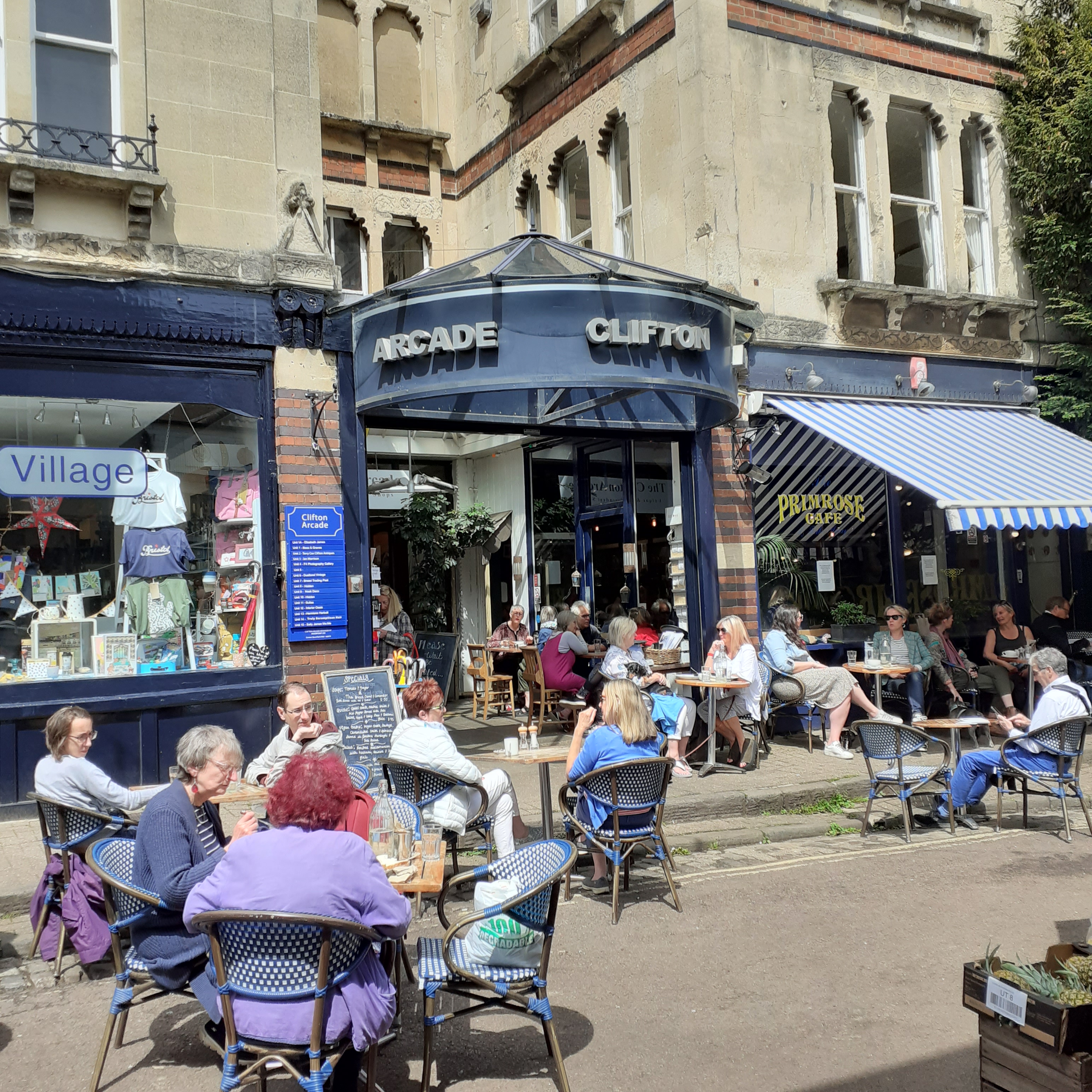
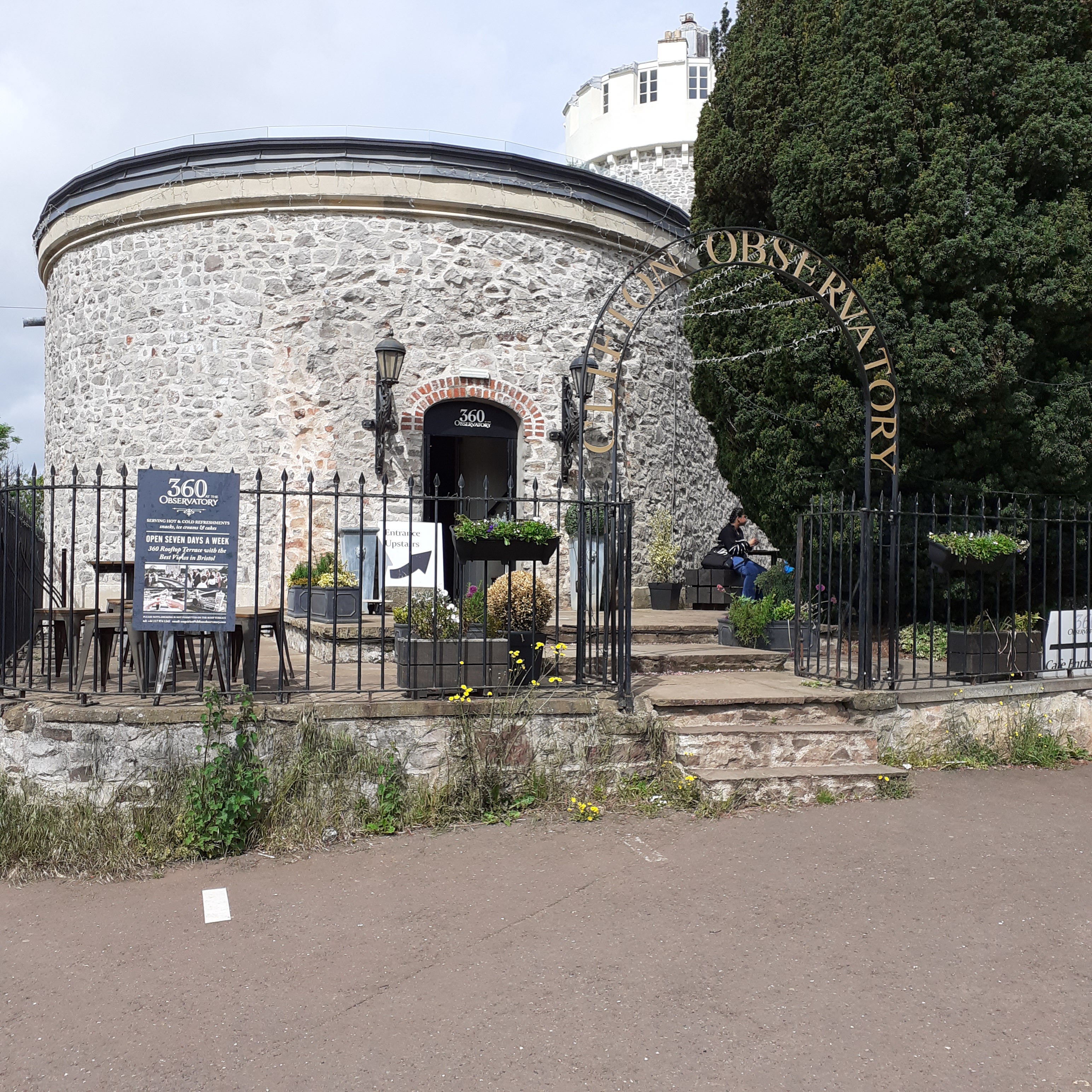
I skirt Clifton Village with its lovely arcade and plenty of sunshine sidewalk cafes, before zigzagging vaguely uphill. There’s parkland along the summit, and prominent here is the Clifton Observatory. There’s a wee coffee shop where I can catch my breath. So good I use it twice. At first to relax over a strong coffee and again to recover with something harder after my visit.
The tower has panoramic views over the gorge with bits of Bristol peeking through the trees beyond Clifton Downs. Built in 1776 as a windmill, it was bought by William West who converted it into his art studio. Indulging his passion for photography, he installed the Camera Obscura, meaning dark room, in 1828. The camera took advantage of the spectacular views of the Clifton Downs and the Avon Gorge, further enhanced by Brunel’s suspension bridge of 1864.
I take the full ticket, with entry to the Camera Obscura above and the Giant’s Cave somewhere below. A lady is ahead of me in the queue for the Camera and kindly offers to share the dark room with me. I’m glad of this as it soothes the experience of being in the dark, atop a tower, with the ghostlike apparition of the giddy panorama somehow all around. She also knows how to operate the thing which would probably have mystified me. It is very addictive. There’s a hint of the confessional in the darkness and the hush, without the padre but the presence of God, and the serene lady. By myself I would probably have left scratch marks on the walls, but spent several magic moments within the ancient and modern contraption before finding the door after only a few attempts.
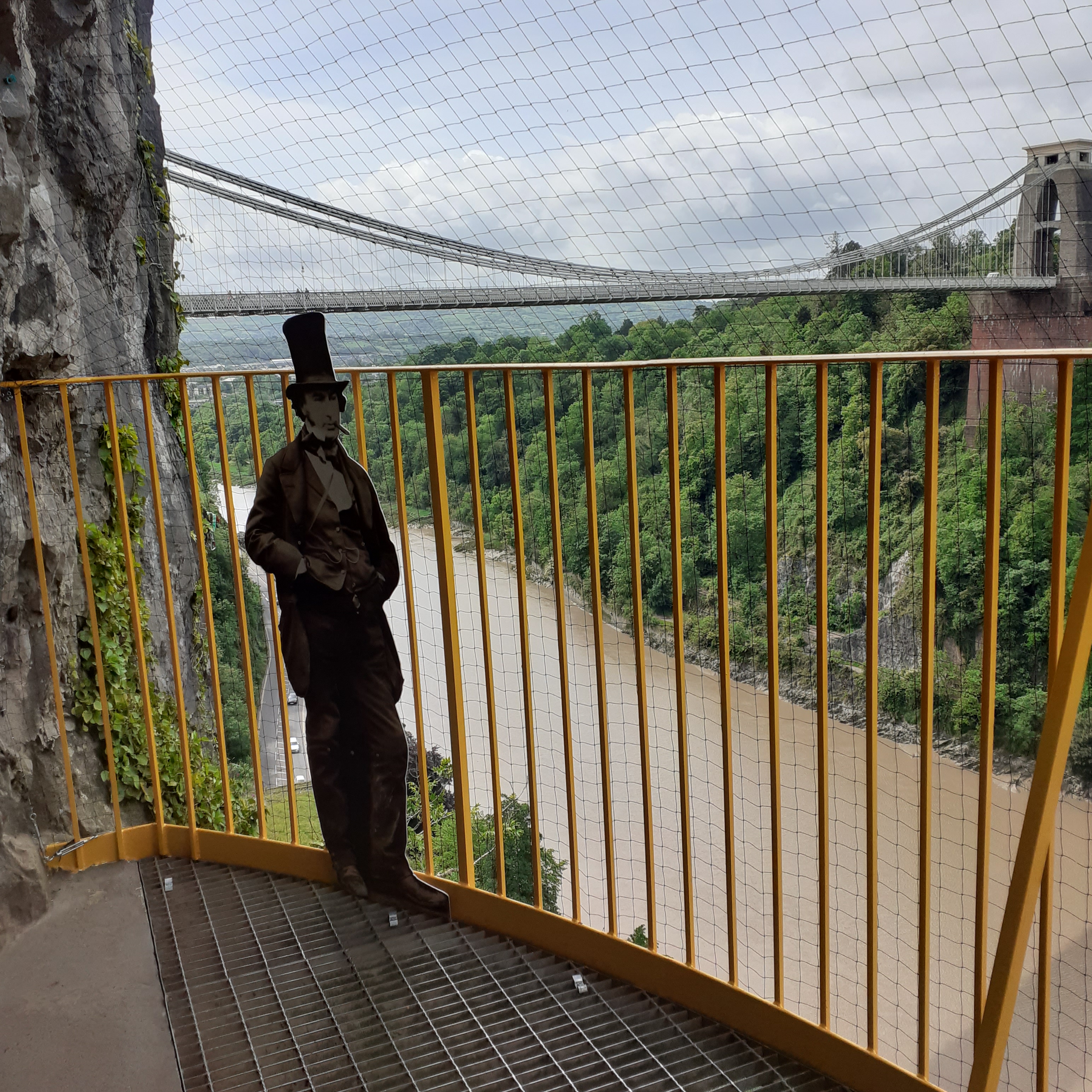
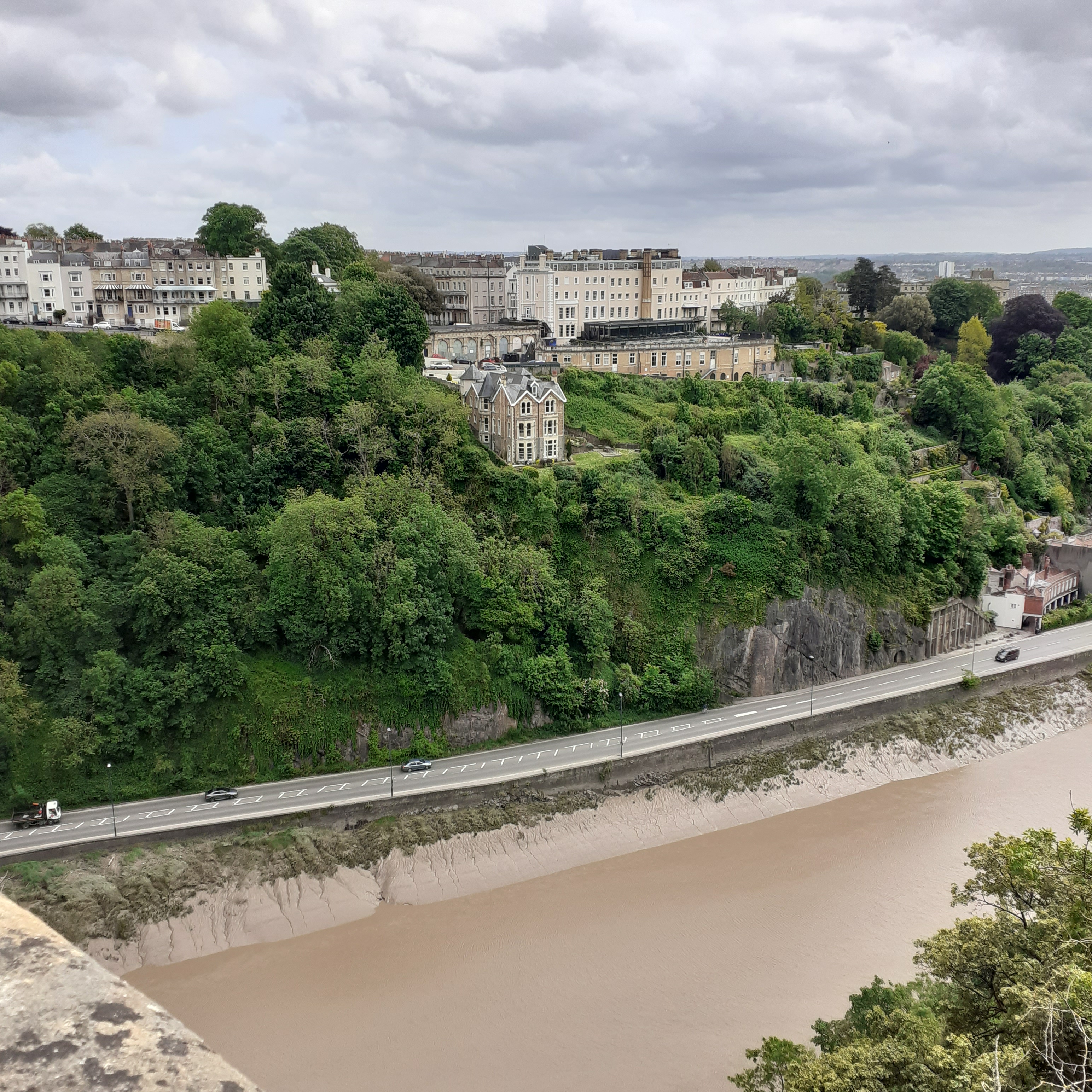
West cut the steep descending passage to the Giant’s Cave. It’s a long way down and my incipient claustrophobia, triggered by the dark room, waxes some more as the passageway gets ever narrower. And then there’s the thought of having to retrace my steps, all of them, all of those steps. I break out into the cave at something of a gallop but don’t tarry long as I rush onto the viewing platform. This juts out of the cliff face with well nigh 360 degree views of the bridge and gorge. Great, claustrophobia and vertigo. It really is stunning. Soaking all in, as much as I can, I quickly clamber up to the open air, regretting I’m not young anymore but very glad to be alive. And my second visit to the 360 degree Glass Cafe offers wonderful views and refreshments, including a welcome bottle of beer. All that and Amy Winehouse singing Valerie on the sound system. Life can be perfect, sometimes.
Well, sometimes I go out by myself
And I look across the water
And I think of all the things of what you’re doing
In my head I paint a picture
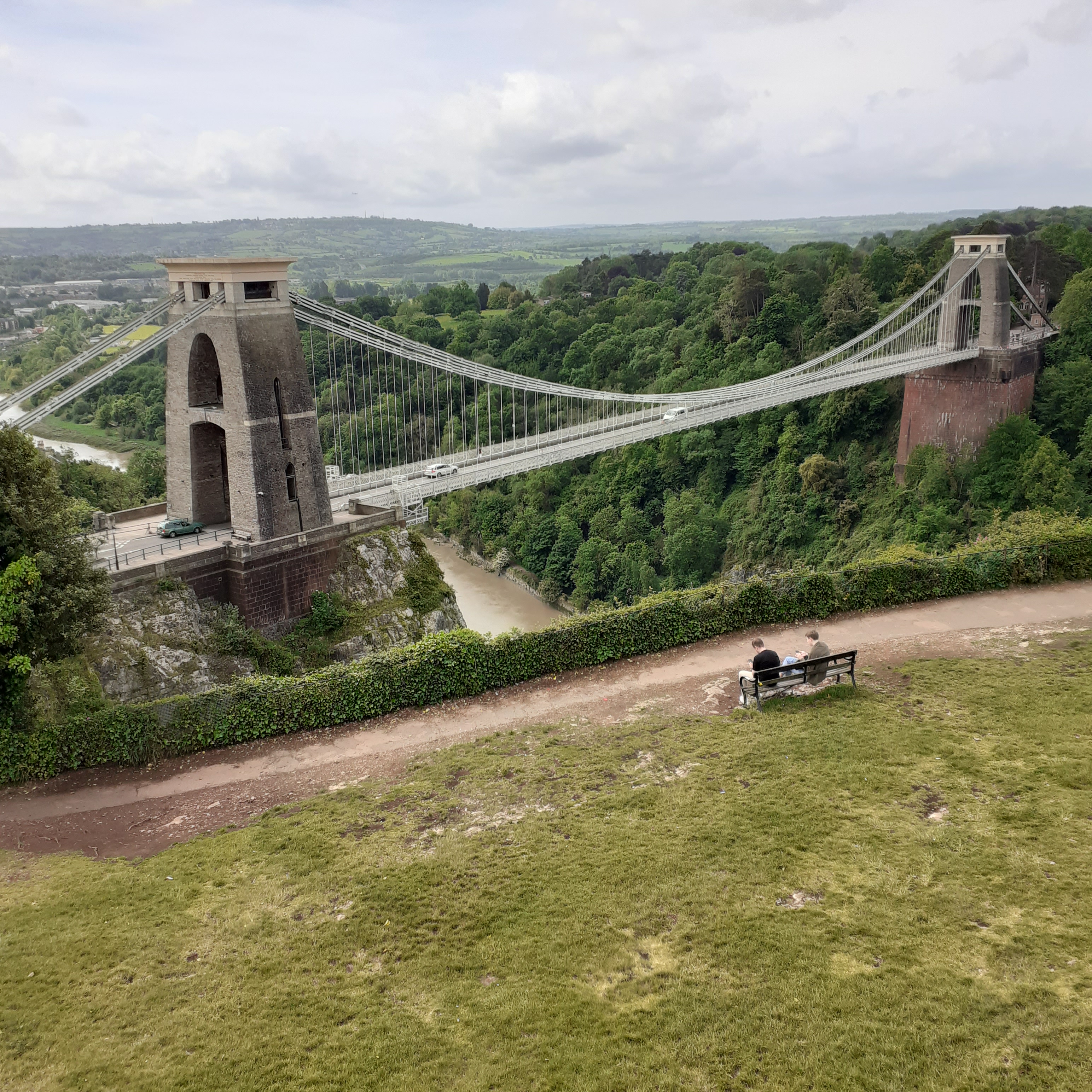
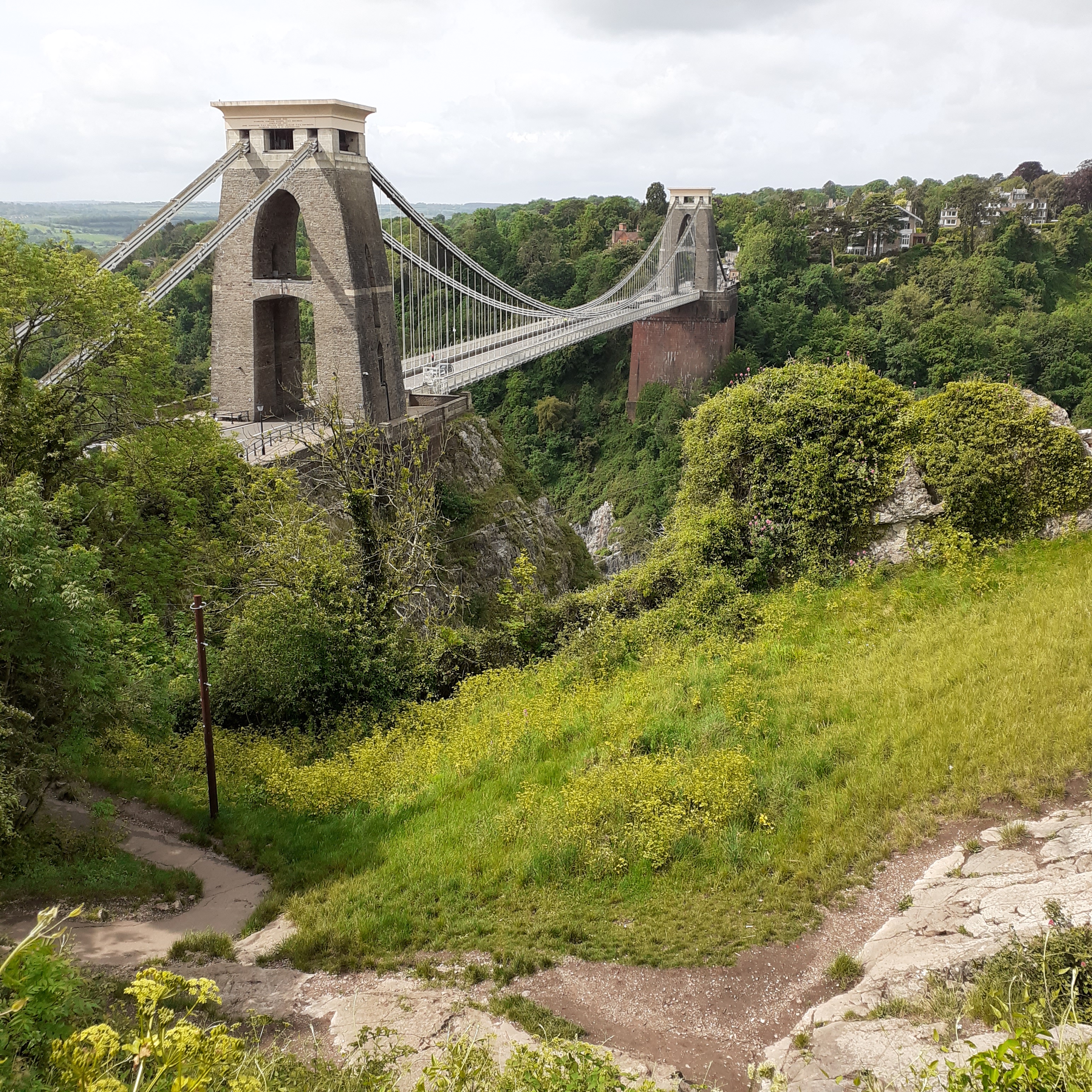
And then it’s time for another cliffhanger. The Clifton Suspension Bridge, Bristol’s most awesome icon, was conceived by Isambard Kingdom Brunel in response to a competition to choose a bridge to span the gorge. Brunel’s design won, or at least he convinced the judges that it did, and he received the contract to proceed. Construction was beset with problems. The Bristol Riots of 1831 halted construction and investors backed out. Work resumed five years later but was dogged by funding problems. The project was abandoned in 1843 with only the towers completed. Brunel died in 1859 and so never saw his project brought to fruition. Admirers at the Institute of Civil Engineers reckoned that completing the bridge would be a fitting memorial to the great man and a revised design by William Henry Barlow and John Hawkshaw was begun in 1862 and opened in 1864.
Brunel’s design had a sphinx atop each tower, but these never materialised. It’s still mighty impressive. The towers do have a certain Egyptian slant and rise to 100 metres above high tide. The bridge has a clearance of 75 metres, a span of 214 metres and a total length over 400 metres.
I walk across the bridge and back. There are few comparable walking on air experiences. I’ve cycled across the Golden Gate, walked and driven over the Hoover Dam, and taken a few tentative steps along the Firth of Forth Bridge. This is right up there, and I mean up. It’s giddy-making and transcendent. There’s a visitors centre on the Leigh Woods side in Somerset but I’m in a special place and continue back to the Clifton side. I am enjoying a long, and I hope visibly poetic, view across the gorge when I sense someone entering my space.
Hello there, you alright there, mate? It’s a genial man, in the livery of the Bridge company. I inform him of my happiness, something not always apparent in my countenance, and consider that people are extraordinarily nice in Bristol. And then I understand where he’s coming from. The bridge is also, balefully, a renowned suicide spot. Plaques advertise the number of the Samaritans and monitors regularly patrol. In 1885 a young barmaid, Sarah Henley, jumped from the bridge. Her voluminous skirts acted as a parachute and she landed safely, if embarrassingly, in the soft mud of the Avon at low tide. She lived into her eighties.
I assure the man that I’ve read the plaques, although that may only confirm his suspicions. I tell him it’s great to be alive. I had hoped to click my heels jauntily while departing, but the old legs aren’t quite up to it, so I stroll, with as much mirth as I can muster, back to Clifton Village.
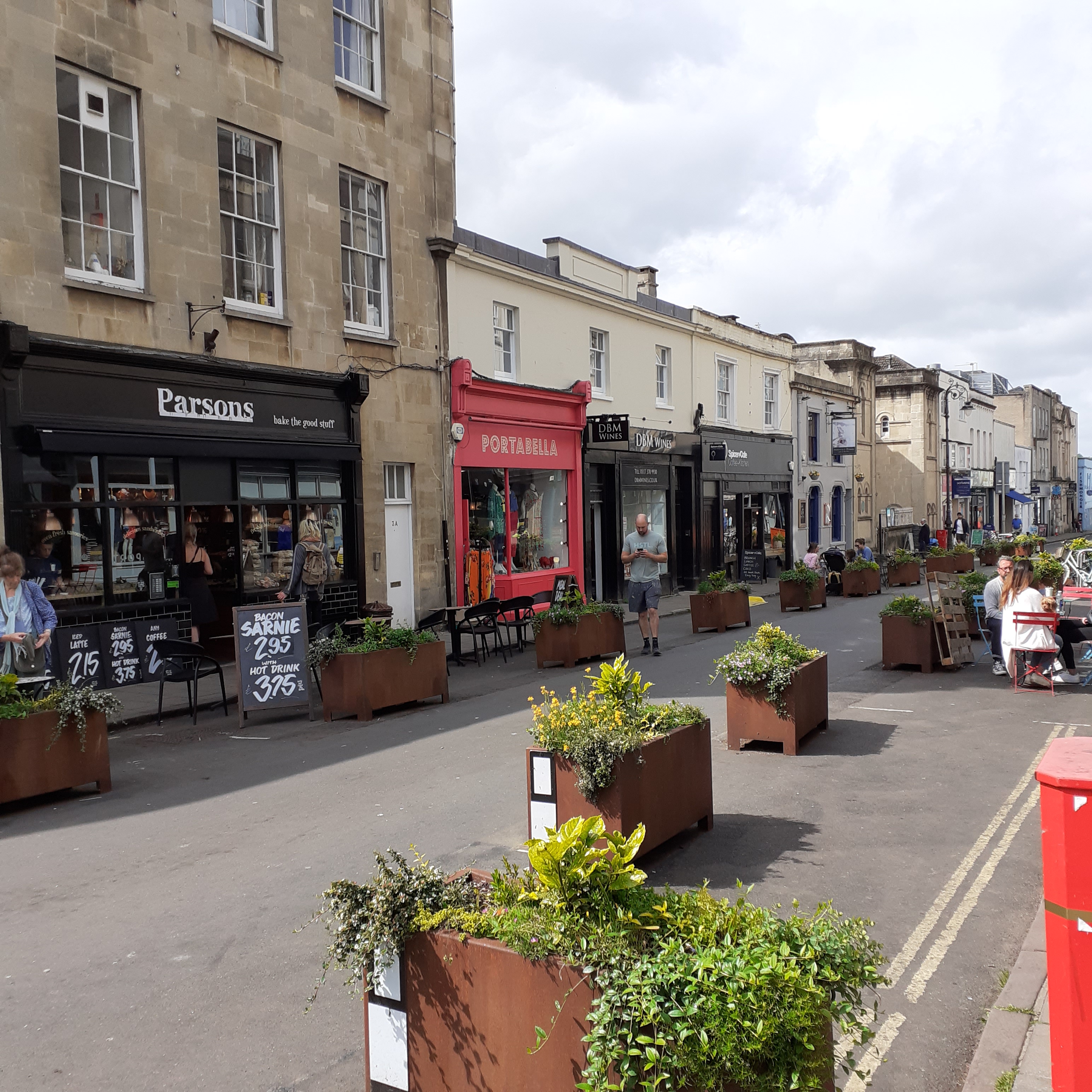
Clifton Village itself is wearing a happy face in the sunshine. I potter about the shops and the cafes. There’s an upmarket but bohemian vibe abroad, a palpable sense of Santa Monica in the straight streets, the faded fin de siecle facades. I stop for refreshment on the pavement along Princess Victoria Street. While reviewing my photography, my phones battery dies and I must head back to the hotel to recharge.
It’s time for a late lunch anyhow. Racks Bar is empty, it was packed yesterday. The bargirl asks me how my day has been going and I tell her. Ultimately it’s all about being glad to be alive. I must apologise to the queue that’s formed behind, hopefully enjoying my tale. Outside the sun is blazing and I relax over a falafel and a foaming beer. Amy Winehouse is playing, same as at Clifton Observatory. Two perfect moments in one day.
Oh, won’t you come on over?
Stop making a fool out of me
Why don’t you come on over, Valerie?
Valerie was originally a song by the Zutons, a Liverpool band of the Noughties. It was written by their frontman, Dave McCabe, though credited to the full band. McCabe wrote it in a cab, a kiss blown westwards to his ex, an American girl called Valerie Star. It features on the album, Tired of Hanging Around from 2006. Winehouse’s cover is found on her producer Mark Ronson’s album Version, released the following year.
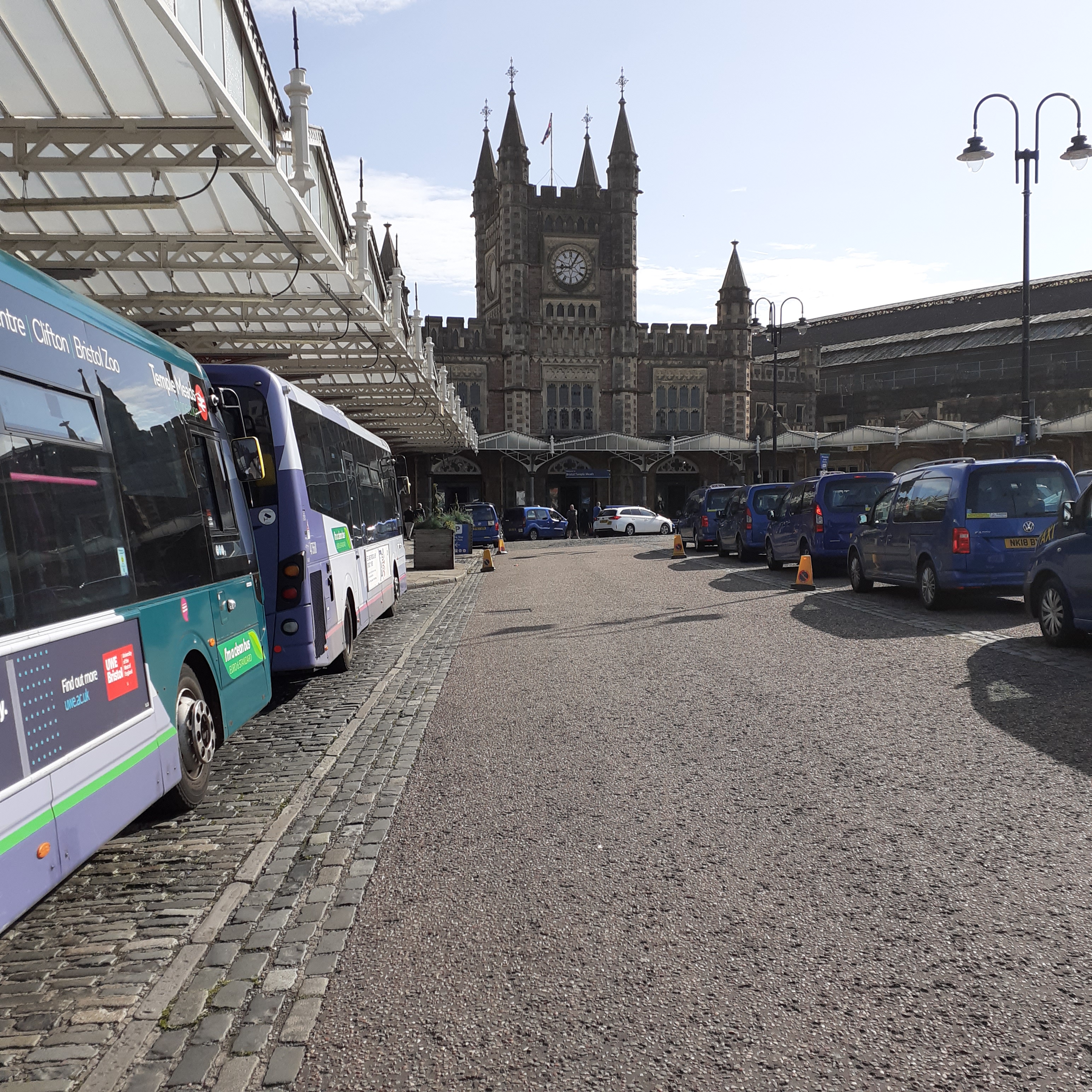
I am early into Bristol and alight from the airport bus at the city’s main railway station, Temple Meads, at the tail end of the morning rush hour. Built in 1840 as the terminus for the Great Western Railway which was the first railway project of Isambard Kingdom Brunel. It was extended in 1870 to allow for through traffic. The distinctive entrance tower with its decorative turrets was added then. The station is on the island formed by the division of the Avon River not far from the city centre which is largely cited on high ground above the northern bank.
The name Bristol is derived from the Anglo Saxon Brigstow, the place of the bridge, and it blossomed in early Norman times into a vital trading city and port. It would also form one end of the bridge for the Norman invasion of Ireland, a century after the Battle of Hastings. Today, Bristol is a large city of half a million people, so I’m not going to see it all in three days. I’ve a checklist to explore; especially its maritime, ancient and cultural connections. I may make a trip to Bath nearby, there’s connections by rail and river. I’ll see how it goes. I’m just glad to be overseas, even if it’s only the Irish Sea crossed. I’m off my own island and onto another, for the first time in two years.
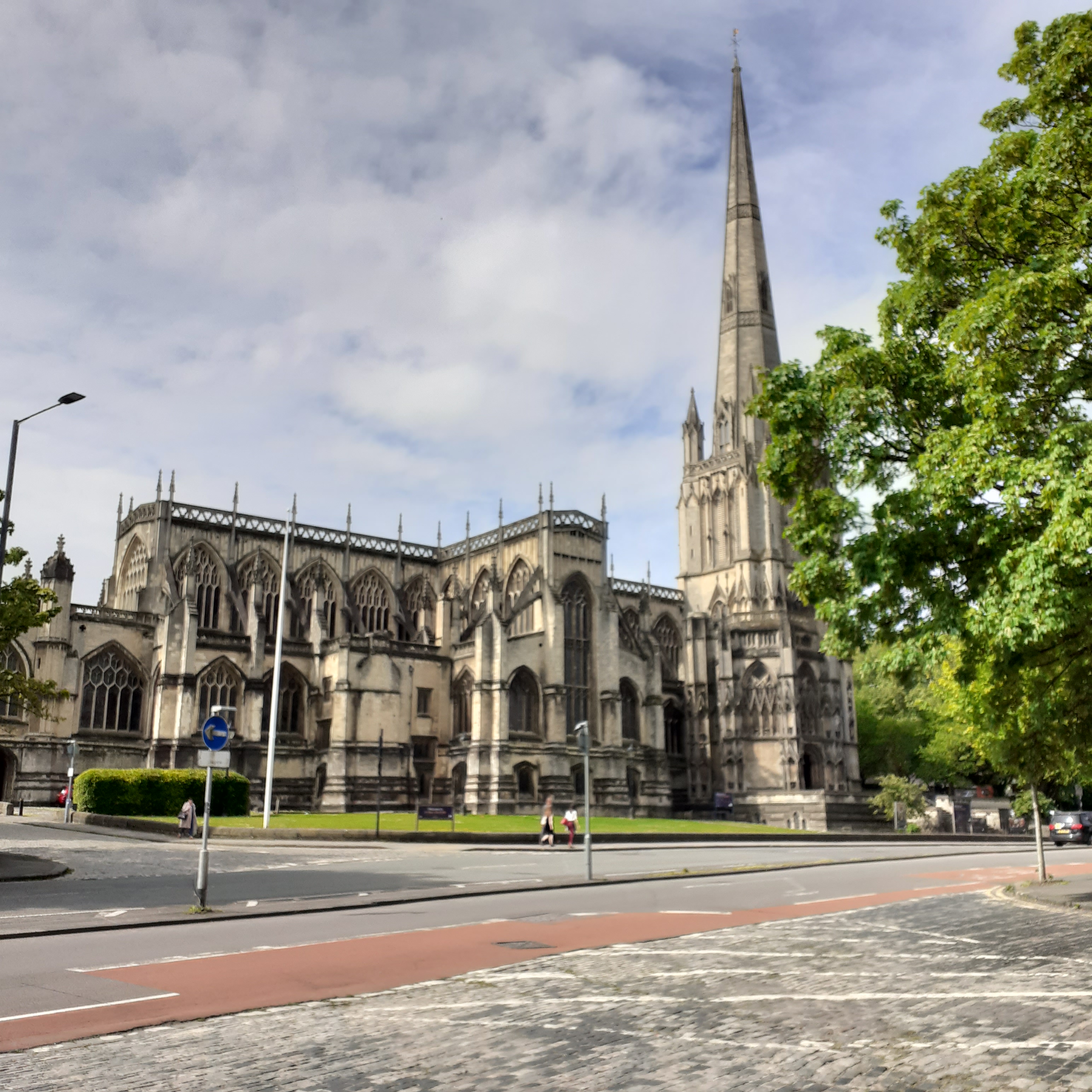
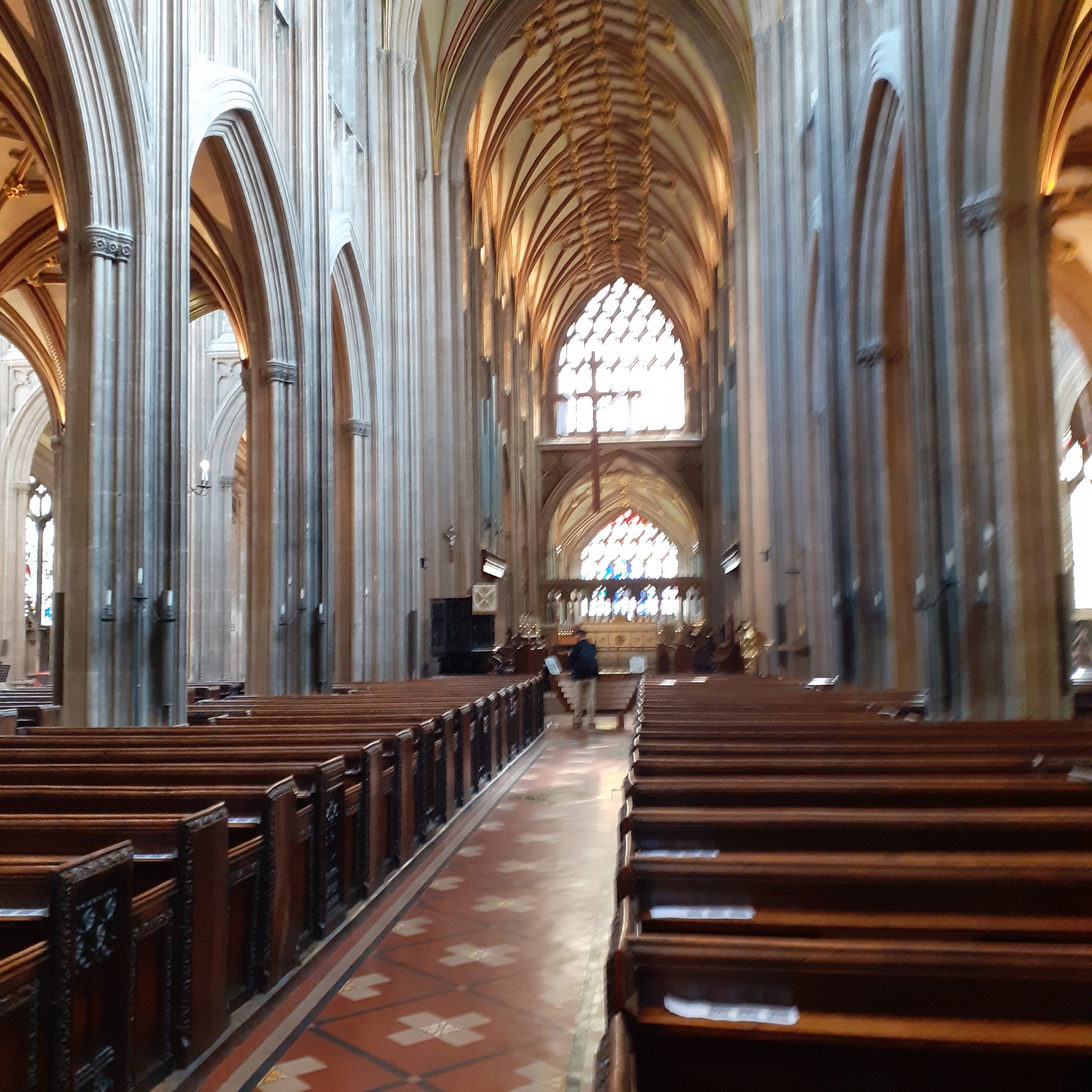
I grab a coffee and breakfast roll at the first opportunity, then begins the task of lugging my bag up to Clifton where I’m staying. My route takes me past St Mary Redcliffe Church which draws me in. It’s a fine gothic pile standing on its own green enclosure. A most friendly gentleman welcomes me. He gives a good rundown of other sights worth seeing, but doesn’t rate my excursion to Bath. “Or, as we say: bah!” says he. I am made swear I will visit the SS Great Britain, as I had planned. Meanwhile, St Mary Redcliffe’s proves well worth the stop.
Described by Queen Elizabeth as the fairest, goodliest and most famous parish church in England, it was almost as old to her as she is to us. There was a church in Saxon times, but today’s church dates back to the 13th and 14th centuries. It formed a significant landmark in its situation above the Avon perched on the red cliff that gives it its name. Mariners would pray for grace on departing and give thanks on their return. As Bristol burgeoned as a port, well heeled local traders contributed to the upkeep of the church. The result is a testimony to the glories of the English Gothic Perpendicular. Such famous family names as the Penns, the Cabots and the Ameryks are part of the fabric.
John Cabot was an Italian who in 1496 came to England seeking funding for a voyage to the New World. He gained the support of Henry VII, and in 1497 sailed from Bristol to cross the Atlantic and make landfall, probably in Newfoundland. He became the first European to reach the North American coast since the Viking, Leif Erikson, some five centuries earlier. That other Italian, Christopher Columbus had famously set foot in Central America in 1492, a prelude to Spanish dominion over the southern parts of the Americas. It looked like England was destined to establish its own foothold to the north. Cabot set sail again the next year, but then only silence. Cabot may have died at sea, or stayed in America by accident or design. Some claim that he returned and sponsored further exploration by other mariners. William Weston was one, his voyage along the Labrador coast being the first to signal the obsessive search for the Northwest passage. Cabot’s son Sebastian, born in Venice, also explored the North American coast over a number of years in the early sixteenth century and was keen to establish a presence there. He returned to England in 1509, but the new king, Henry VIII, wasn’t interested in exploration, of a geographical nature anyway.
England would have to wait until Elizabeth’s time for its colonial project to begin. Virginia Dare, born in Roanoke in 1587, was the first European settler to be born in the territory that became the USA. No one knows what happened to her either. She disappeared without trace into the feral woodland embracing the Chesapeake, a lost white child in a vast dark wilderness.
Cabot’s achievements slipped below the radar for a while. But he’s well commemorated in this most maritime city. There’s a statue to him outside the Arnolfini Gallery near the Old Town, the landmark Cabot’s Tower rises over the city centre and a reconstruction of his ship, the Matthew, floats in Bristol Harbour.
Sir William Penn, father of the founder of Pennsylvania is a notable monument in St. Mary’s, again connecting with the New World. Penn senior was an admiral and politician who died, not yet fifty, in 1670. His son, William, accepted a grant of land in America, in lieu of monies owed by the crown. The new colony was to be called Sylvania, being covered in dense woodland, the word Penn prefixed in honour of the late William senior. A more fanciful connection is proposed for Richard Ameryk, Anglo Welsh merchant and Sheriff of Bristol. The claim that he, as sponsor of Cabot’s Matthew voyage, gave his name to the place has few champions. Yet another Italian, Amerigo Vespucci, has that honour.
After a brief pause for prayer, I continue around the church which is a sublime hymn in stone. Churches, like trees, bend and grow with time. St Mary’s had been hit by lightning in 1446, destroying the spire, which was only repaired four centuries later in 1872 to a height of eighty metres (260 feet). Bombs rained down during WWII, still the church survives. Stories live on, even when their subject quickly fades. In 1752 poet Thomas Chatterton was born here, his family being longterm holders of the office of sexton of St. Mary’s. Chatterton features in Pre-Raphaelite painter Henry Wallis’s depiction of his tragic death by suicide at the age of seventeen. Chatterton was an inspiration for the Romantic poets who followed: Wordsworth, Keats and Coleridge. Coleridge has a particular connection. At Cambridge, he had become a friend of Robert Southey, a Bristolian. They hoped to establish a Utopian commune in Pennsylvania but the plans were abandoned. The two married sisters Sara and Edith Fricker at St. Mary’s in November 1795 and set up house in the Lake District.
Coleridge’s weird masterpiece, the Rime of the Ancient Mariner begins with the wedding guest being accosted by a raving loon, the Mariner himself. Can happen in any bar, believe me. At the end of the tale, spoiler alert, the mariner makes it home, and experiences the universal joy of the traveller returning.
Oh! dream of joy! is this indeed The light-house top I see? Is this the hill? is this the kirk? Is this mine own country?
Another item of note, if you’ll pardon the pun, is provided by the organ. A massive construction of over four thousand pipes it was designed by Harrison and Harrison of Durham in 1911. Which reminds me, the last time I was in Durham I got a lift from Sunderland with a man called Harrison (no kin). Travel is all about connections.
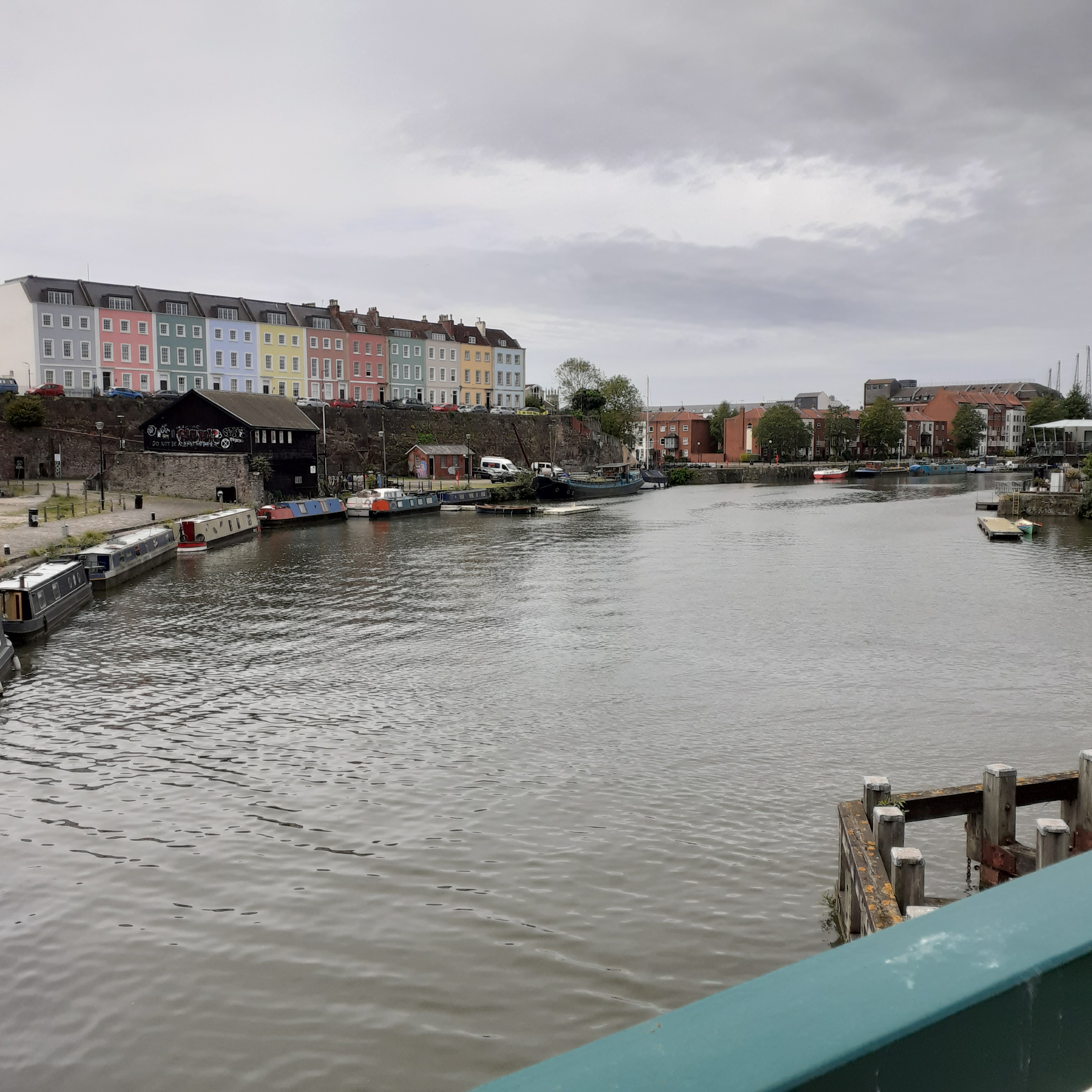
Taking my leave of St. Mary’s I eventually get to cross the Avon at the Redcliffe Bascule Bridge. There are many Avons in England. The most famous dribbling past Stratford not far north of here; but that, though near, is a different Avon. The word is simply the old Celtic word for river, as in our own Avonmore and Avonbeg. At Bristol, the Avon is about eight miles inland from the Severn Estuary. It is still tidal here. That created problems for the harbour as the water level fell by thirty feet at low tide leaving craft grounded in a muddy channel. In the early nineteenth century William Jessop designed the solution creating Bristol’s Floating Harbour.
A new cut for the tidal river was made to the south, with the harbour remaining on the northern branch. Locks, now called The Brunel Locks at the western extreme help establish a constant water level, meaning the harbour is perpetually afloat. At the eastern extreme is another lock, and upriver from that the Avon remains navigable as far as Bath. Between the two branches, Spike Island was created. This long, narrow island became an industrial and dockland centre.
Although Bristol thrived for more than a century, the tidal nature of the river downstream, through the Avon Gorge, presented dire navigational problems for ever larger modern shipping, which eventually did for it as a port town. But towns and cities change and adapt also. The old harbour area of Bristol has been intelligently developed. Riverside bars and restaurants, shops, museums and galleries abound, the wharfs are thronged with joggers and strollers from far and near. Small ferryboats and pleasure boats ply the waters of the floating harbour in the early Summer sunshine. Great ships of the past, Cabot’s Matthew and Brunel’s Great Britain are parked here, now waiting for the world to come to them.
The Palace in Fleet Street is a genuine old style pub dating from 1823. The first proprietor was named Hall. The Ryan family from Tipperary took over in the first half of the twentieth century. The license passed to Bill Aherne in 1946, then to his son Liam and today the pub is run by his son William. It stands on the doorstep of Temple Bar, where the word genuine is oft traduced. I’m not curmudgeonly about it, I delight in most manifestations of the Bacchanalian muse, but the Palace truly remains uniquely oldschool; a place where the discerning soul can commute with the timeless spirit of the capital city.
Back in the day, Temple Bar was a bus queue, waiting for a station, doomed to demolition. Early examples of those things dear to the urban hippy: free love and free trade, were thinly spread on a faded streetscape. These days the whole place is hopping from lunchtime to the wee small hours. The Palace remains unchanged. Always something of an oasis, it rejoices in a literary theme, celebrating Patrick Kavanagh, Brian O’Nolan, Brendan Behan and Sean O’Casey. Patrick Kavanagh described the Palace as “the most wonderful temple of art”. Amongst the artistic regulars were Sean O’Sullivan, Patrick O’Connor and Harry Kernoff.
Kernoff became renowned for his paintings of Dublin streetlife and pub culture. The Palace was both a local and a gallery for Kernoff. He sold his paintings off the wall here through the thirties, forties and fifties. Renown at last recognised him in later years, and he died in 1974. Amongst his most famous pub paintings is A Bird Never Flew on one Wing. This was sold off the Palace wall for a tenner or so in the fifties and found its home in another famed hostelry, O’Briens of Leeson Street. There it hung for decades and I remember admiring it over many’s the liquid lunch back in my ad agency days in the eighties. It was sold to a private buyer for a hundred and eighty grand early this century.
Over the years the Palace has also become closely associated with the newspaper trade, the Irish Times in particular, with their premises just a short block away. Editor RM (Bertie) Smylie would repair here of an evening with a coterie of journalists, in that bygone era when journalism was the thirsty profession.
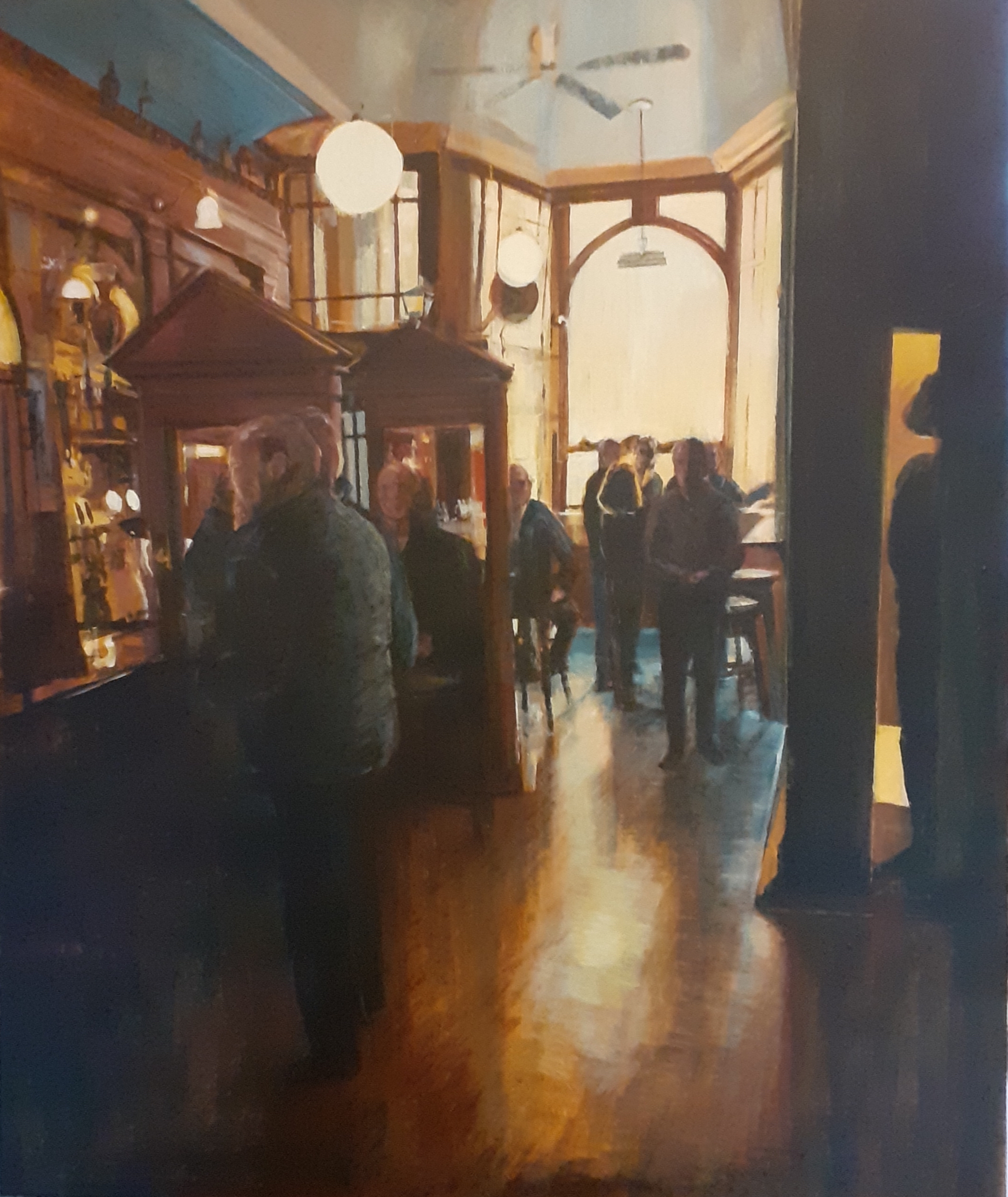
This acrylic is a snapshot of a sunny afternoon spent amongst friends. A brief lull in the conversation allows me to throw my eyes around the bar. I recognise a few of the faces, though things are getting a bit blurred around the edges; but pleasantly so. Perhaps I’ll have another.
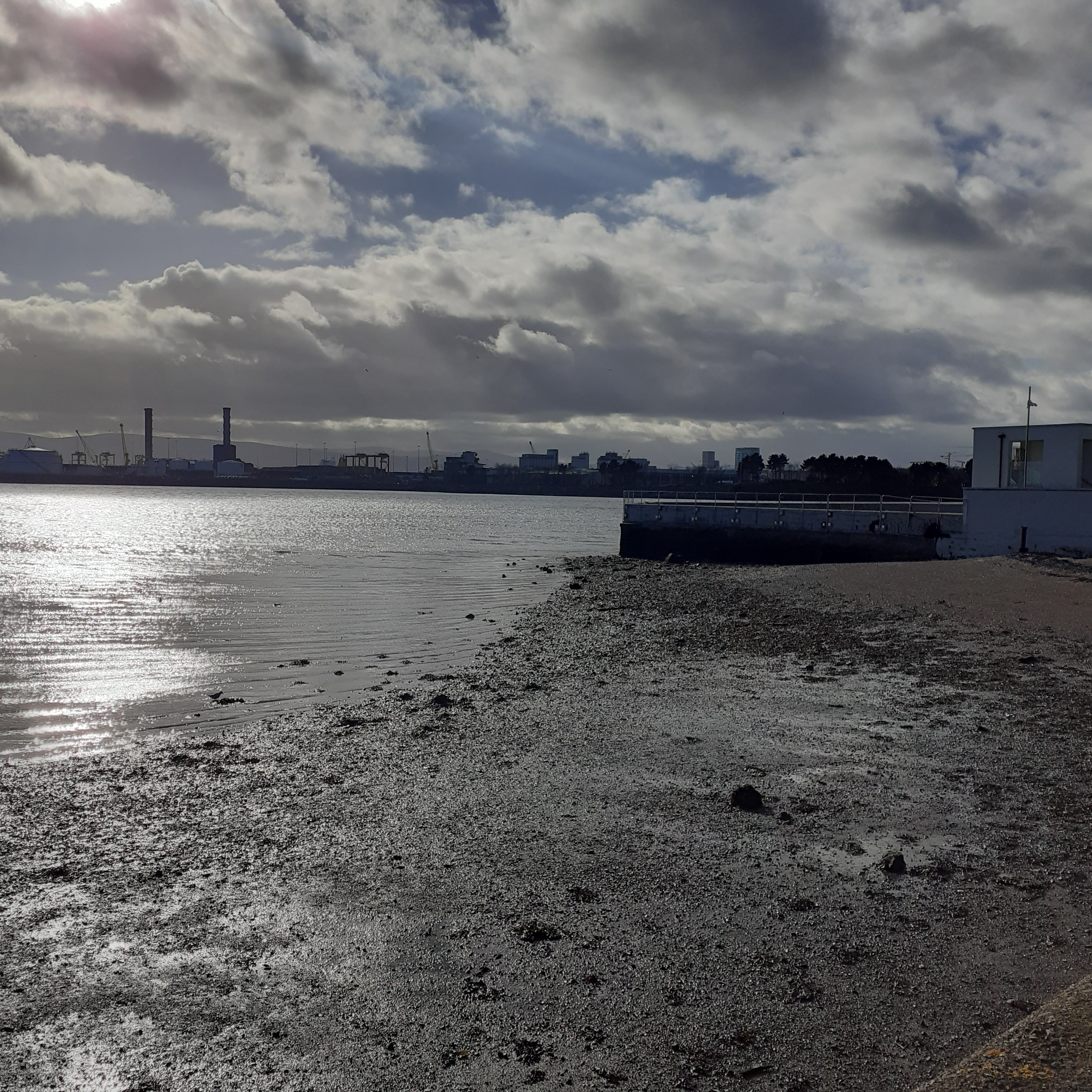
From the Sheds, we blink into the dazzling sun on water which vista extends past Clontarf to Dollymount. Clontarf pier is a little north of the village and it’s suburban housing along the shore from here on. A horse tram service was initiated in 1873 from the city to Clontarf, attracting more and more day trippers. Later catered to by the Howth Tram, this electrified service connected to Sutton and Howth stations via the Summit. On May 31st, 1959, the last tram took its final bow. The colourful, and most useful, tram era was gone, obliterated by conservative forces. Almost fifty years later, the powers that be were persuaded of the error of their ways, and the modern tram service, Luas, went on line in 2004. It doesn’t operate at this end of the city, but there is a frequent bus service all along the coast road.
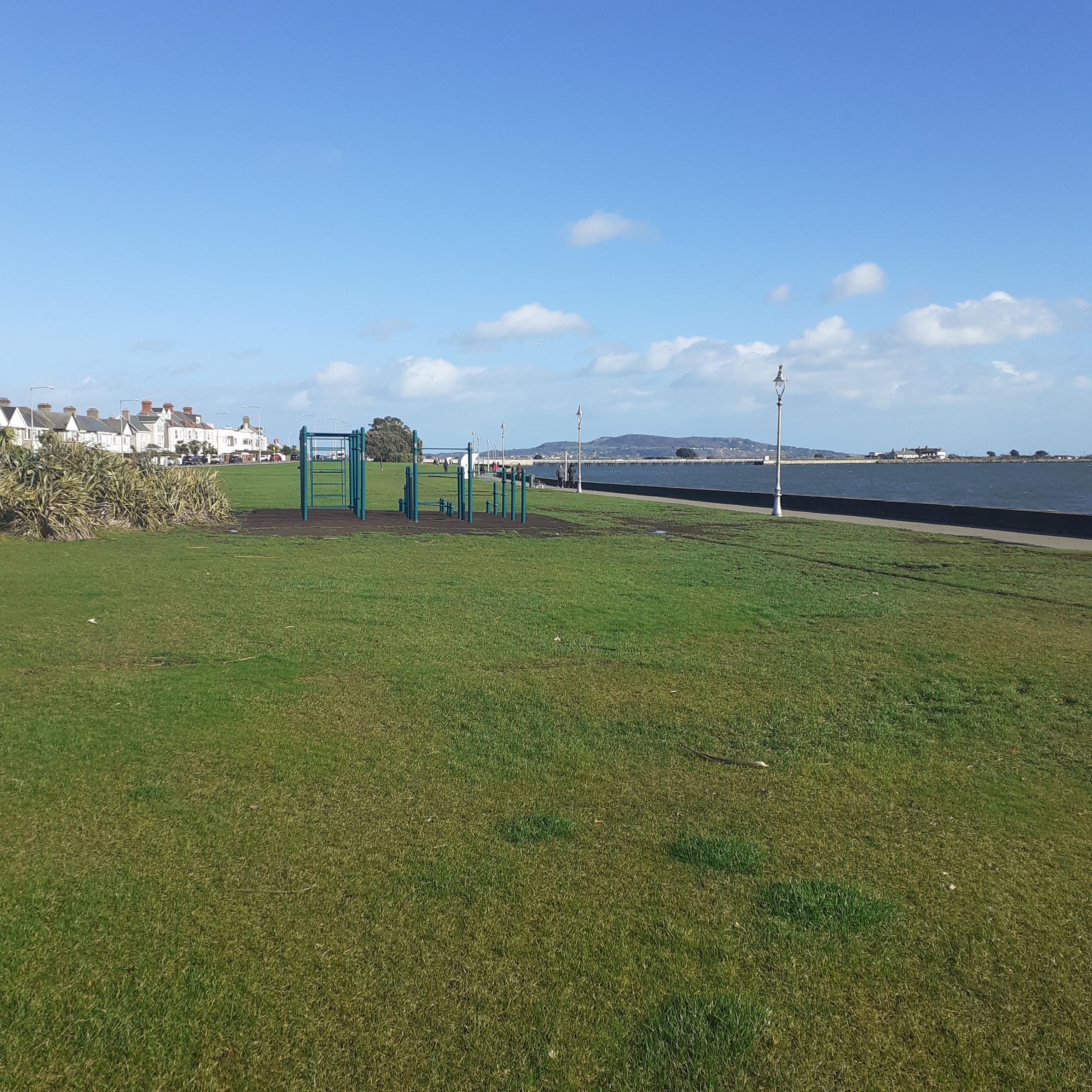
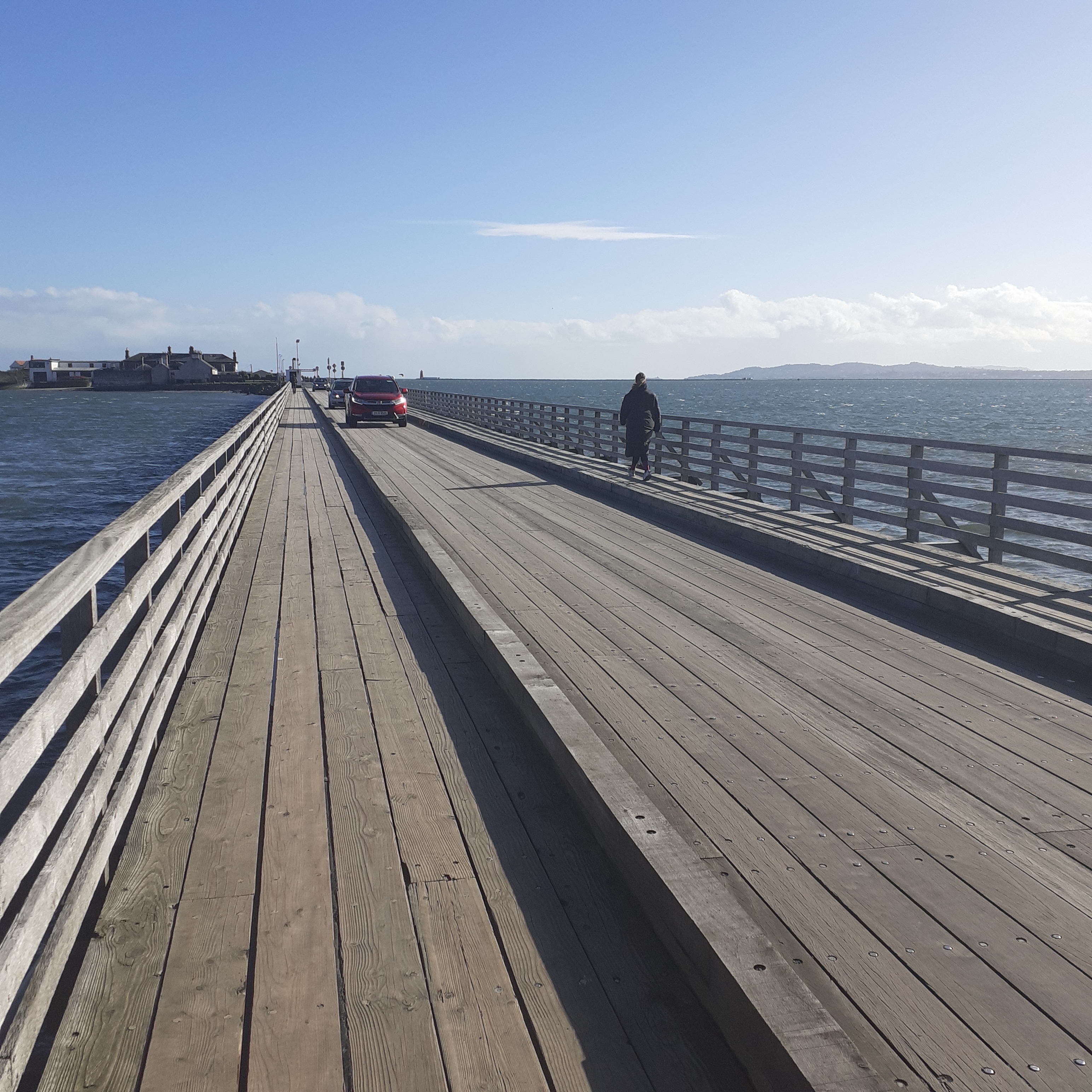
In the distance, the straight line of the Bull Wall, and its wooden bridge, is apparent between our standpoint and the peninsula of Howth. The wide embrace of Dublin Bay looks the most natural and beautiful of havens for the ships of the ocean. More than a millennium of navigators have been welcomed. But there’s a darker side. The commodious bay is prone to silting and many’s the ship has been wrecked in these waters, or run aground on treacherous sandbars that form across the mouth of the Liffey, and the confluence of other tributaries of the bay such as the Dodder and the Tolka. In medieval and early modern times, the Liffey port was so treacherous that Dalkey to the South, and Howth to the North acted as port for the city. This couldn’t continue.
In 1715 work began on the Piles, a wooden construction built to provide a channel past the southern sand bank. Later this would be cast in stone to form the South Bull Wall. In 1760 Sir John Rogerson funded the extension of this westward to meet the Ballast Office and the South Quays. But the problem persisted and in 1801 the Admiralty commissioned William Bligh to survey Dublin bay. Just a dozen years earlier, Bligh had featured in that mother of all adventures at sea: the Mutiny on the Bounty. His four and a half thousand mile voyage with his eighteen loyalists in an open boat is truly the stuff of legend. The waters of Dublin Bay were rather calmer, though treacherous enough, and the Captian of the Bounty, and future Governor of New South Wales, brought his talents to bear on them. The result of Bligh’s survey was the recommendation to built the North Bull Wall, from the Clontarf Coast pointing southeastwards into the bay. This, he calculated, would build up the silt on the Northern side of the wall, which is now evident in the creation of the Bull Island.
Ultimately the design for the wall was made by George Halpin, Ballast Board engineer and designer of bridges and lighthouses. He was the uncle of Robert Halpin, the famed Wicklow mariner who captain Brunel’s SS Great Western in laying the first transatlantic telegraph cable in 1866. George is known as the father of the Irish lighthouse service. He was appointed inspector of lighthouses in 1810, responsible for over fifty lighthouses, including the Skelligs, and the Baily Lighthouse in Howth. He died in 1854 and was succeeded as Inspector of Lighthouses by his son, George.
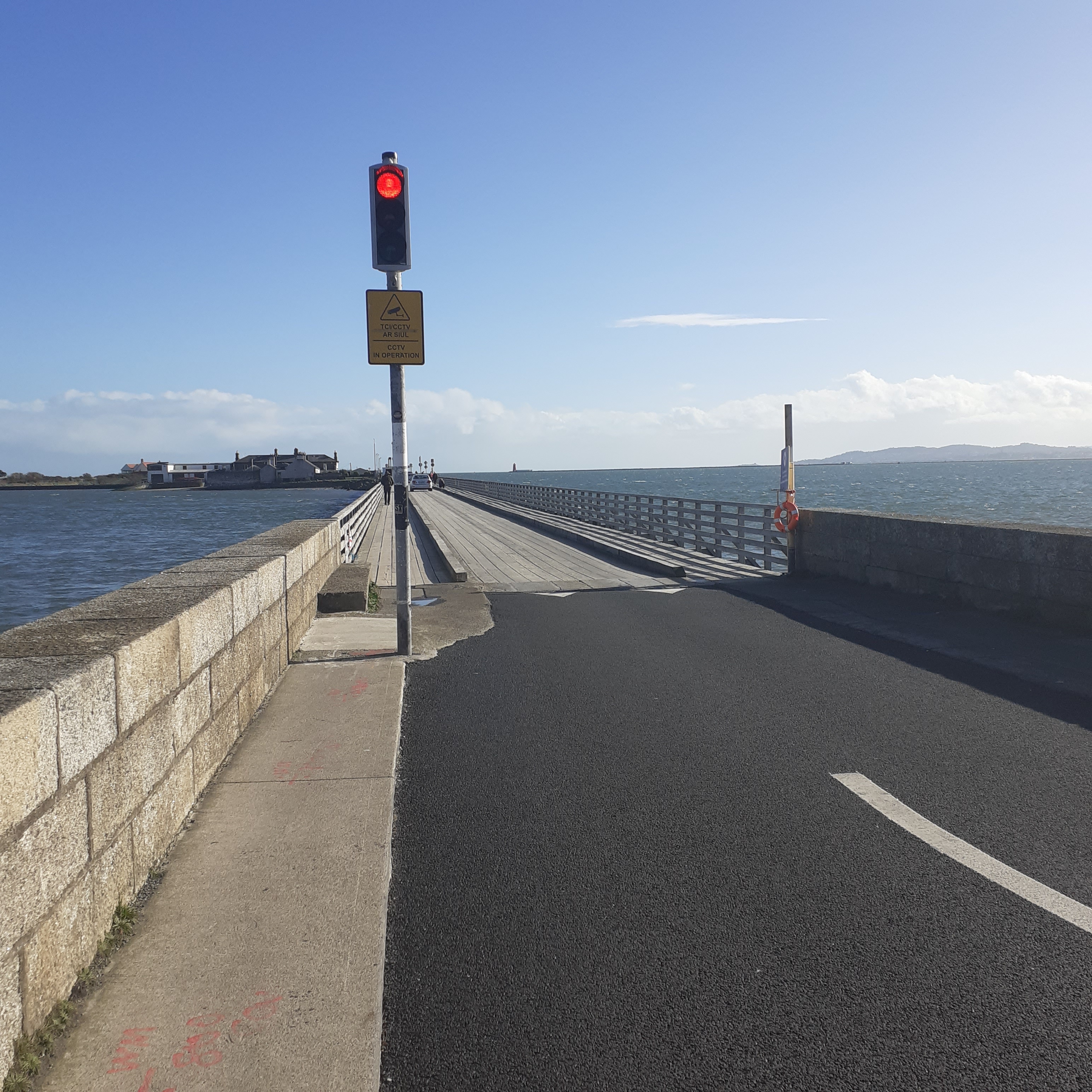
Work commenced on the North Bull in 1819 with the construction of the timber bridge. The crossing of this seems almost a rite of passage for a true blue Dub. Car traffic is one lane at a time, controlled by traffic lights. On one childhood trip, I recall our packed Morris Minor, stopped halfway out by a car coming in the opposite direction. An amber gambler, no doubt. My father got out to reason with the errant driver, who, on seeing him, reversed furiously back to the island. My father was a diminutive man, but imposing. He was a military man, Irish Army, but with something of a British accent. We had a good laugh at his quick resolution of the short impasse.
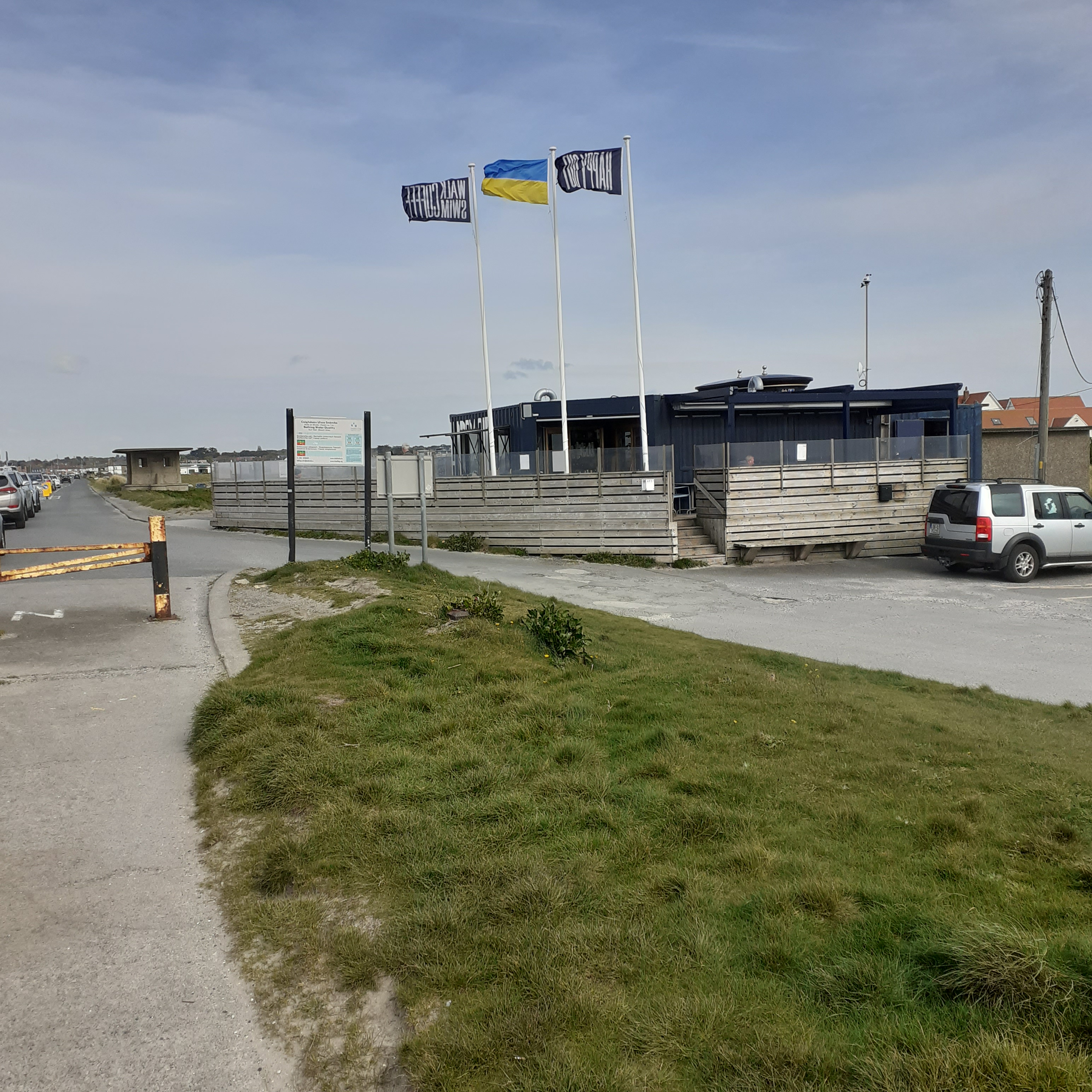
Over the bridge, there’s parking adjacent to a service area which includes pay toilets and picnic benches. There’s a windswept coffee and snack place called Happy Out. I throw out an anchor and lean into the gale, feeling the defrosting balm of americano seep through my veins. All the better to fortify myself on my walk out to the end of the wall.
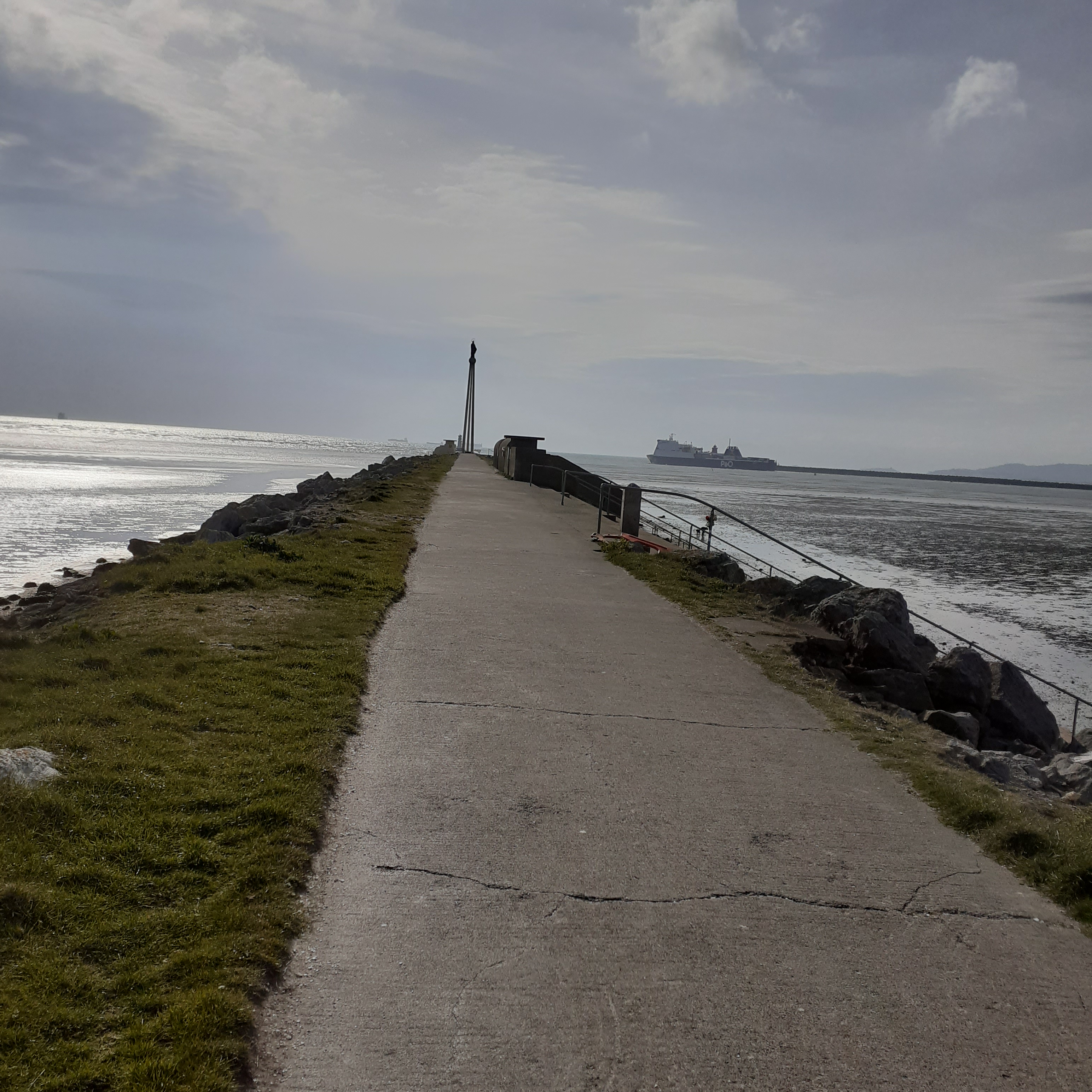
The wall itself was completed six years after the bridge and extended for more than three kilometres into the bay. The walkway is paved as far as Our Lady Star of the Sea, and the last stage is a rough breakwater, covered at high tide, with a green lighthouse at the end. As far as the statue, there are a number of public bathing shelters, designated male and female and designed by George Simms, Dublin Corporation housing architect. Star of the Sea was first mooted in the fifties and funded by subscription from Dublin dockers, sailors and port companies. The structure comprises three tall concrete pillars which merge to support a globe on which stands the statue sculpted by Cecil King. It was unveiled in 1972.
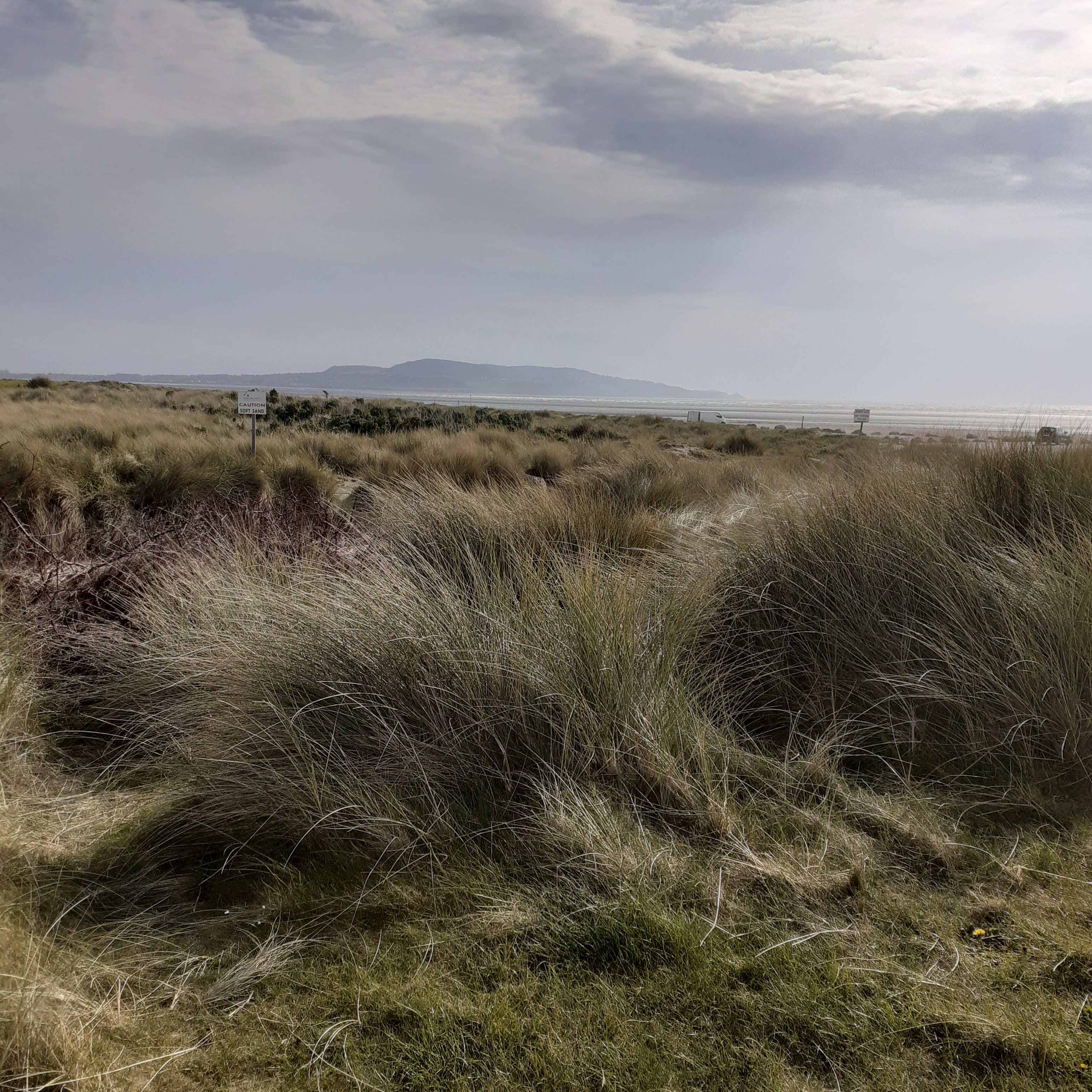
Dollymount strand is a good five kilometres long and is both a splendid public amenity for the huge city on its doorstep, and also an invaluable wildlife reserve. The Bull island on the landward side is occupied by two golf clubs, the Royal Dublin and St. Anne’s. The Royal Dublin was founded in 1855 and is Ireland’s second oldest golf club. It is a regular venue for the Irish Open Championship. A causeway links with the mainland further on at Raheny
And so to stroll the sands of the neverending beach that is Dollymount Strand. It can be all things at all times, a capsule of infinity, a panorama of the memory. Life is a beach. I recall another childhood trip to Dollymount. Taking the car without incident onto the beach, my father gave each of us three kids a turn at driving on the hard packed sand. This is also something of a Dublin tradition. Many’s the driver who cut their motoring teeth here. And returned for other pursuits. It was also a popular nighttime hangout. Motoring, music and romance; what more could a body ask for? There were cars, their drivers, and passengers, otherwise occupied, marooned by the incoming tide.
I want to take you to the island
And trace your footprints in the sand …
And in the evening when the sun goes down
We’ll make love to the sound of the ocean
The Island is a 1985 song by Paul Brady taken from his album Back to the Centre. Brady hails from the town of Strabane, not far from Dungannon, in County Tyrone. My father lived in Dungannon from when he was six, or maybe seven. He died in the late eighties. Near the end of his life he spent some time at a Convalescent Home near Sandymount Strand, across the bay. It was me that drove him home for the last time. We walked out along the corridor together, very slowly, and I recall the song playing was The Island. It refers to the greater island of Ireland, and caustically to the Troubles, but like any great song it applies across a range of human experience. Here, memory, belonging and isolation are evoked in the permanence, and transience of the tide across an expanse of beach. It seems apt now, on this sandy island, to let it flow, and ebb through the soul.
Stepping off the Yacht, I turn left and northwards along the coast. At least I will ultimately head North, way up north. Right now Clontarf Road is curving away east, south east. But there’s no way of getting lost. It hugs the coast, so eminently huggable, all the way onwards from its starting point in Fairview, through Clontarf and on to the timber bridge connecting to the Bull Island at Dollymount. There’s a long grassy promenade as far as the bridge, after which the coast road will continue alone past Saint Anne’s Park in Raheny until Sutton Strand at the isthmus of Howth.
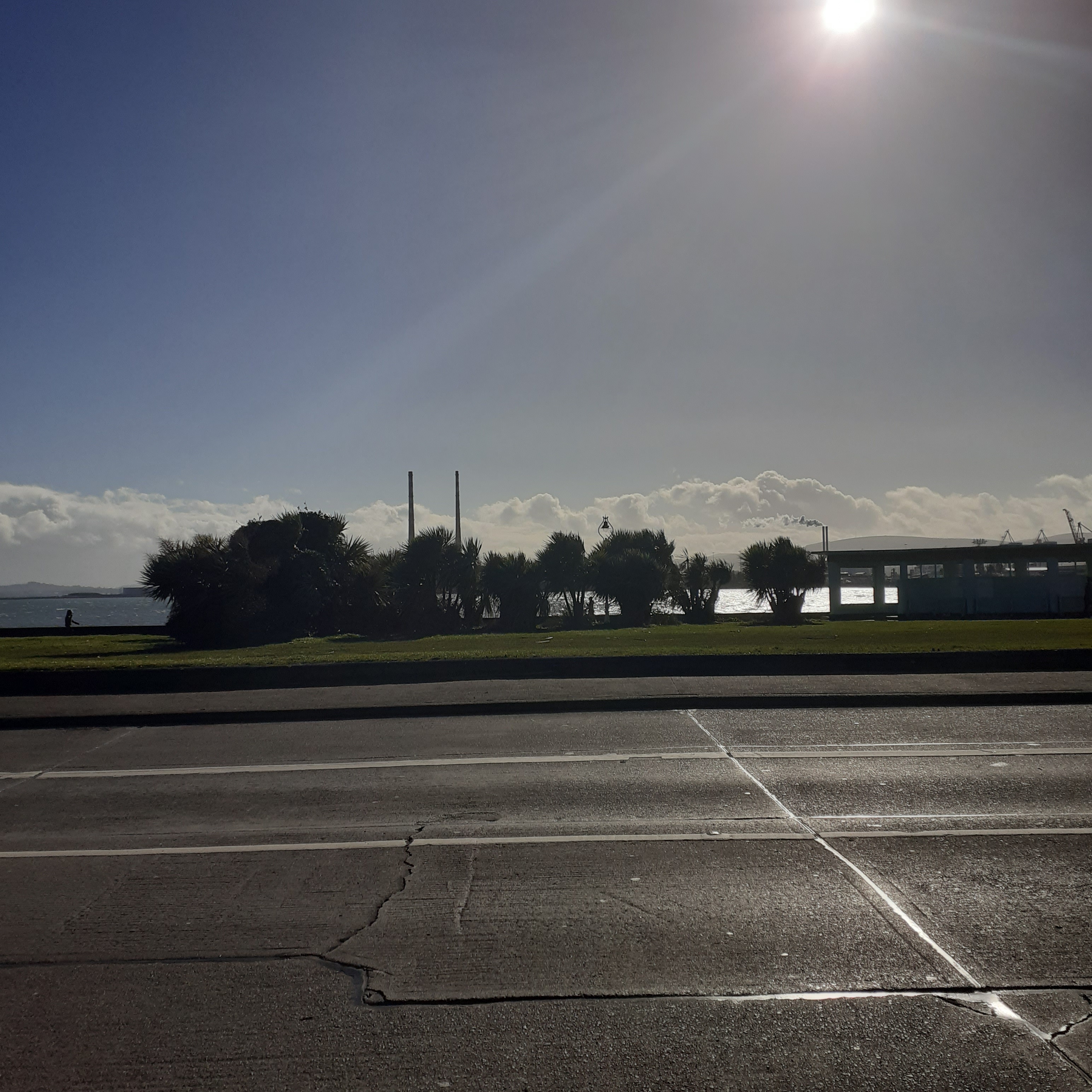
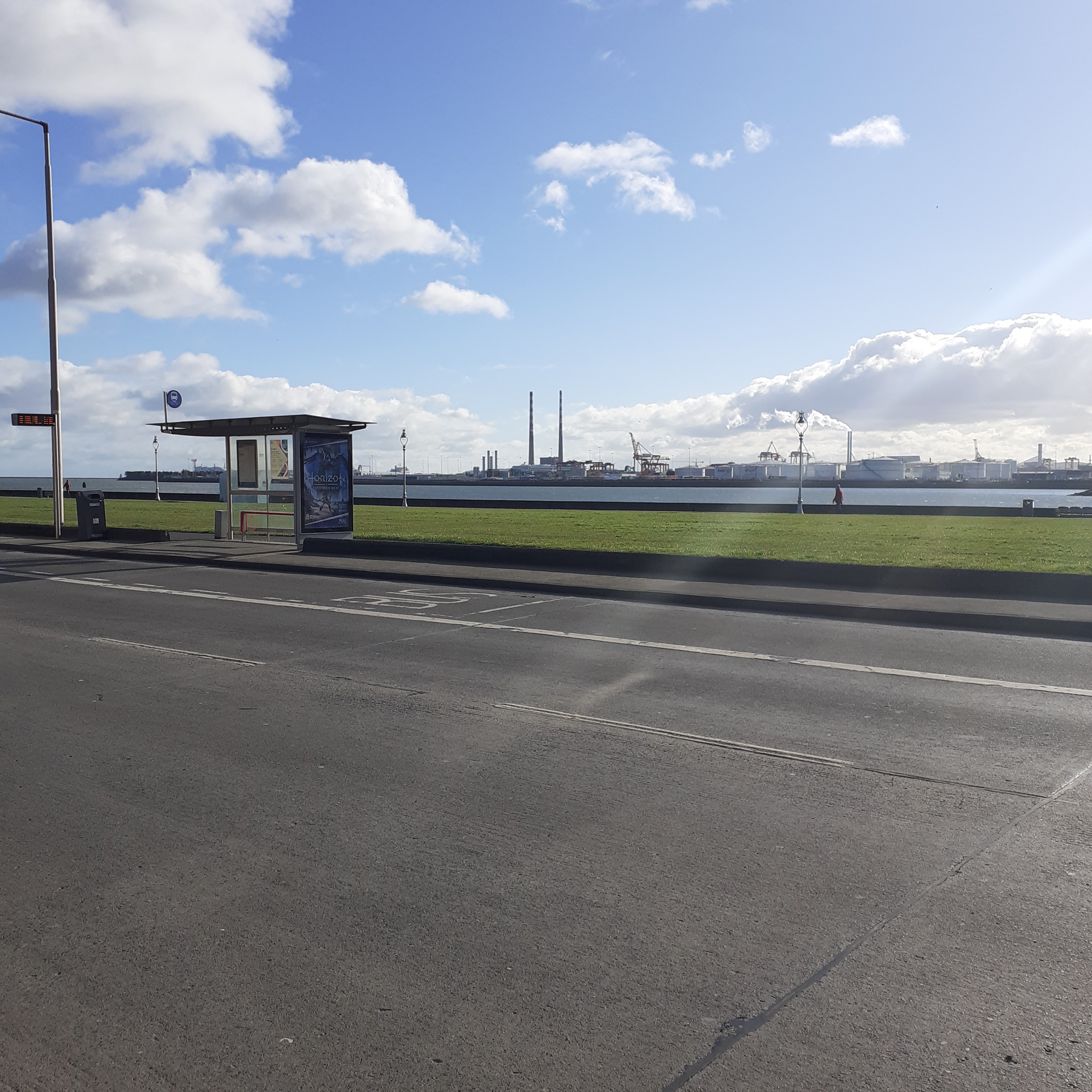
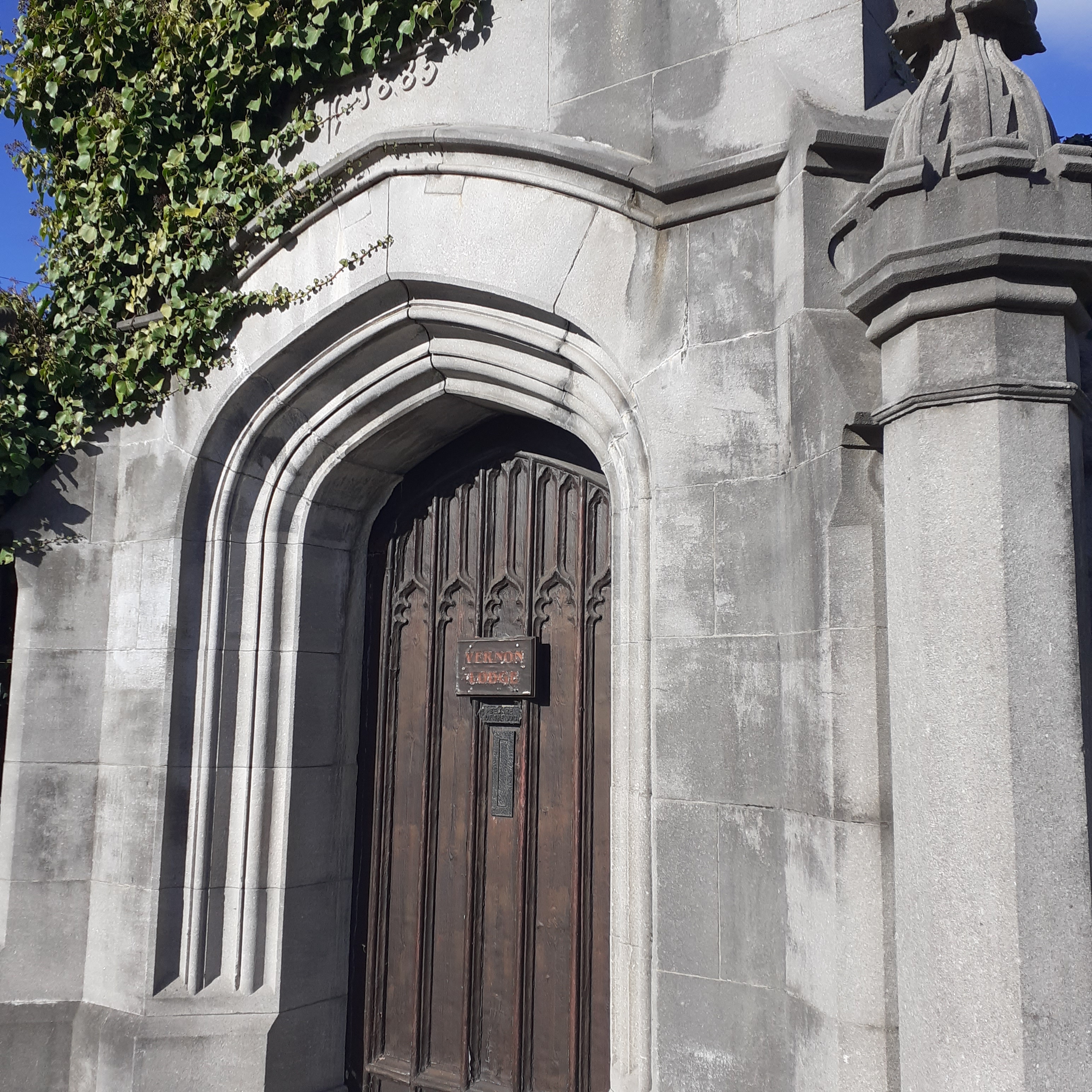
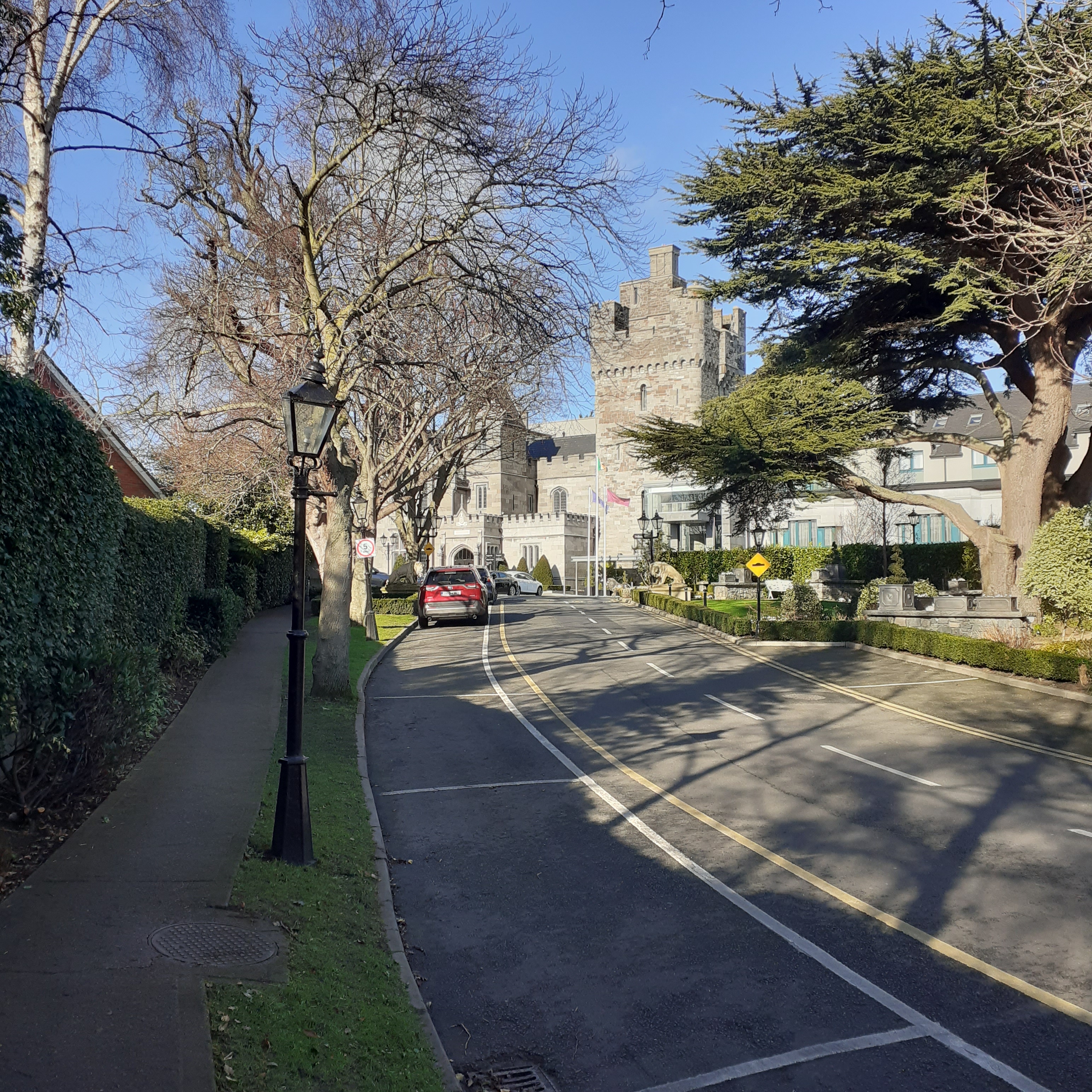
Dublins docklands form a spiky tableau along the horizon, the twin chimneys above all. The road curves away past salubrious suburbia. A few hundred yards on at Castle Avenue there’s time for a detour to Clontarf Castle. Castle Avenue is a sylvan boulevard, lined with attractive nineteenth century terraces and some more modern flats and houses. It takes a sharp right at the top where there’s a stone gateway inscribed for longtime owners of the Castle, the Vernons: Vernon Semper Virit, and dated 1885. This entrance is now dislocated from the Castle grounds, whose modern entrance is a hundred yards or so further on.
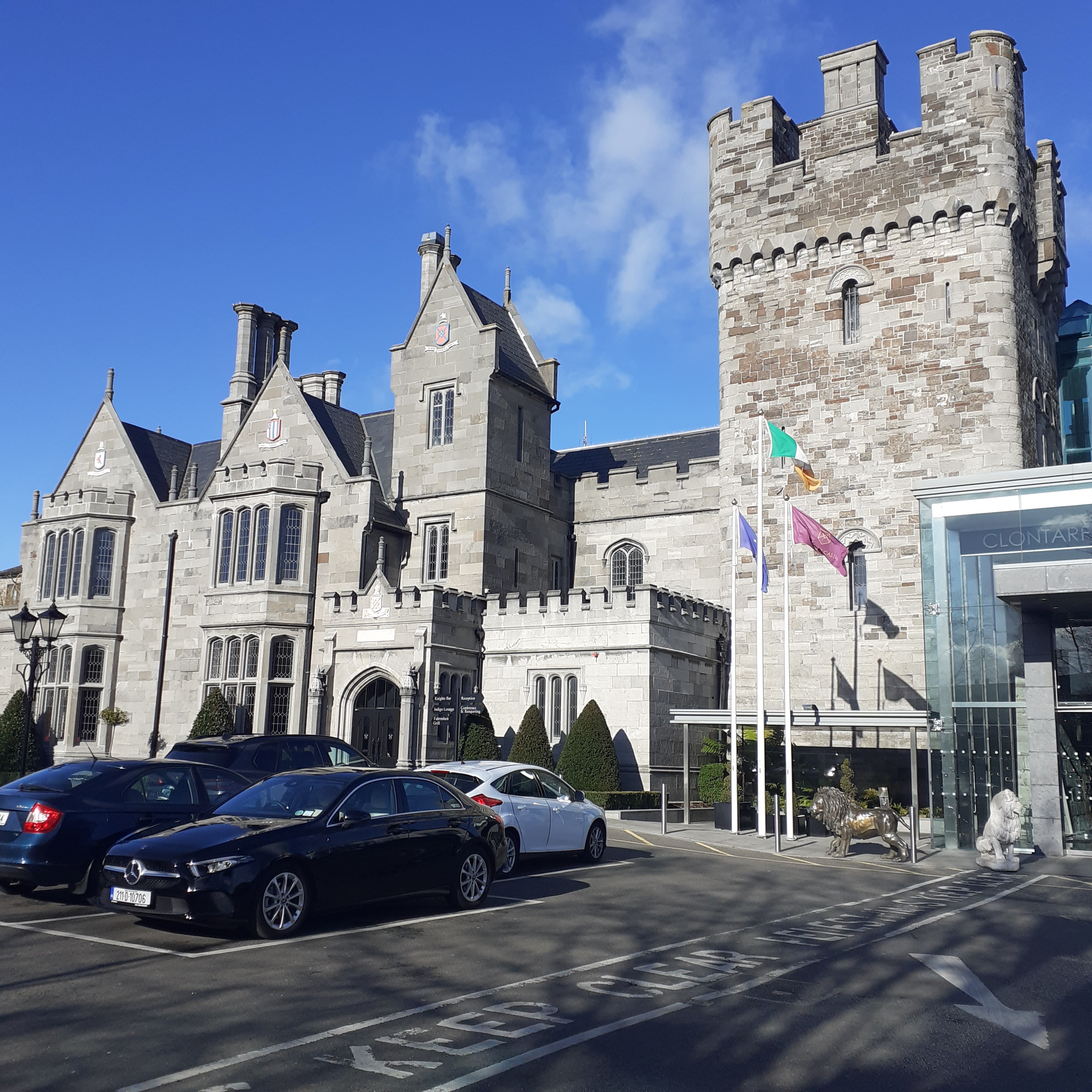
The original castle was built by Hugh De Lacy, Lord of Meath, following Strongbow’s conquest in 1172. His tenant, Adam de Pheypo, took up residence. Ownership passed to the Knights Templar and subsequently the Knights Hospitaller until Henry VIII’s dissolution of the monasteries.
By the mid seventeenth century, times were becoming ever more interesting. The War of the Three Kingdoms kicked off, with the Irish Confederacy of Gaelic and Old English (the Anglo Norman Lords) adding fuel to the fire with the Irish Rebellion of 1641. Avid Cromwellian, Sir Charles Coote, Governor of Dublin, burned the castle as part of a campaign to exterminate the Catholic rebels holed up there. The lands were subsequently granted to John Vernon, Quartermaster general of Cromwell’s army, and he set about rebuilding it and adding a parish church whose ruins endure.
George Handel is a noted visitor. In April 1742, the first performance of Handel’s Messiah took place in the Concert Hall in Fishamble St. The choirs of St Patrick’s and Christ Church Cathedrals were used, though the Dean of St Patrick’s, Jonathan Swift, was initially reluctant until informed it was to be a charity event. And hugely successful too. Such were the crowds clamouring to go, that gentlemen were required to leave their swords at the door, to facilitate more people. Handel stayed for a time at Clontarf Castle, where he formed a close relationship with the lady of the house Dorothy Vernon, whom he honoured in his music. She is also honoured by the Dolly in Dollymount further along the coast.
The Vernon’s owned the castle for three hundred years but the line extinguished in the 1930s and the castle and grounds fell into decay. In the late sixties the castle was reborn as a popular cabaret venue. It was completely renovated as an upmarket hotel in the 1990s. The current structure was designed by Irish Architect William Vitruvius Morrison in 1837, in a Gothic Tudor style. The Tower House being a replica of the original Templar structure.
Another probable visitor, in its derelict days, was Phil Lynott who left his home in Crumlin and moved into a flat at 28 Castle Avenue in the late sixties. The three storey Victorian house where Lynott lived was recently renovated as a private dwelling and worth an approximate four million. But it was the castle that caught the young musician’s imagination.
The friendly ranger paused
And scooping a bowl of beans
Spreading them like stars
Falling like justice on different scenes
Around that time, Lynott joined Skid Row, moving on to front Orphanage and forming Thin Lizzy at the end of 1969 with old pal, Brian Downey, and Belfast duo Eric Bell and Eric Wrixon of Them. Thin Lizzy’s eponymous first album opens with the song The Friendly Ranger at Clontarf Castle. The lyrics suggest the castle and grounds are deserted, a place where wild and ragged people go, which Lynott and friends may have used for a hangout. The friendly ranger is part tramp, part guru, and evening brings a rush of hope and wonder.
To feel the goodness glowing inside
To walk down a street with my arms about your hips, side by side
To play with a sad eyed child till he smiles
To look at a starry sky at night, realize the miles
Like Dublin’s other great musical bard, Thomas Moore, Lynott sings of love and landscape, of lost and living friendships.
Back down at the seafront, there’s a water outlet in the wall, which it is said, derives from the spring where Brian refreshed himself at the Battle of Clontarf. It is known as Brian Boru’s Well; although he wasn’t looking so good last time he left the place, dead.
Turning back onto the coast, we pass Clontarf baths, The bracing shoreline with its spectacular panorama of the bay saw Clontarf become a fashionable resort in the nineteenth century. Catering for the influx, the baths were constructed by a Mr Brierly with hot and cold seaweed baths. These closed in 1996, but are currently refurbished with bar and lounge, although access to bathing remains nebulous.
A little further on we reach the junction of Vernon Avenue where an urban village juts onto the coast road. The ancient manorial village of Clontarf grew originally in the vicinity of the Castle, but the population in the late seventeenth century was less than a hundred. An important fisheries industry developed on the coast further east. Processing the catch, including fish curing and oysters, was carried on in a group of buildings called the Sheds and the modern village grew around this. The fisheries are long gone, but the name, The Sheds, lives on at Connolly’s Pub on the seafront. The small village is an interesting enclave with cafes, eateries, shops and the pub.
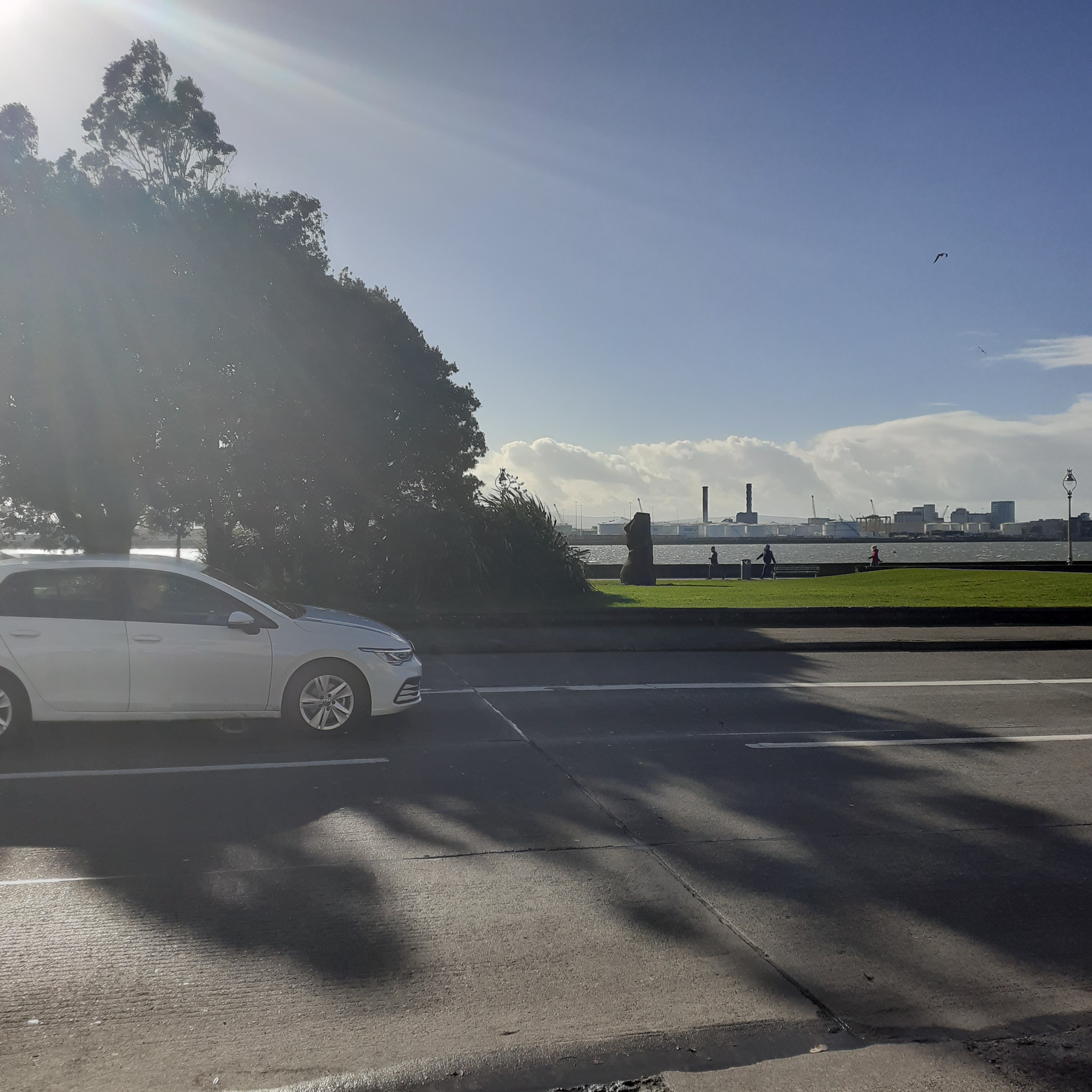
From here the road begins to curve northwards, towards Dollymount and the Bull Island. Guarding the route is an imposing head which resonates of a very distant culture. This is the Easter Island Maoi replica statue presented by the Chilean government to the city of Dublin in 2004. It was carved from the volcanic rock of Easter Island in the Pacific, and forms an eerie, though appropriate, connection between island cultures on different sides of the globe. Rock and roll!
To see the sun set behind the steeple
Clontarf castle, no king, queen or knightly people
A coal fire and it’s pouring rain
To wave goodbye to a very good friend, never meet again
Little thoughts bring little memories of you to me
Last winter we visited Connemara, way out west. Yippee Yi O Ty Aye! We stayed in the Leenane Lodge on the shores of Killary Harbour. Killary, a rare fjord etched into the Connaught coast, is on the Wild Atlantic Way, a 2,600K road connecting Malin Head in Donegal with the Old Head of Kinsale in County Cork. Ireland’s Atlantic coast is truly spectacular and there are plenty of places to explore on foot with lakeland, dramatic cliffs and rugged mountains creating a paradise for the landscape lover.
Right past our hotel door winds the Western Way. The Western Way is a long distance walking trail through Mayo and Galway. It starts up past Ballina and shimmies on down through the mountains of Mayo, through Newport and Westport, past the Leenane Lodge and on down to Oughterard, by the shores of Lough Corrib in Galway.
We picked up a part of it just west of Leenane on a cool, bright morning after a hearty Irish breakfast. The full route of this particular section skirts the northern slopes of the Maumturk Mountains, rising above Killary Harbour, then turning south through Glen Inagh with Lough Inagh and the Twelve Bens away to the west. It is thirty kilometres long, about six hours in all, but we’re only planning two hours or so.
The walk is along an old coach road so the climb is relatively easy, and very rewarding. M precedes me up the hill. Cresting it, the majestic beauty of the twelve Bens are sketched along the horizon, sweeping down to where Killary fjord makes for the Atlantic. Mweelrea, mightiest mountain in Mayo, presides over the northern shore.
We are on the threshold of paradise, but it turns out we don’t we don’t get much further than this. The sky around here is prone to vertiginous mood swings and a storm has sprung up over the Twelve Bens. We turn and hurry downhill, reaching the road as the first sprinkles of rain hit. We are laughing in the lobby as the storm sweeps over, and just as quickly passes, leaving behind the cool and sunny landscape of the morning.
I finished off this piece in the bloom of early Summer, back East in Dublin 4, sitting in the sunshine on the veranda of a bar at the corner of Shelbourne Road and Bath Avenue. This song came on the radio and I felt the singer was looking over my shoulder.
My love, I’m in paradise whenever I’m with you
My time, we’ll be out whatever the weather
If it feels like paradise running through your bloody veins
You know it’s love heading your way!
The sung is Paradise by George Evra and taken from his 2018 album, Staying at Tamara’s. Coincidentally, again, I find he studied music at Bristol BIMM. I’m off to Bristol soon, and hope to revisit Bath. So, with connections abounding, what better lines to quote?
Leaving behind the Tolka River, the Main Road curves around Fairview Park. It’s a welcome stretch of greenery after the urban drear of North Strand. The park was reclaimed from tidal mudflats in the 1920s as the hinterland was being developed into suburbia. Tree lined walks are formally laid out, effectively masking off the railway line. Nearer the road, there’s a skatepark and a children’s playground. Beyond the tracks there are all weather pitches for Gaelic and Soccer.
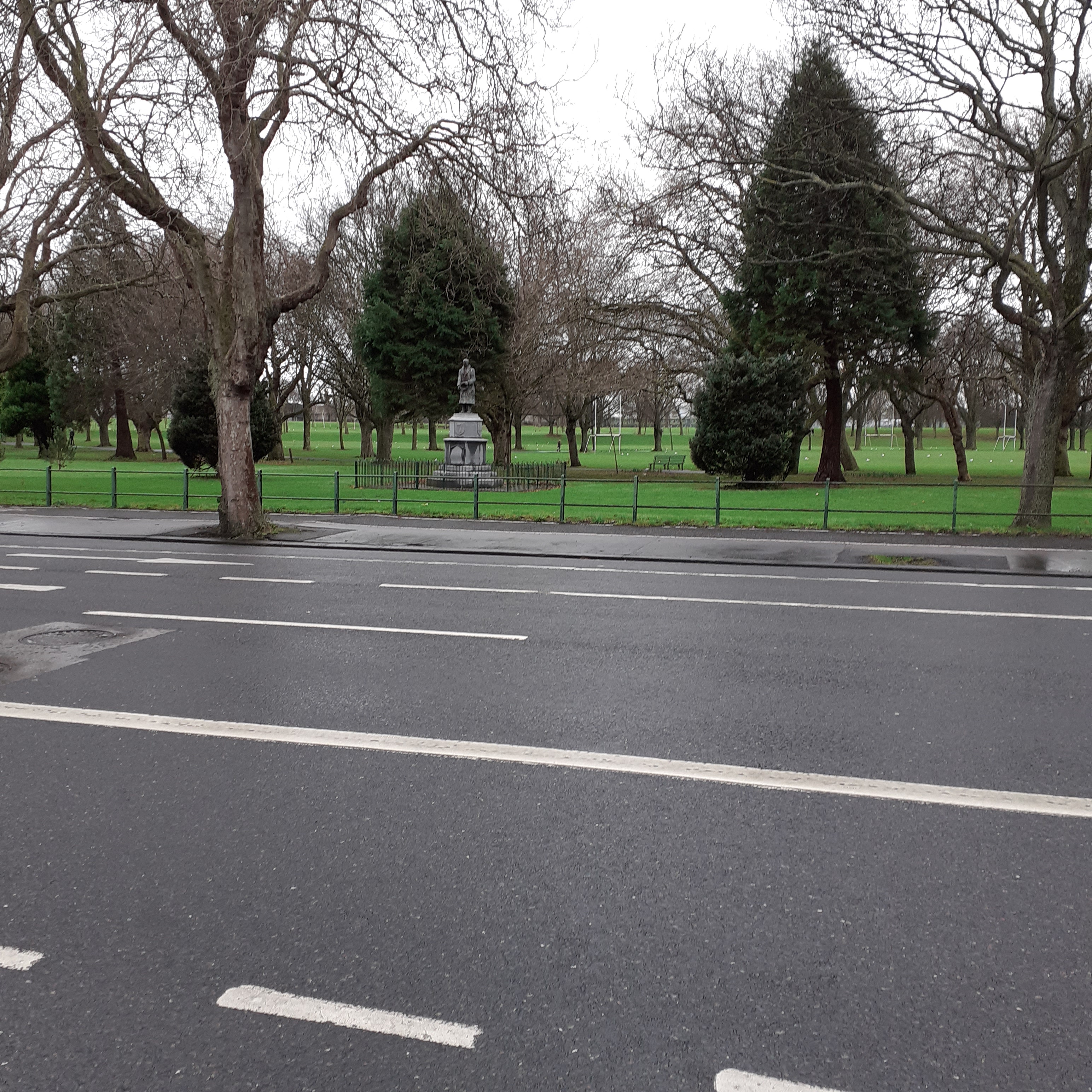
Early on we pass a statue of Sean Russell. Russell was an IRA leader in the War of Independence, and fought against the Treaty in the Civil War. While the IRA diminished, Russell’s radicalism did not. He pursued the armed struggle until his death in 1940. He touted for arms and funding from the Soviet Union and subsequently Nazi Germany. From Germany he set out with Frank Ryan by U-boat, bound for Ireland as part of a sabotage mission. He died aboard and was buried at sea.
The memorial was erected in 1951 and has not proved popular with everyone. In 1954, the right arm, raised in unspecified salute was amputated by right, or left, wingers, depending. Next it was decapitated in 2004 by objectors citing Russell’s Nazi connections, condemning the latter’s systematic extermination of Jews, Gypsies and homosexuals. Apologists claim Russell was no Nazi, and that he leaned towards Communist Russia betimes. A man of many hats, so. The accident prone statue was replaced with a sturdier bronze version. Russell stands, right hand advisedly held close to his side, his left clutching a hat; though precisely which hat is unsure. This hasn’t repelled further indignities. The plinth was gaily painted, quite literally, with the LGBT flag in 2020.
Further on, the main road joins with Fairview Strand, coming from our left. The area known as Fairview formed in the early nineteenth century. Though originally considered part of Ballybough, Poor Town, it was in fact more of a middle class enclave and also held a sizeable Jewish community.
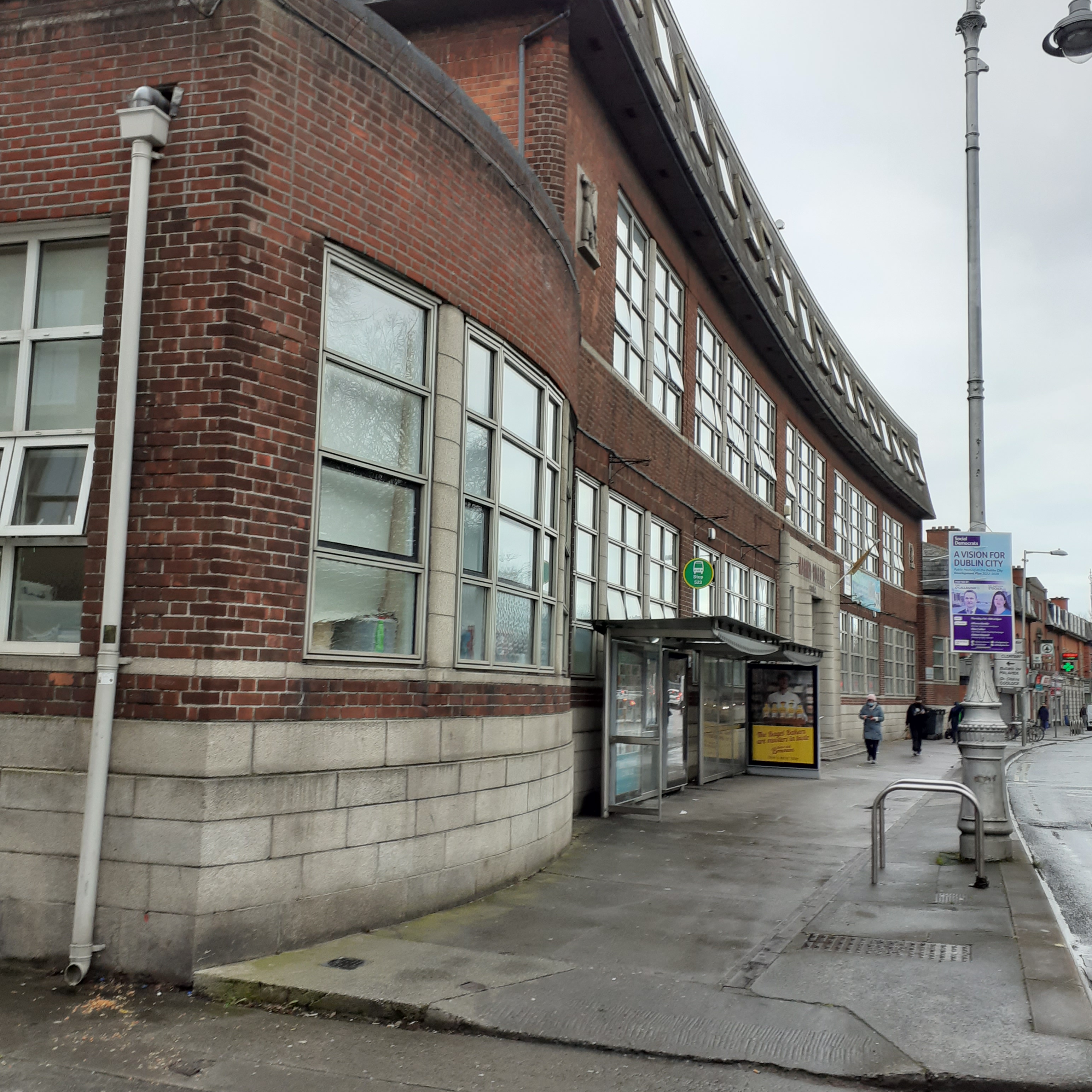
Marino College curves along with the roadway. This second level school, built in 1936 was designed by Robinson O’Keeffe, as a technical college. It is faced in granite and redbrick with metal framed windows. Its attractive, curved facade, recalls the style of the Art Deco period, when style and function rhymed. The complex includes a public library. The mansard roof is a later addition from the seventies, intended to harmonise with the more elegant mansards of the earlier buildings along the frontage.
The building of the church, Our Lady of Fairview, in mid century suggested a more pleasing name. In fact, the view over Dublin Bay from higher ground behind the foreshore had long been considered exceedingly fine. Presiding over it was the demesne of Lord Charlemont, and his grand Georgian residence, Marino House.
The fair view is perhaps less obvious now, the serrated scar of the docklands cutting across the serene complexion of the bay. A view still bracing to the modern, metropolitan soul, and beneath it, the palimpsest of heaven’s reflex endures. Marino House was built in 1753 for James Caulfield, the first Earl of Charlemont, and designed by Scottish architect, William Chambers. He also designed Charlemont House for the Earl in Parnell Square, the building which now houses Dublin’s Municipal Gallery, the Hugh Lane. A guiding impetus for the Marino project was the Grand Tour of Europe, a traditional rite of passage in the formation of the great and the good.The young Caulfield had been particularly engaged by the tour; nine years swanning around the Mediterranean, what’s not to like? On his return, the Bay of Naples, embedded in his memory, must have seemed magically projected on the horizon in the silhouette of the Dublin Mountains and Wicklow’s Sugarloaf Mountains. Milton’s Paradise Lost was another inspiration, suggesting a Garden of Eden for the aesthetically robust Earl back in his beloved home. Caulfield resolved to conjure up his own Xanadu from the higher ground of Marino.
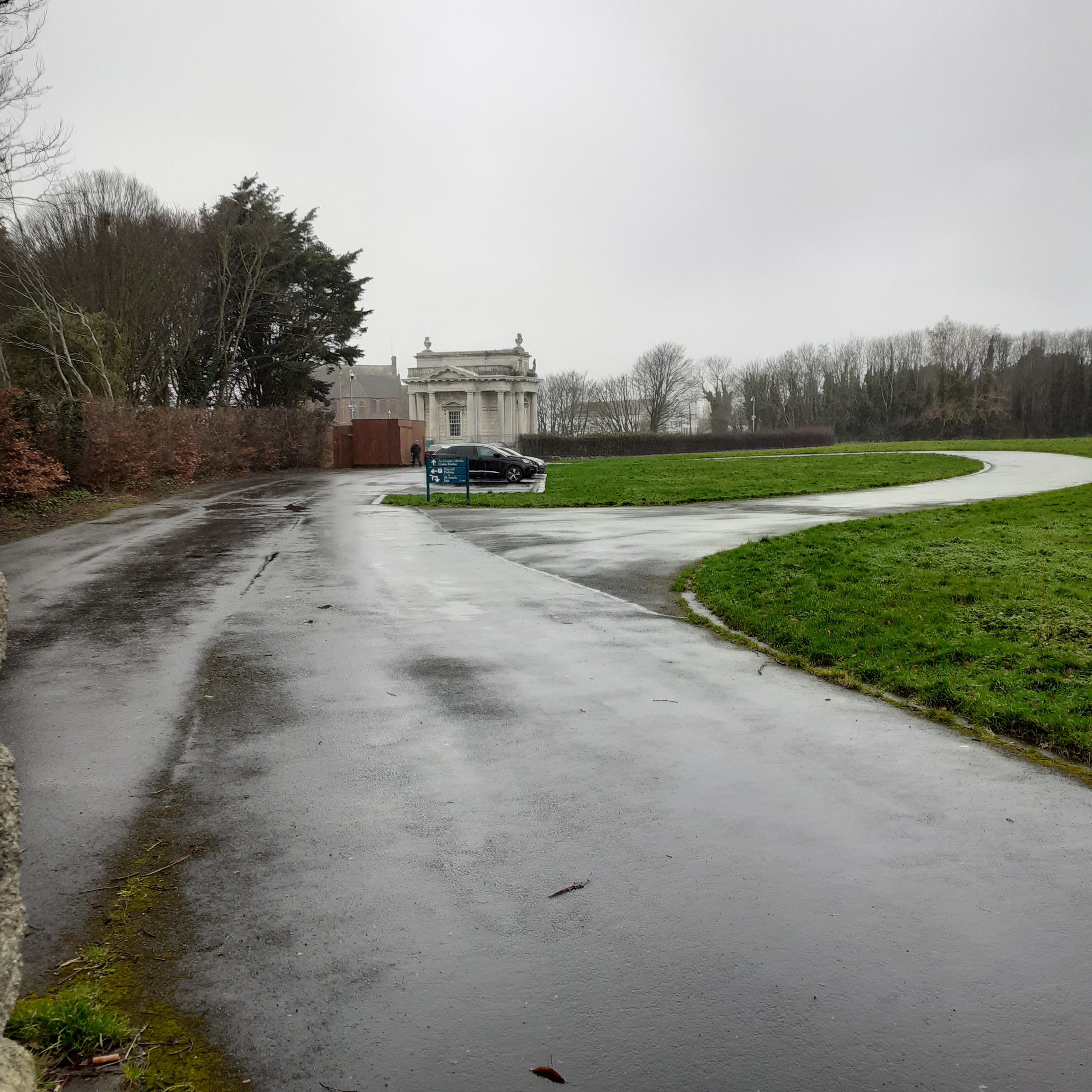
The Casino (meaning small house) was also designed by William Chambers as a garden pavilion for the big house. Something of a Georgian Tardis, the building looks compact from without, but it comprises three stories and is on a grande scale within. Built in 1770, it was truly a wonder of its day, but fell into decline when the estate was sold in 1881. The Irish State took ownership in the thirties, and it has been lovingly restored by the OPW. Today only the pavilion survives, Marino House being demolished in the 1920s to make way for the housing estate.
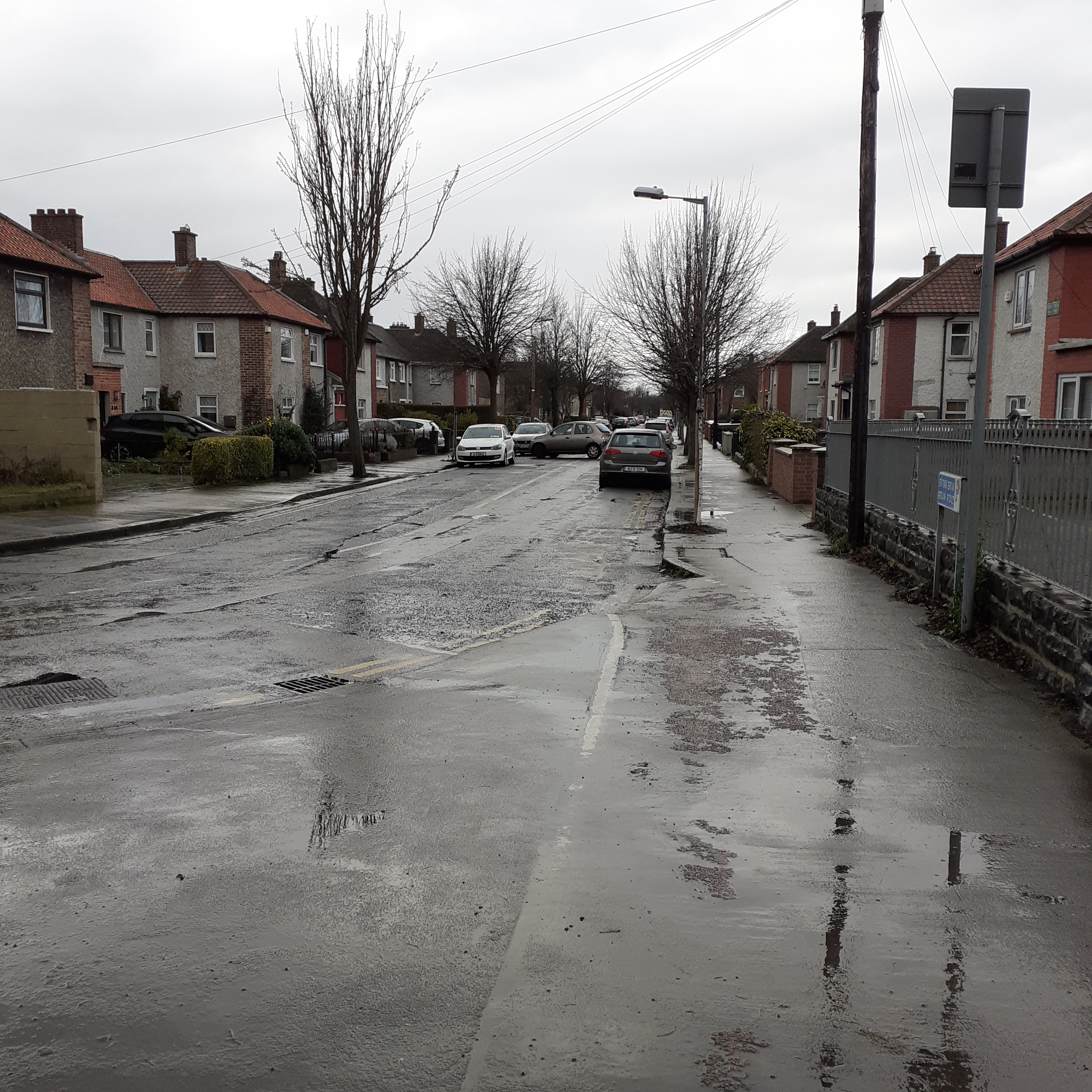
This was the first large local authority housing estate built in independent Ireland. It followed the principles of the Garden City Movement, which aimed for the perfect synthesis of urban and rural living. One thousand, three hundred concrete houses were built, arranged in a symmetrical pattern encompassing circular greens and parks.
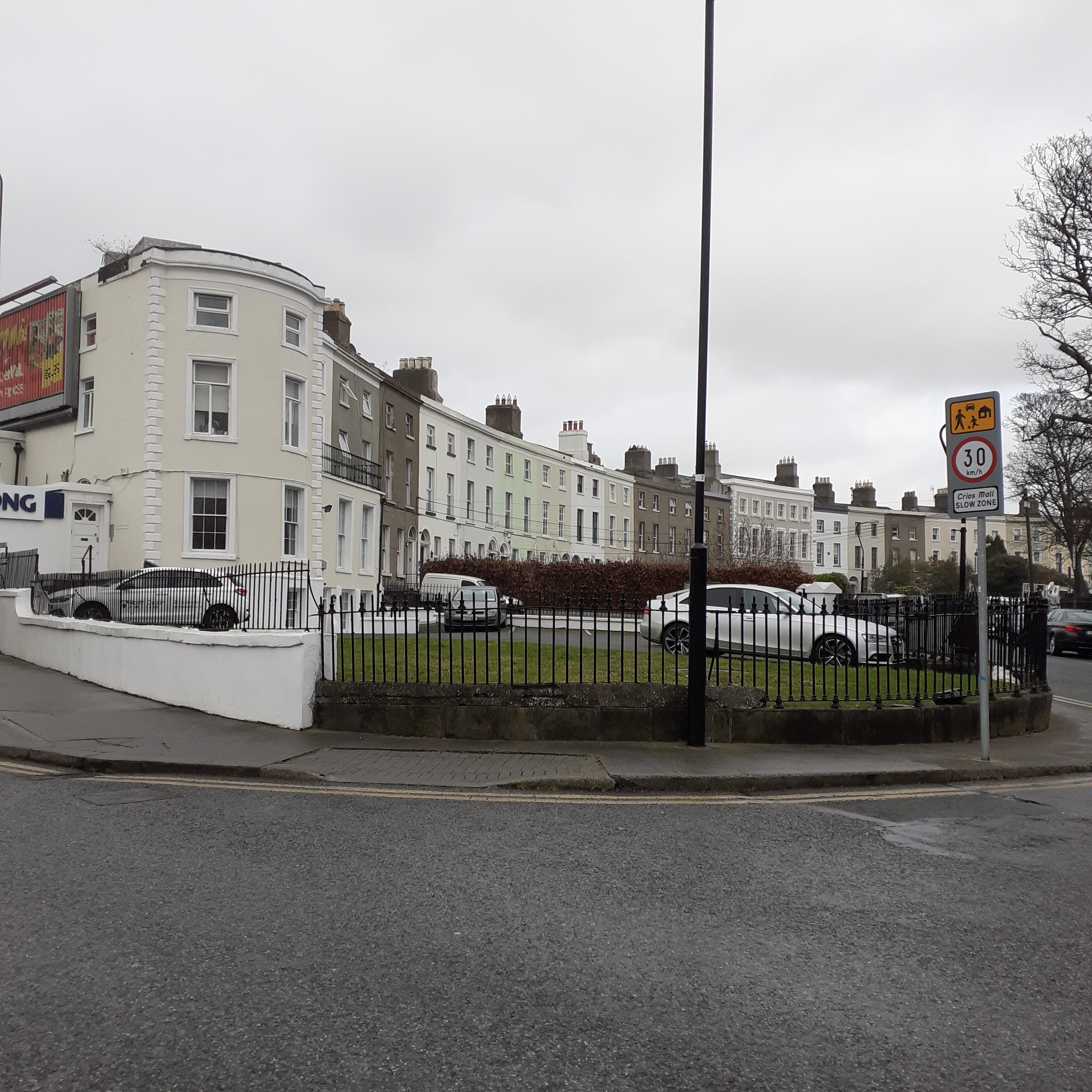
North of the junction of Malahide Road, stands an imposing Georgian crescent of twenty six houses, the only such crescent in Ireland. Built in 1792 by Charles Ffolliatt, a property developer from Aungier Street. It is said to have been built as a spite wall to block the view of the sea from Marino House. The nature of the dispute is lost in time, but whether the developer’s petty insult hastened the Earl’s end we can’t say. He had more important matters to observe, being president of the Royal Irish Academy and in the Irish Parliament a keen supporter of Henry Grattan and the assertion of Irish Independence. The Earl died in 1799 at seventy years of age, so at least he never got to see the hated Act of Union, that disaster being implemented two years later.
The Crescent was originally a redbrick terrace, but the facades were plastered in the Regency years as was then the fashion. The small park in front of the Crescent was originally for residents, though is now open to the public. It is named for Bram Stoker, the author of sensational novels in the Belle Epoque.
Abraham (Bram) Stoker was born in 1847 and lived at Number 15. Florence Balcombe, who lived at 1, became his wife. Oscar Wilde was a suitor, but she opted for Stoker and they married in 1878. Oscar wasn’t pleased, but he and Stoker remained friends, even after the Fall. The Stokers moved to London where Bram worked as manager for actor Henry Irving and the Lyceum Theatre until his death in 1912.
Stoker’s most enduring work is Dracula, published in 1897. A landmark of Gothic horror, it is an epistolary novel beginning with the account of Jonathan Harker, summoned to the Transylvanian Castle of Count Dracula. Dracula has become the archetypal Vampire, an ancient, nocturnal species that feeds on human blood. The legend is woven into European folklore from which Stoker drew his inspiration. There were also antecedents closer to home.
Sheridan Le Fanu’s Carmilla was published a quarter century earlier. Carmilla was a lesbian vampire, with the ability to morph into the form of a cat; Catwoman to Stoker’s Batman, who was himself wreathed in an aura of sexual ambiguity. With the heady mix of sex, death, horror and everlasting life, no surprise that Dracula became a staple of Hollywood horror. Nosferatu, a German expressionist silent film of the twenties, was the second film version of the book.
Florence, executor of her spouse’s estate, won a lawsuit against the filmmakers specifying that all copies be destroyed. The film, like the legend, endures, a creepy masterpiece in monochrome.
Both Fairview Park and Bram Stoker Park are closed off by the railway barrelling inland. At the end of Fairview is the Westwood Club, with a fifty metre swimming pool, indoor tennis courts, gyms and studios, a veritable mecca for health and fitness. Westwood were established across the bay in the Deep South at Leopardstown in 1988. I worked there for a time, but more in overalls than leotards. I painted murals for the studios, finding angels amidst the physical jerks.
We are all in the gutter
but some of us are looking at the stars
More metaphysical pleasures are celebrated at Bram Stoker’s Castle Dracula Experience housed in the Westwood Club. The experience is a two hour evening show, an interactive experience with characters from Dracula, and the life of Bram Stoker. Ironically, perhaps, it finds itself closed due to the pandemic.
The quote is a line written by Oscar Wilde in his comedy of infidelity, Lady Windermere’s Fan. It is echoed in the Pretenders 1981 song Message of Love, written by Chrissie Hind, something of an ode to fidelity, from their second album. The line is usually read as advocating the ability of art, or love, to lift us above the humdrum.
Cleary’s Pub lies in the shadow of the Loopline where it crosses Talbot Street. It is packed with the glinting brass and gloomy wood of the genuine, olde worlde Irish pub. With genuine passenger and freight trains hurtling overhead. I have stopped there on my way to concerts in Croke Park and in bygone days to slake my thirst after a hard day’s night in the Sheriff Street Sorting Office adjoining Connolly Station. Or even before the working night. The zombie shift could be tedious, but with hazardous interludes, so it was no harm to soften the sharper extremities of perception with a couple of pints before closing time. There were times too, in the wee small hours, when the Sorting Office would ring empty and hollow, the workers having repaired to some early opener to put in a round or two. I’d need to solve whatever task they’d set for me, some devious and booby trapped blockage, before sloping off into the dawn to herd them home from whatever watering hole they were hiding in. Grainger’s and the North Star being most likely.
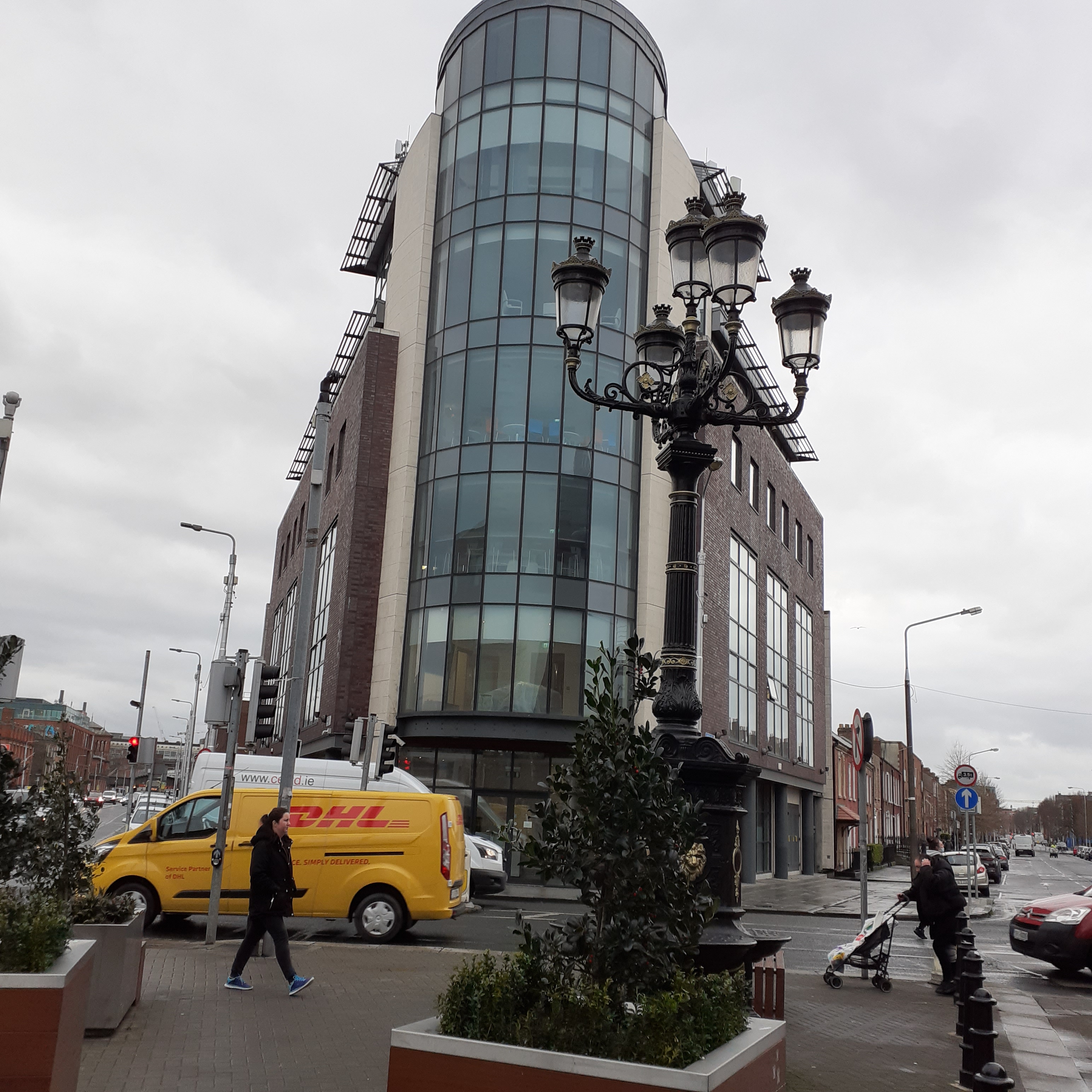
Sheriff Street itself heads seaward before the Loopline, skirting the back end of the IFSC before crossing the Royal Canal to end off in the distance at East Wall Road. Our path continues northwards. A little further along Amiens Street we cross the line of the North Circular Road. Seville Place is on our right and Portland Row slopes up to our left towards Summerhill from where it continues on as the North Circular Road proper. At the five point intersection stands a notable Dublin landmark: the Five Lamps. This famous monument was erected in 1880 to fulfil the wishes of Lieutenant General Henry Hall who died five years earlier. Hall, from Athenry in County Galway, served with the British Army in Bengal and wanted his memorial to encourage sobriety. The cast iron fountain at its base provided clean drinking water, not available in the surrounding tenements.
The Five Lamps miraculously survived the North Strand Bombing of May 1941. WW2 was phrased the Emergency in neutral Ireland, but bits of war intruded. Three hundred houses were destroyed and twenty eight people died in this rare and brutal assault by German planes. Whether it was a mistake or a warning by the Luftwaffe we don’t know. Dublin had sent firefighters up to Belfast to deal with the aftermath of German bombings there, and Ireland’s neutrality was always slanted toward the Allies. Ireland remains neutral, though not passive, at time of going to press.
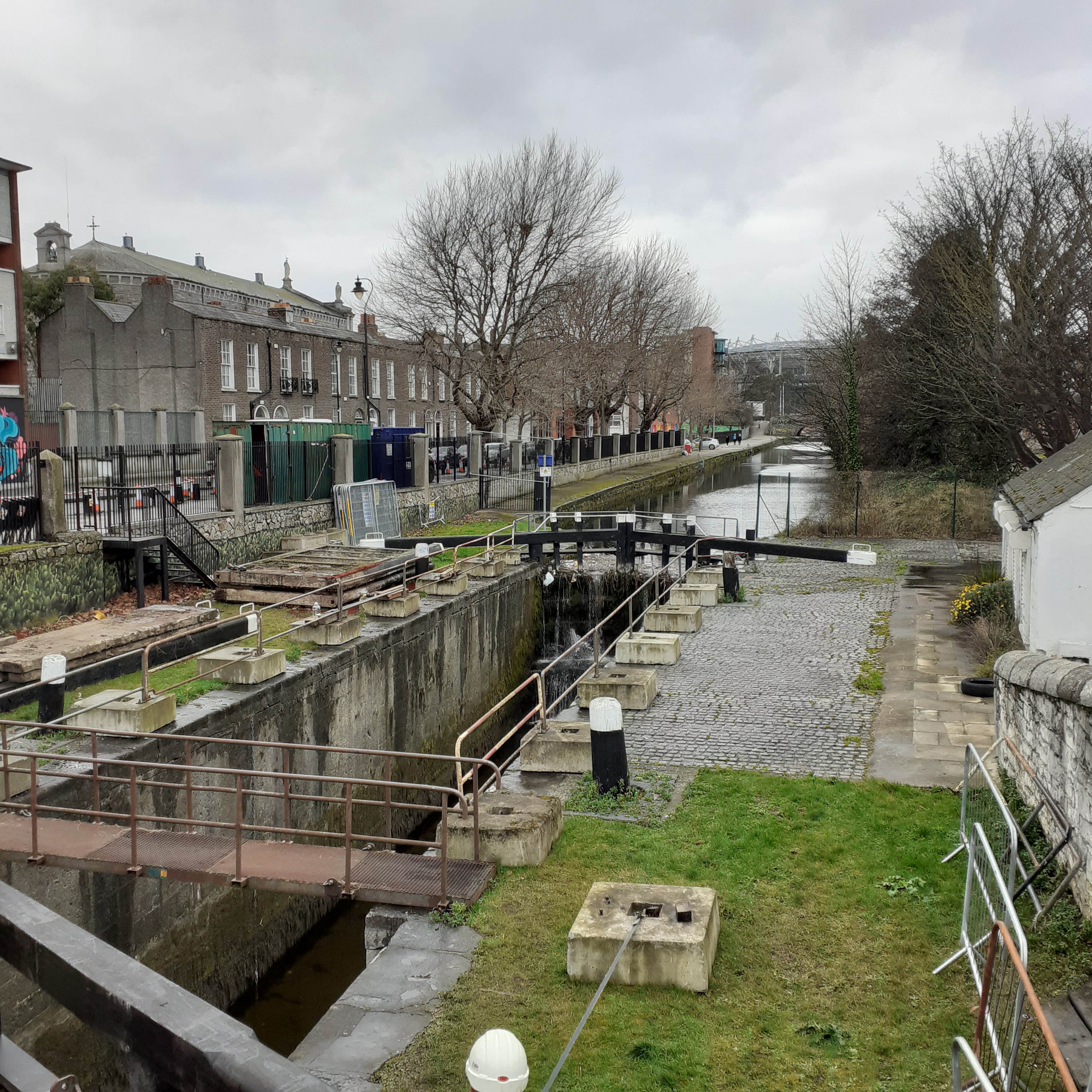
Continuing along North Strand Road, we cross the Royal Canal at Newcomen Bridge which is also the site of the first lock of the Royal Canal. The Royal Canal was the northside riposte to the Grand Canal on the southside. In 1790 construction began and soon the canal flowed westwards from Phibsborough to the Shannon River at Longford. The city extension of the Royal, as with the Grand, followed in the nineteenth century to link the Shannon with the Irish Sea. The Dublin Mullingar railway from the mid nineteenth century runs alongside the canal for much of its length.
Looking westward from the bridge, through the chaos of canal, railway and cityscape, Croke Park frames the horizon. The eighty thousand capacity stadium is the third largest in Europe. A feature of a stadium visit is the Skyline Tour. Way up in the eaves, it gives an elevated, dizzying, view over Dublin City. Croke Park has been the headquarters of the Gaelic Athletic Association (GAA) since its foundation in 1884. The major finals in hurling and football are played there. It is also, betimes, a concert venue. U2, Bruce Springsteen and the Red Hot Chilli Peppers are amongst those who have headlined, and whom I’ve seen.
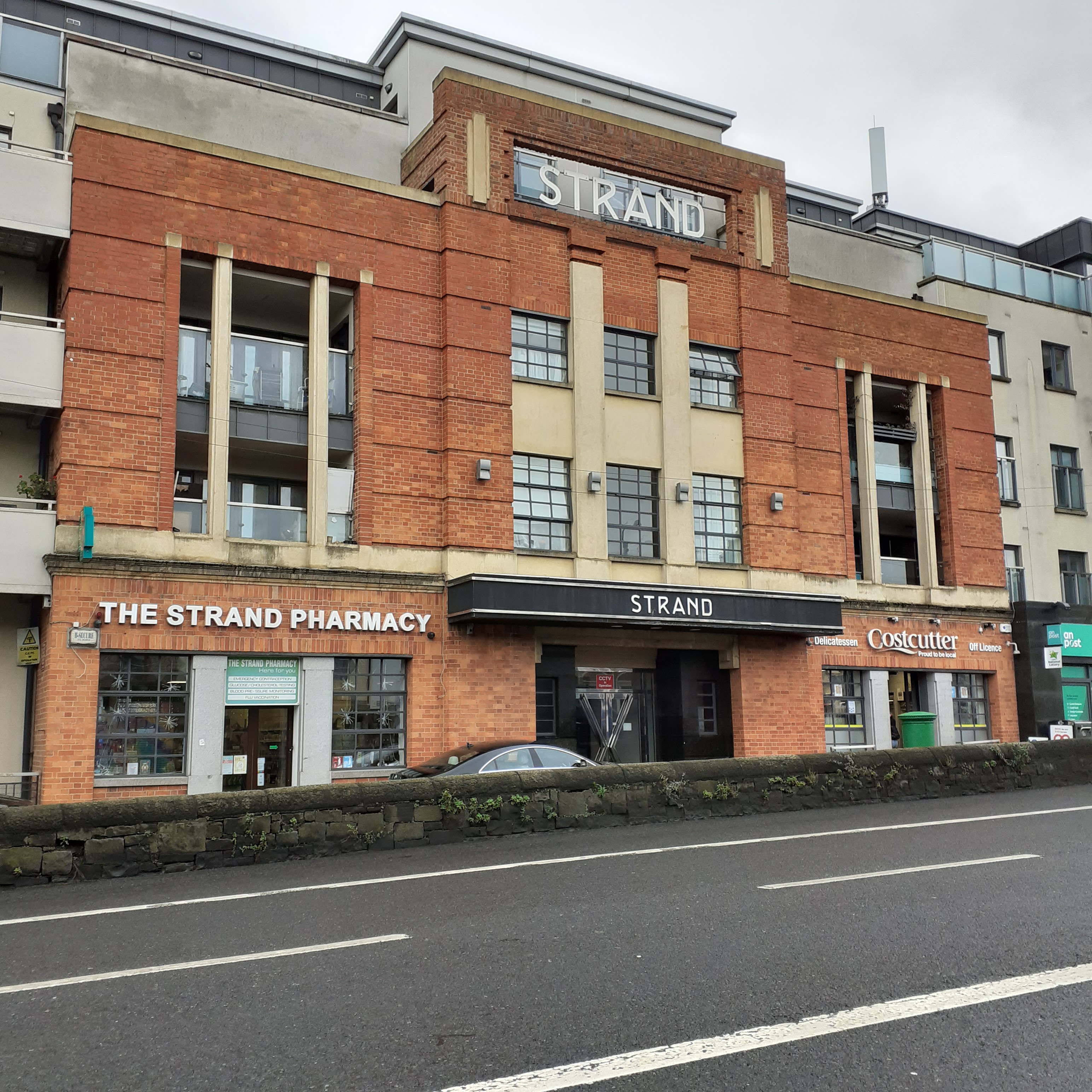
The Strand Cinema on the eastern side of the road was built in the mid thirties, becoming briefly a music venue and a bowling alley, before closing down along with so many suburban cinemas. The art deco facade was preserved and has been tastefully adapted as the frontage of an apartment complex.
Once more beneath the railway, this one also heading west, we continue through the dingy city outskirts to reach the Annesley Bridge crossing the Tolka River. Upstream, the river has enjoyed a pleasant suburban sojourn through The Botanic Gardens, Glasnevin and Drumcondra. But, off to our right, the murky Tolka seeps towards the docklands before taking a sharp left to join with the waters of the bay. East Wall Road continues straight into the docklands and eventually meets the Liffey at the East Link Bridge.
I worked in a factory down on East Wall approaching the Millennium. Planart made components for computers, bound for Finland mostly. It was a small operation, so I could follow through from darkroom to the final, messy business of etching. Urban spacemen in protective gear, the acid got everywhere. Not a place of love stories, so. Still, a young woman working production took a shine to the guy I worked with in the darkroom. I love a man with an accent, she said. Mac was from Arklow. I was appointed matchmaker, but such hints that I dropped, clanging from a height, went unheard by the Adonis of Arklow.
We argued regularly over music. There was wall to wall radio on the shop floor, strictly commercial, while one hip hop comrade was confined to the canteen for his aural hit. Rock music prevailed in the darkroom where I worked with Mac. The Cranberries were coming on strong just then. Their song, Zombie, stood out. Dolores Riordan wrote it in response to the death of two English boys in the IRA bombing of Warrington in 1993. Riordan’s enraged yodel fed directly into the zeitgeist. Mac quibbled with its political naivety, as he saw it. But it was a passionate vindication of light, and of leaving behind the dark, the heroic dead, and the persistent undead. No Need to Argue was the album, their second, released in 1994, and a global multi million seller.
It’s the same old theme Since nineteen-sixteen In your head, in your head, they’re still fighting With their tanks, and their bombs And their bombs, and their guns In your head, in your head, they are dying Zombie, zombie, zombie! What’s in your head?









 xxharrison