The Dart Player of Temple Bar

Dart Player1

Dublin’s Temple Bar is a small enclave bordered by the Liffey, Westmoreland Street and Dame Street. The main drag is a cramped, erratic thoroughfare beginning at Fleet Street in the east, on into Temple Bar and finally as  Essex Street meeting Parliament Street at the western extreme.

Fleet Street, when I first knew it in the sixties, was where you got the bus. It was crammed with waiting busses and passengers, diesel fumes and cigarette smoke, steam rising from raincoats as the sun split the louring clouds. Too narrow and decrepit for its purpose, growing even more narrow as busses shimmied westward through Temple Bar, it was earmarked for development. A great bus terminal would arise to serve the metropolis, and this windy, cobbled backwater would be swallowed in the smog of time. 

Dublin was old and grey, even on a summer day and, like every generation before and since, it was my generation would blow the cobwebs away. Flower power was planted and the Dandelion sprouted by Stephen’s Green. The bees swarming into the hollowed core of the city causing such hives of activity as the Project Arts Centre. I snuck off school many’s the afternoon for the smell of patchouli oil and other exotic substances and a stroll around the Project gallery to gaze in awe at the creations of Fitzpatrick and Ballagh and others. 

The Project would migrate to the neglected quarter of Temple Bar in the early seventies. The Granary, just around the corner, was the early flowering of the Health Food Shop. Not far away was the Alchemist’s Head, a shop for all the comic book guys. In seventies Ireland, such flowers were weeds, but weeds will always proliferate. I used wander the cobbled streets, linger in the music shops, antique shops, the stamp collectors place on Fownes Street, in the shadow of the emerging hulk of Stephenson’s Central Bank, haunt the Project for plays by Sheridan and late night gigs.  

But Temple Bar was doomed, the spaceships of seventies commerce circling ominously. And then it all changed, changed utterly. The growing community of hippies and ne’er-do-wells somehow convinced our esteemed leader, Charles J Haughey, that there was merit in the madness of the crumbling slum. Thoughts of WAAMA no doubt, Flann O’Brien’s Writers, Artists, Actors and Musicians Association, might fit with the denizens, and Charlie was after all a patron of the arts. Thus, reprieve, and the Great Bus Station in the sky went off to orbit another planet. 

Temple Bar has been proposed as many things, principally as Dublin’s cultural quarter, its Left Bank. It is also the night life focus, the funzone for wining, dining and dancing till dawn. And it even has residents to participate or complain about the whole damned thing. Overpriced, overcrowded, noisy and hokey it might be, but it is also real, full of all the variety, quirk and charm you need in a city centre. 

I pass through when I can, hopefully stopping at a watering hole en route. The Palace at Fleet Street is my favourite. A rael olde Dublin pub, narrow, high ceilinged with darkened wood interior and a well established literary theme. It plays host to the Flann O’Brien festival on the first of April. Flann the Man, who also gave us Bloomsday.

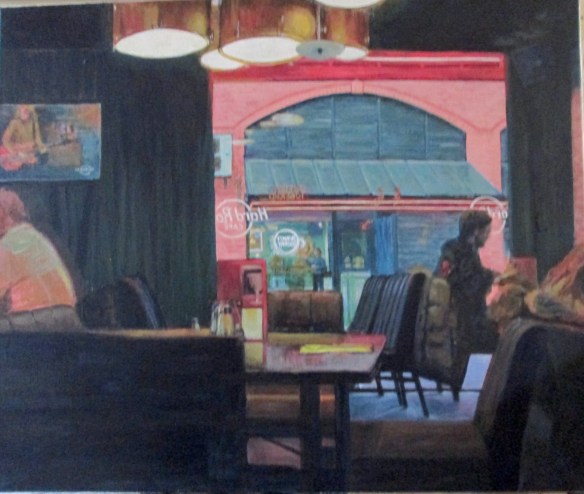
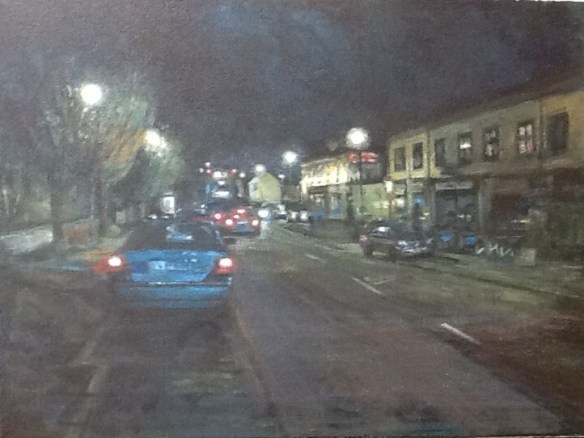
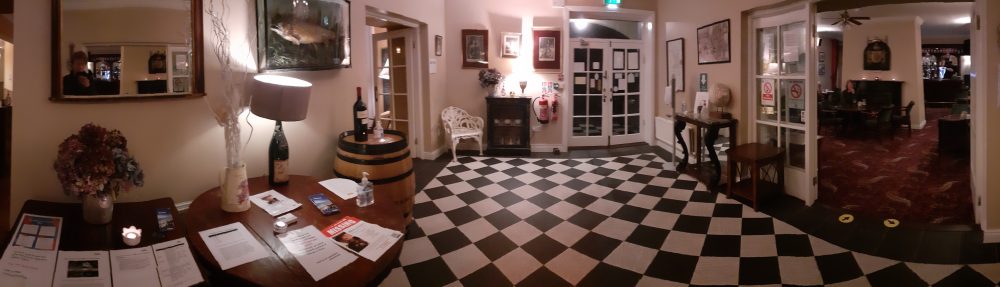
Further in, there’s plenty of boozers and eateries. Take your pick. In this painting, I’ve chosen the Hard Rock Cafe, a good joint for burgers and beer, with a good rock soundtrack to boot, as you would expect. In this painting, I’ve paused between courses, or pints, to gaze out onto Fleet Street. There’s a tattoo parlour across the street, and the tattooist, between customers, is practicing his skills on a dart board. There’s something quite still and serene about that, I think, all going unnoticed in the midst of the madding crowd. I was thinking of calling it The Dart Player.

One Night in Shankill

Shankill

Shankill is Dublin County’s southernmost town. It has a population of just over 14,000, most moving in over the last forty years around what was once a small village. The bridge at the north end of the Main Street (Dublin Road), crosses the defunct Harcourt Street Line, which closed in 1958. This was the original rail connection between Bray and Dublin in 1854. A little later, the coastal route pushed through to Dun Laoghaire and on to Westland Row. This is the surviving route, running all the way north to Belfast and south to Wexford. It provides the  Dartline electrified commuter rail service from Greystones to Howth and Malahide in North Dublin.  

Until the M11 bypass in 1991, Shankill lined the main road from Dublin to Bray. It’s still a busy route, but more pleasant with enhanced village life. Once past the village Main Street an avenue of trees forms a green tunnel from Woodbrook to Bray and the Wicklow border. The village trees are endangered by a recent public transport plan which, whatever its practical benefits, could have dire consequences for the visual amenity. 

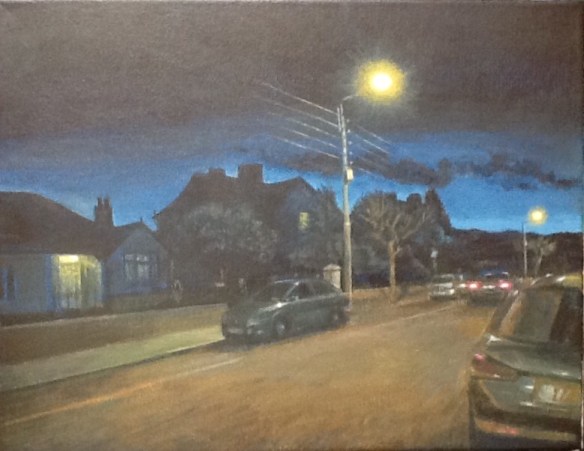
For this painting, I’ve stopped on the southern carriageway of the Main Street, heading home from Dublin. Our Ford Focus seems blue in the glare of the green traffic lights behind me. Across the road the main glow of lights marks Brady’s Pub. In the dark is the Street Food outlet, best viewed by day with a lively sidewalk scene. Bernardo’s chipper is out of frame. A couple of pedestrians wander between pub and chipper. Decisions, decisions. A bus heads into the distance towards Bray. 

Walkinstown’s Musical Roads – 4

Walkinstown Lib

Walkinstown Library

Go far enough east along Cromwellsfort Road and you reach Crumlin. At the junction, the Submarine Bar was seen as Walkinstown’s last outpost, though Crumlin and Kimmage might have said the same. Now defunct, I’ve slurped from silver cups there, the Sam Maguire and the League of Ireland trophy, courtesy of schoolfriends Kevin Moran and Gerry Ryan, of Dubs and Bohemians fame. The road name derives from Oliver Cromwell, who stalked the area between here and Drimnagh Castle back in the mid seventeenth century. Before gaining the art deco joys of the crossroads, one last turn at Moeran Road leads back to the Melodies.

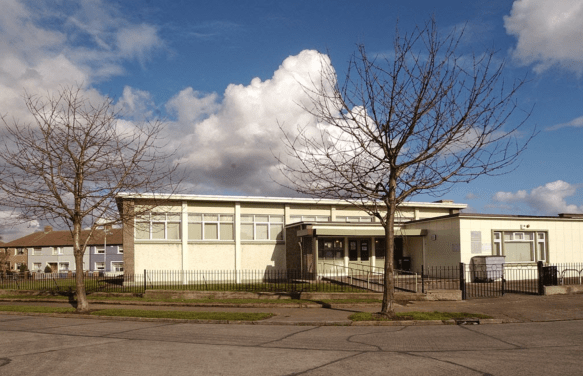
First thing you see is Walkinstown Library, giving its name to this subsection of the area. Lured in by the music, you stay for the words. Situated on a green island on Percy French Road, the library opened in 1961. A third of the stock and premises was devoted to children. My first attempt to borrow was a giant atlas, which I horsed to the desk like a surfer hitting the wave. The librarian kindly, but firmly, pointed out the tag For Reference Only, explaining I could not take it home. Well, feck that for a game of cowboys, I thought. I would, in time, borrow many books, mostly a diet of Blyton, Biggles and Bunter, the very British fare available to children then. Richer veins of storytelling followed, according to the prompts of siblings and peers, teachers, parents or simply whims. From Emily Bronte to Kurt Vonnegut, and a fair few manifestations of Brian O’Nolan, I’d keep on keeping on. One group of stories, set in song, was already well established in my soul, the writer’s name graces the road on which the library stands.

Percy_French

Percy French in Ballyjamesduff, Co. Cavan.

If Moore was seen as the Bard of Ireland, Percy French was more for the plain people. Born in Roscommon in1854, he studied at Trinity College and it was there that he wrote his first major song: Abdulla Bulbul Amir, for a men only event called a smoking concert. Ah, those were the days! As many an artist has found, a work sold cheaply is as good as stolen and French was long denied credit for the song. 

RTE were fond of spinning Brendan O’Dowda’s album of Percy French favourites and Abdulla was a standout for me. For some reason I sided with the Russian, Ivan Stravinsky Stravar. It is he who strode arrogantly into town to tread on the toe of his foe and ignite a colourful duel; although the tale ends tragically for both. A cautionary tale on the excesses of male pride.

They fought all that night neath the pale yellow moon,

The din it was heard from afar,

And great multitudes came, so great was the fame

Of Abdul and Ivan Skivar.

French was in his thirties before going full time as writer and entertainer. His songs, often comic and with a twist of satire were easily taken to heart by the public, but there is a solid and genuine core to his work also. He captures universal human qualities, all the fun and foibles, giving us more than just a picture of a bygone age. He is at his best in the Mountains of Mourne, where there is something of a sadness, and certainly a beauty, in the simplicity of the emigrant’s view of an alien world, and the deep longing for the simpler land, and fairer lass, he’s left behind.

Oh Mary, this London’s a wonderful sight

With the people here working by day and by night,

They don’t sow potatoes, nor barley, nor wheat

But there’s gangs of them digging for gold in the street.

The narrator keeps a promise to his girl back home, informing her of the latest fashions in London. Perhaps he notices the beauty of the girls a bit much, to begin with. The beautiful shapes nature never designed, their lovely complexions “all roses and cream”. But then:

If of those roses you ventured to sip,

The colour might all come away on your lip.

So I’ll wait for the wild rose that’s waiting for me,

Where the Mountains of Mourne sweep down to the sea. 

IMG_0008

Errigal Road, Drimnagh

Drimnagh, with its roads named for mountains, pays tribute to the Mournes. Moeran Road, meanwhile, is named for Ernest Moeran who was London born, though his father was Irish. This connection led him to Ireland in the 1930s. He settled in Kenmare, County Kerry, finding the landscape there a profound influence on his music until his untimely death in 1950, as building continued on the Musical Estate. The Moeran Hall, on the Crumlin Walkinstown border, became the main venue for dances and gigs as the youth population boomed in the sixties. Amongst the talents that burned brightly, if briefly there, were local band The Black Eagles, fronted by a certain Philip Lynott. More of that anon.

Where Balfe Road ends, a meandering road takes up the journey east. Viewed from the air it vaguely resembles a lute, and is named for John Dowland, top lutenist in Shakespearean days. Dowland’s place of birth is unknown, but it was probably Ireland. He dedicates his work From Silent Night to “My loving countryman Mr John Forster the younger, merchant of Dublin, Ireland.” Dalkey has been claimed, though it’s disputed.

Colliemore

Colliemore Harbour, Dalkey

He studied in Paris from 1580 where he converted to Roman Catholicism, which may have been a factor in him being passed over at Elizabeth’s court. He took his talent elsewhere, travelling in Germany and Italy to great acclaim. He was dubbed the English Orpheus. In 1598 he gained a position as lutenist to the Danish Court of King Christian IV for a fabulous salary. Dowland may have dabbled in espionage. He was tapped up by English Catholics plotting to overthrow the Protestant Elizabeth. Accusations of his spying for the papacy were denied. He wrote to Sir Robert Cecil, the Secretary of State, pledging loyalty to Queen Bess. 

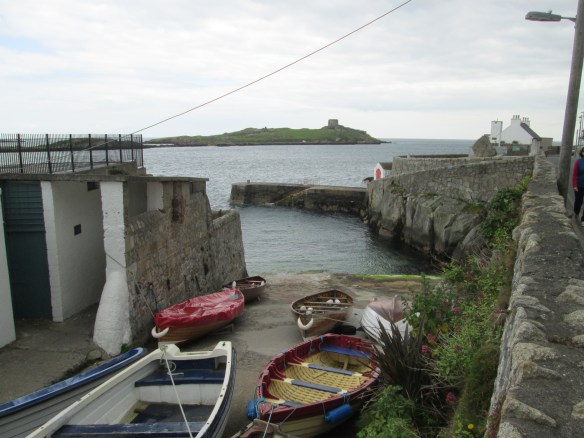
He was a friend and contemporary of Shakespeare, and it is inferred that his knowledge of the Danish Court was used by the Bard in Hamlet. Christian was notoriously fond of the sauce, and at Shakespeare’s Elsinore, the gloom laden prince opines of the courtier’s tendency to “keep wassail”. Some have even found an eerie similarity between Colliemore and Elsinore as described in the play. I’m taken with the giddy scenario of Will setting sail for Colliemore Harbour, there to team up with his good mate John to trade gossip and sink some Carlsberg down at the Queens. In truth, it’s more likely they met in London, where Dowland lived from 1606 having been dismissed by Christian. Then, as with Shakespeare, he gained favour at the court of King James I (James VI of Scotland).

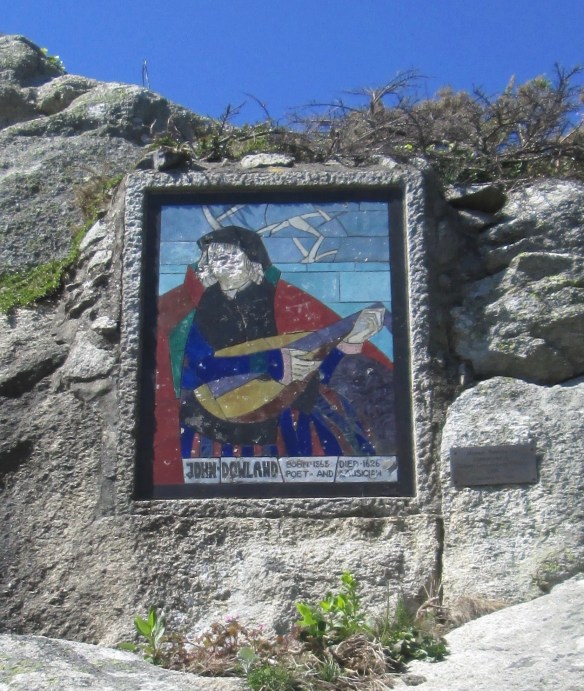
As a formative influence on the guitar, Dowland’s lute playing and compositions have been revived by such as Julian Bream and Sting. Sting’s Songs from the Labyrinth gives a good account of the music of the man, exquisitely lachrymose for the most part, but also of great energy and wit. Sting cites him as the first example of the archetype of the alienated singer songwriter. You might also say Dowland was the first guitar hero, a rock star who left Dalkey to seek fame and fortune, the reverse of the current procedure. There’s a plaque by Sarah Purser at Sorrento Park, at the very edge of my map of Dublin. It has been defaced, further deepening the mystery. But in Dalkey and Walkinstown, this great musician’s name lives on.

Dowland

John Dowland, by Sarah Purser

Flow My Tears was his most famous piece, evoking the bittersweet gloom of the exile. There is perhaps a pre echo of the Beatles, Blackbird, in mood and lyric. 

Flow my tears, fall from your springs,

Exiled forever let me mourn,

Where nights blackbird her sad infamy sings,

There let me live forlorn.

He died in 1626 and is buried in London. 

Walkinstown’s Musical Roads – 2

IMG_0735

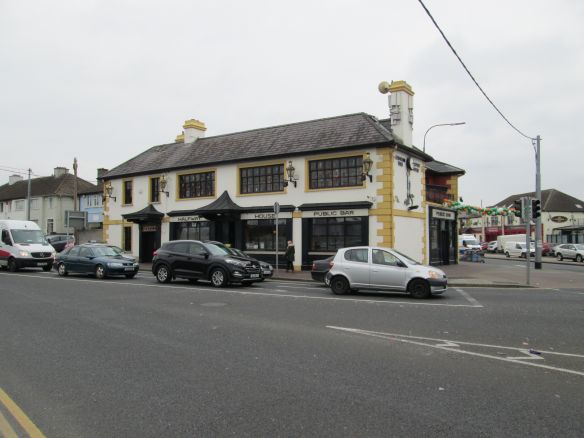
The Halfway House, Walkinstown Road.

The physical parameters of Walkinstown are not obvious to the lazy eye. But there are signals in the architecture, in the subliminal landscape, and in the nomenclature. At the southern slopes of Drimnagh, the main road crosses the Walkinstown Water and takes its name. Walkinstown Road neatly bisects the area with the private housing to the east and the local authority scheme occupying most of the west. These are known respectively as the Melodies, or Musical Roads, and the Scheme. 

Walkinstown takes its name from a 15th century farmer, Wilkins. Wilkinstown House became established as the local manor and a small village grew around it. The village disappeared during the Famine. The nineteenth century Wilkinstown House lasted over a century before being demolished for a supermarket in 1971.

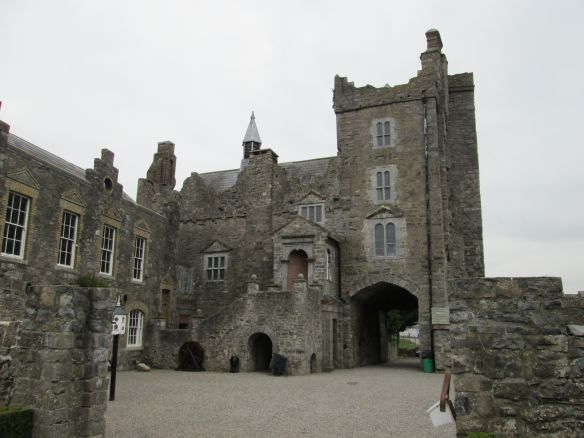
In the later forties, work began on Walkinstown’s musical estate.. On the far bank of the stream that once defined the village, the back windows of a crescent of houses for long overlooked the paddocks of Wilkinstown House, and open countryside to the Norman tower of Drimnagh Castle beyond. The environs are now subsumed in Dublin’s suburban sprawl. The terrace lies to the west of Thomas Moore Road and is called Hardenbeck Avenue. Carl Hardebeck is one of a handful of foreign born artists honoured in the Melodies. He lost his sight while still a baby, but immersed himself in the river of sound. Born in London in 1869 of German/Welsh parentage, he ultimately came to claim his devotion to “God, Beethoven and Patrick Pearse” and was much honoured as a Nationalist on his death in 1945. 

IMG_0748

Drimnagh Castle

The Musical Estate is entered nearby, where the main road crosses the stream. Balfe Road, in its own sweet way, forms the northern boundary of the estate. From its western extreme it runs uphill as far as Bunting Road, stopping where Mooney’s Field is now a green park. Beyond this expanse, Balfe Avenue takes up the journey east before Balfe Road East draws the border with Crumlin.

Michael William Balfe (1808-1870) was born in Dublin, son of a violinist and dancing master. He was sixteen when his father died and the following year he took his precocious musical talent to London. He was a violinist for the orchestra of the Theatre Royal but decided to become an opera singer and travelled to Italy for tuition in 1825. Ten years later he returned to London and quickly achieved success as a composer. One of his first operas as a composer was Falstaff in 1838, adapting Shakespeare’s Merry Wives of Windsor. In 1843 he wrote The Bohemian Girl based on a Cervantes story, La Gitanella.

IMG_3374

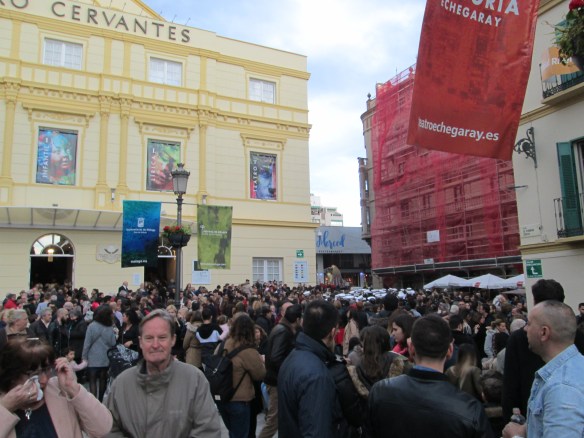
Teatro Cervantes, Malaga

La Gitanella tells of a fifteen year old gypsy girl, Preciosa, who captures the heart of a nobleman, Don Juan, but to marry her he must spend two years as a gypsy. The story examines the nature of stereotypes, truth and lies. The twist in the tale is that Preciosa had been kidnapped by the gypsies as a child. 

Balfe’s version, with libretto by Alfred Bunn, is rather more melodramatic. It was hugely successful at the time and remains his best known work, in particular the Aria I dreamt I dwelt in Marble Halls. Here Arlene, the gypsy girl of the title, recalls her almost forgotten earlier life.

I dreamt I dwelt in marble halls

With vassals and serfs at my side

And of all who assembled within those walls

That I was the hope and the pride.

The song resonates in Irish music and literature. James Joyce namechecks it twice in Dubliners, in Clay and Eveline, and it also features in Finnegans Wake. It has been performed by Enya, Celtic Woman and Sinead O’Connor.

Balfe died in 1870 and was buried at Kensal Green Cemetery in London next to fellow Irish composer William Vincent Wallace.

First left off Balfe Road is Hughes Road, forming a regular promontory up in Walkinstown’s north. It brackets Field Avenue, the one street in the capital named for John Field. Herbert Hughes (1882-1937) was born in Belfast and studied with Stanford in the Royal College of  Music, London. He was a music critic for the Daily Telegraphs, but is best known as an arranger and collector of traditional folksongs. With the support of Francis Joseph Bigger, he published Songs of Uladh in 1904. From 1909, his four collections of Irish Country Songs were written in collaboration with poets WB Yeats, Padraic Colum and Joseph Campbell, including such Irish folk classics as She Moved Through the Fair and Down By the Salley Gardens.

She Moved Through the Fair has a haunting melody that seems to chime with every age. The song was collected in Donegal by Hughes with lyrics written by Padraic Colum. A host of Irish and international artists have covered it from John McCormack to the Waterboys, Tangerine Dream to Clannad. In the film Michael Collins it is sung by Sinead O’Connor. The melody is incorporated in the Simple Minds song, Belfast Child.

Down By the Salley Gardens appears as a poem in Yeats collection The Wanderings of Oisin. Yeats remembered snatches of an old song, The Rambling Boys of Pleasure. It was set to music by Hughes to the traditional air The Moorlough Shore

Down by the salley gardens my love and I did meet

She passed the salley gardens with little snow white feet

She bid me take life easy, as leaves grow on the tree

But I being young and foolish, with her would not agree.

Hughes saw the arrangement of music as an artform on a par with original composition. According to him, the arranger takes the original material so that it is “transmuted into an art song, an art song of its own generation.”

Stanford Green is a wide hemisphere south of Balfe just before Bunting Road. This green and Thomas Moore were convenient football pitches for us as youngsters. As a Chelsea fan, I imagined Stanford as Stamford (Bridge), with me as Peter Bonnetti and my friends as Bobby Tambling and Charlie Cooke. My friends in truth were fans of either Manchester or Leeds United, and the road was named for Charles Villiers Stanford (1852-1924). He was a Romantic composer and a child prodigy who was performing and composing at eight years of age. 

Stanford-at-12

Charles Villiers Stanford, age 8 and a half.

Stanford studied Classics at Cambridge University, but his devotion to music won out. He went on to study at Leipzig and Berlin, returning to Cambridge as Professor of Music. .He was the founding professor of the Royal College of Music in Kensington, which, by the way, is not far from Stamford Bridge. His pupils at Cambridge included Vaughan Williams and Gustav Holst.

George Bernard Shaw praised the Celtic elements of Stanford’s music. His orchestral work, Irish Rhapsodies, incorporated Irish folk songs. He was the first to popularise the Londonderry Air, published in 1855 by George Petrie in the Ancient Music of Ireland, the song originally collected by Jane Ross of Limavady.

Wallace Road leads east off Bunting Road, opposite Harty Avenue. William Vincent Wallace (1812-1865) was born in Waterford. He was a virtuoso on violin and piano and a composer of opera, piano music and parlour songs and ballads. He married at twenty, to a pupil Isabella Kelly, converting to Catholicism for the purpose, and moved to Dublin. In 1835, he took his family to Australia, and three years later left them there. He later spun a colourful yarn that he voyaged the Pacific on a whaling ship. From his arrival in South America he was celebrated as a virtuoso, making his way to New Orleans and New York. In 1845 he composed the first of six operas, Maritana, which was a huge success.

He took American citizenship and a second wife, German pianist Helene Stoepel, in1854. His tomb in London carries the epitaph: music is an art that knows no locality but heaven.

Granada – Sacromonte 1

AL 13 Nazgdn

A place of dreams, where the Lord put the seed of music in my soul.

(Andres Segovia)

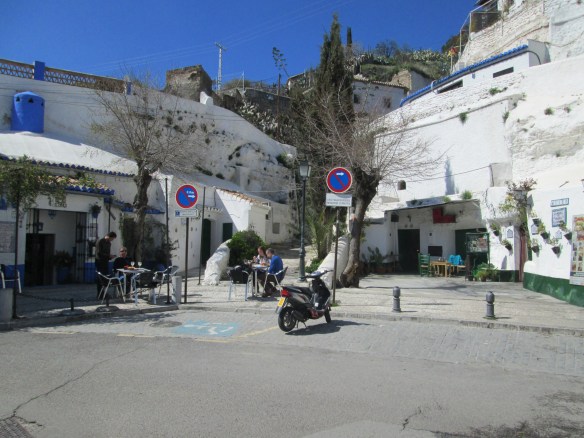
Granada is a name so rhythmic it positively strums. Strung beneath the glistening peaks of the high Sierra Nevada, it has long balanced on the fulcrum of Europe and Africa. Here, the stones are alive, the streets and spires straddle the Medieval and the Renaissance, the Gypsy tangos and strums, the poetic knight tilts at shapeshifting windmills.

The fabulous castle overlooking it all, the Alhambra, dates from the Moslem kingdoms of the high Middle Ages. At the start of the Early Modern, the Reconquista returned the city to the Catholic faith. Before, during and after all those upheavals, Granada has been the focal point of travellers who have left their dust of cultural diversity in the stones, in the air, in the rivers of the town.Little wonder that the guitar is said to have been born here.

The weeping of the guitar begins, 

The goblets of dawn are smashed,

Useless to silence it.

(Federico Garcia Lorca)

Plaza

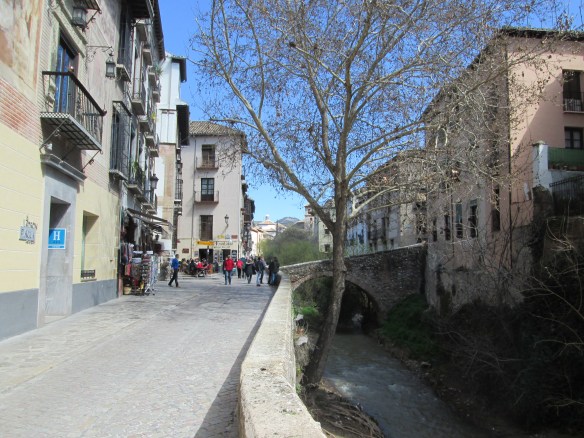
Plaza Nueva is my base camp. It merges into the Plaza de Santa Ana. A step beyond the modern city centre, it distends with eerie vagueness into the cramped ravine of the Darro River. The winding way to the Alhambra begins near the Fontana del Toro. A drink from its waters has magical qualities. Drink once and you will return forever. I have had my day there, in the soft redness of the Alhambra, that lasted forever and never and within my formation. This day I will walk along the clefs and staves and the surging river, carried forward note by note to the Sacred Mountain.

Darro1

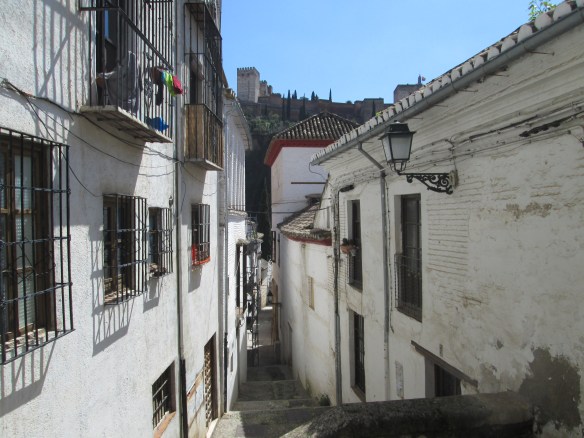
Climbing up from the Darro River, through the bleached alleyways of Alcaibin, the houses melt into an ancient silence. The winding streets flirt with Surrealism, the hush of desertion somehow expectant. I sense the outskirts of paranoia, cross diagonally a deserted square beneath an abandoned church, pause enigmatically with a smouldering Gitanes to notice a slice of the Alhambra between the shuttered Moorish villas. At last the route regains its connection with all other routes. Footfall swells, the whine of mopeds rises and a car is glimpsed. The road meets a t junction, where I turn steeply upwards by way of Cuesta del Chapiz. 
AL 22 Alca

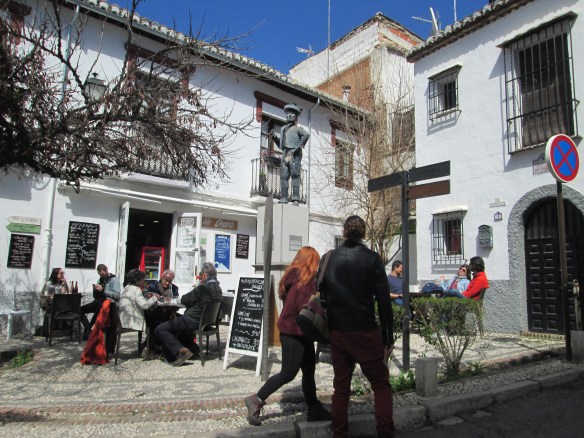
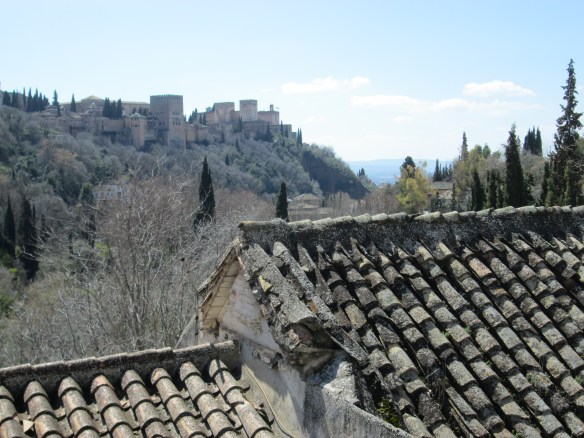
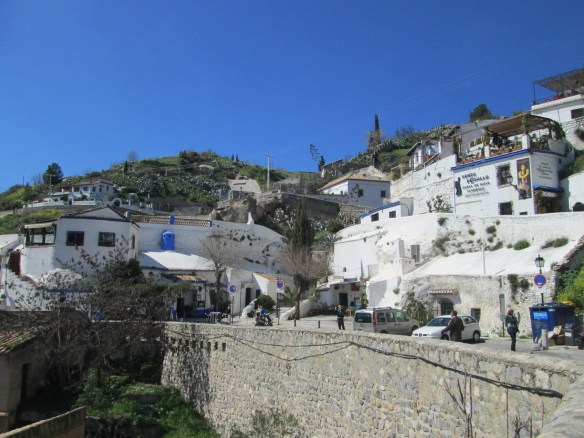
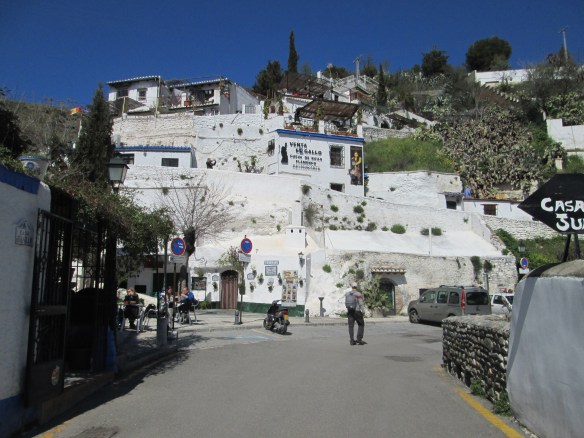
At the apex of a punishing climb, the road veers right at a taverna, El Rincon del Chapiz. A gnarled tree and an eccentric statue preside over the small terrace. Here, the city of Grenada abruptly ends, and morphs into an ancient hilltop village, houses scattered like pearls on the steep hillside. Across the Darro ravine, the Alhambra and Generalife shimmer in the afternoon haze, while ahead the distant Sierra are snowcapped beneath the virgin blue sky. I choose to be lost in this view: red gold palaces set in viridian, purple mountains with their sharp white summits, the blue sphere of the relentless sky. 

El Chapiz

The transition from urban to bucolic is a volte face of all the dialogue transacted this day in the city. The history, the fabric, the setting still run, but parallel, their projections and perspectives distorted. The Sierra Nevada hem the horizon which seems close enough to touch. If you sense a breath descend it may be from the Puerto del Suspiro del Moro where Granada’s last Moslem ruler, Mohammad XII, Boabdil, looked back in anguish at the Alhambra, exhaling that famous final sigh. This was the pinnacle of the Reconquista, in the year 1492, when the Catholic Monarchs, Ferdinand of Aragon and Isabella of Castile took Granada and the modern idea of Spain took shape. 

Sacroalham

Now I stand on Sacromonte, the sacred mountain. This was the haven of the Gypsy, when first they came to Granada in that same year, 1492. They hollowed caves from the soft rock, out here on the periphery. The culture that flowered fed the rivers of the new Spanish identity, a step beyond the rationalist identities of western Europe. And a stepping stone, also that year, to the American continents across the pond. These first rooted in our consciousness with the expedition of Christopher Columbus, an Italian in the service of the Catholic Monarchs. The popular conception of the world was limited. After Columbus, European isolation would fade. 

Sacro3

The term, Gitanos, is synonymous with Gypsy, derived from Egyptian. According to popular myth, they came from Egypt but are, in fact, Romany, an Indo-Aryan group from northwest India. Romany identity has persisted through half a millennium, with its bloodline and culture, but there is much disparity between their far flung settlements. In Andalusia, Gitanos are particularly immersed in local culture, to the point that they’re seen as embodying quintessential Spanish traditions, with Flamenco to the fore. Flamenco, the form of music and dance, derives from a synthesis of Moorish and Christian influences, Jewish folk music and dance, infused with the Oriental spice of the Gitanos. Itself an illustration of a particular social and emotional stance, from Flamenco springs those rhythms of sex and seduction, sorrow and grieving, suffusing the Latin world from Valparaiso to Valencia

Sacro2

In Andalusia there is little to be gained by dissecting its identity. It is more than the sum of its parts, a rare blossom that could only grow in this red soil, from such scattered seeds. Yet, here is a culture that is not perplexing, not a thing to be admired within a hard carapace. It has travelled well, it is well known. Here is something we all understand, whether or not we have done it yet. Here is something we know of the human condition. We are all Gypsies, spinning like dandelion seeds through the air. I have travelled, dipped a toe in different oceans, felt the heat of the desert, the swell of mountain and the cool air of forests. Through all of that runs the constant soundtrack of the music of Christian, Moslem, Gypsy and Jew.

I heard your voice through a photograph

I thought it up it brought up the past

Once you know you can never go back

I’ve got to take it on the otherside

Sacro1

So I sit on a wall in sunshine cold, amidst glare of white houses and sauntering travellers and do nothing. Inside I’m spinning slowly, breathing every song I’ve ever heard. I feel I should do something, enter a museum, buy a souvenir, take out my sketch book and submerge in the quirky scenery. I think of other things, returning to that bold truth, that here was first fashioned the guitar. 

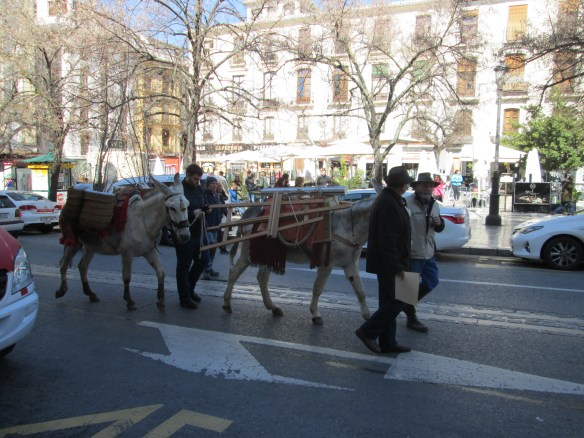
Antonio de Torres (1817-1892) was a carpenter by trade. In his twenties he came to work in  Granada where he learned the craft of guitar building. He returned to set up shop in Seville and in 1850 began to develop the guitar which we recognise today. Torres’s guitar was symmetrical, larger and lighter than previous instruments. Their distinctive sound and greatly improved volume made de Torres’s guitar the standard from which modern guitars derive.

How long, how long will I slide

Separate my side

I don’t, I don’t believe it’s bad

Slit my throat, it’s all I ever …

(Otherside, Red Hot Chilli Peppers)

In its shape the guitar is a key to unlock the secrets of sound. More suggestive still, the guitar is personified as woman. My Graphics maestro at Rathmines College in the seventies was Martin Collins. One evening our class gathered before a still-life assembled by Martin: a guitar, a wine bottle, a bowl of fruit. As we set about our task, he hovered, waiting to pounce with advice. One unfortunate was having difficulty. Martin’s voice boomed through the hush: “A guitar is like a woman. You cradle her on your lap and stroke her.”

Sacromir

In the Art of Spain it is a signature motif.The paintings of Picasso and Juan Gris pay homage to those curves, sinuously evoking its music and mood. With grapes and fine wine, its shape settling in city and skin, with a knife, a fork, a bottle and a cork. From Andalusia to New York, Troubadours have trooped with guitar slung rakishly over shoulders.

 Lovers, fools, thieves and pretenders, and all you’ve got to do is surrender!

(The Waterboys)

, 

Andres Segovia, Hank Williams, Bo Diddley, Paco de Lucia, Bob Dylan, and Jimi Hendrix towering over the close of Woodstock, a beautiful ghost. The muse has manifested her reflection too: Gabriela Quintero, KT Tunstall, Patti Smith, Chrissie Hynde. Joan Osborne. In cherry red or ebony, sunburst finish or sultry blue, this is the emblem of our time.

Bray Seafront Evening

Bray Sfront art

At the start of the 19th century, the recreational and romantic potential of the sea was just being discovered. Up till then, such benefits it gave were seen as limited to its harvest of food and its use as a transport route. Mostly it was regarded as an unpredictable menace; a source of storms, piracy and invasion. This is illustrated by the fate of Bray’s two Martello Towers, constructed in 1804 during the Napoleonic Wars. One, positioned at sea level  midway along the seafront, having fulfilled its original purpose was destroyed by storm some eighty years later. The other, atop a mound at the north end of the seafront, repelled Bonaparte but was occupied in the 1990s by another diminutive general, Bono. It survived. 

Meanwhile, the Romantic era recognised other qualities of life by the seaside. Besides health and wellbeing, the spiritual and aesthetic drama of seascape and shore would increasingly inhabit the human perspective.

Bray, remote and battered gatepost at the southern end of the Pale, attracted romantic and prosperous souls to its dramatic combination of mountain and coast. By the mid 19th century, the expanding town was being connected to the city of Dublin to the north by rail. The town’s population grew as did the seasonal tide of visitors. William Dargan, the railway entrepreneur, undertook the ambitious conversion of Bray into the ‘Brighton of Ireland’. Amongst his plans was the development of the seafront. The Esplanade, almost a mile in length, was laid out with a Promenade to the base of Bray Head. Constant flooding resulted in the construction of the sea wall, with the Promenade on top, in the 1890s. The Harbour was completed at the end of the century, separated from the Esplanade by Martello Terrace.

1 Martello Terrace features in James Joyce’s Portrait of the Artist. Joyce lived here as a child. Longtime resident, former Government Minister Liz McManus, reckons it may also have inspired the phrase found in Ulysses: the snot-green, scrotum tightening sea.

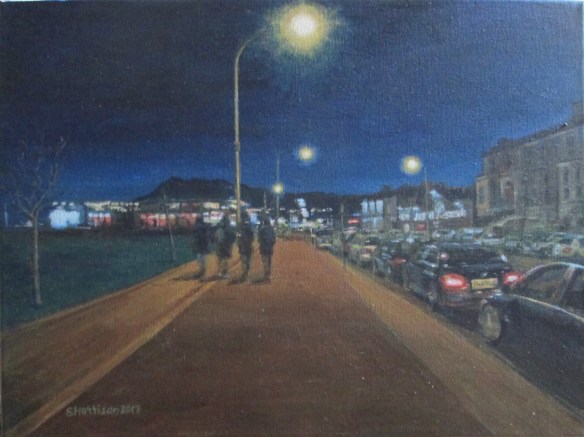
In this view we look south along the length of the Esplanade. The Harbour and Martello Terrace are behind us. A foursome heads out on, or continues, a night out. Just ahead, to the right, is the Silver Strand Amusements, formerly the Fun Palace, setting for my first Bray short story: Coda. To the left is the Sealife Centre, with the lights of Butler and Barry’s Bar and Grill. Further on, the bright lights glow and beckon revellers to the nightspots: The Martello, the Porterhouse and Jim Doyle’s. This is where stories begin, of sex and drink and rock n roll.

Budapest-3


Buda bt1

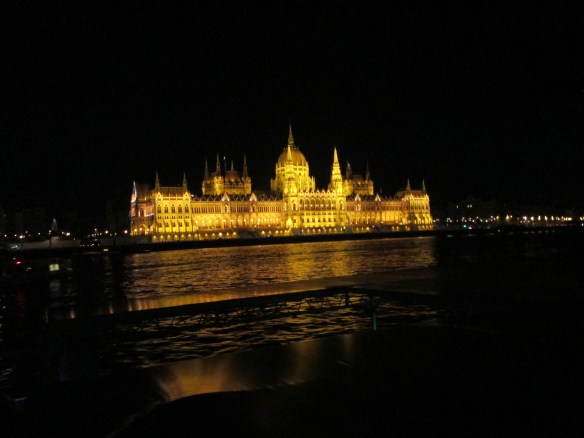
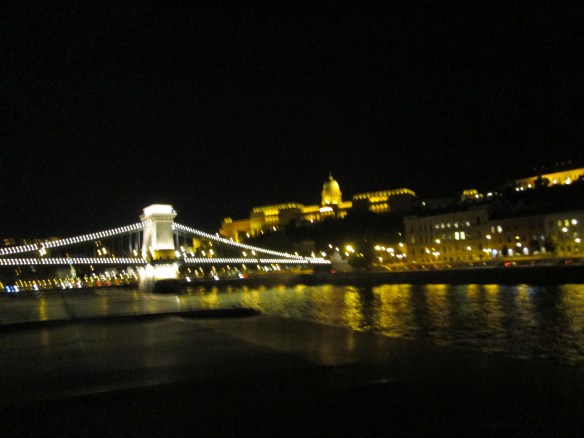
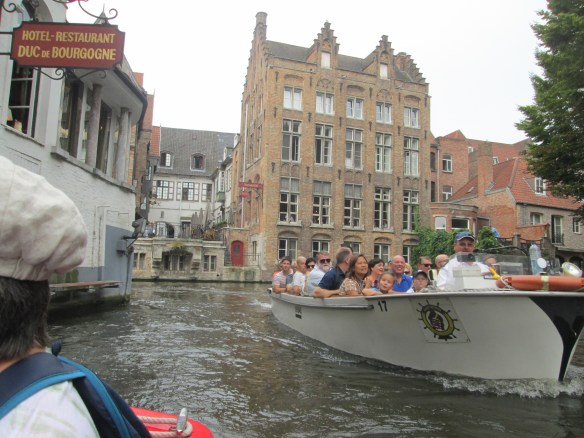
The Danube cruise I’ve booked is a simple no frills trip, ideal for the solo traveller. We do get a shot of vodka, or soft drink for the more sombre. I elbow my way to the aft viewing deck. The soundtrack is good, with enough classic rock zest to enliven the night. We set off down the Danube through a city of light. Yes, I could have stayed on deck forever, float on a river forever and ever. I steeled myself against the unlikelihood of receiving another drink, bathing my eyes in the nocturnal lightshow. Palaces appear to float on air where Buda rises to the West. Bridges, ablaze with light, span the dark honeyed mirror of the river, from the heights of Buda to the flatter land of Pest, just as magically aglow with its swarming boulevards and towering domes. 
Buda bt

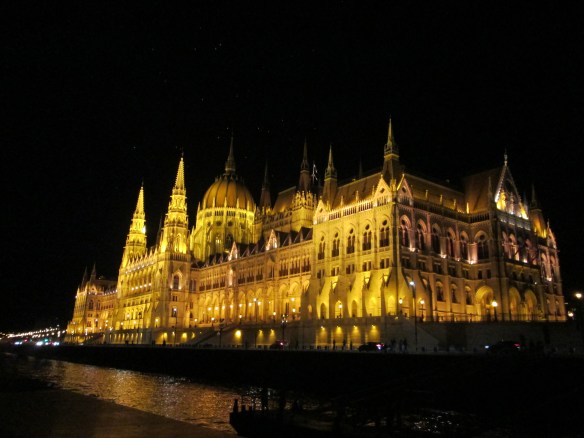
We soon glide past an architectural highlight that tops and tails the tour.The Parliament Building is one of Budapest’s signature landmarks. A sublime confection of spires and facades gathered around an impressive central dome. It was designed by Hungarian architect Imre Steindl in the Neo gothic style. Completed in 1904, Stendl would never see his finished masterpiece; he went blind at the turn of the century and died in 1902. 
Buda Bt3

After that, there’s still more spectacle, and a constant buzz of sublime delight suffuses the deck. It feels like a sightseeing tennis batch, head constantly swivelling to catch the next spectacle. We pass beneath the four main bridges: St. Margaret’s, Chain Bridge, Elizabeth and Liberty. And back again. Returning to our dock after an hour afloat, there was a firework display farther up the river, which somehow seemed less spectacular than it must have been.

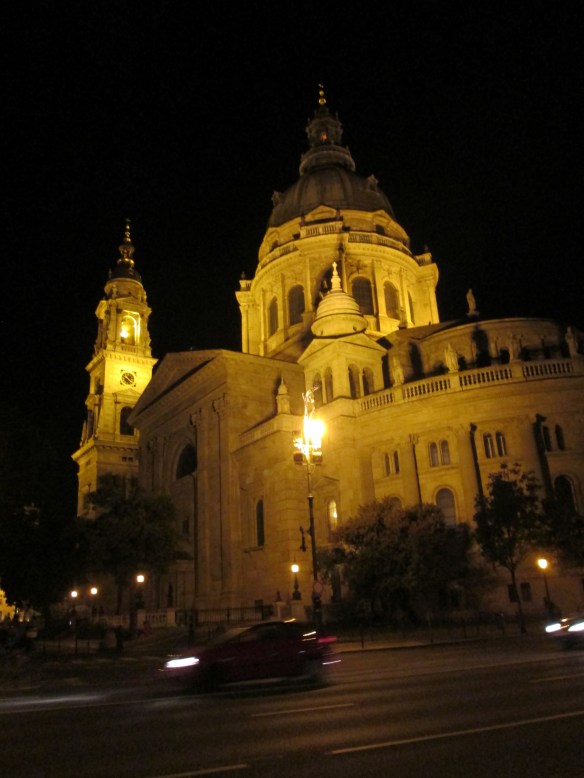
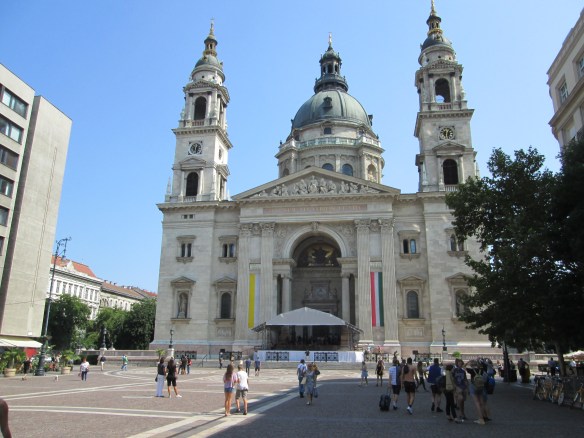
I walk home by Bajcsy Zsilinszky Utca, much easier to pronounce than spell. It’s a long walk on a wide boulevard, terminating in Deak Ter. Saint Stephen’s Basilica is near my destination. Budapest’s twin landmark with the Parliament Buildings, the summits of each reaching the same height of 96metres .

Buda bas

Saint Stephen refers to Hungary’s first king who ruled from the start of the second millennium until 1038. Stephen forged a unified kingdom in the Carpathian Basin that is regarded as the genesis of the modern state. His espousal of Christian doctrine and custom ensured his kingdom was acknowledged throughout Europe where paganism was in terminal decline. While anarchy followed his death, order was eventually restored and Stephen was elevated to sainthood. A cult arose around his relic: the Holy Dexter, or right hand. This has been around, to put it mildly, but after many centuries of sojourn at last came to rest in his eponymous Basilica in 1950. 

Buda Bas1

I return to visit the Basilica in the hot glare of noon. The huge Neo-Classical building was begun in 1851 and took over fifty years to complete. It was designed by Miklos Ybl (1814-1891) who was the country’s leading architect, also the designer of the Hungarian State Opera House nearby on the grand avenue Andrassy Utca. The majesty of that particular building was denied me by the curse of scaffolding, to which I was particularly prone on this trip. 

Buda bas2

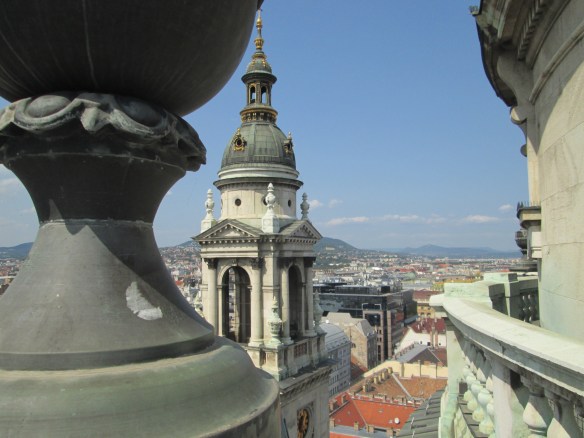
The Basilica awaited in all its sun-blasted glory. The facade is framed by two slender bell towers, with the dome towering impressively over all. This is accessible, either by lift or by stairs. After yesterdays exertions I take the lift, leaving me with a short few steps spiralling within the dome before bursting out into raging air at the cupola. Dizzying views from the top whiten my knuckles; it is the vertigo of paradise.

Budasyn

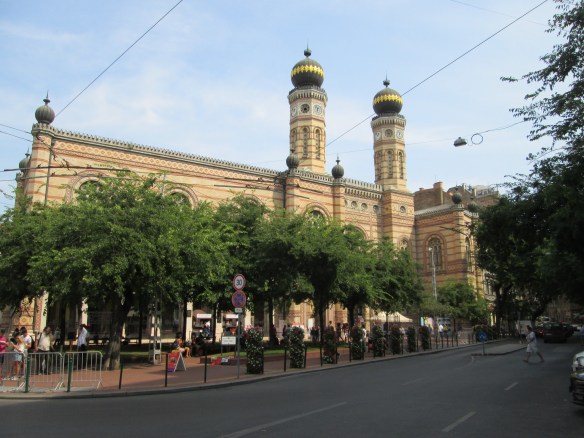
Back on terra firma, I take some time to recover my nerves with a cool beer, or two. Budapest can be just as beautiful from the ground and I stroll aimlessly for a while, which is an essential pleasure in any city. Ever decreasing circles as I find myself back at base camp. The Jewish Quarter is just south of Karoly Utca, cramped and busy with plenty of informal bars. The Jewish community thrived here from the 19th century until the 1940s. Though decimated by Holocaust and Exodus, a small Jewish community survives. They can enjoy the legacy of happier times with the largest Synagogue  in Europe with room for over three thousand souls. Designed in Byzantine style by Ludwig Forster of Vienna in 1851, there is a Jewish museum onsite.

I don’t want to wait anymore

I’m tired of looking for answers

Take me to some place where

There’s music and there’s laughter

Budance

Darkness falls and the carnival is in full flight at Deak Ter. At the arcades off Karoly Utca, the beat pounds on. I’ve found my favourite bar, usually quiet, counter service where I perch at a barrel adrift from the river of life flowing past. They do Italian food here too, good for a light evening bite. Where the two main pedestrian thoroughfares meet, there’s an ad hoc dance floor, where tyro movers and shakers try out their latino steps and the panoply of Ballroom skills. It’s borderline chaos, sex with a smile, fun for all within its ambit, whether participant or passer through. Just watch me now, heel to heel and toe to toe, a few too many on board, just a few steps from home.    

I’ve woken up in a hotel room

My worries as big as the moon

Having no idea who or what or where I am

Show me my silver lining

First Aid Kit My/Silver Lining

Birdhouse With Blossoms

Birdhse2

I took a photo of the Birdhouse, garlanded in flowers, late last summer. You’ve seen the monochrome version, appropriate for the season that was in it. This is the finish I originally intended.

Reviewing the original photo, I noticed for the first time that my two canaries were both in it. Sadly, and weirdly, on completion of the painting there was only one. So, something of a paean to love. Were I to travel through and beyond the birdhouse, and keep on going, I would eventually come to the Canary Islands. It is the point of origin of these distinctive birds, though the name for the archipelago is taken from the Latin for dogs, the canine species.

 I have been to Tenerife and Lanzarote and the Portuguese island of Madeira. They seem somehow fabulous; fabled pinnacles of land in the immensity of the ocean. They are surely the seeds of such myths we fashion; of Atlantis and Tir n nOg and Hy Brasil. Yet, here I am in my own back yard, painting flowers and spinning yarns. Some of our more exotic destinations are right here.

Oh let me go, where the blue flowers grow!

(Where the Blue Flowers Go, by the Cujo Family, is an appropriate themesong for this voyage through Bray and beyond.)

Budapest – 2

Budachain1

Day in Buda and a Night Cruise.

After a seriously long sleep, I have a late morning light breakfast on the balcony. Tuesday is to be a full day with extensive exploration of Buda and a river cruise. First though, a fraught walk to Chain Bridge, running into building works and having to walk back through dusty construction site in 25 degree heat ending up where I began back at Deak Ter. The plaza at Chain Bridge is also difficult to negotiate; but hey, what’s the rush?

Find path to Chain Bridge at last where I buy my Budapest Card off a garrulous student type. Cross the bridge amidst a throng of excited tourists. The Danube below swarms with traffic, and it’s blue, blue, blue, blue, blue, blue, blue! Chain Bridge was built in 1849 and was the first bridge to link the cities of Buda and Pest, facilitating their unification. Two massive stone towers emphasise the sense of fortification and provide functional support for the suspension chains. The effect is formidable and beautiful, even more emphatic at night with its illumination.

Budafun1

Grab a beer in a self service pavilion beside a tiny park and try to chillax. Not an easy feat in this city. After a queue, I take the funicular up to the castle. This attractive old world transport is a pleasant sidestep from the crowds, and fabulous views of Pest unfold as the wood and brass carriage soars towards the Castle. 

Budafrid

Buda Castle is a complex of Baroque palaces including the National Gallery, the Palace itself, and the History Museum. There are spectacular views of the city from the terrace in front of the National Gallery. I have plenty of time to enjoy it as I settle in for a half hour queue.

Budafrid2

The Gallery has a visiting Frida Kahlo show, and very good it is too. Which is just as well as the Renaissance section was closed. A pity that the art of Budapest was not there for me. The Museum of Fine Arts in Pest had been completely closed for renovation for some years but was scheduled to reopen in late summer. But on the eve of departure I learned that its reopening had been further deferred. The National Gallery is a fine building and I enjoyed what art I did see, an interesting selection of national art from the 19th and 20th centuries.  

Budafoun

Leaving the Gallery I head west to find the Matthias Fountain. This is named for the 15th Century King Matthias Corvinus who initiated major construction at the Castle. He was an early advocate of the Italian Renaissance, becoming a major patron of the arts and science in Hungary. He became something a folk hero amongst Hungarians, and was said to wander amongst the peasantry in disguise dispensing justice.

Budawall1

City walls spread out from the Castle to embrace the ancient city of Buda. Looking east over the Danube gives the classic view of teeming Pest, most popularly enjoyed from the pretty Fisherman’s Bastion. The view from the western walls show an entirely different town from Pest.The walk along these ramparts is tree-lined and relaxed with lovely views of populated hills. Dog walkers, strollers, joggers and auld lads on benches (me included) give it an old village atmosphere. 

Lords Street (Uri Utca) is a long winding street of medieval buildings forming the spine of the old walled town. Orszaghaz Utca, running parallel, has a few hostelries and I stop for a meal and drink in one with a sun kissed terrace. Chicken and chips is even less exciting than it sounds, though I spend a pleasant hour in the falling sunshine. Old Buda is very quiet after the tourists depart. Thronged by day, it mellows after five. 

Budatower

The Church of St Mary Magdalene is at the end of Lords Street in Kapisztran Ter. Dating to the 13th century, it lies in ruins since WWII, but the impressive medieval tower still stands, ancient and adrift of the church that spawned it. Buda Tower, as it’s known, has one hundred and seventy steps to take you to the top. I climb it because it’s there and it takes some notional credit off my Budapest Card. Might have taken some days off my life too. In this heat after a busy day, I am reduced to a crawl to gain the summit. The lurching couple at the top seem oblivious to my arrival. As I collapse in a pool of sweat, they give a lively interpretation of The Meeting on the Turret Stairs, together all alone above the magic city. Hey, get a turret! 

Budagate1

I exit the Old Town by Vienna Gate and the road falls steeply away below the walls. I meander through an urban residential area with little to detain me. Reaching the river near Bethany Square, the metropolis is abuzz again. Trams trundle along the waterfront. Beyond  on the Pest shore, the spectacular Parliament Buildings dominate. The square is busy, its most notable sight being the Baroque Church of St. Anne. I stop at a relaxed outdoor bar, where a local clientele relax over drinks and snacks. I hope to time things right for my Danube trip. It grows dark so time is tight. I grab a tram along the river to Saint Margaret’s Bridge.

Budanite

You’re my river running high

Run deep, run wild

The walk takes me across the tip of St. Margaret’s Island. The bridge is long; the river’s wide; I cannot swim over. It’s a longer walk up to the designated dock, and I’m practically the last on board. I get a spot on the aft deck and we set off promptly. It is one of the best river trips ever.

Budadanchn

I, I follow, I follow you

Deep sea baby, I follow you

I, I follow, I follow you

Dark doom honey, I follow you.

(I Follow Rivers by Lykke Li)

Dublin’s Circular Roads – 12

Baggot Street to Grand Canal Docks

img_4240

The clock winds down. From eleven to twelve marks the last hour of the day, the last month of the year. It’s been a long day spent circling Dublin. It has taken about a year to write, often revisiting, refining the reflections harvested on that first sweep. I stroll the Grand Canal again between Luas Line and Dartline in that long Indian Summer just gone. Things change in a year. New buildings rise, old ones fall. The tallest building along the canal, Fitzwilton House, a thirteen story skeletal tower from the sixties, was demolished in October. Meanwhile, the eastern extreme of the canal sees taller buildings growing taller by the year.

A friend once lent me the quote: to the young man the city is old, but to the old man it is young. If I’m not quite the tattered man upon a stick, the rising city of stone and glass is gleamingly new. But the city is always organic: stone, steel and glass, flesh and blood, individual and somehow collective, creating and devouring itself in time. 

 I am the man walking in impossible slow motion through the surging river of commuters. The song I sing is both aching and exultant.

Look at me standing

Here on my own again

Up straight in the sunshine

And I need a friend, Oh, I need a friend

To make me happy

Not stand here on my own

No need to run and hide

It’s a wonderful, wonderful life

No need to hide and cry

It’s a wonderful, wonderful life

by Black (Colin Vearncombe)

twlv cnal lock

After Baggot Street bridge, the Canal enters a quiet stretch. The main thoroughfare has drifted away from the waterside, off towards Beggar’s Bush. Walkers, joggers and wading birds stroll the towpath, enjoying calm water and the shade of trees. Across the canal modern apartments and restaurants stand close to the waterside. Here, on the north bank, Georgian terraces line the road as far as the Pepper Canister Church. We view it from the back where it seems somehow remote from the city centre. Mount Street Upper flows quietly around the church’s island. As Mount Street Crescent it slips across a modest bridge to exit the city.

twlv georgian

Farther on, Mount Street Lower is a broad city thoroughfare of redbrick Georgian terraces. Broad and somewhat dour with a stern business profile. Modern offices line the route to Grand Canal Street. Beyond, the highrise South Docks is growing again after the hiatus of the economic crash of 2008. 

O commemorate me where there is water,

Canal water preferably, so stilly

Greeny at the heart of summer. Brother

commemorate me thus beautifully

Where by a lock Niagarously roars

The falls for those who sit in the tremendous silence

Of mid July.

(Patrick Kavanagh)

twelve aviva

The towpath ends as the canal burrows into the once industrial docklands. To the right, the road heads into Dublin 4. High Temple of this fabled locale is the football stadium at Lansdowne Road. Revamped spectacularly at the turn of the century, it forms a giant glass cake to celebrate the new era. Its northern periphery bows respectfully to Havelock Square as citizens of this city of a million people don’t expect to be overshadowed by tall buildings. The effect is somehow quaint, incongruous as the old Mock-Tudor pitchside clubhouse swept away in the modernisations. 

The home of Irish Rugby is currently witnessing a golden age. My father took me to internationals back when pickings were slim, and players less so. They were the days of Tom Kiernan, Mike Gibson and Willie John McBride. Then there was that enigmatic all rounder, A.N. Other, who somehow could never make it onto the field, despite regular programme promises.

It is soccer’s adoptive home also, hosting internationals from the mid seventies replacing decrepit Dalymount. Nearby the docks gave birth to Shelbourne and Shamrock Rovers. Shelbourne were formed in 1895 and originally played in Havelock Square now in the shadow of the stadium. In 1906 they became the first team outside of Ulster to win the Irish Cup, beating Belfast Celtic in the final. In 1921, during the War of Independence, Shelbourne were refused a home replay having drawn a cup match against Glentoran in Belfast. Along with Bohemians and St. James’s Gate they broke away to form the FAI. The associations have, almost uniquely in Irish sport, remained separate ever since. Neither Shelbourne nor Shamrock Rovers have lingered in these parts. Rovers followed the Dodder River to Tallaght via Milltown. Shelbourne moved North of the river, playing out of Tolka Park in Drumcondra.  

frederic_william_burton_-_hellelil_and_hildebrand_or_the_meeting_on_the_turret_stairs

We hang a left which brings us townwards. A few yards on is Sir Patrick Dun’s Hospital. Patrick Dun was born in Scotland but lived his professional life in Ireland. He accompanied William of Orange to the Battle of the Boyne and was elected to the House of Commons in 1692. When he died in 1714, he left lands in trust to the Royal College of Physicians. The estate proved more prosperous than anticipated and by the end of the eighteenth century the College determined to start a teaching hospital. The hospital was founded and named in his honour a century later. Closing in the 1980s, it is now used for civil marriage ceremonies. A copy of the painting Meeting on the Turret Stairs by Frederic Burton presides over couples being wed. Romantic perhaps, though the last embrace of Hellelil and Hildebrand is something of a cautionary tale of doomed love. The building was designed by Richard Morrison and completed in 1808, Its granite neo classical facade looking rather grand in the utilitarian environs of Grand Canal Street.

Across the road the Treasury Building is an impressive modern structure on the site of Boland’s Bakery, founded 1874. Boland’s was occupied by a group of rebels led by Eamon De Valera during the 1916 Rising. De Valera was captured and sentenced to death but thanks to his American birth and a global outcry over the previous fifteen executions, he dodged the bullet. Dev was president of the revolutionary parliament, the first Dail. When Fianna Fail secured a majority in the 1932 election, he assumed leadership of the country in a peaceful transition from Ireland’s first independent leader, WT Cosgrave. Architect Sam Stephenson, notorious and controversial modernist, designed a factory on the site in 1951. This in turn was rejigged as the Treasury Building twenty years ago, Stephenson’s skeletal frame clad in more glistening postmodern raiment. It recently housed NAMA, the Bad Bank, with Google poised to pounce.

twlv pint

Becky Morgan’s is an attractive watering hole, its cheerful floral exterior a welcome relief from the dour environs; very much the oasis in the desert. The front porch is perfect for a pint and a lungful of robust city air. The pub faces down Macken Street, slicing through an industrial nineteenth century landscape to the city quays. Tall folk like us must crawl beneath the impossibly low railway bridge before the city emerges again in all its towering crystals. At Pearse Street, a right turn leads to Grand Canal Dock where Dublin’s most modern development is concentrated.

twelve brdge

These Docks were first developed in 1796 connecting the sea port with the inland waterways. By the middle of the nineteenth century the immense project had been superseded by the railways. Milling, baking and some other industry persisted, but by the middle of the twentieth century the area was largely derelict and poised for redevelopment in the 1980s. In its heydey, the area was Danteesque: mountains of black coal for the Dublin Gas Company, tar pits and scrap yards. Bottle factories, iron foundries and chemical factories pumping out fumes and noise. The Gasometer rose two hundred and fifty feet (82m) above the inferno, forming Dublin’s major landmark for sixty years from1934. It was constructed in Nazi Germany and stood at the junction of Macken Street and the quays.

This doomed dockland formed the gritty backdrop for many a 1980s rock video. U2 in particular, ensconced in their studios at Windmill Lane, slummed their way into a new rock chique. Regeneration began in earnest in 1990 with a major decontamination project on the old gasworks site. Today the name Silicon Docks has been applied, referring to the concentration of high tech companies such as Google and Facebook.

twelve google

Google occupy the Montevetro Building which at sixty seven metres is Dublin’s tallest building, for now. Its stripey spine nails the southeastern corner of the Dock. To stand on MacMahon Bridge is to stand on the cusp of time. The first bridge here was built in 1791 and known as the Brunswick Bascule. There have been five bridges in all, the first four being drawbridges of one sort or other. The current structure of 2007 is a handsome cantiliver fixed span bridge. Though fixed, I like to imagine it as a drawbridge, each raising like the blink of an eye. The concrete tower of Bolands Mills shimmers one afternoon and a glass tower rises from its own reflection to take its place. The Gasometer tilts and disappears, smoke funnels implode, the red gasometer is stripped to its skeleton to grow new flesh of glass apartments. Against a gale from Irishtown, I cup my hands to protect the flame, and looking up see the world rebuilt anew.

img_4260  

I ain’t happy, I’m feeling glad

I got sunshine in a bag

I’m useless but not for long

The future is coming on

(Gorillaz/Clint Eastwood)

twelve millenium t

I hike the few yards to the foot of the Millenium Tower at Charlotte’s Quay, blow froth from a beer while Viking ships cruise mirthfully by. Tourists aboard the amphibian keep their eyes peeled lest Bono or the Edge take their smokebreak on the quayside. Meanwhile I preside, in poncho and sombrero, squint into the winter sun and exhale. Across the pond, the Bord Gais Theatre crystallises behind a plaza of neon pines. Designed by Daniel Liebeskind the theatre opened in 2010 and is Ireland’s largest with over two thousand fixed seats. It hosts top West End shows such as The Lion King, Miss Saigon and Chitty Chitty Bang Bang. International and local music and dance also feature, most appropriately for this location the like of Swan Lake by the Russian State Ballet and those great Scots; The Waterboys.

The stars are alive and nights like these 

were born to be sanctified by you and me, 

lovers, thieves, fools and pretenders!

img_4266

Sneaking along the side of the Theatre, Misery Hill leads back to Macken Street and the end of our journey. The Beckett Bridge lies lyre-like across the Liffey, suggesting a million tunes to play. The circle is complete. Riverrun, past Eve and Adam’s, from swerve of shore to bend of bay, brings us by a commodious vicus of circulation back to where we began.

I sit down to write on the eve of my birthday. The end of November, the eleventh month, and the end of the eleventh hour. I was born at the top of Dublin’s premier street, O‘Connell Street, in Dublin’s first established maternity hospital, The Rotunda. The name is sympathetic, is it not? To that most essential condition, to our circular journey. And it was there, just before midnight, in front of a blazing turf fire, my mother gave birth to me. So the story goes.

Here I go out to sea again

The sunshine fills my hair

And dreams hang in the air.

No need to run and hide

It’s a wonderful, wonderful life

No need to hide and cry

It’s a wonderful, wonderful life