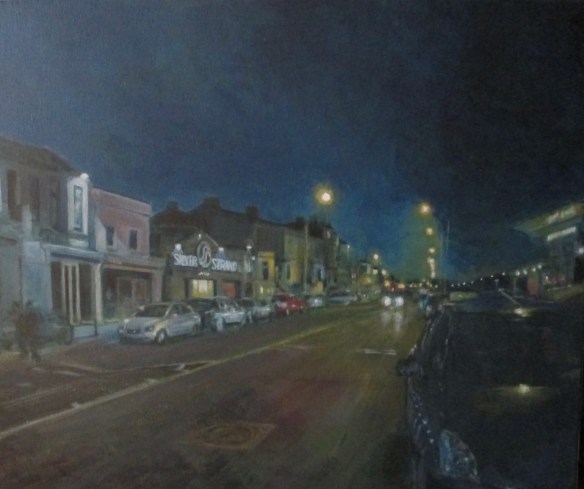
Rainy Night in Ripley Hills

Ripley 1

Where Killarney Road reaches its apex, a copse of fir trees guards an ancient stone marker, Saint Saran’s Cross. This mystery-laden oasis atop the hill is surrounded by a modern housing estate called Fairyhill. On the falling eastern slopes is another estate, Ripley Hills, which I call home. It was built in 1983 beside two grand houses of the nineteenth century, which were curiously conjoined: Rahan and St. Helen’s. Rahan House was once the abode of writer Arthur Conan Doyle. During his stay he developed an interest in the supernatural and wrote a book called The Coming of the Fairies.

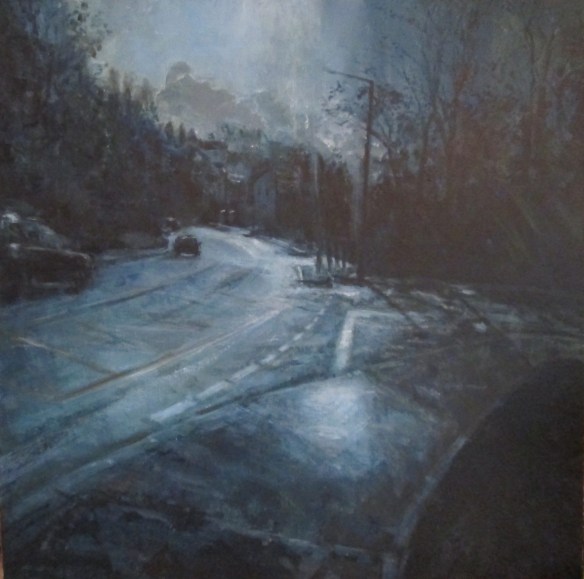
Rahan and St Helen’s were destroyed by fire shortly after I took up residence nearby and I witnessed the sad event from my rear window.  They took their mysteries with them, and their only vestige is a calm green space in Ripley Court. While the urban environment continues to grow, the landscape continues to give. Fabulous views of Bray Head and the Sugarloaf Mountains are always a reward for a walk around Ripley Hills and environs. The estate itself, sylvan and landscaped is a suburban pleasure too. I have been there long enough to witness it beneath blue skies and blankets of snow. But in the dark of night, with rain falling, it is sometimes more magical still.

Something’s gotten hold of my heart

Keeping my soul and my senses apart

Something’s gotten into my life

Cutting its way through my dreams like a knife

Turning me up and turning me down

Making me smile and making me frown

You know the feeling you get when the rain is falling and falling and you stand to look up into it and feel yourself rising up until you reach that point of equilibrium where the rising spirit and the falling water are as one, poised together in endless stasis. A moment like that, held in the sodium glow of the streetlamps, is what this painting is about. Trying to capture it, I reached for a palette richer and more varied than my dark blues and greys. 

Something’s gotten hold of my hand

Dragging my soul to a beautiful land

Something has invaded my mind

Painting my sleep with a colour so bright

Changing the grey and changing the blue

Scarlet for me and scarlet for you

Something’s Gotten Hold of My Heart, was written by Roger Greenaway and Roger Cook and was a hit for Gene Pitney in 1967. Born in 1940, Pitney was a singer songwriter who first achieved fame in the early sixties with movie theme songs. Perhaps his best known hit was the intense narrative Twenty Four Hours from Tulsa, a Bacharach David song in1963. His songwriting credits include Hello Mary Lou which was a hit for Ricky Nelson. In 1989 Pitney scored again with Something’s Gotten Hold of My Heart in a duet version with Mark Almond. He died in 2006.

In a world that was small

I once lived in a time there was peace with no trouble at all

But then you came my way

And a feeling unknown shook my heart, made me want you to stay

All of my nights and all of my days

Vancouver at Night

Vanite1

Vancouver is on the same latitude as Ireland and suffers nominally the same marine temperate climate. It rains, man, it pours. The city is set on a peninsula against a dramatic backdrop of snow capped peaks. 

Vancouver began to form in the 1860s around a sawmill. Nearby, a bar was established, thirsty work after all, by a certain Jack Deighton. Deighton earned the nickname Gassy Jack for his voluble espousal of any worthy cause in the growing city. He died in 1875 and his body lies in an unmarked grave, but there’s a statue to him on Water Street standing atop a beer barrel. The surrounding area is still known as Gastown.

In 1870 the expanding settlement became known as Granville, honouring Granville Leveson Gower, who was the British Secretary of State for the Colonies. It was incorporated as a city in 1886 with the arrival of the trans continental railway, and named Vancouver. This was for George Vancouver who, a century earlier, had explored the coast from Alaska to Oregon with James Cook.

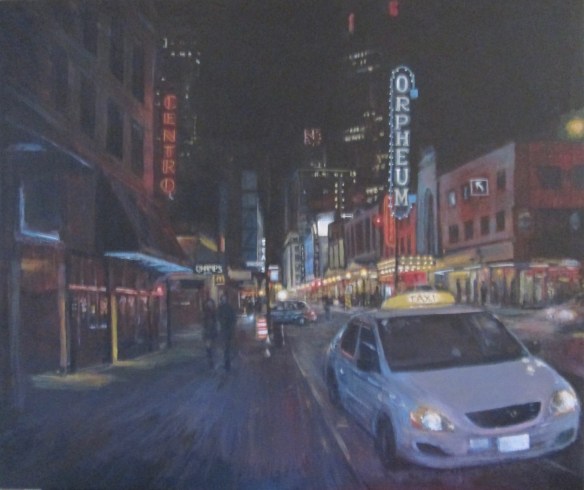
The name Granville persists in one of the city’s main streets. Granville Street has been the centre of the city’s entertainment area for over a century. Theatre Row developed with such major theatres as the Orpheum and Vogue. There were also amusement arcades, pawn stores porn shops and strip joints. Granville Street boasted the world’s largest display of neon signs in the 1950s

While much of Downtown gleams new, Granville Street remains a shabby but seductive slice of fifties Americana. Glorious old film theatres jut into the street which is low-end shopping by day and thronged with rough edged nightlife after dark. And there are bars, bars and more bars. It’s still thirsty work.

It’s ten years back that I visited Vancouver. Granville Street at night is the sort of wonderland I like. Edgy, but never dull. This scene, looking north, features the Orpheum and that neon nirvana for which the area’s famed. Across the road Dublin’s Calling, and I’ve got a thirst that’s raging. Slainte.

In Killruddery Woods

Kilruddery woods

From our last stop, the Bus Stop, Killarney Road makes for the M11 to the southwest. The road to the left is officially known as Oldcourt Park, but known locally as the Soldiers Road.  It runs alongside the ravine carved by the Swan River. Lost amongst the trees, the ancient tower house of Oldcourt Castle looms above, forever beyond reach. The river slithers through Wheatfield, past Swiss Cottage, across the Boghall, up to Southern Cross and on to Killruddery where the brook drains off Giltspur, or the Little Sugarloaf. 

These lands south of Bray were granted to Walter de Riddlesford, one of Strongbow’s loyal adventurers in the invasion of 1169. The large demesne is centred on Killruddery, the Church of the Knight. The Brabazon family came into ownership of the estate in the early 16th century through William Brabazon, Lord Justice of Ireland. The title Earl of Meath was granted to his great-grandson William in 1623. Killruddery House had to be rebuilt following destruction in the Cromwellian wars of the mid century. The current building is largely an 1820s reconstruction in the Tudor revival style. The original gardens remain. Designed by the French gardener Bonet, they are a unique example in Ireland of seventeenth century design, haunted with an exquisite Gothic gloom. Classically inspired additions blossomed in the eighteenth and nineteenth centuries.

The house and gardens are a popular attraction, with coffee shop, farmers market, garden centre and regular music and art events. There’s an adventure playground and Ireland’s largest obstacle course. Best of all are the walks through the estate, beyond the walls where nature wrestles amiably with farmland and forest. I have variously met friends and strangers, no one at all, amiable vikings and post apocalyptic hippies (these later visions being on film set).

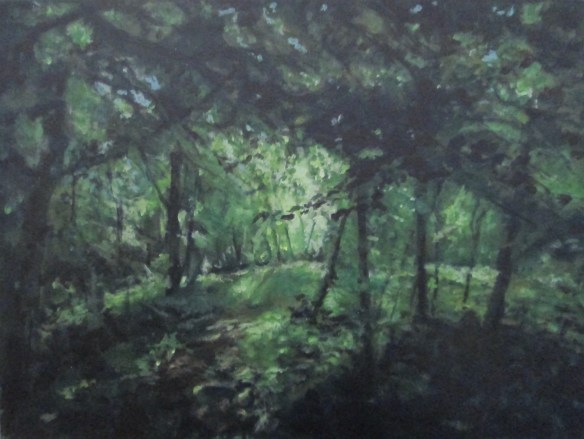
I recently took a path less travelled on the borderline between Killruddery and Belmont. In natural woodland on a sunny day there’s a tangible frisson in the air as light and dark dance with uninhibited abandon, together all alone, but for me. This acrylic is unusual for me in the choice of palette, which is very, very green.

But most of all I miss a girl in Tipperary town

and most of all I miss her lips as soft as eiderdown

again I want to see and do the things we’ve done and seen

where the breeze is sweet as shalimar and there’s Forty Shades of Green 

This song became such an iconic evocation of the Emerald Isle that it is presumed to have originated here. In a way it did. Johnny Cash wrote the song when touring Ireland in the late fifties. Once, after performing the song, a fan thanked him for his respect in singing a grand old Irish traditional air.

Bus Stop

Bustop1

Bus stop, wet day, she’s there, I say

Please share my umbrella

Bus stops, bus goes, she stays, love grows

Under my umbrella

All that summer we enjoyed it

Wind and rain and shine

That umbrella we employed it

By August she was mine

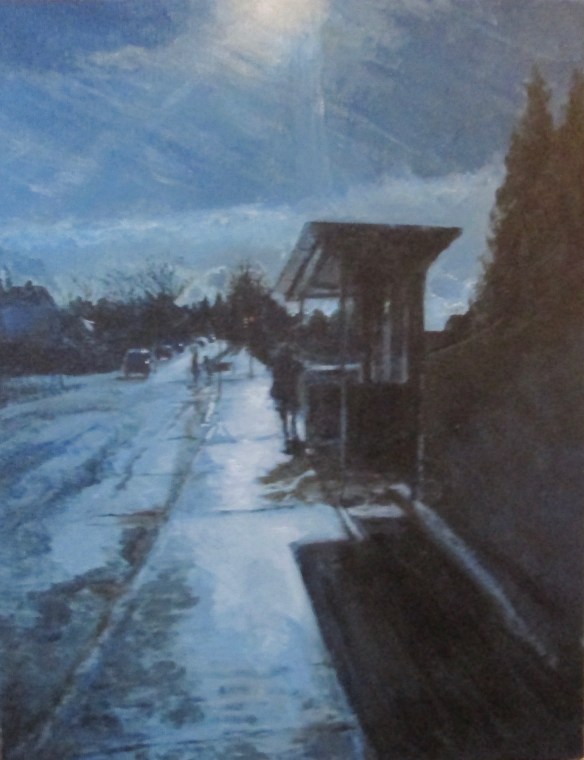
From the Swan River, Killarney Road keeps rising until it tops Fairyhill. Small estates line  the road, most dating from the nineteen eighties. The 145 bus route takes an unexpected right turn at Killarney Lane and the stops before the junction are mine. Across the road, the Nurseries lie beyond a triangular green planted with a copse of silver birch and sycamore. On this side, the western, the footpath runs continuously from the town to the M11. The covered bus stop here is a morning refuge for northbound commuters, whether heading for Bray Dart or Dublin. The 145 connects as far as Huston Station via the N11 and Dublin City Quays. I usually hike to the Dart on my northbound excursions, but the bus has its own consolations. More quaint and communal, and the serpentine route gives a scenic tour of south Dublin. There’s an intimacy too in the bus stop mythology. At least, that was the experience of my generation back in the day. The anticipation, the tension, the longing; and that was just for the vehicle. Love might also blossom, in wind and rain or shine. 

That’s the way the whole thing started

Silly but it’s true

Thinking of our sweet romance

Beginning in a queue

In this acrylic, we approach the bus stop after a heavy shower. The sky is clearing and the surface below us glares painfully, but beautifully. At the junction, the Oldcourt is off to our left, and the nearby right turn heads towards the Ardmore Film Studios on Herbert Road. Ahead, the Killarney Road weaves steeply upwards through a portal of oak trees towards Ripley Hills, and the apex at Fairyhill, crowned with its stand of pines.

Every morning I would see her

Waiting at the stop

Sometimes she’d shop

And she would show me what she’d bought

Other people stared

As if we were both quite insane

Someday my name and hers

Are going to be the same

Bus Stop was written by Graham Gouldman who would later form 10cc. He credits his father with starting  the lyrics from Graham’s own idea. Getting started is the thing. “It’s like finding your way onto a road and when you get onto the right route you just follow it.” A bit like Killarney Road, then. Bus Stop was the breakthrough US hit for Mancunian group, The Hollies, in 1966. I heard it on my first long playing album Hollies’ Greatest Hits (Parlophone) which I got for my thirteenth birthday. 

Kings on the Roof

Kings 2020

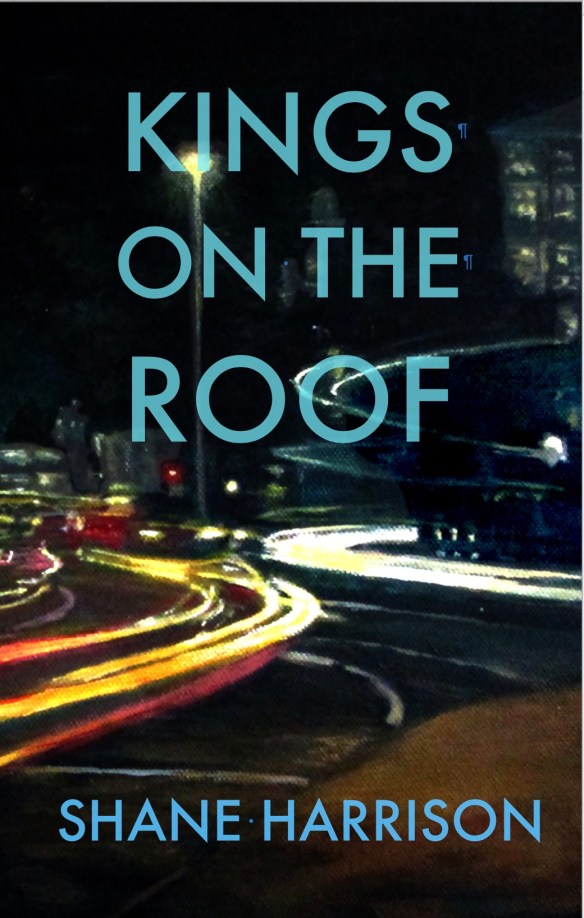
You’ll know me, that I mostly write on travel, posting that topic with photographs and the odd painting. History, art appreciation, personal reflections and music are all part of the mix. But there’s another me that writes fiction. Again, personal reflection and travel are part of the mix, sound and vision too. It’s a different world, but which is real or ideal I can’t say. This is something that happens every seven years or so, and it’s happening again. My latest collection of short stories, Kings on the Roof, is about to go live. Published by Forty Foot Press, it has eleven stories drawn from all across my universe. The title story is set around Dublin’s Amiens Street, with Sheriff Street Sorting Office and Cleary’s Pub beneath the railway bridge featuring. An extract from this story appeared in the second part of my series, Dublin’s Circular Roads. 

… back then when everything seemed possible, even there in the Sorting Office, in the bowels of that clanking beast, amongst the trolls and elves of the workaday world. We’d climb onto the high gantry and up the fixed ladder to the roof, Alex, the Bishop and I. We were kings of the world up there, with Dublin spread out beneath us, above us only a rippling sky.

There’s an autobiographical element to this story, as I worked in Sheriff Street with the P7T in the late seventies. A more mythic Dublin features in The Secret Lover of Captain Raymondo D’Inzeo. Set in the sixties in the Liberties, the narrative includes fanciful versions of Marconi, the Easter Rising, the Theatre Royal and the magnificent Italian showjumping team winning the Aga Khan. There were extracts in part eight of Dublin’s Circular Roads. 

Just past Cassoni’s I see the car, a red Alfa Romeo with the roof rolled down. Graciano is at the wheel, la Contessa Rossi languishing in the passenger seat.

   “You,” she says, “you have set your sight on the Captain. You are good. A young girl with well turned calf. But would he set his cap for you, the Captain? In all probability. He can acquire what he likes.”

   I can’t think what to say. “Will Italy win the Aga Khan?” I stammer.

   La Contessa puts her head to one side, like a bird looking at a worm. When she speaks, it is not by way of a reply. “I see your man there. He is within your reach. Don’t take me wrong for, believe me, we both have love in our hearts. And yes, we will win.”

Meanwhile, a more recognisable Dublin appears in the stories A Man Walks into a Bar and the Black Moon. Both are contemporary but, suspended in their own gothic fog, drift to and fro in time. The cover illustration is realistic enough, based on a photographic time exposure of city traffic at College Green, Dublin’s dizzy fulcrum. Both the acrylics painting and prose featured on this blog about two years ago. 

… this is the beating heart of Dublin. Whenever you stand there, you will experience the rattle and hum of the city. The song it makes is of all the songs that have been sung here, all the words written and spoken, the history of centuries and recent seconds. At night I find it something special, intimate in its inkiness, dangerous and comforting in that non stop firefly display. Stand and watch the lights of passing traffic going everywhere, fast, at the same time. That’s city life.

Kings on the Roof is published by Forty Foot Press, and is available on Amazon.

Venice Remembered – 3

Canaletto_-_The_Grand_Canal_near_the_Ponte_di_Rialto_-_WGA03852

Third time in Venice, we flew in to Marco Polo, arriving by train at the Stazione Santa Lucia late in the evening. We took the Vaporetto down the Grand Canal, sailing beneath Ponte Degli Scalzi to ride the few stops till our pontoon. Darkness fell and a nimbus rose from the water as we approached our rendezvous.

It was one of those meetings which should happen at least once in a person’s life, one which you have seen many times in the movies. Sometimes I dream of Veronica at the Vaporetta stop. As the cool cloak of the canal shaped itself, tangible and ostensible, the Vaporetto stuttered to a halt. there she was, alone amongst the crowd waiting on the pontoon. At last, I was in a movie, about to step into that scene, like Bogey and Bacall, when monochrome celluloid blossomed to a full spectrum. She was perfect; calf length Macintosh a quiet half white, dark felt fedora aslant. I just knew her eyes would glisten softly, the colour of deep water in moonlight.

Well, it was all of sixty five years ago

when the world was the street where she lived

and a young man sailed on a ship in the sea

with a picture of Veronica.

Veronica by Elvis Costello

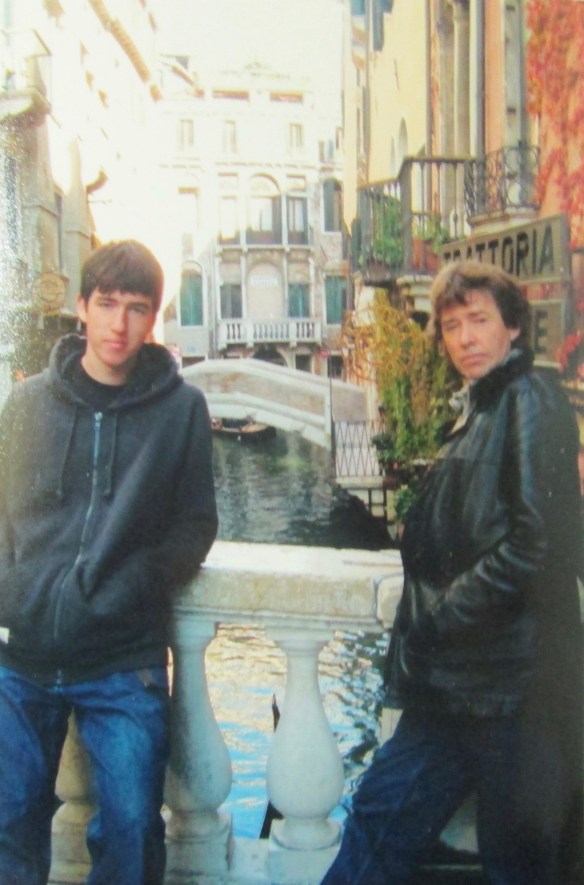
Veronica is our host for the air b’n’b we have booked. She welcomes us warmly and guides us through the labyrinth to the house where we’ll be staying. Once we’re settled she gives us a brief tour of the quarter, recommending the right places for us to eat and drink. Then she smiles and glides off to her own home on some other island.

We are staying in the Sestiere Santa Croce San Polo, near the fishmarkets whose faint hum guides us home of a night. Nearby is Rialto Bridge. We had our two charges, and a list of things to do. Much of this involved pointing and staring, and Venice offers plenty opportunity for that. We had also earmarked a visit to the Biennale.
VenSteps

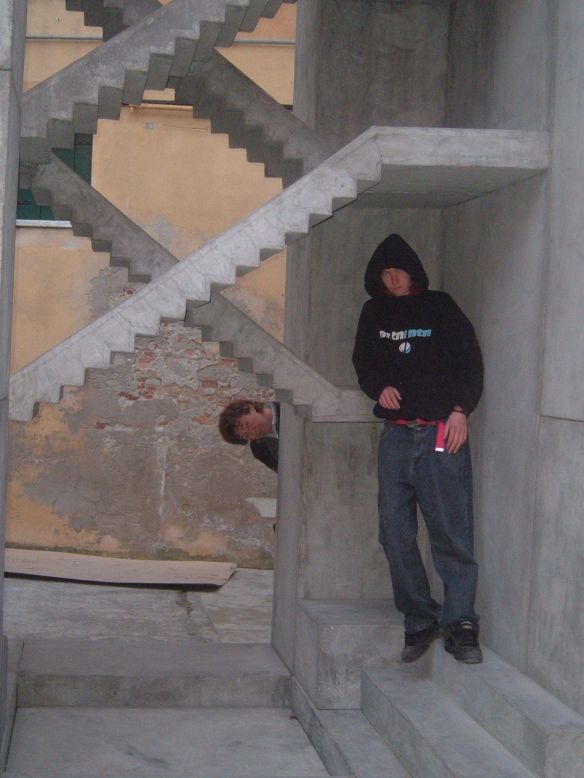
The Venice Biennale was established in 1895 as a major exhibition of contemporary art. It is based in a park, the Giardini, established by Napoleon on drained land east of the Arsenale. The exhibition centre is augmented by thirty national pavilions operated by that country’s foreign ministry to showcase their art and culture. An exhibition focussing on architecture is held on alternate, even years. In 2006, the exhibition explored the theme of Cities, Architecture and Society. For myself and O this was right up our alley. We are both lost in our search for the ultimate city.
VeniceSnO

Our brains were as full of cities as they were likely to be. One particular visual endures. Topping a rise in the motorway, the entire panorama of a teeming city and its towers shifts across the skyline. Whether Caraacas or Bogota I can’t be sure. I felt dizzy contemplating it. O was utterly absorbed. He would, a few years later visit that city himself. 

We stopped for lunch along the quayside in sunshine. Riva degli Schiavoni is a hectic waterfront promenade lined with market stalls. The Grand Canal merges with the lagoon, transitioning towards the open sea. There’s an overwhelming sense of movement, the centuries colliding to make a tableau of the city’s maritime history. On that day, the sky a duck egg blue and suspended in a chill miasma, everything was timeless and possible.
Canaletto Salute Venice

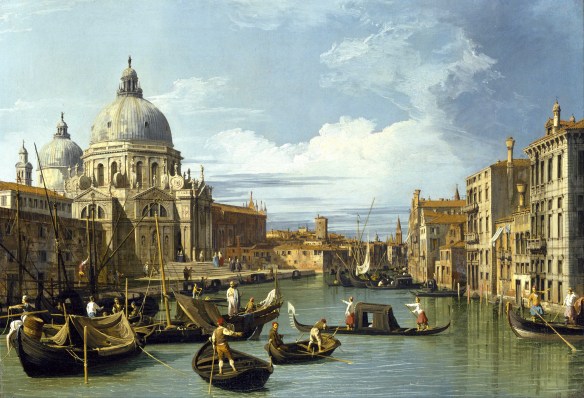
Across the waters, a masterpiece of baroque extravagance, the Church of Santa Maria della Salute was built in thanksgiving for deliverance from the plague of 1630. Further on, Andrea Palladio’s San Giorgio Maggiore floats on its own island.The neo-Classical complex of church and monastery was completed at the end of the sixteenth century, with the soaring campanile added in the late eighteenth.

The view has inspired numerous artists, amongst them Giovanni Antonio Canal. The name is too appropriate to be true: Canaletto, the artist who does exactly what it says on the tin. Born in Venice in 1697, his father, also a painter, was indeed a Signor Canal. His son’s monicker denotes junior. In his early paintings he worked to a finish outdoors while his contemporaries retreated to the studio. Hence, he anticipates Impressionism, and the tendency of modern art to capture the moment in all its blurred intensity. This evolution fits with our technological advance. Camera, cinema and video are caught in the moment. Even modern writing mimics the automatic pulse. We see things differently now than before, but this has developed over time. In Canaletto’s day, the Camera Obscure was available for artists to copy the scene before them. Canaletto is reckoned to have used it. Scholars of his work disagree. His uncanny accuracy can be put down to the simple fact that he was just damned good!

Picture 009

There are other islands too, and it was time to visit them. Whistling past the graveyard of San Michele, we take the Vaporetto from Fundamente Nove to Murano and Burano. Murano is a small clump of islands with its own canal system, a miniature of Venice itself. Renowned for its glassblowers, we took a factory tour and wondered at the ridiculous, seemingly casual skill of the glassblower within such an extreme environment. We still have our gorgeous glass horse, hot off the pipes. Outside, Murano is blissfully calm, a long way from the hubbub of Venice across the lagoon. Burano has Its own unique, crazy atmosphere. Life goes placidly on beneath fantastic leaning towers. We dallied and dined in the picturesque main square, eating Lasagne which was  memorably good. The houses are painted individually in bright colours, forming a patchwork canvas to seduce the artist within us all.
VeniceM

Over a few days, myself and M became fond of Veronica’s coffee maker. The Moka Pot is an Italian style icon, new to us at the time, it was developed by Alonso Bialetti in 1933. A study in Futurismo elan, with facetted aluminium and bakelite handles, it made brewing coffee at home accessible to ordinary folk. During a moment when my concentration wandered, the bakelite began to melt picturesquely over the ring. Two remedies suggested themselves: to disguise ourselves with Venetian masks and escape, or to purchase a new one. The neighbourhood seemed full of souvenir shops, but but we quickly found a shop selling coffee makers, identical to the one I had just melted, if a tiny bit bigger.

There were shops with masks and full regalia too. So that option remained. I almost took it. Browsing in a particularly exquisite shop, I found myself draped in full regalia, though I hadn’t asked to be. Apparently they do that if you stay motionless too long; a dream come true for a lifelong poseur. Davin was pleased to follow suit, and made for a more dashing model.

VenDavMask

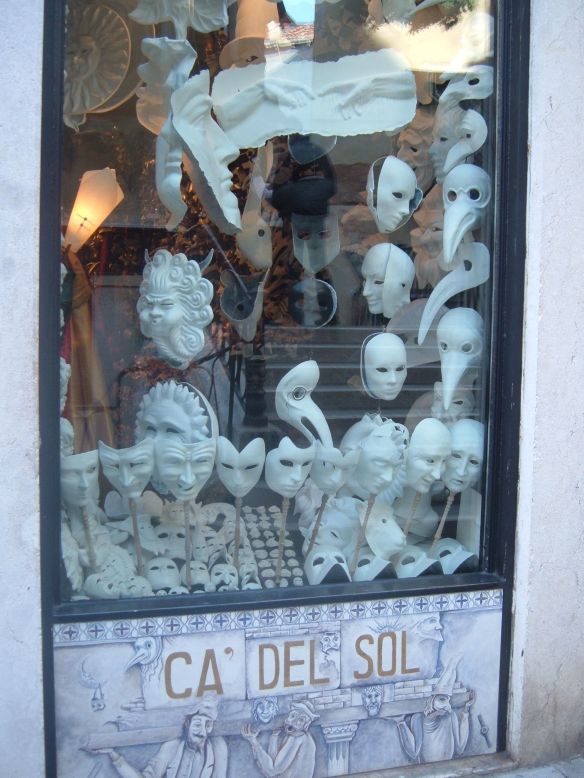
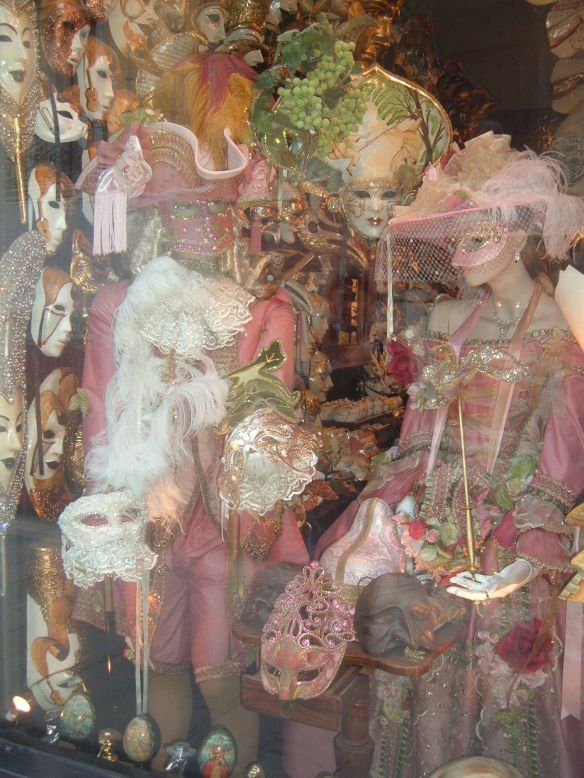
Such paraphernalia is handed down from the once notorious Venice Carnival. The Carnival is a thousand year old tradition. A pre-Lenten celebration, (the word Carnival derives from the Lenten fast, literally meaning ‘goodbye to meat’) it gave citizens licence to transgress the strictures of society for ten days leading up to Shrove Tuesday. Elaborate disguises were worn so that men, and women, could behave outrageously while preserving anonymity. This spirit of subversion allowed the playing of practical jokes and endless possibilities for intrigue. 
VenMasks1

The Carnival came to represent the excesses of decadent Venetian society. From 1453 when Constantinople fell to the Turks, Venice continued to rule the Mediterranean waves but by the eighteenth century the city’s renown was less to do with mercantile power than gambling, partying and vice. Taken by Napoleon in 1795, Venice was annexed to Austria whose autocratic rule saw the Carnival outlawed. If meant to curb Venetian expression, it backfired. The more sober population were to the fore in the Risorgimento, the push for a united independent Italy, achieved in 1870. A century later, in 1979, the Carnival was revived and has become a hugely important event on the cultural calendar.
VenMasks2

My own personal pilgrimage was made on a grey, drizzly morning, taking the Vaporetto to Ponte dell’Accademia. Nearby the Galleria Dell’Accademia has a great collection of Art: Veronese, Tintoretto, Tiepolo, Titian. But one morning of wonders at a time. I kept to the Dorsodura side to visit the Guggenheim Museum of Modern Art, lodged in the Palazzo Venier dei Leoni, the Unfinished Palace

Peggy Guggenheim moved to Europe in the 1930s. In Paris she befriended Samuel Beckett who urged her to support Modern Art, as it was a living thing. She set out to buy a painting a day from such artists as Ernst, Dali, Magritte, Duchamp and others, outstanding works of surrealism, cubism, futurism and some abstract stuff. She fled France after the Nazi occupation, escaping with her future husband Max Ernst.
Ernst Bride

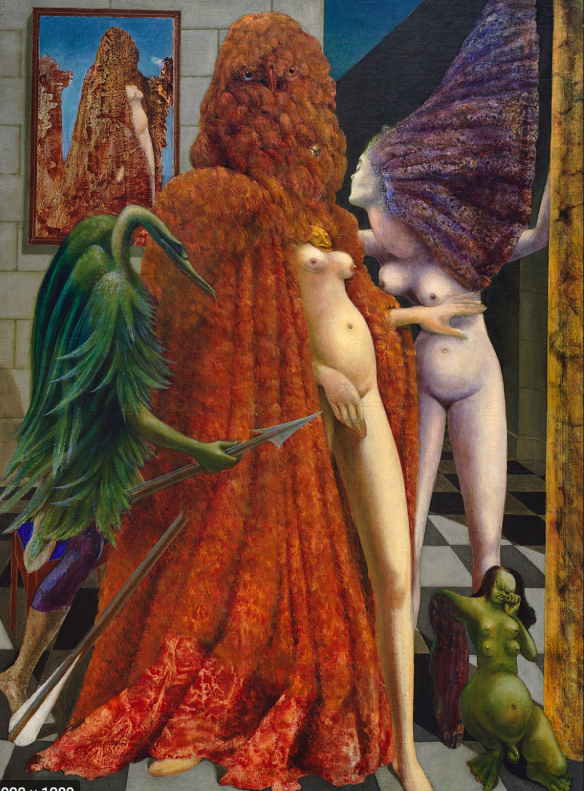
Ernst is a particular favourite of mine. The Guggenheim has two of his masterpieces: the Robing of the Bride and the Antipope. Both are perplexing, employing the automatic technique of pressing paint onto the canvas, decalcomania, to evolve a scenario that’s apparently realistic but incongruously fantastical. Magritte’s Empire of Light also features. These are paintings I could stand in front of for days.
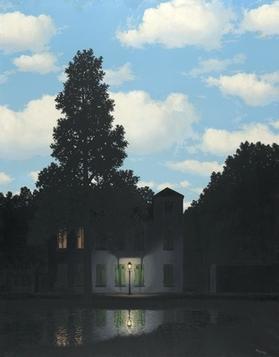
The_Empire_of_Light_Bel

Coming up for air, I pose by the waterside for a while, with blended injections of lagoon air and aromatic infusions from exotic places, Morocco or Virginia perhaps. Behind me on the patio the disconcerting statue by Marino, Angel of the Citadel, brings a whole new meaning to the term saddle pommel. Before me, a haunting tableau in the making emerges from the canal mists. I thought it was the smoke or the music going round in my head, but I took a photograph and it doesn’t lie.

VenGondo

Here they come, and the fire on their wings doesn’t burn,

here they come and they know everything we must learn.

Here they come, and the stars in their eyes seem to glow,

here they come and the fear in our hearts starts to go.

Here They Come by Ten Years After.
Venice Remembered – 2

IMG_5297

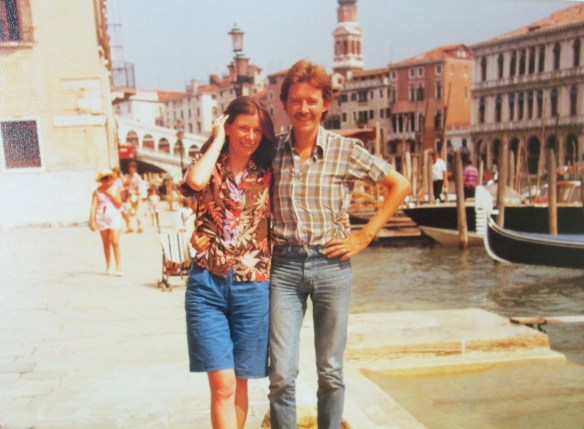
Our second trip to Venice was the summer after myself and M tied the knot, and the trip to Italy was something of an official honeymoon. We had married in the bleak midwinter, escaping to the picturesque thatched roof frostbite of Adare, County Limerick. Like stepping into a Christmas card. Less starred was a trip to the ever-flooding city of Cork, where, and not for the first time, we drove through city streets with water up to the runner boards of our Renault. Perhaps that’s where we got the idea for our return to Venice.

IMG_5289

Our itinerary was something of an infinity loop. From Rome, we leapt across the Pyrenees to Pescara, scurried up the coast for Venice, then on to Florence and on down to Naples, Sorrento and Pompei. After that, we took a few days on the island of Ischia and then back to Rome and the flight home. Trains and boats and planes; but mostly trains. 

The train into Venice was an overnighter and packed to the gills. We were not alone in the notion that taking a kip on an overnight train would save on hotel bills. Mind you, everyone was doing it, tourist and local alike. It was hard to sleep in a corridor, with each stop introducing a new batch of salesmen to parade the corridor roaring: birra! gelati! Sounded good to me, but my companion is asleep, and I must elbow my way to the exit window for a smoke. 

Well I’ve been waiting I was sure

we’d meet between the trains we’re waiting for

I think it’s time to board another.

Please understand I never had a secret chart 

to get me to the heart of this or any other matter. 

Arriving across the isthmus from Mestre by train, we sought accommodation from the Tourist Police at the Station Santa Lucia. Amazing now how we winged it on both honeymoons. After Adare we had launched into that pointless meander across the sodden south before cutting our losses and heading home. Italy in summer held more romantic promise. If we were stuck at least it was Italy; Al Fresco and all that. 

IMG_5290

The Tourist Police were helpful, targeting accommodation and setting us the task of getting there in time. This involved a cross city dash reminiscent of those TV travel competitions. We had thirty minutes to get to the pensione, and we decided, wisely, that the Vaporetto was best. It brought us clockwise from the station, through working waterways. On first crossing the lagoon, what struck me most was seeing a working city. The non pretty parts of Venice are amongst its most exciting. We crossed wash with garbage collection boats, rough heavy goods barges, a speeding police boat. There were rich looking launches too, a taxi with a couple of most elegant poseurs astern. I’ll be there, someday, I wish. An English woman sitting beside me on the Vaporetto, turned to her companion and opined: It’s so Dirty! But that is the beauty of it. Every mosquito and screaming gull, every fat man with cigarette, every building site and bargee. This ain’t no theme park.

Our stop was the Fondamente Nuove. This ‘new quayside’ is in fact four centuries old, along the northern edge of the city with views of the lagoon. Out there are such exotic smaller islands as Murano and Burano, but most noticeable, just offshore is the cemetery of San Michele, the floating city of the dead. 

 It was a short, if complex, walk to the pensione. We were within time and the host gave us a tour of what was a beautiful premises, distinguished by its large courtyard with trees tapering to the sky. The room was olde worlde, plain and clean, with an ingenious device for quelling mosquitos. To awake in Venice is to own it. A whole day to embrace her and fall to bed with her again. And another morning to start over once more. Days to be spent in random exploration, browsing at markets, grazing at stalls, lingering at sidewalk cafes. 

IMG_5298

We returned again to wine and dine at St. Marks while pestered by string quartets in the shadow of the Campanile. The Campanile, or bell tower, is almost a hundred metres tall and was built as a lighthouse in 1173. The current structure dates from 1500, and from its giddy heights Galileo demonstrated his telescope to the Doge in 1609. The tower dramatically collapsed in 1902, but was rebuilt ten years after.

Evenings were quiet after the bustle of the day and spent in the darkening labyrinth of streets which seemed to have neither name nor destination. As happens, certain hostelries became haunts. We learned from the guy serving us, an English lad working at his mother’s trattoria, that accommodation was prohibitive so most visiting was confined to daytrips, cruises and the like.

IMG_5288

Since M is a Liberties girl, and I’m not far off, we were drawn naturally towards the Rialto. There is an area in Dublin called Rialto. It once boasted two canals, or two branches of the Grand Canal. With regular barge traffic to Guinness’s brewery and other businesses there may have been cause for poetic license in its naming. You might have trouble renewing it. When, after a century of inactivity, someone fell in and drowned, on the principal of ‘if it saves one life’ the whole section  including the Basin was filled in making a spectacularly unsuccessful linear park. These days it provides a thruway for the Luas light rail. Incidentally, the same city fathers also had plans to convert the surviving Grand and Royal canals into a ring road. Just think what such an enlightened mentality could do for Venice!

Rialto means the high bank (of river). Venice’s Rialto Bridge was the first to span the Grand Canal. The present structure was built in 1590 and designed by the appropriately named Antonio De Ponte. Until the building of the Accademia Bridge in 1854 it was Venice’s only pedestrian crossing point. It is a signature landmark. The steep single arch span supports a central thoroughfare with shops on each side. The symmetrical colonnades are joined by an imposing portico on the apex of the bridge. Views of the swirling life of the Grand Canal can be had from the ballustraded walkways to each side. The Rialto Markets are long established on the San Polo side. The Erberia is the fruit and vegetable market while the Pescheria is the fish market. Downriver, the Riva del Vin is the best place to get a quayside table and raise a glass to the wonders of La Serenissima.

IMG_5294

In Venice you discover that Gondolas are not simply window decorations in West Dublin. This is the romantic way to tour Venice. For Venetians the Gondola is a form of wedding limo, but tourists book the watery equivalent of the Killarney trap. It is the idea of the thing, I suppose. This is a world of water. A more straightforward Gondola trip, unmediated by an Italian roaring O Sole Mio, is to take a Traghetto, gondola ferries that cross the Grand Canal at seven points. It’s communal and much more fun, practicable and traditional. The protocol is for men to stand while the woman sits. 

The Rialto traghetto crossing provides one of the most evocative moments. Here we were at the focus of a madding city, adrift in its mayhem, but briefly at one with it. Crossing the Grand Canal against the backdrop of Rialto Bridge we knew we had arrived on Earth. All the sense of history, of freedom and surprise, of surviving against the odds, the sheer beauty of it.

Let’s meet tomorrow if you choose upon the shore beneath the bridge

that they are building on some endless river.

Then he leaves the platform for the sleeping car that’s warm

you realise he’s only advertising one more shelter.

And you say okay the bridge or someplace later


The Stranger Song by Leonard Cohen

Venice Remembered – 1

VeniceShDeck

I can’t believe that I’ve never written about Venice. It is the most fascinating place I have ever visited. Writing about it is another matter; an intimidating prospect, I suppose. There it is, extraordinary to experience and behold, but how to capture it in type. Photos can get you part of the way, along with some dreaming about the effects of light on water. I don’t have many photos of Venice, precious few from my ancient visits in the last century. But I’ve plenty of dreams. 

This morning in our living room, upon the electric frame appears that photo I took on a misty morning, looking up the Grand Canal from the landing of the Guggenheim Museum. I was all alone, and there was something in that feeling of isolation that sympathised with the mist rising from the water. It wrapped around me; chilling, but exciting too. In that snapshot I felt I stood flush with the centuries, one card of a stack, and I could forever slip back and forth in time. Venice is like that.

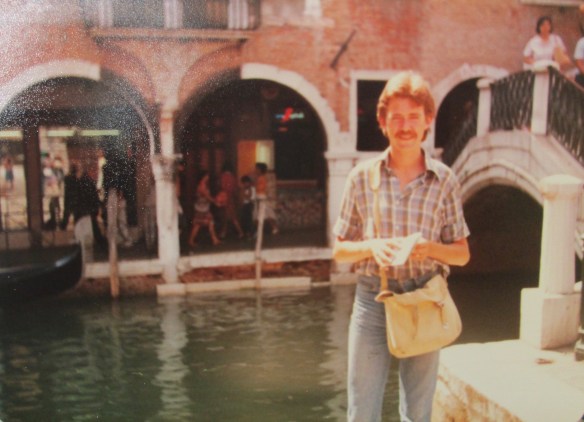
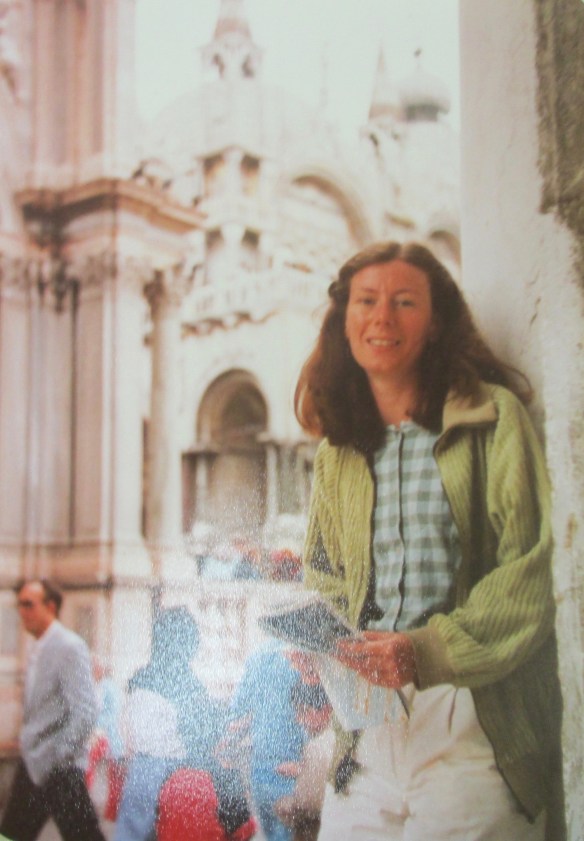
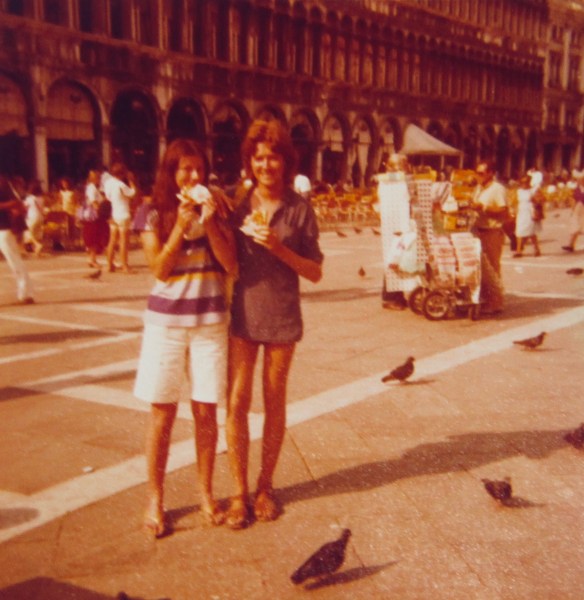
I have been to Venice three times. The first time was in the early eighties, on a daytrip from Yugoslavia, arriving by sea at dawn. M was crashed out in the lounge, as was most everyone else. I stood on the prow, feeling suitably dramatic. Dribs and drabs of Japanese tourists were appearing on deck and soon the place would be ablaze with cameras. I had been enjoying the silent onset of dawn, the fading of the city lights and stars. I had hardly thought to unsheath the camera, it would have intruded on the perfect moment. There is no more perfect moment than approaching Venice by sea, at dawn. I managed to haul M on deck before the fireworks started. I think I got one shot away. One must. It’s long lost now. But the memory lives with me still.

In truth, the Yugoslav trip had been a bad idea. We were booked into a holiday camp in Porec. There’s a limited number of ways to do a holiday camp. The British or the German. This was German. Butlizt! We escaped over the perimeter fence one morning, and zig zagged along the Istrian coast. We hid out in Rovinj for a while and that was good. Our attic window looked across a red slate sea to a dreaming tower. Rovinj is a scenic town, but with much the same feeling of surveillance and imminent capture. We discovered there was a boat trip to Venice, leaving at zero hour and travelling overnight.

VenicePza

The boat docked at the Riva degli Schiavoni, the bustling promenade downstream from St Mark’s Square. We took the guided city tour which proved useful as an introduction and included a visit to the Doge’s Palace. We then had an afternoon and early evening to ourselves. We visited a Salvador Dali exhibition, and sauntered about in the wonderful maelstrom of St Mark’s Square and the mazy streets leading off, swooned at the teetering towers and absorbed the endless painting in life that is the Grand Canal. I remember us sharing pizza with some Italian youths on a fountain by St Mark’s. We had large frothy beers al fresco with the Campanile as our sundial, reassuringly expensive, and laughed at the outrage of a tourist being gulled for a round of drinks and maybe learning the lesson: location, location, location! 

A day is too short in any city. It is enough for a sketch. In the case of Venice, time is never enough. We’ve since followed Francesco and his breathless histories, followed Donald Sutherland’s embodiment of Du Maurier’s doomed hero in Nicholas Roeg’s film, Don’t Look Now, pored over books and lingered on photographs, paintings and travellers tales. Inevitably, we vowed to return at the appropriate time to seed more dreams and memories.

Many feel this attraction, to such an extent that the object of this mad love suffers from all the attention. It is a problem with the ease of modern travel. What was once the preserve of the rich is now democratised. This is a good thing, but there are downsides too. Here and elsewhere, there has been something of a backlash against mass tourism. Rapprochement is required, most importantly for visitors to respect the people, the culture and the places they visit. Most do, I think, and many sins come from local sources. There is no silver bullet solution. Just the other day at the onset of the pandemic, a reporter on tv followed a swooning camera across a deserted Venice. And Venice had never looked so beautiful, he gushed. It has certainly never been so empty. Yet, it is partly that crowded sense of Venice which is part of the attraction.

VeniceShCan

Venice is an unlikely location for an ancient city. Built on a group of low lying islands in a lagoon, it should, in the natural course of things, have been washed away long ago. The city was founded in the early fifth century when residents of the mainland sought to protect themselves from the invading Goths. Refuge in a swamp may be unpromising, but invasion was even more hazardous.

The first Doge was elected in 726 and by the end of the century Charlemagne was established as Holy Roman Emperor and the Barbarian disruptions were quelled. The Venetians established trade links with the Byzantine Empire and with that came notions of glory. Venice conquered Byzantium in 1204, becoming the centre of a new trade empire, a bridge between east and west. You can see it in the buildings, in its sheer, bloody audacity.

So, Venice has been welcoming travellers for centuries, and sending them forth as well. Marco Polo has acquired global mythic status as the original great traveller and man of trade. He was born in 1254 and insinuated himself at the court of Kublai Khan while still a teenager. Returning to Venice, his yarns established his reputation and further enhanced the Venetian story. Mind you he was locally known as Marco of the Million Lies, so perhaps a smidgin of salt is required.

VeniceDuo

And see if you can fit in some of the building …

In 1309 work began on the current Doge’s Palace. The three solid facades of pink marble are held aloft by two floors of exquisitely wrought arcades. St Mark’s Basilica sits into the open facade. Now the Cathedral of Venice, it was originally the Doge’s private chapel. The first church was built in the ninth century but it has been oft remodelled since. An elaborate, eastern tinged  masterpiece, its ornate Gothic facade and five enormous domes make for the most iconic sight in Venice.

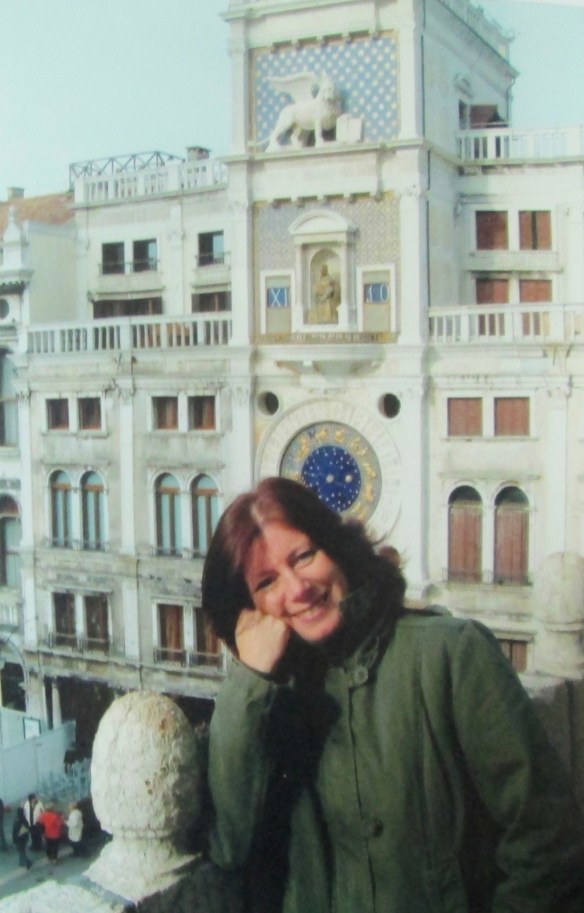
We climbed to the parapet, a feat repeated last time we visited. Posing on the roof of an architectural treasure is always sublime. The Torre dell’Orologio can be viewed up close from the parapet of the Basilica. It is a seafarer’s clock, its face blue and displaying the phases of the moon and the signs of the zodiac. Topping all, two bronze Moors strike the bell on the hour.

There is no point ticking off the must sees here. It is a place to be experienced quietly by your senses, it will inspire and pervade your soul. There is a perfect buzz to be attained simply in hanging around Saint Mark’s Square. Cafe Florian where you can disport in the bumprints of such literary greats as Proust, Dickens and Byron. If you want to shadow the importance of being Ernest Hemingway, Harry’s Bar is nearby, at the end of an alley leading down to the Grand Canal.

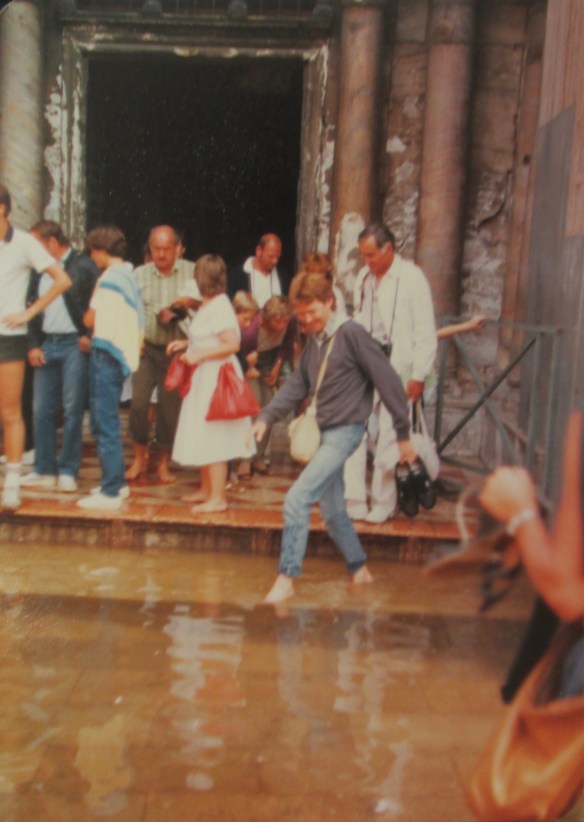
As the sun sets again and the waters rise, perhaps we’ll drown at the end of our day of freedom. What better time to go, in that first flush of seeing Venice. The end wasn’t quite that dramatic, and we picked our way to higher ground on the duckboards laid across the shallow pond of San Marco Square, tossing in a coin to assure our return.

VeniceMarDeck

Everything is wonderful

being here is heavenly

every single day, she says

everything is free

So if I say save me, save me

be the light in my eyes

and if I say ten Hail Marys

leave a light on in heaven for me

Mary’s Prayer by Danny Wilson

Bray – Overlooking the Swan River

Swan R 2

At the top of Bray Main Street there’s a fork in the road. Imagine this through time as being something of a village green, with timber frame tavern and monthly fair days. The Old Town Hall from 1881 originally included a covered market and is Elizabethan in style. Picture it in a Tudor setting, or perhaps Dickensian, surrounded by leaning buildings with gabled fronts and muntin windows.

The fork to the left is the coastal route, climbing up to the gap between Bray Head and Giltspur, (the Little Sugarloaf), and on to Greystones. To the right, Killarney Road is the principal route south towards Wicklow Town and Wexford, via the N11. Gothic redbrick houses of the Fin de Siecle line the road out of town, set in extensive gardens behind granite walls.

The road rises towards the massive spire of Christchurch, Bray’s towering landmark. The Gothic revival church, built of stern granite blocks, was completed in 1863 to serve the Church of Ireland community. The tower was added some decades later, the octagonal spire rising to 175 feet is garlanded by stone pinnacles. Christchurch’s imposing presence is further emphasised by its elevation, standing atop the Rock of Bray, the summit of the rising ground that defines the town.

Past Church Road, we crest the hill, and from here the route falls into the valley of the Swan River. This tributary of the Dargle rises in Kilruddery Estate on the slopes of Giltspur, flowing through Oldcourt and past its castle, under the bridge below our vantage point and on to the Dargle. The Swan trails a score of varied woodland along its deepening chasm. A rich mixture of oak, ash, birch, pine and poplar, with some exotics such as Eucalyptus, cloak the area with a sylvan beauty. With the town centre only a couple hundred metres behind us, and the suburban housing estates gathered on the next hill, this spot is like a blink in time, remote from surrounding urbanisation.

This view, rendered in acrylic, is taken from the junction with Beechhurst estate. Christchurch is out of sight to our left, Patchwork Cottage, to the right, and the bridge await below. After a long uphill climb from the seafront or Dart station, it’s a welcome downhill stretch. Past the bridge, the road will rise continually to Fairyhill, surmounted by the ancient, weathered cross of St Sarain, the area’s patron saint. (Killarney is an Anglicisation of the Gaelic ‘Church of Sarain’.)

On this day, a shower has just cleared, veils of cloud are pulling off to the West. Ahead the sun has broken through, turning all it touches to silver.

Bray Seafront – Looking North

IMG_5206

Up until the mid nineteenth century, Bray seafront was a stony beach stretching between Bray Head and a craggy outcrop a mile to the north on which sat a Martello Tower. The crag overlooked a small dock and the Dargle River opening into the sea. In the 1850s the Dublin to Wexford railway line passed along the shoreline and this ultra modern mode of transport enabled many more people to live here by the seaside. Strand Road was developed with fine Victorian houses, the sea was pushed back and the Esplanade established as a long linear parkland. The Promenade, atop the sea wall, completed the picture in the 1890s. Not all that much has changed over the intervening century.

IMG_5185

The seafront is Bray’s principal attraction for visitor and resident. Throughout the year, but especially in summer, people come for all the fun of seaside entertainment. They throng to the summer carnival, the various outdoor gigs and events, the amusements, the bars, cafes, icecream parlours and restaurants. Or they take a walk along the Promenade or up Bray Head, or just sit on the beach or the Esplanade. This is what people do, crowds of them, together and all alone.

IMG_5187

Our present phase of isolation has robbed us of this fun, but our time will come round again. This is what people do. I’m fortunate in that I’m a Bray resident, and live within the distance parameters of the seafront, and indeed the Cross at the top of Bray Head. I’ve been familiar with this joint since coming here for holidays in 1963. As Gerry and the Pacemakers said at the time: I Like It!

I like it, I like it,

I like the way you run your fingers through my hair

And I love the way you tickle my chin

And I like the way you let me come in

when your Momma’s not there.


IMG_5192

The particular stretch of the seafront which I’ve painted has proven a happy hunting ground for me too. The block of buildings to the left featured in one of my first short stories, called Coda. It won the Bray People short story competition and was the opener for my first collection Blues Before Dawn. It’s a macabre story featuring a couple of musicians, one an Italian running a seafront chipper, the other, the narrator, a bit of a psychopath. In the eighties, the Fun Palace stood where the Silver Strand is, and I borrowed that name for the regular spot where our heroes played. There was also a small Italian chipper, extreme left, which featured too. As for the Fun Palace, the old facade, like the Silver Strand but with timber cladding, was immortalised in an illustration I did. It featured in my first art exhibition in the Bank of Ireland on Main Street. It was the only artwork that sold. I wonder where it resides now.

IMG_5195

Further on, perspective lines converge on what we call The Dug Inn. Mick Duggan’s pub has been through a few name changes since, most notably Katie Gallagher’s. Still in the family, who run a couple more Bray licensed premises, it now has three names: The Box Burger, Platform Pizza and the Ocean. Just beyond, the Hibernia was once a gig hotspot known as The Mississippi Rooms. It still runs folk music gigs midweek.

IMG_5202

Looking to the right hand side, you’ll see the shape of Killiney Head beyond the lights of the Promenade. Nearby, to the right, the modern complex that holds the Bray Sealife Centre. Established in the eighties, it was originally a rather lumpy granite clad modernist structure. It was later recast as a sleek postmodern pavilion. The gastrobar visible here, was originally known as the Barricuda, and now houses Butler and Barry’s. The upstairs area features a glass wall along the eastern side giving fabulous sea views.

Behind me is the central Esplanade and there are many more fine bars facing onto that. Where to go, where to go? I’m gumming for a pint. Only 91 days, 21 hours and eighteen minutes remaining as of Sunday at two o’clock.

IMG_5205