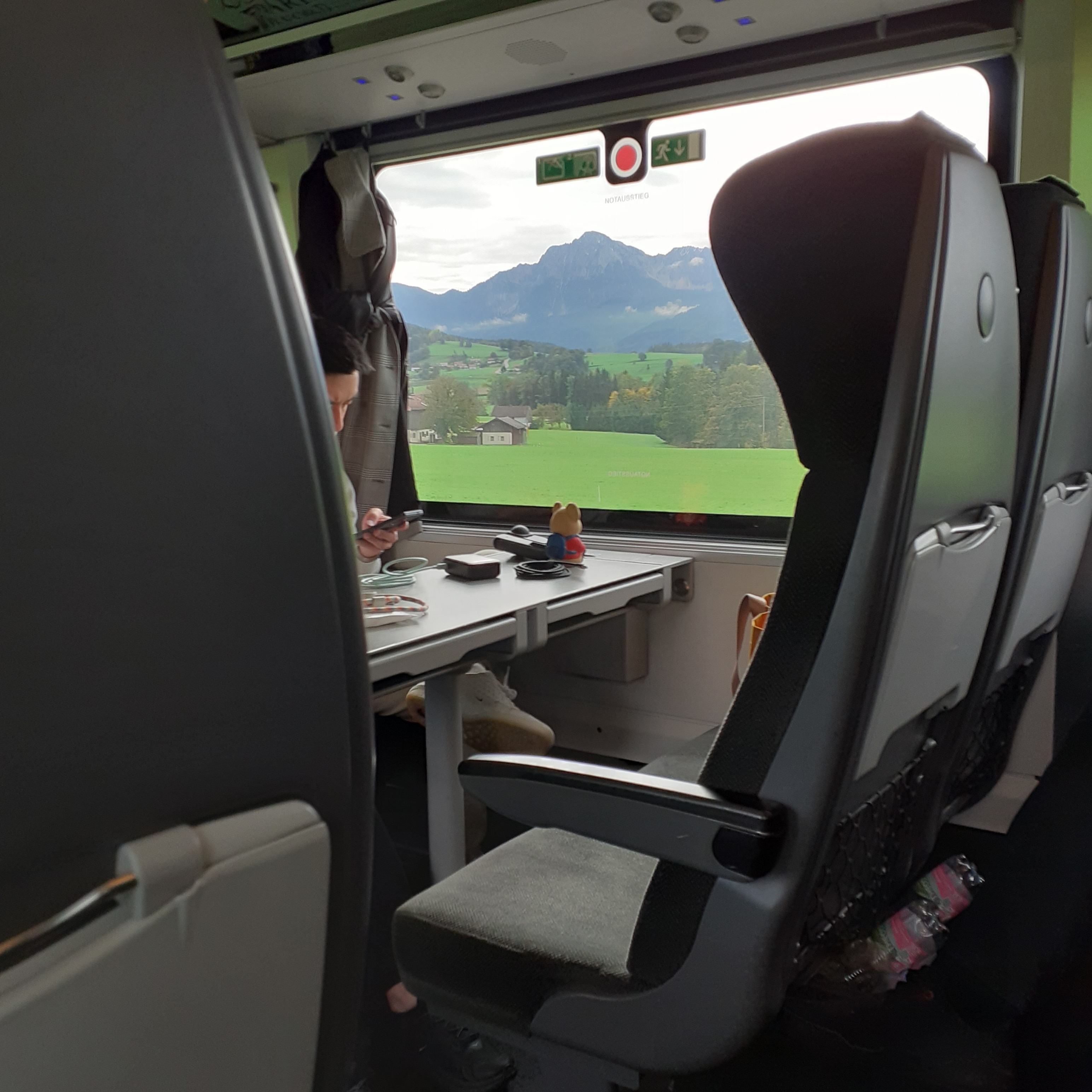
The curtain of cloud lifts as I leave Salzburg. At last I get to see the sublime world of Alpine life and scenery. I could certainly skip through that swinging my guitar case and singing in a high voice. But, probably better not. The train journey is a magical collage of jagged blue peaks and melting green fields. There is sunshine too. At Munich Hauptbanhof I navigate the crowds and make my connection to Arabellapark.
Arabellapark is seven stops and under half an hour by Ubahn. The area is mostly a businesspark with a few hotels. It is modern, quiet, and convenient for the city with regular public transport. My station is on Richard Strauss Strasse. I’m booked into the Best Western Hotel nearby.
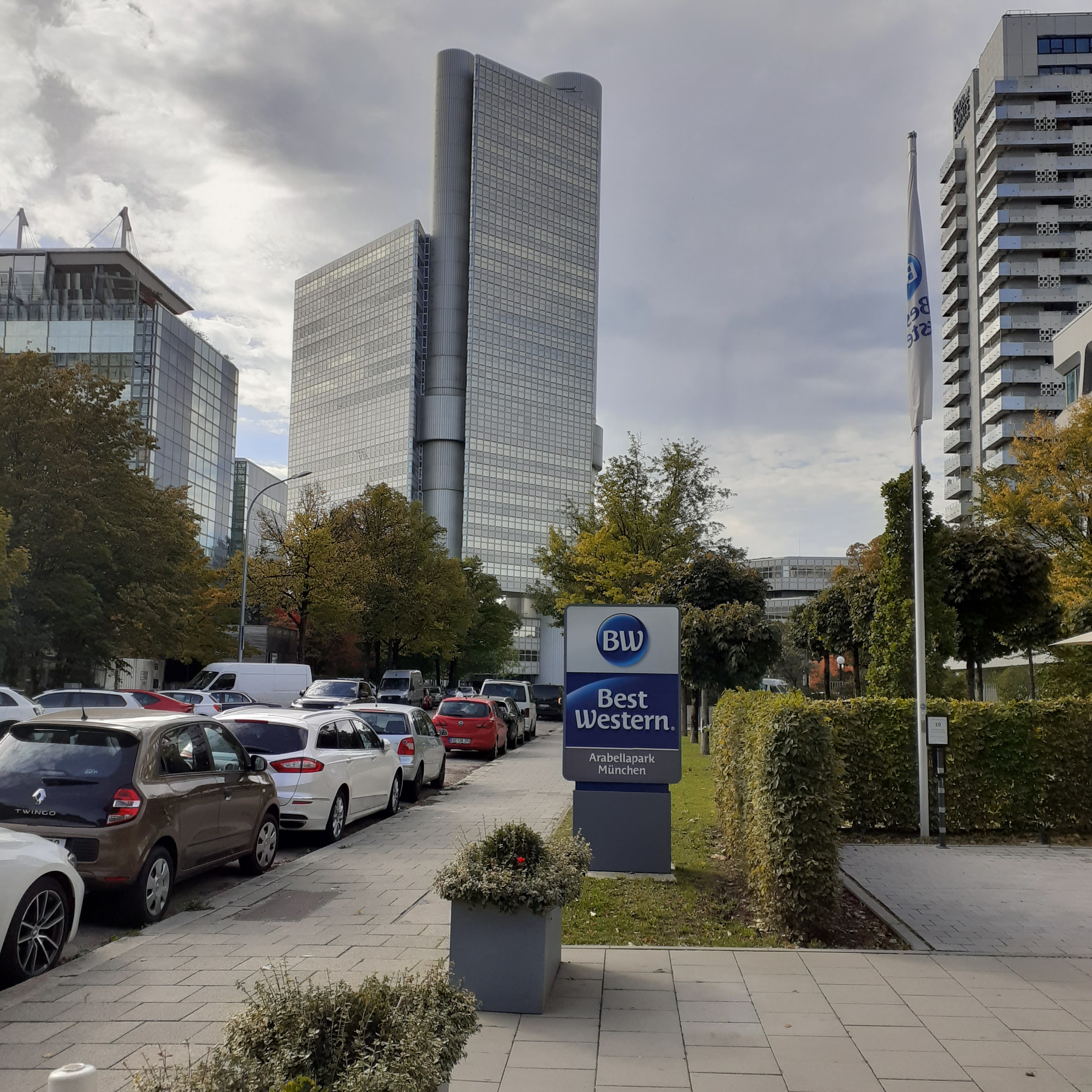
Strauss was born in Munich in1864 and became a famed composer of the late Romantic and early Modernist period. His compositions include Don Juan, Also Sprach Zarathustra and the opera Salome, from Oscar Wilde’s play. Zarathustra provides the dramatic element in the soundtrack for Stanley Kubrick’s 2001 A Space Odyssey, with its opening fanfare, known as Sunrise. Strauss based his sound poem on Friedrich Nietzche’s Thus Spoke Zarathustra. Kubrick’s 1968 film helped reestablish Strauss’s music in the world. In 1933 he had been appointed head of the Reich Music Chamber, the regulating body for music in Germany. This led to accusations of his being a Nazi collaborator, He was cleared post war. It was noted that his insistence to work with librettist Stefan Zweig, a Jew, got him sacked. Strauss died in 1949.

There is something of a town centre in a hdden enclave near the Ubahn terminus at Rosenkavalier Platz. Der Rosenkavalier was an opera written by Strauss in 1910. Arabellapark itself refers to another Strauss opera Arabella. The Platz is a modern pedestrian zone with an interesting Art Deco cinema. There’s a cluster of good eateries and shops. Hans um Gluck is a grill bar. The interior is a startling birch forest making an ambience popular with parents and their kids. Hans um Gluck is a folk tale of the Brothers Grimm. It translates as Hans in Luck, wherein the hapless hero manages through a series of rash transactions to convert a gold nugget the size of his head into a whetstone. There’s an Italian Restaurant nearby, Bistro Fohn, another comfy and friendly spot for good fare.
Morning, and back Into the maw of the Hauptbanhof I go, the Ubahn journey lengthened by a forced connection. It’s heavy rain this morning and I can’t get my bearings in the vicinity of the station which has no discernible front door. I find my way, unintentionally, to Theresienwiesse, the park used for the annual Oktoberfest. This festival takes place in late September, not quite what it says on the tin. I arrived the following week, Hangover Week as it isn’t known. The Oktoberest was certainly tempting, though might be best handled in a group rather than flying solo. The festival began in 1810, to celebrate Prince Ludwig’s marriage to Princess Therese of Saxony. The Festival draws seven million visitors consuming seven million litres of beer. So, they only drink a litre each? I reckon there must be big queues at the bar.
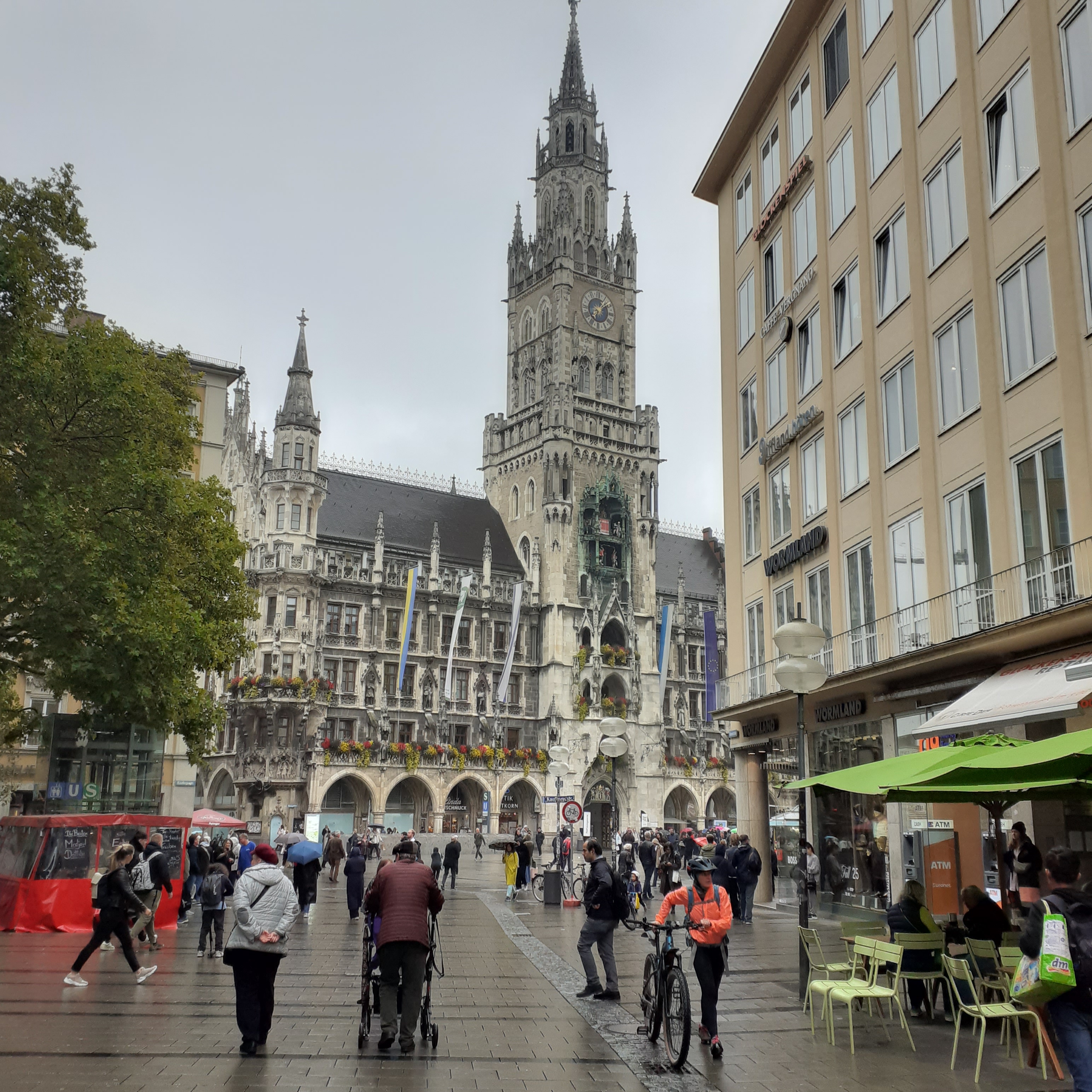
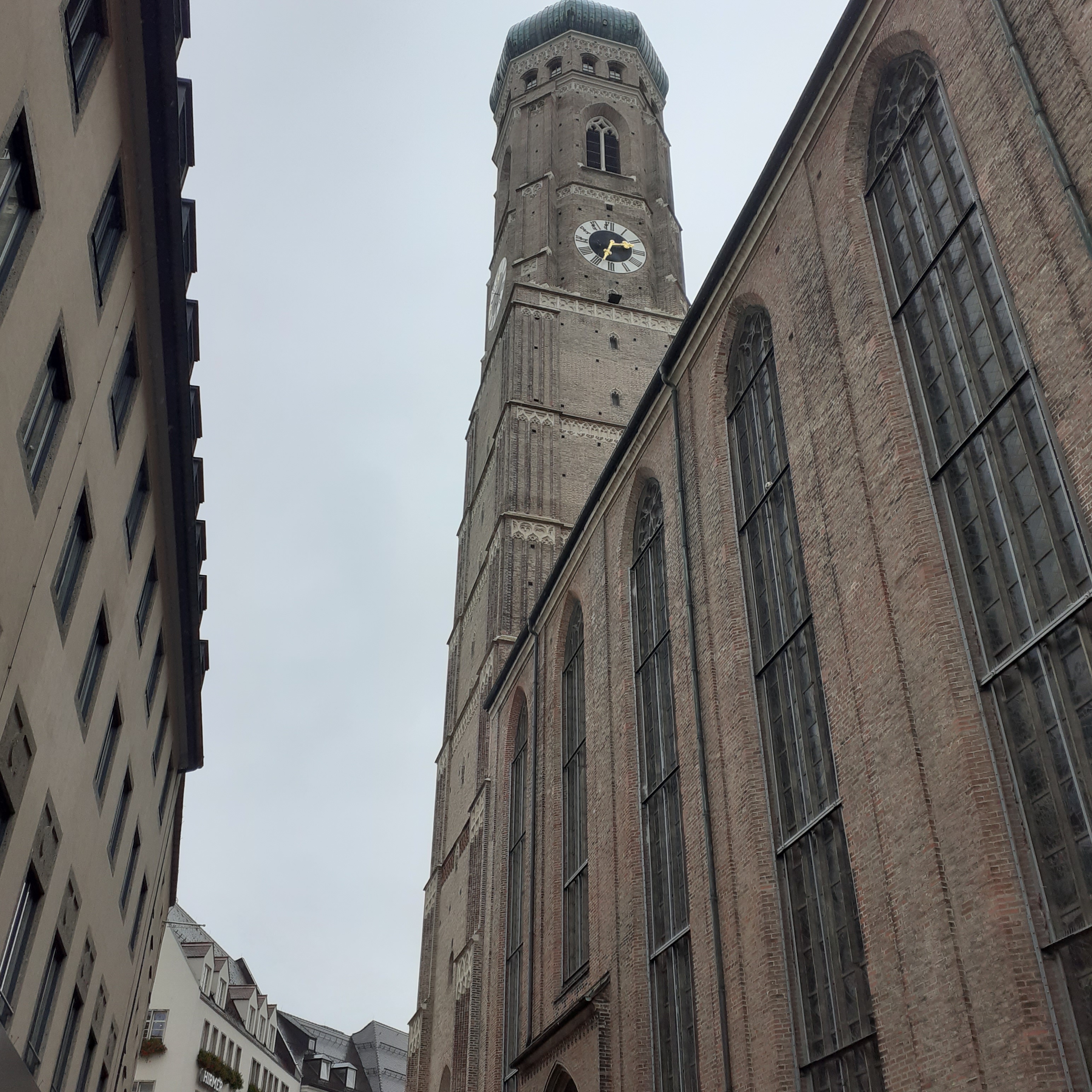
At last I align myself and walk back to the city centre. Marienplatz is that centre, a rectangular plaza dating back to 1158. It centres on the Marian Column, in honour of Our Lady, and erected in 1638 to commemorate the end of the Swedish occupation. The New Town Hall, a fabulous Neo-Gothic palace, forms the northern side of the plaza. Built in the mid nineteenth century and based on Brussels City Hall, it was extended in the early twentieth century with a soaring tower of 85 metres. The Old Town Hall marks the eastern end of Marienplatz, while to the west the towers of Fraunkirch loom. Frauenkirche, also dedicated to Our Lady, is the city cathedral. Its distinctive frontal round towers are the highest structures on the inner city skyline, almost a hundred metres tall and topped with onion domes. The church was built in the late fifteenth century, redbrick and sparse in style.
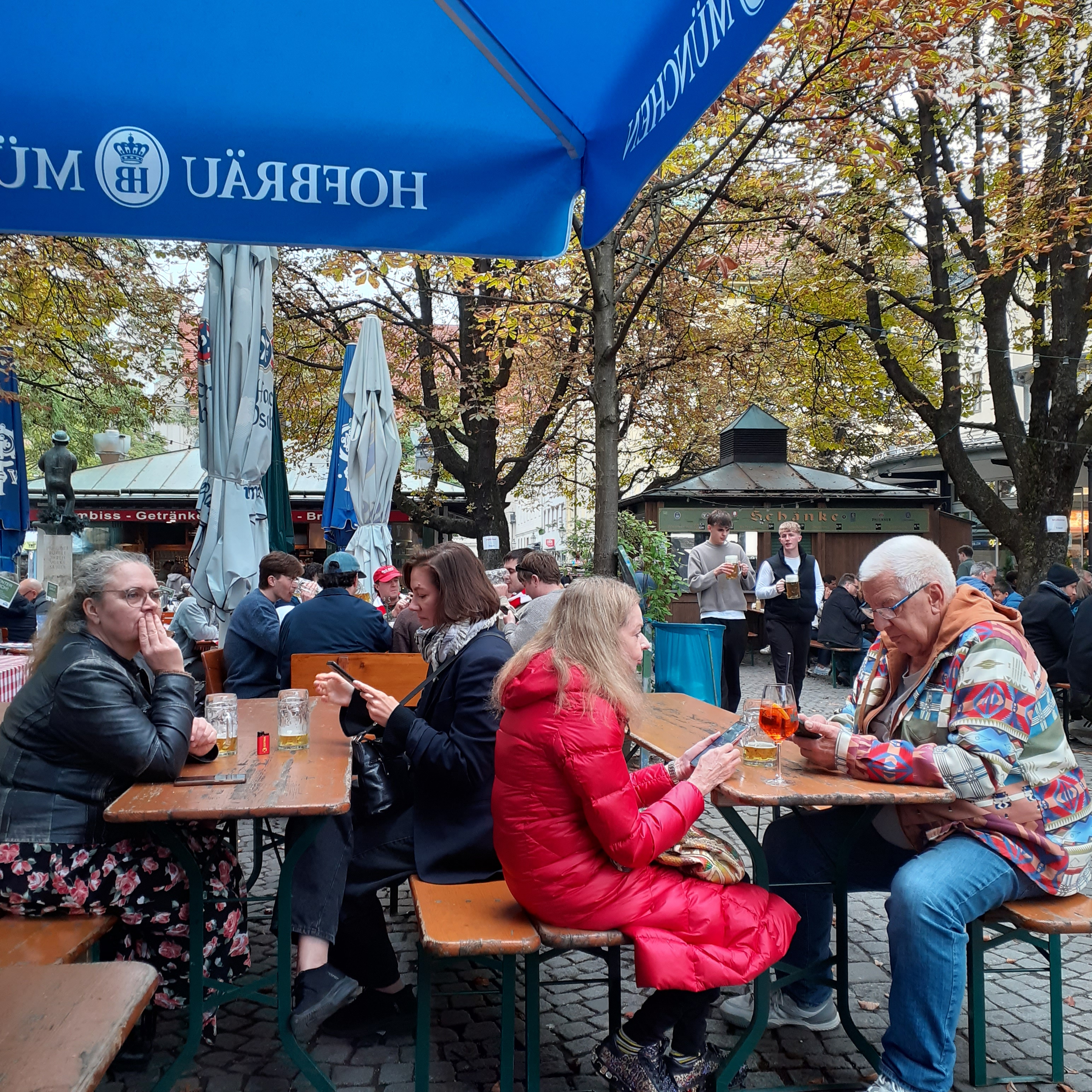
Off Marienplaz is the Viktualienmarket. This vibrant square is packed with stalls selling food, flowers and artefacts, gathered around a sprawling beer garden. It is open every day but Sunday and all human life is here. I queue for bratwurst and chips, with a foaming beer, and find a seat under the trees. The bratwurst is huge and sublime. You could sit here all day and watch the world go by. There’s waiter service, though the self service is best. The beer stall simply sets up the foaming beer by litre or half litre measure and you grab one and pay your €5 at the adjacent register. No queue, just conveyor belt booze. Happy daze.
Munich is a mecca for the dedicated beer hound. In the public interest I thought it best to investigate this phenomenon. Having at last freed myself from the embrace of the Viktualienmarket, I careened through the old town towards the Hofbrauhaus on Platzl, most famous of the city’s beer halls. Ludwig I opened it to the public in 1828 and the current building dates from 1897. The cavernous central hall hums with conversation and cheer. High above, the vaulted ceiling is adorned with baroque frescoes. Light flows in through the high arched windows. The effect is practically religious. I almost feel like genuflecting, though that would be hazardous.
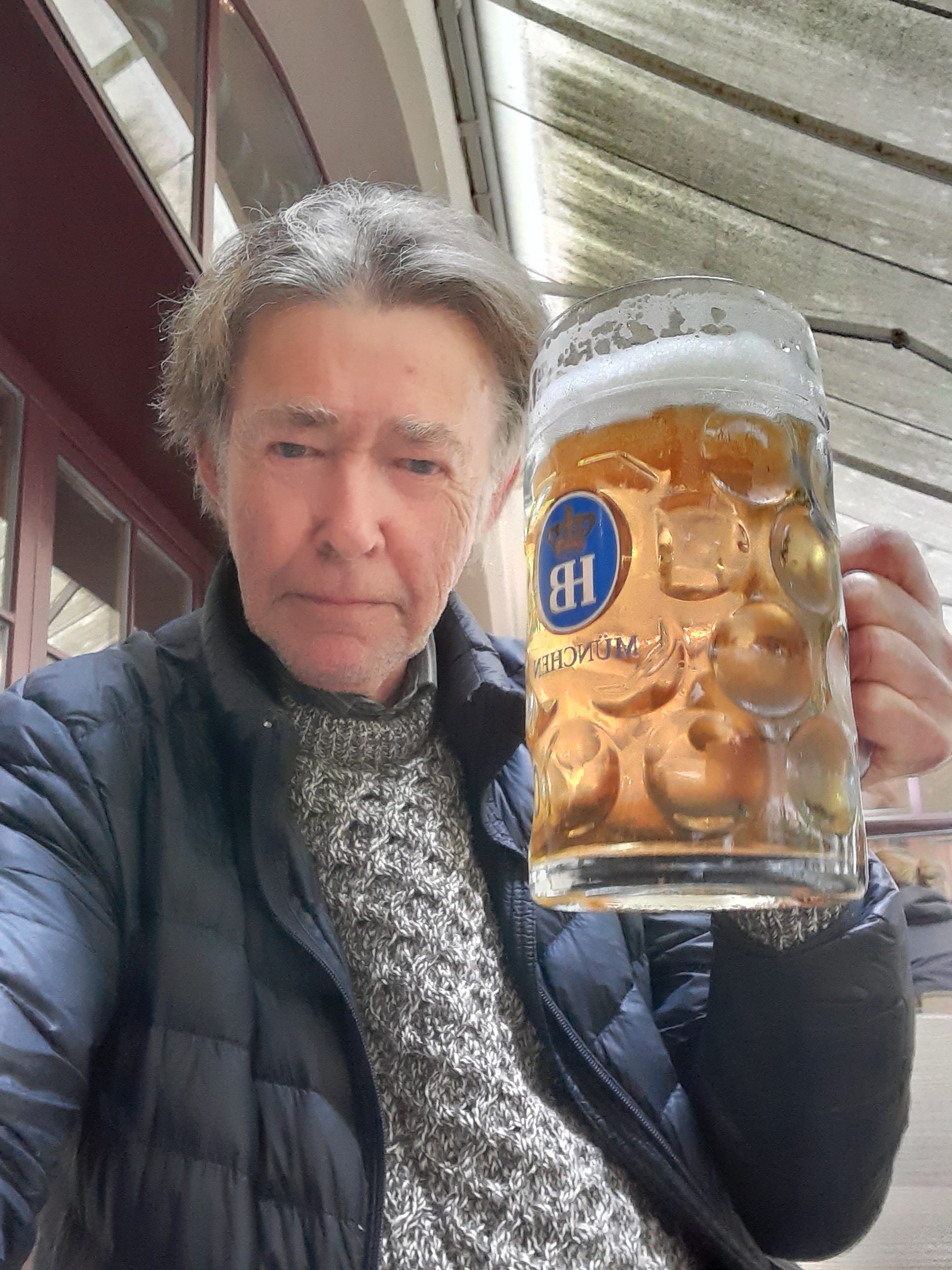
I find a bench in the courtyard beergarden which is quiet. I wrap my hand around a one litre stein, or masskrug. Steins were originally a stoneware mug, though now refer to the heavy glass with a handle synonymous with German beer drinking. There’s a technique to drinking such a volume for a lightweight like me. Slide your hand inside the handle and hold the glass body between palm and thumb. Lift and quaff. Repeat as necessary.
Ein zwei drei vier
Lift your stein and drink your beer
Ein zwei drei vier
Lift your stein and drink your beer
Drink! Drink! Drink!
Platzl is a small pedestrian square lined with drinking and dining terraces. The Dubliner Irish Pub across the road provides a cozier port to put into. I can admire the Hofbrauhaus building from the outdoor terrace.
North of the city centre is the extensive Museum quarter, the Kunstreal, Along the wide treelined avenues are a cluster of major art galeries and museums. The Pinakotheks are the three main galleries: Alte Pinakothek for old masters, the Neue for 19th century art from the Romantics to the Impressionists, and Moderne for twentieth century and contemporary art. The word Pinakothek is taken from the ancient Greek.
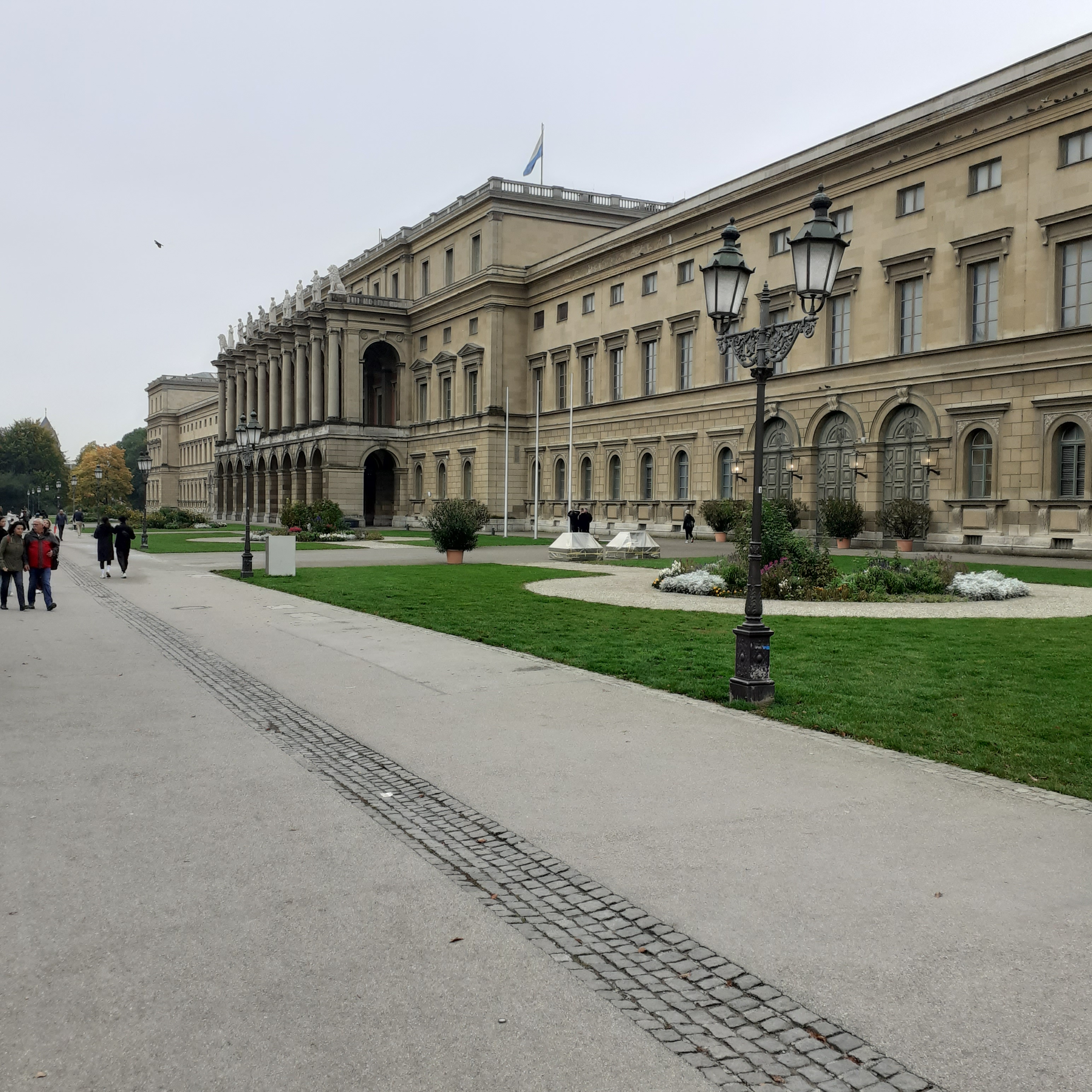
The Alte Pinakothek was begun in 1826 on the orders of King Ludwig (him again) and was the largest art gallery in the world on its completion. It houses a vast collection of European art from the 14th to the 18th century. Amongst 700 paintings there are works by Durer, Rubens, Memling, Raphael, Titian, Breughel, Rembrandt, Van Dyck, Murillo and El Greco. That starting eleven should win the European Champions League for sure. Others that grabbed attantion included Arcimboldo’s ingenious vegetarian heads, the Debauched Student by Van Honthorst, while Bouchier’s elegant portrait of Mme Pompadour is a centrepiece, and also adorns the entrance ticket.
The Neue Pinakothek followed in 1859, the first European museum of contemporary art. Both buildings were badly damaged during World War II but while the Alte was renovated, preserving the stress suffered by the original, the Neue was demolished. It was replaced with a postmodernist building opening in 1981. We didn’t get forty years out of it.

On my visit the Neue Pinakothek was, of course, closed. It is the same throughout Europe I’m afraid, where art museums of 18th and 19th century art are shut. This building was closed in 2019 and will not reopen before the end of the decade. A section of the Alte has been used to display a selection of work from the Neue under the title rom Turner to Van Gogh. Standouts include Manet on his boat, Sunflowers and a view of Arles from Van Gogh, waterlillies from Monet and Max Lieberman’s sundrenched beergardens. New to me was Giovanni Sagatini with a large panoramic landscape title Ploughing from the 1890s. Snow capped mountains at last! It made my trip.
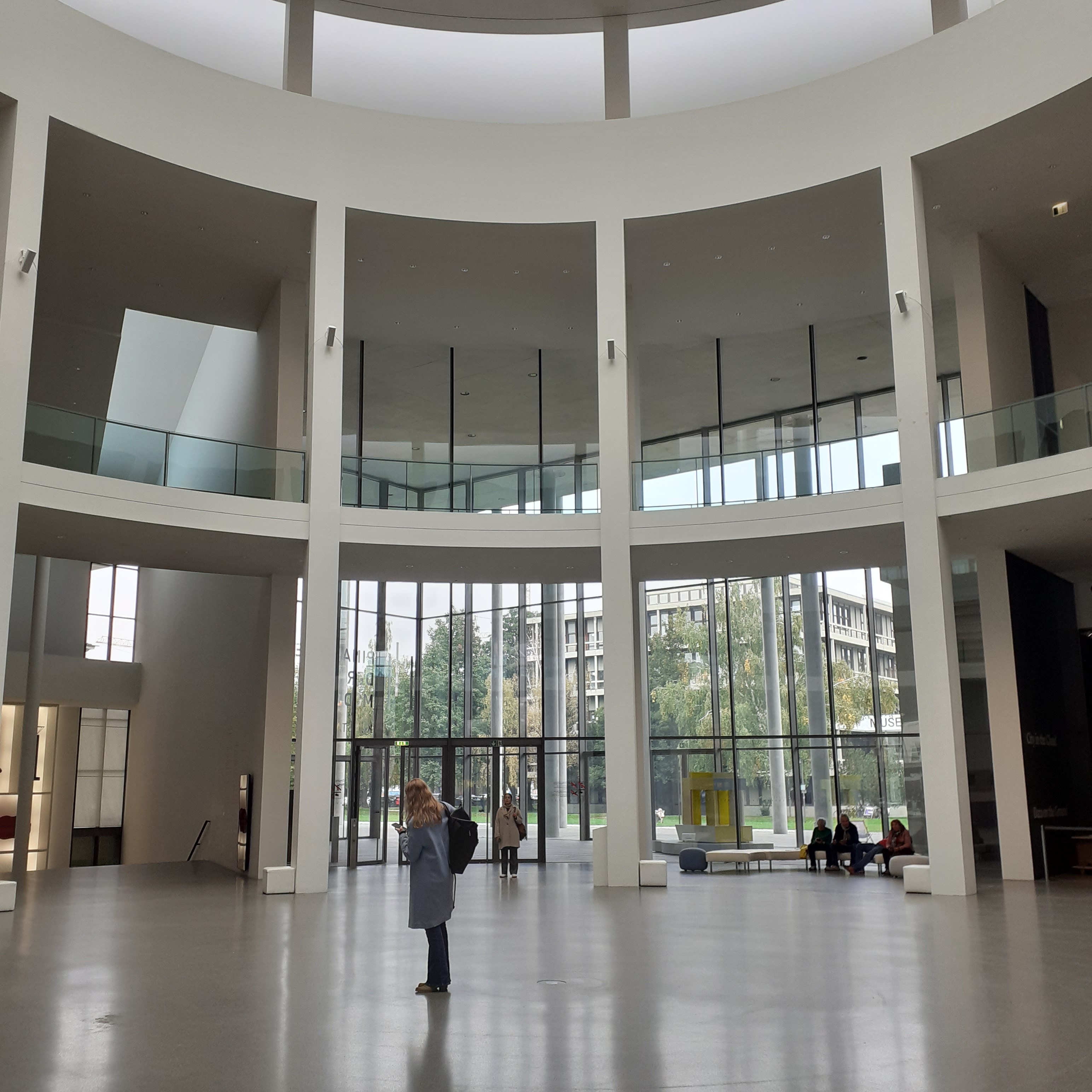
Pinakothek Der Moderne is devoted to art from the twentieth century and onwards. Built in 2002, the building has an impressive glass facade with high columns supporting the canopy roof. Inside it is divided into quarters devoted to art, architecture, design and graphics around a central rotunda. The art focusses first on important works by Braque and Picasso in the development of Cubism. Woman with Violin by Picasso and Braque’s Woman with Mandoline feature as a duet. Something of an all girl band forms farther on with a lifesize vernacular photograph of Patti Smith prowling with her guitar. Magritte, Ernst, Leger and Warhol are also on show. Down towards the basement, there’s a motor car theme, merging with sixtiesish, or seventies graphics.
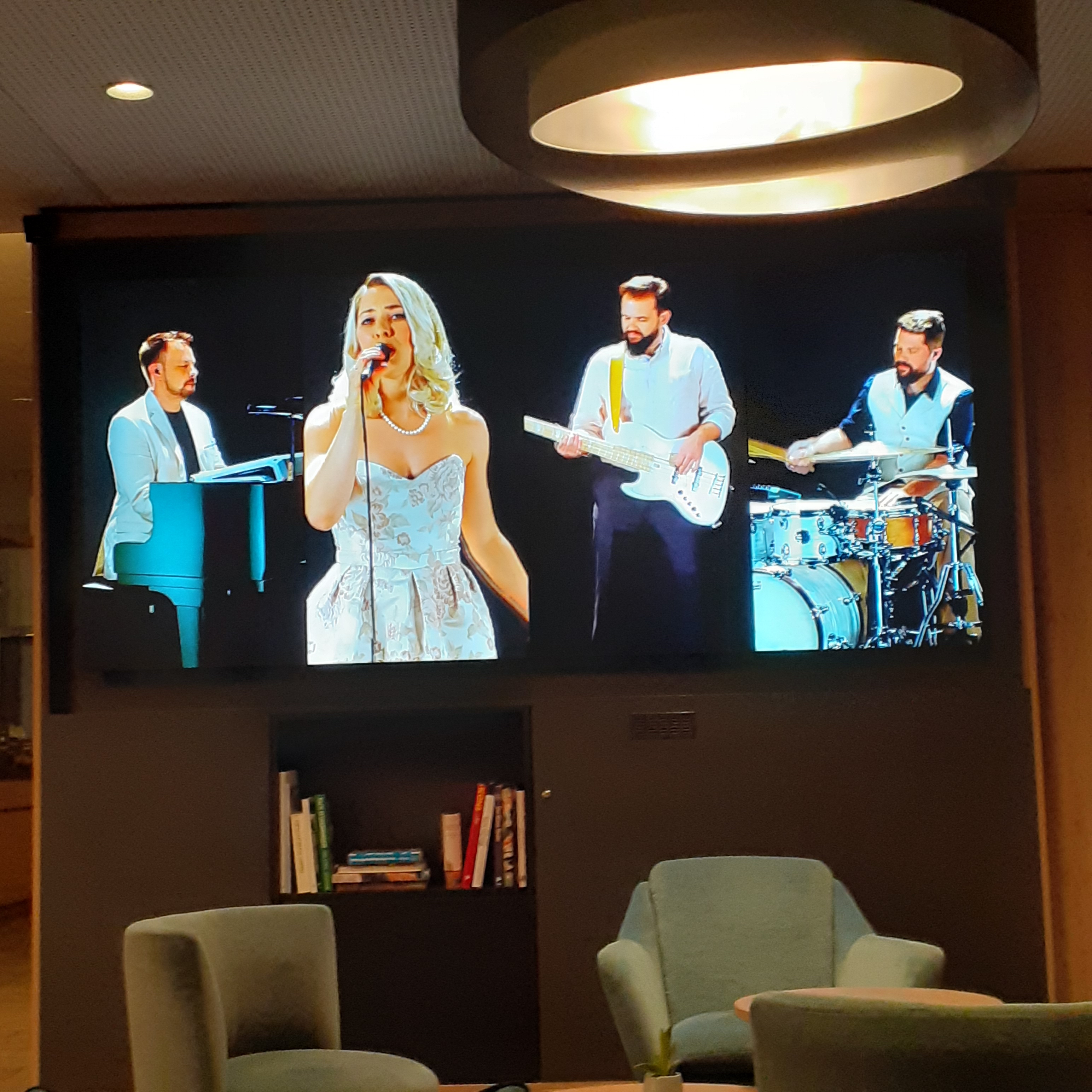
Finally I return to the Best Western for a relaxing drink in the hotel bar. Cillian, or Kilian, the barman keeps ‘em coming. It’s a good Irish name after all. A school in my hometown Bray being dedicated to the saint. He’s also venerated hereabouts in Bavaria. Meanwhile, a virtual band shimmers on the video wall. It’s smooth jazz rock, shades of Supply, Demand and (very attractive) Curves. I slip into the ambience.
The Drinking Song is the appropriate soundbite. It was written by Sigmund Stromberg with lyrics by Dorothy Donnelly for the 1924 Operetta the Student Prince. Sung by Mario Lanza for the 1954 film soundtrack, though in the film Lanza’s voice was lip synched by Edmond Purdom. The story tells of a Prince’s student days at Heidelberg University. Prince Karl is heir to the throne of the fictitious kingdom of Karlsberg. Hmmm, it would be called that. In the course of his studies, or daily drinking sessions as they are more accurately described, Karl falls in love with the innkeeper’s daughter. Who wouldn’t drink to that?
May those lips that are red and sweet
Tonight with joy my own lips meet!
Drink! Drink! Drink! Let the toast start!
May young hearts never part!
Drink! Drink! Drink! Let every true lover salute his sweetheart!
 xxharrison
Wonderful Shane! We were there just before Christmas for the markets!
That must have been fun, Marion. I was between festivals. Enough fun for me!
Oktoberfest beers are tasty. But the celebration in Munich must be pretty rowdy and incredibly congested. Too much togetherness for me!
Too true, Neil. I reckon with less people there’s more beer to go round. It’s a question of balance. Until you fall over.
Aw, the sweet malt of the Hofbrauhaus brew under cloud cover taps into my nostalgia. I was last there in 1999, and even though my visit to Munich was short, I recall very congenial people, an ominous but warmly welcomed mist, and lots of laughs whiles steins clinked (and a few accidentally fell to the ground). Great pics!
Sláinte, Bernie. Hofbrauhaus is still a mecca for beerdrinkers. If you catch my drift. I am amazed I still had a steady hand to take the pics.