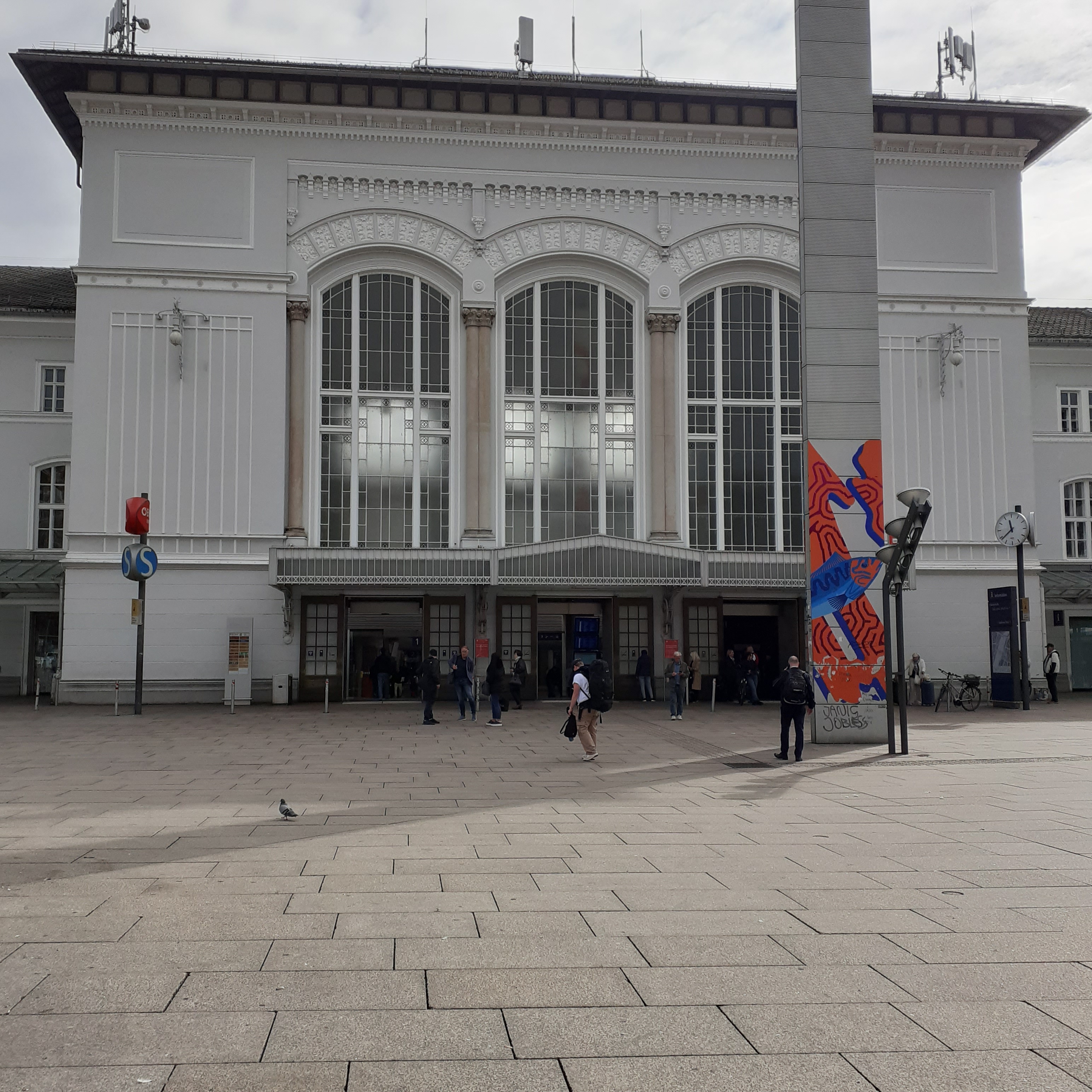
Salzburg is not directly accessible from Dublin outside the Christmas season, so I took an Aer Lingus flight to Munich and a train on to Austria. Salzburg nestles just across the border, ringed by jagged Alpine peaks. Low cloud obscures the Alps on my October visit, which is a pity. The rail route is spectacular, and I did get glimpses on my return. While the Hautbanhof in Munich, efficient hub that it is, visually equates to Hell’s anteroom, Salzburg’s station is sleek, modern and airy, with good refreshment oases. It opens onto a modern square which is a terminus for the city’s tram and bus services. Without sun or shadow to guide me I find myself a bit disorientated but eventually manage to pinball my way to the hotel.
Hotel Scherer is less than a ten minute walk from the station, a bit more when winging it like me. I find it set in a quiet residential quarter that emerges from the edgy periphery of the railway overpass. Such structures are inevitably ugly, though this one serves to make Dublin’s unloved Loopline positively handsome by comparison. It also demarcates the city centre from the inner suburbs. I arrived at four o’clock for check in and then take a short walk down to the river.
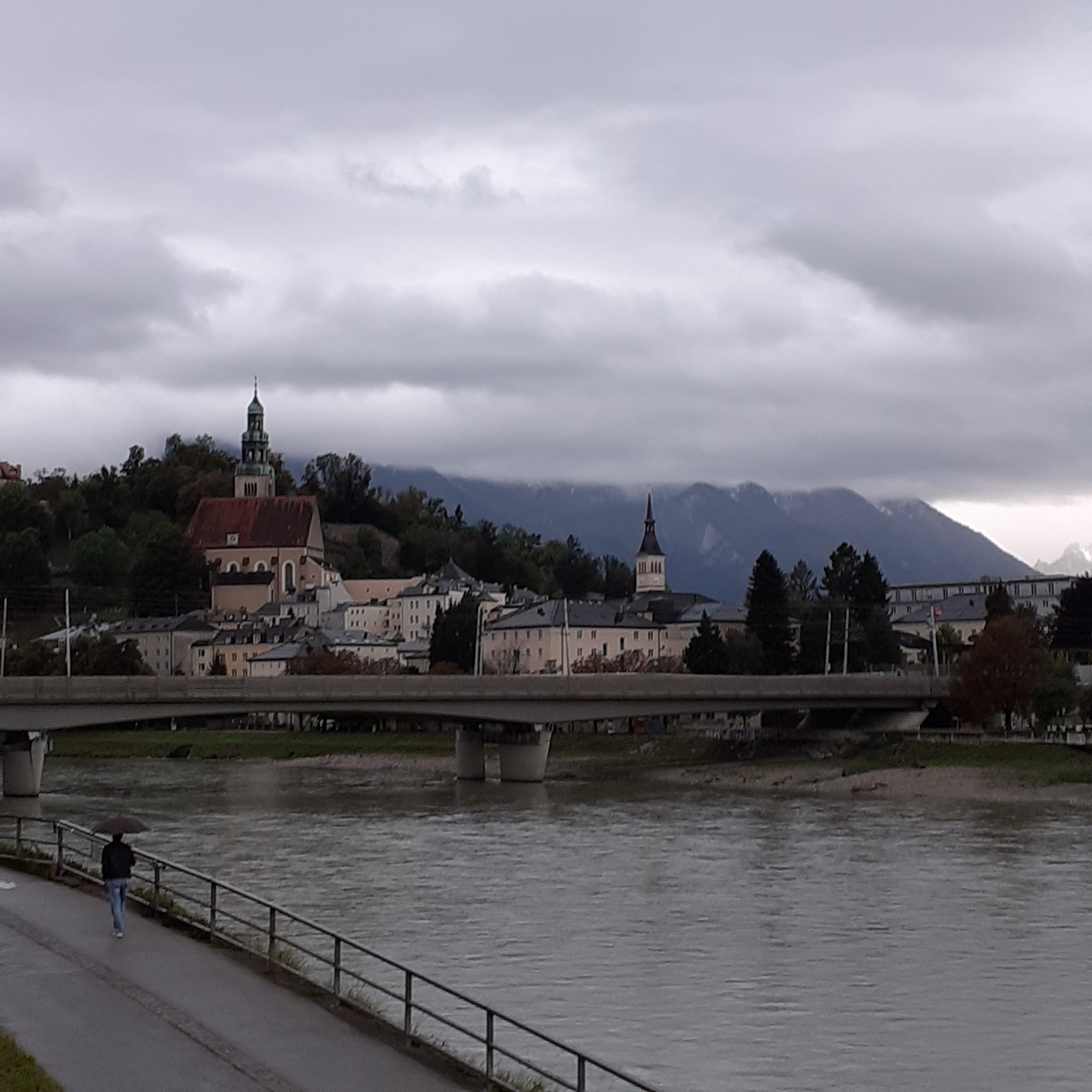
The River Salzach powers through the city, its swift flow channelled between attractive quaysides on both banks. Elizabeth Kai leads all the way into the city centre, a fifteen minute walk or so. Nearby, just past the railway, the Mirabellgarten is laid out on the north bank. This is an attractive rectangular park flowing around the Mirabell Palace, well sprinkled with statues and fountains. Beyond the buildings, I catch fleeting hints of mountain peeping through the clowd. Night is falling with the rain as I sail into Franz Josef Strasse
I have my evening meal at Lazart im Cafe Wernbacher. Its modern, slightly Deco facade wraps a warm inner ambience. It looks European, but it is in part a Peruvian Restaurant, mixing Alpine and Andean fare. Two American couples at nearby tables talk and enthuse; one couple obviously regulars. Good food in a comfortable, colourful setting.
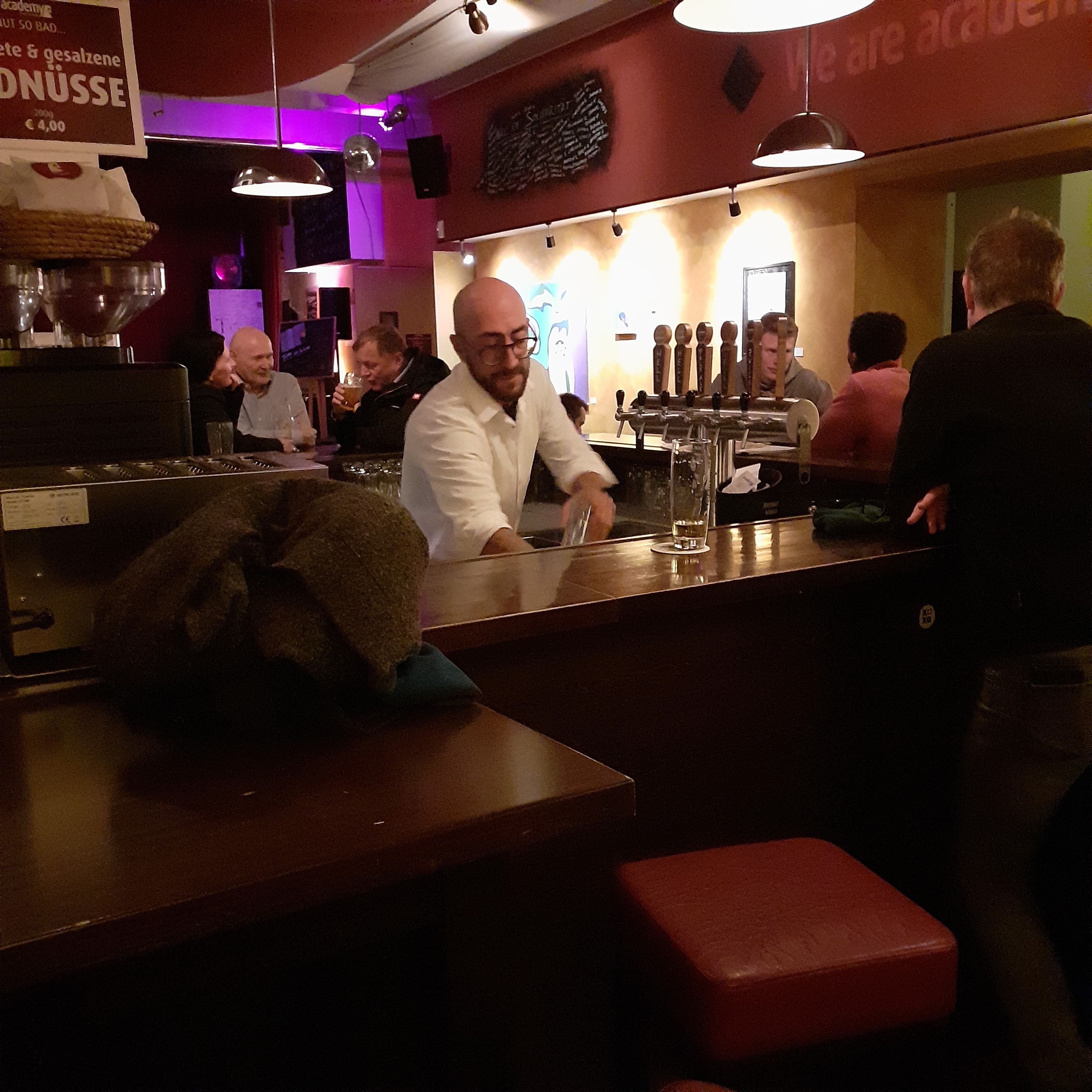
Across the road is the Academy Cafe Bar, with a haphazard, vaguely Bohemian ambience and featuring the Best Barman in the World! I kid you not. One man serving maybe fifty customers scattered through several rooms with panache, unflapable good humour, and speed. How does he do it? He even keeps tabs on my cavalier attitude to beermats, frisbeeing them across the lounge whenever I neglect my duty. But most pleasantly done. I returned the next night but he wasn’t there. The staff, all two of them, were excellent.
That night, I talk to a French Canadian lady on the hotel terrace. She is guiding a group of tourists who have put into port here. Salzburg does seem particularly popular with North Americans. Talk is travel too, and soon we are amongst red maple leaves in the Fall. There’s a good friendly vibe around the hotel lobby and bar which should hasten the approach of sleep. But doesn’t. Later I watch Midsommer Murders in German. Subtitles seem to have disappeared from hotel tvs since covid though the cosiness of the friendly English murder pervades.
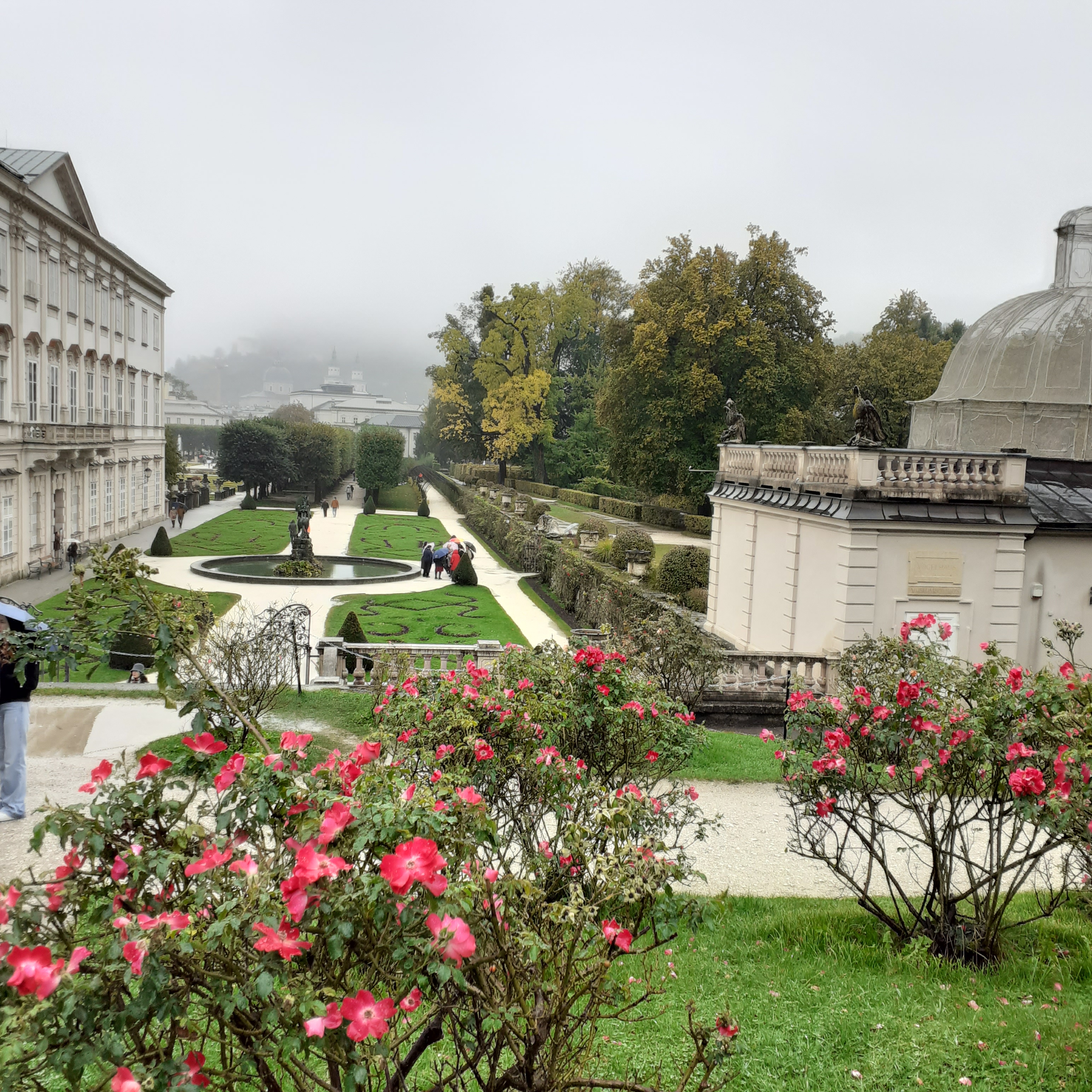
Tuesday is even greyer on my way to the city centre. First a stop for a caffeine spark at Cup & Cino, calmly presiding over a busy intersection within the loopline. I return to Mirabell Park in daylight. The compact park skillfully blends centuries of building, ornament and greenery. Mozarteum Univercity was founded in 1841 and is a college of the dramatic arts with two concert halls. Mirabell Palace along one side was originally home to the reigning archbishop in the late sixteenth century, Wolf Dietrich Raitenau and his mistress Salome Alt. It was an open affair, celibacy then being regarded as a temporary abberration. The loving duo were later expelled. The palace name was coined by conjoining wonderful and amazing; adjectives you’ll use a lot in Salzburg.
Makartplatz at the base of the gardens has the Mozart Museum at the composer’s residence. Across the bridge the Altstadt, Old Town, clings to the far bank, as scenic as you could hope for with the lofty fortifications of Hohensalzburg Castle forming the icing on the cake. The view affirms the guide book witticism regarding Salzburg: if it’s Baroque, don’t fix it.
Salzburg ranks fourth in size of Austrian cities. It is not a particularly large city with a population just over 150,000 people. It sits about 1,400 feet above sea level with the Alps touching the sky all around. The peak of Untersberg climbs to 6,470 feet and is only ten miles from the city centre. It makes a popular day trip for visitors, with a cable car taking one to within five hundred feet of the summit. The mountain featured in the 1965 musical The Sound of Music. The hills are indeed alive to that.

Of even more note musically is Wolfgang Amadeus Mozart, born here in 1756. At seventeen (going on eighteen) he was a court musician in the city but sought fame further afield and settled in Vienna in 1781. His writing across a wide range of musical genres is seen as a pinnacle of classical composition. Operas such as Don Giovani, The Magic Flute, Eine Kleine Nacht Musik and the Marriage of Figaro remain at the top of the Classical repertoire.
He died at thirty five in Vienna, leaving his wife and two sons, and a body of work to console the whole world through the centuries. And beyond. He is well remembered in Salzburg. His birthplace and later residence are preserved in museum and concert hall, by way of fridge magnets and chocolate treats.
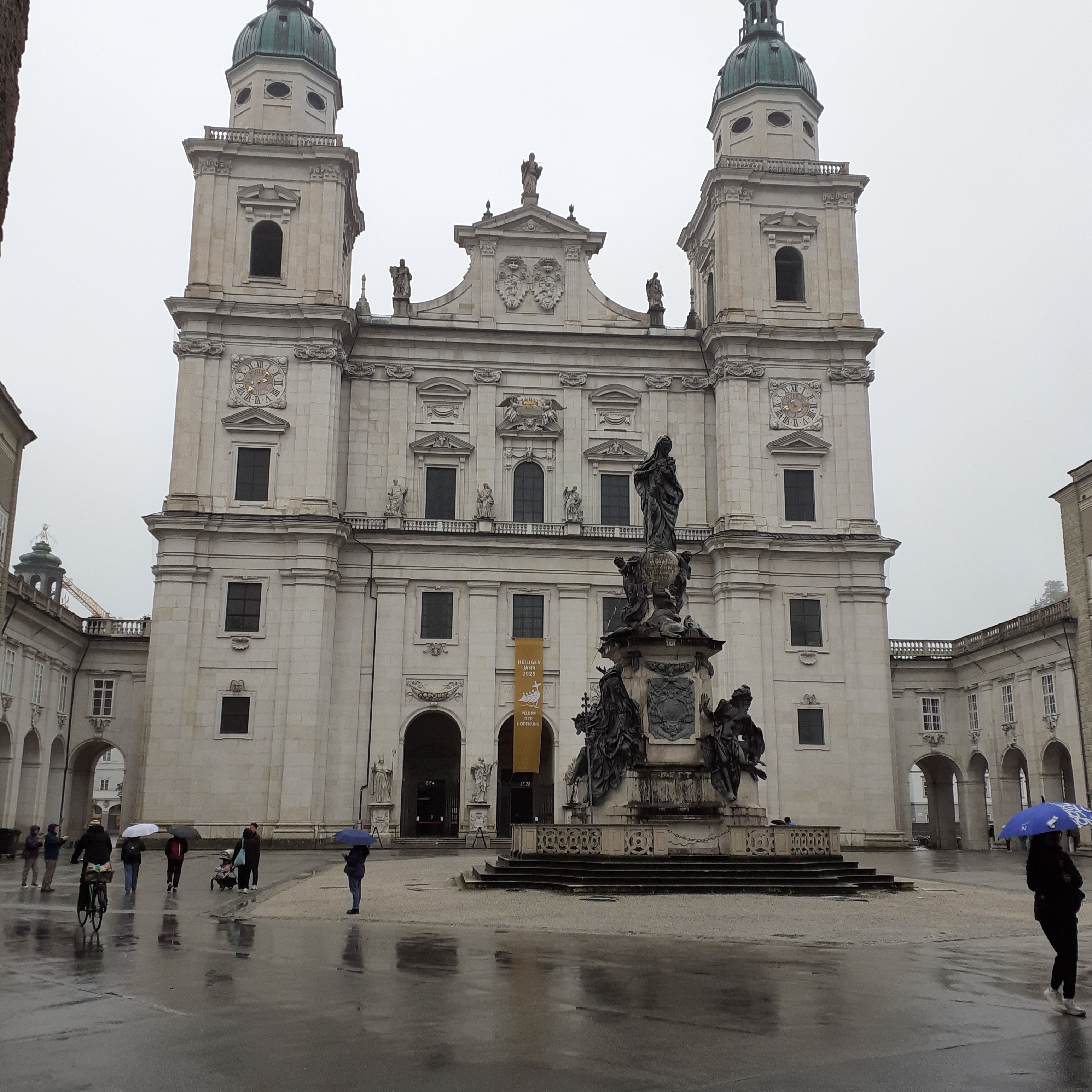
Across the river I stop at Cafe Glockenspiel on Mozartplatz (of course) for their Happy Eggs breakfast. I drape myself on a seat on the heated terrace looking out at a statue of the man himself. Happy indeed. The Dom Cathedral backs on to this square and is a powerful and distinctive landmark of the city. It was designed in the late 16th century in the reign of Raitenau. He was a fan of Italian Baroque, and also responsible for the Old Residence building attached. It was not until 1614 that the foundation stone was laid, the final design by Swiss architect Santino Solaridom
The entrance fee costs me €5 although I thought the sign read €9, and that with a Salzburg card. Cheap at half the price and rewarding with an interior that is peaceful and inspiring. I stop for prayer at the first available altar, lighting the essential votive candle. I had to repeat the process at the final altar too. Its icon to Mary, in the Orthodix style, was the same as one we had in our childhood home where my mother and my sister dressed a daily altar on the landing. That’s worth a candle at least. Mind, by the time I had lit two candles I was nearing €7 and then …
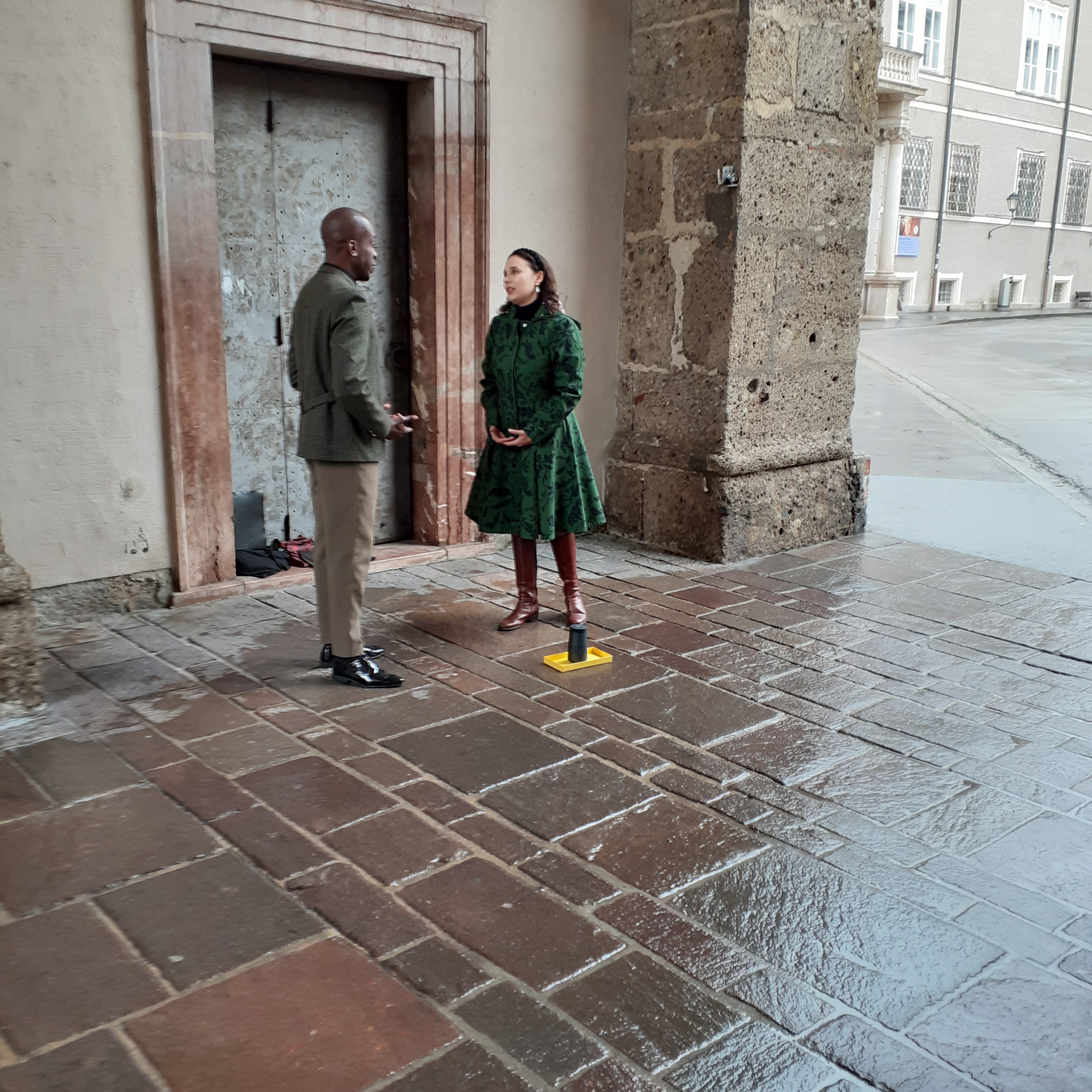
I exit with a calm energy. The front of the cathedral faces on to Domplatz, an enclosed square centred on an impressive Marian column. The square is accessed through three arches. I am leaving the square through the western arch when a duo pop out of an alcove to serenade us. The couple, who I think are English, give voice to the magical music of Salzburg. I am caught in their web for three or four numbers. Culminating in the Magic Flute, where heroine Pamina and comic everyman Papageno sing:
Bie mannern welche liebe fuhlen
fehlt auch ein gutes herze nicht
(men who hear the call of love
do not lack a gentle heart)
The duet is in praise of love and the marriage of man and woman. It links love with the divine, expressed in music that is spiritual and sensual. Hearing such music live, red and raw, is elevating. Soul swooning upwards left me dizzy. Lighter financially, of course; they are buskers after all. The coexistence of spirit and senses inside and outside the Dom had set me back a tenner, but was truly priceless. I walk on air, feeling like a character in a painting by Marc Chagall. Excuse me while I kiss the sky.
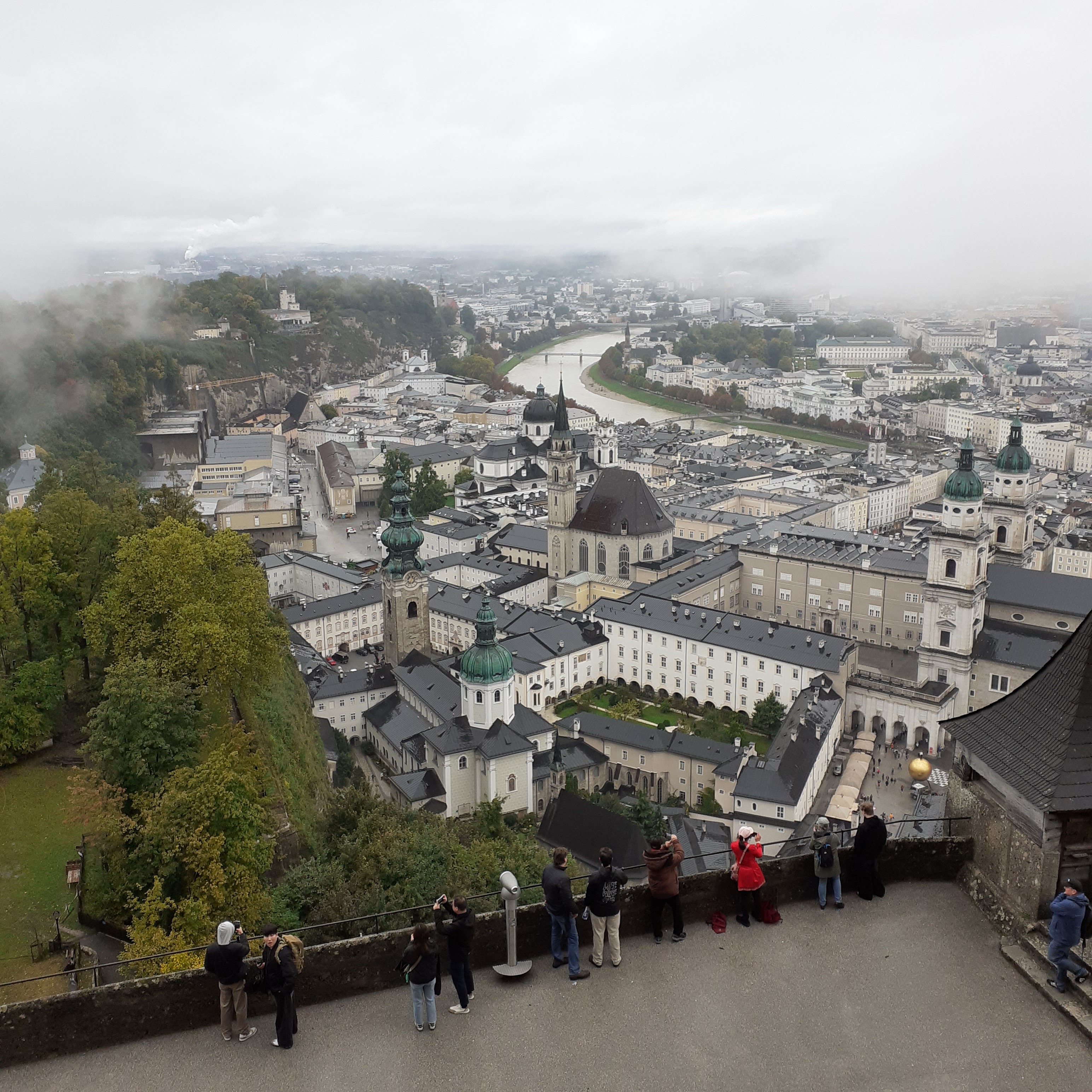
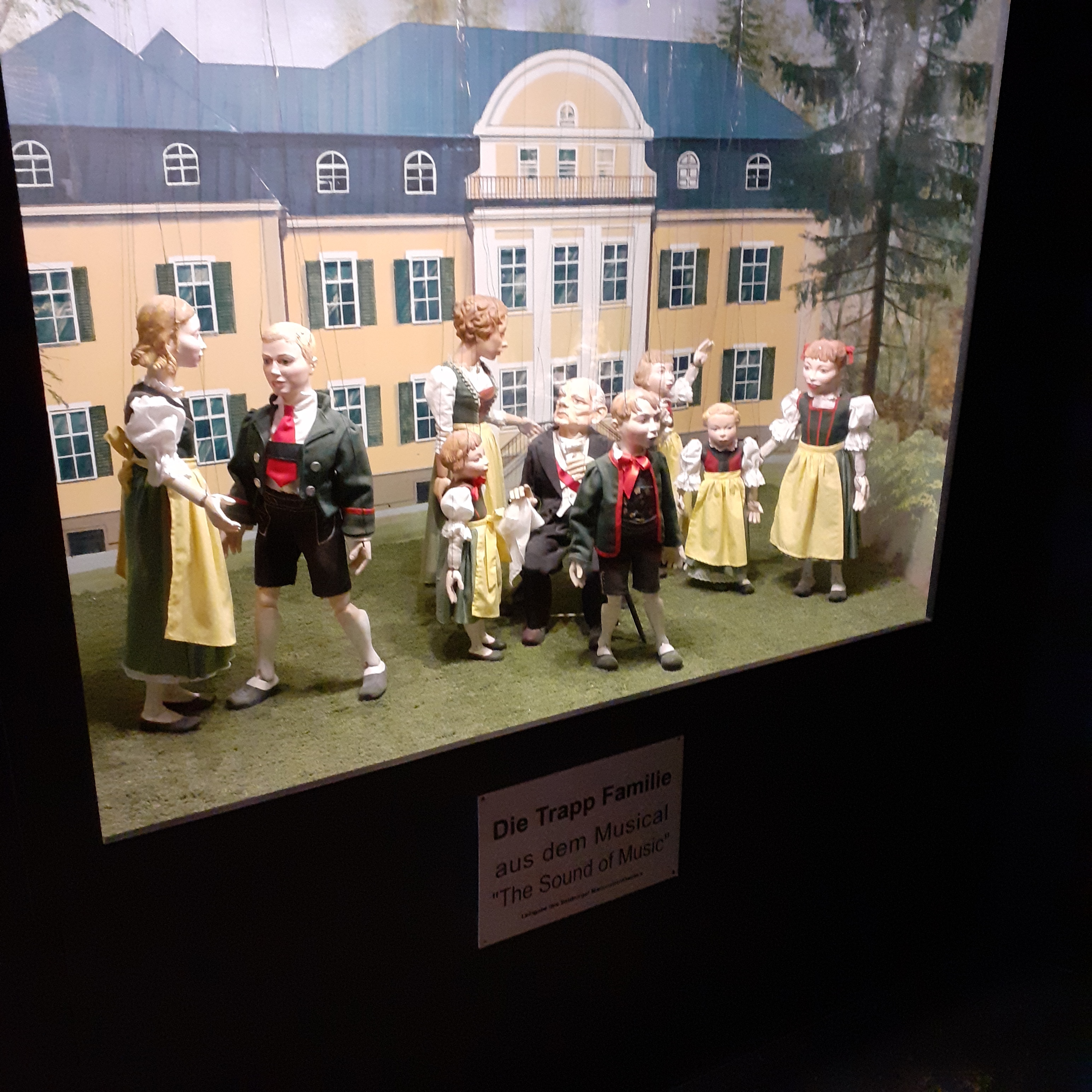
To get truly high in Salzburg take the funicular to the castle. A true ice cream castle in the air, for centuries it was the bastion or the ruling archbishop. The fort was first established around 1077 and has been embellished over the centuries. The funicular was built in 1892 as tourism grew. It beams us up through building, forest and cloud to deliver us to giddy heights. Whether the clouds cushioned or contributed to the sense of vertigo is hard to say. A biergarten balanced on the cliff edge is not open, while the battlements offered leeting apertures of the city far, far below. There’s much to see within the walls. A museum of puppets includes an animation of the peasant’s siege of the sixteenth century. And the Von Trapp family in miniature. The castle museum has models of the fortress through the centuries. There’s much of miltary and political interest. History never rests, but persists.
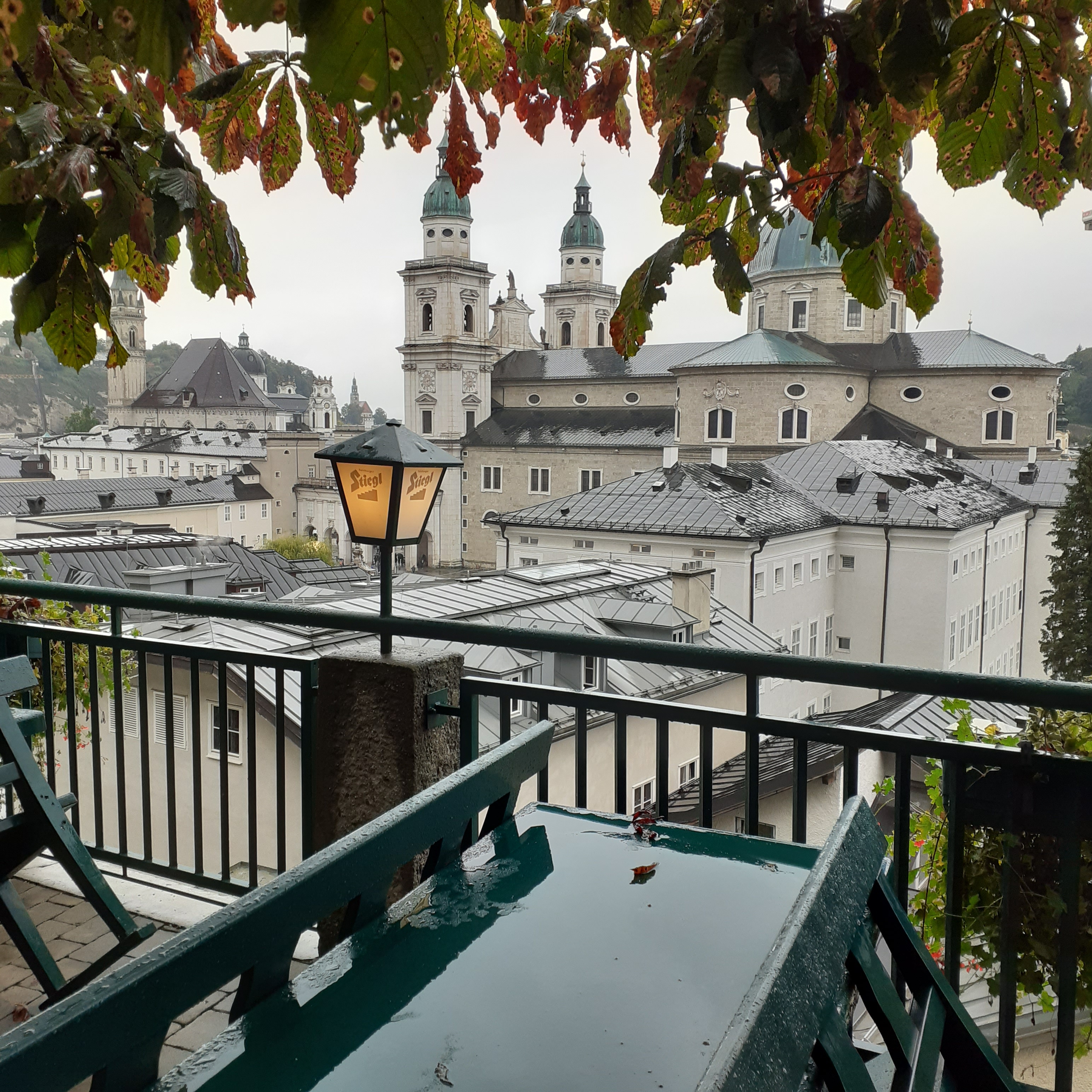
i’m walking on air again as I make my way back via the funicular. Touching ground, I consider this the perfect time to fortify myself with a pint. Stiegkeller is a large building beside the funicular, with cavernous old style bars, restaurants and a rooftop garden. From the garden terrace there’s an excellent view over the city, dominated by the Dom. Service is straightforward scoop and go, a lady pulls your pint and you carry it off. This is music to my heart, dispensing with the middleman, the waiter so beloved, mysteriously, of continentals. Still, such delaying tactics, and indeed food, are available here. But bah! I decide on another self service pint.
 xxharrison
This is a city I would like to visit. And I would like to meet the incredible bartender you write about.
Yeah, Salzburg is well worth a visit. I’d go again. I may take that bartender home with me; he’s a national treasure.
Really enjoyed your tour of Salzburg Shane, a city I’m.yet to visit. I’ve only been to the Austrian Tyrol for ski trips and to Vienna once on a day trip from Bratislava.
It’s very popular this time of year, Marion, for its Christmas market. The rail link from Munich is also good. A lovely city in a spectacular setting; you should give it a try.
Happy Christmas Shane.
Thom
Happy New Year, Thom. I am emerging from hibernation at last. But then this is Hibernia!
Hunker down!