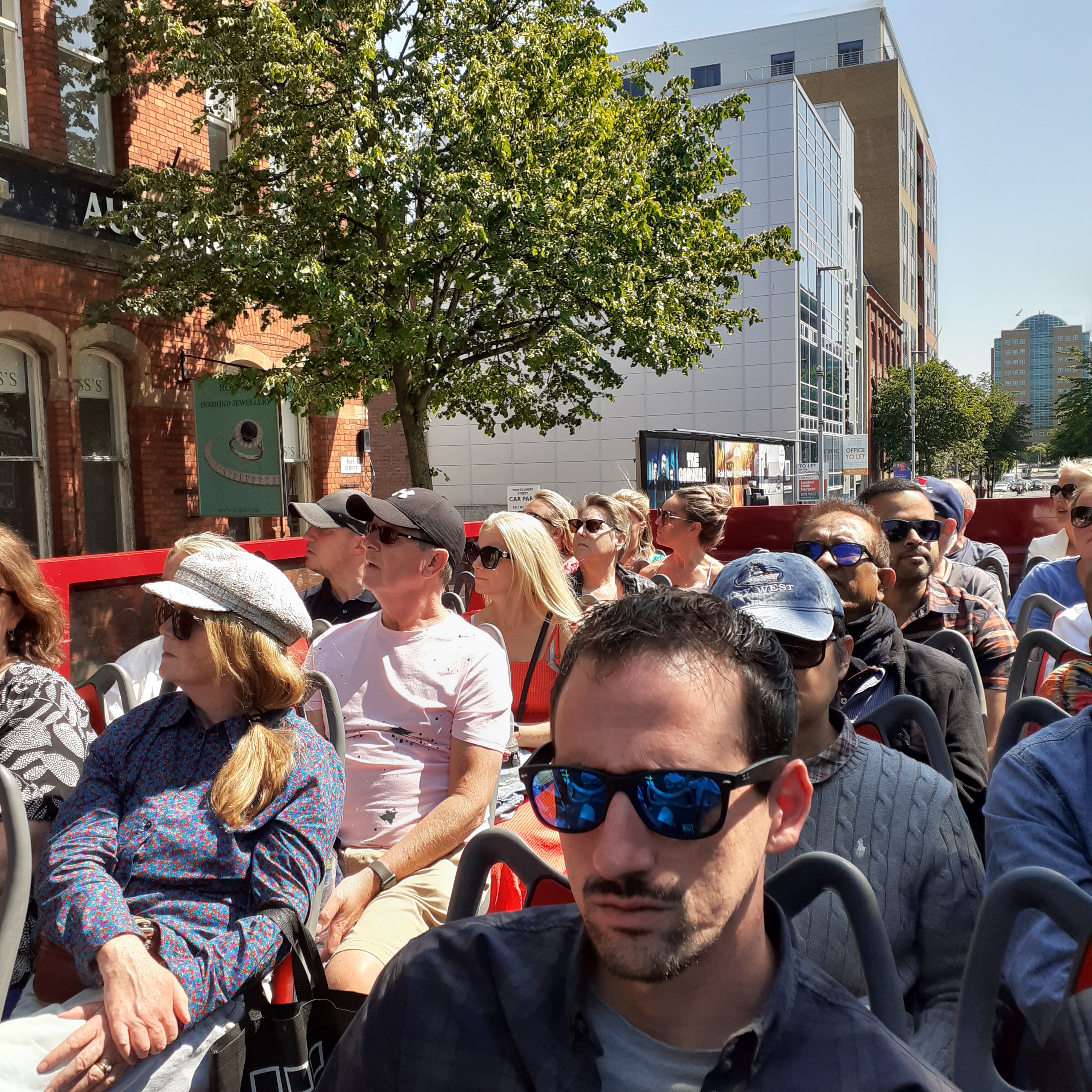
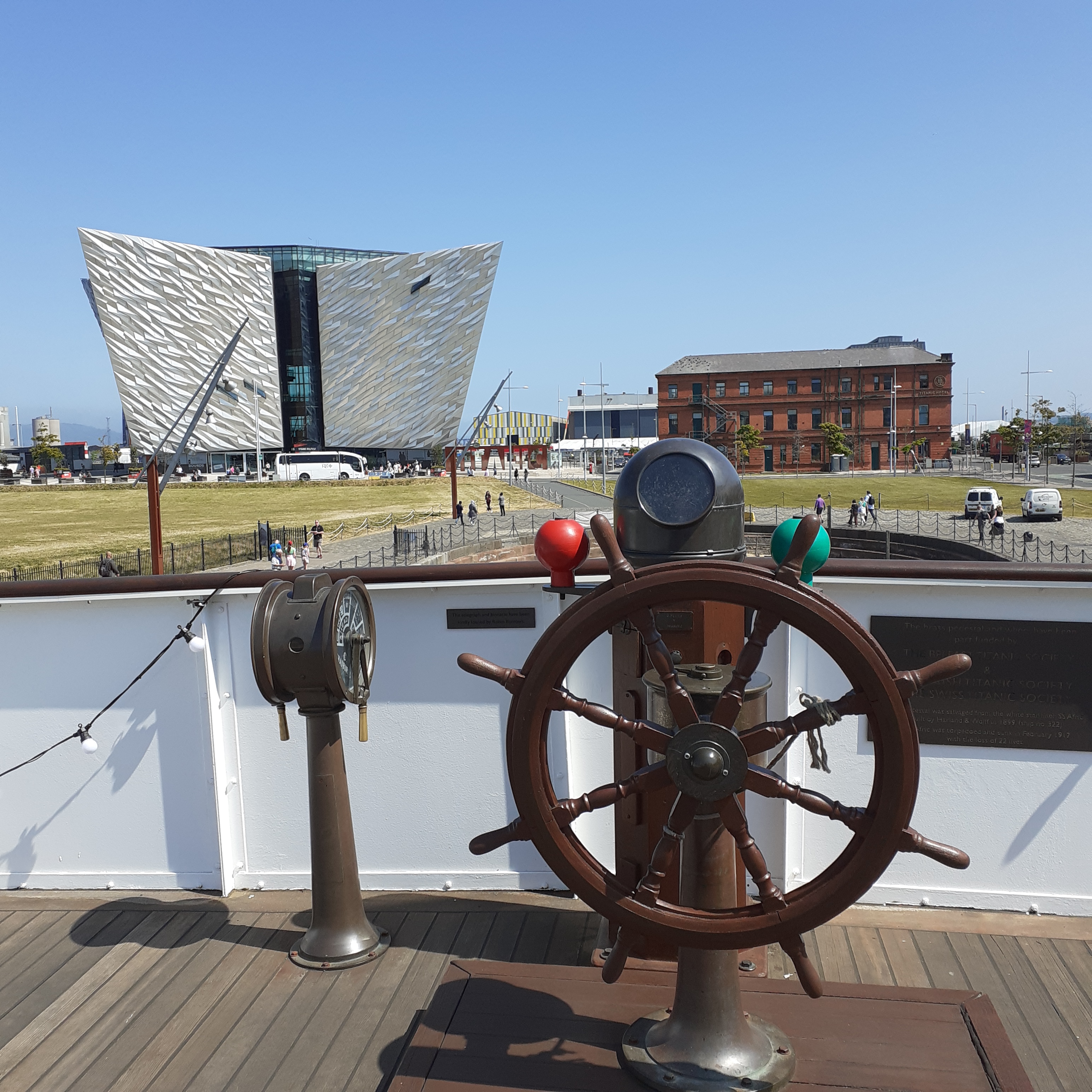
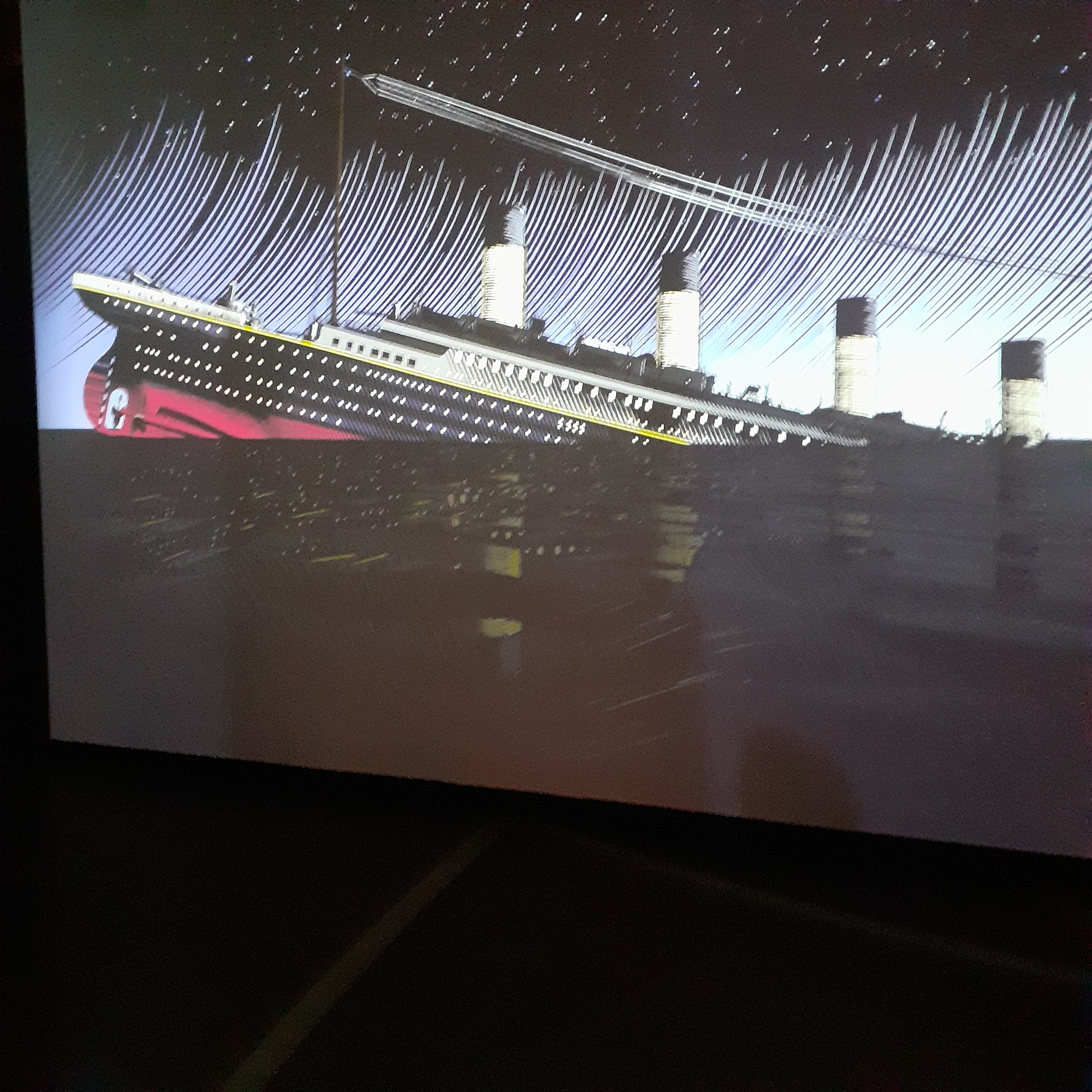
Most cities offer an open-top, hop-on hop-off bus tour. Mostly I can take or leave them. It does make for a particularly useful introduction to Belfast. Much of the city’s fame is steeped in the Troubles, interesting times to be sure. The suburbs featured even more than the city centre. The Falls and the Shankill were the capitals of the troublesome antagonists. There’s something slightly weird being a tourist on an open top bus, cruising through mundane working class residential areas, safe but with a frisson of danger. Perhaps weirder still to be a resident going about your business, yet at any time grabbed in the lens of visitors cameras. Though it could be worse, and once was. A loop through the docklands is also useful, stopping of course outside the Titanic exhibition.
The tour guides each have their own patter, a comedy routine in the making, a mixture of historical details and lurid anecdotes. The latter may be shaggy dog tales, but the history is convincing. We took a couple of jaunts, and so were treated to a variety of routines. Most were racy and jocular, and one who did a drearily hilarious comic turn.
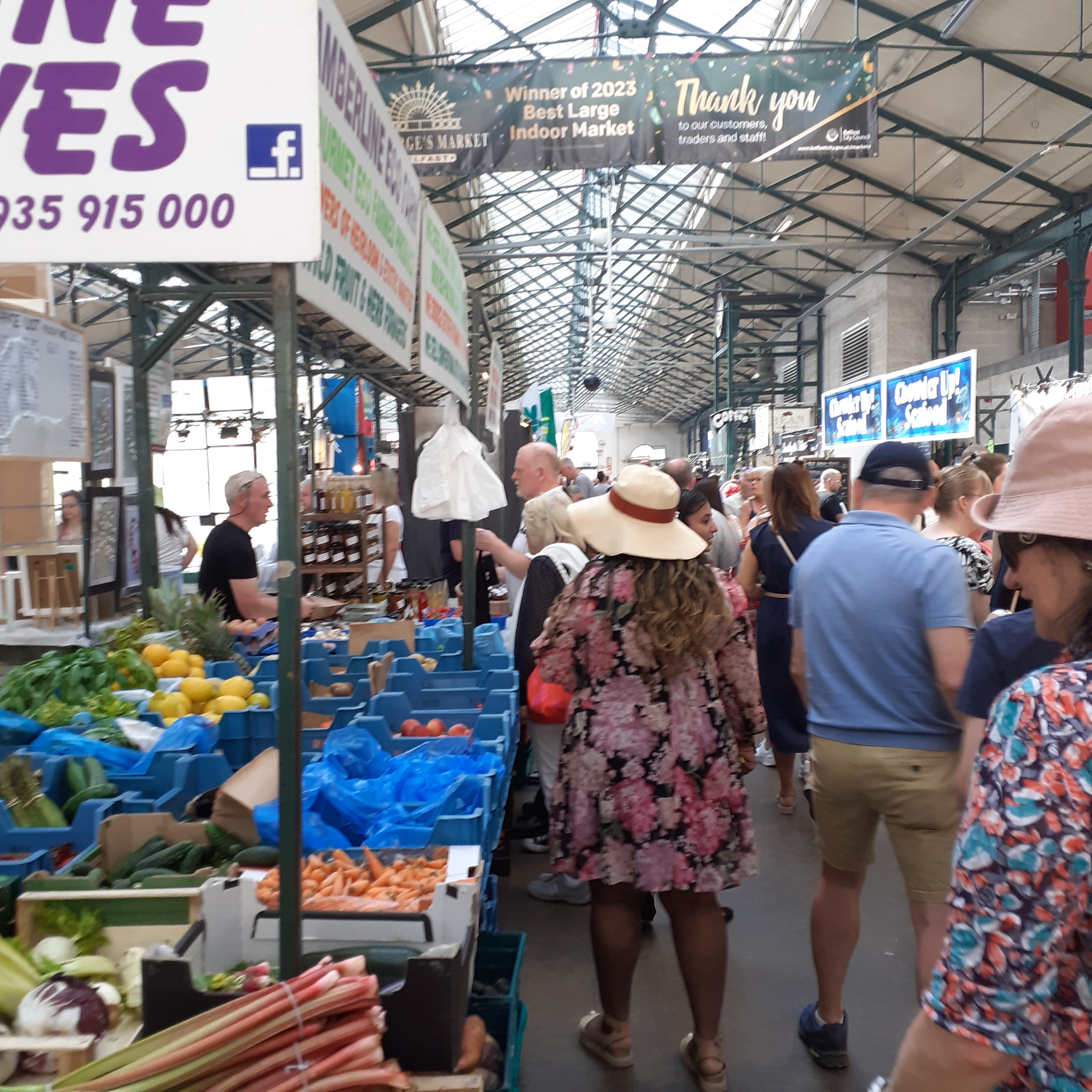
The first stop was at St George’s Market on May Street, close to the Waterfront. This is an attractive redbrick Victorian Market from the end of the nineteenth century. Enter through the main archway into a hive of trading activity with hundreds of stalls selling books, clothes, art, antiques, hot food and snacks from friday through to sunday. The friday market dates back to the city’s formation in 1604, with fruit and veg, antiques, crafts, clothes and books. Saturday devotes itself to being specifically a food and craft fair, then sunday brings both elements together with live music thrown in. St George’s Market doubles as a music and arts venue with events ranging fron the World Irish Dance Championship to Deep Purple.
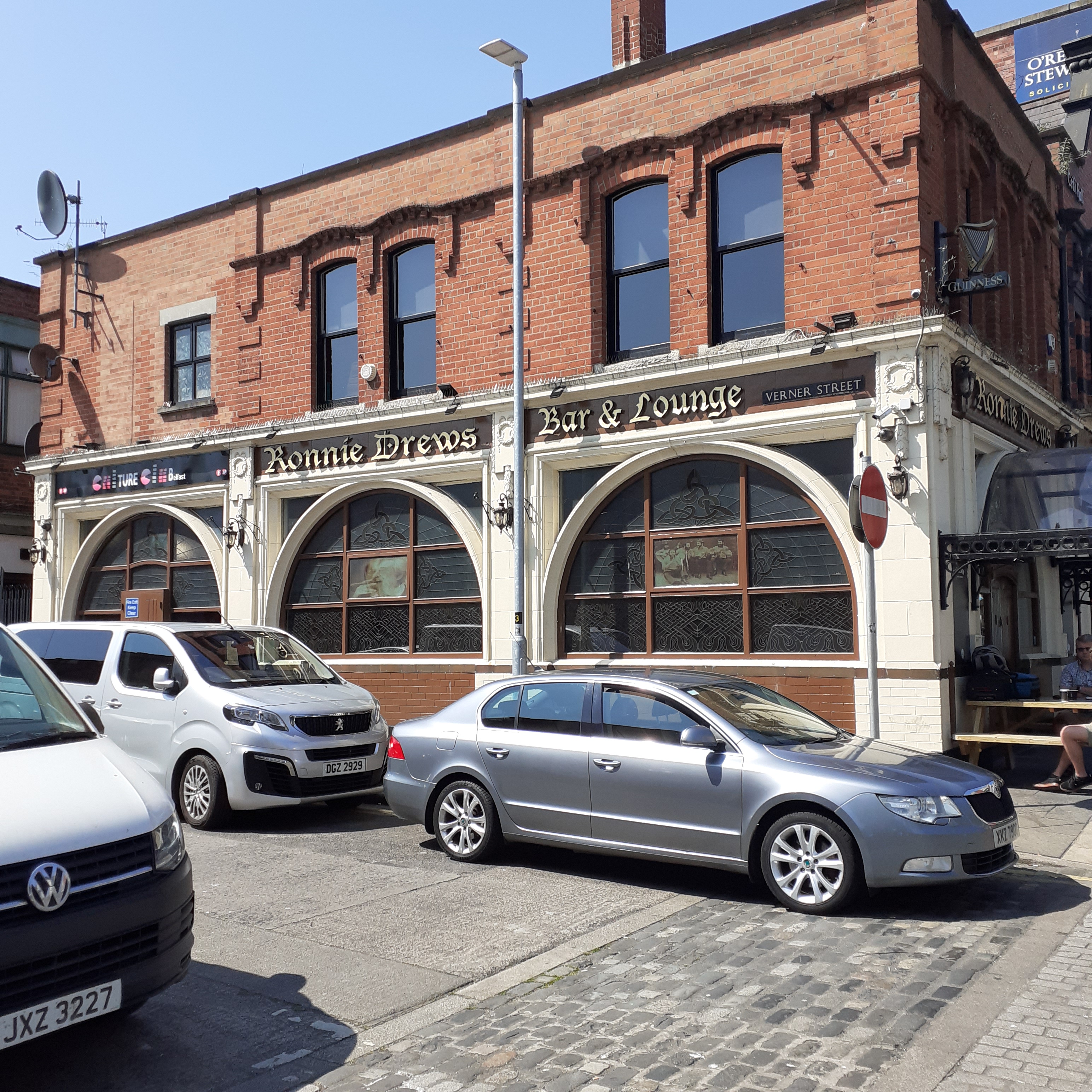
Next door is a pub that honours a singer of my own city, Ronnie Drew. It’s disconcerting to see his face around here, but consoling. Born in Dun Laoghaire in 1934, he founded his own group with Luke Kelly and others. The Dubliners first played in O’Donoghue’s in Dublin’s Merrion Row, a favourite haunt of mine. It’s good to see them commemorated in Ireland’s second city. Ronnie Drew’s is an ornate old style bar from the 1920s, with five large snugs along the huge arched windows at the front. Once called McGettigan’s, it was renamed for Drew following his death in 2008
The next bus takes us via City Hall and on to Great Victoria Street. From the city centre we head into the leafy suburbs of the University Quarter. This quarter includes the Ulster Museum, the Botanic Gerdens and of course Queens University, Belfast. The university was founded in 1845 as an associate college of the Queens University of Ireland, along with Cork and Galway. It was intended to be a learning centre for Catholics and Presbyterians as distinct from the Anglican Trinity College Dublin. Queens is enjoying its summer hiatus at the moment. I recall Freshers week, many moons ago, where the rag mag profiled a hopeful candidate in the student elections. He was running on the surprising platform of a Gay Paisleyite, with the ne’er to be forgotten slogan: Better Gay than Taig. Taig, from the common Gaelic name Tadhg, being the Loyalist slang term for their Nationalist foe.

The main building fronting onto University Road was designed by the English architect Charles Lanyon. It is an impressive gothic redbrick with a central tower inspired by Magdalen College in Oxford. Lanyon also designed the Campanile at Trinity College Dublin and many Belfast landmarks, including the Palm House at the Botanic Gardens nearby, Belfast Castle and Crumlin Road Courthouse and Gaol. Lanyon Place is named in his honour, though the modernist slab of a railway station seems somewhat ironic.
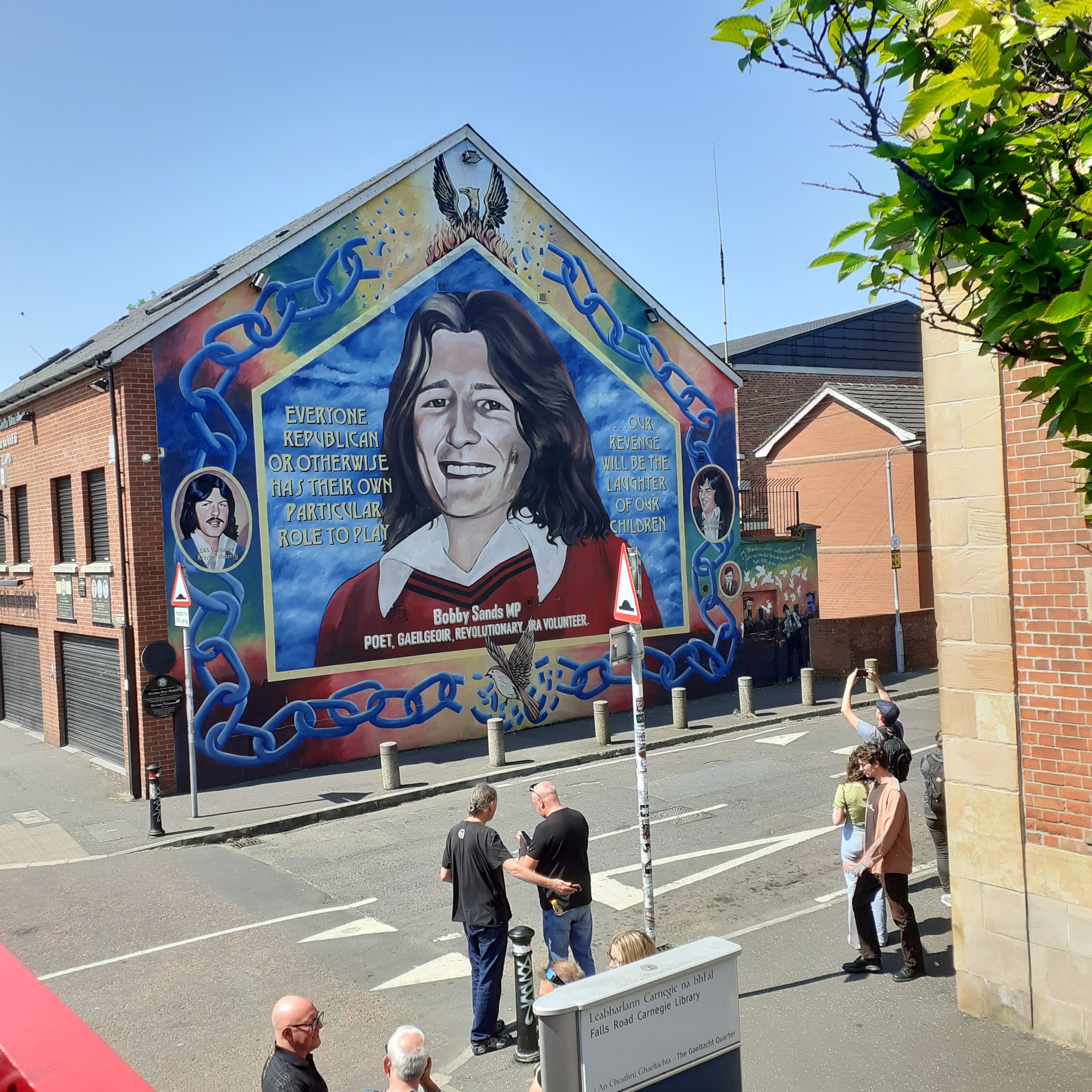
The tour heads west towards the Falls Road, a two mile long thoroughfare heading from the city centre to Andersonstown. The area is home to the Catholic community of West Belfast. We stop at the Bobby Sands mural, one of the most famous of Belfast’s many political murals. It dates from 1998, around the corner of the Falls at Sevastapol Street, on the gable end of the Sinn Fein hq. Sands was sentenced to fourteen years in the H-Block at Long Kesh for possession of a firearm in 1981. He went on hunger strike to campaign for political prisoner status and was elected MP for Fermanagh South Tyrone. After sixty six days he died at the age of twenty seven, in May. A further nine men died before the hunger strike was called off in October.
Further down the Falls we glimpse Divis Tower, a twenty storey residential block from the sixties. Standing 200 foot tall it was a significant landmark of the Troubles. The British army occupied the top two floors as an observation post, though they could only access it by helicopter. Residents moved back in fifteen years ago.
Turning left off the Falls, a row of murals occupies the Solidarity Wall along Northumberland Street. Alongside national and local heroes, other international revolutionaries favoured by Republicans are commemmorated. These include Palestinian, Basque and South African activists, with Nelson Mandela prominent amongst them.
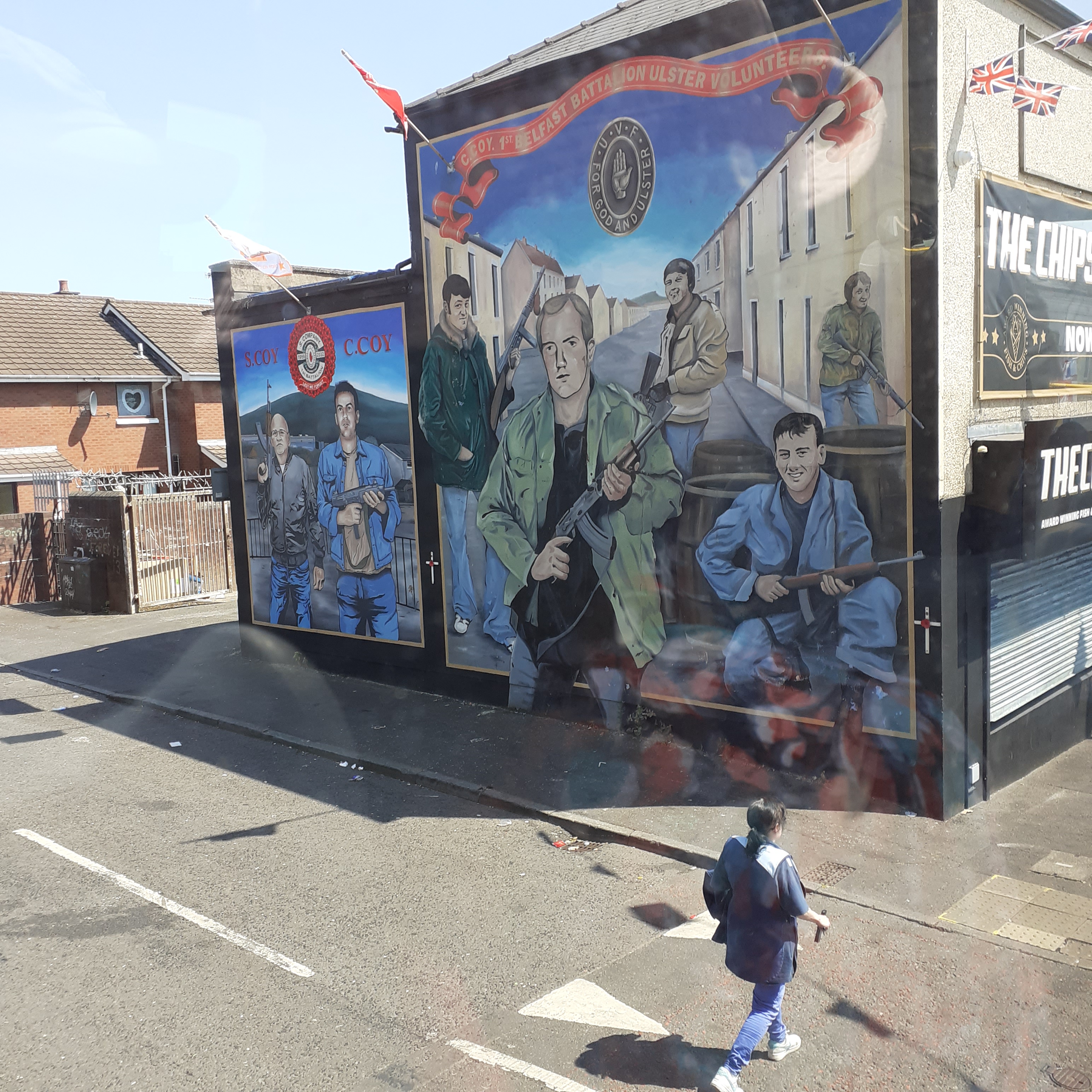
Through a double gate, we leave the Falls and enter the Shankill area, a Loyalist enclave. Murals now switch to assertions of Britishness with the Union Jack and King Billy (William of Orange) signifying that you’ve crossed the divide. That divide is demarcated by the Peace Wall on Cupar Way. This was erected by the British Army in 1969 to prevent inter community strife between Nationalists and Loyalists.
There are thirty km of walls in total, in various areas throughout Belfast. The Good Friday Agreement of 1998, following the IRA ceasefire of four years earlier, effectively brought an end to hostilities. The Peace Wall could at last live up to its name. The barrier has evolved into an open page for the amateur graffitti artist. A litany of hopes and dreams scribbled by the great unwashed, and the great and the good. National and international leaders have made their mark. Bill Clinton, a significant force in the Peace Process was here. According to our guide he contributed the quote: I never slept with that woman! I doubt it. Ironically, the symbolic importance of the wall has itself become a barrier to taking the thing down. It’s longer now than at the end of the Troubles
Andre has a red flag, Chiang Ching’s is blue
They all have hills to fly them on except for Lin Tai Yu
Dressing up in costumes, playing silly games
Hiding out in treetops, shouting out rude names
Whistling tunes, we hide in the dunes by the seaside
Whistling tunes, we piss on the goons in the jungle
It’s a knockout
If looks could kill, they probably will
In games without frontiers
War without tears
(Games Without Frontiers is a Peter Gabriel song from his third solo album Peter Gabrel. The title is taken from a Trans European tv show of the sixties and beyond: Jeux Sans Frontiers. That line is sung by Kate Bush as an alternate chorus. British tv used the more combative title: It’s a Knockout.)
We stop along the Shankill Road where the atmosphere is muted and rather grim. I wonder if we should strike up a few verses of We’re on the One Road. But perhaps its message of togetherness might be misconstrued along here. Returning to the city centre, the bus deposits us at Donegall Square and the City Hall.
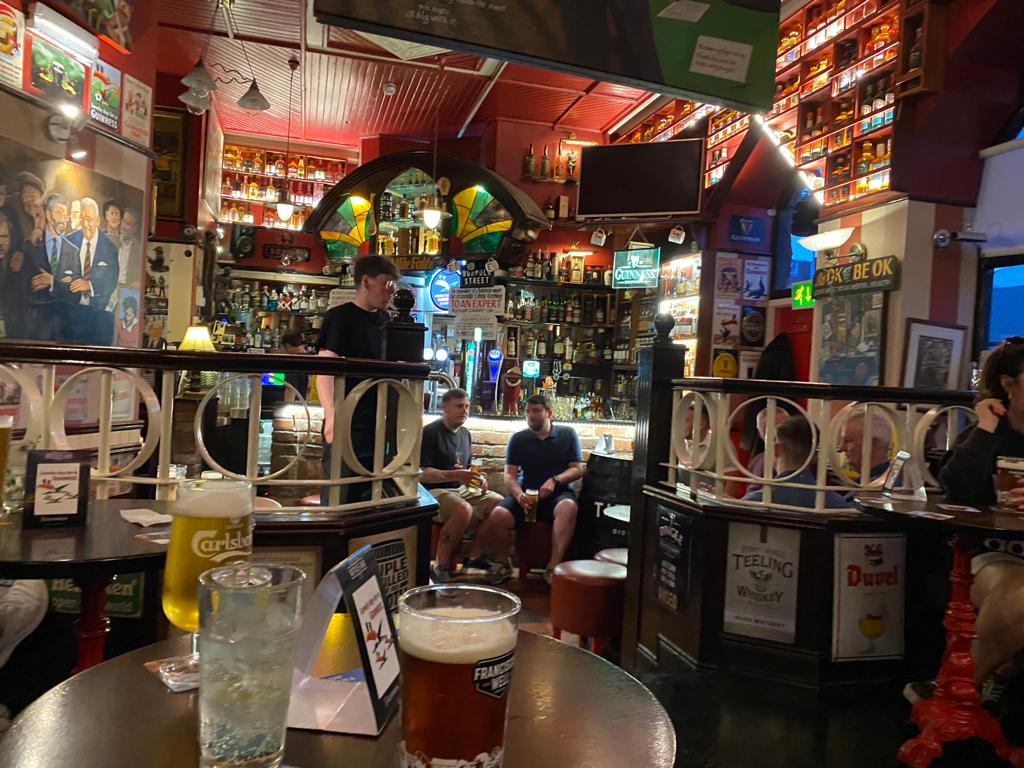
Our last night on the town brings us to Bittles Bar. Occupying a flatiron wedge at the junction of Victoria Street and Church Lane, it dates from 1868, when it was known as the Shakespeare. The literary theme continues inside the small triangular bar. A great selection of paintings are crammed into every available space with group portraits of Irish literary and sporting heroes enjoying a few pints. There’s a large canvas of Yeats, Behan, Beckett, Wilde and Joyce, while peace era iconography brings together erstwhile combatants of the Troubles, Adams and Paisley sharing a joke. The pub’s most popular poet seems to be Padraic Fiacc who gazes down, not quite benignly, at the bar. A spiky quote: Screeching gulls in a smoky bacon sky, hints at a spiky character. Christened Patrick O’Connor, he was born in Belfast, the son of a barman. His family lived in the Markets area nearby, having been burned out of their home in Lisburn. They moved to New York and Padraic grew up in the notorious Hell’s Kitchen area. A case of out of the frying pan and into the fire. He connected with his Belfast roots in the forties and returned to live here in 1956. A member of Aosdana, he died only recently, in 2019 at the grand age of 95.

Meanwhile, although the night is still young, last orders are called. I had just been extolling the benefits of Belfast in peacetime only to be made aware that we were caught in an unfree state, with antediluvian licensing hours. Ten o’clock on a Sunday night on a Bank Holiday weekend and we’re out on the street. So it looks like I’m going to wake up in the city that does sleep. However, a stiff, and anxious, walk back to the Titanic quarter, and the wonderful Premier Inn provides a pint of Harp, or two, to take us to the midnight hour.





 xxharrison