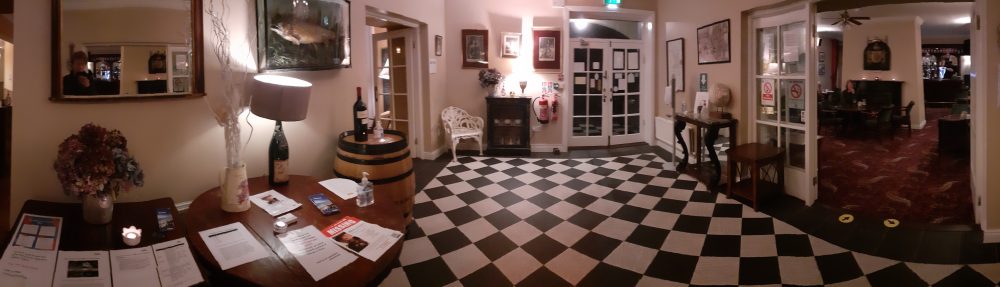
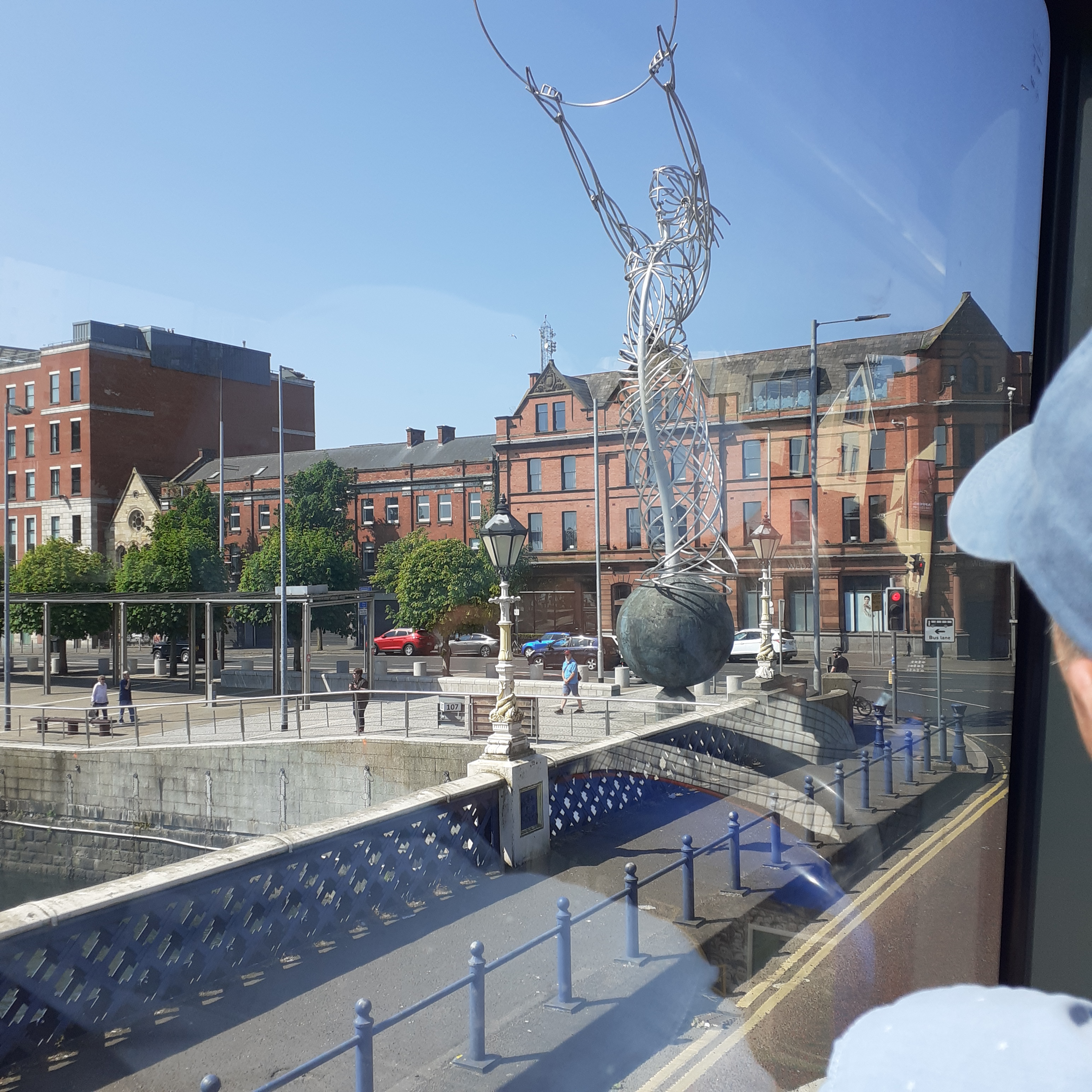
Belfast is Ireland’s second city, and the capital of Northern Ireland. It is a two hour train ride from Dublin Connolly on the Enterprise; all going well. I was last here just over ten years ago, taking another jaunt north with my younger son to see the Belfast Giants ice hockey team at the Odyssey Arena. Images of the frozen north were amplified within the confines of the ice rink, and in truth were not dispelled in the great outdoors; but this time Belfast was caught in the embrace of a big blue sky, and it was sweltering.
I went up with two friends and we booked into the Premier Inn for two nights. It’s just across the Lagan river in the Titanic Quarter, a new development growing around the dockside and the famous shipyards, and adjacent to the Odyssey Complex. Technically, we’re staying in County Down, and this will be the first time I’ve overnighted in that particular county. Most of Belfast is in County Antrim.
As it turned out, the Enterprise didn’t boldly go where it was supposed to, instead depositing us at Lisburn, nine miles short. The rail service put on a few busses to ferry us into the city. It was a cheerful, if cramped half hour, us southern sardines standing and swaying as the cheerful driver kept his foot to the floor and an entertaining patter going with those of us nearby. He delivered us to the terminal on Great Victoria Street on the west side of the city centre.

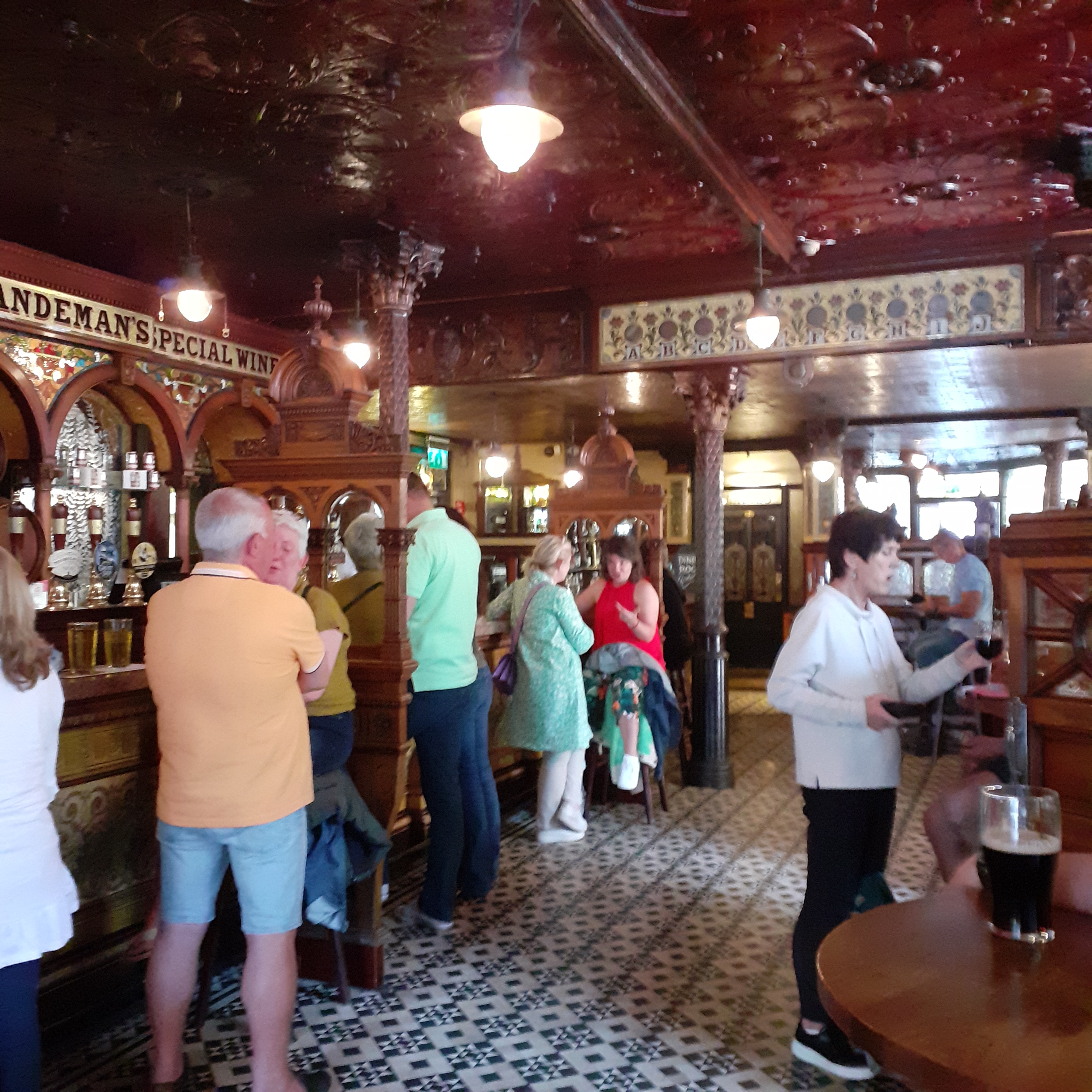
We first put into The Crown Liquor Saloon, it being on our hit list and also being the first pub we saw. Travelling on a hot day is thirsty work. Originally this was called the Railway Tavern for the principal Railway station across the road. The first station was built in 1848 in the first flowering of Irish railroads. Glory days are made to pass and it was closed in 1971, and demolished to make way for a modern block. A new station openend in 1995 adjoining the Great Northern Mall shopping centre. The name Great Northern here alludes to the Great Northern Railway which absorbed the original Ulster Railway of 1838.
Meanwhile, the pub was renovated and renamed the Crown in 1885. It was conceived as a Victorian gin palace, as the lavishly ornate bars of the era were known. Publican Patrick Flanagan employed Italian craftsmen who were engaged in the construction of Catholic churches, enjoying a boom in Belfast at that time. The Italians certainly stamped the Crown with their exuberance. The colourful tiled exterior is eye catching and the effect continues in the glowing interior, also decorated with tiles and illuminated by gas lamps. Stained glass partitions separate a total of ten snugs with original antique fittings. So it was that we three amigos collapsed into the Crown and took possession of a snug.
Belfast city centre is laid out in grid form indicating its relatively modern conception. Its population stands at 350,000 in the urban area, with 650,000 in the wider metropolitan area. Yet two hundred years ago the city population was barely a tenth of that. It may have had a castle in Norman times, but the largest castle of note in the vicinity was Carrickfergus, still is, ten miles north on the shores of the Lough. Carrickfergus was essentially the capital of Ulster since 1177 when John De Courcy established Norman power there shortly after Strongbow’s invasion and Henry II’s assertion of overlordship. English power was stalled by Edward de Bruce’s campaign in the fourteenth century. Edward was the brother of Robert the Bruce, King of Scotland, and was himself proclaimed King of Ireland in 1315. He captured Carrickfergus but three years later he was defeated and slain by Anglo Irish forces at the Battle of Faughart, near Dundalk. Edward’s reign was brief, and rarely extended past Ulster, but English rule remained stalled for a further three centuries.
It wasn’t until 1615 that Sir Arthur Chichester founded Belfast as a town. Belfast Castle was established, built on the ruling O’Neill’s tower house and becoming a focal point as the Plantation of Ulster took off. That castle burnt down a century later. The current Belfast Castle is physically remote from the ancient castle which fell into ruin and then oblivion. It was built in 1870 on the Donegall family’s deerpark on the outskirts of Belfast at Cave Hill. It is actually a grand Victorian residence, in the Scots Baronial style, though in the hands of Belfast City Council for the last century and is open to the public and may also be booked for events and weddings.
English, Manx and Huguentot settlers predominated in the early colonisation of Belfast. It was the Huguenots and Scottish Presbyterians who introduced the linen trade which fuelled the increasing growth of the town. Through the 19th century, Belfast establsihed itself as one of the major linen producers in the world and acquired the nickname Linenopolis. Try saying that after a few jars.
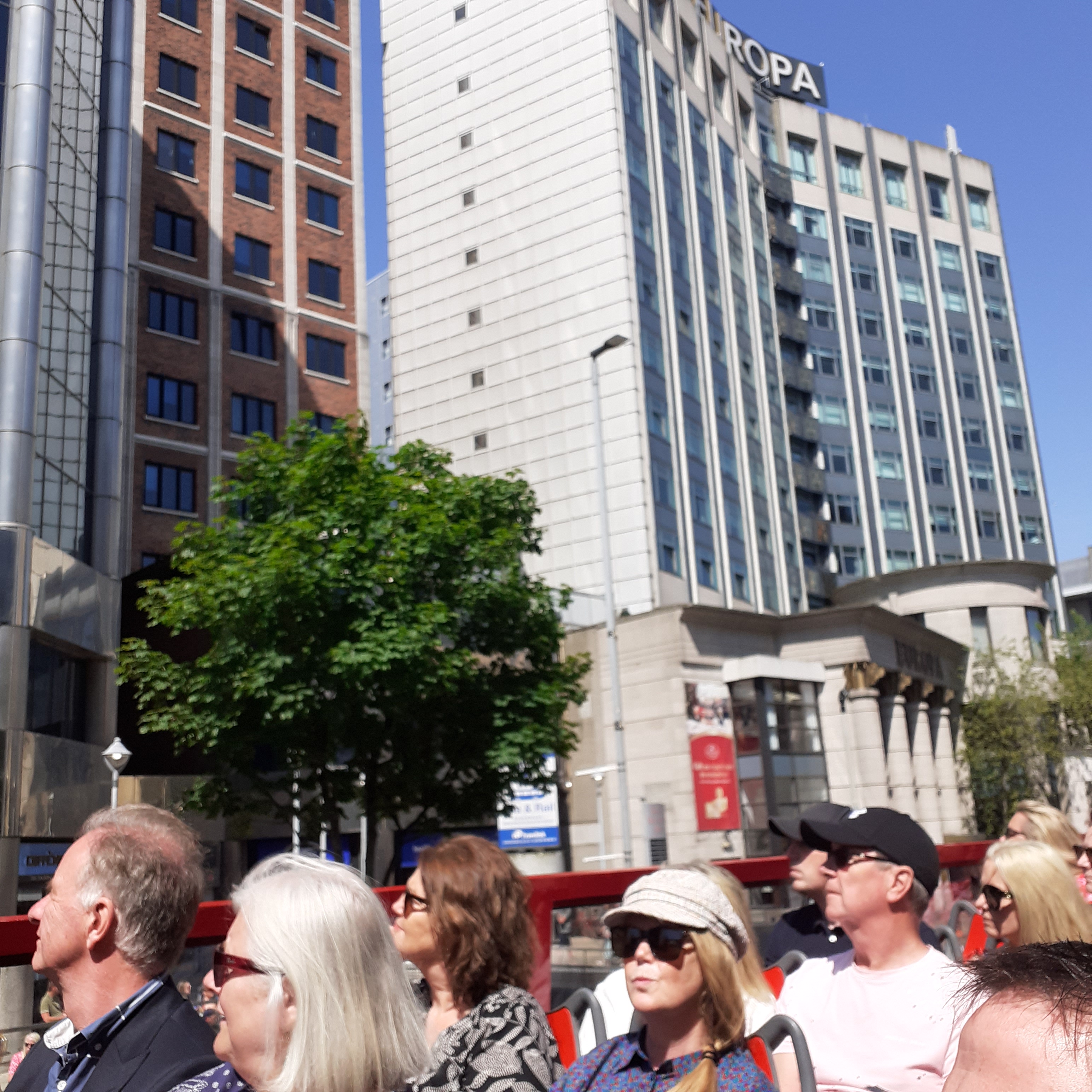
Our cross city navigation was easy enough. Great Victoria Street is a busy thoroughfare lined by tall buildings running north south and defining the western edge of the city centre. Next door to the station is the Europa Hotel, once dubbed the most bombed hotel in world, having suffered thirty six bomb attacks during the Troubles; being the conflict in Norrthern Ireland that lasted for thirty years until 1998. Yet the Europa endures. It was built on the site of the original railway station and was the popular haunt for journalists in those troubled times. Today the twelve stoey tower is a four star luxury hotel with two hundred and seventy bedrooms, and promises a quiet night’s sleep.

Adjacent is the Grand Opera House. This opened in 1895 with a thousand seater auditorium hosting variety shows and musicals. Over the years performers have included Sarah Bernhardt, Charlie Chaplin, Laurel and Hardy, Orson Welles and Luciano Pavarotti. The onset of the Troubles saw a decline in fortunes and developers wanted to pull it down. Sense prevailed, and the building was bought by the Arts Council and listed in 1974. A recent refurbishment has restored the plush ambience of its glory days. Theatre tours can be booked and the upcoming programme includes a heady mix of musical entertsinment, with Oliver, the Rocky Horror Show and the Buddy Holly Story on the bill.
At right angles, the parallel avenues of Chichester Street and May Street head due east, reaching the Lagan River and Belfast Lough just beyond another Victoria Street, which must cause some confusion. Mind you, there is something of an obsession with that particular monarch hereabouts, so inextricably is the city linked to the Victorian age.
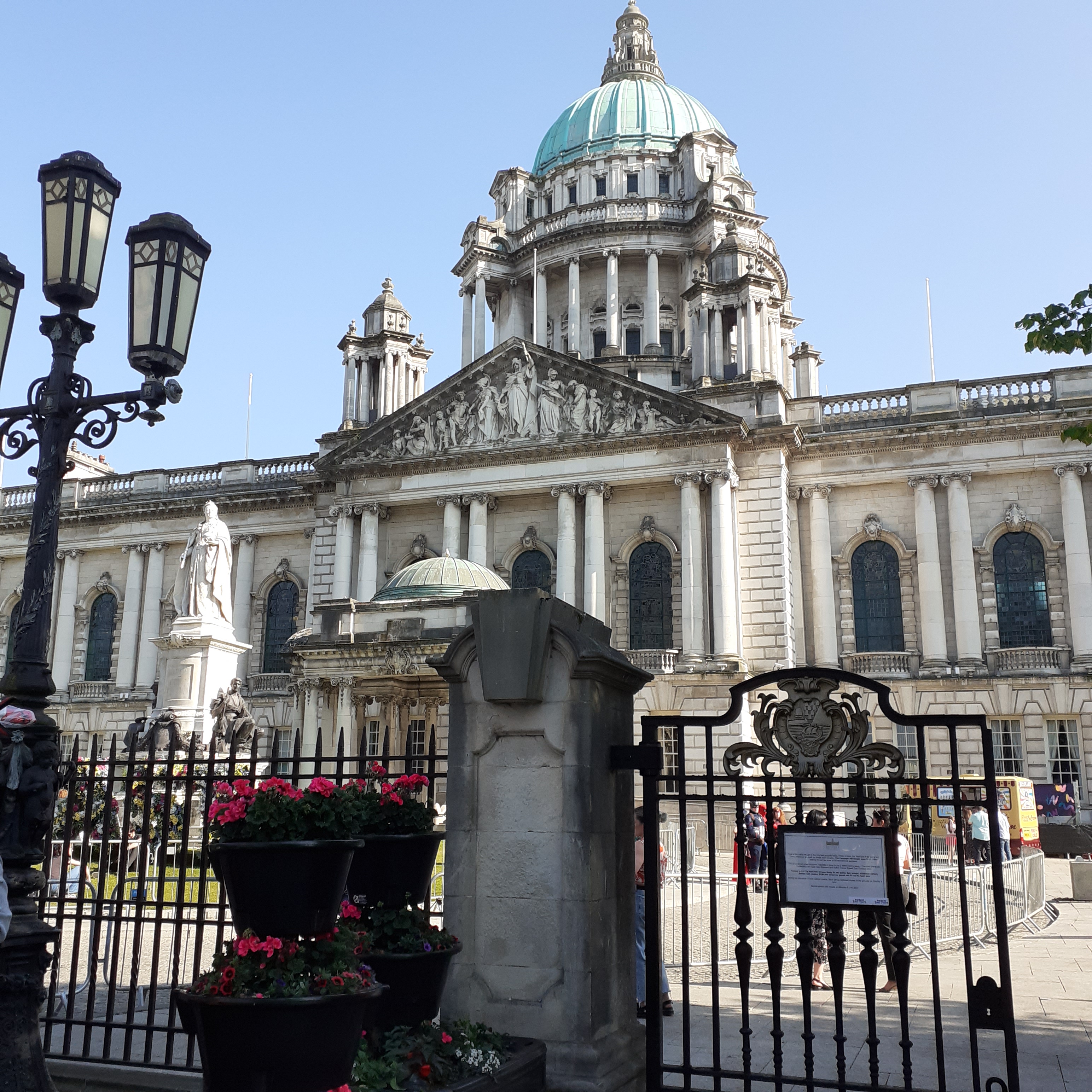
Either route takes us through the busy commercial centre of Belfast, and midway along we find City Hall. Belfast City Hall does what a city hall should, providing the centre point and pivotal landmark for the city it serves. It was conceived in 1888 when Belfast, at last, was granted city status by the Queen, Queen Victoria of course. From a population of only twenty thousand in 1800 it was the largest city in Ireland by then, passing the three hundred thousand mark, so it was not before time that it was recognised as a city.

The City Hall and grounds occupies Donegall Square, named in honour of the Chichester family, founders of the city. Arthur Chichester was made Earl of Donegall in 1647 and the family castle once stood nearby. The county itself is now spelt with one l: Donegal. The building was designed by Alfred Brumwell Thomas, an English architect. Completed in 1906 it is faced in white Portland stone, a shining palace in Neo Baroque style. There are echoes of the phanthom fortress long gone, with a tower in each corner and a soaring copper dome capping the centrepiece column. The grounds are strewn with monuments to Queen Victoria (again), Edward James Harland of shipyards fame and those who sailed on the Titanic. There is also the Garden of Remembrance and Cenotaph. The extensive lawns accomodate the public. They are out in force on this most glorious of days, but can relax here on any day, to take the sunsine and forget such cares that life, and history can bring.
 xxharrison
We loved Belfast! We were there on a cruise, so our time was tragically limited unfortunately, but it was wonderful.
We went to Titanic Belfast and it was amazing!!!
Titanic Belfast is great and would take a good part of a day in Belfast. Ironic that you visited it direct from a cruise ship. But thankfully all went well.
I’ve visited Belfast twice and enjoyed my stay both times. It’s a city I could happily return to anytime for its architecture, friendly people. Our most recent visit was between periods of lockdown when we had the city almost to ourselves. On that occasion we stayed near Queens University on Malone Road which was a very pleasant area. On both occasions we had a meal at the Crown Liquor Saloon but the Dark Horse tucked away on Hill Street was probably my favourite. Did you also go there?
Thanks Marion. I recall your Belfast posts and very good they were. I’ve stayed on Malone Rd also and it is a lovely area. Unfortunately we did not get to the Dark Horse; must look into it next time. City was packed on our visit, on a scorching bank holiday weekend. But fun and friendly, as you say.